WO2009104255A1 - Dispositif, procédé et programme informatique permettant d'évaluer le fonctionnement d'un véhicule - Google Patents
Dispositif, procédé et programme informatique permettant d'évaluer le fonctionnement d'un véhicule Download PDFInfo
- Publication number
- WO2009104255A1 WO2009104255A1 PCT/JP2008/052871 JP2008052871W WO2009104255A1 WO 2009104255 A1 WO2009104255 A1 WO 2009104255A1 JP 2008052871 W JP2008052871 W JP 2008052871W WO 2009104255 A1 WO2009104255 A1 WO 2009104255A1
- Authority
- WO
- WIPO (PCT)
- Prior art keywords
- acceleration
- vehicle
- driving
- driver
- frequency distribution
- Prior art date
- Legal status (The legal status is an assumption and is not a legal conclusion. Google has not performed a legal analysis and makes no representation as to the accuracy of the status listed.)
- Ceased
Links
Images


Classifications
-
- B—PERFORMING OPERATIONS; TRANSPORTING
- B60—VEHICLES IN GENERAL
- B60W—CONJOINT CONTROL OF VEHICLE SUB-UNITS OF DIFFERENT TYPE OR DIFFERENT FUNCTION; CONTROL SYSTEMS SPECIALLY ADAPTED FOR HYBRID VEHICLES; ROAD VEHICLE DRIVE CONTROL SYSTEMS FOR PURPOSES NOT RELATED TO THE CONTROL OF A PARTICULAR SUB-UNIT
- B60W40/00—Estimation or calculation of non-directly measurable driving parameters for road vehicle drive control systems not related to the control of a particular sub unit, e.g. by using mathematical models
- B60W40/08—Estimation or calculation of non-directly measurable driving parameters for road vehicle drive control systems not related to the control of a particular sub unit, e.g. by using mathematical models related to drivers or passengers
-
- B—PERFORMING OPERATIONS; TRANSPORTING
- B60—VEHICLES IN GENERAL
- B60W—CONJOINT CONTROL OF VEHICLE SUB-UNITS OF DIFFERENT TYPE OR DIFFERENT FUNCTION; CONTROL SYSTEMS SPECIALLY ADAPTED FOR HYBRID VEHICLES; ROAD VEHICLE DRIVE CONTROL SYSTEMS FOR PURPOSES NOT RELATED TO THE CONTROL OF A PARTICULAR SUB-UNIT
- B60W40/00—Estimation or calculation of non-directly measurable driving parameters for road vehicle drive control systems not related to the control of a particular sub unit, e.g. by using mathematical models
- B60W40/10—Estimation or calculation of non-directly measurable driving parameters for road vehicle drive control systems not related to the control of a particular sub unit, e.g. by using mathematical models related to vehicle motion
-
- G—PHYSICS
- G07—CHECKING-DEVICES
- G07C—TIME OR ATTENDANCE REGISTERS; REGISTERING OR INDICATING THE WORKING OF MACHINES; GENERATING RANDOM NUMBERS; VOTING OR LOTTERY APPARATUS; ARRANGEMENTS, SYSTEMS OR APPARATUS FOR CHECKING NOT PROVIDED FOR ELSEWHERE
- G07C5/00—Registering or indicating the working of vehicles
- G07C5/08—Registering or indicating performance data other than driving, working, idle, or waiting time, with or without registering driving, working, idle or waiting time
- G07C5/0841—Registering performance data
- G07C5/085—Registering performance data using electronic data carriers
Definitions
- the present invention relates to a vehicle driving evaluation apparatus that evaluates driving of a vehicle by a driver such as a digital tachograph.
- Patent Document 1 discloses a configuration in which driving is evaluated based on a driver's sudden operation of an accelerator, a brake, and a steering wheel, and an inter-vehicle distance.
- Patent Document 2 discloses a configuration for predicting a driver's future unexpected encounter based on vehicle conditions such as vehicle speed and acceleration, driving of the driver, and the environment of the road on which the vehicle is traveling. JP 2000-247162 A JP 2001-208126 A
- the present invention performs vehicle driving evaluation that also considers the driving technology of the driver using vehicle information detected by as few sensors as possible, and notifies the driver of the driving result. It is an object to provide an apparatus.
- a vehicle driving evaluation apparatus includes an acceleration detection unit that detects an acceleration of a vehicle driven by a driver, a distribution calculation unit that calculates and stores a frequency distribution of the acceleration, Driving evaluation means for calculating the skewness in the frequency distribution, evaluating the driving of the driver from the calculated skewness, and output means for outputting the evaluation result.
- a vehicle driving evaluation method of the present invention includes an acceleration detection step of detecting acceleration of a vehicle driven by a driver, a distribution calculation step of calculating and storing the frequency distribution of the acceleration, A driving evaluation step of calculating a skewness in the frequency distribution, evaluating the driving of the driver from the calculated skewness, and an output step of outputting the evaluation result.
- a computer program includes acceleration detection means for detecting acceleration of a vehicle driven by a driver, distribution calculation means for calculating and storing a frequency distribution of the acceleration, and the frequency distribution in the frequency distribution.
- Controlling a computer provided in a vehicle driving evaluation apparatus comprising: driving evaluation means for calculating skewness and evaluating driving of the driver from the calculated skewness; and output means for outputting the evaluation result.
- a computer program that causes the computer to function as at least part of the acceleration detection means, the distribution calculation means, the driving evaluation means, and the output means.
- FIG. 1 is a block diagram conceptually showing the basic structure of a vehicle driving evaluation apparatus according to an embodiment of the present invention. It is an example of the histogram which shows the frequency distribution of the acceleration of the vehicle which concerns on a present Example. It is a flowchart which shows the flow of the basic operation
- An embodiment of the vehicle driving evaluation apparatus of the present invention includes an acceleration detecting means for detecting an acceleration of a vehicle driven by a driver, a distribution calculating means for calculating and storing a frequency distribution of the acceleration, and a distortion in the frequency distribution.
- Driving evaluation means for calculating the degree of driving and evaluating the driving of the driver from the calculated skewness; and output means for outputting the evaluation result.
- the frequency distribution of the acceleration of the vehicle driven by the driver and the skewness in the frequency distribution are calculated, and based on the skewness, the driver driving technique is statistically calculated. It is possible to evaluate driving considering Above all, the evaluation of the unfamiliar encounter according to the evaluation result is performed mainly for the driver of the vehicle by evaluating the focused driving by the evaluation of the unexpected encounter degree due to the decrease in the prediction judgment level of the driver of the vehicle.
- the frequency distribution of acceleration typically means that the acceleration of the vehicle, which fluctuates due to acceleration / deceleration operations such as an accelerator operation and a brake operation by a driver, and a braking operation, etc., every predetermined range and every predetermined time.
- the frequency distribution is divided and calculated as a frequency distribution, and may be calculated and stored in the form of a histogram, for example.
- the skewness is typically a scale that represents asymmetry in the distribution of statistical data, and is an index value that indicates the degree of bias toward one side.
- the sudden acceleration of the vehicle due to the driver's sudden accelerator operation is considered to be an operation based on the driver's prediction judgment from the correlation with the driver's intention, while the sudden braking by the sudden brake operation is typical.
- the driver's surrounding prediction judgment is poor, such as inadequate distance between vehicles, carelessness by driving aside and excessive speed.
- the vehicle driving evaluation apparatus particularly detects the driver's acceleration frequency distribution from the bias in the negative acceleration direction (that is, the situation where the skewness is ⁇ 0). Estimate the degree of unexpected encounters due to poor predictive judgment.
- the acceleration in all steps of the driving is typically detected in real time while the vehicle is running under the driving by the driver by the operation of the acceleration detecting means. Then, the frequency distribution of the detected acceleration is calculated and stored by the distribution calculating means. Next, the degree of distortion in the stored frequency distribution of acceleration is calculated by the driving evaluation means, and driving evaluation based on the degree of distortion is performed. Then, according to the driving risk level in the driving evaluation result based on the skewness, alerting a vehicle occupant such as a driver by text or voice in real time via an output means such as a display or a speaker. Etc. are notified.
- the prediction judgment level of the driver can be determined from the driving tendency of the driver. It is possible to guess and call attention based on the prediction determination level.
- the vehicle driving evaluation apparatus is typically a so-called stand-alone apparatus that is mounted or installed in a vehicle and operates alone, and includes acceleration detection means and distribution calculation means.
- the apparatus comprises an operation evaluation means and an output means.
- it is incorporated in a device such as a digital tachograph or a car navigation system or in the vehicle itself, and receives acceleration input from an acceleration detection means such as an acceleration sensor provided in the device, and is similarly provided in the device.
- the driving evaluation result may be output via an output unit such as a display or a speaker.
- the driving evaluation means evaluates the driving of the driver based on a set threshold in the frequency distribution.
- a predetermined threshold for example, -2.0
- the driver's prediction determination level has been lowered, and alerts the driver and passengers of the unexpected encounter level. If comprised in this way, it will become possible to detect suitably that the prediction judgment level in a driver
- the driving evaluation means evaluates the driving of the driver by observing the acceleration trend detected in time series.
- the trend of the judgment prediction level of the driver is observed from the latest time series data in the statistics of the acceleration data detected in real time.
- attention is given. If comprised in this way, it will presume suitably that the fall of the prediction judgment level in a driver
- the distribution calculation means calculates the frequency distribution of the acceleration detected in the first predetermined period.
- the “first predetermined period” is relatively short, for example, in the past one hour before the present time, or during a so-called one-time drive from when the vehicle engine is operated until it is stopped. It is a period.
- the distribution calculation means calculates the frequency distribution on a moving average, for example, using only the acceleration data detected in the latest relatively short period. In such a first predetermined period, since it is considered that the temporal element in the frequency distribution related to the detected acceleration data is poor, it is possible to evaluate the driving with more emphasis on the current driving situation of the driver. It becomes possible.
- the driver's driving in the latest short period is subject to evaluation, so by evaluating the driver's prediction judgment level from the recent driving tendency, the current driving situation of the driver It is possible to perform a suitable driving evaluation in accordance with the above and alerting according to the evaluation result. Further, for example, when storing the calculated acceleration frequency distribution data in the memory provided in the distribution calculating means, there is also an advantage that the capacity of the memory that technically limits the recording capacity can be suitably suppressed. is there.
- the distribution calculation means weights the acceleration detected in the second predetermined period according to the detected time. Calculate the frequency distribution.
- the “second predetermined period” is typically a relatively long period such as the past month or the past year, for example, from when the vehicle engine is operated until it is stopped. This is a period in which the evaluation of the driving situation across at least a plurality of drives can be performed beyond the so-called evaluation for each drive.
- the second predetermined period is the above-mentioned first predetermined period accumulated over time.
- the distribution calculation means calculates the frequency distribution by weighting the acceleration data detected in a relatively long period according to the detection time.
- the weighting according to the detection time is typically performed by weighting acceleration data divided into relatively past acceleration data and relatively recent data, respectively. Therefore, it is based on a technique such as combining them together or comparing them.
- the acceleration detection means detects the acceleration in the left-right direction of the vehicle, and the distribution calculation means calculates the acceleration and the left-right direction of the vehicle. A frequency distribution obtained by accumulating acceleration is calculated.
- the acceleration detection means detects the lateral acceleration (so-called lateral G) of the vehicle, and the distribution calculation unit adds the lateral G data to the above-described frequency distribution of acceleration (for example, The driver's driving is evaluated based on the calculated frequency distribution. If comprised in this way, the change of the acceleration of the left-right direction of the vehicle resulting from a driver
- the sudden steering operation by the driver is typically caused by poor prediction judgment of the driver, such as emergency avoidance operation due to carelessness of the front, Similarly, it can be a material for evaluating the unexpected encounter degree. In other words, it can be evaluated that the driver's driving that tends to have a high degree of acceleration in the left-right direction has a poor prediction judgment level because he uses a lot of sudden handles.
- vehicle speed estimation means for estimating the vehicle speed by integrating the detected acceleration with time
- the vehicle further includes road determination means for determining a road condition on which the vehicle is traveling based on the estimated vehicle speed.
- the driving speed of the vehicle is estimated by accumulating the acceleration detected by the acceleration detecting means with time. Further, based on the estimated speed of the vehicle, for example, a road condition in which the vehicle is currently traveling is determined, for example, whether the road on which the current vehicle is traveling is a general road or a highway.
- the driving evaluation means changes the driving evaluation mode of the driver based on a road condition where the vehicle is traveling.
- general roads and expressways have different risks due to poor driver predictions such as sudden acceleration, sudden braking and sudden steering during driving. Since the view is also established, there is a possibility that the driver's driving cannot be sufficiently evaluated only by a single index that does not consider each road condition, and appropriate alerting cannot be performed.
- An embodiment of the computer program according to the present invention includes an acceleration detection unit that detects an acceleration of a vehicle driven by a driver, a distribution calculation unit that calculates and stores a frequency distribution of the acceleration, and calculates a skewness in the frequency distribution.
- a computer program for controlling a computer provided in a vehicle driving evaluation apparatus comprising driving evaluation means for evaluating driving of the driver from the calculated skewness and output means for outputting the result of the evaluation.
- the computer is caused to function as at least a part of the acceleration detection means, the distribution calculation means, the driving evaluation means, and the output means.
- the computer program is read from a recording medium such as a ROM, a CD-ROM, a DVD-ROM, and a hard disk that stores the computer program, and executed. If the computer program is downloaded to a computer via communication means and then executed, the above-described embodiment of the vehicle driving evaluation apparatus of the present invention can be realized relatively easily.
- the embodiment of the computer program of the present invention can also adopt various aspects.
- Embodiments of the computer program product of the present invention include acceleration detection means for detecting acceleration of a vehicle driven by a driver, distribution calculation means for calculating and storing the acceleration frequency distribution, and calculating skewness in the frequency distribution. And a computer program for controlling a computer provided in a vehicle driving evaluation device comprising driving evaluation means for evaluating the driving of the driver from the calculated skewness and output means for outputting the result of the evaluation.
- the computer is caused to function as at least a part of the acceleration detection means, the distribution calculation means, the driving evaluation means, and the output means.
- the computer program product of the present invention if the computer program product is read into a computer from a recording medium such as a ROM, a CD-ROM, a DVD-ROM, and a hard disk storing the computer program product, or
- a recording medium such as a ROM, a CD-ROM, a DVD-ROM, and a hard disk storing the computer program product
- the computer program product which is a transmission wave
- the computer program product which is a transmission wave
- the computer program product which is a transmission wave
- the computer program product which is a transmission wave
- the embodiment of the computer program product of the present invention can also adopt various aspects.
- Embodiments according to the vehicle driving evaluation method of the present invention include an acceleration detecting step of detecting acceleration of a vehicle driven by a driver, a distribution calculating step of calculating and storing the frequency distribution of the acceleration, and distortion in the frequency distribution.
- the detected acceleration data of the vehicle is calculated as a frequency distribution, and based on the skewness of the distribution.
- the driving of the driver is calculated as a frequency distribution, and based on the skewness of the distribution.
- the vehicle driving evaluation apparatus includes the acceleration detection means, the distribution calculation means, the driving evaluation means, and the output means.
- the vehicle driving evaluation method according to the present embodiment includes an acceleration detection step, a distribution calculation step, a driving evaluation step, and an output step.
- the computer program according to the present embodiment causes the computer to function as a vehicle driving evaluation apparatus according to the present embodiment. Therefore, it is possible to perform driving evaluation considering the driving technique of the driver using vehicle information detected by as few sensors as possible, and to notify the driver of the evaluation result.
- FIG. 1 is a block diagram showing the basic configuration of the driving evaluation apparatus according to this embodiment.
- a driving evaluation apparatus 1 which is a specific example of a driving evaluation apparatus according to the present embodiment includes an acceleration sensor 101, a CPU 102, and an output unit 106.
- the acceleration sensor 101 is a specific example of the “acceleration detecting means” in the present invention, and includes any aspect of physical, mechanical, mechanical, and electrical, and more preferably at least acceleration in the longitudinal direction of the vehicle. Further, it is a means capable of detecting acceleration in the left-right direction. Moreover, as long as the acceleration of a vehicle can be detected suitably, you may comprise the means of estimating the present acceleration from the traveling speed and traveling time of a vehicle.
- the vehicle acceleration data detected by the acceleration sensor 101 is output to the CPU 102 electrically connected to the acceleration sensor 101.
- the CPU 102 includes a distribution calculation unit 103 that is a specific example of “distribution calculation means” in the present invention, and a statistical processing unit 104 and a driving evaluation unit 105 that are specific examples of “driving evaluation means”.
- the distribution calculation unit 103 calculates the frequency distribution of the acceleration data
- the statistical processing unit 104 calculates the positive acceleration and the skewness in the frequency distribution, or at least the frequency distribution.
- a value that can serve as an index indicating a bias toward either side (particularly in the negative acceleration direction) in the negative acceleration is calculated. Note that the skewness is calculated using a known formula.
- the driving evaluation unit 105 compares the calculated skewness with a predetermined threshold value or observes a trend of the most recent skewness and determines that the predetermined threshold value will be exceeded in the future, An evaluation result indicating that the prediction determination level is lowered is output to the output unit 106.
- a series of processing of such acceleration data is always performed in real time during traveling.
- the output unit 106 is a specific example of the “output unit” in the present invention, and is typically a display, a speaker, and the like. Informs the driver or the occupant of alerts or the like using characters or voice. In addition, under the control of the output unit 106, the driver or the occupant may be notified by means for operating each unit attached to the vehicle driving evaluation apparatus 1 according to the evaluation result. Absent. That is, the output unit 106 can take any form as long as it can notify the driver or the occupant of the vehicle a considerable amount of alerting according to the evaluation result.
- the driving evaluation apparatus 1 may be configured to include a memory (not shown), and when configured in this way, the frequency distribution of acceleration data calculated by the operation of the memory can be suitably stored.
- the CPU 102 may be configured as an example of “vehicle speed estimation means” and “road determination means” of the present invention.
- the CPU 102 receives the acceleration data detected by the acceleration sensor 101, accumulates the acceleration data over time, and estimates the speed of the vehicle on which the driving evaluation device 1 is mounted (that is, the vehicle speed). Always. Next, based on the vehicle speed, for example, a determination is made of a current vehicle traveling state such as whether the current traveling road is a general road or an expressway. As an example of this determination, determination is made using a method for detecting the degree of change in acceleration during a predetermined period using information obtained from an acceleration sensor, a method for detecting a vehicle speed obtained from a vehicle speed estimation unit 107 described later, and the like.
- the aspect of evaluation in the comparison of the skewness of the acceleration data performed in the above-described driving evaluation unit 105 with a predetermined threshold or the observation of the skewness trend is changed.
- the change of the aspect of evaluation may employ a plurality of preset aspects according to the traveling situation, or may be calculated based on the traveling situation.
- the vehicle speed estimation unit 107 Upon receiving the input of the acceleration data detected in the acceleration data 101, the vehicle speed estimation unit 107 accumulates the acceleration data with time and estimates the vehicle speed.
- the driving evaluation apparatus 1 is a so-called stand-alone apparatus that is typically installed or installed in a vehicle and operates alone, and includes an acceleration sensor 101, a CPU 102, and an output unit. 106. However, on the other hand, it is incorporated in a device such as a digital tachograph or a car navigation system or in the vehicle itself, and receives acceleration input from an acceleration detection means such as an acceleration sensor provided in the device, and is similarly provided in the device.
- the driving evaluation result may be output via an output unit such as a display or a speaker.
- FIG. 2 is an example of a histogram showing the frequency distribution of the acceleration of the vehicle according to the present embodiment.
- the distribution calculation unit 103 typically has a positive acceleration (that is, a vehicle by an accelerator operation or the like) centered on 0G (that is, a state where acceleration is not applied to the vehicle). Acceleration data detected every predetermined time is calculated as a frequency distribution with respect to negative acceleration (ie, indicating deceleration and braking of the vehicle due to a brake operation or the like). That is, each time the driver performs acceleration by an accelerator operation or the like, the detected positive acceleration frequency is added. On the other hand, every time the driver decelerates and brakes by a brake operation or the like, the detected frequency of negative acceleration is added. Further, when there is a particularly large acceleration change such as sudden acceleration or sudden braking, the acceleration data is plotted at a position far from the center of the graph. Data exceeding the threshold value determined as sudden braking is determined as sudden acceleration or sudden braking.
- the skewness of the distribution tends to 0 while the kurtosis tends to increase as shown by the solid line in FIG.
- the driving of the driver uses both acceleration and braking, as shown by the dotted line in FIG. 2
- the kurtosis is reduced as compared with the driving of the driver described above, but as a result, the skewness of the distribution is It can be said that it tends to be close to zero.
- the acceleration / deceleration ratio is larger than usual, and the driving of the driver with particularly high frequency and degree of sudden braking is not sufficiently predicted in the driving environment, and the distance between the vehicles is inadequate.
- the skewness indicates that the tendency of the acceleration data is biased toward negative acceleration (for example, the state where the skewness is ⁇ 0), and the skewness exceeds a predetermined threshold value.
- the driving evaluation unit 105 determines that the driver's prediction determination level is lowered, and the evaluation result is output to the output unit 106. Will be output.
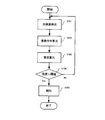
- FIG. 3 is a flowchart showing the flow of the basic operation.
- the acceleration of the vehicle is always detected by the acceleration sensor 101 (step S101), and is output to the CPU 102 as acceleration data.
- the distribution calculation unit 103 provided in the CPU 102 calculates the frequency distribution of the input acceleration data (step S102).
- the CPU 102 receives the input of acceleration data, and determines the state of the road surface on which the current vehicle is traveling, which is typically roughly classified as a general road or a highway. It may be configured to.
- the statistical processing unit 104 calculates the skewness in the frequency distribution of the calculated acceleration data (step S103). Then, a comparison between the calculated skewness and a predetermined threshold value is performed in the driving evaluation unit 105 (step S104).
- step S104 When the skewness exceeds a predetermined threshold (step S104: Yes), an evaluation result indicating that is passed to the output unit 106, and the output unit 106 notifies the driver or the occupant of the vehicle (step S105). ).
- a plurality of threshold values to be compared with the skewness may be prepared, and an evaluation result corresponding to each exceeding the threshold value is passed to the output unit 106, and a notification corresponding to each evaluation result is sent. It may be configured to do. In other words, the driver is informed of the level of predictive judgment in driving that is evaluated by exceeding at least one or more thresholds (ie, the degree to which the distribution of acceleration data has a bias toward negative acceleration). Any configuration can be used.
- the trend may be estimated by observing the moving average of the skewness while comparing the skewness with a predetermined threshold.
- a predetermined threshold when it is estimated that the distribution of acceleration data exceeds a predetermined threshold (step S104: Yes), an evaluation result indicating that is passed to the output unit 106, and as described above. Notification is performed (step S105).
- the skewness of the acceleration distribution does not exceed the predetermined threshold value, or when it is not estimated that the predetermined threshold value is exceeded from the observation of the moving average (step S104: No), a series of processes from the detection of the acceleration continues. (Steps S101 to S104) are repeated.
- the acceleration sensor 101 configured to detect the acceleration in the lateral direction of the vehicle (so-called lateral G) is used, and the acceleration data of the lateral G is added to the frequency distribution. May be. According to this operation, it is possible to realize a driving evaluation that takes into account the driver's sudden steering operation that is considered as a factor of the change in the lateral G.
- the addition may be performed after weighting. More specifically, for example, when emphasizing the longitudinal acceleration with respect to the lateral acceleration of the vehicle, for example, data obtained by multiplying the lateral G acceleration data may be added, On the other hand, the reverse configuration is also conceivable.
- map data may be acquired from the car navigation device and the weight may be changed according to the terrain on which the vehicle travels.
Landscapes
- Engineering & Computer Science (AREA)
- Physics & Mathematics (AREA)
- Automation & Control Theory (AREA)
- Mathematical Physics (AREA)
- Transportation (AREA)
- Mechanical Engineering (AREA)
- General Physics & Mathematics (AREA)
- Traffic Control Systems (AREA)
- Auxiliary Drives, Propulsion Controls, And Safety Devices (AREA)
Abstract
La présente invention concerne un dispositif (1) permettant d'évaluer le fonctionnement d'un véhicule comportant un moyen de détection d'accélération (101) permettant la détection de l'accélération du véhicule conduit par un conducteur, un moyen de calcul de distribution (103) permettant le calcul et le stockage de la distribution de fréquence de l'accélération, un moyen d'évaluation de fonctionnement (104, 105) permettant le calcul du degré de distorsion dans la distribution de fréquence et l'évaluation de la conduite du conducteur à partir du degré de distorsion calculé, et un moyen de sortie (106) permettant l'émission en sortie des résultats de l'évaluation.
Priority Applications (2)
| Application Number | Priority Date | Filing Date | Title |
|---|---|---|---|
| JP2009554161A JP4886047B2 (ja) | 2008-02-20 | 2008-02-20 | 車両の運転評価装置、方法、及びコンピュータプログラム |
| PCT/JP2008/052871 WO2009104255A1 (fr) | 2008-02-20 | 2008-02-20 | Dispositif, procédé et programme informatique permettant d'évaluer le fonctionnement d'un véhicule |
Applications Claiming Priority (1)
| Application Number | Priority Date | Filing Date | Title |
|---|---|---|---|
| PCT/JP2008/052871 WO2009104255A1 (fr) | 2008-02-20 | 2008-02-20 | Dispositif, procédé et programme informatique permettant d'évaluer le fonctionnement d'un véhicule |
Publications (1)
| Publication Number | Publication Date |
|---|---|
| WO2009104255A1 true WO2009104255A1 (fr) | 2009-08-27 |
Family
ID=40985150
Family Applications (1)
| Application Number | Title | Priority Date | Filing Date |
|---|---|---|---|
| PCT/JP2008/052871 Ceased WO2009104255A1 (fr) | 2008-02-20 | 2008-02-20 | Dispositif, procédé et programme informatique permettant d'évaluer le fonctionnement d'un véhicule |
Country Status (2)
| Country | Link |
|---|---|
| JP (1) | JP4886047B2 (fr) |
| WO (1) | WO2009104255A1 (fr) |
Cited By (11)
| Publication number | Priority date | Publication date | Assignee | Title |
|---|---|---|---|---|
| WO2011033840A1 (fr) * | 2009-09-18 | 2011-03-24 | トヨタ自動車株式会社 | Système d'évaluation de conduite, machine embarquée dans le véhicule, et centre de traitement d'information |
| JP2011059855A (ja) * | 2009-09-08 | 2011-03-24 | Nissan Motor Co Ltd | 車両用運転状態検出装置、車両用運転状態検出方法および自動車 |
| JP2011059856A (ja) * | 2009-09-08 | 2011-03-24 | Nissan Motor Co Ltd | 車両用運転特性検出装置、車両用運転特性検出方法および自動車 |
| JP2012221407A (ja) * | 2011-04-13 | 2012-11-12 | Denso Corp | 車両の評価指標作成システム |
| EP2442112A3 (fr) * | 2010-10-13 | 2014-05-07 | MAN Truck & Bus AG | Procédé et dispositif d'évaluation de la conduite d'un conducteur de véhicules automobiles, notamment des véhicules utilitaires |
| JP2014080087A (ja) * | 2012-10-16 | 2014-05-08 | Toyota Motor Corp | 運転診断装置、運転診断方法、プログラム及び媒体 |
| EP3073450A1 (fr) * | 2015-03-27 | 2016-09-28 | Tata Consultancy Services Limited | Système et procédé de surveillance de comportement de conduite d'un conducteur |
| WO2017081851A1 (fr) * | 2015-11-12 | 2017-05-18 | パナソニックIpマネジメント株式会社 | Dispositif de détection d'amélioration de conduite et système de détection d'amélioration de conduite |
| US20220309841A1 (en) * | 2021-03-26 | 2022-09-29 | Toyota Jidosha Kabushiki Kaisha | Driving evaluation device, driving evaluation method, and driving evaluation program |
| CN116757885A (zh) * | 2023-07-06 | 2023-09-15 | 北京中知智慧科技有限公司 | 一种企业知识产权维度评审系统 |
| CN116933140A (zh) * | 2023-07-28 | 2023-10-24 | 合肥工业大学 | 一种基于车辆大数据的驾驶行为评价方法 |
Families Citing this family (1)
| Publication number | Priority date | Publication date | Assignee | Title |
|---|---|---|---|---|
| JP7011508B2 (ja) * | 2018-03-26 | 2022-01-26 | 本田技研工業株式会社 | 運転評価システム、及びプログラム |
Citations (9)
| Publication number | Priority date | Publication date | Assignee | Title |
|---|---|---|---|---|
| JPH06331391A (ja) * | 1993-05-25 | 1994-12-02 | Yazaki Corp | 車両運行情報の表示方法 |
| JP2000185676A (ja) * | 1998-10-12 | 2000-07-04 | Data Tec:Kk | 移動体の操作傾向解析方法、運行管理システム及びその構成装置、記録媒体 |
| JP2002150468A (ja) * | 2000-11-07 | 2002-05-24 | Tokyo Kaijo Risk Consulting Kk | 運行解析システム、運行解析方法及びコンピュータプログラム |
| JP2003044556A (ja) * | 2001-07-31 | 2003-02-14 | Sony Corp | 車両情報処理装置、車両及び車両情報の処理方法 |
| JP2004026098A (ja) * | 2002-06-28 | 2004-01-29 | Hitachi Ltd | 交通安全診断方法 |
| JP2004234260A (ja) * | 2003-01-29 | 2004-08-19 | Hitachi Ltd | 安全運転診断方法および省燃費運転診断方法、ならびに装置、安全運転診断プログラムおよび省燃費運転診断プログラム |
| JP2004318912A (ja) * | 2004-07-07 | 2004-11-11 | Data Tec:Kk | 移動体の運行管理方法、システム及びその構成装置 |
| JP2005173636A (ja) * | 2003-12-05 | 2005-06-30 | Fujitsu Ten Ltd | 居眠り検出方法および装置 |
| JP2006335277A (ja) * | 2005-06-03 | 2006-12-14 | Nissan Motor Co Ltd | 運転状態推定装置および運転状態推定方法 |
-
2008
- 2008-02-20 WO PCT/JP2008/052871 patent/WO2009104255A1/fr not_active Ceased
- 2008-02-20 JP JP2009554161A patent/JP4886047B2/ja not_active Expired - Fee Related
Patent Citations (9)
| Publication number | Priority date | Publication date | Assignee | Title |
|---|---|---|---|---|
| JPH06331391A (ja) * | 1993-05-25 | 1994-12-02 | Yazaki Corp | 車両運行情報の表示方法 |
| JP2000185676A (ja) * | 1998-10-12 | 2000-07-04 | Data Tec:Kk | 移動体の操作傾向解析方法、運行管理システム及びその構成装置、記録媒体 |
| JP2002150468A (ja) * | 2000-11-07 | 2002-05-24 | Tokyo Kaijo Risk Consulting Kk | 運行解析システム、運行解析方法及びコンピュータプログラム |
| JP2003044556A (ja) * | 2001-07-31 | 2003-02-14 | Sony Corp | 車両情報処理装置、車両及び車両情報の処理方法 |
| JP2004026098A (ja) * | 2002-06-28 | 2004-01-29 | Hitachi Ltd | 交通安全診断方法 |
| JP2004234260A (ja) * | 2003-01-29 | 2004-08-19 | Hitachi Ltd | 安全運転診断方法および省燃費運転診断方法、ならびに装置、安全運転診断プログラムおよび省燃費運転診断プログラム |
| JP2005173636A (ja) * | 2003-12-05 | 2005-06-30 | Fujitsu Ten Ltd | 居眠り検出方法および装置 |
| JP2004318912A (ja) * | 2004-07-07 | 2004-11-11 | Data Tec:Kk | 移動体の運行管理方法、システム及びその構成装置 |
| JP2006335277A (ja) * | 2005-06-03 | 2006-12-14 | Nissan Motor Co Ltd | 運転状態推定装置および運転状態推定方法 |
Cited By (17)
| Publication number | Priority date | Publication date | Assignee | Title |
|---|---|---|---|---|
| JP2011059855A (ja) * | 2009-09-08 | 2011-03-24 | Nissan Motor Co Ltd | 車両用運転状態検出装置、車両用運転状態検出方法および自動車 |
| JP2011059856A (ja) * | 2009-09-08 | 2011-03-24 | Nissan Motor Co Ltd | 車両用運転特性検出装置、車両用運転特性検出方法および自動車 |
| WO2011033840A1 (fr) * | 2009-09-18 | 2011-03-24 | トヨタ自動車株式会社 | Système d'évaluation de conduite, machine embarquée dans le véhicule, et centre de traitement d'information |
| JP2011065527A (ja) * | 2009-09-18 | 2011-03-31 | Toyota Motor Corp | 運転評価システム、車載機及び情報処理センター |
| CN102549628A (zh) * | 2009-09-18 | 2012-07-04 | 丰田自动车株式会社 | 驾驶评估系统、车载机以及信息处理中心 |
| EP2442112A3 (fr) * | 2010-10-13 | 2014-05-07 | MAN Truck & Bus AG | Procédé et dispositif d'évaluation de la conduite d'un conducteur de véhicules automobiles, notamment des véhicules utilitaires |
| JP2012221407A (ja) * | 2011-04-13 | 2012-11-12 | Denso Corp | 車両の評価指標作成システム |
| JP2014080087A (ja) * | 2012-10-16 | 2014-05-08 | Toyota Motor Corp | 運転診断装置、運転診断方法、プログラム及び媒体 |
| EP3073450A1 (fr) * | 2015-03-27 | 2016-09-28 | Tata Consultancy Services Limited | Système et procédé de surveillance de comportement de conduite d'un conducteur |
| AU2016201775B2 (en) * | 2015-03-27 | 2017-12-14 | Tata Consultancy Services Limited | System and method for monitoring driving behavior of a driver |
| WO2017081851A1 (fr) * | 2015-11-12 | 2017-05-18 | パナソニックIpマネジメント株式会社 | Dispositif de détection d'amélioration de conduite et système de détection d'amélioration de conduite |
| US20220309841A1 (en) * | 2021-03-26 | 2022-09-29 | Toyota Jidosha Kabushiki Kaisha | Driving evaluation device, driving evaluation method, and driving evaluation program |
| CN115195753A (zh) * | 2021-03-26 | 2022-10-18 | 丰田自动车株式会社 | 驾驶评估装置、驾驶评估方法和驾驶评估程序 |
| US12094263B2 (en) * | 2021-03-26 | 2024-09-17 | Toyota Jidosha Kabushiki Kaisha | Driving evaluation device, driving evaluation method, and driving evaluation program |
| CN116757885A (zh) * | 2023-07-06 | 2023-09-15 | 北京中知智慧科技有限公司 | 一种企业知识产权维度评审系统 |
| CN116757885B (zh) * | 2023-07-06 | 2024-04-23 | 北京中知智慧科技有限公司 | 一种企业知识产权维度评审系统 |
| CN116933140A (zh) * | 2023-07-28 | 2023-10-24 | 合肥工业大学 | 一种基于车辆大数据的驾驶行为评价方法 |
Also Published As
| Publication number | Publication date |
|---|---|
| JPWO2009104255A1 (ja) | 2011-06-16 |
| JP4886047B2 (ja) | 2012-02-29 |
Similar Documents
| Publication | Publication Date | Title |
|---|---|---|
| JP4886047B2 (ja) | 車両の運転評価装置、方法、及びコンピュータプログラム | |
| US11100801B2 (en) | Utilizing sensors to detect hazard from other vehicle while driving | |
| US7283056B2 (en) | Method and computer program for identification of inattentiveness by the driver of a vehicle | |
| JP6142718B2 (ja) | 運転支援装置、および運転支援方法 | |
| JP2011086304A (ja) | 意図的でない車線逸脱の検出 | |
| JP2009001066A (ja) | 車両用アクセルペダル誤操作検出装置 | |
| JP2013539572A (ja) | 運転者インタフェースタスクを管理する方法、及び、車両 | |
| WO2009107210A1 (fr) | Dispositif d'évaluation d'opération de véhicule, procédé et programme d'ordinateur | |
| JP4529394B2 (ja) | ドライバの車両運転特性推定装置 | |
| JP6318785B2 (ja) | 車両情報処理システム | |
| JP4969660B2 (ja) | 車両の運転評価装置、方法、及びコンピュータプログラム | |
| JP2022156752A (ja) | 車両制御システム | |
| JP2009266100A (ja) | ドライバ状態推定装置及びプログラム | |
| JP2019114100A (ja) | 交通管制装置および車載器 | |
| US20210244326A1 (en) | System, information processing apparatus, and information processing method | |
| JP2001071833A (ja) | 車両用情報報知装置 | |
| JP2789887B2 (ja) | 車両用走行制御装置 | |
| SE535602C2 (sv) | System och metod för bedömning av kökörning | |
| US20070213883A1 (en) | Vehicle over speed indicator | |
| JP2010020367A (ja) | 飲酒運転検出装置及び飲酒運転検出方法 | |
| JP4923522B2 (ja) | 運転者心理判定装置 | |
| Dai et al. | A warning algorithm for lane departure warning system | |
| JP2005181277A (ja) | 速度表示装置 | |
| EP4194297A1 (fr) | Indication de collision basée sur la vitesse de lacet et les seuils de vitesse latérale | |
| JP2021056602A (ja) | 判定装置 |
Legal Events
| Date | Code | Title | Description |
|---|---|---|---|
| 121 | Ep: the epo has been informed by wipo that ep was designated in this application |
Ref document number: 08711677 Country of ref document: EP Kind code of ref document: A1 |
|
| DPE2 | Request for preliminary examination filed before expiration of 19th month from priority date (pct application filed from 20040101) | ||
| DPE2 | Request for preliminary examination filed before expiration of 19th month from priority date (pct application filed from 20040101) | ||
| WWE | Wipo information: entry into national phase |
Ref document number: 2009554161 Country of ref document: JP |
|
| NENP | Non-entry into the national phase |
Ref country code: DE |
|
| 122 | Ep: pct application non-entry in european phase |
Ref document number: 08711677 Country of ref document: EP Kind code of ref document: A1 |