WO2009104547A1 - インク組成物及びそれを用いた繊維の捺染方法 - Google Patents
インク組成物及びそれを用いた繊維の捺染方法 Download PDFInfo
- Publication number
- WO2009104547A1 WO2009104547A1 PCT/JP2009/052528 JP2009052528W WO2009104547A1 WO 2009104547 A1 WO2009104547 A1 WO 2009104547A1 JP 2009052528 W JP2009052528 W JP 2009052528W WO 2009104547 A1 WO2009104547 A1 WO 2009104547A1
- Authority
- WO
- WIPO (PCT)
- Prior art keywords
- ink composition
- ink
- dye
- composition according
- reactive
- Prior art date
- Legal status (The legal status is an assumption and is not a legal conclusion. Google has not performed a legal analysis and makes no representation as to the accuracy of the status listed.)
- Ceased
Links
Classifications
-
- D—TEXTILES; PAPER
- D06—TREATMENT OF TEXTILES OR THE LIKE; LAUNDERING; FLEXIBLE MATERIALS NOT OTHERWISE PROVIDED FOR
- D06P—DYEING OR PRINTING TEXTILES; DYEING LEATHER, FURS OR SOLID MACROMOLECULAR SUBSTANCES IN ANY FORM
- D06P3/00—Special processes of dyeing or printing textiles, or dyeing leather, furs, or solid macromolecular substances in any form, classified according to the material treated
- D06P3/58—Material containing hydroxyl groups
- D06P3/60—Natural or regenerated cellulose
- D06P3/66—Natural or regenerated cellulose using reactive dyes
-
- C—CHEMISTRY; METALLURGY
- C09—DYES; PAINTS; POLISHES; NATURAL RESINS; ADHESIVES; COMPOSITIONS NOT OTHERWISE PROVIDED FOR; APPLICATIONS OF MATERIALS NOT OTHERWISE PROVIDED FOR
- C09D—COATING COMPOSITIONS, e.g. PAINTS, VARNISHES OR LACQUERS; FILLING PASTES; CHEMICAL PAINT OR INK REMOVERS; INKS; CORRECTING FLUIDS; WOODSTAINS; PASTES OR SOLIDS FOR COLOURING OR PRINTING; USE OF MATERIALS THEREFOR
- C09D11/00—Inks
- C09D11/30—Inkjet printing inks
- C09D11/32—Inkjet printing inks characterised by colouring agents
- C09D11/328—Inkjet printing inks characterised by colouring agents characterised by dyes
-
- C—CHEMISTRY; METALLURGY
- C09—DYES; PAINTS; POLISHES; NATURAL RESINS; ADHESIVES; COMPOSITIONS NOT OTHERWISE PROVIDED FOR; APPLICATIONS OF MATERIALS NOT OTHERWISE PROVIDED FOR
- C09D—COATING COMPOSITIONS, e.g. PAINTS, VARNISHES OR LACQUERS; FILLING PASTES; CHEMICAL PAINT OR INK REMOVERS; INKS; CORRECTING FLUIDS; WOODSTAINS; PASTES OR SOLIDS FOR COLOURING OR PRINTING; USE OF MATERIALS THEREFOR
- C09D11/00—Inks
- C09D11/30—Inkjet printing inks
- C09D11/38—Inkjet printing inks characterised by non-macromolecular additives other than solvents, pigments or dyes
-
- D—TEXTILES; PAPER
- D06—TREATMENT OF TEXTILES OR THE LIKE; LAUNDERING; FLEXIBLE MATERIALS NOT OTHERWISE PROVIDED FOR
- D06P—DYEING OR PRINTING TEXTILES; DYEING LEATHER, FURS OR SOLID MACROMOLECULAR SUBSTANCES IN ANY FORM
- D06P1/00—General processes of dyeing or printing textiles, or general processes of dyeing leather, furs, or solid macromolecular substances in any form, classified according to the dyes, pigments, or auxiliary substances employed
- D06P1/38—General processes of dyeing or printing textiles, or general processes of dyeing leather, furs, or solid macromolecular substances in any form, classified according to the dyes, pigments, or auxiliary substances employed using reactive dyes
-
- D—TEXTILES; PAPER
- D06—TREATMENT OF TEXTILES OR THE LIKE; LAUNDERING; FLEXIBLE MATERIALS NOT OTHERWISE PROVIDED FOR
- D06P—DYEING OR PRINTING TEXTILES; DYEING LEATHER, FURS OR SOLID MACROMOLECULAR SUBSTANCES IN ANY FORM
- D06P1/00—General processes of dyeing or printing textiles, or general processes of dyeing leather, furs, or solid macromolecular substances in any form, classified according to the dyes, pigments, or auxiliary substances employed
- D06P1/44—General processes of dyeing or printing textiles, or general processes of dyeing leather, furs, or solid macromolecular substances in any form, classified according to the dyes, pigments, or auxiliary substances employed using insoluble pigments or auxiliary substances, e.g. binders
- D06P1/60—General processes of dyeing or printing textiles, or general processes of dyeing leather, furs, or solid macromolecular substances in any form, classified according to the dyes, pigments, or auxiliary substances employed using insoluble pigments or auxiliary substances, e.g. binders using compositions containing polyethers
- D06P1/613—Polyethers without nitrogen
-
- D—TEXTILES; PAPER
- D06—TREATMENT OF TEXTILES OR THE LIKE; LAUNDERING; FLEXIBLE MATERIALS NOT OTHERWISE PROVIDED FOR
- D06P—DYEING OR PRINTING TEXTILES; DYEING LEATHER, FURS OR SOLID MACROMOLECULAR SUBSTANCES IN ANY FORM
- D06P3/00—Special processes of dyeing or printing textiles, or dyeing leather, furs, or solid macromolecular substances in any form, classified according to the material treated
- D06P3/008—Special processes of dyeing or printing textiles, or dyeing leather, furs, or solid macromolecular substances in any form, classified according to the material treated using reactive dyes
-
- D—TEXTILES; PAPER
- D06—TREATMENT OF TEXTILES OR THE LIKE; LAUNDERING; FLEXIBLE MATERIALS NOT OTHERWISE PROVIDED FOR
- D06P—DYEING OR PRINTING TEXTILES; DYEING LEATHER, FURS OR SOLID MACROMOLECULAR SUBSTANCES IN ANY FORM
- D06P3/00—Special processes of dyeing or printing textiles, or dyeing leather, furs, or solid macromolecular substances in any form, classified according to the material treated
- D06P3/58—Material containing hydroxyl groups
- D06P3/60—Natural or regenerated cellulose
- D06P3/66—Natural or regenerated cellulose using reactive dyes
- D06P3/666—Natural or regenerated cellulose using reactive dyes reactive group not directly attached to heterocyclic group
-
- D—TEXTILES; PAPER
- D06—TREATMENT OF TEXTILES OR THE LIKE; LAUNDERING; FLEXIBLE MATERIALS NOT OTHERWISE PROVIDED FOR
- D06P—DYEING OR PRINTING TEXTILES; DYEING LEATHER, FURS OR SOLID MACROMOLECULAR SUBSTANCES IN ANY FORM
- D06P5/00—Other features in dyeing or printing textiles, or dyeing leather, furs, or solid macromolecular substances in any form
- D06P5/30—Ink jet printing
Definitions
- the present invention relates to an ink composition containing a reactive dye as a pigment and a method for printing a cellulose fiber using the same, and more specifically, an ink composition for inkjet printing excellent in color development and processing reproducibility, and cellulose using the same. More particularly, the present invention relates to an ink composition suitable for a printer equipped with an industrial inkjet head and a method for printing a cellulosic fiber using the same.
- inkjet printing of textile materials using inkjet printers eliminates the need for a plate making process, reduces the number of processes, and allows digital designs to be printed as they are via a computer. There are many merits such as that it is possible to produce a small amount of the product and that the waste liquid of the dye color paste can be greatly reduced. On the other hand, compared to conventional plate-making textile printing, there are problems such as a slow printing process and difficulty in reproducing dark colors, and they are often used in the range of sample production and small-scale production.
- dye inks for inkjet printing acid dye inks for polyamide fibers such as silk and nylon; disperse dye inks for polyester fibers; reactive dye inks for cellulose fibers such as cotton and rayon; ing.
- These ink-jet printing dye inks are generally water-based inks in which a dye is dissolved or dispersed in water, and ethylene glycol, diethylene glycol, propylene are used for the purpose of suppressing ink drying due to water evaporation and adjusting the viscosity of the ink.
- Glycols such as glycol and triethylene glycol, compounds such as monoalkyl ethers of these glycols, or solvents having a hydroxyl group in the molecule such as glycerin are added to the ink.
- a reactive dye is one that adheres to a fiber by reacting a reactive group present in the dye molecule with a hydroxy group present in the fiber.
- the hydroxy group contained in the above-described solvent or the like in the reactive fixing step by heat for the purpose of fixing the dye after printing or after printing.
- the reactive dye reacts and the fixing rate of the dye to the fiber decreases.
- Patent Document 1 thiodiglycol
- Patent Document 2 propylene glycol
- Patent Document 3 1,3-butanediol
- Patent Document 4 EO adduct of glycerin
- Patent Document 5 polypropylene glycol
- the present inventors contain at least one reactive dye as a pigment, and also contain water and a specific compound represented by the following formula (1).
- the present inventors have found that an ink composition to solve the above-mentioned problems has completed the present invention.
- the present invention 1) An ink composition containing at least one reactive dye as a pigment and containing water and a compound having an average molecular weight of 340 to 2200 represented by the following formula (1): [Where: X 1 , X 2 , X 3 , and X 4 each independently represent a hydrogen atom or a methyl group, j, k, m, and n represent a total number of 4 to 40 in total.
- the step of applying the ink composition according to any one of 1) to 9) above to a cellulose fiber using an ink jet printer, and the dye in the ink composition applied by the step to the cellulose type by heat A method for printing a cellulosic fiber, comprising a step of reactively fixing to a fiber and a step of washing unfixed dye remaining in the cellulosic fiber; 11) 10.
- Cellulosic fiber printing method About.
- an ink composition excellent in ejection stability in a printer equipped with an industrial inkjet head that requires high-viscosity ink, and excellent in storage stability of the ink and adhesion to fibers, and A method for printing a cellulosic fiber using the ink composition can be provided.
- the ink composition of the present invention contains at least one reactive dye as a pigment and contains water and a compound having an average molecular weight of 340 to 2200 represented by the above formula (1).
- the reactive dye used in the ink composition of the present invention is not particularly limited, but is preferably a dye whose reactive group that reacts with the fiber is a monochlorotriazinyl group, that is, a monochlorotriazine-based reactive dye.
- reactive dyes include C.I. I. Yellow dyes such as Reactive Yellow 2, 3, 18, 81, 84, 85, 95, 99, 102; I. Orange dyes such as Reactive Orange 5, 9, 12, 13, 35, 45, 99; I. Brown dyes such as Reactive Brown 2, 8, 9, 17, 33; I. Red dyes such as Reactive Red 3, 3: 1, 4, 13, 24, 29, 31, 33, 125, 151, 206, 218, 226; I.
- Violet dyes such as Reactive Violet 1, 24; I. Blue dyes such as Reactive Blue 2, 5, 10, 13, 14, 15, 15: 1, 49, 63, 71, 72, 75, 162, 176; I. Green dyes such as Reactive Green 5, 8, 19; I. And black dyes such as Reactive Black 1, 8, 23, 39, and the like. These may be used alone or in combination of two or more.
- a mixed dye composed mainly of a blue dye and an orange dye and a red dye can also be used as a black dye.
- the black dye may further contain other reactive dyes for the purpose of adjusting the color tone.
- reactive dyes powder or lump dyes such as dry cakes and wet cakes can be used.
- Commercially available reactive dyes have various qualities such as powder for industrial dyeing, liquid products for textile printing, ink-jet textile printing, etc., and the production method, purity, etc. are different.
- the ink composition of the present invention is preferably prepared using a material having as few impurities as possible in order to reduce adverse effects on storage stability and ejection accuracy from an ink jet printer.
- reactive dyes often contain inorganic salts such as sodium chloride during the synthesis of the dye.
- inorganic impurities since water and the like that are not particularly subjected to purification operations contain metal ions such as calcium ions and magnesium ions, even when such water or the like is used in the preparation of the ink composition, the metal ions and the like, although in trace amounts. Is mixed.
- the inorganic salt and the metal ion are referred to as “inorganic impurities”. These inorganic impurities not only significantly deteriorate the solubility and storage stability of reactive dyes in inks, but also cause corrosion and wear of the ink jet printer head.
- inorganic impurities contained in the ink composition In order to remove these inorganic impurities, it is desirable to remove inorganic impurities contained in the ink composition as much as possible by using a known method such as an ultrafiltration method, a reverse osmosis method, or an ion exchange method.
- the amount of inorganic impurities contained in the total amount of the ink composition is usually 1% by mass or less, preferably 0.5% by mass or less, more preferably 0.1% by mass or less.
- concentration by dilution or concentration it is good to adjust to a desired dye density
- the content of the reactive dye is usually 0.5 to 35% by mass, preferably 1 to 20% by mass with respect to the total mass of the ink composition of the present invention.
- the compound represented by the formula (1) is a compound having an average molecular weight of 340 to 2200, and X 1 , X 2 , X 3 , and X 4 each independently represent a hydrogen atom or a methyl group; j, k , M, and n represent a total number of 4 or more and 40 or less.
- X 1 to X 4 may be the same or different, but are preferably the same. Further, it is more preferable that all of X 1 to X 4 are hydrogen atoms or methyl groups, and it is particularly preferable that all of them are methyl groups.
- the compound represented by Formula (1) is a compound obtained by addition polymerization of propylene oxide or ethylene oxide to diglycerin, and k, j, m, and n are average values of addition polymerization.
- X 1 to X 4 are all compounds represented by a methyl group, k, j, m and n represent about 4 to 24 in total.
- the values of k, j, m, and n are difficult to specify because they are average values, but are preferably the same value. Specifically, all of k, j, m, and n are preferably in the range of about 1 to 6.
- the average molecular weight of the compound represented by the formula (1) is usually about 340 to about 2200, preferably about 380 to about 2000, and more preferably about 400 to about 1600.
- X 1 to X 4 are all compounds represented by hydrogen atoms, k, j, m, and n represent about 6 to 40 in total.
- Each value of k, j, m, and n is preferably the same value as described above.
- all of k, j, m, and n are preferably in the range of about 1.5 to about 10.
- the average molecular weight of the compound represented by the formula (1) is usually about 390 to about 2200, preferably about 430 to about 2200, and more preferably about 450 to about 2000.
- Oxyethylene diglyceryl ether and the like.
- those having an average molecular weight of about 340 to 2200, preferably 400 to 2000 are preferable.
- the average molecular weight can be measured by GPC (gel permeation chromatography).
- the compound represented by the above formula (1) is used for the purpose of adjusting the viscosity of the ink composition of the present invention.
- the compound does not react with the reactive dye contained as a pigment in the ink composition of the present invention, and the viscosity of the ink composition is a value suitable for an industrial inkjet head that requires high-speed ejection response. Allows adjustment to range.
- the content of the compound represented by the above formula (1) is usually 5 to 50% by mass, preferably 10 to 40% by mass, and more preferably 15% with respect to the total mass of the ink composition of the present invention. ⁇ 30% by mass.
- the ink composition of the present invention has a viscosity at 25 ° C. measured with an E-type viscometer for the purpose of improving discharge response at high speed when used in a printer equipped with an industrial inkjet head. Sometimes it is usually 3 to 20 mPa ⁇ s, preferably 8 to 20 mPa ⁇ s.
- the surface tension at this time is usually preferably in the range of 20 to 40 mN / m when measured by the plate method. More specifically, it is preferable to adjust to an appropriate physical property value in consideration of the ejection amount of the printer to be used, the response speed, the flight characteristics of the ink droplets, the characteristics of the inkjet head, and the like.
- the ink composition of the present invention preferably contains a water-soluble organic solvent.
- the water-soluble organic solvent has an effect as a viscosity adjusting agent and has a role of adjusting the ink viscosity to an optimum viscosity for ejection with an inkjet head. Further, it is preferable to select one that has an effect as an anti-drying agent, has a role of preventing generation of solid matter by drying of the ink, and does not hinder the solubility of the contained reactive dye. It is also preferable to select a water-soluble organic solvent in consideration of not reacting with the reactive group that reacts with the fiber of the reactive dye and not promoting the decomposition of the reactive group. As the water-soluble organic solvent, those having a high wetting effect are preferable for the purpose of preventing clogging at the nozzle.
- Examples of the water-soluble organic solvent as described above include polyhydric alcohols and pyrrolidones in addition to the compound represented by the above formula (1).
- Examples of the polyhydric alcohols include C2 to C6 polyhydric alcohols having 2 to 3 alcoholic hydroxyl groups, poly C2 to C3 alkylene glycols having a repeating unit of 4 or more and a molecular weight of about 20,000 or less, preferably a liquid polyhydric alcohol. Examples include alkylene glycol. Of these, C2 to C6 polyhydric alcohols having 2 to 3 alcoholic hydroxyl groups and pyrrolidones are preferred.
- the water-soluble organic solvent include C2 to C6 polyhydric alcohols having 2 to 3 alcoholic hydroxyl groups such as glycerin, 1,3-pentanediol, and 1,5-pentanediol; ethylene glycol, diethylene glycol, triethylene And di- or tri-C2 to C3 alkylene glycols such as glycol and propylene glycol polyethylene glycol; poly C2 to C3 alkylene glycols such as polypropylene glycol; pyrrolidones such as 2-pyrrolidone and N-methyl-2-pyrrolidone; and the like. Of these, propylene glycol and 2-pyrrolidone are particularly preferred.
- the water-soluble organic solvent may be used alone or in combination, but is preferably used in combination.
- the content thereof is usually 1 to 50% by mass, preferably 3 to 40% by mass, more preferably 5 to 5% by mass with respect to the total mass of the ink composition of the present invention. 20% by mass.
- the ink composition of the present invention may further contain, for example, an ink preparation agent such as a surfactant, a pH adjuster, an antiseptic / antifungal agent, in addition to the water-soluble organic solvent.
- an ink preparation agent such as a surfactant, a pH adjuster, an antiseptic / antifungal agent, in addition to the water-soluble organic solvent.
- the total content of these ink preparation agents is usually about 0 to 10% by mass, preferably about 0.05 to 5% by mass, based on the total mass of the ink composition of the present invention.
- the surface tension of the ink composition is preferably adjusted with various anionic surfactants, amphoteric surfactants, cationic surfactants, nonionic surfactants, and the like.
- anionic surfactants include alkyl sulfocarboxylates, ⁇ -olefin sulfonates, polyoxyethylene alkyl ether acetates, N-acyl amino acids or salts thereof, N-acyl methyl taurate, alkyl sulfate polyoxyalkyl ethers Sulfate, alkyl sulfate polyoxyethylene alkyl ether phosphate, rosin acid soap, castor oil sulfate ester, lauryl alcohol sulfate ester, alkylphenol type phosphate ester, alkyl type phosphate ester, alkylaryl sulfonate, diethylsulfosuccinate Salt, diethyl hexyl sulphosuccinate, dioctyl
- Examples of the cationic surfactant include 2-vinylpyridine derivatives and poly-4-vinylpyridine derivatives.
- Amphoteric surfactants include lauryldimethylaminoacetic acid betaine, 2-alkyl-N-carboxymethyl-N-hydroxyethylimidazolinium betaine, coconut oil fatty acid amidopropyldimethylaminoacetic acid betaine, polyoctylpolyaminoethylglycine, imidazoline derivatives, etc. Is mentioned.
- Nonionic surfactants include polyoxyethylene nonyl phenyl ether, polyoxyethylene octyl phenyl ether, polyoxyethylene dodecyl phenyl ether, polyoxyethylene octyl phenyl ether, polyoxyethylene oleyl ether, polyoxyethylene lauryl ether, polyoxyethylene Ethers such as alkyl ethers; polyoxyethylene oleate, polyoxyethylene distearate, sorbitan laurate, sorbitan monostearate, sorbitan monooleate, sorbitan sesquioleate, polyoxyethylene monooleate, polyoxyethylene Esters such as stearate; 2,4,7,9-tetramethyl-5-decyne-4,7-diol, 3,6-dimethyl-4 Acetylene glycol (alcohol) series such as octyne-3,6-diol, 3,5-dimethyl-1-hexyn-3-ol; as another
- pH adjusters examples include tris (hydroxymethyl) aminomethane; alkali hydroxides such as sodium hydroxide, potassium hydroxide, and lithium hydroxide; tertiary amines such as triethanolamine, diethanolamine, dimethylethanolamine, and diethylethanolamine. And the like.
- the ink composition of the present invention particularly preferably contains tris (hydroxymethyl) aminomethane.
- the content of the pH adjuster is usually 0.1 to 2% by mass, preferably 0.3 to 1.5% by mass, based on the total mass of the ink composition of the present invention.
- antiseptic / antifungal agents examples include sodium dehydroacetate, sodium benzoate, sodium pyridinethione-1-oxide, zinc pyridinethione-1-oxide, 1,2-benzisothiazolin-3-one, and 1-benzisothiazoline-3-
- An amine salt of ON, proxel GXL manufactured by Avecia, and the like are mentioned, and proxel GXL is preferable.
- the ink composition of the present invention can be prepared by mixing the above components with water as necessary, and stirring until the solid content such as reactive dye is dissolved. That is, the balance other than the above components is water.
- the ink composition of the present invention preferably, the ink composition is filtered through a membrane filter or the like to obtain an ink except for the narrow matter, and then printed on a fabric using this ink.
- the ink nozzles used at that time There are no particular restrictions on the ink nozzles used at that time, and they can be appropriately selected according to the purpose.
- the fabric those mainly composed of cellulosic fibers are preferable, and examples thereof include natural fibers such as cotton and hemp, regenerated cellulose fibers such as rayon, and blended fibers containing these.
- Examples of a method for printing on a fabric using the ink composition of the present invention include, for example, a step of performing a pretreatment such as bleeding prevention on the fabric; a dye in the ink composition applied to the fabric using an inkjet printer.
- Examples of the method include a method of sequentially performing three steps of a reaction fixing step, a step of washing unfixed dye remaining in the fabric, and the like.
- a pretreatment agent containing a paste, an alkaline substance, a reduction inhibitor, and a hydrotropic agent is used as an aqueous solution as a pretreatment liquid and applied to the fabric.
- the paste include natural gums such as guar and locust bean; seaweeds such as starches, sodium alginate and funari; plant skins such as pectic acid; methyl fibrin, ethyl fibrin, hydroxyethylcellulose, carboxymethylcellulose, etc. Fiber starch derivatives; processed starch such as carboxymethyl starch; synthetic glues such as polyvinyl alcohol and polyacrylate. Sodium alginate is preferable.
- alkaline substance examples include inorganic metal or organic acid alkali metal salts; alkaline earth metal salts; and compounds that liberate alkali when heated.
- alkali metal hydroxides and alkali metal salts of inorganic or organic acids are suitable.
- a sodium compound and a potassium compound are preferable.
- examples of such substances include sodium hydroxide, calcium hydroxide, sodium carbonate, sodium bicarbonate, potassium carbonate, sodium formate, sodium dihydrogen phosphate, disodium hydrogen phosphate, sodium trichloroacetate, sodium phosphate and the like. Can be mentioned. Particularly preferred is sodium bicarbonate.
- sodium metanitrobenzenesulfonate is preferable.
- hydrotropic agent examples include urea and alkylureas such as dimethylurea, and urea is preferred. These pretreatment agents may be used alone or in combination, but are preferably used in combination.
- the mixing ratio of each pretreatment agent with respect to the total mass of the pretreatment liquid is, for example, 0.5 to 5% by mass for the paste, 0.5 to 5% by mass for sodium bicarbonate, and 0 to 5 for sodium metanitrobenzenesulfonate. % By weight, 1 to 20% by weight of urea, and the balance water.
- Examples of the method for applying the pretreatment agent to the fabric include a padding method.
- the padding drawing ratio is preferably about 40 to 90%, more preferably about 60 to 80%.
- the fabric is allowed to stand at room temperature to 150 ° C. for 0.5 to 30 minutes and preliminarily dried, and then steamed on the fabric. It is preferable to perform the treatment.
- the conditions are preferably left for 5 to 40 minutes in an environment with a humidity of 80 to 100% and a temperature of 95 to 105 ° C.
- washing with warm water is preferable.
- the warm water may contain a surfactant.
- the fabric is dried at 50 to 120 ° C. for 5 to 30 minutes to obtain a printed product.
- the compounds of “SC-P” are all polyoxypropylene diglyceryl ether
- the compounds of “SC-E” are all polyoxyethylene diglyceryl ether.
- SC-P400 Average molecular weight 400
- SC-P1000 Average molecular weight 1000
- SC-P1200 average molecular weight 1200
- SC-P1600 Average molecular weight 1600
- SC-E450 Average molecular weight 450
- SC-E1000 Average molecular weight 1000
- SC-E1500 Average molecular weight 1500
- SC-E2000 Average molecular weight 2000
- Examples 1 to 8 The components described in each of the following examples were mixed, and each ink composition was obtained by stirring for about 1 hour until the solid content was dissolved. After that, a 0.45 ⁇ m membrane filter (trade name, cellulose acetate type) The ink of each Example was prepared by filtering with a filter paper (made by Advantech).
- Example 1 (yellow ink)]
- C. Reactive Yellow 2 10 parts (Monochlorotriazine-based reactive dye manufactured by Nippon Kayaku Co., Ltd.) Tris (hydroxymethyl) aminomethane 0.5 part SC-P400 25 parts Propylene glycol 10 parts 2-Pyrrolidone 3 parts Surfinol 440 0.1 part Proxel GXL 0.1 part Ion-exchanged water 51.3 parts
- Comparative inks of Comparative Examples 1, 2, and 4 were prepared in the same manner as in Example 2 except that the following compounds were used instead of the compound represented by the formula (1).
- Comparative Example 3 since the ink composition itself was gelled, filtration with a membrane filter could not be performed, and ink could not be prepared.
- Comparative Example 1 Glycerin Comparative Example 2: Polyglycerin 750 (Polyglycerin having an average molecular weight of 750, manufactured by Sakamoto Pharmaceutical Co., Ltd.) Comparative Example 3: Polypropylene glycol 400 Comparative Example 4: Propylene glycol
- Comparative inks of Comparative Examples 6, 7, and 9 were prepared in the same manner as in Example 8, except that the following compounds were used instead of the compound represented by the formula (1).
- Comparative Example 8 since the ink composition itself was gelled, filtration with a membrane filter could not be performed, and ink could not be prepared.
- Comparative Example 6 Glycerin Comparative Example 7: Polyglycerin 750 (polyglycerin having an average molecular weight of 750, manufactured by Sakamoto Pharmaceutical Co., Ltd.)
- Comparative Example 8 Polypropylene glycol 400 Comparative Example 9: Propylene glycol
- Reactive Blue 176 5.0 parts (monochlorotriazine-based reactive dye manufactured by Nippon Kayaku Co., Ltd.) Tris (hydroxymethyl) aminomethane 0.5 part Propylene glycol 70 parts 2-Pyrrolidone 3 parts Surfinol 440 0.1 part Proxel GXL 0.1 part Ion-exchanged water 16.3 parts
- a dyed fabric was prepared as follows. That is, a color paste having the following composition was prepared using the ink of the present invention prepared according to Example 1, and a solid color of the following color paste was prepared using an autoscreen printing apparatus (RSP-510VM type, manufactured by Sakurai Dyeing Machine Co., Ltd.).
- Example 1 10 parts 5% sodium alginate aqueous solution 50 parts Urea 5 parts Sodium hydrogen carbonate 2 parts Ion-exchanged water 33 parts
- each of the Examples 2 to 8 or the ink of Comparative Examples 1, 2, 4, 6, 7, or 9 was used in the same manner as described above.
- Each test dyed fabric printed with the color paste containing the ink of the example or the ink of each comparative example was obtained. These are referred to as “dyed fabrics 2 to 8” and “comparative dyed fabrics 1, 2, 4, 6, 7, and 9”, respectively.
- Standard dyeing fabric In place of the ink prepared in Example 1, a standard dye was prepared in the same manner as in Preparation of dyeing cloth 1, except that an aqueous solution having a dye concentration of 10% in which the same and the same amount of dye as in Example 1 was dissolved in ion-exchanged water was used. A fabric was prepared. This standard dyeing cloth is referred to as “standard dyeing cloth 1”. Instead of using the same and the same amount of dye as in Example 1, except that the same and the same amount of dye as in any of Examples 2 to 8 or Comparative Examples 1, 2, 4, 6, 7, or 9 was used. In the same manner as the dyeing cloth 1, “standard dyeing cloths 2 to 8” and “comparative standard dyeing cloths 1, 2, 4, 6, 7, and 9” were prepared.
- the test result of the adhesion rate was evaluated according to the following criteria. ⁇ : 95% or more ⁇ : 90% or more and less than 95% ⁇ : less than 90% The results are shown in Table 1.
- each standard dyeing fabric and each comparative standard dyeing fabric should use an aqueous dye solution that does not contain other components. did.
- the reflection density of a dyed cloth dyed using the aqueous dye solution shows the highest value (dense density) as compared with the case of dyeing using an ink further containing other components.
- the dye concentration in the dye aqueous solution was adjusted to 10% in order to obtain the same dye concentration as the inks of the corresponding Examples or Comparative Examples.
- Viscosity The viscosity of each ink of Examples 1 to 8 and Comparative Examples 1, 2, 4, 6, 7, and 9 was measured at 25 ° C. using an E-type viscometer. The results are shown in Table 2. The unit of numerical values in the table is mP ⁇ s.
- Dischargeability Examples 1 to 8 and Comparative Examples 1, 2, 4, 6 were applied to cotton fabrics pretreated by a pad method using an aqueous solution containing sodium alginate, urea, sodium hydrogencarbonate, and the like.
- an on-demand type ink jet printer (Apollo 2 printer system, manufactured by Fuji Film Dimatics) equipped with an industrial ink jet head (NOVA, manufactured by Fuji Film Dimatics) using each of the inks 7 and 9 Printing (printing) was performed, and the ejection properties of each ink were evaluated.
- Ejection is performed using an ITI Web Transport (inkjet printing cloth conveyor, manufactured by ITI Corporation), and a continuous pattern of 2 m is printed on a 7.5 cm wide roll cotton fabric with a basic pattern that can be printed with the initial settings of the printer.
- the evaluation was performed according to the following criteria depending on the state of the obtained print image. ⁇ : Prints well to the end. ⁇ : Although printing can be performed to the end, slight scattering and streaks can be confirmed in the printed image. X: Scatter of printed image and streak are severe. The test results are shown in Table 2.
- each of the dyed fabrics prepared from the ink composition of the present invention showed a good fixing rate, but the comparative dyeing fabrics 1, 2, 6, and 7 were in the fixing rate. It was greatly inferior. It was also found that the viscosity of the inks of the examples and comparative examples was in the range of 3 to 20 mP ⁇ s that can be used with industrial inkjet heads. However, the ejection properties of Comparative Examples 1, 4, 6, and 9 are greatly inferior to those of others, and the viscosity of the ink is 5.4 to 6.1 mP ⁇ s.
- the viscosity of the ink in each example is 8.3 to 16.3 mP ⁇ s
- the range of the viscosity of the ink suitable for the industrial inkjet head is about 8 to 20 mP ⁇ s, and 3 to 20 mP ⁇ s. It can be seen that it gives better results than s. It is difficult to adjust the ink of each comparative example using a compound conventionally known as a viscosity modifier to an ink suitable for an industrial inkjet head.
- Comparative Examples 4, 5, 9, and 10 are all examples in which propylene glycol is used, but these comparative ratios are the same as those of the compound represented by the above formula (1) of the present invention.
- the viscosity was slightly insufficient.
- Comparative Examples 5 and 10 in which the blending ratio was increased to increase the viscosity the ink itself could not be prepared.
- Comparative Examples 2 and 7 using polyglycerin 750 show a relatively good value in viscosity, but are greatly inferior in the fixing rate of the dye.
- the inks of the comparative examples and examples in which the ink could be prepared showed no problem in storage stability. From the above results, it can be said that the ink composition of the present invention is excellent in ejection stability, dye fixing property, and storage stability, and is suitable for an industrial inkjet head.
- the ink composition of the present invention can be suitably used as an ink for inkjet printing, particularly for inkjet printing using an industrial inkjet head.
Landscapes
- Engineering & Computer Science (AREA)
- Textile Engineering (AREA)
- Chemical & Material Sciences (AREA)
- Life Sciences & Earth Sciences (AREA)
- Materials Engineering (AREA)
- Wood Science & Technology (AREA)
- Organic Chemistry (AREA)
- Inks, Pencil-Leads, Or Crayons (AREA)
- Ink Jet Recording Methods And Recording Media Thereof (AREA)
- Coloring (AREA)
Abstract
Description
近年になり、コンピュータの画像処理やプリントヘッド製造の技術的進歩によりインクジェットプリンタのプリント速度が大幅に向上されてきたこと、プリントデザインのデジタル化、プリント加工の多様化及び小ロット化が市場で要求されてきたこと等を背景に、インクジェット捺染の普及が進んでいる。
1)
少なくとも1種類の反応染料を色素として含有すると共に、水及び下記式(1)で表される平均分子量が340から2200の化合物を含有するインク組成物、

X1、X2、X3、及びX4はそれぞれ独立に水素原子又はメチル基を表し、
j、k、m、及びnは総和で4以上40以下の数を表す。]
2)
上記式(1)におけるX1、X2、X3、及びX4の全てが水素原子又はメチル基である上記1)に記載のインク組成物、
3)
上記式(1)におけるX1、X2、X3、及びX4の全てがメチル基である上記1)又は2)に記載のインク組成物、
4)
水溶性有機溶剤をさらに含有する上記1)乃至3)のいずれか一項に記載のインク組成物、
5)
インク組成物の総質量に対して0.1~2質量%のpH調整剤をさらに含有する上記1)乃至4)のいずれか一項に記載のインク組成物、
6)
上記pH調整剤がトリス(ヒドロキシメチル)アミノメタンである上記5)に記載のインク組成物、
7)
上記反応染料がモノクロルトリアジン系の反応染料である上記1)乃至6)のいずれか一項に記載のインク組成物、
8)
25℃におけるインク組成物の粘度が3~20mPa・sの範囲である上記1)乃至7)のいずれか一項に記載のインク組成物、
9)
インク組成物の粘度が8~20mPa・sの範囲である上記8)に記載のインク組成物、
10)
上記1)乃至9)のいずれか一項に記載のインク組成物を、インクジェットプリンタを用いてセルロース系繊維に付与する工程と、該工程により付与したインク組成物中の染料を熱により上記セルロース系繊維に反応固着させる工程と、上記セルロース系繊維中に残存する未固着の染料を洗浄する工程とを含むセルロース系繊維の捺染方法、
11)
1種類以上の糊材、アルカリ性物質、及びヒドロトロピー剤を少なくとも含む水溶液を、インク組成物を付与する前の上記セルロース系繊維に含浸させる、繊維の前処理工程をさらに含む上記10)に記載のセルロース系繊維の捺染方法、
に関する。
X1乃至X4は、同一であっても異なっていてもよいが、同一であることが好ましい。また、X1乃至X4の全てが水素原子であるか、又はメチル基であるものがより好ましく、全てがメチル基であるものが特に好ましい。
式(1)で表される化合物が酸化プロピレンを付加重合して得られる化合物、すなわち式(1)においてX1乃至X4がいずれもメチル基で表される化合物である場合、k、j、m、及びnは、その総和でおよそ4以上24以下を表す。k、j、m、及びnのそれぞれの値は、これらが平均値であるため特定することは困難であるが、同じ程度の値であることが好ましい。具体的には、k、j、m、及びnのいずれもが1程度から6程度の範囲であるのがよい。この場合、上記式(1)で表される化合物の平均分子量は、通常340程度から2200程度であり、好ましくは380程度から2000程度であり、より好ましくは400程度から1600程度である。
上記式(1)で表される化合物が酸化エチレンを付加重合して得られる化合物、すなわち式(1)において、X1乃至X4がいずれも水素原子で表される化合物である場合、k、j、m、及びnは、その総和でおよそ6以上40以下を表す。k、j、m、及びnのそれぞれの値は、上記と同様に、同じ程度の値であることが好ましい。具体的には、k、j、m、及びnのいずれもが1.5程度から10程度の範囲であるのがよい。この場合、上記式(1)で表される化合物の平均分子量は、通常390程度から2200程度であり、好ましくは430程度から2200程度であり、より好ましくは450程度から2000程度である。
これらの具体例のうちでは、平均分子量がおよそ340~2200、好ましくは400~2000のものがよい。なお、該平均分子量はGPC(ゲル浸透クロマトグラフィー)で測定することが可能である。
この際の表面張力は、プレート法にて測定したときに通常20~40mN/mの範囲が好ましい。より詳細には、使用するプリンタの吐出量、応答速度、インク液滴の飛行特性、該インクジェットヘッドの特性等を考慮し、適切な物性値に調整するのがよい。
水溶性有機溶剤としては、ノズルでの目詰まり防止等の目的で湿潤効果の高いものが好ましい。
水溶性有機溶剤の具体例としては、グリセリン、1,3-ペンタンジオール、1,5-ペンタンジオール等のアルコール性水酸基を2~3個有するC2~C6多価アルコール;エチレングリコール、ジエチレングリコール、トリエチレングリコール、プロピレングリコールポリエチレングリコール等のジ又はトリC2~C3アルキレングリコール;ポリプロピレングリコール等のポリC2~C3アルキレングリコール;2-ピロリドン、N-メチル-2-ピロリドン等のピロリドン類;等が挙げられる。これらの中ではプロピレングリコール及び2-ピロリドンが特に好ましい。
水溶性有機溶剤は、単独で使用しても併用してもよいが、併用するのが好ましい。
アニオン界面活性剤としては、アルキルスルホカルボン酸塩、α-オレフィンスルホン酸塩、ポリオキシエチレンアルキルエーテル酢酸塩、N-アシルアミノ酸又はその塩、N-アシルメチルタウリン塩、アルキル硫酸塩ポリオキシアルキルエーテル硫酸塩、アルキル硫酸塩ポリオキシエチレンアルキルエーテル燐酸塩、ロジン酸石鹸、ヒマシ油硫酸エステル塩、ラウリルアルコール硫酸エステル塩、アルキルフェノール型燐酸エステル、アルキル型燐酸エステル、アルキルアリールスルホン酸塩、ジエチルスルホ琥珀酸塩、ジエチルヘキルシルスルホ琥珀酸塩、ジオクチルスルホ琥珀酸塩等が挙げられる。
カチオン界面活性剤としては、2-ビニルピリジン誘導体、ポリ4-ビニルピリジン誘導体等が挙げられる。
両性界面活性剤としては、ラウリルジメチルアミノ酢酸ベタイン、2-アルキル-N-カルボキシメチル-N-ヒドロキシエチルイミダゾリニウムベタイン、ヤシ油脂肪酸アミドプロピルジメチルアミノ酢酸ベタイン、ポリオクチルポリアミノエチルグリシン、イミダゾリン誘導体等が挙げられる。
ノニオン界面活性剤としては、ポリオキシエチレンノニルフェニルエーテル、ポリオキシエチレンオクチルフェニルエーテル、ポリオキシエチレンドデシルフェニルエーテル、ポリオキシエチレオクチルフェニルエーテル、ポリオキシエチレンオレイルエーテル、ポリオキシエチレンラウリルエーテル、ポリオキシエチレンアルキルエーテル等のエーテル系;ポリオキシエチレンオレイン酸エステル、ポリオキシエチレンジステアリン酸エステル、ソルビタンラウレート、ソルビタンモノステアレート、ソルビタンモノオレエート、ソルビタンセスキオレエート、ポリオキシエチレンモノオレエート、ポリオキシエチレンステアレート等のエステル系;2,4,7,9-テトラメチル-5-デシン-4,7-ジオール、3,6-ジメチル-4-オクチン-3,6-ジオール、3,5-ジメチル-1-ヘキシン-3-オール等のアセチレングリコール(アルコール)系;他の具体例として、例えば、日信化学社製 商品名サーフィノール104、82、440、465、オルフィンSTG;等が挙げられる。好ましくはサーフィノール系、より好ましくはサーフィノール440である。
上記糊剤としては、グアー、ローカストビーン等の天然ガム類;澱粉類、アルギン酸ソーダ、ふのり等の海藻類;ペクチン酸等の植物皮類;メチル繊維素、エチル繊維素、ヒドロキシエチルセルロース、カルボキシメチルセルロース等の繊維素誘導体;カルボキシメチル澱粉等の加工澱粉;ポリビニルアルコール、ポリアクリル酸エステル等の合成糊等が挙げられる。好ましくはアルギン酸ソーダである。
上記アルカリ性物質としては、例えば無機酸又は有機酸のアルカリ金属塩;アルカリ土類金属の塩;並びに加熱した際にアルカリを遊離する化合物が挙げられる。特に無機酸又は有機酸のアルカリ金属水酸化物及びアルカリ金属塩が適している。好ましくは、ナトリウム化合物及びカリウム化合物である。このような物質としては、例えば水酸化ナトリウム、水酸化カルシウム、炭酸ナトリウム、炭酸水素ナトリウム、炭酸カリウム、蟻酸ナトリウム、リン酸二水素ナトリウム、リン酸水素二ナトリウム、トリクロル酢酸ナトリウム、リン酸ナトリウム等が挙げられる。特に好ましくは炭酸水素ナトリウムである。
上記還元防止剤としては、メタニトロベンゼンスルホン酸ナトリウムが好ましい。
上記ヒドロトロピー剤としては、尿素、ジメチル尿素等のアルキル尿素等が挙げられ、好ましくは尿素である。
これらの前処理剤は単独で用いてもよいし、併用してもよいが、併用するのが好ましい。
前処理液の総質量に対する各前処理剤の混合比率は、例えば、糊剤が0.5~5質量%、炭酸水素ナトリウムが0.5~5質量%、メタニトロベンゼンスルホン酸ナトリウムが0~5質量%、尿素が1~20質量%、残部が水である。
前処理剤の布帛への付与方法は、例えばパディング法が挙げられる。パディングの絞り率は40~90%程度が好ましく、より好ましくは60~80%程度である。
その後、布帛を50~120℃で、5~30分乾燥することにより捺染物を得ることができる。
商品名
1)SC-P400 :平均分子量400
2)SC-P1000:平均分子量1000
3)SC-P1200:平均分子量1200
4)SC-P1600:平均分子量1600
5)SC-E450 :平均分子量450
6)SC-E1000:平均分子量1000
7)SC-E1500:平均分子量1500
8)SC-E2000:平均分子量2000
下記する各実施例に記載の成分を混合し、固形分が溶解するまでおよそ1時間撹拌することにより、それぞれのインク組成物を得た後、0.45μmのメンブランフィルタ(商品名、セルロースアセテート系濾紙、アドバンテック社製)で濾過することにより、各実施例のインクを調製した。
C.I. Reactive Yellow 2 10部
(日本化薬株式会社製 モノクロルトリアジン系反応染料)
トリス(ヒドロキシメチル)アミノメタン 0.5部
SC-P400 25部
プロピレングリコール 10部
2-ピロリドン 3部
サーフィノール440 0.1部
プロキセルGXL 0.1部
イオン交換水 51.3部
C.I. Reactive Red 31 10部
(日本化薬株式会社製 モノクロルトリアジン系反応染料)
トリス(ヒドロキシメチル)アミノメタン 0.5部
SC-P1000 25部
プロピレングリコール 10部
2-ピロリドン 3部
サーフィノール440 0.1部
プロキセルGXL 0.1部
イオン交換水 51.3部
C.I. Reactive Blue 15:1 10部
(日本化薬株式会社製 モノクロルトリアジン系反応染料)
トリス(ヒドロキシメチル)アミノメタン 0.5部
SC-P1200 25部
プロピレングリコール 10部
2-ピロリドン 3部
サーフィノール440 0.1部
プロキセルGXL 0.1部
イオン交換水 51.3部
C.I. Reactive Orange 12 2.5部
(日本化薬株式会社製 モノクロルトリアジン系反応染料)
C.I. Reactive Red 3:1 2.5部
(日本化薬株式会社製 モノクロルトリアジン系反応染料)
C.I. Reactive Blue 176 5.0部
(日本化薬株式会社製 モノクロルトリアジン系反応染料)
トリス(ヒドロキシメチル)アミノメタン 0.5部
SC-P1600 25部
プロピレングリコール 10部
2-ピロリドン 3部
サーフィノール440 0.1部
プロキセルGXL 0.1部
イオン交換水 51.3部
C.I. Reactive Yellow 2 10部
(日本化薬株式会社製 モノクロルトリアジン系反応染料)
トリス(ヒドロキシメチル)アミノメタン 0.5部
SC-E450 25部
プロピレングリコール 10部
2-ピロリドン 3部
サーフィノール440 0.1部
プロキセルGXL 0.1部
イオン交換水 51.3部
C.I. Reactive Red 31 10部
(日本化薬株式会社製 モノクロルトリアジン系反応染料)
トリス(ヒドロキシメチル)アミノメタン 0.5部
SC-E1500 25部
プロピレングリコール 10部
2-ピロリドン 3部
サーフィノール440 0.1部
プロキセルGXL 0.1部
イオン交換水 51.3部
C.I. Reactive Blue 15:1 10部
(日本化薬株式会社製 モノクロルトリアジン系反応染料)
トリス(ヒドロキシメチル)アミノメタン 0.5部
SC-E2000 25部
プロピレングリコール 10部
2-ピロリドン 3部
サーフィノール440 0.1部
プロキセルGXL 0.1部
イオン交換水 51.3部
C.I. Reactive Orange 12 2.5部
(日本化薬株式会社製 モノクロルトリアジン系反応染料)
C.I. Reactive Red 3:1 2.5部
(日本化薬株式会社製 モノクロルトリアジン系反応染料)
C.I. Reactive Blue 176 5.0部
(日本化薬株式会社製 モノクロルトリアジン系反応染料)
トリス(ヒドロキシメチル)アミノメタン 0.5部
SC-E1000 25部
プロピレングリコール 10部
2-ピロリドン 3部
サーフィノール440 0.1部
プロキセルGXL 0.1部
イオン交換水 51.3部
上記式(1)で表される化合物の代わりに以下に示す化合物をそれぞれ使用する以外は、実施例2と同様にして、比較例1、2、及び4の比較用インクを調製した。なお、比較例3についてはインク組成物自体がゲル化したためメンブランフィルタでの濾過が行えず、インクを調製することができなかった。
比較例1:グリセリン
比較例2:ポリグリセリン750(平均分子量750のポリグリセリン、阪本薬品工業株式会社製)
比較例3:ポリプロピレングリコール400
比較例4:プロピレングリコール
以下の成分を混合する以外は、各実施例と同様にしてインク組成物を得ようと試みたが、この組成とした場合には染料が溶解せず、インク組成物を調製することができなかった。
C.I. Reactive Red 31 10部
(日本化薬株式会社製 モノクロルトリアジン系反応染料)
トリス(ヒドロキシメチル)アミノメタン 0.5部
プロピレングリコール 70部
2-ピロリドン 3部
サーフィノール440 0.1部
プロキセルGXL 0.1部
イオン交換水 16.3部
上記式(1)で表される化合物の代わりに以下に示す化合物をそれぞれ使用する以外は、実施例8と同様にして、比較例6、7、及び9の比較用インクを調製した。なお、比較例8についてはインク組成物自体がゲル化したためメンブランフィルタでの濾過が行えず、インクを調製することができなかった。
比較例6:グリセリン
比較例7:ポリグリセリン750(平均分子量750のポリグリセリン、阪本薬品工業 株式会社製)
比較例8:ポリプロピレングリコール400
比較例9:プロピレングリコール
以下の成分を混合する以外は、各実施例と同様にしてインク組成物を得ようと試みたが、この組成とした場合には染料が溶解せず、インク組成物を調製することができなかった。
C.I. Reactive Orange12 2.5部
(日本化薬株式会社製 モノクロルトリアジン系反応染料)
C.I. Reactive Red 3:1 2.5部
(日本化薬株式会社製 モノクロルトリアジン系反応染料)
C.I. Reactive Blue 176 5.0部
(日本化薬株式会社製 モノクロルトリアジン系反応染料)
トリス(ヒドロキシメチル)アミノメタン 0.5部
プロピレングリコール 70部
2-ピロリドン 3部
サーフィノール440 0.1部
プロキセルGXL 0.1部
イオン交換水 16.3部
各実施例及び比較例のインクはそれぞれ粘度が異なる等の理由により、同一の条件でインクジェットプリンタにより布帛に捺染(印刷)を行った場合、下記表1における吐出性試験結果に示すとおり、比較例のインクにおいては良好に印刷することができないものが認められた。そこで、均一に印刷された試験染布を調製するため、以下のようにして染布を調製した。すなわち、実施例1によって調製した本発明のインクを用いて下記組成の色糊を調製し、オートスクリーン印刷装置(RSP-510VM型、辻井染機工業株式会社製)を用いて下記色糊のベタ柄を木綿布に印捺し、60~80℃で中間乾燥後、100~103℃で10分間スチーミング処理を行った。水洗後、95~100℃の沸騰水で10分間洗浄し、水洗、乾燥することにより試験染布を得た。この試験染布を「染布1」とする。
実施例1のインク 10部
5%アルギン酸ナトリウム水溶液 50部
尿素 5部
炭酸水素ナトリウム 2部
イオン交換水 33部
実施例1で調製したインクの代わりに、実施例1と同一かつ同量の染料をイオン交換水に溶解した10%染料濃度の水溶液を用いる以外は染布1の調製と同様にして、標準染布を調製した。この標準染布を「標準染布1」とする。
実施例1と同一かつ同量の染料の代わりに、実施例2~8のいずれか、又は比較例1、2、4、6、7、若しくは9と同一かつ同量の染料を用いる以外は標準染布1の調製と同様にして、「標準染布2~8」並びに「比較標準染布1、2、4、6、7、及び9」をそれぞれ調製した。
(1)固着率
上記のようにして得た各試験染布の染料固着率について評価を行った。該固着率は、GRETAG-MACBETH社製の測色機、商品名SpectroEyeを用いて、試験染布及び標準染布のマクベス反射濃度を測色することにより測定した後、各固着率を以下の式で求めた。
固着率=(A/B)×100(%)
A:各染布又は各比較染布の反射濃度。
B:各標準染布又は各比較標準染布の反射濃度。
○ :95%以上
△ :90%以上で95%未満
× :90%未満
結果を表1に示す。
実施例1~8、並びに比較例1、2、4、6、7、及び9の各インクの粘度を25℃においてE型粘度計を用いて測定した。結果を表2に示す。なお、表中の数値の単位はmP・sである。
アルギン酸ナトリウム、尿素、炭酸水素ナトリウム等を含む水溶液を用いてパッド法にて前処理を行った木綿布に、実施例1~8、並びに比較例1、2、4、6、7、及び9の各インクを使用して工業用インクジェットヘッド(NOVA、フジフィルムダイマティックス社製)を搭載したオンデマンド型インクジェットプリンタ(アポロ2プリンタシステム、フジフィルムダイマティックス社製)にて捺染(プリント)し、各インクの吐出性を評価した。吐出性は、ITI Web Transport(インクジェット印刷布搬送機、ITI Corporation社製)を用い、7.5cm幅ロール状の木綿布に、上記プリンタの初期設定で印字できる基本パターンで2mの連続プリントを行い、得られたプリント画像の状態により以下の基準で評価を行った。
○ :最後まで良好にプリントできる。
△ :最後までプリントはできるが、プリント画像に僅かに散り及びスジ欠けが確認できる。
× :プリント画像の散り、スジ欠けが激しい。
試験結果を表2に示す。
実施例1~8、並びに比較例1、2、4、6、7、及び9の各インクの保存安定性を評価した。保存安定性は常温で1時間撹拌し、一週間後に染料の沈降の有無及びインクの状態を評価した。試験結果は、以下の基準で評価を行った。
○ :染料の沈降、及びインクのゲル化が確認できない。
△ :染料の沈降が僅かにあるが、インクのゲル化は確認できない。
× :染料の沈降が相当あるか、又はインクのゲル化が確認された。
試験結果を表2に示す。


また、各実施例及び比較例のインクの粘度はいずれも工業用インクジェットヘッドで使用可能な3~20mP・sの範囲にあることが分かった。しかし、比較例1、4、6、及び9の吐出性は他と比較して大きく劣り、そのインクの粘度は5.4~6.1mP・sである。これに対して各実施例のインクの粘度は8.3~16.3mP・sであり、工業用インクジェットヘッドに適するインクの粘度の範囲としては8~20mP・s程度の方が、3~20mP・sよりもさらに良好な結果を与えることが分かる。
従来より粘度調整剤として知られる化合物を使用した各比較例のインクは、工業用インクジェットヘッドに適するインクに調整することが困難である。例えば、比較例4、5、9、及び10は、いずれもプロピレングリコールを使用した例であるが、これらの配合比率を本発明の上記式(1)で表される化合物と同一とした比較例4及び9では粘度がやや不足となった。一方、粘度を大きくするため配合比率を上げた比較例5及び10ではインク自体の調製ができなくなった。
また同様に、ポリグリセリン750を使用した比較例2及び7は、粘度において比較的良好な値を示すものの、染料の固着率において大きく劣る。
なお、インクが調製できなかった比較例のものを除き、インクが調製できた各比較例及び各実施例のインクは、いずれも保存安定性に問題は認められなかった。
以上の結果から、本発明のインク組成物は吐出安定性、染料の固着性、及び保存安定性のいずれにも優れ、工業用インクジェットヘッドに好適なインク組成物であると言える。
Claims (11)
- 少なくとも1種類の反応染料を色素として含有すると共に、水及び下記式(1)で表される平均分子量が340から2200の化合物を含有するインク組成物。
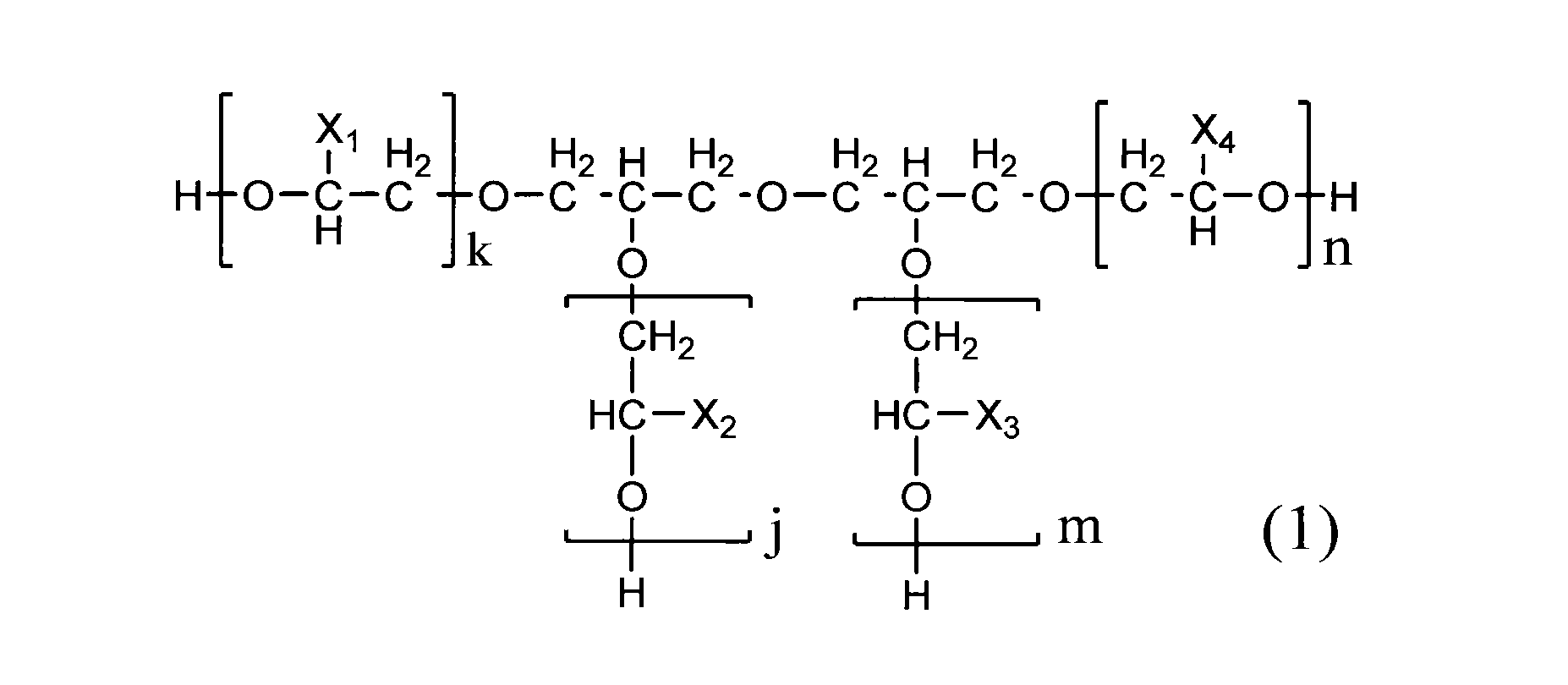
X1、X2、X3、及びX4はそれぞれ独立に水素原子又はメチル基を表し、
j、k、m、及びnは総和で4以上40以下の数を表す。] - 前記式(1)におけるX1、X2、X3、及びX4の全てが水素原子又はメチル基である請求項1に記載のインク組成物。
- 前記式(1)におけるX1、X2、X3、及びX4の全てがメチル基である請求項1又は2に記載のインク組成物。
- 水溶性有機溶剤をさらに含有する請求項1乃至3のいずれか一項に記載のインク組成物。
- インク組成物の総質量に対して0.1~2質量%のpH調整剤をさらに含有する請求項1乃至4のいずれか一項に記載のインク組成物。
- 前記pH調整剤がトリス(ヒドロキシメチル)アミノメタンである請求項5に記載のインク組成物。
- 前記反応染料がモノクロルトリアジン系の反応染料である請求項1乃至6のいずれか一項に記載のインク組成物。
- 25℃におけるインク組成物の粘度が3~20mPa・sの範囲である請求項1乃至7のいずれか一項に記載のインク組成物。
- インク組成物の粘度が8~20mPa・sの範囲である請求項8に記載のインク組成物。
- 請求項1乃至9のいずれか一項に記載のインク組成物を、インクジェットプリンタを用いてセルロース系繊維に付与する工程と、該工程により付与したインク組成物中の染料を熱により前記セルロース系繊維に反応固着させる工程と、前記セルロース系繊維中に残存する未固着の染料を洗浄する工程とを含むセルロース系繊維の捺染方法。
- 1種類以上の糊材、アルカリ性物質、及びヒドロトロピー剤を少なくとも含む水溶液を、インク組成物を付与する前の前記セルロース系繊維に含浸させる、繊維の前処理工程をさらに含む請求項10に記載のセルロース系繊維の捺染方法。
Priority Applications (6)
| Application Number | Priority Date | Filing Date | Title |
|---|---|---|---|
| BRPI0906000-6A BRPI0906000A2 (pt) | 2008-02-22 | 2009-02-16 | Composição de tinta e método de impressão têxtil usando a mesma. |
| AU2009216336A AU2009216336A1 (en) | 2008-02-22 | 2009-02-16 | Ink composition and textile printing method using the same |
| JP2009554300A JP5174047B2 (ja) | 2008-02-22 | 2009-02-16 | インク組成物及びそれを用いた繊維の捺染方法 |
| CN2009801058172A CN101945960A (zh) | 2008-02-22 | 2009-02-16 | 油墨组合物以及使用该油墨组合物的纤维印染方法 |
| US12/865,106 US8657432B2 (en) | 2008-02-22 | 2009-02-16 | Ink composition and textile printing method using the same |
| EP20090713041 EP2246398B1 (en) | 2008-02-22 | 2009-02-16 | Ink composition and textile printing method using the same |
Applications Claiming Priority (2)
| Application Number | Priority Date | Filing Date | Title |
|---|---|---|---|
| JP2008040887 | 2008-02-22 | ||
| JP2008-040887 | 2008-02-22 |
Publications (1)
| Publication Number | Publication Date |
|---|---|
| WO2009104547A1 true WO2009104547A1 (ja) | 2009-08-27 |
Family
ID=40985428
Family Applications (1)
| Application Number | Title | Priority Date | Filing Date |
|---|---|---|---|
| PCT/JP2009/052528 Ceased WO2009104547A1 (ja) | 2008-02-22 | 2009-02-16 | インク組成物及びそれを用いた繊維の捺染方法 |
Country Status (9)
| Country | Link |
|---|---|
| US (1) | US8657432B2 (ja) |
| EP (1) | EP2246398B1 (ja) |
| JP (1) | JP5174047B2 (ja) |
| KR (1) | KR20100125314A (ja) |
| CN (2) | CN101945960A (ja) |
| AU (1) | AU2009216336A1 (ja) |
| BR (1) | BRPI0906000A2 (ja) |
| TW (1) | TW201000573A (ja) |
| WO (1) | WO2009104547A1 (ja) |
Cited By (8)
| Publication number | Priority date | Publication date | Assignee | Title |
|---|---|---|---|---|
| WO2010109867A1 (ja) * | 2009-03-27 | 2010-09-30 | 日本化薬株式会社 | インク組成物及び染色されたポリアミド系繊維の製造方法 |
| WO2011013503A1 (ja) * | 2009-07-30 | 2011-02-03 | 日本化薬株式会社 | インク組成物及びそれを用いた繊維の捺染方法 |
| US20110273508A1 (en) * | 2010-05-04 | 2011-11-10 | Toshiba Tec Kabushiki Kaisha | Aqueous inkjet ink |
| JP2012031241A (ja) * | 2010-07-29 | 2012-02-16 | Nippon Kayaku Co Ltd | インクジェット捺染用インクセット及びそれを用いた繊維の捺染方法 |
| WO2013022044A1 (ja) | 2011-08-09 | 2013-02-14 | 日本化薬株式会社 | インクジェット捺染用グレーインク組成物及びそれを用いた繊維の捺染方法 |
| JP6005286B2 (ja) * | 2013-07-12 | 2016-10-12 | 富士フイルム株式会社 | 画像形成方法 |
| JP2018090653A (ja) * | 2016-11-30 | 2018-06-14 | 理想科学工業株式会社 | 水性インクジェットインク |
| JP2022061262A (ja) * | 2020-10-06 | 2022-04-18 | コニカミノルタ株式会社 | 捺染用インクジェットインク、捺染用インクジェットインクセット、および画像形成方法 |
Families Citing this family (4)
| Publication number | Priority date | Publication date | Assignee | Title |
|---|---|---|---|---|
| CN103468055B (zh) * | 2013-09-25 | 2015-10-28 | 句容市后白镇迎瑞印花厂 | 一种活性染料墨水及其制备方法 |
| JP6233579B2 (ja) * | 2013-12-17 | 2017-11-22 | セイコーエプソン株式会社 | インクジェット捺染用のインク組成物および捺染方法 |
| JP6605765B2 (ja) * | 2016-03-16 | 2019-11-13 | 富士フイルム株式会社 | インク |
| CN109321037B (zh) * | 2017-07-31 | 2022-02-15 | 精工爱普生株式会社 | 喷墨印染用油墨以及喷墨印染用油墨组 |
Citations (10)
| Publication number | Priority date | Publication date | Assignee | Title |
|---|---|---|---|---|
| JPH0436362A (ja) * | 1990-05-31 | 1992-02-06 | Pentel Kk | 水性インキ |
| JPH05246132A (ja) | 1991-09-26 | 1993-09-24 | Canon Inc | インクジェット捺染用インク及びインクジェット捺染方法 |
| JP2001146561A (ja) | 1998-12-17 | 2001-05-29 | Seiko Epson Corp | インクジェット捺染用インク組成物 |
| JP2002241639A (ja) | 2001-02-14 | 2002-08-28 | Nippon Kayaku Co Ltd | モノクロルトリアジン系反応性染料の安定な液状組成物及びそれを含有するインクジェット用捺染インク |
| JP2003306627A (ja) | 2002-03-15 | 2003-10-31 | Everlight Chemical Industrial Corp | 紡織品インクジェットプリント用インク組成物 |
| JP2004155869A (ja) * | 2002-11-05 | 2004-06-03 | Sharp Corp | インクジェット用インク組成物 |
| JP2004346134A (ja) * | 2003-05-20 | 2004-12-09 | Mitsubishi Pencil Co Ltd | 水性インキ組成物 |
| JP2005520015A (ja) | 2002-03-08 | 2005-07-07 | イー・アイ・デュポン・ドウ・ヌムール・アンド・カンパニー | テキスタイル用インクジェットインク |
| JP2007238892A (ja) * | 2006-03-13 | 2007-09-20 | Konica Minolta Ij Technologies Inc | 捺染用インクジェットインクの製造方法及び捺染用インクジェットインク |
| JP2008231341A (ja) * | 2007-03-23 | 2008-10-02 | Seiko Epson Corp | インクジェット記録用インク |
Family Cites Families (4)
| Publication number | Priority date | Publication date | Assignee | Title |
|---|---|---|---|---|
| US6015454A (en) * | 1997-06-17 | 2000-01-18 | Ciba Specialty Chemicals Corporation | Process for printing textile fibre materials in accordance with the ink-jet printing process |
| US6001137A (en) * | 1998-02-27 | 1999-12-14 | Encad, Inc. | Ink jet printed textiles |
| US20080092309A1 (en) * | 2006-09-15 | 2008-04-24 | Ellis Scott W | Fabric pretreatment for inkjet printing |
| JP2010094843A (ja) * | 2008-10-14 | 2010-04-30 | Fujifilm Corp | インクジェット記録方法 |
-
2009
- 2009-02-16 CN CN2009801058172A patent/CN101945960A/zh active Pending
- 2009-02-16 WO PCT/JP2009/052528 patent/WO2009104547A1/ja not_active Ceased
- 2009-02-16 EP EP20090713041 patent/EP2246398B1/en not_active Not-in-force
- 2009-02-16 JP JP2009554300A patent/JP5174047B2/ja active Active
- 2009-02-16 CN CN201510472784.2A patent/CN105062217B/zh not_active Expired - Fee Related
- 2009-02-16 AU AU2009216336A patent/AU2009216336A1/en not_active Abandoned
- 2009-02-16 KR KR20107020453A patent/KR20100125314A/ko not_active Withdrawn
- 2009-02-16 US US12/865,106 patent/US8657432B2/en not_active Expired - Fee Related
- 2009-02-16 BR BRPI0906000-6A patent/BRPI0906000A2/pt not_active Application Discontinuation
- 2009-02-17 TW TW98105021A patent/TW201000573A/zh unknown
Patent Citations (10)
| Publication number | Priority date | Publication date | Assignee | Title |
|---|---|---|---|---|
| JPH0436362A (ja) * | 1990-05-31 | 1992-02-06 | Pentel Kk | 水性インキ |
| JPH05246132A (ja) | 1991-09-26 | 1993-09-24 | Canon Inc | インクジェット捺染用インク及びインクジェット捺染方法 |
| JP2001146561A (ja) | 1998-12-17 | 2001-05-29 | Seiko Epson Corp | インクジェット捺染用インク組成物 |
| JP2002241639A (ja) | 2001-02-14 | 2002-08-28 | Nippon Kayaku Co Ltd | モノクロルトリアジン系反応性染料の安定な液状組成物及びそれを含有するインクジェット用捺染インク |
| JP2005520015A (ja) | 2002-03-08 | 2005-07-07 | イー・アイ・デュポン・ドウ・ヌムール・アンド・カンパニー | テキスタイル用インクジェットインク |
| JP2003306627A (ja) | 2002-03-15 | 2003-10-31 | Everlight Chemical Industrial Corp | 紡織品インクジェットプリント用インク組成物 |
| JP2004155869A (ja) * | 2002-11-05 | 2004-06-03 | Sharp Corp | インクジェット用インク組成物 |
| JP2004346134A (ja) * | 2003-05-20 | 2004-12-09 | Mitsubishi Pencil Co Ltd | 水性インキ組成物 |
| JP2007238892A (ja) * | 2006-03-13 | 2007-09-20 | Konica Minolta Ij Technologies Inc | 捺染用インクジェットインクの製造方法及び捺染用インクジェットインク |
| JP2008231341A (ja) * | 2007-03-23 | 2008-10-02 | Seiko Epson Corp | インクジェット記録用インク |
Non-Patent Citations (1)
| Title |
|---|
| See also references of EP2246398A4 |
Cited By (12)
| Publication number | Priority date | Publication date | Assignee | Title |
|---|---|---|---|---|
| WO2010109867A1 (ja) * | 2009-03-27 | 2010-09-30 | 日本化薬株式会社 | インク組成物及び染色されたポリアミド系繊維の製造方法 |
| EP2412761A4 (en) * | 2009-03-27 | 2013-08-07 | Nippon Kayaku Kk | INK COMPOSITION AND PROCESS FOR PRODUCING COLORFUL FIBER BASED ON POLYAMIDE |
| WO2011013503A1 (ja) * | 2009-07-30 | 2011-02-03 | 日本化薬株式会社 | インク組成物及びそれを用いた繊維の捺染方法 |
| JP5580824B2 (ja) * | 2009-07-30 | 2014-08-27 | 日本化薬株式会社 | インク組成物及びそれを用いた繊維の捺染方法 |
| US20110273508A1 (en) * | 2010-05-04 | 2011-11-10 | Toshiba Tec Kabushiki Kaisha | Aqueous inkjet ink |
| JP2011236420A (ja) * | 2010-05-04 | 2011-11-24 | Toshiba Corp | 水性インクジェットインク |
| JP2012031241A (ja) * | 2010-07-29 | 2012-02-16 | Nippon Kayaku Co Ltd | インクジェット捺染用インクセット及びそれを用いた繊維の捺染方法 |
| WO2013022044A1 (ja) | 2011-08-09 | 2013-02-14 | 日本化薬株式会社 | インクジェット捺染用グレーインク組成物及びそれを用いた繊維の捺染方法 |
| JP6005286B2 (ja) * | 2013-07-12 | 2016-10-12 | 富士フイルム株式会社 | 画像形成方法 |
| JP2018090653A (ja) * | 2016-11-30 | 2018-06-14 | 理想科学工業株式会社 | 水性インクジェットインク |
| JP2022061262A (ja) * | 2020-10-06 | 2022-04-18 | コニカミノルタ株式会社 | 捺染用インクジェットインク、捺染用インクジェットインクセット、および画像形成方法 |
| JP7593040B2 (ja) | 2020-10-06 | 2024-12-03 | コニカミノルタ株式会社 | 捺染用インクジェットインク、捺染用インクジェットインクセット、および画像形成方法 |
Also Published As
| Publication number | Publication date |
|---|---|
| EP2246398B1 (en) | 2013-10-16 |
| KR20100125314A (ko) | 2010-11-30 |
| CN105062217B (zh) | 2019-02-15 |
| CN101945960A (zh) | 2011-01-12 |
| AU2009216336A2 (en) | 2010-09-23 |
| EP2246398A1 (en) | 2010-11-03 |
| BRPI0906000A2 (pt) | 2015-06-30 |
| AU2009216336A1 (en) | 2009-08-27 |
| US8657432B2 (en) | 2014-02-25 |
| EP2246398A4 (en) | 2012-01-04 |
| JP5174047B2 (ja) | 2013-04-03 |
| JPWO2009104547A1 (ja) | 2011-06-23 |
| TW201000573A (en) | 2010-01-01 |
| US20110007110A1 (en) | 2011-01-13 |
| CN105062217A (zh) | 2015-11-18 |
Similar Documents
| Publication | Publication Date | Title |
|---|---|---|
| JP5174047B2 (ja) | インク組成物及びそれを用いた繊維の捺染方法 | |
| EP2412761B1 (en) | Ink composition and method for producing dyed polyamide-based fiber | |
| JP5580824B2 (ja) | インク組成物及びそれを用いた繊維の捺染方法 | |
| JP5416116B2 (ja) | インクジェット捺染用インクセット及びそれを用いた繊維の捺染方法 | |
| JP6198340B2 (ja) | 水系インクセット及び繊維の捺染方法 | |
| JP5557640B2 (ja) | インクジェット捺染用インクセット及びそれを用いた繊維の捺染方法 | |
| JP2014185201A (ja) | インクジェット捺染に用いるインク及びそれを用いた繊維の捺染方法 | |
| JP2010189460A (ja) | インク組成物及びそれを用いた繊維の捺染方法 | |
| JP2017110097A (ja) | インク及びそれを用いた繊維の捺染方法 | |
| JP2016155968A (ja) | インク組成物及びそれを用いた繊維の捺染方法 | |
| JP2015078300A (ja) | インクジェット捺染用インク及び繊維の捺染方法 | |
| JP6198341B2 (ja) | インク組成物及び繊維の捺染方法 | |
| JP7775568B2 (ja) | インクジェット捺染用インク組成物および記録方法 | |
| JP2016169272A (ja) | インク組成物及びそれを用いた繊維の捺染方法 | |
| JP2017125081A (ja) | インク組成物及びそれを用いた繊維の捺染方法 | |
| JP2017125082A (ja) | インク組成物及びそれを用いた繊維の捺染方法 |
Legal Events
| Date | Code | Title | Description |
|---|---|---|---|
| WWE | Wipo information: entry into national phase |
Ref document number: 200980105817.2 Country of ref document: CN |
|
| 121 | Ep: the epo has been informed by wipo that ep was designated in this application |
Ref document number: 09713041 Country of ref document: EP Kind code of ref document: A1 |
|
| WWE | Wipo information: entry into national phase |
Ref document number: 2009554300 Country of ref document: JP |
|
| WWE | Wipo information: entry into national phase |
Ref document number: 12865106 Country of ref document: US |
|
| WWE | Wipo information: entry into national phase |
Ref document number: 4750/CHENP/2010 Country of ref document: IN |
|
| WWE | Wipo information: entry into national phase |
Ref document number: 2009713041 Country of ref document: EP |
|
| NENP | Non-entry into the national phase |
Ref country code: DE |
|
| ENP | Entry into the national phase |
Ref document number: 2009216336 Country of ref document: AU Date of ref document: 20090216 Kind code of ref document: A |
|
| ENP | Entry into the national phase |
Ref document number: 20107020453 Country of ref document: KR Kind code of ref document: A |
|
| ENP | Entry into the national phase |
Ref document number: PI0906000 Country of ref document: BR Kind code of ref document: A2 Effective date: 20100819 |