WO2009107586A1 - 高強度高導電銅棒線材 - Google Patents
高強度高導電銅棒線材 Download PDFInfo
- Publication number
- WO2009107586A1 WO2009107586A1 PCT/JP2009/053220 JP2009053220W WO2009107586A1 WO 2009107586 A1 WO2009107586 A1 WO 2009107586A1 JP 2009053220 W JP2009053220 W JP 2009053220W WO 2009107586 A1 WO2009107586 A1 WO 2009107586A1
- Authority
- WO
- WIPO (PCT)
- Prior art keywords
- strength
- mass
- conductivity
- wire
- rolling
- Prior art date
- Legal status (The legal status is an assumption and is not a legal conclusion. Google has not performed a legal analysis and makes no representation as to the accuracy of the status listed.)
- Ceased
Links
Images


Classifications
-
- H—ELECTRICITY
- H01—ELECTRIC ELEMENTS
- H01B—CABLES; CONDUCTORS; INSULATORS; SELECTION OF MATERIALS FOR THEIR CONDUCTIVE, INSULATING OR DIELECTRIC PROPERTIES
- H01B1/00—Conductors or conductive bodies characterised by the conductive materials; Selection of materials as conductors
- H01B1/02—Conductors or conductive bodies characterised by the conductive materials; Selection of materials as conductors mainly consisting of metals or alloys
- H01B1/026—Alloys based on copper
-
- B—PERFORMING OPERATIONS; TRANSPORTING
- B23—MACHINE TOOLS; METAL-WORKING NOT OTHERWISE PROVIDED FOR
- B23K—SOLDERING OR UNSOLDERING; WELDING; CLADDING OR PLATING BY SOLDERING OR WELDING; CUTTING BY APPLYING HEAT LOCALLY, e.g. FLAME CUTTING; WORKING BY LASER BEAM
- B23K35/00—Rods, electrodes, materials, or media, for use in soldering, welding, or cutting
- B23K35/22—Rods, electrodes, materials, or media, for use in soldering, welding, or cutting characterised by the composition or nature of the material
- B23K35/24—Selection of soldering or welding materials proper
- B23K35/30—Selection of soldering or welding materials proper with the principal constituent melting at less than 1550°C
-
- C—CHEMISTRY; METALLURGY
- C22—METALLURGY; FERROUS OR NON-FERROUS ALLOYS; TREATMENT OF ALLOYS OR NON-FERROUS METALS
- C22C—ALLOYS
- C22C9/00—Alloys based on copper
- C22C9/02—Alloys based on copper with tin as the next major constituent
-
- C—CHEMISTRY; METALLURGY
- C22—METALLURGY; FERROUS OR NON-FERROUS ALLOYS; TREATMENT OF ALLOYS OR NON-FERROUS METALS
- C22C—ALLOYS
- C22C9/00—Alloys based on copper
- C22C9/06—Alloys based on copper with nickel or cobalt as the next major constituent
-
- C—CHEMISTRY; METALLURGY
- C22—METALLURGY; FERROUS OR NON-FERROUS ALLOYS; TREATMENT OF ALLOYS OR NON-FERROUS METALS
- C22F—CHANGING THE PHYSICAL STRUCTURE OF NON-FERROUS METALS AND NON-FERROUS ALLOYS
- C22F1/00—Changing the physical structure of non-ferrous metals or alloys by heat treatment or by hot or cold working
- C22F1/08—Changing the physical structure of non-ferrous metals or alloys by heat treatment or by hot or cold working of copper or alloys based thereon
-
- H—ELECTRICITY
- H01—ELECTRIC ELEMENTS
- H01B—CABLES; CONDUCTORS; INSULATORS; SELECTION OF MATERIALS FOR THEIR CONDUCTIVE, INSULATING OR DIELECTRIC PROPERTIES
- H01B13/00—Apparatus or processes specially adapted for manufacturing conductors or cables
- H01B13/0016—Apparatus or processes specially adapted for manufacturing conductors or cables for heat treatment
-
- H—ELECTRICITY
- H01—ELECTRIC ELEMENTS
- H01B—CABLES; CONDUCTORS; INSULATORS; SELECTION OF MATERIALS FOR THEIR CONDUCTIVE, INSULATING OR DIELECTRIC PROPERTIES
- H01B13/00—Apparatus or processes specially adapted for manufacturing conductors or cables
- H01B13/012—Apparatus or processes specially adapted for manufacturing conductors or cables for manufacturing wire harnesses
- H01B13/01209—Details
-
- H—ELECTRICITY
- H01—ELECTRIC ELEMENTS
- H01B—CABLES; CONDUCTORS; INSULATORS; SELECTION OF MATERIALS FOR THEIR CONDUCTIVE, INSULATING OR DIELECTRIC PROPERTIES
- H01B7/00—Insulated conductors or cables characterised by their form
- H01B7/0045—Cable-harnesses
-
- Y—GENERAL TAGGING OF NEW TECHNOLOGICAL DEVELOPMENTS; GENERAL TAGGING OF CROSS-SECTIONAL TECHNOLOGIES SPANNING OVER SEVERAL SECTIONS OF THE IPC; TECHNICAL SUBJECTS COVERED BY FORMER USPC CROSS-REFERENCE ART COLLECTIONS [XRACs] AND DIGESTS
- Y10—TECHNICAL SUBJECTS COVERED BY FORMER USPC
- Y10T—TECHNICAL SUBJECTS COVERED BY FORMER US CLASSIFICATION
- Y10T428/00—Stock material or miscellaneous articles
- Y10T428/29—Coated or structually defined flake, particle, cell, strand, strand portion, rod, filament, macroscopic fiber or mass thereof
- Y10T428/2913—Rod, strand, filament or fiber
Definitions
- the present invention relates to a high-strength, high-conductivity copper rod wire produced by a process including continuous casting and rolling.
- copper rod wires have been used as electrical conductors and are used in various fields.
- it is used also for the wire harness of a motor vehicle, and the motor vehicle is required to reduce the weight of the vehicle body in order to improve the fuel efficiency with respect to global warming.
- the use weight of wire harnesses tends to increase due to advanced information technology, electronics, and hybridization of automobiles.
- copper is an expensive metal, and there is a demand for reduction in cost from the automobile industry.
- the invention of the high-strength, high-conductivity copper rod wire meets the needs of the times.
- wire harnesses There are several types of wire harnesses, ranging from power systems to signal systems where only weak current flows. In the former, conductivity close to that of pure copper is first required as a first condition, and in the latter, particularly high strength is required. Therefore, a copper wire having a balance between strength and conductivity is required depending on the application. In addition, distribution lines for robots, aircraft, etc. are required to have high strength and high conductivity and bend-resistant. For these distribution lines, in order to further increase the bending resistance, the copper wire is often used as a stranded wire composed of several or several tens of fine wires. High strength and high conductivity are also required for copper rods used for welding tips and the like.
- a wire refers to a product having a diameter or an opposite side distance of less than 6 mm, and is referred to as a wire even if the wire is cut into a rod shape.
- a bar means a product having a diameter or opposite side distance of 6 mm or more, and is called a bar even if the bar is coiled.
- a material having a large outer diameter is cut into a rod shape, and a thin material is shipped in a coil shape.
- the diameter or the opposite side distance is 4 to 16 mm, they are mixed and defined here.
- a rod and a wire are generically called a rod and wire.
- the following characteristics are calculated
- a trolley wire Generally referred to as a trolley wire, most of them have a diameter of 20 mm, and this specification falls within the category of bars.
- the welding tip is required to have high conductivity, high strength, wear resistance, high temperature strength, and durability.
- Electrical parts such as bus bars, rotor bars, terminals, electrodes, relays, power relays, connectors, connection terminals, fasteners, and the like are required to have high conductivity and high strength.
- mechanical parts such as nuts and faucet fittings are manufactured from a bar by cutting, pressing, or forging, high conductivity, high strength, and wear resistance are required.
- brazing is often used as a means of joining from the viewpoint of reliability of the joining part.
- Heat resistance is required to maintain high strength even after heating.
- the heat resistance property means that recrystallization is difficult even when heated to a high temperature of 500 ° C. or higher, and the strength after heating is excellent.
- pressing and forging are performed, and rolling and partial cutting are included in post-processing. In particular, it requires cold formability, ease of forming, high strength and wear resistance, and is required to have no stress corrosion cracking.
- the continuous casting rolling method which is a manufacturing method of a copper bar wire has high productivity and low cost.
- a trapezoidal, polygonal, elliptical, or cylindrical casting rod with a side of several tens of millimeters (cross-sectional area of 1000 to 9000 mm 2 , generally about 4000 mm 2 ) obtained by melting and casting is continuous after casting.
- the cross section is 35 to 700 mm 2 (generally 100 mm 2 ), and the cross section is circular or elliptical. Bars having a shape and a polygonal shape can be obtained.
- This rod is further drawn by drawing to make the rod thin, and is also drawn to wire (drawing this rod and drawing to draw the wire are collectively referred to as drawing / drawing).
- a bus bar, a polygonal bar, or a bar having a complicated cross section is formed from the bar by a kind of extrusion (generally called conform).
- the continuous casting and rolling method has a low deformation resistance during hot rolling in a wide temperature range, and is used as a method for producing a pure copper wire material excellent in hot deformability immediately after solidification.
- the hot deformation resistance is increased and the deformability is deteriorated.
- the addition of elements causes a solidification temperature range and the solidus temperature decreases, so that copper alloys have been made unsuitable for continuous casting rolling that requires excellent deformability immediately after solidification. That is, in order to produce a copper alloy bar wire by continuous casting and rolling, it is necessary that the hot deformation resistance is low and the hot deformability immediately after solidification is excellent.
- a copper bar wire containing an alloy composition containing Sn and In in a total amount of 0.15 to 0.8 mass% and the balance being Cu and inevitable impurities for example, Japanese Patent Application Laid-Open No. 2004-137551. See the official gazette).
- a copper rod wire is insufficient in strength, and is expensive because the casting process and the rolling process are performed separately, not continuously casting and rolling.
- This invention solves the said problem, and aims at providing the high intensity
- the present invention provides a high-strength, high-conductivity copper bar wire in which 0.12 to 0.32 mass% Co, 0.042 to 0.095 mass% P, and 0.005 to 0.00. It contains 70 mass% Sn and 0.00005 to 0.0050 mass% O. Between the Co content [Co] mass% and the P content [P] mass%, 3.0 ⁇ ( [Co] ⁇ 0.007) / ([P] ⁇ 0.008) ⁇ 6.2 and the balance is an alloy composition composed of Cu and inevitable impurities, and is produced by a process including continuous casting and rolling. It is a thing.
- the strength and conductivity of the high-strength, high-conductivity copper rod are improved by the uniform precipitation of the Co and P compounds and the solid solution of Sn. Moreover, since it manufactures by continuous casting rolling, it becomes low cost.
- the high-strength, high-conductivity copper bar wire has 0.12 to 0.32 mass% Co, 0.042 to 0.095 mass% P, 0.005 to 0.70 mass% Sn, and 0.00005. And 0.0050 mass% O, and 0.01 to 0.15 mass% Ni, or 0.005 to 0.07 mass% Fe, and one or more of Co, [Co content [ Co ⁇ mass%, Ni content [Ni] mass%, Fe content [Fe] mass%, and P content [P] mass%, 3.0 ⁇ ([Co] +0.85 ⁇ [Ni] + 0.75 ⁇ [Fe] ⁇ 0.007) / ([P] ⁇ 0.008) ⁇ 6.2, and 0.015 ⁇ 1.5 ⁇ [Ni] + 3 ⁇ [Fe] ⁇ [ Co] and the balance is an alloy composition composed of Cu and inevitable impurities, and is produced by a process including continuous casting and rolling. . Thereby, precipitates, such as Co and P, become fine by Ni and Fe, and the strength and heat resistance
- High-strength, high-conductivity copper rod wire is 0.002 to 0.5 mass% Zn, 0.002 to 0.25 mass% Mg, 0.002 to 0.25 mass% Ag, 0.001 to 0.1 mass% It is desirable to further contain any one or more of Zr. This makes S mixed in the recycling process of copper material harmless by Zn, Mg, Ag, and Zr, prevents intermediate temperature brittleness, and further strengthens the alloy. Therefore, the ductility and strength of high-strength, high-conductivity copper rods are increased. improves.
- the high-strength and high-conductivity copper rod wire has an unrecrystallized rate of 1 to 60 in the metal structure after the continuous casting and rolling. %, The average crystal grain size of the recrystallized portion is 4 to 40 ⁇ m, and the hot working rate is 95% or more, the unrecrystallized rate of the metal structure after the continuous casting and rolling is 10%. It is desirable that the average crystal grain size of the recrystallized portion is 2.5 to 25 ⁇ m. Thereby, since it has a non-recrystallized structure and a recrystallized grain size is small at the stage of the continuous cast and rolled material, the strength of the high-strength, high-conductivity copper rod is improved.
- the high-strength, high-conductivity copper rod wire has a rolling start temperature in the continuous casting rolling of between 860 ° C. and 1000 ° C., a total hot working rate of 75% or more, and a temperature range from 850 ° C. to 400 ° C. It is desirable that the average cooling rate in is 10 ° C./second or more.
- rolling start temperature in the continuous casting rolling of between 860 ° C. and 1000 ° C., a total hot working rate of 75% or more, and a temperature range from 850 ° C. to 400 ° C. It is desirable that the average cooling rate in is 10 ° C./second or more.
- the high-strength, high-conductivity copper rod and wire are subjected to cold drawing / drawing after the continuous casting and rolling, and are performed at 350 ° C. to 620 ° C. at 0.5 to 0.5 ° C. before or after the cold drawing / drawing.
- fine precipitates having a substantially circular or substantially elliptical shape are uniformly dispersed, and the average particle size of the precipitates is 2 to 20 nm, or 90% of all the precipitates. % Or more is preferably 30 nm or less.
- the high-strength, high-conductivity copper rod wire be heat-treated at 200 to 700 ° C. for 0.001 second to 180 minutes during or after the cold wire drawing process and have excellent bending resistance.
- excellent bending resistance means that, for example, in the case of a wire with an outer diameter of 2 mm, the number of repeated bending is 15 times or more, and when the outer diameter is 0.8 mm, repeated bending. The number of times means 20 times or more.
- a high-strength, high-conductivity copper rod wire has excellent bending resistance in a wire having an outer diameter of 3 mm or less. Since it has excellent bending resistance, it can be used for applications where bending is repeated.
- a high-strength, high-conductivity copper rod wire has a conductivity of 45 (% IACS) or higher, a conductivity of R (% IACS), and a tensile strength of S (N / mm 2 ) for a wire having an outer diameter of 3 mm or less.
- % IACS conductivity of 45
- R conductivity of R
- N tensile strength of S
- High-strength, high-conductivity copper rod wire is preferably used for wire harnesses. Since the strength and bending resistance of the high-strength, high-conductivity copper rod wire are good, the reliability of the wire harness is improved, and the outer diameter can be reduced and the cost can be reduced.
- High-strength, high-conductivity copper rod wire has an electrical conductivity of 45 (% IACS) or more, an elongation of 5% or more, an electrical conductivity of R (% IACS), a tensile strength of S (N / mm 2 ), and an elongation.
- Is L (%), the value of (R 1/2 ⁇ S ⁇ (100 + L) / 100) is preferably 4200 or more. Thereby, it can use for the use for which electroconductivity, elongation, and intensity
- the high-strength, high-conductivity copper rod wire has a high-temperature strength with a tensile strength at 400 ° C. of 180 (N / mm 2 ) or more.
- a rod wire can be used at high temperature, and an outer diameter can be made thin and it can be made low-cost.
- high-strength, high-conductivity copper rod wire is used for cold forging or pressing. Since fine precipitates are uniformly dispersed, the strength of cold forged products and press products is increased. In addition, cold forging and press molding can be easily performed even with processing equipment with low power, and strength and conductivity are improved by heat treatment after processing, so that high power equipment is not required and the cost is low.
- the high-strength, high-conductivity copper rod wire has a Vickers hardness (HV) of 90 or higher after heating at 700 ° C. for 30 seconds and a conductivity of 45 (% IACS) or higher. It is desirable that the average particle size of the precipitates is 2 to 20 nm, 90% or more of all the precipitates is 30 nm or less, or the recrystallization rate in the metal structure is 45% or less. Thereby, since it is excellent in heat resistance, it can be processed and used in an environment exposed to a high temperature state. Or, since there is little decrease in strength after high-temperature heating for a short time, the diameter of the rod / wire material can be reduced, or the rod / wire material, press, cold forged product can be reduced, and the cost can be reduced.
- HV Vickers hardness
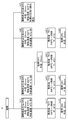
- the flowchart of the manufacturing process A and B of the high performance copper bar wire which concerns on embodiment of this invention.
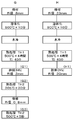
- the flowchart of the manufacturing process E, F, ZE, and ZF in the laboratory test of the high performance copper bar wire which concerns on embodiment.
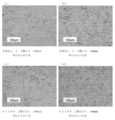
- (A) is a photograph of the metal structure near the surface (6 / 7R from the center) after continuous casting and rolling of the same high performance copper rod wire
- (b) is 1 / from the center after continuous casting and rolling of the same high performance copper rod wire.
- 2C part metal structure photograph (c) is a metal structure photograph near the surface after conventional C1100 continuous casting and rolling (6 / 7R from the center), (b) is the center of the C1100 after continuous casting and rolling 1 / The metal structure photograph of 2R part.
- the high performance copper rod wire according to the embodiment of the present invention will be described.
- the present invention proposes a first invention alloy, a second invention alloy, and a third invention alloy having an alloy composition in the high-performance copper rod wire according to claims 1 to 4.
- the element symbol in parentheses such as [Co] indicates the content value of the element to represent the alloy composition.
- the first to third invention alloys are collectively referred to as invention alloys.
- the third invention alloy has a composition of the first invention alloy or the second invention alloy in the range of 0.002 to 0.5 mass% Zn, 0.002 to 0.25 mass% Mg, 0.002 to 0.25 mass%. And an alloy composition further containing at least one of 0.001 to 0.1 mass% of Zr.
- the outer diameter is rolled to 8 to 25 mm by continuous casting and rolling.
- the rolling start temperature is 860 to 1000 ° C.
- the total hot working rate is 75% or more
- the temperature after the final pass is, for example, 500 to 600 ° C. when the outer diameter is 8 mm and the outer diameter is 20 mm.
- the temperature is 600 to 700 ° C.
- the average cooling rate from 850 ° C. to 400 ° C. is 10 ° C./second or more. Note that the total hot working rate is (1 ⁇ (cross-sectional area of bar wire after continuous casting and rolling) / (cross-sectional area of casting before rolling)) ⁇ 100%.
- heat treatment TH1 may be performed at 350 to 620 ° C. for 0.5 to 16 hours.
- This heat treatment TH1 is mainly intended for precipitation, and may be performed during the drawing / drawing process, after the drawing / drawing process, or may be performed a plurality of times.
- heat treatment TH2 may be performed at 200 to 700 ° C. for 0.001 second to 180 minutes.
- This heat treatment TH2 is mainly intended for recovery, and may be performed a plurality of times.
- the drawing / drawing process may be performed again, or the drawing / drawing process after the heat treatment TH2.
- the heat treatment TH2 may be performed again later.
- Co alone cannot provide high strength and high conductivity when added alone, but high strength and high heat resistance characteristics can be obtained without impairing thermal and electrical conductivity by co-addition with P and Sn.
- the strength is slightly improved and there is no remarkable effect.
- the upper limit (0.32 mass%) is exceeded, the effect is saturated, the high temperature deformation resistance is increased, and the hot rolling processability is lowered. Moreover, electroconductivity is impaired. If the amount is less than the lower limit (0.12 mass%), the strength and heat resistance are not improved even when co-added with P, and the intended non-recrystallized structure is not formed. Moreover, it does not become a metal structure in which recrystallized grains are miniaturized.
- P has high strength and high heat resistance without loss of thermal and electrical conductivity by co-addition with Co and Sn. P alone improves the flowability and strength of hot water and refines the crystal grains.
- the upper limit 0.095 mass%
- the above effect is saturated and the thermal and electrical conductivity is impaired. Cracks are likely to occur during casting and hot rolling.
- ductility, particularly repetitive bending workability is deteriorated. If the amount is less than the lower limit (0.042 mass%), the strength and heat resistance are not improved, and the target metal structure is not obtained.
- Co and P are improved in strength, heat resistance, high temperature strength, wear resistance, hot deformation resistance, deformability, and conductivity by co-addition within the above-described composition range.
- Co 0.16 to 0.29 mass%
- P 0 .051 to 0.089 mass%
- the composition of Co and P is low on the other hand, none of the above-described characteristics exhibits a remarkable effect.
- problems such as an increase in cost, a decrease in hot deformability, an increase in hot deformation resistance, hot working cracks, and bending cracks occur as in the case of each addition alone.
- Sn is required to have the above-described composition range.
- 0.005 to 0.095 mass% is preferable, and further 0 0.005 to 0.045 mass% is optimal.
- 0.03 to 0.40 mass% is good when placing emphasis on strength in bar applications, and Sn increases the hot deformation resistance for wire applications where the wire needs to be thin.
- 05 to 0.19 mass% is preferable.
- 0.05 mass% to 0.095 mass% due to the synergistic effect of solid solution strengthening of Sn and work hardening by cold drawing, etc. A sufficiently high strength can be obtained by adding a small amount of Sn.
- Sn when hot rolled at 800 ° C. or 750 ° C. from the rolling start temperature, refines the recrystallized grains generated by breaking the coarse cast structure, suppresses the growth of recrystallized grains, and Co, P, etc. Many are in solid solution. Due to the solid solution and precipitation of Sn and Co and P dissolved in the matrix, the dynamic recrystallization temperature of the matrix and the static recrystallization temperature are increased, and the hot rolling temperature is a temperature slightly lower than 750 ° C. or 750 ° C., For example, the proportion of the unrecrystallized structure increases at 700 ° C., but the unrecrystallized structure is uniformly distributed. The heat resistance of the matrix is enhanced by Co, P, and Sn.
- the matrix is composed of fine recrystallized grains and non-recrystallized grains that are uniformly distributed. Precipitation is suppressed and a lot of Co and P are in a solid solution state. That is, Sn has the effect of lowering the solution susceptibility of Co, P, etc., and further, finely and uniformly dispersing precipitates such as Co, P, etc. during the subsequent precipitation heat treatment.
- Sn is required to refine the recrystallized grains.
- the strength at high temperature of about 300 ° C. required for welding tips and trolley wires is improved. It is also effective for wear resistance depending on hardness and strength. In this specification, atoms that are solid solution at high temperature are difficult to precipitate even when the cooling rate is low during cooling. Is called “highly solution-sensitive”.
- the additive material with Sn: 0.2 mass% increases the hot deformation resistance at 700 to 900 ° C. by about 20% compared with the additive material with Sn: 0.03 mass%. Becomes higher.
- the Sn amount is preferably 0.19 mass% or 0.095 mass%, more preferably 0.045 mass%.
- Sn decreases the conductivity.
- Sn should be 0.19 mass% or less.
- Sn is preferably 0.095 mass% or less, It is preferable to make it 0.045% mass or less.
- the size and distribution of precipitates that is, the blending ratio of Co, Ni, Fe, and P are very important.
- Precipitation treatment results in deposits of Co, Ni, Fe, and P, such as Co x P y , Co x Ni y P z , and Co x Fe y P z, having a spherical or elliptical precipitate particle size of about 10 nm, that is, planar 2 to 20 nm, or 90%, preferably 95% or more of the precipitate is 0.7 nm to 30 nm, or 2.5 nm to 30 nm (30 nm or less).
- High strength is obtained by depositing uniformly.
- the particle size is 0.7 nm. If less than precipitates can be observed, the abundance of precipitates having a particle size of 0.7 nm or 2.5 nm to 30 nm also changes. Then, during continuous casting and rolling of the casting, recrystallization can be delayed by precipitates such as Co and P, and an unrecrystallized structure and a fine recrystallized structure can be obtained. Note that at a temperature of 800 ° C.
- precipitates such as Co and P improve the high-temperature strength of 300 ° C. or 400 ° C. required for welding tips and the like.
- wear resistance depends on hardness and strength
- precipitates such as Co and P are also effective in wear resistance.
- X2 ([Co] + 0.85 ⁇ [Ni] + 0.75 ⁇ [Fe] ⁇ 0.007) / ([P] ⁇ 0.008)
- X2 should be 3.0 to 6.2, preferably 3.1 to 5.7, more preferably 3.3 to 5.1, and most preferably 3.5 to 4.5. If X1 and X2 exceed the upper limit, the heat and electrical conductivity will be lowered, the heat resistance will be insufficient, the recrystallization temperature will be lowered during continuous casting and rolling, the crystal grain growth cannot be suppressed, and hot Deformation resistance also increases and strength cannot be improved.
- the hot deformation resistance of a Co: 0.25 mass% material at 700 to 900 ° C. (when the processing rate is 20%) is Co: 0.15 mass%. Compared to the material, the increase is approximately 5%. Further, in the temperature range of 900 ° C. or higher, the hot deformation resistance of the Co: 0.15 mass% material is about 5% higher than that of pure copper C1100, and 15 to 20% higher at 800 ° C.
- the ratio of ([Co] + 0.85 ⁇ [Ni] + 0.75 ⁇ [Fe] ⁇ 0.007) and ([P] ⁇ 0.008) is optimal.
- the precipitate formed of Co, Ni, Fe and P is, for example, Co 2 P or Co2 .
- x P portion of Ni Co represented by compounds formula y, Co was replaced by Fe x Ni y Fe z P a , Co x Ni y P z, present as Co x Fe y P z, and the like.
- any of Co, Ni, Fe and P is in a solid solution state without being subjected to precipitate formation. Not only is the strength material not obtained, but the conductivity is poor. Alternatively, precipitates different from the purpose of the compounding ratio are formed, and the precipitate particle diameter becomes large, or the precipitates do not contribute much to the strength, so that they cannot be a highly conductive and high strength material.
- Fe and Ni alone does not contribute much to the improvement of various properties such as heat resistance and strength, and also decreases the conductivity.
- Fe and Ni are based on the co-addition of Co and P.
- the function of Co is partially replaced.
- the coefficient of [Ni] of 0.85 and the coefficient of [Fe] of 0.75 are:
- the ratio of Ni and Fe binding to P is expressed with the binding of Co and P as 1.
- FE and Ni partially replace the Co function.
- the addition of Fe and Ni alone decreases the conductivity and does not contribute much to the improvement of various properties such as heat resistance and strength.
- Ni alone improves the stress relaxation resistance required for connectors and the like.
- Ni has an alternative function of Co, and the above formula ([Co] + 0.85 ⁇ [Ni] + 0.75 ⁇ [Fe] ⁇ 0.007) / ([ Even if the value of P] ⁇ 0.008) deviates from the central value of 3.0 to 6.2, it has a function of minimizing the decrease in conductivity. Further, Sn diffusion is suppressed by a Sn plated connector or the like.
- Zn, Mg, Ag, and Zr detoxify S mixed in the copper recycling process, reduce intermediate temperature brittleness, and improve ductility and heat resistance.
- Zn, Mg, Ag, and Zr reinforce the alloy with almost no loss of conductivity.
- Zn, Mg, and Ag improve the strength of the alloy by solid solution strengthening, and Zr improves the strength of the alloy by the precipitation effect.
- Zn further improves solder wettability and brazing.
- Zn or the like has an action of promoting uniform precipitation of Co and P.
- the addition amount is preferably 0.19 mass% or less. .
- the amount of Zr added is preferably 0.0045 mass% or less.
- the hot deformation resistance in continuous casting and rolling increases exponentially with decreasing temperature. Moreover, when other elements are added to pure copper, the hot deformation resistance increases.
- the alloy according to the present invention has a hot deformation resistance that is not significantly different from that of pure copper on the high temperature side exceeding 800 ° C., but at a temperature of 800 ° C. or less, the difference between the hot deformation resistance and pure copper increases as the temperature decreases.
- the hot rolling start temperature is equal to or higher than that of pure copper, for example, 860 ° C. to 1000 ° C., preferably 880 ° C. to 990 ° C., more preferably 910 ° C. to 980 ° C.
- the deformation resistance depends on the contact area with the roll, that is, the rolling amount (rolling amount). Since the hot deformation resistance is low at the beginning of rolling, the rolling amount (rolling amount) is made larger than pure copper, for example, 5 to 20% increase. On the other hand, since the deformation resistance of the invention alloy is higher than that of pure copper in the latter stage of rolling, a thin wire having the same size as the final pure copper can be obtained by reducing the rolling amount (reduction amount).
- the strength of the material can be increased by using the non-recrystallized structure.
- the non-recrystallized structure obtained by continuous casting and rolling is not a processed structure that is processed cold.
- the unrecrystallized structure has a higher dislocation density than the recrystallized structure, but has a lower dislocation density and a higher ductility than the cold-worked structure.
- the unrecrystallized structure preferably has finer recrystallized grains.
- the non-recrystallization rate depends on the rolling temperature and the processing rate as well as the composition. For example, when the continuous casting rolling is started at 860 ° C. to 1000 ° C. and the cooling rate is 10 ° C./second or more, When the rod has an outer diameter of 24 mm, the unrecrystallized rate is only 2 to 50%. Conversely, when the outer diameter is 8 mm, the unrecrystallized rate increases to 10 to 80% mainly due to a decrease in the final rolling temperature. . Therefore, the smaller the outer diameter, the larger the ratio of non-recrystallization.
- the unrecrystallized ratio in the vicinity of the surface layer is high.
- the average crystal grain size of the recrystallized part affects the strength of the final product.
- the non-recrystallized ratio of the metal structure is preferably 1 to 60%, and the average crystal grain size of the recrystallized portion is preferably 4 to 40 ⁇ m. More preferably, the unrecrystallized ratio of the metal structure is 3 to 45%, and the average crystal grain size of the recrystallized portion is 4 to 30 ⁇ m.
- the non-recrystallization rate is 0 to 30% at the center or near the center in the cross section, and the average crystal grain size of the recrystallized portion is 5 to 35 ⁇ m.
- the crystal ratio is preferably 20 to 80%, and the average crystal grain size of the recrystallized portion is preferably 4 to 25 ⁇ m.
- the unrecrystallized rate of the metal structure is 10 to 80%, and the average recrystallized portion
- the crystal grain size is preferably 2.5 to 25 ⁇ m. Furthermore, it is preferable that the unrecrystallized rate of the metal structure is 20 to 65% and the average crystal grain size of the recrystallized portion is 2 to 20 ⁇ m.
- the non-recrystallization rate is 1 to 45%
- the average crystal grain size of the recrystallized part is 3 to 35 ⁇ m
- the non-recrystallization rate is 35 to 95%
- the average crystal grain size of the recrystallized portion is preferably 3 to 15 ⁇ m.
- the unrecrystallized rate is high, the size of crystal grains in the recrystallized portion is reduced and the strength is increased.
- the precipitation hardening is better, so that the unrecrystallized rate is preferably 1 to 45%.
- the bar is cold-pressed or cold-forged, it is desired that the strength is lower and the ductility is higher, so that the non-recrystallization rate is preferably 1 to 45%.
- the non-recrystallization rate is preferably 20 to 65% from the viewpoint of strength.
- the non-recrystallization rate is preferably 20 to 65%. This is because, especially when the non-recrystallization ratio in the vicinity of the surface is high at 35 to 95%, the vicinity of the surface becomes rather soft during the precipitation heat treatment, and the flexibility becomes excellent.
- the total hot working rate is (1 ⁇ (cross-sectional area of bar wire after continuous casting and rolling) / (cross-sectional area of casting before rolling)) ⁇ 100%.
- the recrystallized grains are basically better, but if high temperature strength and ductility are required, the recrystallized grains should be somewhat larger than fine from the viewpoint of high temperature (300 ° C.) creep, and 10-30 ⁇ m. Is preferred.
- the non-recrystallization rate is preferably 1 to 45%. As described above, the total hot working rate is set to 75% or more because the working rate at which the cast structure is completely destroyed is used. And even if it is outside this range, the above is generally applicable as long as the processing rate is 70% or more, which is close to 75%.
- the bar wire of the invention alloy composed of such an unrecrystallized structure and fine recrystallized grains and then subjected to heat treatment has the same strength as a bar wire that has undergone a solution-heat treatment process that is generally performed. . And it is characterized by not only strength but also ductility.
- the heat treatment TH1 will be described.
- fine precipitates having a substantially circular shape or a substantially elliptic shape are uniformly dispersed in the rod and wire, and the average particle size of the precipitates is 2 to 20 nm, or 90% or more of all the precipitates.
- the size is 30 nm or less.
- Basic heat treatment conditions for TH1 are 350 ° C. to 620 ° C. for 0.5 to 16 hours.
- the cold working rate When the cold working rate is 0%, it may be 1 to 16 hours at 450 to 600 ° C., preferably 2 to 12 hours at 475 to 550 ° C. In order to obtain even higher conductivity, for example, a two-step heat treatment at 525 ° C. for 2 hours and 500 ° C. for 4 hours is effective. As the processing rate before the heat treatment increases, the number of precipitation sites increases. For example, when the processing rate is 10 to 40%, the optimum heat treatment condition shifts to 10 to 20 ° C. on the low temperature side. Better conditions are 425 to 580 ° C. and 1 to 16 hours.
- the heat treatment temperature T (° C.), the heat treatment time: t (hour), and the cold work rate: RE (%), (T ⁇ 100 ⁇ t If the value of ⁇ 1/2 ⁇ 50 ⁇ Log ⁇ (100 ⁇ RE) / 100) ⁇ is the heat treatment index TI, 370 ⁇ TI ⁇ 510 Is good, 390 ⁇ TI ⁇ 490 Is preferred, 400 ⁇ TI ⁇ 480 This is optimal.
- the heat treatment time is lengthened, the heat treatment temperature shifts to a low temperature side, and the influence on the temperature is given by the reciprocal of the square root of time.
- the cold working rate has a great influence on the heat treatment temperature.
- Log is a natural logarithm
- the cold working rate RE is (1 ⁇ (cross-sectional area of the bar wire after processing) / (cross-sectional area of the bar wire before processing)) ⁇ 100%.
- heat treatment TH1 The purpose of heat treatment TH1 is to deposit Co, P, etc. in a fine and uniform manner, so there is a trade-off between costs. However, if heat treatment TH1 is performed twice, the conductivity of the rod and wire becomes better and ductility is improved. Will also improve. Most of the precipitates are deposited by the first heat treatment TH1, but there are still some Co, P, etc. that are not yet complete and can be deposited in the matrix. By performing plastic processing such as drawing or wire drawing after the first heat treatment TH1, when the temperature is raised during the next heat treatment, the movement of atoms becomes microscopic and the precipitate is completely deposited by the first heat treatment. Co, P, and the like are further precipitated in the second heat treatment TH1. In the case of a wire with particularly required bending resistance, TH1 may be performed a plurality of times and used after the final TH1 rise.
- Precipitates are uniformly and finely distributed, the sizes are uniform, and the smaller the particle size, the better the crystal grain size, strength, and heat resistance of the recrystallized portion.
- the size of precipitates such as Co and P is effective for strength, heat resistance, formation of unrecrystallized structure, refinement of recrystallized structure, and ductility.
- the average particle size is preferably 2 to 20 nm, preferably 2 to 12 nm, and optimally 3 to 9 nm.
- the strength mainly depends on precipitation hardening
- the precipitate should be small, and optimally the average particle size is 2.5-5.5 nm.
- the average particle diameter of the precipitate is optimally 3.5 to 9.5 nm, and the ductility and conductivity are improved and balanced, with a slight sacrifice of precipitation hardening.
- the bar wire of the alloy according to the invention and the press material obtained by pressing the bar wire have a recrystallization rate of 45% or less and still have high strength even when exposed to a high temperature of 700 ° C. for 30 seconds, for example.
- the decrease rate is within 20% compared to the conductivity of the material before heating, and high conductivity of 60% IACS or 65% IACS or higher when Sn is added to 0.095% or less for high conductivity applications.
- This high conductive property and the like are superior to Corson alloy, Cr copper, Cr—Zr copper and Ti copper, which are general precipitation hardening alloys. This is because even when exposed to a high temperature of 700 ° C.
- the precipitate does not include a crystallized product generated in the casting stage.
- the uniform dispersion of precipitates is defined, at least 90 in an arbitrary 1000 nm ⁇ 1000 nm region at a microscope observation position (excluding a specific portion such as the extreme surface layer) described later when observed with a TEM of 150,000 times. %,
- the distance between the most adjacent precipitated particles is 150 nm or less, preferably 100 nm or less, and optimally within 5 times the average particle diameter.
- at least 25 or more, preferably 50 or more, and optimally 100 or more are present. Even if the portion is taken, there is no large precipitation-free zone that affects the characteristics.
- the average precipitate size is 2.5 nm or more, and similarly, 30 nm or less.
- the ratio of the deposits the deposits of 2.5 nm or more are targeted.
- the size of the precipitate was approximately 7 nm or less, it was observed at 750,000 times.
- the limit of precipitates that can be discerned when observed with a 750,000-fold TEM is 0.7 nm. Therefore, the average precipitate size and the ratio of precipitates of 30 nm or less are subject to precipitates of 0.7 nm or more. It becomes.
- the heat treatment TH2 When giving a high cold work rate such as a fine wire, the material that has undergone the continuous casting and rolling process with the alloy according to the invention is subjected to a treatment such as recovery at a low temperature below the recrystallization temperature in the middle of wire drawing, and after ductility is achieved When the wire is drawn, the strength is improved. Further, when the above heat treatment is performed after the final wire drawing, the ductility such as the bending resistance is remarkably improved and the electrical conductivity is improved although the strength is slightly reduced. When the outer diameter is 3 mm or less, it is preferable to heat-treat at 350 to 700 ° C.
- the bending resistance of the rod and wire is further improved, so that the reliability of the rod and wire is further improved.
- excellent bending resistance means that, for example, in the case of a wire with an outer diameter of 2 mm, the number of repeated bending is 15 times or more, and when the outer diameter is 0.8 mm, the number of repeated bending is 20 More than once.
- the characteristics of the above-described high-performance copper rod wire according to the present invention will be described.
- a structure control mainly composed of aging / precipitation hardening, solid solution hardening, and crystal grain refinement, and various elements are added for this structure control.
- conductivity when an additive element is dissolved in the matrix, the conductivity is generally inhibited, and depending on the element, the conductivity is significantly inhibited.
- Inventive alloys Co, P, and Fe are elements that significantly impede conductivity. For example, only adding 0.02 mass% of Co, Fe, and P to pure copper will impair the conductivity by about 10%.
- the constituent elements Co, P, etc. of the invention alloy are characterized by being able to precipitate most of the dissolved Co, P, etc. in the subsequent heat treatment if they are added according to the above-described mathematical formula, and have high conductivity. Can be secured.
- Corson alloy (Ni and Si addition) and titanium copper which are well known as age-hardening copper alloys, contain more Ni, Si or Ti in the matrix than invented alloys even after complete solution treatment and aging treatment.
- the strength is high, the conductivity is lowered.
- a solution treatment at a high temperature necessary for the complete solution-aging precipitation process for example, heating at a typical solution temperature of 800 to 950 ° C. for several minutes or more
- the crystal grains become coarse. Grain coarsening adversely affects various mechanical properties.
- the solution treatment is subject to quantitative restrictions in manufacturing, leading to a significant increase in cost.
- crystal grain refinement is mainly adopted as the structure control, but when the amount of added elements is small, a remarkable effect of crystal grain refinement cannot be expected so much.
- the composition of Co, P, etc. and the solution forming in the continuous casting and rolling process, the grain refinement and the structure control of the non-recrystallized structure can be performed at the same time, and further the Co, P in the subsequent heat treatment process.
- Etc. were found to be finely precipitated. That is, in continuous casting and rolling, plastic deformation by hot rolling is applied to a casting in a high-temperature solidified state, and the average cooling rate in the temperature range from 850 ° C. to 400 ° C. is 10 ° C./second or more, or from 850 ° C. If the average cooling rate in the temperature region up to 600 ° C. is 5 ° C./second or more, preferably 10 ° C./second or more, Co, P, etc. can be sufficiently dissolved in the matrix and made into solution.
- the cooling start speed is preferably increased by increasing the rolling start temperature at 880 ° C. to 990 ° C., increasing the rolling speed, performing strong working (rolling) rolling, adjusting the rolling pass schedule, and the like. It is preferable to perform water cooling immediately after the final rolling (reducing cooling water containing alcohol), shorten the distance to the water cooling facility, and perform shower water cooling or forced air cooling.
- metal structures other than an unrecrystallized structure consist of fine recrystallized grains.
- the subsequent heat treatment favorably precipitates Co, P, etc. and restores the ductility of the matrix, and starts with strength, conductivity, and flexibility.
- a high-strength, high-conductivity bar wire that is balanced in ductility can be obtained.
- Co, P, etc. are dissolved in the continuous casting and rolling by the combination of the composition of Co and P and continuous casting and rolling, and the non-recrystallized structure and fineness are reduced.
- a recrystallized structure consisting of various recrystallized grains is formed.
- the above-described continuous casting and rolling equipment is mainly intended for pure copper having a low hot deformation resistance, and the material is required to have a low hot deformation resistance.
- the invention alloy to which Co or the like is added shows a low deformation resistance that is not much different from that of pure copper at 800 ° C. or higher, particularly 900 ° C. or higher, and when an unrecrystallized structure starts to occur at a temperature of 700 ° C. or lower during rolling, the deformation resistance Will increase.
- the problem of hot deformation resistance in the process can be solved.
- the alloy according to the invention is characterized by low deformation resistance during hot rolling while the manufactured bar wire has high strength.
- the deformability which is another major problem in processing, since it exhibits excellent hot deformability from a high temperature immediately after solidification.
- an aging precipitation type copper alloy is completely solutionized, and then a high performance copper rod wire is obtained through a process of precipitation.
- the performance of a rod and wire rod made by a process such as a continuous casting and rolling method in which solution forming is simplified is inferior.
- the bar wire according to the present invention has a performance equivalent to or higher than that produced by a high-cost complete solution-precipitation hardening process.
- the only practical alloys are Cr-Zr copper and Cr copper, which are high-strength, high-conductivity copper and solution-aging / precipitation type alloys.
- the upper limit temperature for solution treatment is a temperature of 960 ° C. or higher, and thus has a great restriction because it has poor hot deformability.
- the solid solution limit of Cr and Zr decreases rapidly with a slight decrease in temperature, so the temperature range of the solution temperature is narrow and the sensitivity of the cooling rate is high.
- the inventive alloy is excellent in hot deformability to the extent that continuous casting and rolling is possible, has low hot deformation resistance like pure copper, and has a structure control (not yet achieved) that achieves high strength at room temperature during continuous casting and rolling. Recrystallized structure and fine recrystallized structure).
- the rod and wire obtained in the process including the series of continuous casting and rolling of the present invention is more conductive than the material obtained by solution-aging precipitation of the alloy according to the invention offline such as Cr-Zr copper. It is equivalent or better, but rather high strength and high ductility. This is notable.
- high strength and high conductivity copper alloys with elements added to copper have been found to have low deformation resistance in the hot state where rolling is performed from a high temperature immediately after solidification in the continuous casting and rolling method, and excellent deformability. Not required for practical use.
- Conventional high-strength, high-conductivity copper is produced by a manufacturing method that uses hot extruded material with low productivity, and performs solution solution at a temperature of 900 ° C. or higher, rapid cooling, and aging. It was.
- This composition allows the shape of a rod and wire to be made by a continuous casting and rolling process that can produce wires and rods at the lowest cost without using these manufacturing methods, and also allows not only solution but also structure control in the continuous casting and rolling process.
- the high conductivity as a premise is preferably 55% IACS, more preferably 60% IACS or more. When high conductivity is required, it is preferably 65% IACS or more equivalent to or higher than aluminum, more preferably 70% IACS or more, and most preferably 75% IACS or more.
- the wire performance index I1 is defined as follows as an index for evaluating the strength and conductivity of the rod and wire.
- I1 R 1/2 ⁇ S
- the wire performance index I1 is 4300 or more, preferably 4500 or more, more preferably 4700 or more, and most preferably 5000 or more. It can be said that these values are very excellent high strength and high conductivity copper. Since the copper wire according to the present embodiment is excellent in strength, conductivity, and bending resistance even at an outer diameter of 3 mm or less, the reliability of the copper wire is improved.
- the wire described above can be used for wire harnesses, relays, connector wires, robots, and aircraft wiring. In these applications, it is necessary to balance conductivity, strength, and ductility. Even if the conductivity is 50% IACS or higher, the strength is increased, or even if the strength is slightly reduced, the conductivity is 70% IACS or higher, and further 75% IACS or higher. It is roughly divided into two. The material is determined in a balance according to the application. Assuming that the wire has bending resistance, increasing strength in these fields will lead to weight reduction, leading to improved fuel economy and CO 2 reduction in automobiles and the like. Moreover, since these characteristics are good, it is suitable also for the use of a connector or wire for wire cutting. Since the strength, conductivity, and bending resistance of the wire are good, the reliability of the wire harness and the like is increased.
- the bar performance index I2 is defined as follows as an index for evaluating the strength, elongation, and conductivity of the bar together.
- conductivity is R (% IACS)
- tensile strength is S (N / mm 2 )
- elongation is L (%)
- I2 R 1/2 ⁇ S ⁇ (100 + L) / 100
- the bar material performance index I2 is 4200 or more, preferably 4400 or more, more preferably 4600 or more, optimal, provided that the conductivity is 45% IACS or more and the elongation is 5% or more, preferably 10% or more. 4800 or more is preferable.
- the conductivity is preferably 55% IACS or higher, more preferably 60% IACS or higher. Furthermore, when high conductivity is required, it is 70% IACS or more, and further 75% IACS or more.
- the bar performance index I2 may be applied when elongation is required regardless of the wire diameter. In particular, for wire rods having an outer diameter of 3 mm or more and less than 6 mm, the rod material performance index I2 may be applied because elongation is often required in the same manner as the rod member.
- a bar material that requires strength at high temperatures.
- a tensile strength at 400 °C 180N / mm 2 or more preferably, 200 N / mm 2 or more, more preferably 220 N / mm 2 or more, and most preferably at 240 N / mm 2 or more.
- the bar material according to the present embodiment has a high tensile strength at a high temperature such as 400 ° C., the reliability is improved by using it for an application requiring a high-temperature strength.
- Precipitates such as Co and P in the bar are hardly re-dissolved at 400 ° C., that is, do not disappear, and the particle size thereof hardly changes.
- the heat resistance of the matrix is improved by the solid solution of Sn.
- atomic diffusion is still inactive, recrystallization does not occur, and even when deformation is applied, precipitates such as Co and P resist resistance to deformation. Show.
- good ductility can be obtained when the crystal grain size of the recrystallized portion is 4 to 40 ⁇ m.
- high tensile strength is exhibited.
- it is also characterized by high strength after brazing at 600 ° C. or 700 ° C. That is, for example, even if heated to 700 ° C., recrystallization still does not occur for about 10 seconds, and it has high strength even after brazing.
- Bar materials for trolley wires and welding tips are required to have high temperature strength and wear resistance on the premise of high strength and high conductivity, but the balance of strength, conductivity, high temperature strength, wear resistance, etc. required by the application is required.
- the composition and process are determined according to the application. In particular, in order to obtain strength, cold drawing is performed before and / or after heat treatment, and the total cold work is increased to obtain a high strength material. However, emphasis is also placed on the balance with ductility. There must be. In order to ensure an elongation of at least 5% or more, preferably 10% or more, the total drawing rate should be 60% or less, or the drawing rate after heat treatment should be 40% or less.
- the drawing rate after heat treatment is preferably 50% or less, and more preferably 30% or less.
- the trolley wire and the welding tip are consumables, the use of the product of the present invention makes it possible to achieve a long life, so that the cost can be reduced.
- the high performance copper rod wire of this embodiment is suitable for applications such as trolley wires, welding tips, electrodes, and power distribution members.
- the high-performance copper bars and wires according to the present embodiment and their compression-processed products have high heat resistance characteristics, are heated at 700 ° C. for 30 seconds, have a Vickers hardness (HV) of 90 or more after water cooling, and are electrically conductive.
- the rate is 45% IACS or higher.
- the precipitate in the metal structure after heating has an average particle diameter of 2 to 20 nm, or 90% or more of all the precipitates is 30 nm or less, or the recrystallization rate in the metal structure is 45% or less. More preferably, the average particle size of the precipitates is 3 to 12 nm, or 95% or more of all the precipitates is 30 nm or less, or the recrystallization rate in the metal structure is 30% or less.
- the high performance copper rod and wire according to the present embodiment and their compression processed products can be used in an environment exposed to a high temperature state, and have high strength even after brazing used for joining.
- the high-performance copper bar wire according to the present embodiment is suitable for uses such as a rotor bar used in a motor, a power relay in which a bar is brazed after press molding.
- the brazing material is, for example, silver brazing BAg-7 (40 to 60 mass% Ag, 20 to 30 mass% Cu, 15 to 30 mass% Zn, 2 to 6 mass% Sn) shown in JIS Z 3261.
- the temperature is 600 to 650 ° C.
- the liquidus temperature is 640 to 700 ° C.
- the high performance copper rod wire according to the present embodiment is also optimal for electrical applications such as power distribution parts made by forging or pressing.
- forging and pressing are collectively referred to as compression processing.
- compression processing Depending on the compression capacity of the compression process and the shape and amount of deformation of the product, it is optimal to use a high-strength, high-conductivity bar that has been heat-treated and cold drawn before the compression process.
- the processing rate for cold drawing of the bar is appropriately determined depending on the compression capacity and the product shape.
- the processing equipment has a low compression capacity, a very high degree of compression processing is required, or when precise dimensional accuracy is required, the subsequent process of the continuous casting and rolling process requires no heat treatment.
- the heat treatment is performed after the compression processing and the drawing is performed at a processing degree of about 20%
- the characteristics of the heat treatment and the cold drawing before the compression processing are slightly inferior to those of the compression processed product, but a highly conductive and high strength distribution member is used. Can be obtained.
- the heat processing in a series of manufacturing processes is especially unnecessary, and it is advantageous also in terms of cost. This is because fine precipitates such as Co and P are first deposited during heating at about 700 ° C. This is because the precipitates delay the recrystallization of the matrix and improve the conductivity while having high strength.
- the heat treatment conditions after the compression process are preferably lower than those after continuous casting and rolling or after the drawing / drawing process. If high cold processing is applied locally in compression processing, heat treatment should be considered based on that portion. Therefore, when high processing is performed, the heat treatment temperature shifts to a low temperature side or a short time side.
- Preferable conditions apply the above-described conditional expression for the heat treatment TH1, or at 380 to 630 ° C. for 15 to 180 minutes.
- heat treatment is not necessarily required, but it may be performed mainly for the purpose of restoring ductility, further improving conductivity, and removing residual stress. In this case, preferable conditions are 250 to 550 ° C. and 5 to 180 minutes.
- a high-performance copper rod wire was prepared using the above-described first invention alloy, second invention alloy, third invention alloy and copper having a composition for comparison.
- Table 1 shows the composition of the alloy that produced the high performance copper rod wire.
- the alloy is alloy No. 1 of the first invention alloy. 1, 2, 3, 101 and alloy No. 2 of the second invention alloy. 4, 5, 102 and alloy No. 3 of the third invention alloy. 6, 7, 103, and alloy Nos. Having compositions similar to those of the invention alloy for comparison. 11, 12, 104, and C1100 alloy no.
- a high performance copper rod wire was prepared by using a plurality of process patterns for any alloy.
- FIG. 1 to 3 show a manufacturing process of a high-performance copper bar wire.
- the wire was produced by manufacturing processes A and B.
- the manufacturing process A was made into a bar with an outer diameter of 8 mm by continuous casting and rolling (the process from melting to continuous casting and rolling is referred to as process a1, the same applies hereinafter).
- Continuous casting and rolling adjusts the composition in holding furnace of real operation, and cast into trapezoidal cast bar of the cross-sectional area of about 4800 mm 2, was started rolling at 975 ° C..
- step a11 the wire was drawn by cold drawing to an outer diameter of 0.8 mm (step a12), and then heat treatment TH2 was performed at 500 ° C. for 5 seconds (step a13). Further, following step a3, the wire was drawn to an outer diameter of 0.8 mm by cold drawing and heat treatment TH2 was performed at 500 ° C. for 5 seconds (step a21). Further, following the step a3, a heat treatment TH2 was performed at 500 ° C. for 5 seconds, and the wire was drawn to an outer diameter of 0.8 mm by cold drawing (step a31).
- the manufacturing process B was made into a bar with an outer diameter of 11 mm by continuous casting and rolling similar to the manufacturing process A (process b1).
- the average cooling rate from 850 ° C. to 400 ° C. was about 13 ° C./second.
- the outer diameter is extended to 9 mm by cold drawing, and heat treatment TH1 is performed at 480 ° C. for 8 hours, the outer diameter is drawn to 2 mm by cold drawing (step b11), and the heat treatment TH2 is performed at 400 ° C. for 2 minutes.
- Step b12 the wire was drawn to an outer diameter of 0.8 mm by cold drawing (step b13), and then heat treatment TH2 was performed at 550 ° C. for 2 seconds (step b14).
- a heat treatment TH1 is performed at 500 ° C. for 4 hours after forming a bar with an outer diameter of 11 mm by continuous casting and rolling (step b21), and the outer diameter is extended to 9 mm by cold drawing.
- a heat treatment TH1 was performed at 480 ° C. for 8 hours, and the wire was drawn to an outer diameter of 2 mm by cold drawing (step b22), followed by a heat treatment TH2 for 2 minutes at 400 ° C. (step b23). Further, subsequent to step b21, the wire was drawn to an outer diameter of 2 mm by cold drawing, and then heat treatment TH1 was performed at 420 ° C. for 1 hour (step b24).
- step b1 the outer diameter is extended to 9 mm by cold drawing, heat treatment TH1 is performed at 460 ° C. for 8 hours, the outer diameter is drawn to 0.8 mm by cold drawing, and 2 at 400 ° C. Heat treatment TH1 was performed for a period of time (step b31). Further, following step b1, heat treatment was performed at 630 ° C. for 1 hour (step b41), the wire was drawn to an outer diameter of 2 mm by cold drawing, and subsequently heat treatment TH1 was performed at 420 ° C. for 1 hour ( Step b42).
- the bar was created by the manufacturing process C.
- the manufacturing process C was made into a bar with an outer diameter of 23 mm by continuous casting and rolling similar to the manufacturing process A (process c1).
- the average cooling rate from 850 ° C. to 400 ° C. was about 16 ° C./second.
- it was cleaned by performing heat treatment TH1 for 3 hours at 530 ° C. (step c11), and subsequently extended to an outer diameter of 20 mm by cold drawing (step c12).
- the outer diameter is extended to 20 mm by cold drawing (step c13) and cleaned by performing heat treatment TH1 for 8 hours at 480 ° C.
- step c14 the outer diameter is 18 mm by cold drawing.
- Step c15 the heat treatment TH1 was performed at 575 ° C. for 4 hours after the process c1 for cleaning (process c16), and then the outer diameter was extended to 20 mm by cold drawing.
- a heat treatment TH1 was performed at 420 ° C. for 2 hours for cleaning c18.
- the heat treatment TH1 in step c16 is out of the side where the heat treatment index TI is higher than the manufacturing condition
- the heat treatment TH1 in step c18 is out of the side where the heat treatment index TI is lower than the manufacturing condition.
- a rod having an outer diameter of 23 mm is formed by continuous casting and rolling and immediately immersed in a water tank (step c2).
- the surface temperature of the bar immediately before dipping in the water tank was about 650 ° C.
- the average cooling rate from 850 to 600 ° C. was about 15 ° C./second, and the average cooling rate from 850 ° C. to 400 ° C. was about 24 ° C./second.
- steps c21 to c24 were performed in the same manner as steps c11 to c14.
- process c3 a process of cooling after rolling by air cooling was performed (process c3).
- the average cooling rate from 850 ° C. to 400 ° C. was about 8 ° C./second.
- steps c31 to c34 were performed in the same manner as steps c11 to c14.
- Step c4 having a start temperature of 850 ° C. was performed as a step having a hot rolling start temperature lower than the production conditions, and after rolling, steps c41 and c42 were performed in the same manner as steps c11 and c12.
- step c51 of extending to an outer diameter of 20 mm by cold drawing and performing a heat treatment TH1 at 480 ° C. for 8 hours for cleaning was performed.
- the process c7 whose start temperature is 1025 degreeC was performed as a process whose hot rolling start temperature is higher than manufacturing conditions, since the crack generate
- the process c6 whose start temperature is 930 degreeC was performed as a process in which hot rolling start temperature is in manufacturing conditions, and the process c61 and the process c62 were performed like the process c11 and the process c12 after rolling.
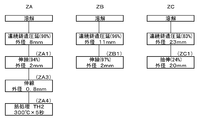
- C1100 the wire and the bar were created by the manufacturing processes ZA, ZB, and ZC corresponding to the manufacturing processes A, B, and C.
- FIG. 4 shows the configuration of steps ZA, ZB, and ZC.
- C1100 is pure copper containing about 0.03 mass% of oxygen, and cuprous oxide (Cu 2 O) is produced as a crystallized product, but no precipitate is produced. Therefore, it is produced in the same manner as the production process in general C1100.
- steps ZA, ZB, and ZC heat treatment TH1 for precipitation is not performed.
- a rod having an outer diameter of 8 mm is formed by continuous casting and rolling, and is extended to an outer diameter of 2 mm by cold drawing (process ZA1), and further is extended to an outer diameter of 0.8 mm by cold drawing (process ZA3).
- heat treatment TH2 was performed at 300 ° C. for 5 seconds (step ZA4).
- a bar having an outer diameter of 11 mm was formed by continuous casting and rolling, and subsequently, the outer diameter was extended to 2 mm by cold drawing (process ZB1).
- a rod having an outer diameter of 23 mm was formed by continuous casting and rolling, and subsequently, the outer diameter was extended to 20 mm by cold drawing (process ZC1).
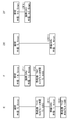
- FIG. 5 shows the configuration of steps G and H.
- a bar material having an outer diameter of 8 mm is subjected to a solution heat treatment at 900 ° C. for 10 minutes and then water-cooled, and heat treatment TH 1 is performed at 500 ° C. for 4 hours, and the outer diameter is extended to 2 mm by cold drawing.
- heat treatment TH2 was performed at 305 ° C. for 30 minutes (Step G2), and the wire was extended to an outer diameter of 0.8 mm by cold drawing, followed by heat treatment TH2 at 500 ° C. for 5 seconds (Step G3). ).
- a rod having an outer diameter of 23 mm is subjected to a solution heat treatment at 900 ° C. for 10 minutes and then water-cooled, and a heat treatment TH 1 is performed at 500 ° C. for 4 hours, followed by cold drawing to an outer diameter of 20 mm. Stretched (Step H1).
- Table 2 shows the composition of the alloy subjected to the lab test
- FIG. 6 shows the manufacturing process in the lab test.
- a plate-like casting having a thickness of 50 mm is prepared, heated to 970 ° C. and rolled to a thickness of 6 mm and 15 mm, and the plates are cut out from each, followed by lathe processing to have outer diameters of 5.6 mm and 14.5 mm.
- the bar wire was made.
- the average cooling rates between 850 ° C. and 400 ° C. were about 15 ° C./second and about 19 ° C./second, respectively.
- wires and rods were produced by the manufacturing processes E and F.
- a wire having an outer diameter of 5.6 mm is subjected to a heat treatment TH1 for 4 hours at 500 ° C., and is extended to an outer diameter of 1.4 mm by cold wire drawing (process E1), and then at 450 ° C. for 10 seconds.
- the heat treatment TH2 was performed (step E2).
- a rod having an outer diameter of 14.5 mm was extended by cold drawing to an outer diameter of 12.6 mm (process F1), and subsequently heat-treated TH1 at 475 ° C. for 8 hours (process F2).
- the high-performance copper bar wire prepared by the method described above As an evaluation of the high-performance copper bar wire prepared by the method described above, tensile strength, Vickers hardness, elongation, Rockwell hardness, number of repeated bending, electrical conductivity, 400 ° C high temperature tensile strength, Rockwell hardness and electrical conductivity after cold compression The rate was measured. In addition, the metallographic structure was observed to measure the recrystallization rate, the crystal grain size, and the ratio of precipitates having a size of 30 nm or less. Further, the bar material in step c12 was measured for Rockwell hardness and electrical conductivity after cold compression. Further, a high-temperature heating test was performed at 700 ° C. for 30 seconds and 100 seconds using a bar wire and a compression processed material.
- the measurement of tensile strength was performed as follows.
- the shape of the test piece was a 14A test piece in which the gauge distance of JIS Z 2201 (the square root of the cross-sectional area of the test piece parallel part) ⁇ 5.65 was used for the bar.
- a 9B test piece having a gauge distance of JIS Z 2201 of 200 mm was used.
- the measurement of the number of repeated bendings was performed as follows.
- the bending portion R was set to 2 ⁇ D (product diameter) mm, bent 90 degrees and returned to the original position once, bent 90 degrees to the opposite side, and repeated until breaking.
- a conductivity measuring device (SIGMATEST D2.068) manufactured by Nippon Ferster Co., Ltd. was used in the case of a bar having a diameter of 8 mm or more and in the case of a cold compression test piece. In the case of a wire and a bar less than 8 mm in diameter, it was measured according to JIS H 0505. At that time, a double bridge was used for measurement of electric resistance.
- the terms “electric conduction” and “conduction” are used in the same meaning.
- the measurement of 400 ° C high temperature tensile strength was performed as follows. After holding at 400 ° C. for 30 minutes, a high temperature tensile test was conducted. The gauge distance was 50 mm, and the test part was machined to a diameter of 10 mm with a lathe.
- the measurement of the non-recrystallization rate was performed as follows. This was carried out with a micrograph of a metallographic microscope at 100 times, 200 times or 500 times. When it is difficult to distinguish between recrystallized and unrecrystallized, a grain boundary with an orientation difference of 15 degrees or more from the crystal grain map by EBSP (Electron Backscatter Diffraction Pattern) of 200 times, 500 times, or 1000 times In the region surrounded by, the region in which the length in the drawing direction is three times or more than the length in the direction perpendicular to the drawing direction is set as an unrecrystallized region, and the area ratio of the region is analyzed by image analysis (image processing software “WinROOF” The value was regarded as the unrecrystallized rate.
- EBSP Electro Backscatter Diffraction Pattern
- EBSP is based on JEOL's FE-SEM (Field Emission Scanning Electron Microscope: Field Emission Scanning Electron Microscope, Model No. JSM-7000F FE-SEM), and TSL Solutions Co., Ltd. OIM It was created by a device equipped with a device, model number TSL-OIM 5.1).
- the crystal grain size was measured according to the comparison method of the copper grain size test method in JIS H 0501 from an optical micrograph.
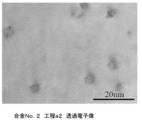
- the particle size of the precipitate is obtained by converting the transmission electron image of a 150,000-fold TEM (transmission electron microscope) into two by using the “WinROOF” described above, extracting the precipitate, and calculating the average value of the area of each precipitate.
- the average particle size was measured. Assuming that the radius of the bar wire is R, the measurement positions are two points 1R / 2 and 6R / 7 from the center of the bar wire, and the average value is taken. Since the size of the precipitate is difficult to measure when the dislocation density in the metal structure is high, the size of the precipitate was measured mainly with a bar wire obtained by subjecting a continuously cast and rolled material to heat treatment TH1, for example, a bar wire after step c11.
- the 700 degreeC high temperature heating test material it measured in the part recrystallized partially. Moreover, from the particle size of each precipitate, the ratio of the number of precipitates of 30 nm or less was measured. However, in the transmission electron image of TEM of 150,000 times, the dimension can be measured accurately only up to about 2.5 nm. The proportion in the precipitate is larger than 2.5 nm. When the size of the precipitate was approximately 7 nm or less and small, the observation was performed at 750,000 times. Since the limit of precipitates that can be distinguished relatively accurately when observed with a 750,000-fold TEM is 0.7 nm, the average precipitate size and the ratio of precipitates of 30 nm or less are also 0.7 nm or more. Precipitates are targeted.
- Wear resistance was measured as follows. A ring-shaped test piece having an outer diameter of 19.5 mm and a thickness (axial direction length) of 10 mm was obtained by subjecting a bar material having an outer diameter of 20 mm to cutting and drilling. Next, the test piece is fitted and fixed to the rotating shaft, and a SUS304 roll (outer diameter 60.5 mm) made of 18 mass% Cr, 8 mass% Ni, and remaining Fe is applied to the outer peripheral surface of the ring-shaped test piece with a load of 5 kg.
- the multi-oil was dripped onto the outer peripheral surface of the test piece (at the beginning of the test, the test surface was excessively wetted, and then 10 mL was replenished per day), and the rotating shaft was 209 rpm It was rotated with. Then, when the rotation number of the test piece reached 100,000 times, the rotation of the test piece was stopped, and the weight difference before and after the rotation of the test piece, that is, the weight loss (mg) was measured. It can be said that the smaller the wear loss is, the more excellent the copper alloy is.
- the high temperature heating test was performed as follows. After immersion in a 700 ° C. salt bath (mixed NaCl and CaCl 2 in about 3: 2) for 30 seconds and water cooling, conductivity, metal structure, average particle size of precipitates, Vickers hardness, and partly Tensile strength, elongation, and Rockwell hardness were measured.
- the high temperature heating test was performed in one of the following three types depending on the sample.
- the sample of the high temperature heating test is a sample of the rod and wire material that has been cut into a length of 35 mm while keeping the outer diameter after each process, and the cold compression material is a sample after the above cold compression test. Was used.
- the outer diameter of each step was kept as it was, and the length of the test piece was set to 300 mm. Since the length and volume became large, the tensile test piece was immersed in a salt bath for 100 seconds and then cooled with water.
- 1. State of bar wire after each process 2. A state in which the above-described cold compression is performed on the bar wire after each process. A state in which the above-described cold compression was performed on the bar wire after each process and heat treatment (same as [0097]) at 440 ° C. for 60 minutes was performed. In each table of test results described later, “heat resistance at 700 ° C. for 30 seconds” The test state of each sample is represented by the numbers 1 to 3 in the column “Processing before heating” of the test item “ability”.
- Tables 3 and 4 show the results in step E1.
- the first invention alloy, the second invention alloy, and the third invention alloy are referred to as first, second, and third, respectively, the comparative alloy is compared, and C1100 is referred to as C (the same applies to the following tables).
- surface is investigated in the step of the outer diameter 5.6mm.
- C1100 describes the result of the step ZE1 without the heat treatment TH1.
- the inventive alloy has a higher unrecrystallized ratio after hot rolling and a smaller crystal grain size than the comparative alloy and C1100.
- the alloy according to the invention has a smaller average particle size of precipitates and a higher ratio of 30 nm or less after the wire drawing than the comparative alloy and C1100. Further, good results were obtained in the tensile strength, Vickers hardness, number of repeated bendings, and wire rod performance index I1.
- the conductivity of the comparative alloy is reduced to about 60% of C1100, while the alloy of the invention remains at about 80% of C1100.
- Alloy No. In the comparative alloys 43 and 44 since the contents of P and Sn were high, cracks occurred during hot rolling and could not be processed into a wire.
- C1100 describes the result of the step ZE1 in which the heat treatment TH1, TH2 is not performed. Similar to the result of the process E1, the result of the process E2 also shows that the inventive alloy has better results in the tensile strength, the Vickers hardness, the number of repeated bendings, and the wire performance index I1 than the comparative alloy and C1100. .
- the conductivity of the comparative alloy is reduced to about 60% of C1100, while the alloy of the invention remains at about 75% of C1100.
- the tensile strength is slightly smaller than after step E1, but the number of repeated bendings is improved.
- the alloy according to the invention is a high-strength and high-conductivity copper alloy, and in particular, the wire performance index I1 is more preferable in the formula, the range of X1, X2, and X3 and the composition range. high. (Alloys 32 and 35 are slightly inferior.)
- C1100 describes the result of the process ZF1 corresponding to the process F1.
- the alloy according to the invention has good results in tensile strength as compared with C1100, but the elongation and Rockwell hardness are equivalent, and the conductivity is reduced to about 50% of C1100.
- the alloy according to the invention is equivalent in tensile strength, elongation, Rockwell hardness, electrical conductivity, bar performance index I2 and good in Rockwell hardness and electrical conductivity after cold compression compared to the comparative alloy. It is the result.
- C1100 describes the result of the process ZF1 without the heat treatment TH1.
- the invention alloy is very good in comparison with the comparative alloy and C1100 in tensile strength, Rockwell hardness, bar performance index I2, 400 ° C high temperature tensile strength, Rockwell hardness after cold compression, and electrical conductivity. It is the result.
- the invention alloy is greatly improved in performance such as tensile strength after the process F1 by performing the heat treatment (precipitation treatment) at 475 ° C. for 8 hours.
- Comparison alloy No. No. 42 contains Fe and Ni in a larger amount than the predetermined amount, so the precipitated particle size may be large and the form of the precipitate may be changed. High temperature strength is low.
- Comparison alloy No. No. 43 had a poor ratio of Co, P, etc., and the amount of P exceeded the claimed range.
- Comparison alloy No. No. 44 had a large amount of Sn, and during the rolling, the rolling load was increased by 70% in the case of C1100, so rolling was stopped.
- Tables 11 and 12 show the results in steps a1, a2, a3, b1, and b11.
- C1100 shows the result of step ZA1 for step a3 and the result of step ZB1 for step b11.
- FIG. 8 shows the alloy No. in step a2 with a transmission electron microscope. The result of having observed the deposit of 2 is shown.
- step a1, step b1 the alloy according to the invention has a higher non-recrystallization rate and a smaller crystal grain size than the comparative alloy.
- the alloy according to the invention has a smaller average particle size of precipitates and a higher proportion of precipitates of 30 nm or less than the comparative alloy.
- an invention alloy is extended by outer diameter 2mm (process a3, process b11), compared with a comparative alloy and C1100, tensile strength, Vickers hardness, and wire rod performance index I1 are very high.
- the wire performance index I1 satisfies 4500 or more, further 4700 or more, which is a preferable range for most high performance copper rod wires including the high performance copper rod wire according to the present invention.
- the number of repetitive bendings is also excellent in the alloy according to the invention as compared with the comparative alloy and C1100.
- the conductivity of the comparative alloy is about 70% of C1100, while the invention alloys are about 80%, which is a better result than the comparative alloy. Also in heat resistance, the alloy according to the invention has higher Vickers hardness, lower recrystallization rate, and higher conductivity than the comparative alloy and C1100.
- Tables 13 and 14 show the results in steps c1, c11, c12, c16, and c17.
- the inventive alloy has an unrecrystallized ratio of 15 to 30% after continuous casting and rolling (process c1). 11 and 12 for comparison, and alloy no. No. 21 is higher than C1100, and the size of recrystallized grains is 18 to 20 ⁇ m, which is smaller than that of the comparative alloy or C1100.
- the alloy according to the invention has a smaller average particle size of precipitates and a higher proportion of precipitates of 30 nm or less than the comparative alloy. Further, the tensile strength, Rockwell hardness and bar performance index I2 are very high.
- the alloy of the invention is soft after the continuous casting and rolling in step c1, but after the heat treatment TH1 in step c11, the tensile strength and the Rockwell hardness are increased, and the electrical conductivity and the bar material performance index I2 are greatly improved.
- the low material strength after continuous casting and rolling suggests that molding can be easily performed with high dimensional accuracy using a low-power press or cold forging equipment.
- the alloy according to the invention is greatly improved in mechanical properties and conductivity by performing the heat treatment TH1. And after an invention alloy is extended to 20 mm in outer diameter (process c12), compared with a comparative alloy and C1100, tensile strength, Rockwell hardness, and rod performance index I2 are very high.
- the rod performance index I2 satisfies 4400 or more which is a preferable range for most high performance copper rod wires including the high performance copper rod wire according to the present invention.
- the elongation of the invention alloy is slightly better than that of the comparative alloy and C1100.
- the alloy according to the invention has a 400 ° C. high temperature tensile strength that is twice or more that of the comparative alloy and is about four times that of C1100.
- the Rockwell hardness after cold compression is also a good result.
- the alloy according to the invention also has higher Vickers hardness than the comparative alloy and C1100 in heat resistance at 700 ° C.
- the recrystallization rate is 45% or less, and most is 20% or less.
- the conductivity is about 8% IACS worse than that of the material before the heat treatment TH1 (step c12), but shows high conductivity at about 70% IACS.
- the conductivity is improved by about 20% IACS and shows high conductivity at about 70% IACS compared to the material before heating (process c1) not subjected to the heat treatment TH1.
- the size of the precipitate grows from about 3.5 nm before heating to 7.5 nm after heating, but it remains fine and almost no precipitate exceeding 30 nm exists.
- the recrystallization rate exceeds 50%, the precipitate becomes coarse, and the re-solution of the elements related to the precipitate causes a significant decrease in conductivity.
- the decrease in strength is also large.
- the alloy of the present invention has little re-dissolution of elements related to precipitates, and the precipitates are fine, thus preventing recrystallization. As a result, even when heated to 700 ° C., it seems to have high strength and conductivity.
- the wear resistance weight loss evaluated by the bar material of step c12 and ZC1 is the test number of the first invention alloy. 107 was 93 mg and the test No. 110 for 66 mg, C1100 test no. 119 is 652 mg and the invention alloy is far superior to C1100.
- step c16 where the heat treatment index TI of the heat treatment TH1 deviates to a higher side than the manufacturing conditions, the matrix softens and the precipitates become larger. Therefore, the tensile strength, Rockwell hardness, bar performance index compared to the result in step c11 Also in step c17 where I2 is greatly reduced and then drawn, the tensile strength, Rockwell hardness, and rod performance index I2 are greatly reduced as compared with the result in step c12.
- step c16 since the heat treatment index TI of the heat treatment TH1 deviates to a higher side than the production conditions, precipitation is excessive, so that strength improvement due to precipitation is small, and tensile strength, Rockwell hardness, and rod performance index I2 are low.
- Table 15 shows the results of the high-temperature heating test of the bar of the invention alloy step c12 and step c14 and the bar material of the step ZC1 of C1100 at 700 ° C. for 100 seconds.
- the alloy according to the invention is superior to C1100.
- the determination of the presence or absence of heat resistance is made based on whether or not the material has a tensile strength of 80% of the original material before heating.
- Inventive alloys have a tensile strength of 80% or more of the original material.
- the conductivity is 80% or more of the original material.
- C1100 has a tensile strength of 70% or less of the original material, and is 150 N / mm 2 or more lower than the alloy of the invention.
- Tables 16 and 17 show the results in steps a11, a12, a13, a21, and a31
- Tables 18 and 19 show the results in steps b12, b13, and b14.
- C1100 shows the results of steps ZA3 and ZA4.
- steps a11, a12, a13, a21, a31 and steps b12 to b14 heat treatment TH2 mainly for recovery is performed during or after the drawing / drawing step.
- the inventive alloy has a very high tensile strength, Vickers hardness and wire performance index I1 in each step compared to the comparative alloy and C1100. Also, the number of repeated bendings is good for each invention alloy compared to the comparative alloy and C1100.
- the conductivity of the comparative alloy is about 70% of that of C1100, whereas the inventive alloy is about 75%, which is a better result than the comparative alloy.
- the alloy according to the invention greatly improves the number of repeated bendings by performing the heat treatment TH2 after the wire drawing step. Yes.
- Tables 20 and 21 show the results in steps b21 to b24 and steps b31, b41, and b42 in comparison with the results in steps b11 and b12.
- Steps b22 and b23 have been subjected to heat treatment TH1 twice, and the wire in steps b22 and b23 has any of strength, hardness, electrical conductivity, or flexibility compared to the wire in steps b11 and b12 in which heat treatment TH1 is performed once. It has also improved.
- the final manufacturing process is a heat treatment TH1.
- the wire performance index I1 indicating the total balance of strength and conductivity is satisfied, and the bending resistance is further improved.
- the wire rod of the process b24 and the process b31 shows the value of 4800 or more which is the optimal range also about the rod performance index I2 which considered ductility.
- the wire material in step b31 has a very large number of repeated bending. It should be noted that the strength of the invention alloy is higher and the bending resistance is more than twice that of C1100 and the comparative material, which are finally produced in the respective steps b11 to b13 where the heat treatment TH1 is not performed.
- Tables 22 and 23 show the results in steps c13 to c15 and step c18.
- C1100 shows the result of step ZC1.
- the alloy of the invention is soft after continuous casting and rolling (step c1), but becomes stronger after the drawing step (step c13).
- step c14 By performing heat treatment TH1 (step c14), the tensile strength, elongation, and Rockwell hardness are increased. The conductivity is further improved.
- the comparative alloy is slightly improved in elongation and conductivity even after the heat treatment TH1, the tensile strength and the Rockwell hardness are lowered.
- the inventive alloy is in a soft state when processed, and can be strengthened after processing, so that the processing cost can be reduced.
- the high temperature tensile strength at 400 ° C. after the heat treatment TH1 is more than twice that of the comparative alloy.
- the elongation is reduced, but the tensile strength and the Rockwell hardness are further increased.
- the Vickers hardness is 110th
- the conductivity is 70th
- high strength High conductivity is because the size of the precipitate including the process materials c1 and c12 is fine at about 7 nm and the recrystallization rate is about 10%.
- the alloy according to the invention has the same Rockwell hardness as that of the comparative alloy at the stage of the rod after drawing (step c13), which is only 9 points higher than C1100, but is shown in the data after “cold compression”.
- the inventive alloy is much harder than the comparative alloy and C1100 after the heat treatment after forging, and thus exhibits excellent properties in cold working such as forging (see Test Nos. 201, 205, and 206).
- step c18 heat treatment TH1 is performed at 420 ° C. for 2 hours after step c13.
- the heat treatment index TI of the heat treatment TH1 is out of the manufacturing conditions, the precipitation is insufficient, so the strength improvement due to the precipitation is small, the tensile strength, the Rockwell hardness, the bar performance index I2 is low, and the conductivity is also low. Low.
- Tables 24 and 25 show the results of steps c2, c21 to c24 and steps c3, c31, c32, and c34 in comparison with the results of steps c1, c11 to c14.
- Steps c2, c21, c22, c23, c24 are rapidly water-cooled after hot rolling of continuous casting rolling, and the cooling rate from 850 ° C. to 400 ° C. is 24 ° C./second.
- the precipitates after the heat treatment TH1 (step c21) immediately after that become finer, and as a result, the tensile strength, Rockwell hardness, and rod performance index I2 of the rod are improved and 400 ° C. High tensile strength at high temperature.
- the recrystallization rate of the bar and the compression processed product after heating at 700 ° C. is low, and the Vickers hardness is also high.
- Rockwell hardness after cold compression is also high.
- the results in steps c22, c23, and c24 also have better tensile strength, Rockwell hardness, and bar performance index I2 than the results in steps c12, c13, and c14 corresponding to the respective steps.
- the alloy according to the present invention has a high level of strength, conductivity, and strength-conductivity balance, but an average from 850 ° C. to 600 ° C. or from 850 ° C. to 400 ° C.
- the strength, conductivity, and balance thereof can be further increased. Furthermore, improvement in high temperature strength and heat resistance and improvement in hardness after cold compression can be achieved.
- Steps c3, c31, c32, and c34 are gradually cooled after hot rolling of continuous casting rolling, and the cooling rate from 850 ° C. to 400 ° C. is 8 ° C./second.
- the cooling rate from 850 ° C. to 400 ° C. is 8 ° C./second.
- precipitates after heat treatment TH1 step c31 immediately after that increase.
- tensile strength, elongation, Rockwell hardness, and bar material performance index I2 are worse than the result in process c11, c12, c14 corresponding to each process.
- Tables 26 and 27 show the results in steps c4, c41, c42, c51, c6, c61, c62, and c7 in comparison with the results in steps c1, c11, and c12.
- step c7 hot rolling cracks occurred when the hot rolling start temperature was 1025 ° C. higher than the production conditions (see Test No. 291).
- step c4 hot rolling is started at 850 ° C. where the hot rolling start temperature is lower than the production conditions as in step c4, since the solid solution of Co, P, etc. is insufficient, the unrecrystallized rate after rolling is high, The precipitate becomes coarse in the subsequent heat treatment step.
- the results in the steps c41 and c42 have worse tensile strength, elongation, Rockwell hardness, and bar performance index I2 than the results in the steps c11 and c12 corresponding to the respective steps.
- the hot rolling load becomes high, continuous casting and rolling may not be possible (see Test No. 294).
- the heat treatment TH1 is performed after the drawing after the step c4 (step c51)
- the tensile strength, the Rockwell hardness, and the rod performance index I2 are low.
- the results in the steps c61 and c62 in which the hot rolling start temperature was 930 ° C. within the production conditions were good as in the steps c11 and c12.
- Steps G1 to G3 and Step H1 are solution-precipitation steps.
- the processes a3, a11, a13, and c12 including the continuous casting and rolling process according to the present embodiment are the process G1, the process G3, the process G2, the process a11, and the process G3, the process a13.
- Step H1 corresponds to step c12.
- the high-performance copper rod and wire according to the present embodiment has higher tensile strength and a larger number of repeated bending than the rod and wire subjected to the solution-precipitation step. Elongation is also high.
- the hot working rate of continuous casting and rolling is 75% or more and less than 95%
- the non-recrystallization rate of the metal structure after hot rolling is 1 to 60%
- the recrystallized portion A bar wire having a crystal grain size of 4 to 40 ⁇ m was obtained (see Test Nos. 91 to 95 in Tables 13 and 14).
- the hot working rate of continuous casting and rolling is 95% or more
- the unrecrystallized ratio of the metal structure after hot rolling is 10 to 80%
- the crystal grain size of the recrystallized portion is 2.5 to 25 ⁇ m.
- a wire rod having an outer diameter of 3 mm or less, an electric conductivity of 45 (% IACS) or more, a wire material performance index I1 of 4300 or more, and an excellent bending resistance were obtained (Table 11, 12 test Nos. 74 to 76, etc.).
- the Vickers hardness (HV) after heating at 700 ° C. for 30 seconds and water cooling is 90 or more and the conductivity is 45% or more
- the precipitate in the metal structure after heating has an average particle diameter of 2 to 20 nm, or all
- 90% or more of the precipitate was 30 nm or less, or a rod and wire rod having a recrystallization rate in the metal structure of 45% or less was obtained.
- IACS absolute value
- the invention alloy is 10% IACS.
- C1100 has crystallized particles of Cu 2 O, its particle size is as large as about 2 ⁇ m, so it does not contribute to strength and has little influence on the metal structure. Therefore, the high temperature strength is low and the particle size is large, so it cannot be said that repeated bending workability is good (see Test No. 130 in Tables 16 and 17).
- Alloy No. for comparison alloy 11 and 12 have less Co or P, and the balance of Co, P, etc. is poor.
- the particle size of precipitates such as Co and P is large and the amount is small. Therefore, since the unrecrystallized rate of the raw material is low and the recrystallized grain size of the recrystallized portion is large, the strength is low. Moreover, since the balance of Co, P, etc. is bad, electrical conductivity is low. Further, the wire performance index I1 is also bad. This is because alloy No. 1 in which Co and P are almost the same amount. 1 (see Test Nos. 74, 77, and 78 in Tables 11 and 12, and Test Nos. 121, 126, and 127 in Tables 16 and 17). No.
- Invented alloys have finely precipitated Co, P, etc., preventing the movement of atoms, and the heat resistance of the matrix is improved by Sn. There is little, and high strength is obtained. Alloy No. for comparison alloy Nos. 11 and 12 have poor heat resistance due to a small amount of precipitation, and the high-temperature strength at 400 ° C. is also low (see Test Nos. 107 to 112, 114 to 116, and 119 in Tables 13 and 14).
- the alloy according to the present invention contains a predetermined amount of Co, P, etc., a predetermined amount of non-recrystallized portion is generated and the recrystallized grain size of the recrystallized portion is small. Even in the case of solution treatment of the present level, Co, P, etc., which have been dissolved, are finely precipitated by the subsequent precipitation treatment, and high strength can be obtained. Since most of Co, P, etc. is deposited, high conductivity can be obtained. In addition, since the precipitate is small, it is excellent in repeated bendability.
- the rod and wire material of the present embodiment has high tensile strength and high hardness, so it is considered that the wear resistance depending on the tensile strength and hardness is excellent.
- the high-performance copper rod wire according to the present invention has high strength, high conductivity, and excellent bending resistance, so it is optimal for wire harnesses, robot wires, aircraft wires, and electronic equipment wiring materials. It is. In addition, it has excellent high-temperature strength, wear resistance, and durability, so it can be used for connector wires (busbars), wire cut (electric discharge machining) wires, trolley wires, welding tips, spot welding tips, stud welding base points, electric discharge machining. It is most suitable for electrode materials, bus bars, electric motor rotor bars, and electrical components (such as fasteners, fasteners, electrical wiring devices, electrodes, power relays, relays, connection terminals, etc.). In addition, since it is excellent in workability such as forging and pressing, it is most suitable for hot forged products, cold forged products, rolled screws, bolts, nuts, and piping parts.
Landscapes
- Chemical & Material Sciences (AREA)
- Engineering & Computer Science (AREA)
- Mechanical Engineering (AREA)
- Materials Engineering (AREA)
- Metallurgy (AREA)
- Organic Chemistry (AREA)
- Physics & Mathematics (AREA)
- Thermal Sciences (AREA)
- Crystallography & Structural Chemistry (AREA)
- Manufacturing & Machinery (AREA)
- Conductive Materials (AREA)
- Non-Insulated Conductors (AREA)
Abstract
Description
コネクタ用線、バスバーは、コネクタの小型化によりオス側の細線化が進んでいるので、コネクタの抜き差しに耐えられる強度と導電性が求められる。使用中の温度上昇もあるので耐応力緩和特性も必要である。
ワイヤカット(放電加工)用線には、高導電、高強度、耐摩耗性、高温強度、耐久性が求められる。
トロリ線には、高導電、高強度が必要で、使用中の耐久性、耐摩耗性、高温強度も求められる。一般にトロリ線と称されるが、φ20mmのものが多く、本明細書では棒の範疇に入る。
溶接用チップには、高導電、高強度、耐摩耗性、高温強度、耐久性が求められる。
電気部品、例えばブスバー、ローターバー、ターミナル、電極、リレー、パワーリレー、コネクタ、接続端子、留具等は、高導電、高強度が求められる。また、ナット等の機械部品、水栓金具は、棒材から切削、プレス、又は鍛造により製造されるので、高導電、高強度、耐摩耗性が求められる。さらに、パワーリレーやモーターに使われるローターバー等の電気部品や水栓用途等では、接合部の信頼性の観点から、接合の手段として、ろう付けを用いることが多いので、例えば700℃の高温加熱後も高い強度を保持する耐熱特性が必要である。なお、本明細書で耐熱特性とは、500℃以上の高温に加熱されても、再結晶し難く、加熱後の強度に優れていることをいう。
機械部品、又は水栓金具用途は、プレス、鍛造が行なわれ、後加工に転造と一部切削が入る。特に、冷間での成形性、成形の容易性、高強度と耐摩耗性が必要であり、応力腐食割れが無いことが求められる。
X1=([Co]-0.007)/([P]-0.008)
として、X1が3.0~6.2、好ましくは、3.1~5.7、より好ましくは3.3~5.1、最適には3.5~4.5の関係を有し、かつ残部がCu及び不可避不純物からなる合金組成である。
X2=([Co]+0.85×[Ni]+0.75×[Fe]-0.007)/([P]-0.008)
として、X2が3.0~6.2、好ましくは、3.1~5.7、より好ましくは3.3~5.1、最適には3.5~4.5の関係を有し、かつ、
X3=1.5×[Ni]+3×[Fe]
として、X3が0.015~[Co]、好ましくは、0.035~(0.9×[Co])、より好ましくは0.05~(0.8×[Co])の関係を有し、かつ、残部がCu及び不可避不純物からなる合金組成である。
X1=([Co]-0.007)/([P]-0.008)
として、X1が3.0~6.2、好ましくは、3.1~5.7、より好ましくは3.3~5.1、最適には3.5~4.5でなければならない。また、Ni、Fe添加の場合には、
X2=([Co]+0.85×[Ni]+0.75×[Fe]-0.007)/([P]-0.008)
として、X2が3.0~6.2、好ましくは、3.1~5.7、より好ましくは3.3~5.1、最適には3.5~4.5でなければならない。X1、X2が上限を越えると、熱・電気伝導性の低下を招き、耐熱特性が不十分となり、連続鋳造圧延中での再結晶温度の低下を招き、結晶粒成長を抑制できず、熱間変形抵抗も増し、強度向上が得られない。X1、X2が下限より低いと、熱・電気伝導性の低下を招き、熱間・冷間での延性が損なわれる。また、Co、Pの組成が適正な比率であれば、例えばCo:0.25mass%材の700~900℃での熱間変形抵抗(加工率20%の時)は、Co:0.15mass%材に比べ、概ね5%増で済む。また、900℃以上の温度域では、Co:0.15mass%材の熱間変形抵抗は、純銅C1100に比べ5%程度高く、800℃では、15~20%高い。
370≦TI≦510
が良く、
390≦TI≦490
が好ましく、
400≦TI≦480
にすれば最適である。ここで、例えば熱処理時間を長くすると熱処理温度は低温側に移行し、温度への影響は、概ね時間の平方根の逆数で与えられる。また、加工度が増すに連れ、析出サイトが増え、かつ原子の移動が増して析出しやすくなるので、熱処理温度は低温側へ移行する。冷間加工率は熱処理温度に大きな影響を与える。ここで、Logは自然対数であり、冷間加工率REは、(1-(加工後の棒線材の断面積)/(加工前の棒線材の断面積))×100%をいう。複数回TH1処理を行なう場合、REは連続鋳造圧延材からのトータルの冷間加工率が適用される。
導電率をR(%IACS)、引張強度をS(N/mm2)としたとき、
I1=R1/2×S
とする。
線材性能指数I1は、4300以上、好ましくは4500以上、更に好ましくは、4700以上、最適には5000以上がよい。これらの数値になると非常に優れた高強度・高導電銅と言える。本実施形態に係る銅線材は、外径3mm以下においても強度、導電率、耐屈曲性に優れるので、銅線材の信頼性が向上する。
導電率をR(%IACS)、引張強度をS(N/mm2)、伸びをL(%)、としたとき
I2=R1/2×S×(100+L)/100
とする。
棒材性能指数I2は、導電率が45%IACS以上で、伸びが5%以上、好ましくは10%以上であることを条件として、4200以上、好ましくは4400以上、更に好ましくは、4600以上、最適には、4800以上がよい。導電率も好ましくは55%IACS以上、より好ましくは、60%IACS以上とするのが良い。さらに、高伝導を必要とする場合は70%IACS以上、さらには75%IACS以上である。棒材性能指数I2をこのようにすることにより、棒材の信頼性が向上する。また、本実施形態に係る棒材は耐摩耗性も高いので、トロリ線に用いることができ、トロリ線の信頼性が向上する。また、線材についても、線径に関わらず、伸びが必要とされる場合は、棒材性能指数I2を適用すればよい。特に外径3mm以上で6mm未満の線材用途では、棒材用途と同様に伸びが必要とされることが多いので、棒材性能指数I2を適用すればよい。
上述した第1発明合金、第2発明合金、第3発明合金及び比較用の組成の銅を用いて高性能銅棒線材を作成した。表1は、高性能銅棒線材を作成した合金の組成を示す。合金は、第1発明合金の合金No.1、2、3、101と、第2発明合金の合金No.4、5、102と、第3発明合金の合金No.6、7、103と、比較用として発明合金に近似した組成の合金No.11、12、104と、従来のタフピッチ銅であるC1100の合金No.21とし、任意の合金を複数の工程パターンによって高性能銅棒線材を作成した。

また、工程b21に続いて冷間伸線加工によって外径2mmまで伸線し、続いて420℃で1時間の熱処理TH1を行なった(工程b24)。また、工程b1に続いて、冷間抽伸加工によって外径9mmに伸ばし、460℃で8時間の熱処理TH1を行い、冷間伸線加工によって外径0.8mmまで伸線し、400℃で2時間の熱処理TH1を行った(工程b31)。また、工程b1に続いて、630℃で1時間の熱処理を行い(工程b41)、冷間伸線加工によって外径2mmまで伸線し、続いて420℃で1時間の熱処理TH1を行なった(工程b42)。
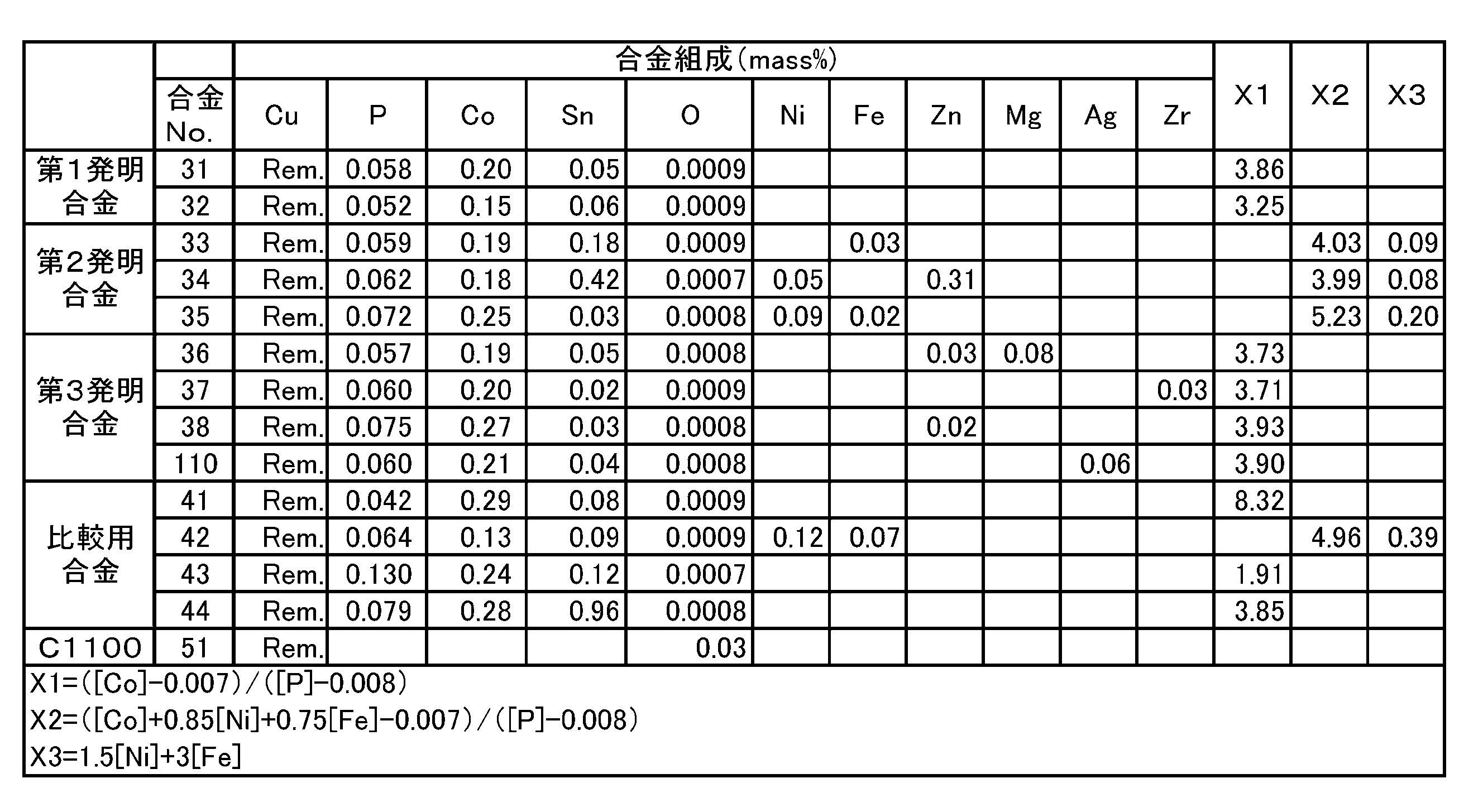
1.各工程上がりの棒線材の状態
2.各工程上がりの棒線材に上記の冷間圧縮を行なった状態
3.各工程上がりの棒線材に上記の冷間圧縮を行ない、さらに440℃×60分の熱処理([0097]と同様)を行った状態
後述する試験結果の各表において、「700℃30秒の耐熱性」の試験項目の「加熱前の加工」の欄に、各試料の試験状態をこの1から3の数字で表す。
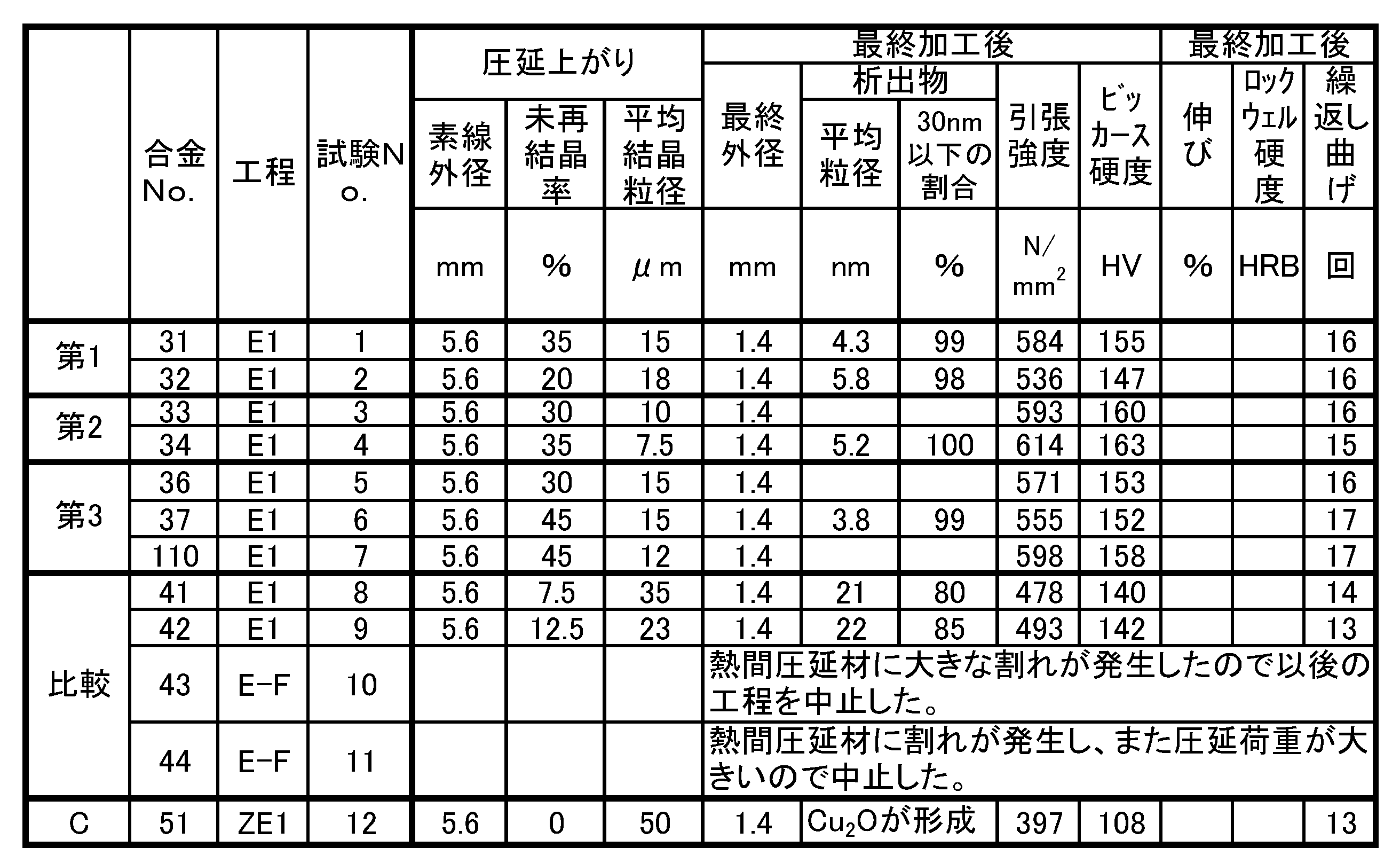

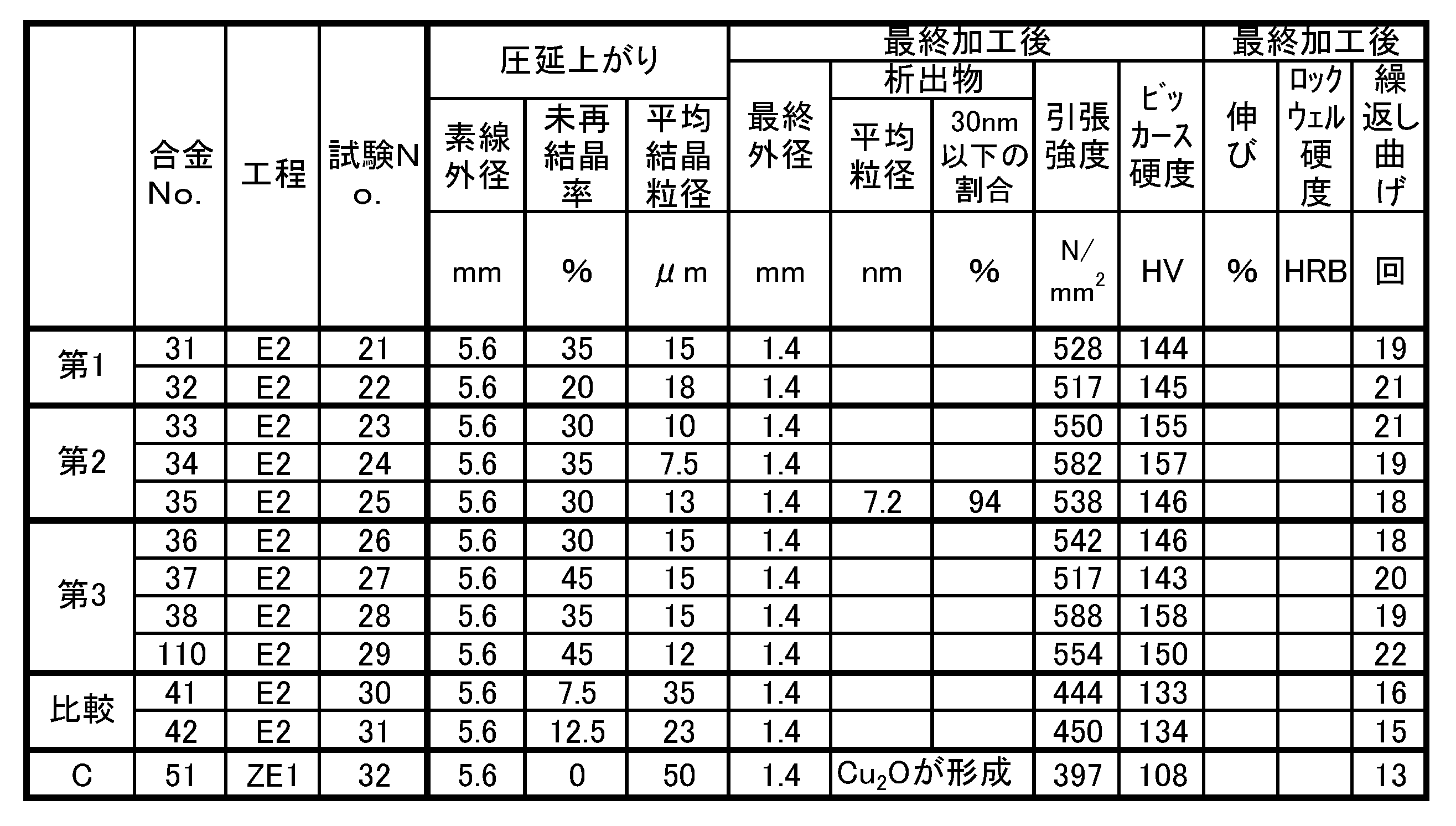
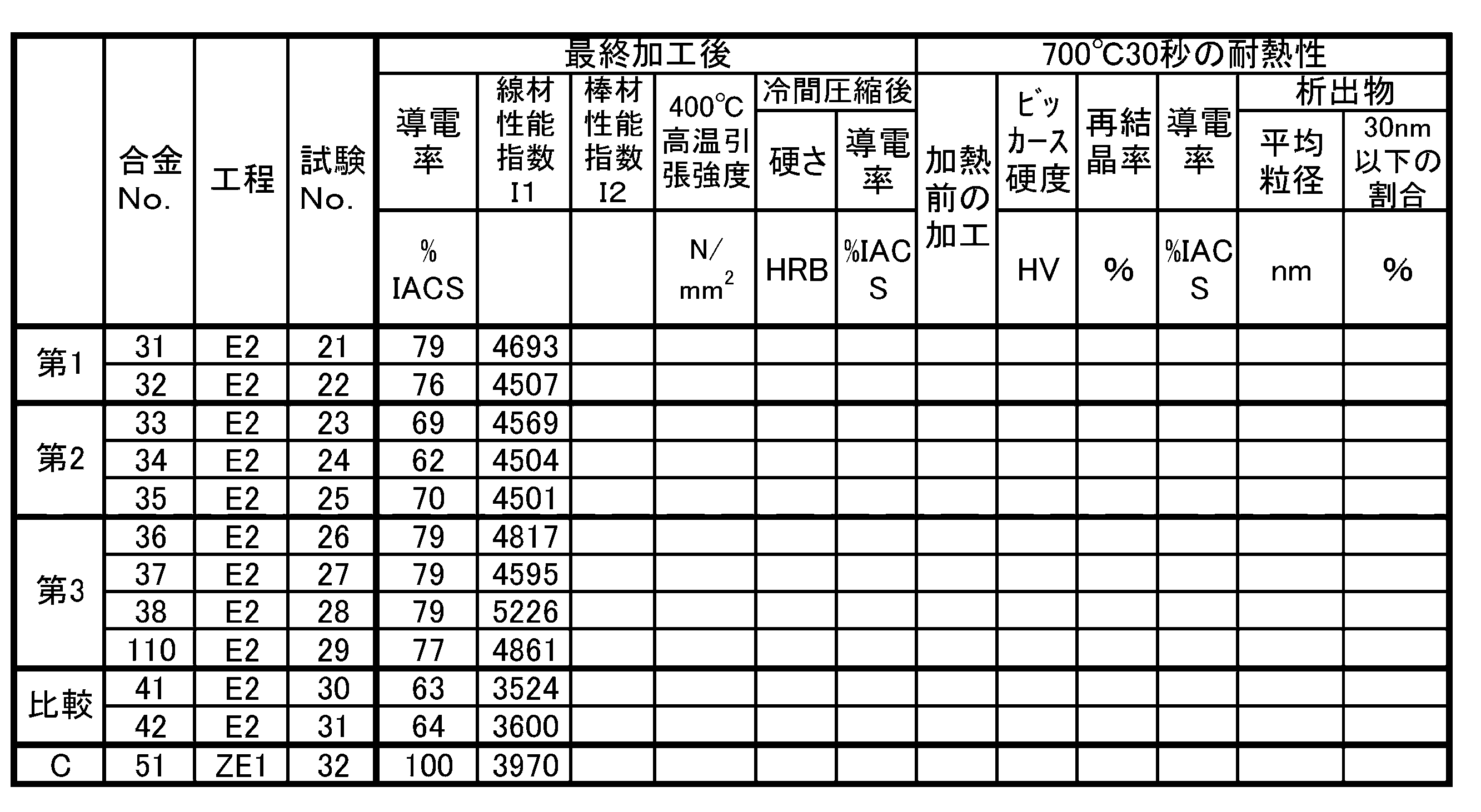
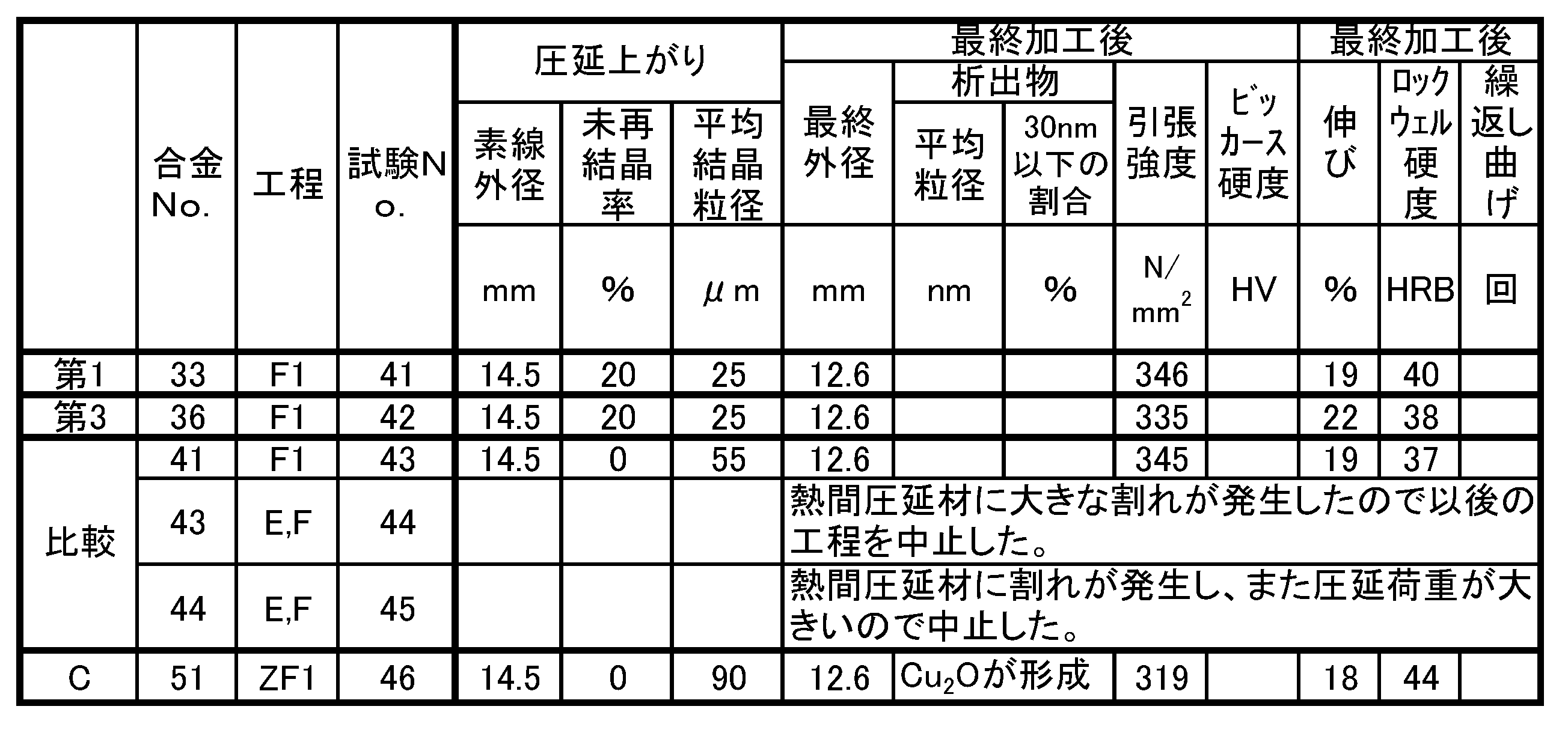
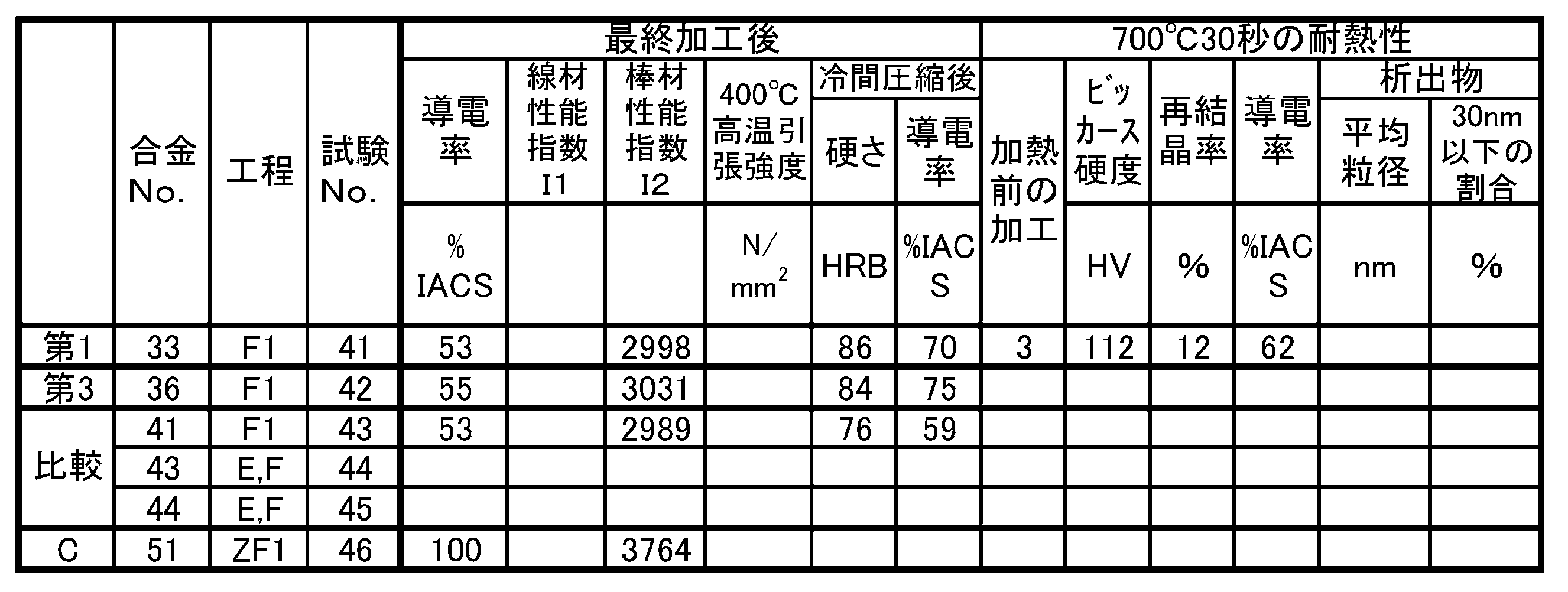
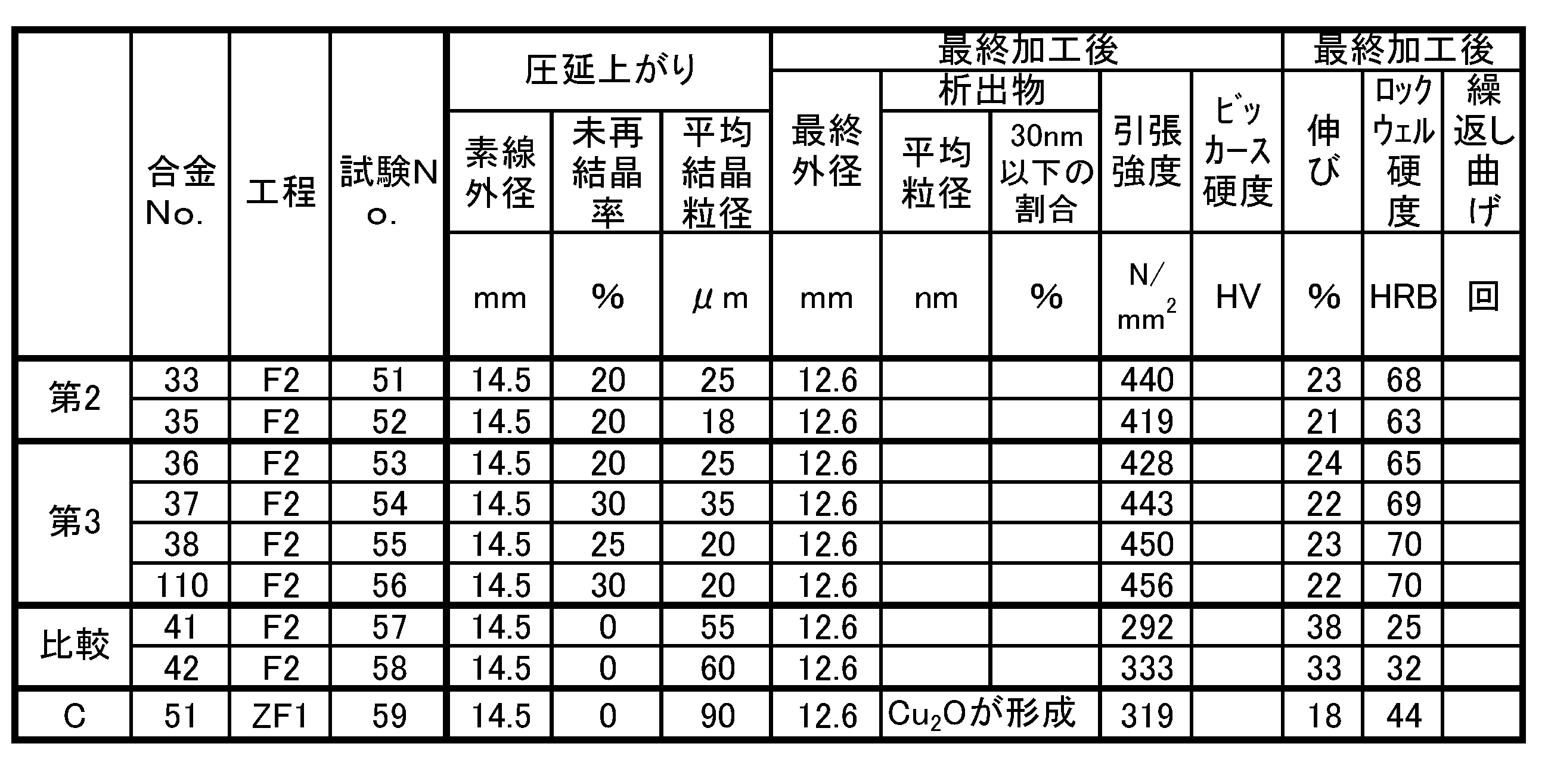

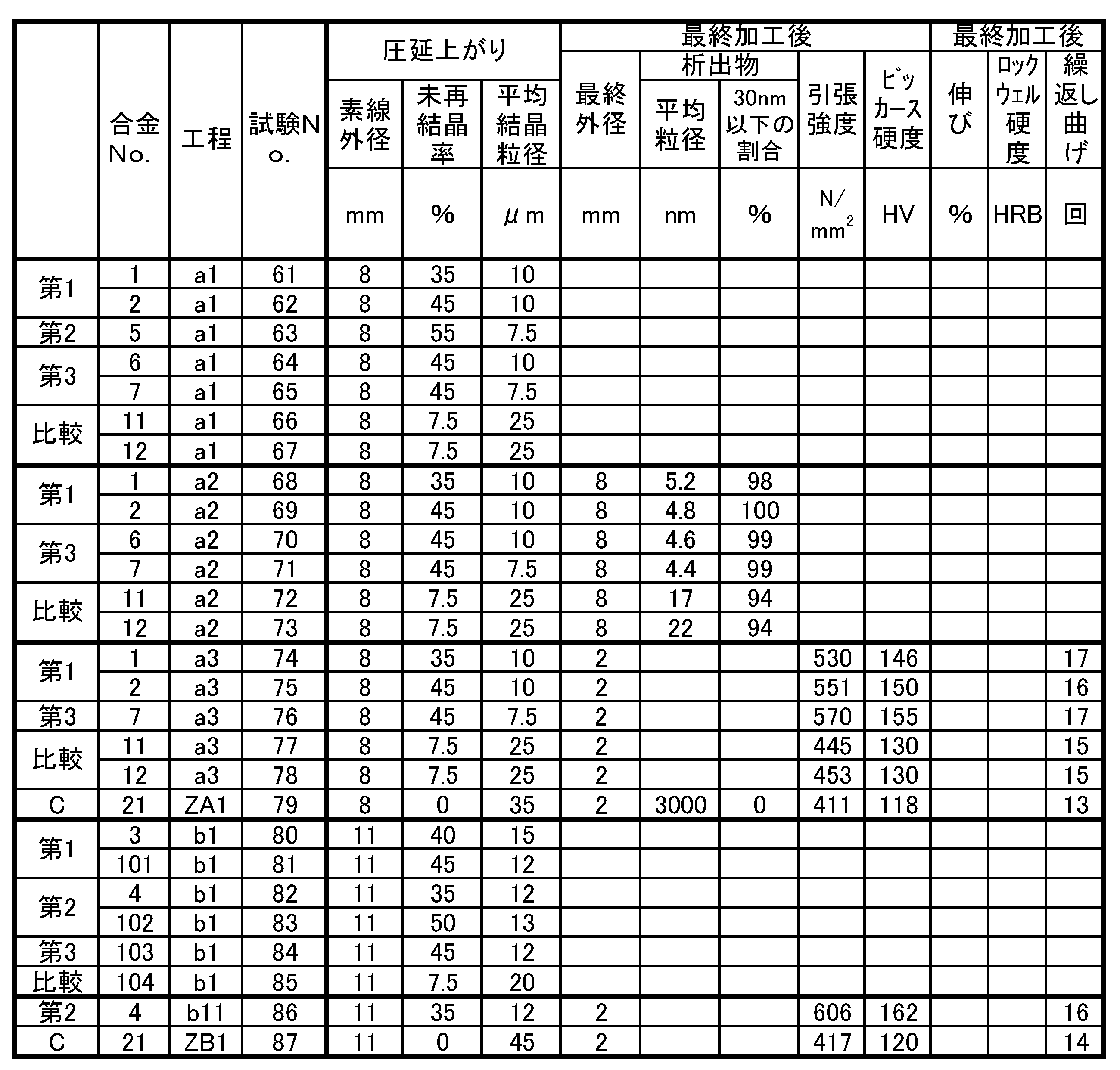
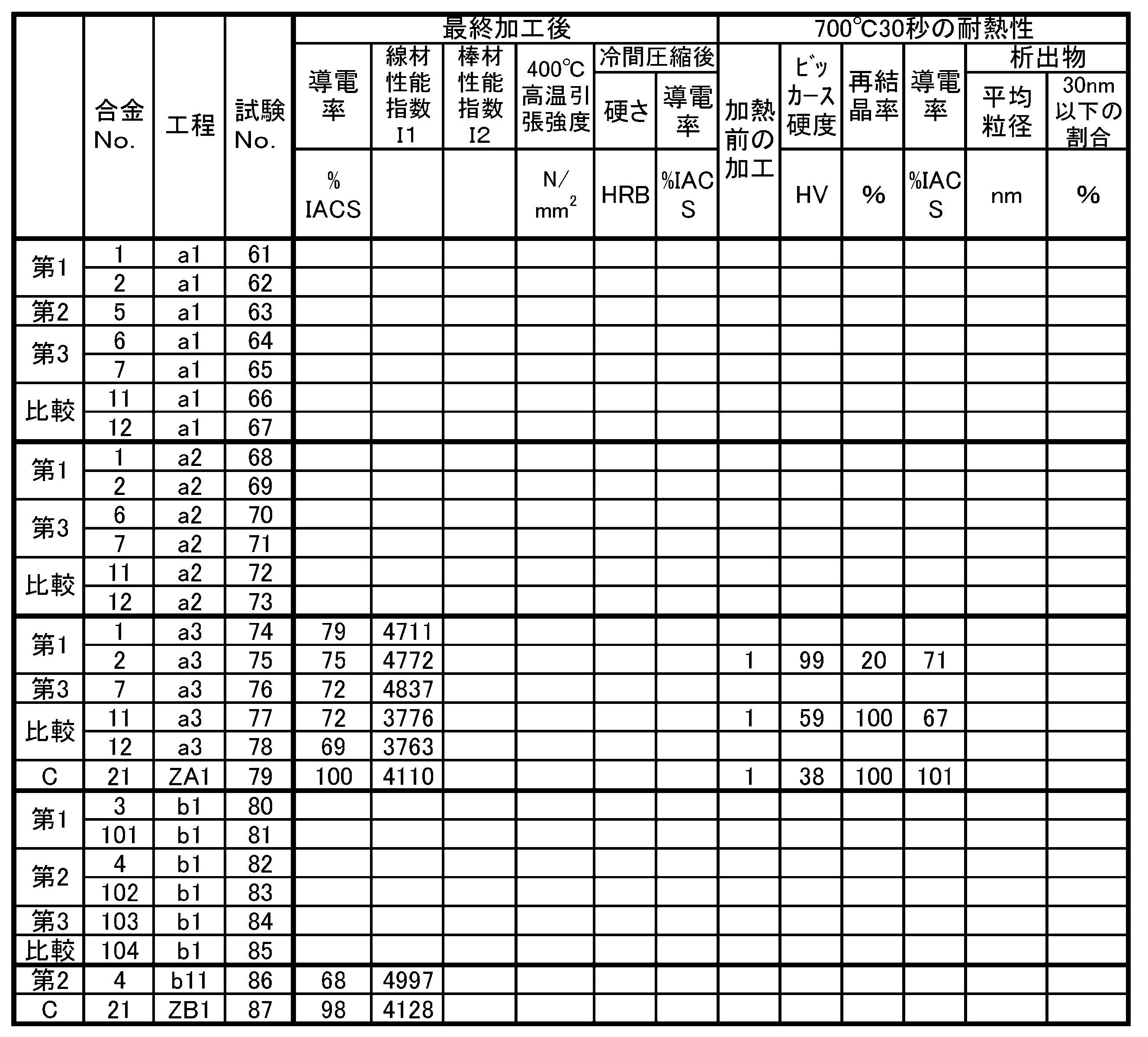
C1100は工程a3に対して工程ZA1の結果を、工程b11に対して工程ZB1の結果を示している。図7は合金No.1の発明合金とC1100において、金属組織を観察した結果を示す。図8は、透過型電子顕微鏡で工程a2における合金No.2の析出物を観察した結果を示す。
連続鋳造圧延後(工程a1、工程b1)では、発明合金は比較用合金と較べて未再結晶率が高く、結晶粒径が小さい。また、熱処理TH1後(工程a2)では、発明合金は比較用合金と較べて、析出物の平均粒径が小さく、30nm以下の析出物の割合が高くなっている。そして、発明合金は、外径2mmに伸ばされた後(工程a3、工程b11)は、比較用合金やC1100と比べて、引張強度やビッカース硬度や線材性能指数I1が非常に高い。
線材性能指数I1は、以後の本発明に係る高性能銅棒線材を含め、殆どの高性能銅棒線材で好ましい範囲である4500以上、さらには4700以上を満足する。また、繰り返し曲げ回数も、発明合金は、比較用合金やC1100と比べて、良好な結果となっている。導電率は、比較用合金がC1100の70%位なのに対し、各発明合金は80%位であり、比較用合金よりも良好な結果となっている。また、耐熱性においても、発明合金は比較用合金やC1100と比べて、ビッカース硬度が高く、再結晶率が低く、導電率も比較用合金と較べて高い。

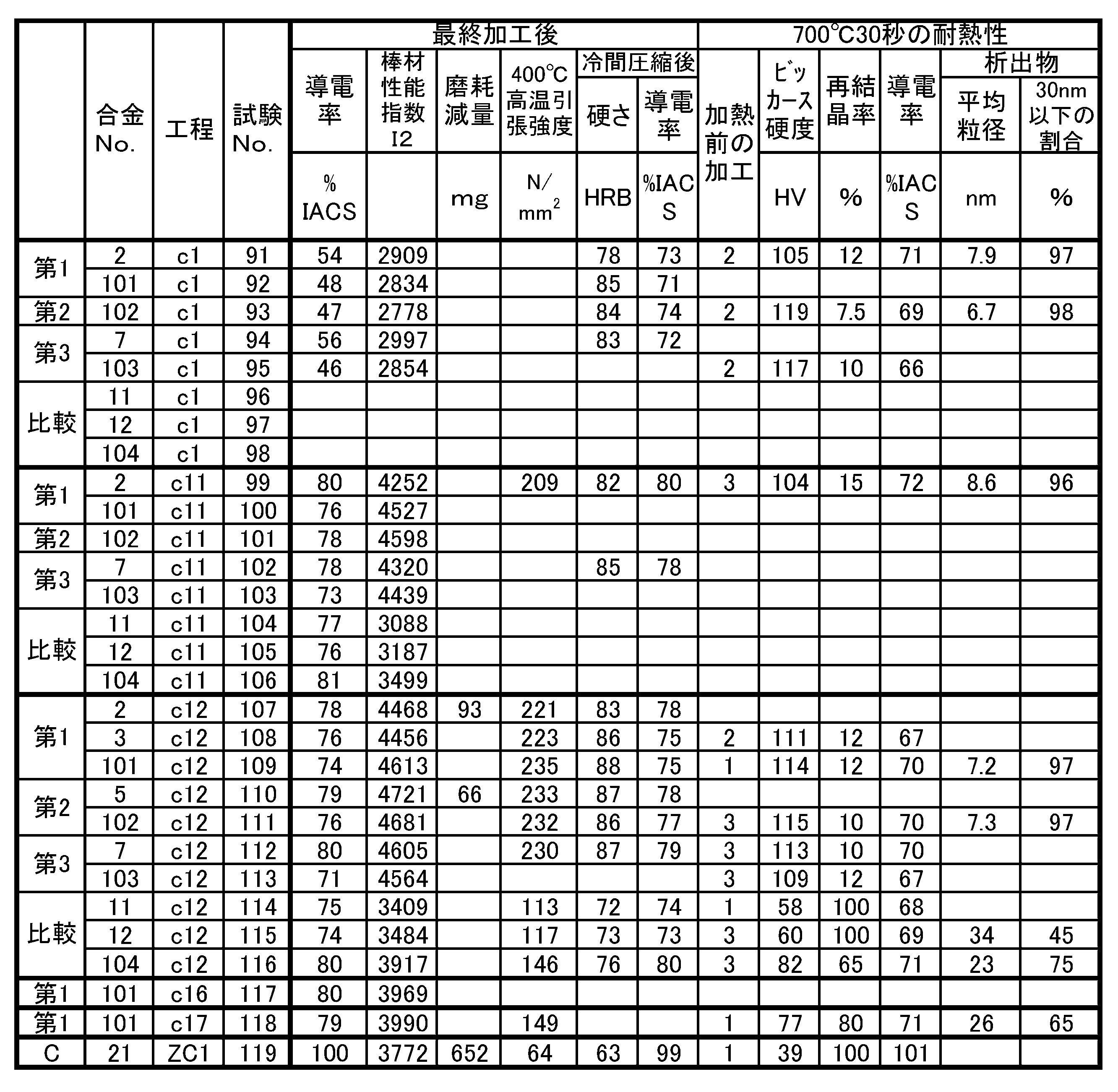
棒材性能指数I2は、以後の本発明に係る高性能銅棒線材を含め、殆どの高性能銅棒線材で好ましい範囲である4400以上を満足する。また、伸びも、発明合金は、比較用合金やC1100と比べて、若干良好な結果となっている。
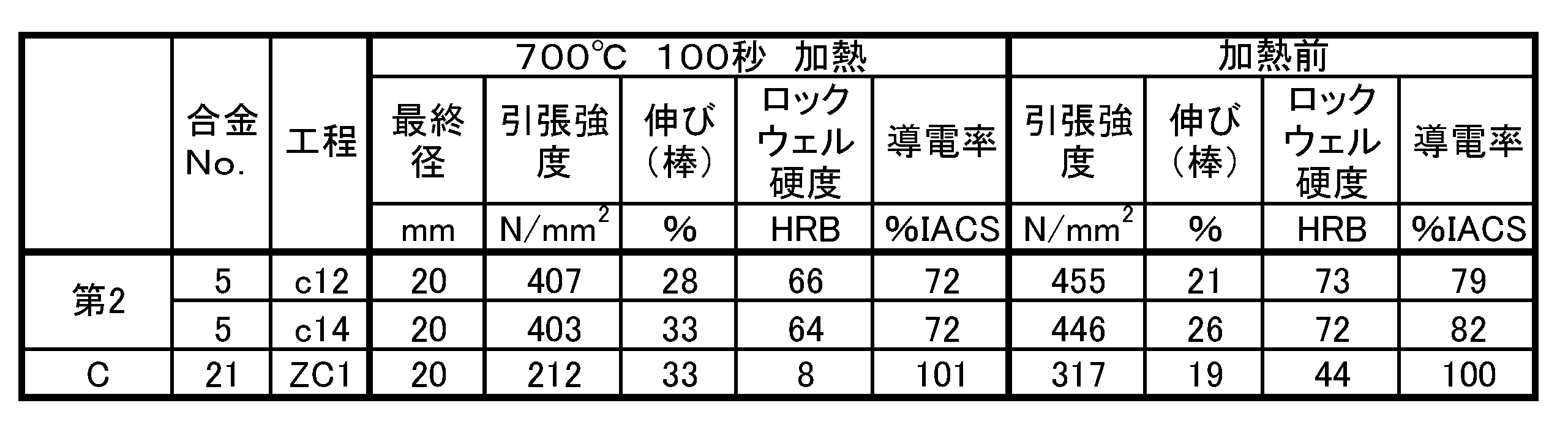


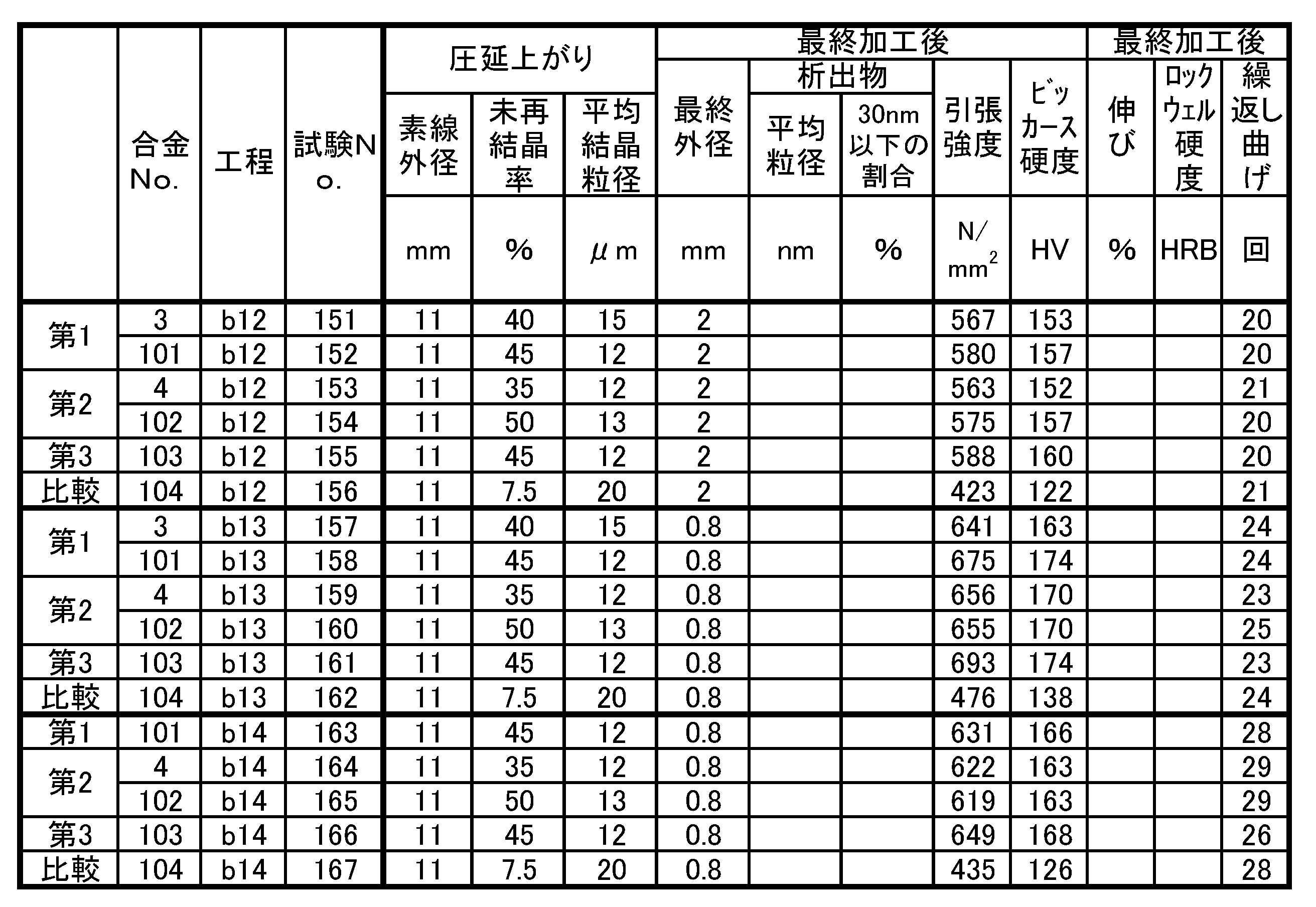

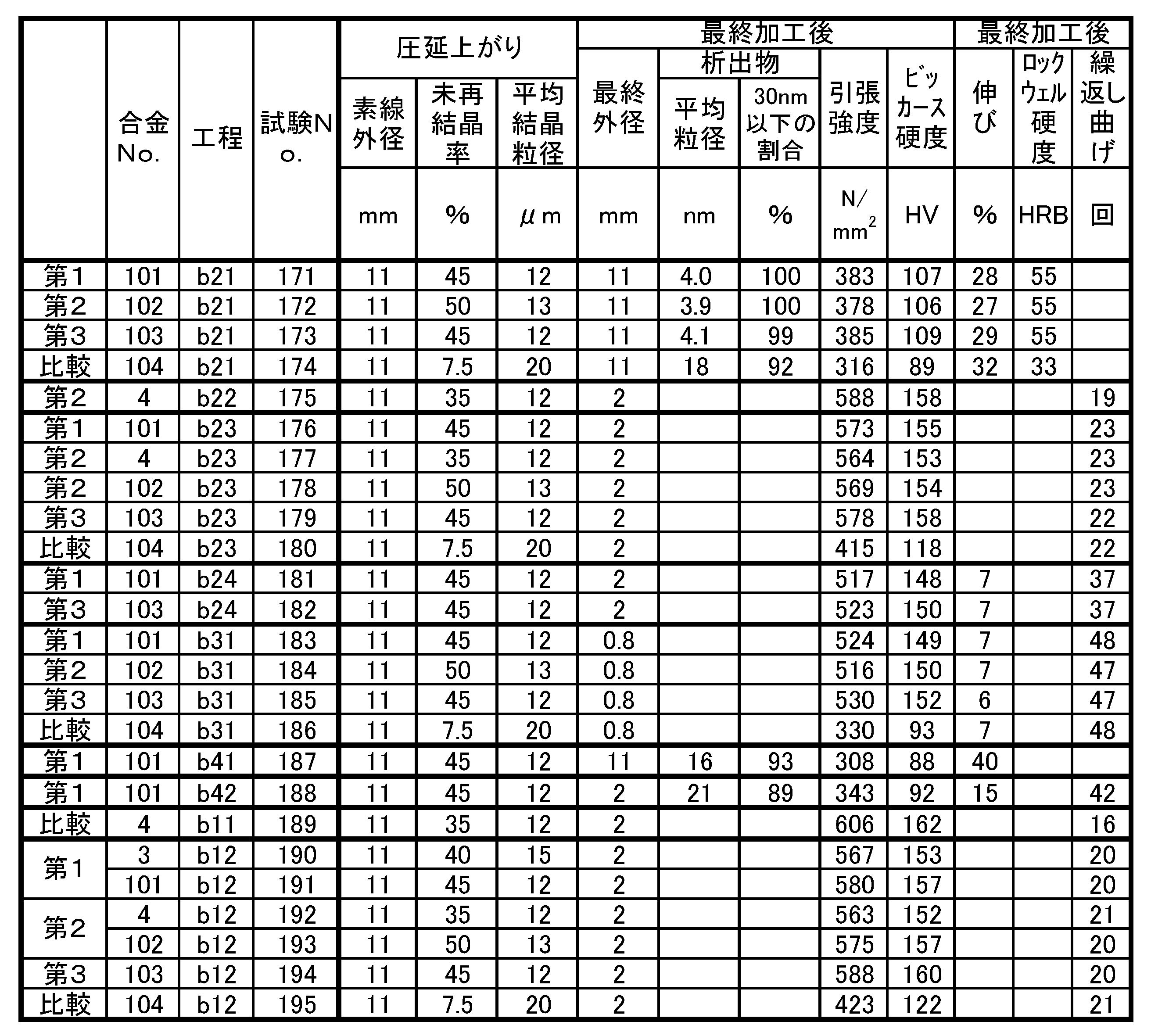


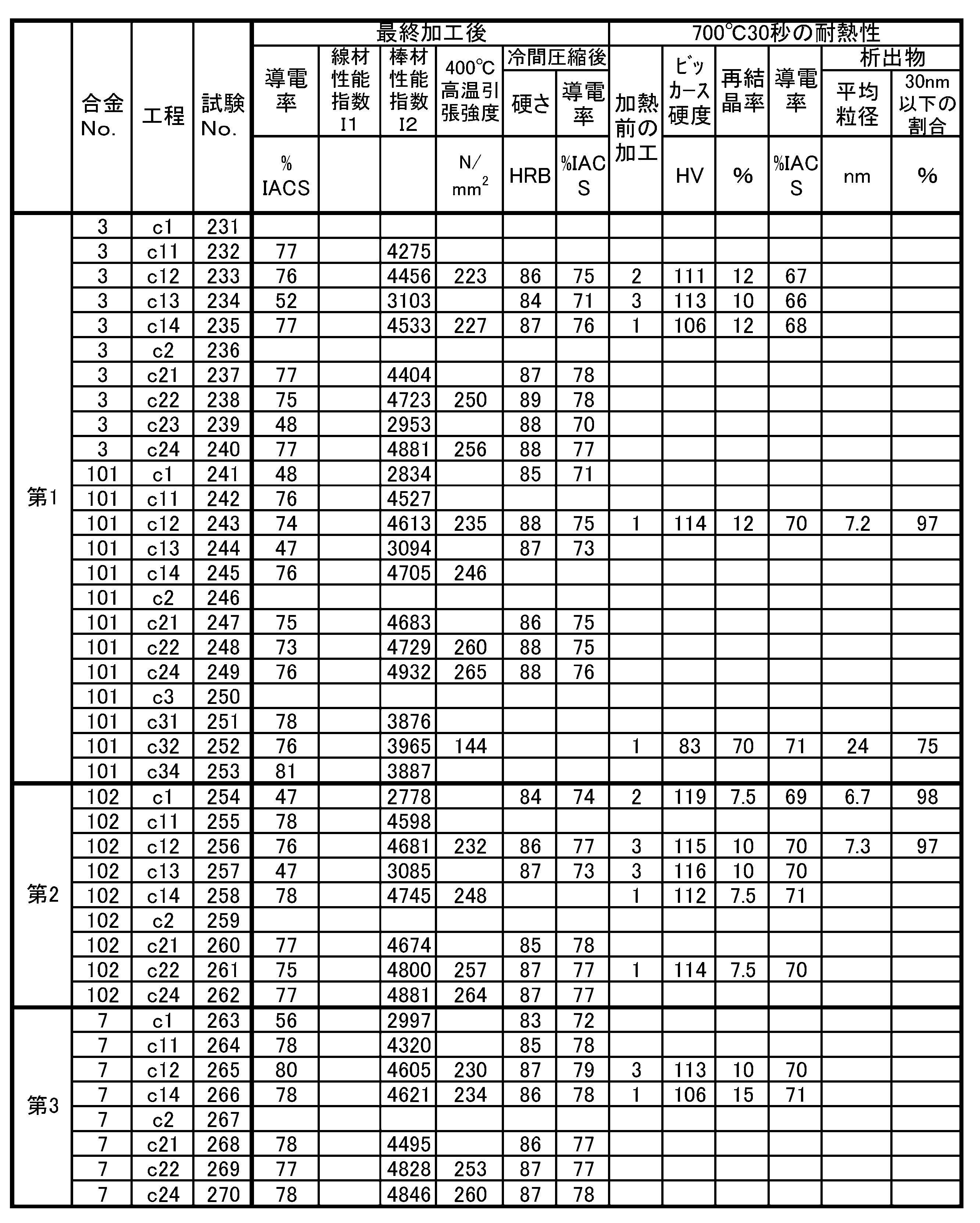
これらから得られた材料は、当然耐熱性も低い。


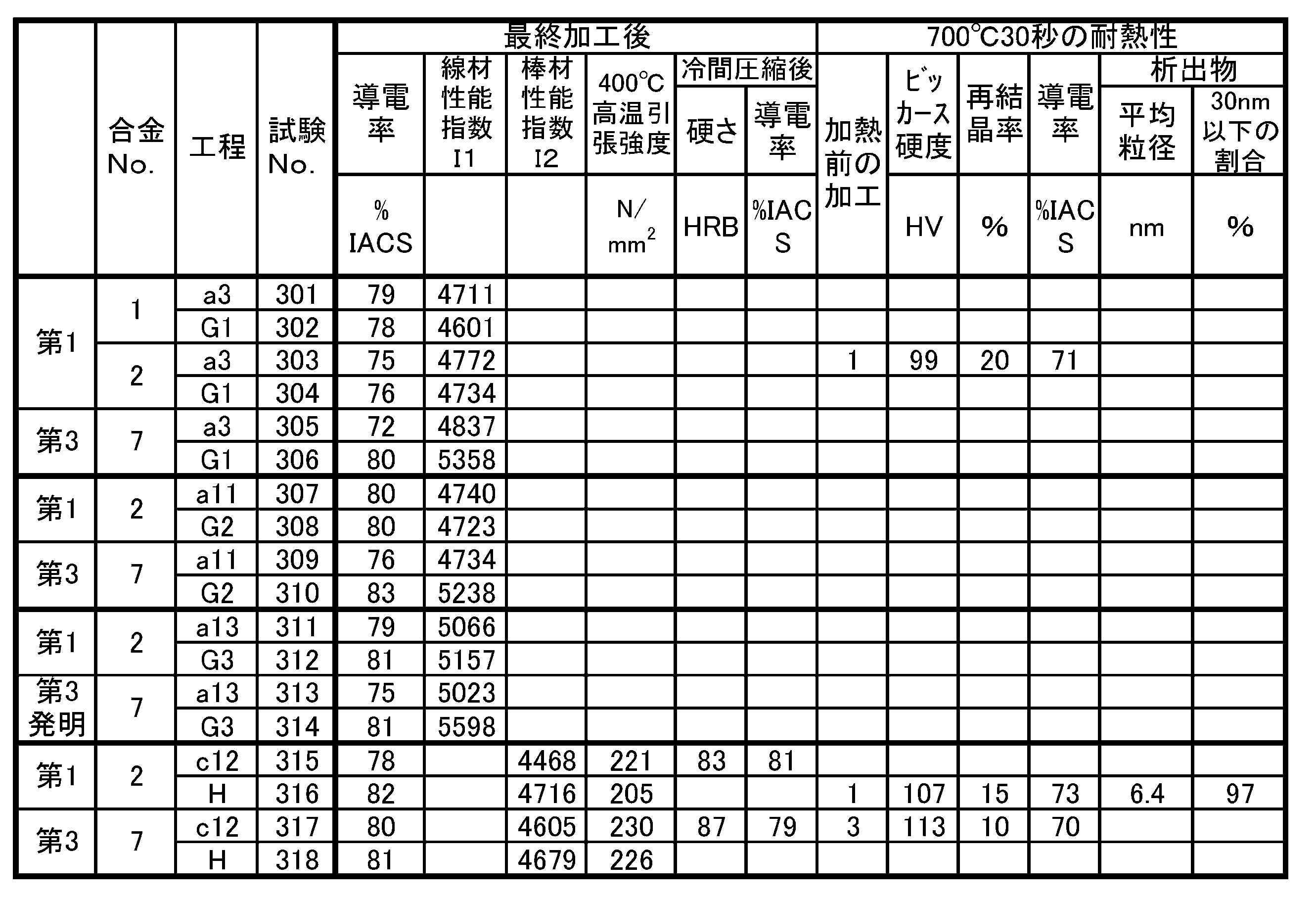
特に、析出硬化型銅合金の場合、700℃の高温に加熱、水冷すると20%IACS(絶対値)又は元の導電率の30%以上(相対値)低下するが、発明合金は、10%IACS以下(絶対値)の低下或いは、元の導電率に比べ、15%以下(相対値)の低下に留まっており、高導電を維持する。なお、比較合金はいずれもビッカース硬度、金属組織中の再結晶化率、析出物大きさを満足していない。
No.104は、Snの添加量が少ない。そのため、マトリックスの耐熱性が低いので、再結晶が低温側で起こり、未再結晶率が低く、析出粒子の大きさも大きい。そのため、強度が低くなり、線材性能指数I1や棒材性能指数I2も低くなっていると思われる。
Claims (15)
- 0.12~0.32mass%のCoと、0.042~0.095mass%のPと、0.005~0.70mass%のSnと、0.00005~0.0050mass%のOとを含有し、Coの含有量[Co]mass%とPの含有量[P]mass%との間に、3.0≦([Co]-0.007)/([P]-0.008)≦6.2の関係を有し、かつ残部がCu及び不可避不純物からなる合金組成であり、連続鋳造圧延を含む工程によって造られたことを特徴とする高強度高導電銅棒線材。
- 0.002~0.5mass%のZn、0.002~0.25mass%のMg、0.002~0.25mass%のAg、0.001~0.1mass%のZrのいずれか1種以上をさらに含有したことを特徴とする請求項1に記載の高強度高導電銅棒線材。
- 0.12~0.32mass%のCoと、0.042~0.095mass%のPと、0.005~0.70mass%のSnと、0.00005~0.0050mass%のOとを含有し、かつ0.01~0.15mass%のNi、又は0.005~0.07mass%のFeのいずれか1種以上を含有し、Coの含有量[Co]mass%とNiの含有量[Ni]mass%とFeの含有量[Fe]mass%とPの含有量[P]mass%との間に、3.0≦([Co]+0.85×[Ni]+0.75×[Fe]-0.007)/([P]-0.008)≦6.2、及び0.015≦1.5×[Ni]+3×[Fe]≦[Co」の関係を有し、かつ、残部がCu及び不可避不純物からなる合金組成であり、連続鋳造圧延を含む工程によって造られたことを特徴とする高強度高導電銅棒線材。
- 0.002~0.5mass%のZn、0.002~0.25mass%のMg、0.002~0.25mass%のAg、0.001~0.1mass%のZrのいずれか1種以上をさらに含有したことを特徴とする請求項3に記載の高強度高導電銅棒線材。
- 前記連続鋳造圧延におけるトータルの熱間加工率が75%以上、95%未満の場合は、前記連続鋳造圧延上がりでの金属組織の未再結晶率が1~60%で、かつ、再結晶部分の平均結晶粒径が4~40μmであり、前記熱間加工率が95%以上の場合は、前記連続鋳造圧延上がりでの金属組織の未再結晶率が、10~80%で、かつ、再結晶部の平均結晶粒径が2.5~25μmであることを特徴とする請求項1乃至請求項4のいずれか一項に記載の高強度高導電銅棒線材。
- 前記連続鋳造圧延における圧延開始温度が860℃から1000℃の間であり、トータルの熱間加工率が75%以上であり、850℃から400℃までの温度領域における平均冷却速度が10℃/秒以上であることを特徴とする請求項1乃至請求項4のいずれか一項に記載の高強度高導電銅棒線材。
- 前記連続鋳造圧延の後に冷間抽伸/伸線加工を施され、
前記冷間抽伸/伸線加工の前後、又は間に350℃~620℃で0.5~16時間の熱処理を施され、
略円形、又は略楕円形の微細な析出物が均一に分散しており、
前記析出物の平均粒径が2~20nmであるか、又は全ての析出物の90%以上が30nm以下の大きさであることを特徴とする請求項1乃至請求項4のいずれか一項に記載の高強度高導電銅棒線材。 - 冷間伸線加工の間、又は後に200~700℃で0.001秒~180分の熱処理を施され、
耐屈曲性に優れたことを特徴とする請求項1乃至請求項4のいずれか一項に記載の高強度高導電銅棒線材。 - 外径3mm以下の線材で、かつ耐屈曲性に優れたことを特徴とする請求項1乃至請求項4のいずれか一項に記載の高強度高導電銅棒線材。
- 外径3mm以下の線材で、導電率が45(%IACS)以上であって、導電率をR(%IACS)、引張強度をS(N/mm2)としたとき、(R1/2×S)の値が4300以上であり、かつ耐屈曲性に優れたことを特徴とする請求項1乃至請求項4のいずれか一項に記載の高強度高導電銅棒線材。
- ワイヤハーネスに使われることを特徴とする請求項1乃至請求項4のいずれか一項に記載の高強度高導電銅棒線材。
- 導電率が45(%IACS)以上で、伸びが5%以上であって、導電率をR(%IACS)、引張強度をS(N/mm2)、伸びをL(%)、としたとき、(R1/2×S×(100+L)/100)の値が4200以上であることを特徴とする請求項1乃至請求項4のいずれか一項に記載の高強度高導電銅棒線材。
- 400℃での引張強度が180(N/mm2)以上の高温強度を有することを特徴とする請求項1乃至請求項4のいずれか一項に記載の高強度高導電銅棒線材。
- 冷間鍛造用途、又はプレス用途に使われることを特徴とする請求項1乃至請求項4のいずれか一項に記載の高強度高導電銅棒線材。
- 700℃で30秒加熱後におけるビッカース硬度(HV)が90以上であって導電率が45(%IACS)以上であり、かつ、前記加熱後の金属組織中の析出物の平均粒径が2~20nmであるか、全ての前記析出物の90%以上が30nm以下であるか、又は前記金属組織中の再結晶化率が45%以下であることを特徴とする請求項1乃至請求項4のいずれか一項に記載の高強度高導電銅棒線材。
Priority Applications (8)
| Application Number | Priority Date | Filing Date | Title |
|---|---|---|---|
| KR1020127018025A KR101290900B1 (ko) | 2008-02-26 | 2009-02-23 | 고강도 고도전 구리봉 선재 |
| CN200980103780XA CN101932741B (zh) | 2008-02-26 | 2009-02-23 | 高强度高导电铜棒线材 |
| KR1020107010355A KR101291002B1 (ko) | 2008-02-26 | 2009-02-23 | 고강도 고도전 구리봉 선재 |
| US12/919,206 US9512506B2 (en) | 2008-02-26 | 2009-02-23 | High strength and high conductivity copper alloy rod or wire |
| JP2009540543A JP5394250B2 (ja) | 2008-02-26 | 2009-02-23 | 高強度高導電銅棒線材 |
| EP09713698.0A EP2246448B1 (en) | 2008-02-26 | 2009-02-23 | High-strength high-conductive copper wire |
| BRPI0907018-4A BRPI0907018B1 (pt) | 2008-02-26 | 2009-02-23 | Copper rod or wire and method for producing rod or wire |
| US15/297,633 US10163539B2 (en) | 2008-02-26 | 2016-10-19 | High strength and high conductivity copper alloy rod or wire |
Applications Claiming Priority (2)
| Application Number | Priority Date | Filing Date | Title |
|---|---|---|---|
| JP2008-044353 | 2008-02-26 | ||
| JP2008044353 | 2008-02-26 |
Related Child Applications (2)
| Application Number | Title | Priority Date | Filing Date |
|---|---|---|---|
| US12/919,206 A-371-Of-International US9512506B2 (en) | 2008-02-26 | 2009-02-23 | High strength and high conductivity copper alloy rod or wire |
| US15/297,633 Division US10163539B2 (en) | 2008-02-26 | 2016-10-19 | High strength and high conductivity copper alloy rod or wire |
Publications (1)
| Publication Number | Publication Date |
|---|---|
| WO2009107586A1 true WO2009107586A1 (ja) | 2009-09-03 |
Family
ID=41015980
Family Applications (1)
| Application Number | Title | Priority Date | Filing Date |
|---|---|---|---|
| PCT/JP2009/053220 Ceased WO2009107586A1 (ja) | 2008-02-26 | 2009-02-23 | 高強度高導電銅棒線材 |
Country Status (9)
| Country | Link |
|---|---|
| US (2) | US9512506B2 (ja) |
| EP (1) | EP2246448B1 (ja) |
| JP (2) | JP5394250B2 (ja) |
| KR (2) | KR101290900B1 (ja) |
| CN (1) | CN101932741B (ja) |
| BR (1) | BRPI0907018B1 (ja) |
| PT (1) | PT2246448T (ja) |
| TW (1) | TWI465588B (ja) |
| WO (1) | WO2009107586A1 (ja) |
Cited By (19)
| Publication number | Priority date | Publication date | Assignee | Title |
|---|---|---|---|---|
| US20110265916A1 (en) * | 2009-01-09 | 2011-11-03 | Mitsubishi Shindoh Co., Ltd. | High-strength and high-electrical conductivity copper alloy rolled sheet and method of manufacturing the same |
| JP2012028057A (ja) * | 2010-07-21 | 2012-02-09 | Yazaki Corp | 電線及び端子付電線 |
| WO2012060359A1 (ja) * | 2010-11-02 | 2012-05-10 | 三菱伸銅株式会社 | 銅合金熱間鍛造品及び銅合金熱間鍛造品の製造方法 |
| JP2014025137A (ja) * | 2012-07-30 | 2014-02-06 | Mitsubishi Materials Corp | 銅合金線及び銅合金線の製造方法 |
| WO2014020706A1 (ja) * | 2012-07-31 | 2014-02-06 | 三菱マテリアル株式会社 | 銅合金線及び銅合金線の製造方法 |
| JP2014025138A (ja) * | 2012-07-30 | 2014-02-06 | Mitsubishi Cable Ind Ltd | 銅合金トロリ線及び銅合金トロリ線の製造方法 |
| WO2014020707A1 (ja) * | 2012-07-31 | 2014-02-06 | 三菱電線工業株式会社 | 銅合金トロリ線及び銅合金トロリ線の製造方法 |
| WO2014020701A1 (ja) * | 2012-07-31 | 2014-02-06 | 三菱マテリアル株式会社 | 銅合金線及び銅合金線の製造方法 |
| JP2014025136A (ja) * | 2012-07-30 | 2014-02-06 | Mitsubishi Materials Corp | 銅合金線及び銅合金線の製造方法 |
| WO2014189103A1 (ja) | 2013-05-24 | 2014-11-27 | 三菱マテリアル株式会社 | 銅合金線 |
| US8986471B2 (en) | 2007-12-21 | 2015-03-24 | Mitsubishi Shindoh Co., Ltd. | High strength and high thermal conductivity copper alloy tube and method for producing the same |
| US9163300B2 (en) | 2008-03-28 | 2015-10-20 | Mitsubishi Shindoh Co., Ltd. | High strength and high conductivity copper alloy pipe, rod, or wire |
| US9455058B2 (en) | 2009-01-09 | 2016-09-27 | Mitsubishi Shindoh Co., Ltd. | High-strength and high-electrical conductivity copper alloy rolled sheet and method of manufacturing the same |
| US9512506B2 (en) | 2008-02-26 | 2016-12-06 | Mitsubishi Shindoh Co., Ltd. | High strength and high conductivity copper alloy rod or wire |
| WO2017222041A1 (ja) * | 2016-06-23 | 2017-12-28 | 三菱マテリアル株式会社 | 銅合金、銅合金鋳塊、銅合金溶体化材、及び、銅合金トロリ線、銅合金トロリ線の製造方法 |
| JP2018003154A (ja) * | 2016-06-23 | 2018-01-11 | 三菱マテリアル株式会社 | 銅合金、銅合金鋳塊及び銅合金溶体化材 |
| JP2018507326A (ja) * | 2015-02-02 | 2018-03-15 | イザベレンヒュッテ ホイスラー ゲー・エム・ベー・ハー ウント コンパニー コマンデイトゲゼルシャフト | 接続要素、特にネジまたはナット |
| JP2018083973A (ja) * | 2016-11-24 | 2018-05-31 | 三菱マテリアル株式会社 | 銅合金部材の製造方法 |
| US10266917B2 (en) | 2003-03-03 | 2019-04-23 | Mitsubishi Shindoh Co., Ltd. | Heat resistance copper alloy materials |
Families Citing this family (12)
| Publication number | Priority date | Publication date | Assignee | Title |
|---|---|---|---|---|
| JP5737273B2 (ja) * | 2012-11-15 | 2015-06-17 | 株式会社デンソー | 固定子巻線、および、固定子巻線の製造方法 |
| CN103924118B (zh) * | 2013-01-11 | 2017-07-28 | 株式会社Sh铜业 | 铜合金材料、电动汽车用的配电部件以及混合动力汽车用的配电部件 |
| CN103805927A (zh) * | 2013-11-28 | 2014-05-21 | 青岛蓝图文化传播有限公司市南分公司 | 一种铜棒材的生产工艺方法 |
| JP6488951B2 (ja) * | 2014-09-25 | 2019-03-27 | 三菱マテリアル株式会社 | 鋳造用モールド材及びCu−Cr−Zr合金素材 |
| CN105355322A (zh) * | 2015-11-09 | 2016-02-24 | 江西安讯实业股份有限公司 | 镀锡铜包铝线的制作方法 |
| JP6828444B2 (ja) * | 2017-01-10 | 2021-02-10 | 日立金属株式会社 | 導電線の製造方法、並びにケーブルの製造方法 |
| CN107755451B (zh) * | 2017-09-30 | 2019-02-12 | 重庆鸽牌电线电缆有限公司 | 大容量调相机用含银铜排的制备方法 |
| CN108118175B (zh) * | 2017-11-30 | 2019-06-07 | 重庆鸽牌电线电缆有限公司 | 大容量调相机用含银铜杆的制备方法 |
| CN113462923A (zh) * | 2020-03-31 | 2021-10-01 | 有研工程技术研究院有限公司 | 一种吊弦用高强高导铜镁系合金和线材及其制备方法 |
| CN115427595B (zh) * | 2021-03-23 | 2025-06-06 | 古河电气工业株式会社 | 铜合金线材 |
| CN115261666B (zh) * | 2022-07-18 | 2023-03-31 | 江西省金叶有色新材料研究院 | 一种无铅高强高导铍青铜棒材及其制造方法和应用 |
| JP2024060760A (ja) * | 2022-10-20 | 2024-05-07 | 三菱マテリアル株式会社 | Cu-Zn-Sn系合金の連続鋳造線棒材 |
Citations (5)
| Publication number | Priority date | Publication date | Assignee | Title |
|---|---|---|---|---|
| JP2001214226A (ja) * | 2000-01-28 | 2001-08-07 | Sumitomo Metal Mining Co Ltd | 端子用銅基合金、該合金条および該合金条の製造方法 |
| JP2004137551A (ja) | 2002-10-17 | 2004-05-13 | Hitachi Cable Ltd | 電車線用銅合金導体の製造方法及び電車線用銅合金導体 |
| WO2004079026A1 (ja) * | 2003-03-03 | 2004-09-16 | Sambo Copper Alloy Co.,Ltd. | 耐熱性銅合金材 |
| JP2004292917A (ja) * | 2003-03-27 | 2004-10-21 | Kobe Steel Ltd | 熱交換器用銅合金平滑管の製造方法及び熱交換器用銅合金内面溝付管の製造方法 |
| WO2007139213A1 (ja) * | 2006-06-01 | 2007-12-06 | The Furukawa Electric Co., Ltd. | 銅合金線材の製造方法および銅合金線材 |
Family Cites Families (48)
| Publication number | Priority date | Publication date | Assignee | Title |
|---|---|---|---|---|
| US2074713A (en) | 1935-10-19 | 1937-03-23 | United Eng Foundry Co | Means and method of making wire and the like |
| US4016010A (en) | 1976-02-06 | 1977-04-05 | Olin Corporation | Preparation of high strength copper base alloy |
| GB1562870A (en) | 1977-03-09 | 1980-03-19 | Louyot Comptoir Lyon Alemand | Copper alloys |
| US4260432A (en) | 1979-01-10 | 1981-04-07 | Bell Telephone Laboratories, Incorporated | Method for producing copper based spinodal alloys |
| US4388270A (en) | 1982-09-16 | 1983-06-14 | Handy & Harman | Rhenium-bearing copper-nickel-tin alloys |
| JPS60245754A (ja) | 1984-05-22 | 1985-12-05 | Nippon Mining Co Ltd | 高力高導電銅合金 |
| JPS60245753A (ja) | 1984-05-22 | 1985-12-05 | Nippon Mining Co Ltd | 高力高導電銅合金 |
| JPH0653901B2 (ja) * | 1986-09-08 | 1994-07-20 | 古河電気工業株式会社 | 電子電気機器用銅合金 |
| JPH0798980B2 (ja) | 1987-10-21 | 1995-10-25 | 株式会社ジャパンエナジー | 蒸留精製方法 |
| US5004498A (en) | 1988-10-13 | 1991-04-02 | Kabushiki Kaisha Toshiba | Dispersion strengthened copper alloy and a method of manufacturing the same |
| US5322575A (en) | 1991-01-17 | 1994-06-21 | Dowa Mining Co., Ltd. | Process for production of copper base alloys and terminals using the same |
| JPH0765131B2 (ja) | 1991-02-25 | 1995-07-12 | 株式会社神戸製鋼所 | 硬ろう付け性が優れた熱交換器用耐熱銅合金 |
| JPH0653901A (ja) * | 1992-07-31 | 1994-02-25 | Nippon Telegr & Teleph Corp <Ntt> | 移動通信の空きチャネル検出方法 |
| JPH0694390A (ja) | 1992-09-10 | 1994-04-05 | Kobe Steel Ltd | 熱交換器伝熱管用銅合金管及びその製造方法 |
| JP3302840B2 (ja) * | 1994-10-20 | 2002-07-15 | 矢崎総業株式会社 | 伸び特性及び屈曲特性に優れた導電用高力銅合金、及びその製造方法 |
| JP3550233B2 (ja) | 1995-10-09 | 2004-08-04 | 同和鉱業株式会社 | 高強度高導電性銅基合金の製造法 |
| JP3896422B2 (ja) | 1996-10-08 | 2007-03-22 | Dowaメタルテック株式会社 | バッキングプレート用銅合金およびその製造方法 |
| JP3347001B2 (ja) | 1996-10-31 | 2002-11-20 | 三宝伸銅工業株式会社 | 耐熱性銅基合金 |
| US6254702B1 (en) | 1997-02-18 | 2001-07-03 | Dowa Mining Co., Ltd. | Copper base alloys and terminals using the same |
| JPH1197609A (ja) | 1997-09-17 | 1999-04-09 | Dowa Mining Co Ltd | 酸化膜密着性に優れたリードフレーム用銅合金及びその製造方法 |
| JP3957391B2 (ja) | 1998-03-06 | 2007-08-15 | 株式会社神戸製鋼所 | 剪断加工性に優れる高強度、高導電性銅合金 |
| JP4228166B2 (ja) | 2000-04-28 | 2009-02-25 | 三菱マテリアル株式会社 | 疲労強度の優れた継目無銅合金管 |
| JP3794971B2 (ja) | 2002-03-18 | 2006-07-12 | 株式会社コベルコ マテリアル銅管 | 熱交換器用銅合金管 |
| US6895319B2 (en) | 2003-03-07 | 2005-05-17 | Deere & Company | Valve command signal processing system |
| CN1546701A (zh) | 2003-12-03 | 2004-11-17 | 海亮集团浙江铜加工研究所有限公司 | 一种耐蚀锡黄铜合金 |
| CN100514505C (zh) * | 2004-05-19 | 2009-07-15 | 住友电工钢线株式会社 | 用于束线的复合线及其制造方法 |
| JP4660735B2 (ja) | 2004-07-01 | 2011-03-30 | Dowaメタルテック株式会社 | 銅基合金板材の製造方法 |
| JP4441467B2 (ja) * | 2004-12-24 | 2010-03-31 | 株式会社神戸製鋼所 | 曲げ加工性及び耐応力緩和特性を備えた銅合金 |
| CN1333094C (zh) | 2005-05-26 | 2007-08-22 | 宁波博威集团有限公司 | 环保健康新型无铅易切削耐蚀低硼钙黄铜合金 |
| EP2439296B1 (en) | 2005-07-07 | 2013-08-28 | Kabushiki Kaisha Kobe Seiko Sho | Copper alloy having high strength and superior bending workability, and method for manufacturing copper alloy plates |
| JP3838521B1 (ja) * | 2005-12-27 | 2006-10-25 | 株式会社神戸製鋼所 | 高強度および優れた曲げ加工性を備えた銅合金およびその製造方法 |
| JP4756195B2 (ja) | 2005-07-28 | 2011-08-24 | Dowaメタルテック株式会社 | Cu−Ni−Sn−P系銅合金 |
| JP4655834B2 (ja) | 2005-09-02 | 2011-03-23 | 日立電線株式会社 | 電気部品用銅合金材とその製造方法 |
| EP1930453B1 (en) | 2005-09-30 | 2011-02-16 | Mitsubishi Shindoh Co., Ltd. | Melt-solidified copper alloy comprising phosphor and zirconium |
| JP4984108B2 (ja) | 2005-09-30 | 2012-07-25 | Dowaメタルテック株式会社 | プレス打抜き性の良いCu−Ni−Sn−P系銅合金およびその製造法 |
| US7795708B2 (en) * | 2006-06-02 | 2010-09-14 | Honeywell International Inc. | Multilayer structures for magnetic shielding |
| EP2388348B1 (en) | 2006-10-02 | 2013-07-31 | Kabushiki Kaisha Kobe Seiko Sho (Kobe Steel, Ltd.) | Copper alloy sheet for electric and electronic parts |
| WO2008041777A1 (en) | 2006-10-04 | 2008-04-10 | Sumitomo Light Metal Industries, Ltd. | Copper alloy for seamless pipes |
| JP4357536B2 (ja) * | 2007-02-16 | 2009-11-04 | 株式会社神戸製鋼所 | 強度と成形性に優れる電気電子部品用銅合金板 |
| KR20150063172A (ko) | 2007-10-16 | 2015-06-08 | 미츠비시 마테리알 가부시키가이샤 | 동합금선 제조 방법 |
| WO2009081664A1 (ja) | 2007-12-21 | 2009-07-02 | Mitsubishi Shindoh Co., Ltd. | 高強度・高熱伝導銅合金管及びその製造方法 |
| EP2246448B1 (en) | 2008-02-26 | 2016-10-12 | Mitsubishi Shindoh Co., Ltd. | High-strength high-conductive copper wire |
| US7928541B2 (en) | 2008-03-07 | 2011-04-19 | Kobe Steel, Ltd. | Copper alloy sheet and QFN package |
| CA2706199C (en) * | 2008-03-28 | 2014-06-10 | Mitsubishi Shindoh Co., Ltd. | High strength and high conductivity copper alloy pipe, rod, or wire |
| JP4913902B2 (ja) | 2008-08-05 | 2012-04-11 | 古河電気工業株式会社 | 電気・電子部品用銅合金材料の製造方法 |
| US10311991B2 (en) * | 2009-01-09 | 2019-06-04 | Mitsubishi Shindoh Co., Ltd. | High-strength and high-electrical conductivity copper alloy rolled sheet and method of manufacturing the same |
| JP4851626B2 (ja) | 2009-01-09 | 2012-01-11 | 三菱伸銅株式会社 | 高強度高導電銅合金圧延板及びその製造方法 |
| JP2011214226A (ja) * | 2010-03-31 | 2011-10-27 | Okihara Komusho:Kk | 鉄道用敷設物の凍結防止装置 |
-
2009
- 2009-02-23 EP EP09713698.0A patent/EP2246448B1/en active Active
- 2009-02-23 PT PT97136980T patent/PT2246448T/pt unknown
- 2009-02-23 WO PCT/JP2009/053220 patent/WO2009107586A1/ja not_active Ceased
- 2009-02-23 JP JP2009540543A patent/JP5394250B2/ja active Active
- 2009-02-23 KR KR1020127018025A patent/KR101290900B1/ko active Active
- 2009-02-23 US US12/919,206 patent/US9512506B2/en active Active
- 2009-02-23 KR KR1020107010355A patent/KR101291002B1/ko active Active
- 2009-02-23 BR BRPI0907018-4A patent/BRPI0907018B1/pt active IP Right Grant
- 2009-02-23 CN CN200980103780XA patent/CN101932741B/zh active Active
- 2009-02-26 TW TW098106209A patent/TWI465588B/zh active
-
2013
- 2013-08-01 JP JP2013160833A patent/JP5456927B2/ja active Active
-
2016
- 2016-10-19 US US15/297,633 patent/US10163539B2/en active Active
Patent Citations (5)
| Publication number | Priority date | Publication date | Assignee | Title |
|---|---|---|---|---|
| JP2001214226A (ja) * | 2000-01-28 | 2001-08-07 | Sumitomo Metal Mining Co Ltd | 端子用銅基合金、該合金条および該合金条の製造方法 |
| JP2004137551A (ja) | 2002-10-17 | 2004-05-13 | Hitachi Cable Ltd | 電車線用銅合金導体の製造方法及び電車線用銅合金導体 |
| WO2004079026A1 (ja) * | 2003-03-03 | 2004-09-16 | Sambo Copper Alloy Co.,Ltd. | 耐熱性銅合金材 |
| JP2004292917A (ja) * | 2003-03-27 | 2004-10-21 | Kobe Steel Ltd | 熱交換器用銅合金平滑管の製造方法及び熱交換器用銅合金内面溝付管の製造方法 |
| WO2007139213A1 (ja) * | 2006-06-01 | 2007-12-06 | The Furukawa Electric Co., Ltd. | 銅合金線材の製造方法および銅合金線材 |
Non-Patent Citations (1)
| Title |
|---|
| See also references of EP2246448A4 * |
Cited By (35)
| Publication number | Priority date | Publication date | Assignee | Title |
|---|---|---|---|---|
| US10266917B2 (en) | 2003-03-03 | 2019-04-23 | Mitsubishi Shindoh Co., Ltd. | Heat resistance copper alloy materials |
| US8986471B2 (en) | 2007-12-21 | 2015-03-24 | Mitsubishi Shindoh Co., Ltd. | High strength and high thermal conductivity copper alloy tube and method for producing the same |
| US10163539B2 (en) | 2008-02-26 | 2018-12-25 | Mitsubishi Shindoh Co., Ltd. | High strength and high conductivity copper alloy rod or wire |
| US9512506B2 (en) | 2008-02-26 | 2016-12-06 | Mitsubishi Shindoh Co., Ltd. | High strength and high conductivity copper alloy rod or wire |
| US9163300B2 (en) | 2008-03-28 | 2015-10-20 | Mitsubishi Shindoh Co., Ltd. | High strength and high conductivity copper alloy pipe, rod, or wire |
| US20110265916A1 (en) * | 2009-01-09 | 2011-11-03 | Mitsubishi Shindoh Co., Ltd. | High-strength and high-electrical conductivity copper alloy rolled sheet and method of manufacturing the same |
| US10311991B2 (en) | 2009-01-09 | 2019-06-04 | Mitsubishi Shindoh Co., Ltd. | High-strength and high-electrical conductivity copper alloy rolled sheet and method of manufacturing the same |
| US9455058B2 (en) | 2009-01-09 | 2016-09-27 | Mitsubishi Shindoh Co., Ltd. | High-strength and high-electrical conductivity copper alloy rolled sheet and method of manufacturing the same |
| CN103025905A (zh) * | 2010-07-21 | 2013-04-03 | 矢崎总业株式会社 | 电线和具有端子的电线 |
| DE112011102402B4 (de) | 2010-07-21 | 2020-07-30 | Yazaki Corporation | Draht mit Anschluss |
| US9263165B2 (en) | 2010-07-21 | 2016-02-16 | Yazaki Corporation | Electrical wire and electrical wire with terminal |
| US9786403B2 (en) | 2010-07-21 | 2017-10-10 | Yazaki Corporation | Electrical wire and electrical wire with terminal |
| JP2012028057A (ja) * | 2010-07-21 | 2012-02-09 | Yazaki Corp | 電線及び端子付電線 |
| CN103154285A (zh) * | 2010-11-02 | 2013-06-12 | 三菱伸铜株式会社 | 铜合金热锻件及铜合金热锻件的制造方法 |
| CN103154285B (zh) * | 2010-11-02 | 2014-11-12 | 三菱伸铜株式会社 | 铜合金热锻件及铜合金热锻件的制造方法 |
| JPWO2012060359A1 (ja) * | 2010-11-02 | 2014-05-12 | 三菱伸銅株式会社 | 銅合金熱間鍛造品及び銅合金熱間鍛造品の製造方法 |
| WO2012060359A1 (ja) * | 2010-11-02 | 2012-05-10 | 三菱伸銅株式会社 | 銅合金熱間鍛造品及び銅合金熱間鍛造品の製造方法 |
| JP2014025137A (ja) * | 2012-07-30 | 2014-02-06 | Mitsubishi Materials Corp | 銅合金線及び銅合金線の製造方法 |
| JP2014025136A (ja) * | 2012-07-30 | 2014-02-06 | Mitsubishi Materials Corp | 銅合金線及び銅合金線の製造方法 |
| JP2014025138A (ja) * | 2012-07-30 | 2014-02-06 | Mitsubishi Cable Ind Ltd | 銅合金トロリ線及び銅合金トロリ線の製造方法 |
| WO2014020707A1 (ja) * | 2012-07-31 | 2014-02-06 | 三菱電線工業株式会社 | 銅合金トロリ線及び銅合金トロリ線の製造方法 |
| CN104411845A (zh) * | 2012-07-31 | 2015-03-11 | 三菱综合材料株式会社 | 铜合金线及铜合金线的制造方法 |
| WO2014020706A1 (ja) * | 2012-07-31 | 2014-02-06 | 三菱マテリアル株式会社 | 銅合金線及び銅合金線の製造方法 |
| WO2014020701A1 (ja) * | 2012-07-31 | 2014-02-06 | 三菱マテリアル株式会社 | 銅合金線及び銅合金線の製造方法 |
| US10584400B2 (en) | 2013-05-24 | 2020-03-10 | Mitsubishi Materials Corporation | Copper alloy wire |
| CN105229181A (zh) * | 2013-05-24 | 2016-01-06 | 三菱综合材料株式会社 | 铜合金线 |
| KR20160013025A (ko) | 2013-05-24 | 2016-02-03 | 미쓰비시 마테리알 가부시키가이샤 | 구리 합금선 |
| JP2015004126A (ja) * | 2013-05-24 | 2015-01-08 | 三菱マテリアル株式会社 | 銅合金線 |
| WO2014189103A1 (ja) | 2013-05-24 | 2014-11-27 | 三菱マテリアル株式会社 | 銅合金線 |
| JP2018507326A (ja) * | 2015-02-02 | 2018-03-15 | イザベレンヒュッテ ホイスラー ゲー・エム・ベー・ハー ウント コンパニー コマンデイトゲゼルシャフト | 接続要素、特にネジまたはナット |
| US10619232B2 (en) | 2015-02-02 | 2020-04-14 | Isabellenhuette Heusler Gmbh & Co. Kg | Connecting element, in particular screw or nut |
| WO2017222041A1 (ja) * | 2016-06-23 | 2017-12-28 | 三菱マテリアル株式会社 | 銅合金、銅合金鋳塊、銅合金溶体化材、及び、銅合金トロリ線、銅合金トロリ線の製造方法 |
| JP2018003154A (ja) * | 2016-06-23 | 2018-01-11 | 三菱マテリアル株式会社 | 銅合金、銅合金鋳塊及び銅合金溶体化材 |
| AU2017282513B2 (en) * | 2016-06-23 | 2022-04-07 | Mitsubishi Materials Corporation | Copper alloy, copper alloy ingot, copper alloy solution forming material, copper alloy trolley wire and method for producing copper alloy trolley wire |
| JP2018083973A (ja) * | 2016-11-24 | 2018-05-31 | 三菱マテリアル株式会社 | 銅合金部材の製造方法 |
Also Published As
| Publication number | Publication date |
|---|---|
| CN101932741B (zh) | 2012-10-24 |
| KR20100068484A (ko) | 2010-06-23 |
| EP2246448A1 (en) | 2010-11-03 |
| BRPI0907018B1 (pt) | 2017-12-19 |
| CN101932741A (zh) | 2010-12-29 |
| TW201000650A (en) | 2010-01-01 |
| JPWO2009107586A1 (ja) | 2011-06-30 |
| US9512506B2 (en) | 2016-12-06 |
| TWI465588B (zh) | 2014-12-21 |
| EP2246448A4 (en) | 2014-07-02 |
| JP2013256717A (ja) | 2013-12-26 |
| US20170103825A1 (en) | 2017-04-13 |
| US20110100676A1 (en) | 2011-05-05 |
| KR101291002B1 (ko) | 2013-07-30 |
| KR101290900B1 (ko) | 2013-07-29 |
| JP5456927B2 (ja) | 2014-04-02 |
| US10163539B2 (en) | 2018-12-25 |
| BRPI0907018A2 (pt) | 2015-07-07 |
| PT2246448T (pt) | 2016-11-17 |
| BRPI0907018A8 (pt) | 2015-09-22 |
| JP5394250B2 (ja) | 2014-01-22 |
| EP2246448B1 (en) | 2016-10-12 |
| KR20120085343A (ko) | 2012-07-31 |
Similar Documents
| Publication | Publication Date | Title |
|---|---|---|
| JP5456927B2 (ja) | 高強度高導電銅棒線材 | |
| JP5051927B2 (ja) | 高強度高導電銅合金管・棒・線材 | |
| JP4851626B2 (ja) | 高強度高導電銅合金圧延板及びその製造方法 | |
| JP3961529B2 (ja) | 高強度銅合金 | |
| TWI443205B (zh) | 高強度高導電銅合金軋延板及其製造方法 | |
| JP2014095150A (ja) | コバルト、ニッケル、珪素を含む銅合金 | |
| JP2002180165A (ja) | プレス打ち抜き性に優れた銅基合金およびその製造方法 | |
| JP5619389B2 (ja) | 銅合金材料 | |
| CN102859016B (zh) | 铜合金伸展材、铜合金部件和铜合金伸展材的制造方法 | |
| JP4630387B1 (ja) | 銅合金展伸材、銅合金部品および銅合金展伸材の製造方法 | |
| JP5207927B2 (ja) | 高強度かつ高導電率を備えた銅合金 | |
| JP2006083465A (ja) | 曲げ加工性を備えた電気電子部品用銅合金板 | |
| JP7537643B2 (ja) | 銅合金材および銅合金材の製造方法 | |
| JP2012246530A (ja) | 銅合金展伸材 |
Legal Events
| Date | Code | Title | Description |
|---|---|---|---|
| WWE | Wipo information: entry into national phase |
Ref document number: 200980103780.X Country of ref document: CN |
|
| ENP | Entry into the national phase |
Ref document number: 2009540543 Country of ref document: JP Kind code of ref document: A |
|
| 121 | Ep: the epo has been informed by wipo that ep was designated in this application |
Ref document number: 09713698 Country of ref document: EP Kind code of ref document: A1 |
|
| ENP | Entry into the national phase |
Ref document number: 20107010355 Country of ref document: KR Kind code of ref document: A |
|
| WWE | Wipo information: entry into national phase |
Ref document number: 3469/DELNP/2010 Country of ref document: IN |
|
| REEP | Request for entry into the european phase |
Ref document number: 2009713698 Country of ref document: EP |
|
| WWE | Wipo information: entry into national phase |
Ref document number: 2009713698 Country of ref document: EP |
|
| NENP | Non-entry into the national phase |
Ref country code: DE |
|
| WWE | Wipo information: entry into national phase |
Ref document number: 12919206 Country of ref document: US |
|
| ENP | Entry into the national phase |
Ref document number: PI0907018 Country of ref document: BR Kind code of ref document: A2 Effective date: 20100616 |