WO2009107786A1 - 非水系電解液および非水系電解液電池 - Google Patents
非水系電解液および非水系電解液電池 Download PDFInfo
- Publication number
- WO2009107786A1 WO2009107786A1 PCT/JP2009/053701 JP2009053701W WO2009107786A1 WO 2009107786 A1 WO2009107786 A1 WO 2009107786A1 JP 2009053701 W JP2009053701 W JP 2009053701W WO 2009107786 A1 WO2009107786 A1 WO 2009107786A1
- Authority
- WO
- WIPO (PCT)
- Prior art keywords
- carbonate
- butylphenyl
- aqueous electrolyte
- phosphate
- weight
- Prior art date
- Legal status (The legal status is an assumption and is not a legal conclusion. Google has not performed a legal analysis and makes no representation as to the accuracy of the status listed.)
- Ceased
Links
Classifications
-
- H—ELECTRICITY
- H01—ELECTRIC ELEMENTS
- H01M—PROCESSES OR MEANS, e.g. BATTERIES, FOR THE DIRECT CONVERSION OF CHEMICAL ENERGY INTO ELECTRICAL ENERGY
- H01M10/00—Secondary cells; Manufacture thereof
- H01M10/05—Accumulators with non-aqueous electrolyte
- H01M10/052—Li-accumulators
- H01M10/0525—Rocking-chair batteries, i.e. batteries with lithium insertion or intercalation in both electrodes; Lithium-ion batteries
-
- H—ELECTRICITY
- H01—ELECTRIC ELEMENTS
- H01M—PROCESSES OR MEANS, e.g. BATTERIES, FOR THE DIRECT CONVERSION OF CHEMICAL ENERGY INTO ELECTRICAL ENERGY
- H01M10/00—Secondary cells; Manufacture thereof
- H01M10/05—Accumulators with non-aqueous electrolyte
- H01M10/056—Accumulators with non-aqueous electrolyte characterised by the materials used as electrolytes, e.g. mixed inorganic/organic electrolytes
- H01M10/0564—Accumulators with non-aqueous electrolyte characterised by the materials used as electrolytes, e.g. mixed inorganic/organic electrolytes the electrolyte being constituted of organic materials only
- H01M10/0566—Liquid materials
- H01M10/0567—Liquid materials characterised by the additives
-
- H—ELECTRICITY
- H01—ELECTRIC ELEMENTS
- H01M—PROCESSES OR MEANS, e.g. BATTERIES, FOR THE DIRECT CONVERSION OF CHEMICAL ENERGY INTO ELECTRICAL ENERGY
- H01M10/00—Secondary cells; Manufacture thereof
- H01M10/05—Accumulators with non-aqueous electrolyte
- H01M10/056—Accumulators with non-aqueous electrolyte characterised by the materials used as electrolytes, e.g. mixed inorganic/organic electrolytes
- H01M10/0564—Accumulators with non-aqueous electrolyte characterised by the materials used as electrolytes, e.g. mixed inorganic/organic electrolytes the electrolyte being constituted of organic materials only
- H01M10/0566—Liquid materials
- H01M10/0569—Liquid materials characterised by the solvents
-
- H—ELECTRICITY
- H01—ELECTRIC ELEMENTS
- H01M—PROCESSES OR MEANS, e.g. BATTERIES, FOR THE DIRECT CONVERSION OF CHEMICAL ENERGY INTO ELECTRICAL ENERGY
- H01M2300/00—Electrolytes
- H01M2300/0017—Non-aqueous electrolytes
- H01M2300/0025—Organic electrolyte
- H01M2300/0028—Organic electrolyte characterised by the solvent
- H01M2300/0037—Mixture of solvents
- H01M2300/0042—Four or more solvents
-
- H—ELECTRICITY
- H01—ELECTRIC ELEMENTS
- H01M—PROCESSES OR MEANS, e.g. BATTERIES, FOR THE DIRECT CONVERSION OF CHEMICAL ENERGY INTO ELECTRICAL ENERGY
- H01M4/00—Electrodes
- H01M4/02—Electrodes composed of, or comprising, active material
- H01M4/13—Electrodes for accumulators with non-aqueous electrolyte, e.g. for lithium-accumulators; Processes of manufacture thereof
- H01M4/131—Electrodes based on mixed oxides or hydroxides, or on mixtures of oxides or hydroxides, e.g. LiCoOx
-
- H—ELECTRICITY
- H01—ELECTRIC ELEMENTS
- H01M—PROCESSES OR MEANS, e.g. BATTERIES, FOR THE DIRECT CONVERSION OF CHEMICAL ENERGY INTO ELECTRICAL ENERGY
- H01M4/00—Electrodes
- H01M4/02—Electrodes composed of, or comprising, active material
- H01M4/13—Electrodes for accumulators with non-aqueous electrolyte, e.g. for lithium-accumulators; Processes of manufacture thereof
- H01M4/133—Electrodes based on carbonaceous material, e.g. graphite-intercalation compounds or CFx
-
- Y—GENERAL TAGGING OF NEW TECHNOLOGICAL DEVELOPMENTS; GENERAL TAGGING OF CROSS-SECTIONAL TECHNOLOGIES SPANNING OVER SEVERAL SECTIONS OF THE IPC; TECHNICAL SUBJECTS COVERED BY FORMER USPC CROSS-REFERENCE ART COLLECTIONS [XRACs] AND DIGESTS
- Y02—TECHNOLOGIES OR APPLICATIONS FOR MITIGATION OR ADAPTATION AGAINST CLIMATE CHANGE
- Y02E—REDUCTION OF GREENHOUSE GAS [GHG] EMISSIONS, RELATED TO ENERGY GENERATION, TRANSMISSION OR DISTRIBUTION
- Y02E60/00—Enabling technologies; Technologies with a potential or indirect contribution to GHG emissions mitigation
- Y02E60/10—Energy storage using batteries
Definitions
- the present invention relates to a non-aqueous electrolyte and a non-aqueous electrolyte battery using the same.
- Non-aqueous electrolyte batteries such as lithium secondary batteries are being put to practical use in a wide range of applications from so-called consumer power sources such as mobile phones and notebook computers to automotive in-vehicle power sources such as automobiles.
- consumer power sources such as mobile phones and notebook computers
- automotive in-vehicle power sources such as automobiles.
- the demand for higher performance of non-aqueous electrolyte batteries in recent years is increasing, and there is a demand for improvement in battery characteristics.
- the electrolyte used for a non-aqueous electrolyte battery is usually mainly composed of an electrolyte and a non-aqueous solvent.
- the main components of the non-aqueous solvent include cyclic carbonates such as ethylene carbonate and propylene carbonate; chain carbonates such as dimethyl carbonate, diethyl carbonate and ethyl methyl carbonate; cyclic carboxylic acid esters such as ⁇ -butyrolactone and ⁇ -valerolactone. It is used.
- Patent Document 1 proposes to protect the battery by increasing the internal resistance of the battery by mixing an additive that is polymerized at a battery voltage equal to or higher than the maximum operating voltage of the battery in the electrolyte.
- the internal electrical disconnection device provided for overcharge protection is ensured by mixing gas and an additive that generates pressure by polymerizing at a battery voltage above the maximum operating voltage of the battery in the electrolyte. It has been proposed to work.
- aromatic compounds, such as biphenyl, thiophene, and furan are disclosed as those additives.
- Patent Document 3 discloses a non-aqueous system in which phenylcyclohexane is added in a range of 0.1 to 20% by weight in a non-aqueous electrolyte solution in order to suppress deterioration of battery characteristics when biphenyl or thiophene is used.
- a non-aqueous electrolyte secondary battery system including an electrolyte secondary battery and a charge control system that senses an increase in battery temperature and disconnects a charging circuit has been proposed.
- Patent Document 4 by using an organic solvent selected from carbonates having a phenyl group, such as methylphenyl carbonate, esters, and ethers, the affinity of the electrolytic solution with the carbon electrode is improved, and lithium It proposes to reduce the size, performance and productivity of ion batteries.
- Patent Document 5 proposes adding a phosphoric acid triester to an electrolytic solution in order to improve cycle characteristics.
- Patent Document 6 discloses that diphenyl carbonate is contained in an amount of 0.5% by mass to 10% by mass and unsaturated compounds in order to suppress swelling of the battery during high temperature storage while suppressing a decrease in initial charge / discharge efficiency.
- a method of increasing the capacity of a battery it has been studied to pack as many active materials as possible in a limited battery volume.
- a method of pressurizing an active material layer of an electrode to increase the density a battery
- the design is such that the volume (for example, the amount of electrolytic solution) occupied other than the internal active material is minimized.
- the active material layer of the electrode is pressed to increase the density or the amount of the electrolytic solution is reduced, the active material cannot be used uniformly. Thereby, a part of lithium precipitates due to a non-uniform reaction, or deterioration of the active material is promoted, so that a problem that sufficient characteristics cannot be obtained easily occurs.
- a safety valve may be activated in a battery that senses this when the internal pressure is abnormally increased due to an abnormality such as overcharge and activates the safety valve. Further, in a battery without a safety valve, the battery may expand due to the pressure of the generated gas, and the battery itself may become unusable.
- the present invention has been made in view of the above-described conventional situation, and is a non-aqueous electrolyte battery that has a high capacity and is excellent in high-temperature storage characteristics and cycle characteristics after sufficiently increasing safety during overcharge. It is an object of the present invention to provide a non-aqueous electrolyte solution that can be realized and a high-performance non-aqueous electrolyte battery that can be miniaturized using the non-aqueous electrolyte solution.
- the gist of the present invention is as follows.
- a nonaqueous electrolytic solution containing an electrolyte and a nonaqueous solvent wherein the nonaqueous electrolytic solution contains any of the following (A) to (D):
- (A) A group comprising a compound represented by the following general formula (1) and further having a C C unsaturated bond, a cyclic carbonate having a fluorine atom, a monofluorophosphate, and a difluorophosphate
- R 1 represents an alkyl group having 1 to 12 carbon atoms which may have at least one of a halogen atom and a phenyl group.
- R 2 to R 6 are each independently selected. Represents a hydrogen atom or a halogen atom.
- B Non-aqueous electrolyte solution containing the compound represented by the following general formula (2) (second embodiment):
- R 7 represents an alkyl group having 1 to 12 carbon atoms which may have at least one of a halogen atom and a phenyl group.
- R 8 to R 12 are each independently selected.
- the proportion of (a) diphenyl carbonate in the non-aqueous electrolyte is 0.001 wt% or more and less than 5 wt%
- (B) The total proportion of at least one compound selected from the group consisting of vinylene carbonate, a cyclic carbonate compound having a fluorine atom, a monofluorophosphate and a difluorophosphate is 0.001 to 20% by weight
- the non-aqueous solvent contains ethylene carbonate and dialkyl carbonate
- a nonaqueous electrolytic solution (third aspect) in which the ratio of ethylene carbonate to the total of ethylene carbonate and dialkyl carbonate in the nonaqueous solvent is 5% by volume or more and 50% by volume or less;
- the nonaqueous electrolytic solution (A) contains the compound represented by the general formula (1) in a proportion of 0.001 wt% or more and less than 10 wt% in the nonaqueous electrolytic solution (A).
- the nonaqueous electrolyte solution according to (1) above which comprises (5)
- the nonaqueous electrolytic solution (B) contains the compound represented by the general formula (2) in a proportion of 0.001 wt% or more and less than 10 wt% in the nonaqueous electrolytic solution (B).
- the nonaqueous electrolytic solution (A) is characterized in that the nonaqueous solvent contains a cyclic carbonate selected from ethylene carbonate and propylene carbonate, an asymmetric chain dialkyl carbonate, and a symmetric chain dialkyl carbonate.
- the nonaqueous electrolytic solution (B) is characterized in that the nonaqueous solvent contains a cyclic carbonate selected from ethylene carbonate and propylene carbonate, an asymmetric chain dialkyl carbonate, and a symmetric chain dialkyl carbonate.
- the total proportion of at least one of the phosphate ester compound and the carboxylic acid ester compound in the non-aqueous electrolyte solution (D) is 0.001% by weight or more, 10
- a non-aqueous electrolyte solution comprising a methylphenyl carbonate and vinylene carbonate in a non-aqueous electrolyte solution containing an electrolyte and a non-aqueous solvent (a particularly preferable embodiment of the non-aqueous electrolyte solution (A)).
- a non-aqueous electrolyte solution containing an electrolyte and a non-aqueous solvent diphenyl carbonate and vinylene carbonate are contained, and the proportion of diphenyl carbonate in the non-aqueous electrolyte solution is 0.001 wt% or more and less than 5 wt%,
- the proportion of vinylene carbonate is 0.001 to 20% by weight
- the non-aqueous solvent contains ethylene carbonate and dialkyl carbonate
- the proportion of ethylene carbonate to the total of ethylene carbonate and dialkyl carbonate in the non-aqueous solvent is 5 volumes.
- Non-aqueous electrolyte solution (particularly preferred embodiment of non-aqueous electrolyte solution (C)) characterized by being not less than 50% and not more than 50% by volume.
- a nonaqueous electrolytic solution containing a electrolyte and a nonaqueous solvent, comprising tris (4-t-butylphenyl) phosphate and vinylene carbonate (nonaqueous electrolytic solution (D)) Particularly preferred embodiment).
- a non-aqueous electrolyte battery including a negative electrode and a positive electrode capable of inserting and extracting lithium ions, and a non-aqueous electrolyte solution, wherein the non-aqueous electrolyte solution is any one of the above (1) to (12)
- non-aqueous electrolyte battery having a high capacity and excellent in high-temperature storage characteristics and cycle characteristics while sufficiently enhancing safety during overcharge. Can achieve downsizing and high performance.
- the non-aqueous electrolyte solution of the present invention contains an electrolyte and a non-aqueous solvent that dissolves the electrolyte, as in the case of a conventional non-aqueous electrolyte solution, and usually contains them as main components.
- a lithium salt is usually used as the electrolyte.
- the lithium salt is not particularly limited as long as it is known to be used for this purpose. Any lithium salt can be used, and specific examples include the following.
- inorganic lithium salts such as LiPF 6 and LiBF 4 ; LiCF 3 SO 3 , LiN (CF 3 SO 2 ) 2 , LiN (C 2 F 5 SO 2 ) 2 , lithium cyclic 1,2-perfluoroethanedisulfonylimide , Lithium cyclic 1,3-perfluoropropanedisulfonylimide, LiN (CF 3 SO 2 ) (C 4 F 9 SO 2 ), LiC (CF 3 SO 2 ) 3 , LiPF 4 (CF 3 ) 2 , LiPF 4 ( C 2 F 5 ) 2 , LiPF 4 (CF 3 SO 2 ) 2 , LiPF 4 (C 2 F 5 SO 2 ) 2 , LiBF 2 (CF 3 ) 2 , LiBF 2 (C 2 F 5 ) 2 , LiBF 2 (CF 3 SO 2) 2, LiBF 2 (C 2 F 5 SO 2) fluorine-containing organic lithium salt and lithium bis 2, etc. (oxalate) volley , And lithium di
- LiPF 6 , LiBF 4 , LiCF 3 SO 3 , LiN (CF 3 SO 2 ) 2 or LiN (C 2 F 5 SO 2 ) 2 are preferable from the viewpoint of improving battery performance, and LiPF 6 or LiBF 4 is particularly preferable. preferable.
- lithium salts may be used alone or in combination of two or more.
- a preferable example in the case of using two or more lithium salts in combination is a combination of LiPF 6 and LiBF 4 , which has an effect of improving cycle characteristics.
- the lower limit of the proportion of LiBF 4 in the total of both is preferably 0.01% by weight or more, more preferably 0.1% by weight or more, and particularly preferably 0.2% by weight or more.
- the upper limit is preferably 20% by weight or less, more preferably 5% by weight or less, and particularly preferably 3% by weight or less. If the lower limit is not reached, the desired effect may be difficult to obtain. If the upper limit is exceeded, battery characteristics after high-temperature storage may be deteriorated.
- Another example is the combined use of an inorganic lithium salt and a fluorine-containing organic lithium salt.
- the proportion of the inorganic lithium salt in the total of both is 70% by weight or more and 99% by weight or less. It is desirable.
- Fluorine-containing organic lithium salts include LiN (CF 3 SO 2 ) 2 , LiN (C 2 F 5 SO 2 ) 2 , lithium cyclic 1,2-perfluoroethanedisulfonylimide, lithium cyclic 1,3-perfluoropropane It is preferably any of disulfonylimide.
- the combined use of both has the effect of suppressing deterioration due to high temperature storage.
- the lithium salt is preferably LiBF 4 or a combination of LiBF 4 and another.
- LiBF 4 preferably accounts for 40 mol% or more of the lithium salt.
- the proportion of LiBF 4 in the lithium salt is 40 mol% or more and 95 mol% or less, and the remainder is LiPF 6 , LiCF 3 SO 3 , LiN (CF 3 SO 2 ) 2 and LiN (C 2 F 5 SO 2 ) 2 is a combination selected from the group consisting of 2 .
- the concentration of these electrolytes in the non-aqueous electrolytic solution is not particularly limited in order to exhibit the effects of the present invention, but is usually 0.5 mol / liter or more, preferably 0.6 mol / liter or more, more Preferably it is 0.7 mol / liter or more.
- the upper limit is usually 3 mol / liter or less, preferably 2 mol / liter or less, more preferably 1.8 mol / liter or less, and still more preferably 1.5 mol / liter or less.
- the concentration of the electrolyte in the non-aqueous electrolyte is too low, the electrical conductivity of the electrolyte may be insufficient, whereas if the concentration is too high, the electrical conductivity may decrease due to an increase in viscosity. Battery performance may be reduced.
- the non-aqueous solvent can also be appropriately selected from conventionally known solvents for non-aqueous electrolyte solutions.
- Examples of the cyclic carbonates having no C ⁇ C unsaturated bond or fluorine atom include alkylene carbonates having an alkylene group having 2 to 4 carbon atoms such as ethylene carbonate, propylene carbonate, butylene carbonate, among these. , Ethylene carbonate and propylene carbonate are preferable from the viewpoint of improving battery characteristics, and ethylene carbonate is particularly preferable.
- the chain carbonate is preferably a dialkyl carbonate, and the number of carbon atoms of the alkyl group constituting the chain carbonate is preferably 1 to 5 and particularly preferably 1 to 4 for each of the two alkyl groups.
- symmetrical chain alkyl carbonates such as dimethyl carbonate, diethyl carbonate, and di-n-propyl carbonate
- asymmetric chain alkyl such as ethyl methyl carbonate, methyl-n-propyl carbonate, and ethyl-n-propyl carbonate
- dialkyl carbonates such as carbonates.
- dimethyl carbonate, diethyl carbonate, and ethyl methyl carbonate are preferable from the viewpoint of improving battery characteristics (particularly, high load discharge characteristics).
- cyclic ethers examples include tetrahydrofuran and 2-methyltetrahydrofuran.
- chain ethers examples include dimethoxyethane and dimethoxymethane.
- cyclic carboxylic acid esters examples include ⁇ -butyrolactone and ⁇ -valerolactone.
- chain carboxylic acid esters examples include methyl acetate, ethyl acetate, propyl acetate, butyl acetate, methyl propionate, ethyl propionate, propyl propionate, methyl butyrate, and ethyl butyrate.
- sulfur-containing organic solvent examples include sulfolane, 2-methyl sulfolane, 3-methyl sulfolane, diethyl sulfone and the like.
- Examples of the phosphorus-containing organic solvent include trimethyl phosphate, triethyl phosphate, dimethyl ethyl phosphate, methyl diethyl phosphate, ethylene methyl phosphate, ethylene ethyl phosphate, and the like.
- non-aqueous solvents may be used alone or in combination of two or more, but it is preferable to use in combination of two or more compounds.
- a high dielectric constant solvent such as alkylene carbonates or cyclic carboxylic acid esters in combination with a low viscosity solvent such as dialkyl carbonates or chain carboxylic acid esters.
- the non-aqueous solvent is a cyclic carbonate or an asymmetric chain dialkyl carbonate selected from ethylene carbonate and propylene carbonate. And symmetric chain dialkyl carbonate.
- One preferable combination of the non-aqueous solvents is a combination mainly composed of one or more of ethylene carbonate and dialkyl carbonate.
- the total of ethylene carbonate and dialkyl carbonate in the nonaqueous solvent is 70% by volume or more, preferably 80% by volume or more, more preferably 90% by volume or more, and relative to the total of ethylene carbonate and dialkyl carbonate.
- the proportion of ethylene carbonate is 5% by volume or more, preferably 10% by volume or more, more preferably 15% by volume or more, 50% by volume or less, preferably 35% by volume or less, more preferably 30% by volume or less, still more preferably 25% by volume or less.
- the non-aqueous solvent contains ethylene carbonate and dialkyl carbonate, and ethylene carbonate relative to the total of ethylene carbonate and dialkyl carbonate in the non-aqueous solvent.
- the ratio is 5 volume% or more and 50 volume% or less.
- the lower limit of the ratio of ethylene carbonate to the total of ethylene carbonate and dialkyl carbonate in the nonaqueous solvent is preferably 10% by volume or more, more preferably 15% by volume or more, and the upper limit is preferably 35% by volume or less. 30 volume% or less is more preferable, and 25 volume% or less is still more preferable.
- ethylene carbonate and dialkyl carbonate examples include ethylene carbonate and dimethyl carbonate, ethylene carbonate and diethyl carbonate, ethylene carbonate and ethyl methyl carbonate, ethylene carbonate and dimethyl carbonate and diethyl carbonate, ethylene carbonate and dimethyl carbonate and ethyl methyl.
- Examples thereof include carbonate, ethylene carbonate, diethyl carbonate and ethyl methyl carbonate, ethylene carbonate, dimethyl carbonate, diethyl carbonate and ethyl methyl carbonate.
- a combination in which propylene carbonate is further added to such a combination of ethylene carbonate and dialkyl carbonate is also a preferable combination.
- the volume ratio of ethylene carbonate to propylene carbonate is preferably 99: 1 to 40:60, particularly preferably 95: 5 to 50:50.
- the lower limit of the proportion of propylene carbonate in the entire non-aqueous solvent is usually 0.1% by volume or more, preferably 1% by volume or more, more preferably 2% by volume or more, and the upper limit is usually 20% by volume or less. Preferably it is 8 volume% or less, More preferably, it is 5 volume% or less.
- ethylene carbonate and dialkyl carbonate those containing asymmetric chain alkyl carbonate as dialkyl carbonate are more preferable, in particular, ethylene carbonate and dimethyl carbonate and ethyl methyl carbonate, ethylene carbonate, diethyl carbonate and ethyl methyl carbonate
- Cycle characteristics include ethylene carbonate, dimethyl carbonate, diethyl carbonate and ethyl methyl carbonate, which contain one or more of ethylene carbonate and symmetric chain alkyl carbonate and one or more of asymmetric chain alkyl carbonate.
- a large current discharge characteristic are preferable.
- the asymmetric chain alkyl carbonate is preferably ethyl methyl carbonate, and the alkyl group of the alkyl carbonate preferably has 1 to 2 carbon atoms.
- the lower limit of the proportion of diethyl carbonate in the total non-aqueous solvent is usually 10% by volume or more, preferably 20% by volume or more, more preferably 25%.
- a range in which the upper limit is usually 90% by volume or less, preferably 80% by volume or less, more preferably 75% by volume or less, and further preferably 70% by volume or less. It is preferable to contain it because it suppresses gas generation during high-temperature storage.
- the lower limit of the proportion of dimethyl carbonate in the total non-aqueous solvent is usually 10% by volume or more, preferably 20% by volume or more, more preferably 25%. More than 30% by volume, more preferably 30% by volume or more, and the upper limit is usually 90% by volume or less, preferably 80% by volume or less, more preferably 75% by volume or less, more preferably 70% by volume or less.
- the inclusion is preferable because the load characteristics of the battery are improved.
- the nonaqueous solvent may further contain another solvent.
- another example of the preferred non-aqueous solvent is selected from the group consisting of ethylene carbonate, propylene carbonate, ⁇ -butyrolactone, and ⁇ -valerolactone.
- One organic solvent or a mixed solvent composed of two or more organic solvents selected from the group accounts for 60% by volume or more of the whole. The non-aqueous electrolyte using this mixed solvent is less likely to evaporate or leak when used at high temperatures.
- the total of ethylene carbonate and ⁇ -butyrolactone in the non-aqueous solvent is 70% by volume or more, preferably 80% by volume or more, more preferably 90% by volume or more, and the combination of ethylene carbonate and ⁇ -butyrolactone.
- the volume ratio is 5:95 to 45:55, or the total of ethylene carbonate and propylene carbonate in the non-aqueous solvent is 70% by volume or more, preferably 80% by volume or more, more preferably 90% by volume or more.
- a volume ratio of ethylene carbonate to propylene carbonate of 30:70 to 60:40 is used, the balance between cycle characteristics and high temperature storage characteristics is generally improved.
- another example of a preferable non-aqueous solvent is one organic solvent selected from the group consisting of ethylene carbonate, propylene carbonate, ⁇ -butyrolactone and ⁇ -valerolactone, or from the group
- the mixed solvent composed of two or more selected organic solvents accounts for 60% by volume or more of the total, provided that ethylene carbonate has a ratio of ethylene carbonate to the total of ethylene carbonate and dialkyl carbonate in the nonaqueous solvent of 5%.
- the capacity is not less than 50% by volume.
- the non-aqueous electrolyte using this mixed solvent is less likely to evaporate or leak when used at high temperatures.
- the total of ethylene carbonate and ⁇ -butyrolactone in the non-aqueous solvent is 70% by volume or more, preferably 80% by volume or more, more preferably 90% by volume or more, and the combination of ethylene carbonate and ⁇ -butyrolactone.
- the volume ratio is 5:95 to 45:55, or the total of ethylene carbonate and propylene carbonate in the non-aqueous solvent is 70% by volume or more, preferably 80% by volume or more, more preferably 90% by volume or more.
- a volume ratio of ethylene carbonate to propylene carbonate of 30:70 to 60:40 is used, the balance between cycle characteristics and high temperature storage characteristics is generally improved.
- the capacity of the non-aqueous solvent is a measured value at 25 ° C., but the measured value at the melting point is used for a solid at 25 ° C. such as ethylene carbonate.
- R 1 represents an alkyl group having 1 to 12 carbon atoms which may have at least one of a halogen atom and a phenyl group.
- R 2 to R 6 are each independently selected. Represents a hydrogen atom or a halogen atom.
- the compound represented by the general formula (1) will be described in detail.
- the lower limit of the number of carbon atoms of the alkyl group represented by R 1 is usually 1 or more from the viewpoint of improving safety during overcharge and battery characteristics.
- the upper limit is usually 12 or less, preferably 8 or less, more preferably 6 or less, from the viewpoints of improving safety during overcharge, battery characteristics, and solubility in the electrolyte.
- Examples of the halogen atom that can be substituted with the alkyl group represented by R 1 include a fluorine atom, a chlorine atom, and a bromine atom. Among these, a fluorine atom is preferable from the viewpoint of battery characteristics.
- Examples of the alkyl group having 1 to 12 carbon atoms represented by R 1 include a methyl group, an ethyl group, an n-propyl group, an i-propyl group, an n-butyl group, an i-butyl group, a sec-butyl group, and a t-butyl group.
- Examples thereof include a butyl group, an n-pentyl group, a t-amyl group, a 1,1-dimethylbutyl group, a cyclobutyl group, a cyclopentyl group, a cyclohexyl group, a 1-methylcyclohexyl group, and a 1-ethylcyclohexyl group.
- R 2 to R 6 represent a hydrogen atom or a halogen atom.
- R 2 to R 6 are preferably hydrogen atoms from the viewpoint of improving safety during overcharge and battery characteristics.
- Examples of the halogen atom represented by R 2 to R 6 include a fluorine atom, a chlorine atom, and a bromine atom. Among these, a fluorine atom is preferable from the viewpoint of battery characteristics.
- Specific examples of the compound represented by the general formula (1) include the following. Methyl phenyl carbonate, Ethyl phenyl carbonate, n-propylphenyl carbonate, i-propyl phenyl carbonate, n-butylphenyl carbonate, i-butylphenyl carbonate, sec-butylphenyl carbonate, t-butylphenyl carbonate, n-pentylphenyl carbonate, t-amyl phenyl carbonate, (1,1-dimethylbutyl) phenyl carbonate, Cyclobutylphenyl carbonate, Cyclopentyl phenyl carbonate, Cyclohexyl phenyl carbonate, (2-methylcyclohexyl) phenyl carbonate, (2-ethylcyclohexyl) phenyl carbonate, Fluoromethylphenyl carbonate, (1-fluoroethyl) phenyl carbonate,
- (4-fluorophenyl) methyl carbonate Ethyl (4-fluorophenyl) carbonate, (4-fluorophenyl) n-propyl carbonate, (4-fluorophenyl) i-propyl carbonate, n-butyl (4-fluorophenyl) carbonate, i-butyl (4-fluorophenyl) carbonate, sec-butyl (4-fluorophenyl) carbonate, t-butyl (4-fluorophenyl) carbonate, (4-fluorophenyl) n-pentyl carbonate, t-amyl (4-fluorophenyl) carbonate, (4-fluorophenyl) (1,1-dimethylbutyl) carbonate,
- R 2 to R 6 are hydrogen atoms, Methyl phenyl carbonate, Ethyl phenyl carbonate, n-propylphenyl carbonate, i-propyl phenyl carbonate, n-butylphenyl carbonate, i-butylphenyl carbonate, sec-butylphenyl carbonate, t-butylphenyl carbonate, n-pentylphenyl carbonate, t-amyl phenyl carbonate, (1,1-dimethylbutyl) phenyl carbonate, Cyclobutylphenyl carbonate, Cyclopentyl phenyl carbonate, Cyclohexyl phenyl carbonate, (2-methylcyclohexyl) phenyl carbonate, (2-ethylcyclohexyl) phenyl carbonate, Fluoromethylphenyl carbonate,
- the proportion of the compound represented by the general formula (1) in the non-aqueous electrolyte is usually 0.001% by weight or more, preferably 0.01% by weight or more, more preferably 0.05% by weight or more, particularly preferably. It is 0.1% by weight or more. If the concentration is lower than this, the effects of the present invention may not be easily exhibited. On the other hand, if the concentration is too high, the capacity of the battery may decrease. Therefore, the upper limit is usually less than 10% by weight, preferably 5% by weight or less, more preferably 3% by weight or less, and particularly preferably 2% by weight or less. Most preferably, it is 1.5% by weight or less.
- the content of these compounds in the non-aqueous electrolyte is usually 0.001% by weight or more, preferably 0.01% by weight or more, more preferably 0.1% by weight or more, particularly preferably 0.3% by weight or more, Most preferably, it is 0.5 weight% or more. If the content is higher than the lower limit, the cycle characteristics and high-temperature storage characteristics of the battery can be improved, and if the content is lower than the upper limit, an increase in the amount of gas generated during high-temperature storage can be prevented.
- the upper limit is usually 10% by weight or less, preferably 5% by weight or less, more preferably 3% by weight or less, and particularly preferably 2% by weight or less.
- the cyclic carbonate having a fluorine atom has different effects depending on the content.
- the cyclic carbonate having a fluorine atom is used as an additive, that is, when the content is 0.001 wt% or more and 10 wt% or less, the above-described effects of the present invention are exhibited.
- a cyclic carbonate having a fluorine atom is used as a non-aqueous solvent instead of the above-described alkylene carbonate having 2 to 4 carbon atoms used as the non-aqueous solvent, that is, when more than 10% by weight is used, the above-mentioned
- the storage characteristics particularly when using high voltage are improved.
- ⁇ C C cyclic carbonate having an unsaturated bond>
- Vinylene carbonate compounds such as vinylene carbonate; vinyl ethylene carbonate, 4-methyl-4-vinylethylene carbonate, 4-ethyl-4-vinylethylene carbonate, 4-n-propyl-4-vinylethylene carbonate, 5-methyl-4- Vinyl ethylene carbonate such as vinyl ethylene carbonate, 4,4-divinyl ethylene carbonate, 4,5-divinyl ethylene carbonate; 4,4-dimethyl-5-methylene ethyl Carbonates, such as methylene ethylene carbonate compounds such as 4,4-diethyl-5-methylene ethylene carbonate.
- vinylene carbonate, vinyl ethylene carbonate, 4-methyl-4-vinyl ethylene carbonate or 4,5-divinyl ethylene carbonate are preferable from the viewpoint of improving cycle characteristics and high temperature storage characteristics.
- vinylene carbonate or vinyl ethylene carbonate is preferred. Is more preferable, and vinylene carbonate is particularly preferable.
- these may be used independently or may use 2 or more types together. When using 2 or more types together, it is preferable to use together vinylene carbonate and vinyl ethylene carbonate.
- cyclic carbonate compound having a fluorine atom examples include fluoroethylene carbonate, 4,5-difluoroethylene carbonate, 4,4-difluoroethylene carbonate, 4,4,5-trifluoroethylene carbonate, 4,4,5,5. -Tetrafluoroethylene carbonate, 4-fluoro-5-methylethylene carbonate, 4-fluoro-4-methylethylene carbonate, 4,5-difluoro-4-methylethylene carbonate, 4,4,5-trifluoro-5-methyl Examples thereof include ethylene carbonate and trifluoromethyl ethylene carbonate.
- fluoroethylene carbonate 4,5-difluoroethylene carbonate, and 4-fluoro-5-methylethylene carbonate are preferred from the viewpoint of improving cycle characteristics and high-temperature storage characteristics. These may be used alone or in combination of two or more. When two or more types are used in combination, it is preferable to use fluoroethylene carbonate and 4,5-difluoroethylene carbonate in combination.
- the counter cation of monofluorophosphate and difluorophosphate is not particularly limited, but in addition to metal elements such as Li, Na, K, Mg, Ca, Fe and Cu, NR 13 R 14 R 15 R 16 (
- R 13 to R 16 each independently represents a hydrogen atom or an organic group having 1 to 12 carbon atoms.
- examples of the organic group having 1 to 12 carbon atoms of R 13 to R 16 include an alkyl group which may be substituted with a halogen atom, a cycloalkyl group which may be substituted with a halogen atom, and a halogen atom.
- R 13 to R 16 are each preferably a hydrogen atom, an alkyl group, a cycloalkyl group, a nitrogen atom-containing heterocyclic group, or the like.
- lithium, sodium, potassium, magnesium, calcium, or NR 13 R 14 R 15 R 16 is preferable, and lithium is particularly preferable from the viewpoint of battery characteristics when used in a lithium secondary battery.
- monofluorophosphate and difluorophosphate include lithium monofluorophosphate, lithium difluorophosphate, sodium monofluorophosphate, sodium difluorophosphate, potassium monofluorophosphate, and potassium difluorophosphate. Etc. Among these, lithium monofluorophosphate and lithium difluorophosphate are preferable, and lithium difluorophosphate is more preferable from the viewpoint of improving low-temperature discharge characteristics, improving battery cycle characteristics, and high-temperature storage characteristics.
- cyclic carbonate having a C ⁇ C unsaturated bond may be used in combination with vinylene carbonate or vinyl ethylene carbonate from the viewpoint of improving cycle characteristics and high-temperature storage characteristics.
- vinylene carbonate or vinyl ethylene carbonate from the viewpoint of improving cycle characteristics and high-temperature storage characteristics.
- the reason why the non-aqueous electrolyte solution (A) of the first aspect according to the present invention is excellent in safety during overcharge and excellent in high-temperature storage characteristics is not clear, and the present invention is limited to the following principle of operation. Although it is not a thing, it is guessed as follows.
- the compound represented by the general formula (1) is easier to react on the electrode than the solvent component, it reacts at a site with high activity of the electrode during high temperature storage, thereby reducing the battery characteristics after high temperature storage.
- the non-aqueous electrolyte solution (B) according to the second aspect of the present invention contains the above-described electrolyte and a non-aqueous solvent, and further contains a compound represented by the general formula (2). .
- R 7 represents an alkyl group having 1 to 12 carbon atoms which may have at least one of a halogen atom and a phenyl group.
- R 8 to R 12 are each independently selected.
- the lower limit of the carbon number of the alkyl group represented by R 7 is usually 1 or more from the viewpoints of improvement in safety during overcharge and battery characteristics.
- the upper limit is usually 12 or less, preferably 8 or less, more preferably 6 or less, from the viewpoints of improvement in safety during overcharge, battery characteristics, and solubility in the electrolyte.
- the halogen atom that can be substituted with the alkyl group represented by R 7 include a fluorine atom, a chlorine atom, and a bromine atom. Among these, a fluorine atom is preferable from the viewpoint of battery characteristics.
- Examples of the alkyl group having 1 to 12 carbon atoms represented by R 7 include methyl, ethyl, n-propyl, i-propyl, n-butyl, i-butyl, sec-butyl, t- Examples thereof include a butyl group, an n-pentyl group, a t-amyl group, a 1,1-dimethylbutyl group, a cyclobutyl group, a cyclopentyl group, a cyclohexyl group, a 1-methylcyclohexyl group, and a 1-ethylcyclohexyl group.
- R 8 to R 12 represent a hydrogen atom, a halogen atom, an ether group having 1 to 12 carbon atoms, or an alkyl group having 1 to 12 carbon atoms which may have a halogen atom.
- R 8 to R 12 are preferably alkyl having 1 to 12 carbon atoms which may have hydrogen or a halogen atom, particularly secondary. What is an alkyl group or a tertiary alkyl group is more preferable.
- Examples of the halogen atom represented by R 8 to R 12 include a fluorine atom, a chlorine atom, and a bromine atom. Among these, a fluorine atom is preferable from the viewpoint of battery characteristics.
- Examples of the alkyl group having 1 to 12 carbon atoms represented by R 8 to R 12 include a methyl group, an ethyl group, an n-propyl group, an i-propyl group, an n-butyl group, an i-butyl group, and a sec-butyl group.
- T-butyl group n-pentyl group, t-amyl group, 1,1-dimethylbutyl group, cyclobutyl group, cyclopentyl group, cyclohexyl group, 1-methylcyclohexyl group, 1-ethylcyclohexyl group and the like.
- R 8 to R 12 in the general formula (2) is an alkyl group having 2 to 12 carbon atoms which may have a halogen atom.
- R 8 to R 12 are preferably a secondary alkyl group or a tertiary alkyl group from the viewpoint of safety during overcharge and high-temperature storage characteristics, and among them, a sec-butyl group, a t-butyl group, t-Amyl group, 1,1-dimethylbutyl group, cyclopentyl group, cyclohexyl group, 1-methylcyclohexyl group and 1-ethylcyclohexyl group are more preferable, t-butyl group, t-amyl group, 1,1-dimethylbutyl group Group, cyclopentyl group, cyclohexyl group, 1-methylcyclohexyl group and 1-ethylcyclohexyl group are particularly preferred.
- the hydrogen atoms may be substituted with halogen atoms (preferably fluorine atoms).
- halogen atoms preferably fluorine atoms.
- Specific examples of the compound represented by the general formula (2) include the following. (2-tert-butylphenyl) methyl carbonate, (2-tert-butylphenyl) ethyl carbonate, (2-t-butylphenyl) n-propyl carbonate, (2-t-butylphenyl) i-propyl carbonate, n-butyl (2-tert-butylphenyl) carbonate, i-butyl (2-tert-butylphenyl) carbonate, sec-butyl (2-tert-butylphenyl) carbonate, t-butyl (2-t-butylphenyl) carbonate, (2-t-butylphenyl) n-pentyl carbonate, t-amyl (2-t-butylpheny
- n-butyl (3-tert-butylphenyl) carbonate i-butyl (3-tert-butylphenyl) carbonate, sec-butyl (3-tert-butylphenyl) carbonate, t-butyl (3-t-butylphenyl) carbonate, (3-t-butylphenyl) n-pentyl carbonate, t-amyl (3-t-butylphenyl) carbonate, (3-t-butylphenyl) (1,1-dimethylbutyl) carbonate, (3-t-butylphenyl) fluoromethyl carbonate, (3-t-butylphenyl) (1-fluoroethyl) carbonate, (3-t-butylphenyl) (1,1-difluoroethyl) carbonate, (3-t-butylphenyl) (1,2-difluoroethyl) carbonate, (3-t-butylphenyl
- n-butyl (4-tert-butylphenyl) carbonate i-butyl (4-tert-butylphenyl) carbonate, sec-butyl (4-tert-butylphenyl) carbonate, t-butyl (4-t-butylphenyl) carbonate, (4-tert-butylphenyl) n-pentyl carbonate, t-amyl (4-t-butylphenyl) carbonate, (4-tert-butylphenyl) (1,1-dimethylbutyl) carbonate, (4-tert-butylphenyl) fluoromethyl carbonate, (4-tert-butylphenyl) (1-fluoroethyl) carbonate, (4-tert-butylphenyl) (1,1-difluoroethyl) carbonate, (4-tert-butylphenyl) (1,2-difluoroethyl) carbonate, (4-tert
- R 8 to R 12 are secondary alkyl groups or tertiary alkyl groups, (2-tert-butylphenyl) methyl carbonate, (2-tert-butylphenyl) ethyl carbonate, (3-tert-butylphenyl) methyl carbonate, (3-tert-butylphenyl) ethyl carbonate, (4-tert-butylphenyl) methyl carbonate, (4-tert-butylphenyl) ethyl carbonate, (3,5-di-tert-butylphenyl) methyl carbonate, (3,5-di-tert-butylphenyl) ethyl carbonate, Methyl (2,4,5-tri-tert-butylphenyl) carbonate, Ethyl (2,4,5-tri-t-butylphenyl) carbonate, (2-cyclohexyl
- the proportion of the compound represented by the general formula (2) in the non-aqueous electrolyte is usually 0.001% by weight or more, preferably 0.01% by weight or more, more preferably 0.05% by weight or more, particularly preferably. It is 0.1% by weight or more. If the concentration is lower than this, the effects of the present invention may not be easily exhibited. On the other hand, if the concentration is too high, the capacity of the battery may decrease. Therefore, the upper limit is usually less than 10% by weight, preferably 5% by weight or less, more preferably 3% by weight or less, and particularly preferably 2% by weight or less. Most preferably, it is 1.5% by weight or less.
- a cyclic carbonate having a C ⁇ C unsaturated bond, a cyclic carbonate having a fluorine atom, a monofluorophosphate and a difluorophosphate may be used alone or in combination of two or more. Detailed descriptions of these compounds are as described above.
- the nonaqueous electrolytic solution according to the present invention is excellent in safety during overcharge and excellent in high temperature storage characteristics is not clear, and the present invention is not limited to the following operation principle, It is guessed as follows.
- the electron donating property of an alkyl group increases as the carbon number of the alkyl group increases.
- the secondary alkyl group and the tertiary alkyl group have higher electron donating properties than the primary alkyl group.
- a carbonate compound having a phenyl group substituted with an alkyl group having 1 carbon atom a carbonate compound having a phenyl group substituted with an alkyl group having 2 or more carbon atoms has a lower oxidation potential and is at an earlier stage during overcharge. It is possible to improve the safety at the time of overcharge.
- a compound having a low oxidation potential reacts at a site where the activity of the electrode is high even during high-temperature storage, and deteriorates battery characteristics after high-temperature storage, but phenyl substituted with an alkyl group having 2 or more carbon atoms Therefore, it is considered that side reactivity during high-temperature storage is suppressed due to steric hindrance of the alkyl group, and a significant decrease in discharge characteristics after high-temperature storage is suppressed.
- the nonaqueous electrolytic solution (C) of the third aspect of the present invention contains an electrolyte and a nonaqueous solvent, and further includes (a) diphenyl carbonate, (b) vinylene carbonate, a cyclic carbonate compound having a fluorine atom, monofluoro It may be referred to as at least one compound selected from the group consisting of phosphate and difluorophosphate (hereinafter referred to as “compound (b))”.
- the proportion of diphenyl carbonate in the non-aqueous electrolyte is 0.001 wt% or more and less than 5 wt%, and the total proportion of compound (b) is 0.001 to 20 wt%
- the nonaqueous solvent contains ethylene carbonate and dialkyl carbonate, and the ratio of ethylene carbonate to the total of ethylene carbonate and dialkyl carbonate in the nonaqueous solvent is 5% by volume or more and 50% by volume or less.
- the proportion of diphenyl carbonate in the nonaqueous electrolytic solution is 0.001% by weight or more, preferably 0.01% by weight or more, more preferably 0.05% by weight or more, and particularly preferably 0.1% by weight or more. If the ratio of diphenyl carbonate in the non-aqueous electrolyte is lower than this, the effects of the present invention may not be easily achieved. On the other hand, if the concentration of diphenyl carbonate is too high, the high-temperature storage characteristics of the battery may deteriorate, so the upper limit is less than 5% by weight, preferably 4% by weight or less, more preferably 3% by weight, particularly preferably 2% by weight. % Or less, and most preferably 1.5% by weight or less.
- the compound (b) only one of vinylene carbonate, a cyclic carbonate compound having a fluorine atom, a monofluorophosphate, and a difluorophosphate may be used, or two or more may be used in combination.
- a cyclic carbonate compound having a fluorine atom, monofluorophosphate, and difluorophosphate is as described above.
- a cyclic carbonate compound having a fluorine atom may be used in combination with vinylene carbonate, monofluorophosphate and / or difluorophosphate, and these are used in combination from the viewpoint of improving cycle characteristics and high temperature storage characteristics Is preferred.
- monofluorophosphate and / or difluorophosphate may be used in combination with vinylene carbonate or a cyclic carbonate compound having a fluorine atom.
- the fluorophosphate and / or difluorophosphate is preferably used in combination with vinylene carbonate or fluoroethylene carbonate, and more preferably used in combination with vinylene carbonate.
- the total proportion of the compound (b) in the non-aqueous electrolyte solution of the present invention is 0.001% by weight or more, preferably 0.01% by weight or more, more preferably 0.05% by weight or more, and particularly preferably 0.8%. 1% by weight or more. If the content of the compound (b) in the non-aqueous electrolyte is lower than this, the effect of improving the cycle characteristics and high-temperature storage characteristics of the battery may not be sufficiently exhibited. On the other hand, if the concentration of the compound (b) is too high, the amount of gas generated may increase during storage at high temperatures, or the discharge characteristics at low temperatures may decrease, so the upper limit is 20% by weight or less, preferably 10% by weight or less. More preferably, it is 5% by weight, particularly preferably 4% by weight or less, and most preferably 3% by weight or less.
- the lower limit of the proportion in the non-aqueous electrolyte is preferably 0.001% by weight or more, more preferably 0.01% by weight or more, Particularly preferably, it is 0.1% by weight or more, most preferably 0.3% by weight or more, and the upper limit thereof is preferably 8% by weight or less, more preferably 4% by weight or less, and particularly preferably 3% by weight or less. .
- the lower limit of the proportion in the non-aqueous electrolyte is preferably 0.001% by weight or more, more preferably 0.00. 1% by weight or more, particularly preferably 0.3% by weight or more, most preferably 0.5% by weight or more, and the upper limit thereof is preferably 20% by weight or less, more preferably 10% by weight or less, and still more preferably 5% by weight. % By weight or less, particularly preferably 3% by weight or less.
- the ratio of the non-aqueous electrolyte in the non-aqueous electrolyte is preferably at least 0.001% by weight, More preferably 0.01% by weight or more, particularly preferably 0.1% by weight or more, most preferably 0.2% by weight or more, and the upper limit thereof is preferably 5% by weight or less, more preferably 3% by weight or less. Particularly preferably, it is 2% by weight or less.
- Diphenyl carbonate has an oxidation potential lower than that of the solvent component, and can react on the positive electrode at an earlier stage during overcharge, thereby increasing safety during overcharge. However, it is more likely to be reduced than the solvent component, causing side reactions on the negative electrode during high temperature storage and degrading battery characteristics after high temperature storage.
- diphenyl carbonate in combination with the compound (b) that forms a stable protective film on the surface of the negative electrode, these compounds form a stable protective film on the surface of the negative electrode. It is thought that the side reaction of can be suppressed.
- a protective film is formed also on the positive electrode side and a side reaction on the positive electrode side during high temperature storage can be suppressed.
- the non-aqueous electrolyte solution (D) of the fourth aspect of the present invention contains the above-described electrolyte and a non-aqueous solvent, and a phenyl group substituted with an alkyl group which may have a substituent. At least one of the phosphoric acid ester compound and the carboxylic acid ester compound, and the number of carbon atoms of the alkyl group substituted on the phenyl group is 4 or more (such phosphoric acid In the following description, an ester compound or a carboxylic acid ester compound may be referred to as a phosphoric acid ester compound of the present invention or a carboxylic acid ester compound of the present invention.
- the phosphate ester compound of the present invention or the carboxylic acid ester compound of the present invention includes a phosphate ester compound in which all phenyl groups are substituted with an alkyl group having 4 or more carbon atoms and / or a chain carboxylic acid ester compound. From the viewpoint of improving safety during overcharge and improving battery characteristics after high temperature storage, a phosphate ester compound is particularly preferred.
- the molecular weight of the phosphoric acid ester compound of the present invention the lower limit is usually 250 or more, preferably 300 or more, particularly preferably 400 or more, from the viewpoint of improving the safety during overcharging, and the upper limit is overcharging. From the viewpoint of improving safety, battery characteristics, and solubility in an electrolytic solution, it is usually 1500 or less, preferably 800 or less, particularly preferably 700 or less.
- the lower limit is usually 180 or more from the viewpoint of improving the safety at the time of overcharging
- the upper limit is the improvement of the safety at the time of overcharging and the battery characteristics and From the viewpoint of solubility in the electrolytic solution, it is usually 1000 or less, preferably 500 or less, particularly preferably 400 or less.
- the alkyl group having 4 or more carbon atoms include n-butyl, i-butyl, sec-butyl, tert-butyl, n-pentyl, t-amyl, 1,1-dimethylbutyl, and cyclobutyl. , Cyclopentyl group, cyclohexyl group, 1-methylcyclohexyl group, 1-ethylcyclohexyl group and the like.
- the lower limit of the carbon number of the alkyl group is usually 4 or more from the viewpoint of improvement in safety during overcharge, and the upper limit is improvement in safety during overcharge, battery characteristics, and From the viewpoint of solubility, it is usually 12 or less, preferably 8 or less, and more preferably 6 or less.
- a secondary alkyl group or a tertiary alkyl group is preferable.
- a sec-butyl group, a t-butyl group, a t-amyl group, a 1,1-dimethylbutyl group, a cyclopentyl group, a cyclohexyl group, 1- A methylcyclohexyl group and a 1-ethylcyclohexyl group are more preferable, and a t-butyl group, a t-amyl group, a 1,1-dimethylbutyl group, a cyclopentyl group, a cyclohexyl group, a 1-methylcyclohexyl group, and a 1-ethylcyclohexyl group are particularly preferable.
- some or all of the hydrogen atoms may be substituted with fluorine atoms. Further, the number of alkyl groups bonded to the phenyl group may be plural.
- phosphate ester compound of the present invention include the following. Tris (2-n-butylphenyl) phosphate, Tris (3-n-butylphenyl) phosphate, Tris (4-n-butylphenyl) phosphate, Tris (2,4-di-n-butylphenyl) phosphate, Tris (3,5-di-n-butylphenyl) phosphate, Tris (2-i-butylphenyl) phosphate, Tris (3-i-butylphenyl) phosphate, Tris (4-i-butylphenyl) phosphate, Tris (2,4-di-i-butylphenyl) phosphate, Tris (3,5-di-i-butylphenyl) phosphate, Tris (2-sec-butylphenyl) phosphate, Tris (3-sec-butylphenyl) phosphate, Tris (4-sec-butylphenyl) phosphate
- carboxylic acid ester compound of the present invention include the following. 2-n-butylphenyl acetate, 3-n-butylphenyl acetate, 4-n-butylphenyl acetate, 2-i-butylphenyl acetate, 3-i-butylphenyl acetate, 4-i-butylphenyl acetate, 2-sec-butylphenyl acetate, 3-sec-butylphenyl acetate, 4-sec-butylphenyl acetate, 2-t-butylphenyl acetate, 3-t-butylphenyl acetate, 4-t-butylphenyl acetate, 2-t-amylphenyl acetate, 3-t-amylphenyl acetate, 4-t-amylphenyl acetate, 2-cyclopentylphenyl acetate, 3-cyclopentylphenyl acetate, 4-cyclopentylphenyl acetate, 2-cyclopenty
- Tris (2-tert-butylphenyl) phosphate Tris (3-tert-butylphenyl) phosphate, Tris (4-tert-butylphenyl) phosphate, Tris (2,4-di-tert-butylphenyl) phosphate, Tris (3,5-di-tert-butylphenyl) phosphate, Tris (2-t-amylphenyl) phosphate, Tris (3-t-amylphenyl) phosphate, Tris (4-t-amylphenyl) phosphate, Tris (2,4-di-t-amylphenyl) phosphate, Most preferred is tris (3,5-di-t-amylphenyl) phosphate.
- the phosphoric acid ester compound of the present invention and the carboxylic acid ester compound of the present invention may be used alone or in combination of two or more.
- the proportion of the phosphoric acid ester compound of the present invention and the carboxylic acid ester compound of the present invention in the non-aqueous electrolyte (the proportion of the total when two or more are used) is usually 0.001% by weight or more, preferably 0.01. % By weight or more, more preferably 0.05% by weight or more, particularly preferably 0.1% by weight or more. If the concentration is lower than this, the effects of the present invention may not be easily exhibited. On the other hand, if the concentration is too high, the capacity of the battery may decrease. Therefore, the upper limit is usually less than 10% by weight, preferably 5% by weight or less, more preferably 3% by weight or less, and particularly preferably 2% by weight or less. Most preferably, it is 1.5% by weight or less.
- non-aqueous electrolyte solution (D) of the fourth aspect according to the present invention is excellent in safety during overcharge and excellent in high-temperature storage characteristics.
- the present invention is limited to the following principle of operation. Although it is not a thing, it is guessed as follows. In general, the electron donating property of an alkyl group increases as the carbon number of the alkyl group increases. Further, the secondary alkyl group and the tertiary alkyl group have higher electron donating properties than the primary alkyl group.
- phosphate ester compounds and carboxylate compounds having phenyl groups not substituted with alkyl groups phosphate ester compounds and carboxylate compounds having phenyl groups substituted with alkyl groups having 4 or more carbon atoms are oxidized. The potential becomes lower, and it reacts at an earlier stage during overcharge, thereby improving safety during overcharge.
- a compound having a low oxidation potential reacts at a site where the activity of the electrode is high even at high temperature storage, and deteriorates battery characteristics after high temperature storage, but has an alkyl group having 4 or more carbon atoms,
- the carbon number of the alkyl group substituted with the phenyl group is 4 or more, the steric hindrance of the alkyl group suppresses side reactivity during high temperature storage and suppresses a significant decrease in discharge characteristics after high temperature storage. It is done.
- the compound of this application should just be contained in the inside of a battery, for example, you may make it contain in a positive electrode, a negative electrode, and / or a separator, without containing beforehand in electrolyte solution.
- Monofluorophosphate and difluorophosphate may be contained.
- the non-aqueous electrolyte solution according to the present invention may contain various other compounds such as a conventionally known overcharge inhibitor as an auxiliary agent as long as the effects of the present invention are not impaired.
- overcharge inhibitors include alkylbiphenyls such as biphenyl and 2-methylbiphenyl, terphenyl, partially hydrogenated terphenyl, cyclopentylbenzene, cyclohexylbenzene (phenylcyclohexane), cis-1-propyl-4- Phenylcyclohexane, trans-1-propyl-4-phenylcyclohexane, cis-1-butyl-4-phenylcyclohexane, trans-1-butyl-4-phenylcyclohexane, t-butylbenzene, t-amylbenzene, diphenyl ether, dibenzofuran, etc.
- alkylbiphenyls such as biphenyl and 2-methylbiphenyl, terphenyl, partially hydrogenated terphenyl, cyclopentylbenzene, cyclohexylbenzene (phenylcyclo
- Aromatic compounds such as 2-fluorobiphenyl, 3-fluorobiphenyl, 4-fluorobiphenyl, 4,4′-difluorobiphenyl, o-cyclohexylfluorobenzene, p-cyclohexylfluorobenzene, etc. Portion fluoride of the serial aromatics; 2,4-difluoro anisole, 2,5-difluoro anisole, 2,6-difluoro anisole, 3,5-difluoro anisole, etc. fluorinated anisole compound of the like.
- alkylbiphenyl such as biphenyl and 2-methylbiphenyl, terphenyl, partially hydrogenated terphenyl, cyclopentylbenzene, cyclohexylbenzene, cis-1-propyl-4-phenylcyclohexane, trans-1-propyl-4
- Aromatic compounds such as phenylcyclohexane, cis-1-butyl-4-phenylcyclohexane, trans-1-butyl-4-phenylcyclohexane, t-butylbenzene, t-amylbenzene, diphenyl ether, dibenzofuran; 2-fluorobiphenyl, Partially fluorinated products of the above aromatic compounds such as 3-fluorobiphenyl, 4-fluorobiphenyl, 4,4′-difluorobiphenyl, o-cyclohexylfluorobenzene, p-cyclohexylfluor
- overcharge inhibitors may be used alone or in combination of two or more.
- overcharge inhibitors in particular, a partially hydrogenated terphenyl, a combination of cyclohexylbenzene and t-butylbenzene or t-amylbenzene, biphenyl, alkylbiphenyl, terphenyl, Selected from aromatic compounds not containing oxygen such as partially hydrogenated phenyl, cyclohexylbenzene, t-butylbenzene, t-amylbenzene and those selected from oxygen-containing aromatic compounds such as diphenyl ether and dibenzofuran.
- Use in combination is preferable in terms of the balance between overcharge prevention characteristics and high-temperature storage characteristics.
- the proportion of these overcharge inhibitors in the non-aqueous electrolyte is usually 0.1% by weight or more, preferably 0.2% by weight or more, particularly preferably 0.3% by weight or more, most preferably 0.5% by weight.
- the upper limit is usually 5% by weight or less, preferably 3% by weight or less, particularly preferably 2% by weight or less. If the concentration is lower than this lower limit, the desired effect of the overcharge inhibitor may hardly be exhibited. Conversely, when the concentration of the overcharge inhibitor is too high, battery characteristics such as high-temperature storage characteristics tend to deteriorate.
- auxiliaries include carbonate compounds such as erythritan carbonate, spiro-bis-dimethylene carbonate, methoxyethyl-methyl carbonate; succinic anhydride, glutaric anhydride, maleic anhydride, itaconic anhydride, citraconic anhydride, anhydrous Carboxylic anhydrides such as glutaconic acid, diglycolic anhydride, cyclohexanedicarboxylic anhydride, cyclopentanetetracarboxylic dianhydride and phenylsuccinic anhydride; dimethyl succinate, diethyl succinate, diallyl succinate, dimethyl maleate , Diethyl maleate, diallyl maleate, dipropyl maleate, dibutyl maleate, bis (trifluoromethyl) maleate, bis (pentafluoroethyl) maleate, bis (2,2,2-trifluoroethyl maleate), etc.
- succinic anhydride gluta
- Zikaru Acid diester compounds such as 2,4,8,10-tetraoxaspiro [5.5] undecane, 3,9-divinyl-2,4,8,10-tetraoxaspiro [5.5] undecane
- auxiliaries may be used alone or in combination of two or more.
- ethylene sulfite, 1,3-propane sultone, 1,4-butane sultone, 1,3-propene sultone, 1,4-butene sultone, busulfan, 1,4 are used for improving battery characteristics after high-temperature storage.
- -Sulfur-containing compounds such as butanediol bis (2,2,2-trifluoroethanesulfonate); nitrile compounds such as acetonitrile, propionitrile, butyronitrile, malononitrile, succinonitrile, glutaronitrile, adiponitrile and the like are more preferable.
- the ratio of these auxiliaries in the non-aqueous electrolyte solution is not particularly limited in order to exhibit the effects of the present invention, but is usually 0.01% by weight or more, preferably 0.1% by weight or more, particularly preferably. Is 0.2% by weight or more, and the upper limit is usually 10% by weight or less, preferably 5% by weight or less, more preferably 3% by weight or less, and particularly preferably 1% by weight or less.
- the nonaqueous electrolytic solution of the present invention can be prepared by dissolving an electrolyte, characteristic components in various aspects of the present invention, and other compounds and auxiliaries blended as necessary in a nonaqueous solvent. .
- each raw material is preferably dehydrated in advance in order to reduce the water content when the electrolyte solution is used, and the water content is usually 50 ppm or less, preferably 30 ppm or less, particularly It is preferable to use after dehydrating to 10 ppm or less.
- the non-aqueous electrolyte solution of the present invention can be suitably used in a non-aqueous electrolyte battery. Any configuration of the non-aqueous electrolyte battery can be used in the present invention.
- the non-aqueous electrolyte batteries it is particularly suitable for use as an electrolyte for a secondary battery, that is, a non-aqueous electrolyte secondary battery, for example, a lithium secondary battery.
- Non-aqueous electrolyte secondary battery of the present invention is a non-aqueous electrolyte battery including a negative electrode and a positive electrode capable of occluding and releasing lithium ions, and a non-aqueous electrolyte solution, and the non-aqueous electrolyte solution of the present invention described above. It is a non-aqueous electrolyte solution.
- the non-aqueous electrolyte secondary battery according to the present invention can occlude and release lithium ions as in the case of a conventionally known non-aqueous electrolyte secondary battery except that it is produced using the non-aqueous electrolyte of the present invention.
- the positive electrode and the negative electrode are accommodated in a case through a porous film impregnated with the non-aqueous electrolyte solution according to the present invention. can get.
- the shape of the secondary battery according to the present invention is not particularly limited, and may be any of a cylindrical shape, a square shape, a laminate shape, a coin shape, a large size, and the like.
- the negative electrode active material is not particularly limited as long as it can occlude and release lithium ions. Specific examples thereof include carbonaceous materials, alloy-based materials, lithium-containing metal composite oxide materials, and the like. Of these, preferred are carbonaceous materials and alloy materials. These negative electrode active materials may be used alone or in combination of two or more.
- Carbonaceous material Among the carbonaceous materials, graphite and graphite whose surface is coated with amorphous carbon as compared with graphite are particularly preferable.
- the graphite preferably has a lattice plane (002 plane) d value (interlayer distance) of 0.335 to 0.338 nm, particularly 0.335 to 0.337 nm, as determined by X-ray diffraction using the Gakushin method.
- the crystallite size (Lc) determined by X-ray diffraction by the Gakushin method is usually 10 nm or more, preferably 50 nm or more, and particularly preferably 100 nm or more.
- the ash content is usually 1% by weight or less, preferably 0.5% by weight or less, particularly preferably 0.1% by weight or less.
- the graphite surface coated with amorphous carbon is preferably graphite having a d-value of 0.335 to 0.338 nm on the lattice plane (002 plane) in X-ray diffraction as a core material.
- a carbonaceous material having a larger d-value on the lattice plane (002 plane) in X-ray diffraction than the core material is attached, and the d-value on the lattice plane (002 plane) in X-ray diffraction is greater than that of the core material and the core material.
- the ratio with respect to the carbonaceous material having a large weight is 99/1 to 80/20 by weight. When this is used, a negative electrode having a high capacity and hardly reacting with the electrolytic solution can be produced.
- the particle size of the carbonaceous material is a median diameter measured by a laser diffraction / scattering method, and is usually 1 ⁇ m or more, preferably 3 ⁇ m or more, more preferably 5 ⁇ m or more, most preferably 7 ⁇ m or more, and usually 100 ⁇ m or less, preferably 50 ⁇ m or less. More preferably, it is 40 micrometers or less, Most preferably, it is 30 micrometers or less.
- the specific surface area of the carbonaceous material by the BET method is usually 0.3 m 2 / g or more, preferably 0.5 m 2 / g or more, more preferably 0.7 m 2 / g or more, and most preferably 0.8 m 2 / g. or more, usually 25.0 m 2 / g or less, preferably 20.0 m 2 / g, more preferably 15.0 m 2 / g or less, and most preferably 10.0 m 2 / g or less.
- the carbonaceous material is analyzed by a Raman spectrum using an argon ion laser beam, and the peak intensity of the peak P A in the range of 1570 to 1620 cm ⁇ 1 is the peak P in the range of I A and 1300 to 1400 cm ⁇ 1.
- R value represented by the ratio of I B and I a is preferably one in the range of 0.01-0.7.
- the half width of the peak in the range of 1570 ⁇ 1620cm -1, 26cm -1 or less, are preferred in particular 25 cm -1 or less.
- the alloy material is not particularly limited as long as it can occlude and release lithium, and single metals and alloys forming lithium alloys, or oxides, carbides, nitrides, silicides, sulfides, Any of compounds such as phosphides may be used. It is preferably a material containing a single metal and an alloy forming a lithium alloy, more preferably a material containing a metal or a metalloid element (that is, excluding carbon) of Groups 13 and 14 of the periodic table, further aluminum, It is preferably a single metal of silicon and tin (hereinafter sometimes referred to as “specific metal element”) and an alloy or compound containing these specific metal elements.
- specific metal element a single metal of silicon and tin
- Examples of the negative electrode active material having at least one element selected from the specific metal elements include a single metal element of any one specific metal element, an alloy composed of two or more specific metal elements, one type, or two or more types An alloy composed of the specific metal element and one or more other metal elements, a compound containing one or more specific metal elements, and oxides, carbides, nitrides of the compounds, Examples include composite compounds such as silicides, sulfides, and phosphides. By using one or more selected from these simple metals, alloys and metal compounds as the negative electrode active material, the capacity of the battery can be increased.
- compounds in which these complex compounds are complexly bonded to several kinds of elements such as simple metals, alloys, or non-metallic elements can be given as examples. More specifically, for example, for silicon and tin, an alloy of these elements and a metal that does not operate as a negative electrode can be used. In addition, for example, in the case of tin, a complex compound containing 5 to 6 kinds of elements in combination with a metal that acts as a negative electrode other than tin and silicon, a metal that does not operate as a negative electrode, and a nonmetallic element can also be used. .
- any single element of a specific metal element, an alloy of two or more specific metal elements, an oxide of a specific metal element silicon and / or tin metal alone, alloys, oxides, carbides, nitrides, and the like are preferable because of their large capacity per unit weight.
- the capacity per unit weight is inferior to that of using a single metal or an alloy, the following compounds containing silicon and / or tin are preferable because of excellent cycle characteristics.
- the elemental ratio of silicon and / or tin to oxygen is usually 0.5 or more, preferably 0.7 or more, more preferably 0.9 or more, and usually 1.5 or less, preferably 1. Silicon and / or tin oxide of 3 or less, more preferably 1.1 or less.
- the elemental ratio of silicon and / or tin to nitrogen is usually 0.5 or more, preferably 0.7 or more, more preferably 0.9 or more, and usually 1.5 or less, preferably 1. Silicon and / or tin nitride of 3 or less, more preferably 1.1 or less.
- the element ratio of silicon and / or tin to carbon is usually 0.5 or more, preferably 0.7 or more, more preferably 0.9 or more, and usually 1.5 or less, preferably 1. Silicon and / or tin carbide of 3 or less, more preferably 1.1 or less.
- These alloy materials may be powder or thin film, and may be crystalline or amorphous.
- the average particle size of the alloy-based material is not particularly limited in order to exhibit the effects of the present invention, but is usually 50 ⁇ m or less, preferably 20 ⁇ m or less, particularly preferably 10 ⁇ m or less, usually 0.1 ⁇ m or more, preferably 1 ⁇ m. As described above, it is particularly preferably 2 ⁇ m or more.
- the average particle size exceeds this upper limit, the expansion of the electrode is increased, and the cycle characteristics may be deteriorated.
- an average particle diameter is less than this lower limit, current collection becomes difficult, and there is a possibility that the capacity is not sufficiently developed.
- the lithium-containing metal composite oxide material used as the negative electrode active material is not particularly limited as long as it can occlude and release lithium, but lithium-containing composite metal oxide materials containing titanium are preferable.
- the composite oxide hereinafter abbreviated as “lithium titanium composite oxide”) is more preferable.
- lithium or titanium of the lithium titanium composite oxide is at least selected from the group consisting of other metal elements such as Na, K, Co, Al, Fe, Ti, Mg, Cr, Ga, Cu, Zn, and Nb. Those substituted with one element are also preferred.
- lithium titanium composite oxide represented by Li x Ti y M z O 4 , and 0.7 ⁇ x ⁇ 1.5, 1.5 ⁇ y ⁇ 2.3, and 0 ⁇ z ⁇ 1.6. It is preferable that the structure at the time of occlusion / release of lithium ions is stable (where M is Na, K, Co, Al, Fe, Ti, Mg, Cr, Ga, Cu, Zn, and Nb). Represents at least one element selected from the group consisting of:
- the structure of the z O, for example, be mentioned as Li 4/3 Ti 4/3 Al 1/3 O 4 are preferred.
- the positive electrode active material is not particularly limited as long as it can occlude and release lithium ions.
- a substance containing lithium and at least one transition metal is preferable, and examples thereof include a lithium transition metal composite oxide and a lithium-containing transition metal phosphate compound.
- the transition metal of the lithium transition metal composite oxide is preferably V, Ti, Cr, Mn, Fe, Co, Ni, Cu or the like, and specific examples include lithium-cobalt composite oxide such as LiCoO 2 or LiNiO 2 .
- substituted ones include, for example, LiNi 0.5 Mn 0.5 O 2 , LiNi 0.85 Co 0.10 Al 0.05 O 2 , LiNi 0.33 Co 0.33 Mn 0.33 O 2 , LiMn 1.8 Al 0.2 O 4 , LiMn 1.5 Ni 0.5 O 4, etc. Is mentioned.
- transition metal of the lithium-containing transition metal phosphate compound V, Ti, Cr, Mn, Fe, Co, Ni, Cu and the like are preferable, and specific examples include, for example, LiFePO 4 , Li 3 Fe 2 (PO 4 ). 3 , iron phosphates such as LiFeP 2 O 7 , cobalt phosphates such as LiCoPO 4 , and some of the transition metal atoms that are the main components of these lithium transition metal phosphate compounds are Al, Ti, V, Cr, Mn , Fe, Co, Li, Ni, Cu, Zn, Mg, Ga, Zr, Nb, Si and the like substituted with other metals.
- These positive electrode active materials may be used alone or in combination.
- a material in which a material having a composition different from that of the material constituting the main cathode active material is attached to the surface of the cathode active material include aluminum oxide, silicon oxide, titanium oxide, zirconium oxide, magnesium oxide, calcium oxide, boron oxide, antimony oxide, bismuth oxide, lithium sulfate, sodium sulfate, potassium sulfate, magnesium sulfate, calcium sulfate And sulfates such as aluminum sulfate and carbonates such as lithium carbonate, calcium carbonate and magnesium carbonate.
- the amount of the surface-adhering substance is not particularly limited in order to exhibit the effects of the present invention, but is preferably 0.1 ppm or more, more preferably 1 ppm or more as a lower limit by mass with respect to the positive electrode active material.
- the upper limit is preferably 10 ppm or more, preferably 20% or less, more preferably 10% or less, and still more preferably 5% or less.
- the surface adhering substance can suppress the oxidation reaction of the non-aqueous electrolyte solution on the surface of the positive electrode active material, and can improve the battery life. If the amount is too large, the resistance may increase in order to inhibit the entry and exit of lithium ions.
- binders, thickeners, etc. As the binder for binding the active material, any material can be used as long as it is a material that is stable with respect to the solvent and the electrolyte used in manufacturing the electrode.
- fluororesins such as polyvinylidene fluoride and polytetrafluoroethylene
- polyolefins such as polyethylene and polypropylene
- polymers having unsaturated bonds such as styrene / butadiene rubber, isoprene rubber and butadiene rubber, and copolymers thereof
- ethylene-acrylic examples thereof include acrylic acid polymers such as acid copolymers and ethylene-methacrylic acid copolymers, and copolymers thereof. These may be used alone or in combination.
- the electrode may contain a thickener, a conductive material, a filler, etc. in order to increase mechanical strength and electrical conductivity.
- thickener examples include carboxymethyl cellulose, methyl cellulose, hydroxymethyl cellulose, ethyl cellulose, polyvinyl alcohol, oxidized starch, phosphorylated starch, and casein. These may be used alone or in combination.
- Examples of the conductive material include metal materials such as copper or nickel, and carbon materials such as graphite or carbon black. These may be used alone or in combination.
- the electrode may be manufactured by a conventional method. For example, it can be formed by adding a binder, a thickener, a conductive material, a solvent or the like to a negative electrode or a positive electrode active material to form a slurry, applying the slurry to a current collector, drying it, and then pressing it.
- a material obtained by adding a binder or a conductive material to an active material is roll-formed as it is to form a sheet electrode, a pellet electrode is formed by compression molding, and an electrode is formed on the current collector by a technique such as vapor deposition, sputtering, or plating.
- a thin film of material can also be formed.
- the density of the negative electrode active material layer after drying and pressing is usually 1.45 g / cm 3 or more, preferably 1.55 g / cm 3 or more, more preferably 1.60 g. / Cm 3 or more, particularly preferably 1.65 g / cm 3 or more.
- the density of the positive electrode active material layer after drying and pressing is usually 2.0 g / cm 3 or more, preferably 2.5 g / cm 3 or more, more preferably 3.0 g / cm 3 or more.
- Current collector Various types of current collectors can be used, but metals and alloys are usually used. Examples of the current collector for the negative electrode include copper, nickel, and stainless steel, with copper being preferred. Examples of the current collector for the positive electrode include metals such as aluminum, titanium, and tantalum, or alloys thereof, and aluminum or an alloy thereof is preferable.
- a porous film is interposed between the positive electrode and the negative electrode to prevent a short circuit.
- the electrolytic solution is used by impregnating the porous membrane.
- the material and shape of the porous film are not particularly limited as long as the material and shape are stable in the electrolytic solution and excellent in liquid retention, and a porous sheet or nonwoven fabric made of a polyolefin such as polyethylene or polypropylene is preferable.
- the material of the battery casing used in the battery according to the present invention is also arbitrary, and nickel-plated iron, stainless steel, aluminum or an alloy thereof, nickel, titanium, a laminate film, or the like is used.
- the operating voltage of the above-described non-aqueous electrolyte secondary battery of the present invention is usually in the range of 2V to 4.9V.
- 1C represents a current value for discharging the reference capacity of the battery in one hour
- 0.2C represents a current value of 1/5 thereof.
- the lower the OCV of the battery after the overcharge test the lower the overcharge depth and the higher the safety during overcharge.
- the larger the amount of gas generated after overcharging the more preferable the battery that senses this when the internal pressure rises abnormally due to an abnormality such as overcharging and operates the safety valve because the safety valve can be activated earlier.
- the greater the difference between the amount of gas generated after overcharging and the amount of gas generated during high-temperature storage, etc. prevents the safety valve from malfunctioning during high-temperature storage, etc., while reliably operating the safety valve during overcharging. Is preferable.
- Example 1-1 Manufacture of negative electrode
- the d value of the lattice plane (002 plane) in X-ray diffraction is 0.336 nm
- the crystallite size (Lc) is 652 nm
- the ash content is 0.07 parts by weight
- the median diameter by laser diffraction / scattering method is 12 ⁇ m
- This slurry was uniformly applied to one side of a 12 ⁇ m thick copper foil, dried, and then pressed so that the density of the negative electrode active material layer was 1.67 g / cm 3 to form a negative electrode.
- 90 parts by weight of LiCoO 2 , 4 parts by weight of carbon black and 6 parts by weight of polyvinylidene fluoride (manufactured by Kureha Chemical Co., Ltd., trade name “KF-1000”) are mixed, and N-methyl-2-pyrrolidone is added to form a slurry.
- the positive electrode active material layer was pressed to a density of 3.2 g / cm 3 to obtain a positive electrode.
- a mixture of ethylene carbonate, ethyl methyl carbonate and dimethyl carbonate (volume ratio 2: 3: 3) was mixed with 2% by weight of vinylene carbonate and 1% by weight of methyl phenyl carbonate as the content in the non-aqueous electrolyte.
- sufficiently dried LiPF 6 was dissolved at a rate of 1.0 mol / liter to obtain an electrolytic solution.
- the positive electrode, the negative electrode, and the polyethylene separator were laminated in the order of the negative electrode, the separator, the positive electrode, the separator, and the negative electrode to produce a battery element.
- the battery element was inserted into a bag made of a laminate film in which both surfaces of aluminum (thickness: 40 ⁇ m) were coated with a resin layer while projecting positive and negative terminals, and then the electrolyte was poured into the bag and vacuum sealed.
- the sheet-like battery was manufactured, and overcharge characteristics and continuous charge characteristics were evaluated. The evaluation results are shown in Table 2.
- Example 1-2 A sheet-like lithium secondary battery was prepared in the same manner as in Example 1 except that 0.5% by weight of lithium difluorophosphate was used instead of 2% by weight of vinylene carbonate in the electrolyte solution of Example 1-1. Overcharge characteristics and continuous charge characteristics were evaluated. The evaluation results are shown in Table 2. (Example 1-3) A sheet-like lithium secondary battery was produced in the same manner as in Example 1-1 except that 0.5% by weight of lithium difluorophosphate was further added to the electrolyte solution of Example 1-1. The charging characteristics were evaluated. The evaluation results are shown in Table 2.
- Example 1-4 1% by weight of (4-tert-butylphenyl methyl carbonate) as a content in the non-aqueous electrolyte is mixed with a mixture of ethylene carbonate, ethyl methyl carbonate and dimethyl carbonate (volume ratio 2: 3: 3), and then fully A sheet-like lithium secondary battery was prepared in the same manner as in Example 1-1, except that an electrolyte prepared by dissolving LiPF 6 dried at a rate of 1.0 mol / liter was used. Charging characteristics and continuous charging characteristics were evaluated. The evaluation results are shown in Table 2.
- Example 1-5 To a mixture of ethylene carbonate, ethyl methyl carbonate and dimethyl carbonate (volume ratio 2: 3: 3), the content in the non-aqueous electrolyte is 2% by weight of vinylene carbonate and 2-cyclohexylphenyl as the content in the non-aqueous electrolyte.
- Example 1 was used except that an electrolytic solution prepared by mixing 1% by weight of methyl carbonate and then dissolving sufficiently dried LiPF 6 to a ratio of 1.0 mol / liter was used.
- a sheet-like lithium secondary battery was prepared, and overcharge characteristics and continuous charge characteristics were evaluated. The evaluation results are shown in Table 2.
- Example 1-1 As a content in the non-aqueous electrolyte, 2% by weight of vinylene carbonate was mixed with a mixture of ethylene carbonate, ethyl methyl carbonate and dimethyl carbonate (volume ratio 2: 3: 3). Next, a sheet-like lithium secondary battery was produced in the same manner as in Example 1-1 except that an electrolyte prepared by dissolving LiPF 6 sufficiently dried to a ratio of 1.0 mol / liter was used. The overcharge characteristics and the continuous charge characteristics were evaluated. The evaluation results are shown in Table 2.
- Example 1-2 A sheet-like lithium secondary battery was produced in the same manner as in Example 1-1 except that phenylcyclohexane was used instead of methylphenyl carbonate in the electrolyte solution of Example 1-1. The charging characteristics were evaluated. The evaluation results are shown in Table 2.
- Comparative Example 1-3 A sheet-like lithium secondary battery was produced in the same manner as in Example 1-1 except that vinylene carbonate was not added to the electrolyte solution of Example 1-1, and the overcharge characteristics and the continuous charge characteristics were evaluated. . The evaluation results are shown in Table 2.
- Example 1-4 A sheet-like lithium secondary battery was produced in the same manner as in Example 1-1, except that vinylene carbonate and methylphenyl carbonate were not added to the electrolyte solution of Example 1-1. Evaluation was performed. The evaluation results are shown in Table 2.
- Comparative Example 1-5) Under a dry argon atmosphere, a mixture of ethylene carbonate, ethyl methyl carbonate and dimethyl carbonate (volume ratio 2: 3: 3) was mixed with 1% by weight of 4-methylphenyl methyl carbonate, and then fully dried LiPF 6 was mixed with 1.
- a sheet-like lithium secondary battery was produced in the same manner as in Example 1-1 except that an electrolyte prepared by dissolving at a rate of 0 mol / liter was used, and evaluation of overcharge characteristics and continuous charge characteristics was performed. Went. (Comparative Example 1-6) Under a dry argon atmosphere, a mixture of ethylene carbonate, ethylmethyl carbonate and dimethyl carbonate (volume ratio 2: 3: 3) was mixed with 2% by weight of vinylene carbonate and 1% by weight of 4-methylphenylmethyl carbonate, and then thoroughly dried.
- a sheet-like lithium secondary battery was prepared in the same manner as in Example 1-1 except that an electrolytic solution prepared by dissolving LiPF 6 prepared at a ratio of 1.0 mol / liter was used, and overcharge characteristics were obtained. And the continuous charge characteristics were evaluated.
- the batteries of Comparative Examples 1-1 and 1-4 are excellent in battery characteristics after high-temperature storage, but can be said to have low safety during overcharge.
- the batteries of Comparative Examples 1-2, 1-3, 1-5, and 1-6 have high safety during overcharge, but the battery characteristics are greatly degraded after high-temperature storage. It can be seen that the battery according to the present invention has high safety during overcharge and is excellent in high temperature retention characteristics.
- KF-1000 polyvinylidene fluoride
- the positive electrode, the negative electrode, and the polyethylene separator were laminated in the order of the negative electrode, the separator, the positive electrode, the separator, and the negative electrode to produce a battery element.
- the battery element was inserted into a bag made of a laminate film in which both surfaces of aluminum (thickness: 40 ⁇ m) were coated with a resin layer while projecting positive and negative terminals, and then the electrolyte was poured into the bag and vacuum sealed. Then, a sheet-like lithium secondary battery was produced, and overcharge characteristics and continuous charge characteristics were evaluated. The evaluation results are shown in Table 3.
- Example 2-2 A sheet-like lithium secondary battery was produced in the same manner as in Example 2-1, except that fluoroethylene carbonate was used in place of vinylene carbonate in the electrolyte solution of Example 2-1, and overcharge characteristics and continuous charge characteristics were obtained. Was evaluated. The evaluation results are shown in Table 3.
- Example 2-3 In a mixture of ethylene carbonate, ethyl methyl carbonate and dimethyl carbonate (volume ratio 2: 3: 3), the content in the non-aqueous electrolyte is 2% by weight of vinylene carbonate, 0.5% by weight of lithium difluorophosphate and diphenyl carbonate 1 The weight percent was mixed. Next, a sheet-like lithium secondary battery was produced in the same manner as in Example 2-1, except that an electrolyte prepared by dissolving LiPF 6 sufficiently dried at a ratio of 1.0 mol / liter was used. The overcharge characteristics and the continuous charge characteristics were evaluated. The evaluation results are shown in Table 3.
- Example 2-1 As a content in the non-aqueous electrolyte, 2% by weight of vinylene carbonate was mixed with a mixture of ethylene carbonate, ethyl methyl carbonate and dimethyl carbonate (volume ratio 2: 3: 3). Next, a sheet-like lithium secondary battery was produced in the same manner as in Example 2-1, except that an electrolyte prepared by dissolving LiPF 6 sufficiently dried at a ratio of 1.0 mol / liter was used. The overcharge characteristics and the continuous charge characteristics were evaluated. The evaluation results are shown in Table 3.
- Example 2-2 A sheet-like lithium secondary battery was produced in the same manner as in Example 1 except that phenylcyclohexane was used in place of diphenyl carbonate in the electrolytic solution of Example 2-1, and the overcharge characteristics and the continuous charge characteristics were improved. Evaluation was performed. The evaluation results are shown in Table 3.
- Example 2-3 A sheet-like lithium secondary battery was produced in the same manner as in Example 2-1, except that vinylethylene carbonate was used instead of vinylene carbonate in the electrolyte solution of Example 2-1, and overcharge characteristics and continuous charge characteristics were obtained. Was evaluated. The evaluation results are shown in Table 3.
- the battery of Comparative Example 2-2 using an electrolytic solution containing phenylcyclohexane in place of diphenyl carbonate is highly safe during overcharge, but generates a lot of gas due to high-temperature storage and has a large deterioration in battery characteristics.
- the electrolyte solution does not contain the compound (b)
- gas generation due to high-temperature storage is small, but battery characteristics are greatly deteriorated.
- the batteries of Comparative Examples 2-1 and 2-5 in which the electrolytic solution does not contain diphenyl carbonate are excellent in battery characteristics after high-temperature storage, but can be said to have low safety during overcharge.
- the battery using the electrolytic solution of the present invention in which diphenyl carbonate and the compound (b) are used in combination has high safety during overcharge and is excellent in high temperature retention characteristics.
- Example 3-1 Manufacture of negative electrode
- the d value of the lattice plane (002 plane) in X-ray diffraction is 0.336 nm
- the crystallite size (Lc) is 652 nm
- the ash content is 0.07 parts by weight
- the median diameter by laser diffraction / scattering method is 12 ⁇ m
- the positive electrode, the negative electrode, and the polyethylene separator were laminated in the order of the negative electrode, the separator, the positive electrode, the separator, and the negative electrode to produce a battery element.
- the battery element was inserted into a bag made of a laminate film in which both surfaces of aluminum (thickness: 40 ⁇ m) were coated with a resin layer while projecting positive and negative terminals, and then the electrolyte was poured into the bag and vacuum sealed.
- the sheet-like battery was manufactured, and overcharge characteristics and continuous charge characteristics were evaluated. The evaluation results are shown in Table 5.
- Example 3-2 In the electrolytic solution of Example 3-1, in the same manner as in Example 3-1, except that tris (4-cyclohexylphenyl) phosphate was used instead of tris (4-tert-butylphenyl) phosphate, sheet-like lithium disulfide was used. A secondary battery was prepared, and overcharge characteristics and continuous charge characteristics were evaluated. The evaluation results are shown in Table 5. (Example 3-3) In the electrolytic solution of Example 3-1, in the same manner as in Example 3-1, except that 4-t-butylphenyl acetate was used instead of tris (4-t-butylphenyl) phosphate, sheet-like lithium secondary Batteries were prepared and overcharge characteristics and continuous charge characteristics were evaluated. The evaluation results are shown in Table 5.
- Example 3-4 In the electrolytic solution of Example 3-1, in the same manner as in Example 3-1, except that methyl-4-t-butylbenzoate was used in place of tris (4-t-butylphenyl) phosphate, sheet-like lithium disulfide was used. A secondary battery was prepared, and overcharge characteristics and continuous charge characteristics were evaluated. The evaluation results are shown in Table 5.
- Example 3-5 In a mixture of ethylene carbonate, ethyl methyl carbonate and dimethyl carbonate (volume ratio 2: 3: 3), the content in the non-aqueous electrolyte is 2% by weight of vinylene carbonate, 0.5% by weight of lithium difluorophosphate and tris (4 1% by weight of -t-butylphenyl) phosphate was mixed.
- a sheet-like lithium secondary battery was produced in the same manner as in Example 3-1, except that an electrolyte prepared by dissolving LiPF 6 sufficiently dried at a ratio of 1.0 mol / liter was used. The overcharge characteristics and the continuous charge characteristics were evaluated. The evaluation results are shown in Table 5.
- Example 3-1 As a content in the non-aqueous electrolyte, 2% by weight of vinylene carbonate was mixed with a mixture of ethylene carbonate, ethyl methyl carbonate and dimethyl carbonate (volume ratio 2: 3: 3). Next, a sheet-like lithium secondary battery was produced in the same manner as in Example 3-1, except that an electrolyte prepared by dissolving LiPF 6 sufficiently dried at a ratio of 1.0 mol / liter was used. The overcharge characteristics and the continuous charge characteristics were evaluated. The evaluation results are shown in Table 5.
- Example 3-2 A sheet-like lithium secondary battery was produced in the same manner as in Example 3-1, except that phenylcyclohexane was used in place of tris (4-t-butylphenyl) phosphate in the electrolytic solution of Example 3-1. Then, overcharge characteristics and continuous charge characteristics were evaluated. The evaluation results are shown in Table 5.
- Comparative Example 3-3 A sheet-like lithium secondary battery was prepared in the same manner as in Example 3-1, except that triphenyl phosphate was used instead of tris (4-t-butylphenyl) phosphate in the electrolyte solution of Example 3-1. The overcharge characteristics and the continuous charge characteristics were evaluated. The evaluation results are shown in Table 5.
- Example 3-4 In the electrolytic solution of Example 3-1, instead of tris (4-t-butylphenyl) phosphate, tris (4-methylphenyl) phosphate was used. A secondary battery was prepared, and overcharge characteristics and continuous charge characteristics were evaluated. The evaluation results are shown in Table 5.
- the batteries of Comparative Examples 3-1, 3-3, and 3-4 are excellent in battery characteristics after high-temperature storage, but have low safety during overcharge.
- the battery of Comparative Example 3-2 is highly safe when overcharged, but the battery characteristics greatly deteriorate after storage at high temperatures. Therefore, it can be seen that the battery using the non-aqueous electrolyte according to the present invention has high safety during overcharging and is excellent in high temperature retention characteristics.
- This application includes a Japanese patent application filed on February 29, 2008 (Japanese Patent Application No. 2008-049154), a Japanese patent application filed on June 6, 2008 (Japanese Patent Application No. 2008-149723), and June 18, 2008. This is based on the Japanese patent application (Japanese Patent Application No. 2008-159333), the contents of which are incorporated herein by reference.
- non-aqueous electrolyte battery having a high capacity and excellent in high-temperature storage characteristics and cycle characteristics while sufficiently enhancing safety during overcharge. Can achieve downsizing and high performance.
Landscapes
- Chemical & Material Sciences (AREA)
- Engineering & Computer Science (AREA)
- Manufacturing & Machinery (AREA)
- Chemical Kinetics & Catalysis (AREA)
- Electrochemistry (AREA)
- General Chemical & Material Sciences (AREA)
- Physics & Mathematics (AREA)
- Condensed Matter Physics & Semiconductors (AREA)
- General Physics & Mathematics (AREA)
- Inorganic Chemistry (AREA)
- Materials Engineering (AREA)
- Secondary Cells (AREA)
Abstract
Description
特許文献5には、サイクル特性を向上させるために、電解液にリン酸トリエステルを添加することが提案されている。
また、特許文献6には、初回充放電効率の低下を抑制しつつ、高温保存時における電池の膨れを抑制するために、ジフェニルカーボネートを0.5質量%以上10質量%以下、不飽和化合物の環状炭酸エステルを0.5質量%以上5質量%以下の範囲内でそれぞれ含む溶媒を含有することを特徴とする電解質が提案されており、不飽和化合物の環状炭酸エステルとして、ビニルエチレンカーボネートが好ましいとされている。
また、特許文献5に記載されている電解液を用いた非水系電解液二次電池では、過充電時の安全性向上の点で、満足しうるものではなかった。
(A) 下記一般式(1)で表される化合物を含有し、さらにC=C不飽和結合を有する環状カーボネート、フッ素原子を有する環状カーボネート、モノフルオロリン酸塩およびジフルオロリン酸塩からなる群より選ばれる少なくとも1種の化合物を含有する非水系電解液(第1の態様):

(B) 下記一般式(2)で表される化合物を含有する非水系電解液(第2の態様):
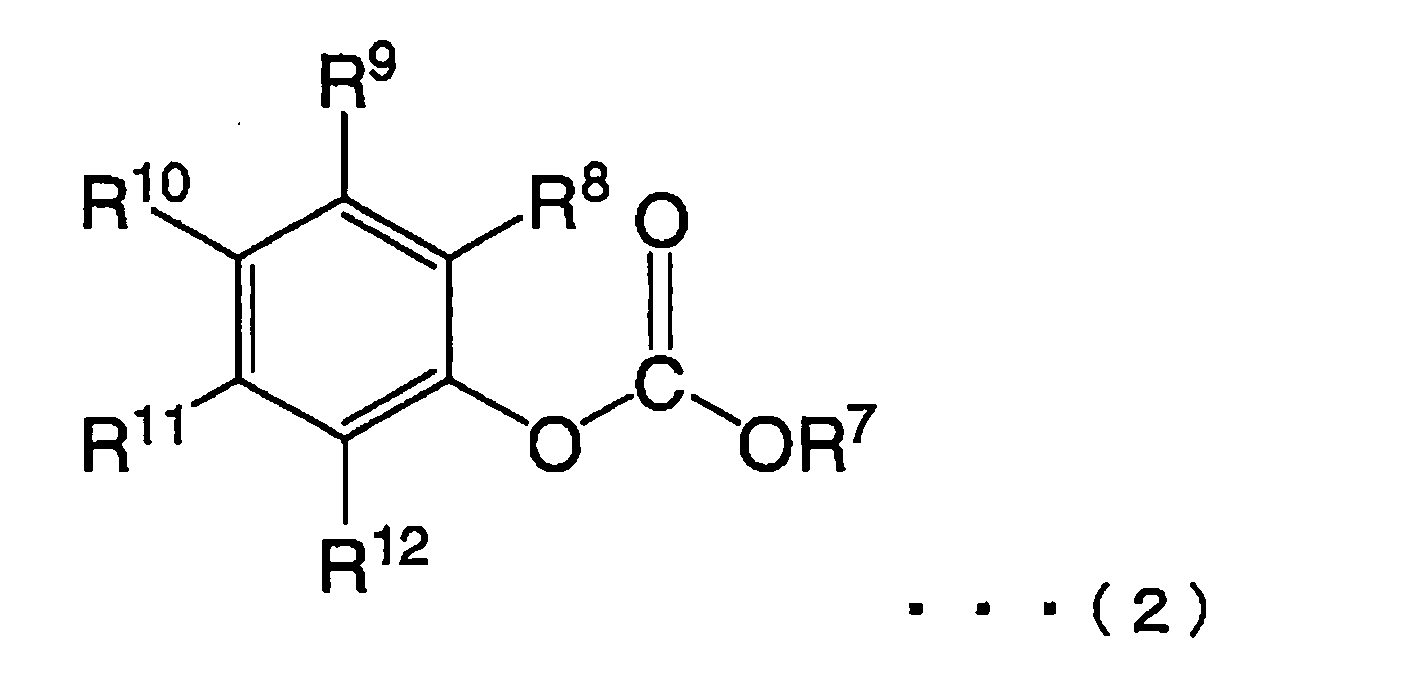
非水系電解液に占める(a)ジフェニルカーボネートの割合が0.001重量%以上、5重量%未満であり、
(b)ビニレンカーボネート、フッ素原子を有する環状カーボネート化合物、モノフルオロリン酸塩およびジフルオロリン酸塩からなる群から選ばれる少なくとも一種の化合物の合計の割合が0.001~20重量%であり、
非水溶媒がエチレンカーボネートとジアルキルカーボネートとを含有し、
非水溶媒に占めるエチレンカーボネートとジアルキルカーボネートとの合計に対するエチレンカーボネートの割合が5容量%以上50容量%以下である非水系電解液(第3の態様); 及び
(3) 上記非水系電解液(A)が、C=C不飽和結合を有する環状カーボネート、フッ素原子を有する環状カーボネート、モノフルオロリン酸塩およびジフルオロリン酸塩からなる群より選ばれる少なくとも1種の化合物を、非水系電解液(A)中に0.001重量%以上10重量%以下の割合で含むことを特徴とする上記(1)または(2)に記載の非水系電解液。
(5) 上記非水系電解液(B)が、一般式(2)で表わされる化合物を、非水系電解液(B)中に0.001重量%以上10重量%未満の割合で含むことを特徴とする上記(1)又は(4)に記載の非水系電解液。
(6) 上記非水系電解液(B)が、C=C不飽和結合を有する環状カーボネート、フッ素原子を有する環状カーボネート、モノフルオロリン酸塩およびジフルオロリン酸塩からなる群より選ばれる少なくとも1種の化合物を、非水系電解液(B)中に0.001重量%以上10重量%以下の割合で含むことを特徴とする上記(4)または(5)に記載の非水系電解液。
(8) 上記非水系電解液(B)において、非水溶媒が、エチレンカーボネートおよびプロピレンカーボネートから選ばれる環状カーボネート、非対称鎖状ジアルキルカーボネート、および対称鎖状ジアルキルカーボネートを含有していることを特徴とする上記(4)ないし(6)の何れか一項に記載の非水系電解液。
(9) 上記非水系電解液(D)において、非水系電解液(D)に占める、リン酸エステル化合物およびカルボン酸エステル化合物のうち少なくとも1つの合計の割合が、0.001重量%以上、10重量%未満であることを特徴とする上記(1)に記載の非水系電解液。
(11) 電解質および非水溶媒を含む非水系電解液において、ジフェニルカーボネートとビニレンカーボネートを含有し、非水系電解液に占めるジフェニルカーボネートの割合が0.001重量%以上、5重量%未満であり、ビニレンカーボネートの割合が0.001~20重量%であり、非水溶媒がエチレンカーボネートとジアルキルカーボネートとを含有し、非水溶媒に占めるエチレンカーボネートとジアルキルカーボネートとの合計に対するエチレンカーボネートの割合が5容量%以上50容量%以下であることを特徴とする非水系電解液(非水系電解液(C)の特に好ましい態様)。
(12) 電解質および非水溶媒を含む非水系電解液において、トリス(4-t-ブチルフェニル)ホスフェートとビニレンカーボネートを含有することを特徴とする非水系電解液(非水系電解液(D)の特に好ましい態様)。
本発明の非水系電解液は、常用の非水系電解液と同じく、電解質およびこれを溶解する非水溶媒を含有するものであり、通常、これらを主成分として含むものである。
電解質としては、通常、リチウム塩が用いられる。リチウム塩としては、この用途に用いることが知られているものであれば特に制限がなく、任意のものを用いることができ、具体的には以下のものが挙げられる。
非水溶媒も、従来から非水系電解液の溶媒として公知のものの中から適宜選択して用いることができる。例えば、C=C不飽和結合またはフッ素原子を有さない環状カーボネート類、鎖状カーボネート類、環状エーテル類、鎖状エーテル類、環状カルボン酸エステル類、鎖状カルボン酸エステル類、含硫黄有機溶媒、含燐有機溶媒等が挙げられる。
本発明の第1の態様と第2の態様である上記非水系電解液(A)及び(B)においては、非水溶媒が、エチレンカーボネートおよびプロピレンカーボネートから選ばれる環状カーボネート、非対称鎖状ジアルキルカーボネート、および対称鎖状ジアルキルカーボネートを含有していることが好ましい。
本発明の第3の態様である上記非水系電解液(C)においては、非水溶媒がエチレンカーボネートとジアルキルカーボネートとを含有し、非水溶媒に占めるエチレンカーボネートとジアルキルカーボネートとの合計に対するエチレンカーボネートの割合が5容量%以上50容量%以下である。また、非水溶媒に占めるエチレンカーボネートとジアルキルカーボネートとの合計に対するエチレンカーボネートの割合の下限としては、10容量%以上が好ましく、15容量%以上がより好ましく、上限としては、35容量%以下が好ましく、30容量%以下がより好ましく、25容量%以下が更に好ましい。
本発明の第3の態様において、好ましい非水溶媒の他の例は、エチレンカーボネート、プロピレンカーボネート、γ-ブチロラクトンおよびγ-バレロラクトンよりなる群から選ばれた1種の有機溶媒、または該群から選ばれた2以上の有機溶媒からなる混合溶媒を全体の60容量%以上を占めるものであり、ただしエチレンカーボネートは、非水溶媒に占めるエチレンカーボネートとジアルキルカーボネートとの合計に対するエチレンカーボネートの割合が5容量%以上50容量%以下であるものである。この混合溶媒を用いた非水系電解液は、高温で使用しても溶媒の蒸発や液漏れが少なくなる。なかでも、非水溶媒に占めるエチレンカーボネートとγ-ブチロラクトンとの合計が、70容量%以上、好ましくは80容量%以上、更に好ましくは90容量%以上であり、かつエチレンカーボネートとγ-ブチロラクトンとの容量比が5:95~45:55であるもの、または非水溶媒に占めるエチレンカーボネートとプロピレンカーボネートとの合計が、70容量%以上、好ましくは80容量%以上、更に好ましくは90容量%以上であり、かつエチレンカーボネートとプロピレンカーボネートの容量比が30:70~60:40であるものを用いると、一般にサイクル特性と高温保存特性等のバランスがよくなる。
本発明の第1の態様に係る非水系電解液(A)は、上述の電解質と非水溶媒を含有するが、これに下記一般式(1)で表わされる化合物を含有し、さらに C=C不飽和結合を有する環状カーボネート、フッ素原子を有する環状カーボネート、モノフルオロリン酸塩およびジフルオロリン酸塩からなる群より選ばれる少なくとも1種の化合物を含有することを特徴としている。
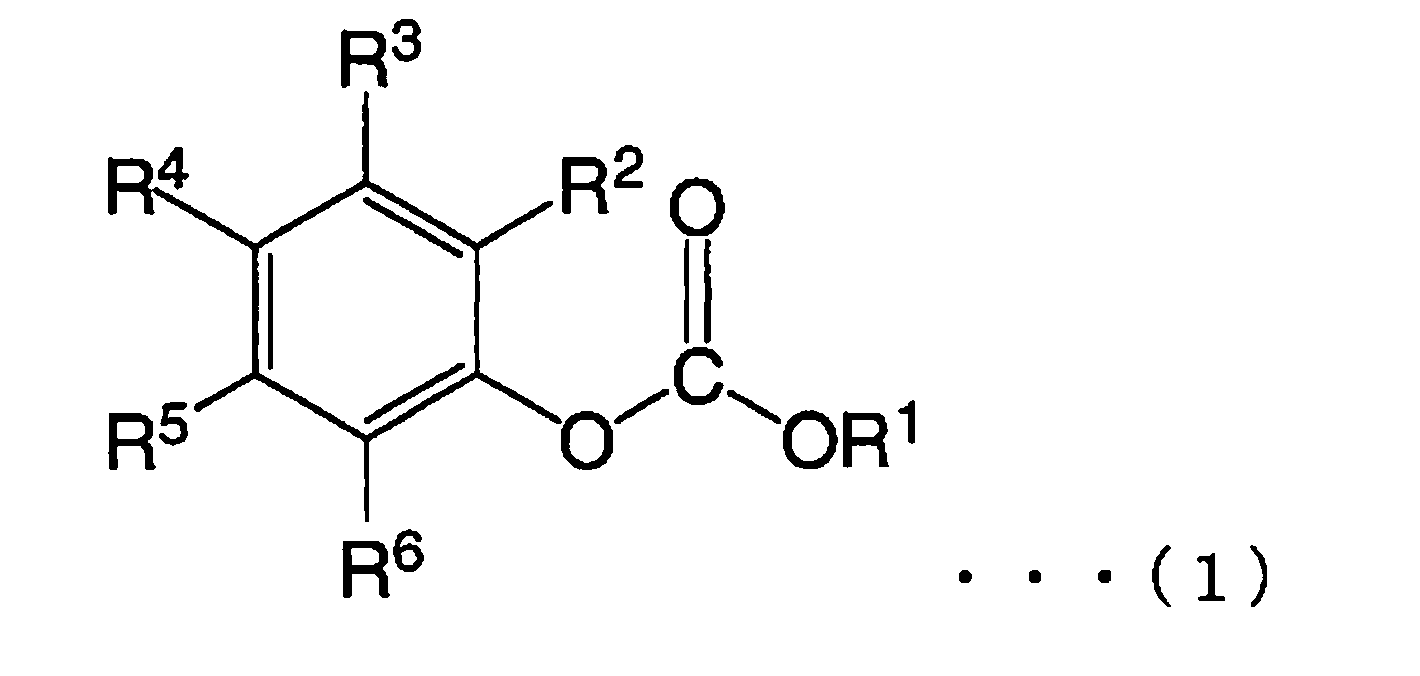
上記一般式(1)で表わされる化合物を詳細に説明する。
R1で表わされるアルキル基の炭素数としては、下限は、過充電時の安全性の向上および電池特性の点から通常1以上である。上限としては、過充電時の安全性の向上、電池特性および電解液への溶解性の点から通常12以下、好ましくは8以下、より好ましくは6以下である。
R1で表わされるアルキル基に置換されうるハロゲン原子としては、フッ素原子、塩素原子、臭素原子等が挙げられるが、これらの中でも、電池特性の点からフッ素原子が好ましい。
R2~R6は、水素原子またはハロゲン原子を表す。これらの中でも、過充電時の安全性の向上および電池特性の点から、R2~R6が、水素原子であることが好ましい。
メチルフェニルカーボネート、
エチルフェニルカーボネート、
n-プロピルフェニルカーボネート、
i-プロピルフェニルカーボネート、
n-ブチルフェニルカーボネート、
i-ブチルフェニルカーボネート、
sec-ブチルフェニルカーボネート、
t-ブチルフェニルカーボネート、
n-ペンチルフェニルカーボネート、
t-アミルフェニルカーボネート、
(1,1-ジメチルブチル)フェニルカーボネート、
シクロブチルフェニルカーボネート、
シクロペンチルフェニルカーボネート、
シクロヘキシルフェニルカーボネート、
(2-メチルシクロへキシル)フェニルカーボネート、
(2-エチルシクロヘキシル)フェニルカーボネート、
フルオロメチルフェニルカーボネート、
(1-フルオロエチル)フェニルカーボネート、
(1, 1-ジフルオロエチル)フェニルカーボネート、
(1, 2-ジフルオロエチル)フェニルカーボネート、
(2, 2-ジフルオロエチル)フェニルカーボネート、
(2-フルオロシクロペンチル)フェニルカーボネート、
(2, 3-ジフルオロシクロペンチル)フェニルカーボネート、
エチル(2-フルオロフェニル)カーボネート、
(2-フルオロフェニル)n-プロピルカーボネート、
(2-フルオロフェニル)i-プロピルカーボネート、
n-ブチル(2-フルオロフェニル)カーボネート、
i-ブチル(2-フルオロフェニル)カーボネート、
sec-ブチル(2-フルオロフェニル)カーボネート、
t-ブチル(2-フルオロフェニル)カーボネート、
(2-フルオロフェニル)n-ペンチルカーボネート、
t-アミル(2-フルオロフェニル)カーボネート、
(2-フルオロフェニル)(1,1-ジメチルブチル)カーボネート、
(3-フルオロフェニル)メチルカーボネート、
エチル(3-フルオロフェニル)カーボネート、
(3-フルオロフェニル)n-プロピルカーボネート、
(3-フルオロフェニル)i-プロピルカーボネート、
n-ブチル(3-フルオロフェニル)カーボネート、
i-ブチル(3-フルオロフェニル)カーボネート、
sec-ブチル(3-フルオロフェニル)カーボネート、
t-ブチル(3-フルオロフェニル)カーボネート、
(3-フルオロフェニル)n-ペンチルカーボネート、
t-アミル(3-フルオロフェニル)カーボネート、
(3-フルオロフェニル)(1,1-ジメチルブチル)カーボネート、
エチル(4-フルオロフェニル)カーボネート、
(4-フルオロフェニル)n-プロピルカーボネート、
(4-フルオロフェニル)i-プロピルカーボネート、
n-ブチル(4-フルオロフェニル)カーボネート、
i-ブチル(4-フルオロフェニル)カーボネート、
sec-ブチル(4-フルオロフェニル)カーボネート、
t-ブチル(4-フルオロフェニル)カーボネート、
(4-フルオロフェニル)n-ペンチルカーボネート、
t-アミル(4-フルオロフェニル)カーボネート、
(4-フルオロフェニル)(1,1-ジメチルブチル)カーボネート、
エチル(3,5-ジフルオロフェニル)カーボネート、
(3,5-ジフルオロフェニル)n-プロピルカーボネート、
(3,5-ジフルオロフェニル)i-プロピルカーボネート、
n-ブチル(3,5-ジフルオロフェニル)カーボネート、
i-ブチル(3,5-ジフルオロフェニル)カーボネート、
sec-ブチル(3,5-ジフルオロフェニル)カーボネート、
t-ブチル(3,5-ジフルオロフェニル)カーボネート、
(3,5-ジフルオロフェニル)n-ペンチルカーボネート、
t-アミル(3,5-ジフルオロフェニル)カーボネート、
(3,5-ジフルオロフェニル)(1,1-ジメチルブチル)カーボネート、
エチル(2,4,6-トリフルオロフェニル)カーボネート、
(2,4,6-トリフルオロフェニル)n-プロピルカーボネート、
(2,4,6-トリフルオロフェニル)i-プロピルカーボネート、
n-ブチル(2,4,6-トリフルオロフェニル)カーボネート、
i-ブチル(2,4,6-トリフルオロフェニル)カーボネート、
sec-ブチル(2,4,6-トリフルオロフェニル)カーボネート、
t-ブチル(2,4,6-トリフルオロフェニル)カーボネート、
(2,4,6-トリフルオロフェニル)n-ペンチルカーボネート、
t-アミル(2,4,6-トリフルオロフェニル)カーボネート、
(2,4,6-トリフルオロフェニル)(1,1-ジメチルブチル)カーボネート。
メチルフェニルカーボネート、
エチルフェニルカーボネート、
n-プロピルフェニルカーボネート、
i-プロピルフェニルカーボネート、
n-ブチルフェニルカーボネート、
i-ブチルフェニルカーボネート、
sec-ブチルフェニルカーボネート、
t-ブチルフェニルカーボネート、
n-ペンチルフェニルカーボネート、
t-アミルフェニルカーボネート、
(1,1-ジメチルブチル)フェニルカーボネート、
シクロブチルフェニルカーボネート、
シクロペンチルフェニルカーボネート、
シクロヘキシルフェニルカーボネート、
(2-メチルシクロへキシル)フェニルカーボネート、
(2-エチルシクロヘキシル)フェニルカーボネート、
フルオロメチルフェニルカーボネート、
(1-フルオロエチル)フェニルカーボネート、
(1, 1-ジフルオロエチル)フェニルカーボネート、
(1, 2-ジフルオロエチル)フェニルカーボネート、
(2, 2-ジフルオロエチル)フェニルカーボネート、
(2-フルオロシクロペンチル)フェニルカーボネート、
(2, 3-ジフルオロシクロペンチル)フェニルカーボネート、
がより好ましく、
エチルフェニルカーボネート、
n-プロピルフェニルカーボネート、
i-プロピルフェニルカーボネート、
n-ブチルフェニルカーボネート、
i-ブチルフェニルカーボネート、
sec-ブチルフェニルカーボネート、
t-ブチルフェニルカーボネート、
n-ペンチルフェニルカーボネート、
t-アミルフェニルカーボネート、
(1,1-ジメチルブチル)フェニルカーボネート、
がさらに好ましく、
メチルフェニルカーボネート、
エチルフェニルカーボネート、
n-プロピルフェニルカーボネート、
n-ブチルフェニルカーボネート、
が特に好ましい。
C=C不飽和結合を有する環状カーボネート、フッ素原子を有する環状カーボネート、モノフルオロリン酸塩およびジフルオロリン酸塩のうちの少なくとも一種を含有する本発明の非水系電解液は、これら添加剤が負極の表面に安定な保護被膜を形成するため、電池のサイクル特性や高温保存特性を向上させることができる。
含有量が下限より多いと、特に電池のサイクル特性や高温保存特性を向上させることができ、含有量が上限より少ないと、高温保存時のガス発生量の増大を防ぐことができたり、低温での放電特性の低下を防ぐことができるので、その上限は、通常10重量%以下、好ましくは5重量%以下、更に好ましくは3重量%以下、特に好ましくは2重量%以下である。
C=C不飽和結合を有する環状カーボネート化合物としては、例えば、ビニレンカーボネート、メチルビニレンカーボネート、エチルビニレンカーボネート、4,5-ジメチルビニレンカーボネート、4,5-ジエチルビニレンカーボネート、フルオロビニレンカーボネート、トリフルオロメチルビニレンカーボネート等のビニレンカーボネート化合物;ビニルエチレンカーボネート、4-メチル-4-ビニルエチレンカーボネート、4-エチル-4-ビニルエチレンカーボネート、4-n-プロピル-4-ビニルエチレンカーボネート、5-メチル-4-ビニルエチレンカーボネート、4,4-ジビニルエチレンカーボネート、4,5-ジビニルエチレンカーボネート等のビニルエチレンカーボネート;4,4-ジメチル-5-メチレンエチレンカーボネート、4,4-ジエチル-5-メチレンエチレンカーボネート等のメチレンエチレンカーボネート化合物などが挙げられる。
また、これらは単独で用いても、2種類以上を併用してもよい。2種類以上を併用する場合は、ビニレンカーボネートとビニルエチレンカーボネートとを併用するのが好ましい。
フッ素原子を有する環状カーボネート化合物としては、例えば、フルオロエチレンカーボネート、4,5-ジフルオロエチレンカーボネート、4,4-ジフルオロエチレンカーボネート、4,4,5-トリフルオロエチレンカーボネート、4,4,5,5-テトラフルオロエチレンカーボネート、4-フルオロ-5-メチルエチレンカーボネート、4-フルオロ-4-メチルエチレンカーボネート、4,5-ジフルオロ-4-メチルエチレンカーボネート、4,4,5-トリフルオロ-5-メチルエチレンカーボネート、トリフルオロメチルエチレンカーボネート等が挙げられる。
これらは単独で用いても、2種類以上を併用してもよい。2種類以上を併用する場合は、フルオロエチレンカーボネートと4,5-ジフルオロエチレンカーボネートとを併用するのが好ましい。
モノフルオロリン酸塩およびジフルオロリン酸塩のカウンターカチオンとしては特に限定はないが、Li、Na、K、Mg、Ca、Fe、Cu等の金属元素の他、NR13R14R15R16(式中、R13~R16は、各々独立に、水素原子又は炭素数1~12の有機基を表わす。)で表現されるアンモニウム、4級アンモニウムが挙げられる。ここで、R13~R16の炭素数1~12の有機基としては、ハロゲン原子で置換されていてもよいアルキル基、ハロゲン原子で置換されていてもよいシクロアルキル基、ハロゲン原子で置換されていてもよいアリール基、窒素原子含有複素環基等が挙げられる。R13~R16としては、それぞれ、水素原子、アルキル基、シクロアルキル基、窒素原子含有複素環基等が好ましい。これらのカウンターカチオン中でも、リチウム二次電池に用いたときの電池特性の点から、リチウム、ナトリウム、カリウム、マグネシウム、カルシウム又はNR13R14R15R16が好ましく、リチウムが特に好ましい。
また、C=C不飽和結合を有する環状カーボネートと併用しても良く、サイクル特性向上や高温保存特性向上の点からは、ビニレンカーボネートやビニルエチレンカーボネートと併用するのが好ましい。また、フッ素原子を有する環状カーボネート化合物と併用しても良く、サイクル特性向上や高温保存特性向上の点からは、フルオロエチレンカーボネートが好ましい。
本発明に係る第1の態様の非水系電解液(A)が、過充電時の安全性に優れ、高温保存特性にも優れる理由は明らかではなく、また、本発明は下記作用原理に限定されるものではないが、次のように推察される。
また、本発明の第2の態様に係る非水系電解液(B)は、上述の電解質と非水溶媒を含有し、さらに一般式(2)で表される化合物を含有することを特徴としている。
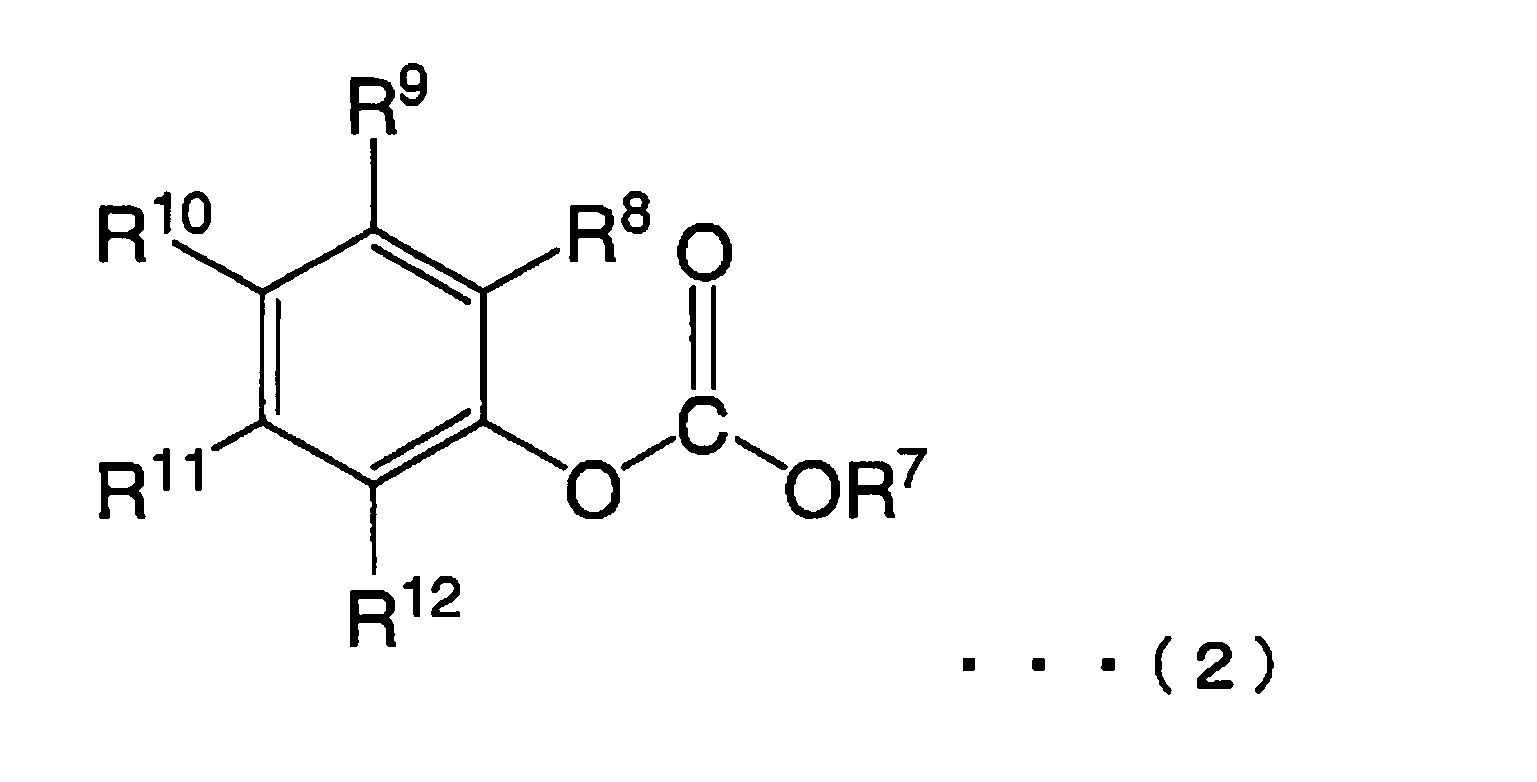
上記一般式(2)で表わされる化合物を詳細に説明する。
R7で表わされるアルキル基に置換されうるハロゲン原子としては、フッ素原子、塩素原子、臭素原子等が挙げられるが、これらの中でも、電池特性の点からフッ素原子が好ましい。
R8~R12は、水素原子、ハロゲン原子、炭素数1以上12以下のエーテル基、またはハロゲン原子を有していてもよい炭素数1以上12以下のアルキル基を表す。これらの中でも、過充電時の安全性および高温保存特性の点から、R8~R12は、水素またはハロゲン原子を有していてもよい炭素数1以上12以下のアルキルが好ましく、特に2級アルキル基または3級アルキル基であるものがより好ましい。
R8~R12として表わされる炭素数1以上12以下のアルキル基としては、メチル基、エチル基、n-プロピル基、i-プロピル基、n-ブチル基、i-ブチル基、sec-ブチル基、t-ブチル基、n-ペンチル基、t-アミル基、1,1-ジメチルブチル基、シクロブチル基、シクロペンチル基、シクロヘキシル基、1-メチルシクロヘキシル基、1-エチルシクロヘキシル基などが挙げられる。
ただし、一般式(2)中のR8~R12のうち少なくとも一つはハロゲン原子を有していてもよい炭素数2以上12以下のアルキル基である。
また、R8~R12は、過充電時の安全性および、高温保存特性の点から2級アルキル基または3級アルキル基であるものが好ましく、中でも、sec-ブチル基、t-ブチル基、t-アミル基、1,1-ジメチルブチル基、シクロペンチル基、シクロヘキシル基、1-メチルシクロヘキシル基、1-エチルシクロヘキシル基がより好ましく、t-ブチル基、t-アミル基、1,1-ジメチルブチル基、シクロペンチル基、シクロヘキシル基、1-メチルシクロヘキシル基、1-エチルシクロヘキシル基が特に好ましい。
一般式(2)で表わされる化合物の具体例としては、次のようなものが挙げられる。
(2-t-ブチルフェニル)メチルカーボネート、
(2-t-ブチルフェニル)エチルカーボネート、
(2-t-ブチルフェニル)n-プロピルカーボネート、
(2-t-ブチルフェニル)i-プロピルカーボネート、
n-ブチル(2-t-ブチルフェニル)カーボネート、
i-ブチル(2-t-ブチルフェニル)カーボネート、
sec-ブチル(2-t-ブチルフェニル)カーボネート、
t-ブチル(2-t-ブチルフェニル)カーボネート、
(2-t-ブチルフェニル)n-ペンチルカーボネート、
t-アミル(2-t-ブチルフェニル)カーボネート、
(2-t-ブチルフェニル)シクロブチルカーボネート、
(2-t-ブチルフェニル)シクロペンチルカーボネート、
(2-t-ブチルフェニル)シクロヘキシルカーボネート、
(2-t-ブチルフェニル)(2-メチルシクロへキシル)カーボネート、
(2-t-ブチルフェニル)(2-エチルシクロヘキシル)カーボネート、
(2-t-ブチルフェニル)フルオロメチルカーボネート、
(2-t-ブチルフェニル)(1-フルオロエチル)カーボネート、
(2-t-ブチルフェニル)(1, 1-ジフルオロエチル)カーボネート、
(2-t-ブチルフェニル)(1, 2-ジフルオロエチル)カーボネート、
(2-t-ブチルフェニル)(2, 2-ジフルオロエチル)カーボネート、
(2-t-ブチルフェニル)(2-フルオロシクロペンチル)カーボネート、
(2-t-ブチルフェニル)(2, 3-ジフルオロシクロペンチル)カーボネート、
(2-t-ブチルフェニル)フェニルメチルカーボネート、
(2-t-ブチルフェニル)(1-フェニルエチル)カーボネート、
(3-t-ブチルフェニル)メチルカーボネート、
(3-t-ブチルフェニル)エチルカーボネート、
(3-t-ブチルフェニル)n-プロピルカーボネート、
(3-t-ブチルフェニル)i-プロピルカーボネート、
i-ブチル(3-t-ブチルフェニル)カーボネート、
sec-ブチル(3-t-ブチルフェニル)カーボネート、
t-ブチル(3-t-ブチルフェニル)カーボネート、
(3-t-ブチルフェニル)n-ペンチルカーボネート、
t-アミル(3-t-ブチルフェニル)カーボネート、
(3-t-ブチルフェニル)(1,1-ジメチルブチル)カーボネート、
(3-t-ブチルフェニル)フルオロメチルカーボネート、
(3-t-ブチルフェニル)(1-フルオロエチル)カーボネート、
(3-t-ブチルフェニル)(1, 1-ジフルオロエチル)カーボネート、
(3-t-ブチルフェニル)(1, 2-ジフルオロエチル)カーボネート、
(3-t-ブチルフェニル)フェニルメチルカーボネート、
(3-t-ブチルフェニル)(1-フェニルエチル)カーボネート、
(4-t-ブチルフェニル)メチルカーボネート、
(4-t-ブチルフェニル)エチルカーボネート、
(4-t-ブチルフェニル)n-プロピルカーボネート、
(4-t-ブチルフェニル)i-プロピルカーボネート、
i-ブチル(4-t-ブチルフェニル)カーボネート、
sec-ブチル(4-t-ブチルフェニル)カーボネート、
t-ブチル(4-t-ブチルフェニル)カーボネート、
(4-t-ブチルフェニル)n-ペンチルカーボネート、
t-アミル(4-t-ブチルフェニル)カーボネート、
(4-t-ブチルフェニル)(1,1-ジメチルブチル)カーボネート、
(4-t-ブチルフェニル)フルオロメチルカーボネート、
(4-t-ブチルフェニル)(1-フルオロエチル)カーボネート、
(4-t-ブチルフェニル)(1, 1-ジフルオロエチル)カーボネート、
(4-t-ブチルフェニル)(1, 2-ジフルオロエチル)カーボネート、
(4-t-ブチルフェニル)フェニルメチルカーボネート、
(4-t-ブチルフェニル)(1-フェニルエチル)カーボネート、
(3,5-ジ-t-ブチルフェニル)エチルカーボネート、
(3,5-ジ-t-ブチルフェニル)n-プロピルカーボネート、
(3,5-ジ-t-ブチルフェニル)i-プロピルカーボネート、
n-ブチル(3,5-ジ-t-ブチルフェニル)カーボネート、
i-ブチル(3,5-ジ-t-ブチルフェニル)カーボネート、
sec-ブチル(3,5-ジ-t-ブチルフェニル)カーボネート、
t-ブチル(3,5-ジ-t-ブチルフェニル)カーボネート、
(3,5-ジ-t-ブチルフェニル)n-ペンチルカーボネート、
t-アミル(3,5-ジ-t-ブチルフェニル)カーボネート、
(3,5-ジ-t-ブチルフェニル)(1,1-ジメチルブチル)カーボネート、
(3,5-ジ-t-ブチルフェニル)フルオロメチルカーボネート、
(3,5-ジ-t-ブチルフェニル)(1-フルオロエチル)カーボネート、
(3,5-ジ-t-ブチルフェニル)(1, 1-ジフルオロエチル)カーボネート、
(3,5-ジ-t-ブチルフェニル)(1, 2-ジフルオロエチル)カーボネート、
(3,5-ジ-t-ブチルフェニル)フェニルメチルカーボネート、
(3,5-ジ-t-ブチルフェニル)(1-フェニルエチル)カーボネート、
(2,4,5-トリ-t-ブチルフェニル)エチルカーボネート、
(2,4,5-トリ-t-ブチルフェニル)n-プロピルカーボネート、
(2,4,5-トリ-t-ブチルフェニル)i-プロピルカーボネート、
n-ブチル(2,4,5-トリ-t-ブチルフェニル)カーボネート、
i-ブチル(2,4,5-トリ-t-ブチルフェニル)カーボネート、
sec-ブチル(2,4,5-トリ-t-ブチルフェニル)カーボネート、
t-ブチル(2,4,5-トリ-t-ブチルフェニル)カーボネート、
(2,4,5-トリ-t-ブチルフェニル)n-ペンチルカーボネート、
t-アミル(2,4,5-トリ-t-ブチルフェニル)カーボネート、
(2,4,5-トリ-t-ブチルフェニル)(1,1-ジメチルブチル)カーボネート、(2,4,5-トリ-t-ブチルフェニル)フルオロメチルカーボネート、
(2,4,5-トリ-t-ブチルフェニル)(1-フルオロエチル)カーボネート、
(2,4,5-トリ-t-ブチルフェニル)(1, 1-ジフルオロエチル)カーボネート、
(2,4,5-トリ-t-ブチルフェニル)(1, 2-ジフルオロエチル)カーボネート、
(2,4,5-トリ-t-ブチルフェニル)フェニルメチルカーボネート、
(2,4,5-トリ-t-ブチルフェニル)(1-フェニルエチル)カーボネート、
(2-シクロヘキシルフェニル)エチルカーボネート、
(2-シクロヘキシルフェニル)n-プロピルカーボネート、
(2-シクロヘキシルフェニル)i-プロピルカーボネート、
n-ブチル(2-シクロヘキシルフェニル)カーボネート、
i-ブチル(2-シクロヘキシルフェニル)カーボネート、
sec-ブチル(2-シクロヘキシルフェニル)カーボネート、
t-ブチル(2-シクロヘキシルフェニル)カーボネート、
(2-シクロヘキシルフェニル)n-ペンチルカーボネート、
t-アミル(2-シクロヘキシルフェニル)カーボネート、
(2-シクロヘキシルフェニル)(1,1-ジメチルブチル)カーボネート、
(3-シクロヘキシルフェニル)メチルカーボネート、
(3-シクロヘキシルフェニル)エチルカーボネート、
(4-シクロヘキシルフェニル)メチルカーボネート、
(4-シクロヘキシルフェニル)エチルカーボネート、
(2-エチルフェニル)メチルカーボネート、
(3-エチルフェニル)メチルカーボネート、
エチル(4-エチルフェニル)カーボネート、
t-ブチル(4-エチルフェニル)カーボネート、
t-アミル(4-エチルフェニル)カーボネート、
シクロブチル(4-エチルフェニル)カーボネート、
シクロペンチル(4-エチルフェニル)カーボネート、
シクロヘキシル(4-エチルフェニル)カーボネート、
(4-エチルフェニル)フルオロメチルカーボネート、
(4-エチルフェニル)(1-フルオロエチル)カーボネート、
(4-エチルフェニル)(1, 2-ジフルオロエチル)カーボネート、
(4-エチルフェニル)(2-フルオロシクロペンチル)カーボネート、
(4-エチルフェニル)(2, 3-ジフルオロシクロペンチル)カーボネート、
(4-エチルフェニル)フェニルメチルカーボネート、
(4-エチルフェニル)(1-フェニルエチル)カーボネート、
(3-t-ブチル-5-フルオロフェニル) エチルカーボネート、
t-ブチル(3-t-ブチル-5-フルオロフェニル)カーボネート、
t-アミル(3-t-ブチル-5-フルオロフェニル)カーボネート、
(3-t-ブチル-5-フルオロフェニル) シクロブチルカーボネート、
(3-t-ブチル-5-フルオロフェニル) シクロペンチルカーボネート、
(3-t-ブチル-5-フルオロフェニル) シクロヘキシルカーボネート、
(3-t-ブチル-5-フルオロフェニル)フルオロメチルカーボネート、
(3-t-ブチル-5-フルオロフェニル)(1-フルオロエチル)カーボネート、
(3-t-ブチル-5-フルオロフェニル) (1, 2-ジフルオロエチル)カーボネート、
(3-t-ブチル-5-フルオロフェニル) (2-フルオロシクロペンチル)カーボネート、
(3-t-ブチル-5-フルオロフェニル)カーボネート(2, 3-ジフルオロシクロペンチル)、
(3-t-ブチル-5-メトキシフェニル) エチルカーボネート、
t-ブチル(3-t-ブチル-5-メトキシフェニル)カーボネート、
t-アミル(3-t-ブチル-5-メトキシフェニル)カーボネート、
(3-t-ブチル-5-メトキシフェニル) シクロブチルカーボネート、
(3-t-ブチル-5-メトキシフェニル) シクロペンチルカーボネート、
(3-t-ブチル-5-メトキシフェニル) シクロヘキシルカーボネート、
(3-t-ブチル-5-メトキシフェニル)フルオロメチルカーボネート、
(3-t-ブチル-5-メトキシフェニル)(1-フルオロエチル)カーボネート、
(3-t-ブチル-5-メトキシフェニル) (1, 2-ジフルオロエチル)カーボネート、
(3-t-ブチル-5-メトキシフェニル) (2-フルオロシクロペンチル)カーボネート、
(3-t-ブチル-5-メトキシフェニル)(2, 3-ジフルオロシクロペンチル)カーボネート。
(2-t-ブチルフェニル)メチルカーボネート、
(2-t-ブチルフェニル)エチルカーボネート、
(3-t-ブチルフェニル)メチルカーボネート、
(3-t-ブチルフェニル)エチルカーボネート、
(4-t-ブチルフェニル)メチルカーボネート、
(4-t-ブチルフェニル)エチルカーボネート、
(3,5-ジ-t-ブチルフェニル)メチルカーボネート、
(3,5-ジ-t-ブチルフェニル)エチルカーボネート、
メチル(2,4,5-トリ-t-ブチルフェニル)カーボネート、
エチル(2,4,5-トリ-t-ブチルフェニル)カーボネート、
(2-シクロヘキシルフェニル)メチルカーボネート、
(2-シクロヘキシルフェニル)エチルカーボネート、
(3-シクロヘキシルフェニル)メチルカーボネート、
(3-シクロヘキシルフェニル)エチルカーボネート、
(4-シクロヘキシルフェニル)メチルカーボネート、
(4-シクロヘキシルフェニル)エチルカーボネート、
がより好ましい。
一般にアルキル基の電子供与性は、アルキル基の炭素数が大きくなるほど大きくなる。また、1級アルキル基よりも2級アルキル基、3級アルキル基の方が電子供与性は高い。よって炭素数1のアルキル基で置換されたフェニル基を有するカーボネート化合物に比べ、炭素数2以上のアルキル基で置換されたフェニル基を有するカーボネート化合物は酸化電位が低くなり、過充電時により早い段階で反応して、過充電時の安全性を高めることができる。通常、酸化電位が低い化合物は、高温保存時においても電極の活性の高い部位で反応して、高温保存後の電池特性を低下させてしまうが、炭素数2以上のアルキル基で置換されたフェニル基を有しているので、アルキル基の立体障害により、高温保存時における副反応性が抑制され、高温保存後の放電特性の著しい低下を抑制すると考えられる。
本発明の第3の態様の非水系電解液(C)は、電解質および非水溶媒を含み、更に、(a)ジフェニルカーボネートと、(b)ビニレンカーボネート、フッ素原子を有する環状カーボネート化合物、モノフルオロリン酸塩およびジフルオロリン酸塩からなる群から選ばれる少なくとも一種の化合物(以下「化合物(b))」と称す場合がある。)とを含有し、非水系電解液に占める(a)ジフェニルカーボネートの割合が0.001重量%以上5重量%未満であり、化合物(b)の合計の割合が0.001~20重量%であり、非水溶媒がエチレンカーボネートとジアルキルカーボネートとを含有し、非水溶媒に占めるエチレンカーボネートとジアルキルカーボネートとの合計に対するエチレンカーボネートの割合が5容量%以上50容量%以下であることを特徴とする。
フッ素原子を有する環状カーボネート化合物、モノフルオロリン酸塩、ジフルオロリン酸塩の詳細な説明は、上述に記載のとおりである。
例えば、フッ素原子を有する環状カーボネート化合物をビニレンカーボネートやモノフルオロリン酸塩および/またはジフルオロリン酸塩と併用しても良く、サイクル特性向上や高温保存特性向上の点からは、これらを併用することが好ましい。
また、モノフルオロリン酸塩および/またはジフルオロリン酸塩をビニレンカーボネートやフッ素原子を有する環状カーボネート化合物と併用して用いても良く、サイクル特性向上や高温保存後の特性向上の点からは、モノフルオロリン酸塩および/またはジフルオロリン酸塩を、ビニレンカーボネートやフルオロエチレンカーボネートと併用するのが好ましく、ビニレンカーボネートと併用するのが更に好ましい。
また、化合物(b)として、ビニレンカーボネートとモノフルオロリン酸塩および/またはジフルオロリン酸塩とを併用する場合、ビニレンカーボネートとモノフルオロリン酸塩および/またはジフルオロリン酸塩との含有重量比は、ビニレンカーボネート:モノフルオロリン酸塩および/またはジフルオロリン酸塩=1:0.1~5とすることが好ましい。
本発明の第4の態様の非水系電解液(D)は、上述の電解質と非水溶媒を含有するが、これに、置換基を有していてもよいアルキル基で置換されたフェニル基を有するリン酸エステル化合物およびカルボン酸エステル化合物のうち少なくとも1つを含有しており、該フェニル基に置換されたアルキル基の炭素数は全て4以上であることを特徴としている(このようなリン酸エステル化合物またはカルボン酸エステル化合物を以下の記載では、本発明のリン酸エステル化合物または本発明のカルボン酸エステル化合物と言うことがある。)。
本発明のリン酸エステル化合物の分子量としては、過充電時の安全性の向上の点から、下限は通常250以上、好ましくは300以上、特に好ましくは400以上であり、上限としては、過充電時の安全性の向上および電池特性および電解液への溶解性の点から、通常1500以下、好ましくは800以下、特に好ましくは700以下である。
炭素数4以上のアルキル基としては、n-ブチル基、i-ブチル基、sec-ブチル基、tert-ブチル基、n-ペンチル基、t-アミル基、1,1-ジメチルブチル基、シクロブチル基、シクロペンチル基、シクロヘキシル基、1-メチルシクロヘキシル基、1-エチルシクロヘキシル基等が挙げられる。
また、2級アルキル基または3級アルキル基であるものが好ましく、中でも、sec-ブチル基、t-ブチル基、t-アミル基、1,1-ジメチルブチル基、シクロペンチル基、シクロヘキシル基、1-メチルシクロヘキシル基、1-エチルシクロヘキシル基がより好ましく、t-ブチル基、t-アミル基、1,1-ジメチルブチル基、シクロペンチル基、シクロヘキシル基、1-メチルシクロヘキシル基、1-エチルシクロヘキシル基が特に好ましい。
これらのアルキル基は、水素原子の一部または全てがフッ素原子で置換されていてもよい。
また、フェニル基に結合しているアルキル基の数は複数個でもよい。
トリス(2-n-ブチルフェニル)ホスフェート、
トリス(3-n-ブチルフェニル)ホスフェート、
トリス(4-n-ブチルフェニル)ホスフェート、
トリス(2,4-ジ-n-ブチルフェニル)ホスフェート、
トリス(3,5-ジ-n-ブチルフェニル)ホスフェート、
トリス(2-i-ブチルフェニル)ホスフェート、
トリス(3-i-ブチルフェニル)ホスフェート、
トリス(4-i-ブチルフェニル)ホスフェート、
トリス(2,4-ジ-i-ブチルフェニル)ホスフェート、
トリス(3,5-ジ-i-ブチルフェニル)ホスフェート、
トリス(2-sec-ブチルフェニル)ホスフェート、
トリス(3-sec-ブチルフェニル)ホスフェート、
トリス(4-sec-ブチルフェニル)ホスフェート、
トリス(2,4-ジ-sec-ブチルフェニル)ホスフェート、
トリス(3,5-ジ-sec-ブチルフェニル)ホスフェート、
トリス(2-t-ブチルフェニル)ホスフェート、
トリス(3-t-ブチルフェニル)ホスフェート、
トリス(4-t-ブチルフェニル)ホスフェート、
トリス(2,4-ジ-t-ブチルフェニル)ホスフェート、
トリス(3,5-ジ-t-ブチルフェニル)ホスフェート、
トリス(2-t-アミルフェニル)ホスフェート、
トリス(3-t-アミルフェニル)ホスフェート、
トリス(4-t-アミルフェニル)ホスフェート、
トリス(2,4-ジ-t-アミルフェニル)ホスフェート、
トリス(3,5-ジ-t-アミルフェニル)ホスフェート、
トリス(2-シクロペンチルフェニル)ホスフェート、
トリス(3-シクロペンチルフェニル)ホスフェート、
トリス(4-シクロペンチルフェニル)ホスフェート、
トリス(2,4-ジ-シクロペンチルフェニル)ホスフェート、
トリス(3,5-ジ-シクロペンチルフェニル)ホスフェート、
トリス(2-シクロヘキシルフェニル)ホスフェート、
トリス(3-シクロヘキシルフェニル)ホスフェート、
トリス(4-シクロヘキシルフェニル)ホスフェート、
トリス(2,4-ジ-シクロヘキシルフェニル)ホスフェート、
トリス(3,5-ジ-シクロヘキシルフェニル)ホスフェート
2-t-ブチルフェニルジフェニルホスフェート、
3-t-ブチルフェニルジフェニルホスフェート、
4-t-ブチルフェニルジフェニルホスフェート、
ビス(2-t-ブチルフェニル)フェニルホスフェート、
ビス(3-t-ブチルフェニル)フェニルホスフェート、
ビス(4-t-ブチルフェニル)フェニルホスフェート、
2-t-ブチルフェニルジメチルホスフェート、
3-t-ブチルフェニルジメチルホスフェート、
4-t-ブチルフェニルジメチルホスフェート、
ビス(2-t-ブチルフェニル)メチルホスフェート、
ビス(3-t-ブチルフェニル)メチルホスフェート、
ビス(4-t-ブチルフェニル)メチルホスフェート、
2-t-ブチルフェニルジエチルホスフェート、
3-t-ブチルフェニルジエチルホスフェート、
4-t-ブチルフェニルジエチルホスフェート、
ビス(2-t-ブチルフェニル)エチルホスフェート、
ビス(3-t-ブチルフェニル)エチルホスフェート、
ビス(4-t-ブチルフェニル)エチルホスフェートなど。
2-n-ブチルフェニルアセテート、
3-n-ブチルフェニルアセテート、
4-n-ブチルフェニルアセテート、
2-i-ブチルフェニルアセテート、
3-i-ブチルフェニルアセテート、
4-i-ブチルフェニルアセテート、
2-sec-ブチルフェニルアセテート、
3-sec-ブチルフェニルアセテート、
4-sec-ブチルフェニルアセテート、
2-t-ブチルフェニルアセテート、
3-t-ブチルフェニルアセテート、
4-t-ブチルフェニルアセテート、
2-t-アミルフェニルアセテート、
3-t-アミルフェニルアセテート、
4-t-アミルフェニルアセテート、
2-シクロペンチルフェニルアセテート、
3-シクロペンチルフェニルアセテート、
4-シクロペンチルフェニルアセテート、
2-シクロヘキシルフェニルアセテート、
3-シクロヘキシルフェニルアセテート、
4-シクロヘキシルフェニルアセテート、
2-n-ブチルフェニルプロピオネート、
3-n-ブチルフェニルプロピオネート、
4-n-ブチルフェニルプロピオネート、
2-i-ブチルフェニルプロピオネート、
3-i-ブチルフェニルプロピオネート、
4-i-ブチルフェニルプロピオネート、
2-sec-ブチルフェニルプロピオネート、
3-sec-ブチルフェニルプロピオネート、
4-sec-ブチルフェニルプロピオネート、
2-t-ブチルフェニルプロピオネート、
3-t-ブチルフェニルプロピオネート、
4-t-ブチルフェニルプロピオネート、
2-t-アミルフェニルプロピオネート、
3-t-アミルフェニルプロピオネート、
4-t-アミルフェニルプロピオネート、
2-シクロペンチルフェニルプロピオネート、
3-シクロペンチルフェニルプロピオネート、
4-シクロペンチルフェニルプロピオネート、
2-シクロヘキシルフェニルプロピオネート、
3-シクロヘキシルフェニルプロピオネート、
4-シクロヘキシルフェニルプロピオネート、
メチル-2-n-ブチルベンゾエート、
メチル-3-n-ブチルベンゾエート、
メチル-4-n-ブチルベンゾエート、
メチル-2-i-ブチルベンゾエート、
メチル-3-i-ブチルベンゾエート、
メチル-4-i-ブチルベンゾエート、
メチル-2-sec-ブチルベンゾエート、
メチル-3-sec-ブチルベンゾエート、
メチル-4-sec-ブチルベンゾエート、
メチル-2-t-ブチルベンゾエート、
メチル-3-t-ブチルベンゾエート、
メチル-4-t-ブチルベンゾエート、
メチル-2-t-アミルベンゾエート、
メチル-3-t-アミルベンゾエート、
メチル-4-t-アミルベンゾエート、
メチル-2-シクロヘキシルベンゾエート、
メチル-3-シクロヘキシルベンゾエート、
メチル-4-シクロヘキシルベンゾエート、
エチル-2-n-ブチルベンゾエート、
エチル-3-n-ブチルベンゾエート、
エチル-4-n-ブチルベンゾエート、
エチル-2-i-ブチルベンゾエート、
エチル-3-i-ブチルベンゾエート、
エチル-4-i-ブチルベンゾエート、
エチル-2-sec-ブチルベンゾエート、
エチル-3-sec-ブチルベンゾエート、
エチル-4-sec-ブチルベンゾエート、
エチル-2-t-ブチルベンゾエート、
エチル-3-t-ブチルベンゾエート、
エチル-4-t-ブチルベンゾエート、
エチル-2-t-アミルベンゾエート、
エチル-3-t-アミルベンゾエート、
エチル-4-t-アミルベンゾエート、
エチル-2-シクロヘキシルベンゾエート、
エチル-3-シクロヘキシルベンゾエート、
エチル-4-シクロヘキシルベンゾエート、
フェニル-2-n-ブチルベンゾエート、
フェニル-3-n-ブチルベンゾエート、
フェニル-4-n-ブチルベンゾエート、
フェニル-2-i-ブチルベンゾエート、
フェニル-3-i-ブチルベンゾエート、
フェニル-4-i-ブチルベンゾエート、
フェニル-2-sec-ブチルベンゾエート、
フェニル-3-sec-ブチルベンゾエート、
フェニル-4-sec-ブチルベンゾエート、
フェニル-2-t-ブチルベンゾエート、
フェニル-3-t-ブチルベンゾエート、
フェニル-4-t-ブチルベンゾエート、
フェニル-2-t-アミルベンゾエート、
フェニル-3-t-アミルベンゾエート、
フェニル-4-t-アミルベンゾエート、
フェニル-2-シクロヘキシルベンゾエート、
フェニル-3-シクロヘキシルベンゾエート、
フェニル-4-シクロヘキシルベンゾエートなど。
トリス(2-sec-ブチルフェニル)ホスフェート、
トリス(3-sec-ブチルフェニル)ホスフェート、
トリス(4-sec-ブチルフェニル)ホスフェート、
トリス(2,4-ジ-sec-ブチルフェニル)ホスフェート、
トリス(3,5-ジ-sec-ブチルフェニル)ホスフェート、
トリス(2-t-ブチルフェニル)ホスフェート、
トリス(3-t-ブチルフェニル)ホスフェート、
トリス(4-t-ブチルフェニル)ホスフェート、
トリス(2,4-ジ-t-ブチルフェニル)ホスフェート、
トリス(3,5-ジ-t-ブチルフェニル)ホスフェート、
トリス(2-t-アミルフェニル)ホスフェート、
トリス(3-t-アミルフェニル)ホスフェート、
トリス(4-t-アミルフェニル)ホスフェート、
トリス(2,4-ジ-t-アミルフェニル)ホスフェート、
トリス(3,5-ジ-t-アミルフェニル)ホスフェート、
トリス(2-シクロペンチルフェニル)ホスフェート、
トリス(3-シクロペンチルフェニル)ホスフェート、
トリス(4-シクロペンチルフェニル)ホスフェート、
トリス(2,4-ジ-シクロペンチルフェニル)ホスフェート、
トリス(3,5-ジ-シクロペンチルフェニル)ホスフェート、
トリス(2-シクロヘキシルフェニル)ホスフェート、
トリス(3-シクロヘキシルフェニル)ホスフェート、
トリス(4-シクロヘキシルフェニル)ホスフェート、
トリス(2,4-ジ-シクロヘキシルフェニル)ホスフェート、
トリス(3,5-ジ-シクロヘキシルフェニル)ホスフェート、
2-t-ブチルフェニルジフェニルホスフェート、
3-t-ブチルフェニルジフェニルホスフェート、
4-t-ブチルフェニルジフェニルホスフェート、
ビス(2-t-ブチルフェニル)フェニルホスフェート、
ビス(3-t-ブチルフェニル)フェニルホスフェート、
ビス(4-t-ブチルフェニル)フェニルホスフェート、
2-t-ブチルフェニルジメチルホスフェート、
3-t-ブチルフェニルジメチルホスフェート、
4-t-ブチルフェニルジメチルホスフェート、
ビス(2-t-ブチルフェニル)メチルホスフェート、
ビス(3-t-ブチルフェニル)メチルホスフェート、
ビス(4-t-ブチルフェニル)メチルホスフェート、
2-t-ブチルフェニルジエチルホスフェート、
3-t-ブチルフェニルジエチルホスフェート、
4-t-ブチルフェニルジエチルホスフェート、
ビス(2-t-ブチルフェニル)エチルホスフェート、
ビス(3-t-ブチルフェニル)エチルホスフェート、
ビス(4-t-ブチルフェニル)エチルホスフェート、
2-sec-ブチルフェニルアセテート、
3-sec-ブチルフェニルアセテート、
4-sec-ブチルフェニルアセテート、
2-t-ブチルフェニルアセテート、
3-t-ブチルフェニルアセテート、
4-t-ブチルフェニルアセテート、
2-t-アミルフェニルアセテート、
3-t-アミルフェニルアセテート、
4-t-アミルフェニルアセテート、
2-シクロペンチルフェニルアセテート、
3-シクロペンチルフェニルアセテート、
4-シクロペンチルフェニルアセテート、
2-シクロヘキシルフェニルアセテート、
3-シクロヘキシルフェニルアセテート、
4-シクロヘキシルフェニルアセテート、
2-sec-ブチルフェニルプロピオネート、
3-sec-ブチルフェニルプロピオネート、
4-sec-ブチルフェニルプロピオネート、
2-t-ブチルフェニルプロピオネート、
3-t-ブチルフェニルプロピオネート、
4-t-ブチルフェニルプロピオネート、
2-t-アミルフェニルプロピオネート、
3-t-アミルフェニルプロピオネート、
4-t-アミルフェニルプロピオネート、
2-シクロペンチルフェニルプロピオネート、
3-シクロペンチルフェニルプロピオネート、
4-シクロペンチルフェニルプロピオネート、
2-シクロヘキシルフェニルプロピオネート、
3-シクロヘキシルフェニルプロピオネート、
4-シクロヘキシルフェニルプロピオネート、
メチル-2-sec-ブチルベンゾエート、
メチル-3-sec-ブチルベンゾエート、
メチル-4-sec-ブチルベンゾエート、
メチル-2-t-ブチルベンゾエート、
メチル-3-t-ブチルベンゾエート、
メチル-4-t-ブチルベンゾエート、
メチル-2-t-アミルベンゾエート、
メチル-3-t-アミルベンゾエート、
メチル-4-t-アミルベンゾエート、
メチル-2-シクロヘキシルベンゾエート、
メチル-3-シクロヘキシルベンゾエート、
メチル-4-シクロヘキシルベンゾエート、
エチル-2-sec-ブチルベンゾエート、
エチル-3-sec-ブチルベンゾエート、
エチル-4-sec-ブチルベンゾエート、
エチル-2-t-ブチルベンゾエート、
エチル-3-t-ブチルベンゾエート、
エチル-4-t-ブチルベンゾエート、
エチル-2-t-アミルベンゾエート、
エチル-3-t-アミルベンゾエート、
エチル-4-t-アミルベンゾエート、
エチル-2-シクロヘキシルベンゾエート、
エチル-3-シクロヘキシルベンゾエート、
エチル-4-シクロヘキシルベンゾエート、
フェニル-2-sec-ブチルベンゾエート、
フェニル-3-sec-ブチルベンゾエート、
フェニル-4-sec-ブチルベンゾエート、
フェニル-2-t-ブチルベンゾエート、
フェニル-3-t-ブチルベンゾエート、
フェニル-4-t-ブチルベンゾエート、
フェニル-2-t-アミルベンゾエート、
フェニル-3-t-アミルベンゾエート、
フェニル-4-t-アミルベンゾエート、
フェニル-2-シクロヘキシルベンゾエート、
フェニル-3-シクロヘキシルベンゾエート、
フェニル-4-シクロヘキシルベンゾエート等の2級アルキル基または3級アルキル基で置換されたフェニル基を有する化合物が好ましく、
トリス(3-t-ブチルフェニル)ホスフェート、
トリス(4-t-ブチルフェニル)ホスフェート、
トリス(2,4-ジ-t-ブチルフェニル)ホスフェート、
トリス(3,5-ジ-t-ブチルフェニル)ホスフェート、
トリス(2-t-アミルフェニル)ホスフェート、
トリス(3-t-アミルフェニル)ホスフェート、
トリス(4-t-アミルフェニル)ホスフェート、
トリス(2,4-ジ-t-アミルフェニル)ホスフェート、
トリス(3,5-ジ-t-アミルフェニル)ホスフェート、
トリス(2-シクロペンチルフェニル)ホスフェート、
トリス(3-シクロペンチルフェニル)ホスフェート、
トリス(4-シクロペンチルフェニル)ホスフェート、
トリス(2,4-ジ-シクロペンチルフェニル)ホスフェート、
トリス(3,5-ジ-シクロペンチルフェニル)ホスフェート、
トリス(2-シクロヘキシルフェニル)ホスフェート、
トリス(3-シクロヘキシルフェニル)ホスフェート、
トリス(4-シクロヘキシルフェニル)ホスフェート、
トリス(2,4-ジ-シクロヘキシルフェニル)ホスフェート、
トリス(3,5-ジ-シクロヘキシルフェニル)ホスフェート、
2-t-ブチルフェニルジフェニルホスフェート、
3-t-ブチルフェニルジフェニルホスフェート、
4-t-ブチルフェニルジフェニルホスフェート、
ビス(2-t-ブチルフェニル)フェニルホスフェート、
ビス(3-t-ブチルフェニル)フェニルホスフェート、
ビス(4-t-ブチルフェニル)フェニルホスフェート、
2-t-ブチルフェニルジメチルホスフェート、
3-t-ブチルフェニルジメチルホスフェート、
4-t-ブチルフェニルジメチルホスフェート、
ビス(2-t-ブチルフェニル)メチルホスフェート、
ビス(3-t-ブチルフェニル)メチルホスフェート、
ビス(4-t-ブチルフェニル)メチルホスフェート、
2-t-ブチルフェニルジエチルホスフェート、
3-t-ブチルフェニルジエチルホスフェート、
4-t-ブチルフェニルジエチルホスフェート、
ビス(2-t-ブチルフェニル)エチルホスフェート、
ビス(3-t-ブチルフェニル)エチルホスフェート、
ビス(4-t-ブチルフェニル)エチルホスフェート、
2-t-ブチルフェニルアセテート、
3-t-ブチルフェニルアセテート、
4-t-ブチルフェニルアセテート、
2-t-アミルフェニルアセテート、
3-t-アミルフェニルアセテート、
4-t-アミルフェニルアセテート、
2-シクロペンチルフェニルアセテート、
3-シクロペンチルフェニルアセテート、
4-シクロペンチルフェニルアセテート、
2-シクロヘキシルフェニルアセテート、
3-シクロヘキシルフェニルアセテート、
4-シクロヘキシルフェニルアセテート、
2-t-ブチルフェニルプロピオネート、
3-t-ブチルフェニルプロピオネート、
4-t-ブチルフェニルプロピオネート、
2-t-アミルフェニルプロピオネート、
3-t-アミルフェニルプロピオネート、
4-t-アミルフェニルプロピオネート、
2-シクロペンチルフェニルプロピオネート、
3-シクロペンチルフェニルプロピオネート、
4-シクロペンチルフェニルプロピオネート、
2-シクロヘキシルフェニルプロピオネート、
3-シクロヘキシルフェニルプロピオネート、
4-シクロヘキシルフェニルプロピオネート、
メチル-2-t-ブチルベンゾエート、
メチル-3-t-ブチルベンゾエート、
メチル-4-t-ブチルベンゾエート、
メチル-2-t-アミルベンゾエート、
メチル-3-t-アミルベンゾエート、
メチル-4-t-アミルベンゾエート、
メチル-2-シクロヘキシルベンゾエート、
メチル-3-シクロヘキシルベンゾエート、
メチル-4-シクロヘキシルベンゾエート、
エチル-2-t-ブチルベンゾエート、
エチル-3-t-ブチルベンゾエート、
エチル-4-t-ブチルベンゾエート、
エチル-2-t-アミルベンゾエート、
エチル-3-t-アミルベンゾエート、
エチル-4-t-アミルベンゾエート、
エチル-2-シクロヘキシルベンゾエート、
エチル-3-シクロヘキシルベンゾエート、
エチル-4-シクロヘキシルベンゾエート、
フェニル-2-t-ブチルベンゾエート、
フェニル-3-t-ブチルベンゾエート、
フェニル-4-t-ブチルベンゾエート、
フェニル-2-t-アミルベンゾエート、
フェニル-3-t-アミルベンゾエート、
フェニル-4-t-アミルベンゾエート、
フェニル-2-シクロヘキシルベンゾエート、
フェニル-3-シクロヘキシルベンゾエート、
フェニル-4-シクロヘキシルベンゾエート等のt-アルキル基またはシクロアルキル基で置換されたフェニル基を有する化合物がより好ましく、
トリス(3-t-ブチルフェニル)ホスフェート、
トリス(4-t-ブチルフェニル)ホスフェート、
トリス(2,4-ジ-t-ブチルフェニル)ホスフェート、
トリス(3,5-ジ-t-ブチルフェニル)ホスフェート、
トリス(2-t-アミルフェニル)ホスフェート、
トリス(3-t-アミルフェニル)ホスフェート、
トリス(4-t-アミルフェニル)ホスフェート、
トリス(2,4-ジ-t-アミルフェニル)ホスフェート、
トリス(3,5-ジ-t-アミルフェニル)ホスフェート、
トリス(2-シクロペンチルフェニル)ホスフェート、
トリス(3-シクロペンチルフェニル)ホスフェート、
トリス(4-シクロペンチルフェニル)ホスフェート、
トリス(2,4-ジ-シクロペンチルフェニル)ホスフェート、
トリス(3,5-ジ-シクロペンチルフェニル)ホスフェート、
トリス(2-シクロヘキシルフェニル)ホスフェート、
トリス(3-シクロヘキシルフェニル)ホスフェート、
トリス(4-シクロヘキシルフェニル)ホスフェート、
トリス(2,4-ジ-シクロヘキシルフェニル)ホスフェート、
トリス(3,5-ジ-シクロヘキシルフェニル)ホスフェート、
2-t-ブチルフェニルジフェニルホスフェート、
3-t-ブチルフェニルジフェニルホスフェート、
4-t-ブチルフェニルジフェニルホスフェート、
ビス(2-t-ブチルフェニル)フェニルホスフェート、
ビス(3-t-ブチルフェニル)フェニルホスフェート、
ビス(4-t-ブチルフェニル)フェニルホスフェート、
2-t-ブチルフェニルジメチルホスフェート、
3-t-ブチルフェニルジメチルホスフェート、
4-t-ブチルフェニルジメチルホスフェート、
ビス(2-t-ブチルフェニル)メチルホスフェート、
ビス(3-t-ブチルフェニル)メチルホスフェート、
ビス(4-t-ブチルフェニル)メチルホスフェート、
2-t-ブチルフェニルジエチルホスフェート、
3-t-ブチルフェニルジエチルホスフェート、
4-t-ブチルフェニルジエチルホスフェート、
ビス(2-t-ブチルフェニル)エチルホスフェート、
ビス(3-t-ブチルフェニル)エチルホスフェート、
ビス(4-t-ブチルフェニル)エチルホスフェート、
2-t-ブチルフェニルアセテート、
3-t-ブチルフェニルアセテート、
4-t-ブチルフェニルアセテート、
2-t-アミルフェニルアセテート、
3-t-アミルフェニルアセテート、
4-t-アミルフェニルアセテート、
2-シクロペンチルフェニルアセテート、
3-シクロペンチルフェニルアセテート、
4-シクロペンチルフェニルアセテート、
2-シクロヘキシルフェニルアセテート、
3-シクロヘキシルフェニルアセテート、
4-シクロヘキシルフェニルアセテート、
2-t-ブチルフェニルプロピオネート、
3-t-ブチルフェニルプロピオネート、
4-t-ブチルフェニルプロピオネート、
2-t-アミルフェニルプロピオネート、
3-t-アミルフェニルプロピオネート、
4-t-アミルフェニルプロピオネート、
2-シクロペンチルフェニルプロピオネート、
3-シクロペンチルフェニルプロピオネート、
4-シクロペンチルフェニルプロピオネート、
2-シクロヘキシルフェニルプロピオネート、
3-シクロヘキシルフェニルプロピオネート、
4-シクロヘキシルフェニルプロピオネート等のリン酸エステル化合物や鎖状カルボン酸エステル化合物がさらに好ましく、
トリス(3-t-ブチルフェニル)ホスフェート、
トリス(4-t-ブチルフェニル)ホスフェート、
トリス(2,4-ジ-t-ブチルフェニル)ホスフェート、
トリス(3,5-ジ-t-ブチルフェニル)ホスフェート、
トリス(2-t-アミルフェニル)ホスフェート、
トリス(3-t-アミルフェニル)ホスフェート、
トリス(4-t-アミルフェニル)ホスフェート、
トリス(2,4-ジ-t-アミルフェニル)ホスフェート、
トリス(3,5-ジ-t-アミルフェニル)ホスフェート、
トリス(2-シクロペンチルフェニル)ホスフェート、
トリス(3-シクロペンチルフェニル)ホスフェート、
トリス(4-シクロペンチルフェニル)ホスフェート、
トリス(2,4-ジ-シクロペンチルフェニル)ホスフェート、
トリス(3,5-ジ-シクロペンチルフェニル)ホスフェート、
トリス(2-シクロヘキシルフェニル)ホスフェート、
トリス(3-シクロヘキシルフェニル)ホスフェート、
トリス(4-シクロヘキシルフェニル)ホスフェート、
トリス(2,4-ジ-シクロヘキシルフェニル)ホスフェート、
トリス(3,5-ジ-シクロヘキシルフェニル)ホスフェート等のリン酸エステル化合物が特に好ましく、
トリス(3-t-ブチルフェニル)ホスフェート、
トリス(4-t-ブチルフェニル)ホスフェート、
トリス(2,4-ジ-t-ブチルフェニル)ホスフェート、
トリス(3,5-ジ-t-ブチルフェニル)ホスフェート、
トリス(2-t-アミルフェニル)ホスフェート、
トリス(3-t-アミルフェニル)ホスフェート、
トリス(4-t-アミルフェニル)ホスフェート、
トリス(2,4-ジ-t-アミルフェニル)ホスフェート、
トリス(3,5-ジ-t-アミルフェニル)ホスフェートが最も好ましい。
一般にアルキル基の電子供与性は、アルキル基の炭素数が大きくなるほど大きくなる。また、1級アルキル基よりも2級アルキル基、3級アルキル基の方が電子供与性は高い。よってアルキル基で置換されていないフェニル基を有するリン酸エステル化合物やカルボン酸エステル化合物に比べ、炭素数4以上のアルキル基で置換されたフェニル基を有するリン酸エステル化合物やカルボン酸エステル化合物は酸化電位が低くなり、過充電時により早い段階で反応して、過充電時の安全性を高めることができる。通常、酸化電位が低い化合物は、高温保存時においても電極の活性の高い部位で反応して、高温保存後の電池特性を低下させてしまうが、炭素数4以上のアルキル基を有し、全てのフェニル基に置換されたアルキル基の炭素数は4以上である場合、アルキル基の立体障害により、高温保存時における副反応性が抑制され、高温保存後の放電特性の著しい低下を抑制すると考えられる。
また、本願の化合物は、電池内部に含有されていればよく、例えば、電解液中に予め含有させず、正極、負極および/またはセパレーター中に含有させてもよい。正極やセパレーターに含有させた場合には、初期充電時での負極側での副反応が抑制されるのでこのましい場合がある。
本発明に係る第4の態様の非水系電解液は、本発明の効果を損ねない範囲で、上述のような、C=C不飽和結合を有する環状カーボネート化合物、フッ素原子を有する環状カーボネート化合物、モノフルオロリン酸塩、ジフルオロリン酸塩を含有していてもよい。
<他の化合物>
本発明に係る非水系電解液は、本発明の効果を損ねない範囲で、従来公知の過充電防止剤などの種々の他の化合物を助剤として含有していてもよい。
従来公知の過充電防止剤としては、ビフェニル、2-メチルビフェニル等のアルキルビフェニル、ターフェニル、ターフェニルの部分水素化体、シクロペンチルベンゼン、シクロヘキシルベンゼン(フェニルシクロヘキサン)、シス-1-プロピル-4-フェニルシクロヘキサン、トランス-1-プロピル-4-フェニルシクロヘキサン、シス-1-ブチル-4-フェニルシクロヘキサン、トランス-1-ブチル-4-フェニルシクロヘキサン、t-ブチルベンゼン、t-アミルベンゼン、ジフェニルエーテル、ジベンゾフラン等の芳香族化合物;2-フルオロビフェニル、3-フルオロビフェニル、4-フルオロビフェニル、4,4’-ジフルオロビフェニル、o-シクロヘキシルフルオロベンゼン、p-シクロヘキシルフルオロベンゼン等の前記芳香族化合物の部分フッ素化物;2,4-ジフルオロアニソール、2,5-ジフルオロアニソール、2,6-ジフルオロアニソール、3,5-ジフルオロアニソール等の含フッ素アニソール化合物等が挙げられる。
本発明の非水系電解液は、非水溶媒に、電解質、本発明における各種態様における特徴成分と、必要に応じて配合される他の化合物や助剤等を溶解することにより調製することができる。本発明の非水系電解液の調製に際しては、各原料は、電解液とした場合の水分を低減させるため予め脱水しておくのが好ましく、水分含有量が通常50ppm以下、好ましくは30ppm以下、特に好ましくは10ppm以下まで脱水して用いるのが好ましい。また、電解液調製後に、脱水、脱酸処理等を実施してもよい。
本発明の非水系電解液二次電池は、リチウムイオンを吸蔵・放出可能な負極および正極、並びに非水系電解液を含む非水系電解液電池であって、該非水系電解液が上記した本発明の非水系電解液であることを特徴とするものである。
本発明に係る非水系電解液二次電池は、上記本発明の非水系電解液を用いて作製される以外は従来公知の非水系電解液二次電池と同様、リチウムイオンを吸蔵・放出可能な負極および正極、並びに非水系電解液を含む非水系電解液電池であり、通常、正極と負極とを本発明に係る非水系電解液が含浸されている多孔膜を介してケースに収納することで得られる。本発明に係る二次電池の形状は特に制限されるものではなく、円筒型、角型、ラミネート型、コイン型、大型等のいずれであってもよい。
(負極活物質)
負極活物質としては、リチウムイオンを吸蔵・放出可能なものであれば特に制限はない。その具体例としては、炭素質材料、合金系材料、リチウム含有金属複合酸化物材料等が挙げられる。なかでも好ましいものは炭素質材料、合金系材料である。
これらの負極活物質は、単独で用いても、2種類以上を混合して用いてもよい。
炭素質材料のなかでは、特に、黒鉛や黒鉛の表面を黒鉛に比べて非晶質の炭素で被覆したものが好ましい。
合金系材料としては、リチウムを吸蔵・放出可能なものであれば特に限定はされず、リチウム合金を形成する単体金属および合金、またはそれらの酸化物、炭化物、窒化物、珪化物、硫化物、燐化物等の化合物のいずれであってもよい。好ましくはリチウム合金を形成する単体金属および合金を含む材料であり、周期表第13族および14族の金属または半金属元素(即ち炭素を除く)を含む材料あることがより好ましく、さらにはアルミニウム、珪素、および錫(これらを以下「特定金属元素」という場合がある。)の単体金属、およびこれらの特定金属元素を含む合金ないし化合物であることが好ましい。
・珪素および/または錫と窒素との元素比が通常0.5以上であり、好ましくは0.7以上、更に好ましくは0.9以上、また、通常1.5以下であり、好ましくは1.3以下、更に好ましくは1.1以下の珪素および/または錫の窒化物。
・珪素および/または錫と炭素との元素比が通常0.5以上であり、好ましくは0.7以上、更に好ましくは0.9以上、また、通常1.5以下であり、好ましくは1.3以下、更に好ましくは1.1以下の珪素および/または錫の炭化物。
負極活物質として用いられるリチウム含有金属複合酸化物材料としては、リチウムを吸蔵・放出可能なものであれば、特に限定はされないが、チタンを含むリチウム含有複合金属酸化物材料が好ましく、リチウムとチタンの複合酸化物(以下、「リチウムチタン複合酸化物」と略記する)がより好ましい。
(a)1.2≦x≦1.4、1.5≦y≦1.7、z=0
(b)0.9≦x≦1.1、1.9≦y≦2.1、z=0
(c)0.7≦x≦0.9、2.1≦y≦2.3、z=0
の構造が、電池性能のバランスが良好なため特に好ましく、特に好ましい代表的な組成は、(a)ではLi4/3Ti5/3O4、(b)ではLi1Ti2O4、(c)ではLi4/5Ti11/5O4である。
正極活物質としては、リチウムイオンを吸蔵・放出可能なものであれば特に制限はない。正極活物質としては、リチウムと少なくとも1種の遷移金属を含有する物質が好ましく、例えば、リチウム遷移金属複合酸化物、リチウム含有遷移金属リン酸化合物が挙げられる。
活物質を結着する結着剤としては、電極製造時に使用する溶媒や電解液に対して安定な材料であれば、任意のものを使用することができる。例えば、ポリフッ化ビニリデン、ポリテトラフルオロエチレン等のフッ素系樹脂、ポリエチレン、ポリプロピレン等のポリオレフィン、スチレン・ブタジエンゴム、イソプレンゴム、ブタジエンゴム等の不飽和結合を有するポリマーおよびその共重合体、エチレン-アクリル酸共重合体、エチレン-メタクリル酸共重合体等のアクリル酸系ポリマーおよびその共重合体などが挙げられる。これらは単独で用いても、複数を併用しても良い。
電極の製造は、常法によればよい。例えば、負極または正極活物質に、結着剤、増粘剤、導電材、溶媒等を加えてスラリー化し、これを集電体に塗布、乾燥した後に、プレスすることによって形成することができる。
集電体としては各種のものが用いることができるが、通常は金属や合金が用いられる。負極の集電体としては、銅、ニッケル、ステンレス等が挙げられ、好ましいのは銅である。また、正極の集電体としては、アルミニウム、チタン、タンタル等の金属またはその合金が挙げられ、好ましいのはアルミニウムまたはその合金である。
正極と負極の間には、短絡を防止するために多孔膜(セパレータ)を介在させる。この場合、電解液は多孔膜に含浸させて用いる。多孔膜の材質や形状は、電解液に安定であり、かつ保液性に優れていれば、特に制限はなく、ポリエチレン、ポリプロピレン等のポリオレフィンを原料とする多孔性シートまたは不織布等が好ましい。
非水系電解液二次電池を、電極間の密着性を高めるためにガラス板で挟んだ状態で、25℃において、0.2Cに相当する定電流で4.2Vまで充電した後、0.2Cの定電流で3Vまで放電した。これを3サイクル行って電池を安定させ、4サイクル目は、0.5Cの定電流で4.2Vまで充電後、4.2Vの定電圧で電流値が0.05Cになるまで充電を実施し、0.2Cの定電流で3Vまで放電して、初期放電容量を求めた。
容量評価試験の終了した電池を、エタノール浴中に浸して体積を測定した後、25℃において、0.2Cの定電流で5Vまで定電流充電を行い、5Vに達した時点で電流をカットして、過充電試験後の電池の開回路電圧(OCV)を測定した。
次にエタノール浴中に浸して体積を測定し、過充電の前後の体積変化から発生したガス量を求めた。
また、過充電後のガス発生量が多いほど、過充電等の異常により内圧が異常に上昇したときにこれを感知して安全弁を作動させる電池では、安全弁を早めに作動させることができるので好ましい。
また、過充電後のガス発生量と、高温保存時等に発生するガス量の差が大きい方が、過充電時に安全弁を確実に作動させながら、高温保存時等における安全弁の誤作動を防ぐことができるので好ましい。
容量評価試験の終了した電池を、エタノール浴中に浸して体積を測定した後、60℃において、0.5Cの定電流で定電流充電を行い、4.25Vに到達した後、定電圧充電に切り替え、1週間連続充電を行った。
電池を冷却させた後、エタノール浴中に浸して体積を測定し、連続充電の前後の体積変化から発生したガス量を求めた。
[負極の製造]
X線回折における格子面(002面)のd値が0.336nm、結晶子サイズ(Lc)が652nm、灰分が0.07重量部、レーザー回折・散乱法によるメジアン径が12μm、BET法による比表面積が7.5m2/g、アルゴンイオンレーザー光を用いたラマンスペクトル分析から求めたR値(=IB/IA)が0.12、1570~1620cm-1の範囲にあるピークの半値幅が19.9cm-1である天然黒鉛粉末94重量部とポリフッ化ビニリデン6重量部とを混合し、N-メチル-2-ピロリドンを加えスラリー状にした。このスラリーを厚さ12μmの銅箔の片面に均一に塗布、乾燥した後、負極活物質層の密度が1.67g/cm3になるようにプレスして負極とした。
[正極の製造]
LiCoO2 90重量部、カーボンブラック4重量部及びポリフッ化ビニリデン(呉羽化学社製、商品名「KF-1000」)6重量部を混合し、N-メチル-2-ピロリドンを加えスラリーし、これを厚さ15μmのアルミニウム箔の両面に均一に塗布、乾燥した後、正極活物質層の密度が3.2g/cm3になるようにプレスして正極とした。
[電解液の製造]
乾燥アルゴン雰囲気下、エチレンカーボネートとエチルメチルカーボネートとジメチルカーボネートの混合物(容量比2:3:3)に、非水系電解液中の含有量としてビニレンカーボネート2重量%とメチルフェニルカーボネート1重量%を混合し、次いで十分に乾燥したLiPF6を1.0モル/リットルの割合となるように溶解して電解液とした。
[リチウム二次電池の製造]
上記の正極、負極、及びポリエチレン製のセパレータを、負極、セパレータ、正極、セパレータ、負極の順に積層して電池要素を作製した。この電池要素をアルミニウム(厚さ40μm)の両面を樹脂層で被覆したラミネートフィルムからなる袋内に正極負極の端子を突設させながら挿入した後、上記電解液を袋内に注入し、真空封止を行い、シート状電池を作製し、過充電特性および連続充電特性の評価を行った。評価結果を表2に示す。
(実施例1-2)
実施例1-1の電解液において、ビニレンカーボネート2重量%に代えて、ジフルオロリン酸リチウム0.5重量%を使用した以外、実施例1と同様にしてシート状リチウム二次電池を作製し、過充電特性および連続充電特性の評価を行った。評価結果を表2に示す。
(実施例1-3)
実施例1-1の電解液において、さらにジフルオロリン酸リチウム0.5重量%をさらに加えた以外、実施例1-1と同様にしてシート状リチウム二次電池を作製し、過充電特性および連続充電特性の評価を行った。評価結果を表2に示す。
(実施例1-4)
エチレンカーボネートとエチルメチルカーボネートとジメチルカーボネートの混合物(容量比2:3:3)に、非水系電解液中の含有量として(4-t-ブチルフェニルメチルカーボネート)1重量%を混合し、次いで十分に乾燥したLiPF6を1.0モル/リットルの割合となるように溶解して調整した電解液を使用した以外、実施例1-1と同様にしてシート状リチウム二次電池を作製し、過充電特性および連続充電特性の評価を行った。評価結果を表2に示す。
(実施例1-5)
エチレンカーボネートとエチルメチルカーボネートとジメチルカーボネートの混合物(容量比2:3:3)に、非水系電解液中の含有量として非水系電解液中の含有量としてビニレンカーボネート2重量%と2-シクロヘキシルフェニルメチルカーボネート1重量%を混合し、次いで十分に乾燥したLiPF6を1.0モル/リットルの割合となるように溶解して調整した電解液を使用した以外、実施例1-1と同様にしてシート状リチウム二次電池を作製し、過充電特性および連続充電特性の評価を行った。評価結果を表2に示す。
(比較例1-1)
エチレンカーボネートとエチルメチルカーボネートとジメチルカーボネートの混合物(容量比2:3:3)に、非水系電解液中の含有量としてビニレンカーボネート2重量%を混合した。次いで十分に乾燥したLiPF6を1.0モル/リットルの割合となるように溶解して調製した電解液を使用した以外、実施例1-1と同様にしてシート状リチウム二次電池を作製し、過充電特性および連続充電特性の評価を行った。評価結果を表2に示す。
(比較例1-2)
実施例1-1の電解液において、メチルフェニルカーボネートに代えて、フェニルシクロへキサンを使用した以外、実施例1-1と同様にしてシート状リチウム二次電池を作製し、過充電特性および連続充電特性の評価を行った。評価結果を表2に示す。
(比較例1-3)
実施例1-1の電解液において、ビニレンカーボネートを加えなかったこと以外、実施例1-1と同様にしてシート状リチウム二次電池を作製し、過充電特性および連続充電特性の評価を行った。評価結果を表2に示す。
(比較例1-4)
実施例1-1の電解液において、ビニレンカーボネートとメチルフェニルカーボネートを加えなかったこと以外、実施例1-1と同様にしてシート状リチウム二次電池を作製し、過充電特性および連続充電特性の評価を行った。評価結果を表2に示す。
(比較例1-5)
乾燥アルゴン雰囲気下、エチレンカーボネートとエチルメチルカーボネートとジメチルカーボネートの混合物(容量比2:3:3)に、4-メチルフェニルメチルカーボネート1重量%を混合し、次いで十分に乾燥したLiPF6を1.0モル/リットルの割合となるように溶解して調製した電解液を使用した以外、実施例1-1と同様にしてシート状リチウム二次電池を作製し、過充電特性および連続充電特性の評価を行った。
(比較例1-6)
乾燥アルゴン雰囲気下、エチレンカーボネートとエチルメチルカーボネートとジメチルカーボネートの混合物(容量比2:3:3)に、ビニレンカーボネート2重量%と4-メチルフェニルメチルカーボネート1重量%を混合し、次いで十分に乾燥したLiPF6を1.0モル/リットルの割合となるように溶解して調製した電解液を使用した以外、実施例1-1と同様にしてシート状リチウム二次電池を作製し、過充電特性および連続充電特性の評価を行った。
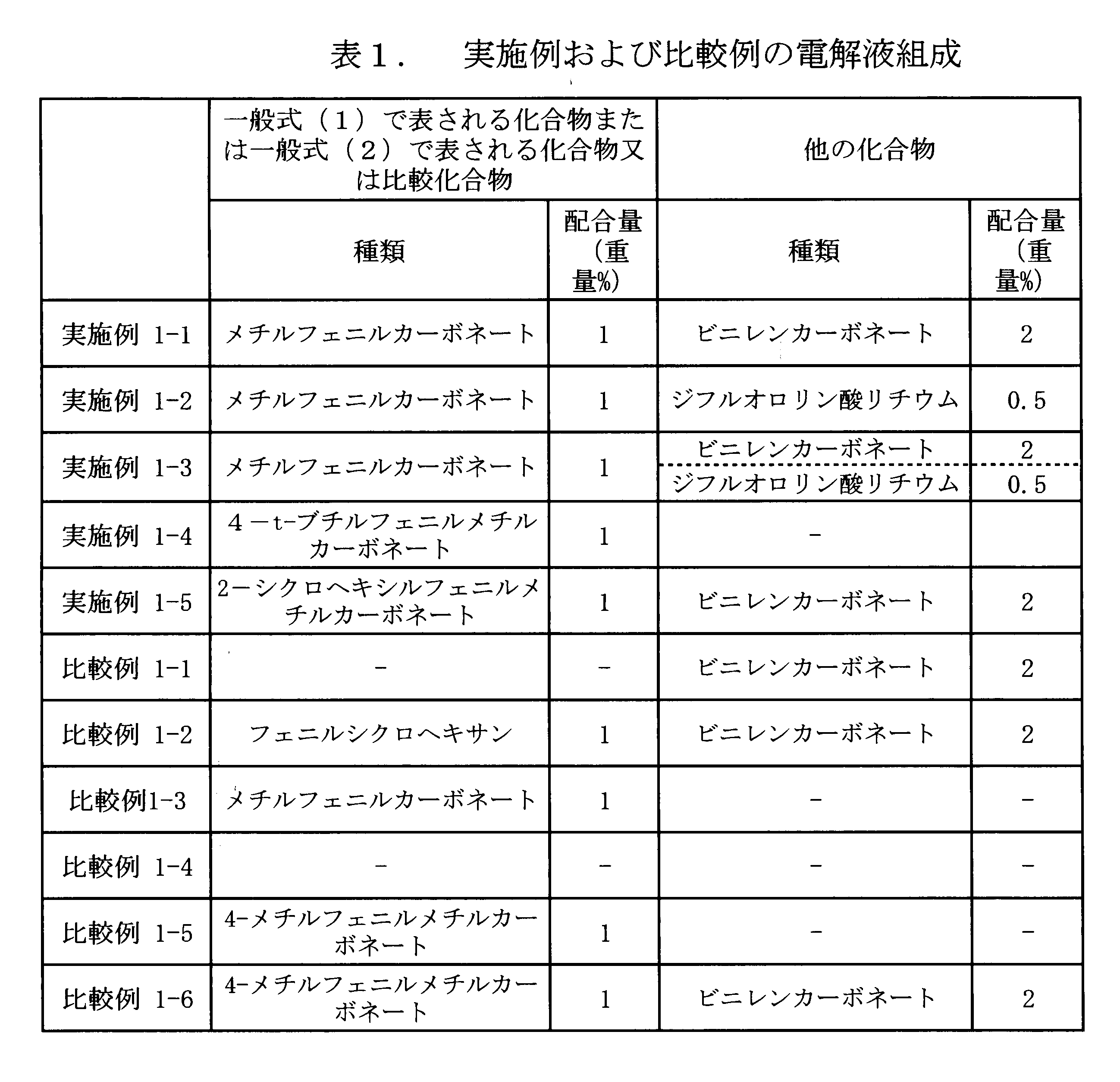
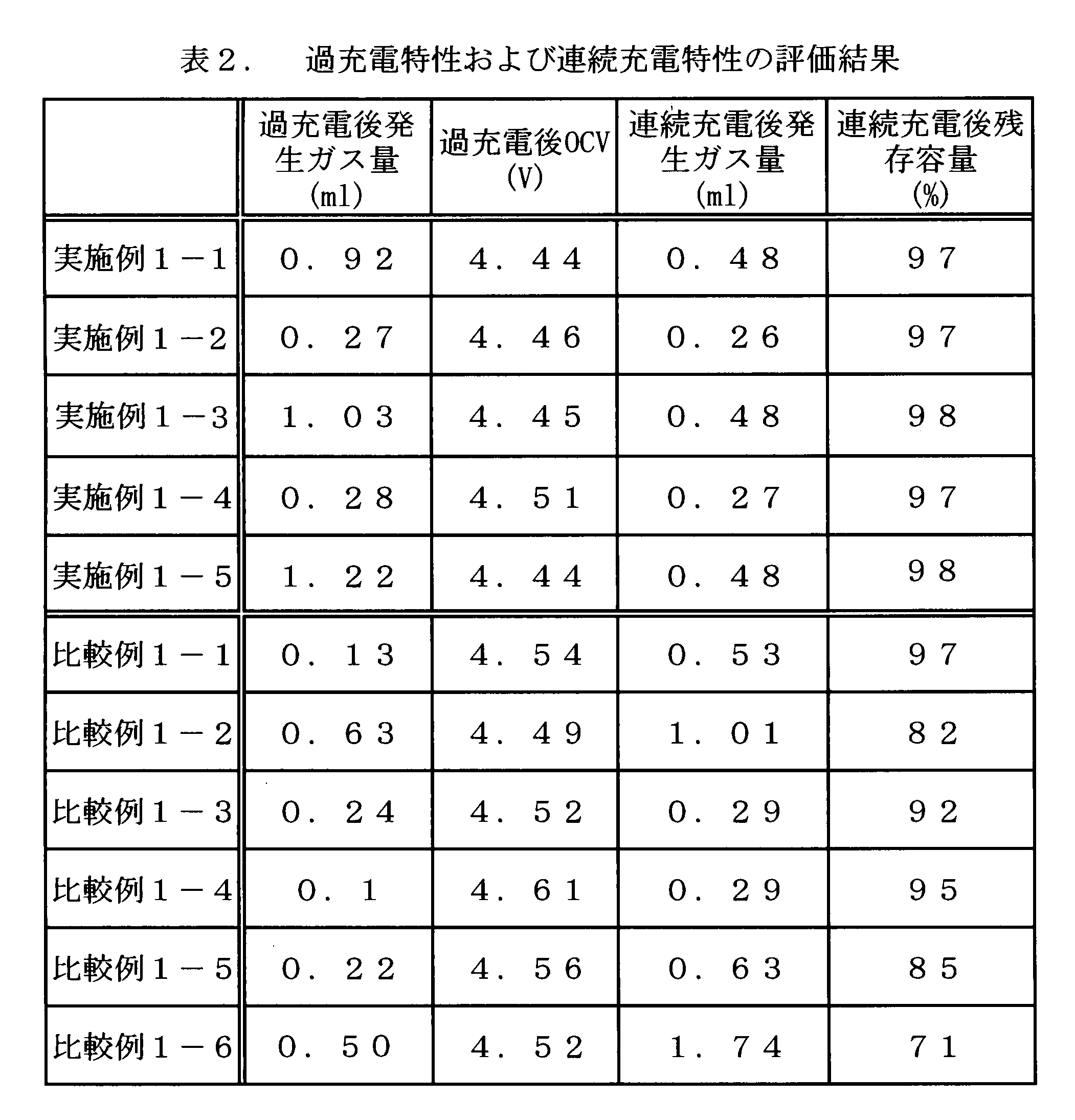
<負極の製造>
X線回折における格子面(002面)のd値が0.336nm、結晶子サイズ(Lc)が652nm、灰分が0.07重量%、レーザー回折・散乱法によるメジアン径が12μm、BET法による比表面積が7.5m2/g、アルゴンイオンレーザー光を用いたラマンスペクトル分析から求めたR値(=IB/IA)が0.12、1570~1620cm-1の範囲にあるピークの半値幅が19.9cm-1である天然黒鉛粉末94重量部とポリフッ化ビニリデン6重量部とを混合し、N-メチル-2-ピロリドンを加えスラリー状にした。このスラリーを厚さ12μmの銅箔の片面に均一に塗布、乾燥した後、負極活物質層の密度が1.67g/cm3になるようにプレスして負極とした。
LiCoO290重量部、カーボンブラック4重量部およびポリフッ化ビニリデン(呉羽化学社製、商品名「KF-1000」)6重量部を混合し、N-メチル-2-ピロリドンを加えてスラリーとし、これを厚さ15μmのアルミニウム箔の両面に均一に塗布、乾燥した後、正極活物質層の密度が3.2g/cm3になるようにプレスして正極とした。
乾燥アルゴン雰囲気下、エチレンカーボネートとエチルメチルカーボネートとジメチルカーボネートの混合物(容量比2:3:3)に、非水系電解液中の含有量としてビニレンカーボネート2重量%とジフェニルカーボネート1重量%を混合し、次いで十分に乾燥したLiPF6を1.0モル/リットルの割合となるように溶解して電解液とした。
上記の正極、負極、およびポリエチレン製のセパレータを、負極、セパレータ、正極、セパレータ、負極の順に積層して電池要素を作製した。この電池要素をアルミニウム(厚さ40μm)の両面を樹脂層で被覆したラミネートフィルムからなる袋内に正極負極の端子を突設させながら挿入した後、上記電解液を袋内に注入し、真空封止を行って、シート状リチウム二次電池を作製し、過充電特性および連続充電特性の評価を行った。評価結果を表3に示す。
実施例2-1の電解液において、ビニレンカーボネートに代えて、フルオロエチレンカーボネートを使用した以外、実施例2-1と同様にしてシート状リチウム二次電池を作製し、過充電特性および連続充電特性の評価を行った。評価結果を表3に示す。
エチレンカーボネートとエチルメチルカーボネートとジメチルカーボネートの混合物(容量比2:3:3)に、非水系電解液中の含有量としてビニレンカーボネート2重量%、ジフルオロリン酸リチウム0.5重量%およびジフェニルカーボネート1重量%を混合した。次いで十分に乾燥したLiPF6を1.0モル/リットルの割合となるように溶解して調製した電解液を使用した以外、実施例2-1と同様にしてシート状リチウム二次電池を作製し、過充電特性および連続充電特性の評価を行った。評価結果を表3に示す。
エチレンカーボネートとエチルメチルカーボネートとジメチルカーボネートの混合物(容量比2:3:3)に、非水系電解液中の含有量としてビニレンカーボネート2重量%を混合した。次いで十分に乾燥したLiPF6を1.0モル/リットルの割合となるように溶解して調製した電解液を使用した以外、実施例2-1と同様にしてシート状リチウム二次電池を作製し、過充電特性および連続充電特性の評価を行った。評価結果を表3に示す。
実施例2-1の電解液において、ジフェニルカーボネートに代えて、フェニルシクロへキサンを使用した以外、実施例1と同様にしてシート状リチウム二次電池を作製し、過充電特性および連続充電特性の評価を行った。評価結果を表3に示す。
実施例2-1の電解液において、ビニレンカーボネートに代えて、ビニルエチレンカーボネートを使用した以外、実施例2-1と同様にしてシート状リチウム二次電池を作製し、過充電特性および連続充電特性の評価を行った。評価結果を表3に示す。
エチレンカーボネートとエチルメチルカーボネートとジメチルカーボネートの混合物(容量比2:3:3)に、非水系電解液中の含有量としてジフェニルカーボネート1重量%を混合した。次いで十分に乾燥したLiPF6を1.0モル/リットルの割合となるように溶解して調製した電解液を使用した以外、実施例2-1と同様にしてシート状リチウム二次電池を作製し、過充電特性および連続充電特性の評価を行った。評価結果を表3に示す。
エチレンカーボネートとエチルメチルカーボネートとジメチルカーボネートの混合物(容量比2:3:3)に、十分に乾燥したLiPF6を1.0モル/リットルの割合となるように溶解して調製した電解液を使用した以外、実施例2-1と同様にしてシート状リチウム二次電池を作製し、過充電特性および連続充電特性の評価を行った。評価結果を表3に示す。
[比較例2-6]
乾燥アルゴン雰囲気下、エチレンカーボネートとエチルメチルカーボネートとジメチルカーボネートの混合物(容量比6:1:3)に、非水系電解液中の含有量としてビニレンカーボネート2重量%とジフェニルカーボネート1重量%を混合し、次いで十分に乾燥したLiPF6を1.0モル/リットルの割合となるように溶解して調製した電解液を使用した以外、実施例2-1と同様にしてシート状リチウム二次電池を作製し、過充電特性および連続充電特性の評価を行った。評価結果を表3に示す。
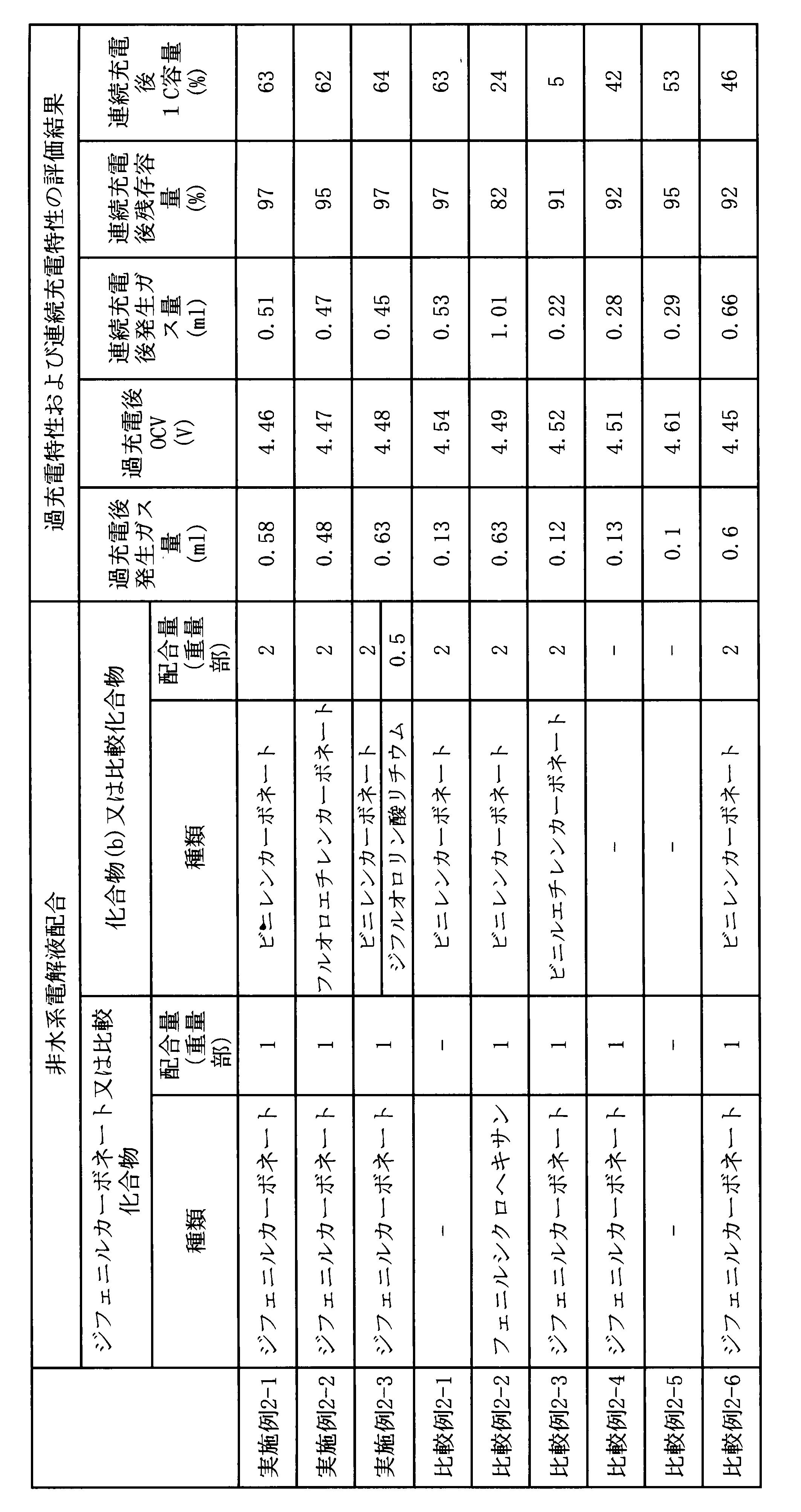
ジフェニルカーボネートの代わりにフェニルシクロヘキサンを配合した電解液を用いた比較例2-2の電池は過充電時の安全性は高いが、高温保存によるガス発生が多く、電池特性劣化も大きい。
電解液が化合物(b)を含まない比較例2-3、2-4の電池は、高温保存によるガス発生は少ないが、電池特性劣化が大きい。
電解液がジフェニルカーボネートを含まない比較例2-1、2-5の電池は、高温保存後の電池特性には優れているが、過充電時の安全性が低いといえる。
電解液が特定の非水溶媒を含まない比較例2-6の電池は、高温保存によるガス発生も多く、電池特性劣化が大きい。 これに対して、ジフェニルカーボネートと化合物(b)とを併用した本発明の電解液を用いた電池は、過充電時の安全性が高く、高温保特性に優れていることがわかる。
[負極の製造]
X線回折における格子面(002面)のd値が0.336nm、結晶子サイズ(Lc)が652nm、灰分が0.07重量部、レーザー回折・散乱法によるメジアン径が12μm、BET法による比表面積が7.5m2/g、アルゴンイオンレーザー光を用いたラマンスペクトル分析から求めたR値(=IB/IA)が0.12、1570~1620cm-1の範囲にあるピークの半値幅が19.9cm-1である天然黒鉛粉末94重量部とポリフッ化ビニリデン6重量部とを混合し、N-メチル-2-ピロリドンを加えスラリー状にした。このスラリーを厚さ12μmの銅箔の片面に均一に塗布、乾燥した後、負極活物質層の密度が1.67g/cm3になるようにプレスして負極とした。
LiCoO2 90重量部、カーボンブラック4重量部及びポリフッ化ビニリデン(呉羽化学社製、商品名「KF-1000」)6重量部を混合し、N-メチル-2-ピロリドンを加えスラリーし、これを厚さ15μmのアルミニウム箔の両面に均一に塗布、乾燥した後、正極活物質層の密度が3.2g/cm3になるようにプレスして正極とした。
[電解液の製造]
乾燥アルゴン雰囲気下、エチレンカーボネートとエチルメチルカーボネートとジメチルカーボネートの混合物(容量比2:3:3)に、非水系電解液中の含有量としてビニレンカーボネート2重量%とトリス(4-t-ブチルフェニル)ホスフェート1重量%を混合し、次いで十分に乾燥したLiPF6を1.0モル/リットルの割合となるように溶解して電解液とした。
上記の正極、負極、及びポリエチレン製のセパレータを、負極、セパレータ、正極、セパレータ、負極の順に積層して電池要素を作製した。この電池要素をアルミニウム(厚さ40μm)の両面を樹脂層で被覆したラミネートフィルムからなる袋内に正極負極の端子を突設させながら挿入した後、上記電解液を袋内に注入し、真空封止を行い、シート状電池を作製し、過充電特性および連続充電特性の評価を行った。評価結果を表5に示す。
実施例3-1の電解液において、トリス(4-t-ブチルフェニル)ホスフェートに代えて、トリス(4-シクロヘキシルフェニル)ホスフェートを使用した以外、実施例3-1と同様にしてシート状リチウム二次電池を作製し、過充電特性および連続充電特性の評価を行った。評価結果を表5に示す。
(実施例3-3)
実施例3-1の電解液において、トリス(4-t-ブチルフェニル)ホスフェートに代えて、4-t-ブチルフェニルアセテートを使用した以外、実施例3-1と同様にしてシート状リチウム二次電池を作製し、過充電特性および連続充電特性の評価を行った。評価結果を表5に示す。
実施例3-1の電解液において、トリス(4-t-ブチルフェニル)ホスフェートに代えて、メチル-4-t-ブチルベンゾエートを使用した以外、実施例3-1と同様にしてシート状リチウム二次電池を作製し、過充電特性および連続充電特性の評価を行った。評価結果を表5に示す。
(実施例3-5)
エチレンカーボネートとエチルメチルカーボネートとジメチルカーボネートの混合物(容量比2:3:3)に、非水系電解液中の含有量としてビニレンカーボネート2重量%、ジフルオロリン酸リチウム0.5重量%及びトリス(4-t-ブチルフェニル)ホスフェート1重量%を混合した。次いで十分に乾燥したLiPF6を1.0モル/リットルの割合となるように溶解して調製した電解液を使用した以外、実施例3-1と同様にしてシート状リチウム二次電池を作製し、過充電特性および連続充電特性の評価を行った。評価結果を表5に示す。
エチレンカーボネートとエチルメチルカーボネートとジメチルカーボネートの混合物(容量比2:3:3)に、非水系電解液中の含有量としてビニレンカーボネート2重量%を混合した。次いで十分に乾燥したLiPF6を1.0モル/リットルの割合となるように溶解して調製した電解液を使用した以外、実施例3-1と同様にしてシート状リチウム二次電池を作製し、過充電特性および連続充電特性の評価を行った。評価結果を表5に示す。
実施例3-1の電解液において、トリス(4-t-ブチルフェニル)ホスフェートに代えて、フェニルシクロへキサンを使用した以外、実施例3-1と同様にしてシート状リチウム二次電池を作製し、過充電特性および連続充電特性の評価を行った。評価結果を表5に示す。
(比較例3-3)
実施例3-1の電解液において、トリス(4-t-ブチルフェニル)ホスフェートに代えて、トリフェニルホスフェートを使用した以外、実施例3-1と同様にしてシート状リチウム二次電池を作製し、過充電特性および連続充電特性の評価を行った。評価結果を表5に示す。
実施例3-1の電解液において、トリス(4-t-ブチルフェニル)ホスフェートに代えて、トリス(4-メチルフェニル)ホスフェートを使用した以外、実施例3-1と同様にしてシート状リチウム二次電池を作製し、過充電特性および連続充電特性の評価を行った。評価結果を表5に示す。


本出願は、2008年2月29日出願の日本特許出願(特願2008-049154号)、2008年6月6日出願の日本特許出願(特願2008-149723号)及び2008年6月18日出願の日本特許出願(特願2008-159333号)、に基づくものであり、その内容はここに参照として取り込まれる。
Claims (13)
- 電解質および非水溶媒を含む非水系電解液において、非水系電解液が下記(A)~(D)のいずれかを含むことを特徴とする非水系電解液:
(A) 下記一般式(1)で表される化合物を含有し、さらにC=C不飽和結合を有する環状カーボネート、フッ素原子を有する環状カーボネート、モノフルオロリン酸塩およびジフルオロリン酸塩からなる群より選ばれる少なくとも1種の化合物を含有する非水系電解液:

(B) 下記一般式(2)で表される化合物を含有する非水系電解液:
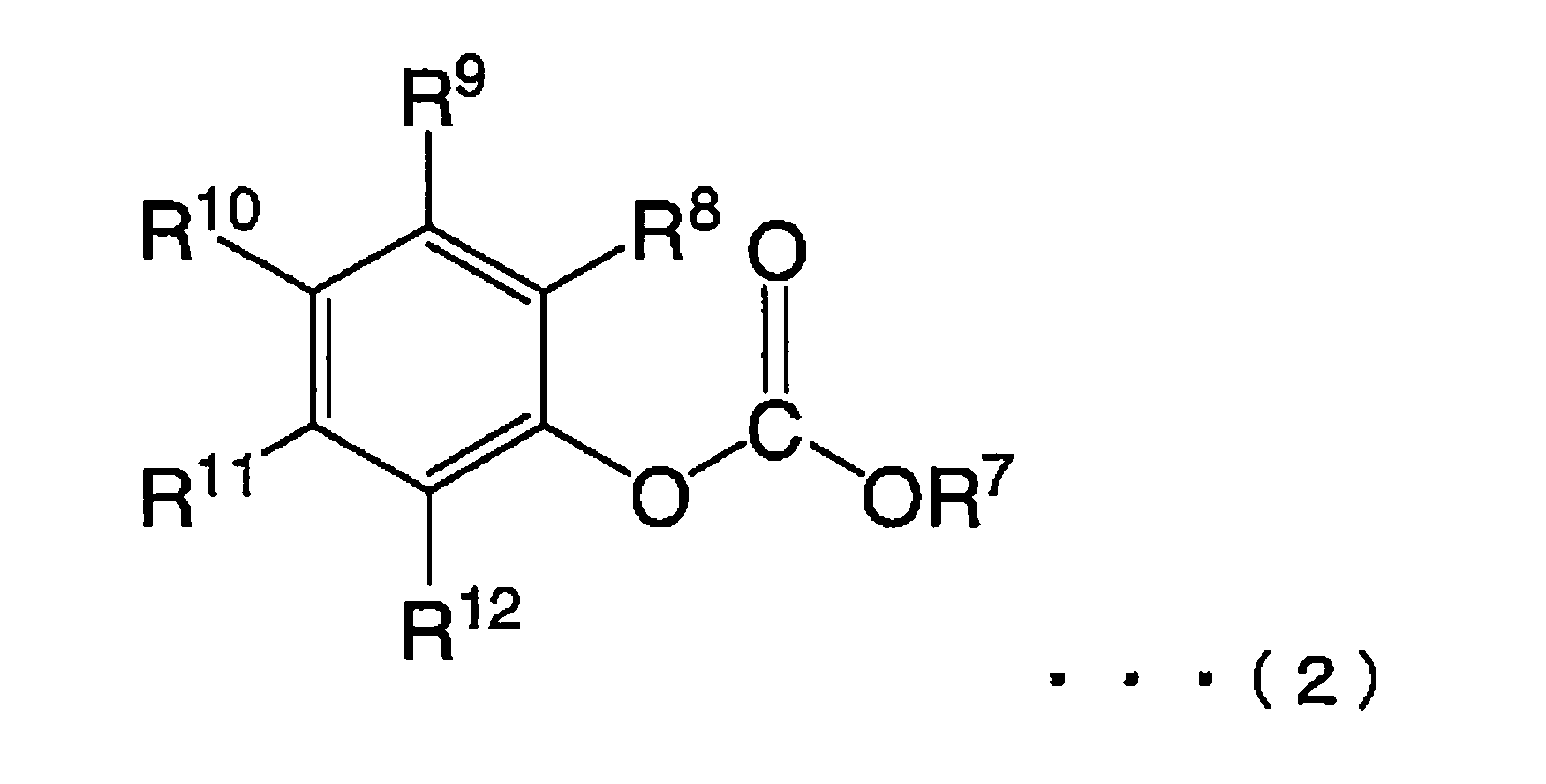
(C) (a)ジフェニルカーボネートと、(b)ビニレンカーボネート、フッ素原子を有する環状カーボネート化合物、モノフルオロリン酸塩およびジフルオロリン酸塩からなる群から選ばれる少なくとも一種の化合物とを含有し、
非水系電解液に占める(a)ジフェニルカーボネートの割合が0.001重量%以上、5重量%未満であり、
(b)ビニレンカーボネート、フッ素原子を有する環状カーボネート化合物、モノフルオロリン酸塩およびジフルオロリン酸塩からなる群から選ばれる少なくとも一種の化合物の合計の割合が0.001~20重量%であり、
非水溶媒がエチレンカーボネートとジアルキルカーボネートとを含有し、
非水溶媒に占めるエチレンカーボネートとジアルキルカーボネートとの合計に対するエチレンカーボネートの割合が5容量%以上50容量%以下である非水系電解液; 及び
(D) 置換基を有していてもよいアルキル基で置換されたフェニル基を有するリン酸エステル化合物およびカルボン酸エステル化合物のうち少なくとも1つを含有しており、該フェニル基に置換されたアルキル基の炭素数は全て4以上である非水系電解液。 - 上記非水系電解液(A)が、一般式(1)で表わされる化合物を、非水系電解液(A)中に0.001重量%以上10重量%未満の割合で含むことを特徴とする請求項1に記載の非水系電解液。
- 上記非水系電解液(A)が、C=C不飽和結合を有する環状カーボネート、フッ素原子を有する環状カーボネート、モノフルオロリン酸塩およびジフルオロリン酸塩からなる群より選ばれる少なくとも1種の化合物を、非水系電解液(A)中に0.001重量%以上10重量%以下の割合で含むことを特徴とする請求項1または2に記載の非水系電解液。
- 上記非水系電解液(B)が、C=C不飽和結合を有する環状カーボネート、フッ素原子を有する環状カーボネート、モノフルオロリン酸塩およびジフルオロリン酸塩からなる群より選ばれる少なくとも1種の化合物を含有することを特徴とする請求項1に記載の非水系電解液。
- 上記非水系電解液(B)が、一般式(2)で表わされる化合物を、非水系電解液(B)中に0.001重量%以上10重量%未満の割合で含むことを特徴とする請求項1又は4に記載の非水系電解液。
- 上記非水系電解液(B)が、C=C不飽和結合を有する環状カーボネート、フッ素原子を有する環状カーボネート、モノフルオロリン酸塩およびジフルオロリン酸塩からなる群より選ばれる少なくとも1種の化合物を、非水系電解液(B)中に0.001重量%以上10重量%以下の割合で含むことを特徴とする請求項4または5に記載の非水系電解液。
- 上記非水系電解液(A)において、非水溶媒が、エチレンカーボネートおよびプロピレンカーボネートから選ばれる環状カーボネート、非対称鎖状ジアルキルカーボネート、および対称鎖状ジアルキルカーボネートを含有していることを特徴とする請求項1ないし3の何れか一項に記載の非水系電解液。
- 上記非水系電解液(B)において、非水溶媒が、エチレンカーボネートおよびプロピレンカーボネートから選ばれる環状カーボネート、非対称鎖状ジアルキルカーボネート、および対称鎖状ジアルキルカーボネートを含有していることを特徴とする請求項4ないし6の何れか一項に記載の非水系電解液。
- 上記非水系電解液(D)において、非水系電解液(D)に占める、リン酸エステル化合物およびカルボン酸エステル化合物のうち少なくとも1つの合計の割合が、0.001重量%以上、10重量%未満であることを特徴とする請求項1に記載の非水系電解液。
- 電解質および非水溶媒を含む非水系電解液において、メチルフェニルカーボネートとビニレンカーボネートを含有することを特徴とする非水系電解液。
- 電解質および非水溶媒を含む非水系電解液において、ジフェニルカーボネートとビニレンカーボネートを含有し、非水系電解液に占めるジフェニルカーボネートの割合が0.001重量%以上、5重量%未満であり、ビニレンカーボネートの割合が0.001~20重量%であり、非水溶媒がエチレンカーボネートとジアルキルカーボネートとを含有し、非水溶媒に占めるエチレンカーボネートとジアルキルカーボネートとの合計に対するエチレンカーボネートの割合が5容量%以上50容量%以下であることを特徴とする非水系電解液。
- 電解質および非水溶媒を含む非水系電解液において、トリス(4-t-ブチルフェニル)ホスフェートとビニレンカーボネートを含有することを特徴とする非水系電解液。
- リチウムイオンを吸蔵・放出可能な負極及び正極、並びに非水系電解液を含む非水系電解液電池であって、該非水系電解液が請求項1ないし12の何れか一項に記載の非水系電解液であることを特徴とする非水系電解液電池。
Priority Applications (7)
| Application Number | Priority Date | Filing Date | Title |
|---|---|---|---|
| EP09715213.6A EP2249426B1 (en) | 2008-02-29 | 2009-02-27 | Nonaqueous electrolyte solution and nonaqueous electrolyte battery |
| CN2009801064008A CN101960662A (zh) | 2008-02-29 | 2009-02-27 | 非水电解液及非水电解质电池 |
| KR1020107018686A KR101658678B1 (ko) | 2008-02-29 | 2009-02-27 | 비수계 전해액 및 비수계 전해액 전지 |
| US12/920,186 US9083058B2 (en) | 2008-02-29 | 2009-02-27 | Nonaqueous electrolytic solution and nonaqueous-electrolyte battery |
| US13/466,621 US8916298B2 (en) | 2008-02-29 | 2012-05-08 | Nonaqueous electrolytic solution and nonaqueous-electrolyte battery |
| US13/587,149 US8889302B2 (en) | 2008-02-29 | 2012-08-16 | Nonaqueous electrolytic solution and nonaqueous-electrolyte battery |
| US14/157,625 US20140134481A1 (en) | 2008-02-29 | 2014-01-17 | Nonaqueous electrolytic solution and nonaqueous-electrolyte battery |
Applications Claiming Priority (6)
| Application Number | Priority Date | Filing Date | Title |
|---|---|---|---|
| JP2008-049154 | 2008-02-29 | ||
| JP2008049154 | 2008-02-29 | ||
| JP2008-149723 | 2008-06-06 | ||
| JP2008149723A JP5589264B2 (ja) | 2008-06-06 | 2008-06-06 | 非水系電解液及び非水系電解液電池 |
| JP2008-159333 | 2008-06-18 | ||
| JP2008159333 | 2008-06-18 |
Related Child Applications (2)
| Application Number | Title | Priority Date | Filing Date |
|---|---|---|---|
| US12/920,186 A-371-Of-International US9083058B2 (en) | 2008-02-29 | 2009-02-27 | Nonaqueous electrolytic solution and nonaqueous-electrolyte battery |
| US13/466,621 Division US8916298B2 (en) | 2008-02-29 | 2012-05-08 | Nonaqueous electrolytic solution and nonaqueous-electrolyte battery |
Publications (1)
| Publication Number | Publication Date |
|---|---|
| WO2009107786A1 true WO2009107786A1 (ja) | 2009-09-03 |
Family
ID=41016171
Family Applications (1)
| Application Number | Title | Priority Date | Filing Date |
|---|---|---|---|
| PCT/JP2009/053701 Ceased WO2009107786A1 (ja) | 2008-02-29 | 2009-02-27 | 非水系電解液および非水系電解液電池 |
Country Status (5)
| Country | Link |
|---|---|
| US (4) | US9083058B2 (ja) |
| EP (1) | EP2249426B1 (ja) |
| KR (1) | KR101658678B1 (ja) |
| CN (4) | CN104600360A (ja) |
| WO (1) | WO2009107786A1 (ja) |
Cited By (14)
| Publication number | Priority date | Publication date | Assignee | Title |
|---|---|---|---|---|
| WO2011025016A1 (ja) * | 2009-08-31 | 2011-03-03 | 三菱化学株式会社 | 非水系電解液及びそれを用いた非水系電解液電池 |
| JP2011071098A (ja) * | 2009-08-31 | 2011-04-07 | Mitsubishi Chemicals Corp | 非水系電解液及びそれを用いたリチウム二次電池 |
| JP2011187410A (ja) * | 2010-03-11 | 2011-09-22 | Hitachi Ltd | 非水電解液及びこれを用いたリチウム二次電池 |
| US20120135314A1 (en) * | 2010-11-26 | 2012-05-31 | Soulbrain Co., Ltd | Electrolyte additive, electrolyte including the same and lithiumsecondary battery including the electrolyte. |
| US20130122379A1 (en) * | 2011-11-16 | 2013-05-16 | National Taiwan University Of Science And Technology | Lithium-ion battery and method for fabricating the same |
| US20140093787A1 (en) * | 2011-04-26 | 2014-04-03 | Ube Industries, Ltd. | Non-aqueous electrolytic solution, electrical storage device utilizing same, and cyclic sulfonic acid ester compound |
| EP2626943A4 (en) * | 2010-10-05 | 2014-04-30 | Shin Kobe Electric Machinery | LITHIUM ION BATTERY |
| WO2014115690A1 (ja) * | 2013-01-23 | 2014-07-31 | 宇部興産株式会社 | 非水電解液及びそれを用いた蓄電デバイス |
| US20160145190A1 (en) * | 2013-07-09 | 2016-05-26 | Solvay Sa | Fluorinated carbonates comprising double bond-containing groups, methods for their manufacture and uses thereof |
| JP2020527823A (ja) * | 2017-07-17 | 2020-09-10 | ノームズ テクノロジーズ インコーポレイテッド | リン含有電解質 |
| JPWO2020170833A1 (ja) * | 2019-02-19 | 2021-12-23 | 株式会社Adeka | 電解質用組成物、非水電解質及び非水電解質二次電池 |
| US12322795B2 (en) | 2021-05-26 | 2025-06-03 | Tdk Corporation | Lithium ion secondary battery |
| US12531237B2 (en) | 2021-05-26 | 2026-01-20 | Tdk Corporation | Lithium ion secondary battery |
| US12573631B2 (en) | 2021-05-26 | 2026-03-10 | Tdk Corporation | Lithium ion secondary battery |
Families Citing this family (31)
| Publication number | Priority date | Publication date | Assignee | Title |
|---|---|---|---|---|
| WO2005114773A1 (ja) | 2004-04-20 | 2005-12-01 | Mitsubishi Chemical Corporation | 非水系電解液及びそれを用いたリチウム二次電池 |
| JP5694833B2 (ja) * | 2010-09-22 | 2015-04-01 | 富士フイルム株式会社 | 非水二次電池用電解液及びリチウム二次電池 |
| JP5595887B2 (ja) | 2010-12-06 | 2014-09-24 | 株式会社日立製作所 | リチウム二次電池 |
| WO2012144306A1 (ja) * | 2011-04-22 | 2012-10-26 | 宇部興産株式会社 | 非水電解液、それを用いた蓄電デバイス、及びトリフルオロメチルベンゼン化合物 |
| KR101319379B1 (ko) * | 2011-08-02 | 2013-10-17 | 삼성에스디아이 주식회사 | 리튬 이차 전지용 전해액 및 이를 포함하는 리튬 이차 전지 |
| CN102332608A (zh) * | 2011-09-21 | 2012-01-25 | 广东达之邦新能源技术有限公司 | 一种锂离子电池电解液、锂离子电池 |
| US9865900B2 (en) * | 2012-02-07 | 2018-01-09 | Battelle Memorial Institute | Solid electrolyte interphase film-suppression additives |
| CN104205472B (zh) * | 2012-03-30 | 2017-04-12 | 三菱化学株式会社 | 非水电解液及使用其的非水电解质电池 |
| WO2013188594A2 (en) | 2012-06-12 | 2013-12-19 | A123 Systems, LLC | Non-aqueous electrolytic rechargeable batteries for extended temperature range operation |
| KR20150027125A (ko) | 2012-06-29 | 2015-03-11 | 미쓰비시 가가꾸 가부시키가이샤 | 비수계 전해액 및 그것을 사용한 비수계 전해액 전지 |
| TWI528612B (zh) * | 2012-11-02 | 2016-04-01 | China Petrochemical Dev Corp Taipei Taiwan | A lithium salt and an electrolyte solution having the lithium salt and a lithium battery |
| JP6365305B2 (ja) * | 2012-11-21 | 2018-08-01 | 日本電気株式会社 | リチウム二次電池 |
| EP3012896B1 (en) * | 2013-06-21 | 2018-03-28 | UBE Industries, Ltd. | Nonaqueous electrolyte solution, electricity storage device using same, and biphenyl group-containing carbonate compound used in same |
| CN103618108B (zh) * | 2013-11-25 | 2017-09-29 | 东莞新能源科技有限公司 | 锂离子电池及其电解液 |
| CN106415910B (zh) | 2014-01-22 | 2019-05-03 | 三菱化学株式会社 | 非水系电解液和使用了该非水系电解液的非水系电解液二次电池 |
| US10355312B2 (en) | 2014-03-27 | 2019-07-16 | Daikin Industries, Ltd. | Electrolyte and electrochemical device |
| JP6183657B2 (ja) * | 2014-03-28 | 2017-08-23 | トヨタ自動車株式会社 | リチウムイオン二次電池の製造方法 |
| KR102487263B1 (ko) * | 2014-04-17 | 2023-01-10 | 고션 인코포레이티드 | 리튬계 배터리용 전해질 첨가제로서 알킬벤조에이트 유도체 |
| JP7107682B2 (ja) * | 2014-12-18 | 2022-07-27 | ソルヴェイ(ソシエテ アノニム) | フッ化カーボネートを含有する電解質組成物及びその組成物を含む電池 |
| KR102272270B1 (ko) | 2016-07-22 | 2021-07-02 | 삼성에스디아이 주식회사 | 리튬 이차 전지용 전해질 및 이를 포함하는 리튬 이차 전지 |
| JP7233157B2 (ja) * | 2016-08-31 | 2023-03-06 | 住友化学株式会社 | 非水電解液二次電池用セパレータ |
| CN106450456A (zh) * | 2016-10-31 | 2017-02-22 | 武汉美格科技股份有限公司 | 一种耐高温高倍率锂离子电池电解液及包含其的电池 |
| CN107342438B (zh) * | 2017-06-21 | 2020-05-22 | 苏州大学 | 一种高库伦效率锂硫电池电解液及其制备方法 |
| CN107834110A (zh) * | 2017-10-26 | 2018-03-23 | 东莞市杉杉电池材料有限公司 | 锂离子电池电解液及锂离子电池 |
| US20230103825A1 (en) * | 2020-03-10 | 2023-04-06 | Honda Motor Co., Ltd. | Electrode for lithium-ion secondary battery, and lithium-ion secondary battery |
| CN113839090B (zh) * | 2020-06-24 | 2022-11-25 | 张家港市国泰华荣化工新材料有限公司 | 一种非水电解液及二次锂电池 |
| KR102663158B1 (ko) | 2021-12-24 | 2024-05-08 | 주식회사 엘지에너지솔루션 | 안전성이 향상된 리튬 이차전지 |
| CN114883650B (zh) * | 2022-06-29 | 2025-08-15 | 珠海冠宇电池股份有限公司 | 一种电解液和电池 |
| CN116315089B (zh) * | 2023-01-18 | 2026-02-24 | 南方科技大学 | 一种非水电解液稀释剂、非水电解液及二次电池 |
| CN116315082B (zh) * | 2023-05-22 | 2025-06-06 | 浙江中哲新能源有限公司 | 一种钠离子二次电池非水电解液及其制备方法 |
| CN116666759A (zh) * | 2023-06-28 | 2023-08-29 | 深蓝汽车科技有限公司 | 一种电解液、电化学装置以及电子设备 |
Citations (12)
| Publication number | Priority date | Publication date | Assignee | Title |
|---|---|---|---|---|
| JPS61227377A (ja) * | 1985-04-02 | 1986-10-09 | Showa Denko Kk | 非水系二次電池 |
| JPH07114940A (ja) | 1993-10-18 | 1995-05-02 | Sanyo Electric Co Ltd | 非水電解液二次電池 |
| JPH08293323A (ja) | 1995-04-24 | 1996-11-05 | Mitsubishi Chem Corp | リチウムイオン電池用電解液 |
| JPH09106835A (ja) | 1995-08-23 | 1997-04-22 | Moli Energy 1990 Ltd | 非水系の再充電可能電池における過充電保護のための重合性の芳香族添加剤 |
| JPH09171840A (ja) | 1995-11-17 | 1997-06-30 | Moli Energy 1990 Ltd | 非水系リチウム電池における過充電保護用芳香族モノマー系気体発生剤 |
| JP2000058115A (ja) * | 1998-07-31 | 2000-02-25 | Sanyo Electric Co Ltd | 非水系電池用電解液およびこの電解液を用いた二次電池 |
| JP2000106210A (ja) * | 1998-09-29 | 2000-04-11 | Shin Kobe Electric Mach Co Ltd | 有機電解液二次電池 |
| JP2001028272A (ja) * | 1999-07-15 | 2001-01-30 | Mitsubishi Chemicals Corp | リチウム二次電池用電解液及びそれを用いたリチウム二次電池 |
| JP2002050398A (ja) | 1999-06-30 | 2002-02-15 | Matsushita Electric Ind Co Ltd | 非水電解液二次電池と充電制御システムとを含む非水電解液二次電池システムおよびこれを搭載した機器 |
| JP2004063432A (ja) * | 2002-06-05 | 2004-02-26 | Sony Corp | 電池 |
| JP2005322634A (ja) | 2004-04-09 | 2005-11-17 | Sony Corp | 電解質およびそれを用いた電池 |
| JP2007173180A (ja) * | 2005-12-26 | 2007-07-05 | Central Glass Co Ltd | 非水電解液電池用電解液及び非水電解液電池 |
Family Cites Families (50)
| Publication number | Priority date | Publication date | Assignee | Title |
|---|---|---|---|---|
| JPS61284070A (ja) | 1985-06-11 | 1986-12-15 | Showa Denko Kk | 非水系二次電池 |
| JPH02244565A (ja) | 1989-03-17 | 1990-09-28 | Asahi Chem Ind Co Ltd | 非水電池 |
| JPH08106909A (ja) | 1994-10-04 | 1996-04-23 | Sanyo Electric Co Ltd | 非水電解液電池 |
| JP3341524B2 (ja) * | 1995-04-04 | 2002-11-05 | 宇部興産株式会社 | リチウム二次電池用電解液 |
| JPH0922722A (ja) | 1995-07-06 | 1997-01-21 | Mitsubishi Chem Corp | リチウムイオン電池用電解液 |
| JPH09223516A (ja) | 1996-02-14 | 1997-08-26 | Fuji Photo Film Co Ltd | 非水電解液二次電池 |
| CA2233128A1 (en) * | 1996-07-30 | 1998-02-05 | Sony Corporation | Non-aqueous electrolyte secondary battery |
| JP3961597B2 (ja) | 1996-11-22 | 2007-08-22 | 三井化学株式会社 | 非水電解液及び非水電解液二次電池 |
| JP3870584B2 (ja) | 1998-12-14 | 2007-01-17 | 三菱化学株式会社 | 非水電解液及びリチウム二次電池 |
| US6379846B1 (en) * | 1999-03-16 | 2002-04-30 | Sumitomo Chemical Company, Limited | Non-aqueous electrolyte and lithium secondary battery using the same |
| JP3113652B1 (ja) | 1999-06-30 | 2000-12-04 | 三洋電機株式会社 | リチウム二次電池 |
| JP2002203597A (ja) | 2001-01-04 | 2002-07-19 | Mitsubishi Chemicals Corp | 非水系電解液及びその使用 |
| CN1317790C (zh) | 2001-01-04 | 2007-05-23 | 三菱化学株式会社 | 非水系电解液及其二次锂电池 |
| US6746794B2 (en) | 2001-06-12 | 2004-06-08 | Tech Drive, Inc | Thermal runaway inhibitors |
| WO2003063269A1 (en) * | 2002-01-24 | 2003-07-31 | Hitachi Maxell, Ltd. | Nonaqueous secondary cell and electronic device incorporating same |
| JP4051947B2 (ja) | 2002-02-12 | 2008-02-27 | 三菱化学株式会社 | 非水系電解液及びそれを用いたリチウム二次電池 |
| US7026074B2 (en) * | 2002-02-15 | 2006-04-11 | The University Of Chicago | Lithium ion battery with improved safety |
| WO2003077350A1 (en) | 2002-03-08 | 2003-09-18 | Mitsubishi Chemical Corporation | Nonaqueous electrolyte and lithium-ion secondary battery containing the same |
| JP4461664B2 (ja) | 2002-04-02 | 2010-05-12 | 三菱化学株式会社 | 非水系電解液二次電池及びそれに用いる非水系電解液 |
| JP4233819B2 (ja) | 2002-06-25 | 2009-03-04 | 三菱化学株式会社 | 非水電解液二次電池 |
| JP4141214B2 (ja) | 2002-09-18 | 2008-08-27 | 三菱化学株式会社 | 非水電解液及びそれを用いた非水電解液二次電池 |
| JP2004296237A (ja) | 2003-03-26 | 2004-10-21 | Toshiba Corp | 非水電解質二次電池 |
| CN100365862C (zh) * | 2003-05-26 | 2008-01-30 | 北京有色金属研究总院 | 一种锂离子电池 |
| CN100481604C (zh) | 2003-09-17 | 2009-04-22 | 宇部兴产株式会社 | 非水电解液及使用该电解液的锂二次电池 |
| JP2005116327A (ja) | 2003-10-07 | 2005-04-28 | Mitsubishi Chemicals Corp | リチウム二次電池 |
| KR100574328B1 (ko) * | 2003-12-30 | 2006-04-26 | 제일모직주식회사 | 전지용 비수전해액 |
| CN1934743A (zh) * | 2004-03-22 | 2007-03-21 | 宇部兴产株式会社 | 非水电解液及使用该非水电解液的锂二次电池 |
| WO2005091422A1 (ja) | 2004-03-22 | 2005-09-29 | Ube Industries, Ltd. | 非水電解液及びそれを用いたリチウム二次電池 |
| CN2689546Y (zh) | 2004-03-23 | 2005-03-30 | 张宏 | 一种带插座的收线箱 |
| KR100670448B1 (ko) | 2004-05-31 | 2007-01-16 | 삼성에스디아이 주식회사 | 리튬이온 이차전지용 전해액 및 이를 포함하는 리튬이온이차전지 |
| JP4429323B2 (ja) | 2005-01-18 | 2010-03-10 | 日本板硝子株式会社 | 導波路素子、導波路素子の製造方法及び光学センサ |
| CN100559648C (zh) | 2005-01-20 | 2009-11-11 | 宇部兴产株式会社 | 非水电解液和使用其的锂二次电池 |
| JP4479728B2 (ja) | 2005-01-20 | 2010-06-09 | 宇部興産株式会社 | 非水電解液及びそれを用いたリチウム二次電池 |
| EP1847959B1 (en) | 2005-01-21 | 2013-11-27 | NEC Corporation | Threshold determining device, method and program, and person identifying system |
| JP2006221972A (ja) | 2005-02-10 | 2006-08-24 | Sony Corp | 電解液および電池 |
| KR101191636B1 (ko) * | 2005-02-28 | 2012-10-18 | 삼성에스디아이 주식회사 | 리튬 전지용 전해질 및 그를 포함하는 리튬 전지 |
| JP4952186B2 (ja) | 2005-10-20 | 2012-06-13 | 三菱化学株式会社 | 二次電池用非水系電解液及びそれを用いた二次電池 |
| KR20130090913A (ko) | 2005-10-20 | 2013-08-14 | 미쓰비시 가가꾸 가부시키가이샤 | 리튬 2 차 전지 및 그것에 사용하는 비수계 전해액 |
| JP4940625B2 (ja) | 2005-10-21 | 2012-05-30 | ソニー株式会社 | 電解液および電池 |
| JP5503098B2 (ja) | 2005-10-28 | 2014-05-28 | 三菱化学株式会社 | 二次電池用非水系電解液及びそれを用いた二次電池 |
| JP2007134245A (ja) | 2005-11-11 | 2007-05-31 | Sony Corp | 電解液および電池 |
| JP4972922B2 (ja) | 2005-12-14 | 2012-07-11 | セントラル硝子株式会社 | 非水電解液電池用電解液及び非水電解液電池 |
| JP5671775B2 (ja) | 2006-01-27 | 2015-02-18 | 三菱化学株式会社 | リチウムイオン二次電池 |
| JP5213151B2 (ja) | 2006-03-20 | 2013-06-19 | 日立マクセル株式会社 | 非水二次電池およびその使用方法 |
| CN101188282B (zh) * | 2006-03-20 | 2010-09-08 | 日立麦克赛尔株式会社 | 非水二次电池及其使用方法 |
| JP5098280B2 (ja) | 2006-07-13 | 2012-12-12 | ソニー株式会社 | 非水電解質組成物及び非水電解質二次電池 |
| CN101507041B (zh) * | 2006-08-22 | 2014-12-17 | 三菱化学株式会社 | 二氟磷酸锂、含有二氟磷酸锂的电解液、二氟磷酸锂的制备方法、非水电解液的制备方法、非水电解液以及使用该非水电解液的非水电解质二次电池 |
| KR100760763B1 (ko) | 2006-10-17 | 2007-10-04 | 삼성에스디아이 주식회사 | 고전압 리튬 이차 전지용 전해액 및 이를 채용하는 고전압리튬 이차 전지 |
| JP5286718B2 (ja) | 2007-08-01 | 2013-09-11 | 宇部興産株式会社 | フェニルエステル及びリチウム二次電池用非水電解液並びにそれを用いたリチウム二次電池 |
| JP5589287B2 (ja) | 2008-02-29 | 2014-09-17 | 三菱化学株式会社 | 非水系電解液及び非水系電解液電池 |
-
2009
- 2009-02-27 KR KR1020107018686A patent/KR101658678B1/ko active Active
- 2009-02-27 CN CN201410720568.0A patent/CN104600360A/zh active Pending
- 2009-02-27 WO PCT/JP2009/053701 patent/WO2009107786A1/ja not_active Ceased
- 2009-02-27 EP EP09715213.6A patent/EP2249426B1/en active Active
- 2009-02-27 CN CN2009801064008A patent/CN101960662A/zh active Pending
- 2009-02-27 US US12/920,186 patent/US9083058B2/en active Active
- 2009-02-27 CN CN201310009078.5A patent/CN103078137B/zh active Active
- 2009-02-27 CN CN201610124233.1A patent/CN105762402A/zh active Pending
-
2012
- 2012-05-08 US US13/466,621 patent/US8916298B2/en active Active
- 2012-08-16 US US13/587,149 patent/US8889302B2/en active Active
-
2014
- 2014-01-17 US US14/157,625 patent/US20140134481A1/en not_active Abandoned
Patent Citations (12)
| Publication number | Priority date | Publication date | Assignee | Title |
|---|---|---|---|---|
| JPS61227377A (ja) * | 1985-04-02 | 1986-10-09 | Showa Denko Kk | 非水系二次電池 |
| JPH07114940A (ja) | 1993-10-18 | 1995-05-02 | Sanyo Electric Co Ltd | 非水電解液二次電池 |
| JPH08293323A (ja) | 1995-04-24 | 1996-11-05 | Mitsubishi Chem Corp | リチウムイオン電池用電解液 |
| JPH09106835A (ja) | 1995-08-23 | 1997-04-22 | Moli Energy 1990 Ltd | 非水系の再充電可能電池における過充電保護のための重合性の芳香族添加剤 |
| JPH09171840A (ja) | 1995-11-17 | 1997-06-30 | Moli Energy 1990 Ltd | 非水系リチウム電池における過充電保護用芳香族モノマー系気体発生剤 |
| JP2000058115A (ja) * | 1998-07-31 | 2000-02-25 | Sanyo Electric Co Ltd | 非水系電池用電解液およびこの電解液を用いた二次電池 |
| JP2000106210A (ja) * | 1998-09-29 | 2000-04-11 | Shin Kobe Electric Mach Co Ltd | 有機電解液二次電池 |
| JP2002050398A (ja) | 1999-06-30 | 2002-02-15 | Matsushita Electric Ind Co Ltd | 非水電解液二次電池と充電制御システムとを含む非水電解液二次電池システムおよびこれを搭載した機器 |
| JP2001028272A (ja) * | 1999-07-15 | 2001-01-30 | Mitsubishi Chemicals Corp | リチウム二次電池用電解液及びそれを用いたリチウム二次電池 |
| JP2004063432A (ja) * | 2002-06-05 | 2004-02-26 | Sony Corp | 電池 |
| JP2005322634A (ja) | 2004-04-09 | 2005-11-17 | Sony Corp | 電解質およびそれを用いた電池 |
| JP2007173180A (ja) * | 2005-12-26 | 2007-07-05 | Central Glass Co Ltd | 非水電解液電池用電解液及び非水電解液電池 |
Cited By (19)
| Publication number | Priority date | Publication date | Assignee | Title |
|---|---|---|---|---|
| JP2011071098A (ja) * | 2009-08-31 | 2011-04-07 | Mitsubishi Chemicals Corp | 非水系電解液及びそれを用いたリチウム二次電池 |
| WO2011025016A1 (ja) * | 2009-08-31 | 2011-03-03 | 三菱化学株式会社 | 非水系電解液及びそれを用いた非水系電解液電池 |
| JP2011187410A (ja) * | 2010-03-11 | 2011-09-22 | Hitachi Ltd | 非水電解液及びこれを用いたリチウム二次電池 |
| EP2626943A4 (en) * | 2010-10-05 | 2014-04-30 | Shin Kobe Electric Machinery | LITHIUM ION BATTERY |
| US20120135314A1 (en) * | 2010-11-26 | 2012-05-31 | Soulbrain Co., Ltd | Electrolyte additive, electrolyte including the same and lithiumsecondary battery including the electrolyte. |
| US20140093787A1 (en) * | 2011-04-26 | 2014-04-03 | Ube Industries, Ltd. | Non-aqueous electrolytic solution, electrical storage device utilizing same, and cyclic sulfonic acid ester compound |
| US9608287B2 (en) * | 2011-04-26 | 2017-03-28 | Ube Industries, Ltd. | Non-aqueous electrolytic solution, electrical storage device utilizing same, and cyclic sulfonic acid ester compound |
| US20130122379A1 (en) * | 2011-11-16 | 2013-05-16 | National Taiwan University Of Science And Technology | Lithium-ion battery and method for fabricating the same |
| JPWO2014115690A1 (ja) * | 2013-01-23 | 2017-01-26 | 宇部興産株式会社 | 非水電解液及びそれを用いた蓄電デバイス |
| WO2014115690A1 (ja) * | 2013-01-23 | 2014-07-31 | 宇部興産株式会社 | 非水電解液及びそれを用いた蓄電デバイス |
| US20160145190A1 (en) * | 2013-07-09 | 2016-05-26 | Solvay Sa | Fluorinated carbonates comprising double bond-containing groups, methods for their manufacture and uses thereof |
| JP2016531093A (ja) * | 2013-07-09 | 2016-10-06 | ソルヴェイ(ソシエテ アノニム) | 二重結合含有基を含むフッ化カーボネート、その製造方法、及びその使用 |
| JP2020527823A (ja) * | 2017-07-17 | 2020-09-10 | ノームズ テクノロジーズ インコーポレイテッド | リン含有電解質 |
| JP7296893B2 (ja) | 2017-07-17 | 2023-06-23 | ノームズ テクノロジーズ インコーポレイテッド | リン含有電解質 |
| JPWO2020170833A1 (ja) * | 2019-02-19 | 2021-12-23 | 株式会社Adeka | 電解質用組成物、非水電解質及び非水電解質二次電池 |
| JP7627654B2 (ja) | 2019-02-19 | 2025-02-06 | 株式会社Adeka | 電解質用組成物、非水電解質及び非水電解質二次電池 |
| US12322795B2 (en) | 2021-05-26 | 2025-06-03 | Tdk Corporation | Lithium ion secondary battery |
| US12531237B2 (en) | 2021-05-26 | 2026-01-20 | Tdk Corporation | Lithium ion secondary battery |
| US12573631B2 (en) | 2021-05-26 | 2026-03-10 | Tdk Corporation | Lithium ion secondary battery |
Also Published As
| Publication number | Publication date |
|---|---|
| US20120308883A1 (en) | 2012-12-06 |
| EP2249426B1 (en) | 2019-07-10 |
| EP2249426A4 (en) | 2012-03-14 |
| CN103078137A (zh) | 2013-05-01 |
| CN105762402A (zh) | 2016-07-13 |
| CN103078137B (zh) | 2015-09-16 |
| US20120219854A1 (en) | 2012-08-30 |
| KR101658678B1 (ko) | 2016-09-21 |
| EP2249426A1 (en) | 2010-11-10 |
| CN101960662A (zh) | 2011-01-26 |
| KR20100120164A (ko) | 2010-11-12 |
| US20110123871A1 (en) | 2011-05-26 |
| CN104600360A (zh) | 2015-05-06 |
| US9083058B2 (en) | 2015-07-14 |
| US8889302B2 (en) | 2014-11-18 |
| US8916298B2 (en) | 2014-12-23 |
| US20140134481A1 (en) | 2014-05-15 |
Similar Documents
| Publication | Publication Date | Title |
|---|---|---|
| KR101658678B1 (ko) | 비수계 전해액 및 비수계 전해액 전지 | |
| JP5817797B2 (ja) | 非水系電解液及び非水系電解液電池 | |
| JP5589264B2 (ja) | 非水系電解液及び非水系電解液電池 | |
| JP5223395B2 (ja) | 非水系電解液電池用非水系電解液および非水系電解液電池 | |
| JP5338151B2 (ja) | 非水系電解液及び非水系電解液電池 | |
| KR101508788B1 (ko) | 비수계 전해액 및 비수계 전해액 전지 | |
| JP5217200B2 (ja) | 非水系電解液および非水系電解液電池 | |
| JP5499542B2 (ja) | 非水系電解液及び非水系電解液電池 | |
| JP6107814B2 (ja) | 非水系電解液及び非水系電解液電池 | |
| JP5565212B2 (ja) | 非水系電解液及びそれを用いた非水系電解液電池 | |
| JP2012204100A (ja) | 非水系電解液及びそれを用いた非水系電解液二次電池 | |
| JP5348024B2 (ja) | 非水系電解液及び非水系電解液電池 | |
| JP6064357B2 (ja) | 非水系電解液及びそれを用いた非水系電解液電池 | |
| JP5251174B2 (ja) | 非水系電解液および非水系電解液電池 | |
| JP5651931B2 (ja) | 電池用非水系電解液および非水系電解液電池 | |
| JP5842952B2 (ja) | 非水系電解液及び非水系電解液電池 | |
| JP5773004B2 (ja) | 非水系電解液及び非水系電解液電池 | |
| JP6024387B2 (ja) | 非水系電解液及びそれを用いた非水系電解液電池 | |
| JP5223258B2 (ja) | 非水系電解液二次電池用非水系電解液及び非水系電解液電池 | |
| JP2012038716A (ja) | 非水系電解液及び非水系電解液電池 |
Legal Events
| Date | Code | Title | Description |
|---|---|---|---|
| WWE | Wipo information: entry into national phase |
Ref document number: 200980106400.8 Country of ref document: CN |
|
| 121 | Ep: the epo has been informed by wipo that ep was designated in this application |
Ref document number: 09715213 Country of ref document: EP Kind code of ref document: A1 |
|
| ENP | Entry into the national phase |
Ref document number: 20107018686 Country of ref document: KR Kind code of ref document: A |
|
| WWE | Wipo information: entry into national phase |
Ref document number: 2009715213 Country of ref document: EP |
|
| NENP | Non-entry into the national phase |
Ref country code: DE |
|
| WWE | Wipo information: entry into national phase |
Ref document number: 12920186 Country of ref document: US |