WO2009125668A1 - ラテラルフッ素を有する3環液晶性化合物、液晶組成物および液晶表示素子 - Google Patents
ラテラルフッ素を有する3環液晶性化合物、液晶組成物および液晶表示素子 Download PDFInfo
- Publication number
- WO2009125668A1 WO2009125668A1 PCT/JP2009/055920 JP2009055920W WO2009125668A1 WO 2009125668 A1 WO2009125668 A1 WO 2009125668A1 JP 2009055920 W JP2009055920 W JP 2009055920W WO 2009125668 A1 WO2009125668 A1 WO 2009125668A1
- Authority
- WO
- WIPO (PCT)
- Prior art keywords
- liquid crystal
- compound
- carbons
- diyl
- crystal composition
- Prior art date
- Legal status (The legal status is an assumption and is not a legal conclusion. Google has not performed a legal analysis and makes no representation as to the accuracy of the status listed.)
- Ceased
Links
- ZMTRHRHZECEALY-UHFFFAOYSA-N NC(C1N)C=CC=C1[O]=[IH] Chemical compound NC(C1N)C=CC=C1[O]=[IH] ZMTRHRHZECEALY-UHFFFAOYSA-N 0.000 description 1
- REZSNUCOALSVMD-UHFFFAOYSA-N Nc(c(C(CC1)CCC1=O)ccc1O)c1N Chemical compound Nc(c(C(CC1)CCC1=O)ccc1O)c1N REZSNUCOALSVMD-UHFFFAOYSA-N 0.000 description 1
Classifications
-
- C—CHEMISTRY; METALLURGY
- C09—DYES; PAINTS; POLISHES; NATURAL RESINS; ADHESIVES; COMPOSITIONS NOT OTHERWISE PROVIDED FOR; APPLICATIONS OF MATERIALS NOT OTHERWISE PROVIDED FOR
- C09K—MATERIALS FOR MISCELLANEOUS APPLICATIONS, NOT PROVIDED FOR ELSEWHERE
- C09K19/00—Liquid crystal materials
- C09K19/04—Liquid crystal materials characterised by the chemical structure of the liquid crystal components, e.g. by a specific unit
- C09K19/06—Non-steroidal liquid crystal compounds
- C09K19/08—Non-steroidal liquid crystal compounds containing at least two non-condensed rings
- C09K19/30—Non-steroidal liquid crystal compounds containing at least two non-condensed rings containing saturated or unsaturated non-aromatic rings, e.g. cyclohexane rings
- C09K19/3098—Unsaturated non-aromatic rings, e.g. cyclohexene rings
-
- C—CHEMISTRY; METALLURGY
- C09—DYES; PAINTS; POLISHES; NATURAL RESINS; ADHESIVES; COMPOSITIONS NOT OTHERWISE PROVIDED FOR; APPLICATIONS OF MATERIALS NOT OTHERWISE PROVIDED FOR
- C09K—MATERIALS FOR MISCELLANEOUS APPLICATIONS, NOT PROVIDED FOR ELSEWHERE
- C09K19/00—Liquid crystal materials
- C09K19/04—Liquid crystal materials characterised by the chemical structure of the liquid crystal components, e.g. by a specific unit
- C09K19/06—Non-steroidal liquid crystal compounds
- C09K19/08—Non-steroidal liquid crystal compounds containing at least two non-condensed rings
- C09K19/10—Non-steroidal liquid crystal compounds containing at least two non-condensed rings containing at least two benzene rings
-
- C—CHEMISTRY; METALLURGY
- C09—DYES; PAINTS; POLISHES; NATURAL RESINS; ADHESIVES; COMPOSITIONS NOT OTHERWISE PROVIDED FOR; APPLICATIONS OF MATERIALS NOT OTHERWISE PROVIDED FOR
- C09K—MATERIALS FOR MISCELLANEOUS APPLICATIONS, NOT PROVIDED FOR ELSEWHERE
- C09K19/00—Liquid crystal materials
- C09K19/04—Liquid crystal materials characterised by the chemical structure of the liquid crystal components, e.g. by a specific unit
- C09K19/06—Non-steroidal liquid crystal compounds
- C09K19/08—Non-steroidal liquid crystal compounds containing at least two non-condensed rings
- C09K19/10—Non-steroidal liquid crystal compounds containing at least two non-condensed rings containing at least two benzene rings
- C09K19/12—Non-steroidal liquid crystal compounds containing at least two non-condensed rings containing at least two benzene rings at least two benzene rings directly linked, e.g. biphenyls
-
- C—CHEMISTRY; METALLURGY
- C09—DYES; PAINTS; POLISHES; NATURAL RESINS; ADHESIVES; COMPOSITIONS NOT OTHERWISE PROVIDED FOR; APPLICATIONS OF MATERIALS NOT OTHERWISE PROVIDED FOR
- C09K—MATERIALS FOR MISCELLANEOUS APPLICATIONS, NOT PROVIDED FOR ELSEWHERE
- C09K19/00—Liquid crystal materials
- C09K19/04—Liquid crystal materials characterised by the chemical structure of the liquid crystal components, e.g. by a specific unit
- C09K19/06—Non-steroidal liquid crystal compounds
- C09K19/08—Non-steroidal liquid crystal compounds containing at least two non-condensed rings
- C09K19/10—Non-steroidal liquid crystal compounds containing at least two non-condensed rings containing at least two benzene rings
- C09K19/20—Non-steroidal liquid crystal compounds containing at least two non-condensed rings containing at least two benzene rings linked by a chain containing carbon and oxygen atoms as chain links, e.g. esters or ethers
-
- C—CHEMISTRY; METALLURGY
- C09—DYES; PAINTS; POLISHES; NATURAL RESINS; ADHESIVES; COMPOSITIONS NOT OTHERWISE PROVIDED FOR; APPLICATIONS OF MATERIALS NOT OTHERWISE PROVIDED FOR
- C09K—MATERIALS FOR MISCELLANEOUS APPLICATIONS, NOT PROVIDED FOR ELSEWHERE
- C09K19/00—Liquid crystal materials
- C09K19/04—Liquid crystal materials characterised by the chemical structure of the liquid crystal components, e.g. by a specific unit
- C09K19/06—Non-steroidal liquid crystal compounds
- C09K19/08—Non-steroidal liquid crystal compounds containing at least two non-condensed rings
- C09K19/30—Non-steroidal liquid crystal compounds containing at least two non-condensed rings containing saturated or unsaturated non-aromatic rings, e.g. cyclohexane rings
- C09K19/3001—Cyclohexane rings
-
- C—CHEMISTRY; METALLURGY
- C09—DYES; PAINTS; POLISHES; NATURAL RESINS; ADHESIVES; COMPOSITIONS NOT OTHERWISE PROVIDED FOR; APPLICATIONS OF MATERIALS NOT OTHERWISE PROVIDED FOR
- C09K—MATERIALS FOR MISCELLANEOUS APPLICATIONS, NOT PROVIDED FOR ELSEWHERE
- C09K19/00—Liquid crystal materials
- C09K19/04—Liquid crystal materials characterised by the chemical structure of the liquid crystal components, e.g. by a specific unit
- C09K19/06—Non-steroidal liquid crystal compounds
- C09K19/08—Non-steroidal liquid crystal compounds containing at least two non-condensed rings
- C09K19/30—Non-steroidal liquid crystal compounds containing at least two non-condensed rings containing saturated or unsaturated non-aromatic rings, e.g. cyclohexane rings
- C09K19/3001—Cyclohexane rings
- C09K19/3066—Cyclohexane rings in which the rings are linked by a chain containing carbon and oxygen atoms, e.g. esters or ethers
-
- C—CHEMISTRY; METALLURGY
- C09—DYES; PAINTS; POLISHES; NATURAL RESINS; ADHESIVES; COMPOSITIONS NOT OTHERWISE PROVIDED FOR; APPLICATIONS OF MATERIALS NOT OTHERWISE PROVIDED FOR
- C09K—MATERIALS FOR MISCELLANEOUS APPLICATIONS, NOT PROVIDED FOR ELSEWHERE
- C09K19/00—Liquid crystal materials
- C09K19/04—Liquid crystal materials characterised by the chemical structure of the liquid crystal components, e.g. by a specific unit
- C09K19/06—Non-steroidal liquid crystal compounds
- C09K19/32—Non-steroidal liquid crystal compounds containing condensed ring systems, i.e. fused, bridged or spiro ring systems
- C09K19/322—Compounds containing a naphthalene ring or a completely or partially hydrogenated naphthalene ring
-
- C—CHEMISTRY; METALLURGY
- C09—DYES; PAINTS; POLISHES; NATURAL RESINS; ADHESIVES; COMPOSITIONS NOT OTHERWISE PROVIDED FOR; APPLICATIONS OF MATERIALS NOT OTHERWISE PROVIDED FOR
- C09K—MATERIALS FOR MISCELLANEOUS APPLICATIONS, NOT PROVIDED FOR ELSEWHERE
- C09K19/00—Liquid crystal materials
- C09K19/04—Liquid crystal materials characterised by the chemical structure of the liquid crystal components, e.g. by a specific unit
- C09K19/06—Non-steroidal liquid crystal compounds
- C09K19/34—Non-steroidal liquid crystal compounds containing at least one heterocyclic ring
- C09K19/3402—Non-steroidal liquid crystal compounds containing at least one heterocyclic ring having oxygen as hetero atom
-
- C—CHEMISTRY; METALLURGY
- C09—DYES; PAINTS; POLISHES; NATURAL RESINS; ADHESIVES; COMPOSITIONS NOT OTHERWISE PROVIDED FOR; APPLICATIONS OF MATERIALS NOT OTHERWISE PROVIDED FOR
- C09K—MATERIALS FOR MISCELLANEOUS APPLICATIONS, NOT PROVIDED FOR ELSEWHERE
- C09K19/00—Liquid crystal materials
- C09K19/04—Liquid crystal materials characterised by the chemical structure of the liquid crystal components, e.g. by a specific unit
- C09K19/06—Non-steroidal liquid crystal compounds
- C09K19/34—Non-steroidal liquid crystal compounds containing at least one heterocyclic ring
- C09K19/3441—Non-steroidal liquid crystal compounds containing at least one heterocyclic ring having nitrogen as hetero atom
- C09K19/3444—Non-steroidal liquid crystal compounds containing at least one heterocyclic ring having nitrogen as hetero atom the heterocyclic ring being a six-membered aromatic ring containing one nitrogen atom, e.g. pyridine
-
- C—CHEMISTRY; METALLURGY
- C09—DYES; PAINTS; POLISHES; NATURAL RESINS; ADHESIVES; COMPOSITIONS NOT OTHERWISE PROVIDED FOR; APPLICATIONS OF MATERIALS NOT OTHERWISE PROVIDED FOR
- C09K—MATERIALS FOR MISCELLANEOUS APPLICATIONS, NOT PROVIDED FOR ELSEWHERE
- C09K19/00—Liquid crystal materials
- C09K19/04—Liquid crystal materials characterised by the chemical structure of the liquid crystal components, e.g. by a specific unit
- C09K19/0403—Liquid crystal materials characterised by the chemical structure of the liquid crystal components, e.g. by a specific unit the structure containing one or more specific, optionally substituted ring or ring systems
- C09K2019/0407—Liquid crystal materials characterised by the chemical structure of the liquid crystal components, e.g. by a specific unit the structure containing one or more specific, optionally substituted ring or ring systems containing a carbocyclic ring, e.g. dicyano-benzene, chlorofluoro-benzene or cyclohexanone
-
- C—CHEMISTRY; METALLURGY
- C09—DYES; PAINTS; POLISHES; NATURAL RESINS; ADHESIVES; COMPOSITIONS NOT OTHERWISE PROVIDED FOR; APPLICATIONS OF MATERIALS NOT OTHERWISE PROVIDED FOR
- C09K—MATERIALS FOR MISCELLANEOUS APPLICATIONS, NOT PROVIDED FOR ELSEWHERE
- C09K19/00—Liquid crystal materials
- C09K19/04—Liquid crystal materials characterised by the chemical structure of the liquid crystal components, e.g. by a specific unit
- C09K19/0403—Liquid crystal materials characterised by the chemical structure of the liquid crystal components, e.g. by a specific unit the structure containing one or more specific, optionally substituted ring or ring systems
- C09K2019/0411—Liquid crystal materials characterised by the chemical structure of the liquid crystal components, e.g. by a specific unit the structure containing one or more specific, optionally substituted ring or ring systems containing a chlorofluoro-benzene, e.g. 2-chloro-3-fluoro-phenylene-1,4-diyl
-
- C—CHEMISTRY; METALLURGY
- C09—DYES; PAINTS; POLISHES; NATURAL RESINS; ADHESIVES; COMPOSITIONS NOT OTHERWISE PROVIDED FOR; APPLICATIONS OF MATERIALS NOT OTHERWISE PROVIDED FOR
- C09K—MATERIALS FOR MISCELLANEOUS APPLICATIONS, NOT PROVIDED FOR ELSEWHERE
- C09K19/00—Liquid crystal materials
- C09K19/04—Liquid crystal materials characterised by the chemical structure of the liquid crystal components, e.g. by a specific unit
- C09K19/06—Non-steroidal liquid crystal compounds
- C09K19/34—Non-steroidal liquid crystal compounds containing at least one heterocyclic ring
- C09K19/3402—Non-steroidal liquid crystal compounds containing at least one heterocyclic ring having oxygen as hetero atom
- C09K2019/3422—Non-steroidal liquid crystal compounds containing at least one heterocyclic ring having oxygen as hetero atom the heterocyclic ring being a six-membered ring
- C09K2019/3425—Six-membered ring with oxygen(s) in fused, bridged or spiro ring systems
-
- C—CHEMISTRY; METALLURGY
- C09—DYES; PAINTS; POLISHES; NATURAL RESINS; ADHESIVES; COMPOSITIONS NOT OTHERWISE PROVIDED FOR; APPLICATIONS OF MATERIALS NOT OTHERWISE PROVIDED FOR
- C09K—MATERIALS FOR MISCELLANEOUS APPLICATIONS, NOT PROVIDED FOR ELSEWHERE
- C09K2323/00—Functional layers of liquid crystal optical display excluding electroactive liquid crystal layer characterised by chemical composition
-
- G—PHYSICS
- G02—OPTICS
- G02F—OPTICAL DEVICES OR ARRANGEMENTS FOR THE CONTROL OF LIGHT BY MODIFICATION OF THE OPTICAL PROPERTIES OF THE MEDIA OF THE ELEMENTS INVOLVED THEREIN; NON-LINEAR OPTICS; FREQUENCY-CHANGING OF LIGHT; OPTICAL LOGIC ELEMENTS; OPTICAL ANALOGUE/DIGITAL CONVERTERS
- G02F1/00—Devices or arrangements for the control of the intensity, colour, phase, polarisation or direction of light arriving from an independent light source, e.g. switching, gating or modulating; Non-linear optics
- G02F1/01—Devices or arrangements for the control of the intensity, colour, phase, polarisation or direction of light arriving from an independent light source, e.g. switching, gating or modulating; Non-linear optics for the control of the intensity, phase, polarisation or colour
- G02F1/13—Devices or arrangements for the control of the intensity, colour, phase, polarisation or direction of light arriving from an independent light source, e.g. switching, gating or modulating; Non-linear optics for the control of the intensity, phase, polarisation or colour based on liquid crystals, e.g. single liquid crystal display cells
- G02F1/137—Devices or arrangements for the control of the intensity, colour, phase, polarisation or direction of light arriving from an independent light source, e.g. switching, gating or modulating; Non-linear optics for the control of the intensity, phase, polarisation or colour based on liquid crystals, e.g. single liquid crystal display cells characterised by the electro-optical or magneto-optical effect, e.g. field-induced phase transition, orientation effect, guest-host interaction or dynamic scattering
- G02F1/13712—Devices or arrangements for the control of the intensity, colour, phase, polarisation or direction of light arriving from an independent light source, e.g. switching, gating or modulating; Non-linear optics for the control of the intensity, phase, polarisation or colour based on liquid crystals, e.g. single liquid crystal display cells characterised by the electro-optical or magneto-optical effect, e.g. field-induced phase transition, orientation effect, guest-host interaction or dynamic scattering the liquid crystal having negative dielectric anisotropy
Definitions
- the present invention relates to a liquid crystal compound, a liquid crystal composition, and a liquid crystal display element. Specifically, the present invention relates to a fluorobenzene derivative having fluorine at a lateral position, which is a liquid crystal compound, a liquid crystal composition having a nematic phase containing the compound, and a liquid crystal display element containing the composition.
- a liquid crystal display element typified by a liquid crystal display panel, a liquid crystal display module, or the like is a liquid crystal compound (in the present invention, a compound having a liquid crystal phase such as a nematic phase or a smectic phase, and a component of a liquid crystal composition having no liquid crystal phase
- the liquid crystal display element uses an optical anisotropy, a dielectric anisotropy, etc., as an operation mode of this liquid crystal display element.
- Twisted nematic mode STN (super twisted nematic) mode
- BTN bistable twisted nematic
- ECB electricallyelectriccontrolled birefringence
- OCB optical compensated bend
- IPS in-plane switching
- VA vertical
- Various modes such as an alignment mode are known.
- the ECB mode, IPS mode, VA mode, etc. are operation modes utilizing the vertical alignment of liquid crystal molecules, and in particular, the IPS mode and VA mode are conventional display modes such as TN mode, STN mode, etc. It is known that the narrow viewing angle, which is a drawback, can be improved.
- a terphenyl compound (C) having fluorine at a lateral position is described (see Patent Document 3).
- this compound has a high melting point and poor compatibility.
- a liquid crystal display element in an operation mode such as an IPS mode and a VA mode still has problems as a display element as compared with a CRT. For example, an improvement in response speed, an improvement in contrast, and a reduction in driving voltage are caused. It is desired.
- the display element that operates in the IPS mode or the VA mode is mainly composed of a liquid crystal composition having negative dielectric anisotropy.
- the liquid crystal composition is used.
- the liquid crystalline compound contained in the composition must have the following properties (1) to (8).
- the voltage holding ratio can be increased.
- the temperature range of the nematic phase is wide, so that the device is used in a wide temperature range. It becomes possible.
- the response speed is used as a display device a composition comprising a compound having a small compound viscosity, and a large elastic constant K 33 as in (7) as (4), (5)
- a composition comprising a compound having a small compound viscosity, and a large elastic constant K 33 as in (7) as (4), (5)
- the contrast of the element can be improved.
- the optical anisotropy needs to be small to large.
- methods for improving the response speed by reducing the cell thickness have been studied, and accordingly, a liquid crystal composition having a large optical anisotropy is also required.
- the threshold voltage of the liquid crystal composition containing this compound can be lowered, so that an appropriate negative voltage can be obtained as in (6).
- the driving voltage of the display element can be lowered and the power consumption can be reduced.
- a small driving voltage of the display device can be reduced by using a composition containing a compound having an elastic constant K 33 as a display device as described above, power consumption can be reduced.
- the liquid crystal compound is generally used as a composition prepared by mixing with many other liquid crystal compounds in order to develop characteristics that are difficult to be exhibited by a single compound. Therefore, it is preferable that the liquid crystalline compound used for the display element has good compatibility with other liquid crystalline compounds as shown in (8). In addition, since the display element may be used in a wide temperature range including below freezing point, it may be preferable that the display element is a compound showing good compatibility from a low temperature range.
- a first object of the present invention has heat, light stability to such becomes a nematic phase in a wide temperature range, a small viscosity, a large optical anisotropy, and a suitable elastic constant K 33, further It is to provide a liquid crystal compound having an appropriate negative dielectric anisotropy and excellent compatibility with other liquid crystal compounds.
- the second object of the present invention is to have stability against heat, light, etc., low viscosity, large optical anisotropy, and appropriate negative dielectric anisotropy, and an appropriate elastic constant K 33.
- a liquid crystal composition having a low threshold voltage, a high nematic phase maximum temperature (nematic phase-isotropic phase transition temperature) and a low nematic phase minimum temperature Is to provide.
- the third object of the present invention is to provide a liquid crystal display device containing the above composition, which has a short response time, low power consumption and low driving voltage, high contrast, and can be used in a wide temperature range. It is.
- a tricyclic liquid crystalline compound having fluorine in a lateral position in a specific structure having phenylene in which hydrogen on the benzene ring is replaced by fluorine heat, such as having a stability to light, a wide temperature range becomes a nematic phase, a small viscosity, a large optical anisotropy, and a suitable elastic constant K 33, further suitable negative dielectric anisotropy And has excellent compatibility with other liquid crystal compounds, and the liquid crystal composition containing this compound has stability against heat, light, etc., has a low viscosity, and has a large optical property.
- R 1 and R 2 are independently hydrogen, alkyl having 1 to 10 carbons, alkenyl having 2 to 10 carbons, alkoxy having 1 to 9 carbons, alkoxyalkyl having 2 to 9 carbons, or carbon An alkenyloxy having a number of 2 to 9;
- Ring A 1 is xylene trans-1,4-cyclohexylene, 1,4-cyclohexenylene, 1,4-phenylene, tetrahydropyran-2,5-diyl, 1,3-dioxane-2,5-diyl, Pyrimidine-2,5-diyl, or pyridine-2,5-diyl;
- L 1 , L 2 , L 3 and L 4 are independently hydrogen or fluorine, of which at least 3 are fluorine;
- Ring A 1 is trans-1,4-cyclohexylene, 1,4-cyclohexenylene, tetrahydropyran-2,5-diyl, 1,3-di
- R 1 and R 2 are independently alkyl having 1 to 10 carbons, alkenyl having 2 to 10 carbons, alkoxy having 1 to 9 carbons, 2 to 9 alkoxyalkyl or alkenyloxy having 2 to 9 carbon atoms;
- Ring A 1 is, xylene trans-1,4-cyclohexylene, 1,4-cyclohexenylene, tetrahydropyran-2,5-diyl, 1,3-dioxane-2,5-diyl, pyrimidine-2,5 Diyl or pyridine-2,5-diyl;
- Z 1 is a single bond, — (CH 2 ) 2 —, —CH ⁇ CH—, —C ⁇ C—, —CH 2 O—, or —OCH 2 —.
- R 1 and R 2 are independently alkyl having 1 to 10 carbons, alkenyl having 2 to 10 carbons, alkoxy having 1 to 9 carbons, 2 to 9 alkoxyalkyl or alkenyloxy having 2 to 9 carbon atoms; Ring A 1 is 1,4-phenylene;
- Z 1 is — (CH 2 ) 2 —, —CH ⁇ CH—, —C ⁇ C—, —CH 2 O—, or —OCH 2 —.
- R 1 and R 2 are independently alkyl having 1 to 10 carbons, alkenyl having 2 to 10 carbons, alkoxy having 1 to 9 carbons, 2 to 9 alkoxyalkyl or alkenyloxy having 2 to 9 carbon atoms;
- Ring A 1 is trans-1,4-cyclohexylene, 1,4-cyclohexenylene, tetrahydropyran-2,5-diyl, or pyridine-2,5-diyl;
- Z 1 is a single bond, — (CH 2 ) 2 —, —CH ⁇ CH—, —C ⁇ C—, —CH 2 O—, or —OCH 2 —.
- R 1 and R 2 are independently alkyl having 1 to 10 carbons, alkenyl having 2 to 10 carbons, alkoxy having 1 to 9 carbons, 2 to 9 alkoxyalkyl or alkenyloxy having 2 to 9 carbon atoms;
- Ring A 1 is trans-1,4-cyclohexylene, 1,4-cyclohexenylene, or tetrahydropyran-2,5-diyl;
- Z 1 is a single bond, — (CH 2 ) 2 —, —CH ⁇ CH—, —CH 2 O—, or —OCH 2 —.
- R 1 and R 2 are independently alkyl having 1 to 10 carbons, alkenyl having 2 to 10 carbons, alkoxy having 1 to 9 carbons, 2 to 9 alkoxyalkyl or alkenyloxy having 2 to 9 carbon atoms;
- ring A 1 is trans-1,4-cyclohexylene.
- R 3 and R 4 are independently alkyl having 1 to 10 carbons, alkenyl having 2 to 10 carbons, alkoxy having 1 to 9 carbons, alkoxyalkyl having 2 to 9 carbons, or 2 carbons -9 alkenyloxy;
- L 5 , L 6 , L 7 and L 8 are independently hydrogen or fluorine, of which at least 3 are fluorine;
- Z 2 is a single bond, — (CH 2 ) 2 —, —CH ⁇ CH—, —CH 2 O—, or —OCH 2 —.
- R 3 and R 4 are independently alkyl having 1 to 10 carbons, alkenyl having 2 to 10 carbons, alkoxy having 1 to 9 carbons, alkoxyalkyl having 2 to 9 carbons, or 2 carbons -9 alkenyloxy;
- Z 3 is — (CH 2 ) 2 —, —CH ⁇ CH—, —CH 2 O—, or —OCH 2 —.
- Ra 11 and Rb 11 are each independently alkyl having 1 to 10 carbons, and in this alkyl, —CH 2 — that is not adjacent to each other may be replaced by —O— Non-adjacent — (CH 2 ) 2 — may be replaced with —CH ⁇ CH—, and hydrogen may be replaced with fluorine;
- Ring A 11 , Ring A 12 , Ring A 13 and Ring A 14 are independently trans-1,4-cyclohexylene, 1,4-phenylene, 2-fluoro-1,4-phenylene, 3- Fluoro-1,4-phenylene, pyrimidine-2,5-diyl, 1,3-dioxane-2,5-diyl, or tetrahydropyran-2,5-diyl;
- Z 11 , Z 12 , and Z 13 are each independently a single bond, —CH 2 —CH 2 —, —CH ⁇ CH—, —C ⁇ C—, —COO—, or —CH 2
- the content of the first component is in the range of 5 to 60% by weight and the content of the second component is in the range of 40 to 95% by weight based on the total weight of the liquid crystal composition. 13] or [14].
- Ra 21 and Rb 21 are each independently hydrogen or alkyl having 1 to 10 carbon atoms, and in this alkyl, non-adjacent —CH 2 — may be replaced by —O—, Non-adjacent — (CH 2 ) 2 — may be replaced with —CH ⁇ CH—, and hydrogen may be replaced with fluorine;
- Ring A 21 , Ring A 22 , and Ring A 23 are independently trans-1,4-cyclohexylene, 1,4-phenylene, 2-fluoro-1,4-phenylene, 3-fluoro-1,4 -Phenylene, 2,3-difluoro-1,4-phenylene, pyrimidine-2,5-diyl, 1,3-dioxane-2,5-diyl, or tetrahydropyran-2,5-diyl;
- Z 21 , Z 22 , and Z 23 are each independently a single bond, —CH 2 —CH 2 —, —CH ⁇ CH—
- Ra 22 and Rb 22 are independently straight-chain alkyl having 1 to 8 carbon atoms, straight-chain alkenyl having 2 to 8 carbon atoms, or straight-chain alkoxy having 1 to 7 carbon atoms;
- Z 24 , Z 25 and Z 26 are each independently a single bond, —CH 2 CH 2 —, —CH 2 O—, or —OCH 2 —;
- Y 1 and Y 2 are both fluorine, or one is fluorine and the other is chlorine.
- the content ratio of the first component is in the range of 5 to 60% by weight
- the content ratio of the second component is in the range of 20 to 75% by weight
- Item 19 The liquid crystal composition according to any one of items [16] to [18], wherein the content of the component is in the range of 20 to 75% by weight.
- a liquid crystal display device comprising the liquid crystal composition according to any one of items [13] to [19].
- the liquid crystal display element according to item [20] wherein the operation mode of the liquid crystal display element is a VA mode or an IPS mode, and the driving method of the liquid crystal display element is an active matrix method.
- the liquid crystalline compound of the present invention has stability against heat, light, etc., becomes a nematic phase over a wide temperature range, has a small viscosity, a large optical anisotropy, and an appropriate elastic constant K 33 (K 33 : bend elasticity). And a suitable negative dielectric anisotropy and excellent compatibility with other liquid crystal compounds. Further, the liquid crystalline compound of the present invention is particularly excellent in that the upper limit temperature of the nematic phase does not decrease and the viscosity tends to increase without increasing the optical anisotropy.
- the liquid crystal composition of the present invention has a low viscosity, a large optical anisotropy, an appropriate elastic constant K 33 , and an appropriate negative dielectric anisotropy, a low threshold voltage,
- the upper limit temperature of the nematic phase is high and the lower limit temperature of the nematic phase is low.
- the liquid crystal composition of the present invention since the liquid crystal composition of the present invention has a large optical anisotropy, it is effective for an element that requires a large optical anisotropy.
- the liquid crystal display element of the present invention is characterized by containing this liquid crystal composition, has a short response time, low power consumption and drive voltage, a large contrast ratio, and can be used in a wide temperature range.
- TN mode, STN mode, ECB mode, OCB mode, IPS mode, VA mode and other liquid crystal display elements can be used suitably, especially for IPS mode, VA mode liquid crystal display elements can do.
- the amount of the compound expressed as a percentage means a weight percentage (% by weight) based on the total weight of the composition.
- the liquid crystalline compound of the present invention has a structure represented by the formula (a-1) (hereinafter, these compounds are also referred to as “compound (a-1)”).
- R 1 and R 2 are independently hydrogen, alkyl having 1 to 10 carbons, alkenyl having 2 to 10 carbons, alkoxy having 1 to 9 carbons, or 2 to 9 carbons Alkoxyalkyl or alkenyloxy having 2 to 9 carbon atoms.
- Ring A 1 is xylene trans-1,4-cyclohexylene, 1,4-cyclohexenylene, 1,4-phenylene, tetrahydropyran-2,5-diyl, 1,3-dioxane-2,5-diyl, Pyrimidine-2,5-diyl or pyridine-2,5-diyl.
- L 1 , L 2 , L 3 and L 4 are independently hydrogen or fluorine, of which at least three are fluorine, and ring A 1 is trans-1,4-cyclohexylene, 1,4 When cyclohexenylene, tetrahydropyran-2,5-diyl, 1,3-dioxane-2,5-diyl, or pyrimidine-2,5-diyl, pyridine-2,5-diyl, Z 1 is A single bond, — (CH 2 ) 2 —, —CH ⁇ CH—, —C ⁇ C—, —CH 2 O—, or —OCH 2 —, and when ring A 1 is 1,4-phenylene, Z 1 is — (CH 2 ) 2 —, —CH ⁇ CH—, —C ⁇ C—, —CH 2 O—, or —OCH 2 —.
- the compound (a-1) includes 1,4-phenylene in which the hydrogen at the 2-position or the 3-position is replaced with fluorine, and 1,4-phenylene in which the hydrogen at the 2-position and the 3-position is replaced with fluorine. And phenylene.
- the compound (a-1) includes 1,4-phenylene in which the hydrogen at the 2-position or the 3-position is replaced with fluorine, and 1,4-phenylene in which the hydrogen at the 2-position and the 3-position is replaced with fluorine.
- phenylene By having such a structure, it exhibits low viscosity, appropriate optical anisotropy, appropriate elastic constant K 33 , high negative dielectric anisotropy, and excellent compatibility with other compounds.
- the upper limit temperature of the nematic phase does not decrease, and the viscosity is not increased, and the negative dielectric anisotropy is particularly large.
- R 1 and R 2 are hydrogen, alkyl having 1 to 10 carbons, or alkenyl having 2 to 10 carbons, alkoxy having 1 to 9 carbons, alkoxyalkyl having 2 to 9 carbons, or carbon number 2 -9 alkenyloxy, for example, CH 3 (CH 2 ) 3 —, —CH 2 —, CH 3 (CH 2 ) 2 O—, CH 3 —O— (CH 2 ) 2 —, CH 3 —O —CH 2 —O—, H 2 C ⁇ CH— (CH 2 ) 2 —, CH 3 —CH ⁇ CH—CH 2 —, CH 3 —CH ⁇ CH—O— or the like.
- oxygen and oxygen adjacent groups such as CH 3 —O—O—CH 2 — and double bond sites such as CH 3 —CH ⁇ CH—CH ⁇ CH— are adjacent. Such groups are not preferred.
- R 1 and R 2 include hydrogen, alkyl, alkoxy, alkoxyalkyl, alkenyl and alkenyloxy.
- the chain of carbon-carbon bonds in these groups is preferably a straight chain.
- the carbon-carbon bond chain is a straight chain, the temperature range of the liquid crystal phase can be widened, and the viscosity can be reduced.
- R 1 or R 2 is an optically active group, it is useful as a chiral dopant, and a reverse twist domain generated in a liquid crystal display device by adding the compound to a liquid crystal composition (Reverse twisted domain) can be prevented.
- R 1 and R 2 are preferably alkyl, alkoxy, alkoxyalkyl and alkenyl, and more preferably alkyl, alkoxy and alkenyl.
- Alkenyl has a preferred configuration of —CH ⁇ CH—, depending on the position of the double bond in the alkenyl.
- the steric configuration is preferably a trans configuration.
- the alkenyl compound having the preferred configuration as described above has a wide temperature range of the liquid crystal phase, a large elastic constant ratio K 33 / K 11 (K 33 : bend elastic constant, K 11 : spray elastic constant), and compound Further, when this compound is added to the liquid crystal composition, the upper limit temperature (T NI ) of the nematic phase can be increased.
- alkyl examples include —CH 3 , —C 2 H 5 , —C 3 H 7 , —C 4 H 9 , —C 5 H 11 , —C 6 H 13 , —C 7 H 15 , —C 8 Mention may be made of H 17 , —C 9 H 19 , and —C 10 H 21 ;
- alkoxy include —OCH 3 , —OC 2 H 5 , —OC 3 H 7 , —OC 4 H 9 , —OC 5 H 11 , —OC 6 H 13 , —OC 7 H 15 , —OC 8 H 17 and —OC 9 H 19 may be mentioned;
- alkoxyalkyl include —CH 2 OCH 3 , —CH 2 OC 2 H 5 , —CH 2 OC 3 H 7 , — (CH 2 ) 2 OCH 3 , — (CH 2 ) 2 OC 2 H 5 , -(CH 2 ) 2 OC 3 H 7 ,
- R 1 and R 2 —CH 3 , —C 2 H 5 , —C 3 H 7 , —C 4 H 9 , —C 5 H 11 , —OCH 3 , —OC 2 H 5 , —OC 3 H 7 , —OC 4 H 9 , —OC 5 H 11 , —CH 2 OCH 3 , — (CH 2 ) 2 OCH 3 , — (CH 2 ) 3 OCH 3 , —CH 2 CH ⁇ CH 2 , —CH 2 CH ⁇ CHCH 3 , — (CH 2 ) 2 CH ⁇ CH 2 , —CH 2 CH ⁇ CHC 2 H 5 , — (CH 2 ) 2 CH ⁇ CHCH 3 , — (CH 2 ) 3 CH ⁇ CH 2 , — (CH 2 ) 3 CH ⁇ CHCH 3 , — (CH 2 ) 3 CH ⁇ CHCH 3 , — (CH 2 ) 3 CH ⁇ CHC 2 H 5 , — (CH 2 ) 3 CH ⁇ CHC 2
- Ring A 1 is trans-1,4-cyclohexylene, cyclohexene-1,4-diyl, trans-1,3-dioxane-2,5-diyl, trans-tetrahydropyran-2,5-diyl, pyrimidine- 2,5-diyl, pyridine-2,5-diyl, and in these rings, hydrogen may be replaced by fluorine.
- Ring A 1 is 1,4-phenylene, trans-1,4-cyclohexylene, cyclohexene-1,4-diyl, trans-1,3-dioxane-2,5-diyl, trans-tetrahydropyran-2,5 -Diyl, pyridine-2,5-diyl are preferred.
- 1,4-phenylene, trans-1,4-cyclohexylene and trans-tetrahydropyran-2,5-diyl are more preferable, and trans-1,4-cyclohexylene is most preferable.
- the viscosity can be reduced.
- the upper limit temperature of the nematic phase T NI ) can be increased.
- L 1 , L 2 , L 3 and L 4 are independently hydrogen or fluorine, of which at least 3 are fluorine.
- L 1 and L 2 or L 3 and L 4 one is preferably hydrogen and the other is fluorine because the melting point of the compound can be lowered. Further, it is more preferable that all of L 1 and L 2 or L 3 and L 4 are fluorine because the dielectric anisotropy of the compound can be increased.
- Z 1 is a single bond, — (CH 2 ) 2 —, —CH ⁇ CH—, —C ⁇ C—, —CH 2 O—, or —OCH 2 —.
- Z 1 is a single bond, — (CH 2 ) 2 —, or —CH ⁇ CH— because the viscosity of the compound can be reduced.
- a single bond, — (CH 2 ) 2 —, and —CH ⁇ CH— are preferable, and a single bond and — (CH 2 ) 2 — are more preferable.
- the configuration of the other group with respect to the double bond is preferably a trans configuration.
- the temperature range of the liquid crystal phase of this compound can be expanded, and further, the maximum temperature (T NI ) of the nematic phase can be increased by adding this compound to the composition. .
- the temperature range of the liquid crystal phase is expanded, the elastic constant ratio K 33 / K 11 (K 33 : bend elastic constant, K 11 : splay elasticity) (Constant) can be increased, and the viscosity of the compound can be decreased. Further, when this compound is added to the composition, the upper limit temperature (T NI ) of the nematic phase can be increased.
- the compound (a) may contain an isotope such as 2 H (deuterium) and 13 C in an amount larger than the natural abundance.
- physical properties such as dielectric anisotropy can be adjusted to desired physical properties by appropriately selecting R 1 , R 2 , ring A 1 and Z 1 .
- Preferred compounds of compound (a-1) are compounds (a-4) to (a-13).
- R 5 and R 6 are independently alkyl having 1 to 10 carbons, alkenyl having 2 to 10 carbons, alkoxy having 1 to 9 carbons, carbon number 2-9 alkoxyalkyl or alkenyloxy having 2-9 carbon atoms
- Z 3 is a single bond, — (CH 2 ) 2 —, —CH ⁇ CH—, —C ⁇ C—, —CH 2 O —, Or —OCH 2 —.
- Compounds (a-4) to (a-13) have a large negative dielectric anisotropy, stability to heat and light, become a nematic phase over a wide temperature range, and have an appropriate optical anisotropy. And an appropriate elastic constant K 33 .
- a compound in which Z 3 is —CH ⁇ CH— is preferable from the viewpoint of lowering the lower limit temperature of the liquid crystal phase and lowering the viscosity almost without lowering the upper limit temperature of the nematic phase.
- a compound in which Z 3 is — (CH 2 ) 2 — is more preferable from the viewpoints of lowering the lower limit temperature of the liquid crystal phase, higher compatibility, and lower viscosity.
- a compound in which Z 3 is —CH 2 O— or —OCH 2 — is most preferable from the viewpoint of higher negative dielectric anisotropy and lower viscosity.
- the liquid crystalline compound When the liquid crystalline compound has a structure represented by these compounds (a-4) to (a-13), it has a large negative dielectric anisotropy and is extremely compatible with other compounds. Furthermore, the heat has stability to such light, a small viscosity, and has a large optical anisotropy, and a suitable elastic constant K 33.
- the liquid crystal composition containing the compound (a-1) is stable under the conditions in which the liquid crystal display device is normally used, and the compound precipitates as crystals (or a smectic phase) even when stored at a low temperature. There is nothing to do.
- the compound (a-1) can be suitably applied to a liquid crystal composition used in a liquid crystal display element of a display mode such as PC, TN, STN, ECB, OCB, IPS, VA, and the like, such as IPS, VA, etc.
- the present invention can be particularly preferably applied to a liquid crystal composition used in a display mode liquid crystal display element.
- Compound (a-1) can be synthesized by appropriately combining synthetic methods of organic synthetic chemistry. Methods for introducing the desired end groups, rings, and linking groups into the starting materials include, for example, Organic Syntheses (John Wiley & Sons, Inc), Organic Reactions (Organic Reactions, John Wiley & Sons, Inc), It is described in books such as Comprehensive Organic Synthesis (Pergamon Press) and New Experimental Chemistry Course (Maruzen).
- the compound obtained by treating the organic halogen compound (a1) with butyllithium or magnesium is reacted with formamide such as N, N-dimethylformamide (DMF) to obtain the aldehyde derivative (a3).
- formamide such as N, N-dimethylformamide (DMF)
- the resulting aldehyde (a3) is reacted with phosphorus ylide obtained by treating the phosphonium salt (a4) with a base such as potassium t-butoxide to synthesize the corresponding compound (1A) having a double bond.
- a cis isomer may be generated depending on the reaction conditions. Therefore, when it is necessary to obtain a trans isomer, the cis isomer is isomerized to a trans isomer by a known method as necessary.
- Compound (1B) can be synthesized by hydrogenating compound (1A) in the presence of a catalyst such as palladium on carbon (Pd / C).
- An organic halogen compound (a1) is reacted with magnesium or butyllithium to prepare a Grignard reagent or a lithium salt.
- a dihydroxyborane derivative (a5) is synthesized by reacting the prepared Grignard reagent or a lithium salt with a boric acid ester such as trimethyl borate and hydrolyzing with an acid such as hydrochloric acid.
- a catalyst comprising, for example, an aqueous carbonate solution and tetrakis (triphenylphosphine) palladium (Pd (PPh 3 ) 4 ).
- Compound (1C) can be synthesized.
- the dihydroxyborane derivative (a5) is oxidized with an oxidizing agent such as hydrogen peroxide to obtain the alcohol derivative (a7).
- the alcohol derivative (a8) is obtained by reducing the aldehyde derivative (a3) with a reducing agent such as sodium borohydride.
- the obtained alcohol derivative (a8) is halogenated with hydrobromic acid or the like to obtain an organic halogen compound (a9).
- the compound (1D) can be synthesized by reacting the alcohol derivative (a8) thus obtained with the organic halogen compound (a9) in the presence of potassium carbonate or the like.
- ring A 1 Trans-1,4-cyclohexylene, cyclohexene-1,4-diyl, 1,3-dioxane-2,5-diyl, tetrahydropyran-2,5-diyl, 1,4-phenylene, pyrimidine-2,5
- rings such as -diyl, pyridine-2,5-diyl, starting materials are commercially available or synthetic methods are well known.
- compound (b3) is obtained by reacting ethyl 4-iodobenzoate (b1) with dihydroxyborane derivative (b2) in the presence of a catalyst such as potassium carbonate or Pd / C.
- a catalyst such as potassium carbonate or Pd / C.
- the compound (b3) is reduced with lithium aluminum hydride or the like to obtain the compound (b4).
- (b5) is obtained by chlorination with thionyl chloride or the like.
- Compound (b7) which is an example of compound (a-1), is synthesized by subjecting compound (b5) obtained by the above operation and phenol derivative (b6) to an etherification reaction in the presence of a base such as potassium carbonate. can do.
- liquid crystal composition Hereinafter, the liquid crystal composition of the present invention will be described.
- the component of this liquid crystal composition is characterized by containing at least one compound (a-1), but may contain two or more compounds (a-1), and only from compound (a-1). It may be configured.
- components can be selected in consideration of the dielectric anisotropy of the compound (a-1).
- the liquid crystal composition selected from the components has a low viscosity, an appropriate negative dielectric anisotropy, an appropriate elastic constant K 33 , a low threshold voltage, and a nematic phase upper limit temperature.
- the (nematic phase-isotropic phase transition temperature) is high, and the minimum temperature of the nematic phase is low.
- liquid crystal composition (1) In addition to the compound (a-1), the liquid crystal composition of the present invention has, as the second component, liquid crystal compounds represented by formulas (e-1) to (e-3) (hereinafter referred to as compound (e-1) to A composition further containing at least one compound selected from the group of (e-3)) is preferred (hereinafter also referred to as a liquid crystal composition (1)).
- Ra 11 and Rb 11 are independently alkyl having 1 to 10 carbons, but in alkyl, —CH 2 — that is not adjacent to each other is —O—.
- the non-adjacent — (CH 2 ) 2 — may be replaced with —CH ⁇ CH—, and hydrogen may be replaced with fluorine.
- ring A 11 , ring A 12 , ring A 13 , and ring A 14 are independently trans-1,4-cyclohexylene, 1,4- Phenylene, 2-fluoro-1,4-phenylene, 3-fluoro-1,4-phenylene, pyrimidine-2,5-diyl, 1,3-dioxane-2,5-diyl, or tetrahydropyran-2,5- It is a diyl.
- Z 11 , Z 12 , and Z 13 are each independently a single bond, —CH 2 —CH 2 —, —CH ⁇ CH—, —C ⁇ C -, -COO-, or CH 2 O-.
- the viscosity of the liquid crystal composition can be reduced, and the lower limit temperature of the nematic phase can be lowered. Further, since the dielectric anisotropy of the compounds (e-1) to (e-3) is almost 0, the dielectric anisotropy of the liquid crystal composition containing the compounds can be adjusted to approach 0. .
- Compound (e-1) or (e-2) is an effective compound for reducing the viscosity and increasing the voltage holding ratio of the liquid crystal composition containing it. Furthermore, the compound (e-3) is an effective compound for increasing the maximum temperature of the nematic phase of the liquid crystal composition containing it and increasing the voltage holding ratio.
- the upper limit temperature of the nematic phase of the liquid crystal composition containing the ring is set to In the case where two or more rings are 1,4-phenylene, the optical anisotropy of a composition containing the ring can be increased.
- more preferred compounds are compounds represented by formulas (2-1) to (2-74) (hereinafter also referred to as compounds (2-1) to (2-74), respectively).
- Ra 11 and Rb 11 have the same meaning as in the compounds (e-1) to (e-3).
- the second component is a compound (2-1) to (2-74)
- a liquid crystal composition having excellent heat resistance and light resistance, higher specific resistance, and a wide nematic phase should be prepared. Can do.
- the first component is at least one compound selected from compounds (a-4) to (a-13), and the second component is selected from compounds (e-1) to (e-3).
- the liquid crystal composition (1) which is at least one compound, is excellent in heat resistance and light resistance, has a wider nematic phase, a higher voltage holding ratio, a lower viscosity, and an appropriate elastic constant K. 33 is shown.
- the content of the second component in the liquid crystal composition (1) is not particularly limited, but it is preferable to increase the content from the viewpoint of lowering the viscosity.
- the threshold voltage of the liquid crystal composition tends to increase when the content of the second component is increased, for example, when the liquid crystal composition of the present invention is used in a VA mode liquid crystal element
- the second component The content of is in the range of 45 to 95% by weight with respect to the total weight of the liquid crystal compound contained in the liquid crystal composition (1), and the content of the first component is in the liquid crystal composition (1).
- the range of 5 to 60% by weight is more preferable with respect to the total weight of the liquid crystal compound contained in the above.
- liquid crystal composition (2) In addition to the first component and the second component, the liquid crystal composition of the present invention further includes liquid crystal compounds represented by formulas (g-1) to (g-4) (hereinafter referred to as compounds (g)
- compounds (g) A liquid crystal composition containing at least one compound selected from the group of -1) to (g-4)) is also preferred (hereinafter also referred to as a liquid crystal composition (2)).
- the rings A 21 , A 22 , and A 23 are independently trans-1,4-cyclohexylene, 1,4-phenylene, 2-fluoro- 1,4-phenylene, 3-fluoro-1,4-phenylene, 2,3-difluoro-1,4-phenylene, pyrimidine-2,5-diyl, 1,3-dioxane-2,5-diyl, or tetrahydro Pyran-2,5-diyl.
- Z 21 , Z 22 , and Z 23 are each independently a single bond, —CH 2 —CH 2 —, —CH ⁇ CH—, —C ⁇ C —, —OCF 2 —, —CF 2 O—, —OCF 2 CH 2 CH 2 —, —CH 2 CH 2 CF 2 O—, —COO—, —OCO—, —OCH 2 —, or —CH 2 O -And Y 1 , Y 2 , Y 3 , and Y 4 are independently fluorine or chlorine.
- liquid crystal composition (2) further containing the third component has a large negative dielectric anisotropy.
- liquid crystal composition having a wide nematic phase temperature range, a low viscosity, a large negative dielectric anisotropy and a large specific resistance can be obtained, and further, these physical properties are appropriately balanced. Is obtained.
- compounds represented by formulas (h-1) to (h-7) (hereinafter referred to as compounds (h-1) to At least one compound selected from the group of (h-7) is also preferred.
- Ra 22 and Rb 22 are each independently linear alkyl having 1 to 8 carbon atoms, linear alkenyl having 2 to 8 carbon atoms, or 1 to 7 is alkoxy
- Z 24 , Z 25 , and Z 26 are a single bond, —CH 2 CH 2 —, —CH 2 O—, —OCH 2 —, —COO—, or —OCO—
- Y 1 and Y 2 are both fluorine, or one is fluorine and the other is chlorine.
- the compounds (h-1) and (h-2) can reduce the viscosity of the liquid crystal composition containing the compound, lower the threshold voltage, and lower the minimum temperature of the nematic phase. Can do.
- Compounds (h-2), (h-3) and (h-4) can lower the threshold voltage without lowering the upper limit temperature of the nematic phase of the liquid crystal composition containing the compounds.
- Compounds (h-3) and (h-6) can increase optical anisotropy, and compounds (h-4) and (h-7) can increase optical anisotropy. .
- Compounds (h-5), (h-6) and (h-7) can lower the minimum temperature of the nematic phase of the liquid crystal composition containing the compounds (h-5), (h-6) and (h-7).
- the first component which is at least one compound selected from the compounds (a-2) to (a-11), and the compounds (e-1) to (e-3)
- more preferred compounds are compounds (3-1) to (3-118).
- Rb 22 and Rb 22 have the same meaning as in the compounds (h-1) to (h-7).
- a compound having a condensed ring such as compounds (g-3) to (g-6) can reduce the threshold voltage, and from the viewpoint of heat resistance or light resistance, compound (3-119).
- compound (3-119) to (3-143) are preferred.
- Ra 22 and Rb 22 have the same meaning as in compounds (g-3) to (g-6).
- the content ratio of the first component, the second component, and the third component of the liquid crystal composition (2) is not particularly limited, but the content of the compound (a-1) is based on the total weight of the liquid crystal composition (2). It is preferable that the ratio is in the range of 5 to 60% by weight, the content of the second component is in the range of 20 to 75% by weight, and the content of the third component is in the range of 20 to 75% by weight.
- the heat resistance and light resistance are excellent, the temperature range of the nematic phase is wide, and the viscosity is small.
- a high voltage holding ratio shows a suitable optical anisotropy, a suitable dielectric anisotropy, a suitable elastic constant K 33. Furthermore, a liquid crystal composition in which these physical properties are more appropriately balanced can be obtained.
- liquid crystal composition in addition to the liquid crystal compound constituting the first component, the second component, and the third component added as necessary, for example, for the purpose of further adjusting the characteristics of the liquid crystal composition, Furthermore, other liquid crystal compounds may be added and used. Further, for example, from the viewpoint of cost, in the liquid crystal composition of the present invention, without adding a liquid crystal compound other than the liquid crystal compound constituting the first component, the second component, and the third component to be added as necessary. Sometimes used.
- additives such as an optically active compound, a pigment
- an optically active compound is added to the liquid crystal composition according to the present invention, a helical structure can be induced in the liquid crystal to give a twist angle.
- a known chiral dopant is added as an optically active compound.
- This chiral dopant has the effect of inducing the helical structure of the liquid crystal to adjust the necessary twist angle and preventing reverse twist.
- Examples of the chiral dopant include the following optically active compounds (Op-1) to (Op-13).
- the liquid crystal composition can be applied to a liquid crystal display element having a GH (Guest host) mode.
- GH Guest host
- the liquid crystal composition according to the present invention When an ultraviolet absorber or an antioxidant is added to the liquid crystal composition according to the present invention, it is possible to prevent deterioration of the liquid crystal composition and the liquid crystal display element containing the liquid crystal composition.
- the antioxidant can suppress a decrease in specific resistance when the liquid crystal composition is heated.
- the ultraviolet absorber examples include a benzophenone ultraviolet absorber, a benzoate ultraviolet absorber, and a triazole ultraviolet absorber.
- a specific example of the benzophenone-based ultraviolet absorber is 2-hydroxy-4-n-octoxybenzophenone.
- a specific example of the benzoate ultraviolet absorber is 2,4-di-t-butylphenyl-3,5-di-t-butyl-4-hydroxybenzoate.
- Specific examples of the triazole ultraviolet absorber include 2- (2-hydroxy-5-methylphenyl) benzotriazole, 2- [2-hydroxy-3- (3,4,5,6-tetrahydroxyphthalimide-methyl)- 5-methylphenyl] benzotriazole, and 2- (3-tert-butyl-2-hydroxy-5-methylphenyl) -5-chlorobenzotriazole.
- antioxidants examples include a phenolic antioxidant and an organic sulfur antioxidant.
- the antioxidant represented by the formula (I) is preferable.
- w represents an integer of 1 to 15.
- phenolic antioxidants include 2,6-di-t-butyl-4-methylphenol, 2,6-di-t-butyl-4-ethylphenol, 2,6-di-t-butyl- 4-propylphenol, 2,6-di-t-butyl-4-butylphenol, 2,6-di-t-butyl-4-pentylphenol, 2,6-di-t-butyl-4-hexylphenol, 2 , 6-di-t-butyl-4-heptylphenol, 2,6-di-t-butyl-4-octylphenol, 2,6-di-t-butyl-4-nonylphenol, 2,6-di-t- Butyl-4-decylphenol, 2,6-di-t-butyl-4-undecylphenol, 2, 6-di-t-butyl-4-dodecylphenol, 2,6-di-t-butyl-4-tridecylphenol
- organic sulfur antioxidant examples include dilauryl-3,3′-thiopropionate, dimyristyl-3,3′-thiopropionate, distearyl-3,3′-thiopropionate, pentaerythritol Tetrakis (3-laurylthiopropionate) and 2-mercaptobenzimidazole.
- the addition amount of an additive typified by an ultraviolet absorber, an antioxidant and the like can be added and used within a range that does not impair the purpose of the present invention and can achieve the purpose of adding the additive.
- the addition ratio is usually in the range of 10 ppm to 500 ppm, preferably in the range of 30 to 300 ppm, based on the total weight of the liquid crystal composition according to the present invention. More preferably, it is in the range of 40 to 200 ppm.
- the liquid crystal composition according to the present invention includes impurities such as synthesis raw materials, by-products, reaction solvents, and synthesis catalysts mixed in the synthesis process of each compound constituting the liquid crystal composition, the liquid crystal composition preparation process, and the like. In some cases.
- composition according to the present invention for example, when the compounds constituting each component are liquid, the respective compounds are mixed and shaken, and when containing a solid, the respective compounds are mixed, It can be prepared by shaking each other by heating and dissolving.
- the liquid crystal composition according to the present invention can also be prepared by other known methods.
- the upper limit temperature of the nematic phase can be set to 70 ° C. or higher
- the lower limit temperature of the nematic phase can be set to ⁇ 20 ° C. or lower
- the temperature range of the nematic phase is wide. Therefore, the liquid crystal display element containing this composition can be used in a wide temperature range.
- the optical anisotropy can also be in the range of 0.10 to 0.13 and in the range of 0.05 to 0.18 by appropriately adjusting the composition and the like.
- the dielectric anisotropy is usually in the range of -5.0 to -2.0, preferably the dielectric anisotropy in the range of -4.5 to -2.5. Can be obtained.
- a liquid crystal composition having a dielectric anisotropy in the range of ⁇ 4.5 to ⁇ 2.5 can be suitably used as a liquid crystal display element operating in the IPS mode and the VA mode.
- the liquid crystal composition according to the present invention has operation modes such as a PC mode, a TN mode, an STN mode, and an OCB mode, and is not only a liquid crystal display element driven by an AM mode, but also a PC mode, a TN mode, an STN mode, an OCB. It can also be used for a liquid crystal display element having an operation mode such as a mode, a VA mode, and an IPS mode and driven by a passive matrix (PM) method.
- PM passive matrix
- the composition according to the present invention includes a DS (dynamic scattering) mode element using a composition to which a conductive agent is added, a NCAP (nematic curvilinear aligned phase) element prepared by microencapsulating the composition, It can also be used for a PD (polymer dispersed) element in which a three-dimensional network polymer is formed in an object, for example, a PN (polymer network) element.
- DS dynamic scattering
- NCAP non-nematic curvilinear aligned phase
- the composition according to the present invention has the above-described characteristics. Therefore, an AM liquid crystal display driven in an operation mode using a liquid crystal composition having a negative dielectric anisotropy such as a VA mode and an IPS mode. It can be suitably used for an element, and in particular, it can be suitably used for an AM liquid crystal display element driven in a VA mode.
- 1 H-NMR analysis DRX-500 (manufactured by Bruker BioSpin Co., Ltd.) was used as the measuring apparatus. The measurement was carried out by dissolving the sample synthesized in Examples and the like in a deuterated solvent in which a sample such as CDCl 3 is soluble, and at room temperature under conditions of 500 MHz and 32 integrations.
- s is a singlet
- d is a doublet
- t is a triplet
- q is a quartet
- quin is a quintet
- sex is a sextet
- m is a multiplet
- br is broad.
- Tetramethylsilane (TMS) was used as a reference material for the zero point of the chemical shift ⁇ value.
- GC analysis A GC-14B gas chromatograph manufactured by Shimadzu Corporation was used as a measuring apparatus.
- a capillary column CBP1-M25-025 (length: 25 m, inner diameter: 0.22 mm, film thickness: 0.25 ⁇ m) manufactured by Shimadzu Corporation; dimethylpolysiloxane; nonpolar) as the stationary liquid phase was used.
- Helium was used as the carrier gas, and the flow rate was adjusted to 1 ml / min.
- the temperature of the sample vaporizing chamber was set to 280 ° C., and the temperature of the detector (FID) portion was set to 300 ° C.
- the sample was dissolved in toluene to prepare a 1% by weight solution, and 1 ⁇ l of the resulting solution was injected into the sample vaporization chamber.
- a recorder a C-R6A type Chromatopac manufactured by Shimadzu Corporation or an equivalent thereof was used.
- the obtained gas chromatogram shows the peak retention time and peak area value corresponding to the component compounds.
- the column is a capillary column DB-1 (length 30 m, inner diameter 0.32 mm, film thickness 0.25 ⁇ m) manufactured by Agilent Technologies Inc., and HP-1 (length 30 m, inner diameter 0 .mu.m) manufactured by Agilent Technologies Inc. 32mm, film thickness 0.25 ⁇ m), Rtx-1 from Restek Corporation (length 30m, inner diameter 0.32mm, film thickness 0.25 ⁇ m), BP-1 from SGE International Co., Ltd. Pty. Ltd (length 30m, inner diameter 0) .32 mm, film thickness of 0.25 ⁇ m) or the like may be used.
- the peak area ratio in the gas chromatogram corresponds to the ratio of the component compounds.
- the weight% of the component compound of the analysis sample is not completely the same as the area% of each peak of the analysis sample.
- the correction factor is substantially 1. Therefore, the weight% of the component compound in the analysis sample substantially corresponds to the area% of each peak in the analysis sample. This is because there is no significant difference in the correction coefficients of the component liquid crystal compounds.
- an internal standard method using gas chromatogram is used.
- test component liquid crystal compound component
- reference liquid crystal compound reference material
- samples for measuring physical properties of liquid crystalline compounds, etc. There are two types of samples for measuring the physical properties of the liquid crystal compound: when the compound itself is used as a sample, and when the compound is mixed with a mother liquid crystal as a sample.
- the measurement is performed by the following method. First, 15% by weight of the obtained liquid crystal compound and 85% by weight of the mother liquid crystal are mixed to prepare a sample. And the extrapolation value was computed from the measured value of the obtained sample according to the extrapolation method shown to the following formula. This extrapolated value was taken as the physical property value of this compound.
- ⁇ Extrapolated value> (100 ⁇ ⁇ Measured value of sample> ⁇ ⁇ Weight% of mother liquid crystal> ⁇ ⁇ Measured value of mother liquid crystal> ) / ⁇ Weight% of compound> Even when the ratio of the compound to the mother liquid crystal is this ratio, when the smectic phase or crystal is precipitated at 25 ° C., the ratio of the liquid crystal compound to the mother liquid crystal is 10% by weight: 90% by weight, 5% by weight.
- mother liquid crystal i there are various types of mother liquid crystals used in this measurement.
- the composition of the mother liquid crystal i is as follows.
- liquid crystal composition itself was used as a sample for measuring the physical properties of the liquid crystal composition.
- Method for measuring physical properties of compounds, etc. The physical properties of the compound were measured by the method described later. Most of these are the methods described in the Standard of Electric Industries Association of Japan EIAJ / ED-2521A or a modified method thereof. Moreover, TFT was not attached to the TN element or VA element used for the measurement.
- Phase structure and transition temperature (°C) Measurement was carried out by the methods (1) and (2) below.
- the transition temperature was determined by onset.
- the crystal was expressed as C.
- the smectic phase is represented as S and the nematic phase is represented as N.
- the liquid (isotropic) was designated as I.
- the smectic phase when the smectic B phase or the smectic A phase can be distinguished, they are represented as S B or S A , respectively.
- C 50.0 N 100.0 I means that the transition temperature (CN) from the crystal to the nematic phase is 50.0 ° C., and the transition temperature from the nematic phase to the liquid ( NI) is 100.0 ° C. The same applies to other notations.
- T NI Maximum temperature of nematic phase
- a sample liquid crystalline composition or a mixture of a liquid crystalline compound and a mother liquid crystal
- the polarizing microscope was observed while heating at 650 nm.
- the temperature at which a part of the sample changed from a nematic phase to an isotropic liquid was defined as the upper limit temperature of the nematic phase.
- the upper limit temperature of the nematic phase may be simply abbreviated as “upper limit temperature”.
- Low temperature compatibility Prepare a sample in which the mother liquid crystal and the compound are mixed so that the compound is in an amount of 20% by weight, 15% by weight, 10% by weight, 5% by weight, 3% by weight, and 1% by weight, Place the sample in a glass bottle.
- the glass bottle was stored in a freezer at ⁇ 10 ° C. or ⁇ 20 ° C. for a certain period, and then it was observed whether a crystal or smectic phase was precipitated.
- Viscosity ( ⁇ ; measured at 20 ° C .; mPa ⁇ s) It measured using the E-type rotational viscometer.
- Rotational viscosity ( ⁇ 1; measured at 25 ° C .; mPa ⁇ s) The measurement followed the method described in M. Imai et al., Molecular Crystals and Liquid Crystals, Vol. 259, 37 (1995).
- a sample (a liquid crystalline composition or a mixture of a liquid crystalline compound and a mother liquid crystal) was put in a VA device having a distance (cell gap) between two glass substrates of 20 ⁇ m. This element was applied stepwise in increments of 1 volt in the range of 30 to 50 volts. After no application for 0.2 seconds, the application was repeated under the condition of only one rectangular wave (rectangular pulse; 0.2 seconds) and no application (2 seconds).
- the peak current and peak time of the transient current generated by this application were measured.
- the value of rotational viscosity was obtained from these measured values and the paper by M. Imai et al., Formula (8) on page 40.
- the dielectric anisotropy necessary for this calculation was a value measured by the following dielectric anisotropy.
- Dielectric anisotropy ( ⁇ ; measured at 25 ° C) The dielectric anisotropy was measured by the following method. An ethanol (20 mL) solution of octadecyltriethoxysilane (0.16 mL) was applied to a well-cleaned glass substrate. The glass substrate was rotated with a spinner and then heated at 150 ° C. for 1 hour. A VA device having an interval (cell gap) of 20 ⁇ m was assembled from two glass substrates.
- a polyimide alignment film was prepared on a glass substrate. After the alignment film of the obtained glass substrate was rubbed, a TN device in which the distance between the two glass substrates was 9 ⁇ m and the twist angle was 80 degrees was assembled.
- a sample (a liquid crystal composition or a mixture of a liquid crystal compound and a mother liquid crystal) is put into the obtained VA element, 0.5 V (1 kHz, sine wave) is applied, and the dielectric constant in the major axis direction of the liquid crystal molecules. ( ⁇ ) was measured.
- a sample (a liquid crystalline composition or a mixture of a liquid crystalline compound and a mother liquid crystal) is put into the obtained TN device, and 0.5 V (1 kHz, sine wave) is applied to the liquid crystal molecules in the minor axis direction.
- the dielectric constant ( ⁇ ) was measured.
- the TN device used for the measurement has a polyimide alignment film, and the distance (cell gap) between the two glass substrates is 6 ⁇ m. This element was sealed with an adhesive that was polymerized by ultraviolet rays after a sample (a liquid crystalline composition or a mixture of a liquid crystalline compound and a mother liquid crystal) was added. The TN device was charged by applying a pulse voltage (60 microseconds at 5 V). The decaying voltage was measured with a high-speed voltmeter for 16.7 milliseconds, and the area A between the voltage curve and the horizontal axis in a unit cycle was obtained. The area B is an area when it is not attenuated. The voltage holding ratio is expressed as a percentage (%) of the area A with respect to the area B.
- Elastic constant K 11 , K 33 ; measured at 25 ° C
- an EC-1 type elastic constant measuring device manufactured by Toyo Corporation was used. A sample was put in a vertical alignment cell in which the distance between two glass substrates (cell gap) was 20 ⁇ m. A 20 to 0 volt charge was applied to the cell, and the capacitance and applied voltage were measured. Fitting the measured values of capacitance (C) and applied voltage (V) using “Liquid Crystal Device Handbook” (Nikkan Kogyo Shimbun), formulas (2.98) and (2.101) on page 75 The value of the elastic constant was obtained from the formula (2.100).
- the obtained organic layer was washed with water and dried over anhydrous magnesium sulfate.
- the obtained solution was concentrated under reduced pressure, and the obtained residue was purified by column chromatography (silica gel; toluene).
- the product was further purified by recrystallization from ethanol and dried to obtain 18.8 g of ethyl 4-ethoxy-2,3-difluoro-4′-biphenylcarboxylate (3).
- the yield based on the compound (1) was 67.9%.
- Second Step 1.4 g of lithium aluminum hydride was suspended in 100 ml of THF. To this suspension, 18.8 g of the compound (3) was added dropwise in the temperature range of ⁇ 20 ° C. to ⁇ 10 ° C., and further stirred in this temperature range for 2 hours. After confirming the completion of the reaction by GC analysis, ethyl acetate and a saturated aqueous ammonia solution were successively added to the reaction mixture under ice cooling, and the precipitate was removed by Celite filtration. The filtrate was extracted with ethyl acetate. The obtained organic layer was washed successively with water and saturated brine, and dried over anhydrous magnesium sulfate.
- the product was further purified by recrystallization from heptane, dried, and concentrated under reduced pressure to obtain 12.0 g of (4-ethoxy-2,3-difluoro-4′-biphenyl) methanol (4).
- the yield based on the compound (3) was 74.0%.
- Step 3 Under a nitrogen atmosphere, 12.0 g of Compound (4), 50 ml of toluene and 0.12 ml of pyridine were added to the reactor, and the mixture was stirred at 45 ° C. for 1 hour. Thereafter, 3.6 ml of thionyl chloride was added in the temperature range of 45 ° C. to 55 ° C. and heated to reflux for 2 hours. The reaction solution was cooled to 25 ° C., poured into 200 ml of water and 200 ml of toluene, and mixed. Then, it left still and was made to isolate
- the obtained organic layer was washed twice with saturated aqueous sodium hydrogen carbonate and three times with water, and dried over anhydrous magnesium sulfate.
- the transition temperature of compound (No. 678) obtained is as follows. Transition temperature: C 123.7 (N 113.4) I
- the chemical shift ⁇ (ppm) of 1 H-NMR analysis is as follows, and the obtained compound is 4-ethoxy-2,3-difluoro-4 ′-(4-ethoxy-2,3-difluorophenoxymethyl): ) -1,1′-biphenyl could be identified.
- Second Step 0.83 g of dried magnesium and 20 ml of THF were added to a reactor under a nitrogen atmosphere and heated to 50 ° C. Thereto, 10.0 g of 4-ethoxy-4′-bromo-2,3-difluoro-1,1′-biphenyl (9) dissolved in 50 ml of THF was slowly added dropwise in a temperature range of 40 ° C. to 60 ° C., The mixture was further stirred for 60 minutes. Thereafter, 3 ml of N, N-dimethylformamide dissolved in 20 ml of THF was slowly added dropwise in the temperature range of 50 ° C. to 60 ° C., and the mixture was further stirred for 60 minutes.
- the obtained reaction mixture was cooled to 30 ° C., added to a container containing 100 ml of 1N HCl aqueous solution and 50 ml of ethyl acetate, mixed and then separated into an organic layer and an aqueous layer for extraction.
- the obtained organic layer was washed with water, saturated aqueous sodium hydrogen carbonate, and water, and dried over anhydrous magnesium sulfate. Thereafter, the solvent was distilled off under reduced pressure, and the residue was purified by column chromatography (silica gel; toluene) to obtain 8.3 g of 4-ethoxy-2,3-difluoro-4′-biphenylcarboxaldehyde (10).
- the yield based on the compound (9) was 99.2%.
- reaction solution was poured into a mixed solution of 100 ml of water and 100 ml of toluene, mixed, then separated into an organic layer and an aqueous layer, and extracted into the organic layer.
- the obtained organic layer was washed with water and dried over anhydrous magnesium sulfate.
- the obtained solution was concentrated under reduced pressure, and the resulting residue was purified by fractionation by column chromatography (silica gel; toluene).
- the obtained eluent was concentrated under reduced pressure and dissolved in a mixed solvent of 50 ml of toluene and 50 ml of Solmix A-11.
- the transition temperature of compound (No. 378) obtained is as follows. Transition temperature: C 99.0 N 112.1 I
- the chemical shift ⁇ (ppm) of 1 H-NMR analysis is as follows, and the obtained compound is 4-ethoxy-2,3-difluoro-4 ′-(4-ethoxy-2,3-difluorophenoxymethyl): ) -1,1′-biphenyl (No. 378).
- the obtained reaction mixture was cooled to 30 ° C., added to a container containing 900 ml of 3% aqueous ammonium chloride cooled to 0 ° C. and 500 ml of toluene, mixed, and then separated into an organic layer and an aqueous layer. Extraction was performed. The obtained organic layer was washed with water, saturated aqueous sodium hydrogen carbonate, and water, and dried over anhydrous magnesium sulfate. Thereafter, the solvent was distilled off under reduced pressure to obtain 86.2 g of 8- (4-ethoxy-2,3-difluorophenyl) -1,4-dioxaspiro [4.5] dec-8-ol (14). .
- the compound (14) obtained was a yellow oil.
- Step 4 Under a nitrogen atmosphere, 26.3 g of dried methoxymethyltriphenylphosphonium chloride and 100 ml of THF were mixed and cooled to ⁇ 30 ° C. Thereafter, 8.6 g of potassium t-butoxide (t-BuOK) was added in two portions in the temperature range of ⁇ 30 ° C. to ⁇ 20 ° C. After stirring at ⁇ 20 ° C. for 30 minutes, 15.0 g of Compound (16) dissolved in 100 ml of THF was added dropwise in the temperature range of ⁇ 30 to ⁇ 20 ° C. After stirring at ⁇ 10 ° C.
- t-BuOK potassium t-butoxide
- reaction solution was poured into a mixed solution of 200 ml of water and 200 ml of toluene, mixed, separated into an organic layer and an aqueous layer, and extracted into the organic layer.
- the obtained organic layer was washed with water and dried over anhydrous magnesium sulfate.
- the resulting solution was concentrated under reduced pressure, and the resulting residue was purified by column chromatography (silica gel; toluene).
- the obtained eluent was concentrated under reduced pressure to obtain 21.8 g of 1- (4-ethoxy-2,3-difluorophenyl) -4-methoxymethylenecyclohexane (17).
- the obtained compound (17) was a colorless oil.
- Step 5 Compound (17) 16.6 g, 87% formic acid 6.2 g, and toluene 100 ml were mixed, and this mixture was heated to reflux for 2 hours. After cooling the reaction mixture to 30 ° C., 100 ml of water and 200 ml of toluene were added to and mixed with the resulting liquid, and then the organic layer and the aqueous layer were separated into two layers, and extraction into the organic layer was performed. The obtained organic layer was washed with water, saturated aqueous sodium hydrogen carbonate, and water, and dried over anhydrous magnesium sulfate. Thereafter, the solvent was distilled off under reduced pressure to obtain 19.0 g of a pale yellow solid.
- This residue was dissolved in 50 ml of toluene, added to a mixed solution of 0.5 g of 95% sodium hydroxide cooled to 7 ° C. and 200 ml of methanol, and stirred at 10 ° C. for 2 hours. Then, 20 ml of 2N sodium hydroxide aqueous solution was added, and it stirred at 5 degreeC for 2 hours.
- the obtained reaction solution was poured into a mixed solution of 500 ml of water and 500 ml of toluene, mixed and then allowed to stand to separate into two layers, an organic layer and an aqueous layer, and an extraction operation into the organic layer was performed. The obtained organic layer was separated, washed with water, and dried over anhydrous magnesium sulfate.
- Step 6 Under a nitrogen atmosphere, 24.9 g of dried 4-ethoxy-2,3-difluorobenzyltriphenylphosphonium chloride (11) and 100 ml of THF were mixed and cooled to ⁇ 10 ° C. Thereafter, 5.4 g of potassium t-butoxide (t-BuOK) was added in two portions in the temperature range of ⁇ 10 ° C. to ⁇ 5 ° C. After stirring at ⁇ 10 ° C. for 60 minutes, 10.0 g of compound (18) dissolved in 30 ml of THF was added dropwise in the temperature range of ⁇ 10 to ⁇ 5 ° C. After stirring at 0 ° C.
- t-BuOK potassium t-butoxide
- reaction solution was poured into a mixed solution of 100 ml of water and 50 ml of toluene, mixed, then separated into an organic layer and an aqueous layer, and extracted into the organic layer.
- the obtained organic layer was washed with water and dried over anhydrous magnesium sulfate.
- the resulting solution was concentrated under reduced pressure, and the resulting residue was purified by fractionation using column chromatography (silica gel; toluene), and the eluent was concentrated under reduced pressure.
- the transition temperature of compound (No. 228) obtained is as follows. Transition temperature: C 110.1 I
- the chemical shift ⁇ (ppm) of 1 H-NMR analysis is as follows, and the obtained compound is 2,3-difluoro-4-ethoxy- [trans-4- (2,3-difluoro-4-ethoxy). Phenylethenyl) cyclohexyl] benzene (No. 228) was identified.
- the measurement solvent is
- transition temperature of compound (No. 528) obtained is as follows. Transition temperature: C 114.3 (N 109.6) I
- the chemical shift ⁇ (ppm) of 1 H-NMR analysis is as follows, and the obtained compound is 2,3-difluoro-4-ethoxy- [trans-4- (2,3-difluoro-4-ethoxy). Phenylphenyl) cyclohexyl] benzene.
- the obtained organic layer was washed twice with saturated aqueous sodium hydrogen carbonate and three times with water, and dried over anhydrous magnesium sulfate.
- the yield based on the compound (19) was 93.6%.
- Step 3 Under a nitrogen atmosphere, 2.2 g of 4-ethoxy-2,3-difluorophenol (6) and 11.0 g of tripotassium phosphate (K 3 PO 4 ) were added to 100 ml of DMF, and the mixture was stirred at 70 ° C. The compound (20) 3.0g was added there, and it stirred at 70 degreeC for 7 hours. The obtained reaction mixture was cooled to 30 ° C. and separated from a solid by filtration, and then 100 ml of toluene and 100 ml of water were added and mixed. Thereafter, the organic layer and the aqueous layer were separated and extracted into the organic layer. The obtained organic layer was washed with brine and dried over anhydrous magnesium sulfate.
- K 3 PO 4 tripotassium phosphate
- transition temperature of compound (No. 828) obtained is as follows. Transition temperature: C 97.0 N 102.5 I
- the chemical shift ⁇ (ppm) of 1 H-NMR analysis is as follows, and the obtained compound is 2,3-difluoro-4-ethoxy- [trans-4- (2,3-difluoro-4-ethoxy). Phenoxymethyl) cyclohexyl] benzene (No. 828).
- Second Step 84.6 g of Compound (22) and 500 ml of THF were added to a reactor under a nitrogen atmosphere, and the mixture was cooled to ⁇ 74 ° C.
- 303.0 ml of a 1.65M n-butyllithium / n-hexane solution was added dropwise in the temperature range of ⁇ 74 ° C. to ⁇ 70 ° C., and the mixture was further stirred for 2 hours.
- 56.7 g of trimethyl borate was added dropwise to a 200 ml THF solution in a temperature range of ⁇ 74 ° C. to ⁇ 65 ° C., and the mixture was further stirred for 8 hours while returning to 25 ° C.
- reaction mixture was poured into a container containing 1N hydrochloric acid 100 ml ice water 500 ml and mixed. 300 ml of ethyl acetate was added, and the organic layer and the aqueous layer were separated and extracted. The obtained organic layer was washed successively with water, saturated aqueous sodium hydrogen carbonate solution and brine, and dried over anhydrous magnesium sulfate. Thereafter, the solvent was distilled off under reduced pressure to obtain 6.4 g of 4-butoxy-2,3-difluorophenylboronic acid (23). The yield based on the compound (22) was 69.2%.
- the transition temperature of compound (No. 681) obtained is as follows. Transition temperature: C 115.7 (N 106.7) I
- the chemical shift ⁇ (ppm) of 1 H-NMR analysis is as follows, and the obtained compound is 4-ethoxy-2,3-difluoro-4 ′-(4-butoxy-2,3-difluorophenoxymethyl): ) -1,1′-biphenyl could be identified.
- the transition temperature of compound (No. 831) obtained is as follows. Transition temperature: C 72.4 N 92.8 I
- the chemical shift ⁇ (ppm) of 1 H-NMR analysis is as follows, and the obtained compound is 2,3-difluoro-4-ethoxy- [trans-4- (2,3-difluoro-4-butoxy). Phenoxymethyl) cyclohexyl] benzene (No. 831).
- Step 2 Under a nitrogen atmosphere, 26.3 g of the dried compound (25) and 200 ml of THF were mixed and cooled to ⁇ 30 ° C. Thereafter, 5.4 g of potassium t-butoxide (t-BuOK) was added in two portions in the temperature range of ⁇ 30 ° C. to ⁇ 20 ° C. After stirring at ⁇ 20 ° C. for 30 minutes, 5.0 g of 3-fluorobenzaldehyde (26) dissolved in 100 ml of THF was added dropwise in the temperature range of ⁇ 30 to ⁇ 20 ° C. After stirring at ⁇ 10 ° C.
- t-BuOK potassium t-butoxide
- reaction solution was poured into a mixed solution of 200 ml of water and 200 ml of toluene, mixed, separated into an organic layer and an aqueous layer, and extracted into the organic layer.
- the obtained organic layer was washed with water and dried over anhydrous magnesium sulfate.
- the obtained solution was concentrated under reduced pressure, and the resulting residue was purified by column chromatography (silica gel; toluene).
- the yield based on the compound (26) was 90.5%.
- the transition temperature of compound (No. 497) obtained is as follows. Transition temperature: C 1 59.0 C 2 61.2 I
- the chemical shift ⁇ (ppm) of 1 H-NMR analysis is as follows, and the obtained compound was 4-ethoxy-2,3-difluoro-1,1′-biphenylethyl-3-fluorobenzene (No. 497).
- Second Step 19.0 g of Compound (29), 0.57 g of p-toluenesulfonic acid and 200 ml of toluene were mixed, and this mixture was heated to reflux for 2 hours while removing distilled water. After cooling the reaction mixture to 30 ° C., 200 ml of water and 200 ml of toluene were added to and mixed with the resulting liquid, and then the organic layer and the aqueous layer were separated and extracted into the organic layer. The obtained organic layer was washed with saturated aqueous sodium hydrogen carbonate and water, and dried over anhydrous magnesium sulfate. The resulting solution was purified by column chromatography (silica gel; toluene).
- the transition temperature of compound (No. 77) obtained is as follows. Transition temperature: C 1 61.8 C 2 67.5 N 105.8 I
- the chemical shift ⁇ (ppm) of 1 H-NMR analysis is as follows, and the obtained compound is 1- (4-ethoxy-2,3-difluorophenyl) -4- (4-butoxy-2,3 -Difluorophenyl) cyclohexene (No. 77) was identified.
- the transition temperature of compound (No. 78) obtained is as follows. Transition temperature: C 85.6 N 124.2 I
- the chemical shift ⁇ (ppm) of 1 H-NMR analysis is as follows, and the obtained compound is 1- (4-ethoxy-2,3-difluorophenyl) -4- (4-butoxy-2,3 -Difluorophenyl) cyclohexane (No. 78) could be identified.
- Compound No. 528 is a composition comprising 90% by weight of the mother liquid crystal and 10% by weight of the compound, measuring the physical properties of the resulting composition, and extrapolating the measured values
- the compound to which the remaining data is added is a physical property value obtained by extrapolating the measured value of the composition obtained by preparing a composition composed of 85% by weight of the mother liquid crystal and 15% by weight of the compound.
- the transition temperature of compound (E) was as follows. Transition temperature: C 131.3 N 132.4 I
- the mother liquid crystal i having a nematic phase was prepared by mixing the five compounds described as the mother liquid crystal i described above.
- a liquid crystal comprising 90% by weight of the base liquid crystal i and 10% by weight of the synthesized 4-ethoxy-4 ′ ′-propyl-2,3,3 ′ ′-trifluoro-1,1′-terphenyl (E) Composition ii was prepared.
- the physical property of the obtained liquid crystal composition ii was measured, and the extrapolated value of the physical property of the comparative compound (E) was calculated by extrapolating the measured value.
- the compound (No. 528) is a compound having a low melting point, a large negative dielectric anisotropy ( ⁇ ), and a low viscosity.
- the compound had a large negative dielectric anisotropy ( ⁇ ), a low melting point, and a low viscosity as compared with the comparative compound (E).
- the compound (No. 78678) has a low melting point, a large optical anisotropy ( ⁇ n), and a negative dielectric anisotropy ( ⁇ ).
- Example of composition Hereinafter, the liquid crystal composition obtained by the present invention will be described in detail with reference to examples.
- the liquid crystalline compounds used in the examples are represented by symbols based on the definitions in Table 1 below.
- Table 1 the configuration of 1,4-cyclohexylene is a trans configuration.
- the ratio (percentage) of each compound is a weight percentage (% by weight) based on the total weight of the composition unless otherwise specified.
- the characteristics of the composition obtained at the end of each example are shown.
- the number described in the portion of the liquid crystal compound used in each example corresponds to the formula number indicating the liquid crystal compound used for the first to third components of the present invention described above. When not described, but simply described as “-”, this means that the compound is another compound that does not correspond to these components.
- the characteristics were measured according to the following method. Most of these are the methods described in the Standard of Electric Industries Association of Japan EIAJ ED-2521A, or a modified method thereof.
- nematic phase (NI; ° C) A sample was placed on a hot plate of a melting point measurement apparatus equipped with a polarizing microscope and heated at a rate of 1 ° C./min. The temperature was measured when a part of the sample changed from a nematic phase to an isotropic liquid.
- upper limit temperature the upper limit temperature of the nematic phase
- Viscosity ( ⁇ ; measured at 20 ° C .; mPa ⁇ s) An E-type viscometer was used for the measurement.
- Dielectric anisotropy ( ⁇ ; measured at 25 ° C.) An ethanol (20 mL) solution of octadecyltriethoxysilane (0.16 mL) was applied to a well-cleaned glass substrate. The glass substrate was rotated with a spinner and then heated at 150 ° C. for 1 hour. A VA device having an interval (cell gap) of 20 ⁇ m was assembled from two glass substrates.
- a polyimide alignment film was prepared on a glass substrate. After the alignment film of the obtained glass substrate was rubbed, a TN device in which the distance between the two glass substrates was 9 ⁇ m and the twist angle was 80 degrees was assembled.
- a sample (a liquid crystal composition or a mixture of a liquid crystal compound and a mother liquid crystal) is placed in the obtained VA element, 0.5 V (1 kHz, sine wave) is applied, and the dielectric constant (in the major axis direction of the liquid crystal molecules ( ⁇ ) was measured.
- a sample (a liquid crystal composition or a mixture of a liquid crystal compound and a mother liquid crystal) is put into the obtained TN device, 0.5 V (1 kHz, sine wave) is applied, and the dielectric in the minor axis direction of the liquid crystal molecules The rate ( ⁇ ) was measured.
- a composition having a negative value is a composition having a negative dielectric anisotropy.
- VHR Voltage holding ratio
- a sample was put in a cell having a polyimide alignment film and a distance (cell gap) between two glass substrates of 6 ⁇ m to produce a TN device.
- the TN device was charged by applying a pulse voltage (5 V, 60 microseconds).
- the waveform of the voltage applied to the TN device was observed with a cathode ray oscilloscope, and the area between the voltage curve and the horizontal axis in a unit cycle (16.7 milliseconds) was determined.
- the area was similarly determined from the waveform of the voltage applied after removing the TN element.
- VHR-1 The voltage holding ratio thus obtained is indicated as “VHR-1”.
- this TN device was heated at 100 ° C. for 250 hours. After returning the TN device to 25 ° C., the voltage holding ratio was measured by the same method as described above. The voltage holding ratio obtained after this heating test was indicated as “VHR-2”. This heating test is an accelerated test, and was used as a test corresponding to the long-term durability test of the TN device.
- Example 14 was superior to the composition of Comparative Example 3 in that it had a large negative dielectric anisotropy ( ⁇ ) and a low viscosity ( ⁇ ). .
- 2O-B (2F, 3F) 2BB (2F, 3F) -O2 (a-11) 5% 4O-B (2F, 3F) 2BB (2F, 3F) -O2 (a-11) 5% 5-HB-3 7% 3-HB-O1 7% 3-HB-O2 12% 3-HHB-1 10% 3-HHB-3 10% 3-H2B (2F, 3F) -O2 12% 5-H2B (2F, 3F) -O2 12% 3-HBB (2F, 3F) -O2 10% 3-HHB (2F, 3Cl) -O2 4% 4-HHB (2F, 3Cl) -O2 3% 5-HHB (2F, 3Cl) -O2 3% NI 79.5 ° C .; TC ⁇ ⁇ 20 ° C .; ⁇
Landscapes
- Chemical & Material Sciences (AREA)
- Crystallography & Structural Chemistry (AREA)
- Engineering & Computer Science (AREA)
- Materials Engineering (AREA)
- Organic Chemistry (AREA)
- Liquid Crystal Substances (AREA)
- Organic Low-Molecular-Weight Compounds And Preparation Thereof (AREA)
- Heterocyclic Carbon Compounds Containing A Hetero Ring Having Oxygen Or Sulfur (AREA)
Abstract
Description
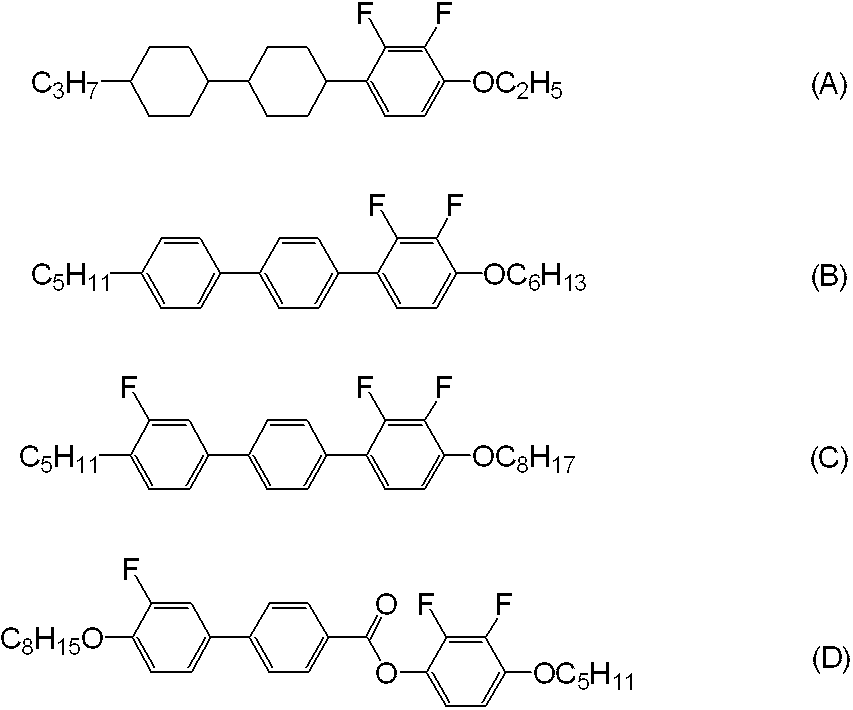
(1)化学的に安定であること、および物理的に安定であること、
(2)高い透明点(液晶相-等方相の転移温度)を有すること、
(3)液晶相(ネマチック相、スメクチック相等)の下限温度、特にネマチック相の下限温度が低いこと、
(4)粘度が小さいこと、
(5)適切な光学異方性を有すること、
(6)適切な負の誘電率異方性を有すること、
(7)適切な弾性定数K33(K33:ベンド弾性定数)を有すること、および
(8)他の液晶性化合物との相溶性に優れること、
である。
(2)および(3)のように、高い透明点、または液晶相の低い下限温度を有する液晶性化合物を含む組成物では、ネマチック相の温度範囲が広いので、素子は幅広い温度領域で使用することが可能となる。
〔1〕:式(a-1)で表される液晶性化合物。
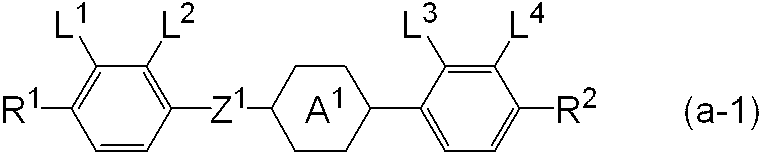
環A1は、トランス-1,4-シクロへキシレン、1,4-シクロヘキセニレン、1,4-フェニレン、テトラヒドロピラン-2,5-ジイル、1,3-ジオキサン-2,5-ジイル、ピリミジン-2,5-ジイル、またはピリジン-2,5-ジイルであり;
L1、L2、L3およびL4は独立して、水素またはフッ素であり、これらのうち少なくとも3つはフッ素であり;
環A1がトランス-1,4-シクロへキシレン、1,4-シクロヘキセニレン、テトラヒドロピラン-2,5-ジイル、1,3-ジオキサン-2,5-ジイル、ピリミジン-2,5-ジイル、またはピリジン-2,5-ジイルであるとき、Z1は、単結合、-(CH2)2-、-CH=CH-、-C≡C-、-CH2O-、または-OCH2-であり、環A1が1,4-フェニレンであるとき、Z1は、-(CH2)2-、-CH=CH-、-C≡C-、-CH2O-、または-OCH2-である。
環A1が、トランス-1,4-シクロへキシレン、1,4-シクロヘキセニレン、テトラヒドロピラン-2,5-ジイル、1,3-ジオキサン-2,5-ジイル、ピリミジン-2,5-ジイル、またはピリジン-2,5-ジイルであり;
Z1が、単結合、-(CH2)2-、-CH=CH-、-C≡C-、-CH2O-、または-OCH2-である項〔1〕に記載の化合物。
環A1が、1,4-フェニレンであり;
Z1が、-(CH2)2-、-CH=CH-、-C≡C-、-CH2O-、または-OCH2-である項〔1〕に記載の化合物。
環A1が、トランス-1,4-シクロへキシレン、1,4-シクロヘキセニレン、テトラヒドロピラン-2,5-ジイル、またはピリジン-2,5-ジイルであり;
Z1が、単結合、-(CH2)2-、-CH=CH-、-C≡C-、-CH2O-、または-OCH2-である項〔2〕に記載の化合物。
環A1が、トランス-1,4-シクロへキシレン、1,4-シクロヘキセニレン、またはテトラヒドロピラン-2,5-ジイルであり;
Z1が、単結合、-(CH2)2-、-CH=CH-、-CH2O-、または-OCH2-である項〔4〕に記載の化合物。
環A1がトランス-1,4-シクロへキシレンである項〔1〕に記載の化合物。

式中、R3およびR4は独立して、炭素数1~10のアルキル、炭素数2~10のアルケニル、炭素数1~9のアルコキシ、炭素数2~9のアルコキシアルキル、または炭素数2~9のアルケニルオキシであり;
L5、L6、L7およびL8は独立して、水素またはフッ素であり、これらのうち少なくとも3つはフッ素であり;
Z2は、単結合、-(CH2)2-、-CH=CH-、-CH2O-、または-OCH2-である。
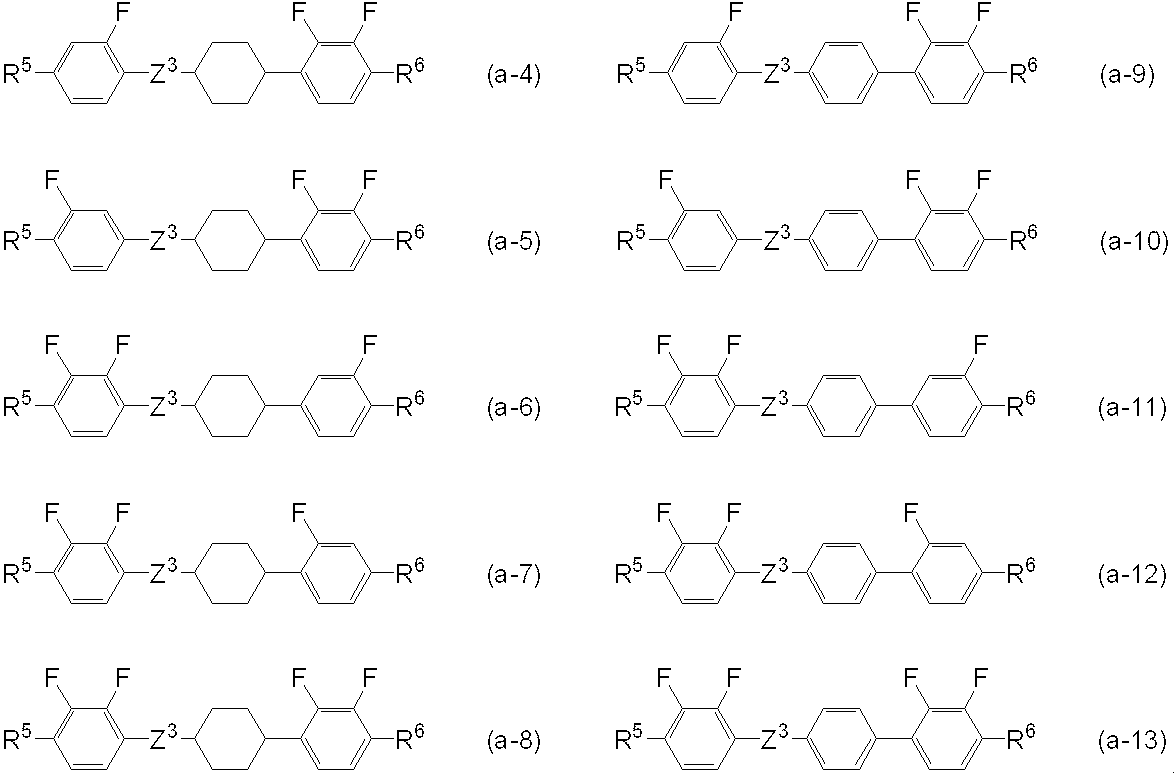
Z3は、-(CH2)2-、-CH=CH-、-CH2O-、または-OCH2-である。
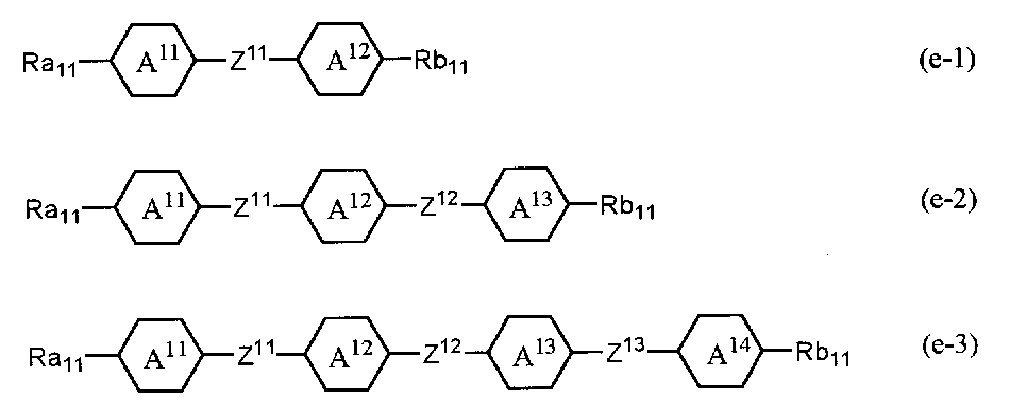
環A11、環A12、環A13、および環A14は、独立して、トランス-1,4-シクロへキシレン、1,4-フェニレン、2-フルオロ-1,4-フェニレン、3-フルオロ-1,4-フェニレン、ピリミジン-2,5-ジイル、1,3-ジオキサン-2,5-ジイル、またはテトラヒドロピラン-2,5-ジイルであり;
Z11、Z12、およびZ13は、独立して、単結合、-CH2-CH2-、-CH=CH-、-C≡C-、-COO-、または-CH2O-である。
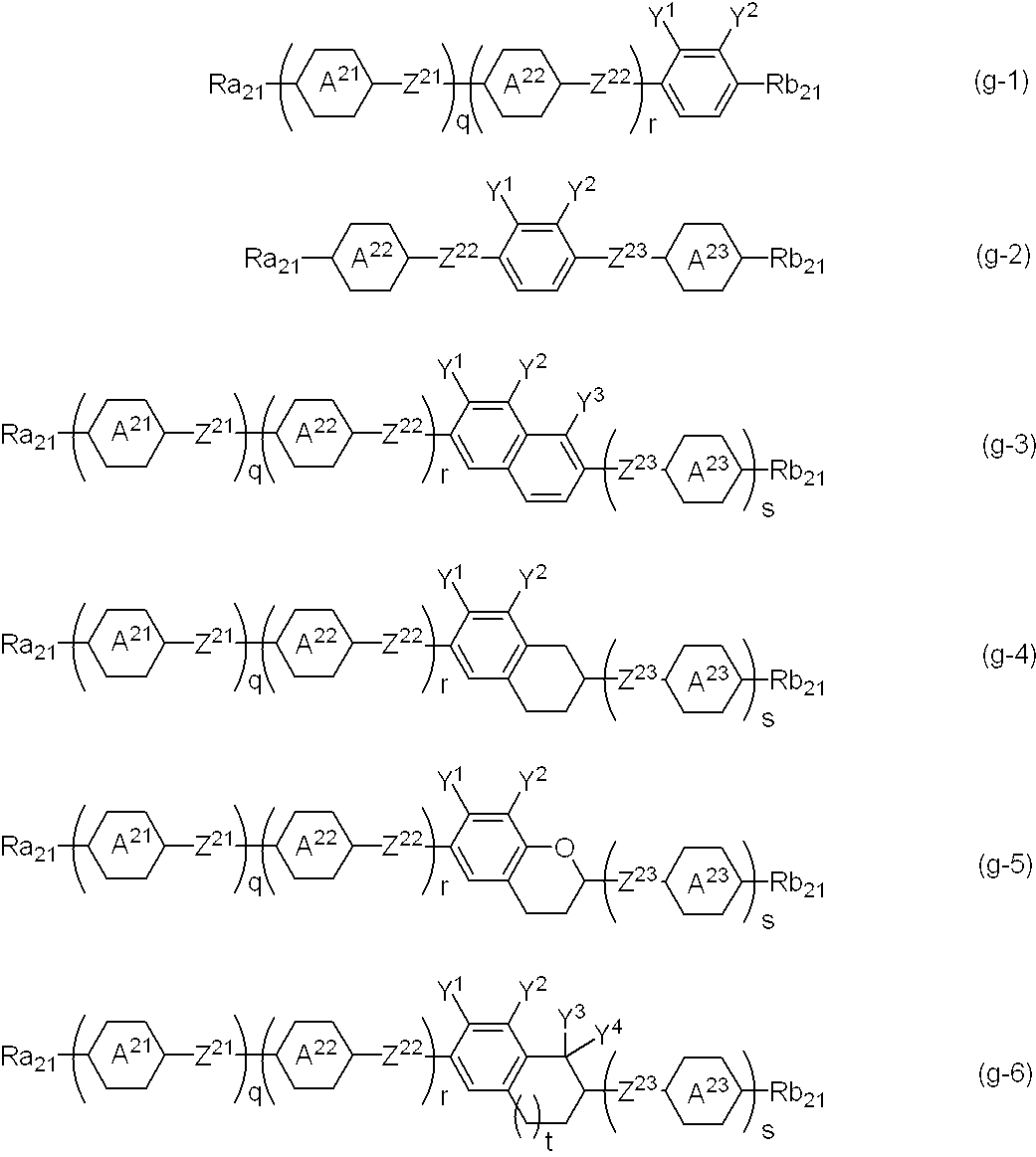
環A21、環A22、および環A23は独立して、トランス-1,4-シクロへキシレン、1,4-フェニレン、2-フルオロ-1,4-フェニレン、3-フルオロ-1,4-フェニレン、2,3-ジフルオロ-1,4-フェニレン、ピリミジン-2,5-ジイル、1,3-ジオキサン-2,5-ジイル、またはテトラヒドロピラン-2,5-ジイルであり;
Z21、Z22、およびZ23は独立して、単結合、-CH2-CH2-、-CH=CH-、-C≡C-、-OCF2-、-CF2O-、-OCF2CH2CH2-、-CH2CH2CF2O-、-COO-、-OCO-、-OCH2-、または-CH2O-であり;
Y1、Y2、Y3、およびY4は独立して、フッ素または塩素であり;
q、r、およびsは、独立して0、1、または2であり、q+rは1または2であり、q+r+sは1、2、または3であり;
tは0、1、または2である。
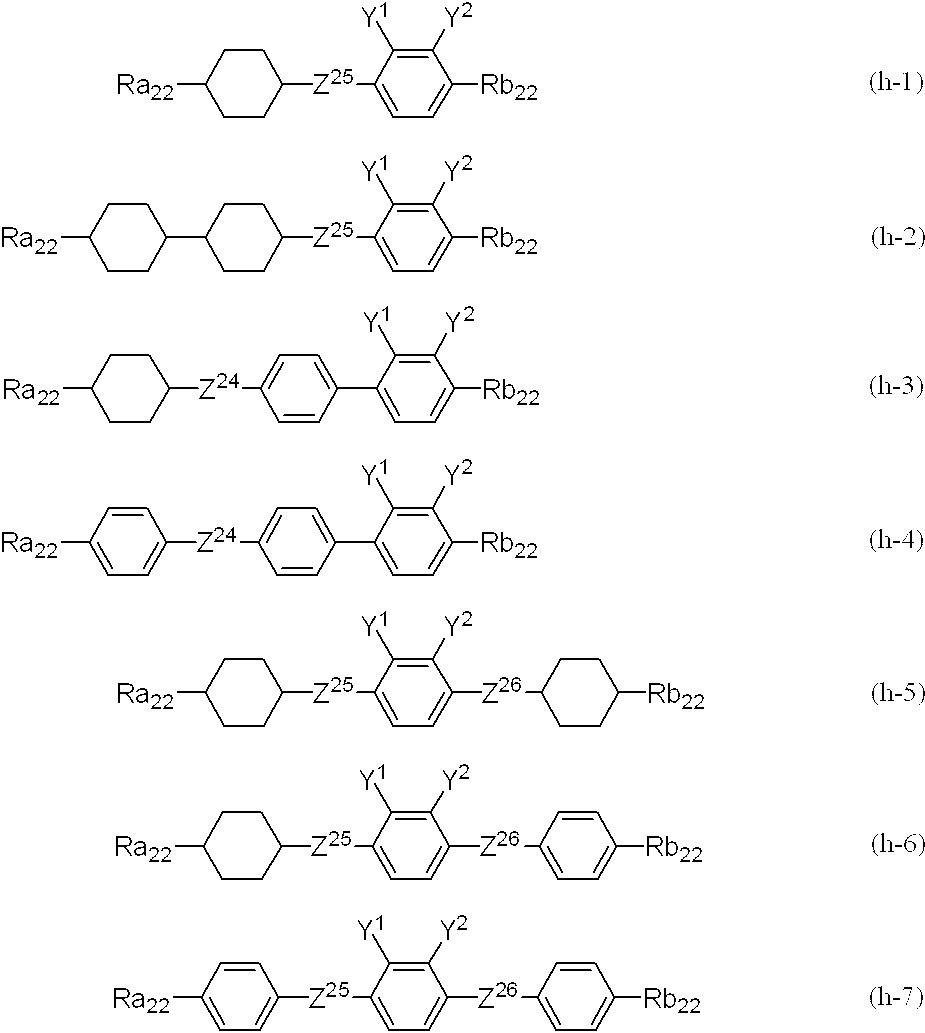
Z24、Z25およびZ26は独立して、単結合、-CH2CH2-、-CH2O-、または-OCH2-であり;
Y1およびY2は、共にフッ素、または一方がフッ素で他方が塩素である。
〔21〕:液晶表示素子の動作モードが、VAモードまたはIPSモードであり、液晶表示素子の駆動方式がアクティブマトリックス方式である、項〔20〕に記載の液晶表示素子。
なお、以下説明中では、特に断りのない限り、百分率で表した化合物の量は組成物の全重量に基づいた重量百分率(重量%)を意味する。
〔液晶性化合物(a)〕
本発明の液晶性化合物は、式(a-1)で示される構造を有する(以下、これら化合物を「化合物(a-1)」ともいう。)。

アルケニルには、アルケニル中の二重結合の位置に依存して、-CH=CH-の好ましい立体配置がある。
アルコキシの具体例としては、-OCH3、-OC2H5、-OC3H7、-OC4H9、-OC5H11、-OC6H13、-OC7H15、-OC8H17、および-OC9H19を挙げることができ;
アルコキシアルキルの具体例としては、-CH2OCH3、-CH2OC2H5、-CH2OC3H7、-(CH2)2OCH3、-(CH2)2OC2H5、-(CH2)2OC3H7、-(CH2)3OCH3、-(CH2)4OCH3、および-(CH2)5OCH3を挙げることができ;
アルケニルの具体例としては、-CH=CH2、-CH=CHCH3、-CH2CH=CH2、-CH=CHC2H5、-CH2CH=CHCH3、-(CH2)2CH=CH2、-CH=CHC3H7、-CH2CH=CHC2H5、-(CH2)2CH=CHCH3、および-(CH2)3CH=CH2を挙げることができ;
アルケニルオキシの具体例としては、-OCH2CH=CH2、-OCH2CH=CHCH3、および-OCH2CH=CHC2H5を挙げることができる。
化合物の安定性を考慮すると、単結合、-(CH2)2-、および-CH=CH-が好ましく、単結合および-(CH2)2-がさらに好ましい。
これら化合物(a)では、R1、R2、環A1およびZ1を適宜選択することにより、誘電率異方性などの物性を所望の物性に調整することが可能である。
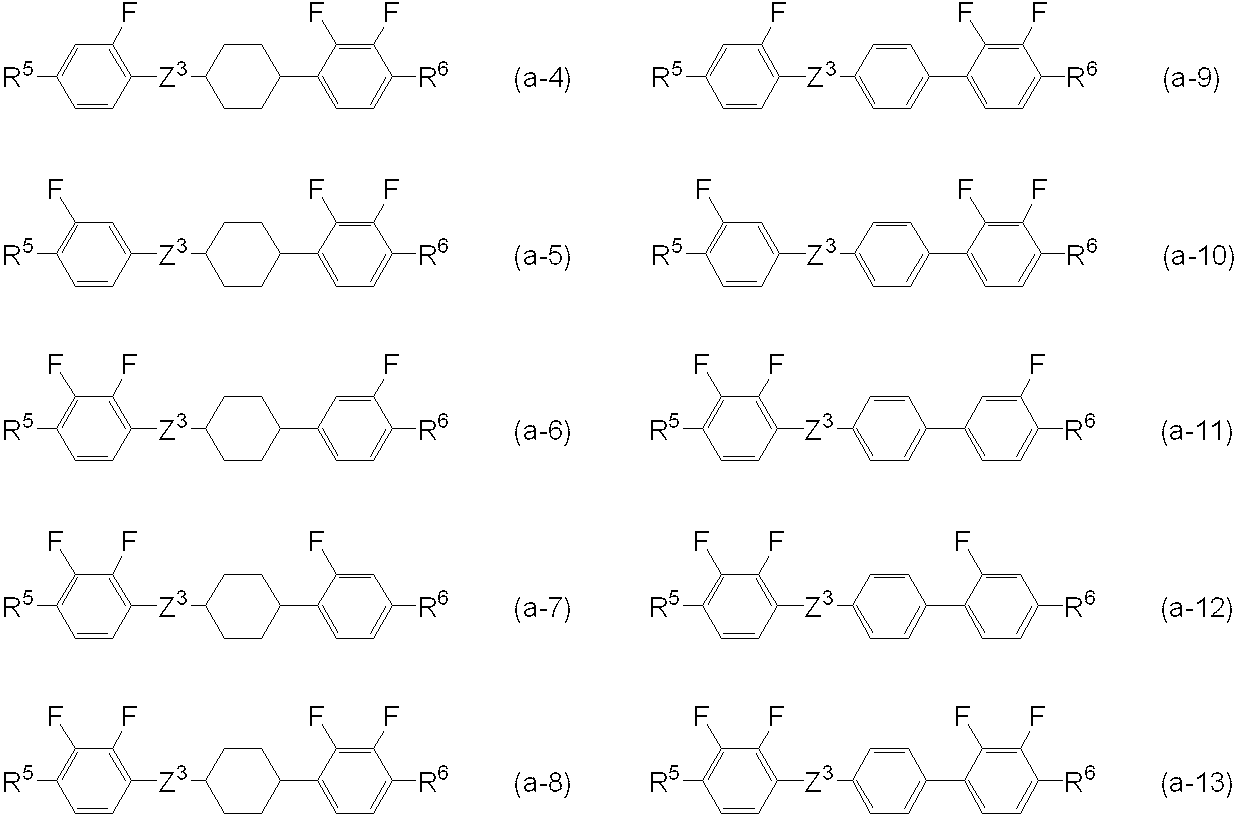
化合物(a-1)は、有機合成化学の合成手法を適切に組み合わせることにより合成することができる。出発物に目的の末端基、環、および結合基を導入する方法は、例えば、オーガニックシンセシス(Organic Syntheses, John Wiley & Sons, Inc)、オーガニック・リアクションズ(Organic Reactions, John Wiley & Sons, Inc)、コンプリヘンシブ・オーガニック・シンセシス(Comprehensive Organic Synthesis, Pergamon Press)、新実験化学講座(丸善)などの成書に記載されている。
結合基Z1を形成する方法の一例を示す。結合基を形成するスキームを以下示す。このスキームにおいて、MSG1またはMSG2は1価の有機基である。スキームで用いた複数のMSG1(またはMSG2)は、同一であってもよいし、または異なってもよい。化合物(1A)~(1E)は化合物(a-1)に相当する。

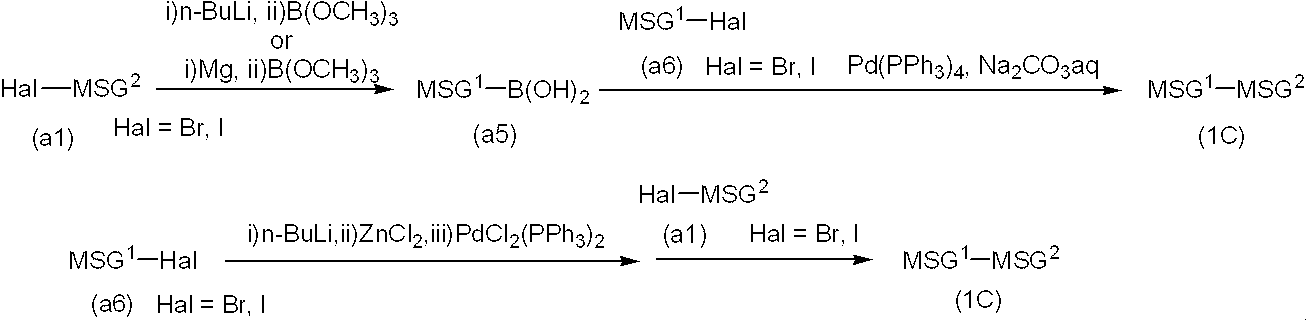
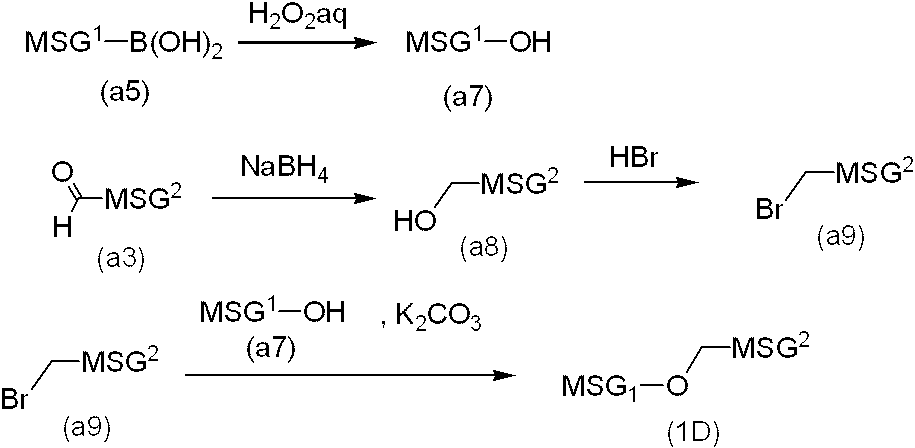

一価の有機基MSG2を有する有機ハロゲン化合物(a1)とマグネシウムとを反応させ、グリニャール試薬を調製する。これら調製したグリニャール試薬あるいはリチウム塩と、アルデヒド誘導体(a2)とを反応させることにより、対応するアルコール誘導体を合成する。ついで、p-トルエンスルホン酸等の酸触媒を用いて、得られたアルコール誘導体の脱水反応を行うことにより、対応する化合物(1A)を合成することができる。
化合物(1A)を炭素担持パラジウム(Pd/C)のような触媒の存在下で水素化することにより、化合物(1B)を合成することができる。
有機ハロゲン化合物(a1)とマグネシウム、またはブチルリチウムとを反応させ、グリニャール試薬、またはリチウム塩を調製する。この調製したグリニャール試薬、またはリチウム塩とホウ酸トリメチルなどのホウ酸エステルを反応させ、塩酸などの酸で加水分解することによりジヒドロキシボラン誘導体(a5)を合成する。そのジヒドロキシボラン誘導体(a5)と有機ハロゲン化合物(a6)とを、例えば、炭酸塩水溶液とテトラキス(トリフェニルホスフィン)パラジウム(Pd(PPh3)4)とからなる触媒の存在下で反応させることにより、化合物(1C)を合成することができる。
ジヒドロキシボラン誘導体(a5)を過酸化水素等の酸化剤により酸化し、アルコール誘導体(a7)を得る。別途、アルデヒド誘導体(a3)を水素化ホウ素ナトリウムなどの還元剤で還元してアルコール誘導体(a8)を得る。得られたアルコール誘導体(a8)を臭化水素酸等でハロゲン化して有機ハロゲン化合物(a9)を得る。このようにして得られたアルコール誘導体(a8)と有機ハロゲン化合物(a9)とを炭酸カリウムなどの存在下反応させることにより化合物(1D)を合成することができる。
ジクロロパラジウムとハロゲン化銅との触媒存在下で、化合物(a6)に2-メチル-3-ブチン-2-オールを反応させたのち、塩基性条件下で脱保護して化合物(a10)を得る。ジクロロパラジウムとハロゲン化銅との触媒存在下、化合物(a10)を化合物(a1)と反応させて、化合物(1E)を合成する。
トランス-1,4-シクロへキシレン、シクロヘキセン-1,4-ジイル、1,3-ジオキサン-2,5-ジイル、テトラヒドロピラン-2,5-ジイル、1,4-フェニレン、ピリミジン-2,5-ジイル、ピリジン-2,5-ジイルなどの環に関しては出発物が市販されているか、または合成法がよく知られている。
以下、化合物(a-1)の合成例を示す。
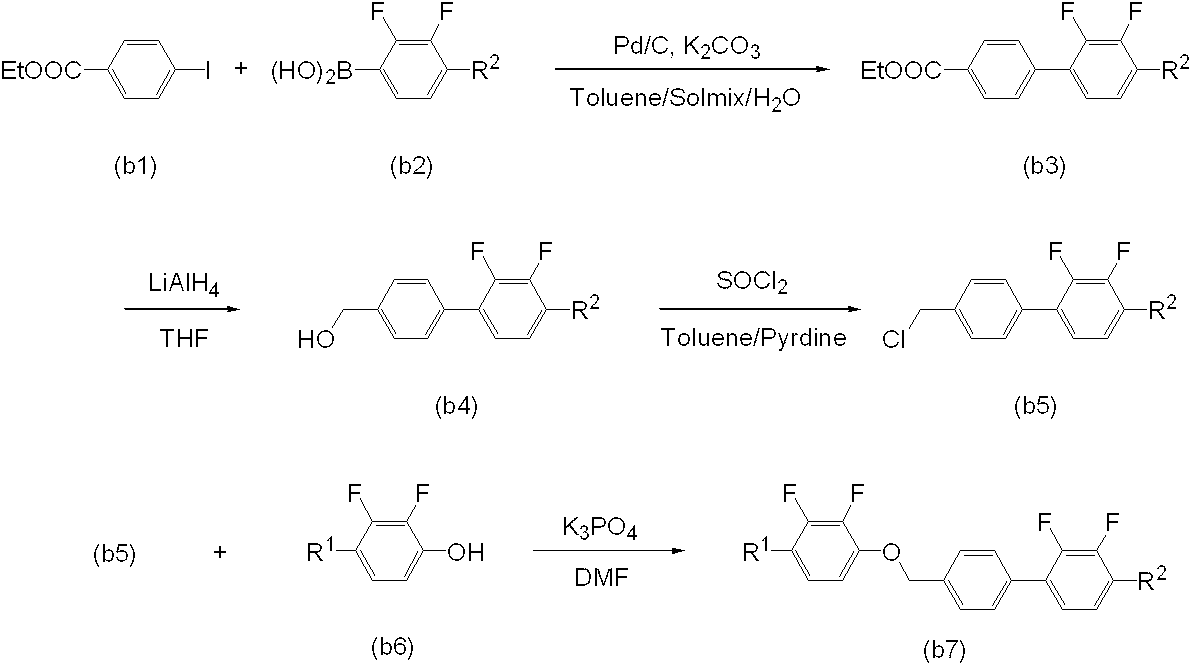
以下、本発明の液晶組成物について説明をする。この液晶組成物の成分は、少なくとも一つの化合物(a-1)を含むことを特徴とするが、化合物(a-1)を2つ以上含んでいてもよく、化合物(a-1)のみから構成されていてもよい。また液晶組成物を調製するときには、例えば、化合物(a-1)の誘電率異方性を考慮して成分を選択することもできる。成分を選択した液晶組成物は、粘度が低く、適切な負の誘電率異方性を有し、適切な弾性定数K33を有し、しきい値電圧が低く、さらに、ネマチック相の上限温度(ネマチック相-等方相の相転移温度)が高く、ネマチック相の下限温度が低い。
本発明の液晶組成物は化合物(a-1)に加え、第二成分として式(e-1)~(e-3)で表される液晶性化合物(以下、それぞれ化合物(e-1)~(e-3)ともいう。)の群から選択された少なくとも1つの化合物をさらに含有する組成物が好ましい(以下、液晶組成物(1)ともいう。)。
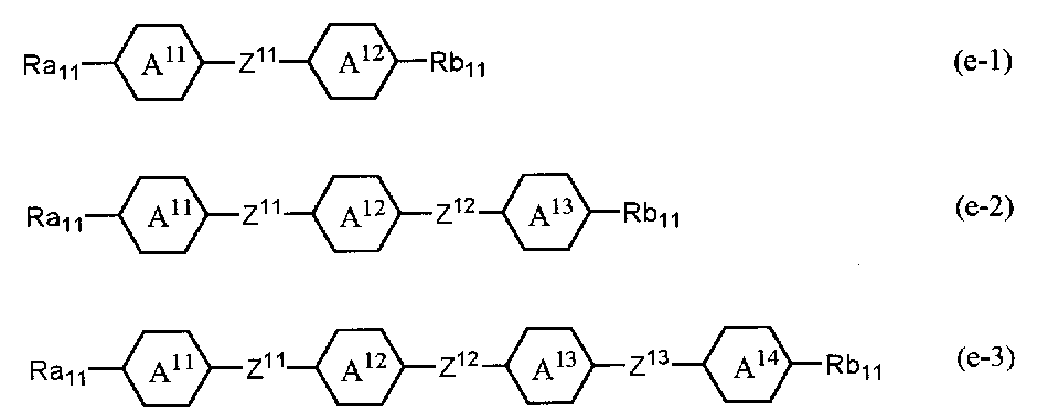
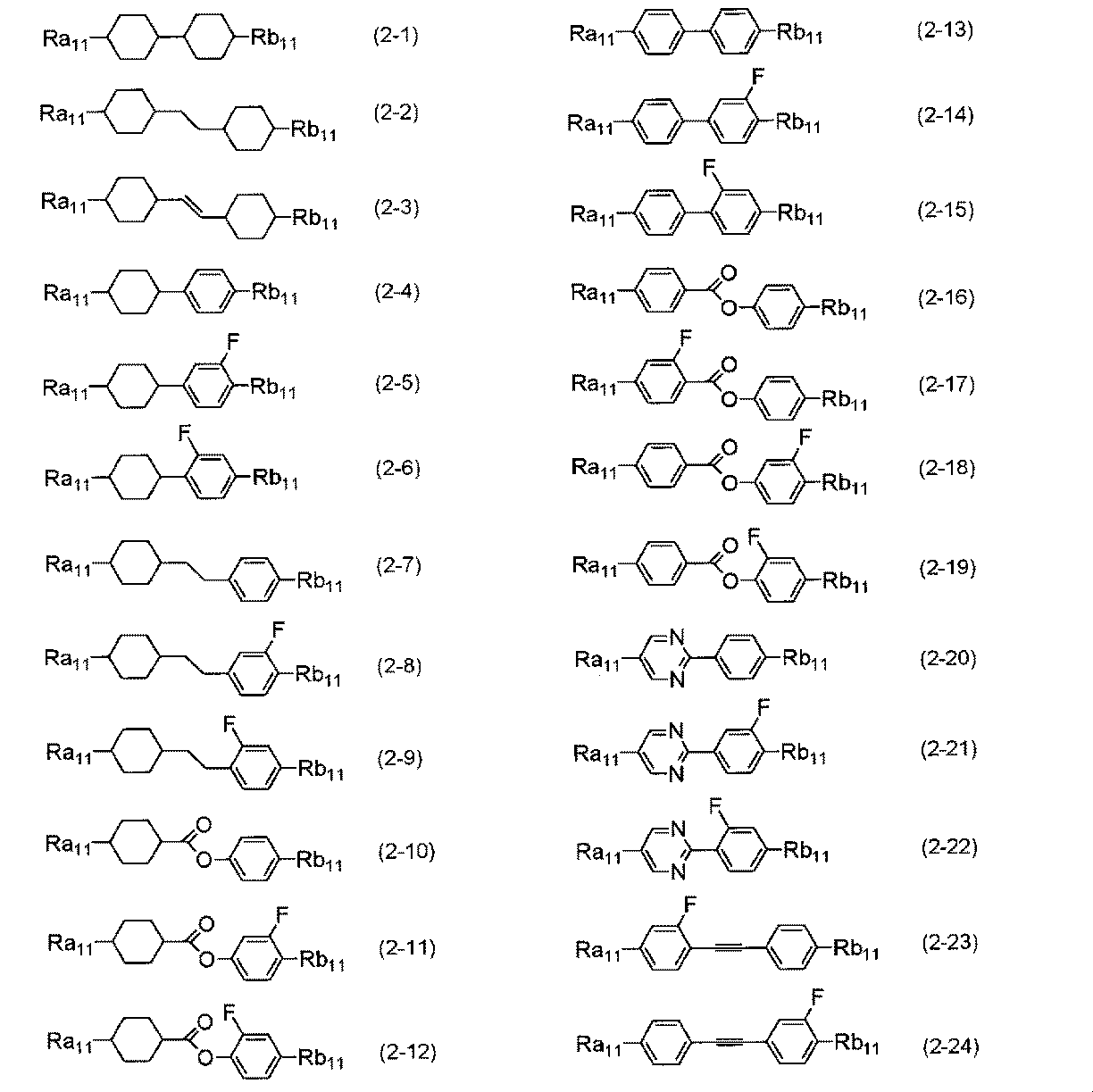

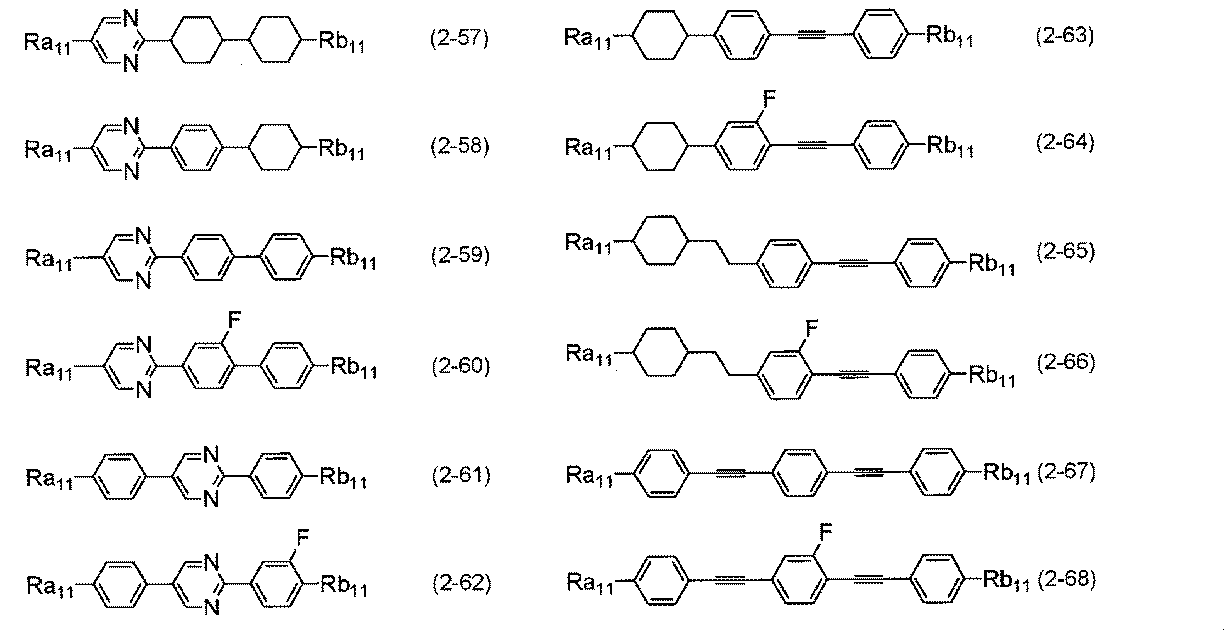
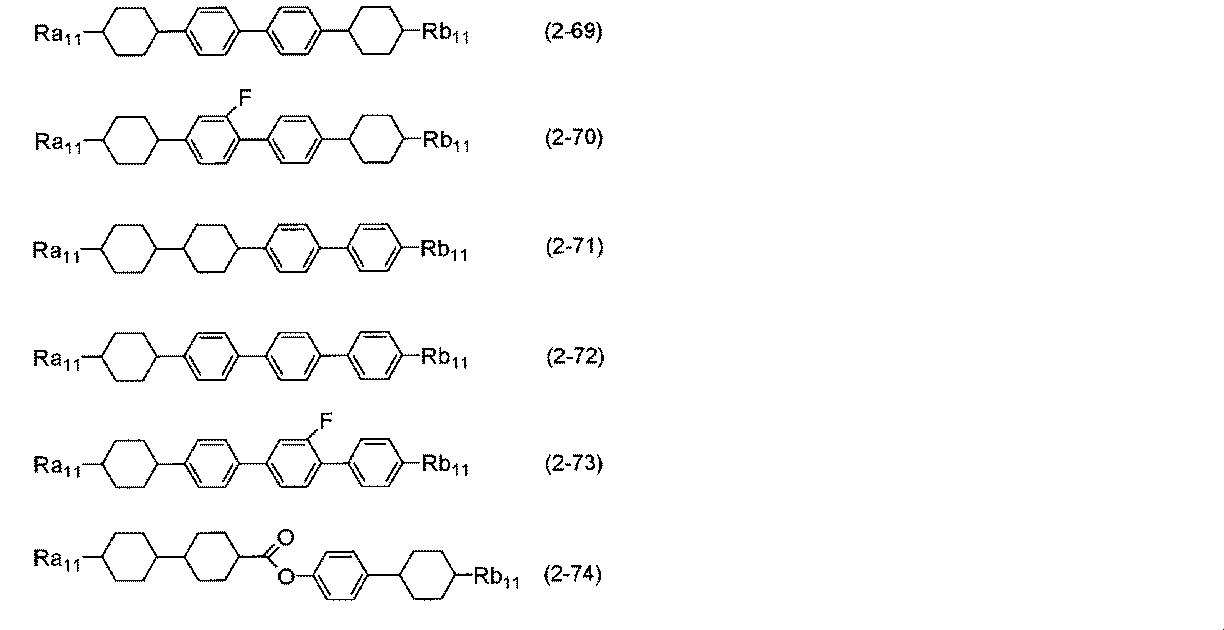
本発明の液晶組成物は、第一成分および第二成分に加えてさらに、第三成分として式(g-1)~(g-4)で表される液晶性化合物(以下、それぞれ化合物(g-1)~(g-4)ともいう。)の群から選択される少なくとも1つの化合物を含有させた液晶組成物も好ましい(以下、液晶組成物(2)ともいう。)。
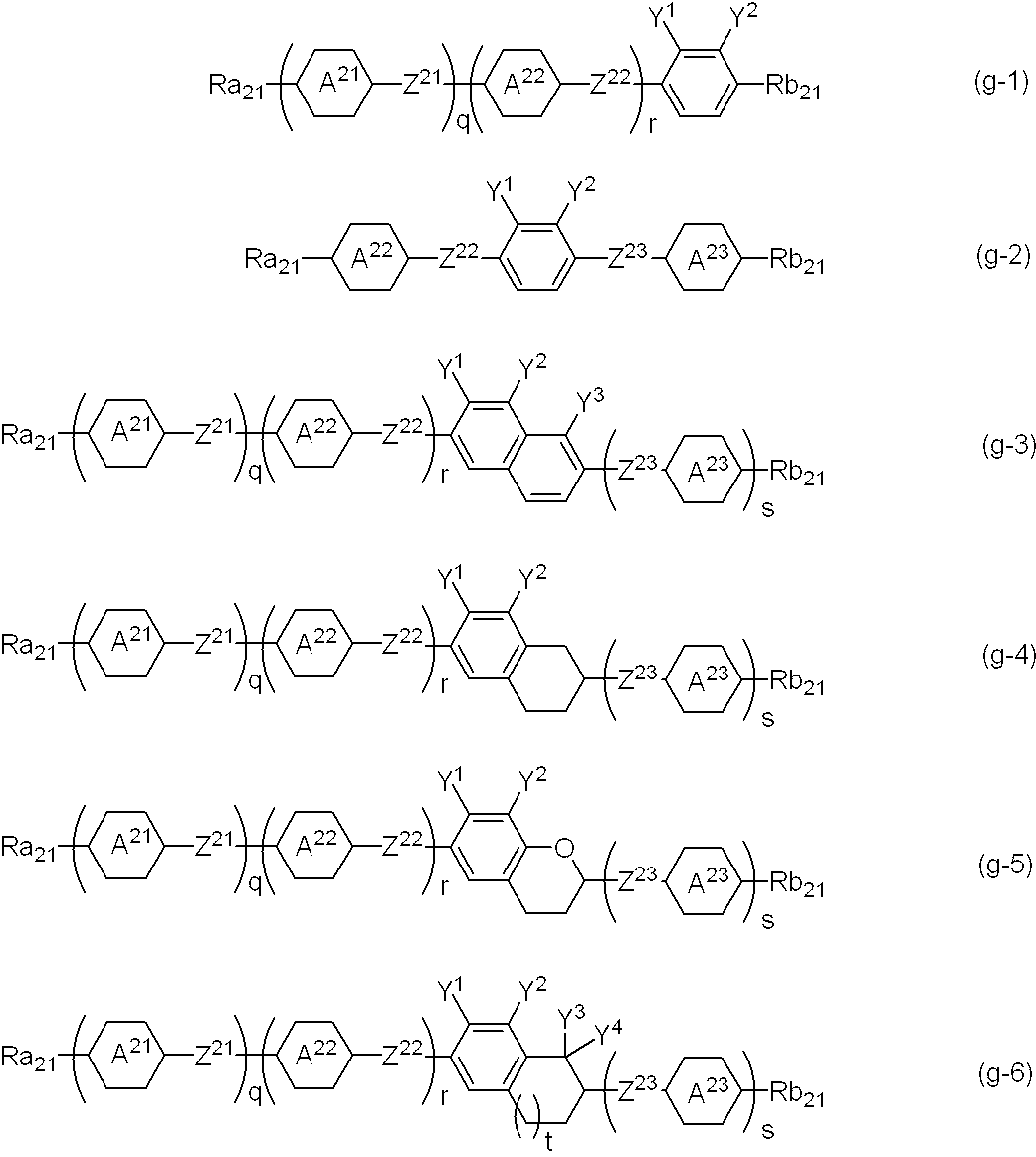
第三成分をさらに含有する液晶組成物(2)は誘電率異方性が負に大きい。

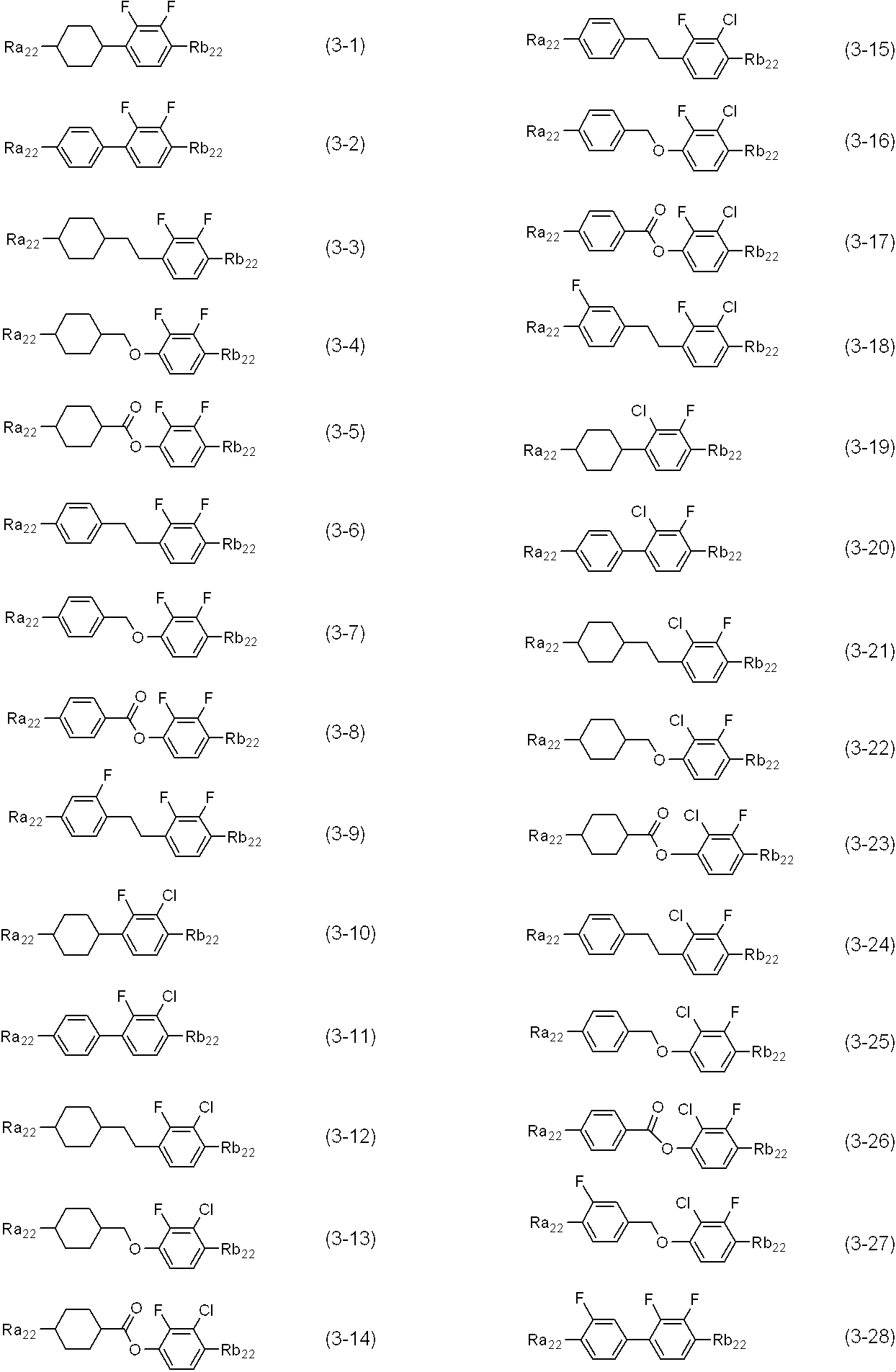
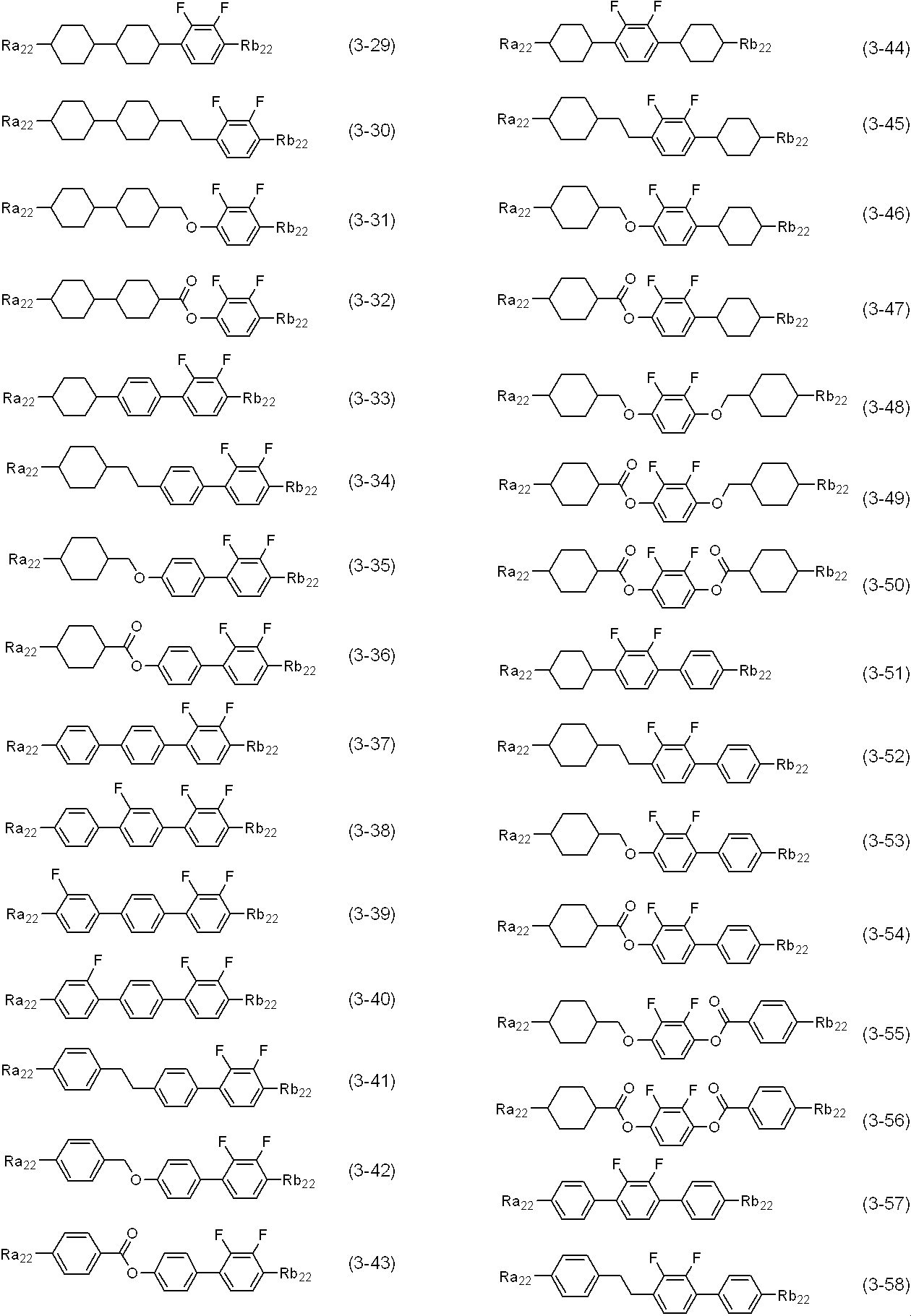
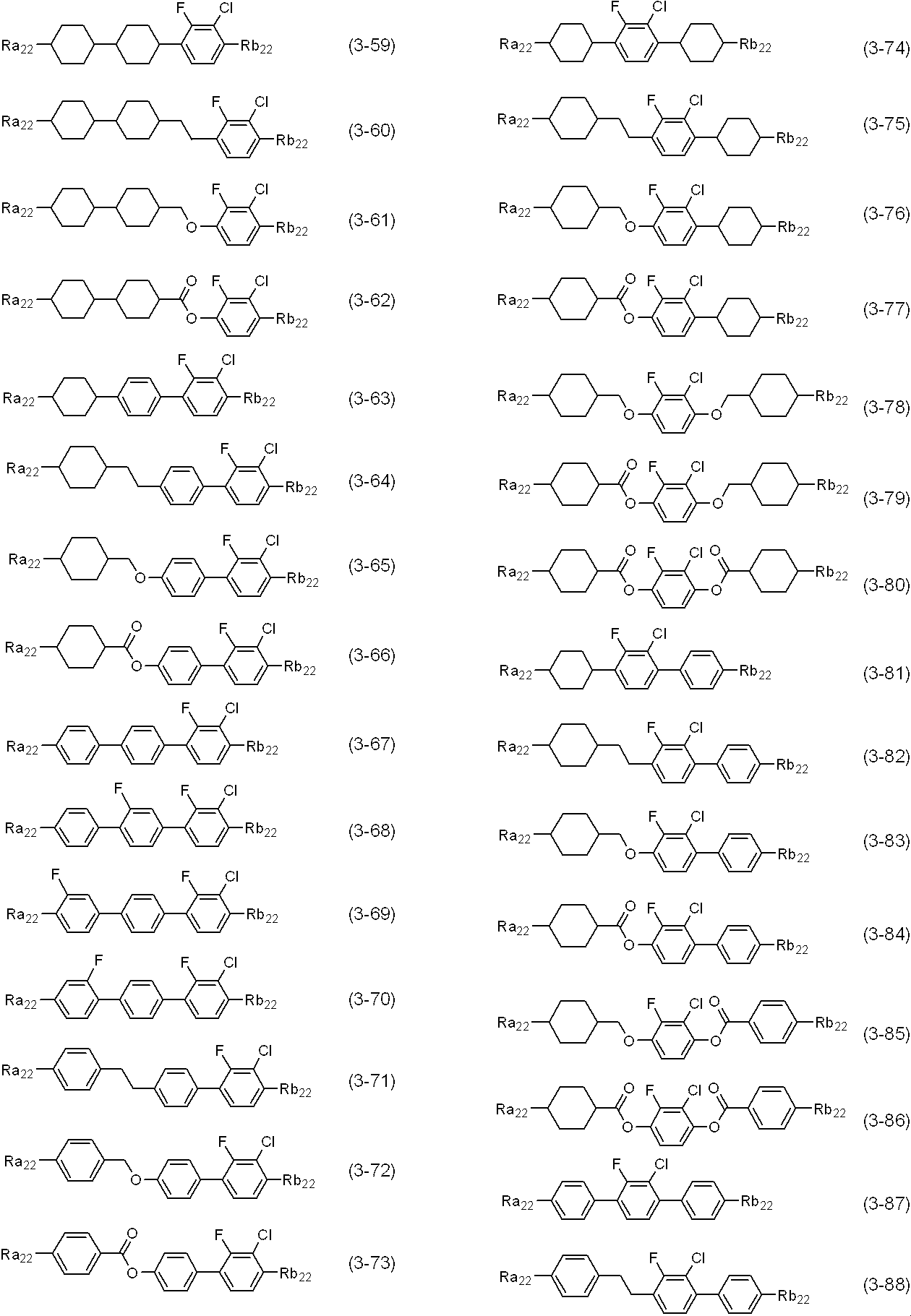
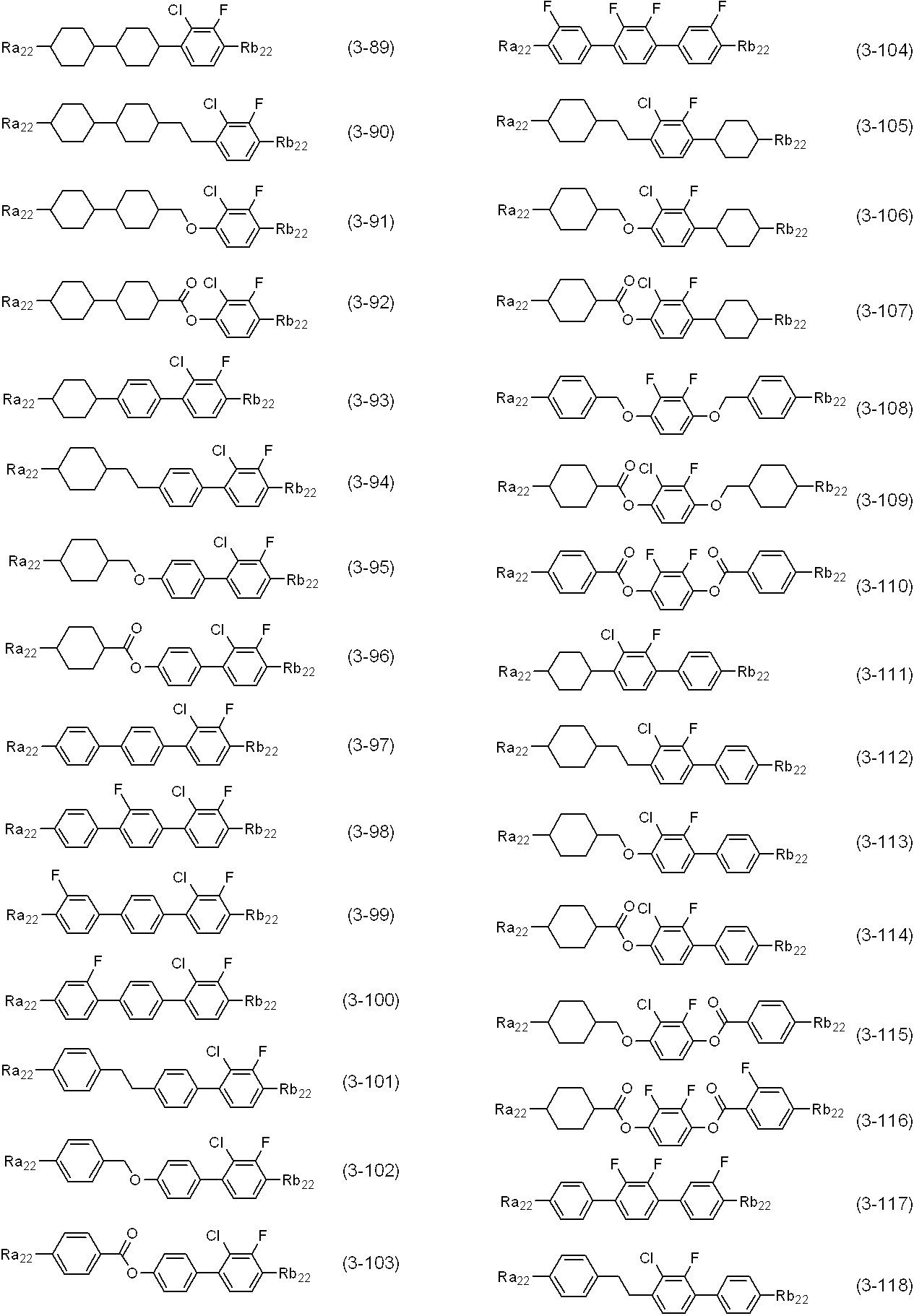
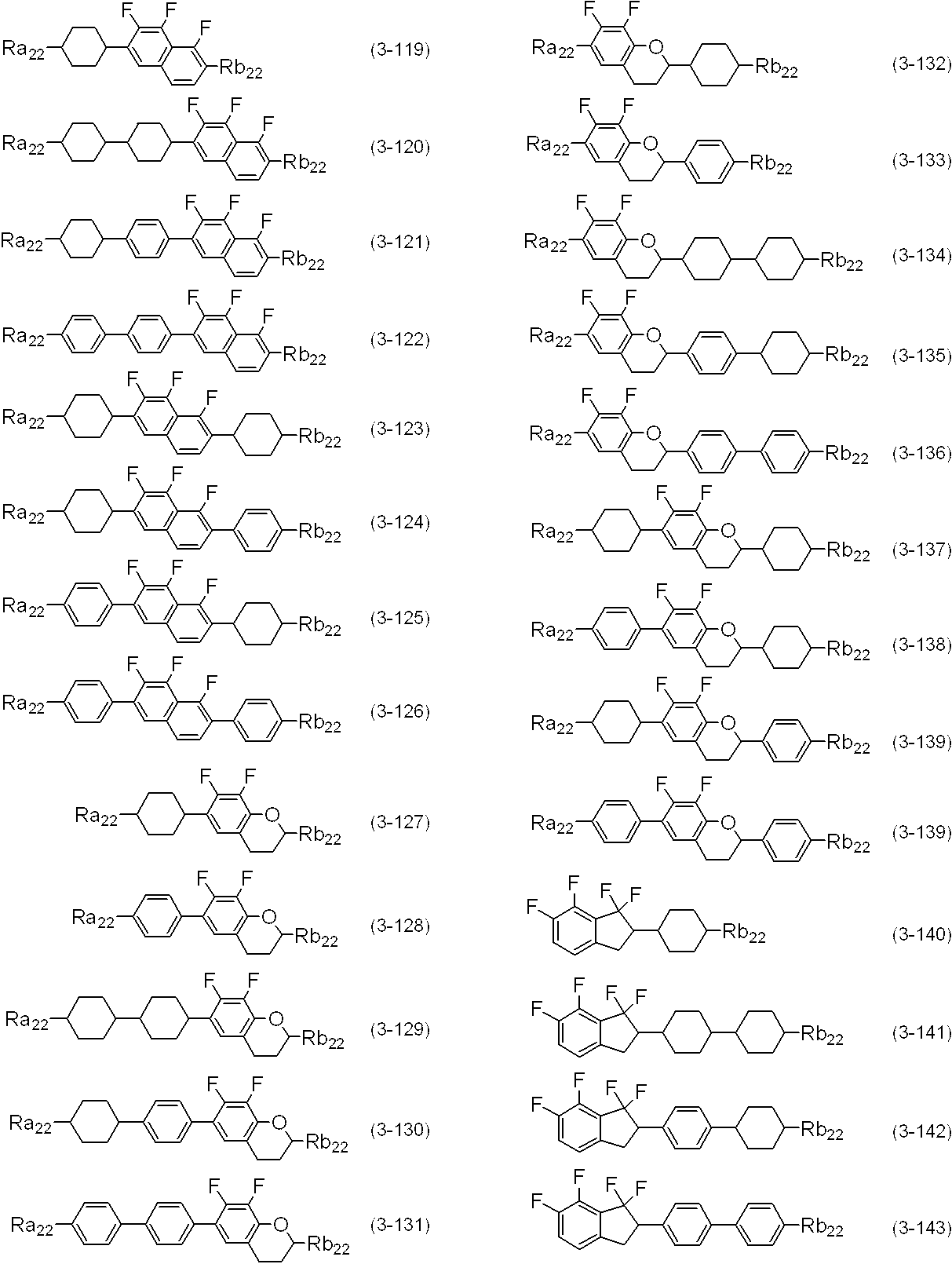
液晶組成物(2)の第一成分、第二成分、および第三成分の含有割合は特に制限はされないが、液晶組成物(2)の全重量に基づいて、化合物(a-1)の含有割合が5~60重量%の範囲、第二成分の含有割合が20~75重量%の範囲、第三成分の含有割合が20~75重量%の範囲であることが好ましい。
本発明に係る液晶組成物では、第一成分、第二成分、および必要に応じて添加する第三成分を構成する液晶性化合物に加えて、例えば液晶組成物の特性をさらに調整する目的で、さらに他の液晶性化合物を添加して使用する場合がある。また、例えばコストの観点から、本発明の液晶組成物では、第一成分、第二成分、および必要に応じて添加する第三成分を構成する液晶性化合物以外の液晶性化合物は添加せずに使用する場合もある。
光学活性化合物を本発明に係る液晶組成物に添加した場合には、液晶にらせん構造を誘起して、ねじれ角を与えることなどができる。
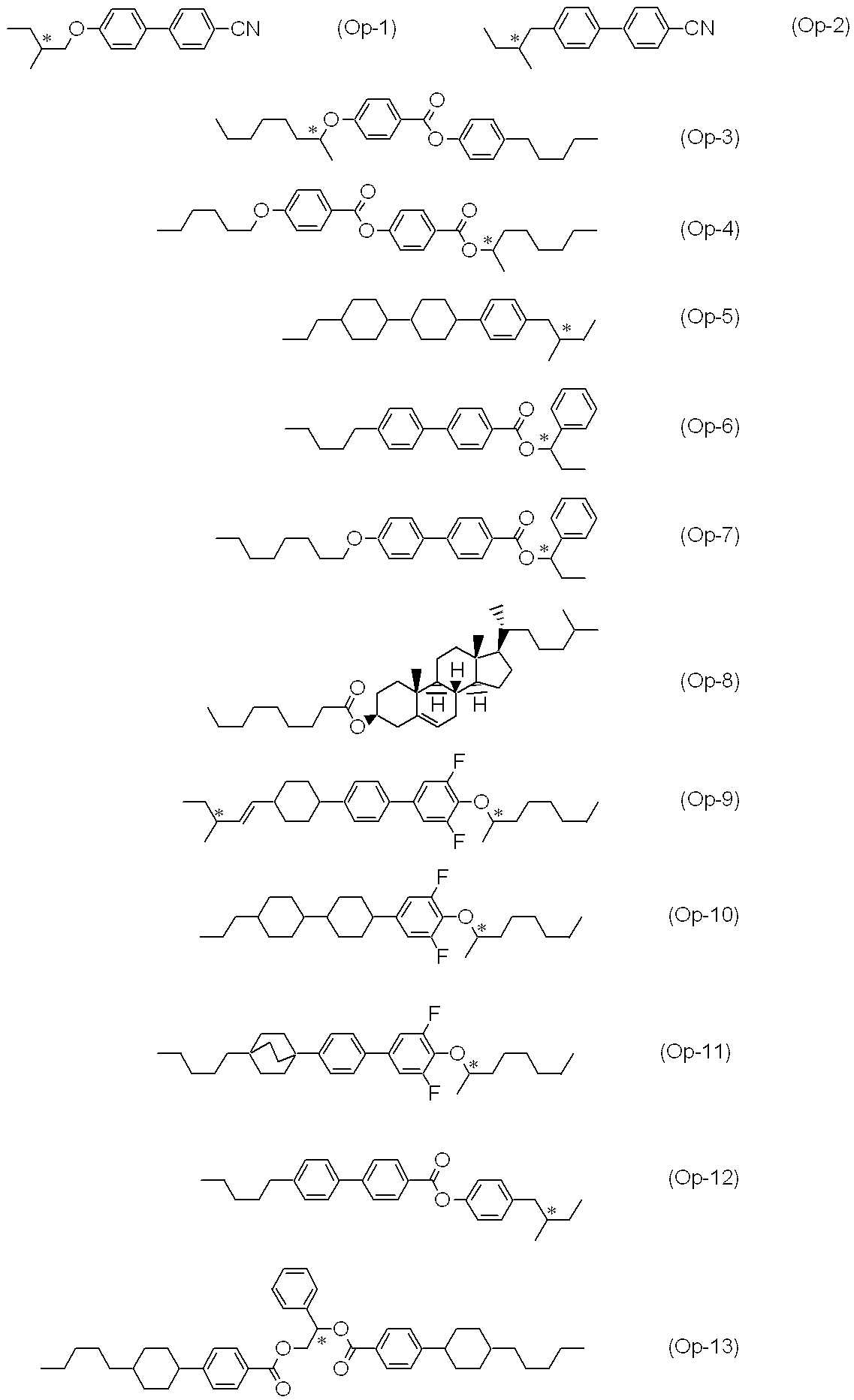
消泡剤を本発明に係る液晶組成物に添加した場合には、液晶組成物の運搬中、あるいは該液晶組成物から液晶表示素子を製造工程中で、発泡を抑制することなどが可能となる。
ベンゾフェノン系紫外線吸収剤の具体例は、2-ヒドロキシ-4-n-オクトキシベンゾフェノンである。
トリアゾール系紫外線吸収剤の具体例は、2-(2-ヒドロキシ-5-メチルフェニル)ベンゾトリアゾール、2-[2-ヒドロキシ-3-(3,4,5,6-テトラヒドロキシフタルイミド-メチル)-5-メチルフェニル]ベンゾトリアゾール、および2-(3-t-ブチル-2-ヒドロキシ-5-メチルフェニル)-5-クロロベンゾトリアゾールである。
特に、液晶組成物の物性を変化させずに酸化防止効果が高いという観点からは、式(I)で表される酸化防止剤が好ましい。

式(I)中、wは1から15の整数を示す。
6-ジ-t-ブチル-4-ドデシルフェノール、2,6-ジ-t-ブチル-4-トリデシルフェノール、2,6-ジ-t-ブチル-4-テトラデシルフェノール、2,6-ジ-t-ブチル-4-ペンタデシルフェノール、2,2’-メチレンビス(6-t-ブチルー4-メチルフェノール)、4,4’-ブチリデンビス(6-t-ブチル-3-メチルフェノール)、2,6-ジ-t-ブチル-4-(2-オクタデシルオキシカルボニル)エチルフェノール、およびペンタエリスリトールテトラキス[3-(3,5-ジ-t-ブチル-4-ヒドロキシフェニル)プロピオネート]である。
本発明に係る組成物は、例えば、各成分を構成する化合物が液体の場合には、それぞれの化合物を混合し振とうさせることにより、また固体を含む場合には、それぞれの化合物を混合し、加熱溶解によってお互い液体にしてから振とうさせることにより調製することができる。また、本発明に係る液晶組成物はその他の公知の方法により調製することも可能である。
本発明に係る組成物では、ネマチック相の上限温度を70℃以上とすること、ネマチック相の下限温度は-20℃以下とすることができ、ネマチック相の温度範囲が広い。したがって、この組成物を含む液晶表示素子は広い温度領域で使用することが可能である。
また、本発明に係る組成物では、通常、-5.0~-2.0の範囲の誘電率異方性、好ましくは、-4.5~-2.5の範囲の誘電率異方性を有する液晶組成物を得ることができる。-4.5~-2.5の範囲の誘電率異方性を有する液晶組成物は、IPSモード、およびVAモードで動作する液晶表示素子として好適に使用することができる。
本発明に係る液晶組成物は、PCモード、TNモード、STNモード、OCBモード等の動作モードを有し、AM方式で駆動する液晶表示素子だけでなく、PCモード、TNモード、STNモード、OCBモード、VAモード、IPSモード等の動作モードを有しパッシブマトリクス(PM)方式で駆動する液晶表示素子にも使用することができる。
また、本発明に係る組成物は、導電剤を添加させた組成物を用いたDS(dynamic scattering)モード素子や、組成物をマイクロカプセル化して作製したNCAP(nematic curvilinear aligned phase)素子や、組成物中に三次元の網目状高分子を形成させたPD(polymer dispersed)素子、例えばPN(polymer network)素子にも使用できる。
[実施例]
以下、実施例により本発明をさらに詳しく説明するが、本発明はこれら実施例によっては制限されない。なお特に断りのない限り、「%」は「重量%」を意味する。
測定装置は、DRX-500(ブルカーバイオスピン(株)社製)を用いた。測定は、実施例等で合成したサンプルを、CDCl3等のサンプルが可溶な重水素化溶媒に溶解し、室温で、500MHz、積算回数32回の条件で行った。なお、得られた核磁気共鳴スペクトルの説明において、sはシングレット、dはダブレット、tはトリプレット、qはカルテット、quinはクインテット、sexはセクステット、mはマルチプレット、brはブロードであることを意味する。また、化学シフトδ値のゼロ点の基準物質としてはテトラメチルシラン(TMS)を用いた。
測定装置は、島津製作所製のGC-14B型ガスクロマトグラフを用いた。カラムは、島津製作所製のキャピラリーカラムCBP1-M25-025(長さ25m、内径0.22mm、膜厚0.25μm);固定液相はジメチルポリシロキサン;無極性)を用いた。キャリアーガスとしてはヘリウムを用い、流量は1ml/分に調整した。試料気化室の温度を280℃、検出器(FID)部分の温度を300℃に設定した。
記録計としては島津製作所製のC-R6A型Chromatopac、またはその同等品を用いた。得られたガスクロマトグラムには、成分化合物に対応するピークの保持時間およびピークの面積値が示されている。
液晶性化合物の物性を測定する試料としては、化合物そのものを試料とする場合、化合物を母液晶と混合して試料とする場合の2種類がある。
)/〈化合物の重量%〉
化合物と母液晶との割合がこの割合であっても、スメクチック相、または結晶が25℃で析出する場合には、液晶性化合物と母液晶との割合を10重量%:90重量%、5重量%:95重量%、1重量%:99重量%の順に変更をしていき、スメクチック相、または結晶が25℃で析出しなくなった組成で試料の物性を測定し、この式にしたがって外挿値を求めて、これを化合物の物性値とした。
母液晶i:

〔化合物等の物性の測定方法〕
化合物の物性の測定は後述する方法で行った。これらの多くは、日本電子機械工業会規格(Standard of Electric Industries Association of Japan)EIAJ・ED-2521Aに記載された方法、またはこれを修飾した方法である。また、測定に用いたTN素子またはVA素子には、TFTを取り付けなかった。
以下(1)、および(2)の方法で測定を行った。
(1)偏光顕微鏡を備えた融点測定装置のホットプレート(メトラー社FP-52型ホットステージ)に試料を置き、3℃/分の速度で加熱しながら相状態とその変化を偏光顕微鏡で観察し、相の種類を特定した。
(2)パーキンエルマー社製走査熱量計DSC-7システム、またはDiamond DSCシステムを用いて、3℃/分速度で昇降温し、試料の相変化に伴う吸熱ピーク、または発熱ピークの開始点を外挿により求め(on set)、転移温度を決定した。
偏光顕微鏡を備えた融点測定装置のホットプレート(メトラー社FP-52型ホットステージ)に、試料(液晶性組成物、または液晶性化合物と母液晶との混合物)を置き、1℃/分の速度で加熱しながら偏光顕微鏡を観察した。試料の一部がネマチック相から等方性液体に変化したときの温度をネマチック相の上限温度とした。以下、ネマチック相の上限温度を、単に「上限温度」と略すことがある。
母液晶と化合物とを、化合物が、20重量%、15重量%、10重量%、5重量%、3重量%、および1重量%の量となるように混合した試料を調製し、試料をガラス瓶に入れる。このガラス瓶を、-10℃または-20℃のフリーザー中に一定期間保管したあと、結晶またはスメクチック相が析出しているかどうか観察をした。
E型回転粘度計を用いて測定した。
測定はM. Imai et al., Molecular Crystals and Liquid Crystals, Vol. 259, 37 (1995) に記載された方法に従った。2枚のガラス基板の間隔(セルギャップ)が20μmのVA素子に試料(液晶性組成物、または液晶性化合物と母液晶との混合物)を入れた。この素子に30ボルトから50ボルトの範囲で1ボルト毎に段階的に印加した。0.2秒の無印加のあと、ただ1つの矩形波(矩形パルス;0.2秒)と無印加(2秒)の条件で印加を繰り返した。この印加によって発生した過渡電流(transient current)のピーク電流(peak current)とピーク時間(peak time)を測定した。これらの測定値とM. Imaiらの論文、40頁の計算式(8)とから回転粘度の値を得た。なお、この計算に必要な誘電率異方性は、下記誘電率異方性で測定した値を用いた。
測定は、25℃の温度下で、波長589nmの光を用い、接眼鏡に偏光板を取り付けたアッベ屈折計により行なった。主プリズムの表面を一方向にラビングしたあと、試料(液晶性組成物、または液晶性化合物と母液晶との混合物)を主プリズムに滴下した。屈折率(n∥)は偏光の方向がラビングの方向と平行であるときに測定した。屈折率(n⊥)は偏光の方向がラビングの方向と垂直であるときに測定した。光学異方性(Δn)の値は、Δn=n∥-n⊥の式から計算した。
誘電率異方性は以下の方法によって測定した。
よく洗浄したガラス基板にオクタデシルトリエトキシシラン(0.16mL)のエタノール(20mL)溶液を塗布した。ガラス基板をスピンナーで回転させたあと、150℃で1時間加熱した。2枚のガラス基板から、間隔(セルギャップ)が20μmであるVA素子を組み立てた。
誘電率異方性の値は、Δε=ε∥-ε⊥の式から計算した。
測定に用いたTN素子はポリイミド配向膜を有し、そして2枚のガラス基板の間隔(セルギャップ)は6μmである。この素子は試料(液晶性組成物、または液晶性化合物と母液晶との混合物)を入れたあと紫外線によって重合する接着剤で密閉した。このTN素子にパルス電圧(5Vで60マイクロ秒)を印加して充電した。減衰する電圧を、高速電圧計で16.7ミリ秒のあいだ測定し、単位周期における電圧曲線と横軸との間の面積Aを求めた。面積Bは減衰しなかったときの面積である。電圧保持率は面積Bに対する面積Aの百分率(%)で表現したものである。
測定には株式会社東陽テクニカ製のEC-1型弾性定数測定器を用いた。2枚のガラス基板の間隔(セルギャップ)が20μmである垂直配向セルに試料を入れた。このセルに20ボルトから0ボルト電荷を印加し、静電容量および印加電圧を測定した。測定した静電容量(C)と印加電圧(V)の値を『液晶デバイスハンドブック』(日刊工業新聞社)、75頁にある式(2.98)、式(2.101)を用いてフィッティングし、式(2.100)から弾性定数の値を得た。

窒素雰囲気下、反応器へ4-ヨード安息香酸エチル(1) 25.0g、4-エトキシ-2,3-ジフルオロフェニルボロン酸(2) 20.1g、炭酸カリウム 25.0g、Pd/C 0.25g、トルエン 100ml、エタノール 100mlおよび水 100mlを加え、2時間加熱還流させた。反応液を25℃まで冷却後、水 500mlおよびトルエン 500mlへ注ぎ込み、混合した。その後、静置して有機層と水層の2層に分離させた。有機層への抽出を行った。得られた有機層を、水で洗浄し、無水硫酸マグネシウムで乾燥した。得られた溶液を減圧下、濃縮し、得られた残渣を、カラムクロマトグラフィー(シリカゲル;トルエン)により精製した。さらにエタノールからの再結晶により精製し、乾燥させ、4-エトキシ-2,3-ジフルオロ-4’-ビフェニルカルボン酸エチル(3) 18.8gを得た。化合物(1)からの収率は67.9%であった。
水素化リチウムアルミニウム 1.4gをTHF 100mlに懸濁した。この懸濁液に化合物(3) 18.8gを、-20℃から-10℃の温度範囲で滴下し、さらにこの温度範囲で2時間攪拌した。GC分析により反応終了を確認後、氷冷下、反応混合物に、順次、酢酸エチル、飽和アンモニア水溶液を加えていき、析出物をセライト濾過により除去した。濾液を酢酸エチルにより抽出した。得られた有機層を、水、飽和食塩水で順次洗浄して、無水硫酸マグネシウムで乾燥した。さらにヘプタンからの再結晶により精製し、乾燥させ、減圧下濃縮をして、(4-エトキシ-2,3-ジフルオロ-4’-ビフェニル)メタノール(4) 12.0gを得た。化合物(3)からの収率は74.0%であった。
窒素雰囲気下、反応器へ化合物(4) 12.0g、トルエン 50mlおよびピリジン 0.12mlを加え、45℃で1時間攪拌した。その後、塩化チオニル 3.6mlを45℃から55℃の温度範囲で加え、2時間加熱還流させた。反応液を25 ℃まで冷却後、水 200mlおよびトルエン 200mlへ注ぎ込み、混合した。その後、静置して有機層と水層に分離させて、有機層への抽出を行った。得られた有機層をて、飽和重曹水で2回、水で3回洗浄し、無水硫酸マグネシウムで乾燥した。得られた溶液を減圧下で濃縮し、得られた残渣を、トルエンとヘプタンとの混合溶媒(体積比 トルエン:ヘプタン=1:1)を展開溶媒とし、シリカゲルを充填剤として用いたカラムクロマトグラフィー(シリカゲル;体積比 トルエン:ヘプタン=1:1)で精製した。さらにソルミックスA-11からの再結晶により精製し、4’-クロロメチル-4-エトキシ-2,3-ジフルオロ-ビフェニル(5) 9.4gを得た。化合物(4)からの収率は73.2%であった。
窒素雰囲気下、DMF 100mlに4-エトキシ-2,3-ジフルオロフェノール(6) 1.5g、およびリン酸三カリウム(K3PO4) 7.5gを加え、70℃で攪拌した。そこへ化合物(5) 2.0gを加え、70℃で、7時間攪拌した。得られた反応混合物を30℃まで冷却し、ろ過によって固形物と分離した後、トルエン 100ml、および水 100mlを加え混合した。その後、静置して有機層と水層の2層に分離させた。有機層への抽出を行った。得られた有機層を、食塩水で洗浄し、無水硫酸マグネシウムで乾燥した。その後、減圧下、溶媒を留去し、得られた残渣をカラムクロマトグラフィー(シリカゲル;体積比 ヘプタン:トルエン=1:2)で精製した。さらにソルミックスA-11とヘプタンの混合溶媒(体積比 ソルミックスA-11:ヘプタン=1:2)からの再結晶により精製し、4-エトキシ-2,3-ジフルオロ-4’-(4-エトキシ-2,3-ジフルオロフェノキシメチル)-1,1’-ビフェニル(No.678)2.2gを得た。化合物(5)からの収率は74.0%であった。
転移温度 :C 123.7 (N 113.4) I
1H-NMR分析の化学シフトδ(ppm)は以下の通りであり、得られた化合物が、4-エトキシ-2,3-ジフルオロ-4’-(4-エトキシ-2,3-ジフルオロフェノキシメチル)-1,1’-ビフェニルであることが同定できた。
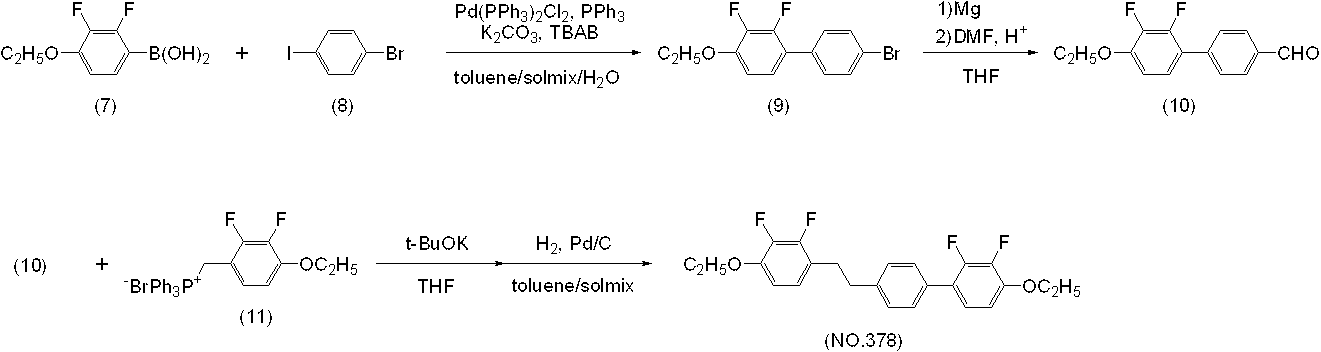
窒素雰囲気下、反応器へ4-エトキシ-2,3-ジフルオロフェニルボロン酸(7) 14.4g、4-ブロモヨードベンゼン(8) 20.0g、炭酸カリウム 29.3g、Pd(Ph3P)2Cl2 1.49g、トルエン100ml、ソルミックスA-11 100mlおよび水 100mlを加え、2時間加熱還流させた。反応液を25℃まで冷却後、水 500mlおよびトルエン 500mlへ注ぎ込み、混合した。その後、有機層と水層に分離させて、有機層への抽出を行った。得られた有機層を、水で洗浄し、無水硫酸マグネシウムで乾燥した。得られた溶液を減圧下、濃縮し、得られた残渣を、カラムクロマトグラフィー(シリカゲル;トルエン)で精製した。さらに再結晶(ソルミックスA-11)により精製し、4-エトキシ-4’-ブロモ-2,3-ジフルオロ-1,1'-ビフェニル(9) 20.8gを得た。化合物(8)からの収率は94.0%であった。
窒素雰囲気下の反応器へ、乾燥させたマグネシウム 0.83gとTHF 20mlとを加えて、50℃まで加熱した。そこへ、THF 50mlに溶解した4-エトキシ-4’-ブロモ-2,3-ジフルオロ-1,1'-ビフェニル(9) 10.0gを、40℃から60℃の温度範囲でゆっくり滴下し、さらに60分攪拌した。その後、THF 20mlに溶解したN,N-ジメチルホルムアミド 3mlを、50℃から60℃の温度範囲でゆっくり滴下し、さらに60分攪拌した。得られた反応混合物を30℃まで冷却した後、1N HCl水溶液 100mlと酢酸エチル 50mlとが入った容器中に添加して混合した後、有機層と水層に分離させ抽出を行った。得られた有機層を、水、飽和重曹水、および水で洗浄し、無水硫酸マグネシウムで乾燥した。その後、減圧下、溶媒を留去し、カラムクロマトグラフィー(シリカゲル;トルエン)で精製させ、4-エトキシ-2,3-ジフルオロ-4'-ビフェニルカルボキシアルデヒド(10) 8.3gを得た。化合物(9)からの収率は99.2%であった。
窒素雰囲気下、乾燥させた4-エトキシ-2,3-ジフルオロベンジルトリフェニルホスホニウムクロリド(11) 9.4gとTHF 200mlを混合し、-30℃まで冷却した。その後、カリウムt-ブトキシド(t-BuOK) 2.1gを-30℃~-20℃の温度範囲で投入した。-20℃で30分攪拌した後、THF 50mlに溶解した化合物(10) 8.3gを-30~-20℃の温度範囲で滴下した。-10℃で30分攪拌した後、反応液を水 100mlとトルエン 100mlの混合液へ注ぎ込み、混合した後、有機層と水層に分離させて、有機層への抽出を行った。得られた有機層を、水で洗浄し、無水硫酸マグネシウムで乾燥した。得られた溶液を減圧下、濃縮し得られた残渣をカラムクロマトグラフィー(シリカゲル;トルエン)による分取操作で精製した。得られた溶離液を減圧下、濃縮し、トルエン 50ml、ソルミックスA-11 50mlとの混合溶媒に溶解させた。さらにPd/Cを0.5g加え、水素雰囲気下、水素を吸収しなくなるまで室温で攪拌した。反応終了後、Pd/Cを除去して、さらに溶媒を留去して、得られた残渣をカラムクロマトグラフィー(シリカゲル;体積比 ヘプタン:トルエン=3:7)で精製し、さらに再結晶(体積比 ソルミックスA-11:ヘプタン=1:2)により精製し、4-エトキシ-2,3-ジフルオロ-4’-(4-エトキシ-2,3-ジフルオロフェノキシメチル)-1,1’-ビフェニル(No.378) 5.9gを得た。化合物(10)からの収率は44.6%であった。
転移温度 :C 99.0 N 112.1 I
1H-NMR分析の化学シフトδ(ppm)は以下の通りであり、得られた化合物が、4-エトキシ-2,3-ジフルオロ-4’-(4-エトキシ-2,3-ジフルオロフェノキシメチル)-1,1’-ビフェニル(No.378)であることが同定できた。
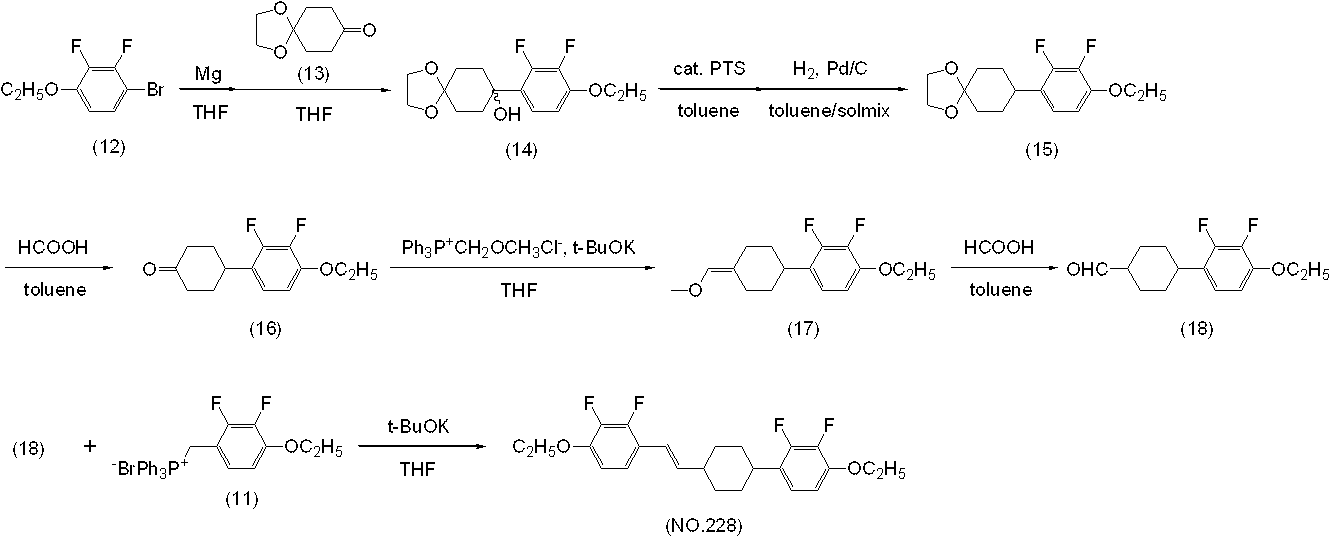
窒素雰囲気下の反応器へ、乾燥させたマグネシウム 6.1gとTHF 20mlとを加えて、40℃まで加熱した。そこへ、THF 300mlに溶解した1-ブロモ-4-エトキシ-2,3-ジフルオロベンゼン(12) 59.2gを、40℃から60℃の温度範囲でゆっくり滴下し、さらに60分攪拌した。その後、THF 150mlに溶解した1,4-ジオキサスピロ[4.5]デカン-8-オン(13)30.0gを、50℃から60℃の温度範囲でゆっくり滴下し、さらに60分攪拌した。得られた反応混合物を30℃まで冷却した後、0℃に冷却した3% 塩化アンモニウム水溶液 900mlとトルエン 500mlとが入った容器中に添加して混合した後、有機層と水層とに分離させ抽出を行った。得られた有機層を、水、飽和重曹水、および水で洗浄し、無水硫酸マグネシウムで乾燥した。その後、減圧下、溶媒を留去し、8-(4-エトキシ-2,3-ジフルオロフェニル)-1,4-ジオキサスピロ[4.5]デカ-8-オール(14) 86.2gを得た。得られた化合物(14)は黄色油状物であった。
化合物(14) 86.2g、p-トルエンスルホン酸 2.4g、およびトルエン 250mlを混合し、この混合物を、留出する水を抜きながら2時間加熱還流させた。反応混合物を30℃まで冷却した後、得られた液に水 500mlとトルエン 900mlとを加え混合した後、有機層と水層に分離させて、有機層への抽出を行った。得られた有機層を、飽和重曹水、および水で洗浄し、無水硫酸マグネシウムで乾燥した。得られた溶液を、カラムクロマトグラフィー(シリカゲル;トルエン)で精製した。それを、トルエン 150ml、ソルミックスA-11 150mlとの混合溶媒に溶解させ、さらにPd/Cを3.0g加え、水素雰囲気下、水素を吸収しなくなるまで室温で攪拌した。反応終了後、Pd/Cを除去して、さらに溶媒を留去して、得られた残渣を、カラムクロマトグラフィー(シリカゲル;ヘプタン)で精製し、さらに再結晶(ソルミックスA-11)により精製し、8-(4-エトキシ-2,3-ジフルオロフェニル)-1,4-ジオキサスピロ[4.5]デカン(15) 59.7gを得た。得られた化合物(15)は黄色油状物であった。
化合物(15) 59.7g、87%ギ酸 20ml、およびトルエン 200mlを混合し、この混合物を、2時間加熱還流させた。反応混合物を30℃まで冷却した後、得られた液に水 500mlとトルエン 1000mlとを加え混合した後、有機層と水層の2層に分離させた。有機層への抽出を行った。得られた有機層を、水、飽和重曹水、および水で洗浄し、無水硫酸マグネシウムで乾燥した。その後、減圧下、溶媒を留去し、得られた残渣を、カラムクロマトグラフィー(シリカゲル;トルエン)による分取操作で精製し、さらに再結晶(ヘプタン)により精製し、1-(4-エトキシ-2,3-ジフルオロフェニル)-シクロヘキサン-4-オン(16)27.5gを得た。化合物(13)からの収率は56.4%であった。
窒素雰囲気下、乾燥させたメトキシメチルトリフェニルホスホニウムクロリド 26.3gとTHF 100mlを混合し、-30℃まで冷却した。その後、カリウムt-ブトキシド(t-BuOK) 8.6gを-30℃~-20℃の温度範囲で、2回に分けて投入した。-20℃で30分攪拌した後、THF 100mlに溶解した化合物(16) 15.0gを-30~-20℃の温度範囲で滴下した。-10℃で30分攪拌した後、反応液を水 200mlとトルエン 200mlの混合液へ注ぎ込み、混合した後、有機層と水層に分離させて、有機層への抽出を行った。得られた有機層を、水で洗浄し、無水硫酸マグネシウムで乾燥した。得られた溶液を減圧下、濃縮し得られた残渣を、カラムクロマトグラフィー(シリカゲル;トルエン)で精製した。得られた溶離液を減圧下、濃縮し、1-(4-エトキシ-2,3-ジフルオロフェニル)-4-メトキシメチレンシクロヘキサン(17)21.8gを得た。得られた化合物(17)は無色油状物であった。
化合物(17) 16.6g、87%ギ酸 6.2g、およびトルエン 100mlを混合し、この混合物を、2時間加熱還流させた。反応混合物を30℃まで冷却した後、得られた液に水 100mlとトルエン 200mlとを加え混合した後、有機層と水層の2層に分離させて、有機層への抽出を行った。得られた有機層を、水、飽和重曹水、および水で洗浄し、無水硫酸マグネシウムで乾燥した。その後、減圧下、溶媒を留去し、淡黄色固体 19.0gを得た。この残渣をトルエン50mlに溶解し、7℃に冷却した95%水酸化ナトリウム 0.5gとメタノール 200mlの混合液へ添加し、10℃で2時間攪拌した。その後、2N 水酸化ナトリウム水溶液 20mlを添加し、5℃で2時間攪拌した。得られた反応液を水 500mlとトルエン 500mlの混合液へ注ぎ込み、混合した後、静置して有機層と水層の2層に分離させて、有機層への抽出操作を行った。得られた有機層を分取して、水で洗浄し、無水硫酸マグネシウムで乾燥した。その後、減圧下、溶媒を留去し、得られた残渣をカラムクロマトグラフィー(シリカゲル;トルエン)で精製し、1-(4-エトキシ-2,3-ジフルオロフェニル)-シクロヘキサンカルボアルデヒド(18)11.9gを得た。化合物(16)からの収率は75.2%であった。
窒素雰囲気下、乾燥させた4-エトキシ-2,3-ジフルオロベンジルトリフェニルホスホニウムクロリド(11) 24.9gとTHF 100mlを混合し、-10℃まで冷却した。その後、カリウムt-ブトキシド(t-BuOK) 5.4gを-10℃~-5℃の温度範囲で、2回に分けて投入した。-10℃で60分攪拌した後、THF 30mlに溶解した化合物(18) 10.0gを-10~-5℃の温度範囲で滴下した。0℃で30分攪拌した後、反応液を水 100mlとトルエン 50mlの混合液へ注ぎ込み、混合した後、有機層と水層に分離させて、有機層への抽出を行った。得られた有機層を、水で洗浄し、無水硫酸マグネシウムで乾燥した。得られた溶液を減圧下、濃縮し得られた残渣を、カラムクロマトグラフィー(シリカゲル;トルエン)による分取操作で精製し、溶離液を減圧下、濃縮した。得られた淡黄色結晶にソルミックス A-11 20mlを添加し、攪拌している中、ベンゼンスルフィン酸ナトリウム二水和物 2.6gを添加し、続いて6N-塩酸 2.2mlを添加し、5時間加熱還流させた。反応混合物を30℃まで冷却した後、得られた液に水 100mlとトルエン 100mlとを加え混合した後、有機層と水層に分離させて、有機層への抽出を行った。得られた有機層を、水、0.5N-水酸化ナトリウム水溶液、飽和重曹水、および水で洗浄し、無水硫酸マグネシウムで乾燥した。得られた溶液を減圧下、濃縮し得られた残渣をカラムクロマトグラフィー(シリカゲル;体積比 ヘプタン:トルエン=2:3)で精製し、溶離液を減圧下、濃縮した。得られた残渣を再結晶(体積比 ヘプタン:ソルミックス=3:2)により精製し、2,3-ジフルオロ-4-エトキシ-[トランス-4-(2,3-ジフルオロ-4-エトキシフェニルエテニル)シクロヘキシル]ベンゼン(No.228)10.6gを得た。化合物(18)からの収率は67.5%であった。
転移温度 :C 110.1 I
1H-NMR分析の化学シフトδ(ppm)は以下の通りであり、得られた化合物が、2,3-ジフルオロ-4-エトキシ-[トランス-4-(2,3-ジフルオロ-4-エトキシフェニルエテニル)シクロヘキシル]ベンゼン(No.228)であることが同定できた。なお、測定溶媒はである。

トルエン 150ml、ソルミックスA-11 150mlとの混合溶媒に化合物(No.228) 15.6gを溶解させ、さらにPd/Cを1.0g加え、水素雰囲気下、水素を吸収しなくなるまで室温で攪拌した。反応終了後、Pd/Cを除去して、さらに溶媒を留去して、得られた残渣をカラムクロマトグラフィー(シリカゲル;ヘプタン/トルエン=2/3(体積比))で精製し、さらに得られた残渣を再結晶(体積比 ヘプタン:ソルミックス=3:2)により精製し、2,3-ジフルオロ-4-エトキシ-[トランス-4-(2,3-ジフルオロ-4-エトキシフェニルエチル)シクロヘキシル]ベンゼン(No.528) 8.8gを得た。化合物(No.228)からの収率は56.8%であった。
転移温度 :C 114.3 (N 109.6) I
1H-NMR分析の化学シフトδ(ppm)は以下の通りであり、得られた化合物が、2,3-ジフルオロ-4-エトキシ-[トランス-4-(2,3-ジフルオロ-4-エトキシフェニルエチル)シクロヘキシル]ベンゼンであることが同定できた。
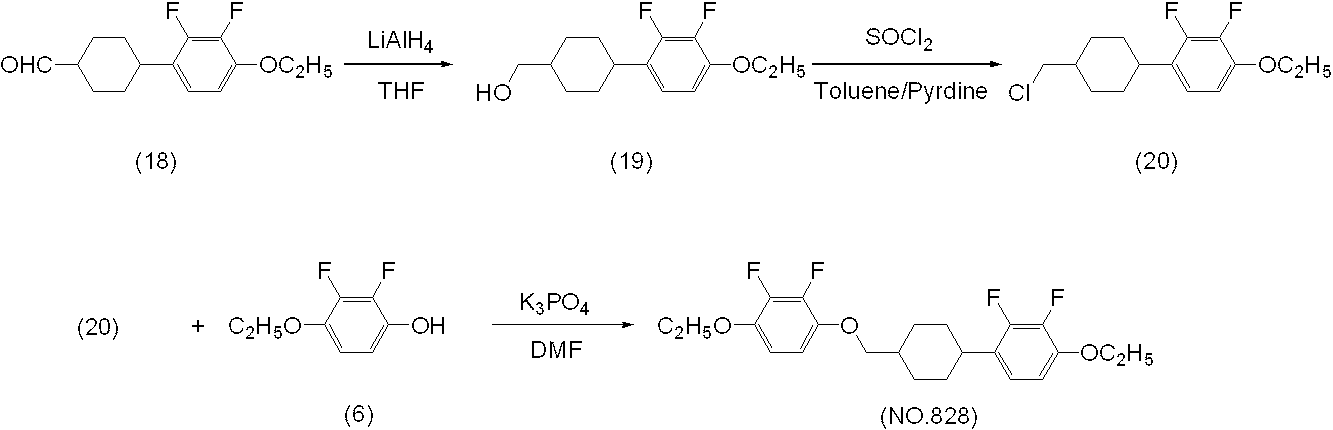
水素化リチウムアルミニウム 4.2gをTHF 300mlに懸濁した。この懸濁液に1-(4-エトキシ-2,3-ジフルオロフェニル)-シクロヘキサンカルボアルデヒド(18) 50.0gを、-20℃から-10℃の温度範囲で滴下し、さらにこの温度範囲で2時間攪拌した。GC分析により反応終了を確認後、氷冷下、反応混合物に、順次、酢酸エチル、飽和アンモニア水溶液を加えていき、析出物をセライト濾過により除去した。濾液を酢酸エチルにより抽出した。得られた有機層を、水、飽和食塩水で順次洗浄して、無水硫酸マグネシウムで乾燥した。さらに再結晶(ヘプタン)により精製し、減圧下濃縮をして、4-ヒドロキシメチル-(4-エトキシ-2,3-ジフルオロ)シクロヘキサン(19) 47.6gを得た。化合物(18)からの収率は94.5%であった。
窒素雰囲気下、反応器へ化合物(19) 47.6g、トルエン 300mlおよびピリジン 0.5mlを加え、45℃で1時間攪拌した。その後、塩化チオニル 14.0mlを45℃から55℃の温度範囲で加え、2時間加熱還流させた。反応液を25℃まで冷却後、水 300mlおよびトルエン 300mlへ注ぎ込み、混合した。その後、有機層と水層に分離させて、有機層への抽出を行った。得られた有機層を、飽和重曹水で2回、水で3回洗浄し、無水硫酸マグネシウムで乾燥した。得られた溶液を減圧下で濃縮し、得られた残渣を、カラムクロマトグラフィー(シリカゲル;ヘプタン/トルエン=1/1(体積比))で精製した。さらに再結晶(ソルミックスA-11)により精製し、4-クロロメチル-(4-エトキシ-2,3-ジフルオロフェニル)-シクロヘキサン(20) 47.6gを得た。化合物(19)からの収率は93.6%であった。
窒素雰囲気下、DMF 100mlに4-エトキシ-2,3-ジフルオロフェノール(6) 2.2g、およびリン酸三カリウム(K3PO4) 11.0gを加え、70℃で攪拌した。そこへ化合物(20) 3.0gを加え、70℃で、7時間攪拌した。得られた反応混合物を30℃まで冷却し、ろ過によって固形物と分離した後、トルエン 100ml、および水 100mlを加え混合した。その後、有機層と水層に分離させて、有機層への抽出を行った。得られた有機層を、食塩水で洗浄し、無水硫酸マグネシウムで乾燥した。その後、減圧下、溶媒を留去し、得られた残渣をカラムクロマトグラフィー(シリカゲル;ヘプタン/トルエン=1/2(体積比))で精製した。さらに再結晶(体積比 ソルミックスA-11:ヘプタン=1:2)により精製し、1-(4-エトキシ-2,3-ジフルオロフェニル)-4-(4-エトキシ-2,3-ジフルオロフェノキシメチル)-シクロヘキサン(No.828)2.2gを得た。化合物(20)からの収率は74.0%であった。
転移温度 :C 97.0 N 102.5 I
1H-NMR分析の化学シフトδ(ppm)は以下の通りであり、得られた化合物が、2,3-ジフルオロ-4-エトキシ-[トランス-4-(2,3-ジフルオロ-4-エトキシフェノキシメチル)シクロヘキシル]ベンゼン(No.828)であることが同定できた。
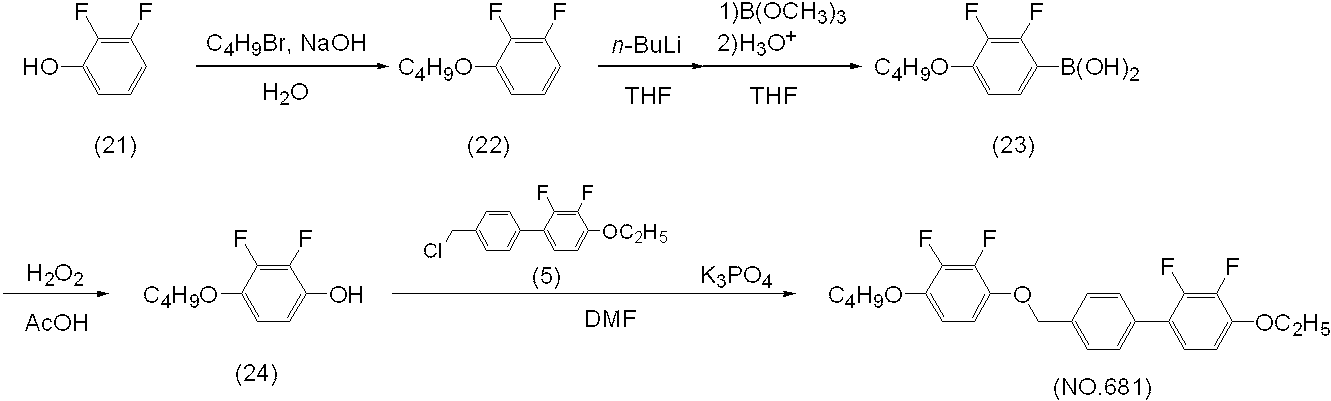
窒素雰囲気下、水 300mlに2,3-ジフルオロフェノール(21) 100.0g、および水酸化ナトリウム(NaOH) 36.9gを加え、70℃で攪拌した。そこへ1-ブロモブタン 158.0gを加え、70℃で、2時間攪拌した。得られた反応混合物を30℃まで冷却し、ヘプタン 100ml、および水 100mlを加え混合した。その後、有機層と水層に分離させて、有機層への抽出を行った。得られた有機層を、食塩水で洗浄し、無水硫酸マグネシウムで乾燥した。その後、減圧下分別蒸留を行い、4-ブトキシ-2,3-ジフルオロベンゼン(22)114.4gを得た。得られた化合物(22)は無色液体、沸点は109~110℃/20mmHgであり、化合物(21)からの収率は80.0%であった。
窒素雰囲気下の反応器へ、化合物(22) 84.6gとTHF 500mlとを加えて、-74 ℃まで冷却した。そこへ、1.65M n-ブチルリチウム,n-ヘキサン溶液 303.0mlを-74℃から-70℃の温度範囲で滴下し、さらに2時間攪拌した。続いて、ホウ酸トリメチル 56.7gのTHF 200ml溶液に-74℃から-65℃の温度範囲で滴下し、25 ℃に戻しつつ、さらに8時間攪拌した。その後、反応混合物を1N塩酸 100ml氷水 500mlとが入った容器中に注ぎ込み、混合した。酢酸エチル 300mlを加えて、有機層と水層とに分離させ抽出を行った。得られた有機層を、水、飽和炭酸水素ナトリウム水溶液、食塩水で順次洗浄し、無水硫酸マグネシウムで乾燥した。その後、減圧下、溶媒を留去し、4-ブトキシ-2,3-ジフルオロフェニルボロン酸(23) 6.4gを得た。化合物(22)からの収率は69.2%であった。
窒素雰囲気下の反応器へ、化合物(23) 40.0gと酢酸 100mlとを加えて、室温下、31%過酸化水素水 40.4mlを25℃から30℃の温度範囲で滴下し、さらに2時間攪拌した。その後、反応混合物を亜硫酸水素ナトリウム水溶液100ml、酢酸エチル300mlが入った容器中に注ぎ込み、混合した。その後、有機層と水層とに分離させ抽出を行った。得られた有機層を、水、食塩水で順次洗浄し、無水硫酸マグネシウムで乾燥した。その後、減圧下、溶媒を留去し、4-ブトキシ-2,3-ジフルオロフェノール(24) 31.7gを得た。化合物(23)からの収率は90.2%であった。
窒素雰囲気下、DMF 100mlに4-ブトキシ-2,3-ジフルオロフェノール(24) 3.6g、およびリン酸三カリウム(K3PO4) 11.3gを加え、70℃で攪拌した。そこへ化合物(5) 3.0gを加え、70℃で、7時間攪拌した。得られた反応混合物を30℃まで冷却し、ろ過によって固形物と分離した後、トルエン 100ml、および水 100mlを加え混合した。その後、有機層と水層に分離させて、有機層への抽出操作を行った。得られた有機層を、食塩水で洗浄し、無水硫酸マグネシウムで乾燥した。その後、減圧下、溶媒を留去し、得られた残渣をカラムクロマトグラフィーシリカゲル;ヘプタン/トルエン=1/2(体積比))で精製した。さらに再結晶(体積比 ソルミックスA-11:ヘプタン=1:2)により精製し、1-(4-ブトキシ-2,3-ジフルオロ)-4-(4-エトキシ-2,3-ジフルオロフェノキシメチル)-シクロヘキサン(No.681)3.62gを得た。化合物(5)からの収率は76.1%であった。
転移温度 :C 115.7 (N 106.7) I
1H-NMR分析の化学シフトδ(ppm)は以下の通りであり、得られた化合物が、4-エトキシ-2,3-ジフルオロ-4’-(4-ブトキシ-2,3-ジフルオロフェノキシメチル)-1,1’-ビフェニルであることが同定できた。

窒素雰囲気下、DMF 100mlに4-ブトキシ-2,3-ジフルオロフェノール(24) 4.6g、およびリン酸三カリウム(K3PO4) 14.0gを加え、70℃で攪拌した。そこへ化合物(20) 3.0gを加え、70℃で、7時間攪拌した。得られた反応混合物を30℃まで冷却し、ろ過によって固形物と分離した後、トルエン 100ml、および水 100mlを加え混合した。その後、有機層と水層に分離させて、有機層への抽出を行った。得られた有機層を、食塩水で洗浄し、無水硫酸マグネシウムで乾燥した。その後、減圧下、溶媒を留去し、得られた残渣をカラムクロマトグラフィー(シリカゲル;ヘプタン/トルエン=1/2(体積比))で精製した。さらに再結晶(体積比 ソルミックスA-11:ヘプタン=1:2)により精製し、2,3-ジフルオロ-4-エトキシ-[トランス-4-(2,3-ジフルオロ-4-ブトキシフェノキシメチル)シクロヘキシル]ベンゼン(No.831)4.02gを得た。化合物(20)からの収率は85.1%であった。
転移温度 :C 72.4 N 92.8 I
1H-NMR分析の化学シフトδ(ppm)は以下の通りであり、得られた化合物が、2,3-ジフルオロ-4-エトキシ-[トランス-4-(2,3-ジフルオロ-4-ブトキシフェノキシメチル)シクロヘキシル]ベンゼン(No.831)であることが同定できた。

窒素雰囲気下、化合物(5) 20.0g、トリフェニルホスフィン 37.1g、およびトルエン 200mlを混合し、この混合物を、2時間加熱還流させた。反応混合物をろ過し、トルエンで3回し未反応の原料を洗い流した後、4-エトキシ-2,3-ジフルオロ-1,1’-ビフェニルメチルトリフェニルホスホニウムクロリド(25)38.5gを得た。化合物(5)からの収率は99.9%であった。
窒素雰囲気下、乾燥させた化合物(25) 26.3gとTHF 200mlを混合し、-30℃まで冷却した。その後、カリウムt-ブトキシド(t-BuOK) 5.4gを-30℃~-20℃の温度範囲で、2回に分けて投入した。-20℃で30分攪拌した後、THF 100mlに溶解した3-フルオロベンズアルデヒド(26) 5.0gを-30~-20℃の温度範囲で滴下した。-10℃で30分攪拌した後、反応液を水 200mlとトルエン 200mlの混合液へ注ぎ込み、混合した後、有機層と水層に分離させて、有機層への抽出を行った。得られた有機層を、水で洗浄し、無水硫酸マグネシウムで乾燥した。得られた溶液を減圧下、濃縮し得られた残渣をカラムクロマトグラフィー(シリカゲル;トルエン)で精製した。得られた溶離液を減圧下、濃縮し、さらに再結晶(体積比 ソルミックスA-11:ヘプタン=2:1)により精製し、4-エトキシ-2,3-ジフルオロ-1,1’-ビフェニルエチル-3-フルオロベンゼン(No.497)13.0gを得た。化合物(26)からの収率は90.5%であった。
転移温度 :C1 59.0 C2 61.2 I
1H-NMR分析の化学シフトδ(ppm)は以下の通りであり、得られた化合物が、4-エトキシ-2,3-ジフルオロ-1,1’-ビフェニルエチル-3-フルオロベンゼン(No.497)であることが同定できた。

窒素雰囲気下の反応器へ、1-エトキシ-2,3-ジフルオロベンゼン(27) 7.0gとTHF 200mlとを加えて、-74 ℃まで冷却した。そこへ、1.57M n-ブチルリチウム,n-ヘキサン溶液 31.0mlを-74℃から-70℃の温度範囲で滴下し、さらに2時間攪拌した。その後、THF50mlに溶解した1-(4-ブトキシ-2,3-ジフルオロフェニル)-シクロヘキサン-4-オン(28)12.5gを、50℃から60℃の温度範囲でゆっくり滴下し、さらに60分攪拌した。得られた反応混合物を30℃まで冷却した後、0℃に冷却した3% 塩化アンモニウム水溶液 400mlとトルエン 200mlとが入った容器中に添加して混合した後、有機層と水層とに分離させ抽出を行った。得られた有機層を、水、飽和重曹水、および水で洗浄し、無水硫酸マグネシウムで乾燥した。その後、減圧下、溶媒を留去し、1-(4-エトキシ-2,3-ジフルオロフェニル)-4-(4-ブトキシ-2,3-ジフルオロフェニル)シクロヘキサン-1-オール(29) 19.0gを得た。得られた化合物(29)は黄色油状物であった。
化合物(29) 19.0g、p-トルエンスルホン酸 0.57g、およびトルエン 200mlを混合し、この混合物を、留出する水を抜きながら2時間加熱還流させた。反応混合物を30℃まで冷却した後、得られた液に水 200mlとトルエン 200mlとを加え混合した後、有機層と水層に分離させて、有機層への抽出を行った。得られた有機層を、飽和重曹水、および水で洗浄し、無水硫酸マグネシウムで乾燥した。得られた溶液を、カラムクロマトグラフィー(シリカゲル;トルエン)で精製した。さらに再結晶(体積比 ソルミックスA-11:酢酸エチル=2:1)により精製し、1-(4-エトキシ-2,3-ジフルオロフェニル)-4-(4-ブトキシ-2,3-ジフルオロフェニル)シクロヘキセン(No.77) 10.3gを得た。化合物(27)からの収率は55.0%であった。
転移温度 :C1 61.8 C2 67.5 N 105.8 I
1H-NMR分析の化学シフトδ(ppm)は以下の通りであり、得られた化合物が、1-(4-エトキシ-2,3-ジフルオロフェニル)-4-(4-ブトキシ-2,3-ジフルオロフェニル)シクロヘキセン(No.77)であることが同定できた。
トルエン 150ml、ソルミックスA-11 150mlとの混合溶媒に化合物(No.77) 9.0gを溶解させ、さらにラネーニッケルを0.90g加え、水素雰囲気下、水素を吸収しなくなるまで室温で攪拌した。反応終了後、ラネーニッケルを除去して、さらに溶媒を留去して、得られた残渣をカラムクロマトグラフィー(シリカゲル;体積比 ヘプタン:トルエン=1:2)で精製し、さらに得られた残渣を再結晶(体積比 酢酸エチル:ソルミックス=1:2)により精製し、1-(4-エトキシ-2,3-ジフルオロフェニル)-4-(4-ブトキシ-2,3-ジフルオロフェニル)シクロヘキサン(No.78)6.2gを得た。化合物(No.77)からの収率は68.3%であった。
転移温度 :C 85.6 N 124.2 I
1H-NMR分析の化学シフトδ(ppm)は以下の通りであり、得られた化合物が、1-(4-エトキシ-2,3-ジフルオロフェニル)-4-(4-ブトキシ-2,3-ジフルオロフェニル)シクロヘキサン(No.78)であることが同定できた。
なお、化合物No.228、678、681は母液晶95重量%、化合物5重量%とからなる組成物を調製し、得られた液晶組成物の物性を測定し、測定値を外挿したもの、
化合物No.528は母液晶90重量%、化合物10重量%とからなる組成物を調製し、得られた組成物の物性を測定し、測定値を外挿したもの、
残りのデータを付記した化合物は母液晶85重量%、化合物15重量%とからなる組成物を調製し、得られた組成物の測定値からを外挿した物性値である。
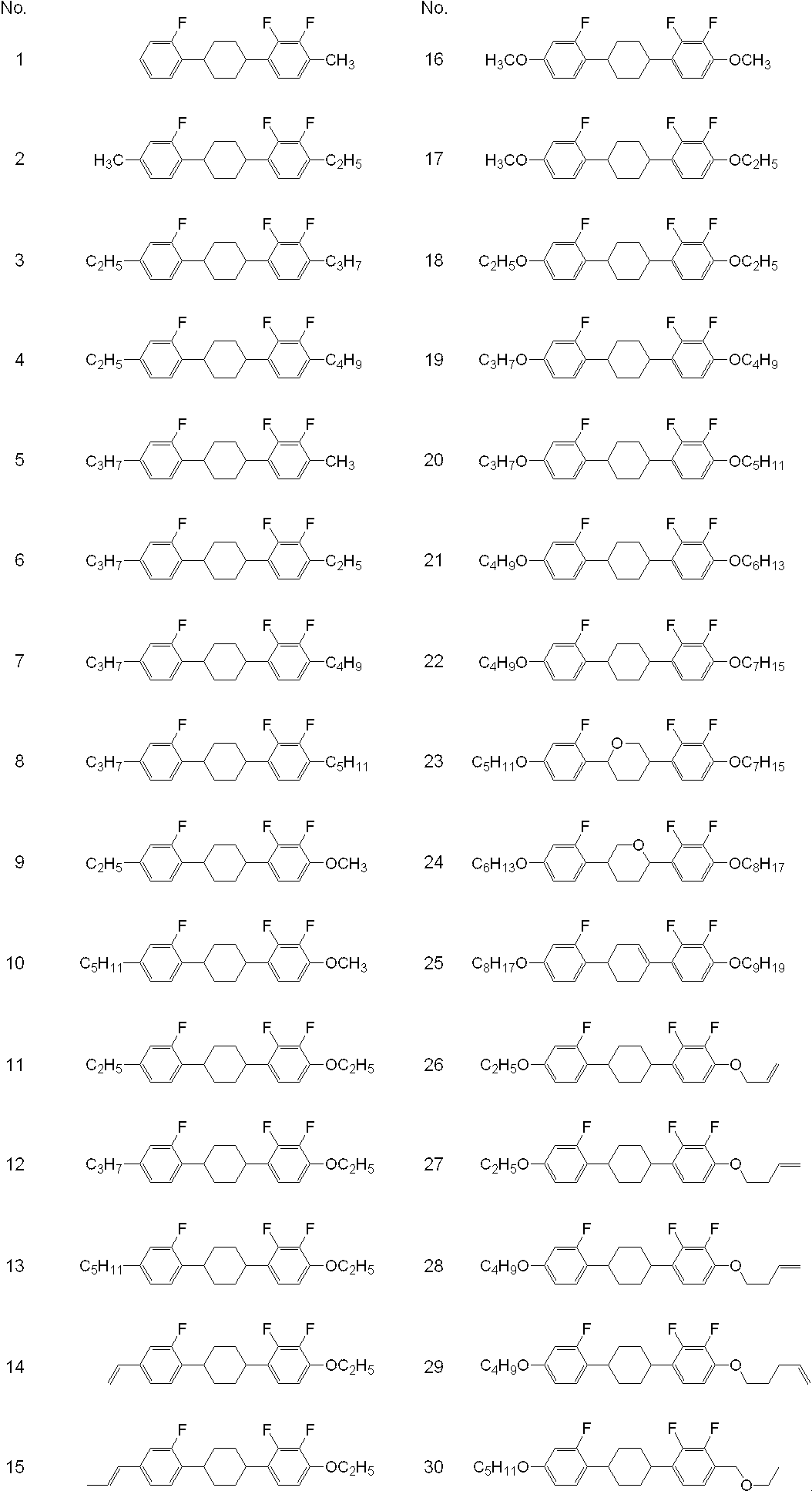

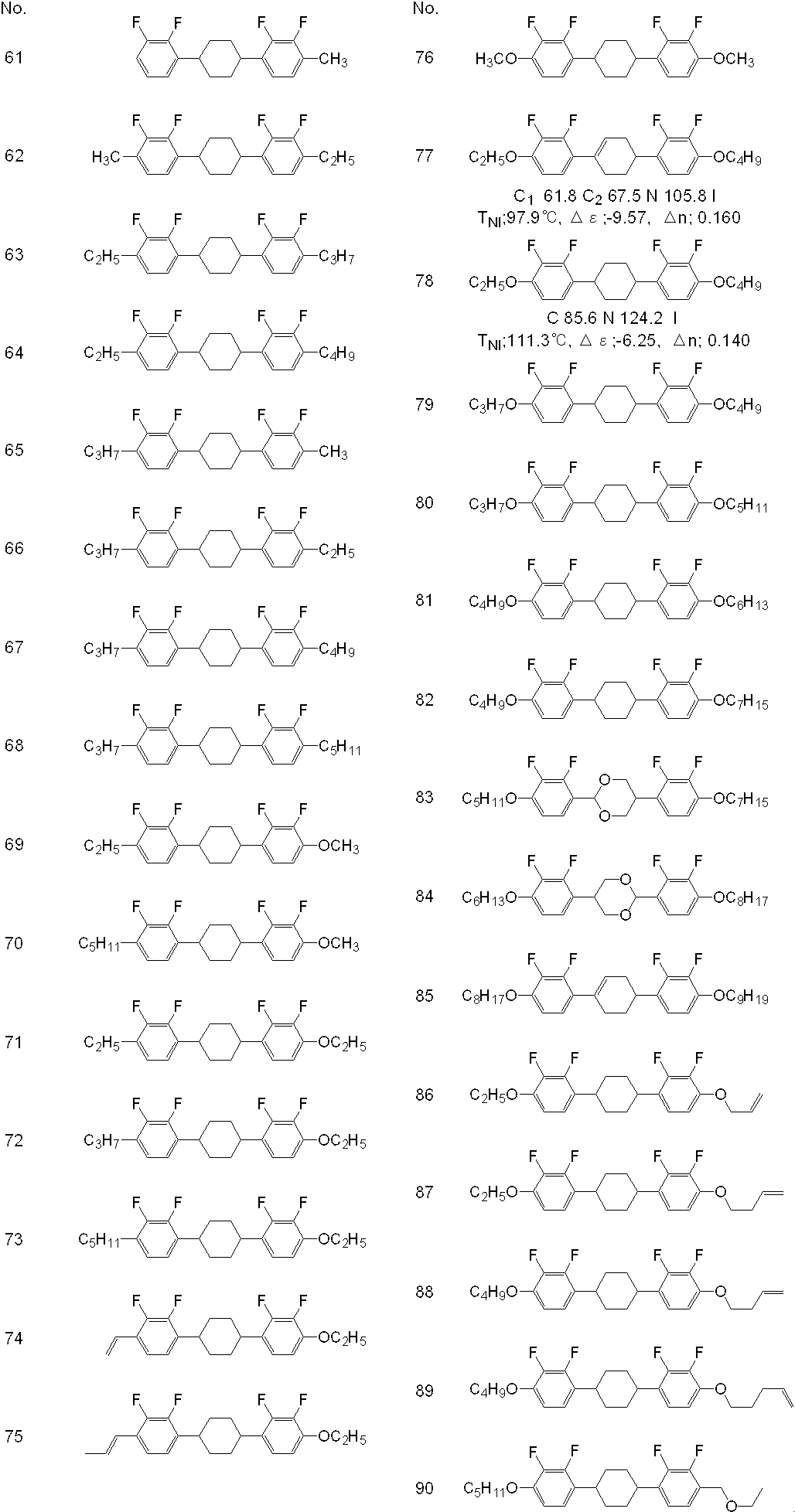
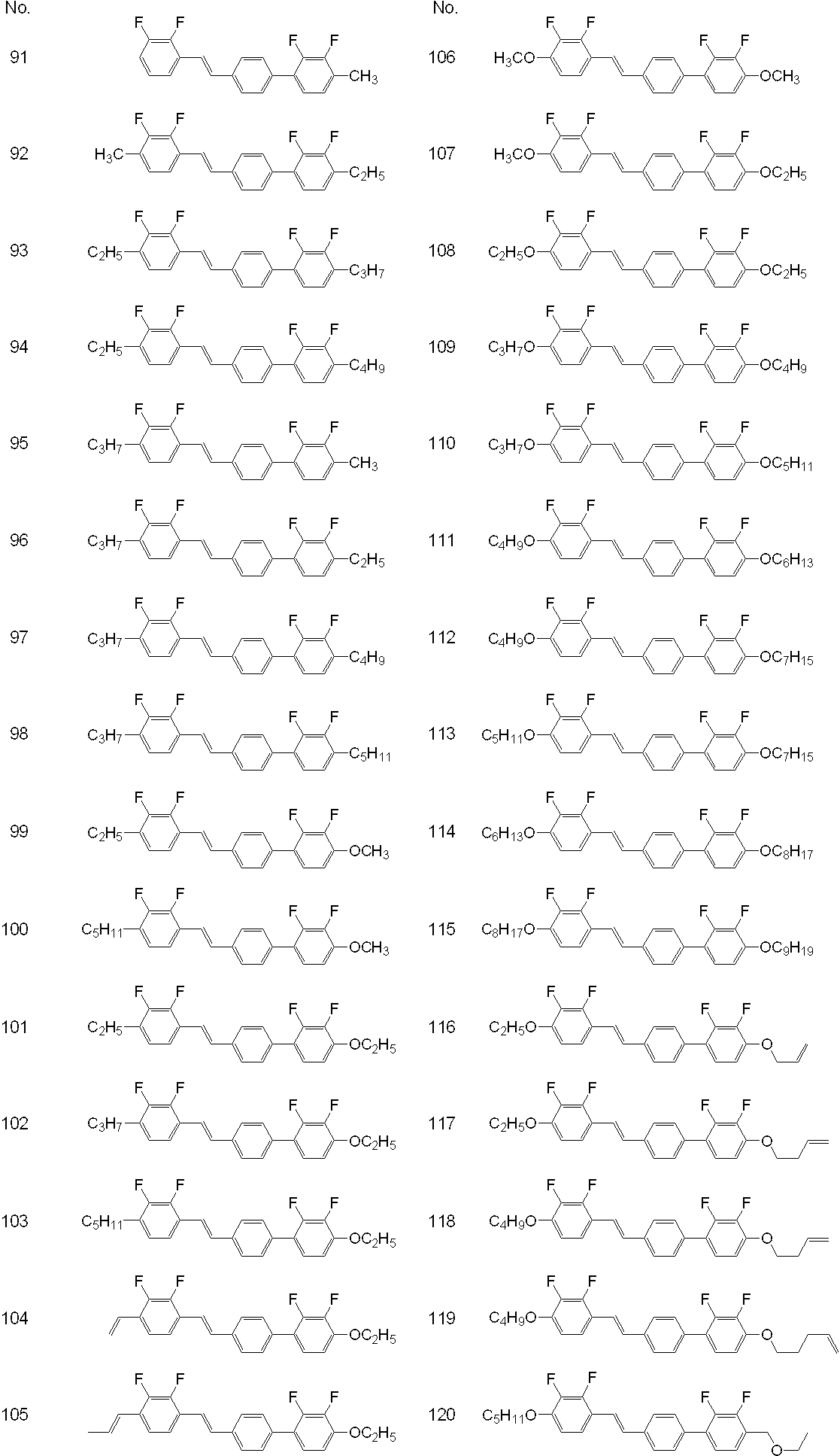
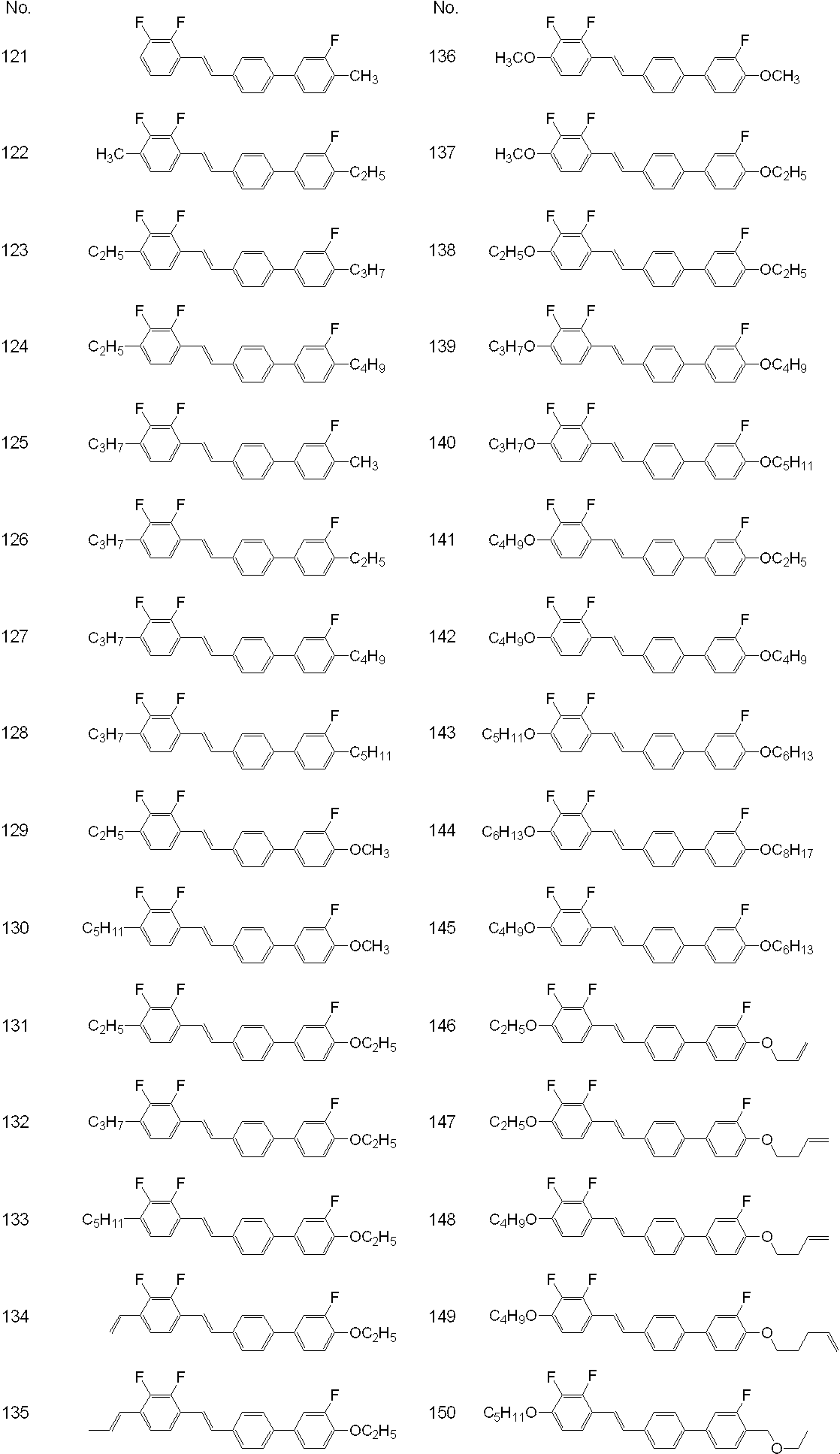
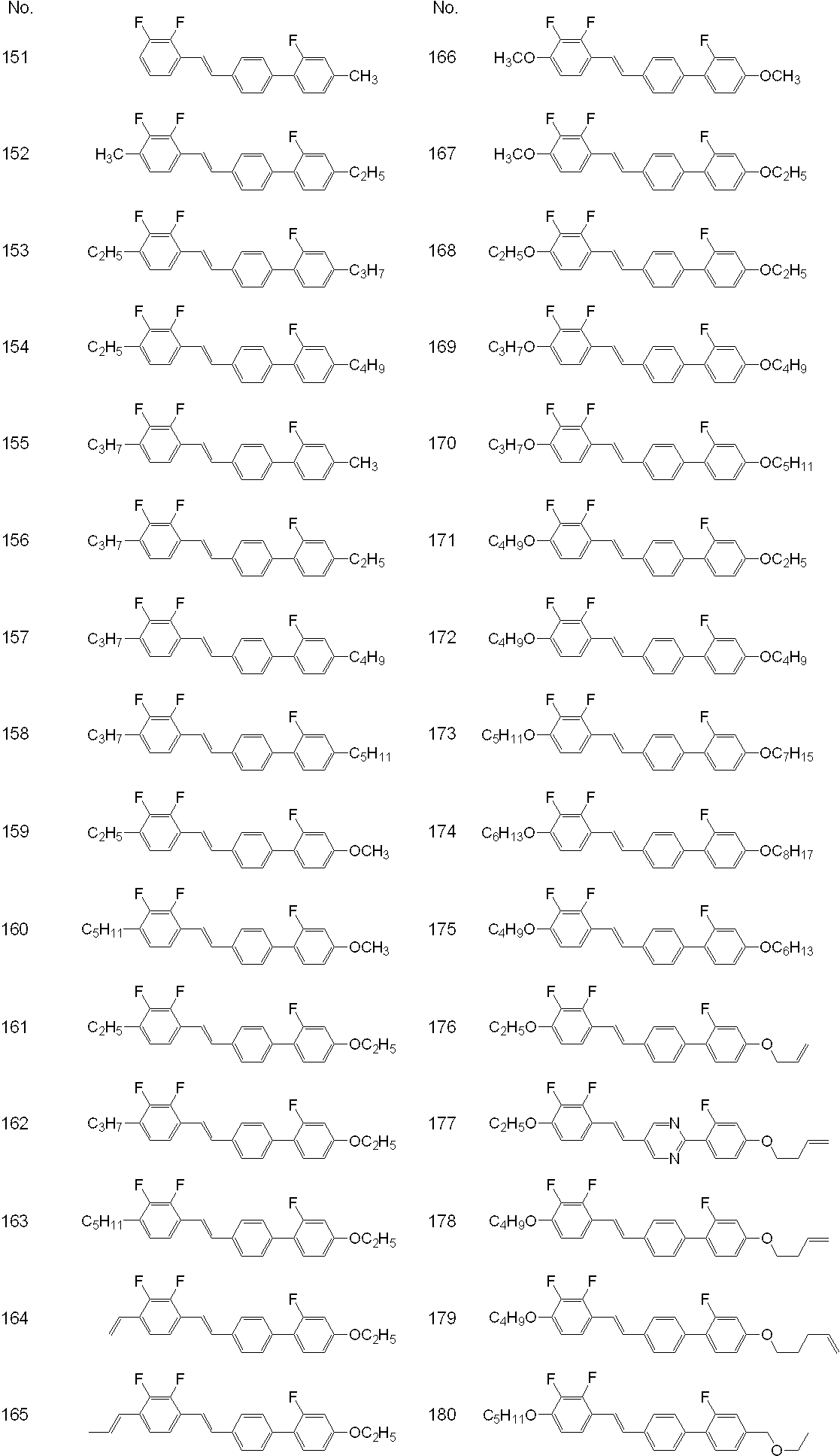

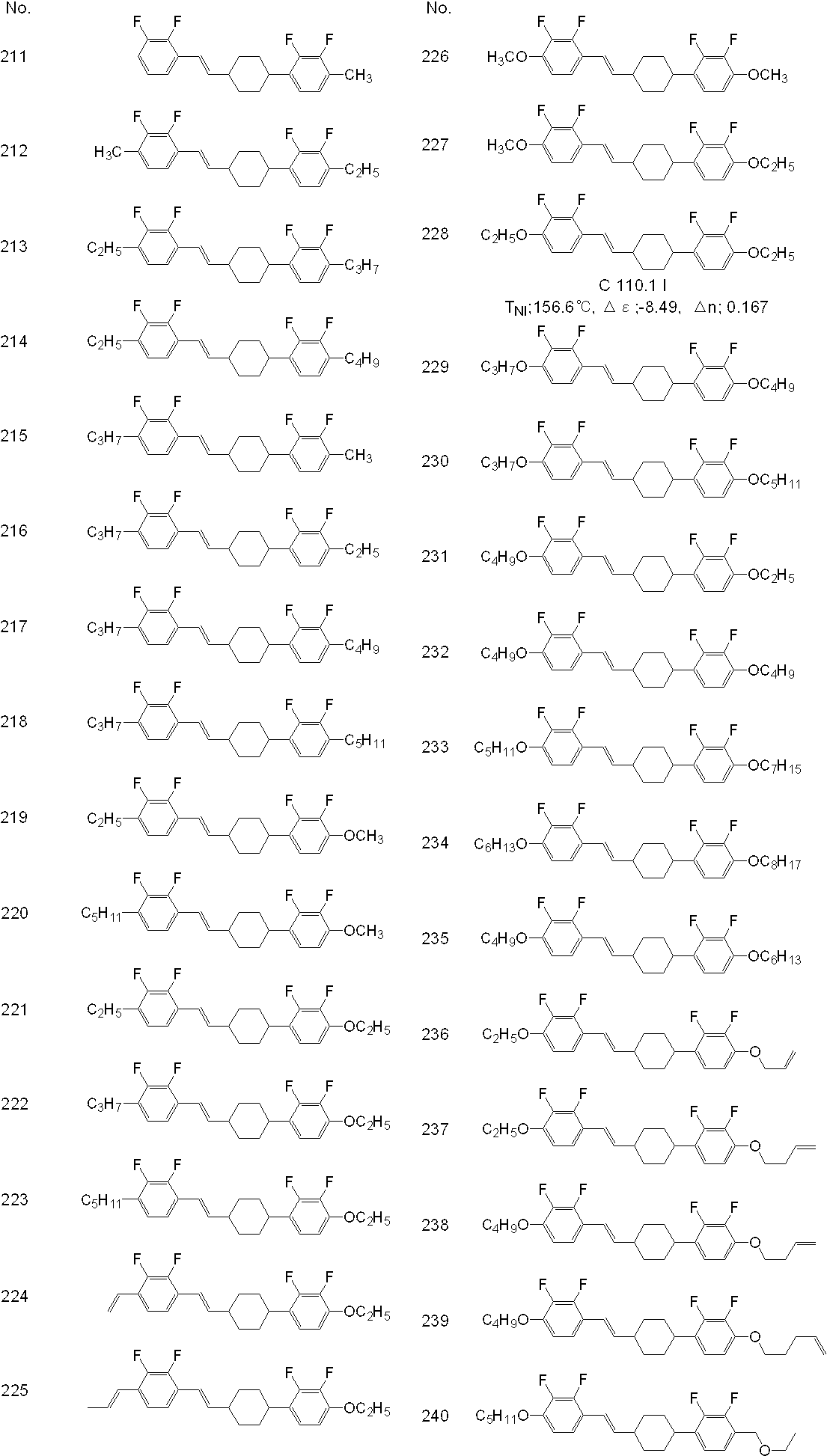

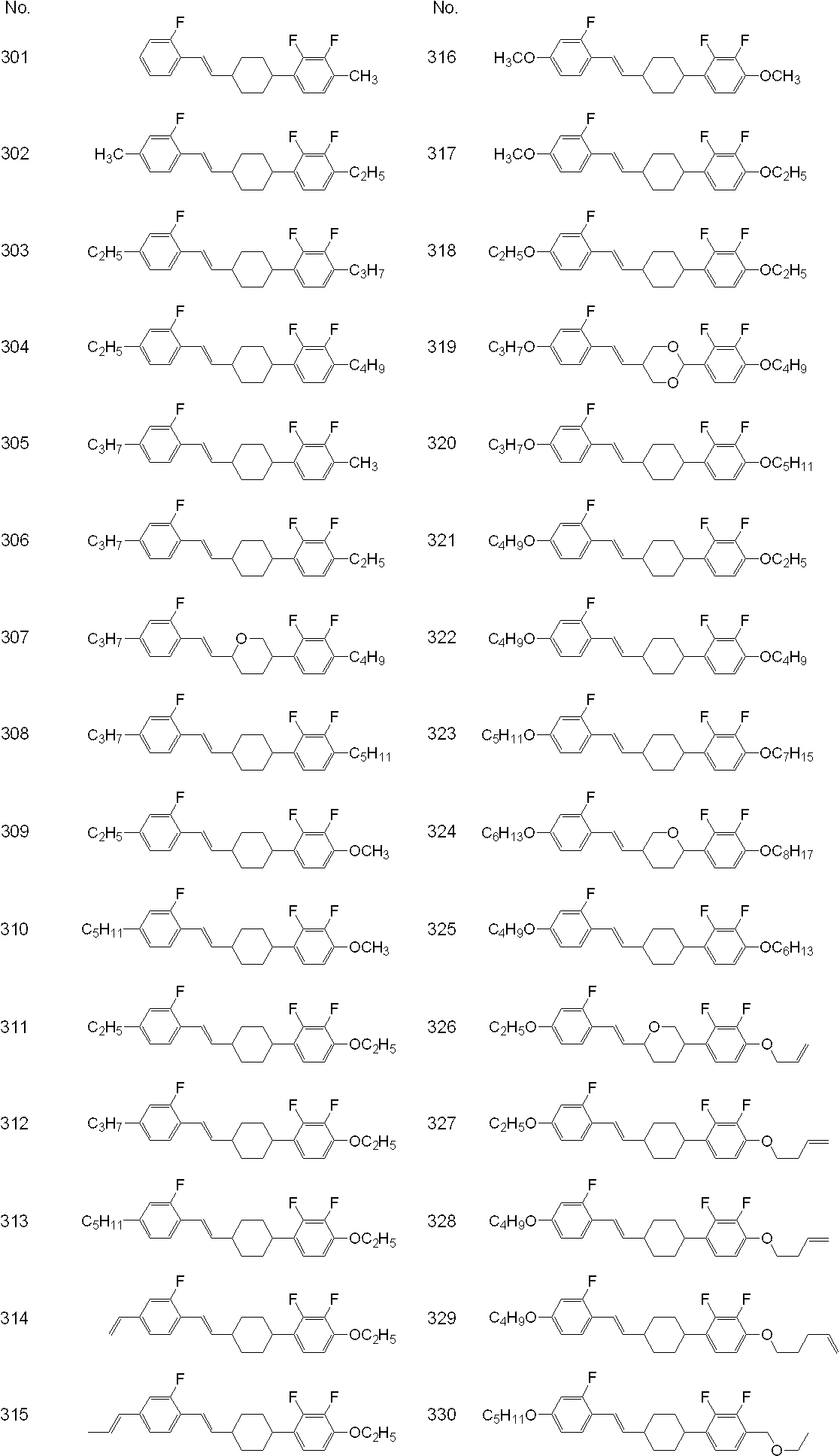

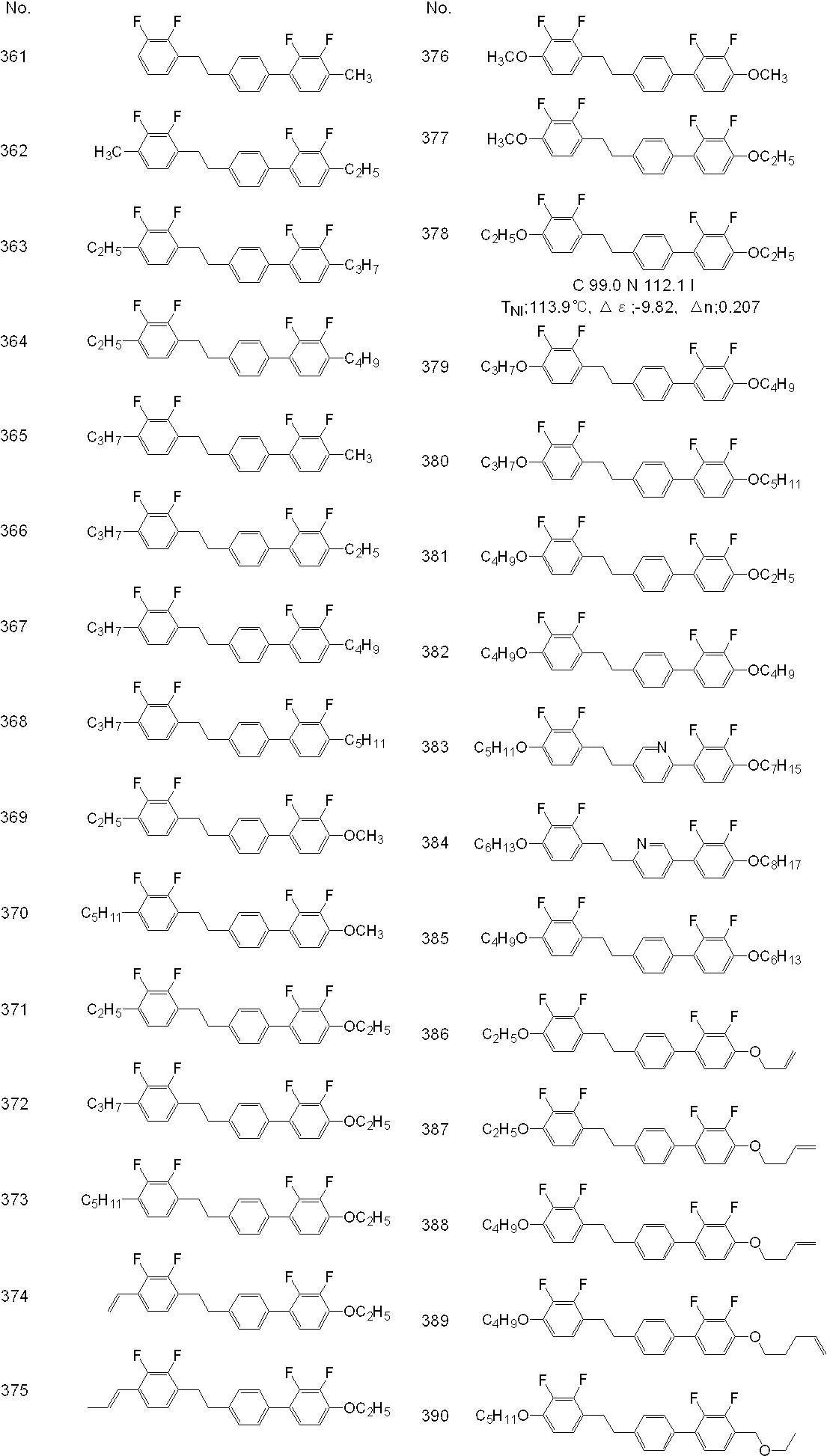
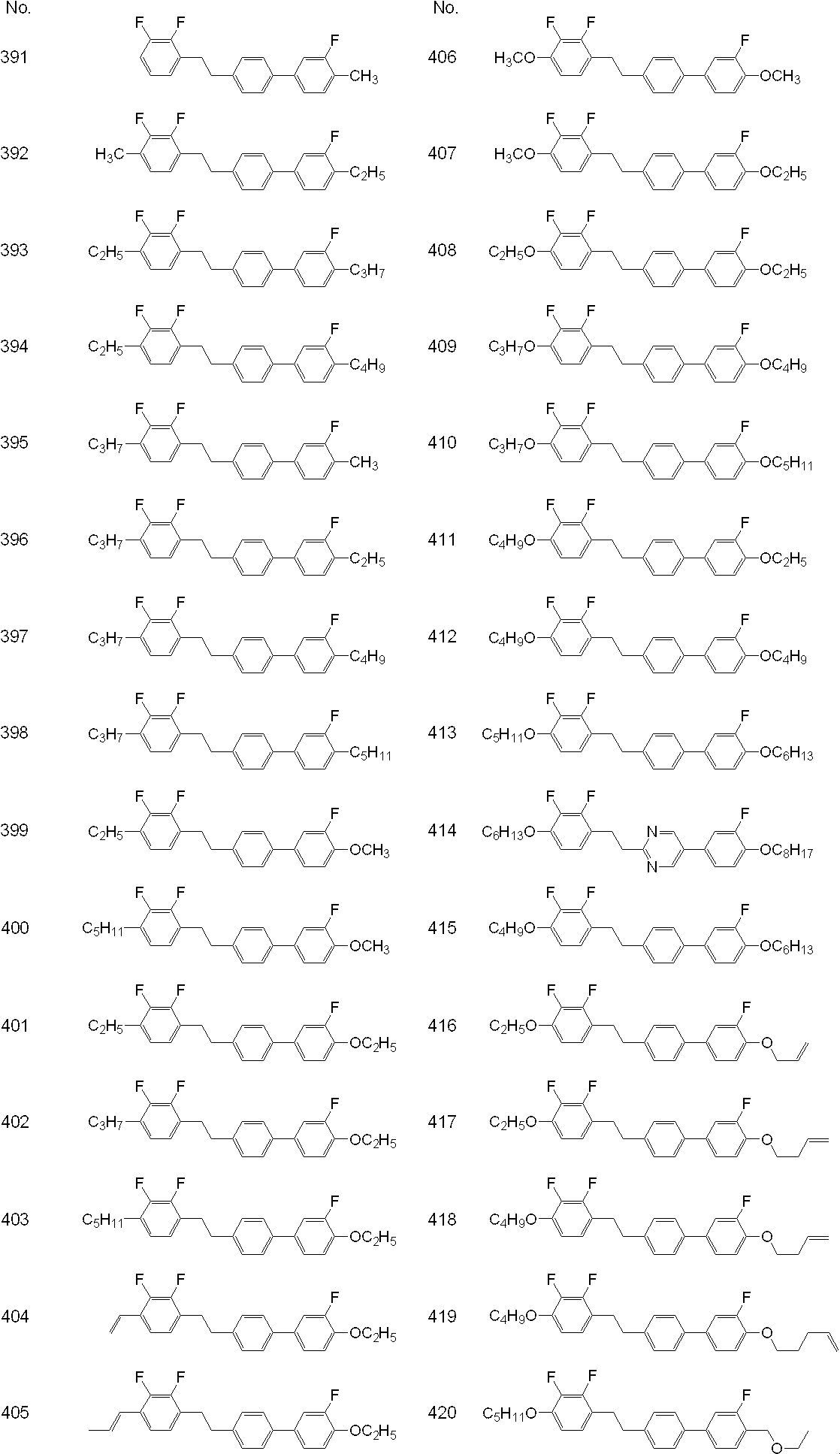
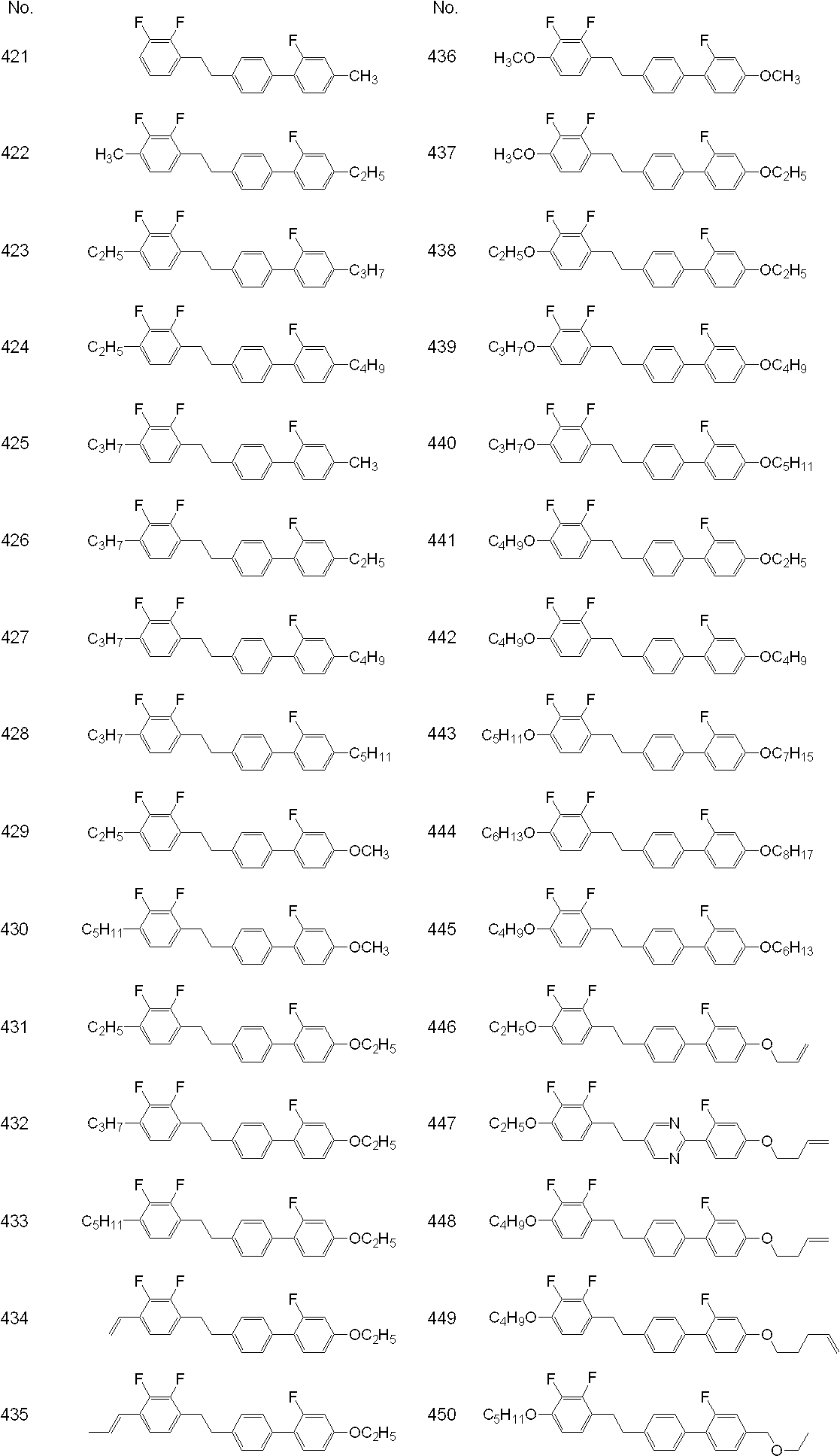


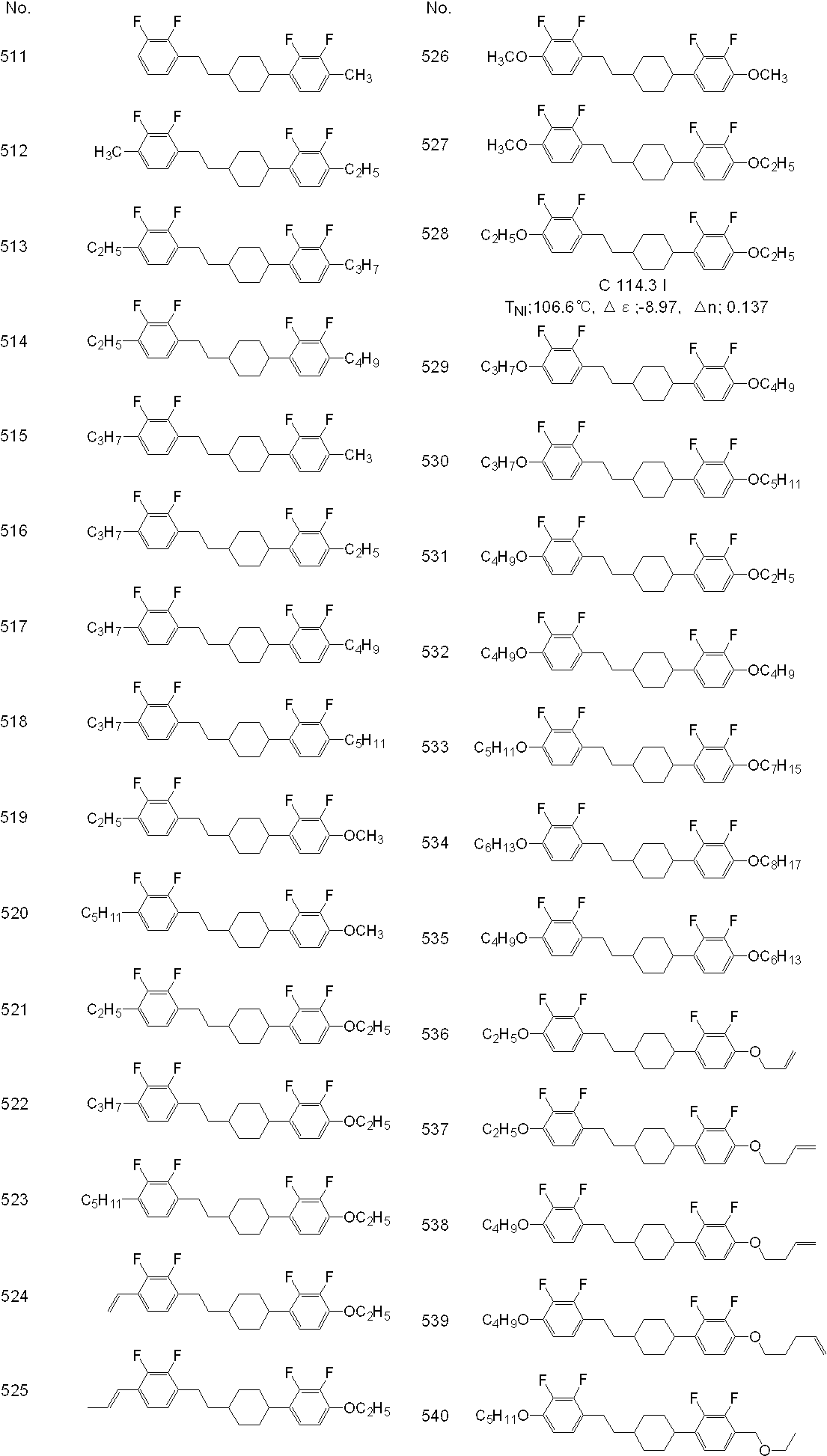


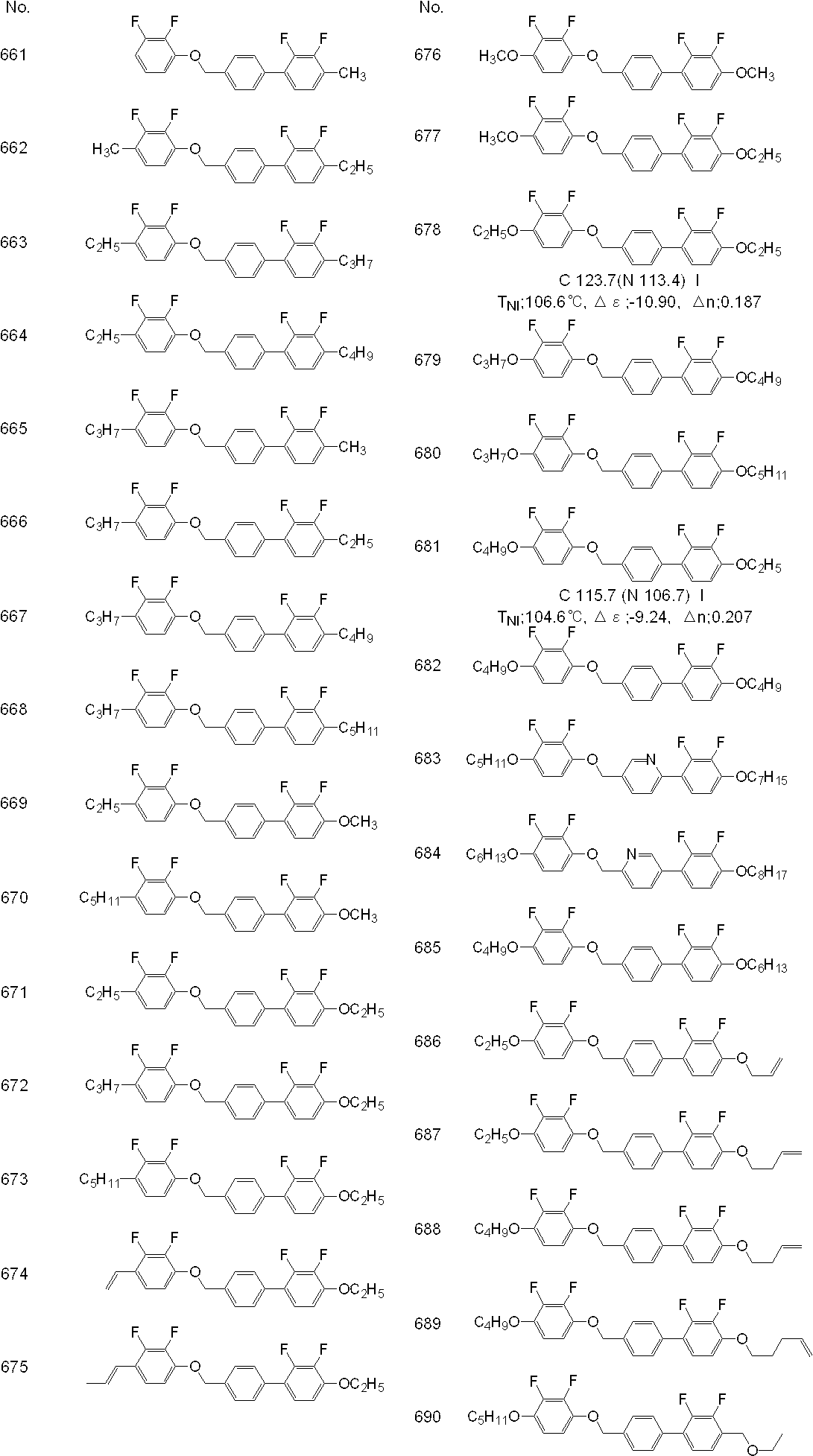
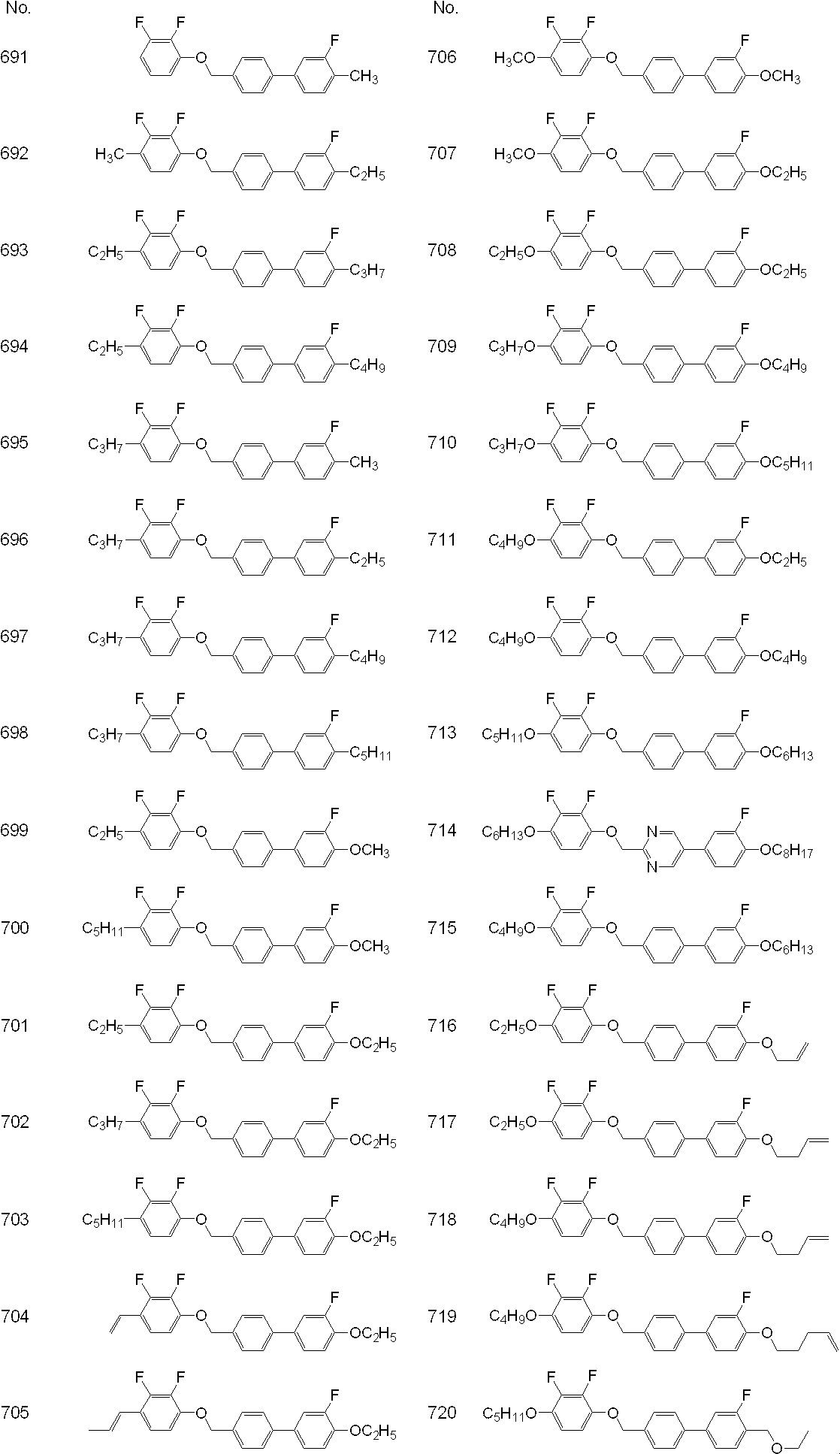
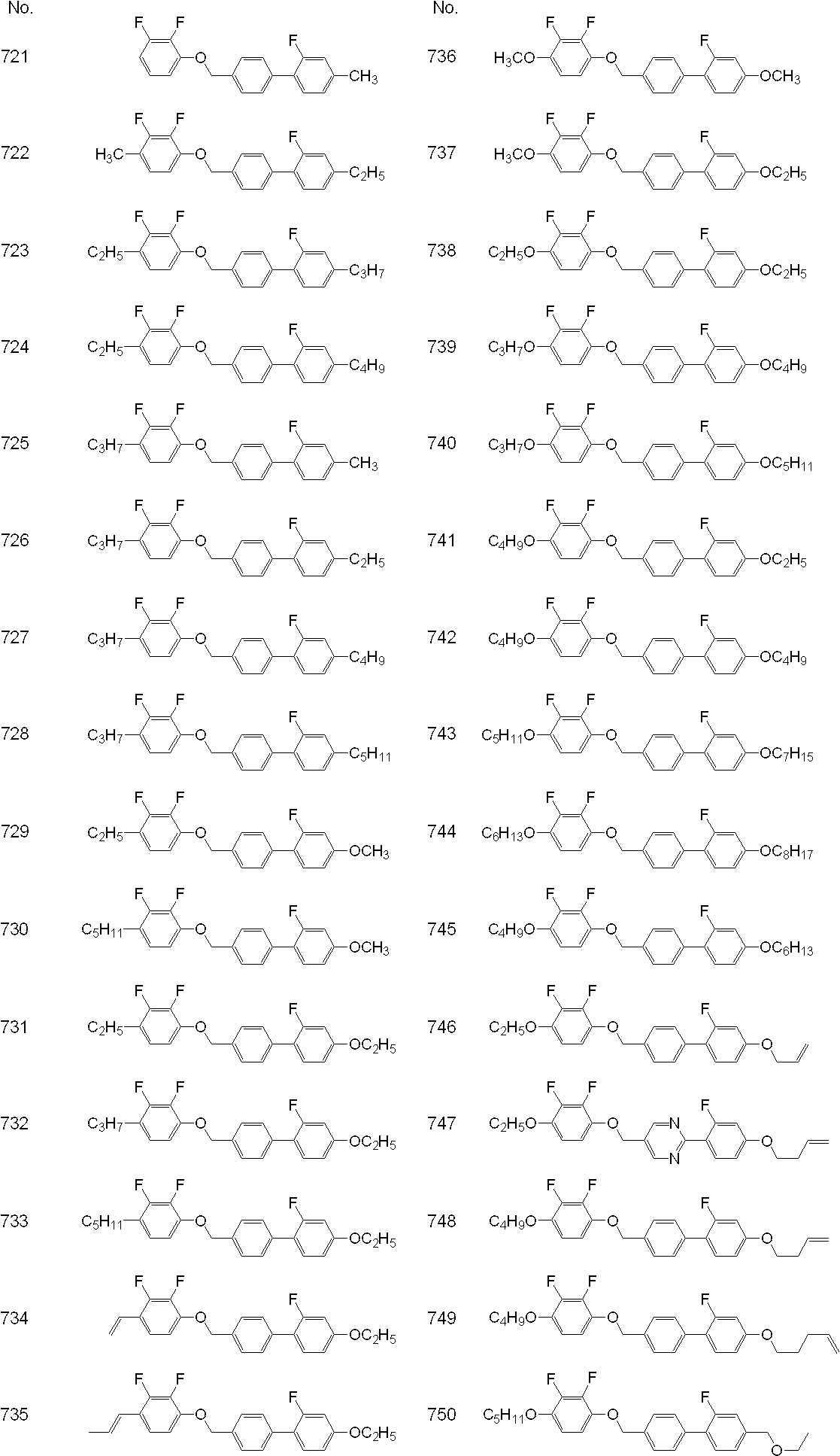

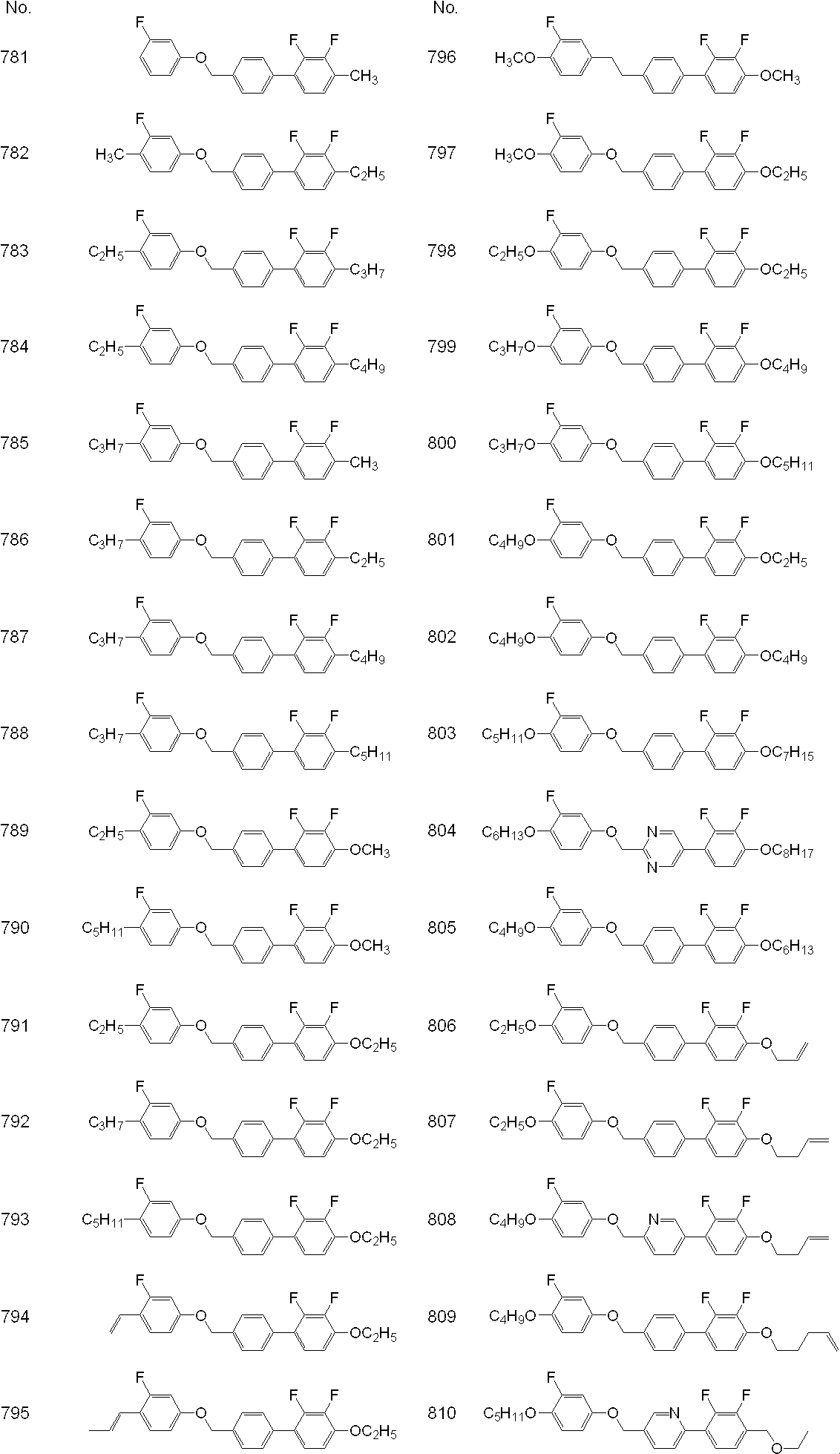

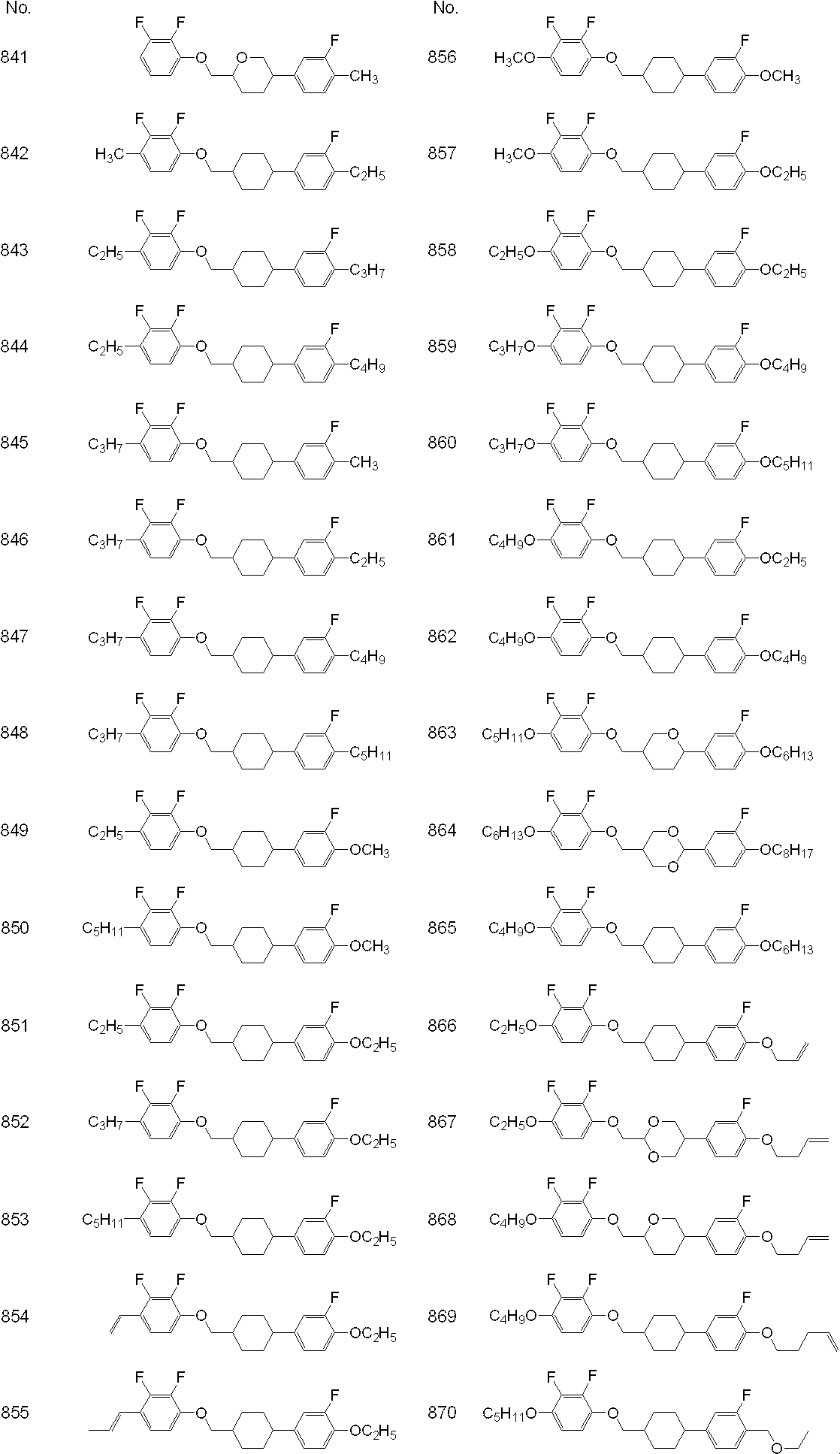

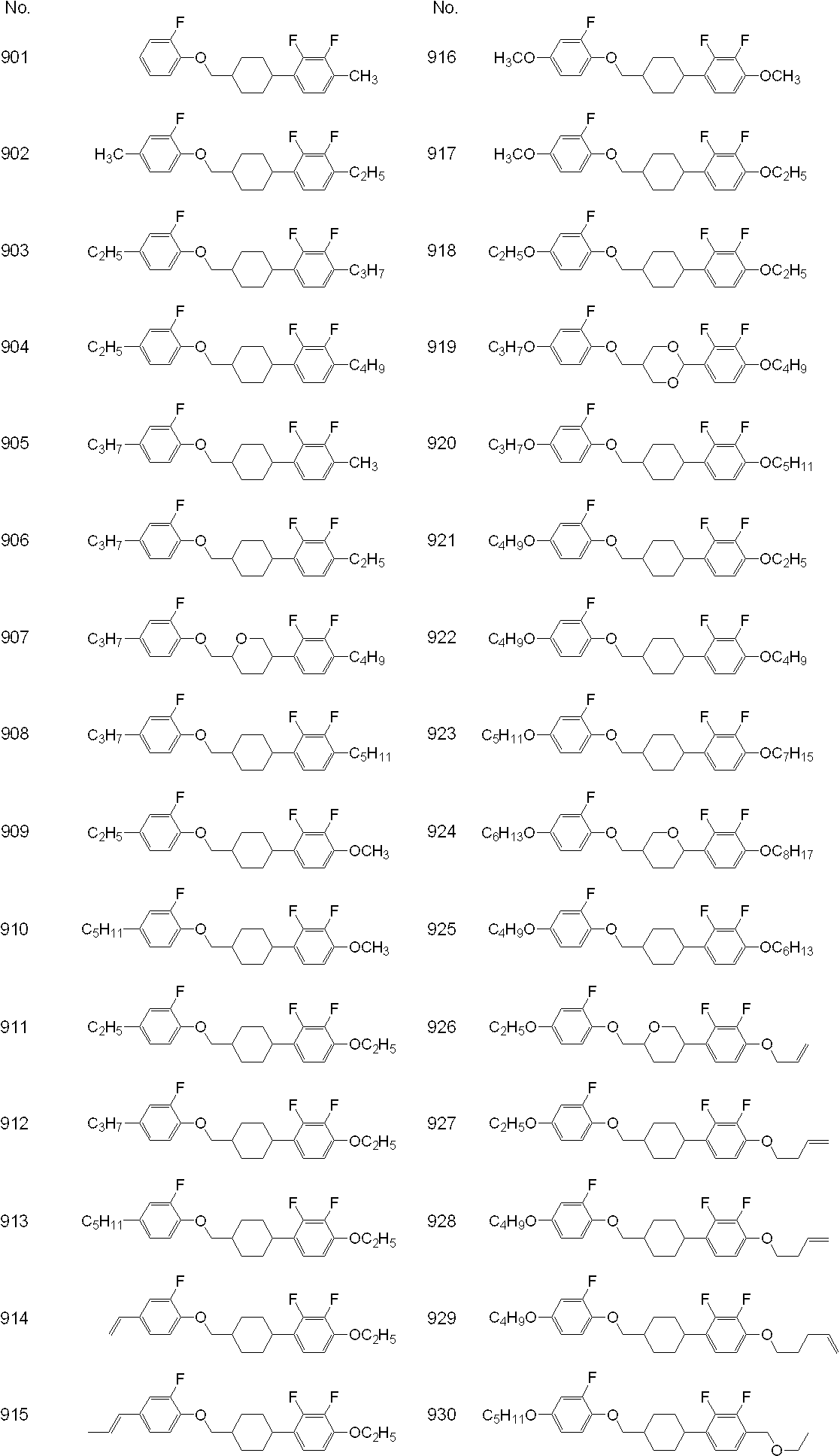
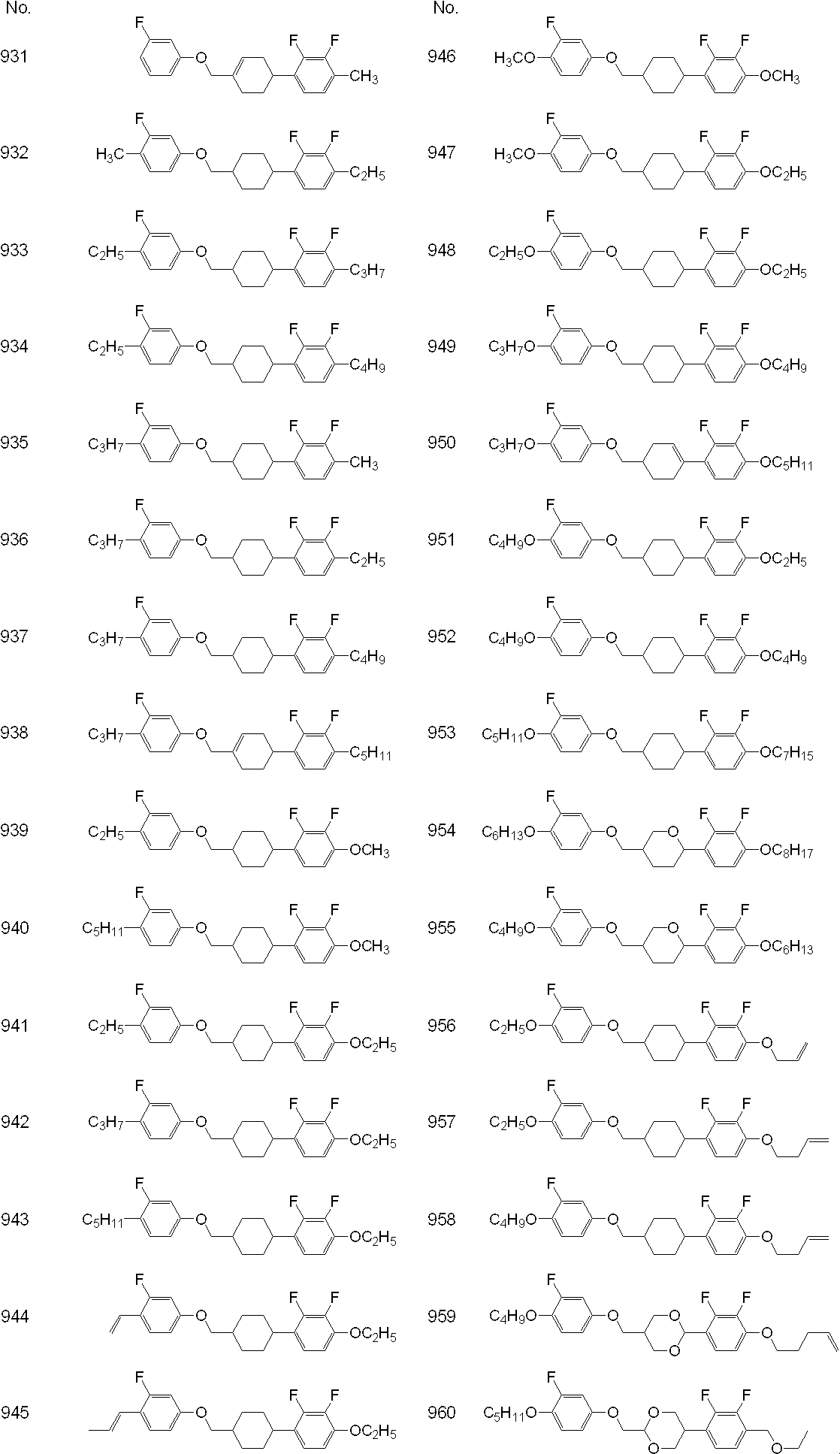

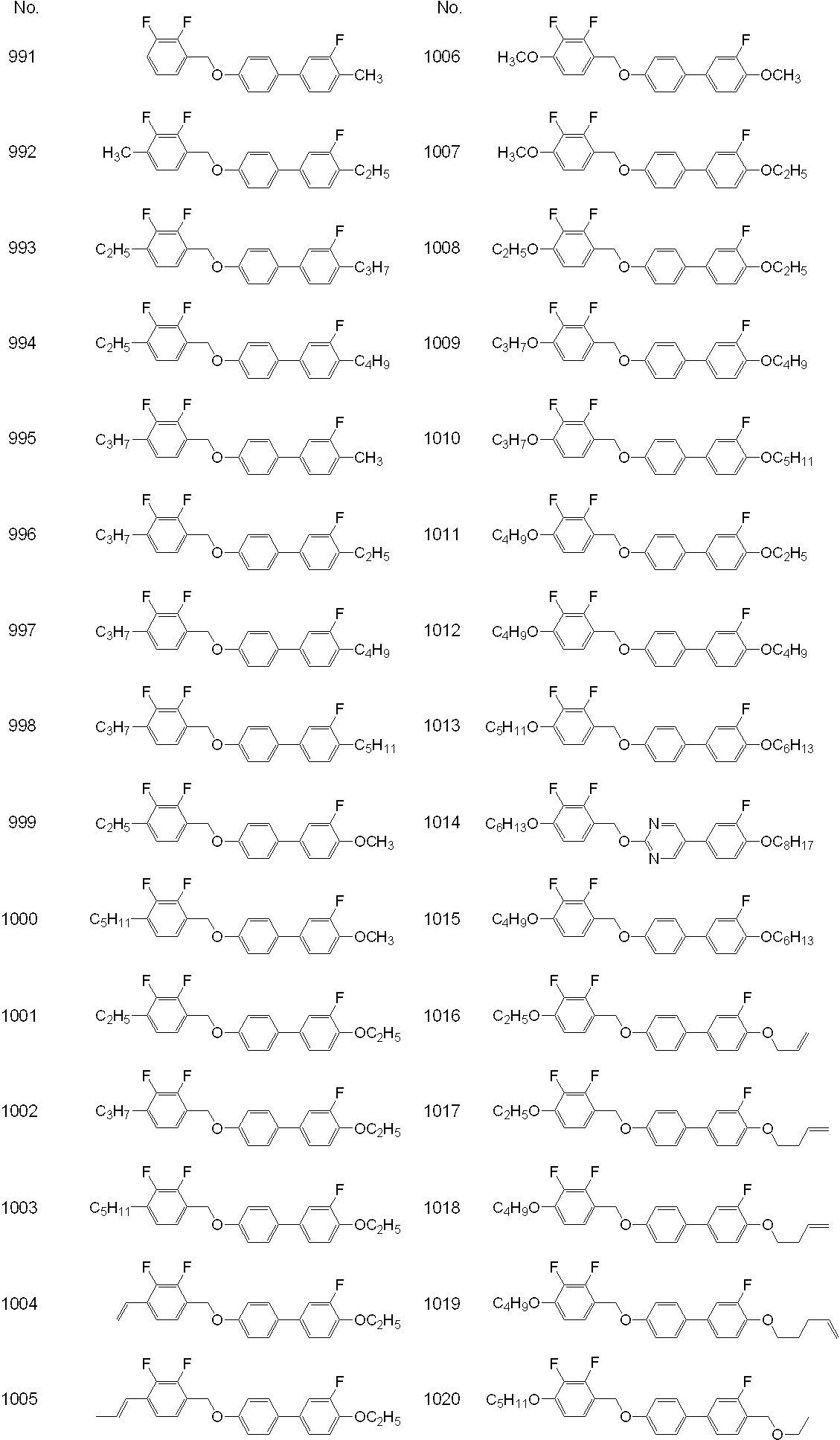

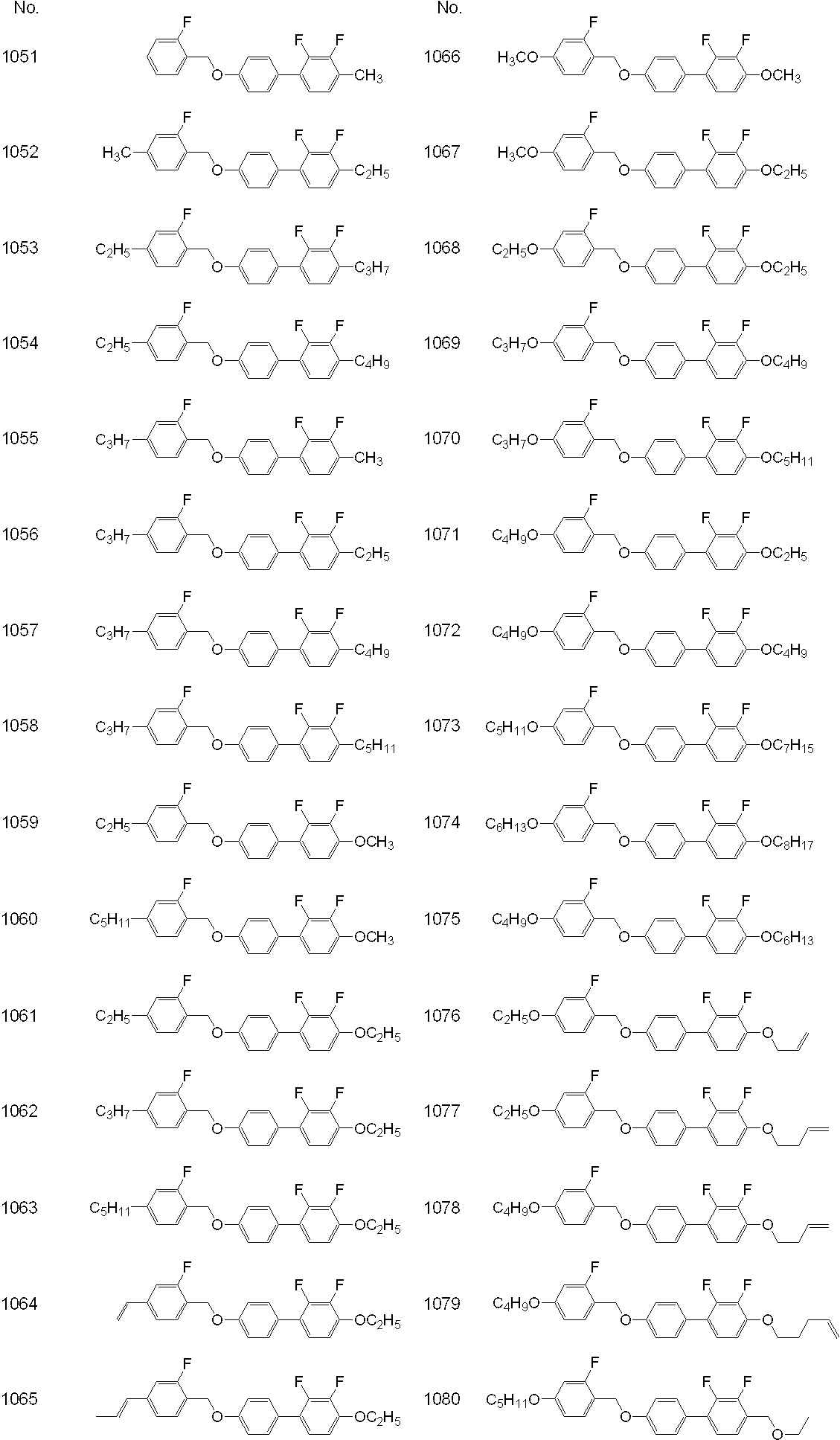


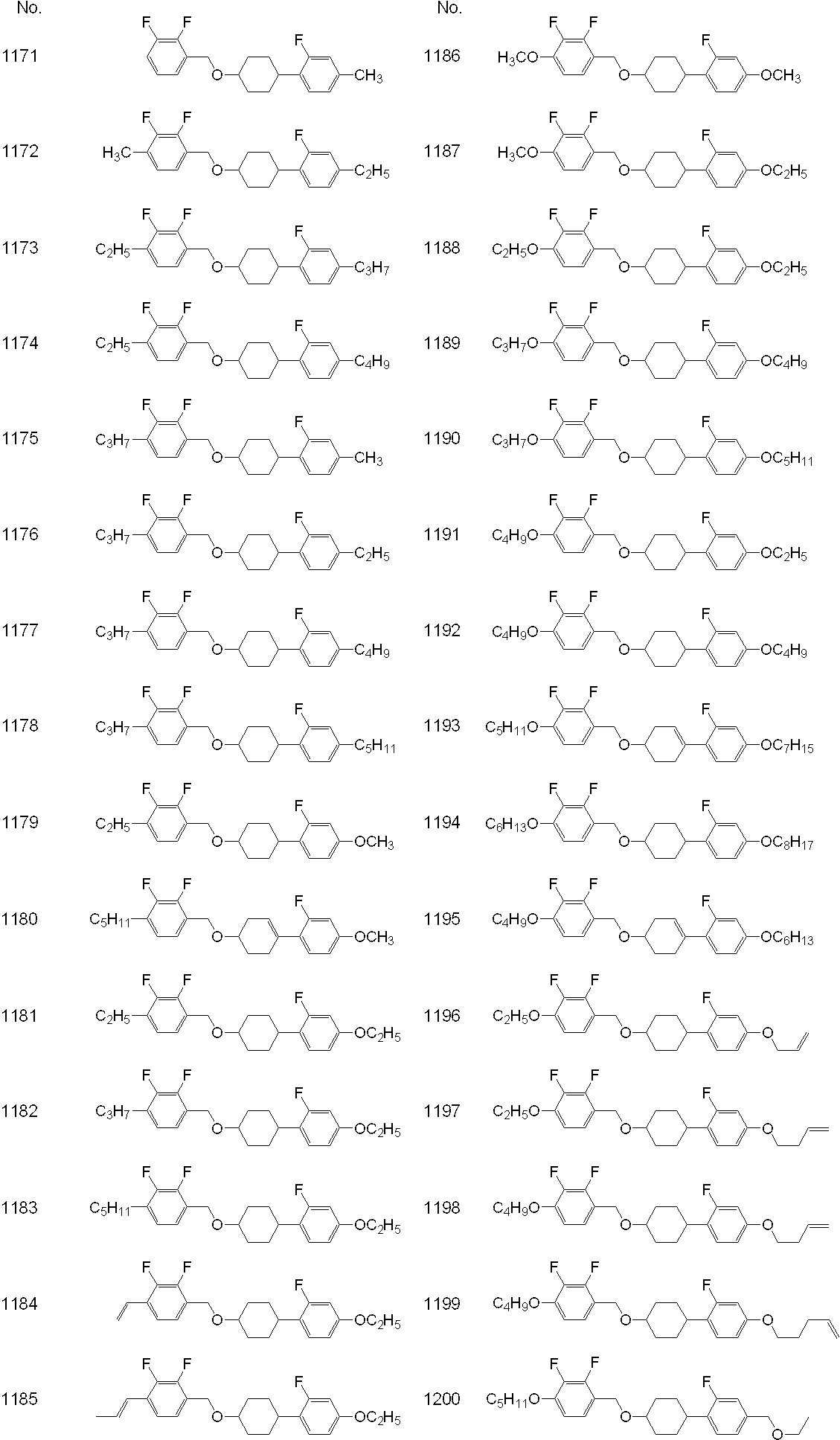
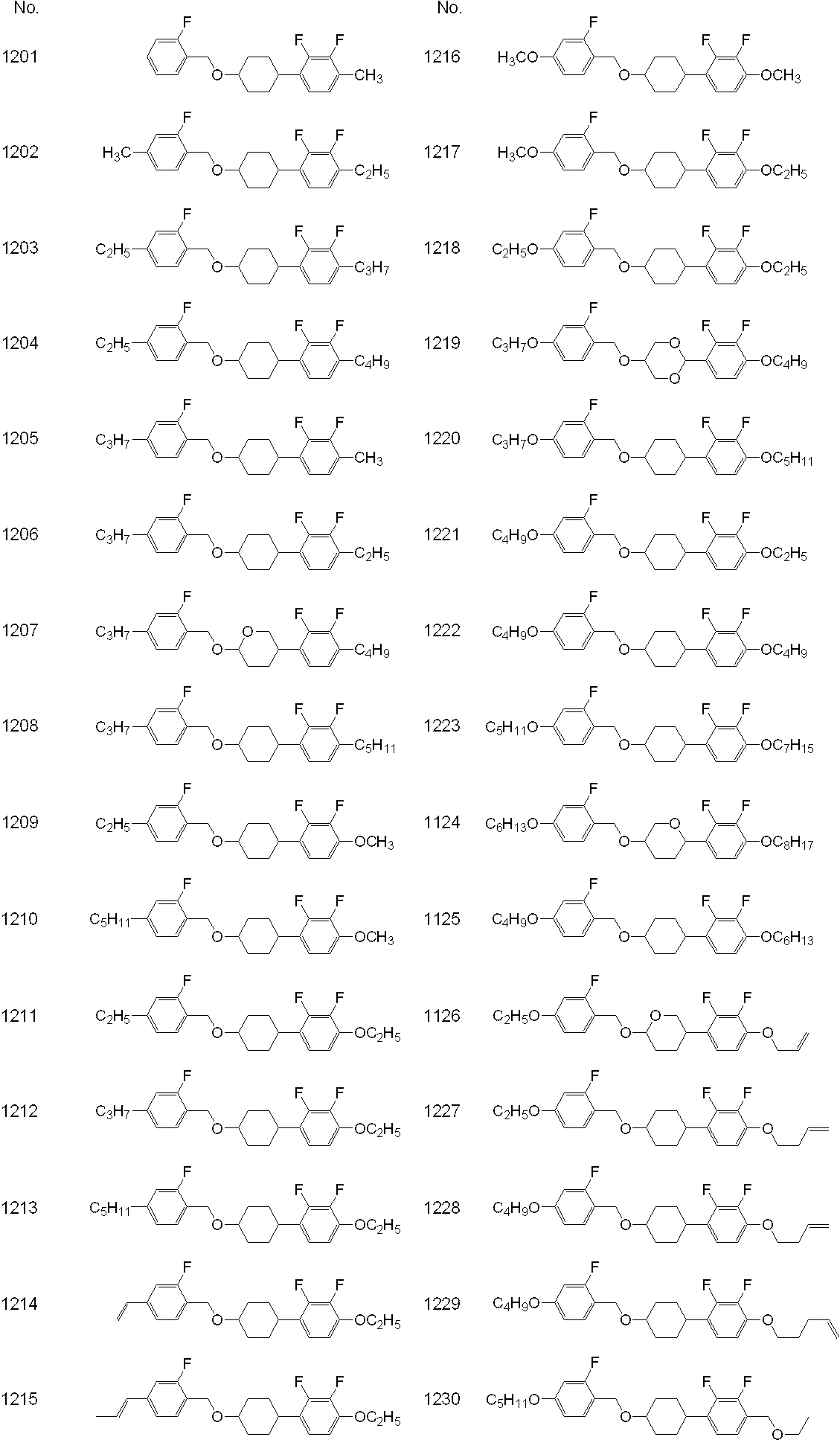


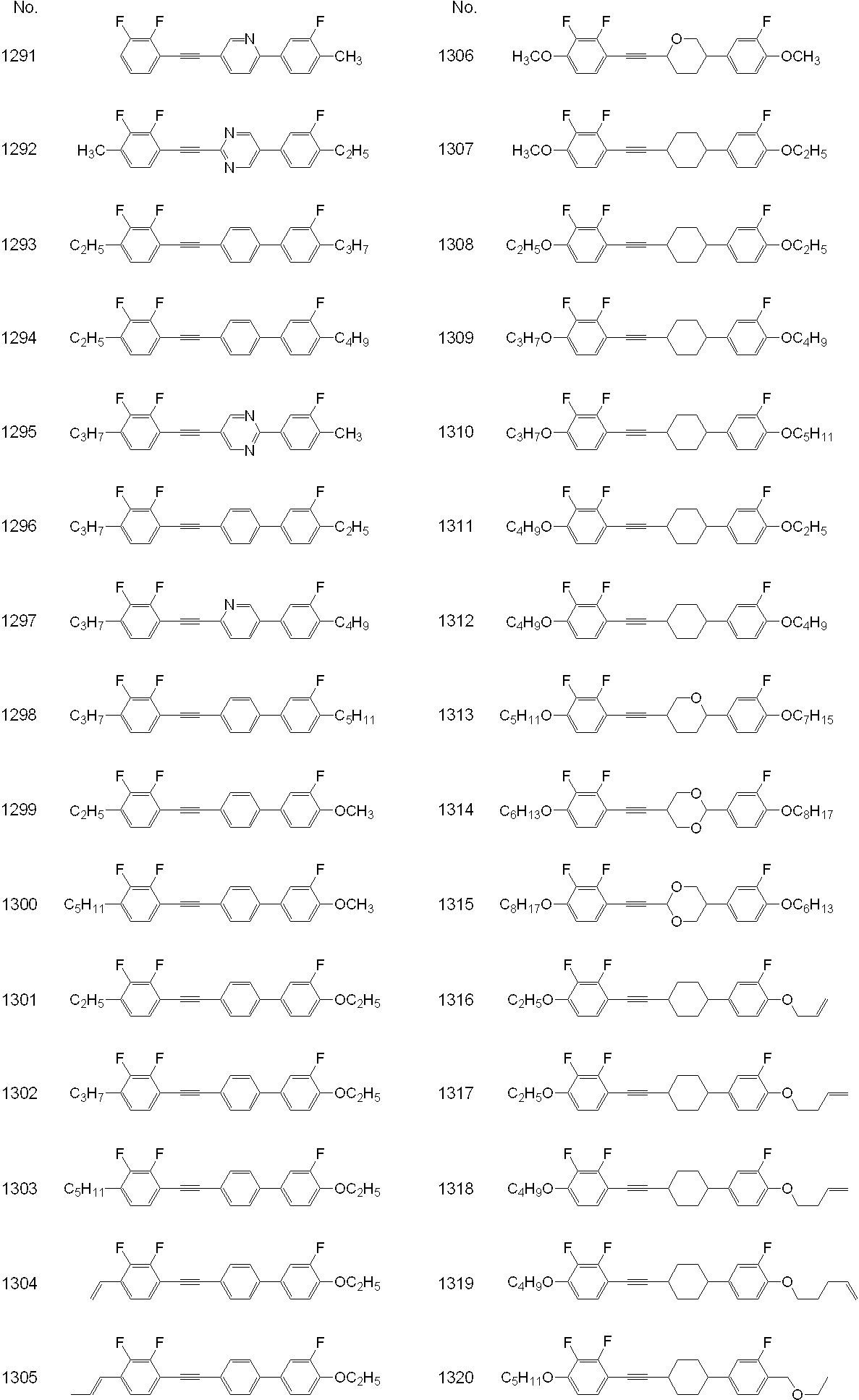

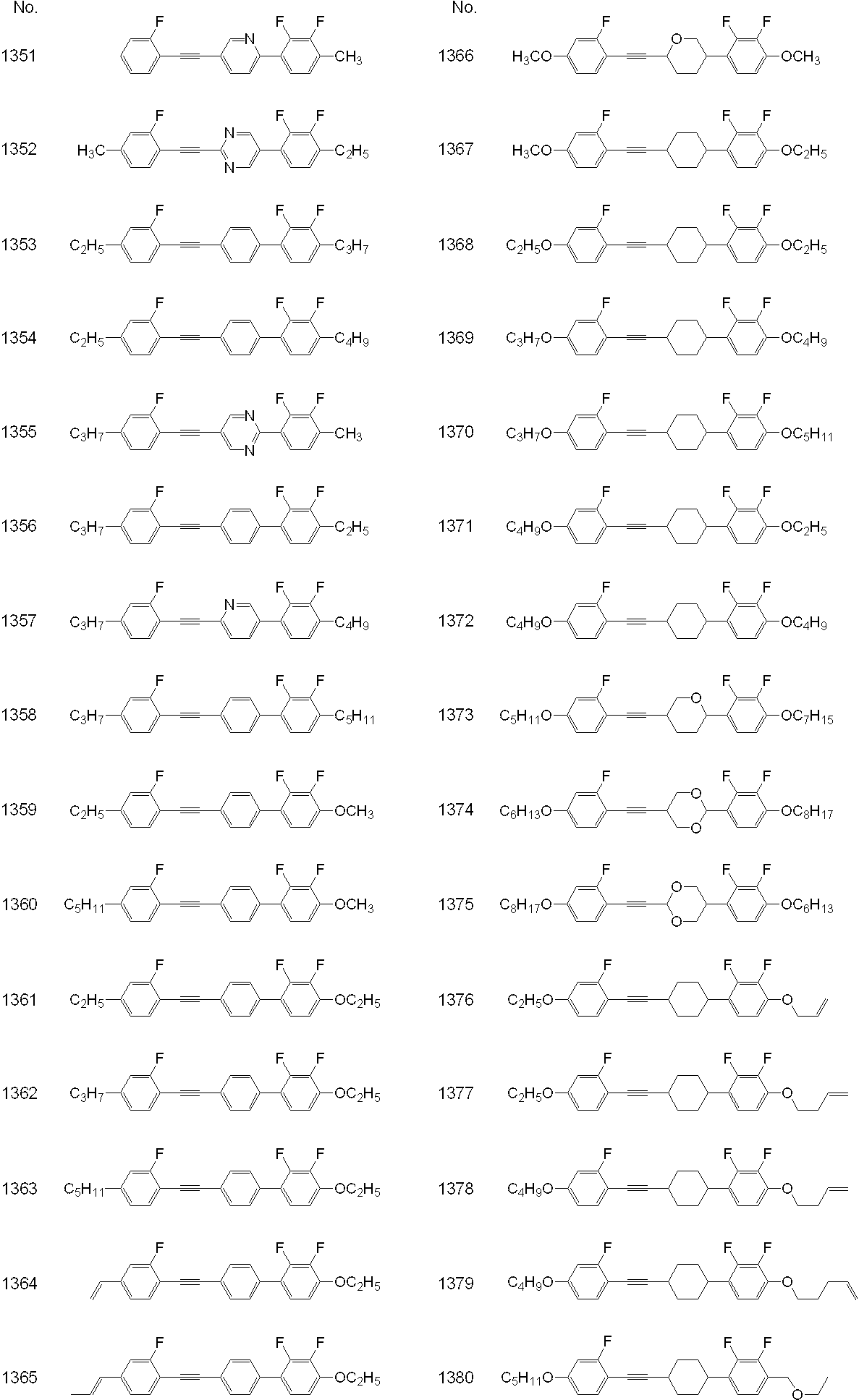

比較例として化合物C類似の化合物である、4-エトキシ-4’ ’-プロピル-2,3,3’ ’-トリフルオロ-1,1’-ターフェニル(E)を合成した。

化学シフトδ(ppm;CDCl3);7.63(d,2H),7.58(d,2H),7.34(dd,1H),7.28(dd,1H),7.26(t,1H),6.82(td,2H),4.17(q,2H),2.66(t,2H),1.68(sex,2H),1.49(t,3H),0.99(t,3H).
転移温度 :C 131.3 N 132.4 I
上限温度(TNI)=74.6℃;粘度(η20)=18.9mPa・s;光学異方性(Δn)=0.087;誘電率異方性(Δε)=-1.3。
誘電率異方性(Δε)=-5.38;
粘度(η)=77.8mPa・s
母液晶i 90重量%と、実施例3で得られた2,3-ジフルオロ-4-エトキシ-[トランス-4-(2,3-ジフルオロ-4-エトキシフェニルエテニル)シクロヘキシル]ベンゼン(No.528)の10重量%とからなる液晶組成物iiiを調製した。得られた液晶組成物iiiの物性を測定し、測定値を外挿することで化合物(No.528)の物性の外挿値を算出した。その値は以下のとおりであった。
誘電率異方性(Δε)=-8.97;
粘度(η)=69.8mPa・s
比較例として、4-エトキシ-4’ ’-ペンチル-2,2’ ’,3,3’’-テトラフルオロ-1,1’-ターフェニル(F)を合成した。

化学シフトδ(ppm;CDCl3);7.60(dd,4H),7.18-7.12(m,2H),7.01(td,1H),6.82(td,1H),4.17(q,2H),2.70(t,2H),1.69-1.61(m,2H),1.50(t,3H),1.42-1.24(m,8H),0.89(t,3H).
転移温度 :C 124.3 N 132.4 I
光学異方性(Δn)=0.179;
誘電率異方性(Δε)=-5.13;
また、液晶組成物ivの弾性定数K33は14.70 pNであった。
母液晶i 95重量%と、実施例6で得られた4-エトキシ-2,3-ジフルオロ-4’-(4-エトキシ-2,3-ジフルオロフェノキシメチル)-1,1’-ビフェニル(No.678)の5重量%とからなる液晶組成物vを調製した。得られた液晶組成物vの物性を測定し、測定値を外挿することで化合物(No. 678)の物性の外挿値を算出した。その値は以下のとおりであった。
光学異方性(Δn)=0.187;
誘電率異方性(Δε)=-10.90;
また、液晶組成物vの弾性定数K33は14.91 pNであった。
以下、本発明で得られる液晶組成物を実施例により詳細に説明する。なお、実施例で用いる液晶性化合物は、下記表1の定義に基づいて記号により表す。なお、表1中、1,4-シクロへキシレンの立体配置はトランス配置である。各化合物の割合(百分率)は、特に断りのない限り、組成物の全重量に基づいた重量百分率(重量%)である。各実施例の最後に得られた組成物の特性を示す。
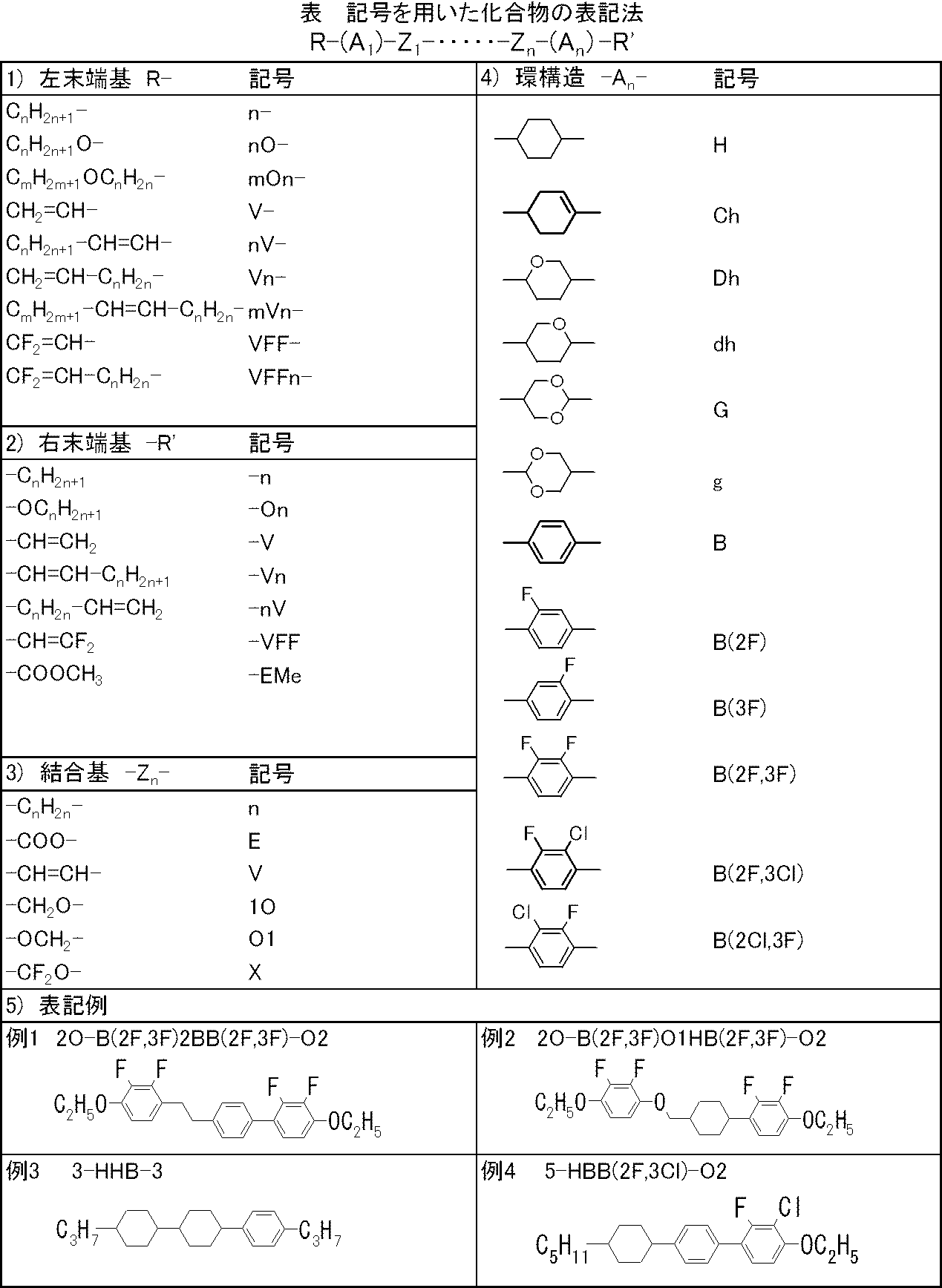
偏光顕微鏡を備えた融点測定装置のホットプレートに試料を置き、1℃/分の速度で加熱した。試料の一部がネマチック相から等方性液体に変化したときの温度を測定した。以下、ネマチック相の上限温度を「上限温度」と略することがある。
ネマチック相を有する試料を0℃、-10℃、-20℃、-30℃、および-40℃のフリーザー中に10日間保管したあと、液晶相を観察した。例えば、試料が-20℃ではネマチック相のままであり、-30℃では結晶またはスメクチック相に変化したとき、TCを≦-20℃と記載した。以下、ネマチック相の下限温度を「下限温度」と略すことがある。
波長が589nmの光を用い、接眼鏡に偏光板を取り付けたアッベ屈折計により測定した。まず、主プリズムの表面を一方向にラビングしたあと、試料を主プリズムに滴下した。そして、偏光の方向がラビングの方向と平行であるときの屈折率(n∥)、および偏光の方向がラビングの方向と垂直であるときの屈折率(n⊥)を測定した。光学異方性の値(Δn)は、(Δn)=(n∥)-(n⊥)の式から算出した。
測定にはE型粘度計を用いた。
よく洗浄したガラス基板にオクタデシルトリエトキシシラン(0.16mL)のエタノール(20mL)溶液を塗布した。ガラス基板をスピンナーで回転させたあと、150℃で1時間加熱した。2枚のガラス基板から、間隔(セルギャップ)が20μmであるVA素子を組み立てた。
誘電率異方性の値は、Δε=ε∥-ε⊥の式から計算した。
この値が負である組成物が、負の誘電率異方性を有する組成物である。
ポリイミド配向膜を有し、そして2枚のガラス基板の間隔(セルギャップ)が6μmであるセルに試料を入れてTN素子を作製した。25℃において、このTN素子にパルス電圧(5Vで60マイクロ秒)を印加して充電した。TN素子に印加した電圧の波形を陰極線オシロスコープで観測し、単位周期(16.7ミリ秒)における電圧曲線と横軸との間の面積を求めた。TN素子を取り除いたあと印加した電圧の波形から同様にして面積を求めた。電圧保持率(%)の値は、(電圧保持率)=(TN素子がある場合の面積値)/(TN素子がない場合の面積値)×100の値から算出した。
根拠は、この組成物が特許文献3記載の化合物(C)およびその類似化合物を含有するからである。この組成物の成分および特性は下記のとおりである。
5-B(2F)BB(2F,3F)-O8 (C) 5%
3-B(2F)BB(2F,3F)-O4 (C)類似化合物 5%
5-HB-3 7%
3-HB-O1 7%
3-HB-O2 12%
3-HHB-1 10%
3-HHB-3 10%
3-H2B(2F,3F)-O2 12%
5-H2B(2F,3F)-O2 12%
3-HBB(2F,3F)-O2 10%
3-HHB(2F,3Cl)-O2 4%
4-HHB(2F,3Cl)-O2 3%
5-HHB(2F,3Cl)-O2 3%
NI=81.4℃;Δn=0.111;η=26.8mPa・s;Δε=-2.8.
2O-B(2F,3F)2BB(2F,3F)-O2 (a-11) 5%
4O-B(2F,3F)2BB(2F,3F)-O2 (a-11) 5%
5-HB-3 7%
3-HB-O1 7%
3-HB-O2 12%
3-HHB-1 10%
3-HHB-3 10%
3-H2B(2F,3F)-O2 12%
5-H2B(2F,3F)-O2 12%
3-HBB(2F,3F)-O2 10%
3-HHB(2F,3Cl)-O2 4%
4-HHB(2F,3Cl)-O2 3%
5-HHB(2F,3Cl)-O2 3%
NI=79.5℃;TC≦-20℃;Δn=0.107;η=25.8mPa・s;Δε=-3.2.
2O-B(2F,3F)O1BB(2F,3F)-O2 (a-11) 5%
3-HB-O2 14%
5-HB-O2 15%
3-HHB-1 10%
3-HHB-3 10%
3-HB(2F,3F)-O2 12%
5-HB(2F,3F)-O2 12%
3-HHB(2F,3F)-O2 8%
5-HHB(2F,3F)-O2 9%
NI=82.3℃;Δn=0.099;η=25.4mPa・s;Δε=-3.3.
4O-B(2F,3F)O1BB(2F)-O2 (a-10) 4%
4O-B(2F,3F)O1BB(2F,3F)-O2 (a-11) 3%
3-HB-O2 15%
5-HB-O2 15%
3-HHB-3 7%
3-HHB-O1 3%
3-HHEH-5 5%
5-H2B(2F,3F)-O2 15%
3-HB(2F,3Cl)-O2 5%
2-HHB(2F,3F)-1 10%
3-HHB(2F,3F)-O2 7%
5-HHB(2F,3F)-O2 7%
NI=83.8℃;Δn=0.103;η=25.6mPa・s;Δε=-3.2.
4O-B(2F,3F)O1HB(2F,3F)-O2 (a-6) 5%
2-H2H-3 6%
3-HB-O1 16%
3-HB-O2 10%
3-HHB-O1 3%
2-BB(3F)B-3 6%
5-HBB(3F)B-2 5%
3-HHEBH-3 4%
3-HHEBH-5 3%
3-H2B(2F,3F)-O2 20%
3-HB(2Cl,3F)-O2 3%
5-HH2B(2F,3F)-O2 5%
3-HBB(2F,3F)-O2 7%
NI=82.2℃;TC≦-20℃;Δn=0.111;η=25.6mPa・s;Δε=-3.1.
4O-B(2F,3F)VHB(2F,3F)-O2 (a-6) 3%
4O-B(2F,3F)VHB(2F,3F)-O4 (a-6) 5%
3-HH-4 5%
3-HB-O2 15%
5-HB-O2 15%
3-HHB-1 5%
3-HHB-3 7%
2-BB(3F)B-5 5%
V-HB(2F,3F)-O2 15%
V-HHB(2F,3F)-O2 10%
2-HBB(2F,3F)-O2 7%
3-HBB(2F,3Cl)-O2 5%
NI=83.2℃;Δn=0.113;η=25.6mPa・s;Δε=-3.1.
4O-B(2F,3F)O1HB(2F,3F)-O2 (a-6) 8%
2-H2H-3 5%
3-HB-O1 12%
3-HB-O2 3%
3-HHB-1 7%
3-HHB-3 7%
3-HBB-2 5%
2-BBB(2F)-5 5%
3-HHEBH-3 5%
3-H2B(2F,3F)-O2 14%
5-H2B(2F,3F)-O2 14%
3-HBB(2F,3F)-O2 5%
2-BB(2F,3F)B-3 3%
3-HBB(2Cl,3F)-O2 3%
NI=81.9℃;Δn=0.110;η=25.7mPa・s;Δε=-3.1.
4O-B(2F,3F)O1HB(2F)-O2 (a-5) 7%
3-HB-O1 11%
5-HB-O2 20%
3-HHB-1 3%
3-HBBH-5 5%
1O1-HBBH-4 5%
3-H2B(2F,3F)-O2 15%
5-H2B(2F,3F)-O2 15%
5-HHB(2F,3F)-O2 12%
NI=81.9℃;TC≦-20℃;Δn=0.101;η=25.8mPa・s;Δε=-3.3.
4O-B(2F,3F)O1DhB(2F,3F)-O2 (a-1) 7%
3-HH-5 5%
3-HB-O1 17%
3-HB-O2 10%
3-HHB-1 10%
3-HHB-3 10%
5-H2B(2F,3F)-O2 16%
3-HH2B(2F,3F)-O2 9%
5-HH2B(2F,3F)-O2 9%
NI=81.8℃;Δn=0.091;η=25.6mPa・s;Δε=-3.1.
2O-B(2F,3F)2BB(2F,3F)-O2 (a-11) 5%
3-HB-O2 15%
5-HB-O2 15%
3-HHB-3 10%
3-HHEBH-3 5%
3-HHEBH-5 3%
3-H2B(2F,3F)-O2 15%
5-H2B(2F,3F)-O2 15%
3-HBB(2F,3F)-O2 6%
5-HBB(2F,3Cl)-O2 6%
NI=82.0℃;TC≦-20℃;Δn=0.106;η=25.4mPa・s;Δε=-3.4.
2O-B(2F,3F)2BB(2F,3F)-O2 (a-11) 5%
2O-B(2F,3F)O1BB(2F,3F)-O2 (a-11) 3%
5-HB-3 10%
3-HB-O1 13%
3-HHB-1 10%
3-HHB-3 7%
2-BB(3F)B-3 5%
3-H2B(2F,3F)-O2 10%
5-H2B(2F,3F)-O2 10%
3-HHB(2F,3F)-O2 10%
3-HH2B(2F,3F)-O2 12%
NI=83.1℃;Δn=0.107;η=25.5mPa・s;Δε=-3.3.
上記組成物100部に光学活性化合物(Op-5)を0.25部添加したときのピッチは61.2μmであった。
Claims (21)
- 式(a-1)で表される液晶性化合物。

式中、R1およびR2は独立して、水素、炭素数1~10のアルキル、炭素数2~10のアルケニル、炭素数1~9のアルコキシ、炭素数2~9のアルコキシアルキル、または炭素数2~9のアルケニルオキシであり;
環A1は、トランス-1,4-シクロへキシレン、1,4-シクロヘキセニレン、1,4-フェニレン、テトラヒドロピラン-2,5-ジイル、1,3-ジオキサン-2,5-ジイル、ピリミジン-2,5-ジイル、またはピリジン-2,5-ジイルであり;
L1、L2、L3およびL4は独立して、水素またはフッ素であり、これらのうち少なくとも3つはフッ素であり;
環A1がトランス-1,4-シクロへキシレン、1,4-シクロヘキセニレン、テトラヒドロピラン-2,5-ジイル、1,3-ジオキサン-2,5-ジイル、またはピリミジン-2,5-ジイル、ピリジン-2,5-ジイルであるとき、Z1は、単結合、-(CH2)2-、-CH=CH-、-C≡C-、-CH2O-、または-OCH2-であり;
環A1が1,4-フェニレンであるとき、Z1は、-(CH2)2-、-CH=CH-、-C≡C-、-CH2O-、または-OCH2-である。 - 式(a-1)において、R1およびR2が独立して、炭素数1~10のアルキル、炭素数2~10のアルケニル、炭素数1~9のアルコキシ、炭素数2~9のアルコキシアルキル、または炭素数2~9のアルケニルオキシであり;
環A1が、トランス-1,4-シクロへキシレン、1,4-シクロヘキセニレン、テトラヒドロピラン-2,5-ジイル、1,3-ジオキサン-2,5-ジイル、ピリミジン-2,5-ジイル、またはピリジン-2,5-ジイルであり;
Z1が、単結合、-(CH2)2-、-CH=CH-、-C≡C-、-CH2O-または-OCH2-である請求項1に記載の化合物。 - 式(a-1)において、R1およびR2が独立して、炭素数1~10のアルキル、炭素数2~10のアルケニル、炭素数1~9のアルコキシ、炭素数2~9のアルコキシアルキル、または炭素数2~9のアルケニルオキシであり;
環A1が、1,4-フェニレンであり;
Z1が、-(CH2)2-、-CH=CH-、-C≡C-、-CH2O-、または-OCH2-である請求項1に記載の化合物。 - 式(a-1)において、R1およびR2が独立して、炭素数1~10のアルキル、炭素数2~10のアルケニル、炭素数1~9のアルコキシ、炭素数2~9のアルコキシアルキル、または炭素数2~9のアルケニルオキシであり;
環A1が、トランス-1,4-シクロへキシレン、1,4-シクロヘキセニレン、テトラヒドロピラン-2,5-ジイル、またはピリジン-2,5-ジイルであり;
Z1が、単結合、-(CH2)2-、-CH=CH-、-C≡C-、-CH2O-、または-OCH2-である請求項2に記載の化合物。 - 式(a-1)において、R1およびR2が独立して、炭素数1~10のアルキル、炭素数2~10のアルケニル、炭素数1~9のアルコキシ、炭素数2~9のアルコキシアルキル、または炭素数2~9のアルケニルオキシであり;
環A1が、トランス-1,4-シクロへキシレン、1,4-シクロヘキセニレン、またはテトラヒドロピラン-2,5-ジイルであり;
Z1が、単結合、-(CH2)2-、-CH=CH-、-CH2O-、または-OCH2-である請求項4に記載の化合物。 - 式(a-1)において、R1およびR2が独立して、炭素数1~10のアルキル、炭素数2~10のアルケニル、炭素数1~9のアルコキシ、炭素数2~9のアルコキシアルキル、または炭素数2~9のアルケニルオキシであり;
環A1がトランス-1,4-シクロへキシレンである請求項1に記載の化合物。 - 式(a-2)または(a-3)で表される請求項2に記載の化合物。

式中、R3およびR4は独立して、炭素数1~10のアルキル、炭素数2~10のアルケニル、炭素数1~9のアルコキシ、炭素数2~9のアルコキシアルキル、または炭素数2~9のアルケニルオキシであり;
L5、L6、L7およびL8は独立して、水素またはフッ素であり、これらのうち少なくとも3つはフッ素であり;
Z2は、単結合、-(CH2)2-、-CH=CH-、-CH2O-、または-OCH2-である。 - 式(a-4)~(a-13)のいずれか1つで表される請求項1に記載の化合物。

式中、R5およびR6は独立して、炭素数1~10のアルキル、炭素数2~10のアルケニル、炭素数1~9のアルコキシ、炭素数2~9のアルコキシアルキル、または炭素数2~9のアルケニルオキシであり;
Z3は、-(CH2)2-、-CH=CH-、-CH2O-、または-OCH2-である。 - 式(a-4)~(a-13)において、Z3が-CH=CH-である請求項8に記載の化合物。
- 式(a-4)~(a-13)において、Z3が-CH2O-である請求項8に記載の化合物。
- 式(a-4)~(a-13)において、Z3が-OCH2-である請求項8に記載の化合物。
- 式(a-4)~(a-13)において、Z3が-(CH2)2-である請求項8に記載の化合物。
- 請求項1~6のいずれか1項に記載の式(a-1)、または請求項7に記載の式(a-2)または(a-3)で表される化合物群から選択される少なくとも1つの化合物からなる第一成分、および式(e-1)~(e-3)で表される化合物群から選択される少なくとも1つの化合物からなる第二成分を含有し、そして誘電率異方性が負である液晶組成物。
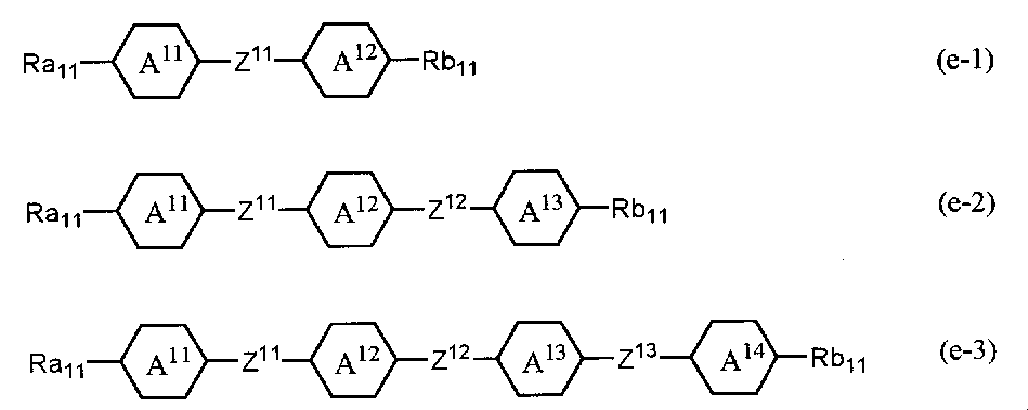
式中、Ra11、およびRb11は独立して、炭素数1~10のアルキルであり、このアルキルにおいて、相隣接しない任意の-CH2-は-O-で置き換えられていてもよく、相隣接しない任意の-(CH2)2-は-CH=CH-で置き換えられていてもよく、任意の水素はフッ素で置き換えられていてもよく;
環A11、環A12、環A13、および環A14は独立して、トランス-1,4-シクロへキシレン、1,4-フェニレン、2-フルオロ-1,4-フェニレン、3-フルオロ-1,4-フェニレン、ピリミジン-2,5-ジイル、1,3-ジオキサン-2,5-ジイル、またはテトラヒドロピラン-2,5-ジイルであり;
Z11、Z12、およびZ13は独立して、単結合、-CH2-CH2-、-CH=CH-、-C≡C-、-COO-、または-CH2O-である。 - 請求項8~12のいずれか1項に記載の式(a-4)~(a-13)で表される化合物群から選択される少なくとも1つの化合物からなる第一成分、および請求項13に記載の式(e-1)~(e-3)で表される化合物群から選択される少なくとも1つの化合物からなる第二成分を含有し、そして誘電率異方性が負である液晶組成物。
- 液晶組成物の全重量に基づいて、第一成分の含有割合が5~60重量%の範囲であり、第二成分の含有割合が40~95重量%の範囲である請求項13または14に記載の液晶組成物。
- 第一成分および第二成分に加えて、式(g-1)~(g-6)で表される化合物群から選択される少なくとも1つの化合物からなる第三成分を含有する請求項13または14に記載の液晶組成物。

式中、Ra21およびRb21は独立して、水素または炭素数1~10のアルキルであり、このアルキルにおいて、相隣接しない任意の-CH2-は-O-で置き換えられていてもよく、相隣接しない任意の-(CH2)2-は-CH=CH-で置き換えられていてもよく、任意の水素はフッ素で置き換えられていてもよく;
環A21、環A22、および環A23は独立して、トランス-1,4-シクロへキシレン、1,4-フェニレン、2-フルオロ-1,4-フェニレン、3-フルオロ-1,4-フェニレン、2,3-ジフルオロ-1,4-フェニレン、ピリミジン-2,5-ジイル、1,3-ジオキサン-2,5-ジイル、またはテトラヒドロピラン-2,5-ジイルであり;
Z21、Z22、およびZ23は独立して、単結合、-CH2-CH2-、-CH=CH-、-C≡C-、-OCF2-、-CF2O-、-OCF2CH2CH2-、-CH2CH2CF2O-、-COO-、-OCO-、-OCH2-、または-CH2O-であり;
Y1、Y2、Y3、およびY4は独立して、フッ素または塩素であり;
q、r、およびsは独立して、0、1、または2であり、q+rは1または2であり、q+r+sは1、2、または3であり;
tは0、1、または2である。 - 第三成分が、式(h-1)~(h-7)で表される化合物群から選択される少なくとも1つの化合物である請求項16に記載の液晶組成物。
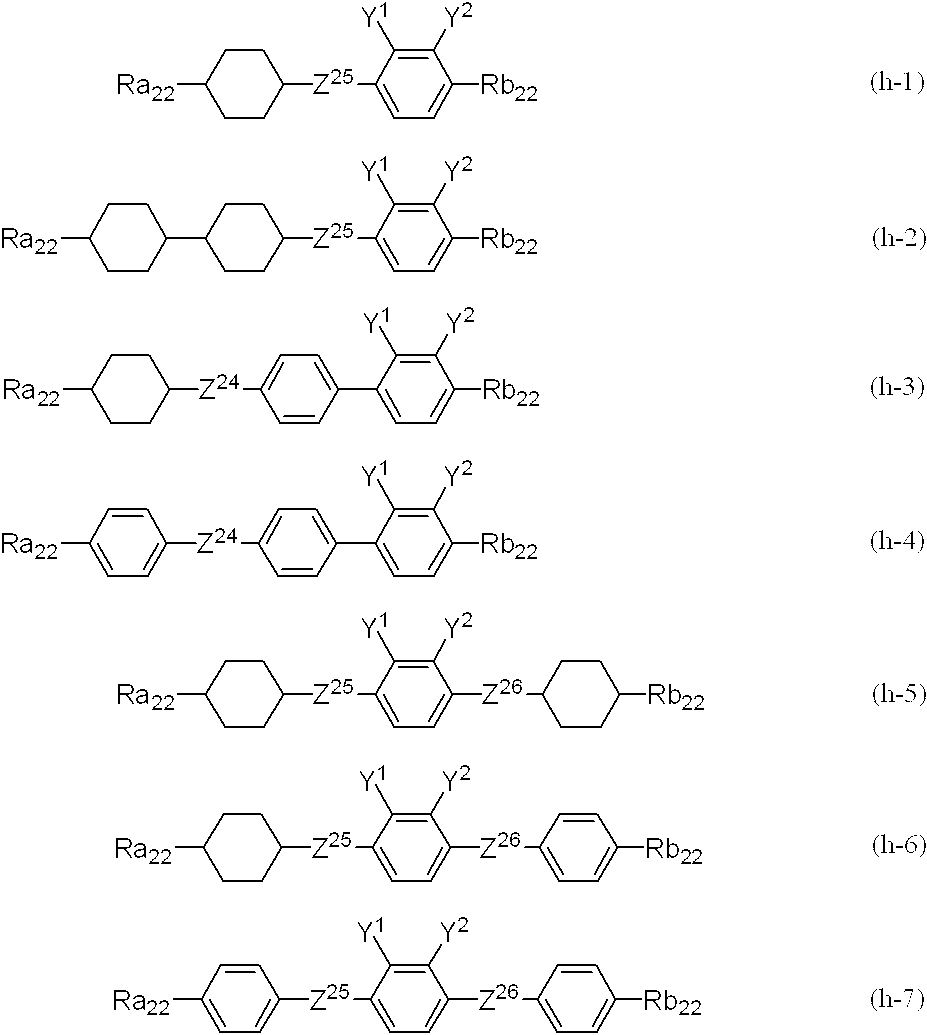
式中、Ra22およびRb22は独立して、炭素数1~8の直鎖アルキル、炭素数2~8の直鎖アルケニル、または炭素数1~7の直鎖アルコキシであり;
Z24、Z25およびZ26は独立して、単結合、-CH2CH2-、-CH2O-または-OCH2-であり;
Y1およびY2は、いずれもフッ素であるか、または一方がフッ素で他方が塩素である。 - 請求項8~12のいずれか1項に記載の式(a-4)~(a-13)で表される化合物群から選択される少なくとも1つの化合物からなる第一成分、請求項13に記載の式(e-1)~(e-3)で表される化合物群から選択される少なくとも1つの化合物からなる第二成分、および請求項17に記載の式(h-1)~(h-7)で表される化合物群から選択される少なくとも1つの化合物からなる第三成分を含有し、そして誘電率異方性が負である液晶組成物。
- 液晶組成物の全重量に基づいて、第一成分の含有割合が5~60重量%の範囲であり、第二成分の含有割合が20~75重量%の範囲であり、第三成分の含有割合が20~75重量%の範囲である請求項16~18のいずれか1項に記載の液晶組成物。
- 請求項13~19のいずれか1項に記載の液晶組成物を含有する液晶表示素子。
- 上記液晶表示素子の動作モードが、VAモードまたはIPSモードであり、上記液晶表示素子の駆動方式がアクティブマトリックス方式である請求項20に記載の液晶表示素子。
Priority Applications (4)
| Application Number | Priority Date | Filing Date | Title |
|---|---|---|---|
| CN2009801114952A CN101980996B (zh) | 2008-04-09 | 2009-03-25 | 含有侧向氟的3环液晶性化合物、液晶组成物及液晶显示元件 |
| US12/936,660 US8216489B2 (en) | 2008-04-09 | 2009-03-25 | Three-ring liquid crystal compound having lateral fluorine, liquid crystal composition, and liquid crystal display device |
| JP2010507206A JP5652202B2 (ja) | 2008-04-09 | 2009-03-25 | ラテラルフッ素を有する3環液晶性化合物、液晶組成物および液晶表示素子 |
| EP09731248.2A EP2266941B1 (en) | 2008-04-09 | 2009-03-25 | Tricyclic liquid crystalline compound having lateral fluorine, liquid crystal composition and liquid crystal display device |
Applications Claiming Priority (2)
| Application Number | Priority Date | Filing Date | Title |
|---|---|---|---|
| JP2008-101474 | 2008-04-09 | ||
| JP2008101474 | 2008-04-09 |
Publications (1)
| Publication Number | Publication Date |
|---|---|
| WO2009125668A1 true WO2009125668A1 (ja) | 2009-10-15 |
Family
ID=41161802
Family Applications (1)
| Application Number | Title | Priority Date | Filing Date |
|---|---|---|---|
| PCT/JP2009/055920 Ceased WO2009125668A1 (ja) | 2008-04-09 | 2009-03-25 | ラテラルフッ素を有する3環液晶性化合物、液晶組成物および液晶表示素子 |
Country Status (7)
| Country | Link |
|---|---|
| US (1) | US8216489B2 (ja) |
| EP (1) | EP2266941B1 (ja) |
| JP (1) | JP5652202B2 (ja) |
| KR (1) | KR101558016B1 (ja) |
| CN (1) | CN101980996B (ja) |
| TW (1) | TWI486425B (ja) |
| WO (1) | WO2009125668A1 (ja) |
Cited By (17)
| Publication number | Priority date | Publication date | Assignee | Title |
|---|---|---|---|---|
| JP2011074010A (ja) * | 2009-09-30 | 2011-04-14 | Dic Corp | ジフルオロベンゼン誘導体及びこれを含有する液晶組成物。 |
| CN102834487A (zh) * | 2010-04-22 | 2012-12-19 | 捷恩智株式会社 | 液晶组成物及液晶显示元件 |
| JP2013112631A (ja) * | 2011-11-28 | 2013-06-10 | Dic Corp | 重合性液晶化合物 |
| WO2013187373A1 (ja) * | 2012-06-15 | 2013-12-19 | Dic株式会社 | ネマチック液晶組成物及びこれを用いた液晶表示素子 |
| JP2015108127A (ja) * | 2013-10-23 | 2015-06-11 | Jnc株式会社 | 液晶組成物および液晶表示素子 |
| JP2015178589A (ja) * | 2014-02-26 | 2015-10-08 | Jnc株式会社 | 液晶組成物および液晶表示素子 |
| JP2015178591A (ja) * | 2014-02-25 | 2015-10-08 | Jnc株式会社 | 液晶組成物および液晶表示素子 |
| WO2016017614A1 (ja) * | 2014-07-31 | 2016-02-04 | Dic株式会社 | ネマチック液晶組成物 |
| JP2016030754A (ja) * | 2014-07-25 | 2016-03-07 | Dic株式会社 | 接触水素還元による製造方法 |
| JP2016047918A (ja) * | 2014-08-22 | 2016-04-07 | メルク パテント ゲゼルシャフト ミット ベシュレンクテル ハフツングMerck Patent Gesellschaft mit beschraenkter Haftung | 液晶媒体 |
| WO2016152405A1 (ja) * | 2015-03-26 | 2016-09-29 | Dic株式会社 | 液晶性化合物、液晶組成物および表示素子 |
| WO2016208483A1 (ja) * | 2015-06-25 | 2016-12-29 | Dic株式会社 | 重合性化合物およびそれを使用した液晶表示素子 |
| US10253258B2 (en) | 2014-07-31 | 2019-04-09 | Dic Corporation | Nematic liquid crystal composition |
| JP2020011937A (ja) * | 2018-07-20 | 2020-01-23 | Dic株式会社 | 液晶化合物、液晶組成物及び液晶表示素子 |
| US10544365B2 (en) | 2013-08-30 | 2020-01-28 | Dic Corporation | Nematic liquid crystal composition |
| US10597583B2 (en) | 2017-02-27 | 2020-03-24 | Jnc Corporation | Liquid crystal composition and liquid crystal display device |
| JP2020066582A (ja) * | 2018-10-23 | 2020-04-30 | Dic株式会社 | 液晶化合物 |
Families Citing this family (15)
| Publication number | Priority date | Publication date | Assignee | Title |
|---|---|---|---|---|
| KR101969811B1 (ko) * | 2011-04-13 | 2019-04-17 | 디아이씨 가부시끼가이샤 | 네마틱 액정 조성물 및 이를 사용한 액정 표시 소자 |
| CN102585839B (zh) * | 2011-12-23 | 2013-12-11 | 陕西师范大学 | 环己二烯类多氟液晶化合物及其制备方法 |
| TWI464242B (zh) | 2012-10-26 | 2014-12-11 | Ind Tech Res Inst | 負介電異方性液晶化合物、液晶顯示器、與光電裝置 |
| TWI507511B (zh) | 2013-11-05 | 2015-11-11 | Ind Tech Res Inst | 負介電異方性液晶化合物、液晶顯示器、與光電裝置 |
| EP3173457B1 (en) * | 2014-07-25 | 2019-06-05 | DIC Corporation | Liquid-crystal composition and liquid-crystal display element obtained using same |
| CN104844428B (zh) * | 2015-03-13 | 2016-08-24 | 中节能万润股份有限公司 | 一种三烯类液晶单体的制备方法 |
| KR20160136118A (ko) * | 2015-05-19 | 2016-11-29 | 주식회사 동진쎄미켐 | 액정 화합물 및 이를 포함하는 액정 조성물 |
| EP3103855A1 (en) * | 2015-06-11 | 2016-12-14 | Merck Patent GmbH | Liquid-crystalline medium |
| JP6677122B2 (ja) * | 2015-08-20 | 2020-04-08 | Jnc株式会社 | 両端にアルケニルを有する化合物、液晶組成物および液晶表示素子 |
| CN105112073A (zh) * | 2015-09-21 | 2015-12-02 | 西安近代化学研究所 | 一种氮杂环负性液晶化合物及其组合物 |
| JP2018178050A (ja) * | 2017-04-21 | 2018-11-15 | Jnc株式会社 | 液晶組成物および液晶表示素子 |
| JP2022134973A (ja) * | 2021-03-04 | 2022-09-15 | 株式会社Jactaコラボレーション | ハイブリッド液晶化合物、そのハイブリッド液晶化合物を含有する液晶組成物、および、その液晶組成物を用いた液晶表示素子 |
| CN115207442A (zh) * | 2021-04-13 | 2022-10-18 | 深圳新宙邦科技股份有限公司 | 一种富锰锂离子电池 |
| CN115926807A (zh) * | 2022-08-19 | 2023-04-07 | 深圳市和力信材料有限公司 | 一种液晶介质及应用 |
| CN115710514A (zh) * | 2022-11-09 | 2023-02-24 | Tcl华星光电技术有限公司 | 液晶组合物及液晶显示面板 |
Citations (16)
| Publication number | Priority date | Publication date | Assignee | Title |
|---|---|---|---|---|
| JPS6416512A (en) | 1987-07-09 | 1989-01-20 | Matsuyama Kk | Onion harvester |
| WO1989002425A1 (en) | 1987-09-09 | 1989-03-23 | MERCK Patent Gesellschaft mit beschränkter Haftung | Fluorinated oligophenyls and their use in liquid crystal materials |
| WO1989006678A1 (en) | 1988-01-14 | 1989-07-27 | MERCK Patent Gesellschaft mit beschränkter Haftung | Fluorinated oligophenyl derivatives |
| JPH024725A (ja) * | 1988-03-10 | 1990-01-09 | Merck Patent Gmbh | ジハロゲノベンゼン誘導体 |
| JPH02503441A (ja) | 1988-03-10 | 1990-10-18 | メルク・パテント・ゲゼルシヤフト・ミツト・ベシユレンクテル・ハフツング | ジフルオロベンゼン誘導体 |
| WO1991010936A1 (de) | 1990-01-09 | 1991-07-25 | Fraunhofer-Gesellschaft zur Förderung der angewandten Forschung e.V. | Elektrooptisches flüssigkristallschaltelement |
| JPH0559366A (ja) * | 1991-09-03 | 1993-03-09 | Dainippon Ink & Chem Inc | 強誘電性液晶組成物 |
| JPH06122648A (ja) * | 1992-10-12 | 1994-05-06 | Sanyo Chem Ind Ltd | 液晶化合物および組成物 |
| US5576867A (en) | 1990-01-09 | 1996-11-19 | Merck Patent Gesellschaft Mit Beschrankter Haftung | Liquid crystal switching elements having a parallel electric field and βo which is not 0° or 90° |
| JP2003064366A (ja) * | 2001-08-27 | 2003-03-05 | Mitsui Chemicals Inc | 液晶組成物および液晶素子 |
| JP2003096460A (ja) * | 2001-09-26 | 2003-04-03 | Minolta Co Ltd | 液晶組成物及び液晶表示素子 |
| JP2005213423A (ja) * | 2004-01-30 | 2005-08-11 | Dainippon Ink & Chem Inc | 液晶組成物 |
| JP2006045416A (ja) * | 2004-08-06 | 2006-02-16 | Dainippon Ink & Chem Inc | 光散乱型液晶デバイス |
| JP2006160727A (ja) * | 2004-11-09 | 2006-06-22 | Chisso Corp | ベンゼン環にアルキル基を有する化合物、この化合物を含有する液晶組成物およびこの液晶組成物を含有する液晶表示素子 |
| JP2007002132A (ja) * | 2005-06-24 | 2007-01-11 | Chisso Corp | 液晶組成物および液晶表示素子 |
| JP2008007752A (ja) * | 2006-05-31 | 2008-01-17 | Chisso Corp | 液晶組成物および液晶表示素子 |
Family Cites Families (8)
| Publication number | Priority date | Publication date | Assignee | Title |
|---|---|---|---|---|
| US8006A (en) * | 1851-04-01 | Horseshoe-nail machine | ||
| KR960009679B1 (ko) | 1987-09-09 | 1996-07-23 | 나우만, 호이만 | 플루오르화 올리고페닐 및 이들의 액정 물질에의 용도 |
| DE3807801A1 (de) * | 1988-03-10 | 1989-09-21 | Merck Patent Gmbh | Derivate des 2,3-difluorhydrochinons |
| JP2903493B2 (ja) * | 1996-09-25 | 1999-06-07 | チッソ株式会社 | テルフェニル誘導体、液晶組成物および液晶表示素子 |
| JP4505879B2 (ja) * | 1999-06-01 | 2010-07-21 | Dic株式会社 | 液晶組成物及び液晶表示素子 |
| JP4876300B2 (ja) * | 1999-06-30 | 2012-02-15 | Dic株式会社 | ネマチック液晶組成物及びこれを用いた液晶表示装置 |
| DE10247986A1 (de) * | 2002-10-15 | 2004-04-29 | Merck Patent Gmbh | Photostabiles flüssigkristallines Medium |
| EP1903090B1 (en) | 2006-09-06 | 2011-07-27 | JNC Corporation | Cyclohexene derivative having alkenyl, liquid crystal composition and liquid crystal display device |
-
2009
- 2009-03-25 CN CN2009801114952A patent/CN101980996B/zh not_active Expired - Fee Related
- 2009-03-25 EP EP09731248.2A patent/EP2266941B1/en not_active Not-in-force
- 2009-03-25 US US12/936,660 patent/US8216489B2/en not_active Expired - Fee Related
- 2009-03-25 WO PCT/JP2009/055920 patent/WO2009125668A1/ja not_active Ceased
- 2009-03-25 KR KR1020107022517A patent/KR101558016B1/ko not_active Expired - Fee Related
- 2009-03-25 JP JP2010507206A patent/JP5652202B2/ja not_active Expired - Fee Related
- 2009-04-08 TW TW098111698A patent/TWI486425B/zh not_active IP Right Cessation
Patent Citations (16)
| Publication number | Priority date | Publication date | Assignee | Title |
|---|---|---|---|---|
| JPS6416512A (en) | 1987-07-09 | 1989-01-20 | Matsuyama Kk | Onion harvester |
| WO1989002425A1 (en) | 1987-09-09 | 1989-03-23 | MERCK Patent Gesellschaft mit beschränkter Haftung | Fluorinated oligophenyls and their use in liquid crystal materials |
| WO1989006678A1 (en) | 1988-01-14 | 1989-07-27 | MERCK Patent Gesellschaft mit beschränkter Haftung | Fluorinated oligophenyl derivatives |
| JPH024725A (ja) * | 1988-03-10 | 1990-01-09 | Merck Patent Gmbh | ジハロゲノベンゼン誘導体 |
| JPH02503441A (ja) | 1988-03-10 | 1990-10-18 | メルク・パテント・ゲゼルシヤフト・ミツト・ベシユレンクテル・ハフツング | ジフルオロベンゼン誘導体 |
| US5576867A (en) | 1990-01-09 | 1996-11-19 | Merck Patent Gesellschaft Mit Beschrankter Haftung | Liquid crystal switching elements having a parallel electric field and βo which is not 0° or 90° |
| WO1991010936A1 (de) | 1990-01-09 | 1991-07-25 | Fraunhofer-Gesellschaft zur Förderung der angewandten Forschung e.V. | Elektrooptisches flüssigkristallschaltelement |
| JPH0559366A (ja) * | 1991-09-03 | 1993-03-09 | Dainippon Ink & Chem Inc | 強誘電性液晶組成物 |
| JPH06122648A (ja) * | 1992-10-12 | 1994-05-06 | Sanyo Chem Ind Ltd | 液晶化合物および組成物 |
| JP2003064366A (ja) * | 2001-08-27 | 2003-03-05 | Mitsui Chemicals Inc | 液晶組成物および液晶素子 |
| JP2003096460A (ja) * | 2001-09-26 | 2003-04-03 | Minolta Co Ltd | 液晶組成物及び液晶表示素子 |
| JP2005213423A (ja) * | 2004-01-30 | 2005-08-11 | Dainippon Ink & Chem Inc | 液晶組成物 |
| JP2006045416A (ja) * | 2004-08-06 | 2006-02-16 | Dainippon Ink & Chem Inc | 光散乱型液晶デバイス |
| JP2006160727A (ja) * | 2004-11-09 | 2006-06-22 | Chisso Corp | ベンゼン環にアルキル基を有する化合物、この化合物を含有する液晶組成物およびこの液晶組成物を含有する液晶表示素子 |
| JP2007002132A (ja) * | 2005-06-24 | 2007-01-11 | Chisso Corp | 液晶組成物および液晶表示素子 |
| JP2008007752A (ja) * | 2006-05-31 | 2008-01-17 | Chisso Corp | 液晶組成物および液晶表示素子 |
Non-Patent Citations (7)
| Title |
|---|
| "COMPREHENSIVE ORGANIC SYNTHESIS", PERGAMON PRESS |
| "NEW EXPERIMENTAL CHEMISTRY COURSE", MARUZEN |
| "ORGANIC REACTIONS", JOHN WILEY & SONS, INC |
| "ORGANIC SYNTHESES", JOHN WILEY & SONS, INC |
| K. OHMURO; S. KATAOKA; T. SASAKI; Y. KOIKE, SID '97 DIGEST OF TECHNICAL PAPERS, vol. 28, 1997, pages 845 |
| M. IMAI ET AL., MOLECULAR CRYSTALS AND LIQUID CRYSTALS, vol. 259, 1995, pages 37 |
| See also references of EP2266941A4 |
Cited By (25)
| Publication number | Priority date | Publication date | Assignee | Title |
|---|---|---|---|---|
| JP2011074010A (ja) * | 2009-09-30 | 2011-04-14 | Dic Corp | ジフルオロベンゼン誘導体及びこれを含有する液晶組成物。 |
| CN102834487A (zh) * | 2010-04-22 | 2012-12-19 | 捷恩智株式会社 | 液晶组成物及液晶显示元件 |
| CN102834487B (zh) * | 2010-04-22 | 2015-04-22 | 捷恩智株式会社 | 液晶组成物及液晶显示元件 |
| JP2013112631A (ja) * | 2011-11-28 | 2013-06-10 | Dic Corp | 重合性液晶化合物 |
| WO2013187373A1 (ja) * | 2012-06-15 | 2013-12-19 | Dic株式会社 | ネマチック液晶組成物及びこれを用いた液晶表示素子 |
| US9175221B2 (en) | 2012-06-15 | 2015-11-03 | Dic Corporation | Nematic liquid crystal composition and liquid crystal display element using same |
| JPWO2013187373A1 (ja) * | 2012-06-15 | 2016-02-04 | Dic株式会社 | ネマチック液晶組成物及びこれを用いた液晶表示素子 |
| US10544365B2 (en) | 2013-08-30 | 2020-01-28 | Dic Corporation | Nematic liquid crystal composition |
| JP2015108127A (ja) * | 2013-10-23 | 2015-06-11 | Jnc株式会社 | 液晶組成物および液晶表示素子 |
| JP2015178591A (ja) * | 2014-02-25 | 2015-10-08 | Jnc株式会社 | 液晶組成物および液晶表示素子 |
| JP2015178589A (ja) * | 2014-02-26 | 2015-10-08 | Jnc株式会社 | 液晶組成物および液晶表示素子 |
| JP2016030754A (ja) * | 2014-07-25 | 2016-03-07 | Dic株式会社 | 接触水素還元による製造方法 |
| US10253258B2 (en) | 2014-07-31 | 2019-04-09 | Dic Corporation | Nematic liquid crystal composition |
| JP5910800B1 (ja) * | 2014-07-31 | 2016-04-27 | Dic株式会社 | ネマチック液晶組成物 |
| US10000700B2 (en) | 2014-07-31 | 2018-06-19 | Dic Corporation | Nematic liquid crystal composition |
| WO2016017614A1 (ja) * | 2014-07-31 | 2016-02-04 | Dic株式会社 | ネマチック液晶組成物 |
| JP2016047918A (ja) * | 2014-08-22 | 2016-04-07 | メルク パテント ゲゼルシャフト ミット ベシュレンクテル ハフツングMerck Patent Gesellschaft mit beschraenkter Haftung | 液晶媒体 |
| WO2016152405A1 (ja) * | 2015-03-26 | 2016-09-29 | Dic株式会社 | 液晶性化合物、液晶組成物および表示素子 |
| WO2016208483A1 (ja) * | 2015-06-25 | 2016-12-29 | Dic株式会社 | 重合性化合物およびそれを使用した液晶表示素子 |
| JP2017203035A (ja) * | 2015-06-25 | 2017-11-16 | Dic株式会社 | 重合性化合物およびそれを使用した液晶表示素子 |
| US10597583B2 (en) | 2017-02-27 | 2020-03-24 | Jnc Corporation | Liquid crystal composition and liquid crystal display device |
| JP2020011937A (ja) * | 2018-07-20 | 2020-01-23 | Dic株式会社 | 液晶化合物、液晶組成物及び液晶表示素子 |
| JP7279312B2 (ja) | 2018-07-20 | 2023-05-23 | Dic株式会社 | 液晶化合物、液晶組成物及び液晶表示素子 |
| JP2020066582A (ja) * | 2018-10-23 | 2020-04-30 | Dic株式会社 | 液晶化合物 |
| JP7255131B2 (ja) | 2018-10-23 | 2023-04-11 | Dic株式会社 | 液晶化合物 |
Also Published As
| Publication number | Publication date |
|---|---|
| JPWO2009125668A1 (ja) | 2011-08-04 |
| CN101980996A (zh) | 2011-02-23 |
| US20110037024A1 (en) | 2011-02-17 |
| KR20110003484A (ko) | 2011-01-12 |
| EP2266941A4 (en) | 2013-06-19 |
| US8216489B2 (en) | 2012-07-10 |
| EP2266941A1 (en) | 2010-12-29 |
| TWI486425B (zh) | 2015-06-01 |
| JP5652202B2 (ja) | 2015-01-14 |
| CN101980996B (zh) | 2013-06-26 |
| KR101558016B1 (ko) | 2015-10-06 |
| TW200942599A (en) | 2009-10-16 |
| EP2266941B1 (en) | 2014-03-05 |
Similar Documents
| Publication | Publication Date | Title |
|---|---|---|
| JP5652202B2 (ja) | ラテラルフッ素を有する3環液晶性化合物、液晶組成物および液晶表示素子 | |
| JP5601199B2 (ja) | ラテラルフッ素を有する4環液晶性化合物、液晶組成物および液晶表示素子 | |
| JP5487967B2 (ja) | ラテラルフッ素を有する4、5環液晶性化合物、液晶組成物および液晶表示素子 | |
| JP5549599B2 (ja) | 液晶性化合物、液晶組成物および液晶表示素子 | |
| JP5509852B2 (ja) | 液晶性化合物、液晶組成物および液晶表示素子 | |
| JP5163019B2 (ja) | アルケニルを有するシクロヘキセン誘導体、液晶組成物および液晶表示素子 | |
| JP5958608B2 (ja) | 誘電率異方性が負の液晶性化合物、これを用いた液晶組成物および液晶表示素子 | |
| KR101408570B1 (ko) | 클로로플루오로벤젠계 액정성 화합물, 액정 조성물 및 액정표시 소자 | |
| JP5637137B2 (ja) | 液晶性化合物、液晶組成物および液晶表示素子 | |
| JP5672043B2 (ja) | 5環化合物、液晶組成物および液晶表示素子 | |
| JP5163018B2 (ja) | クロロフルオロベンゼン系液晶性化合物、液晶組成物および液晶表示素子 | |
| JP5392256B2 (ja) | 誘電率異方性が負の液晶性化合物、液晶組成物および液晶表示素子 | |
| JP5663957B2 (ja) | 誘電率異方性が負のトランスモノフルオロエチレン液晶性化合物、これを用いた液晶組成物および液晶表示素子 | |
| JP5849798B2 (ja) | ビシクロ[3.3.0]オクタン−2,6−ジイルを有する化合物、液晶組成物および液晶表示素子 |
Legal Events
| Date | Code | Title | Description |
|---|---|---|---|
| WWE | Wipo information: entry into national phase |
Ref document number: 200980111495.2 Country of ref document: CN |
|
| 121 | Ep: the epo has been informed by wipo that ep was designated in this application |
Ref document number: 09731248 Country of ref document: EP Kind code of ref document: A1 |
|
| WWE | Wipo information: entry into national phase |
Ref document number: 2010507206 Country of ref document: JP |
|
| WWE | Wipo information: entry into national phase |
Ref document number: 12936660 Country of ref document: US |
|
| ENP | Entry into the national phase |
Ref document number: 20107022517 Country of ref document: KR Kind code of ref document: A |
|
| NENP | Non-entry into the national phase |
Ref country code: DE |
|
| WWE | Wipo information: entry into national phase |
Ref document number: 2009731248 Country of ref document: EP |