WO2009144792A1 - Composition pour le frittage de métal précieux, procédé pour la fabrication de fritté de métal précieux et fritté de métal précieux - Google Patents
Composition pour le frittage de métal précieux, procédé pour la fabrication de fritté de métal précieux et fritté de métal précieux Download PDFInfo
- Publication number
- WO2009144792A1 WO2009144792A1 PCT/JP2008/059845 JP2008059845W WO2009144792A1 WO 2009144792 A1 WO2009144792 A1 WO 2009144792A1 JP 2008059845 W JP2008059845 W JP 2008059845W WO 2009144792 A1 WO2009144792 A1 WO 2009144792A1
- Authority
- WO
- WIPO (PCT)
- Prior art keywords
- precious metal
- composition
- powder
- hollow glass
- noble metal
- Prior art date
- Legal status (The legal status is an assumption and is not a legal conclusion. Google has not performed a legal analysis and makes no representation as to the accuracy of the status listed.)
- Ceased
Links
Images



Classifications
-
- B—PERFORMING OPERATIONS; TRANSPORTING
- B22—CASTING; POWDER METALLURGY
- B22F—WORKING METALLIC POWDER; MANUFACTURE OF ARTICLES FROM METALLIC POWDER; MAKING METALLIC POWDER; APPARATUS OR DEVICES SPECIALLY ADAPTED FOR METALLIC POWDER
- B22F3/00—Manufacture of workpieces or articles from metallic powder characterised by the manner of compacting or sintering; Apparatus specially adapted therefor ; Presses and furnaces
- B22F3/10—Sintering only
- B22F3/11—Making porous workpieces or articles
- B22F3/1103—Making porous workpieces or articles with particular physical characteristics
- B22F3/1112—Making porous workpieces or articles with particular physical characteristics comprising hollow spheres or hollow fibres
-
- C—CHEMISTRY; METALLURGY
- C22—METALLURGY; FERROUS OR NON-FERROUS ALLOYS; TREATMENT OF ALLOYS OR NON-FERROUS METALS
- C22C—ALLOYS
- C22C1/00—Making non-ferrous alloys
- C22C1/04—Making non-ferrous alloys by powder metallurgy
- C22C1/0466—Alloys based on noble metals
-
- C—CHEMISTRY; METALLURGY
- C22—METALLURGY; FERROUS OR NON-FERROUS ALLOYS; TREATMENT OF ALLOYS OR NON-FERROUS METALS
- C22C—ALLOYS
- C22C1/00—Making non-ferrous alloys
- C22C1/04—Making non-ferrous alloys by powder metallurgy
- C22C1/05—Mixtures of metal powder with non-metallic powder
-
- C—CHEMISTRY; METALLURGY
- C22—METALLURGY; FERROUS OR NON-FERROUS ALLOYS; TREATMENT OF ALLOYS OR NON-FERROUS METALS
- C22C—ALLOYS
- C22C1/00—Making non-ferrous alloys
- C22C1/10—Alloys containing non-metals
-
- C—CHEMISTRY; METALLURGY
- C22—METALLURGY; FERROUS OR NON-FERROUS ALLOYS; TREATMENT OF ALLOYS OR NON-FERROUS METALS
- C22C—ALLOYS
- C22C32/00—Non-ferrous alloys containing at least 5% by weight but less than 50% by weight of oxides, carbides, borides, nitrides, silicides or other metal compounds, e.g. oxynitrides, sulfides, whether added as such or formed in situ
- C22C32/0089—Non-ferrous alloys containing at least 5% by weight but less than 50% by weight of oxides, carbides, borides, nitrides, silicides or other metal compounds, e.g. oxynitrides, sulfides, whether added as such or formed in situ with other, not previously mentioned inorganic compounds as the main non-metallic constituent, e.g. sulfides, glass
-
- C—CHEMISTRY; METALLURGY
- C22—METALLURGY; FERROUS OR NON-FERROUS ALLOYS; TREATMENT OF ALLOYS OR NON-FERROUS METALS
- C22C—ALLOYS
- C22C5/00—Alloys based on noble metals
- C22C5/06—Alloys based on silver
-
- Y—GENERAL TAGGING OF NEW TECHNOLOGICAL DEVELOPMENTS; GENERAL TAGGING OF CROSS-SECTIONAL TECHNOLOGIES SPANNING OVER SEVERAL SECTIONS OF THE IPC; TECHNICAL SUBJECTS COVERED BY FORMER USPC CROSS-REFERENCE ART COLLECTIONS [XRACs] AND DIGESTS
- Y10—TECHNICAL SUBJECTS COVERED BY FORMER USPC
- Y10T—TECHNICAL SUBJECTS COVERED BY FORMER US CLASSIFICATION
- Y10T428/00—Stock material or miscellaneous articles
- Y10T428/249921—Web or sheet containing structurally defined element or component
- Y10T428/249953—Composite having voids in a component [e.g., porous, cellular, etc.]
- Y10T428/249967—Inorganic matrix in void-containing component
- Y10T428/249969—Of silicon-containing material [e.g., glass, etc.]
Definitions
- the present invention relates to a precious metal sintering composition capable of obtaining a precious metal sintered body used for jewelry, ornaments, jewelry, and the like. Specifically, a noble metal sintered body can be obtained even if the noble metal content per unit volume of the noble metal sintering composition is reduced, and the noble metal sintered body can be reduced in weight.
- the present invention relates to a composition, a production method for obtaining the noble metal sintered body, and the noble metal sintered body.
- a composition for precious metal sintering (also referred to as a precious metal clay-like composition or a precious metal plastic composition) having a precious metal powder and an organic binder as basic components is known.
- This precious metal sintering composition is shaped into a predetermined shape, dried, and then heated and sintered, whereby the organic binder is removed by decomposition, evaporation, combustion, etc., and particles of the precious metal powder are sintered together.
- Noble metal sintered body can be manufactured. Since the noble metal sintered body obtained from such a noble metal sintering composition itself is porous, it is lighter than a metal molded body produced by casting or the like (in the cast body). It can be lightened up to 40% at the maximum), and is particularly suitably used as a decorative item to be worn. (For example, see Patent Documents 1 to 6).
- weight reduction has been studied and implemented in many fields.
- concrete products concrete with a large porosity by covering the aggregate with cement concrete, and lightweight aggregate such as perlite and vermiculite on cement mortar. It is known to add weight to reduce weight. It is also known that various plastic products are made lighter by adding a lightweight filler such as silicon dioxide (silica) powder to the resin.
- a lightweight filler such as silicon dioxide (silica) powder
- the method of the concrete product or plastic product cannot be applied. This is because concrete products are solidified by incorporating the aggregate into the matrix by cement solidification (hydraulic reaction), and the basic reaction system is completely different from the precious metal sintered body manufacturing, in which precious metal powder is sintered at high temperature. Because it is different. Moreover, the plastic product is one in which the resin is solidified, and the basic reaction system is completely different from the precious metal sintered body manufacturing which is also sintered at a high temperature.
- a sintered body of precious metal can be obtained in the first place when a large amount of these lightweight filler additives are mixed to greatly reduce the precious metal content per unit volume of the precious metal sintering composition. There wasn't. Moreover, the addition of these lightweight fillers degrades the visual (aesthetic) value of a precious metal product, or the precious metal such as color and gloss. In the field of precious metal production by casting or the like, a method of hollowing out using a core may be employed, but when manufacturing a product having a complicated shape such as a decorative product, it is not possible to use a core. Have difficulty.
- the core when obtaining a sintered body from the precious metal sintering composition, the core may be hollowed out.
- a core that burns and burns during firing has a strong gas generation due to combustion.
- the shape was limited.
- the precious metal sintering composition is thinly applied (coated) to the entire surface of the cork, the article itself is small or has a hole through which gas can escape.
- the hermetic coating is completely performed, the sintered product is deformed by the gas force during firing.
- the precious metal sintering composition containing silver oxide powder is fired, the silver oxide powder is decomposed and oxygen is generated, so that a porous fired body can be obtained.
- Patent Document 7 Japanese Patent No. 3867786 Japanese Patent No. 3456644 Japanese Patent No. 3248505 Japanese Patent No. 3896181 Japanese Patent Laid-Open No. 2002-241802 JP 2007-51331 A JP 2004-292894 A
- the present invention can obtain a sintered body of a noble metal even if the noble metal content per unit volume of the composition for sintering a noble metal is greatly reduced, while maintaining the visual (aesthetic) value, and the noble metal. It aims at providing the composition for noble metal sintering which can aim at weight reduction of a sintered compact, the manufacturing method which obtains the noble metal sintered body, and the noble metal sintered body.
- a precious metal sintering composition according to claim 1 of the present invention is a precious metal sintering composition comprising a precious metal powder, an organic binder solution, and a hollow glass powder, wherein the precious metal sintering composition comprises:
- the ratio of the hollow glass powder in the total volume is in the range of 5 to 160% of the total volume when the contained hollow glass powder is converted into a bulk volume in a single state.
- the composition for sintering a noble metal according to claim 2 of the present invention is a precious metal sintering composition in which a hollow glass powder is contained in a noble metal basic composition comprising 50 to 99 wt% of a noble metal powder and 1 to 50 wt% of an organic binder solution.
- the ratio of the hollow glass powder occupying the total volume of the precious metal sintering composition is a binding composition, the hollow glass powder contained being converted into a single volume of the bulk volume, It is characterized by being in the range of 5 to 160%.
- the bulk volume of the mixed powder is smaller than the sum of the bulk volumes of the original powders. Become. This is because the bulk density increases because small particles enter between large particles. Therefore, in the case of the present invention, the actual volume of the entire composition is at least the actual volume of the composition for sintering a noble metal obtained by mixing the noble metal powder, the hollow glass powder, and the organic binder solution. Since the bulk volume of the hollow glass powder added to the base is compared, it exceeds 100%. This definition is because precious metal powder and hollow glass powder have different “bulk density” depending on their shape and state, and even if unified to wt% or vol%, they may show a substantially desirable state. Because it is not possible.
- the precious metal sintering composition according to claim 3 of the present invention is the above-mentioned claim 1 or claim 2, wherein the hollow glass powder has an average particle size. It is a hollow powder having a diameter of 15 to 65 ⁇ m, and the noble metal powder is a powder having an average particle diameter of 1.0 to 20 ⁇ m.
- the “average particle diameter” of the noble metal powder according to the present invention is also called a median diameter, a medium diameter, a median diameter, a median diameter, or a 50% particle diameter, and is usually represented by D50, and is 50% of the cumulative curve. It means the corresponding particle size.
- the measurement conditions are [particle permeability: reflection] and [true sphere / non-spherical: non-spherical]. ] Is the value of D50 of the particle size distribution measured.
- the definition of “average particle diameter” of the hollow glass powder according to the present invention is the same as described above.
- the measurement conditions of a laser diffraction particle size distribution measuring device manufactured by Microtrac Co., Ltd.
- the measurement conditions of a laser diffraction particle size distribution measuring device are [particle permeability: transmission, particle refractive index: refractive index of hollow glass powder to be measured. ] And [true sphere / non-spherical: true sphere].
- the noble metal powder it is preferable to use a mixed powder of a powder having an average particle size of 2.2 to 3.0 ⁇ m in 30 to 70 wt% and a powder having an average particle size of 5 to 20 ⁇ m in the balance. .
- the hollow glass powder is preferably a glass powder having a hollow inside and having a bulk density of 0.075 to 0.38 g / cm 3 . Further, as described above, this hollow glass powder has an average particle size (D50) of 15 to 65 ⁇ m, but the volume cumulative value from the smaller particle size in the particle size distribution is 5 to 10% (D10). In the range of 30 ⁇ m and the cumulative value of 90% (D90), those in the range of 20 to 110 ⁇ m can be preferably used.
- the precious metal sintering composition according to claim 4 of the present invention is the precious metal sintering composition according to claim 1 or 2, wherein the precious metal is added to a syringe for 2 ml having an inner diameter of 6 mm ⁇ , an outlet of 1.3 mm ⁇ and an outlet inner length of 8.3 mm.
- the maximum measured value of the syringe push-out load is affected by the size, shape, etc. of the noble metal powder and the hollow glass powder, and the type, combination, amount of solvent, etc. of the organic binder, and these noble metal powder, hollow glass It varies depending on the blending ratio of the powder and the organic binder solution. Therefore, the maximum measured value of the extrusion load has been found to be a total index of the composition for precious metal sintering, and the present invention has been achieved.
- a trade name: JMS syringe (micro) without a 2 ml needle (without NEEDLE cyringe) [JM Corporation S (JMS CO.LTD.)] Can be preferably used.
- the noble metal sintering composition according to claim 4 of the present invention has excellent formability and a suitable noble metal sintering composition if the maximum measured value of the extrusion load is in the range of 0.08 to 1.13N. It is a thing.
- the precious metal sintering composition according to claim 5 of the present invention is the precious metal sintering composition according to claim 4, wherein the maximum measured value of the syringe extrusion load is 0. .24 to 1.13N.
- the composition for precious metal sintering having a maximum measured value of the syringe pushing load according to claim 5 of the present invention in the range of 0.24 to 1.13 N is suitable for manual molding like ordinary clay. It is a composition for precious metal sintering having excellent plasticity and excellent plasticity.
- the precious metal sintering composition according to claim 6 of the present invention is the precious metal sintering composition according to claim 4, wherein the precious metal sintering composition is formed by extruding from a state in a syringe.
- the measured value is 0.08 to 0.23 N.
- the precious metal sintering composition having a maximum measured value of the syringe push-out load according to claim 6 of the present invention in the range of 0.08 to 0.23 N is filled with the precious metal sintering composition in a syringe.
- the manufacturing method of the noble metal sintered body according to claim 7 of the present invention includes a step of shaping the noble metal sintering composition according to claim 1 or claim 2, a step of drying the shaped object, and the shaping And a step of firing the dried product.
- the noble metal sintering composition according to claim 1 or 2 is not deteriorated in handleability such as formability. It can be shaped, dried and fired in the same manner as the method for producing a precious metal sintered body, and a precious metal sintered body that is much lighter than the conventional one can be obtained while maintaining visual value.
- a noble metal sintered body according to claim 8 of the present invention is manufactured by the method according to claim 7.
- the precious metal sintered body according to claim 8 of the present invention is a precious metal sintered body that is significantly reduced in weight by mixing hollow glass powder, and maintains a visual value in the same manner as a conventional precious metal sintered body. It is a precious metal sintered body.
- the noble metal sintering composition of the present invention can greatly reduce the noble metal content per unit volume of the noble metal sintering composition, and the handleability such as formability is the same as that of the conventional noble metal sintering composition.
- the noble metal sintered body has the same visual (aesthetic) value as the conventional one, and the conventional noble metal sintering composition containing no hollow glass powder was too heavy for decoration and could not be used. Large-sized ornaments can also be produced.
- the precious metal sintering composition itself is lightweight, the workability in producing a large art craft is improved.
- the density is remarkably small, so that the amount of precious metal powder used can be greatly reduced, and the effect of cost reduction is great.
- the amount of silver used can be reduced by about 60 wt%.
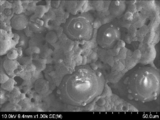
- Partial perspective view of syringe push-out load measuring device SEM photograph of the precious metal sintered body of the present invention fired at 650 ° C for 30 minutes (1000 times) SEM photograph of precious metal sintered body of the present invention fired at 650 ° C for 30 minutes (5000 times) SEM photograph of the precious metal sintered body of the present invention fired at 800 ° C for 30 minutes (1000 times) SEM photograph of precious metal sintered body of the present invention fired at 800 ° C for 30 minutes (5000 times)
- the noble metal sintering composition of the present invention comprises a noble metal powder, an organic binder solution, and a hollow glass powder.
- the noble metal powder refers to a pure noble metal powder such as Au, Ag, Pt, Pd, Rh, Ru, Ir, Os, or a noble metal alloy powder mainly composed of one or more of these elements.
- the particle diameter of these noble metal powders is not particularly limited, but is a powder having an average particle diameter of 1.0 to 20 ⁇ m, a powder having a maximum of about 60.0 ⁇ m and a minimum of about 0.3 ⁇ m. It is preferable to adjust the particle size distribution so that the setting temperature is 600 to 900 ° C.
- the “average particle diameter” is also called a median diameter, a medium diameter, a median diameter, a median diameter, or a 50% particle diameter, and is usually represented by D50, and means a particle diameter corresponding to 50% of a cumulative curve.
- D50 means a particle diameter corresponding to 50% of a cumulative curve.
- the measurement conditions are [particle permeability: reflection] and [true sphere / non-spherical: non-spherical]. ] Is the value of D50 of the particle size distribution measured.
- the precious metal powder is not particularly specified for its production method, but a powder having a nearly spherical particle shape is preferably used.
- Anisotropic particles with non-spherical powder shape tend to be oriented along the flow due to a difference in speed between the outside and inside of the rod coming out of the syringe, for example, when extruding from a place like a syringe. . Therefore, when shrinking during drying or sintering, different behaviors are exhibited between the center and the outside, which is likely to cause defects.
- the particle shape of the powder when the particle shape of the powder is close to a sphere, the powder can be easily densified, and can be fired at a lower temperature or in a shorter time.
- the fluidity of the clay increases, making it easier to perform modeling operations such as bending and stretching the clay.
- the noble metal powder obtained by the gas atomization method, water atomization method, oxidation-reduction method, and gas phase method is substantially spherical.
- the hollow glass powder is a glass powder having a hollow inside and preferably has a bulk density of 0.075 to 0.38 g / cm 3 .
- the hollow portion is preferably in a reduced pressure state.
- the hollow glass powder has an average particle size (D50) of 15 to 65 ⁇ m, but the volume cumulative value from the smaller particle size in the particle size distribution is in the range of 5 to 30 ⁇ m at a cumulative value of 10% (D10).
- D50 average particle size
- D10 volume cumulative value from the smaller particle size in the particle size distribution is in the range of 5 to 30 ⁇ m at a cumulative value of 10% (D10).
- Those having a cumulative value of 90% (D90) in the range of 20 to 110 ⁇ m and those having a cumulative value of 95% (D95) in the range of 25 to 120 ⁇ m can be preferably used.
- the definition of the “average particle size” is not different from the definition of the average particle size described above for the noble metal powder, but a laser diffraction particle size distribution measuring device (micrometer) having three laser scattered light detection mechanisms.
- the measurement conditions of “Truck Co., Ltd.” are [particle permeability: transmission, particle refractive index: refractive index of hollow glass powder to be measured] and [true sphere / non-spherical: true sphere].
- soda lime borosilicate glass main components SiO 2 , CaO, Na 2 O, B 2 O 3
- borosilicate glass, sodium borosilicate glass, aluminosilicate glass and the like are preferable.
- the softening point is preferably 550 ° C. or higher.
- Such hollow glass powder can be purchased on the market.
- the organic binder solution includes an organic binder, a solvent, and an organic additive that can be mixed with a solvent that is added as necessary.
- the organic binder is not particularly limited, but is a cellulose binder such as methylcellulose, ethylcellulose, hydroxyethylcellulose, hydroxypropylcellulose, hydroxypropylmethylcellulose, and carmellose (carboxymethylcellulose), an alginate binder such as sodium alginate, and starch.
- the cellulose binder it is most preferable to use a water-soluble cellulose binder.
- the water-soluble cellulose binder serves to impart plasticity.
- polyethylene oxide functions to give high viscosity at a low concentration and to improve adhesiveness in liquid form.
- sodium alginate gives moderate water retention like the said glycerol, it contributes also to the contact
- the polyacrylic acid ester and the polyacrylic acid serve to strengthen the adhesiveness.
- organic additives include organic acids (oleic acid, stearic acid, phthalic acid, palmitic acid, sepacic acid, acetylcitric acid, hydroxybenzoic acid, lauric acid, myristic acid, caproic acid, enanthic acid, butyric acid, capric acid.
- organic acid esters such as phthalic acid-n-dioctyl, phthalic acid-n-dibutyl (methyl group, ethyl group, propyl group, butyl group, octyl group, hexyl group, dimethyl group, diethyl group, isopropyl group, isobutyl) Group organic acid ester), higher alcohol (octanol, nonanol, decanol), polyhydric alcohol (glycerin, arabit, sorbitan, diglycerin, isoprene glycol, 1,3 butylene glycol), ether (dioctyl ether, didecyl ether) ), Bone with phenylpropane Or a mixture of two or more selected from the group consisting of lignin, liquid paraffin, and oils and fats (for example, olive oil rich in oleic acid). .
- organic additives are added for the purpose of improving plasticity, or added for the purpose of preventing the noble metal sintering composition from adhering to the hand during modeling. Furthermore, the above organic additives, lignin and glycerin, provide appropriate water retention. Further, examples of the organic additive include anionic, cationic, and nonionic surfactants. The surfactant has an effect of improving the mixing property between the noble metal powder and the organic binder and an effect of improving water retention.
- organic binders and the above-mentioned organic additives that are added as necessary are used by dissolving them in a solvent such as water, a water / alcohol mixed solution, alcohol, or ester.
- the amount of the solvent is determined by the form of the target composition for precious metal sintering.
- the ratio of the solvent amount to the noble metal sintering composition is small, the noble metal sintering composition exhibits a clay-like behavior, and when the solvent amount ratio is large, the noble metal sintering composition exhibits a slurry-like or paste-like behavior.
- the amount of the solvent is too small, it becomes hard and difficult to form, and if it is too large, the shape cannot be maintained.
- the solvent addition is divided into a plurality of times so that the ratio of the solvent amount to the precious metal sintering composition finally becomes a predetermined amount, and only the solvent is added after adding the organic binder solution of the predetermined concentration to the precious metal powder.
- the paste-like precious metal sintering composition serves as both an organic binder and a solvent (that is, as an organic binder solution), and an oily (meth) acrylic acid ester copolymer or A phthalate ester or the like may be used.
- the organic binder solution composed of the organic binder, the solvent, and the organic additive that can be mixed with the solvent that is added if necessary usually contains 1 to 20 wt% including the organic additive. It is preferable to use it as a concentration.
- the noble metal base composition according to the present invention is composed of the noble metal powder, the organic binder solution, and inorganic additives such as a sintering accelerator and an adhesion improver, which are added if necessary, excluding the hollow glass powder. .
- this noble metal base composition 0.02 to 3.0 wt% of starch and 0.02 to 3.0 wt% of water-soluble cellulose binder are more preferably used as the organic binder in terms of solid content excluding the solvent. I can do it.
- the solvent is preferably water.
- the water-soluble cellulose-based binder serves to impart plasticity as described above, but the starch serves to increase the dry strength when the noble metal sintering composition is dried. However, when only starch is used as the organic binder, fabric cracking is likely to occur during coating. Therefore, these problems can be solved by using a water-soluble cellulose binder together.
- this starch contains 0.02 to 3.0 wt% in terms of solid content excluding water as a solvent in the noble metal base composition. If less than 0.02 wt%, Insufficient strength is likely to occur, and if it exceeds 3.0 wt%, fabric cracking is liable to occur during coating, and the shrinkage rate increases.
- the water-soluble cellulosic binder also contains 0.02 to 3.0 wt% in terms of solid content excluding water as the solvent in the noble metal base composition as described above, and is less than 0.02 wt%. When the amount exceeds 3.0 wt%, the shrinkage rate increases.
- a water-soluble cellulose-based binder methyl cellulose, hydroxyethyl cellulose, hydroxypropyl cellulose, hydroxypropylmethyl cellulose, and the like are used, which are dissolved in water as a solvent.
- the amount of the organic binder in the noble metal base composition is, as a more preferable aspect, the total amount of the organic binder is a solid content excluding water. Desirably, it is within the range of 0.1 to 4 wt%. In this case, when the amount of the organic binder is less than 0.1 wt%, it is difficult to obtain a homogeneous basic composition. In addition, there is a disadvantage that the strength after coating and drying is weakened. When the amount of the organic binder exceeds 4 wt%, the shrinkage rate increases and cracking is likely to occur.
- polyethylene oxide When polyethylene oxide is used, it is desirable that the polyethylene oxide having a molecular weight of 100,000 to several million is in the range of 0.1 to 3 wt%. Further, when a surfactant is used, it is preferably within a range of 0.03 to 3 wt%, and when an oil is used, it is preferably within a range of 0.1 to 3 wt%.
- this additive at least one compound selected from B 2 O 3 , SiO 2 and Li 2 O may be added. That is, at least one compound selected from B oxide, Si oxide and Li oxide may be contained as the sintering accelerator.
- the hollow glass powder as a product contains Si oxide and B oxide as described above, these are expected to exert an effect as an auxiliary agent during sintering of the noble metal powder. .
- a metal compound powder or glass powder selected from lead carbonate, lithium carbonate, zinc oxide, phosphoric acid, sodium carbonate, vanadium oxide, sodium silicate, phosphate and the like may be added as the adhesion improver.
- a sulfide such as black silver sulfide (Ag 2 S) reacts with sulfur ions (S 2 ⁇ ) and silver at room temperature.
- S 2 ⁇ sulfur ions
- 0.05 to 1 wt% of palladium (Pd) powder is added to the pure silver (Ag) powder to prevent sulfidation. Examples thereof include a silver sintered product having characteristics.
- the addition ratio of each of the above components in the precious metal sintering composition part is such that a hollow glass powder is added to the precious metal basic composition composed of the precious metal powder 50 to 99 wt% and the organic binder solution 1 to 50 wt%.
- the ratio of the hollow glass powder to the total volume of the sintering composition is in the range of 5 to 160% of the total volume when the contained hollow glass powder is converted into a bulk volume in a single state. It is preferable to make it contain.
- the organic binder solution in the precious metal sintering composition part has a concentration corresponding to 1 to 20 wt%.
- the handleability such as formability is not deteriorated, and it can be handled in the same manner as the conventional composition for sintering precious metals while maintaining the visual (aesthetic) value.
- a light noble metal sintered body can be obtained.
- the “bulk volume” is, for example, a volume measured with a graduation of the graduated cylinder when hollow glass powder is placed in a graduated cylinder.
- the gap between the powder and the powder is measured. It includes the volume and the volume of the gap between the powder and the container. Therefore, the ratio of the hollow glass powder occupying the total volume of the precious metal sintering composition is in the range of 5 to 160% of the total volume when the contained hollow glass powder is converted into a bulk volume in a single state.
- Bulk volume of hollow glass powder to be added / actual volume of the entire composition) ⁇ 100 5 to 160%. The reason for exceeding 100% is that the “bulk volume” of the added hollow glass powder is used.
- the bulk volume of the mixed powder is smaller than the sum of the bulk volumes of the original powders. Become. This is because the bulk density increases because small particles enter between large particles. Therefore, in the case of the present invention, the actual volume of the entire composition is at least the actual volume of the composition for sintering a noble metal obtained by mixing the noble metal powder, the hollow glass powder, and the organic binder solution. Since the bulk volume of the hollow glass powder to be added is compared, it exceeds 100%. This definition is because precious metal powder and hollow glass powder have different “bulk density” depending on their shape and state, and even if unified to wt% or vol%, they may show a substantially desirable state. Because it is not possible.
- the addition ratio of each of the above components in the precious metal sintering composition part is such that the noble metal basic composition composed of 50 to 99 wt% of the noble metal powder and 1 to 50 wt% of the organic binder solution has a hollow glass powder.
- the ratio of the hollow glass powder to the total volume of the composition for sintering the noble metal is 5 to 160% of the total volume when the contained hollow glass powder is converted into a bulk volume in a single state. It is preferable to make it contain so that it may become this range. In other words, 40 to 90% by volume of the noble metal basic composition containing 50 to 99% by weight of noble metal powder, 0.02 to 10% by weight of an organic binder, and the balance as a solvent, and 10 to 60% by volume of hollow glass powder.
- % Composition In particular, when the effect of reducing the precious metal powder by reducing the weight and the cost of the process of preparing the lightweight clay composition are compared, it is desirable that the added amount of the hollow glass powder is 10% by volume or more.
- a noble metal composition containing 60% by volume or less of hollow glass powder does not break during firing, for example, during polishing, and does not cause cracks.
- the addition ratio of each of the above components in the precious metal sintering composition part is greatly influenced by the size, shape, etc. of the precious metal powder and the hollow glass powder, and further forms the desired precious metal sintering composition. Since the type, combination, amount of solvent, and the like of the organic binder differ depending on (clay, slurry, paste, etc.), it cannot be specified unconditionally. Therefore, as a total index of the precious metal sintering composition (for example, a final pass / fail judgment index), a syringe (syringe) is filled with the precious metal sintering composition, and the precious metal sintering composition is discharged from the syringe outlet.
- a total index of the precious metal sintering composition for example, a final pass / fail judgment index
- the measured value of the maximum extrusion load when extruding the ligating composition is used.
- the maximum measured value of the syringe push-out load is affected by the size, shape, etc. of the noble metal powder and the hollow glass powder, and the kind, combination, moisture content, etc. of the organic binder, and these noble metal powder, hollow glass Since it varies depending on the blending ratio of the powder and the organic binder solution, it can be a total index of the precious metal sintering composition.
- the crosshead 30 is provided so as to move up and down at a desired constant speed along the support column 20 of the measuring apparatus main body 10.
- the upper compression jig 50 is fixed to the lower end of the crosshead 30 through the lower end of the measuring element of the load cell 40.
- a disc-shaped plate 51 is provided at the tip of the upper compression jig 50 so as to be brought into contact with a plunger (piston portion) 91 of a syringe 90 and pushed down.
- a column base 60 is provided at the bottom of the base end of the column 20 of the measuring apparatus body 10.
- a lower fixed compression table 70 is fixed to the support column 60 at a position below the upper compression jig 50.
- An H-section steel [H125 (H dimension) ⁇ 125 (B dimension)] 80 is placed on the upper surface of the lower fixed compression table 70.
- the upper flange portion 81 of the H-shaped steel 80 is provided with a hole 82 that allows the barrel (outer cylinder) 92 of the syringe 90 to pass therethrough but does not allow the flange portion 93 provided in the barrel 92 to pass therethrough.
- the crosshead 30 is moved down along the support column 20 at a constant speed of 17 mm / min, and the plunger 91 of the syringe 90 is pressed by the plate 51 at the tip of the upper compression jig 50, and the noble metal is discharged from the outlet of the syringe 90. Extrude the composition for sintering.
- the pushing load while the plunger 91 of the syringe 90 moves 10 mm is recorded by a recorder (not shown) attached, and the maximum measured value is obtained.
- the composition is excellent in formability and is a suitable composition for sintering a noble metal.
- the precious metal sintering composition having a maximum measured value of the extrusion load in the range of 0.24 to 1.13 N has a plasticity suitable for modeling by hand, such as general clay. It is an excellent composition for sintering precious metals.
- the precious metal sintering composition having a maximum measured value of the extrusion load in the range of 0.08 to 0.23 N is filled with the precious metal sintering composition in a syringe, and a thin nozzle is provided at the tip of the syringe.
- the syringe used for modeling is preferably 10 ml, and the thin nozzle provided at the tip of the syringe is preferably 0.4 to 1.2 mm ⁇ .
- the thin nozzle provided at the tip of the syringe is preferably 0.4 to 1.2 mm ⁇ .
- the thin nozzle dries quickly, so even if the composition for precious metal sintering is softer than the normal composition for precious metal sintering, before the liquid is dripped.
- the surface can solidify and maintain its shape. Conversely, if a thick line is drawn with soft clay, dripping will occur immediately. If it is a thick line, the resistance to push out from the syringe will be reduced, so use hard clay accordingly.
- the method for producing a precious metal sintered body of the present invention includes a step of shaping the above-described composition for precious metal sintering, a step of drying the shaped product, and a step of firing the shaped dry product. Since the composition for precious metal sintering of the present invention does not deteriorate the handleability such as formability, it can be shaped, dried and fired in the same manner as the conventional method for producing a precious metal sintered body, and has a visual value. While maintaining the above, it is possible to obtain a sintered noble metal much lighter than before.
- the step of shaping the precious metal sintering composition it is arbitrarily shaped using a jig such as a hand or a spatula, similarly to the conventional precious metal sintering composition (not including hollow glass powder).
- a jig such as a hand or a spatula
- the mold may be molded, or a commonly used mold may be crafted and molded, or both may be used in combination.
- the composition for precious metal sintering may be put into a mold, and the composition for precious metal sintering taken out from the mold may be further crafted using a hand or a jig.
- the composition for precious metal sintering of the present invention can be dried and fired in an appropriate combination with a conventional composition for precious metal sintering that does not contain hollow glass powder, a precious metal sintered shaped product, or a precious metal cast product.
- a conventional composition for precious metal sintering that does not contain hollow glass powder, a precious metal sintered shaped product, or a precious metal cast product.
- platinum and gold they may be combined and dried or fired at the same time or later.
- the firing temperature is adjusted to be between 600 and 900 ° C. near the softening point of the hollow glass powder.
- a lightweight noble metal sintered body can be produced without requiring special equipment or equipment.
- the SEM of the noble metal sintered body of the present invention obtained by firing the noble metal sintering composition (silver sintering composition) of the present invention showing the uppermost composition in Table 2 in an electric furnace at 650 ° C. for 30 minutes.
- An example of a photograph (a photograph of a scanning electron microscope [Scanning Electron Micrscope]) is shown in FIGS.
- compacts using precious metal powder from precious metal bare metal have the property of shrinking when fired, and the shrinkage becomes more severe the smaller the density, the finished sintered body is far from the original compact. It may become a shape.
- the glass does not melt and retains its shape in the case of firing conditions of 650 ° C. for 30 minutes from the SEM photograph even though the density is small. It is understood that the hollow glass powder maintains the shape of the sintered body by inhibiting the shrinkage of the noble metal powder in the volume direction.
- FIGS. an SEM photograph of a noble metal sintered body of the present invention obtained by firing a precious metal sintering composition (silver sintering composition) having the same composition as shown above in Table 2 in an electric furnace at 800 ° C. for 30 minutes. An example of this is shown in FIGS. From the SEM photograph, under the baking conditions of 800 ° C.-30 min, the glass is deformed but not completely melted, and the shape is maintained to some extent. It is understood that the hollow glass inhibits the volume shrinkage of the noble metal powder and maintains the shape of the sintered body despite the low density.
- a precious metal sintering composition silver sintering composition
- the noble metal sintered body of the present invention is a noble metal sintered body that is significantly reduced in weight by mixing hollow glass powder, and is a noble metal sintered body that maintains visual value like a conventional noble metal sintered body. is there. That is, the noble metal sintered body of the present invention has a structure in which hollow glass powders are scattered in the noble metal sintered body, and is apparently the same as a conventional noble metal sintered body that does not contain hollow glass powders. It is extremely lightweight. Precious metal luster can be obtained by polishing in the same way as in the past, and as accessories such as pendants (heads) and brooches to be worn, glasses, eyeglass fittings, watch belts, parts around the case and dial are lightweight. It can also be suitably used as an integrated part.
- a decorative effect can be further added to the precious metal sintered body of the present invention by subjecting the precious metal sintered body to surface treatment such as electroplating, electroless plating, or vapor deposition film forming techniques such as PVD and CVD.
- surface treatment such as electroplating, electroless plating, or vapor deposition film forming techniques such as PVD and CVD.
- an activator and sensitizer treatment activate
- the decorative effect can be enhanced by coloring the hollow glass powder and then mixing it with the noble metal clay composition.
- Example 1 8 wt% of organic binder solution consisting of 8.75 wt% starch, 10 wt% cellulose and the balance water, 50 wt% Ag powder with an average particle diameter of 2.5 ⁇ m (46 wt% overall), 50 wt% Ag powder with an average particle diameter of 20 ⁇ m ( A silver basic composition was prepared by mixing 92 wt% of a silver alloy powder consisting of 46 wt% in total.
- the density of the silver sintering composition was determined from the volume and weight when the silver sintering composition was molded into a cube, and was found to be 5.51 g / cm 3 .
- This silver sintering composition has an inner diameter of 6 mm ⁇ , an outlet of 1.3 mm ⁇ , and an outlet length of 8.3 mm.
- a syringe for 2 ml [trade name: JMS syringe (micro), 2 ml without needle (without NEEDLE cyringe) / J.
- the result of measuring the extrusion load described above was 0.90 N.
- This silver sintering composition was cast with a fixed volume silicon mold and fired in an electric furnace under the conditions shown in Table 1.
- Table 1 shows the weight of the silver sintering composition used by filling the silicon mold and the weight of the sintered body obtained by firing the composition. The firing conditions were 600 ° C. and 30 minutes, and the results are shown in Table 3.
- Examples 2 to 8 Except that the addition amount and size of the hollow glass powder were appropriately changed to the conditions shown in Table 2 so that the bulk volume of the hollow glass powder in the entire composition was in the range of 5 to 160% Performed as in Example 1.
- the firing conditions were 600 ° C. and 30 minutes, and the results are shown in Tables 2 and 3.
- Example 1 The same procedure as in Example 1 was performed except that the amount and size of the hollow glass powder were changed to the conditions shown in Table 2.
- the firing conditions were 600 ° C. and 30 minutes, and the compositions and results of the silver sintering composition are shown in Tables 2 and 3, respectively.
- Example 2 instead of hollow glass powder, a micro hollow sphere plastic (trade name: EXPANCEL [manufactured by Nippon Philite Co., Ltd.]) having an average particle size of 50 ⁇ m and a bulk density of 0.02 g / cm 3 was compared with 1.3 g in Comparative Example 2.
- Example 3 was carried out in the same manner as in Example 1 except that 0.1 g was added and the total weight of the silver sintering composition was 100 g.
- the firing conditions were 600 ° C. and 30 minutes. Both Comparative Example 2 and Comparative Example 3 were deformed during firing, and a beautiful sintered body could not be obtained.
- the composition and results of the silver sintering composition are shown in Table 2 and Table 3, respectively.
- Comparative Examples 4 and 5 In place of the hollow glass powder, silica-based micro hollow spheres having an average particle diameter of 60 ⁇ m and a bulk density of 0.4 g / cm 3 (trade name: Philite [manufactured by Nippon Philite Co., Ltd.]) were used. Comparative Example 5 was carried out in the same manner as in Example 1 except that 1.4 g was added and the weight of the entire silver sintering composition was 100 g. The firing conditions were 600 ° C. and 30 minutes. In both Comparative Example 4 and Comparative Example 5, impurities were observed on the surface even when the sintered body was polished, and sufficient metal luster was not obtained. The composition and results of the silver sintering composition are shown in Table 2 and Table 3, respectively.
- hollow glass powder having a bulk density of 0.075 to 0.378 g / cm 3 (true density of 0.125 to 0.600 g / cm 3 ) is used.
- the hollow glass powder is contained in an amount of 7.1 to 153% by volume with respect to the total composition volume including the hollow glass powder (bulk volume of the hollow glass powder / silver sintering composition).
- the total volume of the product was 7.1 to 153%) [in terms of added weight, 0.2 to 14.9% by weight]. This corresponds to a volume ratio of the hollow glass powder in the silver sintering composition of approximately 10% or 60%.
- Example 9 A mixture of 8 wt% of an organic binder solution consisting of 8.75 wt% starch, 10 wt% cellulose and the balance water, and 92 wt% Au powder having an average particle size of 4.5 ⁇ m was used as a gold basic composition.
- the gold base composition 94.6g hollow glass powder (Sumitomo 3M Limited Glass Bubbles: bulk density 0.378 g / cm 3, the true density of 0.6 g / cm 3, particle size 27 [mu] m) of 5.4g mixed And it was set as the composition for gold sintering. This gold sintering composition was cast with a silicon mold and fired in an electric furnace at 800 ° C. for 30 minutes.
- the weight of the sintered body obtained by firing was 31.6 g, and the weight of the same volume to which no hollow glass powder was added was 52.3 g, so the weight loss was 40.0%.
- the results are also shown in Table 2.
- the finished sample was barrel polished. As a result, a metallic luster was obtained, and no cracks or breakage occurred.
- Example 10 Organic binder solution consisting of 5.25 wt% starch, 10 wt% cellulose and the balance water, 8 wt% Ag powder having an average particle size of 2.5 ⁇ m (46 wt% overall), wt% Ag powder having an average particle size of 20 ⁇ m ( A silver basic composition was prepared by mixing 92 wt% of a silver alloy powder consisting of 46 wt% in total.
- this silver basic composition 0.2 g (bulk) of hollow glass powder (Glass Bubbles manufactured by Sumitomo 3M Limited: bulk density 0.075 g / cm 3 , true density 0.125 g / cm 3 , particle size 65 ⁇ m) Volume 2.67 cm 3 ) was mixed to obtain a silver sintering composition (total volume 18.1 cm 3 ).
- the ratio of the bulk volume in a single state of the added hollow glass powder to the total volume of the silver sintering composition was 14.7%.
- This silver sintering composition has an inner diameter of 6 mm ⁇ , an outlet of 1.3 mm ⁇ , and an outlet length of 8.3 mm.
- a syringe for 2 ml [trade name: JMS syringe (micro), 2 ml without needle (without NEEDLE cyringe) / J. It was 0.24 N as a result of measuring the extrusion load described above by packing into a product manufactured by JMS CO. LTD. Make a cut so that the tip of the unused 2 ml syringe is jagged.
- the silver sintering composition is packed in the syringe and the silver sintering composition is extruded.
- a ring was produced while twisting both ends of the bar. It put into the dryer of 80 degreeC, and was dried for 20 minutes.
- Example 11 In the same manner as in Example 10, a ring is produced and the drying process is performed. 5.25 wt% starch, 6 wt% cellulose and 13.5 wt% organic binder solution consisting of water, 50 wt% Ag powder (average 43.25 wt%) with an average particle size of 2.5 ⁇ m, Ag with an average particle size of 20 ⁇ m A mixture of 86.5 wt% of a silver alloy powder consisting of wt% of powder (43.25 wt% in total) was used as the basic silver composition.
- this silver basic composition 0.2 g (bulk) of hollow glass powder (Glass Bubbles manufactured by Sumitomo 3M Limited: bulk density 0.075 g / cm 3 , true density 0.125 g / cm 3 , particle size 65 ⁇ m) Volume 2.67 cm 3 ) was mixed to obtain a silver sintering composition (total volume 25.3 cm 3 ).
- the ratio of the bulk volume in a single state of the added hollow glass powder to the total volume of the silver sintering composition was 10.5%.
- This silver sintering composition has an inner diameter of 6 mm ⁇ , an outlet of 1.3 mm ⁇ , and an outlet length of 8.3 mm.
- a syringe for 2 ml [trade name: JMS syringe (micro), 2 ml without needle (without NEEDLE cyringe) / J. It was 0.08N as a result of measuring the extrusion load described above by packing into a product manufactured by JMS CO. LTD.
- This silver-sintering composition is packed in another 10 ml syringe, a resin nozzle (inner diameter ⁇ 0.84 mm) is attached to the syringe tip, and the silver-sintering composition is extruded and the surface of the ring previously dried. The initial pattern was put on.
- Example 7 In the same manner as in Example 10, a ring is produced and the drying process is performed. 20 wt% organic binder solution consisting of 3 wt% starch, 4 wt% cellulose and the balance water, 50 wt% Ag powder having an average particle size of 2.5 ⁇ m (40 wt% overall), and wt% Ag powder having an average particle size of 20 ⁇ m 40 wt%) was mixed with 80 wt% of silver alloy powder to make a basic silver composition.
- 20 wt% organic binder solution consisting of 3 wt% starch, 4 wt% cellulose and the balance water, 50 wt% Ag powder having an average particle size of 2.5 ⁇ m (40 wt% overall), and wt% Ag powder having an average particle size of 20 ⁇ m 40 wt%) was mixed with 80 wt% of silver alloy powder to make a basic silver composition.
- this silver basic composition 0.2 g (bulk) of hollow glass powder (Glass Bubbles manufactured by Sumitomo 3M Limited: bulk density 0.075 g / cm 3 , true density 0.125 g / cm 3 , particle size 65 ⁇ m) Volume 2.67 cm 3 ) was mixed to obtain a silver sintering composition (total volume 31.2 cm 3 ).
- the ratio of the bulk volume in a single state of the added hollow glass powder to the total volume of the silver sintering composition was 8.6%.
- This silver sintering composition has an inner diameter of 6 mm ⁇ , an outlet of 1.3 mm ⁇ , and an outlet length of 8.3 mm.
- a syringe for 2 ml [trade name: JMS syringe (micro), 2 ml without needle (without NEEDLE cyringe) / J. It was 0.05N as a result of measuring the extrusion load described above by packing into a product manufactured by JMS CO. LTD.
- This silver-sintering composition is packed in another 10 ml syringe, a resin nozzle (inner diameter ⁇ 0.84 mm) is attached to the syringe tip, and the silver-sintering composition is extruded and the surface of the ring previously dried.
- the initial pattern was put on. When placed in a dryer at 80 ° C. and dried for 20 minutes, the initial pattern line added later partly flowed before drying and solidification, and could not be read as characters.
- this silver basic composition 0.2 g (bulk) of hollow glass powder (Glass Bubbles manufactured by Sumitomo 3M Limited: bulk density 0.075 g / cm 3 , true density 0.125 g / cm 3 , particle size 65 ⁇ m) Volume 2.67 cm 3 ) was mixed to obtain a silver sintering composition (total volume 18.1 cm 3 ).
- the ratio of the bulk volume in a single state of the added hollow glass powder to the total volume of the silver sintering composition was 14.7%.
- This silver sintering composition has an inner diameter of 6 mm ⁇ , an outlet of 1.3 mm ⁇ , and an outlet length of 8.3 mm.
- a syringe for 2 ml [trade name: JMS syringe (micro), 2 ml without needle (without NEEDLE cyringe) / J. It was 1.5N as a result of measuring the extrusion load described above by packing it into a product manufactured by JMS CO. LTD.
- this silver-sintering composition was formed into a rod shape by hand, both ends of the rod were drawn and formed into a ring shape, the silver-sintering composition was hard and bent without bending.
Landscapes
- Chemical & Material Sciences (AREA)
- Engineering & Computer Science (AREA)
- Mechanical Engineering (AREA)
- Materials Engineering (AREA)
- Metallurgy (AREA)
- Organic Chemistry (AREA)
- Manufacturing & Machinery (AREA)
- Inorganic Chemistry (AREA)
- Powder Metallurgy (AREA)
Abstract
Priority Applications (9)
| Application Number | Priority Date | Filing Date | Title |
|---|---|---|---|
| CA 2723284 CA2723284A1 (fr) | 2008-05-28 | 2008-05-28 | Composition pour le frittage de metal precieux, procede pour la fabrication de fritte de metal precieux et fritte de metal precieux |
| JP2010500002A JP4741712B2 (ja) | 2008-05-28 | 2008-05-28 | 貴金属焼結用組成物、貴金属焼結体の製造方法及び貴金属焼結体 |
| KR1020107024867A KR101569762B1 (ko) | 2008-05-28 | 2008-05-28 | 귀금속 소결용 조성물, 귀금속 소결체의 제조방법 및 귀금속 소결체 |
| US12/736,780 US20110064937A1 (en) | 2008-05-28 | 2008-05-28 | Composition for precious metal sintering, process for producing precious metal sinter and precious metal sinter |
| EP20080776960 EP2283951A1 (fr) | 2008-05-28 | 2008-05-28 | Composition pour le frittage de métal précieux, procédé pour la fabrication de fritté de métal précieux et fritté de métal précieux |
| CN2008801290199A CN102015165A (zh) | 2008-05-28 | 2008-05-28 | 贵金属烧结用组合物、贵金属烧结体的制造方法及贵金属烧结体 |
| AU2008357012A AU2008357012A1 (en) | 2008-05-28 | 2008-05-28 | Composition for precious metal sintering, process for producing precious metal sinter and precious metal sinter |
| PCT/JP2008/059845 WO2009144792A1 (fr) | 2008-05-28 | 2008-05-28 | Composition pour le frittage de métal précieux, procédé pour la fabrication de fritté de métal précieux et fritté de métal précieux |
| TW098111476A TWI478781B (zh) | 2008-05-28 | 2009-04-07 | A method for producing a precious metal sintered body, a method for producing a noble metal sintered body, and a precious metal sintered body thereof |
Applications Claiming Priority (1)
| Application Number | Priority Date | Filing Date | Title |
|---|---|---|---|
| PCT/JP2008/059845 WO2009144792A1 (fr) | 2008-05-28 | 2008-05-28 | Composition pour le frittage de métal précieux, procédé pour la fabrication de fritté de métal précieux et fritté de métal précieux |
Publications (1)
| Publication Number | Publication Date |
|---|---|
| WO2009144792A1 true WO2009144792A1 (fr) | 2009-12-03 |
Family
ID=41376692
Family Applications (1)
| Application Number | Title | Priority Date | Filing Date |
|---|---|---|---|
| PCT/JP2008/059845 Ceased WO2009144792A1 (fr) | 2008-05-28 | 2008-05-28 | Composition pour le frittage de métal précieux, procédé pour la fabrication de fritté de métal précieux et fritté de métal précieux |
Country Status (9)
| Country | Link |
|---|---|
| US (1) | US20110064937A1 (fr) |
| EP (1) | EP2283951A1 (fr) |
| JP (1) | JP4741712B2 (fr) |
| KR (1) | KR101569762B1 (fr) |
| CN (1) | CN102015165A (fr) |
| AU (1) | AU2008357012A1 (fr) |
| CA (1) | CA2723284A1 (fr) |
| TW (1) | TWI478781B (fr) |
| WO (1) | WO2009144792A1 (fr) |
Cited By (2)
| Publication number | Priority date | Publication date | Assignee | Title |
|---|---|---|---|---|
| JP2012122711A (ja) * | 2010-03-15 | 2012-06-28 | Denso Corp | 吸着器 |
| JP7512243B2 (ja) | 2020-10-27 | 2024-07-08 | 三ツ星ベルト株式会社 | ペースト組成物ならびに多孔質体およびその製造方法 |
Families Citing this family (10)
| Publication number | Priority date | Publication date | Assignee | Title |
|---|---|---|---|---|
| DE102009040076A1 (de) * | 2009-09-04 | 2011-03-10 | W.C. Heraeus Gmbh | Metallpaste mit Oxidationsmittel |
| JP5642157B2 (ja) * | 2010-03-19 | 2014-12-17 | 本田技研工業株式会社 | 内燃機関用ピストン |
| JP6090664B2 (ja) * | 2013-03-28 | 2017-03-08 | 三菱マテリアル株式会社 | 貴金属焼結体用の粘土状組成物 |
| JP6445858B2 (ja) * | 2014-12-12 | 2018-12-26 | 住友電工焼結合金株式会社 | 焼結部品の製造方法、及びドリル |
| WO2018097372A1 (fr) * | 2016-11-28 | 2018-05-31 | 마경희 | Composition de pâte d'argent et procédé pour la fabriquer |
| CN107052346A (zh) * | 2016-12-28 | 2017-08-18 | 江苏精研科技股份有限公司 | 粉末注射成形钨镍硬质合金的制备工艺 |
| EP3766997A1 (fr) * | 2019-07-18 | 2021-01-20 | The Swatch Group Research and Development Ltd | Procédé de fabrication d'alliages de métaux précieux et alliages de métaux précieux ainsi obtenus |
| US11319613B2 (en) | 2020-08-18 | 2022-05-03 | Enviro Metals, LLC | Metal refinement |
| CN112974805B (zh) * | 2021-02-05 | 2023-06-23 | 深圳市信德缘珠宝首饰有限公司 | 一种贵金属与宝石的结合工艺 |
| CN114406285B (zh) * | 2021-12-30 | 2023-03-10 | 苏州大学 | 一种激光增材制造技术制备闭孔泡沫钢的方法 |
Citations (9)
| Publication number | Priority date | Publication date | Assignee | Title |
|---|---|---|---|---|
| JPH0725684A (ja) * | 1993-07-06 | 1995-01-27 | Kagoshima Pref Gov | 微細空隙を有するファインセラミックス焼結体およびその製造方法 |
| JPH08295576A (ja) * | 1995-04-24 | 1996-11-12 | Eagle Ind Co Ltd | 独立球形気孔を有するセラミックス部材およびその製造方法 |
| JP3248505B2 (ja) | 1999-02-12 | 2002-01-21 | 相田化学工業株式会社 | 貴金属焼結品及びその製造方法 |
| JP2002241802A (ja) | 2000-12-12 | 2002-08-28 | Mitsubishi Materials Corp | 低温燒結性に優れた銀粘土用銀粉末およびこの銀粉末を含む銀粘土 |
| JP3456644B2 (ja) | 2001-01-25 | 2003-10-14 | 相田化学工業株式会社 | 造形用粘土組成物及び貴金属製品の製造方法 |
| JP2004292894A (ja) | 2003-03-27 | 2004-10-21 | Mitsubishi Materials Corp | 多孔質焼結体形成用銀粘土 |
| JP3867786B2 (ja) | 2002-11-05 | 2007-01-10 | 相田化学工業株式会社 | 貴金属造形用粘土組成物及び貴金属焼結品の製造方法 |
| JP2007051331A (ja) | 2005-08-18 | 2007-03-01 | Mitsubishi Materials Corp | 貴金属粘土用原料粉末 |
| JP3896181B2 (ja) | 1997-01-30 | 2007-03-22 | 相田化学工業株式会社 | 貴金属製品の製造方法 |
Family Cites Families (8)
| Publication number | Priority date | Publication date | Assignee | Title |
|---|---|---|---|---|
| CH559018A5 (fr) * | 1971-12-10 | 1975-02-28 | Far Fab Assortiments Reunies | |
| DE3724156A1 (de) * | 1987-07-22 | 1989-02-02 | Norddeutsche Affinerie | Verfahren zum herstellen von metallischen oder keramischen hohlkugeln |
| DE4412715C1 (de) * | 1994-04-13 | 1995-08-17 | Degussa | Edelmetallhaltiger Werkstoff für Schmuckgegenstände und Verfahren zu ihrer Herstellung |
| JPH09104012A (ja) * | 1995-10-12 | 1997-04-22 | Honda Motor Co Ltd | セラミックス射出成形体の製造方法 |
| JP3274960B2 (ja) * | 1996-02-23 | 2002-04-15 | 相田化学工業株式会社 | 金属焼結品の製造方法 |
| CA2397770A1 (fr) * | 2000-01-25 | 2001-08-02 | Glatt Systemtechnik Dresden Gmbh | Sphere creuse, et procede de production de spheres creuses et de composants legers constitues de spheres creuses |
| US6544315B2 (en) * | 2001-03-12 | 2003-04-08 | Gadi Har-Shai | Sintered jewelry and decorative articles |
| JP2005277003A (ja) * | 2004-03-24 | 2005-10-06 | Tdk Corp | マグネットロール用ボンド磁石の製造方法及びマグネットロールの製造方法 |
-
2008
- 2008-05-28 US US12/736,780 patent/US20110064937A1/en not_active Abandoned
- 2008-05-28 CN CN2008801290199A patent/CN102015165A/zh active Pending
- 2008-05-28 WO PCT/JP2008/059845 patent/WO2009144792A1/fr not_active Ceased
- 2008-05-28 KR KR1020107024867A patent/KR101569762B1/ko not_active Expired - Fee Related
- 2008-05-28 CA CA 2723284 patent/CA2723284A1/fr not_active Abandoned
- 2008-05-28 AU AU2008357012A patent/AU2008357012A1/en not_active Abandoned
- 2008-05-28 EP EP20080776960 patent/EP2283951A1/fr not_active Withdrawn
- 2008-05-28 JP JP2010500002A patent/JP4741712B2/ja not_active Expired - Fee Related
-
2009
- 2009-04-07 TW TW098111476A patent/TWI478781B/zh not_active IP Right Cessation
Patent Citations (9)
| Publication number | Priority date | Publication date | Assignee | Title |
|---|---|---|---|---|
| JPH0725684A (ja) * | 1993-07-06 | 1995-01-27 | Kagoshima Pref Gov | 微細空隙を有するファインセラミックス焼結体およびその製造方法 |
| JPH08295576A (ja) * | 1995-04-24 | 1996-11-12 | Eagle Ind Co Ltd | 独立球形気孔を有するセラミックス部材およびその製造方法 |
| JP3896181B2 (ja) | 1997-01-30 | 2007-03-22 | 相田化学工業株式会社 | 貴金属製品の製造方法 |
| JP3248505B2 (ja) | 1999-02-12 | 2002-01-21 | 相田化学工業株式会社 | 貴金属焼結品及びその製造方法 |
| JP2002241802A (ja) | 2000-12-12 | 2002-08-28 | Mitsubishi Materials Corp | 低温燒結性に優れた銀粘土用銀粉末およびこの銀粉末を含む銀粘土 |
| JP3456644B2 (ja) | 2001-01-25 | 2003-10-14 | 相田化学工業株式会社 | 造形用粘土組成物及び貴金属製品の製造方法 |
| JP3867786B2 (ja) | 2002-11-05 | 2007-01-10 | 相田化学工業株式会社 | 貴金属造形用粘土組成物及び貴金属焼結品の製造方法 |
| JP2004292894A (ja) | 2003-03-27 | 2004-10-21 | Mitsubishi Materials Corp | 多孔質焼結体形成用銀粘土 |
| JP2007051331A (ja) | 2005-08-18 | 2007-03-01 | Mitsubishi Materials Corp | 貴金属粘土用原料粉末 |
Cited By (2)
| Publication number | Priority date | Publication date | Assignee | Title |
|---|---|---|---|---|
| JP2012122711A (ja) * | 2010-03-15 | 2012-06-28 | Denso Corp | 吸着器 |
| JP7512243B2 (ja) | 2020-10-27 | 2024-07-08 | 三ツ星ベルト株式会社 | ペースト組成物ならびに多孔質体およびその製造方法 |
Also Published As
| Publication number | Publication date |
|---|---|
| CA2723284A1 (fr) | 2009-12-03 |
| AU2008357012A1 (en) | 2009-12-03 |
| KR20110017360A (ko) | 2011-02-21 |
| US20110064937A1 (en) | 2011-03-17 |
| TWI478781B (zh) | 2015-04-01 |
| JP4741712B2 (ja) | 2011-08-10 |
| CN102015165A (zh) | 2011-04-13 |
| TW200948513A (en) | 2009-12-01 |
| EP2283951A1 (fr) | 2011-02-16 |
| KR101569762B1 (ko) | 2015-11-19 |
| JPWO2009144792A1 (ja) | 2011-09-29 |
| AU2008357012A8 (en) | 2010-12-23 |
Similar Documents
| Publication | Publication Date | Title |
|---|---|---|
| JP4741712B2 (ja) | 貴金属焼結用組成物、貴金属焼結体の製造方法及び貴金属焼結体 | |
| US5362438A (en) | Powder of dental metal, a process for the preparation thereof, a process for the manufacture of a substructure for a dental restoration and a process for the manufacture of a dental restoration | |
| TWI511814B (zh) | A copper sintered product for process or decoration, and a copper-containing plasticity composition | |
| JP3867786B2 (ja) | 貴金属造形用粘土組成物及び貴金属焼結品の製造方法 | |
| WO2012059990A1 (fr) | Procédé de fabrication d'un article métallique fritté décoratif et article métallique fritté décoratif | |
| KR0179371B1 (ko) | 귀금속품과, 귀금속품의 제조방법과, 귀금속품의 제조에 사용되는 성형혼합물, 및 성형혼합물의 제조방법 | |
| CN1280045C (zh) | 银粘土用银粉以及含有该银粉的银粘土 | |
| JP5829914B2 (ja) | 工芸または装飾用の銅焼結物品の製造方法、および、工芸または装飾用の銅含有可塑性組成物 | |
| DE102006051200A1 (de) | Verfahren zur Herstellung eines Körpers aus Metall-Keramik-Verbundwerkstoffen | |
| JP2976707B2 (ja) | 金属可塑性組成物 | |
| JP2008169426A (ja) | 軽量貴金属焼結用組成物、軽量貴金属焼結体、及び軽量貴金属焼結体の製造方法 | |
| JP2012046820A (ja) | 銀銅合金焼結体の製造方法およびその方法によって製造された銀銅合金焼結体 | |
| EP3708271A1 (fr) | Mélange d'agrégat expansible pour des moules, moule et procédé permettant de fabriquer un moule | |
| CN107052327B (zh) | 一种银黏土用银粉及包含该银粉的银黏土 | |
| JP2005187858A (ja) | 銀粘土焼成体表面装飾用ペースト | |
| JP2004292894A (ja) | 多孔質焼結体形成用銀粘土 | |
| WO2011021535A1 (fr) | Procédé de production dun article métallique décoratif, et article métallique décoratif | |
| JP5862004B2 (ja) | 銀焼結体の製造方法 | |
| JP2011068958A (ja) | 装飾金属物品の製造方法および装飾金属物品 | |
| JP4375529B2 (ja) | 銀粘土焼結体装飾用金または金合金流動体ペースト | |
| JP5672945B2 (ja) | 焼結体形成用の粘土状組成物、焼結体形成用の粘土状組成物用粉末、焼結体形成用の粘土状組成物の製造方法、銀焼結体及び銀焼結体の製造方法 | |
| JP4843645B2 (ja) | 耐硫化特性を有する銀焼結品を得るための銀粘土組成物、耐硫化特性を有する銀焼結品、及びその製造方法 | |
| JP2836232B2 (ja) | 合金金粘土 | |
| JP4110410B2 (ja) | 銀粘土焼結体の表面に金色を呈する被膜を形成する方法 | |
| JP3435508B2 (ja) | 粘土組成物及びこれを用いた金属又はセラミックスからなる造形品の製造方法 |
Legal Events
| Date | Code | Title | Description |
|---|---|---|---|
| WWE | Wipo information: entry into national phase |
Ref document number: 200880129019.9 Country of ref document: CN |
|
| WWE | Wipo information: entry into national phase |
Ref document number: 2010500002 Country of ref document: JP |
|
| 121 | Ep: the epo has been informed by wipo that ep was designated in this application |
Ref document number: 08776960 Country of ref document: EP Kind code of ref document: A1 |
|
| WWE | Wipo information: entry into national phase |
Ref document number: 588882 Country of ref document: NZ |
|
| WWE | Wipo information: entry into national phase |
Ref document number: 2723284 Country of ref document: CA |
|
| WWE | Wipo information: entry into national phase |
Ref document number: 2008357012 Country of ref document: AU |
|
| ENP | Entry into the national phase |
Ref document number: 20107024867 Country of ref document: KR Kind code of ref document: A |
|
| WWE | Wipo information: entry into national phase |
Ref document number: 12736780 Country of ref document: US Ref document number: 2008776960 Country of ref document: EP |
|
| NENP | Non-entry into the national phase |
Ref country code: DE |
|
| ENP | Entry into the national phase |
Ref document number: 2008357012 Country of ref document: AU Date of ref document: 20080528 Kind code of ref document: A |