WO2009147777A1 - Système de communication sans fil fixé à un véhicule - Google Patents
Système de communication sans fil fixé à un véhicule Download PDFInfo
- Publication number
- WO2009147777A1 WO2009147777A1 PCT/JP2009/001760 JP2009001760W WO2009147777A1 WO 2009147777 A1 WO2009147777 A1 WO 2009147777A1 JP 2009001760 W JP2009001760 W JP 2009001760W WO 2009147777 A1 WO2009147777 A1 WO 2009147777A1
- Authority
- WO
- WIPO (PCT)
- Prior art keywords
- vehicle
- radio
- wireless communication
- wireless
- communication system
- Prior art date
- Legal status (The legal status is an assumption and is not a legal conclusion. Google has not performed a legal analysis and makes no representation as to the accuracy of the status listed.)
- Ceased
Links
Images




Classifications
-
- H—ELECTRICITY
- H04—ELECTRIC COMMUNICATION TECHNIQUE
- H04B—TRANSMISSION
- H04B15/00—Suppression or limitation of noise or interference
- H04B15/02—Reducing interference from electric apparatus by means located at or near the interfering apparatus
- H04B15/04—Reducing interference from electric apparatus by means located at or near the interfering apparatus the interference being caused by substantially sinusoidal oscillations, e.g. in a receiver or in a tape-recorder
-
- H—ELECTRICITY
- H04—ELECTRIC COMMUNICATION TECHNIQUE
- H04W—WIRELESS COMMUNICATION NETWORKS
- H04W72/00—Local resource management
- H04W72/02—Selection of wireless resources by user or terminal
-
- H—ELECTRICITY
- H04—ELECTRIC COMMUNICATION TECHNIQUE
- H04B—TRANSMISSION
- H04B2215/00—Reducing interference at the transmission system level
- H04B2215/064—Reduction of clock or synthesizer reference frequency harmonics
- H04B2215/065—Reduction of clock or synthesizer reference frequency harmonics by changing the frequency of clock or reference frequency
-
- H—ELECTRICITY
- H04—ELECTRIC COMMUNICATION TECHNIQUE
- H04W—WIRELESS COMMUNICATION NETWORKS
- H04W72/00—Local resource management
- H04W72/20—Control channels or signalling for resource management
-
- H—ELECTRICITY
- H04—ELECTRIC COMMUNICATION TECHNIQUE
- H04W—WIRELESS COMMUNICATION NETWORKS
- H04W72/00—Local resource management
- H04W72/50—Allocation or scheduling criteria for wireless resources
- H04W72/54—Allocation or scheduling criteria for wireless resources based on quality criteria
- H04W72/541—Allocation or scheduling criteria for wireless resources based on quality criteria using the level of interference
Definitions
- the present invention relates to an in-vehicle wireless communication system in which a plurality of wireless devices that transmit and receive wireless signals are arranged in a vehicle interior to constitute a wireless network.
- In-vehicle information devices that continue to evolve in recent years centering on car navigation provide user applications that incorporate various wireless technologies.
- Typical examples include GPS (Global Positioning System), detection of own vehicle position by radio beacons, reception of broadcasts such as radio / TV, payment of charges by ETC (Electric Tool Collection System), mobile phones and wireless LAN (Local Area Network) ) And the like, and a short-range wireless communication system that connects a user device such as Bluetooth (registered trademark) and the in-vehicle information device.
- Bluetooth registered trademark
- the mounting rate of user applications incorporating these wireless technologies in in-vehicle information devices is also increasing.
- radio wave interference that is, radio waves used in each other's wireless communication system become noise. Since it appears, there is a possibility that communication quality deteriorates.
- a plurality of in-vehicle radio devices have transmission spurious emission intensity characteristics that the self radio device does not affect other radio devices, and the transmission radio waves of other radio devices.
- a vehicle short-range wireless communication device realized by a band-pass filter (BPF) having reception characteristics that is not affected by interference is known (for example, see Patent Document 1).
- radio beacons and in-vehicle Bluetooth (registered trademark) radio waves for example, the frequency is in the vicinity of 2.4 GHz band
- radio waves in car navigation internal information are prevented from causing radio wave interference with each other and degrading communication quality.
- an in-vehicle communication device that, based on the beacon station position and own vehicle position information, stops communication by in-vehicle Bluetooth (registered trademark) when the own vehicle position approaches the radio beacon station and optimizes the reception state from the radio beacon station. (See Patent Document 2).
- the in-vehicle wireless communication system that connects the in-vehicle information devices is assumed to form a wireless communication network in a closed space in the vehicle using a short-range wireless communication technology, but there are not a few leaks of radio waves to the outside of the vehicle.
- the degree also changes depending on the state of the vehicle such as the vehicle type and window opening / closing.
- in-vehicle wireless communication systems that connect between in-vehicle information devices are always assumed to be user applications that are wirelessly connected. In this case, deterioration of communication quality directly connected to the service is suppressed, and the performance of the in-vehicle wireless communication system is improved. That is a big challenge.
- the present invention has been made to solve the above-described problems, and even if a vehicle equipped with an in-vehicle wireless communication system using the same wireless communication method is adjacent, performance is suppressed by suppressing communication quality deterioration due to radio wave interference.
- An object is to provide an in-vehicle wireless communication system that is improved.
- an in-vehicle wireless communication system is an in-vehicle wireless communication system in which a plurality of wireless devices that transmit and receive wireless signals are arranged in a vehicle interior to form a wireless network, and wireless communication with a constant period Synchronize timing with the frame, and allocate and transmit a notification signal for notifying other wireless devices of the state management information of the wireless device and a control signal for controlling each wireless device during a predetermined period at the beginning of the frame
- a radio transmission / reception unit that selects one of frequency channels capable of wireless communication and transmits / receives a radio signal in a time-sharing manner using the selected frequency channel, and an adjacent vehicle detection that detects another vehicle adjacent to the host vehicle.
- the in-vehicle wireless communication system of the present invention even if a vehicle equipped with the in-vehicle wireless communication system using the same wireless communication method is adjacent, it is possible to improve performance by suppressing communication quality deterioration due to radio wave interference. .
- FIG. 1 is a diagram showing a system configuration of an in-vehicle wireless communication system according to Embodiment 1 of the present invention.
- the in-vehicle wireless communication system according to Embodiment 1 of the present invention performs the detection of an adjacent vehicle with the host vehicle 11, a plurality of radio devices 12a to 12e arranged in the vehicle interior, For example, the ultrasonic sensors 13a to 13e and the in-vehicle information devices 14a to 14e are configured.
- the wireless devices 12a to 12e transmit and receive wireless signals and communicate with each other's wireless devices 12a to 12e.
- each of the radio units 12a to 12e synchronizes timing with a frame having a certain period, and each other within a certain period of the head portion of the frame.
- Notification signals 1A to 1E for informing the state management information of the wireless devices 12a to 12e constituting the wireless network are assigned, and control signals for controlling the functions of the wireless devices 12a to 12e are assigned.
- a notification signal and a control signal are transmitted and received using a period. Further, apart from the above-described head portion, a period for transmitting / receiving the data body between the radio units 12a to 12e is assigned, and data is transmitted / received using this period.
- notification signal is transmitted and received for each frame, so that, for example, the wireless device 12a can grasp the states of the other wireless devices 12b to 12e constituting the wireless network.
- Control signals are transmitted and received as necessary to control each of the radio devices 12a to 12e.
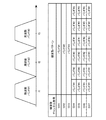
- the radio units 12a to 12e have a plurality of frequency channels by combining a hopping technique with a plurality of frequency bands, as shown in FIG. Wireless communication is performed by selecting one of them.
- a plurality of frequency bands (frequency bands # 1, # 2, and # 3) are allocated to one frequency channel in a time division manner, and CH4 repeatedly transmits and receives data therein. The following will be selected and transmitted / received.
- each of the radio units 12a to 12e has a "notification signal that synchronizes timing with a frame of a fixed period and informs other radio units of status management information of the radio unit during a predetermined period of the head portion of the frame.
- a radio transmission / reception unit that assigns and transmits control signals for controlling the respective radios, and selects one of frequency channels capable of radio communication, and transmits and receives radio signals in a time division manner using the selected frequency channel.
- UWB Ultra Wide Band
- a wireless system used here for example, a wireless LAN and an MB-OFDM (Multi Band-Orthogonal Frequency Division Multiplex) UWB (Ultra Wide Band) are assumed.
- UWB is ultra-wideband wireless communication that uses a bandwidth of 500 MHz or more, and is known for its low power consumption, resistance to interference waves, and high-speed communication in a short distance within a radius of 10 m.
- the ultrasonic sensors 13a to 13e are used here.
- the ultrasonic sensors 13a to 13e detect adjacent vehicles by transmitting ultrasonic waves to the outside of the passenger compartment using a transmitter, receiving reflected waves with a receiver, and measuring the distance.
- an in-vehicle camera or a radar may be substituted.
- the in-vehicle camera detects the adjacent vehicle by image recognition
- the radar detects the adjacent vehicle by measuring the reflected wave, like the ultrasonic sensor.
- the in-vehicle information devices 14a to 14e are devices that provide user applications such as a car navigation system, a DVD (Digital Versatile Disc) player, a television receiver, and a display monitor.
- a car navigation system such as a car navigation system, a DVD (Digital Versatile Disc) player, a television receiver, and a display monitor.
- DVD Digital Versatile Disc
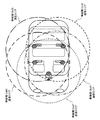
- FIG. 4 shows an example of the communicable area in the passenger compartment of the wireless devices 12a to 12e.
- the communicable area of each of the radio devices 12a to 12e includes each other's radio devices 12a to 12e, but is related to the communication between the radio devices 12a to 12e. It has also spread to other areas. In particular, the spread to the outside of the vehicle is regarded as radio wave leakage and is not preferable.
- the in-vehicle wireless communication system according to Embodiment 1 of the present invention aims to improve performance by suppressing communication quality deterioration due to radio wave interference. Details will be described below.
- the wireless device 12 a includes a network management unit 120, a wireless transmission / reception control unit 121, a radio wave interference determination unit 122, an RSSI measurement unit 123, a storage unit 124, and a transmission output control unit 125. And a frequency channel change control unit 126.
- the network management unit 120 manages the state management information of each of the wireless devices 12a to 12e based on the notification signal assigned to the head portion of the wireless communication frame, and based on this state management information, the wireless transmission / reception control unit 121, radio wave interference determination
- the unit 122 and the like are controlled, and here, in particular, a radio communication mode and a radio wave interference detection mode to be described later are controlled.
- the “wireless communication mode” means that, as described above, timing synchronization is performed with a frame of a fixed period, and the state management information of the wireless device 12a is transmitted to the other wireless devices 12b to 12b during a predetermined period at the head portion of the frame.
- the notification signal to be notified to 12d and the control signal for controlling each of the wireless devices 12a to 12d are allocated and transmitted and received, and one of the frequency channels capable of wireless communication is selected, and time division is performed according to the selected frequency channel.
- This mode is for transmitting and receiving wireless signals.
- the “radio wave interference detection mode” is a mode that is activated when another vehicle adjacent to the host vehicle 11 is detected and determines whether there is interference due to radio waves leaking from the adjacent vehicle 21.
- the received signal strength indication (RSSI) of radio waves leaking from the adjacent vehicle 21 is measured and stored in the storage unit 124.
- the presence / absence of radio wave interference is determined by comparison with the interference threshold.
- the operation mode of each of the wireless devices 12a to 12e the frequency channel used in the “wireless communication mode”, and the position information of the adjacent vehicle detected by the ultrasonic sensors 13a to 13e. Shall be included.
- the radio transmission / reception control unit 121 controls the “radio communication mode” described above, and the radio wave interference determination unit 122 executes and controls the “radio wave interference detection mode” described above.
- the radio wave interference determination unit 122 compares the received electric field strength (RSSI) of the radio wave leaking from the adjacent vehicle measured by the RSSI measurement unit 123 with the interference threshold value stored in the storage unit 124, and the result is transmitted and output.
- the data is output to the control unit 125 and the frequency channel change control unit 126.
- the transmission output control unit 125 reduces the transmission output of the radio unit 12a and performs radio transmission / reception within a range in which the quality of radio communication in the vehicle interior does not deteriorate.
- the data is output to the control unit 121.
- the frequency channel change control unit 126 scans another frequency channel that can be changed, and uses the notification signal to indicate the frequency channel that has been successfully scanned. 12b to 12e are notified to change the frequency channel in use.
- the storage unit 124 stores state management information of each of the wireless devices 12a to 12e acquired by communication (notification signal), an interference level threshold used for determining the presence / absence of radio wave interference, a list of frequency channels that can be changed, and the like. Stored.
- FIG. 7 is a flowchart showing the operation of the in-vehicle wireless communication system according to the first embodiment of the present invention. Here, the operation procedure after the start of the wireless communication mode in the host vehicle 11 is shown. .
- the operation of the in-vehicle wireless communication system according to the first embodiment of the present invention will be described in detail with reference to the flowchart of FIG.
- the radio units 12a to 12e are in the “radio communication mode” state (step ST701). Therefore, the radio units 12a to 12e are synchronized with the frame configuration shown in FIG.
- the state of the other wireless devices 12a to 12e constituting the wireless network can be known by mutually transmitting and receiving notification signals for informing state management information at the head portion of the frame.
- the wireless devices 12a to 12e are further in communication with the wireless devices 12a to 12e in accordance with the user application.
- the wireless devices 12a to 12e continue the “wireless communication mode” state (step S702). ST701).
- the radio units 12a to 12e proceed to radio unit selection processing (step ST703) for detecting radio wave interference. To do.
- the wireless devices 12a to 12e that detect radio wave interference are the closest to the adjacent vehicle among the wireless devices 12a to 12e that constitute the wireless network from the position information of the adjacent vehicle detected by any of the ultrasonic sensors 13a to 13e.
- One of the radio devices 12a to 12e located nearby is selected.
- the radios 12a to 12e selected here are in communication because the user application is operating, the radios 12a to 12e that are next closest to the adjacent vehicle are selected, and radios that detect radio wave interference are selected.
- the selection of the radio units 12a to 12e that detect the radio wave interference described above is performed by the radio units 12a to 12e in the radio network including the position information of the adjacent vehicle by the ultrasonic sensors 13a to 13e transmitted and received by the notification signal. This is performed from the state management information. That is, the network management unit 120 included in each of the wireless devices 12a to 12e acquires the state management information of each of the wireless devices 12a to 12e from the notification signal, and refers to the state management information so that the wireless device 12a to which it belongs. When it is determined that 12e is located closest to the adjacent vehicle and is not performing wireless communication, it operates autonomously as a wireless device that detects radio wave interference.
- the wireless device (in this case, 12a) selected by the above shifts to the “radio wave interference detection mode”.
- the wireless transmission / reception control unit 121 sets the reception state on the frequency channel used in the wireless network in the host vehicle 11, and the RSSI measurement unit 123 is received from other than the radio devices 12 a to 12 e in the host vehicle 11.
- the RSSI of the radio signal is measured and supplied to the radio wave interference determination unit 122.
- the radio wave interference determination unit 122 affects the RSSI (interference level E I ) obtained by measurement by the RSSI measurement unit 123 and the radio wave that affects the communication quality of the wireless network in the host vehicle 11 stored in the storage unit 124.
- the interference level threshold value E Ith is compared (step ST705).
- the transmission output control unit 125 does not deteriorate the communication quality of the wireless network in the vehicle. Transmission output control is performed in a direction that lowers the transmission output level of the wireless device 12a within a range, and interference caused by leakage of radio waves from the vehicle 11 is reduced (step ST706), and then the wireless communication mode within the vehicle 11 of step ST701 is returned to. .
- the radio wave interference determining unit 122 determines that the wireless network in the host vehicle 11 is deteriorated in communication quality due to radio wave interference, and the frequency The channel change control unit 126 is activated.
- the frequency channel change control unit 126 sequentially scans the changeable frequency channels stored in the storage unit 124, for example, listed in order of priority, and determines the frequency channels without radio wave interference in which the scan has succeeded (Step). ST707).
- the frequency channel change control unit 126 After determining the frequency channel of the change destination, the frequency channel change control unit 126 notifies the other radio units 12b to 12e of the change of the frequency channel and the change destination frequency channel by the notification signal via the radio transmission / reception control unit 121. (Step ST708) In addition, interference is avoided by simultaneously changing the frequency channel with respect to all the radio devices 12a to 12e in the host vehicle 11 according to the control signal (Step ST709).
- the selected wireless device 12a detects the adjacent vehicle when the adjacent vehicle detection means (ultrasonic sensors 13a to 13e) detects the adjacent vehicle 21.
- the adjacent vehicle detection means ultrasonic sensors 13a to 13e
- the radio wave interference determination unit scans other frequency channels that can be changed, and Operates as “frequency channel changing means” for changing the frequency channel being used by informing the other radio units 12b to 12e of the frequency channel that has succeeded by the notification signal.
- the ultrasonic sensors 13a to 13e that operate as “adjacent vehicle detection means” are linked to at least one of the plurality of radio units 12a to 12e, and the position information of the adjacent vehicle 21 is transmitted to other radios by a notification signal.
- the devices 12a to 12e are notified, and at the same time, radio wave interference determination and frequency channel change are instructed by a control signal.
- the adjacent vehicle detection means detects this, and radio wave interference
- the determination unit and the frequency channel changing unit can provide an in-vehicle wireless communication system in which performance is improved by suppressing deterioration in communication quality due to radio wave interference.
- FIG. FIG. 8 is a diagram showing a system configuration of an in-vehicle wireless communication system according to Embodiment 2 of the present invention.
- the difference from the first embodiment shown in FIG. 1 is that the detection information from the ultrasonic sensors 13a to 13e is one piece of information. That is, the radio equipment (here, the radio equipment 12a) is aggregated, and the adjacent vehicle detection information is notified from the radio equipment 12a to the other radio equipment 12b to 12e using the notification signal. Thereafter, a radio device (any one of 12a to 12e) that performs radio wave interference detection is selected, and the selected radio device (any one of 12a to 12e) is controlled and executed using the control signal. This is the same as in the first embodiment.
- the radio device 12b performs radio wave interference detection, notifies the radio devices 12a, 12c to 12e of the radio wave interference level and the frequency channel scan result using the notification signal, and the radio device 12b reports the result. Determination is made, and frequency channel change control of each of the radio devices 12a to 12e in the host vehicle 11 is executed.
- the wireless device 12a is assigned as the master wireless device, the detection information of the adjacent vehicle is collected from one or more slave wireless devices (12b to 12e), and the other wireless devices are notified by the notification signal. Then, the slave radio device that performs radio wave interference determination is selected, and the selected slave radio device is instructed to determine the presence or absence of radio wave interference by a control signal. As described above, the detection information from the ultrasonic sensors 13a to 13e is collected in one radio 12a, and the adjacent vehicle detection information is notified to the other radios 12b to 12e using the notification signal from the radio 12a.
- the control is simplified and the effect of reducing communication traffic can be obtained as compared with the first embodiment that is notified from the wireless devices 12a to 12e to which the ultrasonic sensors 13a to 13e are connected.
- the adjacent vehicle detection means detects this, and the radio wave interference determination means and the frequency channel change means.
- FIG. 9 is a diagram showing a system configuration of an in-vehicle wireless communication system according to Embodiment 3 of the present invention.
- the difference from the first and second embodiments is that the ultrasonic sensors 13a to 13e as the adjacent vehicle detecting means are used for communication.
- the wireless devices 31a to 31e are provided. That is, since the adjacent vehicle detection information is also transmitted between the radios (12a-31a, 12b-31b,... 12e-31e), no wiring is required, so that the vehicle mounting space can be made compact.
- the position information of the adjacent vehicle is notified by a notification signal, and radio wave interference detection and frequency channel change control are the same as in the first and second embodiments.
- the vehicle mounting space can be made compact.
- the adjacent vehicle detection means detects this, and the radio wave interference determination means and the frequency channel change means.
- the present invention is not limited to the in-vehicle use described in the first to third embodiments, but is a home wireless communication system using ultra-wideband radio, such as an AV (Audio Visual) network or a PC (Personal Computer) network.
- ultra-wideband radio such as an AV (Audio Visual) network or a PC (Personal Computer) network.
- AV Audio Visual
- PC Personal Computer
- the functions of the constituent blocks included in the radio units 12a to 12e of the in-vehicle radio communication system according to the first to third embodiments of the present invention described above may be realized entirely by hardware, or at least a part thereof. It may be realized by software.
- timing synchronization is performed with a frame of a fixed period, and a notification signal for notifying other radio units of radio state management information and a control signal for controlling each radio unit during a predetermined period at the beginning of the frame.
- the assigned vehicle transmits and receives, selects one of the frequency channels that can be wirelessly communicated, and transmits and receives wireless signals in a time-sharing manner using the selected frequency channel, when the adjacent vehicle detection means detects an adjacent vehicle
- the radio wave interference judgment means or radio wave interference judgment means that is activated and judges whether there is interference due to radio waves leaking from adjacent vehicles, it scans other frequency channels that can be changed, and the scan is successful
- the frequency channel changing means for informing the other radios of the changed frequency channel by a notification signal and changing the frequency channel in use. That data processing may be implemented in hardware, also the at least a portion thereof, may be realized on a computer by one or more programs.
- the in-vehicle wireless communication system improves performance by suppressing communication quality deterioration due to radio wave interference even when a vehicle equipped with the in-vehicle wireless communication system using the same wireless communication system is adjacent.
- an in-vehicle wireless communication system in which a plurality of wireless devices for transmitting and receiving wireless signals are arranged in a vehicle interior to constitute a wireless network, timing synchronization is performed with a wireless communication frame of a fixed period, and a predetermined part of the head portion of the frame is determined During this period, a notification signal for notifying other wireless devices of the state management information of the wireless device and a control signal for controlling each wireless device are allocated and transmitted and received, and one of the frequency channels capable of wireless communication is transmitted.
- a radio transmission / reception means for transmitting and receiving a radio signal in a time-sharing manner by the selected frequency channel, and an adjacent for detecting another vehicle adjacent to the own vehicle
- Both detection means a radio wave interference determination means that is activated when the adjacent vehicle detection means detects the adjacent another vehicle, and determines whether there is interference due to radio waves leaking from the separate vehicle, and the radio wave interference determination means
- the channel changing means is provided, it is suitable for use in an in-vehicle wireless communication system.
Landscapes
- Engineering & Computer Science (AREA)
- Computer Networks & Wireless Communication (AREA)
- Signal Processing (AREA)
- Mobile Radio Communication Systems (AREA)
- Traffic Control Systems (AREA)
- Navigation (AREA)
Abstract
Priority Applications (4)
| Application Number | Priority Date | Filing Date | Title |
|---|---|---|---|
| CN200980117584.8A CN102100117B (zh) | 2008-06-06 | 2009-04-16 | 车载无线通信系统 |
| DE112009001036T DE112009001036B4 (de) | 2008-06-06 | 2009-04-16 | Bord-Funkkommunikationssystem |
| JP2010515736A JP5025794B2 (ja) | 2008-06-06 | 2009-04-16 | 車載無線通信システム |
| US12/934,939 US8630589B2 (en) | 2008-06-06 | 2009-04-16 | Onboard radio communication system |
Applications Claiming Priority (2)
| Application Number | Priority Date | Filing Date | Title |
|---|---|---|---|
| JP2008149230 | 2008-06-06 | ||
| JP2008-149230 | 2008-06-06 |
Publications (1)
| Publication Number | Publication Date |
|---|---|
| WO2009147777A1 true WO2009147777A1 (fr) | 2009-12-10 |
Family
ID=41397865
Family Applications (1)
| Application Number | Title | Priority Date | Filing Date |
|---|---|---|---|
| PCT/JP2009/001760 Ceased WO2009147777A1 (fr) | 2008-06-06 | 2009-04-16 | Système de communication sans fil fixé à un véhicule |
Country Status (5)
| Country | Link |
|---|---|
| US (1) | US8630589B2 (fr) |
| JP (1) | JP5025794B2 (fr) |
| CN (1) | CN102100117B (fr) |
| DE (1) | DE112009001036B4 (fr) |
| WO (1) | WO2009147777A1 (fr) |
Cited By (10)
| Publication number | Priority date | Publication date | Assignee | Title |
|---|---|---|---|---|
| JP2011142562A (ja) * | 2010-01-08 | 2011-07-21 | Mitsubishi Electric Corp | 無線通信装置および干渉予測方法 |
| JP2012114715A (ja) * | 2010-11-25 | 2012-06-14 | Mitsubishi Electric Corp | 無線通信装置および干渉検出方法 |
| JP2012191415A (ja) * | 2011-03-10 | 2012-10-04 | Resonant Systems Inc | 輸送機械のデジタル無線マイクロフォンシステム |
| JP5627775B2 (ja) * | 2011-06-10 | 2014-11-19 | 三菱電機株式会社 | 無線通信装置 |
| KR101463142B1 (ko) * | 2013-02-15 | 2014-12-04 | 우리로광통신주식회사 | 차량 레이더 및 그 운영 방법 |
| JP2017143940A (ja) * | 2016-02-16 | 2017-08-24 | コニカミノルタ株式会社 | 放射線画像撮影システム |
| JP2019009725A (ja) * | 2017-06-28 | 2019-01-17 | 矢崎総業株式会社 | 車両用無線通信システム |
| US10491312B1 (en) | 2018-09-05 | 2019-11-26 | Toyota Jidosha Kabushiki Kaisha | Simultaneous reception of vehicle-to-everything (V2X) messages over multiple channels in multi-channel V2X networks |
| US20210227441A1 (en) * | 2020-01-20 | 2021-07-22 | Panasonic Intellectual Property Management Co., Ltd. | Communication apparatus and communication system for communication in a situation where broadcast is received |
| WO2021229920A1 (fr) * | 2020-05-14 | 2021-11-18 | 株式会社デンソー | Système d'estimation de position, procédé d'estimation de position et dispositif de communication de véhicule |
Families Citing this family (19)
| Publication number | Priority date | Publication date | Assignee | Title |
|---|---|---|---|---|
| DE102011105051A1 (de) * | 2011-06-20 | 2012-12-20 | Volkswagen Ag | Ultraschallsensorvorrichtung für ein Fahrzeug sowie Anordnung mit einer derartigen Ultraschallsensorvorrichtung |
| JP5906413B2 (ja) * | 2012-03-06 | 2016-04-20 | パナソニックIpマネジメント株式会社 | 無線通信システム、通信端末装置および可搬型端末装置 |
| EP2688351B1 (fr) * | 2012-07-20 | 2018-10-24 | Mitsubishi Electric R&D Centre Europe B.V. | Procédé et dispositif d'allocation de ressources pour communication de liaison descendante sur un canal sélectif en fréquence |
| JP5803983B2 (ja) | 2013-06-07 | 2015-11-04 | 株式会社デンソー | 通信装置 |
| EP3062551B1 (fr) * | 2015-02-27 | 2019-03-27 | Mitsubishi Electric R&D Centre Europe B.V. | Procédé d'estimation d'interférence susceptible d'être rencontrée avec des communications de liaison descendante vers un dispositif de communication dans un dispositif de transport mobile |
| CN106199523B (zh) * | 2015-05-27 | 2020-08-28 | 松下知识产权经营株式会社 | 雷达装置及干扰防止方法 |
| CN105704648B (zh) * | 2016-01-11 | 2019-05-21 | 深圳职业技术学院 | 基于蓝牙信标的车载定向沟通方法、系统及蓝牙信标设备 |
| JP6597436B2 (ja) * | 2016-03-23 | 2019-10-30 | トヨタ自動車株式会社 | スマートキーシステム |
| CN105954754A (zh) * | 2016-04-11 | 2016-09-21 | 张雪莱 | 一种抗干扰泊车雷达装置 |
| US10625156B2 (en) * | 2016-06-30 | 2020-04-21 | Sony Interactive Entertainment LLC | Method and system for sharing video game content |
| CN107644520A (zh) * | 2016-07-22 | 2018-01-30 | 重庆无线绿洲通信技术有限公司 | 一种车载分布式电池管理方法及系统 |
| EP3633885B1 (fr) * | 2017-05-30 | 2022-08-03 | JVCKenwood Corporation | Appareil sans fil |
| KR102483329B1 (ko) * | 2018-06-27 | 2023-01-02 | 삼성전자주식회사 | 무선 통신 시스템에서 액세스 포인트에 접속하는 방법 및 단말 |
| JP2020025199A (ja) * | 2018-08-07 | 2020-02-13 | パナソニックIpマネジメント株式会社 | 管理サーバ及び管理方法 |
| JP7123818B2 (ja) * | 2019-01-25 | 2022-08-23 | 日立Astemo株式会社 | 無線通信装置、通信制御方法及び無線通信システム |
| JP7321033B2 (ja) * | 2019-08-23 | 2023-08-04 | 日立Astemo株式会社 | 無線通信システム、及び無線通信機 |
| US11910283B2 (en) * | 2020-01-17 | 2024-02-20 | Qualcomm Incorporated | Wireless in-vehicle networking enhanced interference detection via external sensors |
| CN111693834A (zh) * | 2020-06-18 | 2020-09-22 | 国网福建省电力有限公司福州供电公司 | 一种轻量化搭载式局放检测装置及检测方法 |
| EP3962217B1 (fr) * | 2020-08-24 | 2024-06-12 | Bayerische Motoren Werke Aktiengesellschaft | Appareil, procédé, programme informatique, système d'accès et unité de tête pour un véhicule |
Citations (4)
| Publication number | Priority date | Publication date | Assignee | Title |
|---|---|---|---|---|
| JP2002027040A (ja) * | 2000-07-13 | 2002-01-25 | Toyota Motor Corp | 携帯端末装置 |
| JP2002230696A (ja) * | 2001-02-06 | 2002-08-16 | Hitachi Ltd | 車両走行情報管理方法、車両走行情報管理システム、車載情報端末装置、及び、コンピュータ読み取り可能な記録媒体 |
| JP2006033264A (ja) * | 2004-07-14 | 2006-02-02 | Denso Corp | 車々間通信制御システム、車載通信システムおよび通信状態表示装置 |
| JP2007243765A (ja) * | 2006-03-10 | 2007-09-20 | Matsushita Electric Ind Co Ltd | 車載通信装置 |
Family Cites Families (15)
| Publication number | Priority date | Publication date | Assignee | Title |
|---|---|---|---|---|
| US5285443A (en) * | 1992-08-25 | 1994-02-08 | Motorola, Inc. | Method and apparatus for synchronizing a time division duplexing communication system |
| JP3427971B2 (ja) * | 1998-08-24 | 2003-07-22 | ソニー株式会社 | 通信制御方法 |
| JP2000309288A (ja) | 1999-02-26 | 2000-11-07 | Tuner Kk | 車載用画像記録システムにおける蓄画作動装置 |
| JP2000339029A (ja) * | 1999-05-31 | 2000-12-08 | Komatsu Ltd | 車両の干渉防止装置 |
| DE60239170D1 (de) * | 2001-10-25 | 2011-03-24 | Asahi Kasei Pharma Corp | Bicyclische Verbindungen |
| JP3607247B2 (ja) | 2001-12-19 | 2005-01-05 | 株式会社デンソー | 車載通信装置 |
| JP2003224509A (ja) | 2002-01-30 | 2003-08-08 | Denso Corp | 車両用近距離無線通信装置 |
| JP4089369B2 (ja) | 2002-09-24 | 2008-05-28 | 株式会社デンソー | 車載無線端末 |
| EP1745605A1 (fr) * | 2004-05-04 | 2007-01-24 | Philips Intellectual Property & Standards GmbH | Systeme de communication, procede de communication entre des vehicules et vehicule comprenant ce systeme de communication |
| US7499675B2 (en) * | 2005-11-07 | 2009-03-03 | Denso Corporation | Vehicle-to-vehicle communication system |
| US7635855B2 (en) * | 2005-11-15 | 2009-12-22 | Macronix International Co., Ltd. | I-shaped phase change memory cell |
| US8126389B2 (en) * | 2007-04-27 | 2012-02-28 | D3T, Llc | Apparatus and method for interfering with wireless communications devices in response to transmission power detection |
| US7933547B2 (en) * | 2007-04-27 | 2011-04-26 | D3T, Llc | Apparatus and method for interfering with wireless communications devices positioned in a volume occupied by a human driver |
| RU2511526C9 (ru) * | 2007-12-11 | 2014-08-10 | Континенталь Тевес Аг Унд Ко. Охг | Коммуникационное устройство для автомобиля для беспроводной передачи релевантных для автомобиля данных на другой автомобиль или инфраструктуру, система помощи водителю и автомобиль, включающие указанное коммуникационное устройство и способ передачи релевантных для автомобиля данных на другой автомобиль или инфраструктуру |
| US9065574B2 (en) * | 2008-04-30 | 2015-06-23 | Intel Mobile Communications GmbH | Frequency tracking for a FMR transmitter |
-
2009
- 2009-04-16 WO PCT/JP2009/001760 patent/WO2009147777A1/fr not_active Ceased
- 2009-04-16 DE DE112009001036T patent/DE112009001036B4/de not_active Expired - Fee Related
- 2009-04-16 US US12/934,939 patent/US8630589B2/en not_active Expired - Fee Related
- 2009-04-16 CN CN200980117584.8A patent/CN102100117B/zh not_active Expired - Fee Related
- 2009-04-16 JP JP2010515736A patent/JP5025794B2/ja not_active Expired - Fee Related
Patent Citations (4)
| Publication number | Priority date | Publication date | Assignee | Title |
|---|---|---|---|---|
| JP2002027040A (ja) * | 2000-07-13 | 2002-01-25 | Toyota Motor Corp | 携帯端末装置 |
| JP2002230696A (ja) * | 2001-02-06 | 2002-08-16 | Hitachi Ltd | 車両走行情報管理方法、車両走行情報管理システム、車載情報端末装置、及び、コンピュータ読み取り可能な記録媒体 |
| JP2006033264A (ja) * | 2004-07-14 | 2006-02-02 | Denso Corp | 車々間通信制御システム、車載通信システムおよび通信状態表示装置 |
| JP2007243765A (ja) * | 2006-03-10 | 2007-09-20 | Matsushita Electric Ind Co Ltd | 車載通信装置 |
Cited By (11)
| Publication number | Priority date | Publication date | Assignee | Title |
|---|---|---|---|---|
| JP2011142562A (ja) * | 2010-01-08 | 2011-07-21 | Mitsubishi Electric Corp | 無線通信装置および干渉予測方法 |
| JP2012114715A (ja) * | 2010-11-25 | 2012-06-14 | Mitsubishi Electric Corp | 無線通信装置および干渉検出方法 |
| JP2012191415A (ja) * | 2011-03-10 | 2012-10-04 | Resonant Systems Inc | 輸送機械のデジタル無線マイクロフォンシステム |
| JP5627775B2 (ja) * | 2011-06-10 | 2014-11-19 | 三菱電機株式会社 | 無線通信装置 |
| KR101463142B1 (ko) * | 2013-02-15 | 2014-12-04 | 우리로광통신주식회사 | 차량 레이더 및 그 운영 방법 |
| JP2017143940A (ja) * | 2016-02-16 | 2017-08-24 | コニカミノルタ株式会社 | 放射線画像撮影システム |
| JP2019009725A (ja) * | 2017-06-28 | 2019-01-17 | 矢崎総業株式会社 | 車両用無線通信システム |
| US10491312B1 (en) | 2018-09-05 | 2019-11-26 | Toyota Jidosha Kabushiki Kaisha | Simultaneous reception of vehicle-to-everything (V2X) messages over multiple channels in multi-channel V2X networks |
| US20210227441A1 (en) * | 2020-01-20 | 2021-07-22 | Panasonic Intellectual Property Management Co., Ltd. | Communication apparatus and communication system for communication in a situation where broadcast is received |
| US11510126B2 (en) * | 2020-01-20 | 2022-11-22 | Panasonic Intellectual Property Management Co., Ltd. | Communication apparatus and communication system for communication in a situation where broadcast is received |
| WO2021229920A1 (fr) * | 2020-05-14 | 2021-11-18 | 株式会社デンソー | Système d'estimation de position, procédé d'estimation de position et dispositif de communication de véhicule |
Also Published As
| Publication number | Publication date |
|---|---|
| US20110028163A1 (en) | 2011-02-03 |
| CN102100117B (zh) | 2014-08-13 |
| JP5025794B2 (ja) | 2012-09-12 |
| DE112009001036B4 (de) | 2013-12-24 |
| US8630589B2 (en) | 2014-01-14 |
| JPWO2009147777A1 (ja) | 2011-10-20 |
| CN102100117A (zh) | 2011-06-15 |
| DE112009001036T5 (de) | 2011-04-14 |
Similar Documents
| Publication | Publication Date | Title |
|---|---|---|
| JP5025794B2 (ja) | 車載無線通信システム | |
| US7299042B2 (en) | Common signaling method and apparatus | |
| AU2010239888B2 (en) | Apparatus and method for operating piconets in body area networks | |
| JP5268777B2 (ja) | 送受信装置 | |
| JP5769882B2 (ja) | 無線通信装置 | |
| US10846961B2 (en) | RF communication for secure access | |
| WO2009055304A1 (fr) | Balayage de point d'accès à contexte guidé par localisation pour un réseau local sans fil | |
| JP2007166488A (ja) | 無線通信システム、無線チャネル監視装置および無線通信方法 | |
| KR101160729B1 (ko) | 무선 송신을 통한 방송 방법, 무선 방송 제어 방법, 컴퓨터 판독가능 매체, 전자 장치, 방송 수단 및 방송 제어 수단 | |
| US20240340128A1 (en) | Method of a Control Unit for Transmission/Reception of Sensing Configuration Information for a Wireless Device, a Computer Program Product, Control Units and a Wireless Device | |
| CN101511112A (zh) | 一种适用于地铁掉头的信道切换方法及车载无线接入点 | |
| JP2010166468A (ja) | 車載通信装置 | |
| KR20070054969A (ko) | 빔포밍을 적용한 통신 시스템에서 데이터 전송 방법 및장치 | |
| US10820261B1 (en) | Multi-channel RF system with off-channel scanning | |
| KR20160085087A (ko) | 무선 통신 장치 및 방법 | |
| KR101826361B1 (ko) | 접속 인지 신호를 이용하는 유휴 대역 활용 시스템 | |
| US7818011B2 (en) | Method and apparatus for channel selection | |
| KR101040170B1 (ko) | 복수의 무선 송수신기의 자동 선택기 및 이를 이용하여 복수의 무선송수신기를 선택적으로 동작시키는 방법 | |
| TWI760229B (zh) | 無線通訊系統、方法及其相關發送裝置 | |
| JYOTHY et al. | UNLOCKING THE POTENTIAL: ULTRA-WIDEBAND. | |
| Rzayev et al. | Implementation of a vehicular networking architecture supporting dynamic spectrum access | |
| Somov et al. | Consist-to-Consist communications in the trains: Is it time to use ultra wide-band? | |
| JP2021190754A (ja) | 無線通信装置、および、無線通信システム | |
| WO2023233644A1 (fr) | Dispositif de communication sans fil, procédé de détermination et programme de détermination | |
| EP4713712A1 (fr) | Système et procédé de coordination d'interférences pour radar automobile |
Legal Events
| Date | Code | Title | Description |
|---|---|---|---|
| WWE | Wipo information: entry into national phase |
Ref document number: 200980117584.8 Country of ref document: CN |
|
| 121 | Ep: the epo has been informed by wipo that ep was designated in this application |
Ref document number: 09758044 Country of ref document: EP Kind code of ref document: A1 |
|
| ENP | Entry into the national phase |
Ref document number: 2010515736 Country of ref document: JP Kind code of ref document: A |
|
| WWE | Wipo information: entry into national phase |
Ref document number: 12934939 Country of ref document: US |
|
| RET | De translation (de og part 6b) |
Ref document number: 112009001036 Country of ref document: DE Date of ref document: 20110414 Kind code of ref document: P |
|
| 122 | Ep: pct application non-entry in european phase |
Ref document number: 09758044 Country of ref document: EP Kind code of ref document: A1 |