WO2009149858A1 - Neue heteroaromatische amide und thioamide als schädlingsbekämpfungsmittel - Google Patents

Neue heteroaromatische amide und thioamide als schädlingsbekämpfungsmittel Download PDF

Info

Publication number
WO2009149858A1
WO2009149858A1 PCT/EP2009/003984 EP2009003984W WO2009149858A1 WO 2009149858 A1 WO2009149858 A1 WO 2009149858A1 EP 2009003984 W EP2009003984 W EP 2009003984W WO 2009149858 A1 WO2009149858 A1 WO 2009149858A1
Authority
WO
WIPO (PCT)
Prior art keywords
spp
alkyl
halogen
substituted
optionally
Prior art date
Legal status (The legal status is an assumption and is not a legal conclusion. Google has not performed a legal analysis and makes no representation as to the accuracy of the status listed.)
Ceased
Application number
PCT/EP2009/003984
Other languages
English (en)
French (fr)
Other versions
WO2009149858A8 (de
Inventor
Thomas Bretschneider
Eva-Maria Franken
Ulrich Görgens
Martin FÜSSLEIN
Achim Hense
Joachim Kluth
Current Assignee (The listed assignees may be inaccurate. Google has not performed a legal analysis and makes no representation or warranty as to the accuracy of the list.)
Bayer CropScience AG
Original Assignee
Bayer CropScience AG
Priority date (The priority date is an assumption and is not a legal conclusion. Google has not performed a legal analysis and makes no representation as to the accuracy of the date listed.)
Filing date
Publication date
Priority to US12/997,803 priority Critical patent/US9428487B2/en
Priority to JP2011512872A priority patent/JP5583661B2/ja
Priority to ES09761421.8T priority patent/ES2524045T3/es
Priority to BRPI0915350A priority patent/BRPI0915350A2/pt
Priority to CN2009801216890A priority patent/CN102056916A/zh
Priority to MX2010013705A priority patent/MX2010013705A/es
Application filed by Bayer CropScience AG filed Critical Bayer CropScience AG
Priority to EP09761421.8A priority patent/EP2297130B1/de
Publication of WO2009149858A1 publication Critical patent/WO2009149858A1/de
Publication of WO2009149858A8 publication Critical patent/WO2009149858A8/de
Anticipated expiration legal-status Critical
Priority to US15/208,060 priority patent/US20160316755A1/en
Ceased legal-status Critical Current

Links

Classifications

    • AHUMAN NECESSITIES
    • A01AGRICULTURE; FORESTRY; ANIMAL HUSBANDRY; HUNTING; TRAPPING; FISHING
    • A01NPRESERVATION OF BODIES OF HUMANS OR ANIMALS OR PLANTS OR PARTS THEREOF; BIOCIDES, e.g. AS DISINFECTANTS, AS PESTICIDES OR AS HERBICIDES; PEST REPELLANTS OR ATTRACTANTS; PLANT GROWTH REGULATORS
    • A01N43/00Biocides, pest repellants or attractants, or plant growth regulators containing heterocyclic compounds
    • A01N43/72Biocides, pest repellants or attractants, or plant growth regulators containing heterocyclic compounds having rings with nitrogen atoms and oxygen or sulfur atoms as ring hetero atoms
    • A01N43/74Biocides, pest repellants or attractants, or plant growth regulators containing heterocyclic compounds having rings with nitrogen atoms and oxygen or sulfur atoms as ring hetero atoms five-membered rings with one nitrogen atom and either one oxygen atom or one sulfur atom in positions 1,3
    • A01N43/781,3-Thiazoles; Hydrogenated 1,3-thiazoles
    • AHUMAN NECESSITIES
    • A01AGRICULTURE; FORESTRY; ANIMAL HUSBANDRY; HUNTING; TRAPPING; FISHING
    • A01NPRESERVATION OF BODIES OF HUMANS OR ANIMALS OR PLANTS OR PARTS THEREOF; BIOCIDES, e.g. AS DISINFECTANTS, AS PESTICIDES OR AS HERBICIDES; PEST REPELLANTS OR ATTRACTANTS; PLANT GROWTH REGULATORS
    • A01N43/00Biocides, pest repellants or attractants, or plant growth regulators containing heterocyclic compounds
    • A01N43/48Biocides, pest repellants or attractants, or plant growth regulators containing heterocyclic compounds having rings with two nitrogen atoms as the only ring hetero atoms
    • A01N43/541,3-Diazines; Hydrogenated 1,3-diazines
    • AHUMAN NECESSITIES
    • A01AGRICULTURE; FORESTRY; ANIMAL HUSBANDRY; HUNTING; TRAPPING; FISHING
    • A01NPRESERVATION OF BODIES OF HUMANS OR ANIMALS OR PLANTS OR PARTS THEREOF; BIOCIDES, e.g. AS DISINFECTANTS, AS PESTICIDES OR AS HERBICIDES; PEST REPELLANTS OR ATTRACTANTS; PLANT GROWTH REGULATORS
    • A01N43/00Biocides, pest repellants or attractants, or plant growth regulators containing heterocyclic compounds
    • A01N43/48Biocides, pest repellants or attractants, or plant growth regulators containing heterocyclic compounds having rings with two nitrogen atoms as the only ring hetero atoms
    • A01N43/561,2-Diazoles; Hydrogenated 1,2-diazoles
    • AHUMAN NECESSITIES
    • A01AGRICULTURE; FORESTRY; ANIMAL HUSBANDRY; HUNTING; TRAPPING; FISHING
    • A01NPRESERVATION OF BODIES OF HUMANS OR ANIMALS OR PLANTS OR PARTS THEREOF; BIOCIDES, e.g. AS DISINFECTANTS, AS PESTICIDES OR AS HERBICIDES; PEST REPELLANTS OR ATTRACTANTS; PLANT GROWTH REGULATORS
    • A01N43/00Biocides, pest repellants or attractants, or plant growth regulators containing heterocyclic compounds
    • A01N43/72Biocides, pest repellants or attractants, or plant growth regulators containing heterocyclic compounds having rings with nitrogen atoms and oxygen or sulfur atoms as ring hetero atoms
    • A01N43/80Biocides, pest repellants or attractants, or plant growth regulators containing heterocyclic compounds having rings with nitrogen atoms and oxygen or sulfur atoms as ring hetero atoms five-membered rings with one nitrogen atom and either one oxygen atom or one sulfur atom in positions 1,2
    • AHUMAN NECESSITIES
    • A01AGRICULTURE; FORESTRY; ANIMAL HUSBANDRY; HUNTING; TRAPPING; FISHING
    • A01NPRESERVATION OF BODIES OF HUMANS OR ANIMALS OR PLANTS OR PARTS THEREOF; BIOCIDES, e.g. AS DISINFECTANTS, AS PESTICIDES OR AS HERBICIDES; PEST REPELLANTS OR ATTRACTANTS; PLANT GROWTH REGULATORS
    • A01N43/00Biocides, pest repellants or attractants, or plant growth regulators containing heterocyclic compounds
    • A01N43/72Biocides, pest repellants or attractants, or plant growth regulators containing heterocyclic compounds having rings with nitrogen atoms and oxygen or sulfur atoms as ring hetero atoms
    • A01N43/82Biocides, pest repellants or attractants, or plant growth regulators containing heterocyclic compounds having rings with nitrogen atoms and oxygen or sulfur atoms as ring hetero atoms five-membered rings with three ring hetero atoms
    • AHUMAN NECESSITIES
    • A01AGRICULTURE; FORESTRY; ANIMAL HUSBANDRY; HUNTING; TRAPPING; FISHING
    • A01NPRESERVATION OF BODIES OF HUMANS OR ANIMALS OR PLANTS OR PARTS THEREOF; BIOCIDES, e.g. AS DISINFECTANTS, AS PESTICIDES OR AS HERBICIDES; PEST REPELLANTS OR ATTRACTANTS; PLANT GROWTH REGULATORS
    • A01N43/00Biocides, pest repellants or attractants, or plant growth regulators containing heterocyclic compounds
    • A01N43/72Biocides, pest repellants or attractants, or plant growth regulators containing heterocyclic compounds having rings with nitrogen atoms and oxygen or sulfur atoms as ring hetero atoms
    • A01N43/84Biocides, pest repellants or attractants, or plant growth regulators containing heterocyclic compounds having rings with nitrogen atoms and oxygen or sulfur atoms as ring hetero atoms six-membered rings with one nitrogen atom and either one oxygen atom or one sulfur atom in positions 1,4
    • AHUMAN NECESSITIES
    • A01AGRICULTURE; FORESTRY; ANIMAL HUSBANDRY; HUNTING; TRAPPING; FISHING
    • A01NPRESERVATION OF BODIES OF HUMANS OR ANIMALS OR PLANTS OR PARTS THEREOF; BIOCIDES, e.g. AS DISINFECTANTS, AS PESTICIDES OR AS HERBICIDES; PEST REPELLANTS OR ATTRACTANTS; PLANT GROWTH REGULATORS
    • A01N43/00Biocides, pest repellants or attractants, or plant growth regulators containing heterocyclic compounds
    • A01N43/72Biocides, pest repellants or attractants, or plant growth regulators containing heterocyclic compounds having rings with nitrogen atoms and oxygen or sulfur atoms as ring hetero atoms
    • A01N43/88Biocides, pest repellants or attractants, or plant growth regulators containing heterocyclic compounds having rings with nitrogen atoms and oxygen or sulfur atoms as ring hetero atoms six-membered rings with three ring hetero atoms
    • AHUMAN NECESSITIES
    • A01AGRICULTURE; FORESTRY; ANIMAL HUSBANDRY; HUNTING; TRAPPING; FISHING
    • A01NPRESERVATION OF BODIES OF HUMANS OR ANIMALS OR PLANTS OR PARTS THEREOF; BIOCIDES, e.g. AS DISINFECTANTS, AS PESTICIDES OR AS HERBICIDES; PEST REPELLANTS OR ATTRACTANTS; PLANT GROWTH REGULATORS
    • A01N47/00Biocides, pest repellants or attractants, or plant growth regulators containing organic compounds containing a carbon atom not being member of a ring and having no bond to a carbon or hydrogen atom, e.g. derivatives of carbonic acid
    • A01N47/08Biocides, pest repellants or attractants, or plant growth regulators containing organic compounds containing a carbon atom not being member of a ring and having no bond to a carbon or hydrogen atom, e.g. derivatives of carbonic acid the carbon atom having one or more single bonds to nitrogen atoms
    • A01N47/10Carbamic acid derivatives, i.e. containing the group —O—CO—N<; Thio analogues thereof
    • A01N47/12Carbamic acid derivatives, i.e. containing the group —O—CO—N<; Thio analogues thereof containing a —O—CO—N< group, or a thio analogue thereof, neither directly attached to a ring nor the nitrogen atom being a member of a heterocyclic ring
    • AHUMAN NECESSITIES
    • A01AGRICULTURE; FORESTRY; ANIMAL HUSBANDRY; HUNTING; TRAPPING; FISHING
    • A01NPRESERVATION OF BODIES OF HUMANS OR ANIMALS OR PLANTS OR PARTS THEREOF; BIOCIDES, e.g. AS DISINFECTANTS, AS PESTICIDES OR AS HERBICIDES; PEST REPELLANTS OR ATTRACTANTS; PLANT GROWTH REGULATORS
    • A01N47/00Biocides, pest repellants or attractants, or plant growth regulators containing organic compounds containing a carbon atom not being member of a ring and having no bond to a carbon or hydrogen atom, e.g. derivatives of carbonic acid
    • A01N47/08Biocides, pest repellants or attractants, or plant growth regulators containing organic compounds containing a carbon atom not being member of a ring and having no bond to a carbon or hydrogen atom, e.g. derivatives of carbonic acid the carbon atom having one or more single bonds to nitrogen atoms
    • A01N47/10Carbamic acid derivatives, i.e. containing the group —O—CO—N<; Thio analogues thereof
    • A01N47/24Carbamic acid derivatives, i.e. containing the group —O—CO—N<; Thio analogues thereof containing the groups, or; Thio analogues thereof
    • AHUMAN NECESSITIES
    • A61MEDICAL OR VETERINARY SCIENCE; HYGIENE
    • A61PSPECIFIC THERAPEUTIC ACTIVITY OF CHEMICAL COMPOUNDS OR MEDICINAL PREPARATIONS
    • A61P33/00Antiparasitic agents
    • AHUMAN NECESSITIES
    • A61MEDICAL OR VETERINARY SCIENCE; HYGIENE
    • A61PSPECIFIC THERAPEUTIC ACTIVITY OF CHEMICAL COMPOUNDS OR MEDICINAL PREPARATIONS
    • A61P33/00Antiparasitic agents
    • A61P33/10Anthelmintics
    • AHUMAN NECESSITIES
    • A61MEDICAL OR VETERINARY SCIENCE; HYGIENE
    • A61PSPECIFIC THERAPEUTIC ACTIVITY OF CHEMICAL COMPOUNDS OR MEDICINAL PREPARATIONS
    • A61P33/00Antiparasitic agents
    • A61P33/14Ectoparasiticides, e.g. scabicides
    • CCHEMISTRY; METALLURGY
    • C07ORGANIC CHEMISTRY
    • C07DHETEROCYCLIC COMPOUNDS
    • C07D401/00Heterocyclic compounds containing two or more hetero rings, having nitrogen atoms as the only ring hetero atoms, at least one ring being a six-membered ring with only one nitrogen atom
    • C07D401/02Heterocyclic compounds containing two or more hetero rings, having nitrogen atoms as the only ring hetero atoms, at least one ring being a six-membered ring with only one nitrogen atom containing two hetero rings
    • C07D401/04Heterocyclic compounds containing two or more hetero rings, having nitrogen atoms as the only ring hetero atoms, at least one ring being a six-membered ring with only one nitrogen atom containing two hetero rings directly linked by a ring-member-to-ring-member bond
    • CCHEMISTRY; METALLURGY
    • C07ORGANIC CHEMISTRY
    • C07DHETEROCYCLIC COMPOUNDS
    • C07D401/00Heterocyclic compounds containing two or more hetero rings, having nitrogen atoms as the only ring hetero atoms, at least one ring being a six-membered ring with only one nitrogen atom
    • C07D401/14Heterocyclic compounds containing two or more hetero rings, having nitrogen atoms as the only ring hetero atoms, at least one ring being a six-membered ring with only one nitrogen atom containing three or more hetero rings
    • CCHEMISTRY; METALLURGY
    • C07ORGANIC CHEMISTRY
    • C07DHETEROCYCLIC COMPOUNDS
    • C07D413/00Heterocyclic compounds containing two or more hetero rings, at least one ring having nitrogen and oxygen atoms as the only ring hetero atoms
    • C07D413/14Heterocyclic compounds containing two or more hetero rings, at least one ring having nitrogen and oxygen atoms as the only ring hetero atoms containing three or more hetero rings
    • CCHEMISTRY; METALLURGY
    • C07ORGANIC CHEMISTRY
    • C07DHETEROCYCLIC COMPOUNDS
    • C07D417/00Heterocyclic compounds containing two or more hetero rings, at least one ring having nitrogen and sulfur atoms as the only ring hetero atoms, not provided for by group C07D415/00
    • C07D417/02Heterocyclic compounds containing two or more hetero rings, at least one ring having nitrogen and sulfur atoms as the only ring hetero atoms, not provided for by group C07D415/00 containing two hetero rings
    • C07D417/04Heterocyclic compounds containing two or more hetero rings, at least one ring having nitrogen and sulfur atoms as the only ring hetero atoms, not provided for by group C07D415/00 containing two hetero rings directly linked by a ring-member-to-ring-member bond
    • CCHEMISTRY; METALLURGY
    • C07ORGANIC CHEMISTRY
    • C07DHETEROCYCLIC COMPOUNDS
    • C07D417/00Heterocyclic compounds containing two or more hetero rings, at least one ring having nitrogen and sulfur atoms as the only ring hetero atoms, not provided for by group C07D415/00
    • C07D417/14Heterocyclic compounds containing two or more hetero rings, at least one ring having nitrogen and sulfur atoms as the only ring hetero atoms, not provided for by group C07D415/00 containing three or more hetero rings

Definitions

  • the present application relates to novel amides and thioamides, to processes for their preparation and their use for combating animal pests, which include arthropods and in particular insects.
  • the object of the present invention was to provide compounds which broaden the spectrum of pesticides from various aspects.
  • G 1 is N or C-halogen
  • R 1 is hydrogen or alkyl
  • X is oxygen or sulfur
  • R 2 is a radical from the group consisting of hydrogen, alkyl, haloalkyl, alkoxy, haloalkoxy, alkenyl, alkoxyalkyl, optionally alkyl-substituted by halogen, alkoxycarbonyl optionally substituted by halogen and cycloalkylcarbonyl optionally substituted by halogen,
  • R 3 is a radical selected from the group consisting of hydrogen, alkyl, haloalkyl, cyanoalkyl, alkenyl, haloalkenyl, alkynyl, haloalkynyl, alkoxy, haloalkoxy, optionally halogen-substituted alkoxyalkyl, optionally halogen-substituted bis (alkoxy) alkyl, optionally halogen-substituted Alkylthioalkyl, alkylcarbonylalkyl optionally substituted by halogen, alkylsulfinylalkyl optionally substituted by halogen, alkylsulfonyalkyl optionally substituted by halogen, alkoxycarbonylalkyl optionally substituted by halogen, alkynyloxy, alkynyloxycarbonyl, optionally substituted cycloalkyl, optionally substituted cycloalkyl, optionally substituted cyclo
  • R 2 and R 3 together with the nitrogen atom to which they are attached form an optionally substituted ring optionally containing further heteroatoms,
  • G 1 is CH and
  • R 1 is hydrogen or alkyl
  • X is oxygen or sulfur
  • R 2 has the meanings given above and
  • R 3 has the meanings given above or
  • R 2 and R 3 together with the nitrogen atom to which they are attached form an optionally substituted ring optionally containing further heteroatoms or
  • G 1 is CH
  • R 1 is hydrogen or alkyl
  • R 2 has the meanings given above and
  • R 3 has the meanings given above or
  • R 2 and R 3 together with the nitrogen atom to which they are attached form an optionally substituted ring optionally containing further heteroatoms
  • G 1 is CH and
  • R 1 is hydrogen or alkyl
  • G 3 is C (O) NR 2 R 3 ,
  • R 2 is a radical from the group consisting of hydrogen, alkyl, haloalkyl, alkoxy, haloalkoxy, alkenyl, alkoxyalkyl, optionally alkyl-substituted by halogen, alkoxycarbonyl optionally substituted by halogen and cycloalkylcarbonyl optionally substituted by halogen,
  • R 3 is a radical from the group haloalkyl, cyanoalkyl, haloalkenyl, haloalkynyl, alkoxy, haloalkoxy, halogen-substituted alkoxyalkyl, optionally substituted by
  • Halogen-substituted bis (alkoxy) alkyl optionally substituted by halogen alkylthioalkyl, optionally substituted by halogen alkylcarbonylalkyl, optionally substituted by halogen alkylsulfinylalkyl, optionally substituted by halogen alkylsulfonylalkyl, optionally substituted by halogen alkoxycarbony- lalkyl, alkynyloxy, alkynyloxycarbonyl, by halogen, cyano , Alkyl, haloalkyl, alkoxy, haloalkoxy, alkoxycarbonyl, haloalkoxycarbonyl or hetaryl (which is optionally itself substituted by alkyl or halogen) substituted cycloalkyl, optionally substituted cycloalkylcarbonyl, optionally substituted cycloalkylalkyl, optionally substituted heterocyclyl, optionally substituted heterocycly
  • R 1 is hydrogen
  • R 2 is hydrogen or alkyl
  • R 3 is hydrogen or alkyl.
  • G 1 is N or C-halogen
  • X is oxygen or sulfur
  • R 2 is a radical from the group consisting of hydrogen, alkyl, haloalkyl, alkoxy, haloalkoxy, alkenyl, alkoxyalkyl, optionally alkyl-substituted by halogen, alkoxycarbonyl optionally substituted by halogen and cycloalkylcarbonyl optionally substituted by halogen,
  • R 3 is a radical selected from the group consisting of hydrogen, alkyl, haloalkyl, cyanoalkyl, alkenyl, haloalkenyl, alkynyl, haloalkynyl, alkoxy, haloalkoxy, optionally halogen-substituted alkoxyalkyl, optionally halogen-substituted bis (alkoxy) alkyl, optionally halogen-substituted Alkylthioalkyl, alkylcarbonylalkyl optionally halogen-substituted, alkylsulphinylalkyl optionally substituted by halogen, alkylsulphonyalkyl optionally substituted by halogen, alkoxycarbonylalkyl optionally substituted by halogen, alkynyloxy, alkynyloxycarbonyl, optionally by halogen, cyano, alkyl, haloalkyl, alkoxy, hal
  • Alkoxy or haloalkoxy-substituted arylalkyl if appropriate by halogen, cyano (also in the alkyl part), nitro, alkyl, haloalkyl, cycloalkyl, alkoxy, haloalkoxy, Alkylthio, haloalkylthio, alkylsulfinyl, alkylsulfonyl, haloalkylsulfinyl, haloalkylsulfinyl, amino, alkylamino, dialkylamino, alkylcarbonylamino, alkoxycarbonylamino, alkoxyalkyl, haloalkoxyalkyl, alkenyl, alkynyl, alkylcycloalkyl, alkylcarbonyl, alkoxycarbonyl or aminocarbonyl-substituted hetarylalkyl and NR 4 R 5 in which R 4 and R 5 independently of one another represent
  • R 2 and R 3 together with the nitrogen atom to which they are attached form an optionally substituted ring optionally containing further heteroatoms,
  • G 1 is CH and
  • R 1 is hydrogen or alkyl
  • X is oxygen or sulfur
  • R 2 has the meanings given above and
  • R 3 has the meanings given above or
  • R 2 and R 3 together with the nitrogen atom to which they are attached form an optionally substituted ring optionally containing further heteroatoms
  • G 1 is CH
  • R 1 is hydrogen or alkyl
  • R 2 has the meanings given above and
  • R 3 has the meanings given above or
  • R 2 and R 3 together with the nitrogen atom to which they are attached form an optionally substituted ring optionally containing further heteroatoms
  • G 1 is CH and G 'for stands,
  • R 1 is hydrogen or alkyl
  • R 2 is a radical from the group consisting of hydrogen, alkyl, haloalkyl, alkoxy, haloalkoxy, alkenyl, alkoxyalkyl, optionally alkyl-substituted by halogen, alkoxycarbonyl optionally substituted by halogen and cycloalkylcarbonyl optionally substituted by halogen,
  • R 3 is a radical from the group consisting of haloalkyl, cyanoalkyl, haloalkenyl, haloalkynyl, alkoxy, haloalkoxy, halogen-substituted alkoxyalkyl, optionally halogen-substituted bis (alkoxy) alkyl, optionally halogen-substituted alkylthioalkyl, optionally halogen-substituted alkylcarbonylalkyl if alkylsulfinylalkyl which is halogen-substituted, alkylsulfonylalkyl optionally substituted by halogen, alkoxycarbonylalkyl optionally substituted by halogen, alkynyloxy, alkynyloxycarbonyl, by halogen, cyano, alkyl, haloalkyl, alkoxy, haloalkoxy, alkoxycarbonyl, halo
  • R 1 is hydrogen
  • R> 2 is hydrogen or alkyl
  • R 3 is hydrogen or alkyl. and salts and N-oxides of the compounds of the formula (I).
  • G 1 and R 1 have the meanings mentioned above
  • R 2 and R 3 have the meanings mentioned above,
  • R 2 and R 3 have the meanings mentioned above,
  • R 2 and R 3 have the meanings mentioned above,
  • the compounds of the formula (I) obtainable by these processes can be converted by reaction with a sulfurization reagent into compounds of the formula (I) in which X is sulfur.
  • novel compounds of the formula (I) have pronounced biological properties and, above all, for controlling animal pests, in particular insects, arachnids and nematodes, which are used in agriculture, in forestry, in the protection of stored products and materials, and on the hygiene sector are suitable.
  • the compounds of the formula (I) may optionally be present as geometrical and / or as optically active isomers or corresponding isomer mixtures in different compositions.
  • the invention relates to both the pure isomers and the isomer mixtures.
  • the compounds according to the invention can also be present as metal complexes, as described for other amides, for example in DE 2221647.
  • R 1 is hydrogen or C 1 -C 0 -alkyl, in particular hydrogen or methyl.
  • R 2 is hydrogen, C r C 6 alkyl, QQ haloalkyl, C r C 4 alkoxy, QC 4 - haloalkoxy, C 2 -C 4 alkenyl, Ci-C4-alkoxy-Ci-C 4 alkyl optionally halogen-substituted Ci-C 4 -alkylcarbonyl, optionally halogen-substituted C r C 4 -
  • R 3 is hydrogen, C r C 6 alkyl, C r C 6 haloalkyl, cyano-C, -C 6 alkyl, C 2 -C 4 - alkenyl, C 2 -C 4 haloalkenyl, C 2 -C 4 alkynyl, C 2 -C 4 haloalkynyl, C r C 6 alkoxy, C, -
  • C ⁇ -haloalkoxy optionally substituted by halogen Ci-Q-alkoxy-Ci-C ⁇ -alkyl, optionally substituted by halogen bis (Ci-C 6 alkoxy) -Ci-C 6 alkyl, optionally substituted by halogen Ci-Ce-alkylthio -CrC ⁇ - alkyl, optionally substituted by halogen Ci-C 4 alkylcarbonyl-C r C 4 alkyl, optionally substituted by halogen C 1 -C 6 alkylsulf ⁇ nyl-Ci-C 6 alkyl, optionally substituted by halogen C 1 -C 6 -alkylsulfonyl-C 1 -C 6 -alkyl, optionally C 1 -C 6 -alkoxycarbonyl-C 1 -C 6 -alkyl substituted by halogen, C 2 -C 4 -alkynyloxy, C 2 -C 4 -alk
  • Ci-C 6 -alkoxycarbonyl Ci-C 6 -haloalkoxycarbonyl or hetaryl (which is optionally itself substituted by QC 6 alkyl or halogen) substituted C 3 -C 6 -cycloalkyl-Ci-C 6 -alkyl, optionally substituted by halo, cyano (also in the alkyl part), nitro, C r C 6 alkyl, C r C 6 haloalkyl, C 3 -C 6 cycloalkyl, C r C 6 alkoxy, QC 6 - haloalkoxy, C, - C 6 alkylthio, C r C 6 haloalkylthio, C r C 6 alkylsulfinyl, QC 6 -
  • Ci-C 6 haloalkylsulfonyl amino, C r C 6 alkylamino, di (C] to C 6 alkyl) amino, C r C 6 - alkylcarbonylamino, Ci-C 6 alkoxycarbonylamino, Ci-C 6 -alkoxy-C ] -C 6 -alkyl, C] -C 6 -haloalkoxyC r C 6 -alkyl, C 2 -C 6 -alkenyl, C 2 -C 6 -alkynyl, C r C 6 -alkyl-C 3 -C 6 cycloalkyl, C 3 -C 6 cycloalkyl-Ci-C 6 alkyl, Ci-Q-alkylcarbonyl, Ci-C 6 alkoxycarbonyl or amino carbonyl substituted hetaryl-Ci-C 6 alkyl, or NR 4 R 5 wherein R 4 and R 5 independently of one another represent a
  • R 2 and R 3 together with the nitrogen atom to which they are attached, form an optionally substituted by C 1 -C 6 -alkyl or C 1 -C 6 -alkyl and optionally one or two further heteroatoms from the series consisting of oxygen, nitrogen and sulfur-containing 3 to 7 membered ring.
  • R 1 is hydrogen or methyl.
  • R 2 is hydrogen, C r C 4 alkyl, C, -C 4 haloalkyl, C r C 4 alkoxy, C 2 -C 3 alkenyl, C, - C 2 alkoxy-Ci-C 2 alkyl C 1 -C 2 -alkylcarbonyl, C 1 -C 2 -alkoxycarbonyl or, if appropriate, by halogen-substituted cyclopropylcarbonyl, cyclopentylcarbonyl or
  • R 3 is hydrogen, C r C 4 alkyl, C r C 4 haloalkyl, cyano-C, -C 4 alkyl, C 2 -C 4 - alkenyl, C 2 -C 4 haloalkenyl, C 2 -C 4 alkynyl, C 2 -C 4 haloalkynyl, Ci-C4-alkoxy, Ci- C4-haloalkoxy, optionally halogen-substituted Ci-C 2 alkoxy-Ci-C4-alkyl, optionally halogen-substituted bis ( Ci-C 2 alkoxy) -C-C 4 -alkyl, optionally halogen-4 alkylthio-Ci-C4-substituted C alkyl, optionally substituted by halogen QQ-alkylcarbonyl-Ci-Q-alkyl, optionally substituted by halogen substituted C 4 alkylsulfinyl-C
  • Haloalkoxycarbonyl or pyridyl (which is itself optionally substituted by C] -C 4 alkyl or halo) substituted C 3 -C 6 cycloalkylcarbonyl, optionally substituted by halogen, cyano, Ci-C 4 alkyl, C r C 4 haloalkyl, C r C 4 alkoxy, Ci-C 4 - haloalkoxy, Ci-C 4 alkoxycarbonyl, Ci-C4-haloalkoxycarbonyl or pyridyl (WEL ches is itself substituted by C] -C 4 alkyl or halogen, optionally) substituted
  • C 3 -C 6 cycloalkyl-Ci-C4-alkyl optionally substituted by halogen, cyano (also in the alkyl part), nitro, C r C 4 alkyl, C r C 4 haloalkyl, C 3 -C 6 cycloalkyl, C r C 4 alkoxy, CpC 4 - haloalkoxy, C, -C 4 alkylthio, C r C 4 haloalkylthio, C, -C 4 alkylsulfinyl, C, -C 4 - Alkylsulfonyl, Ci-C4-haloalkylsulfinyl, Ci-C4-haloalkylsulfonyl, amino, C] -C 4 - alkylamino, di (Ci -C 4 alkyl) amino, Ci-C4-alkylcarbonylamino, Ci-C 4 -
  • Ci-C4-alkoxy-Ci-C4-alkyl Ci-C4-haloalkoxy-Ci-C 4 alkyl, C 2 - C 4 alkenyl, C 2 -C 4 alkynyl, Ci-C 4 alkyl-C 3 -C 6 cycloalkyl, C 3 -C 6 -CyClOaIlCyI-C 1 -C 4 alkyl, Ci-C4-alkylcarbonyl, C r C 4 -alkoxycarbonyl or aminocarbonyl substituted hetero- cyclyl-C] - C 4 alkyl, optionally substituted by halogen, cyano, QQ-alkyl, C 1 -C 4 haloalkyl, Ci-C 4 alkoxy or Ci-C 4 haloalkoxy-substituted aryl-C] -C 4 alkyl, optionally by halogen, cyano (also in
  • C r C 4 haloalkylsulfonyl amino, Ci-C 4 alkylamino, di (Ci-C 4 alkyl) amino, C r C 4 - alkylcarbonylamino, Ci-C 4 alkoxycarbonylamino, C] -C 4 alkoxy-C C 4 -C 4 alkyl, C 1 -C 4 haloalkoxyC r C 4 alkyl, C 2 -C 4 alkenyl, C 2 -C 4 alkynyl, C 1 -C 4 allylC 3 -C 6 -CyClOaI] CyI, C 3 -C 6 cycloalkyl-Ci-C4-alkyl, -C 4 alkylcarbonyl, C r C 4 -alkoxycarbonyl or amino carbonyl substituted hetaryl-C i -C 4 alkyl
  • R 2 and R 3 together with the nitrogen atom to which they are attached, form a radical optionally substituted by CpQ-alkyl or C 1 -C 4 -alkoxy and optionally containing one or two further heteroatoms from the series consisting of oxygen, nitrogen and sulfur 7-membered ring.
  • R 1 is hydrogen or methyl.
  • R 2 is hydrogen, methyl, ethyl, CH 2 CF 3 , CH 2 CF 2 CH 3 , CH 2 CHF 2 , CH 2 CF 2 CHF 2 , CH 2 CH 2 F, CH 2 -CHF-CH 3 , CH 2 CF 2 Br, CH 2 CFCl 2 , CH (CH 3 ) CH 2 F, CH 2 CCl 3 , CH 2 CClF 2 ,
  • CH 2 CH 2 CH 2 F CH 2 CH (CH 3 ) Cl, CHCF 3 CH (CH 3 ) 2 , CH (CF 3 ) 2 , CH 2 CH 2 Cl, CHCF 3 CH 2 CH 2 CH 3 or CH 2 CF 2 CF 3 , methoxy, ethoxy, vinyl, CH 2 OCH 3 , CH 2 OCH 2 CH 3 , methylcarbonyl, ethylcarbonyl, methoxycarbonyl, ethoxycarbonyl, cyclopropylcarbonyl or fluorocyclopropylcarbonyl.
  • R 3 is hydrogen, methyl, ethyl, CH 2 CF 3 , CH 2 CF 2 CH 3 , CH 2 CHF 2 , CH 2 CF 2 CHF 2 , CH 2 CH 2 F, CH 2 -CHF-CH 3 , CH 2 CF 2 Br, CH 2 CFCl 2 , CH (CH 3 ) CH 2 F, CH 2 CCl 3 , CH 2 CClF 2 , CH 2 CH 2 CH 2 F, CH 2 CH (CH 3 ) Cl, CHCF 3 CH (CH 3 ) 2 , CH (CF 3 ) 2 , CH 2 CH 2 Cl, CHCF 3 CH 2 CH 2 CH 3 , CH 2 CF 2 CF 3 , C (CH 3 ) 2 CN, C (CN) CH (CH 3 ) 2 , CH 2 CN, CH 2 CH 2 CN, vinyl, C (CH 3 ) 2 CCH, CH 2 CCCH 3 , methoxy , Ethoxy, CH 2 CH (CH 3 ) (OCH 3 ), CH 2 C (
  • R 2 and R 3 together with the nitrogen atom to which they are attached form an optionally substituted by Ci-C 4 -AllCyI or Ci-C 4 alkoxy and optionally one or two further heteroatoms from the series oxygen, nitrogen and Sulfur containing 3 to
  • R 2 and R 3 together are CH 2 CH 2 CH 2 or
  • R 1 is hydrogen or Ci-C ⁇ -alkyl and here again preferably hydrogen or methyl.
  • R 2 is hydrogen, C r C 6 alkyl, C r C 6 haloalkyl, C r C 4 alkoxy, C 1 -C 4 -
  • R 3 represents C, -C 6 haloalkyl, cyano-C r C 6 alkyl, C 2 -C 4 haloalkenyl, C 2 -C 4 - haloalkynyl, CpC 6 alkoxy, CpC 6 haloalkoxy, optionally substituted by halogen substituted C 1 -C 6 -alkoxyC r C 6 -alkyl, optionally halogen-substituted BiS (C 1 -C 6 -alkoxy) -C r C 6 -alkyl, optionally CpC 6 -alkylthio-Cp C 6 substituted by halogen alkyl, C 1 -C 4 -alkylcarbonyl-C 1 -C 4 -alkyl optionally substituted by halogen, optionally CpCe-alkylsulfmyl-CpQ-alkyl substituted by halogen, CpQ-alkylsulfon
  • Alkoxycarbonylamino CpC 6 alkoxy CpC 6 alkyl, CpC 6 haloalkoxy-CpC 6 alkyl, C 2 - C 6 alkenyl, C 2 -C 6 alkynyl, C 3 -C 6 -cycloalkyl-C r C 6 alkyl, C r C 6 alkyl-C 3 -C 6 cycloalkyl,
  • Haloalkylsulfonyl amino, Ci-C 6 -alkylamino, di (Ci-C 6 alkyl) amino, C 1 -C 6 - alkylcarbonylamino, Ci-C 6 alkoxycarbonylamino, Ci-C 6 alkoxy-C 6 alkyl , CpC 6 - haloalkoxy-CpC 6 -alkyl, C 2 -C 6 -alkenyl, C 2 -C 6 -alkynyl, C 3 -C 6 -cycloalkyl-C r C 6 -alkyl, C r C 6 -alkyl-C 3 -C 6 cycloalkyl, C r C 6 alkylcarbonyl, Ci-C 6 alkoxycarbonyl or amino carbonyl substituted hetaryl-dQ-alkyl.
  • R 1 is hydrogen or methyl.
  • R 2 represents hydrogen, Ci-C 4 alkyl, C r C 4 haloalkyl, C r C 4 alkoxy, C 2 -C 3 alkenyl, C, - C 2 -alkoxy-C pC 2 -alkyl, C ⁇ -Alkylcarbonyl, Ci-C 2 -alkoxycarbonyl or for each optionally substituted by halogen cyclopropylcarbonyl, cyclopentylcarbonyl or cyclohexylcarbonyl.
  • R 3 represents C, -C 4 haloalkyl, cyano-C r C 4 alkyl, C 2 -C 4 haloalkenyl, C 2 -C 4 - haloalkynyl, Ci-C 4 alkoxy, Ci-4 haloalkoxy C optionally alkyl substituted by halogen, Ci-C 2 alkoxy-Ci-C 4, optionally substituted by halogen to (C 1 - C 2 alkoxy) -C-C 4 -alkyl, optionally halogen-substituted Ci-C 4 - Alkylthio-C 1 -C 4 -alkyl, optionally C 1 -C 4 -alkylcarbonyl-C 1 -C 4 -alkyl substituted by halogen, C 1 -C 4 -alkylsulfinyl-C 1 -C 4 -alkyl optionally substituted by halogen, optionally substituted by halogen C 1 -
  • Ci-C4-alkylcarbonyl Ci-C 4 alkoxycarbonyl or aminocarbonyl substituted hetero- cyclyl-Ci-C 4 -alkyl, halogen, cyano, C r C 4 alkyl, Ci-C4 haloalkyl, Cj-C 4 - Alkoxy or Cj-C 4 haloalkoxy-substituted aryl-Cj-C 4 alkyl or optionally halogen, cyano (also in the alkyl moiety), nitro, Cj-C 4 alkyl, Ci-C 4 -haloalkyl, C 3 -C 6 -cycloalkyl, Cj-C 4 -alkoxy, Cj-C 4 -haloalkoxy, C r C 4 -alkylthio, Cj-C 4 -haloalkylthio,
  • R 1 is hydrogen or methyl.
  • R 2 is hydrogen, methyl, ethyl, CH 2 CF 3 , CH 2 CF 2 CH 3 , CH 2 CHF 2 , CH 2 CF 2 CHF 2 , CH 2 CH 2 F, CH 2 -CHF-CH 3 , CH 2 CF 2 Br, CH 2 CFCl 2 , CH (CH 3 ) CH 2 F, CH 2 CCl 3 , CH 2 CClF 2 , CH 2 CH 2 CH 2 F, CH 2 CH (CH 3 ) Cl, CHCF 3 CH (CH 3 ) 2 , CH (CF 3 ) 2 , CH 2 CH 2 Cl, CHCF 3 CH 2 CH 2 CH 3 or CH 2 CF 2 CF 3 , methoxy, ethoxy, vinyl, CH 2 OCH 3 , CH 2 OCH 2 CH 3 , Methylcarbonyl, ethylcarbonyl, methoxycarbonyl, ethoxycarbonyl, cyclopropylcarbonyl or fluorocyclopropylcarbonyl.
  • R 3 is CH 2 CF 3 , CH 2 CF 2 CH 3 , CH 2 CHF 2 , CH 2 CF 2 CHF 2 , CH 2 CH 2 F, CH 2 -CHF-CH 3 , CH 2 CF 2 Br, CH 2 CFCl 2 , CH (CH 3 ) CH 2 F, CH 2 CCl 3 , CH 2 CClF 2 , CH 2 CH 2 CH 2 F, CH 2 CH (CH 3 ) Cl, CHCF 3 CH (CH 3 ) 2 , CH ( CF 3 ) 2 , CH 2 CH 2 Cl, CHCF 3 CH 2 CH 2 CH 3 , CH 2 CF 2 CF 3 , C (CH 3 ) 2 CN, C (CN) CH (CH 3 ) 2 , CH 2 CN, CH 2 CH 2 CN, methoxy, ethoxy, CH 2 CH (CH 3 ) (OCH 3 ), CH 2 C (CHj) 2 (OCH 3 ), CH (CH 3 ) CH (OCH 3 ) 2 , CH 2 C (
  • Benzyl which is substituted by halogen, cyano, methyl, ethyl, methoxy or ethoxy, or pyrimidylmethyl substituted by halogen, cyano, methyl, methoxy or ethoxy as appropriate, (in particular pyrimid-2-ylmethyl, .alpha.-methylpyrimidylmethyl, 4-Bromo-pyrimid-2-yl-methyl, 2-methylpyrimid-4-ylmethyl, 4,6-dimethylpyrimidin-2-yl-methyl, 4-iodo-pyrimid-2-ylmethyl, 2-ethyl pyrimidin-6-ylmethyl, 5-chloropyrimid-2-ylmethyl, 5
  • R 2 is hydrogen or C r C 6 alkyl.
  • R 3 is hydrogen or C, -C 6 alkyl.
  • R 2 is hydrogen or C r C 4 alkyl.
  • R 3 is hydrogen or C r C 4 alkyl.
  • R 2 is hydrogen, methyl, ethyl, n-propyl or i-propyl.
  • R 3 is hydrogen, methyl, ethyl, n-propyl or i-propyl.
  • Halogen selected from the group fluorine, chlorine, bromine and iodine, preferably again from the series fluorine, chlorine and bromine,
  • Aryl also as part of a larger unit, such as, for example, arylalkyl selected from the group consisting of phenyl, naphthyl, anthryl, phenanthrenyl and in turn preferably represents phenyl,
  • Hetaryl (also as part of a larger moiety such as hetarylalkyl) selected from the series furyl, thienyl, pyrrolyl, pyrazolyl, imidazolyl, 1,2,3-triazolyl, 1,2,4-triazolyl, oxazolyl, isoxazolyl, thiazolyl, isothiazolyl , 1,2,3-oxadiazolyl, 1,2,4-oxadiazolyl, 1,3,4-oxadiazolyl, 1,2,5-oxadiazolyl, 1, 2,3-thiadiazolyl, 1, 2,4-thiadiazolyl, 1 , 3,4-thiadiazolyl, 1, 2,5-thiadiazolyl, pyridyl, pyrimidinyl, pyridazinyl, pyrazinyl, 1,2,3-triazinyl, 1,2,4-triazinyl, 1,3,5-triazinyl, benzofu -
  • Heterocyclyl (also as part of a larger unit such as heterocyclylalkyl) selected from the series 2-tetrahydrofuranyl, 3-tetrahydrofuranyl, 2-tetrahydrothienyl, 3-tetrahydrothienyl, 2-pyrrolidinyl, 3-pyrrolidinyl, 3-isoxazolidinyl, 4-isoxazolidinyl 5 isoxazolidinyl, 3-isothiazolidinyl, 4-isothiazolidinyl, 5-isothiazolidinyl, 3-pyrazolidinyl, 4-pyrazolidinyl, 5-pyrazolidinyl, 2-oxazolidinyl, 4-oxazolidinyl, 5-oxazolidinyl, 2-thiazolidinyl, 4-thiazolidinyl, 5-thiazolidinyl, 2-imidazolidinyl, 4-imidazolidinyl, 1, 2,4-oxadiazolidin-3-yl,
  • Halogen selected from the group fluorine, chlorine, bromine and iodine, preferably again from the series fluorine, chlorine and bromine,
  • Aryl also as part of a larger unit, such as, for example, arylalkyl selected from the group consisting of phenyl, naphthyl, anthryl, phenanthrenyl and in turn preferably represents phenyl,
  • Hetaryl also as part of a larger unit, such as, for example, hetarylalkyl selected from the series pyrimidyl, oxadiazolyl, oxazolyl, pyrazinyl, imidazolyl, thiazolyl and furanyl,
  • Heterocyclyl (also as part of a larger moiety such as heterocyclylalkyl) selected from the group consisting of 2-tetrahydrofuranyl, 3-tetrahydrofuranyl, 2-tetrahydrothienyl, 3-tetrahydrothienyl, 2-pyrrolidinyl, 3-pyrrolidinyl, 3-isoxazolidinyl, 4-isoxazolidinyl, 5 Isoxazolidinyl, 3-isothiazolidinyl, 4-isothiazolidinyl, 5-isothiazolidinyl, 3-pyrazolidinyl, 4-pyrazolidinyl, 5-pyrazolidinyl, 2-oxazolidinyl, 4-oxazolidinyl, 5-oxazolidinyl, 2-thiazolidinyl, 4-thiazolidinyl, 5- Thiazolidinyl, 2-imidazolidinyl, 4-imidazolidinyl, 1, 2,4-oxadiazoli
  • Halogen is fluorine, chlorine, bromine or iodine, in particular fluorine, chlorine or bromine.
  • Preferred, particularly preferred or very particularly preferred are compounds which in each case carry the substituents mentioned under preferred, particularly preferred or very particularly preferred.
  • Saturated or unsaturated hydrocarbon radicals such as alkyl or alkenyl
  • heteroatoms e.g. in alkoxy, as far as possible, in each case straight-chain or branched.
  • Optionally substituted radicals may be monosubstituted or polysubstituted, with multiple substituents the substituents may be the same or different.
  • Another highlighted group of compounds according to the invention are the compounds defined under (Ib)
  • Another highlighted group of compounds according to the invention are the compounds defined under (Ic)
  • R 3 is haloalkyl
  • R 3 is heterocyclylalkyl
  • R 3 is hetarylalkyl
  • X is oxygen
  • X is sulfur
  • the compounds of the formula (VIIa) required as starting materials, in which G has the abovementioned meaning, are known or obtainable by known methods, for example as described in Synthetic Communications 35, 5, 2005, 761.
  • Compounds of the formula (Va) in which R 1 is alkyl can be prepared using the standard methods given in Reaction Scheme 1, cf. DE 2221647. Reaction of a thioamide (VIIa) with the ester of formula (VIa) in the presence of a base such as triethylamine provides the thiazole (Va).
  • the compounds of formula (Va) in which R 1 is hydrogen can be prepared in analogy to the methods described in Helvetica Chimica Acta 1944, 1432-1436.
  • the chloroformyl ester used there can be prepared as described in Chemische Berichte, 1910, 3528-3533.
  • the sodium salt of the chloroformyl ester prepared analogously to the potassium salt described there is preferably used directly for the reaction with a thioamide of the formula (VIIa) without addition of a base, see Example 3.
  • the thiazole of formula (Va) can be prepared using the standard methods given in Reaction Scheme 1, cf. DE 2221647, first in the acid of the formula (FVa) and then in the acid chloride of the formula (Ha) are converted.
  • the compounds of the formula (I) can also be prepared directly from the acids of the formula (IVa) by reaction with amines of the formula (Iu) in the presence of coupling agents, for example EDC (1-ethyl-S-tS-dimethylaminopropylcarbodiimide hydrochloride), DCC (Dicyclohexylcarbodiimide) or BoPCl (bis (2-oxo-3-oxazolidinyl) phosphorous acid chloride).
  • EDC 1-ethyl-S-tS-dimethylaminopropylcarbodiimide hydrochloride
  • DCC Dicyclohexylcarbodiimide
  • BoPCl bis (2-oxo-3-oxazolidinyl
  • the compounds of the formula (I) can also be prepared directly from the esters of the formula (VIa) by reaction with amines of the formula (III) in a diluent such as, for example, ethanol with heating.
  • Compounds of formula (I) in which R 2 is hydrogen or R 3 is hydrogen may be derivatized by alkylation, for example by reaction with an alkylating agent such as methyl iodide in a diluent such as DMF using a base (eg sodium hydride).
  • an alkylating agent such as methyl iodide in a diluent such as DMF using a base (eg sodium hydride).
  • the amines of the formula (HI) are known or can be prepared by methods known in principle, for example by reduction of amides, as described in EP 0 030 092, page 86, see also Preparation Example 1.
  • compounds of formula (I) may also be prepared by Suzuki coupling according to Scheme 2.
  • the acid of the formula (Xa) (compare, for example, Helvetica Chim Acta 27, 1432 (1944) and J.Het.Chem. 22 (6) 1621 (1985)) either directly or after conversion to the acid chloride of the formula (XIa) into the amide of the formula (IXa) and then this with the boric acid ester of the formula (VHIa) to compounds according to the invention of the formula (I) coupled (see, for example, J. Med. Chem 48 (1), 224 (2005)).
  • Compounds of the formula (I) in which X is sulfur can be prepared from the compounds of the formula (I) in which X is oxygen by reaction with a sulfurizing reagent, for example Lawesson's reagent or P 4 S 10 .
  • a sulfurizing reagent for example Lawesson's reagent or P 4 S 10 .
  • N-oxides can be obtained, for example, by reacting compounds of the formula (I) with mCPBA (meta-chloroperbenzoic acid).
  • Salts of compounds of the formula (I) are obtainable in accordance with Reaction Scheme 3 (illustrated there by way of example for the radical (A)) by reacting compounds of the formula (I) with compounds of the formula RX in which, for example, X represents halogen, such as chlorine or bromine and R is an optionally substituted alkyl, alkenyl or alkynyl radical (Scheme 3).
  • reaction sequence starting from the ester of the formula (Vb) corresponds to that in Reaction Scheme 1, starting there from the ester of the formula (Va), and the statements made there apply accordingly (Reaction Scheme 4).
  • esters of formula (Vb) are new, they can be prepared by methods known in principle, for example in analogy to Liquid Crystals Today, VoI 14.1, 2005, 15-18, for example as shown in Reaction Scheme 5.
  • the hydrazide of formula (XIIb) is reacted in the presence of a base such as e.g. Triethylamine or sodium methoxide in a diluent such as dimethylformamide (DMF) or
  • reaction sequence starting from the ester of the formula (Vc) corresponds to that in Reaction Scheme 1, there starting from the ester of the formula (Va), and again the statements made there apply accordingly (Reaction Scheme 6).
  • the diketo ester of the formula (XVIc) is prepared by reacting the methyl ketone of the formula (XVc) with the oxalic acid diester in the presence of sodium methoxide in methanol (see also WO 2004/002409 and WO 2004/016741). Subsequent reaction with the hydrazine derivative of the formula H 2 NNHR 1 in an alcohol, for example methanol, as a diluent leads to the ester of the formula (Vc) and to the isomer of (Vc) shown above. Both isomers can be separated, for example, by chromatography.
  • the compounds of the formula (XVc) are known or can be obtained by known processes (cf., for example, EP334146, EP1270535, Monatshefte für Chemie 126 (6/7), 805 (1995), JOC 66 (12), 4340 (2001) ).
  • Phosphor reagents such as diphosphorus pentasulfide (P 2 S 5 ), diphosphorus pentasulfide / pyridine (P 2 S 5 / Py), diphosphorus pentasulfide / triethylamine (P 2 S 5 MEt 3 ) are preferred as adding agents (sulfurizing reagent),
  • Diphosphorus pentasulfide / sodium bicarbonate P 2 S 5 / NaHCO 3 "Scheeren's reagent), or more preferably the 2,4-bis (4-methoxyphenyl) -2,4-dithioxo-1,3,2,4-dithiadiphosphetane"Lawesson's reagent (LR ), 2,4-bis (4-phenoxyphenyl) -2,4-dithioxo-l, 3,2,4-dithiadiphosphetane "Belleau's reagent (BR)" and 2,4-bis (4-phenylthiophenyl) -2, respectively , 4-dithioxo-l, 3,2,4-dithiadiphosphetane used.
  • the compounds of formula (I) may optionally be present in different polymorphic forms or as a mixture of different polymorphic forms. Both the pure polymorphs and the polymorph mixtures are the subject of the invention and can be used
  • the active compounds according to the invention are suitable for plant tolerance, favorable warm-blood toxicity and good environmental compatibility for the protection of plants and plant organs, for increasing crop yields, improving the quality of the crop and for controlling animal pests, in particular insects, arachnids, helminths, nematodes and molluscs which are found in agriculture, horticulture, livestock, forests, gardens and recreational facilities, in the protection of materials and materials and in the hygiene sector. They can preferably be used as crop protection agents. They are effective against normally sensitive and resistant species as well as against all or individual stages of development.
  • the above mentioned pests include:
  • Anoplura e.g. Damalinia spp., Haematopinus spp., Ligognathus spp., Pediculus spp., Trichodectes spp.
  • arachnids e.g. Acarus siro, Aceria sheldoni, Aculops spp., Aculus spp., Amblyomma spp., Argas spp., Boophilus spp., Brevipalpus spp., Bryobia praetiosa, Chorioptes spp., Dermanyssus gallinae, Eotetranychus spp., Epitrimerus pyri, Eutetranychus spp.
  • Eriophyes spp. Hemitarsonemus spp., Hyalomma spp., Ixodes spp., Latrodectus mactans, Metatetranychus spp., Oligonychus spp., Ornithodoros spp., Panonychus spp., Phyllocoptruta oleivora, Polyphago- tarsonemus latus, Psoroptes spp., Rhipicephalus spp , Rhizoglyphus spp., Sarcoptes spp., Scorpio maurus, Stenotarsonemus spp., Tarsonemus spp., Tetranychus spp., Vasates lycopersici.
  • Gastropoda e.g. Arion spp., Biomphalaria spp., Bulinus spp., Deroceras spp., Galba spp., Lymnaea spp., Oncomelania spp., Succinea spp.
  • helminths e.g. Ancylostoma duodenale, Ancylostoma ceylanicum, Acyostoma braziliensis, Ancylostoma spp., Ascaris lubricoides, Ascaris spp., Brugia malayi, Brugia timori, Bunostomum spp., Chabertia spp., Clonorchis spp., Cooperia spp., Dicrocoelium spp.
  • tyocaulus filaria Diphyllobothrium latum, Dracunculus medinensis, Echinococcus granulosus, Echinococcus multilocularis, Enterobius vermicularis, Faciola spp., Haemonchus spp., Heterakis spp., Hymenolepis nana, Hyostrongulus spp., Loa Loa, Nematodirus spp., Oesophagostomum spp., Opisthorchis spp , Onchocerca volvulus, Ostertagia spp., Paragonimus spp., Schistosome spp, Strongyloides fuelleborni, Strongyloides stercoralis, Stronyloides spp., Taenia saginata, Taenia solium, Trichinella spiralis, Trichinella nativa, Trichinella britovi, Trichinella
  • protozoa such as Eimeria
  • Dysaphis spp. Dysmicoccus spp., Empoasca spp., Eriosoma spp., Erythroneura spp., Euscelis bilobatus, Geococcus coffeae, Homalodisca coagulata, Hyalopterus arundinis, Icerya spp., Idiocerus spp., Idioscopus spp., Laodelphax striatellus, Lecanium spp.
  • Lep idosaphes spp. Lipaphis erysimi, Macrosiphum spp., Mahanarva f ⁇ mbriolata, Melanaphis sacchari, Metcalfiella spp., Metopolophium dirhodum, Monellia costalis, Monelliopsis pecanis, Myzus spp., Nasonovia ribisnigri, Nephotettix spp., Nilaparvata lugens, Oncometopia spp., Orthezia praelonga , Parabensis myricae, Paratrioza spp., Parlatoria spp., Pemphigus spp., Peregrinus maidis, Phenacoccus spp., Phloeomyzus passerinii, Phorodon humuli, Phylloxera spp., Pinnaspis aspidistrae, Planococcus
  • Sogatella flircifera Sogatodes spp., Stictocephala festina, Tenalaphara malayensis, Tinocallis caryaefoliae, Tomaspis spp., Toxoptera spp., Trialeurodes vaporariorum, Trioza spp., Typhlocyba spp., Unaspis spp., Viteus vitifolii.
  • Hymenoptera e.g. Diprion spp., Hoplocampa spp., Lasius spp., Monomorium pharaonis, Vespa spp.
  • Lepidoptera for example, Acronicta major, Aedia leucomelas, Agrotis spp., Alabama argillacea, Anticarsia spp., Barathra brassicae, Bucculatrix thurberiella, Bupalus piniarius, Caceacia podana, Capua reticulana, Ca ⁇ ocaps
  • Orthoptera e.g. Acheta domesticus, Blatta orientalis, Blattella germanica, Gryllotalpa spp., Leucophaea maderae, Locusta spp., Melanoplus spp., Periplaneta americana, Schistocerca gregaria.
  • siphonaptera e.g. Ceratophyllus spp., Xenopsylla cheopis.
  • Symphyla e.g. Scutigerella immaculata.
  • Thysanoptera e.g. Basothrips biformis, Enneothrips flavens, Frankliniella spp., Heliothrips spp., Hercinothrips femoralis, Kakothrips spp., Rhipiphorothrips cruentatus, Scirothrips spp., Taeniothrips cardamoni, Thrips spp.
  • Thysanura e.g. Lepisma saccharina.
  • the plant parasitic nematodes include e.g. Anguina spp., Aphelenchoides spp., Belonoclampus spp., Bursaphelenchus spp., Ditylenchus dipsaci, Globodera spp., Heliocotylenchus spp., Heterodera spp., Longidorus spp., Meloidogyne spp., Pratylenchus spp., Radopholus similis, Ro- Tylenchus spp., Trichodorus spp., Tylenchorhynchus spp., Tylenchulus spp., Tylenchulus semipetnetrans, Xiphinema spp.
  • Anguina spp. Aphelenchoides spp., Belonoclampus spp., Bursaphelenchus spp., Ditylenchus dipsaci, Globod
  • the compounds according to the invention may also be used in certain concentrations or application rates as herbicides, safeners, growth regulators or agents for improving plant properties, or as microbicides, for example as fungicides, antimycotics, bactericides, viricides (including anti-viral agents) or as anti-MLO agents (Mycoplasma-like- organism) and RLO (Rickettsia-like-organism). They can also be used as intermediates or precursors for the synthesis of other active ingredients.
  • the active compounds can be converted into the customary formulations, such as solutions, emulsions, wettable powders, water- and oil-based suspensions, powders, dusts, pastes, soluble powders, soluble granules, scattering granules, suspension-emulsion concentrates, active substance-impregnated natural substances, Active substance-impregnated synthetic substances, fertilizers and ultrafine encapsulations in polymeric substances.
  • customary formulations such as solutions, emulsions, wettable powders, water- and oil-based suspensions, powders, dusts, pastes, soluble powders, soluble granules, scattering granules, suspension-emulsion concentrates, active substance-impregnated natural substances, Active substance-impregnated synthetic substances, fertilizers and ultrafine encapsulations in polymeric substances.
  • formulations are prepared in a known manner, e.g. by mixing the active compounds with extenders, ie liquid solvents and / or solid carriers, if appropriate using surface-active agents, ie emulsifiers and / or dispersants and / or foam-forming agents.
  • extenders ie liquid solvents and / or solid carriers
  • surface-active agents ie emulsifiers and / or dispersants and / or foam-forming agents.
  • Excipients which can be used are those which are suitable for imparting special properties to the composition itself or to preparations derived therefrom (for example spray mixtures, seed dressing), such as certain technical properties and / or also particular biological properties.
  • Typical auxiliaries are: extenders, solvents and carriers.
  • polar and non-polar organic chemical liquids e.g. from the classes of aromatic and non-aromatic hydrocarbons (such as paraffins, alkylbenzenes, alkylnaphthalenes, chlorobenzenes), alcohols and polyols (which may also be substituted, etherified and / or esterified), ketones (such as acetone, cyclohexanone), Esters (including fats and oils) and (poly) ethers, simple and substituted amines, amides, lactams (such as N-alkylpyrrolidones) and lactones, sulfones and sulfoxides (such as dimethyl sulfoxide).
  • aromatic and non-aromatic hydrocarbons such as paraffins, alkylbenzenes, alkylnaphthalenes, chlorobenzenes
  • alcohols and polyols which may also be substituted, etherified and / or esterified
  • ketones such
  • Aromatics such as xylene, toluene, or alkylnaphthalenes, chlorinated aromatics and chlorinated aliphatic hydrocarbons, such as chlorobenzenes, chloroethylenes or methylene chloride, aliphatic
  • Hydrocarbons such as cyclohexane or paraffins, e.g. Petroleum fractions, mineral and vegetable oils, alcohols, such as butanol or glycol, and their ethers and esters, ketones, such as acetone, methyl ethyl ketone, methyl isobutyl ketone or cyclohexanone, strongly polar solvents, such as
  • Ammonium salts and ground natural minerals such as kaolins, clays, talc, chalk, quartz, attapulgite, montmorillonite or diatomaceous earth, and ground synthetic minerals, such as finely divided silica, alumina and silicates, as solid carriers for granules are suitable: e.g. crushed and fractionated natural rocks such as calcite, marble, pumice, sepiolite, dolomite and synthetic granules of inorganic and organic flours and granules of organic material such as paper, sawdust, coconut shells, corn cobs and tobacco stalks; suitable emulsifiers and / or foam formers are: e.g.
  • nonionic and anionic emulsifiers such as polyoxyethylene fatty acid esters, polyoxyethylene fatty alcohol ethers, e.g. Alkylaryl polyglycol ethers, alkylsulfonates, alkyl sulfates, arylsulfonates and protein hydrolysates;
  • suitable dispersants are non-ionic and / or ionic substances, e.g.
  • Adhesives such as carboxymethylcellulose, natural and synthetic powdery, granular or latex-type polymers can be used in the formulations, such as gum arabic, polyvinyl alcohol, polyvinyl acetate, as well as natural phospholipids such as cephalins and lecithins and synthetic phospholipids.
  • Dyes such as inorganic pigments, e.g. Iron oxide, titanium oxide, ferrocyan blue and organic dyes such as alizarin, azo and metal phthalocyanine dyes and trace nutrients such as salts of iron, manganese, boron, copper, cobalt, molybdenum and zinc.
  • inorganic pigments e.g. Iron oxide, titanium oxide, ferrocyan blue and organic dyes such as alizarin, azo and metal phthalocyanine dyes and trace nutrients such as salts of iron, manganese, boron, copper, cobalt, molybdenum and zinc.
  • additives may be fragrances, mineral or vegetable optionally modified oils, waxes and nutrients (also trace nutrients), such as salts of iron, manganese, boron, copper, cobalt, molybdenum and zinc.
  • Stabilizers such as cold stabilizers, preservatives, antioxidants, light stabilizers or other chemical and / or physical stability-improving agents may also be present.
  • the formulations generally contain between 0.01 and 98% by weight of active compound, preferably between 0.5 and 90%.
  • the active ingredient according to the invention may be present in its commercial formulations as well as in the formulations prepared from these formulations in admixture with other active ingredients such as insecticides, attractants, sterilants, bactericides, acaricides, nematicides, fungicides, growth regulators, herbicides, safeners, fertilizers or semiochemicals.
  • active ingredients such as insecticides, attractants, sterilants, bactericides, acaricides, nematicides, fungicides, growth regulators, herbicides, safeners, fertilizers or semiochemicals.
  • a mixture with other known active ingredients, such as herbicides, fertilizers, growth regulators, safeners, semiochemicals, or with agents for improving the plant properties is possible.
  • the active compounds according to the invention can be present as insecticides in their commercial formulations and in the forms of use prepared from these formulations in admixture with synergists.
  • Synergists are compounds which increase the effect of the active ingredients without the added synergist itself having to be active.
  • the active compounds according to the invention may furthermore, when used as insecticides in their commercial formulations and in the forms of use prepared from these formulations, be present in mixtures with inhibitors which reduce degradation of the active ingredient after application in the environment of the plant, on the surface of plant parts or in plant tissues ,
  • the active substance content of the application forms prepared from the commercial formulations can vary within wide ranges.
  • the active ingredient concentration of the use forms may be from 0.00000001 up to 95% by weight of active compound, preferably between 0.00001 and 1% by weight.
  • the application is done in a custom forms adapted to the application.
  • plants and parts of plants can be treated.
  • plants are understood as meaning all plants and plant populations, such as desired and undesired wild plants or crop plants (including naturally occurring crop plants).
  • Crop plants can be plants that are produced by conventional breeding and optimization methods or by biotechnological and genetic engineering methods or combinations thereof Methods can be obtained, including transgenic plants and including those protected by plant breeders' rights or non-protectable plant varieties.
  • Plant parts are to be understood as meaning all aboveground and underground parts and organs of the plants, such as shoot, leaf, flower and root, by way of example leaves, needles, stems, stems, flowers, fruiting bodies, fruits and seeds and roots, tubers and rhizomes.
  • the plant parts also include crops and vegetative and generative propagation material, such as cuttings, tubers, rhizomes, offshoots and seeds.
  • the treatment according to the invention of the plants and plant parts with the active substances takes place directly or by acting on their environment, habitat or storage space according to the usual treatment methods, e.g. by dipping, spraying, evaporating, atomizing, spreading, brushing, injecting and in propagating material, in particular in seeds, further by single or multilayer coating.
  • plants and their parts can be treated.
  • wild-type or plant species obtained by conventional biological breeding methods such as crossing or protoplast fusion
  • plant cultivars and their parts are treated.
  • transgenic plants and plant cultivars obtained by genetic engineering if appropriate in combination with conventional methods (Genetically Modified Organisms), and parts thereof are treated.
  • the terms "parts” or “parts of plants” or “plant parts” have been explained above.
  • Plant varieties are understood as meaning plants having new traits which have been bred by conventional breeding, by mutagenesis or by recombinant DNA techniques. These can be varieties, biotypes and genotypes.
  • the treatment according to the invention may also give rise to superadditive ("synergistic") effects.
  • reduced application rates and / or extensions of the spectrum of action and / or an increase in the effect of the substances and agents usable in the invention better plant growth, increased tolerance to high or low temperatures, increased tolerance to drought or to water or soil salt content, increased flowering power , facilitated harvest, acceleration of ripeness, higher crop yields, higher quality and / or higher nutritional value of the harvested products, higher
  • the preferred plants or plant cultivars to be treated according to the invention include all plants which, as a result of the genetic engineering modification, obtained genetic material which gives these plants particularly advantageous valuable properties ("traits").
  • traits are better plant growth, increased tolerance to high or low temperatures, increased tolerance to dryness or to bottoms salt, increased flowering, easier harvesting, acceleration of ripeness, higher crop yields, higher quality and / or higher nutritional value of the harvested products , higher shelf life and / or workability of the harvested products.
  • Further and particularly emphasized examples of such properties are an increased defense of the plants against animal and microbial pests, such as against insects, mites, phytopathogenic fungi, bacteria and / or viruses as well as an increased tolerance of the plants to certain herbicidal active substances.
  • transgenic plants are the important crops such as cereals (wheat, rice), corn, soybeans, potatoes, sugar beets, tomatoes, peas and other vegetables, cotton, tobacco, oilseed rape and fruit plants (with the fruits apples, pears, citrus fruits and Grapes), with special emphasis on maize, soya, potato, cotton, tobacco and oilseed rape.
  • Traits that are particularly emphasized are the increased defense of the plants against insects, arachnids, nematodes and snails by toxins produced in the plants, in particular those which are produced by the genetic material from Bacillus thuringiensis (eg by the genes Cry ⁇ A (a) , Cry ⁇ A (b), Cry ⁇ A (c), CryllA, CrylDA, Cryl IIB2, Cry9c Cry2Ab, Cry3Bb and CrylF, and combinations thereof) in the plants (hereinafter "Bt plants”). Traits also highlight the increased resistance of plants to fungi, bacteria and viruses by systemic acquired resistance (SAR), systemin, phytoalexins, elicitors and resistance genes and correspondingly expressed proteins and toxins.
  • SAR systemic acquired resistance
  • Traits which are furthermore particularly emphasized are the increased tolerance of the plants to certain herbicidally active compounds, for example imidazolinones, sulfonylureas, glyphosate or phosphinotricin (eg "PAT" gene).
  • the genes which confer the desired properties (“traits") can also occur in combinations with one another in the transgenic plants.
  • Examples of “Bt plants” are maize varieties, cotton varieties, soybean varieties and potato varieties which are sold under the trade names YIELD GARD® (eg corn, cotton, soya), KnockOut® (eg maize), StarLink® (eg maize), Bollgard® ( Cotton), Nucotn® (cotton) and NewLeaf® (potato).
  • herbicide-tolerant plants include maize, cotton and soybean varieties sold under the trade names Roundup Ready® (Tolerance to glyphosate eg corn, cotton, soy), Liberty Link® (tolerance to phosphinotricin, eg rapeseed), IMI® (tolerance to imidazolinone) and STS® (tolerance to sulfonylureas eg corn).
  • Roundup Ready® Tolerance to glyphosate eg corn, cotton, soy
  • Liberty Link® tolerance to phosphinotricin, eg rapeseed
  • IMI® to imidazolinone
  • STS® tolerance to sulfonylureas eg corn
  • herbicide-resistant plants are also the varieties sold under the name Clearf ⁇ eld® (eg corn) mentioned. Of course, these statements also apply to future or future marketed plant varieties with these or future developed genetic traits.
  • the plants listed can be treated particularly advantageously erf ⁇ ndungshack with the compounds of the general formula (I) or the active substance mixtures according to the invention.
  • the preferred ranges given above for the active compounds or mixtures also apply to the treatment of these plants.
  • Particularly emphasized is the plant treatment with the compounds or mixtures specifically mentioned in the present text.
  • the active compounds of the invention not only against plant, hygiene and storage pests, but also in the veterinary sector against animal parasites (ecto- and endoparasites) such as ticks, leather ticks, mange mites, running mites, flies (stinging and licking), parasitic fly larvae, lice , Hair pieces, featherlings and fleas.
  • animal parasites ecto- and endoparasites
  • ticks ecto- and endoparasites
  • leather ticks such as ticks, leather ticks, mange mites, running mites, flies (stinging and licking), parasitic fly larvae, lice , Hair pieces, featherlings and fleas.
  • flies stinging and licking
  • parasitic fly larvae such as ticks, leather ticks, mange mites, running mites, flies (stinging and licking), parasitic fly larvae, lice , Hair pieces, featherlings and fleas.
  • Anoplurida e.g. Haematopinus spp., Linognathus spp., Pediculus spp., Phytus spp., Solenopotes spp.
  • Trimenopon spp. Menopon spp., Trinoton spp., Bovicola spp., Werneckiella spp., Lepikentron spp., Damalina spp., Trichodectes spp., Felicola spp.
  • Nematocerina and Brachycerina eg Aedes spp., Anopheles spp , Culex spp., Simulium spp., Eusimulium spp., Phlebotomus spp., Lutzomyia spp., Culicoides spp., Chrysops spp., Hybomitra spp., Atylotus spp., Tabanus spp., Haematopota spp., Philipomyia spp.
  • Actinedida Prostigmata
  • Acaridida e.g. Acarapis spp., Cheyletiella spp., Ornitrocheyletia spp., Myobia spp., Psorergates spp., Demodex spp., Trombicula spp., Listrophorus spp., Acarus spp., Tyrophagus spp., Caloglyphus spp., Hypodectes spp., Pterolichus spp , Psoroptes spp., Chorioptes spp., Otodectes spp., Sarcoptes spp., Notoedres spp., Knemidocoptes spp., Cytodites spp., Laminosioptes spp.
  • the active compounds of the formula (I) according to the invention are also suitable for controlling arthropods which are farm animals, such as e.g. Cattle, sheep, goats, horses, pigs, donkeys, camels, buffaloes, rabbits, chickens, turkeys, ducks, geese, bees, other pets such as e.g. Dogs, cats, caged birds, aquarium fish and so-called experimental animals, such. Hamsters, guinea pigs, rats and mice.
  • arthropods are farm animals, such as e.g. Cattle, sheep, goats, horses, pigs, donkeys, camels, buffaloes, rabbits, chickens, turkeys, ducks, geese, bees, other pets such as e.g. Dogs, cats, caged birds, aquarium fish and so-called experimental animals, such. Hamsters, guinea pigs, rats and mice.
  • the application of the active compounds according to the invention takes place in the veterinary sector and in animal husbandry in a known manner by enteral administration in the form of, for example, tablets, capsules, infusions, drenches, granules, pastes, boilies, the feed-through process, suppositories, by parenteral administration, as by injections (intramuscular, subcutaneous, intravenous, intraperitoneal, etc.), implants, by nasal application, by dermal application in the form of, for example, diving or bathing (dipping), spraying, pouring (pour-on and spot-on ), washing, powdering and with the aid of active substance-containing shaped articles, such as collars, ear tags, tail tags, limb bands, holsters, marking devices, etc.
  • enteral administration in the form of, for example, tablets, capsules, infusions, drenches, granules, pastes, boilies, the feed-through process, suppositories
  • parenteral administration as by injections (
  • the active compounds of the formula (I) can be used as formulations (for example powders, emulsions, flowable agents) which contain the active ingredients in an amount of from 1 to 80% by weight, directly or apply after 100 to 10,000 times dilution or use as a chemical bath.
  • formulations for example powders, emulsions, flowable agents
  • the compounds according to the invention show a high insecticidal activity against insects which destroy industrial materials.
  • insects By way of example and preferably without limiting however, the following insects are mentioned:
  • Hymenoptera such as Sirex juvencus, Urocerus gigas, Urocerus gigas taignus, Urocerus augur;
  • Termites such as Kalotermes flavicollis, Cryptotermes brevis, Heterotermes indicola, Reticulitermes flavipes, Reticulitermes santonensis, Reticulitermes lucifugus, Mastotermes darwiniensis, Zooter- mopsis nevadensis, Coptotermes formosanus;
  • Non-living materials such as preferably plastics, adhesives, glues, papers and cardboard, leather, wood, wood processing products and paints.
  • the ready-to-use agents may optionally contain further insecticides and optionally one or more fungicides.
  • the compounds according to the invention can be used to protect against fouling of objects, in particular hulls, sieves, nets, structures, quay systems and signal systems, which come into contact with seawater or brackish water. Furthermore, the compounds according to the invention can be used alone or in combinations with other active substances as antifouling agents.
  • the active substances are also suitable for controlling animal pests in household, hygiene and storage protection, in particular insects, arachnids and mites, which are used in closed rooms, such as apartments, factory halls, offices, vehicle cabins and the like. occurrence. They can be used to control these pests, alone or in combination with other active ingredients and adjuvants in household insecticide products. They are effective against sensitive and resistant species and against all stages of development. These pests include:
  • Acarina e.g. Argas persicus, Argas reflexus, Bryobia ssp., Dermanyssus gallinae, Glyciphagus domesticus, Ornithodorus moubat, Rhipicephalus sanguineus, Trombicula alfreddugesi, Neutrombicula autumnalis, Dermatophagoides pteronissimus, Dermatophagoides forinae.
  • Opiliones e.g. Pseudoscorpiones chelifer, Pseudoscorpiones cheiridium, Opiliones phalangium.
  • Zygentoma e.g. Ctenolepisma spp., Lepisma saccharina, Lepismodes inqui- linus.
  • Diptera e.g. Aedes aegypti, Aedes albopictus, Aedes taeniorhynchus, Anopheles spp., Calliphora erythrocephala, Chrysozona pluvialis, Culex quinquefasciatus, Culex pipiens, Culex tarsalis, Drosophila spp., Fannia canicularis, Musca domestica, Phlebotomus spp., Sarcophaga camaria, Simulium spp. , Stomoxys calcitrans, Tipula paludosa.
  • Lepidoptera e.g. Achroia grisella, Galleria mellonella, Plodia interpunctella, Tinea cloacella, Tinea pellionella, Tineola bisselliella.
  • Ctenocephalides canis Ctenocephalides felis, Pulex irri- tans, Tunga penetrans, Xenopsylla cheopis.
  • Hymenoptera e.g. Camponotus herculeanus, Lasius fuliginosus, Lasius niger, Lasius umbratus, Monomorium pharaonis, Paravespula spp., Tetramorium caespitum.
  • Heteroptera e.g. Cimex hemipterus, Cimex lectularius, Rhodinus prolixus, Triatoma infestans.
  • the application in the field of household insecticides is carried out alone or in combination with other suitable active ingredients such as phosphoric acid esters, carbamates, pyrethroids, neonicotinoids, growth regulators or active compounds from other known classes of insecticides.
  • the application is carried out in aerosols, non-pressurized sprays, eg pump and atomizer sprays, smoke machines, foggers, foams, gels, evaporator products with evaporator plates of cellulose or plastic, liquid evaporators, gel and membrane evaporators, propeller driven evaporators, energy-less or passive evaporation systems, moth papers, Mot - bags and moth gels, as granules or dusts, in straw baits or bait stations.
  • suitable active ingredients such as phosphoric acid esters, carbamates, pyrethroids, neonicotinoids, growth regulators or active compounds from other known classes of insecticides.
  • the application is carried out in aerosols, non-pressurized spray
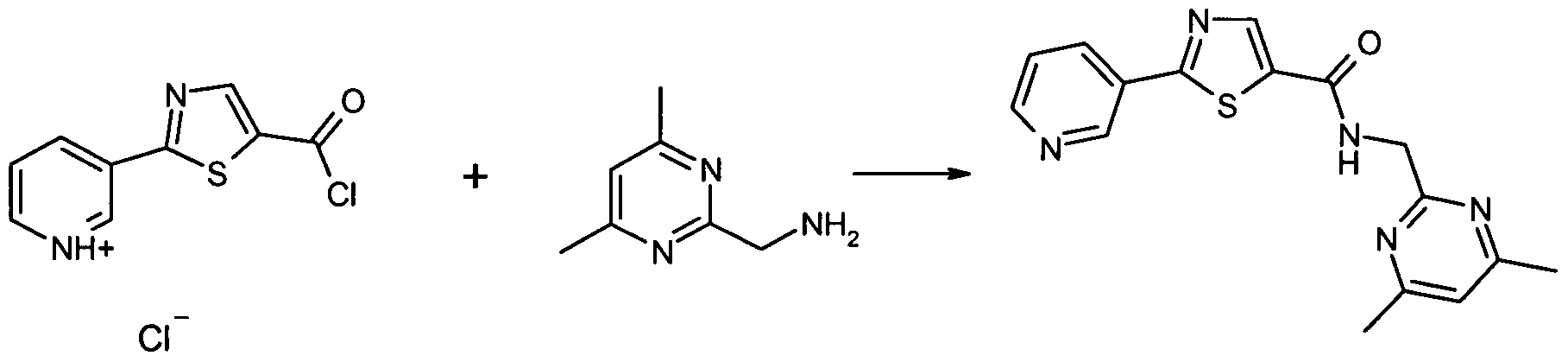
  • the mixture was concentrated in vacuo, partitioned between ethyl acetate and common salt solution / phosphate buffer solution (pH 7), and the organic phase was dried over sodium sulfate and concentrated in vacuo.
  • the residue was purified by chromatography on silica gel (cyclohexane / ethyl acetate).
  • Step 1 Sodium 2-chloro-2-ethoxycarbonyl-ethanolate
  • Step 1
  • Step 1 Oxo [N- (pyridine-3-carbonyl) -hydrazino] -acetic acid ethyl ester:
  • Step 2 5-Pyridin-3-yl [l, 3,4] thiadiazole-2-carboxylic acid ethyl ester
  • Step 3 Sodium 5-pyridin-3-yl [l, 3,4] thiadiazole-2-carboxylate
  • Step 4 5-Pyridin-3-yl [l, 3,4] thiadiazole-2-carboxylic acid dimethylamide
  • the mixture was concentrated in vacuo, partitioned between water and chloroform / isopropanol (10: 1), the organic phase dried, concentrated in vacuo and purified by chromatography on silica gel (ethyl acetate, acetone).
  • Eluenate A acetonitrile + 1 ml of formic acid / liter.
  • Eluent B water + 0.9 ml of formic acid / liter.
  • Gradient from 10% eluent A / 90% eluent B to 95% eluent A / 5% eluent B in 4.25 min.
  • the calibration was carried out with unbranched alkan-2-ones (with 3 to 16 carbon atoms) whose logP values are known (determination of the logP values by means of the retention times by linear interpolation between two consecutive alkanones).
  • the lambda max values were determined on the basis of the UV spectra from 200 nm to 400 nm in the maxima of the chromatographic signals.
  • Emulsifier 0.5 part by weight of alkylaryl polyglycol ether
  • active compound 1 part by weight of active compound is mixed with the indicated amounts of solvent and emulsifier, and the concentrate is diluted with emulsifier-containing water to the desired concentration.
  • Chinese cabbage leaf discs (Brassica pekinensis) infested with all stages of the green peach aphid (Myzus persicae) are sprayed with an active compound preparation of the desired concentration.
  • the effect is determined in%. 100% means that all aphids have been killed; 0% means that no aphids have been killed.
  • Emulsifier 0.5 part by weight of alkylaryl polyglycol ether
  • active compound 1 part by weight of active compound is mixed with the indicated amounts of solvent and emulsifier, and the concentrate is diluted with emulsifier-containing water to the desired concentration.
  • Chinese cabbage leaf discs (Brassica pekinensis) are sprayed with an active compound preparation of the desired concentration and, after drying, are populated with larvae of the horseradish leaf beetle (Phaedon cochleariae).
  • the effect is determined in%. 100% means that all beetle larvae have been killed; 0% means that no beetle larvae have been killed.
  • Emulsifier 0.5 part by weight of alkylaryl polyglycol ether
  • active compound 1 part by weight of active compound is mixed with the indicated amounts of solvent and emulsifier, and the concentrate is diluted with emulsifier-containing water to the desired concentration.
  • Corn-leaf disks (Zea mays) are sprayed with an active-substance preparation of the desired concentration and, after drying, are infested with caterpillars of the armyworm ⁇ Spodoptera frugiperda).
  • the effect is determined in%. 100% means that all caterpillars have been killed; 0% means that no caterpillar has been killed.
  • Emulsifier 0.5 part by weight of alkylaryl polyglycol ether
  • active compound 1 part by weight of active compound is mixed with the indicated amounts of solvent and emulsifier, and the concentrate is diluted with emulsifier-containing water to the desired concentration.
  • Bean leaf discs Phaseolus vulgaris infected by all stages of the common spider mite (Tetranychus urticae) are sprayed with an active compound preparation of the desired concentration.
  • the effect is determined in%. 100% means that all spider mites have been killed; 0% means that no spider mites have been killed.
  • Vessels are filled with sand, drug solution, Meloidogyne cogwta egg larvae suspension and lettuce seeds.
  • the lettuce seeds germinate and the plantlets develop.
  • the galls develop at the roots.
  • the nematicidal activity is determined by means of bile formation in%. 100% means that no bile was found; 0% means that the number of bile on the treated plants corresponds to that of the untreated control.
  • the drug solution is injected into the abdomen (Boophilus microplus), the animals are transferred into trays and stored in an air-conditioned room. The effect control takes place on storage of fertile eggs.
  • the effect is determined in%. 100% means that no ticks have laid fertile eggs.
  • Vessels containing horsemeat treated with the preparation of active compound of the desired concentration are infested with Lucilia cuprina larvae.
  • the kill is determined in%. 100% means that all larvae have been killed; 0% means that no larvae have been killed.

Landscapes

  • Organic Chemistry (AREA)
  • Chemical & Material Sciences (AREA)
  • Life Sciences & Earth Sciences (AREA)
  • Health & Medical Sciences (AREA)
  • General Health & Medical Sciences (AREA)
  • Environmental Sciences (AREA)
  • Engineering & Computer Science (AREA)
  • Dentistry (AREA)
  • Pest Control & Pesticides (AREA)
  • Wood Science & Technology (AREA)
  • Zoology (AREA)
  • Agronomy & Crop Science (AREA)
  • Plant Pathology (AREA)
  • Veterinary Medicine (AREA)
  • General Chemical & Material Sciences (AREA)
  • Chemical Kinetics & Catalysis (AREA)
  • Tropical Medicine & Parasitology (AREA)
  • Medicinal Chemistry (AREA)
  • Nuclear Medicine, Radiotherapy & Molecular Imaging (AREA)
  • Pharmacology & Pharmacy (AREA)
  • Animal Behavior & Ethology (AREA)
  • Public Health (AREA)
  • Plural Heterocyclic Compounds (AREA)
  • Agricultural Chemicals And Associated Chemicals (AREA)
  • Pharmaceuticals Containing Other Organic And Inorganic Compounds (AREA)
  • Pyridine Compounds (AREA)

Abstract

Die vorliegende Anmeldung betrifft neue Amide und Thioamide, Verfahren zu ihrer Herstellung und ihre Verwendung zur Bekämpfung von tierischen Schädlingen, vor allem von Arthropoden und insbesondere von Insekten.

Description

NEUE HETEROAROMATISCHE AMIDE UND THIOAMIDE ALS SCHÄDLINGSBEKÄMPFUNGSMITTEL
Die vorliegende Anmeldung betrifft neue Amide und Thioamide, Verfahren zu Ihrer Herstellung und ihre Verwendung zur Bekämpfung von tierischen Schädlingen, zu denen Arthropoden und insbesondere Insekten zählen.
Bestimmte Amide sind bereits als insektizid wirksame Verbindungen bekannt geworden (vgl. DE 2221647).
Moderne Planzenschutzmittel müssen vielen Anforderungen genügen, beispielsweise in Bezug auf Höhe, Dauer und Breite ihrer Wirkung und möglichen Verwendung. Es spielen Fragen der Toxizi- tät, der Kombinierbarkeit mit anderen Wirkstoffen oder Formulierhilfsmitteln eine Rolle sowie die Frage des Aufwands, der für die Synthese eines Wirkstoffs betrieben werden muss. Ferner können Resistenzen auftreten. Aus all diesen Gründen kann die Suche nach neuen Pflanzenschutzmitteln nicht als abgeschlossen betrachtet werden und es besteht ständig Bedarf an neuen Verbindungen mit gegenüber den bekannten Verbindungen zumindest in Bezug auf einzelne Aspekte verbesserten Eigenschaften.
Aufgabe der vorliegenden Erfindung war es, Verbindungen bereitzustellen, durch die das Spektrum der Schädlingsbekämpfungsmittel unter verschiedenen Aspekten verbreitert wird.
Gelöst wird die Aufgabe, sowie weitere nicht explizit genannte Aufgaben, die aus den hierin diskutierten Zusammenhängen ableitbar oder erschließbar sind, durch neue Verbindungen der Formel (I),
Figure imgf000002_0001
worin
(Ia)
G1 für N oder C-Halogen steht, und
G2 für einen Rest aus der Reihe
Figure imgf000003_0001
steht,
woπn
R1 für Wasserstoff oder Alkyl steht und
für C(=X)NR2R3 steht,
woπn
X für Sauerstoff oder Schwefel steht,
R2 für einen Rest aus der Reihe Wasserstoff, Alkyl, Halogenalkyl, Alkoxy, Halogenalkoxy, Alkenyl, Alkoxyalkyl, gegebenenfalls durch Halogen substituiertes Alkylcarbonyl, gegebenenfalls durch Halogen substituiertes Alkoxycarbonyl und gegebenenfalls durch Halogen substituiertes Cycloalkylcarbonyl steht,
und
R3 für einen Rest aus der Reihe Wasserstoff, Alkyl, Halogenalkyl, Cyanoalkyl, Alkenyl, Ha- logenalkenyl, Alkinyl, Halogenalkinyl, Alkoxy, Halogenalkoxy, gegebenenfalls durch Halogen substituiertes Alkoxyalkyl, gegebenenfalls durch Halogen substituiertes Bis(alkoxy)alkyl, gegebenenfalls durch Halogen substituiertes Alkylthioalkyl, gegebenenfalls durch Halogen substituiertes Alkylcarbonylalkyl, gegebenenfalls durch Halogen substituiertes Alkylsulfinylalkyl, gegebenenfalls durch Halogen substituiertes Alkylsulfony- lalkyl, gegebenenfalls durch Halogen substituiertes Alkoxycarbonylalkyl, Alkinyloxy, Al- kinyloxycarbonyl, gegebenenfalls substituiertes Cycloalkyl, gegebenenfalls substituiertes Cycloalkylcarbonyl, gegebenenfalls substituiertes Cycloalkylalkyl, gegebenenfalls substituiertes Heterocyclyl, gegebenenfalls substituiertes Heterocyclylalkyl, gegebenenfalls substituiertes Arylalkyl, gegebenenfalls substituiertes Hetarylalkyl und NR4R5 steht, worin R4 und R5 unabhängig voneinander für einen Rest aus der Reihe Wasserstoff, Alkyl, Halogenalkyl, Cycloalkyl, Alkoxy, Alkylcarbonyl, Alkoxycarbonyl, Hetaryl und Heterocyclyl stehen oder R4 und R5 gemeinsam mit dem Stickstoffatom, an das sie gebunden sind, einen gegebenenfalls substituierten Hetrocyclus bilden,
oder
R2 und R3 gemeinsam mit dem Stickstoffatom, an das sie gebunden sind, einen gegebenenfalls substituierten und gegebenenfalls weitere Heteroatome enthaltenden Ring bilden,
oder
(Ib)
worin
G1 für CH steht und
G2 für
Figure imgf000004_0001
steht,
woπn
R1 für Wasserstoff oder Alkyl steht und
G3 für C(=X)NR2R3 steht,
worin
X für Sauerstoff oder Schwefel steht,
R2 die oben angegebenen Bedeutungen hat und
R3 die oben angegebenen Bedeutungen hat oder
R2 und R3 gemeinsam mit dem Stickstoffatom, an das sie gebunden sind, einen gegebenenfalls substituierten und gegebenenfalls weitere Heteroatome enthaltenden Ring bilden oder
(Ic)
worin
G1 für CH steht,
G2 für
Figure imgf000005_0001
steht
R1 für Wasserstoff oder Alkyl steht und
G3 für C(=S)NR2R3 steht,
woπn
R2 die oben angegebenen Bedeutungen hat und
R3 die oben angegebenen Bedeutungen hat oder
R2 und R3 gemeinsam mit dem Stickstoffatom, an das sie gebunden sind, einen gegebenenfalls substituierten und gegebenenfalls weitere Heteroatome enthaltenden Ring bilden
oder
(Id)
woπn
G1 für CH steht und
G2 für
Figure imgf000005_0002
steht, R1 für Wasserstoff oder Alkyl steht und
G3 für C(O)NR2R3 steht,
worin
R2 für einen Rest aus der Reihe Wasserstoff, Alkyl, Halogenalkyl, Alkoxy, Halogenalkoxy, Alkenyl, Alkoxyalkyl, gegebenenfalls durch Halogen substituiertes Alkylcarbonyl, gegebenenfalls durch Halogen substituiertes Alkoxycarbonyl und gegebenenfalls durch Halogen substituiertes Cycloalkylcarbonyl steht,
und
R3 für eine Rest aus der Reihe Halogenalkyl, Cyanoalkyl, Halogenalkenyl, Halogenalkinyl, Alkoxy, Halogenalkoxy, durch Halogen substituiertes Alkoxyalkyl, gegebenenfalls durch
Halogen substituiertes Bis(alkoxy)alkyl, gegebenenfalls durch Halogen substituiertes Al- kylthioalkyl, gegebenenfalls durch Halogen substituiertes Alkylcarbonylalkyl, gegebenenfalls durch Halogen substituiertes Alkylsulfinylalkyl, gegebenenfalls durch Halogen substituiertes Alkylsulfonylalkyl, gegebenenfalls durch Halogen substituiertes Alkoxycarbony- lalkyl, Alkinyloxy, Alkinyloxycarbonyl, durch Halogen, Cyano, Alkyl, Halogenalkyl, Alkoxy, Halogenalkoxy, Alkoxycarbonyl, Halogenalkoxycarbonyl oder Hetaryl (welches gegebenenfalls selbst durch Alkyl oder Halogen substituiert ist) substituiertes Cycloalkyl, gegebenenfalls substituiertes Cycloalkylcarbonyl, gegebenenfalls substituiertes Cycloalky- lalkyl, gegebenenfalls substituiertes Heterocyclyl, gegebenenfalls substituiertes Heterocyc- lylalkyl, durch Halogen, Cyano, Alkyl, Halogenalkyl, Alkoxy oder Halogenalkoxy substituiertes Arylalkyl, gegebenenfalls substituiertes Hetarylalkyl und NR4R5 steht, worin R4 und R5 unabhängig voneinander für einen Rest aus der Reihe Wasserstoff, Alkyl, Halogenalkyl, Cycloyalkyl, Alkoxy, Alkylcarbonyl, Alkoxycarbonyl, Hetaryl und Heterocyclyl stehen oder R4 und R5 gemeinsam mit dem Stickstoffatom, an das sie gebunden sind, einen gegebenenfalls substituierten Hetrocyclus bilden
oder
(Ie)
worin
für CH steht und G' für
Figure imgf000007_0002
steht,
R1 für Wasserstoff steht und
G3 für C(=O)NR2R3 steht,
worin
R2 Wasserstoff oder Alkyl steht
und
R3 für Wasserstoff oder Alkyl steht.
sowie Salze und N-Oxide der Verbindungen der Formel (I).
Insbesondere gelöst wird die oben genannte Aufgabe, sowie weitere nicht explizit genannte Aufgaben, die aus den hierin diskutierten Zusammenhängen ableitbar oder erschließbar sind, durch neue Verbindungen der oben genannten Formel (I), worin
(Ia)
G1 für N oder C-Halogen steht, und
G2 für einen Rest aus der Reihe
R1
N N (B) N N (C) und g- -Q3 .*^\^\~3
Figure imgf000007_0001
steht,
woπn
R1 für Wasserstoff oder Alkyl steht und G3 für C(=X)NR2R3 steht,
worin
X für Sauerstoff oder Schwefel steht,
R2 für einen Rest aus der Reihe Wasserstoff, Alkyl, Halogenalkyl, Alkoxy, Halogenalkoxy, Alkenyl, Alkoxyalkyl, gegebenenfalls durch Halogen substituiertes Alkylcarbonyl, gegebenenfalls durch Halogen substituiertes Alkoxycarbonyl und gegebenenfalls durch Halogen substituiertes Cycloalkylcarbonyl steht,
und
R3 für einen Rest aus der Reihe Wasserstoff, Alkyl, Halogenalkyl, Cyanoalkyl, Alkenyl, Ha- logenalkenyl, Alkinyl, Halogenalkinyl, Alkoxy, Halogenalkoxy, gegebenenfalls durch Halogen substituiertes Alkoxyalkyl, gegebenenfalls durch Halogen substituiertes Bis(alkoxy)alkyl, gegebenenfalls durch Halogen substituiertes Alkylthioalkyl, gegebenenfalls durch Halogen substituiertes Alkylcarbonylalkyl, gegebenenfalls durch Halogen substituiertes Alkylsulfinylalkyl, gegebenenfalls durch Halogen substituiertes Alkylsulfony- lalkyl, gegebenenfalls durch Halogen substituiertes Alkoxycarbonylalkyl, Alkinyloxy, Al- kinyloxycarbonyl, gegebenenfalls durch Halogen, Cyano, Alkyl, Halogenalkyl, Alkoxy, Halogenalkoxy, Alkoxycarbonyl, Halogenalkoxycarbonyl oder Hetaryl (welches gegebenenfalls selbst durch Alkyl oder Halogen substituiert ist) substituiertes Cycloalkyl, gegebenenfalls durch Halogen, Cyano, Alkyl, Halogenalkyl, Alkoxy, Halogenalkoxy, Alkoxy- carbonyl, Halogenalkoxycarbonyl oder Hetaryl (welches gegebenenfalls selbst durch Alkyl oder Halogen substituiert ist) substituiertes Cycloalkylcarbonyl, gegebenenfalls durch Halogen, Cyano, Alkyl, Halogenalkyl, Alkoxy, Halogenalkoxy, Alkoxycarbonyl, Halogenalkoxycarbonyl oder Hetaryl (welches gegebenenfalls selbst durch Alkyl oder Halogen substituiert ist) substituiertes Cycloalkylalkyl, gegebenenfalls substituiertes Heterocyclyl, ge- gebenenfalls durch Halogen, Cyano (auch im Alkylteil), Nitro, Alkyl, Halogenalkyl, Cycloalkyl, Alkoxy, Halogenalkoxy, Alkylthio, Haloalkylthio, Alkylsulfϊnyl, Alkylsulfonyl, Haloalkylsulfmyl, Haloalkylsulfonyl, Amino, Alkylamino, Dialkylamino, Alkylcarbony- lamino, Alkoxycarbonylamino, Alkoxyalkyl, Halogenalkoxyalkyl, Alkenyl, Alkinyl, Al- kylcycloalkyl, Cycloalkylalkyl, Alkylcarbonyl, Alkoxycarbonyl oder Aminocarbonyl sub- stituiertes Heterocyclylalkyl, gegebenenfalls durch Halogen, Cyano, Alkyl, Halogenalkyl,
Alkoxy oder Halogenalkoxy substituiertes Arylalkyl, gegebenenfalls durch Halogen, Cyano (auch im Alkylteil), Nitro, Alkyl, Halogenalkyl, Cycloalkyl, Alkoxy, Halogenalkoxy, Alkylthio, Haloalkylthio, Alkylsulfinyl, Alkylsulfonyl, Haloalkylsulfinyl, Haloalkylsulfo- nyl, Amino, Alkylamino, Dialkylamino, Alkylcarbonylamino, Alkoxycarbonylamino, Al- koxyalkyl, Halogenalkoxyalkyl, Alkenyl, Alkinyl, Alkylcycloalkyl, Alkylcarbonyl, Alko- xycarbonyl oder Aminocarbonyl substituiertes Hetarylalkyl und NR4R5 steht, worin R4 und R5 unabhängig voneinander für einen Rest aus der Reihe Wasserstoff, Alkyl, Halogenalkyl, Cycloyalkyl, Alkoxy, Alkylcarbonyl, Alkoxycarbonyl, Hetaryl und Heterocyclyl stehen oder R4 und R5 gemeinsam mit dem Stickstoffatom, an das sie gebunden sind, einen gegebenenfalls substituierten Hetrocyclus bilden
oder
R2 und R3 gemeinsam mit dem Stickstoffatom, an das sie gebunden sind, einen gegebenenfalls substituierten und gegebenenfalls weitere Heteroatome enthaltenden Ring bilden,
oder
(Ib)
worin
G1 für CH steht und
für
Figure imgf000009_0001
steht,
woπn
R1 für Wasserstoff oder Alkyl steht und
G3 für C(=X)NR2R3 steht,
wonn
X für Sauerstoff oder Schwefel steht, R2 die oben angegebenen Bedeutungen hat und
R3 die oben angegebenen Bedeutungen hat oder
R2 und R3 gemeinsam mit dem Stickstoffatom, an das sie gebunden sind, einen gegebenenfalls substituierten und gegebenenfalls weitere Heteroatome enthaltenden Ring bilden
oder
(Ic)
worin
G1 für CH steht,
Figure imgf000010_0001
steht
R1 für Wasserstoff oder Alkyl steht und
G3 für C(=S)NR2R3 steht,
worin
R2 die oben angegebenen Bedeutungen hat und
R3 die oben angegebenen Bedeutungen hat oder
R2 und R3 gemeinsam mit dem Stickstoffatom, an das sie gebunden sind, einen gegebenenfalls substituierten und gegebenenfalls weitere Heteroatome enthaltenden Ring bilden
oder
(Id)
worin
G1 für CH steht und G' für
Figure imgf000011_0001
steht,
R1 für Wasserstoff oder Alkyl steht und
G3 für C(=O)NR2R3 steht,
worin
R2 für einen Rest aus der Reihe Wasserstoff, Alkyl, Halogenalkyl, Alkoxy, Halogenalkoxy, Alkenyl, Alkoxyalkyl, gegebenenfalls durch Halogen substituiertes Alkylcarbonyl, gegebenenfalls durch Halogen substituiertes Alkoxycarbonyl und gegebenenfalls durch Halogen substituiertes Cycloalkylcarbonyl steht,
und
R3 für einen Rest aus der Reihe Halogenalkyl, Cyanoalkyl, Halogenalkenyl, Halogenalkinyl, Alkoxy, Halogenalkoxy, durch Halogen substituiertes Alkoxyalkyl, gegebenenfalls durch Halogen substituiertes Bis(alkoxy)alkyl, gegebenenfalls durch Halogen substituiertes Al- kylthioalkyl, gegebenenfalls durch Halogen substituiertes Alkylcarbonylalkyl, gegebenen- falls durch Halogen substituiertes Alkylsulfinylalkyl, gegebenenfalls durch Halogen substituiertes Alkylsulfonylalkyl, gegebenenfalls durch Halogen substituiertes Alkoxycarbony- lalkyl, Alkinyloxy, Alkinyloxycarbonyl, durch Halogen, Cyano, Alkyl, Halogenalkyl, Alkoxy, Halogenalkoxy, Alkoxycarbonyl, Halogenalkoxycarbonyl oder Hetaryl (welches gegebenenfalls selbst durch Alkyl oder Halogen substituiert ist) substituiertes Cycloalkyl, gegebenenfalls durch Halogen, Cyano, Alkyl, Halogenalkyl, Alkoxy, Halogenalkoxy, Alkoxycarbonyl, Halogenalkoxycarbonyl oder Hetaryl (welches gegebenenfalls selbst durch Alkyl oder Halogen substituiert ist) substituiertes Cycloalkylcarbonyl, gegebenenfalls durch Halogen, Cyano, Alkyl, Halogenalkyl, Alkoxy, Halogenalkoxy, Alkoxycarbonyl, Halogenalkoxycarbonyl oder Hetaryl (welches gegebenenfalls selbst durch Alkyl oder Ha- logen substituiert ist) substituiertes Cycloalkylalkyl, gegebenenfalls substituiertes Hetero- cyclyl, gegebenenfalls durch Halogen, Cyano (auch im Alkylteil), Nitro, Alkyl, Halogenalkyl, Cycloalkyl, Alkoxy, Halogenalkoxy, Alkylthio, Haloalkylthio, Alkylsulfϊnyl, Alkyl- sulfonyl, Haloalkylsulfinyl, Haloalkylsulfonyl, Amino, Alkylamino, Dialkylamino, Alkyl- carbonylamino, Alkoxycarbonylamino, Alkoxyalkyl, Halogenalkoxyalkyl, Alkenyl, Alki- nyl, Cycloalkylalkyl, Alkylcycloalkyl, Alkylcarbonyl, Alkoxycarbonyl oder Aminocarbo- nyl substituiertes Heterocyclylalkyl, durch Halogen, Cyano, Alkyl, Halogenalkyl, Alkoxy oder Halogenalkoxy substituiertes Arylalkyl, gegebenenfalls durch Halogen, Cyano (auch im Alkylteil), Nitro, Alkyl, Halogenalkyl, Cycloalkyl, Alkoxy, Halogenalkoxy, Alkylthio, Haloalkylthio, Alkylsulfinyl, Alkylsulfonyl, Haloalkylsulfϊnyl, Haloalkylsulfonyl, Amino, Alkylamino, Dialkylamino, Alkylcarbonylamino, Alkoxycarbonylamino, Alkoxyalkyl, Halogenalkoxyalkyl, Alkenyl, Alkinyl, Alkylcycloalkyl, Alkylcarbonyl, Alkoxycarbonyl oder Aminocarbonyl substituiertes Hetarylalkyl und NR4R5 steht, worin R4 und R5 unabhängig voneinander für einen Rest aus der Reihe Wasserstoff, Alkyl, Halogenalkyl, Cycloyalkyl, Alkoxy, Alkylcarbonyl, Alkoxycarbonyl, Hetaryl und Heterocyclyl stehen oder R4 und R5 gemeinsam mit dem Stickstoffatom, an das sie gebunden sind, einen gegebenenfalls substituierten Hetrocyclus bilden
oder
(Ie)
worin
für CH steht und
G2 für
Figure imgf000012_0001
steht,
R1 für Wasserstoff steht und
Gj für C(=O)NR'Rj steht,
woπn
R >2 Wasserstoff oder Alkyl steht
und
R3 für Wasserstoff oder Alkyl steht. sowie Salze und N-Oxide der Verbindungen der Formel (I).
Weiter wurde gefunden, dass man die neuen Verbindungen der Formel (I), in welcher G2 für den Rest (A) und X für Sauerstoff steht, erhält, wenn man
Verbindungen der Formel (IIa)
Figure imgf000013_0001
in welcher
G1 und R1 die weiter oben genannten Bedeutungen haben
mit Verbindungen der Formel (HT)
Figure imgf000013_0003
in welcher
R2 und R3 die weiter oben genannten Bedeutungen haben,
gegebenenfalls in Gegenwart eines geeigneten Verdünnungsmittels und gegebenenfalls in Gegenwart eine Base umsetzt (Verfahren 1),
dass man ferner die neuen substituierten Verbindungen der Formel (I), in welcher G2 für den Rest (B) und X für Sauerstoff steht, erhält, wenn man
Verbindungen der Formel (üb)
Figure imgf000013_0002
in welcher G1 die weiter oben genannten Bedeutung hat
mit Verbindungen der Formel (IH)
Figure imgf000014_0002
in welcher
R2 und R3 die weiter oben genannten Bedeutungen haben,
gegebenenfalls in Gegenwart eines geeigneten Verdünnungsmittels und gegebenenfalls in Gegenwart eine Base umsetzt (Verfahren 2),
und dass man ferner die neuen substituierten Verbindungen der Formel (I), in welcher G2 für den Rest (C) und X für Sauerstoff steht, erhält, wenn man
Verbindungen der Formel (He)
Figure imgf000014_0001
in welcher
G1 und R1 die weiter oben genannten Bedeutung haben
mit Verbindungen der Formel (HI)
in welcher
Figure imgf000014_0003
R2 und R3 die weiter oben genannten Bedeutungen haben,
Figure imgf000014_0004
gegebenenfalls in Gegenwart eines geeigneten Verdünnungsmittels und gegebenenfalls in Gegenwart eine Base umsetzt (Verfahren 3).
Die nach diesen Verfahren erhältlichen Verbindungen der Formel (I) lassen sich durch Umsetzung mit einem Schwefelungsreagenz in Verbindungen der Formel (I) überführen, in denen X für Schwefel steht.
Schließlich wurde gefunden, dass die neuen Verbindungen der Formel (I) stark ausgeprägte biologische Eigenschaften besitzen und vor allem zur Bekämpfung von tierischen Schädlingen, insbesondere von Insekten, Spinnentieren und Nematoden, die in der Landwirtschaft, in den Forsten, im Vorrats- und Materialschutz sowie auf dem Hygienesektor vorkommen, geeignet sind.
Die Verbindungen der Formel (I) können gegebenenfalls in Abhängigkeit von der Art der Substi- tuenten als geometrische und/oder als optisch aktive Isomere oder entsprechende Isomerengemische in unterschiedlicher Zusammensetzung vorliegen. Die Erfindung betrifft sowohl die reinen Isomere als auch die Isomerengemische.
Die erfϊndungsgemäßen Verbindungen können auch als Metallkomplexe vorliegen, wie sie für andere Amide beispielsweise in DE 2221647 beschrieben sind.
Bevorzugte Substituenten bzw. Bereiche der in den oben erwähnten Verbindungen (Ia), (Ib) und (Ic) aufgeführten Reste werden im Folgenden erläutert.
R1 steht für Wasserstoff oder C1-CO- Alkyl, insbesondere für Wasserstoff oder Methyl.
R2 steht für Wasserstoff, CrC6-Alkyl, Q-Q-Halogenalkyl, CrC4-Alkoxy, Q-C4- Halogenalkoxy, C2-C4-Alkenyl, Ci-C4-Alkoxy-Ci-C4-alkyl, gegebenenfalls durch Halogen substituiertes Ci-C4-Alkylcarbonyl, gegebenenfalls durch Halogen substituiertes CrC4-
Alkoxycarbonyl oder gegebenenfalls durch Halogen substituiertes C3-C6-
Cycloalkylcarbonyl.
R3 steht für Wasserstoff, CrC6-Alkyl, CrC6-Halogenalkyl, Cyano-C,-C6-alkyl, C2-C4- Alkenyl, C2-C4-Halogenalkenyl, C2-C4-Alkinyl, C2-C4-Halogenalkinyl, CrC6-Alkoxy, C,-
Cβ-Halogenalkoxy, gegebenenfalls durch Halogen substituiertes Ci-Q-Alkoxy-Ci-Cβ-alkyl, gegebenenfalls durch Halogen substituiertes Bis(Ci-C6-alkoxy)-Ci-C6-alkyl, gegebenenfalls durch Halogen substituiertes Ci-Ce-Alkylthio-CrCό-alkyl, gegebenenfalls durch Halogen substituiertes Ci-C4-Alkylcarbonyl-CrC4-alkyl, gegebenenfalls durch Halogen sub- stituiertes Ci-C6-Alkylsulfϊnyl-Ci-C6-alkyl, gegebenenfalls durch Halogen substituiertes Ci-C6-Alkylsulfonyl-Ci-C6-alkyl, gegebenenfalls durch Halogen substituiertes Ci-C6- Alkoxycarbonyl-Ci-Cβ-alkyl, für C2-C4-Alkinyloxy, für C2-C4-Alkinyloxycarbonyl, für gegebenenfalls durch Halogen, Cyano, Ci-C6-Alkyl, Ci-C6-Halogenalkyl, C1-C6-AIkOXy, Cr Cδ-Halogenalkoxy, CrC6-Alkoxycarbonyl, Ci-C6-Halogenalkoxycarbonyl oder Hetaryl (welches gegebenenfalls selbst durch CrC6-Alkyl oder Halogen substituiert ist) substituiertes C3-C6-Cycloalkyl, für gegebenenfalls durch Halogen, Cyano, d-C6-Alkyl, Q-C6- Halogenalkyl, Ci-C6-Alkoxy, Ci-C6-Halogenalkoxy, Ci-C6-Alkoxycarbonyl, Q-C6- Halogenalkoxycarbonyl oder Hetaryl (welches gegebenenfalls selbst durch Ci-C6-Alkyl oder Halogen substituiert ist) substituiertes C3-C6-Cycloalkylcarbonyl, für gegebenenfalls durch Halogen, Cyano, CrC6-Alkyl, CrC6-Halogenalkyl, C1-C6- Alkoxy, Q-C6-
Halogenalkoxy, Ci-C6-Alkoxycarbonyl, Ci-C6-Halogenalkoxycarbonyl oder Hetaryl (welches gegebenenfalls selbst durch Q-C6-Alkyl oder Halogen substituiert ist) substituiertes C3-C6-Cycloalkyl-Ci-C6-alkyl, für gegebenenfalls durch Halogen, Cyano (auch im Alkyl- teil), Nitro, CrC6-Alkyl, CrC6-Halogenalkyl, C3-C6-Cycloalkyl, CrC6-Alkoxy, Q-C6- Halogenalkoxy, C,-C6-Alkylthio, CrC6-Haloalkylthio, CrC6-Alkylsulfinyl, Q-C6-
Alkylsulfonyl, Ci-C6-Haloalkylsulfinyl, Q-Cό-Haloalkylsulfonyl, Amino, Q-C6- Alkylamino, Di(Ci-C6-alkyl)amino, Q-C6-Alkylcarbonylamino, Q-C6-
Alkoxycarbonylamino, Ci-C6-Alkoxy-Ci-C6-alkyl, Ci-C6-Halogenalkoxy-CrC6-alkyl, C2- C6-Alkenyl, C2-C6-Alkinyl, CrC6-Alkyl-C3-C6-cycloalkyl, C3-C6-Cycloalkyl-CrC6-alkyl, Ci-Cö-Alkylcarbonyl, Ci-C6-Alkoxycarbonyl oder Aminocarbonyl substituiertes Hetero- cyclyl-C]-C6-alkyl, für gegebenenfalls durch Halogen, Cyano, C]-C6-Alkyl, Cj-C6- Halogenalkyl, Ci-C6-Alkoxy oder Ci-C6-Halogenalkoxy substituiertes Aryl-Ci-C6-alkyl, für gegebenenfalls durch Halogen, Cyano (auch im Alkylteil), Nitro, C]-C6-Alkyl, CpC6- Halogenalkyl, C3-C6-Cycloalkyl, CrC6-Alkoxy, CrC6-Halogenalkoxy, CrC6-Alkylthio, CrC6-Haloalkylthio, CrC6-Alkylsulfinyl, CrC6-Alkylsulfonyl, CrC6-Haloalkylsulfinyl,
Ci-C6-Haloalkylsulfonyl, Amino, CrC6-Alkylamino, Di(C]-C6-alkyl)amino, CrC6- Alkylcarbonylamino, Ci-C6-Alkoxycarbonylamino, Ci-C6-Alkoxy-C]-C6-alkyl, C]-C6- Halogenalkoxy-CrC6-alkyl, C2-C6-Alkenyl, C2-C6-Alkinyl, CrC6-Alkyl-C3-C6-cycloalkyl, C3-C6-Cycloalkyl-Ci-C6-alkyl, Ci-Q-Alkylcarbonyl, Ci-C6-Alkoxycarbonyl oder Amino- carbonyl substituiertes Hetaryl-Ci-C6-alkyl, oder für NR4R5, worin R4 und R5 unabhängig voneinander für einen Rest aus der Reihe Wasserstoff, Ci-C6-Alkyl, Ci-Cβ-Halogenalkyl, C3-C6-Cycloyalkyl, C]-C6-Alkoxy, Ci-C6-Alkylcarbonyl und Ci-C6-Alkoxycarbonyl stehen,
oder R2 und R3 bilden gemeinsam mit dem Stickstoffatom, an das sie gebunden sind, einen gegebenenfalls durch Ci-Cβ-Alkyl oder Q-C6-AIkOXy substituierten und gegebenenfalls ein oder zwei weitere Heteroatome aus der Reihe Sauerstoff, Stickstoff und Schwefel enthaltenden 3 bis 7 gliedrigen Ring.
Besonders bevorzugte Substituenten bzw. Bereiche der in den oben erwähnten Verbindungen (Ia), (Ib) und (Ic) aufgeführten Reste werden im Folgenden erläutert.
R1 steht für Wasserstoff oder Methyl .
R2 steht für Wasserstoff, CrC4-Alkyl, C,-C4-Halogenalkyl, CrC4-Alkoxy, C2-C3-Alkenyl, C,- C2-Alkoxy-Ci-C2-alkyl, Ci-C2-Alkylcarbonyl, Ci-C2-Alkoxycarbonyl oder für jeweils ge- gebenenfalls durch Halogen substituiertes Cyclopropylcarbonyl, Cyclopentylcarbonyl oder
Cyclohexylcarbonyl.
R3 steht für Wasserstoff, CrC4-Alkyl, CrC4-Halogenalkyl, Cyano-C,-C4-alkyl, C2-C4- Alkenyl, C2-C4-Halogenalkenyl, C2-C4-Alkinyl, C2-C4-Halogenalkinyl, Ci-C4-Alkoxy, Ci- C4-Halogenalkoxy, gegebenenfalls durch Halogen substituiertes Ci-C2-Alkoxy-Ci-C4-alkyl, gegebenenfalls durch Halogen substituiertes Bis(Ci-C2-alkoxy)-Ci-C4-alkyl, gegebenenfalls durch Halogen substituiertes Ci-C4-Alkylthio-Ci-C4-alkyl, gegebenenfalls durch Halogen substituiertes Q-Q-Alkylcarbonyl-Ci-Q-alkyl, gegebenenfalls durch Halogen substituiertes Ci-C4-Alkylsulfinyl-Ci-C4-alkyl, gegebenenfalls durch Halogen substituiertes CrC4-Alkylsulfonyl-Ci-C4-alkyl, gegebenenfalls durch Halogen substituiertes Cj-C4- Alkoxycarbonyl-CrQ-alkyl, für C2-C4-Alkinyloxy, für C2-C4-Alkinyloxycarbonyl, für gegebenenfalls durch Halogen, Cyano, CrC4-Alkyl, Ci-C4-Halogenalkyl, CrC4-Alkoxy, Cr C4-Halogenalkoxy, CrC4-Alkoxycarbonyl, Ci-C4-Halogenalkoxycarbonyl oder Pyridyl (welches gegebenenfalls selbst durch Q-Q-Alkyl oder Halogen substituiert ist) substituiertes C3-C6-Cycloalkyl, für gegebenenfalls durch Halogen, Cyano, Ci-C4-Alkyl, Ci-C4- Halogenalkyl, Ci-C4-Alkoxy, Ci-C4-Halogenalkoxy, CrC4-Alkoxycarbonyl, Ci-C4-
Halogenalkoxycarbonyl oder Pyridyl (welches gegebenenfalls selbst durch C]-C4-Alkyl oder Halogen substituiert ist) substituiertes C3-C6-Cycloalkylcarbonyl, für gegebenenfalls durch Halogen, Cyano, Ci-C4-Alkyl, CrC4-Halogenalkyl, CrC4-Alkoxy, Ci-C4- Halogenalkoxy, Ci-C4-Alkoxycarbonyl, Ci-C4-Halogenalkoxycarbonyl oder Pyridyl (wel- ches gegebenenfalls selbst durch C]-C4-Alkyl oder Halogen substituiert ist) substituiertes
C3-C6-Cycloalkyl-Ci-C4-alkyl, für gegebenenfalls durch Halogen, Cyano (auch im Alkyl- teil), Nitro, CrC4-Alkyl, CrC4-Halogenalkyl, C3-C6-Cycloalkyl, CrC4-Alkoxy, CpC4- Halogenalkoxy, C,-C4-Alkylthio, CrC4-Haloalkylthio, C,-C4-Alkylsulfinyl, C,-C4- Alkylsulfonyl, Ci-C4-Haloalkylsulfinyl, Ci-C4-Haloalkylsulfonyl, Amino, C]-C4- Alkylamino, Di(Ci -C4-alkyl)amino, Ci-C4-Alkylcarbonylamino, Ci-C4-
Alkoxycarbonylamino, Ci-C4-Alkoxy-Ci-C4-alkyl, Ci-C4-Halogenalkoxy-Ci-C4-alkyl, C2- C4-Alkenyl, C2-C4-Alkinyl, Ci-C4-Alkyl-C3-C6-cycloalkyl, C3-C6-CyClOaIlCyI-C1 -C4-alkyl, Ci-C4-Alkylcarbonyl, CrC4-Alkoxycarbonyl oder Aminocarbonyl substituiertes Hetero- cyclyl-C]-C4-alkyl, für gegebenenfalls durch Halogen, Cyano, Q-Q-Alkyl, C1-C4- Halogenalkyl, Ci-C4-Alkoxy oder Ci-C4-Halogenalkoxy substituiertes Aryl-C]-C4-alkyl, für gegebenenfalls durch Halogen, Cyano (auch im Alkylteil), Nitro, C]-C4-Alkyl, Ci-C4- Halogenalkyl, C3-C6-Cycloalkyl, CrC4-Alkoxy, CrC4-Halogenalkoxy, CrC4-Alkylthio, Ci-Gt-Haloalkylthio, CrC4-Alkylsulfinyl, CrC4-Alkylsulfonyl, C,-C4-Haloalkylsulfinyl,
CrC4-Haloalkylsulfonyl, Amino, Ci-C4-Alkylamino, Di(Ci-C4-alkyl)amino, CrC4- Alkylcarbonylamino, Ci-C4-Alkoxycarbonylamino, C]-C4-Alkoxy-Ci-C4-alkyl, C1-C4- Halogenalkoxy-CrC4-alkyl, C2-C4-Alkenyl, C2-C4-Alkinyl, C1-C4-AIlCyI-C3-C6-CyClOaI]CyI, C3-C6-Cycloalkyl-Ci-C4-alkyl, CrC4-Alkylcarbonyl, CrC4-Alkoxycarbonyl oder Amino- carbonyl substituiertes Hetaryl-C i -C4-alkyl
oder
R2 und R3 bilden gemeinsam mit dem Stickstoffatom, an das sie gebunden sind, einen gegebenenfalls durch CpQ-Alkyl oder C1-C4-AIkOXy substituierten und gegebenenfalls ein oder zwei weitere Heteroatome aus der Reihe Sauerstoff, Stickstoff und Schwefel enthaltenden 3 bis 7 gliedrigen Ring.
Ganz besonders bevorzugte Substituenten bzw. Bereiche der in den oben erwähnten Verbindungen (Ia), (Ib) und (Ic) aufgeführten Reste werden im Folgenden erläutert.
R1 steht für Wasserstoff oder Methyl.
R2 steht für Wasserstoff, Methyl, Ethyl, CH2CF3, CH2CF2CH3, CH2CHF2, CH2CF2CHF2, CH2CH2F, CH2-CHF-CH3, CH2CF2Br, CH2CFCl2, CH(CH3)CH2F, CH2CCl3, CH2CClF2,
CH2CH2CH2F, CH2CH(CH3)Cl, CHCF3CH(CH3)2, CH(CF3)2, CH2CH2Cl, CHCF3CH2CH2CH3 oder CH2CF2CF3, Methoxy, Ethoxy, Vinyl, CH2OCH3, CH2OCH2CH3, Methylcarbonyl, Ethylcarbonyl, Methoxycarbonyl, Ethoxycarbonyl, Cyclopropylcarbonyl oder Fluorcyclpropylcarbonyl.
R3 steht für Wasserstoff, Methyl, Ethyl, CH2CF3, CH2CF2CH3, CH2CHF2, CH2CF2CHF2, CH2CH2F, CH2-CHF-CH3, CH2CF2Br, CH2CFCl2, CH(CH3)CH2F, CH2CCl3, CH2CClF2, CH2CH2CH2F, CH2CH(CH3)Cl, CHCF3CH(CH3)2, CH(CF3)2, CH2CH2Cl, CHCF3CH2CH2CH3, CH2CF2CF3, C(CH3)2CN, C(CN)CH(CH3)2, CH2CN, CH2CH2CN, Vinyl, C(CH3)2CCH, CH2CCCH3, Methoxy, Ethoxy, CH2CH(CH3)(OCH3), CH2C(CH3)2(OCH3), CH(CH3)CH(OCH3)2, CH2C(CH3)(OCH3)2, C(CH3)2-CH2SCH3, CH2CH2SCH3, CHCH3CH2SCH3, gegebenenfalls durch Halogen substituiertes C1-C4-
Alkylcarbonyl-CrC4-alkyl, CH3SO2CH2C(CH3)2, CH3SO2CH2CHCH3, Propargyloxy, Cya- nocyclopropyl, Fluorcyclopropyl, Trifluormethylcyclopropyl, Trifluormethylcyclohexyl, Methoxycarbonylcyclopropyl, Fluorcyclopropylcarbonyl, Cyclopropylmethyl, Cyclohe- xylmethyl, l-Cyano-l-cyclopropyl-eth-l-yl, 1 ,3-Dioxolan-2-ylmethyl, 4-Methyl-l,3- dioxolan-2-ylmethyl, Tetrahydrofurylmethyl, Tetrahydropyranylmethyl, 2,2-Dimethyl-l,3- dioxolan-5-yl-methyl, 2-Methyltetrahydrofur-2-yl-methyl, α-Methyl-3,5-dimethyltriazol-l- yl-ethyl, l,5-Dimethyl-l,3-oxazol-4-yl-methyl, für gegebenenfalls durch Halogen, Cyano, Methyl, Ethyl, Methoxy oder Ethoxy substituiertes Benzyl oder für gegebenenfall durch Halogen, Cyano, Methyl, Methoxy oder Ethoxy substituiertes Pyrimidylmethyl, (insbeson- dere Pyrimid-2-yl-methyl, α-Methyl-pyrimidylmethyl, 4-Brom-pyrimid-2-yl-methyl, 2-
Methylpyrimid-4-yl-methyl, 4,6-Dimethylpyrimid-2-yl-methyl, 4-lod-pyrimid-2-yl-methyl, 2-Ethyl-pyrimid-6-yl-methyl, 5-Chlor-pyrimid-2-yl-methyl, 5-Brom-pyrimid-2-yl-methyl, 5-Cyano-pyrimid-2-yl-methyl, 4,6-Dimethoxy-pyrimid-2-yl-methyl und 4,6-Diethoxy-2- pyrimid-2-yl-methyl), Oxadiazolylmethyl, Oxazolylmethyl, 5-Methyl-pyrazin-2-yl, α- Methyl-pyrid-2-yl-methyl, Imidazolylmethyl, 6-Chlor-pyridin-3-yl-methyl, Thiazolyl- methyl, Furanylmethyl, l,5-Dimethylpyrazol-3-yl-methyl, 3-Cyclopropyl-l,2,4-oxadiazol- 5-yl-methyl, 6-Brom-pyrid-2-yl-methyl,
oder
R2 und R3 bilden gemeinsam mit dem Stickstoffatom, an das sie gebunden sind, einen gegebenen- falls durch Ci-C4-AIlCyI oder Ci-C4-Alkoxy substituierten und gegebenenfalls ein oder zwei weitere Heteroatome aus der Reihe Sauerstoff, Stickstoff und Schwefel enthaltenden 3 bis
7 gliedrigen Ring, beispielsweise stehen R2 und R3 gemeinsam für CH2CH2CH2 oder
CH2CH2CH2O.
Bevorzugte Substituenten bzw. Bereiche der in den oben erwähnten Verbindungen (Id) aufgeführ- ten Reste werden im Folgenden erläutert.
R1 steht für Wasserstoff oder Ci-Cβ-Alkyl und hier wiederum bevorzugt für Wasserstoff oder Methyl. R2 steht für Wasserstoff, CrC6-Alkyl, CrC6-Halogenalkyl, CrC4-Alkoxy, C1-C4-
Halogenalkoxy, C2-C4-Alkenyl, Ci-C4-Alkoxy-Ci-C4-alkyl, gegebenenfalls durch Halogen substituiertes Ci-C4-Alkylcarbonyl, gegebenenfalls durch Halogen substituiertes CpC4-
Alkoxycarbonyl oder gegebenenfalls durch Halogen substituiertes C3-C6- Cycloalkylcarbonyl.
R3 steht für C,-C6-Halogenalkyl, Cyano-CrC6-alkyl, C2-C4-Halogenalkenyl, C2-C4- Halogenalkinyl, CpC6-Alkoxy, CpC6-Halogenalkoxy, gegebenenfalls durch Halogen substituiertes Ci-C6-Alkoxy-CrC6-alkyl, gegebenenfalls durch Halogen substituiertes BiS(C1- C6-alkoxy)-CrC6-alkyl, gegebenenfalls durch Halogen substituiertes CpC6-Alkylthio-Cp C6-alkyl, gegebenenfalls durch Halogen substituiertes Ci-C4-Alkylcarbonyl-Ci-C4-alkyl, gegebenenfalls durch Halogen substituiertes CpCe-Alkylsulfmyl-CpQ-alkyl, gegebenenfalls durch Halogen substituiertes CpQ-Alkylsulfonyl-CpQ-alkyl, gegebenenfalls durch Halogen substituiertes Ci-C6-Alkoxycarbonyl-Ci-C6-alkyl, für C2-C4-Alkinyloxy, für C2- C4-Alkinyloxycarbonyl, für durch Halogen, Cyano, Ci-C6-Alkyl, CpC6-Halogenalkyl, C1- C6-Alkoxy, CpC6-Halogenalkoxy, CpC6-Alkoxycarbonyl, CpC6-Halogenalkoxycarbonyl oder Hetaryl (welches gegebenenfalls selbst durch Ci -C6- Alkyl oder Halogen substituiert ist) substituiertes C3-C6-Cycloalkyl, für gegebenenfalls durch Halogen, Cyano, CpC6- Alkyl, CpC6-Halogenalkyl, CrC6-Alkoxy, CpC6-Halogenalkoxy, Ci-C6-Alkoxycarbonyl, Ci-C6-Halogenalkoxycarbonyl oder Hetaryl (welches gegebenenfalls selbst durch CpC6- Alkyl oder Halogen substituiert ist) substituiertes C3-C6-Cycloalkylcarbonyl, für gegebenenfalls durch Halogen, Cyano, CpC6-Alkyl, CpC6-Halogenalkyl, C1-C6-AIkOXy, CrC6- Halogenalkoxy, Ci-C6-Alkoxycarbonyl, CrC6-Halogenalkoxycarbonyl oder Hetaryl (welches gegebenenfalls selbst durch Ci -C6- Alkyl oder Halogen substituiert ist) substituiertes C3-C6-Cycloalkyl-Ci-C6-alkyl, für gegebenenfalls durch Halogen, Cyano (auch im Alkyl- teil), Nitro, C,-C6-Alkyl, Q-Q-Halogenalkyl, C3-C6-Cycloalkyl, C,-C6-Alkoxy, Ci-C6-
Halogenalkoxy, CrC6-Alkylthio, CrC6-Haloalkylthio, CrC6-Alkylsulfmyl, C,-C6- Alkylsulfonyl, Ci-C6-Haloalkylsulfinyl, CrC6-Haloalkylsulfonyl, Amino, CpC6- Alkylamino, Di(CpC6-alkyl)amino, CpCö-Alkylcarbonylamino, CpC6-
Alkoxycarbonylamino, CpC6-Alkoxy-CpC6-alkyl, CpC6-Halogenalkoxy-CpC6-alkyl, C2- C6-Alkenyl, C2-C6-Alkinyl, C3-C6-Cycloalkyl-CrC6-alkyl, CrC6-Alkyl-C3-C6-cycloalkyl,
CpC6-Alkylcarbonyl, CpC6-Alkoxycarbonyl oder Aminocarbonyl substituiertes Hetero- cyclyl-CpC6-alkyl, für durch Halogen, Cyano, CpC6-Alkyl, CrC6-Halogenalkyl, C1-C6- Alkoxy oder CpC6-Halogenalkoxy substituiertes Aryl-CrC6-alkyl, oder für gegebenenfalls durch Halogen, Cyano (auch im Alkylteil), Nitro, CpC6-Alkyl, CpC6-Halogenalkyl, C3-C6- Cycloalkyl, C,-C6-Alkoxy, C,-C6-Halogenalkoxy, C,-C6-Alkylthio, C,-C6-Haloalkylthio, Ci-C6-Alkylsulfinyl, CrC6-Alkylsulfonyl, Ci-Q-Haloalkylsulfinyl, C1-C6-
Haloalkylsulfonyl, Amino, Ci-C6-Alkylamino, Di(Ci-C6-alkyl)amino, C1-C6- Alkylcarbonylamino, Ci-C6-Alkoxycarbonylamino, Ci-C6-Alkoxy-Ci-C6-alkyl, CpC6- Halogenalkoxy-CpC6-alkyl, C2-C6-Alkenyl, C2-C6-Alkinyl, C3-C6-Cycloalkyl-CrC6-alkyl, CrC6-Alkyl-C3-C6-cycloalkyl, CrC6-Alkylcarbonyl, Ci-C6-Alkoxycarbonyl oder Amino carbonyl substituiertes Hetaryl-d-Q-alkyl.
Besonders bevorzugte Substituenten bzw. Bereiche der in den oben erwähnten Verbindungen (Id) aufgeführten Reste werden im Folgenden erläutert.
R1 steht für Wasserstoff oder Methyl .
R2 steht für Wasserstoff, Ci-C4-Alkyl, CrC4-Halogenalkyl, CrC4-Alkoxy, C2-C3-Alkenyl, C,- C2-AIkOXy-C pC2-alkyl, Ci^-Alkylcarbonyl, Ci-C2-Alkoxycarbonyl oder für jeweils gegebenenfalls durch Halogen substituiertes Cyclopropylcarbonyl, Cyclopentylcarbonyl oder Cyclohexylcarbonyl.
R3 steht für C,-C4-Halogenalkyl, Cyano-CrC4-alkyl, C2-C4-Halogenalkenyl, C2-C4- Halogenalkinyl, Ci-C4-Alkoxy, Ci-C4-Halogenalkoxy, gegebenenfalls durch Halogen substituiertes Ci-C2-Alkoxy-Ci-C4-alkyl, gegebenenfalls durch Halogen substituiertes BiS(C1 - C2-alkoxy)-Ci-C4-alkyl, gegebenenfalls durch Halogen substituiertes Ci-C4-Alkylthio-Cr C4-alkyl, gegebenenfalls durch Halogen substituiertes Ci-C4-Alkylcarbonyl-Ci-C4-alkyl, gegebenenfalls durch Halogen substituiertes Ci-C4-Alkylsulfinyl-Ci-C4-alkyl, gegebenen- falls durch Halogen substituiertes Ci-C4-Alkylsulfonyl-Ci-C4-alkyl, gegebenenfalls durch
Halogen substituiertes Ci-C4-Alkoxycarbonyl-Ci-C4-alkyl, für C2-C4-Alkinyloxy, für C2- C4-Alkinyloxycarbonyl, für durch Halogen, Cyano, Ci-C4-Alkyl, Ci-C4-Halogenalkyl, Q- C4-Alkoxy, Ci-C4-Halogenalkoxy, Ci-C4-Alkoxycarbonyl, Ci-C4-Halogenalkoxycarbonyl oder Pyridyl (welches gegebenenfalls selbst durch Ci-C4-Alkyl oder Halogen substituiert ist) substituiertes C3-C6-Cycloalkyl, für gegebenenfalls durch Halogen, Cyano, C1-C4-
Alkyl, Ci-C4-Halogenalkyl, Ci-C4-Alkoxy, Ci-C4-Halogenalkoxy, CrC4-Alkoxycarbonyl, CpQ-Halogenalkoxycarbonyl oder Pyridyl (welches gegebenenfalls selbst durch Cj-C4- Alkyl oder Halogen substituiert ist) substituiertes C3-C6-Cycloalkylcarbonyl, für gegebenenfalls durch Halogen, Cyano, Ci-C4-Alkyl, Ci-C4-Halogenalkyl, Ci-C4-Alkoxy, C1-C4- Halogenalkoxy, Ci-C4-Alkoxycarbonyl, Ci-C4-Halogenalkoxycarbonyl oder Pyridyl (welches gegebenenfalls selbst durch Ci-C4-Alkyl oder Halogen substituiert ist) substituiertes C3-C6-Cycloalkyl-Ci-C4-alkyl, für gegebenenfalls durch Halogen, Cyano (auch im Alkyl- teil), Nitro, C,-C4-Alkyl, C,-C4-Halogenalkyl, C3-C6-Cycloalkyl, CrC4-Alkoxy, C1-C4- Halogenalkoxy, CrC4-Alkylthio, C,-C4-Haloalkylthio, Ci-C4-Alkylsulfinyl, C1-C4- Alkylsulfonyl, Cj-GrHaloalkylsulfinyl, Cj-C4-Haloalkylsulfonyl, Amino, Cj-C4- Alkylamino, Di(Ci-C4-alkyl)amino, Ci-C4-Alkylcarbonylamino, Cj-C4-
Alkoxycarbonylamino, Ci-C4-Alkoxy-Cj-C4-alkyl, CrC4-Halogenalkoxy-CrC4-alkyl, C2- C4-Alkenyl, C2-C4-Alkinyl, C3-C6-Cycloalkyl-CrC4-alkyl, CrC4-Alkyl-C3-C6-cycloalkyl,
Ci-C4-Alkylcarbonyl, Ci-C4-Alkoxycarbonyl oder Aminocarbonyl substituiertes Hetero- cyclyl-Ci-C4-alkyl, für durch Halogen, Cyano, CrC4-Alkyl, Ci-C4-Halogenalkyl, Cj-C4- Alkoxy oder Cj-C4-Halogenalkoxy substituiertes Aryl-Cj-C4-alkyl oder für gegebenenfalls durch Halogen, Cyano (auch im Alkylteil), Nitro, Cj-C4-Alkyl, Ci-C4-Halogenalkyl, C3-C6- Cycloalkyl, Cj-C4-Alkoxy, Cj-C4-Halogenalkoxy, CrC4-Alkylthio, Cj-C4-Haloalkylthio,
CrC4-Alkylsulfinyl, Cj-C4-Alkylsulfonyl, Cj-C4-Haloalkylsulfmyl, Cj-C4- Haloalkylsulfonyl, Amino, Ci-C4-Alkylamino, Di(Cj-C4-alkyl)amino, Cj-C4- Alkylcarbonylamino, Cj-C4-Alkoxycarbonylamino, Cj-C4-Alkoxy-C]-C4-alkyl, Cj-C4- Halogenalkoxy-Cj-C4-alkyl, C2-C4-Alkenyl, C2-G»-Alkinyl, C3-C6-Cycloalkyl-Cj-C4-alkyl, Cj-C4-Alkyl-C3-C6-cycloalkyl, Cj-C4-Alkylcarbonyl, Cj-C4-Alkoxycarbonyl oder Aminocarbonyl substituiertes Hetaryl-Cj-C4-alkyl.
Ganz besonders bevorzugte Substituenten bzw. Bereiche der in den oben erwähnten Verbindungen (Id) aufgeführten Reste werden im Folgenden erläutert.
R1 steht für Wasserstoff oder Methyl.
R2 steht für Wasserstoff, Methyl, Ethyl, CH2CF3, CH2CF2CH3, CH2CHF2, CH2CF2CHF2, CH2CH2F, CH2-CHF-CH3, CH2CF2Br, CH2CFCl2, CH(CH3)CH2F, CH2CCl3, CH2CClF2, CH2CH2CH2F, CH2CH(CH3)Cl, CHCF3CH(CH3)2, CH(CF3)2, CH2CH2Cl, CHCF3CH2CH2CH3 oder CH2CF2CF3, Methoxy, Ethoxy, Vinyl, CH2OCH3, CH2OCH2CH3, Methylcarbonyl, Ethylcarbonyl, Methoxycarbonyl, Ethoxycarbonyl, Cyclopropylcarbonyl oder Fluorcyclopropylcarbonyl.
R3 steht für CH2CF3, CH2CF2CH3, CH2CHF2, CH2CF2CHF2, CH2CH2F, CH2-CHF-CH3, CH2CF2Br, CH2CFCl2, CH(CH3)CH2F, CH2CCl3, CH2CClF2, CH2CH2CH2F, CH2CH(CH3)Cl, CHCF3CH(CH3)2, CH(CF3)2, CH2CH2Cl, CHCF3CH2CH2CH3, CH2CF2CF3, C(CH3)2CN, C(CN)CH(CH3)2, CH2CN, CH2CH2CN, Methoxy, Ethoxy, CH2CH(CH3)(OCH3), CH2C(CHj)2(OCH3), CH(CH3)CH(OCH3)2, CH2C(CH3)(OCH3)2,
C(CHj)2-CH2SCH3, CH2CH2SCH3, CHCH3CH2SCH3, gegebenenfalls durch Halogen substituiertes Ci-C4-Alkylcarbonyl-C,-C4-alkyl, CH3SO2CH2C(CH3);,, CH3SO2CH2CHCH3, Propargyloxy, Cyanocyclopropyl, Fluorcyclopropyl, Trifluormethylcyclopropyl, Trifluor- methylcyclohexyl, Methoxycarbonylcyclopropyl, Fluorcyclopropylcarbonyl, Cyclopro- pylmethyl, Cyclohexylmethyl, l-Cyano-l-cyclopropyl-eth-l-yl, l,3-Dioxolan-2-ylmethyl, 4-Methyl-l,3-Dioxolan-2-ylmethyl, Tetrahydrofurylmethyl, Tetrahydropyranylmethyl, 2,2- Dimethyl-1 ,3-dioxolan-5-yl-methyl, 2-Methyltetrahydrofur-2-yl-methyl, α-Methyl-3,5- dimethyltriazol-1-yl-ethyl, l,5-Dimethyl-l,3-oxazol-4-yl-methyl, für gegebenenfalls durch
Halogen, Cyano, Methyl, Ethyl, Methoxy oder Ethoxy substituiertes Benzyl, oder für ge- gebenenfall durch Halogen, Cyano, Methyl, Methoxy oder Ethoxy substituiertes Pyrimi- dylmethyl, (insbesondere Pyrimid-2-yl-methyl, α-Methyl-pyrimidylmethyl, 4-Brom- pyrimid-2-yl-methyl, 2-Methylpyrimid-4-yl-methyl, 4,6-Dimethylpyrimid-2-yl-methyl, 4- lod-pyrimid-2-yl-methyl, 2-Ethyl-pyrimid-6-yl-methyl, 5-Chlor-pyrimid-2-yl-methyl, 5-
Brom-pyrimid-2-yl-methyl, 5-Cyano-pyrimid-2-yl-methyl, 4,6-Dimethoxy-pyrimid-2-yl- methyl und 4,6-Diethoxy-2-pyrimid-2-yl-methyl), Oxadiazolylmethyl, Oxazolylmethyl, 5- Methyl-pyrazin-2-yl, α-Methyl-pyrid-2-yl-methyl, Imidazolylmethyl, 6-Chlor-pyridin-3-yl- methyl, Thiazolylmethyl, Furanylmethyl, l,5-Dimethylpyrazol-3-yl-methyl, 3- Cyclopropyl-1 ,2,4-oxadiazol-5-yl-methyl, 6-Brom-pyrid-2-yl-methyl.
Bevorzugte Substituenten bzw. Bereiche der in den oben erwähnten Verbindungen (Ie) aufgeführten Reste werden im Folgenden erläutert.
R2 steht für Wasserstoff oder CrC6-Alkyl.
R3 steht für Wasserstoff oder C,-C6-Alkyl.
Besonders bevorzugte Substituenten bzw. Bereiche der in den oben erwähnten Verbindungen (Ie) aufgeführten Reste werden im Folgenden erläutert.
R2 steht für Wasserstoff oder CrC4-Alkyl.
R3 steht für Wasserstoff oder CrC4-Alkyl.
Ganz besonders bevorzugte Substituenten bzw. Bereiche der in den oben erwähnten Verbindungen (Ie) aufgeführten Reste werden im Folgenden erläutert.
R2 steht für Wasserstoff, Methyl, Ethyl, n-Propyl oder i-Propyl.
R3 steht für Wasserstoff, Methyl, Ethyl, n-Propyl oder i-Propyl.
In den bevorzugten Definitionen ist, sofern nichts anderes angegeben ist, Halogen ausgewählt aus der Reihe Fluor, Chlor, Brom und Iod, bevorzugt wiederum aus der Reihe Fluor, Chlor und Brom,
Aryl (auch als Teil einer größeren Einheit, wie beispielsweise Arylalkyl) ausgewählt aus der Reihe Phenyl, Naphthyl, Anthryl, Phenanthrenyl und steht wiederum bevorzugt für Phenyl,
Hetaryl (auch als Teil einer größeren Einheit, wie beispielsweise Hetarylalkyl) ausgewählt aus der Reihe Furyl, Thienyl, Pyrrolyl, Pyrazolyl, Imidazolyl, 1,2,3-Triazolyl, 1,2,4-Triazolyl, Oxazolyl, Isoxazolyl, Thiazolyl, Isothiazolyl, 1,2,3-Oxadiazolyl, 1,2,4-Oxadiazolyl, 1,3,4-Oxadiazolyl, 1,2,5- Oxadiazolyl, 1 ,2,3-Thiadiazolyl, 1 ,2,4-Thiadiazolyl, 1,3,4-Thiadiazolyl, 1 ,2,5-Thiadiazolyl, Pyri- dyl, Pyrimidinyl, Pyridazinyl, Pyrazinyl, 1,2,3-Triazinyl, 1,2,4-Triazinyl, 1,3,5-Triazinyl, Benzofu- ryl, Benzisofuryl, Benzothienyl, Benzisothienyl, Indolyl, Isoindolyl, Indazolyl, Benzothiazolyl, Benzisothiazolyl, Benzoxazolyl, Benzisoxazolyl, Benzimidazolyl, 2,1,3-Benzoxadiazole, Chinoli- nyl, Isochinolinyl, Cinnolinyl, Phthalazinyl, Chinazolinyl, Chinoxalinyl, Naphthyridinyl, Benzotri- azinyl, Purinyl, Pteridinyl und Indolizinyl,
Heterocyclyl (auch als Teil einer größeren Einheit, wie beispielsweise Heterocyclylalkyl) ausge- wählt aus der Reihe 2-Tetrahydrofuranyl, 3-Tetrahydrofuranyl, 2-Tetrahydrothienyl, 3- Tetrahydrothienyl, 2-Pyrrolidinyl, 3-Pyrrolidinyl, 3-Isoxazolidinyl, 4-Isoxazolidinyl, 5 Isoxazolidi- nyl, 3-Isothiazolidinyl, 4-Isothiazolidinyl, 5-Isothiazolidinyl, 3-Pyrazolidinyl, 4-Pyrazolidinyl, 5- Pyrazolidinyl, 2-Oxazolidinyl, 4-Oxazolidinyl, 5-Oxazolidinyl, 2-Thiazolidinyl, 4-Thiazolidinyl, 5- Thiazolidinyl, 2-Imidazolidinyl, 4-Imidazolidinyl, l,2,4-Oxadiazolidin-3-yl, 1 ,2,4-Oxadiazolidin-5- yl, l,2,4-Thiadiazolidin-3-yl, l,2,4-Thiadiazolidin-5-yl, l,2,4-Triazolidin-3-yl, 1,3,4- Oxadiazolidin-2-yl, l,3,4-Thiadiazolidin-2-yl, l,3,4-Triazolidin-2-yl, 2,3-Dihydrofur-2-yl, 2,3- Dihydrofur-3-yl, 2,4-Dihydrofur-2-yl, 2,3-Dihydrothien-2-yl, 2,3-Dihydrothien-3-yl, 2,4- Dihydrothien-2-yl, 2-Pyrrolin-2-yl, 2-Pyrrolin-3-yl, 3-Pyrrolin-2-yl, 3-Pyrrolin-3-yl, 2-Isoxazolin- 3-yl, 3-Isoxazolin-3-yl, 4-Isoxazolin-3-yl, 2-Isoxazolin-4-yl, 3-Isoxazolin-4-yl, 4-Isoxazolin-4-yl, 2- Isoxazolin-5-yl, 3-Isoxazolin-5-yl, 4-Isoxazolin-5-yl, 2-Isothiazolin-3-yl, 3-Isothiazolin-3-yl, 4- Isothiazolin-3-yl, 2-Isothiazolin-4-yl, 3-Isothiazolin-4-yl, 4-Isothiazolin-4-yl, 2-Isothiazolin-5-yl, 3- Isothiazolin-5-yl, 4-Isothiazolin-5-yl, 2,3-Dihydropyrazol-l-yl, 2,3-Dihydropyrazol-2-yl, 2,3- Dihydropyrazol-3-yl, 2,3-Dihydropyrazol-4-yl, 2,3-Dihydropyrazol-5-yl, 3,4-Dihydropyrazol-l-yl, 3,4-Dihydropyrazol-3-yl, 3,4-Dihydropyrazol-4-yl, 3,4-Dihydropyrazol-5-yl, 4,5-Dihydropyrazol- 1-yl, 4,5-Dihydropyrazol-3-yl, 4,5-Dihydropyrazol-4-yl, 4,5-Dihydropyrazol-5-yl, 2,3- Dihydrooxazol-2-yl, 2,3-Dihydrooxazol-3-yl, 2,3-Dihydrooxazol-4-yl, 2,3-Dihydrooxazol-5-yl, 3,4-Dihydrooxazol-2-yl, 3,4-Dihydrooxazol-3-yl, 3,4-Dihydrooxazol-4-yl, 3,4-Dihydrooxazol-5-yl, 3,4-Dihydrooxazol-2-yl, 3,4-Dihydrooxazol-3-yl, 3,4-Dihydrooxazol-4-yl, 2-Piperidinyl, 3- Piperidinyl, 4-Piperidinyl, 1 ,3-Dioxan-5-yl, 2-Tetrahydropyranyl, 4-Tetrahydropyranyl, 2- Tetrahydrothienyl, 3-Hexahydropyridazinyl, 4-Hexahydropyridazinyl, 2-Hexahydropyrimidinyl, 4- Hexahydropyrimidinyl, 5-Hexahydropyrimidinyl, 2-Piperazinyl, l,3,5-Hexahydro-triazin-2-yl und 1 ,2,4-Hexahydrotriazin-3-yl.
In den besonders bevorzugten Definitionen ist, sofern nichts anderes angegeben ist,
Halogen ausgewählt aus der Reihe Fluor, Chlor, Brom und Iod, bevorzugt wiederum aus der Reihe Fluor, Chlor und Brom,
Aryl (auch als Teil einer größeren Einheit, wie beispielsweise Arylalkyl) ausgewählt aus der Reihe Phenyl, Naphthyl, Anthryl, Phenanthrenyl und steht wiederum bevorzugt für Phenyl,
Hetaryl (auch als Teil einer größeren Einheit, wie beispielsweise Hetarylalkyl) ausgewählt aus der Reihe Pyrimidyl, Oxadiazolyl, Oxazolyl, Pyrazinyl, Imidazolyl, Thiazolyl und Furanyl,
Heterocyclyl (auch als Teil einer größeren Einheit, wie beispielsweise Heterocyclylalkyl) ausgewählt aus der Reihe 2-Tetrahydrofuranyl, 3-Tetrahydrofuranyl, 2-Tetrahydrothienyl, 3- Tetrahydrothienyl, 2-Pyrrolidinyl, 3-Pyrrolidinyl, 3-Isoxazolidinyl, 4-Isoxazolidinyl, 5 Isoxazolidi- nyl, 3-Isothiazolidinyl, 4-Isothiazolidinyl, 5-Isothiazolidinyl, 3-Pyrazolidinyl, 4-Pyrazolidinyl, 5- Pyrazolidinyl, 2-Oxazolidinyl, 4-Oxazolidinyl, 5-Oxazolidinyl, 2-Thiazolidinyl, 4-Thiazolidinyl, 5- Thiazolidinyl, 2-Imidazolidinyl, 4-Imidazolidinyl, 1 ,2,4-Oxadiazolidin-3-yl, 1 ,2,4-Oxadiazolidin-5- yl, l,2,4-Thiadiazolidin-3-yl, l,2,4-Thiadiazolidin-5-yl, l,2,4-Triazolidin-3-yl, 1,3,4- Oxadiazolidin-2-yl, l,3,4-Thiadiazolidin-2-yl, l,3,4-Triazolidin-2-yl, 2,3-Dihydrofur-2-yl, 2,3- Dihydrofur-3-yl, 2,4-Dihydrofur-2-yl, 2,3-Dihydrothien-2-yl, 2,3-Dihydrothien-3-yl, 2,4- Dihydrothien-2-yl, 2-Pyrrolin-2-yl, 2-Pyrrolin-3-yl, 3-Pyrrolin-2-yl, 3-Pyrrolin-3-yl, 2-Isoxazolin- 3-yl, 3-Isoxazolin-3-yl, 4-Isoxazolin-3-yl, 2-Isoxazolin-4-yl, 3-Isoxazolin-4-yl, 4-Isoxazolin-4-yl, 2- Isoxazolin-5-yl, 3-Isoxazolin-5-yl, 4-Isoxazolin-5-yl, 2-Isothiazolin-3-yl, 3-Isothiazolin-3-yl, 4- Isothiazolin-3-yl, 2-Isothiazolin-4-yl, 3-Isothiazolin-4-yl, 4-Isothiazolin-4-yl, 2-Isothiazolin-5-yl, 3- Isothiazolin-5-yl, 4-Isothiazolin-5-yl, 2,3-Dihydropyrazol-l-yl, 2,3-Dihydropyrazol-2-yl, 2,3- Dihydropyrazol-3-yl, 2,3-Dihydropyrazol-4-yl, 2,3-Dihydropyrazol-5-yl, 3,4-Dihydropyrazol-l-yl, 3,4-Dihydropyrazol-3-yl, 3,4-Dihydropyrazol-4-yl, 3,4-Dihydropyrazol-5-yl, 4,5-Dihydropyrazol- 1-yl, 4,5-Dihydropyrazol-3-yl, 4,5-Dihydropyrazol-4-yl, 4,5-Dihydropyrazol-5-yl, 2,3- Dihydrooxazol-2-yl, 2,3-Dihydrooxazol-3-yl, 2,3-Dihydrooxazol-4-yl, 2,3-Dihydrooxazol-5-yl, 3,4-Dihydrooxazol-2-yl, 3,4-Dihydrooxazol-3-yl, 3,4-Dihydrooxazol-4-yl, 3,4-Dihydrooxazol-5-yl, 3,4-Dihydrooxazol-2-yl, 3,4-Dihydrooxazol-3-yl, 3,4-Dihydrooxazol-4-yl, 2-Piperidinyl, 3- Piperidinyl, 4-Piperidinyl, l,3-Dioxan-5-yl, 2-Tetrahydropyranyl, 4-Tetrahydropyranyl, 2- Tetrahydrothienyl, 3-Hexahydropyridazinyl, 4-Hexahydropyridazinyl, 2-Hexahydropyrimidinyl, 4- Hexahydropyrimidinyl, 5-Hexahydropyrimidinyl, 2-Piperazinyl, l,3,5-Hexahydro-triazin-2-yl und 1 ,2,4-Hexahydrotriazin-3-yl.
Durch Halogen substituierte Reste, z.B. Haloalkyl (= Halogenalkyl), sind einfach oder mehrfach bis zur maximal möglichen Substituentenzahl halogeniert. Bei mehrfacher Halogenierung können die Halogenatome gleich oder verschieden sein. Halogen steht dabei für Fluor, Chlor, Brom oder Iod, insbesondere für Fluor, Chlor oder Brom.
Bevorzugt, besonders bevorzugt oder ganz besonders bevorzugt sind Verbindungen, welche jeweils die unter bevorzugt, besonders bevorzugt oder ganz besonders bevorzugt genannten Substi- tuenten tragen.
Gesättigte oder ungesättigte Kohlenwasserstoffreste wie Alkyl oder Alkenyl können, auch in Verbindung mit Heteroatomen, wie z.B. in Alkoxy, soweit möglich, jeweils geradkettig oder verzweigt sein.
Gegebenenfalls substituierte Reste können einfach oder mehrfach substituiert sein, wobei bei Mehrfachsubstitutionen die Substituenten gleich oder verschieden sein können.
Die oben aufgeführten allgemeinen oder in Vorzugsbereiche aufgeführten Restedefinitionen bzw. Erläuterungen gelten für die Endprodukte und für die Ausgangsprodukte und Zwischenprodukte entsprechend. Diese Restedefinitionen können untereinander, also auch zwischen den jeweiligen Vorzugsbereichen, beliebig kombiniert werden.
Erfindungsgemäß bevorzugt werden Verbindungen der Formel (I), in welchen eine Kombination der vorstehend als bevorzugt aufgeführten Bedeutungen vorliegt.
Erfϊndungsgemäß besonders bevorzugt werden Verbindungen der Formel (I), in welchen eine Kombination der vorstehend als besonders bevorzugt aufgeführten Bedeutungen vorliegt.
Erfindungsgemäß ganz besonders bevorzugt werden Verbindungen der Formel (I), in welchen eine Kombination der vorstehend als ganz besonders bevorzugt aufgeführten Bedeutungen vorliegt.
Eine hervorgehobene Gruppe von erfindungsgemäßen Verbindungen sind die unter (Ia) definierten Verbindungen.
Eine weitere hervorgehobene Gruppe von erfindungsgemäßen Verbindungen sind die unter (Ib) definierten Verbindungen Eine weitere hervorgehobene Gruppe von erfindungsgemäßen Verbindungen sind die unter (Ic) definierten Verbindungen
Eine weitere hervorgehobene Gruppe von erfindungsgemäßen Verbindungen sind die unter (Id) definierten Verbindungen
Eine weitere hervorgehobene Gruppe von erfindungsgemäßen Verbindungen sind die unter (Ie) definierten Verbindungen
In einer weiteren hervorgehobenen Gruppe von erfindungsgemäßen Verbindungen steht R3 für Halogenalkyl.
In einer weiteren hervorgehobenen Gruppe von erfindungsgemäßen Verbindungen steht R3 für Heterocyclylalkyl.
In einer weiteren hervorgehobenen Gruppe von erfindungsgemäßen Verbindungen steht R3 für Hetarylalkyl.
In einer weiteren hervorgehobenen Gruppe von erfindungsgemäßen Verbindungen steht X für Sauerstoff.
In einer weiteren hervorgehobenen Gruppe von erfindungsgemäßen Verbindungen steht X für Schwefel.
Die Herstellung erfindungsgemäßer Verbindungen der Formel (I), in welcher G2 für den Rest (A) steht, und entsprechender Vorstufen werden in den folgenden Reaktionsschemata erläutert.
Reaktionsschema 1
Figure imgf000028_0001
Die als Ausgangsstoffe benötigten Verbindungen der Formel (VIIa), in welcher G die oben ge- nannte Bedeutung hat, sind bekannt bzw. nach bekannten Methoden erhältlich, beispielsweise wie in Synthetic Communications 35, 5, 2005, 761 beschrieben. Verbindungen der Formel (Va) in welchen R^ für Alkyl steht, sind herstellbar unter Verwendung der in Reaktionsschema 1 angegebenen Standardmethoden, vgl. DE 2221647. Umsetzung eines Thioamids (VIIa) mit dem Ester der Formel (VIa) in Gegenwart einer Base wie beispielsweise Triethylamin liefert das Thiazol (Va). Die Verbindungen der Formel (Va) in welchen R^ für Wasserstoff steht, sind herstellbar in Analogie zu den Methoden, die in Helvetica Chimica Acta 1944, 1432-1436 beschrieben sind. Der dort eingesetzte Chlorformylester kann hergestellt werden wie in Chemische Berichte, 1910, 3528-3533 beschrieben. Bevorzugt aber wird das in Analogie zu dem dort beschriebenen Kaliumsalz hergestellte Natriumsalz des Chlorformylesters direkt für die Umsetzung mit einem Thioamid der For- mel (VIIa) ohne Zusatz einer Base verwendet, siehe Beispiel 3. Das Thiazol der Formel (Va) kann unter Verwendung der in Reaktionsschema 1 angegebenen Standardmethoden, vgl. DE 2221647, zunächst in die Säure der Formel (FVa) und anschließend in das Säurechlorid der Formel (Ha) überfuhrt werden. Weitere Umsetzung mit dem Amin der Formel (HT), in welcher R2 und R3 die oben angegebenen Bedeutungen haben, in einem Verdünnungsmittel wie beispielsweise Dichlormethan oder Tetrahydrofuran und in Gegenwart einer Base wie beispielsweise Triethylamin oder Diisopropylethylamin, führt zu erfindungsgemäßen Verbindungen der Formel (I), in welchen X für Sauerstoff steht.
Die Verbindungen der Formel (I) lassen sich auch direkt aus den Säuren der Formel (IVa) durch Umsetzung mit Aminen der Formel (Iu) in Gegenwart von Kupplungsagenzien wie beispielsweise EDC (l-Ethyl-S-tS-dimethylaminopropy^carbodiimidehydrochlorid), DCC (Dicyclohexylcarbo- diimid) oder BoPCl (Bis(2-oxo-3-oxazolidinyl)phosphisäurechlorid) herstellen.
Die Verbindungen der Formel (I) lassen sich auch direkt aus den Estern der Formel (VIa) durch Umsetzung mit Aminen der Formel (IH) in einem Verdünnungsmittel wie beispielsweise Ethanol unter Erwärmen herstellen.
Verbindungen der Formel (I), in welchen R2 für Wasserstoff steht oder R3 für Wasserstoff steht, können durch Alkylierung, beispielsweise durch Umsetzung mit einem Alkylierungsmittel wie Methyliodid in einem Verdünnungsmittel wie DMF unter Verwendung einer Base (z.B. Natriumhydrid) derivatisiert werden.
Die Amine der Formel (HI) sind bekannt oder lassen sich nach im Prinzip bekannten Methoden herstellen, beispielsweise durch Reduktion von Amiden, wie in EP 0 030 092, Seite 86 beschrieben, vergleiche auch Herstellungsbeispiel 1.
Alternativ können Verbindungen der Formel (I) auch durch Suzuki-Kupplung gemäß Reaktionsschema 2 hergestellt werden. Hierbei wird die Säure der Formel (Xa) (vgl. beispielsweise Helvetica Chim Acta 27, 1432 (1944) und J.Het.Chem. 22(6) 1621 (1985)) entweder direkt oder nach Umsetzung zum Säurechlorid der Formel (XIa) in das Amid der Formel (IXa) überfuhrt und dieses anschließend mit dem Borsäureester der Formel (VHIa) zu erfϊndungsgemäßen Verbindungen der Formel (I) gekuppelt (vgl. beispielsweise J.Med.Chem 48 (1), 224 (2005)). Die Borverbindungen der Formel (VHIa) sind bekannt, bzw. nach bekannten Methoden erhältlich (siehe zum Beispiel Tetrahedron 57 (49), 9813 (2001), Journal of Organic.Chemistry 70 (15), 6034 (2005) sowie Tetrahedron Letters 43, (2002), 4285-4287 und Journal of Organic Chemistry 2002, 67, 5394- 5397). Reaktionsschema 2
Figure imgf000030_0001
Verbindungen der Formel (I), in denen X für Schwefel steht, lassen sich aus den Verbindungen der Formel (I), in denen X für Sauerstoff steht, durch Umsetzung mit einem Schwefelungsreagenz, beispielsweise Lawessons Reagenz oder P4S10, herstellen. N-Oxide lassen sich beispielsweise durch Umsetzung von Verbindungen der Formel (I) mit mCPBA (meta-Chlorperbenzoesäure) gewinnen. Salze von Verbindungen der Formel (I) sind gemäß Reaktionsschema 3 (dort beispielhaft für den Rest (A) dargestellt) zugänglich, indem man Verbindungen der Formel (I) mit Verbindungen der Formel RX umsetzt, in der beispielsweise X für Halogen wie Chlor oder Brom und R für einen jeweils gegebenenfalls substituierten Alkyl-, Alkenyl- oder Alkinylrest steht (Reaktionsschema 3).
Reaktionsschema 3
etc.
Figure imgf000031_0001
Die Herstellung erfϊndungsgemäßer Verbindungen der Formel (I), in welcher G2 für den Rest (B) steht, und entsprechender Vorstufen werden in den folgenden Reaktionsschemata erläutert.
Die Reaktionsfolge ausgehend vom Ester der Formel (Vb) entspricht der im Reaktionsschema 1 , dort ausgehend vom Ester der Formel (Va), und es gelten entsprechend die dort gemachten Angaben (Reaktionsschema 4).
Reaktionsschema 4
Figure imgf000032_0001
Die Ester der Formel (Vb) sind neu, sie können nach im Prinzip bekannten Verfahren, beispiels- weise in Analogie zu Liquid Crystals Today, VoI 14,1, 2005, 15-18 hergestellt werden, beispielsweise wie in Reaktionsschema 5 dargestellt.
Reaktionsschema 5
Figure imgf000032_0002
Das Hydrazid der Formel (XIIb) wird in Gegenwart einer Base wie z.B. Triethylamin oder Natri- ummethanolat in einem Verdünnungsmittel wie beispielsweise Dimethylformamid (DMF) oder
Methanol mit Oxalsäurechloridethylester zur Diacylhydrazinverbindung der Formel (XIIIb) umge- setzt, die anschließend in einem Verbindungsmittel wie z.B. mit Lawessons Reagenz zum Thiadia- zol der Formel (Vb) reagiert. Hydrazide der Formel (XIIb) sind beschrieben, beispielsweise in Journal of Medicinal Chemistry, 32, 3, 1989, 583-593 und durch Hydrazinolyse der entsprechenden Carbonsäureester erhältlich. Neu und Gegenstand der Erfindung sind auch die Verbindungen der Formeln (üb), (IVb) und (Vb).
Die Herstellung erfindungsgemäßer Verbindungen der Formel (I), in welcher G2 für den Rest (C) steht, und entsprechender Vorstufen werden in den folgenden Reaktionsschemata erläutert.
Die Reaktionsfolge ausgehend vom Ester der Formel (Vc) entspricht der im Reaktionsschema 1, dort ausgehend vom Ester der Formel (Va), und es gelten wiederum entsprechend die dort gemach- ten Angaben (Reaktionsschema 6).
Reaktionsschema 6
roxid OH1 LiOH etc. der THF / Wasser
Figure imgf000033_0001
Verbindungen der Formeln (IVc) und (Vc), in welchen R1 für Wasserstoff steht, sind bekannt (vgl. WO 2005/090328; WO 1999/62885; Bioorganic & Medicinal Chemistry Letters (2000), 10 (11), 1211-1214; J. Chem. Soc. (1933), 350). Verbindungen der Formeln (IVc) und (Vc), in welchen R1 für Alkyl, insbesondere Methyl, steht, sind neu und auch Gegenstand der Erfindung.
Die Herstellung des Esters der Formel (Vc) ist in Reaktionsschema 7 dargestellt.
Reaktionsschema 7
Figure imgf000034_0001
Es wird zunächst der Diketoester der Formel (XVIc) hergestellt, indem das Methylketon der Formel (XVc) mit dem Oxalsäurediester in Gegenwart von Natriummethanolat in Methanol umgesetzt wird (siehe auch WO 2004/002409 und WO 2004/016741). Anschließende Umsetzung mit dem Hydrazinderivat der Formel H2NNHR1 in einem Alkohol, z.B. Methanol, als Verdünnungsmittel führt zum Ester der Formel (Vc) und zum oben dargestellten Isomeren von (Vc). Beide Isomere lassen sich beispielsweise chromatographisch trennen. Die Verbindungen der Formel (XVc) sind bekannt bzw. können nach bekannten Verfahren erhalten werden (vgl. z.B. EP334146, EP1270535, Monatshefte für Chemie 126(6/7), 805 (1995), JOC 66(12), 4340 (2001)).
Verbindungen der Formel (I), in welcher X für Sauerstoff steht, lassen sich mit einem Schwefe- lungsreagenz in Verbindung der Formel (I) überführen, in welcher X für Schwefel steht.
Als Suliϊdierungsmittel (Schwefelungsreagenz) werden bevorzugt Phosphorreagenzien wie beispielsweise Diphosphorpentasulfid (P2S5), Diphosphorpentasulfϊd/Pyridin (P2S5/Py), Diphosphorpentasulfid/ Triethylamin (P2S5MEt3),
Diphosphorpentasulfid/Natriumhydrogencarbonat (P2S5/NaHCO3 „Scheeren's Reagenz) oder besonders bevorzugt das 2,4-Bis(4-methoxyphenyl)-2,4-dithioxo-l,3,2,4-dithiadiphosphetan „Lawesson's Reagens (LR)", 2,4-Bis(4-phenoxyphenyl)-2,4-dithioxo-l,3,2,4-dithiadiphosphetan „Belleau's Reagens (BR)" bzw. 2,4-Bis(4-phenylthiophenyl)-2,4-dithioxo-l, 3,2,4- dithiadiphosphetan, eingesetzt. Die Verbindungen der Formel (I) können gegebenenfalls in verschiedenen polymorphen Formen oder als Mischung verschiedener polymorpher Formen vorliegen. Sowohl die reinen Polymorphe als auch die Polymorphgemische sind Gegenstand der Erfindung und können erfindungsgemäß verwendet werden.
Die erfindungsgemäßen Wirkstoffe eignen sich bei guter Pflanzenverträglichkeit, günstiger Warm- blütertoxizität und guter Umweltverträglichkeit zum Schutz von Pflanzen und Pflanzenorganen, zur Steigerung der Ernteerträge, Verbesserung der Qualität des Erntegutes und zur Bekämpfung von tierischen Schädlingen, insbesondere Insekten, Spinnentieren, Helminthen, Nematoden und Mollusken, die in der Landwirtschaft, im Gartenbau, bei der Tierzucht, in Forsten, in Gärten und Freizeiteinrichtungen, im Vorrats- und Materialschutz sowie auf dem Hygienesektor vorkommen. Sie können vorzugsweise als Pflanzenschutzmittel eingesetzt werden. Sie sind gegen normal sensible und resistente Arten sowie gegen alle oder einzelne Entwicklungsstadien wirksam. Zu den oben erwähnten Schädlingen gehören:
Aus der Ordnung der Anoplura (Phthiraptera) z.B. Damalinia spp., Haematopinus spp., Li- nognathus spp., Pediculus spp., Trichodectes spp..
Aus der Klasse der Arachnida z.B. Acarus siro, Aceria sheldoni, Aculops spp., Aculus spp., Amblyomma spp., Argas spp., Boophilus spp., Brevipalpus spp., Bryobia praetiosa, Chorioptes spp., Dermanyssus gallinae, Eotetranychus spp., Epitrimerus pyri, Eutetranychus spp., Eriophyes spp., Hemitarsonemus spp., Hyalomma spp., Ixodes spp., Latrodectus mactans, Metatetranychus spp., Oligonychus spp., Ornithodoros spp., Panonychus spp., Phyllocoptruta oleivora, Polyphago- tarsonemus latus, Psoroptes spp., Rhipicephalus spp., Rhizoglyphus spp., Sarcoptes spp., Scorpio maurus, Stenotarsonemus spp., Tarsonemus spp., Tetranychus spp., Vasates lycopersici.
Aus der Klasse der Bivalva z.B. Dreissena spp..
Aus der Ordnung der Chilopoda z.B. Geophilus spp., Scutigera spp..
Aus der Ordnung der Coleoptera z.B. Acanthoscelides obtectus, Adoretus spp., Agelastica alni, Agriotes spp., Amphimallon solstitialis, Anobium punctatum, Anoplophora spp., Anthonomus spp., Anthrenus spp., Apogonia spp., Atomaria spp., Attagenus spp., Bruchidius obtectus, Bruchus spp., Ceuthorhynchus spp., Cleonus mendicus, Conoderus spp., Cosmopolites spp., Costelytra zea- landica, Curculio spp., Cryptorhynchus lapathi, Dermestes spp., Diabrotica spp., Epilachna spp., Faustinus cubae, Gibbium psylloides, Heteronychus arator, Hylamorpha elegans, Hylotrupes baju- lus, Hypera postica, Hypothenemus spp., Lachnosterna consanguinea, Leptinotarsa decemlineata, Lissorhoptrus oryzophilus, Lixus spp., Lyctus spp., Meligethes aeneus, Melolontha melolontha, Migdolus spp., Monochamus spp., Naupactus xanthographus, Niptus hololeucus, Oryctes rhino- ceros, Oryzaephilus surinamensis, Otiorrhynchus sulcatus, Oxycetonia jucunda, Phaedon cochlea- riae, Phyllophaga spp., Popillia japonica, Premnotrypes spp., Psylliodes chrysocephala, Ptinus spp., Rhizobius ventralis, Rhizopertha dominica, Sitophilus spp., Sphenophorus spp., Sternechus spp., Symphyletes spp., Tenebrio molitor, Tribolium spp., Trogoderma spp., Tychius spp., Xy- lotrechus spp., Zabrus spp..
Aus der Ordnung der Collembola z.B. Onychiurus armatus.
Aus der Ordnung der Dermaptera z.B. Forficula auricularia.
Aus der Ordnung der Diplopoda z.B. Blaniulus guttulatus.
Aus der Ordnung der Diptera z.B. Aedes spp., Anopheles spp., Bibio hortulanus, Calliphora e- rythrocephala, Ceratitis capitata, Chrysomyia spp., Cochliomyia spp., Cordylobia anthropophaga, Culex spp., Cuterebra spp., Dacus oleae, Dermatobia hominis, Drosophila spp., Fannia spp., Gastrophilus spp., Hylemyia spp., Hyppobosca spp., Hypoderma spp., Liriomyza spp.. Lucilia spp., Musca spp., Nezara spp., Oestrus spp., Oscinella frit, Pegomyia hyoscyami, Phorbia spp., Stomoxys spp., Tabanus spp., Tannia spp., Tipula paludosa, Wohlfahrtia spp.
Aus der Klasse der Gastropoda z.B. Arion spp., Biomphalaria spp., Bulinus spp., Deroceras spp., Galba spp., Lymnaea spp., Oncomelania spp., Succinea spp..
Aus der Klasse der Helminthen z.B. Ancylostoma duodenale, Ancylostoma ceylanicum, Acy- lostoma braziliensis, Ancylostoma spp., Ascaris lubricoides, Ascaris spp., Brugia malayi, Brugia timori, Bunostomum spp., Chabertia spp., Clonorchis spp., Cooperia spp., Dicrocoelium spp., Dic- tyocaulus filaria, Diphyllobothrium latum, Dracunculus medinensis, Echinococcus granulosus, Echinococcus multilocularis, Enterobius vermicularis, Faciola spp., Haemonchus spp., Heterakis spp., Hymenolepis nana, Hyostrongulus spp., Loa Loa, Nematodirus spp., Oesophagostomum spp., Opisthorchis spp., Onchocerca volvulus, Ostertagia spp., Paragonimus spp., Schistosomen spp, Strongyloides fuelleborni, Strongyloides stercoralis, Stronyloides spp., Taenia saginata, Taenia solium, Trichinella spiralis, Trichinella nativa, Trichinella britovi, Trichinella nelsoni, Trichinella pseudopsiralis, Trichostrongulus spp., Trichuris trichuria, Wuchereria bancrofti.
Weiterhin lassen sich Protozoen, wie Eimeria, bekämpfen. Aus der Ordnung der Heteroptera z.B. Anasa tristis, Antestiopsis spp., Blissus spp., Calocoris spp., Campylomma livida, Cavelerius spp., Cimex spp., Creontiades dilutus, Dasynus piperis, Dichelops furcatus, Diconocoris hewetti, Dysdercus spp., Euschistus spp., Eurygaster spp., Heliopeltis spp., Horcias nobilellus, Leptocorisa spp., Leptoglossus phyllopus, Lygus spp., Macropes excavatus, Miridae, Nezara spp., Oebalus spp., Pentomidae, Piesma quadrata, Piezodorus spp., Psallus seria- tus, Pseudacysta persea, Rhodnius spp., Sahlbergella singularis, Scotinophora spp., Stephanitis nashi, Tibraca spp., Triatoma spp.
Aus der Ordnung der Homoptera z.B. Acyrthosipon spp., Aeneolamia spp., Agonoscena spp., A- leurodes spp., Aleurolobus barodensis, Aleurothrixus spp., Amrasca spp., Anuraphis cardui, Aoni- diella spp., Aphanostigma piri, Aphis spp., Arboridia apicalis, Aspidiella spp., Aspidiotus spp., Atanus spp., Aulacorthum solani, Bemisia spp., Brachycaudus helichrysii, Brachycolus spp., Bre- vicoryne brassicae, Calligypona marginata, Carneocephala fulgida, Ceratovacuna lanigera, Cerco- pidae, Ceroplastes spp., Chaetosiphon fragaefolii, Chionaspis tegalensis, Chlorita onukii, Chro- maphis juglandicola, Chrysomphalus ficus, Cicadulina mbila, Coccomytilus halli, Coccus spp., Cryptomyzus ribis, Dalbulus spp., Dialeurodes spp., Diaphorina spp., Diaspis spp., Doralis spp., Drosicha spp., Dysaphis spp., Dysmicoccus spp., Empoasca spp., Eriosoma spp., Erythroneura spp., Euscelis bilobatus, Geococcus coffeae, Homalodisca coagulata, Hyalopterus arundinis, Icerya spp., Idiocerus spp., Idioscopus spp., Laodelphax striatellus, Lecanium spp., Lepidosaphes spp., Lipaphis erysimi, Macrosiphum spp., Mahanarva fϊmbriolata, Melanaphis sacchari, Metcalfiella spp., Metopolophium dirhodum, Monellia costalis, Monelliopsis pecanis, Myzus spp., Nasonovia ribisnigri, Nephotettix spp., Nilaparvata lugens, Oncometopia spp., Orthezia praelonga, Parabe- misia myricae, Paratrioza spp., Parlatoria spp., Pemphigus spp., Peregrinus maidis, Phenacoccus spp., Phloeomyzus passerinii, Phorodon humuli, Phylloxera spp., Pinnaspis aspidistrae, Planococ- cus spp., Protopulvinaria pyriformis, Pseudaulacaspis pentagona, Pseudococcus spp., Psylla spp., Pteromalus spp., Pyrilla spp., Quadraspidiotus spp., Quesada gigas, Rastrococcus spp., Rhopa- losiphum spp., Saissetia spp., Scaphoides titanus, Schizaphis graminum, Selenaspidus articulatus, Sogata spp., Sogatella flircifera, Sogatodes spp., Stictocephala festina, Tenalaphara malayensis, Tinocallis caryaefoliae, Tomaspis spp., Toxoptera spp., Trialeurodes vaporariorum, Trioza spp., Typhlocyba spp., Unaspis spp., Viteus vitifolii.
Aus der Ordnung der Hymenoptera z.B. Diprion spp., Hoplocampa spp., Lasius spp., Monomorium pharaonis, Vespa spp..
Aus der Ordnung der Isopoda z.B. Armadillidium vulgäre, Oniscus asellus, Porcellio scaber.
Aus der Ordnung der Isoptera z.B. Reticulitermes spp., Odontotermes spp.. Aus der Ordnung der Lepidoptera z.B. Acronicta major, Aedia leucomelas, Agrotis spp., Alabama argillacea, Anticarsia spp., Barathra brassicae, Bucculatrix thurberiella, Bupalus piniarius, Cacoe- cia podana, Capua reticulana, Caφocapsa pomonella, Cheimatobia brumata, Chilo spp., Choristo- neura fumiferana, Clysia ambiguella, Cnaphalocerus spp., Earias insulana, Ephestia kuehniella, Euproctis chrysorrhoea, Euxoa spp., Feltia spp., Galleria mellonella, Helicoverpa spp., Heliothis spp., Hofmannophila pseudospretella, Homona magnanima, Hyponomeuta padella, Laphygma spp., Lithocolletis blancardella, Lithophane antennata, Loxagrotis albicosta, Lymantria spp., MaIa- cosoma neustria, Mamestra brassicae, Mocis repanda, Mythimna separata, Oria spp., Oulema ory- zae, Panolis flammea, Pectinophora gossypiella, Phyllocnistis citrella, Pieris spp., Plutella xylo- Stella, Prodenia spp., Pseudaletia spp., Pseudoplusia includens, Pyrausta nubilalis, Spodoptera spp., Thermesia gemmatalis, Tinea pellionella, Tineola bisselliella, Tortrix viridana, Trichoplusia spp..
Aus der Ordnung der Orthoptera z.B. Acheta domesticus, Blatta orientalis, Blattella germanica, Gryllotalpa spp., Leucophaea maderae, Locusta spp., Melanoplus spp., Periplaneta americana, Schistocerca gregaria.
Aus der Ordnung der Siphonaptera z.B. Ceratophyllus spp., Xenopsylla cheopis.
Aus der Ordnung der Symphyla z.B. Scutigerella immaculata.
Aus der Ordnung der Thysanoptera z.B. Baliothrips biformis, Enneothrips flavens, Frankliniella spp., Heliothrips spp., Hercinothrips femoralis, Kakothrips spp., Rhipiphorothrips cruentatus, Scir- tothrips spp., Taeniothrips cardamoni, Thrips spp..
Aus der Ordnung der Thysanura z.B. Lepisma saccharina.
Zu den pflanzenparasitären Nematoden gehören z.B. Anguina spp., Aphelenchoides spp., Belono- aimus spp., Bursaphelenchus spp., Ditylenchus dipsaci, Globodera spp., Heliocotylenchus spp., Heterodera spp., Longidorus spp., Meloidogyne spp., Pratylenchus spp., Radopholus similis, Ro- tylenchus spp., Trichodorus spp., Tylenchorhynchus spp., Tylenchulus spp., Tylenchulus semipe- netrans, Xiphinema spp..
Die erfindungsgemäßen Verbindungen können in bestimmten Konzentrationen bzw. Aufwandmengen auch als Herbizide, Safener, Wachstumsregulatoren oder Mittel zur Verbesserung der Pflanzeneigenschaften, oder als Mikrobizide, beispielsweise als Fungizide, Antimykotika, Bakteri- zide, Virizide (einschließlich Mittel gegen Viroide) oder als Mittel gegen MLO (Mycoplasma-like- organism) und RLO (Rickettsia-like-organism) verwendet werden. Sie lassen sich auch als Zwischen- oder Vorprodukte für die Synthese weiterer Wirkstoffe einsetzen.
Die Wirkstoffe können in die üblichen Formulierungen überführt werden, wie Lösungen, Emulsionen, Spritzpulver, wasser- und ölbasierte Suspensionen, Pulver, Stäubemittel, Pasten, lösliche PuI- ver, lösliche Granulate, Streugranulate, Suspensions-Emulsions-Konzentrate, Wirkstoff-imprägnierte Naturstoffe, Wirkstoff-imprägnierte synthetische Stoffe, Düngemittel sowie Feinst- verkapselungen in polymeren Stoffen.
Diese Formulierungen werden in bekannter Weise hergestellt, z.B. durch Vermischen der Wirkstoffe mit Streckmitteln, also flüssigen Lösungsmitteln und/oder festen Trägerstoffen, gegebenen- falls unter Verwendung von oberflächenaktiven Mitteln, also Emulgiermitteln und/oder Dispergiermitteln und/oder schaumerzeugenden Mitteln. Die Herstellung der Formulierungen erfolgt entweder in geeigneten Anlagen oder auch vor oder während der Anwendung.
Als Hilfsstoffe können solche Stoffe Verwendung finden, die geeignet sind, dem Mittel selbst oder und/oder davon abgeleitete Zubereitungen (z.B. Spritzbrühen, Saatgutbeizen) besondere Eigen- schaffen zu verleihen, wie bestimmte technische Eigenschaften und/oder auch besondere biologische Eigenschaften. Als typische Hilfsmittel kommen in Frage: Streckmittel, Lösemittel und Trägerstoffe.
Als Streckmittel eignen sich z.B. Wasser, polare und unpolare organische chemische Flüssigkeiten z.B. aus den Klassen der aromatischen und nicht-aromatischen Kohlenwasserstoffe (wie Paraffine, Alkylbenzole, Alkylnaphthaline, Chlorbenzole), der Alkohole und Polyole (die ggf. auch substituiert, verethert und/oder verestert sein können), der Ketone (wie Aceton, Cyclohexanon), Ester (auch Fette und Öle) und (poly-)Ether, der einfachen und substituierten Amine, Amide, Lactame (wie N-Alkylpyrrolidone) und Lactone, der Sulfone und Sulfoxide (wie Dimethylsysulfoxid).
Im Falle der Benutzung von Wasser als Streckmittel können z.B. auch organische Lösemittel als Hilfslösungsmittel verwendet werden. Als flüssige Lösemittel kommen im wesentlichen in Frage:
Aromaten, wie Xylol, Toluol, oder Alkylnaphthaline, chlorierte Aromaten und chlorierte aliphati- sche Kohlenwasserstoffe, wie Chlorbenzole, Chlorethylene oder Methylenchlorid, aliphatische
Kohlenwasserstoffe, wie Cyclohexan oder Paraffine, z.B. Erdölfraktionen, mineralische und pflanzliche Öle, Alkohole, wie Butanol oder Glykol sowie deren Ether und Ester, Ketone wie Ace- ton, Methylethylketon, Methylisobutylketon oder Cyclohexanon, stark polare Lösungsmittel, wie
Dimethylsulfoxid, sowie Wasser. AIs feste Trägerstoffe kommen in Frage:
z.B. Ammoniumsalze und natürliche Gesteinsmehle, wie Kaoline, Tonerden, Talkum, Kreide, Quarz, Attapulgit, Montmorillonit oder Diatomeenerde und synthetische Gesteinsmehle, wie hochdisperse Kieselsäure, Aluminiumoxid und Silikate, als feste Trägerstoffe für Granulate kom- men in Frage: z.B. gebrochene und fraktionierte natürliche Gesteine wie Calcit, Marmor, Bims, Sepiolith, Dolomit sowie synthetische Granulate aus anorganischen und organischen Mehlen sowie Granulate aus organischem Material wie Papier, Sägemehl, Kokosnußschalen, Maiskolben und Tabakstengeln; als Emulgier- und/oder schaumerzeugende Mittel kommen in Frage: z.B. nicht- ionogene und anionische Emulgatoren, wie Polyoxyethylen-Fettsäure-Ester, Polyoxyethylen- Fettalkohol-Ether, z.B. Alkylaryl-polyglykolether, Alkylsulfonate, Alkylsulfate, Arylsulfonate sowie Eiweißhydrolysate; als Dispergiermittel kommen in Frage nicht-ionische und/oder ionische Stoffe, z.B. aus den Klassen der Alkohol-POE- und/oder POP-Ether, Säure- und/oder POP- POE- Ester, Alkyl-Aryl- und/oder POP- POE-Ether, Fett- und/oder POP- POE-Addukte, POE- und/oder POP-Polyol Derivate, POE- und/oder POP-Sorbitan- oder-Zucker-Addukte, Alky- oder Aryl- Sulfate, Sulfonate und Phosphate oder die entsprechenden PO-Ether-Addukte. Ferner geeignete Oligo- oder Polymere, z.B. ausgehend von vinylischen Monomeren, von Acrylsäure, aus EO und/oder PO allein oder in Verbindung mit z.B. (poly-) Alkoholen oder (poly-) Aminen. Ferner können Einsatz finden Lignin und seine Sulfonsäure-Derivate, einfache und modifizierte Cellulo- sen, aromatische und/oder aliphatische Sulfonsäuren sowie deren Addukte mit Formaldehyd.
Es können in den Formulierungen Haftmittel wie Carboxymethylcellulose, natürliche und synthetische pulvrige, körnige oder latexförmige Polymere verwendet werden, wie Gummiarabicum, PoIy- vinylalkohol, Polyvinylacetat, sowie natürliche Phospholipide, wie Kephaline und Lecithine und synthetische Phospholipide.
Es können Farbstoffe wie anorganische Pigmente, z.B. Eisenoxid, Titanoxid, Ferrocyanblau und organische Farbstoffe, wie Alizarin-, Azo- und Metallphthalocyaninfarbstoffe und Spurennährstoffe wie Salze von Eisen, Mangan, Bor, Kupfer, Kobalt, Molybdän und Zink verwendet werden.
Weitere Additive können Duftstoffe, mineralische oder vegetabile gegebenenfalls modifizierte Öle, Wachse und Nährstoffe (auch Spurennährstoffe), wie Salze von Eisen, Mangan, Bor, Kupfer, Kobalt, Molybdän und Zink sein. Weiterhin enthalten sein können Stabilisatoren wie Kältestabilisatoren, Konservierungsmittel, Oxidationsschutzmittel, Lichtschutzmittel oder andere die chemische und / oder physikalische Stabilität verbessernde Mittel.
Die Formulierungen enthalten im allgemeinen zwischen 0,01 und 98 Gew.-% Wirkstoff, vorzugs- weise zwischen 0,5 und 90 %.
Der erfindungsgemäße Wirkstoff kann in seinen handelsüblichen Formulierungen sowie in den aus diesen Formulierungen bereiteten Anwendungsformen in Mischung mit anderen Wirkstoffen wie Insektiziden, Lockstoffen, Sterilantien, Bakteriziden, Akariziden, Nematiziden, Fungiziden, wachstumsregulierenden Stoffen, Herbiziden, Safenern, Düngemitteln oder Semiochemicals vorliegen.
Auch eine Mischung mit anderen bekannten Wirkstoffen, wie Herbiziden, Düngemitteln, Wachstumsregulatoren, Safenern, Semiochemicals, oder auch mit Mitteln zur Verbesserung der Pflanzeneigenschaften ist möglich.
Die erfϊndungsgemäßen Wirkstoffe können ferner beim Einsatz als Insektizide in ihren handelsüblichen Formulierungen sowie in den aus diesen Formulierungen bereiteten Anwendungsformen in Mischung mit Synergisten vorliegen. Synergisten sind Verbindungen, durch die die Wirkung der Wirkstoffe gesteigert wird, ohne daß der zugesetzte Synergist selbst aktiv wirksam sein muß.
Die erfindungsgemäßen Wirkstoffe können ferner beim Einsatz als Insektizide in ihren handelsüblichen Formulierungen sowie in den aus diesen Formulierungen bereiteten Anwendungsformen in Mischungen mit Hemmstoffen vorliegen, die einen Abbau des Wirkstoffes nach Anwendung in der Umgebung der Pflanze, auf der Oberfläche von Pflanzenteilen oder in pflanzlichen Geweben vermindern.
Der Wirkstoffgehalt der aus den handelsüblichen Formulierungen bereiteten Anwendungsformen kann in weiten Bereichen variieren. Die Wirkstoffkonzentration der Anwendungsformen kann von 0,00000001 bis zu 95 Gew.-% Wirkstoff, vorzugsweise zwischen 0,00001 und 1 Gew.-% liegen.
Die Anwendung geschieht in einer den Anwendungsformen angepaßten üblichen Weise.
Erfindungsgemäß können alle Pflanzen und Pflanzenteile behandelt werden. Unter Pflanzen werden hierbei alle Pflanzen und Pflanzenpopulationen verstanden, wie erwünschte und unerwünschte Wildpflanzen oder Kulturpflanzen (einschließlich natürlich vorkommender Kulturpflanzen). Kulturpflanzen können Pflanzen sein, die durch konventionelle Züchtungs- und Optimierungsmetho- den oder durch biotechnologische und gentechnologische Methoden oder Kombinationen dieser Methoden erhalten werden können, einschließlich der transgenen Pflanzen und einschließlich der durch Sortenschutzrechte schützbaren oder nicht schützbaren Pflanzensorten. Unter Pflanzenteilen sollen alle oberirdischen und unterirdischen Teile und Organe der Pflanzen, wie Sproß, Blatt, Blüte und Wurzel verstanden werden, wobei beispielhaft Blätter, Nadeln, Stengel, Stämme, Blüten, Fruchtkörper, Früchte und Saatgut sowie Wurzeln, Knollen und Rhizome aufgeführt werden. Zu den Pflanzenteilen gehört auch Erntegut sowie vegetatives und generatives Vermehrungsmaterial, beispielsweise Stecklinge, Knollen, Rhizome, Ableger und Saatgut.
Die erfindungsgemäße Behandlung der Pflanzen und Pflanzenteile mit den Wirkstoffen erfolgt direkt oder durch Einwirkung auf deren Umgebung, Lebensraum oder Lagerraum nach den übli- chen Behandlungsmethoden, z.B. durch Tauchen, Sprühen, Verdampfen, Vernebeln, Streuen, Aufstreichen, Injizieren und bei Vermehrungsmaterial, insbesondere bei Saatgut, weiterhin durch ein- oder mehrschichtiges Umhüllen.
Wie bereits oben erwähnt, können erfindungsgemäß alle Pflanzen und deren Teile behandelt werden. In einer bevorzugten Ausführungsform werden wild vorkommende oder durch konventionelle biologische Zuchtmethoden, wie Kreuzung oder Protoplastenfusion erhaltenen Pflanzenarten und Pflanzensorten sowie deren Teile behandelt. In einer weiteren bevorzugten Ausführungsform werden transgene Pflanzen und Pflanzensorten, die durch gentechnologische Methoden gegebenenfalls in Kombination mit konventionellen Methoden erhalten wurden (Genetically Modified Organisms) und deren Teile behandelt. Die Begriffe "Teile" bzw. "Teile von Pflanzen" oder "Pflanzenteile" wurden oben erläutert.
Besonders bevorzugt werden erfindungsgemäß Pflanzen der jeweils handelsüblichen oder in Gebrauch befindlichen Pflanzensorten behandelt. Unter Pflanzensorten versteht man Pflanzen mit neuen Eigenschaften ("Traits"), die sowohl durch konventionelle Züchtung, durch Mutagenese oder durch rekombinante DNA-Techniken gezüchtet worden sind. Dies können Sorten, Bio- und Genotypen sein.
Je nach Pflanzenarten bzw. Pflanzensorten, deren Standort und Wachstumsbedingungen (Böden, Klima, Vegetationsperiode, Ernährung) können durch die erfindungsgemäße Behandlung auch überadditive ("synergistische") Effekte auftreten. So sind beispielsweise erniedrigte Aufwandmengen und/oder Erweiterungen des Wirkungsspektrums und/oder eine Verstärkung der Wirkung der erfindungsgemäß verwendbaren Stoffe und Mittel, besseres Pflanzenwachstum, erhöhte Toleranz gegenüber hohen oder niedrigen Temperaturen, erhöhte Toleranz gegen Trockenheit oder gegen Wasser- bzw. Bodensalzgehalt, erhöhte Blühleistung, erleichterte Ernte, Beschleunigung der Reife, höhere Ernteerträge, höhere Qualität und/oder höherer Ernährungswert der Ernteprodukte, höhere Lagerfähigkeit und/oder Bearbeitbarkeit der Emteprodukte möglich, die über die eigentlich zu erwartenden Effekte hinausgehen.
Zu den bevorzugten erfϊndungsgemäß zu behandelnden transgenen (gentechnologisch erhaltenen) Pflanzen bzw. Pflanzensorten gehören alle Pflanzen, die durch die gentechnologische Modifikation genetisches Material erhielten, welches diesen Pflanzen besondere vorteilhafte wertvolle Eigenschaften ("Traits") verleiht. Beispiele für solche Eigenschaften sind besseres Pflanzenwachstum, erhöhte Toleranz gegenüber hohen oder niedrigen Temperaturen, erhöhte Toleranz gegen Trockenheit oder gegen Wasser- bzw. Bodensalzgehalt, erhöhte Blühleistung, erleichterte Ernte, Beschleunigung der Reife, höhere Ernteerträge, höhere Qualität und/oder höherer Ernährungswert der Ernteprodukte, höhere Lagerfähigkeit und/oder Bearbeitbarkeit der Ernteprodukte. Weitere und besonders hervorgehobene Beispiele für solche Eigenschaften sind eine erhöhte Abwehr der Pflanzen gegen tierische und mikrobielle Schädlinge, wie gegenüber Insekten, Milben, pflanzenpatho- genen Pilzen, Bakterien und/oder Viren sowie eine erhöhte Toleranz der Pflanzen gegen bestimmte herbizide Wirkstoffe. Als Beispiele transgener Pflanzen werden die wichtigen Kulturpflanzen, wie Getreide (Weizen, Reis), Mais, Soja, Kartoffel, Zuckerrüben, Tomaten, Erbsen und andere Gemüsesorten, Baumwolle, Tabak, Raps, sowie Obstpflanzen (mit den Früchten Äpfel, Birnen, Zitrusfrüchten und Weintrauben) erwähnt, wobei Mais, Soja, Kartoffel, Baumwolle, Tabak und Raps besonders hervorgehoben werden. Als Eigenschaften ("Traits") werden besonders hervorgehoben die erhöhte Abwehr der Pflanzen gegen Insekten, Spinnentiere, Nematoden und Schnecken durch in den Pflanzen entstehende Toxine, insbesondere solche, die durch das genetische Material aus Bacillus Thuringiensis (z.B. durch die Gene CryΙA(a), CryΙA(b), CryΙA(c), CryllA, CrylDA, Cryl- IIB2, Cry9c Cry2Ab, Cry3Bb und CrylF sowie deren Kombinationen) in den Pflanzen erzeugt werden (im folgenden "Bt Pflanzen"). Als Eigenschaften ("Traits") werden auch besonders hervorgehoben die erhöhte Abwehr von Pflanzen gegen Pilze, Bakterien und Viren durch Systemische Akquirierte Resistenz (SAR), Systemin, Phytoalexine, Elicitoren sowie Resistenzgene und entsprechend exprimierte Proteine und Toxine. Als Eigenschaften ("Traits") werden weiterhin besonders hervorgehoben die erhöhte Toleranz der Pflanzen gegenüber bestimmten herbiziden Wirkstoffen, beispielsweise Imidazolinonen, Sulfonylharnstoffen, Glyphosate oder Phosphinotricin (z.B. "PAT"-Gen). Die jeweils die gewünschten Eigenschaften ("Traits") verleihenden Gene können auch in Kombinationen miteinander in den transgenen Pflanzen vorkommen. Als Beispiele für "Bt Pflanzen" seien Maissorten, Baumwollsorten, Sojasorten und Kartoffelsorten genannt, die unter den Handelsbezeichnungen YIELD GARD® (z.B. Mais, Baumwolle, Soja), KnockOut® (z.B. Mais), StarLink® (z.B. Mais), Bollgard® (Baumwolle), Nucotn® (Baumwolle) und NewLeaf® (Kartoffel) vertrieben werden. Als Beispiele für Herbizid-tolerante Pflanzen seien Maissorten, Baumwollsorten und Sojasorten genannt, die unter den Handelsbezeichnungen Roundup Ready® (Toleranz gegen Glyphosate z.B. Mais, Baumwolle, Soja), Liberty Link® (Toleranz gegen Phosphinotricin, z.B. Raps), IMI® (Toleranz gegen Imidazolinone) und STS® (Toleranz gegen Sulfonylharnstoffe z.B. Mais) vertrieben werden. Als Herbizid- resistente (konventionell auf Herbizid-Toleranz gezüchtete) Pflanzen seien auch die unter der Bezeichnung Clearfϊeld® vertriebe- nen Sorten (z.B. Mais) erwähnt. Selbstverständlich gelten diese Aussagen auch für in der Zukunft entwickelte bzw. zukünftig auf den Markt kommende Pflanzensorten mit diesen oder zukünftig entwickelten genetischen Eigenschaften ("Traits").
Die aufgeführten Pflanzen können besonders vorteilhaft erfϊndungsgemäß mit den Verbindungen der allgemeinen Formel (I) bzw. den erfindungsgemäßen Wirkstoffmischungen behandelt werden. Die bei den Wirkstoffen bzw. Mischungen oben angegebenen Vorzugsbereiche gelten auch für die Behandlung dieser Pflanzen. Besonders hervorgehoben sei die Pflanzenbehandlung mit den im vorliegenden Text speziell aufgeführten Verbindungen bzw. Mischungen.
Die erfindungsgemäßen Wirkstoffe wirken nicht nur gegen Pflanzen-, Hygiene- und Vorratsschädlinge, sondern auch auf dem veterinärmedizinischen Sektor gegen tierische Parasiten (Ekto- und Endoparasiten) wie Schildzecken, Lederzecken, Räudemilben, Laufmilben, Fliegen (stechend und leckend), parasitierende Fliegenlarven, Läuse, Haarlinge, Federlinge und Flöhe. Zu diesen Parasiten gehören:
Aus der Ordnung der Anoplurida z.B. Haematopinus spp., Linognathus spp., Pediculus spp., Phti- rus spp., Solenopotes spp..
Aus der Ordnung der Mallophagida und den Unterordnungen Amblycerina sowie Ischnocerina z.B. Trimenopon spp., Menopon spp., Trinoton spp., Bovicola spp., Werneckiella spp., Lepikentron spp., Damalina spp., Trichodectes spp., Felicola spp..
Aus der Ordnung Diptera und den Unterordnungen Nematocerina sowie Brachycerina z.B. Aedes spp., Anopheles spp
Figure imgf000044_0001
., Culex spp., Simulium spp., Eusimulium spp., Phlebotomus spp., Lutzomyia spp., Culicoides spp., Chrysops spp., Hybomitra spp., Atylotus spp., Tabanus spp., Haematopota spp., Philipomyia spp., Braula spp., Musca spp., Hydrotaea spp., Stomoxys spp., Haematobia spp., Morellia spp., Fannia spp., Glossina spp., Calliphora spp., Lucilia spp., Chrysomyia spp., Wohl- r fa-%h-r-^ti'-a spp ., Sarcophaga spp., Oestrus spp., Hypoderma spp., Gasterophilus spp., Hippobosca spp.,
Lipoptena s SsnDppnD..., M MMfieelllnoonDphhhaaagceπuuisss s SspnDnDp.
Aus der Ordnung der Siphonapterida z.B. Pulex spp., Ctenocephalides spp. (Ctenocephalides ca- nis, Ctenocephalides felis), Xenopsylla spp., Ceratophyllus spp.. Aus der Ordnung der Heteropterida z.B. Cimex spp., Triatoma spp., Rhodnius spp., Panstrongylus spp..
Aus der Ordnung der Blattarida z.B. Blatta orientalis, Periplaneta americana, Blattela germanica, Supella spp..
Aus der Unterklasse der Acari (Acarina) und den Ordnungen der Meta- sowie Mesostigmata z.B. Argas spp., Ornithodorus spp., Otobius spp., Ixodes spp., Amblyomma spp., Boophilus spp., Dermacentor spp., Haemophysalis spp., Hyalomma spp., Rhipicephalus spp., Dermanyssus spp., Raillietia spp., Pneumonyssus spp., Sternostoma spp., Varroa spp..
Aus der Ordnung der Actinedida (Prostigmata) und Acaridida (Astigmata) z.B. Acarapis spp., Cheyletiella spp., Ornithocheyletia spp., Myobia spp., Psorergates spp., Demodex spp., Trombicula spp., Listrophorus spp., Acarus spp., Tyrophagus spp., Caloglyphus spp., Hypodectes spp., Pterolichus spp., Psoroptes spp., Chorioptes spp., Otodectes spp., Sarcoptes spp., Notoedres spp., Knemidocoptes spp., Cytodites spp., Laminosioptes spp..
Die erfindungsgemäßen Wirkstoffe der Formel (I) eignen sich auch zur Bekämpfung von Arthro- poden, die landwirtschaftliche Nutztiere, wie z.B. Rinder, Schafe, Ziegen, Pferde, Schweine, Esel, Kamele, Büffel, Kaninchen, Hühner, Puten, Enten, Gänse, Bienen, sonstige Haustiere wie z.B. Hunde, Katzen, Stubenvögel, Aquarienfische sowie sogenannte Versuchstiere, wie z.B. Hamster, Meerschweinchen, Ratten und Mäuse befallen. Durch die Bekämpfung dieser Arthropoden sollen Todesfälle und Leistungsminderungen (bei Fleisch, Milch, Wolle, Häuten, Eiern, Honig usw.) ver- mindert werden, so daß durch den Einsatz der erfindungsgemäßen Wirkstoffe eine wirtschaftlichere und einfachere Tierhaltung möglich ist.
Die Anwendung der erfindungsgemäßen Wirkstoffe geschieht im Veterinärsektor und bei der Tierhaltung in bekannter Weise durch enterale Verabreichung in Form von beispielsweise Tabletten, Kapseln, Tränken, Drenchen, Granulaten, Pasten, BoIi, des feed-through-Verfahrens, von Zäpfchen, durch parenterale Verabreichung, wie zum Beispiel durch Injektionen (intramuskulär, subcutan, intravenös, intraperitonal u.a.), Implantate, durch nasale Applikation, durch dermale Anwendung in Form beispielsweise des Tauchens oder Badens (Dippen), Sprühens (Spray), Aufgießens (Pour-on und Spot-on), des Waschens, des Einpuderns sowie mit Hilfe von wirkstoffhalti- gen Formkörpern, wie Halsbändern, Ohrmarken, Schwanzmarken, Gliedmaßenbändern, Halftern, Markierungs Vorrichtungen usw. Bei der Anwendung für Vieh, Geflügel, Haustiere etc. kann man die Wirkstoffe der Formel (I) als Formulierungen (beispielsweise Pulver, Emulsionen, fließfähige Mittel), die die Wirkstoffe in einer Menge von 1 bis 80 Gew.-% enthalten, direkt oder nach 100 bis 10 000-facher Verdünnung anwenden oder sie als chemisches Bad verwenden.
Außerdem wurde gefunden, daß die erfindungsgemäßen Verbindungen eine hohe insektizide Wirkung gegen Insekten zeigen, die technische Materialien zerstören.
Beispielhaft und vorzugsweise - ohne jedoch zu limitieren - seien die folgenden Insekten genannt:
Käfer wie Hylotrupes bajulus, Chlorophorus pilosis, Anobium punctatum, Xestobium rufovillo- sum, Ptilinus pecticornis, Dendrobium pertinex, Ernobius mollis, Priobium carpini, Lyctus brun- neus, Lyctus africanus, Lyctus planicollis, Lyctus linearis, Lyctus pubescens, Trogoxylon aequale, Minthes rugicollis, Xyleborus spec. Tryptodendron spec. Apate monachus, Bostrychus capucins, Heterobostrychus brunneus, Sinoxylon spec. Dinoderus minutus;
Hautflügler wie Sirex juvencus, Urocerus gigas, Urocerus gigas taignus, Urocerus augur;
Termiten wie Kalotermes flavicollis, Cryptotermes brevis, Heterotermes indicola, Reticulitermes flavipes, Reticulitermes santonensis, Reticulitermes lucifugus, Mastotermes darwiniensis, Zooter- mopsis nevadensis, Coptotermes formosanus;
Borstenschwänze wie Lepisma saccharina.
Unter technischen Materialien sind im vorliegenden Zusammenhang nicht-lebende Materialien zu verstehen, wie vorzugsweise Kunststoffe, Klebstoffe, Leime, Papiere und Kartone, Leder, Holz, Holzverarbeitungsprodukte und Anstrichmittel.
Die anwendungsfertigen Mittel können gegebenenfalls noch weitere Insektizide und gegebenenfalls noch ein oder mehrere Fungizide enthalten.
Hinsichtlich möglicher zusätzlicher Zumischpartner sei auf die oben genannten Insektizide und Fungizide verwiesen.
Zugleich können die erfindungsgemäßen Verbindungen zum Schutz vor Bewuchs von Gegenständen, insbesondere von Schiffskörpern, Sieben, Netzen, Bauwerken, Kaianlagen und Signalanlagen, welche mit See- oder Brackwasser in Verbindung kommen, eingesetzt werden. Weiter können die erfindungsgemäßen Verbindungen allein oder in Kombinationen mit anderen Wirkstoffen als Antifouling-Mittel eingesetzt werden.
Die Wirkstoffe eignen sich auch zur Bekämpfung von tierischen Schädlingen im Haushalts-, Hygiene- und Vorratsschutz, insbesondere von Insekten, Spinnentieren und Milben, die in geschlos- senen Räumen, wie beispielsweise Wohnungen, Fabrikhallen, Büros, Fahrzeugkabinen u.a. vorkommen. Sie können zur Bekämpfung dieser Schädlinge allein oder in Kombination mit anderen Wirk- und Hilfsstoffen in Haushaltsinsektizid-Produkten verwendet werden. Sie sind gegen sensible und resistente Arten sowie gegen alle Entwicklungsstadien wirksam. Zu diesen Schädlingen gehören:
Aus der Ordnung der Scorpionidea z.B. Buthus occitanus.
Aus der Ordnung der Acarina z.B. Argas persicus, Argas reflexus, Bryobia ssp., Dermanyssus gallinae, Glyciphagus domesticus, Ornithodorus moubat, Rhipicephalus sanguineus, Trombicula alfreddugesi, Neutrombicula autumnalis, Dermatophagoides pteronissimus, Dermatophagoides forinae.
Aus der Ordnung der Araneae z.B. Aviculariidae, Araneidae.
Aus der Ordnung der Opiliones z.B. Pseudoscorpiones chelifer, Pseudoscorpiones cheiridium, Opiliones phalangium.
Aus der Ordnung der Isopoda z.B. Oniscus asellus, Porcellio scaber.
Aus der Ordnung der Diplopoda z.B. Blaniulus guttulatus, Polydesmus spp..
Aus der Ordnung der Chilopoda z.B. Geophilus spp..
Aus der Ordnung der Zygentoma z.B. Ctenolepisma spp., Lepisma saccharina, Lepismodes inqui- linus.
Aus der Ordnung der Blattaria z.B. Blatta orientalies, Blattella germanica, Blattella asahinai, Leu- cophaea maderae, Panchlora spp., Parcoblatta spp., Periplaneta australasiae, Periplaneta america- na, Periplaneta brunnea, Periplaneta fuliginosa, Supella longipalpa.
Aus der Ordnung der Saltatoria z.B. Acheta domesticus.
Aus der Ordnung der Dermaptera z.B. Forficula auricularia. Aus der Ordnung der Isoptera z.B. Kalotermes spp., Reticulitermes spp.
Aus der Ordnung der Psocoptera z.B. Lepinatus spp., Liposcelis spp.
Aus der Ordnung der Coleoptera z.B. Anthrenus spp., Attagenus spp., Dermestes spp., Latheticus oryzae, Necrobia spp., Ptinus spp., Rhizopertha dominica, Sitophilus granarius, Sitophilus oryzae, Sitophilus zeamais, Stegobium paniceum.
Aus der Ordnung der Diptera z.B. Aedes aegypti, Aedes albopictus, Aedes taeniorhynchus, A- nopheles spp., Calliphora erythrocephala, Chrysozona pluvialis, Culex quinquefasciatus, Culex pipiens, Culex tarsalis, Drosophila spp., Fannia canicularis, Musca domestica, Phlebotomus spp., Sarcophaga camaria, Simulium spp., Stomoxys calcitrans, Tipula paludosa.
Aus der Ordnung der Lepidoptera z.B. Achroia grisella, Galleria mellonella, Plodia interpunctella, Tinea cloacella, Tinea pellionella, Tineola bisselliella.
Aus der Ordnung der Siphonaptera z.B. Ctenocephalides canis, Ctenocephalides felis, Pulex irri- tans, Tunga penetrans, Xenopsylla cheopis.
Aus der Ordnung der Hymenoptera z.B. Camponotus herculeanus, Lasius fuliginosus, Lasius ni- ger, Lasius umbratus, Monomorium pharaonis, Paravespula spp., Tetramorium caespitum.
Aus der Ordnung der Anoplura z.B. Pediculus humanus capitis, Pediculus humanus coφoris, Pemphigus spp., Phylloera vastatrix, Phthirus pubis.
Aus der Ordnung der Heteroptera z.B. Cimex hemipterus, Cimex lectularius, Rhodinus prolixus, Triatoma infestans.
Die Anwendung im Bereich der Haushaltsinsektizide erfolgt allein oder in Kombination mit anderen geeigneten Wirkstoffen wie Phosphorsäureestern, Carbamaten, Pyrethroiden, Neo- nicotinoiden, Wachstumsregulatoren oder Wirkstoffen aus anderen bekannten Insektizidklassen. Die Anwendung erfolgt in Aerosolen, drucklosen Sprühmitteln, z.B. Pump- und Zerstäubersprays, Nebelautomaten, Foggern, Schäumen, Gelen, Verdampferprodukten mit Verdampferplättchen aus Cellulose oder Kunststoff, Flüssigverdampfern, Gel- und Membranverdampfern, propellergetriebenen Verdampfern, energielosen bzw. passiven Verdampfungssystemen, Mottenpapieren, Mot- tensäckchen und Mottengelen, als Granulate oder Stäube, in Streuködern oder Köderstationen.
Herstellungsbeispiele :
Beispiel 1
2-Chloro-2,2-difluoro-ethyl-ammoninmchlorid
Figure imgf000050_0001
15.12g (116,7 mmol) Chlordifluoracetamid wurden in 150 ml THF unter Argon gelöst und mit 8g (105,3 mmol) Boran-Dimethylsulfid versetzt. Man erhitzte 1 Stunde unter Rückfluß, gab langsam 40 ml verdünnte Salzsäure zu, erhitzte noch 1 Stunde unter Rückfluß, kühlte mit einem Eisbad, versetzte mit Ether, verdünnter Natronlauge und wässriger Zitronensäure bis pH=9, extrahierte die wäßrige Phase insgesamt drei mal mit Ether, trocknete die vereinigten organischen Phasen mit Natriumsulfat, versetzte die erhaltene Lösung mit ca 80 ml HCl 2M in Ether, saugte den gebildeten Niederschlag und trocknete ihn am Rotationsverdampfer.
Ausbeute: 5,99 g (33% d.Th)
4-Methyl-2-pyridin-3-yl-thiazol-5-carbonsäure (2-chlor-2,2-difluoro-ethyl)-amid
Figure imgf000050_0002
330 mg (1,50 mmol) der Thiazolcarbonsäure und 2,52 g (19,5 mmol) N,N-Diisopropylethylamin wurden in 70 ml Acetonitril vorgelegt und unter Rühren mit 458 mg (1,8 mmol) Bis(2-oxo-3- oxazolidinyl)phosphisäurechlorid (Bop-Cl) versetzt. Nach 20 Minuten wurden 455 mg (3 mmol) des Aminhydrochlorides zugesetzt und 16 Stunden bei Raumtemperatur gerührt. Zur Aufarbeitung wurde im Vakuum eingeengt, zwischen Essigester und Kochsalzlösung/Phosphatpufferlösung (pH 7) verteilt, die organische Phase über Natriumsulfat getrocknet und im Vakuum eingeengt. Der Rückstand wurde chromatographisch an Kieselgel (Cyclohexan / Essigester) gereinigt.
Ausbeute: 265 mg (51 % d.Th.), logP0 (HCOOH) 1,84 IH-NMR (CD3CN): 2,7(s, 3H) 4,2 (dt, 2H), 7,1 (br, IH), 7,45 (dd, IH), 8,2 (m, IH), 8,75 (m, IH), 9,1 (m, IH)
Beispiel 2
Figure imgf000051_0001
150 mg (0,589 mmol) der Thiazolcarbonsäure und 989 mg (7,66 mmol) N,N-Diisopropylethylamin wurden in 30 ml Acetonitril vorgelegt und unter Rühren mit 179 mg (0,71 mmol) Bis(2-oxo-3- oxazolidinyl)phosphisäurechlorid (Bop-Cl) versetzt. Nach 20 Minuten wurden 264 mg (1,77 mmol) des Aminhydrochlorides zugesetzt und 16 Stunden bei Raumtemperatur gerührt. Zur Auf- arbeitung wurde im Vakuum eingeengt, zwischen Essigester und Wasser verteilt, die organische Phase über Magnesiumsulfat getrocknet und im Vakuum eingeengt.
Ausbeute: 192 mg (90 % d.Th.), logP (HCOOH) 2,72
IH-NMR (d6-DMSO): 2,43(s,3H), 3,13(s,3H), 4,35(q,2H), 8,37(lH,m), 8,73(lH,m), 9,05(lH,m) ppm.
Beispiel 3
Stufe 1 : Natrium 2-chloro-2-ethoxycarbonyl-ethanolat
Figure imgf000051_0002
89,31g (728 mmol) Chloressigsäureethylester und 63,7g (859,9 mmol) Ethylformat wurden in 500ml MTBE gelöst. Unter Rühren wurden 259,77g (801 mmol) einer ethanolischen Lösung von Na-Ethanolat zugetropft. Nach 16 Stunden wurde vom gebildeten Niederschlag abdekantiert, der Rückstand mit ca 500 ml Diethylether verrührt, abgesaugt, der Feststoff mit weiteren 500 ml Diethylether gewaschen und getrocknet.
Ausbeute 84 g (66% d. Th.) Stufe 2: 2-Pyridin-3-yl-thiazol-5-carbonsäure-ethylester
Figure imgf000052_0001
20g (144,72 mmol) Thionikotinamid wurden mit 50,52 g (289,45mmol) Natrium 2-chloro-2- ethoxycarbonyl-ethanolat in 600 ml Ethanol 24 Stunden bei Rückfluß gerührt. Das Lösungsmittel wurde im Vakuum entfernt, der Rückstand mit Dichlormethan versetzt, die organische Phase dreimal mit Wasser gewaschen und eingedampft. Der Rückstand wurde aus Dichlormethan/Hexan umkristallisiert. Aus der Mutterlauge konnte noch weiteres Produkt gewonnen werden.
Ausbeute 18,66 g (50% d.Th.), logP (HCOOH) 1,93
Stufe 3: 2-Pyridin-3-yl-thiazol-5-carbonsäure
Figure imgf000052_0002
4,03g (16,5 mmol) des Thiazol-carbonsäureesters wurden in 60 ml Ethanol vorgelegt, eine Lösung von 5,86g (66 mmol) Natriumhydroxid in 20 ml Wasser zugetropft und 16 Stunden bei Raumtemperatur gerührt. Das Ethanol wurde abdestilliert und die verbleibende wässrige Lösung mit Salzsäure angesäuert. Das ausgefallene Produkt wurde abgesaugt und getrocknet.
Ausbeute: 2,57 g (75% d.Th.), logP (HCOOH): 0,42 Stufe 4: 3-(5-Chlorocarbonyl-thiazol-2-yl)-pyridiniumchlorid
Figure imgf000053_0001
8,50 g (41,21 mmol) der Thiazol-carbonsäure wurden in 120ml Toluol zusammen mit einigen Tropfen DMF mit 5,1 ml (70mmol) Thionylchlorid innerhalb von 30 min versetzt, dann 3 Stunden bei 600C gerührt, abgekühlt und dabei 30 min Argon durch die Lösung geleitet, noch 30 min in einem Eisbad gekühlt, der Niederschlag abgesaugt, mit Toluol gewaschen und am Rotationsverdampfer getrocknet.
Ausbeute: 10,36 g (96% d.Th.)
Stufe 5:
Figure imgf000053_0002
219 mg (0,84 mmol) des Säurechlorids wurden in 6 ml Dioxan vorgelegt, mit 324 mg (2,51 mmol) N,N-Diisopropylethylamin und 138 mg (1,00 mmol) des Pyrimidyl-methylamins versetzt und 16 Stunden bei Raumtemperatur gerührt. Zur Aufarbeitung wurde im Vakuum eingeengt, der Rückstand zwischen Essigester und Wasser verteilt und die organische Phase getrocknet und eingeengt.
Ausbeute: 96 mg (34 % d.Th.), logP (HCOOH) 1,19
lH-NMR(dό-DMSO): 2,40(s,6H), 4,58(m,2H), 7,l(m,lH), 7,55(m,lH), 8,35(m,lH), 8,55(s,lH), 8,70(m,lH), 9,10(m,lH), 9,15(m,lH) ppm. Beispiel 4
Figure imgf000054_0001
600 mg (1,99 mmol) des Thiazolcarbonsäureamides und 443 mg (1,10 mmol) 4- Methoxyphenyldithiophosphonsäureanhydrid wurden in 60 ml Toluol 16 Stunden unter Argon zum Rückfluß erhitzt. Zur Aufarbeitung wurde zwischen Natriumhydrogencarbonatlösung und Essigester verteilt, die organische Phase getrocknet und eingeengt. Der Rückstand wurde chromatographisch an Kieselgel (Dichlormethan / Essigester) gereinigt.
Ausbeute: 590 mg (92 % d.Th.), logP (HCOOH) 2,39
lH-NMR(d6-DMSO): 2,54(s,3H), 4,65(q,2H), 7,50(m,lH), 8,25(m,lH), 8,65(m,lH), 9,10(m,lH) ppm.
Beispiel 5
Stufe 1:
Figure imgf000054_0002
2,22 g ( 12,5 mmol) der Chlorthiazol-carbonsäure und 21 g (162 mmol) Diisopropylethylamin wurden in 50 ml Acetonitril unter Rühren mit 3,82 g (15 mmol) Bis(2-oxo-3- oxazolidinyl)phosphisäurechlorid (Bop-Cl) versetzt. Nach 20 Minuten wurden 1,857 g (18,75 mmol) des Amins zugegeben und 16 Stunden bei Raumtemperatur gerührt. Zur Aufarbeitung wurde zwischen Wasser und Essigester verteilt, die organische Phase getrocknet und eingeengt. Der Rückstand wurde chromatographisch an Kieselgel (Dichlormethan / Essigester) gereinigt.
Ausbeute: 1,10 g (34 % d.Th.), logP (HCOOH) 1,97 Stufe 2:
Figure imgf000055_0001
326 mg (1,26 mmol) des Chlorthiazolcarbonsäurearnids aus Stufe 1, 200 mg (0,97 mmol) des Py- rimidyl-borsäureesters und 21 mg (0,029 mmol) l,r-Bis(diphenylphosphino)ferrocen- palladium(ii)chlorid wurden in 10 ml Dimethoxyethan vorgelegt. Es wurden 1,45 ml 2M Kalium- carbonatlösung zugesetzt und 4h unter Argon bei 800C gerührt. Zur Aufarbeitung wurde zwischen Wasser und Dichlormethan verteilt, die organische Phase über Magnesiumsulfat getrocknet und eingeengt, der Rückstand wurde chromatographisch an Kieselgel (Dichlormethan / Essigester) gereinigt.
Ausbeute: 64 mg (21 % d.Th.), logP (HCOOH) 1 ,61
IH-NMR (d6-DMSO): 2,60(s,3H), 4,05(m,2H), 8,85(m,lH), 9,25(m,2H).
Beispiel 6
Stufe 1 :
Figure imgf000055_0002
15,0 g (72,4 mmol) des Pyridin-diketoesters und 3,34 g (72,4 mmol) Methylhydrazin wurden 2 Stunden in 300 ml Ethanol unter Rückfluß erhitzt. Dann wurde im Vakuum eingeengt und die Isomeren durch Chromatographie an Kieselgel getrennt (Laufmittel Cyclohexan / Essigester).
Ausbeute:
6,55 g (41 % d,Th.) des gewünschten Isomers A, logP (HCOOH) 0,84 (weiter eingesetzt in der nächsten Stufe) 2,23 g (14 % d.Th.) des anderen Isomers B, logP (HCOOH) 0,77
Stufe 2:
Figure imgf000056_0001
6,55 g (30,15 mmol) des Pyrazolcarbonsäureesters wurden in einem Gemisch aus 400 ml THF (Tetrahydrofuran) und 250 ml Wasser gelöst, mit einer Lösung von 2,53 g (60,31 mmol) Lithium- hydroxid-monohydrat in 150 ml Wasser versetzt und 16 Stunden bei Raumtemperatur gerührt. Zur Aufarbeitung wird das THF im Vakuum entfernt und das ausgefallene Produkt abgesaugt und getrocknet.
Ausbeute: 6,08 g (99% d.Th.)
Stufe 3:
Figure imgf000056_0002
2,0 g (9,84 mmol) der Pyrazolcarbonsäure wurden in 50 ml Thionylchorid 2 Stunden unter Rückfluß erhitzt und eingeengt.
Ausbeute: 2,13 g (91 % d.Th.)
Stufe 4:
Figure imgf000056_0003
3,00 g (13,5 mmol) des Pyrazolyl-säurechlorids wurden in 100 ml Dioxan mit 7,00 g (54,1 mmol) N,N-Diisopropylethylamin und 1,58 g (16,2 mmol) des Aminhydrochlorids 16 Stunden bei Raumtemperatur gerührt. Zur Aufarbeitung wurde eingeengt und der Rückstand durch Chromatographie an Kieselgel gereinigt (Laufmittel Cyclohexan/Essigester).
Ausbeute: 1 ,92 g (56 % d.Th.), logP (HCOOH) 0,49
IH-NMR (d6-DMSO): 3,31(s,3H), 3,70(s,3H), 4,02(s,3H), 7,20(s,lH), 7,40(m,lH), 8,15(m,lH), 8,50(m,lH), 9,02(m,lH).
Beispiel 7
Stufe 1 : Oxo-[N-(pyridine-3-carbonyl)-hydrazino]-essigsäureethylester:
Figure imgf000057_0001
28,0 g (204 mmol) Nikotinsäurehydrazid wurden in 700 ml DMF durch leichtes Erwärmen gelöst, dann 52,5 g (518 mmol) Triethylamin zugesetzt und unter Eisbadkühlung eine Lösung von 31,7 g (232 mmol) Oxalylchlorid in 40 ml Dichlormethan zugetropft. Es wurde 15 Minuten gerührt, ein- gedampft und der Rückstand zwischen Wasser (pH7) und Chloroform/Isopropanol (10:1) verteilt. Die organische Phase wurde getrocknet und im Vakuum eingeengt.
Ausbeute: 59,0 g Rohprodukt, ohne weitere Reinigung in der nächsten Stufe umgesetzt.
Stufe 2: 5-Pyridin-3-yl-[l,3,4]thiadiazol-2-carbonsäureethylester
Figure imgf000057_0002
59,0 g (248 mmol) des Hydrazons und 57,3 g (141 mmol) Methoxyphenyldithio- phosphonsäureanhydrid wurden in 500 ml Toluol 4 Stunden lang zum Rückfluß erhitzt. Zur Aufarbeitung wurde im Vakuum eingeengt und mittels Chromatographie an Kieselgel (Cyclohe- xan/ Aceton) gereinigt. Ausbeute: 15,5 g (26% d.Th.), logP (HCOOH) 1,41
Stufe 3: Natrium- 5-pyridin-3-yl-[l,3,4]thiadiazol-2-carboxylat
Figure imgf000058_0001
1,5 g (6,37 mmol) des Thiadiazolcarbonsäureesters und 2,3 ml (6,3 mmol) einer 21%igen Lösung von Natriumethylat in Ethanol wurden in einer Mischung aus 23ml Ethanol und 7,5 ml Wasser 30 Minuten bei Raumtemperatur gerührt und noch 10 min bei Eisbadkühlung gerührt. Das ausgefallene Produkt wurde abgesaugt, zweimal mit Ether gewaschen und am Rotationsverdampfer getrocknet.
Ausbeute: 1 ,35 g (92% d.Th.)
Stufe 4: 5-Pyridin-3-yl-[l,3,4]thiadiazol-2-carbonsäuredimethylamid
Figure imgf000058_0002
Zu 0,50 g (2,18 mmol) des Thiadiazolcarbonsäuresalzes in einer Mischung aus 20 ml THF und 2 ml DMF (Dimethylformamid) wurden 0,498 g (3,92 mmol) Oxalylchlorid getropft. Nach Beendigung der Gasentwicklung wurden 0,726 g (7,17 mmol) Triethylamin und 0,476 g (4,36 mmol) des Amins zugesetzt und 16 Stunden bei Raumtemperatur gerührt. Zur Aufarbeitung wurde im Vakuum eingeengt, zwischen Wasser und Chloroform/Isopropanol (10:1) verteilt, die organische Phase getrocknet, im Vakuum eingeengt und mittels Chromatographie an Kieselgel (Essigester, Aceton) gereinigt.
Ausbeute: 0,14 g (19 % d.Th.), logP (HCOOH) 0,85; logP (pH=7.5) 0,85
IH-NMR (d6-DMSO): 4,25(m, 2H), 7,4 (t, IH), 7,6 (m, IH), 8,4 (m, IH), 8,8 (m, 3H), 9,2 (m, IH), 9,4 (br, IH) Beispiel 8
5-Pyridin-3-yl-[ 1 ,3,4]thiadiazol-2-carbonsäuredimethylamid
Figure imgf000059_0001
0,3g (1,25 mmol) des Thiadiazolesters wurden mit 2,5 ml (14 mmol) einer 5.6-molaren Lösung von Dimethylamin in Ethanol in 15 ml Ethanol 1 Stunde bei 1050C in einem geschlossenen Reaktionsgefäß gerührt. Man dampfte ein, löste in 10 ml heißem 1,1,1-Benzotrifluorid, kochte kurz mit etwas Aktivkohle, filtrierte diese heiß ab, ließ abkühlen, saugte den gebildeten Niederschlag ab und trocknete am Rotationsverdampfer.
Ausbeute 0, 1 g (32% d.Th.) logP (HCOOH) 0,95
IH-NMR (d6-DMSO): 3,l(s, 3H, unter DMSO), 3,4 (2, 3H), 7,4 (m, IH), 8,4 (m, IH), 8,8 (m, 3H), 9,2 (m, IH)
In der folgenden Tabelle sind weitere erfϊndungsgemäße Verbindungen aufgeführt.
Figure imgf000060_0001
Figure imgf000061_0001
Figure imgf000062_0001
Figure imgf000063_0001
Figure imgf000064_0001
Figure imgf000065_0001
Figure imgf000066_0001
Figure imgf000067_0001
Figure imgf000068_0001
Figure imgf000069_0001
Figure imgf000070_0001
Figure imgf000071_0001
Figure imgf000072_0001
Figure imgf000073_0001
Figure imgf000074_0001
Figure imgf000075_0001
Figure imgf000076_0001
Figure imgf000077_0001
Figure imgf000078_0001
Figure imgf000079_0001
Figure imgf000080_0001
Figure imgf000081_0001
Figure imgf000082_0001
Figure imgf000083_0001
Figure imgf000084_0001
Figure imgf000085_0001
Figure imgf000086_0001
Figure imgf000087_0001
Figure imgf000088_0001
Figure imgf000089_0001
Figure imgf000090_0001
Figure imgf000091_0001
Figure imgf000092_0001
Figure imgf000093_0001
Figure imgf000094_0001
Figure imgf000095_0001
Figure imgf000096_0001
Figure imgf000097_0001
Figure imgf000099_0001
Figure imgf000100_0001
Figure imgf000100_0002
Figure imgf000101_0001
Figure imgf000102_0001
1) Methodenbeschreibung zur Bestimmung der IogP Werte (Ameisensäure Methode)
Die Bestimmung der in der Tabelle angegebenen logP-Werte erfolgte gemäß EEC-Directive 79/831 Annex V.A8 durch HPLC (High Performance Liquid Chromato-graphy) an einer Phasen- umkehrsäule (C 18). Temperatur: 550C. Eluenten für die Bestimmung im sauren Bereich (pH 3,4):
Eluenat A: Acetonitril + 1 ml Ameisensäure/Liter. Eluent B: Wasser + 0,9 ml Ameisensäure/Liter. Gradient: von 10% Eluent A / 90% Eluent B bis 95% Eluent A / 5% Eluent B in 4,25 min. Die Eichung erfolgte mit unverzweigten Alkan-2-onen (mit 3 bis 16 Kohlen-stoff-atomen), deren logP-Werte bekannt sind (Bestimmung der logP-Werte anhand der Retentionszeiten durch lineare Interpolation zwischen zwei aufeinander folgenden Alkanonen). Die lambda-max-Werte wurden an Hand der UV-Spektren von 200 nm bis 400 nm in den Maxima der chromatographischen Signale ermittelt.
Biologische Beispiele
Beispiel Nr. 1
Myzus-Test
Lösungsmittel: 78,0 Gewichtsteile Aceton 1 ,5 Gewichtsteile Dimethylformamid
Emulgator: 0,5 Gewichtsteile Alkylarylpolyglykolether
Zur Herstellung einer zweckmäßigen Wirkstoffzubereitung vermischt man 1 Gewichtsteil Wirkstoff mit den angegebenen Mengen Lösungsmittel und Emulgator und verdünnt das Konzentrat mit emulgatorhaltigem Wasser auf die gewünschte Konzentration.
Chinakohlblattscheiben (Brassica pekinensis), die von allen Stadien der Grünen Pfirsichblattlaus (Myzus persicae) befallen sind, werden mit einer Wirkstoffzubereitung der gewünschten Konzentration gespritzt.
Nach der gewünschten Zeit wird die Wirkung in % bestimmt. Dabei bedeutet 100 %, dass alle Blattläuse abgetötet wurden; 0 % bedeutet, dass keine Blattläuse abgetötet wurden.
Bei diesem Test zeigen z. B. die folgenden Verbindungen der Herstellungsbeispiele eine Wirkung von > 70 % bei einer Aufwandmenge von 500 g/ha:
Bsp. Nr. 1, 3, 4, 5, 7, 8, 9, 10, 11, 12, 13, 14, 15, 16, 21, 22, 24, 25, 26, 27, 28, 29, 30, 31, 32, 33, 34, 35, 36, 37, 38, 39, 40, 41, 42, 43, 44, 45, 46, 47, 48, 49, 50, 51, 52, 53, 54, 55, 56, 57, 58, 59, 60, 61, 62, 63, 64, 65, 66, 67, 68, 69, 70, 71, 72, 73, 74, 75, 76, 77, 78, 79, 80, 81, 82, 83, 84, 85, 86, 87, 88, 89, 90, 91, 92, 93, 94, 95, 96, 97, 98, 99, 100, 101, 102, 103, 104, 105, 106, 107, 108, 109, 110, 111, 112, 113, 114, 115, 116, 117, 118, 119, 120, 121, 122, 123, 124, 125, 126, 127, 128, 129, 130, 131, 132, 133, 134, 135, 136, 137, 138, 139, 140, 141, 142, 143, 144, 145, 146, 147, 148, 149, 150, 151, 152, 153, 154, 155, 156, 157, 158, 159, 160, 161, 162, 163, 164, 165, 166, 167, 168, 169, 170, 171, 172, 173, 174, 175, 176, 177, 178, 179, 180, 181, 182, 183, 184, 185, 186, 187, 188, 189, 190, 191, 192, 193, 194, 195, 196, 197, 198, 199, 200, 201, 202, 203, 204 Beispiel Nr. 2
Phaedon-Test
Lösungsmittel: 78,0 Gewichtsteile Aceton
1,5 Gewichtsteile Dimethylformamid
Emulgator: 0,5 Gewichtsteile Alkylarylpolyglykolether
Zur Herstellung einer zweckmäßigen Wirkstoffzubereitung vermischt man 1 Gewichtsteil Wirkstoff mit den angegebenen Mengen Lösungsmittel und Emulgator und verdünnt das Konzentrat mit emulgatorhaltigem Wasser auf die gewünschte Konzentration.
Chinakohlblattscheiben (Brassica pekinensis) werden mit einer Wirkstoffzubereitung der ge- wünschten Konzentration gespritzt und nach dem Abtrocknen mit Larven des Meerrettichblattkäfers (Phaedon cochleariae) besetzt.
Nach der gewünschten Zeit wird die Wirkung in % bestimmt. Dabei bedeutet 100 %, dass alle Käferlarven abgetötet wurden; 0 % bedeutet, dass keine Käferlarven abgetötet wurden.
Bei diesem Test zeigen z. B. die folgenden Verbindungen der Herstellungsbeispiele eine Wirkung von ≥ 80 % bei einer Aufwandmenge von 500 g/ha:
Bsp. Nr. 39, 75
Beispiel Nr. 3
Spodoptera frugiperda-Test
Lösungsmittel: 78,0 Gewichtsteile Aceton
1,5 Gewichtsteile Dimethylformamid
Emulgator: 0,5 Gewichtsteile Alkylarylpolyglykolether
Zur Herstellung einer zweckmäßigen Wirkstoffzubereitung vermischt man 1 Gewichtsteil Wirkstoff mit den angegebenen Mengen Lösungsmittel und Emulgator und verdünnt das Konzentrat mit emulgatorhaltigem Wasser auf die gewünschte Konzentration.
Maisblattscheiben {Zea mays) werden mit einer Wirkstoffzubereitung der gewünschten Konzentra- tion gespritzt und nach dem Abtrocknen mit Raupen des Heerwurms {Spodoptera frugiperda) besetzt.
Nach der gewünschten Zeit wird die Wirkung in % bestimmt. Dabei bedeutet 100 %, dass alle Raupen abgetötet wurden; 0 % bedeutet, dass keine Raupe abgetötet wurde.
Bei diesem Test zeigen z. B. die folgenden Verbindungen der Herstellungsbeispiele eine Wirkung von > 80 % bei einer Aufwandmenge von 500 g/ha:
Example No. 39
Beispiel Nr. 4
Tetranychus-Test, OP-resistent
Lösungsmittel: 78,0 Gewichtsteile Aceton
1 ,5 Gewichtsteile Dimethylformamid
Emulgator: 0,5 Gewichtsteile Alkylarylpolyglykolether
Zur Herstellung einer zweckmäßigen Wirkstoffzubereitung vermischt man 1 Gewichtsteil Wirkstoff mit den angegebenen Mengen Lösungsmittel und Emulgator und verdünnt das Konzentrat mit emulgatorhaltigem Wasser auf die gewünschte Konzentration.
Bohnenblattscheiben (Phaseolus vulgaris), die von allen Stadien der Gemeinen Spinnmilbe (Tetranychus urticae) befallen sind, werden mit einer Wirkstoffzubereitung der gewünschten Konzentration gespritzt.
Nach der gewünschten Zeit wird die Wirkung in % bestimmt. Dabei bedeutet 100 %, dass alle Spinnmilben abgetötet wurden; 0 % bedeutet, dass keine Spinnmilben abgetötet wurden.
Bei diesem Test zeigen z. B. die folgenden Verbindungen der Herstellungsbeispiele eine Wirkung von > 80 % bei einer Aufwandmenge von 100 g/ha:
Bsp. Nr. 53
Beispiel Nr. 5
Meloidogyne-Test
Lösungsmittel: 80 Gewichtsteile Aceton
Zur Herstellung einer zweckmäßigen Wirkstoffzubereitung vermischt man 1 Gewichtsteil Wirk- stoff mit der angegebenen Menge Lösungsmittel und verdünnt das Konzentrat mit Wasser auf die gewünschte Konzentration.
Gefäße werden mit Sand, Wirkstofflösung, Meloidogyne /«cogwta-Ei-Larven-Suspension und Salatsamen gefüllt. Die Salatsamen keimen und die Pflänzchen entwickeln sich. An den Wurzeln entwickeln sich die Gallen.
Nach der gewünschten Zeit wird die nematizide Wirkung an Hand der Gallenbildung in % bestimmt. Dabei bedeutet 100 %, dass keine Gallen gefunden wurden; 0 % bedeutet, dass die Zahl der Gallen an den behandelten Pflanzen der der unbehandelten Kontrolle entspricht.
Bei diesem Test zeigen z. B. die folgenden Verbindungen der Herstellungsbeispiele eine Wirkung von > 80 % bei einer Aufwandmenge von 20 ppm:
Bsp. Nr. 98, 200
Beispiel Nr. 6
Boophilus microplus -Test
Lösungsmittel: Dimethylsulfoxid
Zur Herstellung einer zweckmäßigen Wirkstoffzubereitung vermischt man 1 Gewichtsteil Wirk- stoff mit der angegebenen Menge Lösungsmittel und verdünnt das Konzentrat mit Wasser auf die gewünschte Konzentration.
Die Wirkstofflösung wird in das Abdomen (Boophilus microplus) injiziert, die Tiere werden in Schalen überfuhrt und in einem klimatisierten Raum aufbewahrt. Die Wirkungskontrolle erfolgt auf Ablage fertiler Eier.
Nach der gewünschten Zeit wird die Wirkung in % bestimmt. Dabei bedeutet 100%, dass keine Zecke fertile Eier gelegt hat.
Bei diesem Test zeigen z. B. die folgenden Verbindungen der Herstellungsbeispiele eine Wirkung von > 80 % bei einer Aufwandmenge von 20 μg/Tier:
Bsp. Nr. 35, 53, 67, 70, 85, 87, 111
Beispiel Nr. 7
Lucilia cuprina-Test
Lösungsmittel: Dimethylsulfoxid
Zur Herstellung einer zweckmäßigen Wirkstoffzubereitung vermischt man 1 Gewichtsteil Wirk- stoff mit der angegebenen Menge Lösungsmittel und verdünnt das Konzentrat mit Wasser auf die gewünschte Konzentration.
Gefäße, die Pferdefleisch enthalten, das mit der Wirkstoffzubereitung der gewünschten Konzentration behandelt wurde, werden mit Lucilia cuprina Larven besetzt.
Nach der gewünschten Zeit wird die Abtötung in % bestimmt. Dabei bedeutet 100 %, dass alle Larven abgetötet wurden; 0 % bedeutet, dass keine Larven abgetötet wurden.
Bei diesem Test zeigen z. B. die folgenden Verbindungen der Herstellungsbeispiele eine Wirkung von > 80 % bei einer Aufwandmenge von 100 ppm:
Bsp. Nr. 35

Claims

Patentansprüche
1. Verbindungen der Formel (I)
Figure imgf000111_0001
woπn
(Ia)
G1 für N oder C-Halogen steht, und
G2 für einen Rest aus der Reihe
Figure imgf000111_0002
steht,
worin
R1 für Wasserstoff oder Alkyl steht und
für C(=X)NR2R3 steht,
woπn
X für Sauerstoff oder Schwefel steht,
R2 für einen Rest aus der Reihe Wasserstoff, Alkyl, Halogenalkyl, Alkoxy, Haloge- nalkoxy, Alkenyl, Alkoxyalkyl, gegebenenfalls durch Halogen substituiertes Al- kylcarbonyl, gegebenenfalls durch Halogen substituiertes Alkoxycarbonyl und gegebenenfalls durch Halogen substituiertes Cycloalkylcarbonyl steht,
und R3 für einen Rest aus der Reihe Wasserstoff, Alkyl, Halogenalkyl, Cyanoalkyl, Alke- nyl, Halogenalkenyl, Alkinyl, Halogenalkinyl, Alkoxy, Halogenalkoxy, gegebenenfalls durch Halogen substituiertes Alkoxyalkyl, gegebenenfalls durch Halogen substituiertes Bis(alkoxy)alkyl, gegebenenfalls durch Halogen substituiertes Al- kylthioalkyl, gegebenenfalls durch Halogen substituiertes Alkylcarbonylalkyl, gegebenenfalls durch Halogen substituiertes Alkylsulfϊnylalkyl, gegebenenfalls durch Halogen substituiertes Alkylsulfonylalkyl, gegebenenfalls durch Halogen substituiertes Alkoxycarbonylalkyl, Alkinyloxy, Alkinyloxycarbonyl, gegebenenfalls substituiertes Cycloalkyl, gegebenenfalls substituiertes Cycloalkylcarbonyl, gegebenenfalls substituiertes Cycloalkylalkyl, gegebenenfalls substituiertes Hete- rocyclyl, gegebenenfalls substituiertes Heterocyclylalkyl, gegebenenfalls substituiertes Arylalkyl, gegebenenfalls substituiertes Hetarylalkyl und NR4R5 steht, worin R4 und R5 unabhängig voneinander für einen Rest aus der Reihe Wasserstoff, Alkyl, Halogenalkyl, Cycloalkyl, Alkoxy, Alkylcarbonyl, Alkoxycarbonyl, Hetaryl und Heterocyclyl stehen oder R4 und R5 gemeinsam mit dem Stickstoffatom, an das sie gebunden sind, einen gegebenenfalls substituierten Hetrocyclus bilden,
oder
R2 und R3 gemeinsam mit dem Stickstoffatom, an das sie gebunden sind, einen gegebenenfalls substituierten und gegebenenfalls weitere Heteroatome enthaltenden Ring bilden,
oder
(Ib)
wonn
G1 für CH steht und
G2 für
Figure imgf000112_0001
steht, woπn
R1 für Wasserstoff oder Alkyl steht und
G3 für C(=X)NR2R3 steht,
worin
X für Sauerstoff oder Schwefel steht,
R2 die oben angegebenen Bedeutungen hat und
R3 die oben angegebenen Bedeutungen hat oder
R2 und R3 gemeinsam mit dem Stickstoffatom, an das sie gebunden sind, einen gegebenenfalls substituierten und gegebenenfalls weitere Heteroatome enthaltenden Ring bilden
oder
(Ic) worin
G1 für CH steht,
G1 für
Figure imgf000113_0001
steht,
R1 für Wasserstoff oder Alkyl steht und
G3 für C(=S)NR2R3 steht,
worin
R2 die oben angegebenen Bedeutungen hat und
R3 die oben angegebenen Bedeutungen hat oder R2 und R3 gemeinsam mit dem Stickstoffatom, an das sie gebunden sind, einen gegebenenfalls substituierten und gegebenenfalls weitere Heteroatome enthaltenden Ring bilden
oder
(Id)
wonn
für CH steht und
für
Figure imgf000114_0001
steht,
R1 für Wasserstoff oder Alkyl steht und
GJ für C(=O)NR 2ZrR>3J steht,
wonn
R2 für einen Rest aus der Reihe Wasserstoff, Alkyl, Halogenalkyl, Alkoxy, Haloge- nalkoxy, Alkenyl, Alkoxyalkyl, gegebenenfalls durch Halogen substituiertes Al- kylcarbonyl, gegebenenfalls durch Halogen substituiertes Alkoxycarbonyl und gegebenenfalls durch Halogen substituiertes Cycloalkylcarbonyl steht,
und
R3 für eine Rest aus der Reihe Halogenalkyl, Cyanoalkyl, Halogenalkenyl, Halogenal- kinyl, Alkoxy, Halogenalkoxy, durch Halogen substituiertes Alkoxyalkyl, gegebenenfalls durch Halogen substituiertes Bis(alkoxy)alkyl, gegebenenfalls durch Halogen substituiertes Alkylthioalkyl, gegebenenfalls durch Halogen substituiertes Al- kylcarbonylalkyl, gegebenenfalls durch Halogen substituiertes Alkylsuliϊnylalkyl, gegebenenfalls durch Halogen substituiertes Alkylsulfonylalkyl, gegebenenfalls durch Halogen substituiertes Alkoxycarbonylalkyl, Alkinyloxy, Alkinyloxycarbonyl, durch Halogen, Cyano, Alkyl, Halogenalkyl, Alkoxy, Halogenalkoxy, Alkoxycarbo- nyl, Halogenalkoxycarbonyl oder Hetaryl (welches gegebenenfalls selbst durch Al- kyl oder Halogen substituiert ist) substituiertes Cycloalkyl, gegebenenfalls substituiertes Cycloalkylcarbonyl, gegebenenfalls substituiertes Cycloalkylalkyl, gegebenenfalls substituiertes Heterocyclyl, gegebenenfalls substituiertes Heterocyclylalkyl, durch Halogen, Cyano, Alkyl, Halogenalkyl, Alkoxy oder Halogenalkoxy substituiertes Arylalkyl, gegebenenfalls substituiertes Hetarylalkyl und NR4R5 steht, worin R4 und R5 unabhängig voneinander für einen Rest aus der Reihe Wasserstoff, Alkyl, Halogenalkyl, Cycloyalkyl, Alkoxy, Alkylcarbonyl, Alkoxycarbonyl, Hetaryl und Heterocyclyl stehen oder R4 und R5 gemeinsam mit dem Stickstoffatom, an das sie gebunden sind, einen gegebenenfalls substituierten Hetrocyclus bilden
oder
(Ie)
woπn
für CH steht und
für
Figure imgf000115_0001
steht,
R für Wasserstoff steht und
G3 für C(=O)NR2R3 steht,
woπn
R^ Wasserstoff oder Alkyl steht
und
R für Wasserstoff oder Alkyl steht.
sowie Salze und N-Oxide der Verbindungen der Formel (I).
2. Mittel, gekennzeichnet durch einen Gehalt von mindestens einer Verbindung der Formel (I) gemäß Anspruch 1 und üblichen Streckmitteln und/oder oberflächenaktiven Substanzen.
3. Verfahren zum Bekämpfen von Schädlingen dadurch gekennzeichnet, dass man eine Verbindung der Formel (I) gemäß Anspruch 1 oder ein Mittel gemäß Anspruch 2 auf die Schädlinge und/oder ihren Lebensraum einwirken lässt.
4. Verwendung von Verbindungen der Formel (I) gemäß Anspruch 1 oder von Mitteln gemäß Anspruch 2 zum Bekämpfen von Schädlingen.
PCT/EP2009/003984 2008-06-13 2009-06-04 Neue heteroaromatische amide und thioamide als schädlingsbekämpfungsmittel Ceased WO2009149858A1 (de)

Priority Applications (8)

Application Number Priority Date Filing Date Title
JP2011512872A JP5583661B2 (ja) 2008-06-13 2009-06-04 殺有害生物剤としての新規ヘテロ芳香族アミド及びチオアミド
ES09761421.8T ES2524045T3 (es) 2008-06-13 2009-06-04 Nuevas amidas y tioamidas heteroaromáticas como plaguicidas
BRPI0915350A BRPI0915350A2 (pt) 2008-06-13 2009-06-04 novas amidas e tioamidas heteroatômicas como pesticidas
CN2009801216890A CN102056916A (zh) 2008-06-13 2009-06-04 作为杀虫剂的新的杂芳族酰胺和硫代酰胺
MX2010013705A MX2010013705A (es) 2008-06-13 2009-06-04 Nuevas amidas y tioamidas heteroaromaticas como plaguicidas.
US12/997,803 US9428487B2 (en) 2008-06-13 2009-06-04 Heteroaromatic amides and thioamides as pesticides
EP09761421.8A EP2297130B1 (de) 2008-06-13 2009-06-04 Neue heteroaromatische amide und thioamide als schädlingsbekämpfungsmittel
US15/208,060 US20160316755A1 (en) 2008-06-13 2016-07-12 Novel Heteroaromatic Amides and Thioamides as Pesticides

Applications Claiming Priority (3)

Application Number Priority Date Filing Date Title
EP08158247.0 2008-06-13
EP08158247 2008-06-13
DE08158247.0 2008-06-13

Related Child Applications (2)

Application Number Title Priority Date Filing Date
US12/997,803 A-371-Of-International US9428487B2 (en) 2008-06-13 2009-06-04 Heteroaromatic amides and thioamides as pesticides
US15/208,060 Division US20160316755A1 (en) 2008-06-13 2016-07-12 Novel Heteroaromatic Amides and Thioamides as Pesticides

Publications (2)

Publication Number Publication Date
WO2009149858A1 true WO2009149858A1 (de) 2009-12-17
WO2009149858A8 WO2009149858A8 (de) 2010-11-18

Family

ID=39884132

Family Applications (1)

Application Number Title Priority Date Filing Date
PCT/EP2009/003984 Ceased WO2009149858A1 (de) 2008-06-13 2009-06-04 Neue heteroaromatische amide und thioamide als schädlingsbekämpfungsmittel

Country Status (12)

Country Link
US (2) US9428487B2 (de)
EP (7) EP2730569B1 (de)
JP (3) JP5583661B2 (de)
KR (1) KR20110016955A (de)
CN (1) CN102056916A (de)
AR (1) AR072786A1 (de)
BR (1) BRPI0915350A2 (de)
CL (1) CL2010001428A1 (de)
ES (1) ES2524045T3 (de)
MX (1) MX2010013705A (de)
TW (1) TW201010610A (de)
WO (1) WO2009149858A1 (de)

Cited By (60)

* Cited by examiner, † Cited by third party
Publication number Priority date Publication date Assignee Title
WO2011128304A2 (de) 2010-04-16 2011-10-20 Bayer Cropscience Ag Neue heterocyclische verbindungen als schädlingsbekämpfungsmittel
WO2012007500A3 (de) * 2010-07-15 2012-03-29 Bayer Cropscience Ag 3-heterocyclyl-substituierte pyridinverbindungen als schädlingsbekämpfungsmittel
WO2012052412A1 (de) 2010-10-22 2012-04-26 Bayer Cropscience Ag Neue heterocylische verbindungen als schädlingsbekämpfungsmittel
US20120110702A1 (en) * 2010-11-03 2012-05-03 Yap Maurice C H Pesticidal Compositions and Processes Related Thereto
CN102757426A (zh) * 2011-04-28 2012-10-31 中国医学科学院医药生物技术研究所 一种苯并异恶唑基取代的噻唑类化合物、制备方法及用途
EP2532661A1 (de) 2011-06-10 2012-12-12 Syngenta Participations AG Neue Insektizide
EP2540718A1 (de) 2011-06-29 2013-01-02 Syngenta Participations AG. Neue Insektizide
WO2013010946A2 (en) 2011-07-15 2013-01-24 Basf Se Pesticidal methods using substituted 3-pyridyl thiazole compounds and derivatives for combating animal pests i
WO2013156431A1 (en) 2012-04-17 2013-10-24 Syngenta Participations Ag Pesticidally active pyridyl- and pyrimidyl- substituted thiazole and thiadiazole derivatives
WO2013156433A1 (en) 2012-04-17 2013-10-24 Syngenta Participations Ag Insecticidally active thiazole derivatives
EP2671881A1 (de) 2012-06-07 2013-12-11 Syngenta Participations AG. Pestizidaktive pyridyl- und pyrimidylsubstituierte Thiazolderivate
WO2013186089A2 (en) 2012-06-14 2013-12-19 Basf Se Pesticidal methods using substituted 3-pyridyl thiazole compounds and derivatives for combating animal pests
WO2014060381A1 (de) 2012-10-18 2014-04-24 Bayer Cropscience Ag Heterocyclische verbindungen als schädlingsbekämpfungsmittel
WO2014067962A1 (de) 2012-10-31 2014-05-08 Bayer Cropscience Ag Neue heterocylische verbindungen als schädlingsbekämpfungsmittel
WO2014102244A1 (en) 2012-12-27 2014-07-03 Basf Se 2-(pyridin-3-yl)-5-hetaryl-thiazole compounds carrying an imine or imine-derived substituent for combating invertebrate pests
US8901153B2 (en) 2012-04-27 2014-12-02 Dow Agrosciences, Llc. Pesticidal compositions and processes related thereto
US9024031B1 (en) 2014-08-19 2015-05-05 Dow Agrosciences Llc Process for the preparation of 3-(3-chloro-1H-pyrazol-1-yl)pyridine
US9029555B1 (en) 2014-07-31 2015-05-12 Dow Agrosciences Llc Process for the preparation of 3-(3-chloro-1H-pyrazol-1-yl)pyridine
US9029556B1 (en) 2014-07-31 2015-05-12 Dow Argosciences Llc Process for the preparation of 3-(3-chloro-1H-pyrazol-1-yl)pyridine
US9029554B1 (en) 2013-10-17 2015-05-12 Dow Agrosciences Llc Processes for the preparation of pesticidal compounds
US9044017B2 (en) 2013-10-17 2015-06-02 Dow Agrosciences Llc Processes for the preparation of pesticidal compounds
US9085564B2 (en) 2013-10-17 2015-07-21 Dow Agrosciences Llc Processes for the preparation of pesticidal compounds
US9085552B1 (en) 2014-09-12 2015-07-21 Dow Agrosciences Llc Process for the preparation of 3-(3-chloro-1H-pyrazol-1-yl)pyridine
US9102654B2 (en) 2013-10-17 2015-08-11 Dow Agrosciences Llc Processes for the preparation of pesticidal compounds
US9102655B2 (en) 2013-10-17 2015-08-11 Dow Agrosciences Llc Processes for the preparation of pesticidal compounds
US9108946B2 (en) 2013-10-17 2015-08-18 Dow Agrosciences Llc Processes for the preparation of pesticidal compounds
US9137998B2 (en) 2013-10-22 2015-09-22 Dow Agrosciences Llc Pesticidal compositions and related methods
AU2015201987B2 (en) * 2010-11-03 2015-09-24 Corteva Agriscience Llc Pesticidal compositions and processes related thereto
US9144241B2 (en) 2013-10-22 2015-09-29 Dow Agrosciences Llc Synergistic pesticidal compositions and related methods
US9149040B2 (en) 2013-10-22 2015-10-06 Dow Agrosciences Llc Synergistic pesticidal compositions and related methods
US9174962B2 (en) 2013-10-17 2015-11-03 Dow Agrosciences Llc Processes for the preparation of pesticidal compounds
US9199964B1 (en) 2014-07-31 2015-12-01 Dow Agrosciences Llc Process for the preparation of 3-(3-chloro-1H-pyrazol-1-yl)pyridine
WO2015185531A1 (de) * 2014-06-05 2015-12-10 Bayer Cropscience Aktiengesellschaft Bicyclische verbindungen als schädlingsbekämpfungsmittel
US9282739B2 (en) 2012-04-27 2016-03-15 Dow Agrosciences Llc Pesticidal compositions and processes related thereto
US9282740B2 (en) 2013-10-22 2016-03-15 Dow Agrosciences Llc Synergistic pesticidal compositions and related methods
US9295260B2 (en) 2013-10-22 2016-03-29 Dow Agrosciences Llc Pesticidal compositions and related methods
US9295258B2 (en) 2013-10-22 2016-03-29 Dow Agrosciences Llc Synergistic pesticidal compositions and related methods
US9445597B2 (en) 2013-10-22 2016-09-20 Dow Agrosciences Llc Pesticidal compositions and related methods
US9474276B2 (en) 2013-10-22 2016-10-25 Dow Agrosciences Llc Synergistic pesticidal compositions and related methods
US9491944B2 (en) 2013-10-22 2016-11-15 Dow Agrosciences Llc Pesticidal compositions and related methods
US9497966B2 (en) 2013-10-22 2016-11-22 Dow Agrosciences Llc Pesticidal compositions and related methods
US9497967B2 (en) 2013-10-22 2016-11-22 Doe AgroSciences LLC Synergistic pesticidal compositions and related methods
US9549560B2 (en) 2013-10-22 2017-01-24 Dow Agrosciences Llc Pesticidal compositions and related methods
US9655365B2 (en) 2011-10-26 2017-05-23 Dow Agrosciences Llc Pesticidal compositions and processes related thereto
US9708288B2 (en) 2012-04-27 2017-07-18 Dow Agrosciences Llc Pesticidal compositions and processes related thereto
US9788546B2 (en) 2013-10-22 2017-10-17 Dow Agrosciences Llc Synergistic pesticidal compositions and related methods
US9788545B2 (en) 2013-10-22 2017-10-17 Dow Agrosciences Llc Synergistic pesticidal compositions and related methods
US9801383B2 (en) 2013-10-22 2017-10-31 Dow Agrosciences Llc Synergistic pesticidal compositions and related methods
US9801376B2 (en) 2013-10-22 2017-10-31 Dow Agrosciences Llc Synergistic pesticidal compositions and related methods
US9808008B2 (en) 2013-10-22 2017-11-07 Dow Agrosciences Llc Synergistic pesticidal compositions and related methods
US10100033B2 (en) 2016-12-29 2018-10-16 Dow Agrosciences Llc Processes for the preparation of pesticidal compounds
US10233155B2 (en) 2016-12-29 2019-03-19 Dow Agrosciences Llc Processes for the preparation of pesticide compounds
WO2021092264A1 (en) * 2019-11-05 2021-05-14 Dermira, Inc. MrgprX2 ANTAGONISTS AND USES THEREOF
WO2024105104A1 (en) 2022-11-16 2024-05-23 Syngenta Crop Protection Ag Microbiocidal tetrahydroisoquinoline derivatives
WO2024115546A1 (en) 2022-11-30 2024-06-06 Syngenta Crop Protection Ag Fungicidal compositions
WO2024115512A1 (en) 2022-11-30 2024-06-06 Syngenta Crop Protection Ag Microbiocidal tetrahydroisoquinoline derivatives
WO2024156886A1 (en) 2023-01-27 2024-08-02 Syngenta Crop Protection Ag Microbiocidal pyrazole derivatives
WO2024160801A1 (en) 2023-02-01 2024-08-08 Syngenta Crop Protection Ag Fungicidal compositions
WO2025172368A1 (en) 2024-02-13 2025-08-21 Syngenta Crop Protection Ag (5-isoxazol-3-yl)-[4-(pyrazol-4-yl)-3,4-dihydro-1h-isoquinolin-2-yl]methanone derivatives for use as fungicides
US12502380B2 (en) 2019-11-05 2025-12-23 Dermira, Inc. MrgprX2 antagonists for the treatment of inflammatory disorders

Families Citing this family (11)

* Cited by examiner, † Cited by third party
Publication number Priority date Publication date Assignee Title
BRPI0916218B1 (pt) 2008-07-17 2018-11-27 Bayer Cropscience Ag compostos heterocíclicos como composições praguicidas
UA107791C2 (en) 2009-05-05 2015-02-25 Dow Agrosciences Llc Pesticidal compositions
CN102573478B (zh) * 2009-10-12 2015-12-16 拜尔农作物科学股份公司 作为杀虫剂的1-(吡啶-3-基)-吡唑和1-(嘧啶-5-基)-吡唑
ES2626601T3 (es) 2010-06-28 2017-07-25 Bayer Intellectual Property Gmbh Compuestos heterocíclicos como pesticidas
NZ606849A (en) * 2010-08-31 2014-08-29 Dow Agrosciences Llc Substituted amino thiadiazole pesticidal compositions
CN102516239B (zh) * 2011-12-13 2015-02-18 华东师范大学 一种芳香基噻唑类化合物及其类似物、用途及其制备方法
WO2014119684A1 (ja) * 2013-01-30 2014-08-07 三井化学アグロ株式会社 有害生物防除剤として使用される複素環化合物又はその塩
JP2016534075A (ja) * 2013-10-22 2016-11-04 ダウ アグロサイエンシィズ エルエルシー 相乗的有害生物防除組成物および関連する方法
EP2957557A1 (de) * 2014-06-17 2015-12-23 Novartis Tiergesundheit AG Neue Verbindungen
US11180470B2 (en) * 2016-07-25 2021-11-23 Basf Se Herbicidal pyrimidine compounds
US20230020507A1 (en) * 2019-10-04 2023-01-19 Parenchyma Biotech Inc. Compound and use thereof in treating autoimmune diseases

Citations (5)

* Cited by examiner, † Cited by third party
Publication number Priority date Publication date Assignee Title
DE2221647A1 (de) 1971-05-05 1972-11-09 Uniroyal Inc 2-(3-Pyridyl)-thiazolabkoemmlinge und deren Verwendung als Insektizide
EP0030092A1 (de) 1979-11-13 1981-06-10 Imperial Chemical Industries Plc Guanidin-Derivate, Verfahren zu ihrer Herstellung und sie enthaltende pharmazeutische Zusammensetzungen
WO1998057969A1 (de) * 1997-06-16 1998-12-23 Hoechst Schering Agrevo Gmbh 4-haloalkyl-3-heterocyclylpyridine und 4-haloalkyl-5-heterocyclylpyrimidine, verfahren zu ihrer herstellung, sie enthaltende mittel und ihre verwendung als schädlingsbekämpfungsmittel
WO2006000358A1 (de) * 2004-06-25 2006-01-05 Basf Aktiengesellschaft 2, 4, 5, 6-substituierte pyridine, verfahren zu ihrer herstellung und ihre verwendung zur bekämpfung von schadpilzen
WO2007033780A2 (de) * 2005-09-24 2007-03-29 Bayer Cropscience Ag Thiazole als fungizide

Family Cites Families (27)

* Cited by examiner, † Cited by third party
Publication number Priority date Publication date Assignee Title
EP0062612A1 (de) * 1981-04-02 1982-10-13 Ciba-Geigy Ag Neue Thiazolinderivate
US4518601A (en) * 1982-06-16 1985-05-21 Ciba Geigy Corporation 2-(3-Pyridyl)-1,3,4-oxadiazoles and use thereof in pest control
DE3641184A1 (de) * 1985-12-04 1987-06-11 Ciba Geigy Ag Schaedlingsbekaempfungsmittel
DE3809775A1 (de) 1988-03-23 1989-10-05 Thomae Gmbh Dr K Neue heterocyclisch substituierte morpholine und morpholin-n-oxide, diese verbindungen enthaltende arzneimittel und verfahren zu ihrer herstellung
DE19721031A1 (de) * 1997-05-20 1998-11-26 Bayer Ag Substituierte Pyridylpyrazole
US6699853B2 (en) * 1997-06-16 2004-03-02 Hoechst Schering Agrevo Gmbh 4-haloalkyl-3-heterocyclylpyridines, 4-haloalkyl-5-heterocyclyl-pyrimidines and 4-trifluoromethyl-3-oxadiazolylpyridines, processes for their preparation, compositions comprising them, and their use as pesticides
CA2332957A1 (en) 1998-06-05 1999-12-09 Boehringer Ingelheim Pharmaceuticals, Inc. Substituted 1-(4-aminophenyl)pyrazoles and their use as anti-inflammatory agents
DE19858191A1 (de) * 1998-12-17 2000-06-21 Aventis Cropscience Gmbh 4-Haloalkyl-3-heterocyclylpyridine und 4-Haloalkyl-5-heterocyclyl-pyrimidine und ihre Verwendung als Repellentien
MY138097A (en) * 2000-03-22 2009-04-30 Du Pont Insecticidal anthranilamides
US6492385B2 (en) * 2000-08-18 2002-12-10 Pharmacia & Upjohn Company Quinuclidine-substituted heteroaryl moieties for treatment of disease
US6500840B2 (en) * 2000-08-21 2002-12-31 Pharmacia & Upjohn Company Quinuclidine-substituted heteroaryl moieties for treatment of disease
EP1688412A3 (de) * 2001-02-16 2006-08-16 Aventis Pharmaceuticals, Inc. Neue heterocyclische Amide-Derivate und ihre Verwendung als dopamine D3-Rezeptor-Liganden
EP1270535A3 (de) 2001-06-20 2004-02-18 Clariant GmbH Verfahren zur Herstellung von substituierten aromatischen Verbindungen
WO2003018585A1 (en) * 2001-08-24 2003-03-06 Pharmacia & Upjohn Company Substituted-heteroaryl-7-aza[2.2.1]bicycloheptanes for the treatment of disease
JP4287816B2 (ja) * 2002-06-13 2009-07-01 イー・アイ・デュポン・ドウ・ヌムール・アンド・カンパニー ピラゾールカルボキサミド殺虫剤
CA2489428A1 (en) 2002-06-27 2004-01-08 Nitromed, Inc. Cyclooxygenase-2 selective inhibitors, compositions and methods of use
EP1534279A4 (de) 2002-08-14 2006-11-08 Ppd Discovery Inc Prenylierungshemmer mit dimethyl-cyclobutan und verfahren zu ihrer synthese und verwendung
JP2007223901A (ja) 2004-03-24 2007-09-06 Takeda Chem Ind Ltd 複素環化合物およびその用途
JP2008007405A (ja) * 2004-12-07 2008-01-17 Takeda Chem Ind Ltd カルボキサミド誘導体
EP1888563A1 (de) * 2005-05-23 2008-02-20 Merck & Co., Inc. Prolin-bisamidverbindungen als antagonisten des orexinrezeptors
TWI391378B (zh) * 2006-03-16 2013-04-01 Astellas Pharma Inc 喹啉酮衍生物或其製藥學上可被容許之鹽
EP2049520A4 (de) * 2006-08-07 2011-01-05 Ironwood Pharmaceuticals Inc Indolverbindungen
AU2008275891B2 (en) * 2007-07-19 2013-10-10 H.Lundbeck A/S 5-membered heterocyclic amides and related compounds
AR068063A1 (es) * 2007-08-27 2009-11-04 Basf Plant Science Gmbh Co mpuestos de pirazol para controlar plagas de invertebrados
BRPI0916218B1 (pt) * 2008-07-17 2018-11-27 Bayer Cropscience Ag compostos heterocíclicos como composições praguicidas
WO2011128304A2 (de) * 2010-04-16 2011-10-20 Bayer Cropscience Ag Neue heterocyclische verbindungen als schädlingsbekämpfungsmittel
BR112013000925A2 (pt) * 2010-07-15 2020-12-01 Bayer Intellectual Property Gmbh compostos heterocíclicos como pesticidas

Patent Citations (5)

* Cited by examiner, † Cited by third party
Publication number Priority date Publication date Assignee Title
DE2221647A1 (de) 1971-05-05 1972-11-09 Uniroyal Inc 2-(3-Pyridyl)-thiazolabkoemmlinge und deren Verwendung als Insektizide
EP0030092A1 (de) 1979-11-13 1981-06-10 Imperial Chemical Industries Plc Guanidin-Derivate, Verfahren zu ihrer Herstellung und sie enthaltende pharmazeutische Zusammensetzungen
WO1998057969A1 (de) * 1997-06-16 1998-12-23 Hoechst Schering Agrevo Gmbh 4-haloalkyl-3-heterocyclylpyridine und 4-haloalkyl-5-heterocyclylpyrimidine, verfahren zu ihrer herstellung, sie enthaltende mittel und ihre verwendung als schädlingsbekämpfungsmittel
WO2006000358A1 (de) * 2004-06-25 2006-01-05 Basf Aktiengesellschaft 2, 4, 5, 6-substituierte pyridine, verfahren zu ihrer herstellung und ihre verwendung zur bekämpfung von schadpilzen
WO2007033780A2 (de) * 2005-09-24 2007-03-29 Bayer Cropscience Ag Thiazole als fungizide

Non-Patent Citations (10)

* Cited by examiner, † Cited by third party
Title
CHEMISCHE BERICHTE, 1910, pages 3528 - 3533
HELVETICA CHIM ACTA, vol. 27, 1944, pages 1432
HELVETICA CHIMICA ACTA, 1944, pages 1432 - 1436
J.HET.CHEM., vol. 22, no. 6, 1985, pages 1621
J.MED.CHEM, vol. 48, no. 1, 2005, pages 224
JOURNAL OFORGANIC CHEMISTRY, vol. 67, 2002, pages 5394 - 5397
JOURNAL OFORGANIC.CHEMISTRY, vol. 70, no. 15, 2005, pages 6034
SYNTHETIC COMMUNICATIONS, vol. 35, no. 5, 2005, pages 761
TETRAHEDRON LETTERS, vol. 43, 2002, pages 4285 - 4287
TETRAHEDRON, vol. 57, no. 49, 2001, pages 9813

Cited By (132)

* Cited by examiner, † Cited by third party
Publication number Priority date Publication date Assignee Title
CN103119034A (zh) * 2010-04-16 2013-05-22 拜耳知识产权有限责任公司 作为害虫防治剂的杂环化合物
WO2011128304A3 (de) * 2010-04-16 2011-12-08 Bayer Cropscience Ag Heterocyclische verbindungen als schädlingsbekämpfungsmittel
WO2011128304A2 (de) 2010-04-16 2011-10-20 Bayer Cropscience Ag Neue heterocyclische verbindungen als schädlingsbekämpfungsmittel
US9339032B2 (en) 2010-04-16 2016-05-17 Bayer Intellectual Property Gmbh Heterocyclic compounds as pesticides
CN103119034B (zh) * 2010-04-16 2016-08-03 拜耳知识产权有限责任公司 作为害虫防治剂的杂环化合物
US8664229B2 (en) 2010-04-16 2014-03-04 Bayer Cropscience Ag Heterocyclic compounds as pesticides
WO2012007500A3 (de) * 2010-07-15 2012-03-29 Bayer Cropscience Ag 3-heterocyclyl-substituierte pyridinverbindungen als schädlingsbekämpfungsmittel
US9233951B2 (en) 2010-07-15 2016-01-12 Bayer Intellectual Property Gmbh Heterocyclic compounds as pesticides
CN104086528A (zh) * 2010-07-15 2014-10-08 拜耳知识产权有限责任公司 作为杀虫剂的新杂环化合物
JP2013535434A (ja) * 2010-07-15 2013-09-12 バイエル・インテレクチユアル・プロパテイー・ゲー・エム・ベー・ハー 有害生物防除剤としての新規複素環式化合物
WO2012052412A1 (de) 2010-10-22 2012-04-26 Bayer Cropscience Ag Neue heterocylische verbindungen als schädlingsbekämpfungsmittel
US9173396B2 (en) 2010-10-22 2015-11-03 Bayer Intellectual Property Gmbh Heterocyclic compounds as pesticides
US8815271B2 (en) * 2010-11-03 2014-08-26 Dow Agrosciences, Llc. Pesticidal compositions and processes related thereto
TWI572281B (zh) * 2010-11-03 2017-03-01 陶氏農業科學公司 殺蟲組成物
CN103619171B (zh) * 2010-11-03 2015-11-25 陶氏益农公司 杀虫组合物和与其相关的方法
US20120110702A1 (en) * 2010-11-03 2012-05-03 Yap Maurice C H Pesticidal Compositions and Processes Related Thereto
WO2012061290A3 (en) * 2010-11-03 2013-11-14 Dow Agrosciences Llc Pesticidal compositions and processes related thereto
EP2635278A4 (de) * 2010-11-03 2014-11-12 Dow Agrosciences Llc Pestizide zusammensetzungen und zugehörige verfahren
RU2576316C2 (ru) * 2010-11-03 2016-02-27 ДАУ АГРОСАЙЕНСИЗ ЭлЭлСи Пестицидная композиция, способ контроля вредителей, способ контроля эндопаразитов, эктопаразитов или обоих и способ усиления жизнестойкости растений
JP2014504267A (ja) * 2010-11-03 2014-02-20 ダウ アグロサイエンシィズ エルエルシー 殺有害生物剤組成物およびこれに関連した方法
AU2015201987B2 (en) * 2010-11-03 2015-09-24 Corteva Agriscience Llc Pesticidal compositions and processes related thereto
CN103619171A (zh) * 2010-11-03 2014-03-05 陶氏益农公司 杀虫组合物和与其相关的方法
CN105360132A (zh) * 2010-11-03 2016-03-02 陶氏益农公司 杀虫组合物和与其相关的方法
CN105360131A (zh) * 2010-11-03 2016-03-02 陶氏益农公司 杀虫组合物和与其相关的方法
KR101825773B1 (ko) 2010-11-03 2018-02-05 다우 아그로사이언시즈 엘엘씨 살충 조성물 및 이에 관련된 방법
AU2011323617B2 (en) * 2010-11-03 2015-02-05 Corteva Agriscience Llc Pesticidal compositions and processes related thereto
US9422278B2 (en) 2010-11-03 2016-08-23 Dow Agrosciences Llc Pesticidal compositions and processes related thereto
AP3821A (en) * 2010-11-03 2016-09-30 Dow Agrosciences Llc Pesticidal compositions and processes related thereto
CN102757426A (zh) * 2011-04-28 2012-10-31 中国医学科学院医药生物技术研究所 一种苯并异恶唑基取代的噻唑类化合物、制备方法及用途
EP2532661A1 (de) 2011-06-10 2012-12-12 Syngenta Participations AG Neue Insektizide
US9756858B2 (en) 2011-06-10 2017-09-12 Syngenta Participations Ag Insecticides
WO2012168361A1 (en) * 2011-06-10 2012-12-13 Syngenta Participations Ag Novel insecticides
US9060519B2 (en) 2011-06-29 2015-06-23 Syngenta Participations Ag Insecticidally active pyridyl-thiazole and pyridyl-thiadiazole derivatives
WO2013000931A1 (en) 2011-06-29 2013-01-03 Syngenta Participations Ag Insecticidally active pyridyl-thiazole and pyridyl-thiadiazole derivatives
US20140283218A1 (en) * 2011-06-29 2014-09-18 Syngenta Participations Ag Insecticidally active pyridyl-thiazole and pyridyl-thiadiazole derivatives
EP2540718A1 (de) 2011-06-29 2013-01-02 Syngenta Participations AG. Neue Insektizide
WO2013010946A2 (en) 2011-07-15 2013-01-24 Basf Se Pesticidal methods using substituted 3-pyridyl thiazole compounds and derivatives for combating animal pests i
WO2013010947A2 (en) 2011-07-15 2013-01-24 Basf Se Pesticidal methods using substituted 3-pyridyl thiazole compounds and derivatives for combating animal pests ii
US9655365B2 (en) 2011-10-26 2017-05-23 Dow Agrosciences Llc Pesticidal compositions and processes related thereto
US10165775B2 (en) 2011-10-26 2019-01-01 Dow Agrosciences Llc Pesticidal compositions and processes related thereto
WO2013156431A1 (en) 2012-04-17 2013-10-24 Syngenta Participations Ag Pesticidally active pyridyl- and pyrimidyl- substituted thiazole and thiadiazole derivatives
WO2013156433A1 (en) 2012-04-17 2013-10-24 Syngenta Participations Ag Insecticidally active thiazole derivatives
US9591857B2 (en) 2012-04-27 2017-03-14 Dow Agrosciences Llc Pesticidal compositions and processes related thereto
US9282739B2 (en) 2012-04-27 2016-03-15 Dow Agrosciences Llc Pesticidal compositions and processes related thereto
US8901153B2 (en) 2012-04-27 2014-12-02 Dow Agrosciences, Llc. Pesticidal compositions and processes related thereto
US9708288B2 (en) 2012-04-27 2017-07-18 Dow Agrosciences Llc Pesticidal compositions and processes related thereto
EP2671881A1 (de) 2012-06-07 2013-12-11 Syngenta Participations AG. Pestizidaktive pyridyl- und pyrimidylsubstituierte Thiazolderivate
EP2858992A4 (de) * 2012-06-07 2015-12-30 Syngenta Participations Ag Pestizidaktive pyridyl- und pyrimidylsubstituierte thiazolderivate
WO2013186089A2 (en) 2012-06-14 2013-12-19 Basf Se Pesticidal methods using substituted 3-pyridyl thiazole compounds and derivatives for combating animal pests
WO2014060381A1 (de) 2012-10-18 2014-04-24 Bayer Cropscience Ag Heterocyclische verbindungen als schädlingsbekämpfungsmittel
WO2014067962A1 (de) 2012-10-31 2014-05-08 Bayer Cropscience Ag Neue heterocylische verbindungen als schädlingsbekämpfungsmittel
WO2014102244A1 (en) 2012-12-27 2014-07-03 Basf Se 2-(pyridin-3-yl)-5-hetaryl-thiazole compounds carrying an imine or imine-derived substituent for combating invertebrate pests
US9102655B2 (en) 2013-10-17 2015-08-11 Dow Agrosciences Llc Processes for the preparation of pesticidal compounds
US9199942B2 (en) 2013-10-17 2015-12-01 Dow Agrosciences Llc Processes for the preparation of pesticidal compounds
US9670164B2 (en) 2013-10-17 2017-06-06 Dow Agrosciences Llc Processes for the preparation of pesticidal compounds
US9174962B2 (en) 2013-10-17 2015-11-03 Dow Agrosciences Llc Processes for the preparation of pesticidal compounds
US9723839B2 (en) 2013-10-17 2017-08-08 Dow Agrosciences Llc Processes for the preparation of pesticidal compounds
US9670178B2 (en) 2013-10-17 2017-06-06 Dow Agrosciences Llc Processes for the preparation of pesticidal compounds
US9255083B2 (en) 2013-10-17 2016-02-09 Dow Agrosciences Llc Processes for the preparation of pesticidal compounds
US9661849B2 (en) 2013-10-17 2017-05-30 Dow Agrosciences Llc Processes for the preparation of pesticidal compounds
US9255082B2 (en) 2013-10-17 2016-02-09 Dow Agrosciences Llc Processes for the preparation of pesticidal compounds
US9260396B2 (en) 2013-10-17 2016-02-16 Dow Agrosciences Llc Processes for the preparation of pesticidal compounds
US9796682B2 (en) 2013-10-17 2017-10-24 Dow Agrosciences Llc Processes for the preparation of pesticidal compounds
US9862702B2 (en) 2013-10-17 2018-01-09 Dow Agrosciences Llc Processes for the preparation of pesticidal compounds
US9126974B2 (en) 2013-10-17 2015-09-08 Dow Agrosciences Llc Processes for the preparation of pesticidal compounds
US9108946B2 (en) 2013-10-17 2015-08-18 Dow Agrosciences Llc Processes for the preparation of pesticidal compounds
US9540342B2 (en) 2013-10-17 2017-01-10 Dow Agrosciences Llc Processes for the preparation of pesticidal compounds
US9102654B2 (en) 2013-10-17 2015-08-11 Dow Agrosciences Llc Processes for the preparation of pesticidal compounds
US9908864B2 (en) 2013-10-17 2018-03-06 Dow Agrosciences Llc Processes for the preparation of pesticidal compounds
US9085564B2 (en) 2013-10-17 2015-07-21 Dow Agrosciences Llc Processes for the preparation of pesticidal compounds
US9044017B2 (en) 2013-10-17 2015-06-02 Dow Agrosciences Llc Processes for the preparation of pesticidal compounds
US9029554B1 (en) 2013-10-17 2015-05-12 Dow Agrosciences Llc Processes for the preparation of pesticidal compounds
US9414594B2 (en) 2013-10-17 2016-08-16 Dow Agrosciences Llc Processes for the preparation of pesticidal compounds
US9988356B2 (en) 2013-10-17 2018-06-05 Dow Agrosciences Llc Processes for the preparation of pesticidal compounds
US9580405B2 (en) 2013-10-17 2017-02-28 Dow Agrosciences Llc Processes for the preparation of pesticidal compounds
US9433215B2 (en) 2013-10-17 2016-09-06 Dow Agrosciences Llc Processes for the preparation of pesticidal compounds
US9434712B2 (en) 2013-10-17 2016-09-06 Dow Agrosciences Llc Processes for the preparation of pesticidal compounds
US9447048B2 (en) 2013-10-17 2016-09-20 Dow Agrosciences Llc Processes for the preparation of pesticidal compounds
US9550751B2 (en) 2013-10-17 2017-01-24 Dow Agrosciences Llc Processes for the preparation of pesticidal compounds
US10315999B2 (en) 2013-10-17 2019-06-11 Dow Agrosciences Llc Processes for the preparation of pesticidal compounds
US9282740B2 (en) 2013-10-22 2016-03-15 Dow Agrosciences Llc Synergistic pesticidal compositions and related methods
US9808008B2 (en) 2013-10-22 2017-11-07 Dow Agrosciences Llc Synergistic pesticidal compositions and related methods
US9497966B2 (en) 2013-10-22 2016-11-22 Dow Agrosciences Llc Pesticidal compositions and related methods
US9497967B2 (en) 2013-10-22 2016-11-22 Doe AgroSciences LLC Synergistic pesticidal compositions and related methods
US9523100B2 (en) 2013-10-22 2016-12-20 Dow Agrosciences Llc Pesticidal compositions and related methods
USRE48057E1 (en) 2013-10-22 2020-06-23 Dow Agrosciences Llc Pesticidal compositions and related methods
US9474276B2 (en) 2013-10-22 2016-10-25 Dow Agrosciences Llc Synergistic pesticidal compositions and related methods
US9445597B2 (en) 2013-10-22 2016-09-20 Dow Agrosciences Llc Pesticidal compositions and related methods
US9549560B2 (en) 2013-10-22 2017-01-24 Dow Agrosciences Llc Pesticidal compositions and related methods
US9788546B2 (en) 2013-10-22 2017-10-17 Dow Agrosciences Llc Synergistic pesticidal compositions and related methods
US9137998B2 (en) 2013-10-22 2015-09-22 Dow Agrosciences Llc Pesticidal compositions and related methods
US9149040B2 (en) 2013-10-22 2015-10-06 Dow Agrosciences Llc Synergistic pesticidal compositions and related methods
US9491944B2 (en) 2013-10-22 2016-11-15 Dow Agrosciences Llc Pesticidal compositions and related methods
US9295258B2 (en) 2013-10-22 2016-03-29 Dow Agrosciences Llc Synergistic pesticidal compositions and related methods
US9801376B2 (en) 2013-10-22 2017-10-31 Dow Agrosciences Llc Synergistic pesticidal compositions and related methods
US9295260B2 (en) 2013-10-22 2016-03-29 Dow Agrosciences Llc Pesticidal compositions and related methods
US9801383B2 (en) 2013-10-22 2017-10-31 Dow Agrosciences Llc Synergistic pesticidal compositions and related methods
US9144241B2 (en) 2013-10-22 2015-09-29 Dow Agrosciences Llc Synergistic pesticidal compositions and related methods
US9788545B2 (en) 2013-10-22 2017-10-17 Dow Agrosciences Llc Synergistic pesticidal compositions and related methods
WO2015185531A1 (de) * 2014-06-05 2015-12-10 Bayer Cropscience Aktiengesellschaft Bicyclische verbindungen als schädlingsbekämpfungsmittel
US10294243B2 (en) 2014-06-05 2019-05-21 Bayer Cropscience Aktiengesellschaft Bicyclic compounds as pesticides
US9371310B2 (en) 2014-07-31 2016-06-21 Dow Agrosciences Llc Process for the preparation of 3-(3-chloro-1H-pyrazol-1-yl)pyridine
US9029556B1 (en) 2014-07-31 2015-05-12 Dow Argosciences Llc Process for the preparation of 3-(3-chloro-1H-pyrazol-1-yl)pyridine
US9199964B1 (en) 2014-07-31 2015-12-01 Dow Agrosciences Llc Process for the preparation of 3-(3-chloro-1H-pyrazol-1-yl)pyridine
US9249122B1 (en) 2014-07-31 2016-02-02 Dow Agrosciences Llc Process for the preparation of 3-(3-chloro-1H-pyrazol-1-yl)pyridine
US9255081B1 (en) 2014-07-31 2016-02-09 Dow Agrosciences Llc Process for the preparation of 3-(3-chloro-1H-pyrazol-1-yl)pyridine
US9573931B2 (en) 2014-07-31 2017-02-21 Dow Agrosciences Llc Process for the preparation of 3-(3-chloro-1H-pyrazol-1-yl)pyridine
US9611247B2 (en) 2014-07-31 2017-04-04 Dow Agrosciences Llc Process for the preparation of 3-(3-chloro-1H-pyrazol-1-yl)pyridine
US9029555B1 (en) 2014-07-31 2015-05-12 Dow Agrosciences Llc Process for the preparation of 3-(3-chloro-1H-pyrazol-1-yl)pyridine
US9580403B2 (en) 2014-07-31 2017-02-28 Dow Agrosciences Llc Process for the preparation of 3-(3-chloro-1H-pyrazol-1-yl)pyridine
US9840490B2 (en) 2014-07-31 2017-12-12 Dow Agrosciences Llc Process for the preparation of 3-(3-chloro-1H-pyrazol-1-yl)pyridine
US10035786B2 (en) 2014-07-31 2018-07-31 Dow Agrosciences Llc Process for the preparation of 3-(3-chloro-1h-pyrazol-1-yl)pyridine
US10005758B2 (en) 2014-08-19 2018-06-26 Dow Agrosciences Llc Process for the preparation of 3-(3-chloro-1H-pyrazol-1-yl)pyridine
US9809570B2 (en) 2014-08-19 2017-11-07 Dow Agrosciences Llc Process for the preparation of 3-(3-chloro-1H-pyrazol-1-yl)pyridine
US9522900B2 (en) 2014-08-19 2016-12-20 Dow Agrosciences Llc Process for the preparation of 3-(3-chloro-1H-pyrazol-1-yl)pyridine
US9115115B1 (en) 2014-08-19 2015-08-25 Dow Agrosciences Llc Process for the preparation of 3-(3-chloro-1H-pyrazol-1-yl)pyridine
US9024031B1 (en) 2014-08-19 2015-05-05 Dow Agrosciences Llc Process for the preparation of 3-(3-chloro-1H-pyrazol-1-yl)pyridine
US9663489B2 (en) 2014-09-12 2017-05-30 Dow Agrosciences Llc Process for the preparation of 3-(3-chloro-1H-pyrazol-1-yl)pyridine
US9422265B2 (en) 2014-09-12 2016-08-23 Dow Agrosciences Llc Process for the preparation of 3-(3-chloro-1H-pyrazol-1-yl)pyridine
US9896430B2 (en) 2014-09-12 2018-02-20 Dow Agrosciences Llc Process for the preparation of 3-(3-CHLORO-1H-pyrazol-1-yl)pyridine
US9156813B1 (en) 2014-09-12 2015-10-13 Dow Agrosciences Llc Process for the preparation of 3-(3-chloro-1H-pyrazol-1-yl)pyridine
US9085552B1 (en) 2014-09-12 2015-07-21 Dow Agrosciences Llc Process for the preparation of 3-(3-chloro-1H-pyrazol-1-yl)pyridine
US10100033B2 (en) 2016-12-29 2018-10-16 Dow Agrosciences Llc Processes for the preparation of pesticidal compounds
US10233155B2 (en) 2016-12-29 2019-03-19 Dow Agrosciences Llc Processes for the preparation of pesticide compounds
WO2021092264A1 (en) * 2019-11-05 2021-05-14 Dermira, Inc. MrgprX2 ANTAGONISTS AND USES THEREOF
US12502380B2 (en) 2019-11-05 2025-12-23 Dermira, Inc. MrgprX2 antagonists for the treatment of inflammatory disorders
WO2024105104A1 (en) 2022-11-16 2024-05-23 Syngenta Crop Protection Ag Microbiocidal tetrahydroisoquinoline derivatives
WO2024115546A1 (en) 2022-11-30 2024-06-06 Syngenta Crop Protection Ag Fungicidal compositions
WO2024115512A1 (en) 2022-11-30 2024-06-06 Syngenta Crop Protection Ag Microbiocidal tetrahydroisoquinoline derivatives
WO2024156886A1 (en) 2023-01-27 2024-08-02 Syngenta Crop Protection Ag Microbiocidal pyrazole derivatives
WO2024160801A1 (en) 2023-02-01 2024-08-08 Syngenta Crop Protection Ag Fungicidal compositions
WO2025172368A1 (en) 2024-02-13 2025-08-21 Syngenta Crop Protection Ag (5-isoxazol-3-yl)-[4-(pyrazol-4-yl)-3,4-dihydro-1h-isoquinolin-2-yl]methanone derivatives for use as fungicides

Also Published As

Publication number Publication date
JP2011524349A (ja) 2011-09-01
EP2297130A1 (de) 2011-03-23
KR20110016955A (ko) 2011-02-18
EP2730569B1 (de) 2016-11-30
JP5583661B2 (ja) 2014-09-03
EP2725022A1 (de) 2014-04-30
JP2014224128A (ja) 2014-12-04
WO2009149858A8 (de) 2010-11-18
MX2010013705A (es) 2011-02-25
US20110098287A1 (en) 2011-04-28
AR072786A1 (es) 2010-09-22
EP2297130B1 (de) 2014-09-17
EP2725022B1 (de) 2017-03-29
CL2010001428A1 (es) 2011-05-06
EP2725023A1 (de) 2014-04-30
US20160316755A1 (en) 2016-11-03
CN102056916A (zh) 2011-05-11
EP2725020A1 (de) 2014-04-30
ES2524045T3 (es) 2014-12-03
US9428487B2 (en) 2016-08-30
TW201010610A (en) 2010-03-16
JP5789332B2 (ja) 2015-10-07
BRPI0915350A2 (pt) 2016-05-03
EP2730569A1 (de) 2014-05-14
JP2015205902A (ja) 2015-11-19
EP2725021A1 (de) 2014-04-30
JP6073974B2 (ja) 2017-02-01
EP2730568A1 (de) 2014-05-14

Similar Documents

Publication Publication Date Title
EP2725022B1 (de) Neue Amide als Schädlingsbekämpfungsmittel
EP2583556B1 (de) Heterocyclische Verbindungen als Schädlingsbekämpfungsmittel
EP2582691B1 (de) Anthranilsäurederivate
EP2582695B1 (de) Anthranilsäurediamid-derivate mit zyklischen seitenketten
EP2558458A2 (de) Neue heterocyclische verbindungen als schädlingsbekämpfungsmittel
EP2398778B1 (de) Aminopyrimidinamide als schädlingsbekämpfungsmittel
WO2008155031A1 (de) Insektizide heterocylische verbindungen
WO2009074231A2 (de) Insektizide iminoheterocyclen

Legal Events

Date Code Title Description
WWE Wipo information: entry into national phase

Ref document number: 200980121689.0

Country of ref document: CN

121 Ep: the epo has been informed by wipo that ep was designated in this application

Ref document number: 09761421

Country of ref document: EP

Kind code of ref document: A1

WWE Wipo information: entry into national phase

Ref document number: 2009761421

Country of ref document: EP

WWE Wipo information: entry into national phase

Ref document number: 2011512872

Country of ref document: JP

WWE Wipo information: entry into national phase

Ref document number: 2010001428

Country of ref document: CL

Ref document number: 12997803

Country of ref document: US

Ref document number: 8896/DELNP/2010

Country of ref document: IN

Ref document number: MX/A/2010/013705

Country of ref document: MX

NENP Non-entry into the national phase

Ref country code: DE

ENP Entry into the national phase

Ref document number: 20107028998

Country of ref document: KR

Kind code of ref document: A

ENP Entry into the national phase

Ref document number: PI0915350

Country of ref document: BR

Kind code of ref document: A2

Effective date: 20101213