WO2010010700A1 - 抗菌剤含有液の製造方法 - Google Patents
抗菌剤含有液の製造方法 Download PDFInfo
- Publication number
- WO2010010700A1 WO2010010700A1 PCT/JP2009/003451 JP2009003451W WO2010010700A1 WO 2010010700 A1 WO2010010700 A1 WO 2010010700A1 JP 2009003451 W JP2009003451 W JP 2009003451W WO 2010010700 A1 WO2010010700 A1 WO 2010010700A1
- Authority
- WO
- WIPO (PCT)
- Prior art keywords
- antibacterial agent
- containing liquid
- aqueous solution
- acid
- alkaline aqueous
- Prior art date
- Legal status (The legal status is an assumption and is not a legal conclusion. Google has not performed a legal analysis and makes no representation as to the accuracy of the status listed.)
- Ceased
Links
Images

Classifications
-
- A—HUMAN NECESSITIES
- A01—AGRICULTURE; FORESTRY; ANIMAL HUSBANDRY; HUNTING; TRAPPING; FISHING
- A01N—PRESERVATION OF BODIES OF HUMANS OR ANIMALS OR PLANTS OR PARTS THEREOF; BIOCIDES, e.g. AS DISINFECTANTS, AS PESTICIDES OR AS HERBICIDES; PEST REPELLANTS OR ATTRACTANTS; PLANT GROWTH REGULATORS
- A01N31/00—Biocides, pest repellants or attractants, or plant growth regulators containing organic oxygen or sulfur compounds
- A01N31/08—Oxygen or sulfur directly attached to an aromatic ring system
- A01N31/16—Oxygen or sulfur directly attached to an aromatic ring system with two or more oxygen or sulfur atoms directly attached to the same aromatic ring system
-
- A—HUMAN NECESSITIES
- A01—AGRICULTURE; FORESTRY; ANIMAL HUSBANDRY; HUNTING; TRAPPING; FISHING
- A01N—PRESERVATION OF BODIES OF HUMANS OR ANIMALS OR PLANTS OR PARTS THEREOF; BIOCIDES, e.g. AS DISINFECTANTS, AS PESTICIDES OR AS HERBICIDES; PEST REPELLANTS OR ATTRACTANTS; PLANT GROWTH REGULATORS
- A01N25/00—Biocides, pest repellants or attractants, or plant growth regulators, characterised by their forms, or by their non-active ingredients or by their methods of application, e.g. seed treatment or sequential application; Substances for reducing the noxious effect of the active ingredients to organisms other than pests
- A01N25/02—Biocides, pest repellants or attractants, or plant growth regulators, characterised by their forms, or by their non-active ingredients or by their methods of application, e.g. seed treatment or sequential application; Substances for reducing the noxious effect of the active ingredients to organisms other than pests containing liquids as carriers, diluents or solvents
-
- A—HUMAN NECESSITIES
- A61—MEDICAL OR VETERINARY SCIENCE; HYGIENE
- A61K—PREPARATIONS FOR MEDICAL, DENTAL OR TOILETRY PURPOSES
- A61K8/00—Cosmetics or similar toiletry preparations
- A61K8/18—Cosmetics or similar toiletry preparations characterised by the composition
- A61K8/30—Cosmetics or similar toiletry preparations characterised by the composition containing organic compounds
- A61K8/33—Cosmetics or similar toiletry preparations characterised by the composition containing organic compounds containing oxygen
- A61K8/34—Alcohols
- A61K8/347—Phenols
-
- A—HUMAN NECESSITIES
- A61—MEDICAL OR VETERINARY SCIENCE; HYGIENE
- A61Q—SPECIFIC USE OF COSMETICS OR SIMILAR TOILETRY PREPARATIONS
- A61Q17/00—Barrier preparations; Preparations brought into direct contact with the skin for affording protection against external influences, e.g. sunlight, X-rays or other harmful rays, corrosive materials, bacteria or insect stings
- A61Q17/005—Antimicrobial preparations
Definitions
- the present invention relates to a method for producing an antibacterial agent-containing liquid that is used by being added to household goods, cosmetics, cosmetics, and the like.
- Chlorophenolic antibacterial agents, parabens and isopropylmethylphenol, which are phenolic antibacterial agents, are known as excellent antibacterial agents. Many of these phenolic antibacterial agents are solid at room temperature and hardly soluble in water. Therefore, the general usage is used when blended with detergents containing surfactants, or in oily components or organic solvents. Most of them are used after being dissolved.
- Patent Document 1 discloses that a desfluoropyridone carboxylic acid compound having an antibacterial activity or a salt thereof is dissolved in an aqueous solution having a pH of 10 or more, and an acid is added in the presence of cyclodextrins or a magnesium salt to adjust the pH to 6-8.
- a method for producing an aqueous solution having a concentration sufficient to increase the solubility of the compound and obtain a pharmacological effect by preparing the compound in the vicinity of the property is shown.
- the method for producing an antibacterial agent-containing liquid of the present invention is to mix an alkaline aqueous solution having a pH of 9 or more in which a phenolic antibacterial agent is dissolved and an acid having a pH of 6 or less.
- Another method for producing an antibacterial agent-containing liquid of the present invention uses a container having first and second chambers each having a liquid discharge part, and has a pH of 9 or more containing a phenolic antibacterial agent in the first chamber of the container.
- An alkaline aqueous solution of pH 6 and an acid having a pH of 6 or less are placed in the second chamber, respectively, and the alkaline aqueous solution and the acid from the liquid discharge portion of the second chamber are simultaneously discharged from the liquid discharge portion of the first chamber.
- an antibacterial agent-containing liquid containing phenolic antibacterial agent fine particles having an average particle diameter of 50 to 5000 nm measured by a dynamic light scattering method.
- the method for producing an antibacterial agent-containing liquid according to the present embodiment is a method of mixing an alkaline aqueous solution having a pH of 9 or more in which a phenolic antibacterial agent is dissolved and an acid having a pH of 6 or less.
- Solid anti-bacterial phenolic antibacterial agents eg, chlorophenolic antibacterial agents, parabens, isopropylmethylphenol, etc.
- Solid anti-bacterial phenolic antibacterial agents which are solid at room temperature, have reduced antibacterial and bactericidal properties due to the presence of surfactants when mixed with detergents. Often to do. Therefore, in order to exhibit sufficient antibacterial and bactericidal properties, it is necessary to increase the blending amount in the cleaning agent.
- the blending amount of the phenolic antibacterial agent is often regulated from the viewpoint of safety.
- the phenolic antibacterial agent is dissolved in an oil component or an organic solvent, the applicable range of use is limited.
- an antibacterial agent-containing liquid by mixing an alkaline aqueous solution having a pH of 9 or higher in which a phenolic antibacterial agent is dissolved and an acid having a pH of 6 or lower, antibacterial properties are conventionally exhibited. It is possible to produce an aqueous antibacterial agent-containing liquid that exhibits excellent antibacterial properties even with a low concentration of phenolic antibacterial agent.
- examples of the phenolic antibacterial agent include chlorophenolic antibacterial agents, parabens, and isopropylmethylphenol.
- the phenolic antibacterial agent may be composed of a single type of compound or may be composed of a plurality of types of compounds.
- the concentration of the phenolic antibacterial agent in the alkaline aqueous solution is preferably 10 to 5000 mg / L, and more preferably 20 to 3000 mg / L.
- the phenolic antibacterial agent is preferably a solid at room temperature and hardly soluble in water.
- normal temperature solid means that melting
- the poor water solubility means that the solubility in water at 20 ° C. is 3000 mg / L or less.
- Specific phenolic antibacterial agents include chlorophenolic antibacterial agents such as triclosan (5-chloro-2- [2,4-dichlorophenoxyl] phenol), chlorthymol, carbachlor, chlorophene, dichlorophene, and hexachlorophene. , Chloroxylenol, chlorocresol and the like. Of these, triclosan is particularly preferred.
- the parabens include methyl paraoxybenzoate, ethyl paraoxybenzoate, propyl paraoxybenzoate, isopropyl paraoxybenzoate, butyl paraoxybenzoate, isobutyl paraoxybenzoate, and benzyl paraoxybenzoate. Of these, propyl paraoxybenzoate is particularly preferred.
- Other phenolic antibacterial agents include 0-phenylphenol, 4-isopropylmethylphenol and the like.
- the alkaline aqueous solution is an aqueous solution of an alkaline agent such as sodium hydroxide, potassium hydroxide, sodium carbonate, potassium carbonate, sodium hydrogen carbonate, potassium hydrogen carbonate, trisodium phosphate, etc., and further dissolves the phenolic antibacterial agent. It has been made.
- the alkaline agent contained in the alkaline aqueous solution may be composed of a single species or a plurality of species.
- the alkaline aqueous solution has a pH of 9 or more and preferably 10 or more.
- the alkaline aqueous solution preferably has a pH of 14 or less, and more preferably 13 or less.
- the alkaline aqueous solution may contain polyvinylpyrrolidone from the viewpoint of enhancing the storage stability of the produced antibacterial agent-containing liquid.
- the content of polyvinylpyrrolidone is preferably 0.1 to 0.5 in terms of a mass ratio with respect to the content of the phenolic antibacterial agent.
- the alkaline aqueous solution may contain a surfactant and an organic solvent to the extent that they do not significantly affect the antibacterial properties of the phenolic antibacterial agent.
- the surfactant include anionic ones such as sodium dodecyl sulfate, sodium polyoxyethylene alkyl ether sulfate, and lauryl methyl taurate.
- the organic solvent include water-miscible ethanol, dimethyl sulfoxide, dimethylformamide, dimethylacetamide, glycerin, propylene glycol and the like. However, it is preferable that these surfactants and organic solvents are not substantially contained.
- the acid to be mixed with the alkaline aqueous solution may be a liquid such as an aqueous acid solution or a water-soluble solid.
- the acid may be an inorganic acid or an organic acid.
- examples of the inorganic acid include hydrochloric acid (dilute hydrochloric acid), sulfuric acid (dilute sulfuric acid), phosphoric acid, and the like
- examples of the organic acid include acetic acid, citric acid, and the like.
- the acid may be composed of a single species or a plurality of species.
- the acid has a pH of 6 or less, preferably a pH of 1 to 6, more preferably 2 to 5.
- the acid may contain polyvinyl pyrrolidone from the viewpoint of enhancing the storage stability of the produced antibacterial agent-containing liquid, similarly to the alkaline aqueous solution.
- the content of polyvinylpyrrolidone is preferably 0.1 to 0.5 in terms of a mass ratio with respect to the content of the phenolic antibacterial agent.
- the acid may be an acidic buffer.
- the acidic buffer include Bis-Tris (Bis (2-hydroxyethyl) iminotris (hydroxymethyl) methane) aqueous solution, HEPES (2- [4- (2-Hydroxyethyl) -1-piperazinyl] ethanesulfonic acid) solution, Examples include sodium dihydrogen phosphate aqueous solution, citric acid / disodium hydrogen phosphate aqueous solution, and the like.
- the acid may contain a surfactant or an organic solvent to the extent that it does not significantly affect the antibacterial properties of the phenolic antibacterial agent.
- the mixing method of the alkaline aqueous solution and the acid may be a batch mixing method or a continuous method.
- a batch mixing method there is a method in which one of an alkaline aqueous solution and an acid is charged into a mixing tank, and the other is gradually added and mixed using a stirring blade such as a propeller blade, an anchor blade, or a homomixer. Can be mentioned.
- a stirring blade such as a propeller blade, an anchor blade, or a homomixer.
- an acid may be added to the alkaline aqueous solution, or an alkaline aqueous solution may be added to the acid.
- the continuous mixing method there is a method in which a mixture of an alkaline aqueous solution and an acid is circulated through a mixer and mixed.
- the mixer used in the continuous mixing method include a static mixer, a line mixer, and a micromixer.
- each of the alkaline aqueous solution and the acid is separately introduced into the mixer and mixed while circulating them inside the mixer.
- an alkaline aqueous solution and an acid from one side of the straight tube portion 11 of the T-shaped mixer 10 are caused to flow into and collide with each other at the center,
- This is a method of flowing through the branch pipe portion 12 for example, the channel diameter of the pore portion is 0.1 to 0.5 mm and the channel length is 0.3 to 3 mm
- the branch pipe portion 12 for example, the channel diameter of the pore portion is 0.1 to 0.5 mm and the channel length is 0.3 to 3 mm
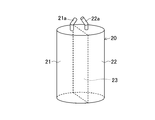
- a container 20 is divided into first and second chambers 21 and 22 by an internal partition wall 23, each of which has nozzles (liquid discharge portions) 21a and 22a.
- the method used is also mentioned. Specifically, an alkaline aqueous solution having a pH of 9 or more containing a phenolic antibacterial agent is placed in the first chamber 21 of the container 20 and an acid having a pH of 6 or less is placed in the second chamber 22, respectively.
- an alkaline aqueous solution having a pH of 9 or more containing a phenolic antibacterial agent is placed in the first chamber 21 of the container 20 and an acid having a pH of 6 or less is placed in the second chamber 22, respectively.
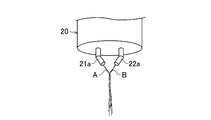
- the alkaline aqueous solution A and the acid B are simultaneously discharged from the nozzle 21 a of the first chamber 21 and the nozzle 22 a of the second chamber 22 by compression or the like, and collide with each other outside the container 20 to mix them.
- the produced antibacterial agent-containing liquid may have an antibacterial agent concentration less than or higher than the solubility of the phenolic antibacterial agent in the mixed aqueous solution of the alkaline aqueous solution and the acid.
- the antibacterial agent concentration is less than the solubility of the phenolic antibacterial agent
- the antibacterial agent-containing liquid becomes an antibacterial agent solution in which the phenolic antibacterial agent is dissolved in an aqueous solvent containing water as a main component.
- the solubility is higher than the above, fine particles of the phenolic antibacterial agent are precipitated, and the antibacterial agent dispersion is obtained by dispersing the phenolic antibacterial agent in an aqueous dispersion medium containing water as a main component.
- the average particle size of the phenolic antibacterial agent particles is preferably 50 to 5000 nm.
- the average particle size of the fine particles of the phenolic antibacterial agent is measured by a dynamic light scattering method.
- the manufactured antibacterial agent-containing liquid preferably has a pH of 4 to 9, more preferably 5 to 8, from the viewpoint of effective antibacterial expression and handling during use.
- the manufactured antibacterial agent-containing liquid preferably has an appropriate concentration according to the type of each phenolic antibacterial agent, from the viewpoint of a balance between effective antibacterial expression and suppression of aggregation of precipitated particles.
- the concentration in the antibacterial agent-containing liquid is preferably 8 to 200 mg / L, and more preferably 10 to 150 mg / L.
- the concentration of such a phenolic antibacterial agent is not sufficient to develop antibacterial properties, but according to the method for producing an antibacterial agent-containing liquid according to this embodiment, By mixing an alkaline aqueous solution with a pH of 9 or higher in which a phenolic antibacterial agent is dissolved and an acid with a pH of 6 or less, even a low concentration phenolic antibacterial agent that has not developed antibacterial properties has been used. A water-based antibacterial agent-containing liquid can be produced.
- the antibacterial agent-containing liquid thus produced may contain preservatives, thickeners, various polymers, and the like to the extent that they do not significantly affect the antibacterial properties of the phenolic antibacterial agent.
- the manufactured antibacterial agent-containing liquid is used by being added to household goods, cosmetics, cosmetics, and the like.
- Example 1 Triclosan concentration from one side of straight tube at room temperature (20 ° C.) using a T-shaped mixer (micro mixer made of SUS316 and having a tube flow diameter of 0.15 mm) having the same configuration as shown in FIG.
- the antibacterial agent-containing liquid of Example 1 had a triclosan concentration of 100 mg / L and a pH of 7.0.
- Example 2 An antibacterial agent-containing liquid obtained in the same manner as in Example 1 except that an alkaline aqueous solution having a triclosan concentration of 50 mg / L was used was designated as Example 2.
- the antibacterial agent-containing liquid of Example 2 had a triclosan concentration of 25 mg / L and a pH of 7.0.
- Example 3 An antibacterial agent-containing liquid obtained in the same manner as in Example 1 except that an alkaline aqueous solution having a triclosan concentration of 24 mg / L was used was designated as Example 3.
- the antibacterial agent-containing liquid of Example 3 had a triclosan concentration of 12 mg / L and a pH of 7.0.
- Example 4 An antibacterial agent-containing liquid obtained in the same manner as in Example 1 except that an alkaline aqueous solution having a triclosan concentration of 20 mg / L was used was designated as Example 4.
- the antibacterial agent-containing liquid of Example 4 had a triclosan concentration of 10 mg / L and a pH of 7.0.
- Example 5 An alkaline aqueous solution (solvent: alkaline water, NaOH concentration: 0.06 mol / L, pH: 13) having a triclosan concentration of 800 mg / L was used, and an aqueous sodium dihydrogen phosphate solution (diphosphate diacid) that was an acidic buffer as an acid.
- An antibacterial agent-containing liquid obtained by diluting an antibacterial agent-containing liquid obtained in the same manner as in Example 1 with water except for using sodium hydrogen concentration: 0.1 mol / L, pH 4.4) with water to four times the volume. It was set to 5.
- the antibacterial agent-containing liquid of Example 5 had a triclosan concentration of 100 mg / L and a pH of 7.0.
- the antibacterial agent-containing liquid obtained in the test tube was taken as Example 6.
- the antibacterial agent-containing liquid of Example 6 had a triclosan concentration of 100 mg / L and a pH of 5.9.
- the antibacterial agent-containing liquid obtained in the test tube was taken as Example 7.
- the antibacterial agent-containing liquid of Example 7 had a triclosan concentration of 100 mg / L and a pH of 7.7.
- the antibacterial agent-containing liquid obtained in the test tube was taken as Example 8.
- the antibacterial agent-containing liquid of Example 8 had a triclosan concentration of 100 mg / L and a pH of 6.7.
- the antibacterial agent-containing liquid obtained in the test tube was set as Example 9.
- the antibacterial agent-containing liquid of Example 9 had a triclosan concentration of 100 mg / L and a pH of 7.0.
- solvent alkaline water, NaOH concentration: 0.02 mol / L, pH: 12
- a second chamber Place a 0.1 mol / L HEPES aqueous solution (pH: 5.1
- the antibacterial agent-containing liquid of Example 10 had a triclosan concentration of 400 mg / L and a pH of 7.0.
- the antibacterial agent-containing liquid of Comparative Example 1 had a triclosan concentration of 100 mg / L and a pH of 7.0.
- Comparative example 2 The antibacterial agent-containing liquid obtained in the same manner as in Comparative Example 1 was used as Comparative Example 2, except that a propylene glycol solution having a triclosan concentration of 40 g / L was used instead of the ethanol solution of triclosan.
- the antibacterial agent-containing liquid of Comparative Example 2 had a triclosan concentration of 100 mg / L and a pH of 7.0.
- E.coli Escherichia coli NBRC3972
- SCDA Soybean Casein Digest Agar
- Tables 1 to 3 show the test results.
- Examples 1 and 5 to 9 in which the concentration of triclosan is 100 mg / L, Example 2 in which 25 mg / L is used, and Example 10 in which 400 mg / L is 400 mg / L are antibacterial agent dispersions, whereas the concentration of triclosan is Example 3 which is 12 mg / L and Example 4 which is 10 mg / L were antibacterial agent solutions.
- the average particle size of Example 1 is 200 nm
- the average particle size of Example 2 is 150 nm
- the average particle size of Example 5 is 1100 nm
- the average particle size of Example 6 is 400 nm
- the average particle size of Example 7 is 320 nm
- the average particle size of Example 8 was 350 nm
- the average particle size of Example 9 was 400 nm
- the average particle size of Example 10 was 500 nm.
- the comparative example 1 which is an ethanol solution was an antibacterial agent dispersion liquid
- the comparative example 2 which was a propylene glycol solution was an antibacterial agent solution.
- the average particle size of Comparative Example 1 was 200 nm.
- Example 11 In a 100 mL volumetric flask, 6 mL of an aqueous sodium hydroxide (NaOH) solution having a concentration of 1 mol / L (manufactured by Kishida Chemical Co., Ltd.), 80 mg of triclosan (manufactured by Ciba Specialty Chemicals Co., Ltd.), and polyvinylpyrrolidone (ISP: PVP-K30, weight average) (Molecular weight: 60000) 28 mg was added, water was further added to make 100 mL, and an alkaline aqueous solution in which triclosan and polyvinylpyrrolidone were dissolved was prepared.
- NaOH sodium hydroxide
- ISP polyvinylpyrrolidone
- the pH of the alkaline aqueous solution was 13.
- the concentrations of sodium hydroxide, triclosan, and polyvinylpyrrolidone in this alkaline aqueous solution are 60 mmol / L, 800 mg / L, and 100 mg / L, respectively, and the mass ratio of polyvinylpyrrolidone / triclosan is 0.35.
- An acidic aqueous solution in which sodium dihydrogen phosphate (manufactured by Wako Pure Chemical Industries, Ltd.) was dissolved in water so as to have a concentration of 100 mmol / L was prepared.
- the pH of the acidic aqueous solution was 4.4. Each of the alkaline aqueous solution and the acidic aqueous solution was adjusted to 20 ° C.
- Example 11 An average particle size was measured by a dynamic light scattering method using a zeta potential / particle size measurement system (model number: ELSZ-2, manufactured by Otsuka Electronics Co., Ltd.), and appearance evaluation (immediately after preparation and from adjustment to room temperature) After storage for 1 day).
- Table 4 shows the test results.
- Example 11 the average particle size of Example 11 was 51 nm. Further, the appearance evaluation of Example 11 was transparent immediately after the adjustment, and there was no change after storage for 1 day, and no change in state was observed.
- solution A 20 mL of an aqueous sodium hydroxide solution (manufactured by Kishida Chemical Co., Ltd.) was added and dissolved, and then an alkaline aqueous solution having a triclosan concentration of 400 mg / L adjusted to 100 mL by adding ion-exchanged water was used as solution A.
- the pH of solution A was 12.
- Liquid B HEPES aqueous solution 2.383 g of HEPES (manufactured by Wako Pure Chemical Industries, Ltd.) was taken in a 100 ml volumetric flask, and ion-exchanged water was added thereto and dissolved to make 100 mL.
- the pH of the B liquid was 5.1.
- HEPES 2.383g was taken to the HEPES buffer 100mL volumetric flask whose HEPES density
- a PTFE tube with a length of 10 cm and an inner diameter of 0.8 mm is connected to the remaining connection portion of the T-shaped joint, and this tube and the tube for liquid C are opposed to a T-shaped joint (swage lock) with an inner diameter of 1.3 mm.
- the two liquids were connected to a pair of connecting portions so that the two liquids collided in the front.
- a PTFE tube having a length of 10 cm and an inner diameter of 0.8 mm was connected to one remaining connection portion of the T-shaped joint, and the tip was used as a sampling port.
- each of liquid A and liquid B was fed at a flow rate of 3 ml / min and liquid C at a flow rate of 42 ml / min.
- an appropriate amount of the antibacterial agent-containing liquid which is a triclosan dispersion, was sampled from the sampling port 1 minute after the start of liquid feeding.
- the antibacterial agent-containing liquid sampled at this time had a triclosan concentration of 25 mg / L, a HEPES concentration of 0.05 mol / L, and a pH of 7.
- the average particle size was measured by a dynamic light scattering method using a zeta potential / particle size measurement system (model number: ELSZ-2 manufactured by Otsuka Electronics Co., Ltd.).
- Antimicrobial agent-containing liquid 1 After 2 hours of standing, the particle diameter increases to 2300 nm (antimicrobial agent-containing liquid 2), and after 6 hours of standing, the particle diameter further increases to 2711 nm (antimicrobial agent-containing liquid) 3).
- Antimicrobial activity evaluation ⁇ Test Example 1> Antibacterial activity was evaluated using Escherichia coli NBRC3972.
- E.coli Escherichia coli NBRC3972 cultured overnight at 30 ° C. on a Soybean Casein Digest Agar (SCDA) plate (manufactured by Wako Pure Chemical Industries, Ltd.) is scraped off with one platinum ear, and then sterilized with physiological saline The inoculum was suspended in water.
- SCDA Soybean Casein Digest Agar
- the antibacterial activity was compared from the log reduction amount of the number of bacteria after contact.
- the test solution after contact is inactivated by diluting with lecithin polysorbate (Lecithin Polysorbate), and the test solution is soybean casein digest lecithin polysorbate agar (Soybean Casein Digest-Lecithin Polysorbate Agar).
- the number of surviving bacteria at the time of the test was calculated by measuring the number of colonies obtained by culturing at 30 ° C. overnight.
- the number of initial bacteria was calculated by measuring the number of colonies obtained by diluting the inoculum and applying to SCDA and culturing overnight at 30 ° C.
- the common logarithm of the reduced number of surviving bacteria with respect to the initial number of bacteria was defined as the log reduction amount of the number of bacteria. Table 5 shows the test results.
- the antibacterial agent-containing liquid 1 exhibits a more remarkable antibacterial activity than the comparative product at triclosan concentrations of 25 mg / L, 50 mg / L, and 100 mg / L.
- the antibacterial agent-containing liquid 2 shows a higher antibacterial activity than that of the comparative product at a triclosan concentration of 25 mg / L, and a remarkable antibacterial activity as compared with the comparative product at a triclosan concentration of 50 mg / L and 100 mg / L. I understand.
- the inoculum was prepared in the same manner as in Test Example 1 using staphylococcus aureus. 10 ⁇ L of the above inoculum was added to 1 mL of the antibacterial agent-containing solution 1 whose concentrations were adjusted so that the triclosan concentrations were 25 mg / L, 200 mg / L, and 400 mg / L, respectively, and both were brought into contact with each other for 10 minutes. . A similar test was performed for each of the antibacterial agent-containing liquid 2 and the comparative product. And the antibacterial activity was compared from the log reduction amount of the number of bacteria after contact. Table 6 shows the test results.
- the antibacterial agent-containing liquid 1 exhibits a more remarkable antibacterial activity than the comparative product at triclosan concentrations of 25 mg / L and 400 mg / L.
- the antibacterial agent-containing liquid 2 shows a higher antibacterial activity than that of the comparative product at a triclosan concentration of 25 mg / L, and a remarkable antibacterial activity at a triclosan concentration of 400 mg / L.
- the inoculum was prepared in the same manner as in Test Example 1 using Pseudomonas aeruginosa. 10 ⁇ L of the above inoculum was added to 1 mL of the antibacterial agent-containing solution 1 whose concentrations were adjusted so that the triclosan concentrations were 25 mg / L, 200 mg / L, and 400 mg / L, respectively, and both were brought into contact with each other for 10 minutes. . A similar test was performed for each of the antibacterial agent-containing liquid 2 and the comparative product. And the antibacterial activity was compared from the log reduction amount of the number of bacteria after contact. Table 7 shows the test results.
- antibacterial agent-containing liquids 1 and 2 exhibit higher antibacterial activity than the comparative product at a triclosan concentration of 25 mg / L. It can also be seen that a remarkable antibacterial activity against Pseudomonas aeruginosa is obtained at a triclosan concentration of 400 mg / L.
- the antibacterial agent-containing liquids 1 and 2 have excellent antibacterial properties and also have antibacterial activity against Pseudomonas aeruginosa.
- the inoculum was prepared in the same manner as in Test Example 1 using the fungus body as a spore solution of blue mold. 10 ⁇ L of the inoculum was added to 1 mL of the antibacterial agent-containing solution 1 whose concentrations were adjusted so that the triclosan concentrations were 25 mg / L, 100 mg / L, 200 mg / L, and 400 mg / L, respectively. Touched for a minute. A similar test was performed for each of the antibacterial agent-containing liquid 2 and the comparative product. And the antibacterial activity was compared from the log reduction amount of the number of bacteria after contact. Table 8 shows the test results.
- the antibacterial agent-containing liquids 1 and 2 have an antifungal action against blue mold at a triclosan concentration of 25 mg / L.
- remarkable anti-epileptic activity against blue mold is obtained at triclosan concentrations of 200 mg / L and 400 mg / L.
- the antibacterial agent-containing liquids 1 and 2 have an excellent antifungal action.
- the NBRC strain was purchased from the NITE biological research center. Further, alcaligenes (Alcaligenes faecalis NBRC13111), Klebsiella (Klebsiella pneumoniae NBRC14940), Proteus (Proteus vulgaris NBRC3167), Pseudomonas aeruginosa (Pseudomonas aeruginosa NBRC13275), Pseudomonas (Pseudomonas putida NBRC14164), Staphylococcus aureus (Staphylococcus aureus NBRC13276), and Serratia for (Serratia marcescence NBRC12648) except for changing the cells was prepared inoculum in the same manner as in test example 1.
- a potato dextrose Agar (PDA) flat plate medium manufactured by Difco
- twin 80 A spore solution was prepared using Tokyo Chemical Industry Co., Ltd. and used as an inoculum solution.
- Candida albicans was tested in the same manner as in Test Example 1 using bacteria cultured on a Glucose Pepton Agar (GPA) plate medium (Wako Pure Chemical Industries, Ltd.) at 30 ° C. for 3 days. An inoculum solution was prepared.
- the antibacterial agent-containing liquid 1 (average particle size 200 nm) has a remarkable antibacterial activity with respect to all the above-mentioned bacteria than the comparative product.
- E.coli Escherichia coli NBRC3972 cultured overnight at 30 ° C. on a Soybean Casein Digest Agar (SCDA) plate (manufactured by Wako Pure Chemical Industries, Ltd.) is scraped off with one platinum ear, and then sterilized with physiological saline The inoculum was suspended in water.
- SCDA Soybean Casein Digest Agar
- triclosan having any average particle diameter shows antibacterial activity, but that the antibacterial agent-containing liquid 1 having an average particle diameter of 200 nm is significantly high.
- the antibacterial agent-containing liquids 1 to 3 have superior antibacterial and antibacterial properties against various gram-negative bacteria, gram-positive bacteria, and fungi compared to the case where triclosan is solubilized with an organic solvent or a surfactant.
- Antibacterial activity and antibacterial activity against Pseudomonas aeruginosa , Penicillium citrinum , Cladosporium cladosporioides , Staphylococcus aureus It can be seen that some cocoons also have antibacterial action.
- the present invention is useful for a method for producing an antibacterial agent-containing liquid used in addition to household, medical, and commercial cleaning agents, antifouling agents, deodorizing and deodorizing agents, cosmetics, cosmetics, hygiene products, etc. It is.
Landscapes
- Life Sciences & Earth Sciences (AREA)
- Health & Medical Sciences (AREA)
- General Health & Medical Sciences (AREA)
- Environmental Sciences (AREA)
- Animal Behavior & Ethology (AREA)
- Engineering & Computer Science (AREA)
- Dentistry (AREA)
- Pest Control & Pesticides (AREA)
- Wood Science & Technology (AREA)
- Zoology (AREA)
- Agronomy & Crop Science (AREA)
- Veterinary Medicine (AREA)
- Plant Pathology (AREA)
- Public Health (AREA)
- Dermatology (AREA)
- Emergency Medicine (AREA)
- Birds (AREA)
- Epidemiology (AREA)
- Toxicology (AREA)
- Agricultural Chemicals And Associated Chemicals (AREA)
Abstract
抗菌剤含有液の製造方法は、フェノール系抗菌剤を溶解させたpH9以上のアルカリ性水溶液とpH6以下の酸とを混合する。
Description
本発明は、家庭用品、化粧品、香粧品等に添加されて用いられる抗菌剤含有液の製造方法に関する。
フェノール系抗菌剤であるクロロフェノール系抗菌剤やパラベン類やイソプロピルメチルフェノールは優れた抗菌剤として知られている。これらのフェノール系抗菌剤は、常温固体で水難溶解性の物質が多く、そのため一般的な利用形態は、界面活性剤を含有する洗浄剤に配合して用いる場合、或いは、油性成分や有機溶媒に溶解させて用いる場合がほとんどである。
また、特許文献1には、抗菌活性を有するデスフルオロピリドンカルボン酸系化合物またはその塩をpH10以上の水溶液に溶解させ、シクロデキストリン類、マグネシウム塩の存在下、酸を加えてpH6~8の中性付近に調製することにより、当該化合物の溶解性を高め、薬理効果を得るために十分な濃度の水溶液剤を製造する方法が示されている。
本発明の抗菌剤含有液の製造方法は、フェノール系抗菌剤を溶解させたpH9以上のアルカリ性水溶液とpH6以下の酸とを混合するものである。
本発明の別の抗菌剤含有液の製造方法は、各々、液出し部を有する第1及び第2室を備えた容器を用い、該容器における第1室にフェノール系抗菌剤を含有するpH9以上のアルカリ性水溶液及び第2室にpH6以下の酸をそれぞれ入れ、該容器の第1室の液出し部からアルカリ性水溶液及び第2室の液出し部から酸をそれぞれ同時に流出させて該容器外でそれらを混合し、動的光散乱法により測定される平均粒子径が50~5000nmであるフェノール系抗菌剤の微粒子を含む抗菌剤含有液を製造するものである。
以下、実施形態について詳細に説明する。
本実施形態に係る抗菌剤含有液の製造方法は、フェノール系抗菌剤を溶解させたpH9以上のアルカリ性水溶液とpH6以下の酸とを混合するものである。
常温固体で水難溶解性のフェノール系抗菌剤(例えば、クロロフェノール系抗菌剤、パラベン類、イソプロピルメチルフェノール等)は、洗浄剤に配合された場合、界面活性剤の存在により抗菌・殺菌性が低下することが多い。そのため、十分な抗菌・殺菌性を発揮させるためには、洗浄剤中への配合量を多くせざるを得ない。その一方、家庭用品、化粧品、香粧品等においては、安全性の面からフェノール系抗菌剤の配合量が規制されている場合が多い。また、フェノール系抗菌剤は、油性成分や有機溶媒に溶解させた場合、使用可能な適用範囲が制限される。
しかしながら、本実施形態に係る抗菌剤含有液の製造方法によれば、フェノール系抗菌剤を溶解させたpH9以上のアルカリ性水溶液とpH6以下の酸とを混合することにより、従来は抗菌性を発現しなかったような低濃度のフェノール系抗菌剤でも優れた抗菌性を発揮する水系の抗菌剤含有液を製造することができる。
ここで、フェノール系抗菌剤としては、クロロフェノール系抗菌剤、パラベン類、及びイソプロピルメチルフェノール等が挙げられる。フェノール系抗菌剤は、単一種の化合物で構成されていてもよく、また、複数種の化合物で構成されていてもよい。アルカリ性水溶液におけるフェノール系抗菌剤の濃度は、10~5000mg/Lであることが好ましく、20~3000mg/Lであることがより好ましい。
また、フェノール系抗菌剤は、常温固体で且つ水難溶解性のものが好ましい。なお、本出願において、常温固体とは、単体の融点が35℃以上であることをいう。水難溶解性とは、20℃の水への溶解度が3000mg/L以下であることをいう。
具体的なフェノール系抗菌剤としては、クロロフェノール系抗菌剤では、例えば、トリクロサン(5-chloro-2-[2,4-dichlorophenoxyl]phenol)、クロルチモール、カルバクロル、クロロフェン、ジクロロフェン、ヘキサクロロフェン、クロロキシレノール、クロロクレゾール等が挙げられる。これらのうちトリクロサンが特に好ましい。パラベン類では、例えば、パラオキシ安息香酸メチル、パラオキシ安息香酸エチル、パラオキシ安息香酸プロピル、パラオキシ安息香酸イソプロピル、パラオキシ安息香酸ブチル、パラオキシ安息香酸イソブチル、パラオキシ安息香酸ベンジル等が挙げられる。これらのうちパラオキシ安息香酸プロピルが特に好ましい。その他のフェノール系抗菌剤では、0-フェニルフェノール、4‐イソプロピルメチルフェノール等が挙げられる。
アルカリ性水溶液は、例えば、水酸化ナトリウム、水酸化カリウム、炭酸ナトリウム、炭酸カリウム、炭酸水素ナトリウム、炭酸水素カリウム、リン酸3ナトリウム等といったアルカリ剤の水溶液であって、さらに上記フェノール系抗菌剤を溶解させたものである。アルカリ性水溶液に含まれるアルカリ剤は、単一種で構成されていてもよく、また、複数種で構成されていてもよい。
アルカリ性水溶液は、pHが9以上であり、10以上であることが好ましい。一方、アルカリ性水溶液は、pHが14以下であることが好ましく、13以下であることがより好ましい。
アルカリ性水溶液には、製造される抗菌剤含有液の保存安定性を高める観点から、ポリビニルピロリドンが含まれていてもよい。ポリビニルピロリドンの含有量は、フェノール系抗菌剤の含有量に対する質量比で0.1~0.5であることが好ましい。
また、アルカリ性水溶液には、その他にフェノール系抗菌剤の抗菌性に大きな影響を及ぼさない程度に界面活性剤や有機溶剤が含まれていてもよい。界面活性剤としては、例えば、ドデシル硫酸ナトリウム、ポリオキシエチレンアルキルエーテル硫酸ナトリウム、ラウリルメチルタウリン塩等のアニオン性のものが挙げられる。有機溶剤としては、例えば、水混和性のエタノール、ジメチルスルホキシド、ジメチルホルムアミド、ジメチルアセトアミド、グリセリン、プロピレングリコール等が挙げられる。但し、これらの界面活性剤や有機溶剤は実質的に含まれていないことが好ましい。
アルカリ性水溶液に混合する酸は、酸水溶液等の液体であってもよく、また、水溶性固体であってもよい。
酸は、無機酸であってもよく、また、有機酸であってもよい。具体的には、無機酸としては、塩酸(希塩酸)、硫酸(希硫酸)、リン酸等が挙げられ、有機酸としては、例えば、酢酸、クエン酸等が挙げられる。酸は、単一種で構成されていてもよく、また、複数種で構成されていてもよい。
酸は、pHが6以下であり、pHは1~6であることが好ましく、2~5であることがより好ましい。
酸には、アルカリ性水溶液と同様に、製造される抗菌剤含有液の保存安定性を高める観点から、ポリビニルピロリドンが含まれていてもよい。ポリビニルピロリドンの含有量は、フェノール系抗菌剤の含有量に対する質量比で0.1~0.5であることが好ましい。
酸は、酸性の緩衝液であってもよい。かかる酸性の緩衝液としては、例えば、Bis-Tris(Bis(2-hydroxyethyl)iminotris(hydroxymethyl)methane)水溶液、HEPES(2-[4-(2-Hydroxyethyl)-1-piperazinyl]ethanesulfonic acid)水溶液、リン酸二水素ナトリウム水溶液、クエン酸・リン酸水素二ナトリウム水溶液等が挙げられる。
酸には、アルカリ性水溶液の場合と同様、フェノール系抗菌剤の抗菌性に大きな影響を及ぼさない程度に界面活性剤や有機溶剤が含まれていてもよい。
アルカリ性水溶液と酸との混合方法は、バッチ混合方式であってもよく、また、連続方式であってもよい。
バッチ混合方式としては、混合槽にアルカリ性水溶液及び酸のうち一方を仕込んでおき、そして、他方を徐々に添加すると共にプロペラ翼、アンカー翼、ホモミキサーなどの攪拌翼等を用いて混合する方法が挙げられる。このとき、アルカリ性水溶液に酸を添加してもよく、また、酸にアルカリ性水溶液を添加してもよい。
連続混合方式としては、アルカリ性水溶液及び酸を合流させたものを混合器に流通させて混合する方法が挙げられる。連続混合方式で用いる混合器としては、例えば、静止型混合器、ラインミキサー、マイクロミキサー等が挙げられる。
また、連続混合方式としては、アルカリ性水溶液及び酸のそれぞれを別々に混合器に流入させ、混合器内部においてそれらを流通させながら混合する方法も挙げられる。具体的には、例えば、図1に示すように、T字管状の混合器10の直管部分11の一方側からアルカリ性水溶液及び他方側から酸をそれぞれ流入させて中央で衝突接触させ、それらを総流量1~100ml/minで分岐管部分12(例えば、細孔部分の流路径0.1~0.5mm、及び流路長さ0.3~3mm)に流通させる方法である。
さらに、連続混合方式としては、図2に示すような、内部隔壁23によって第1及び第2室21,22に区画され、それらのそれぞれがノズル(液出し部)21a,22aを有する容器20を用いる方法も挙げられる。具体的には、この容器20における第1室21にフェノール系抗菌剤を含有するpH9以上のアルカリ性水溶液及び第2室22にpH6以下の酸をそれぞれ入れ、図3に示すように、容器20を圧縮等して第1室21のノズル21aからアルカリ性水溶液A及び第2室22のノズル22aから酸Bをそれぞれ同時に流出させ、容器20外でそれらを衝突させて混合する方法である。
ここで、アルカリ性水溶液と酸との混合割合は、混合体積比でアルカリ性水溶液/酸=1/400~100/1とすることが好ましい。
製造された抗菌剤含有液は、抗菌剤濃度が、当該アルカリ性水溶液と酸との混合水溶液におけるフェノール系抗菌剤の溶解度未満であってもよく、また、それ以上であってもよい。抗菌剤含有液は、抗菌剤濃度がフェノール系抗菌剤の溶解度未満の場合、フェノール系抗菌剤が水を主成分とする水系溶媒に溶解した抗菌剤溶液となり、抗菌剤濃度がフェノール系抗菌剤の溶解度以上の場合、フェノール系抗菌剤の微粒子が析出し、フェノール系抗菌剤が水を主成分とする水系分散媒に分散した抗菌剤分散液となる。後者の抗菌剤分散液の場合、フェノール系抗菌剤の微粒子の平均粒子径は50~5000nmであることが好ましい。このフェノール系抗菌剤の微粒子の平均粒子径は動的光散乱法により測定されるものである。
製造された抗菌剤含有液は、有効な抗菌性の発現と使用時の取り扱いの観点から、pHが4~9であることが好ましく、5~8であることがより好ましい。
製造された抗菌剤含有液は、有効な抗菌性の発現と析出粒子の凝集抑制とのバランスの観点から、各フェノール系抗菌剤の種類に応じて適当な濃度を有することが好ましい。例えば、フェノール系抗菌剤がトリクロサンの場合、抗菌剤含有液における濃度が8~200mg/Lであることが好ましく、10~150mg/Lであることがより好ましい。従来の知見からすれば、このようなフェノール系抗菌剤の濃度は抗菌性を発現させるのには十分とは言えないものであるが、本実施形態に係る抗菌剤含有液の製造方法によれば、フェノール系抗菌剤を溶解させたpH9以上のアルカリ性水溶液とpH6以下の酸とを混合することにより、従来は抗菌性を発現しなかったような低濃度のフェノール系抗菌剤でも優れた抗菌性を発揮する水系の抗菌剤含有液を製造することができる。
製造された抗菌剤含有液には、フェノール系抗菌剤の抗菌性に大きな影響を及ぼさない程度に防腐剤、粘調剤、各種高分子などが添加されてもよい。そして、製造された抗菌剤含有液は、家庭用品、化粧品、香粧品等に添加されて用いられる。
[試験評価1]
(抗菌剤含有液)
<実施例1>
図1に示すのと同様の構成のT字状の混合器(SUS316製で管内流路径が0.15mmのマイクロミキサー)を用い、室温下(20℃)、直管部分の一方側からトリクロサン濃度が200mg/Lのアルカリ性水溶液(溶媒:アルカリ水、NaOH濃度:0.02mol/L、pH:12)及び他方側から酸として酸性の緩衝液であるHEPES水溶液(HEPES濃度:0.1mol/L、pH5.1)を、混合体積比がアルカリ性水溶液/HEPES水溶液=1/1で且つ総流量が6ml/minとなるようにそれぞれシリンジポンプで送液して流入させた。そして、分岐管部分から回収された抗菌剤含有液を実施例1とした。
実施例1の抗菌剤含有液は、トリクロサン濃度が100mg/L、及びpHが7.0であった。
<実施例2>
トリクロサン濃度が50mg/Lであるアルカリ性水溶液を用いたことを除いて実施例1と同様にして得た抗菌剤含有液を実施例2とした。
トリクロサン濃度が50mg/Lであるアルカリ性水溶液を用いたことを除いて実施例1と同様にして得た抗菌剤含有液を実施例2とした。
実施例2の抗菌剤含有液は、トリクロサン濃度が25mg/L、及びpHが7.0であった。
<実施例3>
トリクロサン濃度が24mg/Lであるアルカリ性水溶液を用いたことを除いて実施例1と同様にして得た抗菌剤含有液を実施例3とした。
トリクロサン濃度が24mg/Lであるアルカリ性水溶液を用いたことを除いて実施例1と同様にして得た抗菌剤含有液を実施例3とした。
実施例3の抗菌剤含有液は、トリクロサン濃度が12mg/L、及びpHが7.0であった。
<実施例4>
トリクロサン濃度が20mg/Lであるアルカリ性水溶液を用いたことを除いて実施例1と同様にして得た抗菌剤含有液を実施例4とした。
トリクロサン濃度が20mg/Lであるアルカリ性水溶液を用いたことを除いて実施例1と同様にして得た抗菌剤含有液を実施例4とした。
実施例4の抗菌剤含有液は、トリクロサン濃度が10mg/L、及びpHが7.0であった。
<実施例5>
トリクロサン濃度が800mg/Lのアルカリ性水溶液(溶媒:アルカリ水、NaOH濃度:0.06mol/L、pH:13)を用いると共に、酸として酸性の緩衝液であるリン酸二水素ナトリウム水溶液(リン酸二水素ナトリウム濃度:0.1mol/L、pH4.4)を用いたことを除いて実施例1と同様にして得た抗菌剤含有液を水で4倍体積に希釈した抗菌剤含有液を実施例5とした。
トリクロサン濃度が800mg/Lのアルカリ性水溶液(溶媒:アルカリ水、NaOH濃度:0.06mol/L、pH:13)を用いると共に、酸として酸性の緩衝液であるリン酸二水素ナトリウム水溶液(リン酸二水素ナトリウム濃度:0.1mol/L、pH4.4)を用いたことを除いて実施例1と同様にして得た抗菌剤含有液を水で4倍体積に希釈した抗菌剤含有液を実施例5とした。
実施例5の抗菌剤含有液は、トリクロサン濃度が100mg/L、及びpHが7.0であった。
<実施例6>
試験管を用い、室温下(20℃)、濃度が0.05mol/Lのクエン酸水溶液(pH:2.1)に、トリクロサン濃度が200mg/Lのアルカリ性水溶液(溶媒:アルカリ水、NaHCO3濃度:0.04mol/L、Na2CO3濃度0.06mol/L、pH:10.3)を、混合体積比がアルカリ性水溶液/クエン酸水溶液=1/1となるように添加した。そして、試験管内に得られた抗菌剤含有液を実施例6とした。
試験管を用い、室温下(20℃)、濃度が0.05mol/Lのクエン酸水溶液(pH:2.1)に、トリクロサン濃度が200mg/Lのアルカリ性水溶液(溶媒:アルカリ水、NaHCO3濃度:0.04mol/L、Na2CO3濃度0.06mol/L、pH:10.3)を、混合体積比がアルカリ性水溶液/クエン酸水溶液=1/1となるように添加した。そして、試験管内に得られた抗菌剤含有液を実施例6とした。
実施例6の抗菌剤含有液は、トリクロサン濃度が100mg/L、及びpHが5.9であった。
<実施例7>
試験管を用い、室温下(20℃)、濃度が0.05mol/LのHEPES水溶液(pH5.2)に、トリクロサン濃度が10000mg/Lのアルカリ性水溶液(溶媒:アルカリ水、NaOH濃度:1mol/L、pH:13.6)を、混合体積比がアルカリ性水溶液/HEPES水溶液=1/99となるように添加した。そして、試験管内に得られた抗菌剤含有液を実施例7とした。
試験管を用い、室温下(20℃)、濃度が0.05mol/LのHEPES水溶液(pH5.2)に、トリクロサン濃度が10000mg/Lのアルカリ性水溶液(溶媒:アルカリ水、NaOH濃度:1mol/L、pH:13.6)を、混合体積比がアルカリ性水溶液/HEPES水溶液=1/99となるように添加した。そして、試験管内に得られた抗菌剤含有液を実施例7とした。
実施例7の抗菌剤含有液は、トリクロサン濃度が100mg/L、及びpHが7.7であった。
<実施例8>
試験管を用い、室温下(20℃)、トリクロサン濃度が100mg/Lのアルカリ性水溶液(溶媒:アルカリ水、NaHCO3濃度:0.02mol/L、Na2CO3濃度0.03mol/L、pH:10.3)に、濃度が1mol/Lの硫酸(pH:0.5)を、混合体積比がアルカリ性水溶液/硫酸=49/1となるように添加した。そして、試験管内に得られた抗菌剤含有液を実施例8とした。
試験管を用い、室温下(20℃)、トリクロサン濃度が100mg/Lのアルカリ性水溶液(溶媒:アルカリ水、NaHCO3濃度:0.02mol/L、Na2CO3濃度0.03mol/L、pH:10.3)に、濃度が1mol/Lの硫酸(pH:0.5)を、混合体積比がアルカリ性水溶液/硫酸=49/1となるように添加した。そして、試験管内に得られた抗菌剤含有液を実施例8とした。
実施例8の抗菌剤含有液は、トリクロサン濃度が100mg/L、及びpHが6.7であった。
<実施例9>
試験管を用い、室温下(20℃)、濃度が0.05mol/Lのクエン酸水溶液(pH:2.1)に、トリクロサン濃度が200mg/Lのアルカリ性水溶液(溶媒:アルカリ水、リン酸3ナトリウム濃度:0.1mol/L、pH:12.6)を、混合体積比がアルカリ性水溶液/クエン酸水溶液=1/1となるように添加した。そして、試験管内に得られた抗菌剤含有液を実施例9とした。
試験管を用い、室温下(20℃)、濃度が0.05mol/Lのクエン酸水溶液(pH:2.1)に、トリクロサン濃度が200mg/Lのアルカリ性水溶液(溶媒:アルカリ水、リン酸3ナトリウム濃度:0.1mol/L、pH:12.6)を、混合体積比がアルカリ性水溶液/クエン酸水溶液=1/1となるように添加した。そして、試験管内に得られた抗菌剤含有液を実施例9とした。
実施例9の抗菌剤含有液は、トリクロサン濃度が100mg/L、及びpHが7.0であった。
<実施例10>
図2に示すのと同様の構成の容器を用い、その第1室にトリクロサン濃度が800mg/Lのアルカリ性水溶液(溶媒:アルカリ水、NaOH濃度:0.02mol/L、pH:12)及び第2室に濃度が0.1mol/LのHEPES水溶液(pH:5.1)をそれぞれ入れ、容器の第1室のノズルからアルカリ性水溶液及び第2室のノズルからHEPES水溶液をそれぞれ同時に流出させて容器外で、混合体積比がアルカリ性水溶液/HEPES水溶液=1/1となるようにそれらを衝突させて混合し、得られた抗菌剤含有液を実施例10とした。
図2に示すのと同様の構成の容器を用い、その第1室にトリクロサン濃度が800mg/Lのアルカリ性水溶液(溶媒:アルカリ水、NaOH濃度:0.02mol/L、pH:12)及び第2室に濃度が0.1mol/LのHEPES水溶液(pH:5.1)をそれぞれ入れ、容器の第1室のノズルからアルカリ性水溶液及び第2室のノズルからHEPES水溶液をそれぞれ同時に流出させて容器外で、混合体積比がアルカリ性水溶液/HEPES水溶液=1/1となるようにそれらを衝突させて混合し、得られた抗菌剤含有液を実施例10とした。
実施例10の抗菌剤含有液は、トリクロサン濃度が400mg/L、及びpHが7.0であった。
<比較例1>
試験管を用い、室温下(20℃)、トリクロサン濃度が40g/Lのエタノール溶液に、HEPES濃度が0.05mol/L及びNaOH濃度が0.01mol/Lの水性溶液を、混合体積比がエタノール溶液/水性溶液=1/399となるように添加した。そして、試験管内に得られた抗菌剤含有液を比較例1とした。
試験管を用い、室温下(20℃)、トリクロサン濃度が40g/Lのエタノール溶液に、HEPES濃度が0.05mol/L及びNaOH濃度が0.01mol/Lの水性溶液を、混合体積比がエタノール溶液/水性溶液=1/399となるように添加した。そして、試験管内に得られた抗菌剤含有液を比較例1とした。
比較例1の抗菌剤含有液は、トリクロサン濃度が100mg/L、及びpHが7.0であった。
<比較例2>
トリクロサンのエタノール溶液の代わりにトリクロサン濃度が40g/Lのプロピレングリコール溶液を用いたことを除いて比較例1と同様にして得た抗菌剤含有液を比較例2とした。
トリクロサンのエタノール溶液の代わりにトリクロサン濃度が40g/Lのプロピレングリコール溶液を用いたことを除いて比較例1と同様にして得た抗菌剤含有液を比較例2とした。
比較例2の抗菌剤含有液は、トリクロサン濃度が100mg/L、及びpHが7.0であった。
(試験評価方法)
<抗菌性試験>
ソイビーン・カゼイン・ダイジェスト・アガー(Soybean Casein Digest Agar(SCDA))平板(和光純薬工業社製)上において30℃で一夜培養した大腸菌(Escherichia coli NBRC3972)を一白金耳掻き取り、それを滅菌生理食塩水に懸濁させて接種菌液とした。
<抗菌性試験>
ソイビーン・カゼイン・ダイジェスト・アガー(Soybean Casein Digest Agar(SCDA))平板(和光純薬工業社製)上において30℃で一夜培養した大腸菌(Escherichia coli NBRC3972)を一白金耳掻き取り、それを滅菌生理食塩水に懸濁させて接種菌液とした。
実施例1~10及び比較例1~2のそれぞれの抗菌剤含有液1mlに、上記接種菌液10μLを添加し、それにより両者を10分間接触させた。そして、接触後プレート法により生菌数を計測し、菌数の減少数の対数値(Log減少数)が2以上であれば抗菌性あり:○、2未満であれば抗菌性なし:×と評価した。
<粒子の有無・粒子径測定>
実施例1~10及び比較例1~2のそれぞれの抗菌剤含有液について、ゼータ電位・粒径測定システム(大塚電子社製 型番:ELSZ-2)を用い、動的光散乱法により粒子の析出の有無及び平均粒子径を測定した。
実施例1~10及び比較例1~2のそれぞれの抗菌剤含有液について、ゼータ電位・粒径測定システム(大塚電子社製 型番:ELSZ-2)を用い、動的光散乱法により粒子の析出の有無及び平均粒子径を測定した。
(試験評価結果)
表1~3は試験結果を示す。
表1~3は試験結果を示す。

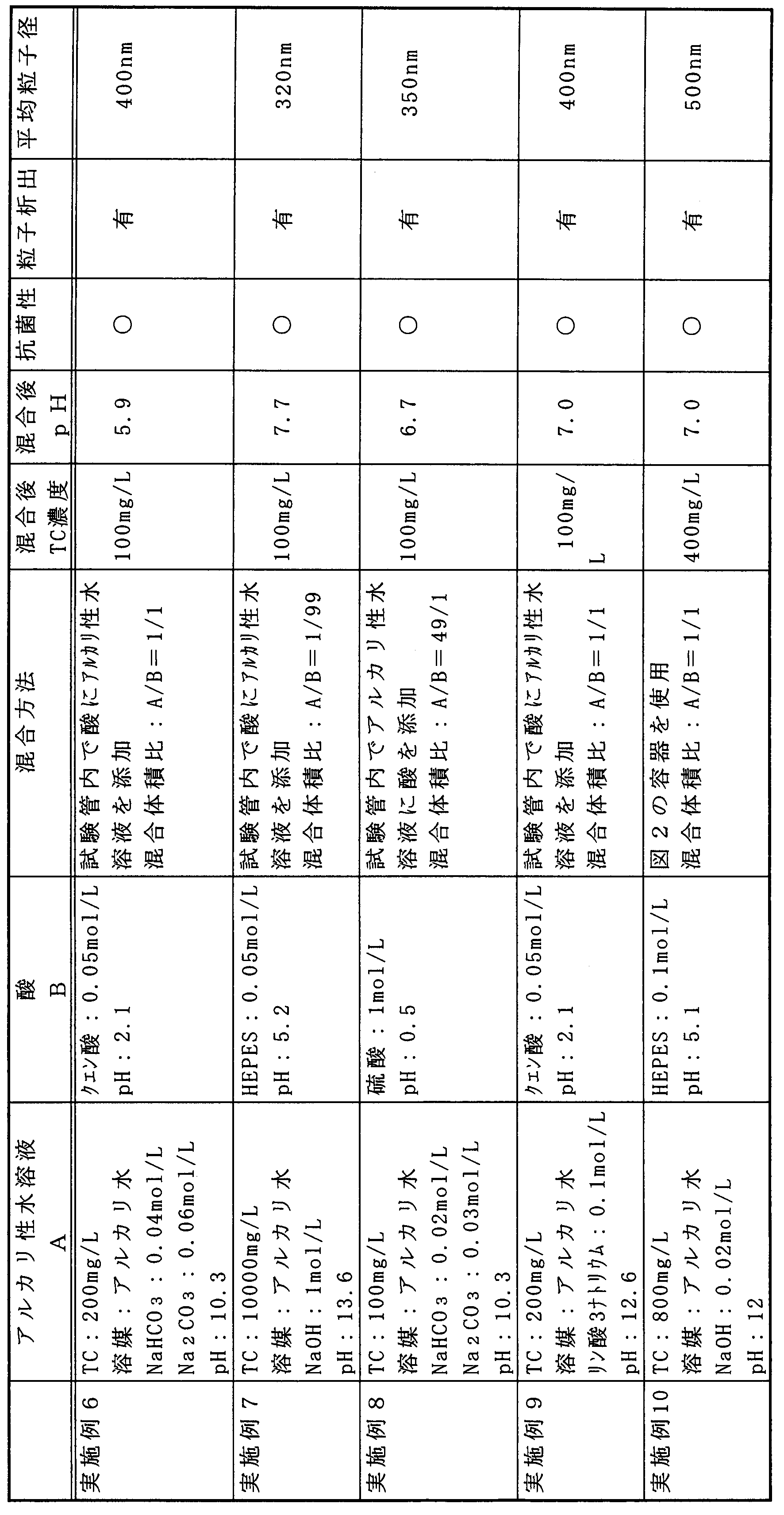

表1~3によれば、比較例1~2では抗菌性が認められないが、実施例1~10では、トリクロサンが比較例1及び2と比較して大幅に低い濃度でも顕著な抗菌性が認められることが分かる。この理由は定かではないが、pHを変化させて得られた実施例1~10のトリクロサンの抗菌剤含有液は、トリクロサンの存在状態が比較例1~2に比べて特異であることが関連しているのではないかと推測される。
トリクロサンの濃度が100mg/Lである実施例1及び5~9、25mg/Lである実施例2、並びに400mg/Lである実施例10は抗菌剤分散液であるのに対し、トリクロサンの濃度が12mg/Lである実施例3及び10mg/Lである実施例4は抗菌剤溶液であった。実施例1の平均粒子径は200nm、実施例2の平均粒子径は150nm、実施例5の平均粒子径は1100nm、実施例6の平均粒子径は400nm、実施例7の平均粒子径は320nm、実施例8の平均粒子径は350nm、実施例9の平均粒子径は400nm、及び実施例10の平均粒子径は500nmであった。また、エタノール溶液である比較例1は抗菌剤分散液であるのに対し、プロピレングリコール溶液である比較例2は抗菌剤溶液であった。比較例1の平均粒子径は200nmであった。
[試験評価2]
(抗菌剤含有液)
<実施例11>
100mLメスフラスコに、濃度が1mol/Lの水酸化ナトリウム(NaOH)水溶液(キシダ化学社製)6mL、トリクロサン(チバ・スペシャルティ・ケミカルズ社製)80mg、及びポリビニルピロリドン(ISP:PVP-K30,重量平均分子量:60000)28mgを入れ、そこにさらに水を加えて100mLとし、そのトリクロサン及びポリビニルピロリドンを溶解させたアルカリ性水溶液を調整した。アルカリ性水溶液のpHは13であった。このアルカリ性水溶液における水酸化ナトリウム、トリクロサン、及びポリビニルピロリドンの濃度は、それぞれ60mmol/L、800mg/L、及び100mg/Lであり、ポリビニルピロリドン/トリクロサンの質量比は0.35である。リン酸二水素ナトリウム(和光純薬工業社製)を濃度が100mmol/Lとなるように水に溶解させた酸性水溶液を調整した。酸性水溶液のpHは4.4であった。アルカリ性水溶液及び酸性水溶液をそれぞれ20℃に調温した。
図1に示すのと同様の構成のT字状の混合器(分岐管部分が孔径0.15mm及び孔長さ1.0mmの円筒孔であるマイクロミキサー)を用い、室温下(20℃)、直管部分の一方側からアルカリ性水溶液及び他方側から酸性水溶液を、混合体積比がアルカリ性水溶液/酸性水溶液=1/1で且つ総流量が6ml/minとなるようにそれぞれシリンジポンプで送液して流入させた。そして、分岐管部分から回収された抗菌剤含有液を実施例11とした。この実施例11の抗菌剤含有液のトリクロサン濃度は400mg/Lであった。
(試験評価方法)
実施例11について、ゼータ電位・粒径測定システム(大塚電子社製 型番:ELSZ-2)を用い、動的光散乱法により平均粒子径を測定し、また、外観評価(調製直後及び調整から室温1日保存後)を行った。
実施例11について、ゼータ電位・粒径測定システム(大塚電子社製 型番:ELSZ-2)を用い、動的光散乱法により平均粒子径を測定し、また、外観評価(調製直後及び調整から室温1日保存後)を行った。
(試験評価結果)
表4は試験結果を示す。
表4は試験結果を示す。

表4によれば、実施例11の平均粒子径は51nmであった。また、実施例11の外観評価は、調整直後が透明であり、1日保存後も変化は無く、状態変化が見られなかった。
[試験評価3]
(製造例 抗菌剤含有液(トリクロサン分散液)の調製)
(1)A液~C液の調製
A液:トリクロサン濃度が400mg/Lのアルカリ性水溶液
100mLメスフラスコに、トリクロサン(チバ・スペシャルティ・ケミカルズ社製)40mgをとり、そこに濃度が0.1mol/Lの水酸化ナトリウム水溶液(キシダ化学社製)20mLを加えて溶解させた後、さらにイオン交換水を加えて100mLとして調整したトリクロサン濃度が400mg/Lのアルカリ性水溶液をA液とした。A液のpHは12であった。
(製造例 抗菌剤含有液(トリクロサン分散液)の調製)
(1)A液~C液の調製
A液:トリクロサン濃度が400mg/Lのアルカリ性水溶液
100mLメスフラスコに、トリクロサン(チバ・スペシャルティ・ケミカルズ社製)40mgをとり、そこに濃度が0.1mol/Lの水酸化ナトリウム水溶液(キシダ化学社製)20mLを加えて溶解させた後、さらにイオン交換水を加えて100mLとして調整したトリクロサン濃度が400mg/Lのアルカリ性水溶液をA液とした。A液のpHは12であった。
B液:HEPES水溶液
100mlメスフラスコに、HEPES(和光純薬工業社製)2.383gをとり、そこにイオン交換水を加えて溶解させて100mLとして調整したHEPES水溶液をB液とした。B液のpHは5.1であった。
100mlメスフラスコに、HEPES(和光純薬工業社製)2.383gをとり、そこにイオン交換水を加えて溶解させて100mLとして調整したHEPES水溶液をB液とした。B液のpHは5.1であった。
C液:HEPES濃度が0.05mol/LのHEPES緩衝液
100mLメスフラスコに、HEPES2.383gをとり、そこにイオン交換水を加えて溶解させて100mLとした。また、別の100mLメスフラスコに、0.1mol/Lの水酸化ナトリウム水溶液を20mLとり、そこにイオン交換水を加えて希釈して100mLとした。そして、両者をビーカー内で混合して調整したHEPES濃度が0.05mol/LのHEPES緩衝液をC液とした。C液のpHは7であった。
100mLメスフラスコに、HEPES2.383gをとり、そこにイオン交換水を加えて溶解させて100mLとした。また、別の100mLメスフラスコに、0.1mol/Lの水酸化ナトリウム水溶液を20mLとり、そこにイオン交換水を加えて希釈して100mLとした。そして、両者をビーカー内で混合して調整したHEPES濃度が0.05mol/LのHEPES緩衝液をC液とした。C液のpHは7であった。
(2)抗菌剤含有液調製装置
3本の30mLプラスチックシリンジをそれぞれA液用、B液用、及びC液用とし、それぞれの先端に孔径0.22μmのメンブレンフィルターを装着し、マイクロシリンジポンプ(kd Scientific社製)に取り付けた。また、それぞれのシリンジ出口(フィルター出口)には、長さ20cm及び内径0.8mmのPTFE製チューブを接続した。そして、A液用のチューブ及びB液用のチューブを、内径0.15mmのT字継手(ジーエルサイエンス)の対向する一対の接続部に、A液とB液とが正面衝突するように接続した。T字継手の残る1つの接続部には長さ10cm及び内径0.8mmのPTFE製チューブを接続し、このチューブ及びC液用のチューブを、内径1.3mmのT字継手(スウェジロック)の対向する一対の接続部に、2液が正面衝突するように接続した。T字継手の残る1つの接続部には長さ10cm及び内径0.8mmのPTFE製チューブを接続し、その先端をサンプリング口とした。
3本の30mLプラスチックシリンジをそれぞれA液用、B液用、及びC液用とし、それぞれの先端に孔径0.22μmのメンブレンフィルターを装着し、マイクロシリンジポンプ(kd Scientific社製)に取り付けた。また、それぞれのシリンジ出口(フィルター出口)には、長さ20cm及び内径0.8mmのPTFE製チューブを接続した。そして、A液用のチューブ及びB液用のチューブを、内径0.15mmのT字継手(ジーエルサイエンス)の対向する一対の接続部に、A液とB液とが正面衝突するように接続した。T字継手の残る1つの接続部には長さ10cm及び内径0.8mmのPTFE製チューブを接続し、このチューブ及びC液用のチューブを、内径1.3mmのT字継手(スウェジロック)の対向する一対の接続部に、2液が正面衝突するように接続した。T字継手の残る1つの接続部には長さ10cm及び内径0.8mmのPTFE製チューブを接続し、その先端をサンプリング口とした。
(3)抗菌剤含有液の調製
配管部分を事前にオートクレーブ内で滅菌した後、シリンジに各液を充填してトリクロサン分散液である抗菌剤含有液の調製を開始した。
配管部分を事前にオートクレーブ内で滅菌した後、シリンジに各液を充填してトリクロサン分散液である抗菌剤含有液の調製を開始した。
マイクロシリンジポンプにより、A液及びB液のそれぞれを3ml/min、並びにC液を42ml/minの流量で送液した。そして、送液開始から1分後、サンプリング口よりトリクロサン分散液である抗菌剤含有液を適量サンプリングした。このときサンプリングした抗菌剤含有液は、トリクロサン濃度が25mg/L、HEPES濃度が0.05mol/L、及びpHが7であった。
サンプリングした抗菌剤含有液について、ゼータ電位・粒径測定システム(大塚電子社製 型番:ELSZ-2)を用い、動的光散乱法により平均粒子径を測定したところ、調製から1分後で200nm(抗菌剤含有液1)、2時間静置後には粒子径が大きくなって2300nm(抗菌剤含有液2)、及び6時間静置後にはさらに粒子径が大きくなって2711 nm(抗菌剤含有液3)であった。
(抗菌活性評価)
<試験例1>
大腸菌(Escherichia coli NBRC3972)を用いて抗菌活性を評価した。
<試験例1>
大腸菌(Escherichia coli NBRC3972)を用いて抗菌活性を評価した。
ソイビーン・カゼイン・ダイジェスト・アガー(Soybean Casein Digest Agar(SCDA))平板(和光純薬工業社製)上において30℃で一夜培養した大腸菌(Escherichia coli NBRC3972)を一白金耳掻き取り、それを滅菌生理食塩水に懸濁させて接種菌液とした。
トリクロサン濃度が25mg/L、50mg/L、100mg/L、及び400mg/Lとなるようにそれぞれ濃度調整した抗菌剤含有液1の1mLに、上記接種菌液10μLを添加し、それにより両者を10分間接触させた。同様の試験を、抗菌剤含有液2及び100%プロピレングリコールにトリクロサンを溶解させた後、C液で希釈して調整した溶解状態のトリクロサン溶液(以下、「比較品」という。)のそれぞれについても行った。
接触後の菌数のLog減少量から抗菌活性を比較した。具体的には、接触後の試験液をレシチン・ポリソルベート(Lecithin Polysorbate)を用いて希釈することで不活性化し、それをソイビーン・カゼイン・ダイジェスト・レシチン・ポリソルベート・アガー(Soybean Casein Digest-Lecithin Polysorbate Agar)に塗布し、30℃で一晩培養して得られたコロニー数を測定することにより試験時の生残菌数を算出した。また、接種菌液を希釈してSCDAに塗布し、30℃で一晩培養して得られたコロニー数を測定することにより初発菌数を算出した。この初発菌数に対する生残菌数の減少菌数の常用対数を菌数のLog減少量とした。表5は試験結果を示す。
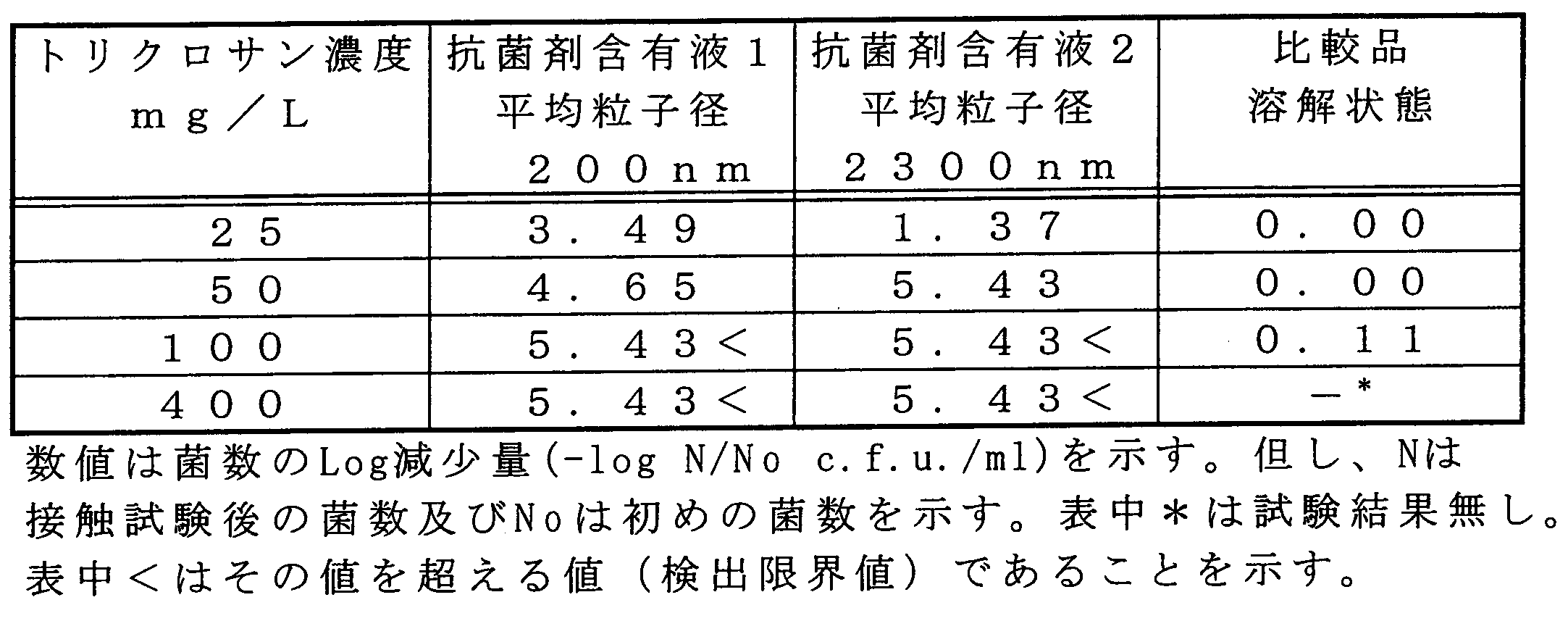
これによれば、抗菌剤含有液1は、トリクロサン濃度25mg/L、50mg/L、及び100mg/Lにおいて、比較品より顕著な抗菌活性がみられるのが分かる。
また、抗菌剤含有液2は、トリクロサン濃度25mg/Lにおいて、比較品より高い抗菌活性がみられ、また、トリクロサン濃度50mg/L、及び100mg/Lにおいて比較品より顕著な抗菌活性がみられるのが分かる。
<試験例2>
黄色ブドウ球菌(Staphylococcus aureus NBRC13276)を用いて抗菌活性を評価した。
黄色ブドウ球菌(Staphylococcus aureus NBRC13276)を用いて抗菌活性を評価した。
菌体を黄色ブドウ球菌として試験例1と同様にして接種菌液を調整した。トリクロサン濃度が25mg/L、200mg/L、及び400mg/Lとなるようにそれぞれ濃度調整した抗菌剤含有液1の1mLに、上記接種菌液10μLを添加し、それにより両者を10分間接触させた。同様の試験を、抗菌剤含有液2及び比較品のそれぞれについても行った。そして、接触後の菌数のLog減少量から抗菌活性を比較した。表6は試験結果を示す。
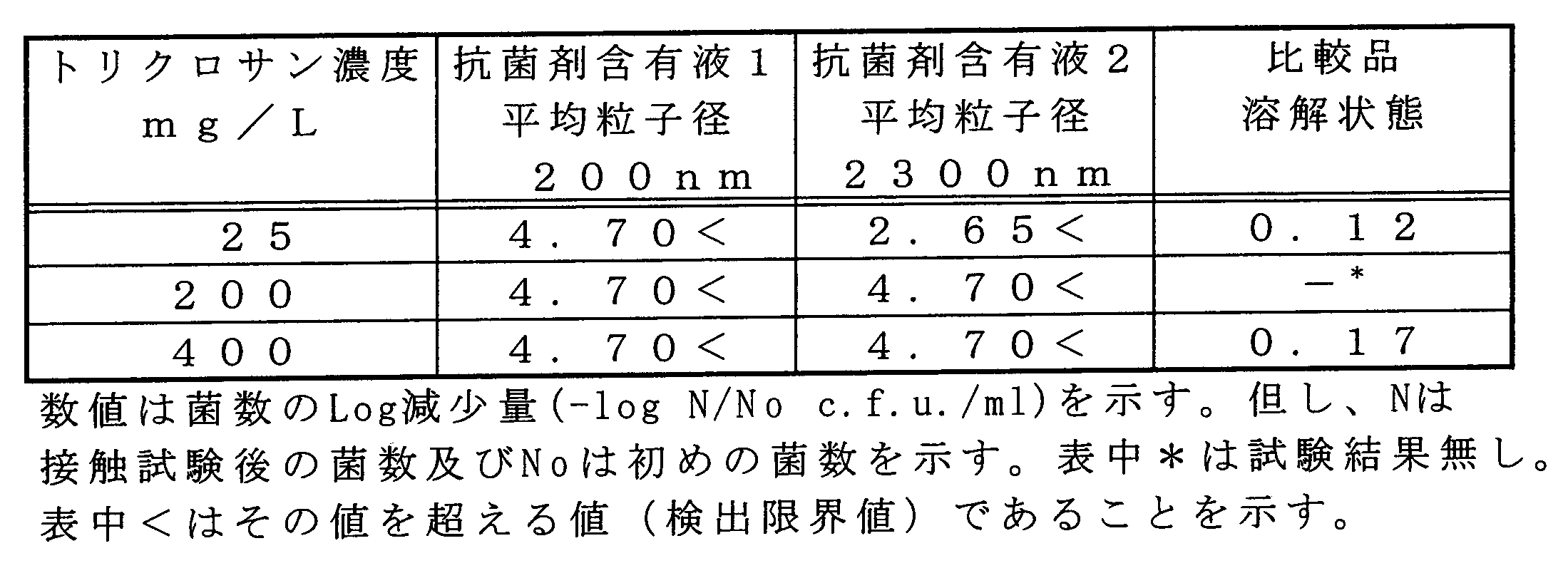
これによれば、抗菌剤含有液1は、トリクロサン濃度25mg/L及び400mg/Lにおいて、比較品より顕著な抗菌活性がみられるのが分かる。
抗菌剤含有液2は、トリクロサン濃度25mg/Lにおいて、比較品より高い抗菌活性がみられ、また、トリクロサン濃度400mg/Lにおいて比較品より顕著な抗菌活性がみられるのが分かる。
<試験例3>
緑膿菌(Pseudomonas aeruginosa NBRC13275)を用いて抗菌活性を評価した。
緑膿菌(Pseudomonas aeruginosa NBRC13275)を用いて抗菌活性を評価した。
菌体を緑膿菌として試験例1と同様にして接種菌液を調整した。トリクロサン濃度が25mg/L、200mg/L、及び400mg/Lとなるようにそれぞれ濃度調整した抗菌剤含有液1の1mLに、上記接種菌液10μLを添加し、それにより両者を10分間接触させた。同様の試験を、抗菌剤含有液2及び比較品のそれぞれについても行った。そして、接触後の菌数のLog減少量から抗菌活性を比較した。表7は試験結果を示す。
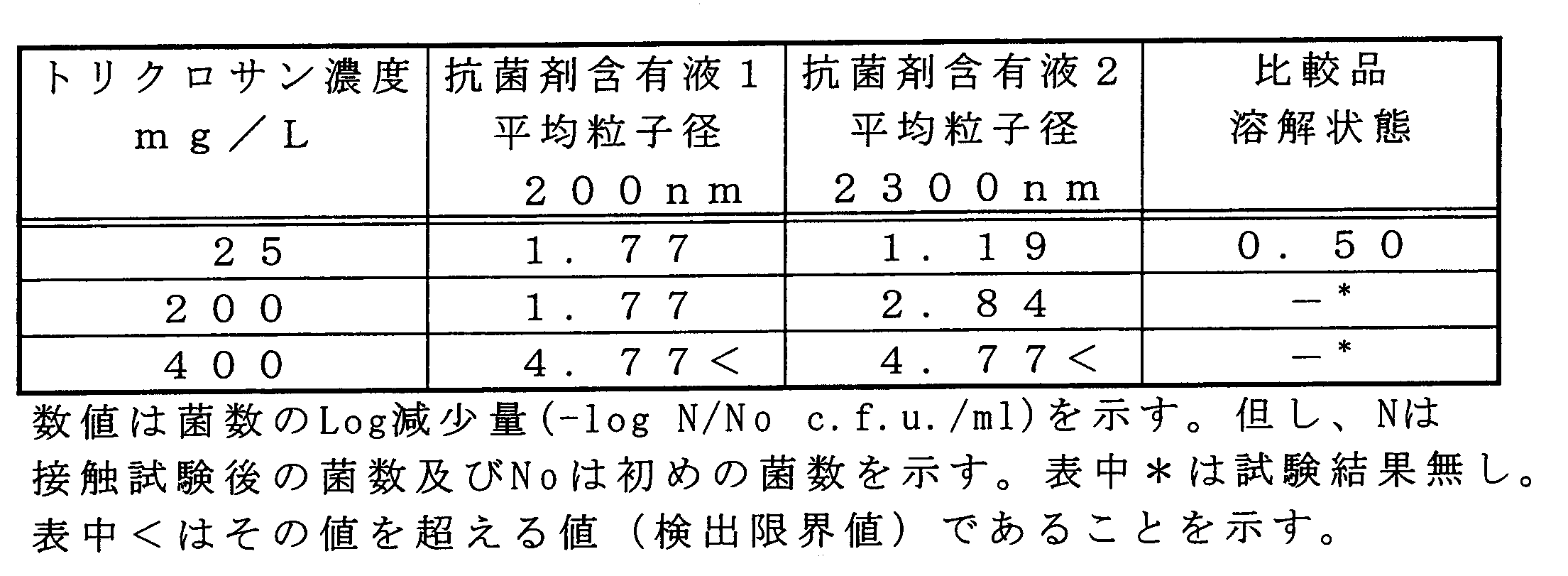
これによれば、抗菌剤含有液1及び2は、トリクロサン濃度25mg/Lにおいて、比較品より高い抗菌活性がみられるのが分かる。また、トリクロサン濃度400mg/Lにおいて、緑膿菌に対する顕著な抗菌活性が得られるのが分かる。
よって、抗菌剤含有液1及び2は、優れた抗菌性を有し、且つ緑膿菌に対しても抗菌活性を有する。
<試験例4>
アオカビ(Penicillium citrinum NBRC 6532)を用いて抗黴活性を評価した。
アオカビ(Penicillium citrinum NBRC 6532)を用いて抗黴活性を評価した。
菌体をアオカビの胞子液として試験例1と同様にして接種菌液を調整した。トリクロサン濃度が25mg/L、100mg/L、200mg/L、及び400mg/Lとなるようにそれぞれ濃度調整した抗菌剤含有液1の1mLに、上記接種菌液10μLを添加し、それにより両者を10分間接触させた。同様の試験を、抗菌剤含有液2及び比較品のそれぞれについても行った。そして、接触後の菌数のLog減少量から抗菌活性を比較した。表8は試験結果を示す。
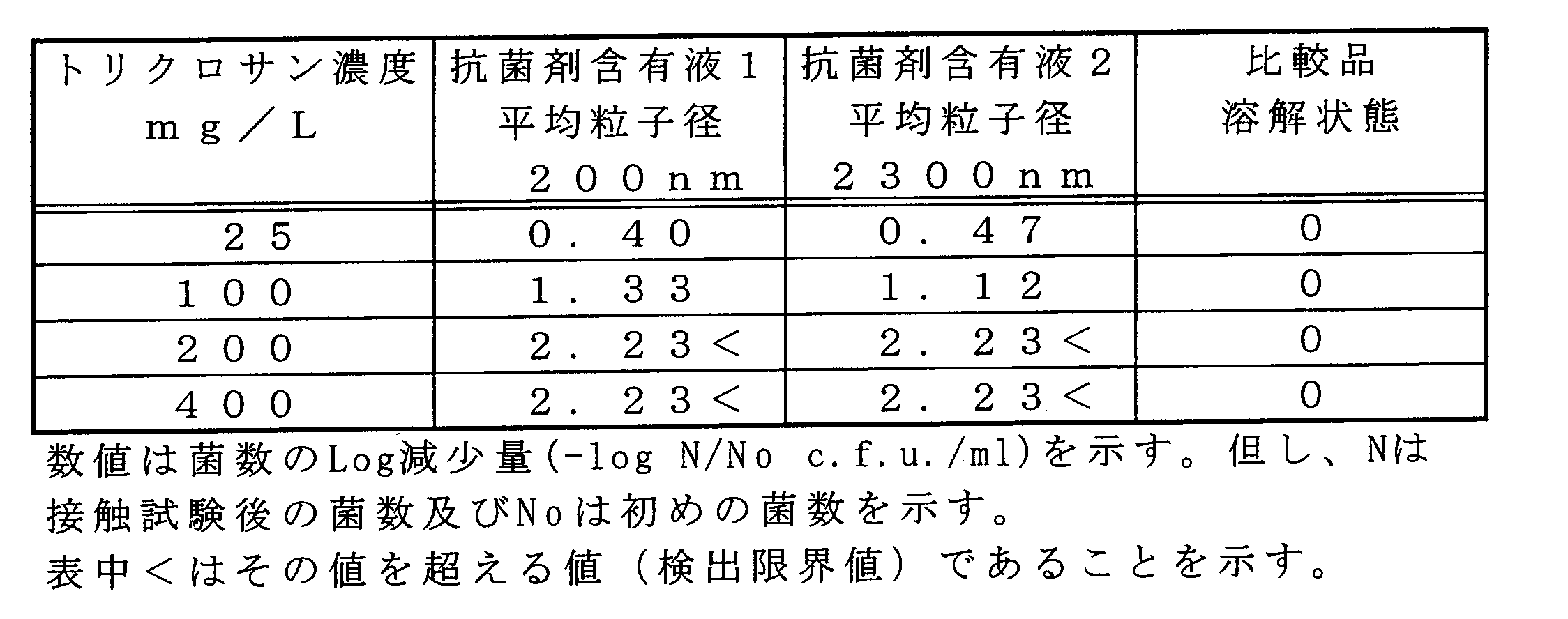
一般的にトリクロサンはアオカビに対し有効でないと考えられており、比較品では抗黴活性がみられなかった。
しかしながら、表8によれば、抗菌剤含有液1及び2は、トリクロサン濃度25mg/Lにおいて、アオカビに対する抗黴作用がみられるのが分かる。また、トリクロサン濃度200mg/L及び400mg/Lにおいて、アオカビに対する顕著な抗黴活性が得られるのが分かる。
よって、抗菌剤含有液1及び2は優れた抗黴作用を有する。
<試験例5>
抗菌剤含有液1及び比較品を用い、クロカワカビ(Cladosporium cladosporioides NBRC6348)、アオカビ(Penicillium citrinum NBRC6352)、キャンディダ(Candida albicans NBRC1061)、アルカリジェネス(Alcaligenes faecalis NBRC13111)、クレブシエラ(Klebsiella pneumoniae NBRC14940)、プロテウス(Proteus vulgaris NBRC3167)、緑膿菌(Pseudomonas aeruginosa NBRC13275)、シュードモナス(Pseudomonas putida NBRC14164)、黄色ブドウ球菌(Staphylococcus aureus NBRC13276)、セラチア(Serratia marcescense NBRC12648)、バチルス(Bacillus cereus (分離株)、Bacillus coagulans(分離株))、及び大腸菌(Escherichia coli NBRC3972)といった様々の菌に対する抗菌活性を評価する抗菌性試験を行った。
抗菌剤含有液1及び比較品を用い、クロカワカビ(Cladosporium cladosporioides NBRC6348)、アオカビ(Penicillium citrinum NBRC6352)、キャンディダ(Candida albicans NBRC1061)、アルカリジェネス(Alcaligenes faecalis NBRC13111)、クレブシエラ(Klebsiella pneumoniae NBRC14940)、プロテウス(Proteus vulgaris NBRC3167)、緑膿菌(Pseudomonas aeruginosa NBRC13275)、シュードモナス(Pseudomonas putida NBRC14164)、黄色ブドウ球菌(Staphylococcus aureus NBRC13276)、セラチア(Serratia marcescense NBRC12648)、バチルス(Bacillus cereus (分離株)、Bacillus coagulans(分離株))、及び大腸菌(Escherichia coli NBRC3972)といった様々の菌に対する抗菌活性を評価する抗菌性試験を行った。
なお、NBRC株についてはNITE biological research centerより購入した。また、アルカリジェネス(Alcaligenes faecalis NBRC13111)、クレブシエラ(Klebsiella pneumoniae NBRC14940)、プロテウス(Proteus vulgaris NBRC3167)、緑膿菌(Pseudomonas aeruginosa NBRC13275)、シュードモナス(Pseudomonas putida NBRC14164)、黄色ブドウ球菌(Staphylococcus aureus NBRC13276)、及びセラチア(Serratia marcescence NBRC12648)については菌体を変えた以外は試験例1と同様にして接種菌液を調製した。クロカワカビ(Cladosporium cladosporioides NBRC6348)及びアオカビ(Penicillium citrinum NBRC6352)については、ポテト・デキストロース・アガー(Poteto Dextrose Agar(PDA))平板培地(ディフコ社製)を用いて25℃で1週間培養した後にツイン80(東京化成工業社製)を用いて胞子液を調製して接種菌液とした。さらに、Candida albicansについては、グルコース・ペプトン・アガー(Glucose Pepton Agar(GPA))平板培地(和光純薬工業社製)上において30℃で3日間培養した菌を用いて試験例1と同様にして接種菌液を調製した。
トリクロサン濃度が25mg/L、50mg/L、100mg/L、及び400mg/Lとなるようにそれぞれ濃度調整した抗菌剤含有液1の1mLに、上記各接種菌液10μLを添加し、それにより両者を10分間接触させた。同様の試験を、比較品についても行った。接触後の菌数のLog減少量が1以上となるトリクロサン濃度(mg/L)を比較した。表9は試験結果を示す。

抗菌剤含有液1(平均粒子径200nm)は上記の全ての菌に対して、比較品よりも顕著な抗菌活性が得られるのが分かる。
<試験例6>
トリクロサンの抗菌性の粒径依存性について試験を行った。
トリクロサンの抗菌性の粒径依存性について試験を行った。
ソイビーン・カゼイン・ダイジェスト・アガー(Soybean Casein Digest Agar(SCDA))平板(和光純薬工業社製)上において30℃で一夜培養した大腸菌(Escherichia coli NBRC3972)を一白金耳掻き取り、それを滅菌生理食塩水に懸濁させて接種菌液とした。
トリクロサン濃度が25mg/Lとなるように濃度調整した抗菌剤含有液1の1mLに、上記接種菌液10μLを添加し、それにより両者を10分間接触させた。同様の試験を抗菌剤含有液2及び3のそれぞれについても行った。そして、それぞれの接触後の菌数のLog減少量から抗菌活性を比較した。表10は試験結果を示す。

これによれば、いずれの平均粒子径のトリクロサンでも抗菌活性が認められるが、平均粒子径が200nmの抗菌剤含有液1ではそれが著しく高いことが分かる。
以上の通り、抗菌剤含有液1~3は、トリクロサンを有機溶媒や界面活性剤で可溶化して用いた場合に比べ、様々なグラム陰性細菌、グラム陽性細菌、真菌に対して優れた抗菌・抗黴活性を有し、しかも、トリクロサンが有効でないとされていた緑膿菌(Pseudomonas aeruginosa)、アオカビ(Penicillium citrinum)、クロカワカビ(Cladosporium cladosporioides)、黄色ブドウ球菌(Staphylococcus aureus)に対しても抗菌活性を有し、一部の黴にも抗菌作用を有することが分かる。
本発明は、家庭用、医療用、業務用の洗浄剤、防汚剤、消臭防臭剤の他、化粧品、香粧品、衛生品等に添加されて用いられる抗菌剤含有液の製造方法について有用である。
10 混合器
11 直管部分
12 分岐管部分
20 容器
21 第1室
21a,22a ノズル(液出し部)
22 第2室
23 隔壁
11 直管部分
12 分岐管部分
20 容器
21 第1室
21a,22a ノズル(液出し部)
22 第2室
23 隔壁
Claims (10)
- フェノール系抗菌剤を溶解させたpH9以上のアルカリ性水溶液とpH6以下の酸とを混合する抗菌剤含有液の製造方法。
- 上記抗菌剤含有液は、動的光散乱法により測定される平均粒子径が50~5000nmであるフェノール系抗菌剤の微粒子を含む、請求項1に記載された抗菌剤含有液の製造方法。
- 上記アルカリ性水溶液のフェノール系抗菌剤の濃度が10~5000mg/Lである、請求項1又は2に記載された抗菌剤含有液の製造方法。
- 上記アルカリ性水溶液と上記酸とを、アルカリ性水溶液/酸=1/400~100/1の混合体積比で混合する、請求項1乃至3のいずれかに記載された抗菌剤含有液の製造方法。
- 上記アルカリ性水溶液と上記酸との混合を連続混合方式で行う、請求項1乃至4のいずれかに記載された抗菌剤含有液の製造方法。
- 上記フェノール系抗菌剤が、クロロフェノール系抗菌剤、パラベン類、及びイソプロピルメチルフェノールのうち少なくとも一種である請求項1乃至5のいずれかに記載された抗菌剤含有液の製造方法。
- 上記フェノール系抗菌剤がトリクロサンである請求項1乃至6のいずれかに記載された抗菌剤含有液の製造方法。
- 上記抗菌剤含有液における上記フェノール系抗菌剤であるトリクロサンの濃度が8~200mg/Lである請求項7に記載された抗菌剤含有液の製造方法。
- 上記酸が酸性の緩衝液である請求項1乃至8のいずれかに記載された抗菌剤含有液の製造方法。
- 各々、液出し部を有する第1及び第2室を備えた容器を用い、該容器における第1室にフェノール系抗菌剤を含有するpH9以上のアルカリ性水溶液及び第2室にpH6以下の酸をそれぞれ入れ、該容器の第1室の液出し部からアルカリ性水溶液及び第2室の液出し部から酸をそれぞれ同時に流出させて該容器外でそれらを混合する、動的光散乱法により測定される平均粒子径が50~5000nmであるフェノール系抗菌剤の微粒子を含む抗菌剤含有液の製造方法。
Priority Applications (3)
| Application Number | Priority Date | Filing Date | Title |
|---|---|---|---|
| CN2009801290263A CN102105057B (zh) | 2008-07-23 | 2009-07-22 | 含抗菌剂液体的制造方法 |
| EP09800216.5A EP2322038A4 (en) | 2008-07-23 | 2009-07-22 | PROCESS FOR PRODUCING A LIQUID CONTAINING AN ANTIBACTERIAL AGENT |
| US13/055,358 US20110130467A1 (en) | 2008-07-23 | 2009-07-22 | Method for producing antimicrobial-containing solution |
Applications Claiming Priority (2)
| Application Number | Priority Date | Filing Date | Title |
|---|---|---|---|
| JP2008-189614 | 2008-07-23 | ||
| JP2008189614 | 2008-07-23 |
Publications (1)
| Publication Number | Publication Date |
|---|---|
| WO2010010700A1 true WO2010010700A1 (ja) | 2010-01-28 |
Family
ID=41570169
Family Applications (1)
| Application Number | Title | Priority Date | Filing Date |
|---|---|---|---|
| PCT/JP2009/003451 Ceased WO2010010700A1 (ja) | 2008-07-23 | 2009-07-22 | 抗菌剤含有液の製造方法 |
Country Status (5)
| Country | Link |
|---|---|
| US (1) | US20110130467A1 (ja) |
| EP (1) | EP2322038A4 (ja) |
| JP (1) | JP5432620B2 (ja) |
| CN (1) | CN102105057B (ja) |
| WO (1) | WO2010010700A1 (ja) |
Cited By (1)
| Publication number | Priority date | Publication date | Assignee | Title |
|---|---|---|---|---|
| WO2013089140A1 (ja) * | 2011-12-14 | 2013-06-20 | 花王株式会社 | 抗菌剤組成物の製造方法 |
Families Citing this family (2)
| Publication number | Priority date | Publication date | Assignee | Title |
|---|---|---|---|---|
| JP2011063528A (ja) * | 2009-09-16 | 2011-03-31 | Kao Corp | トリクロサン含有抗菌・抗黴組成物 |
| CN106255743A (zh) * | 2014-05-12 | 2016-12-21 | 宝洁公司 | 洗涤织物的方法 |
Citations (12)
| Publication number | Priority date | Publication date | Assignee | Title |
|---|---|---|---|---|
| JPS51109911A (en) * | 1975-03-25 | 1976-09-29 | Sadaaki Nishimura | Kyoryokubofu bokabiseisenzai |
| JPS5843902A (ja) * | 1981-09-09 | 1983-03-14 | Yonezawa Kagaku Kogyo Kk | 農園芸用殺菌剤 |
| JPH0236104A (ja) * | 1988-07-27 | 1990-02-06 | Dai Ichi Kogyo Seiyaku Co Ltd | 抗菌加工剤、およびその処理方法 |
| JPH0358902A (ja) * | 1989-07-25 | 1991-03-14 | Bayer Ag | 殺微生物調製剤およびその使用 |
| JPH0418001A (ja) * | 1990-05-09 | 1992-01-22 | Earth Chem Corp Ltd | 水難溶性フェノール系化合物の可溶化方法及び殺ダニ剤等 |
| JPH119667A (ja) * | 1997-06-27 | 1999-01-19 | Zero:Kk | ゲル状殺菌剤 |
| JPH11504629A (ja) * | 1995-04-24 | 1999-04-27 | ノバファーム リサーチ (オーストラリア) プロプライアタリー リミティッド | 殺生剤表面膜 |
| JPH11180809A (ja) * | 1997-12-17 | 1999-07-06 | Showa Denko Kk | 2剤型抗生物剤および物品処理方法 |
| JP2002060303A (ja) * | 2000-08-17 | 2002-02-26 | Bayer Ag | オルソ−フェニルフェノラート濃縮液 |
| JP2002532518A (ja) * | 1998-12-21 | 2002-10-02 | オミヤ・アーゲー | フェノール及び/又はフェノール誘導体を含有する低凝固点組成物 |
| JP2004535416A (ja) * | 2001-06-01 | 2004-11-25 | アイシーアイ アメリカズ インコーポレイティド | アルコキシル化アルカノールアミド界面活性剤および抗微生物化合物の溶液 |
| JP2008063499A (ja) * | 2006-09-08 | 2008-03-21 | Kao Corp | 液体殺菌洗浄剤組成物 |
Family Cites Families (3)
| Publication number | Priority date | Publication date | Assignee | Title |
|---|---|---|---|---|
| AU757773B2 (en) * | 1997-11-26 | 2003-03-06 | Sds Biotech K.K. | Method for the treatment of wood with metallic treatment and wood treated by the method |
| AU2001265907B2 (en) * | 2000-05-12 | 2006-08-17 | Omya International Ag | Phenolate-containing formulation with low freezing point |
| US20100260691A1 (en) * | 2006-07-31 | 2010-10-14 | Narayanan Kolazi S | Aqueous compositions containing a hydrophobic material |
-
2009
- 2009-07-22 EP EP09800216.5A patent/EP2322038A4/en not_active Withdrawn
- 2009-07-22 US US13/055,358 patent/US20110130467A1/en not_active Abandoned
- 2009-07-22 CN CN2009801290263A patent/CN102105057B/zh not_active Expired - Fee Related
- 2009-07-22 WO PCT/JP2009/003451 patent/WO2010010700A1/ja not_active Ceased
- 2009-07-22 JP JP2009171536A patent/JP5432620B2/ja not_active Expired - Fee Related
Patent Citations (12)
| Publication number | Priority date | Publication date | Assignee | Title |
|---|---|---|---|---|
| JPS51109911A (en) * | 1975-03-25 | 1976-09-29 | Sadaaki Nishimura | Kyoryokubofu bokabiseisenzai |
| JPS5843902A (ja) * | 1981-09-09 | 1983-03-14 | Yonezawa Kagaku Kogyo Kk | 農園芸用殺菌剤 |
| JPH0236104A (ja) * | 1988-07-27 | 1990-02-06 | Dai Ichi Kogyo Seiyaku Co Ltd | 抗菌加工剤、およびその処理方法 |
| JPH0358902A (ja) * | 1989-07-25 | 1991-03-14 | Bayer Ag | 殺微生物調製剤およびその使用 |
| JPH0418001A (ja) * | 1990-05-09 | 1992-01-22 | Earth Chem Corp Ltd | 水難溶性フェノール系化合物の可溶化方法及び殺ダニ剤等 |
| JPH11504629A (ja) * | 1995-04-24 | 1999-04-27 | ノバファーム リサーチ (オーストラリア) プロプライアタリー リミティッド | 殺生剤表面膜 |
| JPH119667A (ja) * | 1997-06-27 | 1999-01-19 | Zero:Kk | ゲル状殺菌剤 |
| JPH11180809A (ja) * | 1997-12-17 | 1999-07-06 | Showa Denko Kk | 2剤型抗生物剤および物品処理方法 |
| JP2002532518A (ja) * | 1998-12-21 | 2002-10-02 | オミヤ・アーゲー | フェノール及び/又はフェノール誘導体を含有する低凝固点組成物 |
| JP2002060303A (ja) * | 2000-08-17 | 2002-02-26 | Bayer Ag | オルソ−フェニルフェノラート濃縮液 |
| JP2004535416A (ja) * | 2001-06-01 | 2004-11-25 | アイシーアイ アメリカズ インコーポレイティド | アルコキシル化アルカノールアミド界面活性剤および抗微生物化合物の溶液 |
| JP2008063499A (ja) * | 2006-09-08 | 2008-03-21 | Kao Corp | 液体殺菌洗浄剤組成物 |
Non-Patent Citations (1)
| Title |
|---|
| See also references of EP2322038A4 * |
Cited By (3)
| Publication number | Priority date | Publication date | Assignee | Title |
|---|---|---|---|---|
| WO2013089140A1 (ja) * | 2011-12-14 | 2013-06-20 | 花王株式会社 | 抗菌剤組成物の製造方法 |
| CN103998029A (zh) * | 2011-12-14 | 2014-08-20 | 花王株式会社 | 抗菌剂组合物的制造方法 |
| CN103998029B (zh) * | 2011-12-14 | 2016-10-12 | 花王株式会社 | 抗菌剂组合物的制造方法 |
Also Published As
| Publication number | Publication date |
|---|---|
| JP5432620B2 (ja) | 2014-03-05 |
| US20110130467A1 (en) | 2011-06-02 |
| JP2010047565A (ja) | 2010-03-04 |
| EP2322038A1 (en) | 2011-05-18 |
| EP2322038A4 (en) | 2014-08-13 |
| CN102105057B (zh) | 2013-10-16 |
| CN102105057A (zh) | 2011-06-22 |
Similar Documents
| Publication | Publication Date | Title |
|---|---|---|
| KR101733723B1 (ko) | 전기화학적으로 활성화된 차아염소산염 용액을 포함하는 약제학적 제제 | |
| CN103118656B (zh) | 含有阳离子活性成分和季化糖衍生的表面活性剂的抗微生物组合物 | |
| US7045493B2 (en) | Stabilized thickened hydrogen peroxide containing compositions | |
| EP1473998B1 (en) | Enhanced activity hydrogen peroxide disinfectant | |
| US10010078B2 (en) | Antibacterial surfactant/microgel formulations, methods of making and methods of using the same | |
| JP5432620B2 (ja) | 抗菌剤含有液の製造方法 | |
| EP2482649B1 (en) | Synergistic microbicidal compositions comprising 2,2-dibromomalonamide and an oxidizing biocide. | |
| EP3975717B1 (en) | Method and composition for water treatment | |
| DE502007000308D1 (de) | Verwendung einer Behälterverschlussbeschichtungszusammensetzung, Behälterverschlussbeschichtung als antibakterielles Mittel, deren Herstellung und Aufbringung | |
| JP7569145B2 (ja) | 内生胞子に対する効能を有する抗菌性組成物 | |
| CN111184658A (zh) | 一种手部消毒液及其制备方法 | |
| CA1291027C (fr) | Compositions aqueuses contenant un compose cationique et de la gomme xanthane | |
| DE112021001600T5 (de) | Verfahren zur Herstellung eines hybriden antimikrobiellen und antiviralen Mittels aus Kupfer-Nanopartikeln und aktiven organischen Verbindungen, so hergestelltes antimikrobielles und antivirales Mittel und die Verwendung eines antimikrobiellen und antiviralen Mittels | |
| WO2016175727A1 (en) | Production method of iodophor based antimicrobial hydrogel | |
| JP5241363B2 (ja) | トリクロサンのナノ粒子分散液の製造方法 | |
| JPH08225433A (ja) | 水系美爪料 | |
| IT202100022790A1 (it) | Termogel disinfettante contenente ipoclorito di sodio stabilizzato con taurina a ph fisiologico | |
| Rhoades et al. | HT Fluorescence-Based Investigation of the Impact of Latex Components on the Efficacy of Biocides |
Legal Events
| Date | Code | Title | Description |
|---|---|---|---|
| WWE | Wipo information: entry into national phase |
Ref document number: 200980129026.3 Country of ref document: CN |
|
| 121 | Ep: the epo has been informed by wipo that ep was designated in this application |
Ref document number: 09800216 Country of ref document: EP Kind code of ref document: A1 |
|
| WWE | Wipo information: entry into national phase |
Ref document number: 13055358 Country of ref document: US |
|
| NENP | Non-entry into the national phase |
Ref country code: DE |
|
| WWE | Wipo information: entry into national phase |
Ref document number: 2009800216 Country of ref document: EP |