WO2010010760A1 - 末端ハロゲン基含量が低減されたポリアリーレンスルフィドの製造方法 - Google Patents
末端ハロゲン基含量が低減されたポリアリーレンスルフィドの製造方法 Download PDFInfo
- Publication number
- WO2010010760A1 WO2010010760A1 PCT/JP2009/060598 JP2009060598W WO2010010760A1 WO 2010010760 A1 WO2010010760 A1 WO 2010010760A1 JP 2009060598 W JP2009060598 W JP 2009060598W WO 2010010760 A1 WO2010010760 A1 WO 2010010760A1
- Authority
- WO
- WIPO (PCT)
- Prior art keywords
- mol
- alkali metal
- sulfur source
- polymerization
- water
- Prior art date
- Legal status (The legal status is an assumption and is not a legal conclusion. Google has not performed a legal analysis and makes no representation as to the accuracy of the status listed.)
- Ceased
Links
Classifications
-
- C—CHEMISTRY; METALLURGY
- C08—ORGANIC MACROMOLECULAR COMPOUNDS; THEIR PREPARATION OR CHEMICAL WORKING-UP; COMPOSITIONS BASED THEREON
- C08G—MACROMOLECULAR COMPOUNDS OBTAINED OTHERWISE THAN BY REACTIONS ONLY INVOLVING UNSATURATED CARBON-TO-CARBON BONDS
- C08G75/00—Macromolecular compounds obtained by reactions forming a linkage containing sulfur with or without nitrogen, oxygen, or carbon in the main chain of the macromolecule
- C08G75/02—Polythioethers
- C08G75/0204—Polyarylenethioethers
- C08G75/0231—Polyarylenethioethers containing chain-terminating or chain-branching agents
-
- C—CHEMISTRY; METALLURGY
- C08—ORGANIC MACROMOLECULAR COMPOUNDS; THEIR PREPARATION OR CHEMICAL WORKING-UP; COMPOSITIONS BASED THEREON
- C08G—MACROMOLECULAR COMPOUNDS OBTAINED OTHERWISE THAN BY REACTIONS ONLY INVOLVING UNSATURATED CARBON-TO-CARBON BONDS
- C08G75/00—Macromolecular compounds obtained by reactions forming a linkage containing sulfur with or without nitrogen, oxygen, or carbon in the main chain of the macromolecule
- C08G75/02—Polythioethers
- C08G75/0204—Polyarylenethioethers
- C08G75/025—Preparatory processes
-
- C—CHEMISTRY; METALLURGY
- C08—ORGANIC MACROMOLECULAR COMPOUNDS; THEIR PREPARATION OR CHEMICAL WORKING-UP; COMPOSITIONS BASED THEREON
- C08G—MACROMOLECULAR COMPOUNDS OBTAINED OTHERWISE THAN BY REACTIONS ONLY INVOLVING UNSATURATED CARBON-TO-CARBON BONDS
- C08G75/00—Macromolecular compounds obtained by reactions forming a linkage containing sulfur with or without nitrogen, oxygen, or carbon in the main chain of the macromolecule
- C08G75/02—Polythioethers
- C08G75/0204—Polyarylenethioethers
- C08G75/0286—Chemical after-treatment
- C08G75/029—Modification with organic compounds
Definitions
- the present invention relates to a method for producing polyarylene sulfide having a significantly reduced terminal halogen group content. More specifically, the present invention relates to a method for producing a polyarylene sulfide in which a sulfur source and a dihaloaromatic compound are polymerized by a polymerization method including a phase separation polymerization step in an organic amide solvent, and the yield, melt viscosity, molecular weight, etc. The present invention relates to a process for producing a polyarylene sulfide that can efficiently obtain a granular polyarylene sulfide having a significantly reduced content of terminal halogen groups while maintaining a high level.
- PAS Polyarylene sulfide
- PPS polyphenylene sulfide
- PPS polyphenylene sulfide
- Engineering plastic with excellent stability.
- PAS can be molded into various molded products, films, sheets, fibers, etc. by general melt processing methods such as extrusion molding, injection molding, compression molding, etc., so it can be used in a wide range of fields such as electrical / electronic equipment and automotive equipment. It is widely used.
- a method of reacting a sulfur source with a dihaloaromatic compound in an organic amide solvent such as N-methyl-2-pyrrolidone is known.
- an alkali metal sulfide, an alkali metal hydrosulfide, or a mixture thereof is used as the sulfur source.
- the alkali metal hydrosulfide is used in combination with an alkali metal hydroxide.
- alkali metal salts such as NaCl are by-produced by a desalting condensation reaction. Since alkali metal salts are electrolyte components, they adversely affect the electrical properties of PAS.
- PAS is used, for example, as a sealing agent or coating agent for electronic components.
- the alkali metal salt corrodes an electrode or wiring of an electronic component, causes disconnection, or increases a leakage current.
- Patent Document 1 proposes a method of extracting PPS powder with heated deionized water for a long time.
- the hot water extraction method has a problem that the extraction efficiency of the alkali metal salt is low in addition to a long time.
- Patent Document 2 proposes a method of reducing the content of alkali metal salt by heat-treating PPS in an aromatic solvent.
- an aromatic solvent such as diphenyl ether
- Patent Documents 1 and 2 are intended to remove by-produced alkali metal salts such as NaCl, and reduce the content of halogen atoms such as chlorine atoms bonded to the terminal.
- alkali metal salts such as NaCl
- halogen atoms such as chlorine atoms bonded to the terminal.
- PAS generates.
- Patent Document 3 discloses a method of heat-treating PPS in a mercapto group-containing compound or an alkali metal salt thereof and a solvent capable of dissolving PPS. Has been proposed. However, this method is not efficient in that, after the polymerization, the PPS is washed and then reacted with a special reaction reagent at a high temperature for a long time, followed by filtration and washing steps.
- Patent Document 4 proposes a process for producing PAS with a low content of bonded chlorine by subjecting a cyclic arylene sulfide oligomer to thermal ring-opening polymerization in the presence of a ring-opening polymerization catalyst.
- a sodium sulfide and p-dichlorobenzene are polymerized in an organic amide solvent
- a 7 to 15-mer cyclic phenylene sulfide oligomer is formed from the produced PPS by Soxhlet extraction using methylene chloride as a solvent. Must be extracted. Therefore, this method is difficult to apply to production on an industrial scale.
- Patent Document 5 discloses a process for producing PPS using an alkali metal carboxylate as a polymerization aid.
- Patent Document 6 discloses a process for producing PPS using an alkaline earth metal salt or zinc salt of an aromatic carboxylic acid as a polymerization aid.
- Patent Document 7 discloses a process for producing PPS using an alkali metal halide as a polymerization aid.
- Patent Document 8 proposes a process for producing PPS using a sodium salt of an aliphatic carboxylic acid as a polymerization aid.
- Patent Document 9 discloses a process for producing PAS using water as a polymerization aid.
- phase separation aids By adjusting the amount and timing of addition of these polymerization aids, the temperature of the polymerization reaction system, etc., a phase separation state in which the produced polymer rich phase and the produced polymer dilute phase coexist in the liquid phase in the polymerization reaction system is created. be able to.
- the high molecular weight PAS can be obtained in a granular form by gradually increasing the molecular weight of the PAS and gradually cooling the polymerization reaction system after the polymerization reaction. Therefore, these polymerization aids are called phase separation agents.
- the desalting condensation reaction between monomers proceeds rapidly.
- the conversion rate of the dihaloaromatic compound is increased.
- the polymer in this state has a low melt viscosity (molecular weight) and is in the so-called prepolymer stage.
- the phase separation agent if a phase separation state in which the product polymer rich phase and the product polymer dilute phase are mixed in the liquid phase in the polymerization reaction system is created, the product polymer rich phase is mixed in the product polymer dilute phase by stirring. Dispersed and the condensation reaction between the prepolymers efficiently proceeds in the concentrated phase. As a result, high molecular weight advances.
- Granular high molecular weight PAS can easily remove impurities such as by-product alkali metal salts and oligomers.
- granular high molecular weight PAS is washed in combination with water washing, organic solvent washing, acid washing, etc. to obtain PAS substantially free of alkali metal salt such as NaCl. Be able to.
- the sufficiently washed granular high molecular weight PAS is substantially free of ash even when burned.
- Patent Document 10 when a PAS is produced by reacting an alkali metal sulfide and a dihaloaromatic compound in a polar organic solvent, a mono- or polyhalo-substituted organic compound (however, , Except for compounds in which halogen is directly substituted on the aromatic ring).
- the method disclosed in Patent Document 10 is intended to increase the melt crystallization temperature of PAS, and is not intended to produce PAS with a reduced content of terminal halogen groups.
- the method disclosed in the Examples of Patent Document 10 is a method in which a mono- or polyhalo-substituted organic compound is converted into a polymerization reaction system at the beginning of the polymerization reaction or at the time when the subsequent polymerization (phase separation polymerization) is substantially completed. It is only added inside. However, with such a method, it is difficult to obtain a PAS with a reduced terminal halogen group.
- An object of the present invention is to produce a polyarylene sulfide which can efficiently obtain a granular polyarylene sulfide having a significantly reduced terminal halogen group content while maintaining a high level of yield, melt viscosity, molecular weight and the like. Is to provide.
- the present inventors include a step of polymerizing a sulfur source and a dihaloaromatic compound in an organic amide solvent, and the polymerization step is performed in the presence of a phase separation agent.
- a phase separation agent In the method for producing polyarylene sulfide including the phase separation polymerization step in which the polymerization reaction is continued in a phase separation state in which the produced polymer rich phase and the produced polymer dilute phase coexist in the liquid phase in the polymerization reaction system, At a stage where the conversion rate of the dihaloaromatic compound has reached a specific range, and before the liquid phase is in a phase-separated state, a specific amount of the monohalo organic compound is added to the polymerization reaction system.
- the inventors have come up with a method of reacting with the produced polymer and then converting the liquid phase in the polymerization reaction system to a phase separation state and continuing the polymerization reaction.
- the terminal halogen group content is remarkably maintained only by adding a relatively simple process to the conventional phase separation polymerization method while maintaining the yield, melt viscosity, molecular weight and the like at a high level. Reduced granular polyarylene sulfide can be obtained efficiently.
- the present invention has been completed based on these findings.
- the method includes a step of polymerizing a sulfur source and a dihaloaromatic compound in an organic amide solvent, wherein the polymerization step is performed in the presence of a phase separation agent in the liquid phase in the polymerization reaction system.
- the method for producing polyarylene sulfide including the phase separation polymerization step in which the polymerization reaction is continued in a phase separation state in which the product polymer rich phase and the product polymer dilute phase are mixed, (1) After the start of the polymerization reaction, the dihaloaromatic compound has reached a conversion rate of 80 to 99%, and before the liquid phase enters the phase separation state, The organic compound is added at a rate of 0.005 to 20 moles per 100 moles of the charged sulfur source and reacted with the resulting polymer, (2) Provided is a method for producing polyarylene sulfide having a reduced content of terminal halogen groups, wherein the polymerization reaction is continued by converting the liquid phase in the polymerization reaction system to a phase separation state.
- the polymerization step includes at least the following three steps: (I) A sulfur source and a dihaloaromatic compound are polymerized in an organic amide solvent at a temperature of 170 to 270 ° C. in the presence of 0.02 to 2.0 mol of water per mol of the charged sulfur source.
- Step 2 in which a monohalo organic compound is added to the polymerization reaction system at a ratio of 0.005 to 20 mol per 100 mol of the charged sulfur source and reacted with the resulting polymer; and
- III Water, organic carboxylic acid metal salts, organic sulfonic acid metal salts, alkali metal halides, alkaline earth metal halides, alkaline earth metal salts of aromatic carboxylic acids, alkali metal phosphates, alcohols, and paraffins
- At least one phase separation agent selected from the group consisting of hydrocarbons is present in the range of 0.01 to 10 mol with respect to 1 mol of the charged sulfur source and heated to a temperature of 245 to 290 ° C.
- a subsequent polymerization step 3 in which the liquid phase in the polymerization reaction system is converted into a phase-separated state and the polymer
- the polymerization step includes at least the following three steps: (1) A sulfur source and a dihaloaromatic compound are polymerized in an organic amide solvent at a temperature of 170 to 270 ° C. in a state where 0.02 to 2.0 mol of water is present per mol of the charged sulfur source.
- a subsequent polymerization step 3 in which the liquid phase in the reaction system is converted to a phase separation state and the polymerization reaction is continued; A method for producing the polyarylene sulfide performed by the method is provided.
- the polymerization step includes at least the following five steps: (A) A mixture containing an organic amide solvent, an alkali metal hydrosulfide, and 0.95 to 1.05 mol of alkali metal hydroxide per mol of the alkali metal hydrosulfide is reacted by heating, the mixture A dehydration step I for discharging at least a part of the distillate containing water from the system containing (B) After the dehydration step, an alkali metal hydroxide and water are added to the mixture remaining in the system as necessary, and the number of moles of alkali metal hydroxide generated along with the hydrogen sulfide generated during dehydration; The total number of moles of alkali metal hydroxide added before dehydration and the number of moles of alkali metal hydroxide added after dehydration includes alkali metal hydrosulfide present in the system after dehydration as a sulfur source.
- step II in which the amount of water is adjusted to 1.00 to 1.09 mol per mol of sulfur source and the water is adjusted to 0.02 to 2.0 mol per mol of sulfur source;
- C A dihaloaromatic compound is added to the mixture, charged in an organic amide solvent, and a sulfur source and the dihaloaromatic compound are polymerized at a temperature of 170 to 270 ° C., so that the conversion of the dihaloaromatic compound is Pre-stage polymerization step III to produce 80-99% polymer;
- step IV in which a monohalo organic compound is added to the polymerization reaction system at a ratio of 0.005 to 20 mol per 100 mol of the charged sulfur source and reacted with the resulting polymer; and
- E Water, organic carboxylic acid metal salt, organic sulfonic acid metal salt, alkali metal halide, alkaline earth metal halide, alkaline earth metal salt of aromatic carboxylic acid, alkali metal phosphate, alcohols, and paraffin
- the polymerization step includes at least the following five steps: (A) A mixture containing an organic amide solvent, an alkali metal hydrosulfide, and 0.95 to 1.05 mole of alkali metal hydroxide per mole of the alkali metal hydrosulfide is reacted by heating, and the mixture A dehydration step I for discharging at least a part of the distillate containing water from the system containing (B) After the dehydration step, an alkali metal hydroxide and water are added to the mixture remaining in the system as necessary, and the number of moles of alkali metal hydroxide generated along with the hydrogen sulfide generated during dehydration
- the total number of moles of alkali metal hydroxide added before dehydration and the number of moles of alkali metal hydroxide added after dehydration includes alkali metal hydrosulfide present in the system after dehydration as a sulfur source.
- step II in which the amount of water is adjusted to 1.00 to 1.09 mol per mol of sulfur source and the water is adjusted to 0.02 to 2.0 mol per mol of sulfur source;
- C A dihaloaromatic compound is added to the mixture, charged in an organic amide solvent, and a sulfur source and the dihaloaromatic compound are polymerized at a temperature of 170 to 270 ° C., so that the conversion of the dihaloaromatic compound is Pre-stage polymerization step III to produce 80-99% polymer;
- step IV in which a monohalo organic compound is added to the polymerization reaction system in a ratio of 0.005 to 20 mol per 100 mol of the charged sulfur source and reacted with the resulting polymer; and
- E Polymerization is carried out by adjusting the amount of water in the polymerization reaction system so that water exceeding 2.0 moles and 10 moles or less per mole of charged sulfur source is present and heating to a temperature of 245 to 290 ° C.
- the present invention it is possible to efficiently obtain a granular PAS in which the content of terminal halogen groups is remarkably reduced while maintaining the yield, melt viscosity, molecular weight and the like at a high level.
- the PAS of the present invention can meet the demands from various fields regarding the regulation of halogen content, and is suitable for a wide range of fields such as sealants and coating agents for electronic parts, electrical and electronic equipment, and automotive equipment. Can be used.
- At least one sulfur source selected from the group consisting of alkali metal sulfides and alkali metal hydrosulfides is used as the sulfur source.
- alkali metal sulfide include lithium sulfide, sodium sulfide, potassium sulfide, rubidium sulfide, cesium sulfide, and a mixture of two or more thereof.
- alkali metal hydrosulfide include lithium hydrosulfide, sodium hydrosulfide, potassium hydrosulfide, rubidium hydrosulfide, cesium hydrosulfide, and a mixture of two or more thereof.
- the alkali metal sulfide any of an anhydride, a hydrate, and an aqueous solution may be used. Among these, sodium sulfide and lithium sulfide are preferable because they can be obtained industrially at low cost.
- the alkali metal sulfide is preferably used as an aqueous mixture such as an aqueous solution (that is, a mixture with fluid water) from the viewpoint of processing operation, measurement, and the like.
- the alkali metal hydrosulfide may be any of anhydride, hydrate, and aqueous solution. Among these, sodium hydrosulfide and lithium hydrosulfide are preferable because they can be obtained industrially at low cost.
- the alkali metal hydrosulfide is preferably used as an aqueous mixture such as an aqueous solution (that is, a mixture with fluid water) from the viewpoint of processing operation, measurement, and the like.
- alkali metal hydrosulfide In the production process of alkali metal sulfide, generally, a small amount of alkali metal hydrosulfide is by-produced. A small amount of alkali metal hydrosulfide may be contained in the alkali metal sulfide used in the present invention. In this case, the total molar amount of the alkali metal sulfide and the alkali metal hydrosulfide becomes a charged sulfur source after the dehydration step.
- a small amount of alkali metal sulfide is generally produced as a by-product in the production process of alkali metal hydrosulfide.
- a small amount of alkali metal sulfide may be contained in the alkali metal hydrosulfide used in the present invention.
- the total molar amount of the alkali metal hydrosulfide and the alkali metal sulfide becomes a charged sulfur source after the dehydration step.
- the alkali metal sulfide and the alkali metal hydrosulfide are mixed and used, naturally, a mixture of both becomes a charged sulfur source.
- an alkali metal hydroxide is used in combination.
- the alkali metal hydroxide include lithium hydroxide, sodium hydroxide, potassium hydroxide, rubidium hydroxide, cesium hydroxide, and a mixture of two or more thereof.
- sodium hydroxide and lithium hydroxide are preferable because they can be obtained industrially at low cost.
- the alkali metal hydroxide is preferably used as an aqueous mixture such as an aqueous solution.
- the water to be dehydrated in the dehydration step is hydrated water, aqueous medium of water, water produced as a by-product due to reaction of alkali metal hydrosulfide and alkali metal hydroxide, or the like. is there.
- the dihaloaromatic compound used in the present invention is a dihalogenated aromatic compound having two halogen atoms directly bonded to an aromatic ring.
- Specific examples of the dihaloaromatic compound include, for example, o-dihalobenzene, m-dihalobenzene, p-dihalobenzene, dihalotoluene, dihalonaphthalene, methoxy-dihalobenzene, dihalobiphenyl, dihalobenzoic acid, dihalodiphenyl ether, dihalodiphenyl sulfone. , Dihalodiphenyl sulfoxide, dihalodiphenyl ketone and the like.
- the halogen atom refers to each atom of fluorine, chlorine, bromine and iodine, and in the same dihaloaromatic compound, the two halogen atoms may be the same or different.
- dihaloaromatic compounds can be used alone or in combination of two or more.
- the charged amount of the dihaloaromatic compound is usually 0.90 to 1.50 mol, preferably 1 mol to 1 mol of the sulfur source (alkali metal sulfide and / or alkali metal hydrosulfide) remaining in the system after the dehydration step.
- the amount is 0.95 to 1.20 mol, more preferably 1.00 to 1.09 mol, particularly preferably 1.00 to 1.05 mol. If the amount of the dihaloaromatic compound charged is too small, a decomposition reaction tends to occur, and if it is too large, it is difficult to sufficiently increase the molecular weight of the produced polymer.
- Branching / crosslinking agent In order to introduce a branched or crosslinked structure into the produced PAS, a polyhalo compound (not necessarily an aromatic compound) having 3 or more halogen atoms bonded thereto, an active hydrogen-containing halogenated aromatic compound, halogen Aromatic nitro compounds can be used in combination.
- the polyhalo compound as the branching / crosslinking agent is preferably trihalobenzene.
- Organic Amide Solvent in the present invention, an organic amide solvent that is an aprotic polar organic solvent is used as a solvent for the dehydration reaction and the polymerization reaction.
- the organic amide solvent is preferably stable to alkali at high temperatures.
- organic amide solvent examples include amide compounds such as N, N-dimethylformamide and N, N-dimethylacetamide; N-alkylcaprolactam compounds such as N-methyl- ⁇ -caprolactam; N-methyl-2-pyrrolidone, N-alkylpyrrolidone compounds or N-cycloalkylpyrrolidone compounds such as N-cyclohexyl-2-pyrrolidone; N, N-dialkylimidazolidinone compounds such as 1,3-dialkyl-2-imidazolidinone; tetramethylurea, etc. Tetraalkylurea compounds; hexaalkylphosphoric acid triamide compounds such as hexamethylphosphoric acid triamide. These organic amide solvents may be used alone or in combination of two or more.
- N-alkylpyrrolidone compounds N-cycloalkylpyrrolidone compounds, N-alkylcaprolactam compounds, and N, N-dialkylimidazolidinone compounds are preferred, and in particular, N-methyl-2-pyrrolidone, N-methyl- ⁇ -caprolactam and 1,3-dialkyl-2-imidazolidinone are preferably used.
- the amount of the organic amide solvent used in the polymerization reaction of the present invention is usually in the range of 0.1 to 10 kg per mole of sulfur source.
- phase separation agent polymerization aid
- various phase separation agents can be used in order to accelerate the polymerization reaction and obtain a high degree of polymerization PAS in a short time.
- a phase separation agent is a compound that dissolves in an organic amide solvent by itself or in the presence of a small amount of water and has an action of reducing the solubility of PAS in an organic amide solvent.
- the phase separation agent itself is a compound that is not a solvent for PAS.
- phase separation agent generally known compounds can be used as polymerization assistants or phase separation agents for PAS.
- phase separation agents include water, organic carboxylic acid metal salts such as alkali metal carboxylates, organic sulfonic acid metal salts, alkali metal halides such as lithium halides, alkaline earth metal halides, and aromatic carboxylic acids. Alkaline earth metal salts, alkali metal phosphates, alcohols, paraffinic hydrocarbons and the like can be mentioned.
- phase separation agents can be used alone or in combination of two or more.
- water and organic carboxylic acid metal salts are preferable because they are inexpensive, and water is particularly preferable.
- the amount of polymerization aid used varies depending on the type of compound used, but generally ranges from 0.01 to 10 moles per mole of the charged sulfur source.
- water is present as a phase separation agent in the polymerization reaction system at a ratio of more than 2.0 moles and 10 moles or less with respect to 1 mole of the charged sulfur source.
- the phase separation agent other than water such as an organic carboxylic acid metal salt, is preferably 0.01 to 3 mol, more preferably 0.02 to 2 mol, particularly preferably 0.03 to 1 mol of the charged sulfur source. Use within the range of ⁇ 1 mole. Even when water is used as the phase separation agent, another phase separation agent can be used in combination as a polymerization aid from the viewpoint of efficiently performing the phase separation polymerization.
- Dehydration process As a pre-process of the polymerization process, it is preferable to arrange a dehydration process to adjust the amount of water in the reaction system.
- the dehydration step is preferably carried out by heating and reacting a mixture containing an organic amide solvent and an alkali metal sulfide in an inert gas atmosphere, and discharging water out of the system by distillation.
- an alkali metal hydrosulfide is used as the sulfur source
- the reaction is carried out by heating and reacting a mixture containing the alkali metal hydrosulfide and the alkali metal hydroxide, and discharging water out of the system by distillation.
- water consisting of hydrated water (crystal water), aqueous medium, by-product water, etc. is dehydrated until it falls within the required range.
- the amount of coexisting water in the polymerization reaction system is usually 0.02 to 2.0 mol, preferably 0.05 to 2.0 mol, more preferably 0.5 to 2.0 mol with respect to 1 mol of the charged sulfur source. Dehydrate to 2.0 moles.
- the sulfur source after the dehydration process is referred to as “prepared sulfur source”.
- water may be added to the desired amount of water before the polymerization step.
- an organic amide solvent an alkali metal hydrosulfide, and 0.95 to 1.05 mole of alkali metal hydroxide per mole of the alkali metal hydrosulfide It is preferable to heat and react the mixture containing water and to discharge at least a part of the distillate containing water from the system containing the mixture to the outside of the system.
- the preferred molar ratio of alkali metal hydroxide per mole of alkali metal hydrosulfide charged in this step is 1.00 to 1.04, more preferably 1.005 to 1.03.
- Alkali metal hydrosulfides often contain a small amount of alkali metal sulfide, and the amount of sulfur source is the total amount of alkali metal hydrosulfide and alkali metal sulfide. Even if the alkali metal hydrosulfide contains an alkali metal sulfide, there is no problem as a raw material for PAS, but in order to produce the high-quality PAS of the present invention, the content is preferably as small as possible. Further, even if a small amount of alkali metal sulfide is mixed, in the present invention, the molar ratio with the alkali metal hydroxide is calculated based on the content (analytical value) of the alkali metal hydrosulfide. Adjust the ratio.
- each raw material is generally charged into the reaction vessel in a temperature range from room temperature (5-35 ° C.) to 300 ° C., preferably from room temperature to 200 ° C.
- the order in which the raw materials are input may be in any order, and further, each raw material may be additionally input during the dehydration operation.
- An organic amide solvent is used as a solvent used in the dehydration step. This solvent is preferably the same as the organic amide solvent used in the polymerization step, and N-methyl-2-pyrrolidone is particularly preferred.
- the amount of the organic amide solvent used is usually about 0.1 to 10 kg per mole of sulfur source charged into the reaction tank.
- the mixture after the raw materials are charged into the reaction vessel is usually heated at a temperature of 300 ° C. or less, preferably 100 to 250 ° C., usually 15 minutes to 24 hours, preferably 30 minutes to 10 hours. Done.
- a heating method there are a method for maintaining a constant temperature, a stepwise or continuous temperature raising method, or a method in which both are combined.
- the dehydration step is performed by a batch method, a continuous method, or a combination method of both methods.
- the apparatus for performing the dehydration process may be the same as or different from the reaction tank (reaction can) used in the subsequent polymerization process.
- the material of the device is preferably a corrosion resistant material such as titanium.
- part of the organic amide solvent is usually discharged with the water out of the reaction vessel. At that time, hydrogen sulfide is discharged out of the system as a gas.
- an alkali metal hydroxide and water can be added to the mixture remaining in the system after the dehydration step, if necessary.
- alkali metal hydrosulfide used as the sulfur source
- the total number of moles of alkali metal hydroxide added later is from 1.00 to 1. per mole of charged sulfur source (sulfur source) containing alkali metal hydrosulfide present in the system after dehydration as a sulfur source.
- the mole number of water is usually 0.02 to 2.0 moles, preferably 0.05 to 2.0 moles, more preferably 0.5 to 2.0 moles per mole of the charged sulfur source. It is preferable to adjust so that.
- the molar ratio of the alkali metal hydroxide per mole of the charged sulfur source is preferably 1.01 to 1.08 mole, more preferably 1.015 to 1.075 mole. It is preferable to carry out the polymerization reaction with a small excess of alkali metal hydroxide in order to stably carry out the polymerization reaction and obtain a high-quality PAS.
- Polymerization process The polymerization process is performed by charging the mixture after completion of the dehydration process with a dihaloaromatic compound and heating the sulfur source and the dihaloaromatic compound in an organic amide solvent.
- a polymerization tank different from the reaction tank used in the dehydration step the mixture after the dehydration step and the dihaloaromatic compound are charged into the polymerization tank.
- the amount of organic amide solvent and the amount of coexisting water may be adjusted as necessary.
- the mixture obtained after the dehydration step and the dihaloaromatic compound are usually mixed within a temperature range of 100 to 350 ° C., preferably 120 to 330 ° C.
- the charging order is not particularly limited, and is carried out by partially charging both components partially or at a time.
- the polymerization reaction is preferably carried out in a two-step process of a pre-stage polymerization process and a post-stage polymerization process, generally in the range of 170 to 290 ° C.
- a heating method a method of maintaining a constant temperature, a stepwise or continuous temperature raising method, or a combination of both methods is used.
- the polymerization reaction time is generally in the range of 10 minutes to 72 hours, preferably 30 minutes to 48 hours.
- the organic amide solvent used in the polymerization step is usually 0.1 to 10 kg, preferably 0.15 to 5 kg, per mole of the charged sulfur source present in the polymerization step. Within this range, the amount may be changed during the polymerization reaction.
- the amount of coexisting water at the start of the polymerization reaction is usually 0.02 to 2.0 mol, preferably 0.05 to 2.0 mol, more preferably 0.5 to 2.0 mol, relative to 1 mol of the charged sulfur source. It is desirable to adjust so that it may become a mole. It is preferable to increase the amount of coexisting water during the polymerization reaction.
- a reaction mixture containing an organic amide solvent, a sulfur source, and a dihaloaromatic compound is heated to 170 to 270 ° C. in the presence of 0.02 to 2.0 mol of water per mol of the charged sulfur source.
- a pre-stage polymerization step in which a polymerization reaction is carried out to produce a polymer having a conversion rate of dihaloaromatic compound of 80 to 99%, and (2) 0.01 to 10 mol of phase separation agent is present per mol of the charged sulfur source.
- the polymerization reaction is preferably carried out by a polymerization step including a subsequent polymerization step in which the polymerization reaction is continued by heating to a temperature of 245 to 290 ° C.
- the polymerization step includes at least the following three steps: (I) A sulfur source and a dihaloaromatic compound are polymerized in an organic amide solvent at a temperature of 170 to 270 ° C. in the presence of 0.02 to 2.0 mol of water per mol of the charged sulfur source.
- Step 2 in which a monohalo organic compound is added to the polymerization reaction system at a ratio of 0.005 to 20 mol per 100 mol of the charged sulfur source and reacted with the resulting polymer; and
- III Water, organic carboxylic acid metal salts, organic sulfonic acid metal salts, alkali metal halides, alkaline earth metal halides, alkaline earth metal salts of aromatic carboxylic acids, alkali metal phosphates, alcohols, and paraffins
- At least one phase separation agent selected from the group consisting of hydrocarbons is present in the range of 0.01 to 10 mol with respect to 1 mol of the charged sulfur source and heated to a temperature of 245 to 290 ° C.
- a subsequent polymerization step 3 in which the liquid phase in the polymerization reaction system is converted into a phase-separated state and the polymer
- the polymerization step includes at least the following three steps: (1) A sulfur source and a dihaloaromatic compound are polymerized in an organic amide solvent at a temperature of 170 to 270 ° C. in a state where 0.02 to 2.0 mol of water is present per mol of the charged sulfur source.
- a subsequent polymerization step 3 in which the liquid phase in the reaction system is converted to a phase separation state and the polymerization reaction is continued; It is more preferable to carry out by.
- the amount of coexisting water in the reaction system in the preceding polymerization step is 0.02 to 2.0 mol, preferably 0.05 to 2.0 mol, more preferably 0.5 to 2.0 mol, per mol of the charged sulfur source.
- the range of 1.0 to 1.9 mol is particularly preferred. If the amount of coexisting water is too small, an undesirable reaction such as decomposition of the produced PAS is likely to occur, and conversely, if it exceeds 2.0 mol, the polymerization rate is remarkably reduced or the organic amide solvent and the produced PAS are liable to be decomposed. Therefore, neither is preferable.
- the polymerization is carried out within a temperature range of 170 to 270 ° C., preferably 180 to 265 ° C.
- the polymerization temperature is too low, the polymerization rate becomes too slow. Conversely, if the polymerization temperature is higher than 270 ° C., the produced PAS and the organic amide solvent are liable to decompose, and the degree of polymerization of the produced PAS becomes extremely low.
- the amount of water in the polymerization reaction system when water is used as the phase separation agent, it is preferable to adjust the amount of water in the polymerization reaction system so that more than 2.0 moles and 10 moles or less of water exists per mole of the charged sulfur source. .
- the amount of coexisting water in the reaction system when the amount of coexisting water in the reaction system is 2.0 mol or less or exceeds 10 mol, the degree of polymerization of the produced PAS decreases.
- phase separation agent other than water (organic carboxylic acid metal salt, organic sulfonic acid metal salt, alkali metal halide, alkaline earth metal halide, alkaline earth metal salt of aromatic carboxylic acid, phosphorus
- the phase separation agent is added in an amount of 0. It is preferably present in the range of 01 to 3 mol.
- the polymerization temperature in Step 2 is less than 245 ° C, it is difficult to obtain a high degree of polymerization PAS, and if it exceeds 290 ° C, the produced PAS and the organic amide solvent may be decomposed.
- a temperature range of 250 to 270 ° C. is preferable because a PAS having a high degree of polymerization is easily obtained.
- the latter polymerization step in the present invention is not a simple fractionation / granulation step of the PAS prepolymer produced in the former polymerization step, but is for raising the degree of polymerization of the PAS prepolymer.
- phase separation agent In the subsequent polymerization step, it is preferable to use water as the phase separation agent, but other phase separation agent (polymerization aid) together with water is preferably within a range of 0.01 to 3 mol per mol of the charged sulfur source. Can be used.
- the amount of water in the polymerization reaction system is adjusted so that more than 2.0 mol of water and 10 mol or less of water per mol of the charged sulfur source is present, and the organic carboxylic acid metal salt, organic At least one selected from the group consisting of sulfonic acid metal salts, alkali metal halides, alkaline earth metal halides, alkaline earth metal salts of aromatic carboxylic acids, alkali metal phosphates, alcohols, and paraffinic hydrocarbons
- the phase separation agent is preferably present in the range of 0.01 to 3 mol with respect to 1 mol of the charged sulfur source.
- an alkali metal hydrosulfide when used as a sulfur source, in the polymerization step, (1) A reaction mixture containing an organic amide solvent, a sulfur source, a dihaloaromatic compound and an alkali metal hydroxide in a predetermined molar ratio is added in an amount of 0.02 to 2.0 mol of water with respect to 1 mol of the charged sulfur source.
- a polymerization reaction is carried out by heating to 170 to 270 ° C. to produce a polymer with a dihaloaromatic compound conversion of 80 to 99%, and (2) 0 mole per mole of charged sulfur source. It is preferable to carry out the polymerization reaction by a polymerization step including a subsequent polymerization step in which 0.01 to 10 moles of phase separation agent are present and heated to 245 to 290 ° C. to continue the polymerization reaction.
- the polymerization step is at least the following five steps: (A) A mixture containing an organic amide solvent, an alkali metal hydrosulfide, and 0.95 to 1.05 mol of alkali metal hydroxide per mol of the alkali metal hydrosulfide is reacted by heating, the mixture A dehydration step I for discharging at least a part of the distillate containing water from the system containing (B) After the dehydration step, an alkali metal hydroxide and water are added to the mixture remaining in the system as necessary, and the number of moles of alkali metal hydroxide generated along with the hydrogen sulfide generated during dehydration; The total number of moles of alkali metal hydroxide added before dehydration and the number of moles of alkali metal hydroxide added after dehydration includes alkali metal hydrosulfide present in the system after dehydration as a sulfur source.
- step II in which the amount of water is adjusted to 1.00 to 1.09 mol per mol of sulfur source and the water is adjusted to 0.02 to 2.0 mol per mol of sulfur source;
- C A dihaloaromatic compound is added to the mixture, charged in an organic amide solvent, and a sulfur source and the dihaloaromatic compound are polymerized at a temperature of 170 to 270 ° C., so that the conversion of the dihaloaromatic compound is Pre-stage polymerization step III to produce 80-99% polymer;
- step IV in which a monohalo organic compound is added to the polymerization reaction system at a ratio of 0.005 to 20 mol per 100 mol of the charged sulfur source and reacted with the resulting polymer; and
- E Water, organic carboxylic acid metal salt, organic sulfonic acid metal salt, alkali metal halide, alkaline earth metal halide, alkaline earth metal salt of aromatic carboxylic acid, alkali metal phosphate, alcohols, and paraffin
- the polymerization step is at least the following five steps: (A) A mixture containing an organic amide solvent, an alkali metal hydrosulfide, and 0.95 to 1.05 mole of alkali metal hydroxide per mole of the alkali metal hydrosulfide is reacted by heating, and the mixture A dehydration step I for discharging at least a part of the distillate containing water from the system containing (B) After the dehydration step, an alkali metal hydroxide and water are added to the mixture remaining in the system as necessary, and the number of moles of alkali metal hydroxide generated along with the hydrogen sulfide generated during dehydration
- the total number of moles of alkali metal hydroxide added before dehydration and the number of moles of alkali metal hydroxide added after dehydration includes alkali metal hydrosulfide present in the system after dehydration as a sulfur source.
- step II in which the amount of water is adjusted to 1.00 to 1.09 mol per mol of sulfur source and the water is adjusted to 0.02 to 2.0 mol per mol of sulfur source;
- C A dihaloaromatic compound is added to the mixture, charged in an organic amide solvent, and a sulfur source and the dihaloaromatic compound are polymerized at a temperature of 170 to 270 ° C., so that the conversion of the dihaloaromatic compound is Pre-stage polymerization step III to produce 80-99% polymer;
- step IV in which a monohalo organic compound is added to the polymerization reaction system in a ratio of 0.005 to 20 mol per 100 mol of the charged sulfur source and reacted with the resulting polymer; and
- E Polymerization is carried out by adjusting the amount of water in the polymerization reaction system so that water exceeding 2.0 moles and 10 moles or less per mole of charged sulfur source is present and heating to a temperature of 245 to 290 ° C.
- a polymer also referred to as “prepolymer” having a melt viscosity of usually 0.5 to 30 Pa ⁇ s measured at a temperature of 310 ° C. and a shear rate of 1,216 sec ⁇ 1 .
- phase separation agent Even when an alkali metal hydrosulfide is used as the sulfur source, it is preferable to use water as the phase separation agent in the subsequent polymerization step. However, other phase separation agent (polymerization aid) is added together with water, and the sulfur source 1 is charged. It can be used preferably in the range of 0.01 to 3 moles per mole.
- the amount of water in the polymerization reaction system is adjusted so that water exceeding 2.0 moles and 10 moles or less per mole of charged sulfur source is present, and the organic carboxylic acid metal salt, organic sulfone At least one phase selected from the group consisting of acid metal salts, alkali metal halides, alkaline earth metal halides, alkaline earth metal salts of aromatic carboxylic acids, alkali metal phosphates, alcohols, and paraffinic hydrocarbons
- the separating agent is preferably present in the range of 0.01 to 3 mol with respect to 1 mol of the charged sulfur source.
- water can be added at the end of the polymerization reaction or at the end to increase the water content.
- the polymerization reaction system may be a batch system, a continuous system, or a combination of both systems.
- a system using two or more reaction vessels can be used as desired.
- the conversion rate of the dihaloaromatic compound is preferably 85 to 98%, and more preferably 90 to 97%.
- the conversion rate of the dihaloaromatic compound is a value calculated by the following formula.
- conversion rate [[DHA charge (mol) ⁇ DHA remaining amount (mol)] / [DHA charge (mol)]] ⁇ 100 To calculate the conversion.
- Monohalo organic compounds include monohalo-substituted saturated or unsaturated aliphatic hydrocarbons such as monohalopropane, monohalobutane, monohaloheptane, monohalohexane, aryl halide and chloroprene; monohalo-substituted saturated such as monohalocyclohexane and monohalodecalin Cyclic hydrocarbons; monohalobenzene, monohalonaphthalene, 4-chlorobenzoic acid, methyl 4-chlorobenzoate, 4-chlorodiphenylsulfone, 4-chlorobenzonitrile, 4-chlorobenzotrifluoride, 4-chloronitrobenzene, And monohalo-substituted aromatic hydrocarbons such as 4-chloroacetophenone, 4-chlorobenzophenone, and benzyl chloride. These monohalo organic compounds can be used alone or in combination of two or more.
- Halogen atoms refer to fluorine, chlorine, bromine, and iodine atoms. Of these halogen atoms, a chlorine atom is preferred. In addition, an organic compound substituted with one chlorine atom and having a substituent such as trifluoromethane, which is extremely less reactive than the chlorine atom, is also incorporated into the monohalo organic compound for convenience. I will do it.
- aromatic compounds containing monohalo-substituted aliphatic hydrocarbon groups such as monochloromethane groups; carboxyl groups, methoxycarbonyl groups, sulfone groups, cyano groups, nitro groups, carbonyl groups, ether groups, etc.
- Monohalo-substituted aromatic compounds containing electron withdrawing groups are preferred, and benzyl chloride is particularly preferred.
- the monohalo organic compound is a stage in which the conversion rate of the dihaloaromatic compound reaches 80 to 99%, preferably 85 to 98%, more preferably 90 to 97% after the start of the polymerization reaction, and the polymerization reaction system Before the liquid phase inside becomes phase-separated, it is added into the polymerization reaction system.
- the added amount of the monohalo organic compound is 0.005 to 20 mol, preferably 0.1 to 10 mol, more preferably 0.2 to 5 mol per 100 mol of the charged sulfur source. Polymer).
- the reaction between the monohalo organic compound and the resulting polymer is performed at a temperature of 170 to 270 ° C., preferably 200 to 250 ° C., more preferably 210 to 240 ° C., usually 1 to 60 minutes, preferably 3 to 45 minutes, more preferably 5-30 minutes, often 7-20 minutes.
- the polymerization reaction is continued in a phase separation state in which the liquid phase in the polymerization reaction system is a mixture of the product polymer rich phase and the product polymer dilute phase.
- the PAS concentration of the concentrated phase is usually 30 to 70% by mass, preferably 40 to 60% by mass, more preferably 45 to 55% by mass.
- the PAS concentration of the diluted phase is usually 0 to 10% by mass, preferably 0 to 8% by mass, more preferably 0 to 5% by mass.
- phase separation agent When water is used as the phase separation agent, it is preferable to employ the two-stage polymerization method as described above. Specifically, it is the next manufacturing method among the above manufacturing methods.
- the first production method comprises at least the following three steps of the polymerization step: (1) A sulfur source and a dihaloaromatic compound are polymerized in an organic amide solvent at a temperature of 170 to 270 ° C. in a state where 0.02 to 2.0 mol of water is present per mol of the charged sulfur source.
- phase separation agent polymerization aid
- water preferably within a range of 0.01 to 3 mol per mol of the charged sulfur source.
- phase separation agent it is preferable that 0.5 to 2.0 mol of water is present per mol of the charged sulfur source in the pre-stage polymerization step.
- the second production method is a case where an alkali metal hydrosulfide is used as a sulfur source, and the polymerization step is at least the following five steps: (A) A mixture containing an organic amide solvent, an alkali metal hydrosulfide, and 0.95 to 1.05 mole of alkali metal hydroxide per mole of the alkali metal hydrosulfide is reacted by heating, and the mixture A dehydration step I for discharging at least a part of the distillate containing water from the system containing (B) After the dehydration step, an alkali metal hydroxide and water are added to the mixture remaining in the system as necessary, and the number of moles of alkali metal hydroxide generated along with the hydrogen sulfide generated during dehydration The total number of moles of alkali metal hydroxide added before dehydration and the number of moles of alkali metal hydroxide added after dehydration includes alkali metal hydrosulfide present in the system after dehydration as a sulfur source
- Feeding step II in which the sulfur source (sulfur source) is adjusted to 1.00 to 1.09 mol per mol and the number of moles of water is adjusted to 0.02 to 2.0 mol per mol of the charged sulfur source. ; (C) A dihaloaromatic compound is added to the mixture, and a sulfur source and the dihaloaromatic compound are polymerized at a temperature of 170 to 270 ° C.
- Step IV in which a monohalo organic compound is added to the polymerization reaction system in a ratio of 0.005 to 20 mol per 100 mol of the charged sulfur source and reacted with the resulting polymer; and
- E Polymerization is carried out by adjusting the amount of water in the polymerization reaction system so that water exceeding 2.0 moles and 10 moles or less per mole of charged sulfur source is present and heating to a temperature of 245 to 290 ° C.
- a subsequent polymerization step V in which the liquid phase in the reaction system is converted to a phase-separated state and the polymerization reaction is continued; It is a manufacturing method performed by.
- phase separation state In the pre-polymerization process, no phase separation state appears.
- the liquid phase in the polymerization reaction system is divided into a polymer rich phase containing a large amount of polymer (prepolymer) produced by the pre-stage polymerization and a polymer dilute phase containing a small amount of the polymer. To separate. The phase separation state can be clearly observed visually.
- phase separation agent In the subsequent polymerization step, water is used as a phase separation agent, and other phase separation agent (polymerization aid) is used together with water, preferably within a range of 0.01 to 3 mol per mol of the charged sulfur source. be able to.
- phase separation agent it is preferable that 0.5 to 2.0 mol of water is present per mol of the charged sulfur source in the pre-stage polymerization step.
- the produced PAS has a low molecular weight (low melt viscosity), and it is difficult to obtain a high molecular weight PAS.
- the monohalo organic compound is added when the liquid phase is in a phase-separated state, such as in the initial stage or the late stage of the phase-separation polymerization process, the content of terminal halogen groups cannot be reduced or the rate of reduction is insufficient. It becomes.
- the post-treatment after the polymerization reaction can be performed by a conventional method.
- the cooled product slurry can be recovered as it is or after diluting with water or the like, followed by filtration, repeated washing and filtration, and drying.
- the washing is preferably carried out by appropriately combining water washing, organic solvent washing, acid washing, etc. until no by-product alkali metal salt or oligomer remains.
- a granular polymer since a granular polymer can be produced, it is easy to adopt a method of separating granular PAS from a reaction solution by a method of sieving using a screen from by-products and oligomers. It is preferable because it can be separated.
- the product slurry may be sieved through the polymer while still in the high temperature state.
- the PAS is preferably washed with the same organic amide solvent as the polymerization solvent, an organic solvent such as ketones (for example, acetone), alcohols (for example, methanol). PAS may be washed with hot water or the like.
- the produced PAS can also be treated with a salt such as acid or ammonium chloride.
- a PAS having a significantly reduced content of terminal halogen groups (usually terminal chlorine atoms) can be obtained.
- the content of the terminal halogen group is usually 3,000 ppm or less, preferably 2,800 ppm or less, more preferably 2,500 ppm or less. It is also possible to reduce the terminal halogen group content to 2,000 ppm or less, and further to 1,500 ppm or less by adjusting the type and addition amount of the monohalo organic compound.
- the melt viscosity and the weight average molecular weight can be maintained at a high level as compared with the conventional production method.
- the melt viscosity measured at a temperature of 310 ° C. and a shear rate of 1,216 sec ⁇ 1 is usually 1 to 100 Pa ⁇ s, preferably 5 to 85 Pa ⁇ s, particularly preferably 6 to 70 Pa ⁇ s.
- the PAS can be obtained.
- a PAS having a weight average molecular weight of usually 10,000 to 60,000, preferably 13,000 to 55,000, particularly preferably 14,000 to 50,000 can be obtained. .
- the granular polymer collected by a screen having an opening diameter of 150 ⁇ m (100 mesh) is usually 80 to 98%, preferably 83 to 97%, particularly preferably 85 to 95%. Can be recovered.
- the average particle size is preferably 1.1 to 5 times, more preferably 1.2 to 1, compared with the conventional production method by adjusting the type and amount of the monohalo organic compound. It is also possible to increase to 3 times, particularly preferably 1.3 to 2.5 times.
- the PAS obtained by the production method of the present invention is used as it is or after being oxidatively cross-linked, alone or with various inorganic fillers, fibrous fillers, various synthetic resins, and various injection molded articles, sheets, films, fibers. , And can be formed into extruded products such as pipes.
- PPS is particularly preferable.
- the measuring method of physical properties and characteristics in the present invention is as follows.
- Halogen content was measured by a combustion flask method using a polymer sample from which by-product alkali metal salt (NaCl) was substantially removed by washing.
- Weight average molecular weight The weight average molecular weight (Mw) of the polymer was measured using a high temperature gel permeation chromatograph (GPC) SSC-7000 manufactured by Senshu Kagaku Co., Ltd. under the following conditions. The weight average molecular weight was calculated as a polystyrene equivalent value.
- GPC gel permeation chromatograph
- Solvent 1-chloronaphthalene, Temperature: 210 ° C Detector: UV detector (360 nm), Sample injection volume: 200 ⁇ l (concentration: 0.05% by mass), Flow rate: 0.7 ml / min, Standard polystyrene: Five standard polystyrenes of 616,000, 113,000, 26,000, 8,200, and 600.
- melt Viscosity Using about 20 g of the dried granular polymer, the melt viscosity was measured by Capillograph 1-C (registered trademark) manufactured by Toyo Seiki. A 1 mm ⁇ ⁇ 10 mmL flat die was used as the capillary, and the set temperature was 310 ° C. The polymer sample was introduced into the apparatus and held for 5 minutes, and then the melt viscosity was measured at a shear rate of 1,216 sec ⁇ 1 .
- the contents of the autoclave were cooled to 150 ° C., and 3,350 g of p-dichlorobenzene (hereinafter abbreviated as “pDCB”), 3,456 g of NMP, and 149 g of water were added.
- pDCB p-dichlorobenzene
- charge S charged sulfur source
- the ratio (g / mol) of NMP / charged sulfur source (hereinafter abbreviated as “charge S”) in the can is 376
- pDCB / charge S (mol / mol) is 1.05
- the (mol / mol) was 1.52, and the NaOH / charge S (mol / mol) was 1.05.
- the contents of the autoclave were reacted at 220 ° C. for 3 hours while stirring at a rotational speed of 250 rpm of the stirrer to perform pre-stage polymerization.
- the polymerization conversion rate was 93%.
- the mixture was cooled to near room temperature, and the contents were passed through a 100 mesh screen to screen the granular polymer.
- the granular polymer was washed with acetone three times, washed with water three times, washed once with an acetic acid aqueous solution adjusted to pH 4, and then washed again four times with water to obtain a washed granular polymer.
- the granular polymer was dried overnight in a thermostatic chamber at 100 ° C.
- the results are shown in Table 1.
- Example 1 As in Comparative Example 1, NMP 6,004 g, sodium hydrosulfide 1,999 g, and sodium hydroxide 1,191 g were charged into a 20 liter autoclave, replaced with nitrogen gas, and gradually stirred while stirring for about 4 hours. The temperature was raised to 200 ° C., and 1,006 g of water, 1,287 g of NMP, and 12 g of hydrogen sulfide were distilled off.
- the contents are cooled to 150 ° C., pDCB 3,236 g, NMP 3,456 g, and 149 g of water are added, and the mixture is reacted at 220 ° C. for 3 hours while stirring at 250 rpm of the stirrer to carry out pre-stage polymerization It was.
- the polymerization conversion rate was 93%.
- the amount of pDCB was adjusted so that the melt viscosity was almost the same as that of the polymer of Comparative Example 1.
- the mixture was cooled to near room temperature, and the contents were passed through a 100 mesh screen to screen the granular polymer.
- the granular polymer was washed with acetone three times, washed with water three times, washed once with an acetic acid aqueous solution adjusted to pH 4, and then washed again four times with water to obtain a washed granular polymer.
- the granular polymer was dried overnight in a thermostatic chamber at 100 ° C.
- the results are shown in Table 1.
- Example 1 In Example 1, instead of benzyl chloride after the former stage polymerization and before the latter stage polymerization, 102 g of 4-chlorobenzoic acid (0.65 mol; Example 2), 112 g of methyl 4-chlorobenzoate (0.65 mol; Example 3), 165 g (0.65 mol; Example 4) of 4-chlorodiphenylsulfone, 90 g (0.65 mol; Example 5) of 4-chlorobenzonitrile, 117 g (0.65) of 4-chlorobenzotrifluoride Mol; Example 6), 103 g (0.65 mol; Example 7) of 4-chloronitrobenzene, 101 g (0.65 mol; Example 8) of 4-chloroacetophenone, 142 g (0.65 mol; 4-chlorobenzophenone); Example 9) or 4-chlorobenzophenone 24 g (0.11 mol; Example 10) was used, except that the same operation as in Example 1 was performed
- Example 9 instead of adding 142 g (0.65 mol) of 4-chlorobenzophenone at the end of the previous polymerization, the same amount was added to the autoclave simultaneously with pDCB before the previous polymerization, as in Example 9. A granular polymer was obtained by the same operation as in Example 9. The results are shown in Table 1.
- Example 9 In Example 9, except that 142 g (0.65 mol) of 4-chlorobenzophenone was added at the end of the former polymerization, the same amount was injected at the beginning of the latter polymerization (30 minutes after the start of the latter polymerization). Polymerization similar to that in Example 9 was performed, and a granular polymer was obtained by the same operation as in Example 9. The results are shown in Table 1.
- Example 9 instead of adding 142 g (0.65 mol) of 4-chlorobenzophenone at the end of the prepolymerization, the same amount was injected at the end of the postpolymerization (after polymerization at 255 ° C. for 4 hours) and reacted for 10 minutes. Except that, the same polymerization as in Example 9 was performed, and a granular polymer was obtained by the same operation as in Example 9. The results are shown in Table 1.
- the polyarylene sulfide of the present invention can be suitably used in a wide range of fields such as sealants and coating agents for electronic parts, as well as electrical / electronic equipment and automobile equipment.
Landscapes
- Chemical & Material Sciences (AREA)
- Health & Medical Sciences (AREA)
- Chemical Kinetics & Catalysis (AREA)
- Medicinal Chemistry (AREA)
- Polymers & Plastics (AREA)
- Organic Chemistry (AREA)
- General Chemical & Material Sciences (AREA)
- Polymers With Sulfur, Phosphorus Or Metals In The Main Chain (AREA)
Abstract
Description
(1)重合反応開始後、該ジハロ芳香族化合物の転化率が80~99%に達した段階であって、かつ、該液相が相分離状態となる前に、重合反応系内に、モノハロ有機化合物を、仕込み硫黄源100モル当たり、0.005~20モルとなる割合で加えて生成ポリマーと反応させ、次いで、
(2)重合反応系内の液相を相分離状態に転換して重合反応を継続する
ことを特徴とする末端ハロゲン基含量が低減されたポリアリーレンスルフィドの製造方法が提供される。
(I)有機アミド溶媒中で硫黄源とジハロ芳香族化合物とを、仕込み硫黄源1モル当たり0.02~2.0モルの水が存在する状態で、170~270℃の温度で重合反応させて、該ジハロ芳香族化合物の転化率が80~99%のポリマーを生成させる前段重合工程1;
(II)重合反応系内に、モノハロ有機化合物を、仕込み硫黄源100モル当たり、0.005~20モルとなる割合で加えて生成ポリマーと反応させる工程2;並びに、
(III)水、有機カルボン酸金属塩、有機スルホン酸金属塩、アルカリ金属ハライド、アルカリ土類金属ハライド、芳香族カルボン酸のアルカリ土類金属塩、リン酸アルカリ金属塩、アルコール類、及びパラフィン系炭化水素類からなる群より選ばれる少なくとも一種の相分離剤を、仕込み硫黄源1モルに対して、0.01~10モルの範囲内で存在させるとともに、245~290℃の温度に加熱することにより、重合反応系内の液相を相分離状態に転換して重合反応を継続する後段重合工程3;
によって行う前記ポリアリーレンスルフィドの製造方法が提供される。
(1)有機アミド溶媒中で硫黄源とジハロ芳香族化合物とを、仕込み硫黄源1モル当たり0.02~2.0モルの水が存在する状態で、170~270℃の温度で重合反応させて、該ジハロ芳香族化合物の転化率が80~99%のポリマーを生成させる前段重合工程1;
(2)重合反応系内に、モノハロ有機化合物を、仕込み硫黄源100モル当たり、0.005~20モルとなる割合で加えて生成ポリマーと反応させる工程2;並びに、
(3)仕込み硫黄源1モル当たり2.0モル超過10モル以下の水が存在する状態となるように重合反応系内の水量を調整するとともに245~290℃の温度に加熱することにより、重合反応系内の液相を相分離状態に転換して重合反応を継続する後段重合工程3;
によって行う前記ポリアリーレンスルフィドの製造方法が提供される。
(a)有機アミド溶媒、アルカリ金属水硫化物、及び該アルカリ金属水硫化物1モル当たり0.95~1.05モルのアルカリ金属水酸化物を含有する混合物を加熱して反応させ、該混合物を含有する系内から水を含む留出物の少なくとも一部を系外に排出する脱水工程I;
(b)脱水工程後、系内に残存する混合物に、必要に応じてアルカリ金属水酸化物及び水を添加して、脱水時に生成した硫化水素に伴い生成するアルカリ金属水酸化物のモル数と脱水前に添加したアルカリ金属水酸化物のモル数と脱水後に添加するアルカリ金属水酸化物のモル数の総モル数が、硫黄源として脱水後に系内に存在するアルカリ金属水硫化物を含む仕込み硫黄源1モル当たり1.00~1.09モルとなり、かつ、水のモル数が仕込み硫黄源1モル当たり0.02~2.0モルとなるように調整する仕込み工程II;
(c)該混合物にジハロ芳香族化合物を添加し、有機アミド溶媒中で仕込み硫黄源とジハロ芳香族化合物とを170~270℃の温度で重合反応させて、該ジハロ芳香族化合物の転化率が80~99%のポリマーを生成させる前段重合工程III;
(d)重合反応系内に、モノハロ有機化合物を、仕込み硫黄源100モル当たり、0.005~20モルとなる割合で加えて生成ポリマーと反応させる工程IV;並びに、
(e)水、有機カルボン酸金属塩、有機スルホン酸金属塩、アルカリ金属ハライド、アルカリ土類金属ハライド、芳香族カルボン酸のアルカリ土類金属塩、リン酸アルカリ金属塩、アルコール類、及びパラフィン系炭化水素類からなる群より選ばれる少なくとも一種の相分離剤を、仕込み硫黄源1モルに対して、0.01~10モルの範囲内で存在させるとともに、245~290℃の温度に加熱することにより、重合反応系内の液相を相分離状態に転換して重合反応を継続する後段重合工程V;
によって行うポリアリーレンスルフィドの製造方法が提供される。
(A)有機アミド溶媒、アルカリ金属水硫化物、及び該アルカリ金属水硫化物1モル当たり0.95~1.05モルのアルカリ金属水酸化物を含有する混合物を加熱して反応させ、該混合物を含有する系内から水を含む留出物の少なくとも一部を系外に排出する脱水工程I;
(B)脱水工程後、系内に残存する混合物に、必要に応じてアルカリ金属水酸化物及び水を添加して、脱水時に生成した硫化水素に伴い生成するアルカリ金属水酸化物のモル数と脱水前に添加したアルカリ金属水酸化物のモル数と脱水後に添加するアルカリ金属水酸化物のモル数の総モル数が、硫黄源として脱水後に系内に存在するアルカリ金属水硫化物を含む仕込み硫黄源1モル当たり1.00~1.09モルとなり、かつ、水のモル数が仕込み硫黄源1モル当たり0.02~2.0モルとなるように調整する仕込み工程II;
(C)該混合物にジハロ芳香族化合物を添加し、有機アミド溶媒中で仕込み硫黄源とジハロ芳香族化合物とを170~270℃の温度で重合反応させて、該ジハロ芳香族化合物の転化率が80~99%のポリマーを生成させる前段重合工程III;
(D)重合反応系内に、モノハロ有機化合物を、仕込み硫黄源100モル当たり、0.005~20モルとなる割合で加えて生成ポリマーと反応させる工程IV;並びに、
(E)仕込み硫黄源1モル当たり2.0モル超過10モル以下の水が存在する状態となるように重合反応系内の水量を調整するとともに245~290℃の温度に加熱することにより、重合反応系内の液相を相分離状態に転換して重合反応を継続する後段重合工程V;
によって行うポリアリーレンスルフィドの製造方法が提供される。
本発明では、硫黄源としてアルカリ金属硫化物及びアルカリ金属水硫化物からなる群より選ばれる少なくとも一種の硫黄源を使用する。アルカリ金属硫化物としては、硫化リチウム、硫化ナトリウム、硫化カリウム、硫化ルビジウム、硫化セシウム、及びこれらの2種以上の混合物などを挙げることができる。アルカリ金属水硫化物としては、水硫化リチウム、水硫化ナトリウム、水硫化カリウム、水硫化ルビジウム、水硫化セシウム、及びこれらの2種以上の混合物などを挙げることができる。
本発明で使用するジハロ芳香族化合物は、芳香環に直接結合した2個のハロゲン原子を有するジハロゲン化芳香族化合物である。ジハロ芳香族化合物の具体例としては、例えば、o-ジハロベンゼン、m-ジハロベンゼン、p-ジハロベンゼン、ジハロトルエン、ジハロナフタレン、メトキシ-ジハロベンゼン、ジハロビフェニル、ジハロ安息香酸、ジハロジフェニルエーテル、ジハロジフェニルスルホン、ジハロジフェニルスルホキシド、ジハロジフェニルケトン等が挙げられる。
生成PASに分岐または架橋構造を導入するために、3個以上のハロゲン原子が結合したポリハロ化合物(必ずしも芳香族化合物でなくてもよい)、活性水素含有ハロゲン化芳香族化合物、ハロゲン化芳香族ニトロ化合物等を併用することができる。分岐・架橋剤としてのポリハロ化合物として、好ましくはトリハロベンゼンが挙げられる。
本発明では、脱水反応及び重合反応の溶媒として、非プロトン性極性有機溶媒である有機アミド溶媒を用いる。有機アミド溶媒は、高温でアルカリに対して安定なものが好ましい。
本発明では、重合反応を促進させ、高重合度のPASを短時間で得るために、各種相分離剤(重合助剤)を用いることができる。相分離剤とは、それ自身でまたは少量の水の共存下に、有機アミド溶媒に溶解し、PASの有機アミド溶媒に対する溶解性を低下させる作用を有する化合物である。相分離剤それ自体は、PASの溶媒ではない化合物である。
重合工程の前工程として、脱水工程を配置して反応系内の水分量を調節することが好ましい。脱水工程は、望ましくは不活性ガス雰囲気下、有機アミド溶媒とアルカリ金属硫化物とを含む混合物を加熱して反応させ、蒸留により水を系外へ排出する方法により実施する。硫黄源としてアルカリ金属水硫化物を用いる場合には、アルカリ金属水硫化物とアルカリ金属水酸化物とを含む混合物を加熱して反応させ、蒸留により水を系外へ排出する方法により実施する。
本発明では、脱水工程後、系内に残存する混合物に、必要に応じてアルカリ金属水酸化物及び水を添加することができる。特に、硫黄源としてアルカリ金属水硫化物を用いる場合には、脱水時に生成した硫化水素に伴い生成するアルカリ金属水酸化物のモル数と脱水前に添加したアルカリ金属水酸化物のモル数と脱水後に添加するアルカリ金属水酸化物のモル数の総モル数が、硫黄源として脱水後に系内に存在するアルカリ金属水硫化物を含む仕込み硫黄源(硫黄源)1モル当たり1.00~1.09モルとなり、かつ、水のモル数が、仕込み硫黄源1モル当たり通常0.02~2.0モル、好ましくは0.05~2.0モル、より好ましくは0.5~2.0モルとなるように調整することが好ましい。
重合工程は、脱水工程終了後の混合物にジハロ芳香族化合物を仕込み、有機アミド溶媒中で硫黄源とジハロ芳香族化合物を加熱することにより行われる。脱水工程で用いた反応槽とは異なる重合槽を使用する場合には、重合槽に脱水工程後の混合物とジハロ芳香族化合物を投入する。脱水工程後、重合工程前には、必要に応じて、有機アミド溶媒量や共存水分量などの調整を行ってもよい。また、重合工程前または重合工程中に、重合助剤その他の添加物を混合してもよい。
(1)有機アミド溶媒、硫黄源、及びジハロ芳香族化合物を含有する反応混合物を、仕込み硫黄源1モル当たり0.02~2.0モルの水の存在下に、170~270℃に加熱して重合反応を行い、ジハロ芳香族化合物の転化率が80~99%のポリマーを生成させる前段重合工程、及び
(2)仕込み硫黄源1モル当たり、0.01~10モルの相分離剤を存在させるとともに、245~290℃の温度に加熱して、重合反応を継続する後段重合工程
を含む重合工程により重合反応を行うことが好ましい。
(I)有機アミド溶媒中で硫黄源とジハロ芳香族化合物とを、仕込み硫黄源1モル当たり0.02~2.0モルの水が存在する状態で、170~270℃の温度で重合反応させて、該ジハロ芳香族化合物の転化率が80~99%のポリマーを生成させる前段重合工程1;
(II)重合反応系内に、モノハロ有機化合物を、仕込み硫黄源100モル当たり、0.005~20モルとなる割合で加えて生成ポリマーと反応させる工程2;並びに、
(III)水、有機カルボン酸金属塩、有機スルホン酸金属塩、アルカリ金属ハライド、アルカリ土類金属ハライド、芳香族カルボン酸のアルカリ土類金属塩、リン酸アルカリ金属塩、アルコール類、及びパラフィン系炭化水素類からなる群より選ばれる少なくとも一種の相分離剤を、仕込み硫黄源1モルに対して、0.01~10モルの範囲内で存在させるとともに、245~290℃の温度に加熱することにより、重合反応系内の液相を相分離状態に転換して重合反応を継続する後段重合工程3;
によって行うことが好ましい。
(1)有機アミド溶媒中で硫黄源とジハロ芳香族化合物とを、仕込み硫黄源1モル当たり0.02~2.0モルの水が存在する状態で、170~270℃の温度で重合反応させて、該ジハロ芳香族化合物の転化率が80~99%のポリマーを生成させる前段重合工程1;
(2)重合反応系内に、モノハロ有機化合物を、仕込み硫黄源100モル当たり、0.005~20モルとなる割合で加えて生成ポリマーと反応させる工程2;並びに、
(3)仕込み硫黄源1モル当たり2.0モル超過10モル以下の水が存在する状態となるように重合反応系内の水量を調整するとともに245~290℃の温度に加熱することにより、重合反応系内の液相を相分離状態に転換して重合反応を継続する後段重合工程3;
によって行うことがより好ましい。
(1)有機アミド溶媒と硫黄源とジハロ芳香族化合物と所定モル比のアルカリ金属水酸化物とを含有する反応混合物を、仕込み硫黄源1モルに対して0.02~2.0モルの水の存在下に、170~270℃に加熱して重合反応を行い、ジハロ芳香族化合物の転化率80~99%でポリマーを生成させる前段重合工程、及び
(2)仕込み硫黄源1モル当たり、0.01~10モルの相分離剤を存在させるとともに、245~290℃に加熱して、重合反応を継続する後段重合工程
を含む重合工程により重合反応を行うことが好ましい。
(a)有機アミド溶媒、アルカリ金属水硫化物、及び該アルカリ金属水硫化物1モル当たり0.95~1.05モルのアルカリ金属水酸化物を含有する混合物を加熱して反応させ、該混合物を含有する系内から水を含む留出物の少なくとも一部を系外に排出する脱水工程I;
(b)脱水工程後、系内に残存する混合物に、必要に応じてアルカリ金属水酸化物及び水を添加して、脱水時に生成した硫化水素に伴い生成するアルカリ金属水酸化物のモル数と脱水前に添加したアルカリ金属水酸化物のモル数と脱水後に添加するアルカリ金属水酸化物のモル数の総モル数が、硫黄源として脱水後に系内に存在するアルカリ金属水硫化物を含む仕込み硫黄源1モル当たり1.00~1.09モルとなり、かつ、水のモル数が仕込み硫黄源1モル当たり0.02~2.0モルとなるように調整する仕込み工程II;
(c)該混合物にジハロ芳香族化合物を添加し、有機アミド溶媒中で仕込み硫黄源とジハロ芳香族化合物とを170~270℃の温度で重合反応させて、該ジハロ芳香族化合物の転化率が80~99%のポリマーを生成させる前段重合工程III;
(d)重合反応系内に、モノハロ有機化合物を、仕込み硫黄源100モル当たり、0.005~20モルとなる割合で加えて生成ポリマーと反応させる工程IV;並びに、
(e)水、有機カルボン酸金属塩、有機スルホン酸金属塩、アルカリ金属ハライド、アルカリ土類金属ハライド、芳香族カルボン酸のアルカリ土類金属塩、リン酸アルカリ金属塩、アルコール類、及びパラフィン系炭化水素類からなる群より選ばれる少なくとも一種の相分離剤を、仕込み硫黄源1モルに対して、0.01~10モルの範囲内で存在させるとともに、245~290℃の温度に加熱することにより、重合反応系内の液相を相分離状態に転換して重合反応を継続する後段重合工程V;
によって行うことが好ましい。
(A)有機アミド溶媒、アルカリ金属水硫化物、及び該アルカリ金属水硫化物1モル当たり0.95~1.05モルのアルカリ金属水酸化物を含有する混合物を加熱して反応させ、該混合物を含有する系内から水を含む留出物の少なくとも一部を系外に排出する脱水工程I;
(B)脱水工程後、系内に残存する混合物に、必要に応じてアルカリ金属水酸化物及び水を添加して、脱水時に生成した硫化水素に伴い生成するアルカリ金属水酸化物のモル数と脱水前に添加したアルカリ金属水酸化物のモル数と脱水後に添加するアルカリ金属水酸化物のモル数の総モル数が、硫黄源として脱水後に系内に存在するアルカリ金属水硫化物を含む仕込み硫黄源1モル当たり1.00~1.09モルとなり、かつ、水のモル数が仕込み硫黄源1モル当たり0.02~2.0モルとなるように調整する仕込み工程II;
(C)該混合物にジハロ芳香族化合物を添加し、有機アミド溶媒中で仕込み硫黄源とジハロ芳香族化合物とを170~270℃の温度で重合反応させて、該ジハロ芳香族化合物の転化率が80~99%のポリマーを生成させる前段重合工程III;
(D)重合反応系内に、モノハロ有機化合物を、仕込み硫黄源100モル当たり、0.005~20モルとなる割合で加えて生成ポリマーと反応させる工程IV;並びに、
(E)仕込み硫黄源1モル当たり2.0モル超過10モル以下の水が存在する状態となるように重合反応系内の水量を調整するとともに245~290℃の温度に加熱することにより、重合反応系内の液相を相分離状態に転換して重合反応を継続する後段重合工程V;
によって行うことがより好ましい。
本発明では、前記の如き重合工程において、重合反応開始後、該ジハロ芳香族化合物の転化率が80~99%に達した段階であって、かつ、該液相が相分離状態となる前に、重合反応系内に、モノハロ有機化合物を、仕込み硫黄源100モル当たり、0.005~20モルとなる割合で加えて生成ポリマーと反応させる。次いで、重合反応系内の液相を相分離状態に転換して重合反応を継続する。
転化率=[〔DHA仕込み量(モル)-DHA残存量(モル)〕/〔DHA仕込み量(モル)-DHA過剰量(モル)〕]×100
によって転化率を算出する。
転化率=[〔DHA仕込み量(モル)-DHA残存量(モル)〕/〔DHA仕込み量(モル)〕]×100
によって転化率を算出する。
(1)有機アミド溶媒中で硫黄源とジハロ芳香族化合物とを、仕込み硫黄源1モル当たり0.02~2.0モルの水が存在する状態で、170~270℃の温度で重合反応させて、該ジハロ芳香族化合物の転化率が80~99%のポリマーを生成させる前段重合工程1;
(2)重合反応系内に、モノハロ有機化合物を、仕込み硫黄源100モル当たり、0.005~20モルとなる割合で加えて生成ポリマーと反応させる工程2;並びに、
(3)仕込み硫黄源1モル当たり2.0モル超過10モル以下の水が存在する状態となるように重合反応系内の水量を調整するとともに245~290℃の温度に加熱することにより、重合反応系内の液相を相分離状態に転換して重合反応を継続する後段重合工程3;
によって行う製造方法である。後段重合工程では、相分離剤として水を使用するが、水と共に他の相分離剤(重合助剤)を、仕込み硫黄源1モル当り、好ましくは0.01~3モルの範囲内で用いることができる。相分離剤として水を用いる場合、前段重合工程では、仕込み硫黄源1モル当たり0.5~2.0モルの水を存在させることが好ましい。
(A)有機アミド溶媒、アルカリ金属水硫化物、及び該アルカリ金属水硫化物1モル当たり0.95~1.05モルのアルカリ金属水酸化物を含有する混合物を加熱して反応させ、該混合物を含有する系内から水を含む留出物の少なくとも一部を系外に排出する脱水工程I;
(B)脱水工程後、系内に残存する混合物に、必要に応じてアルカリ金属水酸化物及び水を添加して、脱水時に生成した硫化水素に伴い生成するアルカリ金属水酸化物のモル数と脱水前に添加したアルカリ金属水酸化物のモル数と脱水後に添加するアルカリ金属水酸化物のモル数の総モル数が、硫黄源として脱水後に系内に存在するアルカリ金属水硫化物を含む仕込み硫黄源(硫黄源)1モル当たり1.00~1.09モルとなり、かつ、水のモル数が、仕込み硫黄源1モル当たり0.02~2.0モルとなるように調整する仕込み工程II;
(C)該混合物にジハロ芳香族化合物を添加し、有機アミド溶媒中で硫黄源とジハロ芳香族化合物とを170~270℃の温度で重合反応させて、該ジハロ芳香族化合物の転化率が80~99%のポリマーを生成させる前段重合工程III;
(D)重合反応系内に、モノハロ有機化合物を、仕込み硫黄源100モル当たり、0.005~20モルとなる割合で加えて生成ポリマーと反応させる工程IV;並びに、
(E)仕込み硫黄源1モル当たり2.0モル超過10モル以下の水が存在する状態となるように重合反応系内の水量を調整するとともに245~290℃の温度に加熱することにより、重合反応系内の液相を相分離状態に転換して重合反応を継続する後段重合工程V;
によって行う製造方法である。
本発明の製造方法において、重合反応後の後処理は、常法によって行うことができる。例えば、重合反応の終了後、冷却した生成物スラリーをそのまま、あるいは水などで希釈してから、濾別し、洗浄・濾過を繰り返して乾燥することにより、PASを回収することができる。洗浄は、水洗、有機溶媒洗浄、酸洗浄などを適宜組み合わせて、副生するアルカリ金属塩やオリゴマーが残存しなくなるまで行うことが好ましい。
本発明の製造方法によれば、末端ハロゲン基(通常は、末端塩素原子)の含量が顕著に低減したPASを得ることができる。末端ハロゲン基の含有量は、通常3,000ppm以下、好ましくは2,800ppm以下、より好ましくは2,500ppm以下である。モノハロ有機化合物の種類と添加量を調整することによって、末端ハロゲン基含量を2,000ppm以下、さらには1,500ppm以下にまで低減させることも可能である。
重合反応終了後、反応混合物を目開き径の異なる複数のスクリーンで篩別して分別し、洗浄した。目開き径150μm(100メッシュ)のスクリーンで捕集したものを「粒状ポリマー」とした。粒状ポリマーの収率は、脱水工程後の反応缶中に存在する仕込み硫黄源中の有効硫黄成分の全てがポリマーに転換したと仮定したときのポリマー質量(理論量)を基準とした。有効硫黄源がジハロ芳香族化合物よりも過剰のモル比で仕込まれた場合は、有効硫黄源の全てがポリマーに転換することはあり得ない場合もあるが、その場合でも、一応有効硫黄源の量を基準として収率を算出することとする。
回収した粒状ポリマーの平均粒径は、使用篩として、メッシュ#7(目開き径2800μm)、#12(目開き径1410μm)、#16(目開き径100μm)、#24(目開き径710μm)、#32(目開き径500μm)、#60(目開き径250μm)、#100(目開き径150μm)、#145(目開き径105μm)、#200(目開き径75μm)を用いた篩分法により測定した。
洗浄により副生アルカリ金属塩(NaCl)を実質的に除去したポリマー試料を用いて、燃焼フラスコ法によりハロゲン(塩素)含有量の測定を行った。
ポリマーの重量平均分子量(Mw)は、株式会社センシュー科学製の高温ゲルパーミエーションクロマトグラフ(GPC)SSC-7000を用いて、以下の条件で測定した。重量平均分子量は、ポリスチレン換算値として算出した。
温度: 210℃、
検出器: UV検出器(360nm)、
サンプル注入量: 200μl(濃度:0.05質量%)、
流速: 0.7ml/分、
標準ポリスチレン: 616,000、113,000、26,000、8,200、及び600の5種類の標準ポリスチレン。
乾燥した粒状ポリマー約20gを用いて、東洋精機製キャピログラフ1-C(登録商標)により溶融粘度を測定した。キャピラリーとして1mmφ×10mmLのフラットダイを使用し、設定温度を310℃とした。ポリマー試料を装置内に導入し、5分間保持した後、剪断速度1,216sec-1で溶融粘度を測定した。
20リットルのオートクレーブに、N-メチル-2-ピロリドン(以下、「NMP」と略記)6,004g、水硫化ナトリウム(NaSH;純度61質量%、Na2Sを28g含む)1,999g、水酸化ナトリウム(NaOH;純度74質量%)1,191gを仕込んだ。水酸化ナトリウム/硫黄源(NaOH/S)のモル比は、0.997であり、NaOH/NaSHのモル比は、1.013であった。
比較例1と同様に、20リットルのオートクレーブに、NMP6,004g、水硫化ナトリウム1,999g、水酸化ナトリウム1,191gを仕込み、窒素ガスで置換後、約4時間かけて撹拌しながら、徐々に200℃まで昇温して、水1,006g、NMP1,287g、及び硫化水素12gを留出させた。
実施例1において、前段重合後、後段重合前に、塩化ベンジルに代えて、4-クロロ安息香酸102g(0.65モル;実施例2)、4-クロロ安息香酸メチル112g(0.65モル;実施例3)、4-クロロジフェニルスルホン165g(0.65モル;実施例4)、4-クロロベンゾニトリル90g(0.65モル;実施例5)、4-クロロベンゾトリフルオリド117g(0.65モル;実施例6)、4-クロロニトロベンゼン103g(0.65モル;実施例7)、4-クロロアセトフェノン101g(0.65モル;実施例8)、4-クロロベンゾフェノン142g(0.65モル;実施例9)、または4-クロロベンゾフェノン24g(0.11モル;実施例10)をそれぞれ圧入したこと以外は、実施例1と同様の操作を行い、各粒状ポリマーを得た。結果を表1に示す。
実施例9において、4-クロロベンゾフェノン142g(0.65モル)を前段重合終了時に添加する代わりに、同量を前段重合前にpDCBと同時にオートクレーブ内に添加したこと以外は、実施例9と同様の重合を行い、実施例9と同様の操作により、粒状ポリマーを得た。結果を表1に示す。
実施例9において、4-クロロベンゾフェノン142g(0.65モル)を前段重合終了時に添加する代わりに、同量を後段重合の頭初(後段重合開始の30分後)に圧入したこと以外は、実施例9と同様の重合を行い、実施例9と同様の操作により、粒状ポリマーを得た。結果を表1に示す。
実施例9において、4-クロロベンゾフェノン142g(0.65モル)を前段重合終了時に添加する代わりに、同量を後段重合の終了時(255℃で4時間重合後)に圧入して10分間反応させたこと以外は、実施例9と同様の重合を行い、実施例9と同様の操作により、粒状ポリマーを得た。結果を表1に示す。
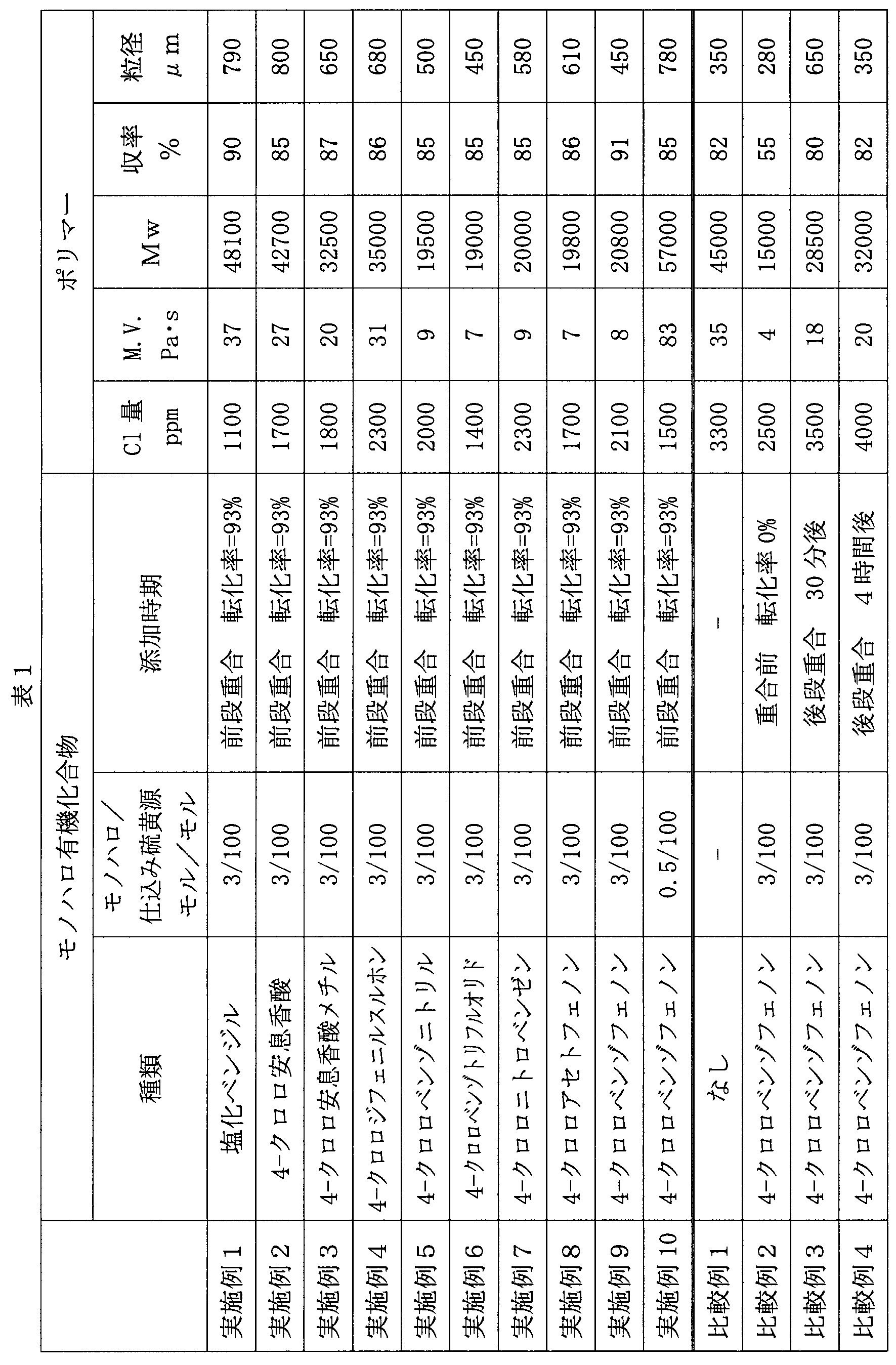
Claims (13)
- 有機アミド溶媒中で硫黄源とジハロ芳香族化合物とを重合する工程を含み、その際、該重合工程が、相分離剤の存在下に、重合反応系内の液相に生成ポリマー濃厚相と生成ポリマー希薄相とが混在する相分離状態で重合反応を継続する相分離重合工程を含むポリアリーレンスルフィドの製造方法において、
(1)重合反応開始後、該ジハロ芳香族化合物の転化率が80~99%に達した段階であって、かつ、該液相が相分離状態となる前に、重合反応系内に、モノハロ有機化合物を、仕込み硫黄源100モル当たり、0.005~20モルとなる割合で加えて生成ポリマーと反応させ、次いで、
(2)重合反応系内の液相を相分離状態に転換して重合反応を継続する
ことを特徴とする末端ハロゲン基含量が低減されたポリアリーレンスルフィドの製造方法。 - 該モノハロ有機化合物が、モノハロ置換飽和脂肪族炭化水素類、モノハロ置換不飽和脂肪族炭化水素類、モノハロ置換飽和環状炭化水素類、及びモノハロ置換芳香族炭化水素類からなる群より選ばれる少なくとも一種のモノハロ有機化合物である請求項1記載の製造方法。
- 該モノハロ有機化合物が、モノハロ置換脂肪族炭化水素基を含有する芳香族化合物、またはカルボキシル基、メトキシカルボニル基、スルホン基、シアノ基、ニトロ基、カルボニル基、及びエーテル基からなる群より選ばれる電子吸引基を含有するモノハロ置換芳香族化合物である請求項1記載の製造方法。
- 該モノハロ有機化合物と生成ポリマーとの反応を、170~270℃の範囲内の温度で、1~60分間の範囲内の時間で行う請求項1記載の製造方法。
- 前記工程(2)において、重合反応系内に、水、有機カルボン酸金属塩、有機スルホン酸金属塩、アルカリ金属ハライド、アルカリ土類金属ハライド、芳香族カルボン酸のアルカリ土類金属塩、リン酸アルカリ金属塩、アルコール類、及びパラフィン系炭化水素類からなる群より選ばれる少なくとも一種の相分離剤を、仕込み硫黄源1モルに対して、0.01~10モルの範囲内で加えて、該重合反応系内の液相を相分離状態に転換する請求項1記載の製造方法。
- 前記工程(2)において、ポリアリーレンスルフィド濃度が30~70質量%の生成ポリマー濃厚相と、ポリアリーレンスルフィド濃度が0~10質量%の生成ポリマー希薄相とが混在する相分離状態で重合反応を継続する請求項1記載の製造方法。
- 前記工程(2)において、攪拌により、生成ポリマー希薄相中に生成ポリマー濃厚相を分散させて重合反応を継続する請求項6記載の製造方法。
- 前記重合工程を少なくとも下記の3工程:
(I)有機アミド溶媒中で硫黄源とジハロ芳香族化合物とを、仕込み硫黄源1モル当たり0.02~2.0モルの水が存在する状態で、170~270℃の温度で重合反応させて、該ジハロ芳香族化合物の転化率が80~99%のポリマーを生成させる前段重合工程1;
(II)重合反応系内に、モノハロ有機化合物を、仕込み硫黄源100モル当たり、0.005~20モルとなる割合で加えて生成ポリマーと反応させる工程2;並びに、
(III)水、有機カルボン酸金属塩、有機スルホン酸金属塩、アルカリ金属ハライド、アルカリ土類金属ハライド、芳香族カルボン酸のアルカリ土類金属塩、リン酸アルカリ金属塩、アルコール類、及びパラフィン系炭化水素類からなる群より選ばれる少なくとも一種の相分離剤を、仕込み硫黄源1モルに対して、0.01~10モルの範囲内で存在させるとともに、245~290℃の温度に加熱することにより、重合反応系内の液相を相分離状態に転換して重合反応を継続する後段重合工程3;
によって行う請求項1記載の製造方法。 - 前記重合工程を少なくとも下記の3工程:
(1)有機アミド溶媒中で硫黄源とジハロ芳香族化合物とを、仕込み硫黄源1モル当たり0.02~2.0モルの水が存在する状態で、170~270℃の温度で重合反応させて、該ジハロ芳香族化合物の転化率が80~99%のポリマーを生成させる前段重合工程1;
(2)重合反応系内に、モノハロ有機化合物を、仕込み硫黄源100モル当たり、0.005~20モルとなる割合で加えて生成ポリマーと反応させる工程2;並びに、
(3)仕込み硫黄源1モル当たり2.0モル超過10モル以下の水が存在する状態となるように重合反応系内の水量を調整するとともに245~290℃の温度に加熱することにより、重合反応系内の液相を相分離状態に転換して重合反応を継続する後段重合工程3;
によって行う請求項1記載の製造方法。 - 後段重合工程3において、仕込み硫黄源1モル当たり2.0モル超過10モル以下の水が存在する状態となるように重合反応系内の水量を調整するとともに、有機カルボン酸金属塩、有機スルホン酸金属塩、アルカリ金属ハライド、アルカリ土類金属ハライド、芳香族カルボン酸のアルカリ土類金属塩、リン酸アルカリ金属塩、アルコール類、及びパラフィン系炭化水素類からなる群より選ばれる少なくとも一種の相分離剤を、仕込み硫黄源1モルに対して、0.01~3モルの範囲内で存在させる請求項9記載の製造方法。
- 前記重合工程を少なくとも下記の5工程:
(a)有機アミド溶媒、アルカリ金属水硫化物、及び該アルカリ金属水硫化物1モル当たり0.95~1.05モルのアルカリ金属水酸化物を含有する混合物を加熱して反応させ、該混合物を含有する系内から水を含む留出物の少なくとも一部を系外に排出する脱水工程I;
(b)脱水工程後、系内に残存する混合物に、必要に応じてアルカリ金属水酸化物及び水を添加して、脱水時に生成した硫化水素に伴い生成するアルカリ金属水酸化物のモル数と脱水前に添加したアルカリ金属水酸化物のモル数と脱水後に添加するアルカリ金属水酸化物のモル数の総モル数が、硫黄源として脱水後に系内に存在するアルカリ金属水硫化物を含む仕込み硫黄源1モル当たり1.00~1.09モルとなり、かつ、水のモル数が仕込み硫黄源1モル当たり0.02~2.0モルとなるように調整する仕込み工程II;
(c)該混合物にジハロ芳香族化合物を添加し、有機アミド溶媒中で仕込み硫黄源とジハロ芳香族化合物とを170~270℃の温度で重合反応させて、該ジハロ芳香族化合物の転化率が80~99%のポリマーを生成させる前段重合工程III;
(d)重合反応系内に、モノハロ有機化合物を、仕込み硫黄源100モル当たり、0.005~20モルとなる割合で加えて生成ポリマーと反応させる工程IV;並びに、
(e)水、有機カルボン酸金属塩、有機スルホン酸金属塩、アルカリ金属ハライド、アルカリ土類金属ハライド、芳香族カルボン酸のアルカリ土類金属塩、リン酸アルカリ金属塩、アルコール類、及びパラフィン系炭化水素類からなる群より選ばれる少なくとも一種の相分離剤を、仕込み硫黄源1モルに対して、0.01~10モルの範囲内で存在させるとともに、245~290℃の温度に加熱することにより、重合反応系内の液相を相分離状態に転換して重合反応を継続する後段重合工程V;
によって行う請求項1記載の製造方法。 - 前記重合工程を少なくとも下記の5工程:
(A)有機アミド溶媒、アルカリ金属水硫化物、及び該アルカリ金属水硫化物1モル当たり0.95~1.05モルのアルカリ金属水酸化物を含有する混合物を加熱して反応させ、該混合物を含有する系内から水を含む留出物の少なくとも一部を系外に排出する脱水工程I;
(B)脱水工程後、系内に残存する混合物に、必要に応じてアルカリ金属水酸化物及び水を添加して、脱水時に生成した硫化水素に伴い生成するアルカリ金属水酸化物のモル数と脱水前に添加したアルカリ金属水酸化物のモル数と脱水後に添加するアルカリ金属水酸化物のモル数の総モル数が、硫黄源として脱水後に系内に存在するアルカリ金属水硫化物を含む仕込み硫黄源1モル当たり1.00~1.09モルとなり、かつ、水のモル数が、仕込み硫黄源1モル当たり0.02~2.0モルとなるように調整する仕込み工程II;
(C)該混合物にジハロ芳香族化合物を添加し、有機アミド溶媒中で仕込み硫黄源とジハロ芳香族化合物とを170~270℃の温度で重合反応させて、該ジハロ芳香族化合物の転化率が80~99%のポリマーを生成させる前段重合工程III;
(D)重合反応系内に、モノハロ有機化合物を、仕込み硫黄源100モル当たり、0.005~20モルとなる割合で加えて生成ポリマーと反応させる工程IV;並びに、
(E)仕込み硫黄源1モル当たり2.0モル超過10モル以下の水が存在する状態となるように重合反応系内の水量を調整するとともに245~290℃の温度に加熱することにより、重合反応系内の液相を相分離状態に転換して重合反応を継続する後段重合工程V;
によって行う請求項1記載の製造方法。 - 後段重合工程Vにおいて、仕込み硫黄源1モル当たり2.0モル超過10モル以下の水が存在する状態となるように重合反応系内の水量を調整するとともに、有機カルボン酸金属塩、有機スルホン酸金属塩、アルカリ金属ハライド、アルカリ土類金属ハライド、芳香族カルボン酸のアルカリ土類金属塩、リン酸アルカリ金属塩、アルコール類、及びパラフィン系炭化水素類からなる群より選ばれる少なくとも一種の相分離剤を、仕込み硫黄源1モルに対して、0.01~3モルの範囲内で存在させる請求項12記載の製造方法。
Priority Applications (4)
| Application Number | Priority Date | Filing Date | Title |
|---|---|---|---|
| JP2010521637A JP5731196B2 (ja) | 2008-07-22 | 2009-06-10 | 末端ハロゲン基含量が低減されたポリアリーレンスルフィドの製造方法 |
| EP09800276.9A EP2305737A4 (en) | 2008-07-22 | 2009-06-10 | PROCESS FOR PRODUCING POLYARYLENE SULFIDE HAVING REDUCED HALOGEN TERMINAL GROUP CONTENT |
| US13/055,430 US8680230B2 (en) | 2008-07-22 | 2009-06-10 | Production process of poly(arylene sulfide) whose content of terminal halogen group has been reduced |
| CN2009801284385A CN102105512B (zh) | 2008-07-22 | 2009-06-10 | 末端卤基含量降低了的聚芳撑硫醚的制造方法 |
Applications Claiming Priority (2)
| Application Number | Priority Date | Filing Date | Title |
|---|---|---|---|
| JP2008-188057 | 2008-07-22 | ||
| JP2008188057 | 2008-07-22 |
Publications (1)
| Publication Number | Publication Date |
|---|---|
| WO2010010760A1 true WO2010010760A1 (ja) | 2010-01-28 |
Family
ID=41570226
Family Applications (1)
| Application Number | Title | Priority Date | Filing Date |
|---|---|---|---|
| PCT/JP2009/060598 Ceased WO2010010760A1 (ja) | 2008-07-22 | 2009-06-10 | 末端ハロゲン基含量が低減されたポリアリーレンスルフィドの製造方法 |
Country Status (5)
| Country | Link |
|---|---|
| US (1) | US8680230B2 (ja) |
| EP (1) | EP2305737A4 (ja) |
| JP (1) | JP5731196B2 (ja) |
| CN (1) | CN102105512B (ja) |
| WO (1) | WO2010010760A1 (ja) |
Cited By (17)
| Publication number | Priority date | Publication date | Assignee | Title |
|---|---|---|---|---|
| JP2010053335A (ja) * | 2008-07-30 | 2010-03-11 | Toray Ind Inc | ポリアリーレンスルフィド樹脂の製造方法 |
| WO2010134445A1 (ja) * | 2009-05-18 | 2010-11-25 | 株式会社クレハ | ポリアリーレンスルフィド及びその製造方法 |
| CN102822239A (zh) * | 2010-03-31 | 2012-12-12 | 株式会社吴羽 | 支化状聚亚芳基硫醚树脂及其制造方法 |
| JP2013181044A (ja) * | 2012-02-29 | 2013-09-12 | Dic Corp | ポリアリーレンサルファイド樹脂組成物およびその成形体 |
| KR20140109476A (ko) * | 2012-03-30 | 2014-09-15 | 가부시끼가이샤 구레하 | 입상 폴리아릴렌 설파이드 및 그 제조방법 |
| WO2016108270A1 (ja) * | 2014-12-29 | 2016-07-07 | 株式会社クレハ | ポリアリーレンスルフィドの製造方法、及びポリアリーレンスルフィド |
| KR20180053974A (ko) * | 2016-11-14 | 2018-05-24 | 주식회사 엘지화학 | 폴리페닐렌 설파이드의 제조방법 및 이로부터 제조된 저염소 폴리페닐렌 설파이드 |
| US10004782B2 (en) | 2012-05-17 | 2018-06-26 | Vtv Therapeutics Llc | Glucokinase activator compositions for the treatment of diabetes |
| JP2019039015A (ja) * | 2012-08-07 | 2019-03-14 | エスケー ケミカルズ カンパニー リミテッド | ポリアリーレンスルフィド樹脂、及び成形品 |
| JP2019507825A (ja) * | 2016-12-30 | 2019-03-22 | 浙江新和成特種材料有限公司Zhejiang Nhu Special Materials Co., Ltd. | 低塩素含有量のポリフェニレンスルフィド及びその製造方法、樹脂組成物並びに成形体 |
| JP2020500999A (ja) * | 2017-05-15 | 2020-01-16 | エルジー・ケム・リミテッド | ポリアリーレンスルフィドの製造方法 |
| JP2020105498A (ja) * | 2018-12-26 | 2020-07-09 | 群栄化学工業株式会社 | ポリイミン、ポリイミンイミド、ワニス、フィルム及びその製造方法、並びに積層体及びその製造方法 |
| KR20210052074A (ko) * | 2019-10-31 | 2021-05-10 | 주식회사 엘지화학 | 친수성 관능기가 도입된 폴리아릴렌 설파이드의 제조방법 |
| KR20210053729A (ko) * | 2019-11-04 | 2021-05-12 | 주식회사 엘지화학 | 저염소 폴리페닐렌 설파이드의 제조방법 |
| KR20210053728A (ko) * | 2019-11-04 | 2021-05-12 | 주식회사 엘지화학 | 폴리아릴렌 설파이드의 제조방법 |
| JP2021075695A (ja) * | 2019-10-31 | 2021-05-20 | 東レ株式会社 | ポリアリーレンスルフィド樹脂の製造方法 |
| KR20210147326A (ko) * | 2020-05-28 | 2021-12-07 | 주식회사 엘지화학 | 폴리아릴렌 설파이드의 제조 방법 |
Families Citing this family (19)
| Publication number | Priority date | Publication date | Assignee | Title |
|---|---|---|---|---|
| KR101468825B1 (ko) * | 2010-07-13 | 2014-12-03 | 가부시끼가이샤 구레하 | 폴리아릴렌술피드의 제조 방법 및 제조 장치 |
| US9604156B2 (en) | 2013-09-25 | 2017-03-28 | Ticona Llc | Method and system for separation of a polymer from multiple compounds |
| JP2016536376A (ja) | 2013-09-25 | 2016-11-24 | ティコナ・エルエルシー | 低ハロゲン含量のポリアリーレンスルフィドを形成する方法 |
| US9617387B2 (en) | 2013-09-25 | 2017-04-11 | Ticona Llc | Scrubbing process for polyarylene sulfide formation |
| JP6797687B2 (ja) | 2013-09-25 | 2020-12-09 | ティコナ・エルエルシー | ポリアリーレンスルフィド結晶化方法 |
| JP6684206B2 (ja) | 2013-09-25 | 2020-04-22 | ティコナ・エルエルシー | ポリアリーレンスルフィドの形成中における塩副生成物の分離 |
| WO2015047718A1 (en) | 2013-09-25 | 2015-04-02 | Ticona Llc | Multi-stage process for forming polyarylene sulfides |
| US9938407B2 (en) | 2013-09-27 | 2018-04-10 | Toray Industries, Inc. | Polyarylene sulfide resin composition |
| JP6418852B2 (ja) * | 2014-09-05 | 2018-11-07 | 株式会社クレハ | ポリアリーレンスルフィドの製造方法及びポリアリーレンスルフィド |
| WO2016133739A1 (en) | 2015-02-19 | 2016-08-25 | Ticona Llc | Method for forming a high molecular weight polyarylene sulfide |
| JP6803844B2 (ja) | 2015-02-19 | 2020-12-23 | ティコナ・エルエルシー | 低粘度のポリアリーレンスルフィドを形成する方法 |
| WO2016133740A1 (en) | 2015-02-19 | 2016-08-25 | Ticona Llc | Method of polyarylene sulfide precipitation |
| WO2016153610A1 (en) | 2015-03-25 | 2016-09-29 | Ticona Llc | Technique for forming a high melt viscosity polyarylene sulfide |
| US11407861B2 (en) | 2019-06-28 | 2022-08-09 | Ticona Llc | Method for forming a polyarylene sulfide |
| CN115279734A (zh) | 2019-12-20 | 2022-11-01 | 提克纳有限责任公司 | 形成聚芳硫醚的方法 |
| JP2024535216A (ja) | 2021-09-08 | 2024-09-30 | ティコナ・エルエルシー | ポリアリーレンスルフィド廃棄汚泥から有機溶媒を回収するための逆溶媒技術 |
| US12018129B2 (en) | 2021-09-08 | 2024-06-25 | Ticona Llc | Extraction technique for recovering an organic solvent from a polyarylene sulfide waste sludge |
| CN115260496B (zh) * | 2022-07-27 | 2024-03-29 | 浙江新和成特种材料有限公司 | 聚亚芳基硫醚树脂的制造工艺及其产品和应用 |
| CN115477601A (zh) * | 2022-09-22 | 2022-12-16 | 江苏麒祥高新材料有限公司 | 一种有机多硫化物及其制备方法和应用 |
Citations (15)
| Publication number | Priority date | Publication date | Assignee | Title |
|---|---|---|---|---|
| JPS5212240A (en) | 1975-07-18 | 1977-01-29 | Matsushita Electric Ind Co Ltd | Process for preparing transparent coating compounds |
| US4038263A (en) | 1975-05-27 | 1977-07-26 | Phillips Petroleum Company | Production of p-phenylene sulfide polymers |
| JPS55156342A (en) | 1979-05-25 | 1980-12-05 | Hitachi Ltd | Resin sealed electronic parts |
| JPS59219332A (ja) | 1983-05-30 | 1984-12-10 | Dainippon Ink & Chem Inc | ポリフェニレンスルフィドの製造方法 |
| JPS59219331A (ja) | 1983-05-27 | 1984-12-10 | Dainippon Ink & Chem Inc | ポリフエニレンスルフイドの精製法 |
| JPS62106929A (ja) | 1985-11-02 | 1987-05-18 | Toyo Soda Mfg Co Ltd | ポリフエニレンスルフイドおよびその製造方法 |
| JPS6333775A (ja) | 1986-07-28 | 1988-02-13 | シャープ株式会社 | ライトボックス |
| JPH01161022A (ja) | 1987-12-18 | 1989-06-23 | Tosoh Corp | ポリ(p−フェニレンスルフィド)の製造方法 |
| JPH0511128A (ja) | 1991-07-02 | 1993-01-19 | Toray Ind Inc | プラスチツク光フアイバの熱処理方法およびその装置 |
| JPH05163349A (ja) | 1991-08-06 | 1993-06-29 | Tosoh Corp | ポリアリーレンスルフィドおよびその製造方法 |
| JPH0710997A (ja) * | 1993-06-29 | 1995-01-13 | Kureha Chem Ind Co Ltd | 破砕抵抗性を有する粒状ポリフェニレンスルフィドの 製造方法 |
| JP2000191785A (ja) * | 1998-12-24 | 2000-07-11 | Kureha Chem Ind Co Ltd | ポリアリーレンスルフィドの製造方法 |
| JP2002293936A (ja) * | 2001-03-30 | 2002-10-09 | Idemitsu Petrochem Co Ltd | ポリアリーレンスルフィドの脱揮方法 |
| JP2003176357A (ja) * | 2001-12-10 | 2003-06-24 | Tosoh Corp | ポリアリーレンスルフィドの製造方法 |
| WO2004060972A1 (ja) * | 2002-12-27 | 2004-07-22 | Kureha Chemical Industry Company, Limited | ポリアリーレンスルフィド及びその製造方法 |
Family Cites Families (12)
| Publication number | Priority date | Publication date | Assignee | Title |
|---|---|---|---|---|
| US3919177A (en) | 1973-11-19 | 1975-11-11 | Phillips Petroleum Co | P-phenylene sulfide polymers |
| US4016145A (en) | 1974-08-08 | 1977-04-05 | Phillips Petroleum Company | Production of aromatic sulfide/sulfone polymers |
| US4507468A (en) | 1982-07-16 | 1985-03-26 | Dainippon Ink And Chemicals, Inc. | Method for purifying polyphenylene sulfide |
| US4645826A (en) | 1984-06-20 | 1987-02-24 | Kureha Kagaku Kogyo Kabushiki Kaisha | Process for production of high to ultra-high molecular weight linear polyarylenesulfides |
| CA1262006A (en) * | 1985-08-20 | 1989-09-26 | Norio Ogata | Method for producing of polyarylene sulfides |
| US4820801A (en) | 1985-11-02 | 1989-04-11 | Tosoh Corp. | Polyphenylene sulfide containing covalently bonded chlorine in a reduced amount |
| US4820800A (en) * | 1988-02-25 | 1989-04-11 | Phillips Petroleum Company | Arylene sulfide polymers |
| DE69222997T2 (de) | 1991-08-06 | 1998-04-30 | Tosoh Corp | Verfahren zur Herstellung von Polyarylensulfid |
| JPH069780A (ja) * | 1992-03-27 | 1994-01-18 | Kureha Chem Ind Co Ltd | 無水フタル酸基含有ポリアリーレンチオエーテルの製造方法 |
| JP2002265603A (ja) * | 2001-03-12 | 2002-09-18 | Idemitsu Petrochem Co Ltd | ポリアリーレンスルフィドの製造方法 |
| JP2004123958A (ja) * | 2002-10-04 | 2004-04-22 | Idemitsu Petrochem Co Ltd | ポリアリーレンスルフィドの製造方法 |
| WO2006046748A1 (ja) * | 2004-10-29 | 2006-05-04 | Kureha Corporation | ポリアリーレンスルフィドの製造方法 |
-
2009
- 2009-06-10 JP JP2010521637A patent/JP5731196B2/ja active Active
- 2009-06-10 US US13/055,430 patent/US8680230B2/en not_active Expired - Fee Related
- 2009-06-10 WO PCT/JP2009/060598 patent/WO2010010760A1/ja not_active Ceased
- 2009-06-10 CN CN2009801284385A patent/CN102105512B/zh not_active Expired - Fee Related
- 2009-06-10 EP EP09800276.9A patent/EP2305737A4/en not_active Withdrawn
Patent Citations (15)
| Publication number | Priority date | Publication date | Assignee | Title |
|---|---|---|---|---|
| US4038263A (en) | 1975-05-27 | 1977-07-26 | Phillips Petroleum Company | Production of p-phenylene sulfide polymers |
| JPS5212240A (en) | 1975-07-18 | 1977-01-29 | Matsushita Electric Ind Co Ltd | Process for preparing transparent coating compounds |
| JPS55156342A (en) | 1979-05-25 | 1980-12-05 | Hitachi Ltd | Resin sealed electronic parts |
| JPS59219331A (ja) | 1983-05-27 | 1984-12-10 | Dainippon Ink & Chem Inc | ポリフエニレンスルフイドの精製法 |
| JPS59219332A (ja) | 1983-05-30 | 1984-12-10 | Dainippon Ink & Chem Inc | ポリフェニレンスルフィドの製造方法 |
| JPS62106929A (ja) | 1985-11-02 | 1987-05-18 | Toyo Soda Mfg Co Ltd | ポリフエニレンスルフイドおよびその製造方法 |
| JPS6333775A (ja) | 1986-07-28 | 1988-02-13 | シャープ株式会社 | ライトボックス |
| JPH01161022A (ja) | 1987-12-18 | 1989-06-23 | Tosoh Corp | ポリ(p−フェニレンスルフィド)の製造方法 |
| JPH0511128A (ja) | 1991-07-02 | 1993-01-19 | Toray Ind Inc | プラスチツク光フアイバの熱処理方法およびその装置 |
| JPH05163349A (ja) | 1991-08-06 | 1993-06-29 | Tosoh Corp | ポリアリーレンスルフィドおよびその製造方法 |
| JPH0710997A (ja) * | 1993-06-29 | 1995-01-13 | Kureha Chem Ind Co Ltd | 破砕抵抗性を有する粒状ポリフェニレンスルフィドの 製造方法 |
| JP2000191785A (ja) * | 1998-12-24 | 2000-07-11 | Kureha Chem Ind Co Ltd | ポリアリーレンスルフィドの製造方法 |
| JP2002293936A (ja) * | 2001-03-30 | 2002-10-09 | Idemitsu Petrochem Co Ltd | ポリアリーレンスルフィドの脱揮方法 |
| JP2003176357A (ja) * | 2001-12-10 | 2003-06-24 | Tosoh Corp | ポリアリーレンスルフィドの製造方法 |
| WO2004060972A1 (ja) * | 2002-12-27 | 2004-07-22 | Kureha Chemical Industry Company, Limited | ポリアリーレンスルフィド及びその製造方法 |
Non-Patent Citations (1)
| Title |
|---|
| See also references of EP2305737A4 * |
Cited By (33)
| Publication number | Priority date | Publication date | Assignee | Title |
|---|---|---|---|---|
| JP2014074186A (ja) * | 2008-07-30 | 2014-04-24 | Toray Ind Inc | ポリアリーレンスルフィド樹脂の製造方法 |
| JP2010053335A (ja) * | 2008-07-30 | 2010-03-11 | Toray Ind Inc | ポリアリーレンスルフィド樹脂の製造方法 |
| WO2010134445A1 (ja) * | 2009-05-18 | 2010-11-25 | 株式会社クレハ | ポリアリーレンスルフィド及びその製造方法 |
| JPWO2010134445A1 (ja) * | 2009-05-18 | 2012-11-08 | 株式会社クレハ | ポリアリーレンスルフィド及びその製造方法 |
| US8530605B2 (en) | 2009-05-18 | 2013-09-10 | Kureha Corporation | Poly(arylene sulfide) and production process thereof |
| CN102822239A (zh) * | 2010-03-31 | 2012-12-12 | 株式会社吴羽 | 支化状聚亚芳基硫醚树脂及其制造方法 |
| US9255350B2 (en) | 2010-03-31 | 2016-02-09 | Kureha Corporation | Branched poly(arylene sulfide) resin and method for producing same |
| JP2013181044A (ja) * | 2012-02-29 | 2013-09-12 | Dic Corp | ポリアリーレンサルファイド樹脂組成物およびその成形体 |
| KR20140109476A (ko) * | 2012-03-30 | 2014-09-15 | 가부시끼가이샤 구레하 | 입상 폴리아릴렌 설파이드 및 그 제조방법 |
| US9422400B2 (en) * | 2012-03-30 | 2016-08-23 | Kureha Corporation | Granular polyarylene sulfide and process for manufacturing the same |
| KR101660614B1 (ko) * | 2012-03-30 | 2016-09-27 | 가부시끼가이샤 구레하 | 입상 폴리아릴렌 설파이드 및 그 제조방법 |
| US10004782B2 (en) | 2012-05-17 | 2018-06-26 | Vtv Therapeutics Llc | Glucokinase activator compositions for the treatment of diabetes |
| JP2019039015A (ja) * | 2012-08-07 | 2019-03-14 | エスケー ケミカルズ カンパニー リミテッド | ポリアリーレンスルフィド樹脂、及び成形品 |
| US10875966B2 (en) | 2012-08-07 | 2020-12-29 | Sk Chemicals Co., Ltd | Polyarylene sulfide and a preparation method thereof |
| JPWO2016108270A1 (ja) * | 2014-12-29 | 2017-08-31 | 株式会社クレハ | ポリアリーレンスルフィドの製造方法、及びポリアリーレンスルフィド |
| US10072123B2 (en) | 2014-12-29 | 2018-09-11 | Kureha Corporation | Polyarylene sulfide production method and polyarylene sulfide |
| WO2016108270A1 (ja) * | 2014-12-29 | 2016-07-07 | 株式会社クレハ | ポリアリーレンスルフィドの製造方法、及びポリアリーレンスルフィド |
| KR102131164B1 (ko) * | 2016-11-14 | 2020-07-07 | 주식회사 엘지화학 | 폴리페닐렌 설파이드의 제조방법 및 이로부터 제조된 저염소 폴리페닐렌 설파이드 |
| KR20180053974A (ko) * | 2016-11-14 | 2018-05-24 | 주식회사 엘지화학 | 폴리페닐렌 설파이드의 제조방법 및 이로부터 제조된 저염소 폴리페닐렌 설파이드 |
| JP2019507825A (ja) * | 2016-12-30 | 2019-03-22 | 浙江新和成特種材料有限公司Zhejiang Nhu Special Materials Co., Ltd. | 低塩素含有量のポリフェニレンスルフィド及びその製造方法、樹脂組成物並びに成形体 |
| JP2020500999A (ja) * | 2017-05-15 | 2020-01-16 | エルジー・ケム・リミテッド | ポリアリーレンスルフィドの製造方法 |
| US11407860B2 (en) | 2017-05-15 | 2022-08-09 | Lg Chem, Ltd. | Method for preparing polyarylene sulfide |
| JP2020105498A (ja) * | 2018-12-26 | 2020-07-09 | 群栄化学工業株式会社 | ポリイミン、ポリイミンイミド、ワニス、フィルム及びその製造方法、並びに積層体及びその製造方法 |
| KR20210052074A (ko) * | 2019-10-31 | 2021-05-10 | 주식회사 엘지화학 | 친수성 관능기가 도입된 폴리아릴렌 설파이드의 제조방법 |
| JP7679611B2 (ja) | 2019-10-31 | 2025-05-20 | 東レ株式会社 | ポリアリーレンスルフィド樹脂の製造方法 |
| JP2021075695A (ja) * | 2019-10-31 | 2021-05-20 | 東レ株式会社 | ポリアリーレンスルフィド樹脂の製造方法 |
| KR102701677B1 (ko) | 2019-10-31 | 2024-08-30 | 주식회사 엘지화학 | 친수성 관능기가 도입된 폴리아릴렌 설파이드의 제조방법 |
| KR20210053729A (ko) * | 2019-11-04 | 2021-05-12 | 주식회사 엘지화학 | 저염소 폴리페닐렌 설파이드의 제조방법 |
| KR102663676B1 (ko) | 2019-11-04 | 2024-05-03 | 주식회사 엘지화학 | 폴리아릴렌 설파이드의 제조방법 |
| KR102664888B1 (ko) | 2019-11-04 | 2024-05-08 | 주식회사 엘지화학 | 저염소 폴리페닐렌 설파이드의 제조방법 |
| KR20210053728A (ko) * | 2019-11-04 | 2021-05-12 | 주식회사 엘지화학 | 폴리아릴렌 설파이드의 제조방법 |
| KR20210147326A (ko) * | 2020-05-28 | 2021-12-07 | 주식회사 엘지화학 | 폴리아릴렌 설파이드의 제조 방법 |
| KR102847795B1 (ko) | 2020-05-28 | 2025-08-18 | 주식회사 엘지화학 | 폴리아릴렌 설파이드의 제조 방법 |
Also Published As
| Publication number | Publication date |
|---|---|
| CN102105512B (zh) | 2013-01-23 |
| JP5731196B2 (ja) | 2015-06-10 |
| EP2305737A1 (en) | 2011-04-06 |
| EP2305737A4 (en) | 2015-03-04 |
| CN102105512A (zh) | 2011-06-22 |
| US20110124825A1 (en) | 2011-05-26 |
| JPWO2010010760A1 (ja) | 2012-01-05 |
| US8680230B2 (en) | 2014-03-25 |
Similar Documents
| Publication | Publication Date | Title |
|---|---|---|
| JP5731196B2 (ja) | 末端ハロゲン基含量が低減されたポリアリーレンスルフィドの製造方法 | |
| JP5623277B2 (ja) | 粒状ポリアリーレンスルフィドの製造方法 | |
| JP5713402B2 (ja) | ポリアリーレンスルフィド及びその製造方法 | |
| JP6517337B2 (ja) | 粒状ポリアリーレンスルフィドを製造する方法、及び粒状ポリアリーレンスルフィド | |
| JP6420668B2 (ja) | ポリアリーレンスルフィドの製造方法及びポリアリーレンスルフィド | |
| JP6062924B2 (ja) | 粒状ポリアリーレンスルフィド及びその製造方法 | |
| JP4777610B2 (ja) | ポリアリーレンスルフィド及びその製造方法 | |
| JP5221877B2 (ja) | ポリアリーレンスルフィドの製造方法 | |
| CN108602954B (zh) | 粒状聚亚芳基硫醚的制造方法、粒状聚亚芳基硫醚的平均粒径增大方法、粒状聚亚芳基硫醚的粒子强度提高方法以及粒状聚亚芳基硫醚 | |
| JP6374030B2 (ja) | ポリアリーレンスルフィドの製造方法、及びポリアリーレンスルフィド | |
| CN110637046B (zh) | 聚芳硫醚的制备方法 | |
| JP6889271B2 (ja) | ポリアリーレンスルフィドの製造方法 | |
| WO2021131985A1 (ja) | ポリアリーレンスルフィドの製造方法 | |
| WO2020121785A1 (ja) | ポリアリーレンスルフィドの製造方法 | |
| JP2021024881A (ja) | ポリアリーレンスルフィド共重合体およびその製造方法 |
Legal Events
| Date | Code | Title | Description |
|---|---|---|---|
| WWE | Wipo information: entry into national phase |
Ref document number: 200980128438.5 Country of ref document: CN |
|
| 121 | Ep: the epo has been informed by wipo that ep was designated in this application |
Ref document number: 09800276 Country of ref document: EP Kind code of ref document: A1 |
|
| WWE | Wipo information: entry into national phase |
Ref document number: 2010521637 Country of ref document: JP |
|
| WWE | Wipo information: entry into national phase |
Ref document number: 13055430 Country of ref document: US |
|
| NENP | Non-entry into the national phase |
Ref country code: DE |
|
| REEP | Request for entry into the european phase |
Ref document number: 2009800276 Country of ref document: EP |
|
| WWE | Wipo information: entry into national phase |
Ref document number: 2009800276 Country of ref document: EP |