WO2010074301A1 - クロロシランの製造方法 - Google Patents
クロロシランの製造方法 Download PDFInfo
- Publication number
- WO2010074301A1 WO2010074301A1 PCT/JP2009/071835 JP2009071835W WO2010074301A1 WO 2010074301 A1 WO2010074301 A1 WO 2010074301A1 JP 2009071835 W JP2009071835 W JP 2009071835W WO 2010074301 A1 WO2010074301 A1 WO 2010074301A1
- Authority
- WO
- WIPO (PCT)
- Prior art keywords
- chlorosilane
- catalyst
- packed bed
- disproportionation reaction
- liquid
- Prior art date
- Legal status (The legal status is an assumption and is not a legal conclusion. Google has not performed a legal analysis and makes no representation as to the accuracy of the status listed.)
- Ceased
Links
Classifications
-
- C—CHEMISTRY; METALLURGY
- C01—INORGANIC CHEMISTRY
- C01B—NON-METALLIC ELEMENTS; COMPOUNDS THEREOF; METALLOIDS OR COMPOUNDS THEREOF NOT COVERED BY SUBCLASS C01C
- C01B33/00—Silicon; Compounds thereof
- C01B33/08—Compounds containing halogen
- C01B33/107—Halogenated silanes
-
- C—CHEMISTRY; METALLURGY
- C01—INORGANIC CHEMISTRY
- C01B—NON-METALLIC ELEMENTS; COMPOUNDS THEREOF; METALLOIDS OR COMPOUNDS THEREOF NOT COVERED BY SUBCLASS C01C
- C01B33/00—Silicon; Compounds thereof
- C01B33/08—Compounds containing halogen
- C01B33/107—Halogenated silanes
- C01B33/10773—Halogenated silanes obtained by disproportionation and molecular rearrangement of halogenated silanes
-
- B—PERFORMING OPERATIONS; TRANSPORTING
- B01—PHYSICAL OR CHEMICAL PROCESSES OR APPARATUS IN GENERAL
- B01J—CHEMICAL OR PHYSICAL PROCESSES, e.g. CATALYSIS OR COLLOID CHEMISTRY; THEIR RELEVANT APPARATUS
- B01J31/00—Catalysts comprising hydrides, coordination complexes or organic compounds
- B01J31/02—Catalysts comprising hydrides, coordination complexes or organic compounds containing organic compounds or metal hydrides
- B01J31/06—Catalysts comprising hydrides, coordination complexes or organic compounds containing organic compounds or metal hydrides containing polymers
- B01J31/08—Ion-exchange resins
Definitions
- the present invention relates to a method for producing disproportionated chlorosilane by passing a chlorosilane liquid through a catalyst packed bed packed with a weakly basic anion exchange resin as a disproportionation reaction catalyst to disproportionate. More specifically, the present invention relates to a method for producing chlorosilane by efficient disproportionation in the production of chlorosilane, preventing deterioration of the disproportionation reaction catalyst at the start of the reaction.
- chlorosilanes such as monochlorosilane, dichlorosilane, trichlorosilane, silicon tetrachloride and the like used as electronic materials such as semiconductors and raw materials for silicone resins
- a method using a disproportionation reaction is known.
- a method of producing dichlorosilane from trichlorosilane or producing trichlorosilane or monosilane from silicon tetrachloride and dichlorosilane using a disproportionation reaction catalyst comprising a basic anion exchange resin has been proposed. (See Japanese Patent Application Laid-Open No. 47-12569 and Japanese Patent No. 2863774).
- the disproportionation reaction can be carried out by either a gas phase reaction in which chlorosilane is reacted in a gaseous state or a liquid phase reaction in which the chlorosilane is reacted in a liquid state.
- by-product such as silica or a precursor of silica is generated due to the reaction between the water in the catalyst and chlorosilane, It is known that the pores of the catalyst particles are clogged and the surface of the catalyst particles is coated, and the catalytic activity is lowered.
- the catalyst is packed in a fixed bed and then removed by refluxing an organic solvent azeotropic with water, such as toluene, and extracting the water (Japanese Patent Laid-Open No. Sho). 47-12569) and a method of removing moisture by passing an inert gas such as dry nitrogen gas through the fixed bed for a long time (see Japanese Patent No. 2863774 and Japanese Patent Laid-Open No. 2001-131188). Yes.
- an object of the present invention is to produce disproportionated chlorosilane by passing the raw material chlorosilane liquid through a catalyst packed bed packed with a weakly basic anion exchange resin as a disproportionation reaction catalyst and disproportionating it. It is an object of the present invention to provide a method for producing disproportionated chlorosilane that can reduce the catalyst activity at the initial stage of reaction, stably produce the disproportionation reaction, and efficiently produce the mixture while maintaining a sufficient reaction rate. .
- the cause of the deterioration of the disproportionation reaction catalyst in the early stage of the disproportionation reaction is that the catalyst is charged due to heat generated when chlorosilane first contacts the catalyst.
- the object of the present invention is to disproportionate the raw material chlorosilane liquid by passing it through the catalyst packed bed filled with the weakly basic anion exchange resin of the disproportionation reaction catalyst.
- the disproportionation reaction catalyst in the catalyst packed bed is previously contacted with a treatment gas diluted with chlorosilane with an inert gas before performing the disproportionation reaction.
- This is a method for producing disproportionated chlorosilane.
- solids such as silica are produced as a by-product due to the reaction between the chlorosilane in the processing gas or the generated disproportionated chlorosilane and the moisture in the catalyst, and the solids clog the pores of the catalyst particles.
- the treatment before the disproportionation by flowing the raw material chlorosilane liquid through the catalyst packed bed Circulate gas.
- the catalyst packed bed is washed by flowing a chlorosilane liquid to prevent a decrease in the catalyst activity of the disproportionation catalyst due to the solid content.
- it is circulated as a cleaning liquid for cleaning the catalyst packed bed, thereby reducing the amount of chlorosilane liquid used for cleaning. Since it can reduce, it is preferable.
- the disproportionation reaction refers to dissociation / bonding of Si—H bonds and Si—Cl bonds between chlorosilane molecules by passing chlorosilane as a raw material through a disproportionation reaction catalyst.
- This is a reaction in which H and Cl on Si are redistributed among molecules.
- the reaction is represented by the following reaction formula.
- dichlorosilane when dichlorosilane is subjected to a disproportionation reaction, monosilane and trichlorosilane are produced, and further, dichlorosilane and silicon tetrachloride are produced from trichlorosilane, so that the reaction product is a mixture of monosilane and various chlorosilanes. Become. Moreover, since the disproportionation reaction is an equilibrium reaction, it is possible to obtain the main target product in a high yield by adjusting the composition of the raw material chlorosilane.
- trichlorosilane which is a raw material for producing high-purity polycrystalline silicon by the Siemens method
- a mixture of chlorosilane containing at least dichlorosilane and silicon tetrachloride is used as the raw material chlorosilane.
- trichlorosilane can be obtained efficiently.
- the raw material chlorosilane in the present invention is a chlorosilane used in the disproportionation reaction, and examples thereof include chlorosilanes such as hydrogenated chlorosilanes such as monochlorosilane, dichlorosilane, and trichlorosilane.
- the target chlorosilane can be obtained in a high yield by adjusting the composition of the raw material chlorosilane.
- the raw material chlorosilane used for this purpose include chlorosilanes such as chloromonosilane such as silicon tetrachloride.
- the raw material chlorosilane can be used as it is industrially available, or chlorosilane can be separated from the gas discharged during the production of polycrystalline silicon by the Siemens method or the like by an operation such as distillation. Is possible.
- the above hydrogenated chlorosilane can be used alone, as a mixture of hydrogenated chlorosilane, or as a mixture of chlorosilane such as silicon tetrachloride and hydrogenated chlorosilane. It is possible to select appropriately according to the chlorosilane to be produced. For example, when trying to obtain trichloromonosilane as a target product, it is preferable to use a mixture of chloromonosilane containing at least dichloromonosilane and silicon tetrachloride as raw material chlorosilane because trichloromonosilane can be obtained efficiently. It is.
- a mixture containing dichloromonosilane, trichloromonosilane and silicon tetrachloride is used as the raw material chlorosilane.
- This mixture preferably contains 2 to 50% by weight of dichloromonosilane, 2 to 45% by weight of trichloromonosilane and 4 to 96% by weight of silicon tetrachloride, based on the total weight of dichloromonosilane, trichloromonosilane and silicon tetrachloride, and more Preferably, it contains 5 to 30% by mass of dichloromonosilane, 3 to 30% by mass of trichloromonosilane, and 40 to 92% by mass of silicon tetrachloride.
- the raw material chlorosilane is contacted as a liquid with a catalyst packed bed (hereinafter referred to as catalyst packed bed) filled with a weakly basic anion exchange resin as a disproportionation reaction catalyst.
- a catalyst packed bed hereinafter referred to as catalyst packed bed
- a weakly basic anion exchange resin as a disproportionation reaction catalyst.
- the chlorosilane to be used as the raw material chlorosilane is liquid at room temperature and normal pressure, it can be used as it is, but if the chlorosilane to be used is a gas at room temperature and normal pressure, is it used after liquefaction? Alternatively, it may be used by adjusting to a liquid at normal temperature and normal pressure by mixing with chlorosilane having a high boiling point.
- chlorosilane may be cooled to the boiling point or lower and supplied to the catalyst packed bed in a liquid state.
- a disproportionation reaction catalyst a weakly basic anion exchange resin is used as a disproportionation reaction catalyst (hereinafter referred to as a disproportionation reaction catalyst).
- Weakly basic anion exchange resin means that amino groups such as primary to tertiary amino groups are introduced as ion exchange groups into substrates such as styrene-divinylbenzene copolymer and acrylic acid amide-divinylbenzene copolymer. It has been done.
- an industrially available weakly basic anion exchange resin can be used as it is, or a metal element or the like supported on the resin can be used.
- the metal element supported on the weakly basic anion exchange resin include metal elements belonging to Group 8 of the periodic table such as platinum and palladium.
- steps such as preparation of a dispersion solution of the metal element, impregnation of the weakly basic anion exchange resin into the dispersion solution, removal of the solvent from the resin are required. Since the operation for preparing the leveling reaction catalyst becomes complicated, it is preferable to use the weakly basic anion exchange resin as it is from the viewpoint of industrially efficient production.
- the disproportionation reaction catalyst used in the present invention specifically, as a weakly basic anion exchange resin having a tertiary amino group based on a styrene-divinylbenzene copolymer, Amberlyst A-21 is used. Amberlyst B-20 / HG-DRY (made by Rohm and Haas), Diaion WA-30 (made by Mitsubishi Chemical), DOWEX MWA-1 (made by Dow Chemical) Alternatively, as a weakly basic anion exchange resin having a secondary amino group based on a styrene-divinylbenzene copolymer, Diaion WA-20 (manufactured by Mitsubishi Chemical Corporation) and the like can be mentioned.
- a weakly basic anion exchange resin into which a tertiary amino group has been introduced is particularly preferred from the viewpoint of a high disproportionation reaction rate.
- the structure of the weakly basic anion exchange resin may be any of structures such as a gel shape, a porous shape, a high porous shape, and a macroreticular (MR) shape.
- MR macroreticular
- the diameter is particularly 0.1 to 2 mm. Particularly preferred are spherical particles of the order.
- the disproportionation reaction catalyst is filled in a reaction apparatus such as a fixed bed flow reaction apparatus to form a catalyst packed bed.
- the structure of the catalyst packed layer is not particularly limited as long as the catalyst packed layer is formed, and a known structure can be appropriately adopted in consideration of the production amount and the like.
- the contact time with the disproportionation reaction catalyst is the same, the higher the linear velocity, the more chances that the molecules of the chlorosilane contact each other on the surface of the disproportionation reaction catalyst. The yield of the target object per unit time increases.
- the L / D (ratio of the catalyst packed bed length and the catalyst packed bed diameter) of the catalyst packed bed is the same as the contact time as the L / D is larger at the same linear velocity. It is efficient because it decreases.
- the L / D of the catalyst packed bed is preferably 2 to 200, more preferably 3 to 200.
- the weakly basic anion exchange resin usually contains several mass% to several tens mass% of water. When water is present in the disproportionation reaction catalyst during the disproportionation reaction, the chlorosilane and the water react with each other and a solid content such as silica is by-produced.
- the solid content produced as a by-product results in the clogging of the pores of the catalyst particles and the coating of the catalyst particle surfaces, which causes a reduction in reaction efficiency in the disproportionation reaction. Accordingly, when performing the disproportionation reaction, it is preferable to dry the disproportionation reaction catalyst and remove moisture in the catalyst as much as possible. However, in order to completely remove the water in the disproportionation reaction catalyst, it is necessary to remove the water present as structural water in the disproportionation reaction catalyst, and the larger the disproportionation reaction scale, the more It is difficult to remove moisture.
- the above-mentioned sub-gassing is performed by flowing a treatment gas obtained by diluting chlorosilane with a gas inert to the chloromonosilane, which will be described later, and preferably by further flowing a chlorosilane liquid and washing. It is possible to remove the produced solid content from the catalyst packed bed. Therefore, in the present invention, it is sufficient and preferable that the moisture content of the weakly basic anion exchange resin before being brought into contact with the processing gas is 2.0% by mass or less.
- a known drying method can be used without particular limitation.
- an azeotropic dehydration method in which an organic solvent that is azeotroped with water such as toluene is supplied to the catalyst packed bed and water is removed by reflux / extraction operation, and dry nitrogen gas or the like is used for the catalyst packed bed.
- Examples thereof include a method in which an inert gas is allowed to flow under normal pressure to remove moisture and a vacuum drying method.
- a vacuum drying method since the heat-resistant temperature of weakly basic anion exchange resins used as disproportionation reaction catalysts is as low as about 100 ° C. or less, water can be efficiently removed even under relatively low temperature conditions. Therefore, it is preferable to employ a vacuum drying method as a method for drying the catalyst packed bed.
- the conditions for drying under reduced pressure are appropriately determined in consideration of the size and cooling capacity of a reaction apparatus such as a fixed bed flow reaction apparatus using a disproportionation reaction catalyst, the amount of the catalyst charged, and the like.
- the temperature is within the range of 100 to 300 hours under a temperature of 50 ° C. or more and a heat resistant temperature of the resin and a pressure of 30 kPa or less.
- drying under reduced pressure while circulating an inert gas such as dry nitrogen gas in the catalyst packed bed is most preferable because drying can be performed more efficiently.
- the water content contained in the disproportionation reaction catalyst after drying can be confirmed by sampling a part of the disproportionation reaction catalyst and measuring the water content.
- the chlorosilane may be the same as or different from the raw chlorosilane before the raw chlorosilane liquid is circulated through the disproportionation reaction catalyst in the catalyst packed bed.
- a treatment gas diluted with an inert gas is contacted in advance.
- the catalyst present in the catalyst packed bed is brought into contact with the treatment gas diluted with chlorosilane inert gas, where the concentration of chlorosilane is dilute.
- the amount of chlorosilane in contact is adjusted to suppress heat generation in the catalyst packed bed, and heat generated in the catalyst packed bed is removed by the inert gas, and the heat enters the catalyst packed bed. Temperature rise due to staying can be prevented. By these actions, it is possible to prevent the catalyst activity decrease at the initial stage of the disproportionation reaction very effectively.
- the chlorosilane used in the processing gas may be the same as or different from the raw material chlorosilane.
- chlorosilane such as hydrogenated chlorosilane and silicon tetrachloride described in the raw material chlorosilane can be used without any limitation.
- the raw material chlorosilane and the different chlorosilane are chlorosilanes made of different chemical species from the chlorosilanes of the raw material chlorosilane, or chlorosilanes having the same chemical species as the raw material chlorosilane but having different chemical species composition ratios. There may be.
- chlorosilane composed of one kind of chemical species as chlorosilane or a mixture of chlorosilanes composed of a plurality of chemical species.
- the chlorosilanes used in the processing gas from the viewpoint that heat generation due to the disproportionation reaction does not occur, the amount of heat generated in the catalyst packed bed can be further suppressed, and that it is relatively safe and easy to handle.
- the gas for diluting the chlorosilane (hereinafter referred to as dilution gas) is not particularly limited as long as it is an inert gas for the chlorosilane, and a known inert gas can be used. Examples of such a dilution gas include nitrogen, helium, and argon. As described above, since chlorosilane reacts with water to produce by-products such as silica, the dilution gas is preferably used as a sufficiently dry drying gas and is allowed to flow with a desiccant before being supplied to the reactor. It is suitable that the dew point is less than 0 ° C., preferably ⁇ 30 ° C. or less.
- the concentration and supply rate of chlorosilane in the treatment gas are such that the disproportionation reaction catalyst is not decomposed, and the size and cooling of the reaction apparatus such as a fixed bed type flow reaction apparatus filled with the disproportionation reaction catalyst are cooled. It is determined as appropriate in consideration of the capacity, the amount of the catalyst charged, and the like.
- the concentration of chlorosilane can be constant during the supply of the processing gas to the catalyst packed bed, or the temperature of the disproportionation reaction catalyst in the catalyst packed bed can be checked by using a low concentration of processing gas at the initial supply stage. However, it is possible to gradually increase the concentration of chlorosilane.
- the supply rate of chlorosilane can be kept constant during the process gas supply to the catalyst packed bed, or the supply rate is kept low at the initial supply stage, and the temperature of the disproportionation reaction catalyst in the catalyst packed bed is confirmed.
- the supply speed can be gradually increased.
- the concentration of chlorosilane in the treatment gas is preferably in the range of 0.01 to 50% by volume, more preferably 0.1 to 30% by volume.
- the supply speed is preferably 0.05 to 5.0 cm / s, more preferably 0.1 to 1.0 cm / s, as the linear speed.
- the temperature of the treatment gas is such that the disproportionation reaction catalyst is not decomposed by the treatment gas circulated through the disproportionation reaction catalyst, and the fixed bed flow reaction device or the like is charged with the disproportionation reaction catalyst. It is appropriately determined in consideration of the size of the reaction apparatus, the cooling capacity, the amount of the catalyst charged, and the like.
- a process gas having a very high temperature is used, the difference between the temperature of the process gas and the heat resistance temperature of the disproportionation reaction catalyst becomes too small, and it becomes difficult to control the temperature of the catalyst packed bed in the flow of the process gas. On the other hand, if it is too low, it is not efficient because equipment for cooling the processing gas is required.
- the temperature of the treatment gas is preferably 0 to 80 ° C, more preferably 10 to 30 ° C.
- the chlorosilane sequentially contacts the disproportionation reaction catalyst from the processing gas supply position side, and heat is generated due to the contact, and the temperature of the catalyst packed bed rises. After sufficient contact with the leveling reaction catalyst, the temperature of the catalyst packed bed decreases. Therefore, the temperature of the catalyst packed bed in the vicinity of the process gas discharge position is measured over time, and the supply of the process gas into the catalyst packed bed is continued until the temperature rise of the catalyst packed bed at this location is finished. preferable.
- the chlorosilane liquid is preferably circulated through the packed bed for cleaning.
- the chlorosilane liquid is preferably circulated through the packed bed for cleaning.
- chlorosilane described in the raw material chlorosilane can be used without any limitation. Of course, it can be used alone as a chlorosilane, or it can be used as a mixture of different chlorosilanes.
- a chlorosilane for cleaning silicon tetrachloride is used from the viewpoint of reusing chlorosilane discharged during the production of polycrystalline silicon, and from the viewpoint of being liquid at room temperature and pressure, relatively safe and easy to handle. Is preferably used.
- the chlorosilane to be produced in the disproportionation reaction is trichlorosilane
- trichlorosilane can be obtained in a higher yield by the disproportionation reaction if the composition ratio of silicon tetrachloride in the raw material chlorosilane is increased. Therefore, it is preferable to use silicon tetrachloride as the chlorosilane adsorbed on the disproportionation reaction catalyst before the flow of the raw material chlorosilane, and in this respect, it is most preferable to use silicon tetrachloride alone.
- a method of circulating the chlorosilane liquid through the catalyst packed bed As a method of circulating the chlorosilane liquid through the catalyst packed bed, a batch type distribution method in which the catalyst packed bed is filled with the chlorosilane liquid and discharged after a lapse of a certain time, the chlorosilane liquid is sequentially supplied at a constant supply rate, and the catalyst packed bed is obtained. And a continuous distribution method that allows continuous distribution. Among these distribution methods, continuous distribution is possible in that the above-mentioned by-product can be efficiently discharged by the flow of the chlorosilane liquid supplied into the catalyst packed bed filled with the disproportionation reaction catalyst. The method is preferred.
- the distribution temperature of the chlorosilane liquid in the continuous distribution method is not particularly limited as long as it does not affect the disproportionation reaction of the raw material chlorosilane liquid. It is determined appropriately. However, if the flow temperature of the cleaning chlorosilane liquid and the flow temperature of the raw material chlorosilane liquid to the catalyst packed bed are too large, it will affect the reaction rate of the disproportionation reaction, etc. When hydrogenated chlorosilanes such as chlorosilane and monochlorosilane are used, heat is also generated due to the disproportionation reaction of the hydrogenated chlorosilane. Therefore, the temperature of the cleaning chlorosilane liquid is preferably 0 ° C.
- the circulation speed of the chlorosilane liquid is preferably 1 to 10 m / h as a linear speed, and 4 to 4 8 m / h is more preferable.
- the chlorosilane discharged from the catalyst packed bed can be discarded after appropriate treatment, but from the viewpoint of reducing the amount of chlorosilane liquid used for cleaning, It is preferable to separate the solid content such as silica from the chlorosilane liquid circulated in the catalyst packed bed and then use it again as a cleaning liquid for the catalyst packed bed. (Solid content separation means)
- the washed chlorosilane liquid discharged from the catalyst packed bed contains a solid content.
- the solids include hydrogen chloride produced by the reaction between chlorosilanes, Ammonium chloride produced as a by-product in the reaction with a small amount of free amine present in the weakly basic anion exchange resin that is the leveling reaction catalyst, or by the reaction between the above-mentioned hydrogen chloride and iron that is the material of the reactor, etc. Contains raw iron chloride.
- the chlorosilane liquid when the chlorosilane liquid is reused and circulated, it is preferable to separate the solids such as silica from the chlorosilane liquid circulated in the catalyst packed bed and then circulate as a cleaning liquid in the catalyst packed bed.
- the solid content separation means any known separation means can be employed without any limitation as long as it can separate the solid content such as silica and ammonium chloride from the chlorosilane liquid. Specific examples include removal with a filter or strainer, removal with a packed tower filled with a filler, and the like.
- the material used for the filter and strainer is not limited at all as long as it does not cause corrosion or the like due to the chlorosilane liquid that circulates, and a metal element such as stainless steel can be used.
- the mesh size for removing by-products is preferably 100 to 60 mesh.
- any known filler can be employed without any limitation as long as the solid content can be removed from the chlorosilane liquid.
- Specific examples of the filler include silica, silica gel, activated alumina, activated carbon, activated carbon fiber, molecular sieve carbon, and zeolite.
- the separation means can be used alone or in combination. If the particle size of the by-product solids is very small, the solids may pass through separation means such as filters and strainers and affect the subsequent process.
- Disproportionation reaction conditions In the present invention, as the disproportionation reaction conditions when the raw material chlorosilane liquid is allowed to flow through the disproportionation reaction catalyst and reacted, known reaction conditions are not limited as reaction conditions for performing the disproportionation reaction by liquid phase reaction. It is possible to use without. Therefore, the conditions for the disproportionation reaction are appropriately determined according to the type of chlorosilane to be produced.
- the temperature range is from room temperature to the heat resistance temperature of the disproportionation reaction catalyst, for example, 20 to 100 ° C.
- the pressure range is from atmospheric pressure to 5 MPa.
- the disproportionation reaction catalyst is used before the raw material chlorosilane liquid is circulated to the disproportionation reaction catalyst. Cooling below the boiling point of the raw material chlorosilane liquid is more preferable from the viewpoint of suppressing vaporization of the raw material chlorosilane liquid in the medium packed bed filled with the disproportionation reaction catalyst.
- the contact time with the disproportionation reaction catalyst when the raw material chlorosilane liquid is passed through the disproportionation reaction catalyst is desirably set to such an extent that the reaction system almost reaches the equilibrium composition.
- the contact time is too short, the disproportionation reaction does not proceed sufficiently, so that the yield of the target product is lowered. If the contact time is longer than necessary, the equilibrium composition is sufficiently reached, so the yield of the target product relative to the raw material does not change, but the ratio of the target product does not increase beyond the equilibrium composition.
- the yield of the target object is reduced.
- the appropriate contact time varies depending on the reaction temperature, pressure, raw material, catalyst, and other factors, but the contact time is preferably 1 minute to 60 minutes.
- the product obtained by the above disproportionation reaction is obtained as a mixture of chlorosilanes composed of different chemical species.
- This product can be further used as a raw material for the production of the method of the present invention, and the target chlorosilane can be purified by distillation using the boiling point of each chlorosilane. Moreover, it is also possible to further refine
- the product obtained after the disproportionation reaction of the present invention is preferably dichloromonosilane 0 to 47 when the mixture containing dichloromonosilane, trichloromonosilane and silicon tetrachloride described in the above preferred embodiment is used as the raw material chlorosilane.
- a method for producing a disproportionated chlorosilane is provided, and at the same time, as a pretreatment method before the disproportionation reaction of a disproportionation reaction catalyst for chlorosilane, disproportionation of chlorosilane is performed. It is understood that a method of bringing a treatment gas obtained by diluting chlorosilane with an inert gas into contact with a catalyst packed bed filled with a weakly basic anion exchange resin as a reaction catalyst is similarly provided.
- Example 1 Basic anion exchange resin having a tertiary amine group based on a styrene-divinylbenzene copolymer as a disproportionation reaction catalyst in a catalyst packed bed having an inner diameter of 0.1 m and a height of 3.0 m Name: Amberlyst B-20.HG-DRY, manufactured by Rohm and Haas Co., Ltd.) was filled with 10 kg (about 26 L).
- the entire catalyst was heated to 80 ° C. while flowing nitrogen gas at 5 L / min, and dried under reduced pressure at 20 kPa for 200 hours.
- the water content of the catalyst after drying was 1.1% by mass.
- the catalyst packed tower was allowed to cool, and the temperature of the catalyst packed bed was adjusted to 25 ° C. or lower. Thereafter, a nitrogen dilution gas containing 0.3% by volume of silicon tetrachloride as a treatment gas is added to the catalyst after the drying, with a gas temperature of 25 ° C., a flow rate of 0.08 L / h (linear velocity: 1.0 cm / h), 0 It was made to distribute
- the solid recovered in the strainer was 1.0 kg.
- 20% by mass of dichloromonosilane (DCS), 10% by mass of trichloromonosilane (TCS) and 70% by mass of silicon tetrachloride (STC) are used as a raw material chlorosilane liquid in the catalyst packed bed after circulating the tetrachlorosilicon liquid.
- % Mixture was passed under pressure conditions of a temperature of 50 ° C., a flow rate of 40 L / h (linear velocity of 5.1 m / h), and 0.1 MPa to initiate a disproportionation reaction.
- Example 1 In Example 1 (1), vacuum drying was performed at a temperature of 80 ° C. and 20 kPa for 300 hours, except that the water content of the catalyst before flowing the treatment gas through the disproportionation reaction catalyst was 0.8% by mass. When the experiment was conducted in the same manner as in Example 1, the solid matter recovered in the strainer was 0.8 kg.
- Example 3 The experiment was conducted in the same manner as in Example 1 except that in Example 1 (3), silicon tetrachloride liquid was filled in the catalyst-filled tower instead of circulating and was discharged after 350 hours.
- the amount of the solid contained in the silicon tetrachloride liquid discharged from the catalyst packed tower was 0.1 kg. Moreover, when the liquid distilled from the catalyst packed bed 40 minutes after the distribution
- the analysis results of the distillate are shown in Table 1 below. When the liquid distilled from the catalyst packed bed was recovered through a strainer, the solid recovered in the strainer was 1.0 kg.
- Example 4 Basic anion exchange resin having a tertiary amine group based on a styrene-divinylbenzene copolymer as a disproportionation reaction catalyst in a catalyst packed bed having an inner diameter of 0.1 m and a height of 3.0 m
- Amberlyst B-20.HG-DRY manufactured by Rohm and Haas Co., Ltd.
- the whole catalyst was heated to 80 ° C. while flowing nitrogen gas at 5 L / min, and dried under reduced pressure at 20 kPa for 100 hours.
- the amount of water contained in the catalyst after drying was 1.5% by mass.
- the silicon tetrachloride liquid discharged from the catalyst packed bed was circulated through the catalyst packed bed through a strainer having a mesh size of 60.
- the temperature of the catalyst packed bed during the circulation was a maximum of 50 ° C.
- the solid recovered in the strainer was 0.1 kg.
- Comparative Example 1 A basic anion exchange resin having a tertiary amine group based on a styrene-divinylbenzene copolymer as a disproportionation reaction catalyst in a catalyst packed tower having an inner diameter of 0.1 m and a height of 3.0 m (product) Name: Amberlyst B-20.HG-DRY, manufactured by Rohm and Haas Co., Ltd.) was filled with 10 kg (about 26 L). Here, the entire catalyst was heated to 80 ° C. while flowing nitrogen gas at 5 L / min, and dried under reduced pressure at 20 kPa for 200 hours. The amount of water contained in the catalyst after the drying was 1.2% by mass.
- the catalyst packed tower was allowed to cool, and the temperature of the catalyst packed bed was set to 50 ° C. or lower. Thereafter, as a raw material chlorosilane liquid, a mixture of 20% by mass of dichloromonosilane, 10% by mass of trichloromonosilane, and 70% by mass of silicon tetrachloride was mixed at a temperature of 50 ° C., a flow rate of 40 L / h (linear velocity 5.1 m / h), 0.1 MPa. The disproportionation reaction was started under the pressure condition of The temperature inside the catalyst packed bed at the beginning of the disproportionation reaction rose to 90 ° C.
- Example 5 In Example 1 (4), the catalyst packed bed after circulating the silicon tetrachloride liquid was cooled to ⁇ 10 ° C., and then cooled to ⁇ 10 ° C. as a raw material chlorosilane liquid to be liquefied dichloromonosilane.
- the composition of the distillate was 4% by mass of monochloromonosilane, 10% by mass of dichloromonosilane, and 86% by mass of trichloromonosilane. In addition, content of monosilane and silicon tetrachloride was less than 0.01 mass%. When the liquid distilled from the catalyst packed bed was recovered through a strainer, the solids recovered in the strainer were less than 0.1 kg.
- Example 6 The experiment was performed in the same manner as in Example 1 except that trichloromonosilane was used as the raw material chlorosilane liquid in (4) of Example 1.
- Examples 7-9 An experiment was performed in the same manner as in Example 1 except that the raw material chlorosilane liquid shown in Table 2 was used in (4) of Example 1.
- the distillate after 40 minutes from the start of the flow of the raw material chlorosilane liquid and after the raw material chlorosilane was continuously passed through for 100 hours was analyzed by gas chromatography. The analysis results of the distillate are shown in Table 2.
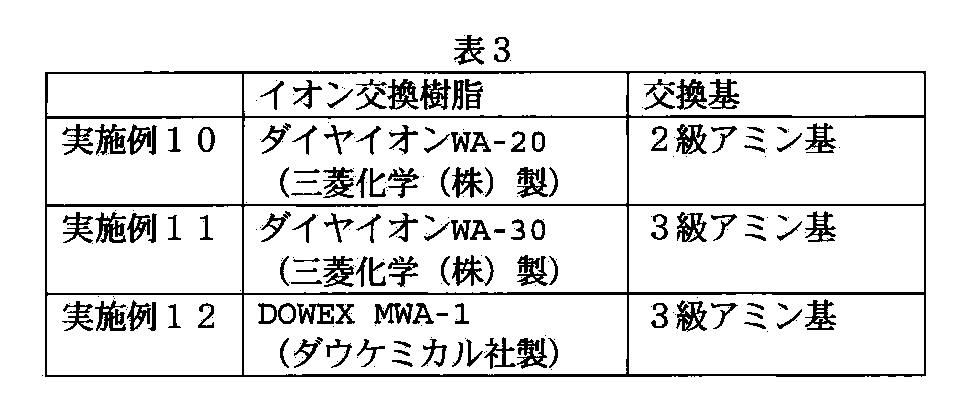
- Examples 10-12 As a weakly basic anion exchange resin, the same procedure as in Example 1 was performed except that a weakly basic anion exchange resin having a styrene-divinylbenzene copolymer as a base and having an exchange group shown in Table 3 was used. A leveling reaction was performed.
- the disproportionation reaction was performed by causing the raw material chlorosilane liquid to flow through the catalyst packed bed filled with the disproportionation reaction catalyst of the weakly basic anion exchange resin.
- the disproportionation catalyst in the catalyst packed bed is brought into contact with a treatment gas diluted with chlorosilane in an inert gas in advance to suppress a rapid temperature rise in the catalyst packed bed at the start of the reaction.
- deterioration of the disproportionation reaction catalyst due to heat can be prevented, and chlorosilane can be efficiently produced (disproportionated).
- the cause of the rapid temperature rise in the catalyst packed bed at the start of the reaction is not necessarily clear, but the reaction between chlorosilane and water remaining in the disproportionation reaction catalyst or when chlorosilane adsorbs to the disproportionation reaction catalyst. Heat generation due to the heat of adsorption is estimated.
- the concentration of the chlorosilane supplied to the catalyst packed bed is adjusted to suppress the heat generated in the catalyst packed bed and the inert gas.
- the gas circulated in the catalyst packed bed thereby removing heat generated in the catalyst packed bed and preventing temperature rise due to the heat staying in the catalyst packed bed.
Landscapes
- Chemical & Material Sciences (AREA)
- Organic Chemistry (AREA)
- Inorganic Chemistry (AREA)
- Engineering & Computer Science (AREA)
- Materials Engineering (AREA)
- Chemical Kinetics & Catalysis (AREA)
- Silicon Compounds (AREA)
- Catalysts (AREA)
- Low-Molecular Organic Synthesis Reactions Using Catalysts (AREA)
Abstract
Description
上記不均化反応は、クロロシランをガス状で反応させる気相反応、若しくは液体状で反応させる液相反応のいずれでも実施することができる。
しかしながら、いずれの場合でも、不均化反応触媒中に水分が存在すると、該触媒中の水分とクロロシランとの反応により、シリカ、或いはシリカの前駆体等の副生物が生成し、該副生物による触媒粒子の細孔の閉塞や触媒粒子表面の被覆が起こり、触媒活性が低下することが知られている。このため、クロロシランを上記不均化反応触媒に接触させる前に、該触媒を水分を実質的に含まない状態となるまで十分に乾燥させることが必要であった。
上記不均化反応触媒の乾燥方法としては、該触媒を固定床に充填したのち、トルエンのような水と共沸する有機溶媒を還流させて水を抽出することにより除去する方法(特開昭47−12569号公報参照)や、乾燥窒素ガス等の不活性ガスを上記固定床に長時間通じて水分を除去する方法(特許第2863774号および特開2001−131188号公報参照)が知られている。
しかしながら、上記乾燥方法を行った不均化反応触媒を充填した触媒充填層に原料クロロシラン液体を流通させて不均化反応を行なうと、反応開始時における触媒活性の低下が大きく、その後の反応率が十分に上がらないという現象が起こることが、本発明者らの研究により判明した。また、かかる問題は、特に不均化反応のスケールが大きい場合に顕著になることも判った。
上記課題に対し、本発明者らは鋭意検討を行った結果、不均化反応初期の不均化反応触媒の劣化の原因が、該触媒にクロロシランが最初に接触した際に生じる発熱により触媒充填層の急激な温度上昇が起ることにあるという知見を得た。
そこで、上記知見に基づき、更に研究を重ねた結果、不均化反応を開始する前に、前記触媒充填層に存在する触媒を、クロロシランを不活性なガスで希釈した処理ガスと接触させることにより、触媒充填層に供給されるクロロシランの濃度を調節して該触媒充填層内で生じる発熱を抑制し、且つ、該不活性なガスにより、前記触媒充填層内で発生した熱を除去して、該熱が触媒充填層内に滞留することによる温度上昇を防止できることを明らかにした。
そして、これらの作用によって、前記不均化反応の反応初期における触媒の活性低下を極めて効果的に防止できることを見出し、本発明を完成するに至ったものである。
即ち、本発明によれば、本発明の上記目的は、不均化反応触媒の弱塩基性陰イオン交換樹脂が充填された触媒充填層に原料クロロシラン液体を流通させて不均化せしめ、不均化されたクロロシランを製造するに際し、前記触媒充填層中の不均化反応触媒に、クロロシランを、不活性なガスで希釈した処理ガスを、上記不均化反応を行う前に予め接触させることを特徴とする不均化されたクロロシランの製造方法である。
また、処理ガス中のクロロシラン、或いは、生成された、不均化されたクロロシランと触媒中の水分との反応によってシリカ等の固形分が副生し、該固形分による触媒粒子の細孔の閉塞や触媒粒子表面の被覆により、不均化反応触媒の活性が低下するため、本発明の上記クロロモノシランの製造方法において、触媒充填層に原料クロロシラン液体を流通させて不均化させる前に前記処理ガスを流通させる。好ましくはその後、クロロシラン液体を流通させて該触媒充填層を洗浄して、該固形分による不均化触媒の触媒活性の低下を防止する。
更に、該触媒充填層に洗浄のために流通させたクロロシラン液体より固形分を分離した後、前記触媒充填層を洗浄するための洗浄液として循環流通させることにより、洗浄に使用するクロロシラン液体の量を減少させることができるので好ましい。
本発明において、不均化反応とは、不均化反応触媒に、原料としてクロロシランを流通させることで、クロロシランの分子間で、Si−H結合とSi−Cl結合の解離・結合が起こって、Si上のHとClが分子間で再配分される反応である。具体的には、下記反応式に示される反応である。

また、上記不均化反応は、平衡反応であるため、原料クロロシランの組成を調整することで、主たる目的物を高収率で得ることが可能である。例えば、シーメンス法等による高純度多結晶シリコン製造時の原料であるトリクロロシランを目的物として得ようとする場合には、原料クロロシランとして、少なくともジクロロシラン及び四塩化ケイ素を含むクロロシランの混合物を用いることが、効率良くトリクロロシランを得ることができるので好適である。
(原料クロロシラン)
本発明における原料クロロシランは、不均化反応に用いられるクロロシランであり、例えばモノクロロシラン、ジクロロシラン、トリクロロシラン等の水素化クロロシランの如きクロロシランが挙げられる。また、上記反応式に示されているように、不均化反応は平衡反応であるため、原料クロロシランの組成を調整することで、目的のクロロシランを高収率で得ることが可能となる。かかる目的で用いる原料クロロシランとして、四塩化ケイ素等のクロロモノシランの如きクロロシランが挙げられる。
上記原料クロロシランは、工業的に入手可能なものをそのまま用いることも可能であるし、シーメンス法等による多結晶シリコンの製造時に排出されるガスからクロロシランを蒸留等の操作により分離して用いることも可能である。
さらに、原料クロロシランは、上記水素化クロロシランを単独で用いることも、或いは水素化クロロシランの混合物として用いることも、さらには、四塩化ケイ素等のクロロシランと水素化クロロシランの混合物として用いることも可能であり、製造目的のクロロシランに応じて適宜選択することが可能である。例えば、トリクロロモノシランを目的物として得ようとする場合には、原料クロロシランとしては、少なくともジクロロモノシラン及び四塩化ケイ素を含むクロロモノシランの混合物とすることが、効率良くトリクロロモノシランを得ることができるので好適である。
本発明の好ましい態様では、原料クロロシランとして、ジクロロモノシラン、トリクロロモノシランおよび四塩化ケイ素を含有する混合物が用いられる。この混合物は、ジクロロモノシラン、トリクロロモノシランおよび四塩化ケイ素の合計重量に基づき、好ましくはジクロロモノシラン2~50質量%、トリクロロモノシラン2~45質量%および四塩化ケイ素4~96質量%を含有し、より好ましくはジクロロモノシラン5~30質量%、トリクロロモノシラン3~30質量%および四塩化ケイ素40~92質量%で含有する。
また、本発明では、上記原料クロロシランを弱塩基性陰イオン交換樹脂を不均化反応触媒として充填した触媒充填層(以下、触媒充填層と称す)に液体として接触させる。原料クロロシランとして用いようとするクロロシランが常温、常圧で液体状であれば、そのまま用いれば良いが、用いようとするクロロシランが常温、常圧で気体である場合には、液化してから用いるかあるいは高沸点のクロロシランと混合する等することにより、常温、常圧で液体となるように調整して用いれば良い。あるいはクロロシランを沸点以下に冷却し、液体の状態で触媒充填層に供結してもよい。
(不均化反応触媒)
本発明のクロロシランの製造方法では、弱塩基性陰イオン交換樹脂を不均化反応触媒(以下、不均化反応触媒と称す)として使用する。弱塩基性陰イオン交換樹脂とは、スチレン−ジビニルベンゼン共重合物、アクリル酸アミド−ジビニルベンゼン共重合物等の基体にイオン交換基として第一級~第三級アミノ基等のアミノ基が導入されたものである。
また、上記不均化反応触媒としては、工業的に入手可能な弱塩基性陰イオン交換樹脂をそのまま用いることも、或いは、該樹脂に金属元素等を担持させて用いることも可能である。弱塩基性陰イオン交換樹脂に担持させる金属元素としては、例えば白金、パラジウム等の周期律表第八属の金属元素等が挙げられる。金属元素を担持させるためには、金属元素の分散溶液の調製、該分散溶液への弱塩基性陰イオン交換樹脂の含侵、該樹脂からの溶媒の除去等の工程が必要となって、不均化反応触媒を調製するための操作が煩雑となるため、工業的に効率良く製造するという観点から、弱塩基性陰イオン交換樹脂をそのまま用いることが好適である。
上記本発明において用いられる不均化反応触媒としては、具体的には、スチレン−ジビニルベンゼン共重合物を基体とし三級アミノ基を有する弱塩基性陰イオン交換樹脂としては、アンバーリストA−21、その乾燥品である、アンバーリストB−20・HG−DRY(ローム・アンド・ハース社製)、ダイヤイオンWA−30(三菱化学(株)製)、DOWEX MWA−1(ダウケミカル社製)等が、或いは、スチレン−ジビニルベンゼン共重合物を基体とし二級アミノ基を有する弱塩基性陰イオン交換樹脂としては、ダイヤイオンWA−20(三菱化学(株)製)等が挙げられる。かかる弱塩基性陰イオン交換樹脂のうち、不均化反応の反応率が高いという観点から、特に第三級アミノ基を導入した弱塩基性陰イオン交換樹脂が好適である。
また、上記弱塩基性陰イオン交換樹脂の構造は、例えばゲル形、ポーラス形、ハイポーラス形、マクロレチキュラー(MR)形等の構造のいずれであってもよい。原料クロロシランの流通や反応後のクロロシランとの分離等の取扱い易さを考慮した場合、ポーラス形、ハイポーラス形、マクロレチキュラー(MR)の構造の粒状が好ましく、とりわけ直径が0.1から2mm程度の球状粒子であることが特に好適である。
本発明のクロロシランの製造方法において、上記不均化反応触媒は固定床式流通反応装置等の反応装置に充填され、触媒充填層を形成する。かかる触媒充填層の構造としては、触媒充填層を形成すれば特に制限なく、製造量等を勘案して、公知の構造を適宜採用することが可能である。不均化反応において、一般的に、不均化反応触媒との接触時間が同じ場合、線速度が大きい方が、不均化反応触媒表面でクロロシランの分子同士が接触する機会が増加するため、単位時間あたりの目的物の収量は多くなる。また、同じ線速度でも、上記触媒充填層のL/D(触媒充填層長と触媒充填層径の比率)は、L/Dが大きいほど、同じ接触時間とするために必要とする触媒量が少なくなるので、効率的である。不均化反応を効率良く行うためには、触媒充填層のL/Dとして、好ましくは2~200、より好ましくは3~200の範囲を採用するのが良い。
(不均化反応触媒の乾燥)
弱塩基性陰イオン交換樹脂は、通常数質量%~数10質量%の水分を含有している。不均化反応を行う際に、不均化反応触媒に水分が存在すると、クロロシランと水分が反応して、シリカ等の固形分が副生する。そして副生した固形分によって、上記触媒粒子の細孔の閉塞や触媒粒子表面の被覆が生じるため、不均化反応における反応効率の低下の要因となる。従って、不均化反応を行うに際し、不均化反応触媒の乾燥を行い、該触媒中の水分を可能な限り十分に除去しておくことが好ましい。しかしながら、不均化反応触媒中の水分を完全に除去するには、不均化反応触媒中に構造水として存在する水分を除去する必要があり、不均化反応のスケールが大きくなる程、かかる水分の除去は困難となる。さらに、本発明においては、後述する、クロロシランをこのクロロモノシランに対して不活性なガスで希釈した処理ガスを流通させ、好ましくはその後さらに、クロロシラン液体を流通させて洗浄することで、上記の副生した固形分を該触媒充填層から除去することが可能である。従って、本発明において、処理ガスと接触させる前の弱塩基性陰イオン交換樹脂の水分量は、2.0質量%以下とすれば十分であり好ましい。
上記の触媒充填層の乾燥方法としては、公知の乾燥方法を特に制限なく用いることが可能である。乾燥方法として具体的には、触媒充填層に、トルエン等の水と共沸する有機溶媒を供給して還流・抽出操作により水分を除去する共沸脱水法、触媒充填層に乾燥窒素ガス等の不活性ガスを常圧下で流通せしめて水分を除去する方法、及び減圧乾燥法等が挙げられる。一般的に、不均化反応触媒として用いられる弱塩基性陰イオン交換樹脂の耐熱温度は、概ね100℃以下と低いため、比較的低温下の条件でも効率良く水分の除去が可能であるという観点から、上記触媒充填層の乾燥方法としては、減圧乾燥法を採用するのが好適である。
上記減圧乾燥の条件は、不均化反応触媒を用いる固定床式流通反応装置等の反応装置の大きさや冷却能力、該触媒の充填量等を勘案して適宜決定される。例えば50℃以上樹脂の耐熱温度以下の温度および30kPa以下の圧力下で100~300時間の条件内にある。さらに、上記触媒充填層に、乾燥窒素ガス等の不活性ガスを流通させながら減圧乾燥を行うことで、より効率よく乾燥を行うことが可能となり、最も好適である。
また、上記乾燥後の不均化反応触媒中に含有される水分量は、不均化反応触媒を一部サンプリングして水分量を測定する等によって確認することが可能である。
(処理ガス)
本発明のクロロシランの製造方法の最大の特徴は、触媒充填層中の不均化反応触媒に、原料クロロシラン液体を流通させる前に、原料クロロシランと同種であっても、異種であってもよいクロロシランを不活性ガスで希釈した処理ガスを、予め接触させることにある。
クロロシランの不均化反応を開始する前に、前記触媒充填層に存在する触媒を、クロロシランの濃度が希薄な、クロロシランを不活性なガスで希釈した処理ガスと接触させることにより、触媒充填層に接触するクロロシランの量を調節して、触媒充填層内で生じる発熱を抑制し、且つ、前記不活性ガスにより、前記触媒充填層内で発生した熱を除去し、該熱が触媒充填層内に滞留することによる温度上昇を防止できる。これらの作用によって、前記不均化反応の反応初期における触媒の活性低下を極めて効果的に防止することが可能となる。
上記の処理ガスに用いられるクロロシランは、原料クロロシランと同種であっても異種であってもよい。かかるクロロシランとしては、原料クロロシランで記載された、水素化クロロシランや四塩化ケイ素等のクロロシランを何ら制限なく用いることができる。ここで、原料クロロシランと異種のクロロシランとは、原料クロロシランのクロロシランとは異なる化学種からなるクロロシラン、或いは、原料クロロシランとは化学種は同種ではあるが、その化学種組成比が異なるクロロシランのいずれであってもよい。このように、クロロシランとして一種類の化学種からなるクロロシランを用いることも、複数の化学種からなるクロロシランの混合物を用いることも可能である。
上記処理ガスに用いるクロロシランの中でも、不均化反応による発熱が生じず、触媒充填層にて発生する発熱量をさらに抑制できる点、及び、比較的安全で取り扱いが容易であるという観点から、四塩化ケイ素を単独で用いることが最も好適である。
上記クロロシランを希釈するガス(以下、希釈ガスと称す)は、該クロロシランに対して不活性なガスであれば特に制限なく、公知の不活性ガスを用いることができる。かかる希釈ガスとしては、例えば、窒素、ヘリウム、アルゴンなどが挙げられる。上記のとおり、クロロシランは水と反応してシリカ等の副生物を生成するため、上記希釈ガスは、十分乾燥した乾燥ガスとして使用することが好ましく、反応器に供給する前に乾燥剤と流通させ、露点が0℃未満、好ましくは−30℃以下となるようにすることが好適である。
上記処理ガス中のクロロシランの濃度、及び供給速度は、不均化反応触媒の分解が生じないようにして、不均化反応触媒を充填する固定床式流通反応装置等の反応装置の大きさや冷却能力、該触媒の充填量等を勘案して、適宜決定される。また、クロロシランの濃度は、触媒充填層への処理ガスの供給中、一定とすることも、あるいは供給初期は低濃度の処理ガスを用い、触媒充填層中の不均化反応触媒の温度を確認しながら、徐々にクロロシランの濃度を上げることも可能である。さらに、クロロシランの供給速度についても、触媒充填層への処理ガスの供給中、一定とすることも、あるいは供給初期は供給速度を低く抑え、触媒充填層中の不均化反応触媒の温度を確認しながら、徐々に供給速度を上げることも可能である。上記処理ガス中のクロロシランの濃度としては、好ましくは0.01~50容量%、より好ましくは0.1~30容量%の範囲内である。また、供給速度としては、線速度として、0.05~5.0cm/sが好ましく、0.1~1.0cm/sがより好ましい。
また、処理ガスの温度は、不均化反応触媒に流通させる処理ガスにより、不均化反応触媒の分解が生じないようにして、不均化反応触媒を充填する固定床式流通反応装置等の反応装置等の大きさや冷却能力、該触媒の充填量等を勘案して、適宜決定される。しかしながら、あまり高い温度の処理ガスを使用すると、処理ガスの温度と不均化反応触媒の耐熱温度との差が少なくなりすぎて、処理ガスの流通における触媒充填層の温度制御が困難になり、また、低すぎると処理ガスを冷却するための設備等が必要となるため効率的ではない。処理ガスの温度は、0~80℃が好ましく、10~30℃がより好ましい。
触媒充填層内に処理ガスを供給すると、クロロシランは処理ガスの供給位置側から順次不均化反応触媒と接触し、接触に伴い発熱が生じ触媒充填層の温度が上昇するが、該クロロシランが不均化反応触媒に十分接触した後には、触媒充填層の温度は低下する。従って、処理ガスの排出位置付近の触媒充填層の温度を経時的に測定し、かかる箇所の触媒充填層の温度上昇が終結するまで、処理ガスの触媒充填層内への供給を継続するのが好ましい。
(クロロシラン液体による洗浄)
本発明のクロロシランの製造方法では、前記処理ガスを不均化反応触媒が充填された触媒充填層に接触させた後、好ましくは該充填層にクロロシラン液体を洗浄のため流通させる。
本発明において、処理ガス中のクロロシランと触媒充填層中の水分との反応副生物を不均化反応前に触媒充填層から除去することを目的に、原料クロロシラン液体を流通させる前に、クロロシラン液体を流通させて、該触媒充填層を洗浄することが、上記副生物による不均化触媒の触媒活性の低下を防止するという観点から好適である。
原料クロロシラン液体に先立って流通させる洗浄用クロロシラン液体としては、原料クロロシランで記載されたクロロシランを何ら制限なく用いることが可能である。もちろんクロロシランとして単独で用いることも、さらには、異種クロロシランの混合物として用いることも可能である。洗浄用クロロシランとしては、多結晶シリコンの製造時に排出されるクロロシランの再利用という観点から、さらに常温、常圧で液体状であり且つ比較的安全で取り扱いが容易であるという観点から、四塩化ケイ素を用いることが好適である。特に、不均化反応での製造目的となるクロロシランがトリクロロシランである場合には、原料クロロシラン中の四塩化ケイ素の組成比を多くした方がトリクロロシランを不均化反応により高収率で得られ易くなることから、原料クロロシランの流通の前に不均化反応触媒に吸着されているクロロシランを四塩化ケイ素とすることが好ましく、かかる点でも四塩化ケイ素を単独で用いることが最も好適である。
クロロシラン液体を触媒充填層に流通させる方法としては、触媒充填層にクロロシラン液体を満たし、一定時間経過後に排出させるバッチ式での流通方法、クロロシラン液体を一定の供給速度で順次供給し、触媒充填層に連続的に流通させる連続式での流通方法が挙げられる。これらの流通方法の中でも不均化反応触媒を充填した触媒充填層中に供給されるクロロシラン液体の流れにより、上記副生物を効率良く排出させることが可能であるという点で、連続式での流通方法が好適である。
上記連続式流通方法におけるクロロシラン液体の流通温度は、原料クロロシラン液体の不均化反応に影響を及ぼさない程度であれば、特に制限なく、反応装置の規模や触媒の充填量等を勘案して、適宜決定される。しかしながら、洗浄用クロロシラン液体の流通温度と原料クロロシラン液体の触媒充填層への流通温度があまりに大きく相違すると、不均化反応の反応速度等に影響を及ぼすこと、又、洗浄用クロロシラン液体として、ジクロロシランやモノクロロシラン等の水素化クロロシランを用いたときには、この水素化クロロシランの不均化反応による発熱も生じるため、洗浄用クロロシラン液体の温度は、0℃~触媒の耐熱温度以下が好ましく、20~50℃の範囲がより好ましい。
また、クロロシラン液体の流通速度は、あまり低すぎると、触媒充填層に残存しているシリカやシリカの前駆体等の副生物の除去効率が低く、該副生物を触媒充填層から除去するために長時間の流通を要するため好ましくなく、また、あまり高くしすぎても該副生物の除去効率は変わらないため、クロロシラン液体の流通速度は、線速度として、1~10m/hが好ましく、4~8m/hがより好ましい。
また、連続式での流通方法において、触媒充填層より排出されるクロロシランは、適切な処理の後、廃棄することも可能であるが、洗浄に使用するクロロシラン液体の量の低減という観点から、該触媒充填層に流通させたクロロシラン液体よりシリカ等の固形分を分離した後、触媒充填層の洗浄液として再度使用することが好ましい。
(固形分の分離手段)
上記、連続式流通方法において、触媒充填層より排出される、洗浄後のクロロシラン液体には、固形分が含有されている。上記固形分中には、前記処理ガス中のクロロシランと不均化反応触媒中の水分とが反応して副生したシリカ等の固形分以外にも、クロロシラン同士の反応で生じる塩化水素と、不均化反応触媒である弱塩基性陰イオン交換樹脂中に存在する微量の遊離アミンとの反応で副生する塩化アンモニウム、あるいは、上記塩化水素と反応装置等の材質である鉄との反応で副生する塩化鉄等が含有している。これらの固形分は分離手段により、クロロシラン液体との分離が可能である。また、クロロシラン液体を再使用して循環流通させる際には、該触媒充填層に流通させたクロロシラン液体からシリカ等の固形分を分離した後、前記触媒充填層に洗浄液として循環流通させることが好ましい。
固形分の分離手段としては、クロロシラン液体から、上記シリカや塩化アンモニウム等の固形分が分離できる手段であれば何ら制限なく、公知の分離手段を採用することができる。具体的には、フィルターや、ストレーナによる除去、充填剤を充填した充填塔による除去等が挙げられる。フィルターやストレーナに用いる材質は、流通するクロロシラン液体による腐食等が生じない材質であれば何ら制限されず、ステンレス等の金属エレメント等を用いることが可能である。また副生物を除去するためのメッシュサイズは、好ましくは100~60メッシュである。また、充填搭による分離に用いる充填剤としては、上記固形分をクロロシラン液体から除去可能な充填剤であれば、何ら制限されず公知の充填剤を採用することが可能である。かかる充填剤として、具体的には、シリカ、シリカゲル、活性アルミナ、活性炭、活性炭素繊維、分子ふるい炭素、ゼオライト等が挙げられる。
上記分離手段は、各々単独で用いることも、また、複数を組み合わせて用いることも可能である。副生した固形分の粒径が非常に小さい場合には、固形物がフィルターやストレーナ等の分離手段を通過し、後段の工程に影響を及ぼすことがあるので、固形分を含有するクロロシラン液体を最初にフィルターやストレーナ等の分離手段に流通させて比較的粒径の大きな固形分を分離し、次いで、上記の如き充填剤を充填した充填塔に流通させて、粒径が非常に小さい固形分を分離することが、固形分の分離効率が高いという点から好適である。
(不均化反応の条件)
本発明において、原料クロロシラン液体を不均化反応触媒に流通させて、反応せしめる際の不均化反応条件としては、不均化反応を液相反応で行う反応条件として公知の反応条件が何ら制限なく用いることが可能である。従って、上記不均化反応の条件は、製造目的とするクロロシランの種類に応じて適宜決定される。反応効率等を勘案すれば、温度範囲は室温~不均化反応触媒の耐熱温度、例えば20~100℃、圧力範囲は大気圧~5MPaで行うのが好ましい。なお、原料クロロシラン液体として、常温、常圧で気体のクロロシランを沸点以下に冷却して、液体の状態で用いる場合、原料クロロシラン液体を不均化反応触媒に流通させる前に、不均化反応触媒の原料クロロシラン液体の沸点以下に冷却しておくことは、不均化反応触媒が充填された媒充填層内での、原料クロロシラン液体の気化を抑制する点でより好ましい。
また、原料クロロシラン液体を不均化反応触媒に流通させる際の不均化反応触媒との接触時間は、反応系が平衡組成にほぼ到達する程度に設定することが望ましい。接触時間が短すぎる場合、十分に不均化反応が進行しないため、目的物の収率が低くなる。接触時間が必要以上に長い場合、平衡組成に十分達しているため、原料に対する目的物の収率は変わらないが、平衡組成以上に目的物の割合が増加することはないので、結果として単位時間当たりの目的物の収量が少なくなる。適当な接触時間は、反応温度や圧力、原料、触媒、およびその他の要素によって異なるが、接触時間1分~60分とするのが好ましい。
(反応後の操作)
上記不均化反応によって得られた生成物は、異なる化学種からなるクロロシランの混合物として得られる。この生成物をさらに本発明方法の製造原料とすることも可能であるし、各クロロシランの沸点を利用した蒸留によって目的とするクロロシランを精製して得ることも可能である。また、必要に応じて活性炭等を通過させて更に精製することも可能である。
本発明の不均化反応後に得られる生成物は、原料クロロシランとして、前記好ましい態様に記載した、ジクロロモノシラン、トリクロロモノシランおよび四塩化ケイ素を含有する混合物を用いたとき、好ましくはジクロロモノシラン0~47質量%、トリクロロモノシラン6~94質量%および四塩化ケイ素0~94質量%を含有する混合物であり、より好ましくはジクロロモノシラン1~6質量%、トリクロロモノシラン15~54質量%および四塩化ケイ素40~86質量%を含有する混合物である。
以上のとおり、本発明によれば、不均化されたクロロシランの製造方法が提供され、それとともに、クロロシランの不均化反応触媒の不均化反応前の前処理方法として、クロロシランの不均化反応触媒の弱塩基性陰イオン交換樹脂が充填された触媒充填層に、クロロシランを不活性ガスで希釈した処理ガスを接触させる方法が同様に提供されることが理解される。
なお、不均化反応触媒の水分量の測定方法は、サンプリングした不均化反応触媒を窒素ガスを流通させながら105℃、75時間乾燥させ、乾燥前後の重量差により算出した。
実施例1
(1)内径0.1m、高さ3.0mの触媒充填層に、不均化反応触媒として、スチレン−ジビニルベンゼン共重合物を基体とし3級アミン基を有する塩基性陰イオン交換樹脂(商品名;アンバーリストB−20・HG−DRY、ローム・アンド・ハース社製)を10kg(約26L)充填した。ここに、窒素ガスを5L/minで流通させつつ、触媒全体を80℃に加熱し、20kPaにて200時間減圧乾燥を行った。乾燥終了後の触媒が含有する水分量は1.1質量%であった。
(2)乾燥終了後、触媒充填塔を放冷し、触媒充填層の温度を25℃以下とした。その後、上記乾燥後の触媒に、処理ガスとして四塩化ケイ素を0.3容量%含有する窒素希釈ガスをガス温度25℃、流速0.08L/h(線速度:1.0cm/h)、0.02MPaの加圧条件下で流通させた。触媒充填層のガス排出口付近に設置した温度計で触媒の温度を測定したところ、最高で42℃まで上昇した。300時間流通後、上記温度計の測定値が低下したため、処理ガスの流通を停止した。
(3)次いで、上記触媒充填層に、四塩化ケイ素液体を温度50℃、流速50L/h(線速度=6.4m/h)、0.1MPaの加圧条件下で流通させた。触媒充填層から排出された四塩化ケイ素液体は、メッシュサイズが60のストレーナを介して触媒充填層に循環流通させた。循環流通時の触媒充填層の温度は最大51℃であった。
上記の循環流通を100時間継続したところ、ストレーナに回収された固形物は1.0kgであった。
(4)四塩化ケイ素液体を循環流通させた後の触媒充填層に、原料クロロシラン液体として、ジクロロモノシラン(DCS)20質量%、トリクロロモノシラン(TCS)10質量%および四塩化ケイ素(STC)70質量%の混合物を、温度50℃、流速40L/h(線速度5.1m/h)、0.1MPaの加圧条件下で流通させ、不均化反応を開始した。
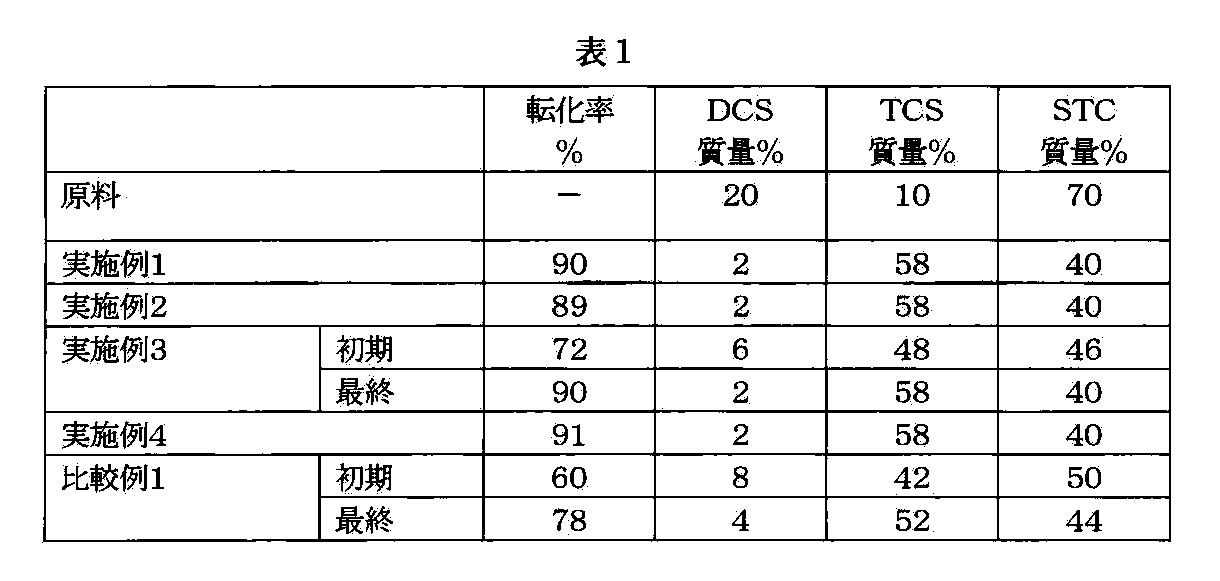
原料クロロシラン液体の流通開始40分後に触媒充填層より留出した液をガスクロマトグラフィーで分析したところ、ジクロロモノシランの転化率は90%であった。さらに、原料クロロモノシランの流通を100時間継続して行った後の留出液をガスクロマトグラフィーで分析したところ、ジクロロモノシランの転化率は90%であった。留出液の分析結果を下記表1に示した。なお、ジクロロモノシランの転化率(%)は下記式により求められる。
{原料ガス中のDCS(質量%)−排出ガス中のDCS(質量%)}/原料ガス中のDCS(質量%)×100
上記原料クロロシランの流通時の触媒充填層の温度は最大60℃であった。
また、触媒充填層より留出した液をメッシュサイズが60のストレーナを介して回収したところ、ストレーナに回収された固形物は、0.1kgであった。
実施例2
実施例1の(1)において、減圧乾燥を温度80℃、20kPaにて300時間行い、不均化反応触媒に処理ガスを流通させる前の該触媒の水分量を0.8質量%とした以外は実施例1と同様に実験を行ったところ、ストレーナに回収された固形物は0.8kgであった。また、原料クロロシラン液体の流通開始40分後に触媒充填層より留出した液を分析したところ、ジクロロモノシランの転化率は89%であった。さらに、原料クロロシラン液体の流通を100時間継続して行った後の留出液を分析したところ、ジクロロモノシランの転化率は89%であった。留出液の分析結果を下記表1に示した。
触媒充填層より留出した液をストレーナを介して回収したところ、ストレーナに回収された固形物は、0.1kg未満であった。
実施例3
実施例1の(3)において、循環流通の代わりに四塩化ケイ素液体を触媒充填搭に充填し、350時間経過後排出した以外は、実施例1と同様に実験を行った。触媒充填搭から排出された四塩化ケイ素液体中に含有されていた固形物量は、0.1kgであった。また、原料クロロシラン液体の流通開始40分後に触媒充填層より留出した液を分析したところ、ジクロロモノシランの転化率は72%であった。さらに、原料クロロシラン液体の流通を100時間継続して行った後の留出液を測定したところ、ジクロロモノシランの転化率は90%であった。留出液の分析結果を下記表1に示した。
触媒充填層より留出した液をストレーナを介して回収したところ、ストレーナに回収された固形物は、1.0kgであった。
実施例4
(1)内径0.1m、高さ3.0mの触媒充填層に、不均化反応触媒として、スチレン−ジビニルベンゼン共重合物を基体とし3級アミン基を有する塩基性陰イオン交換樹脂(商品名;アンバーリストB−20・HG−DRY、ローム・アンド・ハース社製)を10kg(約26L)充填した。ここに、窒素ガスを5L/minで流通させつつ、触媒全体を80℃に加熱し、20kPaにて100時間減圧乾燥を行った。乾燥終了後の触媒に含有する水分量は1.5質量%であった。
(2)乾燥終了後、触媒充填塔を放冷し、触媒充填層の温度を25℃以下とした。その後、上記乾燥後の触媒に、処理ガスとしてジクロロモノシランを0.3容量%で含有する窒素希釈ガスをガス温度25℃、流速0.08L/h(線速度:1.0cm/h)、0.02MPaの加圧条件下で流通させた。触媒充填層のガス排出口付近に設置した温度計で触媒の温度を測定したところ、最高で47℃まで上昇した。300時間流通後、上記温度計の測定値が低下したため、処理ガスの流通を停止した。
(3)次いで、上記触媒充填層に、四塩化ケイ素液体を温度50℃、流速50L/h(線速度=6.4m/h)、0.1MPaの加圧条件下で流通させた。触媒充填層から排出された四塩化ケイ素液体は、メッシュサイズが60のストレーナを介して触媒充填層に循環流通させた。循環流通時の触媒充填層の温度は最大50℃であった。
上記の循環流通を100時間継続したところ、ストレーナに回収された固形物は0.1kgであった。
(4)四塩化ケイ素液体を循環流通させた後の触媒充填層に、原料クロロシラン液体として、ジクロロモノシラン20質量%、トリクロロモノシラン10質量%、四塩化ケイ素70質量%の混合物を、温度50℃、流速40L/h(線速度5.1m/h)、0.1MPaの加圧条件下で流通させ、不均化反応を開始した。
原料クロロシラン液体の流通開始40分後に触媒充填層より留出した液を分析したところ、ジクロロモノシランの転化率は91%であった。さらに、原料クロロシラン液体の流通を100時間継続して行った後の留出液を分析したところ、ジクロロモノシランの転化率は91%であった。留出液の分析結果を下記表1に示した。上記原料クロロシラン液体の流通時の触媒充填層の温度は最大60℃であった。
また、触媒充填層より留出した液をメッシュサイズが60のストレーナを介して回収したところ、ストレーナに回収された固形物は、0.1kg未満であった。
比較例1
(1)内径0.1m、高さ3.0mの触媒充填塔に、不均化反応触媒として、スチレン−ジビニルベンゼン共重合物を基体とし3級アミン基を有する塩基性陰イオン交換樹脂(商品名;アンバーリストB−20・HG−DRY、ローム・アンド・ハース社製)を10kg(約26L)充填した。ここに、窒素ガスを5L/minで流通させつつ、触媒全体を80℃に加熱し、20kPaにて200時間減圧乾燥を行った。乾燥終了後の触媒に含有する水分量は1.2質量%であった。
(2)乾燥終了後、触媒充填塔を放冷し、触媒充填層の温度を50℃以下とした。その後、原料クロロシラン液体として、ジクロロモノシラン20質量%、トリクロロモノシラン10質量%、四塩化ケイ素70質量%の混合物を、温度50℃、流速40L/h(線速度5.1m/h)、0.1MPaの加圧条件下で流通させ、不均化反応を開始した。
不均化反応開始初期の触媒充填層内部の温度が90℃まで上昇した。また、原料クロロシラン液体の流通開始30分後に触媒充填層より留出した液を分析したところ、ジクロロモノシランの転化率は60%であった。さらに、原料クロロシラン液体の流通を100時間継続して行った後の留出液を分析したところ、ジクロロモノシランの転化率は78%であった。留出液の分析結果を下記表1に示した。
触媒充填層より留出した液をメッシュサイズが60のストレーナを介して回収したところ、ストレーナに回収された固形物は、1.0kgであった。また、反応終了後、触媒が充填された触媒充填搭を開放したところ、触媒が劣化したものと推測される、触媒の黒色化が確認された。不均化反応時の最高温度は、不均化反応触媒の耐熱温度以下ではあったが局所的に耐熱温度以上の温度上昇が発生し、触媒の劣化が生じたものと推測された。
実施例5
実施例1の(4)において、四塩化ケイ素液体を循環流通させた後の触媒充填層を−10℃まで冷却した後、原料クロロシラン液体として、−10℃に冷却して、液化させたジクロロモノシランを、温度−10℃、流速40L/h(線速度5.1m/h)、0.1MPaの加圧条件下で流通させ、不均化反応を開始した。
液化させたジクロロモノシランの流通開始40分後に触媒充填層より留出した液を分析したところ、ジクロロモノシランの転化率は90%であった。さらに、液化させたジクロロモノシランの流通を100時間継続して行った後の留出液を測定したところ、ジクロロモノシランの転化率は90%であった。留出液の組成は、モノクロロモノシラン4質量%、ジクロロモノシラン10質量%、トリクロロモノシラン86質量%であった。なお、モノシラン及び四塩化ケイ素の含有量は、0.01質量%未満であった。
触媒充填層より留出した液をストレーナを介して回収したところ、ストレーナに回収された固形物は、0.1kg未満であった。
実施例6
実施例1の(4)において、原料クロロシラン液体として、トリクロロモノシランを、用いた以外は、実施例1と同様に実験を行った。
トリクロロシランの流通開始40分後、及びトリクロロモノシランの通液を100時間継続して行った後に触媒充填層より留出した液を分析したところ、トリクロロモノシランの転化率はいずれも20%であった。留出液の組成は、いずれも、ジクロロシラン7.5質量%、トリクロロモノシラン80質量%、四塩化ケイ素12.5質量%であった。なお、モノシラン及びモノクロロモノシランの含有量は、0.01質量%未満であった。
触媒充填層より留出した液をストレーナを介して回収したところ、ストレーナに回収された固形物は、0.1kg未満であった。
実施例7~9
実施例1の(4)において、表2に示す原料クロロシラン液体を用いた以外は、実施例1と同様に実験を行った。いずれの実施例においても、原料クロロシラン液体の流通開始40分後、及び原料クロロシランの通液を100時間継続して行った後の留出液をガスクロマトグラフィーで分析した。留出液の分析結果を表2に示した。

弱塩基性陰イオン交換樹脂として、スチレン−ジビニルベンゼン共重合体を基体とし、表3に示した交換基を有する弱塩基性陰イオン交換樹脂を用いた以外は、実施例1と同様にして不均化反応を行なった。
その結果、実施例1と同様の結果が得られた。
Claims (5)
- 不均化反応触媒の弱塩基性陰イオン交換樹脂が充填された触媒充填層に、原料クロロシラン液体を流通させて不均化せしめて、不均化されたクロロシランを製造するに際し、前記触媒充填層中の不均化反応触媒に、クロロシランを不活性ガスで希釈した処理ガスを、上記不均化を行う前に予め接触させることを特徴とする不均化されたクロロシランの製造方法。
- 不均化されたクロロシランが原料クロロシランよりもトリクロロシランの含有割合が多い請求項1に記載の製造方法。
- 前記処理ガスと接触された後の不均化反応触媒が充填された触媒充填層に、原料クロロシラン液体を流通させて不均化させる前にクロロシラン液体を流通させて触媒充填層の洗浄を行う、請求項1に記載の製造方法。
- 前記触媒充填層の洗浄のために、該触媒充填層に流通させたクロロシラン液体から固形分を分離し、かかる後、触媒充填層の洗浄のために再度使用する請求項2に記載の製造方法。
- クロロシランの不均化反応触媒の弱塩基性陰イオン交換樹脂が充填された触媒充填層に、クロロシランを不活性ガスで希釈した処理ガスを接触させることを特徴とする、クロロシランの不均化反応触媒の前処理方法。
Priority Applications (6)
| Application Number | Priority Date | Filing Date | Title |
|---|---|---|---|
| KR1020117008249A KR101666473B1 (ko) | 2008-12-25 | 2009-12-22 | 클로로실란의 제조 방법 |
| EP09835091.1A EP2371765B1 (en) | 2008-12-25 | 2009-12-22 | Chlorosilane manufacturing method |
| JP2010544202A JP5441924B2 (ja) | 2008-12-25 | 2009-12-22 | クロロシランの製造方法 |
| RU2011130894/05A RU2011130894A (ru) | 2008-12-25 | 2009-12-22 | Способ получения хлорсилана |
| CN2009801522909A CN102264642B (zh) | 2008-12-25 | 2009-12-22 | 氯硅烷的制造方法 |
| US13/132,956 US9840421B2 (en) | 2008-12-25 | 2009-12-22 | Chlorosilane production method |
Applications Claiming Priority (2)
| Application Number | Priority Date | Filing Date | Title |
|---|---|---|---|
| JP2008-330269 | 2008-12-25 | ||
| JP2008330269 | 2008-12-25 |
Publications (1)
| Publication Number | Publication Date |
|---|---|
| WO2010074301A1 true WO2010074301A1 (ja) | 2010-07-01 |
Family
ID=42287898
Family Applications (1)
| Application Number | Title | Priority Date | Filing Date |
|---|---|---|---|
| PCT/JP2009/071835 Ceased WO2010074301A1 (ja) | 2008-12-25 | 2009-12-22 | クロロシランの製造方法 |
Country Status (9)
| Country | Link |
|---|---|
| US (1) | US9840421B2 (ja) |
| EP (1) | EP2371765B1 (ja) |
| JP (1) | JP5441924B2 (ja) |
| KR (1) | KR101666473B1 (ja) |
| CN (1) | CN102264642B (ja) |
| MY (1) | MY156599A (ja) |
| RU (1) | RU2011130894A (ja) |
| TW (1) | TWI465396B (ja) |
| WO (1) | WO2010074301A1 (ja) |
Cited By (3)
| Publication number | Priority date | Publication date | Assignee | Title |
|---|---|---|---|---|
| WO2011006694A3 (de) * | 2009-07-15 | 2011-12-01 | Evonik Degussa Gmbh | Verfahren zur behandlung von aminofunktionellen, polymeren katalysator-präkursoren |
| WO2014167757A1 (ja) * | 2013-04-11 | 2014-10-16 | 信越化学工業株式会社 | シラン化合物またはクロロシラン化合物の精製方法、多結晶シリコンの製造方法、および、弱塩基性イオン交換樹脂の再生処理方法 |
| JP2015202991A (ja) * | 2014-04-15 | 2015-11-16 | 信越化学工業株式会社 | クロロシラン類、クロロシラン類の精製方法、および、シリコン結晶 |
Families Citing this family (7)
| Publication number | Priority date | Publication date | Assignee | Title |
|---|---|---|---|---|
| DE102011075974A1 (de) * | 2011-05-17 | 2012-11-22 | Evonik Degussa Gmbh | Verfahren zur Herstellung von Trisilylamin in der Gasphase |
| WO2015111886A1 (ko) | 2014-01-24 | 2015-07-30 | 한화케미칼 주식회사 | 폐가스의 정제방법 및 정제장치 |
| CN104828827B (zh) * | 2015-05-15 | 2017-03-08 | 国电内蒙古晶阳能源有限公司 | 提纯三氯氢硅的方法 |
| CN105921175A (zh) * | 2016-04-18 | 2016-09-07 | 张玲 | 一种甲硅烷催化剂的制备方法 |
| CN112010314A (zh) * | 2020-08-03 | 2020-12-01 | 四川永祥新能源有限公司 | 一种用于多晶硅生产中树脂的干燥及活化方法 |
| CN113402640A (zh) * | 2021-06-10 | 2021-09-17 | 青海亚洲硅业半导体有限公司 | 用于氯硅烷除杂的吸附树脂及其制备方法 |
| CN118183755A (zh) * | 2024-03-07 | 2024-06-14 | 中船(邯郸)派瑞特种气体股份有限公司 | 一种电子级二氯氢硅的合成及纯化方法 |
Citations (6)
| Publication number | Priority date | Publication date | Assignee | Title |
|---|---|---|---|---|
| JPS4712569Y1 (ja) | 1967-10-16 | 1972-05-10 | ||
| JPH1129315A (ja) * | 1997-05-12 | 1999-02-02 | Tokuyama Corp | ジクロロシラン含量の減少したトリクロロシランの製造方法 |
| JP2863774B2 (ja) | 1988-03-25 | 1999-03-03 | ヘムロツク・セミコンダクター・コーポレーシヨン | Cvd法による半導体シリコンの蒸着法 |
| JP2000218166A (ja) * | 1999-01-29 | 2000-08-08 | Tokuyama Corp | シラン化合物の不均化反応用触媒 |
| JP2001122609A (ja) * | 1999-10-27 | 2001-05-08 | Tokuyama Corp | シラン化合物の不均化反応生成物の製造方法 |
| JP2001131188A (ja) | 1999-10-29 | 2001-05-15 | Tokuyama Corp | クロロシラン類の不均化反応方法 |
Family Cites Families (15)
| Publication number | Priority date | Publication date | Assignee | Title |
|---|---|---|---|---|
| US2732280A (en) * | 1956-01-24 | Disproportionation of chlorosilanes | ||
| BE784818A (fr) * | 1971-06-14 | 1972-12-13 | Westinghouse Electric Corp | Etalonnage du profil de deplacement de la position d'un entrainement par moteur |
| US4676967A (en) * | 1978-08-23 | 1987-06-30 | Union Carbide Corporation | High purity silane and silicon production |
| JPS6042216A (ja) * | 1983-08-10 | 1985-03-06 | Osaka Titanium Seizo Kk | トリクロロシラン・ジクロロシラン・モノクロロシランの不均斉化方法 |
| US4610858A (en) * | 1984-04-06 | 1986-09-09 | Denki Kagaku Kogyo Kabushiki Kaisha | Chlorosilane disproportionation catalyst and method for producing a silane compound by means of the catalyst |
| JPH0753574B2 (ja) * | 1985-06-11 | 1995-06-07 | 三井東圧化学株式会社 | シラン類の不均化方法 |
| US4725420A (en) * | 1985-09-25 | 1988-02-16 | Toa Nenryo Kogyo Kabushiki Kaisha | Process for the production of silanes |
| JP3766475B2 (ja) | 1996-08-13 | 2006-04-12 | 株式会社トクヤマ | モノシランの製造方法 |
| US5869017A (en) | 1997-05-12 | 1999-02-09 | Tokuyama Corporation | Method of producing trichlorosilane having a reduced content of dichlorosilane |
| JP3865904B2 (ja) * | 1997-11-25 | 2007-01-10 | 株式会社トクヤマ | シラン化合物の不均化反応生成物の製造方法 |
| JP3998837B2 (ja) * | 1998-12-18 | 2007-10-31 | 株式会社トクヤマ | シラン化合物の不均化反応生成物の製造方法 |
| DE10057519A1 (de) * | 2000-11-21 | 2002-05-23 | Solarworld Ag | Verfahren zur Herstellung von Silanen |
| DE102004045245B4 (de) * | 2004-09-17 | 2007-11-15 | Degussa Gmbh | Vorrichtung und Verfahren zur Herstellung von Silanen |
| JP4740646B2 (ja) * | 2005-05-18 | 2011-08-03 | 株式会社トクヤマ | シリコンの製造方法 |
| US20090060819A1 (en) * | 2007-08-29 | 2009-03-05 | Bill Jr Jon M | Process for producing trichlorosilane |
-
2009
- 2009-12-22 WO PCT/JP2009/071835 patent/WO2010074301A1/ja not_active Ceased
- 2009-12-22 CN CN2009801522909A patent/CN102264642B/zh active Active
- 2009-12-22 JP JP2010544202A patent/JP5441924B2/ja active Active
- 2009-12-22 US US13/132,956 patent/US9840421B2/en active Active
- 2009-12-22 EP EP09835091.1A patent/EP2371765B1/en active Active
- 2009-12-22 RU RU2011130894/05A patent/RU2011130894A/ru not_active Application Discontinuation
- 2009-12-22 MY MYPI2011002532A patent/MY156599A/en unknown
- 2009-12-22 KR KR1020117008249A patent/KR101666473B1/ko active Active
- 2009-12-25 TW TW098145096A patent/TWI465396B/zh active
Patent Citations (6)
| Publication number | Priority date | Publication date | Assignee | Title |
|---|---|---|---|---|
| JPS4712569Y1 (ja) | 1967-10-16 | 1972-05-10 | ||
| JP2863774B2 (ja) | 1988-03-25 | 1999-03-03 | ヘムロツク・セミコンダクター・コーポレーシヨン | Cvd法による半導体シリコンの蒸着法 |
| JPH1129315A (ja) * | 1997-05-12 | 1999-02-02 | Tokuyama Corp | ジクロロシラン含量の減少したトリクロロシランの製造方法 |
| JP2000218166A (ja) * | 1999-01-29 | 2000-08-08 | Tokuyama Corp | シラン化合物の不均化反応用触媒 |
| JP2001122609A (ja) * | 1999-10-27 | 2001-05-08 | Tokuyama Corp | シラン化合物の不均化反応生成物の製造方法 |
| JP2001131188A (ja) | 1999-10-29 | 2001-05-15 | Tokuyama Corp | クロロシラン類の不均化反応方法 |
Cited By (5)
| Publication number | Priority date | Publication date | Assignee | Title |
|---|---|---|---|---|
| WO2011006694A3 (de) * | 2009-07-15 | 2011-12-01 | Evonik Degussa Gmbh | Verfahren zur behandlung von aminofunktionellen, polymeren katalysator-präkursoren |
| WO2014167757A1 (ja) * | 2013-04-11 | 2014-10-16 | 信越化学工業株式会社 | シラン化合物またはクロロシラン化合物の精製方法、多結晶シリコンの製造方法、および、弱塩基性イオン交換樹脂の再生処理方法 |
| JP2014205589A (ja) * | 2013-04-11 | 2014-10-30 | 信越化学工業株式会社 | シラン化合物またはクロロシラン化合物の精製方法、多結晶シリコンの製造方法、および、弱塩基性イオン交換樹脂の再生処理方法 |
| US9669400B2 (en) | 2013-04-11 | 2017-06-06 | Shin-Etsu Chemical Co., Ltd. | Method for purifying silane compound or chlorosilane compound, method for producing polycrystalline silicon, and method for regenerating weakly basic ion-exchange resin |
| JP2015202991A (ja) * | 2014-04-15 | 2015-11-16 | 信越化学工業株式会社 | クロロシラン類、クロロシラン類の精製方法、および、シリコン結晶 |
Also Published As
| Publication number | Publication date |
|---|---|
| US20110236289A1 (en) | 2011-09-29 |
| MY156599A (en) | 2016-03-15 |
| JP5441924B2 (ja) | 2014-03-12 |
| US9840421B2 (en) | 2017-12-12 |
| KR101666473B1 (ko) | 2016-10-14 |
| RU2011130894A (ru) | 2013-01-27 |
| CN102264642B (zh) | 2013-07-17 |
| CN102264642A (zh) | 2011-11-30 |
| TWI465396B (zh) | 2014-12-21 |
| EP2371765B1 (en) | 2020-08-26 |
| EP2371765A4 (en) | 2015-05-06 |
| KR20110117054A (ko) | 2011-10-26 |
| JPWO2010074301A1 (ja) | 2012-06-21 |
| EP2371765A1 (en) | 2011-10-05 |
| TW201038478A (en) | 2010-11-01 |
Similar Documents
| Publication | Publication Date | Title |
|---|---|---|
| JP5441924B2 (ja) | クロロシランの製造方法 | |
| JP5632362B2 (ja) | 純シリコンを製造するための方法およびシステム | |
| EP2576573B1 (en) | A method for preparing a diorganodihalosilane | |
| JP5879283B2 (ja) | トリクロロシランの製造方法 | |
| EP3296261B1 (en) | Method for regenerating weakly basic ion-exchange resin | |
| JP5680075B2 (ja) | 触媒前駆体の処理法 | |
| JP2012158515A (ja) | クロロシランの蒸留による精製方法 | |
| EP1867604B1 (en) | Method for purification of disilicon hexachloride and high purity disilicon hexachloride | |
| CN109843800B (zh) | 多晶硅的制造方法 | |
| JP4256998B2 (ja) | シラン化合物の不均化反応生成物の製造方法 | |
| EP2818475B1 (en) | Method for refining trimethylsilane | |
| KR20160143994A (ko) | 클로로실란으로부터 인 화합물을 제거하는 방법 | |
| CN114008056A (zh) | 通过使至少一种部分氢化的氯乙硅烷在固体非官能化吸附剂上反应来获得六氯乙硅烷的方法 | |
| JP2002069077A (ja) | トリアルコキシシランの製造方法 |
Legal Events
| Date | Code | Title | Description |
|---|---|---|---|
| WWE | Wipo information: entry into national phase |
Ref document number: 200980152290.9 Country of ref document: CN |
|
| 121 | Ep: the epo has been informed by wipo that ep was designated in this application |
Ref document number: 09835091 Country of ref document: EP Kind code of ref document: A1 |
|
| ENP | Entry into the national phase |
Ref document number: 20117008249 Country of ref document: KR Kind code of ref document: A |
|
| ENP | Entry into the national phase |
Ref document number: 2010544202 Country of ref document: JP Kind code of ref document: A |
|
| WWE | Wipo information: entry into national phase |
Ref document number: 2009835091 Country of ref document: EP |
|
| WWE | Wipo information: entry into national phase |
Ref document number: 13132956 Country of ref document: US |
|
| NENP | Non-entry into the national phase |
Ref country code: DE |
|
| WWE | Wipo information: entry into national phase |
Ref document number: 2011130894 Country of ref document: RU |