WO2010108738A2 - Formulierungen enthaltend sorbitancarbonsäureester - Google Patents
Formulierungen enthaltend sorbitancarbonsäureester Download PDFInfo
- Publication number
- WO2010108738A2 WO2010108738A2 PCT/EP2010/052252 EP2010052252W WO2010108738A2 WO 2010108738 A2 WO2010108738 A2 WO 2010108738A2 EP 2010052252 W EP2010052252 W EP 2010052252W WO 2010108738 A2 WO2010108738 A2 WO 2010108738A2
- Authority
- WO
- WIPO (PCT)
- Prior art keywords
- carboxylic acid
- formulation
- formulations
- sorbitan
- formulation according
- Prior art date
- Legal status (The legal status is an assumption and is not a legal conclusion. Google has not performed a legal analysis and makes no representation as to the accuracy of the status listed.)
- Ceased
Links
Classifications
-
- A—HUMAN NECESSITIES
- A61—MEDICAL OR VETERINARY SCIENCE; HYGIENE
- A61K—PREPARATIONS FOR MEDICAL, DENTAL OR TOILETRY PURPOSES
- A61K8/00—Cosmetics or similar toiletry preparations
- A61K8/18—Cosmetics or similar toiletry preparations characterised by the composition
- A61K8/30—Cosmetics or similar toiletry preparations characterised by the composition containing organic compounds
- A61K8/49—Cosmetics or similar toiletry preparations characterised by the composition containing organic compounds containing heterocyclic compounds
- A61K8/4973—Cosmetics or similar toiletry preparations characterised by the composition containing organic compounds containing heterocyclic compounds with oxygen as the only hetero atom
-
- A—HUMAN NECESSITIES
- A61—MEDICAL OR VETERINARY SCIENCE; HYGIENE
- A61K—PREPARATIONS FOR MEDICAL, DENTAL OR TOILETRY PURPOSES
- A61K8/00—Cosmetics or similar toiletry preparations
- A61K8/18—Cosmetics or similar toiletry preparations characterised by the composition
- A61K8/30—Cosmetics or similar toiletry preparations characterised by the composition containing organic compounds
- A61K8/49—Cosmetics or similar toiletry preparations characterised by the composition containing organic compounds containing heterocyclic compounds
- A61K8/4973—Cosmetics or similar toiletry preparations characterised by the composition containing organic compounds containing heterocyclic compounds with oxygen as the only hetero atom
- A61K8/498—Cosmetics or similar toiletry preparations characterised by the composition containing organic compounds containing heterocyclic compounds with oxygen as the only hetero atom having 6-membered rings or their condensed derivatives, e.g. coumarin
-
- A—HUMAN NECESSITIES
- A61—MEDICAL OR VETERINARY SCIENCE; HYGIENE
- A61P—SPECIFIC THERAPEUTIC ACTIVITY OF CHEMICAL COMPOUNDS OR MEDICINAL PREPARATIONS
- A61P17/00—Drugs for dermatological disorders
-
- A—HUMAN NECESSITIES
- A61—MEDICAL OR VETERINARY SCIENCE; HYGIENE
- A61Q—SPECIFIC USE OF COSMETICS OR SIMILAR TOILETRY PREPARATIONS
- A61Q19/00—Preparations for care of the skin
- A61Q19/10—Washing or bathing preparations
-
- A—HUMAN NECESSITIES
- A61—MEDICAL OR VETERINARY SCIENCE; HYGIENE
- A61Q—SPECIFIC USE OF COSMETICS OR SIMILAR TOILETRY PREPARATIONS
- A61Q5/00—Preparations for care of the hair
- A61Q5/02—Preparations for cleaning the hair
-
- A—HUMAN NECESSITIES
- A61—MEDICAL OR VETERINARY SCIENCE; HYGIENE
- A61Q—SPECIFIC USE OF COSMETICS OR SIMILAR TOILETRY PREPARATIONS
- A61Q5/00—Preparations for care of the hair
- A61Q5/12—Preparations containing hair conditioners
Definitions
- the invention relates to formulations for cleaning and care of human or animal body parts containing sorbitanecarboxylic acid esters, characterized in that the carboxylic acid portion of the Sorbitancarbonklareesters derived from a carboxylic acid containing 6 to 10 carbon atoms and the sorbitanecarboxylic a hydroxyl number (OH number) of greater than 350 such as the use of
- Sorbitan carboxylic acid esters in cleansing or nourishing formulations Sorbitan carboxylic acid esters in cleansing or nourishing formulations.
- Modern cosmetic cleansing products for skin and hair consist essentially of
- Viscosity regulators for thickening the formulation are Viscosity regulators for thickening the formulation
- Typical surfactants in personal cleansers are anionic, amphoteric and zwitterionic structure.
- the anionic surfactants include, in particular, the salts of various cations (sodium, ammonium or other) of lauryl sulfate, lauryl ether sulfate, myristyl ether sulfate, cocoyl glutamates, lauryl glucose carboxylates etc.
- Cocamidopropylbetaine or cocoamidopropylsultain are used as zwitterionic surfactants, among others.
- Amphoteric surfactants are in particular amphoacetates such as sodium cocoamphoacetate or disodium cocoamphodiacetate.
- Typical thickeners used in the prior art are NaCl, low molecular weight nonionic surfactants such as coconut fatty acid monoethanolamide / diethanolamide and laureth-3, or polymers, high molecular weight, associative, highly ethoxylated fatty derivatives, e.g. Polyethylene glycol (9000) -hydrogenated glycerol palmitate.
- a solubilizer or also a solubilizer is a substance which is able to dissolve water-insoluble compounds as clearly as possible in aqueous systems.
- aggregates such as micelles are formed in this process, in whose structures the hydrophobic substances are integrated.
- Optimal is the formation of a "microemulsion", ie a thermodynamically stable mixture of water (aqueous solution), an oil (water-immiscible substance) and a solubilizer or solubilizer.
- Typical solubilizers are ethoxylated fatty derivatives.
- Perfume oils are generally added to the formulations to improve olfactory properties. Consumer acceptance plays the most important role here. In addition, it may be advantageous to cover the odors of raw materials used with perfume oils.
- Preservatives are used for microbiological stabilization. In case of contamination, these ingredients should prevent the growth of germs and, if necessary, kill germs. Preservatives are extensively described and regulated in regulatory requirements (e.g., EU Cosmetics Regulation).
- Typical care additives are ethoxylated glycerol
- Fatty acid esters such as PEG-7 glyceryl cocoate, or cationic polymers such as polyquaternium-7. These are also called backfatters.
- PEG-7 glyceryl cocoate or cationic polymers such as polyquaternium-7.
- cationic polymers such as polyquaternium-7.
- Body cleaners added so that the described degreasing process is reduced.
- the effect caused by the washed-off lipid effect can be compensated by the refatting agent, but on the other hand, the degreasing effect of the formulation per se can also be reduced by the use of the refining agent.
- emollients cosmetic oils
- isopropyl myristate for this purpose because these oils have to be solubilized in a complicated manner. More common backfats are therefore more hydrophilic products, such as
- the refatting process takes place during rinse-off of the formulation after the actual wash.
- the existing solution is diluted until the critical micelle concentration is exceeded and the solubilized in the Tensidaggregaten lipophilic components are insoluble.
- the refatting agents With the release of the micellar components (the lipophilic refatting agents, the surfactants and solubilizers), the refatting agents become insoluble again.
- These lipophilic substances both skin-specific lipids and emollients / cosmetic oils precipitate and are absorbed by the skin.
- the requirements of the finished formulation include a creamy foam, good foaming behavior, good foam volume, protection against drying out of the skin and good care performance.
- the basic requirements for the individual components include mildness, in particular a good one Skin compatibility and processability. It is advantageous if as many of the requirements as possible for a cosmetic formulation could be met by as few toxicologically acceptable and universally usable components as possible.
- polyether-free formulations which contain as few components as possible, starting from petrochemical, non-renewable raw materials. Therefore, an important goal of cosmetic research is to dispense with polyether-containing ingredients.
- prior art polyether-free products do not exhibit the desired property profiles.
- Polyether-free formulations have e.g. significantly reduced foam properties, which is considered a significant disadvantage.
- polyether-free surfactant formulations are significantly more difficult to thicken because NaCl has no thickening properties in such systems.
- the formulator is therefore forced to resort to the class of associative, highly ethoxylated fatty derivatives, abandoning the goal of the polyether-free formulations. It is therefore traditional ways to leave and develop new polyether-free formulations that replace the conventional polyether-containing formulations, and meet the modern needs of consumers. For this purpose, new polyether-free active ingredients are required with very good application properties.
- Sorbitol is the reduced polyol form of glucose, is one of the sugar alcohols and is also known as sorbitol or glucitol. Sorbitol can self-condense with elimination of water, this produces the so-called sorbitan. Under sorbitan is generally understood a product mixture of the self-condensation products of sorbitol; these are essentially five- and six-membered, mono- and bicyclic, hydroxy-functional ether polyols, as exemplified by the following formulas:
- Sorbitan esters are the esters of sorbitan and thus the esterification products of this above-described polyol mixture with organic acids, wherein the polyol mixture is usually esterified with 1 to 3 moles of acid per mole of polyol mixture.
- Sorbitan esters have long been known as good and mild emulsifiers but have only longer chain length
- Fatty acid derivatives of mono-laurate to tri-stearate hitherto an industrial significance Traditional sorbitan esters are initially insoluble in water. They are therefore hydrophilic if necessary by ethoxylation. For the emulsifying work is then by mixing the hydrophilic and hydrophobic sorbitan ester set the desired HLB value and thus enables the solubility in the various systems.
- Sorbitan esters as cleaning enhancers in aqueous cleaning agent concentrates based on nonionic, anionic or amphoteric surfactants and optionally with the concomitant use of customary auxiliaries and additives for cleaning profiled tiles.
- EP 1813251 describes inter alia the use of sorbitan partial esters for the production of polyether-free, cold-preparable, long-term stable, low-viscosity and fine-cell oil-in-water emulsions for wet wipes.
- EP0843713 describes mild hair shampoos containing long-chain fatty acid N-alkylglucamides and sugar surfactants.
- sorbitan esters are preferred here as sugar surfactants which are said to improve the application properties of the fatty acid N-alkylglucamides
- Sorbitan esters of C12 to Cis carboxylic acids in question.
- Fatty acid N-alkylglucamides are mild polyether-free surfactants, which, however, have found no widespread application due to their complex production.
- EP1394225 describes water-in-oil thickener dispersions in which the thickening effect Polyelectrolyte is based, and sorbitan esters of Cio ⁇ to C20 carboxylic acids are used as dispersant.
- Object of the present invention is to provide formulations that manage with small amounts of conventional thickeners or viscosity regulators and thereby have a good care performance.
- the present invention therefore relates to formulations for the purification and care of human or animal body parts containing process products of esterification reactions of sorbitol.
- Another object of the invention is the use of process products of esterification reactions of sorbitol as a viscosity regulator, care active ingredient, foam booster or solubilizer.
- An advantage of the invention is the good availability of the components used and their, especially for cosmetic and pharmaceutical applications relevant, good toxicological properties.
- Application performance can be dispensed with further viscosity regulators and optionally also to further refatting agents, foam boosters or solubilizers in each selected formulation.
- Foam booster or solubilizer is possible.
- associative thickeners may be polyether-free because of their polyether groups
- the present invention thus relates to formulations for cleaning and care of human or animal body parts
- Sorbitancarbonklarester characterized in that the carboxylic acid portion of the sorbitanecarboxylic ester is derived from a carboxylic acid containing 6 to 10, preferably 8, carbon atoms and the sorbitan having a hydroxyl number (OH number) of greater than 350, preferably greater than 400, in particular greater than 450 , Suitable determination methods for determining the hydroxyl number are in particular those according to DGF CV 17 a (53), Ph. Eur. 2.5.3 Method A and DIN 53240.
- the formulation of the invention from 0.01 wt .-% to 10 wt .-%, preferably 0.05 wt .-% to 5 wt .-%, particularly preferably 0.1 wt .-% to 3 wt. % Of sorbitan carboxylic acid ester based on the total formulation.
- the formulations according to the invention are preferably aqueous formulations; such are for the purposes of the present invention characterized by a water content of at least 50 wt .-%, preferably at least 75 wt .-%, particularly preferably at least 80 wt .-% based on the total formulation.
- formulations according to the invention are surface-active formulations. As contained in formulations of the invention
- surfactant formulation is to be understood as meaning a formulation which contains at least one further surfactant in addition to the sorbitan carboxylic acid ester amphoteric surfactants are typical examples of mild, ie particularly skin-friendly surfactants
- Amphoteric surfactants are, for example, betaines, amphoacetates or amphopropionates, for example substances such as N-alkyl-N, N-dimethylammonium glycinates, for example cocoalkyldimethylammonium glycinate, N-acylaminopropyl-N, N-dimethylammonium glycinates, for example cocoacylaminopropyldimethylammonium glycinate, and 2-alkyl-3 carboxymethyl-3-hydroxyethyl-imidazolines each having 8 to 18 carbon atoms in the alkyl or acyl group, and the cocoacylaminoethylhydroxyethylcarboxymethylglycinate.
- Ampholytic surfactants are, for example, those surface-active compounds which, apart from a C 8/18 alkyl or acyl group in the molecule, contain at least one free amino group and at least one -COOH or -SO 3 H group and are capable of forming internal salts.
- ampholytic surfactants are N-alkylglycines, N-alkylpropionic acids, N-alkylaminobutyric acids, N-alkyliminodipropionic acids, N-hydroxyethyl-N-alkylamidopropylglycines, N-alkyltaurines, N-alkylsarcosines, 2-alkylaminopropionic acids and alkylaminoacetic acids each having about 8 to 18 C Atoms in the alkyl group.
- ampholytic surfactants are N-cocoalkylaminopropionate,
- Cocoacylaminoethylaminopropionate and the C12 / 18 acylsarcosine Cocoacylaminoethylaminopropionate and the C12 / 18 acylsarcosine.
- Surface-active formulations according to the invention contain as further surfactant in particular fatty alcohol sulfates, fatty alcohol polyether sulfates, mono- and / or dialkyl sulfosuccinates, amphoacetates, amphopropionates, Betaine, cocamidopropyl betaines, alkyl oligoglucosides or fatty acid glutamates.
- Surfactant formulations according to the invention preferably contain, as further surfactant, those surfactants which are described in US Pat
- Particularly preferred surface-active formulations according to the invention contain, as further surfactants, the polyether-free ones
- Preferred surface-active formulations according to the invention comprise at least 2% by weight, preferably at least 4% by weight and more preferably at least 6% by weight of at least one further surfactant, based on the overall formulation.
- Particularly preferred formulations according to the invention are aqueous surfactant formulations comprising at least 0.01% by weight of sorbitan carboxylic acid ester, at least 5% by weight of at least one further surfactant and at least 75% by weight of water, based on the overall formulation, especially those containing at least 0.3% by weight .-%
- Sorbitan carboxylic acid ester at least 6% by weight of at least one further surfactant and at least 80% by weight of water, based on the total formulation.
- Preferred formulations according to the invention are liquid, cosmetic, dermatological or pharmaceutical Body cleansing preparations, in particular shower baths and gels, bath formulations, liquid soaps and shampoos.
- the human or animal body parts are preferably hair or skin.
- formulations according to the invention which are characterized in that the formulation is substantially free of polyethers and polyether-containing compounds. Also preferred are formulations according to the invention which are characterized in that the formulation is free from fatty acid N-alkylglucamides.
- substantially free of polyethers and polyether-containing compounds in the context of the present invention describes that contained compounds contain only trace amounts, preferably none, alkoxy groups, oligoalkoxy groups or polyalkoxy groups such as eg ethylene oxide or propylene oxide
- concentration of polyether-containing compounds should less than 0.1% by weight, particularly preferably less than 0.01% by weight, based on the overall formulation, preferably below the detection limit of conventional analysis methods such as, for example, NMR spectroscopy, GPC or Maldi ..
- formulations according to the invention preferably contain sorbitan carboxylic acid esters in which the Carboxylic acid portion derived from ethylhexanoic acid or caprylic acid, preferably caprylic acid.
- formulations according to the invention preferably sorbitan carboxylic acid esters in which the carboxylic acid portion is derived from technical caprylic acid, in particular from technical caprylic acid from native raw materials, as obtained, for example, from palm oil or coconut oil.
- This technical caprylic acid can be used with a carboxylic acid
- essential component are at least 50 wt .-%, preferably 80 wt .-%, in particular 90 wt .-% based to understand the total weight of the technical acid mixture.
- Formulations according to the invention particularly preferably contain sorbitan carboxylic acid esters, which are characterized in that they have an acid number of less than 20, preferably less than 15, in particular less than 10. Suitable determination methods for determining the acid number are in particular those according to DGF C-V 2, Ph. Eur. 2.5.1, ISO 3682, ASTM D 974 and DIN EN ISO 2114.
- Formulations according to the invention particularly preferably contain sorbitan carboxylic acid esters, which are characterized in that they have an iodine value of less than 30, preferably less than 10, in particular less than 5. Suitable determination methods for determining the iodine value are in particular those according to DGF CV 11 a (53), Ph. Eur. 2.5.4 Method A and DIN 53241.
- Formulations according to the invention particularly preferably comprise sorbitan carboxylic acid esters, which are characterized in that they have a viscosity of 100 to 20 000 mPa ⁇ s, preferably of 1000 to 15000 mPa ⁇ s, in particular of 2000 to 10000 mPa ⁇ s.
- Suitable determination method for determining the viscosity is in particular that according to DIN 53015.
- Formulations according to the invention particularly preferably contain sorbitan carboxylic acid esters in which 1 to 3 moles, preferably 1.2 to 2 moles, in particular 1.4 to 1.6 moles, of carboxylic acid are esterified per mole of sorbitol from which the sorbitan carboxylic acid ester is derived.
- Formulations according to the invention particularly preferably contain sorbitan carboxylic acid esters commercially available (Evonik Industries) under the INCI name Sorbitan Sesquicaprylate.
- Formulations according to the invention contain in particular sorbitan carboxylic acid esters obtainable by, preferably obtained by a process comprising the process steps A) dehydration of sorbitol, B) Reacting the dehydrated sorbitol with at least one compound selected from the group comprising carboxylic acids containing 6 to 10, preferably 8, carbon atoms, carboxylic acid esters or carboxylic ester mixtures, in which the
- step A) the sorbitol is dehydrated to various isomers, such as 1,4- and 3,6-sorbitan.
- the reaction conditions in process step A) have an influence on the composition of the dehydration product.
- Formulations according to the invention are distinguished by the fact that preferably sorbitan carboxylic acid esters are contained, during their preparation process step A) at a temperature between 100 ° C. to 180 ° C., preferably between 120 ° C. to 160 ° C., in particular between 130 ° C. to 150 ° C. is carried out.
- formulations according to the invention are characterized in that preferably sorbitan carboxylic acid esters are contained, in whose preparation process step A) at a pressure between 0.001 bar to 1.5 bar, preferably between 0.5 bar to 1.25 bar, in particular between 0.8 bar is performed to 1.2 bar.
- Sorbitancarbonklareester be used in the production process step A) at a pressure between 0.001 bar to 0.9 bar, preferably between 0.005 bar to 0.5 bar, in particular between 0.006 bar to 0.01 bar and at a Temperature between 80 0 C to 140 0 C, preferably between 90 0 C to 130 0 C, in particular between 95 0 C to 120 0 C is performed.
- Formulations according to the invention preferably contain
- an acidic catalyst preferably phosphoric acid.
- a fast and as quantitative as possible implementation in process step B) is dependent on various parameters such as pressure, temperature and ratio of the reactants to each other. These parameters also affect the sorbitan carboxylic acid esters in terms of random distribution, for example of different isomers caused by e.g. different possibilities of the esterification position in the molecule that too
- Formulations according to the invention preferably contain sorbitan carboxylic acid esters which are characterized in that process step B) is carried out at a temperature between 140 ° C. and 260 ° C., preferably between 160 ° C. and 250 ° C., in particular between 200 ° C. and 230 ° C. Analogously, it is preferred that process step B) is carried out at a pressure between 0.001 bar to 1.5 bar, preferably between 0.5 bar to 1.25 bar, in particular between 0.8 bar to 1.2 bar.
- process step B) is carried out at a pressure between 0.001 bar to 1.5 bar, preferably between 0.5 bar to 1.25 bar, in particular between 0.8 bar to 1.2 bar.
- a catalyst in process step B such as, for example, alkali metal hydroxides, alkali metal carbonates or alkali metal salts of phosphoric acid, phosphorous acid or hypophosphorous acid, can have an effect on the sorbitan carboxylic acid esters.
- Formulations according to the invention preferably contain sorbitan carboxylic acid esters, in the preparation of which in process step B) at least one catalyst selected from the group comprising alkali metal salts and
- Alkaline earth metal salts preferably sodium hydroxide, is used.
- the formulations according to the invention may contain sorbitan carboxylic acid esters in which Process step B) carboxylic acid esters of any carboxylic acid containing 8 carbon atoms are used; however, it is preferred in this connection that the carboxylic acid ester used is an ester of a carboxylic acid containing 8 carbon atoms with at least one alcohol selected from the group comprising glycerol, methanol and ethanol.
- carboxylic acid ester used is preferably an ester of ethylhexanoic acid or caprylic acid, the caprylic acid being derived, as described above, in particular from technical caprylic acid, in particular from technical caprylic acid from native raw materials.
- carboxylic acid esters can also be prepared from native raw materials, e.g. Glycerol esters of caprylic acid from goat butter, milk, palm oil and coconut oil or from wine fusel oil as carboxylic acid ester in process step B).
- mixtures of different starting materials can also be used in the different process steps, just as mixtures of sorbitan carboxylic acid esters may be present in the formulations according to the invention.
- Formulations according to the invention can be influenced by the ratio of carboxylic acid or carboxylic acid ester to sorbitol used in the process.
- Formulations according to the invention are distinguished by the fact that preferably sorbitan carboxylic acid esters are contained, in the preparation of which the molar ratio of sorbitol used in process step A) is in Process step B) used implementation partner between 1: 1 to 1: 3, preferably between 1: 1.2 to 1: 2, in particular between 1: 1.4 to 1: 1.6.
- formulations according to the invention preferably contain sorbitan carboxylic acid esters which are characterized in that all those used in process steps A) and B)
- process step B is initiated by a dynamic increase in temperature.
- Formulations according to the invention preferably contain sorbitan carboxylic acid esters obtained without process step C).
- the care formulations according to the invention may contain, for example, at least one additional component selected from the group of
- Emollients emulsifiers
- Deodorant and antiperspirant actives include insect repellents, self-tanners, preservatives, conditioners, perfumes, dyes, cosmetic actives, care additives, superfatting agents, solvents.
- Another object of the present invention is the Use of sorbitan carboxylic acid esters in which the carboxylic acid portion is derived from a carboxylic acid containing 6 to 10, preferably 8, carbon atoms and having a hydroxyl number (OH number) of greater than 350, preferably greater than 400, in particular greater than 450, as a viscosity regulator , Conditioning agent, foam booster or solubilizer in cleansing or conditioning formulations.
- a carboxylic acid containing 6 to 10, preferably 8, carbon atoms and having a hydroxyl number (OH number) of greater than 350, preferably greater than 400, in particular greater than 450, as a viscosity regulator , Conditioning agent, foam booster or solubilizer in cleansing or conditioning formulations.
- the cleansing or care formulations in which the sorbitan carboxylic acid esters are used according to the invention are preferably cosmetic, dermatological or pharmaceutical formulations, preferably for cleaning and care of human or animal body parts, particularly preferably surface-active, especially aqueous surface-active formulations for cleaning and care of human or animal Body parts, especially of skin and hair.
- Sorbitan carboxylic acid esters are used according to the invention are the preferred formulations of the invention described above.
- Sorbitancarbon Acidester used which are preferably included in the formulations according to the invention in the formulations of the invention described above.
- Phosphoric acid and 5.0 g of sodium hydroxide were weighed into a flask and dehydrated at atmospheric pressure and at 140 0 C for 30 min. Subsequently, 334.8 g of caprylic acid were added and esterified at 200 0 C and atmospheric pressure. After the reaction time, the product was filtered through a filter press. The product obtained is clear, has a final viscosity of about 6000 mPa * s, a hydroxyl number of 470, an acid number of ⁇ 10 and an iodine value of ⁇ 1, determined by the methods described above.
- Example 1 Testing of the thickening properties The thickening effect of the CapOl from Example 0 was tested in comparison to conventional surfactant thickeners in various surfactant systems. The viscosity was measured using a Brookfield viscometer (Brookfield LVF, spindle 3, 5 rpm) at 25 0 C.
- Brookfield viscometer Brookfield LVF, spindle 3, 5 rpm
- Thickener amount of 4.5 wt .-% to 1.5 wt .-% can be achieved. Here, too, it comes to a resource conservation, since significantly fewer thickening agents are needed.
- Table 1-3 Thickening effect of CapOl in a PEG-free formulation compared to commercially available thickeners.
- Example 2 Testing the conditioning of skin (skin care performance) and foam properties by means of a
- Polyethylene glycol (7) glyceryl monococoate is widely used in industry as a refatting care agent and is considered to be a highly effective component in aqueous, surfactant
- Formulations A group of 10 trained examiners washed their hands in a defined manner and evaluated foam properties and skin sensation on the basis of a grading scale from 1 (poor) to 5 (very good). The products used were each tested in a standardized surfactant formulation (Tables 2-1 and 2-3).
- control formulation 2al a formulation without the addition of an additive is used.
- Table 2-2 shows the results of the handwashing test. From the measurement results, it can be seen that formulation 2a2 of the present invention using CapOl provides better skin smoothness and skin softness 3 minutes after application and superior skin feel during washing as compared to prior art comparative formulations 2al and 2a3. The skin smoothness and skin softness directly after application are also superior to the measured values in comparison formulations 2al and 2a3 in formulations 2a2 according to the invention. Furthermore, it can be seen from the measured values that formulation 2a2 according to the invention with CapOl brings about an improvement in the foam properties.
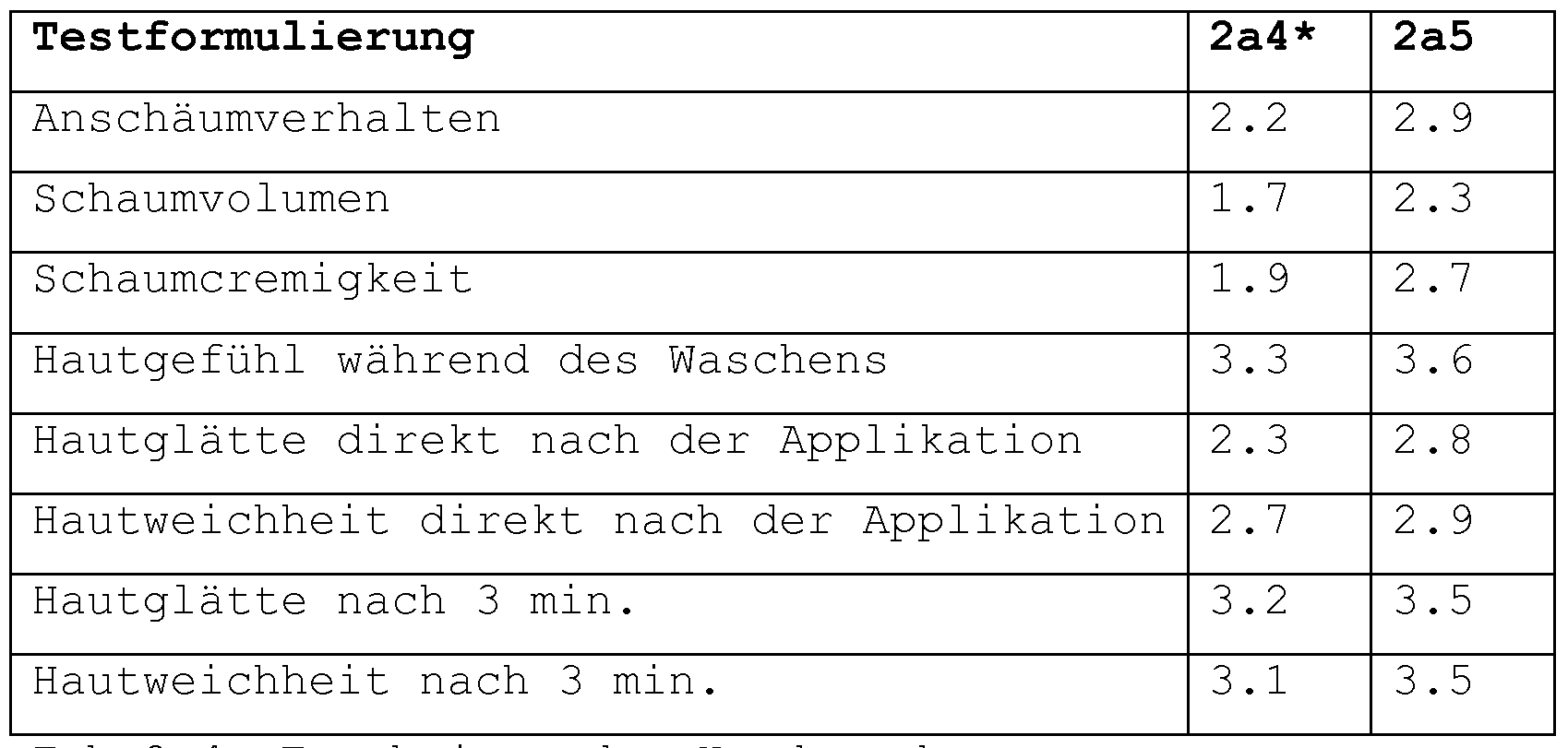
- control formulation 2a4 is a formulation without
- Table 2-4 shows the results of the handwashing test. From the measurement results, it can be seen that the formulation 2a5 according to the invention using CapOl has a superior skin feel during and after the Washing compared to the comparative formulation 2a4 effect.
- formulation 2a5 according to the invention with CapO1 effects an improvement in the foam properties in the polyether-free surfactant system.
- CapOl has a markedly positive influence on classic polyether-containing and polyether-free surfactant formulations, both in terms of foam quality and skin feel during and after application.
- Example 3 Testing of the solubilizing properties
- the solubilizing properties of Capol were tested by the water-insoluble oil isopropyl myristate (Evonik Goldschmidt GmbH, TEGOSOFT ® M) (in a surfactant solution consisting of 40 wt .-% sodium lauryl Cognis, Texapon ® NSO, 28% strength), 10 wt .-% cocamidopropyl betaine (Evonik Goldschmidt GmbH, TEGO ® betaine F 50, 38% strength) and 0.5 wt .-% Solubilisator- additive (see examples 3a3, 3a4, 3a6 and 3a7) a clear solution has been.
- the oil was dissolved in the pure surfactant solution (see Examples 3al and 3a2 Table 3-1) without solubilizer addition.
- Table 3-1 indicates the amount of isopropyl (Evonik Goldschmidt GmbH, TEGOSOFT ® M) in the corresponding system could still be solved clearly. Above this amount, cloudiness occurs.
- CapOl has a significant solubilizing effect, which is the
- Preparation or mixture of formulation components this is referred to as a multi-phase preparation. If two-phase production is required, the two phases are marked A and B in the tables given.
- ANTIL ® 200 Evonik Goldschmidt GmbH 2, 00% (INCI: PEG-200 Hydrogenated Glyceryl Palmate; PEG-7 Glyceryl Cocoate)
Landscapes
- Health & Medical Sciences (AREA)
- Life Sciences & Earth Sciences (AREA)
- Animal Behavior & Ethology (AREA)
- General Health & Medical Sciences (AREA)
- Public Health (AREA)
- Veterinary Medicine (AREA)
- Dermatology (AREA)
- Birds (AREA)
- Epidemiology (AREA)
- Bioinformatics & Cheminformatics (AREA)
- Engineering & Computer Science (AREA)
- Chemical & Material Sciences (AREA)
- Chemical Kinetics & Catalysis (AREA)
- General Chemical & Material Sciences (AREA)
- Medicinal Chemistry (AREA)
- Nuclear Medicine, Radiotherapy & Molecular Imaging (AREA)
- Organic Chemistry (AREA)
- Pharmacology & Pharmacy (AREA)
- Cosmetics (AREA)
- Detergent Compositions (AREA)
Abstract
Description




Claims
Priority Applications (5)
| Application Number | Priority Date | Filing Date | Title |
|---|---|---|---|
| JP2012501208A JP2012521380A (ja) | 2009-03-23 | 2010-02-23 | ソルビタンカルボン酸エステル含有配合物 |
| EP10711362.3A EP2410979B1 (de) | 2009-03-23 | 2010-02-23 | Formulierungen enthaltend sorbitancarbonsäureester |
| CN201080013646.3A CN102438582B (zh) | 2009-03-23 | 2010-02-23 | 含有脱水山梨糖醇羧酸酯的配制品 |
| US13/258,802 US8642525B2 (en) | 2009-03-23 | 2010-02-23 | Formulations containing sorbitan carboxylic acid ester |
| BRPI1013598-7A BRPI1013598B1 (pt) | 2009-03-23 | 2010-02-23 | formulações para limpeza e cuidados de partes corporais humanas ou animais, que contêm ésteres de ácidos sorbitancarboxílico e uso de ésteres de ácido sorbitancarboxílico em formulações de limpeza ou cuidados |
Applications Claiming Priority (2)
| Application Number | Priority Date | Filing Date | Title |
|---|---|---|---|
| DE102009001748.8 | 2009-03-23 | ||
| DE102009001748A DE102009001748A1 (de) | 2009-03-23 | 2009-03-23 | Formulierungen enthaltend Sorbitancarbonsäureester |
Publications (2)
| Publication Number | Publication Date |
|---|---|
| WO2010108738A2 true WO2010108738A2 (de) | 2010-09-30 |
| WO2010108738A3 WO2010108738A3 (de) | 2011-09-29 |
Family
ID=42663810
Family Applications (1)
| Application Number | Title | Priority Date | Filing Date |
|---|---|---|---|
| PCT/EP2010/052252 Ceased WO2010108738A2 (de) | 2009-03-23 | 2010-02-23 | Formulierungen enthaltend sorbitancarbonsäureester |
Country Status (7)
| Country | Link |
|---|---|
| US (1) | US8642525B2 (de) |
| EP (1) | EP2410979B1 (de) |
| JP (1) | JP2012521380A (de) |
| CN (1) | CN102438582B (de) |
| BR (1) | BRPI1013598B1 (de) |
| DE (1) | DE102009001748A1 (de) |
| WO (1) | WO2010108738A2 (de) |
Cited By (19)
| Publication number | Priority date | Publication date | Assignee | Title |
|---|---|---|---|---|
| WO2010136120A3 (de) * | 2009-05-23 | 2011-08-18 | Clariant International Ltd | Zusammensetzung enthaltend sorbitanmonocaprylat und alkohol |
| WO2010136121A3 (de) * | 2009-05-23 | 2012-02-02 | Clariant Finance (Bvi) Limited | Zusammensetzung enthaltend sorbitanmonocaprylat und antimikrobielle wirkstoffe |
| DE102011119033A1 (de) | 2011-11-22 | 2012-09-06 | Clariant International Ltd. | Verwendung von Isosorbidcaprylaten/capraten in Deodorantien und Antiperspirantien |
| WO2013017258A1 (de) | 2011-08-04 | 2013-02-07 | Clariant International Ltd | Zusammensetzungen enthaltend isosorbidmonoester und isothiazolinone |
| WO2013017261A1 (de) | 2011-08-04 | 2013-02-07 | Clariant International Ltd | Zusammensetzung enthaltend isosorbidmonoester und isosorbiddiester |
| WO2013017264A1 (de) | 2011-08-04 | 2013-02-07 | Clariant International Ltd | Zusammensetzungen enthaltend isosorbidmonoester und alkohole, die mindestens eine aromatische gruppe enthalten |
| WO2013017257A1 (de) * | 2011-08-04 | 2013-02-07 | Clariant International Ltd | Verwendung von isosorbidmonoestern als antimikrobielle wirkstoffe |
| WO2013017262A1 (de) | 2011-08-04 | 2013-02-07 | Clariant International Ltd | Zusammensetzungen enthaltend isosorbidmonoester und halogenierte antimikrobielle wirkstoffe |
| WO2013017263A1 (de) | 2011-08-04 | 2013-02-07 | Clariant International Ltd | Zusammensetzungen enthaltend isosorbidmonoester und aliphatische vicinale diole |
| WO2013017255A1 (de) | 2011-08-04 | 2013-02-07 | Clariant International Ltd | Verwendung von isosorbidmonoestern als verdicker |
| WO2013017256A1 (de) | 2011-08-04 | 2013-02-07 | Clariant International Ltd | Verwendung von isosorbiddiestern als verdicker |
| WO2013017260A1 (de) | 2011-08-04 | 2013-02-07 | Clariant International Ltd | Kosmetische, dermatologische oder pharmazeutische zusammensetzungen enthaltend isosorbiddiester und uv-filter |
| WO2013017259A1 (de) | 2011-08-04 | 2013-02-07 | Clariant International Ltd | Zusammensetzungen enthaltend isosorbidmonoester und n- hydroxypyridone |
| EP2731583A2 (de) * | 2011-07-11 | 2014-05-21 | Henkel AG&Co. KGAA | Pflegendes kosmetisches reinigungsmittel mit verbesserten schaumeigenschaften |
| JP2014515016A (ja) * | 2011-03-29 | 2014-06-26 | エヴォニク デグッサ ゲーエムベーハー | 化粧料組成物、皮膚用組成物または医薬組成物に使用するためのイソペンチルエステル |
| WO2014177291A1 (de) * | 2013-05-02 | 2014-11-06 | Henkel Ag & Co. Kgaa | Pflegeshampoo |
| EP2932960A1 (de) * | 2014-04-17 | 2015-10-21 | Evonik Degussa GmbH | Tensidzusammensetzungen und hoch ölhaltige formulierungen enthaltend diese |
| EP3744310A1 (de) * | 2019-05-28 | 2020-12-02 | Evonik Operations GmbH | Zusammensetzungen enthaltend sorbitan- und glycerincarbonsäureester |
| US20230023141A1 (en) * | 2019-12-20 | 2023-01-26 | Evonik Operations Gmbh | Sorbitan esters and process for enzymatically preparing same |
Families Citing this family (10)
| Publication number | Priority date | Publication date | Assignee | Title |
|---|---|---|---|---|
| KR102059398B1 (ko) | 2012-06-15 | 2019-12-26 | 루브리졸 어드밴스드 머티어리얼스, 인코포레이티드 | 계면활성제 시스템을 위한 알킬 글리코사이드-기반 마이셀 증점제 |
| DE102013224957A1 (de) | 2013-12-05 | 2015-06-11 | Evonik Industries Ag | Polyglycerinpartialester, ihre Herstellung und Verwendung |
| JP7103944B2 (ja) * | 2016-02-16 | 2022-07-20 | ローディア オペレーションズ | パーソナルケア組成物及び該組成物の使用方法 |
| EP3487945B1 (de) | 2016-07-19 | 2020-05-13 | Evonik Operations GmbH | Verwendung von polyolestern zur herstellung poröser kunststoffbeschichtungen |
| EP3500550B1 (de) | 2016-08-18 | 2021-03-17 | Evonik Operations GmbH | Vernetzte polyglycerinester |
| EP3467052B1 (de) | 2017-10-06 | 2022-04-13 | Evonik Operations GmbH | Wässrige dispersion enthaltend siliziumdioxid und trimethyl 1,6-hexamethylendiamin |
| WO2020103069A1 (en) | 2018-11-22 | 2020-05-28 | Beiersdorf Daily Chemical (Wuhan) Co. Ltd. | A Cosmetic Cleansing Composition |
| US11133957B2 (en) | 2019-05-29 | 2021-09-28 | Trane International Inc. | HVAC controller area network hybrid network topology |
| EP3954743A1 (de) | 2020-08-12 | 2022-02-16 | Evonik Operations GmbH | Verwendung von siliziumdioxid zur verbesserung der leitfähigkeit von beschichtungen |
| WO2022263149A1 (en) | 2021-06-18 | 2022-12-22 | Evonik Operations Gmbh | Nonanic acid esters |
Family Cites Families (24)
| Publication number | Priority date | Publication date | Assignee | Title |
|---|---|---|---|---|
| JPS5130638B2 (de) | 1972-07-12 | 1976-09-02 | ||
| JPS5912717B2 (ja) | 1974-11-13 | 1984-03-24 | 旭電化工業株式会社 | すすぎ助剤 |
| DE3703257A1 (de) | 1987-02-04 | 1988-08-18 | Huels Chemische Werke Ag | Gezielt eingestellte polyolgemische auf basis von sorbit, verfahren zu ihrer herstellung und ihre verwendung zur herstellung von sorbitanestern |
| JP2848830B2 (ja) | 1988-09-02 | 1999-01-20 | 旭電化工業株式会社 | 水に難溶性の脂肪酸エステルの可溶化方法 |
| WO1992001034A1 (en) | 1990-07-13 | 1992-01-23 | Ecolab Inc. | Solid rinse aid from food grade components |
| DE19529590C2 (de) | 1995-08-11 | 1999-06-02 | Henkel Kgaa | Milde Haarshampoos |
| JP2000239697A (ja) | 1999-02-23 | 2000-09-05 | Eagle Star:Kk | 水可溶化性リンス剤 |
| DE10038198A1 (de) | 2000-08-04 | 2002-02-21 | Goldschmidt Ag Th | Wässrige Reinigungsmittelkonzentrate für raue, insbesondere profilierte Fliesen und Platten |
| DE10045289A1 (de) | 2000-09-13 | 2002-03-28 | Henkel Kgaa | Schnell trocknendes Wasch- und Reinigungsmittel, insbesondere Handgeschirrspülmittel |
| DE10050403A1 (de) | 2000-10-12 | 2002-04-25 | Goldschmidt Ag Th | Enzymatische Herstellung von bei Raumtemperatur festen Hydroxyfettsäureestern mehrwertiger Alkohole |
| DE10153047A1 (de) | 2001-10-26 | 2003-05-08 | Goldschmidt Ag Th | Wässriges tensidhaltiges Reinigungsmittel mit verbessertem Trocknungsverhalten für die Reinigung harter Oberflächen, insbesondere von Geschirr |
| JP2003238396A (ja) * | 2002-02-21 | 2003-08-27 | Nisshin Pharma Inc | コエンザイムq10含有乳化組成物 |
| EP1394225B1 (de) | 2002-08-10 | 2013-11-20 | Lefatex Chemie GmbH | Wasser-in-Öl-Verdickerdispersionen auf Basis natürlicher Öle mit verbesserter Umweltverträglichkeit |
| US7135168B2 (en) | 2002-09-10 | 2006-11-14 | Revlon Consumer Products Corporation | Hair color compositions and methods for coloring hair |
| DE10333443A1 (de) | 2003-07-23 | 2005-02-10 | Goldschmidt Ag | Emulgator für dünnflüssige W/O-Emulsionen auf Basis von teilvernetzten Polyglycerinestern der Polyhydroxystearinsäure |
| JP5058457B2 (ja) * | 2004-06-30 | 2012-10-24 | 太陽化学株式会社 | 化粧料用組成物及び化粧料 |
| US7901699B2 (en) | 2004-06-30 | 2011-03-08 | The Nisshin Oillio Group, Ltd. | Cosmetic composition and cosmetics |
| DE102004036067A1 (de) * | 2004-07-24 | 2006-02-16 | Goldschmidt Gmbh | Wässrige Reinigungsmittelkonzentrate für raue, insbesondere profilierte Fliesen und Platten |
| DE102005011785A1 (de) | 2005-03-11 | 2006-09-21 | Goldschmidt Gmbh | Langzeitstabile kosmetische Emulsionen |
| JP4616744B2 (ja) * | 2005-09-30 | 2011-01-19 | 理研ビタミン株式会社 | ソルビタン脂肪酸エステルの製造方法 |
| DE102006004353A1 (de) | 2006-01-30 | 2007-08-02 | Goldschmidt Gmbh | Kaltherstellbare, niedrigviskose und langzeitstabile kosmetische Emulsionen |
| JP2008169123A (ja) | 2007-01-09 | 2008-07-24 | Dai Ichi Kogyo Seiyaku Co Ltd | 透明化粧料 |
| DE102008001788A1 (de) | 2008-05-15 | 2009-11-26 | Evonik Goldschmidt Gmbh | Verwendung organomodifizierter Siloxanblockcopolymere zur Herstellung kosmetischer oder pharmazeutischer Zusammensetzungen |
| DE102008042149A1 (de) | 2008-09-17 | 2010-03-18 | Evonik Goldschmidt Gmbh | Kosmetische und dermatologische Formulierungen enthaltend Phenoxyalkylester |
-
2009
- 2009-03-23 DE DE102009001748A patent/DE102009001748A1/de not_active Withdrawn
-
2010
- 2010-02-23 CN CN201080013646.3A patent/CN102438582B/zh not_active Expired - Fee Related
- 2010-02-23 EP EP10711362.3A patent/EP2410979B1/de active Active
- 2010-02-23 WO PCT/EP2010/052252 patent/WO2010108738A2/de not_active Ceased
- 2010-02-23 JP JP2012501208A patent/JP2012521380A/ja active Pending
- 2010-02-23 BR BRPI1013598-7A patent/BRPI1013598B1/pt not_active IP Right Cessation
- 2010-02-23 US US13/258,802 patent/US8642525B2/en not_active Expired - Fee Related
Cited By (50)
| Publication number | Priority date | Publication date | Assignee | Title |
|---|---|---|---|---|
| WO2010136121A3 (de) * | 2009-05-23 | 2012-02-02 | Clariant Finance (Bvi) Limited | Zusammensetzung enthaltend sorbitanmonocaprylat und antimikrobielle wirkstoffe |
| US9596849B2 (en) | 2009-05-23 | 2017-03-21 | Clariant International Ltd. | Composition containing sorbitan monocaprylate and alcohol |
| US8969390B2 (en) | 2009-05-23 | 2015-03-03 | Clariant Finance (Bvi) Limited | Composition containing sorbitan monocaprylate and antimicrobial substances |
| WO2010136120A3 (de) * | 2009-05-23 | 2011-08-18 | Clariant International Ltd | Zusammensetzung enthaltend sorbitanmonocaprylat und alkohol |
| JP2014515016A (ja) * | 2011-03-29 | 2014-06-26 | エヴォニク デグッサ ゲーエムベーハー | 化粧料組成物、皮膚用組成物または医薬組成物に使用するためのイソペンチルエステル |
| EP2731583A2 (de) * | 2011-07-11 | 2014-05-21 | Henkel AG&Co. KGAA | Pflegendes kosmetisches reinigungsmittel mit verbesserten schaumeigenschaften |
| JP2014525971A (ja) * | 2011-08-04 | 2014-10-02 | クラリアント・インターナシヨナル・リミテツド | 増粘剤としてのイソソルビドモノエステルの使用 |
| US9445595B2 (en) | 2011-08-04 | 2016-09-20 | Clariant International Ltd. | Composition containing isosorbide monoester and isosorbide diester |
| WO2013017263A1 (de) | 2011-08-04 | 2013-02-07 | Clariant International Ltd | Zusammensetzungen enthaltend isosorbidmonoester und aliphatische vicinale diole |
| WO2013017255A1 (de) | 2011-08-04 | 2013-02-07 | Clariant International Ltd | Verwendung von isosorbidmonoestern als verdicker |
| WO2013017256A1 (de) | 2011-08-04 | 2013-02-07 | Clariant International Ltd | Verwendung von isosorbiddiestern als verdicker |
| WO2013017260A1 (de) | 2011-08-04 | 2013-02-07 | Clariant International Ltd | Kosmetische, dermatologische oder pharmazeutische zusammensetzungen enthaltend isosorbiddiester und uv-filter |
| WO2013017259A1 (de) | 2011-08-04 | 2013-02-07 | Clariant International Ltd | Zusammensetzungen enthaltend isosorbidmonoester und n- hydroxypyridone |
| CN103717074A (zh) * | 2011-08-04 | 2014-04-09 | 克拉里安特国际有限公司 | 包含异山梨醇单酯和包含至少一个芳族基团的醇的组合物 |
| CN103717065A (zh) * | 2011-08-04 | 2014-04-09 | 克拉里安特国际有限公司 | 异山梨醇二酯作为增稠剂的用途 |
| CN103717064A (zh) * | 2011-08-04 | 2014-04-09 | 克拉里安特国际有限公司 | 异山梨醇单酯作为增稠剂的用途 |
| CN103747678A (zh) * | 2011-08-04 | 2014-04-23 | 克拉里安特国际有限公司 | 包含异山梨醇单酯和异噻唑啉酮的组合物 |
| WO2013017257A1 (de) * | 2011-08-04 | 2013-02-07 | Clariant International Ltd | Verwendung von isosorbidmonoestern als antimikrobielle wirkstoffe |
| CN103747679A (zh) * | 2011-08-04 | 2014-04-23 | 克拉里安特国际有限公司 | 异山梨醇单酯作为抗微生物有效成分的用途 |
| JP2014521669A (ja) * | 2011-08-04 | 2014-08-28 | クラリアント・インターナシヨナル・リミテツド | イソソルビドモノエステルと、少なくとも1個の芳香族基を含有するアルコールとを含有する組成物 |
| JP2014521667A (ja) * | 2011-08-04 | 2014-08-28 | クラリアント・インターナシヨナル・リミテツド | イソソルビドモノエステル及びイソソルビドジエステルを含む組成物 |
| JP2014521668A (ja) * | 2011-08-04 | 2014-08-28 | クラリアント・インターナシヨナル・リミテツド | イソソルビドモノエステルおよびハロゲン化抗菌有効物質を含有する組成物 |
| JP2014521664A (ja) * | 2011-08-04 | 2014-08-28 | クラリアント・インターナシヨナル・リミテツド | イソソルビドモノエステルおよびイソチアゾリノン類を含有する組成物 |
| JP2014525916A (ja) * | 2011-08-04 | 2014-10-02 | クラリアント・インターナシヨナル・リミテツド | 抗菌作用物質としてのイソソルビドモノエステルの使用 |
| WO2013017264A1 (de) | 2011-08-04 | 2013-02-07 | Clariant International Ltd | Zusammensetzungen enthaltend isosorbidmonoester und alkohole, die mindestens eine aromatische gruppe enthalten |
| JP2014525972A (ja) * | 2011-08-04 | 2014-10-02 | クラリアント・インターナシヨナル・リミテツド | イソソルビドジエステルの増粘剤としての使用 |
| JP2014527044A (ja) * | 2011-08-04 | 2014-10-09 | クラリアント・インターナシヨナル・リミテツド | イソソルビドモノエステルおよび脂肪族ビシナルジオールを含有する組成物 |
| US10406135B2 (en) | 2011-08-04 | 2019-09-10 | Clariant International Ltd. | Compositions containing isosorbide monoester and alcohols that contain at least one aromatic group |
| US9968536B2 (en) | 2011-08-04 | 2018-05-15 | Clariant International Ltd. | Composition comprising isosorbide monoesters and isosorbide diesters |
| US9730450B2 (en) | 2011-08-04 | 2017-08-15 | Clariant International Ltd. | Use of isosorbide monoesters as antimicrobial active substances |
| CN103747679B (zh) * | 2011-08-04 | 2017-07-11 | 克拉里安特国际有限公司 | 异山梨醇单酯作为抗微生物有效成分的用途 |
| WO2013017258A1 (de) | 2011-08-04 | 2013-02-07 | Clariant International Ltd | Zusammensetzungen enthaltend isosorbidmonoester und isothiazolinone |
| WO2013017261A1 (de) | 2011-08-04 | 2013-02-07 | Clariant International Ltd | Zusammensetzung enthaltend isosorbidmonoester und isosorbiddiester |
| US9555117B2 (en) | 2011-08-04 | 2017-01-31 | Clariant International Ltd. | Use of isosorbide monoesters as thickeners |
| US9295626B2 (en) | 2011-08-04 | 2016-03-29 | Clariant International Ltd. | Compositions comprising isosorbide monoester and N-hydroxypyridones |
| US9358199B2 (en) | 2011-08-04 | 2016-06-07 | Clariant International Ltd. | Use of isosorbide diesters as thickeners |
| CN103717064B (zh) * | 2011-08-04 | 2016-08-17 | 克拉里安特国际有限公司 | 异山梨醇单酯作为增稠剂的用途 |
| WO2013017262A1 (de) | 2011-08-04 | 2013-02-07 | Clariant International Ltd | Zusammensetzungen enthaltend isosorbidmonoester und halogenierte antimikrobielle wirkstoffe |
| CN103717065B (zh) * | 2011-08-04 | 2017-01-18 | 克拉里安特国际有限公司 | 异山梨醇二酯作为增稠剂的用途 |
| CN104302359A (zh) * | 2011-11-22 | 2015-01-21 | 科莱恩金融(Bvi)有限公司 | 异山梨醇辛酸酯/癸酸酯在除臭剂和止汗剂中的用途 |
| WO2013075826A3 (de) * | 2011-11-22 | 2014-02-20 | Clariant International Ltd | Verwendung von isosorbidcaprylaten/capraten in deodorantien und antiperspirantien |
| EP3300771A1 (de) | 2011-11-22 | 2018-04-04 | Clariant International Ltd | Verwendung von isosorbidcaprylaten/capraten in deodorantien und antiperspirantien |
| WO2013075826A2 (de) | 2011-11-22 | 2013-05-30 | Clariant International Ltd | Verwendung von isosorbidcaprylaten/capraten in deodorantien und antiperspirantien |
| DE102011119033A1 (de) | 2011-11-22 | 2012-09-06 | Clariant International Ltd. | Verwendung von Isosorbidcaprylaten/capraten in Deodorantien und Antiperspirantien |
| WO2014177291A1 (de) * | 2013-05-02 | 2014-11-06 | Henkel Ag & Co. Kgaa | Pflegeshampoo |
| EP2991615B1 (de) | 2013-05-02 | 2018-07-04 | Henkel AG & Co. KGaA | Pflegeshampoo |
| EP2932960A1 (de) * | 2014-04-17 | 2015-10-21 | Evonik Degussa GmbH | Tensidzusammensetzungen und hoch ölhaltige formulierungen enthaltend diese |
| EP3744310A1 (de) * | 2019-05-28 | 2020-12-02 | Evonik Operations GmbH | Zusammensetzungen enthaltend sorbitan- und glycerincarbonsäureester |
| US11491093B2 (en) | 2019-05-28 | 2022-11-08 | Evonik Operations Gmbh | Compositions comprising sorbitan carboxylic esters and glycerol carboxylic esters |
| US20230023141A1 (en) * | 2019-12-20 | 2023-01-26 | Evonik Operations Gmbh | Sorbitan esters and process for enzymatically preparing same |
Also Published As
| Publication number | Publication date |
|---|---|
| DE102009001748A1 (de) | 2010-09-30 |
| JP2012521380A (ja) | 2012-09-13 |
| BRPI1013598B1 (pt) | 2020-10-27 |
| CN102438582A (zh) | 2012-05-02 |
| CN102438582B (zh) | 2015-01-28 |
| EP2410979B1 (de) | 2016-12-21 |
| EP2410979A2 (de) | 2012-02-01 |
| WO2010108738A3 (de) | 2011-09-29 |
| BRPI1013598A2 (pt) | 2020-08-11 |
| US8642525B2 (en) | 2014-02-04 |
| US20120015893A1 (en) | 2012-01-19 |
Similar Documents
| Publication | Publication Date | Title |
|---|---|---|
| EP2410979B1 (de) | Formulierungen enthaltend sorbitancarbonsäureester | |
| EP3013429B1 (de) | Verwendung von speziellen n-methyl-n-acylglucaminen in handgeschirrspülmitteln | |
| EP3168251B1 (de) | Vernetzte polyglycerinester | |
| EP3013427B1 (de) | Verwendung von speziellen n-alkyl-n-acylglucaminen zur haarkonditionierung in haarwaschmitteln | |
| DE102013224957A1 (de) | Polyglycerinpartialester, ihre Herstellung und Verwendung | |
| EP2637637B1 (de) | Zusammensetzung enthaltend mischungen von isostearinsäureamid, glycerinester und wasser | |
| EP2682161B1 (de) | Flüssiges Reinigungs- und Pflegemittel | |
| EP2018889B1 (de) | Wässrige tensidische Formulierung enthaltend Polypropylenglykol(3)myristylether | |
| WO2015117757A1 (de) | Kombinationen von kationischen haarbehandlungsmitteln mit dimethylaminopropylamiden von oxidaten natürlicher wachse und deren verwendung in kosmetischen zubereitungen, insbesondere haarpflegemitteln | |
| DE102013003366A1 (de) | Dimethylaminopropylamide von Oxidaten natürlicher Wachse und deren Verwendung in kosmetischen Zusammensetzungen, insbesondere Haarpflegemitteln | |
| DE69527272T2 (de) | Reinigungszusammensetzung | |
| EP0371339B1 (de) | Oberflächenaktive Mischungen | |
| EP3744310B1 (de) | Zusammensetzungen enthaltend sorbitan- und glycerincarbonsäureester | |
| EP1442004A1 (de) | Alkyl(en)ylglycerinethercarbonsäuren | |
| EP3285732B1 (de) | Isosorbiddiester als perlglanzmittel und trübungsmittel | |
| DE19544710C2 (de) | Verdickungsmittel | |
| EP3302714B1 (de) | Kombination von isosorbiddiestern mit nichtionischen tensiden als perlglanzmittel | |
| EP1660622B1 (de) | Mehrphasiges tensidprodukt | |
| DE29508078U1 (de) | Hanfsamenöl, Hanfsamenderivate oder/und Hanföltrub enthaltende Zusammensetzungen für kosmetische Zwecke und Reinigungszwecke | |
| DE102018221597A1 (de) | Verfahren zur Haar- und/oder Körperreinigung mit verminderter Hautreizung |
Legal Events
| Date | Code | Title | Description |
|---|---|---|---|
| WWE | Wipo information: entry into national phase |
Ref document number: 201080013646.3 Country of ref document: CN |
|
| WWE | Wipo information: entry into national phase |
Ref document number: 2012501208 Country of ref document: JP |
|
| REEP | Request for entry into the european phase |
Ref document number: 2010711362 Country of ref document: EP |
|
| WWE | Wipo information: entry into national phase |
Ref document number: 2010711362 Country of ref document: EP |
|
| WWE | Wipo information: entry into national phase |
Ref document number: 13258802 Country of ref document: US |
|
| NENP | Non-entry into the national phase |
Ref country code: DE |
|
| 121 | Ep: the epo has been informed by wipo that ep was designated in this application |
Ref document number: 10711362 Country of ref document: EP Kind code of ref document: A2 |
|
| REG | Reference to national code |
Ref country code: BR Ref legal event code: B01A Ref document number: PI1013598 Country of ref document: BR |
|
| ENP | Entry into the national phase |
Ref document number: PI1013598 Country of ref document: BR Kind code of ref document: A2 Effective date: 20110922 |