WO2010143357A1 - Composition de polyorganosiloxane et produits durcis de celle-ci - Google Patents
Composition de polyorganosiloxane et produits durcis de celle-ci Download PDFInfo
- Publication number
- WO2010143357A1 WO2010143357A1 PCT/JP2010/003242 JP2010003242W WO2010143357A1 WO 2010143357 A1 WO2010143357 A1 WO 2010143357A1 JP 2010003242 W JP2010003242 W JP 2010003242W WO 2010143357 A1 WO2010143357 A1 WO 2010143357A1
- Authority
- WO
- WIPO (PCT)
- Prior art keywords
- tte
- polyorganosiloxane
- tmos
- cured product
- pdms
- Prior art date
- Legal status (The legal status is an assumption and is not a legal conclusion. Google has not performed a legal analysis and makes no representation as to the accuracy of the status listed.)
- Ceased
Links
Images









Classifications
-
- C—CHEMISTRY; METALLURGY
- C08—ORGANIC MACROMOLECULAR COMPOUNDS; THEIR PREPARATION OR CHEMICAL WORKING-UP; COMPOSITIONS BASED THEREON
- C08G—MACROMOLECULAR COMPOUNDS OBTAINED OTHERWISE THAN BY REACTIONS ONLY INVOLVING UNSATURATED CARBON-TO-CARBON BONDS
- C08G79/00—Macromolecular compounds obtained by reactions forming a linkage containing atoms other than silicon, sulfur, nitrogen, oxygen, and carbon with or without the latter elements in the main chain of the macromolecule
-
- C—CHEMISTRY; METALLURGY
- C08—ORGANIC MACROMOLECULAR COMPOUNDS; THEIR PREPARATION OR CHEMICAL WORKING-UP; COMPOSITIONS BASED THEREON
- C08G—MACROMOLECULAR COMPOUNDS OBTAINED OTHERWISE THAN BY REACTIONS ONLY INVOLVING UNSATURATED CARBON-TO-CARBON BONDS
- C08G77/00—Macromolecular compounds obtained by reactions forming a linkage containing silicon with or without sulfur, nitrogen, oxygen or carbon in the main chain of the macromolecule
- C08G77/04—Polysiloxanes
- C08G77/14—Polysiloxanes containing silicon bound to oxygen-containing groups
- C08G77/16—Polysiloxanes containing silicon bound to oxygen-containing groups to hydroxy groups
-
- C—CHEMISTRY; METALLURGY
- C08—ORGANIC MACROMOLECULAR COMPOUNDS; THEIR PREPARATION OR CHEMICAL WORKING-UP; COMPOSITIONS BASED THEREON
- C08G—MACROMOLECULAR COMPOUNDS OBTAINED OTHERWISE THAN BY REACTIONS ONLY INVOLVING UNSATURATED CARBON-TO-CARBON BONDS
- C08G77/00—Macromolecular compounds obtained by reactions forming a linkage containing silicon with or without sulfur, nitrogen, oxygen or carbon in the main chain of the macromolecule
- C08G77/48—Macromolecular compounds obtained by reactions forming a linkage containing silicon with or without sulfur, nitrogen, oxygen or carbon in the main chain of the macromolecule in which at least two but not all the silicon atoms are connected by linkages other than oxygen atoms
- C08G77/58—Metal-containing linkages
-
- C—CHEMISTRY; METALLURGY
- C08—ORGANIC MACROMOLECULAR COMPOUNDS; THEIR PREPARATION OR CHEMICAL WORKING-UP; COMPOSITIONS BASED THEREON
- C08K—Use of inorganic or non-macromolecular organic substances as compounding ingredients
- C08K5/00—Use of organic ingredients
- C08K5/04—Oxygen-containing compounds
- C08K5/05—Alcohols; Metal alcoholates
- C08K5/057—Metal alcoholates
-
- C—CHEMISTRY; METALLURGY
- C08—ORGANIC MACROMOLECULAR COMPOUNDS; THEIR PREPARATION OR CHEMICAL WORKING-UP; COMPOSITIONS BASED THEREON
- C08K—Use of inorganic or non-macromolecular organic substances as compounding ingredients
- C08K5/00—Use of organic ingredients
- C08K5/54—Silicon-containing compounds
- C08K5/541—Silicon-containing compounds containing oxygen
- C08K5/5415—Silicon-containing compounds containing oxygen containing at least one Si—O bond
-
- C—CHEMISTRY; METALLURGY
- C09—DYES; PAINTS; POLISHES; NATURAL RESINS; ADHESIVES; COMPOSITIONS NOT OTHERWISE PROVIDED FOR; APPLICATIONS OF MATERIALS NOT OTHERWISE PROVIDED FOR
- C09J—ADHESIVES; NON-MECHANICAL ASPECTS OF ADHESIVE PROCESSES IN GENERAL; ADHESIVE PROCESSES NOT PROVIDED FOR ELSEWHERE; USE OF MATERIALS AS ADHESIVES
- C09J183/00—Adhesives based on macromolecular compounds obtained by reactions forming in the main chain of the macromolecule a linkage containing silicon, with or without sulfur, nitrogen, oxygen, or carbon only; Adhesives based on derivatives of such polymers
- C09J183/14—Adhesives based on macromolecular compounds obtained by reactions forming in the main chain of the macromolecule a linkage containing silicon, with or without sulfur, nitrogen, oxygen, or carbon only; Adhesives based on derivatives of such polymers in which at least two but not all the silicon atoms are connected by linkages other than oxygen atoms
Definitions
- the present invention relates to a polyorganosiloxane composition and a cured product thereof.
- polyorganosiloxane compositions have been used for adhesives and sealing materials because they exhibit excellent weather resistance and durability when cured.
- a cured product of a polyorganosiloxane composition tends to require higher strength.
- a polyorganosiloxane composition in which a filler made of an inorganic or organic compound is mixed is known (see Patent Document 1).
- the cured product of the conventional polyorganosiloxane composition has the following problems.
- the polyorganosiloxane composition disclosed in Patent Document 1 requires a step of mixing a filler during the production thereof.
- the filler must be surface treated to uniformly disperse the filler in the cured product, or fine particles with a narrower particle size distribution must be used in order to achieve high strength. It was difficult to obtain a cured product.
- the polyorganosiloxane composition disclosed in Patent Document 2 uses a compound having a bisphenol A skeleton known as a kind of environmental hormone, there is a high possibility that it will lead to environmental pollution.
- the present invention has been made in view of such a problem, and an object of the present invention is to provide a polyorganosiloxane composition that can obtain a cured product having high strength and has a small influence on the environment, and the cured product thereof. To do.
- the present inventors have mixed silicon alkoxide, titanium alkoxide, and hydroxycarboxylic acid ester with polyorganosiloxane, thereby improving the strength of the cured product.
- the present inventors have succeeded in producing a polyorganosiloxane composition and a cured product thereof, which are increased and reduce substances that have a risk of adversely affecting the environment as much as possible.
- the present invention relates to (A) a polyorganosiloxane in which at least one terminal in one molecule is silanol-modified, (B) 0.5 to 30 mol of silicon alkoxide with respect to 1 mol of polyorganosiloxane, and (C Polyorganosiloxane composition comprising 0.01) to 2 moles of titanium alkoxide per mole of polyorganosiloxane, and (D) 0.01 to 2 moles of hydroxycarboxylic acid ester per mole of polyorganosiloxane. It is a thing.
- Another aspect of the present invention is a polyorganosiloxane composition further comprising an inorganic filler occupying 2 to 30% by weight with respect to the total weight of the polyorganosiloxane composition.
- Another invention of the present invention is a polyorganosiloxane composition containing 5 to 20 mol of silicon alkoxide (B) with respect to 1 mol of polyorganosiloxane (A).
- Another aspect of the present invention is a polyorganosiloxane composition in which the hydroxycarboxylic acid ester (D) is a malic acid dialkyl ester.
- Another aspect of the present invention relates to a polyorganosiloxane comprising, in particular, 0.3 to 0.5 mol of titanium alkoxide (C) and hydroxycarboxylic acid ester (D), respectively, per mol of polyorganosiloxane (A). It is a composition.
- Another aspect of the present invention is a cured polyorganosiloxane composition obtained by curing any of the above polyorganosiloxane compositions.
- Another aspect of the present invention is: (A) a polyorganosiloxane in which at least one terminal in one molecule is silanol-modified, and (B) 0.5 to 4 mol of silicon alkoxide with respect to 1 mol of the polyorganosiloxane. (C) 0.01 to 0.5 moles of titanium alkoxide with respect to 1 mole of the polyorganosiloxane, and (D) 0.01 to 0.5 moles of hydroxycarboxylic acid with respect to 1 mole of the polyorganosiloxane.
- Another aspect of the present invention is a polyorganosiloxane composition in which the hydroxycarboxylic acid ester is a malic acid dialkyl ester.
- a polyorgano containing 0.02 to 0.1 mol of the titanium alkoxide (C) and the hydroxycarboxylic acid ester (D) with respect to 1 mol of the polyorganosiloxane (A). It is a siloxane composition.
- Another aspect of the present invention is a cured polyorganosiloxane composition obtained by curing any of the above polyorganosiloxane compositions.
- a cured product having high strength can be obtained, and a polyorganosiloxane composition having a small influence on the environment and a cured product thereof can be obtained.
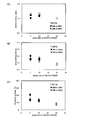
- FIG. 1 shows a TEOS-TTE-MA 0.025 system solution, a TEOS-TTE-MA 0.05 system solution, and a TEOS-TTE-MA0.1 system solution at 25 ° C. and a humidity of 50% ⁇ 10% R.S. H. It is a graph which shows the tensile characteristic of each hardened
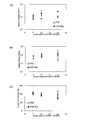
- FIG. 2 shows a TEOS-TTE 0.025 system solution, a TEOS-TTE 0.05 system solution, a TEOS-TTE 0.1 system solution, and a TEOS-TTE 0.2 system solution at 25 ° C.
- FIG. 3 shows that a TMOS-TTE-MA0.01 system solution, a TMOS-TTE-MA0.025 system solution, and a TMOS-TTE-MA0.05 system solution are each 25 ° C., humidity 50% ⁇ 10% R.D. H. It is a graph which shows the tensile characteristic of each hardened
- FIG. 3 shows that a TMOS-TTE-MA0.01 system solution, a TMOS-TTE-MA0.025 system solution, and a TMOS-TTE-MA0.05 system solution are each 25 ° C., humidity 50% ⁇ 10% R.D. H. It is a graph which shows the tensile characteristic of each hardened
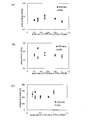
- FIG. 4 shows a TMOS-TTE 0.025 system solution and a TMOS-TTE 0.08 system solution at 25 ° C. and a humidity of 50% ⁇ 10% R.E. H. It is a graph which shows the tensile characteristic of each hardened
- FIG. 5 is a graph showing the relationship between the elapsed time after the various test pieces are placed in a thermostatic bath maintained at 100 ° C. and 200 ° C. and the residual weight ratio.
- FIG. 5 is a graph showing the relationship between the elapsed time after the various test pieces are placed in a thermostatic bath maintained at 100 ° C. and 200 ° C. and the residual weight ratio.
- FIG. 6 shows three types of test pieces, a TMOS-TTE-MA 0.025 cured product, a TMOS-TTE 0.025 cured product, and a TMOS-TTE 0.08 cured product, which are kept at 150 ° C. and 200 ° C. It is a graph which shows the relationship between the elapsed time after putting in a tank, and a residual weight rate.
- FIG. 7 is a graph showing the residual weight ratios of test pieces of various TMOS-based cured products evaluated under conditions of holding at 120 ° C. for 120 hours.
- FIG. 8 shows tensile properties of the PDMS-MTMS-TTE-MA-R972 cured body (7) and the PDMS-TMOS-TTE-MA-R972 cured body (7) when the molar ratio of silicon alkoxide is changed. It is a graph which shows.
- FIG. 9 shows a PDMS-MTMS-TTE-MA-R972-based cured product (7), PDMS-MTMS-TTE-MA-R972-based cured product 100 ° C. (20) and PDMS- when the molar ratio of MTMS is changed.
- 3 is a graph showing tensile properties of a cured MTMS-TTE-MA-R972 system at 200 ° C. (20).
- FIG. 10 shows PDMS-TMOS-TTE-MA-R972-based cured product (7), PDMS-TMOS-TTE-MA-R972-based cured product 100 ° C. (20) and PDMS- when the molar ratio of TMOS is changed.
- 6 is a graph showing tensile properties of a TMOS-TTE-MA-R972 cured body at 200 ° C. (20).
- FIG. 11 is a graph showing tensile properties of the PDMS-MTMS-TTE-MA-R972 cured product (7) and the PDMS-MTMS-TTE-R972 cured product (7) when the MTMS molar ratio is changed. It is.
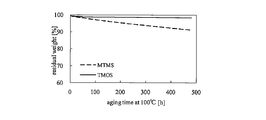
- FIG. 12 shows a PDMS-MTMS-TTE-MA-R972-based cured product (7) and a PDMS-TMOS-TTE-MA-R972-based cured product (7) and MTMS or TMOS prepared by changing the molar ratio in the range of 5 to 20 molar ratio ( It is a graph which shows the relationship between the elapsed time after putting 7) in the thermostat kept at 100 degreeC, and a residual weight percentage.
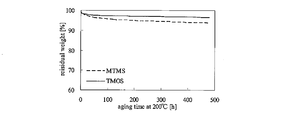
- FIG. 13 shows a PDMS-MTMS-TTE-MA-R972-based cured body (7) and a PDMS-TMOS-TTE-MA-R972-based cured body (7) and MTMS or TMOS prepared by changing MTMS or TMOS in the range of 5 to 20 molar ratio. It is a graph which shows the relationship between the elapsed time after putting 7) in the thermostat kept at 200 degreeC, and a residual weight percentage.
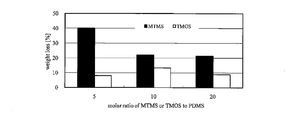
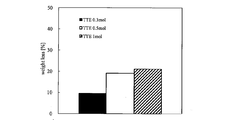
- FIG. 14 shows a PDMS-MTMS-TTE-MA-R972-based cured body (7) and a PDMS-TMOS-TTE-MA-R972-based cured body (7) and MTMS or TMOS prepared by changing MTMS or TMOS in a range of 5 to 20 molar ratio ( It is a figure which compares and shows each weight decreasing rate when 7) is hold
- FIG. 15 shows the tensile properties of the PDMS-MTMS-TTE-MA-R972 cured body (7) and PDMS-MTMS-TTE-R972 cured body (7) prepared by changing the molar ratio of TTE and MA. It is a graph to show.
- FIG. 16 shows a PDMS-MTMS-TTE-MA-R972-based cured product (7) and a PDMS-TMOS-TTE-MA-R972-based cured product (7) when both TTE and MA are in a 0.3 molar ratio. It is a graph which shows the relationship between the elapsed time after putting in the thermostat kept at 100 degreeC, and a residual weight percentage.
- FIG. 17 shows a PDMS-MTMS-TTE-MA-R972-based cured product (7) and a PDMS-TMOS-TTE-MA-R972-based cured product (7) when both TTE and MA are in a 0.3 molar ratio.
- FIG. 18 shows a constant temperature bath in which a PDMS-MTMS-TTE-MA-R972-based cured product (7) prepared by changing both TTE and MA in a range of 0.2 to 0.5 molar ratio is maintained at 100 ° C. It is a figure which shows the relationship between the elapsed time after putting in and residual weight ratio.
- FIG. 19 shows a constant temperature bath in which a PDMS-MTMS-TTE-MA-R972-based cured product (7) prepared by changing both TTE and MA in a range of 0.2 to 0.5 molar ratio is maintained at 200 ° C.
- FIG. 20 shows a PDMS-MTMS-TTE-R972-based cured product (7) produced by changing TTE within a range of 0.3 to 1.0 molar ratio after being placed in a thermostatic bath maintained at 100 ° C. It is a figure which shows the relationship between elapsed time and residual weight percentage.
- FIG. 21 shows a PDMS-MTMS-TTE-R972-based cured product (7) produced by changing TTE within a range of 0.3 to 1.0 molar ratio after being placed in a thermostatic bath maintained at 200 ° C. It is a figure which shows the relationship between elapsed time and residual weight percentage.
- FIG. 20 shows a PDMS-MTMS-TTE-R972-based cured product (7) produced by changing TTE within a range of 0.3 to 1.0 molar ratio after being placed in a thermostatic bath maintained at 200 ° C. It is a figure which shows the relationship between elapsed time and residual weight percentage.
- FIG. 20 shows a PD
- FIG. 22 shows a PDMS-MTMS-TTE-MA-R972 cured body (7) and a PDMS-TMOS-TTE-MA-R972 cured body (7) when both TTE and MA are in a 0.3 molar ratio. It is a figure which compares and shows each weight reduction rate when it hold
- FIG. 23 shows a PDMS-MTMS-TTE-MA-R972-based cured product (7) prepared by changing both TTE and MA in the range of 0.2 to 0.5 molar ratio, and kept at 120 ° C. for 120 hours. It is a figure which compares and shows each weight reduction
- the polyorganosiloxane composition according to this embodiment is (A) a polyorganosiloxane in which at least one terminal in one molecule is silanol-modified, (B) 0.5 to 4 moles of silicon alkoxide per mole of the polyorganosiloxane; (C) 0.01 to 0.5 mole of titanium alkoxide with respect to 1 mole of the polyorganosiloxane; (D) A sol or gel composition containing 0.01 to 0.5 mol of hydroxycarboxylic acid ester per mol of the polyorganosiloxane.
- a sol or gel composition containing 0.01 to 0.5 mol of hydroxycarboxylic acid ester per mol of the polyorganosiloxane.
- Terminal silanol-modified polyorganosiloxane The terminal silanol-modified polyorganosiloxane that can be used in this embodiment is represented by the following general formula (1).
- R 1 and R 2 are each independently a linear or branched alkyl group having 1 to 20 carbon atoms, a cycloalkyl group having 4 to 10 carbon atoms, or an aryl or aryl-substituted carbon atom having 6 to 10 carbon atoms. It is a hydrogen group.
- Examples of the linear or branched alkyl group having 1 to 20 carbon atoms include methyl, ethyl, n-propyl, i-propyl, n-butyl, i-butyl, s-butyl, t-butyl, pentyl, neopentyl, and hexyl.
- Heptyl, octyl, nonyl, decyl, undecyl, dodecyl, and the like can be given as preferred examples.
- suitable cycloalkyl groups having 4 to 10 carbon atoms include functional groups such as cyclopentyl and cyclohexyl.
- aryl group or aryl-substituted hydrocarbon group having 6 to 10 carbon atoms include phenyl, toluyl, xylyl, ethylphenyl, benzyl, phenethyl and the like.
- a particularly preferred terminal silanol-modified polyorganosiloxane is a both-end silanol-modified polydimethylsiloxane.
- the viscosity of the terminal silanol-modified polyorganosiloxane at 30 ° C. is 1 to 500 mPa ⁇ s, preferably 5 to 100 mPa ⁇ s, more preferably 10 to 50 mPa ⁇ s.
- the mass average molecular weight (Mw) of the terminal silanol-modified polyorganosiloxane is preferably 500 to 3000, more preferably 700 to 2000, and still more preferably 900 to 1200.
- Silicon alkoxide As the silicon alkoxide, one or a mixture of two or more tri- or tetraalkoxysilanes having a lower alkyl group having 1 to 4 carbon atoms may be mentioned. Specific examples thereof include trimethoxysilane, tetramethoxysilane, triethoxysilane, tetraethoxysilane, tetrapropoxysilane, and tetrabutoxysilane. Moreover, these oligomers can also be used. A particularly preferred example of silicon alkoxide is tetramethoxysilane or tetraethoxysilane.
- Silicon alkoxide is preferably contained in the composition in an amount of 0.5 to 4 mol, more preferably 0.7 to 2 mol, relative to 1 mol of polyorganosiloxane. Silicon alkoxide functions as a cross-linking agent that cross-links the polyorganosiloxane molecules. For this reason, if the amount of silicon alkoxide is too small, crosslinking of the polyorganosiloxane becomes insufficient. If the amount is too large, there is an excess of polyorganosiloxane modified at both ends by alkoxide at the initial stage of curing, and the curing reaction tends to be slow. There is. More preferably, the silicon alkoxide is present in the same mole as 1 mole of polyorganosiloxane.
- Titanium alkoxide As the titanium alkoxide, one or a mixture of two or more of titanium tetraethoxide, titanium tetrapropoxide, titanium tetraisopropoxide, titanium tetrabutoxide, titanium tetraisobutoxide, titanium tetraisopropenyl oxide, etc. Is mentioned. Moreover, these oligomers can also be used. Preferable examples of the titanium alkoxide are titanium tetraethoxide, titanium tetraisopropoxide, or titanium tetrabutoxide, and among these, titanium tetraethoxide is preferable.
- the titanium alkoxide is preferably contained in the composition in an amount of 0.01 to 0.5 mol, preferably 0.02 to 0.1 mol, relative to 1 mol of polyorganosiloxane.
- the titanium alkoxide When there is too little titanium alkoxide, it will become difficult to harden
- the hydroxycarboxylic acid ester is one or a mixture of two or more products obtained by ester reaction of a hydroxycarboxylic acid having 3 to 6 carbon atoms with an alcohol having 1 to 20 carbon atoms.
- Examples of the hydroxycarboxylic acid include monocarboxylic acids such as lactic acid and glyceric acid, dicarboxylic acids such as malic acid and tartaric acid, and tricarboxylic acids such as citric acid.
- Examples of the alcohol include methyl alcohol, ethyl alcohol, n-propyl alcohol, i-propyl alcohol, n-butyl alcohol, i-butyl alcohol, ter-butyl alcohol, pentyl alcohol, hexyl alcohol, heptyl alcohol, octyl alcohol, nonyl alcohol, Examples thereof include aliphatic saturated alcohols such as decyl alcohol, lauryl alcohol, myristyl alcohol, palmityl alcohol, and stearyl alcohol.
- hydroxycarboxylic acid ester produced by the ester reaction between the hydroxycarboxylic acid and the alcohol examples include, for example, malic acid ester, citric acid ester, lactic acid ester, tartaric acid ester, glycol monoester, glycerin monoester, glycerin diester, There may be mentioned ricinoleic acid esters.
- malic acid ester, citric acid ester, lactic acid ester, and tartaric acid ester are preferable, and among them, malic acid ester is preferable.
- a malic acid dialkyl ester is particularly preferable.
- malic acid dialkyl ester examples include malic acid dimethyl ester, malic acid diethyl ester, malic acid dipropyl ester, malic acid dibutyl ester, malic acid dihexyl ester, acetyl malic acid dioctyl ester, malic acid monoethyl monooctyl ester and the like. Can be mentioned. Among these, malic acid diethyl ester and malic acid dibutyl ester are particularly preferable.
- the hydroxycarboxylic acid ester is preferably contained in the composition in the range of 0.01 to 0.5 mol, particularly in the range of 0.02 to 0.1 mol, relative to 1 mol of polyorganosiloxane. It is preferably contained in the inside. Furthermore, the hydroxycarboxylic acid ester is contained in the composition in an equimolar amount with the titanium alkoxide, preferably in the range of 0.01 to 0.5 mol, more preferably in the range of 0.02 to 0.1 mol. .
- the atmosphere of stirring either a sealed atmosphere or an open atmosphere can be selected.
- mixed liquid 1 in which polyorganosiloxane and silicon alkoxide are mixed, and mixing in which titanium alkoxide and hydroxycarboxylic acid ester are separately mixed It is preferable to mix the liquid 2.
- the reaction would be more uniform if mixed liquid 1 and mixed liquid 2 were mixed separately. It is.
- the mixed solution 1 is prepared by stirring at a temperature of 25 to 60 ° C., preferably 30 to 50 ° C., more preferably 35 to 45 ° C.
- the stirring environment is preferably an inert gas atmosphere.
- the mixed solution 2 is prepared by stirring in a temperature range of 15 to 40 ° C., preferably 20 to 35 ° C., more preferably 25 to 30 ° C.
- the stirring environment is preferably an inert gas atmosphere.
- Method for producing a cured product of polyorganosiloxane composition For example, the polyorganosiloxane composition according to the embodiment obtained by the above-described method is subjected to humidity at a temperature of 15 to 45 ° C, preferably 20 to 30 ° C. 50% ⁇ 20% R.D. H.
- the cured product of the polyorganosiloxane composition can be obtained by leaving it in an environment preferably maintained in an atmosphere of 50% ⁇ 10%.
- the polyorganosiloxane composition according to the embodiment has an advantage of being cured even at a so-called room temperature.
- the standing time until curing is preferably 0.1 hour or longer, particularly 100 hours or longer, more preferably 150 hours or longer, and further preferably 200 hours or longer.
- the polyorganosiloxane composition according to this embodiment is (A) a polyorganosiloxane in which at least one terminal in one molecule is silanol-modified, (B) 0.5 to 30 moles of silicon alkoxide per mole of the polyorganosiloxane; (C) 0.01 to 2.0 moles of titanium alkoxide with respect to 1 mole of the polyorganosiloxane; (D) A sol or gel composition containing at least 0.01 to 2.0 mol of hydroxycarboxylic acid ester per mol of the polyorganosiloxane.
- the polyorganosiloxane composition according to this embodiment includes (E) an inorganic filler occupying 2 to 30% by weight with respect to the total weight of the polyorganosiloxane composition. It is more preferable to contain.
- an inorganic filler occupying 2 to 30% by weight with respect to the total weight of the polyorganosiloxane composition. It is more preferable to contain.
- the weight average molecular weight (Mw) of the terminal silanol-modified polyorganosiloxane is preferably 500 to 100,000, more preferably 700 to 50,000, and still more preferably 900 to 40,000. Others are the same as those in the first embodiment, and thus description thereof is omitted.
- Silicon alkoxide examples include tri- or tetraalkoxysilane having a lower alkyl group having 1 to 4 carbon atoms, as in the first embodiment. Specific examples thereof include methyltrimethoxysilane, trimethoxysilane, tetramethoxysilane, triethoxysilane, tetraethoxysilane, tetrapropoxysilane, and tetrabutoxysilane. Moreover, these oligomers can also be used. Particularly preferred examples of the silicon alkoxide are methyltrimethoxysilane, tetramethoxysilane or tetraethoxysilane.
- Silicon alkoxide has a composition in the range of 0.5 to 30 moles per mole of polyorganosiloxane, and in the range of 1 to 25 moles when Mw of the terminal silanol-modified polyorganosiloxane is 10,000 or more. It is preferably contained in the product.
- methyltrimethoxysilane is used for the silicon alkoxide and the polyorganosiloxane composition contains an inorganic filler, it is more preferable to include 5 mol or more of methyltrimethoxysilane with respect to 1 mol of polyorganosiloxane. preferable.
- tetramethoxysilane when used for the silicon alkoxide and an inorganic filler is contained in the polyorganosiloxane composition, it is preferable to contain 20 mol or less of tetramethoxysilane with respect to 1 mol of polyorganosiloxane.
- Titanium alkoxide The titanium alkoxide is preferably contained in the composition in an amount of 0.01 to 2 mol, preferably 0.02 to 1 mol, relative to 1 mol of polyorganosiloxane. Specific alkoxides and preferred alkoxides belonging to the titanium alkoxide are the same as those described in the first embodiment.
- (D) Hydroxycarboxylic acid ester The hydroxycarboxylic acid ester is preferably contained in the composition in an amount of 0.01 to 2 mol, preferably 0.02 to 1 mol, relative to 1 mol of polyorganosiloxane. . In particular, it is more preferable to use the same mole as the titanium alkoxide. Specific esters and preferred esters belonging to the hydroxycarboxylic acid ester are the same as those described in the first embodiment.
- inorganic filler examples include particulate, plate-like, or fibrous fillers of inorganic oxides such as silica, titanium oxide, alumina, and zirconia.
- silica having a small particle size and good compatibility with the polyorganosiloxane composition is preferable.
- the content of the inorganic filler is 2 to 30% by weight, more preferably 5 to 20% by weight, still more preferably 7 to 15% by weight, based on the total weight of the polyorganosiloxane composition including the inorganic filler.
- Process for producing polyorganosiloxane composition Polyorganosiloxane having at least one terminal in a molecule modified with silanol, 0.5 to 30 mol of silicon alkoxide per mol of the polyorganosiloxane, and polyorganosiloxane 1 0.01 to 2 moles of titanium alkoxide per mole, 0.01 to 2 moles of hydroxycarboxylic acid ester per mole of the above polyorganosiloxane, and 2 to 2 weight based on the total weight of the polyorganosiloxane composition.
- An inorganic filler occupying 30% by weight is put into a container and stirred at a temperature of 20 to 120 ° C., preferably 25 to 80 ° C., more preferably 30 to 50 ° C.
- the atmosphere of stirring either a sealed atmosphere or an open atmosphere can be selected.
- nitrogen gas or argon gas is preferably flowed.
- the absorption peak at 920 cm ⁇ 1 due to the Si—O—Ti bond by FT-IR measurement and the peak due to silicon alkoxide by GPC measurement were confirmed, and it was confirmed that these peaks disappeared. It is preferable to end the stirring. This is to confirm that the silanol group of PDMS and the alkoxy group of silicon alkoxide have reacted.
- mixed liquid 1 in which polyorganosiloxane and silicon alkoxide are mixed, and mixing in which titanium alkoxide and hydroxycarboxylic acid ester are separately mixed It is preferable to prepare the liquid 2 and mix them.
- adding an inorganic filler it is preferable to add the said inorganic filler to either the liquid mixture 1, the liquid mixture 2, or both.
- the preparation of a plurality of mixed liquids in this way is that the mixed liquid 1 and the mixed liquid 2 are separated from the polyorganosiloxane and silicon alkoxide solution, rather than the hydroxycarboxylic acid ester is coordinated to the titanium alkoxide. This is because the reaction is considered to be more uniform when mixed together.
- the mixed solution 1 is prepared by stirring at a temperature of 25 to 60 ° C., preferably 30 to 50 ° C., more preferably 35 to 45 ° C.
- the stirring environment is preferably an inert gas atmosphere.
- the mixed solution 2 is prepared by stirring in a temperature range of 15 to 40 ° C., preferably 20 to 35 ° C., more preferably 25 to 30 ° C.
- the stirring environment is preferably an inert gas atmosphere.
- Method for producing cured product of polyorganosiloxane composition For example, the polyorganosiloxane composition according to the second embodiment obtained by the above-described method is heated to a temperature of 15 to 45 ° C, preferably 20 to 30 ° C. Humidity 50% ⁇ 20% R.B. H.
- the cured product of the polyorganosiloxane composition can be obtained by leaving it in an environment preferably maintained in an atmosphere of 50% ⁇ 10%.
- the polyorganosiloxane composition according to the second embodiment has an advantage that it is cured at a so-called room temperature.
- the standing time until curing is preferably 0.1 hour or longer, particularly 100 hours or longer, more preferably 150 hours or longer, and further preferably 200 hours or longer.
- the polyorganosiloxane composition according to the second embodiment can be allowed to cure by allowing it to stand at room temperature or higher, for example, at 50 to 300 ° C. for 0.1 hour or longer.
- the curing temperature is particularly preferably in the range of 80 to 250 ° C.
- the standing time until curing is preferably 0.1 hour or longer, particularly 100 hours or longer, more preferably 150 hours or longer, and further preferably 200 hours or longer.
- TTE-MA-based solution was stirred under a sealed atmosphere by flowing a dry nitrogen gas through a glass container, inserting a stirring rod with a propeller, and immersing it in an oil bath maintained at 40 ° C.
- TTE-based cured product a cured product obtained by curing a solution in which PDMS, TEOS, and TTE are mixed (hereinafter referred to as “TTE-based solution”), and ethyl acetoacetate (EAcAc) on PDMA, TEOS, and TTE are used.
- TTE-EAcAc-based cured body A cured body obtained by curing a solution in which the coordinated materials were mixed (hereinafter referred to as “TTE-EAcAc-based solution”) was also produced.
- PDMS 50 g, TEOS 10.417 g, and TTE 0.570 g were put in this order in a glass container with a lid (capacity: 200 ml) in a nitrogen-substituted glove box, and the lid of the glass container was closed.
- PDMS: TEOS: TTE 1: 1: 0.05 in molar ratio).
- TTE-EAcAc-based cured body 50 g of PDMS, 10.417 g of TEOS, 0.570 g of TTE, and 0.325 g of EAcAc were put in this order in a glass container with a lid (capacity: 200 ml), and the lid of the glass container was closed (mol).
- PDMS: TEOS: TTE: EAcAc 1: 1: 0.05: 0.05).
- each glass container with the lid closed outside the glove box was taken out.
- TTE-based solution and the TTE-EAcAc-based solution were treated in the same manner as the above-mentioned TTE-MA-based solution, and the peaks due to Si—O—Ti bonds and TEOS disappeared.
- the TTE-EAcAc solution was confirmed after 96 hours. Thereafter, each solution was developed in a petri dish, and the temperature was 25 ° C. and the humidity was 50% ⁇ 10% R.D. H. This was left for 168 hours in a box kept under the atmosphere of TTE to obtain a TTE cured product and a TTE-EAcAc cured product.
- Table 1 shows the evaluation results of the tensile properties of the TTE-MA based cured body, the TTE based cured body, and the TTE-EAcAc based cured body.
- the elongation at break (%) is indicated by the ratio of the elongation to the original length.
- TTE-MA-based cured body was superior in elastic modulus and breaking strength compared to the TTE-based cured body and the TTE-EAcAc-based cured body. This suggests that the degree of cross-linking of the TTE-MA-based cured body is superior to other cured bodies.
- the glass container with the lid closed outside the glove box was taken out. Thereafter, the TTE-MADb-based solution was treated in the same manner as the TTE-MA-based solution, and it was confirmed after 96 hours that the peaks due to the Si—O—Ti bond and TEOS disappeared. Thereafter, the TTE-MADb-based solution was developed in a petri dish, and the temperature was 25 ° C
- TTE-MADb-based cured bodies Each of the cured bodies (TTE-MADb-based cured bodies) was allowed to stand in a box kept in the atmosphere of 168 hours (hereinafter referred to as “7 days”) and 336 hours (hereinafter referred to as “14 days”). )
- Table 2 shows a TTE-MA-based cured product, a TTE-MADb-based cured product, a TTE-CAtB-based cured product, a TTE-CAtE-based cured product, and a TTE-EL-based cured product obtained by curing each solution for 7 days.
- the evaluation result of each tensile characteristic of a body and a TTE-TAdE type hardening body is shown.
- the numbers in parentheses following the cured bodies in the table indicate the number of days left for curing. The same applies to the following tables.
- Table 3 shows a TTE-MADb-based cured product, a TTE-CAtB-based cured product, a TTE-CAtE-based cured product, a TTE-EL-based cured product, and a TTE-TAdE-based cured product obtained by curing each solution for 14 days. The evaluation result of each tensile property of a body is shown.
- the cured product prepared by leaving each solution for 14 days has a strength at break and an elastic modulus equal to or higher than those left for 7 days. It was. This indicates that the tensile properties of the cured body can be improved by taking a longer time during the production of the cured body.
- TEOS-TTE-MA0.1 system solution This content was designated as “TEOS-TTE-MA0.1 system solution”.
- each glass container with the lid closed outside the glove box was taken out.
- the above three TEOS-TTE-MA-based solutions were immersed in an oil bath maintained at 40 ° C. while stirring with a propeller while flowing dry nitrogen gas through a glass container in a sealed atmosphere. Started. Then, stirring was performed while confirming the absorption peak at 920 cm ⁇ 1 due to the Si—O—Ti bond by FT-IR measurement and the peak due to TEOS by the GPC measurement, resulting from the Si—O—Ti bond and TEOS.
- the disappearance of the peak was confirmed after 216 hours with the TEOS-TTE-MA 0.025 solution, 96 hours with the TEOS-TTE-MA 0.05 solution, and 24 hours with the TEOS-TTE-MA 0.1 solution. did. Then, it was developed in a petri dish, and the temperature was 25 ° C. and the humidity was 50% ⁇ 10% R.D. H. And left in a box kept under the atmosphere for 7 days and 14 days to obtain cured bodies (TEOS-TTE-MA0.025 series cured body, TEOS-TTE-MA0.05 series cured body). , TEOS-TTE-MA0.1 cured product).
- TTE-based cured bodies cured without adding MA were also produced.
- TTE 0.570 g, TTE 1.140 g, and TTE 2.280 g was also produced by changing the amount of TTE only by the same production method as described above. These contents were designated as “TEOS-TTE 0.05 system solution”, “TEOS-TTE 0.1 system solution”, and “TEOS-TTE 0.2 system solution”, respectively.
- TEOS-TTE 0.05 system solution TEOS-TTE 0.1 system solution
- TEOS-TTE 0.2 system solution TEOS-TTE 0.2 system solution
- FIG. 1 shows a TEOS-TTE-MA 0.025 system solution, a TEOS-TTE-MA0.05 system solution, and a TEOS-TTE-MA0.1 system solution at 25 ° C. and a humidity of 50% ⁇ 10% R.O. H. It is a graph which shows the tensile characteristic of each hardened
- (A), (B) and (C) take the molar ratio of MA to PDMS (TTE is the same) on the horizontal axis, and show the elastic modulus (MPa), strength at break (MPa) and elongation at break (%), respectively. It is the graph which took the vertical axis
- black indicates the characteristics of a cured product prepared under a condition of standing for 7 days
- white indicates the characteristics of a cured product prepared under a condition of leaving for 14 days.
- the black and white plots are the same in the subsequent drawings in this embodiment.
- Table 4 is a table showing the characteristics of each cured body shown in FIG.
- FIG. 2 shows a TEOS-TTE 0.025 system solution, a TEOS-TTE 0.05 system solution, a TEOS-TTE 0.1 system solution, and a TEOS-TTE 0.2 system solution at 25 ° C. and a humidity of 50% ⁇ 10% R.P. H. It is a graph which shows the tensile characteristic of each hardened
- the horizontal axis represents the molar ratio of TTE to PDMS
- the vertical axis represents the elastic modulus (MPa), strength at break (MPa) and elongation at break (%). It is a graph.
- Table 5 is a table
- the cured product prepared by adding DL-malic acid diethyl ester had a higher strength at break than the cured product prepared without adding DL-malic acid diethyl ester. And having an elastic modulus. Furthermore, it was confirmed that a cured product prepared by leaving each solution for 14 days had a larger strength at break and elastic modulus than those obtained by leaving for 7 days.
- TMOS-TTE-MA0.01 system solution This content was designated as “TMOS-TTE-MA0.01 system solution”.
- TMOS-TTE-MA 0.025 system solution In the same procedure, TTE and MA were put in the same amount in a screw tube bottle, and 1.045 g of the mixture stirred at 25 ° C. for 30 minutes was put, and the lid of the glass container was closed (in molar ratio).
- TMOS-TTE-MA 0.05 system solution 1: 1: 0.05: 0.05. This content was designated as “TMOS-TTE-MA 0.05 system solution”.
- each glass container with the lid closed outside the glove box was taken out.
- the above three types of TMOS-TTE-MA-based solutions were stirred in a sealed atmosphere while flowing dry nitrogen gas through a glass container and a stirring rod with a propeller inserted and immersed in an oil bath maintained at 40 ° C. Started. Then, stirring was performed while confirming the absorption peak at 920 cm ⁇ 1 due to the Si—O—Ti bond by FT-IR measurement and the peak due to TMOS by the GPC measurement, resulting from the Si—O—Ti bond and TMOS.
- TMOS-TTE cured bodies cured without adding MA were also produced.
- This content was designated as “TMOS-TTE 0.025 system solution”.
- a solution containing 0.95 g of TTE was produced by changing only the amount of TTE by the same production method as described above.
- TMOS-TTE 0.08 system solution This content was designated as “TMOS-TTE 0.08 system solution”.
- each glass container with the lid closed outside the glove box was taken out. Thereafter, the above two types of TMOS-TTE-based solutions were treated in the same manner as the above-mentioned various TMOS-TTE-MA-based solutions, and the peaks due to Si—O—Ti bonds and TMOS disappeared.
- the TTE 0.025 solution and the TMOS-TTE 0.08 solution were confirmed after 24 hours. Thereafter, various TMOS-TTE solutions were developed in each petri dish, and the temperature was 25 ° C. and the humidity was 50% ⁇ 10% R.P. H.
- Each of the cured bodies (TMOS-TTE 0.025 series cured body, TMOS-TTE 0.08 series cured body) was obtained by leaving it in a box kept under the atmosphere of 7 days and 14 days.
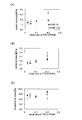
- FIG. 3 shows a TMOS-TTE-MA0.01 system solution, a TMOS-TTE-MA0.025 system solution, and a TMOS-TTE-MA0.05 system solution at 25 ° C. and a humidity of 50% ⁇ 10% R.O. H. It is a graph which shows the tensile characteristic of each hardened
- (A), (B) and (C) take the molar ratio of MA to TMOS (same for TTE) as the horizontal axis, and show the elastic modulus (MPa), strength at break (MPa) and elongation at break (%), respectively. It is the graph which took the vertical axis
- Table 6 is a table showing the characteristics of each cured body shown in FIG.
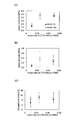
- FIG. 4 shows that each of the TMOS-TTE 0.025 system solution and the TMOS-TTE 0.08 system solution is 25 ° C. and the humidity is 50% ⁇ 10% R.D. H. It is a graph which shows the tensile characteristic of each hardened
- the horizontal axis represents the molar ratio of TTE to TMOS
- the vertical axis represents elastic modulus (MPa), strength at break (MPa), and elongation at break (%). It is a graph.
- Table 7 is a table showing the characteristics of each cured body shown in FIG.
- the cured product prepared by adding DL-malic acid diethyl ester contains DL-malic acid diethyl ester. It was confirmed that the cured product produced without addition had a strength at break and an elastic modulus greater than those of the cured product.
- the TMOS system it was found that when DL-malic acid diethyl ester was added in an amount of 0.025 mol or more per 1 mol of TMOS, the strength at break and the elastic modulus tended to be remarkably increased.
- the cured product prepared by leaving each solution for 14 days had greater strength at break and elastic modulus than those obtained by leaving for 7 days. .
- Each test piece was placed in a thermostatic bath (ETTAS OFW-300, manufactured by AS ONE Co., Ltd.) maintained at a specific temperature in the range of 100 to 200 ° C. After that, after a predetermined time in the range of 0 to 480 hours, four test pieces for each type were taken out from the thermostat and the change in weight after 1 minute was measured. The change in weight was the total of four test pieces each.
- ETAS OFW-300 manufactured by AS ONE Co., Ltd.
- FIG. 5 is a graph showing the relationship between the elapsed time after the various test pieces were placed in a thermostat kept at 100 ° C. and 200 ° C. and the residual weight ratio (vertical axis: residual weight ratio (%), Horizontal axis: retention time (hours)).
- (A), (C), and (E) show the change in the residual weight ratio at 100 ° C. holding.
- (B), (D) and (F) show the change in the remaining weight ratio at 200 ° C. holding.
- the solid line, the short broken line, and the dotted line indicate the TMOS-TTE-MA0.01 series cured body, the TMOS-TTE-MA0.025 series cured body, and the TMOS-TTE-MA0.05 series, respectively.
- the change of each residual weight rate of a hardening body is shown.
- the solid line, the dotted chain line, and the short dashed line indicate the TEOS-TTE-MA0.025 series cured body, the TEOS-TTE-MA0.05 series cured body, and the TEOS-TTE-MA0.
- the change of each residual weight ratio of 1 type hardening body is shown.
- a solid line, a long broken line, a short broken line, and a dotted line indicate a TMOS-TTE 0.08 series cured body (or TEOS-TTE 0.05 series cured body) and TMOS-TTE 0.025, respectively.
- the change of each residual weight rate of a system hardening body, a TEOS-TTE-EAcAc0.05 type hardening body, and a TEOS-TTE0.1 type hardening body is shown.
- Tables 8, 9 and 10 are tables showing the weight loss ratios after holding for 480 hours of the TMOS-TTE-MA based cured body, the TEOS-TTE-MA based cured body and the cured body not containing MA, respectively. It is.
- the TMOS-TTE-MA based cured body and the TEOS-TTE-MA based cured body are inferior in heat resistance when the added amount of TTE and MA increases.
- the TMOS-TTE cured product, the TEOS-TTE cured product, and the TEOS-TTE-EAcAc cured product also have poor heat resistance when the amount of TTE added is increased.
- the TEOS-TTE-MA based cured body and the TMOS-TTE-MA based cured body are TMOS-TTE-MA0.01 even if the addition amount of TTE and MA is reduced.
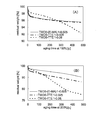
- FIG. 6 shows three types of test pieces, a TMOS-TTE-MA 0.025 cured product, a TMOS-TTE 0.025 cured product, and a TMOS-TTE 0.08 cured product, which are kept at 150 ° C. and 200 ° C.
- It is a graph which shows the relationship between the elapsed time after putting into a tank, and a residual weight ratio (vertical axis: residual weight ratio (%), horizontal axis: holding time (hour)).
- (A) shows the change in the residual weight percentage at 150 ° C.
- (B) shows the change in the residual weight percentage at 200 ° C., respectively.
- the solid line, the dotted line, and the broken line indicate changes in the respective remaining weight ratios of the TMOS-TTE-MA 0.025 cured product, the TMOS-TTE 0.025 cured product, and the TMOS-TTE 0.08 cured product, respectively. .
- Table 11 is a table showing the weight loss ratio after holding for 480 hours of the TMOS-TTE-MA based cured body and the cured body not containing MA.
- the cured product obtained by adding 0.025 mol of TTE and MA to 1 mol of TMOS is heat resistant to the cured product of only TTE in each temperature region of 150 ° C. and 200 ° C. It was confirmed that is not inferior.
- TMOS-TTE-MA 0.025-based cured product
- TMOS-TTE 0.025-based cured product TMOS-TTE 0.08-based cured product
- Body a TMOS-Sn0.01-based cured body was also evaluated under the same conditions. All three types of TMOS-based cured bodies were prepared under the condition of leaving for 14 days.
- a TMOS-Sn0.01-based cured body as a comparative material was produced under the following conditions.
- PDMS 50 g, tetramethoxysilane (Tetramethoxysilane: TMOS, manufactured by Shin-Etsu Chemical Co., Ltd., product number: KBM-04) 7 in a glass container with a lid (capacity: 200 ml) in a glove box in a dry nitrogen gas flow .612 g and dibutyltin dilaurate (manufactured by Tokyo Chemical Industry Co., Ltd., C 32 H 64 O 4 Sn) 0.316 g were put in order, and the lid of the glass container was closed (in molar ratio, PDMS: TMOS: Sn 1: 1: 0.01). This content was designated as “TMOS-Sn0.01 series solution”.
- each glass container with the lid closed outside the glove box was taken out.
- the TMOS-Sn0.01 series solution was immersed in an oil bath maintained at 40 ° C. under a hermetically sealed atmosphere, while a dry nitrogen gas was allowed to flow through the glass container, and was then stirred in an oil bath. After stirring for 24 hours at 40 ° C., it was developed in a petri dish, and the temperature was 25 ° C. and the humidity was 50% ⁇ 10% H. In a box kept under the atmosphere of, left for 14 days to obtain a cured product.
- Degradation evaluation in high temperature and high humidity was performed by the following method.
- Each test piece is weighed in advance and sealed in a PTFE container (inner diameter 53 mm, outer diameter 70 mm, height 90 mm, capacity 100 ml, manufactured by AS ONE Co., Ltd.) together with 30 g of water.
- the temperature was kept at 120 ° C. for 120 hours in the same constant temperature bath.
- each test piece was taken out of the thermostat, placed in another thermostat previously held at 80 ° C. (same type as the above thermostat) and held for 1 hour, After taking out from the thermostat and the container, the weight was measured after 1 minute, and the residual weight ratio was calculated from the weight change before and after the test to evaluate the degree of deterioration.
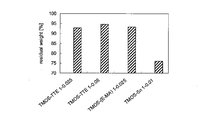
- FIG. 7 and Table 12 show the remaining weight ratio and weight loss ratio obtained by evaluating test pieces of various TMOS-based cured bodies under the conditions of holding at 120 ° C. for 120 hours.
- TMOS-TTE1-0.025 represents a TMOS-TTE 0.025 cured product
- TMOS-TTE1-0.08 represents a TMOS-TTE 0.08 cured product
- TMOS- (E- “MA) 1-0.025 represents a TMOS-TTE-MA 0.025-based cured product
- TMOS-Sn1-0.01 represents a TMOS-Sn0.01-based cured product.
- (1) (2) represents that two pieces were measured for each test piece.
- the TMOS-TTE-MA 0.025 cured product shows no significant difference in the degree of deterioration compared to the TMOS-TTE 0.025 and TMOS-TTE 0.08 cured products. It was. On the other hand, the TMOS-Sn0.01-based cured product was the most deteriorated among all the cured products. From this result, it can be seen that the TMOS-TTE-MA cured product is superior to the TMOS-Sn cured product in terms of heat resistance under high humidity and high temperature.
- TMOS-TTE -MA0.025 solution 1: 1: 0.025: 0.025 (molar ratio) polyorganosiloxane composition
- PDMS: TMOS: TTE: EAcAc 1: 1: 0.025: 0.05 (molar ratio) polyorganosiloxane composition
- Table 13 shows the evaluation results of the tensile properties of the TTE-MA type cured product and the TTE-EAcAc cured product obtained by curing each cured product for 7 days. However, since the TTE-Sn cured material gelled in one day, the tensile properties were not evaluated.
- PDMS-TMOS-TTE-MA-R972 system solution a “PDMS-TMOS-TTE-MA-R972 system solution”.
- each glass container with the lid closed was taken out of the glove box.
- a stirring bar with a propeller is inserted while flowing dry nitrogen gas through a glass container in a sealed atmosphere. Then, it was immersed in an oil bath maintained at 40 ° C., and stirring was started. After that, stirring was performed while confirming the absorption peak at 920 cm ⁇ 1 due to the Si—O—Ti bond by FT-IR measurement and the peak due to MTMS by the GPC measurement, resulting from the Si—O—Ti bond and MTMS. It was confirmed that the peak disappeared.
- a system solution without addition of MA (PDMS-MTMS-TTE-R972 system solution) was also prepared and allowed to stand for 7 days in the same manner as above to obtain each cured product (PDMS-MTMS- TTE-R972 cured body (7)).
- PDMS-MTMS-TTE-MA-R972 system solution and the PDMS-TMOS-TTE-MA-R972 system solution were stirred in the same manner as described above, and then developed in a petri dish, at a temperature of 25 ° C. and a humidity of 50% ⁇ 10% R.D. H.
- Each cured product was obtained by allowing it to stand for 168 hours (7 days) in a box kept under the atmosphere of A dumbbell sample was punched out from each of the obtained cured products and left in a dryer at a temperature of 100 ° C. for 20 days (PDMS-MTMS-TTE-MA-R972 series cured product 100 ° C.
- FIG. 8 shows tensile properties of the PDMS-MTMS-TTE-MA-R972 cured body (7) and the PDMS-TMOS-TTE-MA-R972 cured body (7) when the molar ratio of silicon alkoxide is changed. It is a graph which shows.
- the black triangle plots in FIG. 8 show a system using MTMS for silicon alkoxide, and the white square plots show a system using TMOS for silicon alkoxide.
- FIG. 9 shows a PDMS-MTMS-TTE-MA-R972-based cured product (7), PDMS-MTMS-TTE-MA-R972-based cured product 100 ° C. (20) and PDMS- when the molar ratio of MTMS is changed.
- 3 is a graph showing tensile properties of a cured MTMS-TTE-MA-R972 system at 200 ° C. (20).
- the white triangle plot shows the condition of standing at room temperature for 7 days
- the black triangle plot shows the condition of standing at 100 ° C. for 20 days
- the black circle plot shows the cured bodies prepared under conditions of leaving at 200 ° C. for 20 days. Show.
- FIG. 10 shows PDMS-TMOS-TTE-MA-R972-based cured product (7), PDMS-TMOS-TTE-MA-R972-based cured product 100 ° C. (20) and PDMS- when the molar ratio of TMOS is changed.
- 6 is a graph showing tensile properties of a TMOS-TTE-MA-R972 cured body at 200 ° C. (20).
- the white square plots in FIG. 10 are the conditions of standing at room temperature for 7 days, the black square plots are the conditions of standing at 100 ° C. for 20 days, and the black circles are plots of each cured body prepared at 200 ° C. for 20 days. Show.
- FIG. 11 is a graph showing tensile properties of the PDMS-MTMS-TTE-MA-R972 cured product (7) and the PDMS-MTMS-TTE-R972 cured product (7) when the MTMS molar ratio is changed. It is.
- the white rhombus plots indicate systems that do not use MA
- the black rhombus plots indicate cured bodies that are manufactured using a system using MA.
- FIG. 12 shows a PDMS-MTMS-TTE-MA-R972-based cured product (7) and a PDMS-TMOS-TTE-MA-R972-based cured product (7) and MTMS or TMOS prepared by changing the molar ratio in the range of 5 to 20 molar ratio
- ( 7) is a graph showing the relationship between the elapsed time after putting in a thermostat kept at 100 ° C. and the remaining weight percentage (vertical axis: residual weight percentage (%), horizontal axis: holding time (hour)) ).
- FIG. 13 is a graph showing the relationship between the elapsed time and the remaining weight percentage when the same evaluation is performed on these cured bodies using a thermostatic bath maintained at 200 ° C. (vertical axis) : Residual weight ratio (%), horizontal axis: retention time (hours)).
- Table 14 is a table showing a comparison of the weight reduction rate after 480 hours of the cured bodies in FIGS. 12 and 13.
- FIG. 14 and Table 15 show the PDMS-MTMS-TTE-MA-R972-based cured product (7) and PDMS-TMOS-TTE-MA- produced by changing MTMS or TMOS in the range of 5 to 20 molar ratio, respectively. It is a figure and table
- FIG. 15 shows the tensile properties of the PDMS-MTMS-TTE-MA-R972 cured body (7) and PDMS-MTMS-TTE-R972 cured body (7) prepared by changing the molar ratio of TTE and MA. It is a graph to show.
- the white rhombus plots in FIG. 15 are systems that do not use MA, and the black rhombus plots show the cured bodies that are manufactured using a system that uses MA.
- FIG. 16 shows a PDMS-MTMS-TTE-MA-R972-based cured product (7) and a PDMS-TMOS-TTE-MA-R972-based cured product (7) when both TTE and MA are in a 0.3 molar ratio.
- 3 is a graph showing the relationship between the elapsed time after being placed in a thermostat kept at 100 ° C. and the remaining weight ratio (vertical axis: residual weight ratio (%), horizontal axis: holding time (hour)).
- FIG. 17 is a graph showing the relationship between the elapsed time and the residual weight percentage when the same evaluation was performed using a thermostat kept at 200 ° C. (vertical axis: residual weight percentage (%), Horizontal axis: retention time (hours)).
- FIG. 18 and FIG. 19 show a PDMS-MTMS-TTE-MA-R972-based cured product (7) produced by changing both TTE and MA in the range of 0.2 to 0.5 molar ratio at 100 ° C. and FIG. It is a figure which shows the relationship between the elapsed time after putting into the thermostat each hold
- Table 16 is a table
- 20 and 21 show the PDMS-MTMS-TTE-R972-based cured product (7) produced by changing TTE in the range of 0.3 to 1.0 molar ratio to 100 ° C. and 200 ° C., respectively.
- Table 17 is a table
- FIG. 22 shows a PDMS-MTMS-TTE-MA-R972 cured body (7) and a PDMS-TMOS-TTE-MA-R972 cured body (7) when both TTE and MA are in a 0.3 molar ratio. It is a figure which compares and shows each weight reduction rate when it hold
- FIG. 23 shows a PDMS-MTMS-TTE-MA-R972-based cured product (7) prepared by changing both TTE and MA in the range of 0.2 to 0.5 molar ratio, and kept at 120 ° C. for 120 hours. It is a figure which compares and shows each weight reduction
- FIG. 24 shows a PDMS-MTMS-TTE-R972 cured body (7) produced by changing TTE in the range of 0.3 to 1.0 molar ratio when held at 120 ° C. for 120 hours. It is a figure which compares and shows each weight decreasing rate.
- the present invention can be used for, for example, an adhesive and a sealing material.
Landscapes
- Chemical & Material Sciences (AREA)
- Chemical Kinetics & Catalysis (AREA)
- Organic Chemistry (AREA)
- Health & Medical Sciences (AREA)
- Medicinal Chemistry (AREA)
- Polymers & Plastics (AREA)
- Compositions Of Macromolecular Compounds (AREA)
- Silicon Polymers (AREA)
- Polymers With Sulfur, Phosphorus Or Metals In The Main Chain (AREA)
Abstract
L'invention porte sur une composition de polyorganosiloxane qui permet de former des produits durcis de dureté élevée et qui a peu d'incidence sur l'environnement. L'invention porte également sur des produits durcis de celle-ci. L'invention porte sur une composition de polyorganosiloxane qui comporte (A) un polyorganosiloxane dans lequel au moins une extrémité de chaque molécule est modifiée par un silanol, (B) 0,5 à 4 moles d'un alcoolate de silicium pour une mole du polyorganosiloxane, (C) 0,01 à 0,5 mole d'un alcoolate de titane pour une mole du polyorganosiloxane et (D) 0,01 à 0,5 mole d'un ester d'acide hydroxycarboxylique pour une mole du polyorganosiloxane. L'invention porte, en outre, sur les produits durcis de celle-ci.
Priority Applications (1)
| Application Number | Priority Date | Filing Date | Title |
|---|---|---|---|
| JP2011518228A JP5597859B2 (ja) | 2009-06-10 | 2010-05-13 | ポリオルガノシロキサン組成物およびその硬化体 |
Applications Claiming Priority (2)
| Application Number | Priority Date | Filing Date | Title |
|---|---|---|---|
| JP2009-139256 | 2009-06-10 | ||
| JP2009139256 | 2009-06-10 |
Publications (1)
| Publication Number | Publication Date |
|---|---|
| WO2010143357A1 true WO2010143357A1 (fr) | 2010-12-16 |
Family
ID=43308620
Family Applications (1)
| Application Number | Title | Priority Date | Filing Date |
|---|---|---|---|
| PCT/JP2010/003242 Ceased WO2010143357A1 (fr) | 2009-06-10 | 2010-05-13 | Composition de polyorganosiloxane et produits durcis de celle-ci |
Country Status (2)
| Country | Link |
|---|---|
| JP (1) | JP5597859B2 (fr) |
| WO (1) | WO2010143357A1 (fr) |
Cited By (13)
| Publication number | Priority date | Publication date | Assignee | Title |
|---|---|---|---|---|
| JP2013173879A (ja) * | 2012-02-27 | 2013-09-05 | Shinshu Univ | シリコーンゴム組成物およびその製造方法ならびにシリコーンゴム |
| EP2343341A4 (fr) * | 2008-10-23 | 2013-10-02 | Univ Mie | Composition de polyorganosiloxane et produit durci à base de cette composition |
| JP2014058609A (ja) * | 2012-09-14 | 2014-04-03 | Mie Univ | シリコーン組成物 |
| CN107207860A (zh) * | 2015-01-28 | 2017-09-26 | 美国道康宁公司 | 弹性体组合物及其应用 |
| US20170292029A1 (en) * | 2014-09-19 | 2017-10-12 | Mie University | Electrophoretic deposition fluid, metal core substrate, and method for fabricating the metal core substrate |
| KR20190025723A (ko) * | 2016-08-03 | 2019-03-11 | 다우 실리콘즈 코포레이션 | 탄성중합체 조성물 및 그의 응용 |
| JP2019515100A (ja) * | 2016-05-06 | 2019-06-06 | ダウ シリコーンズ コーポレーション | シリコーン系材料を基材に接着させる方法 |
| JP2019526001A (ja) * | 2016-08-03 | 2019-09-12 | ダウ シリコーンズ コーポレーション | シリコーン材料を含む布地ケア組成物 |
| JP2020520394A (ja) * | 2017-05-09 | 2020-07-09 | ダウ シリコーンズ コーポレーション | 積層接着剤組成物及びその使用 |
| US10844177B2 (en) | 2016-08-03 | 2020-11-24 | Dow Silicones Corporation | Elastomeric compositions and their applications |
| US11090253B2 (en) | 2016-08-03 | 2021-08-17 | Dow Silicones Corporation | Cosmetic composition comprising silicone materials |
| US11479022B2 (en) | 2017-05-09 | 2022-10-25 | Dow Silicones Corporation | Lamination process |
| US12534576B2 (en) | 2015-01-28 | 2026-01-27 | Dow Silicones Corporation | Elastomeric compositions and their applications |
Citations (5)
| Publication number | Priority date | Publication date | Assignee | Title |
|---|---|---|---|---|
| DE4213875A1 (de) * | 1992-04-28 | 1993-11-04 | Bayer Ag | Polysiloxanmasse |
| DE4213873A1 (de) * | 1992-04-28 | 1993-11-04 | Bayer Ag | Polysiloxanmassen |
| JPH07304953A (ja) * | 1992-12-17 | 1995-11-21 | Bayer Ag | 新規なチタン(iv)キレート類及びそのポリシロキサン材料における使用法 |
| WO2010047109A1 (fr) * | 2008-10-23 | 2010-04-29 | 国立大学法人三重大学 | Composition de polyorganosiloxane et produit durci à base de cette composition |
| JP2010121111A (ja) * | 2008-10-23 | 2010-06-03 | Mie Univ | ポリオルガノシロキサン組成物およびその硬化体 |
-
2010
- 2010-05-13 JP JP2011518228A patent/JP5597859B2/ja not_active Expired - Fee Related
- 2010-05-13 WO PCT/JP2010/003242 patent/WO2010143357A1/fr not_active Ceased
Patent Citations (5)
| Publication number | Priority date | Publication date | Assignee | Title |
|---|---|---|---|---|
| DE4213875A1 (de) * | 1992-04-28 | 1993-11-04 | Bayer Ag | Polysiloxanmasse |
| DE4213873A1 (de) * | 1992-04-28 | 1993-11-04 | Bayer Ag | Polysiloxanmassen |
| JPH07304953A (ja) * | 1992-12-17 | 1995-11-21 | Bayer Ag | 新規なチタン(iv)キレート類及びそのポリシロキサン材料における使用法 |
| WO2010047109A1 (fr) * | 2008-10-23 | 2010-04-29 | 国立大学法人三重大学 | Composition de polyorganosiloxane et produit durci à base de cette composition |
| JP2010121111A (ja) * | 2008-10-23 | 2010-06-03 | Mie Univ | ポリオルガノシロキサン組成物およびその硬化体 |
Non-Patent Citations (2)
| Title |
|---|
| HIROAKI CHO ET AL.: "Development of a novel silicone compound with high thermal endurance", IEICE TECHNICAL REPORT, vol. 108, no. 387, 14 January 2009 (2009-01-14), pages 43 - 48 * |
| YASUNORI ASHIDA ET AL.: "A new low temperature vulcanized silicone compound", IEICE TECHNICAL REPORT, vol. 108, no. 387, 14 January 2009 (2009-01-14), pages 49 - 54 * |
Cited By (27)
| Publication number | Priority date | Publication date | Assignee | Title |
|---|---|---|---|---|
| EP2343341A4 (fr) * | 2008-10-23 | 2013-10-02 | Univ Mie | Composition de polyorganosiloxane et produit durci à base de cette composition |
| WO2013128497A1 (fr) * | 2012-02-27 | 2013-09-06 | 国立大学法人信州大学 | Composition de caoutchouc de silicone, son procédé de production et caoutchouc de silicone |
| JP2013173879A (ja) * | 2012-02-27 | 2013-09-05 | Shinshu Univ | シリコーンゴム組成物およびその製造方法ならびにシリコーンゴム |
| JP2014058609A (ja) * | 2012-09-14 | 2014-04-03 | Mie Univ | シリコーン組成物 |
| US20170292029A1 (en) * | 2014-09-19 | 2017-10-12 | Mie University | Electrophoretic deposition fluid, metal core substrate, and method for fabricating the metal core substrate |
| US10563015B2 (en) | 2015-01-28 | 2020-02-18 | Dow Silicones Corporation | Elastomeric compositions and their applications |
| US11332581B2 (en) | 2015-01-28 | 2022-05-17 | Dow Silicones Corporation | Elastomeric compositions and their applications |
| US12534576B2 (en) | 2015-01-28 | 2026-01-27 | Dow Silicones Corporation | Elastomeric compositions and their applications |
| JP7116034B2 (ja) | 2015-01-28 | 2022-08-09 | ダウ シリコーンズ コーポレーション | エラストマー組成物及びその使用 |
| JP2018503725A (ja) * | 2015-01-28 | 2018-02-08 | ダウ コーニング コーポレーションDow Corning Corporation | エラストマー組成物及びその使用 |
| CN107207860B (zh) * | 2015-01-28 | 2021-03-30 | 美国陶氏有机硅公司 | 弹性体组合物及其应用 |
| JP2020019965A (ja) * | 2015-01-28 | 2020-02-06 | ダウ シリコーンズ コーポレーション | エラストマー組成物及びその使用 |
| CN107207860A (zh) * | 2015-01-28 | 2017-09-26 | 美国道康宁公司 | 弹性体组合物及其应用 |
| US10774250B2 (en) | 2016-05-06 | 2020-09-15 | Dow Silicones Corporation | Adhesive compositions and their applications |
| JP2019515100A (ja) * | 2016-05-06 | 2019-06-06 | ダウ シリコーンズ コーポレーション | シリコーン系材料を基材に接着させる方法 |
| US10808154B2 (en) | 2016-08-03 | 2020-10-20 | Dow Silicones Corporation | Elastomeric compositions and their applications |
| KR102124300B1 (ko) * | 2016-08-03 | 2020-06-22 | 다우 실리콘즈 코포레이션 | 탄성중합체 조성물 및 그의 응용 |
| US10844177B2 (en) | 2016-08-03 | 2020-11-24 | Dow Silicones Corporation | Elastomeric compositions and their applications |
| JP2019527276A (ja) * | 2016-08-03 | 2019-09-26 | ダウ シリコーンズ コーポレーション | エラストマー組成物及びその用途 |
| US11090253B2 (en) | 2016-08-03 | 2021-08-17 | Dow Silicones Corporation | Cosmetic composition comprising silicone materials |
| JP2019526001A (ja) * | 2016-08-03 | 2019-09-12 | ダウ シリコーンズ コーポレーション | シリコーン材料を含む布地ケア組成物 |
| US11485936B2 (en) | 2016-08-03 | 2022-11-01 | Dow Silicones Corporation | Fabric care composition comprising silicone materials |
| KR20190025723A (ko) * | 2016-08-03 | 2019-03-11 | 다우 실리콘즈 코포레이션 | 탄성중합체 조성물 및 그의 응용 |
| US11254847B2 (en) | 2017-05-09 | 2022-02-22 | Dow Silicones Corporation | Lamination adhesive compositions and their applications |
| JP2020520394A (ja) * | 2017-05-09 | 2020-07-09 | ダウ シリコーンズ コーポレーション | 積層接着剤組成物及びその使用 |
| US11479022B2 (en) | 2017-05-09 | 2022-10-25 | Dow Silicones Corporation | Lamination process |
| JP7254030B2 (ja) | 2017-05-09 | 2023-04-07 | ダウ シリコーンズ コーポレーション | 積層接着剤組成物及びその使用 |
Also Published As
| Publication number | Publication date |
|---|---|
| JPWO2010143357A1 (ja) | 2012-11-22 |
| JP5597859B2 (ja) | 2014-10-01 |
Similar Documents
| Publication | Publication Date | Title |
|---|---|---|
| JP5597859B2 (ja) | ポリオルガノシロキサン組成物およびその硬化体 | |
| EP1167455B1 (fr) | Composition de silicone à durcissement rapide à température ambiante | |
| KR101527231B1 (ko) | 실온 경화성 오르가노폴리실록산 조성물 | |
| JP6092491B1 (ja) | 室温硬化性ポリオルガノシロキサン組成物およびその調製方法 | |
| CN105829449B (zh) | 多成分系室温固化性有机聚硅氧烷组合物和该组合物的固化物以及包括该固化物的成型物 | |
| JP5555956B2 (ja) | ポリオルガノシロキサン組成物およびその硬化体 | |
| JP2011506744A (ja) | エラストマーに室温加硫可能なオルガノポリシロキサン組成物及び新規なオルガノポリシロキサン重縮合触媒 | |
| JP7444857B2 (ja) | 室温硬化性オルガノポリシロキサン組成物および電気・電子部品の保護剤または接着剤組成物 | |
| WO2019116892A1 (fr) | Composition de gel de silicone de type à durcissement à température et humidité de laboratoire, et objet durci ainsi qu'article associés | |
| TWI894137B (zh) | 二元型室溫縮合固化性有機聚矽氧烷組合物 | |
| JP5429968B2 (ja) | ポリオルガノシロキサン組成物およびその硬化体 | |
| JP5608909B2 (ja) | 室温硬化性ポリオルガノシロキサン組成物 | |
| CN101027342A (zh) | 含氮的有机聚硅氧烷及其在可交联组合物中的用途 | |
| JP6490367B2 (ja) | 室温硬化性ポリオルガノシロキサン組成物 | |
| JP3970484B2 (ja) | 自動車用室温硬化性シール材組成物 | |
| KR20220118392A (ko) | 수분 경화성 네트워크 실리콘 중합체 및 그의 용도 | |
| JP2010100764A (ja) | 素焼き素材塗工液 | |
| JP7604931B2 (ja) | 室温硬化性オルガノポリシロキサン組成物の製造方法及び室温硬化性オルガノポリシロキサン組成物、接着剤、シーリング材並びに物品 | |
| JP2024102808A (ja) | 室温硬化性オルガノポリシロキサン組成物の製造方法及び室温硬化性オルガノポリシロキサン組成物 | |
| KR20260010345A (ko) | 실온 경화성 오르가노폴리실록산 조성물 및 그 제조 방법 | |
| JP2012126808A (ja) | 室温硬化性オルガノポリシロキサン組成物 | |
| JP7140009B2 (ja) | 自動車オイルシール用室温硬化性オルガノポリシロキサン組成物及びその製造方法 | |
| WO2025033098A1 (fr) | Composition de caoutchouc de silicone liquide | |
| JP2017095603A (ja) | 室温硬化性ポリオルガノシロキサン組成物 | |
| JP5734568B2 (ja) | 室温硬化性ポリオルガノシロキサン組成物 |
Legal Events
| Date | Code | Title | Description |
|---|---|---|---|
| 121 | Ep: the epo has been informed by wipo that ep was designated in this application |
Ref document number: 10785889 Country of ref document: EP Kind code of ref document: A1 |
|
| WWE | Wipo information: entry into national phase |
Ref document number: 2011518228 Country of ref document: JP |
|
| NENP | Non-entry into the national phase |
Ref country code: DE |
|
| 122 | Ep: pct application non-entry in european phase |
Ref document number: 10785889 Country of ref document: EP Kind code of ref document: A1 |