WO2013128497A1 - Composition de caoutchouc de silicone, son procédé de production et caoutchouc de silicone - Google Patents
Composition de caoutchouc de silicone, son procédé de production et caoutchouc de silicone Download PDFInfo
- Publication number
- WO2013128497A1 WO2013128497A1 PCT/JP2012/001723 JP2012001723W WO2013128497A1 WO 2013128497 A1 WO2013128497 A1 WO 2013128497A1 JP 2012001723 W JP2012001723 W JP 2012001723W WO 2013128497 A1 WO2013128497 A1 WO 2013128497A1
- Authority
- WO
- WIPO (PCT)
- Prior art keywords
- silicone rubber
- rubber composition
- break
- catalyst
- composition according
- Prior art date
- Legal status (The legal status is an assumption and is not a legal conclusion. Google has not performed a legal analysis and makes no representation as to the accuracy of the status listed.)
- Ceased
Links
Images










Classifications
-
- C—CHEMISTRY; METALLURGY
- C08—ORGANIC MACROMOLECULAR COMPOUNDS; THEIR PREPARATION OR CHEMICAL WORKING-UP; COMPOSITIONS BASED THEREON
- C08G—MACROMOLECULAR COMPOUNDS OBTAINED OTHERWISE THAN BY REACTIONS ONLY INVOLVING UNSATURATED CARBON-TO-CARBON BONDS
- C08G77/00—Macromolecular compounds obtained by reactions forming a linkage containing silicon with or without sulfur, nitrogen, oxygen or carbon in the main chain of the macromolecule
- C08G77/48—Macromolecular compounds obtained by reactions forming a linkage containing silicon with or without sulfur, nitrogen, oxygen or carbon in the main chain of the macromolecule in which at least two but not all the silicon atoms are connected by linkages other than oxygen atoms
- C08G77/58—Metal-containing linkages
-
- C—CHEMISTRY; METALLURGY
- C08—ORGANIC MACROMOLECULAR COMPOUNDS; THEIR PREPARATION OR CHEMICAL WORKING-UP; COMPOSITIONS BASED THEREON
- C08G—MACROMOLECULAR COMPOUNDS OBTAINED OTHERWISE THAN BY REACTIONS ONLY INVOLVING UNSATURATED CARBON-TO-CARBON BONDS
- C08G77/00—Macromolecular compounds obtained by reactions forming a linkage containing silicon with or without sulfur, nitrogen, oxygen or carbon in the main chain of the macromolecule
- C08G77/04—Polysiloxanes
- C08G77/06—Preparatory processes
- C08G77/08—Preparatory processes characterised by the catalysts used
-
- C—CHEMISTRY; METALLURGY
- C08—ORGANIC MACROMOLECULAR COMPOUNDS; THEIR PREPARATION OR CHEMICAL WORKING-UP; COMPOSITIONS BASED THEREON
- C08K—Use of inorganic or non-macromolecular organic substances as compounding ingredients
- C08K5/00—Use of organic ingredients
- C08K5/04—Oxygen-containing compounds
- C08K5/05—Alcohols; Metal alcoholates
- C08K5/057—Metal alcoholates
-
- C—CHEMISTRY; METALLURGY
- C08—ORGANIC MACROMOLECULAR COMPOUNDS; THEIR PREPARATION OR CHEMICAL WORKING-UP; COMPOSITIONS BASED THEREON
- C08K—Use of inorganic or non-macromolecular organic substances as compounding ingredients
- C08K5/00—Use of organic ingredients
- C08K5/54—Silicon-containing compounds
- C08K5/541—Silicon-containing compounds containing oxygen
- C08K5/5415—Silicon-containing compounds containing oxygen containing at least one Si—O bond
- C08K5/5419—Silicon-containing compounds containing oxygen containing at least one Si—O bond containing at least one Si—C bond
-
- C—CHEMISTRY; METALLURGY
- C08—ORGANIC MACROMOLECULAR COMPOUNDS; THEIR PREPARATION OR CHEMICAL WORKING-UP; COMPOSITIONS BASED THEREON
- C08L—COMPOSITIONS OF MACROMOLECULAR COMPOUNDS
- C08L83/00—Compositions of macromolecular compounds obtained by reactions forming in the main chain of the macromolecule a linkage containing silicon with or without sulfur, nitrogen, oxygen or carbon only; Compositions of derivatives of such polymers
-
- C—CHEMISTRY; METALLURGY
- C08—ORGANIC MACROMOLECULAR COMPOUNDS; THEIR PREPARATION OR CHEMICAL WORKING-UP; COMPOSITIONS BASED THEREON
- C08L—COMPOSITIONS OF MACROMOLECULAR COMPOUNDS
- C08L83/00—Compositions of macromolecular compounds obtained by reactions forming in the main chain of the macromolecule a linkage containing silicon with or without sulfur, nitrogen, oxygen or carbon only; Compositions of derivatives of such polymers
- C08L83/04—Polysiloxanes
-
- C—CHEMISTRY; METALLURGY
- C08—ORGANIC MACROMOLECULAR COMPOUNDS; THEIR PREPARATION OR CHEMICAL WORKING-UP; COMPOSITIONS BASED THEREON
- C08G—MACROMOLECULAR COMPOUNDS OBTAINED OTHERWISE THAN BY REACTIONS ONLY INVOLVING UNSATURATED CARBON-TO-CARBON BONDS
- C08G77/00—Macromolecular compounds obtained by reactions forming a linkage containing silicon with or without sulfur, nitrogen, oxygen or carbon in the main chain of the macromolecule
- C08G77/04—Polysiloxanes
- C08G77/14—Polysiloxanes containing silicon bound to oxygen-containing groups
- C08G77/16—Polysiloxanes containing silicon bound to oxygen-containing groups to hydroxy groups
Definitions
- the present invention relates to a silicone rubber composition, a method for producing the same, and a silicone rubber obtained by curing the silicone rubber composition.
- Silicone rubber that is vulcanized by heating is roughly divided into the following two types.
- One is to cure by radical reaction using an organic peroxide as a vulcanizing agent (see, for example, Patent Document 1).
- the other is a method in which a platinum compound is used as a catalyst and cured by an addition reaction thereof (see, for example, Patent Document 2).
- silicone rubber cured with an organic peroxide as a vulcanizing agent generates a product due to decomposition of the organic peroxide, and this product may cause cracking of the main chain of the silicone rubber.
- a silicone rubber is formed by addition reaction of a vinyl group-containing silicone raw rubber with hydrogen organosiloxane as a crosslinking agent.
- the life cycle is short and long-term storage is not possible.
- foaming during vulcanization On the other hand, in common with both types, there are a problem that workability is inferior because of the two-component type, and a problem that the degree of expansion as rubber is small.
- the present invention has been made in view of the above problems, and is based on the premise of reducing cracking of the main chain of silicone rubber, reducing yellowing, extending the life cycle and reducing firing during vulcanization.
- An object of the present invention is to obtain a silicone rubber composition capable of improving the workability of rubber formation and forming a silicone rubber excellent in extensibility and a silicone rubber obtained by curing it.
- the present inventors do not use an organic peroxide-based or platinum-based catalyst conventionally used as a catalyst, use a novel curable catalyst, and further use a one-component type.
- the form of silicone rubber composition was adopted.
- two types of polyorganosiloxanes having different weight average molecular weights (Mw) were used as polyorganosiloxanes as the main component of the silicone rubber composition. Specifically, it is as follows.
- a silicone rubber composition according to an aspect of the present invention is a curable catalyst comprising two types of terminal silanol-modified polyorganosiloxanes having different weight average molecular weights (Mw), alkoxysilanes, and aluminum alkoxides, or aluminum alkoxides and hydroxy acid esters. And a curable catalyst comprising a mixture of the following.
- the ratio of the weight average molecular weight of the two types of terminal silanol-modified polyorganosiloxane is 8 or more.
- the silicone rubber composition according to another embodiment of the present invention further uses a hydroxy acid ester as a malic acid ester.
- the alkoxysilane is methyltrimethoxysilane or phenyltrimethoxysilane.
- the terminal silanol-modified polyorganosiloxane is further changed to both terminal silanol-modified polydimethylsiloxane.
- the silicone rubber composition according to another embodiment of the present invention further includes a filler.
- a method for producing a silicone rubber composition according to an embodiment of the present invention includes a curable catalyst or aluminum alkoxide comprising two types of terminal silanol-modified polyorganosiloxanes having different weight average molecular weights (Mw), alkoxysilane, and aluminum alkoxide.
- the mixing step further comprises one of the two types of terminal silanol-modified polyorganosiloxane, one terminal silanol-modified polyorganosiloxane, alkoxysilane, and a curable catalyst. And mixing at least one terminal silanol-modified polyorganosiloxane other than one terminal silanol-modified polyorganosiloxane in the mixture obtained through the first mixing step.
- the second mixing step is performed during the polymerizing step.
- the ratio of the weight average molecular weight of the two types of terminal silanol-modified polyorganosiloxane is 8 or more.
- the hydroxy acid ester is further malic acid ester.
- the alkoxysilane is further methyltrimethoxysilane or phenyltrimethoxysilane.
- the terminal silanol-modified polyorganosiloxane is further changed to both terminal silanol-modified polydimethylsiloxane.
- the silicone rubber according to an embodiment of the present invention is formed by curing any of the above silicone rubber compositions.
- the workability of rubber formation is improved, Silicone rubber having excellent extensibility can be obtained.
- FIG. 1 shows a flow of a manufacturing method by an exemplary simultaneous mixing method of a silicone rubber composition according to an embodiment of the present invention.
- FIG. 2 shows a flow of a manufacturing method by an exemplary two-stage mixing method of the silicone rubber composition according to the embodiment of the present invention.
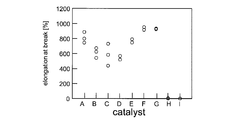
- FIG. 3 shows the elongation at break of the silicone rubber produced in Examples 1-9.
- FIG. 4 shows the strength at break of the silicone rubber produced in Examples 1-9.
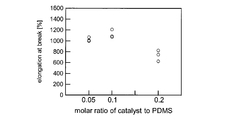
- FIG. 5 shows the elongation at break of the silicone rubber produced in Examples 10-12.
- FIG. 6 shows the strength at break of the silicone rubber produced in Examples 10-12.
- the elongation at break of a silicone rubber (adjustment method C) prepared by mixing 1 mol of MTMS and 0.1 mol of catalyst A at the same time with the other conditions being the same as in Example 1 is shown.
- FIG. 8 shows the strength at break of the three types of silicone rubber shown in FIG.
- FIG. 9 shows the gel fraction of the silicone rubber produced in Example 13 (two-stage adjustment) compared with that of Example 1 (simultaneous adjustment).
- FIG. 10 shows the hot water resistance of the silicone rubber prepared in Example 13 (two-stage adjustment) compared with that of Example 1 (simultaneous adjustment).
- FIG. 11 shows the elongation at break of each silicone rubber produced in Examples 16-21.
- FIG. 12 shows the strength at break of each silicone rubber produced in Examples 16-21.
- FIG. 13 shows the elongation at break of each silicone rubber produced in Examples 22-25.
- FIG. 14 shows the strength at break of each silicone rubber produced in Examples 22-25.
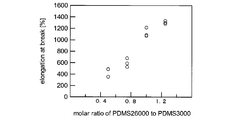
- FIG. 15 shows the elongation at break of each silicone rubber produced in Example 13 of Experiment 3 and Examples 26 to 28 of Experiment 7.
- FIG. 16 shows the breaking strength of each silicone rubber produced in Example 13 of Experiment 3 and Examples 26 to 28 of Experiment 7.
- FIG. 11 shows the elongation at break of each silicone rubber produced in Examples 16-21.
- FIG. 12 shows the strength at break of each silicone rubber produced in Examples 16-21.
- FIG. 13 shows the elongation at break of each silicone rubber produced
- FIG. 17 shows the gel fraction of each silicone rubber produced in Example 13 and Examples 26 to 28 in comparison.
- FIG. 18 shows the elongation at break of each silicone rubber produced in Examples 29-32.
- FIG. 19 shows the strength at break of each silicone rubber produced in Examples 29-32.
- FIG. 20 shows the elongation at break of each silicone rubber produced in Example 32 of Experiment 8 and Examples 33 to 35 of Experiment 9.
- FIG. 21 shows the strength at break of each silicone rubber produced in Example 32 of Experiment 8 and Examples 33 to 35 of Experiment 9.
- FIG. 22 shows the elongation at break of each silicone rubber produced in Examples 36-38.
- FIG. 23 shows the strength at break of each silicone rubber produced in Examples 36-38.
- FIG. 24 shows the elongation at break of each silicone rubber produced in Example 37 of Experiment 10 and Examples 39 and 40 of Experiment 11.
- FIG. 25 shows the breaking strength of each silicone rubber produced in Example 37 of Experiment 10 and Examples 39 and 40 of Experiment 11.
- FIG. 26 shows the visible light transmittance of the silicone rubber produced in Example 36 and Example 37 in comparison with liquid crystal glass and commercially available silicone rubber (commercially available product).
- the silicone rubber composition according to this embodiment is (A) Two types of terminal silanol-modified polyorganosiloxanes having different weight average molecular weights (Mw); (B) alkoxysilane; (C) a curable catalyst comprising an aluminum alkoxide or a curable catalyst comprising a mixture of an aluminum alkoxide and a hydroxy acid ester; At least.
- the silicone rubber composition according to this embodiment preferably includes (D) a filler.
- (A) Terminal silanol-modified polyorganosiloxane The both-end silanol-modified polyorganosiloxane suitably used in this embodiment is represented by the following general formula (1).
- the polyorganosiloxane which not only silanol-modified both ends but also silanol-modified only one end may be used.
- R 1 and R 2 are each independently a linear or branched alkyl group having 1 to 20 carbon atoms, a cycloalkyl group having 4 to 10 carbon atoms, or an aryl or aryl having 6 to 10 carbon atoms It is a substituted hydrocarbon group.
- Examples of the linear or branched alkyl group having 1 to 20 carbon atoms include methyl, ethyl, n-propyl, i-propyl, n-butyl, i-butyl, s-butyl, t-butyl, pentyl, neopentyl, and hexyl.
- Heptyl, octyl, nonyl, decyl, undecyl, dodecyl, and the like can be given as preferred examples.
- suitable cycloalkyl groups having 4 to 10 carbon atoms include functional groups such as cyclopentyl and cyclohexyl.
- aryl group or aryl-substituted hydrocarbon group having 6 to 10 carbon atoms include phenyl, toluyl, xylyl, ethylphenyl, benzyl, phenethyl and the like.
- a particularly preferred terminal silanol-modified polyorganosiloxane is a both-end silanol-modified polydimethylsiloxane.
- the viscosity of the terminal silanol-modified polyorganosiloxane at 23 ° C. is 10 to 100,000 mPa ⁇ s, preferably 20 to 50,000 mPa ⁇ s, more preferably 30 to 10,000 mPa ⁇ s.
- the terminal silanol-modified polyorganosiloxane is preferably a both-end silanol-modified polydimethylsiloxane.
- the terminal silanol-modified polyorganosiloxane (hereinafter, simply referred to as “polyorganosiloxane”) is used by mixing two types having different weight average molecular weights (Mw).
- Mw is preferably selected from two types in the range of 300 to 1,000,000.
- tetraalkoxysilanes and trialkoxysilanes are preferable for increasing the elongation at break when cured, and tetramethoxysilane, methyltrimethoxysilane, and phenyltrimethoxysilane.
- 3-glycidoxypropyltrimethoxysilane and 3-aminopropyltrimethoxysilane are more preferable, and tetramethoxysilane, methyltrimethoxysilane, phenyltrimethoxysilane and 3-aminopropyltrimethoxysilane are more preferable.
- trialkoxysilanes are preferable for increasing the strength at break when cured, and methyltrimethoxysilane and phenyltrimethoxysilane are more preferable.
- the amount of alkoxysilane added is preferably in the range of 0.6 to 1.5 mol, more preferably in the range of 0.8 to 1.2 mol, particularly preferably 1.0 mol, per mol of polyorganosiloxane. To do.
- (C) Curable catalyst It is preferable to use only the aluminum alkoxide or a mixture of aluminum alkoxide and hydroxy acid ester as the curable catalyst.
- Preferred examples of the aluminum alkoxide include aluminum isopropoxide, aluminum-sec-butoxide, and aluminum ethoxide.
- Hydroxy acid esters include methyl formate, ethyl formate, methyl acetate, ethyl acetate, vinyl acetate, propyl acetate, octyl acetate, cyclohexyl acetate, ethyl propionate, methyl acetate, ethyl valerate, ethyl caproate, ethyl chloroacetate, dichloro Aliphatic monocarboxylic esters such as ethyl acetate, ethyl hydroxyacetate, ethyl acrylate, methyl methacrylate, ethyl crotonic acid; diethyl oxalate, dibutyl malonate, dimethyl succinate, diethyl glutarate, diethyl malate, diethyl tartrate, Aliphatic polycarboxylic acid polyesters such as triethyl citrate, ethyl lactate, diethyl chlorosuccinate
- the curable catalyst is preferably added in an amount of less than 0.2 mol, more preferably less than 0.1 mol, and more preferably in the range of 0.05 to 0.1 mol with respect to 1 mol of the polyorganosiloxane. It is more preferable to add at.
- the silicone rubber composition according to this embodiment may contain an inorganic or organic filler.
- Inorganic fillers include silica (silicon dioxide), calcium carbonate, magnesium carbonate, barium sulfate, magnesium sulfate, aluminum silicate, zirconium silicate, iron oxide, titanium oxide, aluminum oxide, zinc oxide, potassium titanate, kaolin, talc, glass Examples thereof include beads, sericite activated clay, bentonite, aluminum nitride, and silicon nitride.
- the organic filler include polymethyl methacrylate, polyester fine particles, polyurethane fine particles, and the like. Among them, silica that can easily obtain finer particulate fillers is preferable in ensuring the transparency of the silicone rubber.
- the amount of the filler is preferably 3% by mass or more based on the total mass of the silicone rubber composition including the filler in terms of increasing the elongation at break when the silicone rubber composition is cured. Henceforth, the meaning of the mass% of a filler is the same meaning. Further, the amount of the filler is preferably 3 to 10% by mass, particularly 3 to 8% by mass for increasing the strength at break.
- the shape of the filler may be any shape such as a plate shape, a particle shape, or a fiber shape.
- the size of the filler is preferably 5 nm or more in diameter in terms of a sphere, and particularly preferably 50 nm or more. .
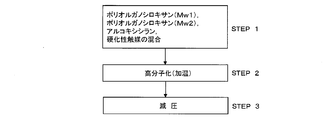
- FIG. 1 shows a flow of a manufacturing method by an exemplary simultaneous mixing method of the silicone rubber composition according to this embodiment.
- step 1 mixing step
- a filler can also be mixed.
- the curable catalyst is preferably mixed with an organic solvent such as toluene diluted to 0.5 to 20% by mass with respect to the total amount of the curable catalyst and the organic solvent.
- the organic solvent is preferably one that does not easily evaporate at room temperature.
- Step 2 Polymerization step
- Step 3 pressure reduction step.
- stirring may be performed using any stirring means, and may be performed by, for example, ultrasonic dispersion using an ultrasonic cleaner, stirring using a stirring blade or a stirring bar.
- the stirring speed can be appropriately changed according to the contents, and is preferably set to 300 to 800 rpm, more preferably 400 to 500 rpm, for example.
- the temperature in the polymerization step is particularly preferably in the range of 50 to 70 ° C. This is because the polymerization of the polyorganosiloxane is promoted and the semi-cured state (gel) is set to such an extent that the polymerization is not terminated.
- the heating time in the polymerization step can be appropriately changed depending on the temperature.
- the solvent in the silicone rubber composition is volatilized by using a vacuum desiccator device at room temperature (around 25 ° C.), and without completely drying, Concentrate in jelly form.
- FIG. 2 shows a flow of a manufacturing method by an exemplary two-stage mixing method of the silicone rubber composition according to this embodiment.
- one polyorganosiloxane (Mw1) of two types of polyorganosiloxanes having different Mw, alkoxysilane, and a curable catalyst are mixed (step 11: first mixing step).
- the mixture is heated to 40 to 80 ° C. and stirred to polymerize the polyorganosiloxane (Step 12: Polymerization step).
- a polyorganosiloxane (Mw2) different from the polyorganosiloxane mixed in Step 11 and a curable catalyst are added to the stirring mixture (Step 13: second mixing step). You may mix a filler in a 2nd mixing process.
- the second mixing step is preferably performed in the early stage of the polymerization step of Step 12.
- the total time of the polymerization step is 70 to 80 hours, this step is started for 0.5 to 8 hours. It is preferable to carry out within a range, more preferably within a range of 1 to 5 hours.
- the filler may be mixed in the first mixing step, or may be mixed in both the first mixing step and the second mixing step. Further, alkoxysilane can be added not only in the first mixing step but also in the second mixing step.
- the polyorganosiloxane Mw2 mixed in the second mixing step may have a weight average molecular weight larger or smaller than the polyorganosiloxane Mw1 mixed in the first mixing step.
- step 14 pressure reduction step. Through these treatments, the silicone rubber composition is completed.
- the polymerizing step in Step 12 and the decompressing step in Step 14 can be performed in the same manner as Step 2 and Step 3 shown in FIG. 1, respectively.
- Silicone rubber is obtained by heating a silicone rubber composition.
- the heating temperature is 100 to 180 ° C, preferably 110 to 170 ° C, more preferably 140 to 160 ° C.
- the heating is preferably performed by gradually raising the temperature from room temperature to the above range.
- methyltrimethoxysilane manufactured by Tokyo Chemical Industry Co., Ltd.
- TMOS tetramethoxysilane
- phenyltrimethoxysilane manufactured by Tokyo Chemical Industry Co., Ltd. PhTMS
- 5-glycidoxypropyltrimethoxysilane product name: KBM403
- KBM903 3-aminopropyltrimethoxysilane
- the curable catalyst As the curable catalyst (hereinafter simply referred to as “catalyst”), five types of metal alkoxides and four types of hydroxy acid esters were used.
- the metal alkoxides include aluminum-s-butoxide (ALsB) manufactured by Wako Pure Chemical Industries, Ltd., aluminum isopropoxide (ALiP) manufactured by Tokyo Chemical Industry Co., Ltd., and aluminum ethoxide (ALE) manufactured by Tokyo Chemical Industry Co., Ltd. Titanium tetraethoxide (TTE) manufactured by Kanto Chemical Co., Ltd. and dibutyltin dilaurate (DBTDL) manufactured by Gelest Co., Ltd. were used.
- ALsB aluminum-s-butoxide
- ALiP aluminum isopropoxide
- ALE aluminum ethoxide
- TTE Titanium tetraethoxide
- DBTDL dibutyltin dilaurate
- hydroxy acid esters examples include diethyl malate (MAdE) manufactured by Tokyo Chemical Industry Co., Ltd., diethyl tartrate (TAdE) manufactured by Tokyo Chemical Industry Co., Ltd., triethyl citrate (CAtE) manufactured by Wako Pure Chemical Industries, Ltd., and Tokyo Chemical Industry. Kogyo Corp. ethyl lactate (LAe) was used.
- MAdE diethyl malate
- TdE diethyl tartrate
- CAtE triethyl citrate
- LAe ethyl lactate
- the elongation at break (unit:%) was obtained by subtracting the length of the original test piece (unit: mm, excluding the distance gripped by the test device) from the length of the test piece at break (unit: mm). The value was expressed as a percentage by dividing by the length of the original test piece (unit: mm, excluding the distance gripped by the test apparatus).
- the strength at break (unit: MPa) was expressed by dividing the test force at break (unit: N) by the fracture cross-sectional area (width ⁇ thickness, unit: mm 2 ) of the test piece.
- Hot water resistance A test piece for mechanical property evaluation was immersed in warm water at 120 ° C. for 120 hours, and the weight ratio before and after immersion was shown as a percentage. It means that hot water resistance is so low that the weight after immersion in warm water is small.
- catalyst A an organic synthesizer (model number: CP-160, manufactured by Shibata Kagaku Co., Ltd.) that can keep 1 mol of ALsB and 1 mol of MAdE at a constant temperature and stirring number in a nitrogen atmosphere.
- catalyst B 1 mol of ALsB and 1 mol of TAdE were mixed and diluted with toluene.
- the meaning of the content rate (wt%) of a filler is the same meaning also in a subsequent example.
- mixing was stopped and the pressure in the silicone rubber composition was removed by reducing the pressure at room temperature (around 25 ° C.) using a vacuum desiccator.
- a silicone rubber composition was completed.
- the silicone rubber composition is transferred to a thin container, and held at 60 ° C. for 12 hours using a dry oven (manufactured by ASONE, model number: DOV-300), and then held at 120 ° C. for 6 hours. Then, it hold
- a sheet-shaped silicone rubber was produced in the same procedure as in Example 1 except that Catalyst A was changed to Catalyst B (Example 2).
- a sheet-shaped silicone rubber was prepared in the same procedure as in Example 1 except that the catalyst A was changed to the catalyst C (Example 3).
- a sheet-shaped silicone rubber was produced in the same procedure as in Example 1 except that Catalyst A was changed to Catalyst D (Example 4).
- a sheet-shaped silicone rubber was produced in the same procedure as in Example 1 except that Catalyst A was changed to Catalyst E (Example 5).
- a sheet-shaped silicone rubber was prepared in the same procedure as in Example 1 except that the catalyst A was changed to the catalyst F (Example 6).
- a sheet-shaped silicone rubber was produced in the same procedure as in Example 1 except that the catalyst A was changed to the catalyst G (Example 7).
- a sheet-shaped silicone rubber was produced in the same procedure as in Example 1 except that the catalyst A was changed to the catalyst H (Example 8).
- a sheet-shaped silicone rubber was produced in the same procedure as in Example 1 except that Catalyst A was changed to Catalyst I (Example 9).
- the silicone rubbers of Examples 1 to 7 have a large elongation at break of 400% or more.
- Example 1 using Catalyst A
- Example 5 using Catalyst E
- Example 6 The elongation at break of Catalyst F
- Example 7 Catalyst G
- a catalyst made of a single aluminum alkoxide or a catalyst obtained by mixing aluminum alkoxide and MAdE it has been found that it is advantageous to use a catalyst made of a single aluminum alkoxide or a catalyst obtained by mixing aluminum alkoxide and MAdE.
- the silicone rubber of Example 5 using catalyst E
- FIGS. 5 and 6 show the elongation at break and strength at break of the silicone rubbers produced in Examples 10 to 12, respectively.
- a silicone rubber having an elongation at break of 600% or more was obtained with any amount of catalyst, and in particular, the elongation at break of the silicone rubber increased when the catalyst A was 0.05 and 0.1 mol. .
- the strength at break did not show a large difference regardless of the amount of catalyst A added.
- FIGS. 7 and 8 show the elongation at break and the strength at break of the silicone rubber prepared in Example 13 (Adjustment Method A), respectively.
- the value of the silicone rubber (adjustment method B) produced in Example 1 of the simultaneous mixing method is also shown.
- 1 mol of MTMS and 0.1 mol of catalyst A were simultaneously mixed, and other conditions were the same as in Example 1.
- the silicone rubber produced as (adjustment method C) was subjected to comparison with Example 13 and Example 1 (Comparative Example 1).
- Example 13 in which two types of PDMS having different Mw in two stages were mixed, both the elongation at break and the strength at break of the silicone rubber were extremely large.
- Example 1 in which two types of PDMS having different Mw were mixed at the same time, both the elongation at break and the strength at break were lower than in Example 13, but in Comparative Example 1 prepared from one type of Mw PDMS. In comparison, the elongation at break was much higher.
- the silicone rubber produced by the two-stage mixing method had a larger residual weight in toluene than that produced by the simultaneous mixing method.
- the hot water resistance as shown in FIG. 10, there was no significant difference between the silicone rubber produced by the two-stage method and the silicone rubber produced by the simultaneous mixing method.
- Table 1 shows the fluorescent X-ray analysis results and elongation at break of the silicone rubber produced in Example 14 and Example 15.
- a commercially available silicone rubber manufactured by Tomita Matex Co., Ltd., product number: TSCE4000 was also subjected to the same evaluation.
- the silicone rubber produced under any of the conditions of Examples 14 and 15 had a higher elongation at break than commercially available products.
- the elongation at break was about 1.5 times larger.
- the compositions of Si, O, Al, and CH 3 were compared by fluorescent X-ray analysis, no relationship with the elongation at break was observed.
- Example 16 Sample A
- Example 17 Sample B
- a composition was prepared to prepare a sheet-shaped silicone rubber (Example 20: Sample E).
- FIGS. 11 and 12 show the elongation at break and strength at break of the silicone rubbers produced in Examples 16 to 21, respectively.
- PDMS mixed in the second stage was 1.0 mol, and other conditions were the same as those in Experiment 3, and a silicone rubber composition was prepared to produce a sheet-shaped silicone rubber (Example 24).
- PDMS mixed in the second stage was changed to 1.25 mol, and other conditions were the same as those in Experiment 3, and a silicone rubber composition was prepared to produce a sheet-shaped silicone rubber (Example 25).
- FIGS. 13 and 14 show the elongation at break and strength at break of the silicone rubbers produced in Examples 22 to 25, respectively.
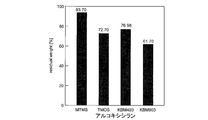
- Experiment 7 (Stepwise mixing of two types of PDMS with different Mw / Examination of types of alkoxysilane) 10.1 Production conditions of silicone rubber composition and silicone rubber obtained by curing the same ⁇ Examples 26 to 28> A silicone rubber composition was produced under the same conditions as in Experiment 3 except that MTMS was changed to TMOS, and a sheet-shaped silicone rubber was produced (Example 26). A silicone rubber composition was produced under the same conditions as in Experiment 3 except that MTMS was changed to KBM403, and a sheet-shaped silicone rubber was produced (Example 27). A silicone rubber composition was prepared under the same conditions as in Experiment 3 except that MTMS was changed to KBM903, and a sheet-shaped silicone rubber was produced (Example 28).
- FIGS. 15 and 16 show the elongation at break and strength at break of the silicone rubbers produced in Example 13 of Experiment 3 and Examples 26 to 28 of Experiment 7, respectively.
- FIG. 17 shows a comparison of gel fractions of the silicone rubbers produced in Example 13 and Examples 26 to 28.
- Experiment 8 (gradual mixing of two types of PDMS with different Mw / examination of filler particle size) 11.1 Production Conditions for Silicone Rubber Composition and Silicone Rubber Cured with It ⁇ Examples 29 to 32> Using four types of fumed silica (manufactured by Nippon Aerosil Co., Ltd.) having primary particle sizes of 7 nm, 12 nm, 30 nm, and 50 nm, the relationship between the particle size of the filler and the properties of the silicone rubber was examined. A silicone rubber composition was prepared under the same conditions as in Experiment 3 except that fumed silica having a primary particle diameter of 7 nm was added, and a sheet-shaped silicone rubber was produced (Example 29).
- a silicone rubber composition was prepared under the same conditions as in Example 29 except that fumed silica with a primary particle size of 12 nm was added, to produce a sheet-shaped silicone rubber (Example 30).
- a silicone rubber composition was prepared under the same conditions as in Example 29 except that fumed silica with a primary particle size of 30 nm was added, to produce a sheet-shaped silicone rubber (Example 31).
- a silicone rubber composition was prepared under the same conditions as in Example 29 except that fumed silica with a primary particle size of 50 nm was added, to produce a sheet-shaped silicone rubber (Example 32).
- FIGS. 18 and 19 show the elongation at break and strength at break of the silicone rubbers produced in Examples 29 to 32, respectively.
- a silicone rubber composition was prepared under the same conditions as in Example 33 except that 5 wt% of fumed silica having a primary particle diameter of 50 nm was added (Example 34).
- a silicone rubber composition was prepared under the same conditions as in Example 33 except that 8 wt% of fumed silica having a primary particle diameter of 50 nm was added (Example 35).
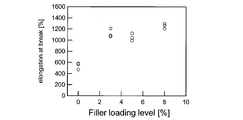
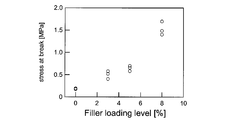
- FIGS. 20 and 21 show the elongation at break and strength at break of the silicone rubbers produced in Example 32 of Experiment 8 and Examples 33 to 35 of Experiment 9, respectively.
- the elongation at break increased when the filler was added compared to the case where the filler was not added. However, the elongation at break was almost constant when the amount of filler added was 3 wt% or more. On the other hand, as shown in FIG. 21, the strength at break increased as the amount of filler added increased.
- FIGS. 22 and 23 show the elongation at break and strength at break of the silicone rubbers produced in Examples 36 to 38, respectively.
- FIGS. 24 and 25 show the elongation at break and strength at break of the silicone rubbers produced in Example 37 of Experiment 10 and Examples 39 and 40 of Experiment 11, respectively.
- Table 3 summarizes the mechanical properties and visible light transmittance of the silicone rubber produced in Examples 36 to 40.
- FIG. 26 shows the visible light transmittance of the silicone rubber produced in Example 36 and Example 37 in comparison with liquid crystal glass and the aforementioned commercially available silicone rubber (commercial product).
- a silicone rubber having a high visible light transmittance can be obtained by using MTMS as the alkoxysilane.
- the silicone rubber produced in Example 36 and Example 37 is so transparent that it exhibits a visible light transmittance equivalent to that of liquid crystal glass, and is more visible than commercially available products. The transmittance was high.
- the present invention can be used for silicone rubber materials, adhesives using the materials, sealants, paints, and the like.
Landscapes
- Chemical & Material Sciences (AREA)
- Health & Medical Sciences (AREA)
- Chemical Kinetics & Catalysis (AREA)
- Medicinal Chemistry (AREA)
- Polymers & Plastics (AREA)
- Organic Chemistry (AREA)
- Compositions Of Macromolecular Compounds (AREA)
- Silicon Polymers (AREA)
Abstract
L'invention a pour objet une composition de caoutchouc de silicone, avec laquelle l'aptitude au façonnage pour la formation de caoutchouc est améliorée et avec laquelle du caoutchouc de silicone présentant une excellente extensibilité peut être formé, et un caoutchouc de silicone obtenu par durcissement de ladite composition, afin de diminuer le craquage de la chaîne principale du caoutchouc de silicone, de diminuer le jaunissement, d'allonger son cycle de vie et de diminuer le moussage au moment de la vulcanisation. A cette fin, la présente invention porte sur : une composition de caoutchouc de silicone qui comprend au moins deux types de polyorganosiloxane modifié par silanol en extrémité ayant différentes masses moléculaires moyennes en poids (Mw), un alcoxysilane et un catalyseur durcissable composé d'alcoolate d'aluminium ou un catalyseur durcissable composé d'un mélange d'alcoolate d'aluminium et d'ester d'hydroxyacide ; un procédé pour sa production ; et un caoutchouc de silicone.
Applications Claiming Priority (2)
| Application Number | Priority Date | Filing Date | Title |
|---|---|---|---|
| JP2012-040323 | 2012-02-27 | ||
| JP2012040323A JP2013173879A (ja) | 2012-02-27 | 2012-02-27 | シリコーンゴム組成物およびその製造方法ならびにシリコーンゴム |
Publications (1)
| Publication Number | Publication Date |
|---|---|
| WO2013128497A1 true WO2013128497A1 (fr) | 2013-09-06 |
Family
ID=49081763
Family Applications (1)
| Application Number | Title | Priority Date | Filing Date |
|---|---|---|---|
| PCT/JP2012/001723 Ceased WO2013128497A1 (fr) | 2012-02-27 | 2012-03-13 | Composition de caoutchouc de silicone, son procédé de production et caoutchouc de silicone |
Country Status (2)
| Country | Link |
|---|---|
| JP (1) | JP2013173879A (fr) |
| WO (1) | WO2013128497A1 (fr) |
Citations (11)
| Publication number | Priority date | Publication date | Assignee | Title |
|---|---|---|---|---|
| JPH02196860A (ja) * | 1975-05-19 | 1990-08-03 | General Electric Co <Ge> | 硬化性組成物 |
| JPH073163A (ja) * | 1992-10-06 | 1995-01-06 | Naito Shizuka | 無溶剤のオルガノシロキサン液組成物とその用途 |
| JPH10316861A (ja) * | 1997-02-26 | 1998-12-02 | General Electric Co <Ge> | 低比率パッケージングに好適な二成分型速硬rtv接着シーラント |
| JP2009523892A (ja) * | 2006-01-20 | 2009-06-25 | モメンティブ パフォーマンス マテリアルズ インコーポレイテッド | 無機−有機ナノ複合充填剤を含むシーリング材組成物 |
| JP2009542848A (ja) * | 2006-07-07 | 2009-12-03 | ヘンケル コーポレイション | 低弾性率、耐湿性シリコーンrtv組成物およびこの製造方法 |
| WO2010047109A1 (fr) * | 2008-10-23 | 2010-04-29 | 国立大学法人三重大学 | Composition de polyorganosiloxane et produit durci à base de cette composition |
| WO2010055628A1 (fr) * | 2008-11-13 | 2010-05-20 | 国立大学法人信州大学 | Composition de polyorganosiloxane, produit durci de la composition et procédé pour la fabrication de la composition |
| JP2010121111A (ja) * | 2008-10-23 | 2010-06-03 | Mie Univ | ポリオルガノシロキサン組成物およびその硬化体 |
| WO2010143357A1 (fr) * | 2009-06-10 | 2010-12-16 | 国立大学法人信州大学 | Composition de polyorganosiloxane et produits durcis de celle-ci |
| JP2011219729A (ja) * | 2010-03-23 | 2011-11-04 | Yokohama Rubber Co Ltd:The | 加熱硬化性シリコーン樹脂組成物およびこれを用いる光半導体封止体 |
| JP2012092240A (ja) * | 2010-10-27 | 2012-05-17 | Fujifilm Corp | 硬化物の製造方法、半導体発光デバイスの製造方法、硬化物製造用キット、及び半導体発光デバイス封止物の製造用キット |
-
2012
- 2012-02-27 JP JP2012040323A patent/JP2013173879A/ja active Pending
- 2012-03-13 WO PCT/JP2012/001723 patent/WO2013128497A1/fr not_active Ceased
Patent Citations (11)
| Publication number | Priority date | Publication date | Assignee | Title |
|---|---|---|---|---|
| JPH02196860A (ja) * | 1975-05-19 | 1990-08-03 | General Electric Co <Ge> | 硬化性組成物 |
| JPH073163A (ja) * | 1992-10-06 | 1995-01-06 | Naito Shizuka | 無溶剤のオルガノシロキサン液組成物とその用途 |
| JPH10316861A (ja) * | 1997-02-26 | 1998-12-02 | General Electric Co <Ge> | 低比率パッケージングに好適な二成分型速硬rtv接着シーラント |
| JP2009523892A (ja) * | 2006-01-20 | 2009-06-25 | モメンティブ パフォーマンス マテリアルズ インコーポレイテッド | 無機−有機ナノ複合充填剤を含むシーリング材組成物 |
| JP2009542848A (ja) * | 2006-07-07 | 2009-12-03 | ヘンケル コーポレイション | 低弾性率、耐湿性シリコーンrtv組成物およびこの製造方法 |
| WO2010047109A1 (fr) * | 2008-10-23 | 2010-04-29 | 国立大学法人三重大学 | Composition de polyorganosiloxane et produit durci à base de cette composition |
| JP2010121111A (ja) * | 2008-10-23 | 2010-06-03 | Mie Univ | ポリオルガノシロキサン組成物およびその硬化体 |
| WO2010055628A1 (fr) * | 2008-11-13 | 2010-05-20 | 国立大学法人信州大学 | Composition de polyorganosiloxane, produit durci de la composition et procédé pour la fabrication de la composition |
| WO2010143357A1 (fr) * | 2009-06-10 | 2010-12-16 | 国立大学法人信州大学 | Composition de polyorganosiloxane et produits durcis de celle-ci |
| JP2011219729A (ja) * | 2010-03-23 | 2011-11-04 | Yokohama Rubber Co Ltd:The | 加熱硬化性シリコーン樹脂組成物およびこれを用いる光半導体封止体 |
| JP2012092240A (ja) * | 2010-10-27 | 2012-05-17 | Fujifilm Corp | 硬化物の製造方法、半導体発光デバイスの製造方法、硬化物製造用キット、及び半導体発光デバイス封止物の製造用キット |
Also Published As
| Publication number | Publication date |
|---|---|
| JP2013173879A (ja) | 2013-09-05 |
Similar Documents
| Publication | Publication Date | Title |
|---|---|---|
| TWI680152B (zh) | 表面改質金屬氧化物粒子分散液及其製造方法、表面改質金屬氧化物粒子-矽酮樹脂複合組成物、表面改質金屬氧化物粒子-矽酮樹脂複合物、光學構件以及發光裝置 | |
| TWI718173B (zh) | 支鏈聚有機矽氧烷及相關可固化之組成物、方法、用途以及裝置 | |
| CN102597065B (zh) | 成簇官能聚有机硅氧烷的制备工艺及其使用方法 | |
| CN104968750B (zh) | 簇合官能化聚有机硅氧烷、形成所述簇合官能化聚有机硅氧烷的工艺及其使用方法 | |
| JP6524901B2 (ja) | シリコーンゴム組成物及びその硬化物 | |
| CN101443418A (zh) | 含金属氧化物微粒的聚硅氧烷组合物及其制备方法 | |
| CN108463508B (zh) | 缩合反应型聚硅氧烷组合物以及固化物 | |
| JP5424381B2 (ja) | 光半導体封止用樹脂組成物 | |
| KR20150118139A (ko) | 안정한 열 라디칼 경화성 실리콘 접착제 조성물 | |
| CN111394052B (zh) | 一种脱醇缩合型双组分室温硫化硅橡胶及其制备方法 | |
| US20160208151A1 (en) | Combination of rtv-1 silicone formulation and accelerator with enhanced cure characteristics | |
| JP2012532981A (ja) | 皮膜形成用組成物及びその組成物が塗布される皮膜 | |
| CN103525358B (zh) | 一种含梯形聚倍半硅氧烷的透明硅橡胶的制备方法与应用 | |
| WO2013179896A1 (fr) | Ruban ou feuille adhésif(ve) et son procédé de fabrication | |
| JP4772858B2 (ja) | シリコーン樹脂組成物 | |
| JP2016098245A (ja) | ポリシルセスキオキサン液体及びその製造方法、led封止用組成物、led封止材、及び半導体発光装置 | |
| WO2015111229A1 (fr) | Composition de résine silicone liquide | |
| EP2154188A1 (fr) | Composition de résine contenant des particules d'oxyde métallique fine | |
| CN116042172A (zh) | 一种单组份脱醇型室温硫化硅橡胶及其制备方法 | |
| JP2014043572A (ja) | シリコーン樹脂組成物 | |
| JP2015081275A (ja) | 光半導体用シリコーン樹脂組成物およびその硬化物 | |
| JP7485049B2 (ja) | 熱ラジカル硬化可能なオルガノポリシロキサン組成物、該組成物で接着、コーティング又はポッティングされた物品、及び該組成物の硬化物を製造する方法 | |
| EP0540040B1 (fr) | Composition d'organopolysiloxane durcissable à température ambiante | |
| CN111662548B (zh) | 二元型室温缩合固化性有机聚硅氧烷组合物 | |
| JP6583160B2 (ja) | シリコーンゴム組成物及びシリコーンゴム |
Legal Events
| Date | Code | Title | Description |
|---|---|---|---|
| 121 | Ep: the epo has been informed by wipo that ep was designated in this application |
Ref document number: 12870244 Country of ref document: EP Kind code of ref document: A1 |
|
| NENP | Non-entry into the national phase |
Ref country code: DE |
|
| 122 | Ep: pct application non-entry in european phase |
Ref document number: 12870244 Country of ref document: EP Kind code of ref document: A1 |