WO2010143395A1 - Dispositif de régénération de fonction physiologique - Google Patents
Dispositif de régénération de fonction physiologique Download PDFInfo
- Publication number
- WO2010143395A1 WO2010143395A1 PCT/JP2010/003764 JP2010003764W WO2010143395A1 WO 2010143395 A1 WO2010143395 A1 WO 2010143395A1 JP 2010003764 W JP2010003764 W JP 2010003764W WO 2010143395 A1 WO2010143395 A1 WO 2010143395A1
- Authority
- WO
- WIPO (PCT)
- Prior art keywords
- temperature
- holding operation
- air
- target temperature
- human body
- Prior art date
- Legal status (The legal status is an assumption and is not a legal conclusion. Google has not performed a legal analysis and makes no representation as to the accuracy of the status listed.)
- Ceased
Links
Images





Classifications
-
- F—MECHANICAL ENGINEERING; LIGHTING; HEATING; WEAPONS; BLASTING
- F24—HEATING; RANGES; VENTILATING
- F24F—AIR-CONDITIONING; AIR-HUMIDIFICATION; VENTILATION; USE OF AIR CURRENTS FOR SCREENING
- F24F11/00—Control or safety arrangements
- F24F11/30—Control or safety arrangements for purposes related to the operation of the system, e.g. for safety or monitoring
-
- F—MECHANICAL ENGINEERING; LIGHTING; HEATING; WEAPONS; BLASTING
- F24—HEATING; RANGES; VENTILATING
- F24F—AIR-CONDITIONING; AIR-HUMIDIFICATION; VENTILATION; USE OF AIR CURRENTS FOR SCREENING
- F24F11/00—Control or safety arrangements
- F24F11/30—Control or safety arrangements for purposes related to the operation of the system, e.g. for safety or monitoring
- F24F11/46—Improving electric energy efficiency or saving
-
- F—MECHANICAL ENGINEERING; LIGHTING; HEATING; WEAPONS; BLASTING
- F24—HEATING; RANGES; VENTILATING
- F24F—AIR-CONDITIONING; AIR-HUMIDIFICATION; VENTILATION; USE OF AIR CURRENTS FOR SCREENING
- F24F11/00—Control or safety arrangements
- F24F11/62—Control or safety arrangements characterised by the type of control or by internal processing, e.g. using fuzzy logic, adaptive control or estimation of values
Definitions
- the present invention relates to a physiological function activation device that activates physiological functions of a human body by applying thermal stimulation and cold stimulation to the human body.
- Patent Document 1 discloses this type of physiological function activation device.
- the physiological function activating device of Patent Document 1 includes a heat pump type air conditioner and a control unit for controlling the air conditioner.
- a temperature fluctuation operation (fluctuation operation mode) is performed in which a room temperature is changed to give a warm / cool stimulus to the occupants.
- the peripheral vasomotor function of the human body is activated, and as a result, blood pressure regulating action, blood circulation regulating action, body temperature regulating action and the like are promoted.
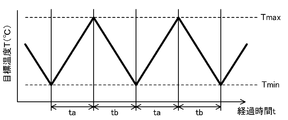
- the target temperature of the air conditioner is controlled as shown in FIG. That is, in this temperature fluctuation operation, the target temperature (set temperature) of the air conditioner gradually increases from the predetermined low temperature side target temperature Tmin to the high temperature side target temperature Tmax at a predetermined set time ta. Then, when the target temperature reaches the high temperature side target temperature Tmax as the set time ta elapses, the target temperature gradually increases from the high temperature side target temperature Tmax to the low temperature side target temperature Tmin in the subsequent predetermined set time tb. It goes down.
- the target temperature of the air conditioner is gradually increased or decreased to give the occupant a warm stimulus and a cool stimulus.
- the present invention has been made in view of such a point, and an object thereof is to improve an activation action of a physiological function in a physiological function activation device.
- a first invention is directed to a physiological function activating device, and an air conditioning unit (20) that changes a room temperature to give a thermal stimulus and a cold stimulus to a human body, and a predetermined for giving the thermal stimulus to the human body.
- a temperature setting unit (43a) in which a high temperature side target temperature and a predetermined low temperature side target temperature that is lower than the high temperature side target temperature and that gives the cold stimulation to the human body are set, and the air conditioning unit (20) A high temperature holding operation in which the target temperature is held at the high temperature side target temperature for a predetermined time, and a low temperature holding operation in which the target temperature of the air conditioning unit (20) is held at the low temperature side target temperature for a predetermined time.
- An air conditioning control unit (50) for performing a temperature fluctuation operation executed at least once, and in the temperature fluctuation operation, the other operation is performed after the end of one of the high temperature holding operation and the low temperature holding operation. Is executed.
- the “high temperature side target temperature” here is a target temperature for giving a desired thermal stimulus to the human body among the temperatures of the air in the vicinity of the human body.
- the “low temperature side target temperature” here is a target temperature for giving a desired cold stimulus to the human body among the temperatures of the air in the vicinity of the human body.
- the high temperature side target temperature and the low temperature side target temperature are set in the temperature setting section (43a).
- the high temperature holding operation and the low temperature holding operation are alternately executed at least once.
- the target temperature of the air conditioning unit (20) is held at the high temperature side target temperature.
- thermal stimulation is applied to the human body.
- the target temperature of the air conditioning unit (20) is held at the low temperature side target temperature.
- the temperature around the human body is lowered, and a cold stimulus is applied to the human body.
- the peripheral blood vessels of the human body contract.
- the high-temperature holding operation and the low-temperature holding operation are alternately performed at least once, so that the thermal stimulus and the cold stimulus are applied to the human body.
- the other operation when one of the high temperature holding operation and the low temperature holding operation is completed, the other operation is performed after the completion. Specifically, for example, the high temperature holding operation is executed, the target temperature of the air conditioning unit (20) becomes the high temperature side target temperature, and when this high temperature holding operation ends, the low temperature holding operation is executed thereafter. For example, when the low temperature holding operation is executed and the target temperature of the air conditioning unit (20) becomes the low temperature side target temperature, and this low temperature holding operation ends, the high temperature holding operation is executed thereafter.
- the other operation is executed after one operation in this way, the temperature around the human body can be rapidly changed. As a result, it is possible to apply steep thermal stimulation or cold stimulation to the human body.
- the second invention is characterized in that, in the first invention, the low temperature holding operation is executed when the temperature fluctuation operation is started, and the high temperature holding operation is executed after the low temperature holding operation is completed.
- a low temperature holding operation is first executed for a predetermined time. Thereby, cold stimulation is given to a human body.
- the high temperature holding operation is performed after the end. Thereby, since the temperature around a human body rises rapidly, a steep thermal stimulus can be given to a human body.
- the second invention when the temperature fluctuation operation is started, the low temperature holding operation is executed, the high temperature holding operation is executed after the low temperature holding operation is ended, and the low temperature holding operation is executed after the high temperature holding operation is ended. The holding operation is performed again.
- the low temperature holding operation is first executed, and the high temperature holding operation is executed after the low temperature holding operation is completed. Thereby, since the temperature around a human body rises rapidly, a steep thermal stimulus can be given to a human body. When this high temperature holding operation ends, the low temperature holding operation is executed again after the high temperature holding operation. Thereby, since the temperature around the human body is suddenly lowered, it is possible to apply a steep cooling / heating stimulus to the human body.
- the fourth invention is characterized in that, in the first invention, the high temperature holding operation is executed when the temperature fluctuation operation is started, and the low temperature holding operation is executed after the high temperature holding operation is completed.
- a high temperature holding operation is first executed for a predetermined time. Thereby, thermal stimulation is given to a human body.
- the high temperature holding operation ends the low temperature holding operation is performed after the end. Thereby, since the temperature around the human body is suddenly lowered, it is possible to apply a steep cooling / heating stimulus to the human body.
- the high temperature holding operation when the temperature fluctuation operation starts, the high temperature holding operation is executed, the low temperature holding operation is executed after the high temperature holding operation is completed, and the high temperature holding operation is executed after the low temperature holding operation is completed. The holding operation is performed again.
- the high temperature holding operation is first executed, and the low temperature holding operation is executed after the high temperature holding operation is completed.
- the high temperature holding operation is performed again after the completion.
- a steep thermal stimulus can be given to a human body.
- the sixth invention is characterized in that, in any one of the first to fifth inventions, the execution time of the high temperature holding operation is longer than the execution time of the low temperature holding operation.
- the execution time of the high temperature holding operation for applying the thermal stimulus to the human body is longer than the execution time of the cold holding operation for applying the cold stimulus to the human body. Therefore, in this temperature fluctuation operation, since it takes a relatively long time to apply the thermal stimulus to the human body, it becomes easier to dilate the peripheral blood vessels of the human body. Thereby, the improvement effect of cooling property can be accelerated
- the time for applying the thermal stimulus to the human body is lengthened and the skin peripheral blood vessels are actively expanded, so the effect of improving the cooling property is enhanced.
- the low temperature side target temperature and the above are determined according to the wind speed of the air reaching the human body from the air conditioning unit (20).
- a target temperature correction unit (52) that corrects either one or both of the high temperature side target temperatures is further provided.
- the wind speed of the air reaching the human body means the wind speed immediately before hitting the human body (the wind speed in the vicinity of the human body).
- the target temperature correction unit (52) is set in the temperature setting unit (43a) according to the wind speed of the air (hereinafter referred to as reaching air) supplied from the air conditioning unit (20) and reaching the human body.
- the corrected high temperature side target temperature and / or low temperature side target temperature are corrected. That is, the thermal stimulus and the cool stimulus given to the human body change not only according to the temperature of the reaching air but also strictly according to the wind speed of the reaching air. This is because when the wind speed of the arrival air changes, the amount of heat absorbed by the human body and the amount of heat released from the human body change, and accordingly, the thermal stimulation and the cold stimulation also change. Therefore, in the present invention, in consideration of this point, the high temperature side target temperature and the low temperature side target temperature are corrected according to the wind speed of the reaching air. As a result, it is possible to give a more optimal thermal stimulus or cooler stimulus to the human body.
- the target temperature correction unit (52) is configured such that the low temperature side target temperature or the high temperature side target temperature corresponds to the skin temperature of the human body as the air speed of the air increases. It is characterized in that the correction is made so as to approach the reference temperature.
- the target temperature correction unit (52) of the eighth invention corresponds to the low temperature side target temperature or the high temperature side target temperature as the reference temperature (the surface temperature of the human body skin (for example, 30 °) as the wind speed of the reaching air increases.
- the low temperature side target temperature and the high temperature side target temperature are corrected away from the reference temperature. That is, the thermal stimulus or the cool stimulus given to the human body increases as the wind speed of the reaching air increases, and decreases as the wind speed decreases.
- the target temperature correction unit (52) corrects the high temperature side target temperature and the low temperature side target temperature to be close to the reference temperature in a situation where the wind speed of the reaching air increases and the thermal stimulation or the cold stimulation becomes too large.
- the target temperature correction unit (52) corrects the high temperature side target temperature and the low temperature side target temperature away from the reference temperature under a situation where the wind speed of the reaching air is low and the thermal stimulus or the cold stimulus is too small.
- the target temperature correction section (52) responds to the air speed as the difference between the low temperature side target temperature or the high temperature side target temperature with respect to the reference temperature increases. Further, the present invention is characterized in that the correction range of the low temperature side target temperature or the high temperature side target temperature is increased.
- the target temperature correction unit (52) of the ninth aspect of the invention relates to the low temperature side target corresponding to the wind speed of air as the difference between the reference temperature and the low temperature side target temperature or the difference between the reference temperature and the high temperature side target temperature is large. Increase the correction range of the temperature or high temperature side target temperature. That is, for example, when the difference between the reference temperature and the high-temperature side target temperature is relatively large, the thermal stimulus given to the human body greatly changes as the wind speed of the reaching air changes. Therefore, in the present invention, under a situation where the difference between the reference temperature and the high temperature side target temperature is large, the correction range of the high temperature side target temperature corresponding to the change in the air wind speed is increased.
- the difference between the reference temperature and the low-temperature side target temperature is relatively large, the cold stimulus given to the human body greatly changes as the wind speed of the reaching air changes. Therefore, in the present invention, under a situation where the difference between the reference temperature and the low temperature side target temperature is large, the correction range of the low temperature side target temperature corresponding to the change in the air wind speed is increased.
- the air conditioning unit (in accordance with one or both of the low temperature side target temperature and the high temperature side target temperature during the temperature fluctuation operation) 20) is further provided with a wind speed control section (53) for changing the wind speed of the air reaching the human body.
- the wind speed control section (53) changes the wind speed of the reaching air according to the low temperature side target temperature or the high temperature side target temperature. That is, as described above, the thermal stimulus and the cool stimulus given to the human body change not only with the temperature of the reaching air but also with the wind speed of the reaching air. Therefore, in the present invention, the wind speed of the reaching air is changed according to the low temperature side target temperature or the high temperature side target temperature. As a result, it is possible to give a more optimal thermal stimulus or cooler stimulus to the human body.
- the eleventh invention is characterized in that, in any one of the first to sixth inventions, the low temperature side target temperature set in the temperature setting section (43a) is 18 ° C. or more and 22 ° C. or less.
- the target temperature (low temperature side target temperature) of the air conditioning unit (20) in the low temperature holding operation is set within a range of 18 ° C. or higher and 22 ° C. or lower.
- the low temperature side target temperature is set to 18 ° C. or more and 22 ° C. or less in order to achieve both of them.
- the twelfth invention is characterized in that, in any one of the first to sixth inventions, the high temperature side target temperature set in the temperature setting section (43a) is 28 ° C. or more and 32 ° C. or less.
- the target temperature (high temperature side target temperature) of the air conditioning unit (20) in the high temperature holding operation is set within a range of 28 ° C. or higher and 32 ° C. or lower.
- the high temperature side target temperature is set to 28 ° C. or more and 32 ° C. or less in order to achieve both of them.
- a thirteenth aspect of the invention includes the air conditioning temperature setting unit (42a) to which a set temperature of a room to be air-conditioned by the air conditioning unit (20) is input in any one of the first to twelfth inventions, When the temperature fluctuation operation ends, the air conditioning control unit (50) performs the normal operation in which the target temperature of the air conditioning unit (20) is set to the set temperature of the air conditioning temperature setting unit (42a). 20) is controlled.
- the air conditioning unit (20) when the temperature fluctuation operation ends, the air conditioning unit (20) performs the normal operation. As a result, the room temperature approaches the set temperature set in the air conditioning temperature setting unit (42a), and the room is maintained at a comfortable temperature.
- the present invention in the temperature fluctuation operation, when one of the low temperature holding operation and the high temperature holding operation ends, the other operation is performed after the end. For this reason, since the temperature around the human body can be suddenly increased or decreased, it is possible to apply a steep cold or thermal stimulus to the human body. As a result, for example, the function of the peripheral blood vessels of the skin can be activated, and the physiological function of the human body can be effectively activated. Therefore, it can promote blood pressure regulating action, blood circulation regulating action, body temperature regulating action, etc. of the human body, thereby improving coldness, preventing hypertension, preventing metabolism / repair function from being lowered, promoting fatigue recovery, heat stroke prevention, etc. Can be achieved.
- a low temperature side target temperature and a high temperature side target temperature are used. Therefore, for example, when the target temperature is set more than this, or when the target temperature is gradually changed with a predetermined gradient, the control of the air conditioning unit (20) can be easily performed.
- the low temperature holding operation is first executed, and then the high temperature holding operation is executed. For this reason, a sharp thermal stimulus can be given to the human body.
- the high temperature holding operation is first executed, and then the low temperature holding operation is executed. For this reason, it is possible to apply a steep cooling / heating stimulus to the human body.
- the low temperature holding operation, the high temperature holding operation, and the low temperature holding operation are executed in order
- the high temperature holding operation, the low temperature holding operation, and the high temperature holding operation are executed in order. For this reason, in the third and fifth inventions, it is possible to apply both a steep cold heat stimulus and a steep heat stimulus to the human body.
- the execution time of the high temperature holding operation is set longer than the execution time of the low temperature holding operation. For this reason, since the time which gives a thermal stimulus to a human body becomes comparatively long, the improvement effect of cooling property can be accelerated
- the low temperature side target temperature and the high temperature side target temperature are corrected according to the wind speed of the air reaching the human body.
- the wind speed of the air reaching the human body is changed according to the low temperature side target temperature or the high temperature side target temperature. That is, in these inventions, not only the temperature of the air in the vicinity of the human body but also the wind speed of the reaching air is taken into consideration, so that it is possible to apply an optimal cold stimulus or thermal stimulus to the human body. Therefore, the physiological function of the human body can be more effectively activated.
- the low temperature side target temperature is 18 ° C. or higher and 22 ° C. or lower. For this reason, in the low temperature holding operation, it is possible to give a suitable cold stimulus to the human body while avoiding that the room is extremely cooled and the comfort is impaired.
- the high temperature side target temperature is set to 28 ° C. or more and 32 ° C. or less. For this reason, in the high temperature holding operation, an appropriate thermal stimulus can be applied to the human body while avoiding that the room becomes extremely hot and the comfort is impaired.
- the normal operation is automatically executed. For this reason, since the indoor temperature approaches the set temperature after the temperature fluctuation operation, the indoor comfort can be promptly improved.
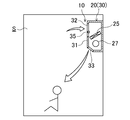
- FIG. 1 is a schematic configuration diagram illustrating an operation state of the physiological function activating device according to the embodiment.
- FIG. 2 is a schematic configuration diagram of a refrigerant circuit of the room air conditioner.
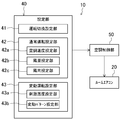
- FIG. 3 is a schematic block diagram of the physiological function activation device.
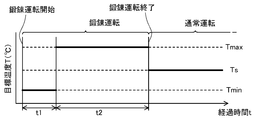
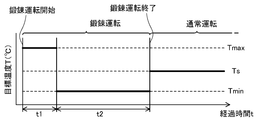
- FIG. 4 is a time chart showing changes in the target temperature of the physiological function activating device.
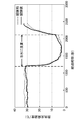
- FIG. 5 is a graph comparing the changes in fingertip skin temperature immersed in cold water before and after the training operation.
- FIG. 6 is a first example of other temperature fluctuation patterns, and is a time chart showing changes in the target temperature of the physiological function activating device.
- FIG. 7 is a second example of other temperature fluctuation patterns, and is a time chart showing changes in the target temperature of the physiological function activating device.
- FIG. 1 is a schematic configuration diagram illustrating an operation state of the physiological function activating device according to the embodiment.
- FIG. 2 is a schematic configuration diagram of a refrigerant circuit of the room air conditioner.
- FIG. 8 is a third example of another temperature variation pattern, and is a time chart showing changes in the target temperature of the physiological function activating device.
- FIG. 9 is a schematic block diagram of the physiological function activating device according to the first modification including the target temperature correction unit.
- FIG. 10 is a graph showing the relationship between the target temperature and the wind speed stored in the storage unit.
- FIG. 11 is a schematic block diagram of the physiological function activation apparatus of the modification 2 provided with the wind speed control part.
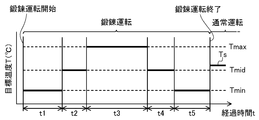
- FIG. 12 is an example of a temperature variation pattern using the intermediate target temperature, and is a time chart showing a change in the target temperature of the physiological function activating device.
- FIG. 13 is a time chart showing changes in the target temperature of the conventional physiological function activation device.
- the physiological function activation device (10) activates the physiological function of the human body by applying thermal stimulation and cold stimulation to the human body.
- the physiological function activation device (10) includes a room air conditioner (20) as an air conditioning unit.
- the room air conditioner (20) constitutes a heat pump refrigeration apparatus (air conditioner) that performs a vapor compression refrigeration cycle. That is, the room air conditioner (20) includes a refrigerant circuit (21) that performs a refrigeration cycle by circulating refrigerant (see FIG. 2).
- a compressor (22), an outdoor heat exchanger (23), an expansion valve (24), an indoor heat exchanger (25), and a four-way switching valve (26) are connected to the refrigerant circuit (21).
- the compressor (22) is configured as an inverter type having a variable capacity.
- the expansion valve (24) is composed of, for example, an electronic expansion valve.
- the refrigerant flow path is changed as the four-way switching valve (26) is switched.
- a refrigeration cycle in which the outdoor heat exchanger (23) serves as a condenser and the indoor heat exchanger (25) serves as an evaporator (refrigeration cycle in which the refrigerant flows in the direction of the solid line arrow in FIG. 2).
- a refrigeration cycle in which the refrigerant flows in the direction of the broken line arrow in FIG. 2 in which the outdoor heat exchanger (23) serves as an evaporator and the indoor heat exchanger (25) serves as a condenser can be changed. .
- the room air conditioner (20) includes an indoor unit (30) disposed in the indoor space (S).
- the indoor unit (30) is configured to be wall-mounted, for example, attached to an indoor wall surface.
- the indoor unit (30) includes a horizontally long casing (31).
- a suction port (32) is formed on the front side and / or upper part, and a blower outlet (33) is formed on the lower part.
- An air passage is formed in the casing (31) from the inlet (32) to the outlet (33).
- the air passage is provided with the indoor heat exchanger (25) and the indoor fan (27) described above. When the indoor fan (27) is operated, the air in the indoor space (S) is taken into the casing (31) through the suction port (32).
- the indoor fan (27) constitutes an air blowing unit that supplies air to the human body. Further, the indoor fan (27) is configured such that the rotational speed of the fan motor is variable.
- the physiological function activating device (10) includes a setting unit (40) and an air conditioning control unit (50).
- the setting unit (40) various operation parameters related to the room air conditioner (20) are set.
- the setting unit (40) includes an operation switching setting unit (41), a normal operation setting unit (42), and a variable operation setting unit (43).
- the operation switching setting unit (41) is a switch for switching the operation of the room air conditioner (20).
- the operation mode of the room air conditioner (20) is roughly classified into “normal operation” and “forge operation”.
- the “normal operation” is an operation for performing air conditioning so that the temperature of the indoor space (S) approaches a temperature desired by the user (air conditioning target temperature).
- This “normal operation” includes “cooling operation” in which a refrigeration cycle using an indoor heat exchanger (25) as an evaporator and “heating operation” in which a refrigeration cycle using an indoor heat exchanger (25) as a condenser are performed. are categorized.
- the “training operation” is an operation for activating the physiological functions of the occupants in the indoor space (S). That is, the “training operation” is a temperature fluctuation operation in which a thermal stimulus and a cold stimulus are given to the human body by changing the temperature of the indoor space (S).
- the normal operation setting unit (42) includes an air conditioning temperature setting unit (42a), an air volume setting unit (42b), and an air direction setting unit (42c).
- the set temperature Ts in the room to be air-conditioned by the room air conditioner (20) is input to the air conditioning temperature setting unit (42a). That is, the target temperature of the room air conditioner (20) during normal operation is set in the air conditioning temperature setting unit (42a).
- the air volume of the air blown out from the air outlet (33) is input / set for the room air conditioner (20) during normal operation.
- the air volume of the blown air can be changed, for example, by controlling the rotational speed of the motor of the indoor fan (27).
- the wind direction of the air blown from the room air conditioner (20) during normal operation is input / set in the wind direction setting unit (42c).
- the wind direction of blowing air can be changed by controlling the flap (airflow control board) provided in the blower outlet (33), for example.
- variable operation setting section (43) operation parameters related to the training operation of the room air conditioner (20) are set.
- the fluctuating operation setting unit (43) is provided with a stimulation temperature setting unit (43a) and a fluctuation pattern setting unit (43b).
- the high temperature side target temperature Tmax and the low temperature side target temperature Tmin are set in the stimulation temperature setting unit (43a) as the target temperatures of the room air conditioner (20) during the training operation.
- the “high temperature side target temperature Tmax” is a temperature for applying a thermal stimulus to the human body during the training operation, and is an environmental temperature for dilating the peripheral blood vessels of the human body. That is, the high temperature side target temperature Tmax is a target temperature for giving a desired thermal stimulus to the human body among the temperatures of the air in the vicinity of the human body.
- the high temperature side target temperature Tmax is 28 ° C.
- the high temperature side target temperature Tmax is not limited to 28 ° C., but is preferably 28 ° C. or more and 32 ° C. or less.
- the “low temperature side target temperature Tmin” is a temperature for applying a cold stimulus to the human body during the training operation, and is an environmental temperature for contracting the peripheral blood vessels of the human body. That is, the low temperature side target temperature Tmin is a target temperature for giving a desired cold stimulus to the human body among the temperatures of the air in the vicinity of the human body. In this embodiment, the low temperature side target temperature Tmin is 22 ° C.
- the low temperature side target temperature Tmin is not limited to 22 ° C. as long as it is lower than the high temperature side target temperature Tmax, but is preferably 18 ° C. or more and 22 ° C. or less.
- a fluctuation pattern of the target temperature is set, such as how to change the target temperature of the room air conditioner (20) during the training operation as time elapses.
- the change pattern setting unit (43b) sets the target temperature of the room air conditioner (20) in the order of Tmin ⁇ Tmax ⁇ Tmin, from the start to the end of the training operation.
- a variation pattern to be changed is set. That is, in the present embodiment, when the operation of holding the target temperature of the room air conditioner (20) at the low temperature side target temperature (low temperature holding operation) is completed, the operation of holding the target temperature of the room air conditioner (20) at the high temperature side target temperature. (High temperature holding operation) is executed, and when this high temperature holding operation is completed, the low temperature holding operation is executed again.
- times (t1, t2, t3) for executing the above-described operations are set.
- the first time t1 is set to 12.5 minutes
- the second time t2 is set to 35 minutes
- the third time t3 is set to 12.5 minutes.
- the time during which the high temperature holding operation is executed is longer than the time during which the low temperature holding operation is executed (time t1 and time t3 in this embodiment). ing.
- the execution time of the low temperature holding operation immediately before the high temperature holding operation (time t1 in this embodiment) and the execution time of the low temperature holding operation immediately after the high temperature holding operation (time t3 in this embodiment). ) Is set to the same time (for example, 12.5 minutes).
- the air conditioning control unit (50) controls the room air conditioner (20) based on various operating parameters set in the setting unit (40), and constitutes a controller for normal operation and training operation is doing.
- the air conditioning control unit (50) controls, for example, the operating frequency of the compressor (22), the rotational speed of the indoor fan (27), the opening of the expansion valve (24), the setting of the four-way switching valve (26), etc. It is configured.
- the air in the indoor space (S) is introduced into the casing (31) from the suction port (32).
- the air introduced into the casing (31) flows through the air passage and passes through the indoor heat exchanger (25).
- the indoor heat exchanger (25) the refrigerant absorbs heat from the air and evaporates, and the air is cooled.
- the refrigerant evaporated in the indoor heat exchanger (25) is sucked into the compressor (22) and compressed.
- the air cooled by the indoor heat exchanger (25) is supplied to the outside of the casing (31) (that is, the indoor space (S)) through the air outlet (33).
- the four-way switching is performed so that the discharge side of the compressor (22) communicates with the indoor heat exchanger (25) and at the same time the suction side of the compressor (22) communicates with the outdoor heat exchanger (23).
- Valve (26) is set.
- the compressor (22) is operated from this state, the refrigerant discharged from the compressor (22) flows through the indoor heat exchanger (25) (see the broken line arrow in FIG. 2).
- the air in the indoor space (S) is introduced into the casing (31) from the suction port (32).
- the air introduced into the casing (31) flows through the air passage and passes through the indoor heat exchanger (25).
- the indoor heat exchanger (25) the refrigerant dissipates heat into the air and condenses, and the air is heated.
- the refrigerant condensed in the indoor heat exchanger (25) is depressurized by the expansion valve (24) and then evaporated by the outdoor heat exchanger (23), and is sucked into the compressor (22) and compressed.
- the air heated by the indoor heat exchanger (25) is supplied to the outside of the casing (31) (that is, the indoor space (S)) through the air outlet (33).
- the temperature of the indoor space (S) to be air-conditioned by the room air conditioner (20) approaches the set temperature Ts set in the air-conditioning temperature setting unit (42a).
- the capacity of the room air conditioner (20) is controlled.
- a suction temperature sensor (35) is provided in the suction port (32) of the room air conditioner (20) of the present embodiment.
- the air conditioning control unit (50) controls the operating frequency and start / stop of the compressor (22) so that the temperature of the air (suction air) detected by the suction temperature sensor (35) approaches the set temperature Ts. I do. Thereby, in the cooling operation or the heating operation, the temperature of the air in the indoor space (S) converges to the set temperature Ts.
- the air conditioning control unit (50) controls the room air conditioner (20) so that the temperature around the occupants in the indoor space (S) approaches Tmin. More specifically, the air conditioning control unit (50), for example, operates the operating frequency and the generator of the compressor (22) so that the temperature of the intake air detected by the suction temperature sensor (35) approaches the low temperature side target temperature Tmin. Control stop.
- the room occupant is given a cold stimulus.
- the peripheral blood vessels of the occupants contract. And such a cold stimulus is continuously given to the occupant over time t1. Therefore, at time t1, the occupant's peripheral skin blood vessels are surely contracted.
- the high temperature holding operation is executed immediately after the end. That is, at the time t2 (35 minutes), the target temperature of the room air conditioner (20) becomes the high temperature side target temperature Tmax (28 ° C.). That is, the air conditioning control unit (50) controls the room air conditioner (20) so that the temperature around the occupant in the indoor space (S) approaches Tmax. More specifically, the air conditioning control unit (50), for example, determines the operating frequency and the frequency of the compressor (22) so that the temperature of the intake air detected by the intake temperature sensor (35) approaches the high temperature side target temperature Tmax. Control stop.
- peripheral skin blood vessels tend to be in a contracted state. For this reason, by making the execution time of the high-temperature holding operation immediately after the execution time of the first low-temperature holding operation longer, it becomes easier to transition the skin peripheral blood vessels of such chilled occupants to the expanded state. .
- the second low temperature holding operation is executed immediately after the end. That is, at the time t3 (12.5 minutes), the target temperature of the room air conditioner (20) becomes the low temperature side target temperature Tmin (22 ° C.) again. Thereby, the temperature around the occupant falls to the low temperature side target temperature Tmin. As a result, the occupant is given a steep cold stimulus, and the peripheral blood vessels of the occupant rapidly contract. Note that if the execution time of the second low-temperature holding operation is too short, the cold stimulus provided to the occupants becomes insufficient. For this reason, the execution time (t3) of the second low temperature holding operation is preferably 12.5 minutes or more.
- the training operation is completed and the normal operation is automatically executed.
- the target temperature of the room air conditioner (20) becomes the set temperature Ts, and the above-described cooling operation and heating operation are performed. Therefore, after the training operation, the temperature of the indoor space (S) approaches the set temperature Ts, so that the comfort of the indoor space (S) is promptly improved.
- the low temperature holding operation and the high temperature holding operation are alternately executed in a cycle of the low temperature holding operation ⁇ the high temperature holding operation ⁇ the low temperature holding operation.
- the high temperature holding operation is executed immediately after the completion
- the second low temperature holding operation is executed immediately after the completion.
- the ambient temperature of the occupant can be rapidly increased or decreased.
- FIG. 5 shows the results of experimental verification of this point.
- FIG. 5 compares the change in fingertip skin temperature by immersing the fingertip in cold water before and after receiving the training operation.
- the broken line in FIG. 5 shows the change in the fingertip skin temperature of the subject before undergoing the training operation.
- the continuous line of FIG. 5 shows the change of the fingertip skin temperature of the subject who received the training operation once a day for one week continuously.
- the minimum fingertip skin temperature during the period of immersing the fingertip in cold water increased by about 0.5 ° C. due to the training operation.
- the fingertip skin temperature is more likely to rise after receiving the training operation than before receiving the training operation even after the fingertip is lifted from the cold water. .
- the physiological function of the human body (function of peripheral blood vessels) can be improved by receiving the training operation of the present embodiment. Therefore, according to the present embodiment, it is possible to promote the blood pressure regulating action, blood circulation regulating action, body temperature regulating action, etc. of the human body, thereby improving cooling properties, preventing hypertension, preventing the metabolism / repair function from being lowered, and recovering from fatigue. Promotion, prevention of heat stroke, etc. can be aimed at.
- the room air conditioner (20) can be easily controlled as compared with a case where a larger number of target temperatures during the training operation are set.
- ⁇ Temperature fluctuation pattern of training operation> You may employ
- the variation pattern of the training operation shown in FIG. 6 is to change the target temperature of the room air conditioner (20) in the order of Tmax ⁇ Tmin ⁇ Tmax. That is, in the training operation of the example shown in FIG. 6, the high temperature holding operation and the low temperature holding operation are alternately performed in a cycle of high temperature holding operation ⁇ low temperature holding operation ⁇ high temperature holding operation, and then normal operation is performed. Also in the training operation of this example, by performing the low temperature holding operation immediately after the end of the first high temperature holding operation, it is possible to apply a steep cold heat stimulus to the human body. Further, by performing the high temperature holding operation immediately after the end of the subsequent low temperature holding operation, it is possible to apply a steep thermal stimulus to the human body.
- the low temperature holding operation and the high temperature holding operation may be performed once in the training operation. That is, in the training operation shown in FIG. 7, the low temperature holding operation and the high temperature holding operation are alternately executed in a cycle of the low temperature holding operation ⁇ the high temperature holding operation, and then the normal operation is performed. In the training operation shown in FIG. 8, the high temperature holding operation and the low temperature holding operation are alternately executed in a cycle of the high temperature holding operation ⁇ the low temperature holding operation, and then the normal operation is performed.
- a rapid thermal holding operation is performed immediately after the low temperature holding operation is completed, or a rapid low temperature holding operation is performed immediately after the completion of the high temperature holding operation, thereby applying a steep thermal stimulus or a cold stimulus to the human body. can do.
- the number of times of repeating the low temperature holding operation and the high temperature holding operation alternately may be set to be larger than that in the above embodiment. That is, according to the present invention, the number of times of each operation may be any number as long as the low temperature holding operation and the high temperature holding operation are alternately performed at least once.
- a room air conditioner (20) is used as an air-conditioning part which changes indoor temperature.
- a fan coil unit, a heater, a Peltier element, or the like may be used as the air conditioning unit (20). That is, the air conditioning unit (20) may be any means as long as it can heat or cool the air.
- the normal operation is automatically performed when the training operation is completed.
- a program that always executes the training operation once a day for a predetermined period for example, one week
- the training operation is automatically executed over a predetermined period (for example, one week) without the user selecting / inputting “forging operation” as the operation mode every day.
- the user or the like can be reliably and continuously subjected to the training operation, so that the physiological function of the user can be improved reliably.
- the air conditioning control unit (50) includes a storage unit (51) and a target temperature correction unit (52). Yes.
- the storage unit (51) supplies data (wind speed) that correlates the wind speed of air that has been supplied to the human body from the air outlet (23) and has reached the human body (hereinafter referred to as reaching air) and the temperature of the reaching air. -Temperature map) is stored (see Fig. 10). This data was obtained experimentally to give the optimal cold stimulus or thermal stimulus to the human body.
- the target temperature correction section (52) corrects the high temperature side target temperature Tmax and the low temperature side target temperature Tmin according to the wind speed of the reaching air based on the wind speed-temperature map stored in the storage section (51). It is.
- Sc1 and Sc2 are stored as characteristics (cooling stimulation side characteristics) for correcting the low temperature side target temperature Tmin according to the wind speed.
- This is a relationship between the wind speed and temperature of the reaching air to cause the human body to be given a cold heat stimulus equivalent to the cold heat stimulus under a windy condition where air directly hits the human body.
- Sc2 is a cold stimulus when the temperature of the air in the vicinity of the human body is 22 ° C. in the absence of wind (a cold stimulus at point b in FIG. 10), and a cold stimulus equivalent to the cold stimulus at point b. Is the relationship between the wind speed of the reaching air and the air for imparting to the human body under windy conditions.
- a plurality of thermal stimulation side characteristics other than Sc1 and Sc2 are also stored in the region Rc, but the illustration is omitted in FIG. 10 for convenience.
- Sh1 and Sh2 are stored as characteristics (thermal stimulation side characteristics) for correcting the high temperature side target temperature according to the wind speed.
- Sh2 is a thermal stimulus when the temperature of the air in the vicinity of the human body is 32 ° C.
- Each characteristic (Sc1, Sc2, Sh1, Sh2) of the wind speed-temperature map tends to approach a reference temperature (Tb in FIG. 10 (eg, 30 ° C.)) corresponding to the surface temperature of the human skin as the wind speed increases.
- Tb a reference temperature
- the cold stimulus and the warm stimulus depend on the temperature difference ⁇ T between the temperature of the reaching air and the reference temperature and the wind speed of the reaching air, but if the same cool stimulus or the warm stimulus is given to the human body, the higher the wind speed, This is because the temperature difference ⁇ T can be small.
- the characteristics (Sc1, Sc2, Sh1, Sh2) of the wind speed-temperature map are more dependent on the wind speed when the characteristics away from the reference temperature (for example, Sc1) than the characteristics closer to the reference temperature (for example, Sc2).
- the variation range of the air temperature is large. This is because the greater the difference between the reference temperature and the air temperature, the easier it is to change the cold stimulus or the hot stimulus as the wind speed changes.
- the target temperature correction unit (52) corrects the low temperature side target temperature Tmin and the high temperature side target temperature Tmax based on such a wind speed-temperature map.
- the low temperature side target temperature Tmin is set to 18 ° C. (point a in FIG. 10).
- Tmin is corrected on the characteristic Sc1 of the wind speed-temperature map.
- the wind speed of the air reaching the human body is 0.8 m / s.
- the temperature at point a1 (for example, 21 ° C.) corresponding to the wind speed of 0.8 m / s on Sc1 is updated as the low temperature side target temperature Tmin.
- attains a human body is 1.4 m / s, for example.
- the temperature at point a2 (for example, 22 ° C.) corresponding to the wind speed of 1.4 m / s on Sc1 is updated as the low temperature side target temperature Tmin.
- the low temperature side target temperature Tmin at the initial stage of the low temperature holding operation is 22 ° C., the same correction is performed on the characteristic Sc2 of the wind speed-temperature map.
- the high temperature side target temperature Tmax is similarly corrected based on the characteristics Sh1, the characteristics Sh2, and the like. Specifically, for example, it is assumed that the high temperature side target temperature Tmin is set to a temperature (for example, 28 ° C.) lower than the reference temperature. In this case, correction is performed so that the high-temperature side target temperature Tmax increases (approaches the reference temperature) as the wind speed of the reaching air increases. Conversely, it is assumed that the high temperature side target temperature Tmax is set to a temperature (for example, 35 ° C.) higher than the reference temperature. In this case, correction is performed so that the high-temperature side target temperature Tmax decreases (approaches the reference temperature) as the wind speed of the reaching air increases.
- the wind speed of the air reaching the human body can be directly detected by, for example, a wind speed sensor or the like.
- the air volume of the indoor fan (27), the flap angle of the air outlet (33), the room air conditioner (20) It can also be obtained indirectly based on the distance between the human body and the human body. Further, the distance between the room air conditioner (20) and the human body can be obtained by designating a position for the user to receive the training operation in advance or by detecting the position of the human body using an infrared sensor or the like.
- the target temperature correction unit (52) corrects Tmax and Tmin to approach the reference temperature Tb as the wind speed of the reaching air increases.
- the correction range of Tmax and Tmin is increased as the temperature difference between Tmax and Tmin with respect to the reference temperature Tb is increased.
- the target temperature correction unit (52) corrects both the high temperature side target temperature Tmax and the low temperature side target temperature Tmin, but only one of them is corrected. Also good.
- the wind speed of the air reaching the human body may be changed using the wind speed-temperature map shown in FIG. That is, in the modification 2 shown in FIG. 11, the memory
- the storage unit (51) as in the first modification, data relating the wind speed and temperature of the reaching air is stored.
- the second modification is configured to change the wind speed of the air reaching the human body in accordance with the temperature of the reaching air.
- the low temperature side target temperature Tmin is set to 18 ° C. (point a in FIG. 10).
- the temperature of the air reaching the human body from the room air conditioner (20) is, for example, 21 ° C.
- the wind speed (1.4 m / s) of air at point a1 corresponding to a temperature of 21 ° C. on Sc1 is the target wind speed. Therefore, in this case, the air volume of the indoor fan (27) (the rotational speed of the fan motor) is controlled so that the wind speed of the reaching air approaches the target wind speed.
- the wind speed of the reaching air is controlled on the characteristic Sc2 of the wind speed-temperature map. Further, in the above-described high temperature holding operation, the wind speed of the reaching air is controlled based on the characteristics Sh1 and the characteristics Sh2.
- the wind speed of air is controlled in accordance with the temperature change of the air reaching the human body, it is possible to apply the optimum cold and thermal stimulation to the human body.
- the temperature of the air reaching the human body can be obtained by directly detecting the temperature in the vicinity of the human body with a temperature sensor, or indirectly by detecting the temperature of the intake air of the room air conditioner (20), for example. You can ask for it.
- the low temperature side target temperature Tmin for applying a thermal stimulus to the human body and the high temperature side target temperature Tmax for applying a thermal stimulus to the human body are set, and the high temperature holding operation is performed after the low temperature holding operation.
- the low temperature holding operation is performed after the high temperature holding operation.
- an intermediate target temperature Tmid which is a temperature between the high temperature side target temperature Tmax and the low temperature side target temperature Tmin, is set, and during the transition from the low temperature holding operation to the high temperature holding operation, or from the high temperature holding operation to the low temperature holding operation.
- an intermediate temperature holding operation for holding the target temperature at the intermediate target temperature Tmid may be performed.
- the target temperature is changed in the order of low temperature holding operation ⁇ intermediate holding operation ⁇ high temperature holding operation ⁇ intermediate holding operation ⁇ low temperature holding operation.
- the modified example in which such an intermediate holding operation is introduced is not limited to this.
- the target temperature is changed in the order of high temperature holding operation ⁇ intermediate holding operation ⁇ low temperature holding operation ⁇ intermediate holding operation ⁇ high temperature holding operation.
- other patterns may be used.
- the present invention is useful for a physiological function activation device that activates physiological functions of a human body by applying thermal stimulation and cold stimulation to the human body.
- Physiological function activation device 20 Room air conditioner 42a Air conditioning temperature setting section 43a Stimulation temperature setting part (temperature setting part) 43c Compensator 50 Air conditioning control unit
Landscapes
- Engineering & Computer Science (AREA)
- Chemical & Material Sciences (AREA)
- Combustion & Propulsion (AREA)
- Mechanical Engineering (AREA)
- General Engineering & Computer Science (AREA)
- Physics & Mathematics (AREA)
- Fuzzy Systems (AREA)
- Mathematical Physics (AREA)
- Signal Processing (AREA)
- Air Conditioning Control Device (AREA)
Abstract
L'invention concerne un dispositif de régénération de fonction physiologique doté d'une unité de commande de conditionnement d'air (50) pour faire fonctionner un mode de variation de température, lesdits éléments suivants étant exécutés en alternance, au moins une fois chacun : comportement de maintien à haute température, selon lequel ladite température cible d'une unité de conditionnement d'air (20) est maintenue à une température cible élevée pendant une période de temps prescrite ; et comportement de maintien à basse température, selon lequel ladite température cible de l'unité de conditionnement d'air (20) est maintenue à une basse température cible pendant une période de temps prescrite. Dans ledit mode de variation de température, lorsque le comportement de maintien à haute température ou le comportement de maintien à basse température se termine, l'autre est exécuté.
Applications Claiming Priority (4)
| Application Number | Priority Date | Filing Date | Title |
|---|---|---|---|
| JP2009-141533 | 2009-06-12 | ||
| JP2009141533 | 2009-06-12 | ||
| JP2010-111920 | 2010-05-14 | ||
| JP2010111920A JP2011017525A (ja) | 2009-06-12 | 2010-05-14 | 生理機能活性化装置 |
Publications (1)
| Publication Number | Publication Date |
|---|---|
| WO2010143395A1 true WO2010143395A1 (fr) | 2010-12-16 |
Family
ID=43308658
Family Applications (1)
| Application Number | Title | Priority Date | Filing Date |
|---|---|---|---|
| PCT/JP2010/003764 Ceased WO2010143395A1 (fr) | 2009-06-12 | 2010-06-04 | Dispositif de régénération de fonction physiologique |
Country Status (2)
| Country | Link |
|---|---|
| JP (1) | JP2011017525A (fr) |
| WO (1) | WO2010143395A1 (fr) |
Cited By (1)
| Publication number | Priority date | Publication date | Assignee | Title |
|---|---|---|---|---|
| CN104110773A (zh) * | 2013-08-22 | 2014-10-22 | 广东美的制冷设备有限公司 | 一种空调的节能控制方法及装置 |
Families Citing this family (2)
| Publication number | Priority date | Publication date | Assignee | Title |
|---|---|---|---|---|
| JP6578672B2 (ja) * | 2015-02-27 | 2019-09-25 | ダイキン工業株式会社 | 室内環境制御システム |
| JP7099287B2 (ja) * | 2018-11-29 | 2022-07-12 | 株式会社デンソー | シート温度調整装置 |
Citations (5)
| Publication number | Priority date | Publication date | Assignee | Title |
|---|---|---|---|---|
| JPH0682075A (ja) * | 1992-09-02 | 1994-03-22 | Mitsubishi Electric Corp | 冷暖房装置 |
| JPH07103542A (ja) * | 1993-10-06 | 1995-04-18 | Daikin Plant Kk | 温度脈動形空気調和装置 |
| JP2005147614A (ja) * | 2003-11-19 | 2005-06-09 | Matsushita Electric Ind Co Ltd | 空気調和機 |
| JP2009041795A (ja) * | 2007-08-07 | 2009-02-26 | Daikin Ind Ltd | 生理機能活性化方法及び装置 |
| JP2009085514A (ja) * | 2007-09-28 | 2009-04-23 | Daikin Ind Ltd | 空気調和システム |
-
2010
- 2010-05-14 JP JP2010111920A patent/JP2011017525A/ja active Pending
- 2010-06-04 WO PCT/JP2010/003764 patent/WO2010143395A1/fr not_active Ceased
Patent Citations (5)
| Publication number | Priority date | Publication date | Assignee | Title |
|---|---|---|---|---|
| JPH0682075A (ja) * | 1992-09-02 | 1994-03-22 | Mitsubishi Electric Corp | 冷暖房装置 |
| JPH07103542A (ja) * | 1993-10-06 | 1995-04-18 | Daikin Plant Kk | 温度脈動形空気調和装置 |
| JP2005147614A (ja) * | 2003-11-19 | 2005-06-09 | Matsushita Electric Ind Co Ltd | 空気調和機 |
| JP2009041795A (ja) * | 2007-08-07 | 2009-02-26 | Daikin Ind Ltd | 生理機能活性化方法及び装置 |
| JP2009085514A (ja) * | 2007-09-28 | 2009-04-23 | Daikin Ind Ltd | 空気調和システム |
Cited By (2)
| Publication number | Priority date | Publication date | Assignee | Title |
|---|---|---|---|---|
| CN104110773A (zh) * | 2013-08-22 | 2014-10-22 | 广东美的制冷设备有限公司 | 一种空调的节能控制方法及装置 |
| CN104110773B (zh) * | 2013-08-22 | 2016-12-28 | 广东美的制冷设备有限公司 | 一种空调的节能控制方法及装置 |
Also Published As
| Publication number | Publication date |
|---|---|
| JP2011017525A (ja) | 2011-01-27 |
Similar Documents
| Publication | Publication Date | Title |
|---|---|---|
| CN110513819B (zh) | 一种空调控制方法、空调以及存储介质 | |
| WO2018223927A1 (fr) | Appareil de climatisation et procédé de commande associé | |
| JP4836212B2 (ja) | 空気調和機 | |
| CN107366999B (zh) | 一种多联式空调干衣机及其控制方法 | |
| JP2020051666A (ja) | 空気調和機 | |
| JP5492625B2 (ja) | 空気調和機 | |
| CN112856717A (zh) | 空调器及其控制方法和存储介质 | |
| JP6019773B2 (ja) | 空気調和機の制御装置 | |
| JP2005262948A (ja) | 車両用空調装置 | |
| WO2010143395A1 (fr) | Dispositif de régénération de fonction physiologique | |
| JP5163772B2 (ja) | 生理機能活性化装置 | |
| US20110296857A1 (en) | Method for controlling air conditioner | |
| CN111981641B (zh) | 一种空调除霜控制方法及空调系统 | |
| JP3756854B2 (ja) | 空気調和機の運転制御装置及びその方法 | |
| JPH11159911A (ja) | 冷凍サイクル装置 | |
| CN116147082B (zh) | 一种多联机空调 | |
| JP2004205071A (ja) | 空気調和機 | |
| JP2012042097A (ja) | 生理機能活性化装置 | |
| JP4592599B2 (ja) | 空気調和機 | |
| JP2003056886A (ja) | 空気調和機の運転制御方法 | |
| JP4592600B2 (ja) | 空気調和機 | |
| JP5589733B2 (ja) | 生理機能活性化装置 | |
| JP5703849B2 (ja) | ヒートポンプ式給湯装置 | |
| JP2020020558A (ja) | 空気調和機 | |
| JP3128519B2 (ja) | 複合温水暖房システムの温度制御装置 |
Legal Events
| Date | Code | Title | Description |
|---|---|---|---|
| 121 | Ep: the epo has been informed by wipo that ep was designated in this application |
Ref document number: 10785927 Country of ref document: EP Kind code of ref document: A1 |
|
| NENP | Non-entry into the national phase |
Ref country code: DE |
|
| 122 | Ep: pct application non-entry in european phase |
Ref document number: 10785927 Country of ref document: EP Kind code of ref document: A1 |