WO2010143560A1 - 感光性組成物 - Google Patents
感光性組成物 Download PDFInfo
- Publication number
- WO2010143560A1 WO2010143560A1 PCT/JP2010/059266 JP2010059266W WO2010143560A1 WO 2010143560 A1 WO2010143560 A1 WO 2010143560A1 JP 2010059266 W JP2010059266 W JP 2010059266W WO 2010143560 A1 WO2010143560 A1 WO 2010143560A1
- Authority
- WO
- WIPO (PCT)
- Prior art keywords
- group
- carbon atoms
- acid
- base
- generator
- Prior art date
- Legal status (The legal status is an assumption and is not a legal conclusion. Google has not performed a legal analysis and makes no representation as to the accuracy of the status listed.)
- Ceased
Links
- CBDLNOVOFXJEOB-UHFFFAOYSA-N COc(cc1)ccc1Oc(cc1)ccc1OC Chemical compound COc(cc1)ccc1Oc(cc1)ccc1OC CBDLNOVOFXJEOB-UHFFFAOYSA-N 0.000 description 1
- FRYHTTMCKQVEDB-UHFFFAOYSA-N [O-][N+]1(CCC2)C2N(Cc2c(cccc3)c3cc3c2cccc3)CCC1 Chemical compound [O-][N+]1(CCC2)C2N(Cc2c(cccc3)c3cc3c2cccc3)CCC1 FRYHTTMCKQVEDB-UHFFFAOYSA-N 0.000 description 1
Classifications
-
- C—CHEMISTRY; METALLURGY
- C07—ORGANIC CHEMISTRY
- C07F—ACYCLIC, CARBOCYCLIC OR HETEROCYCLIC COMPOUNDS CONTAINING ELEMENTS OTHER THAN CARBON, HYDROGEN, HALOGEN, OXYGEN, NITROGEN, SULFUR, SELENIUM OR TELLURIUM
- C07F9/00—Compounds containing elements of Groups 5 or 15 of the Periodic Table
- C07F9/02—Phosphorus compounds
- C07F9/28—Phosphorus compounds with one or more P—C bonds
- C07F9/50—Organo-phosphines
- C07F9/53—Organo-phosphine oxides; Organo-phosphine thioxides
-
- C—CHEMISTRY; METALLURGY
- C08—ORGANIC MACROMOLECULAR COMPOUNDS; THEIR PREPARATION OR CHEMICAL WORKING-UP; COMPOSITIONS BASED THEREON
- C08F—MACROMOLECULAR COMPOUNDS OBTAINED BY REACTIONS ONLY INVOLVING CARBON-TO-CARBON UNSATURATED BONDS
- C08F2/00—Processes of polymerisation
- C08F2/44—Polymerisation in the presence of compounding ingredients, e.g. plasticisers, dyestuffs, fillers
-
- C—CHEMISTRY; METALLURGY
- C08—ORGANIC MACROMOLECULAR COMPOUNDS; THEIR PREPARATION OR CHEMICAL WORKING-UP; COMPOSITIONS BASED THEREON
- C08F—MACROMOLECULAR COMPOUNDS OBTAINED BY REACTIONS ONLY INVOLVING CARBON-TO-CARBON UNSATURATED BONDS
- C08F2/00—Processes of polymerisation
- C08F2/46—Polymerisation initiated by wave energy or particle radiation
- C08F2/48—Polymerisation initiated by wave energy or particle radiation by ultraviolet or visible light
- C08F2/50—Polymerisation initiated by wave energy or particle radiation by ultraviolet or visible light with sensitising agents
-
- C—CHEMISTRY; METALLURGY
- C08—ORGANIC MACROMOLECULAR COMPOUNDS; THEIR PREPARATION OR CHEMICAL WORKING-UP; COMPOSITIONS BASED THEREON
- C08F—MACROMOLECULAR COMPOUNDS OBTAINED BY REACTIONS ONLY INVOLVING CARBON-TO-CARBON UNSATURATED BONDS
- C08F222/00—Copolymers of compounds having one or more unsaturated aliphatic radicals, each having only one carbon-to-carbon double bond, and at least one being terminated by a carboxyl radical and containing at least one other carboxyl radical in the molecule; Salts, anhydrides, esters, amides, imides, or nitriles thereof
- C08F222/10—Esters
- C08F222/1006—Esters of polyhydric alcohols or polyhydric phenols
-
- C—CHEMISTRY; METALLURGY
- C08—ORGANIC MACROMOLECULAR COMPOUNDS; THEIR PREPARATION OR CHEMICAL WORKING-UP; COMPOSITIONS BASED THEREON
- C08G—MACROMOLECULAR COMPOUNDS OBTAINED OTHERWISE THAN BY REACTIONS ONLY INVOLVING UNSATURATED CARBON-TO-CARBON BONDS
- C08G59/00—Polycondensates containing more than one epoxy group per molecule; Macromolecules obtained by polymerising compounds containing more than one epoxy group per molecule using curing agents or catalysts which react with the epoxy groups
- C08G59/18—Macromolecules obtained by polymerising compounds containing more than one epoxy group per molecule using curing agents or catalysts which react with the epoxy groups ; e.g. general methods of curing
- C08G59/68—Macromolecules obtained by polymerising compounds containing more than one epoxy group per molecule using curing agents or catalysts which react with the epoxy groups ; e.g. general methods of curing characterised by the catalysts used
-
- C—CHEMISTRY; METALLURGY
- C08—ORGANIC MACROMOLECULAR COMPOUNDS; THEIR PREPARATION OR CHEMICAL WORKING-UP; COMPOSITIONS BASED THEREON
- C08G—MACROMOLECULAR COMPOUNDS OBTAINED OTHERWISE THAN BY REACTIONS ONLY INVOLVING UNSATURATED CARBON-TO-CARBON BONDS
- C08G59/00—Polycondensates containing more than one epoxy group per molecule; Macromolecules obtained by polymerising compounds containing more than one epoxy group per molecule using curing agents or catalysts which react with the epoxy groups
- C08G59/18—Macromolecules obtained by polymerising compounds containing more than one epoxy group per molecule using curing agents or catalysts which react with the epoxy groups ; e.g. general methods of curing
- C08G59/68—Macromolecules obtained by polymerising compounds containing more than one epoxy group per molecule using curing agents or catalysts which react with the epoxy groups ; e.g. general methods of curing characterised by the catalysts used
- C08G59/681—Metal alcoholates, phenolates or carboxylates
-
- G—PHYSICS
- G03—PHOTOGRAPHY; CINEMATOGRAPHY; ANALOGOUS TECHNIQUES USING WAVES OTHER THAN OPTICAL WAVES; ELECTROGRAPHY; HOLOGRAPHY
- G03F—PHOTOMECHANICAL PRODUCTION OF TEXTURED OR PATTERNED SURFACES, e.g. FOR PRINTING, FOR PROCESSING OF SEMICONDUCTOR DEVICES; MATERIALS THEREFOR; ORIGINALS THEREFOR; APPARATUS SPECIALLY ADAPTED THEREFOR
- G03F7/00—Photomechanical, e.g. photolithographic, production of textured or patterned surfaces, e.g. printing surfaces; Materials therefor, e.g. comprising photoresists; Apparatus specially adapted therefor
- G03F7/004—Photosensitive materials
- G03F7/0045—Photosensitive materials with organic non-macromolecular light-sensitive compounds not otherwise provided for, e.g. dissolution inhibitors
-
- G—PHYSICS
- G03—PHOTOGRAPHY; CINEMATOGRAPHY; ANALOGOUS TECHNIQUES USING WAVES OTHER THAN OPTICAL WAVES; ELECTROGRAPHY; HOLOGRAPHY
- G03F—PHOTOMECHANICAL PRODUCTION OF TEXTURED OR PATTERNED SURFACES, e.g. FOR PRINTING, FOR PROCESSING OF SEMICONDUCTOR DEVICES; MATERIALS THEREFOR; ORIGINALS THEREFOR; APPARATUS SPECIALLY ADAPTED THEREFOR
- G03F7/00—Photomechanical, e.g. photolithographic, production of textured or patterned surfaces, e.g. printing surfaces; Materials therefor, e.g. comprising photoresists; Apparatus specially adapted therefor
- G03F7/004—Photosensitive materials
- G03F7/0047—Photosensitive materials characterised by additives for obtaining a metallic or ceramic pattern, e.g. by firing
-
- G—PHYSICS
- G03—PHOTOGRAPHY; CINEMATOGRAPHY; ANALOGOUS TECHNIQUES USING WAVES OTHER THAN OPTICAL WAVES; ELECTROGRAPHY; HOLOGRAPHY
- G03F—PHOTOMECHANICAL PRODUCTION OF TEXTURED OR PATTERNED SURFACES, e.g. FOR PRINTING, FOR PROCESSING OF SEMICONDUCTOR DEVICES; MATERIALS THEREFOR; ORIGINALS THEREFOR; APPARATUS SPECIALLY ADAPTED THEREFOR
- G03F7/00—Photomechanical, e.g. photolithographic, production of textured or patterned surfaces, e.g. printing surfaces; Materials therefor, e.g. comprising photoresists; Apparatus specially adapted therefor
- G03F7/004—Photosensitive materials
- G03F7/027—Non-macromolecular photopolymerisable compounds having carbon-to-carbon double bonds, e.g. ethylenic compounds
- G03F7/028—Non-macromolecular photopolymerisable compounds having carbon-to-carbon double bonds, e.g. ethylenic compounds with photosensitivity-increasing substances, e.g. photoinitiators
-
- G—PHYSICS
- G03—PHOTOGRAPHY; CINEMATOGRAPHY; ANALOGOUS TECHNIQUES USING WAVES OTHER THAN OPTICAL WAVES; ELECTROGRAPHY; HOLOGRAPHY
- G03F—PHOTOMECHANICAL PRODUCTION OF TEXTURED OR PATTERNED SURFACES, e.g. FOR PRINTING, FOR PROCESSING OF SEMICONDUCTOR DEVICES; MATERIALS THEREFOR; ORIGINALS THEREFOR; APPARATUS SPECIALLY ADAPTED THEREFOR
- G03F7/00—Photomechanical, e.g. photolithographic, production of textured or patterned surfaces, e.g. printing surfaces; Materials therefor, e.g. comprising photoresists; Apparatus specially adapted therefor
- G03F7/004—Photosensitive materials
- G03F7/027—Non-macromolecular photopolymerisable compounds having carbon-to-carbon double bonds, e.g. ethylenic compounds
- G03F7/028—Non-macromolecular photopolymerisable compounds having carbon-to-carbon double bonds, e.g. ethylenic compounds with photosensitivity-increasing substances, e.g. photoinitiators
- G03F7/029—Inorganic compounds; Onium compounds; Organic compounds having hetero atoms other than oxygen, nitrogen or sulfur
-
- G—PHYSICS
- G03—PHOTOGRAPHY; CINEMATOGRAPHY; ANALOGOUS TECHNIQUES USING WAVES OTHER THAN OPTICAL WAVES; ELECTROGRAPHY; HOLOGRAPHY
- G03F—PHOTOMECHANICAL PRODUCTION OF TEXTURED OR PATTERNED SURFACES, e.g. FOR PRINTING, FOR PROCESSING OF SEMICONDUCTOR DEVICES; MATERIALS THEREFOR; ORIGINALS THEREFOR; APPARATUS SPECIALLY ADAPTED THEREFOR
- G03F7/00—Photomechanical, e.g. photolithographic, production of textured or patterned surfaces, e.g. printing surfaces; Materials therefor, e.g. comprising photoresists; Apparatus specially adapted therefor
- G03F7/004—Photosensitive materials
- G03F7/0046—Photosensitive materials with perfluoro compounds, e.g. for dry lithography
Definitions
- the present invention relates to a composition that is cured by light irradiation.
- a photocurable coating agent comprises a photopolymerization initiator, a radical polymerizable monomer, an oligomer or a polymer, and a colorant and an additive depending on applications. Colorants are roughly divided into pigments and dyes, and are blended to color the coating film. The colorant has a light absorption characteristic according to its color and absorbs a part of the irradiated light to attenuate the light or shield the irradiated light. The light may not reach. In order to solve this problem, it has been proposed to use a specific photopolymerization initiator (see, for example, Patent Document 1).
- Patent Document 1 is a combination of a photopolymerization initiator and a sensitizer having a specific structure, and can be cured with a smaller amount of energy irradiation than conventionally used photopolymerization initiator systems. Is improved, but there is a problem that the curability is insufficient when the colorant concentration in the ink composition is increased or the film thickness is increased.
- the present invention has been made in view of the above problems, and the object of the present invention is small even when a substance such as a colorant that attenuates or shields irradiated light is present in a high concentration or has a large film thickness. It is providing the photosensitive composition which can be hardened
- the present invention is a photosensitive composition containing the following (1) to (4), wherein at least one of the radical initiator (A), the acid generator (B) and the base generator (C).
- One generates active species (H) upon irradiation with actinic rays, and the active species (H) reacts with the radical initiator (A), acid generator (B) or base generator (C) to form new active species.
- the polymerization reaction of the polymerizable substance (D) by the production of (I) and the new active species (I) proceeds, and the active species (H) or (I) is an acid or a base.
- a photosensitive composition (1) Radical initiator (A) (2) Acid generator (B) or base generator (C) (3) Polymerizable substance (D) (4) Colorant (E), metal oxide powder (F) or metal powder (G) It is.
- an actinic ray is a ray having a wavelength of 360 nm to 830 nm.
- a thick film can be cured with a small amount of energy even if a substance such as a colorant that attenuates or blocks irradiated light is present in a high concentration.
- a substance such as a colorant that attenuates or blocks irradiated light
- metal oxide powder or metal powder as a substance that attenuates or shields irradiated light
- green sheet formation and electrode layer formation of ceramic electronic components can be performed in a short time by light irradiation. .
- the photosensitive composition of the present invention contains the following (1) to (4); (1) Radical initiator (A) (2) Acid generator (B) or base generator (C) (3) Polymerizable substance (D) (4) Colorant (E), metal oxide powder (F) or metal powder (G).
- the photosensitive composition of the present invention at least one of the radical initiator (A), the acid generator (B) and the base generator (C) generates an active species (H) by irradiation with actinic rays,
- the active species (H) reacts with the radical initiator (A), the acid generator (B), or the base generator (C) to generate a new active species (I), thereby generating the new active species (I).
- examples of the active species (H) and (I) include radicals, acids, and bases. In the above reaction, either of the active species (H) or (I) is an acid or a base. is necessary.
- the active species (H) By diffusing the active species (H), it is possible to cure a portion where the active ray is attenuated or a portion where the light does not reach, which is difficult to photocur with a general photopolymerization initiator.
- a polymerizable substance (D) that does not react with the active species (H).
- the active species (H) is an acid
- the active species (I) is not a base
- the active species (I) is not an acid.
- a wavelength at which the generator does not absorb In general cationic polymerization using an acid generator alone or anionic polymerization using a base generator alone, it is difficult to use a wavelength at which the generator does not absorb.
- a photoacid generator or a photobase is used.
- a wavelength at which the generator does not have absorption can be used by combining with a radical generator having absorption at that wavelength.
- the radical initiator (A) means a compound that generates radicals by active light, acid or base, radical initiator (A1) that generates radicals by active light, radical initiation that generates radicals by acid.
- radical initiator (A3) that generates radicals with the agent (A2) and the base can be used.
- acylphosphine oxide derivative polymerization initiator (A1231), ⁇ -aminoacetophenone derivative polymerization initiator (A1232), benzyl ketal derivative polymerization initiator (A1233), ⁇ -hydroxyacetophenone derivative polymerization initiator (A1234) ,
- a benzoin derivative polymerization initiator (A1235), an oxime ester derivative polymerization initiator (A1236), a titanocene derivative polymerization initiator (A1237) and the like can generate radicals by any of actinic rays, acids or bases. Any of (A1), (A2) and (A3) can be applied.
- the organic peroxide polymerization initiator (A231), the azo compound polymerization initiator (A232), the other radical initiator (A233), etc. can generate radicals with an acid or a base (A2) or It can be applied as (A3).
- (A) may be used independently and may use 2 or more types together.
- (A1231) shows that it is the 1st example of a compound which can be applied as any of (A1) (A2) (A3).
- (A231) is the first example of a compound that can be applied as either (A2) or (A3).
- acylphosphine oxide derivative polymerization initiator A1231
- 2,4,6-trimethylbenzoyl-diphenyl-phosphine oxide manufactured by Ciba Japan (DAROCUR TPO)
- bis (2,4,6-trimethylbenzoyl)- Phenylphosphine oxide Ciba Japan Co., Ltd. (IRGACUR 819)] and the like.
- ⁇ -aminoacetophenone derivative-based polymerization initiator A1232
- 2-methyl-1- (4-methylthiophenyl) -2-morpholinopropan-1-one [manufactured by Ciba Japan (IRGACUR 907)]
- 2- Benzyl-2-dimethylamino-1- (4-morpholinophenyl) butanone [manufactured by Ciba Japan (IRGACUR 369)]
- 1,2- (dimethylamino) -2-[(4-methylphenyl) methyl] -1 -[4- (4-morpholinyl) phenyl] -1-butanone [manufactured by Ciba Japan (IRGACUR 379)] and the like.
- Examples of the benzyl ketal derivative polymerization initiator (A1233) include 2,2-dimethoxy-1,2-diphenylethane-1-one [manufactured by Ciba Japan (IRGACUR 651)].
- ⁇ -hydroxyacetophenone derivative-based polymerization initiator (A1234), 1-hydroxy-cyclohexyl-phenyl-ketone [manufactured by Ciba Japan (IRGACUR 184)], 2-hydroxy-2-methyl-1-phenyl-propane-1 -ON [Ciba Japan (DAROCUR 1173)], 1- [4- (2-hydroxyethoxy) -phenyl] -2-hydroxy-2-methyl-1-propan-1-one [Ciba Japan (IRGACUR) 2959)] and 2-hydroxy-1- ⁇ 4- [4- (2-hydroxy-2-methyl-propionyl) -benzyl] phenyl ⁇ -2-methyl-propan-1-one [IRGACUR 127 )] And the like.
- benzoin derivative polymerization initiator examples include benzoin methyl ether, benzoin ethyl ether, and benzoin isopropyl ether.
- oxime ester derivative polymerization initiator As the oxime ester derivative polymerization initiator (A1236), 1,2-octanedione-1- (4- [phenylthio) -2- (O-benzoyloxime)] [manufactured by Ciba Japan (IRGACURE OXE 01)] and Etanone-1- (9-ethyl-6- (2-methylbenzoyl) -9H-carbazol-3-yl] -1- (0-acetyloxime) [manufactured by Ciba Japan (IRGACURE OXE 02)] .
- the titanocene derivative polymerization initiator (A1237) includes bis ( ⁇ 5-2,4-cyclopentadien-1-yl) -bis (2,6-difluoro-3- (1H-pyrrol-1-yl) -phenyl). Titanium [Ciba Japan Co., Ltd. (IRGACUR 784)] etc. are mentioned.
- organic peroxide polymerization initiator (A231) examples include benzoyl peroxide, t-butyl peroxyacetate, 2,2-di- (t-butylperoxy) butane, t-butyl peroxybenzoate, and n-butyl.
- Examples of the azo compound polymerization initiator (A232) include 1-[(1-cyano-1-methylethyl) azo] formamide, 2,2′-azobis (N-butyl-2-methylpropionamide), 2,2 Examples include '-azobis (N-cyclohexyl-2-methylpropionamide) and 2,2'-azobis (2,4,4-trimethylpentane).
- polymerizable initiator (A233) examples include 2,3-dimethyl-2,3-diphenylbutane.
- radical initiator (A2) that generates radicals with an acid or the radical generator (A3) that generates radicals with a base examples include an organic peroxide polymerization initiator (A231) and / or an azo compound polymerization initiator (A232). ) Is preferred.
- the addition amount of the radical polymerization initiator (A) is preferably 0.05 to 30% by weight, more preferably 0.1 to 20% by weight with respect to the weight of the polymerizable substance (D) from the viewpoint of photocurability. %.
- the acid generator (B) means a compound that generates an acid by actinic rays, radicals or acids, an acid generator (B1) that generates an acid by actinic rays, and an acid generator that generates an acid by radicals.
- an acid generator (B3) which generate
- the sulfonium salt derivative (B121) and the iodonium salt derivative (B122) can generate an acid by actinic rays or radicals, and can be applied as (B1) or (B2).
- the sulfonic acid ester derivative (B31), the acetic acid ester derivative (B32), the phosphonic acid ester (B33) and the like can generate an acid with an acid and can be applied as (B3).
- (B) may be used alone or in combination of two or more.
- Examples of the sulfonium salt derivative (B121) in the present invention include compounds represented by the following general formula (1) or the following general formula (2).
- a 1 is a divalent or trivalent group represented by general formulas (3) to (10), and Ar 1 to Ar 7 each independently represents a benzene ring skeleton.
- Ar 1 to Ar 7 each independently represents a benzene ring skeleton.
- R 1 to R 7 in the general formulas (5) to (8) are each independently a hydrogen atom, an alkyl group having 1 to 20 carbon atoms, a halogen atom, an acyl group having 1 to 20 carbon atoms, or 1 to 20 alkyl group, an amino group, a cyano group, a phenyl group, a naphthyl group, at least one atom or optionally substituted phenyl group which is substituted with a group selected from the group consisting of a phenoxy group and a phenylthio group, R 1 And R 2 , R 4 and R 5 , and R 6 and R 7 may be bonded to each other to form a ring structure.
- Ar 1 to Ar 7 in the general formula (1) and the general formula (2) are groups having absorption in the ultraviolet to visible light region.
- the number of benzene ring skeletons in Ar 1 to Ar 7 is preferably 1 to 5, and more preferably 1 to 4.
- a residue obtained by removing one or two hydrogen atoms from benzene or a heterocyclic compound such as benzofuran, benzothiophene, indole, quinoline, coumarin, and the like can be given.
- Examples of the case of having two benzene ring skeletons include one or two hydrogen atoms from heterocyclic compounds such as naphthalene, biphenyl, fluorene, or dibenzofuran, dibenzothiophene, xanthone, xanthene, thioxanthone, acridine, phenothiazine, and thianthrene. Residues excluded are listed.
- Examples of having three benzene ring skeletons include, for example, removing one or two hydrogen atoms from a heterocyclic compound such as anthracene, phenanthrene, terphenyl, p- (thioxanthyl mercapto) benzene, and naphthobenzothiophene. Residue.
- a residue obtained by removing one or two hydrogen atoms from naphthacene, pyrene, benzoanthracene, triphenylene and the like can be mentioned.
- halogen atom examples include fluorine, chlorine, bromine and iodine, with fluorine and chlorine being preferred.
- acyl group having 1 to 20 carbon atoms examples include formyl group, acetyl group, propionyl group, isobutyryl group, valeryl group, and cyclohexylcarbonyl group.
- alkyl group having 1 to 20 carbon atoms examples include methyl group, ethyl group, n- or iso-propyl group, n-, sec- or tert-butyl group, n-, iso- or neo-pentyl group, hexyl group, A heptyl group, an octyl group, etc. are mentioned.
- alkoxy group having 1 to 20 carbon atoms examples include methoxy group, ethoxy group, n- or iso-propoxy group, n-, sec- or tert-butoxy group, n-, iso- or neo-pentyloxy group, A hexyloxy group, a heptyloxy group, an octyloxy group, etc. are mentioned.
- alkylthio group having 1 to 20 carbon atoms examples include methylthio group, ethylthio group, n- or iso-propylthio group, n-, sec- or tert-butylthio group, n-, iso- or neo-pentylthio group, and hexylthio group. , Heptylthio group, octylthio group and the like.
- alkylsilyl group having 1 to 20 carbon atoms examples include trialkylsilyl groups such as trimethylsilyl group and triisopropylsilyl group.
- the alkyl may be a linear structure or a branched structure.
- halogen acid cyano group, phenyl group, naphthyl group, phenoxy group, phenylthio group, alkyl group having 1 to 20 carbon atoms are preferable from the viewpoint of acid generation efficiency.
- An alkoxy group having 1 to 20 carbon atoms, an alkylthio group having 1 to 20 carbon atoms and an acyl group having 1 to 20 carbon atoms more preferably a cyano group, a phenyl group, an alkyl group having 1 to 15 carbon atoms, An alkoxy group having 1 to 15 carbon atoms, an alkylthio group having 1 to 15 carbon atoms and an acyl group having 1 to 15 carbon atoms, particularly preferably an alkyl group having 1 to 10 carbon atoms, an alkoxy group having 1 to 10 carbon atoms, An alkylthio group having 1 to 10 carbon atoms and an acyl group having 1 to 10 carbon atoms.
- the above alkyl moiety may be linear, branched or cyclic.
- Ar 1 to Ar 4 , Ar 6 and Ar 7 are preferably a phenyl group, a p-methylphenyl group, a p-methoxyphenyl group, a p-tert-butylphenyl group, 2,4, from the viewpoint of acid generation efficiency. 6-trimethylphenyl group, p- (thioxanthylmercapto) phenyl group and m-chlorophenyl group.
- Ar 5 is preferably a phenylene group, a 2- or 3-methylphenylene group, a 2- or 3-methoxyphenylene group, a 2- or 3-butylphenylene group, and a 2- or 3-chloro group from the viewpoint of acid generation efficiency.
- Examples of the anion represented by (X 1 ) ⁇ or (X 2 ) ⁇ in the general formula (1) or (2) include a halide anion, a hydroxide anion, a thiocyanate anion, and those having 1 to 4 carbon atoms.
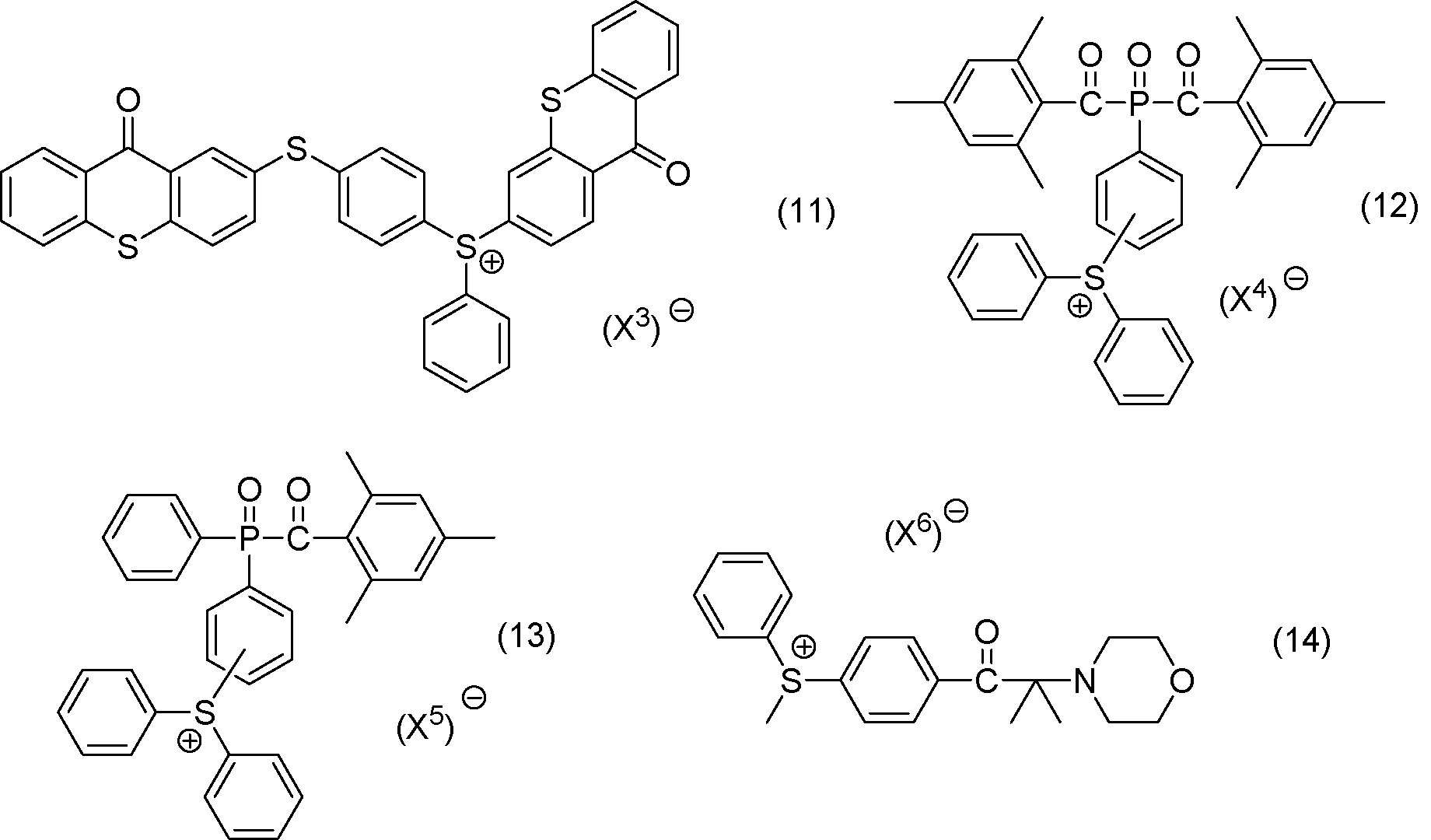
- sulfonium salt derivative (B121) a compound having a triphenylsulfonium cation, a tri-p-tolylsulfonium cation, or a [p- (phenylmercapto) phenyl] diphenylsulfonium cation as a cation skeleton is preferable from the viewpoint of acid generation efficiency.
- Compounds represented by the following general formulas (11) to (14) are preferable, and compounds represented by the following general formulas (11) to (14) are more preferable.
- (X 3 ) ⁇ to (X 6 ) ⁇ in the general formulas (11) to (14) represent anions, specifically, (X 1 ) ⁇ or (X 2 in the general formula (1) or (2). ) - it includes the same ones as exemplified as, preferable ones are also same.
- the iodonium salt derivative (B122) in the present invention is represented by the following general formula (15) or the following general formula (16).
- a 2 is a divalent or trivalent group represented by the general formulas (3) to (10), and Ar 8 to Ar 12 each independently have at least one benzene ring skeleton, Atoms, acyl groups having 1 to 20 carbon atoms, alkyl groups having 1 to 20 carbon atoms, alkoxy groups having 1 to 20 carbon atoms, alkylthio groups having 1 to 20 carbon atoms, alkylsilyl groups having 1 to 20 carbon atoms, nitro groups
- An aromatic hydrocarbon group that may be substituted with at least one substituent selected from the group consisting of a carboxyl group, a hydroxyl group, a mercapto group, an amino group, a cyano group, a phenyl group, a naphthyl group, a phenoxy group, and a phenylthio group
- Ar 8 to Ar 10 and Ar 12 are monovalent groups
- Ar 11 is a divalent group
- (X 7 ) ⁇ and (X 8 ) ⁇ represent an
- a halogen atom an acyl group having 1 to 20 carbon atoms, an alkyl group having 1 to 20 carbon atoms, an alkoxy group having 1 to 20 carbon atoms, an alkylthio group having 1 to 20 carbon atoms and an alkylsilyl group having 1 to 20 carbon atoms; The thing similar to what was described by description of General formula (1) and General formula (2) is illustrated.
- groups represented by the general formulas (7) to (10) are preferable from the viewpoint of the efficiency of generating an acid, and the general formulas (5) and (8) to The group represented by (10) is more preferable.
- Ar 8 to Ar 12 in the general formula (15) or the general formula (16) are groups having absorption in the ultraviolet to visible light region.
- the number of benzene ring skeletons in Ar 8 to Ar 12 is preferably 1 to 5, and more preferably 1 to 4.
- Specific examples of Ar 8 to Ar 12 include those represented by general formula (1) or general formula (2).
- Examples of Ar 1 to Ar 7 are the same as those exemplified above, and preferable examples are also the same.
- iodonium salt derivative (B122) (4-methylphenyl) ⁇ 4- (2-methylpropyl) phenyl ⁇ iodonium cation, [bis (4-t-butylphenyl)] iodonium are preferable from the viewpoint of acid generation efficiency.
- Compounds having a cationic skeleton and compounds represented by the following general formulas (17) to (20) are preferred, and compounds represented by the following general formulas (17) to (20) are more preferable.
- R 8 to R 13 are a hydrogen atom, a halogen atom, an acyl group having 1 to 20 carbon atoms, an alkyl group having 1 to 20 carbon atoms, an alkoxy group having 1 to 20 carbon atoms, An atom or substitution selected from the group consisting of an alkylthio group having 1 to 20 carbon atoms, an alkylsilyl group having 1 to 20 carbon atoms, a nitro group, a carboxyl group, a hydroxyl group, a mercapto group, an amino group, a cyano group, a phenyl group, and a naphthyl group
- (X 9 ) ⁇ to (X 12 ) ⁇ represent anions.
- a halogen atom an acyl group having 1 to 20 carbon atoms, an alkyl group having 1 to 20 carbon atoms, an alkoxy group having 1 to 20 carbon atoms, an alkylthio group having 1 to 20 carbon atoms and an alkylsilyl group having 1 to 20 carbon atoms; The thing similar to what was described by description of General formula (1) and General formula (2) is illustrated.
- R 8 to R 13 are preferably a halogen atom, a cyano group, a phenyl group, a naphthyl group, an alkyl group having 1 to 20 carbon atoms, and an alkoxy group having 1 to 20 carbon atoms, and more preferably a cyano group, A phenyl group, an alkyl group having 1 to 15 carbon atoms, an alkoxy group having 1 to 15 carbon atoms and an acyl group having 1 to 15 carbon atoms, particularly preferably an alkyl group having 1 to 10 carbon atoms and an alkyl group having 1 to 10 carbon atoms. An alkoxy group and an acyl group having 1 to 10 carbon atoms.
- the above alkyl moiety may be linear, branched or cyclic.
- a photopolymerization initiator that can be used for curing in the visible light region (360 nm to 830 nm; see JIS-Z8120) absorbs visible light, and the initiator itself is colored, which adversely affects the hue of the cured film.
- the compound represented by the general formula (2) or the general formula (16) an adverse effect on the hue of the cured film can be suppressed.
- Examples of the sulfonic acid ester derivative (B31) include methanesulfonic acid cyclohexyl ester, ethanesulfonic acid isopropyl ester, benzenesulfonic acid-t-butyl ester, p-toluenesulfonic acid cyclohexyl ester, and naphthalenesulfonic acid cyclohexyl ester.
- Examples of the acetic acid ester derivative (B32) include dichloroacetic acid cyclohexyl ester and trichloroacetic acid isopropyl ester.
- Examples of the phosphonic acid ester (B33) include triphenylphosphonic acid cyclohexyl ester.
- the addition amount of the acid generator (B) is preferably 0.05 to 30% by weight, more preferably 0.1 to 20% by weight, based on the weight of the polymerizable substance (D), from the viewpoint of photocurability. It is.
- the base generator (C) means a compound that generates a base with actinic rays, radicals or bases, a base generator (C1) that generates a base with actinic rays, and a base generator that generates a base with radicals.
- Known compounds such as the agent (C2) or a base generator (C3) that generates a base with a base can be used.
- the oxime derivative (C121), the quaternary ammonium salt derivative (C122), the quaternary amidine salt derivative (C123) and the like can generate a base by actinic rays or radicals, and are applied as (C1) or (C2). it can.
- the carbamate derivative (C31) can generate a base with a base and can be applied as (C3).
- (C) may be used alone or in combination of two or more.
- Examples of the oxime derivative (C121) include o-acyloxime.
- Examples of the carbamate derivative (C31) include 1-Fmoc-4-piperidone and o-nitrobenzoyl carbamate.
- Examples of the quaternary ammonium salt derivative (C122) and the quaternary amidine salt derivative (C123) include compounds represented by the following general formulas (21) to (23).
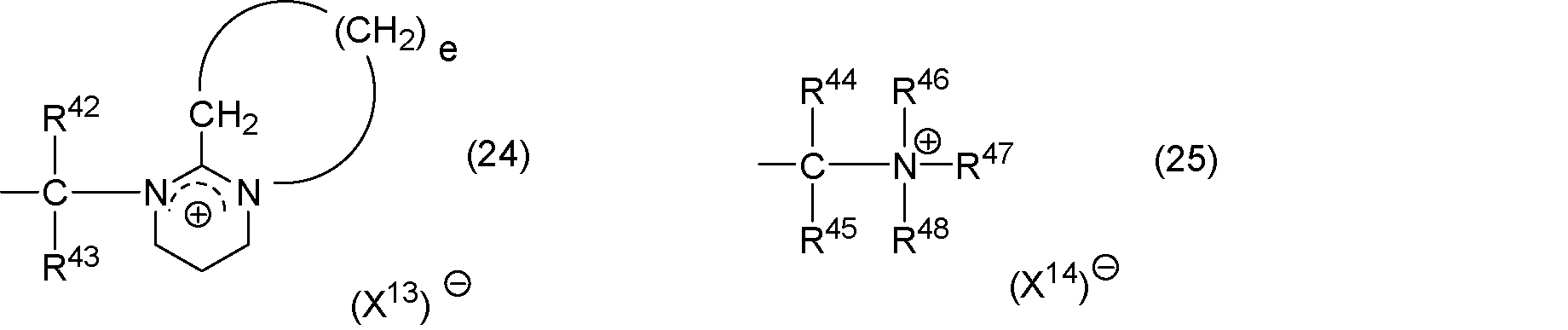
- R 14 to R 41 in the general formulas (21) to (23) are each a hydrogen atom, a halogen atom, an acyl group having 1 to 20 carbon atoms, an alkyl group having 1 to 20 carbon atoms, an alkoxy group having 1 to 20 carbon atoms, An alkylthio group having 1 to 20 carbon atoms, an alkylsilyl group having 1 to 20 carbon atoms, a nitro group, a carboxyl group, a hydroxyl group, a mercapto group, an amino group, a cyano group, a phenyl group, a naphthyl group, represented by the general formula (24) An atom or a substituent selected from the group consisting of a substituent represented by formula (25) and a substituent represented by formula (25), wherein any one of R 14 to R 23 is represented by formula (24) or formula (25 And any one of R 24 to R 31 is a substituent represented by the general formula (24) or the general formula (25), and any
- R 42 to R 45 are a hydrogen atom or an alkyl group having 1 to 20 carbon atoms, and R 46 to R 48 have 1 to 20 carbon atoms which may be substituted with a hydroxyl group.
- alkyl group, (X 13) - and (X 14) - represents an anion, e is an integer of 2-4.
- a halogen atom an acyl group having 1 to 20 carbon atoms, an alkyl group having 1 to 20 carbon atoms, an alkoxy group having 1 to 20 carbon atoms, an alkylthio group having 1 to 20 carbon atoms, and carbon
- alkylsilyl group of 1 to 20 are the same as those described in the description of the general formula (1) and the general formula (2).
- the compound represented by the general formula (21) is an anthracene skeleton
- the compound represented by the general formula (22) is a thioxanthone skeleton
- the compound represented by the general formula (23) is a compound having a benzophenone skeleton, i-line (365 nm). It is an example of a compound having a maximum absorption wavelength in the vicinity.
- R 14 to R 23 are modified in consideration of adjustment of absorption wavelength, adjustment of sensitivity, thermal stability, reactivity, decomposability, etc., and include a hydrogen atom, a halogen atom, an alkoxy group having 1 to 20 carbon atoms, Nitro group, carboxyl group, hydroxyl group, mercapto group, alkyl silyl group having 1 to 20 carbon atoms, acyl group having 1 to 20 carbon atoms, amino group, cyano group, alkyl group having 1 to 20 carbon atoms, phenyl group, naphthyl group The atom or substituent selected from the group consisting of is modified according to the purpose. However, any one of R 14 to R 23 is a substituent represented by the general formula (24) or the general formula (25).
- R 14 to R 23 are preferably a halogen atom, a cyano group, a phenyl group, a naphthyl group, an alkyl group having 1 to 20 carbon atoms, and an alkoxy group having 1 to 20 carbon atoms, and more preferably a cyano group, A phenyl group, an alkyl group having 1 to 15 carbon atoms, an alkoxy group having 1 to 15 carbon atoms and an acyl group having 1 to 15 carbon atoms, particularly preferably an alkyl group having 1 to 10 carbon atoms and an alkyl group having 1 to 10 carbon atoms. An alkoxy group and an acyl group having 1 to 10 carbon atoms.
- the above alkyl moiety may be linear, branched or cyclic.
- R 14 to R 23 include the compounds described in the description of R 8 to R 13 in the general formulas (17) to (19).
- the substituent represented by the general formula (24) is a substituent having a cationized amidine skeleton, and e is an integer of 2 to 4.
- substituents include a substituent having a structure in which 1,8-diazabicyclo [5.4.0] -7-undecene in which e is 4 and a 1,5-diazabicyclo [4. 3.0] -5-Nonene is preferably a substituent having a cationized structure.
- R 42 and R 43 represent a hydrogen atom or an alkyl group having 1 to 20 carbon atoms, preferably a hydrogen atom and an alkyl group having 1 to 10 carbon atoms, more preferably a hydrogen atom and an alkyl group having 1 to 5 carbon atoms. It is.
- Formula (25) has a quaternary ammonium structure
- R 44 and R 45 represent a hydrogen atom or an alkyl group having 1 to 20 carbon atoms, preferably a hydrogen atom or an alkyl group having 1 to 10 carbon atoms, More preferred are a hydrogen atom or an alkyl group having 1 to 5 carbon atoms.
- R 46 to R 48 each represents an alkyl group having 1 to 20 carbon atoms which may be substituted with a hydroxyl group, and may be linear, branched or cyclic.
- R 46 to R 48 are preferably an alkyl group having 1 to 10 carbon atoms, particularly preferably an alkyl group having 1 to 5 carbon atoms.
- (X 13 ) ⁇ and (X 14 ) ⁇ in the general formulas (24) and (25) represent anions, specifically, (X 1 ) ⁇ or (X 2 in the general formula (1) or (2). ) - it includes the same ones exemplified as. Of these, aliphatic or aromatic carboxy ions and borate anions are preferred from the viewpoint of photodegradability.
- the compound represented by the general formula (24) generates a basic compound having an amidine skeleton by cleaving the bond between carbon and nitrogen to which R 42 and R 43 are bonded by irradiation with actinic rays.
- the compound represented by 25 upon irradiation with actinic rays, a bond between carbon and nitrogen to which R 44 and R 45 are bonded is cleaved to generate a tertiary amine.
- the compound represented by the following general formula (26) is preferred from the viewpoint of photodegradability.
- (X 15 ) ⁇ in the general formula (26) represents an anion, specifically, the same as those exemplified as (X 1 ) ⁇ or (X 2 ) ⁇ in the general formula (1) or (2) Things.
- aliphatic or aromatic carboxy ions and borate anions are preferred from the viewpoint of photodegradability.
- Examples of the carbamate derivative (C31) include 1-Z-4-piperidone.
- the amount of the base generator (C) added is preferably 0.05 to 30% by weight, more preferably 0.1 to 20% by weight, based on the weight of the polymerizable substance (D), from the viewpoint of photocurability. It is.
- (A1) to (A3), (B1) to (B3) or (C1) to (C3) are preferably contained in any combination of the following (1) to (10).
- (10) A combination of two or more of (5) to (8) above.
- radicals are generated as active species (H) by irradiation with actinic rays, and acids are generated as active species (I).
- the active species (H) diffuses into the portions where the actinic rays are attenuated or shielded, thereby promoting curing in these portions.
- an acid is generated as an active species (H) by irradiation with actinic rays, and a radical is generated as an active species (I).
- the active species (H) diffuses into the portions where the actinic rays are attenuated or shielded, thereby promoting curing in these portions.
- a base is generated as an active species (H) by irradiation with actinic rays, and a radical is generated as an active species (I).
- the active species (H) diffuses into the portions where the actinic rays are attenuated or shielded, thereby promoting curing in these portions.
- a base is generated as an active species (H) as in the above (5), and the base is proliferated by reacting with this (C3), and the active light is attenuated or shielded. Is further accelerated.
- radicals are generated as active species (H) by irradiation with actinic rays, and bases are generated as active species (I).
- the active species (H) diffuses into the portions where the actinic rays are attenuated or shielded, thereby promoting curing in these portions.
- a base is generated as an active species (I) in the same manner as in the above (7), and this base reacts with (C3) so that the base is proliferated and the active light is attenuated or shielded. Is further accelerated.
- polymerizable substance (D) in the present invention known compounds such as a radical polymerizable compound (D1) and an ion polymerizable compound (D2) can be used.
- (D) may be used alone or in combination of two or more.
- a polymerization inhibitor such as hydroquinone or methyl ether hydroquinone may be used in combination.
- radical polymerizable compound (D1) examples include an acrylamide compound (D11) having 3 to 35 carbon atoms, a (meth) acrylate compound (D12) having 4 to 35 carbon atoms, and an aromatic vinyl compound (D13) having 6 to 35 carbon atoms. And a C3-C20 vinyl ether compound (D14) and other radical polymerizable compounds (D15).
- Examples of the (meth) acrylamide compound (D11) having 3 to 35 carbon atoms include (meth) acrylamide, N-methyl (meth) acrylamide, N-ethyl (meth) acrylamide, N-propyl (meth) acrylamide, N- n-butyl (meth) acrylamide, Nt-butyl (meth) acrylamide, N-butoxymethyl (meth) acrylamide, N-isopropyl (meth) acrylamide, N-methylol (meth) acrylamide, N, N-dimethyl (meth) ) Acrylamide, N, N-diethyl (meth) acrylamide and (meth) acryloylmorpholine.
- Examples of the (meth) acrylate compound (D12) having 4 to 35 carbon atoms include the following monofunctional to hexafunctional (meth) acrylates.
- Monofunctional (meth) acrylates include ethyl (meth) acrylate, hexyl (meth) acrylate, 2-ethylhexyl (meth) acrylate, tert-octyl (meth) acrylate, isoamyl (meth) acrylate, decyl (meth) acrylate, isodecyl (Meth) acrylate, stearyl (meth) acrylate, isostearyl (meth) acrylate, cyclohexyl (meth) acrylate, 4-n-butylcyclohexyl (meth) acrylate, bornyl (meth) acrylate, isobornyl (meth) acrylate, benzyl ( (Meth) acrylate, 2-ethy
- Bifunctional (meth) acrylates include 1,4-butanedi (meth) acrylate, 1,6-hexanediacrylate, polypropylene diacrylate, 1,6-hexanediol di (meth) acrylate, and 1,10-decanedioldi (Meth) acrylate, neopentyl diacrylate, neopentyl glycol di (meth) acrylate, 2,4-dimethyl-1,5-pentanediol di (meth) acrylate, butylethylpropanediol (meth) acrylate, ethoxylated cyclohexanemethanol Di (meth) acrylate, polyethylene glycol di (meth) acrylate, oligoethylene glycol di (meth) acrylate, ethylene glycol di (meth) acrylate, 2-ethyl-2-butyl-butanediol di (meth) Acrylate,
- Trifunctional (meth) acrylates include trimethylolpropane tri (meth) acrylate, trimethylolethane tri (meth) acrylate, trimethylolpropane alkylene oxide modified tri (meth) acrylate, pentaerythritol tri (meth) acrylate, di Pentaerythritol tri (meth) acrylate, trimethylolpropane tri ((meth) acryloyloxypropyl) ether, isocyanuric acid alkylene oxide modified tri (meth) acrylate, dipentaerythritol tri (meth) acrylate propionate, tri ((meta ) Acryloyloxyethyl) isocyanurate, hydroxypivalaldehyde-modified dimethylolpropane tri (meth) acrylate, sorbitol tri (meth) acrylate DOO, propoxylated trimethylolpropane tri (meth) acrylate
- Tetrafunctional (meth) acrylates include pentaerythritol tetra (meth) acrylate, sorbitol tetra (meth) acrylate, ditrimethylolpropane tetra (meth) acrylate, propionate dipentaerythritol tetra (meth) acrylate and ethoxylated pentaerythritol tetra. (Meth) acrylate etc. are mentioned.
- pentafunctional (meth) acrylates examples include sorbitol penta (meth) acrylate and dipentaerythritol penta (meth) acrylate.
- hexafunctional (meth) acrylates examples include dipentaerythritol hexa (meth) acrylate, sorbitol hexa (meth) acrylate, phosphazene alkylene oxide modified hexa (meth) acrylate, and caprolactone modified dipentaerythritol hexa (meth) acrylate. It is done.
- Examples of the aromatic vinyl compound having 6 to 35 carbon atoms (D13) include vinyl thiophene, vinyl furan, vinyl pyridine, styrene, methyl styrene, trimethyl styrene, ethyl styrene, isopropyl styrene, chloromethyl styrene, methoxy styrene, acetoxy styrene, chloro.
- Styrene dichlorostyrene, bromostyrene, vinyl benzoic acid methyl ester, 3-methylstyrene, 4-methylstyrene, 3-ethylstyrene, 4-ethylstyrene, 3-propylstyrene, 4-propylstyrene, 3-butylstyrene, 4-butylstyrene, 3-hexylstyrene, 4-hexylstyrene, 3-octylstyrene, 4-octylstyrene, 3- (2-ethylhexyl) styrene, 4- (2-ethylhexyl) styrene, allylstyrene Isopropenyl styrene, butenylstyrene, octenyl styrene, 4-t-butoxycarbonyl styrene, 4-methoxys
- Examples of the vinyl ether compound (D14) having 3 to 35 carbon atoms include the following monofunctional or polyfunctional vinyl ethers.
- Examples of the monofunctional vinyl ether include methyl vinyl ether, ethyl vinyl ether, propyl vinyl ether, n-butyl vinyl ether, t-butyl vinyl ether, 2-ethylhexyl vinyl ether, n-nonyl vinyl ether, lauryl vinyl ether, cyclohexyl vinyl ether, cyclohexyl methyl vinyl ether, 4-methyl Cyclohexylmethyl vinyl ether, benzyl vinyl ether, dicyclopentenyl vinyl ether, 2-dicyclopentenoxyethyl vinyl ether, methoxyethyl vinyl ether, ethoxyethyl vinyl ether, butoxyethyl vinyl ether, methoxyethoxyethyl vinyl ether, ethoxyethoxyethyl vinyl ether, methoxypolyethylene
- polyfunctional vinyl ether examples include ethylene glycol divinyl ether, diethylene glycol divinyl ether, polyethylene glycol divinyl ether, propylene glycol divinyl ether, butylene glycol divinyl ether, hexanediol divinyl ether, bisphenol A alkylene oxide divinyl ether, bisphenol F alkylene oxide divinyl ether.
- Divinyl ethers such as: trimethylolethane trivinyl ether, trimethylolpropane trivinyl ether, ditrimethylolpropane tetravinyl ether, glycerin trivinyl ether, pentaerythritol tetravinyl ether, dipentaerythritol pentavinyl ether, dipentaerythritol hexabi Ether, ethylene oxide-added trimethylolpropane trivinyl ether, propylene oxide-added trimethylolpropane trivinyl ether, ethylene oxide-added ditrimethylolpropane tetravinyl ether, propylene oxide-added ditrimethylolpropane tetravinyl ether, ethylene oxide-added pentaerythritol tetravinyl ether, propylene oxide-added pentaerythritol te
- radical polymerizable compounds (D15) include acrylonitrile, vinyl ester compounds (such as vinyl acetate, vinyl propionate and vinyl versatate), allyl ester compounds (such as allyl acetate), and halogen-containing monomers (vinylidene chloride and chloride). Vinyl) and olefin compounds (ethylene and propylene, etc.).
- acrylamide compounds having 3 to 35 carbon atoms (D11), (meth) acrylate compounds having 4 to 35 carbon atoms (D12), and aromatic vinyl compounds having 6 to 35 carbon atoms are preferable.
- (D13) and a vinyl ether compound (D14) having 3 to 20 carbon atoms more preferably an acrylamide compound (D11) having 3 to 35 carbon atoms and a (meth) acrylate compound (D12) having 4 to 35 carbon atoms. .
- Examples of the ion polymerizable compound (D2) include an epoxy compound (D21) having 3 to 20 carbon atoms and an oxetane compound having 4 to 20 carbon atoms (D22).
- Examples of the epoxy compound having 3 to 20 carbon atoms (D21) include the following monofunctional or polyfunctional epoxy compounds.
- Examples of the monofunctional epoxy compound include phenyl glycidyl ether, p-tert-butylphenyl glycidyl ether, butyl glycidyl ether, 2-ethylhexyl glycidyl ether, allyl glycidyl ether, 1,2-butylene oxide, and 1,3-butadiene monooxide.
- 1,2-epoxydodecane epichlorohydrin, 1,2-epoxydecane, styrene oxide, cyclohexene oxide, 3-methacryloyloxymethylcyclohexene oxide, 3-acryloyloxymethylcyclohexene oxide and 3-vinylcyclohexene oxide .
- polyfunctional epoxy compound examples include bisphenol A diglycidyl ether, bisphenol F diglycidyl ether, bisphenol S diglycidyl ether, brominated bisphenol A diglycidyl ether, brominated bisphenol F diglycidyl ether, and brominated bisphenol S diglycidyl ether.
- Epoxy novolac resin hydrogenated bisphenol A diglycidyl ether, hydrogenated bisphenol F diglycidyl ether, hydrogenated bisphenol S diglycidyl ether, 3,4-epoxycyclohexylmethyl-3 ', 4'-epoxycyclohexanecarboxylate, 2- (3,4-epoxycyclohexyl-5,5-spiro-3,4-epoxy) cyclohexane-meta-dioxane, bis (3,4-epoxycyclohexyl) Til) adipate, vinylcyclohexene oxide, 4-vinylepoxycyclohexane, bis (3,4-epoxy-6-methylcyclohexylmethyl) adipate, 3,4-epoxy-6-methylcyclohexyl-3 ′, 4′-epoxy-6 '-Methylcyclohexanecarboxylate, methylenebis (3,4-epoxycyclohex
- aromatic epoxides and alicyclic epoxides are preferable from the viewpoint of curing speed, and alicyclic epoxides are particularly preferable.
- Examples of the oxetane compound (D22) having 4 to 20 carbon atoms include compounds having 1 to 6 oxetane rings.
- Examples of the compound having one oxetane ring include 3-ethyl-3-hydroxymethyloxetane, 3- (meth) allyloxymethyl-3-ethyloxetane, (3-ethyl-3-oxetanylmethoxy) methylbenzene, 4 -Fluoro- [1- (3-ethyl-3-oxetanylmethoxy) methyl] benzene, 4-methoxy- [1- (3-ethyl-3-oxetanylmethoxy) methyl] benzene, [1- (3-ethyl-3 -Oxetanylmethoxy) ethyl] phenyl ether, isobutoxymethyl (3-ethyl-3-oxetanylmethyl) ether, isobornyloxyethyl (3-ethyl-3-oxetanylmethyl) ether, isobornyl (3-ethyl-3-oxet
- Examples of the compound having 2 to 6 oxetane rings include 3,7-bis (3-oxetanyl) -5-oxa-nonane, 3,3 ′-(1,3- (2-methylenyl) propanediylbis ( Oxymethylene)) bis- (3-ethyloxetane), 1,4-bis [(3-ethyl-3-oxetanylmethoxy) methyl] benzene, 1,2-bis [(3-ethyl-3-oxetanylmethoxy) methyl ] Ethane, 1,3-bis [(3-ethyl-3-oxetanylmethoxy) methyl] propane, ethylene glycol bis (3-ethyl-3-oxetanylmethyl) ether, dicyclopentenylbis (3-ethyl-3-oxetanyl) Methyl) ether, triethylene glycol bis (3-ethyl-3-oxetanylmethyl) ether,
- colorant (E) in the present invention pigments and dyes such as inorganic pigments and organic pigments conventionally used in paints and inks can be used.
- inorganic pigments include chrome yellow, zinc yellow, bitumen, barium sulfate, cadmium red, titanium oxide, zinc white, bengara, alumina, calcium carbonate, ultramarine, carbon black, graphite, and titanium black.
- Organic pigments include soluble azo pigments such as ⁇ -naphthol, ⁇ -oxynaphthoic acid anilide, acetoacetanilide, pyrazolone, ⁇ -naphthol, ⁇ -oxynaphthoic acid, ⁇ -oxynaphthoic acid Insoluble azo pigments such as anilide, acetoacetate anilide monoazo, acetoacetate anilide disazo, pyrazolone, phthalocyanine pigments such as copper phthalocyanine blue, halogenated copper phthalocyanine blue, sulfonated copper phthalocyanine blue, metal-free phthalocyanine, Examples thereof include non-cyclic compounds, quinacridone-based compounds, dioxazine-based compounds, perinone-based compounds, and perylene-based compounds.
- soluble azo pigments such as ⁇ -naphthol, ⁇ -oxynaphthoic acid
- dyes include yellow dyes, aryl or heteryl azo dyes having phenols, naphthols, anilines, pyrazolones, pyridones or open-chain active methylene compounds as coupling components, open-chain activity as coupling components
- examples thereof include azomethine dyes having a methylene compound, methine dyes such as benzylidene dyes and monomethine oxonol dyes, quinone dyes such as naphthoquinone dyes and anthraquinone dyes, quinophthalone dyes, nitro, nitroso dyes, acridine dyes and acridinone dyes.
- magenta dyes phenols, naphthols, anilines, pyrazolones, pyridones, pyrazolotriazoles, ring-closing active methylene compounds or heterocycles (pyrrole, imidazole, thiophene and thiazole derivatives, etc.) are used as coupling components.
- merocyanine dyes such as merocyanine dyes and oxonol dyes
- diphenylmethane dyes triphenylmethane dyes and xanthene dyes
- Examples thereof include carbonium dyes, quinone dyes such as naphthoquinone, anthraquinone and anthrapyridone, and condensed polycyclic dyes such as dioxazine dyes.
- cyan dyes As cyan dyes, azomethine dyes such as indoaniline dyes and indophenol dyes, polymethine dyes such as cyanine dyes, oxonol dyes and merocyanine dyes, carbonium dyes such as diphenylmethane dyes, triphenylmethane dyes and xanthene dyes, phthalocyanine dyes, anthraquinone dyes
- Examples of coupling components include phenols, naphthols, anilines, pyrrolopyrimidinone or pyrrolotriazinone derivatives, aryl or heteryl azo dyes (such as CI Direct Blue 14), and indigo / thioindigo dyes.
- the particle diameter of the colorant (E) is preferably from 0.01 ⁇ m to 2.0 ⁇ m, more preferably from 0.01 ⁇ m to 1.0 ⁇ m, from the viewpoint of the sharpness of the coating film.
- the amount of the colorant (E) added is not particularly limited, but it is preferably added in the range of 1 to 60% by weight in the photosensitive composition.
- a pigment dispersant is preferably added to improve the dispersibility and the storage stability of the photosensitive composition.
- Pigment dispersants manufactured by Big Chemie Anti-Terra-U, Disperbyk-101, 103, 106, 110, 161, 162, 164, 166, 167, 168, 170, 174, 182, 184, 2020, etc.
- Pigment dispersants manufactured by Ajinomoto Fine Techno Co. (Ajisper PB711, PB821, PB814, PN411, PA111, etc.)
- pigment dispersants manufactured by Lubrizol Solspers 5000, 12000, 32000, 33000, 39000, etc.).
- These pigment dispersants may be used alone or in combination of two or more.
- the addition amount of the pigment dispersant is not particularly limited, but it is preferably used in the range of 0.1 to 10% by weight in the photosensitive composition.
- the photosensitive composition of the present invention contains metal oxide powder (F) or metal powder (G) and can be used for forming green sheets and electrode layers of ceramic electronic components.
- the metal oxide powder (F) is used when forming the dielectric layer.
- Examples of (F) include titanium oxide, aluminum oxide, barium titanate, calcium zirconate, niobium oxide, and lead zirconate titanate, with barium titanate being preferred.
- the particle diameter of (F) is preferably from 0.01 ⁇ m to 2.0 ⁇ m, more preferably from 0.01 ⁇ m to 1.0 ⁇ m, from the viewpoint of dielectric constant.
- the metal powder (G) is a noble metal and a base metal used when forming the conductor layer, and specifically includes palladium, nickel, copper, silver, gold, etc., preferably palladium, nickel, and copper. It is.
- the average particle size of (G) is preferably 0.01 ⁇ m to 10 ⁇ m.
- the photosensitive composition of the present invention can contain a solvent, a sensitizer, an adhesion-imparting agent (such as a silane coupling agent) and the like as necessary.
- Solvents include glycol ethers (ethylene glycol monoalkyl ether, propylene glycol monoalkyl ether, etc.), ketones (acetone, methyl ethyl ketone, methyl isobutyl ketone, cyclohexanone, etc.), esters (ethyl acetate, butyl acetate, ethylene glycol alkyl ether).
- glycol ethers ethylene glycol monoalkyl ether, propylene glycol monoalkyl ether, etc.
- ketones acetone, methyl ethyl ketone, methyl isobutyl ketone, cyclohexanone, etc.
- esters ethyl acetate, butyl acetate, ethylene glycol alkyl ether.
- the content of the solvent in the photosensitive composition is preferably 0 to 99% by weight, more preferably 3 to 95% by weight, and particularly preferably 5 to 90% by weight.
- Sensitizers include ketocoumarin, fluorene, thioxanthone, anthraquinone, naphthiazoline, biacetyl, benzyl and their derivatives, perylene, and substituted anthracene.
- the content of the sensitizer is preferably 0 to 20% by weight, more preferably 1 to 15% by weight, and particularly preferably 5 to 10% by weight with respect to the photosensitive composition.
- Adhesive agents include ⁇ -aminopropyltrimethoxysilane, ⁇ -aminopropyltriethoxysilane, vinyltriethoxysilane, ⁇ -glycidoxypropyltriethoxysilane, ⁇ -methacryloxypropyltrimethoxysilane, ureapropyltri Examples include ethoxysilane, tris (acetylacetonate) aluminum, and acetylacetate aluminum diisopropylate.
- the content of the adhesion-imparting agent is preferably 0 to 20% by weight, more preferably 1 to 15% by weight, and particularly preferably 5 to 10% by weight with respect to the photosensitive composition.
- the photosensitive composition of the present invention further comprises inorganic fine particles, a dispersant, an antifoaming agent, a leveling agent, a thixotropic agent, a slip agent, a flame retardant, an antistatic agent, an antioxidant and an ultraviolet ray in accordance with the purpose of use.
- An absorbent or the like can be contained.
- the photosensitive composition of the present invention comprises a radical initiator (A), a polymerizable substance (D), an acid generator (B) or a base generator (C), a colorant (E), and a metal oxide powder. It can be obtained by kneading (F) or metal powder (G) with a solvent or other components, if necessary, with a ball mill or a three-roll mill.
- the kneading temperature is usually 10 ° C. to 40 ° C., preferably 20 ° C. to 30 ° C.
- the photosensitive composition of the present invention can be photocured by irradiation with actinic rays of 360 to 830 nm, in addition to commonly used high-pressure mercury lamps, ultra-high pressure mercury lamps, metal halide lamps, high-power metal halide lamps, etc. (UV The latest trends in EB curing technology, edited by Radtech Research Association, CMC Publishing, 138, 2006) can be used. Moreover, the irradiation apparatus using an LED light source can also be used conveniently. Heating may be performed for the purpose of diffusing the base generated from the photobase generator during and / or after irradiation with actinic rays. The heating temperature is usually 30 ° C. to 200 ° C., preferably 35 ° C. to 150 ° C., more preferably 40 ° C. to 120 ° C.
- Examples of the method for applying the photosensitive composition of the present invention to a substrate include known coating methods such as spin coating, roll coating, and spray coating, and planographic printing, carton printing, metal printing, offset printing, screen printing, and gravure printing.
- a known printing method can be applied.
- the present invention can also be applied to ink jet type coating in which fine droplets are continuously discharged.
- IRGACUR 819 [Ciba Japan Co., Ltd.] 4.2 parts, p-tolyl sulfoxide [Tokyo Kasei Co., Ltd.] 2.8 parts, nonafluoro-1-butanesulfonate potassium [Tokyo Kasei Co., Ltd.] 4 .1 part, 1.2 parts of sulfuric acid [manufactured by Wako Pure Chemical Industries, Ltd.] and 100 parts of acetonitrile were charged and dissolved, followed by stirring at 60 ° C. for 6 hours.
- DAROCUR TPO [Ciba Japan Co., Ltd.] 3.5 parts, diphenyl sulfoxide [Tokyo Kasei Co., Ltd.] 2.4 parts, potassium hexafluorophosphate [Tokyo Kasei Co., Ltd.] 2.2 parts, sulfuric acid [Wako Pure Chemical Industries, Ltd.] 1.2 parts and 100 parts of acetonitrile were charged and dissolved, followed by stirring at 60 ° C. for 6 hours. 200 parts of dichloromethane was added, the organic layer was washed three times with 200 parts of ion-exchanged water, and the solvent was distilled off from the organic layer under reduced pressure to obtain 5.4 parts of an acid generator (B121-3) (yellow solid). .
- the reaction solution was added dropwise to a dispersion composed of 3.0 parts of silver phenylglyoxylate and 20 parts of methanol, and the mixture was further stirred for 1 hour at room temperature (about 25 ° C.), and then the resulting gray solid was removed by filtration. Was distilled off under reduced pressure to obtain 4.5 parts of a brown solid. This brown solid was recrystallized with an ether / hexane mixed solution to obtain 2.6 parts of a photobase generator (C123-3) (yellow solid).
- Examples 1 to 21 (Examples of radical polymerization using pigments) [Preparation of photosensitive composition] ⁇ Preparation of high concentration dispersion> Titanium oxide as a pigment (“Typaque R-930” manufactured by Ishihara Sangyo Co., Ltd.), 43 parts of a pigment dispersant (“Solspers 32000” manufactured by Lubrizol) and tetrahydrofurryl acrylate as a radical polymerizable compound [Kyoeisha Chemical ( A mixture of 53 parts “light acrylate THF-A”] was kneaded for 3 hours using a ball mill to prepare a pigment dispersant solution having a pigment concentration of 43%.
- ⁇ Preparation of photosensitive composition 47 parts of the above high-concentration pigment dispersant solution, 46 parts of dipentaerythritol pentaacrylate [Sanyo Kasei Kogyo "Neomer DA-600”] as a radical polymerizable compound, diethylthioxanthone as a sensitizer [Nippon Kayaku “Kayacure DETX-S” manufactured by Co., Ltd. 2 parts and the radical generator (A) shown in Table 1 and the acid generator (B) or base generator (C) are used to produce a “radical generator (A) 3 parts of an acid generator (B) or 2 parts of a base generator (C) ”was kneaded for 3 hours at 25 ° C.
- Examples 22 to 27 (Examples of cationic polymerization using a pigment) [Preparation of photosensitive composition] ⁇ Preparation of high concentration dispersion> A mixture comprising 43 parts of titanium oxide as a pigment (“Typaque R-930” manufactured by Ishihara Sangyo Co., Ltd.), 4 parts of a pigment dispersant (“Solspers 32000” manufactured by Lubrizol) and 53 parts of cyclohexene oxide as an ion polymerizable compound A pigment dispersant solution having a pigment concentration of 43% was prepared by kneading for 3 hours using a ball mill.
- ⁇ Preparation of photosensitive composition 47 parts of the above high-concentration pigment dispersant solution, 46 parts of cyclohexene oxide as an ion polymerizable compound, 2 parts of diethylthioxanthone [“Kayacure DETX-S” manufactured by Nippon Kayaku Co., Ltd.] and Table 2 Using the radical generator (A) and the acid generator (B), “3 parts of the radical generator (A) and 2 parts of the acid generator (B)” are kneaded at 25 ° C. for 3 hours using a ball mill. Photosensitive compositions (Q-22) to (Q-27) were prepared.
- Example 26 the breakdown of 2 parts of (B) in Example 26 is 1.5 parts of (B2) and 0.5 part of (B3), and the breakdown of 2 parts of (B) in Example 27 is (B1) 1 Part, (B2) 0.5 part and (B3) 0.5 part.
- the breakdown of 3 parts (A) in Example 27 is 2 parts (A1) and 1 part (A2).
- Examples 28 to 34 (Examples of anionic polymerization using a pigment) [Preparation of photosensitive composition] ⁇ Preparation of high concentration dispersion> A mixture comprising 43 parts of titanium oxide as a pigment (“Typaque R-930” manufactured by Ishihara Sangyo Co., Ltd.), 4 parts of a pigment dispersant (“Solspers 32000” manufactured by Lubrizol) and 53 parts of cyclohexene oxide as an ion polymerizable compound A pigment dispersant solution having a pigment concentration of 43% was prepared by kneading for 3 hours using a ball mill.
- Photosensitive compositions (Q-35) to (Q -68) was produced.
- Comparative Examples 1 and 2 Example of radical polymerization using pigment
- (Q′-1) and (Q′-2) were produced.
- Comparative Examples 3 to 8 Examples of cationic polymerization using pigment Comparative photosensitivity in the same manner as in Examples 22 to 27 except that the radical generator (A) was not used and 5 parts of the acid generator (B) shown in Table 5 was used as the acid generator (B). Compositions (Q′-3) to (Q′-8) were produced. However, the breakdown of (B) 5 parts in Comparative Example 7 is (B2) 3.75 parts and (B3) 1.25 parts, and the breakdown of (B) 5 parts in Comparative Example 8 is (B1) 2 .5 parts, (B2) 1.25 parts and (B3) 1.25 parts.
- Comparative Examples 9 to 15 Comparative photosensitivity in the same manner as in Examples 28 to 34 except that the radical generator (A) was not used and 5 parts of the base generator (C) shown in Table 6 was used as the base generator (C). Compositions (Q′-9) to (Q′-15) were produced. However, the breakdown of (C) 5 parts in Comparative Example 14 is (C1) 3.75 parts and (C3) 1.25 parts, and the breakdown of (C) 5 parts in Comparative Example 15 is (C1) 2 .5 parts, (C2) 1.25 parts and (C3) 1.25 parts.
- Comparative Example 31 Example of cationic polymerization using a combination of a radical initiator and an acid generator that do not react with each other in a pigment-based system
- a comparative photosensitive composition (Q′-31) was produced in the same manner as in Example 22, except that the acid generator (B) shown in Table 1 was replaced with the acid generator (B) shown in Table 7.
- DAROCUR TPO (2,4,6-trimethylbenzoyl-diphenyl-phosphine oxide) as (A1231) is manufactured by Ciba Japan
- 1-Fmoc-4-piperidone as (C31) is Products manufactured by ALDRICH, BPO (benzoyl peroxide) as (A231), “NIPPER BW” manufactured by NOF, and p-toluenesulfonic acid cyclohexyl ester (B31) manufactured by Tokyo Chemical Industry Co., Ltd. were used.
- Each photosensitive composition obtained in Examples 1 to 68 and Comparative Examples 1 to 31 was subjected to surface treatment on a PET (polyethylene terephthalate) film having a thickness of 100 ⁇ m [Cosmo Shine A4300 manufactured by Toyobo Co., Ltd.] and an applicator. The film thickness was 20 ⁇ m or 80 ⁇ m.
- Exposure was carried out using a belt conveyor type UV irradiation device (“EICS-151U”, iGraphics Co., Ltd.). The exposure amount was 150 mJ / cm 2 at 365 nm.
- a generator (A) an acid generator (B) or a base generator (C)
- "3 parts of a radical generator (A), 2 parts of an acid generator (B) or a base generator (C)” is ball milled. Were used and kneaded at 25 ° C. for 3 hours to prepare photosensitive compositions (Q-69) to (Q-89) of the present invention.
- the breakdown of (B) 2 parts in Example 77 is (B1) 1.5 parts and (B3) 0.5 parts
- the breakdown of (C) 2 parts in Example 89 is (C1) 1 .5 parts and (C3) 0.5 parts.
- Comparative Examples 32-33 [Examples using metal oxide powder (F)] A comparative photosensitive composition (as in Example 69) except that 5 parts of the radical generator (A) shown in Table 10 was used as the radical generator (A) without using the acid generator (B). Q′-32) and (Q′-33) were produced.
- Comparative Examples 34 to 35 [Examples using metal powder (G)] A comparative photosensitive composition (Q′-) was used in the same manner as in Comparative Examples 32-33 except that “barium titanate powder” was replaced with “palladium powder [“ SFP-030 ”manufactured by Sumitomo Metal Mining Co., Ltd.]”. 34) or (Q′-35) was produced.
- Exposure was performed using a spot type LED irradiation device (“RX FireFlex” manufactured by Foseon Technology). The exposure amount was 150 mJ / cm 2 .
- Table 12 shows the results of evaluating the curability immediately after light irradiation of the coating film after curing with the following evaluation criteria by scratching with a finger and nails. A: There is no tack on the surface and it is not damaged by the nail. ⁇ : There is no tack on the surface, but the nail is damaged. ⁇ : There is tack on the surface and it is damaged by the nail. X: Uncured.
- Example 69 The photosensitive composition described in Example 69 was applied by a doctor blade method, exposed to light, and cured to produce a green sheet. Next, the photosensitive composition described in Example 90 was printed by screen printing, exposed and cured. 30 layers of this were stacked and pressure-bonded at a pressure of 49 MPa. Thereafter, the laminate was cut into a predetermined size to obtain a chip. This was degreased at 350 ° C. for 4 hours and then sintered at 1320 ° C. for 2 hours. Further, an external electrode was formed on the sintered body to obtain a multilayer ceramic capacitor. The capacitance of the obtained capacitor was measured based on JIS C 5101-1-1998, and it was confirmed that there was no problem. Further, as a result of checking the appearance and the inside with an optical microscope, no abnormality was found.
- the photosensitive composition of the present invention can be cured with a thick film at a high colorant concentration even with a small amount of energy, a coating agent, ink (such as UV printing ink and UV inkjet printing ink), paint, adhesive, or ceramic electronic component manufacturing It is extremely useful as a material for use.
- ink such as UV printing ink and UV inkjet printing ink
- paint adhesive, or ceramic electronic component manufacturing It is extremely useful as a material for use.
Landscapes
- Chemical & Material Sciences (AREA)
- Physics & Mathematics (AREA)
- Organic Chemistry (AREA)
- Health & Medical Sciences (AREA)
- General Physics & Mathematics (AREA)
- Chemical Kinetics & Catalysis (AREA)
- Medicinal Chemistry (AREA)
- Polymers & Plastics (AREA)
- Spectroscopy & Molecular Physics (AREA)
- Inorganic Chemistry (AREA)
- Engineering & Computer Science (AREA)
- Ceramic Engineering (AREA)
- Life Sciences & Earth Sciences (AREA)
- Biochemistry (AREA)
- General Health & Medical Sciences (AREA)
- Molecular Biology (AREA)
- Materials For Photolithography (AREA)
- Polymerisation Methods In General (AREA)
- Paints Or Removers (AREA)
- Inks, Pencil-Leads, Or Crayons (AREA)
- Adhesives Or Adhesive Processes (AREA)
- Organic Low-Molecular-Weight Compounds And Preparation Thereof (AREA)
- Polyethers (AREA)
- Epoxy Resins (AREA)
Abstract
Description
一般に光硬化性コーティング剤は、光重合開始剤、ラジカル重合性モノマー、オリゴマー又はポリマー、用途に応じ着色剤及び添加剤からなる。着色剤は大別して顔料及び染料からなり、塗膜を着色させるために配合される。着色剤は、その色に応じた光吸収特性を持ち、照射する光の一部を吸収して光を減衰させたり、照射する光を遮蔽してしまうため、塗布された塗膜の深部にまで光が届かないことがある。この問題を解決するために、特定の光重合開始剤を使用することが提案されている(例えば特許文献1参照)。
(1)ラジカル開始剤(A)
(2)酸発生剤(B)又は塩基発生剤(C)
(3)重合性物質(D)
(4)着色剤(E)、金属酸化物粉末(F)又は金属粉末(G)
である。
なお、本明細書において、活性光線とは360nm~830nmの波長を有する光線である。
また、照射した光を減衰又は遮蔽する物質として金属酸化物粉末又は金属粉末を使用することにより、セラミック電子部品のグリーンシート形成及び電極層形成を光照射により、短時間で行うことが可能となる。
(1)ラジカル開始剤(A)
(2)酸発生剤(B)又は塩基発生剤(C)
(3)重合性物質(D)
(4)着色剤(E)、金属酸化物粉末(F)又は金属粉末(G)。
尚、活性種(H)が酸の場合は活性種(I)は塩基ではなく、活性種(H)が塩基の場合は活性種(I)は酸ではないことが必要である。
例えば、アシルホスフィンオキサイド誘導体系重合開始剤(A1231)、α-アミノアセトフェノン誘導体系重合開始剤(A1232)、ベンジルケタール誘導体系重合開始剤(A1233)、α-ヒドロキシアセトフェノン誘導体系重合開始剤(A1234)、ベンゾイン誘導体系重合開始剤(A1235)、オキシムエステル誘導体系重合開始剤(A1236)及びチタノセン誘導体系重合開始剤(A1237)等は活性光線、酸又は塩基いずれによってもラジカルを発生させることが可能で(A1)、(A2)又は(A3)のいずれとしても適用できる。
また、有機過酸化物系重合開始剤(A231)、アゾ化合物系重合開始剤(A232)、その他のラジカル開始剤(A233)等は酸又は塩基によってラジカルを発生させることが可能で(A2)又は(A3)として適用できる。
(A)は単独で用いてもよいし、2種以上を併用してもよい。
なお、(A1231)は、(A1)(A2)(A3)のいずれとしても適用できる化合物の1番目の例であることを示す。同様に、(A231)は、(A2)(A3)のいずれとしても適用できる化合物の1番目の例であることを示す。
例えば、スルホニウム塩誘導体(B121)及びヨードニウム塩誘導体(B122)等は活性光線又はラジカルによって酸を発生させることが可能で、(B1)又は(B2)として適用できる。
また、スルホン酸エステル誘導体(B31)、酢酸エステル誘導体(B32)及びホスホン酸エステル(B33)等は酸によって酸を発生させることが可能で、(B3)として適用できる。
(B)は単独で用いてもよいし、2種以上を併用してもよい。


Ar1~Ar7におけるベンゼン環骨格の数は、好ましくは1~5、更に好ましくは1~4である。
ベンゼン環骨格を1個有する場合の例としては、例えばベンゼン、又はベンゾフラン、ベンゾチオフェン、インドール、キノリン、クマリン等の複素環化合物から水素原子を1個又は2個除いた残基が挙げられる。
ベンゼン環骨格を2個有する場合の例としては、例えばナフタレン、ビフェニル、フルオレン、又はジベンゾフラン、ジベンゾチオフェン、キサントン、キサンテン、チオキサントン、アクリジン、フェノチアジン及びチアントレン等の複素環化合物から水素原子を1個又は2個除いた残基が挙げられる。
ベンゼン環骨格を3個有する場合の例としては、例えば、アントラセン、フェナントレン、ターフェニル、p-(チオキサンチルメルカプト)ベンゼン及びナフトベンゾチオフェン等の複素環化合物から水素原子を1個又は2個除いた残基が挙げられる。
ベンゼン環骨格を4個有する場合の例としては、例えばナフタセン、ピレン、ベンゾアントラセン及びトリフェニレン等から水素原子を1個又は2個除いた残基が挙げられる。

Ar8~Ar12におけるベンゼン環骨格の数は、好ましくは1~5、更に好ましくは1~4であり、Ar8~Ar12の具体例としては、一般式(1)又は一般式(2)のAr1~Ar7として例示したものと同様のものが挙げられ、好ましいものも同様である。

例えば、オキシム誘導体(C121)、4級アンモニウム塩誘導体(C122)及び4級アミジン塩誘導体(C123)等は活性光線又はラジカルによって塩基を発生させることが可能で、(C1)又は(C2)として適用できる。
また、カルバメート誘導体(C31)は塩基によって塩基を発生させることが可能で、(C3)として適用できる。
(C)は単独で用いてもよいし、2種以上を併用してもよい。


(1)(A1)及び(B2)を含有する。
(2)(A1)、(B2)及び(B3)を含有する。
(3)(B1)及び(A2)を含有する。
(4)(B1)、(A2)及び(B3)を含有する。
(5)(C1)及び(A3)を含有する。
(6)(C1)、(A3)及び(C3)を含有する。
(7)(A1)及び(C2)を含有する。
(8)(A1)、(C2)及び(C3)を含有する。
(9)上記(1)~(4)の2種以上の組み合わせ。
(10)上記(5)~(8)の2種以上の組み合わせ。
尚、上記及び以下において、「アクリレート」、「メタクリレート」の双方又はいずれかを指す場合「(メタ)アクリレート」と、「アクリル」、「メタクリル」の双方又はいずれかを指す場合「(メタ)アクリル」と、それぞれ記載することがある。
単官能(メタ)アクリレートとしては、エチル(メタ)アクリレート、ヘキシル(メタ)アクリレート、2-エチルヘキシル(メタ)アクリレート、tert-オクチル(メタ)アクリレート、イソアミル(メタ)アクリレート、デシル(メタ)アクリレート、イソデシル(メタ)アクリレート、ステアリル(メタ)アクリレート、イソステアリル(メタ)アクリレート、シクロヘキシル(メタ)アクリレート、4-n-ブチルシクロへキシル(メタ)アクリレート、ボルニル(メタ)アクリレート、イソボルニル(メタ)アクリレート、ベンジル(メタ)アクリレート、2-エチルヘキシルジグリコール(メタ)アクリレート、ブトキシエチル(メタ)アクリレート、2-クロロエチル(メタ)アクリレート、4-ブロモブチル(メタ)アクリレート、シアノエチル(メタ)アクリレート、ベンジル(メタ)アクリレート、ブトキシメチル(メタ)アクリレート、メトキシプロピレンモノアクリレート、3-メトキシブチル(メタ)アクリレート、アルコキシメチル(メタ)アクリレート、2-エチルへキシルカルビトール(メタ)アクリレート、アルコキシエチル(メタ)アクリレート、2-(2-メトキシエトキシ)エチル(メタ)アクリレート、2-(2-ブトキシエトキシ)エチル(メタ)アクリレート、2,2,2-テトラフルオロエチル(メタ)アクリレート、1H,1H,2H,2H-パーフルオロデシル(メタ)アクリレート、4-ブチルフェニル(メタ)アクリレート、フェニル(メタ)アクリレート、2,4,5-テトラメチルフェニル(メタ)アクリレート、4-クロロフェニル(メタ)アクリレート、フェノキシメチル(メタ)アクリレート、フェノキシエチル(メタ)アクリレート、グリシジル(メタ)アクリレート、グリシジロキシブチル(メタ)アクリレート、グリシジロキシエチル(メタ)アクリレート、グリシジロキシプロピル(メタ)アクリレート、ジエチレングリコールモノビニルエーテルモノアクリレート、テトラヒドロフルフリル(メタ)アクリレート、ヒドロキシアルキル(メタ)アクリレート、2-ヒドロキシエチル(メタ)アクリレート、3-ヒドロキシプロピル(メタ)アクリレート、2-ヒドロキシプロピル(メタ)アクリレート、2-ヒドロキシブチル(メタ)アクリレート、4-ヒドロキシブチル(メタ)アクリレート、ジメチルアミノエチル(メタ)アクリレート、ジエチルアミノエチル(メタ)アクリレート、ジメチルアミノプロピル(メタ)アクリレート、ジエチルアミノプロピル(メタ)アクリレート、トリメトキシシリルプロピル(メタ)アクリレート、トリメトキシシリルプロピル(メタ)アクリレート、トリメチルシリルプロピル(メタ)アクリレート、ポリエチレンオキサイドモノメチルエーテル(メタ)アクリレート、オリゴエチレンオキサイドモノメチルエーテル(メタ)アクリレート、ポリエチレンオキサイド(メタ)アクリレート、オリゴエチレンオキサイド(メタ)アクリレート、オリゴエチレンオキサイドモノアルキルエーテル(メタ)アクリレート、ポリエチレンオキサイドモノアルキルエーテル(メタ)アクリレート、ジプロピレングリコール(メタ)アクリレート、ポリプロピレンオキサイドモノアルキルエーテル(メタ)アクリレート、オリゴプロピレンオキサイドモノアルキルエーテル(メタ)アクリレート、2-メタクリロイロキシエチルコハク酸、2-メタクリロイロキシヘキサヒドロフタル酸、2-メタクリロイロキシエチル-2-ヒドロキシプロピルフタレート、ブトキシジエチレングリコール(メタ)アクリレート、トリフロロエチル(メタ)アクリレート、パーフロロオクチルエチル(メタ)アクリレート、2-ヒドロキシ-3-フェノキシプロピル(メタ)アクリレート、EO変性フェノール(メタ)アクリレート、EO変性クレゾール(メタ)アクリレート、EO変性ノニルフェノール(メタ)アクリレート、PO変性ノニルフェノール(メタ)アクリレート及びEO変性-2-エチルヘキシル(メタ)アクリレート等が挙げられる。
単官能ビニルエーテルとしては、例えば、メチルビニルエーテル、エチルビニルエーテル、プロピルビニルエーテル、n-ブチルビニルエーテル、t-ブチルビニルエーテル、2-エチルヘキシルビニルエーテル、n-ノニルビニルエーテル、ラウリルビニルエーテル、シクロヘキシルビニルエーテル、シクロヘキシルメチルビニルエーテル、4-メチルシクロヘキシルメチルビニルエーテル、ベンジルビニルエーテル、ジシクロペンテニルビニルエーテル、2-ジシクロペンテノキシエチルビニルエーテル、メトキシエチルビニルエーテル、エトキシエチルビニルエーテル、ブトキシエチルビニルエーテル、メトキシエトキシエチルビニルエーテル、エトキシエトキシエチルビニルエーテル、メトキシポリエチレングリコールビニルエーテル、テトラヒドロフリフリルビニルエーテル、2-ヒドロキシエチルビニルエーテル、2-ヒドロキシプロピルビニルエーテル、4-ヒドロキシブチルビニルエーテル、4-ヒドロキシメチルシクロヘキシルメチルビニルエーテル、ジエチレングリコールモノビニルエーテル、ポリエチレングリコールビニルエーテル、クロルエチルビニルエーテル、クロルブチルビニルエーテル、クロルエトキシエチルビニルエーテル、フェニルエチルビニルエーテル及びフェノキシポリエチレングリコールビニルエーテルが挙げられる。
単官能エポキシ化合物としては、例えば、フェニルグリシジルエーテル、p-tert―ブチルフェニルグリシジルエーテル、ブチルグリシジルエーテル、2-エチルヘキシルグリシジルエーテル、アリルグリシジルエーテル、1,2-ブチレンオキサイド、1,3-ブタジエンモノオキサイド、1,2-エポキシドデカン、エピクロロヒドリン、1,2-エポキシデカン、スチレンオキサイド、シクロヘキセンオキサイド、3-メタクリロイルオキシメチルシクロヘキセンオキサイド、3-アクリロイルオキシメチルシクロヘキセンオキサイド及び3-ビニルシクロヘキセンオキサイドが挙げられる。
顔料分散剤としてはビックケミー社製顔料分散剤(Anti-Terra-U、Disperbyk-101,103、106、110、161、162、164、166、167、168,170、174、182、184又は2020等)、味の素ファインテクノ社製顔料分散剤(アジスパーPB711、PB821、PB814、PN411及びPA111等)、ルーブリゾール社製顔料分散剤(ソルスパーズ5000、12000、32000、33000及び39000等)が挙げられる。これらの顔料分散剤は単独で用いても2種以上を併用してもよい。顔料分散剤の添加量は特に限定されるものではないが、感光性組成物中に0.1~10重量%の範囲で用いることが好ましい。
(G)の平均粒子径は、0.01μm~10μmであることが好ましい。
感光性組成物における溶剤の含有量は、0~99重量%であることが好ましく、更に好ましくは3~95重量%、特に好ましくは5~90重量%である。
製造例1
[酸発生剤(B121-1){一般式(27)で表される化合物}の合成]

2-クロロチオキサントン11.0部、チオフェノール4.9部、水酸化カリウム2.5部及びN,N-ジメチルホルムアミド162部を均一混合し、130℃で9時間反応させた後、反応溶液を室温(約25℃)まで冷却し、蒸留水200部中に投入し、生成物を析出させた。これをろ過し、残渣を水で濾液のpHが中性になるまで洗浄した後、残渣を減圧乾燥させ、黄色粉末状の生成物を得た。カラムクロマトグラフィー(溶離液:トルエン/ヘキサン=1/1:容量比)で精製し、中間体(B121-1-1)(黄色固体)3.1部を得た。
中間体(B121-1-1)11.2部、アセトニトリル215部及び硫酸0.02部を40℃で撹拌しながら、これに30%過酸化水素水溶液4.0部を徐々に滴下し、40~45℃で14時間反応させた後、反応溶液を室温(約25℃)まで冷却し、蒸留水200部中に投入し、生成物を析出させた。これをろ過し、残渣を水で濾液のpHが中性になるまで洗浄した後、残渣を減圧乾燥させ、黄色粉末状の生成物を得た。カラムクロマトグラフィー(溶離液:酢酸エチル/トルエン=1/3:容量比)にて生成物を精製して、中間体(B121-1-2)(黄色固体)13.2部を得た。
中間体(B121-1-2)4.3部、無水酢酸4.1部及びアセトニトリル110部を40℃で撹拌しながら、これにトリフルオロメタンスルホン酸2.4部を徐々に滴下し、40~45℃で1時間反応させた後、反応溶液を室温(約25℃)まで冷却し、蒸留水150部中に投入し、クロロホルムで抽出し、水相のpHが中性になるまで水で洗浄した。クロロホルム相をロータリーエバポレーターに移して溶媒を留去した後、トルエン50部を加えて超音波洗浄器でトルエン中に分散し約15分間静置してから上澄みを除く操作を3回繰り返して、生成した固体を洗浄した後、残渣を減圧乾燥した。この残渣をジクロロメタン212部に溶かし、10%トリス(ペンタフルオロエチル)トリフルオロリン酸カリウム水溶液65部中に投入してから、室温(約25℃)で2時間撹拌し、ジクロロメタン層を分液操作にて水で3回洗浄した後、有機溶媒を減圧留去することにより、酸発生剤(B121-1)(黄色固体)5.5部を得た。
[酸発生剤(B121-2){一般式(28)で表される化合物}の合成]

[酸発生剤(B121-3){一般式(29)で表される化合物}の合成]

[酸発生剤(B121-4){一般式(30)で表される化合物}の合成]

[酸発生剤(B122-1){一般式(31)で表される化合物}の合成]

[酸発生剤(B122-2){一般式(32)で表される化合物}の合成]

[酸発生剤(B122-3){一般式(33)で表される化合物}の合成]

[酸発生剤(B122-4){一般式(34)で表される化合物}の合成]

製造例9
[塩基発生剤(C122-1){一般式(35)でされる化合物}の合成]

[塩基発生剤(C122-2){一般式(36)で表される化合物}の合成]

ジチオサリチル酸[和光純薬工業(株)製]10部を硫酸139部に溶解させ、1時間室温(約25℃)で攪拌した後、氷浴にて冷却して冷却溶液を得た。ついで、この冷却溶液の液温を20℃以下に保ちながら、トルエン25部を少しずつ滴下した後、室温(約25℃)にもどし、更に2時間攪拌して反応液を得た。水815部に反応液を少しずつ加えた後、析出した黄色固体を濾別した。この黄色固体をジクロロメタン260部に溶解させ、水150部を加え、更に24%KOH水溶液6.7部を加えて水層をアルカリ性とし、1時間攪拌した後、分液操作にて水層を除去し、有機層を130部の水で3回洗浄した。ついで有機層を無水硫酸ナトリウムにて乾燥した後、有機溶剤を減圧留去して、中間体(C122-2-1)(黄色固体)8.7部を得た。尚、中間体(C122-2-1)は、2-メチルチオキサントンと3-メチルチオキサントンの混合物である。
中間体(C122-2-1)2.1部をシクロヘキサン120部に溶解させ、これにN-ブロモスクシンイミド[和光純薬工業(株)製]8.3部及び過酸化ベンゾイル[和光純薬工業(株)製]0.1部を加え、還流下で4時間反応させた後(3-メチルチオキサントンは反応しない)、溶剤(シクロヘキサン)を留去し、そこへクロロホルム50部を加えて残渣を再溶解させてクロロホルム溶液を得た。クロロホルム溶液を30部の水で3回洗浄し、分液操作により水層を除去した後、有機溶剤を減圧留去して、褐色固体1.7部を得た。これを酢酸エチルで再結晶させて(3-メチルチオキサントンはここで除かれる)、中間体(C122-2-2)(黄色固体)1.5部を得た。
中間体(C122-2-2)(2-ブロモメチルチオキサントン)1.0部をジクロロメタン85gに溶解し、これにトリエタノールアミン[和光純薬工業(株)製]0.5部を滴下した後(滴下後発熱した)、室温(約25℃)下、1時間攪拌し、有機溶剤を減圧留去して、白色固体2.2部を得た。この白色固体をテトラヒドロフラン/ジクロロメタン混合溶液で再結晶させて、中間体(C122-2-3)(褐色固体)1.0部を得た。
ナトリウムテトラフェニルボレート塩[ナカライテスク(株)製]0.8部を水17部で溶解させた水溶液に、あらかじめクロロホルム50部に中間体(C122-2-3)1.0部を溶解させた溶液を少しずつ滴下した後、1時間室温(約25℃)で攪拌し、水層を分液操作により除き、有機層を30部の水で3回洗浄した。有機溶剤を減圧留去して、黄色固体を得た。この黄色固体をアセトニトリル/エーテル混合溶液で再結晶させて、塩基発生剤(C122-2)(微黄色粉末)1.3部を得た。
[塩基発生剤(C122-3){一般式(37)で表される化合物}の合成]

「トリエタノールアミン[和光純薬工業(株)製]0.5部」を「ジメチルエタノールアミン[和光純薬工業(株)製]0.3部」に変更した以外、製造例10の(1)~(3)と同様にして中間体(C122-3-3)(褐色固体)0.8部を得た。
「中間体(C122-2-3)1.0部」を「中間体(C122-3-3)0.8部」に変更した以外、製造例10の(4)と同様にして塩基発生剤(C122-3)(白色粉末)1.0部を得た。
[塩基発生剤(C122-4){一般式(38)で表される化合物}の合成]

[塩基発生剤(C123-1){一般式(39)で表される化合物}の合成]

[塩基発生剤(C123-2){一般式(40)で表される化合物}の合成]

[塩基発生剤(C123-3){一般式(41)で表される化合物}の合成]

フェニルグリオキシル酸(アルドリッチ社製)3.9部をメタノール20部に溶解させ、そこへ水酸化ナトリウム[和光純薬工業(株)製]0.9部を少しずつ加え(中和による発熱がみられた)、1時間攪拌し、そこへ1mol/L硝酸銀水溶液[和光純薬工業(株)製]10.4部を加えた後、析出した灰色固体を濾別し、メタノールで洗浄し、乾燥して、フェニルグリオキシル酸銀(灰色固体)4.4部を得た。
9-クロロメチルアントラセン(アルドリッチ社製)2.0部をメタノール40gに溶解させ、そこへ1,8-ジアザビシクロ[5.4.0]-7-ウンデセン[サンアプロ(株)製「DBU」]1.3部を少量ずつ加え(添加後若干の発熱が見られた。)、このまま室温(約25℃)で1時間攪拌して反応液を得た。フェニルグリオキシル酸銀3.0部及びメタノール20部からなる分散液に、反応液を少しずつ滴下し、更に1時間室温(約25℃)で攪拌した後、生じた灰色固体を濾過により除いた濾液を減圧留去して、褐色固体4.5部を得た。この褐色固体をエーテル/ヘキサン混合溶液で再結晶させて、光塩基発生剤(C123-3)(黄色固体)2.6部を得た。
[塩基発生剤(C123-4){一般式(42)で表される化合物}の合成]

「トリエタノールアミン[和光純薬工業(株)製]」を「1,8-ジアザビシクロ[5.4.0]-7-ウンデセン[サンアプロ(株)製「DBU」]」に変更した以外、製造例10の(1)~(3)と同様にして中間体(C123-4-3)(白色固体)2.2部を得た。
「中間体(C122-2-3)」を「中間体(C123-4-3)」に変更した以外、製造例10(4)と同様にして塩基発生剤(C123-4)(淡黄白色粉末)1.3部を得た。
[塩基発生剤(C123-5){一般式(43)で表される化合物}の合成]

中間体(C122-2-1)2.1部をジクロロメタン85部に溶解させ、これに塩化アルミニウム(III)[和光純薬工業(株)製]0.5部と2-クロロ-2-メチルプロパン[和光純薬工業(株)製]1.9部を加え、23時間室温(約25℃)で攪拌した。水層を分液操作により除き、有機層を30部の水で3回洗浄した。有機溶剤を減圧留去して、淡黄色固体を得た。この淡黄色固体を酢酸エチル/ヘキサン混合溶液にて再結晶させて、中間体(C123-5-1)(黄色粉末)0.5部を得た。
「中間体(C122-2-1)2.1部」を「中間体(C123-5-1)1.0部」に変更した以外、製造例10の(2)と同様にして中間体(C123-5-2)(黄色粉末)1.2部を得た。
「中間体(C122-2-2)」を「中間体(C123-5-2)」に変更した以外、製造例10の(3)と同様にして中間体(C123-5-3)(微黄色粉末)1.3部を得た。
「中間体(C122-2-2)1.0部」を「中間体(C123-5-3)0.8部」に変更した以外、製造例10の(4)と同様にして塩基発生剤(C123-5)(微黄色粉末)1.0部を得た。
[塩基発生剤(C123-6){一般式(44)で表される化合物}の合成]

4-メチルベンゾフェノン(アルドリッチ社製)25.1部、N-ブロモスクシンイミド[和光純薬工業(株)製]22.8部、過酸化ベンゾイル[20%含水:和光純薬工業(株)製]0.54部及びアセトニトリル80部を加え、80℃まで加熱し、還流下2時間反応させ、冷却した後、有機溶剤を減圧留去して、メタノール160部で再結晶させて、中間体(C123-6-1)(白色結晶)26部を得た。
中間体(C123-6-1)25.8部をアセトニトリル100部に溶解させ、これに1,8-ジアザビシクロ[5.4.0]-7-ウンデセン[サンアプロ(株)製「DBU」]14.6部を滴下した後(滴下後発熱した。)、室温(約25℃)下、18時間攪拌し、有機溶剤を減圧留去して、褐色固体を得た。この褐色固体をアセトニトリルで再結晶を行い、中間体(C123-6-2)(白色固体)28.2部を得た。
ナトリウムテトラフェニルボレート塩[ナカライテスク(株)製]0.8部を水17部に溶解させ、あらかじめクロロホルム50部に中間体(C123-6-2)6.8部を溶解させた溶液を少しずつ滴下した後、2時間室温(約25℃)で攪拌して反応液を得た。反応液を濾過し、濾液を減圧留去して得た黄色液体をアセトニトリルに溶解して再結晶して、塩基発生剤(C123-6)(白色固体)7.6部を得た。
[塩基発生剤(C123-7){一般式(45)で表される化合物}の合成]

「中間体(C123-6-1)25.8部」を「2-ブロモメチルナフタレン[東京化成工業(株)製]1.1部」に変更した以外、製造例18(2)と同様にして中間体(C123-7-1)(白色粉末)1.3部を得た。
「中間体(C123-6-2)6.8部」を「中間体(C123-7-1)0.8部」に変更した以外、製造例18の(3)と同様にして光塩基発生剤(C123-7)(微黄色粉末)1.3部を得た。
[感光性組成物の調製]
<高濃度分散液の調製>
顔料としての酸化チタン(石原産業社製「タイペークR-930」)43部、顔料分散剤(ルーブリゾール社製「ソルスパーズ32000」)4部及びラジカル重合性化合物としてのテトラヒドロフルリルアクリレート[共栄社化学(株)製「ライトアクリレートTHF-A」]53部からなる混合物を、ボールミルを用いて3時間混練することにより顔料濃度43%の顔料分散剤液を調製した。
前記高濃度顔料分散剤液47部、ラジカル重合性化合物としてのジペンタエリスリトールペンタアクリレート[三洋化成工業(株)製「ネオマーDA-600」]46部、増感剤としてのジエチルチオキサントン[日本化薬(株)製「カヤキュアDETX-S」]2部及び表1に示すラジカル発生剤(A)と、酸発生剤(B)又は塩基発生剤(C)とを用いて「ラジカル発生剤(A)3部、酸発生剤(B)又は塩基発生剤(C)2部」をボールミルを用いて25℃で3時間混練して本発明の感光性組成物(Q-1)~(Q-21)を製造した。
但し、実施例9における(B)2部の内訳は、(B1)1.5部及び(B3)0.5部であり、実施例21における(C)2部の内訳は、(C1)1.5部及び(C3)0.5部である。

[感光性組成物の調製]
<高濃度分散液の調製>
顔料としての酸化チタン(石原産業社製「タイペークR-930」)43部、顔料分散剤(ルーブリゾール社製「ソルスパーズ32000」)4部及びイオン重合性化合物としてのシクロヘキセンオキサイド53部からなる混合物を、ボールミルを用いて3時間混練することにより顔料濃度43%の顔料分散剤液を調製した。
前記高濃度顔料分散剤液47部、イオン重合性化合物としてのシクロヘキセンオキサイド46部、増感剤としてのジエチルチオキサントン[日本化薬(株)製「カヤキュアDETX-S」]2部及び表2に示すラジカル発生剤(A)及び酸発生剤(B)を用いて「ラジカル発生剤(A)3部、酸発生剤(B)2部」をボールミルを用いて25℃で3時間混練して本発明の感光性組成物(Q-22)~(Q-27)を製造した。
但し、実施例26における(B)2部の内訳は、(B2)1.5部及び(B3)0.5部であり、実施例27における(B)2部の内訳は、(B1)1部、(B2)0.5部及び(B3)0.5部である。
実施例27における(A)3部の内訳は、(A1)2部、及び(A2)1部である。

[感光性組成物の調製]
<高濃度分散液の調製>
顔料としての酸化チタン(石原産業社製「タイペークR-930」)43部、顔料分散剤(ルーブリゾール社製「ソルスパーズ32000」)4部及びイオン重合性化合物としてのシクロヘキセンオキサイド53部からなる混合物を、ボールミルを用いて3時間混練することにより顔料濃度43%の顔料分散剤液を調製した。
前記高濃度顔料分散剤液47部、イオン重合性化合物としてのシクロヘキセンオキサイド46部、増感剤としてのジエチルチオキサントン[日本化薬(株)製「カヤキュアDETX-S」]2部及び表3に示すラジカル発生剤(A)及び塩基発生剤(C)を用いて「ラジカル発生剤(A)3部、塩基発生剤(C)2部」をボールミルを用いて25℃で3時間混練して本発明の感光性組成物(Q-28)~(Q-34)を製造した。
実施例33における(C)2部の内訳は、(C2)1部、及び(C3)1部である。
実施例34における(A)3部の内訳は、(A1)2部、及び(A2)1部であり、(C)2部の内訳は、(C1)1部、(C2)0.5部及び(C3)0.5部である。
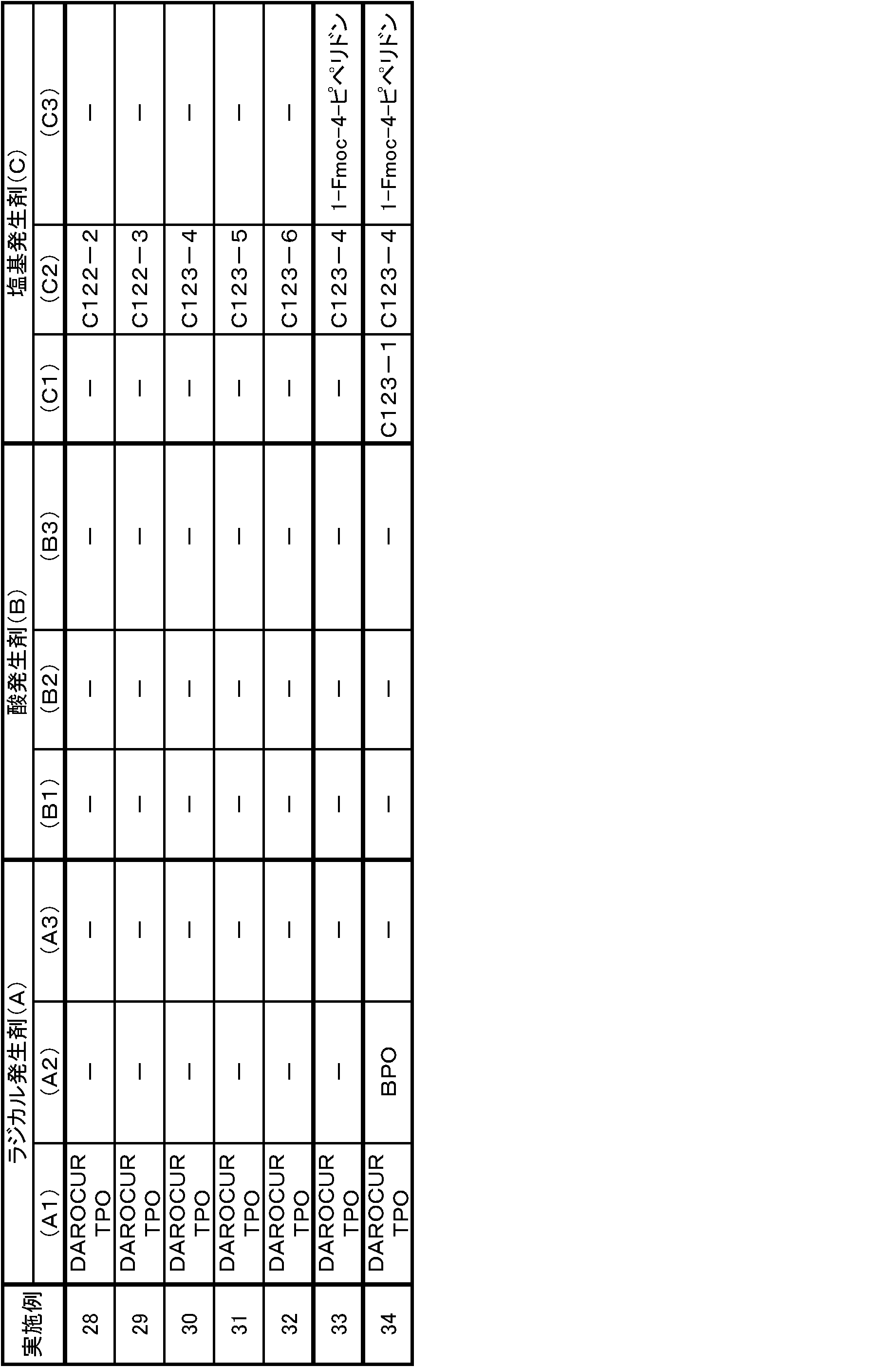
「酸化チタン」を「C.I.ダイレクトブルー14」[東京化成(株)製]に代える以外は実施例1~34と同様にして本発明の感光性組成物(Q-35)~(Q-68)を製造した。
酸発生剤(B)を使用せず、ラジカル発生剤(A)として表4に示すラジカル発生剤(A)を5部使用する以外は実施例1と同様にして、比較用の感光性組成物(Q’-1)及び(Q’-2)を製造した。

ラジカル発生剤(A)を使用せず、酸発生剤(B)として表5に示す酸発生剤(B)を5部使用する以外は実施例22~27と同様にして、比較用の感光性組成物(Q’-3)~(Q’-8)を製造した。
但し、比較例7における(B)5部の内訳は、(B2)3.75部及び(B3)1.25部であり、比較例8における(B)5部の内訳は、(B1)2.5部、(B2)1.25部及び(B3)1.25部である。

ラジカル発生剤(A)を使用せず、塩基発生剤(C)として表6に示す塩基発生剤(C)を5部使用する以外は実施例28~34と同様にして、比較用の感光性組成物(Q’-9)~(Q’-15)を製造した。
但し、比較例14における(C)5部の内訳は、(C1)3.75部及び(C3)1.25部であり、比較例15における(C)5部の内訳は、(C1)2.5部、(C2)1.25部及び(C3)1.25部である。
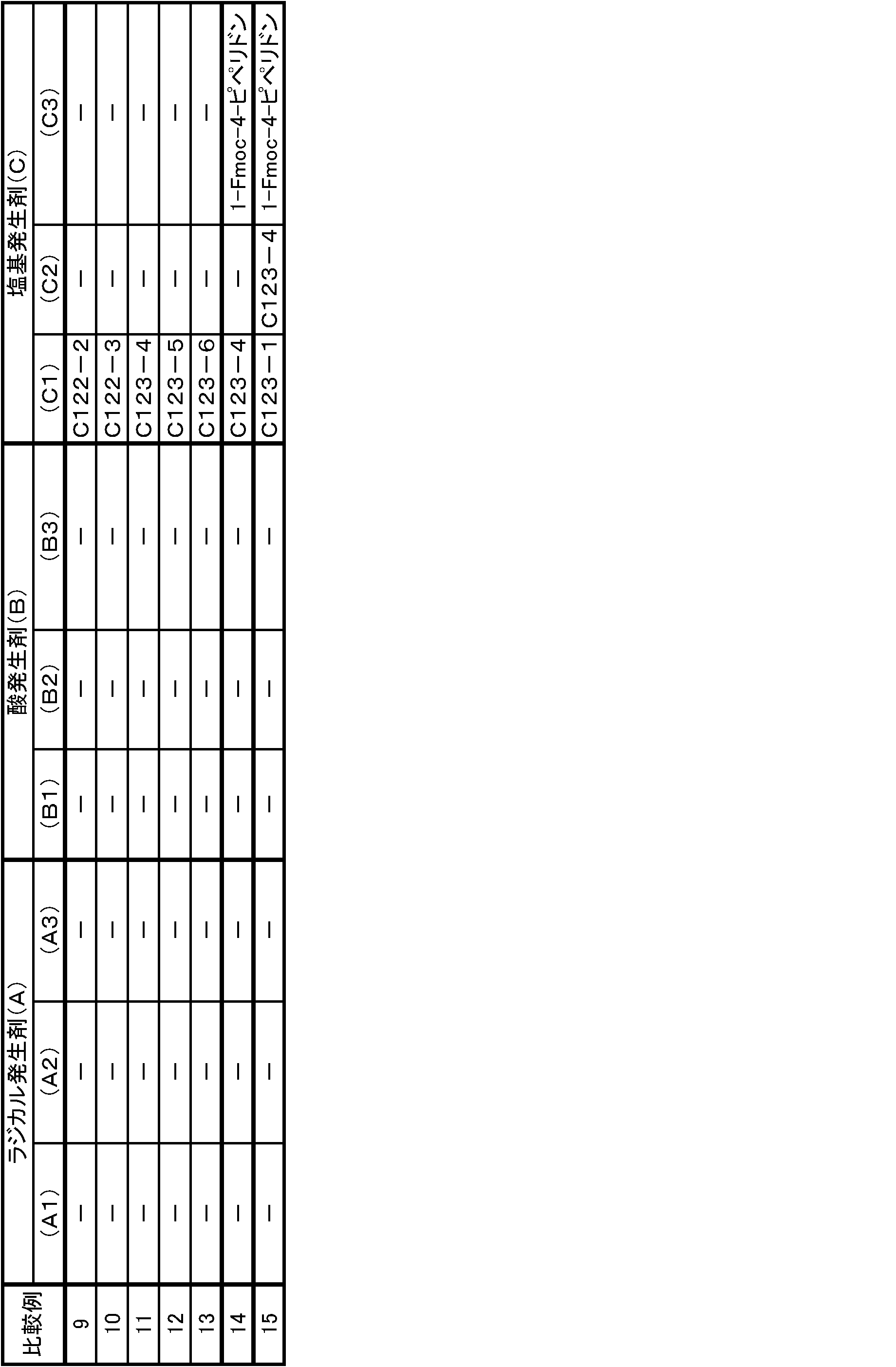
「酸化チタン」を「C.I.ダイレクトブルー14」[東京化成(株)製]に代える以外は比較例1~15と同様にして、比較用の感光性組成物(Q’-16)~(Q’-30)を製造した。
表1に示す酸発生剤(B)を表7に示す酸発生剤(B)に代える以外は実施例22と同様にして、比較用の感光性組成物(Q’-31)を製造した。
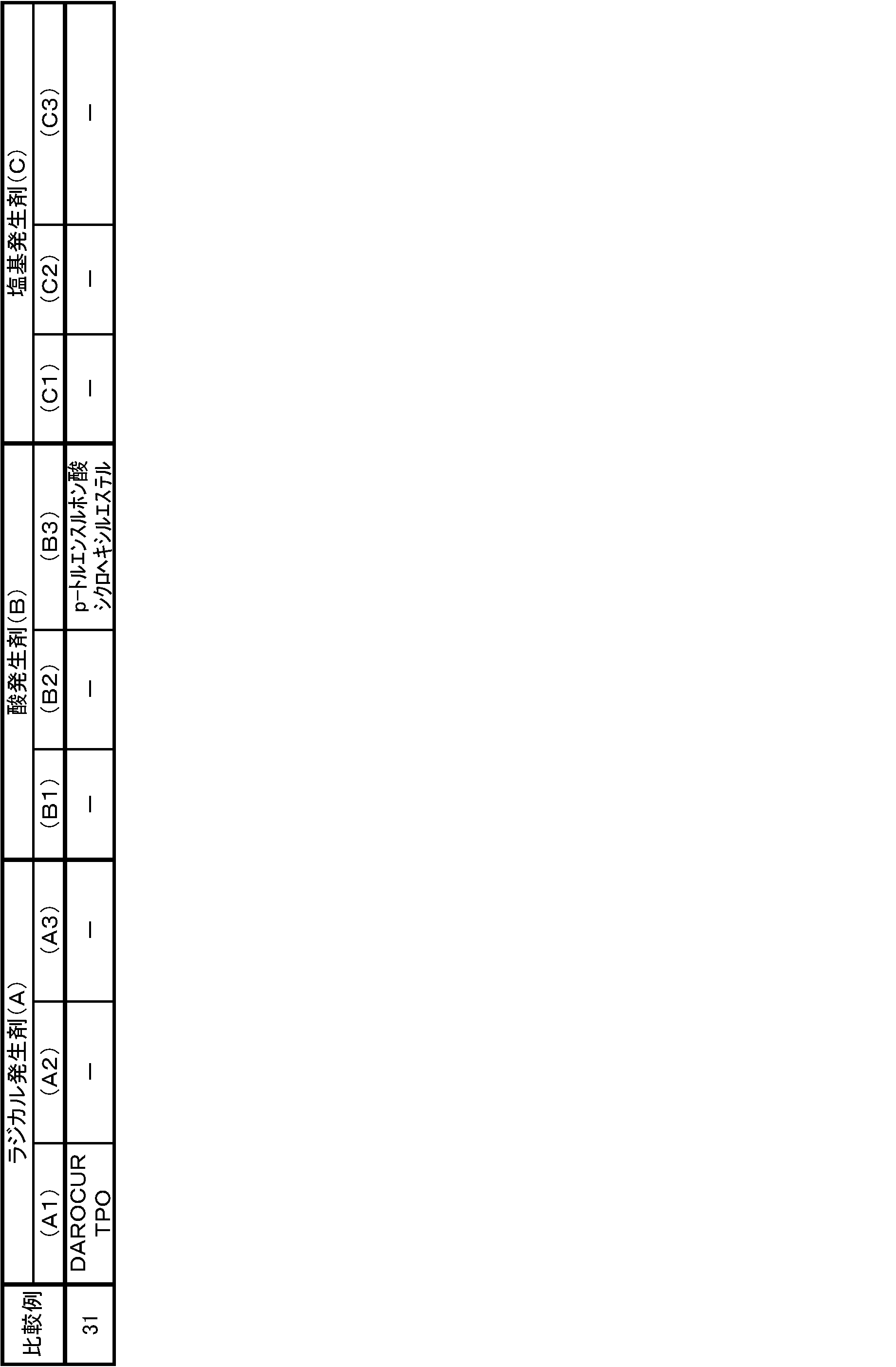
実施例1~68及び比較例1~31で得た各感光性組成物を、表面処理を施した厚さ100μmのPET(ポリエチレンテレフタレート)フィルム[東洋紡(株)製コスモシャインA4300]に、アプリケーターを用いて膜厚20μm又は80μmとなるように塗布した。露光については下記2種の照射装置を用いて実施した。
(1)ベルトコンベア式UV照射装置(アイグラフィックス株式会社「ECS-151U」)を使用して露光を行った。露光量は365nmとして150mJ/cm2であった。
(2)スポット式LED照射装置(フォセオン・テクノロジー社製「RX FireFlex」)を使用して露光を行った。露光量は150mJ/cm2であった。
硬化後塗膜の光照射直後の硬化性を、指触及び爪で強く引っ掻くことにより、以下の評価基準で評価した結果を表8に示す。
◎:表面にタックがなく爪で傷つかない。
○:表面にタックはないが、爪で傷つく。
△:表面にタックがあり、爪で傷つく。
×:未硬化。

実施例69~89[金属酸化物粉末(F)を用いた例]
<感光性組成物の調製>
チタン酸バリウム粉末[堺化学工業(株)製「BT-03」]80部、ラジカル重合性化合物としてのポリエチレングリコールジアクリレート[新中村化学(株)製「NKエステルA-600」]13部、増感剤としてのジエチルチオキサントン[日本化薬(株)製「カヤキュアDETX-S」]1部、分散剤としてのイオネットDO-1000[三洋化成工業(株)製]1部及び表9に示すラジカル発生剤(A)、酸発生剤(B)又は塩基発生剤(C)を用いて「ラジカル発生剤(A)3部、酸発生剤(B)又は塩基発生剤(C)2部」をボールミルを用いて25℃で3時間混練して本発明の感光性組成物(Q-69)~(Q-89)を製造した。
但し、実施例77における(B)2部の内訳は、(B1)1.5部及び(B3)0.5部であり、実施例89における(C)2部の内訳は、(C1)1.5部及び(C3)0.5部である。

酸発生剤(B)を使用せずラジカル発生剤(A)として表10に示すラジカル発生剤(A)を5部使用する以外は実施例69と同様にして、比較用の感光性組成物(Q’-32)及び(Q’-33)を製造した。
実施例69~89及び比較例32~33で得た各感光性組成物を、表面処理を施した厚さ100μmのPET(ポリエチレンテレフタレート)フィルム[東洋紡(株)製コスモシャインA4300]に、アプリケーターを用いて膜厚20μm又は80μmとなるように塗布した。露光については下記2種の照射装置を用いて実施した。
(1)ベルトコンベア式UV照射装置(アイグラフィックス株式会社製「ECS-151U」)を使用して露光を行った。露光量は365nmとして150mJ/cm2であった。
(2)スポット式LED照射装置(フォセオン・テクノロジー社製「RX FireFlex」)を使用して露光を行った。露光量は150mJ/cm2であった。
硬化後塗膜の光照射直後の硬化性を、指触及び爪で強く引っ掻くことにより、以下の評価基準で評価した結果を表11に示す。
◎:表面にタックがなく爪で傷つかない。
○:表面にタックはないが、爪で傷つく。
△:表面にタックがあり、爪で傷つく。
×:未硬化。

実施例90~110[金属粉末(G)を使用した例]
「チタン酸バリウム粉末」を「パラジウム粉末[住友金属鉱山(株)製「SFP-030」]」に代える以外は実施例69~89と同様にして、感光性組成物(Q-90)~(Q-110)を製造した。
「チタン酸バリウム粉末」を「パラジウム粉末[住友金属鉱山(株)製「SFP-030」]」に代える以外は比較例32~33と同様にして、比較用の感光性組成物(Q’-34)又は(Q’-35)を製造した。
実施例90~110及び比較例34~35で得た各感光性組成物を、表面処理を施した厚さ100μmのPET(ポリエチレンテレフタレート)フィルム[東洋紡(株)製コスモシャインA4300]に、アプリケーターを用いて膜厚20μm又は80μmとなるように塗布した。露光については下記2種の照射装置を用いて実施した。
(1)ベルトコンベア式UV照射装置(アイグラフィックス株式会社製「ECS-151U」)を使用して露光を行った。露光量は365nmとして150mJ/cm2であった。
(2)スポット式LED照射装置(フォセオン・テクノロジー社製「RX FireFlex」)を使用して露光を行った。露光量は150mJ/cm2であった。
硬化後塗膜の光照射直後の硬化性を、指触及び爪で強く引っ掻くことにより、以下の評価基準で評価した結果を表12に示す。
◎:表面にタックがなく爪で傷つかない。
○:表面にタックはないが、爪で傷つく。
△:表面にタックがあり、爪で傷つく。
×:未硬化。

実施例69記載の感光性組成物を使用してドクターブレード法により塗布、露光して硬化し、グリーンシートを作製した。次に実施例90記載の感光性組成物をスクリーン印刷法により印刷し、露光、硬化させた。これを30層重ね合わせ、49MPaの圧力で加圧圧着を行った。その後積層体を所定の大きさに裁断しチップとした。これを350℃4時間で脱脂後更に1320℃2時間で焼結させ、更にこの焼結体に外部電極を形成することで積層セラミックコンデンサを得た。得られたコンデンサについて静電容量をJIS C 5101-1-1998に基づき測定し問題ないことを確認した。また、外観及び内部を光学顕微鏡にて欠陥をチェックした結果、異常は見られなかった。
Claims (18)
- 下記(1)~(4)を含有する感光性組成物であって、ラジカル開始剤(A)、酸発生剤(B)及び塩基発生剤(C)の内の少なくとも1つが活性光線の照射により活性種(H)を発生し、該活性種(H)がラジカル開始剤(A)、酸発生剤(B)又は塩基発生剤(C)と反応して新たな活性種(I)を生成して該新たな活性種(I)による重合性物質(D)の重合反応が進行し、該活性種(H)又は(I)が酸又は塩基であることを特徴とする感光性組成物;
(1)ラジカル開始剤(A)
(2)酸発生剤(B)又は塩基発生剤(C)
(3)重合性物質(D)
(4)着色剤(E)、金属酸化物粉末(F)又は金属粉末(G)。 - 前記ラジカル開始剤(A)が活性光線によりラジカルを発生するラジカル開始剤(A1)、酸によりラジカルを発生するラジカル開始剤(A2)又は塩基によりラジカルを発生するラジカル開始剤(A3)であり、前記酸発生剤(B)が活性光線により酸を発生する酸発生剤(B1)、ラジカルにより酸を発生する酸発生剤(B2)又は酸により酸を発生する酸発生剤(B3)であり、前記塩基発生剤(C)が活性光線により塩基を発生する塩基発生剤(C1)、ラジカルにより塩基を発生する塩基発生剤(C2)又は塩基により塩基を発生する塩基発生剤(C3)であって、(A1)~(A3)、(B1)~(B3)又は(C1)~(C3)を以下の(1)~(10)のいずれかの組み合わせで含有する請求項1記載の感光性組成物。
(1)(A1)及び(B2)を含有する。
(2)(A1)、(B2)及び(B3)を含有する。
(3)(B1)及び(A2)を含有する。
(4)(B1)、(A2)及び(B3)を含有する。
(5)(C1)及び(A3)を含有する。
(6)(C1)、(A3)及び(C3)を含有する。
(7)(A1)及び(C2)を含有する。
(8)(A1)、(C2)及び(C3)を含有する。
(9)上記(1)~(4)の2種以上の組み合わせ。
(10)上記(5)~(8)の2種以上の組み合わせ。 - 前記活性光線によりラジカルを発生するラジカル開始剤(A1)、前記酸によりラジカルを発生するラジカル開始剤(A2)又は前記塩基によりラジカルを発生するラジカル発生剤(A3)が、アシルホスフィンオキサイド誘導体系重合開始剤(A1231)、α-アミノアセトフェノン誘導体系重合開始剤(A1232)、ベンジルケタール誘導体系重合開始剤(A1233)、α-ヒドロキシアセトフェノン誘導体系重合開始剤(A1234)、ベンゾイン誘導体系重合開始剤(A1235)、オキシムエステル誘導体系重合開始剤(A1236)及びチタノセン誘導体系重合開始剤(A1237)からなる群から選ばれる少なくとも1種のラジカル重合開始剤である請求項2記載の感光性組成物。
- 前記酸によりラジカルを発生するラジカル開始剤(A2)又は前記塩基によりラジカルを発生するラジカル発生剤(A3)が、有機過酸化物系重合開始剤(A231)及び/又はアゾ化合物系重合開始剤(A232)である請求項2又は3記載の感光性組成物。
- 前記活性光線により酸を発生する酸発生剤(B1)又はラジカルにより酸を発生する酸発生剤(B2)が、スルホニウム塩誘導体(B121)及び/又はヨードニウム塩誘導体(B122)である請求項2~4のいずれか記載の感光性組成物。
- 前記スルホニウム塩誘導体(B121)が一般式(1)又は一般式(2)で示される化合物である請求項5記載の感光性組成物。


- 前記スルホニウム塩誘導体(B121)が一般式(11)~(14)で示される化合物である請求項5記載の感光性組成物。
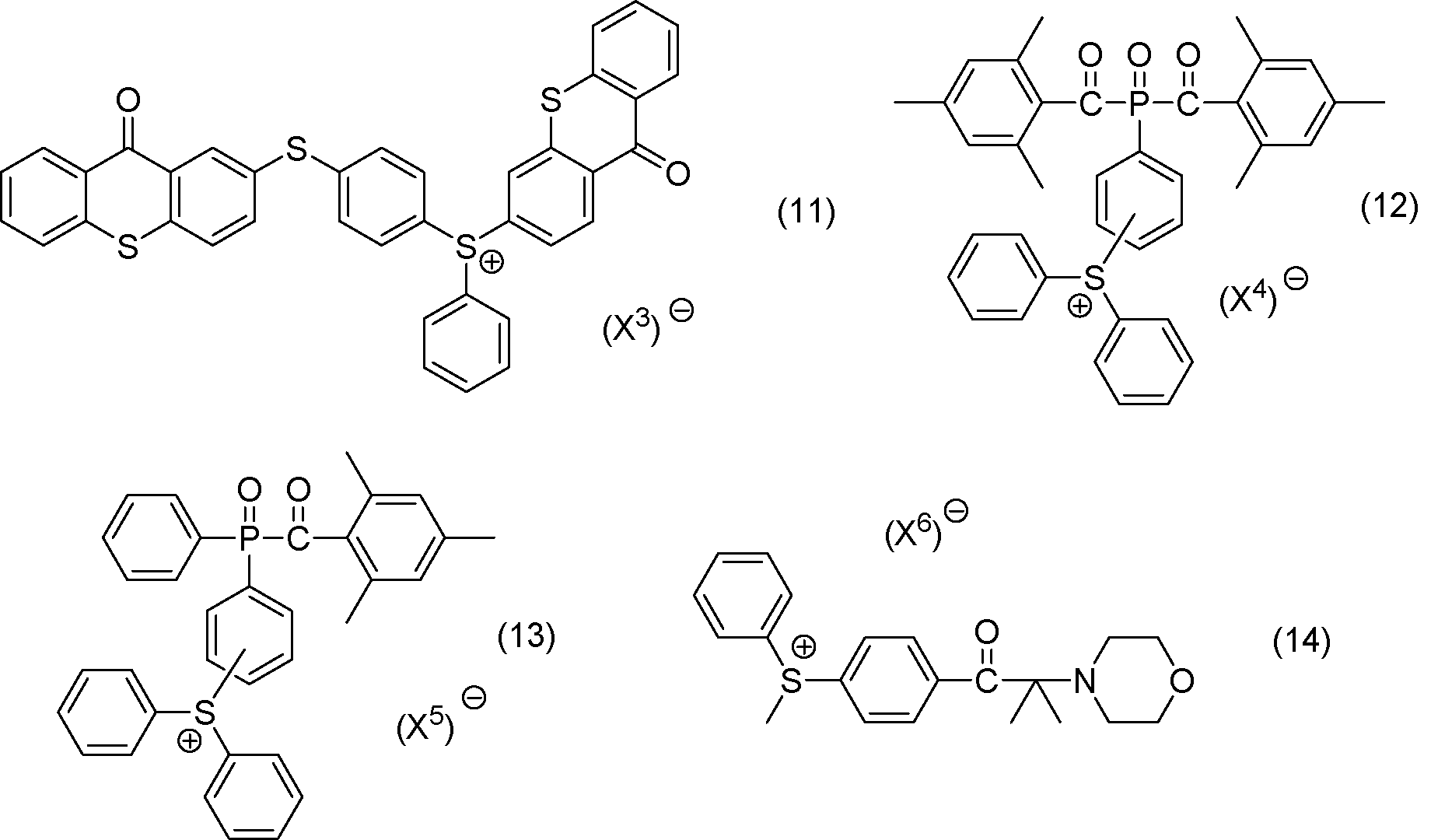
- 前記ヨードニウム塩誘導体(B122)が一般式(15)又は一般式(16)で示される化合物である請求項5~7のいずれか記載の感光性組成物。

- 前記ヨードニウム塩誘導体(B122)が一般式(17)~(20)で示される化合物である請求項5~7のいずれか記載の感光性組成物。

- 前記酸により酸を発生する酸発生剤(B3)が、スルホン酸エステル誘導体(B31)、酢酸エステル誘導体(B32)及びホスホン酸エステル(B33)からなる群から選ばれる少なくとも1種の酸発生剤である請求項2~9のいずれか記載の感光性組成物。
- 前記活性光線により塩基を発生する塩基発生剤(C1)又はラジカルにより塩基を発生する塩基発生剤(C2)が、オキシム誘導体(C121)、4級アンモニウム塩誘導体(C122)及び4級アミジン塩誘導体(C123)からなる群から選ばれる少なくとも1種の塩基発生剤である請求項2~4のいずれか記載の感光性組成物。
- 前記活性光線により塩基を発生する塩基発生剤(C1)又はラジカルにより塩基を発生する塩基発生剤(C2)が、一般式(21)~(23)で示される化合物である請求項2~4のいずれか記載の感光性組成物。

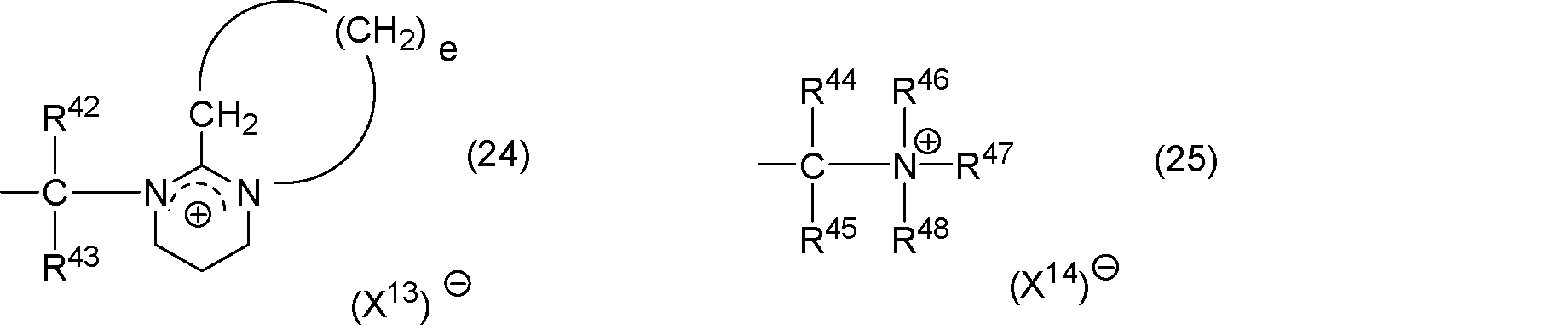
- 前記活性光線により塩基を発生する塩基発生剤(C1)又はラジカルにより塩基を発生する塩基発生剤(C2)が一般式(26)で示される化合物である請求項2~4のいずれか記載の感光性組成物。

- 塩基により塩基を発生する塩基発生剤(C3)がカルバメート誘導体(C31)である請求項2~4又は請求項11~13のいずれか記載の感光性組成物。
- 前記重合性物質(D)がラジカル重合性化合物(D1)及び/又はイオン重合性化合物(D2)である請求項1~14のいずれか記載の感光性組成物。
- 前記ラジカル重合性物質(D1)が、炭素数3~35のアクリルアミド化合物(D11)、炭素数4~35の(メタ)アクリレート化合物(D12)、炭素数6~35の芳香族ビニル化合物(D13)及び炭素数3~20のビニルエーテル化合物(D14)からなる群から選ばれる少なくとも1種の重合性物質である請求項15記載の感光性組成物。
- 前記イオン重合性物質(D2)が、炭素数3~20のエポキシ化合物(D21)及び/又は炭素数4~20のオキセタン化合物(D22)である請求項15又は16記載の感光性組成物。
- コーティング剤用、インキ用、塗料用、接着剤用又はセラミック電子部品製造用である請求項1~17のいずれか記載の感光性組成物。
Priority Applications (5)
| Application Number | Priority Date | Filing Date | Title |
|---|---|---|---|
| KR1020127000305A KR101475573B1 (ko) | 2009-06-08 | 2010-06-01 | 감광성 조성물 |
| CN201080025245.XA CN102459354B (zh) | 2009-06-08 | 2010-06-01 | 感光性组合物 |
| EP10786091A EP2441778A1 (en) | 2009-06-08 | 2010-06-01 | Photosensitive composition |
| US13/376,951 US8853290B2 (en) | 2009-06-08 | 2010-06-01 | Photosensitive composition |
| KR1020137030442A KR101486692B1 (ko) | 2009-06-08 | 2010-06-01 | 감광성 조성물 |
Applications Claiming Priority (16)
| Application Number | Priority Date | Filing Date | Title |
|---|---|---|---|
| JP2009-137001 | 2009-06-08 | ||
| JP2009137001 | 2009-06-08 | ||
| JP2009148446 | 2009-06-23 | ||
| JP2009-148446 | 2009-06-23 | ||
| JP2009250743 | 2009-10-30 | ||
| JP2009-250743 | 2009-10-30 | ||
| JP2009262551 | 2009-11-18 | ||
| JP2009-262551 | 2009-11-18 | ||
| JP2009268340 | 2009-11-26 | ||
| JP2009-268340 | 2009-11-26 | ||
| JP2010024481 | 2010-02-05 | ||
| JP2010-024481 | 2010-02-05 | ||
| JP2010-033085 | 2010-02-18 | ||
| JP2010033085 | 2010-02-18 | ||
| JP2010068952 | 2010-03-24 | ||
| JP2010-068952 | 2010-03-24 |
Publications (1)
| Publication Number | Publication Date |
|---|---|
| WO2010143560A1 true WO2010143560A1 (ja) | 2010-12-16 |
Family
ID=43308815
Family Applications (1)
| Application Number | Title | Priority Date | Filing Date |
|---|---|---|---|
| PCT/JP2010/059266 Ceased WO2010143560A1 (ja) | 2009-06-08 | 2010-06-01 | 感光性組成物 |
Country Status (6)
| Country | Link |
|---|---|
| US (1) | US8853290B2 (ja) |
| EP (1) | EP2441778A1 (ja) |
| JP (3) | JP5570874B2 (ja) |
| KR (2) | KR101486692B1 (ja) |
| CN (2) | CN103176360B (ja) |
| WO (1) | WO2010143560A1 (ja) |
Cited By (15)
| Publication number | Priority date | Publication date | Assignee | Title |
|---|---|---|---|---|
| WO2011096195A1 (en) * | 2010-02-05 | 2011-08-11 | Canon Kabushiki Kaisha | Photosensitive resin composition, method for producing structure, and liquid discharge head |
| JP2012140550A (ja) * | 2011-01-04 | 2012-07-26 | Ricoh Co Ltd | 紫外線硬化型インク及びインクジェット記録方法 |
| JP2012167262A (ja) * | 2011-01-25 | 2012-09-06 | Sanyo Chem Ind Ltd | 感光性組成物 |
| JP2012168526A (ja) * | 2011-01-26 | 2012-09-06 | Sanyo Chem Ind Ltd | 感光性組成物 |
| JP2012167266A (ja) * | 2011-01-25 | 2012-09-06 | Sanyo Chem Ind Ltd | 感光性組成物 |
| JP2012167271A (ja) * | 2011-01-26 | 2012-09-06 | Sanyo Chem Ind Ltd | 感光性組成物 |
| CN102741748A (zh) * | 2010-12-24 | 2012-10-17 | 富士胶片株式会社 | 光化射线敏感或辐射敏感树脂组合物,其形成的光化射线敏感或辐射敏感膜以及使用该组合物形成图案的方法 |
| US20130004741A1 (en) * | 2011-06-30 | 2013-01-03 | Fujifilm Corporation | Actinic-ray- or radiation-sensitive resin composition, actinic-ray- or radiation-sensitive film therefrom and method of forming pattern using the composition |
| JP2013036024A (ja) * | 2011-07-11 | 2013-02-21 | Sanyo Chem Ind Ltd | 感光性樹脂組成物 |
| JP2013040307A (ja) * | 2011-08-19 | 2013-02-28 | Ricoh Co Ltd | 活性光線硬化組成物及び活性光線硬化型インクジェット用インク |
| CN103415540A (zh) * | 2011-03-07 | 2013-11-27 | 三洋化成工业株式会社 | 感光性组合物、固化物以及活性光线固化物的制造方法 |
| JP2014141583A (ja) * | 2013-01-24 | 2014-08-07 | Nippon Kagaku Kogyosho:Kk | 新規な光重合開始剤及びその使用方法 |
| US9061499B2 (en) | 2010-02-05 | 2015-06-23 | Canon Kabushiki Kaisha | Negative photosensitive resin composition, pattern formation method, and liquid discharge head |
| WO2017141723A1 (ja) * | 2016-02-19 | 2017-08-24 | 富士フイルム株式会社 | 硬化性組成物、遮光膜、固体撮像装置、および、カラーフィルタ |
| WO2019160079A1 (ja) * | 2018-02-16 | 2019-08-22 | 株式会社Adeka | ラジカル重合開始剤、これを含有する組成物、その硬化物、その製造方法、および化合物 |
Families Citing this family (32)
| Publication number | Priority date | Publication date | Assignee | Title |
|---|---|---|---|---|
| US8329771B2 (en) * | 2008-03-31 | 2012-12-11 | San-Apro Limited | Photobase generator |
| JP2012022227A (ja) * | 2010-07-16 | 2012-02-02 | San Apro Kk | フッ素化アルキルリン酸ヨードニウム系光酸発生剤含有エネルギー線硬化性組成物 |
| JP5940259B2 (ja) * | 2010-08-06 | 2016-06-29 | 三洋化成工業株式会社 | 感光性組成物 |
| JP5930758B2 (ja) * | 2012-02-15 | 2016-06-08 | 三洋化成工業株式会社 | 感光性組成物 |
| EP2826799A4 (en) | 2012-03-13 | 2015-11-25 | Daicel Corp | LIGHT-SENSITIVE RESIN COMPOSITION, HARDENED PRODUCT, AND OPTICAL COMPONENT |
| JP6008166B2 (ja) | 2012-04-05 | 2016-10-19 | 株式会社リコー | 活性光線硬化組成物、活性光線硬化型インクジェット印刷用インク組成物、活性光線硬化型接着剤組成物および活性光線硬化組成物の安定化方法 |
| JP6183642B2 (ja) * | 2012-08-10 | 2017-08-23 | 株式会社リコー | 活性光線硬化組成物、並びにこれを用いた活性光線硬化型インクジェット印刷用インク組成物及び活性光線硬化型接着剤組成物 |
| JP6095964B2 (ja) * | 2012-12-10 | 2017-03-15 | 三洋化成工業株式会社 | 感光性組成物及び硬化物 |
| KR101981579B1 (ko) * | 2012-12-10 | 2019-05-23 | 엘지디스플레이 주식회사 | 표시장치용 감광성 조성물, 이를 포함하는 블랙 매트릭스 및 블랙 매트릭스의 패턴 형성 방법 |
| JP6140501B2 (ja) * | 2013-03-28 | 2017-05-31 | 日東電工株式会社 | 活性エネルギー線硬化型接着剤組成物、偏光フィルムおよびその製造方法、光学フィルムならびに画像表示装置 |
| BE1022066B1 (nl) * | 2013-06-28 | 2016-02-15 | Chemstream Bvba | Oppervlakteactief middel en bereiding daarvan |
| JPWO2015029940A1 (ja) * | 2013-08-30 | 2017-03-02 | 三洋化成工業株式会社 | 感光性組成物、硬化物及び画像表示装置 |
| JP6232855B2 (ja) * | 2013-08-30 | 2017-11-22 | デクセリアルズ株式会社 | ラジカル重合型接着剤組成物、及び電気接続体の製造方法 |
| JP6171774B2 (ja) * | 2013-09-18 | 2017-08-02 | Jsr株式会社 | 感放射線性樹脂組成物、レジストパターン形成方法及び感放射線性酸発生剤 |
| JP2015124240A (ja) * | 2013-12-25 | 2015-07-06 | 三洋化成工業株式会社 | 活性エネルギー線硬化型樹脂組成物 |
| US9207533B2 (en) * | 2014-02-07 | 2015-12-08 | Eastman Kodak Company | Photopolymerizable compositions for electroless plating methods |
| JP6581568B2 (ja) * | 2014-04-21 | 2019-09-25 | 富士フイルム和光純薬株式会社 | リチウム電池用結着剤 |
| JP6384234B2 (ja) * | 2014-09-25 | 2018-09-05 | デクセリアルズ株式会社 | ラジカル重合型接着剤組成物、及び電気接続体の製造方法 |
| JP6603127B2 (ja) * | 2015-12-29 | 2019-11-06 | サンアプロ株式会社 | 感光性組成物 |
| WO2018037517A1 (ja) * | 2016-08-24 | 2018-03-01 | 日立化成株式会社 | 硬化性樹脂組成物、画像表示装置及び画像表示装置の製造方法 |
| JP6873417B2 (ja) * | 2016-11-10 | 2021-05-19 | 学校法人東京理科大学 | 光反応性組成物 |
| WO2018163942A1 (ja) * | 2017-03-07 | 2018-09-13 | 東レ株式会社 | 活性エネルギー線硬化型平版印刷用インキ、およびそれを用いた印刷物の製造方法 |
| JP7082582B2 (ja) * | 2018-01-30 | 2022-06-08 | 三洋化成工業株式会社 | 粘着剤用活性エネルギー線硬化性組成物及び硬化物 |
| JP7159633B2 (ja) * | 2018-06-15 | 2022-10-25 | 昭和電工マテリアルズ株式会社 | ダイシング・ダイボンディング一体型フィルム及びこれに用いる粘着フィルム |
| CN112384536A (zh) * | 2018-07-10 | 2021-02-19 | 积水化学工业株式会社 | 光反应性组合物 |
| WO2020153269A1 (ja) * | 2019-01-21 | 2020-07-30 | 三井化学株式会社 | 光重合開始剤、光硬化性組成物、硬化物、及び、歯科材料 |
| DE102019123000A1 (de) * | 2019-08-27 | 2021-03-04 | Ferro Gmbh | Drucksubstanz zur Beschichtung von Glasoberflächen |
| WO2021193230A1 (ja) * | 2020-03-26 | 2021-09-30 | 富士フイルム株式会社 | 活性エネルギー線硬化型インク及び画像記録方法 |
| WO2023167201A1 (ja) * | 2022-03-02 | 2023-09-07 | 株式会社カネカ | 活性エネルギー線硬化性組成物、及び硬化物の製造方法 |
| CN115232510B (zh) * | 2022-08-04 | 2023-07-04 | 广东诚展科技股份有限公司 | 一种液态感光ldi内层油墨及其制备方法 |
| WO2026023585A1 (ja) * | 2024-07-23 | 2026-01-29 | 三洋化成工業株式会社 | 活性エネルギー線硬化性組成物及びその硬化物 |
| CN121142911B (zh) * | 2025-11-19 | 2026-02-17 | 湖南初源新材料股份有限公司 | 含有蒽甲基季铵盐光敏剂的感光树脂组合物及其应用 |
Citations (4)
| Publication number | Priority date | Publication date | Assignee | Title |
|---|---|---|---|---|
| JPH11258790A (ja) * | 1998-03-10 | 1999-09-24 | Sumitomo Chem Co Ltd | 着色感光性樹脂組成物 |
| JP2007017458A (ja) * | 2005-07-05 | 2007-01-25 | Taiyo Ink Mfg Ltd | 着色感光性樹脂組成物及びその硬化物 |
| WO2007112921A1 (en) * | 2006-03-30 | 2007-10-11 | Dsm Ip Assets B.V. | Cationic composition and methods of making and using the same |
| JP2009019142A (ja) | 2007-07-13 | 2009-01-29 | Toyo Ink Mfg Co Ltd | 光硬化型インキ |
Family Cites Families (17)
| Publication number | Priority date | Publication date | Assignee | Title |
|---|---|---|---|---|
| JPH02166451A (ja) * | 1988-12-21 | 1990-06-27 | Canon Inc | 光重合性樹脂組成物および記録媒体 |
| EP0960354A1 (en) * | 1997-02-14 | 1999-12-01 | Alliedsignal Inc. | High temperature performance polymers for stereolithography |
| JP3055617B2 (ja) * | 1997-08-27 | 2000-06-26 | 日本電気株式会社 | ネガ型フォトレジスト組成物およびそれを用いたパターン形成方法 |
| JP4204113B2 (ja) * | 1997-12-04 | 2009-01-07 | 株式会社Adeka | 新規な芳香族スルホニウム化合物、これからなる光酸発生剤およびこれを含む光重合性組成物、光造形用樹脂組成物ならびに光学的立体造形法 |
| KR100704423B1 (ko) * | 1999-03-31 | 2007-04-06 | 스미또모 가가꾸 가부시키가이샤 | 화학 증폭형 포지티브 레지스트 |
| JP2000321769A (ja) * | 1999-05-06 | 2000-11-24 | Nippon Shokubai Co Ltd | 感光性樹脂組成物 |
| JP2003008236A (ja) * | 2001-06-27 | 2003-01-10 | Hitachi Chem Co Ltd | 感光性樹脂組成物、それを用いた多層プリント配線板及びビルドアップ多層配線板の製造方法 |
| JP2005275334A (ja) * | 2004-03-25 | 2005-10-06 | Yasuhara Chemical Co Ltd | 感光性組成物 |
| JP4723263B2 (ja) * | 2005-03-14 | 2011-07-13 | 株式会社トクヤマ | 歯科用硬化性組成物 |
| JP2006307093A (ja) * | 2005-05-02 | 2006-11-09 | Sekisui Chem Co Ltd | 光反応型接着剤組成物および液晶表示装置の製造方法 |
| JP4830435B2 (ja) * | 2005-09-30 | 2011-12-07 | 大日本印刷株式会社 | 感光性樹脂組成物及び物品 |
| JP2007119542A (ja) * | 2005-10-26 | 2007-05-17 | Sekisui Fuller Kk | 紫外線反応型接着剤およびこの紫外線反応型接着剤を用いた液晶パネル |
| US7776940B2 (en) | 2005-12-20 | 2010-08-17 | 3M Innovative Properties Company | Methods for reducing bond strengths, dental compositions, and the use thereof |
| JP5168860B2 (ja) * | 2006-09-14 | 2013-03-27 | 株式会社スリーボンド | 光重合性組成物 |
| WO2008093507A1 (ja) * | 2007-01-31 | 2008-08-07 | Jsr Corporation | 感放射線性樹脂組成物 |
| KR101385946B1 (ko) * | 2007-04-02 | 2014-04-16 | 주식회사 동진쎄미켐 | 포토레지스트 조성물 및 이를 이용한 포토레지스트 패턴의형성 방법 |
| CN102307909B (zh) * | 2009-02-18 | 2014-05-07 | 三亚普罗股份有限公司 | 感光性树脂组合物 |
-
2010
- 2010-06-01 US US13/376,951 patent/US8853290B2/en not_active Expired - Fee Related
- 2010-06-01 KR KR1020137030442A patent/KR101486692B1/ko not_active Expired - Fee Related
- 2010-06-01 CN CN201310124408.5A patent/CN103176360B/zh not_active Expired - Fee Related
- 2010-06-01 WO PCT/JP2010/059266 patent/WO2010143560A1/ja not_active Ceased
- 2010-06-01 CN CN201080025245.XA patent/CN102459354B/zh not_active Expired - Fee Related
- 2010-06-01 KR KR1020127000305A patent/KR101475573B1/ko not_active Expired - Fee Related
- 2010-06-01 EP EP10786091A patent/EP2441778A1/en not_active Withdrawn
- 2010-06-02 JP JP2010127204A patent/JP5570874B2/ja not_active Expired - Fee Related
-
2013
- 2013-07-30 JP JP2013158226A patent/JP5723933B2/ja active Active
-
2014
- 2014-05-20 JP JP2014104265A patent/JP5844416B2/ja not_active Expired - Fee Related
Patent Citations (4)
| Publication number | Priority date | Publication date | Assignee | Title |
|---|---|---|---|---|
| JPH11258790A (ja) * | 1998-03-10 | 1999-09-24 | Sumitomo Chem Co Ltd | 着色感光性樹脂組成物 |
| JP2007017458A (ja) * | 2005-07-05 | 2007-01-25 | Taiyo Ink Mfg Ltd | 着色感光性樹脂組成物及びその硬化物 |
| WO2007112921A1 (en) * | 2006-03-30 | 2007-10-11 | Dsm Ip Assets B.V. | Cationic composition and methods of making and using the same |
| JP2009019142A (ja) | 2007-07-13 | 2009-01-29 | Toyo Ink Mfg Co Ltd | 光硬化型インキ |
Non-Patent Citations (1)
| Title |
|---|
| "Latest trend of UV-EB curing technique", 2006, CMC PUBLISHING CO., LTD., pages: 138 |
Cited By (29)
| Publication number | Priority date | Publication date | Assignee | Title |
|---|---|---|---|---|
| JP2011180586A (ja) * | 2010-02-05 | 2011-09-15 | Canon Inc | 感光性樹脂組成物、液体吐出装置及び微細構造体の製造方法 |
| US8980968B2 (en) | 2010-02-05 | 2015-03-17 | Canon Kabushiki Kaisha | Photosensitive resin composition, method for producing structure, and liquid discharge head |
| US9061499B2 (en) | 2010-02-05 | 2015-06-23 | Canon Kabushiki Kaisha | Negative photosensitive resin composition, pattern formation method, and liquid discharge head |
| WO2011096195A1 (en) * | 2010-02-05 | 2011-08-11 | Canon Kabushiki Kaisha | Photosensitive resin composition, method for producing structure, and liquid discharge head |
| KR101651162B1 (ko) * | 2010-12-24 | 2016-08-25 | 후지필름 가부시키가이샤 | 감활성광선성 또는 감방사선성 수지 조성물, 이 조성물을 사용한 감활성광선성 또는 감방사선성 막 및 패턴형성방법 |
| KR20140000129A (ko) * | 2010-12-24 | 2014-01-02 | 후지필름 가부시키가이샤 | 감활성광선성 또는 감방사선성 수지 조성물, 이 조성물을 사용한 감활성광선성 또는 감방사선성 막 및 패턴형성방법 |
| US9081277B2 (en) * | 2010-12-24 | 2015-07-14 | Fujifilm Corporation | Actinic-ray- or radiation-sensitive resin composition, actinic-ray- or radiation-sensitive film therefrom and method of forming pattern using the composition |
| CN102741748A (zh) * | 2010-12-24 | 2012-10-17 | 富士胶片株式会社 | 光化射线敏感或辐射敏感树脂组合物,其形成的光化射线敏感或辐射敏感膜以及使用该组合物形成图案的方法 |
| US20120273924A1 (en) * | 2010-12-24 | 2012-11-01 | Fujifilm Corporation | Actinic-ray- or radiation-sensitive resin composition, actinic-ray- or radiation-sensitive film therefrom and method of forming pattern using the composition |
| CN102741748B (zh) * | 2010-12-24 | 2017-03-15 | 富士胶片株式会社 | 光化射线敏感或辐射敏感树脂组合物,其形成的光化射线敏感或辐射敏感膜以及使用该组合物形成图案的方法 |
| JP2012140550A (ja) * | 2011-01-04 | 2012-07-26 | Ricoh Co Ltd | 紫外線硬化型インク及びインクジェット記録方法 |
| JP2012167262A (ja) * | 2011-01-25 | 2012-09-06 | Sanyo Chem Ind Ltd | 感光性組成物 |
| JP2012167266A (ja) * | 2011-01-25 | 2012-09-06 | Sanyo Chem Ind Ltd | 感光性組成物 |
| JP2012167271A (ja) * | 2011-01-26 | 2012-09-06 | Sanyo Chem Ind Ltd | 感光性組成物 |
| JP2012168526A (ja) * | 2011-01-26 | 2012-09-06 | Sanyo Chem Ind Ltd | 感光性組成物 |
| TWI559086B (zh) * | 2011-03-07 | 2016-11-21 | Sanyo Chemical Ind Ltd | A photosensitive composition, a hardened product, and a reactive light hardening material |
| CN103415540B (zh) * | 2011-03-07 | 2016-03-23 | 三洋化成工业株式会社 | 感光性组合物、固化物以及活性光线固化物的制造方法 |
| CN103415540A (zh) * | 2011-03-07 | 2013-11-27 | 三洋化成工业株式会社 | 感光性组合物、固化物以及活性光线固化物的制造方法 |
| US20130004741A1 (en) * | 2011-06-30 | 2013-01-03 | Fujifilm Corporation | Actinic-ray- or radiation-sensitive resin composition, actinic-ray- or radiation-sensitive film therefrom and method of forming pattern using the composition |
| US9316911B2 (en) * | 2011-06-30 | 2016-04-19 | Fujifilm Corporation | Actinic-ray- or radiation-sensitive resin composition, actinic-ray- or radiation-sensitive film therefrom and method of forming pattern using the composition |
| JP2013036024A (ja) * | 2011-07-11 | 2013-02-21 | Sanyo Chem Ind Ltd | 感光性樹脂組成物 |
| JP2013040307A (ja) * | 2011-08-19 | 2013-02-28 | Ricoh Co Ltd | 活性光線硬化組成物及び活性光線硬化型インクジェット用インク |
| JP2014141583A (ja) * | 2013-01-24 | 2014-08-07 | Nippon Kagaku Kogyosho:Kk | 新規な光重合開始剤及びその使用方法 |
| WO2017141723A1 (ja) * | 2016-02-19 | 2017-08-24 | 富士フイルム株式会社 | 硬化性組成物、遮光膜、固体撮像装置、および、カラーフィルタ |
| JPWO2017141723A1 (ja) * | 2016-02-19 | 2018-11-22 | 富士フイルム株式会社 | 硬化性組成物、遮光膜、固体撮像装置、および、カラーフィルタ |
| WO2019160079A1 (ja) * | 2018-02-16 | 2019-08-22 | 株式会社Adeka | ラジカル重合開始剤、これを含有する組成物、その硬化物、その製造方法、および化合物 |
| JPWO2019160079A1 (ja) * | 2018-02-16 | 2021-02-04 | 株式会社Adeka | ラジカル重合開始剤、これを含有する組成物、その硬化物、その製造方法、および化合物 |
| US11618742B2 (en) | 2018-02-16 | 2023-04-04 | Adeka Corporation | Radical polymerization initiator, composition containing same, cured product of composition, production method for cured product, and compound |
| JP7372904B2 (ja) | 2018-02-16 | 2023-11-01 | 株式会社Adeka | ラジカル重合開始剤、これを含有する組成物、その硬化物、その製造方法、および化合物 |
Also Published As
| Publication number | Publication date |
|---|---|
| JP5570874B2 (ja) | 2014-08-13 |
| JP5723933B2 (ja) | 2015-05-27 |
| EP2441778A1 (en) | 2012-04-18 |
| JP5844416B2 (ja) | 2016-01-13 |
| US20120142806A1 (en) | 2012-06-07 |
| KR101486692B1 (ko) | 2015-01-29 |
| KR101475573B1 (ko) | 2014-12-22 |
| KR20130130096A (ko) | 2013-11-29 |
| JP2014205838A (ja) | 2014-10-30 |
| CN102459354B (zh) | 2014-08-20 |
| JP2014001395A (ja) | 2014-01-09 |
| JP2011221476A (ja) | 2011-11-04 |
| US8853290B2 (en) | 2014-10-07 |
| KR20120031055A (ko) | 2012-03-29 |
| CN102459354A (zh) | 2012-05-16 |
| CN103176360B (zh) | 2015-09-30 |
| CN103176360A (zh) | 2013-06-26 |
Similar Documents
| Publication | Publication Date | Title |
|---|---|---|
| JP5844416B2 (ja) | 感光性組成物の光硬化物の製造方法 | |
| JP5940259B2 (ja) | 感光性組成物 | |
| JP2012167271A (ja) | 感光性組成物 | |
| KR101666263B1 (ko) | 감광성 조성물, 경화물, 및, 활성 광선 경화물의 제조 방법 | |
| JP2012167262A (ja) | 感光性組成物 | |
| JP2017036361A (ja) | 光硬化性組成物 | |
| JP2012168526A (ja) | 感光性組成物 | |
| JP5989469B2 (ja) | 感光性組成物 | |
| JP2012158745A (ja) | インクジェット印刷インク用重合性化合物及びインク組成物 | |
| JP2012167263A (ja) | マイクロ波硬化型組成物 | |
| JP2015086371A (ja) | 活性光線硬化型接着剤組成物 | |
| JP2015124240A (ja) | 活性エネルギー線硬化型樹脂組成物 | |
| JP2016156856A (ja) | カラーフィルター形成用感光性組成物 | |
| JP2012167266A (ja) | 感光性組成物 | |
| JP6781738B2 (ja) | 活性エネルギー線硬化性組成物 | |
| JP2011241251A (ja) | インクジェット印刷インク用重合性化合物及びインク組成物 | |
| JP2012167265A (ja) | 感光性組成物 | |
| JP2000273399A (ja) | 紫外線硬化型被膜形成組成物 | |
| JP7556786B2 (ja) | 変性顔料を含有する放射線硬化型組成物及びその応用 | |
| JP5554074B2 (ja) | インクジェット印刷インク用重合性化合物及びインク組成物 | |
| JP2012167264A (ja) | 超音波硬化型組成物 | |
| JP5490588B2 (ja) | インクジェット印刷インク用重合性化合物及びインク組成物 | |
| JP5580158B2 (ja) | インクジェット印刷インク用組成物 | |
| JP2015110762A (ja) | 活性光線硬化型接着剤組成物 | |
| JP2016155999A (ja) | 感光性組成物の製造方法 |
Legal Events
| Date | Code | Title | Description |
|---|---|---|---|
| WWE | Wipo information: entry into national phase |
Ref document number: 201080025245.X Country of ref document: CN |
|
| 121 | Ep: the epo has been informed by wipo that ep was designated in this application |
Ref document number: 10786091 Country of ref document: EP Kind code of ref document: A1 |
|
| REEP | Request for entry into the european phase |
Ref document number: 2010786091 Country of ref document: EP |
|
| WWE | Wipo information: entry into national phase |
Ref document number: 2010786091 Country of ref document: EP |
|
| NENP | Non-entry into the national phase |
Ref country code: DE |
|
| ENP | Entry into the national phase |
Ref document number: 20127000305 Country of ref document: KR Kind code of ref document: A |
|
| WWE | Wipo information: entry into national phase |
Ref document number: 13376951 Country of ref document: US |