WO2010143623A1 - メッキ洗浄排水からの水及び金属の回収方法 - Google Patents
メッキ洗浄排水からの水及び金属の回収方法 Download PDFInfo
- Publication number
- WO2010143623A1 WO2010143623A1 PCT/JP2010/059680 JP2010059680W WO2010143623A1 WO 2010143623 A1 WO2010143623 A1 WO 2010143623A1 JP 2010059680 W JP2010059680 W JP 2010059680W WO 2010143623 A1 WO2010143623 A1 WO 2010143623A1
- Authority
- WO
- WIPO (PCT)
- Prior art keywords
- water
- metal
- crystallization
- plating
- iron
- Prior art date
- Legal status (The legal status is an assumption and is not a legal conclusion. Google has not performed a legal analysis and makes no representation as to the accuracy of the status listed.)
- Ceased
Links
Images
Classifications
-
- C—CHEMISTRY; METALLURGY
- C22—METALLURGY; FERROUS OR NON-FERROUS ALLOYS; TREATMENT OF ALLOYS OR NON-FERROUS METALS
- C22B—PRODUCTION AND REFINING OF METALS; PRETREATMENT OF RAW MATERIALS
- C22B7/00—Working up raw materials other than ores, e.g. scrap, to produce non-ferrous metals and compounds thereof; Methods of a general interest or applied to the winning of more than two metals
- C22B7/006—Wet processes
-
- B—PERFORMING OPERATIONS; TRANSPORTING
- B01—PHYSICAL OR CHEMICAL PROCESSES OR APPARATUS IN GENERAL
- B01D—SEPARATION
- B01D9/00—Crystallisation
- B01D9/0036—Crystallisation on to a bed of product crystals; Seeding
-
- C—CHEMISTRY; METALLURGY
- C02—TREATMENT OF WATER, WASTE WATER, SEWAGE, OR SLUDGE
- C02F—TREATMENT OF WATER, WASTE WATER, SEWAGE, OR SLUDGE
- C02F1/00—Treatment of water, waste water, or sewage
- C02F1/44—Treatment of water, waste water, or sewage by dialysis, osmosis or reverse osmosis
- C02F1/441—Treatment of water, waste water, or sewage by dialysis, osmosis or reverse osmosis by reverse osmosis
-
- C—CHEMISTRY; METALLURGY
- C02—TREATMENT OF WATER, WASTE WATER, SEWAGE, OR SLUDGE
- C02F—TREATMENT OF WATER, WASTE WATER, SEWAGE, OR SLUDGE
- C02F1/00—Treatment of water, waste water, or sewage
- C02F1/44—Treatment of water, waste water, or sewage by dialysis, osmosis or reverse osmosis
- C02F1/444—Treatment of water, waste water, or sewage by dialysis, osmosis or reverse osmosis by ultrafiltration or microfiltration
-
- C—CHEMISTRY; METALLURGY
- C02—TREATMENT OF WATER, WASTE WATER, SEWAGE, OR SLUDGE
- C02F—TREATMENT OF WATER, WASTE WATER, SEWAGE, OR SLUDGE
- C02F1/00—Treatment of water, waste water, or sewage
- C02F1/72—Treatment of water, waste water, or sewage by oxidation
-
- C—CHEMISTRY; METALLURGY
- C22—METALLURGY; FERROUS OR NON-FERROUS ALLOYS; TREATMENT OF ALLOYS OR NON-FERROUS METALS
- C22B—PRODUCTION AND REFINING OF METALS; PRETREATMENT OF RAW MATERIALS
- C22B3/00—Extraction of metal compounds from ores or concentrates by wet processes
- C22B3/20—Treatment or purification of solutions, e.g. obtained by leaching
- C22B3/22—Treatment or purification of solutions, e.g. obtained by leaching by physical processes, e.g. by filtration, by magnetic means, or by thermal decomposition
-
- C—CHEMISTRY; METALLURGY
- C22—METALLURGY; FERROUS OR NON-FERROUS ALLOYS; TREATMENT OF ALLOYS OR NON-FERROUS METALS
- C22B—PRODUCTION AND REFINING OF METALS; PRETREATMENT OF RAW MATERIALS
- C22B3/00—Extraction of metal compounds from ores or concentrates by wet processes
- C22B3/20—Treatment or purification of solutions, e.g. obtained by leaching
- C22B3/44—Treatment or purification of solutions, e.g. obtained by leaching by chemical processes
-
- C—CHEMISTRY; METALLURGY
- C25—ELECTROLYTIC OR ELECTROPHORETIC PROCESSES; APPARATUS THEREFOR
- C25D—PROCESSES FOR THE ELECTROLYTIC OR ELECTROPHORETIC PRODUCTION OF COATINGS; ELECTROFORMING; APPARATUS THEREFOR
- C25D21/00—Processes for servicing or operating cells for electrolytic coating
- C25D21/16—Regeneration of process solutions
- C25D21/20—Regeneration of process solutions of rinse-solutions
-
- C—CHEMISTRY; METALLURGY
- C02—TREATMENT OF WATER, WASTE WATER, SEWAGE, OR SLUDGE
- C02F—TREATMENT OF WATER, WASTE WATER, SEWAGE, OR SLUDGE
- C02F2101/00—Nature of the contaminant
- C02F2101/10—Inorganic compounds
- C02F2101/20—Heavy metals or heavy metal compounds
-
- C—CHEMISTRY; METALLURGY
- C02—TREATMENT OF WATER, WASTE WATER, SEWAGE, OR SLUDGE
- C02F—TREATMENT OF WATER, WASTE WATER, SEWAGE, OR SLUDGE
- C02F2103/00—Nature of the water, waste water, sewage or sludge to be treated
- C02F2103/16—Nature of the water, waste water, sewage or sludge to be treated from metallurgical processes, i.e. from the production, refining or treatment of metals, e.g. galvanic wastes
-
- C—CHEMISTRY; METALLURGY
- C02—TREATMENT OF WATER, WASTE WATER, SEWAGE, OR SLUDGE
- C02F—TREATMENT OF WATER, WASTE WATER, SEWAGE, OR SLUDGE
- C02F2209/00—Controlling or monitoring parameters in water treatment
- C02F2209/06—Controlling or monitoring parameters in water treatment pH
-
- Y—GENERAL TAGGING OF NEW TECHNOLOGICAL DEVELOPMENTS; GENERAL TAGGING OF CROSS-SECTIONAL TECHNOLOGIES SPANNING OVER SEVERAL SECTIONS OF THE IPC; TECHNICAL SUBJECTS COVERED BY FORMER USPC CROSS-REFERENCE ART COLLECTIONS [XRACs] AND DIGESTS
- Y02—TECHNOLOGIES OR APPLICATIONS FOR MITIGATION OR ADAPTATION AGAINST CLIMATE CHANGE
- Y02P—CLIMATE CHANGE MITIGATION TECHNOLOGIES IN THE PRODUCTION OR PROCESSING OF GOODS
- Y02P10/00—Technologies related to metal processing
- Y02P10/20—Recycling
Definitions
- the present invention relates to a method for efficiently recovering water and valuable metals from plating washing wastewater, and in particular, efficiently recovers both water and valuable metals such as nickel and zinc from washing wastewater in the electroplating process.
- the present invention relates to a method for reducing the amount of sludge generated by wastewater treatment.
- the plating washing wastewater discharged from the plating factory generally has a pH of 2 to 3, and in many cases contains valuable metals such as nickel, zinc, chromium and copper in addition to divalent iron. It is desirable to reuse.
- a neutralization coagulation precipitation method (hydroxide precipitation method) has been adopted as a method for treating plating washing wastewater.
- the pH of the waste water is made alkaline, and metal ions are precipitated as hydroxides and separated and removed.
- a method of coagulating and precipitating under different pH conditions is employed. That is, this is a method in which Fe 2+ is oxidized to Fe 3+ in the presence of an oxidizing agent or the like at pH 3 to 6, and then precipitated and removed as a hydroxide, and then nickel and zinc are precipitated and separated at pH 7 to 10.
- nickel and zinc are precipitated and separated, and then solid-liquid separation such as sand filtration and ultrafiltration, or reverse osmosis (RO) membrane treatment is performed according to the required water quality of the collected water. .
- RO reverse osmosis
- treatment methods for metal-containing wastewater include the sulfide precipitation method, ion exchange method, chelate resin method, and membrane separation method.
- the sulfide precipitation method is a method in which a metal is precipitated as a sulfide by adding sodium sulfide.
- a metal is precipitated as a sulfide by adding sodium sulfide.
- metals can be treated at a lower concentration from the viewpoint of wastewater treatment.
- the ion exchange method is to remove the metal ions in the waste water by adsorbing to the ion exchange resin, and if used within the range of the adsorption capacity of the ion exchange resin, the ion exchange method is reliable. It is possible to remove metal ions.
- the chelate resin method uses a chelate resin having selectivity for a specific metal to adsorb and remove the metal. As with the ion exchange resin, it is possible to reliably remove metal ions, but the chelate resin has selectivity for the metal, and a metal that can be adsorbed and removed is specified.
- the membrane separation method uses a RO membrane to remove metal ions, and provides a good treated water quality.
- each method has the following problems when recovering both water and valuable metals from the metal-containing wastewater.
- Sulfide precipitation method Sulfide has a low solubility product and can reduce the metal ion concentration. However, since the sulfide precipitate is fine, precipitation separation is poor. Further, since sulfides generate hydrogen sulfide under acidic conditions, there is a safety problem.
- the object of the present invention is to solve the above-mentioned conventional problems and to provide a method for efficiently recovering water and metal from plating washing waste water.
- the method for recovering water and metal from the plating cleaning wastewater according to the first aspect is a method of recovering water and metal from the plating cleaning wastewater, adjusting the plating cleaning wastewater to pH 3 to 6 in the presence of an oxidizing agent,
- the iron insolubilization step of oxidizing the divalent iron ions into trivalent iron ions and precipitating iron hydroxide, and the treated water in the iron insolubilization step are separated into solid and liquid using a microfiltration membrane, ultrafiltration membrane or filter
- a solid-liquid separation step, a reverse osmosis membrane separation process in which the separated water separated in the solid-liquid separation step is subjected to a reverse osmosis membrane separation process, and the permeate is taken out of the system as treated water
- the method for recovering water and metal from the plating washing waste water according to the second aspect is the metal recovery according to the first aspect, wherein, in the crystallization step, the metal carbonate precipitated on the seed crystal is dissolved in an acid to obtain a metal salt solution. It has the process.
- the third aspect of the method for recovering water and metal from the plating washing wastewater is characterized in that the metal salt solution obtained in the metal recovery step is reused as a plating solution.
- the fourth aspect of the method for recovering water and metal from the plating washing wastewater is characterized in that, in any one of the first to third aspects, the treated water of the crystallization step is returned to the iron insolubilization step for treatment. To do.
- water and metal can be efficiently recovered from the plating washing waste water.
- iron is precipitated as iron hydroxide (Fe (OH) 3 ) in the iron insolubilization step, and this is separated and removed in the solid-liquid separation step. Since this solid-liquid separation is performed with a microfiltration (MF) membrane, an ultrafiltration (UF) membrane, or a filter, the solid-liquid separation is excellent. Since the pH is adjusted to 3 to 6 in the iron precipitation step, iron hydroxide is precipitated, but metal ions such as nickel and zinc are dissolved. Therefore, the separated water containing the dissolved metal ions is obtained from the solid-liquid separation step.
- MF microfiltration
- UF ultrafiltration
- this solid-liquid separated water is first concentrated by RO membrane separation treatment.
- RO membrane permeated water has a water quality as good as pure water, and can be taken out of the system as treated water and reused as plating cleaning water, or used at other points of use.
- Metal ions such as nickel and zinc concentrated in the RO-concentrated water are precipitated as metal carbonates on the seed crystal by the subsequent crystallization treatment.
- the metal can be recovered as metal carbonate particles having good dehydration properties.
- the crystallization method does not require a sedimentation basin or dehydration equipment as in the neutralization precipitation method.
- Nickel and zinc can also be insolubilized as hydroxides, but hydroxides are not suitable for crystallization because they generate flocs with high moisture content including moisture.
- the metal carbonate precipitated on the seed crystals can be dissolved in an acid and easily recovered as a metal salt solution.
- this metal salt solution can be reused as a plating solution, and the recovered seed crystals can be reused in the crystallization step.
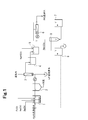
- FIG. 1 is a system diagram showing an embodiment of a method for recovering water and metal from plating washing waste water according to the present invention
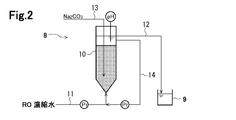
- FIG. 2 is a system diagram showing the structure of a crystallizer
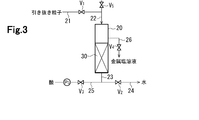
- FIG. 3 is the structure of an acid contact device.
- the plating cleaning waste water as raw water is introduced into the agglomeration / oxidation tank 1, and an oxidizing agent (sodium hypochlorite (NaClO) in FIG. 1) and a pH adjusting agent (in FIG. 1, as an alkaline agent).
- an oxidizing agent sodium hypochlorite (NaClO) in FIG. 1
- a pH adjusting agent in FIG. 1, as an alkaline agent
- AgOH sodium hypochlorite
- FeCl 3 a flocculant
- divalent iron (Fe 2+ ) in the liquid is converted to trivalent iron (Fe 3+ ) at pH 3-6.
- the oxidizing agent hydrogen peroxide, potassium permanganate, chlorine, ozone, or the like can be used in addition to NaClO.
- the addition amount of the oxidizing agent may be equal to or more than the equivalent for oxidizing Fe 2+ in the liquid to Fe 3+ .
- the plating washing wastewater is usually acidic at a pH of less than 3, for example, about pH 2, it needs to be at least pH 3 for precipitation of Fe (OH) 3 , so that NaOH, Ca (OH) are used as pH adjusters.
- the pH is adjusted by adding alkali such as 2 .
- the pH is adjusted to 3 to 7, particularly 5 to 6, since nickel and zinc in the liquid are precipitated when the pH exceeds 7.
- a flocculant such as FeCl 3 may be added in order to improve the sedimentation of Fe (OH) 3 floc.
- a flocculant such as FeCl 3
- the sedimentation property of the insolubilized particles is improved, the sedimentation efficiency in the subsequent sedimentation tank 2 is increased, and the floc diameter is increased so that the downstream UF membrane device 3
- the filterability of can also be improved.
- the addition of a flocculant is also preferable in order to agglomerate organic substances in the plating washing waste water to reduce the load on the subsequent RO membrane device 6 and to prevent contamination of the RO membrane.
- Amount of FeCl 3 is generally 10 ⁇ 200mg / L, preferably about 100 ⁇ 150mg / L.
- the liquid in which the floc of Fe (OH) 3 is precipitated in the coagulation / oxidation tank 1 is then solid-liquid separated by an MF membrane, a UF membrane or a filter (for example, a sand filter).
- MF membrane separation device MF membrane separation device
- the separation liquid pump P A is introduced into the UF membrane device 3, is a membrane filtration.
- the UF membrane device 3 is regularly backwashed, and the collected Fe (OH) 3 sludge is discharged out of the system together with the backwash drainage.
- the filtered water of the UF membrane device 3 is introduced into the adjustment tank 5 through the UF treatment water tank 4 and the water quality is adjusted in the adjustment tank 5. That is, prior to processing the filtered water of the UF membrane device 3 by the RO membrane device (RO membrane separation device) 6, sodium bisulfite (NaHSO 3 ) and sodium sulfite (Na 2 ) are added to the UF membrane filtered water to protect the RO membrane. It is necessary to add a reducing agent such as SO 4 ) or contact with activated carbon to remove the remaining oxidizing agent, and to prevent precipitation of metal hydroxides such as nickel and zinc by concentration in the RO membrane device 6. Accordingly, a pH adjusting agent is added to adjust the pH of the water (RO feed water) supplied to the RO membrane device 6 to 4 to 6, preferably 4 to 5.
- the amount of the reducing agent added to the UF membrane filtered water is usually 5 to 20 mg / L, preferably 10 to 15 mg / L in excess of the equivalent of the remaining oxidizing agent.
- the water whose water quality has been adjusted in the adjustment tank 5 is introduced into the RO membrane device 6 by the pump P B and subjected to membrane separation treatment into permeated water (RO permeated water) and concentrated water (RO concentrated water). A part of the concentrated water is supplied to the RO concentrated water tank 7, and the remaining part is circulated.
- the treatment with the RO membrane device 6 is performed at a concentration factor of 5 to 10 times and a water recovery rate of 80 to 90%, so that metal ions can be highly concentrated and the water recovery rate can be increased without causing operational troubles. It is preferable in terms of enhancement.
- RO permeated water obtained by the RO membrane device 6 has the same good water quality as pure water, it can be reused as plating cleaning water. Moreover, this RO permeated water can also be used at other use points.
- the metal ions in the RO concentrated water are concentrated to 5 to 10 times the metal ion concentration in the plating washing wastewater.
- This RO concentrated water is introduced into the crystallizer 8 through the RO concentrated water tank 7 and crystallized. Is done.
- the crystallization apparatus 8 is not particularly limited as long as it can promote the precipitation of metal carbonate.
- a seed crystal is packed in the crystallization reaction tower 10 as shown in FIG.
- a tower reactor in which RO concentrated water is passed from the bottom of the tower to form a fluidized bed of seed crystals in the tower can be suitably used.
- the raw crystallization water is passed from the lower part of the reaction tower 10 through the pipe 11 by the pump P 1 , and the treated water flows out from the pipe 12 and is introduced into the treated water tank 9. From the tower top part of the treated water is processed is circulated to the bottom of the column by the circulation pipe 14 and a circulation pump P 2.
- Alkali carbonate such as sodium carbonate (Na 2 CO 3 ) or a mixed solution of sodium bicarbonate (NaHCO 3 ) and caustic soda (NaOH) is injected from the upper part of the crystallization reaction tower 13.
- a metal carbonate precipitates on the seed crystal flowing in the tower in accordance with a reaction between sodium carbonate and metal ions, for example, according to the following reaction.
- the metal carbonate needs to be precipitated by raising the pH of the crystallization raw water to 7 to 10, preferably 8 to 9. Therefore, the alkali carbonate injected into the crystallization tower reaction tower 10 is an amount necessary for forming the metal carbonate, and the liquid pH in the crystallization tower is such an amount. When the pH is less than 7, carbonate is not precipitated, and when it exceeds 10, zinc carbonate is easily dissolved again.
- acid-insoluble particles that are not dissolved by acid treatment in the subsequent metal recovery step are used as seed crystals.
- acid-insoluble particles sand (silica sand), anthracite and the like can be used as the acid-insoluble particles.
- the seed crystal grain size is suitably about 0.1 to 1 mm, particularly about 0.2 to 0.4 mm.
- metal ions in the crystallization raw water are insolubilized as metal carbonates and precipitate on the seed crystal surface.
- the seed crystal particles grow by precipitation of the metal carbonate and increase to a particle size of 0.3 to 1.5 mm.
- the increased particles are extracted from the crystallizer and fed to the metal recovery process.
- the treated water of the crystallizer 8 is introduced into the crystallized water tank 9.
- the recovery rate of metal ions is often 70 to 90%, generally about 80%. For this reason, it is preferable to return a part of this crystallization treatment water to the iron insolubilization step and to circulate it together with the raw water plating washing waste water. Thereby, the metal ions which could not be recovered by one crystallization process can be repeatedly crystallized, and the overall metal recovery rate can be increased.
- the ratio of the crystallized water to be circulated is 10 to 80% of the water introduced into the crystallized water tank 9, the total water recovery rate is 70 to 90%, and the metal recovery rate is 80%. It is preferable to perform the treatment under the condition of about 95%.
- the crystallizer 8 when an acid such as sulfuric acid or hydrochloric acid is brought into contact with particles having a metal carbonate such as nickel or zinc attached using an acid-insoluble seed crystal as a nucleus, the metal carbonate such as nickel or zinc is redissolved. Thus, a highly concentrated solution of metal sulfate or chloride is obtained. In the treatment of the electroplating washing waste water, the high-concentration metal sulfate aqueous solution thus obtained can be reused as it is in the plating bath. In addition, after the recovered particles are brought into contact with an acid to dissolve the metal carbonate, acid-insoluble seed crystal particles remain, but these seed crystal particles should be used again as seed crystals in a crystallizer. Can do. By reusing seed crystal particles in this way, particle size management in the crystallizer becomes easy.
- the device for bringing the particles extracted from the crystallizer 8 (particles having a metal carbonate deposited on the surface of the seed crystal) into contact with the acid is not particularly limited as long as it can efficiently bring both into contact with each other.
- an acid contact device as shown in FIG. 3 can be used.
- This acid contact device has an acid contact tower 20 into which the drawn particles from the crystallizer 8 are charged, and a water collecting plate (porous) through which only water can pass without passing through the particles in the lower part of the tower. Plate or mesh).
- the valves V 1 and V 2 are opened, the other valves are closed, the extracted particles are put into the acid contact tower 20 from the pipe 21, and moisture is supplied to the pipe 23, Extract from 24. This water is returned to the crystallization water tank 9.
- the valves V 3 and V 4 are opened, the other valves are closed, and an acid such as sulfuric acid is passed through the pipes 25 and 23 from the lower part of the acid contact tower 20 by the pump P 3 to contact the acid and the particles.
- a solution containing metal ions in which the metal carbonate is dissolved is taken out via the pipe 26.
- this metal salt solution since a high concentration solution of about 5 to 15% by weight of metal ions is usually obtained, this metal salt solution can be suitably reused as a plating solution.
- valves V 2 and V 5 After dissolving the metal carbonate on the surface of the seed crystal, the valves V 2 and V 5 are opened, the other valves are closed, and the water is acidified at a high flow rate through the pipes 24 and 23 by a pump (not shown). and passed through from the bottom of the contact tower 20, the seed crystals through the valve V 5 to return to reuse the crystallizer 8.
- the acid used for dissolving the metal carbonate on the seed crystal is preferably a high concentration sulfuric acid aqueous solution of about 50 to 98% by weight or a 20 to 35% by weight hydrochloric acid aqueous solution.
- the amount of waste water and the amount of discharged metal are reduced, the amount of sludge generated in the entire system is greatly reduced, and water and valuable metals are efficiently recovered from the plating washing waste water. can do.
- Example 1 Water and metal were recovered from the plating washing waste water by the method shown in FIG.
- the treatment liquid in the flocculation / oxidation tank 1 was introduced into the precipitation tank 2 and most of the generated floc was settled and separated, and then the separation liquid in the precipitation tank 2 was subjected to membrane filtration with the UF membrane device 3. This UF membrane device 3 was regularly backwashed.
- the filtered water of the UF membrane device 3 is introduced into the adjustment tank 5 through the UF treatment water tank 4, and after adding residual sodium bisulfite 15mg / L to remove residual chlorine, it is supplied to the RO membrane apparatus 6 (RO supply water) ), RO permeated water was recovered, and RO concentrated water was supplied to the crystallizer 8 through the RO concentrated water tank 7 for crystallization treatment.
- the water recovery rate of this RO membrane device 6 was 80%.
- the crystallization apparatus 8 is a crystallization reaction tower 10 as shown in FIG. 2 filled with sand having a particle size of about 0.2 mm.
- RO concentrated water is passed from the lower part of the crystallization reaction tower 10 to sand.
- the pH in the fluidized bed was adjusted to 9 by adding sodium carbonate (Na 2 CO 3 ) to the fluidized bed. Crystallized water from the crystallizer 8 was received in a crystallized water tank 9.
- Table 1 shows the water quality for each process in this treatment.
- Iron was insolubilized by the iron insolubilization treatment, and was removed to a level that was not detected at the stage of RO supply water.
- Nickel and zinc were hardly insolubilized up to the RO membrane device 6 and were in a dissolved state.
- About 80% of nickel and zinc concentrated in a dissolved state on the RO concentrated water side were removed by crystallization treatment (metal recovery rate 80%).
- metal recovery rate 80% nickel and zinc were deposited on the surface of sand introduced as seed crystals, and an increase in seed crystal particle diameter was observed.
- Example 2 In Example 1, the seed crystal having a particle size increased to about 0.3 to 0.4 mm by the crystallization treatment is guided to the acid contact tower 20 shown in FIG. A weight% aqueous sulfuric acid solution was injected. The water content of the particles after draining was 10% by weight. By injecting sulfuric acid from the lower part of the tower, nickel and zinc adhering to the seed crystal surface were dissolved, and a sulfate solution of nickel and zinc was obtained from the upper part of the tower. The nickel and zinc concentrations of this solution were 1.5 wt% and 17 wt%, respectively. As a result, nickel and zinc in plating washing wastewater in the raw water are concentrated 600 times and 577 times, respectively.
- Example 3 In Example 1, 90% of the crystallization treated water was returned to the inlet side of the flocculation / oxidation tank 1 and treated in the same manner as in the treatment with the plating washing waste water.
- the one-pass metal recovery rate in the crystallization treatment is not changed to 80%, but by returning the crystallization treatment water and treating it again, the crystallization treatment is repeated and the entire metal is recovered. The recovery increased to 98%. The water recovery rate was improved to 92%.
Landscapes
- Chemical & Material Sciences (AREA)
- Engineering & Computer Science (AREA)
- Organic Chemistry (AREA)
- Life Sciences & Earth Sciences (AREA)
- Environmental & Geological Engineering (AREA)
- Metallurgy (AREA)
- Materials Engineering (AREA)
- Manufacturing & Machinery (AREA)
- Hydrology & Water Resources (AREA)
- General Life Sciences & Earth Sciences (AREA)
- Water Supply & Treatment (AREA)
- Mechanical Engineering (AREA)
- Chemical Kinetics & Catalysis (AREA)
- Geology (AREA)
- Geochemistry & Mineralogy (AREA)
- Crystallography & Structural Chemistry (AREA)
- General Chemical & Material Sciences (AREA)
- Electrochemistry (AREA)
- Removal Of Specific Substances (AREA)
- Separation Using Semi-Permeable Membranes (AREA)
- Treatment Of Water By Oxidation Or Reduction (AREA)
- Manufacture And Refinement Of Metals (AREA)
Abstract
Description
水酸化物は、フロックが微細で、沈殿池での分離性が不安定であるため、安定運転のためには高分子凝集剤などの沈殿補助剤が必要である。また、水酸化物スラッジは含水率70~80%程度であり、発生した大量のスラッジの処理が問題となる。
また、この方法で、鉄とニッケルや亜鉛とを分離回収するためには、中和時のpHを2段階にする必要があるため、沈殿池を2段階に設けることとなり、大きな設置スペースが必要である。
更に、水回収のために、後段でRO(逆浸透)膜処理を行う場合、中和処理によりイオンが増加するため、RO膜へのイオン負荷が増加してしまう。
硫化物は溶解度積が低く、金属イオン濃度を低下させることができるが、硫化物の沈殿物は微細であるため、沈殿分離性が悪い。また、硫化物は酸性条件で硫化水素を発生するため、安全性の問題がある。
イオン交換樹脂は殆どすべてのイオンを吸着するため、排水処理では金属イオン以外のイオン吸着量が大きく、金属イオン除去を目的とした場合には効率が悪い。また、その分、再生薬剤を多く必要とし、しかも、再生液中にはこれらのイオンが混合された状態で含まれるため、有価金属の回収が困難である。
イオン交換樹脂に比べて金属イオンに対する選択性は高いが、共存イオンの挙動に注意が必要である。また、再生には通常、硫酸や塩酸を使用するが、再生液中に酸が多く残留するとともに、回収液の金属イオン濃度は高々2~3重量%程度と再利用するには濃度が低い。
RO膜の使用により良好な処理水質を得ることができるが、RO濃縮水側に濃縮される金属イオンは排水中の10倍程度にしかならないため、RO膜単独では金属回収に適さない。
なお、ニッケルや亜鉛は、水酸化物として不溶化させることもできるが、水酸化物は水分を包含した含水率の高いフロックを生成するため、晶析法には適さない。
Ni2++Na2CO3→NiCO3(析出)+2Na+
Zn2++Na2CO3→ZnCO3(析出)+2Na+
図1に示す方法でメッキ洗浄排水からの水と金属の回収を行った。

実施例1において、晶析処理により0.3~0.4mm程度に粒径が増大した種晶を、図3に示す酸接触塔20に導き、10分間水切りを行った後、塔下部から50重量%硫酸水溶液を注入した。水切りした段階での粒子の含水率は10重量%であった。塔下部から硫酸を注入することにより、種晶表面に付着したニッケル、亜鉛が溶解し、塔上部よりニッケル、亜鉛の硫酸塩溶液が得られた。この溶液のニッケル、亜鉛濃度はそれぞれ1.5重量%、17重量%であった。この結果は、原水中のメッキ洗浄排水のニッケル、亜鉛がそれぞれ600倍、577倍に濃縮されたことになる。
実施例1において、晶析処理水の90%を凝集・酸化槽1の入口側に返送し、メッキ洗浄排水と共に処理したこと以外は同様に行った。本例において、晶析処理での1パスの金属回収率は80%と変わらないが、晶析処理水を返送して再度処理することで、繰り返し晶析処理されることになり、全体の金属回収率は98%まで上昇した。また、水回収率は92%まで向上した。
なお、本出願は、2009年6月11日付で出願された日本特許出願(特願2009-140335)に基づいており、その全体が引用により援用される。
Claims (6)
- メッキ洗浄排水から水及び金属を回収する方法において、
メッキ洗浄排水を酸化剤の存在下にpH3~6に調整して、液中の2価鉄イオンを3価鉄イオンに酸化すると共に鉄水酸化物を析出させる鉄不溶化工程と、
該鉄不溶化工程の処理水を精密濾過膜、限外濾過膜又は濾過器で固液分離する固液分離工程と、
該固液分離工程で分離された分離水を逆浸透膜分離処理し、透過水を処理水として系外へ取り出す逆浸透膜分離工程と、
該逆浸透膜分離工程の濃縮水にアルカリを添加して、酸不溶性の粒子を種晶とする晶析法により、液中の金属を炭酸塩として析出させる晶析工程と
を有することを特徴とするメッキ洗浄排水からの水及び金属の回収方法。 - 請求項1において、前記晶析工程において、種晶上に析出した金属炭酸塩を酸に溶解させて金属塩溶液を得る金属回収工程を有することを特徴とするメッキ洗浄排水からの水及び金属の回収方法。
- 請求項2において、前記金属回収工程で得られた金属塩溶液をメッキ液として再利用することを特徴とするメッキ洗浄排水からの水及び金属の回収方法。
- 請求項2において、前記金属回収工程からの種晶を回収して晶析工程で再使用することを特徴とするメッキ洗浄排水からの水及び金属の回収方法。
- 請求項2において、前記酸は硫酸水溶液又は塩酸水溶液であることを特徴とするメッキ洗浄排水からの水及び金属の回収方法。
- 請求項1ないし5のいずれか1項において、前記晶析工程の処理水の一部を前記鉄不溶化工程に返送して処理することを特徴とするメッキ洗浄排水からの水及び金属の回収方法。
Priority Applications (1)
| Application Number | Priority Date | Filing Date | Title |
|---|---|---|---|
| CN201080025924.7A CN102459096B (zh) | 2009-06-11 | 2010-06-08 | 从镀敷清洗废水中回收水和金属的方法 |
Applications Claiming Priority (2)
| Application Number | Priority Date | Filing Date | Title |
|---|---|---|---|
| JP2009-140335 | 2009-06-11 | ||
| JP2009140335A JP5471054B2 (ja) | 2009-06-11 | 2009-06-11 | メッキ洗浄排水からの水及び金属の回収方法 |
Publications (1)
| Publication Number | Publication Date |
|---|---|
| WO2010143623A1 true WO2010143623A1 (ja) | 2010-12-16 |
Family
ID=43308878
Family Applications (1)
| Application Number | Title | Priority Date | Filing Date |
|---|---|---|---|
| PCT/JP2010/059680 Ceased WO2010143623A1 (ja) | 2009-06-11 | 2010-06-08 | メッキ洗浄排水からの水及び金属の回収方法 |
Country Status (3)
| Country | Link |
|---|---|
| JP (1) | JP5471054B2 (ja) |
| CN (1) | CN102459096B (ja) |
| WO (1) | WO2010143623A1 (ja) |
Cited By (12)
| Publication number | Priority date | Publication date | Assignee | Title |
|---|---|---|---|---|
| CN103539276A (zh) * | 2013-06-03 | 2014-01-29 | 广州凯膜过滤设备有限公司 | 一种电镀清洗零排放及电镀液回收系统及工艺 |
| US8747787B2 (en) | 2010-07-28 | 2014-06-10 | Sumitomo Metal Mining Co., Ltd. | Method for producing raw material for ferronickel smelting from low grade nickel oxide ore |
| CN104724857A (zh) * | 2015-03-27 | 2015-06-24 | 天津大学 | 漂粉精生产过程中漂洗液的资源化处理方法 |
| EP3015160A4 (en) * | 2013-12-18 | 2016-12-21 | Mitsubishi Heavy Ind Ltd | TARTER DETECTION DEVICE AND METHOD FOR CONCENTRATING DEVICE AND WATER RECYCLING TREATMENT SYSTEM |
| EP3156508A1 (en) * | 2015-10-16 | 2017-04-19 | Vito NV | Recovery process for metal-containing byproducts of metal production and processing |
| CN106587478A (zh) * | 2017-01-22 | 2017-04-26 | 青岛北方节能环保有限公司 | 一种热镀锌废酸资源化处理方法 |
| CN107253775A (zh) * | 2017-06-22 | 2017-10-17 | 广东益诺欧环保股份有限公司 | 一种电镀废水污泥减量装置 |
| US20180029907A1 (en) * | 2015-12-22 | 2018-02-01 | Sumitomo Electric Industries, Ltd. | Water treatment method and water treatment system |
| CN108147622A (zh) * | 2018-01-16 | 2018-06-12 | 张家港市佰坤物资有限公司 | 一种电解铜废水处理工艺 |
| CN110963622A (zh) * | 2019-12-17 | 2020-04-07 | 浙江富莱迪环境设备有限责任公司 | 一种耦合分质功能的二次供水深度净化系统 |
| CN111392923A (zh) * | 2020-03-04 | 2020-07-10 | 首钢京唐钢铁联合有限责任公司 | 一种含酸废水处理方法、处理系统及应用 |
| CN116655176A (zh) * | 2023-06-29 | 2023-08-29 | 华电水务科技股份有限公司 | 双燃料能源站废水的零排放处理工艺和零排放处理系统 |
Families Citing this family (14)
| Publication number | Priority date | Publication date | Assignee | Title |
|---|---|---|---|---|
| WO2012098924A1 (ja) * | 2011-01-20 | 2012-07-26 | 三菱レイヨン株式会社 | 廃水の処理装置、処理方法、および廃水処理システム |
| JP5719320B2 (ja) * | 2012-01-27 | 2015-05-13 | Jfeエンジニアリング株式会社 | 亜鉛めっき廃液からの亜鉛回収方法 |
| JP6061024B2 (ja) * | 2014-02-27 | 2017-01-18 | 三菱レイヨン株式会社 | 重金属含有排水の処理方法及び処理装置 |
| JP6709036B2 (ja) * | 2015-11-12 | 2020-06-10 | 岩井ファルマテック株式会社 | 温水回収システム |
| JP6216856B1 (ja) * | 2016-10-06 | 2017-10-18 | 川村 彰彦 | 有用資源が溶出されている溶出液から有用資源を回収するための有用資源回収装置及び方法 |
| JP7237640B2 (ja) * | 2018-03-26 | 2023-03-13 | 三菱ケミカルアクア・ソリューションズ株式会社 | 酸性凝集物含有廃液の処理方法および水処理装置 |
| JP7305090B2 (ja) * | 2019-01-30 | 2023-07-10 | アサヒプリテック株式会社 | レジスト廃液からの有価金属粉回収方法、及び有価金属粉回収装置 |
| CN110734168B (zh) | 2019-12-18 | 2020-04-14 | 烟台金正环保科技有限公司 | 一种高浓盐水的处理方法及系统 |
| CN113477639B (zh) * | 2021-06-25 | 2022-06-10 | 武钢集团昆明钢铁股份有限公司 | 一种三氯化铁污渍的清洗方法 |
| CN114455765B (zh) * | 2022-02-11 | 2023-04-14 | 宜兴市中发水处理环保设备有限公司 | 一种电镀液膜分离回收技术设备及其回收方法 |
| CN115432861A (zh) * | 2022-10-26 | 2022-12-06 | 西安交通大学 | 一种带有晶种再生系统的核晶凝聚诱导造粒分盐结晶水处理装置 |
| JPWO2024162250A1 (ja) * | 2023-01-31 | 2024-08-08 | ||
| CN115807159B (zh) * | 2023-02-03 | 2025-08-05 | 西安交通大学 | 一种用于高效回收重金属锰的核晶造粒装置 |
| CN118851465A (zh) * | 2024-07-09 | 2024-10-29 | 安徽广信农化股份有限公司 | 一种噁唑菌酮产生的废水的处理工艺 |
Citations (11)
| Publication number | Priority date | Publication date | Assignee | Title |
|---|---|---|---|---|
| JPS62253738A (ja) * | 1986-02-18 | 1987-11-05 | ジエイムズ エム.フランカ−ド | 危険な金属廃スラツジの除去方法 |
| JPH0751684A (ja) * | 1993-08-19 | 1995-02-28 | Kankyo Eng Kk | 溶存鉄含有排水の処理方法 |
| JP2000117270A (ja) * | 1998-10-09 | 2000-04-25 | Nippon Steel Corp | 金属含有排水の処理および有価金属の回収方法 |
| JP2001321768A (ja) * | 2000-05-15 | 2001-11-20 | Kawasaki Heavy Ind Ltd | 廃棄物埋立処分地浸出水の処理方法及び装置 |
| JP2002018485A (ja) * | 2000-07-11 | 2002-01-22 | Nippon Steel Corp | 金属含有排水の処理方法および金属含有排水からの有価金属の回収方法 |
| JP2002121626A (ja) * | 2000-10-18 | 2002-04-26 | National Institute Of Advanced Industrial & Technology | めっきスラッジから有価金属を回収する方法 |
| JP2002192168A (ja) * | 2000-12-27 | 2002-07-10 | Nippon Steel Corp | ニッケル、亜鉛含有排水あるいはスラッジからのニッケル、亜鉛の分離回収方法 |
| JP2004105923A (ja) * | 2002-09-20 | 2004-04-08 | Nippon Steel Corp | 金属含有排水中の有価金属の回収方法および利用方法 |
| JP2004107780A (ja) * | 2002-09-20 | 2004-04-08 | Nippon Steel Corp | 金属含有排水中の有価金属の回収方法および利用方法 |
| JP2005015272A (ja) * | 2003-06-26 | 2005-01-20 | Nippon Steel Corp | ニッケル含有廃液スラッジからのニッケル塩の回収方法 |
| JP2005296866A (ja) * | 2004-04-14 | 2005-10-27 | Nippon Steel Corp | 廃液からの鉄含有脱水ケーキの製造方法 |
Family Cites Families (12)
| Publication number | Priority date | Publication date | Assignee | Title |
|---|---|---|---|---|
| JPS5537310B2 (ja) * | 1974-02-18 | 1980-09-26 | ||
| JPS5470644A (en) * | 1977-11-16 | 1979-06-06 | Hitachi Plant Eng & Constr Co Ltd | Purification disposal method of waste water containing zinc |
| JPS61143527A (ja) * | 1984-12-14 | 1986-07-01 | Kurita Water Ind Ltd | 金属含有水の処理方法 |
| JP2701284B2 (ja) * | 1988-01-27 | 1998-01-21 | 住友金属工業株式会社 | 金属含有水の処理方法 |
| JPH01207185A (ja) * | 1988-02-12 | 1989-08-21 | Kurita Water Ind Ltd | メッキ廃水の処理方法 |
| US6416668B1 (en) * | 1999-09-01 | 2002-07-09 | Riad A. Al-Samadi | Water treatment process for membranes |
| JP2002292204A (ja) * | 2001-03-30 | 2002-10-08 | Japan Organo Co Ltd | 原水供給制御手段を備えた晶析反応装置および該装置を用いた晶析処理方法 |
| JP4842450B2 (ja) * | 2001-03-30 | 2011-12-21 | オルガノ株式会社 | 濁度測定手段を備えた晶析反応装置および該装置を用いた晶析処理方法 |
| JP4669625B2 (ja) * | 2001-03-30 | 2011-04-13 | オルガノ株式会社 | 晶析反応成分回収手段を備えた晶析反応装置 |
| CN1282616C (zh) * | 2004-12-04 | 2006-11-01 | 海宁市海整整流器有限公司 | 电镀中水回用技术 |
| CN101423309B (zh) * | 2008-05-07 | 2010-10-13 | 厦门市闽发实业有限公司 | 电镀废水及重金属双回收方法 |
| JP2010138490A (ja) * | 2008-11-12 | 2010-06-24 | Mitsubishi Materials Corp | 亜鉛の回収方法等 |
-
2009
- 2009-06-11 JP JP2009140335A patent/JP5471054B2/ja not_active Expired - Fee Related
-
2010
- 2010-06-08 WO PCT/JP2010/059680 patent/WO2010143623A1/ja not_active Ceased
- 2010-06-08 CN CN201080025924.7A patent/CN102459096B/zh not_active Expired - Fee Related
Patent Citations (11)
| Publication number | Priority date | Publication date | Assignee | Title |
|---|---|---|---|---|
| JPS62253738A (ja) * | 1986-02-18 | 1987-11-05 | ジエイムズ エム.フランカ−ド | 危険な金属廃スラツジの除去方法 |
| JPH0751684A (ja) * | 1993-08-19 | 1995-02-28 | Kankyo Eng Kk | 溶存鉄含有排水の処理方法 |
| JP2000117270A (ja) * | 1998-10-09 | 2000-04-25 | Nippon Steel Corp | 金属含有排水の処理および有価金属の回収方法 |
| JP2001321768A (ja) * | 2000-05-15 | 2001-11-20 | Kawasaki Heavy Ind Ltd | 廃棄物埋立処分地浸出水の処理方法及び装置 |
| JP2002018485A (ja) * | 2000-07-11 | 2002-01-22 | Nippon Steel Corp | 金属含有排水の処理方法および金属含有排水からの有価金属の回収方法 |
| JP2002121626A (ja) * | 2000-10-18 | 2002-04-26 | National Institute Of Advanced Industrial & Technology | めっきスラッジから有価金属を回収する方法 |
| JP2002192168A (ja) * | 2000-12-27 | 2002-07-10 | Nippon Steel Corp | ニッケル、亜鉛含有排水あるいはスラッジからのニッケル、亜鉛の分離回収方法 |
| JP2004105923A (ja) * | 2002-09-20 | 2004-04-08 | Nippon Steel Corp | 金属含有排水中の有価金属の回収方法および利用方法 |
| JP2004107780A (ja) * | 2002-09-20 | 2004-04-08 | Nippon Steel Corp | 金属含有排水中の有価金属の回収方法および利用方法 |
| JP2005015272A (ja) * | 2003-06-26 | 2005-01-20 | Nippon Steel Corp | ニッケル含有廃液スラッジからのニッケル塩の回収方法 |
| JP2005296866A (ja) * | 2004-04-14 | 2005-10-27 | Nippon Steel Corp | 廃液からの鉄含有脱水ケーキの製造方法 |
Cited By (13)
| Publication number | Priority date | Publication date | Assignee | Title |
|---|---|---|---|---|
| US8747787B2 (en) | 2010-07-28 | 2014-06-10 | Sumitomo Metal Mining Co., Ltd. | Method for producing raw material for ferronickel smelting from low grade nickel oxide ore |
| CN103539276A (zh) * | 2013-06-03 | 2014-01-29 | 广州凯膜过滤设备有限公司 | 一种电镀清洗零排放及电镀液回收系统及工艺 |
| US10407331B2 (en) | 2013-12-18 | 2019-09-10 | Mitsubishi Heavy Industries Engineering, Ltd. | Scale detection device and method for concentrating device, and water reclamation processing treatment system |
| EP3015160A4 (en) * | 2013-12-18 | 2016-12-21 | Mitsubishi Heavy Ind Ltd | TARTER DETECTION DEVICE AND METHOD FOR CONCENTRATING DEVICE AND WATER RECYCLING TREATMENT SYSTEM |
| CN104724857A (zh) * | 2015-03-27 | 2015-06-24 | 天津大学 | 漂粉精生产过程中漂洗液的资源化处理方法 |
| EP3156508A1 (en) * | 2015-10-16 | 2017-04-19 | Vito NV | Recovery process for metal-containing byproducts of metal production and processing |
| US20180029907A1 (en) * | 2015-12-22 | 2018-02-01 | Sumitomo Electric Industries, Ltd. | Water treatment method and water treatment system |
| CN106587478A (zh) * | 2017-01-22 | 2017-04-26 | 青岛北方节能环保有限公司 | 一种热镀锌废酸资源化处理方法 |
| CN107253775A (zh) * | 2017-06-22 | 2017-10-17 | 广东益诺欧环保股份有限公司 | 一种电镀废水污泥减量装置 |
| CN108147622A (zh) * | 2018-01-16 | 2018-06-12 | 张家港市佰坤物资有限公司 | 一种电解铜废水处理工艺 |
| CN110963622A (zh) * | 2019-12-17 | 2020-04-07 | 浙江富莱迪环境设备有限责任公司 | 一种耦合分质功能的二次供水深度净化系统 |
| CN111392923A (zh) * | 2020-03-04 | 2020-07-10 | 首钢京唐钢铁联合有限责任公司 | 一种含酸废水处理方法、处理系统及应用 |
| CN116655176A (zh) * | 2023-06-29 | 2023-08-29 | 华电水务科技股份有限公司 | 双燃料能源站废水的零排放处理工艺和零排放处理系统 |
Also Published As
| Publication number | Publication date |
|---|---|
| CN102459096B (zh) | 2014-06-18 |
| CN102459096A (zh) | 2012-05-16 |
| JP5471054B2 (ja) | 2014-04-16 |
| JP2010284593A (ja) | 2010-12-24 |
Similar Documents
| Publication | Publication Date | Title |
|---|---|---|
| JP5471054B2 (ja) | メッキ洗浄排水からの水及び金属の回収方法 | |
| JP3842907B2 (ja) | 金属含有排水の処理および有価金属の回収方法 | |
| CN101723526B (zh) | 一种合成橡胶生产废水的膜处理方法 | |
| JP5879901B2 (ja) | 有機排水の回収処理装置及び回収処理方法 | |
| CA2891066C (en) | Process for reducing the sulfate concentration in a wastewater stream by employing regenerated gibbsite | |
| JP5540574B2 (ja) | 金属回収方法 | |
| JPH02157090A (ja) | 重金属含有廃水の処理方法 | |
| JP2009226244A (ja) | 廃水処理方法および廃水処理装置 | |
| CN101466855B (zh) | 硫化镍沉淀方法 | |
| JP2006095425A (ja) | 廃水の生物処理水含有水の浄化方法及び浄化装置 | |
| JP4261857B2 (ja) | 金属含有排水中の有価金属の回収方法および利用方法 | |
| JP6213044B2 (ja) | セレン含有水の処理方法及び処理装置 | |
| JP2013141641A (ja) | 重金属含有排水の処理方法 | |
| US11008240B2 (en) | Process for reduction of sulfide from water and wastewater | |
| JP5023809B2 (ja) | 塩化ナトリウム水溶液の電解方法 | |
| TWI725782B (zh) | 含鉬廢水處理方法及裝置 | |
| JP2006224023A (ja) | 重金属含有排水の処理方法および重金属含有排水の処理装置 | |
| JP2006263553A (ja) | 陰イオン性有機物含有排水の処理方法 | |
| JP2004074146A (ja) | 不純物を含有する液体の処理方法および装置 | |
| CN120097452B (zh) | 一种膜过滤法回收催化湿式氧化催化剂的方法 | |
| CN102491556B (zh) | 一种煤液化含氰污水处理系统及处理方法 | |
| JP4482488B2 (ja) | 無機性廃水の処理方法及び処理装置 | |
| JP4122207B2 (ja) | 排水中の金属除去方法 | |
| CN121729391A (zh) | 废水处理设备及废水处理方法 | |
| CN117720221A (zh) | 利用回收中水制备脱盐水的方法及系统 |
Legal Events
| Date | Code | Title | Description |
|---|---|---|---|
| WWE | Wipo information: entry into national phase |
Ref document number: 201080025924.7 Country of ref document: CN |
|
| 121 | Ep: the epo has been informed by wipo that ep was designated in this application |
Ref document number: 10786154 Country of ref document: EP Kind code of ref document: A1 |
|
| WWE | Wipo information: entry into national phase |
Ref document number: 9008/CHENP/2011 Country of ref document: IN |
|
| NENP | Non-entry into the national phase |
Ref country code: DE |
|
| 122 | Ep: pct application non-entry in european phase |
Ref document number: 10786154 Country of ref document: EP Kind code of ref document: A1 |