WO2010146820A1 - 樹脂ペレットおよびその製造方法 - Google Patents
樹脂ペレットおよびその製造方法 Download PDFInfo
- Publication number
- WO2010146820A1 WO2010146820A1 PCT/JP2010/003920 JP2010003920W WO2010146820A1 WO 2010146820 A1 WO2010146820 A1 WO 2010146820A1 JP 2010003920 W JP2010003920 W JP 2010003920W WO 2010146820 A1 WO2010146820 A1 WO 2010146820A1
- Authority
- WO
- WIPO (PCT)
- Prior art keywords
- resin
- fine particles
- base material
- resin base
- vinyl acetate
- Prior art date
- Legal status (The legal status is an assumption and is not a legal conclusion. Google has not performed a legal analysis and makes no representation as to the accuracy of the status listed.)
- Ceased
Links
Images

Classifications
-
- C—CHEMISTRY; METALLURGY
- C08—ORGANIC MACROMOLECULAR COMPOUNDS; THEIR PREPARATION OR CHEMICAL WORKING-UP; COMPOSITIONS BASED THEREON
- C08J—WORKING-UP; GENERAL PROCESSES OF COMPOUNDING; AFTER-TREATMENT NOT COVERED BY SUBCLASSES C08B, C08C, C08F, C08G or C08H
- C08J3/00—Processes of treating or compounding macromolecular substances
- C08J3/12—Powdering or granulating
- C08J3/124—Treatment for improving the free-flowing characteristics
-
- C—CHEMISTRY; METALLURGY
- C08—ORGANIC MACROMOLECULAR COMPOUNDS; THEIR PREPARATION OR CHEMICAL WORKING-UP; COMPOSITIONS BASED THEREON
- C08J—WORKING-UP; GENERAL PROCESSES OF COMPOUNDING; AFTER-TREATMENT NOT COVERED BY SUBCLASSES C08B, C08C, C08F, C08G or C08H
- C08J3/00—Processes of treating or compounding macromolecular substances
- C08J3/12—Powdering or granulating
-
- B—PERFORMING OPERATIONS; TRANSPORTING
- B29—WORKING OF PLASTICS; WORKING OF SUBSTANCES IN A PLASTIC STATE IN GENERAL
- B29B—PREPARATION OR PRETREATMENT OF THE MATERIAL TO BE SHAPED; MAKING GRANULES OR PREFORMS; RECOVERY OF PLASTICS OR OTHER CONSTITUENTS OF WASTE MATERIAL CONTAINING PLASTICS
- B29B9/00—Making granules
-
- B—PERFORMING OPERATIONS; TRANSPORTING
- B29—WORKING OF PLASTICS; WORKING OF SUBSTANCES IN A PLASTIC STATE IN GENERAL
- B29B—PREPARATION OR PRETREATMENT OF THE MATERIAL TO BE SHAPED; MAKING GRANULES OR PREFORMS; RECOVERY OF PLASTICS OR OTHER CONSTITUENTS OF WASTE MATERIAL CONTAINING PLASTICS
- B29B9/00—Making granules
- B29B9/12—Making granules characterised by structure or composition
-
- C—CHEMISTRY; METALLURGY
- C08—ORGANIC MACROMOLECULAR COMPOUNDS; THEIR PREPARATION OR CHEMICAL WORKING-UP; COMPOSITIONS BASED THEREON
- C08L—COMPOSITIONS OF MACROMOLECULAR COMPOUNDS
- C08L23/00—Compositions of homopolymers or copolymers of unsaturated aliphatic hydrocarbons having only one carbon-to-carbon double bond; Compositions of derivatives of such polymers
- C08L23/02—Compositions of homopolymers or copolymers of unsaturated aliphatic hydrocarbons having only one carbon-to-carbon double bond; Compositions of derivatives of such polymers not modified by chemical after-treatment
- C08L23/04—Homopolymers or copolymers of ethene
- C08L23/08—Copolymers of ethene
-
- C—CHEMISTRY; METALLURGY
- C08—ORGANIC MACROMOLECULAR COMPOUNDS; THEIR PREPARATION OR CHEMICAL WORKING-UP; COMPOSITIONS BASED THEREON
- C08L—COMPOSITIONS OF MACROMOLECULAR COMPOUNDS
- C08L31/00—Compositions of homopolymers or copolymers of compounds having one or more unsaturated aliphatic radicals, each having only one carbon-to-carbon double bond, and at least one being terminated by an acyloxy radical of a saturated carboxylic acid, of carbonic acid or of a haloformic acid; Compositions of derivatives of such polymers
- C08L31/02—Homopolymers or copolymers of esters of monocarboxylic acids
- C08L31/04—Homopolymers or copolymers of vinyl acetate
-
- B—PERFORMING OPERATIONS; TRANSPORTING
- B29—WORKING OF PLASTICS; WORKING OF SUBSTANCES IN A PLASTIC STATE IN GENERAL
- B29B—PREPARATION OR PRETREATMENT OF THE MATERIAL TO BE SHAPED; MAKING GRANULES OR PREFORMS; RECOVERY OF PLASTICS OR OTHER CONSTITUENTS OF WASTE MATERIAL CONTAINING PLASTICS
- B29B9/00—Making granules
- B29B9/16—Auxiliary treatment of granules
- B29B2009/165—Crystallizing granules
-
- C—CHEMISTRY; METALLURGY
- C08—ORGANIC MACROMOLECULAR COMPOUNDS; THEIR PREPARATION OR CHEMICAL WORKING-UP; COMPOSITIONS BASED THEREON
- C08J—WORKING-UP; GENERAL PROCESSES OF COMPOUNDING; AFTER-TREATMENT NOT COVERED BY SUBCLASSES C08B, C08C, C08F, C08G or C08H
- C08J2323/00—Characterised by the use of homopolymers or copolymers of unsaturated aliphatic hydrocarbons having only one carbon-to-carbon double bond; Derivatives of such polymers
- C08J2323/02—Characterised by the use of homopolymers or copolymers of unsaturated aliphatic hydrocarbons having only one carbon-to-carbon double bond; Derivatives of such polymers not modified by chemical after treatment
- C08J2323/04—Homopolymers or copolymers of ethene
- C08J2323/08—Copolymers of ethene
-
- Y—GENERAL TAGGING OF NEW TECHNOLOGICAL DEVELOPMENTS; GENERAL TAGGING OF CROSS-SECTIONAL TECHNOLOGIES SPANNING OVER SEVERAL SECTIONS OF THE IPC; TECHNICAL SUBJECTS COVERED BY FORMER USPC CROSS-REFERENCE ART COLLECTIONS [XRACs] AND DIGESTS
- Y10—TECHNICAL SUBJECTS COVERED BY FORMER USPC
- Y10T—TECHNICAL SUBJECTS COVERED BY FORMER US CLASSIFICATION
- Y10T428/00—Stock material or miscellaneous articles
- Y10T428/29—Coated or structually defined flake, particle, cell, strand, strand portion, rod, filament, macroscopic fiber or mass thereof
- Y10T428/2982—Particulate matter [e.g., sphere, flake, etc.]
- Y10T428/2991—Coated
Definitions
- the present invention relates to a resin pellet and a manufacturing method thereof.
- Patent Document 1 introduces EVA particles produced by cutting in water in a post-treatment step of a resin pellet manufacturing process based on ethylene-vinyl acetate copolymer (Ethylene-Vinyl Acetate) particles into a transport pipe.
- the anti-adhesion powder is attached to the surface of the EVA particles by contacting with the anti-adhesion powder slurry in the transport pipe. Accordingly, it is described that it has been found that blocking does not occur even when a large amount of resin pellets are stored in a large-capacity hopper.
- an EVA aqueous dispersion is added to circulating water used for water transport of EVA particles in a post-treatment step of a resin pellet manufacturing process using EVA particles as a base material, and EVA is applied to the surface of the EVA particles.
- an EVA aqueous dispersion is sprayed to attach EVA fine particles in the resin pellet air feeding step.
- Patent Document 3 describes a poorly crystalline copolyester resin pellet having a glass transition point of 40 ° C. or higher. This resin pellet is coated with a powder layer of a copolyester resin in which the copolyester resin has a glass transition point of 40 ° C. or higher, an average particle diameter of 35 ⁇ m or less, and is soluble in a general-purpose solvent, thereby blocking the pellets. It is described that the solution stability is improved even when dissolved in a general-purpose solvent without blocking for a long period of time.
- Patent Document 4 an emulsion polymer latex and a slurry containing a (meth) acrylic block copolymer are mixed with an emulsion polymer latex and then mixed with beef tallow cured fatty acid and heated to a predetermined temperature. It describes that beef tallow hardened fatty acid is adhered to polymer particles. Thereby, it is described that blocking is suppressed with respect to resin pellets having low hardness and stickiness.
- Patent Document 5 describes a surface treatment method for resin pellets.
- polyvinyl alcohol polymerization degree 1100, vinyl alcohol unit content 98 mol%) as a saponified product of polyvinyl acetate (co) polymer and octadecyl isocyanate (1 in terms of functional group) as a long-chain alkyl compound. 0 equivalents
- the release agent component an ethylene-acrylic acid copolymer or the like as an acid-modified polyolefin copolymer is poured into water, and then heated and melted at 120 ° C. in advance.
- the heated melt and water are uniformly emulsified and dispersed at 135 ° C., and then cooled to obtain a desired water-dispersed release agent composition.
- resin pellets that have excellent blocking resistance, do not cause separation, sedimentation, clogging, etc. even in the final product, and do not deteriorate the final performance are easy. Can get to.
- the stick temperature of the obtained resin pellets is described as 5 ° C. to 25 ° C.
- the stick temperature is a temperature at which blocking between the pellets can be completely prevented. The higher the temperature, the easier the temperature conditions during storage of the pellets and the easier to handle. Therefore, in the technique of Patent Document 1, it is necessary to control the storage of resin pellets at room temperature (approximately 25 ° C.) or less, and in summer when the temperature rises, unless the storage temperature is adjusted by an air conditioner or the like, There is a problem that blocking occurs again. Therefore, it is necessary to pulverize again before use.
- the resin pellet contains volatile components due to unreacted raw material monomers or decomposition products, it is necessary to purge (remove) the volatile components.
- this purging operation there is a method in which resin pellets are exposed to air or an inert gas stream. At this time, if the temperature of the airflow is increased or the temperature of the resin pellet itself is increased, volatile components in the resin pellet can easily escape and the purge processing time can be shortened.
- the stick temperature is below room temperature, these temperatures cannot be increased, so the treatment must be performed at a low temperature, and the purge processing time is from several tens of hours to sometimes over 100 hours. Therefore, a resin pellet that can shorten the purge time, that is, has a stick temperature as high as possible exceeding room temperature has been desired.
- Patent Document 2 requires a large-scale process in which EVA fine particles are adhered many times during the air transportation of resin pellets. This indicates that the EVA fine particles attached to the pellets are easily removed only by attaching the EVA fine particles to the pellets by a normal method. As a solution, the EVA fine particles are attached many times during the air transport. . According to this method, the EVA fine particles finally attached at the end of the air transport process are also likely to drop off, and it is understood that the pellets may be blocked in the transport and storage process after being transported from the silo storage process. . Furthermore, when the inventor examined this method, the stick temperature was approximately 25 ° C. or lower as in Patent Document 1, and there was a limitation in storage of resin pellets.
- Patent Document 3 also has a problem that the resin powder layer that coats the copolyester resin tends to fall off.
- Patent Document 4 also has a problem that the emulsion polymer latex and the beef tallow fatty acid adhering to the polymer particles easily fall off.
- the present invention has been made in view of the above circumstances, and an object of the present invention is to prevent resin particles falling off the resin base material and to effectively prevent blocking between resin pellets and a method for producing the same Is to provide.
- a resin pellet having a resin base material and a plurality of fine particles embedded in the resin base material, the surface of the resin base material being covered with the plurality of fine particles.
- the method includes a step of preparing a resin base material and a step of embedding a plurality of fine particles in the resin base material, wherein the plurality of fine particles are embedded in the step of embedding the plurality of fine particles in the resin base material.
- covers the surface of the said resin base material is provided.
- a plurality of fine particles are embedded in a resin base material to cover the surface of the resin base material.
- corrugation is formed in the surface of a resin pellet, preventing drop-off
- blocking between resin pellets is effectively suppressed. That is, even when stored or stored at a high temperature, blocking between the resin pellets is effectively controlled.
- Another effect of the preferred embodiment is that the anti-adhesive fine particles coated on the surface of the resin substrate do not fall off even when transported by air in the pipe.
- the resin pellet of this embodiment includes a resin base material and a plurality of fine particles embedded in the resin base material.
- the surface of the resin base material is coated with a plurality of fine particles.
- the fine particles can be embedded in the resin base material by being dispersed in a liquid together with the resin base material that retains at least the original shape with the surface softened.
- the fine particles show even a little adhesiveness, the fine particles are brought into pseudo-adhesion on the resin substrate by bringing the fine particles into contact with the resin substrate, and then at least the resin substrate.
- the surface is softened, the original shape can be maintained, and the fine particles can be embedded in the resin substrate by heating to a temperature at which the fine particles are not softened.
- “softening” does not include a state in which the resin base material that cannot retain the shape of the resin base material is melted.
- the resin base material is a particle, but the shape may be spherical or elliptical.
- the particle size is not limited as long as it is a size that can be used in a normal molding machine, but is usually 1 to 10 mm, and generally 2 to 5 mm. If the size is 2 to 5 mm, it has excellent handleability (handling property), and the time for purging volatile components can be shortened due to its large surface area. Can be made.
- the effect of the present embodiment is more remarkably exhibited.
- the term “low crystallinity” as used herein means that the degree of crystallinity determined by a differential scanning calorimeter (DSC) is 30% or less, preferably 20% or less, particularly preferably 10% or less.
- the molecular weight of the thermoplastic resin may be a molecular weight that can maintain the shape of a pellet and is not easily damaged by impact.
- the melt flow rate JIS K6924-2, 190 ° C., 2160 g load
- the melt flow rate is 0.1 to 1000 g. / 10 minutes, preferably 0.1 to 500 g / 10 minutes, particularly 0.5 to 200 g / 10 minutes.
- thermoplastic resin having a softening temperature (Vicat softening point, JIS K7206) of 80 ° C. or lower, preferably 50 ° C. or lower, more preferably 30 ° C. or lower, particularly 25 ° C. or lower, which is a standard room temperature, is used. And the effect of the present invention is remarkably exhibited.
- the lower the softening temperature the lower the stick temperature. Therefore, cooling is required for storage, and the purge gas temperature also tends to be lowered and the purge time tends to be longer, so the improvement effect is great.
- the resin substrate can be a copolymer of a polar monomer selected from vinyl acetate, methyl acrylate, ethyl acrylate, butyl acrylate, methyl methacrylate, and glycidyl methacrylate and an ethylene monomer.
- copolymers of ethylene and ⁇ -olefins having 3 to 10 carbon atoms such as ethylene / propylene copolymers, ethylene / 1-butene copolymers, ethylene / 1-hexene copolymers, which are mainly composed of ethylene.
- An ethylene / ⁇ -olefin copolymer such as a polymer, an ethylene / 1-octene copolymer, which exhibits amorphous or low crystalline behavior, a copolymer of propylene and ethylene or an ⁇ -olefin having 4 to 10 carbon atoms.
- Polymers such as propylene / ethylene copolymers and propylene / 1-butene copolymers mainly composed of propylene, such as propylene / ⁇ -olefin copolymers exhibiting amorphous or low crystalline behavior it can.
- amorphous means that the melting peak by DSC is not measured, and low crystallinity means that the melting peak by DSC is seen but the area ratio is 30% or less compared to the one showing the maximum peak. It is.
- the resin substrate is particularly preferably applied to an ethylene / polar monomer polymer which is a copolymer of ethylene and a polar monomer, and more preferably an ethylene-vinyl acetate copolymer.
- an ethylene / polar monomer polymer which is a copolymer of ethylene and a polar monomer, and more preferably an ethylene-vinyl acetate copolymer.
- the vinyl acetate content is 20% by mass or more and 50% by mass or less, preferably 30 to 50% by mass, particularly 40 to 50% by mass, the effect of the present embodiment can be obtained. It is preferable because it is remarkably expressed.
- the resin substrate can be produced by combining the above monomers and polymerizing by a known method.
- a resin substrate made of an ethylene-vinyl acetate copolymer can be produced using a radical polymerization method, an emulsion polymerization method, or a solution polymerization method.
- the fine particles preferably include a resin component, more preferably include a resin component as a main component, and further preferably include a resin component.
- the fine particles may be organic acid (salt) powders such as calcium stearyl acid or inorganic compound powders such as silica and talc.
- the fine particles may be dispersed in water.
- the average particle size of the fine particles varies depending on the size of the resin base material to be coated, but generally 20 ⁇ m or less, particularly 10 ⁇ m or less is preferable because the base material surface can be densely coated.
- the Shore hardness (JIS K7215, needle entry angle 90 degrees, needle entry speed 0.8 mm / sec) of the fine particles is higher than the Shore hardness of the resin base material.
- the difference between the Shore hardness of the resin base particle having a Shore hardness (HS 2) (HS 1) ( ⁇ HS HS 2 -HS 1) 30 to 100, preferably may be 50-90.
- the shape of the fine particles may be true or oval. Extremely, it may be an irregular polygonal shape. However, if it is a polygonal shape, for example, when it is transported in the pipe, the frictional force with the pipe inner wall increases, and even if it is embedded in the resin base material, the possibility of falling off increases. A shape with no corners is preferred.
- the resin component constituting the fine particles may be any polyester, polyolefin, polyurethane, etc. that can be dispersed in water or can be dispersed in water using a dispersing aid such as a surfactant. Good. Since the resin pellet coated with the resin base material with the fine particles of the present invention is used as it is for known melt molding and powder molding, is the resin component constituting the fine particles the same as the thermoplastic resin constituting the resin base material? Alternatively, it is preferable to select a similar type of resin component because there is no possibility of impairing the performance of the resin base material, which is the object of molding, or the influence on the physical properties due to the presence of the fine particle component can be adjusted to a minimum.
- the resin component of the resin base material is an ethylene polymer
- the resin component contained in the fine particles is also an ethylene polymer.
- the fine particles are used as a resin additive such as silica, it can be used as it is to exhibit an anti-blocking effect when the resin pellets are firmly coated with silica, and a film after melt molding Then, it is also possible to exert the effect as a slip agent.
- the resin component of the resin base material is an ethylene-vinyl acetate copolymer
- the fine particles are also an ethylene-vinyl acetate copolymer. Therefore, it is preferable.
- the ethylene-vinyl acetate copolymer constituting the fine particles at this time has a Shore hardness (HS 2 ) of 30-100 as compared with the Shore hardness (HS 1 ) of the ethylene-vinyl acetate copolymer of the resin base as described above, for example. It is preferable to select a copolymer that is preferably 50 to 90 higher. Shore hardness is listed in each company's product catalog, so it is easy to select.
- the vinyl acetate content in the ethylene-vinyl acetate copolymer varies depending on the polymerization method and polymerization apparatus, but is generally 20% by mass or less, preferably 5% by mass or more and less than 20% by mass. This is one of the preferred modes since the effect of the present embodiment is remarkably exhibited. However, since the type of the ethylene-vinyl acetate copolymer constituting the fine particles is determined by the relative relationship with the ethylene-vinyl acetate copolymer constituting the resin base material, it can be used even if the vinyl acetate content exceeds 20% by weight. It may be possible.
- the crystallinity (a 2 ) of the resin component constituting the fine particles is higher than the crystallinity (a 1 ) of the resin component constituting the resin base material by X-ray.
- the molecular weight of the resin component constituting the fine particles is, for example, 10 to 500 g / 10 min, preferably 50 to 300 g / 10 min, particularly 100 to 300 g in terms of melt flow rate (JIS K6924-2, 190 ° C., 2160 g load). / 10 minutes are preferred.
- the Vicat softening point (T 2 ) of the resin component constituting the fine particles is higher than the Vicat softening point (T 1 ) of the resin component constituting the resin base material.
- the difference between the Vicat softening points may be calculated using the measurement lower limit value.
- the Vicat softening point can be adjusted by the amount of the copolymer component.
- the resin pellets coated with the fine particles can provide the desired physical properties without impairing the physical properties of the resin base material.
- the manufacturing method of the present embodiment includes (1) a step of preparing a resin base material, (2) a step of embedding a plurality of fine particles in the resin base material, and (3) a step of drying the resin pellets.
- (2) and (3) may be performed separately continuously or simultaneously.
- the pellet-shaped resin base material which is a typical resin base material can be obtained by purchasing a commercial item.
- a pellet-shaped resin base material pelletized by a generally known polymer manufacturing process may be used.
- a dispersion liquid in which fine particles are dispersed in a liquid is used.
- water is preferably used, and a dispersion aid such as a surfactant may be contained in order to improve dispersibility and dispersion stability.
- the organic solvent represented by alcohol such as methanol and ethanol, may be contained. That is, in the present embodiment, the term “water” includes a mixture with other components mainly composed of water.
- the stability of the fine particles in the dispersion is preferably good, but the fine particles need only be dispersed in water without any spots.
- the aqueous dispersion can be prepared by directly dispersing Chemipearl (registered trademark) manufactured by Mitsui Chemicals, Inc. or the like in water.
- Chemipearl is divided into resin components that make up dispersed fine particles.
- the A series is composed mainly of ethylene- ⁇ -olefin copolymer elastomer
- the M series is composed mainly of polyethylene
- ethylene-vinyl acetate There are V series mainly composed of a copolymer, S or SA series mainly composed of ionomer, and W series mainly composed of low molecular weight (wax) polyethylene or polypropylene.
- the resin base material is an amorphous or low crystalline ethylene- ⁇ -olefin copolymer
- Chemipearl A series selects from Chemipearl A series
- Chemipearl M series selects from Chemipearl M series.
- a preferred combination is selected from Chemipearl V series.
- the dispersion a dispersion in which fine particles are dispersed in a range of 10 to 70% by mass with respect to water can be generally used.
- the concentration of the dispersion tends to increase the viscosity of the solution and impair the handleability and uniform dispersibility as the concentration increases, so it is preferably 20 to 50% by mass, more preferably 30 to 40% by mass.
- the dispersion prepared in this way and the resin base material are mixed.
- the mixing amount is 0.001 to 20 times, preferably 0.1 to 10 times the total weight of the dispersion.
- the mixed dispersion and the resin base material are heated by exposing them to warm air or (far) infrared rays made of air or inert gas.
- the heating is higher than the softening temperature of the resin substrate, and lower than the melting point when the substrate resin is a crystalline thermoplastic resin.
- the resin pede itself is heated so that the temperature of the resin pelde itself (hereinafter also referred to as “pellet temperature”) is 35 to 80 ° C., preferably 40 to 60 ° C. Good.
- a fluidized bed dryer, a vibratory dryer, an infrared dryer or the like may be used. By doing so, the surface of the resin base material is softened, and the fine particles are embedded in the resin base material.
- the resin base material may be added to the preheated dispersion liquid and stirred.
- the temperature of the dispersion is higher than the softening temperature of the resin base material, and lower than the melting point when the base resin is a crystalline thermoplastic resin.
- the specific temperature can be appropriately selected depending on the combination of the softening temperature of the resin component constituting the resin substrate and the softening temperature of the resin component in the dispersion.
- the dispersion liquid is not agglomerated and the surface of the resin substrate is removed. It is more preferable because it can be softened and the fine particles can be easily embedded in the resin base material.
- the dispersion is preferably 1 to 20 times, preferably 2 to 10 times the total weight of the resin substrate.
- the dispersion liquid is supplied along the side wall of the container into the resin base material existing in the container, and the resin base material and the dispersion liquid are contacted.
- the resin base material and the dispersion liquid are simultaneously supplied in the same direction as a rotating flow along the side wall in the cylindrical or triangular pyramid container, and the resin base material and the dispersion liquid are brought into contact with each other. is there.
- a dispersion liquid is sprayed into a resin base material existing in a container to bring the resin base material into contact with the dispersion liquid. According to these methods, fine particles can be adhered and embedded on the resin substrate with a small amount of dispersion.
- the dispersion can achieve the object of the present invention even in an amount equal to or less than the total weight of the resin substrate, preferably 0.001 to 0.5 times, more preferably 0.01 to 0.1 times. It is advantageous from the viewpoint of productivity and energy saving.
- the fine particles collide with the surface of the softened resin substrate, and the softened and viscous resin substrate surface is retained by the fine particles.
- the fine particles are embedded in the resin base material. Since the surface of the resin base material is in a softened state, the viscosity is improved, and the fine particles are embedded in the depth direction from the resin base material surface, so that the fine particles are prevented from being detached from the resin base material. Is done.
- the resin substrate and the fine particles are brought into contact with each other at room temperature without heating, and the fine particles are adhered to the resin substrate only by substantial point adhesion or point adhesion, followed by drying.
- a method of using the heat in the process to embed the fine particles in the resin substrate and drying them at the same time can be used. This method is particularly preferably applied to those in which fine particles exhibit even adhesiveness at room temperature.
- the resin pellets can be dried at a temperature at which the resin base material component is softened but the fine particle component is not softened.
- drying with warm air or (far) infrared rays can be employed.
- warm air air can be used, but when an organic solvent such as alcohol is used in the step of embedding fine particles, it is preferable to use an inert gas such as nitrogen.
- an organic solvent such as alcohol
- an inert gas such as nitrogen.
- the fine particles are firmly adsorbed and fixed to the resin base material.
- the fine particles are more strongly adsorbed and fixed to the resin substrate depending on the storage time (days).
- the surface of the resin base material is coated with a plurality of fine particles.
- the softening temperature of the resin base material is not more than room temperature, it may be possible to firmly attach the fine particle component if it takes time even in natural drying, but this is not practical in consideration of productivity.
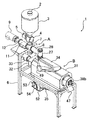
- FIG. 3 is a schematic perspective view according to the pellet manufacturing apparatus 1.
- an agitating / conveying chamber 8 constituted by a cylindrical shell and a drying section B constituted by a breathable cylindrical screen are respectively provided.
- the drying section B is rotatably provided with a main shaft and a stirring blade that is driven to rotate about the axis of the main shaft.
- the step (1) is performed, and the obtained pelletized resin base material is charged into the hopper 3 from the supply port 2.
- a predetermined amount of resin base material is continuously supplied to the stirring and conveying chamber 8 of the covering portion A by the rotary valve 4.
- the pellet-shaped resin base material is conveyed in the longitudinal direction of the agitating and conveying chamber 8 while being agitated by an agitating and conveying means such as a single thread screw roll.
- a nozzle 17 is provided in the agitating and conveying chamber 8, and a dispersion liquid in which fine particles are dispersed in a liquid is sprayed from the nozzle 17 onto the resin base material, thereby covering the surface of the resin base material with the fine particles.
- the resin base material component is heated at a temperature at which the fine particle component is softened but not softened.
- the adhesiveness (non-dropping property) with respect to the resin base material of fine particles can be improved.
- the resin substrate is a crystalline thermoplastic resin
- the melting point is equal to or higher than the melting point
- the resin substrate and the fine particles are below the softening temperature of the fine particle component. Is preferably brought into contact.
- the pelletized resin base material may be heated in advance to a temperature below the temperature at which the resin base material is melted and supplied to the agitation transport chamber 8.
- the resin base material can be heated by mechanically heating the inside of the hopper 3 or the rotary valve 4.
- the heating temperature at this time may be not less than the softening temperature of the resin substrate component and not more than the melting point if the resin substrate component is a crystalline thermoplastic resin.
- the resin substrate component is a crystalline thermoplastic resin.
- the dispersion liquid sprayed from the nozzle 17 may be heated in advance.
- the specific heating temperature is automatically determined by the softening temperature of the resin component constituting the fine particles, it is a dispersion liquid and therefore needs to be lower than the boiling point of the liquid in which the fine particles are dispersed.
- heating to 30 to 90 ° C. is preferable, and heating to 50 to 80 ° C. is more preferable.
- water it is preferable to use water as the liquid for dispersing the fine particles, and a dispersion aid such as a surfactant may be included, or an alcohol such as methanol or ethanol may be included.
- the resin base material thus coated with the fine particles is discharged from the agitation transport chamber 8 and diffuses in the transport path 27.
- the resin base material coated with the fine particles diffused in the transport path 27 is stirred while contacting the warm air while being transported in the longitudinal direction of the drying section B by the stirring blade provided in the drying section B.
- warm air is supplied from the hot air supply port 28.
- fine-particles can be dried.
- the hot air is supplied from the hot air supply port 28 described above, and as the hot air, for example, air heated to 35 ° C. to 80 ° C. or an inert gas such as nitrogen can be used. By doing so, the surface portion of the resin substrate can be softened or melted to embed the fine particles in the surface of the resin substrate.
- the conveyance path 27 may be mechanically heated in order to improve the adhesion (non-dropping property) of the fine particles to the resin base material.
- the heating temperature may be room temperature or higher, for example, a temperature at which the resin base material component is softened and the fine particles are not softened. Further, the temperature can be appropriately controlled in relation to the residence time in the conveyance path 27.
- the resin base material covered with the fine particles discharged from the discharge port 47 is cooled to form the resin pellets of the embodiment.
- the cooling method include a method of immersing in a liquid, a method of spraying a liquid, and a method of contacting with cold air.
- a dispersion aid such as a surfactant may be included, and alcohols such as methanol and ethanol may be included.
- a cooling effect can be expected by evaporating by the heat held by the resin pellets and taking away latent heat of evaporation.
- the cold air for example, cooled air or an inert gas such as nitrogen can be used.
- the cooling temperature is preferably 5 ° C. or less, more preferably 10 ° C. or less, which is the softening temperature of the resin base material component.
- the step of embedding the fine particles of the resin substrate shown in (2) and the step of drying the resin pellet shown in (3) are performed continuously or simultaneously. Therefore, the resin pellet of this embodiment can be manufactured more efficiently.
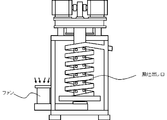
- a spiral elevator also referred to as a spiral vertical conveyor
- a kind of vibration dryer shown in FIG. 4 is used. it can.
- the resin pellets are heated by being exposed to hot air at 30 to 80 ° C. as in the above-described apparatus.
- This spiral elevator is characterized in that the residence time can be extended by extending the height of the apparatus in the vertical direction. If the residence time in the drying process can be extended, the temperature of the hot air can be lowered.
- the hot air of 20 to 75 ° C., preferably 30 to 50 ° C., makes the fine particles on the resin substrate stronger. Can be attached to. In this case, drying is possible by sending air without heating depending on weather conditions, and the heating temperature can also be reduced, so that drying is possible with energy saving.
- the installation area is small and the residence time can be extended. As warm air blown into the spiral elevator, an inert gas such as air or nitrogen can be used. By doing so, the adhesion (non-dropping property) of the fine particles to the resin substrate can be improved.
- a plurality of fine particles are embedded in the resin base material, and the surface of the resin base material is covered.
- corrugation is formed in the surface of a resin pellet, preventing drop-off
- a non-blocking material can be utilized as a component constituting the fine particles, blocking can also be effectively suppressed.
- the softening temperature (or melting point or sublimation temperature) of the fine particles covering the surface is higher than that of the resin base material, drying is possible in a temperature environment that is equal to or higher than the softening temperature of the resin base material and lower than the softening temperature of the fine particle component. Therefore, volatile components such as residual monomers contained in the resin base material can be quickly removed.
- Example 1 An aqueous dispersion in which fine particles of an ethylene / vinyl acetate copolymer having a vinyl acetate content of 19% by mass, an MFR of 150 g / 10 min, a Vicat softening point of 42 ° C., a Shore hardness of 86, and a crystallinity of 26% are dispersed ( 500 g (solid content concentration: 40% by mass) is heated to 45 ° C., and the vinyl acetate content is 46% by mass as a resin substrate, MFR is 100 g / 10 min, Vicat softening point is 25 ° C.
- Example 2 Pellets made of an ethylene / vinyl acetate copolymer having a vinyl acetate content of 46% by mass, a MFR of 100 g / 10 min, a Vicat softening point of 25 ° C. or less, a Shore hardness of 16 and a crystallinity of 0% as a resin substrate (pellet temperature 20 ° C) 10 kg vinyl acetate content 19% by mass, MFR 150 g / 10 min, Vicat softening point 42 ° C.
- Example 3 As a resin base material, a pellet made of an ethylene / vinyl acetate copolymer having a vinyl acetate content of 46% by mass, MFR of 100 g / 10 min, Vicat softening point of 25 ° C. or less, Shore hardness of 22 and crystallinity of 0% (pellet temperature: 15 ° C. ) Vinyl acetate content of 19% by mass with respect to 100 g, MFR of 150 g / 10 min, Vicat softening point of 42 ° C.
- Example 4 As a resin base material, a pellet made of an ethylene / vinyl acetate copolymer having a vinyl acetate content of 41% by mass, MFR 63 g / 10 min, Vicat softening point 25 ° C. or less, Shore hardness 40, crystallinity 0% (pellet temperature 15 ° C. ) Vinyl acetate content of 19% by mass with respect to 10 kg, MFR of 150 g / 10 min, Vicat softening point of 42 ° C.
- the pellet temperature was 20 ° C. or lower, and then dried at room temperature (25 ° C.).
- the fluid pellet dryer, vibration dryer, and infrared dryer were all attached to the entire surface of the resin pellets with some of the fine particles embedded. It was.
- the evaluation for embedding was ⁇ .
- Example 5 As a resin substrate, a pellet made of an ethylene / vinyl acetate copolymer having a vinyl acetate content of 46% by mass, MFR 2.5 g / 10 min, Vicat softening point 25 ° C.
- Shore hardness 28 crystallinity 0% (pellet temperature) (15 ° C) 10 kg vinyl acetate content, MFR 150 g / 10 min, Vicat softening point 42 ° C ( ⁇ T ⁇ 17), Shore hardness 86 ( ⁇ HS: 58), crystallinity 26% ( 150 g (corresponding to 0.015 times the total weight of the base material) of an aqueous dispersion (solid content concentration: 40% by mass) in which fine particles of an ethylene / vinyl acetate copolymer ( ⁇ a: 26%) are dispersed is added, and 60 Heated to ° C. Heating is performed by a method of contacting with warm air of 80 ° C.
- Example 6 As a resin base material, an ethylene / vinyl acetate copolymer pellet having a vinyl acetate content of 41 mass%, an MFR of 2.0 g / 10 min, a Vicat softening point of 25 ° C. or less, a Shore hardness of 45, and a crystallinity of 0% (pellet temperature of 15 ° C) vinyl acetate content of 19% by mass with respect to 10 kg, MFR of 150 g / 10 min, Vicat softening point of 42 ° C.
- a resin base material As a resin base material, a pellet made of an ethylene / vinyl acetate copolymer having a vinyl acetate content of 46% by mass, MFR of 100 g / 10 min, Vicat softening point of 25 ° C. or less, Shore hardness of 16 and crystallinity of 0% (pellet temperature of 15 ° C. ) 10 kg, vinyl acetate content 19% by mass, MFR 150 g / 10 min, Vicat softening point 42 ° C.
- the resin pellet of the present invention has a resin base material and a plurality of fine particles embedded in the resin base material, and the surface of the resin base material is coated with the plurality of fine particles.
- the stick temperature rises by 3 to 6 ° C. as compared to resin pellets in which fine particles obtained by a conventional method are not embedded on the resin substrate.
- the storage conditions and handling conditions of the resin pellets can be eased, and the production time can be eased.
Landscapes
- Chemical & Material Sciences (AREA)
- Health & Medical Sciences (AREA)
- Chemical Kinetics & Catalysis (AREA)
- Medicinal Chemistry (AREA)
- Polymers & Plastics (AREA)
- Organic Chemistry (AREA)
- Engineering & Computer Science (AREA)
- Mechanical Engineering (AREA)
- Processes Of Treating Macromolecular Substances (AREA)
- Compositions Of Macromolecular Compounds (AREA)
Abstract
Description
微粒子として、樹脂基材を構成する樹脂より軟化温度又は融点が高い素材を選択することにより、樹脂基材の軟化温度よりも高い温度にしても、あたかもコア・シェル構造のようにコアとなる樹脂基材を保護することができる。
ケミパールは分散微粒子を構成する樹脂成分で銘柄が分かれており、具体的にはエチレン-α-オレフィン共重合体エラストマーを主成分とするAシリーズ、ポリエチレンを主成分とするMシリーズ、エチレン-酢酸ビニル共重合体を主成分とするVシリーズ、アイオノマーを主成分とするS又はSAシリーズ、低分子量(ワックス)のポリエチレンやポリプロピレンを主成分とするWシリーズがある。
樹脂基材が、非晶性又は低結晶性のエチレン-α-オレフィン共重合体の場合にはケミパールAシリーズから選択し、ポリエチレンの場合にはケミパールMシリーズから選択し、エチレン-酢酸ビニル共重合体の場合にはケミパールVシリーズから選択するのが好ましい組み合わせである。
選択時の目安としてビカット軟化点を利用する場合には、同社のカタログで調べることが可能であり、例えばA100は60℃、A400は55℃、M200は75℃、S100は60℃、SA100は55℃、V200は40℃とあるので、樹脂基材のビカット軟化点に応じて選択し組み合わせれば良い。
樹脂基材と分散液の混合方法の別の態様として、容器内に存在する樹脂基材中に容器側壁に沿って分散液を回転流のようにして供給し、樹脂基材と分散液を接触させる方法がある。
また別の態様として、樹脂基材と分散液を同時に円筒状ないし三角錐状の容器内の側壁に沿って回転流のように同じ方向に供給し、樹脂基材と分散液を接触させる方法がある。
更に別の態様として、容器内に存在する樹脂基材中に、分散液をスプレーで噴霧して、樹脂基材と分散液を接触させる方法がある。
これらの方法によれば、少量の分散液で樹脂基材上に微粒子を付着させて埋め込むことができる。分散液は樹脂基材の総重量に対して等量以下、好ましくは0.001~0.5倍、更には0.01~0.1倍の量でも本発明の目的を達成できるうえ、その後の乾燥時間も短縮化できるので、生産性及び省エネルギーの観点から有利である。
この方法は、とくに微粒子が常温で若干でも粘接着性を示すものに適用するのが好適である。
本実施形態において、樹脂基材成分が軟化するが微粒子成分は軟化しない温度で樹脂ペレットを乾燥することができればよく、例えば、温風や(遠)赤外線による乾燥などを採用することができる。温風の場合、空気が使用できるが、微粒子を埋め込む工程でアルコールのような有機溶剤を使用したときには窒素などの不活性ガスを利用するのが好ましい。こうすることで、樹脂基材に埋め込まれた微粒子は、より強固に樹脂基材に吸着し固定されることになる。
また、分散液を用いた場合には、微粒子と同伴した液体を除去することもできる。
更に、前記の工程において、常温で接触することにより、微粒子が樹脂基材表面上に点接着の状態で付着しているものも、微粒子が強固に樹脂基材に吸着し固定されることになる。
このような乾燥条件で乾燥後、例えば25~35℃、とくに25~30℃の条件で保管すると、保管時間(日数)に応じて微粒子はより強固に樹脂基材に吸着し固定されることになる。このようにして、樹脂基材の表面が複数の微粒子で被覆されることとなる。
自然乾燥や冷風では樹脂基材表面に微粒子成分が付着するだけで、樹脂基材表面に埋め込まれる形にはなりにくい。勿論、樹脂基材の軟化温度が常温以下ならば、自然乾燥でも時間をかければ、微粒子成分を強固に付着させることができるかもしれないが、生産性を考慮すると実用的ではない。
また、微粒子を構成する成分として非ブロッキング性の材料を利用できるので、そのことでもブロッキングを効果的に抑制することができる。
更に、表面を被覆している微粒子の軟化温度(或いは融点や昇華温度)が樹脂基材より高いため、樹脂基材の軟化温度以上微粒子成分の軟化温度未満の温度環境下で乾燥が可能となるので、樹脂基材中に含まれる残留モノマー等の揮発成分を早く取り除くことができる。
ア)メルトフローレート(MFR):
JIS K7219-1999、温度条件190℃、荷重2160g
イ)ビカット軟化点:JIS K7206-1999;測定下限は25℃
ウ)ショア硬度:JIS K7215-1986
エ)酢酸ビニル含有量:JIA K 7192-1999
オ)結晶化度:X線回折法
製造した樹脂ペレットの表面、断面を電子顕微鏡で観察し、粒子の付着状態で判断した。
◎:ペレット表面の略全面にわたり粒子が付着している。
○:ペレット表面に粒子が付着しているが、部分的に脱落している部分がある。
△:ペレット表面の大部分に粒子の付着が見られない。
×:ペレット表面に粒子の付着が見られない。
酢酸ビニル含有量が19質量%、MFRが150g/10分、ビカット軟化点が42℃、ショア硬度86、結晶化度26%のエチレン・酢酸ビニル共重合体からなる微粒子が分散した水性分散液(固形分濃度40質量%)500gを45℃に加温し、樹脂基材として酢酸ビニル含有量が46質量%、MFR100g/10分、ビカット軟化点25℃以下(ΔT≧17)、ショア硬度16(ΔHS:70)、結晶化度0%(Δa:26%)のエチレン・酢酸ビニル共重合体からなるペレット(ペレット温度15℃)100gを添加し、30秒間接触攪拌した。ついで、得られた樹脂ペレットを10℃の冷水で冷却させた後、常温(25℃)で乾燥させた。
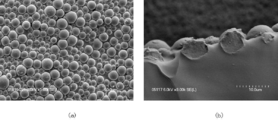
樹脂基材としての酢酸ビニル含有量が46質量%、MFR100g/10分、ビカット軟化点25℃以下、ショア硬度16、結晶化度0%のエチレン・酢酸ビニル共重合体からなるペレット(ペレット温度20℃)10kgに酢酸ビニル含有量が19質量%、MFRが150g/10分、ビカット軟化点が42℃(ΔT≧17)、ショア硬度86(ΔHS:70)、結晶化度26%(Δa:26%)のエチレン・酢酸ビニル共重合体からなる微粒子が分散した水性分散液(固形分濃度40質量%)を300g(基材総重量に対して0.03倍相当)添加し、ペレット温度が30℃、40℃、50℃になるまでそれぞれ加温した。加温は、流動層乾燥機若しくは振動式乾燥機(スパイラルエレベータ)で70℃に加熱した空気と接触させる方法、または、70℃に調整した赤外線式乾燥機内に投入する方法を用いた。ついで、得られた樹脂ペレットを10℃の冷水で冷却しペレット温度が20℃以下になっていることを確認した後、常温(25℃)で乾燥させた。得られた樹脂ペレットを電子顕微鏡で観察して粒子の埋め込み評価を行った。結果を表1に示す。また、ペレット温度40℃に加温して製造した樹脂ペレット表面の電子顕微鏡写真を図1に示し、50℃に加温して製造した樹脂ペレット表面の電子顕微鏡写真を図2(a)に、表層断面写真を図2(b)に示す。図1及び図2の結果を用いて、微粒子の平均粒子径を調べたところ、20μm以下であった。

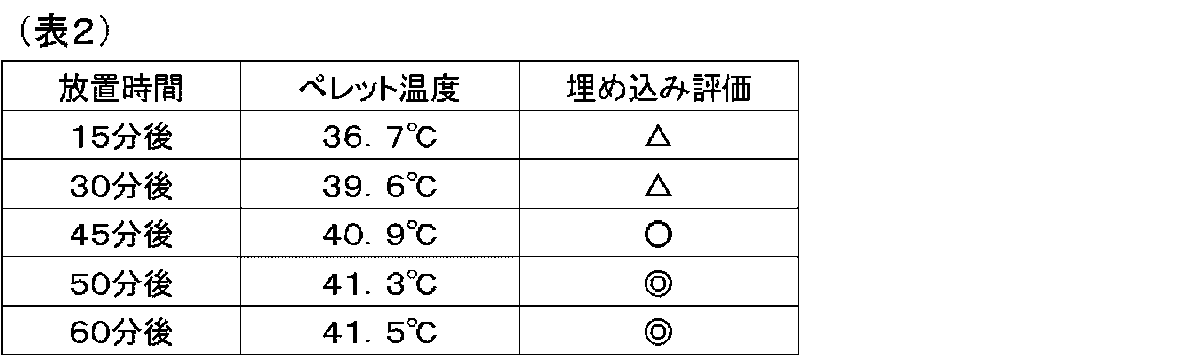
樹脂基材として酢酸ビニル含有量が46質量%、MFR100g/10分、ビカット軟化点25℃以下、ショア硬度22、結晶化度0%のエチレン・酢酸ビニル共重合体からなるペレット(ペレット温度15℃)100gに対して酢酸ビニル含有量が19質量%、MFRが150g/10分、ビカット軟化点が42℃(ΔT≧17)、ショア硬度86(ΔHS=64)、結晶化度26%(Δa:26%)のエチレン・酢酸ビニル共重合体からなる微粒子が分散した水性分散液(固形分濃度40質量%)を3g(基材総重量に対して0.03倍相当)添加し、オーブンで温度45℃、湿度30%の中で15分間、30分間、45分間、50分間、60分間それぞれ放置した。所定の時間における樹脂ペレットの温度をそれぞれ測定した。ついで、10℃の冷水で冷却しペレット温度が20℃以下になっていることを確認した後、常温(25℃)で乾燥させた。得られた樹脂ペレットを電子顕微鏡で観察し粒子の埋め込み評価を行った。結果を表2に示す。
樹脂基材として酢酸ビニル含有量が41質量%、MFR63g/10分、ビカット軟化点25℃以下、ショア硬度40、結晶化度0%のエチレン・酢酸ビニル共重合体からなるペレット(ペレット温度15℃)10kgに対して酢酸ビニル含有量が19質量%、MFRが150g/10分、ビカット軟化点が42℃(ΔT≧17)、ショア硬度86(ΔHS:46)、結晶化度26%(Δa:26%)のエチレン・酢酸ビニル共重合体からなる微粒子が分散した水性分散液(固形分濃度40質量%)を300g(基材総重量に対して0.03倍相当)添加し、ペレット温度を50℃まで加温させた。加温は、流動層乾燥機若しくは振動式乾燥機(スパイラルエレベータ)で70℃の温風と接触させる方法、または、70℃に調整した赤外線式乾燥機内に投入する方法を用いた。ついで、得られた樹脂ペレットを10℃の冷水で冷却しペレット温度が20℃以下になっていることを確認した後、常温(25℃)で乾燥させた。粒子の埋め込み評価を行った結果、流動層乾燥機、振動式乾燥機及び赤外線式乾燥機のいずれの方法でも、樹脂ペレット表面の全面に、微粒子の一部が埋めこまれた状態で付着していた。埋め込み評価は◎とした。
樹脂基材として酢酸ビニル含有量が46質量%、MFR2.5g/10分、ビカット軟化点25℃以下、ショア硬度28、結晶化度0%のエチレン・酢酸ビニル共重合体からなるペレット(ペレット温度15℃)10kgに対して酢酸ビニル含有量が19質量%、MFRが150g/10分、ビカット軟化点が42℃(ΔT≧17)、ショア硬度86(ΔHS:58)、結晶化度26%(Δa:26%)のエチレン・酢酸ビニル共重合体からなる微粒子が分散した水性分散液(固形分濃度40質量%)を150g(基材総重量に対して0.015倍相当)添加し、60℃まで加熱させた。加熱は、流動層乾燥機で80℃の温風と接触させる方法または振動式乾燥機(スパイラルエレベータ)で70℃の温風と接触させる方法、または、80℃に調整した赤外線式乾燥機内に投入する方法を用いた。ついで、得られた樹脂ペレットを10℃の冷水で冷却しペレット温度が20℃以下になっていることを確認した後、常温(25℃)で乾燥させた。粒子の埋め込み評価を行った結果、流動層乾燥機、振動式乾燥機(スパイラルエレベーター)及び赤外線式乾燥機のいずれの方法でも、ペレット表面の全面に、微粒子の一部が埋めこまれた状態で付着していた。埋め込み評価は◎とした。
樹脂基材として酢酸ビニル含有量が41質量%、MFR2.0g/10分、ビカット軟化点25℃以下、ショア硬度45、結晶化度0%のエチレン・酢酸ビニル共重合体のペレット(ペレット温度15℃)10kgに対して酢酸ビニル含有量が19質量%、MFRが150g/10分、ビカット軟化点が42℃(ΔT≧17)、ショア硬度86(ΔHS:41)、結晶化度26%(Δa:26%)のエチレン・酢酸ビニル共重合体からなる微粒子が分散した水性分散液(固形分濃度40質量%)を150g(基材総重量に対して0.015倍相当)添加し、60℃まで加温させた。加温は、流動層乾燥機または振動式乾燥機(スパイラルエレベータ)で80℃の温風と接触させる方法、または、80℃に調整した赤外線式乾燥機内に投入する方法を用いた。ついで、得られた樹脂ペレットを冷水で冷却し20℃以下になっていることを確認した後、常温(25℃)で乾燥させた。粒子の埋め込み評価を行った結果、流動層乾燥機、振動式乾燥機及び赤外線式乾燥機のいずれの方法でも、ペレット表面の全面に、微粒子の一部が埋めこまれた状態で付着していた。粒子の埋め込み評価は、◎とした。
樹脂基材として酢酸ビニル含有量が46質量%、MFR100g/10分、ビカット軟化点25℃以下、ショア硬度16、結晶化度0%のエチレン・酢酸ビニル共重合体からなるペレット(ペレット温度15℃)10kgに、酢酸ビニル含有量が19質量%、MFRが150g/10分、ビカット軟化点が42℃(Δ≧T17)、ショア硬度86(ΔHS:70)、結晶化度0%(Δa:26%)のエチレン・酢酸ビニル共重合体からなる微粒子が分散した水性分散液(固形分濃度40重量%)を300g(基材総重量に対して0.03倍相当)添加し、常温(25℃)で乾燥させた。
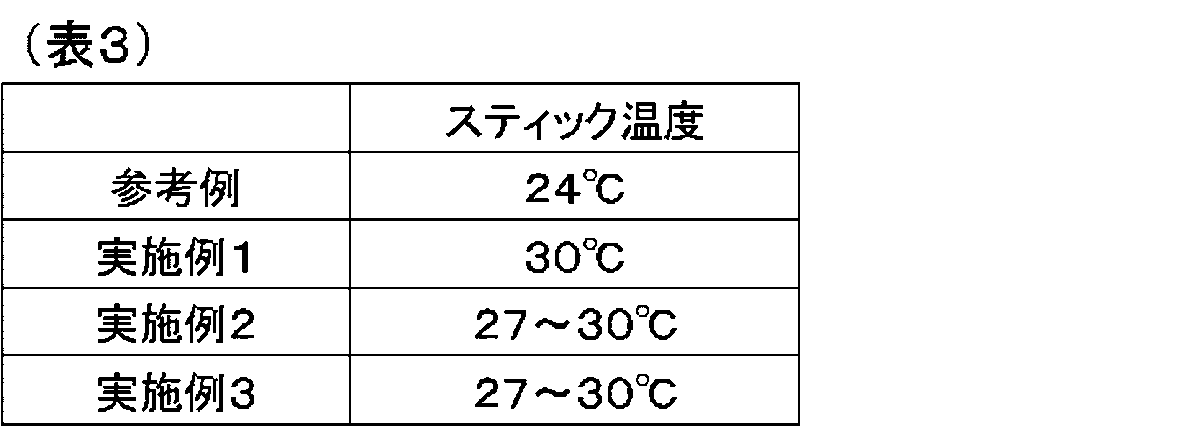
参考例で作製した樹脂ペレット及び上記実施例1~3で作製した樹脂ペレットについてスティック温度を比較し、樹脂ペレットのブロッキングをそれぞれ評価した。
直径40mm、高さ70mmの内面がテフロン(登録商標)でコーティングされた円筒形の金属容器を予め任意の温度に設定されたオーブン中に30分放置後、樹脂ペレットを容器の下から55mmの高さ迄入れて30分間放置する。30分後に金属容器をオーブンから取り出し、樹脂ペレットの上に金属容器の内径よりやや小さい金属錘を使って40.2Nの荷重負荷を1時間かける。その後荷重負荷を取り除き、金属容器を逆さにして、ペレットの落下状況を目視で観察すると共に、1分経過後容器を元に戻して容器内部を目視で観察する。容器内部に複数の樹脂ペレット同士の固まりが残っている場合はスティッキングがあると評価した。この実験を2.5℃きざみで行い、スティッキングの有りと無しが2.5℃で区別される温度をスティック温度とした。結果を表3に示す。
Claims (17)
- 樹脂基材と、
前記樹脂基材に埋め込まれた複数の微粒子と、
を有し、
前記複数の微粒子で前記樹脂基材の表面が被覆された樹脂ペレット。 - 前記微粒子と軟化した状態の前記樹脂基材とを液体中で分散させることで前記樹脂基材に前記微粒子が埋め込まれた、請求項1に記載の樹脂ペレット。
- 前記微粒子が樹脂成分を含む、請求項1または2に記載の樹脂ペレット。
- 前記樹脂基材と前記微粒子とが同じ樹脂成分を含む、請求項1乃至3いずれか1項に記載の樹脂ペレット。
- 前記樹脂基材がエチレン-酢酸ビニル共重合体を含む、請求項1乃至4いずれか1項に記載の樹脂ペレット。
- 前記樹脂基材に含まれる前記エチレン-酢酸ビニル共重合体中の酢酸ビニル含有量が25~50重量%である、請求項5に記載の樹脂ペレット。
- 前記微粒子がエチレン-酢酸ビニル共重合体を含む、請求項1乃至6いずれか1項に記載の樹脂ペレット。
- 前記微粒子に含まれる前記エチレン-酢酸ビニル共重合体中の酢酸ビニル含有量が5~20重量%である、請求項7に記載の樹脂ペレット。
- 前記樹脂基材および前記微粒子がいずれもエチレン-酢酸ビニル共重合体からなる、請求項1乃至8いずれか1項に記載の樹脂ペレット。
- 前記微粒子の平均粒子径が20μm以下である、請求項1乃至9いずれか1項に記載の樹脂ペレット。
- 前記微粒子のショア硬度が前記樹脂基材のショア硬度よりも高い、請求項1乃至10いずれか1項に記載の樹脂ペレット。
- 前記微粒子のX線による結晶化度が前記樹脂基材のX線による結晶化度よりも高い、請求項1乃至11いずれか1項に記載の樹脂ペレット。
- 前記微粒子のビカット軟化点が前記樹脂基材のビカット軟化点よりも高い、請求項1乃至12いずれか1項に記載の樹脂ペレット。
- 前記樹脂基材が粒子である、請求項1乃至13いずれか1項に記載の樹脂ペレット。
- 樹脂基材を用意する工程と、
前記樹脂基材に複数の微粒子を埋め込む工程と、
を含み、
前記樹脂基材に複数の微粒子を埋め込む前記工程において、前記複数の微粒子で前記樹脂基材の表面を被覆する樹脂ペレットの製造方法。 - 前記樹脂基材に複数の微粒子を埋め込む前記工程において、前記微粒子と軟化した状態の前記樹脂基材とを液体中で分散させて前記樹脂基材に前記微粒子を埋め込む、請求項15に記載の樹脂ペレットの製造方法。
- 前記樹脂基材に複数の微粒子を埋め込む前記工程において、35℃以上80℃以下で前記樹脂基材と前記微粒子とを接触させる、請求項15または16に記載の樹脂ペレットの製造方法。
Priority Applications (7)
| Application Number | Priority Date | Filing Date | Title |
|---|---|---|---|
| JP2010550976A JP4801221B2 (ja) | 2009-06-19 | 2010-06-14 | 樹脂ペレットおよびその製造方法 |
| US13/376,201 US20120088105A1 (en) | 2009-06-19 | 2010-06-14 | Resin pellet and method for producing the same |
| CN2010800270829A CN102803353B (zh) | 2009-06-19 | 2010-06-14 | 树脂颗粒及其制造方法 |
| KR1020117028153A KR101138928B1 (ko) | 2009-06-19 | 2010-06-14 | 수지 펠릿 및 그 제조 방법 |
| SG2011084928A SG176561A1 (en) | 2009-06-19 | 2010-06-14 | Resin pellet and method for producing the same |
| EP10789202A EP2444449A1 (en) | 2009-06-19 | 2010-06-14 | Resin pellet and method for producing the same |
| US14/152,141 US9353230B2 (en) | 2009-06-19 | 2014-01-10 | Resin pellet and method for producing the same |
Applications Claiming Priority (2)
| Application Number | Priority Date | Filing Date | Title |
|---|---|---|---|
| JP2009146065 | 2009-06-19 | ||
| JP2009-146065 | 2009-06-19 |
Related Child Applications (2)
| Application Number | Title | Priority Date | Filing Date |
|---|---|---|---|
| US13/376,201 A-371-Of-International US20120088105A1 (en) | 2009-06-19 | 2010-06-14 | Resin pellet and method for producing the same |
| US14/152,141 Division US9353230B2 (en) | 2009-06-19 | 2014-01-10 | Resin pellet and method for producing the same |
Publications (1)
| Publication Number | Publication Date |
|---|---|
| WO2010146820A1 true WO2010146820A1 (ja) | 2010-12-23 |
Family
ID=43356153
Family Applications (1)
| Application Number | Title | Priority Date | Filing Date |
|---|---|---|---|
| PCT/JP2010/003920 Ceased WO2010146820A1 (ja) | 2009-06-19 | 2010-06-14 | 樹脂ペレットおよびその製造方法 |
Country Status (8)
| Country | Link |
|---|---|
| US (2) | US20120088105A1 (ja) |
| EP (1) | EP2444449A1 (ja) |
| JP (1) | JP4801221B2 (ja) |
| KR (1) | KR101138928B1 (ja) |
| CN (1) | CN102803353B (ja) |
| SG (1) | SG176561A1 (ja) |
| TW (1) | TWI485196B (ja) |
| WO (1) | WO2010146820A1 (ja) |
Cited By (5)
| Publication number | Priority date | Publication date | Assignee | Title |
|---|---|---|---|---|
| JP2013067729A (ja) * | 2011-09-22 | 2013-04-18 | Pacific Ind Co Ltd | 樹脂複合粒体の製造方法及びその製造方法により製造された樹脂複合粒体を用いた樹脂成形品の製造方法 |
| WO2013059274A1 (en) * | 2011-10-17 | 2013-04-25 | H.B. Fuller Company | Hollow glass micro particles used as anti-blocking system in hot melts |
| JP2018184568A (ja) * | 2017-04-27 | 2018-11-22 | 三井化学株式会社 | ポリウレタン樹脂ペレットの製造方法、および、ポリウレタン樹脂ペレット |
| JP2019529635A (ja) * | 2016-09-13 | 2019-10-17 | エスピーシー サンフラワー プラスティック コンパウンド ゲーエムベーハーSpc Sunflower Plastic Compound Gmbh | ヒマワリの種殻/種外皮材料に基づいてバイオプラスチック顆粒物を生産する方法 |
| JPWO2020196044A1 (ja) * | 2019-03-28 | 2020-10-01 |
Families Citing this family (3)
| Publication number | Priority date | Publication date | Assignee | Title |
|---|---|---|---|---|
| EP3568429B1 (en) | 2017-03-02 | 2021-09-29 | Nike Innovate C.V. | Rubber pellet treatment |
| JP7449878B2 (ja) | 2018-06-29 | 2024-03-14 | ダウ グローバル テクノロジーズ エルエルシー | 破砕性ベール |
| KR102355495B1 (ko) * | 2018-09-18 | 2022-01-25 | 주식회사 케이티앤지 | 균질화 담배 물질의 주조 웹의 제조 장치 및 방법 |
Citations (15)
| Publication number | Priority date | Publication date | Assignee | Title |
|---|---|---|---|---|
| JPH01288408A (ja) | 1988-05-17 | 1989-11-20 | Du Pont Mitsui Polychem Co Ltd | 樹脂ペレットの製造方法 |
| JPH0224130A (ja) * | 1988-07-13 | 1990-01-26 | Dentaru Kagaku Kk | 樹脂物体成形法 |
| JPH05508116A (ja) * | 1989-07-27 | 1993-11-18 | イーストマン ケミカル カンパニー | 常態で粘着性のプラスチック材料の流し込み可能な粒子及びその製造方法 |
| JPH077890A (ja) | 1993-06-17 | 1995-01-10 | Fuji Electric Co Ltd | 電動ポンプ装置 |
| JPH07316311A (ja) * | 1994-05-24 | 1995-12-05 | Tosoh Corp | 担体の製造方法 |
| JPH091997A (ja) | 1995-06-21 | 1997-01-07 | Toru Hachisu | 折り紙立体額 |
| JP2002338939A (ja) * | 2001-05-22 | 2002-11-27 | Yasuhara Chemical Co Ltd | 粘着性ホットメルトのブロッキング防止方法 |
| JP2003089774A (ja) * | 2001-09-18 | 2003-03-28 | Hiyoshi Chemical Industrial Co Ltd | 粘着型ホットメルト接着剤及びその製造方法並びに製造装置 |
| WO2006117963A1 (ja) * | 2005-04-26 | 2006-11-09 | Idemitsu Kosan Co., Ltd. | 軟質ポリオレフィン系樹脂の造粒方法及び造粒物 |
| JP2007153979A (ja) | 2005-12-02 | 2007-06-21 | Sumitomo Chemical Co Ltd | ポリオレフィンペレットの後処理方法 |
| JP2008013727A (ja) | 2006-07-10 | 2008-01-24 | Kaneka Corp | 耐ブロッキング性に優れた重合体粉体の製造方法 |
| WO2008013266A1 (en) * | 2006-07-28 | 2008-01-31 | Kyodo Printing Co., Ltd. | Resin particle with powder united thereto and method of forming the same, particle-containing molded object, particle-containing sheet material, and method of forming these, and functional sheet and process for producing functional sheet |
| JP2008044183A (ja) * | 2006-08-11 | 2008-02-28 | Mitsui Chemicals Inc | 重合体ペレットの製造方法および重合体ペレット包装体の製造方法 |
| JP2008248015A (ja) | 2007-03-29 | 2008-10-16 | Unitika Ltd | 共重合ポリエステル樹脂ペレットとその製造方法 |
| JP2009146065A (ja) | 2007-12-12 | 2009-07-02 | Toshiba Corp | キーボード、入力方法および情報処理装置 |
Family Cites Families (2)
| Publication number | Priority date | Publication date | Assignee | Title |
|---|---|---|---|---|
| JP3492043B2 (ja) | 1995-09-08 | 2004-02-03 | 積水化学工業株式会社 | 樹脂ペレットの表面処理方法 |
| KR20020025974A (ko) * | 1999-08-17 | 2002-04-04 | 그래햄 이. 테일러 | 자유 유동성 중합체 조성물 |
-
2010
- 2010-06-14 SG SG2011084928A patent/SG176561A1/en unknown
- 2010-06-14 EP EP10789202A patent/EP2444449A1/en not_active Withdrawn
- 2010-06-14 WO PCT/JP2010/003920 patent/WO2010146820A1/ja not_active Ceased
- 2010-06-14 US US13/376,201 patent/US20120088105A1/en not_active Abandoned
- 2010-06-14 CN CN2010800270829A patent/CN102803353B/zh active Active
- 2010-06-14 JP JP2010550976A patent/JP4801221B2/ja active Active
- 2010-06-14 KR KR1020117028153A patent/KR101138928B1/ko active Active
- 2010-06-18 TW TW099119846A patent/TWI485196B/zh active
-
2014
- 2014-01-10 US US14/152,141 patent/US9353230B2/en active Active
Patent Citations (15)
| Publication number | Priority date | Publication date | Assignee | Title |
|---|---|---|---|---|
| JPH01288408A (ja) | 1988-05-17 | 1989-11-20 | Du Pont Mitsui Polychem Co Ltd | 樹脂ペレットの製造方法 |
| JPH0224130A (ja) * | 1988-07-13 | 1990-01-26 | Dentaru Kagaku Kk | 樹脂物体成形法 |
| JPH05508116A (ja) * | 1989-07-27 | 1993-11-18 | イーストマン ケミカル カンパニー | 常態で粘着性のプラスチック材料の流し込み可能な粒子及びその製造方法 |
| JPH077890A (ja) | 1993-06-17 | 1995-01-10 | Fuji Electric Co Ltd | 電動ポンプ装置 |
| JPH07316311A (ja) * | 1994-05-24 | 1995-12-05 | Tosoh Corp | 担体の製造方法 |
| JPH091997A (ja) | 1995-06-21 | 1997-01-07 | Toru Hachisu | 折り紙立体額 |
| JP2002338939A (ja) * | 2001-05-22 | 2002-11-27 | Yasuhara Chemical Co Ltd | 粘着性ホットメルトのブロッキング防止方法 |
| JP2003089774A (ja) * | 2001-09-18 | 2003-03-28 | Hiyoshi Chemical Industrial Co Ltd | 粘着型ホットメルト接着剤及びその製造方法並びに製造装置 |
| WO2006117963A1 (ja) * | 2005-04-26 | 2006-11-09 | Idemitsu Kosan Co., Ltd. | 軟質ポリオレフィン系樹脂の造粒方法及び造粒物 |
| JP2007153979A (ja) | 2005-12-02 | 2007-06-21 | Sumitomo Chemical Co Ltd | ポリオレフィンペレットの後処理方法 |
| JP2008013727A (ja) | 2006-07-10 | 2008-01-24 | Kaneka Corp | 耐ブロッキング性に優れた重合体粉体の製造方法 |
| WO2008013266A1 (en) * | 2006-07-28 | 2008-01-31 | Kyodo Printing Co., Ltd. | Resin particle with powder united thereto and method of forming the same, particle-containing molded object, particle-containing sheet material, and method of forming these, and functional sheet and process for producing functional sheet |
| JP2008044183A (ja) * | 2006-08-11 | 2008-02-28 | Mitsui Chemicals Inc | 重合体ペレットの製造方法および重合体ペレット包装体の製造方法 |
| JP2008248015A (ja) | 2007-03-29 | 2008-10-16 | Unitika Ltd | 共重合ポリエステル樹脂ペレットとその製造方法 |
| JP2009146065A (ja) | 2007-12-12 | 2009-07-02 | Toshiba Corp | キーボード、入力方法および情報処理装置 |
Cited By (8)
| Publication number | Priority date | Publication date | Assignee | Title |
|---|---|---|---|---|
| JP2013067729A (ja) * | 2011-09-22 | 2013-04-18 | Pacific Ind Co Ltd | 樹脂複合粒体の製造方法及びその製造方法により製造された樹脂複合粒体を用いた樹脂成形品の製造方法 |
| WO2013059274A1 (en) * | 2011-10-17 | 2013-04-25 | H.B. Fuller Company | Hollow glass micro particles used as anti-blocking system in hot melts |
| JP2019529635A (ja) * | 2016-09-13 | 2019-10-17 | エスピーシー サンフラワー プラスティック コンパウンド ゲーエムベーハーSpc Sunflower Plastic Compound Gmbh | ヒマワリの種殻/種外皮材料に基づいてバイオプラスチック顆粒物を生産する方法 |
| JP7129971B2 (ja) | 2016-09-13 | 2022-09-02 | エスピーシー サンフラワー プラスティック コンパウンド ゲーエムベーハー | ヒマワリの種殻/種外皮材料に基づいてバイオプラスチック顆粒物を生産する方法 |
| JP2018184568A (ja) * | 2017-04-27 | 2018-11-22 | 三井化学株式会社 | ポリウレタン樹脂ペレットの製造方法、および、ポリウレタン樹脂ペレット |
| JPWO2020196044A1 (ja) * | 2019-03-28 | 2020-10-01 | ||
| WO2020196044A1 (ja) * | 2019-03-28 | 2020-10-01 | 三井・ダウ ポリケミカル株式会社 | 樹脂ペレット、樹脂ペレットの製造方法及びグラビアインキ |
| JP7324834B2 (ja) | 2019-03-28 | 2023-08-10 | 三井・ダウポリケミカル株式会社 | 樹脂ペレット、樹脂ペレットの製造方法及びグラビアインキ |
Also Published As
| Publication number | Publication date |
|---|---|
| TW201107401A (en) | 2011-03-01 |
| KR20120023709A (ko) | 2012-03-13 |
| EP2444449A1 (en) | 2012-04-25 |
| SG176561A1 (en) | 2012-01-30 |
| KR101138928B1 (ko) | 2012-04-30 |
| TWI485196B (zh) | 2015-05-21 |
| US9353230B2 (en) | 2016-05-31 |
| JP4801221B2 (ja) | 2011-10-26 |
| US20120088105A1 (en) | 2012-04-12 |
| JPWO2010146820A1 (ja) | 2012-11-29 |
| US20140127403A1 (en) | 2014-05-08 |
| CN102803353A (zh) | 2012-11-28 |
| CN102803353B (zh) | 2013-10-09 |
Similar Documents
| Publication | Publication Date | Title |
|---|---|---|
| JP4801221B2 (ja) | 樹脂ペレットおよびその製造方法 | |
| US6500888B2 (en) | Surface treatment of ethylene based polymer pellets to improve blocking resistance | |
| EP0410914B1 (en) | Pourable particles of normally tacky plastic materials and process for their preparation | |
| CA1208084A (en) | Method for making free-flowing, melt-coated rubber pellets | |
| KR101681472B1 (ko) | 중합체 펠릿의 고착 방지 처리 방법 | |
| JP5481489B2 (ja) | 粘着性組成物及び粘着性組成物を作成する方法 | |
| CN107263762A (zh) | 自由流动的压敏粘合剂 | |
| CN107667083A (zh) | 含基于聚乙烯或聚丙烯的聚合物的基于蜡的肥料涂层 | |
| EP3194474A1 (en) | High performance anti-block treatments for viscoelastic solids | |
| JPH0737026B2 (ja) | 樹脂ペレットの製造方法 | |
| JP2015502412A (ja) | ホットメルトにおけるブロッキング防止システムとして使用される中空ガラスマイクロ粒子 | |
| JP2016188327A (ja) | 互着防止剤 | |
| JP3729959B2 (ja) | 被覆粒状肥料 | |
| JP5101511B2 (ja) | 物体の被覆のための方法 | |
| JPH0673187A (ja) | 塩素化ポリオレフィン固形物の製造方法 | |
| WO2026009632A1 (ja) | 被覆粒状肥料およびその製造方法 |
Legal Events
| Date | Code | Title | Description |
|---|---|---|---|
| WWE | Wipo information: entry into national phase |
Ref document number: 201080027082.9 Country of ref document: CN |
|
| ENP | Entry into the national phase |
Ref document number: 2010550976 Country of ref document: JP Kind code of ref document: A |
|
| 121 | Ep: the epo has been informed by wipo that ep was designated in this application |
Ref document number: 10789202 Country of ref document: EP Kind code of ref document: A1 |
|
| ENP | Entry into the national phase |
Ref document number: 20117028153 Country of ref document: KR Kind code of ref document: A |
|
| WWE | Wipo information: entry into national phase |
Ref document number: 13376201 Country of ref document: US |
|
| WWE | Wipo information: entry into national phase |
Ref document number: 2010789202 Country of ref document: EP |
|
| NENP | Non-entry into the national phase |
Ref country code: DE |