WO2011004773A1 - フェライト磁性材料 - Google Patents
フェライト磁性材料 Download PDFInfo
- Publication number
- WO2011004773A1 WO2011004773A1 PCT/JP2010/061341 JP2010061341W WO2011004773A1 WO 2011004773 A1 WO2011004773 A1 WO 2011004773A1 JP 2010061341 W JP2010061341 W JP 2010061341W WO 2011004773 A1 WO2011004773 A1 WO 2011004773A1
- Authority
- WO
- WIPO (PCT)
- Prior art keywords
- ferrite
- magnet
- magnetic material
- mass
- ferrite magnetic
- Prior art date
- Legal status (The legal status is an assumption and is not a legal conclusion. Google has not performed a legal analysis and makes no representation as to the accuracy of the status listed.)
- Ceased
Links
Images


Classifications
-
- C—CHEMISTRY; METALLURGY
- C01—INORGANIC CHEMISTRY
- C01G—COMPOUNDS CONTAINING METALS NOT COVERED BY SUBCLASSES C01D OR C01F
- C01G49/00—Compounds of iron
- C01G49/0018—Mixed oxides or hydroxides
- C01G49/0054—Mixed oxides or hydroxides containing one rare earth metal, yttrium or scandium
-
- H—ELECTRICITY
- H01—ELECTRIC ELEMENTS
- H01F—MAGNETS; INDUCTANCES; TRANSFORMERS; SELECTION OF MATERIALS FOR THEIR MAGNETIC PROPERTIES
- H01F1/00—Magnets or magnetic bodies characterised by the magnetic materials therefor; Selection of materials for their magnetic properties
- H01F1/01—Magnets or magnetic bodies characterised by the magnetic materials therefor; Selection of materials for their magnetic properties of inorganic materials
- H01F1/03—Magnets or magnetic bodies characterised by the magnetic materials therefor; Selection of materials for their magnetic properties of inorganic materials characterised by their coercivity
- H01F1/032—Magnets or magnetic bodies characterised by the magnetic materials therefor; Selection of materials for their magnetic properties of inorganic materials characterised by their coercivity of hard-magnetic materials
- H01F1/10—Magnets or magnetic bodies characterised by the magnetic materials therefor; Selection of materials for their magnetic properties of inorganic materials characterised by their coercivity of hard-magnetic materials non-metallic substances, e.g. ferrites, e.g. [(Ba,Sr)O(Fe2O3)6] ferrites with hexagonal structure
-
- C—CHEMISTRY; METALLURGY
- C01—INORGANIC CHEMISTRY
- C01G—COMPOUNDS CONTAINING METALS NOT COVERED BY SUBCLASSES C01D OR C01F
- C01G49/00—Compounds of iron
-
- C—CHEMISTRY; METALLURGY
- C01—INORGANIC CHEMISTRY
- C01G—COMPOUNDS CONTAINING METALS NOT COVERED BY SUBCLASSES C01D OR C01F
- C01G51/00—Compounds of cobalt
-
- C—CHEMISTRY; METALLURGY
- C01—INORGANIC CHEMISTRY
- C01G—COMPOUNDS CONTAINING METALS NOT COVERED BY SUBCLASSES C01D OR C01F
- C01G51/00—Compounds of cobalt
- C01G51/80—Compounds containing cobalt, with or without oxygen or hydrogen, and containing one or more other elements
- C01G51/82—Compounds containing cobalt, with or without oxygen or hydrogen, and containing two or more other elements
-
- C—CHEMISTRY; METALLURGY
- C04—CEMENTS; CONCRETE; ARTIFICIAL STONE; CERAMICS; REFRACTORIES
- C04B—LIME, MAGNESIA; SLAG; CEMENTS; COMPOSITIONS THEREOF, e.g. MORTARS, CONCRETE OR LIKE BUILDING MATERIALS; ARTIFICIAL STONE; CERAMICS; REFRACTORIES; TREATMENT OF NATURAL STONE
- C04B35/00—Shaped ceramic products characterised by their composition; Ceramics compositions; Processing powders of inorganic compounds preparatory to the manufacturing of ceramic products
- C04B35/01—Shaped ceramic products characterised by their composition; Ceramics compositions; Processing powders of inorganic compounds preparatory to the manufacturing of ceramic products based on oxide ceramics
- C04B35/26—Shaped ceramic products characterised by their composition; Ceramics compositions; Processing powders of inorganic compounds preparatory to the manufacturing of ceramic products based on oxide ceramics based on ferrites
-
- C—CHEMISTRY; METALLURGY
- C04—CEMENTS; CONCRETE; ARTIFICIAL STONE; CERAMICS; REFRACTORIES
- C04B—LIME, MAGNESIA; SLAG; CEMENTS; COMPOSITIONS THEREOF, e.g. MORTARS, CONCRETE OR LIKE BUILDING MATERIALS; ARTIFICIAL STONE; CERAMICS; REFRACTORIES; TREATMENT OF NATURAL STONE
- C04B35/00—Shaped ceramic products characterised by their composition; Ceramics compositions; Processing powders of inorganic compounds preparatory to the manufacturing of ceramic products
- C04B35/01—Shaped ceramic products characterised by their composition; Ceramics compositions; Processing powders of inorganic compounds preparatory to the manufacturing of ceramic products based on oxide ceramics
- C04B35/26—Shaped ceramic products characterised by their composition; Ceramics compositions; Processing powders of inorganic compounds preparatory to the manufacturing of ceramic products based on oxide ceramics based on ferrites
- C04B35/2608—Compositions containing one or more ferrites of the group comprising manganese, zinc, nickel, copper or cobalt and one or more ferrites of the group comprising rare earth metals, alkali metals, alkaline earth metals or lead
- C04B35/2633—Compositions containing one or more ferrites of the group comprising manganese, zinc, nickel, copper or cobalt and one or more ferrites of the group comprising rare earth metals, alkali metals, alkaline earth metals or lead containing barium, strontium or calcium
-
- C—CHEMISTRY; METALLURGY
- C04—CEMENTS; CONCRETE; ARTIFICIAL STONE; CERAMICS; REFRACTORIES
- C04B—LIME, MAGNESIA; SLAG; CEMENTS; COMPOSITIONS THEREOF, e.g. MORTARS, CONCRETE OR LIKE BUILDING MATERIALS; ARTIFICIAL STONE; CERAMICS; REFRACTORIES; TREATMENT OF NATURAL STONE
- C04B35/00—Shaped ceramic products characterised by their composition; Ceramics compositions; Processing powders of inorganic compounds preparatory to the manufacturing of ceramic products
- C04B35/01—Shaped ceramic products characterised by their composition; Ceramics compositions; Processing powders of inorganic compounds preparatory to the manufacturing of ceramic products based on oxide ceramics
- C04B35/26—Shaped ceramic products characterised by their composition; Ceramics compositions; Processing powders of inorganic compounds preparatory to the manufacturing of ceramic products based on oxide ceramics based on ferrites
- C04B35/2641—Compositions containing one or more ferrites of the group comprising rare earth metals and one or more ferrites of the group comprising alkali metals, alkaline earth metals or lead
-
- C—CHEMISTRY; METALLURGY
- C04—CEMENTS; CONCRETE; ARTIFICIAL STONE; CERAMICS; REFRACTORIES
- C04B—LIME, MAGNESIA; SLAG; CEMENTS; COMPOSITIONS THEREOF, e.g. MORTARS, CONCRETE OR LIKE BUILDING MATERIALS; ARTIFICIAL STONE; CERAMICS; REFRACTORIES; TREATMENT OF NATURAL STONE
- C04B35/00—Shaped ceramic products characterised by their composition; Ceramics compositions; Processing powders of inorganic compounds preparatory to the manufacturing of ceramic products
- C04B35/622—Forming processes; Processing powders of inorganic compounds preparatory to the manufacturing of ceramic products
- C04B35/626—Preparing or treating the powders individually or as batches ; preparing or treating macroscopic reinforcing agents for ceramic products, e.g. fibres; mechanical aspects section B
- C04B35/62605—Treating the starting powders individually or as mixtures
- C04B35/6261—Milling
-
- C—CHEMISTRY; METALLURGY
- C04—CEMENTS; CONCRETE; ARTIFICIAL STONE; CERAMICS; REFRACTORIES
- C04B—LIME, MAGNESIA; SLAG; CEMENTS; COMPOSITIONS THEREOF, e.g. MORTARS, CONCRETE OR LIKE BUILDING MATERIALS; ARTIFICIAL STONE; CERAMICS; REFRACTORIES; TREATMENT OF NATURAL STONE
- C04B35/00—Shaped ceramic products characterised by their composition; Ceramics compositions; Processing powders of inorganic compounds preparatory to the manufacturing of ceramic products
- C04B35/622—Forming processes; Processing powders of inorganic compounds preparatory to the manufacturing of ceramic products
- C04B35/626—Preparing or treating the powders individually or as batches ; preparing or treating macroscopic reinforcing agents for ceramic products, e.g. fibres; mechanical aspects section B
- C04B35/62605—Treating the starting powders individually or as mixtures
- C04B35/62625—Wet mixtures
- C04B35/6263—Wet mixtures characterised by their solids loadings, i.e. the percentage of solids
-
- C—CHEMISTRY; METALLURGY
- C04—CEMENTS; CONCRETE; ARTIFICIAL STONE; CERAMICS; REFRACTORIES
- C04B—LIME, MAGNESIA; SLAG; CEMENTS; COMPOSITIONS THEREOF, e.g. MORTARS, CONCRETE OR LIKE BUILDING MATERIALS; ARTIFICIAL STONE; CERAMICS; REFRACTORIES; TREATMENT OF NATURAL STONE
- C04B35/00—Shaped ceramic products characterised by their composition; Ceramics compositions; Processing powders of inorganic compounds preparatory to the manufacturing of ceramic products
- C04B35/622—Forming processes; Processing powders of inorganic compounds preparatory to the manufacturing of ceramic products
- C04B35/626—Preparing or treating the powders individually or as batches ; preparing or treating macroscopic reinforcing agents for ceramic products, e.g. fibres; mechanical aspects section B
- C04B35/63—Preparing or treating the powders individually or as batches ; preparing or treating macroscopic reinforcing agents for ceramic products, e.g. fibres; mechanical aspects section B using additives specially adapted for forming the products, e.g.. binder binders
- C04B35/632—Organic additives
-
- H—ELECTRICITY
- H01—ELECTRIC ELEMENTS
- H01F—MAGNETS; INDUCTANCES; TRANSFORMERS; SELECTION OF MATERIALS FOR THEIR MAGNETIC PROPERTIES
- H01F1/00—Magnets or magnetic bodies characterised by the magnetic materials therefor; Selection of materials for their magnetic properties
- H01F1/01—Magnets or magnetic bodies characterised by the magnetic materials therefor; Selection of materials for their magnetic properties of inorganic materials
- H01F1/03—Magnets or magnetic bodies characterised by the magnetic materials therefor; Selection of materials for their magnetic properties of inorganic materials characterised by their coercivity
- H01F1/032—Magnets or magnetic bodies characterised by the magnetic materials therefor; Selection of materials for their magnetic properties of inorganic materials characterised by their coercivity of hard-magnetic materials
- H01F1/10—Magnets or magnetic bodies characterised by the magnetic materials therefor; Selection of materials for their magnetic properties of inorganic materials characterised by their coercivity of hard-magnetic materials non-metallic substances, e.g. ferrites, e.g. [(Ba,Sr)O(Fe2O3)6] ferrites with hexagonal structure
- H01F1/11—Magnets or magnetic bodies characterised by the magnetic materials therefor; Selection of materials for their magnetic properties of inorganic materials characterised by their coercivity of hard-magnetic materials non-metallic substances, e.g. ferrites, e.g. [(Ba,Sr)O(Fe2O3)6] ferrites with hexagonal structure in the form of particles
-
- C—CHEMISTRY; METALLURGY
- C01—INORGANIC CHEMISTRY
- C01P—INDEXING SCHEME RELATING TO STRUCTURAL AND PHYSICAL ASPECTS OF SOLID INORGANIC COMPOUNDS
- C01P2002/00—Crystal-structural characteristics
- C01P2002/30—Three-dimensional structures
-
- C—CHEMISTRY; METALLURGY
- C01—INORGANIC CHEMISTRY
- C01P—INDEXING SCHEME RELATING TO STRUCTURAL AND PHYSICAL ASPECTS OF SOLID INORGANIC COMPOUNDS
- C01P2004/00—Particle morphology
- C01P2004/60—Particles characterised by their size
- C01P2004/61—Micrometer sized, i.e. from 1-100 micrometer
-
- C—CHEMISTRY; METALLURGY
- C01—INORGANIC CHEMISTRY
- C01P—INDEXING SCHEME RELATING TO STRUCTURAL AND PHYSICAL ASPECTS OF SOLID INORGANIC COMPOUNDS
- C01P2004/00—Particle morphology
- C01P2004/60—Particles characterised by their size
- C01P2004/62—Submicrometer sized, i.e. from 0.1-1 micrometer
-
- C—CHEMISTRY; METALLURGY
- C01—INORGANIC CHEMISTRY
- C01P—INDEXING SCHEME RELATING TO STRUCTURAL AND PHYSICAL ASPECTS OF SOLID INORGANIC COMPOUNDS
- C01P2006/00—Physical properties of inorganic compounds
- C01P2006/12—Surface area
-
- C—CHEMISTRY; METALLURGY
- C04—CEMENTS; CONCRETE; ARTIFICIAL STONE; CERAMICS; REFRACTORIES
- C04B—LIME, MAGNESIA; SLAG; CEMENTS; COMPOSITIONS THEREOF, e.g. MORTARS, CONCRETE OR LIKE BUILDING MATERIALS; ARTIFICIAL STONE; CERAMICS; REFRACTORIES; TREATMENT OF NATURAL STONE
- C04B2235/00—Aspects relating to ceramic starting mixtures or sintered ceramic products
- C04B2235/02—Composition of constituents of the starting material or of secondary phases of the final product
- C04B2235/30—Constituents and secondary phases not being of a fibrous nature
- C04B2235/32—Metal oxides, mixed metal oxides, or oxide-forming salts thereof, e.g. carbonates, nitrates, (oxy)hydroxides, chlorides
-
- C—CHEMISTRY; METALLURGY
- C04—CEMENTS; CONCRETE; ARTIFICIAL STONE; CERAMICS; REFRACTORIES
- C04B—LIME, MAGNESIA; SLAG; CEMENTS; COMPOSITIONS THEREOF, e.g. MORTARS, CONCRETE OR LIKE BUILDING MATERIALS; ARTIFICIAL STONE; CERAMICS; REFRACTORIES; TREATMENT OF NATURAL STONE
- C04B2235/00—Aspects relating to ceramic starting mixtures or sintered ceramic products
- C04B2235/02—Composition of constituents of the starting material or of secondary phases of the final product
- C04B2235/30—Constituents and secondary phases not being of a fibrous nature
- C04B2235/32—Metal oxides, mixed metal oxides, or oxide-forming salts thereof, e.g. carbonates, nitrates, (oxy)hydroxides, chlorides
- C04B2235/3201—Alkali metal oxides or oxide-forming salts thereof
- C04B2235/3203—Lithium oxide or oxide-forming salts thereof
-
- C—CHEMISTRY; METALLURGY
- C04—CEMENTS; CONCRETE; ARTIFICIAL STONE; CERAMICS; REFRACTORIES
- C04B—LIME, MAGNESIA; SLAG; CEMENTS; COMPOSITIONS THEREOF, e.g. MORTARS, CONCRETE OR LIKE BUILDING MATERIALS; ARTIFICIAL STONE; CERAMICS; REFRACTORIES; TREATMENT OF NATURAL STONE
- C04B2235/00—Aspects relating to ceramic starting mixtures or sintered ceramic products
- C04B2235/02—Composition of constituents of the starting material or of secondary phases of the final product
- C04B2235/30—Constituents and secondary phases not being of a fibrous nature
- C04B2235/32—Metal oxides, mixed metal oxides, or oxide-forming salts thereof, e.g. carbonates, nitrates, (oxy)hydroxides, chlorides
- C04B2235/3205—Alkaline earth oxides or oxide forming salts thereof, e.g. beryllium oxide
- C04B2235/3206—Magnesium oxides or oxide-forming salts thereof
-
- C—CHEMISTRY; METALLURGY
- C04—CEMENTS; CONCRETE; ARTIFICIAL STONE; CERAMICS; REFRACTORIES
- C04B—LIME, MAGNESIA; SLAG; CEMENTS; COMPOSITIONS THEREOF, e.g. MORTARS, CONCRETE OR LIKE BUILDING MATERIALS; ARTIFICIAL STONE; CERAMICS; REFRACTORIES; TREATMENT OF NATURAL STONE
- C04B2235/00—Aspects relating to ceramic starting mixtures or sintered ceramic products
- C04B2235/02—Composition of constituents of the starting material or of secondary phases of the final product
- C04B2235/30—Constituents and secondary phases not being of a fibrous nature
- C04B2235/32—Metal oxides, mixed metal oxides, or oxide-forming salts thereof, e.g. carbonates, nitrates, (oxy)hydroxides, chlorides
- C04B2235/3205—Alkaline earth oxides or oxide forming salts thereof, e.g. beryllium oxide
- C04B2235/3208—Calcium oxide or oxide-forming salts thereof, e.g. lime
-
- C—CHEMISTRY; METALLURGY
- C04—CEMENTS; CONCRETE; ARTIFICIAL STONE; CERAMICS; REFRACTORIES
- C04B—LIME, MAGNESIA; SLAG; CEMENTS; COMPOSITIONS THEREOF, e.g. MORTARS, CONCRETE OR LIKE BUILDING MATERIALS; ARTIFICIAL STONE; CERAMICS; REFRACTORIES; TREATMENT OF NATURAL STONE
- C04B2235/00—Aspects relating to ceramic starting mixtures or sintered ceramic products
- C04B2235/02—Composition of constituents of the starting material or of secondary phases of the final product
- C04B2235/30—Constituents and secondary phases not being of a fibrous nature
- C04B2235/32—Metal oxides, mixed metal oxides, or oxide-forming salts thereof, e.g. carbonates, nitrates, (oxy)hydroxides, chlorides
- C04B2235/3205—Alkaline earth oxides or oxide forming salts thereof, e.g. beryllium oxide
- C04B2235/3213—Strontium oxides or oxide-forming salts thereof
-
- C—CHEMISTRY; METALLURGY
- C04—CEMENTS; CONCRETE; ARTIFICIAL STONE; CERAMICS; REFRACTORIES
- C04B—LIME, MAGNESIA; SLAG; CEMENTS; COMPOSITIONS THEREOF, e.g. MORTARS, CONCRETE OR LIKE BUILDING MATERIALS; ARTIFICIAL STONE; CERAMICS; REFRACTORIES; TREATMENT OF NATURAL STONE
- C04B2235/00—Aspects relating to ceramic starting mixtures or sintered ceramic products
- C04B2235/02—Composition of constituents of the starting material or of secondary phases of the final product
- C04B2235/30—Constituents and secondary phases not being of a fibrous nature
- C04B2235/32—Metal oxides, mixed metal oxides, or oxide-forming salts thereof, e.g. carbonates, nitrates, (oxy)hydroxides, chlorides
- C04B2235/3205—Alkaline earth oxides or oxide forming salts thereof, e.g. beryllium oxide
- C04B2235/3215—Barium oxides or oxide-forming salts thereof
-
- C—CHEMISTRY; METALLURGY
- C04—CEMENTS; CONCRETE; ARTIFICIAL STONE; CERAMICS; REFRACTORIES
- C04B—LIME, MAGNESIA; SLAG; CEMENTS; COMPOSITIONS THEREOF, e.g. MORTARS, CONCRETE OR LIKE BUILDING MATERIALS; ARTIFICIAL STONE; CERAMICS; REFRACTORIES; TREATMENT OF NATURAL STONE
- C04B2235/00—Aspects relating to ceramic starting mixtures or sintered ceramic products
- C04B2235/02—Composition of constituents of the starting material or of secondary phases of the final product
- C04B2235/30—Constituents and secondary phases not being of a fibrous nature
- C04B2235/32—Metal oxides, mixed metal oxides, or oxide-forming salts thereof, e.g. carbonates, nitrates, (oxy)hydroxides, chlorides
- C04B2235/3217—Aluminum oxide or oxide forming salts thereof, e.g. bauxite, alpha-alumina
-
- C—CHEMISTRY; METALLURGY
- C04—CEMENTS; CONCRETE; ARTIFICIAL STONE; CERAMICS; REFRACTORIES
- C04B—LIME, MAGNESIA; SLAG; CEMENTS; COMPOSITIONS THEREOF, e.g. MORTARS, CONCRETE OR LIKE BUILDING MATERIALS; ARTIFICIAL STONE; CERAMICS; REFRACTORIES; TREATMENT OF NATURAL STONE
- C04B2235/00—Aspects relating to ceramic starting mixtures or sintered ceramic products
- C04B2235/02—Composition of constituents of the starting material or of secondary phases of the final product
- C04B2235/30—Constituents and secondary phases not being of a fibrous nature
- C04B2235/32—Metal oxides, mixed metal oxides, or oxide-forming salts thereof, e.g. carbonates, nitrates, (oxy)hydroxides, chlorides
- C04B2235/3224—Rare earth oxide or oxide forming salts thereof, e.g. scandium oxide
-
- C—CHEMISTRY; METALLURGY
- C04—CEMENTS; CONCRETE; ARTIFICIAL STONE; CERAMICS; REFRACTORIES
- C04B—LIME, MAGNESIA; SLAG; CEMENTS; COMPOSITIONS THEREOF, e.g. MORTARS, CONCRETE OR LIKE BUILDING MATERIALS; ARTIFICIAL STONE; CERAMICS; REFRACTORIES; TREATMENT OF NATURAL STONE
- C04B2235/00—Aspects relating to ceramic starting mixtures or sintered ceramic products
- C04B2235/02—Composition of constituents of the starting material or of secondary phases of the final product
- C04B2235/30—Constituents and secondary phases not being of a fibrous nature
- C04B2235/32—Metal oxides, mixed metal oxides, or oxide-forming salts thereof, e.g. carbonates, nitrates, (oxy)hydroxides, chlorides
- C04B2235/3224—Rare earth oxide or oxide forming salts thereof, e.g. scandium oxide
- C04B2235/3227—Lanthanum oxide or oxide-forming salts thereof
-
- C—CHEMISTRY; METALLURGY
- C04—CEMENTS; CONCRETE; ARTIFICIAL STONE; CERAMICS; REFRACTORIES
- C04B—LIME, MAGNESIA; SLAG; CEMENTS; COMPOSITIONS THEREOF, e.g. MORTARS, CONCRETE OR LIKE BUILDING MATERIALS; ARTIFICIAL STONE; CERAMICS; REFRACTORIES; TREATMENT OF NATURAL STONE
- C04B2235/00—Aspects relating to ceramic starting mixtures or sintered ceramic products
- C04B2235/02—Composition of constituents of the starting material or of secondary phases of the final product
- C04B2235/30—Constituents and secondary phases not being of a fibrous nature
- C04B2235/32—Metal oxides, mixed metal oxides, or oxide-forming salts thereof, e.g. carbonates, nitrates, (oxy)hydroxides, chlorides
- C04B2235/3231—Refractory metal oxides, their mixed metal oxides, or oxide-forming salts thereof
- C04B2235/3232—Titanium oxides or titanates, e.g. rutile or anatase
-
- C—CHEMISTRY; METALLURGY
- C04—CEMENTS; CONCRETE; ARTIFICIAL STONE; CERAMICS; REFRACTORIES
- C04B—LIME, MAGNESIA; SLAG; CEMENTS; COMPOSITIONS THEREOF, e.g. MORTARS, CONCRETE OR LIKE BUILDING MATERIALS; ARTIFICIAL STONE; CERAMICS; REFRACTORIES; TREATMENT OF NATURAL STONE
- C04B2235/00—Aspects relating to ceramic starting mixtures or sintered ceramic products
- C04B2235/02—Composition of constituents of the starting material or of secondary phases of the final product
- C04B2235/30—Constituents and secondary phases not being of a fibrous nature
- C04B2235/32—Metal oxides, mixed metal oxides, or oxide-forming salts thereof, e.g. carbonates, nitrates, (oxy)hydroxides, chlorides
- C04B2235/3231—Refractory metal oxides, their mixed metal oxides, or oxide-forming salts thereof
- C04B2235/3239—Vanadium oxides, vanadates or oxide forming salts thereof, e.g. magnesium vanadate
-
- C—CHEMISTRY; METALLURGY
- C04—CEMENTS; CONCRETE; ARTIFICIAL STONE; CERAMICS; REFRACTORIES
- C04B—LIME, MAGNESIA; SLAG; CEMENTS; COMPOSITIONS THEREOF, e.g. MORTARS, CONCRETE OR LIKE BUILDING MATERIALS; ARTIFICIAL STONE; CERAMICS; REFRACTORIES; TREATMENT OF NATURAL STONE
- C04B2235/00—Aspects relating to ceramic starting mixtures or sintered ceramic products
- C04B2235/02—Composition of constituents of the starting material or of secondary phases of the final product
- C04B2235/30—Constituents and secondary phases not being of a fibrous nature
- C04B2235/32—Metal oxides, mixed metal oxides, or oxide-forming salts thereof, e.g. carbonates, nitrates, (oxy)hydroxides, chlorides
- C04B2235/3231—Refractory metal oxides, their mixed metal oxides, or oxide-forming salts thereof
- C04B2235/3241—Chromium oxides, chromates, or oxide-forming salts thereof
-
- C—CHEMISTRY; METALLURGY
- C04—CEMENTS; CONCRETE; ARTIFICIAL STONE; CERAMICS; REFRACTORIES
- C04B—LIME, MAGNESIA; SLAG; CEMENTS; COMPOSITIONS THEREOF, e.g. MORTARS, CONCRETE OR LIKE BUILDING MATERIALS; ARTIFICIAL STONE; CERAMICS; REFRACTORIES; TREATMENT OF NATURAL STONE
- C04B2235/00—Aspects relating to ceramic starting mixtures or sintered ceramic products
- C04B2235/02—Composition of constituents of the starting material or of secondary phases of the final product
- C04B2235/30—Constituents and secondary phases not being of a fibrous nature
- C04B2235/32—Metal oxides, mixed metal oxides, or oxide-forming salts thereof, e.g. carbonates, nitrates, (oxy)hydroxides, chlorides
- C04B2235/3231—Refractory metal oxides, their mixed metal oxides, or oxide-forming salts thereof
- C04B2235/3244—Zirconium oxides, zirconates, hafnium oxides, hafnates, or oxide-forming salts thereof
-
- C—CHEMISTRY; METALLURGY
- C04—CEMENTS; CONCRETE; ARTIFICIAL STONE; CERAMICS; REFRACTORIES
- C04B—LIME, MAGNESIA; SLAG; CEMENTS; COMPOSITIONS THEREOF, e.g. MORTARS, CONCRETE OR LIKE BUILDING MATERIALS; ARTIFICIAL STONE; CERAMICS; REFRACTORIES; TREATMENT OF NATURAL STONE
- C04B2235/00—Aspects relating to ceramic starting mixtures or sintered ceramic products
- C04B2235/02—Composition of constituents of the starting material or of secondary phases of the final product
- C04B2235/30—Constituents and secondary phases not being of a fibrous nature
- C04B2235/32—Metal oxides, mixed metal oxides, or oxide-forming salts thereof, e.g. carbonates, nitrates, (oxy)hydroxides, chlorides
- C04B2235/3231—Refractory metal oxides, their mixed metal oxides, or oxide-forming salts thereof
- C04B2235/3251—Niobium oxides, niobates, tantalum oxides, tantalates, or oxide-forming salts thereof
-
- C—CHEMISTRY; METALLURGY
- C04—CEMENTS; CONCRETE; ARTIFICIAL STONE; CERAMICS; REFRACTORIES
- C04B—LIME, MAGNESIA; SLAG; CEMENTS; COMPOSITIONS THEREOF, e.g. MORTARS, CONCRETE OR LIKE BUILDING MATERIALS; ARTIFICIAL STONE; CERAMICS; REFRACTORIES; TREATMENT OF NATURAL STONE
- C04B2235/00—Aspects relating to ceramic starting mixtures or sintered ceramic products
- C04B2235/02—Composition of constituents of the starting material or of secondary phases of the final product
- C04B2235/30—Constituents and secondary phases not being of a fibrous nature
- C04B2235/32—Metal oxides, mixed metal oxides, or oxide-forming salts thereof, e.g. carbonates, nitrates, (oxy)hydroxides, chlorides
- C04B2235/3231—Refractory metal oxides, their mixed metal oxides, or oxide-forming salts thereof
- C04B2235/3256—Molybdenum oxides, molybdates or oxide forming salts thereof, e.g. cadmium molybdate
-
- C—CHEMISTRY; METALLURGY
- C04—CEMENTS; CONCRETE; ARTIFICIAL STONE; CERAMICS; REFRACTORIES
- C04B—LIME, MAGNESIA; SLAG; CEMENTS; COMPOSITIONS THEREOF, e.g. MORTARS, CONCRETE OR LIKE BUILDING MATERIALS; ARTIFICIAL STONE; CERAMICS; REFRACTORIES; TREATMENT OF NATURAL STONE
- C04B2235/00—Aspects relating to ceramic starting mixtures or sintered ceramic products
- C04B2235/02—Composition of constituents of the starting material or of secondary phases of the final product
- C04B2235/30—Constituents and secondary phases not being of a fibrous nature
- C04B2235/32—Metal oxides, mixed metal oxides, or oxide-forming salts thereof, e.g. carbonates, nitrates, (oxy)hydroxides, chlorides
- C04B2235/3231—Refractory metal oxides, their mixed metal oxides, or oxide-forming salts thereof
- C04B2235/3258—Tungsten oxides, tungstates, or oxide-forming salts thereof
-
- C—CHEMISTRY; METALLURGY
- C04—CEMENTS; CONCRETE; ARTIFICIAL STONE; CERAMICS; REFRACTORIES
- C04B—LIME, MAGNESIA; SLAG; CEMENTS; COMPOSITIONS THEREOF, e.g. MORTARS, CONCRETE OR LIKE BUILDING MATERIALS; ARTIFICIAL STONE; CERAMICS; REFRACTORIES; TREATMENT OF NATURAL STONE
- C04B2235/00—Aspects relating to ceramic starting mixtures or sintered ceramic products
- C04B2235/02—Composition of constituents of the starting material or of secondary phases of the final product
- C04B2235/30—Constituents and secondary phases not being of a fibrous nature
- C04B2235/32—Metal oxides, mixed metal oxides, or oxide-forming salts thereof, e.g. carbonates, nitrates, (oxy)hydroxides, chlorides
- C04B2235/3262—Manganese oxides, manganates, rhenium oxides or oxide-forming salts thereof, e.g. MnO
-
- C—CHEMISTRY; METALLURGY
- C04—CEMENTS; CONCRETE; ARTIFICIAL STONE; CERAMICS; REFRACTORIES
- C04B—LIME, MAGNESIA; SLAG; CEMENTS; COMPOSITIONS THEREOF, e.g. MORTARS, CONCRETE OR LIKE BUILDING MATERIALS; ARTIFICIAL STONE; CERAMICS; REFRACTORIES; TREATMENT OF NATURAL STONE
- C04B2235/00—Aspects relating to ceramic starting mixtures or sintered ceramic products
- C04B2235/02—Composition of constituents of the starting material or of secondary phases of the final product
- C04B2235/30—Constituents and secondary phases not being of a fibrous nature
- C04B2235/32—Metal oxides, mixed metal oxides, or oxide-forming salts thereof, e.g. carbonates, nitrates, (oxy)hydroxides, chlorides
- C04B2235/327—Iron group oxides, their mixed metal oxides, or oxide-forming salts thereof
- C04B2235/3275—Cobalt oxides, cobaltates or cobaltites or oxide forming salts thereof, e.g. bismuth cobaltate, zinc cobaltite
- C04B2235/3277—Co3O4
-
- C—CHEMISTRY; METALLURGY
- C04—CEMENTS; CONCRETE; ARTIFICIAL STONE; CERAMICS; REFRACTORIES
- C04B—LIME, MAGNESIA; SLAG; CEMENTS; COMPOSITIONS THEREOF, e.g. MORTARS, CONCRETE OR LIKE BUILDING MATERIALS; ARTIFICIAL STONE; CERAMICS; REFRACTORIES; TREATMENT OF NATURAL STONE
- C04B2235/00—Aspects relating to ceramic starting mixtures or sintered ceramic products
- C04B2235/02—Composition of constituents of the starting material or of secondary phases of the final product
- C04B2235/30—Constituents and secondary phases not being of a fibrous nature
- C04B2235/32—Metal oxides, mixed metal oxides, or oxide-forming salts thereof, e.g. carbonates, nitrates, (oxy)hydroxides, chlorides
- C04B2235/327—Iron group oxides, their mixed metal oxides, or oxide-forming salts thereof
- C04B2235/3279—Nickel oxides, nickalates, or oxide-forming salts thereof
-
- C—CHEMISTRY; METALLURGY
- C04—CEMENTS; CONCRETE; ARTIFICIAL STONE; CERAMICS; REFRACTORIES
- C04B—LIME, MAGNESIA; SLAG; CEMENTS; COMPOSITIONS THEREOF, e.g. MORTARS, CONCRETE OR LIKE BUILDING MATERIALS; ARTIFICIAL STONE; CERAMICS; REFRACTORIES; TREATMENT OF NATURAL STONE
- C04B2235/00—Aspects relating to ceramic starting mixtures or sintered ceramic products
- C04B2235/02—Composition of constituents of the starting material or of secondary phases of the final product
- C04B2235/30—Constituents and secondary phases not being of a fibrous nature
- C04B2235/32—Metal oxides, mixed metal oxides, or oxide-forming salts thereof, e.g. carbonates, nitrates, (oxy)hydroxides, chlorides
- C04B2235/3281—Copper oxides, cuprates or oxide-forming salts thereof, e.g. CuO or Cu2O
-
- C—CHEMISTRY; METALLURGY
- C04—CEMENTS; CONCRETE; ARTIFICIAL STONE; CERAMICS; REFRACTORIES
- C04B—LIME, MAGNESIA; SLAG; CEMENTS; COMPOSITIONS THEREOF, e.g. MORTARS, CONCRETE OR LIKE BUILDING MATERIALS; ARTIFICIAL STONE; CERAMICS; REFRACTORIES; TREATMENT OF NATURAL STONE
- C04B2235/00—Aspects relating to ceramic starting mixtures or sintered ceramic products
- C04B2235/02—Composition of constituents of the starting material or of secondary phases of the final product
- C04B2235/30—Constituents and secondary phases not being of a fibrous nature
- C04B2235/32—Metal oxides, mixed metal oxides, or oxide-forming salts thereof, e.g. carbonates, nitrates, (oxy)hydroxides, chlorides
- C04B2235/3284—Zinc oxides, zincates, cadmium oxides, cadmiates, mercury oxides, mercurates or oxide forming salts thereof
-
- C—CHEMISTRY; METALLURGY
- C04—CEMENTS; CONCRETE; ARTIFICIAL STONE; CERAMICS; REFRACTORIES
- C04B—LIME, MAGNESIA; SLAG; CEMENTS; COMPOSITIONS THEREOF, e.g. MORTARS, CONCRETE OR LIKE BUILDING MATERIALS; ARTIFICIAL STONE; CERAMICS; REFRACTORIES; TREATMENT OF NATURAL STONE
- C04B2235/00—Aspects relating to ceramic starting mixtures or sintered ceramic products
- C04B2235/02—Composition of constituents of the starting material or of secondary phases of the final product
- C04B2235/30—Constituents and secondary phases not being of a fibrous nature
- C04B2235/32—Metal oxides, mixed metal oxides, or oxide-forming salts thereof, e.g. carbonates, nitrates, (oxy)hydroxides, chlorides
- C04B2235/3286—Gallium oxides, gallates, indium oxides, indates, thallium oxides, thallates or oxide forming salts thereof, e.g. zinc gallate
-
- C—CHEMISTRY; METALLURGY
- C04—CEMENTS; CONCRETE; ARTIFICIAL STONE; CERAMICS; REFRACTORIES
- C04B—LIME, MAGNESIA; SLAG; CEMENTS; COMPOSITIONS THEREOF, e.g. MORTARS, CONCRETE OR LIKE BUILDING MATERIALS; ARTIFICIAL STONE; CERAMICS; REFRACTORIES; TREATMENT OF NATURAL STONE
- C04B2235/00—Aspects relating to ceramic starting mixtures or sintered ceramic products
- C04B2235/02—Composition of constituents of the starting material or of secondary phases of the final product
- C04B2235/30—Constituents and secondary phases not being of a fibrous nature
- C04B2235/32—Metal oxides, mixed metal oxides, or oxide-forming salts thereof, e.g. carbonates, nitrates, (oxy)hydroxides, chlorides
- C04B2235/3287—Germanium oxides, germanates or oxide forming salts thereof, e.g. copper germanate
-
- C—CHEMISTRY; METALLURGY
- C04—CEMENTS; CONCRETE; ARTIFICIAL STONE; CERAMICS; REFRACTORIES
- C04B—LIME, MAGNESIA; SLAG; CEMENTS; COMPOSITIONS THEREOF, e.g. MORTARS, CONCRETE OR LIKE BUILDING MATERIALS; ARTIFICIAL STONE; CERAMICS; REFRACTORIES; TREATMENT OF NATURAL STONE
- C04B2235/00—Aspects relating to ceramic starting mixtures or sintered ceramic products
- C04B2235/02—Composition of constituents of the starting material or of secondary phases of the final product
- C04B2235/30—Constituents and secondary phases not being of a fibrous nature
- C04B2235/32—Metal oxides, mixed metal oxides, or oxide-forming salts thereof, e.g. carbonates, nitrates, (oxy)hydroxides, chlorides
- C04B2235/3293—Tin oxides, stannates or oxide forming salts thereof, e.g. indium tin oxide [ITO]
-
- C—CHEMISTRY; METALLURGY
- C04—CEMENTS; CONCRETE; ARTIFICIAL STONE; CERAMICS; REFRACTORIES
- C04B—LIME, MAGNESIA; SLAG; CEMENTS; COMPOSITIONS THEREOF, e.g. MORTARS, CONCRETE OR LIKE BUILDING MATERIALS; ARTIFICIAL STONE; CERAMICS; REFRACTORIES; TREATMENT OF NATURAL STONE
- C04B2235/00—Aspects relating to ceramic starting mixtures or sintered ceramic products
- C04B2235/02—Composition of constituents of the starting material or of secondary phases of the final product
- C04B2235/30—Constituents and secondary phases not being of a fibrous nature
- C04B2235/32—Metal oxides, mixed metal oxides, or oxide-forming salts thereof, e.g. carbonates, nitrates, (oxy)hydroxides, chlorides
- C04B2235/3294—Antimony oxides, antimonates, antimonites or oxide forming salts thereof, indium antimonate
-
- C—CHEMISTRY; METALLURGY
- C04—CEMENTS; CONCRETE; ARTIFICIAL STONE; CERAMICS; REFRACTORIES
- C04B—LIME, MAGNESIA; SLAG; CEMENTS; COMPOSITIONS THEREOF, e.g. MORTARS, CONCRETE OR LIKE BUILDING MATERIALS; ARTIFICIAL STONE; CERAMICS; REFRACTORIES; TREATMENT OF NATURAL STONE
- C04B2235/00—Aspects relating to ceramic starting mixtures or sintered ceramic products
- C04B2235/02—Composition of constituents of the starting material or of secondary phases of the final product
- C04B2235/30—Constituents and secondary phases not being of a fibrous nature
- C04B2235/34—Non-metal oxides, non-metal mixed oxides, or salts thereof that form the non-metal oxides upon heating, e.g. carbonates, nitrates, (oxy)hydroxides, chlorides
- C04B2235/3409—Boron oxide, borates, boric acids, or oxide forming salts thereof, e.g. borax
-
- C—CHEMISTRY; METALLURGY
- C04—CEMENTS; CONCRETE; ARTIFICIAL STONE; CERAMICS; REFRACTORIES
- C04B—LIME, MAGNESIA; SLAG; CEMENTS; COMPOSITIONS THEREOF, e.g. MORTARS, CONCRETE OR LIKE BUILDING MATERIALS; ARTIFICIAL STONE; CERAMICS; REFRACTORIES; TREATMENT OF NATURAL STONE
- C04B2235/00—Aspects relating to ceramic starting mixtures or sintered ceramic products
- C04B2235/02—Composition of constituents of the starting material or of secondary phases of the final product
- C04B2235/30—Constituents and secondary phases not being of a fibrous nature
- C04B2235/34—Non-metal oxides, non-metal mixed oxides, or salts thereof that form the non-metal oxides upon heating, e.g. carbonates, nitrates, (oxy)hydroxides, chlorides
- C04B2235/3418—Silicon oxide, silicic acids or oxide forming salts thereof, e.g. silica sol, fused silica, silica fume, cristobalite, quartz or flint
-
- C—CHEMISTRY; METALLURGY
- C04—CEMENTS; CONCRETE; ARTIFICIAL STONE; CERAMICS; REFRACTORIES
- C04B—LIME, MAGNESIA; SLAG; CEMENTS; COMPOSITIONS THEREOF, e.g. MORTARS, CONCRETE OR LIKE BUILDING MATERIALS; ARTIFICIAL STONE; CERAMICS; REFRACTORIES; TREATMENT OF NATURAL STONE
- C04B2235/00—Aspects relating to ceramic starting mixtures or sintered ceramic products
- C04B2235/02—Composition of constituents of the starting material or of secondary phases of the final product
- C04B2235/30—Constituents and secondary phases not being of a fibrous nature
- C04B2235/44—Metal salt constituents or additives chosen for the nature of the anions, e.g. hydrides or acetylacetonate
- C04B2235/447—Phosphates or phosphites, e.g. orthophosphate or hypophosphite
-
- C—CHEMISTRY; METALLURGY
- C04—CEMENTS; CONCRETE; ARTIFICIAL STONE; CERAMICS; REFRACTORIES
- C04B—LIME, MAGNESIA; SLAG; CEMENTS; COMPOSITIONS THEREOF, e.g. MORTARS, CONCRETE OR LIKE BUILDING MATERIALS; ARTIFICIAL STONE; CERAMICS; REFRACTORIES; TREATMENT OF NATURAL STONE
- C04B2235/00—Aspects relating to ceramic starting mixtures or sintered ceramic products
- C04B2235/02—Composition of constituents of the starting material or of secondary phases of the final product
- C04B2235/30—Constituents and secondary phases not being of a fibrous nature
- C04B2235/44—Metal salt constituents or additives chosen for the nature of the anions, e.g. hydrides or acetylacetonate
- C04B2235/448—Sulphates or sulphites
-
- C—CHEMISTRY; METALLURGY
- C04—CEMENTS; CONCRETE; ARTIFICIAL STONE; CERAMICS; REFRACTORIES
- C04B—LIME, MAGNESIA; SLAG; CEMENTS; COMPOSITIONS THEREOF, e.g. MORTARS, CONCRETE OR LIKE BUILDING MATERIALS; ARTIFICIAL STONE; CERAMICS; REFRACTORIES; TREATMENT OF NATURAL STONE
- C04B2235/00—Aspects relating to ceramic starting mixtures or sintered ceramic products
- C04B2235/02—Composition of constituents of the starting material or of secondary phases of the final product
- C04B2235/50—Constituents or additives of the starting mixture chosen for their shape or used because of their shape or their physical appearance
- C04B2235/54—Particle size related information
- C04B2235/5409—Particle size related information expressed by specific surface values
-
- C—CHEMISTRY; METALLURGY
- C04—CEMENTS; CONCRETE; ARTIFICIAL STONE; CERAMICS; REFRACTORIES
- C04B—LIME, MAGNESIA; SLAG; CEMENTS; COMPOSITIONS THEREOF, e.g. MORTARS, CONCRETE OR LIKE BUILDING MATERIALS; ARTIFICIAL STONE; CERAMICS; REFRACTORIES; TREATMENT OF NATURAL STONE
- C04B2235/00—Aspects relating to ceramic starting mixtures or sintered ceramic products
- C04B2235/02—Composition of constituents of the starting material or of secondary phases of the final product
- C04B2235/50—Constituents or additives of the starting mixture chosen for their shape or used because of their shape or their physical appearance
- C04B2235/54—Particle size related information
- C04B2235/5418—Particle size related information expressed by the size of the particles or aggregates thereof
- C04B2235/5436—Particle size related information expressed by the size of the particles or aggregates thereof micrometer sized, i.e. from 1 to 100 micron
-
- C—CHEMISTRY; METALLURGY
- C04—CEMENTS; CONCRETE; ARTIFICIAL STONE; CERAMICS; REFRACTORIES
- C04B—LIME, MAGNESIA; SLAG; CEMENTS; COMPOSITIONS THEREOF, e.g. MORTARS, CONCRETE OR LIKE BUILDING MATERIALS; ARTIFICIAL STONE; CERAMICS; REFRACTORIES; TREATMENT OF NATURAL STONE
- C04B2235/00—Aspects relating to ceramic starting mixtures or sintered ceramic products
- C04B2235/02—Composition of constituents of the starting material or of secondary phases of the final product
- C04B2235/50—Constituents or additives of the starting mixture chosen for their shape or used because of their shape or their physical appearance
- C04B2235/54—Particle size related information
- C04B2235/5418—Particle size related information expressed by the size of the particles or aggregates thereof
- C04B2235/5445—Particle size related information expressed by the size of the particles or aggregates thereof submicron sized, i.e. from 0,1 to 1 micron
-
- C—CHEMISTRY; METALLURGY
- C04—CEMENTS; CONCRETE; ARTIFICIAL STONE; CERAMICS; REFRACTORIES
- C04B—LIME, MAGNESIA; SLAG; CEMENTS; COMPOSITIONS THEREOF, e.g. MORTARS, CONCRETE OR LIKE BUILDING MATERIALS; ARTIFICIAL STONE; CERAMICS; REFRACTORIES; TREATMENT OF NATURAL STONE
- C04B2235/00—Aspects relating to ceramic starting mixtures or sintered ceramic products
- C04B2235/02—Composition of constituents of the starting material or of secondary phases of the final product
- C04B2235/50—Constituents or additives of the starting mixture chosen for their shape or used because of their shape or their physical appearance
- C04B2235/54—Particle size related information
- C04B2235/549—Particle size related information the particle size being expressed by crystallite size or primary particle size
-
- C—CHEMISTRY; METALLURGY
- C04—CEMENTS; CONCRETE; ARTIFICIAL STONE; CERAMICS; REFRACTORIES
- C04B—LIME, MAGNESIA; SLAG; CEMENTS; COMPOSITIONS THEREOF, e.g. MORTARS, CONCRETE OR LIKE BUILDING MATERIALS; ARTIFICIAL STONE; CERAMICS; REFRACTORIES; TREATMENT OF NATURAL STONE
- C04B2235/00—Aspects relating to ceramic starting mixtures or sintered ceramic products
- C04B2235/60—Aspects relating to the preparation, properties or mechanical treatment of green bodies or pre-forms
- C04B2235/605—Making or treating the green body or pre-form in a magnetic field
-
- C—CHEMISTRY; METALLURGY
- C04—CEMENTS; CONCRETE; ARTIFICIAL STONE; CERAMICS; REFRACTORIES
- C04B—LIME, MAGNESIA; SLAG; CEMENTS; COMPOSITIONS THEREOF, e.g. MORTARS, CONCRETE OR LIKE BUILDING MATERIALS; ARTIFICIAL STONE; CERAMICS; REFRACTORIES; TREATMENT OF NATURAL STONE
- C04B2235/00—Aspects relating to ceramic starting mixtures or sintered ceramic products
- C04B2235/65—Aspects relating to heat treatments of ceramic bodies such as green ceramics or pre-sintered ceramics, e.g. burning, sintering or melting processes
- C04B2235/656—Aspects relating to heat treatments of ceramic bodies such as green ceramics or pre-sintered ceramics, e.g. burning, sintering or melting processes characterised by specific heating conditions during heat treatment
- C04B2235/6562—Heating rate
-
- C—CHEMISTRY; METALLURGY
- C04—CEMENTS; CONCRETE; ARTIFICIAL STONE; CERAMICS; REFRACTORIES
- C04B—LIME, MAGNESIA; SLAG; CEMENTS; COMPOSITIONS THEREOF, e.g. MORTARS, CONCRETE OR LIKE BUILDING MATERIALS; ARTIFICIAL STONE; CERAMICS; REFRACTORIES; TREATMENT OF NATURAL STONE
- C04B2235/00—Aspects relating to ceramic starting mixtures or sintered ceramic products
- C04B2235/65—Aspects relating to heat treatments of ceramic bodies such as green ceramics or pre-sintered ceramics, e.g. burning, sintering or melting processes
- C04B2235/66—Specific sintering techniques, e.g. centrifugal sintering
- C04B2235/661—Multi-step sintering
-
- C—CHEMISTRY; METALLURGY
- C04—CEMENTS; CONCRETE; ARTIFICIAL STONE; CERAMICS; REFRACTORIES
- C04B—LIME, MAGNESIA; SLAG; CEMENTS; COMPOSITIONS THEREOF, e.g. MORTARS, CONCRETE OR LIKE BUILDING MATERIALS; ARTIFICIAL STONE; CERAMICS; REFRACTORIES; TREATMENT OF NATURAL STONE
- C04B2235/00—Aspects relating to ceramic starting mixtures or sintered ceramic products
- C04B2235/70—Aspects relating to sintered or melt-casted ceramic products
- C04B2235/72—Products characterised by the absence or the low content of specific components, e.g. alkali metal free alumina ceramics
-
- C—CHEMISTRY; METALLURGY
- C04—CEMENTS; CONCRETE; ARTIFICIAL STONE; CERAMICS; REFRACTORIES
- C04B—LIME, MAGNESIA; SLAG; CEMENTS; COMPOSITIONS THEREOF, e.g. MORTARS, CONCRETE OR LIKE BUILDING MATERIALS; ARTIFICIAL STONE; CERAMICS; REFRACTORIES; TREATMENT OF NATURAL STONE
- C04B2235/00—Aspects relating to ceramic starting mixtures or sintered ceramic products
- C04B2235/70—Aspects relating to sintered or melt-casted ceramic products
- C04B2235/72—Products characterised by the absence or the low content of specific components, e.g. alkali metal free alumina ceramics
- C04B2235/726—Sulfur content
-
- C—CHEMISTRY; METALLURGY
- C04—CEMENTS; CONCRETE; ARTIFICIAL STONE; CERAMICS; REFRACTORIES
- C04B—LIME, MAGNESIA; SLAG; CEMENTS; COMPOSITIONS THEREOF, e.g. MORTARS, CONCRETE OR LIKE BUILDING MATERIALS; ARTIFICIAL STONE; CERAMICS; REFRACTORIES; TREATMENT OF NATURAL STONE
- C04B2235/00—Aspects relating to ceramic starting mixtures or sintered ceramic products
- C04B2235/70—Aspects relating to sintered or melt-casted ceramic products
- C04B2235/72—Products characterised by the absence or the low content of specific components, e.g. alkali metal free alumina ceramics
- C04B2235/727—Phosphorus or phosphorus compound content
-
- C—CHEMISTRY; METALLURGY
- C04—CEMENTS; CONCRETE; ARTIFICIAL STONE; CERAMICS; REFRACTORIES
- C04B—LIME, MAGNESIA; SLAG; CEMENTS; COMPOSITIONS THEREOF, e.g. MORTARS, CONCRETE OR LIKE BUILDING MATERIALS; ARTIFICIAL STONE; CERAMICS; REFRACTORIES; TREATMENT OF NATURAL STONE
- C04B2235/00—Aspects relating to ceramic starting mixtures or sintered ceramic products
- C04B2235/70—Aspects relating to sintered or melt-casted ceramic products
- C04B2235/74—Physical characteristics
- C04B2235/76—Crystal structural characteristics, e.g. symmetry
- C04B2235/767—Hexagonal symmetry, e.g. beta-Si3N4, beta-Sialon, alpha-SiC or hexa-ferrites
-
- C—CHEMISTRY; METALLURGY
- C04—CEMENTS; CONCRETE; ARTIFICIAL STONE; CERAMICS; REFRACTORIES
- C04B—LIME, MAGNESIA; SLAG; CEMENTS; COMPOSITIONS THEREOF, e.g. MORTARS, CONCRETE OR LIKE BUILDING MATERIALS; ARTIFICIAL STONE; CERAMICS; REFRACTORIES; TREATMENT OF NATURAL STONE
- C04B2235/00—Aspects relating to ceramic starting mixtures or sintered ceramic products
- C04B2235/70—Aspects relating to sintered or melt-casted ceramic products
- C04B2235/74—Physical characteristics
- C04B2235/78—Grain sizes and shapes, product microstructures, e.g. acicular grains, equiaxed grains, platelet-structures
- C04B2235/785—Submicron sized grains, i.e. from 0,1 to 1 micron
-
- C—CHEMISTRY; METALLURGY
- C04—CEMENTS; CONCRETE; ARTIFICIAL STONE; CERAMICS; REFRACTORIES
- C04B—LIME, MAGNESIA; SLAG; CEMENTS; COMPOSITIONS THEREOF, e.g. MORTARS, CONCRETE OR LIKE BUILDING MATERIALS; ARTIFICIAL STONE; CERAMICS; REFRACTORIES; TREATMENT OF NATURAL STONE
- C04B2235/00—Aspects relating to ceramic starting mixtures or sintered ceramic products
- C04B2235/70—Aspects relating to sintered or melt-casted ceramic products
- C04B2235/74—Physical characteristics
- C04B2235/78—Grain sizes and shapes, product microstructures, e.g. acicular grains, equiaxed grains, platelet-structures
- C04B2235/786—Micrometer sized grains, i.e. from 1 to 100 micron
-
- C—CHEMISTRY; METALLURGY
- C04—CEMENTS; CONCRETE; ARTIFICIAL STONE; CERAMICS; REFRACTORIES
- C04B—LIME, MAGNESIA; SLAG; CEMENTS; COMPOSITIONS THEREOF, e.g. MORTARS, CONCRETE OR LIKE BUILDING MATERIALS; ARTIFICIAL STONE; CERAMICS; REFRACTORIES; TREATMENT OF NATURAL STONE
- C04B2235/00—Aspects relating to ceramic starting mixtures or sintered ceramic products
- C04B2235/70—Aspects relating to sintered or melt-casted ceramic products
- C04B2235/80—Phases present in the sintered or melt-cast ceramic products other than the main phase
- C04B2235/85—Intergranular or grain boundary phases
-
- C—CHEMISTRY; METALLURGY
- C04—CEMENTS; CONCRETE; ARTIFICIAL STONE; CERAMICS; REFRACTORIES
- C04B—LIME, MAGNESIA; SLAG; CEMENTS; COMPOSITIONS THEREOF, e.g. MORTARS, CONCRETE OR LIKE BUILDING MATERIALS; ARTIFICIAL STONE; CERAMICS; REFRACTORIES; TREATMENT OF NATURAL STONE
- C04B2235/00—Aspects relating to ceramic starting mixtures or sintered ceramic products
- C04B2235/70—Aspects relating to sintered or melt-casted ceramic products
- C04B2235/94—Products characterised by their shape
-
- C—CHEMISTRY; METALLURGY
- C04—CEMENTS; CONCRETE; ARTIFICIAL STONE; CERAMICS; REFRACTORIES
- C04B—LIME, MAGNESIA; SLAG; CEMENTS; COMPOSITIONS THEREOF, e.g. MORTARS, CONCRETE OR LIKE BUILDING MATERIALS; ARTIFICIAL STONE; CERAMICS; REFRACTORIES; TREATMENT OF NATURAL STONE
- C04B2235/00—Aspects relating to ceramic starting mixtures or sintered ceramic products
- C04B2235/70—Aspects relating to sintered or melt-casted ceramic products
- C04B2235/95—Products characterised by their size, e.g. microceramics
Definitions
- the present invention relates to a ferrite magnetic material, and more particularly to a ferrite magnetic material made of hard ferrite.
- Hard ferrite is known as a material for permanent magnets made of oxides.
- the ferrite magnetic material made of hard ferrite is provided as a permanent magnet in the form of a ferrite sintered body or a bonded magnet.
- permanent magnets made of a ferrite magnetic material have been required to have high magnetic properties while being small.
- residual magnetic flux density (Br) and coercive force (HcJ) are used as indicators of the magnetic characteristics of the permanent magnet, and those having high magnetic properties are evaluated as having high magnetic characteristics.
- Br residual magnetic flux density
- HcJ coercive force
- the permanent magnet In addition to having a high Br and HcJ, the permanent magnet also has a high ratio of magnetic field values (Hk) when the magnetization to HcJ is 90% of Br, so-called squareness ratio (Hk / HcJ). preferable.
- Hk / HcJ is high, demagnetization due to an external magnetic field or temperature change is small, and stable magnetic characteristics can be obtained.
- Patent Document 1 discloses that in the production of a ferrite sintered magnet, particles having hexagonal ferrite as a main phase are pulverized to form a magnet raw material. A technique for obtaining a powder having a predetermined specific surface area as well as a predetermined grinding efficiency when obtaining a powder is shown.
- the permanent magnet has a high Br, HcJ, and Hk / HcJ, but it is still not easy to obtain these three favorably, and these properties are easily and satisfactorily good. There is a need for a ferrite magnetic material obtained.
- an object of the present invention is to provide a ferrite magnetic material capable of obtaining a permanent magnet having high Br and HcJ and having high Hk / HcJ. To do.
- the ferrite magnetic material of the present invention is a ferrite magnetic material made of hard ferrite, and the P content is 0.001% by mass or more in terms of P 2 O 5.
- the ferrite magnetic material of the present invention is made of hard ferrite and has sufficient Br and HcJ as a permanent magnet.
- the content of P is, by not less than 0.001 mass% in terms of P 2 O 5, while maintaining the Br and HcJ satisfactorily, it is also possible to obtain a high Hk / HcJ.
- P is contained in a predetermined ratio or more. In particular, Hk / HcJ can be improved.
- the ferrite magnetic material preferably has a P content of 0.001 to 0.1% by mass in terms of P 2 O 5 , and preferably 0.005 to 0.00. It is more preferable that it is 08 mass%.
- FIG. 1 is a perspective view showing a ferrite permanent magnet according to a preferred embodiment.
- a ferrite permanent magnet 1 (hereinafter, simply referred to as “magnet 1”) shown in FIG. 1 has a curved shape so that the end surface is arcuate, and generally has an arc segment shape, a C shape, and a tile shape. It has a shape called a shape, an arcuate shape or the like.
- the magnet 1 is a ferrite sintered magnet composed of a sintered body of ferrite magnetic material.
- the ferrite magnetic material constituting the magnet 1 is made of hard ferrite, and the content of P (phosphorus atom) in the whole is 0.001% by mass or more in terms of P 2 O 5 .
- P phosphorus atom
- the P content is preferably 0.001 to 0.1% by mass in terms of P 2 O 5 , and preferably 0.005 to It is more preferable that it is 0.08 mass%.
- the content of P in the magnet 1 can be measured by, for example, an inductively coupled plasma emission spectrometer or a fluorescent X-ray quantitative analysis.
- the ferrite magnetic material constituting the magnet 1 includes hard ferrite as a main phase.
- the main phase is a portion constituting the crystal grain among the crystal grain constituting the ferrite sintered body and the grain boundary formed between the grains.
- the hard ferrite that constitutes a ferrite magnet material has the property that once it is magnetized by applying a magnetic field, it retains the magnetization vector in the first magnetized direction even if the magnetic field is removed, and it is usually a hexagonal crystal structure. It is a ferrite having. This hard ferrite easily changes its magnetization vector when a magnetic field is applied, and is significantly different from a soft ferrite having a normal spinel crystal structure.
- Examples of the hard ferrite include M type (Magnet Blumbite type) ferrite, W type ferrite, X type ferrite, Y type ferrite, and Z type ferrite.
- M-type ferrite is preferable because the effect of improving Hk / HcJ due to inclusion of P tends to be obtained satisfactorily.
- SrM type ferrite, LaCo substituted SrM type ferrite, LaCo substituted CaM type ferrite and the like are suitable as the M type ferrite.
- the ferrite magnetic material is made of hard ferrite except for subcomponents (P and subcomponents described later).
- the content of hard ferrite is more preferably 90 to 100% by mass, and more preferably 95 to 100% by mass of the entire ferrite magnetic material.
- the composition of the ferrite magnetic material can be analyzed by fluorescent X-ray quantitative analysis, and the presence of the main phase described above can be confirmed by X-ray diffraction or electron beam diffraction.
- the ferrite magnetic material composing the magnet 1 contains P as an auxiliary component other than the hard ferrite, but P may be contained in the main phase described above or may be contained in the grain boundary. In addition, the ferrite magnetic material may have subcomponents other than P in the main phase and grain boundaries as long as the characteristics are not greatly deteriorated.
- the ferrite magnetic material may have, for example, Al and / or Cr as subcomponents other than P.
- the HcJ of the magnet 1 tends to be improved.
- the content of Al and / or Cr is preferably 0.1% by mass or more as Al 2 O 3 or Cr 2 O 3 with respect to the entire ferrite magnetic material. .
- these components may reduce Br of the magnet 1, it is desirable to make it 3 mass% or less from the viewpoint of obtaining Br well.
- the auxiliary component may include B, for example, as a B 2 O 3.
- B the calcining temperature and the sintering temperature when obtaining a sintered body made of a ferrite magnetic material can be lowered, and the magnet 1 can be obtained with high productivity.
- the saturation magnetization of the magnet 1 may be reduced if there is too much B, the content of B is preferably 0.5% by mass or less as B 2 O 3 with respect to the entire ferrite magnetic material.
- the ferrite magnetic material includes Ga, Mg, Cu, Mn, Ni, Zn, In, Li, Ti, Zr, Ge, Sn, V, Nb, Ta, Sb, As, W, Mo, etc. as subcomponents. , And may be included in the form of an oxide.
- oxides of the stoichiometric composition of each atom 5% by mass or less of gallium oxide, 5% by mass or less of magnesium oxide, 5% by mass or less of copper oxide, 5% by mass or less of manganese oxide, oxidation Nickel 5 mass% or less, zinc oxide 5 mass% or less, indium oxide 3 mass% or less, lithium oxide 1 mass% or less, titanium oxide 3 mass% or less, zirconium oxide 3 mass% or less, germanium oxide 3 mass% or less, tin oxide 3 mass% or less, vanadium oxide 3 mass% or less, niobium oxide 3 mass% or less, tantalum oxide 3 mass% or less, antimony oxide 3 mass% or less, arsenic oxide 3 mass% or less, tungsten oxide 3 mass% or less, molybdenum oxide 3 It is preferable that it is below mass%. However, when a plurality of these are included in combination, it is desirable that the total be 5% by mass or less in order to avoid deterioration of magnetic
- a ferrite magnetic material does not contain an alkali metal element (Na, K, Rb etc.) as a subcomponent.
- Alkali metal elements tend to reduce the saturation magnetization of the magnet 1.
- the alkali metal element may be included in the raw material for obtaining the ferrite magnetic material, for example, and may be included in the ferrite magnetic material as long as it is unavoidably included. .
- the content of the alkali metal element that does not greatly affect the magnetic properties is 3% by mass or less.
- the ferrite magnetic material constituting the magnet 1 is in the form of a sintered body and has a structure including crystal grains (main phase) and grain boundaries.
- the average crystal grain size of the crystal grains in this sintered body is preferably 1.5 ⁇ m or less, more preferably 1.0 ⁇ m or less, and further preferably 0.5 to 1.0 ⁇ m. By having such an average crystal grain size, high HcJ is easily obtained.
- the crystal grain size of the sintered body of the ferrite magnetic material can be measured with a scanning electron microscope.
- the magnet 1 has a curved arc segment shape
- FIG. 2 is a plan view of the magnet 1 viewed from above and an end view of the magnet 1 viewed from the side.
- the magnet 1 has a fan-shaped planar shape having a predetermined center angle.
- the central angle of the arc segment-shaped magnet is a value defined as follows. That is, the central angle is a central angle when the outer side of the end surface having an arc shape is assumed to be a circular arc, and is indicated by ⁇ in the end surface diagram shown in FIG.
- the crystal structure is generally oriented so as to have radial anisotropy in the arrow direction indicated by OR in the end view of FIG.
- the magnet 1 is composed of a sintered body of a ferrite magnetic material, and this ferrite magnetic material is particularly advantageous for forming the magnet 1 having a predetermined center angle. That is, when manufacturing a ferrite sintered magnet, as will be described later, a formed body is once formed and then sintered to obtain a sintered body that is a sintered magnet. When obtaining an arc segment-shaped sintered body having anisotropy, a molded body curved in accordance with the target shape is used.
- the compact shrinks at a certain rate during firing, but when it is oriented in a magnetic field, the shrinkage varies greatly between the c-axis (easy axis of magnetization) direction and the a-axis direction when viewed in the crystal structure, and is usually in the c-axis direction. Is larger than the shrinkage rate in the a-axis direction. For this reason, when the crystal structures are aligned and arranged in an arc shape, the shrinkage behavior is usually caused by the difference in shrinkage ratio so that the central angle is further increased by firing. Therefore, in order to obtain an anisotropic shape having a desired central angle by such a reduction ratio, the compact should have a shallow arc in advance (smaller central angle) in view of this reduction ratio. To do.
- This difference in shrinkage ratio can be expressed by, for example, a shrinkage ratio (shrinkage ratio in the c-axis direction / shrinkage ratio in the a-axis direction), and this shrinkage ratio is determined substantially by the composition of the ferrite magnetic material. .
- a shrinkage ratio shrinkage ratio in the c-axis direction / shrinkage ratio in the a-axis direction
- this shrinkage ratio is determined substantially by the composition of the ferrite magnetic material.
- the ferrite magnetic material constituting the magnet 1 of the present embodiment has the above composition, and in particular, the P content is 0.001% by mass or more in terms of P 2 O 5. Also, the effect of increasing the reduction ratio during firing of the molded body can be exhibited. Therefore, according to this ferrite magnetic material, a sintered body having a deep arc (a large central angle) can be obtained from a compact having a shallow arc by generating a large reduction ratio during firing. Therefore, it becomes easy to obtain the magnet 1 having a large central angle of 30 ° or more, preferably 60 ° or more.
- the magnet obtained by the present invention is not limited to the above-described form as long as it is made of the ferrite magnetic material of the present invention.
- the magnet can have various shapes such as a flat plate shape and a cylindrical shape in addition to the arc segment shape having anisotropy. Even if it is other than the arc segment shape, as long as it is made of the ferrite magnetic material of the present invention, high Hk / HcJ can be obtained while maintaining high Br and HcJ.
- the magnet 1 is not limited to the sintered body of the ferrite magnetic material as described above, and may be, for example, a bonded magnet in which a powder of the ferrite magnetic material is bonded with a binder.
- the above-described conditions for the ferrite magnetic material may be satisfied in the ferrite magnetic material powder.
- the average particle size of the primary particles constituting the ferrite magnetic material powder is not particularly limited, but is preferably 2 ⁇ m or less, more preferably 1 ⁇ m or less, and even more preferably 0.1 to 1 ⁇ m. If this average particle size is too large, the ratio of multi-domain particles in the powder becomes high, and there is a risk that HcJ will decrease. On the other hand, if the average particle size is too small, the magnetism is lowered due to thermal disturbance, and the orientation and moldability during molding in a magnetic field are deteriorated.
- binder examples include nitrile rubber (for example, NBR rubber), chlorinated polyethylene, polyamide resin (for example, nylon 6, nylon 12 (or more, registered trademark)), and the like.
- the method for manufacturing a ferrite permanent magnet As described above will be described.
- the ferrite sintered magnet can be manufactured through a blending process, a calcination process, a pulverization process, a molding process, and a firing process. Each step will be described below.
- the raw material of the ferrite magnetic material is blended to obtain a raw material composition.
- a compound (raw material compound) containing one or more of the elements constituting the hard ferrite can be mentioned.
- the raw material compound is preferably, for example, a powder.
- the raw material compound include oxides of the respective elements or compounds that become oxides upon firing (carbonates, hydroxides, nitrates, etc.).
- SrCO 3 , La (OH) 3 , Pr 6 O 11 , Nd examples thereof include 2 O 3 , MnO, Fe 2 O 3 , BaCO 3 , CaCO 3, and Co 3 O 4 .
- the average particle diameter of the raw material compound powder is preferably about 0.1 to 2.0 ⁇ m, for example, from the viewpoint of enabling homogeneous blending.
- Examples of the raw material of P in the ferrite magnetic material include P, P 4 O 10 , FePO 4 .nH 2 O, and the like, but are not particularly limited as long as they are compounds containing P. Moreover, you may mix
- each raw material is weighed and mixed so as to obtain a desired composition of the ferrite magnetic material, and then mixed and pulverized for about 0.1 to 20 hours using a wet attritor, ball mill or the like. Can be done. In this blending step, it is not necessary to mix all the raw materials, and some of them may be added after calcination described later.
- the raw material powder obtained in the blending step is calcined. Calcination can be performed, for example, in an oxidizing atmosphere such as air.
- the calcination temperature is preferably in the temperature range of 1100 to 1400 ° C, more preferably 1100 to 1300 ° C, and even more preferably 1100 to 1250 ° C.
- the calcination time can be 1 second to 10 hours, and preferably 1 second to 3 hours.
- the calcined body obtained by calcining contains 70% or more of the main phase (M phase) as described above.
- the primary particle primary particle diameter is preferably 10 ⁇ m or less, more preferably 2 ⁇ m or less.
- the pulverization step the calcined body that has been granulated or agglomerated by the calcination step is pulverized and again powdered. Thereby, the shaping
- raw materials that were not blended in the blending step may be added (post addition of raw materials).
- the pulverization step may be performed in a two-step process, for example, after the calcined body is pulverized (coarse pulverization) into a coarse powder, and then finely pulverized (fine pulverization).
- the coarse pulverization can be performed using, for example, a vibration mill or the like until the average particle diameter becomes 0.5 to 5.0 ⁇ m.
- the coarsely pulverized material obtained by the coarse pulverization is further pulverized by a wet attritor, a ball mill, a jet mill or the like.
- the average particle size of the pulverized material obtained is preferably 0.08 to 2.0 ⁇ m, more preferably 0.1 to 1.0 ⁇ m, and still more preferably about 0.2 to 0.8 ⁇ m.
- Grind as follows.
- the specific surface area of the finely pulverized material (for example, determined by the BET method) is preferably about 7 to 12 m 2 / g.
- the suitable pulverization time varies depending on the pulverization method. For example, in the case of a wet attritor, 30 minutes to 10 hours are preferable, and in the case of wet pulverization using a ball mill, about 10 to 50 hours are preferable.
- the addition can be performed in pulverization.
- SiO 2 that is a Si component and CaCO 3 that is a Ca component can be added during fine pulverization, but these may be added in a blending step or a coarse pulverization step.
- a polyhydric alcohol represented by the general formula C n (OH) n H n + 2 in order to increase the degree of magnetic orientation of the sintered body obtained after firing.
- n is preferably 4 to 100, more preferably 4 to 30, more preferably 4 to 20, and more preferably 4 to 12. Is more preferable.
- the polyhydric alcohol include sorbitol. Two or more polyhydric alcohols may be used in combination. Furthermore, other known dispersants may be used in combination with the polyhydric alcohol.
- the addition amount is preferably 0.05 to 5.0% by mass, preferably 0.1 to 3.0% by mass, with respect to the object to be added (eg, coarsely pulverized material) More preferably, it is more preferably 0.2 to 2.0% by mass.
- the polyhydric alcohol added in the fine pulverization step is thermally decomposed and removed in a baking step described later.
- the pulverized material (preferably finely pulverized material) obtained after the pulverization step is molded in a magnetic field to obtain a molded body.
- Molding can be performed by either dry molding or wet molding. From the viewpoint of increasing the degree of magnetic orientation, it is preferably performed by wet molding.
- a slurry In the case of molding by wet molding, for example, it is preferable to obtain a slurry by performing the above-described fine pulverization process in a wet manner and then concentrating the slurry to a predetermined concentration to obtain a slurry for wet molding. Concentration of the slurry can be performed by centrifugation, filter press, or the like.
- the wet forming slurry is preferably such that the finely pulverized material accounts for about 30 to 80% by mass in the total amount of the slurry.
- water is preferable as a dispersion medium for dispersing the finely pulverized material.
- a surfactant such as gluconic acid, gluconate or sorbitol may be added to the slurry.
- a non-aqueous solvent may be used as the dispersion medium.
- an organic solvent such as toluene or xylene can be used.
- a surfactant such as oleic acid.
- the wet-forming slurry may be prepared by adding a dispersion medium or the like to the finely pulverized material in a dry state after pulverization.
- the wet molding slurry is then molded in a magnetic field.
- the molding pressure is preferably about 9.8 to 49 MPa (0.1 to 0.5 ton / cm 2 ), and the applied magnetic field is preferably about 398 to 1194 kA / m (5 to 15 kOe). .
- the magnet made of the ferrite magnetic material of the present invention is formed, as described above, when an arc segment-shaped magnet is manufactured, a high reduction ratio can be generated in the firing step described later. . Therefore, in this molding step, a magnet having a deep arc after firing can be obtained even if a molded body having a shallower arc (smaller central angle) than the desired magnet is formed.
- the center angle of the compact is preferably set as appropriate depending on the composition of the ferrite magnetic material.
- the center angle of the compact can be set to be about 10 to 20% smaller than the center angle of the target magnet. .
- the firing step the molded body obtained in the molding step is fired to obtain a sintered body.
- the magnet 1 which consists of a sintered compact of a ferrite magnetic material as mentioned above is obtained.
- a molded body formed to have a predetermined center angle contracts, and at this time, a certain reduction ratio is generated.
- the obtained sintered body has a smaller central angle than the molded body.
- the reduction ratio during firing is preferably 1.0 to 2.5, and more preferably 1.5 to 2.5.
- Firing can be performed in an oxidizing atmosphere such as the air.
- the firing temperature is preferably 1050 to 1270 ° C., more preferably 1080 to 1240 ° C.
- the firing time (the time for maintaining the firing temperature) is preferably about 0.5 to 3 hours.
- the molded body is obtained by wet molding as described above, if the molded body is rapidly heated by firing without being sufficiently dried, volatilization of the dispersion medium and the like occurs vigorously and cracks are generated in the molded body. there's a possibility that. Therefore, from the viewpoint of avoiding such inconvenience, before reaching the above sintering temperature, the molded body is heated, for example, from room temperature to about 100 ° C. at a slow temperature increase rate of about 0.5 ° C./min. It is preferable to suppress the generation of cracks by sufficiently drying the layer.
- a surfactant dispersant
- heating is performed at a temperature rising rate of about 2.5 ° C./min in a temperature range of about 100 to 500 ° C. It is preferable to remove (degreasing treatment).
- these processes may be performed at the beginning of a baking process, and may be performed separately before a baking process.
- a bonded magnet instead of a ferrite sintered magnet as a magnet, for example, after performing the above-described pulverization step, the obtained pulverized product and a binder are mixed and formed in a magnetic field. By doing so, a bonded magnet containing the ferrite magnetic material powder of the present invention can be obtained.
- SiO 2 silicon oxide
- FePO 4 .nH 2 O iron phosphate
- SiO 2 was weighed so that the content of SiO 2 was 0.69 mass% in the ferrite magnetic material.
- the blending amount of FePO 4 ⁇ nH 2 O was changed so that the content of P in the ferrite magnetic material became a value shown in Table 1 in terms of P 2 O 5 .
- the obtained calcined powder was coarsely pulverized for 10 minutes with a small rod vibration mill.
- silicon oxide (SiO 2 ) so as to be 0.14% by mass
- calcium carbonate (CaCO 3 ) so as to be 1.90% by mass
- Sorbitol was added so that it might become the mass%.
- the remaining half of the cobalt oxide that was not added in the blending step was added.
- This mixture was pulverized for 37 hours using a wet ball mill to obtain a slurry (the pulverization step).
- the slurry obtained after pulverization was adjusted to a solid content concentration of 73 to 75% to obtain a wet molding slurry.
- This wet molding slurry was molded in an applied magnetic field of 796 kA / m (10 kOe) using a wet magnetic field molding machine to obtain a molded body having a cylindrical shape with a diameter of 30 mm and a thickness of 15 mm (molding step).
- the obtained molded body was sufficiently dried at room temperature in the air, and then fired in the air at 1200 ° C. for 1 hour to obtain a sintered ferrite magnet (firing step).
- each ferrite sintered magnet obtained in Experimental Example 1 was measured with an inductively coupled plasma emission spectroscopic analyzer, and obtained as a value in terms of P 2 O 5 .
- composition formula of the main composition A 1-w-x R w Ca x Fe z M m O 19
- A Sr
- R La
- M Co.
- w 0.127
- x 0.116
- z 10.36
- m 0.11.
- the obtained calcined powder was coarsely pulverized for 10 minutes with a small rod vibration mill.
- cobalt oxide (Co 3 O 4 ) and lanthanum hydroxide (La (OH) 3 ) which were respectively weighed so as to obtain the above composition after firing, were added, and further to the coarsely pulverized material.
- Silicon oxide (SiO 2 ) was added to 0.5 mass%
- calcium carbonate (CaCO 3 ) was added to 1.13 mass%
- sorbitol was added to 0.45 mass%. This mixture was pulverized for 37 hours using a wet ball mill to obtain a slurry (the pulverization step).
- the slurry obtained after pulverization was adjusted to a solid content concentration of 73 to 75% to obtain a wet molding slurry.
- This wet molding slurry was molded in an applied magnetic field of 796 kA / m (10 kOe) using a wet magnetic field molding machine to obtain a molded body having a cylindrical shape with a diameter of 30 mm and a thickness of 15 mm (molding step).
- the obtained molded body was sufficiently dried in the air at room temperature, and then fired in the air at 1220 ° C. for 1 hour to obtain a sintered ferrite magnet (firing step).
- Composition formula of main composition A 1-x Ca x Fe z O 19
- A Sr.
- the obtained calcined powder was coarsely pulverized for 10 minutes with a small rod vibration mill.
- silicon oxide (SiO 2 ) so as to be 0.86% by mass with respect to the coarsely pulverized material
- calcium carbonate (CaCO 3 ) so as to be 1.04% by mass, 0.45% by mass. Sorbitol was added so that it might become%.
- the mixture was pulverized for 39 hours using a wet ball mill to obtain a slurry (the pulverization step).
- the slurry obtained after pulverization was adjusted to a solid content concentration of 73 to 75% to obtain a wet molding slurry.
- This wet molding slurry was molded in an applied magnetic field of 796 kA / m (10 kOe) using a wet magnetic field molding machine to obtain a molded body having a cylindrical shape with a diameter of 30 mm and a thickness of 15 mm (molding step).
- the obtained molded body was sufficiently dried in the air at room temperature, and then fired in the air at 1220 ° C. for 1 hour to obtain a sintered ferrite magnet (firing step).
- composition formula of the main composition A 1-w-x R w Ca x Fe z M m O 19
- A Sr
- R La
- M Co.
- w 0.127
- x 0.116
- z 10.36
- m 0.11.
- the obtained calcined powder was coarsely pulverized for 10 minutes with a small rod vibration mill.
- cobalt oxide (Co 3 O 4 ) and lanthanum hydroxide (La (OH) 3 ) were weighed and added so as to obtain the composition of the above composition formula.
- silicon oxide (SiO 2 ) is 0.5 mass% with respect to the coarsely pulverized material
- calcium carbonate (CaCO 3 ) is 0.45 mass% so as to be 1.13 mass%. Sorbitol was added to each. This mixture was pulverized for 37 hours using a wet ball mill to obtain a slurry (the pulverization step).
- the slurry obtained after pulverization was adjusted to a solid content concentration of 73 to 75% to obtain a wet molding slurry.
- This wet molding slurry was molded in an applied magnetic field of 796 kA / m (10 kOe) using a wet magnetic field molding machine to obtain a molded body having a cylindrical shape with a diameter of 30 mm and a thickness of 15 mm (molding step).
- the obtained molded body was sufficiently dried in the air at room temperature, and then fired in the air at 1220 ° C. for 1 hour to obtain a sintered ferrite magnet (firing step).
- Example 5 An arc segment type ferrite sintered magnet shown in FIG. 1 using the ferrite magnetic material having a P content of 0.0008% by mass and the ferrite magnetic material having a content of 0.0802% by mass in Experimental Example 1, respectively. was made. Specifically, after obtaining each wet-forming slurry, a ferrite sintered magnet was obtained in the same manner as in Experimental Example 1 except that the forming step was performed so that the arc segment shape was obtained. In Experimental Example 5, the molded body dimensions were adjusted so that the same sintered body dimensions shown in Table 5 were obtained regardless of which ferrite magnetic material was used. Table 5 shows the size of each molded body necessary to obtain the same sintered body size using each ferrite magnetic material. The dimensions of OR, IR, width and length in Table 5 are the dimensions of the portions shown in FIG.
- Example 6 Except for changing the dimensions of the target sintered body as shown in Table 6, using the same two types of ferrite magnetic materials as in Experimental Example 5, each was necessary to obtain the same sintered body dimensions. The molded body dimensions were determined. The results obtained are shown in Table 6.
- Example 7 Except for changing the dimensions of the desired sintered body as shown in Table 7, each of the two types of ferrite magnetic materials similar to Experimental Example 5 was used to obtain the same sintered body dimensions. The molded body dimensions were determined. In addition, the sintered body using each ferrite magnetic material was manufactured 10,000 times, and the number of times that the sintered body was cracked was counted, and in the molding process, the slurry for wet molding was filled in the mold. The average time required was determined. The results obtained are shown in Table 7.
- a ferrite magnetic material having a larger P content and a larger shh / sh ⁇ can use a molded body having a smaller central angle. It was.
- a ferrite magnetic material having a large P content and a large shh / sh ⁇ can reduce cracks when producing a sintered body having a large central angle, and can shorten the filling time during molding. found.
Landscapes
- Chemical & Material Sciences (AREA)
- Engineering & Computer Science (AREA)
- Organic Chemistry (AREA)
- Ceramic Engineering (AREA)
- Manufacturing & Machinery (AREA)
- Inorganic Chemistry (AREA)
- Structural Engineering (AREA)
- Materials Engineering (AREA)
- Power Engineering (AREA)
- Life Sciences & Earth Sciences (AREA)
- General Life Sciences & Earth Sciences (AREA)
- Geology (AREA)
- Magnetic Ceramics (AREA)
- Hard Magnetic Materials (AREA)
- Manufacturing Cores, Coils, And Magnets (AREA)
- Compounds Of Iron (AREA)
Abstract
Description
図1は、好適な実施形態のフェライト永久磁石を示す斜視図である。図1に示すフェライト永久磁石1(以下、単に「磁石1」と称する。)は、端面が円弧状となるように湾曲した形状を有しており、一般にアークセグメント形状、C形形状、瓦型形状、弓形形状等と呼ばれる形状を有している。この磁石1は、フェライト磁性材料の焼結体から構成された、フェライト焼結磁石である。
次に、上述したようなフェライト永久磁石の製造方法の好適な実施形態について説明する。以下の実施形態では、フェライト磁性材料からなるフェライト焼結磁石の製造方法の一例を示す。本実施形態では、フェライト焼結磁石は、配合工程、仮焼工程、粉砕工程、成形工程及び焼成工程を経て製造することができる。各工程については以下に説明する。
配合工程では、フェライト磁性材料の原料を配合して、原料組成物を得る。まず、ハードフェライトの原料としては、ハードフェライトを構成する元素のうちの1種又は2種以上を含む化合物(原料化合物)が挙げられる。原料化合物は、例えば粉末状のものが好適である。原料化合物としては、各元素の酸化物、又は焼成により酸化物となる化合物(炭酸塩、水酸化物、硝酸塩等)が挙げられ、例えばSrCO3、La(OH)3、Pr6O11、Nd2O3、MnO、Fe2O3、BaCO3、CaCO3及びCo3O4等が例示できる。原料化合物の粉末の平均粒径は、例えば、均質な配合を可能とする観点から、0.1~2.0μm程度とすることが好ましい。
仮焼工程では、配合工程で得られた原料粉末を仮焼する。仮焼は、例えば、空気中等の酸化性雰囲気中で行うことができる。仮焼の温度は、1100~1400℃の温度範囲とすることが好ましく、1100~1300℃がより好ましく、1100~1250℃がさらに好ましい。仮焼の時間は1秒間~10時間とすることができ、1秒間~3時間であると好ましい。仮焼により得られる仮焼体は、上述したような主相(M相)を70%以上含む。主相の一次粒子径は、好ましくは10μm以下であり、より好ましくは2μm以下である。
粉砕工程では、仮焼工程により顆粒状や塊状とされた仮焼体を粉砕し、再び粉末状にする。これにより、後述する成形工程での成形が容易となる。この粉砕工程では、配合工程で配合しなかった原料を添加してもよい(原料の後添加)。粉砕工程は、例えば、仮焼体を粗い粉末となるように粉砕(粗粉砕)した後、これを更に微細に粉砕する(微粉砕)、2段階の工程で行ってもよい。
成形工程では、粉砕工程後に得られた粉砕材(好ましくは微粉砕材)を、磁場中で成形して、成形体を得る。成形は、乾式成形及び湿式成形のいずれの方法でも行うことができる。磁気的配向度を高くする観点からは、湿式成形で行うことが好ましい。
焼成工程では、成形工程で得られた成形体を焼成して焼結体とする。これにより、上述したような、フェライト磁性材料の焼結体からなる磁石1が得られる。アークセグメント形状の磁石を製造する場合、焼成では、所定の中心角を有するように成形された成形体が収縮し、この際、一定の縮率比が生じる。これにより、得られる焼結体は、成形体よりも更に小さな中心角を有するものとなる。円弧が深い焼結体を得るためには、焼成時の縮率比は、1.0~2.5であると好ましく、1.5~2.5であるとより好ましい。
まず、フェライト磁性材料の主成分の原料として、酸化鉄(Fe2O3)、炭酸カルシウム(CaCO3)、炭酸ストロンチウム(SrCO3)、酸化コバルト(Co3O4)及び水酸化ランタン(La(OH)3)を準備し、これらの原料を、焼成後のハードフェライトの組成(主組成)が以下の組成式となるようにそれぞれ秤量した。なお、酸化コバルトについては、微粉砕時にも添加を行うため、ここでは主組成が得られるために必要な量の半分を準備した。また、副成分の原料として、酸化ケイ素(SiO2)及び燐酸鉄(FePO4・nH2O)を準備した。SiO2は、フェライト磁性材料中、SiO2の含有量が0.69質量%となるように秤量した。また、FePO4・nH2Oの配合量は、フェライト磁性材料中、Pの含有量が、P2O5換算で表1に示す値となるようにそれぞれ変化させた。
主組成の組成式:Ca1-w-xRwAxFezMmO19
式中、A=Sr、R=La、M=Coである。また、w=0.40、x=0.15、z=9.53、m=0.24である。
まず、実験例1の各フェライト焼結磁石の製造における、焼成時における成形体の収縮の割合を、厚み(shh(%)=100-(焼結体の厚み/成形体の厚み)×100)、及び直径(shΦ(%)=100-(焼結体の直径/成形体の直径)×100)をそれぞれ求め、これに基づいて焼結前後の縮率比(shh/shΦ:c軸方向/a軸方向)を算出した。

まず、フェライト磁性材料の主成分の原料として、酸化鉄(Fe2O3)、炭酸カルシウム(CaCO3)、炭酸ストロンチウム(SrCO3)を準備し、これらの原料を、焼成後のハードフェライトの組成(主組成)が以下の組成式となるようにそれぞれ秤量した。また、副成分の原料として、酸化ケイ素(SiO2)及び燐酸鉄(FePO4・nH2O)を準備した。SiO2は、フェライト磁性材料中、SiO2の含有量が0.21質量%となるように秤量した。また、FePO4・nH2Oの配合量は、フェライト磁性材料中、Pの含有量が、P2O5換算で表2に示す値となるようにそれぞれ変化させた。
式中、A=Sr、R=La、M=Coである。また、w=0.127、x=0.116、z=10.36、m=0.11である。
実験例2の各フェライト焼結磁石について、実験例1と同様に、shh(%)、shΦ(%)、shh/shΦ、P含有量、Br、HcJ、及びHk/HcJをそれぞれ求めた。得られた結果を表2に示す。
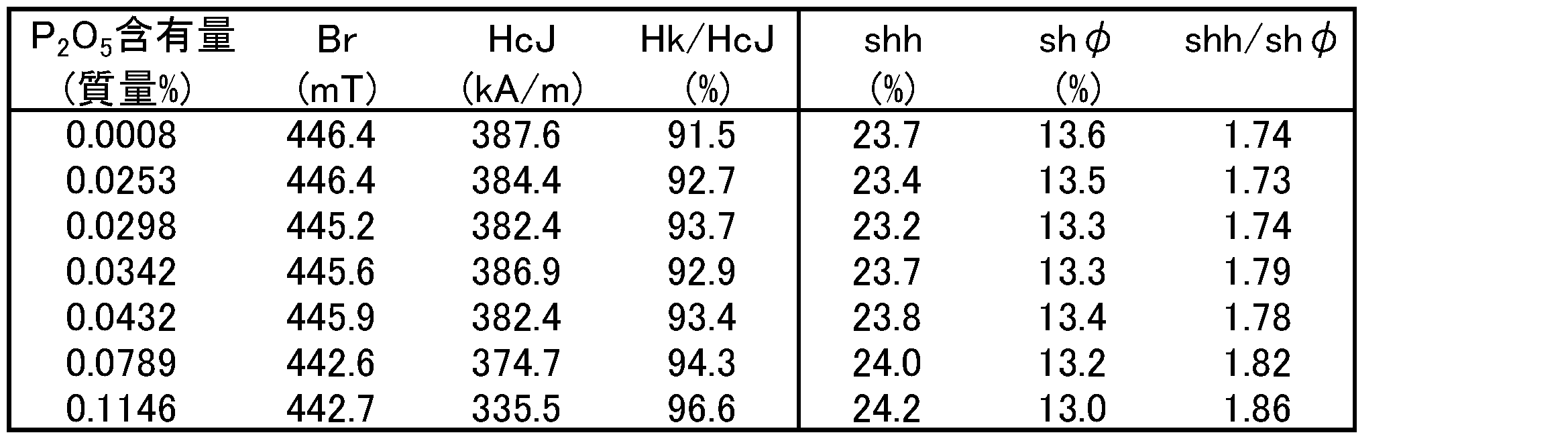
まず、フェライト磁性材料の主成分の原料として、酸化鉄(Fe2O3)、炭酸カルシウム(CaCO3)、炭酸ストロンチウム(SrCO3)を準備し、これらの原料を、焼成後のハードフェライトの組成(主組成)が以下の組成式となるようにそれぞれ秤量した。また、副成分の原料として、燐酸鉄(FePO4・nH2O)を準備した。FePO4・nH2Oの配合量は、フェライト磁性材料中、Pの含有量が、P2O5換算で表3に示す値となるようにそれぞれ変化させた。
式中、A=Srである。また、x=0.105、z=10.20である。
実験例3の各フェライト焼結磁石について、実験例1と同様に、shh(%)、shΦ(%)、shh/shΦ、P含有量、Br、HcJ、及びHk/HcJをそれぞれ求めた。得られた結果を表3に示す。
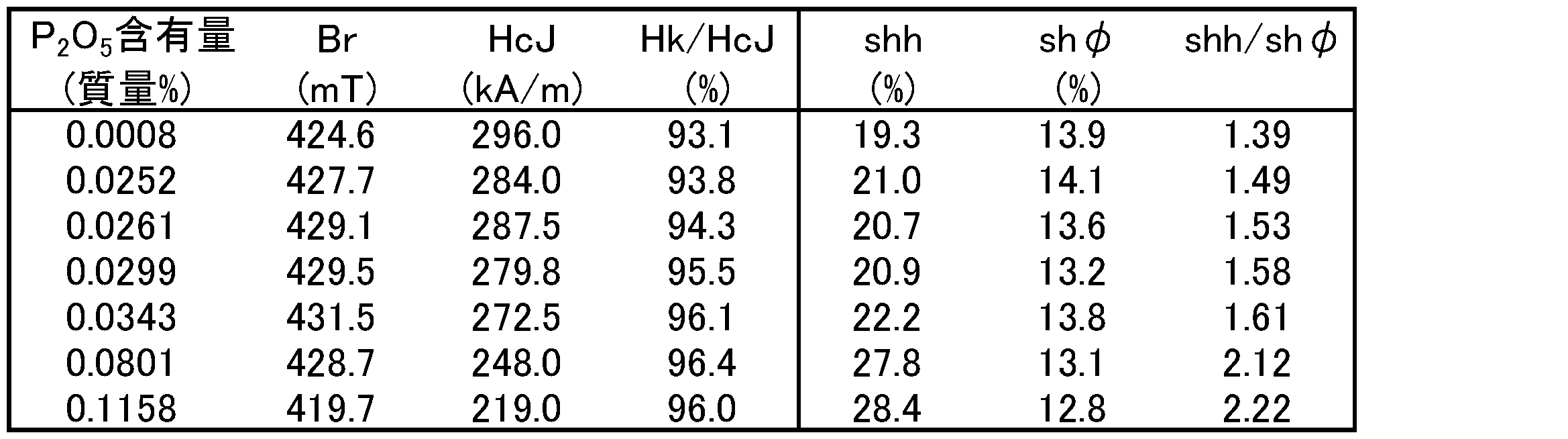
まず、フェライト磁性材料の主成分の原料として、酸化鉄(Fe2O3)、炭酸カルシウム(CaCO3)、炭酸ストロンチウム(SrCO3)及び硫酸ストロンチウム(SrSO4)を準備した。Fe2O3、CaCO3及びSrCO3については、焼成後のハードフェライトの組成(主組成)が以下の組成式となるようにそれぞれ秤量した。また、SrSO4については、フェライト焼結磁石におけるSの含有量が、表4に示す値となるようにそれぞれ変化させた。
式中、A=Sr、R=La、M=Coである。また、w=0.127、x=0.116、z=10.36、m=0.11である。
実験例4の各フェライト焼結磁石について、実験例1と同様に、shh(%)、shΦ(%)、shh/shΦ、Br、HcJ、及びHk/HcJをそれぞれ求めた。また、各フェライト焼結磁石のS含有量を、誘導結合プラズマ発光分光分析装置で測定した。これらの結果を表4に示す。

実験例1における、Pの含有量を0.0008質量%としたフェライト磁性材料、及び、0.0802質量%としたフェライト磁性材料をそれぞれ用いて、図1に示すアークセグメント型のフェライト焼結磁石を作製した。具体的には、各湿式成形用スラリーを得た後、アークセグメント形状が得られるように成形工程を行ったこと以外は、実験例1と同様にして、フェライト焼結磁石を得た。そして、実験例5では、どちらのフェライト磁性材料を用いる場合でも、表5に示す同じ焼結体寸法が得られるように、成形体寸法をそれぞれ調整した。それぞれのフェライト磁性材料を用いて同じ焼結体寸法を得るために必要であった各成形体寸法について、表5に示す。表5中のOR、IR、幅及び長さの各寸法は、それぞれ図2に示した部分の寸法である。

目的とする焼結体の寸法を表6に示すように変えたこと以外は、実験例5と同様の2種類のフェライト磁性材料を用い、同じ焼結体寸法を得るために必要であったそれぞれの成形体寸法を求めた。得られた結果を表6に示す。

目的とする焼結体の寸法を表7に示すように変えたこと以外は、実験例5と同様の2種類のフェライト磁性材料を用い、同じ焼結体寸法を得るために必要であったそれぞれの成形体寸法を求めた。また、各フェライト磁性材料を用いた焼結体の製造をそれぞれ10000回行い、そのうち焼結体にクラックが生じた回数を数えるとともに、成形工程において、湿式成形用スラリーを金型に充填するのに要した平均時間を求めた。得られた結果を表7に示す。
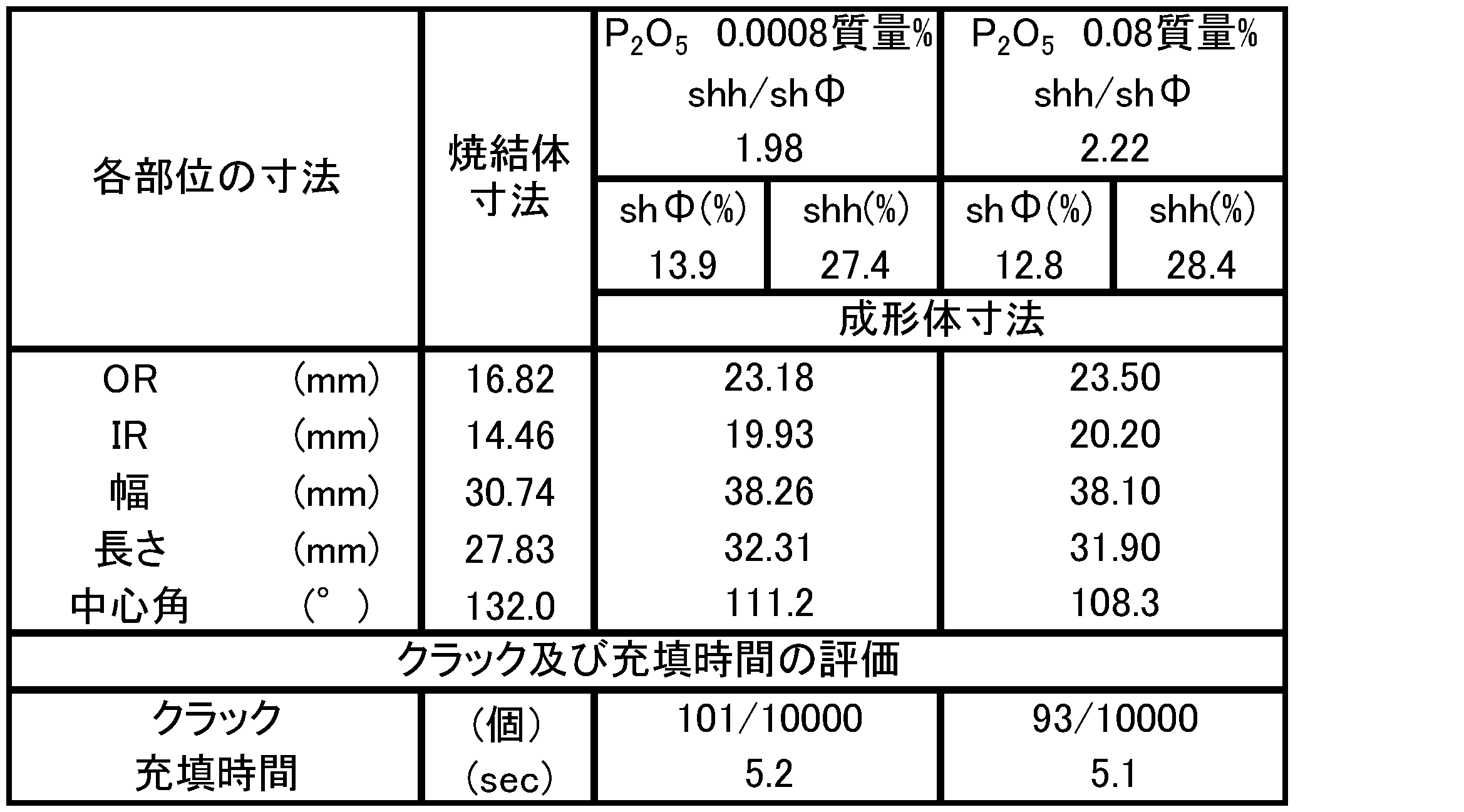
Claims (3)
- ハードフェライトからなるフェライト磁性材料であって、
Pの含有量が、P2O5換算で、0.001質量%以上である、ことを特徴とするフェライト磁性材料。 - Pの含有量が、P2O5換算で、0.001~0.1質量%である、ことを特徴とする請求項1記載のフェライト磁性材料。
- Pの含有量が、P2O5換算で、0.005~0.08質量%である、ことを特徴とする請求項1記載のフェライト磁性材料。
Priority Applications (6)
| Application Number | Priority Date | Filing Date | Title |
|---|---|---|---|
| US13/382,220 US8834738B2 (en) | 2009-07-08 | 2010-07-02 | Ferrite magnetic material |
| CN2010800307255A CN102473499A (zh) | 2009-07-08 | 2010-07-02 | 铁氧体磁性材料 |
| KR1020127002987A KR101377409B1 (ko) | 2009-07-08 | 2010-07-02 | 페라이트 자성 재료 |
| EP10797084.0A EP2453449B1 (en) | 2009-07-08 | 2010-07-02 | Ferrite magnetic material |
| JP2011521903A JP5418595B2 (ja) | 2009-07-08 | 2010-07-02 | 焼結磁石 |
| US14/456,325 US9336933B2 (en) | 2009-07-08 | 2014-08-11 | Ferrite magnetic material |
Applications Claiming Priority (2)
| Application Number | Priority Date | Filing Date | Title |
|---|---|---|---|
| JP2009161930 | 2009-07-08 | ||
| JP2009-161930 | 2009-07-08 |
Related Child Applications (2)
| Application Number | Title | Priority Date | Filing Date |
|---|---|---|---|
| US13/382,220 A-371-Of-International US8834738B2 (en) | 2009-07-08 | 2010-07-02 | Ferrite magnetic material |
| US14/456,325 Division US9336933B2 (en) | 2009-07-08 | 2014-08-11 | Ferrite magnetic material |
Publications (1)
| Publication Number | Publication Date |
|---|---|
| WO2011004773A1 true WO2011004773A1 (ja) | 2011-01-13 |
Family
ID=43429195
Family Applications (1)
| Application Number | Title | Priority Date | Filing Date |
|---|---|---|---|
| PCT/JP2010/061341 Ceased WO2011004773A1 (ja) | 2009-07-08 | 2010-07-02 | フェライト磁性材料 |
Country Status (6)
| Country | Link |
|---|---|
| US (2) | US8834738B2 (ja) |
| EP (1) | EP2453449B1 (ja) |
| JP (1) | JP5418595B2 (ja) |
| KR (1) | KR101377409B1 (ja) |
| CN (1) | CN102473499A (ja) |
| WO (1) | WO2011004773A1 (ja) |
Cited By (5)
| Publication number | Priority date | Publication date | Assignee | Title |
|---|---|---|---|---|
| JP2013251293A (ja) * | 2012-05-30 | 2013-12-12 | Fujifilm Corp | 六方晶フェライト磁性粉末およびその製造方法、ならびに磁気記録媒体およびその製造方法 |
| JP2015130493A (ja) * | 2013-12-04 | 2015-07-16 | Tdk株式会社 | フェライト焼結磁石 |
| JP2017126718A (ja) * | 2016-01-15 | 2017-07-20 | Tdk株式会社 | フェライト焼結磁石 |
| JP2020126931A (ja) * | 2019-02-05 | 2020-08-20 | Tdk株式会社 | フェライト焼結磁石 |
| CN113380489A (zh) * | 2021-05-25 | 2021-09-10 | 合泰盟方电子(深圳)股份有限公司 | 一种磁芯粉末及其制备方法及电感器 |
Families Citing this family (7)
| Publication number | Priority date | Publication date | Assignee | Title |
|---|---|---|---|---|
| CN104376948A (zh) * | 2014-11-10 | 2015-02-25 | 安徽瑞研新材料技术研究院有限公司 | 一种新型铁氧体磁性材料 |
| CN106601418A (zh) * | 2016-11-17 | 2017-04-26 | 安徽荣玖智能装备科技有限公司 | 一种耐压新能源汽车磁力水泵用粉末冶金磁环及其制作方法 |
| US11810699B2 (en) * | 2016-12-22 | 2023-11-07 | Tdk Corporation | Ferrite sintered magnet, ferrite particles, bonded magnet, motor, and generator |
| CN107098689A (zh) * | 2017-06-20 | 2017-08-29 | 合肥博之泰电子科技有限公司 | 一种弱电触头复合导电材料及其生产工艺 |
| CN107564654A (zh) * | 2017-09-15 | 2018-01-09 | 安徽信息工程学院 | 一种用于磁性复合材料的无机复合材料iv及其制备方法 |
| CN113929445B (zh) * | 2021-09-24 | 2023-07-21 | 横店集团东磁股份有限公司 | 一种永磁铁氧体预烧料的制备方法 |
| CN119954504B (zh) * | 2025-02-17 | 2025-10-21 | 合肥迈微新材料技术有限公司 | 一种低温烧结锰锌吸波铁氧体及其制备方法 |
Citations (4)
| Publication number | Priority date | Publication date | Assignee | Title |
|---|---|---|---|---|
| JPS62260724A (ja) * | 1986-05-07 | 1987-11-13 | Ishihara Sangyo Kaisha Ltd | 磁気記録用強磁性微粉末の製造方法 |
| WO2008047854A1 (fr) * | 2006-10-19 | 2008-04-24 | Hitachi Metals, Ltd. | Matériau d'absorption d'ondes radioélectriques et absorbeur d'ondes radioélectriques |
| WO2008126352A1 (ja) * | 2007-03-14 | 2008-10-23 | Toda Kogyo Corporation | ボンド磁石用フェライト粒子粉末、ボンド磁石用樹脂組成物およびそれらから成る成型体 |
| JP2008270792A (ja) | 2007-03-29 | 2008-11-06 | Tdk Corp | フェライト焼結磁石の製造方法 |
Family Cites Families (4)
| Publication number | Priority date | Publication date | Assignee | Title |
|---|---|---|---|---|
| GB1216675A (en) * | 1967-06-02 | 1970-12-23 | Lucas Industries Ltd | Permanent magnet material having strontium ferrite base |
| DE2143718C3 (de) * | 1971-09-01 | 1978-08-17 | Robert Bosch Gmbh, 7000 Stuttgart | Verfahren zur Herstellung von Dauermagnetwerkstoffen aus Ferriten |
| JPS5041092A (ja) * | 1973-08-15 | 1975-04-15 | ||
| JPS6238532A (ja) * | 1985-08-13 | 1987-02-19 | Hitachi Maxell Ltd | 磁気記録媒体 |
-
2010
- 2010-07-02 JP JP2011521903A patent/JP5418595B2/ja active Active
- 2010-07-02 US US13/382,220 patent/US8834738B2/en active Active
- 2010-07-02 KR KR1020127002987A patent/KR101377409B1/ko active Active
- 2010-07-02 EP EP10797084.0A patent/EP2453449B1/en active Active
- 2010-07-02 CN CN2010800307255A patent/CN102473499A/zh active Pending
- 2010-07-02 WO PCT/JP2010/061341 patent/WO2011004773A1/ja not_active Ceased
-
2014
- 2014-08-11 US US14/456,325 patent/US9336933B2/en active Active
Patent Citations (4)
| Publication number | Priority date | Publication date | Assignee | Title |
|---|---|---|---|---|
| JPS62260724A (ja) * | 1986-05-07 | 1987-11-13 | Ishihara Sangyo Kaisha Ltd | 磁気記録用強磁性微粉末の製造方法 |
| WO2008047854A1 (fr) * | 2006-10-19 | 2008-04-24 | Hitachi Metals, Ltd. | Matériau d'absorption d'ondes radioélectriques et absorbeur d'ondes radioélectriques |
| WO2008126352A1 (ja) * | 2007-03-14 | 2008-10-23 | Toda Kogyo Corporation | ボンド磁石用フェライト粒子粉末、ボンド磁石用樹脂組成物およびそれらから成る成型体 |
| JP2008270792A (ja) | 2007-03-29 | 2008-11-06 | Tdk Corp | フェライト焼結磁石の製造方法 |
Non-Patent Citations (1)
| Title |
|---|
| See also references of EP2453449A4 |
Cited By (7)
| Publication number | Priority date | Publication date | Assignee | Title |
|---|---|---|---|---|
| JP2013251293A (ja) * | 2012-05-30 | 2013-12-12 | Fujifilm Corp | 六方晶フェライト磁性粉末およびその製造方法、ならびに磁気記録媒体およびその製造方法 |
| JP2015130493A (ja) * | 2013-12-04 | 2015-07-16 | Tdk株式会社 | フェライト焼結磁石 |
| JP2017126718A (ja) * | 2016-01-15 | 2017-07-20 | Tdk株式会社 | フェライト焼結磁石 |
| US10373746B2 (en) | 2016-01-15 | 2019-08-06 | Tdk Corporation | Ferrite sintered magnet |
| JP2020126931A (ja) * | 2019-02-05 | 2020-08-20 | Tdk株式会社 | フェライト焼結磁石 |
| JP7338161B2 (ja) | 2019-02-05 | 2023-09-05 | Tdk株式会社 | フェライト焼結磁石 |
| CN113380489A (zh) * | 2021-05-25 | 2021-09-10 | 合泰盟方电子(深圳)股份有限公司 | 一种磁芯粉末及其制备方法及电感器 |
Also Published As
| Publication number | Publication date |
|---|---|
| JP5418595B2 (ja) | 2014-02-19 |
| EP2453449B1 (en) | 2016-02-17 |
| EP2453449A4 (en) | 2013-04-03 |
| US20120161062A1 (en) | 2012-06-28 |
| KR20120042917A (ko) | 2012-05-03 |
| EP2453449A1 (en) | 2012-05-16 |
| US20140361214A1 (en) | 2014-12-11 |
| JPWO2011004773A1 (ja) | 2012-12-20 |
| CN102473499A (zh) | 2012-05-23 |
| US8834738B2 (en) | 2014-09-16 |
| KR101377409B1 (ko) | 2014-04-01 |
| US9336933B2 (en) | 2016-05-10 |
Similar Documents
| Publication | Publication Date | Title |
|---|---|---|
| JP5626211B2 (ja) | フェライト磁性材料 | |
| JP5418595B2 (ja) | 焼結磁石 | |
| JP6160619B2 (ja) | フェライト磁性材料、フェライト焼結磁石及びモータ | |
| KR101649242B1 (ko) | 페라이트 소결 자석의 제조 방법 및 페라이트 소결 자석 | |
| TWI434302B (zh) | 氧化物磁性材料及其製法、以及肥粒鐵燒結磁石和其製法 | |
| JP5929764B2 (ja) | フェライト焼結磁石及びその製造方法 | |
| CN111755193B (zh) | 铁氧体烧结磁铁和具备其的旋转电机 | |
| WO1999034376A1 (en) | Ferrite magnet and process for producing the same | |
| WO2014034401A1 (ja) | フェライト仮焼体、フェライト焼結磁石の製造方法及びフェライト焼結磁石 | |
| WO2017200091A1 (ja) | フェライト磁石 | |
| JP2021052097A (ja) | フェライト焼結磁石 | |
| JP5521622B2 (ja) | 酸化物磁性材料、フェライト焼結磁石及びフェライト焼結磁石の製造方法 | |
| JP6863374B2 (ja) | フェライト磁石 | |
| JP2020129579A (ja) | フェライト焼結磁石 | |
| JP3266187B2 (ja) | 回転機 | |
| CN111747737B (zh) | 铁氧体烧结磁体及具备其的旋转电气设备 | |
| JP7367581B2 (ja) | フェライト焼結磁石 | |
| JP3944860B2 (ja) | フェライト磁石粉末 |
Legal Events
| Date | Code | Title | Description |
|---|---|---|---|
| WWE | Wipo information: entry into national phase |
Ref document number: 201080030725.5 Country of ref document: CN |
|
| 121 | Ep: the epo has been informed by wipo that ep was designated in this application |
Ref document number: 10797084 Country of ref document: EP Kind code of ref document: A1 |
|
| WWE | Wipo information: entry into national phase |
Ref document number: 2011521903 Country of ref document: JP |
|
| NENP | Non-entry into the national phase |
Ref country code: DE |
|
| ENP | Entry into the national phase |
Ref document number: 20127002987 Country of ref document: KR Kind code of ref document: A |
|
| WWE | Wipo information: entry into national phase |
Ref document number: 2010797084 Country of ref document: EP |
|
| WWE | Wipo information: entry into national phase |
Ref document number: 13382220 Country of ref document: US |