WO2011009552A1 - Neue alkoxyenone und enaminoketone und ein verfahren zu deren herstellung - Google Patents

Neue alkoxyenone und enaminoketone und ein verfahren zu deren herstellung Download PDF

Info

Publication number
WO2011009552A1
WO2011009552A1 PCT/EP2010/004286 EP2010004286W WO2011009552A1 WO 2011009552 A1 WO2011009552 A1 WO 2011009552A1 EP 2010004286 W EP2010004286 W EP 2010004286W WO 2011009552 A1 WO2011009552 A1 WO 2011009552A1
Authority
WO
WIPO (PCT)
Prior art keywords
alkyl
compounds
formula
haloalkyl
alkoxy
Prior art date
Legal status (The legal status is an assumption and is not a legal conclusion. Google has not performed a legal analysis and makes no representation as to the accuracy of the status listed.)
Ceased
Application number
PCT/EP2010/004286
Other languages
English (en)
French (fr)
Inventor
Sergii Pazenok
Norbert Lui
Arnd Neef
Current Assignee (The listed assignees may be inaccurate. Google has not performed a legal analysis and makes no representation or warranty as to the accuracy of the list.)
Bayer CropScience AG
Original Assignee
Bayer CropScience AG
Priority date (The priority date is an assumption and is not a legal conclusion. Google has not performed a legal analysis and makes no representation as to the accuracy of the date listed.)
Filing date
Publication date
Priority to EP10732671.2A priority Critical patent/EP2456747B1/de
Priority to KR1020127004615A priority patent/KR101747709B1/ko
Priority to JP2012520931A priority patent/JP5735962B2/ja
Priority to RU2012106074/04A priority patent/RU2012106074A/ru
Priority to BR112012001558A priority patent/BR112012001558A2/pt
Priority to IN638DEN2012 priority patent/IN2012DN00638A/en
Priority to DK10732671.2T priority patent/DK2456747T3/da
Priority to ES10732671.2T priority patent/ES2494465T3/es
Application filed by Bayer CropScience AG filed Critical Bayer CropScience AG
Priority to MX2012000877A priority patent/MX2012000877A/es
Publication of WO2011009552A1 publication Critical patent/WO2011009552A1/de
Priority to IL217193A priority patent/IL217193A/en
Priority to ZA2012/00528A priority patent/ZA201200528B/en
Anticipated expiration legal-status Critical
Ceased legal-status Critical Current

Links

Classifications

    • C—CHEMISTRY; METALLURGY
    • C07—ORGANIC CHEMISTRY
    • C07C—ACYCLIC OR CARBOCYCLIC COMPOUNDS
    • C07C67/00—Preparation of carboxylic acid esters
    • C07C67/10—Preparation of carboxylic acid esters by reacting carboxylic acids or symmetrical anhydrides with ester groups or with a carbon-halogen bond
    • C07C67/11—Preparation of carboxylic acid esters by reacting carboxylic acids or symmetrical anhydrides with ester groups or with a carbon-halogen bond being mineral ester groups
    • C—CHEMISTRY; METALLURGY
    • C07—ORGANIC CHEMISTRY
    • C07C—ACYCLIC OR CARBOCYCLIC COMPOUNDS
    • C07C69/00—Esters of carboxylic acids; Esters of carbonic or haloformic acids
    • C07C69/007—Esters of unsaturated alcohols having the esterified hydroxy group bound to an acyclic carbon atom
    • C—CHEMISTRY; METALLURGY
    • C07—ORGANIC CHEMISTRY
    • C07C—ACYCLIC OR CARBOCYCLIC COMPOUNDS
    • C07C69/00—Esters of carboxylic acids; Esters of carbonic or haloformic acids
    • C07C69/007—Esters of unsaturated alcohols having the esterified hydroxy group bound to an acyclic carbon atom
    • C07C69/01—Vinyl esters
    • C—CHEMISTRY; METALLURGY
    • C07—ORGANIC CHEMISTRY
    • C07C—ACYCLIC OR CARBOCYCLIC COMPOUNDS
    • C07C69/00—Esters of carboxylic acids; Esters of carbonic or haloformic acids
    • C07C69/62—Halogen-containing esters
    • C07C69/63—Halogen-containing esters of saturated acids
    • C—CHEMISTRY; METALLURGY
    • C07—ORGANIC CHEMISTRY
    • C07D—HETEROCYCLIC COMPOUNDS
    • C07D401/00—Heterocyclic compounds containing two or more hetero rings, having nitrogen atoms as the only ring hetero atoms, at least one ring being a six-membered ring with only one nitrogen atom
    • C07D401/02—Heterocyclic compounds containing two or more hetero rings, having nitrogen atoms as the only ring hetero atoms, at least one ring being a six-membered ring with only one nitrogen atom containing two hetero rings
    • C07D401/04—Heterocyclic compounds containing two or more hetero rings, having nitrogen atoms as the only ring hetero atoms, at least one ring being a six-membered ring with only one nitrogen atom containing two hetero rings directly linked by a ring-member-to-ring-member bond

Definitions

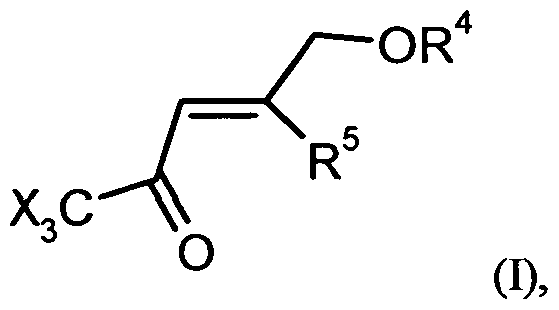
  • the present invention relates to novel alkoxyenones and enaminoketones and to a novel process for their preparation.
  • Alkoxyenones and enaminoketones are valuable intermediates for the preparation of pyrazoles and anthranilic acid amides, which can be used as insecticides.
  • the object of the invention is to provide a process which allows the halogen atom in position 5, for example, of the compounds 5-halo-1,1,1 -trihalogen-4-
  • Another object of the present invention is to develop a process which makes it possible to provide alkoxy enones and enaminoketones in sufficient quantity and purity for the further production of pyrazoles and anthranilic acid amides.
  • R 5 represents alkoxy, dialkylamino, where the alkyl groups may optionally form a ring which may optionally contain 1-2 further heteroatoms from the series O, N, S, represents cycloalkylamino, thioalkyl, characterized in that the compounds of general formula ( DI)
  • Kat is a cation, Li, Na, K, Cs, (alkyl) 4 N, (alkyl) 4 P, (aryl) 4 P,
  • the process gives the compounds of the formula (I) according to the invention without side reactions and thus does not have the disadvantages described in the prior art.
  • halogens includes those elements selected from the group consisting of fluorine, chlorine, bromine and iodine, with fluorine, chlorine and bromine being preferred and fluorine and chlorine particularly preferably used.
  • Substituted groups may be monosubstituted or polysubstituted, with multiple substituents the substituents may be the same or different.
  • alkyl and Ci-Ci 2 alkyl includes, for example, the meanings methyl, ethyl, n-, iso-propyl, n-, iso-, sec- and t-butyl, n-pentyl, n-hexyl, 1,3- Dimethylbutyl, 3,3-dimethylbutyl, n-heptyl, n-nonyl, n-decyl, n-undecyl, n-dodecyl.
  • Cycloalkyl groups are in the context of the present invention, unless otherwise defined, annular saturated hydrocarbon groups which may optionally contain 1-3 heteroatoms from the series O, N, S.
  • Aryl radicals in the context of the present invention are, unless otherwise defined, C ⁇ -Cio aromatic hydrocarbon radicals and aromatic hydrocarbon radicals which may have one, two or more heteroatoms selected from O, N, P and S. and optionally substituted by further groups.
  • the compounds according to the invention can be present as mixtures of various possible isomeric forms, in particular of stereoisomers, such as, for example, E and Z, threo and erythro, as well as optical isomers, but optionally also of tautomers. Both the E and the Z isomers, as well as the threo and erythro, and also the optical isomers, any mixtures of these isomers, as well as the possible tautomeric forms are disclosed and claimed.
  • stereoisomers such as, for example, E and Z, threo and erythro
  • optical isomers such as well as optical isomers
  • X is independently of one another fluorine, chlorine, bromine, iodine, preferably fluorine, chlorine or bromine, particularly preferably chlorine or bromine,
  • R 5 is alkoxy, dialkylamino, wherein the alkyl groups may optionally form a ring which may optionally contain 1-2 further heteroatoms from the series O, N, S, cycloalkylamino, thioalkyl, preferably alkoxy, particularly preferably (C r C 6 ) alkoxy.
  • 5-Halo-l, l, l-trihalo-4-methoxypent-3-en-2-ones can be prepared by the method of Geras et al., Synthesis 2001, N. 3, 431-436.
  • Examples of compounds of the formula (HT) which are suitable according to the invention are, for example:
  • the compounds of the formula (H) are commercially available.
  • the carrying out of the method step according to the invention preferably within a temperature range of 10 0 C to 10O 0 C, particularly preferably at temperatures from 20 0 C to 80 0 C.
  • the process step according to the invention is generally carried out under atmospheric pressure.
  • reaction time is not critical and can, depending on the batch size and temperature, in a range between 30 min. and several hours.
  • 1 mol of the haloenone of the formula (II) is reacted with 0.8 mol to 1.5 mol, preferably 0.9 mol to 1.2 mol, particularly preferably with the equimolar amount of the compound of the formula (IT).
  • Suitable solvents are, for example, aliphatic, alicyclic or aromatic hydrocarbons, e.g. Petroleum ether, n-hexane, n-heptane, cyclohexane, methylcyclohexane, benzene, toluene, xylene or decalin, and halogenated hydrocarbons, e.g.
  • the reaction can be accelerated by the addition of catalysts.
  • catalysts substances can be used that generally accelerate reactions with O-nucleophiles.
  • alkali bromides or alkali iodides such as sodium iodide, potassium iodide, potassium bromide, ammonium bromide or ammonium iodide
  • Tetraalkylammonium iodides, tetraalkylammonium bromides or tetraalkylammonium sulphates such as, for example, tetraethylammonium chloride, tetraethylammonium bromide,
  • Tetrabutylammonium chloride or tetrabutylammonium bromide Tetraalkyl or tetraaryl phosphonium chlorides or bromides or iodides such as bis (dimethylamino) [(1,3-dimethylimidazolidin-2-ylidene) amino] methylium bromide,
  • Tetrakis (dimethylamino) phosphonium bromide Tetrakis (dimethylamino) phosphonium bromide, tetrakis (diethylamino) phosphonium bromide,
  • Tetrakis (dipropylamino) phosphonium chloride or bromide; Crown ethers, for example, 18-crown-6 are used.
  • the amount of the catalyst can be varied from 0.1 to 15% by weight, based on the compound of the formula (II) used. Higher amounts of catalyst are possible but not economical.
  • this reaction gave a complex mixture of several products, with degradation of the CCl 3 group dominating.
  • the acid is added to the reaction mixture and thereby lowered the basicity of the reaction mixture.
  • the amount of acid can be varied from 0.05 to 1 equivalent based on the compound of formula (HI) used.
  • Suitable additives are HCl, H 2 SO 4 , CH 3 COOH, CF 3 COOH, CH 3 COOH, HCl and H 2 SO 4 being preferred.
  • the workup of the reaction mixture is anhydrous by liberation of the mixture of salts (filtration) and removal of the solvent in vacuo. Aqueous workup is also possible. It is also possible to further convert the mixture without intermediate insulation.
  • the purity of the compounds of formula (I) is very high and is in the range of 95-97%, which allows the compounds to continue to be used without purification step.
  • the reaction of the invention is characterized by the use of inexpensive raw materials, as well as by a particularly good and easy to carry out process control on an industrial scale.
  • the compounds of the formula (I) according to the invention are important intermediates for the preparation of pyrazoles according to Scheme (C), which in turn are valuable intermediates in the synthesis of anthranilic acid amides (WO2007 / 112893, WO2007 / 144100).
  • R 4 , R 5 and X have the meanings given above.
  • the mixture was cooled to 0 ° C; the precipitate was filtered off and washed with acetonitrile and dried.
  • Methyl 3- (chloromethyl) -1- (3-chloropyridin-2-yl) -1H-pyrazole-5-carboxylate Methyl 1- (3-chloropyridin-2-yl) -3- (hydroxymethyl) -1H-pyrazole-5 -carboxylates (26.7 g, 0.1 mol) was dissolved in 150 ml of CH 2 Cl 2 and the solution was cooled to 5 ° C. SOCl 2 (0.12 mol) in 30 ml CH 2 Cl 2 was slowly added dropwise at this temperature. The mixture was stirred for 4 hrs. At 40 0 C and concentrated in vacuo. The product can be used without cleaning. Analytical characterization

Landscapes

  • Chemical & Material Sciences (AREA)
  • Organic Chemistry (AREA)
  • Plural Heterocyclic Compounds (AREA)
  • Organic Low-Molecular-Weight Compounds And Preparation Thereof (AREA)
  • Low-Molecular Organic Synthesis Reactions Using Catalysts (AREA)
  • Agricultural Chemicals And Associated Chemicals (AREA)

Abstract

Die vorliegende Erfindung betrifft neue Alkoxyenone und Enaminoketone und ein neues Verfahren zur deren Herstellung. Alkoxyenone und Enaminoketone sind wertvolle Zwischenprodukte zur Herstellung von Pyrazolen und Anthranilsäureamiden, die als Insektizide Verwendung finden können.

Description

Neue Alkoxyenone und Enaminoketone und ein Verfahren zur deren Herstellung
Die vorliegende Erfindung betrifft neue Alkoxyenone und Enaminoketone und ein neues Verfahren zur deren Herstellung. Alkoxyenone und Enaminoketone sind wertvolle Zwischenprodukte zur Herstellung von Pyrazolen und Anthranilsäureamiden, die als Insektizide Verwendung finden können.
In der Literatur ist bekannt, dass 5-Brorno-l,l,l-trihalo-4-rnethoxypent-3-en-2-one drei Reaktionszentren (am Carbonylkohlenstoff, sowie am C4- und C5-Kohlenstoff) hat, welche je nach Nukleophileart und Bedingungen auf unterschiedliche Weise reagieren können. So beschreibt Geras et al. ( Coll.Czech Chem. Comm, 2009, v.74, N 2, p. 335-346), daß Alkoxyketone mit Triethylphosphiten unter der Bildung von„Arbuzov"-Produkten der Formel (DC) oder "Perkow" Produkten der Formel (X) reagieren (siehe nachfolgendes Schema (A)):
Figure imgf000002_0001
Schema (A)
Die Aufgabe der Erfindung ist es, ein Verfahren zur Verfügung zu stellen, welches erlaubt, das Halogenatom in Position 5 beispielsweise der Verbindungen 5-Halo- 1,1,1 -trihalogen-4-
(alkoxy)pent-3-en-2-one oder 5-Halo-l,l,l-trihalogen-4-(dialkylainino)pent-3-en-2-one gegen
O-Nukleophile selektiv auszutauschen, ohne die Trihalogenmethylgruppe am Carbonyl-Kohlenstoff anzugreifen. Das Verfahren soll für die technische Produktion des Produktes tauglich sein. Eine weitere Aufgabe der vorliegenden Erfindung ist es, ein Verfahren zu entwickeln, welches es erlaubt, Alkoxyenone und Enaminoketone in ausreichender Menge und Reinheit für die weitere Herstellung von Pyrazolen und Anthranilsäureamiden bereitzustellen.
Erfindungsgemäß gelöst wurde die Aufgabe durch ein Verfahren zur Herstellung der Alkoxyenone und Enaminoketone der Formel (I),
Figure imgf000003_0001
in welcher
R4 für Wasserstoff, -(C=O)Alkyl, (C=0)Halogenalkyl,-(C=0)0-Alkyl, SO2Alkyl, SO2- Halogenalkyl, SO2-Aryl steht, X für Halogen steht,
R5 für Alkoxy, Dialkylamino, wobei die Alkylgruppen gegebenenfalls einen Ring bilden können, welcher gegebenenfalls 1-2 weitere Heteroatome aus der Reihe O,N,S enthalten kann, für Cycloalkylamino, Thioalkyl steht, dadurch gekennzeichnet, dass die Verbindungen der allgemeinen Formel (DI),
Figure imgf000003_0002
(in) in welcher R5 die oben angegebenen Bedeutungen hat und X unabhängig voneinander für Fluor, Chlor, Brom oder Jod steht, mit einer Verbindung der allgemeinen Formel (IT)
KatOR4 (π) in welcher
Kat für ein Kation steht, für Li, Na , K, Cs, (Alkyl)4N, (Alkyl)4P, (Aryl)4P steht,
R4 für Wasserstoff, -(C=O)Alkyl, (C=O)Halogenalkyl, -(C=O)O-Alkyl, SO2Alkyl, SO2- Halogenalkyl, SO2-Aryl steht,
R4 bevorzugt für -(C=O)(C,-C6)Alkyl, (C=O)Halogen(C,-C6)alkyl, -(C=O)O-(C,-C6)Alkyl, SO2(C,-C6)Alkyl, SO2 -Halogen(C,-C6)alkyl, SO2-Aryl steht, R4 besonders bevorzugt für -(C=O)(C rC6)Alkyl steht, R4 ganz besonders bevorzugt für -(C=O)CH3 steht, umgesetzt werden zu erfindungsgemäßen Alkoxyenonen und Enaminoketonen der Formel (I), welche zu Pyrazolen und Anthranilsäureamiden weiterverarbeitet werden können. Das Verfahren liefert die erfindungsgemäßen Verbindungen der Formel (I) ohne Nebenreaktionen und weist somit die im Stand der Technik beschriebenen Nachteile nicht auf.
Insbesondere ist es als völlig überraschend anzusehen, dass 5-Halo-l,l,l-trihalogen-4-alkoxy- oder -(dialkylamino)pent-3-en-2-one mit den Verbindungen der Formel (U) regioselektiv reagiert und das Halogenatom in Position 5 gegen O-Nukleophile beispielsweise die OR4-Gruppe tauscht, ohne die Trihalogenmethyl-Gruppe X3CO- anzugreifen.
Figure imgf000004_0001
(in) (H) (I)
Schema (B) Wobei Kat, X, R4,R5 die oben angegebenen Bedeutungen haben.
- A -
Allgemeine Definitionen
Im Zusammenhang mit der vorliegenden Erfindung, umfasst der Begriff Halogene (X), soweit nicht anders definiert, solche Elemente, die ausgewählt sind aus der Gruppe bestehend aus Fluor, Chlor, Brom und Iod, wobei Fluor, Chlor und Brom bevorzugt und Fluor und Chlor besonders bevorzugt verwendet werden. Substituierte Gruppen können einfach oder mehrfach substituiert sein, wobei bei Mehrfachsubstitutionen die Substituenten gleich oder verschieden sein können.
Mit einem oder mehreren Halogenatomen (-X) substituierte Alkyl-Gruppen (= Halogenalkyl- Gruppen) sind beispielsweise ausgewählt aus Trifluormethyl (CF3), Difluormethyl (CHF2), CCl3, CFCl2, CF3CH2, ClCH2, CF3CCl2. Alkyl-Gruppen sind im Zusammenhang mit der vorliegenden Erfindung, soweit nicht abweichend definiert, lineare oder verzweigte Kohlenwasserstoff-Gruppen.
Die Definition Alkyl und Ci-Ci2-Alkyl umfasst beispielsweise die Bedeutungen Methyl, Ethyl, n-, iso-Propyl, n-, iso-, sec- und t-Butyl, n-Pentyl, n-Hexyl, 1,3-Dimethylbutyl, 3,3-Dimethylbutyl, n- Heptyl, n-Nonyl, n-Decyl, n-Undecyl, n-Dodecyl. Cycloalkyl-Gruppen sind im Zusammenhang mit der vorliegenden Erfindung, soweit nicht abweichend definiert, ringförmige gesättigte Kohlenwasserstoff-Gruppen, welche gegebenenfalls 1-3 Heteroatome aus der Reihe O,N,S enthalten können.
Aryl-Reste sind im Zusammenhang mit der vorliegenden Erfindung, soweit nicht abweichend definiert, Cβ-Cio aromatische Kohlenwasserstoff-Reste und aromatische Kohlenwasserstoff-Reste, die ein, zwei oder mehrere Heteroatome, die ausgewählt sind aus O, N, P und S aufweisen können und optional durch weitere Gruppen substituiert sein können.
Die erfindungsgemäßen Verbindungen können gegebenenfalls als Mischungen verschiedener möglicher isomerer Formen, insbesondere von Stereoisomeren, wie z.B. E- und Z-, threo- und erythro-, sowie optischen Isomeren, gegebenenfalls aber auch von Tautomeren vorliegen. Es werden sowohl die E- als auch die Z-Isomere, wie auch die threo- und erythro-, und auch die optischen Isomere, beliebige Mischungen dieser Isomere, sowie die möglichen tautomeren Formen offenbart und beansprucht. Verbindungen der Formel (HO
Die bei der Durchführung des erfindungsgemäßen Verfahrens als Ausgangsstoffe verwendeten Verbindungen sind durch die Formel (IH) allgemein definiert:
Figure imgf000006_0001
wobei
X unabhängig voneinander für Fluor, Chlor, Brom, Jod, bevorzugt für Fluor, Chlor oder Brom, besonders bevorzugt für Chlor oder Brom steht,
R5 für Alkoxy, Dialkylamino, wobei die Alkylgruppen gegebenenfalls einen Ring bilden können, welcher gegebenenfalls 1-2 weitere Heteroatome aus der Reihe O,N,S enthalten kann, für Cycloalkylamino, Thioalkyl, steht, bevorzugt für Alkoxy, besonders bevorzugt für (CrC6)Alkoxy steht.
5-Halo-l,l,l-trihalogen-4-methoxypent-3-en-2-one können nach der Methode von Geras et al., Synthesis 2001, N. 3, 431-436, hergestellt werden. Beispiele für erfindungsgemäß geeignete Verbindungen der Formel (HT) sind z.B.:
5-Brom- 1,1,1 -trichloro-4-methoxypent-3 -en-2-one, 5-chlor- 1,1,1 -trichloro-4-methoxypent-3 -en-2- one, 5 -Bromo- 1,1,1 -trifluor-4-methoxypent-3 -en-2-one, 5-Bromo- 1,1,1 -trichloro-4-ethoxypent-3 -en- 2-one, 5 -Chlor- 1,1,1 -trifluor-4-methoxypent-3 -en-2-one, 5-Chlor- 1,1,1 -trifluor-4- dimethylaminopent-3-en-2-one. Verbindun2en der Formel (TD
Die bei der Durchführung des erfindungsgemäßen Verfahrens als Ausgangsstoffe verwendeten Verbindungen sind durch die Formel (II) allgemein definiert
KatOR4 (π) wobei Kat und R4 die oben angegebenen Bedeutungen haben.
Beispielhaft, aber nicht limitierend seien die folgenden Verbindungen der Formel (II) aufgeführt: NaOAc, KOAc, CsOAc, CF3COONa, CF3COOK, CCl3COONa, CH3SO3Na, PhenylSO3Na, Bu4NOCOCH3
Die Verbindungen der Formel (H) sind kommerziell erhältlich. Die Durchführung des erfindungsgemäßen Verfahrensschritts erfolgt vorzugsweise innerhalb eines Temperaturbereichs von 100C bis 10O0C, besonders bevorzugt bei Temperaturen von 200C bis 80 0C. Der erfindungsgemäße Verfahrensschritt wird im Allgemeinen unter Normaldruck durchgeführt.
Die Reaktionszeit ist nicht kritisch und kann, in Abhängigkeit von der Ansatzgröße und Temperatur, in einem Bereich zwischen 30 min. und mehreren Stunden gewählt werden. Bei der Durchführung des erfindungsgemäßen Verfahrensschritts setzt man 1 Mol des Haloenones der Formel (HI) mit 0.8 Mol bis 1.5 Mol, vorzugsweise 0.9 Mol bis 1.2 Mol, besonders bevorzugt mit der äquimolaren Menge der Verbindung der Formel (IT) um.
Geeignete Lösungsmittel sind beispielsweise aliphatische, alicyclische oder aromatische Kohlenwasserstoffe, wie z.B. Petrolether, n-Hexan, n-Heptan, Cyclohexan, Methylcyclohexan, Benzol, Toluol, Xylol oder Decalin, und halogenierte Kohlenwasserstoffe, wie z.B. Chlorbenzol, Dichlorbenzol, Di- chlormethan, Chloroform, Tetrachlormethan, Dichlorethan oder Trichlorethan, Ether, wie Diethylether, Diisopropylether, Methyl-tert-butylether, Methyl-tert-amylether, Dioxan, Tetra- hydrofuran, 1,2-Dimethoxyethan, 1,2-Diethoxyethan oder Anisol; Nitrile, wie Acetonitril, Pro- pionitril, n- oder iso-Butyronitril oder Benzonitril; Amide, wie N,N-Dimethylformamid, N,N-Di- methylacetamid, N-Methylformanilid, N-Methylpyrrolidon oder Hexarnethylphosphorsäuretriamid; Sulfoxide, wie Dimethylsulfoxid oder Sulfone, wie Sulfolan, Alkohole wie Methanol, Ethanol, Isopropanol. Besonders bevorzugt verwendet man Acetonitril, Toluol, Ethanol, THF, Diglym, N- Methylpyrrolidon, 1,2-Diethoxyethan.
Die Umsetzung kann durch den Zusatz von Katalysatoren beschleunigt werden. AIs Katalysatoren können Substanzen eingesetzt werden, die allgemein Umsetzungen mit O- Nukleophilen beschleunigen. Beispielsweise können Alkalibromide oder Alkalijodide, wie zum Beispiel Natriumjodid, Kaliumjodid, Kaliumbromid, Ammoniumbromid oder Ammoniumjodid; Tetraalkylammoniumjodide, Tetraalkylammoniumbromide oder Tetraalkylammoniumsulphate, wie zum Beispiel Tetraethylammoniumchlorid, Tetraethylammoniumbromid,
Tetrabutylammoniumchlorid oder Tetrabutylammoniumbromid; Tetraalkyl- oder Tetraarylphosphoniumchloride oder -bromide oder -Jodide, wie zum Beispiel Bis(dimethylamino)[(l,3-dimethylimidazolidin-2-yliden)amino]methyliumbromid,
Hexadecyl-tri-butyl-phosphoniumbromid, Stearyltributylphosphoniumbromid, Tetrabutylphosphoniumbromid, Tetra-butyl-phosphoniumbromid, Tetraoctylphosphoniumbromid, Tetraphenylphosphoniumchlorid, Tetraphenylphosphoniumbromid,
Tetrakis(dimethylamino)phosphonium-bromid, Tetra-kis-(diethylamino)phosphoniumbromid,
Tetrakis(dipropylamino)phosphoniumchlorid oder -bromid; Kronenether, beispielsweise 18-Krone-6 eingesetzt werden. Die Menge des Katalysators kann von 0,1 bis 15 Gewichtsprozent, bezogen auf die eingesetzte Verbindung der Formel (II) variiert werden. Höhere Mengen an Katalysator sind möglich, aber nicht wirtschaftlich.
Martins et al. (Synthesis 2001, 13, 1959) beschreibt , dass 5-Bromo-l,l,l-trichlor-4-methoxypent-3- en-2-one mit Phenol in Gegenwart von Pottasche bei 800C in Acetonitril unter Br/OPh Austausch reagiert.
Im vorliegenden Fall ergab diese Umsetzung ein komplexes Gemisch von mehreren Produkten, wobei der Abbau der CCl3-Gruppe dominierte.
Um den Haloformabbau (besonders im Fall von CCl3-Enonen) zu vermeiden, wird zu dem Reaktionsgemisch die Säure zugesetzt und hierdurch die Basizität des Reaktionsgemisches abgesenkt. Dadurch wird die Bildung von Nebenprodukten durch Abbau der CCl3-Gruppe signifikant zurückgedrängt. Die Menge der Säure kann von 0,05 bis 1 Äquivalent bezogen auf die eingesetzte Verbindung der Formel (Hl), variiert werden. Als Zusatz kommen HCl, H2SO4, CH3COOH, CF3COOH in Frage, wobei CH3COOH, HCl und H2SO4 bevorzugt sind. Die Aufarbeitung des Reaktionsgemisches erfolgt wasserfrei durch Befreiung des Gemisches von Salzen (Filtration) und Entfernung der Lösemittel im Vakuum. Wässrige Aufarbeitung ist auch möglich. Es ist auch möglich, das Gemisch ohne Zwischenisolierung weiter umzusetzen.
Die Reinheit der Verbindungen der Formel (I) ist sehr hoch und liegt in Bereich von 95-97 %, was es erlaubt, die Verbindungen ohne Reinigungsschritt weiter einzusetzen. Insbesondere zeichnet sich die erfindungsgemäße Umsetzung durch den Einsatz günstiger Rohstoffe, sowie durch eine auch im großtechnischen Maßstab besonders gut und einfach durchzuführende Prozeßführung aus.
Die erfϊndungsgemäßen Verbindungen der Formel (I) sind wichtige Zwischenprodukte für die Herstellung von Pyrazolen gemäß Schema (C), welche wiederum wertvolle Zwischenprodukte sind in der Synthese von Anthranilsäureamiden (WO2007/112893, WO2007/144100).
Figure imgf000009_0001
Schema (C), wobei Z für CH, N steht, R3 für H, Halogen, CN, NO2, Alkyl, Cycloalkyl, Halogenalkyl, Halogencycloalkyl, Alkoxy, Halogenalkoxy, Alkylamino, Dialkylamino, Cycloalkylamino steht und
R4, R5 und X die oben angegebenen Bedeutungen haben.
Herstellbeispiele Beispiel 1
5-Bromo-l,l,l-trichloro-4-methoxypent-3-en-2-one wurde hergestellt nach der Methode von Gerus et al., Synthesis 2001, N. 3, 431-436. Ausbeute 90 %. Beispiel 2
5,5,5-Trichloro-2-methoxy-4-oxopent-2-en-l-yl acetate
29.6 g (0.1 mol) 5-Bromo-l,l,l-trichloro-4-methoxypent-3-en-2-one, 17 g Kaliumacetate, 5 g Tetrabutylammoniumbromid und 8 g Essigsäure wurden in 300 ml Acetonitril 16 Std. bei 400C gerührt. Das Gemisch wurde im Vakuum aufkonzentriert und zu dem Rückstand wurde Wasser zugegeben. Das Produkt wurde mit Ethylacetat extrahiert, die organische Phase mit Wasser gewaschen und das Lösemittel im Vakuum vollständig entfernt.
Man erhielt 25.4 g (85%) des Produktes als hell-braunen Feststoff mit der LC Reinheit von 97 %, Schmp. 53-55°C.
1 HNMR (DMSO O6) δ: 2.05 (s, 3H), 3.85 (s, 3H), 5.2 (s, 2H), 6.1 (s, IH) ppm. GC/MS: m/z 274. Beispiel 3 5,5,5-Trichloro-2-methoxy-4-oxopent-2-en-l-yl acetate
29.6 g (0.1 mol) 5-Bromo-l,l,l-trichloro-4-methoxypent-3-en-2-one, 19.1 g Cesiumacetate, 5 g Tetrabutylammoniumbromid und 8 g Essigsäure wurden in 300 ml Acetonitril 8 Std. bei 25°C gerührt. Der Niederschlag wurde abfiltriert und die organische Phase im Vakuum eingeengt.
Man erhielt 26.8 g (90 %) des Produktes als hell-braunen Feststoff mit der LC Reinheit von 98 %. Schmp. 54-55°C.
Beispiel 4
5, 5,5-Trifluor-2-methoxy-4-oxopent-2-en-l-yl acetate 24.8 g (0.1 mol) 5-Bromo-l,l,l-trifluor-4-methoxypent-3-en-2-one, 20 g Kaliumacetate, 5 g Tetrabutylammoniumbromid und 8 g Essigsäure wurden in 300 ml Acetonitril 20 Std. bei 400C gerührt. Der Niederschlag wurde abfiltriert und das Lösemittel im Vakuum vollständig entfernt. Man erhielt 15.8. g (70%) als hell-braunes Öl mit der Reinheit von 85 %.
1 H NMR (DMSO Cl6) S: 2.17 (s, 3H), 3.80 (s, 3H), 5.28 (s, 2H), 6.15 (s, IH) ppm. GC/MS: m/z 226.
Beispiel 4 b
[l-(3-Chloropyridin-2-yl)-5-(trichloromethyl)-lH-pyrazol-3-yl]methyl acetate. 38.7 g [l-(3-Chloropyridin-2-yl)-5-hydroxy-5-(trichloromethyl)-4,5-dihydro-lH-pyrazol-3-yl]methyl acetate wurden in 200 ml Methyltert-butylether gelöst und 12.6 g Oxalylchlorid wurden binnen 2 Std. zugetropft (starke Gasentwicklung). Das Gemisch wurde 5 Std. bei 25°C nachgerührt und im Vakuum komplett eingeengt.
Man erhielt 36 g des Produktes als zähes Öl, welches nach ca. 10 Std. bei Raumtemperatur durchkristallisiert. Schmp. 40-420C.
1 H NMR (DMSO de) δ: 2.0 (s, 3H), 5.1 (dd, 2H), 7.0 (s, IH), 7.6 (dd,lH), 8.1 (dd, IH), 8.5 (dd, IH) ppm.
Beispiel 5
[l-ß-Chloropyridin^-ylJ-S-hydroxy-S-ftrichloromethylJ^J-dihydro-lH-pyrazol-S-ylJmethyl acetate
27.5 g (0.1 mol) 5,5,5-Trichloro-2-methoxy-4-oxopent-2-en-l-yl acetate und 14.4 g (0.1 mol) 3- Chlor-2-hydrazinopyridine wurden in 200 ml Ethanol vorgelegt und das Gemisch 3 Std. bei 25°C gerührt. Der Niederschlag wurde abfiltriert und mit Cyclohexan gewaschen.
Man erhielt 34 g des Produktes (90 % Ausbeute) als weißen Feststoff mit einem Schmelzpunkt von 105-1060C.
1 H NMR (DMSO Cl6) δ: 2.07 (s, 3H), 3.30 (dt, IH), 3.78 (dt, IH), 4.79 (dt, IH), 4.84 (dt, IH), 7.23 (dd, IH), 7.95 (dd, IH), 8.22 (dd, IH), 9.46 (br.s, IH) ppm.
Beispiel 5 b
[l-(3-Chloropyridin-2-yl)-5-(trichloromethyl)-lH-pyrcaol-3-yl]methcmol 36.9 g [l-(3-Chloropyridin-2-yl>5-(trichloromethyl)-lH-pyrazol-3-yl]methyl acetate wurden in 100 ml Ethanol gelöst und 20 g NaOH (als 40 % Lösung in Wasser) zugegeben. Nach 1 Std. wurde das Gemisch mit 300 ml Wasser verdünnt, das Produkt wurde abfiltriert, mit Wasser gewaschen und getrocknet. Man erhielt 30 g (95 %) des Produktes als weißen Feststoff. Schmp. 109-1 I TC.
1 H NMR (DMSO O6) δ :4.55 (2H); 6.95 (IH); 7.55 (dd, IH); 8.05 (dd, IH); 8.5 (dd, IH) ppm.
Beispiel 6
Hydrochϊorid von l-ß-chloropyridin-2-yl)-3-(hydroxymethyl)-lH-pyrazole-5-ccirboxylic acid 38.7 g (0.1 mol) [l^S-Chloropyridin^-yO-SKtrichloromethyO-lH-pyrazol-S-yljmethanol und 10 g H2SO4 (als 10 % Lösung in Wasser) wurden 3 Std. bei 800C gerührt.
Das Gemisch wurde auf 00C abgekühlt; der Niederschlag wurde abfiltriert und mit Acetonitril gewaschen und getrocknet.
Ausbeute 90 %. Schmp. 173-175°C. ' H NMR (DMSO O6) δ : 3,5 (b.s, IH) 4.50, (2H); 5.2 (b. s ), 6.95 (IH); 7.55 (dd, IH); 8.05 (dd, IH); 8.5 (dd, IH), 13 (b.s) ppm.
Beispiel 7
2-[5-carboxy-3-(hydroxymethyl)-lH-pyrazol-l-yl]-3-chloropyridiniurn hydrochloride Man arbeitet wie in Beispiel 6 beschrieben, nimmt jedoch [1 -(3-Chloropyridin-2-yl)-5-(trichlormethyl)-l H-pyrazol-3-ylJmethyl acetate Ausbeute 95 %. Schmp. 173-175°C. Beispiel 8 3-[(Benzyloxy)methyl]-l-(3-chloropyridin-2-yl)-lH-pyrazole-5-carboxylic acid
4.4 g 2-{3-[(Benzyloxy)methyl]-5-(trichloromethyl)-lH-pyrazol-l-yl}-3-chloropyridine und 30 ml 20 % H2SO4 wurden 24 Std. bei 1000C erhitzt.
Der Niederschlag wurde abfiltriert und mit Wasser gewaschen. Die Ausbeute betrug 92 %. Charakterisierung:
1 H NMR (CDC13) δ : 4.61 (2H, s); 4.63 (m, 2H), 6.97 (IH, s); 7.2-7.4 (5H, m); 7.42 (lH,m); 7.96 (lH,d 2 Hz.); 8.5 (IH, d, 2 Hz) ppm. Beispiel 9
1 -(3-chloropyridin-2-yl)-3-(hydroxymethyl)- 1 H-pyrazole-5-carboxylic acid hydrochlorid
3.43 g 3-[(Benzyloxy)methyl]-l-(3-chloropyridin-2-yl)-lH-pyrazole-5-carboxylic acid und 20 ml HCl (37,5 %) wurden 2 Std. bei 1000C erhitzt und dann das Reaktionsgemisch im Vakuum bei 10 mbar komplett eingeengt. Man erhielt l-(3-chloropyridin-2-yl)-3-(hydroxymethyl)-lH-pyrazole-5- carboxylic acid als Hydrochlorid. Durch Neutralisation mit NaHCC>3 erhielt man die freie Säure als weißen Feststoff.. Die Ausbeute betrug 94 %.
Beispiel 10
Methyl 3-(chlormethyl)-l-(3-chloropyridin-2-yl)-lH-pyrazole-5-carboxylate l-(3-Chloropyridin-2-yl)-3-(hydroxymethyl)-l H-pyrazole-5-carboxylic acid hydrochlorid (0.1 mol) wurde in 100 ml Toluol vorgelegt. 24 g von SOCl2 wurde portionsweise bei 600C zugegeben. Man erhitzte das Gemisch 3 Std. bei 7O0C, wobei der Niederschlag komplett in die Lösung ging. Methanol (30 ml) wurde langsam zu dem Gemisch zugetropft und die Lösung 1 Std. bei 300C nachgerührt. Anschließend wurde die Lösung im Vakuum eingeengt. Man erhielt 95% des Produktes mit einer Reinheit von 96 % .
Charakterisierung
1H NMR (CDCl3) δ: 3.7 (3H,s); 4.7 (2H, s); 7.1 (IH, s); 7.5 (IH, m); 8.05 (IH, m ); 8.5 (IH, m) ppm.
Beispiel 11
Methyl l-(3-chloropyridin-2-yl)-3-(hydroxymethyl)-lH-pyrazole-5-carboxylate 32.6 g [l-(3-chloropyridin-2-yl)-5-(trichloromethyl)-lH-pyrazol-3-yl]methanol und 300 ml Methanol wurden 3 Std. bei 9O0C im Autoklaven erhitzt. Methanol wurde im Vakuum entfernt und der Niederschlag mit Wasser gewaschen. Ausbeute 25 g 94%. Schmp. 1040C.
Beispiel 12
Methyl 3-(chloromethyl)-l-(3-chloropyridin-2-yl)-lH-pyrazole-5-carboxylate Methyl l-(3-chloropyridin-2-yl)-3-(hydroxymethyl)-lH-pyrazole-5-carboxylate (26.7 g, 0.1 mol) wurde in 150 ml CH2Cl2 gelöst und die Lösung auf 5°C gekühlt. SOCl2 (0.12 mol) in 30 ml CH2Cl2 wurde langsam bei dieser Temperatur zugetropft. Das Gemisch wurde 4 Std. bei 400C nachgerührt und im Vakuum eingeengt. Das Produkt kann ohne Reinigung weiter eingesetzt werden. Analytische Charakterisierung
1H NMR (CD3CN) δ: 8,52 (lH,d); 8,06 (lH,d), 7,55 (IH, dd); 7,10 (IH, s); 4,75 (2H,s); 3,75 (3H,s) ppm.

Claims

Ansprüche
1. Verfahren zur Herstellung von Verbindungen der allgemeinen Formel (I),
Figure imgf000015_0001
in welcher R4 für Wasserstoff, -(C=O)Alkyl, (C=O)Halogenalkyl,-(C=O)O-Alkyl,
SO2Alkyl, SO2-Halogenalkyl, SO2-Aryl steht,
X für Halogen steht,
R5 für Alkoxy, Dialkylamino, wobei die Alkylgruppen gegebenenfalls einen
Ring bilden können, welcher gegebenenfalls 1-2 weitere Heteroatome aus der Reihe O,N,S enthalten kann, für Cycloalkylamino, Thioalkyl steht, dadurch gekennzeichnet, dass die Verbindungen der allgemeinen Formel (IH),
Figure imgf000015_0002
(in) in welcher R5 die oben angegebenen Bedeutungen hat und X unabhängig voneinander für Fluor, Chlor, Brom oder Jod steht, mit einer Verbindung der allgemeinen Formel (II)
KatOR4 (πχ in welcher
Kat für ein Kation steht, für Li, Na , K, Cs, (Alkyl)4N, (Alkyl)4P, (Aryl)4P steht,
R4 für Wasserstoff, -(C=O)Alkyl, (C=O)Halogenalkyl, -(C=O)O-Alkyl, SO2Alkyl, SO2-Halogenalkyl, SO2-Aryl steht, umgesetzt werden zu Verbindungen der Formel (I).
2. Verbindungen der Formel (I) gemäß Anspruch 1, dadurch gekennzeichnet, dass
R4 für Wasserstoff, -(C=O)Alkyl, (C=O)Halogenalkyl, -(C=O)O-Alkyl,
SO2Alkyl, SO2-Halogenalkyl, SO2-Aryl steht,
X für Halogen steht,
R5 für Alkoxy, Dialkylamino, wobei die Alkylgruppen gegebenenfalls einen
Ring bilden können, welcher gegebenenfalls 1-2 weitere Heteroatome aus der Reihe O,N,S enthalten kann, für Cycloalkylamino, Thioalkyl steht.
3. Verbindungen der Formel (I) gemäß Anspruch 1, dadurch gekennzeichnet, dass
R4 für -(C=θχCrC6)Alkyl, (C=O)Halogen(CrC6)alkyl, -(C=O)O-(C rC6)Alkyl,
SO2(CrC6)Alkyl, SO2 -Halogen(C,-C6)alkyl, SO2-Aryl steht,
X für Fluor, Chlor oder Brom steht,
R5 für Alkoxy steht.
4. Verbindungen der Formel (I) gemäß Anspruch 1, dadurch gekennzeichnet, dass R4 für -(C=O)(C,-C6)Alkyl steht,
X für Chlor oder Brom steht,
R5 für (C1-C6)AIkOXy steht.
5. Verfahren gemäß Anspruch 1, dadurch gekennzeichnet dass zusätzlich eine Säure zugesetzt wird.
6. Verfahren gemäß Anspruch 1 oder 5, dadurch gekennzeichnet, dass die Säure ausgewählt ist aus HCl, H2SO4, CH3COOH oder CF3COOH.
7. Verfahren gemäß einem der Ansprüche 1, 5 oder 6 , dadurch gekennzeichnet, dass ein Katalysator eingesetzt wird.
8. Verfahren gemäß einem der Ansprüche 1, 5 bis 7, dadurch gekennzeichnet, dass als Säure
CH3COOH und als Katalysator Tetrabutylammoniumbromid eingesetzt wird.
PCT/EP2010/004286 2009-07-23 2010-07-14 Neue alkoxyenone und enaminoketone und ein verfahren zu deren herstellung Ceased WO2011009552A1 (de)

Priority Applications (11)

Application Number Priority Date Filing Date Title
DK10732671.2T DK2456747T3 (da) 2009-07-23 2010-07-14 Fremgangsmåde til fremstilling af alkoxyenoner og enaminoketoner
JP2012520931A JP5735962B2 (ja) 2009-07-23 2010-07-14 新規なアルコキシエノンおよびエナミノケトンおよびその調製方法
RU2012106074/04A RU2012106074A (ru) 2009-07-23 2010-07-14 Новые алкоксиеноны и енаминокетоны и способ их получения
BR112012001558A BR112012001558A2 (pt) 2009-07-23 2010-07-14 alcoxienonas e enaminocetonas e um processo para a sua preparação
IN638DEN2012 IN2012DN00638A (de) 2009-07-23 2010-07-14
EP10732671.2A EP2456747B1 (de) 2009-07-23 2010-07-14 Verfahren zur Herstellung von Alkoxyenonen und Enaminoketonen
KR1020127004615A KR101747709B1 (ko) 2009-07-23 2010-07-14 신규한 알콕시엔온 및 엔아미노케톤 및 그의 제조방법
ES10732671.2T ES2494465T3 (es) 2009-07-23 2010-07-14 Procedimiento para la preparación de alcoxienonas y enaminocetonas
MX2012000877A MX2012000877A (es) 2009-07-23 2010-07-14 Nuevas alcoxienonas y enaminocetonas y un procedimiento para su preparacion.
IL217193A IL217193A (en) 2009-07-23 2011-12-25 Alkoxy Anonim and Anamino Ketones and Process for Preparation
ZA2012/00528A ZA201200528B (en) 2009-07-23 2012-01-23 Novel alkoxyenones and enaminoketones and a method for the production thereof

Applications Claiming Priority (2)

Application Number Priority Date Filing Date Title
EP09166239 2009-07-23
EP09166239.5 2009-07-23

Publications (1)

Publication Number Publication Date
WO2011009552A1 true WO2011009552A1 (de) 2011-01-27

Family

ID=41268331

Family Applications (1)

Application Number Title Priority Date Filing Date
PCT/EP2010/004286 Ceased WO2011009552A1 (de) 2009-07-23 2010-07-14 Neue alkoxyenone und enaminoketone und ein verfahren zu deren herstellung

Country Status (14)

Country Link
US (1) US20110021782A1 (de)
EP (1) EP2456747B1 (de)
JP (1) JP5735962B2 (de)
KR (1) KR101747709B1 (de)
BR (1) BR112012001558A2 (de)
DK (1) DK2456747T3 (de)
ES (1) ES2494465T3 (de)
IL (1) IL217193A (de)
IN (1) IN2012DN00638A (de)
MX (1) MX2012000877A (de)
RU (1) RU2012106074A (de)
TW (1) TWI482752B (de)
WO (1) WO2011009552A1 (de)
ZA (1) ZA201200528B (de)

Families Citing this family (5)

* Cited by examiner, † Cited by third party
Publication number Priority date Publication date Assignee Title
EP2243777A1 (de) 2009-04-03 2010-10-27 Bayer CropScience AG Verfahren zum Herstellen von Pyridyl-substituierten Pyrazolen
US8242313B2 (en) 2009-07-23 2012-08-14 Bayer Cropscience Ag Alkoxy enones and enamino ketones and a process for preparation thereof
US20160137624A1 (en) * 2013-06-20 2016-05-19 Basf Se Process for preparing pyridylpyrazole compounds and derivatives thereof from pyridylhydrazine
CN112119071B (zh) * 2018-05-21 2024-08-02 Pi工业有限公司 制备邻甲酰氨基苯甲酰胺类化合物的方法
CN111825653A (zh) * 2019-04-19 2020-10-27 安道麦马克西姆有限公司 取代吡唑类化合物的制备及其作为邻氨基苯甲酰胺前体的用途

Citations (2)

* Cited by examiner, † Cited by third party
Publication number Priority date Publication date Assignee Title
WO2007112893A2 (de) 2006-03-30 2007-10-11 Bayer Cropscience Ag Wirkstoffkombinationen mit insektiziden eigenschaften
DE102006032168A1 (de) * 2006-06-13 2007-12-20 Bayer Cropscience Ag Anthranilsäurediamid-Derivate mit heteroaromatischen Substituenten

Family Cites Families (4)

* Cited by examiner, † Cited by third party
Publication number Priority date Publication date Assignee Title
AU779063B2 (en) * 1999-12-06 2005-01-06 F. Hoffmann-La Roche Ag 4-pyridinyl-N-acyl-L-phenylalanines
EA200970080A1 (ru) * 2006-07-04 2009-06-30 Янссен Фармацевтика Нв Бензимидазольные агонисты каннабиноидов, содержащие замещенную гетероциклическую группу
ES2525535T3 (es) * 2009-07-16 2014-12-26 Bayer Intellectual Property Gmbh Procedimiento para la preparación de derivados de 3-triazolil-sulfóxido quirales
KR101701335B1 (ko) * 2009-07-23 2017-02-01 바이엘 인텔렉쳐 프로퍼티 게엠베하 아릴 치환된 피라졸의 제조방법

Patent Citations (3)

* Cited by examiner, † Cited by third party
Publication number Priority date Publication date Assignee Title
WO2007112893A2 (de) 2006-03-30 2007-10-11 Bayer Cropscience Ag Wirkstoffkombinationen mit insektiziden eigenschaften
DE102006032168A1 (de) * 2006-06-13 2007-12-20 Bayer Cropscience Ag Anthranilsäurediamid-Derivate mit heteroaromatischen Substituenten
WO2007144100A1 (de) 2006-06-13 2007-12-21 Bayer Cropscience Ag Anthranilsäurediamid-derivate mit heteroaromatischen und heterocyclischen substituenten

Non-Patent Citations (6)

* Cited by examiner, † Cited by third party
Title
GERUS ET AL., COLL.CZECH CHEM. COMM, vol. 74, no. 2, 2009, pages 335 - 346
GERUS ET AL., SYNTHESIS, no. 3, 2001, pages 431 - 436
GERUS ET AL., SYNTHESIS, vol. 3, 2001, pages 431 - 436
K. V. TARASENKO ET AL: "Reactions of beta-aminovinyl bromodifluoromethyl ketones with alkyl phosphites: Perkow versus Arbuzov", COLLECT. CZECH. CHEM. COMMUN., vol. 74, no. 2, 18 February 2009 (2009-02-18), pages 335 - 346, XP002555793 *
M. A. P. MARTINS ET AL: "A convenient synthesis of 5-trichloromethyl-5-hydroxy-3-heteroalkyl-4,5-dihydroisoxazoles", SYNTHESIS, no. 13, 2001, pages 1959 - 1964, XP002555794 *
MARTINS ET AL., SYNTHESIS, vol. 13, 2001, pages 1959

Also Published As

Publication number Publication date
KR101747709B1 (ko) 2017-06-15
IN2012DN00638A (de) 2015-08-21
JP5735962B2 (ja) 2015-06-17
DK2456747T3 (da) 2014-07-28
MX2012000877A (es) 2012-02-01
KR20120037024A (ko) 2012-04-18
IL217193A (en) 2016-08-31
ZA201200528B (en) 2013-04-24
RU2012106074A (ru) 2013-08-27
JP2012533581A (ja) 2012-12-27
BR112012001558A2 (pt) 2016-03-08
TWI482752B (zh) 2015-05-01
EP2456747A1 (de) 2012-05-30
US20110021782A1 (en) 2011-01-27
TW201127804A (en) 2011-08-16
ES2494465T3 (es) 2014-09-15
IL217193A0 (en) 2012-02-29
EP2456747B1 (de) 2014-06-25

Similar Documents

Publication Publication Date Title
EP2729462B1 (de) Verfahren zur herstellung von tetrazol-substituierten anthranilsäurediamid-derivaten durch umsetzung von pyrazolsäuren mit anthranilsäureestern
EP2513063B1 (de) Verfahren zur herstellung von 1-alkyl-/1-aryl-5-pyrazolcarbonsäurederivaten
EP2748157B1 (de) Verfahren zur herstellung von tetrazol-substituierten anthranilsäurediamid-derivaten durch umsetzung von benzoxazinonen mit aminen
DE102006039909A1 (de) Verfahren zum Herstellen von 3-Dihalomethyl-pyrazol-4-carbonsäurederivaten
EP2560961B1 (de) Verfahren zum herstellen von 5-fluor-1-alkyl-3-fluoralkyl-1h-pyrazol-4-carbonsäurechloriden und -fluoriden
WO2011061205A1 (de) Verfahren zum herstellen von 5-fluor-1-alkyl-3-fluoralkyl-1h-pyrazol-4-carbonsäurechloriden
EP2456760B1 (de) Verfahren zum herstellen von aryl-substituierten pyrazolen
EP2414345B1 (de) Verfahren zum herstellen von pyridyl-substituierten pyrazolen
EP2623496A1 (de) Verfahren zur Herstellung von 3,5-bis (fluoralkyl)-pyrazol-4-carbonsäure-Derivaten und 3,5-bis(fluoralkyl)-pyrazolen
EP2456747B1 (de) Verfahren zur Herstellung von Alkoxyenonen und Enaminoketonen
WO2014187774A1 (de) Verfahren zur herstellung von 3,5-bis(fluoralkyl)-pyrazol-derivaten
US8242313B2 (en) Alkoxy enones and enamino ketones and a process for preparation thereof
US10407413B2 (en) Method for preparing pyrazolecarboxylic acid derivative, and intermediate thereof
WO2012175511A1 (de) Verfahren zur herstellung von pyrazolylcarboxaniliden

Legal Events

Date Code Title Description
121 Ep: the epo has been informed by wipo that ep was designated in this application

Ref document number: 10732671

Country of ref document: EP

Kind code of ref document: A1

WWE Wipo information: entry into national phase

Ref document number: 2010732671

Country of ref document: EP

WWE Wipo information: entry into national phase

Ref document number: MX/A/2012/000877

Country of ref document: MX

WWE Wipo information: entry into national phase

Ref document number: 2012520931

Country of ref document: JP

NENP Non-entry into the national phase

Ref country code: DE

WWE Wipo information: entry into national phase

Ref document number: 638/DELNP/2012

Country of ref document: IN

ENP Entry into the national phase

Ref document number: 20127004615

Country of ref document: KR

Kind code of ref document: A

WWE Wipo information: entry into national phase

Ref document number: 2012106074

Country of ref document: RU

REG Reference to national code

Ref country code: BR

Ref legal event code: B01A

Ref document number: 112012001558

Country of ref document: BR

ENP Entry into the national phase

Ref document number: 112012001558

Country of ref document: BR

Kind code of ref document: A2

Effective date: 20120123