WO2011045902A1 - Amidon riche en amidon résistant, aliment ou boisson l'utilisant, et procédé pour la production d'amidon riche en amidon résistant - Google Patents
Amidon riche en amidon résistant, aliment ou boisson l'utilisant, et procédé pour la production d'amidon riche en amidon résistant Download PDFInfo
- Publication number
- WO2011045902A1 WO2011045902A1 PCT/JP2010/005930 JP2010005930W WO2011045902A1 WO 2011045902 A1 WO2011045902 A1 WO 2011045902A1 JP 2010005930 W JP2010005930 W JP 2010005930W WO 2011045902 A1 WO2011045902 A1 WO 2011045902A1
- Authority
- WO
- WIPO (PCT)
- Prior art keywords
- starch
- resistant starch
- content
- resistant
- molecular weight
- Prior art date
- Legal status (The legal status is an assumption and is not a legal conclusion. Google has not performed a legal analysis and makes no representation as to the accuracy of the status listed.)
- Ceased
Links
Images


Classifications
-
- A—HUMAN NECESSITIES
- A23—FOODS OR FOODSTUFFS; TREATMENT THEREOF, NOT COVERED BY OTHER CLASSES
- A23L—FOODS, FOODSTUFFS OR NON-ALCOHOLIC BEVERAGES, NOT OTHERWISE PROVIDED FOR; PREPARATION OR TREATMENT THEREOF
- A23L29/00—Foods or foodstuffs containing additives; Preparation or treatment thereof
- A23L29/20—Foods or foodstuffs containing additives; Preparation or treatment thereof containing gelling or thickening agents
- A23L29/206—Foods or foodstuffs containing additives; Preparation or treatment thereof containing gelling or thickening agents of vegetable origin
- A23L29/212—Starch; Modified starch; Starch derivatives, e.g. esters or ethers
-
- A—HUMAN NECESSITIES
- A21—BAKING; EDIBLE DOUGHS
- A21D—TREATMENT OF FLOUR OR DOUGH FOR BAKING, e.g. BY ADDITION OF MATERIALS; BAKING; BAKERY PRODUCTS
- A21D13/00—Finished or partly finished bakery products
- A21D13/06—Products with modified nutritive value, e.g. with modified starch content
- A21D13/062—Products with modified nutritive value, e.g. with modified starch content with modified sugar content; Sugar-free products
-
- A—HUMAN NECESSITIES
- A21—BAKING; EDIBLE DOUGHS
- A21D—TREATMENT OF FLOUR OR DOUGH FOR BAKING, e.g. BY ADDITION OF MATERIALS; BAKING; BAKERY PRODUCTS
- A21D2/00—Treatment of flour or dough by adding materials thereto before or during baking
- A21D2/08—Treatment of flour or dough by adding materials thereto before or during baking by adding organic substances
- A21D2/14—Organic oxygen compounds
- A21D2/18—Carbohydrates
- A21D2/186—Starches; Derivatives thereof
-
- A—HUMAN NECESSITIES
- A23—FOODS OR FOODSTUFFS; TREATMENT THEREOF, NOT COVERED BY OTHER CLASSES
- A23L—FOODS, FOODSTUFFS OR NON-ALCOHOLIC BEVERAGES, NOT OTHERWISE PROVIDED FOR; PREPARATION OR TREATMENT THEREOF
- A23L2/00—Non-alcoholic beverages; Dry compositions or concentrates therefor; Preparation or treatment thereof
- A23L2/52—Adding ingredients
-
- A—HUMAN NECESSITIES
- A23—FOODS OR FOODSTUFFS; TREATMENT THEREOF, NOT COVERED BY OTHER CLASSES
- A23L—FOODS, FOODSTUFFS OR NON-ALCOHOLIC BEVERAGES, NOT OTHERWISE PROVIDED FOR; PREPARATION OR TREATMENT THEREOF
- A23L33/00—Modifying nutritive qualities of foods; Dietetic products; Preparation or treatment thereof
- A23L33/20—Reducing nutritive value; Dietetic products with reduced nutritive value
- A23L33/21—Addition of substantially indigestible substances, e.g. dietary fibres
-
- A—HUMAN NECESSITIES
- A23—FOODS OR FOODSTUFFS; TREATMENT THEREOF, NOT COVERED BY OTHER CLASSES
- A23L—FOODS, FOODSTUFFS OR NON-ALCOHOLIC BEVERAGES, NOT OTHERWISE PROVIDED FOR; PREPARATION OR TREATMENT THEREOF
- A23L7/00—Cereal-derived products; Malt products; Preparation or treatment thereof
- A23L7/10—Cereal-derived products
- A23L7/109—Types of pasta, e.g. macaroni or noodles
-
- C—CHEMISTRY; METALLURGY
- C08—ORGANIC MACROMOLECULAR COMPOUNDS; THEIR PREPARATION OR CHEMICAL WORKING-UP; COMPOSITIONS BASED THEREON
- C08B—POLYSACCHARIDES; DERIVATIVES THEREOF
- C08B30/00—Preparation of starch, degraded or non-chemically modified starch, amylose, or amylopectin
- C08B30/12—Degraded, destructured or non-chemically modified starch, e.g. mechanically, enzymatically or by irradiation; Bleaching of starch
-
- C—CHEMISTRY; METALLURGY
- C08—ORGANIC MACROMOLECULAR COMPOUNDS; THEIR PREPARATION OR CHEMICAL WORKING-UP; COMPOSITIONS BASED THEREON
- C08B—POLYSACCHARIDES; DERIVATIVES THEREOF
- C08B30/00—Preparation of starch, degraded or non-chemically modified starch, amylose, or amylopectin
- C08B30/12—Degraded, destructured or non-chemically modified starch, e.g. mechanically, enzymatically or by irradiation; Bleaching of starch
- C08B30/18—Dextrin, e.g. yellow canari, white dextrin, amylodextrin or maltodextrin; Methods of depolymerisation, e.g. by irradiation or mechanically
Definitions
- the present invention relates to a resistant starch-rich starch, a food and drink using the same, and a method for producing a resistant starch-rich starch.
- Dietary fiber exhibits various physiological functions in addition to an intestinal environment improving effect, a blood glucose level increasing inhibitory effect, and a cholesterol lowering effect, but it is said that its intake is insufficient in Japan, Europe and America.
- dietary fiber can be ingested from various plants, in order to use it in a wide range of processed foods, it must be purified to a high purity, which inevitably increases costs due to complicated processes.
- the influence on the taste and process is large because the physical properties of starch and the dietary fiber which are the main ingredients of cereal are generally different.
- starch is generally easy to digest, but there are also indigestible fractions, and this fraction is called resistant starch. It has been clarified that resistant starch works in the same way as dietary fiber in vivo, and it has been reported to improve the intestinal environment, suppress blood glucose levels, lower cholesterol, and improve lipid metabolism. .
- Starch is relatively easy to refine because it is present in large amounts in plants. For this reason, it can supply cheaply compared with dietary fiber. Further, since starch containing resistant starch can be used by partially replacing cereals such as wheat flour, it can be blended relatively easily without significantly affecting the original process and blending. However, in practice, there is a limit to the rate at which the starch can be replaced with resistant starch-containing starch. In addition, the resistant starch content of the raw resistant starch-containing starch was generally 45% or less. For this reason, even if it mix
- Patent Document 1 International Publication No. 2000/19841 pamphlet describes that acid treatment is performed in alcohol using high amylose corn starch as a raw material. Further, processed starch having a number average molecular weight in the range of 10,000 to 90,000 obtained by acid treatment is said to exhibit slow digestibility in vivo.
- Patent Document 2 Japanese Patent Application Laid-Open No. 2001-231469
- high amylose starch is used as a raw material, heated at a moisture percentage and temperature insufficient to destroy the granularity of the starch, and further, the amorphous region is digested. It is described that the resistance can be increased by removing them.
- the total dietary fiber (Total Dietary Fiber: TDF) was 50% and the resistant starch (Resistant Starch: RS) was 90% (Example 1a).
- the molecular weight peak of resistant starch obtained in this document is 2,000-80,000, and the heat of gelatinization is at least about 20 J / g.
- Patent Document 3 Japanese Patent Laid-Open No. 11-5802
- an aqueous suspension of high amylose starch is maintained at a temperature higher than the starch component elution temperature and lower than the starch particle disappearance temperature, and ⁇ -amylase is allowed to act.
- a technique for enhancing indigestible ingredients is described.
- the document describes an example in which the indigestible component measured by the Prosky method is increased to 68.2% (Example 3).
- Patent Document 4 Japanese Patent Publication No. 2008-516050 describes that an enzyme-resistant starch is produced by using a high amylose starch as a raw material and heat-treating it in the presence of alcohol in a wet state. This document describes an example in which the total dietary fiber content is about 60 to 70% and the average value of Englyst resistant starch is 43 (Example 4).
- Patent Document 5 Japanese Patent Laid-Open No. 10-195104 discloses a starch processed product in which the dietary fiber content is increased by wet-heat-treating high amylose corn starch.
- Patent Document 6 Japanese Patent Laid-Open No. 9-12601 discloses a method for producing amylase-resistant starch by subjecting high amylose starch to wet heat treatment.
- Patent Document 7 Japanese Patent Laid-Open No. 10-191931 discloses a resistant starch obtained by debranching and aging starch.
- Patent Document 8 Japanese Patent Publication No. 5-506564 describes a technique for enzymatic hydrolysis of an aged high amylose starch.
- Patent Document 9 International Publication No. 2008/155892 pamphlet discloses a method for producing starch having a high content of resistant starch by contacting high amylose corn starch with high-pressure hot water at 165 ° C. to 260 ° C. .
- Patent Document 10 Japanese Patent Laid-Open No. 2008-2804666 describes a technique for producing amylose particles by an enzymatic reaction.
- the amylose particles obtained by the method of the same document have a specific weight average molecular weight and molecular weight dispersity, and are substantially not digested with ⁇ -amylase.
- Non-Patent Document 1 describes that the resistant starch contents measured by the Prosky method and the AOAC official method 2002.02 are different.
- the cause of such a difference in measured values is mainly due to a difference in digestion conditions. That is, in the Prosky method, digestion is performed with a heat-resistant ⁇ -amylase derived from bacteria at 100 ° C. for a short time (15 to 30 minutes), and then digested with protease and then amyloglucosidase at 60 ° C.
- AOAC official method 2002.02 performs digestion under conditions suitable for digestion in vivo, and digests with pancreatic amylase and amyloglucosidase at 37 ° C. for a long time (16 hours).
- the Prosky method has a problem that the resistant starch cannot be accurately quantified because it differs greatly from the actual digestion conditions, while the AOAC official method 2002.02 is a quantification that is highly correlated with the in vivo test. It is pointed out that it is a law.
- the above-mentioned processed starch product has room for improvement from the viewpoint of resistance to heat treatment of the resistant starch.
- the present inventor examined the method described in Patent Document 9, as will be described later in the Examples section, in the processed starch product obtained by the method of the same document, resistant starch is lost in the cooking process. There was still room for improvement.
- the starch processed goods obtained by the method of patent document 4 had room for improvement about food texture.
- a starch that has a high proportion of resistant starch that is excellent in digestion resistance in a living body and that has excellent resistance to heat resistance of resistant starch.
- a resistant starch-rich starch that satisfies the following conditions (a), (b), (c), and (d) is provided.
- the resistant starch content by the resistant starch measurement method of AOAC official method 2002.02 is 60% or more
- the molecular weight peak is 6 ⁇ 10 3 or more and 4 ⁇ 10 4 or less
- the molecular weight dispersity is 1. 5 to 6.0
- Gelatinization enthalpy at 50 ° C to 130 ° C by differential scanning calorimetry is 10 J / g or less
- the food / beverage products containing the resistant starch high content starch in the said this invention are provided.
- a method for producing a starch having a high resistant starch content comprising a step of using a high amylose content starch having an amylose content of 40% or more as a raw material and subjecting the raw material to an acid treatment in an aqueous inorganic acid solution.
- the resistant starch-rich starch in the present invention satisfies the following conditions (a), (b), (c) and (d).
- (A) The resistant starch content by the resistant starch measurement method of AOAC official method 2002.02 is 60% or more
- the molecular weight peak is 6 ⁇ 10 3 or more and 4 ⁇ 10 4 or less
- the molecular weight dispersity is 1. 5 or more and 6.0 or less
- the gelatinization enthalpy at 50 ° C. to 130 ° C. by differential scanning calorimetry is 10 J / g or less. The technical significance of each condition is described below.
- the resistant starch high content starch in this invention satisfy
- the resistant starch content according to the resistant starch measurement method of the AOAC official method 2002.02 of the resistant starch-rich starch in the present invention is preferably 65% or more, More preferably, it is 70% or more.
- the resistant starch content is defined as the resistant starch weight (w / w) per sample dry weight.
- the resistant starch content in the starch can be stably increased.
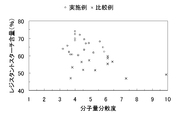
- FIG. 1 is a diagram showing the results of examination by the present inventor regarding the molecular weight peak and the resistant starch content when high amylose corn starch is acid-treated.
- starch having a resistant starch content exceeding 60% is stably obtained when the molecular weight peak is in the range of 6 ⁇ 10 3 to 4 ⁇ 10 4 .
- starch having a resistant starch content of less than 60% exists even when the molecular weight peak is in the range of 6 ⁇ 10 3 to 4 ⁇ 10 4 .
- the starch with high resistant starch content is obtained in the range of the specific molecular weight peak. That is, when the starch is acid-treated, a part of molecular chains constituting the starch is hydrolyzed, and the starch has a low molecular weight.
- the starch granules whose molecular chains have been cut to some extent are further optimized in the spatial arrangement of the molecules and become more dense. Therefore, the digestion tolerance of starch increases as the decomposition by acid treatment occurs. On the other hand, if the acid treatment is advanced excessively, the granular structure is finally destroyed, and the digestive resistance of starch is lost.
- the molecular weight peak may be, for example, 6.5 ⁇ 10 3 or more, preferably 8 ⁇ 10 3 or more. Further, from the viewpoint of obtaining a starch having a high resistant starch content, the molecular weight peak is, for example, 3.6 ⁇ 10 4 or less, preferably 2.5 ⁇ 10 4 or less, more preferably 1.5 ⁇ 10 4. It may be the following.
- the condition (c) defines the molecular weight dispersity.
- the molecular weight dispersity in the condition (c) refers to the ratio Mw / Mn of the weight average molecular weight Mw to the number average molecular weight Mn.
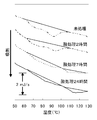
- FIG. 2 is a diagram showing the results of examination by the present inventor regarding changes in the molecular weight distribution shape of resistant starch-rich starch when high amylose corn starch is acid-treated.
- the molecular weight is measured by gel permeation chromatography (GPC, standard material: pullulan conversion). From FIG. 2, the molecular weight distribution shape of starch with high resistant starch content obtained by acid treatment (Example 1) is narrower than that of untreated high amylose corn starch (reference example), and has a single peak. It turns out that it is. The extent of this molecular weight spread is evaluated by molecular weight dispersion.
- the molecular weight dispersity is a ratio of the weight average molecular weight (Mw) to the number average molecular weight (Mn). Usually, since polymers having various degrees of polymerization are mixed, there is a range in molecular weight. In the case of having only one degree of polymerization, Mw / Mn is 1, but when this variation is large, the molecular weight dispersity also increases.
- FIG. 3 is a graph showing the relationship between the molecular weight dispersion of acid-treated high amylose corn starch and the resistant starch content. From FIG. 3, starch having a high resistant starch content is obtained in a range where the molecular weight dispersity satisfies a specific range, that is, the above condition (c). The reason is presumed as follows. That is, since the molecular weight of starch exhibiting enzyme resistance is within a certain range, the proportion of components affected by digestion increases as the number of components that deviate from a certain molecular weight range increases. On the other hand, in the enzyme treatment or the like, the molecular weight decreases as the reaction proceeds, but the molecular weight distribution has a certain width. Although the difference in the detailed reaction mechanism between the acid treatment and the enzyme treatment is not necessarily clear, it is considered that such a difference in the molecular weight distribution appears in the difference between the enzyme treatment and the acid treatment.
- the molecular weight dispersion if the molecular weight dispersion is too high, a preferable texture may not be obtained.
- the molecular weight dispersion in a range where the molecular weight dispersion satisfies the above condition (c), it is possible to suppress an excessive increase in a fraction having a low molecular weight or a fraction having a high molecular weight. It is possible to suppress the appearance of being too sharp or having a hard texture.
- the lower limit of the molecular weight dispersity is 1.5 or more, preferably 2.0 or more, more preferably 3.0 or more, from the viewpoint of the texture.
- the molecular weight peak preferably has a certain width.
- the upper limit of the molecular weight dispersity is 6.0 or less, preferably 5.5 or less, more preferably 5.0 or less, from the viewpoint of more stably increasing the resistant starch content.
- the molecular weight dispersity in the present invention is 1.5 or more and 6.0 or less, preferably 2.0 or more and 5.5 or less, more preferably 3.0 from the viewpoint of the balance between the resistant starch ratio and the texture. It is 5.0 or less.
- the molecular weight of starch can be measured by GPC (standard substance: pullulan conversion), for example.
- the condition (d) in addition to the original resistant starch content being high, the resistant starch can be included in a high ratio even after the heat treatment.
- the resistant starch content after heating at 200 ° C. for 20 minutes can be 60% or more, preferably 70% or more, for example.
- gelatinization enthalpy is the energy required for starch to be heated and become paste.
- An endothermic reaction occurs because energy is required when this paste is formed.
- DSC differential scanning calorimetry
- FIG. 4 is a diagram showing the results of the study of the present inventors on the influence of acid treatment of high amylose corn starch on the DSC curve.
- starch when starch is gelatinized, digestibility increases. In an unheated state, starch is in a crystalline state, and digestive enzymes are difficult to decompose. However, when heated and gelatinized, the crystal state changes and the digestive enzyme is easily decomposed. That is, starch having a small endothermic peak by DSC means that the decrease in the resistant starch content by heating is small (hereinafter also referred to as high heat resistance).
- the high heat resistance of the resistant starch affects not only the gelatinization enthalpy but also the gelatinization temperature and molecular weight distribution (molecular weight peak, molecular weight dispersion).
- gelatinization enthalpy can be used as an index of heat resistance between starches having similar gelatinization temperature, molecular weight peak and molecular weight dispersion.
- the endothermic peak area decreases as the acid treatment proceeds.
- One feature of the starch having a high resistant starch content according to the present invention is that the area of the endothermic peak by DSC is small, specifically 10 J / g or less, preferably 8 J / g or less, more preferably 6 J / g or less. It is. By carrying out like this, the food-drinks with a high resistant starch content can be obtained stably after cooking.
- limiting in particular in the minimum of gelatinization enthalpy For example, 1 J / g or more may be sufficient.
- a resistant starch may be described as RS.
- Moisture Ratio of moisture to wet starch weight (w / w)
- Slurry concentration ratio of starch dry weight to starch slurry weight (w / w)
- Acid normality Normality of acid to water in reaction solution including water derived from starch
- Resistant starch content Ratio of weight of resistant starch to dry weight of sample (w / w)
- Resistant starch high content starch starch with a resistant starch content of 60% or more
- the resistant starch-rich starch in the present invention can be obtained, for example, by using amylose-rich starch having an amylose content of 40% or more as a raw material, and subjecting the raw material to an acid treatment in an aqueous inorganic acid solution.
- the origin of the amylose-rich starch used as a raw material may be corn, potato, rice, wheat, sweet potato, tapioca, etc., but high amylose corn starch is preferred from the viewpoint of easy availability.
- High amylose corn starch is corn starch whose amylose content is increased by breeding, and those having an amylose content of 40% or more and 70% or more are currently available. From the viewpoint of further stably increasing the amount of resistant starch contained in the starch having a high resistant starch content, any starch can be used as long as the amylose content in the starch is, for example, 40% or more.
- raw material starch and purified water are charged into the reactor.
- acid water and a raw material in which an inorganic acid is dissolved in purified water in advance are introduced into the reactor.
- the concentration of the starch slurry in the acid treatment is adjusted to be, for example, 50% by weight or less, preferably 20% by weight or more and 40% by weight or less.
- the slurry concentration is too high, the slurry viscosity increases, and uniform stirring of the slurry may be difficult.
- the acid used for the acid treatment include inorganic acids such as hydrochloric acid, sulfuric acid, and nitric acid, and they can be used regardless of their types and purity.
- the acid treatment reaction is performed by selecting an appropriate temperature and an appropriate acid concentration so that the resulting acid-treated starch satisfies the above conditions (a) to (d).
- the inorganic acid concentration, the reaction temperature, and the reaction time during the acid treatment are set to specific conditions. Each condition will be specifically described below.
- the acid treatment time is set so as to satisfy the above conditions (a) to (d).
- the time required for the acid treatment is, for example, within 3 days. , Preferably within 2 days.
- concentration and reaction temperature in an acid treatment it shall be the conditions which satisfy
- the resistant starch content may not be sufficiently increased. On the other hand, if it is too low, the acid treatment reaction may take too long.
- the resistant starch content can be increased efficiently and stably.
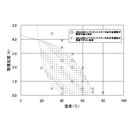
- FIG. 5 is a diagram showing the results of examination by the inventors regarding the reaction temperature (° C.) and acid normality (N) in acid treatment.
- “ ⁇ ” indicates conditions under which resistant starch-rich starch can be produced within 3 days
- “X” indicates conditions under which resistant starch-rich starch cannot be produced within 3 days.
- the mark “ ⁇ ” exists within the hatched area surrounded by the two curves in FIG. Therefore, for example, by performing acid treatment at an acid normality and temperature within a range surrounded by a curve in FIG. 5, starch satisfying the above conditions (a) to (d) can be obtained by acid treatment within 3 days. .
- reaction time in the acid treatment can be uniquely determined by the following formula (2) from two factors of reaction temperature and acid normality. 13.0 ⁇ C (-1.14) ⁇ (1 / 4.2) (T-40) / 10 ⁇ t ⁇ 180 ⁇ C (-1.58) ⁇ (1 / 4.2) (T-40) / 10 ( 2) (However, in the above formula (2), T: reaction temperature (° C.), C: normality of inorganic acid in inorganic acid aqueous solution (N), t: reaction time (hour)).
- the above formula (2) is an experimentally obtained formula.
- the shortest time for obtaining a starch with high resistant starch content is 1 / 2.2 times, and the longest time is 1/3.
- the formula is based on the relationship that when the reaction temperature is doubled and the reaction temperature is increased by 10 ° C., the shortest time and the longest time are both 1/4.
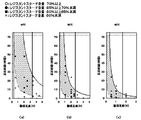
- FIGS. 6 (a) to 6 (c) are graphs showing the results of the study by the present inventor regarding the acid normality and the reaction time when the temperature is fixed in the above formula (2).
- the reaction temperatures in FIG. 6 (a), FIG. 6 (b) and FIG. 6 (c) are 40 ° C., 50 ° C. and 60 ° C., respectively, and the acid normality that can produce resistant starch-rich starch at each temperature.
- the reaction time range is indicated by the shaded area.
- the meanings of the symbols are as follows. ⁇ : Resistant starch content 70% or more ⁇ : Resistant starch content 65% or more and less than 70% ⁇ : Resistant starch content 60% or more and less than 65% ⁇ : Resistant starch content less than 60%
- the above formula (2) shows a curve indicating the upper limit value and lower limit value of the reaction time when the acid normality is changed.
- the time is equal to or longer than the lower limit value indicated by the broken line, and below the upper limit value indicated by the solid line.
- Resistant starch-rich starch can be obtained by performing a time acid treatment.
- the upper and lower limits of the reaction temperature and acid normality used in the above formula (2) are determined by the above formula (1).
- the upper limit and the lower limit of the acid normality determined by the above formula (1) are represented by straight lines indicated by a solid line in the vertical direction in FIG.
- the upper limit of the reaction time 72 hours in the examples of FIGS. 5 and 6) is represented by a straight line indicated by a broken line in FIG. From FIG. 6, in order to obtain starch having a high resistant starch content that satisfies the conditions (a) to (d), acid treatment may be performed under the conditions in the region indicated by the oblique lines surrounded by these lines.
- amylose-rich starch (high amylose starch) having an amylose content of 40% or more as a raw material and subjecting the raw material to acid treatment in an aqueous inorganic acid solution under specific conditions, starch having a high resistant starch content can be stabilized. Is obtained.
- acid treatment is performed using high amylose-containing starch having an amylose content of 40% or more as a raw material, and specific conditions are set for the reaction temperature, acid normality, and reaction time at that time.
- the resistant starch content can be dramatically increased.
- the resistant starch-containing starch thus obtained has a high resistant starch ratio and is excellent in the resistant resistance of resistant starch, and therefore can be suitably blended into various foods and drinks.
- the resistant starch-rich starch in the present invention can be blended in foods and drinks in place of other starches and grains such as wheat flour.
- the resistant starch-rich starch in the present invention has a small decrease in the resistant starch content even when blended in foods such as bread and noodles, and is resistant even at the same blending amount compared to conventional resistant starch-containing starch. Enables supply of food with starch content.
- Foods and drinks that can be blended with the starch having a high resistant starch content in the present invention are not particularly limited.
- breads such as breads, table rolls, confectionery breads, cooking breads, naan breads, and Danish breads; Western confectionery such as sponge cakes, hot cakes, muffins, donuts, crepes, pies, tarts, cookies; Japanese confectionery such as castella and manju; Various confectionery such as rice crackers, hail, snacks, cereals and crackers; Dim sum dough such as Chinese buns, dumplings, spring rolls; Noodles such as udon, ramen, pasta and instant noodles; For example, tempura, fried food such as fried foods, and fritters.
- the food or drink in the present invention contains a starch with a high resistant starch content that satisfies the above conditions (a) to (d).
- a resistant starch-rich starch having a resistant starch content of, for example, 60 to 80% measured by AOAC official method 2002.02 can be obtained. Even when starch with high resistant starch content is incorporated into food (eg, bread, hot cake, udon), the decrease in resistant starch content during cooking is negligible and remains high. Moreover, there is little influence on food texture, such as powderiness. Since it contains a higher percentage of resistant starch than that obtained by the prior art and there is little decrease in the content of resistant starch during cooking, foods containing a higher percentage of resistant starch can be supplied. It does not require high temperature, high pressure and high energy exceeding 100 ° C, does not require expensive enzymes, and does not require complicated purification processes or aging treatments. Can do.
- a resistant starch measurement kit manufactured by Megazyme, product number K-RSTAR was used for measuring the resistant starch content.
- the specific contents are as follows. 0.5 g of pancreatin is suspended in 50 mL of 100 mM maleate buffer (pH 6.0, 0.028% CaCl 2 , containing 0.02% sodium azide (w / v)) for 5 minutes. Of amyloglucosidase (300 U / mL) was added. This was centrifuged at 3000 rpm for 10 minutes.
- the reaction solution after digestion with amyloglucosidase was centrifuged at 3000 rpm for 10 minutes, and 0.5 mL of the supernatant was diluted with 4.5 mL of distilled water.
- the diluted reaction solution (0.1 mL) was mixed with 3 mL of GOPOD reagent and incubated at 50 ° C. for 20 minutes. After cooling to room temperature, the absorbance at 510 nm was measured with a spectrophotometer, and glucose was quantified using the standard contained in the kit as a standard.
- the resistant starch content is measured by converting the starch amount from the glucose amount derived from the resistant starch fraction released by the last amyloglucosidase digestion, and is the resistant starch weight (w / w) per sample dry weight. .
- the molecular weight distribution (molecular weight peak and molecular weight dispersity) was measured using a Tosoh HPLC unit (pump DP-8020, RI detector RS-8021, deaerator SD-8022).
- the analysis conditions are as follows. Column: TSKgel ⁇ -M (7.8 mm ⁇ , 30 cm) (manufactured by Tosoh Corporation) 2 flow rate: 0.5 ml / min Mobile phase: 5 mM NaNO 3 / dimethyl sulfoxide: water (9: 1) Column temperature: 40 ° C Analytical amount: 0.2 mL (sample concentration 1.0 mg / mL mobile phase)
- Detector data was collected using dedicated software (multi-station GPC-8020, model II data collection version 5.70, manufactured by Tosoh Corporation), and molecular weight peaks and molecular weight dispersion were calculated.
- a calibration curve was prepared using pullulan having a known molecular weight (Showa Denko, Shodex Standard P-82).
- the time when the temperature reached a predetermined temperature (40 ° C. in Example 1) was defined as the start time.
- the mixture was neutralized with 3% NaOH, washed with water, dehydrated and dried to obtain acid-treated high amylose corn starch (Example 1).
- the acid normality means the acid normality per reaction water including starch moisture in the final reaction solution.
- Example 2 The reaction conditions of Example 1 were not changed, but instead of high amylose corn starch HS-7 class VII, high amylose corn starch HS-7 class V (manufactured by J-Oil Mills, amylose content 50%) (Example 2), corn starch Y (J- Acid-treated starch according to Example 1 using Oil Mills, amylose content 30%) (Comparative Example 1), Waxy Corn Starch Y (J-Oil Mills, amylose content 0%) (Comparative Example 2) Got.
- Examples 1, 2 and Comparative Examples 1 and 2 acid-treated starch, and, as a reference example, high-amylose corn starch before acid treatment, resistant starch content, molecular weight peak by GPC, molecular weight dispersion, gelatinization enthalpy by DSC The measured results are shown in Table 1.
- starch having a high resistant starch content of 60% or more could be produced using starch having an amylose content of 50% or more as a raw material.
- Examples 3 to 7, Comparative Examples 3 to 5 (Influence of molecular weight) Except for changing the reaction temperature, reaction time and inorganic acid normality (in Table 2, “acid normality (N)”) in Example 1, acid treatment was performed in accordance with Example 1, and various molecular weight peaks were observed.
- the acid-treated starch having (Examples 3 to 7, Comparative Examples 3 to 5) was obtained. The results are shown in Table 2.
- Example 1 Examples 3 to 5, and Comparative Example 3
- the molecular weight decreases according to the reaction time and the resistant starch content increases at the same temperature and acid normality.
- the resistance starch content decreases when the acid treatment is excessive.
- the acid treatment is performed so that the molecular weight peak is 6 ⁇ 10 3 or more and 4 ⁇ 10 4 or less as in Example 6 and Example 7 of Table 2.
- starch having a resistant starch increased to 60% or more was obtained.
- Comparative Examples 4 and 5 the resistant starch content was less than 60%. That is, it can be seen that starch having a resistant starch amount increased to 60% or more can be stably obtained by acid treatment to make the molecular weight in the range of 6 ⁇ 10 3 or more and 4 ⁇ 10 4 or less.
- Actistar 11700 (manufactured by Cargill) is a recrystallized amylose derived from tapioca starch, and is very likely to be produced by a technique corresponding to the production method of Patent Document 7. Therefore, in order to evaluate the starches obtained from Patent Documents 5 to 7, the resistant starch content, molecular weight peak and molecular weight dispersity of these commercially available products were measured (Table 3).
- the suspension was adjusted to pH 5.0 with an aqueous sodium hydroxide solution, washed with water, dehydrated and dried to obtain 8.8 g of enzyme-treated starch (moisture 8.9%).
- the resistant starch content, the molecular weight peak by GPC, and the molecular weight dispersion of the resistant starch obtained were measured. The results are shown in Table 4.
- Comparative Example 9 the molecular weight dispersity by GPC was high, and the resistant starch content by AOAC official method 2002.02 was low. Also in Comparative Example 10, the molecular weight dispersity by GPC was high, and the resistant starch content was low.
- Comparative Example 11 had a molecular weight peak by GPC and a molecular weight dispersity different from those of the present invention, and the resistant starch content by AOAC official method 2002.02 was also low.
- the acid-treated starch obtained in Comparative Example 12 satisfies the conditions (b) and (c), but the resistant starch content was as low as 54%.
- the resistant starch content exceeds 60% even if the acid treatment is carried out by adjusting the conditions so as to have the molecular weight peaks and molecular weight dispersities of the conditions (b) and (c). Such a processed starch product could not be obtained.
- Bacillus subtilis-derived ⁇ -amylase (manufactured by Wako Pure Chemical Industries, Ltd.) 1 g was suspended in 19 ml of cold water, allowed to stand for 2 hours, and the supernatant was collected by centrifugation. Further, 500 U of human salivary amylase (Sigma, TYPE IX-A) was dissolved in 20 ml of cold water. Bacillus subtilis-derived ⁇ -amylase solution (15 ml) and human salivary amylase solution (20 ml) were added to the 10% starch slurry after heating and cooling, followed by enzyme treatment at 24 ° C. for 25 hours.
- the starch after enzyme treatment was collected by centrifugation, resuspended with an equal amount of water, and the precipitate was collected again by centrifugation. This operation was repeated three times, and the precipitate fraction was lyophilized to obtain 8.1 g of a prototype (water content 11.4%).
- the resistant starch content, molecular weight peak by GPC, and molecular weight dispersity of the obtained sample were measured. The results are shown in Table 7.
- the reaction tube containing the sample was heat-treated for 1 hour while continuously shaking in a 150 ° C. salt bath.
- the reaction tube was taken out of the salt bath, placed in a 40 ° C. water bath, and held for 2 hours with continuous shaking.
- the reaction tube was transferred to a salt bath at 145 ° C. and treated for 3 hours with continuous shaking.
- the reaction tube was transferred to an 80 ° C. water bath and treated for 1 hour with continuous shaking. After that, the water bath was turned off and naturally cooled overnight in water.
- a sample was taken out from the reaction tube, and the precipitate was collected by suction filtration.
- the precipitate was dried overnight in a blow dryer at 30 ° C. After drying and grinding, the sample was conditioned to 25.8% and autoclaved at 120 ° C.
- the reaction solution was thoroughly washed out from the reaction tube, and the precipitate was collected by centrifugation (3000 rpm, 10 minutes). Water twice the amount of the precipitate was added and resuspended, and the precipitate was collected again by centrifugation.
- the precipitate was dried under reduced pressure and pulverized to obtain a total of 31.2 g (water content 18.7%) prototypes.
- the obtained samples were analyzed for resistant starch content, molecular weight peak by GPC, molecular weight dispersity, and gelatinization enthalpy. The results are shown in Table 9.
- the starch processed products of Comparative Examples 6, 8, 10, and 12 and the high amylose corn starch of the reference example each had a resistant starch content of less than 60% before and after heating.
- the processed starch product of Comparative Example 15 had a very high resistant starch content before heating, but the resistant starch content decreased to 43% when heated. This is considered to be because the processed starch product of Comparative Example 15 does not satisfy the condition (d) and thus has low heat resistance. Therefore, the resistant starch-rich starch of Example 1 has a higher resistant starch content after heating than the high amylose corn starch of the reference example and the processed starch products of Comparative Examples 6, 8, 10, 12, and 15. I understand.
- the absolute amount of resistant starch of the starch of Example 1 obtained by treating starch with an aqueous inorganic acid solution was significantly higher than that obtained by the method of the comparative example.
- the resistant starch is generated by generating the resistant starch. The content of can be increased.
- the acid treatment reaction liquid was prepared with the following method on the conditions where the inorganic acid normality in reaction water exceeds 2.5N.
- a reaction solution total amount of 400 g, a 32% starch slurry, and a hydrochloric acid aqueous solution adjusted to have a target acid normality are prepared.
- the same high amylose corn starch as in Example 1 is added to form a suspension, and heating is started at a predetermined temperature. After that, a sample was prepared in the same manner as in Example 1.
- Tables 12 to 14 show the results of acid treatment at acid normality and temperature within the range of the above formula (1) (conditions represented by “ ⁇ ” in FIG. 5) (Test Example 1-9). .
- the resistant starch content exceeds 60% in the reaction time between the upper limit value and the lower limit value of the reaction time calculated from the above formula (2), but the reaction time is higher than the upper limit value or lower than the lower limit value. Shows that the resistant starch content is less than 60%.
- high resistant starch starch having a resistant starch content of 60% or more has a molecular weight peak of 6 ⁇ 10 3 or more and 4 ⁇ 10 4 or less, a molecular weight dispersity of 1.5 or more and 6.0 or less, and gelatinization enthalpy.
- Tables 15 to 17 show that the acid treatment was performed at the reaction temperature / acid normality (conditions indicated by “x” in FIG. 5) deviating from the range of the above formula (1) to the high temperature / high acid concentration side. (Test Examples 10-17). Under these conditions, starch having a resistant starch content exceeding 60% was not obtained even when the reaction time was changed from 0 hours to 3 days.
- Table 18 shows the results of acid treatment at a reaction temperature and acid normality deviating from the range of the formula (1) to the low temperature / low acid concentration side (Test Examples 18-20). Under these conditions, although the resistant starch content increased with the passage of the reaction time, the time required for the reaction was long, and starch with high resistant starch content could not be obtained within 3 days.
- Example 1 (Acid treatment with sulfuric acid) In Example 1, hydrochloric acid was used as the acid catalyst, but sulfuric acid was used instead of hydrochloric acid, and the acid normality, temperature, and reaction time described in Table 19 were otherwise applied. Got. The results are shown in Table 19. As shown in Table 19, even when sulfuric acid was used, starch having a high resistant starch content exceeding 60% could be produced.
- Example where the conditions (b), (c) and (d) are satisfied but (a) is not satisfied) The acid treatment was carried out according to the method of Example 1 except for the acid normality, temperature, and time shown in Table 20 (Test Examples 22-24). These are the conditions in which the temperature and the acid normality deviate from the high temperature / high acid concentration side in the above formula (1) which defined the production conditions of the starch with high resistant starch content. The resistant starch content, molecular weight peak, molecular weight dispersity, and gelatinization enthalpy of these samples were measured.
- Example 8 Food containing starch with high resistant starch content
- Example 8 Production of bread blended with starch containing high resistant starch
- Example 16 (Production of bread containing untreated high amylose corn starch)
- Example 8 instead of blending the starch containing high resistant starch obtained by the method of Example 1, the untreated high amylose corn starch exemplified in the Reference Example was used. A bread containing treated high amylose corn starch was obtained.
- Control 1 (Production of starch-free bread) Instead of blending the resistant starch-rich starch obtained by the method of Example 1 in Example 8, a strong flour was used, and the rest was obtained in the same manner as in Example 8 to obtain a bread not blended with starch.
- Example 22 The breads obtained in Example 8, Comparative Example 16 and Control 1 were crushed with a food processor and dried by ventilation at 40 ° C. overnight. Furthermore, after grind
- the RS content before baking or after baking included in bread is a value obtained by subtracting the RS content derived from wheat flour measured in Control 1.
- the residual starch residual ratio after firing (after boiled) is [RS content after firing (after boiled)] / [RS content before firing (before boiled)] It is a value (weight ratio) calculated by x100.
- Example 8 the bread blended with the starch containing high resistant starch obtained by the method of Example 1 did not decrease the resistant starch content even after baking, and the untreated high amylose It was confirmed that bread containing a high amount of resistant starch can be produced as compared with bread containing corn starch (Comparative Example 16).
- Example 9 Production of hot cake containing starch with high resistant starch content
- Table 23 eggs, sucrose, margarine, and milk were mixed, and the well-mixed flour, the starch with high resistant starch obtained by the method of Example 1, and baking powder were added and mixed gently. This was baked on a hot plate heated to 160 ° C. for 5 minutes for the front and 3 minutes for the back to obtain a hot cake containing starch with a high resistant starch content.
- Example 17 (Production of hot cake containing untreated high amylose corn starch)
- Example 9 instead of blending the starch containing high resistant starch obtained by the method of Example 1, the untreated high amylose corn starch exemplified in the Reference Example was used. A hot cake containing the treated high amylose corn starch was obtained.
- Example 9 (Control 2) (Production of starch-free hot cake) In Example 9, instead of blending the starch containing high resistant starch obtained by the method of Example 1, a thin flour was used, and thereafter, a hot cake containing no starch was obtained in the same manner as in Example 9.
- Example 24 The hot cake obtained in Example 9, Comparative Example 17, and Control 2 was pulverized with a food processor and dried by ventilation at 40 ° C. overnight. Furthermore, after grind
- Example 9 the hot cake (Example 9) containing the starch with high resistant starch content obtained by the method of Example 1 had little decrease in the resistant starch content even after baking, and was not yet treated. It was confirmed that a hot cake containing a high amount of resistant starch can be produced as compared to a hot cake containing high amylose corn starch (Comparative Example 17).
- Example 10 Manufacture of udon blended with starch containing high resistant starch
- the composition of Table 25 it was produced according to the following production method.
- Production method In a food processor, medium-strength flour and starch containing a high content of resistant starch obtained by the method of Example 1 were mixed, and after adding salt dissolved in water, the mixture was mixed for 20 minutes.
- the noodles obtained by performing composite rolling and cutting (cutting blade # 10 square, noodle string thickness 2.0 mm) by the method were boiled in boiling water for 8 minutes and washed with running water for 30 seconds.
- Example 18 (Production of udon containing untreated high amylose corn starch)
- Example 10 instead of blending the starch containing high resistant starch obtained by the method of Example 1, the untreated high amylose corn starch exemplified in the Reference Example was used. Udon containing treated high amylose corn starch was obtained.
- Example 10 (Control 3) (Production of starch-free udon) In Example 10, instead of blending the starch containing high resistant starch obtained by the method of Example 1, a medium-strength flour was used, and thereafter, in the same manner as in Example 10, noodles without starch were obtained. .
- the boiled udon obtained in Example 10, Comparative Example 18 and Control 3 and the previous udon in the boil were finely chopped, added to 2 times amount of acetone, and pulverized with a homogenizer. After standing, the supernatant was discarded, and twice the amount of acetone was added again and homogenized to dehydrate the udon.
- the dehydrated udon was air-dried and ground, passed through a 60 mesh sieve, and the resistant starch content was measured by AOAC official method 2002.02.
- the results of calculating the RS content in the same manner as in Example 8 are shown in Table 26.
- Table 26 the RS content before boiled or after boiled is a value obtained by subtracting the RS content derived from wheat flour measured in Control 3.
- Example 10 which mix
Landscapes
- Chemical & Material Sciences (AREA)
- Life Sciences & Earth Sciences (AREA)
- Health & Medical Sciences (AREA)
- Engineering & Computer Science (AREA)
- Food Science & Technology (AREA)
- Polymers & Plastics (AREA)
- Nutrition Science (AREA)
- Biochemistry (AREA)
- Organic Chemistry (AREA)
- Crystallography & Structural Chemistry (AREA)
- Medicinal Chemistry (AREA)
- Materials Engineering (AREA)
- Chemical Kinetics & Catalysis (AREA)
- Mycology (AREA)
- Molecular Biology (AREA)
- Dispersion Chemistry (AREA)
- General Health & Medical Sciences (AREA)
- Polysaccharides And Polysaccharide Derivatives (AREA)
- Cereal-Derived Products (AREA)
- Non-Alcoholic Beverages (AREA)
- Coloring Foods And Improving Nutritive Qualities (AREA)
Abstract
Priority Applications (8)
| Application Number | Priority Date | Filing Date | Title |
|---|---|---|---|
| HK12110600.7A HK1169833B (en) | 2009-10-16 | 2010-10-04 | Resistant starch-rich starch, food or drink using same, and method for producing resistant starch-rich starch |
| AU2010307942A AU2010307942B2 (en) | 2009-10-16 | 2010-10-04 | Resistant starch-rich starch, beverage and food using the same, and method of producing resistant starch-rich starch |
| EP10823171.3A EP2489682B1 (fr) | 2009-10-16 | 2010-10-04 | Amidon riche en amidon résistant, aliment ou boisson l'utilisant, et procédé pour la production d'amidon riche en amidon résistant |
| RU2012120078/13A RU2544058C2 (ru) | 2009-10-16 | 2010-10-04 | Крахмал, обогащенный устойчивым крахмалом, напиток и пищевой продукт с использованием такового и способ производства крахмала, обогащенного устойчивым крахмалом |
| KR1020127011353A KR101745033B1 (ko) | 2009-10-16 | 2010-10-04 | 레지스턴트 스타치 고함유 전분, 그것을 사용한 음식품, 및 레지스턴트 스타치 고함유 전분의 제조방법 |
| CN201080046894.8A CN102574929B (zh) | 2009-10-16 | 2010-10-04 | 抗性淀粉含量高的淀粉和使用它的饮食品、以及抗性淀粉含量高的淀粉的制造方法 |
| BR112012008827-0A BR112012008827B1 (pt) | 2009-10-16 | 2010-10-04 | amido rico em amido resistente, bebida e alimento usando o mesmo, e método de produção de amido rico em amido resistente |
| US13/500,545 US8790740B2 (en) | 2009-10-16 | 2010-10-04 | Resistant starch-rich starch, beverage and food using the same, and method of producing resistant starch-rich starch |
Applications Claiming Priority (2)
| Application Number | Priority Date | Filing Date | Title |
|---|---|---|---|
| JP2009239511A JP4482611B1 (ja) | 2009-10-16 | 2009-10-16 | レジスタントスターチ高含有澱粉およびそれを用いた飲食品 |
| JP2009-239511 | 2009-10-16 |
Publications (1)
| Publication Number | Publication Date |
|---|---|
| WO2011045902A1 true WO2011045902A1 (fr) | 2011-04-21 |
Family
ID=42351824
Family Applications (1)
| Application Number | Title | Priority Date | Filing Date |
|---|---|---|---|
| PCT/JP2010/005930 Ceased WO2011045902A1 (fr) | 2009-10-16 | 2010-10-04 | Amidon riche en amidon résistant, aliment ou boisson l'utilisant, et procédé pour la production d'amidon riche en amidon résistant |
Country Status (9)
| Country | Link |
|---|---|
| US (1) | US8790740B2 (fr) |
| EP (1) | EP2489682B1 (fr) |
| JP (1) | JP4482611B1 (fr) |
| KR (1) | KR101745033B1 (fr) |
| CN (1) | CN102574929B (fr) |
| AU (1) | AU2010307942B2 (fr) |
| BR (1) | BR112012008827B1 (fr) |
| RU (1) | RU2544058C2 (fr) |
| WO (1) | WO2011045902A1 (fr) |
Cited By (7)
| Publication number | Priority date | Publication date | Assignee | Title |
|---|---|---|---|---|
| WO2013161359A1 (fr) * | 2012-04-26 | 2013-10-31 | 株式会社J-オイルミルズ | Agent améliorant l'environnement entéral |
| JP5551846B1 (ja) * | 2013-02-26 | 2014-07-16 | 株式会社J−オイルミルズ | 組成物、これを用いた衣材、飲食品および飼料、ならびに組成物の製造方法 |
| CN104017091A (zh) * | 2014-05-26 | 2014-09-03 | 天津商业大学 | 利用醇溶蛋白促进淀粉回生的方法 |
| WO2014132534A1 (fr) * | 2013-02-26 | 2014-09-04 | 株式会社J-オイルミルズ | Composition et préparation pour pâte à frire, aliment, boisson et aliment pour animaux l'utilisant, et procédé de fabrication de ladite composition |
| JP2015156807A (ja) * | 2014-02-21 | 2015-09-03 | 日清製粉株式会社 | 春巻皮の製造方法 |
| JP2018068224A (ja) * | 2016-10-31 | 2018-05-10 | 株式会社J−オイルミルズ | 風味改善剤 |
| JP2021016379A (ja) * | 2019-07-24 | 2021-02-15 | 日澱化學株式会社 | 難消化性油脂処理澱粉、難消化性油脂処理澱粉を含む食品素材組成物、および難消化性油脂処理澱粉を含む食品 |
Families Citing this family (8)
| Publication number | Priority date | Publication date | Assignee | Title |
|---|---|---|---|---|
| AR086993A1 (es) | 2011-06-20 | 2014-02-05 | Gen Biscuit | Masa de galletita |
| JP6687414B2 (ja) * | 2016-02-18 | 2020-04-22 | 松谷化学工業株式会社 | 食物繊維高含有澱粉及びその製造方法 |
| WO2017179691A1 (fr) * | 2016-04-14 | 2017-10-19 | テーブルマーク株式会社 | Composition alimentaire ou combinaison pour abaisser le taux de glycémie ou réduire la valeur ig |
| JP6810542B2 (ja) * | 2016-06-14 | 2021-01-06 | 株式会社J−オイルミルズ | 飲食品組成物 |
| WO2018123253A1 (fr) * | 2016-12-27 | 2018-07-05 | 株式会社J-オイルミルズ | Amidon pour crème fouettée, et crème fouettée contenant cet amidon |
| CN107944220A (zh) * | 2017-12-31 | 2018-04-20 | 青岛袁策生物科技有限公司 | 一种估算精米直链淀粉和抗性淀粉含量的方法 |
| CN108283266B (zh) * | 2018-04-02 | 2022-02-15 | 海南医学院 | 一种菠萝蜜营养面条 |
| CN118614586A (zh) * | 2024-06-20 | 2024-09-10 | 安徽农业大学 | 一种部分糊化高直链玉米淀粉的抗消化米线的制备方法 |
Citations (11)
| Publication number | Priority date | Publication date | Assignee | Title |
|---|---|---|---|---|
| JPH05506564A (ja) | 1989-11-22 | 1993-09-30 | オプタ フード イングリジエンツ,インコーポレイテッド | デンプン由来の食品級不溶性バルキング剤 |
| JPH07252301A (ja) * | 1994-03-17 | 1995-10-03 | Nakano Vinegar Co Ltd | 難消化性澱粉の製造方法 |
| JPH0912601A (ja) | 1995-06-07 | 1997-01-14 | Natl Starch & Chem Investment Holding Corp | アミラーゼ耐性粒状デンプンの製造法 |
| JPH10191931A (ja) | 1996-12-03 | 1998-07-28 | Cerestar Holding Bv | 高度に発酵するレジスタントでんぷん |
| JPH10195104A (ja) | 1996-12-27 | 1998-07-28 | Nippon Shokuhin Kako Co Ltd | 食物繊維高含有澱粉素材、それを含有する飲食品、医薬品、化粧品及び工業製品 |
| JPH115802A (ja) | 1997-06-18 | 1999-01-12 | Nichiden Kagaku Kk | 難消化性澱粉及びその製造方法 |
| WO2000019841A1 (fr) | 1998-10-08 | 2000-04-13 | Iowa State University Research Foundation, Inc. | Produits à finalite nutritionnelle contenant des amidons modifies traites à l'acide |
| JP2001231469A (ja) | 1999-10-01 | 2001-08-28 | Natl Starch & Chem Investment Holding Corp | 高耐性粒状澱粉 |
| JP2008516050A (ja) | 2004-10-08 | 2008-05-15 | テイト アンド ライル イングレディエンツ アメリカス インコーポレイテッド | 酵素耐性デンプンおよびその製造方法 |
| JP2008280466A (ja) | 2007-05-11 | 2008-11-20 | Osaka Prefecture Univ | 非消化性アミロース粒子、その製造方法、ならびにそれを含有する飲食品、医薬品および医薬部外品 |
| WO2008155892A1 (fr) | 2007-06-21 | 2008-12-24 | J-Oil Mills, Inc. | Procédé de production d'amidon ayant une teneur élevée d'amidon moins digérable |
Family Cites Families (6)
| Publication number | Priority date | Publication date | Assignee | Title |
|---|---|---|---|---|
| US5695803A (en) * | 1995-06-06 | 1997-12-09 | Iowa State University Research Foundation, Inc. | Nutritional products containing modified starches |
| US6013299A (en) * | 1997-11-04 | 2000-01-11 | Nabisco Techology Company | Process for making enzyme-resistant starch for reduced-calorie flour replacer |
| WO2000073352A1 (fr) * | 1999-05-28 | 2000-12-07 | The Penn State Research Foundation | Production d'amidon resistant granulaire stable a l'ebullition par hydrolyse acide et traitement hydrothermique |
| JP4608051B2 (ja) | 2000-03-31 | 2011-01-05 | 三和興産株式会社 | 変性澱粉及びその製造方法 |
| AUPS219802A0 (en) * | 2002-05-09 | 2002-06-06 | Commonwealth Scientific And Industrial Research Organisation | Barley with altered branching enzyme activity and starch and starch containing products with a reduced amylopectin content |
| EP1662898A4 (fr) * | 2003-09-08 | 2010-09-08 | Univ Louisiana State | Amidon resistant aux proprietes de cuisson semblables a celles d'un amidon non traite |
-
2009
- 2009-10-16 JP JP2009239511A patent/JP4482611B1/ja active Active
-
2010
- 2010-10-04 BR BR112012008827-0A patent/BR112012008827B1/pt not_active IP Right Cessation
- 2010-10-04 KR KR1020127011353A patent/KR101745033B1/ko active Active
- 2010-10-04 CN CN201080046894.8A patent/CN102574929B/zh active Active
- 2010-10-04 EP EP10823171.3A patent/EP2489682B1/fr not_active Not-in-force
- 2010-10-04 WO PCT/JP2010/005930 patent/WO2011045902A1/fr not_active Ceased
- 2010-10-04 AU AU2010307942A patent/AU2010307942B2/en not_active Ceased
- 2010-10-04 RU RU2012120078/13A patent/RU2544058C2/ru active
- 2010-10-04 US US13/500,545 patent/US8790740B2/en active Active
Patent Citations (11)
| Publication number | Priority date | Publication date | Assignee | Title |
|---|---|---|---|---|
| JPH05506564A (ja) | 1989-11-22 | 1993-09-30 | オプタ フード イングリジエンツ,インコーポレイテッド | デンプン由来の食品級不溶性バルキング剤 |
| JPH07252301A (ja) * | 1994-03-17 | 1995-10-03 | Nakano Vinegar Co Ltd | 難消化性澱粉の製造方法 |
| JPH0912601A (ja) | 1995-06-07 | 1997-01-14 | Natl Starch & Chem Investment Holding Corp | アミラーゼ耐性粒状デンプンの製造法 |
| JPH10191931A (ja) | 1996-12-03 | 1998-07-28 | Cerestar Holding Bv | 高度に発酵するレジスタントでんぷん |
| JPH10195104A (ja) | 1996-12-27 | 1998-07-28 | Nippon Shokuhin Kako Co Ltd | 食物繊維高含有澱粉素材、それを含有する飲食品、医薬品、化粧品及び工業製品 |
| JPH115802A (ja) | 1997-06-18 | 1999-01-12 | Nichiden Kagaku Kk | 難消化性澱粉及びその製造方法 |
| WO2000019841A1 (fr) | 1998-10-08 | 2000-04-13 | Iowa State University Research Foundation, Inc. | Produits à finalite nutritionnelle contenant des amidons modifies traites à l'acide |
| JP2001231469A (ja) | 1999-10-01 | 2001-08-28 | Natl Starch & Chem Investment Holding Corp | 高耐性粒状澱粉 |
| JP2008516050A (ja) | 2004-10-08 | 2008-05-15 | テイト アンド ライル イングレディエンツ アメリカス インコーポレイテッド | 酵素耐性デンプンおよびその製造方法 |
| JP2008280466A (ja) | 2007-05-11 | 2008-11-20 | Osaka Prefecture Univ | 非消化性アミロース粒子、その製造方法、ならびにそれを含有する飲食品、医薬品および医薬部外品 |
| WO2008155892A1 (fr) | 2007-06-21 | 2008-12-24 | J-Oil Mills, Inc. | Procédé de production d'amidon ayant une teneur élevée d'amidon moins digérable |
Non-Patent Citations (3)
| Title |
|---|
| MARTINE CHAMP ET AL.: "Advances in dietary fibre characterisation. 1. Definition of dietary fibre, physiological relevance, health benefits and analytical aspects", NUTRITION RESEARCH REVIEWS, vol. 16, 2003, pages 71 - 82 |
| RICHARD K LE LEU ET AL.: "Effect of high amylose maize starches on colonic fermentation and apoptotic response to DNA-damage in the colon of rats", NUTRITION AND METABOLISM., vol. 6, no. 11, 2009 |
| See also references of EP2489682A4 * |
Cited By (14)
| Publication number | Priority date | Publication date | Assignee | Title |
|---|---|---|---|---|
| JPWO2013161359A1 (ja) * | 2012-04-26 | 2015-12-24 | 株式会社J−オイルミルズ | 腸内環境改善剤 |
| EP2842561A4 (fr) * | 2012-04-26 | 2016-07-27 | J Oil Mills Inc | Agent améliorant l'environnement entéral |
| US9364017B2 (en) | 2012-04-26 | 2016-06-14 | J-Oil Mills, Inc. | Intestinal environment-improving agent |
| WO2013161359A1 (fr) * | 2012-04-26 | 2013-10-31 | 株式会社J-オイルミルズ | Agent améliorant l'environnement entéral |
| CN104284666A (zh) * | 2012-04-26 | 2015-01-14 | J-制油株式会社 | 肠内环境改善剂 |
| WO2014132534A1 (fr) * | 2013-02-26 | 2014-09-04 | 株式会社J-オイルミルズ | Composition et préparation pour pâte à frire, aliment, boisson et aliment pour animaux l'utilisant, et procédé de fabrication de ladite composition |
| JP5551846B1 (ja) * | 2013-02-26 | 2014-07-16 | 株式会社J−オイルミルズ | 組成物、これを用いた衣材、飲食品および飼料、ならびに組成物の製造方法 |
| TWI632862B (zh) * | 2013-02-26 | 2018-08-21 | 日商J-制油股份有限公司 | 組成物,使用其之外包材、飲食品及飼料,暨組成物之製造方法 |
| US10212950B2 (en) | 2013-02-26 | 2019-02-26 | J-Oil Mills, Inc. | Composition, batter material using same, food or drink and feed, and method of producing composition |
| JP2015156807A (ja) * | 2014-02-21 | 2015-09-03 | 日清製粉株式会社 | 春巻皮の製造方法 |
| CN104017091A (zh) * | 2014-05-26 | 2014-09-03 | 天津商业大学 | 利用醇溶蛋白促进淀粉回生的方法 |
| JP2018068224A (ja) * | 2016-10-31 | 2018-05-10 | 株式会社J−オイルミルズ | 風味改善剤 |
| JP2021016379A (ja) * | 2019-07-24 | 2021-02-15 | 日澱化學株式会社 | 難消化性油脂処理澱粉、難消化性油脂処理澱粉を含む食品素材組成物、および難消化性油脂処理澱粉を含む食品 |
| JP7235617B2 (ja) | 2019-07-24 | 2023-03-08 | 日澱化學株式会社 | 難消化性油脂処理澱粉、難消化性油脂処理澱粉を含む食品素材組成物、および難消化性油脂処理澱粉を含む食品 |
Also Published As
| Publication number | Publication date |
|---|---|
| JP2011084674A (ja) | 2011-04-28 |
| EP2489682A1 (fr) | 2012-08-22 |
| KR20120098665A (ko) | 2012-09-05 |
| AU2010307942B2 (en) | 2013-11-21 |
| EP2489682A4 (fr) | 2014-04-09 |
| US8790740B2 (en) | 2014-07-29 |
| BR112012008827B1 (pt) | 2021-03-09 |
| CN102574929A (zh) | 2012-07-11 |
| JP4482611B1 (ja) | 2010-06-16 |
| KR101745033B1 (ko) | 2017-06-08 |
| HK1169833A1 (en) | 2013-02-08 |
| EP2489682B1 (fr) | 2016-05-04 |
| RU2544058C2 (ru) | 2015-03-10 |
| BR112012008827A2 (pt) | 2020-09-15 |
| US20120196023A1 (en) | 2012-08-02 |
| RU2012120078A (ru) | 2013-12-10 |
| AU2010307942A1 (en) | 2012-04-05 |
| CN102574929B (zh) | 2014-03-12 |
Similar Documents
| Publication | Publication Date | Title |
|---|---|---|
| JP4482611B1 (ja) | レジスタントスターチ高含有澱粉およびそれを用いた飲食品 | |
| Singh et al. | Starch digestibility in food matrix: a review | |
| CN101040714B (zh) | 具有高总饮食纤维含量的加工耐受性淀粉组合物 | |
| Almeida et al. | Rheological and technological characterization of red rice modified starch and jaboticaba peel powder mixtures | |
| NZ525809A (en) | Slowly digestible starch product | |
| Li et al. | Low and high methoxyl pectin lowers on structural change and digestibility of fried potato starch | |
| WO2019163965A1 (fr) | Amidon présentant une teneur élevée en fibres alimentaires, utilisable avantageusement dans les aliments et les boissons | |
| Liu et al. | Preparation and characterization of type 3 resistant starch by ultrasound-assisted autoclave gelatinization and its effect on steamed bread quality | |
| Ge et al. | Toward a comprehensive understanding of various milling methods on the physicochemical properties of highland barley flours and eating quality of corresponding sugar-free cookies | |
| Li | Resistant starch and its applications | |
| Yaqoob et al. | Influence of multiple freezing/thawing cycles on a structural, rheological, and textural profile of fermented and unfermented corn dough | |
| Qadir et al. | Extrusion assisted interaction of rice starch with rice protein and fibre: Effect on physicochemical, thermal and in-vitro digestibility characteristics | |
| Wang et al. | Processing of air-dried chestnut and physicochemical properties of its starch with low digestibility | |
| Devi et al. | Physicochemical properties of barley starch and effect of substitution of wheat flour with barley starch on texture and sensory properties of bread | |
| Bereka et al. | Debranching by enzymatic extrusion of oat flour for enhanced amylose-lipid complex formation: Effects on in vitro digestibility and functional properties | |
| Sui et al. | Crosslinked and stabilized in-kernel heat-moisture-treated and temperature-cycled normal maize starch and effects of reaction conditions on starch properties | |
| Pongjanta et al. | Enzymes-resistant starch (RS III) from pullulanase-debranched high amylose rice starch | |
| Öztürk et al. | Production and characterisation of resistant starch and its utilisation as food ingredient: a review | |
| Bello-Perez et al. | Development of foods high in slowly digestible and resistant starch | |
| Vanier et al. | Starches in foods and beverages | |
| Wardana et al. | Resistant starch content, pasting properties, and structure of modified taro (Colocasia esculenta L. Schott) starch granule by steam cooking | |
| Srikaeo | Starch: Introduction and Structure–Property Relationships | |
| Nasrin et al. | Resistant starch: Properties, preparations and applications in functional foods | |
| Vernon-Carter et al. | The in vitro digestibility of starch fractions in maize tortilla can be rendered healthier by treating the nixtamalized masa with commercial baking yeast | |
| TW201622578A (zh) | 澱粉糊化麵團用硬化促進劑 |
Legal Events
| Date | Code | Title | Description |
|---|---|---|---|
| WWE | Wipo information: entry into national phase |
Ref document number: 201080046894.8 Country of ref document: CN |
|
| 121 | Ep: the epo has been informed by wipo that ep was designated in this application |
Ref document number: 10823171 Country of ref document: EP Kind code of ref document: A1 |
|
| WWE | Wipo information: entry into national phase |
Ref document number: 2010307942 Country of ref document: AU |
|
| WWE | Wipo information: entry into national phase |
Ref document number: 2010823171 Country of ref document: EP |
|
| ENP | Entry into the national phase |
Ref document number: 2010307942 Country of ref document: AU Date of ref document: 20101004 Kind code of ref document: A |
|
| WWE | Wipo information: entry into national phase |
Ref document number: 13500545 Country of ref document: US |
|
| NENP | Non-entry into the national phase |
Ref country code: DE |
|
| WWE | Wipo information: entry into national phase |
Ref document number: 1201001711 Country of ref document: TH |
|
| ENP | Entry into the national phase |
Ref document number: 20127011353 Country of ref document: KR Kind code of ref document: A |
|
| WWE | Wipo information: entry into national phase |
Ref document number: 2012120078 Country of ref document: RU |
|
| REG | Reference to national code |
Ref country code: BR Ref legal event code: B01A Ref document number: 112012008827 Country of ref document: BR |
|
| ENP | Entry into the national phase |
Ref document number: 112012008827 Country of ref document: BR Kind code of ref document: A2 Effective date: 20120413 |