WO2011099320A1 - Dispositif de traitement d'informations, et procédé de traitement d'informations sur le dispositif de traitement d'informations - Google Patents
Dispositif de traitement d'informations, et procédé de traitement d'informations sur le dispositif de traitement d'informations Download PDFInfo
- Publication number
- WO2011099320A1 WO2011099320A1 PCT/JP2011/050559 JP2011050559W WO2011099320A1 WO 2011099320 A1 WO2011099320 A1 WO 2011099320A1 JP 2011050559 W JP2011050559 W JP 2011050559W WO 2011099320 A1 WO2011099320 A1 WO 2011099320A1
- Authority
- WO
- WIPO (PCT)
- Prior art keywords
- packet
- information processing
- information
- processing apparatus
- processing
- Prior art date
- Legal status (The legal status is an assumption and is not a legal conclusion. Google has not performed a legal analysis and makes no representation as to the accuracy of the status listed.)
- Ceased
Links
Images




Classifications
-
- H—ELECTRICITY
- H04—ELECTRIC COMMUNICATION TECHNIQUE
- H04L—TRANSMISSION OF DIGITAL INFORMATION, e.g. TELEGRAPHIC COMMUNICATION
- H04L47/00—Traffic control in data switching networks
- H04L47/10—Flow control; Congestion control
- H04L47/32—Flow control; Congestion control by discarding or delaying data units, e.g. packets or frames
-
- H—ELECTRICITY
- H04—ELECTRIC COMMUNICATION TECHNIQUE
- H04L—TRANSMISSION OF DIGITAL INFORMATION, e.g. TELEGRAPHIC COMMUNICATION
- H04L47/00—Traffic control in data switching networks
- H04L47/10—Flow control; Congestion control
-
- H—ELECTRICITY
- H04—ELECTRIC COMMUNICATION TECHNIQUE
- H04L—TRANSMISSION OF DIGITAL INFORMATION, e.g. TELEGRAPHIC COMMUNICATION
- H04L47/00—Traffic control in data switching networks
- H04L47/10—Flow control; Congestion control
- H04L47/12—Avoiding congestion; Recovering from congestion
- H04L47/122—Avoiding congestion; Recovering from congestion by diverting traffic away from congested entities
Definitions
- a plurality of nodes capable of processing packet data are arranged on a local area network (LAN) located at the end of the network, and server processing is performed to reduce network load and response performance.
- LAN local area network
- server processing is performed to reduce network load and response performance.
- the present invention relates to a network distributed processing device and a packet data processing method.
- IP Internet Protocol
- IP retransmission of terrestrial digital broadcasting is steadily progressing.
- knowledge information is being integrated into networks.
- information stored in an information terminal on the user side is stored in a data center on the network, and the information can be retrieved anytime and anywhere via the network.
- devices such as televisions, air conditioners, refrigerators, home appliances, security cameras, sensors such as temperature / humidity sensors, etc. (embedded devices) will be connected to the network and the surrounding environment Real-time information like information can be expected to be stored in the cloud.
- next generation network Next Generation Network: NGN
- QoS quality of service
- information devices such as servers and personal computers (PCs) have been mainly devices that participate in the network. Therefore, the information distributed on the network is mainly information that is generated as a result of humans actively using those information terminals.
- the information currently scattered in each information terminal by the cloud is being collected on the network, and is now being used as a huge knowledge database (DB).
- DB knowledge database
- there is a problem that such information does not reflect the real-time situation in the real world. For example, taking a large-scale commercial facility as an example, in recent years, a homepage that introduces the facility and products handled by the facility has been established on the Internet and used as a means of attracting customers.
- Patent Document 1 in a system in which an upper server and a plurality of lower servers are connected via a network, information created by the upper server is divided and stored in the lower server as partial information. And when the request from the user terminal for the subordinate server is received, if the subordinate server holds the data subject to the request, the data is sent to the user terminal, and the data is not held In this case, a data delivery request is transmitted to the upper server. As a result, when the lower server holds the data, the response of the user is improved.
- embedded devices cannot have a high-performance information processing mechanism due to cost, size, and power constraints. Therefore, in order for an embedded device to realize a higher performance function, it is necessary to cooperate with an external server device through a network. However, the device is required to respond at high speed in accordance with user input and changes in the environment detected by the sensor. For this reason, if the lower server does not process the packet and accesses the upper server located far away via the network to achieve the above-mentioned high-performance function, the responsiveness deteriorates due to the communication delay time of the network communication. I will let you.
- the robot receives information from the image sensor installed in the space and uses it to avoid obstacles when moving, By communicating with the robot via the network, functions such as transporting multiple packages in cooperation are realized.
- the information from the image sensor is processed once by a server provided on the network and the processing result is transmitted to the robot, a plurality of pieces of image sensor information are concentrated on the network center and the server.
- the load on the part increases.
- the response delay time including the sensor input, the processing on the server and the device control based on the result increases due to the time required for network communication (communication delay time).
- the information of the image sensor is directly distributed to the robot and the robot itself performs information processing.
- the robot requires a broadband wireless network or a high-performance information processing device. Therefore, problems such as an increase in the size of the robot housing and a reduction in operation time due to an increase in power consumption occur.
- the lower-level server has only the function of holding and delivering data from the upper-level server
- the following problems occur depending on the device that executes the processing for the packet.
- the load at the center of the network including the upper server the network Communication delay time becomes a problem.
- the embedded device itself performs information processing directly the problem is that the casing of the embedded device is enlarged and the power consumption is increased.
- An information processing method in a processing device comprising: a first step of receiving a first packet; and after the first step, the first packet is determined based on information in a header of the first packet.
- An information processing apparatus that processes a plurality of packets transmitted to a processing server via a router and a network. When the first packet is received, the information processing apparatus performs a first process on the first packet.
- a processing device wherein a plurality of ports for transmitting or receiving the plurality of packets, and any one of the plurality of ports receives a first packet included in the plurality of packets;
- a first determination unit that determines whether or not the information processing device processes based on a header of one packet, and transfers the first packet to the processing server when it determines not to process;
- a first processing unit that performs a first process on a payload of the first packet when the determination unit determines that the information processing apparatus processes the first packet; And wherein the door.
- the present invention makes it possible to reduce the response delay of the embedded device while reducing the load at the center of the network. In addition, it is possible to prevent an increase in the size of the housing of the embedded device and an increase in power consumption.
- FIG. 1 shows a configuration example of a network to which a server and various devices are connected and to which the present invention is applied.
- Information terminals (TM) 109 and 114 such as IP telephones and network televisions, computers (PCs) 110 and 114, various sensors (SNS) 105, 106, 116, such as cameras and microphones, temperature sensors, humidity sensors, and human sensors.
- SNS sensors
- ACT control devices
- a server 101 is connected to the network central part 102 via a hub (HUB) 108 and routers (RT) 103 and 111, and a server 101 is connected to the network central part 102.
- wired 131 and wireless 132 as a form of network connection.
- WGW104 which performs media conversion to a wired network.
- the sensor SNSs 105, 106, 116, and 118 and the control devices ACT 107 and 117 are connected to the network wirelessly.
- the network is structured in a tree shape that branches from the center to the end, and from upstream to downstream.
- the area is divided and arranged.
- the LAN-A 120 and the LAN-B 121 are divided into two areas.
- distributed processing nodes (DN) 141, 142, and 143 disclosed in the present invention are provided on a network that connects a terminal device (SNS or ACT) and a processing server (SRV).
- the distributed processing node performs a part of processing performed by a server designated in advance on a plurality of packets transmitted from the terminal device (SNS or ACT) to the processing server via the router and the network. Details of the distributed processing node will be described later.
- a management server (DNSRV) 140 that manages these distributed processing nodes DN is provided in the central part of the network.
- the DNSRV has a service management table (SVMT) that manages processing executed by each DN, and a distributed node management table (DNMT) that manages the operating state of each DN. Details regarding various tables (SVMT, DNMT) possessed by DNSRV will be described later.
- SVMT service management table
- DNMT distributed node management table
- ⁇ Network without the distributed processing node of the present invention First, consider a network when there are no distributed processing nodes 141 and 142. In this case, all end devices access the server 101 via the network central unit 102. Accordingly, since the communication packet from each of the LAN-A and LAN-B devices circulates in the network central portion 102, the network of the central portion 102 is congested with communication traffic from each device. For example, it is assumed that the SNS 105 is an image sensor and the ACT 107 is an automatic door. Consider an application that opens an automatic door after detecting a person with an image sensor and authenticating with face recognition. In the conventional network, the SNS 105 sends the captured image as it is to the server SRV101 on the network.
- the image transmitted from the SNS 105 is received every frame and the face detection process is executed.
- a face is extracted as a result of the face detection
- a collation process is performed on the extracted face with a previously registered face database.
- ACT 107 if the registered face matches the detected face, a command to open the door is sent to ACT 107.
- the image is always sent to the network central unit 102 via the wireless gateway WGW 104 and the router 103, so that the network load is increased.
- the conventional network has a problem that the load at the center of the network increases.
- the DN 141 is an example installed in the LAN-A above the router connected to the central part of the network.
- the sensor (SNS) 105 is an image sensor
- the control device (ACT) 107 is an automatic door.
- the image output from the image sensor is transmitted to the server SRV101.
- the SRV101 sets the face extraction function to the distributed processing node (DN) 141 in the processing in the server.
- the DN 141 analyzes the header information of the packet that passes through the DN, and extracts the IP address and port number of the SNS 105 that is the transmission source, and the IP address and port number of the SRV 101 that is the transmission destination.
- the DN 141 is set to detect a packet including image data transmitted from the SNS 105 to the SRV 101 by the SRV 101.
- the proxy processing face extraction processing preset on the DN 141 is performed. Execute on the packet.
- face image data is transmitted to the SRV 101 in accordance with the SRV 101 setting.
- the SRV 101 executes face recognition processing only when it receives a face image when a face is detected, and executes collation processing with a pre-registered face database. As a result, when the registered face matches the detected face, the SRV 101 transmits a command for opening the door to the ACT 107. As a result, the image data of the SNS 105 does not flow to the network central part 102, and traffic can be reduced. In addition, since the server SRV 101 delegates the face extraction processing to the DN 141, the server load can be reduced and the server response time can be shortened.
- the sensor SNS 116 is a temperature sensor
- the sensor SNS 118 is an image sensor.
- the control device ACT117 is a material processing apparatus.
- the PC 114 serves as a monitoring terminal device. When a temperature sensor causes a device abnormality, the device abnormality information and image information are displayed on the terminal device.
- the temperature data of the SNS 116 and the image data of the SNS 118 are transmitted to the server SRV 101, are constantly monitored on the server side, and the abnormality information is distributed to the PC 114 under setting conditions such as temperature abnormality.
- a distributed processing node is inserted between the wireless gateway WGW 115 and the router RT 111 (DN 143), and packets transmitted from the SRV 101 to the temperature sensor SNS 116 and from the image sensor SNS 118 to SRV 101 are detected, and temperature monitoring and image processing are performed. It is assumed that the processing for delivering is set to be performed on behalf of.
- the DN 143 detects the packet, the DN 143 starts a temperature monitoring process and checks whether the temperature is abnormal. Further, the image data is updated while being held on the DN 143 for a certain period.
- the abnormal information is directly notified to the PC 114.
- the image data held on the DN 143 is notified directly to the PC 114.
- temperature data and image data do not flow higher than the router RT111 of the LAN-B 121, and the network load is reduced.
- the abnormality detection and notification are directly responded within the local network LAN-B 121 without going through the network central unit 102, and the response time can be shortened by shortening the network communication path.
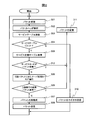
- the DN receives all packets on the connected network (301).
- header information added to the packet is first analyzed to extract the header information (302).
- the source IP (SIP), source port number (SPORT), destination IP (DIP), and destination port (DPORT) of the packet are extracted.
- SVT service table
- the packet is not processed by the processing node DN, so that it is retransmitted to the network without processing (310). If there is a matching entry, it is a packet to be processed by the distributed processing node DN, and therefore, what kind of processing should be executed for the packet is searched from the “service definition table (SVDT)”. (305). If the service mode for the packet indicates "packet discard” in the service definition table SVDT, the packet is discarded and the reception state is returned (311). If the service mode for the packet indicates “processing”, the target data is extracted from the packet, and the server processing of the data is executed on behalf according to the table information (306).
- SVDT service definition table
- the processing result is reconfigured as a packet to the transmission destination defined in the table information (307) and retransmitted to the network (308). After transmission, it returns to the packet reception state again.
- the step (304) of determining whether or not to process the packet in the distributed processing node is executed. If it is a packet to be executed, a step (306, 311) of executing a predetermined process on the payload of the packet is further executed.
- the processing executed by the distributed processing node includes packet discard (311).
- packet discard Such a feature makes it possible to process a part of the packet transmitted by the terminal without transmitting it to the processing server, and solves the load problem at the center of the network, which has been a problem in the conventional network. Further, when the packet is a packet that is not processed by the distributed processing node, the packet is transmitted to the router without performing any special processing (310).
- the distributed processing node when the distributed processing node performs processing on the packet, the predetermined processing described above is not all of the processing that can be executed by the processing server, but a part thereof. By having such a feature, it is sufficient for the distributed processing node to be able to execute a part of the processing executed by the processing server, and the distributed processing node can be realized with a cheaper processor or the like. Become.
- Whether or not the packet is to be processed by the distributed processing node is determined by comparing the header portion of the packet with the service table. This is because the header portion includes information such as the packet transmission source and the transmission destination, so that the determination can be realized most easily.
- a step (309) for determining whether or not the packet after the process can be discarded is executed.
- the packet is actually discarded (311). .
- the distributed processing node can operate at high speed, which is preferable. The determination as to whether or not discarding is possible is performed based on the definition on the service definition table or the parameter output by the process.
- step (309) when it is determined in step (309) that the packet cannot be discarded, processing for changing the transmission destination of the packet is executed (307), and the packet is actually transmitted (308).
- the distributed processing node executes each determination unit for realizing steps (304, 306, 312) and steps (306, 307, 308, 310, 311) in order to realize these flows. And each storage unit for storing the service table SVT and the service definition table SVDT.
- Each determination unit and each processing unit are configured by a processor PRC (404, 506), which will be described later, and the storage unit is configured by a memory (403, 404).
- the distributed processing node DN is used by being added to an arbitrary point at the end of the network. Therefore, the basic configuration of the hardware is configured with two network ports and a processor that performs information processing. Since the DN is arranged at the end of the network, it is expected to be small, low power, and low cost. It performs server processing on its behalf, but does not execute all server processing, and its processing performance is lower than that of the server, but it is necessary to apply an embedded processor to achieve small size, low power, and low cost.
- packets can be processed in parallel, and a plurality of server proxy processes operate in parallel, it is preferable to configure a multi-core processor having a plurality of processor cores.
- high power performance (high performance and low power) is achieved by operating a plurality of processor cores in parallel at low clock frequencies and operating voltages. Further, by introducing a dedicated processor (accelerator) that performs specific processing efficiently and making a multi-core processor with a heterogeneous configuration, further improvement in power performance can be realized.
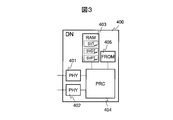
- FIG. 3 shows the configuration of the distributed processing node DN.
- the DN 400 includes the following parts. First, physical layer chips (PHYs) 401 and 402 are connected to a network (LAN), receive physical electrical signals, and convert them into logical signals defined by standards. Next, protocol processing for packet transmission / reception (processing such as TCP / IP to extract packet data according to the protocol), packet header analysis, and packet attribute / processing determination according to the processing flow of FIG. A processor (PRC) 404 that performs analysis processing and server proxy processing. Further, a memory (RAM) 403 that temporarily stores program data and a nonvolatile memory (FROM) 405 that holds a boot program.
- PHYs physical layer chips
- FROM nonvolatile memory
- a service table SVT and a service definition table SVDT for executing various searches shown in FIG.
- a service process definition table SVPT that defines a process number for starting processing is also arranged. Details of SVPT will be described later.
- a network controller (NWCTL) that performs protocol processing for packet transmission / reception and a packet analysis processing unit (PKTPRC) that analyzes the packet header and determines the attribute / processing of the packet according to the processing flow of FIG.
- NWCTL network controller
- PKTPRC packet analysis processing unit
- FIG. 4 shows a configuration diagram when the network controller (NWCTL) and the packet analysis processing unit (PKTPRC) are separate components.
- the packet analysis processing unit is added with a CAM (Content Addressable Memory) 508 that stores the service table SVT and executes a table entry search at high speed, and a memory RAM 509 that stores the service definition table SVDT and the service process definition table SVPT.
- PKTPRC is hardware that executes packet header analysis (302) and service table search (303) of the flow shown in FIG.
- the PKTPRC holds a service table, which will be described later, and compares the header portion of the packet with the service table when a packet is received. Then, the packet that does not match the entry in the service table is retransmitted as it is, the packet that matches the entry temporarily holds the packet, and only the data is transferred to the processor PRC 506.
- the PRC connects a program / data temporary storage memory RAM 505 and a non-volatile memory (FROM) 510 holding a boot program.
- FROM non-volatile memory
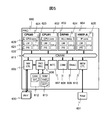
- FIG. 5 shows a configuration example of the processor PRC.
- the PRC includes processor blocks 601, 602, 603, and 604 that perform information processing, a network controller (NWCTL) 605 that performs protocol processing for packet transmission / reception, analyzes the header of the packet, and follows the processing flow of FIG.
- NWCTL network controller
- Packet analysis processing unit 606 for determining processing, interrupt controller (INTC) 607 for controlling interrupts to the processor, on-chip shared memory CSM for temporarily storing data, and autonomously efficient data transfer between memories It consists of a data transfer mechanism (DMAC) 609 that is often executed and a memory controller (MEMTCL) 610 that accesses a large-capacity external memory, and each block is connected to each other via an on-chip shared network ICNNW (611).
- DMAC data transfer mechanism
- MEMTCL memory controller
- ICNNW on-chip shared network
- CAM CAM
- the CAM 612 and the RAM 613 are built on the same chip. However, the chips may be stacked by a multi-chip module (MCM), or connected to the outside of the chip as separate components.
- MCM multi-chip module
- the processing processor PRC has two general-purpose processors (CPUs) (601, 602), a dynamically reconfigurable processor (dynamic reconfigurable processor) that can dynamically execute processing by dynamically changing the hardware configuration.
- DRP general-purpose processor
- HWIP hardware processing engine
- a management process is executed. The management process controls the entire DN, updates the service table SVT on the CAM 612 connected to the PKTPRC, various tables SVDT and SVPT on the RAM 613, and receives table information / proxy processing program from the management server SRV To do.
- Each processor core is equipped with a high-speed local memory LM621, and processing performance can be improved by placing frequently accessed data in the LM.
- each processor core includes a data transfer unit DTU 623 for transferring data from the external memory RAM 631 and the shared memory CSM 608.
- DTU 623 for transferring data from the external memory RAM 631 and the shared memory CSM 608.
- it has a power control register PR622 for setting the clock frequency and power supply voltage of each core.
- PKTPRC has a function of analyzing a header of a received packet, analyzing and extracting the packet header, and searching and checking an entry in a preset service table.
- the processing may be executed on the general-purpose processors 601 and 602.
- PKTPRC can be divided into two blocks: a block that mainly transmits / receives a packet and analyzes a header, and a block that searches a service table and determines the processing contents of a packet.
- the block includes a packet analysis block (HDRANL) 702 that analyzes a header of a packet and extracts a transmission source IP address, a transmission source port, a transmission destination IP address, and a transmission destination port, and a reception data buffer that temporarily stores a reception packet ( RXDBUF) 703, a session management manager (SSNMNG) 713 for managing a session corresponding to a protocol such as TCP / IP, and a transmission data buffer (TXDBUF) 712 for temporarily holding transmission packets.
- SSNMNG holds a session state corresponding to an input packet, and is managed by a management process executed on the processor.
- the packet received via the network controller NWCTL is first subjected to header analysis by the HDRANL 702, and the packet body is temporarily held on the RXDBUF 703.
- the extracted header information is transferred to the service table search block (SVTSRC) 704.
- the SVTSRC searches the service table, and if there is no entry that matches the header information in the service table, instructs the SSMNGNG 713 to transfer the packet.
- SSNMNG reads the packet temporarily held on RXDBUF 703 and transfers the packet to PKTSTR 714. As a result, the packet is not processed on the DN and is sent to the network via the NWCTL 701 as it is. If there is an entry that matches the header information in the service table, the processor on the DN processes the packet.
- the processing result is transmitted, the result is transferred to the TXDBUF 712, reconfigured into a packet by the PTKSTR 714 via the SSNMNG 713, and transmitted via the NWCTL 701. If the processing result is not transmitted (that is, if the packet is discarded), the SSMNGNG 713 notified from the processing processor discards the packet.
- the block is a service table search block (STVSRC) that searches the service table and determines whether the header information of the packet matches the table, or a service definition table reference block (STVSRC) that refers to the table that defines the processing content if they match.
- STVSRC service table search block
- STVSRC service definition table reference block
- SVTDEF a service process management table reference block
- PRCSRC service process management table reference block
- PRCJDG process determination block
- packet data The shared memory CSM 608, the external memory RAM 631, and a data transfer block (RXDTU) 711 for transferring data to the local memory LM621 provided in each processor core.
- the STVSRC 704 is connected to an IF (CAMIF) 705 for connecting a CAM 716 that holds the service table SVT and searches at high speed.
- the SVTDEF 706 is connected to an IF (RAMIF) 707 that connects a memory TRAM 717 holding the service definition table SVDT.
- the PRCSRC 709 is connected to an IF (RAMIF) 710 that connects a memory TRAM 719 that holds a service process management table SVPT.
- Each IF block is connected to the shared bus ICNNW 720, and each table can be updated from a management process executed on the CPU.
- the header information extracted by HDRANL 702 is searched for a matching entry in the service table by SVTSRC 704. If there is a matching entry, the service ID corresponding to the entry is notified to the SVTDEF 706, and the SVTDEF refers to the service definition table that defines the processing content.
- the service mode for determining the operation is first identified from the reference result. In the service mode, “Pass” for transferring the packet to the upper level without performing any processing, “Abandon” for discarding the packet on the DN, and executing information processing on the DN. There are three types of “Process” shown. If it is “Pass”, SVTDEF notifies SSNMNG 713 to read the packet from RXDBUF 703 and transfer it to the host.
- SVTDEF notifies SSNMNG 713 to delete the entry of the packet held on RXDBUF and discard the packet. If it is “Process”, the service process ID on the service definition table referred to for starting the corresponding process is notified to the PRCJDG 708.
- the PRCJDG inquires the service process ID to the PRCSRC, refers to the service process management table that defines which processor core should execute the process, and determines the execution processor core.
- the PRCJDG transfers the packet data to one of the CSM 608, the RAM 631, and the LM 621 by the RXDTU 711. Further, the interrupt controller INTC 718 designates an interrupt destination processor core and raises an interrupt to start processing.
- FIG. 7 shows a configuration example of the service table.
- TCP / IP or UDP is targeted as a communication protocol.
- the service table includes a source IP address (SIP), a source port number (SPORT), a destination IP address (DIP), a destination port number (DPORT), and a service ID corresponding to each combination.
- the search key is SIP / SPORT / DIP / DPORT, and the SVID is output as a result of the search.
- SIP identifies the source device, and SPORT indicates the type of the source data and the corresponding service. Further, DIP determines a destination server (or device), and DPORT indicates a service type on the destination server (or device).
- DIP determines a destination server (or device)
- DPORT indicates a service type on the destination server (or device).
- the service ID is an ID for distinguishing the processing content acting on the DN, and the processing content is determined by referring to a service definition table (SVDT) described below.
- SVDT service definition table
- a wild card, a regular expression, or the like can be used.
- service ID “6” is received when a packet with SIP of 10.1.1.5 and SPORT of 23 is received. "Is output.
- priority is given to the item in the upper table entry row.
- the distributed processing node is characterized by having a service table.
- the service table is a group of information for determining whether or not the distributed processing node should process the packet when the packet is received. This is because by having such a table, the distributed processing node can perform part of the processing of the processing server.
- the service table includes information on the source and destination of the packet received by the distributed processing node. By having such information, the above-described determination is realized, and the load reduction in the central part of the network is realized. Then, as the transmission source and transmission destination information of the packet, the transmission source IP address (SIP), the transmission source port number (SPORT), the transmission destination IP address (DIP), and the transmission destination port number (DPORT) are used. This is preferable because it can be most easily realized as the information on the transmission source and the transmission destination.
- SIP transmission source IP address
- SPORT transmission source port number
- DIP transmission destination IP address
- DPORT transmission destination IP address
- DPORT transmission destination port number
- the service table includes ID (service ID) information corresponding to each of the transmission source and transmission destination information described above.
- ID service ID
- the service table includes ID (service ID) information corresponding to each of the transmission source and transmission destination information described above.
- the service definition table is a table that defines the processing contents for the service ID that is output as a result of hitting a condition as a result of searching the service table.
- FIG. 8 shows a configuration example of the service definition table.
- the service definition table includes a service ID (SVID) 901, a service mode (SVMODE) 902, a service process ID (SPID) 903, a processing time constraint or priority (PRI) 904, an output result destination IP address (ADIP) 905, an output It consists of a destination port number (ADPORT) 906 of the result.
- SVID service ID
- SPID service process ID
- PRI processing time constraint or priority
- ADIP output result destination IP address
- ADPORT destination port number
- Each definition information is obtained by referring to the table using SVID as a key.
- SVMODE 902 indicates a mode of proxy processing on the distributed processing node DN.
- SVMODE includes “Process” for processing the received packet on the DN, “Pass” for transferring the packet to a higher level without processing, and “Abandon” for discarding the packet.
- “Process” indicates that the server process is performed by the processor on the DN for the target packet data. However, it is also conceivable that the processing is not performed and only the address is changed and retransmitted. In this case, by setting SVMODE to “Pass”, for example, for the purpose of server load distribution, a packet destination server is statically determined for a plurality of servers that execute the same processing, and the DN is used. The server can be specified by changing the packet header.
- the service process ID SPID 903 is an ID for designating a process (program entity) executed on the DN.
- an execution destination processor core is determined.
- the SPID corresponding to the SVID “2” is “ ⁇ ”. This indicates that the SVMODE 902 is “Pass” and the target service process ID is not defined.
- PRI 904 indicates the response time or priority of the service. When a plurality of services are executed, the processes are executed in descending order of priority. If the response time cannot be kept, the server proxy process is not performed, and the packet header is not modified and retransmitted to the server.
- ADIP 905 is a destination address to which the result after the proxy process is sent.
- ADPORT 906 is a destination port number to which the result is sent.
- the distributed processing node has a service definition table.
- the service definition table is a group of information that defines processing (service mode) to be executed by the distributed processing node. This is because having such a table allows the distributed processing node to specify the content of the processing to be performed on behalf of.
- the distributed processing node can perform a plurality of processes.
- the service definition table includes processing time constraint or priority information.
- the service definition table includes information on the destination of the packet after processing. Thereby, the packet processing can be completed without going through the processing server, and the load on the central part of the network can be reduced.
- the server proxy processing content is specified by the service definition table, and a table for managing the execution target processor type, process ID, and the like is the service process management table (SVPT).
- FIG. 9 shows a configuration example of the service process table.
- the service definition table includes a service process ID (SPID) 1001, an execution destination processor core type (TRG) 1002, an assigned processor core number (BID) 1003, and an assignment destination processor core, which are keys for referring to the table.
- the TRG 1002 indicates the type of processor core that should execute the distributed program. When it can be executed by a plurality of cores, a plurality of types may be designated.
- a BID 1003 indicates a processor core to be assigned.
- the BID corresponding to the SPID of “13” is “ANY”, which indicates that the processor core has not yet been determined.
- PID 1004 is a process ID of a process executed on the core.
- DRP dynamically reconfigurable processor
- the PID corresponding to the SPID “11” is “ ⁇ ”, but this is “HWIP-A” in which the execution target processor core TRG1002 means a dedicated circuit. This indicates that the concept of process ID does not exist.
- the HWPPRI 1005 specifies the priority of the process on the processor core. This is also determined by the management process according to the time constraint condition PRI 904 indicated by the service ID.
- STAT 1006 indicates the state of the process. For example, “Running” indicates that the process is in an execution state, “Sleeping” indicates that the process is in a standby state, and “Unloaded” indicates that the program body is not yet loaded.
- FIG. 10 shows an example of a distributed node management table showing the DN management status of the management server.
- the distributed node management table includes distributed node ID (DNID) 1101, DN IP address (DNIP) 1102, DN status DNSTAT 1103, number of running service processes NUMPRS 1104, and processor load status AVGWL 1105.
- DNID 1101 is an ID for uniquely identifying a node, and is determined by the management server.
- DNIP indicates an IP address for accessing the DN.
- DNSTAT 1103 indicates the operating status. In the example of FIG. 10, “Serving” indicates that the service is in progress, and “Stopped” indicates that the service is stopped.
- NUMPRS 1104 indicates the number of service processes currently being executed by the DN.
- AVGWL 1105 indicates the average load of the processor core on the DN.
- Service management master table of the management server Information on the service table and service definition table of each distributed processing node DN is centrally managed on a service management master table (SVM) on the management server.
- SVM service management master table
- the management server distributes the service information to each node and starts a service (a proxy for server processing).
- FIG. 11 shows a configuration example of the service management master table.
- the service management master table includes a distributed processing node ID (DNID) 1201, a service ID (SVID) 1202, an execution processor type (TRG) 1203, a source IP address (SIP) 1204 of a proxy processing target packet, a source port number ( SPORT) 1205, destination IP address (DIP) 1206, destination port number (DPORT) 1207, destination IP address (ADIP) 1208 of the processing result, destination port number (ADPORT) 1209, response time constraint of service process or It consists of priority (PRI) 1211.
- DNID distributed processing node ID
- SVID service ID
- TRG execution processor type
- SIP source IP address
- SPORT source port number
- DIP destination IP address
- DPORT destination port number
- ADIP destination IP address
- ADPORT destination port number
- PRI response time constraint of service process or It consists of priority (PRI) 1211.
- PRI priority
- FIG. 12 shows details of a processing flow of server proxy processing on the DN to which the packet processing processor PKTPRC shown in FIG. 6 is applied.
- the DN receives a packet (1301).
- packet header analysis is performed, and SIP, SPORT, DIP, and DPORT are extracted (1302).
- the service table is searched, and a service ID (SVID) for distinguishing the corresponding server proxy process is searched using SIP, SPORT, DIP, and DPORT as keys (1303).
- SVID service ID
- the search key does not hit (1304), it means that the target packet is not a packet to be substituted on the DN, and the packet is transmitted again on the network without modifying the packet (1311).
- a service process ID SPID
- the service process management table is referred to, and the execution target processor core (TRG) and process ID (PID) are obtained from the SPID (1306). Since the execution destination processor is determined, the packet data is transferred to the local memory, shared memory, or external memory on the processor (1307).
- the service process is started by issuing an interrupt to the execution processor core.
- TXDBUF packet transmission buffer
- ADPORT transmission destination port
- FIG. 13 shows a processing flow of distribution of service table information by the management server and distribution of program objects executed on behalf of the DN.
- the process to be performed by the user, the ID of the DN that executes the process, and the packet condition to be executed are registered in the service management master table (1401).
- the management process on the management server registers the entry for the service table for the target DN via the network (1402). Subsequently, the main body of the program object to be executed is distributed to the DN (1403).
- the activation of the service process is notified to the DN (1404).
- the DN activates the service process and detects a packet that matches the condition of the entry registered in the service table
- the DN performs a server proxy process for the packet.
- the management process on the management server receives the state of the node a predetermined time ago and registers the state in the distributed node management table (1405).
- the user notifies the DN of the stop of the program being executed, the deletion of the program, and the deletion of the target entry of the service table (1407). Thereafter, the target entry in the service management master table on the server is deleted, and the service (server proxy processing) is terminated.
- FIG. 14 shows service table information and program reception flow on the DN.
- a DN management process for managing the DN is operating and monitoring management / control communication from the management server.
- the DN management process Upon receiving notification of a new service from the management server, the DN management process receives new service table information (1501). Based on this information, the DN management process registers in the service table on the DN (1502).
- a program object to be substituted on the DN is received from the management server (1503).
- a processor core to execute the processing is determined (1504), and the operation status of the current allocation target processor is confirmed by referring to the service process management table, and there are a plurality of processor cores.
- processing is assigned to a processor core having a low load (1505).
- the process ID on the processor core is acquired, and the service process management table is updated (1506).
- the DN waits for reception of the packet to be processed (1507).
- the above is the procedure for receiving and registering a new service (server proxy processing).
- Non-volatile memory 500 ... Distributed processing node, 01, 502 ... physical layer chip, 503, 504 ... network controller, 505 ... memory, 506 ... processor, 507 ... packet processor, 508 ... content addressable memory, 509 ... Memory, 510... Non-volatile memory, 600... Processor, 601, 602... General-purpose processor, 603... Dynamic reconfigurable processor, 604. Controller, 606 ... Packet processor, 607 ... Interrupt controller, 608 ... Shared memory, 609 ... Data transfer controller, 610 ... Memory controller, 611 ... On-chip shared bus, 612 ..Associative memory, 613 ... Memory, 620 ...
- General-purpose memory Sessa core 621 ... Local memory, 622 ... Control register, 623 ... Data transfer unit, 624 ... ALU array, 625 ... Hardware IP core, 630 ... Physical layer chip, 631 ..External memory, 701 ... Network controller, 702 ... Header analysis block, 703 ... Received packet data buffer, 704 ... Service table search block, 705 ... Associative memory interface, 706 ... Service definition table reference block, 707 ... Memory interface, 708 ... Process decision block, 709 ... Process management table reference block, 710 ... Memory interface, 711 ...
Landscapes
- Engineering & Computer Science (AREA)
- Computer Networks & Wireless Communication (AREA)
- Signal Processing (AREA)
- Data Exchanges In Wide-Area Networks (AREA)
- Computer And Data Communications (AREA)
Abstract
Priority Applications (4)
| Application Number | Priority Date | Filing Date | Title |
|---|---|---|---|
| EP11742069.5A EP2536074A4 (fr) | 2010-02-12 | 2011-01-14 | Dispositif de traitement d'informations, et procédé de traitement d'informations sur le dispositif de traitement d'informations |
| CN2011800088252A CN102754397A (zh) | 2010-02-12 | 2011-01-14 | 信息处理装置和信息处理装置中的信息处理方法 |
| US13/577,555 US20120314710A1 (en) | 2010-02-12 | 2011-01-14 | Information processing device, information processing system, and information processing method |
| JP2011553775A JPWO2011099320A1 (ja) | 2010-02-12 | 2011-01-14 | 情報処理装置、情報処理システム、及び情報処理方法 |
Applications Claiming Priority (2)
| Application Number | Priority Date | Filing Date | Title |
|---|---|---|---|
| JP2010-028394 | 2010-02-12 | ||
| JP2010028394 | 2010-02-12 |
Publications (1)
| Publication Number | Publication Date |
|---|---|
| WO2011099320A1 true WO2011099320A1 (fr) | 2011-08-18 |
Family
ID=44367606
Family Applications (1)
| Application Number | Title | Priority Date | Filing Date |
|---|---|---|---|
| PCT/JP2011/050559 Ceased WO2011099320A1 (fr) | 2010-02-12 | 2011-01-14 | Dispositif de traitement d'informations, et procédé de traitement d'informations sur le dispositif de traitement d'informations |
Country Status (5)
| Country | Link |
|---|---|
| US (1) | US20120314710A1 (fr) |
| EP (1) | EP2536074A4 (fr) |
| JP (1) | JPWO2011099320A1 (fr) |
| CN (1) | CN102754397A (fr) |
| WO (1) | WO2011099320A1 (fr) |
Cited By (7)
| Publication number | Priority date | Publication date | Assignee | Title |
|---|---|---|---|---|
| JP2013045219A (ja) * | 2011-08-23 | 2013-03-04 | Nippon Telegr & Teleph Corp <Ntt> | データ処理システム、データ処理方法、リソースマネージャ装置、アクセラレータ装置及びプログラム |
| CN103024019A (zh) * | 2012-12-05 | 2013-04-03 | 四川长虹电器股份有限公司 | 基于智能空调信息采集的环境信息服务方法及系统 |
| WO2013145530A1 (fr) * | 2012-03-28 | 2013-10-03 | 日本電気株式会社 | Système d'analyse |
| CN103713950A (zh) * | 2012-10-05 | 2014-04-09 | 三星电子株式会社 | 包括多核处理器的计算系统及其负载平衡方法 |
| US9380108B2 (en) | 2013-01-17 | 2016-06-28 | Hitachi Solutions, Ltd. | Computer system |
| WO2016136813A1 (fr) * | 2015-02-27 | 2016-09-01 | 日本電気株式会社 | Dispositif de communication, dispositif de terminal, dispositif de serveur central, système de traitement d'informations, procédé de traitement de télégramme et procédé de génération de télégramme |
| JP2019514329A (ja) * | 2016-04-13 | 2019-05-30 | サントル ナシオナル ドゥ ラ ルシェルシェ シアンティフィクCentre National De La Recherche Scientifique | エネルギー伝送を伴うデータ処理システム |
Families Citing this family (29)
| Publication number | Priority date | Publication date | Assignee | Title |
|---|---|---|---|---|
| US20110085443A1 (en) * | 2008-06-03 | 2011-04-14 | Hitachi. Ltd. | Packet Analysis Apparatus |
| US9680567B2 (en) * | 2011-03-03 | 2017-06-13 | Acacia Communications, Inc. | Fault localization and fiber security in optical transponders |
| US20120311459A1 (en) * | 2011-06-02 | 2012-12-06 | Dashwire Inc. | Facilitated content item transfer |
| US9569139B1 (en) * | 2013-09-26 | 2017-02-14 | EMC IP Holding Company LLC | Methods and apparatus for shared service provisioning |
| KR102309718B1 (ko) * | 2016-05-09 | 2021-10-07 | 삼성전자 주식회사 | 네트워크를 자동적으로 관리하는 방법 및 장치 |
| US10705703B2 (en) * | 2017-01-11 | 2020-07-07 | Universal Entertainment Corporation | Controlling electronic devices by operating head mounted display |
| WO2018183553A1 (fr) | 2017-03-29 | 2018-10-04 | Fungible, Inc. | Réseau de centre de traitement de données à connectivité complète sans blocage présentant une pulvérisation de paquets multiplexée dans des groupes de nœuds d'accès |
| WO2018183526A1 (fr) | 2017-03-29 | 2018-10-04 | Fungible, Inc. | Réseau de centre de données à maillage complet, sans blocage et ayant des dispositifs de permutation optique |
| WO2018183542A1 (fr) | 2017-03-29 | 2018-10-04 | Fungible, Inc. | Réseau de centre de données sans contraintes sans blocage avec pulvérisation de paquets sur de multiples chemins de données alternatifs |
| US10135706B2 (en) | 2017-04-10 | 2018-11-20 | Corning Optical Communications LLC | Managing a communications system based on software defined networking (SDN) architecture |
| CN117971715A (zh) | 2017-04-10 | 2024-05-03 | 微软技术许可有限责任公司 | 多处理器系统中的中继一致存储器管理 |
| US10659254B2 (en) | 2017-07-10 | 2020-05-19 | Fungible, Inc. | Access node integrated circuit for data centers which includes a networking unit, a plurality of host units, processing clusters, a data network fabric, and a control network fabric |
| CN117348976A (zh) | 2017-07-10 | 2024-01-05 | 微软技术许可有限责任公司 | 用于流处理的数据处理单元 |
| US12212495B2 (en) | 2017-09-29 | 2025-01-28 | Microsoft Technology Licensing, Llc | Reliable fabric control protocol extensions for data center networks with unsolicited packet spraying over multiple alternate data paths |
| US12294470B2 (en) | 2017-09-29 | 2025-05-06 | Microsoft Technology Licensing, Llc | Fabric control protocol for large-scale multi-stage data center networks |
| US10965586B2 (en) | 2017-09-29 | 2021-03-30 | Fungible, Inc. | Resilient network communication using selective multipath packet flow spraying |
| US12231353B2 (en) | 2017-09-29 | 2025-02-18 | Microsoft Technology Licensing, Llc | Fabric control protocol for data center networks with packet spraying over multiple alternate data paths |
| US12278763B2 (en) | 2017-09-29 | 2025-04-15 | Microsoft Technology Licensing, Llc | Fabric control protocol with congestion control for data center networks |
| US11178262B2 (en) | 2017-09-29 | 2021-11-16 | Fungible, Inc. | Fabric control protocol for data center networks with packet spraying over multiple alternate data paths |
| US12341687B2 (en) | 2017-09-29 | 2025-06-24 | Microsoft Technology Licensing, Llc | Reliable fabric control protocol extensions for data center networks with failure resilience |
| WO2019104090A1 (fr) | 2017-11-21 | 2019-05-31 | Fungible, Inc. | Structures de données d'empilement d'unités de travail dans un système de processeur multicœur pour traitement de données de flux |
| JP6427697B1 (ja) * | 2018-01-22 | 2018-11-21 | 株式会社Triart | 情報処理装置、情報処理方法、プログラムおよび情報処理システム |
| WO2019152063A1 (fr) | 2018-02-02 | 2019-08-08 | Fungible, Inc. | Traitement efficace d'unité de travail dans un système multicœur |
| US10929175B2 (en) | 2018-11-21 | 2021-02-23 | Fungible, Inc. | Service chaining hardware accelerators within a data stream processing integrated circuit |
| JP6631744B1 (ja) * | 2019-06-05 | 2020-01-15 | 富士通クライアントコンピューティング株式会社 | 情報処理システムおよびプログラム |
| CN112422132B (zh) | 2019-08-23 | 2024-06-18 | 微芯片技术股份有限公司 | 误码率估计和误码校正以及相关系统、方法和装置 |
| CN114303138A (zh) | 2019-09-11 | 2022-04-08 | 英特尔公司 | 用于多核计算环境的硬件队列调度 |
| US11122203B1 (en) * | 2020-05-26 | 2021-09-14 | Haier Us Appliance Solutions, Inc. | Refrigerator camera modules and methods for preventing lens fog |
| CN114356431B (zh) * | 2021-10-11 | 2023-06-30 | 中国人民解放军63620部队 | 基于目标飞行试验的多传感器数据自适应实时处理方法 |
Citations (5)
| Publication number | Priority date | Publication date | Assignee | Title |
|---|---|---|---|---|
| JPH08166916A (ja) | 1994-12-13 | 1996-06-25 | Hitachi Software Eng Co Ltd | オンラインデータ配送システム |
| JP2001309357A (ja) * | 2000-04-25 | 2001-11-02 | Tietech Co Ltd | 遠隔画像監視システム |
| JP2004064276A (ja) * | 2002-07-26 | 2004-02-26 | System K:Kk | 遠隔監視システム |
| JP2007006376A (ja) * | 2005-06-27 | 2007-01-11 | Mitsubishi Electric Corp | メディア集信制御システム及びメディア集信ゲートウェイ |
| JP2009171471A (ja) * | 2008-01-18 | 2009-07-30 | Hitachi Ltd | 映像ネットワークシステム |
Family Cites Families (10)
| Publication number | Priority date | Publication date | Assignee | Title |
|---|---|---|---|---|
| JP3963690B2 (ja) * | 2001-03-27 | 2007-08-22 | 富士通株式会社 | パケット中継処理装置 |
| US7530096B2 (en) * | 2003-11-12 | 2009-05-05 | Nokia Siemens Networks Oy | Intermediate node aware IP datagram generation |
| JP4455170B2 (ja) * | 2004-05-31 | 2010-04-21 | 株式会社東芝 | ネットワーク家電制御システム |
| US20060262721A1 (en) * | 2005-04-26 | 2006-11-23 | International Business Machines Corporation | Receiving data in a sensor network |
| US8270413B2 (en) * | 2005-11-28 | 2012-09-18 | Cisco Technology, Inc. | Method and apparatus for self-learning of VPNS from combination of unidirectional tunnels in MPLS/VPN networks |
| CN101136754A (zh) * | 2006-09-27 | 2008-03-05 | 中兴通讯股份有限公司 | 一种以太网芯片的数据传输控制系统 |
| US7889739B2 (en) * | 2007-10-22 | 2011-02-15 | Verizon Patent And Licensing Inc. | Label and exp field based MPLS network device |
| US20090168779A1 (en) * | 2007-12-31 | 2009-07-02 | Nguyen Loc Q | Integration of multi-protocol label switching (MPLS) |
| JP2009272659A (ja) * | 2008-03-03 | 2009-11-19 | Nec Corp | 通信制御装置、通信制御方法および通信システム |
| JP5426770B2 (ja) * | 2009-07-24 | 2014-02-26 | テレフオンアクチーボラゲット エル エム エリクソン(パブル) | 電気通信網における方法及び装置 |
-
2011
- 2011-01-14 WO PCT/JP2011/050559 patent/WO2011099320A1/fr not_active Ceased
- 2011-01-14 JP JP2011553775A patent/JPWO2011099320A1/ja active Pending
- 2011-01-14 CN CN2011800088252A patent/CN102754397A/zh active Pending
- 2011-01-14 US US13/577,555 patent/US20120314710A1/en not_active Abandoned
- 2011-01-14 EP EP11742069.5A patent/EP2536074A4/fr not_active Withdrawn
Patent Citations (5)
| Publication number | Priority date | Publication date | Assignee | Title |
|---|---|---|---|---|
| JPH08166916A (ja) | 1994-12-13 | 1996-06-25 | Hitachi Software Eng Co Ltd | オンラインデータ配送システム |
| JP2001309357A (ja) * | 2000-04-25 | 2001-11-02 | Tietech Co Ltd | 遠隔画像監視システム |
| JP2004064276A (ja) * | 2002-07-26 | 2004-02-26 | System K:Kk | 遠隔監視システム |
| JP2007006376A (ja) * | 2005-06-27 | 2007-01-11 | Mitsubishi Electric Corp | メディア集信制御システム及びメディア集信ゲートウェイ |
| JP2009171471A (ja) * | 2008-01-18 | 2009-07-30 | Hitachi Ltd | 映像ネットワークシステム |
Non-Patent Citations (2)
| Title |
|---|
| AKITOSHI TSUKAMOTO: "User Hyoka o Takameru Biometric Gijutsu Katsuyo", GEKKAN JIDO NINSHIKI, vol. 21, no. 14, 10 December 2008 (2008-12-10), pages 1 - 3, XP008165491 * |
| See also references of EP2536074A4 |
Cited By (10)
| Publication number | Priority date | Publication date | Assignee | Title |
|---|---|---|---|---|
| JP2013045219A (ja) * | 2011-08-23 | 2013-03-04 | Nippon Telegr & Teleph Corp <Ntt> | データ処理システム、データ処理方法、リソースマネージャ装置、アクセラレータ装置及びプログラム |
| WO2013145530A1 (fr) * | 2012-03-28 | 2013-10-03 | 日本電気株式会社 | Système d'analyse |
| JPWO2013145530A1 (ja) * | 2012-03-28 | 2015-12-10 | 日本電気株式会社 | 解析システム |
| CN103713950A (zh) * | 2012-10-05 | 2014-04-09 | 三星电子株式会社 | 包括多核处理器的计算系统及其负载平衡方法 |
| CN103024019A (zh) * | 2012-12-05 | 2013-04-03 | 四川长虹电器股份有限公司 | 基于智能空调信息采集的环境信息服务方法及系统 |
| US9380108B2 (en) | 2013-01-17 | 2016-06-28 | Hitachi Solutions, Ltd. | Computer system |
| WO2016136813A1 (fr) * | 2015-02-27 | 2016-09-01 | 日本電気株式会社 | Dispositif de communication, dispositif de terminal, dispositif de serveur central, système de traitement d'informations, procédé de traitement de télégramme et procédé de génération de télégramme |
| JP2016163087A (ja) * | 2015-02-27 | 2016-09-05 | 日本電気株式会社 | 通信装置、末端装置、中央サーバ装置、情報処理システム、電文処理方法及び電文生成方法 |
| US10742547B2 (en) | 2015-02-27 | 2020-08-11 | Nec Corporation | Communication device, terminal device, central server device, information processing system, telegram processing method and telegram generation method |
| JP2019514329A (ja) * | 2016-04-13 | 2019-05-30 | サントル ナシオナル ドゥ ラ ルシェルシェ シアンティフィクCentre National De La Recherche Scientifique | エネルギー伝送を伴うデータ処理システム |
Also Published As
| Publication number | Publication date |
|---|---|
| US20120314710A1 (en) | 2012-12-13 |
| CN102754397A (zh) | 2012-10-24 |
| EP2536074A1 (fr) | 2012-12-19 |
| JPWO2011099320A1 (ja) | 2013-06-13 |
| EP2536074A4 (fr) | 2014-01-08 |
Similar Documents
| Publication | Publication Date | Title |
|---|---|---|
| WO2011099320A1 (fr) | Dispositif de traitement d'informations, et procédé de traitement d'informations sur le dispositif de traitement d'informations | |
| CN102770852B (zh) | 信息通信处理系统、方法和网络节点 | |
| EP3111346B1 (fr) | Système de traitement distribué | |
| JP5557066B2 (ja) | スイッチシステム、モニタリング集中管理方法 | |
| CN103141058B (zh) | 用于虚拟分布式业务的网络接口控制器 | |
| CN105099730B (zh) | 终端设备、基于终端设备的网络流量统计方法及系统 | |
| CN104185972A (zh) | 网络系统、交换机和网络构建方法 | |
| CN106533806B (zh) | 多租户SDN网络中基于应用感知提供跨层QoS的方法 | |
| CN101847106A (zh) | 基于多处理器的数据包处理装置以及数据包处理方法 | |
| TWI826999B (zh) | 時間敏感網路配置方法、裝置及計算機可讀存儲介質 | |
| EP3844911A1 (fr) | Systèmes et procédés de génération d'informations de flux de réseau | |
| CN110932972B (zh) | 一种数据传输方法、装置及电子设备 | |
| WO2020143509A1 (fr) | Procédé de transmission de données et dispositif de réseau | |
| US10374946B2 (en) | Centralized wireless network management system | |
| CN109168050A (zh) | 一种基于sdn的视频组播方法 | |
| CN103259869B (zh) | 一种基于分布式数据存储的集中信息管理方法 | |
| Tang et al. | Elephant Flow Detection Mechanism in SDN‐Based Data Center Networks | |
| Montpetit | The network as a computer board: Architecture concepts for in-network computing in the 6G era | |
| CN110049280B (zh) | 监控数据的处理方法和装置 | |
| US20140016459A1 (en) | Network system, gateway, and packet delivery method | |
| CN106209680B (zh) | 信息处理装置以及信息处理方法 | |
| CN113794596B (zh) | 一种基于城域网的网络重构方法 | |
| CN114500418B (zh) | 数据统计方法及相关装置 | |
| CN110351137A (zh) | 自动更新配置信息的方法、系统、电子设备及存储介质 | |
| Kumar et al. | SDN-IoT integration with network function virtualization for improved performance |
Legal Events
| Date | Code | Title | Description |
|---|---|---|---|
| WWE | Wipo information: entry into national phase |
Ref document number: 201180008825.2 Country of ref document: CN |
|
| 121 | Ep: the epo has been informed by wipo that ep was designated in this application |
Ref document number: 11742069 Country of ref document: EP Kind code of ref document: A1 |
|
| WWE | Wipo information: entry into national phase |
Ref document number: 2011553775 Country of ref document: JP |
|
| WWE | Wipo information: entry into national phase |
Ref document number: 2011742069 Country of ref document: EP |
|
| WWE | Wipo information: entry into national phase |
Ref document number: 13577555 Country of ref document: US |
|
| NENP | Non-entry into the national phase |
Ref country code: DE |