WO2011122060A1 - Appareil d'éclairage et dispositif d'affichage - Google Patents
Appareil d'éclairage et dispositif d'affichage Download PDFInfo
- Publication number
- WO2011122060A1 WO2011122060A1 PCT/JP2011/050413 JP2011050413W WO2011122060A1 WO 2011122060 A1 WO2011122060 A1 WO 2011122060A1 JP 2011050413 W JP2011050413 W JP 2011050413W WO 2011122060 A1 WO2011122060 A1 WO 2011122060A1
- Authority
- WO
- WIPO (PCT)
- Prior art keywords
- light
- guide plate
- light guide
- cross
- engaging portion
- Prior art date
- Legal status (The legal status is an assumption and is not a legal conclusion. Google has not performed a legal analysis and makes no representation as to the accuracy of the status listed.)
- Ceased
Links
Images




Classifications
-
- G—PHYSICS
- G02—OPTICS
- G02B—OPTICAL ELEMENTS, SYSTEMS OR APPARATUS
- G02B6/00—Light guides; Structural details of arrangements comprising light guides and other optical elements, e.g. couplings
- G02B6/0001—Light guides; Structural details of arrangements comprising light guides and other optical elements, e.g. couplings specially adapted for lighting devices or systems
- G02B6/0011—Light guides; Structural details of arrangements comprising light guides and other optical elements, e.g. couplings specially adapted for lighting devices or systems the light guides being planar or of plate-like form
- G02B6/0081—Mechanical or electrical aspects of the light guide and light source in the lighting device peculiar to the adaptation to planar light guides, e.g. concerning packaging
- G02B6/0086—Positioning aspects
- G02B6/0091—Positioning aspects of the light source relative to the light guide
-
- G—PHYSICS
- G02—OPTICS
- G02B—OPTICAL ELEMENTS, SYSTEMS OR APPARATUS
- G02B6/00—Light guides; Structural details of arrangements comprising light guides and other optical elements, e.g. couplings
- G02B6/0001—Light guides; Structural details of arrangements comprising light guides and other optical elements, e.g. couplings specially adapted for lighting devices or systems
- G02B6/0011—Light guides; Structural details of arrangements comprising light guides and other optical elements, e.g. couplings specially adapted for lighting devices or systems the light guides being planar or of plate-like form
- G02B6/0081—Mechanical or electrical aspects of the light guide and light source in the lighting device peculiar to the adaptation to planar light guides, e.g. concerning packaging
- G02B6/0086—Positioning aspects
- G02B6/0088—Positioning aspects of the light guide or other optical sheets in the package
Definitions
- the present invention relates to an illumination device such as a backlight unit and a display device (liquid crystal display device or the like) on which the illumination device is mounted.
- an illumination device such as a backlight unit and a display device (liquid crystal display device or the like) on which the illumination device is mounted.
- a backlight unit for supplying light to the liquid crystal display panel.
- the backlight unit desirably generates planar light that spreads over the entire area of the planar liquid crystal display panel.
- the backlight unit may include a light guide plate for mixing light of a built-in light source (for example, a light emitting element such as an LED) to a high degree.
- the light emitting surface 132L of the LED 132 of the LED module mj faces the light receiving surface 111Sa of the light guide plate 111 and faces the light receiving surface 111Sa.
- the light guide plate 111 causes multiple reflections of light inside and emits planar light from the top surface 111U.
- the axis pl formed on the light receiving surface 111Sa of the light guide plate 111 fits into the opening 131H formed in the mounting substrate 131. Thereby, the LED module mj does not shift along the thickness direction of the light guide plate 111 and the longitudinal direction of the light receiving surface 111Sa.
- the axis pl of the light guide plate 111 is along the light emission direction of the LED 132. Therefore, the LED module mj may fluctuate along this axial direction and the emission direction of the LED 132. That is, the distance between the light emitting surface 132L of the LED 132 and the light receiving surface 111Sa of the light guide plate 111 may change.
- the light emitted from the light guide plate 111 is unlikely to be an appropriate planar light that is assumed in design. For example, it becomes planar light including unevenness in the amount of light.
- the present invention has been made in view of the above situation. And the objective of this invention is providing the illuminating device which does not raise
- the illuminating device has a light source, a mounting substrate on which the light source is mounted, a light receiving surface facing the light emitting direction of the light source, receiving light through the light receiving surface, and extending in a direction intersecting the light emitting direction.
- a stator that contacts the overlapping mounting substrate and the light guide plate and fixes the mounting substrate and the light guide plate is included.
- the stator crosses the light emission direction from the light source, the mounting substrate and the light guide plate fixed by the stator do not move along the emission direction. Then, the distance between the light emitting surface of the light source mounted on the mounting substrate and the light receiving surface of the light guide plate does not change. Therefore, the light emitted from the light guide plate is likely to be an appropriate surface light assumed in design.
- the stator is, for example, a shaft connected to the mounting substrate, and the light guide plate is formed with an engaging portion that engages with the shaft.
- the lighting device includes a housing that accommodates the light source, the mounting substrate, the light guide plate, and the stator
- the stator is an axis that is continuous with the housing, and the light guide plate and the mounting substrate have the axis on the axis. It is desirable that engaging portions are formed.
- the lighting device preferably satisfies the following expression. RL ⁇ GL / 4
- RL the shortest distance from the light receiving surface to the engaging portion GL: the total length of the light guide plate in the direction along the light emitting direction of the light source.
- the light guide plate is thermally expanded by receiving light (heat) from the light source.
- thermal expansion is likely to occur with reference to the engaging portion in the light guide plate.
- Formula (1) is satisfy
- the engaging portion is not particularly limited, but is preferably a depression, a notch, or an opening.
- the cross-sectional shape of the engaging portion in the cross-sectional direction in the same plane direction as the light output surface of the light guide plate has a short side along the light output direction of the light source, and has a length orthogonal to the light output direction of the light source.
- the cross-sectional shape of the shaft has a width that closely contacts the interval between the long inner walls of the engaging portion.
- the distance between the light receiving surface of the light guide plate and the light source is not easily changed, but there is a margin between the engaging portion and the shaft in the direction orthogonal to the light emitting direction of the light source. Therefore, it is easy to attach the stator to the light guide plate.
- the light source supplies light to two opposite side surfaces of the light guide plate, and when these two side surfaces are light receiving surfaces, in order to ensure the ease of attaching the stator to the light guide plate, the following It may be like this.
- the cross-sectional shape of the engaging portion close to one light receiving surface side has a short side along the light emitting direction of the light source and the light of the light source
- the cross-sectional shape of the shaft that has a length perpendicular to the emission direction and fits in the engaging portion close to one light receiving surface side has a width that closely contacts the interval between the long inner walls of the engaging portion.
- the cross-sectional shape of the engaging portion close to the other light receiving surface side has a long side along the light emitting direction of the light source and a short side perpendicular to the light emitting direction of the light source, and the other light receiving surface side It is desirable that the cross-sectional shape of the shaft that fits in the engaging portion close to is a width that closely contacts the interval between the long inner walls of the engaging portion.
- the cross-sectional shape of the engaging portion in the cross-sectional direction in the same plane direction as the light exit surface of the light guide plate is an elliptical shape having a short axis along the short side of the engaging portion, a long axis along the long side of the engaging portion, or
- the tongue shape including an ellipse is desirable, and the cross-sectional shape of the shaft is desirably a perfect circle that is in close contact with the interval between the long inner walls of the engaging portion.
- one cross-sectional shape of the engaging portion in the cross-sectional direction in the same plane direction as the light emitting surface of the light guide plate is the length along the light emitting direction of the light source, and the light source
- the cross-sectional shape of the shaft that fits in the engagement portion of the perfect circle is a perfect circle that is in close contact with the interval between the long inner walls of the engagement portion. Desirable.
- a display device including the above lighting device and a display panel that receives light from the light device can be said to be the present invention.
- the overlapping mounting substrate and light guide plate are stationary.
- the light guide plate does not vary with respect to the mounting board along the light emission direction of the light source mounted on the mounting board. For this reason, the distance between the light emitting surface of the light source mounted on the mounting substrate and the light receiving surface of the light guide plate does not change, and the light emitted from the light guide plate is likely to be the appropriate planar light assumed in design.
- FIG. 3 is an exploded perspective view of a liquid crystal display device.
- FIG. 2 is a two-view drawing in which a sectional view and a plan view of the backlight unit are shown.
- FIG. 3 is an exploded perspective view of a liquid crystal display device.
- FIG. 2 is a two-view drawing in which a sectional view and a plan view of the backlight unit are shown.
- These are top views of a light guide plate and an LED module.
- FIG. 6 is an exploded perspective view of a conventional backlight unit.
- FIG. 1 is an exploded perspective view of the liquid crystal display device 69 (for convenience, a reflection sheet 41 described later is omitted in FIG. 1 and is shown in a sectional view of FIG. 2 described later).
- the liquid crystal display device 69 includes a liquid crystal display panel 59 and a backlight unit 49 (note that the liquid crystal display panel 59 is protected by a frame-shaped bezel BZ).
- an active matrix substrate 51 including a switching element such as a TFT (Thin Film Transistor) and a counter substrate 52 facing the active matrix substrate 51 are bonded together with a sealant (not shown). Then, liquid crystal (not shown) is injected into the gap between the substrates 51 and 52.
- a switching element such as a TFT (Thin Film Transistor)
- a counter substrate 52 facing the active matrix substrate 51 are bonded together with a sealant (not shown). Then, liquid crystal (not shown) is injected into the gap between the substrates 51 and 52.
- a polarizing film 53 is attached to the light receiving surface side of the active matrix substrate 51 and the emission side of the counter substrate 52.
- the liquid crystal display panel 59 as described above displays an image using the change in transmittance caused by the inclination of the liquid crystal molecules.
- the backlight unit 49 includes an LED module [light source module] MJ, a light guide plate 11, a reflection sheet 41 (see FIG. 2), a backlight chassis 42, a diffusion plate 43, a prism sheet 44, and a lens sheet 45.
- the LED module MJ is a module that emits light, and includes a mounting board 31 and an LED (Light Emitting Diode) 32 mounted on the board surface of the mounting board 31.
- LED Light Emitting Diode
- the mounting substrate 31 is a plate-like and rectangular substrate, and a plurality of electrodes (not shown) are arranged on the mounting surface 31U. Then, the LED 32 is mounted on the electrodes arranged in a row.
- the backlight unit 49 is mounted with a single mounting substrate 31, and the extending direction of the mounting substrate 31 intersects the X direction (this is orthogonal to the X direction), and also in the emission direction of the LED 32.
- a direction that intersects (perpendicular to, etc.) a certain direction with the Y direction, the X direction, and the Y direction is defined as a Z direction.
- the LED 32 is mounted on an electrode (not shown) formed on the mounting surface of the mounting substrate 31 so as to receive light and emit light (the light emitting surface 32L of the LED 32 is in the direction of the substrate surface of the mounting substrate 31).
- the light emission direction of the LED 32 is along the substrate surface direction).
- a plurality of LEDs (light emitting elements, point light sources) 32 are mounted on the mounting substrate 31 in order to secure the light quantity.
- only a part of the LEDs 32 are shown for convenience.
- the light guide plate 11 is a plate-like member having a side surface 11S and a top surface 11U and a bottom surface 11B positioned so as to sandwich the side surface 11S. And one surface (light-receiving surface 11Sa) of the side surface 11S receives the light from the LED 32 by facing the light-emitting surface 32L of the LED 32. The received light is multiple-reflected inside the light guide plate 11 and is emitted outward from the top surface (exit surface) 11U as planar light.
- the reflection sheet 41 (see FIG. 2) is a sheet covered with the bottom surface 11B of the light guide plate 11, and the reflection surface of the sheet faces the bottom surface 11B of the light guide plate 11. Then, if there is leaked light from the bottom surface 11B of the light guide plate 11, the light is reflected back to the light guide plate 11 to prevent light loss.
- the backlight chassis (container) 42 is, for example, a box-shaped member that houses the reflection sheet 41, the light guide plate 11, and the LED module MJ, as well as the diffusion plate 43, the prism sheet 44, and the lens sheet. 45 is also accommodated.
- the diffusion plate 43 is an optical member that overlaps the top surface 11U of the light guide plate 11, and diffuses the light emitted from the light guide plate 11. That is, the diffusion plate 43 diffuses the planar light formed by the light guide plate 11 and spreads the light throughout the liquid crystal display panel 59.
- the prism sheet 44 is an optical member that overlaps the diffusion plate 43.
- the prism sheet 44 arranges, for example, triangular prisms extending in one direction (linear) in a direction intersecting with one direction in the sheet surface. Thereby, the prism sheet 44 deflects the radiation characteristic of the light from the diffusion plate 43.
- the lens sheet 45 is an optical member that overlaps the prism sheet 44.
- the lens sheet 45 disperses the fine particles that refract and scatter light inside. Thereby, the lens sheet 45 suppresses the light / dark difference (light quantity unevenness) without locally condensing the light from the prism sheet 44.
- the backlight unit 49 as described above converts the light from the plurality of LED modules MJ into planar light by the light guide plate 11 and passes the planar light through the plurality of optical members 43 to 45 to display the liquid crystal display. Supply to panel 59. Thereby, the non-light-emitting liquid crystal display panel 59 receives the light (backlight light) from the backlight unit 49 and improves the display function.
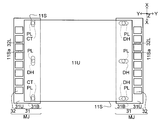
- FIG. 1 and FIG. 2 is a two-plane view showing a partial cross-sectional view and a plan view of the backlight unit 49 (the cross-sectional view is a cross-sectional view taken along the line AA ′ in FIG.
- the plan view mainly shows the light guide plate 11 and the LED module MJ for convenience).
- the light guide plate 11 is formed with a cutout CT and a recess DH. More specifically, the notch (engagement portion) CT is formed by the progress of the defect from the bottom surface 11B of the light guide plate 11 toward the top surface 11U, and the defect reaches the side surface 11S of the light guide plate 11. (However, the defect does not reach the top surface 11U).
- the depression (engagement portion) DH is formed by the progress of the defect from the bottom surface 11B of the light guide plate 11 toward the top surface 11U (however, the defect forming the depression DH is not the same as the notch CT. It does not reach the top surface 11U).
- the reflection sheet 41 is covered with the bottom surface of the light guide plate 11. Therefore, in the reflection sheet 41, a sheet opening 41H is formed at a location overlapping the notch CT and the depression DH in the light guide plate 11 (note that the size of the sheet opening 41H is the outer circumference and the depression of the notch CT. Larger than the outer circumference of DH). That is, the cutout CT and the recess DH in the light guide plate 11 are exposed without being blocked by the reflection sheet 41.
- a shaft (stator) PL protruding from the mounting surface 31U of the mounting substrate 31 is formed.
- the axis PL connected to the mounting substrate 31 corresponds to the notch CT and the recess DH in the light guide plate 11 (in essence, facing each other).
- the circumference (outer circumference) of the axis PL is smaller than the inner circumference of the notch CT and the inner circumference of the recess DH in the light guide plate 11. Therefore, when this axis PL fits into (is engaged with) the notch CT and the recess DH, the LED module MJ is immovable with respect to the light guide plate 11.
- the backlight chassis 42 includes a step 42P that can accommodate the mounting substrate 31 on the bottom surface 42B. More specifically, the backlight chassis 42 includes a step 42 ⁇ / b> P having a slightly larger area than the outer periphery of the mounting substrate 31. Then, when the mounting board 31 is fitted in the region of the step 42P that has dropped from the bottom surface 42B (the recessed step 42P), the mounting board 31 may move in the in-plane direction of the bottom surface 42B, and the side wall of the backlight chassis 42 42S and the wall 42Ps of the step 42P come into contact with each other and become immobile (the depth of the step 42P is slightly longer than the thickness of the mounting substrate 31).
- the backlight unit 49 includes the reflection sheet 41, the LED module MJ, and the backlight chassis 42, the backlight unit 49 is assembled as follows.
- the mounting substrate 31 in the LED module MJ is placed in the step 42P formed on the bottom surface 42B of the backlight chassis 42 with the non-mounting surface 31B (the back surface 31B of the mounting surface 31U) facing (the backlight chassis 42 and
- the mounting substrate 31 may be fixed with a double-sided tape or may be fixed with a screw. Then, the axis PL of the mounting substrate 31 rises with respect to the bottom surface 42B of the backlight chassis 42.
- the reflection sheet 41 covers the bottom surface 42B of the backlight chassis 42 so that the sheet opening 41H communicates with the shaft PL. Then, the axis PL is exposed through the sheet opening 41H of the reflection sheet 41.
- the light guide plate 11 is placed so that the notch CT and the recess DH fit into the axis PL.
- the light receiving surface 11Sa of the light guide plate 11 is designed to be at an appropriate distance without being in contact with the light emitting surface 32L of the LED 32 in a state where the axis PL is engaged with the notch CT and the recess DH. Yes.
- the axis PL is the light emitting direction from the LED 32.
- the mounting substrate 31 and the light guide plate 11 fixed by the axis PL do not move along the emission direction. Then, the distance between the light emitting surface 32L of the LED 32 mounted on the mounting substrate 31 and the light receiving surface 11Sa of the light guide plate 11 does not change. Therefore, the light emitted from the light guide plate 11 is likely to be an appropriate surface light assumed in design.
- the LED module MJ and the light guide plate 11 can be assembled while the positional relationship between the light receiving surface 11Sa and the light emitting surface 32L of the LED 32 is set to a predetermined position simply by fitting the light guide plate 11 to the axis PL.
- the light unit 49 can be easily assembled. In particular, when there are a plurality of shafts PL, the light guide plate 11 fitted to the shafts PL does not rotate.
- the widths of the cutout CT and the recess DH along the Y direction that is perpendicular to (intersects with) the light receiving surface 11Sa are the widths of the axis PL whose cross section (cross section perpendicular to the axial direction) is a perfect circle.
- the length is about the same as the diameter. Otherwise, even if the axis PL fits into the notch CT and the recess DH, the light guide plate 11 fluctuates with respect to the mounting substrate 31 in the Y direction, and the light receiving surface 11Sa and the light emitting surface 32L of the LED 32 This is because the distance changes.
- the width of the notch CT and the recess DH along the X direction which is the longitudinal direction of the light receiving surface 11Sa may be longer than the diameter of the axis PL. This is because, even if the axis PL fits into the notch CT and the recess DH, the light guide plate 11 varies with respect to the mounting substrate 31 in the Y direction, and the distance between the light receiving surface 11Sa and the light emitting surface 32L of the LED 32 does not change. It is. Moreover, it is also because the assembly of the LED module MJ and the light guide plate 11 becomes troublesome if there is no margin (space) between the axis PL and the cutout CT and the recess DH.
- the cross-sectional shapes of the cutout CT and the recess DH (specifically, the shape in the cross-sectional direction along the same plane direction as the top surface 11U of the light guide plate 11) have short sides along the light emitting direction of the LED 32, and the LED 32.
- a longitudinal axis perpendicular to the light emission direction of the light beam (for example, an elliptical shape having a short axis along the short side, an elliptical shape having a long axis extending along the longitudinal direction, or a tongue-shaped cross-sectional shape including the elliptical shape), and a transverse axis of the axis PL
- the surface shape may have a width (for example, a perfect circular cross-sectional shape) in close contact with the interval between the long inner walls of the notch CT and the recess DH.
- the width of the recess DH along the Y direction and the X direction may be equal to the diameter of the axis. This is because the light guide plate 11 does not fluctuate in the in-plane direction of the mounting substrate 31 (XY plane direction).
- the number of the axes PL may be one. This is because the movement of the light guide plate 11 in the XY plane direction relative to the mounting substrate 31 can be prevented even with one axis PL.
- the number of combinations of the engaging portion such as the notch CT or the recess DH and the shaft PL fitted thereto is not particularly limited.
- the position of the axis PL is not limited to the mounting surface 31U of the mounting substrate 31.
- the axis PL is not the mounting substrate 31 but the step 42P on the bottom surface 42B of the backlight chassis 42.
- the mounting substrate 31 must be provided with a substrate opening (engagement portion) 31H through the axis PL connected to the step 42P of the backlight chassis 42 ⁇ .
- the backlight chassis 42 not only accommodates the LED module MJ and the light guide plate 11, but also accommodates the shaft PL by connecting it to the step 42P of the bottom surface 42B.
- the shaft PL is engaged with the notch CT and the recess DH in the light guide plate 11 and the substrate opening 31H of the mounting substrate 31 to fix the overlapping mounting substrate 31 and light guide plate 11.
- the backlight unit 49 preferably satisfies the following expression (1).
- RL the shortest distance from the light receiving surface 11Sa of the light guide plate 11 to the cutout CT, or the shortest distance from the light receiving surface 11Sa of the light guide plate 11 to the recess DH GL: the light emitting direction of the LED 32 at the light guide plate 11
- the total length in the direction along (for example, the Y direction).
- the light guide plate 11 is made of resin, the light guide plate 11 is thermally expanded by receiving light (heat) from the LED 32.
- thermal expansion is likely to occur with reference to the notch CT and the recess DH in the light guide plate 11. Therefore, in order to ensure the quality of the planar light from the light guide plate 11, for example, it is desirable that thermal expansion does not occur in the vicinity of the center of the light guide plate 11 corresponding to the vicinity of the center of the planar light. Therefore, it is preferable that the above expression (1) is satisfied.
- the notch CT and the depression DH are formed near the end of the light guide plate 11 having little influence on the quality of the planar light, the surface is caused by the notch CT and the depression DH. The quality of the light is difficult to deteriorate.
- the cutout CT and the recess DH shown in FIGS. 1 and 2 may have a shape penetrating from the bottom surface 11B to the top surface 11U of the light guide plate 11 (for example, even if the recess DH is an opening). It doesn't matter) Further, out of the three openings 31H shown in FIGS. 3 and 4, the outer two openings 31H may be notches that are continuous with the short side of the mounting substrate 31.
- the mounting substrate 31 that is one member on the side close to the axis PL reaches the light guide plate 11 that is the other member. Therefore, it is sufficient that the hole 31H or the notch penetrates from the non-mounting surface 31B to the mounting surface 31U.
- the light guide plate 11 may be engaged with the approaching axis PL, it may be a notch CT, a recess DH, or an opening.
- the axis PL is not limited to a rod shape having a perfect circular or polygonal cross section, but is a cone shape (conical shape, pyramid shape, etc.), or a truncated cone shape (conical shape, truncated pyramid shape, etc.). It may be a protrusion.
- one indentation DH for example, an engaging portion at the center of three engaging portions arranged in parallel.
- Is a perfect circle in which the length along the light emission direction of the LED 32 and the length orthogonal to the light emission direction of the LED 32 are the same, and the cross-sectional shape of the axis PL that fits into the hollow DH of the perfect circle May be a perfect circle that is in close contact with the interval between the inner walls facing each other in the depression DH.
- the recess DH having a perfect circular cross section and the axis PL having a perfect circular cross section are in close contact with each other, so that the reference position is obtained.
- the remaining two cutouts CT are not in close contact with the axis PL in the X direction (in short, there is a margin between the cutout CT and the axis PL). Therefore, even if the recess DH serving as the reference position and the axis PL are fitted, the two cutouts CT and the axis PL are easily fitted. Therefore, the assembly of the LED module MJ and the light guide plate 11 does not become troublesome, and the light guide plate 11 does not vary in the in-plane direction (XY plane direction) of the mounting substrate 31.
- the LED module MJ is disposed on one side surface 11S of the light guide plate 11.
- the present invention is not limited to this.
- the LED module MJ may be disposed on two opposing side surfaces 11S. That is, the two side surfaces 11S facing each other at the light guide plate 11 may function as the light receiving surface 11Sa.
- the backlight unit 49 as shown in FIG. That is, of the two light receiving surfaces 11Sa, the cross-sectional shape of the engaging portion (the depression DH and the notch CT) close to the one light receiving surface 11Sa side has a short side along the light emitting direction of the LED 32, and the light of the LED 32 (For example, a short axis along the short side, an ellipse having a long axis along the long side, or a tongue-like cross-sectional shape including an ellipse), and a cross-sectional shape of the axis PL May have a width (for example, a perfect circular cross-sectional shape) that is in close contact with the interval between the longitudinal inner walls of the notch CT and the recess DH.
- a width for example, a perfect circular cross-sectional shape
- the shape of the engaging portion (dent DH) close to the other light receiving surface 11Sa side has a length along the light emitting direction of the LED 32 and is orthogonal to the light emitting direction of the LED 32.
- the cross-sectional shape of the axis PL is in close contact with the distance between the long inner walls in the recess DH. It is preferable to have a width (for example, a perfect circular cross-sectional shape).
- the light guide plate 11 is immovable with respect to the mounting substrate 31 in the Y direction by fitting the axis PL into the notch CT and the recess DH (that is, The distance between the light receiving surface 11Sa and the light emitting surface 32L of the LED 32 is constant).
- the extension is not excessively restricted (for example, due to the thermal expansion of the light guide plate 11).
- the axis PL does not break).
- the LED module MJ and the light guide plate 11 can be easily assembled because there is some margin between the axis PL and the recess DH.
- the number of LED modules MJ may be four as shown in FIG. That is, as shown in FIG. 7, the LED module MJ is arranged on the other two opposite side surfaces 11 ⁇ / b> S in addition to the two opposite side surfaces 11 ⁇ / b> S as shown in FIG. 6. May be. That is, all the side surfaces 11S in the light guide plate 11 may function as the light receiving surface 11Sa.
- the cross-sectional shape of the engaging portion (dent DH) close to one light receiving surface 11Sa side of the other two light receiving surfaces 11Sa is short along the light emitting direction of the LED 32. And has a length perpendicular to the light emission direction of the LED 32 (for example, an elliptical cross-sectional shape having a short axis along the short side and a long axis along the long side), and on one light receiving surface 11Sa side.
- the cross-sectional shape of the shaft PL that fits in the close engaging portion has a width that closely contacts the interval between the long inner walls of the recess DH (for example, a perfect circular cross-sectional shape).
- the cross-sectional shape of the engaging portion (indentation DH) close to the other light receiving surface 11Sa side has a length along the light emitting direction of the LED 32, and the light of the LED 32
- a shaft that has a short side perpendicular to the emission direction for example, an elliptical cross-sectional shape having a short axis along the short side and a long axis along the long side
- the cross-sectional shape of the PL has a width that closely adheres to the interval between the long inner walls in the recess DH (for example, a perfect circular cross-sectional shape).
Landscapes
- Physics & Mathematics (AREA)
- General Physics & Mathematics (AREA)
- Optics & Photonics (AREA)
- Planar Illumination Modules (AREA)
Abstract
L'invention porte sur un appareil d'éclairage, qui élimine des variations de la distance entre la surface de réception de lumière d'une plaque de guidage de lumière et une source de lumière. L'invention porte également sur un dispositif d'affichage qui incorpore l'appareil d'éclairage. La plaque de guidage de lumière (11), qui constitue une unité de rétro-éclairage (49), reçoit de la lumière à travers une surface de réception de lumière (11Sa) orientée vers la lumière qui est émise. Dans l'unité de rétro-éclairage (49), des piliers (PL) s'étendent de façon à croiser la direction d'émission à partir d'une diode électroluminescente (32), et sont ainsi amenés en contact avec une carte de support de dispositif (31) et la plaque de guidage de lumière (11), qui sont superposées l'une sur l'autre, de façon à fixer ainsi la carte de support de dispositif (31) et la plaque de guidage de lumière (11).
Priority Applications (1)
| Application Number | Priority Date | Filing Date | Title |
|---|---|---|---|
| US13/580,007 US8911136B2 (en) | 2010-03-31 | 2011-01-13 | Illumination apparatus and display device |
Applications Claiming Priority (2)
| Application Number | Priority Date | Filing Date | Title |
|---|---|---|---|
| JP2010-080450 | 2010-03-31 | ||
| JP2010080450 | 2010-03-31 |
Publications (1)
| Publication Number | Publication Date |
|---|---|
| WO2011122060A1 true WO2011122060A1 (fr) | 2011-10-06 |
Family
ID=44711814
Family Applications (1)
| Application Number | Title | Priority Date | Filing Date |
|---|---|---|---|
| PCT/JP2011/050413 Ceased WO2011122060A1 (fr) | 2010-03-31 | 2011-01-13 | Appareil d'éclairage et dispositif d'affichage |
Country Status (2)
| Country | Link |
|---|---|
| US (1) | US8911136B2 (fr) |
| WO (1) | WO2011122060A1 (fr) |
Cited By (6)
| Publication number | Priority date | Publication date | Assignee | Title |
|---|---|---|---|---|
| CN102635813A (zh) * | 2011-12-30 | 2012-08-15 | 友达光电股份有限公司 | 背光模块及制作具有对位图案的电路板的方法 |
| WO2013054732A1 (fr) * | 2011-10-11 | 2013-04-18 | シャープ株式会社 | Dispositif d'éclairage, dispositif d'affichage, et récepteur de télévision |
| US20130135895A1 (en) * | 2011-11-30 | 2013-05-30 | Panasonic Liquid Crystal Display Co., Ltd. | Surface light source device |
| US20130258717A1 (en) * | 2012-03-28 | 2013-10-03 | Samsung Electronics Co., Ltd. | Backlight unit and image display apparatus having the same |
| WO2014021304A1 (fr) * | 2012-08-03 | 2014-02-06 | シャープ株式会社 | Dispositif d'éclairage, dispositif d'affichage, et dispositif de réception de télévision |
| JP2014170079A (ja) * | 2013-03-01 | 2014-09-18 | Funai Electric Co Ltd | 表示装置 |
Families Citing this family (8)
| Publication number | Priority date | Publication date | Assignee | Title |
|---|---|---|---|---|
| KR102096400B1 (ko) * | 2012-10-17 | 2020-04-06 | 삼성전자주식회사 | 액정표시장치 |
| JPWO2014141340A1 (ja) * | 2013-03-11 | 2017-02-16 | パナソニックIpマネジメント株式会社 | 照明装置及び表示装置 |
| US9851498B2 (en) * | 2013-06-28 | 2017-12-26 | Sakai Display Products Corporation | Light source device and display apparatus |
| JP6772866B2 (ja) * | 2017-01-31 | 2020-10-21 | 三菱電機株式会社 | 面状光源装置および表示装置 |
| CN206479671U (zh) * | 2017-03-01 | 2017-09-08 | 合肥京东方光电科技有限公司 | 一种导光板、背光源及显示装置 |
| DE112018003300T5 (de) * | 2017-06-28 | 2020-03-19 | Mitsubishi Electric Corporation | Lichtleiterkörper und bildlesevorrichtung |
| JP2021193403A (ja) * | 2018-09-12 | 2021-12-23 | ソニーグループ株式会社 | 導光型表示装置及び導光板の位置決め方法 |
| WO2021211768A1 (fr) * | 2020-04-15 | 2021-10-21 | Shanghai Yanfeng Jinqiao Automotive Trim Systems Co. Ltd. | Composant d'intérieur de véhicule |
Citations (4)
| Publication number | Priority date | Publication date | Assignee | Title |
|---|---|---|---|---|
| JPH0520032U (ja) * | 1991-03-06 | 1993-03-12 | 三洋電機株式会社 | 面照明装置 |
| JP2004184493A (ja) * | 2002-11-29 | 2004-07-02 | Seiko Epson Corp | 電気光学装置、電気光学装置の製造方法、および電子機器 |
| JP2008004491A (ja) * | 2006-06-26 | 2008-01-10 | Tokai Rika Co Ltd | 面状光源装置 |
| JP2009277641A (ja) * | 2007-12-27 | 2009-11-26 | Fujifilm Corp | 面状照明装置 |
Family Cites Families (7)
| Publication number | Priority date | Publication date | Assignee | Title |
|---|---|---|---|---|
| KR100965183B1 (ko) * | 2003-12-30 | 2010-06-24 | 삼성전자주식회사 | 백라이트 어셈블리 및 이를 갖는 평판표시장치 |
| JP4244942B2 (ja) * | 2005-03-08 | 2009-03-25 | セイコーエプソン株式会社 | 液晶装置、照明装置、および電子機器 |
| KR101284031B1 (ko) * | 2006-03-17 | 2013-07-09 | 삼성디스플레이 주식회사 | 백라이트 어셈블리 및 이를 갖는 액정표시장치 |
| JP5403579B2 (ja) | 2008-05-02 | 2014-01-29 | シチズン電子株式会社 | 面状光源及び液晶表示装置 |
| KR101698816B1 (ko) * | 2009-11-30 | 2017-01-24 | 삼성디스플레이 주식회사 | 백라이트 어셈블리 |
| KR101354223B1 (ko) * | 2009-12-14 | 2014-01-22 | 엘지디스플레이 주식회사 | 액정표시장치 |
| US8579454B2 (en) * | 2010-06-30 | 2013-11-12 | Sharp Kabushiki Kaisha | Lighting device, display device and television device |
-
2011
- 2011-01-13 US US13/580,007 patent/US8911136B2/en not_active Expired - Fee Related
- 2011-01-13 WO PCT/JP2011/050413 patent/WO2011122060A1/fr not_active Ceased
Patent Citations (4)
| Publication number | Priority date | Publication date | Assignee | Title |
|---|---|---|---|---|
| JPH0520032U (ja) * | 1991-03-06 | 1993-03-12 | 三洋電機株式会社 | 面照明装置 |
| JP2004184493A (ja) * | 2002-11-29 | 2004-07-02 | Seiko Epson Corp | 電気光学装置、電気光学装置の製造方法、および電子機器 |
| JP2008004491A (ja) * | 2006-06-26 | 2008-01-10 | Tokai Rika Co Ltd | 面状光源装置 |
| JP2009277641A (ja) * | 2007-12-27 | 2009-11-26 | Fujifilm Corp | 面状照明装置 |
Cited By (7)
| Publication number | Priority date | Publication date | Assignee | Title |
|---|---|---|---|---|
| WO2013054732A1 (fr) * | 2011-10-11 | 2013-04-18 | シャープ株式会社 | Dispositif d'éclairage, dispositif d'affichage, et récepteur de télévision |
| US20130135895A1 (en) * | 2011-11-30 | 2013-05-30 | Panasonic Liquid Crystal Display Co., Ltd. | Surface light source device |
| CN102635813A (zh) * | 2011-12-30 | 2012-08-15 | 友达光电股份有限公司 | 背光模块及制作具有对位图案的电路板的方法 |
| US20130258717A1 (en) * | 2012-03-28 | 2013-10-03 | Samsung Electronics Co., Ltd. | Backlight unit and image display apparatus having the same |
| WO2014021304A1 (fr) * | 2012-08-03 | 2014-02-06 | シャープ株式会社 | Dispositif d'éclairage, dispositif d'affichage, et dispositif de réception de télévision |
| CN104508355A (zh) * | 2012-08-03 | 2015-04-08 | 夏普株式会社 | 照明装置、显示装置以及电视接收装置 |
| JP2014170079A (ja) * | 2013-03-01 | 2014-09-18 | Funai Electric Co Ltd | 表示装置 |
Also Published As
| Publication number | Publication date |
|---|---|
| US20120320630A1 (en) | 2012-12-20 |
| US8911136B2 (en) | 2014-12-16 |
Similar Documents
| Publication | Publication Date | Title |
|---|---|---|
| WO2011122060A1 (fr) | Appareil d'éclairage et dispositif d'affichage | |
| JP5228109B2 (ja) | レンズユニット、発光モジュール、照明装置、表示装置、およびテレビ受像装置 | |
| KR101529579B1 (ko) | 백라이트 어셈블리, 그를 포함하는 표시 장치 및 표시 장치의 제조 방법 | |
| TWI479233B (zh) | 發光二極體印刷電路板、背光總成與其製造方法及液晶顯示器 | |
| JP5288527B2 (ja) | バックライトアセンブリ及びこれを有する液晶表示装置 | |
| JP5073831B2 (ja) | 照明装置、表示装置、及びテレビ受信装置 | |
| US8734001B2 (en) | Backlight assembly including a light source cover including a sidewall cover portion which contacts with an exterior surface of a sidewall of a receiving container and a light source cover portion which covers a light source and a portion of the exiting surface of a light guide plate, display device having the same and method of assembling the display device | |
| WO2009118942A1 (fr) | Unité de rétroéclairage et dispositif afficheur à cristaux liquides | |
| WO2014073348A1 (fr) | Dispositif d'affichage | |
| WO2010146904A1 (fr) | Module electroluminescent, dispositif d'eclairage, dispositif d'affichage, et recepteur de television | |
| WO2010016322A1 (fr) | Dispositif d'éclairage et dispositif d'affichage à cristaux liquides le comportant | |
| WO2011111444A1 (fr) | Dispositif d'éclairage, appareil d'affichage et récepteur de télévision | |
| WO2011004642A1 (fr) | Lentille, conditionnement d'élément électroluminescent, module électroluminescent, dispositif d'éclairage, dispositif d'affichage et télévision | |
| JP7468165B2 (ja) | 発光装置および表示装置 | |
| JP4155310B2 (ja) | バックライト装置と液晶表示装置および液晶表示装置を使用した電子機器 | |
| US8646962B2 (en) | Light guiding plate, lighting apparatus, and display apparatus | |
| KR101472140B1 (ko) | 액정표시장치 | |
| WO2010041499A1 (fr) | Dispositif d'éclairage, dispositif d'affichage et récepteur de télévision | |
| JP5347025B2 (ja) | 照明装置、表示装置、およびテレビ受像装置 | |
| JP7306129B2 (ja) | 照明装置および表示装置 | |
| CN102682667A (zh) | 显示设备 | |
| CN102187146B (zh) | 照明装置、显示装置和电视接收装置 | |
| WO2010038521A1 (fr) | Dispositif d’éclairage, dispositif d’affichage et récepteur de télévision | |
| KR102421777B1 (ko) | 디스플레이 장치 | |
| CN103984150B (zh) | 散射板的固定装置和具有该固定装置的显示设备 |
Legal Events
| Date | Code | Title | Description |
|---|---|---|---|
| 121 | Ep: the epo has been informed by wipo that ep was designated in this application |
Ref document number: 11762301 Country of ref document: EP Kind code of ref document: A1 |
|
| WWE | Wipo information: entry into national phase |
Ref document number: 13580007 Country of ref document: US |
|
| NENP | Non-entry into the national phase |
Ref country code: DE |
|
| 122 | Ep: pct application non-entry in european phase |
Ref document number: 11762301 Country of ref document: EP Kind code of ref document: A1 |
|
| NENP | Non-entry into the national phase |
Ref country code: JP |