WO2012011402A1 - 乳酸含有酵母エキス - Google Patents
乳酸含有酵母エキス Download PDFInfo
- Publication number
- WO2012011402A1 WO2012011402A1 PCT/JP2011/065775 JP2011065775W WO2012011402A1 WO 2012011402 A1 WO2012011402 A1 WO 2012011402A1 JP 2011065775 W JP2011065775 W JP 2011065775W WO 2012011402 A1 WO2012011402 A1 WO 2012011402A1
- Authority
- WO
- WIPO (PCT)
- Prior art keywords
- yeast extract
- lactic acid
- taste
- yeast
- solid content
- Prior art date
- Legal status (The legal status is an assumption and is not a legal conclusion. Google has not performed a legal analysis and makes no representation as to the accuracy of the status listed.)
- Ceased
Links
Images

Classifications
-
- A—HUMAN NECESSITIES
- A23—FOODS OR FOODSTUFFS; TREATMENT THEREOF, NOT COVERED BY OTHER CLASSES
- A23L—FOODS, FOODSTUFFS OR NON-ALCOHOLIC BEVERAGES, NOT OTHERWISE PROVIDED FOR; PREPARATION OR TREATMENT THEREOF
- A23L2/00—Non-alcoholic beverages; Dry compositions or concentrates therefor; Preparation or treatment thereof
- A23L2/52—Adding ingredients
-
- A—HUMAN NECESSITIES
- A23—FOODS OR FOODSTUFFS; TREATMENT THEREOF, NOT COVERED BY OTHER CLASSES
- A23L—FOODS, FOODSTUFFS OR NON-ALCOHOLIC BEVERAGES, NOT OTHERWISE PROVIDED FOR; PREPARATION OR TREATMENT THEREOF
- A23L2/00—Non-alcoholic beverages; Dry compositions or concentrates therefor; Preparation or treatment thereof
- A23L2/52—Adding ingredients
- A23L2/56—Flavouring or bittering agents
-
- A—HUMAN NECESSITIES
- A23—FOODS OR FOODSTUFFS; TREATMENT THEREOF, NOT COVERED BY OTHER CLASSES
- A23L—FOODS, FOODSTUFFS OR NON-ALCOHOLIC BEVERAGES, NOT OTHERWISE PROVIDED FOR; PREPARATION OR TREATMENT THEREOF
- A23L27/00—Spices; Flavouring agents or condiments; Artificial sweetening agents; Table salts; Dietetic salt substitutes; Preparation or treatment thereof
- A23L27/20—Synthetic spices, flavouring agents or condiments
- A23L27/26—Meat flavours
-
- A—HUMAN NECESSITIES
- A23—FOODS OR FOODSTUFFS; TREATMENT THEREOF, NOT COVERED BY OTHER CLASSES
- A23L—FOODS, FOODSTUFFS OR NON-ALCOHOLIC BEVERAGES, NOT OTHERWISE PROVIDED FOR; PREPARATION OR TREATMENT THEREOF
- A23L33/00—Modifying nutritive qualities of foods; Dietetic products; Preparation or treatment thereof
- A23L33/10—Modifying nutritive qualities of foods; Dietetic products; Preparation or treatment thereof using additives
- A23L33/14—Yeasts or derivatives thereof
- A23L33/145—Extracts
-
- A—HUMAN NECESSITIES
- A23—FOODS OR FOODSTUFFS; TREATMENT THEREOF, NOT COVERED BY OTHER CLASSES
- A23V—INDEXING SCHEME RELATING TO FOODS, FOODSTUFFS OR NON-ALCOHOLIC BEVERAGES AND LACTIC OR PROPIONIC ACID BACTERIA USED IN FOODSTUFFS OR FOOD PREPARATION
- A23V2400/00—Lactic or propionic acid bacteria
- A23V2400/11—Lactobacillus
Definitions
- the present invention relates to a yeast extract in which the yeast odor peculiar to yeast is masked or reduced, and a method for producing the same. Moreover, it is related with the yeast extract which is excellent in the balance and sustainability of a taste, and shows taste like meat extract, and its manufacturing method.
- yeast extract contains various free amino acids, organic acids, taste 5 ′ -nucleotide, and the like, and is attracting attention as a natural seasoning that gives food richness and thickness.
- An off-flavor peculiar to yeast (yeast odor) generated depending on the method of producing the extract may be a problem.
- Patent Document 1 a method of adsorbing molecules that cause off-flavor by activated carbon treatment and removing yeast odor
- Patent Document 2 a method of treating yeast extract with an enzyme and freeing lipid components to reduce yeast odor
- Non-patent Document 1 a method for removing the off-flavor and bitterness of yeast extract by passing the extract through a hydrophobic resin column has also been reported.
- Non-patent Documents 2 and 3 As a conventional attempt on a method for producing yeast extract and various problems, a method for removing yeast odor by heating under acidic conditions, a method for extracting and removing yeast odor by contacting with supercritical carbon dioxide, A method of masking yeast odor by adding and mixing dextrin has also been reported (Non-patent Documents 2 and 3).
- JP 2000-316523 A Japanese Patent Application Laid-Open No. 07-285959 JP 2002-355008 A JP 2003-325130 A
- the present invention reduces and masks the yeast odor contained in the yeast extract, has excellent taste balance and sustainability, does not contain animal-derived components, and has a taste like meat extract. It aims at providing the yeast extract which can provide.
- the present inventors have conducted intensive research to solve the above problems. As a result, it was found that by adding more than a specific amount of lactic acid to the yeast extract, the yeast odor was reduced, and the yeast extract with excellent taste balance and sustainability and a meat extract-like taste was obtained. . Thus, no yeast extract containing lactic acid at a high concentration has been reported so far. Moreover, it discovered that the yeast extract in which said effect was further strengthened is obtained by adjusting pH of this yeast extract with the basic substance containing potassium. Furthermore, when lactic acid is produced by sufficiently fermenting a yeast extract with a specific lactic acid bacterium until a specific amount or more of lactic acid is obtained, various aroma components are also increased by fermentation, and the yeast is further increased. The yeast odor peculiar to an extract was masked, it discovered that the yeast extract which was excellent in the balance of balance and sustainability, and the meat extract-like taste was provided more notably, and completed this invention.
- the present invention relates to the following.
- the lactic acid-containing yeast extract according to (1) or (2) further comprising one or more components selected from the group consisting of: (4) A lactic acid-containing yeast extract containing 7.5% (w / w)% or more of lactic acid per solid content of yeast extract obtained by fermenting yeast extract with lactic acid bacteria. (5) The lactic acid-containing yeast extract according to (4) above, which contains 15 (w / w)% or more of lactic acid per solid content of yeast extract.
- the lactic acid bacteria are Lactobacillus plantarum, Lactobacillus pentosus, Leuconostoc mesenteroides subsp. Cremoris, Lactobacillus acidophilus, or Lactobacillus delbrueckii subsp.
- the lactic acid-containing yeast extract according to any one of (1) to (6) above having a pH of 4.5 to 7.0.
- the lactic acid-containing yeast extract according to any one of (1) to (7) above which has been adjusted to pH 4.5 to 7.0 using a pH adjuster containing potassium.
- the invention also relates to: (10) Acetic acid 0.02% or more; Isobutyl alcohol 0.1 ppm or more; 2-methylbutanol 0.1 ppm or more; Acetoin 1 ppm or more; Furfuryl alcohol 1 ppm or more; and methionol 1 ppm or more;
- the lactic acid-containing yeast extract according to (4) or (5) further comprising one or more components selected from the group consisting of: (11) The lactic acid-containing yeast extract according to (4) or (5), wherein the lactic acid bacterium is Lactobacillus plantarum. (12) The lactic acid-containing yeast extract according to (7), wherein the pH is 5.0 to 6.0.
- the lactic acid-containing yeast extract according to (8) above wherein the pH adjuster containing potassium is potassium hydroxide.
- the step of adding lactic acid is a step of adding 15 (w / w)% or more of lactic acid to the yeast extract per yeast extract solid content, wherein the lactic acid is contained in the above (16) or (17) A method for producing a yeast extract.
- a method for producing a lactic acid-containing yeast extract comprising a step of fermenting a yeast extract with lactic acid bacteria until 7.5 (w / w)% or more of lactic acid is produced per solid content of the yeast extract.
- a method for producing a yeast extract comprising a step of fermenting yeast extract with lactic acid bacteria at a temperature of 20 to 40 ° C. for 48 hours or more.
- Manufacturing method comprising a step of fermenting yeast extract with lactic acid bacteria at a temperature of 20 to 40 ° C. for 48 hours or more.
- Production of a lactic acid-containing yeast extract containing 15 (w / w)% or more of lactic acid per solid of yeast extract comprising a step of fermenting the yeast extract with lactic acid bacteria at a temperature of 20 to 40 ° C. for 48 hours or more.
- a method for producing a yeast extract. The method according to any one of (19) to (22), further comprising a step of adding a potassium salt to the yeast extract and a step of adjusting the pH of the yeast extract to pH 4.5 to 7.0.
- the lactic acid bacteria are Lactobacillus plantarum, Lactobacillus pentosus, Leuconostoc mesenteroides subsp. Cremoris, Lactobacillus acidophilus, or Lactobacillus delbrueckii subsp.
- a yeast extract that is masked or reduced with a nasty odor (yeast odor) peculiar to yeast, has excellent taste balance and sustainability, has no animal-derived ingredients, and has a meat extract-like taste and its production A method is provided.
- a yeast extract is very useful as a new type of natural seasoning that gives meat extract-like richness and thickness to the taste of various foods and drinks.
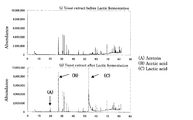
- the total ion chromatogram by GC-MS of (i) yeast extract before lactic fermentation and (ii) yeast extract after lactic fermentation obtained in Example 4 is shown.
- the enlarged view of the total ion chromatogram by GC-MS of (iii) yeast extract before lactic fermentation and (iv) yeast extract after lactic fermentation is shown.
- the yeast extract used in the present invention is produced by extracting the extract by a known method using brewer's yeast, baker's yeast or torula yeast as a raw material, and is particularly limited as long as it is known as edible, medicinal or medium. It can be used without. A commercial item may be used and it may manufacture by a well-known method by using said yeast as a raw material.
- Commercially available yeast extracts include Vertex (Fuji Food Industry Co., Ltd.), Aromildo (Kojin Co., Ltd.), Mist S (Asahi Food and Healthcare Co., Ltd.), Koku Base (Dainippon Meiji Sugar Co., Ltd.), and SK Yeast.
- Extracts manufactured by Nippon Paper Chemical Co., Ltd.
- Gistex manufactured by DSM
- KAV manufactured by Ohly
- a yeast extract made from baker's yeast is preferable because it can be obtained inexpensively and stably.
- the shape of the yeast extract is not particularly limited, and any of liquid, paste, powder and the like can be used.
- a self-digestion method a method of solubilizing cells using a proteolytic enzyme or the like inherent in yeast cells
- an enzyme decomposition method (adding an enzyme derived from microorganisms or plants).
- Solubilization method hot water extraction method (method of solubilization by soaking in hot water for a certain period of time), acid or alkali decomposition method (method of solubilization by adding various acids or alkalis), physical Crushing method (sonication, high-pressure homogenization method, crushing method by mixing and grinding with solid materials such as glass beads), freeze-thawing method (crushing by freezing and thawing at least once) Method) and the like are known, but the present invention is not limited thereto, and yeast extract produced by any method can also be used. Since the yeast extract produced by the self-digestion method may have a problem of off-flavor, it is suitable as a target for masking or reducing the yeast odor in the present invention.
- the lactic acid content is preferably about 15 (w / w)% or more, for example, about 20 (w / w)% per yeast extract solid content.
- the yeast extract has a bad taste balance due to the acidity derived from lactic acid.
- the amount is preferably 40 (w / w)% or less per yeast extract solid content.
- the lactic acid-containing yeast extract of the present invention contains 7.5 to 40 (w / w)%, preferably 15 to 30 (w / w)% lactic acid per solid of yeast extract.
- the lactic acid content per yeast extract solid content means the quantity also including the lactic acid originally contained in a yeast extract.
- dextrin or lactose may be blended as a powdering aid.
- the yeast extract solid content in the present invention is a component other than a yeast extract such as a powdering aid. It refers to the extract solid content that does not contain solid content derived from.
- the lactic acid content of a powdered yeast extract containing 20 (w / w)% of the powdering aid is 10 (w / w)% and the water content is 0 (w / w)% with respect to the total amount of the powdered yeast extract.
- the lactic acid content per yeast extract solid content is 12.5 (w / w)%.
- the lactic acid-containing yeast extract of the present invention can be obtained by adding lactic acid to the yeast extract.
- lactic acid to be added include salts of potassium lactate, sodium lactate, calcium lactate and the like in addition to lactic acid, and lactic acid and potassium lactate are particularly preferable.
- salts are used, the above amount is added in terms of the amount of lactic acid.
- the yeast extract solid content can be determined by evaporation to dryness. Specifically, an appropriate amount of sea sand is mixed with the yeast extract, heated at about 110 ° C. until the water evaporates, and the weight percentage of the remaining solid is measured. More simply, a Brix value using a differential refractometer can be substituted.
- the yeast extract solid content of the liquid yeast extract is 45 to 65 (w / w)%
- the yeast extract solid content of the paste-like yeast extract is 70 to 95 (w / w)%
- the yeast extract has a solid content of 50 to 99 (w / w)%.
- the lactic acid-containing yeast extract as described above may further contain a desired amount of one or more components selected from the group consisting of acetic acid, isobutyl alcohol, 2-methylbutanol, acetoin, furfuryl alcohol, and methionol.
- acetic acid isobutyl alcohol, 2-methylbutanol, acetoin, furfuryl alcohol, and methionol.
- the yeast odor is further improved, the taste balance is excellent, and the meat extract-like taste is preferred.
- a lactic acid-containing yeast extract containing each component can be obtained by adding a desired amount of each of these components to the lactic acid-containing additive extract.
- the acetic acid content is preferably 0.02% or more and less than 2% per yeast extract solid content.
- the yeast extract has a bad taste balance due to the acidity derived from acetic acid.
- acetic acid to be added include acetic acid and salts such as potassium acetate, sodium acetate, and calcium acetate, with acetic acid and potassium acetate being particularly preferred.
- the edible raw material containing said acetic acid or its salt may be sufficient, for example, grain vinegar, rice vinegar, fruit vinegar etc. can be used.
- the isobutyl alcohol content is preferably at least 0.1 ppm and less than 100 ppm per solid of yeast extract. Although depending on the concentration of the yeast extract, when the isobutyl alcohol content is usually 100 ppm or more, the aroma derived from isobutyl alcohol becomes stronger, resulting in a yeast extract with a poor taste balance.
- the isobutyl alcohol to be added may be an edible raw material (for example, a fragrance) containing isobutyl alcohol in addition to a commercially available pure product.
- the 2-methylbutanol content is preferably at least 0.1 ppm and less than 100 ppm per yeast extract solid content. Although it depends on the concentration of the yeast extract, when the 2-methylbutanol content is usually 100 ppm or more, the fragrance derived from 2-methylbutanol becomes strong, resulting in a yeast extract with a poor taste balance.
- the 2-methylbutanol to be added may be an edible raw material (for example, a fragrance) containing 2-methylbutanol in addition to a commercially pure product.
- the acetoin content is preferably at least 1 ppm and less than 10,000 ppm per yeast extract solid content. Although depending on the concentration of the yeast extract, a yeast extract with a bad balance of taste is usually obtained when the acetoin content is 10000 ppm or more.
- the acetoin to be added may be an edible raw material containing acetoin (for example, yogurt, fragrance, etc.) in addition to a commercially available pure product.
- the furfuryl alcohol content is preferably at least 1 ppm and less than 1000 ppm per yeast extract solid content. Although it depends on the concentration of the yeast extract, when the content of furfuryl alcohol is usually 1000 ppm or more, the yeast extract has a poor taste balance.
- the furfuryl alcohol to be added may be an edible raw material (for example, a fragrance) containing furfuryl alcohol in addition to a commercially available pure product.
- the methionol content is preferably at least 1 ppm and less than 1000 ppm per yeast extract solid content. Although it depends on the concentration of the yeast extract, when the methionol content is usually 1000 ppm or more, the yeast extract has a bad taste balance due to excessive fermentation odor.
- the methionol to be added may be an edible raw material (for example, a fragrance) containing methionol in addition to a commercially available pure product.
- the lactic acid-containing yeast extract of the present invention contains lactic acid and, if desired, further contains one or more of the other components as described above. As described above, each of these components may be individually added to the yeast extract. In addition, by culturing the microorganism using the yeast extract as a medium, the above-mentioned components are produced in a desired amount by the microorganism and cultured.
- the later medium can be a yeast extract containing each component.
- content with respect to yeast extract solid content of said each component means the quantity also including content originally contained in a yeast extract similarly to having mentioned above about lactic acid content.
- yeast extract in powdered yeast extract, dextrin or lactose may be blended as a powdering aid, and the yeast extract solid content in the present invention is derived from components other than yeast extract such as powdering aid. It refers to the extract solid content that does not contain solid content.
- lactic acid is produced by lactic acid bacteria by fermenting yeast extract with lactic acid bacteria.
- the lactic acid-containing yeast extract of the present invention can be obtained after sufficient fermentation until the amount of lactic acid per solid content of the yeast extract is 7.5 (w / w)% or more.
- the culture solution for inoculating lactic acid bacteria is a pre-fermentation solution containing yeast extract and water as main components, or a pre-fermentation solution containing yeast extract, sugar source and water as main components. Is preferably used. That is, in one embodiment of the present invention, when a lactic acid-containing yeast extract is obtained by lactic acid fermentation, a pre-fermentation solution having the above simple structure may be used, so that a lactic acid-containing yeast extract is obtained easily and inexpensively. be able to.
- various components that can be added to the medium during fermentation of lactic acid bacteria such as nitrogen sources, carbon sources other than sugar, various inorganic ions, vitamins, antibiotics, etc., may be added to the medium. Good.
- a culture solution with a low salt content may be used in order to achieve good growth.
- the pre-fermentation solution is prepared by diluting the yeast extract with water or the like so that the raw material yeast extract contains about 5 to 40% by weight, preferably 20 to 30% by weight, as a solid content.
- a sugar source that can be assimilated by lactic acid bacteria is added so that the concentration at the start of culture is about 2 to 6% by weight, preferably about 3 to 4% by weight.
- the sugar source added to the pre-fermentation solution is not particularly limited as long as lactic acid bacteria can assimilate, and examples thereof include glucose, sucrose, fructose, lactose, galactose, maltose, and the like. Liquid sugars, fruit juices, vegetables, honey and the like may be used. Among these, in view of fermentability of lactic acid bacteria, glucose or liquid saccharide containing glucose is preferable. These sugar sources can be added alone or in combination.
- the pre-fermentation solution is sterilized by heating, and after cooling, inoculated with lactic acid bacteria. Heat sterilization is usually performed at 70 to 130 ° C., and cooling is usually performed until 25 to 35 ° C. is reached.
- a pH adjusting agent may be used to adjust to a pH suitable for fermentation, preferably pH 5.0 to 7.0.
- the pH adjuster potassium hydroxide, sodium hydroxide, sodium carbonate, dipotassium hydrogen phosphate, tripotassium phosphate, potassium carbonate, etc. can be used.
- potassium hydroxide is preferable because a yeast extract excellent in taste balance and the like can be obtained.
- the lactic acid bacterium used for fermentation is not particularly limited as long as it has a lactic acid-producing ability in a medium containing a yeast extract, for example, a microorganism belonging to the genus Lactobacillus or Leuconostoc, from the viewpoint of masking and reducing the effect of yeast odor in the yeast extract, Specifically, Lactobacillus plantarum, Lactobacillus pentosus, Leuconostoc mesenteroides subsp. Cremoris, Lactobacillus acidophilus, Lactobacillus delbrueckii subsp. Lactis is preferable, and Lactobacillus plantarum is particularly preferable from the viewpoints of the production amount of lactic acid and the like by fermentation and masking and reducing effect of yeast odor. These lactic acid bacteria can be used alone or in any combination.
- Fermentation is performed, for example, by inoculating a starter with about 0.0001 to 1% by weight with respect to the pre-fermentation solution and according to a conventional method.
- the starter can be prepared by culturing lactic acid bacteria used for fermentation using a known medium according to a conventional method.
- the fermentation temperature varies slightly depending on the bacterial species, it is about 20 to 40 ° C., preferably from about 25 to 35 ° C. from the viewpoint of efficiently producing lactic acid, and particularly preferably cultured at around 30 ° C.
- it is performed by static fermentation, but may be gently stirred for the purpose of homogenizing the temperature distribution of the fermentation broth and controlling the precipitation of the bacterial cells.
- the above pH adjuster may be used to culture while maintaining the pH at about 5.0 to 7.0.
- the culture may be an aerobic culture or an anaerobic culture.
- Fermentation time can be appropriately set according to the concentration of yeast extract and other components, and is not particularly limited as long as a desired amount of lactic acid is produced, but is usually 48 to 150 hours, preferably 96 to 144 hours, Preferably, it is 120 to 144 hours.
- the end point of fermentation can be appropriately determined so that the fermentation solution is suitable as a lactic acid-containing yeast extract to be finally obtained.
- the amount of lactic acid can be quantified according to a conventional method, for example, by an enzyme electrode method using lactate oxidase or lactate dehydrogenase or a liquid chromatographic method.
- the fermentation is terminated when the pH of the medium becomes about 3.5 to 4.5 due to the produced lactic acid. Can do. In determining the end point of fermentation, the amount of components other than lactic acid produced by lactic acid bacteria fermentation can also be considered.
- the lactic acid-containing yeast extract obtained by fermenting the yeast extract with lactic acid bacteria as described above may be acetic acid, isobutyl alcohol, 2-methylbutanol, acetoin, furfuryl alcohol, and methionol, depending on the type of lactic acid bacteria used, in addition to lactic acid.
- it can be a lactic acid-containing yeast extract suitable as a raw material for various foods and a natural seasoning. Whether these components are produced can be confirmed by quantification by a gas chromatographic method, for example, according to a conventional method.
- yeast extract in which one or more components selected from the group consisting of acetic acid, isobutyl alcohol, 2-methylbutanol, acetoin, furfuryl alcohol and methionol are increased. it can.
- a bacterium is not particularly limited as long as it has the ability to produce any one of the above-mentioned components.
- the culture is an edible bacterium.
- the medium and culture conditions can be appropriately selected according to the bacteria to be used and cultured.
- the odor of yeast is further improved by adjusting the pH of a lactic acid-containing yeast extract obtained by adding lactic acid or by fermentation of lactic acid bacteria with any pH adjusting agent that can be used for food production.
- a yeast extract having excellent taste balance and sustainability and enhanced meat extract-like taste can be obtained.
- the adjusted pH is preferably 4.5 to 7.0, more preferably pH 4.5 to 6.0. If the pH is too low, the acidity will be strong, and if it is too high, the bitterness will be felt and the quality of the yeast extract will deteriorate.
- a potassium salt is added to the above lactic acid-containing yeast extract, it is possible to obtain a yeast extract that is further excellent in taste balance and sustainability and enhanced in taste like meat extract.
- Sodium salt does not have sufficient taste sustainability and meat extract-like taste, and calcium salt and magnesium salt may cause bitterness and taste.
- the potassium salt is not limited as long as it can be used for food production, but includes potassium hydroxide, potassium chloride, potassium carbonate, dipotassium hydrogen phosphate, tripotassium phosphate, etc., either alone or in combination. Can be used.
- potassium hydroxide is preferable from the viewpoint of improving the balance of taste and sustainability of taste, imparting a taste like meat extract, and versatility. It is desirable that the pH of the yeast extract after addition of the potassium salt is in the above range.
- the above-mentioned preferable yeast extract can be obtained more easily.
- the lactic acid-containing yeast extract of the present invention may be concentrated to increase the solid content if desired.
- concentration method is not particularly limited, and for example, a known concentration method such as normal pressure heat concentration, reduced pressure heat concentration, or freeze concentration can be employed.
- a powdery yeast extract having a high lactic acid content and easy handling can be obtained by drying treatment.
- the drying method is not particularly limited, and for example, a known dry yeast extract preparation method such as freeze-drying method, spray-drying method, drum-drying method and the like can be adopted.
- the pH of the yeast extract concentrated or powdered as described above can be determined by the pH measured in the liquid state before the concentration or powdering.
- the concentrated or powdered yeast extract can also be judged based on the pH measured by dissolving it in distilled water so that the yeast extract solid content is about 25 (w / w)%.
- the lactic acid-containing yeast extract of the present invention can be used in the same manner as a normal yeast extract, and can be blended into any food or drink as it is or after processing such as concentration and drying.
- the lactic acid bacteria may remain contained in the yeast extract or may be isolated according to the purpose of use.
- it can be used for processed agricultural foods including processed products such as vegetables, fruits and cereals, processed fishery products including processed products such as seafood and seaweed, and processed livestock foods including processed products such as eggs and dairy products. it can.
- seasonings such as Japanese-style dashi, Western-style dashi, Chinese dashi, soy sauce, sauce, soup, sauce and dressing.
- seasonings such as Japanese-style dashi, Western-style dashi, Chinese dashi, soy sauce, sauce, soup, sauce and dressing.
- the yeast odor is masked and exhibits an effect superior to conventional yeast extracts in terms of flavor.
- meat extract meat-like taste, feeling of soup
- animal extracts such as beef extract and chicken extract
- the cost is reduced while having an equivalent taste, and a meat extract-like taste without using any animal-derived ingredients ( It is also possible to impart meat-like taste, dashi feeling, etc. Especially meat-like taste).
- the optimum concentration varies depending on the final product, but it is preferably used in the same manner as a normal yeast extract. Moreover, since the taste sustainability is remarkably superior to that of the conventional yeast extract and the taste like meat extract is strong, the same effect as that of the conventional yeast extract can be obtained even with a smaller amount.
- Example 1 (Sensory evaluation of taste when lactic acid is added to yeast extract) Yeast extract (Ohly, Yeast Extract KAV, derived from baker's yeast) is dissolved in distilled water to a concentration of 25 (w / w)% as a solid content, and lactic acid (Wako Pure Chemical Industries, Ltd.) is solidified as yeast extract Prepared with 0, 5, 7.5, 10, 15, 20, 30 or 40% added per minute.
- the yeast extract solid content was determined by the evaporation to dryness method. Specifically, an appropriate amount of sea sand was mixed with the yeast extract, heated at about 110 ° C. until the water evaporated, and the weight% of the remaining solid was measured.
- the yeast extract obtained a comment that when the lactic acid addition amount was 0 and 5%, the evaluation of each evaluation item was low and bitterness was felt. It was also found that when 7.5 to 40% lactic acid was added to the yeast extract, a taste balance and sustainability were imparted, and a yeast extract having a meat-like taste was obtained. In particular, when the amount of lactic acid added was 15 to 30%, the evaluation of each item was high. Although not shown in Table 1, when the amount of lactic acid exceeded 40%, a comment was obtained that a strong acidity was felt and the balance of taste was poor.
- Example 2 (Sensory evaluation of taste when various pH adjusters are added to lactic acid-added yeast extract) Yeast extract (similar to Example 1) is dissolved in water to a solid content of 25 (w / w)%, and lactic acid (manufactured by Wako Pure Chemical Industries, Ltd.) is added to a pH of 4.0 (yeast) The pH was adjusted to 4.5, 5.0, 6.0, 7.0 or 8.0 using potassium hydroxide as a pH adjuster. Furthermore, a sample prepared by adding lactic acid to pH 3.5 was also prepared (44% lactic acid amount per solid of yeast extract).
- the sample which adjusted pH to 6.0 using potassium hydrogen phosphate, tripotassium phosphate, potassium carbonate, or sodium hydroxide, respectively was produced.
- the addition amount of potassium hydroxide when adjusting to pH 6.0 is 2.2 w / w% based on the total amount of yeast extract, and potassium hydroxide when adjusting to pH 4.5, 5.0, or 6.0.
- the amount of potassium converted from the amount added was 0.23 w / w%, 0.91 w / w% or 1.54 w / w% with respect to the total amount of yeast extract, respectively.
- Sample No. with pH adjusted to 3.5 No. 9 got a comment that the taste balance was bad and the acidity of lactic acid was felt strongly.
- Sample No. adjusted to pH 8.0. No. 15 got a comment that the taste balance was bad and bitterness was felt.
- Example 3 (Lactic acid fermentation conditions and sensory evaluation of yeast extract) Yeast extract (same as in Example 1) is dissolved in water to a solid content of 25 (w / w)%, and glucose fructose liquid sugar (made by Showa Sangyo Co., Ltd., trade name “NF42 (Neufract R—O)”) 4) (w / w)% was added to prepare a pre-fermentation solution.
- glucose fructose liquid sugar made by Showa Sangyo Co., Ltd., trade name “NF42 (Neufract R—O)”.
- Lactobacillus plantarum (FERM P-21349), Leuconostoc mesenteroides subsp. Cremoris (NRIC1538), Lactobacillus pentosus (NRIC1069), Lactobacillus acidophilus (YO-MIXLYYO50), Lactobacillus delbrueckii subsp. Lactis (NRIC1683), Lactobacillus delbrueckii subsp. Bulgaricus (NRIC1041), Lactobacillus brevis (NRIC1038), Lactobacillus casei (NRIC0644), Lactobacillus bucheneri (NRIC10440), Weissella paramsenteroid15 (ICIC15). Mesenteroides (NRIC1542), Lactobacillus sakei (NRIC1071) and Leuconostoc mesenteroides subsp. Dextranicum (NRIC 1539) was used.
- fermentation was performed with Lactobacillus plantarum at 10, 20, 30 or 40 ° C. Fermentation time was 24, 48, 96, 120 or 144 hours, and Lactobacillus plantarum was fermented at 30 ° C. The amount of lactic acid per yeast extract solid content in the yeast extract fermentation broth was centrifuged 100 times with distilled water after removing the insoluble matter for each sample, and biosensor BF-5 (Oji Scientific, enzyme electrode method) was used to measure L-lactic acid and D-lactic acid, and the total was obtained.
- biosensor BF-5 Oji Scientific, enzyme electrode method
- Fermentation temperature is 25 ° C, 30 ° C and 35 ° C (sample No. 27, 24 and 28), lactic acid is sufficiently produced, yeast odor is improved, taste balance and sustainability are imparted, and meaty taste
- a yeast extract having a pH of 1 was obtained, and the best results were obtained particularly at 30 ° C. (sample 24).
- fermentation did not proceed at fermentation temperatures of 10 ° C., 20 ° C., and 40 ° C. (sample Nos. 25, 26, and 29), and good results were not obtained.
- the fermentation temperature was preferably 25 to 35 ° C., and most preferably 30 ° C., from the viewpoint of the growth of lactic acid bacteria and the amount of lactic acid produced.
- Lactobacillus plantarum Lactobacillus pentosus, Leuconostoc mesenteroides subsp. Cremoris, Lactobacillus acidophilus, Lactobacillus delbrueckii subsp. lactis and the like can be suitably used for reducing yeast odor and improving taste of yeast extract.
- sample no. Twenty-four Lactobacillus plantarum was considered particularly preferred.
- yeast extract Like bulgaricus, even if the amount of lactic acid produced by fermentation was large, some yeast extract had a low evaluation, and it was considered that other fermentation products influenced the evaluation of yeast extract.
- the yeast extract simply added with lactic acid as in Example 1, or compared with the yeast extract with added lactic acid and adjusted in pH with potassium salt or the like as in Example 2, Surprisingly, further improvements in yeast odor were observed.
- Example 4 (GC-MS analysis of yeast extract before and after lactic acid fermentation)
- sample no. 5 ml of the lactic acid fermentation yeast extract obtained in 24 was transferred to a test tube with a screw cap, and 2 g of sodium chloride, 2 ml of diethyl ether and an internal standard solution (n-pentanol 20 ppm / sample) were added. After shaking for 10 minutes, the mixture was centrifuged at 3000 rpm and 5 ° C. for 10 minutes, and the supernatant was put into a vial and analyzed by gas chromatography / mass spectrometry (7890C manufactured by Agilent Technologies).
- Fig. 1 shows the total ion chromatogram of yeast extract before and after lactic acid fermentation
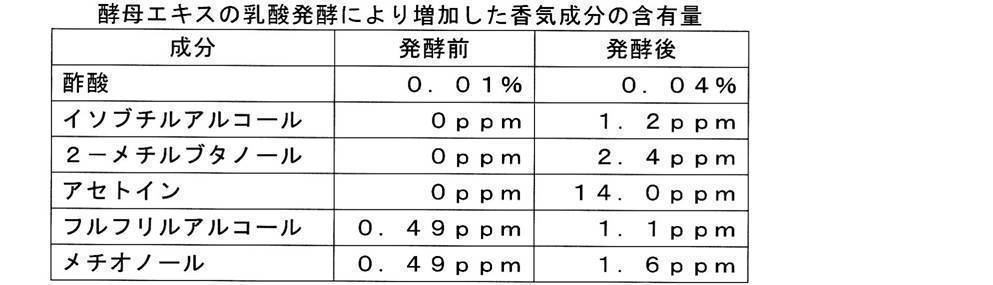
- Fig. 2 shows an enlarged view. From the analysis results, it was found that, in addition to lactic acid, acetic acid, isobutyl alcohol, 2-methylbutanol, acetoin, furfuryl alcohol and methionol were significantly increased in the yeast extract after fermentation as compared with before lactic acid fermentation. Moreover, content was quantified from the peak area of each fragrance component by a calibration curve method using a standard substance. The results are shown in Table 4.
- Example 5 (Taste improvement effect when aroma components that increase due to lactic acid fermentation of yeast extract are added to non-fermented yeast extract)
- Yeast extract (Ohly, Yeast Extract KAV, derived from baker's yeast) is dissolved in distilled water to a concentration of 25 (w / w)% as a solid content, and lactic acid (Wako Pure Chemical Industries, Ltd.) is solidified as yeast extract What was added 20% per minute was prepared.
- lactic acid Waako Pure Chemical Industries, Ltd.
- acetic acid is added at least 0.02 (w / w)%, isobutyl alcohol and 2-methylbutanol are added at least 0.1 ppm, and acetoin, furfuryl alcohol and methionol are added at least 1 ppm to the yeast extract.
- Improved yeast odor and meaty taste were obtained.
- the addition of acetoin, furfuryl alcohol and methionol showed a great effect in improving yeast odor.
- These components increased by lactic acid fermentation were also considered effective in improving the yeast odor of the yeast extract.
- the taste and smell derived from a component became strong and the favorable result was not obtained.
- Example 6 (Sensory evaluation of taste when lactic acid-containing yeast extract is added to consomme soup) A commercially available dried consomme soup (manufactured by Meiji Seika Co., Ltd.) was dissolved in hot water as usual to prepare a consomme soup.
- the lactic acid-containing yeast extract (sample No. 13) obtained by adding the lactic acid obtained in Example 2 or the lactic acid-containing yeast extract (sample No. 24) fermented with lactic acid obtained in Example 3, respectively, What was added so that the solid content of the whole lactic acid containing yeast extract might become a eating concentration of 0.3 (w / w)% was prepared (sample No. 74 and 75).
- a consomme soup (sample No. 73) was prepared so that the solid content of the yeast extract (sample No. 1) containing no lactic acid was 0.3 (w / w)% at the eating concentration.
- sample no. No. 73 got a comment that the evaluation of each evaluation item was low and the yeast odor and bitterness were strong.
- Sample No. 74 is a sample No. in each evaluation item. An evaluation higher than 73 was obtained, and the balance and sustainability of the taste and the meat-like taste were imparted to the consomme soup.
- Sample No. 75 is sample no. More than 74, the balance and sustainability of the taste and the meat-like taste were imparted to the consomme soup, and high evaluation was obtained.
- Example 7 (Sensory evaluation of taste when lactic acid-containing yeast extract is added to mentsuyu)
- lactic acid-containing yeast extract (sample No. 13) obtained by adding lactic acid obtained in Example 2 to commercially available straight noodle soup (manufactured by Kikkoman) or lactic acid fermentation obtained in Example 3 was used.
- the lactic acid-containing yeast extract (sample No. 24) was added so that the solid content of the whole lactic acid-containing yeast extract was 0.6 (w / w)% (sample No. 77).
- added soy sauce (sample No. 76) was prepared so that the solid content of the yeast extract (sample No. 1) containing no lactic acid was 0.6 (w / w)%.
- the sensory evaluation of each sample was performed by a scoring method using a panel of five people, and four items of low yeast odor, balance of taste, sustainability of taste, and dashi feeling were evaluated, and the average is shown in Table 7. Evaluation was performed according to the same criteria as in Example 6. In addition, as the overall evaluation, the evaluation given by the most panels for each sample is shown in Sample No. The relative evaluation based on 76 is shown in Table 7.
- sample no. No. 76 obtained a comment that the evaluation of each evaluation item was low, and yeast odor and bitterness were strong.
- Sample No. 77 is sample No. in each evaluation item. A rating higher than 76 was obtained, and the balance, sustainability and dashi of the taste were imparted to the noodle soup.
- Sample No. 78 is Sample No. More than 77, the taste balance, sustainability, and soup stock were given to the noodle soup, and high evaluation was obtained.
- Example 8 (Sensory evaluation of taste when lactic acid-containing yeast extract is added to beef bowl sauce) Lactic acid-containing yeast extract (sample No. 13) obtained by adding lactic acid obtained in Example 2 to commercially available beef bowl sauce (Morambon) in the same procedure as in Example 6 or lactic acid obtained in Example 3
- a fermented lactic acid-containing yeast extract (sample No. 24) was prepared so that the solid content of the entire lactic acid-containing yeast extract was 0.6% (w / w)% (sample No.). 80 and 81).
- gyudon sauce (sample No. 79) was prepared so that the solid content of the yeast extract (sample No. 1) containing no lactic acid was 0.6 (w / w)%.
- Sensory evaluation of each sample is done by a scoring method using a panel of five people, and for each sample itself, the four items of yeast odor, taste balance, taste persistence, and meaty taste are evaluated and averaged. Is shown in Table 8. Evaluation was performed according to the same criteria as in Example 6. In addition, as the overall evaluation, the evaluation given by the most panels for each sample is the sample number. The relative evaluation based on 79 is shown in Table 8.
- sample No. No. 79 obtained a comment that the evaluation of each evaluation item was low, and yeast odor and bitterness were strong.
- Sample No. 80 is sample No. in each evaluation item. An evaluation higher than 79 was obtained, and the balance and sustainability of the taste and meat-like taste were imparted to the gyudon sauce.
- Sample No. 81 is sample No. More than 80, the taste balance, sustainability and meat-like taste were given to the beef sauce, and high evaluation was obtained, and the comment that the richness and taste of beef seemed to increase was obtained. .
Landscapes
- Life Sciences & Earth Sciences (AREA)
- Health & Medical Sciences (AREA)
- Nutrition Science (AREA)
- Chemical & Material Sciences (AREA)
- Engineering & Computer Science (AREA)
- Food Science & Technology (AREA)
- Polymers & Plastics (AREA)
- Mycology (AREA)
- Microbiology (AREA)
- Seasonings (AREA)
- Coloring Foods And Improving Nutritive Qualities (AREA)
- Seeds, Soups, And Other Foods (AREA)
Abstract
本発明は、酵母特有の異臭(酵母臭)がマスキングまたは低減された、味のバランスと持続性に優れ、肉エキス様の呈味を示す酵母エキスを提供することを目的とする。本発明は、酵母エキス固形分あたり7.5(w/w)%以上の乳酸を含有する、乳酸含有酵母エキスを提供する。また、酵母エキスを、乳酸菌で発酵させて得られる、酵母エキス固形分あたり7.5(w/w)%以上の乳酸を含有する、乳酸含有酵母エキスを提供する。
Description
本発明は、酵母特有の酵母臭がマスキングまたは低減された酵母エキスおよびその製造方法に関する。また、味のバランスと持続性に優れ、肉エキス様の呈味を示す酵母エキスおよびその製造方法に関する。
最近の健康・天然・無添加志向に加え、BSE等、食の安全性に関する問題もあり、天然調味料である酵母エキスへの期待が急速に高まっている。酵母エキスは種々の遊離アミノ酸、有機酸、呈味性5' -ヌクレオチド等を含んでおり、食品にコクや厚みを付与する天然調味料として注目されているが、原料の酵母および培養方法ならびに酵母エキスの製造方法等に依存して生じる酵母特有の異臭(酵母臭)が問題となることがある。
酵母臭の原因物質はその全てが特定されているわけではないが、酵母臭を除去または低く抑えるために種々の方法が試みられている。例えば、活性炭処理によって異臭の原因となる分子を吸着させ、酵母臭を除去する方法(特許文献1)、酵母エキスを酵素によって処理し、脂質成分を遊離させて酵母臭を低減させる方法(特許文献2)等が報告されている。さらに、自己消化を加圧下で行い、逆浸透膜による濃縮およびそれに続くろ過殺菌によって特定の低分子量画分を除去して、呈味性を保持しつつ異臭の少ない酵母エキスを作製する方法(特許文献3)、酵母菌体を高圧処理した後、エンド型プロテアーゼで処理し、次いでエキソ型プロテアーゼを作用させることを特徴とする酵母エキスの製造方法(特許文献4)、ならびに酵素処理によって得た酵母抽出物を疎水性樹脂カラムに通すことによって、酵母エキスの異臭や苦味を除去する方法(非特許文献1)も報告されている。また、酵母エキスの製造方法および種々の問題点に関する従来の試みとして、酸性下で加熱することで酵母臭を除去する方法や、超臨界二酸化炭素を接触させて酵母臭を抽出除去する方法、シクロデキストリンを添加混合して酵母臭をマスクする方法も報告されている(非特許文献2および3)。
月刊フードケミカル、1991-10,p46-51
New Food Industry 1994,Vol.36,N0.10,p41-48
New Food Industry 1994,Vol.36,N0.11,p29-35
しかし、酵母臭を除去または低く抑えるための従来の方法は、十分な効果が得られない、操作が煩雑で経済的でない、衛生上問題がある等の問題があり、酵母エキスの用途や使用量を制約する要因となっている。また、酵母エキスを動物エキスの代替品として用いようとする場合、肉エキス様の風味が足りない、味の持続性が足りないという問題がある。動物由来成分を全く含まずに、肉エキス様の呈味を示し、味の持続性にも優れた、新しいタイプの調味料の開発も求められている。
以上のような背景のもと、本発明は、酵母エキスに含まれる酵母臭を低減およびマスキングすると共に、味のバランスおよび持続性に優れ、動物由来成分を含まずに、肉エキス様の呈味を付与することができる酵母エキスを提供することを目的とする。
本発明者らは上記課題を解決すべく、鋭意研究を行った。その結果、酵母エキスに乳酸を特定量以上添加することで、酵母臭が低減され、味のバランスと持続性に優れ、肉エキス様の呈味が付与された酵母エキスが得られることを見出した。このように乳酸を高濃度で含む酵母エキスはこれまでに報告されていない。また、この酵母エキスのpHを、カリウムを含有する塩基性物質で調整することにより、上記の効果がより増強された酵母エキスが得られることを見出した。さらには、乳酸が、酵母エキスを特定の乳酸菌で、特定量以上の乳酸が得られるまで十分に発酵させて生成されるものである場合には、発酵により各種香気成分も増加し、より一層酵母エキス特有の酵母臭がマスキングされ、味のバランスと持続性に優れ、肉エキス様の呈味がさらに顕著に付与された酵母エキスが得られることを見出し、本発明を完成した。
すなわち、本発明は以下に関する。
(1)酵母エキス固形分あたり7.5(w/w)%以上の乳酸を含有する、乳酸含有酵母エキス。
(2)酵母エキス固形分あたり15(w/w)%以上の乳酸を含有する、上記(1)に記載の乳酸含有酵母エキス。
(3)酢酸 0.02%以上;
イソブチルアルコール 0.1ppm以上;
2-メチルブタノール 0.1ppm以上;
アセトイン 1ppm以上;
フルフリルアルコール 1ppm以上;および
メチオノール 1ppm以上;
からなる群から選択される1または複数の成分をさらに含有する、上記(1)または(2)に記載の乳酸含有酵母エキス。
(4)酵母エキスを、乳酸菌で発酵させて得られる、酵母エキス固形分あたり7.5(w/w)%以上の乳酸を含有する、乳酸含有酵母エキス。
(5)酵母エキス固形分あたり15(w/w)%以上の乳酸を含有する、上記(4)に記載の乳酸含有酵母エキス。
(6)前記乳酸菌が、Lactobacillus plantarum、Lactobacillus pentosus、Leuconostoc mesenteroides subsp. cremoris、Lactobacillus acidophilusまたはLactobacillus delbrueckii subsp. lactisである、上記(4)または(5)に記載の乳酸含有酵母エキス。
(7)pHが4.5~7.0である、上記(1)~(6)のいずれかに記載の乳酸含有酵母エキス。
(8)カリウムを含有するpH調整剤を用いてpH4.5~7.0に調整された、上記(1)~(7)のいずれかに記載の乳酸含有酵母エキス。
(9)上記(1)~(8)のいずれかに記載の乳酸含有酵母エキスを添加した飲食品。
(1)酵母エキス固形分あたり7.5(w/w)%以上の乳酸を含有する、乳酸含有酵母エキス。
(2)酵母エキス固形分あたり15(w/w)%以上の乳酸を含有する、上記(1)に記載の乳酸含有酵母エキス。
(3)酢酸 0.02%以上;
イソブチルアルコール 0.1ppm以上;
2-メチルブタノール 0.1ppm以上;
アセトイン 1ppm以上;
フルフリルアルコール 1ppm以上;および
メチオノール 1ppm以上;
からなる群から選択される1または複数の成分をさらに含有する、上記(1)または(2)に記載の乳酸含有酵母エキス。
(4)酵母エキスを、乳酸菌で発酵させて得られる、酵母エキス固形分あたり7.5(w/w)%以上の乳酸を含有する、乳酸含有酵母エキス。
(5)酵母エキス固形分あたり15(w/w)%以上の乳酸を含有する、上記(4)に記載の乳酸含有酵母エキス。
(6)前記乳酸菌が、Lactobacillus plantarum、Lactobacillus pentosus、Leuconostoc mesenteroides subsp. cremoris、Lactobacillus acidophilusまたはLactobacillus delbrueckii subsp. lactisである、上記(4)または(5)に記載の乳酸含有酵母エキス。
(7)pHが4.5~7.0である、上記(1)~(6)のいずれかに記載の乳酸含有酵母エキス。
(8)カリウムを含有するpH調整剤を用いてpH4.5~7.0に調整された、上記(1)~(7)のいずれかに記載の乳酸含有酵母エキス。
(9)上記(1)~(8)のいずれかに記載の乳酸含有酵母エキスを添加した飲食品。
本発明はまた、以下のものにも関する。
(10)酢酸 0.02%以上;
イソブチルアルコール 0.1ppm以上;
2-メチルブタノール 0.1ppm以上;
アセトイン 1ppm以上;
フルフリルアルコール 1ppm以上;および
メチオノール 1ppm以上;
からなる群から選択される1または複数の成分をさらに含有する、上記(4)または(5)に記載の乳酸含有酵母エキス。
(11)前記乳酸菌が、Lactobacillus plantarumである、上記(4)または(5)に記載の乳酸含有酵母エキス。
(12)pHが5.0~6.0である、上記(7)に記載の乳酸含有酵母エキス。
(13)カリウムを含有するpH調整剤が、水酸化カリウムである、上記(8)に記載の乳酸含有酵母エキス。
(14)酵母エキス固形分あたり15(w/w)%以上30(w/w)%未満の乳酸を含有する、上記(8)に記載の乳酸含有酵母エキス。
(15)カリウム塩を含有する、上記(1)~(7)のいずれかに記載の乳酸含有酵母エキス。
(10)酢酸 0.02%以上;
イソブチルアルコール 0.1ppm以上;
2-メチルブタノール 0.1ppm以上;
アセトイン 1ppm以上;
フルフリルアルコール 1ppm以上;および
メチオノール 1ppm以上;
からなる群から選択される1または複数の成分をさらに含有する、上記(4)または(5)に記載の乳酸含有酵母エキス。
(11)前記乳酸菌が、Lactobacillus plantarumである、上記(4)または(5)に記載の乳酸含有酵母エキス。
(12)pHが5.0~6.0である、上記(7)に記載の乳酸含有酵母エキス。
(13)カリウムを含有するpH調整剤が、水酸化カリウムである、上記(8)に記載の乳酸含有酵母エキス。
(14)酵母エキス固形分あたり15(w/w)%以上30(w/w)%未満の乳酸を含有する、上記(8)に記載の乳酸含有酵母エキス。
(15)カリウム塩を含有する、上記(1)~(7)のいずれかに記載の乳酸含有酵母エキス。
(16)酵母エキスに、酵母エキス固形分あたり7.5(w/w)%以上の乳酸を添加する工程、および
カリウムを含有するpH調整剤を用いて前記酵母エキスのpHをpH4.5~7.0に調整する工程
を含む、乳酸含有酵母エキスの製造方法。
(17)酵母エキスに、酵母エキス固形分あたり7.5(w/w)%以上の乳酸を添加する工程、
前記酵母エキスにカリウム塩を添加する工程、および
前記酵母エキスのpHをpH4.5~7.0に調整する工程
を含む、乳酸含有酵母エキスの製造方法。
(18)前記乳酸を添加する工程が、酵母エキスに、酵母エキス固形分あたり15(w/w)%以上の乳酸を添加する工程である、上記(16)または(17)に記載の乳酸含有酵母エキスの製造方法。
(19)酵母エキス固形分あたり7.5(w/w)%以上の乳酸が生産されるまで、酵母エキスを乳酸菌で発酵させる工程を含む、乳酸含有酵母エキスの製造方法。
(20)前記発酵させる工程が、酵母エキス固形分あたり15(w/w)%以上の乳酸が生産されるまで、酵母エキスを乳酸菌で発酵させる工程である、上記(19)に記載の乳酸含有酵母エキスの製造方法。
(21)酵母エキスを、20~40℃の温度下、48時間以上乳酸菌で発酵させる工程を含む、酵母エキス固形分あたり7.5(w/w)%以上の乳酸を含有する乳酸含有酵母エキスの製造方法。
(22)酵母エキスを、20~40℃の温度下、48時間以上乳酸菌で発酵させる工程を含む、酵母エキス固形分あたり15(w/w)%以上の乳酸を含有する乳酸含有酵母エキスの製造方法。
(23)さらに、カリウムを含有するpH調整剤を用いて前記酵母エキスのpHをpH4.5~7.0に調整する工程を含む、上記(19)~(22)のいずれかに記載の乳酸含有酵母エキスの製造方法。
(24)さらに、前記酵母エキスにカリウム塩を添加する工程、および
前記酵母エキスのpHをpH4.5~7.0に調整する工程を含む、上記(19)~(22)のいずれかに記載の乳酸含有酵母エキスの製造方法。
(25)前記乳酸菌が、Lactobacillus plantarum、Lactobacillus pentosus、Leuconostoc mesenteroides subsp. cremoris、Lactobacillus acidophilusまたはLactobacillus delbrueckii subsp. lactisである、上記(19)~(24)のいずれかに記載の乳酸含有酵母エキスの製造方法。
カリウムを含有するpH調整剤を用いて前記酵母エキスのpHをpH4.5~7.0に調整する工程
を含む、乳酸含有酵母エキスの製造方法。
(17)酵母エキスに、酵母エキス固形分あたり7.5(w/w)%以上の乳酸を添加する工程、
前記酵母エキスにカリウム塩を添加する工程、および
前記酵母エキスのpHをpH4.5~7.0に調整する工程
を含む、乳酸含有酵母エキスの製造方法。
(18)前記乳酸を添加する工程が、酵母エキスに、酵母エキス固形分あたり15(w/w)%以上の乳酸を添加する工程である、上記(16)または(17)に記載の乳酸含有酵母エキスの製造方法。
(19)酵母エキス固形分あたり7.5(w/w)%以上の乳酸が生産されるまで、酵母エキスを乳酸菌で発酵させる工程を含む、乳酸含有酵母エキスの製造方法。
(20)前記発酵させる工程が、酵母エキス固形分あたり15(w/w)%以上の乳酸が生産されるまで、酵母エキスを乳酸菌で発酵させる工程である、上記(19)に記載の乳酸含有酵母エキスの製造方法。
(21)酵母エキスを、20~40℃の温度下、48時間以上乳酸菌で発酵させる工程を含む、酵母エキス固形分あたり7.5(w/w)%以上の乳酸を含有する乳酸含有酵母エキスの製造方法。
(22)酵母エキスを、20~40℃の温度下、48時間以上乳酸菌で発酵させる工程を含む、酵母エキス固形分あたり15(w/w)%以上の乳酸を含有する乳酸含有酵母エキスの製造方法。
(23)さらに、カリウムを含有するpH調整剤を用いて前記酵母エキスのpHをpH4.5~7.0に調整する工程を含む、上記(19)~(22)のいずれかに記載の乳酸含有酵母エキスの製造方法。
(24)さらに、前記酵母エキスにカリウム塩を添加する工程、および
前記酵母エキスのpHをpH4.5~7.0に調整する工程を含む、上記(19)~(22)のいずれかに記載の乳酸含有酵母エキスの製造方法。
(25)前記乳酸菌が、Lactobacillus plantarum、Lactobacillus pentosus、Leuconostoc mesenteroides subsp. cremoris、Lactobacillus acidophilusまたはLactobacillus delbrueckii subsp. lactisである、上記(19)~(24)のいずれかに記載の乳酸含有酵母エキスの製造方法。
本発明により酵母特有の異臭(酵母臭)がマスキングまたは低減され、味のバランスおよび持続性に優れ、動物由来成分を全く含まずに、肉エキス様の呈味が付与された酵母エキスならびにその製造方法が提供される。このような酵母エキスは、各種飲食品の味に肉エキス様のコクや厚みを付与する、新しいタイプの天然調味料として非常に有用である。
本発明に用いる酵母エキスは、ビール酵母、パン酵母またはトルラ酵母などを原料として、公知の方法によりエキスを抽出して製造され、食用、薬用または培地として公知のものであれば特に限定されることなく使用することができる。市販品を用いてもよいし、上記の酵母を原料として公知の方法で製造してもよい。市販品の酵母エキスとしては、バーテックス(富士食品工業社製)、アロマイルド(興人社製)、ミーストS(アサヒフードアンドヘルスケア社製)、コクベース(大日本明治製糖社製)、SK酵母エキス(日本製紙ケミカル社製)、ギステックス(DSM社製)、KAV(Ohly社製)などを使用することができる。とりわけパン酵母を原料とする酵母エキスは、安価かつ安定的に入手できるので好ましい。酵母エキスの形状は特に限定されず、液状、ペースト状、粉体等、いずれも使用することができる。
酵母エキスの製造方法としては、一般に、自己消化法(酵母菌体内に本来あるタンパク質分解酵素等を利用して菌体を可溶化する方法)、酵素分解法(微生物や植物由来の酵素を添加して可溶化する方法)、熱水抽出法(熱水中に一定時間浸漬して可溶化する方法)、酸またはアルカリ分解法(種々の酸またはアルカリを添加して可溶化する方法)、物理的破砕法(超音波処理や、高圧ホモジェナイズ法、グラスビーズ等の固形物と混合して混合・磨砕することにより破砕する方法)、凍結融解法(凍結・融解を1回以上行うことにより破砕する方法)等が知られているが、これらに限定されず、いずれの方法を用いて製造された酵母エキスも用いることができる。自己消化法によって製造された酵母エキスは異臭が問題とされる場合があるので、本発明において酵母臭をマスキングまたは低減する対象として適している。
本発明は、酵母エキスの酵母臭を改善し、味のバランスおよび持続性に優れ、肉エキス様の呈味を有する酵母エキスを得るために、酵母エキス固形分あたり7.5(w/w)%以上の乳酸を含有することを特徴とする。一態様において、酵母エキス固形分あたり、好ましくは15(w/w)%以上、例えば20(w/w)%程度乳酸を含有する。なお、酵母エキスの濃縮度にもよるが、通常酵母エキス固形分あたりの乳酸量が40(w/w)%を超えると、乳酸由来の酸味によって味のバランスが悪い酵母エキスとなるため、乳酸量は酵母エキス固形分あたり40(w/w)%以下であることが好ましい。例えば、本発明の乳酸含有酵母エキスは、酵母エキス固形分あたり、7.5~40(w/w)%、好ましくは15~30(w/w)%の乳酸を含有する。
なお、本発明において、酵母エキス固形分あたりの乳酸含有量とは、酵母エキス中にもともと含まれる乳酸も含めた量をいう。また、例えば粉末状酵母エキスにおいては、粉化助剤としてデキストリンや乳糖等を配合することがあるが、この場合、本発明における酵母エキス固形分とは、粉化助剤等酵母エキス以外の成分に由来する固形分を含まないエキス固形分のことを指す。例えば、粉化助剤が全体の20(w/w)%配合された粉末酵母エキスの乳酸含量が粉末酵母エキス全量に対し10(w/w)%、水分含量が0(w/w)%の場合、酵母エキス固形分あたりの乳酸含量は12.5(w/w)%である。
簡便には、酵母エキスに乳酸を添加することにより、本発明の乳酸含有酵母エキスを得ることができる。添加する乳酸としては、乳酸の他、乳酸カリウム、乳酸ナトリウム、乳酸カルシウムなどの塩類が挙げられるが、特に乳酸および乳酸カリウムが好ましい。塩類を用いた場合、乳酸量に換算して上記の量を添加する。酵母エキス固形分量は、蒸発乾固法により求めることができる。具体的には、酵母エキスに海砂を適量混合し、110℃程度で水分が蒸発するまで加熱し、残った固形物の重量%を測定する。より簡便には、示差屈折計を用いたBrix値で代用することが可能である。一般的には、液状の酵母エキスの酵母エキス固形分は45~65(w/w)%、ペースト状の酵母エキスの酵母エキス固形分は70~95(w/w)%、粉体状の酵母エキスの酵母エキス固形分は50~99(w/w)%である。
上記のような乳酸含有酵母エキスは、さらに、酢酸、イソブチルアルコール、2-メチルブタノール、アセトイン、フルフリルアルコールおよびメチオノールからなる群から選択される一または複数の成分をさらに所望の量含有することで、より一層酵母臭が改善され、味のバランスに優れ、肉エキス様の呈味を有する、好ましい酵母エキスとなる。簡便には、これらの各成分を乳酸含有添加エキスに所望の量添加することにより、各成分を含有する乳酸含有酵母エキスを得ることができる。
酢酸含有量は、酵母エキス固形分あたり0.02%以上2%未満であることが好ましい。酵母エキスの濃縮度にもよるが、通常酢酸含有量が2%以上であると、酢酸由来の酸味によって味のバランスが悪い酵母エキスとなる。添加する酢酸としては、酢酸の他、酢酸カリウム、酢酸ナトリウム、酢酸カルシウムなどの塩類が挙げられるが、特に酢酸および酢酸カリウムが好ましい。また、上記の酢酸またはその塩を含む、食用可能な原料であってもよく、例えば、穀物酢、米酢、果実酢などを使用することができる。
イソブチルアルコール含有量は、酵母エキス固形分あたり少なくとも0.1ppm以上100ppm未満であることが好ましい。酵母エキスの濃縮度にもよるが、通常イソブチルアルコール含有量が100ppm以上であると、イソブチルアルコール由来の香りが強くなることによって、味のバランスが悪い酵母エキスとなる。添加するイソブチルアルコールは、市販されている純品のほか、イソブチルアルコールを含む食用可能な原料(例えば、香料等)であってもよい。
2-メチルブタノール含有量は、酵母エキス固形分あたり少なくとも0.1ppm以上100ppm未満であることが好ましい。酵母エキスの濃縮度にもよるが、通常2-メチルブタノール含有量が100ppm以上であると、2-メチルブタノール由来の香りが強くなることによって、味のバランスが悪い酵母エキスとなる。添加する2-メチルブタノールは、市販されている純品のほか、2-メチルブタノールを含む食用可能な原料(例えば、香料等)であってもよい。
アセトイン含有量は、酵母エキス固形分あたり少なくとも1ppm以上10000ppm未満であることが好ましい。酵母エキスの濃縮度にもよるが、通常アセトイン含有量が10000ppm以上であると、味のバランスが悪い酵母エキスとなる。添加するアセトインは、市販されている純品のほか、アセトインを含む食用可能な原料(例えばヨーグルト、香料等)であってもよい。
フルフリルアルコール含有量は、酵母エキス固形分あたり少なくとも1ppm以上1000ppm未満であることが好ましい。酵母エキスの濃縮度にもよるが、通常フルフリルアルコール含有量が1000ppm以上であると、味のバランスが悪い酵母エキスとなる。添加するフルフリルアルコールは、市販されている純品のほか、フルフリルアルコールを含む食用可能な原料(例えば、香料等)であってもよい。
メチオノール含有量は、酵母エキス固形分あたり少なくとも1ppm以上1000ppm未満であることが好ましい。酵母エキスの濃縮度にもよるが、通常メチオノール含有量が1000ppm以上であると、発酵臭が強くなりすぎることによって味のバランスが悪い酵母エキスとなる。添加するメチオノールは、市販されている純品のほか、メチオノールを含む食用可能な原料(例えば、香料等)であってもよい。
本発明の乳酸含有酵母エキスは、乳酸を含有し、さらに所望により上述したような他の成分の1以上を含有する。これらの成分は、上述したように、それぞれを個別に酵母エキスに添加してもよく、また、酵母エキスを培地として微生物を培養することにより上記の各成分を所望の量微生物に生産させ、培養後の培地を、各成分を含有する酵母エキスとすることもできる。なお、上記各成分の酵母エキス固形分あたりの含有量とは、乳酸含有量について上述したのと同様に、酵母エキス中にもともと含まれる含有量も含めた量をいう。また、例えば粉末状酵母エキスにおいては、粉化助剤としてデキストリンや乳糖等を配合することがあるが、本発明における酵母エキス固形分とは、粉化助剤等酵母エキス以外の成分に由来する固形分を含まないエキス固形分のことを指す。
例えば、酵母エキスを乳酸菌で発酵させることにより、乳酸菌によって乳酸が生産される。酵母エキス固形分あたりの乳酸量が7.5(w/w)%以上となるまで十分に発酵後、本発明の乳酸含有酵母エキスを得ることができる。
酵母エキスを乳酸菌で発酵させる際に、乳酸菌を接種する培養液としては、酵母エキスと水を主成分として含有する発酵前液、または酵母エキス、糖源および水を主成分として含有する発酵前液を使用することが好ましい。すなわち、本発明の一態様において、乳酸発酵により乳酸含有酵母エキスを得る際に、上記のような簡易な構成からなる発酵前液を使用すればよいので、安価かつ簡便に乳酸含有酵母エキスを得ることができる。当然のことながら、上記の培地には、窒素源、糖以外の炭素源、各種無機イオン、ビタミン類、抗生物質等、通常乳酸菌の発酵の際に培地に添加され得る各種成分を添加してもよい。なお、乳酸菌で酵母エキスを発酵させる場合においては、乳酸菌の種類等にもよるが、生育を良好に行わせるために、塩の含量が少ない培養液を使用してもよい。
簡便には、原料となる酵母エキスを固形分として5~40重量%程度、好ましくは20~30重量%含むよう、酵母エキスを水等で希釈して発酵前液を調製する。発酵前液に糖源を添加する場合、乳酸菌が資化可能な糖源を、培養開始時の濃度が2~6重量%程度、好ましくは3~4重量%程度となるように添加する。
なお、前記発酵前液に添加される糖源は、乳酸菌が資化できるものであれば特に限定されず、例えば、グルコース、スクロース、フルクトース、ラクトース、ガラクトース、マルトース等が挙げられ、これらを含有する液糖類、果汁類、野菜類、蜂蜜などであってもよい。これらの中でも、乳酸菌の発酵性からみて、グルコースまたはグルコースを含む液糖類が好ましい。これら糖源は、単独または組み合わせて添加することができる。
前記発酵前液の各成分を均一に溶解した後、該発酵前液を加熱殺菌し、次いで冷却後、乳酸菌を接種する。加熱殺菌は通常70~130℃で行われ、冷却は通常25~35℃になるまで行われる。殺菌前にpH調整剤を用いて、発酵に適したpH、好ましくはpH5.0~7.0に調整することもできる。pH調整剤としては水酸化カリウム、水酸化ナトリウム、炭酸ナトリウム、リン酸水素二カリウム、リン酸三カリウム、炭酸カリウムなどを用いることができるが、後述するように、カリウム塩を添加することにより一層味のバランス等に優れた酵母エキスが得られるため、特に水酸化カリウムが好ましい。
発酵に用いる乳酸菌は、酵母エキスを含む培地で乳酸生産能を有する限り特に限定されないが、例えばLactobacillus属またはLeuconostoc属に属する微生物であり、酵母エキス中の酵母臭のマスキングおよび低減効果という観点から、具体的にはLactobacillus plantarum、Lactobacillus pentosus、Leuconostoc mesenteroides subsp. cremoris、Lactobacillus acidophilus、Lactobacillus delbrueckii subsp. lactisなどが好ましく、発酵による乳酸等の生産量や酵母臭のマスキングおよび低減効果という観点からLactobacillus plantarumが特に好ましい。これらの乳酸菌は単独または任意の組み合わせで用いることができる。
発酵は、例えば、スターターを発酵前液に対し0.0001~1重量%程度接種し、定法に従って行う。スターターは、発酵に用いる乳酸菌を、公知の培地を用いて定法に従って培養して調製することができる。発酵温度は、菌種によっても多少異なるが、20~40℃程度であり、乳酸を効率よく生産させるという観点から好ましくは25~35℃程度であり、特に好ましくは30℃付近で培養する。通常、静置発酵で行われるが、発酵液の温度分布を均一化する目的や菌体の沈殿を制御する目的で緩慢な攪拌を行ってもよい。発酵中、乳酸生産に伴ってpHが低下するため、上記のpH調整剤を用いてpHを5.0~7.0程度に維持しながら培養してもよい。培養は好気培養、嫌気培養のいずれでもよい。
発酵時間は酵母エキスの濃度やその他配合成分に応じて適宜設定することができ、所望の量の乳酸が生産される限り特に限定されないが、通常48~150時間、好ましくは96~144時間、さらに好ましくは120~144時間である。生成する乳酸量を目安に、最終的に得ようとする乳酸含有酵母エキスとして適した発酵液となるように、発酵の終点を適宜定めることができる。乳酸量は、定法に従って、例えば、乳酸オキシダーゼまたは乳酸デヒドロゲナーゼを用いた酵素電極法や、液体クロマトグラフ法により定量することができる。一例において、培地中の酵母エキス固形分量が25(w/w)%程度の場合、生産される乳酸により、培地のpHが3.5~4.5程度となった時点で発酵を終了することができる。発酵の終点の決定に際しては、乳酸菌発酵によって生成される乳酸以外の成分の量も考慮することができる。
上記のように酵母エキスを乳酸菌で発酵させて得られた乳酸含有酵母エキスは、乳酸以外にも、用いる乳酸菌の種類によっては、酢酸、イソブチルアルコール、2-メチルブタノール、アセトイン、フルフリルアルコールおよびメチオノールからなる群から選択される1以上の成分が発酵により増加した酵母エキスとなり、酵母臭がさらにマスキングまたは低減され、味のバランスおよび持続性に優れ、また、肉エキス様の呈味がさらに増強された、各種食品用の原料や天然調味料として好適な乳酸含有酵母エキスとなり得る。これらの成分が生成されているかは、定法に従って、例えばガスクロマトグラフ法により定量することで確認することができる。
乳酸菌以外の菌を酵母エキスで培養することにより、酢酸、イソブチルアルコール、2-メチルブタノール、アセトイン、フルフリルアルコールおよびメチオノールからなる群から選択される1以上の成分が増加した酵母エキスを得ることもできる。このような菌としては、上記の各成分のいずれかの生産能を有する菌であれば特に限定されず、好ましくは培養物が食用可能な菌である。用いる菌に応じて適宜培地および培養条件を選択して培養することができる。
上記のように、乳酸を添加することによって、または乳酸菌の発酵によって得られた乳酸含有酵母エキスを、食品製造に使用可能な任意のpH調整剤でpH調整することにより、さらに酵母臭が改善され、味のバランスおよび持続性に優れ、肉エキス様の呈味が増強した酵母エキスを得ることができる。調整後のpHは4.5~7.0が好ましく、pH4.5~6.0がより好ましい。pHが低すぎると、酸味が強くなり、逆に高すぎると苦味が感じられるようになり、酵母エキスの品質が低下する。
また、上記の乳酸含有酵母エキスにカリウム塩を添加することにより、より一層味のバランスおよび持続性に優れ、肉エキス様の呈味が増強した酵母エキスを得ることができる。ナトリウム塩では味の持続性や肉エキス様の呈味が充分でなく、カルシウム塩、マグネシウム塩では苦味・異味が生じる場合がある。カリウム塩としては、食品製造に使用可能なものであれば限定されないが、水酸化カリウム、塩化カリウム、炭酸カリウム、リン酸水素二カリウム、リン酸三カリウムなどが挙げられ、いずれも単独または組み合わせて用いることができる。特に味のバランスや味の持続性を改善し、肉エキス様の呈味を付与するという観点および汎用性の観点から、水酸化カリウムが好ましい。カリウム塩添加後の酵母エキスのpHが上記の範囲であることが望ましい。
なお、上記のpH調整剤として、カリウムを含有するpH調整剤を用いれば、上述の好ましい酵母エキスをより一層簡便に得ることができる。
本発明の乳酸含有酵母エキスは、所望により、固形分濃度を高めるために濃縮してもよい。濃縮方法は特に限定されるものではなく、例えば、常圧加熱濃縮、減圧加熱濃縮、冷凍濃縮等の公知の濃縮方法が採用できる。さらに、乾燥処理することにより、乳酸含有量が高く、取り扱いの容易な粉末状酵母エキスを得ることもできる。乾燥処理する方法は、特に限定されるものではなく、例えば、凍結乾燥法、スプレードライ法、ドラムドライ法等の公知の乾燥酵母エキス調製方法が採用できる。
上述のように濃縮または粉末化した酵母エキスのpHは、濃縮または粉末化前の液体の状態で測定したpHで判断することができる。また、濃縮または粉末化した酵母エキスを、例えば酵母エキス固形分が25(w/w)%程度になるよう蒸留水に溶解して測定したpHで判断することもできる。
本発明の乳酸含有酵母エキスは、通常の酵母エキスと同様の使い方ができ、そのまま、または濃縮・乾燥等の加工後、任意の飲食品に配合することができる。乳酸菌等を発酵させて得られた乳酸含有酵母エキスの場合、乳酸菌は酵母エキスに含まれたままであってもよいし、使用目的に応じて単離してもよい。例えば、野菜、果実、穀物等の加工品を含む農産加工食品、魚介類、海藻等の加工品を含む水産加工食品、卵・乳製品等の加工品を含む畜産加工食品等に使用することができる。また、和風だし、洋風だし、中華だし、つゆ、たれ、スープ、ソース、ドレッシング等の調味料に添加して用いることもできる。これら飲食品に配合された場合にも、酵母臭がマスキングされ、香味の点で従来の酵母エキスより優れた効果を発揮する。例えば、味のバランス・持続性を向上させたり、肉エキス様の呈味(肉様の呈味、だし感等)を増強したりすることが可能である。さらに、ビーフエキス、チキンエキスなどの動物性エキスの代替品として用いることにより、同等の呈味を有しながら、コストを下げ、また、動物由来成分を全く使用せずに肉エキス様の呈味(肉様の呈味、だし感等。特に肉様の呈味)を付与することも可能である。配合する最適な濃度は最終製品により異なるが、通常の酵母エキスと同様に使用することが好ましい。また、従来の酵母エキスよりも著しく味の持続性に優れ、肉エキス様の呈味が強いことから、より少ない配合量でも従来の酵母エキスと同等の効果が得られる。
次に、実施例によって本発明をさらに具体的に説明するが、本発明の範囲は以下の実施例により何ら限定されず、その要旨の範囲内で種々変形して実施することができる。
[実施例1]
(酵母エキスへ乳酸を添加したときの呈味の官能評価)
酵母エキス(Ohly社製、Yeast Extract KAV、パン酵母由来)を固形分として25(w/w)%の濃度となるよう蒸留水に溶解し、乳酸(和光純薬工業社製)を酵母エキス固形分あたり0、5、7.5、10、15、20、30または40%添加したものを調製した。酵母エキス固形分量は、蒸発乾固法により求めた。具体的には、酵母エキスに海砂を適量混合し、110℃程度で水分が蒸発するまで加熱し、残った固形物の重量%を測定した。
(酵母エキスへ乳酸を添加したときの呈味の官能評価)
酵母エキス(Ohly社製、Yeast Extract KAV、パン酵母由来)を固形分として25(w/w)%の濃度となるよう蒸留水に溶解し、乳酸(和光純薬工業社製)を酵母エキス固形分あたり0、5、7.5、10、15、20、30または40%添加したものを調製した。酵母エキス固形分量は、蒸発乾固法により求めた。具体的には、酵母エキスに海砂を適量混合し、110℃程度で水分が蒸発するまで加熱し、残った固形物の重量%を測定した。
各サンプルの官能評価は5名のパネルによる評点法で行い、酵母臭・味のバランス・味の持続性・肉様の呈味の4つの項目を評価し、平均を表1に示した。また、総合評価として各サンプルについて最も多くのパネルが与えた評価を表1示した。評価は下記の基準に従い、乳酸無添加の酵母エキスを基準に行った。
(各項目)
1:感じられない
2:ごくわずかに感じる
3:わずかに感じる
4:感じる
5:強く感じる
(総合評価)
◎:とても好ましい
○:好ましい
△:やや好ましくない
×:好ましくない
(各項目)
1:感じられない
2:ごくわずかに感じる
3:わずかに感じる
4:感じる
5:強く感じる
(総合評価)
◎:とても好ましい
○:好ましい
△:やや好ましくない
×:好ましくない

表1の結果から、酵母エキスは、乳酸添加量が0および5%の場合、各評価項目の評価は低く、苦味が感じられるというコメントを得た。また、酵母エキスに7.5~40%の乳酸を添加した場合、味のバランスや持続性が付与され、肉様の呈味を有する酵母エキスが得られることがわかった。特に乳酸添加量が15~30%の場合には、各項目のいずれも評価が高かった。なお、表1には示していないが、乳酸量が40%を超える場合は、強い酸味が感じられ味のバランスが悪いというコメントを得た。
[実施例2]
(乳酸添加酵母エキスに各種pH調整剤を添加したときの呈味の官能評価)
酵母エキス(実施例1と同様)を固形分として25(w/w)%となるよう水に溶解し、乳酸(和光純薬工業社製)をpHが4.0となるように加え(酵母エキス固形分あたりの乳酸量25%)、pH調整剤として水酸化カリウムを用いてpHを4.5、5.0、6.0、7.0または8.0に調整した。さらに乳酸を加えてpH3.5に調製したサンプルも作成した(酵母エキス固形分あたりの乳酸量44%)。また、リン酸水素カリウム、リン酸三カリウム、炭酸カリウムまたは水酸化ナトリウムを用いて、それぞれpHを6.0に調整したサンプルを作製した。なお、pH6.0に調整する際の水酸化カリウムの添加量は酵母エキス全量に対し2.2w/w%であり、pH4.5、5.0または6.0に調整する際の水酸化カリウムの添加量から換算したカリウム量は、それぞれ酵母エキス全量に対し0.23w/w%、0.91w/w%または1.54w/w%であった。
(乳酸添加酵母エキスに各種pH調整剤を添加したときの呈味の官能評価)
酵母エキス(実施例1と同様)を固形分として25(w/w)%となるよう水に溶解し、乳酸(和光純薬工業社製)をpHが4.0となるように加え(酵母エキス固形分あたりの乳酸量25%)、pH調整剤として水酸化カリウムを用いてpHを4.5、5.0、6.0、7.0または8.0に調整した。さらに乳酸を加えてpH3.5に調製したサンプルも作成した(酵母エキス固形分あたりの乳酸量44%)。また、リン酸水素カリウム、リン酸三カリウム、炭酸カリウムまたは水酸化ナトリウムを用いて、それぞれpHを6.0に調整したサンプルを作製した。なお、pH6.0に調整する際の水酸化カリウムの添加量は酵母エキス全量に対し2.2w/w%であり、pH4.5、5.0または6.0に調整する際の水酸化カリウムの添加量から換算したカリウム量は、それぞれ酵母エキス全量に対し0.23w/w%、0.91w/w%または1.54w/w%であった。
該サンプルの官能評価は実施例1と同様に、乳酸無添加の酵母エキスを基準に行った。結果を表2に示す。
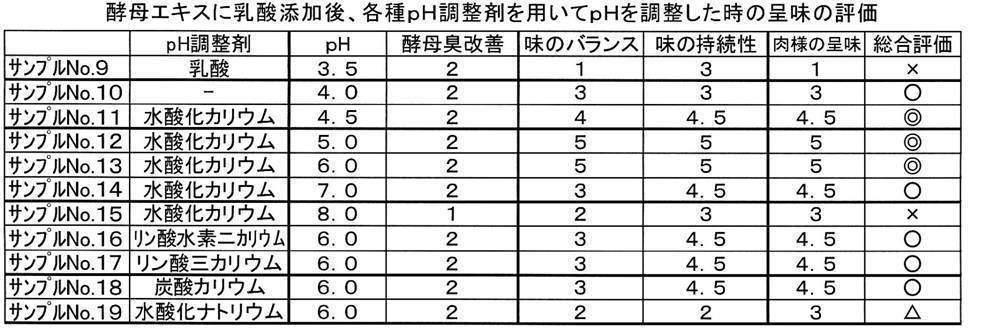
表2の結果から、pH調整剤として水酸化カリウムを用いてpH4.5~7.0に調整したサンプルNo.11、12、13および14では、味のバランス、持続性、肉様の呈味等で高い評価が得られた。pH4.5~6.0に調整したサンプルNo.11,12および13では特に高評価であった。一方、pHを3.5または8.0に調整したサンプルNo.9および15では顕著な改善は見られなかった。
pHを3.5に調整したサンプルNo.9は、味のバランスが悪く、乳酸による酸味が強く感じられるというコメントを得た。pHが4.0~7.0に調整したサンプルNo.10、11,12,13および14では味のバランスがよく、肉様の呈味が良好に感じられる酵母エキスが得られた。pHが8.0に調製したサンプルNo.15は味のバランスが悪く、苦味が感じられるというコメントを得た。
乳酸を添加した酵母エキスを水酸化ナトリウムでpH調整したサンプルNo.19は味のバランスや持続性の改善が足りず、肉様の呈味も弱かった。一方で、カリウム塩を用いてpH調整したサンプルNo.13、16,17および18では、酵母臭が改善し、味のバランスや持続性に優れ、肉様の呈味を有する酵母エキスが得られた。特に水酸化カリウムを用いた場合が最も評価が高かった。
[実施例3]
(酵母エキスの乳酸発酵条件と官能評価)
酵母エキス(実施例1と同様)を固形分として25(w/w)%となるよう水に溶解し、ブドウ糖果糖液糖(昭和産業社製、商品名「NF42(ニューフラクトR─O)」)を4(w/w)%加え発酵前液を作成した。その発酵前液を表3に示す様々な乳酸菌種を発酵初発の菌数が1.0×106cfu/mLとなるように添加し、各種発酵温度、乳酸菌種および発酵時間で発酵させ、pHが4.0~5.5となった発酵液に水酸化カリウムを添加し、pHを6.0に調整したものを作製した。
(酵母エキスの乳酸発酵条件と官能評価)
酵母エキス(実施例1と同様)を固形分として25(w/w)%となるよう水に溶解し、ブドウ糖果糖液糖(昭和産業社製、商品名「NF42(ニューフラクトR─O)」)を4(w/w)%加え発酵前液を作成した。その発酵前液を表3に示す様々な乳酸菌種を発酵初発の菌数が1.0×106cfu/mLとなるように添加し、各種発酵温度、乳酸菌種および発酵時間で発酵させ、pHが4.0~5.5となった発酵液に水酸化カリウムを添加し、pHを6.0に調整したものを作製した。
表3に示すように、上記乳酸菌として、Lactobacillus plantarum(FERM P-21349)、Leuconostoc mesenteroides subsp. cremoris(NRIC1538)、Lactobacillus pentosus(NRIC1069)、Lactobacillus acidophilus(YO-MIXLYO50)、Lactobacillus delbrueckii subsp. lactis(NRIC1683)、Lactobacillus delbrueckii subsp. bulgaricus(NRIC1041)、Lactobacillus brevis(NRIC1038)、Lactobacillus casei(NRIC0644)、Lactobacillus buchneri(NRIC1040)、Weissella paramesenteroides(NRIC1542)、Lactobacillus helveticus(NRIC1545)、Leuconostoc mesenteroides subsp. mesenteroides(NRIC1542)、Lactobacillus sakei(NRIC1071)およびLeuconostoc mesenteroides subsp. dextranicum(NRIC1539)を用いた。
また、表3に示すように、発酵温度は10、20、30または40℃においてLactobacillus plantarumで発酵させたものを作製した。発酵時間は24、48、96、120または144時間、Lactobacillus plantarumを30℃で発酵させたものを作製した。酵母エキス発酵液の酵母エキス固形分あたりの乳酸量は、各サンプルについて遠心分離により不溶性分を除いた後、蒸留水で100倍希釈し、バイオセンサーBF-5(王子計測製、酵素電極法)を用いて、L乳酸およびD乳酸を測定し、それらの合計から求めた。
各サンプルの官能評価は実施例1と同様に行った。評価は下記の基準に従い、乳酸無添加の酵母エキスを基準に行った。
(各項目)
1:感じられない
2:ごくわずかに感じる
3:わずかに感じる
4:感じる
5:強く感じる
(総合評価)
◎:とても好ましい
○:好ましい
△:やや好ましくない
×:好ましくない
(各項目)
1:感じられない
2:ごくわずかに感じる
3:わずかに感じる
4:感じる
5:強く感じる
(総合評価)
◎:とても好ましい
○:好ましい
△:やや好ましくない
×:好ましくない
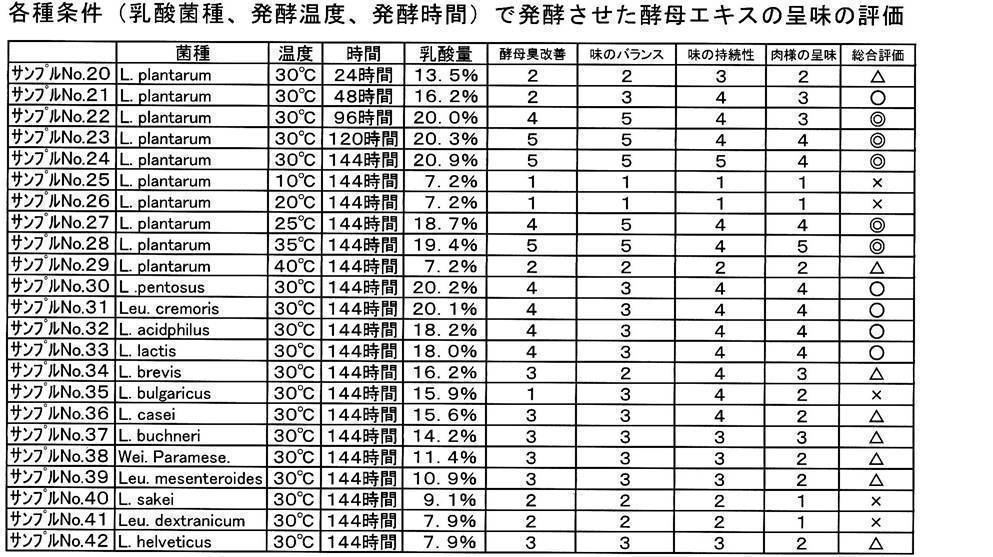
表3の結果から、発酵時間および乳酸量について、サンプルNo.22,23および24では酵母臭が改善し、味のバランスや持続性が付与され、肉様の呈味を有していたが、サンプルNo.20では顕著な効果は見られなかった。発酵時間は、乳酸発酵による乳酸生成量の観点から好ましくは48時間以上であり、より好ましくは96時間以上での発酵で、酵母臭が顕著に改善し、味のバランスや持続性に優れ、肉様の呈味を有する酵母エキスが得られた。
発酵温度は25℃、30℃および35℃(サンプルNo.27、24および28)で十分に乳酸が生産され、酵母臭が改善し、味のバランスや持続性が付与され、肉様の呈味を有する酵母エキスが得られ、特に30℃(サンプル24)では最も良好な結果が得られた。それに対し、発酵温度が10℃、20℃および40℃(サンプルNo.25,26および29)では発酵が進まず、良好な結果は得られなかった。発酵温度は、乳酸菌の増殖や乳酸生成量の観点から、25~35℃が好ましく、中でも30℃が最も好ましいと考えられた。
発酵に用いる乳酸菌種としてはサンプルNo.24,30,31,32および33の結果から、Lactobacillus plantarum、Lactobacillus pentosus、Leuconostoc mesenteroides subsp. cremoris、Lactobacillus acidophilus、Lactobacillus delbrueckii subsp. lactisなどが、酵母エキスの酵母臭低減および呈味改善のために好適に用いることができ、これらの中でも、発酵による乳酸の生産量や酵母臭の改善という点でサンプルNo.24のLactobacillus plantarumが特に好ましいと考えられた。用いる乳酸菌種によっては、例えばLactobacillus delbrueckii subsp. bulgaricusのように、発酵による乳酸の生産量は多くても、酵母エキスの評価が低いものもあり、他の発酵生成物が酵母エキスの評価に影響したと考えられた。
また、酵母エキスを乳酸発酵させることによって、実施例1のように単に乳酸を添加した酵母エキス、または、実施例2のように乳酸を添加しカリウム塩等でpHを調整した酵母エキスと比べ、驚くべきことに特に酵母臭のさらなる改善が認められた。
また、酵母エキスを乳酸発酵させることによって、実施例1のように単に乳酸を添加した酵母エキス、または、実施例2のように乳酸を添加しカリウム塩等でpHを調整した酵母エキスと比べ、驚くべきことに特に酵母臭のさらなる改善が認められた。
[実施例4]
(乳酸発酵前後の酵母エキスのGC-MS分析)
上記実施例3、サンプルNo.24で得られた乳酸発酵酵母エキス5mlをスクリューキャップ付試験管に移し、食塩2g、ジエチルエーテル2ml、内部標準液(n-pentanol 20ppm/サンプル)を入れた。10分振盪後、3000rpm、5℃で10分間遠心し、上澄み液をバイアルへ入れ、ガスクロマトグラフィー・マススペクトロメトリー(アジレント・テクノロジーズ社製7890C)による分析を行った。
(乳酸発酵前後の酵母エキスのGC-MS分析)
上記実施例3、サンプルNo.24で得られた乳酸発酵酵母エキス5mlをスクリューキャップ付試験管に移し、食塩2g、ジエチルエーテル2ml、内部標準液(n-pentanol 20ppm/サンプル)を入れた。10分振盪後、3000rpm、5℃で10分間遠心し、上澄み液をバイアルへ入れ、ガスクロマトグラフィー・マススペクトロメトリー(アジレント・テクノロジーズ社製7890C)による分析を行った。
酵母エキスの乳酸発酵前後のトータルイオンクロマトグラムを図1に、その拡大図を図2に示す。分析結果より乳酸発酵前と比較して発酵後の酵母エキスでは、乳酸のほか、酢酸、イソブチルアルコール、2-メチルブタノール、アセトイン、フルフリルアルコールおよびメチオノールが顕著に増加していることがわかった。また、標準物質を用いた検量線法により、各香気成分のピーク面積から含有量を定量した。その結果を表4に示す。
[実施例5]
(酵母エキスの乳酸発酵により増加する香気成分を非発酵酵母エキスへと添加したときの呈味改善効果)
酵母エキス(Ohly社製、Yeast Extract KAV、パン酵母由来)を固形分として25(w/w)%の濃度となるよう蒸留水に溶解し、乳酸(和光純薬工業社製)を酵母エキス固形分あたり20%添加したものを調製した。その調製液に実施例4で発酵前後に変化が見られた各成分を添加し、サンプルを作製した。官能評価は実施例1と同様に行ったが、「味の持続性」については香気成分の添加による明確な変化が認められなかったため、結果から除外した。評価は下記の基準に従い、乳酸無添加の酵母エキスを基準に行った。結果を表5に示す。なお、表5に示した濃度は、酵母エキス固形分あたりの各成分の濃度である。
(各項目)
1:感じられない
2:ごくわずかに感じる
3:わずかに感じる
4:感じる
5:強く感じる
(総合評価)
◎:とても好ましい
○:好ましい
△:やや好ましくない
×:好ましくない
(酵母エキスの乳酸発酵により増加する香気成分を非発酵酵母エキスへと添加したときの呈味改善効果)
酵母エキス(Ohly社製、Yeast Extract KAV、パン酵母由来)を固形分として25(w/w)%の濃度となるよう蒸留水に溶解し、乳酸(和光純薬工業社製)を酵母エキス固形分あたり20%添加したものを調製した。その調製液に実施例4で発酵前後に変化が見られた各成分を添加し、サンプルを作製した。官能評価は実施例1と同様に行ったが、「味の持続性」については香気成分の添加による明確な変化が認められなかったため、結果から除外した。評価は下記の基準に従い、乳酸無添加の酵母エキスを基準に行った。結果を表5に示す。なお、表5に示した濃度は、酵母エキス固形分あたりの各成分の濃度である。
(各項目)
1:感じられない
2:ごくわずかに感じる
3:わずかに感じる
4:感じる
5:強く感じる
(総合評価)
◎:とても好ましい
○:好ましい
△:やや好ましくない
×:好ましくない
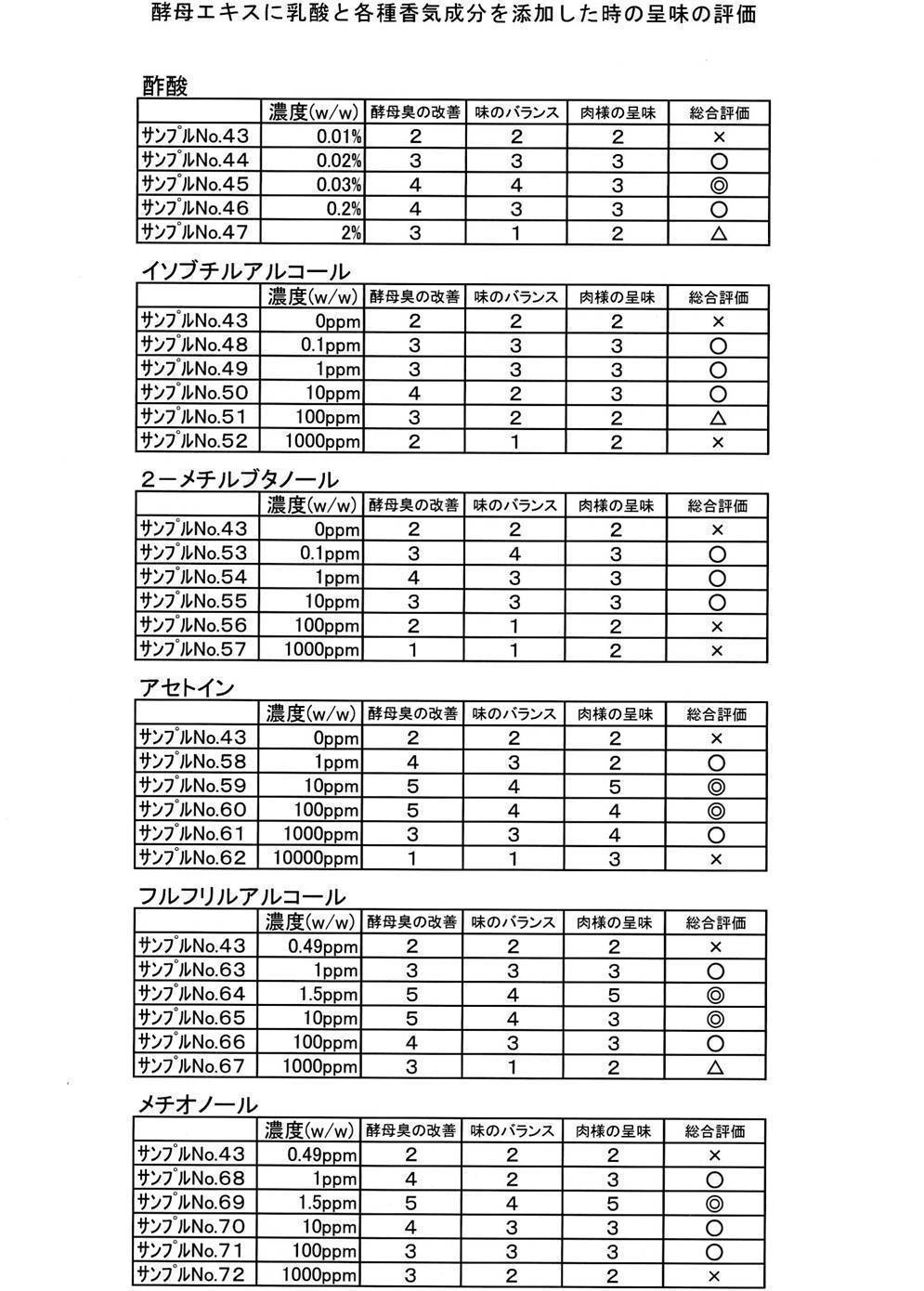
表5の結果から、酢酸は少なくとも0.02(w/w)%、イソブチルアルコールと2-メチルブタノールは少なくとも0.1ppm、アセトインとフルフリルアルコールとメチオノールは少なくとも1ppmを酵母エキスに添加することにより、酵母臭の改善や肉様の呈味が得られた。特に、アセトイン、フルフリルアルコールおよびメチオノールの添加が酵母臭の改善に大きな効果を示した。乳酸発酵で増加するこれらの成分も、酵母エキスの酵母臭の改善に効果があると考えられた。また、乳酸発酵によりこれらの成分を増加させる場合には、これらの成分が所望の量まで増加するまで十分に発酵を行うことが、良好な酵母エキスを得るために望ましいと考えられた。なお、いずれの成分も、添加量が多すぎると成分由来の味や臭いが強くなり、良好な結果が得られなかった。
[実施例6]
(コンソメスープへ乳酸含有酵母エキスを添加したときの呈味の官能評価)
市販の乾燥コンソメスープ(明治製菓社製)を通常喫食するとおりお湯に溶解してコンソメスープを作成した。このコンソメスープに、実施例2で得た乳酸を添加した乳酸含有酵母エキス(サンプルNo.13)または実施例3で得た乳酸発酵させた乳酸含有酵母エキス(サンプルNo.24)を、それぞれ、乳酸含有酵母エキス全体の固形分が喫食濃度0.3(w/w)%になるように添加したものを調製した(サンプルNo.74および75)。対照として、乳酸を含有しない酵母エキス(サンプルNo.1)の固形分が喫食濃度0.3(w/w)%になるように添加したコンソメスープ(サンプルNo.73)を作成した。
(コンソメスープへ乳酸含有酵母エキスを添加したときの呈味の官能評価)
市販の乾燥コンソメスープ(明治製菓社製)を通常喫食するとおりお湯に溶解してコンソメスープを作成した。このコンソメスープに、実施例2で得た乳酸を添加した乳酸含有酵母エキス(サンプルNo.13)または実施例3で得た乳酸発酵させた乳酸含有酵母エキス(サンプルNo.24)を、それぞれ、乳酸含有酵母エキス全体の固形分が喫食濃度0.3(w/w)%になるように添加したものを調製した(サンプルNo.74および75)。対照として、乳酸を含有しない酵母エキス(サンプルNo.1)の固形分が喫食濃度0.3(w/w)%になるように添加したコンソメスープ(サンプルNo.73)を作成した。
各サンプルの官能評価は5名のパネルによる評点法で行い、酵母臭の少なさ・味のバランス・味の持続性・肉様の呈味の4つの項目を評価し、平均を表6に示した。評価は下記の基準に従い、実施例1と同様に行った。また、総合評価として各サンプルについて最も多くのパネルが与えた評価を、サンプルNo.73を基準にした相対評価で表6に示した。
(各項目)
1:感じられない
2:ごくわずかに感じる
3:わずかに感じる
4:感じる
5:強く感じる
(総合評価)
◎:とても好ましい
○:好ましい
△:やや好ましくない
×:好ましくない
(各項目)
1:感じられない
2:ごくわずかに感じる
3:わずかに感じる
4:感じる
5:強く感じる
(総合評価)
◎:とても好ましい
○:好ましい
△:やや好ましくない
×:好ましくない

表6の結果から、サンプルNo.73は、各評価項目の評価は低く、酵母臭や苦味が強いといったコメントを得た。また、サンプルNo.74は、各評価項目においていずれもサンプルNo.73よりも高い評価が得られ、味のバランスや持続性、肉様の呈味がコンソメスープに付与された。サンプルNo.75はサンプルNo.74よりも更に、味のバランスや持続性、肉様の呈味がコンソメスープに付与され、高い評価が得られた。
[実施例7]
(めんつゆへ乳酸含有酵母エキスを添加したときの呈味の官能評価)
実施例6と同様の手順で、市販のストレートめんつゆ(キッコーマン社製)に、実施例2で得た乳酸を添加した乳酸含有酵母エキス(サンプルNo.13)または実施例3で得た乳酸発酵させた乳酸含有酵母エキス(サンプルNo.24)を、それぞれ、乳酸含有酵母エキス全体の固形分が喫食濃度0.6(w/w)%になるように添加したものを調製した(サンプルNo.77および78)。対照として、乳酸を含有しない酵母エキス(サンプルNo.1)の固形分が喫食濃度0.6(w/w)%になるように添加しためんつゆ(サンプルNo.76)を作成した。
(めんつゆへ乳酸含有酵母エキスを添加したときの呈味の官能評価)
実施例6と同様の手順で、市販のストレートめんつゆ(キッコーマン社製)に、実施例2で得た乳酸を添加した乳酸含有酵母エキス(サンプルNo.13)または実施例3で得た乳酸発酵させた乳酸含有酵母エキス(サンプルNo.24)を、それぞれ、乳酸含有酵母エキス全体の固形分が喫食濃度0.6(w/w)%になるように添加したものを調製した(サンプルNo.77および78)。対照として、乳酸を含有しない酵母エキス(サンプルNo.1)の固形分が喫食濃度0.6(w/w)%になるように添加しためんつゆ(サンプルNo.76)を作成した。
各サンプルの官能評価は5名のパネルによる評点法で行い、酵母臭の少なさ・味のバランス・味の持続性・だし感の4つの項目を評価し、平均を表7に示した。評価は実施例6と同様の基準に従い行った。また、総合評価として各サンプルについて最も多くのパネルが与えた評価を、サンプルNo.76を基準にした相対評価で表7に示した。
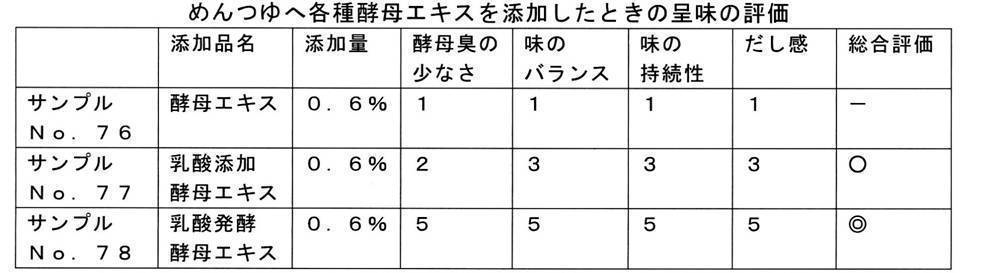
表7の結果から、サンプルNo.76は、各評価項目の評価は低く、酵母臭や苦味が強いといったコメントを得た。また、サンプルNo.77は、各評価項目においていずれもサンプルNo.76よりも高い評価が得られ、味のバランスや持続性、だし感がめんつゆに付与された。サンプルNo.78はサンプルNo.77よりも更に、味のバランスや持続性、だし感がめんつゆに付与されて、高い評価が得られ、鰹だしを増量したようだ、とのコメントを得た。
[実施例8]
(牛丼のたれへ乳酸含有酵母エキスを添加したときの呈味の官能評価)
実施例6と同様の手順で、市販の牛丼のたれ(モランボン社製)に、実施例2で得た乳酸を添加した乳酸含有酵母エキス(サンプルNo.13)または実施例3で得た乳酸発酵させた乳酸含有酵母エキス(サンプルNo.24)を、それぞれ乳酸含有酵母エキス全体の固形分が喫食濃度0.6(w/w)%になるように添加したものを調製した(サンプルNo.80および81)。対照として、乳酸を含有しない酵母エキス(サンプルNo.1)の固形分が喫食濃度0.6(w/w)%になるように添加した牛丼のたれ(サンプルNo.79)を作成した。
(牛丼のたれへ乳酸含有酵母エキスを添加したときの呈味の官能評価)
実施例6と同様の手順で、市販の牛丼のたれ(モランボン社製)に、実施例2で得た乳酸を添加した乳酸含有酵母エキス(サンプルNo.13)または実施例3で得た乳酸発酵させた乳酸含有酵母エキス(サンプルNo.24)を、それぞれ乳酸含有酵母エキス全体の固形分が喫食濃度0.6(w/w)%になるように添加したものを調製した(サンプルNo.80および81)。対照として、乳酸を含有しない酵母エキス(サンプルNo.1)の固形分が喫食濃度0.6(w/w)%になるように添加した牛丼のたれ(サンプルNo.79)を作成した。
各サンプルの官能評価は5名のパネルによる評点法で行い、各サンプル自体について、酵母臭の少なさ・味のバランス・味の持続性・肉様の呈味の4つの項目を評価し、平均を表8に示した。評価は実施例6と同様の基準に従い行った。また、総合評価として各サンプルについて最も多くのパネルが与えた評価をサンプルNo.79を基準にした相対評価で表8に示した。
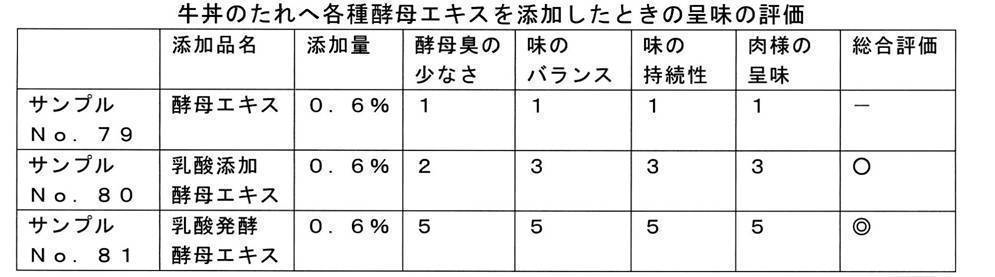
表8の結果から、サンプルNo.79は、各評価項目の評価は低く、酵母臭や苦味が強いといったコメントを得た。また、サンプルNo.80は、各評価項目においていずれもサンプルNo.79よりも高い評価が得られ、味のバランスや持続性、肉様の呈味が牛丼のたれに付与された。サンプルNo.81はサンプルNo.80よりも更に、味のバランスや持続性、肉様の呈味が牛丼のたれに付与されて、高い評価が得られ、牛肉のコクと旨味が増したようだ、とのコメントを得た。
本出願は、2010年7月22日に出願された日本国特許出願第2010-164981号および2011年4月12日に出願された日本国特許出願第2011-88319号に基づく優先権を主張するものであり、これらの内容はここに参照として組み込まれる。
Claims (9)
- 酵母エキス固形分あたり7.5(w/w)%以上の乳酸を含有する、乳酸含有酵母エキス。
- 酵母エキス固形分あたり15(w/w)%以上の乳酸を含有する、請求項1に記載の乳酸含有酵母エキス。
- 酢酸 0.02%以上;
イソブチルアルコール 0.1ppm以上;
2-メチルブタノール 0.1ppm以上;
アセトイン 1ppm以上;
フルフリルアルコール 1ppm以上;および
メチオノール 1ppm以上;
からなる群から選択される1または複数の成分をさらに含有する、請求項1または2に記載の乳酸含有酵母エキス。 - 酵母エキスを、乳酸菌で発酵させて得られる、酵母エキス固形分あたり7.5(w/w)%以上の乳酸を含有する、乳酸含有酵母エキス。
- 酵母エキス固形分あたり15(w/w)%以上の乳酸を含有する、請求項4に記載の乳酸含有酵母エキス。
- 前記乳酸菌が、Lactobacillus plantarum、Lactobacillus pentosus、Leuconostoc mesenteroides subsp. cremoris、Lactobacillus acidophilusまたはLactobacillus delbrueckii subsp. lactisである、請求項4または5に記載の乳酸含有酵母エキス。
- pHが4.5~7.0である、請求項1~6のいずれか1項に記載の乳酸含有酵母エキス。
- カリウムを含有するpH調整剤を用いてpH4.5~7.0に調整された、請求項1~7のいずれか1項に記載の乳酸含有酵母エキス。
- 請求項1~8のいずれか1項に記載の乳酸含有酵母エキスを添加した飲食品。
Priority Applications (2)
| Application Number | Priority Date | Filing Date | Title |
|---|---|---|---|
| EP11809576.9A EP2596703B1 (en) | 2010-07-22 | 2011-07-11 | Yeast extract containing lactic acid |
| JP2012525371A JP5972166B2 (ja) | 2010-07-22 | 2011-07-11 | 乳酸含有酵母エキス |
Applications Claiming Priority (4)
| Application Number | Priority Date | Filing Date | Title |
|---|---|---|---|
| JP2010164981 | 2010-07-22 | ||
| JP2010-164981 | 2010-07-22 | ||
| JP2011088319 | 2011-04-12 | ||
| JP2011-088319 | 2011-04-12 |
Publications (1)
| Publication Number | Publication Date |
|---|---|
| WO2012011402A1 true WO2012011402A1 (ja) | 2012-01-26 |
Family
ID=45496829
Family Applications (1)
| Application Number | Title | Priority Date | Filing Date |
|---|---|---|---|
| PCT/JP2011/065775 Ceased WO2012011402A1 (ja) | 2010-07-22 | 2011-07-11 | 乳酸含有酵母エキス |
Country Status (3)
| Country | Link |
|---|---|
| EP (1) | EP2596703B1 (ja) |
| JP (2) | JP5972166B2 (ja) |
| WO (1) | WO2012011402A1 (ja) |
Cited By (10)
| Publication number | Priority date | Publication date | Assignee | Title |
|---|---|---|---|---|
| WO2013047201A1 (ja) * | 2011-09-30 | 2013-04-04 | 理研ビタミン株式会社 | 呈味改善剤 |
| JP2013078265A (ja) * | 2011-09-30 | 2013-05-02 | Riken Vitamin Co Ltd | 酸性飲食品用呈味改善剤 |
| JP2013179862A (ja) * | 2012-02-29 | 2013-09-12 | Riken Vitamin Co Ltd | 風味改善剤 |
| EP2737808A1 (de) * | 2012-11-30 | 2014-06-04 | Symrise AG | Nahrungsmittelzusatzstoffe |
| JP2015089349A (ja) * | 2013-11-06 | 2015-05-11 | 株式会社Adeka | エキス調味料 |
| JP2016182108A (ja) * | 2015-03-27 | 2016-10-20 | 理研ビタミン株式会社 | 飲食品の風味増強方法 |
| JP2017216952A (ja) * | 2016-06-08 | 2017-12-14 | オリエンタル酵母工業株式会社 | 発酵風味液の製造方法及び食品の製造方法 |
| CN108522781A (zh) * | 2018-03-21 | 2018-09-14 | 杭州早稻田生物技术有限公司 | 一种富含游离氨基酸的酵母蛋白粉及其制备方法 |
| WO2024232240A1 (ja) * | 2023-05-08 | 2024-11-14 | 株式会社ニチレイフーズ | 肉様食品用の風味付与剤 |
| WO2025041577A1 (ja) * | 2023-08-22 | 2025-02-27 | サントリーホールディングス株式会社 | 脂肪酸を含有する飲料ベース |
Families Citing this family (4)
| Publication number | Priority date | Publication date | Assignee | Title |
|---|---|---|---|---|
| US11517036B2 (en) | 2017-04-07 | 2022-12-06 | Givaudan Sa | Flavor modifiers for meat analog products |
| EP3782478A1 (en) * | 2019-08-22 | 2021-02-24 | BrainBoost Solutions | Food, food precursors or beverages comprising d-lactic acid and/or a salt thereof and a method of producing the same |
| JP7455534B2 (ja) * | 2019-09-06 | 2024-03-26 | テーブルマーク株式会社 | 乳酸発酵調味料組成物の製造方法、およびその利用 |
| IL295793A (en) * | 2020-02-22 | 2022-10-01 | Yeap Ltd | Yeast as a raw material for animal product substitutes |
Citations (8)
| Publication number | Priority date | Publication date | Assignee | Title |
|---|---|---|---|---|
| JPH07285995A (ja) | 1994-04-20 | 1995-10-31 | Ajinomoto Co Inc | タンパク含有水溶液の処理法 |
| JP2000316523A (ja) | 1999-05-10 | 2000-11-21 | Yoshihide Hagiwara | 酵母抽出エキスの製造法 |
| JP2002355008A (ja) | 2001-05-31 | 2002-12-10 | Meio Bussan Kk | 酵母エキスの製造方法 |
| JP2003325130A (ja) | 2002-05-14 | 2003-11-18 | T Hasegawa Co Ltd | 酵母エキスの製造方法 |
| JP2006238743A (ja) * | 2005-03-01 | 2006-09-14 | Yaegaki Hakko Giken Kk | 乳酸菌の培養方法と乳酸菌培養物、飲料および食品、飼料および飼料添加物、医薬品 |
| JP2007104977A (ja) * | 2005-10-14 | 2007-04-26 | Taiyo Corp | γ−アミノ酪酸含有物の製造方法 |
| JP2010164981A (ja) | 2010-02-16 | 2010-07-29 | Seiko Epson Corp | 画像転送装置および画像転送における画像表示制御方法 |
| JP2011088319A (ja) | 2009-10-21 | 2011-05-06 | Nok Corp | 成形機及びスプルの離型方法 |
Family Cites Families (6)
| Publication number | Priority date | Publication date | Assignee | Title |
|---|---|---|---|---|
| FR2497635A1 (fr) * | 1981-01-14 | 1982-07-16 | Bioprox Produits Biochimiques | Procede de preparation d'un arome alimentaire a gout de viande de veau et arome alimentaire ainsi obtenu |
| EP0191513B2 (en) * | 1985-01-31 | 1992-12-09 | Unilever N.V. | A process for the preparation of food flavours |
| CA1336174C (en) * | 1988-07-22 | 1995-07-04 | Ronald Peter Potman | Method for the preparation of a yeast extract said yeast extract, its use as a food flavour and a food composition comprising the yeast extract |
| WO2007108558A1 (ja) * | 2006-03-23 | 2007-09-27 | Ajinomoto Co., Inc. | γ-ポリグルタミン酸含有食品の塩味増強方法 |
| JP5063196B2 (ja) * | 2007-06-04 | 2012-10-31 | 花王株式会社 | 歯垢形成抑制剤 |
| JP2010018545A (ja) * | 2008-07-10 | 2010-01-28 | Nippon Zettoc Co Ltd | 活性酸素消去剤、皮膚外用剤、口腔用組成物及び食品 |
-
2011
- 2011-07-11 WO PCT/JP2011/065775 patent/WO2012011402A1/ja not_active Ceased
- 2011-07-11 JP JP2012525371A patent/JP5972166B2/ja active Active
- 2011-07-11 EP EP11809576.9A patent/EP2596703B1/en active Active
-
2016
- 2016-03-30 JP JP2016067023A patent/JP2016116538A/ja active Pending
Patent Citations (8)
| Publication number | Priority date | Publication date | Assignee | Title |
|---|---|---|---|---|
| JPH07285995A (ja) | 1994-04-20 | 1995-10-31 | Ajinomoto Co Inc | タンパク含有水溶液の処理法 |
| JP2000316523A (ja) | 1999-05-10 | 2000-11-21 | Yoshihide Hagiwara | 酵母抽出エキスの製造法 |
| JP2002355008A (ja) | 2001-05-31 | 2002-12-10 | Meio Bussan Kk | 酵母エキスの製造方法 |
| JP2003325130A (ja) | 2002-05-14 | 2003-11-18 | T Hasegawa Co Ltd | 酵母エキスの製造方法 |
| JP2006238743A (ja) * | 2005-03-01 | 2006-09-14 | Yaegaki Hakko Giken Kk | 乳酸菌の培養方法と乳酸菌培養物、飲料および食品、飼料および飼料添加物、医薬品 |
| JP2007104977A (ja) * | 2005-10-14 | 2007-04-26 | Taiyo Corp | γ−アミノ酪酸含有物の製造方法 |
| JP2011088319A (ja) | 2009-10-21 | 2011-05-06 | Nok Corp | 成形機及びスプルの離型方法 |
| JP2010164981A (ja) | 2010-02-16 | 2010-07-29 | Seiko Epson Corp | 画像転送装置および画像転送における画像表示制御方法 |
Non-Patent Citations (10)
| Title |
|---|
| GAUDREAU H. ET AL.: "Lactic Fermentation of Media Containing High Concentrations of Yeast Extracts", J. FOOD SCI., vol. 62, no. 5, 1997, pages 1072 - 1075, XP055069935 * |
| GENTE STEPHANIE ET AL.: "Levels of cystathionine y lyase production by Geotrichum candidum in synthetic media and correlation with the presence of sulphur flavours in cheese", INT. J. FOOD MICROBIOL., vol. 114, no. 2, 2007, pages 136 - 142, XP005892039 * |
| KOTA NAGANUMA ET AL.: "Nyusan Hakko o Riyo shita Tsukemono Seizo Gijutsu no Kaihatsu", REPORT OF THE YAMANASHI INDUSTRIAL TECHNOLOGY CENTER, no. 22, 2008, pages 115 - 121, XP008168046 * |
| KOTZAMANIDIS C. ET AL.: "Optimization of lactic acid production from beet molasses by Lactobacillus delbrueckii NCIMB 8130", WORLD J. MICROBIOL. BIOTECHNOL., vol. 18, no. 5, 2002, pages 441 - 448, XP008071357 * |
| MONDRAGON-PARADA MARIA ELENA ET AL.: "Lactic Acid Bacteria Production From Whey", APPL BIOCHEM BIOTECHNOL PART A, vol. 134, no. 3, 2006, pages 223 - 232, XP055069937 * |
| NEW FOOD INDUSTRY, vol. 36, no. 10, 1994, pages 41 - 48 |
| NEW FOOD INDUSTRY, vol. 36, no. 11, 1994, pages 29 - 35 |
| See also references of EP2596703A4 |
| TECHNICAL JOURNAL ON FOOD CHEMISTRY & CHEMICALS, vol. 10, 1991, pages 46 - 51 |
| TOSHIHIRO SUZUKI ET AL.: "The development of the new natural seasoning", REPORTS OF THE SHIZUOKA INDUSTRIAL TECHNOLOGY CENTER, vol. 31, 1986, pages 91 - 96, XP008167969 * |
Cited By (12)
| Publication number | Priority date | Publication date | Assignee | Title |
|---|---|---|---|---|
| WO2013047201A1 (ja) * | 2011-09-30 | 2013-04-04 | 理研ビタミン株式会社 | 呈味改善剤 |
| JP2013078265A (ja) * | 2011-09-30 | 2013-05-02 | Riken Vitamin Co Ltd | 酸性飲食品用呈味改善剤 |
| US9795161B2 (en) | 2011-09-30 | 2017-10-24 | Riken Vitamin Co., Ltd. | Taste-improving agent |
| JP2013179862A (ja) * | 2012-02-29 | 2013-09-12 | Riken Vitamin Co Ltd | 風味改善剤 |
| EP2737808A1 (de) * | 2012-11-30 | 2014-06-04 | Symrise AG | Nahrungsmittelzusatzstoffe |
| WO2014082771A1 (de) * | 2012-11-30 | 2014-06-05 | Symrise Ag | Nahrungsmittelzusatzstoffe enthaltend glutaminsäure und nukleotide |
| JP2015089349A (ja) * | 2013-11-06 | 2015-05-11 | 株式会社Adeka | エキス調味料 |
| JP2016182108A (ja) * | 2015-03-27 | 2016-10-20 | 理研ビタミン株式会社 | 飲食品の風味増強方法 |
| JP2017216952A (ja) * | 2016-06-08 | 2017-12-14 | オリエンタル酵母工業株式会社 | 発酵風味液の製造方法及び食品の製造方法 |
| CN108522781A (zh) * | 2018-03-21 | 2018-09-14 | 杭州早稻田生物技术有限公司 | 一种富含游离氨基酸的酵母蛋白粉及其制备方法 |
| WO2024232240A1 (ja) * | 2023-05-08 | 2024-11-14 | 株式会社ニチレイフーズ | 肉様食品用の風味付与剤 |
| WO2025041577A1 (ja) * | 2023-08-22 | 2025-02-27 | サントリーホールディングス株式会社 | 脂肪酸を含有する飲料ベース |
Also Published As
| Publication number | Publication date |
|---|---|
| EP2596703A1 (en) | 2013-05-29 |
| JP5972166B2 (ja) | 2016-08-17 |
| JP2016116538A (ja) | 2016-06-30 |
| EP2596703B1 (en) | 2016-12-28 |
| JPWO2012011402A1 (ja) | 2013-09-09 |
| EP2596703A4 (en) | 2014-04-30 |
Similar Documents
| Publication | Publication Date | Title |
|---|---|---|
| JP5972166B2 (ja) | 乳酸含有酵母エキス | |
| JP6022463B2 (ja) | 呈味改善剤 | |
| Singracha et al. | Application of lactic acid bacteria and yeasts as starter cultures for reduced-salt soy sauce (moromi) fermentation | |
| Lee et al. | Fermentation of coconut water by probiotic strains Lactobacillus acidophilus L10 and Lactobacillus casei L26 | |
| JP5114770B2 (ja) | 新規乳酸菌およびこの乳酸菌を用いる発酵食品の製造方法 | |
| JP5467433B2 (ja) | 海藻発酵組成物およびその製造方法 | |
| BR112015007429B1 (pt) | Método para preparar um aroma natural neutro | |
| WO2011046194A1 (ja) | 乳酸菌増殖促進剤 | |
| Saglam et al. | An investigation for the development of whey-based probiotic beverages | |
| JP5011543B2 (ja) | Gaba含有発酵物の製造方法 | |
| JP6006946B2 (ja) | 風味改善剤 | |
| JP2004283109A (ja) | 飲食品の風味改良剤 | |
| JP6510287B2 (ja) | 飲食品の風味増強方法 | |
| JP2022551595A (ja) | 肉ベースの調味料を形成する方法 | |
| JP2013078266A (ja) | 食品用静菌剤 | |
| KR20120111104A (ko) | 톳 추출물의 이취 제거방법 및 이취 제거된 유산균 발효 톳 분말의 제조방법. | |
| JP2009296918A (ja) | 食品の品質改良剤 | |
| JP5856422B2 (ja) | 酸性飲食品用呈味改善剤 | |
| JP3530851B1 (ja) | 新規乳酸菌及びこれを用いた風味改良調味料 | |
| Yan et al. | Enhancement of the flavor and functional characteristics of cod protein isolate using an enzyme–microbe system | |
| JP4921721B2 (ja) | 機能性食品の製造法 | |
| JP4368923B2 (ja) | 風味改良剤 | |
| JP4803971B2 (ja) | 脂質代謝改善組成物 | |
| KR20030076765A (ko) | 유산균이 생산하는 박테리오신을 이용한 탁주 및 약주의제조방법 | |
| CN118844597A (zh) | 一种采用复合菌种制备牡蛎发酵液的方法及应用 |
Legal Events
| Date | Code | Title | Description |
|---|---|---|---|
| 121 | Ep: the epo has been informed by wipo that ep was designated in this application |
Ref document number: 11809576 Country of ref document: EP Kind code of ref document: A1 |
|
| WWE | Wipo information: entry into national phase |
Ref document number: 2012525371 Country of ref document: JP |
|
| NENP | Non-entry into the national phase |
Ref country code: DE |
|
| REEP | Request for entry into the european phase |
Ref document number: 2011809576 Country of ref document: EP |
|
| WWE | Wipo information: entry into national phase |
Ref document number: 2011809576 Country of ref document: EP |