WO2012011402A1 - Extrait de levure contenant de l'acide lactique - Google Patents
Extrait de levure contenant de l'acide lactique Download PDFInfo
- Publication number
- WO2012011402A1 WO2012011402A1 PCT/JP2011/065775 JP2011065775W WO2012011402A1 WO 2012011402 A1 WO2012011402 A1 WO 2012011402A1 JP 2011065775 W JP2011065775 W JP 2011065775W WO 2012011402 A1 WO2012011402 A1 WO 2012011402A1
- Authority
- WO
- WIPO (PCT)
- Prior art keywords
- yeast extract
- lactic acid
- taste
- yeast
- solid content
- Prior art date
- Legal status (The legal status is an assumption and is not a legal conclusion. Google has not performed a legal analysis and makes no representation as to the accuracy of the status listed.)
- Ceased
Links
Images

Classifications
-
- A—HUMAN NECESSITIES
- A23—FOODS OR FOODSTUFFS; TREATMENT THEREOF, NOT COVERED BY OTHER CLASSES
- A23L—FOODS, FOODSTUFFS OR NON-ALCOHOLIC BEVERAGES, NOT OTHERWISE PROVIDED FOR; PREPARATION OR TREATMENT THEREOF
- A23L2/00—Non-alcoholic beverages; Dry compositions or concentrates therefor; Preparation or treatment thereof
- A23L2/52—Adding ingredients
-
- A—HUMAN NECESSITIES
- A23—FOODS OR FOODSTUFFS; TREATMENT THEREOF, NOT COVERED BY OTHER CLASSES
- A23L—FOODS, FOODSTUFFS OR NON-ALCOHOLIC BEVERAGES, NOT OTHERWISE PROVIDED FOR; PREPARATION OR TREATMENT THEREOF
- A23L2/00—Non-alcoholic beverages; Dry compositions or concentrates therefor; Preparation or treatment thereof
- A23L2/52—Adding ingredients
- A23L2/56—Flavouring or bittering agents
-
- A—HUMAN NECESSITIES
- A23—FOODS OR FOODSTUFFS; TREATMENT THEREOF, NOT COVERED BY OTHER CLASSES
- A23L—FOODS, FOODSTUFFS OR NON-ALCOHOLIC BEVERAGES, NOT OTHERWISE PROVIDED FOR; PREPARATION OR TREATMENT THEREOF
- A23L27/00—Spices; Flavouring agents or condiments; Artificial sweetening agents; Table salts; Dietetic salt substitutes; Preparation or treatment thereof
- A23L27/20—Synthetic spices, flavouring agents or condiments
- A23L27/26—Meat flavours
-
- A—HUMAN NECESSITIES
- A23—FOODS OR FOODSTUFFS; TREATMENT THEREOF, NOT COVERED BY OTHER CLASSES
- A23L—FOODS, FOODSTUFFS OR NON-ALCOHOLIC BEVERAGES, NOT OTHERWISE PROVIDED FOR; PREPARATION OR TREATMENT THEREOF
- A23L33/00—Modifying nutritive qualities of foods; Dietetic products; Preparation or treatment thereof
- A23L33/10—Modifying nutritive qualities of foods; Dietetic products; Preparation or treatment thereof using additives
- A23L33/14—Yeasts or derivatives thereof
- A23L33/145—Extracts
-
- A—HUMAN NECESSITIES
- A23—FOODS OR FOODSTUFFS; TREATMENT THEREOF, NOT COVERED BY OTHER CLASSES
- A23V—INDEXING SCHEME RELATING TO FOODS, FOODSTUFFS OR NON-ALCOHOLIC BEVERAGES AND LACTIC OR PROPIONIC ACID BACTERIA USED IN FOODSTUFFS OR FOOD PREPARATION
- A23V2400/00—Lactic or propionic acid bacteria
- A23V2400/11—Lactobacillus
Definitions
- the present invention relates to a yeast extract in which the yeast odor peculiar to yeast is masked or reduced, and a method for producing the same. Moreover, it is related with the yeast extract which is excellent in the balance and sustainability of a taste, and shows taste like meat extract, and its manufacturing method.
- yeast extract contains various free amino acids, organic acids, taste 5 ′ -nucleotide, and the like, and is attracting attention as a natural seasoning that gives food richness and thickness.
- An off-flavor peculiar to yeast (yeast odor) generated depending on the method of producing the extract may be a problem.
- Patent Document 1 a method of adsorbing molecules that cause off-flavor by activated carbon treatment and removing yeast odor
- Patent Document 2 a method of treating yeast extract with an enzyme and freeing lipid components to reduce yeast odor
- Non-patent Document 1 a method for removing the off-flavor and bitterness of yeast extract by passing the extract through a hydrophobic resin column has also been reported.
- Non-patent Documents 2 and 3 As a conventional attempt on a method for producing yeast extract and various problems, a method for removing yeast odor by heating under acidic conditions, a method for extracting and removing yeast odor by contacting with supercritical carbon dioxide, A method of masking yeast odor by adding and mixing dextrin has also been reported (Non-patent Documents 2 and 3).
- JP 2000-316523 A Japanese Patent Application Laid-Open No. 07-285959 JP 2002-355008 A JP 2003-325130 A
- the present invention reduces and masks the yeast odor contained in the yeast extract, has excellent taste balance and sustainability, does not contain animal-derived components, and has a taste like meat extract. It aims at providing the yeast extract which can provide.
- the present inventors have conducted intensive research to solve the above problems. As a result, it was found that by adding more than a specific amount of lactic acid to the yeast extract, the yeast odor was reduced, and the yeast extract with excellent taste balance and sustainability and a meat extract-like taste was obtained. . Thus, no yeast extract containing lactic acid at a high concentration has been reported so far. Moreover, it discovered that the yeast extract in which said effect was further strengthened is obtained by adjusting pH of this yeast extract with the basic substance containing potassium. Furthermore, when lactic acid is produced by sufficiently fermenting a yeast extract with a specific lactic acid bacterium until a specific amount or more of lactic acid is obtained, various aroma components are also increased by fermentation, and the yeast is further increased. The yeast odor peculiar to an extract was masked, it discovered that the yeast extract which was excellent in the balance of balance and sustainability, and the meat extract-like taste was provided more notably, and completed this invention.
- the present invention relates to the following.
- the lactic acid-containing yeast extract according to (1) or (2) further comprising one or more components selected from the group consisting of: (4) A lactic acid-containing yeast extract containing 7.5% (w / w)% or more of lactic acid per solid content of yeast extract obtained by fermenting yeast extract with lactic acid bacteria. (5) The lactic acid-containing yeast extract according to (4) above, which contains 15 (w / w)% or more of lactic acid per solid content of yeast extract.
- the lactic acid bacteria are Lactobacillus plantarum, Lactobacillus pentosus, Leuconostoc mesenteroides subsp. Cremoris, Lactobacillus acidophilus, or Lactobacillus delbrueckii subsp.
- the lactic acid-containing yeast extract according to any one of (1) to (6) above having a pH of 4.5 to 7.0.
- the lactic acid-containing yeast extract according to any one of (1) to (7) above which has been adjusted to pH 4.5 to 7.0 using a pH adjuster containing potassium.
- the invention also relates to: (10) Acetic acid 0.02% or more; Isobutyl alcohol 0.1 ppm or more; 2-methylbutanol 0.1 ppm or more; Acetoin 1 ppm or more; Furfuryl alcohol 1 ppm or more; and methionol 1 ppm or more;
- the lactic acid-containing yeast extract according to (4) or (5) further comprising one or more components selected from the group consisting of: (11) The lactic acid-containing yeast extract according to (4) or (5), wherein the lactic acid bacterium is Lactobacillus plantarum. (12) The lactic acid-containing yeast extract according to (7), wherein the pH is 5.0 to 6.0.
- the lactic acid-containing yeast extract according to (8) above wherein the pH adjuster containing potassium is potassium hydroxide.
- the step of adding lactic acid is a step of adding 15 (w / w)% or more of lactic acid to the yeast extract per yeast extract solid content, wherein the lactic acid is contained in the above (16) or (17) A method for producing a yeast extract.
- a method for producing a lactic acid-containing yeast extract comprising a step of fermenting a yeast extract with lactic acid bacteria until 7.5 (w / w)% or more of lactic acid is produced per solid content of the yeast extract.
- a method for producing a yeast extract comprising a step of fermenting yeast extract with lactic acid bacteria at a temperature of 20 to 40 ° C. for 48 hours or more.
- Manufacturing method comprising a step of fermenting yeast extract with lactic acid bacteria at a temperature of 20 to 40 ° C. for 48 hours or more.
- Production of a lactic acid-containing yeast extract containing 15 (w / w)% or more of lactic acid per solid of yeast extract comprising a step of fermenting the yeast extract with lactic acid bacteria at a temperature of 20 to 40 ° C. for 48 hours or more.
- a method for producing a yeast extract. The method according to any one of (19) to (22), further comprising a step of adding a potassium salt to the yeast extract and a step of adjusting the pH of the yeast extract to pH 4.5 to 7.0.
- the lactic acid bacteria are Lactobacillus plantarum, Lactobacillus pentosus, Leuconostoc mesenteroides subsp. Cremoris, Lactobacillus acidophilus, or Lactobacillus delbrueckii subsp.
- a yeast extract that is masked or reduced with a nasty odor (yeast odor) peculiar to yeast, has excellent taste balance and sustainability, has no animal-derived ingredients, and has a meat extract-like taste and its production A method is provided.
- a yeast extract is very useful as a new type of natural seasoning that gives meat extract-like richness and thickness to the taste of various foods and drinks.
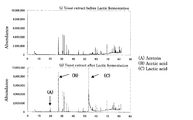
- the total ion chromatogram by GC-MS of (i) yeast extract before lactic fermentation and (ii) yeast extract after lactic fermentation obtained in Example 4 is shown.
- the enlarged view of the total ion chromatogram by GC-MS of (iii) yeast extract before lactic fermentation and (iv) yeast extract after lactic fermentation is shown.
- the yeast extract used in the present invention is produced by extracting the extract by a known method using brewer's yeast, baker's yeast or torula yeast as a raw material, and is particularly limited as long as it is known as edible, medicinal or medium. It can be used without. A commercial item may be used and it may manufacture by a well-known method by using said yeast as a raw material.
- Commercially available yeast extracts include Vertex (Fuji Food Industry Co., Ltd.), Aromildo (Kojin Co., Ltd.), Mist S (Asahi Food and Healthcare Co., Ltd.), Koku Base (Dainippon Meiji Sugar Co., Ltd.), and SK Yeast.
- Extracts manufactured by Nippon Paper Chemical Co., Ltd.
- Gistex manufactured by DSM
- KAV manufactured by Ohly
- a yeast extract made from baker's yeast is preferable because it can be obtained inexpensively and stably.
- the shape of the yeast extract is not particularly limited, and any of liquid, paste, powder and the like can be used.
- a self-digestion method a method of solubilizing cells using a proteolytic enzyme or the like inherent in yeast cells
- an enzyme decomposition method (adding an enzyme derived from microorganisms or plants).
- Solubilization method hot water extraction method (method of solubilization by soaking in hot water for a certain period of time), acid or alkali decomposition method (method of solubilization by adding various acids or alkalis), physical Crushing method (sonication, high-pressure homogenization method, crushing method by mixing and grinding with solid materials such as glass beads), freeze-thawing method (crushing by freezing and thawing at least once) Method) and the like are known, but the present invention is not limited thereto, and yeast extract produced by any method can also be used. Since the yeast extract produced by the self-digestion method may have a problem of off-flavor, it is suitable as a target for masking or reducing the yeast odor in the present invention.
- the lactic acid content is preferably about 15 (w / w)% or more, for example, about 20 (w / w)% per yeast extract solid content.
- the yeast extract has a bad taste balance due to the acidity derived from lactic acid.
- the amount is preferably 40 (w / w)% or less per yeast extract solid content.
- the lactic acid-containing yeast extract of the present invention contains 7.5 to 40 (w / w)%, preferably 15 to 30 (w / w)% lactic acid per solid of yeast extract.
- the lactic acid content per yeast extract solid content means the quantity also including the lactic acid originally contained in a yeast extract.
- dextrin or lactose may be blended as a powdering aid.
- the yeast extract solid content in the present invention is a component other than a yeast extract such as a powdering aid. It refers to the extract solid content that does not contain solid content derived from.
- the lactic acid content of a powdered yeast extract containing 20 (w / w)% of the powdering aid is 10 (w / w)% and the water content is 0 (w / w)% with respect to the total amount of the powdered yeast extract.
- the lactic acid content per yeast extract solid content is 12.5 (w / w)%.
- the lactic acid-containing yeast extract of the present invention can be obtained by adding lactic acid to the yeast extract.
- lactic acid to be added include salts of potassium lactate, sodium lactate, calcium lactate and the like in addition to lactic acid, and lactic acid and potassium lactate are particularly preferable.
- salts are used, the above amount is added in terms of the amount of lactic acid.
- the yeast extract solid content can be determined by evaporation to dryness. Specifically, an appropriate amount of sea sand is mixed with the yeast extract, heated at about 110 ° C. until the water evaporates, and the weight percentage of the remaining solid is measured. More simply, a Brix value using a differential refractometer can be substituted.
- the yeast extract solid content of the liquid yeast extract is 45 to 65 (w / w)%
- the yeast extract solid content of the paste-like yeast extract is 70 to 95 (w / w)%
- the yeast extract has a solid content of 50 to 99 (w / w)%.
- the lactic acid-containing yeast extract as described above may further contain a desired amount of one or more components selected from the group consisting of acetic acid, isobutyl alcohol, 2-methylbutanol, acetoin, furfuryl alcohol, and methionol.
- acetic acid isobutyl alcohol, 2-methylbutanol, acetoin, furfuryl alcohol, and methionol.
- the yeast odor is further improved, the taste balance is excellent, and the meat extract-like taste is preferred.
- a lactic acid-containing yeast extract containing each component can be obtained by adding a desired amount of each of these components to the lactic acid-containing additive extract.
- the acetic acid content is preferably 0.02% or more and less than 2% per yeast extract solid content.
- the yeast extract has a bad taste balance due to the acidity derived from acetic acid.
- acetic acid to be added include acetic acid and salts such as potassium acetate, sodium acetate, and calcium acetate, with acetic acid and potassium acetate being particularly preferred.
- the edible raw material containing said acetic acid or its salt may be sufficient, for example, grain vinegar, rice vinegar, fruit vinegar etc. can be used.
- the isobutyl alcohol content is preferably at least 0.1 ppm and less than 100 ppm per solid of yeast extract. Although depending on the concentration of the yeast extract, when the isobutyl alcohol content is usually 100 ppm or more, the aroma derived from isobutyl alcohol becomes stronger, resulting in a yeast extract with a poor taste balance.
- the isobutyl alcohol to be added may be an edible raw material (for example, a fragrance) containing isobutyl alcohol in addition to a commercially available pure product.
- the 2-methylbutanol content is preferably at least 0.1 ppm and less than 100 ppm per yeast extract solid content. Although it depends on the concentration of the yeast extract, when the 2-methylbutanol content is usually 100 ppm or more, the fragrance derived from 2-methylbutanol becomes strong, resulting in a yeast extract with a poor taste balance.
- the 2-methylbutanol to be added may be an edible raw material (for example, a fragrance) containing 2-methylbutanol in addition to a commercially pure product.
- the acetoin content is preferably at least 1 ppm and less than 10,000 ppm per yeast extract solid content. Although depending on the concentration of the yeast extract, a yeast extract with a bad balance of taste is usually obtained when the acetoin content is 10000 ppm or more.
- the acetoin to be added may be an edible raw material containing acetoin (for example, yogurt, fragrance, etc.) in addition to a commercially available pure product.
- the furfuryl alcohol content is preferably at least 1 ppm and less than 1000 ppm per yeast extract solid content. Although it depends on the concentration of the yeast extract, when the content of furfuryl alcohol is usually 1000 ppm or more, the yeast extract has a poor taste balance.
- the furfuryl alcohol to be added may be an edible raw material (for example, a fragrance) containing furfuryl alcohol in addition to a commercially available pure product.
- the methionol content is preferably at least 1 ppm and less than 1000 ppm per yeast extract solid content. Although it depends on the concentration of the yeast extract, when the methionol content is usually 1000 ppm or more, the yeast extract has a bad taste balance due to excessive fermentation odor.
- the methionol to be added may be an edible raw material (for example, a fragrance) containing methionol in addition to a commercially available pure product.
- the lactic acid-containing yeast extract of the present invention contains lactic acid and, if desired, further contains one or more of the other components as described above. As described above, each of these components may be individually added to the yeast extract. In addition, by culturing the microorganism using the yeast extract as a medium, the above-mentioned components are produced in a desired amount by the microorganism and cultured.
- the later medium can be a yeast extract containing each component.
- content with respect to yeast extract solid content of said each component means the quantity also including content originally contained in a yeast extract similarly to having mentioned above about lactic acid content.
- yeast extract in powdered yeast extract, dextrin or lactose may be blended as a powdering aid, and the yeast extract solid content in the present invention is derived from components other than yeast extract such as powdering aid. It refers to the extract solid content that does not contain solid content.
- lactic acid is produced by lactic acid bacteria by fermenting yeast extract with lactic acid bacteria.
- the lactic acid-containing yeast extract of the present invention can be obtained after sufficient fermentation until the amount of lactic acid per solid content of the yeast extract is 7.5 (w / w)% or more.
- the culture solution for inoculating lactic acid bacteria is a pre-fermentation solution containing yeast extract and water as main components, or a pre-fermentation solution containing yeast extract, sugar source and water as main components. Is preferably used. That is, in one embodiment of the present invention, when a lactic acid-containing yeast extract is obtained by lactic acid fermentation, a pre-fermentation solution having the above simple structure may be used, so that a lactic acid-containing yeast extract is obtained easily and inexpensively. be able to.
- various components that can be added to the medium during fermentation of lactic acid bacteria such as nitrogen sources, carbon sources other than sugar, various inorganic ions, vitamins, antibiotics, etc., may be added to the medium. Good.
- a culture solution with a low salt content may be used in order to achieve good growth.
- the pre-fermentation solution is prepared by diluting the yeast extract with water or the like so that the raw material yeast extract contains about 5 to 40% by weight, preferably 20 to 30% by weight, as a solid content.
- a sugar source that can be assimilated by lactic acid bacteria is added so that the concentration at the start of culture is about 2 to 6% by weight, preferably about 3 to 4% by weight.
- the sugar source added to the pre-fermentation solution is not particularly limited as long as lactic acid bacteria can assimilate, and examples thereof include glucose, sucrose, fructose, lactose, galactose, maltose, and the like. Liquid sugars, fruit juices, vegetables, honey and the like may be used. Among these, in view of fermentability of lactic acid bacteria, glucose or liquid saccharide containing glucose is preferable. These sugar sources can be added alone or in combination.
- the pre-fermentation solution is sterilized by heating, and after cooling, inoculated with lactic acid bacteria. Heat sterilization is usually performed at 70 to 130 ° C., and cooling is usually performed until 25 to 35 ° C. is reached.
- a pH adjusting agent may be used to adjust to a pH suitable for fermentation, preferably pH 5.0 to 7.0.
- the pH adjuster potassium hydroxide, sodium hydroxide, sodium carbonate, dipotassium hydrogen phosphate, tripotassium phosphate, potassium carbonate, etc. can be used.
- potassium hydroxide is preferable because a yeast extract excellent in taste balance and the like can be obtained.
- the lactic acid bacterium used for fermentation is not particularly limited as long as it has a lactic acid-producing ability in a medium containing a yeast extract, for example, a microorganism belonging to the genus Lactobacillus or Leuconostoc, from the viewpoint of masking and reducing the effect of yeast odor in the yeast extract, Specifically, Lactobacillus plantarum, Lactobacillus pentosus, Leuconostoc mesenteroides subsp. Cremoris, Lactobacillus acidophilus, Lactobacillus delbrueckii subsp. Lactis is preferable, and Lactobacillus plantarum is particularly preferable from the viewpoints of the production amount of lactic acid and the like by fermentation and masking and reducing effect of yeast odor. These lactic acid bacteria can be used alone or in any combination.
- Fermentation is performed, for example, by inoculating a starter with about 0.0001 to 1% by weight with respect to the pre-fermentation solution and according to a conventional method.
- the starter can be prepared by culturing lactic acid bacteria used for fermentation using a known medium according to a conventional method.
- the fermentation temperature varies slightly depending on the bacterial species, it is about 20 to 40 ° C., preferably from about 25 to 35 ° C. from the viewpoint of efficiently producing lactic acid, and particularly preferably cultured at around 30 ° C.
- it is performed by static fermentation, but may be gently stirred for the purpose of homogenizing the temperature distribution of the fermentation broth and controlling the precipitation of the bacterial cells.
- the above pH adjuster may be used to culture while maintaining the pH at about 5.0 to 7.0.
- the culture may be an aerobic culture or an anaerobic culture.
- Fermentation time can be appropriately set according to the concentration of yeast extract and other components, and is not particularly limited as long as a desired amount of lactic acid is produced, but is usually 48 to 150 hours, preferably 96 to 144 hours, Preferably, it is 120 to 144 hours.
- the end point of fermentation can be appropriately determined so that the fermentation solution is suitable as a lactic acid-containing yeast extract to be finally obtained.
- the amount of lactic acid can be quantified according to a conventional method, for example, by an enzyme electrode method using lactate oxidase or lactate dehydrogenase or a liquid chromatographic method.
- the fermentation is terminated when the pH of the medium becomes about 3.5 to 4.5 due to the produced lactic acid. Can do. In determining the end point of fermentation, the amount of components other than lactic acid produced by lactic acid bacteria fermentation can also be considered.
- the lactic acid-containing yeast extract obtained by fermenting the yeast extract with lactic acid bacteria as described above may be acetic acid, isobutyl alcohol, 2-methylbutanol, acetoin, furfuryl alcohol, and methionol, depending on the type of lactic acid bacteria used, in addition to lactic acid.
- it can be a lactic acid-containing yeast extract suitable as a raw material for various foods and a natural seasoning. Whether these components are produced can be confirmed by quantification by a gas chromatographic method, for example, according to a conventional method.
- yeast extract in which one or more components selected from the group consisting of acetic acid, isobutyl alcohol, 2-methylbutanol, acetoin, furfuryl alcohol and methionol are increased. it can.
- a bacterium is not particularly limited as long as it has the ability to produce any one of the above-mentioned components.
- the culture is an edible bacterium.
- the medium and culture conditions can be appropriately selected according to the bacteria to be used and cultured.
- the odor of yeast is further improved by adjusting the pH of a lactic acid-containing yeast extract obtained by adding lactic acid or by fermentation of lactic acid bacteria with any pH adjusting agent that can be used for food production.
- a yeast extract having excellent taste balance and sustainability and enhanced meat extract-like taste can be obtained.
- the adjusted pH is preferably 4.5 to 7.0, more preferably pH 4.5 to 6.0. If the pH is too low, the acidity will be strong, and if it is too high, the bitterness will be felt and the quality of the yeast extract will deteriorate.
- a potassium salt is added to the above lactic acid-containing yeast extract, it is possible to obtain a yeast extract that is further excellent in taste balance and sustainability and enhanced in taste like meat extract.
- Sodium salt does not have sufficient taste sustainability and meat extract-like taste, and calcium salt and magnesium salt may cause bitterness and taste.
- the potassium salt is not limited as long as it can be used for food production, but includes potassium hydroxide, potassium chloride, potassium carbonate, dipotassium hydrogen phosphate, tripotassium phosphate, etc., either alone or in combination. Can be used.
- potassium hydroxide is preferable from the viewpoint of improving the balance of taste and sustainability of taste, imparting a taste like meat extract, and versatility. It is desirable that the pH of the yeast extract after addition of the potassium salt is in the above range.
- the above-mentioned preferable yeast extract can be obtained more easily.
- the lactic acid-containing yeast extract of the present invention may be concentrated to increase the solid content if desired.
- concentration method is not particularly limited, and for example, a known concentration method such as normal pressure heat concentration, reduced pressure heat concentration, or freeze concentration can be employed.
- a powdery yeast extract having a high lactic acid content and easy handling can be obtained by drying treatment.
- the drying method is not particularly limited, and for example, a known dry yeast extract preparation method such as freeze-drying method, spray-drying method, drum-drying method and the like can be adopted.
- the pH of the yeast extract concentrated or powdered as described above can be determined by the pH measured in the liquid state before the concentration or powdering.
- the concentrated or powdered yeast extract can also be judged based on the pH measured by dissolving it in distilled water so that the yeast extract solid content is about 25 (w / w)%.
- the lactic acid-containing yeast extract of the present invention can be used in the same manner as a normal yeast extract, and can be blended into any food or drink as it is or after processing such as concentration and drying.
- the lactic acid bacteria may remain contained in the yeast extract or may be isolated according to the purpose of use.
- it can be used for processed agricultural foods including processed products such as vegetables, fruits and cereals, processed fishery products including processed products such as seafood and seaweed, and processed livestock foods including processed products such as eggs and dairy products. it can.
- seasonings such as Japanese-style dashi, Western-style dashi, Chinese dashi, soy sauce, sauce, soup, sauce and dressing.
- seasonings such as Japanese-style dashi, Western-style dashi, Chinese dashi, soy sauce, sauce, soup, sauce and dressing.
- the yeast odor is masked and exhibits an effect superior to conventional yeast extracts in terms of flavor.
- meat extract meat-like taste, feeling of soup
- animal extracts such as beef extract and chicken extract
- the cost is reduced while having an equivalent taste, and a meat extract-like taste without using any animal-derived ingredients ( It is also possible to impart meat-like taste, dashi feeling, etc. Especially meat-like taste).
- the optimum concentration varies depending on the final product, but it is preferably used in the same manner as a normal yeast extract. Moreover, since the taste sustainability is remarkably superior to that of the conventional yeast extract and the taste like meat extract is strong, the same effect as that of the conventional yeast extract can be obtained even with a smaller amount.
- Example 1 (Sensory evaluation of taste when lactic acid is added to yeast extract) Yeast extract (Ohly, Yeast Extract KAV, derived from baker's yeast) is dissolved in distilled water to a concentration of 25 (w / w)% as a solid content, and lactic acid (Wako Pure Chemical Industries, Ltd.) is solidified as yeast extract Prepared with 0, 5, 7.5, 10, 15, 20, 30 or 40% added per minute.
- the yeast extract solid content was determined by the evaporation to dryness method. Specifically, an appropriate amount of sea sand was mixed with the yeast extract, heated at about 110 ° C. until the water evaporated, and the weight% of the remaining solid was measured.
- the yeast extract obtained a comment that when the lactic acid addition amount was 0 and 5%, the evaluation of each evaluation item was low and bitterness was felt. It was also found that when 7.5 to 40% lactic acid was added to the yeast extract, a taste balance and sustainability were imparted, and a yeast extract having a meat-like taste was obtained. In particular, when the amount of lactic acid added was 15 to 30%, the evaluation of each item was high. Although not shown in Table 1, when the amount of lactic acid exceeded 40%, a comment was obtained that a strong acidity was felt and the balance of taste was poor.
- Example 2 (Sensory evaluation of taste when various pH adjusters are added to lactic acid-added yeast extract) Yeast extract (similar to Example 1) is dissolved in water to a solid content of 25 (w / w)%, and lactic acid (manufactured by Wako Pure Chemical Industries, Ltd.) is added to a pH of 4.0 (yeast) The pH was adjusted to 4.5, 5.0, 6.0, 7.0 or 8.0 using potassium hydroxide as a pH adjuster. Furthermore, a sample prepared by adding lactic acid to pH 3.5 was also prepared (44% lactic acid amount per solid of yeast extract).
- the sample which adjusted pH to 6.0 using potassium hydrogen phosphate, tripotassium phosphate, potassium carbonate, or sodium hydroxide, respectively was produced.
- the addition amount of potassium hydroxide when adjusting to pH 6.0 is 2.2 w / w% based on the total amount of yeast extract, and potassium hydroxide when adjusting to pH 4.5, 5.0, or 6.0.
- the amount of potassium converted from the amount added was 0.23 w / w%, 0.91 w / w% or 1.54 w / w% with respect to the total amount of yeast extract, respectively.
- Sample No. with pH adjusted to 3.5 No. 9 got a comment that the taste balance was bad and the acidity of lactic acid was felt strongly.
- Sample No. adjusted to pH 8.0. No. 15 got a comment that the taste balance was bad and bitterness was felt.
- Example 3 (Lactic acid fermentation conditions and sensory evaluation of yeast extract) Yeast extract (same as in Example 1) is dissolved in water to a solid content of 25 (w / w)%, and glucose fructose liquid sugar (made by Showa Sangyo Co., Ltd., trade name “NF42 (Neufract R—O)”) 4) (w / w)% was added to prepare a pre-fermentation solution.
- glucose fructose liquid sugar made by Showa Sangyo Co., Ltd., trade name “NF42 (Neufract R—O)”.
- Lactobacillus plantarum (FERM P-21349), Leuconostoc mesenteroides subsp. Cremoris (NRIC1538), Lactobacillus pentosus (NRIC1069), Lactobacillus acidophilus (YO-MIXLYYO50), Lactobacillus delbrueckii subsp. Lactis (NRIC1683), Lactobacillus delbrueckii subsp. Bulgaricus (NRIC1041), Lactobacillus brevis (NRIC1038), Lactobacillus casei (NRIC0644), Lactobacillus bucheneri (NRIC10440), Weissella paramsenteroid15 (ICIC15). Mesenteroides (NRIC1542), Lactobacillus sakei (NRIC1071) and Leuconostoc mesenteroides subsp. Dextranicum (NRIC 1539) was used.
- fermentation was performed with Lactobacillus plantarum at 10, 20, 30 or 40 ° C. Fermentation time was 24, 48, 96, 120 or 144 hours, and Lactobacillus plantarum was fermented at 30 ° C. The amount of lactic acid per yeast extract solid content in the yeast extract fermentation broth was centrifuged 100 times with distilled water after removing the insoluble matter for each sample, and biosensor BF-5 (Oji Scientific, enzyme electrode method) was used to measure L-lactic acid and D-lactic acid, and the total was obtained.
- biosensor BF-5 Oji Scientific, enzyme electrode method
- Fermentation temperature is 25 ° C, 30 ° C and 35 ° C (sample No. 27, 24 and 28), lactic acid is sufficiently produced, yeast odor is improved, taste balance and sustainability are imparted, and meaty taste
- a yeast extract having a pH of 1 was obtained, and the best results were obtained particularly at 30 ° C. (sample 24).
- fermentation did not proceed at fermentation temperatures of 10 ° C., 20 ° C., and 40 ° C. (sample Nos. 25, 26, and 29), and good results were not obtained.
- the fermentation temperature was preferably 25 to 35 ° C., and most preferably 30 ° C., from the viewpoint of the growth of lactic acid bacteria and the amount of lactic acid produced.
- Lactobacillus plantarum Lactobacillus pentosus, Leuconostoc mesenteroides subsp. Cremoris, Lactobacillus acidophilus, Lactobacillus delbrueckii subsp. lactis and the like can be suitably used for reducing yeast odor and improving taste of yeast extract.
- sample no. Twenty-four Lactobacillus plantarum was considered particularly preferred.
- yeast extract Like bulgaricus, even if the amount of lactic acid produced by fermentation was large, some yeast extract had a low evaluation, and it was considered that other fermentation products influenced the evaluation of yeast extract.
- the yeast extract simply added with lactic acid as in Example 1, or compared with the yeast extract with added lactic acid and adjusted in pH with potassium salt or the like as in Example 2, Surprisingly, further improvements in yeast odor were observed.
- Example 4 (GC-MS analysis of yeast extract before and after lactic acid fermentation)
- sample no. 5 ml of the lactic acid fermentation yeast extract obtained in 24 was transferred to a test tube with a screw cap, and 2 g of sodium chloride, 2 ml of diethyl ether and an internal standard solution (n-pentanol 20 ppm / sample) were added. After shaking for 10 minutes, the mixture was centrifuged at 3000 rpm and 5 ° C. for 10 minutes, and the supernatant was put into a vial and analyzed by gas chromatography / mass spectrometry (7890C manufactured by Agilent Technologies).
- Fig. 1 shows the total ion chromatogram of yeast extract before and after lactic acid fermentation
- Fig. 2 shows an enlarged view. From the analysis results, it was found that, in addition to lactic acid, acetic acid, isobutyl alcohol, 2-methylbutanol, acetoin, furfuryl alcohol and methionol were significantly increased in the yeast extract after fermentation as compared with before lactic acid fermentation. Moreover, content was quantified from the peak area of each fragrance component by a calibration curve method using a standard substance. The results are shown in Table 4.
- Example 5 (Taste improvement effect when aroma components that increase due to lactic acid fermentation of yeast extract are added to non-fermented yeast extract)
- Yeast extract (Ohly, Yeast Extract KAV, derived from baker's yeast) is dissolved in distilled water to a concentration of 25 (w / w)% as a solid content, and lactic acid (Wako Pure Chemical Industries, Ltd.) is solidified as yeast extract What was added 20% per minute was prepared.
- lactic acid Waako Pure Chemical Industries, Ltd.
- acetic acid is added at least 0.02 (w / w)%, isobutyl alcohol and 2-methylbutanol are added at least 0.1 ppm, and acetoin, furfuryl alcohol and methionol are added at least 1 ppm to the yeast extract.
- Improved yeast odor and meaty taste were obtained.
- the addition of acetoin, furfuryl alcohol and methionol showed a great effect in improving yeast odor.
- These components increased by lactic acid fermentation were also considered effective in improving the yeast odor of the yeast extract.
- the taste and smell derived from a component became strong and the favorable result was not obtained.
- Example 6 (Sensory evaluation of taste when lactic acid-containing yeast extract is added to consomme soup) A commercially available dried consomme soup (manufactured by Meiji Seika Co., Ltd.) was dissolved in hot water as usual to prepare a consomme soup.
- the lactic acid-containing yeast extract (sample No. 13) obtained by adding the lactic acid obtained in Example 2 or the lactic acid-containing yeast extract (sample No. 24) fermented with lactic acid obtained in Example 3, respectively, What was added so that the solid content of the whole lactic acid containing yeast extract might become a eating concentration of 0.3 (w / w)% was prepared (sample No. 74 and 75).
- a consomme soup (sample No. 73) was prepared so that the solid content of the yeast extract (sample No. 1) containing no lactic acid was 0.3 (w / w)% at the eating concentration.
- sample no. No. 73 got a comment that the evaluation of each evaluation item was low and the yeast odor and bitterness were strong.
- Sample No. 74 is a sample No. in each evaluation item. An evaluation higher than 73 was obtained, and the balance and sustainability of the taste and the meat-like taste were imparted to the consomme soup.
- Sample No. 75 is sample no. More than 74, the balance and sustainability of the taste and the meat-like taste were imparted to the consomme soup, and high evaluation was obtained.
- Example 7 (Sensory evaluation of taste when lactic acid-containing yeast extract is added to mentsuyu)
- lactic acid-containing yeast extract (sample No. 13) obtained by adding lactic acid obtained in Example 2 to commercially available straight noodle soup (manufactured by Kikkoman) or lactic acid fermentation obtained in Example 3 was used.
- the lactic acid-containing yeast extract (sample No. 24) was added so that the solid content of the whole lactic acid-containing yeast extract was 0.6 (w / w)% (sample No. 77).
- added soy sauce (sample No. 76) was prepared so that the solid content of the yeast extract (sample No. 1) containing no lactic acid was 0.6 (w / w)%.
- the sensory evaluation of each sample was performed by a scoring method using a panel of five people, and four items of low yeast odor, balance of taste, sustainability of taste, and dashi feeling were evaluated, and the average is shown in Table 7. Evaluation was performed according to the same criteria as in Example 6. In addition, as the overall evaluation, the evaluation given by the most panels for each sample is shown in Sample No. The relative evaluation based on 76 is shown in Table 7.
- sample no. No. 76 obtained a comment that the evaluation of each evaluation item was low, and yeast odor and bitterness were strong.
- Sample No. 77 is sample No. in each evaluation item. A rating higher than 76 was obtained, and the balance, sustainability and dashi of the taste were imparted to the noodle soup.
- Sample No. 78 is Sample No. More than 77, the taste balance, sustainability, and soup stock were given to the noodle soup, and high evaluation was obtained.
- Example 8 (Sensory evaluation of taste when lactic acid-containing yeast extract is added to beef bowl sauce) Lactic acid-containing yeast extract (sample No. 13) obtained by adding lactic acid obtained in Example 2 to commercially available beef bowl sauce (Morambon) in the same procedure as in Example 6 or lactic acid obtained in Example 3
- a fermented lactic acid-containing yeast extract (sample No. 24) was prepared so that the solid content of the entire lactic acid-containing yeast extract was 0.6% (w / w)% (sample No.). 80 and 81).
- gyudon sauce (sample No. 79) was prepared so that the solid content of the yeast extract (sample No. 1) containing no lactic acid was 0.6 (w / w)%.
- Sensory evaluation of each sample is done by a scoring method using a panel of five people, and for each sample itself, the four items of yeast odor, taste balance, taste persistence, and meaty taste are evaluated and averaged. Is shown in Table 8. Evaluation was performed according to the same criteria as in Example 6. In addition, as the overall evaluation, the evaluation given by the most panels for each sample is the sample number. The relative evaluation based on 79 is shown in Table 8.
- sample No. No. 79 obtained a comment that the evaluation of each evaluation item was low, and yeast odor and bitterness were strong.
- Sample No. 80 is sample No. in each evaluation item. An evaluation higher than 79 was obtained, and the balance and sustainability of the taste and meat-like taste were imparted to the gyudon sauce.
- Sample No. 81 is sample No. More than 80, the taste balance, sustainability and meat-like taste were given to the beef sauce, and high evaluation was obtained, and the comment that the richness and taste of beef seemed to increase was obtained. .
Landscapes
- Life Sciences & Earth Sciences (AREA)
- Health & Medical Sciences (AREA)
- Nutrition Science (AREA)
- Chemical & Material Sciences (AREA)
- Engineering & Computer Science (AREA)
- Food Science & Technology (AREA)
- Polymers & Plastics (AREA)
- Mycology (AREA)
- Microbiology (AREA)
- Seasonings (AREA)
- Coloring Foods And Improving Nutritive Qualities (AREA)
- Seeds, Soups, And Other Foods (AREA)
Abstract
L'objet de la présente invention concerne un extrait de levure dans lequel la mauvaise odeur inhérente à la levure (c'est-à-dire l'odeur de levure) est masquée ou réduite, et qui possède un excellent équilibre gustatif et un goût durable et peut présenter une saveur comparable à la viande. La présente invention concerne un extrait de levure contenant de l'acide lactique, qui inclut de l'acide lactique dans une quantité de 7,5 (w/w)% ou plus par rapport au contenu solide de l'extrait de levure. La présente invention concerne également un extrait de levure contenant de l'acide lactique, qui est produit en faisant fermenter un extrait de levure avec une bactérie d'acide lactique et inclut de l'acide lactique dans une quantité de 7,5 (w/w)% ou plus par rapport au contenu solide de l'extrait de levure.
Priority Applications (2)
| Application Number | Priority Date | Filing Date | Title |
|---|---|---|---|
| EP11809576.9A EP2596703B1 (fr) | 2010-07-22 | 2011-07-11 | Extrait de levure contenant de l'acide lactique |
| JP2012525371A JP5972166B2 (ja) | 2010-07-22 | 2011-07-11 | 乳酸含有酵母エキス |
Applications Claiming Priority (4)
| Application Number | Priority Date | Filing Date | Title |
|---|---|---|---|
| JP2010164981 | 2010-07-22 | ||
| JP2010-164981 | 2010-07-22 | ||
| JP2011088319 | 2011-04-12 | ||
| JP2011-088319 | 2011-04-12 |
Publications (1)
| Publication Number | Publication Date |
|---|---|
| WO2012011402A1 true WO2012011402A1 (fr) | 2012-01-26 |
Family
ID=45496829
Family Applications (1)
| Application Number | Title | Priority Date | Filing Date |
|---|---|---|---|
| PCT/JP2011/065775 Ceased WO2012011402A1 (fr) | 2010-07-22 | 2011-07-11 | Extrait de levure contenant de l'acide lactique |
Country Status (3)
| Country | Link |
|---|---|
| EP (1) | EP2596703B1 (fr) |
| JP (2) | JP5972166B2 (fr) |
| WO (1) | WO2012011402A1 (fr) |
Cited By (10)
| Publication number | Priority date | Publication date | Assignee | Title |
|---|---|---|---|---|
| WO2013047201A1 (fr) * | 2011-09-30 | 2013-04-04 | 理研ビタミン株式会社 | Agent d'amélioration du goût |
| JP2013078265A (ja) * | 2011-09-30 | 2013-05-02 | Riken Vitamin Co Ltd | 酸性飲食品用呈味改善剤 |
| JP2013179862A (ja) * | 2012-02-29 | 2013-09-12 | Riken Vitamin Co Ltd | 風味改善剤 |
| EP2737808A1 (fr) * | 2012-11-30 | 2014-06-04 | Symrise AG | Additifs alimentaires |
| JP2015089349A (ja) * | 2013-11-06 | 2015-05-11 | 株式会社Adeka | エキス調味料 |
| JP2016182108A (ja) * | 2015-03-27 | 2016-10-20 | 理研ビタミン株式会社 | 飲食品の風味増強方法 |
| JP2017216952A (ja) * | 2016-06-08 | 2017-12-14 | オリエンタル酵母工業株式会社 | 発酵風味液の製造方法及び食品の製造方法 |
| CN108522781A (zh) * | 2018-03-21 | 2018-09-14 | 杭州早稻田生物技术有限公司 | 一种富含游离氨基酸的酵母蛋白粉及其制备方法 |
| WO2024232240A1 (fr) * | 2023-05-08 | 2024-11-14 | 株式会社ニチレイフーズ | Agent aromatisant pour produit alimentaire de type viande |
| WO2025041577A1 (fr) * | 2023-08-22 | 2025-02-27 | サントリーホールディングス株式会社 | Base de boisson comprenant un acide gras |
Families Citing this family (4)
| Publication number | Priority date | Publication date | Assignee | Title |
|---|---|---|---|---|
| US11517036B2 (en) | 2017-04-07 | 2022-12-06 | Givaudan Sa | Flavor modifiers for meat analog products |
| EP3782478A1 (fr) * | 2019-08-22 | 2021-02-24 | BrainBoost Solutions | Aliment, précurseurs d'aliments ou boissons comprenant de l'acide d-lactique et/ou son sel procédé de fabrication associé |
| JP7455534B2 (ja) * | 2019-09-06 | 2024-03-26 | テーブルマーク株式会社 | 乳酸発酵調味料組成物の製造方法、およびその利用 |
| IL295793A (en) * | 2020-02-22 | 2022-10-01 | Yeap Ltd | Yeast as a raw material for animal product substitutes |
Citations (8)
| Publication number | Priority date | Publication date | Assignee | Title |
|---|---|---|---|---|
| JPH07285995A (ja) | 1994-04-20 | 1995-10-31 | Ajinomoto Co Inc | タンパク含有水溶液の処理法 |
| JP2000316523A (ja) | 1999-05-10 | 2000-11-21 | Yoshihide Hagiwara | 酵母抽出エキスの製造法 |
| JP2002355008A (ja) | 2001-05-31 | 2002-12-10 | Meio Bussan Kk | 酵母エキスの製造方法 |
| JP2003325130A (ja) | 2002-05-14 | 2003-11-18 | T Hasegawa Co Ltd | 酵母エキスの製造方法 |
| JP2006238743A (ja) * | 2005-03-01 | 2006-09-14 | Yaegaki Hakko Giken Kk | 乳酸菌の培養方法と乳酸菌培養物、飲料および食品、飼料および飼料添加物、医薬品 |
| JP2007104977A (ja) * | 2005-10-14 | 2007-04-26 | Taiyo Corp | γ−アミノ酪酸含有物の製造方法 |
| JP2010164981A (ja) | 2010-02-16 | 2010-07-29 | Seiko Epson Corp | 画像転送装置および画像転送における画像表示制御方法 |
| JP2011088319A (ja) | 2009-10-21 | 2011-05-06 | Nok Corp | 成形機及びスプルの離型方法 |
Family Cites Families (6)
| Publication number | Priority date | Publication date | Assignee | Title |
|---|---|---|---|---|
| FR2497635A1 (fr) * | 1981-01-14 | 1982-07-16 | Bioprox Produits Biochimiques | Procede de preparation d'un arome alimentaire a gout de viande de veau et arome alimentaire ainsi obtenu |
| EP0191513B2 (fr) * | 1985-01-31 | 1992-12-09 | Unilever N.V. | Procédé pour la fabrication d'arômes pour aliments |
| CA1336174C (fr) * | 1988-07-22 | 1995-07-04 | Ronald Peter Potman | Methode de preparation d'un extrait de levure, extrait de levure, son utilisation comme arome et composition alimentaire renfermant cet extrait de levure |
| WO2007108558A1 (fr) * | 2006-03-23 | 2007-09-27 | Ajinomoto Co., Inc. | PROCÉDÉ DE RENFORCEMENT DE LA SALINITÉ D'ALIMENTS CONTENANT DE L'ACIDE γ-POLYGLUTAMIQUE |
| JP5063196B2 (ja) * | 2007-06-04 | 2012-10-31 | 花王株式会社 | 歯垢形成抑制剤 |
| JP2010018545A (ja) * | 2008-07-10 | 2010-01-28 | Nippon Zettoc Co Ltd | 活性酸素消去剤、皮膚外用剤、口腔用組成物及び食品 |
-
2011
- 2011-07-11 WO PCT/JP2011/065775 patent/WO2012011402A1/fr not_active Ceased
- 2011-07-11 JP JP2012525371A patent/JP5972166B2/ja active Active
- 2011-07-11 EP EP11809576.9A patent/EP2596703B1/fr active Active
-
2016
- 2016-03-30 JP JP2016067023A patent/JP2016116538A/ja active Pending
Patent Citations (8)
| Publication number | Priority date | Publication date | Assignee | Title |
|---|---|---|---|---|
| JPH07285995A (ja) | 1994-04-20 | 1995-10-31 | Ajinomoto Co Inc | タンパク含有水溶液の処理法 |
| JP2000316523A (ja) | 1999-05-10 | 2000-11-21 | Yoshihide Hagiwara | 酵母抽出エキスの製造法 |
| JP2002355008A (ja) | 2001-05-31 | 2002-12-10 | Meio Bussan Kk | 酵母エキスの製造方法 |
| JP2003325130A (ja) | 2002-05-14 | 2003-11-18 | T Hasegawa Co Ltd | 酵母エキスの製造方法 |
| JP2006238743A (ja) * | 2005-03-01 | 2006-09-14 | Yaegaki Hakko Giken Kk | 乳酸菌の培養方法と乳酸菌培養物、飲料および食品、飼料および飼料添加物、医薬品 |
| JP2007104977A (ja) * | 2005-10-14 | 2007-04-26 | Taiyo Corp | γ−アミノ酪酸含有物の製造方法 |
| JP2011088319A (ja) | 2009-10-21 | 2011-05-06 | Nok Corp | 成形機及びスプルの離型方法 |
| JP2010164981A (ja) | 2010-02-16 | 2010-07-29 | Seiko Epson Corp | 画像転送装置および画像転送における画像表示制御方法 |
Non-Patent Citations (10)
| Title |
|---|
| GAUDREAU H. ET AL.: "Lactic Fermentation of Media Containing High Concentrations of Yeast Extracts", J. FOOD SCI., vol. 62, no. 5, 1997, pages 1072 - 1075, XP055069935 * |
| GENTE STEPHANIE ET AL.: "Levels of cystathionine y lyase production by Geotrichum candidum in synthetic media and correlation with the presence of sulphur flavours in cheese", INT. J. FOOD MICROBIOL., vol. 114, no. 2, 2007, pages 136 - 142, XP005892039 * |
| KOTA NAGANUMA ET AL.: "Nyusan Hakko o Riyo shita Tsukemono Seizo Gijutsu no Kaihatsu", REPORT OF THE YAMANASHI INDUSTRIAL TECHNOLOGY CENTER, no. 22, 2008, pages 115 - 121, XP008168046 * |
| KOTZAMANIDIS C. ET AL.: "Optimization of lactic acid production from beet molasses by Lactobacillus delbrueckii NCIMB 8130", WORLD J. MICROBIOL. BIOTECHNOL., vol. 18, no. 5, 2002, pages 441 - 448, XP008071357 * |
| MONDRAGON-PARADA MARIA ELENA ET AL.: "Lactic Acid Bacteria Production From Whey", APPL BIOCHEM BIOTECHNOL PART A, vol. 134, no. 3, 2006, pages 223 - 232, XP055069937 * |
| NEW FOOD INDUSTRY, vol. 36, no. 10, 1994, pages 41 - 48 |
| NEW FOOD INDUSTRY, vol. 36, no. 11, 1994, pages 29 - 35 |
| See also references of EP2596703A4 |
| TECHNICAL JOURNAL ON FOOD CHEMISTRY & CHEMICALS, vol. 10, 1991, pages 46 - 51 |
| TOSHIHIRO SUZUKI ET AL.: "The development of the new natural seasoning", REPORTS OF THE SHIZUOKA INDUSTRIAL TECHNOLOGY CENTER, vol. 31, 1986, pages 91 - 96, XP008167969 * |
Cited By (12)
| Publication number | Priority date | Publication date | Assignee | Title |
|---|---|---|---|---|
| WO2013047201A1 (fr) * | 2011-09-30 | 2013-04-04 | 理研ビタミン株式会社 | Agent d'amélioration du goût |
| JP2013078265A (ja) * | 2011-09-30 | 2013-05-02 | Riken Vitamin Co Ltd | 酸性飲食品用呈味改善剤 |
| US9795161B2 (en) | 2011-09-30 | 2017-10-24 | Riken Vitamin Co., Ltd. | Taste-improving agent |
| JP2013179862A (ja) * | 2012-02-29 | 2013-09-12 | Riken Vitamin Co Ltd | 風味改善剤 |
| EP2737808A1 (fr) * | 2012-11-30 | 2014-06-04 | Symrise AG | Additifs alimentaires |
| WO2014082771A1 (fr) * | 2012-11-30 | 2014-06-05 | Symrise Ag | Additifs alimentaires contenant de l'acide glutamique et des nucléotides |
| JP2015089349A (ja) * | 2013-11-06 | 2015-05-11 | 株式会社Adeka | エキス調味料 |
| JP2016182108A (ja) * | 2015-03-27 | 2016-10-20 | 理研ビタミン株式会社 | 飲食品の風味増強方法 |
| JP2017216952A (ja) * | 2016-06-08 | 2017-12-14 | オリエンタル酵母工業株式会社 | 発酵風味液の製造方法及び食品の製造方法 |
| CN108522781A (zh) * | 2018-03-21 | 2018-09-14 | 杭州早稻田生物技术有限公司 | 一种富含游离氨基酸的酵母蛋白粉及其制备方法 |
| WO2024232240A1 (fr) * | 2023-05-08 | 2024-11-14 | 株式会社ニチレイフーズ | Agent aromatisant pour produit alimentaire de type viande |
| WO2025041577A1 (fr) * | 2023-08-22 | 2025-02-27 | サントリーホールディングス株式会社 | Base de boisson comprenant un acide gras |
Also Published As
| Publication number | Publication date |
|---|---|
| EP2596703A1 (fr) | 2013-05-29 |
| JP5972166B2 (ja) | 2016-08-17 |
| JP2016116538A (ja) | 2016-06-30 |
| EP2596703B1 (fr) | 2016-12-28 |
| JPWO2012011402A1 (ja) | 2013-09-09 |
| EP2596703A4 (fr) | 2014-04-30 |
Similar Documents
| Publication | Publication Date | Title |
|---|---|---|
| JP5972166B2 (ja) | 乳酸含有酵母エキス | |
| JP6022463B2 (ja) | 呈味改善剤 | |
| Singracha et al. | Application of lactic acid bacteria and yeasts as starter cultures for reduced-salt soy sauce (moromi) fermentation | |
| Lee et al. | Fermentation of coconut water by probiotic strains Lactobacillus acidophilus L10 and Lactobacillus casei L26 | |
| JP5114770B2 (ja) | 新規乳酸菌およびこの乳酸菌を用いる発酵食品の製造方法 | |
| JP5467433B2 (ja) | 海藻発酵組成物およびその製造方法 | |
| BR112015007429B1 (pt) | Método para preparar um aroma natural neutro | |
| WO2011046194A1 (fr) | Promoteur de prolifération de bactéries lactiques | |
| Saglam et al. | An investigation for the development of whey-based probiotic beverages | |
| JP5011543B2 (ja) | Gaba含有発酵物の製造方法 | |
| JP6006946B2 (ja) | 風味改善剤 | |
| JP2004283109A (ja) | 飲食品の風味改良剤 | |
| JP6510287B2 (ja) | 飲食品の風味増強方法 | |
| JP2022551595A (ja) | 肉ベースの調味料を形成する方法 | |
| JP2013078266A (ja) | 食品用静菌剤 | |
| KR20120111104A (ko) | 톳 추출물의 이취 제거방법 및 이취 제거된 유산균 발효 톳 분말의 제조방법. | |
| JP2009296918A (ja) | 食品の品質改良剤 | |
| JP5856422B2 (ja) | 酸性飲食品用呈味改善剤 | |
| JP3530851B1 (ja) | 新規乳酸菌及びこれを用いた風味改良調味料 | |
| Yan et al. | Enhancement of the flavor and functional characteristics of cod protein isolate using an enzyme–microbe system | |
| JP4921721B2 (ja) | 機能性食品の製造法 | |
| JP4368923B2 (ja) | 風味改良剤 | |
| JP4803971B2 (ja) | 脂質代謝改善組成物 | |
| KR20030076765A (ko) | 유산균이 생산하는 박테리오신을 이용한 탁주 및 약주의제조방법 | |
| CN118844597A (zh) | 一种采用复合菌种制备牡蛎发酵液的方法及应用 |
Legal Events
| Date | Code | Title | Description |
|---|---|---|---|
| 121 | Ep: the epo has been informed by wipo that ep was designated in this application |
Ref document number: 11809576 Country of ref document: EP Kind code of ref document: A1 |
|
| WWE | Wipo information: entry into national phase |
Ref document number: 2012525371 Country of ref document: JP |
|
| NENP | Non-entry into the national phase |
Ref country code: DE |
|
| REEP | Request for entry into the european phase |
Ref document number: 2011809576 Country of ref document: EP |
|
| WWE | Wipo information: entry into national phase |
Ref document number: 2011809576 Country of ref document: EP |