WO2012014327A1 - Dispositif de mesure de spectre pour objet mobile et procédé de mesure de spectre pour objet mobile - Google Patents
Dispositif de mesure de spectre pour objet mobile et procédé de mesure de spectre pour objet mobile Download PDFInfo
- Publication number
- WO2012014327A1 WO2012014327A1 PCT/JP2010/062960 JP2010062960W WO2012014327A1 WO 2012014327 A1 WO2012014327 A1 WO 2012014327A1 JP 2010062960 W JP2010062960 W JP 2010062960W WO 2012014327 A1 WO2012014327 A1 WO 2012014327A1
- Authority
- WO
- WIPO (PCT)
- Prior art keywords
- data
- spectrum
- information
- measurement
- wavelength
- Prior art date
- Legal status (The legal status is an assumption and is not a legal conclusion. Google has not performed a legal analysis and makes no representation as to the accuracy of the status listed.)
- Ceased
Links
Images









Classifications
-
- G—PHYSICS
- G01—MEASURING; TESTING
- G01N—INVESTIGATING OR ANALYSING MATERIALS BY DETERMINING THEIR CHEMICAL OR PHYSICAL PROPERTIES
- G01N21/00—Investigating or analysing materials by the use of optical means, i.e. using sub-millimetre waves, infrared, visible or ultraviolet light
- G01N21/17—Systems in which incident light is modified in accordance with the properties of the material investigated
- G01N21/25—Colour; Spectral properties, i.e. comparison of effect of material on the light at two or more different wavelengths or wavelength bands
- G01N21/31—Investigating relative effect of material at wavelengths characteristic of specific elements or molecules, e.g. atomic absorption spectrometry
-
- G—PHYSICS
- G01—MEASURING; TESTING
- G01J—MEASUREMENT OF INTENSITY, VELOCITY, SPECTRAL CONTENT, POLARISATION, PHASE OR PULSE CHARACTERISTICS OF INFRARED, VISIBLE OR ULTRAVIOLET LIGHT; COLORIMETRY; RADIATION PYROMETRY
- G01J3/00—Spectrometry; Spectrophotometry; Monochromators; Measuring colours
- G01J3/02—Details
- G01J3/027—Control of working procedures of a spectrometer; Failure detection; Bandwidth calculation
-
- G—PHYSICS
- G01—MEASURING; TESTING
- G01J—MEASUREMENT OF INTENSITY, VELOCITY, SPECTRAL CONTENT, POLARISATION, PHASE OR PULSE CHARACTERISTICS OF INFRARED, VISIBLE OR ULTRAVIOLET LIGHT; COLORIMETRY; RADIATION PYROMETRY
- G01J3/00—Spectrometry; Spectrophotometry; Monochromators; Measuring colours
- G01J3/28—Investigating the spectrum
- G01J3/2823—Imaging spectrometer
Definitions
- the present invention relates to a spectrum measuring apparatus for a moving body having a spectrum sensor mounted on a moving body such as a vehicle, particularly an automobile, for measuring the spectrum data to be measured, and a spectrum measuring method for the moving body.
- the present invention relates to improvement of transfer processing.
- spectrum measuring apparatuses that are being put into practical use recognize a measurement object existing in the surrounding environment by using a spectrum sensor that measures multispectral data including an invisible light region.
- the spectrum measurement device provides information related to the measurement target to a driving support device that is put to practical use in a vehicle such as an automobile
- the driving support device recognizes pedestrians and other vehicles existing in the traffic environment around the vehicle. be able to.
- the driving support device can support the driving operation and decision making of the driver (driver).
- the spatial resolution that is, the resolution and the wavelength resolution of spectrum data obtained by such a spectrum measuring apparatus are both high, that is, fine, based on the viewpoint of improving the accuracy of recognizing the measurement object.
- the amount of spectrum data may increase excessively. That is, the spectrum measuring apparatus may require a high data transfer capability and a high data processing capability for transferring a large amount of spectrum data.
- spectrum measurement devices mounted on mobile objects such as automobiles are subject to various strict constraints such as design constraints and cost constraints, so they must achieve high data transfer capabilities and high data processing capabilities. Is not always realistic.
- the spectrum measuring apparatus described in Patent Document 1 switches between multispectral observation in which the wavelength resolution is set coarsely instead of finely setting the spatial resolution and hyperspectral observation in which the spatial resolution is coarsely set instead of finely setting the wavelength resolution.
- the spectrum measuring apparatus performs wavelength reading and spatial resolution by performing binning reading in which data of each pixel received by a detector composed of a two-dimensional CCD is read out in a vertical direction and a horizontal direction. Is set to a value corresponding to multispectral observation or a value corresponding to hyperspectral observation.
- the data amount of the spectral data certainly changes. That is, the amount of spectrum data observed by the spectrum measuring apparatus is changed as necessary, and the amount of spectrum data read from the detector is suppressed as necessary.
- An object of the present invention is to enable suitable real-time processing of imaging data obtained from a spectrum sensor while maintaining the identification accuracy of a measurement object by a versatile spectrum sensor mounted on a moving body such as a vehicle. It is an object to provide a moving body spectrum measuring apparatus and a moving body spectrum measuring method.
- a spectrum measuring apparatus for a mobile object is mounted on a mobile object to measure measurement spectrum data including information consisting of wavelength information and light intensity information of a measurement target.
- a spectrum sensor ; a processing device mounted on the mobile body to identify the measurement object by processing the measured spectrum data; and signal transmission for transmitting the measured spectrum data from the spectrum sensor to the processing device.
- Road The mobile spectrum measuring apparatus further transfers data to obtain reconstructed spectrum data by reconfiguring the measured spectrum data so as to select selection information as predetermined information from information included in the measured spectrum data Equipment.
- the gist of the invention is that the data transfer device is configured to transfer the reconstructed spectrum data to the processing device via the signal transmission path.
- the data transfer device reduces the information included in the measured spectrum data to only the selection information, and transfers the reconfigured spectrum data after the reduction to the processing device. Therefore, the amount of data flowing through the signal transmission path, that is, the communication line is reduced, and the amount of spectrum data processed by the processing device is also reduced.
- the spectrum sensor may be a high performance hyperspectral sensor. That is, even when the spectrum sensor acquires measurement spectrum data including a large amount of information, the data transferred from the spectrum sensor to the processing device is reduced to an appropriate data amount. Therefore, the transfer delay in the signal transmission path and the processing delay in the processing device are also eliminated. As a result, the spectrum measuring apparatus can perform the recognition processing in real time while maintaining high recognition accuracy of the measurement target by the spectrum sensor.
- the spectrum measuring apparatus reduces the data amount of the measured spectrum data obtained by the spectrum sensor. Therefore, when selecting a spectrum sensor to be employed in the spectrum measuring apparatus, it is not necessary to keep the spectrum sensor capability low. That is, it is not necessary to suppress the upper limit of the data amount of the measured spectrum data detected by the spectrum sensor. Therefore, the degree of freedom in selecting the spectrum sensor is improved. That is, a general-purpose spectrum sensor can be employed in the spectrum measuring apparatus.
- the selection information is preferably information on a wavelength band including a part of wavelength information among the wavelength information included in the measurement spectrum data.
- the data transfer device generates reconstructed spectrum data based on wavelength band information including a part of wavelength information among the wavelength information obtained by the spectrum sensor. Therefore, the data amount of the reconstructed spectrum data transferred by the data transfer device is surely reduced as compared with the measured spectrum data.
- the partial wavelength information may be wavelength information required for identifying the measurement target.
- the data transfer apparatus reconstructs the measurement spectrum data based on the wavelength band information including a part of the wavelength information necessary for identifying the measurement object among the wavelength information. Therefore, the amount of the reconstructed spectrum data transferred by the data transfer device is reliably reduced as compared with the measured spectrum data while maintaining the recognition accuracy of the measurement target.
- the partial wavelength information may be wavelength information included in ambient light around the moving body.
- the data transfer device generates reconstructed spectrum data based on the wavelength band information including a part of the wavelength information included in the ambient light around the mobile body among the wavelength information. Therefore, wavelength information of wavelengths that are not included in the ambient light, wavelength information of weak wavelengths, and light intensity information corresponding to the wavelength information are excluded from the measured spectrum data.
- the data transfer apparatus selects only the wavelength information of light having high intensity among the ambient light and the light intensity information corresponding to the wavelength information. Therefore, the data amount of the reconstructed spectrum data is surely reduced as compared with the measured spectrum data. Since the wavelength information included in the ambient light includes wavelength information with strong light intensity corresponding to the measurement target, the processing apparatus can appropriately recognize the measurement target based on the reconstructed spectrum data.
- the selection information may be a part of the light intensity information included in the measurement spectrum data.
- the data transfer device generates reconstructed spectrum data based on a part of the light intensity information in the measured spectrum data. That is, the reconstructed spectrum data is generated based on the density of the light intensity information. Therefore, the data amount of the reconstructed spectrum data transferred by the data transfer device is surely reduced as compared with the measured spectrum data.
- the measured spectral data may correspond to a plurality of spectral images over time.
- the selection information may be information of the measurement spectrum data corresponding to only a part of the plurality of measurement spectrum data.
- the data transfer device generates reconstructed spectrum data based on measurement spectrum data corresponding to only a part of time among all measurement spectrum data. Therefore, the data amount of the reconstructed spectrum data transferred by the data transfer device is surely reduced as compared with the measured spectrum data.
- the data transfer device may be configured to obtain the reconstructed spectrum data by extracting and excluding wavelength information having meaningless light intensity information from information included in the measurement spectrum data. .
- wavelength information having a meaningless value in which the value of the light intensity information is saturated or has not changed much is excluded from the reconstructed spectrum data. Therefore, the amount of spectrum data to be transferred is reduced.
- the data transfer device may be configured to set a transfer maximum value as a maximum value of data amount that can be transferred to the processing device.
- the data transfer device may limit the amount of the selection information so that the data amount of the reconstructed spectrum data is less than or equal to the maximum transfer value.
- the data transfer device limits the amount of reconstructed spectrum data so as not to exceed the data transfer capability of the signal transmission path, that is, the communication line, and so as not to exceed the data processing capability of the processing device. be able to. Therefore, transfer delay and processing delay of reconstructed spectrum data are suppressed. That is, the real time property when the spectrum measuring apparatus recognizes the measurement object is ensured.
- a priority may be set for each of the plurality of measurement objects.
- the data transfer device may be configured to determine the selection information based on the priority. According to such a configuration, the data transfer device generates reconstructed spectrum data according to the priority. Therefore, the processing apparatus can reliably recognize a high-priority measurement object by real-time processing.
- the mobile body has a mobile body state acquisition unit that acquires a mobile body state as the state of the mobile body.
- the data transfer device may be configured to determine the selection information according to the moving body state.
- the data transfer device can determine the wavelength interval of the wavelength information and the information density of the light intensity information for generating the reconstructed spectrum data according to the state of the moving body such as the vehicle speed and the steering operation. Or, the acquisition time of spectrum data can be changed. Therefore, the processing apparatus can perform recognition processing on the measurement object based on the appropriate reconstructed spectrum data according to the state of the moving body. Thus, the measurement object is suitably identified.
- the processing apparatus may be configured to be able to set the selection information.
- the processing device may be configured to issue a request to the data transfer device based on the recognition result of the measurement target.
- the data transfer device may be configured to determine the selection information in response to the request.
- the data transfer device generates reconstructed spectrum data by adjusting the wavelength interval of the wavelength information, the information density of the light intensity information, and the acquisition time of the spectrum data based on the feedback from the processing device. can do. For example, when the processing apparatus determines that the appearance of a certain measurement target is expected to be high by processing the reconstructed spectrum data, the processing device, that is, the priority of the high appearance rate target is increased, and the high appearance rate target is set. Change the selection information to correspond. By using the tuned selection information, the data transfer apparatus generates reconstructed spectrum data so as to include information effective for recognition of a high appearance rate target. Therefore, the processing apparatus can recognize and measure the measurement target with a flexible target. That is, the recognition performance of the measurement object can be improved.
- the selection information may be set so that the data reduction amount for the high appearance rate target is smaller than the data reduction amount for the other measurement targets.
- the processing apparatus can identify the high appearance rate target in a mode in which the data amount is larger. Therefore, the identification accuracy of the measurement object is maintained high.
- a spectrum image is generated by the measured spectrum data.
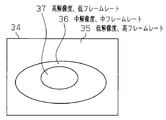
- the selection information corresponding to the central region of the spectrum image may be set to be different from the selection information corresponding to the peripheral region of the spectrum image.
- the data transfer apparatus selects different information for the central region and the peripheral region of the spectrum image.
- the measurement object existing in the central region of the spectrum image looks small because it is far from the moving body, and the relative velocity is low. Therefore, the data transfer apparatus sets the frame rate low instead of finely setting the wavelength information and the light intensity information of the selection information corresponding to the central region of the spectrum image. Therefore, an increase in data amount can be suppressed.
- the measurement object present in the peripheral region of the spectrum image appears large because it is close to the moving object, but has a high relative velocity. Therefore, the data transfer apparatus sets the wavelength information and the light intensity information roughly instead of setting the frame rate of the selection information corresponding to the peripheral region of the spectrum image high. Therefore, an increase in data amount can be suppressed.
- the data transfer device can finely identify the measurement object corresponding to the position of the spectrum image.
- the processing apparatus may be configured to be able to set the selection information.
- the specific measurement object is referred to as a specific measurement object.
- the processing device recognizes that the specific measurement target exists in the measurement range of the spectrum sensor, the processing device sets the selection information so as to exclude the measurement spectrum data of a portion corresponding to the presence of the specific measurement target. May be.
- the data transfer device reconstructs the spectral data of the portion corresponding to the specific measurement target. It can be excluded from the spectral data. Therefore, the data amount of the reconstructed spectrum data is surely reduced.
- the data transfer device In order to generate the reconstructed spectrum data, the data transfer device represents wavelength information corresponding to a certain range of wavelengths as representative wavelength information, and representative light intensity information based on the light intensity information corresponding to each wavelength information. May be calculated.
- wavelength information included in a certain wavelength range is replaced with one representative wavelength information
- light intensity information corresponding to a certain wavelength range is replaced with one representative light intensity information. Therefore, the reconstructed spectrum data is naturally reduced.
- the data transfer apparatus replaces the wavelength information included in the wavelength range of 550 nm to 650 nm with the wavelength information of 600 nm as a superposition method. Further, the data transfer device replaces the light intensity information corresponding to the wavelength range of 550 nm to 650 nm with light intensity information of 600 nm as one representative light intensity information by convolution or averaging. Therefore, the data amount of the reconstructed spectrum data is surely reduced.
- a spectrum measurement method for a mobile object includes measurement spectrum data including information including wavelength information and light intensity information of a measurement object by a spectrum sensor mounted on the mobile object.
- a measurement step of measuring the measurement spectrum data by a processing device mounted on the mobile body, and an identification step of identifying the measurement object; and the measurement spectrum data from the spectrum sensor A transmission step of transmitting the signal to the device via a signal transmission path.
- the transmitting step further includes obtaining reconstructed spectrum data by reconstructing the measured spectrum data so as to select selection information as predetermined information from information included in the measured spectrum data; And a step of transferring the constituent spectrum data to the processing device via the signal transmission path.
- the reconstructed spectrum data after reduction in which the information included in the measured spectrum data is reduced to only the selection information is transferred to the processing device. Therefore, the amount of data flowing through the signal transmission path, that is, the communication line is reduced, and the amount of spectrum data processed by the processing device is also reduced.
- the spectrum sensor may be a high performance hyperspectral sensor. That is, even when the spectrum sensor acquires measurement spectrum data including a large amount of information, the data transferred from the spectrum sensor to the processing device is reduced to an appropriate data amount. Therefore, the transfer delay in the signal transmission path and the processing delay in the processing device are also eliminated.
- the spectrum measurement method for a mobile object can cause the spectrum measurement device to perform recognition processing in real time while maintaining high recognition accuracy of the measurement target by the spectrum sensor.
- the spectrum measurement method reduces the data amount of the measured spectrum data after being obtained by the spectrum sensor. Therefore, according to this spectrum measurement method, it is not necessary to keep the capability of the spectrum sensor low when selecting a spectrum sensor to be employed in the spectrum measurement apparatus. That is, it is not necessary to suppress the upper limit of the data amount of the measured spectrum data detected by the spectrum sensor. Therefore, the degree of freedom in selecting the spectrum sensor is improved.
- the block diagram which shows schematic structure of the spectrum measuring apparatus for moving bodies of 3rd Embodiment of this invention The block diagram which shows schematic structure of the spectrum measuring apparatus for moving bodies of 4th Embodiment of this invention.
- the block diagram which shows schematic structure of the spectrum measuring apparatus for moving bodies of the modification of this invention The block diagram which shows schematic structure of the spectrum measuring apparatus for moving bodies of the other modification of this invention.
- the block diagram which shows schematic structure of the spectrum measuring apparatus for moving bodies of the further another modification of this invention The schematic diagram which shows the conditions from which the spectrum measuring apparatus for mobile bodies of the other modification of this invention selects the information contained in spectrum data.
- the schematic diagram which shows the conditions from which the spectrum measuring apparatus for mobile bodies of the other modification of this invention selects the information contained in spectrum data.
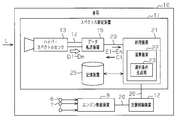
- FIG. 1 is a block diagram showing an outline of the system configuration of the spectrum measuring apparatus 11.
- a vehicle 10 as a moving body includes a hyperspectral sensor together with various sensors as a moving body state acquisition unit such as a vehicle speed sensor 6 that detects a vehicle speed V and a steering angle sensor 7 that detects a steering angle. 13 is provided.
- the hyperspectral sensor 13 constitutes a part of the spectrum measuring device 11.
- the vehicle 10 includes various control devices such as an engine control device 9 that controls an engine (not shown), and an assist control device 12 that supports a driver's driving operation.
- Information from the vehicle speed sensor 6 and the steering angle sensor 7 is directly or indirectly input to the engine control device 9 and the support control device 12.
- An in-vehicle network 20 is connected between the processing device 21 and the support control device 12 and between the support control device 12 and the engine control device 9.
- the spectrum measurement device 11 recognizes the measurement object by observing the observation light L outside the vehicle 10 including light information including visible light and invisible light, and outputs the recognition information regarding the measurement object to the support control device 12. It is configured.
- the support control device 12 transmits the recognition information to another control device such as the engine control device 9.
- the assistance control device 12 is configured to perform driving assistance required for each measurement target.
- the support control device 12 transmits vehicle information as information on the vehicle 10 transmitted directly from the vehicle speed sensor 6 and the steering angle sensor 7 or indirectly via the engine control device 9 to the spectrum measurement device 11. That is, the vehicle speed sensor 6, the steering angle sensor 7, and the engine control device 9 constitute a vehicle information acquisition unit that acquires vehicle information indicating the state of the vehicle 10.
- the vehicle information includes the lighting / extinguishing status of the headlamp of the vehicle 10, the operating status of the direction indicator, and the vehicle speed V.
- a spectrum measuring apparatus 11 includes a hyperspectral sensor 13 that detects measured spectrum data D1 to Dm from observation light L that is light from a measurement target; and a large capacity that transports the measured spectrum data D1 to Dm.
- m and n are integers each indicating a frame rate and will be described in detail later.
- the spectrum measuring device 11 has a processing device 21 that performs recognition processing for recognizing a measurement object by using the reconstructed spectrum data E1 to En.
- the data transfer device 15 and the processing device 21 are connected by an in-vehicle network 20.
- the large-capacity communication circuit 14 has a shorter length, instead of being able to communicate with a larger capacity than the in-vehicle network 20.
- the large-capacity communication circuit 14 and the part of the in-vehicle network 20 between the data transfer device 15 and the processing device 21 constitute a signal transmission path between the hyperspectral sensor 13 and the processing device 21.
- the hyperspectral sensor 13 observes the observation light L as light composed of visible light and invisible light, thereby generating a spectral image that is split into a plurality of wavelength bands.
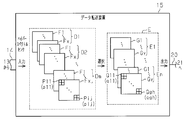
- FIG. 2 details the measured spectrum data D1 to Dm as spectrum images obtained by the hyperspectral sensor 13.
- the measured spectrum data D1 to Dm correspond to the frame rate times t1 to tm of the hyperspectral sensor 13, respectively.
- the hyperspectral sensor 13 measures 20 pieces of measured spectrum data D1 to Dm per second.
- Each of the measured spectrum data D1 to Dm corresponds to a momentary spectrum image obtained by the hyperspectral sensor 13.
- the measurement spectrum data D1 has 150 single-wavelength images F1 to Fx.
- the single wavelength images F1 to Fx are images corresponding to the wavelengths included in the measurement wavelength band measured by the hyperspectral sensor 13, respectively. That is, the measurement spectrum data D1 is composed of single wavelength images F1 to Fx having the number x of measurement bands as the number obtained by dividing the measurement wavelength band by the wavelength resolution f.
- one single-wavelength image F1 has i ⁇ j single-wavelength pixels P11 to Pij in a matrix shape.
- each of the measured spectrum data D1 to Dm as a spectrum image includes wavelength information (number of bands m) as information indicating the wavelength constituting the wavelength band after the spectrum, and the observation light L for each wavelength in these wavelength bands.
- wavelength information number of bands m
- Single-wavelength light intensity information p11 to pij as information indicating the light intensity.
- Each of the measured spectrum data D1 to Dm as a spectrum image has a plurality of single wavelength images F1 to Fx which are images observed for each wavelength in the wavelength band.
- the single wavelength images F1 to Fx are images observed for each wavelength included in the measurement wavelength band of the hyperspectral sensor 13.
- the hyperspectral sensor 13 has a detection surface (not shown) configured by a plurality of imaging elements such as a CCD and a CMOS that detect light intensity information.
- Each of the image sensors constituting the detection surface detects single wavelength light intensity information p11 to pij corresponding to each of the single wavelength pixels P11 to Pij constituting the spectrum image. That is, the plurality of single wavelength pixels P11 to Pij constituting the measurement spectrum data D1 to Dm have single wavelength light intensity information p11 to pij as individual spectrum data corresponding to the measurement wavelength band. That is, each of the single wavelength images F1 to Fx has a plurality of single wavelength pixels P11 to Pij and single wavelength light intensity information p11 to pij respectively corresponding to the plurality of single wavelength pixels P11 to Pij. Therefore, for example, the single wavelength light intensity information p11 of the single wavelength pixel P11 constitutes single pixel light intensity information.
- the large-capacity communication circuit 14 shown in FIG. 1 transfers the measured spectrum data D1 to Dm composed of 3000 single-wavelength images F1 to Fx per second to the data transfer device 15 as described above.
- the large-capacity communication circuit 14 is a communication circuit such as a data bus capable of transferring a large amount of data at high speed. That is, the large-capacity communication circuit 14 can sequentially transfer the measured spectrum data D1 to Dm obtained by the hyperspectral sensor 13 to the data transfer device 15 without causing traffic congestion on the way, that is, without delay.
- the large-capacity communication circuit 14 is a general-purpose, low-cost, high-speed, large-capacity communication circuit that has high reliability and can be realized by a known communication circuit.
- the communication distance of the large-capacity communication circuit 14 is limited to a short distance, for example, several centimeters to several tens of centimeters at the longest to maintain communication performance.
- the communication distance of the large-capacity communication circuit 14 is limited to a shorter distance.
- the data transfer device 15 is mainly composed of a microcomputer having an arithmetic device and a storage device.
- a program used for data selection processing for generating the reconstructed spectrum data E1 to En and various setting values required for the data selection processing are stored in advance.
- the data transfer device 15 includes a temporary storage device (not shown) for temporarily storing a plurality of measured spectrum data D1 to Dm and reconstructed spectrum data E1 to En.
- FIG. 3 shows reconstructed spectrum data E1 to En generated by the data transfer device 15 reconstructing the measured spectrum data D1 to Dm. That is, the data transfer device 15 generates reconstructed spectrum data E1 to En by reducing and reconstructing a part of the information included in the measured spectrum data D1 to Dm by thinning or convolution. The data transfer device 15 outputs the reconstructed spectrum data E1 to En to the processing device 21 via the in-vehicle network 20.
- N represents the frame rate of the reconstructed spectrum data E1 to En
- y represents the number of reconstructed bands.
- the reconstructed spectrum data E1 is a spectrum image constituted by a plurality, that is, y reconstructed single wavelength images G1 to Gy.
- the reconstructed single wavelength images G1 to Gy are images made up of information selected from the measured spectrum data D1 to Dm by the data selection process, respectively.
- the reconstructed single wavelength image G1 has reconfigurable single wavelength pixels Q11 to Qgh in a matrix form. That is, g indicates the horizontal resolution of the reconstruction space decomposition, and h indicates the vertical resolution. Corresponding to these reconstructed single wavelength pixels Q11 to Qgh, reconstructed light intensity information q11 to qgh as reconstructed single wavelength light intensity information is obtained.
- the storage device 16 shown in FIG. 1 is all or part of a storage area provided in a known storage device.
- the storage device 16 stores in advance one or a plurality of data selection conditions as predetermined information, that is, selection information used by the data transfer device 15 for data selection processing.
- the data transfer device 15 acquires a data selection condition used for data selection processing from the storage device 16.
- the storage device 16 of the present embodiment stores a plurality of data selection conditions with different information reduction methods and different information reduction amounts.
- the data transfer device 15 selects an appropriate data selection condition from the storage device 16 based on the specifications of the in-vehicle network 20 and the processing device 21, and performs a data selection process based on the selected data selection condition.
- Predetermined information that is selected by the data transfer device 15 to generate reconstructed spectrum data E1 to En from the measured spectrum data D1 to Dm that is, a predetermined condition indicating the selection information is, for example, the following “frame rate changing condition” , “Wavelength resolution changing condition”, and “resolution changing condition”. “Frame rate changing condition” reduces the number of measurement spectrum data D1 to Dm, “Wavelength resolution changing condition” reduces the number of single wavelength images F1 to Fx, and “Resolution changing condition” is a single wavelength pixel. The number of P11 to Pij is reduced.
- the data selection conditions are not limited to these.
- the frame rate changing condition is used to select a part of the measured spectrum data D1 to Dm, which are spectrum images, and generate reconstructed spectrum data E1 to En. That is, the frame rate n of the reconstructed spectrum data E1 to En is set smaller than the frame rate m of the measured spectrum data D1 to Dm. m> n.
- the data transfer device 15 selects only D1 as selection information from the measured spectrum data D1 to D5, and deletes D2, D3, D4, and D5. That is, only 1/5 of the measured spectrum data D1 is selected.
- the wavelength resolution changing condition is used to generate a reconstructed single wavelength image G1 to Gy by selecting a part of the single wavelength images F1 to Fx. That is, the reconstruction band number y as the number of bands of the reconstructed single wavelength images G1 to Gy is set to be smaller than the measurement band number x which is the number of bands of the single wavelength images F1 to Fx. x> y.
- reconstructed spectrum data E1 to En are generated. That is, the wavelength resolution of the reconstructed spectrum data E1 to En is coarser or lower than the wavelength resolution of the measured spectrum data D1 to Dm.
- the information amount of the reconstructed spectrum data E1 to En is 1/10 compared to the 3000 single wavelength images F1 to Fx of the measured spectrum data D1 to Dm.
- the resolution change condition is used to select a part of the single wavelength pixels P11 to Pij and generate the reconstructed single wavelength pixels Q11 to Qgh. That is, reconstructed light intensity information q11 to qgh corresponding to some pixels is generated from the single wavelength light intensity information p11 to pij corresponding to the single wavelength pixels P11 to Pij, respectively. Therefore, the resolution of the reconstructed single wavelength images G1 to Gy is coarser, that is, lower than the resolution of the single wavelength images F1 to Fx.
- the data transfer device 15 selects at least one of these data selection conditions and executes a data selection process based on the selected data selection conditions. For these reasons, the information amount of the reconstructed spectrum data E1 to En created by the data transfer device 15 is surely reduced as compared with the information amount output from the hyperspectral sensor 13. That is, the amount of data based on the information included in the reconstructed spectrum data E1 to En per unit time is reduced as compared to the measured spectrum data D1 to Dm per unit time.
- the in-vehicle network 20 shown in FIGS. 1 and 3 is, for example, an in-vehicle local CAN (Controller Area Network), and is a general-purpose communication line that can secure a certain communication distance, for example, several meters to several tens of meters. . That is, since the in-vehicle network 20 has a high degree of freedom of wiring constituting the communication line, it is possible to secure a distance between the communicating devices.
- the in-vehicle network 20 may be connected to another device of the data transfer device 15 and the processing device 21. That is, according to the in-vehicle network 20, the degree of freedom of arrangement of the data transfer device 15 and the processing device 21 in the vehicle 10 can be increased.
- the in-vehicle network 20 has a high degree of freedom in connection of wiring and devices, but has a characteristic that when the amount of communication data increases, collision of communication data and waiting for communication occur and communication efficiency decreases. Be constrained.
- the amount of data that can be communicated by the in-vehicle network 20 is smaller than the amount of data that can be transferred by the large-capacity communication circuit 14, and is, for example, 1/100 to 1/100.
- the data transfer device 15 reconstructs the reconstructed spectrum data E1 to En having a data amount reduced from the measured spectrum data D1 to Dm, and outputs the reconstructed spectrum data E1 to En to the in-vehicle network 20.
- the data amount transferred to the in-vehicle network 20 by the data transfer device 15 can be reduced to a data amount that can be suitably transferred by the in-vehicle network 20. That is, the reconstructed spectrum data E1 to En can be suitably transferred to the processing device 21 via the in-vehicle network 20.
- the processing device 21 shown in FIG. 1 is mainly configured by a microcomputer having an arithmetic device 22 and a storage device. Since the processing device 21 is connected to the data transfer device 15, the reconstructed spectrum data E1 to En output from the data transfer device 15 are input. The processing device 21 recognizes the measurement target by performing a measurement target identification process based on the input reconstructed spectrum data E1 to En. Since the processing device 21 recognizes the measurement target by a known method, in this embodiment, the configuration of the processing device 21 for recognizing the measurement target and the recognition processing portion for recognizing the measurement target. The detailed description is omitted for convenience.
- the processing device 21 performs measurement target identification processing based on the input reconstructed spectrum data E1 to En. For example, the processing device 21 determines whether or not the spectrum images match or does not match by comparing the measured spectrum image with the spectrum image to be measured stored in advance in a storage device (not shown). Recognize the object to be measured. In general, comparison of spectral images requires a process for selecting a comparison area, a process for comparing by sequentially updating a measurement object until the measurement object is specified in the selected comparison area, and many processes. For this reason, many operations by the arithmetic unit 22 are required for these processes.
- the processing device 21 performs recognition processing for all of the spectral images picked up by the hyperspectral sensor 13, high performance is required for the processing device 22 that performs calculations related to the recognition processing.
- the processing device 21 (arithmetic device 22) is subject to various restrictions in terms of design and cost due to restrictions placed on the vehicle. Therefore, simply increasing the performance of the processing device 21 and the arithmetic device 22 included therein may cause problems in their versatility, low cost, and maintainability.
- the data transfer device 15 reduces the data amount of the reconstructed spectrum data E1 to En transferred to the processing device 21 to a data amount that can be suitably recognized and processed by the processing device 21, whereby the reconstructed spectrum data
- the data E1 to En can be suitably processed in real time by the processing device 21.
- the processing device 21 recognizes the measurement object while ensuring the real-time property through the recognition processing by the arithmetic device 22. Further, the processing device 21 uses the recognized measurement target information by the processing device 21 itself, or transmits the information to the support control device 12 that is an external device of the spectrum measurement device 11.
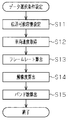
- FIG. 4 is a flowchart showing a procedure of data selection processing performed by the data transfer device 15. The data selection process is sequentially executed in synchronization with the measurement of the spectrum image by the hyperspectral sensor 13.
- the data transfer device 15 sets data selection conditions in step S10.
- the data transfer device 15 of the present embodiment specifies the maximum transfer value as the maximum amount of data that can be transferred to the in-vehicle network 20, the transferable data amount specified in the in-vehicle network 20, and the processing device 21. This is set based on the amount of data that can be recognized in real time.
- the maximum transfer value is preset in the data transfer device 15 and the storage device 16. When the transfer maximum value is set, the data transfer device 15 acquires from the storage device 16 data selection conditions for generating the reconstructed spectrum data E1 to En that do not exceed the transfer maximum value.
- step S20 the data transfer device 15 selects information included in the measured spectrum data D1 to Dm based on the data selection condition, and generates reconstructed spectrum data E1 to En by reconstructing the selected information. Therefore, reconstructed spectrum data E1 to En with a reduced amount of information, that is, the amount of data are generated.
- step S30 the data transfer device 15 transfers the reconstructed spectrum data E1 to En to the processing device 21.
- the data transfer device 15 prevents the data amount of the reconstructed spectrum data E1 to En from exceeding the data transfer capability of the in-vehicle network 20 and the processing capability of the processing device 21. Therefore, a delay in transfer of the reconstructed spectrum data E1 to En by the in-vehicle network 20 and a delay of the processing device 21 based on the reconfigured spectrum data E1 to En are prevented. Therefore, the measurement object recognition process based on the spectrum image is suitably performed in real time.
- the spectrum measuring apparatus that performs binning readout can also change the data amount in various ways by arbitrarily setting the wavelength resolution and spatial resolution of data readout from the detector. .
- the data transfer device 15 of this embodiment does not modify the hyperspectral sensor 13 itself, but reduces the measured spectral data D1 to Dm output from the hyperspectral sensor 13. Therefore, in this embodiment, the hyperspectral sensor 13 having a high spectrum measurement capability can be used as it is in the spectrum measurement device 11.
- the data transfer device 15 reduces the information included in the measurement spectrum data D1 to Dm by selecting only the selection information as the predetermined information, and reconstructed spectrum data E1 to En, which is data after the reduction Is transferred to the processing device 21. As a result, the amount of data flowing through the in-vehicle network 20 and the amount of reconstructed spectrum data E1 to En to be processed by the processing device 21 are reduced.
- the spectrum measurement device 11 reduces the measurement spectrum data D1 to Dm to an appropriate data amount, Reconstructed spectrum data E1 to En, which is data after reduction, can be transferred to the processing device 21.
- the transfer delay of the in-vehicle network 20 and the processing delay of the processing device 21 are eliminated. That is, the spectrum measuring apparatus 11 can sufficiently perform the recognition process in real time while maintaining the recognition accuracy of the measurement object high by using the hyperspectral sensor 13.
- the data transfer device 15 uses the reconstructed spectrum data E1 to E1 based on the wavelength band information composed of a part of the wavelength information out of the wavelength information output from the hyperspectral sensor 13, that is, based on the wavelength resolution changing condition. En is generated. Therefore, the data amount of the reconstructed spectrum data E1 to En transferred from the data transfer device 15 can be surely reduced.
- the data transfer device 15 responds to the resolution based on a part of the light intensity information output from the hyperspectral sensor 13, that is, based on the resolution change condition, in other words, based on the density of the light intensity information.
- the resolution change condition in other words, based on the density of the light intensity information.
- the data transfer device 15 reconstructs the spectral data E1 based on partial time information of the measured spectral data D1 to Dm respectively corresponding to the temporal spectral images output from the hyperspectral sensor 13. ⁇ En are generated. That is, reconstructed spectrum data E1 to En are generated from the measured spectrum data D1 to Dm according to the frame rate of the spectrum image captured over time, that is, according to the frame rate changing condition. Therefore, the data amount of the reconstructed spectrum data E1 to En transferred from the data transfer device 15 can be surely reduced.
- the data transfer device 15 handles the maximum value of the reconstructed spectrum data E1 to En in real time determined by the data transfer capability of the in-vehicle network 20, that is, the signal transmission path or communication line, and the data processing capability of the processing device 21. Set it below the maximum capacity of the possible data volume. Therefore, when transferring the reconfigured spectrum data E1 to En, the data transfer delay and the data processing delay are suppressed, and the real-time performance of the spectrum measuring apparatus 11 for the measurement object recognition process is reliably improved.
- (Second Embodiment) 5 and 6 illustrate a spectrum measuring apparatus 11 according to the second embodiment of the present invention.
- the present embodiment is different from the first embodiment in that it has a speed table 19 for selecting the reconfigured frame rate n according to the vehicle speed V, and the other configurations are the same. For this reason, the same reference numerals are given to the same components, and redundant description is omitted. That is, the data selection condition of the present embodiment is not determined in advance, but changes according to the vehicle speed V.
- the data selection condition setting shown in the flowchart of FIG. 6 corresponds to the details of step S10 of FIG.
- the reconstruction frame rate n is set to 15 fps when the speed is less than 120 km, and the reconstruction frame rate n is set to 30 fps when the vehicle speed V is 120 km or more.
- FIG. 6 is a flowchart showing a processing procedure for setting data selection conditions by the spectrum measuring apparatus 11.
- the data transfer device 15 sets the initial transmittable capacity ct0.
- the initial transmittable capacity ct0 is set based on information on the vehicle 10 newly acquired by the data transfer device 15.
- the newly acquired information of the vehicle 10 includes information acquired based on the recognition status of the measurement target and the external environment of the vehicle, and the data transfer device 15 acquires from the processing device 21 via the in-vehicle network 20.
- the initial transmittable capacity ct0 may be set by the data transfer device 15 based on the priority of the measurement target or based on limited information necessary for identifying the measurement target.
- the initial transferable capacity ct0 is set by the data transfer device 15 based on the amount of data that can be transferred from the processing device 21 and the data that can be transferred in the in-vehicle network 20 or the data that can be processed by the processing device 21. May be.
- the initial transmittable capacity ct0 n0 ⁇ y0 ⁇ g0 ⁇ h0.
- the initial reconstruction frame rate n0 10 fps
- the number of initial reconstruction bands y0 20 (20 bands)
- the initial reconstruction resolution g0 ⁇ h0 320 ⁇ 240 (320 ⁇ 240 pixels).
- step S12 the data transfer device 15 acquires the vehicle speed V from the support control device 12 via the processing device 21.
- step S13 the data transfer device 15 selects the reconstructed frame rate n by referring to the speed table 19 stored in the storage device 16.
- step S14 the data transfer device 15 selects a new reconstruction resolution g1 ⁇ h1.
- the data transfer device 15 determines the reconstruction frame rate n1, the resolution m2, and the new number of bands. Based on b2, reconstructed spectrum data E1 to En are generated. Then, the data transfer device 15 transmits the reconstructed spectrum data E1 to En to the processing device 21 via the in-vehicle network 20.
- the second embodiment shown in FIGS. 5 and 6 has an effect equivalent to or equivalent to the effect of the first embodiment, and further has the following effects.
- the data transfer device 15 changes the reconstructed frame rate n of the reconstructed spectrum data E1 to En according to the vehicle speed V. Therefore, it is possible to recognize the measurement object in real time by the processing device 21 while maintaining the recognition accuracy even when the vehicle speed V changes.
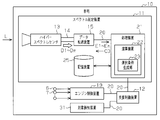
- FIG. 7 is a block diagram showing a schematic configuration of the spectrum measuring apparatus 11 according to the third embodiment of the present invention.
- the data transfer device 15 does not acquire the data selection condition from the storage device 16, but the processing device 21 sets the data selection condition C1 as selection information in the data transfer device 15 described above. This is different from the first embodiment.
- the arithmetic device 22 includes a selection condition generation unit 23 that generates a data selection condition C1. Since other configurations are the same, redundant description with the first embodiment is omitted.
- the processing device 21 acquires various tables indicating the priority of the measurement target from the storage device 25.
- the priority of the measurement target is a priority that changes by feedback according to the current recognition status of the measurement target of the processing device 21 or the priority of the vehicle 10. There is a priority that changes according to the state and the environment outside the vehicle.
- the storage device 25 also stores wavelength information (wavelength band made up of one or more pieces of wavelength information) required for identification for each measurement target.
- the wavelength information suitable for the recognition of the measurement object corresponding to the light source spectrum of the ambient light may be stored in the storage device 25, for example, day or night.
- the selection condition generation unit 23 calculates a measurement target to be detected preferentially based on referring to the priority of the measurement target set in the storage device 25.
- the selection condition generation unit 23 refers to the storage device 25 so as to reflect the current recognition state of the measurement target of the processing device 21.
- the selection condition generation unit 23 generates a data selection condition C1 as selection information suitable for detecting a measurement target based on the calculated priority with reference to the storage device 25 and outputs the data selection condition C1 to the data transfer device 15. .
- the selection condition generation unit 23 selects data suitable for detecting pedestrians, cars, and road surfaces.
- the condition C1 may be generated.
- a data selection condition C1 suitable for detecting pedestrians is set.
- the data transfer device 15 may be output after generation. For example, as the data selection condition C1, when no pedestrian is found in the preprocessing, the reconstruction frame rate n is increased in order to quickly find a newly appearing pedestrian, while the reconstruction resolution g ⁇ h or the reconstruction is performed. The number of bands y may be reduced.
- the data selection condition C1 may be set so that the wavelength resolution before and after the wavelength corresponding to the pedestrian is set high.
- the selection condition generation unit 23 may generate the data selection condition C1 so that wavelength information suitable for detection of the measurement target is set separately for day and night.
- the data selection condition C1 mainly includes wavelength information corresponding to the wavelength component included in the headlamp as the light source. Is generated.
- the selection condition generation unit 23 detects that it is nighttime through the support control device 12, the selection condition generation unit 23 generates the data selection condition C1 so that wavelength information corresponding to the wavelength components of the illuminating lamp and the projector is mainly used.
- the selection condition generation unit 23 may generate a data selection condition C1 suitable for detection of the measurement target according to the vehicle speed V and the steering angle acquired from the support control device 12.
- the selection condition generation unit 23 sets the data selection condition C1 generated as described above in the data transfer device 15.
- the data transfer device 15 generates reconstructed spectrum data E1 to En from the measured spectrum data D1 to Dm based on the set data selection condition C1. Therefore, the data amount of the reconstructed spectrum data E1 to En is surely reduced than the data amount of the measured spectrum data D1 to Dm.
- the third embodiment of FIG. 7 also has the same or similar effects as those of the first embodiment, and the effects listed below.
- the processing device 21 sets the data selection condition C1 and transmits it to the data transfer device 15. Therefore, the data transfer device 15 can generate the reconstructed spectrum data E1 to En based on detailed instructions according to the situation.
- the processing device 21 can set the data selection condition C1 so as to be based on the wavelength information including the wavelength information included in the ambient light around the moving body, that is, the wavelength information included in the light source in the wavelength information. Therefore, the processing device 21 can set the data selection condition C1 so as to exclude the wavelength information of the ambient light, that is, the wavelength not included in the light source, the wavelength information of the weak intensity, and the light intensity information corresponding to the wavelength information. Accordingly, since the data transfer device 15 can select only the wavelength information of the wavelength having a strong intensity under the ambient light, that is, the light source, and the light intensity information corresponding to the wavelength information, the data amount of the reconstructed spectrum data E1 to En is ensured. Reduced.
- the recognition processing by the processing device 21 is performed with the reconstructed spectrum data E1 to E1 with a reduced data amount. Even when based on En, it is preferably performed.
- the selection condition generation unit 23 can set the data selection condition C1 as a request so as to be fed back to the data transfer device 15 according to the recognition result of the measurement target by the processing device 21.
- the selection condition generation unit 23 can change the data selection condition C1 based on the wavelength interval of the wavelength information, the information density of the light intensity information, and the acquisition time of the spectrum data. For example, according to the recognition result of the processing device 21, when the priority is changed in order to measure the high appearance rate target that is expected to appear, the processing device 21 selects the data so as to capture the high appearance rate target.
- the condition C1 can be changed.
- the data reconstruction process of the data transfer device 15 is improved so that the necessary measurement object can be flexibly changed and recognized.
- the recognition performance of the measurement object is improved.
- FIG. 8 is a block diagram showing a schematic configuration of the spectrum measuring apparatus 11 according to the fourth embodiment of the present invention. Note that this embodiment is different from the above-described third embodiment of FIG. 7 in that a navigation device 30 that extends the environment information acquisition device is added. Furthermore, it has an optical sensor 8.
- the navigation device 30 that forms part of the environment information acquisition device is connected to the processing device 21 via the support control device 12.
- the navigation device 30 may be directly connected to the processing device 21.
- the navigation device 30 is a device that acquires information on the external environment of the vehicle 10, and constitutes various environment acquisition devices that acquire, for example, the travel position and day and night of the vehicle 10.
- the navigation device 30 transmits these various environmental information to the processing device 21.
- the navigation device 30 detects the position information of the vehicle 10 to detect the characteristics of the traveling place such as the urban area, the highway, and the field, and shows the position on the map of the display panel. Can tell.
- the navigation device 30 may determine day and night with a clock or illuminometer.
- the navigation device 30 may specify the position by GPS (Global Positioning System) position information or a combination of the position information and the map, or may be acquired by communication from a system that reports the position information. May be. Further, the optical sensor 8 forming a part of the environmental information acquisition device may transmit environmental light or other detection information of day and night to the processing device 21 via the engine control device 9.
- GPS Global Positioning System
- various tables indicating the priority of the measurement target are set.
- the priority of the measurement target the priority of the measurement target set in accordance with the environmental state acquired by the navigation device 30 is stored in advance. For example, information in which the priority of the measurement object that frequently appears from the characteristics of the travel location is increased, or information in which the priority of the measurement object that should not appear from the characteristics of the travel location is decreased is set.
- the storage device 25 also stores wavelength information necessary for identification for each measurement target.
- the selection condition generation unit 23 calculates the measurement target to be detected with priority based on referring to the priority of the measurement target set in the storage device 25 according to the environment information input from the navigation device 30. To do.
- the selection condition generation unit 23 generates a data selection condition C2 based on the calculated priority, and sets the data selection condition C2 in the data transfer device 15.
- the processing device 21 when the navigation device 30 detects the city area, the processing device 21 generates the data selection condition C2 that causes the data transfer device 15 to select information suitable for detecting a bicycle or a pedestrian. May be. Further, for example, when the navigation device 30 detects an expressway, the processing device 21 generates a data selection condition C2 that causes the data transfer device 15 to select information suitable for detecting a car. Also good. Further, the data selection condition C2 may be generated so that the data transfer device 15 selects information suitable for detecting a pedestrian that has a low possibility of appearing on an expressway but has a large influence. The selection condition generation unit 23 may generate the data selection condition C ⁇ b> 2 so that the data transfer device 15 selects information suitable for detection of the measurement object day or night.
- the selection condition generation unit 23 may generate the data selection condition C2 that causes the data transfer device 15 to select only the wavelength information corresponding to the spectrum of the light source observed or estimated by the optical sensor 8. Good. Further, for example, the selection condition generation unit 23 responds to a request for image information to be displayed on the display panel of the navigation device 30 with light of red “R”, green “G”, and blue “B” as selection conditions for wavelength information. As the wavelength information, the data selection condition C2 may be generated.
- the selection condition generation unit 23 sets the data selection condition C2 generated as described above in the data transfer device 15.
- the data transfer device 15 generates reconstructed spectrum data E1 to En from the measured spectrum data D1 to Dm based on the set data selection condition C2. Therefore, the data amount of the reconstructed spectrum data E1 to En is surely reduced than the data amount of the measured spectrum data D1 to Dm.
- the same effects as those of the first and third embodiments can be obtained, and the following effects can also be obtained.
- FIG. 9 is a block diagram showing a schematic configuration of the spectrum measuring apparatus 11 according to the fifth embodiment of the present invention. This embodiment is different from the third embodiment of FIG. 7 in that an object detection device 31 such as a camera, a radar, or a laser measurement device is used.
- an object detection device 31 such as a camera, a radar, or a laser measurement device is used.
- the target detection device 31 is connected to the processing device 21 via the support control device 12. Alternatively, the target detection device 31 may be directly connected to the processing device 21.
- the object detection device 31 detects a measurement object and a detection object that exist in the external environment of the vehicle 10. For example, the object detection device 31 detects a measurement object or a detection object such as a vehicle traveling ahead, a structure around a road, or a building in order to detect the measurement object or the detection object based on the map information and the position information. It is an information acquisition device.
- the target detection device 31 transmits the detected detection target to the processing device 21. That is, the target detection device 31 is a device that detects a vehicle ahead by image recognition based on a captured image of a camera, radar, or laser. Further, the object detection device 31 may be a navigation system that detects structures and buildings around the road from the position information of the vehicle 10 and conveys these positions to a passenger by displaying them on a map on the display panel.
- the selection condition generation unit 23 does not include information on the portion corresponding to the position where the detection target exists in the reconstructed spectrum data E 1 to En.
- the data selection condition C3 is set. Furthermore, the selection condition generation unit 23 may generate the data selection condition C3 based on the priority of the measurement target. For example, the selection condition generation unit 23 may generate a data selection condition C3 by adding a condition that does not select a position where the detection target exists to the data selection condition C2 generated in advance. The data selection condition C3 may be generated from the data selection condition C2 and the condition that does not select the position where the detection target exists.
- the selection condition generation unit 23 sets the data selection condition C3 generated as described above in the data transfer device 15.
- the data transfer device 15 generates reconstructed spectrum data E1 to En from the measured spectrum data D1 to Dm based on the set data selection condition C3. Therefore, the data amount of the reconstructed spectrum data E1 to En is surely reduced than the data amount of the measured spectrum data D1 to Dm.
- the data transfer device 15 may process the data selection condition C2 and then process other data selection conditions C3, or may process the data selection condition C3 at a time.
- the fifth embodiment of FIG. 9 also obtains the same or equivalent effects as those of the first embodiment and the third actual embodiment, and the following effects.
- the map information may be provided in the storage device 25 of the spectrum measuring device 11. That is, the map information is not limited to being provided in the navigation device 30 or the object detection device 31 outside the spectrum measurement device 11 as in the third and fourth embodiments.
- the data transfer device 15 of each of the above embodiments may include an inappropriate data selection unit 17.
- the inappropriate data selection unit 17 excludes meaningless information included in the measured spectrum data D1 to Dm so that meaningless information is not included in the reconstructed spectrum data E1 to En.
- the inadequate data selection unit 17 inspects the light intensity information included in the measurement spectrum data D1 to Dm, for example, the light intensity information value is saturated exceeding the upper limit value or the lower limit value, or less than the lower limit value. The light intensity information that is meaningless as information that is not changed at all is detected.
- the data transfer device 15 does not select, that is, exclude the light intensity information detected as inappropriate data from the reconstructed spectrum data E1 to En.
- the amount of data transferred as the reconstructed spectrum data E1 to En is reduced, and the recognizing spectrum data E1 to En is prevented from containing meaningless light intensity information, thereby improving the recognition accuracy of the measuring apparatus. It can also be maintained.
- the inappropriate data selection unit 17 may be applied later to the reconstructed spectrum data E1 to En generated based on the data selection conditions from the measured spectrum data D1 to Dm.
- the data transfer device 15 may be provided with a spectrum data processing unit 18 for processing a part of the measured spectrum data D1 to Dm.
- the spectrum data processing unit 18 reduces the wavelength information based on the condition set by the data selection condition C1. For example, the spectrum data processing unit 18 averages or convolves light intensity information in a specific wavelength region, for example, 550 nm to 650 nm, which is set as a region that has little influence on the recognition of the measurement object because the change in information is small. . That is, the spectrum data processing unit 18 obtains one representative light intensity information corresponding to one specific representative wavelength, for example, 600 nm.
- the data transfer device 15 uses a plurality of wavelength information corresponding to wavelengths of 550 nm to 650 nm as wavelength information of 600 nm, and converts light intensity information corresponding to wavelengths of 550 nm to 650 nm to wavelength information of 600 nm by convolution or averaging. Is calculated as light intensity information. Accordingly, wavelength information of 550 nm to 650 nm and light intensity information corresponding to them are selected as wavelength information of 600 nm and light intensity information corresponding thereto.
- the selection condition generation unit 23 of the third to fifth embodiments includes a peripheral region 35 as a peripheral portion of the spectrum image 34, a transition region 36 as an intermediate portion, and a center as a central portion.
- the reconstruction frame rate n, the number of reconstruction bands y, and the reconstruction resolution, that is, the reconstruction resolution g ⁇ h may be changed in accordance with each of the areas 37.
- the measurement object that appears in the peripheral region 35 appears large because the relative distance to the vehicle 10 is close, and the relative speed with respect to the vehicle 10 is high.
- the moving speed of is also fast.
- the data selection condition for the peripheral region 35 of the spectrum image 34 can be set to a low reconstruction resolution g ⁇ h or a small reconstruction rate instead of increasing the reconstruction frame rate n so that the processing device 21 can quickly recognize the measurement target. Set the number of constituent bands to y.
- the measurement object shown in the central region 37 of the spectrum image 34 appears small because the relative distance to the vehicle 10 is long, the relative speed with respect to the vehicle 10 is slow, and the moving speed in the spectrum image 34 is also slow. From this, so that the processing device 21 can recognize the measurement target with high accuracy, the data selection condition for the central region 37 of the spectrum image 34 is not a high reconstruction resolution g ⁇ h or a large number of reconstruction bands y. Set to low reconstruction frame rate n. In addition, for the transition region 36 located between the peripheral region 35 and the central region 37 of the spectrum image 34, the data selection condition is set to the medium reconstruction resolution g ⁇ h and the number of reconstruction bands y, and the medium reconstruction is performed. The configuration frame rate is set to n.
- the data transfer device 15 uses the wavelength interval of the wavelength information, that is, the wavelength resolution, and the information density of the light intensity information for generating the reconstructed spectrum data E1 to En according to the vehicle speed V and the state of the vehicle 10 by the steering operation. That is, the resolution and the acquisition time interval of the measurement spectrum data, that is, the frame rate can be changed. Therefore, the spectrum measuring apparatus can perform recognition processing of the measurement object based on appropriate reconstructed spectrum data E1 to En reconfigured according to the state of the moving object. As a result, more suitable identification of the measurement object is realized. For example, the amount of reconstructed spectrum data can be reduced while maintaining the recognition accuracy of the measurement object, compared to a case where information is selected for all regions of the spectrum image under the same conditions. Therefore, the recognition process of the measurement object in real time is easy.
- the data transfer device 15 and the storage device 16 are reconfigured with the reconstructed frame rate n and the reconfiguration according to the peripheral region 35, the transition region 36, and the central region 37 of the spectrum image 34.
- the data selection condition may be set by changing the number of constituent bands y and the reconstruction resolution g ⁇ h.
- the selection condition generation unit 23 of the third to fifth embodiments may set the reconstructed frame rate n of the portion corresponding to the new traveling direction in the spectrum image 34 to be large according to the steering operation angle, that is, the steering angle. Good. That is, instead of allowing the measurement object to be recognized quickly, the reconstruction resolution g ⁇ h and the number of reconstruction bands y may be set small. Therefore, the processing device 21 can appropriately recognize and process a new measurement object in the traveling direction in real time.
- the selection condition generation unit 23 of the third to fifth embodiments places a priority frame on the boundary portion between the measurement target 39 and the background.
- W may be set.
- the data selection condition may be generated by changing the reconstruction frame rate n, the reconstruction resolution g ⁇ h, and the number of reconstruction bands y for the priority frame W.
- the priority frame W is set so that the pedestrian's face and the like can be locked on in advance so that the pedestrian's face and the like appearing from a shadow as a blind spot of another vehicle as the measurement target 39 can be quickly recognized.
- the priority frame W is set to a high reconstruction frame rate n and the priority frame W is small, the reconstruction resolution g ⁇ h and the number of reconstruction bands y are also set high. Therefore, a further measurement object appearing from the blind spot of the measurement object 39 can be quickly detected by real-time recognition processing without greatly increasing the data amount of the reconstructed spectrum data E1 to En.
- the data transfer device 15 acquires the data selection condition from the storage device 16 in order to generate the reconstructed spectrum data E1 to En that does not exceed the maximum transfer value.
- the data transfer device sequentially selects the information of the measurement object having a high priority, and the reconfigured spectrum data E1 to En are transferred.
- the maximum value should not be exceeded.
- the data transfer device 15 has a high priority. The reconstructed spectrum data E1 to En are recreated so as to limit the information related to the measurement target.
- the new reconstruction resolution g1 ⁇ h1 is not limited to the initial reconstruction resolution g0 ⁇ h1, but may be changed.
- both the new reconstruction resolution g1 ⁇ h1 and the new reconstruction band number y1 are changed.
- the degree of freedom in setting data selection conditions is increased.
- the speed table 19 is not limited to setting the reconstruction frame rate n in relation to the vehicle speed V, but may set the reconstruction frame rate n in relation to the steering angle of the vehicle. Good. For example, as the steering angle increases, the reconstruction frame rate n is increased and the reconstruction band number y is decreased so that the measurement target can be found in a short time. Therefore, a suitable reconstruction frame rate n can be set according to the vehicle state.
- the storage device 16 may store data including wavelength information necessary for recognition of the measurement target. Therefore, the data transfer apparatus may generate reconstructed spectrum data including wavelength information required for the measurement target by acquiring data corresponding to the measurement target. Therefore, as the spectrum measuring apparatus 11, the amount of data is reduced, and the recognition accuracy for the selected measurement object is improved.
- the storage device 16 may store wavelength information data included in the light source. That is, the data transfer device 15 can generate the reconstructed spectrum data E1 to En so as to surely include the wavelength information included in the light source.
- a plurality of conditions may be selected simultaneously from among the reconstruction frame rate n, the reconstruction resolution g ⁇ h, and the number of reconstruction bands y, or only one may be set. Good.
- the degree of freedom in designing the spectrum measuring apparatus 11 can be expanded. For example, when the data amount of the measured spectrum data D1 to Dm is small, the information may be selected under effective conditions.
- the reconstruction frame rate n, the reconstruction resolution g ⁇ h, and the number of reconstruction bands y are not limited to predetermined values, and can be arbitrarily changed by a setting device. May be.
- the data transfer device 15 and the processing device 21 may change the selection information in response to other data amount fluctuations passing through the in-vehicle network 20.
- Other devices may change the selection information. The degree of freedom of data selection conditions is increased.
- the data selection condition may be set by an arithmetic expression instead of a map.
- the degree of freedom in designing data selection conditions in the spectrum measuring apparatus 11 is increased.
- the hyperspectral sensor 13 and the data transfer device 15 may be unitized to form one hyperspectral sensor unit 40.
- the hyperspectral sensor unit 40 has a bus that constitutes a large-capacity communication circuit 14 that connects the hyperspectral sensor 13 to the data transfer device 15. In this case, the spectrum measuring apparatus 11 can be reduced in size.
- the selection information as the data selection condition constitutes the reconstructed spectrum data E1 to En
- the present invention is not limited to this, and conversely, information that does not constitute the reconstructed spectrum data E1 to En may be set as the data selection condition. Also in this case, the degree of freedom in setting the data selection condition is increased.
- the in-vehicle network 20 is a CAN
- the present invention is not limited to this, and the in-vehicle network 20 may be other networks such as Ethernet (registered trademark), FlexRay (registered trademark), and IEEE1394 (FireWire (registered trademark)) as long as network communication is possible. . Thereby, the adoption possibility of this spectrum measuring device is increased.
- DESCRIPTION OF SYMBOLS 10 ... Vehicle, 11 ... Spectrum measuring device, 12 ... Support control device, 13 ... Hyper spectrum sensor, 14 ... Large capacity communication circuit, 15 ... Data transfer device, 16 ... Storage device, 17 ... Inappropriate data selection part, 18 ... Spectrum Data processing unit, 19 ... speed table, 20 ... in-vehicle network, 21 ... processing device, 22 ... calculation device, 23 ... selection condition generation unit, 25 ... storage device, 30 ... navigation device, 31 ... target detection device, 34 ... spectrum Image, 35 ... Peripheral region, 36 ... Transition region, 37 ... Center region, 38 ... Spectral image, 39 ... Measurement object, 40 ... Hyperspectral sensor unit, D ... Measurement spectrum data, E ... Reconstructed spectrum data, F ... Single Wavelength image, G: Reconstructed single wavelength image, L: Observation light, P, Q: Pixel.
Landscapes
- Physics & Mathematics (AREA)
- Spectroscopy & Molecular Physics (AREA)
- General Physics & Mathematics (AREA)
- Analytical Chemistry (AREA)
- Life Sciences & Earth Sciences (AREA)
- Chemical & Material Sciences (AREA)
- Health & Medical Sciences (AREA)
- Biochemistry (AREA)
- General Health & Medical Sciences (AREA)
- Immunology (AREA)
- Pathology (AREA)
- Investigating Or Analysing Materials By Optical Means (AREA)
- Spectrometry And Color Measurement (AREA)
Abstract
Priority Applications (5)
| Application Number | Priority Date | Filing Date | Title |
|---|---|---|---|
| PCT/JP2010/062960 WO2012014327A1 (fr) | 2010-07-30 | 2010-07-30 | Dispositif de mesure de spectre pour objet mobile et procédé de mesure de spectre pour objet mobile |
| CN201080042079.4A CN103038628B (zh) | 2010-07-30 | 2010-07-30 | 移动体用光谱测定装置以及移动体用光谱测定方法 |
| US13/383,595 US9121818B2 (en) | 2010-07-30 | 2010-07-30 | Movable body spectrum measuring apparatus and movable body spectrum measuring method |
| JP2012507208A JP5321735B2 (ja) | 2010-07-30 | 2010-07-30 | 移動体用スペクトル測定装置および移動体用スペクトル測定方法 |
| DE112010005786.9T DE112010005786B4 (de) | 2010-07-30 | 2010-07-30 | Vorrichtung und Verfahren zum Messen eines Spektrums eines bewegbaren Körpers |
Applications Claiming Priority (1)
| Application Number | Priority Date | Filing Date | Title |
|---|---|---|---|
| PCT/JP2010/062960 WO2012014327A1 (fr) | 2010-07-30 | 2010-07-30 | Dispositif de mesure de spectre pour objet mobile et procédé de mesure de spectre pour objet mobile |
Publications (1)
| Publication Number | Publication Date |
|---|---|
| WO2012014327A1 true WO2012014327A1 (fr) | 2012-02-02 |
Family
ID=45529569
Family Applications (1)
| Application Number | Title | Priority Date | Filing Date |
|---|---|---|---|
| PCT/JP2010/062960 Ceased WO2012014327A1 (fr) | 2010-07-30 | 2010-07-30 | Dispositif de mesure de spectre pour objet mobile et procédé de mesure de spectre pour objet mobile |
Country Status (5)
| Country | Link |
|---|---|
| US (1) | US9121818B2 (fr) |
| JP (1) | JP5321735B2 (fr) |
| CN (1) | CN103038628B (fr) |
| DE (1) | DE112010005786B4 (fr) |
| WO (1) | WO2012014327A1 (fr) |
Families Citing this family (12)
| Publication number | Priority date | Publication date | Assignee | Title |
|---|---|---|---|---|
| US9307548B2 (en) * | 2013-12-12 | 2016-04-05 | Nokia Solutions And Networks Oy | Band and channel selection in 5G |
| US9977961B2 (en) * | 2014-10-21 | 2018-05-22 | Bae Systems Information And Electronic Systems Integration Inc. | Method for maintaining detection capability when a frame in a multispectral image is corrupted |
| JP2016103708A (ja) * | 2014-11-27 | 2016-06-02 | 株式会社ソシオネクスト | 撮像装置および撮像方法 |
| JP6775285B2 (ja) * | 2015-09-24 | 2020-10-28 | アルパイン株式会社 | 後側方車両検知警報装置 |
| CN105450868B (zh) * | 2015-12-02 | 2018-06-12 | 广东小天才科技有限公司 | 一种有害光提示方法及装置 |
| CN105450869B (zh) * | 2015-12-02 | 2018-06-12 | 广东小天才科技有限公司 | 一种有害光提示方法及装置 |
| US10868981B2 (en) * | 2016-04-27 | 2020-12-15 | Sony Corporation | Shooting control apparatus, shooting control method, and shooting apparatus |
| FR3052904A1 (fr) * | 2016-06-16 | 2017-12-22 | Peugeot Citroen Automobiles Sa | Procede d'aide a la conduite pour vehicule automobile |
| US10291326B2 (en) * | 2016-09-26 | 2019-05-14 | The Boeing Company | Communication systems and methods |
| JP7065356B2 (ja) * | 2019-11-11 | 2022-05-12 | パナソニックIpマネジメント株式会社 | 情報処理装置、情報処理方法、およびプログラム |
| JP7463870B2 (ja) * | 2020-06-12 | 2024-04-09 | 株式会社オートネットワーク技術研究所 | 車載装置、車載通信システムおよび通信制御方法 |
| CN111775962B (zh) * | 2020-07-13 | 2022-04-22 | 中国联合网络通信集团有限公司 | 自动行驶策略的确定方法及装置 |
Citations (6)
| Publication number | Priority date | Publication date | Assignee | Title |
|---|---|---|---|---|
| JP2005077347A (ja) * | 2003-09-03 | 2005-03-24 | Kokusai Kogyo Co Ltd | 大気計測用レーザレーダ装置 |
| JP2005528280A (ja) * | 2002-05-30 | 2005-09-22 | ラファエル―アーマメント ディベロップメント オーソリティー リミテッド | 航空偵察システム |
| JP2006145362A (ja) * | 2004-11-19 | 2006-06-08 | Nec Toshiba Space Systems Ltd | 光学スペクトルセンサ |
| JP2008026998A (ja) * | 2006-07-18 | 2008-02-07 | Sumitomo Electric Ind Ltd | 障害物位置算出システム、及び障害物位置算出方法 |
| JP2008541664A (ja) * | 2005-05-18 | 2008-11-20 | ディーティーエス (ビーヴィーアイ) エイゼット リサーチ リミテッド | スケーラブルに符号化された画像のレート制御 |
| JP2010210355A (ja) * | 2009-03-09 | 2010-09-24 | Kobe Univ | 近赤外線分光法を用いた野菜等の成分の非破壊計測法および非破壊計測装置 |
Family Cites Families (12)
| Publication number | Priority date | Publication date | Assignee | Title |
|---|---|---|---|---|
| US20080147253A1 (en) | 1997-10-22 | 2008-06-19 | Intelligent Technologies International, Inc. | Vehicular Anticipatory Sensor System |
| JP4326621B2 (ja) | 1999-03-01 | 2009-09-09 | 株式会社エヌ・ティ・ティ・データ | データ管理方法及び装置、記録媒体 |
| JP4624594B2 (ja) | 2000-06-28 | 2011-02-02 | パナソニック株式会社 | 物体認識方法および物体認識装置 |
| US7495774B2 (en) * | 2002-03-01 | 2009-02-24 | Michigan Aerospace Corporation | Optical air data system |
| US7564539B2 (en) * | 2002-08-02 | 2009-07-21 | Ophir Corporation | Optical air data systems and methods |
| JP4262072B2 (ja) | 2003-12-05 | 2009-05-13 | 株式会社日立製作所 | 自動車用補助機器制御装置 |
| US7308342B2 (en) | 2004-01-23 | 2007-12-11 | Rafael Armament Development Authority Ltd. | Airborne reconnaissance system |
| US7026600B2 (en) * | 2004-02-26 | 2006-04-11 | Rosemount Aerospace Inc. | System and method of identifying an object in a laser beam illuminated scene based on material types |
| DE102005024716B4 (de) * | 2005-05-30 | 2023-09-21 | Robert Bosch Gmbh | Verfahren und Vorrichtung zur Erkennung und Klassifizierung von Objekten |
| US20080059080A1 (en) * | 2006-08-31 | 2008-03-06 | Caterpillar Inc. | Method and system for selective, event-based communications |
| WO2010137173A1 (fr) | 2009-05-29 | 2010-12-02 | トヨタ自動車 株式会社 | Appareil de mesure de spectre pour chargeur |
| CN102449448B (zh) | 2009-05-29 | 2014-05-21 | 丰田自动车株式会社 | 移动体用光谱测定装置 |
-
2010
- 2010-07-30 WO PCT/JP2010/062960 patent/WO2012014327A1/fr not_active Ceased
- 2010-07-30 JP JP2012507208A patent/JP5321735B2/ja not_active Expired - Fee Related
- 2010-07-30 CN CN201080042079.4A patent/CN103038628B/zh not_active Expired - Fee Related
- 2010-07-30 DE DE112010005786.9T patent/DE112010005786B4/de not_active Expired - Fee Related
- 2010-07-30 US US13/383,595 patent/US9121818B2/en not_active Expired - Fee Related
Patent Citations (6)
| Publication number | Priority date | Publication date | Assignee | Title |
|---|---|---|---|---|
| JP2005528280A (ja) * | 2002-05-30 | 2005-09-22 | ラファエル―アーマメント ディベロップメント オーソリティー リミテッド | 航空偵察システム |
| JP2005077347A (ja) * | 2003-09-03 | 2005-03-24 | Kokusai Kogyo Co Ltd | 大気計測用レーザレーダ装置 |
| JP2006145362A (ja) * | 2004-11-19 | 2006-06-08 | Nec Toshiba Space Systems Ltd | 光学スペクトルセンサ |
| JP2008541664A (ja) * | 2005-05-18 | 2008-11-20 | ディーティーエス (ビーヴィーアイ) エイゼット リサーチ リミテッド | スケーラブルに符号化された画像のレート制御 |
| JP2008026998A (ja) * | 2006-07-18 | 2008-02-07 | Sumitomo Electric Ind Ltd | 障害物位置算出システム、及び障害物位置算出方法 |
| JP2010210355A (ja) * | 2009-03-09 | 2010-09-24 | Kobe Univ | 近赤外線分光法を用いた野菜等の成分の非破壊計測法および非破壊計測装置 |
Non-Patent Citations (1)
| Title |
|---|
| HIROHITO KOJIMA ET AL.: "A GA-based Band Selection Algorithm for Hyper-spectral Image Classification", JOURNAL OF THE REMOTE SENSING SOCIETY OF JAPAN, vol. 25, no. 1, January 2005 (2005-01-01), pages 1 - 12 * |
Also Published As
| Publication number | Publication date |
|---|---|
| DE112010005786B4 (de) | 2023-03-02 |
| US9121818B2 (en) | 2015-09-01 |
| JP5321735B2 (ja) | 2013-10-23 |
| DE112010005786T5 (de) | 2013-05-29 |
| CN103038628B (zh) | 2015-07-22 |
| US20120194817A1 (en) | 2012-08-02 |
| CN103038628A (zh) | 2013-04-10 |
| JPWO2012014327A1 (ja) | 2013-09-09 |
Similar Documents
| Publication | Publication Date | Title |
|---|---|---|
| JP5321735B2 (ja) | 移動体用スペクトル測定装置および移動体用スペクトル測定方法 | |
| US11372200B2 (en) | Imaging device | |
| JP6988819B2 (ja) | 画像処理装置、および画像処理方法、並びにプログラム | |
| EP3757603B1 (fr) | Système de télémétrie, module de réception de lumière et procédé de fabrication d'un filtre passe-bande | |
| JP7225600B2 (ja) | 情報処理装置、情報処理方法、プログラム | |
| JP6137081B2 (ja) | 車載機器 | |
| US11953376B2 (en) | Imaging apparatus, signal processing apparatus, signal processing method, and program | |
| JPWO2018037678A1 (ja) | 画像処理装置および情報生成装置と情報生成方法 | |
| WO2017113403A1 (fr) | Procédé de traitement d'informations d'image et dispositif de réalité augmentée ra | |
| WO2019163315A1 (fr) | Dispositif de traitement de l'information, dispositif d'imagerie et système d'imagerie | |
| EP3585045B1 (fr) | Dispositif de traitement d'informations, procédé de traitement d'informations et programme | |
| JP2018006785A (ja) | 信号処理装置、撮像装置、及び信号処理方法 | |
| WO2017122396A1 (fr) | Dispositif de commande, procédé et programme de commande | |
| JP5212545B2 (ja) | 移動体用スペクトル測定装置 | |
| CN115127544A (zh) | 用于导航的热成像系统和方法 | |
| EP4073548A1 (fr) | Système de connaissance situationnelle pour un véhicule autonome ou semi-autonome | |
| WO2018100992A1 (fr) | Système optique d'imagerie, module de caméra et appareil électronique | |
| JPWO2018042815A1 (ja) | 画像処理装置と画像処理方法 | |
| JP2018033072A (ja) | 撮像装置、撮像システム、及び、信号処理方法 | |
| JPWO2018131514A1 (ja) | 信号処理装置、信号処理方法、およびプログラム | |
| WO2019082686A1 (fr) | Dispositif d'imagerie | |
| CN118355653A (zh) | 图像显示方法和装置 | |
| EP3761636B1 (fr) | Dispositif de traitement de signal, procédé de traitement de signal et dispositif d'imagerie | |
| CN119659325A (zh) | 一种车辆视角图渲染方法以及装置 |
Legal Events
| Date | Code | Title | Description |
|---|---|---|---|
| WWE | Wipo information: entry into national phase |
Ref document number: 201080042079.4 Country of ref document: CN |
|
| WWE | Wipo information: entry into national phase |
Ref document number: 13383595 Country of ref document: US |
|
| WWE | Wipo information: entry into national phase |
Ref document number: 2012507208 Country of ref document: JP |
|
| 121 | Ep: the epo has been informed by wipo that ep was designated in this application |
Ref document number: 10855335 Country of ref document: EP Kind code of ref document: A1 |
|
| WWE | Wipo information: entry into national phase |
Ref document number: 1120100057869 Country of ref document: DE Ref document number: 112010005786 Country of ref document: DE |
|
| 122 | Ep: pct application non-entry in european phase |
Ref document number: 10855335 Country of ref document: EP Kind code of ref document: A1 |