WO2012014852A1 - Composite d'électrolyte à matériau actif, processus de production, et batterie secondaire lithium-soufre tout-solide - Google Patents
Composite d'électrolyte à matériau actif, processus de production, et batterie secondaire lithium-soufre tout-solide Download PDFInfo
- Publication number
- WO2012014852A1 WO2012014852A1 PCT/JP2011/066876 JP2011066876W WO2012014852A1 WO 2012014852 A1 WO2012014852 A1 WO 2012014852A1 JP 2011066876 W JP2011066876 W JP 2011066876W WO 2012014852 A1 WO2012014852 A1 WO 2012014852A1
- Authority
- WO
- WIPO (PCT)
- Prior art keywords
- electrolyte
- active material
- lithium
- electrode
- secondary battery
- Prior art date
- Legal status (The legal status is an assumption and is not a legal conclusion. Google has not performed a legal analysis and makes no representation as to the accuracy of the status listed.)
- Ceased
Links
Images


Classifications
-
- H—ELECTRICITY
- H01—ELECTRIC ELEMENTS
- H01M—PROCESSES OR MEANS, e.g. BATTERIES, FOR THE DIRECT CONVERSION OF CHEMICAL ENERGY INTO ELECTRICAL ENERGY
- H01M4/00—Electrodes
- H01M4/02—Electrodes composed of, or comprising, active material
- H01M4/36—Selection of substances as active materials, active masses, active liquids
- H01M4/58—Selection of substances as active materials, active masses, active liquids of inorganic compounds other than oxides or hydroxides, e.g. sulfides, selenides, tellurides, halogenides or LiCoFy; of polyanionic structures, e.g. phosphates, silicates or borates
- H01M4/581—Chalcogenides or intercalation compounds thereof
-
- H—ELECTRICITY
- H01—ELECTRIC ELEMENTS
- H01M—PROCESSES OR MEANS, e.g. BATTERIES, FOR THE DIRECT CONVERSION OF CHEMICAL ENERGY INTO ELECTRICAL ENERGY
- H01M10/00—Secondary cells; Manufacture thereof
- H01M10/36—Accumulators not provided for in groups H01M10/05-H01M10/34
- H01M10/39—Accumulators not provided for in groups H01M10/05-H01M10/34 working at high temperature
-
- H—ELECTRICITY
- H01—ELECTRIC ELEMENTS
- H01M—PROCESSES OR MEANS, e.g. BATTERIES, FOR THE DIRECT CONVERSION OF CHEMICAL ENERGY INTO ELECTRICAL ENERGY
- H01M10/00—Secondary cells; Manufacture thereof
- H01M10/36—Accumulators not provided for in groups H01M10/05-H01M10/34
- H01M10/39—Accumulators not provided for in groups H01M10/05-H01M10/34 working at high temperature
- H01M10/3909—Sodium-sulfur cells
- H01M10/3918—Sodium-sulfur cells characterised by the electrolyte
-
- H—ELECTRICITY
- H01—ELECTRIC ELEMENTS
- H01M—PROCESSES OR MEANS, e.g. BATTERIES, FOR THE DIRECT CONVERSION OF CHEMICAL ENERGY INTO ELECTRICAL ENERGY
- H01M4/00—Electrodes
- H01M4/02—Electrodes composed of, or comprising, active material
- H01M4/36—Selection of substances as active materials, active masses, active liquids
- H01M4/58—Selection of substances as active materials, active masses, active liquids of inorganic compounds other than oxides or hydroxides, e.g. sulfides, selenides, tellurides, halogenides or LiCoFy; of polyanionic structures, e.g. phosphates, silicates or borates
- H01M4/581—Chalcogenides or intercalation compounds thereof
- H01M4/5815—Sulfides
-
- H—ELECTRICITY
- H01—ELECTRIC ELEMENTS
- H01M—PROCESSES OR MEANS, e.g. BATTERIES, FOR THE DIRECT CONVERSION OF CHEMICAL ENERGY INTO ELECTRICAL ENERGY
- H01M4/00—Electrodes
- H01M4/02—Electrodes composed of, or comprising, active material
- H01M4/62—Selection of inactive substances as ingredients for active masses, e.g. binders, fillers
- H01M4/621—Binders
-
- H—ELECTRICITY
- H01—ELECTRIC ELEMENTS
- H01M—PROCESSES OR MEANS, e.g. BATTERIES, FOR THE DIRECT CONVERSION OF CHEMICAL ENERGY INTO ELECTRICAL ENERGY
- H01M4/00—Electrodes
- H01M4/02—Electrodes composed of, or comprising, active material
- H01M4/62—Selection of inactive substances as ingredients for active masses, e.g. binders, fillers
- H01M4/624—Electric conductive fillers
-
- Y—GENERAL TAGGING OF NEW TECHNOLOGICAL DEVELOPMENTS; GENERAL TAGGING OF CROSS-SECTIONAL TECHNOLOGIES SPANNING OVER SEVERAL SECTIONS OF THE IPC; TECHNICAL SUBJECTS COVERED BY FORMER USPC CROSS-REFERENCE ART COLLECTIONS [XRACs] AND DIGESTS
- Y02—TECHNOLOGIES OR APPLICATIONS FOR MITIGATION OR ADAPTATION AGAINST CLIMATE CHANGE
- Y02E—REDUCTION OF GREENHOUSE GAS [GHG] EMISSIONS, RELATED TO ENERGY GENERATION, TRANSMISSION OR DISTRIBUTION
- Y02E60/00—Enabling technologies; Technologies with a potential or indirect contribution to GHG emissions mitigation
- Y02E60/10—Energy storage using batteries
Definitions
- the present invention relates to an active material-electrolyte complex, a method for producing the same, and an all-solid-state lithium-sulfur secondary battery, and in particular, contacts between electrode active material particles and an electrolyte having a gelled electrolyte using an ether organic solvent.
- Active material-electrolyte composite maintaining its safety, its manufacturing method, and using this active material-electrolyte composite, the safety is improved while maintaining the contact between the electrode active material particles and the electrolyte, and it is a discharge product.
- the present invention relates to an all solid-state lithium-sulfur secondary battery in which elution of lithium polysulfide and low lithium sulfide into an electrolyte is suppressed.
- Lithium ion secondary batteries have characteristics such as high energy density and high output as compared with other types of batteries, and are often used as batteries for mobile phones, notebook computers and the like.
- active research has been conducted with the aim of spreading to hybrid vehicles and electric vehicles, and with the research on hybrid vehicles and electric vehicles, further increase in capacity of lithium ion secondary batteries is required.
- a lithium-sulfur secondary battery using single sulfur which is said to be high capacity, low cost, and environmentally friendly, as a positive electrode active material has attracted attention.
- the theoretical capacity of elemental sulfur is 1675 mAh / g, which is larger than the capacity of a positive electrode active material (for example, LiCoO 2 : about 140 mAh / g) used in a general lithium ion secondary battery. It is known that
- lithium sulfide Li 2 S
- Li 2 S lithium sulfide
- an electrode mixture containing an electrode active material in order to increase the mechanical strength of the electrode mixture and improve the impregnation property of the electrolytic solution, a clay mineral such as smectite is 5 based on the total weight of the electrode mixture.
- An electrode mixture contained in a range of not more than% by weight is known (for example, see Patent Document 2).
- the clay mineral is contained in the electrode mixture, and is used as a slurry to improve the wettability of the electrolytic solution in addition to improving the mechanical strength and impregnating the electrolytic solution.
- a solid electrolyte composed of a mixture of an electrolytic solution in which an electrolyte is dissolved in an organic compound, a polymer material that forms a gel by mixing with the electrolytic solution, and layered clay compound particles that exhibit swelling properties.
- a polymer material such as polyvinylidene fluoride (PVdF) is used to form a gel.
- lithium ion secondary batteries using organic electrolytes, it is safe to say that there are ignition phenomena caused by short circuits caused by liquid leakage from batteries and precipitation of dendritic lithium (dendrites) from negative electrodes due to repeated use of batteries. It is pointed out from the aspect. Considering that lithium ion secondary batteries are used in various applications, it is necessary to give more importance to suppression of liquid leakage and safety. Therefore, there is an urgent need to develop a lithium-ion secondary battery with improved leakage control and safety, such as studying the structure of the battery itself, developing a non-burning electrolyte, and developing an inorganic solid electrolyte. .
- An object of the present invention is to solve the above-mentioned problems of the prior art, using a gelled electrolyte capable of preventing leakage of an electrolytic solution, and maintaining the contact between the particles of the electrode active material and the electrolyte It is an object of the present invention to provide an all-solid-state lithium-sulfur secondary battery that has high safety and that can improve cycle characteristics.
- a swellable layered clay mineral such as scumite
- the active material-electrolyte composite of the present invention is an electrode material in which an active material, a conductive additive, and a binder are mixed at a predetermined ratio, and the positive electrode active material is elemental sulfur or lithium-containing sulfide.
- a gelled electrolyte made of a mixture of a lithium ion conductive electrolyte and a swellable lamellar clay mineral containing an ether organic solvent is provided on an electrode provided on a current collector, and the gel is applied to the electrode. It is characterized in that it is vibrated with such a strength that the electrolytic electrolyte is liquefied.
- the swellable layered clay mineral is a smectite-based layered clay mineral or a mica-based layered clay mineral.
- the lithium-containing sulfide is lithium sulfide (Li 2 S).
- the method for producing an active material-electrolyte composite of the present invention is an electrode material in which an active material, a conductive additive, and a binder are mixed at a predetermined ratio, and the positive electrode active material is composed of elemental sulfur or lithium-containing sulfide.
- a gelled electrolyte composed of a mixture of a lithium ion conductive electrolyte and a swellable layered clay mineral containing an ether organic solvent is applied to an electrode provided with a certain electrode material on a current collector, and then gelled.
- the electrode to which the electrolyte is applied is vibrated at such a strength that the gelled electrolyte liquefies, and the gelled electrolyte is liquefied and penetrated into the electrode to produce an active material-electrolyte complex.
- the swellable layered clay mineral is a smectite-based layered clay mineral or a mica-based layered clay mineral.
- the lithium-containing sulfide is lithium sulfide (Li 2 S).
- the all solid-state lithium-sulfur secondary battery of the present invention is characterized by using the above active material-electrolyte complex.
- the active material-electrolyte complex is a positive electrode active material-electrolyte complex.
- the active material-electrolyte complex is a negative electrode active material-electrolyte complex.
- the active material-electrolyte complex is a positive electrode active material-electrolyte complex and a negative electrode active material-electrolyte complex.
- the present invention by using a gelled electrolyte obtained by gelling an electrolytic solution using an ether organic solvent, leakage of the electrolytic solution is suppressed and the contact between the electrode active material particles and the electrolyte is maintained. As a result, it is possible to provide an all-solid-state lithium-sulfur secondary battery in which safety is improved and elution of lithium polysulfide and low-sulfide lithium as discharge products into the electrolyte can be provided.
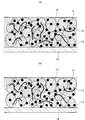
- FIG. 1 is a schematic diagram for explaining the state of an electrode using an active material-electrolyte complex of the present invention, wherein (a) is a case where vibration is produced according to the present invention, and (b) is a comparative example. Therefore, when it is manufactured without giving vibration.
- 6 is a graph showing charge / discharge curves of lithium-sulfur secondary batteries produced in Example 3 and Comparative Example 2.
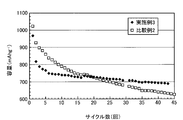
- 3 is a graph showing discharge capacity curves obtained with respective repetitive cycle characteristics of lithium-sulfur secondary batteries produced in Example 3 and Comparative Example 2.
- FIG. 6 is a graph showing a charge / discharge curve of a lithium-sulfur secondary battery produced in Comparative Example 3.
- the active material-electrolyte complex is an electrode material in which an active material, a conductive additive, and a binder are mixed at a predetermined ratio.
- a lithium ion conductive electrolysis comprising an ether organic solvent on an electrode provided with an electrode material on which a positive electrode active material is elemental sulfur or lithium-containing sulfide (for example, lithium sulfide: Li 2 S) on a current collector
- a gelled electrolyte comprising a mixture of a liquid and a predetermined amount of a swellable layered clay mineral selected from a smectite-based layered clay mineral and a mica-based layered clay mineral is provided, and the gelled electrolyte is liquefied with respect to this electrode.
- the vibration method is not particularly limited as long as the gelled electrolyte is liquefied.
- the vibration is carried by holding it in the hand or by applying vibrations such as ultrasonic waves, the gelled electrolyte is liquefied and penetrates into the electrode, thereby covering all the active materials.
- This active material-electrolyte complex can be used for both the positive electrode and the negative electrode.
- the active material examples include known positive electrode active materials selected from lithium-containing sulfides such as elemental sulfur (S) and lithium sulfide (Li 2 S), carbon-based materials such as carbon and carbon black, silicon-based materials, A known negative electrode active material selected from a tin-based material, a silicon-carbon-based material, lithium titanium oxide (for example, Li 4 Ti 5 O 12 ), Li metal, Li—Al alloy, and the like is included.
- known positive electrode active materials selected from lithium-containing sulfides such as elemental sulfur (S) and lithium sulfide (Li 2 S), carbon-based materials such as carbon and carbon black, silicon-based materials
- any material can be used as long as it does not cause a chemical change in the target lithium-sulfur secondary battery and has conductivity, and is not particularly limited.
- graphite various carbon blacks, conductive fibers, metal powders such as copper powder and iron powder, and the like can be used.
- the binder is not particularly limited as long as it is a substance that does not cause a chemical change in the target lithium-sulfur secondary battery and has a function as a binder.
- PVdF polyvinylidene fluoride
- polyethylene polyethylene
- polypropylene polypropylene
- polytetrafluoroethylene PTFE
- any material can be used as long as it does not cause a chemical change in the target lithium-sulfur secondary battery and has conductivity, and is not particularly limited.
- a positive electrode current collector selected from stainless steel, aluminum, nickel, titanium and the like, and a negative electrode current collector selected from copper, stainless steel, aluminum, nickel, titanium and the like can be used.
- the gelled electrolyte used in the present invention contains an ether organic solvent, a lithium ion conductive electrolyte and a smectite layered clay mineral, or a predetermined amount of a swellable layered layer selected from a mica layered clay mineral. It consists of a mixture with clay minerals.
- the gelled electrolyte is obtained by adding a swellable lamellar clay mineral in an organic solvent and sufficiently swelling the clay mineral, and adding it to the electrolyte solution as described below, or It is preferable to prepare it by mixing with an electrolyte, but it is not limited to such a method, and the order of addition is not limited as long as the gelled electrolyte of the present invention can be prepared.
- ether organic solvent known solvents used in lithium ion secondary batteries can be used and are not particularly limited.
- 1,3-dioxolane (DOL), tetrahydrofuran, 2-methyltetrahydrofuran, 1,4-dioxane, 1,2-dimethoxyethane, diethyl ether, 1,2-diethoxyethane, triethylene glycol dimethyl ether, etc. should be used. Can do. Also, two or more of these ether organic solvents can be mixed and used.
- lithium salt added to the organic solvent of the electrolytic solution those commonly used can be used.
- an electrolyte selected from LiClO 4 , LiPF 6 , LiAsF 6 , LiN (CF 3 SO 2 ) 2 , LiBF 4 , LiCF 3 SO 3 , LiSbF 6 and the like in an organic solvent can be used.
- the smectite layered clay mineral can be used as long as it exhibits thixotropic properties, and is not particularly limited.
- Product name: Lucentite STN can be used, and hectorite, bentonite, montmorillonite, synthetic smectite (manufactured by Coop Chemical Co., Ltd., product name: Lucentite STN) and the like are preferable.
- the mica-based layered clay mineral can be used as long as it exhibits thixotropic properties, and is not particularly limited.
- mica, brittle mica, muscovite, soda mica, phlogopite, biotite, etc. can be used, and mica is preferred.
- the swellable layered clay mineral used in the present invention exhibits thixotropic properties when added to a solvent.
- the thixotropy is a phenomenon in which the viscosity gradually decreases and becomes liquid when it continues to receive shear stress (vibration), and the viscosity gradually increases when it is stationary, and finally becomes solid.
- the gelled electrolyte is first liquefied, and the gelled electrolyte is spread over the entire electrode so as to sufficiently cover the periphery of the active material, and only the electrolyte is used.
- the present invention provides an electrode surface while applying physical vibrations such as ultrasonic waves to an electrode in which an electrode material containing an electrode active material is provided on a current collector (for example, Al foil, Cu foil, etc.).
- a current collector for example, Al foil, Cu foil, etc.
- the mixing ratio of the lithium ion conductive electrolyte and the swellable layered clay mineral may be appropriately blended in such an amount that the electrolyte can exhibit thixotropy.
- the amount of the swellable layered clay mineral increases, it becomes solid, so that thixotropy is not expressed, and as the amount of the swellable layered clay mineral decreases, the liquid becomes closer to the liquid.
- the amount of the swellable layered clay mineral added is preferably in the range of about 2 wt% to 10 wt% based on the total weight of the mixture.
- the thixotropic property tends not to be expressed, and if it exceeds 10 wt%, gelation tends to proceed as compared with 10 wt%, and the thixotropic property is not expressed.
- this production method comprises a predetermined ratio (for example, a weight ratio of 45) of the active material, the conductive additive, and the binder. : 45: 10)
- the gelled electrolyte is applied to the electrode obtained by coating the electrode material mixed on the current collector, and then the gelled electrolyte is applied to the electrode coated with the gelled electrolyte.
- the above-mentioned vibration preferably ultrasonic vibration
- the liquefied gelled electrolyte is uniformly infiltrated into the electrode, and the active material is covered with the electrolyte. It is.
- the active material, the conductive auxiliary material, and the binder are blended as follows, for example.
- the conductive additive is mixed in an amount of 1 to 50 wt%, preferably 30 to 50 wt%, based on the total weight of the positive electrode. If it is less than 1 wt%, sufficient conductivity cannot be exhibited, and if it exceeds 50 wt%, the amount of the positive electrode active material is reduced, resulting in a problem that the capacity is reduced.
- the binder is mixed in an amount of 1 to 50 wt%, preferably 5 to 30 wt% based on the total weight of the positive electrode. If it is less than 1 wt%, the binding ability is lowered, and if it exceeds 50 wt%, the amount of the positive electrode active material is reduced, resulting in a problem that the capacity is reduced.
- the secondary battery uses the gelled electrolyte, and the gelled electrolyte is placed in the positive electrode material on the current collector. It is impregnated and used as a positive electrode composite and / or this gelled electrolyte is infiltrated into a negative electrode material on a current collector and used as a negative electrode composite.
- the gelled electrolyte of the present invention When the gelled electrolyte of the present invention is used, the electrolyte liquefied by vibration automatically penetrates into the positive electrode (negative electrode) material applied to the Al foil (positive electrode) or Cu foil (negative electrode) as the current collector.
- a separator that is usually used to prevent a short circuit between the positive electrode and the negative electrode may or may not be used.
- any ordinary known separator may be used.
- a porous polypropylene film manufactured by Celgard; trade name: Celgard # 2400
- Celgard # 2400 can be used.
- an electrode material in which an active material 11, a binder 12, and a conductive additive 13 are mixed at a predetermined ratio is applied on a current collector 14, and the electrode is formed.
- An active material is obtained by applying an organic solvent-containing gelled electrolyte 15 containing a lithium ion conductive electrolyte and a swellable layered clay mineral to the electrode, and applying vibration (for example, ultrasonic vibration).
- vibration for example, ultrasonic vibration
- -An electrolyte composite electrolyte composite
- a lithium-sulfur secondary battery can be assembled by a known method using the active material-electrolyte composite thus prepared as an electrode.
- DME 1,2-dimethoxyethane
- the ultrasonic vibration was given to the gelled electrolyte produced in Example 1. While applying vibration, it was confirmed that the gelled electrolyte was liquefied, stopped vibrating, and then allowed to stand to gel (solidify).
- the gelled electrolyte produced in Example 1 was applied on the surface of the positive electrode, and ultrasonic vibration was applied to liquefy the gelled electrolyte, so that it penetrated into the positive electrode as shown in FIG. A substance-electrolyte complex was prepared. As a result, as shown in FIG.
- a 2032 type lithium-sulfur secondary battery was assembled using the positive electrode composite thus produced as a positive electrode and Li metal as a negative electrode, and a charge / discharge test was performed.
- the charge / discharge current value was 192.74 ⁇ A / cm 2 (corresponding to a 0.1 C rate)
- the cut-off voltage was 1.5-2.8 V
- charge / discharge was repeated 43 cycles. Since elemental sulfur was used as the positive electrode, measurement was started from the discharge reaction.
- Example 1 A lithium-sulfur secondary battery was assembled according to the method described in Example 3 except that no ultrasonic vibration was applied, and a charge / discharge test was performed. In this case, the charge / discharge current value was 190 ⁇ A / cm 2 (corresponding to a 0.1 C rate).
- a lithium-sulfur secondary battery was assembled according to the method described in Example 3 except that a porous polypropylene film (manufactured by Celgard; trade name: Celgard # 2400) was used as the separator, and a charge / discharge test was performed. In this case, the charge / discharge current value was 189.75 ⁇ A / cm 2 (corresponding to a 0.1 C rate), and charge / discharge was repeated 45 cycles. Since elemental sulfur was used as the positive electrode, measurement was started from the discharge reaction.
- a porous polypropylene film manufactured by Celgard; trade name: Celgard # 2400
- the charge / discharge curves of the first cycle of the lithium-sulfur secondary batteries produced in Example 3 and Comparative Example 2 are shown in FIG.
- the vertical axis represents E / V (Li / Li + ), and the horizontal axis represents discharge capacity (mAh / g (active material)).
- the initial discharge capacity is 1000 mAh / g, indicating that a high discharge capacity is obtained.
- FIG. 3 shows the discharge capacities obtained with the respective repetitive cycle characteristics of the lithium-sulfur secondary batteries produced in Example 3 and Comparative Example 2.
- the vertical axis represents the discharge capacity (mAh / g (active material)), and the horizontal axis represents the number of cycles.
- the discharge capacity of Example 3 is greater than the discharge capacity of Comparative Example 2 after 20 cycles, and the cycle characteristics are improved.
- the charge / discharge current value was 355.08 ⁇ A / cm 2 (corresponding to a 0.1 C rate)
- the cut-off voltage was 1.4-3.0 V
- charge / discharge was repeated three cycles. Since elemental sulfur was used as the positive electrode, measurement was started from the discharge reaction.
- FIG. 4 shows charge / discharge curves of the lithium-sulfur secondary battery manufactured in Comparative Example 3 for the first cycle (1st), the second cycle (2nd), and the third cycle (3rd).
- the vertical axis represents E / V (Li / Li + ), and the horizontal axis represents discharge capacity (mAh / g (active material)).
- a carbonate-based organic solvent when used, discharging is possible but charging is not possible.
- 1,2-dimethoxyethane used in Example 1, 1,3-dioxolane, tetrahydrofuran, 2-methyltetrahydrofuran, 1,4-dioxane, diethyl ether, 1,2-diethoxy were used as ether organic solvents.
- a gelled electrolyte was prepared using ethane and triethylene glycol dimethyl ether, respectively, and a lithium-sulfur secondary battery was prepared according to the method described in Example 3. As a result, a charge / discharge curve similar to the results shown in FIGS. And discharge capacity was found to be obtained.
- a lithium-sulfur secondary battery was produced according to the method described in Example 3 except that Li 2 S was used instead of sulfur, which is the positive electrode active material used in Example 3, and the results shown in FIGS. It was found that the same charge / discharge curve and discharge capacity as those obtained were obtained.
- Example 2 the amount of the synthetic smectite used in Example 1 was changed, and an electrolyte was prepared according to the method described in Example 1 in the following proportions (1) to (7). According to Example 2, ultrasonic vibration was applied and the state was observed.
- the following synthetic smectite addition amount is a ratio with respect to the obtained electrolyte weight.
- Synthetic smectite 50 mg + DEC: 2 g + electrolytic solution: 567 mg (addition amount of synthetic smectite: 1.91 wt%) (2) Synthetic smectite: 100 mg + DEC: 2 g + electrolytic solution: 567 mg (additional amount of synthetic smectite: 3.75 wt%) (3) Synthetic smectite: 150 mg + DEC: 2 g + Electrolytic solution: 567 mg (Additional amount of synthetic smectite: 5.52 wt%) (4) Synthetic smectite 200 mg + DEC: 2 g + electrolytic solution: 567 mg (synthetic smectite addition amount: 7.23 wt%) (5) Synthetic smectite 300 mg + DEC: 2 g + electrolytic solution: 567 mg (synthetic smectite addition amount: 10.5 wt%) (6) Synthetic smectit
- (1) is in a liquid state and no thixotropic property is observed
- (2) has thixotropic properties
- (3) has thixotropic properties.
- (4) is more gelled than (3) but has thixotropic properties
- (5) is more gelled than (4) and is almost solid
- thixotropic properties are No (6) was almost solid and no thixotropic property was seen, and (7) was almost solid and no thixotropic property was seen.
- the amount of the swellable layered clay mineral is preferably in the range of about 2 wt% to 10 wt%.
- a lithium-sulfur secondary battery was produced according to the method described in Example 3 except that hectorite, bentonite and montmorillonite were used instead of the synthetic smectite used in Example 1, and the results are shown in FIGS. It was found that the same charge / discharge curve and discharge capacity as the results were obtained.
- the lithium-sulfur secondary battery is used. It can be used in various industries.
Landscapes
- Chemical & Material Sciences (AREA)
- Chemical Kinetics & Catalysis (AREA)
- Electrochemistry (AREA)
- General Chemical & Material Sciences (AREA)
- Engineering & Computer Science (AREA)
- Manufacturing & Machinery (AREA)
- Inorganic Chemistry (AREA)
- Battery Electrode And Active Subsutance (AREA)
- Secondary Cells (AREA)
Abstract
L'invention concerne un composite d'électrolyte à matériau actif obtenu: en appliquant un électrolyte en gel sur une électrode, laquelle électrode comprend un collecteur de charge sur lequel est disposé un matériau d'électrode, le matériau d'électrode étant obtenu en mélangeant un matériau actif, un aide électro-conducteur et un liant selon un rapport de mélange prédéterminé et contenant du soufre élémentaire ou un sulfure contenant du soufre en qualité de matériau actif d'électrode positive, tandis que l'électrolyte en gel contient un solvant organique à base d'éther et comprend un mélange de solution électrolytique conductrice d'ions lithium et un minéral argileux en couche gonflable ; et en soumettant l'électrode à une vibration ayant une intensité qui va liquéfier l'électrolyte en gel. L'invention concerne également une batterie secondaire lithium-soufre tout-solide produite à partir de ce composite.
Priority Applications (1)
| Application Number | Priority Date | Filing Date | Title |
|---|---|---|---|
| JP2012526494A JP5560337B2 (ja) | 2010-07-26 | 2011-07-25 | 活物質−電解質複合体及びその作製方法、並びに全固体型リチウム−硫黄二次電池 |
Applications Claiming Priority (2)
| Application Number | Priority Date | Filing Date | Title |
|---|---|---|---|
| JP2010167498 | 2010-07-26 | ||
| JP2010-167498 | 2010-07-26 |
Publications (1)
| Publication Number | Publication Date |
|---|---|
| WO2012014852A1 true WO2012014852A1 (fr) | 2012-02-02 |
Family
ID=45530060
Family Applications (1)
| Application Number | Title | Priority Date | Filing Date |
|---|---|---|---|
| PCT/JP2011/066876 Ceased WO2012014852A1 (fr) | 2010-07-26 | 2011-07-25 | Composite d'électrolyte à matériau actif, processus de production, et batterie secondaire lithium-soufre tout-solide |
Country Status (3)
| Country | Link |
|---|---|
| JP (1) | JP5560337B2 (fr) |
| TW (1) | TW201225372A (fr) |
| WO (1) | WO2012014852A1 (fr) |
Cited By (6)
| Publication number | Priority date | Publication date | Assignee | Title |
|---|---|---|---|---|
| CN108292782A (zh) * | 2016-04-22 | 2018-07-17 | 株式会社Lg化学 | 锂-硫电池用电解质和包含其的锂-硫电池 |
| CN110291662A (zh) * | 2017-01-30 | 2019-09-27 | 公立大学法人首都大学东京 | 电极用组合物、电极、其制造方法和电池 |
| CN110534742A (zh) * | 2019-07-16 | 2019-12-03 | 江汉大学 | 一种锂硫电池正极复合材料的制备方法 |
| CN110546803A (zh) * | 2017-04-14 | 2019-12-06 | 株式会社村田制作所 | 镁-硫二次电池用正极及其制造方法、以及镁-硫二次电池 |
| JP2022529150A (ja) * | 2019-05-03 | 2022-06-17 | エルジー エナジー ソリューション リミテッド | リチウム-硫黄電池用分離膜及びこれを含むリチウム-硫黄電池 |
| CN116247283A (zh) * | 2023-02-17 | 2023-06-09 | 江西魔玛科技有限公司 | 一种矿物准固态电解质的制备方法 |
Families Citing this family (3)
| Publication number | Priority date | Publication date | Assignee | Title |
|---|---|---|---|---|
| CN111316475B (zh) | 2017-11-06 | 2023-08-11 | 株式会社Lg新能源 | 锂二次电池用负极浆料组合物和其制造方法 |
| CN110212162B (zh) * | 2019-05-22 | 2022-05-17 | 南京大学 | 一种锂硫电池用柔性凝胶硫正极及制备方法 |
| CN115548455B (zh) * | 2022-10-31 | 2026-03-06 | 西安建筑科技大学 | 一种正极电解质一体式固态锂硫电池及其制备方法 |
Citations (4)
| Publication number | Priority date | Publication date | Assignee | Title |
|---|---|---|---|---|
| JPH0528824A (ja) * | 1991-07-23 | 1993-02-05 | Sanyo Chem Ind Ltd | 導電性組成物および電気化学素子 |
| JP2001266855A (ja) * | 2000-03-23 | 2001-09-28 | Matsushita Battery Industrial Co Ltd | 非水電解質二次電池用電極の製造法および非水電解質二次電池 |
| WO2009142794A2 (fr) * | 2008-03-05 | 2009-11-26 | Eaglepicher Technologies, Llc | Accumulateur lithium-soufre et sa cathode |
| WO2010044437A1 (fr) * | 2008-10-17 | 2010-04-22 | 独立行政法人産業技術総合研究所 | Polyacrylonitrile modifié par du soufre, son procédé de fabrication et son application |
-
2011
- 2011-07-25 WO PCT/JP2011/066876 patent/WO2012014852A1/fr not_active Ceased
- 2011-07-25 JP JP2012526494A patent/JP5560337B2/ja active Active
- 2011-07-26 TW TW100126345A patent/TW201225372A/zh unknown
Patent Citations (4)
| Publication number | Priority date | Publication date | Assignee | Title |
|---|---|---|---|---|
| JPH0528824A (ja) * | 1991-07-23 | 1993-02-05 | Sanyo Chem Ind Ltd | 導電性組成物および電気化学素子 |
| JP2001266855A (ja) * | 2000-03-23 | 2001-09-28 | Matsushita Battery Industrial Co Ltd | 非水電解質二次電池用電極の製造法および非水電解質二次電池 |
| WO2009142794A2 (fr) * | 2008-03-05 | 2009-11-26 | Eaglepicher Technologies, Llc | Accumulateur lithium-soufre et sa cathode |
| WO2010044437A1 (fr) * | 2008-10-17 | 2010-04-22 | 独立行政法人産業技術総合研究所 | Polyacrylonitrile modifié par du soufre, son procédé de fabrication et son application |
Cited By (9)
| Publication number | Priority date | Publication date | Assignee | Title |
|---|---|---|---|---|
| CN108292782A (zh) * | 2016-04-22 | 2018-07-17 | 株式会社Lg化学 | 锂-硫电池用电解质和包含其的锂-硫电池 |
| CN108292782B (zh) * | 2016-04-22 | 2021-05-11 | 株式会社Lg化学 | 锂-硫电池用电解质和包含其的锂-硫电池 |
| CN110291662A (zh) * | 2017-01-30 | 2019-09-27 | 公立大学法人首都大学东京 | 电极用组合物、电极、其制造方法和电池 |
| CN110546803A (zh) * | 2017-04-14 | 2019-12-06 | 株式会社村田制作所 | 镁-硫二次电池用正极及其制造方法、以及镁-硫二次电池 |
| JP2022529150A (ja) * | 2019-05-03 | 2022-06-17 | エルジー エナジー ソリューション リミテッド | リチウム-硫黄電池用分離膜及びこれを含むリチウム-硫黄電池 |
| JP7176135B2 (ja) | 2019-05-03 | 2022-11-21 | エルジー エナジー ソリューション リミテッド | リチウム-硫黄電池用分離膜及びこれを含むリチウム-硫黄電池 |
| CN110534742A (zh) * | 2019-07-16 | 2019-12-03 | 江汉大学 | 一种锂硫电池正极复合材料的制备方法 |
| CN110534742B (zh) * | 2019-07-16 | 2021-05-28 | 江汉大学 | 一种锂硫电池正极复合材料的制备方法 |
| CN116247283A (zh) * | 2023-02-17 | 2023-06-09 | 江西魔玛科技有限公司 | 一种矿物准固态电解质的制备方法 |
Also Published As
| Publication number | Publication date |
|---|---|
| JP5560337B2 (ja) | 2014-07-23 |
| JPWO2012014852A1 (ja) | 2013-09-12 |
| TW201225372A (en) | 2012-06-16 |
Similar Documents
| Publication | Publication Date | Title |
|---|---|---|
| JP5560337B2 (ja) | 活物質−電解質複合体及びその作製方法、並びに全固体型リチウム−硫黄二次電池 | |
| JP7413020B2 (ja) | 保護された硫黄カソードを含むアルカリ金属-硫黄二次電池及び製造方法 | |
| JP5349427B2 (ja) | 硫化物固体電解質材料、正極体およびリチウム固体電池 | |
| JP5882516B2 (ja) | リチウム二次電池 | |
| JP5177315B2 (ja) | 硫化物系固体電池 | |
| JP4834030B2 (ja) | リチウム二次電池用正極及びこれを用いたリチウム二次電池 | |
| JP6396153B2 (ja) | リチウム二次電池 | |
| Gopalakrishnan et al. | A comprehensive study on rechargeable energy storage technologies | |
| WO2019027663A1 (fr) | Batterie secondaire métal alcalin-soufre contenant une anode hybride | |
| JP2012048973A (ja) | 硫化物固体電解質材料およびリチウム固体電池 | |
| JP2009218065A (ja) | リチウム二次電池及びその製造方法 | |
| KR20150022647A (ko) | 리튬 이차전지용 전해액 및 리튬 이차전지 | |
| JP2012094437A (ja) | 全固体電池 | |
| JP4362992B2 (ja) | 非水電解質電池 | |
| CN114402460A (zh) | 球状化碳质负极活性材料、其制造方法、以及包含其的负极和锂二次电池 | |
| JP5455136B2 (ja) | ゲル化電解質を用いた活物質−電解質複合体及びその作製方法、並びにこの電解質を用いた全固体リチウムイオン二次電池 | |
| JP2012014973A (ja) | 二次電池用電解質組成物および二次電池 | |
| JP5382414B2 (ja) | リチウムイオン二次電池 | |
| JP4258711B2 (ja) | 非水電解質電池 | |
| JP6067511B2 (ja) | 硫化物固体電解質材料、正極体およびリチウム固体電池 | |
| WO2012127653A1 (fr) | Ensemble électrode, cellule, et procédé pour produire un ensemble électrode | |
| JP2018185914A (ja) | リチウム二次電池用添加剤、それを用いたリチウム二次電池用電解液、それを用いたリチウム二次電池及びリチウム二次電池用添加剤の製造方法 | |
| JP7770385B2 (ja) | 正極シート、リチウムイオン電池、及び電子機器 | |
| JP2015179606A (ja) | リチウムイオン二次電池用負極活物質及びその製造方法並びに該負極活物質を用いたリチウムイオン二次電池 | |
| CN119230917A (zh) | 一种锂离子电池电解液及其应用 |
Legal Events
| Date | Code | Title | Description |
|---|---|---|---|
| 121 | Ep: the epo has been informed by wipo that ep was designated in this application |
Ref document number: 11812441 Country of ref document: EP Kind code of ref document: A1 |
|
| WWE | Wipo information: entry into national phase |
Ref document number: 2012526494 Country of ref document: JP |
|
| NENP | Non-entry into the national phase |
Ref country code: DE |
|
| 122 | Ep: pct application non-entry in european phase |
Ref document number: 11812441 Country of ref document: EP Kind code of ref document: A1 |