WO2012023569A1 - Rna抽出用溶液 - Google Patents
Rna抽出用溶液 Download PDFInfo
- Publication number
- WO2012023569A1 WO2012023569A1 PCT/JP2011/068620 JP2011068620W WO2012023569A1 WO 2012023569 A1 WO2012023569 A1 WO 2012023569A1 JP 2011068620 W JP2011068620 W JP 2011068620W WO 2012023569 A1 WO2012023569 A1 WO 2012023569A1
- Authority
- WO
- WIPO (PCT)
- Prior art keywords
- solution
- rna
- total amount
- concentration
- biological sample
- Prior art date
- Legal status (The legal status is an assumption and is not a legal conclusion. Google has not performed a legal analysis and makes no representation as to the accuracy of the status listed.)
- Ceased
Links
Images




Classifications
-
- C—CHEMISTRY; METALLURGY
- C12—BIOCHEMISTRY; BEER; SPIRITS; WINE; VINEGAR; MICROBIOLOGY; ENZYMOLOGY; MUTATION OR GENETIC ENGINEERING
- C12N—MICROORGANISMS OR ENZYMES; COMPOSITIONS THEREOF; PROPAGATING, PRESERVING, OR MAINTAINING MICROORGANISMS; MUTATION OR GENETIC ENGINEERING; CULTURE MEDIA
- C12N15/00—Mutation or genetic engineering; DNA or RNA concerning genetic engineering, vectors, e.g. plasmids, or their isolation, preparation or purification; Use of hosts therefor
- C12N15/09—Recombinant DNA-technology
- C12N15/10—Processes for the isolation, preparation or purification of DNA or RNA
- C12N15/1003—Extracting or separating nucleic acids from biological samples, e.g. pure separation or isolation methods; Conditions, buffers or apparatuses therefor
-
- C—CHEMISTRY; METALLURGY
- C01—INORGANIC CHEMISTRY
- C01C—AMMONIA; CYANOGEN; COMPOUNDS THEREOF
- C01C3/00—Cyanogen; Compounds thereof
- C01C3/20—Thiocyanic acid; Salts thereof
-
- C—CHEMISTRY; METALLURGY
- C07—ORGANIC CHEMISTRY
- C07C—ACYCLIC OR CARBOCYCLIC COMPOUNDS
- C07C39/00—Compounds having at least one hydroxy or O-metal group bound to a carbon atom of a six-membered aromatic ring
- C07C39/02—Compounds having at least one hydroxy or O-metal group bound to a carbon atom of a six-membered aromatic ring monocyclic with no unsaturation outside the aromatic ring
- C07C39/04—Phenol
-
- G—PHYSICS
- G01—MEASURING; TESTING
- G01N—INVESTIGATING OR ANALYSING MATERIALS BY DETERMINING THEIR CHEMICAL OR PHYSICAL PROPERTIES
- G01N1/00—Sampling; Preparing specimens for investigation
- G01N1/28—Preparing specimens for investigation including physical details of (bio-)chemical methods covered elsewhere, e.g. G01N33/50, C12Q
- G01N1/286—Preparing specimens for investigation including physical details of (bio-)chemical methods covered elsewhere, e.g. G01N33/50, C12Q involving mechanical work, e.g. chopping, disintegrating, compacting, homogenising
-
- G—PHYSICS
- G01—MEASURING; TESTING
- G01N—INVESTIGATING OR ANALYSING MATERIALS BY DETERMINING THEIR CHEMICAL OR PHYSICAL PROPERTIES
- G01N1/00—Sampling; Preparing specimens for investigation
- G01N1/28—Preparing specimens for investigation including physical details of (bio-)chemical methods covered elsewhere, e.g. G01N33/50, C12Q
- G01N1/286—Preparing specimens for investigation including physical details of (bio-)chemical methods covered elsewhere, e.g. G01N33/50, C12Q involving mechanical work, e.g. chopping, disintegrating, compacting, homogenising
- G01N2001/2866—Grinding or homogeneising
Definitions
- the present invention relates to a solution for extracting substantially pure RNA from a biological sample.
- RNA contributes to the phenotype of an organism with the kind and expression level, and for gene expression analysis, it is important to extract RNA with high purity from various biological materials.
- RNA extraction methods include phenol extraction, precipitation from chaotropic salt solutions, and adsorption onto silica membranes.
- Patent Document 1 discloses a solution containing 2 to 5 M guanidine and 40 to 60% phenol for the purpose of RNA extraction. By using this solution, RNA extraction can now be efficiently performed in 3 hours using an ultracentrifuge before 2 days or more. This method is called a single step method.
- Patent Document 2 discloses an extraction solution for simultaneously extracting and separating each of these components from a sample containing RNA, DNA, and protein as a further improvement of the method described in Patent Document 1 above. It is disclosed. Specifically, it describes that RNA is extracted and separated into an aqueous layer using a phenol solution containing 0.5 to 2 M guanidine and having a concentration of 30 to 50%.
- RNA can be extracted by the same operation using each solution. That is, the biological tissue is homogenized with each solution, and the homogenate is centrifuged and separated into layers using a hydrophobic organic solvent such as chloroform. After centrifugation, the uppermost aqueous layer containing RNA is recovered, RNA is precipitated using alcohol, and RNA can be extracted by washing.
- a hydrophobic organic solvent such as chloroform
- RNA isolated using the solutions and methods described in Patent Documents 1 and 2 is still contaminated with an amount of genomic DNA that can be detected by reverse transcription-polymerase chain reaction assay (RT-PCR) (
- RT-PCR reverse transcription-polymerase chain reaction assay
- RNA isolated by these methods must be further purified to remove contaminating DNA.
- RNA sample One common method for removing DNA contaminated as impurities in the extracted RNA sample is to treat the RNA sample with deoxyribonuclease (DNase).
- DNase deoxyribonuclease
- phenol / chloroform extraction or protein denaturation must be performed again to remove DNase after treatment.
- extracting in combination with a silica membrane column it is necessary to repeat the column washing operation.
- DNA contamination is reduced by this DNase treatment, there is a problem in that these efforts are increased, and further RNA loss occurs, resulting in a decrease in the amount of RNA extracted.
- Patent Document 3 reports a method of using an RNA extraction reagent at a pH of less than 4 as a method for avoiding DNA contamination in an RNA sample without performing DNase treatment.
- nucleic acids are depurinated and degraded under acidic conditions, and it is difficult to isolate RNA that has not been substantially degraded.
- the dissolution equilibrium of DNA in the aqueous / organic layer under acidic conditions is biased so that it is distributed to the organic layer.
- the conventional solution for extracting RNA from a biological sample could not extract substantially pure RNA not contaminated with DNA when quantification is required. There was a problem.
- an additional step such as DNase treatment was required.
- the present invention is intended to solve these problems and provides a solution for extracting substantially pure RNA from a biological sample.
- the inventors of the present invention have now studied the composition of a conventional RNA extraction solution, and found that the phenol concentration is particularly related to the effect of preventing DNA contamination, thereby completing the present invention.
- a solution for extracting RNA from a biological sample containing RNA and at least DNA (A) 50% by volume of phenol over the total amount of solution, (B) 3 to 10% by volume of a polyhydric alcohol based on the total amount of the solution, (C) a guanidinium salt having a concentration of 0.5 to 2.0 M based on the total amount of the solution; (D) a thiocyanate having a concentration of 0.1 to 0.5 M based on the total amount of the solution, and (e) a buffer for maintaining the pH of the solution at 4 to 6, Containing solution.
- a biological sample containing RNA and at least DNA (A) 50% by volume of phenol over the total amount of solution, (B) 3 to 10% by volume of a polyhydric alcohol based on the total amount of the solution, (C) a guanidinium salt having a concentration of 0.5 to 2.0 M based on the total amount of the solution; (D) 0.1 to 0.5 M thiocyanate with respect to the total amount of the solution, and (e) a buffering agent for maintaining the pH of the solution at 4 to 6, Homogenizing with a solution containing Mixing the obtained homogenate with an organic solvent for separating the aqueous layer; Centrifuging the resulting mixture; A step of recovering the RNA-containing aqueous layer produced by centrifugation; A method for extracting RNA from the biological sample.
- a biological sample containing RNA and at least DNA (A) 50% by volume of phenol over the total amount of solution, (B) 3 to 10% by volume of a polyhydric alcohol based on the total amount of the solution, (C) a guanidinium salt having a concentration of 0.5 to 2.0 M based on the total amount of the solution; (D) 0.1 to 0.5 M thiocyanate with respect to the total amount of the solution, and (e) a buffering agent for maintaining the pH of the solution at 4 to 6, (F) an organic solvent for separating the aqueous layer, Homogenizing with a solution containing Centrifuging the resulting homogenate; A step of recovering the RNA-containing aqueous layer produced by centrifugation; A method for extracting RNA from the biological sample.
- RNA having such a purity that it can be used as it is even in applications requiring quantitativeness without requiring additional treatment such as DNase treatment that may cause recovery loss.
- RNA of interest with high purity even in body fluids such as blood that contain a large amount of RNase and other contaminants among biological samples.
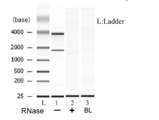
- FIG. 1 is an electrophoretogram of nucleic acid extracted from serum using the solution of the present invention in Example 1.
- FIG. 2 is an electrophoretogram of nucleic acid extracted from serum using the solution described in Patent Document 2 in Comparative Example 1.
- FIG. 3 is an electrophoretogram of nucleic acid extracted from serum using the solution described in Patent Document 1 in Comparative Example 2.
- FIG. 4 is an electrophoretogram of nucleic acids extracted from serum using the solutions of the present invention in Examples 2-5.
- FIG. 5 is an electrophoretogram of nucleic acids extracted from serum using the solutions of the present invention in Examples 6-12.
- FIG. 6 is an electrophoresis diagram of nucleic acids extracted from serum using the solution of the present invention and the solution described in Patent Document 3 in Example 13 and Comparative Example 3.
- FIG. 7 is an electrophoretogram of nucleic acids extracted from cultured cells using the solution of the present invention in Example 14.
- FIG. 8 is an electrophoretogram of nucleic acids extracted from serum using the solutions of the present invention in Examples 15 and 16.
- FIG. 9 is an electrophoretogram of nucleic acids extracted from serum using the solution described in Patent Document 3 in Comparative Example 4.
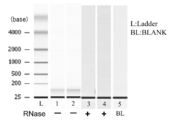
- FIG. 10 is an electrophoresis diagram of nucleic acids extracted from serum using the solutions of the present invention in Examples 17 and 18.
- the present invention is a solution for extracting RNA from a biological sample, and includes the following (a) to (e) as its components.
- D a thiocyanate having a concentration of 0.1 to 0.5 M (0.1 M or more and 0.5 M or less) with respect to the total amount of the solution, and
- the biological sample used in the present invention contains RNA and at least DNA.
- substantially pure RNA can be extracted from the biological sample by using the solution of the present invention.
- substantially pure RNA means RNA that is originally free from contamination after the DNA originally contained in the biological sample is separated. Whether or not RNA is substantially pure can be determined by whether or not DNA is detected by electrophoresis.
- “Agilent RNA 6000 pico kit” (model number 5067-1513) manufactured by Agilent Technologies, Inc. can detect recommended 50 pg / ⁇ L to 5000 pg / ⁇ L of nucleic acid, and this is used to evaluate the presence or absence of DNA contamination. be able to.
- RNA contamination is sufficiently suppressed when no peak is detected, so that it is substantially pure. It can be determined that RNA has been obtained.
- RNA purity can be evaluated by analyzing the amount of mixed DNA by quantitative PCR. For example, when a real-time PCR apparatus and “SYBR Green” (fluorescent dye) are used, double-stranded DNA of 60 pg can be detected, which can be evaluated.
- the extracted nucleic acid is added to a PCR reaction solution containing a primer, DNA synthase, and “SYBR Green”, PCR amplification is performed, and the amount of mixed DNA is quantified by comparing with a previously prepared calibration curve. Analysis.
- the total amount of the solution means the total volume of the solution including all of the above (a) to (e).
- 50% by volume of phenol with respect to the total amount of the solution means that more than 500 mL of phenol is contained in 1 L of the solution after mixing all the components.
- a guanidinium salt having a concentration of 0.5 to 2.0M with respect to the total amount of the solution means that the final concentration of the solution is 0.5M or more and 2.0M or less, that is, after all the components are mixed. It means that 0.5 mol or more and 2 mol or less of guanidinium salt is contained in 1 L of the solution.
- the solution of the present invention contains (a) phenol exceeding 50% by volume with respect to the total amount of the solution. It has been clarified that when the phenol concentration exceeds 50% by volume, which is different from the prior art, the contamination of DNA as an impurity is reduced in the aqueous layer from which RNA is extracted.
- the solution of the present invention contains, for example, 51% by volume or more, 52% by volume or more, 53% by volume or more, 54% by volume or more, or 55% by volume or more phenol. Preferably, it contains 53% by volume or more of phenol, more preferably 55% by volume or more.
- the concentration of phenol is (b) polyhydric alcohol, (c) 0.5 to 2.0 M guanidinium salt, (d) 0.1 to 0.5 M, which is another component of the solution of the present invention.
- concentration of phenol is preferably 75% by volume or less, and in order to reduce the influence of oxidation of phenol, the concentration of phenol Is more preferably 65% by volume or less.
- the range of the preferred phenol concentration is a range in which these upper and lower limits are arbitrarily combined, more preferably 52% by volume to 65% by volume, 53% by volume to 65% by volume, particularly preferably 55% by volume or more. 65% by volume or less.
- the solution of the present invention contains (b) 3 to 10% by volume of polyhydric alcohol with respect to the total amount of the solution.
- the polyhydric alcohol in the present invention is an aliphatic alcohol having a plurality of hydroxyl groups, and the phenol component (a) and the aqueous solution (c) or (d) in the solution of the present invention are mixed to form a uniform solution. What can be maintained can be used.
- the polyhydric alcohol is preferably an aliphatic alcohol having 2 to 6 carbon atoms and 2 to 6 carbon atoms.
- glycerol, ethylene glycol, propylene glycol, erythritol and the like can be mentioned, and glycerol is more preferable.
- the polyhydric alcohol can be used in an amount of 3 to 10% by volume based on the total amount of the solution of the present invention so that the solution of the present invention is maintained as a uniform solution and the phenol component is not excessively distributed to the aqueous layer.
- the solution of the present invention contains (c) a guanidinium salt having a concentration of 0.5 to 2.0 M with respect to the total amount of the solution.
- the guanidinium salt is preferably guanidinium thiocyanate or guanidinium hydrochloride.
- Guanidinium salts have the effect of protecting RNA from degradation and maintaining phenol in solution in aqueous solution.
- the solution of the present invention contains (d) thiocyanate at a concentration of 0.1 to 0.5M with respect to the total amount of the solution.
- thiocyanate an inorganic salt of thiocyanic acid can be preferably used, and ammonium thiocyanate and sodium thiocyanate can be more preferably used. Further, it may be a mixture of a plurality of different inorganic salts of thiocyanic acid. For example, a mixture of ammonium thiocyanate and sodium thiocyanate can be preferably used.
- Thiocyanate is believed to enhance the extraction of RNA from biological samples.
- the concentration of guanidinium thiocyanate is included in the concentration of guanidinium salt described above, but not in the concentration of thiocyanate.
- the solution of the present invention includes (e) a buffering agent for maintaining the pH of the solution at 4-6.
- a buffering agent for maintaining the pH of the solution at 4-6.
- an organic salt or an inorganic salt having a buffering property which is usually used for maintaining the pH in a desired range can be used.
- organic salts and inorganic salts of sodium, potassium, lithium or ammonium such as phosphate, acetate, citrate, phthalate, tartrate or lactate are included.
- sodium acetate and sodium citrate are more preferably used.
- the concentration of the buffering agent is not particularly limited as long as it is sufficient to maintain the solution of the present invention at the intended pH of 4 to 6, but a concentration of 0.02 to 0.2 M with respect to the total amount of the solution of the present invention. It is preferable that In order to adjust the pH of the solution of the present invention, an appropriate acid or alkaline aqueous solution such as hydrochloric acid or sodium hydroxide solution may be appropriately added in addition to the buffer.
- the solution of the present invention may contain a surfactant such as polyoxyethylene sorbitan, sodium dodecyl sulfate, and sarcosine in order to denature proteins in biological samples and assist in purification of the target RNA.
- a surfactant such as polyoxyethylene sorbitan, sodium dodecyl sulfate, and sarcosine in order to denature proteins in biological samples and assist in purification of the target RNA.
- the solution of the present invention may contain an antioxidant such as hindered amine phenol and quinoline in order to prevent the oxidation of phenol.
- the solution of the present invention can be used in an amount of 1 volume or more, preferably 3 volumes or more when extracting the target RNA.
- a biological sample is homogenized in the solution of the present invention to form a homogenate.
- the homogenization method is not particularly limited, but a general homogenizer can be used in addition to stirring by vortex or the like, crushing with an injection needle.
- an organic solvent for separating the aqueous layer is added to the homogenate and then centrifuged.
- the organic solvent added here is preferably about 2 to 40% by volume of the homogenate. Centrifugation can usually be performed at 6,000 x G to 20,000 x G for 3 minutes to 30 minutes, for example, at a speed of 12,000 x G for 10 minutes at room temperature. There is no particular limitation on time.
- the desired substantially pure RNA is extracted into the aqueous layer.
- DNA, protein, and the like are separated into an organic layer or, when an intermediate layer is formed, into an organic layer and an intermediate layer.
- the organic solvent for separating the aqueous layer includes an aqueous layer containing the target RNA extracted using the solution of the present invention, an organic layer and / or an intermediate layer containing DNA, etc. It is a liquid organic compound used for separation.
- this organic solvent those having the same degree of hydrophilicity as phenol or more hydrophobic can be used.
- an organic compound having a water / octanol partition coefficient CLogP value generally used as an index indicating hydrophilicity of 1.4 (ClogP value of phenol) or more can be used, and the ClogP value is 1.4. Those in the range of 5 to 5 can be preferably used.
- the CLogP value can be calculated by using a program such as “Chem Draw” (registered trademark), for example.
- Examples of the organic solvent used in the present invention include chloroform (1.952), p-bromoanisole (3.064), 1-bromo-3-chloropropane (1.847), 4-bromoveratrol (2.7345).
- the organic solvent for separating the aqueous layer can be formed by using the solution of the present invention containing (a) to (e) as described above and added to the homogenate. ) To (e) may be contained in advance in the solution of the present invention. In the case of a conventional solution with a phenol concentration of 50% or less, if this organic solvent is included in advance, the solution separates into two layers, an aqueous layer and an organic layer, before mixing with the biological sample. Although difficult, in the phenol concentration of the solution of the present invention, the organic solvent is uniformly mixed in the solution of the present invention and can be stored as a single solution.
- the solution of the present invention containing the organic solvent in advance can be homogenized by adding a biological sample and then immediately centrifuged to separate the aqueous layer containing RNA. Therefore, it is preferable because the procedure can be greatly simplified as compared with the case where an organic solvent is added to the homogenate later.
- the organic solvent for separating the aqueous layer is previously contained in the solution of the present invention containing the above (a) to (e), the content of the organic solvent is adjusted according to the kind of the organic solvent to be added and the phenol concentration of the solution.
- the organic solvent can be selected within a range that is uniformly mixed in the solution of the present invention.
- chloroform when chloroform is selected as the organic solvent when the phenol concentration of the solution of the present invention is 65%, an arbitrary amount up to 27% by volume with respect to 100% of the total amount of the solution containing the above (a) to (e) It is preferable to include Specifically, it is preferable to add an arbitrary volume of chloroform up to 27 mL to 100 mL of the solution containing the above (a) to (e). More preferably, it contains 5 to 25% by volume of chloroform, more preferably 10 to 20% by volume of chloroform with respect to 100% of the total amount of the solution containing the above (a) to (e).
- the chloroform preferably contains any volume up to 14%, more preferably 6 to 13 volumes, with respect to 100% of the total amount of the solution containing the above (a) to (e). %, More preferably 8-12% by volume.
- p-bromoanisole is selected as the organic solvent when the phenol concentration of the solution is 65%
- an arbitrary amount up to 22% by volume can be added to 100% of the total amount of the solution containing the above (a) to (e).
- it contains 5 to 20% by volume, more preferably 10 to 18% by volume.
- p-bromoanisole when the phenol concentration is 58%, p-bromoanisole preferably contains an arbitrary volume up to 13% by volume with respect to 100% of the total amount of the solution containing the above (a) to (e). Preferably it contains 3 to 11% by volume, more preferably 5 to 9% by volume.
- RNA can be precipitated by adding lower alcohol to the aqueous layer containing RNA, and the precipitated RNA can be recovered.
- RNA precipitated by adding lower alcohol to an aqueous layer containing RNA may be adsorbed on a carrier capable of adsorbing RNA, such as a silica membrane column, and then eluted from the carrier (column) and recovered.
- a carrier capable of adsorbing RNA such as a silica membrane column
- the lower alcohol used here include ethanol and isopropanol.
- the concentration can be determined in accordance with a general nucleic acid ethanol precipitation or isopropanol precipitation method or a manufacturer recommended concentration of a carrier such as a silica membrane column.
- the solution of the present invention can be produced by mixing the above (a) to (e) so as to have respective concentrations.
- the mixing procedure is not particularly limited.
- high concentration solutions can be prepared in advance and then mixed.
- a 6M guanidine thiocyanate aqueous solution, a 6M ammonium thiocyanate aqueous solution, and 1M sodium acetate are prepared in advance, mixed to the desired concentration, and further added with glycerol, phenol and insufficient water. it can.
- the solution of the present invention in which the organic solvent for separating the aqueous layer is previously contained in the solution containing the above (a) to (e) has the desired concentration of (a) to (e) and the organic solvent. It can manufacture by mixing so that it may become.
- the biological sample used in the present invention is not particularly limited as long as it contains RNA and at least DNA.
- a protein may be included in addition to DNA.
- Specific examples include cultured cells, culture fluids of cultured cells, living tissues such as surgical sections and biopsy samples, living cells, blood, blood components (serum, plasma), body fluids such as urine, saliva, and tears.
- any sample containing RNA can be used.
- the biological sample is a cell pellet or tissue piece
- it may be mixed with the solution of the present invention as it is after collection, or may be diluted with PBS or water and then mixed with the solution of the present invention.
- it is preferable to dilute with water or PBS after preparing a homogenate of a biological sample.
- body fluids especially blood
- RNA-degrading enzymes in which case conventional methods can extract substantially pure RNA. It was very difficult.
- contaminants such as proteins can be effectively extracted into the organic layer, so that the target RNA can be obtained with high purity.
- the intermediate layer that appears after centrifugation is reduced and clear layer separation is possible, separation of the aqueous layer containing the target RNA is easy.
- RNA extracted using the solution of the present invention is a ribonucleic acid in which a plurality of ribonucleotides are phosphodiester-linked, and is not limited by the molecular weight, the number of bases, or the origin.
- RNA is classified into mRNA (messenger RNA), tRNA (transfer RNA), rRNA (ribosomal RNA), ncRNA (noncoding RNA), snRNA (nuclear small RNA), snoRNA (nuclear small molecule) in terms of functional classification.
- RNA and the like, but there are no known chemical structural differences other than molecular weight (number of bases), and all are included in RNA in the present invention.
- RNA generally having a base number of about 15 to 500 bases called mill RNA and miRNA (microRNA) having a base number of about 18 to 25 bases are also included in the RNA of the present invention.
- RNA and DNA differ in the main difference in the primary chemical structure between RNA and DNA.
- a hydroxyl group (—OH) at the ribose 2′-position which is a constituent sugar
- the structural difference between RNA and DNA decreases as the number of bases decreases. Since the difference is small, it is difficult to separate them by extraction.
- RNA having a relatively small number of bases such as small ⁇ ⁇ RNA can be extracted with high purity.
- RNA analysis using qRT-PCR or microarray does not require DNase treatment and can be easily analyzed in the absence of noise due to the presence of DNA.
- RNA extraction solution Preparation of RNA extraction solution
- RNA extraction solution Each solution was mixed to prepare an RNA extraction solution so that the final concentration of each component of the solution was as follows. ⁇ 58 vol% phenol ⁇ 5 vol% glycerol ⁇ 0.8M guanidinium thiocyanate (mixed in aqueous solution) ⁇ 0.4M ammonium thiocyanate (mixed in aqueous solution) ⁇ 0.1M sodium acetate buffer (mixed in aqueous solution), adjusted to pH 5.
- RNA extraction from biological sample RNA was extracted using serum as a biological sample containing RNA, DNA, and protein. 900 ⁇ L of the solution prepared in (1) above and 300 ⁇ L of serum were mixed by vortexing and homogenized. 60 ⁇ L of p-bromoanisole was added to the homogenate, mixed, and centrifuged at 12,000 ⁇ G for 10 minutes at room temperature. Centrifugation formed an aqueous layer containing RNA, an organic layer containing DNA and protein, and an intermediate layer. Of these, 400 ⁇ L of the aqueous layer was separated into another tube.
- RNA in the aqueous layer-no enzyme treatment Add 1.5-fold volume of 100% ethanol to the aqueous layer containing RNA separated in (2), and add 700 ⁇ L to “RNeasy Mini Spin Column” of “miRNeasy mini kit” (Qiagen Co., Ltd.), which is a nucleic acid purification column.
- the solution was centrifuged at 8000 ⁇ G for 15 seconds to adsorb nucleic acid to the column, and the liquid that passed through the column was discarded. The same operation was repeated until there was no ethanol-mixed RNA sample, and all the nucleic acid contained in the aqueous layer was adsorbed to the column.
- the column was washed twice with Buffer RWT 700 ⁇ L and Buffer RPE 500 ⁇ L, dried, and then eluted with 30 ⁇ L RNase-free water to obtain a purified and concentrated RNA sample It was.
- RNA Extraction Solution Preparation of RNA Extraction Solution The final concentration of the solution was adjusted so that the phenol concentration was 50% by volume, and the other composition was the same as in Example 1, and the solution described in Patent Document 2 was prepared. .
- Example 2 (2) RNA extraction from a biological sample As in Example 1, serum was used as a biological sample.
- Example 1 the same procedure as in Example 1 was performed.
- RNA Extraction Solution A solution similar to the extraction solution described in Patent Document 1 was prepared except that the phenol concentration was 60% by volume. That is, the final concentration was 60% by volume phenol, 2M guanidinium thiocyanate, 0.1M sodium acetate, 0.2% by volume 2-mercaptoethanol, and the pH was 4.
- RNA extraction from a biological sample As in Example 1, serum was used as a biological sample. (3a) Purification and concentration of RNA in the aqueous layer-no enzyme treatment- The same operation as in Example 1 was performed.
- Example 2 (1) Preparation of RNA Extraction Solution The solution was prepared so that the final concentration of the solution was the same as that of Example 1 except that the phenol concentration was 55% by volume. (2) RNA extraction from a biological sample As in Example 1, serum was used as a biological sample. (3a) Purification and concentration of RNA in the aqueous layer-no enzyme treatment- The same operation as in Example 1 was performed. (3b) Purification and concentration of RNA from aqueous layer -with RNase treatment- The same operation as in Example 1 was performed. (4) Purity evaluation by electrophoresis It carried out similarly to Example 1. The results are shown in FIG.
- Example 3 (1) Preparation of RNA Extraction Solution The solution was prepared so that the final concentration of the solution was the same as that of Example 1 except that the phenol concentration was 65% by volume. (2) RNA extraction from a biological sample As in Example 1, serum was used as a biological sample. (3a) Purification and concentration of RNA in the aqueous layer-no enzyme treatment- The same operation as in Example 1 was performed. (4) Purity evaluation by electrophoresis It carried out similarly to Example 1. The result is shown in lane 2 of FIG. The same peak as in Example 1 was detected, and it was confirmed that only RNA was extracted with high purity. The above results are summarized in Table 1.
- Example 4 (1) Preparation of RNA Extraction Solution The solution was prepared so that the final concentration of the solution was the same as that of Example 1 except that the phenol concentration was 53% by volume. (2) RNA extraction from a biological sample As in Example 1, serum was used as a biological sample. (3a) Purification and concentration of RNA in the aqueous layer-no enzyme treatment- The same operation as in Example 1 was performed. (4) Purity evaluation by electrophoresis It carried out similarly to Example 1. The result is shown in lane 3 of FIG. The same peak as in Example 1 was detected, and it was confirmed that only RNA was extracted with high purity. The above results are summarized in Table 1.
- RNA extraction solution A solution having the same composition as that of Example 1 was prepared.
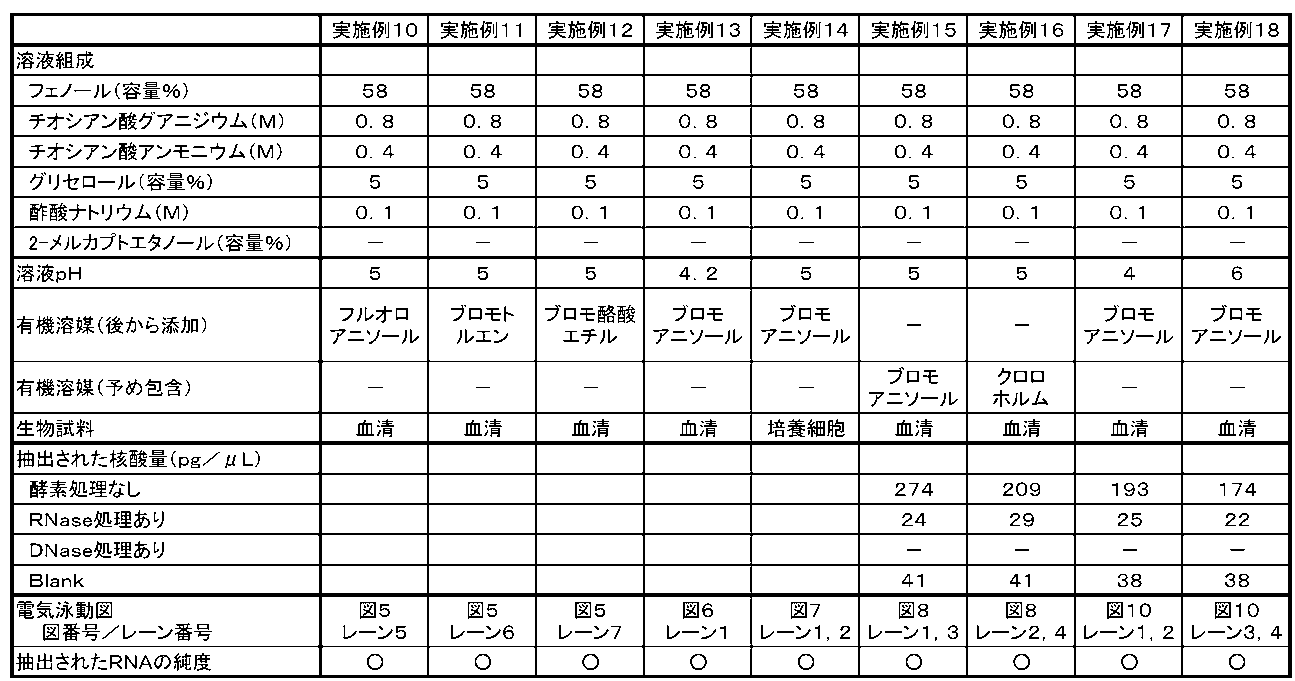
- Table 1 The above results are summarized in Table 1.
- RNA extraction solution A solution having the same composition as that of Example 1 was prepared.
- (4) Purity evaluation by electrophoresis It carried out similarly to Example 1. The result is shown in lane 1 of FIG. The same peak as in Example 1 was detected, and it was confirmed that only RNA was extracted with high purity. The above results are summarized in Table 1.
- RNA extraction solution A solution having the same composition as that of Example 1 was prepared.
- (4) Purity evaluation by electrophoresis It carried out similarly to Example 1. The result is shown in lane 2 of FIG. The same peak as in Example 1 was detected, and it was confirmed that only RNA was extracted with high purity.
- Table 1 The above results are summarized in Table 1.
- RNA extraction solution A solution having the same composition as that of Example 1 was prepared.
- (4) Purity evaluation by electrophoresis It carried out similarly to Example 1. The result is shown in lane 3 of FIG. The same peak as in Example 1 was detected, and it was confirmed that only RNA was extracted with high purity.
- Table 1 The above results are summarized in Table 1.
- RNA extraction solution A solution having the same composition as that of Example 1 was prepared.
- (4) Purity evaluation by electrophoresis It carried out similarly to Example 1. The result is shown in lane 4 of FIG. The same peak as in Example 1 was detected, and it was confirmed that only RNA was extracted with high purity.
- Table 1 The above results are summarized in Table 1.
- RNA extraction solution A solution having the same composition as that of Example 1 was prepared.
- (4) Purity evaluation by electrophoresis It carried out similarly to Example 1. The result is shown in lane 5 of FIG. The same peak as in Example 1 was detected, and it was confirmed that only RNA was extracted with high purity.
- Table 2 The above results are summarized in Table 2.
- RNA extraction solution A solution having the same composition as that of Example 1 was prepared.
- (4) Purity evaluation by electrophoresis It carried out similarly to Example 1. The result was shown in the lane 6 of FIG. 5. The same peak as in Example 1 was detected, and it was confirmed that only RNA was extracted with high purity.
- Table 2 The above results are summarized in Table 2.
- RNA extraction solution A solution having the same composition as that of Example 1 was prepared.
- RNA extraction solution A solution was prepared by adding hydrochloric acid to the solution prepared in Example 1 to adjust the pH of the solution to 4.2.
- RNA extraction from a biological sample As in Example 1, serum was used as a biological sample.
- Table 2 The above results are summarized in Table 2.
- RNA extraction solution A solution was prepared by adding hydrochloric acid to the solution prepared in Comparative Example 1 to adjust the pH of the solution to 3.6.
- RNA extraction from biological sample As in Example 1, serum was used as a biological sample.
- Table 3 The above results are summarized in Table 3.
- RNA extraction solution A solution having the same composition as that of Example 1 was prepared.
- RNA extraction from biological sample The same procedure as in Example 1 was performed except that cultured cells (HEK293 cells) suspended in 300 ⁇ L of PBS were used as biological samples instead of 300 ⁇ L of the serum of Example 1.
- RNA extraction solution Each solution was mixed to prepare an RNA extraction solution so that the final concentration of each component of the solution was as follows. That is, a solution was prepared by adding 60 ⁇ L of p-bromoanisole to 900 ⁇ L of the solution having the same composition as in Example 1.
- RNA extraction from biological sample 900 ⁇ L of the solution prepared in the above (1) and 300 ⁇ L of serum were vortexed and homogenized. Centrifuge for 10 minutes at 12,000 ⁇ G at room temperature. Centrifugation formed an aqueous layer containing RNA, an organic layer containing DNA and protein, and an intermediate layer. Of these, 350 ⁇ L of the aqueous layer was separated into another tube.
- RNA extraction solution Each solution was mixed to prepare an RNA extraction solution so that the final concentration of each component of the solution was as follows. That is, 90 ⁇ L of chloroform was further added to 900 ⁇ L of the solution having the same composition as that of Example 1 to prepare a solution.
- RNA extraction from biological sample Prepared in (1) above 900 ⁇ L of the prepared solution and 300 ⁇ L of serum were vortexed and homogenized. Centrifuge for 10 minutes at 12,000 ⁇ G at room temperature. Centrifugation formed an aqueous layer containing RNA, an organic layer containing DNA and protein, and an intermediate layer.
- RNA Extraction Solution A solution having the same composition as Comparative Example 3 was prepared except that the phenol concentration was 55% by volume.
- Example 17 (1) Preparation of RNA Extraction Solution The final concentration of the solution was pH 4, and a solution was prepared so as to have the same composition as in Example 1 except this. (2) RNA extraction from a biological sample As in Example 1, serum was used as a biological sample. (3a) Purification and concentration of RNA in the aqueous layer-no enzyme treatment- The same operation as in Example 1 was performed. (3b) Purification and concentration of RNA from aqueous layer -with RNase treatment- The same operation as in Example 1 was performed. (4) Purity evaluation by electrophoresis It carried out similarly to Example 1. The results are shown in FIG. 10 (lanes 1, 2, 5).
- Example 18 (1) Preparation of RNA Extraction Solution The final concentration of the solution was pH 6, and the solution was prepared so as to have the same composition as Example 1 except this. (2) RNA extraction from a biological sample As in Example 1, serum was used as a biological sample. (3a) Purification and concentration of RNA in the aqueous layer-no enzyme treatment- The same operation as in Example 1 was performed. (3b) Purification and concentration of RNA from aqueous layer -with RNase treatment- The same operation as in Example 1 was performed. (4) Purity evaluation by electrophoresis It carried out similarly to Example 1. The results are shown in FIG. 10 (lanes 3, 4, 5).
Landscapes
- Chemical & Material Sciences (AREA)
- Health & Medical Sciences (AREA)
- Engineering & Computer Science (AREA)
- Organic Chemistry (AREA)
- Life Sciences & Earth Sciences (AREA)
- Biomedical Technology (AREA)
- Genetics & Genomics (AREA)
- Bioinformatics & Cheminformatics (AREA)
- Zoology (AREA)
- Wood Science & Technology (AREA)
- Biotechnology (AREA)
- General Engineering & Computer Science (AREA)
- Biochemistry (AREA)
- Physics & Mathematics (AREA)
- Analytical Chemistry (AREA)
- General Health & Medical Sciences (AREA)
- Biophysics (AREA)
- Plant Pathology (AREA)
- Crystallography & Structural Chemistry (AREA)
- Microbiology (AREA)
- Molecular Biology (AREA)
- General Physics & Mathematics (AREA)
- Immunology (AREA)
- Pathology (AREA)
- Inorganic Chemistry (AREA)
- Measuring Or Testing Involving Enzymes Or Micro-Organisms (AREA)
- Investigating Or Analysing Biological Materials (AREA)
Abstract
Description
[1]RNAと、少なくともDNAを含む生物試料からRNAを抽出するための溶液であって、
(a)溶液の総量に対して50容量%超過のフェノール、
(b)溶液の総量に対して3~10容量%の多価アルコール、
(c)溶液の総量に対して0.5~2.0M濃度のグアニジニウム塩、
(d)溶液の総量に対して0.1~0.5M濃度のチオシアン酸塩、及び
(e)溶液のpHを4~6に維持するための緩衝剤、
を含む溶液。
[2]フェノール濃度が、溶液の総量に対して55~65容量%である、[1]に記載の溶液。
[3]水層を分離するための有機溶媒をさらに含む、[1]又は[2]に記載の溶液。
[4]生物試料が培養細胞の培養液である、[1]~[3]のいずれか1項に記載の溶液。
[5]生物試料が生物の体液成分である、[1]~[3]のいずれか1項に記載の溶液。
[6]生物試料が生物の血液成分である、[1]~[3]のいずれか1項に記載の溶液。
(a)溶液の総量に対して50容量%超過のフェノール、
(b)溶液の総量に対して3~10容量%の多価アルコール、
(c)溶液の総量に対して0.5~2.0M濃度のグアニジニウム塩、
(d)溶液の総量に対して0.1~0.5M濃度のチオシアン酸塩、及び
(e)溶液のpHを4~6に維持するための緩衝剤、
を含む溶液と共にホモジェナイズする工程と、
得られたホモジェネートを、水層を分離するための有機溶媒と混合する工程と、
得られた混合物を遠心分離する工程と、
遠心分離により生成した、RNA含有水層を回収する工程と、
を含む、前記生物試料からRNAを抽出する方法。
(a)溶液の総量に対して50容量%超過のフェノール、
(b)溶液の総量に対して3~10容量%の多価アルコール、
(c)溶液の総量に対して0.5~2.0M濃度のグアニジニウム塩、
(d)溶液の総量に対して0.1~0.5M濃度のチオシアン酸塩、及び
(e)溶液のpHを4~6に維持するための緩衝剤、
(f)水層を分離するための有機溶媒、
を含む溶液と共にホモジェナイズする工程と、
得られたホモジェネートを遠心分離する工程と、
遠心分離により生成した、RNA含有水層を回収する工程と、
を含む、前記生物試料からRNAを抽出する方法。
(a)溶液の総量に対して50容量%超過のフェノール、
(b)溶液の総量に対して3~10容量%(3容量%以上10容量%以下)の多価アルコール、
(c)溶液の総量に対して0.5~2.0M(0.5M以上2.0M以下)濃度のグアニジニウム塩、
(d)溶液の総量に対して0.1~0.5M(0.1M以上0.5M以下)濃度のチオシアン酸塩、及び
(e)溶液のpHを4~6に維持するための緩衝剤。
(1)RNA抽出用溶液の調製
溶液の各成分の終濃度が以下になるように、それぞれを混合してRNA抽出用の溶液を調製した。
・58容量%フェノール
・5容量%グリセロール
・0.8Mチオシアン酸グアニジニウム(水溶液にて混合)
・0.4Mチオシアン酸アンモニウム(水溶液にて混合)
・0.1M酢酸ナトリウム緩衝液(水溶液にて混合)、pHが5になるように調整。
RNAと、DNA及びタンパク質を含む生物試料として血清を用いてRNA抽出を行った。上記(1)で調製した溶液900μLと血清300μLをボルテックスで混和し、ホモジナイズした。ホモジェネートに60μLのp-ブロモアニソールを加えて混和し、室温で12,000xGで10分間遠心した。遠心により、RNAを含有する水層と、DNA及びタンパク質を含有する有機層と中間層が形成された。このうち、水層400μLを別のチューブに分離した。
(2)で分離したRNAを含む水層に1.5倍容量の100%エタノールを加え、核酸の精製カラムである「miRNeasy mini kit」(株式会社キアゲン製)の「RNeasy Mini Spin Column」に700μL加え、8000xGで15秒遠心してカラムに核酸を吸着させ、カラムを通過した液は廃棄した。エタノール混和RNAサンプルがなくなるまで同作業を繰り返し、水層に含まれていた核酸をすべてカラムに吸着させた。その後「miRNeasy mini kit」のプロトコルに従い、Buffer RWT 700μL、Buffer RPE 500μLで2回カラムを洗浄し、カラムを乾燥させた後、30μLのRNase-free水で溶出し、精製、濃縮したRNAサンプルを得た。
抽出された核酸がRNAであることを確認するために、(2)で分離したサンプルに対してRNase処理を行った。(2)で分離したRNAを含む水層に1.5倍容量の100%エタノールを加え、(3a)と同様に核酸をカラムに吸着させた。Buffer RWT 350μLで洗浄した後、希釈したRNaseを加えてカラムに吸着した核酸をRNase処理し、Buffer RWT 350μL、Buffer RPE 500μLで2回カラムを洗浄して、カラムを乾燥させた後、30μLのRNase-free水で溶出し、精製、濃縮したRNAサンプルを得た。
(3a)、(3b)で得た各RNAサンプル1μLを70℃で2分熱変性したあと、急冷した。アジレント・テクノロジー株式会社製「Agilent RNA6000ピコキット」(型番5067-1513)を用いて、電気泳動を行った。その結果を図1に示した。また、「Bioanalyzer 2100」のSmear Analysis機能により、25-500ntのピークエリアの面積を算出してピークのサイズと検出された核酸量(濃度)を確認した。
以上の結果を表1にまとめた。
(1)RNA抽出用溶液の調製
溶液の終濃度は、フェノール濃度を50容量%とし、これ以外は実施例1と同じ組成になるように調製して、特許文献2に記載の溶液を調製した。
実施例1と同様に生物試料として血清を用いて行った。
(3a)水層のRNAの精製、濃縮-酵素処理なし-
実施例1と同様に行った。
(3b)水層からのRNAの精製、濃縮-RNase処理有り-
実施例1と同様に行った。
(3c)水層からのRNAの精製、濃縮-DNase処理有り-
実施例1の(3b)において、RNAを含む水層を(3b)のRNaseに代えてDNaseで処理して精製、濃縮したサンプルを得た。以上のほかは、実施例1と同様に行った。
実施例1と同様に行った。その結果を図2に示した。
酵素処理していないサンプルからは2本の強いピーク(塩基数が200塩基と500塩基付近)と1本の弱いピーク(実施例1と同塩基数)が検出された(レーン1)。RNase処理有りサンプルでは、200塩基と500塩基のピークにはほとんど変化がなかったことから、2本のピークはRNAではないことが明らかとなった(レーン2)。一方、レーン1で見られた、1本の弱いピークは消失したことから、実施例1と同様にこのピークはRNAであったことが確認された。DNase処理したサンプルでは、2本の強いピークが消失し、非常に短く分解された断片が検出された(レーン3)ことから、この2本の強いピークは、混入したDNA断片であったことがわかった。
以上の結果を表3にまとめた。
(1)RNA抽出用溶液の調製
フェノール濃度が60容量%である以外は、特許文献1に記載の抽出用溶液と同様の溶液を調製した。即ち、終濃度が60容量%フェノール、2Mチオシアン酸グアニジニウム、0.1M酢酸ナトリウム、0.2容量%2-メルカプトエタノールとし、pHは4とした。
実施例1と同様に生物試料として血清を用いて行った。
(3a)水層のRNAの精製、濃縮-酵素処理なし-
実施例1と同様に行った。
実施例1と同様に行った。その結果を図3に示した。
比較例1と同様の3本のピークが確認された。このことから、DNA断片が混入していることが確認された。
以上の結果を表3にまとめた。
(1)RNA抽出用溶液の調製
溶液の終濃度は、フェノール濃度を55容量%とし、これ以外は実施例1と同じ組成になるように溶液を調製した。
(2)生物試料からのRNA抽出
実施例1と同様に生物試料として血清を用いて行った。
(3a)水層のRNAの精製、濃縮-酵素処理なし-
実施例1と同様に行った。
(3b)水層からのRNAの精製、濃縮-RNase処理有り-
実施例1と同様に行った。
(4)電気泳動による純度評価
実施例1と同様に行った。その結果を図4に示した。
以上の結果を表1にまとめた。
(1)RNA抽出用溶液の調製
溶液の終濃度は、フェノール濃度を65容量%とし、これ以外は実施例1と同じ組成になるように溶液を調製した。
(2)生物試料からのRNA抽出
実施例1と同様に生物試料として血清を用いて行った。
(3a)水層のRNAの精製、濃縮-酵素処理なし-
実施例1と同様に行った。
(4)電気泳動による純度評価
実施例1と同様に行った。その結果を図4のレーン2に示した。
実施例1と同様のピークが検出され、RNAのみが純度高く抽出されたことが確認された。
以上の結果を表1にまとめた。
(1)RNA抽出用溶液の調製
溶液の終濃度は、フェノール濃度を53容量%とし、これ以外は実施例1と同じ組成になるように溶液を調製した。
(2)生物試料からのRNA抽出
実施例1と同様に生物試料として血清を用いて行った。
(3a)水層のRNAの精製、濃縮-酵素処理なし-
実施例1と同様に行った。
(4)電気泳動による純度評価
実施例1と同様に行った。その結果を図4のレーン3に示した。
実施例1と同様のピークが検出され、RNAのみが純度高く抽出されたことが確認された。
以上の結果を表1にまとめた。
(1)RNA抽出用溶液の調製
実施例1と同じ組成の溶液を調製した。
(2)生物試料からのRNA抽出
ホモジェネートに60μLのp-ブロモアニソールを加える代わりに、240μLのクロロホルムを加え、これ以外は実施例1と同様に生物試料として血清を用いて行った。
(3a)水層のRNAの精製、濃縮-酵素処理なし-
実施例1と同様に行った。
(4)電気泳動による純度評価
実施例1と同様に行った。その結果を、図4のレーン4に示した。
実施例1と同様のピークが検出され、RNAのみが純度高く抽出されたことが確認された。
以上の結果を表1にまとめた。
(1)RNA抽出用溶液の調製
実施例1と同じ組成の溶液を調製した。
(2)生物試料からのRNA抽出
ホモジェネートに60μLのp-ブロモアニソールを加える代わりに、100μLの4-ブロモベラトロールを加え、これ以外は実施例1と同様に生物試料として血清を用いて行った。
(3a)水層のRNAの精製、濃縮-酵素処理なし-
実施例1と同様に行った。
(4)電気泳動による純度評価
実施例1と同様に行った。その結果を図5のレーン1に示した。
実施例1と同様のピークが検出され、RNAのみが純度高く抽出されたことが確認された。
以上の結果を表1にまとめた。
(1)RNA抽出用溶液の調製
実施例1と同じ組成の溶液を調製した。
(2)生物試料からのRNA抽出
ホモジェネートに60μLのp-ブロモアニソールを加える代わりに、100μLの6-ブロモ-1,4-ベンゾジオキサンを加え、これ以外は実施例1と同様に生物試料として血清を用いて行った。
(3a)水層のRNAの精製、濃縮-酵素処理なし-
実施例1と同様に行った。
(4)電気泳動による純度評価
実施例1と同様に行った。その結果を図5のレーン2に示した。
実施例1と同様のピークが検出され、RNAのみが純度高く抽出されたことが確認された。
以上の結果を表1にまとめた。
(1)RNA抽出用溶液の調製
実施例1と同じ組成の溶液を調製した。
(2)生物試料からのRNA抽出
ホモジェネートに60μLのp-ブロモアニソールを加える代わりに、100μLの1-ブロモ-4-トリフルオロメトキシベンゼンを加え、これ以外は実施例1と同様に生物試料として血清を用いて行った。
(3a)水層のRNAの精製、濃縮-酵素処理なし-
実施例1と同様に行った。
(4)電気泳動による純度評価
実施例1と同様に行った。その結果を図5のレーン3に示した。
実施例1と同様のピークが検出され、RNAのみが純度高く抽出されたことが確認された。
以上の結果を表1にまとめた。
(1)RNA抽出用溶液の調製
実施例1と同じ組成の溶液を調製した。
(2)生物試料からのRNA抽出
ホモジェネートに60μLのp-ブロモアニソールを加える代わりに、100μLの1-ブロモ-2,4,-ジメトキシベンゼンを加え、これ以外は実施例1と同様に生物試料として血清を用いて行った。
(3a)水層のRNAの精製、濃縮-酵素処理なし-
実施例1と同様に行った。
(4)電気泳動による純度評価
実施例1と同様に行った。その結果を図5のレーン4に示した。
実施例1と同様のピークが検出され、RNAのみが純度高く抽出されたことが確認された。
以上の結果を表1にまとめた。
(1)RNA抽出用溶液の調製
実施例1と同じ組成の溶液を調製した。
(2)生物試料からのRNA抽出
ホモジェネートに60μLのp-ブロモアニソールを加える代わりに、100μLの4-フルオロアニソールを加え、これ以外は実施例1と同様に生物試料として血清を用いて行った。
(3a)水層のRNAの精製、濃縮-酵素処理なし-
実施例1と同様に行った。
(4)電気泳動による純度評価
実施例1と同様に行った。その結果を図5のレーン5に示した。
実施例1と同様のピークが検出され、RNAのみが純度高く抽出されたことが確認された。
以上の結果を表2にまとめた。
(1)RNA抽出用溶液の調製
実施例1と同じ組成の溶液を調製した。
(2)生物試料からのRNA抽出
ホモジェネートに60μLのp-ブロモアニソールを加える代わりに、100μLの4-ブロモトルエンを加え、これ以外は実施例1と同様に生物試料として血清を用いて行った。
(3a)水層のRNAの精製、濃縮-酵素処理なし-
実施例1と同様に行った。
(4)電気泳動による純度評価
実施例1と同様に行った。その結果を図5のレーン6に示した
実施例1と同様のピークが検出され、RNAのみが純度高く抽出されたことが確認された。
以上の結果を表2にまとめた。
(1)RNA抽出用溶液の調製
実施例1と同じ組成の溶液を調製した。
(2)生物試料からのRNA抽出
ホモジェネートに60μLのp-ブロモアニソールを加える代わりに、100μLの4-ブロモ酪酸エチルを加え、これ以外は実施例1と同様に生物試料として血清を用いて行った。
(3a)水層のRNAの精製、濃縮-酵素処理なし-
実施例1と同様に行った。
(4)電気泳動による純度評価
実施例1と同様に行った。その結果を図5のレーン7に示した。
実施例1と同様のピークが検出され、RNAのみが純度高く抽出されたことが確認された。
以上の結果を表2にまとめた。
(1)RNA抽出用溶液の調製
実施例1で調製した溶液に塩酸を加えて、溶液のpHを4.2に調整した溶液を調製した。
(2)生物試料からのRNA抽出
実施例1と同様に生物試料として血清を用いて行った。
(3a)水層のRNAの精製、濃縮-酵素処理なし-
実施例1と同様に行った。
(4)電気泳動による純度評価
実施例1と同様に行った。その結果を図6のレーン1に示した。
溶液のpHが4.2においても実施例1と同様のピークが検出され、RNAのみが純度高く抽出されたことがわかった。
以上の結果を表2にまとめた。
(1)RNA抽出用溶液の調製
比較例1で調製した溶液に塩酸を加えて、溶液のpHを3.6に調整した溶液を調製した。
(2)生物試料からのRNA抽出
実施例1と同様に生物試料として血清を用いて行った。
(3a)水層のRNAの精製、濃縮-酵素処理なし-
実施例1と同様に行った。
(4)電気泳動による純度評価
実施例1と同様に行った。その結果を図6のレーン2に示した比較例1と同様の3本のピークが確認された。このことから、フェノール濃度が50容量%の溶液を用いた場合は、pHを3.6としてもDNA断片が混入していることが確認された。
以上の結果を表3にまとめた。
(1)RNA抽出用溶液の調製
実施例1と同じ組成の溶液を調製した。
(2)生物試料からのRNA抽出
実施例1の300μLの血清の代わりに、生物試料としてPBS300μLに懸濁した培養細胞(HEK293細胞)を使用した以外は、実施例1と同様に行った。
(3a)水層のRNAの精製、濃縮-酵素処理なし-
水層に加えるエタノール量を1.5倍容量ではなく、1.25倍容量にした以外は、実施例1と同様に行った。
(3b)水層からのRNAの精製、濃縮-RNase処理有り-
水層に加えるエタノール量を1.5倍容量ではなく、1.25倍容量にした以外は、実施例1と同様に行った。
(4)電気泳動による純度評価
使用するキットを「Agilent RNA6000ピコキット」の代わりに、「Agilent RNA6000ナノキット」(型番5067-1511)(アジレント・テクノロジー社製)を用いた以外は実施例1と同様に行った。その結果を図7に示した。
以上の結果を表2にまとめた。
(1)RNA抽出用溶液の調製
溶液の各成分の終濃度が以下になるように、それぞれを混合してRNA抽出用の溶液を調製した。すなわち、実施例1と同じ組成の溶液900μLに対しさらに60μLのp-ブロモアニソールを加えて溶液を調製した。
・58容量%フェノール
・5容量%グリセロール
・0.8Mチオシアン酸グアニジニウム(水溶液にて混合)
・0.4Mチオシアン酸アンモニウム(水溶液にて混合)
・0.1M酢酸ナトリウム緩衝液(水溶液にて混合)、pHが5になるように調整
・上記の全量100%に対し6.6容量%のp-ブロモアニソール
上記(1)で調製した溶液900μLと血清300μLをボルテックスで混和し、ホモジナイズした。室温で12,000xGで10分間遠心した。遠心により、RNAを含有する水層と、DNA及びタンパク質を含有する有機層と中間層が形成された。このうち、水層350μLを別のチューブに分離した。
(3a)水層のRNAの精製、濃縮-酵素処理なし-
実施例1と同様に行った。
(3b)水層からのRNAの精製、濃縮-RNase処理有り-
実施例1と同様に行った。
(4)電気泳動による純度評価
実施例1と同様に行った。その結果を図8のレーン1、3、5に示した。
以上の結果を表2にまとめた。
(1)RNA抽出用溶液の調製
溶液の各成分の終濃度が以下になるように、それぞれを混合してRNA抽出用の溶液を調製した。すなわち、実施例1と同じ組成の溶液900μLに対しさらに90μLのクロロホルムを加えて溶液を調製した。
・58容量%フェノール
・5容量%グリセロール
・0.8Mチオシアン酸グアニジニウム(水溶液にて混合)
・0.4Mチオシアン酸アンモニウム(水溶液にて混合)
・0.1M酢酸ナトリウム緩衝液(水溶液にて混合)、pHが5になるように調整
・上記の全量100%に対し10容量%クロロホルム
(2)生物試料からのRNA抽出
上記(1)で調製した溶液900μLと血清300μLをボルテックスで混和し、ホモジナイズした。室温で12,000xGで10分間遠心した。遠心により、RNAを含有する水層と、DNA及びタンパク質を含有する有機層と中間層が形成された。このうち、水層350μLを別のチューブに分離した。
(3a)水層のRNAの精製、濃縮-酵素処理なし-
実施例1と同様に行った。
(3b)水層からのRNAの精製、濃縮-RNase処理有り-
実施例1と同様に行った。
(4)電気泳動による純度評価
実施例1と同様に行った。その結果を図8のレーン2、4、5に示した。
以上の結果を表2にまとめた。
(1)RNA抽出用溶液の調製
フェノール濃度が55容量%である以外は比較例3と同じ組成の溶液を調製した。
(2)生物試料からのRNA抽出
実施例1と同様に生物試料として血清を用いて行った。
(3a)水層のRNAの精製、濃縮-酵素処理なし-
実施例1と同様に行った。
(3b)水層からのRNAの精製、濃縮-RNase処理有り-
実施例1と同様に行った。
(4)電気泳動による純度評価
実施例1と同様に行った。その結果を図9に示した。
以上の結果を表3にまとめた。
(1)RNA抽出用溶液の調製
溶液の終濃度は、pH4とし、これ以外は実施例1と同じ組成になるように溶液を調製した。
(2)生物試料からのRNA抽出
実施例1と同様に生物試料として血清を用いて行った。
(3a)水層のRNAの精製、濃縮-酵素処理なし-
実施例1と同様に行った。
(3b)水層からのRNAの精製、濃縮-RNase処理有り-
実施例1と同様に行った。
(4)電気泳動による純度評価
実施例1と同様に行った。その結果を図10(レーン1、2、5)に示した。
以上の結果を表2にまとめた。
(1)RNA抽出用溶液の調製
溶液の終濃度は、pH6とし、これ以外は実施例1と同じ組成になるように溶液を調製した。
(2)生物試料からのRNA抽出
実施例1と同様に生物試料として血清を用いて行った。
(3a)水層のRNAの精製、濃縮-酵素処理なし-
実施例1と同様に行った。
(3b)水層からのRNAの精製、濃縮-RNase処理有り-
実施例1と同様に行った。
(4)電気泳動による純度評価
実施例1と同様に行った。その結果を図10(レーン3、4、5)に示した。
以上の結果を表2にまとめた。


Claims (9)
- RNAと、少なくともDNAを含む生物試料からRNAを抽出するための溶液であって、
(a)溶液の総量に対して50容量%超過のフェノール、
(b)溶液の総量に対して3~10容量%の多価アルコール、
(c)溶液の総量に対して0.5~2.0M濃度のグアニジニウム塩、
(d)溶液の総量に対して0.1~0.5M濃度のチオシアン酸塩、及び
(e)溶液のpHを4~6に維持するための緩衝剤、
を含む溶液。 - フェノール濃度が、溶液の総量に対して55~65容量%である、請求項1に記載の溶液。
- 水層を分離するための有機溶媒をさらに含む、請求項1又は2に記載の溶液。
- 生物試料が培養細胞の培養液である、請求項1~3のいずれか1項に記載の溶液。
- 生物試料が生物の体液成分である、請求項1~3のいずれか1項に記載の溶液。
- 生物試料が生物の血液成分である、請求項1~3のいずれか1項に記載の溶液。
- RNAと少なくともDNAを含む生物試料を、
(a)溶液の総量に対して50容量%超過のフェノール、
(b)溶液の総量に対して3~10容量%の多価アルコール、
(c)溶液の総量に対して0.5~2.0M濃度のグアニジニウム塩、
(d)溶液の総量に対して0.1~0.5M濃度のチオシアン酸塩、及び
(e)溶液のpHを4~6に維持するための緩衝剤、
を含む溶液と共にホモジェナイズする工程と、
得られたホモジェネートを、水層を分離するための有機溶媒と混合する工程と、
得られた混合物を遠心分離する工程と、
遠心分離により生成した、RNA含有水層を回収する工程と、
を含む、前記生物試料からRNAを抽出する方法。 - RNAと少なくともDNAを含む生物試料を、
(a)溶液の総量に対して50容量%超過のフェノール、
(b)溶液の総量に対して3~10容量%の多価アルコール、
(c)溶液の総量に対して0.5~2.0M濃度のグアニジニウム塩、
(d)溶液の総量に対して0.1~0.5M濃度のチオシアン酸塩、及び
(e)溶液のpHを4~6に維持するための緩衝剤、
(f)水層を分離するための有機溶媒、
を含む溶液と共にホモジェナイズする工程と、
得られたホモジェネートを遠心分離する工程と、
遠心分離により生成した、RNA含有水層を回収する工程と、
を含む、前記生物試料からRNAを抽出する方法。 - フェノール濃度が、(a)~(e)の溶液の総量に対して55~65容量%である、請求項7又は8に記載の方法。
Priority Applications (13)
| Application Number | Priority Date | Filing Date | Title |
|---|---|---|---|
| ES11818210.4T ES2622964T3 (es) | 2010-08-18 | 2011-08-17 | Solución para la extracción de ARN |
| US13/816,792 US20130144049A1 (en) | 2010-08-18 | 2011-08-17 | Solution for extraction of rna |
| CN201180038826.1A CN103068979B (zh) | 2010-08-18 | 2011-08-17 | Rna提取用溶液 |
| KR1020127031131A KR101641113B1 (ko) | 2010-08-18 | 2011-08-17 | Rna 추출용 용액 |
| CA2808265A CA2808265C (en) | 2010-08-18 | 2011-08-17 | Solution for extraction of rna |
| DK11818210.4T DK2607482T3 (en) | 2010-08-18 | 2011-08-17 | Solution for extraction of RNA |
| EP11818210.4A EP2607482B1 (en) | 2010-08-18 | 2011-08-17 | Solution for extraction of rna |
| JP2011538560A JP5906740B2 (ja) | 2010-08-18 | 2011-08-17 | Rna抽出用溶液 |
| BR112013003528-5A BR112013003528B1 (pt) | 2010-08-18 | 2011-08-17 | Solução para extrair rna e métodos para extrair rna |
| AU2011291680A AU2011291680B2 (en) | 2010-08-18 | 2011-08-17 | Solution for extraction of RNA |
| RU2013111745/10A RU2013111745A (ru) | 2010-08-18 | 2011-08-17 | Раствор для экстракции рнк |
| US15/581,344 US10647978B2 (en) | 2010-08-18 | 2017-04-28 | Solution for extraction of RNA |
| US16/048,695 US11851646B2 (en) | 2010-08-18 | 2018-07-30 | Solution for extraction of RNA |
Applications Claiming Priority (2)
| Application Number | Priority Date | Filing Date | Title |
|---|---|---|---|
| JP2010-183280 | 2010-08-18 | ||
| JP2010183280 | 2010-08-18 |
Related Child Applications (2)
| Application Number | Title | Priority Date | Filing Date |
|---|---|---|---|
| US13/816,792 A-371-Of-International US20130144049A1 (en) | 2010-08-18 | 2011-08-17 | Solution for extraction of rna |
| US15/581,344 Continuation US10647978B2 (en) | 2010-08-18 | 2017-04-28 | Solution for extraction of RNA |
Publications (1)
| Publication Number | Publication Date |
|---|---|
| WO2012023569A1 true WO2012023569A1 (ja) | 2012-02-23 |
Family
ID=45605222
Family Applications (1)
| Application Number | Title | Priority Date | Filing Date |
|---|---|---|---|
| PCT/JP2011/068620 Ceased WO2012023569A1 (ja) | 2010-08-18 | 2011-08-17 | Rna抽出用溶液 |
Country Status (13)
| Country | Link |
|---|---|
| US (3) | US20130144049A1 (ja) |
| EP (1) | EP2607482B1 (ja) |
| JP (1) | JP5906740B2 (ja) |
| KR (1) | KR101641113B1 (ja) |
| CN (1) | CN103068979B (ja) |
| AU (1) | AU2011291680B2 (ja) |
| BR (1) | BR112013003528B1 (ja) |
| CA (1) | CA2808265C (ja) |
| DK (1) | DK2607482T3 (ja) |
| ES (1) | ES2622964T3 (ja) |
| PL (1) | PL2607482T3 (ja) |
| RU (1) | RU2013111745A (ja) |
| WO (1) | WO2012023569A1 (ja) |
Cited By (1)
| Publication number | Priority date | Publication date | Assignee | Title |
|---|---|---|---|---|
| KR20160034947A (ko) * | 2013-08-16 | 2016-03-30 | 제너럴 일렉트릭 캄파니 | 핵산의 추출 및 저장을 위한 방법 및 조성물 |
Families Citing this family (13)
| Publication number | Priority date | Publication date | Assignee | Title |
|---|---|---|---|---|
| GB2561425B (en) | 2012-03-16 | 2019-01-16 | Cambridge Entpr Ltd | Apparatus for obtaining liquid from a solid phase |
| CN103952399A (zh) * | 2014-04-18 | 2014-07-30 | 天根生化科技(北京)有限公司 | 一种使用含有指示剂的酚胍盐裂解液提取核糖核酸的方法 |
| PT3134506T (pt) | 2014-04-25 | 2019-10-31 | Translate Bio Inc | Métodos de purificação de rna mensageiro |
| EP3209403A4 (en) * | 2014-10-24 | 2018-09-12 | Abbott Molecular Inc. | Enrichment of small nucleic acids |
| KR20190014204A (ko) | 2017-07-28 | 2019-02-12 | 가톨릭대학교 산학협력단 | 미세관을 이용한 rna 추출 방법 |
| CN108587029B (zh) | 2018-03-28 | 2020-09-08 | 中国石油天然气股份有限公司 | 一种相变材料液及其所形成的固相支撑剂 |
| CN108676791B (zh) * | 2018-04-25 | 2022-03-25 | 浙江迪恩生物科技股份有限公司 | 一种磁珠法提取dna的试剂盒及提取方法 |
| CN110887970B (zh) * | 2019-11-29 | 2023-10-31 | 北京赛科希德科技股份有限公司 | 抽提缓冲液、兔脑抽提液、pt检测试剂及pt检测试剂盒 |
| EP4206323A4 (en) * | 2020-08-28 | 2024-08-28 | Kao Corporation | Rna storage method |
| KR102587121B1 (ko) | 2020-09-15 | 2023-10-11 | 주식회사 제노헬릭스 | Rna 분리용 조성물 |
| KR102657767B1 (ko) | 2021-12-02 | 2024-04-16 | 한화오션 주식회사 | 액화가스 연료 선박의 시운전용 연료 공급 시스템 |
| CN114350650A (zh) * | 2021-12-16 | 2022-04-15 | 力因精准医疗产品(上海)有限公司 | 无dna残留血液rna提取试剂盒及核酸提取方法 |
| CN115386574A (zh) * | 2022-09-02 | 2022-11-25 | 苏州英泽生物医药科技有限公司 | 一种不使用氯仿的核酸提取方法 |
Citations (3)
| Publication number | Priority date | Publication date | Assignee | Title |
|---|---|---|---|---|
| US4843155A (en) | 1987-11-19 | 1989-06-27 | Piotr Chomczynski | Product and process for isolating RNA |
| JPH05344886A (ja) | 1992-01-28 | 1993-12-27 | Piotr Chomczynski | Rna、dnaおよび蛋白の同時単離法 |
| JP2007532140A (ja) | 2004-04-16 | 2007-11-15 | ピオトル・チョムクジンスキ | 精製rnaの単離試薬及び方法 |
Family Cites Families (8)
| Publication number | Priority date | Publication date | Assignee | Title |
|---|---|---|---|---|
| GB190600753A (en) * | 1906-01-11 | 1906-12-06 | William Phillips Thompson | Improved Process and Apparatus for Distilling Coals and other Hydrocarbonaceous Substances. |
| JPS5344886B2 (ja) | 1973-11-19 | 1978-12-02 | ||
| DE69534886T2 (de) * | 1994-04-14 | 2006-10-26 | The Rockefeller University | Verfahren zur Isolierung von Zellkomponenten |
| US5945515A (en) * | 1995-07-31 | 1999-08-31 | Chomczynski; Piotr | Product and process for isolating DNA, RNA and proteins |
| WO1998045311A1 (en) * | 1997-04-10 | 1998-10-15 | Life Technologies, Inc. | Rna isolation reagent and methods |
| US7749519B2 (en) * | 2005-12-09 | 2010-07-06 | Kim Lee Sim | Unique DNA and polypeptide sequences based on the circumsporozoite protein of Plasmodium vivax |
| WO2008157316A1 (en) * | 2007-06-14 | 2008-12-24 | Creighton University | Improved method for rna isolation |
| US20110195030A1 (en) * | 2008-10-15 | 2011-08-11 | The University Of North Carolina At Chapel Hill | Nanoparticle compositions comprising liquid oil cores |
-
2011
- 2011-08-17 CN CN201180038826.1A patent/CN103068979B/zh active Active
- 2011-08-17 WO PCT/JP2011/068620 patent/WO2012023569A1/ja not_active Ceased
- 2011-08-17 ES ES11818210.4T patent/ES2622964T3/es active Active
- 2011-08-17 PL PL11818210T patent/PL2607482T3/pl unknown
- 2011-08-17 DK DK11818210.4T patent/DK2607482T3/en active
- 2011-08-17 EP EP11818210.4A patent/EP2607482B1/en active Active
- 2011-08-17 BR BR112013003528-5A patent/BR112013003528B1/pt active Search and Examination
- 2011-08-17 US US13/816,792 patent/US20130144049A1/en not_active Abandoned
- 2011-08-17 KR KR1020127031131A patent/KR101641113B1/ko active Active
- 2011-08-17 CA CA2808265A patent/CA2808265C/en active Active
- 2011-08-17 AU AU2011291680A patent/AU2011291680B2/en not_active Ceased
- 2011-08-17 RU RU2013111745/10A patent/RU2013111745A/ru not_active Application Discontinuation
- 2011-08-17 JP JP2011538560A patent/JP5906740B2/ja active Active
-
2017
- 2017-04-28 US US15/581,344 patent/US10647978B2/en active Active
-
2018
- 2018-07-30 US US16/048,695 patent/US11851646B2/en active Active
Patent Citations (3)
| Publication number | Priority date | Publication date | Assignee | Title |
|---|---|---|---|---|
| US4843155A (en) | 1987-11-19 | 1989-06-27 | Piotr Chomczynski | Product and process for isolating RNA |
| JPH05344886A (ja) | 1992-01-28 | 1993-12-27 | Piotr Chomczynski | Rna、dnaおよび蛋白の同時単離法 |
| JP2007532140A (ja) | 2004-04-16 | 2007-11-15 | ピオトル・チョムクジンスキ | 精製rnaの単離試薬及び方法 |
Non-Patent Citations (1)
| Title |
|---|
| See also references of EP2607482A4 |
Cited By (2)
| Publication number | Priority date | Publication date | Assignee | Title |
|---|---|---|---|---|
| KR20160034947A (ko) * | 2013-08-16 | 2016-03-30 | 제너럴 일렉트릭 캄파니 | 핵산의 추출 및 저장을 위한 방법 및 조성물 |
| KR102214211B1 (ko) * | 2013-08-16 | 2021-02-10 | 글로벌 라이프 사이언시스 솔루션즈 오퍼레이션스 유케이 엘티디 | 핵산의 추출 및 저장을 위한 방법 및 조성물 |
Also Published As
| Publication number | Publication date |
|---|---|
| AU2011291680A1 (en) | 2013-02-28 |
| JPWO2012023569A1 (ja) | 2013-10-28 |
| CN103068979B (zh) | 2015-03-11 |
| CN103068979A (zh) | 2013-04-24 |
| CA2808265A1 (en) | 2012-02-18 |
| US11851646B2 (en) | 2023-12-26 |
| RU2013111745A (ru) | 2014-09-27 |
| KR20130098163A (ko) | 2013-09-04 |
| CA2808265C (en) | 2016-09-06 |
| US20130144049A1 (en) | 2013-06-06 |
| EP2607482A1 (en) | 2013-06-26 |
| EP2607482A4 (en) | 2014-01-15 |
| US10647978B2 (en) | 2020-05-12 |
| US20180340166A1 (en) | 2018-11-29 |
| AU2011291680B2 (en) | 2014-01-09 |
| US20170247681A1 (en) | 2017-08-31 |
| PL2607482T3 (pl) | 2017-09-29 |
| JP5906740B2 (ja) | 2016-04-20 |
| BR112013003528A2 (pt) | 2016-06-28 |
| KR101641113B1 (ko) | 2016-07-20 |
| BR112013003528B1 (pt) | 2019-09-24 |
| DK2607482T3 (en) | 2017-07-03 |
| EP2607482B1 (en) | 2017-04-05 |
| ES2622964T3 (es) | 2017-07-10 |
Similar Documents
| Publication | Publication Date | Title |
|---|---|---|
| JP5906740B2 (ja) | Rna抽出用溶液 | |
| CN101979539B (zh) | 用于分离纯化的rna的试剂和方法 | |
| US20100221788A1 (en) | Method for recovering short rna, and kit therefor | |
| US20090143570A1 (en) | Method for isolation of genomic dna, rna and proteins from a single sample | |
| JP2012502632A (ja) | スモールrnaの単離法 | |
| US10323241B2 (en) | Method for recovering short-chain nucleic acids | |
| US10982207B2 (en) | Method of isolating nucleic acids for long sequencing reads | |
| WO2019067388A1 (en) | EXTRACTION OF SHORT NUCLEIC ACIDS BY NANOFIBERS |
Legal Events
| Date | Code | Title | Description |
|---|---|---|---|
| WWE | Wipo information: entry into national phase |
Ref document number: 201180038826.1 Country of ref document: CN |
|
| WWE | Wipo information: entry into national phase |
Ref document number: 2011538560 Country of ref document: JP |
|
| 121 | Ep: the epo has been informed by wipo that ep was designated in this application |
Ref document number: 11818210 Country of ref document: EP Kind code of ref document: A1 |
|
| ENP | Entry into the national phase |
Ref document number: 20127031131 Country of ref document: KR Kind code of ref document: A |
|
| ENP | Entry into the national phase |
Ref document number: 2808265 Country of ref document: CA |
|
| WWE | Wipo information: entry into national phase |
Ref document number: 13816792 Country of ref document: US |
|
| NENP | Non-entry into the national phase |
Ref country code: DE |
|
| ENP | Entry into the national phase |
Ref document number: 2011291680 Country of ref document: AU Date of ref document: 20110817 Kind code of ref document: A |
|
| REEP | Request for entry into the european phase |
Ref document number: 2011818210 Country of ref document: EP |
|
| WWE | Wipo information: entry into national phase |
Ref document number: 2011818210 Country of ref document: EP |
|
| ENP | Entry into the national phase |
Ref document number: 2013111745 Country of ref document: RU Kind code of ref document: A |
|
| REG | Reference to national code |
Ref country code: BR Ref legal event code: B01A Ref document number: 112013003528 Country of ref document: BR |
|
| ENP | Entry into the national phase |
Ref document number: 112013003528 Country of ref document: BR Kind code of ref document: A2 Effective date: 20130215 |