WO2012026338A1 - Self-crosslinking polysiloxane-modified polyhydroxy polyurethane resin, resin material containing same, method for producing same, artificial leather comprising same, and thermoplastic polyolefin skin material comprising same - Google Patents
Self-crosslinking polysiloxane-modified polyhydroxy polyurethane resin, resin material containing same, method for producing same, artificial leather comprising same, and thermoplastic polyolefin skin material comprising same Download PDFInfo
- Publication number
- WO2012026338A1 WO2012026338A1 PCT/JP2011/068342 JP2011068342W WO2012026338A1 WO 2012026338 A1 WO2012026338 A1 WO 2012026338A1 JP 2011068342 W JP2011068342 W JP 2011068342W WO 2012026338 A1 WO2012026338 A1 WO 2012026338A1
- Authority
- WO
- WIPO (PCT)
- Prior art keywords
- resin
- polysiloxane
- self
- modified
- crosslinking
- Prior art date
- Legal status (The legal status is an assumption and is not a legal conclusion. Google has not performed a legal analysis and makes no representation as to the accuracy of the status listed.)
- Ceased
Links
- 0 C*C(CO1)OC1=O Chemical compound C*C(CO1)OC1=O 0.000 description 6
Classifications
-
- C—CHEMISTRY; METALLURGY
- C08—ORGANIC MACROMOLECULAR COMPOUNDS; THEIR PREPARATION OR CHEMICAL WORKING-UP; COMPOSITIONS BASED THEREON
- C08G—MACROMOLECULAR COMPOUNDS OBTAINED OTHERWISE THAN BY REACTIONS ONLY INVOLVING UNSATURATED CARBON-TO-CARBON BONDS
- C08G71/00—Macromolecular compounds obtained by reactions forming a ureide or urethane link, otherwise, than from isocyanate radicals in the main chain of the macromolecule
- C08G71/04—Polyurethanes
-
- C—CHEMISTRY; METALLURGY
- C08—ORGANIC MACROMOLECULAR COMPOUNDS; THEIR PREPARATION OR CHEMICAL WORKING-UP; COMPOSITIONS BASED THEREON
- C08G—MACROMOLECULAR COMPOUNDS OBTAINED OTHERWISE THAN BY REACTIONS ONLY INVOLVING UNSATURATED CARBON-TO-CARBON BONDS
- C08G18/00—Polymeric products of isocyanates or isothiocyanates
- C08G18/06—Polymeric products of isocyanates or isothiocyanates with compounds having active hydrogen
- C08G18/70—Polymeric products of isocyanates or isothiocyanates with compounds having active hydrogen characterised by the isocyanates or isothiocyanates used
- C08G18/72—Polyisocyanates or polyisothiocyanates
- C08G18/80—Masked polyisocyanates
-
- C—CHEMISTRY; METALLURGY
- C08—ORGANIC MACROMOLECULAR COMPOUNDS; THEIR PREPARATION OR CHEMICAL WORKING-UP; COMPOSITIONS BASED THEREON
- C08G—MACROMOLECULAR COMPOUNDS OBTAINED OTHERWISE THAN BY REACTIONS ONLY INVOLVING UNSATURATED CARBON-TO-CARBON BONDS
- C08G18/00—Polymeric products of isocyanates or isothiocyanates
- C08G18/06—Polymeric products of isocyanates or isothiocyanates with compounds having active hydrogen
- C08G18/28—Polymeric products of isocyanates or isothiocyanates with compounds having active hydrogen characterised by the compounds used containing active hydrogen
- C08G18/40—High-molecular-weight compounds
- C08G18/61—Polysiloxanes
-
- C—CHEMISTRY; METALLURGY
- C08—ORGANIC MACROMOLECULAR COMPOUNDS; THEIR PREPARATION OR CHEMICAL WORKING-UP; COMPOSITIONS BASED THEREON
- C08G—MACROMOLECULAR COMPOUNDS OBTAINED OTHERWISE THAN BY REACTIONS ONLY INVOLVING UNSATURATED CARBON-TO-CARBON BONDS
- C08G18/00—Polymeric products of isocyanates or isothiocyanates
- C08G18/06—Polymeric products of isocyanates or isothiocyanates with compounds having active hydrogen
- C08G18/70—Polymeric products of isocyanates or isothiocyanates with compounds having active hydrogen characterised by the isocyanates or isothiocyanates used
- C08G18/72—Polyisocyanates or polyisothiocyanates
- C08G18/77—Polyisocyanates or polyisothiocyanates having heteroatoms in addition to the isocyanate or isothiocyanate nitrogen and oxygen or sulfur
- C08G18/78—Nitrogen
- C08G18/79—Nitrogen characterised by the polyisocyanates used, these having groups formed by oligomerisation of isocyanates or isothiocyanates
- C08G18/791—Nitrogen characterised by the polyisocyanates used, these having groups formed by oligomerisation of isocyanates or isothiocyanates containing isocyanurate groups
- C08G18/792—Nitrogen characterised by the polyisocyanates used, these having groups formed by oligomerisation of isocyanates or isothiocyanates containing isocyanurate groups formed by oligomerisation of aliphatic and/or cycloaliphatic isocyanates or isothiocyanates
-
- C—CHEMISTRY; METALLURGY
- C08—ORGANIC MACROMOLECULAR COMPOUNDS; THEIR PREPARATION OR CHEMICAL WORKING-UP; COMPOSITIONS BASED THEREON
- C08G—MACROMOLECULAR COMPOUNDS OBTAINED OTHERWISE THAN BY REACTIONS ONLY INVOLVING UNSATURATED CARBON-TO-CARBON BONDS
- C08G18/00—Polymeric products of isocyanates or isothiocyanates
- C08G18/06—Polymeric products of isocyanates or isothiocyanates with compounds having active hydrogen
- C08G18/70—Polymeric products of isocyanates or isothiocyanates with compounds having active hydrogen characterised by the isocyanates or isothiocyanates used
- C08G18/72—Polyisocyanates or polyisothiocyanates
- C08G18/80—Masked polyisocyanates
- C08G18/8003—Masked polyisocyanates masked with compounds having at least two groups containing active hydrogen
- C08G18/8006—Masked polyisocyanates masked with compounds having at least two groups containing active hydrogen with compounds of C08G18/32
- C08G18/8009—Masked polyisocyanates masked with compounds having at least two groups containing active hydrogen with compounds of C08G18/32 with compounds of C08G18/3203
- C08G18/8022—Masked polyisocyanates masked with compounds having at least two groups containing active hydrogen with compounds of C08G18/32 with compounds of C08G18/3203 with polyols having at least three hydroxy groups
- C08G18/8025—Masked aliphatic or cycloaliphatic polyisocyanates
-
- C—CHEMISTRY; METALLURGY
- C08—ORGANIC MACROMOLECULAR COMPOUNDS; THEIR PREPARATION OR CHEMICAL WORKING-UP; COMPOSITIONS BASED THEREON
- C08G—MACROMOLECULAR COMPOUNDS OBTAINED OTHERWISE THAN BY REACTIONS ONLY INVOLVING UNSATURATED CARBON-TO-CARBON BONDS
- C08G18/00—Polymeric products of isocyanates or isothiocyanates
- C08G18/06—Polymeric products of isocyanates or isothiocyanates with compounds having active hydrogen
- C08G18/70—Polymeric products of isocyanates or isothiocyanates with compounds having active hydrogen characterised by the isocyanates or isothiocyanates used
- C08G18/72—Polyisocyanates or polyisothiocyanates
- C08G18/80—Masked polyisocyanates
- C08G18/8003—Masked polyisocyanates masked with compounds having at least two groups containing active hydrogen
- C08G18/8006—Masked polyisocyanates masked with compounds having at least two groups containing active hydrogen with compounds of C08G18/32
- C08G18/8009—Masked polyisocyanates masked with compounds having at least two groups containing active hydrogen with compounds of C08G18/32 with compounds of C08G18/3203
- C08G18/8022—Masked polyisocyanates masked with compounds having at least two groups containing active hydrogen with compounds of C08G18/32 with compounds of C08G18/3203 with polyols having at least three hydroxy groups
- C08G18/8029—Masked aromatic polyisocyanates
-
- C—CHEMISTRY; METALLURGY
- C08—ORGANIC MACROMOLECULAR COMPOUNDS; THEIR PREPARATION OR CHEMICAL WORKING-UP; COMPOSITIONS BASED THEREON
- C08G—MACROMOLECULAR COMPOUNDS OBTAINED OTHERWISE THAN BY REACTIONS ONLY INVOLVING UNSATURATED CARBON-TO-CARBON BONDS
- C08G18/00—Polymeric products of isocyanates or isothiocyanates
- C08G18/06—Polymeric products of isocyanates or isothiocyanates with compounds having active hydrogen
- C08G18/70—Polymeric products of isocyanates or isothiocyanates with compounds having active hydrogen characterised by the isocyanates or isothiocyanates used
- C08G18/72—Polyisocyanates or polyisothiocyanates
- C08G18/80—Masked polyisocyanates
- C08G18/8061—Masked polyisocyanates masked with compounds having only one group containing active hydrogen
- C08G18/807—Masked polyisocyanates masked with compounds having only one group containing active hydrogen with nitrogen containing compounds
- C08G18/8074—Lactams
-
- C—CHEMISTRY; METALLURGY
- C08—ORGANIC MACROMOLECULAR COMPOUNDS; THEIR PREPARATION OR CHEMICAL WORKING-UP; COMPOSITIONS BASED THEREON
- C08G—MACROMOLECULAR COMPOUNDS OBTAINED OTHERWISE THAN BY REACTIONS ONLY INVOLVING UNSATURATED CARBON-TO-CARBON BONDS
- C08G18/00—Polymeric products of isocyanates or isothiocyanates
- C08G18/06—Polymeric products of isocyanates or isothiocyanates with compounds having active hydrogen
- C08G18/70—Polymeric products of isocyanates or isothiocyanates with compounds having active hydrogen characterised by the isocyanates or isothiocyanates used
- C08G18/72—Polyisocyanates or polyisothiocyanates
- C08G18/80—Masked polyisocyanates
- C08G18/8061—Masked polyisocyanates masked with compounds having only one group containing active hydrogen
- C08G18/807—Masked polyisocyanates masked with compounds having only one group containing active hydrogen with nitrogen containing compounds
- C08G18/8077—Oximes
-
- C—CHEMISTRY; METALLURGY
- C08—ORGANIC MACROMOLECULAR COMPOUNDS; THEIR PREPARATION OR CHEMICAL WORKING-UP; COMPOSITIONS BASED THEREON
- C08J—WORKING-UP; GENERAL PROCESSES OF COMPOUNDING; AFTER-TREATMENT NOT COVERED BY SUBCLASSES C08B, C08C, C08F, C08G or C08H
- C08J7/00—Chemical treatment or coating of shaped articles made of macromolecular substances
- C08J7/04—Coating
- C08J7/042—Coating with two or more layers, where at least one layer of a composition contains a polymer binder
-
- C—CHEMISTRY; METALLURGY
- C08—ORGANIC MACROMOLECULAR COMPOUNDS; THEIR PREPARATION OR CHEMICAL WORKING-UP; COMPOSITIONS BASED THEREON
- C08J—WORKING-UP; GENERAL PROCESSES OF COMPOUNDING; AFTER-TREATMENT NOT COVERED BY SUBCLASSES C08B, C08C, C08F, C08G or C08H
- C08J7/00—Chemical treatment or coating of shaped articles made of macromolecular substances
- C08J7/04—Coating
- C08J7/0427—Coating with only one layer of a composition containing a polymer binder
-
- C—CHEMISTRY; METALLURGY
- C08—ORGANIC MACROMOLECULAR COMPOUNDS; THEIR PREPARATION OR CHEMICAL WORKING-UP; COMPOSITIONS BASED THEREON
- C08J—WORKING-UP; GENERAL PROCESSES OF COMPOUNDING; AFTER-TREATMENT NOT COVERED BY SUBCLASSES C08B, C08C, C08F, C08G or C08H
- C08J7/00—Chemical treatment or coating of shaped articles made of macromolecular substances
- C08J7/04—Coating
- C08J7/043—Improving the adhesiveness of the coatings per se, e.g. forming primers
-
- C—CHEMISTRY; METALLURGY
- C08—ORGANIC MACROMOLECULAR COMPOUNDS; THEIR PREPARATION OR CHEMICAL WORKING-UP; COMPOSITIONS BASED THEREON
- C08J—WORKING-UP; GENERAL PROCESSES OF COMPOUNDING; AFTER-TREATMENT NOT COVERED BY SUBCLASSES C08B, C08C, C08F, C08G or C08H
- C08J7/00—Chemical treatment or coating of shaped articles made of macromolecular substances
- C08J7/04—Coating
- C08J7/046—Forming abrasion-resistant coatings; Forming surface-hardening coatings
-
- C—CHEMISTRY; METALLURGY
- C08—ORGANIC MACROMOLECULAR COMPOUNDS; THEIR PREPARATION OR CHEMICAL WORKING-UP; COMPOSITIONS BASED THEREON
- C08L—COMPOSITIONS OF MACROMOLECULAR COMPOUNDS
- C08L75/00—Compositions of polyureas or polyurethanes; Compositions of derivatives of such polymers
- C08L75/04—Polyurethanes
- C08L75/12—Polyurethanes from compounds containing nitrogen and active hydrogen, the nitrogen atom not being part of an isocyanate group
-
- C—CHEMISTRY; METALLURGY
- C09—DYES; PAINTS; POLISHES; NATURAL RESINS; ADHESIVES; COMPOSITIONS NOT OTHERWISE PROVIDED FOR; APPLICATIONS OF MATERIALS NOT OTHERWISE PROVIDED FOR
- C09D—COATING COMPOSITIONS, e.g. PAINTS, VARNISHES OR LACQUERS; FILLING PASTES; CHEMICAL PAINT OR INK REMOVERS; INKS; CORRECTING FLUIDS; WOODSTAINS; PASTES OR SOLIDS FOR COLOURING OR PRINTING; USE OF MATERIALS THEREFOR
- C09D175/00—Coating compositions based on polyureas or polyurethanes; Coating compositions based on derivatives of such polymers
- C09D175/04—Polyurethanes
- C09D175/12—Polyurethanes from compounds containing nitrogen and active hydrogen, the nitrogen atom not being part of an isocyanate group
-
- D—TEXTILES; PAPER
- D06—TREATMENT OF TEXTILES OR THE LIKE; LAUNDERING; FLEXIBLE MATERIALS NOT OTHERWISE PROVIDED FOR
- D06N—WALL, FLOOR, OR LIKE COVERING MATERIALS, e.g. LINOLEUM, OILCLOTH, ARTIFICIAL LEATHER, ROOFING FELT, CONSISTING OF A FIBROUS WEB COATED WITH A LAYER OF MACROMOLECULAR MATERIAL; FLEXIBLE SHEET MATERIAL NOT OTHERWISE PROVIDED FOR
- D06N3/00—Artificial leather, oilcloth or other material obtained by covering fibrous webs with macromolecular material, e.g. resins, rubber or derivatives thereof
- D06N3/12—Artificial leather, oilcloth or other material obtained by covering fibrous webs with macromolecular material, e.g. resins, rubber or derivatives thereof with macromolecular compounds obtained otherwise than by reactions only involving carbon-to-carbon unsaturated bonds, e.g. gelatine proteins
- D06N3/128—Artificial leather, oilcloth or other material obtained by covering fibrous webs with macromolecular material, e.g. resins, rubber or derivatives thereof with macromolecular compounds obtained otherwise than by reactions only involving carbon-to-carbon unsaturated bonds, e.g. gelatine proteins with silicon polymers
-
- D—TEXTILES; PAPER
- D06—TREATMENT OF TEXTILES OR THE LIKE; LAUNDERING; FLEXIBLE MATERIALS NOT OTHERWISE PROVIDED FOR
- D06N—WALL, FLOOR, OR LIKE COVERING MATERIALS, e.g. LINOLEUM, OILCLOTH, ARTIFICIAL LEATHER, ROOFING FELT, CONSISTING OF A FIBROUS WEB COATED WITH A LAYER OF MACROMOLECULAR MATERIAL; FLEXIBLE SHEET MATERIAL NOT OTHERWISE PROVIDED FOR
- D06N3/00—Artificial leather, oilcloth or other material obtained by covering fibrous webs with macromolecular material, e.g. resins, rubber or derivatives thereof
- D06N3/12—Artificial leather, oilcloth or other material obtained by covering fibrous webs with macromolecular material, e.g. resins, rubber or derivatives thereof with macromolecular compounds obtained otherwise than by reactions only involving carbon-to-carbon unsaturated bonds, e.g. gelatine proteins
- D06N3/14—Artificial leather, oilcloth or other material obtained by covering fibrous webs with macromolecular material, e.g. resins, rubber or derivatives thereof with macromolecular compounds obtained otherwise than by reactions only involving carbon-to-carbon unsaturated bonds, e.g. gelatine proteins with polyurethanes
-
- C—CHEMISTRY; METALLURGY
- C08—ORGANIC MACROMOLECULAR COMPOUNDS; THEIR PREPARATION OR CHEMICAL WORKING-UP; COMPOSITIONS BASED THEREON
- C08J—WORKING-UP; GENERAL PROCESSES OF COMPOUNDING; AFTER-TREATMENT NOT COVERED BY SUBCLASSES C08B, C08C, C08F, C08G or C08H
- C08J2323/00—Characterised by the use of homopolymers or copolymers of unsaturated aliphatic hydrocarbons having only one carbon-to-carbon double bond; Derivatives of such polymers
- C08J2323/02—Characterised by the use of homopolymers or copolymers of unsaturated aliphatic hydrocarbons having only one carbon-to-carbon double bond; Derivatives of such polymers not modified by chemical after treatment
-
- C—CHEMISTRY; METALLURGY
- C08—ORGANIC MACROMOLECULAR COMPOUNDS; THEIR PREPARATION OR CHEMICAL WORKING-UP; COMPOSITIONS BASED THEREON
- C08J—WORKING-UP; GENERAL PROCESSES OF COMPOUNDING; AFTER-TREATMENT NOT COVERED BY SUBCLASSES C08B, C08C, C08F, C08G or C08H
- C08J2423/00—Characterised by the use of homopolymers or copolymers of unsaturated aliphatic hydrocarbons having only one carbon-to-carbon double bond; Derivatives of such polymers
- C08J2423/26—Characterised by the use of homopolymers or copolymers of unsaturated aliphatic hydrocarbons having only one carbon-to-carbon double bond; Derivatives of such polymers modified by chemical after-treatment
- C08J2423/28—Characterised by the use of homopolymers or copolymers of unsaturated aliphatic hydrocarbons having only one carbon-to-carbon double bond; Derivatives of such polymers modified by chemical after-treatment by reaction with halogens or halogen-containing compounds
-
- C—CHEMISTRY; METALLURGY
- C08—ORGANIC MACROMOLECULAR COMPOUNDS; THEIR PREPARATION OR CHEMICAL WORKING-UP; COMPOSITIONS BASED THEREON
- C08J—WORKING-UP; GENERAL PROCESSES OF COMPOUNDING; AFTER-TREATMENT NOT COVERED BY SUBCLASSES C08B, C08C, C08F, C08G or C08H
- C08J2475/00—Characterised by the use of polyureas or polyurethanes; Derivatives of such polymers
- C08J2475/04—Polyurethanes
-
- D—TEXTILES; PAPER
- D06—TREATMENT OF TEXTILES OR THE LIKE; LAUNDERING; FLEXIBLE MATERIALS NOT OTHERWISE PROVIDED FOR
- D06N—WALL, FLOOR, OR LIKE COVERING MATERIALS, e.g. LINOLEUM, OILCLOTH, ARTIFICIAL LEATHER, ROOFING FELT, CONSISTING OF A FIBROUS WEB COATED WITH A LAYER OF MACROMOLECULAR MATERIAL; FLEXIBLE SHEET MATERIAL NOT OTHERWISE PROVIDED FOR
- D06N2211/00—Specially adapted uses
- D06N2211/12—Decorative or sun protection articles
- D06N2211/28—Artificial leather
-
- Y—GENERAL TAGGING OF NEW TECHNOLOGICAL DEVELOPMENTS; GENERAL TAGGING OF CROSS-SECTIONAL TECHNOLOGIES SPANNING OVER SEVERAL SECTIONS OF THE IPC; TECHNICAL SUBJECTS COVERED BY FORMER USPC CROSS-REFERENCE ART COLLECTIONS [XRACs] AND DIGESTS
- Y10—TECHNICAL SUBJECTS COVERED BY FORMER USPC
- Y10T—TECHNICAL SUBJECTS COVERED BY FORMER US CLASSIFICATION
- Y10T428/00—Stock material or miscellaneous articles
- Y10T428/249921—Web or sheet containing structurally defined element or component
-
- Y—GENERAL TAGGING OF NEW TECHNOLOGICAL DEVELOPMENTS; GENERAL TAGGING OF CROSS-SECTIONAL TECHNOLOGIES SPANNING OVER SEVERAL SECTIONS OF THE IPC; TECHNICAL SUBJECTS COVERED BY FORMER USPC CROSS-REFERENCE ART COLLECTIONS [XRACs] AND DIGESTS
- Y10—TECHNICAL SUBJECTS COVERED BY FORMER USPC
- Y10T—TECHNICAL SUBJECTS COVERED BY FORMER US CLASSIFICATION
- Y10T428/00—Stock material or miscellaneous articles
- Y10T428/31504—Composite [nonstructural laminate]
- Y10T428/31551—Of polyamidoester [polyurethane, polyisocyanate, polycarbamate, etc.]
- Y10T428/31573—Next to addition polymer of ethylenically unsaturated monomer
- Y10T428/31587—Hydrocarbon polymer [polyethylene, polybutadiene, etc.]
-
- Y—GENERAL TAGGING OF NEW TECHNOLOGICAL DEVELOPMENTS; GENERAL TAGGING OF CROSS-SECTIONAL TECHNOLOGIES SPANNING OVER SEVERAL SECTIONS OF THE IPC; TECHNICAL SUBJECTS COVERED BY FORMER USPC CROSS-REFERENCE ART COLLECTIONS [XRACs] AND DIGESTS
- Y10—TECHNICAL SUBJECTS COVERED BY FORMER USPC
- Y10T—TECHNICAL SUBJECTS COVERED BY FORMER US CLASSIFICATION
- Y10T442/00—Fabric [woven, knitted, or nonwoven textile or cloth, etc.]
- Y10T442/20—Coated or impregnated woven, knit, or nonwoven fabric which is not [a] associated with another preformed layer or fiber layer or, [b] with respect to woven and knit, characterized, respectively, by a particular or differential weave or knit, wherein the coating or impregnation is neither a foamed material nor a free metal or alloy layer
Definitions
- the first embodiment of the present invention relates to a novel self-crosslinking polysiloxane-modified polyhydroxypolyurethane resin, a resin material containing the resin, and a method for producing the same. More specifically, when used in forming materials such as films and molding materials, various coating materials, various binders, etc., it can be a product with excellent lubricity, wear resistance, chemical resistance, non-adhesiveness, and heat resistance, and Further, the present invention relates to a technology of a self-crosslinking polysiloxane-modified polyhydroxypolyurethane resin that is useful from the viewpoint of preventing destruction of the global environment because oxygen dioxide is used as a raw material for production and carbon dioxide can be fixed in the resin.
- the second embodiment of the present invention relates to a pseudo leather obtained using a resin composition containing the self-crosslinking polysiloxane-modified polyhydroxypolyurethane resin as a main component. More specifically, it is excellent in texture, lubricity, scratch resistance, abrasion resistance, chemical resistance, heat resistance, and the resin used as the main component can fix carbon dioxide in the structure. It relates to artificial leather that is also useful from the viewpoint of preventing destruction.
- the third aspect of the present invention relates to a skin material made of a thermoplastic polyolefin resin used for automobile interior materials, home appliance parts and the like.
- the topcoat layer is excellent in scratch resistance, abrasion resistance, chemical resistance, and heat resistance.
- the present invention relates to a skin material made of a thermoplastic polyolefin resin capable of forming a uniform matte coating layer.
- Non-Patent Documents 1 and 2 conversion to renewable resources such as biomass and methane has become a global trend of technology (for example, Non-Patent Documents 1 and 2).
- the present inventors have recognized that it is very useful to review the polyhydroxypolyurethane resin described above and to provide a technology that enables application development of the resin. It was. That is, carbon dioxide, which is a raw material for polyhydroxypolyurethane resin, is a readily available and sustainable carbon resource, and providing a technology for effectively using plastics fixed with carbon dioxide as a raw material, This is because it can be an effective means to solve important issues such as global warming and resource depletion facing the earth in recent years. For products using artificial leather and skin materials listed below, if a polyhydroxy polyurethane resin with carbon dioxide fixed is available, it is extremely useful because the amount of these products used is large.
- (imitation leather) Conventionally, artificial leather is used for bags, bags, shoes, furniture, clothing, vehicle interior materials, electrical appliances, etc., and polyurethane resin is widely used as the resin for artificial leather.
- the “pseudo-leather” is a generic name for leather-like products manufactured to resemble natural leather, and is generally roughly classified into artificial leather, synthetic leather, and vinyl chloride leather.
- Artificial leather has a structure that most closely resembles natural leather among artificial leather, and uses non-woven fabric for the base fabric.
- a general method for producing artificial leather there are the following methods. First, a non-woven fabric is impregnated with a dimethylformamide (hereinafter abbreviated as DMF) solution of a polyurethane resin, and then solidified and dried in a porous state by wet film formation (solidification in water). After that, there are a method in which a surface is further provided with a polyurethane resin coating or laminate layer to make it smooth, and a method in which the surface is ground and brushed to make it suede.
- DMF dimethylformamide
- Synthetic leather uses woven fabric or brushed fabric as a base fabric, and is generally divided into dry synthetic leather and wet synthetic leather depending on the manufacturing method.
- a method for producing dry synthetic leather a polyurethane resin is directly applied to a base cloth and dried, and after applying a polyurethane resin on a release paper, it is dried and filmed, and the base cloth is bonded with an adhesive. There is a method of pasting together.
- the wet synthetic leather can be produced by using the above-mentioned polyurethane resin DMF solution impregnated or coated on a base fabric, and then solidifying and drying in water to form a porous layer.
- the surface obtained by each of the dry and wet methods as described above is further provided with a layer formed by applying or laminating a polyurethane-based resin to make it smooth, or by grinding the surface. There is a method of making it suede by raising.
- the molding material of the member includes thermoplastic polyolefin resin, for example, polypropylene resin (hereinafter abbreviated as PP resin), ABS resin, AS resin, polyolefin-based thermoplastic elastomer (hereinafter abbreviated as TPO resin), and the like. Is used.
- thermoplastic polyolefin resin for example, polypropylene resin (hereinafter abbreviated as PP resin), ABS resin, AS resin, polyolefin-based thermoplastic elastomer (hereinafter abbreviated as TPO resin), and the like. Is used.
- thermoplastic resin polyolefin resins are inferior to conventional vinyl chloride resins and the like in terms of adhesion, scratch resistance, abrasion resistance, and chemical resistance on the surface. It is necessary to paint.
- various coatings are applied to the surface of the thermoplastic polyolefin base material to form a topcoat layer, thereby giving a function for making a better thermoplastic polyolefin resin skin material.
- a method of using a chlorinated polypropylene resin having good adhesion to a polyolefin resin such as a PP resin or a TPO resin as a base material has been proposed.
- a chlorinated polypropylene-modified acrylic resin is used as a binder resin, and a paint in which a matting agent such as an inorganic extender pigment (silica, talc) or acrylic resin particles is blended, or chlorinated polypropylene is used.
- a method has been proposed in which a system primer is applied and a paint having a polyester resin or a polyurethane resin is applied thereon.
- JP 2009-144313 A JP 2007-270373 A JP 2005-154580 A
- the polyhydroxyurethane resin is clearly inferior in terms of characteristics as compared with the polyurethane resin compared with the same type of polymer material, and its application development is not progressing. .
- the polyhydroxy polyurethane resin in order to make the polyhydroxy polyurethane resin using carbon dioxide as a raw material usable for industrial use, it is necessary to improve its performance and add new added value.
- resins that have further improved performance essential for industrial materials, such as heat resistance, chemical resistance, and wear resistance.
- the first object of the present invention is to use a polyhydroxy polyurethane resin, which is a useful material that is considered to contribute to solving problems such as global warming and resource depletion, but whose application development has not progressed, for industrial use. It is to provide a technology that can be used as a material. More specifically, the product formed by the resin is a self-crosslinking polysiloxane modified that is satisfactory in terms of performance such as heat resistance, chemical resistance, and wear resistance while being an environmentally friendly product. An object is to provide a polyhydroxy polyurethane resin.
- the second object of the present invention is particularly inferior to conventional artificial leather, excellent in texture, surface scratch resistance, abrasion resistance, chemical resistance, heat resistance, and carbon dioxide in the resin.
- Environmentally friendly products that can contribute to the reduction of carbon dioxide, which is considered a global problem as a global warming gas, by producing artificial leather using materials that have been captured and fixed. Is to provide useful artificial leather.
- the third object of the present invention is excellent in the effects of scratch resistance, abrasion resistance, chemical resistance and heat resistance, and if necessary, is also excellent in uniform matting effect.
- a greenhouse gas that can incorporate carbon dioxide as a component raw material from the viewpoint of global environmental protection That is.
- the surface material made of thermoplastic polyolefin resin means that a top coat layer is formed directly or via a primer layer for the purpose of imparting surface functionality to the surface of a sheet substrate made of thermoplastic polyolefin resin. Means something.
- the polysiloxane segment is masked in the structure derived from the reaction between a 5-membered cyclic carbonate polysiloxane compound represented by the following general formula (1) and an amine compound. And a self-crosslinking polysiloxane-modified polyhydroxypolyurethane resin characterized by having an isocyanate group.
- R 1 in the formula represents an alkylene group having 1 to 12 carbon atoms (which may be linked to each element of O, S, or N and / or — (C 2 H 4 O) b —).
- R 2 is absent or represents an alkylene group having 2 to 20 carbon atoms, and R 2 may be linked to an alicyclic group or an aromatic group.
- b represents a number from 1 to 300, and a represents a number from 1 to 300.
- the 5-membered cyclic carbonate polysiloxane compound is a reaction product of an epoxy-modified polysiloxane compound and carbon dioxide, and the structure contains carbon dioxide in the range of 1 to 25% by mass; resin The content of the polysiloxane segment in the resin molecule is 1 to 75% by mass in terms of the siloxane content in the resin molecule; the masked isocyanate group is a reaction product of an organic polyisocyanate group and a masking agent. The portion masked by the heat treatment is dissociated to form an isocyanate group, which reacts with the hydroxyl group in the structure to self-crosslink.
- the present invention provides a method for producing the self-crosslinking polysiloxane-modified polyhydroxypolyurethane resin, comprising a modifier having at least one free isocyanate group and a masked isocyanate group. Used, the free isocyanate group of the modifier is masked in its structure by reacting with the hydroxyl group in the polysiloxane modified polyhydroxy polyurethane resin derived from the reaction of the 5-membered cyclic carbonate polysiloxane compound with the amine compound.
- a polysiloxane-modified polyhydroxypolyurethane resin is derived from the reaction between the compound and an amine compound by using a reaction product of an epoxy-modified polysiloxane compound and carbon dioxide as the 5-membered cyclic carbonate polysiloxane compound.
- Carbon dioxide is contained in the polyhydroxy polyurethane resin in the range of 1 to 25% by mass;
- the modifying agent is a reaction product of an organic polyisocyanate compound and a masking agent.
- the present invention provides a resin material obtained by mixing the self-crosslinking polysiloxane-modified polyhydroxypolyurethane resin with another binder resin.
- the present invention has a masked isocyanate group in its structure, which is derived from the reaction between a 5-membered cyclic carbonate polysiloxane compound represented by the general formula (1) and an amine compound.
- a fake leather characterized in that a resin composition comprising a self-crosslinking polysiloxane-modified polyhydroxypolyurethane resin of the first aspect of the invention as a main component is filled or laminated on a base fabric.
- the 5-membered cyclic carbonate polysiloxane compound is a reaction product of an epoxy-modified polysiloxane compound and carbon dioxide, and 1 to 25 masses of carbon dioxide is contained in the structure of the self-crosslinking polysiloxane-modified polyhydroxypolyurethane resin.
- % of the above-described artificial leather the masked isocyanate group is a reaction product of an organic polyisocyanate group and a masking agent, and the masked portion is dissociated by heat treatment to dissociate the isocyanate group.
- the artificial leather as described above which produces a self-crosslink by reacting with a hydroxyl group in the structure of the self-crosslinking polysiloxane-modified polyhydroxypolyurethane resin.
- the artificial leather described above, wherein the resin composition further includes another resin different from the self-crosslinking polysiloxane-modified polyurethane resin.
- the topcoat layer is derived from the reaction of a 5-membered cyclic carbonate polysiloxane compound represented by the above general formula (1) with an amine compound and masked in its structure
- a skin material made of a thermoplastic polyolefin resin comprising a self-crosslinking polysiloxane-modified polyhydroxypolyurethane resin of the first embodiment of the present invention containing a group as a main component is provided.
- the five-membered cyclic carbonate polysiloxane compound is obtained by reacting an epoxy-modified polysiloxane compound and carbon dioxide, and in the structure of the self-crosslinking polysiloxane-modified polyhydroxypolyurethane resin, Containing 1 to 25% by mass of carbon dioxide derived from raw materials.
- a skin material made of a thermoplastic polyolefin resin wherein the content of the polysiloxane segment in the molecule of the self-crosslinking polysiloxane-modified polyhydroxypolyurethane resin is 1 to 75% by mass;
- the masked isocyanate group is a reaction product of an organic polyisocyanate group and a masking agent, and the masked portion is dissociated by heat treatment to form an isocyanate group, and a self-crosslinking polysiloxane modified polyhydroxy
- the heat obtained by modifying the self-crosslinking polysiloxane-modified polyhydroxypolyurethane resin by modifying a polysiloxane-modified polyhydroxypolyurethane resin derived from a reaction between a 5-membered cyclic carbonate polysiloxane
- Skin material made of plastic polyolefin resin A substance comprising one or a combination of two or more selected from organic fine powder or inorganic fine powder as a matting agent with respect to 100 parts by mass of the self-crosslinking polysiloxane-modified polyhydroxypolyurethane resin.
- a skin material made of a thermoplastic polyolefin resin formed of a composition containing 1 to 150 parts by mass of The top coat layer is a skin material made of a thermoplastic polyolefin resin formed of a composition containing, in addition to the self-crosslinking polysiloxane-modified polyhydroxypolyurethane resin, another resin different from the resin.
- a polyhydroxy polyurethane resin which is a useful material that is considered to contribute to solving problems such as global warming and resource depletion, but whose application development has not progressed, is effective for industrial use. It is possible to provide a self-crosslinking polysiloxane-modified polyhydroxypolyurethane resin that can be used as a material. More specifically, according to the present invention, the formed product incorporates carbon dioxide and is an environmentally friendly product that can contribute to the reduction of greenhouse gases, but also has heat resistance, chemical resistance, wear resistance, etc. A self-crosslinking polysiloxane-modified polyhydroxypolyurethane resin that is sufficiently satisfactory in terms of performance is provided.
- the texture and surface scratch resistance, abrasion resistance, chemical resistance, and heat resistance are excellent, and carbon dioxide is taken into the resin, inferior to conventional artificial leather.
- the material fixed in the above as a forming material for artificial leather, it can contribute to the reduction of carbon dioxide, which is regarded as a global problem as a global warming gas.
- Useful artificial leather that is a corresponding product is provided.
- the self-crosslinking polysiloxane modified polyhydroxy containing at least an isocyanate group masked in the molecule on the topcoat layer constituting the skin material made of thermoplastic polyolefin resin By using polyurethane resin, its surface has excellent scratch resistance, abrasion resistance, chemical resistance and heat resistance, and if necessary, it can have a uniform matting effect, and these excellent performances In addition to this, it can also contribute to the reduction of carbon dioxide, which is regarded as a global problem as a greenhouse gas, because it can be made from a material in which carbon dioxide is incorporated and fixed in the resin.
- a skin material made of thermoplastic polyolefin resin is provided.
- the self-crosslinking polysiloxane-modified polyhydroxypolyurethane resin characterizing the present invention is a polysiloxane segment derived from a reaction between a 5-membered cyclic carbonate polysiloxane compound represented by the following general formula (1) and an amine compound: And a masked isocyanate group.
- R 1 in the formula is an alkylene group having 1 to 12 carbon atoms (which may be connected to each element of O, S, or N and / or — (C 2 H 4 O) b —). Represents.
- R 2 is absent or represents an alkylene group having 2 to 20 carbon atoms, and R 2 may be linked to an alicyclic group or an aromatic group.
- b represents a number from 1 to 300, and a represents a number from 1 to 300.
- the self-crosslinking polysiloxane-modified polyhydroxypolyurethane resin characterizing the present invention uses a modifier having at least one free isocyanate group and a masked isocyanate group, and the free isocyanate group of the modifier is used. Can be obtained by reacting with a hydroxyl group in a polysiloxane-modified polyhydroxypolyurethane resin derived from the reaction between a 5-membered cyclic carbonate polysiloxane compound and an amine compound.
- the 5-membered cyclic carbonate polysiloxane compound is obtained by reacting an epoxy-modified polysiloxane compound and carbon dioxide
- the self-crosslinking polysiloxane-modified polyhydroxypolyurethane resin is a material that also contributes to environmental conservation. It becomes. Below, each component is demonstrated.
- the modifier used in the present invention has at least one free isocyanate group and a masked isocyanate group, and the reaction between the organic polyisocyanate compound as described above and the masking agent as described below. It can be obtained as a product.
- the following can be used as a masking agent. Alcohol-based, phenol-based, active methylene-based, acid amide-based, imidazole-based, urea-based, oxime-based, and pyridine-based compounds may be used alone or in combination. As specific masking agents, the following can be used.
- Alcohol-based masking agents include methanol, ethanol, propanol, butanol, 2-ethylhexanol, methyl cellosolve, cyclohexanol and the like.
- phenolic masking agent include phenol, cresol, ethylphenol, nonylphenol and the like.
- active methylene-based masking agent include dimethyl malonate, diethyl malonate, methyl acetoacetate, ethyl acetoacetate, and acetylacetone.
- acid amide masking agents include acetanilide, acetic acid amide, ⁇ -caprolactam, ⁇ -butyrolactam, and the like.
- Examples of the imidazole-based masking agent include imidazole and 2-methylimidazole.
- Examples of urea-based masking agents include urea, thiourea, and ethylene urea.
- Examples of oxime masking agents include formamide oxime, acetoxime, methyl ethyl ketoxime, cyclohexanone oxime, and the like.
- Examples of pyridine-based masking agents include 2-hydroxypyridine and 2-hydroxyquinoline.
- ⁇ Method of synthesizing denaturant> By reacting an organic polyisocyanate compound as listed above with a masking agent as listed above, the isocyanate having at least one free isocyanate group and the other masked is used in the present invention.
- a modifying agent having a group is synthesized.
- the synthesis method used in this case is not particularly limited.
- the masking agent as described above and the organic polyisocyanate compound as described above are combined in a functional group ratio in which one or more isocyanate groups are excessive in one molecule. It can be obtained by reacting at a temperature of 0 to 150 ° C., preferably 20 to 80 ° C. for 30 minutes to 3 hours in the presence or absence of a solvent and a catalyst.
- polysiloxane-modified polyhydroxypolyurethane resin (Polysiloxane-modified polyhydroxypolyurethane resin)
- the polysiloxane-modified polyhydroxypolyurethane resin of the present invention which is modified by a specific modifier obtained by the method as described above, is obtained by reacting a specific 5-membered cyclic carbonate polysiloxane compound with an amine compound. Can do. Below, each component used in this case is demonstrated.
- the 5-membered cyclic carbonate polysiloxane compound represented by the general formula (1) used in the present invention is produced by reacting an epoxy-modified polysiloxane compound and carbon dioxide as shown in the following [Formula-A]. be able to. More particularly, the epoxy-modified polysiloxane compound can be obtained at atmospheric pressure or slightly elevated pressure in the presence or absence of an organic solvent and in the presence of a catalyst at a temperature of 40 ° C. to 150 ° C. It can be obtained by reacting with carbon dioxide for a period of time.
- the epoxy-modified polysiloxane compounds listed above are preferable compounds that can be used in the present invention, and the present invention is not limited to these exemplified compounds. Accordingly, not only the compounds exemplified above, but also any other compounds that are currently commercially available and can be easily obtained from the market can be used in the present invention.
- Examples of the catalyst used in the reaction between the epoxy-modified polysiloxane compound as described above and carbon dioxide include a base catalyst and a Lewis acid catalyst.
- Base catalysts include tertiary amines such as triethylamine and tributylamine, cyclic amines such as diazabicycloundecene, diazabicyclooctane and pyridine, alkalis such as lithium chloride, lithium bromide, lithium fluoride and sodium chloride.
- Metal salts alkaline earth metal salts such as calcium chloride, quaternary ammonium salts such as tetrabutylammonium chloride, tetraethylammonium bromide, benzyltrimethylammonium chloride, carbonates such as potassium carbonate and sodium carbonate, zinc acetate, lead acetate, Examples thereof include metal acetates such as copper acetate and iron acetate, metal oxides such as calcium oxide, magnesium oxide and zinc oxide, and phosphonium salts such as tetrabutylphosphonium chloride.
- Lewis acid catalyst examples include tin compounds such as tetrabutyltin, dibutyltin dilaurate, dibutyltin diacetate, and dibutyltin octoate.
- the amount of the catalyst is preferably 0.1 to 100 parts by mass per 50 parts by mass of the epoxy-modified polysiloxane compound. Further, the amount is preferably 0.3 to 20 parts by mass. If the amount used is less than 0.1 parts by mass, the effect of addition as a catalyst is small, and if it exceeds 100 parts by mass, various performances of the final resin may be deteriorated. However, in the case where the residual catalyst causes a serious performance degradation, the residual catalyst may be removed by washing with pure water after completion of the reaction.
- organic solvent examples include dimethylformamide, dimethyl sulfoxide, dimethylacetamide, N-methylpyrrolidone, N-ethylpyrrolidone, and tetrahydrofuran.
- organic solvents and other poor solvents such as methyl ethyl ketone, xylene, toluene, tetrahydrofuran, diethyl ether, and cyclohexanone may be used in a mixed system.
- the polysiloxane-modified polyhydroxypolyurethane resin used in the present invention comprises, as shown by the following [formula-B], a 5-membered cyclic carbonate polysiloxane compound obtained as described above, an amine compound, and an organic solvent. Can be obtained by reacting at a temperature of 20 ° C. to 150 ° C. in the presence of.
- the amine compound that can be used in the above reaction is preferably a diamine, but any of those conventionally used in the production of polyurethane resins can be used and is not particularly limited.
- aliphatic diamines such as methylenediamine, ethylenediamine, trimethylenediamine, 1,3-diaminopropane, hexamethylenediamine, octamethylenediamine; phenylenediamine, 3,3′-dichloro-4,4′-diaminodiphenylmethane, 4 , 4'-methylenebis (phenylamine), 4,4'-diaminodiphenyl ether, 4,4'-diaminodiphenyl sulfone, metaxylylenediamine, paraxylylenediamine, and other aromatic diamines; 1,4-cyclohexanediamine, 4 , 4'-diaminocyclohexylmethane, 1,
- the amine compounds listed above are preferred compounds used in the present invention, and the present invention is not limited to these exemplified compounds. Accordingly, not only the compounds exemplified above, but also any other compounds that are currently commercially available and can be easily obtained from the market can be used in the present invention.
- the proportion of the polysiloxane segment in the resin is preferably 1 to 75% by mass with respect to the resin molecule content. If it is less than 1% by mass, the function associated with the surface energy based on the polysiloxane segment is insufficiently expressed. On the other hand, if it exceeds 75% by mass, the performance of the polyhydroxyurethane resin such as mechanical strength and abrasion resistance becomes insufficient, which is not preferable. More preferably, it is 2 to 70% by mass, and further preferably 5 to 60% by mass.
- the polysiloxane-modified polyhydroxypolyurethane resin used in the present invention preferably has a number average molecular weight (standard polystyrene conversion value measured by GPC) of about 2,000 to 100,000, more preferably 5 , About 70,000.
- the polysiloxane-modified polyhydroxypolyurethane resin used in the present invention preferably has a hydroxyl value of 20 to 300 mgKOH / g. If the hydroxyl value is less than the above range, it is difficult to obtain a carbon dioxide reduction effect. On the other hand, if the hydroxyl value exceeds the above range, various physical properties as a polymer compound may not be obtained.
- the self-crosslinking polysiloxane-modified polyhydroxypolyurethane resin provided in the first embodiment of the present invention is obtained by reacting the modifier obtained as described above with the polysiloxane-modified polyhydroxypolyurethane resin. It is done. Specifically, it can be obtained by reacting the hydroxyl group in the polysiloxane-modified polyhydroxypolyurethane resin with at least one free isocyanate group in the modifier.
- the modification rate by the modifier is preferably 2 to 60%. If the modification rate is less than 2%, sufficient cross-linking will not occur, so that the heat resistance and chemical resistance of the product may be insufficient, which is not preferable. On the other hand, if it exceeds 60%, there is a possibility that the dissociated isocyanate group may remain without reacting, which is not preferable.
- the reaction between the modifier and the polysiloxane-modified polyhydroxypolyurethane resin is carried out in the presence or absence of an organic solvent and a catalyst at a temperature of 0 to 150 ° C., preferably 20 to 80 ° C., for 30 minutes to 3 hours.
- the self-crosslinking polysiloxane-modified polyhydroxypolyurethane resin of the present invention can be easily obtained by the reaction.
- the reaction is performed at a temperature lower than the dissociation temperature of the masking agent during the reaction so that the synthesized polysiloxane-modified polyhydroxypolyurethane resin has a masked isocyanate group in its structure. There is a need.
- the self-crosslinking polysiloxane-modified polyhydroxy polyurethane resin of the present invention obtained as described above can be used as it is as a film / molding material, various coating materials, various paints, various binders, etc.
- products having excellent performance such as wear resistance, chemical resistance, non-adhesiveness, and heat resistance can be obtained.
- the binder resin used in this case a resin that can chemically react with an isocyanate group generated by dissociation of the masking portion in the structure of the self-crosslinking polysiloxane-modified polyhydroxypolyurethane resin is preferable.
- the present invention is not limited to this, and even a resin having no reactivity as described above can be used in combination with the self-crosslinking polysiloxane-modified polyhydroxyurethane resin of the present invention as appropriate according to the purpose. .
- various conventionally used resins can be used and are not particularly limited.
- acrylic resin, polyurethane resin, polyester resin, polybutadiene resin, silicone resin, melamine resin, phenol resin, polyvinyl chloride resin, cellulose resin, alkyd resin, modified cellulose resin, fluorine resin, polyvinyl butyral resin, epoxy resin, polyamide resin Etc. can be used.
- resins obtained by modifying various resins with silicone or fluorine can be used.
- the amount used varies depending on the product to be prepared and the purpose of use, but is 5 to 90 parts by mass with respect to 100 parts by mass of the self-crosslinking polysiloxane-modified polyhydroxypolyurethane resin of the present invention, More preferably, 60 parts by mass or less is added.
- the more the proportion of the self-crosslinking polysiloxane-modified polyhydroxypolyurethane resin of the present invention used the more preferable environmentally friendly product.
- the masked portion is dissociated by heat treatment to generate an isocyanate group.
- generated isocyanate group and the hydroxyl group in polysiloxane modified polyhydroxy polyurethane resin react, and it produces
- the self-crosslinking polysiloxane-modified polyhydroxypolyurethane resin of the present invention is synthesized using a 5-membered cyclic carbonate polysiloxane compound.
- the 5-membered cyclic carbonate polysiloxane compound is an epoxy. Since it is obtained by reacting the modified polysiloxane compound and carbon dioxide, carbon dioxide can be taken into the resin and fixed. This means that the present invention makes it possible to provide environmentally friendly materials and products that were useful from the viewpoint of reducing greenhouse gases and that could not be achieved with conventional products.
- the self-crosslinking polysiloxane-modified polyhydroxypolyurethane resin of the present invention includes various molding materials, synthetic leather and artificial leather materials, fiber coating materials, surface treatment materials, heat-sensitive recording materials, releasable materials, paints, and printing inks. It is very useful as a binder.
- the skin materials made of thermoplastic leather (synthetic leather or artificial leather material) and thermoplastic polyolefin resin, which are examples of their use, will be described.
- the artificial leather of the present invention is a self-crosslinking type having an isocyanate group masked in its structure, derived from the reaction of a 5-membered cyclic carbonate polysiloxane compound represented by the following general formula (1) and an amine compound.
- a resin composition comprising a polysiloxane-modified polyhydroxypolyurethane resin as a main component (hereinafter referred to as a resin composition for artificial leather) is filled or laminated on a base fabric.
- R 1 in the formula is an alkylene group having 1 to 12 carbon atoms (which may be linked to each element of O, S, or N and / or — (C 2 H 4 O) b —).
- R 2 is absent or represents an alkylene group having 2 to 20 carbon atoms, and R 2 may be linked to an alicyclic group or an aromatic group.
- b represents a number from 1 to 300, and a represents a number from 1 to 300.
- the masked isocyanate group of the resin is a reaction product of an organic polyisocyanate group and a masking agent, and the masked portion is dissociated by heat treatment to form an isocyanate group. It reacts with the hydroxyl group in the structure of the hydroxy polyurethane resin and self-crosslinks. For this reason, the use of the resin makes it possible to obtain artificial leather having excellent texture and surface scratch resistance, abrasion resistance, chemical resistance and heat resistance.
- the self-crosslinking polysiloxane-modified polyhydroxypolyurethane resin particularly preferred from the viewpoint of global environmental protection used in the present invention is a 5-membered cyclic carbonate polysiloxane compound, which is a reaction product of an epoxy-modified polysiloxane compound and carbon dioxide.
- carbon dioxide is contained in the structure in the range of 1 to 25% by mass.
- the resin composition for artificial leather may further contain other resins than the above.
- the modification rate of the resin with a modifier is preferably 2 to 60%.
- performances such as wear resistance, chemical resistance, and heat resistance after heat treatment can be controlled to some extent.
- the modification rate is less than 2%, sufficient crosslinking does not occur and the production of artificial leather When it is used, it is not preferable because heat resistance, chemical resistance and the like may be insufficient.
- the modification rate exceeds 60%, the possibility that the dissociated isocyanate group remains without reacting is not preferable.
- the resin composition for artificial leather is preferably used in the form of an organic solvent solution or an aqueous dispersion in the production of artificial leather.
- the resin composition is used in the form of an organic solvent solution
- the following organic solvent is preferably used. Examples thereof include dimethylformamide, dimethyl sulfoxide, dimethylacetamide, N-methylpyrrolidone, N-ethylpyrrolidone and the like.
- the resin concentration in 100% by mass of the organic solvent solution is preferably 10 to 60% by mass. If the resin concentration is less than 10% by mass, the film formability in wet film formation is inferior, and the thickness of the film is insufficient.
- the artificial leather resin composition When used in the form of an aqueous dispersion, it is preferably used as follows. First, a hydroxyl group or NH group in a self-crosslinking polysiloxane-modified polyhydroxypolyurethane resin is half-esterified or half-amidated with an acid anhydride to introduce a carboxyl group into the resin. Thereafter, the carboxyl group is preferably neutralized with ammonia, an organic amine compound, an inorganic base or the like to form a carboxylate and used as a self-emulsifying aqueous dispersion.
- the acid anhydride used here examples include phthalic anhydride, trimellitic anhydride, hexahydrophthalic anhydride, and the like.
- the organic amine compound examples include monoethanolamine, diethanolamine, triethanolamine, diethylethanolamine, aminoethylethanolamine and the like.
- the resin composition containing the self-crosslinking polysiloxane-modified polyhydroxypolyurethane resin as a main component may be an aqueous dispersion emulsified in water with a surfactant according to a conventional method.
- the above-mentioned resin composition for artificial leather is used by mixing various conventionally known resins in order to adjust workability such as impregnation, coating and coating, and the texture and performance of the obtained artificial leather. be able to.
- Other resins used for mixing are preferably those capable of chemically reacting with isocyanate groups generated by dissociation of the masking agent in the self-crosslinking polysiloxane-modified polyhydroxypolyurethane resin, but not reactive. However, it can be used in the present invention.
- the resin used when the resin composition for artificial leather used in the present invention is a form in which a self-crosslinking polysiloxane-modified polyhydroxypolyurethane resin and another resin different from this are used in combination
- the artificial leather has been conventionally used.
- the polyurethane resin used in the production of is preferably, but not particularly limited.
- An epoxy resin, a polyamide resin, or the like can be used.
- the amount used is 5 to 90% by mass with respect to the self-crosslinking polysiloxane-modified polyhydroxypolyurethane resin composition of the present invention.
- the resin composition mainly composed of the self-crosslinking polysiloxane-modified polyhydroxypolyurethane resin used in the present invention includes an antioxidant, an ultraviolet absorber, an hydrolysis inhibitor, a pigment, a dye, You may mix
- the artificial leather of the present invention is characterized in that a base fabric is filled or laminated with the resin composition mainly composed of the self-crosslinking polysiloxane-modified polyhydroxy polyurethane resin of the present invention described above.
- the method for producing the artificial leather is not limited at all, and a known method for producing artificial leather or synthetic leather can be used.
- the artificial leather of the present invention is provided with a vinyl chloride resin layer containing a plasticizer on a base fabric, which is used as a base sheet, and the self-crosslinking polysiloxane characterizing the present invention on the base sheet. What formed the layer which consists of a resin composition which has a modified polyhydroxy polyurethane resin as a main component is also contained.
- any base fabric (base material sheet) conventionally used for manufacturing artificial leather can be used and is not particularly limited.
- the artificial leather of the present invention has a texture, surface scratch resistance, abrasion resistance, chemical resistance, and heat resistance.
- the self-crosslinking polysiloxane-modified polyhydroxypolyurethane resin used for the artificial leather of the present invention is synthesized using a 5-membered cyclic carbonate polysiloxane compound. Since the siloxane compound is obtained by reacting an epoxy compound and carbon dioxide, carbon dioxide can be taken into the resin and fixed. This means that the present invention makes it possible to provide artificial leather as an environmental protection product that could not be achieved with conventional products that are also useful from the viewpoint of reducing greenhouse gases.
- the skin material made of the thermoplastic polyolefin resin of the present invention includes a thermoplastic polyolefin resin sheet and a top coat layer directly formed on the sheet, or a top formed via a primer layer formed on the sheet. It has any one of the coat layers, and the top coat layer is formed of the above-described resin composition mainly composed of the self-crosslinking polysiloxane-modified polyhydroxy polyurethane resin of the present invention.
- the masked isocyanate group of the resin is a reaction product of an organic polyisocyanate group and a masking agent, and the masked portion is dissociated by heat treatment to form an isocyanate group. It reacts with the hydroxyl group in the structure of the hydroxy polyurethane resin and self-crosslinks. For this reason, by using the resin, the surface is not inferior to the one made of vinyl chloride resin, which has been widely used for skin materials, and its surface has scratch resistance, abrasion resistance, chemical resistance, heat resistance A skin material made of a thermoplastic polyolefin resin having excellent properties can be obtained.
- the modification rate of the resin with a modifier is preferably 2 to 60%. If the modification rate in this case is less than 2%, sufficient cross-linking will not occur, and the surface heat resistance, chemical resistance, etc. may be insufficient when used in the production of the thermoplastic polyolefin resin skin material of the present invention. This is not preferable. On the other hand, if it exceeds 60%, the possibility that the dissociated isocyanate group remains without reacting is not preferable.
- topcoat layer formed of the resin composition containing the self-crosslinking polysiloxane-modified polyhydroxypolyurethane resin of the present invention as a main component, which characterizes the surface material made of the thermoplastic polyolefin resin of the present invention, will be described.
- a matting agent may be blended in consideration of antiglare properties depending on the application. Good.
- organic fine powder or inorganic fine powder is mentioned, These can also be used 1 type or in combination of 2 or more types.
- the organic fine powder used in this case is not particularly limited. For example, acrylic resin particles, styrene resin particles, styrene-acrylic resin particles, phenol resin particles, melamine resin particles, acrylic-polyurethane resin particles, polyurethane resin.
- Examples thereof include particles, polyester resin particles, nylon resin particles, silicone resin particles, and polyethylene resin particles. These powders preferably have an average particle size in the range of 0.1 to 10 ⁇ m. Moreover, since the matte property of the coating film to be formed is particularly excellent, a spherical or substantially spherical shape is practically preferable.
- the inorganic fine powder used in the above includes talc, mica, calcium carbonate, barium sulfate, magnesium carbonate, clay, alumina, silica, carbon fiber, glass fiber, metal fiber, carbon black, titanium oxide, molybdenum, hydroxylated Examples thereof include magnesium, bentonite, and graphite.
- talc mica, calcium carbonate, barium sulfate, magnesium carbonate, clay, alumina, silica, carbon fiber, glass fiber, metal fiber, carbon black, titanium oxide, molybdenum, hydroxylated
- magnesium bentonite, and graphite.
- the average particle size of the particles is 10 ⁇ m or less, it is suitable for the purpose of the present invention, but it is preferable that the particles are as small as possible.
- the amount of the matting agent as mentioned above is used in the range of 1 to 150 parts by mass, preferably 3 to 60 parts by mass with respect to 100 parts by mass of the self-crosslinking polysiloxane-modified polyhydroxypolyurethane resin. If it is less than 1 part by mass, the matting effect is not sufficient, and if it exceeds 150 parts by mass, the mechanical properties of the coating film are greatly reduced, which is not preferable.
- the resin composition mainly composed of the self-crosslinking polysiloxane-modified polyhydroxypolyurethane resin described above is used depending on the application.
- a resin composition containing a quencher hereinafter, abbreviated as “resin composition for skin material”.
- the resin composition is preferably used in the form of an organic solvent solution or an aqueous dispersion.
- the resin composition is used in the form of an organic solvent solution, the following organic solvent is preferably used.
- the resin concentration in 100% by mass of these organic solvent solutions is preferably 3 to 60% by mass. If the resin concentration is less than 3% by mass, the film formability is inferior, and the thickness of the film is insufficient, which may lead to insufficient strength. On the other hand, if the resin concentration exceeds 60% by mass, the formation of the film after drying is incomplete, and problems such as residual organic solvent in the film may occur, which is not preferable.
- the resin composition for a skin material mainly composed of a self-crosslinking type polysiloxane-modified polyhydroxypolyurethane resin is used in the form of an aqueous dispersion, it is preferably used as follows. First, a carboxyl group is introduced into a resin by semi-esterifying or semi-amidating a hydroxyl group or NH group in a self-crosslinking polysiloxane-modified polyhydroxy polyurethane resin with an acid anhydride. Thereafter, the carboxyl group is preferably neutralized with ammonia, an organic amine compound, an inorganic base or the like to form a carboxylate and used as a self-emulsifying aqueous dispersion.
- the acid anhydride used here examples include phthalic anhydride, trimellitic anhydride, hexahydrophthalic anhydride, and the like.
- the organic amine compound examples include monoethanolamine, diethanolamine, triethanolamine, diethylethanolamine, aminoethylethanolamine and the like.
- the self-crosslinking polysiloxane-modified polyhydroxypolyurethane resin may be an aqueous dispersion emulsified in water with a surfactant according to a conventional method.
- the resin composition for the skin material used in the present invention is added to the self-crosslinking polysiloxane-modified polyhydroxypolyurethane resin in order to improve the spraying and coating suitability for the thermoplastic polyolefin resin as a base material and the film forming property.
- another resin different from the resin may be included.
- various conventionally known binder resins can be mixed and used.
- Other resins used for mixing are preferably those capable of chemically reacting with the polyisocyanate groups formed by dissociation of the masking agent in the self-crosslinking polysiloxane-modified polyhydroxypolyurethane resin. However, even those having no reactivity can be used in the present invention.
- a binder resin conventionally used for the surface of thermoplastic polyolefin resin can be used, and is not particularly limited.
- acrylic resin, polyurethane resin, polyester resin, polybutadiene resin, silicone resin, melamine resin, phenol resin, polyvinyl chloride resin, cellulose resin, alkyd resin, modified cellulose resin, fluorine resin, polyvinyl butyral resin, epoxy resin, polyamide resin Etc. can be used.
- the amount used is 5 to 90 parts by mass, more preferably about 10 to 60 parts by mass with respect to the self-crosslinking polysiloxane-modified polyhydroxypolyurethane resin composition of the present invention. Use within a range.
- the resin composition for the skin material used in the present invention may contain various coating additives such as a coating surface adjusting agent, a fluidity adjusting agent, an ultraviolet absorber, a dispersant, and an anti-settling agent, as necessary. You may mix
- thermoplastic polyolefin resin sheet The skin material made of the thermoplastic polyolefin resin of the present invention has a top coat layer in which the above-mentioned resin composition for skin material is applied directly or via a primer layer on a thermoplastic polyolefin resin sheet.
- a thermoplastic polyolefin resin sheet it does not specifically limit as a kind of the said thermoplastic polyolefin resin sheet, For example, what is selected from the material listed below can be used.
- low density to high density polyethylene LDPE, LLDPE, HDPE, etc.
- polypropylene polypropylene
- polypropylene such as propylene-ethylene copolymer
- EPR ethylene-propylene rubber
- EBR ethylene-butene rubber
- EDPM enter polymer
- thermoplastic polyolefin resin constituting the sheet is inactive, and therefore often has poor adhesion to a coated product on the surface. For this reason, it is preferable to form the topcoat layer by directly applying the above-described resin composition for skin material after physically or chemically activating the surface by corona discharge treatment or the like.
- the above-described resin composition for skin material described above Is preferably applied to form a topcoat layer via a primer layer.
- the skin material made of the thermoplastic polyolefin resin of the present invention comprises the above-described self-crosslinking polysiloxane-modified polyhydroxy polyurethane resin of the present invention as a main component, and a matting agent added as necessary. It can be obtained as follows using the resin composition for use. First, a primer layer is formed on a thermoplastic polyolefin resin sheet directly or on the sheet with the above-described compound or the like. Thereafter, the above-described resin composition for skin material is applied by a known application method such as brush coating, spraying, roll coating, gravure, or immersion.
- a known application method such as brush coating, spraying, roll coating, gravure, or immersion.
- the resin composition is applied so that the thickness after drying becomes about 3 to 20 ⁇ m, and after drying, heat treatment is performed at a temperature of 80 to 170 ° C., so that the topcoat layer can be easily formed on the base sheet. Can be formed.
- the sheet-shaped thermoplastic polyolefin resin skin material of the present invention formed as described above is then processed into a predetermined shape by vacuum forming, for example, to become a vehicle interior material or a household appliance member.
- the skin material made of the thermoplastic polyolefin resin of the present invention uses the unique self-crosslinking polysiloxane-modified polyhydroxypolyurethane resin described above as the material for forming the topcoat layer, thereby providing scratch resistance and abrasion resistance. In addition, it has excellent chemical resistance and heat resistance, and further has a uniform matte effect if necessary.
- the 5-membered cyclic carbonate polysiloxane compound used for the synthesis of the resin used in the present invention can use carbon dioxide as a raw material for production, carbon dioxide can be incorporated and fixed in the resin. It is possible to provide a skin material made of a thermoplastic polyolefin resin, which is useful from the viewpoint of reducing carbon dioxide, which is a cause of the above, and is an environmentally friendly material product that cannot be achieved by conventional products.
- the main structure of the above modifier is assumed to be the following formula.
- the resulting solution was diluted by adding 100 parts of n-hexane and then washed 3 times with 80 parts of pure water in a separatory funnel to remove N-methylpyrrolidone and sodium iodide.
- the n-hexane solution was dehydrated with magnesium sulfate and concentrated to obtain 92 parts (yield 89.7%) of a colorless and transparent liquid 5-membered cyclic carbonate polysiloxane compound (1-A).
- ⁇ Production Example 5> (Production of 5-membered cyclic carbonate polysiloxane compound) Instead of the divalent epoxy-modified polysiloxane A used in Production Example 4, a divalent epoxy-modified polysiloxane B represented by the following formula B (manufactured by Shin-Etsu Chemical Co., Ltd., KF-105 (trade name); epoxy equivalent of 485 g) / Mol) was used in the same manner as in Production Example 4 to obtain 99 parts (yield 91%) of a colorless and transparent liquid 5-membered cyclic carbonate polysiloxane compound (1-B).
- formula B manufactured by Shin-Etsu Chemical Co., Ltd., KF-105 (trade name); epoxy equivalent of 485 g) / Mol
- Example 1 (Production of self-crosslinking polysiloxane-modified polyhydroxy polyurethane resin) A reaction vessel equipped with a stirrer, a thermometer, a gas introduction tube and a reflux condenser was replaced with nitrogen, and 100 parts of the 5-membered cyclic carbonate polysiloxane compound (1-A) obtained in Production Example 4 was added thereto. N-methylpyrrolidone was added and dissolved uniformly so that the ratio was 35%.
- Examples 2 to 4 (Production of self-crosslinking polysiloxane-modified polyhydroxy polyurethane resin) Thereafter, in the same manner as in Example 1, a combination of a 5-membered cyclic carbonate polysiloxane compound, an amine compound, and a modifier was reacted in the same manner as in Example 1, and the self-reactions of Examples 2 to 4 shown in Table 1 were made. A crosslinked polysiloxane-modified polyhydroxypolyurethane resin solution was obtained.
- polyester polyurethane resin used in the comparative example was synthesized as follows. A reaction vessel equipped with a stirrer, a thermometer, a gas introduction tube and a reflux condenser was replaced with nitrogen, and 150 parts of polybutylene adipate having an average molecular weight of about 2,000 and 15 parts of 1,4-butanediol were mixed with 200 parts. In a mixed organic solvent consisting of 50 parts of dimethylformamide.
- This solution had a solid content of 35% and a viscosity of 3.2 MPa ⁇ s (25 ° C.).
- a film obtained from this solution by a casting method had a breaking strength of 45 MPa, a breaking elongation of 480%, and a thermal softening temperature of 110 ° C.
- Comparative Example 2-2 (Production of polyurethane resin) As in Comparative Example 2-1, 150 parts of polybutylene adipate having an average molecular weight of about 2,000 and 15 parts of 1,4-butanediol were dissolved in a solvent comprising 250 parts of dimethylformamide. Thereafter, 62 parts of water-added MDI dissolved in 171 parts of dimethylformamide were gradually added dropwise with stirring well at 60 ° C., and reacted at 80 ° C. for 6 hours after the completion of the addition. This solution had a viscosity of 3.2 MPa ⁇ s (25 ° C.) at a solid content of 35%. The film obtained from this solution had a breaking strength of 45 MPa, a breaking elongation of 480%, and a thermal softening temperature of 110 ° C.
- the polysiloxane modified polyurethane resin used in the comparative example was synthesized as follows. 150 parts of polydimethylsiloxanediol represented by the following formula (C) and having an average molecular weight of about 3,200 and 10 parts of 1,4-butanediol are composed of 200 parts of methyl ethyl ketone and 50 parts of dimethylformamide. Added in mixed organic solvent. Thereafter, 40 parts of water-added MDI dissolved in 120 parts of dimethylformamide was gradually added dropwise and reacted at 80 ° C. for 6 hours after completion of the addition.
- C polydimethylsiloxanediol represented by the following formula (C) and having an average molecular weight of about 3,200 and 10 parts of 1,4-butanediol are composed of 200 parts of methyl ethyl ketone and 50 parts of dimethylformamide. Added in mixed organic solvent. Thereafter, 40 parts of water-added MDI dissolved in 120 parts of
- This solution had a solid content of 35% and a viscosity of 1.6 MPa ⁇ s (25 ° C.).
- a film obtained from this solution by a casting method had a breaking strength of 21 MPa, a breaking elongation of 250%, and a thermal softening temperature of 135 ° C.
- This solution has a solid content of 35% and a viscosity of 1.6 MPa ⁇ s (25 ° C.).
- a film obtained from this solution has a breaking strength of 21 MPa and a breaking elongation of 250%, and the thermal softening temperature is It was 135 ° C.
- Films were prepared from the resin solutions of Examples 1 to 4 and Comparative Examples 1, 2-1 and 3-1 by the casting method, and the following characteristics were measured and evaluated for each of the obtained films. .
- the casting conditions were drying at 100 ° C. for 3 minutes and then heat treatment at 160 ° C. for 30 minutes.
- thermo softening point About each film, the thermal softening point was evaluated according to JISK7206 (Vicat softening point measuring method). The results are shown in Table 2.
- Thermal softening point At the time of making the above synthetic leather, a film obtained by applying to a release paper and heating and drying (150 ° C./10 minutes) was measured according to JIS K7206 (Vicat softening point measurement method), and the thermal softening point was measured. evaluated.
- topcoat layer 120-mesh chlorinated polypropylene (Super Clon (trade name); manufactured by Nippon Paper Industries Co., Ltd.) is used as a primer layer on a thermoplastic polyolefin substrate sheet that has been corona discharge treated and has a surface activated with a wetting index of 45 dyn / cm.
- the primer layer was formed by coating with a gravure roll so that the thickness after drying was 3 ⁇ m and dried at 100 ° C. for 2 minutes.
- each coating material for skin (resin composition) prepared by the formulation shown in Tables 5 and 6 was applied with a 120 mesh gravure roll so that the thickness after drying was 5 ⁇ m. did.
- the molded products made of each skin material obtained above have moldability, gloss (glossiness), coefficient of friction, adhesion, scratch resistance, oil resistance, chemical resistance, surface wear resistance, and environmental compatibility. Evaluation was performed by the following methods and criteria. In particular, the surface (topcoat layer) of the molded product made of each sheet was evaluated. The results are shown in Tables 5 and 6.
- ⁇ Adhesiveness ⁇ A peel test using a grid cellophane tape was performed on the surface (top coat layer surface) of each sheet after vacuum forming, and evaluation was performed according to the following criteria. ⁇ : Good (no peeling part on the coated surface) ⁇ : Defect (there is a peeled part on the coated surface)
- a self-crosslinking polysiloxane-modified polyhydroxypolyurethane resin that is a useful material that is considered to contribute to solving problems such as global warming and resource depletion and that can be effectively used for industrial use.
- the product formed is an environmentally friendly product that contributes to the reduction of greenhouse gases, incorporating carbon dioxide, but has heat resistance, slipperiness, non-adhesiveness, and wear resistance.
- a self-crosslinking polysiloxane-modified polyhydroxypolyurethane resin that is sufficiently satisfactory in performance such as property and chemical resistance is provided. Therefore, its utilization is expected from the standpoint of global environmental conservation.
- the artificial leather of the present invention uses a resin composition containing a self-crosslinking polysiloxane-modified polyhydroxypolyurethane resin as a main component, thereby masking isocyanate groups that are dissociated by heat in the structure, Since the hydroxyl group of the polysiloxane-modified polyhydroxypolyurethane resin reacts to form a cross-linked resin, it is possible to obtain a fake leather excellent in scratch resistance, abrasion resistance, chemical resistance, and heat resistance. Due to the effect, it has excellent performance and flexibility. As a result, it is possible to provide environmentally friendly artificial leather products that could not be achieved with conventional products. As a result, it can contribute to solving problems such as global warming and resource depletion that have become global issues in recent years. it can.
- a resin composition containing a specific self-crosslinking polysiloxane-modified polyhydroxypolyurethane resin for the topcoat layer on the surface of a thermoplastic polyolefin resin sheet as a base material molding obtained from the sheet
- the product reacts with the heat-dissociated isocyanate group and the free hydroxyl group in the self-crosslinked polysiloxane-modified polyhydroxypolyurethane resin to form a self-crosslinked film as the topcoat layer (outermost layer).
- It is excellent in scratch resistance, abrasion resistance, chemical resistance, and heat resistance, and has a performance that is excellent in uniform matting effect as required.
- global warming and resource depletion have become a global issue in recent years. It can contribute to solving such problems.
Landscapes
- Chemical & Material Sciences (AREA)
- Chemical Kinetics & Catalysis (AREA)
- Organic Chemistry (AREA)
- Medicinal Chemistry (AREA)
- Polymers & Plastics (AREA)
- Health & Medical Sciences (AREA)
- Engineering & Computer Science (AREA)
- Dispersion Chemistry (AREA)
- Textile Engineering (AREA)
- Life Sciences & Earth Sciences (AREA)
- Materials Engineering (AREA)
- Wood Science & Technology (AREA)
- Polyurethanes Or Polyureas (AREA)
- Synthetic Leather, Interior Materials Or Flexible Sheet Materials (AREA)
- Compositions Of Macromolecular Compounds (AREA)
Abstract
Description
本発明の第1の形態は、新規な自己架橋型ポリシロキサン変性ポリヒドロキシポリウレタン樹脂、該樹脂を含む樹脂材料及びその製造方法に関する。さらに詳しくは、フィルム・成型材料、各種コーティング材、各種バインダーなどの形成材料に用いた場合に、滑性、耐摩耗性、耐薬品性、非粘着性、耐熱性に優れた製品とでき、しかも、製造原料に二酸化酸素を用い、樹脂中に二酸化炭素が固定できることから、地球環境破壊を阻止する観点からも有用な、自己架橋型ポリシロキサン変性ポリヒドロキシポリウレタン樹脂の技術に関するものである。 The first embodiment of the present invention relates to a novel self-crosslinking polysiloxane-modified polyhydroxypolyurethane resin, a resin material containing the resin, and a method for producing the same. More specifically, when used in forming materials such as films and molding materials, various coating materials, various binders, etc., it can be a product with excellent lubricity, wear resistance, chemical resistance, non-adhesiveness, and heat resistance, and Further, the present invention relates to a technology of a self-crosslinking polysiloxane-modified polyhydroxypolyurethane resin that is useful from the viewpoint of preventing destruction of the global environment because oxygen dioxide is used as a raw material for production and carbon dioxide can be fixed in the resin.
本発明の第2の形態は、上記自己架橋型ポリシロキサン変性ポリヒドロキシポリウレタン樹脂を主成分とする樹脂組成物を用いて得られる擬革に関する。さらに詳しくは、風合い、滑性、耐擦傷性、耐摩耗性、耐薬品性、耐熱性に優れ、しかも、主成分として使用する樹脂が二酸化炭素を構造中に固定したものとできるため、地球環境破壊を阻止する観点からも有用な擬革に関する。 The second embodiment of the present invention relates to a pseudo leather obtained using a resin composition containing the self-crosslinking polysiloxane-modified polyhydroxypolyurethane resin as a main component. More specifically, it is excellent in texture, lubricity, scratch resistance, abrasion resistance, chemical resistance, heat resistance, and the resin used as the main component can fix carbon dioxide in the structure. It relates to artificial leather that is also useful from the viewpoint of preventing destruction.
本発明の第3の形態は、自動車の内装材や家電部品等に使用される熱可塑性ポリオレフィン樹脂製の表皮材に関する。特に、そのトップコート層の形成に上記の自己架橋型ポリシロキサン変性ポリヒドロキシポリウレタン樹脂を用いることで、耐擦傷性、耐摩耗性、耐薬品性、耐熱性に優れ、好ましい実施形態では、そのトップコート層を均一な艶消し皮膜とできる熱可塑性ポリオレフィン樹脂製の表皮材に関する。 The third aspect of the present invention relates to a skin material made of a thermoplastic polyolefin resin used for automobile interior materials, home appliance parts and the like. In particular, by using the above self-crosslinking polysiloxane-modified polyhydroxypolyurethane resin for forming the topcoat layer, the topcoat layer is excellent in scratch resistance, abrasion resistance, chemical resistance, and heat resistance. The present invention relates to a skin material made of a thermoplastic polyolefin resin capable of forming a uniform matte coating layer.
二酸化炭素を製造原料としたポリヒドロキシポリウレタン樹脂は、以前から知られているが(例えば、特許文献1および2参照)、その応用展開は進んでいないのが実情である。その理由は、ポリヒドロキシポリウレタン樹脂は、同種系の高分子化合物として対比されるポリウレタン系樹脂に比べて、特性面で明らかに劣っていたからである。 Although the polyhydroxy polyurethane resin using carbon dioxide as a production raw material has been known for a long time (see, for example, Patent Documents 1 and 2), the actual situation is that its application development has not progressed. The reason is that the polyhydroxypolyurethane resin is clearly inferior in characteristics as compared with the polyurethane-based resin compared with the same type of polymer compound.
一方、近年、増加の一途をたどる二酸化炭素の排出に起因すると考えられている地球の温暖化現象は、世界的な問題となっており、二酸化炭素の排出量低減は、全世界的な重要課題である。さらに枯渇性石化資源(石油)問題の観点からも、バイオマス、メタンなどの再生可能資源への転換が、技術の世界的潮流となっている(例えば、非特許文献1および2)。 On the other hand, the global warming phenomenon, which is thought to be caused by the ever-increasing carbon dioxide emissions in recent years, has become a global problem, and the reduction of carbon dioxide emissions is an important global issue. It is. Further, from the viewpoint of the depleted petrochemical resource (petroleum) problem, conversion to renewable resources such as biomass and methane has become a global trend of technology (for example, Non-Patent Documents 1 and 2).
上記したような背景下、本発明者らは、前記したポリヒドロキシポリウレタン樹脂を見直し、該樹脂の応用展開を可能とできる技術を提供することは、非常に有用であるとの認識をもつに至った。すなわち、ポリヒドロキシポリウレタン樹脂の原料である二酸化炭素は、容易に入手可能で、かつ、持続可能な炭素資源であり、この二酸化炭素を原料として固定したプラスチックを有効利用する技術を提供することは、近年、地球が直面している温暖化、資源枯渇などの重要課題を解決する有効な手段となり得ると考えられるからである。下記に挙げる擬革や表皮材が用いられている製品について、二酸化炭素を固定したポリヒドロキシポリウレタン樹脂が利用できれば、これら製品の使用量が多いこともあって極めて有用である。 Under the background as described above, the present inventors have recognized that it is very useful to review the polyhydroxypolyurethane resin described above and to provide a technology that enables application development of the resin. It was. That is, carbon dioxide, which is a raw material for polyhydroxypolyurethane resin, is a readily available and sustainable carbon resource, and providing a technology for effectively using plastics fixed with carbon dioxide as a raw material, This is because it can be an effective means to solve important issues such as global warming and resource depletion facing the earth in recent years. For products using artificial leather and skin materials listed below, if a polyhydroxy polyurethane resin with carbon dioxide fixed is available, it is extremely useful because the amount of these products used is large.
(擬革)
従来、袋物、鞄、靴、家具、衣料、車両内装材、電化製品などに擬革が使用されているが、この擬革用樹脂として、広くポリウレタン系樹脂が使用されている。上記「擬革」とは、天然皮革に似せて製造される皮革状製品の総称で、一般的には、人工皮革、合成皮革、塩化ビニルレザーに大別される。
(imitation leather)
Conventionally, artificial leather is used for bags, bags, shoes, furniture, clothing, vehicle interior materials, electrical appliances, etc., and polyurethane resin is widely used as the resin for artificial leather. The “pseudo-leather” is a generic name for leather-like products manufactured to resemble natural leather, and is generally roughly classified into artificial leather, synthetic leather, and vinyl chloride leather.
人工皮革は、擬革中で天然皮革に最も近似した構造を持ち、基布に不織布を使用する。一般的な人工皮革の製造方法としては、以下の方法がある。先ず、ポリウレタン系樹脂のジメチルホルムアミド(以下、DMFと略記)溶液を不織布に含浸後、湿式成膜(水中凝固)により多孔質状に凝固・乾燥する。その後、表面にさらにポリウレタン系樹脂をコーティングあるいはラミネートによる層を設けてスムース調とする場合と、表面を研削して起毛することによるスエード調とする方法がある。 Artificial leather has a structure that most closely resembles natural leather among artificial leather, and uses non-woven fabric for the base fabric. As a general method for producing artificial leather, there are the following methods. First, a non-woven fabric is impregnated with a dimethylformamide (hereinafter abbreviated as DMF) solution of a polyurethane resin, and then solidified and dried in a porous state by wet film formation (solidification in water). After that, there are a method in which a surface is further provided with a polyurethane resin coating or laminate layer to make it smooth, and a method in which the surface is ground and brushed to make it suede.
一方、合成皮革は、基布に織布や起毛布などの布地が使用され、一般的には、その製造方法の違いにより、乾式合成皮革と湿式合成皮革に大別される。ここで、乾式合成皮革を製造する方法としては、基布に直接ポリウレタン系樹脂を塗布し乾燥する方法と、離型紙上にポリウレタン系樹脂を塗布後、乾燥・フィルム化し、接着剤で基布と貼り合わせる方法がある。また、湿式合成皮革は、前述したポリウレタン系樹脂のDMF溶液を用いて、基布に含浸又は塗布後、水中凝固・乾燥させて多孔質層を形成させることで製造できる。さらに、上記のようにして乾式あるいは湿式の各方法で得られたそれぞれの表面に、さらにポリウレタン系樹脂を塗布あるいはラミネートして形成した層を設けてスムース調とする方法や、表面を研削して起毛することによるスエード調とする方法がある。 Synthetic leather, on the other hand, uses woven fabric or brushed fabric as a base fabric, and is generally divided into dry synthetic leather and wet synthetic leather depending on the manufacturing method. Here, as a method for producing dry synthetic leather, a polyurethane resin is directly applied to a base cloth and dried, and after applying a polyurethane resin on a release paper, it is dried and filmed, and the base cloth is bonded with an adhesive. There is a method of pasting together. Further, the wet synthetic leather can be produced by using the above-mentioned polyurethane resin DMF solution impregnated or coated on a base fabric, and then solidifying and drying in water to form a porous layer. Furthermore, the surface obtained by each of the dry and wet methods as described above is further provided with a layer formed by applying or laminating a polyurethane-based resin to make it smooth, or by grinding the surface. There is a method of making it suede by raising.
先に述べたように、二酸化炭素の排出量低減は、全世界的に重要な課題となっているが、擬革の分野においても、環境対策に積極的に取り組むメーカーが多くなり、環境保全性に優れた材料を用いて擬革製品を構成する動きがある。例えば、有機溶剤を使用するポリウレタン系樹脂の代わりに、水系媒体に分散又は乳化可能なポリウレタン樹脂を使用し、VOC(揮発性有機化合物)排出量をできるだけ抑制することの検討や、カーボンニュートラルの観点から、植物由来原料を使用することの検討も盛んに行われている。しかしながら、従来製品と比べて性能に差があり実用化に問題があると言え、また、現在の地球規模での環境保全を実現するといった面からも、まだ不十分である(特許文献3~5)。 As mentioned earlier, reducing carbon dioxide emissions has become an important issue worldwide, but in the field of artificial leather, more manufacturers are actively engaged in environmental measures, and environmental conservation There is a movement to construct artificial leather products using superior materials. For example, instead of using a polyurethane-based resin that uses an organic solvent, use a polyurethane resin that can be dispersed or emulsified in an aqueous medium to reduce VOC (volatile organic compound) emissions as much as possible. Therefore, studies on the use of plant-derived raw materials have been actively conducted. However, it can be said that there is a difference in performance compared to conventional products and there is a problem in practical use, and it is still insufficient from the viewpoint of realizing the current global environmental conservation (Patent Documents 3 to 5). ).
(熱可塑性ポリオレフィン樹脂製の表皮材)
近年におけるゴミ問題および環境問題の深刻化に鑑み、車両内装材(インストルメントパネル、ドアトリムなど)や家電部品においては、使用後における廃材をできるだけ低減するため、その構成部材に対し、リサイクル化が強く要望されている。この観点から、上記部材の成形材料には、熱可塑性ポリオレフィン樹脂、例えば、ポリプロピレン樹脂(以下、PP樹脂と略記)、ABS樹脂、AS樹脂、ポリオレフィン系熱可塑性エラストマー(以下、TPO樹脂と略記)などが使用されている。しかしながら、これら熱可塑性樹脂ポリオレフィン樹脂は、表面における、接着性、耐擦傷性、耐摩耗性、耐薬品性が、従来使用されていた塩化ビニル樹脂などに比べ劣るため、これらの性能向上を目的として塗装を施す必要がある。また、高級感を与える意匠性の実現のために、或いは、特に自動車内装材の場合には、意匠性だけでなく運転者への防眩性の配慮などを考慮する必要がある。このため、熱可塑性ポリオレフィン基材の表面に種々の塗装を施して、トップコート層を形成することで、より良好な熱可塑性ポリオレフィン樹脂製の表皮材とするための機能付与が行われている。
(Skin material made of thermoplastic polyolefin resin)
In view of the seriousness of dust and environmental problems in recent years, in automobile interior materials (instrument panels, door trims, etc.) and home appliance parts, waste materials after use are reduced as much as possible. It is requested. From this viewpoint, the molding material of the member includes thermoplastic polyolefin resin, for example, polypropylene resin (hereinafter abbreviated as PP resin), ABS resin, AS resin, polyolefin-based thermoplastic elastomer (hereinafter abbreviated as TPO resin), and the like. Is used. However, these thermoplastic resin polyolefin resins are inferior to conventional vinyl chloride resins and the like in terms of adhesion, scratch resistance, abrasion resistance, and chemical resistance on the surface. It is necessary to paint. In addition, in order to realize a high-quality design, or particularly in the case of an automobile interior material, it is necessary to consider not only the design but also the anti-glare property for the driver. For this reason, various coatings are applied to the surface of the thermoplastic polyolefin base material to form a topcoat layer, thereby giving a function for making a better thermoplastic polyolefin resin skin material.
従来、この場合に使用される塗料には、基材にするPP樹脂やTPO樹脂などのポリオレフィン系樹脂に対して接着性が良好な塩素化ポリプロピレン樹脂を用いる方法が提案されてきた。具体的には、例えば、塩素化ポリプロピレン変性アクリル樹脂をバインダー樹脂とし、これに無機系体質顔料(シリカ、タルク)、アクリル樹脂粒子などの艶消剤を配合した塗料を用いることや、塩素化ポリプロピレン系プライマーを塗布し、その上にポリエステル樹脂やポリウレタン樹脂を有する塗料を塗布する方法が提案されてきた。 Conventionally, as a coating material used in this case, a method of using a chlorinated polypropylene resin having good adhesion to a polyolefin resin such as a PP resin or a TPO resin as a base material has been proposed. Specifically, for example, a chlorinated polypropylene-modified acrylic resin is used as a binder resin, and a paint in which a matting agent such as an inorganic extender pigment (silica, talc) or acrylic resin particles is blended, or chlorinated polypropylene is used. A method has been proposed in which a system primer is applied and a paint having a polyester resin or a polyurethane resin is applied thereon.
さらに、最近では、環境問題の高まりから、環境対策に積極的に取り組むメーカーが多くなり、その機能性のみならず、環境保全性に優れた材料を用いて製品を構成する動きがある。例えば、前記塗料に使用する有機溶剤から特定の溶剤(トルエンなど)を選択しないことについての検討や、有機溶剤の代わりに水系樹脂を使用してVOC(揮発性有機化合物)排出量をできるだけ抑制する検討も盛んに行われている。しかし、現在の地球規模での環境保全性を実現するといった面からは、まだ不十分である(特許文献6~8参照)。また、先に述べたように、二酸化炭素の排出量低減は全世界的に重要な課題となっており、二酸化炭素を原料とする材料が開発され、これを利用できれば極めて有用である。 Furthermore, recently, due to the growing environmental problems, many manufacturers are actively working on environmental measures, and there is a movement to configure products using materials that are excellent not only in functionality but also in environmental conservation. For example, it is considered that a specific solvent (such as toluene) is not selected from the organic solvent used in the paint, and a VOC (volatile organic compound) emission amount is suppressed as much as possible by using a water-based resin instead of the organic solvent. Studies are also being actively conducted. However, it is still insufficient from the viewpoint of realizing the current environmental conservation on a global scale (see Patent Documents 6 to 8). In addition, as described above, reduction of carbon dioxide emission has become an important issue worldwide, and it is extremely useful if a material using carbon dioxide as a raw material has been developed and can be used.
しかしながら、先に述べたように、ポリヒドロキシウレタン樹脂は、同種系の高分子材料として対比されるポリウレタン系樹脂に比べて特性面で明らかに劣り、その応用展開は進んでいないのが実情である。このため、この二酸化炭素を原料としてなるポリヒドロキシポリウレタン樹脂を、産業用として利用可能なものにするには、その性能向上を図り、新たな付加価値を付ける必要性がある。つまり、地球環境保護の観点に加え、一層の、耐熱性、耐薬品性、耐摩耗性などといった、産業用材料として不可欠な性能を向上させた樹脂の開発が要望される。 However, as described above, the polyhydroxyurethane resin is clearly inferior in terms of characteristics as compared with the polyurethane resin compared with the same type of polymer material, and its application development is not progressing. . For this reason, in order to make the polyhydroxy polyurethane resin using carbon dioxide as a raw material usable for industrial use, it is necessary to improve its performance and add new added value. In other words, in addition to the viewpoint of protecting the global environment, there is a demand for the development of resins that have further improved performance essential for industrial materials, such as heat resistance, chemical resistance, and wear resistance.
したがって、本発明の第1の目的は、地球温暖化、資源枯渇などの問題解決に資すると考えられる有用な材料でありながら、その応用展開が進んでいないポリヒドロキシポリウレタン樹脂を、産業用として有効利用できる材料とする技術を提供することにある。より具体的には、該樹脂によって形成される製品が、環境対応製品でありながら、耐熱性、耐薬品性、耐摩耗性などの性能においても十分に満足できるものとなる自己架橋型ポリシロキサン変性ポリヒドロキシポリウレタン樹脂を提供することを目的とする。 Therefore, the first object of the present invention is to use a polyhydroxy polyurethane resin, which is a useful material that is considered to contribute to solving problems such as global warming and resource depletion, but whose application development has not progressed, for industrial use. It is to provide a technology that can be used as a material. More specifically, the product formed by the resin is a self-crosslinking polysiloxane modified that is satisfactory in terms of performance such as heat resistance, chemical resistance, and wear resistance while being an environmentally friendly product. An object is to provide a polyhydroxy polyurethane resin.
また、本発明の第2の目的は、特に、従来の擬革と遜色なく、風合いや、表面の耐擦傷性、耐摩耗性、耐薬品性、耐熱性に優れると共に、二酸化炭素を樹脂中に取り込んで固定した材料を利用して擬革を製造することで、地球温暖化ガスとして世界的に問題視されている二酸化炭素削減に寄与し得る、地球環境保全の観点からも優れた環境対応製品として有用な擬革を提供することである。 In addition, the second object of the present invention is particularly inferior to conventional artificial leather, excellent in texture, surface scratch resistance, abrasion resistance, chemical resistance, heat resistance, and carbon dioxide in the resin. Environmentally friendly products that can contribute to the reduction of carbon dioxide, which is considered a global problem as a global warming gas, by producing artificial leather using materials that have been captured and fixed. Is to provide useful artificial leather.
また、本発明の第3の目的は、耐擦傷性、耐摩耗性、耐薬品性および耐熱性の効果に優れ、必要によっては均一な艶消効果にも優れる、さらに、これらの効果に加えて、地球環境保全の観点から、製品の構成原料に二酸化炭素を取り入れることができる、温暖化ガスである二酸化炭素削減に寄与することによる環境対応製品としても有用な熱可塑性ポリオレフィン樹脂表皮材を提供することである。ここで、熱可塑性ポリオレフィン樹脂製の表皮材とは、熱可塑性ポリオレフィン樹脂製のシート基材の表面に、表面の機能性を付与する目的で、直接又はプライマー層を介してトップコート層が形成されてなるものを意味する。 In addition, the third object of the present invention is excellent in the effects of scratch resistance, abrasion resistance, chemical resistance and heat resistance, and if necessary, is also excellent in uniform matting effect. In addition to these effects, To provide a thermoplastic polyolefin resin skin material that is useful as an environmentally-friendly product by contributing to the reduction of carbon dioxide, a greenhouse gas, that can incorporate carbon dioxide as a component raw material from the viewpoint of global environmental protection That is. Here, the surface material made of thermoplastic polyolefin resin means that a top coat layer is formed directly or via a primer layer for the purpose of imparting surface functionality to the surface of a sheet substrate made of thermoplastic polyolefin resin. Means something.
上記目的は以下の本発明によって達成される。すなわち、本発明の第1の形態では、下記一般式(1)で表せる5員環環状カーボネートポリシロキサン化合物とアミン化合物との反応から誘導された、その構造中に、ポリシロキサンセグメントと、マスキングされたイソシアネート基とを有することを特徴とする自己架橋型ポリシロキサン変性ポリヒドロキシポリウレタン樹脂を提供する。

該樹脂の好ましい形態としては、下記のものが挙げられる。
前記5員環環状カーボネートポリシロキサン化合物が、エポキシ変性ポリシロキサン化合物と二酸化炭素との反応物であって、かつ、その構造中に二酸化炭素を1~25質量%の範囲で含んでいること;樹脂中におけるポリシロキサンセグメントの含有量が、樹脂分子中のシロキサン含有量で1~75質量%であること;前記マスキングされたイソシアネート基は、有機ポリイソシアネート基とマスキング剤との反応生成物であって、熱処理することによりマスキングされた部分が解離されてイソシアネート基を生成し、その構造中の水酸基と反応して自己架橋するものであることである。
The following are mentioned as a preferable form of this resin.
The 5-membered cyclic carbonate polysiloxane compound is a reaction product of an epoxy-modified polysiloxane compound and carbon dioxide, and the structure contains carbon dioxide in the range of 1 to 25% by mass; resin The content of the polysiloxane segment in the resin molecule is 1 to 75% by mass in terms of the siloxane content in the resin molecule; the masked isocyanate group is a reaction product of an organic polyisocyanate group and a masking agent. The portion masked by the heat treatment is dissociated to form an isocyanate group, which reacts with the hydroxyl group in the structure to self-crosslink.
また、本発明は、別の実施形態として、上記自己架橋型ポリシロキサン変性ポリヒドロキシポリウレタン樹脂の製造方法であって、少なくとも一個の遊離のイソシアネート基と、マスキングされたイソシアネート基とを有する変性剤を用い、該変性剤の遊離のイソシアネート基を、5員環環状カーボネートポリシロキサン化合物とアミン化合物との反応から誘導したポリシロキサン変性ポリヒドロキシポリウレタン樹脂中の水酸基と反応させて、その構造中にマスキングされたイソシアネート基を有するポリシロキサン変性ポリヒドロキシポリウレタン樹脂を得ることを特徴とする自己架橋型ポリシロキサン変性ポリヒドロキシポリウレタン樹脂の製造方法を提供する。 In another embodiment, the present invention provides a method for producing the self-crosslinking polysiloxane-modified polyhydroxypolyurethane resin, comprising a modifier having at least one free isocyanate group and a masked isocyanate group. Used, the free isocyanate group of the modifier is masked in its structure by reacting with the hydroxyl group in the polysiloxane modified polyhydroxy polyurethane resin derived from the reaction of the 5-membered cyclic carbonate polysiloxane compound with the amine compound. There is provided a method for producing a self-crosslinking polysiloxane-modified polyhydroxypolyurethane resin characterized by obtaining a polysiloxane-modified polyhydroxypolyurethane resin having an isocyanate group.
該製造方法の好ましい形態としては、下記のものが挙げられる。上記5員環環状カーボネートポリシロキサン化合物に、エポキシ変性ポリシロキサン化合物と二酸化炭素との反応物を用い、該化合物とアミン化合物との反応からポリシロキサン変性ポリヒドロキシポリウレタン樹脂を誘導して、ポリシロキサン変性ポリヒドロキシポリウレタン樹脂中に二酸化炭素を1~25質量%の範囲で含有させること;前記変性剤が、有機ポリイソシアネート化合物とマスキング剤との反応生成物であることである。 Preferred examples of the production method include the following. A polysiloxane-modified polyhydroxypolyurethane resin is derived from the reaction between the compound and an amine compound by using a reaction product of an epoxy-modified polysiloxane compound and carbon dioxide as the 5-membered cyclic carbonate polysiloxane compound. Carbon dioxide is contained in the polyhydroxy polyurethane resin in the range of 1 to 25% by mass; the modifying agent is a reaction product of an organic polyisocyanate compound and a masking agent.
また、本発明は、別の実施形態として、上記の自己架橋型ポリシロキサン変性ポリヒドロキシポリウレタン樹脂に、他のバインダー樹脂を混合してなることを特徴とする樹脂材料を提供する。 As another embodiment, the present invention provides a resin material obtained by mixing the self-crosslinking polysiloxane-modified polyhydroxypolyurethane resin with another binder resin.
また、本発明の第2の形態では、上記一般式(1)で表せる5員環環状カーボネートポリシロキサン化合物とアミン化合物との反応から誘導された、その構造中にマスキングされたイソシアネート基を有する本発明の第1の形態の自己架橋型ポリシロキサン変性ポリヒドロキシポリウレタン樹脂を主成分とする樹脂組成物を、基布に充填ないしは積層せしめたことを特徴とする擬革を提供する。 In the second embodiment of the present invention, the present invention has a masked isocyanate group in its structure, which is derived from the reaction between a 5-membered cyclic carbonate polysiloxane compound represented by the general formula (1) and an amine compound. Provided is a fake leather characterized in that a resin composition comprising a self-crosslinking polysiloxane-modified polyhydroxypolyurethane resin of the first aspect of the invention as a main component is filled or laminated on a base fabric.
該擬革の好ましい形態としては、下記のものが挙げられる。
前記5員環環状カーボネートポリシロキサン化合物がエポキシ変性ポリシロキサン化合物と二酸化炭素との反応物であって、かつ、前記自己架橋型ポリシロキサン変性ポリヒドロキシポリウレタン樹脂の構造中に二酸化炭素を1~25質量%の範囲で含んでいる上記の擬革;前記マスキングされたイソシアネート基は、有機ポリイソシアネート基とマスキング剤との反応生成物であって、熱処理することによりマスキングされた部分が解離されてイソシアネート基を生成し、自己架橋型ポリシロキサン変性ポリヒドロキシポリウレタン樹脂の構造中の水酸基と反応して自己架橋するものである上記の擬革。前記樹脂組成物が、さらに前記自己架橋型ポリシロキサン変性ポリウレタン樹脂と異なる他の樹脂を含む上記の擬革である。
Preferred forms of the artificial leather include the following.
The 5-membered cyclic carbonate polysiloxane compound is a reaction product of an epoxy-modified polysiloxane compound and carbon dioxide, and 1 to 25 masses of carbon dioxide is contained in the structure of the self-crosslinking polysiloxane-modified polyhydroxypolyurethane resin. % Of the above-described artificial leather; the masked isocyanate group is a reaction product of an organic polyisocyanate group and a masking agent, and the masked portion is dissociated by heat treatment to dissociate the isocyanate group. The artificial leather as described above, which produces a self-crosslink by reacting with a hydroxyl group in the structure of the self-crosslinking polysiloxane-modified polyhydroxypolyurethane resin. The artificial leather described above, wherein the resin composition further includes another resin different from the self-crosslinking polysiloxane-modified polyurethane resin.
また、本発明の第3の形態では、熱可塑性ポリオレフィン樹脂シートと、該シート上に直接形成されたトップコート層、或いは、上記シート上に形成されたプライマー層を介して形成されたトップコート層のいずれかを有し、かつ、該トップコート層が、上記一般式(1)で表せる5員環環状カーボネートポリシロキサン化合物とアミン化合物との反応から誘導された、その構造中にマスキングされたイソシアネート基を含有する本発明の第1の形態の自己架橋型ポリシロキサン変性ポリヒドロキシポリウレタン樹脂を主成分としてなることを特徴とする熱可塑性ポリオレフィン樹脂製の表皮材を提供する。 In the third embodiment of the present invention, a thermoplastic polyolefin resin sheet and a topcoat layer formed directly on the sheet, or a topcoat layer formed via a primer layer formed on the sheet. And the topcoat layer is derived from the reaction of a 5-membered cyclic carbonate polysiloxane compound represented by the above general formula (1) with an amine compound and masked in its structure A skin material made of a thermoplastic polyolefin resin comprising a self-crosslinking polysiloxane-modified polyhydroxypolyurethane resin of the first embodiment of the present invention containing a group as a main component is provided.
該表皮材の好ましい実施形態としては、下記のものが挙げられる。
前記5員環環状カーボネートポリシロキサン化合物が、エポキシ変性ポリシロキサン化合物と二酸化炭素とを反応させて得られたものであって、かつ、前記自己架橋型ポリシロキサン変性ポリヒドロキシポリウレタン樹脂の構造中に、原料由来の二酸化炭素を1~25質量%含有してなること。前記自己架橋型ポリシロキサン変性ポリヒドロキシポリウレタン樹脂の分子中に占めるポリシロキサンセグメントの含有量が、1~75質量%である熱可塑性ポリオレフィン樹脂製の表皮材;
前記マスキングされたイソシアネート基は、有機ポリイソシアネート基とマスキング剤との反応生成物であって、熱処理することによりマスキングされた部分が解離されてイソシアネート基を生成し、自己架橋型ポリシロキサン変性ポリヒドロキシポリウレタン樹脂の構造中の水酸基と反応して自己架橋するものである熱可塑性ポリオレフィン樹脂製の表皮材;
前記自己架橋型ポリシロキサン変性ポリヒドロキシポリウレタン樹脂が、5員環環状カーボネートポリシロキサン化合物とアミン化合物との反応から誘導されたポリシロキサン変性ポリヒドロキシポリウレタン樹脂を変性剤によって変性してなるものである熱可塑性ポリオレフィン樹脂製の表皮材;
前記トップコート層が、自己架橋型ポリシロキサン変性ポリヒドロキシポリウレタン樹脂100質量部に対して、艶消剤として、有機系微粉末或いは無機系微粉末から選ばれる一種または二種以上の組み合わせからなる物質を1~150質量部の割合で配合した組成物によって形成されている熱可塑性ポリオレフィン樹脂製の表皮材;
前記トップコート層が、前記自己架橋型ポリシロキサン変性ポリヒドロキシポリウレタン樹脂に加えて、該樹脂と異なる他の樹脂を含む組成物によって形成されている熱可塑性ポリオレフィン樹脂製の表皮材である。
The following are mentioned as preferable embodiment of this skin material.
The five-membered cyclic carbonate polysiloxane compound is obtained by reacting an epoxy-modified polysiloxane compound and carbon dioxide, and in the structure of the self-crosslinking polysiloxane-modified polyhydroxypolyurethane resin, Containing 1 to 25% by mass of carbon dioxide derived from raw materials. A skin material made of a thermoplastic polyolefin resin, wherein the content of the polysiloxane segment in the molecule of the self-crosslinking polysiloxane-modified polyhydroxypolyurethane resin is 1 to 75% by mass;
The masked isocyanate group is a reaction product of an organic polyisocyanate group and a masking agent, and the masked portion is dissociated by heat treatment to form an isocyanate group, and a self-crosslinking polysiloxane modified polyhydroxy A skin material made of a thermoplastic polyolefin resin that reacts with a hydroxyl group in the structure of the polyurethane resin to self-crosslink;
The heat obtained by modifying the self-crosslinking polysiloxane-modified polyhydroxypolyurethane resin by modifying a polysiloxane-modified polyhydroxypolyurethane resin derived from a reaction between a 5-membered cyclic carbonate polysiloxane compound and an amine compound. Skin material made of plastic polyolefin resin;
A substance comprising one or a combination of two or more selected from organic fine powder or inorganic fine powder as a matting agent with respect to 100 parts by mass of the self-crosslinking polysiloxane-modified polyhydroxypolyurethane resin. A skin material made of a thermoplastic polyolefin resin formed of a composition containing 1 to 150 parts by mass of
The top coat layer is a skin material made of a thermoplastic polyolefin resin formed of a composition containing, in addition to the self-crosslinking polysiloxane-modified polyhydroxypolyurethane resin, another resin different from the resin.
本発明の第1の形態によれば、地球温暖化、資源枯渇などの問題解決に資すると考えられる有用な材料でありながら、その応用展開が進んでいないポリヒドロキシポリウレタン樹脂を、産業用として有効利用できる材料となり得る自己架橋型ポリシロキサン変性ポリヒドロキシポリウレタン樹脂の提供が可能になる。より具体的には、本発明によれば、形成される製品が、二酸化炭素を取り入れた、温暖化ガス削減に寄与できる環境対応製品でありながら、耐熱性、耐薬品性、耐磨耗性などの性能においても十分に満足できるものとなる自己架橋型ポリシロキサン変性ポリヒドロキシポリウレタン樹脂が提供される。 According to the first aspect of the present invention, a polyhydroxy polyurethane resin, which is a useful material that is considered to contribute to solving problems such as global warming and resource depletion, but whose application development has not progressed, is effective for industrial use. It is possible to provide a self-crosslinking polysiloxane-modified polyhydroxypolyurethane resin that can be used as a material. More specifically, according to the present invention, the formed product incorporates carbon dioxide and is an environmentally friendly product that can contribute to the reduction of greenhouse gases, but also has heat resistance, chemical resistance, wear resistance, etc. A self-crosslinking polysiloxane-modified polyhydroxypolyurethane resin that is sufficiently satisfactory in terms of performance is provided.
また、本発明の第2の形態によれば、従来の擬革と遜色なく、風合いや表面の耐擦傷性、耐摩耗性、耐薬品性、耐熱性に優れると共に、二酸化炭素を樹脂中に取り込んで固定した材料を擬革の形成材料に利用して製造することで、地球温暖化ガスとして世界的に問題視されている二酸化炭素削減に寄与し得る、地球環境保全の観点からも優れた環境対応製品である有用な擬革を提供される。 In addition, according to the second embodiment of the present invention, the texture and surface scratch resistance, abrasion resistance, chemical resistance, and heat resistance are excellent, and carbon dioxide is taken into the resin, inferior to conventional artificial leather. By using the material fixed in the above as a forming material for artificial leather, it can contribute to the reduction of carbon dioxide, which is regarded as a global problem as a global warming gas. Useful artificial leather that is a corresponding product is provided.
また、本発明の第3の形態によれば、熱可塑性ポリオレフィン樹脂製の表皮材を構成するトップコート層に、少なくとも、分子中にマスキングされたイソシアネート基を含有する自己架橋型ポリシロキサン変性ポリヒドロキシポリウレタン樹脂を用いることで、その表面が、耐擦傷性、耐摩耗性、耐薬品性及び耐熱性に優れ、必要であれば均一な艶消効果に優れるものとでき、さらに、これらの優れた性能に加え、その形成材料に、二酸化炭素を樹脂中に取り入れ固定した材料を利用できることから、温暖化ガスとして世界的に問題視されている二酸化炭素の削減にも寄与し得る、環境対応製品でもある熱可塑性ポリオレフィン樹脂製の表皮材が提供される。 According to the third embodiment of the present invention, the self-crosslinking polysiloxane modified polyhydroxy containing at least an isocyanate group masked in the molecule on the topcoat layer constituting the skin material made of thermoplastic polyolefin resin. By using polyurethane resin, its surface has excellent scratch resistance, abrasion resistance, chemical resistance and heat resistance, and if necessary, it can have a uniform matting effect, and these excellent performances In addition to this, it can also contribute to the reduction of carbon dioxide, which is regarded as a global problem as a greenhouse gas, because it can be made from a material in which carbon dioxide is incorporated and fixed in the resin. A skin material made of thermoplastic polyolefin resin is provided.
次に、好ましい実施の形態を挙げて本発明をさらに詳しく説明する。本発明を特徴づける自己架橋型ポリシロキサン変性ポリヒドロキシポリウレタン樹脂は、下記一般式(1)で表される5員環環状カーボネートポリシロキサン化合物と、アミン化合物との反応から誘導された、ポリシロキサンセグメントと、マスキングされたイソシアネート基とを有するものである。

本発明を特徴づける上記の自己架橋型ポリシロキサン変性ポリヒドロキシポリウレタン樹脂は、少なくとも一個の遊離のイソシアネート基と、マスキングされたイソシアネート基とを有する変性剤とを用い、該変性剤の遊離のイソシアネート基を、5員環環状カーボネートポリシロキサン化合物とアミン化合物との反応から誘導したポリシロキサン変性ポリヒドロキシポリウレタン樹脂中の水酸基と反応させることで得ることができる。そして、該5員環環状カーボネートポリシロキサン化合物は、エポキシ変性ポリシロキサン化合物と二酸化炭素を反応させて得られるため、上記の己架橋型ポリシロキサン変性ポリヒドロキシポリウレタン樹脂は、環境保全性にも資する材料となる。以下に、各成分について説明する。 The self-crosslinking polysiloxane-modified polyhydroxypolyurethane resin characterizing the present invention uses a modifier having at least one free isocyanate group and a masked isocyanate group, and the free isocyanate group of the modifier is used. Can be obtained by reacting with a hydroxyl group in a polysiloxane-modified polyhydroxypolyurethane resin derived from the reaction between a 5-membered cyclic carbonate polysiloxane compound and an amine compound. Since the 5-membered cyclic carbonate polysiloxane compound is obtained by reacting an epoxy-modified polysiloxane compound and carbon dioxide, the self-crosslinking polysiloxane-modified polyhydroxypolyurethane resin is a material that also contributes to environmental conservation. It becomes. Below, each component is demonstrated.
[自己架橋型ポリシロキサン変性ポリヒドロキシポリウレタン樹脂]
(変性剤)
<有機ポリイソシアネート化合物>
本発明の自己架橋型ポリシロキサン変性ポリヒドロキシポリウレタン樹脂の製造方法で使用する変性剤の構成成分について説明する。該変性剤としては、有機ポリイソシアネート化合物とマスキング剤との反応生成物を用いることができる。本発明で使用できる有機ポリイソシアネート化合物としては、脂肪族或いは芳香族化合物中に少なくとも2個のイソシアネート基を有する有機化合物が挙げられ、これらは、従来からポリウレタン樹脂の合成原料として広く使用されている。これらの公知の有機ポリイソシアネート化合物は、いずれも本発明において有用である。本発明で使用できる特に好ましい有機ポリイソシアネート化合物としては、以下のものが挙げる。
[Self-crosslinking polysiloxane modified polyhydroxy polyurethane resin]
(Modifier)
<Organic polyisocyanate compound>
The components of the modifier used in the method for producing the self-crosslinking polysiloxane-modified polyhydroxypolyurethane resin of the present invention will be described. As the modifier, a reaction product of an organic polyisocyanate compound and a masking agent can be used. Examples of the organic polyisocyanate compound that can be used in the present invention include organic compounds having at least two isocyanate groups in an aliphatic or aromatic compound, which have been widely used as a raw material for synthesizing polyurethane resins. . Any of these known organic polyisocyanate compounds are useful in the present invention. Particularly preferred organic polyisocyanate compounds that can be used in the present invention include the following.
例えば、1,4-テトラメチレンジイソシアネート、1,5-ペンタメチレンジイソシアネート、1,6-ヘキサメチレンジイソシアネート、3-イソシアネートメチル-3,5,5-トリメチルシクロヘキシルイソシアネート(イソホロンジイソシアネート)、4,4’-ジシクロヘキシルメタンジイソシアネート、トリレンジイソシアネート、4,4’-ジフェニルメタンジイソシアネート、1,5-ナフタレンジイソシアネート、トリジンジイソシアネートおよびキシリレンジイソシアネート等を例示することができる。さらに、これらの有機ポリイソシアネート化合物と他の化合物との付加体、例えば、下記構造式のものも好適に使用できる。しかし、本発明は、これらに限定されない。 For example, 1,4-tetramethylene diisocyanate, 1,5-pentamethylene diisocyanate, 1,6-hexamethylene diisocyanate, 3-isocyanate methyl-3,5,5-trimethylcyclohexyl isocyanate (isophorone diisocyanate), 4,4′- Examples thereof include dicyclohexylmethane diisocyanate, tolylene diisocyanate, 4,4′-diphenylmethane diisocyanate, 1,5-naphthalene diisocyanate, tolidine diisocyanate and xylylene diisocyanate. Furthermore, adducts of these organic polyisocyanate compounds with other compounds, for example, those having the following structural formulas can also be suitably used. However, the present invention is not limited to these.


<マスキング剤>
本発明で使用する変性剤は、少なくとも一個の遊離のイソシアネート基と、マスキングされたイソシアネート基とを有するものであり、上記したような有機ポリイソシアネート化合物と、下記に挙げるようなマスキング剤との反応生成物として得ることができる。マスキング剤としては、下記のものが使用できる。アルコール系、フェノール系、活性メチレン系、酸アミド系、イミダゾール系、尿素系、オキシム系、ピリジン系の化合物などであり、これらを単独あるいは混合して使用してもよい。具体的なマスキング剤としては、下記に挙げるものが使用できる。
<Masking agent>
The modifier used in the present invention has at least one free isocyanate group and a masked isocyanate group, and the reaction between the organic polyisocyanate compound as described above and the masking agent as described below. It can be obtained as a product. The following can be used as a masking agent. Alcohol-based, phenol-based, active methylene-based, acid amide-based, imidazole-based, urea-based, oxime-based, and pyridine-based compounds may be used alone or in combination. As specific masking agents, the following can be used.
アルコール系のマスキング剤としては、メタノール、エタノール、プロパノール、ブタノール、2-エチルヘキサノール、メチルセロソルブ、シクロヘキサノールなどが挙げられる。フェノール系のマスキング剤としては、フェノール、クレゾール、エチルフェノール、ノニルフェノールなどが挙げられる。活性メチレン系のマスキング剤としては、マロン酸ジメチル、マロン酸ジエチル、アセト酢酸メチル、アセト酢酸エチル、アセチルアセトンなどが挙げられる。酸アミド系のマスキング剤としては、アセトアニリド、酢酸アミド、ε-カプロラクタム、γ-ブチロラクタムなどが挙げられる。イミダゾール系のマスキング剤としては、イミダゾール、2-メチルイミダゾールなどが挙げられる。尿素系のマスキング剤としては、尿素、チオ尿素、エチレン尿素などが挙げられる。オキシム系のマスキング剤としては、ホルムアミドオキシム、アセトオキシム、メチルエチルケトオキシム、シクロヘキサノンオキシムなどが挙げられる。ピリジン系のマスキング剤としては、2-ヒドロキシピリジン、2-ヒドロキシキノリンなどが挙げられる。 Alcohol-based masking agents include methanol, ethanol, propanol, butanol, 2-ethylhexanol, methyl cellosolve, cyclohexanol and the like. Examples of the phenolic masking agent include phenol, cresol, ethylphenol, nonylphenol and the like. Examples of the active methylene-based masking agent include dimethyl malonate, diethyl malonate, methyl acetoacetate, ethyl acetoacetate, and acetylacetone. Examples of acid amide masking agents include acetanilide, acetic acid amide, ε-caprolactam, γ-butyrolactam, and the like. Examples of the imidazole-based masking agent include imidazole and 2-methylimidazole. Examples of urea-based masking agents include urea, thiourea, and ethylene urea. Examples of oxime masking agents include formamide oxime, acetoxime, methyl ethyl ketoxime, cyclohexanone oxime, and the like. Examples of pyridine-based masking agents include 2-hydroxypyridine and 2-hydroxyquinoline.
<変性剤の合成方法>
上記に列挙したような有機ポリイソシアネート化合物と、上記に列挙したようなマスキング剤とを反応させることで、本発明で用いる、少なくとも一個の遊離イソシアネート基を有し、かつ、他はマスキングされたイソシアネート基を有する変性剤が合成される。この場合に用いる合成方法は特に限定されないが、例えば、上記の如きマスキング剤と、上記の如き有機ポリイソシアネート化合物とを、1分子中でイソシアネート基が1個以上過剰になる官能基比で、有機溶媒および触媒の存在下または不存在下において、0~150℃、好ましくは20~80℃の温度で、30分~3時間反応させることによって得ることができる。
<Method of synthesizing denaturant>
By reacting an organic polyisocyanate compound as listed above with a masking agent as listed above, the isocyanate having at least one free isocyanate group and the other masked is used in the present invention. A modifying agent having a group is synthesized. The synthesis method used in this case is not particularly limited. For example, the masking agent as described above and the organic polyisocyanate compound as described above are combined in a functional group ratio in which one or more isocyanate groups are excessive in one molecule. It can be obtained by reacting at a temperature of 0 to 150 ° C., preferably 20 to 80 ° C. for 30 minutes to 3 hours in the presence or absence of a solvent and a catalyst.
(ポリシロキサン変性ポリヒドロキシポリウレタン樹脂)
上記したような方法で得られる特定の変性剤によって変性されてなる、本発明のポリシロキサン変性ポリヒドロキシポリウレタン樹脂は、特定の5員環環状カーボネートポリシロキサン化合物と、アミン化合物との反応により得ることができる。以下に、この際に用いる各成分について説明する。
(Polysiloxane-modified polyhydroxypolyurethane resin)
The polysiloxane-modified polyhydroxypolyurethane resin of the present invention, which is modified by a specific modifier obtained by the method as described above, is obtained by reacting a specific 5-membered cyclic carbonate polysiloxane compound with an amine compound. Can do. Below, each component used in this case is demonstrated.
<5員環環状カーボネートポリシロキサン化合物>
本発明で使用する前記一般式(1)で表せる5員環環状カーボネートポリシロキサン化合物は、下記[式-A]で示されるように、エポキシ変性ポリシロキサン化合物と二酸化炭素とを反応させて製造することができる。さらに詳しくは、エポキシ変性ポリシロキサン化合物を、有機溶媒の存在下または不存在下、および触媒の存在下、40℃~150℃の温度で、常圧または僅かに高められた圧力下、10~20時間二酸化炭素と反応させることによって得ることができる。
<5-membered cyclic carbonate polysiloxane compound>
The 5-membered cyclic carbonate polysiloxane compound represented by the general formula (1) used in the present invention is produced by reacting an epoxy-modified polysiloxane compound and carbon dioxide as shown in the following [Formula-A]. be able to. More particularly, the epoxy-modified polysiloxane compound can be obtained at atmospheric pressure or slightly elevated pressure in the presence or absence of an organic solvent and in the presence of a catalyst at a temperature of 40 ° C. to 150 ° C. It can be obtained by reacting with carbon dioxide for a period of time.

上記の合成の際に好適に使用できるエポキシ変性ポリシロキサン化合物としては、例えば、次のような化合物が挙げられる。 Examples of the epoxy-modified polysiloxane compound that can be suitably used in the above synthesis include the following compounds.



以上列記したエポキシ変性ポリシロキサン化合物は、本発明において使用することができる好ましい化合物であって、本発明はこれらの例示の化合物に限定されるものではない。従って、上述の例示の化合物のみならず、その他、現在市販されており、市場から容易に入手し得る化合物は、いずれも本発明において使用することができる。 The epoxy-modified polysiloxane compounds listed above are preferable compounds that can be used in the present invention, and the present invention is not limited to these exemplified compounds. Accordingly, not only the compounds exemplified above, but also any other compounds that are currently commercially available and can be easily obtained from the market can be used in the present invention.
<触媒及び反応>
上記したようなエポキシ変性ポリシロキサン化合物と、二酸化炭素の反応において使用される触媒としては、塩基触媒およびルイス酸触媒が挙げられる。
<Catalyst and reaction>
Examples of the catalyst used in the reaction between the epoxy-modified polysiloxane compound as described above and carbon dioxide include a base catalyst and a Lewis acid catalyst.
塩基触媒としては、トリエチルアミン、トリブチルアミンなどの第三級アミン類、ジアザビシクロウンデセン、ジアザビシクロオクタン、ピリジンなどの環状アミン類、リチウムクロライド、リチウムブロマイド、フッ化リチウム、塩化ナトリウムなどのアルカリ金属塩類、塩化カルシウムなどのアルカリ土類金属塩類、テトラブチルアンモニウムクロライド、テトラエチルアンモニウムブロマイド、ベンジルトリメチルアンモニウムクロライド、などの四級アンモニウム塩類、炭酸カリウム、炭酸ナトリウムなどの炭酸塩類、酢酸亜鉛、酢酸鉛、酢酸銅、酢酸鉄などの金属酢酸塩類、酸化カルシウム、酸化マグネシウム、酸化亜鉛などの金属酸化物、テトラブチルホスホニウムクロリドなどのホスホニウム塩類が挙げられる。 Base catalysts include tertiary amines such as triethylamine and tributylamine, cyclic amines such as diazabicycloundecene, diazabicyclooctane and pyridine, alkalis such as lithium chloride, lithium bromide, lithium fluoride and sodium chloride. Metal salts, alkaline earth metal salts such as calcium chloride, quaternary ammonium salts such as tetrabutylammonium chloride, tetraethylammonium bromide, benzyltrimethylammonium chloride, carbonates such as potassium carbonate and sodium carbonate, zinc acetate, lead acetate, Examples thereof include metal acetates such as copper acetate and iron acetate, metal oxides such as calcium oxide, magnesium oxide and zinc oxide, and phosphonium salts such as tetrabutylphosphonium chloride.
ルイス酸触媒としては、テトラブチル錫、ジブチル錫ジラウレート、ジブチル錫ジアセテート、ジブチル錫オクトエートなどの錫化合物が挙げられる。 Examples of the Lewis acid catalyst include tin compounds such as tetrabutyltin, dibutyltin dilaurate, dibutyltin diacetate, and dibutyltin octoate.
上記触媒の量は、エポキシ変性ポリシロキサン化合物50質量部当たり、0.1~100質量部とすることが好ましい。さらには0.3~20質量部とするとよい。上記使用量が0.1質量部未満では、触媒としての添加効果が小さく、100質量部を超えると、最終樹脂の諸性能を低下させる場合があるので好ましくない。しかし、残留触媒が重大な性能低下を引き起こすような場合は、反応終了後に純水で洗浄して、残留触媒を除去する構成としてもよい。 The amount of the catalyst is preferably 0.1 to 100 parts by mass per 50 parts by mass of the epoxy-modified polysiloxane compound. Further, the amount is preferably 0.3 to 20 parts by mass. If the amount used is less than 0.1 parts by mass, the effect of addition as a catalyst is small, and if it exceeds 100 parts by mass, various performances of the final resin may be deteriorated. However, in the case where the residual catalyst causes a serious performance degradation, the residual catalyst may be removed by washing with pure water after completion of the reaction.
エポキシ変性ポリシロキサン化合物と二酸化炭素の反応において、使用することができる有機溶媒としては、例えば、ジメチルホルムアミド、ジメチルスルホオキシド、ジメチルアセトアミド、N-メチルピロリドン、N-エチルピロリドン、テトラヒドロフランなどが挙げられる。また、これら有機溶剤と他の貧溶剤、例えば、メチルエチルケトン、キシレン、トルエン、テトラヒドロフラン、ジエチルエーテル、シクロヘキサノンなどの混合系で使用してもよい。 Examples of the organic solvent that can be used in the reaction between the epoxy-modified polysiloxane compound and carbon dioxide include dimethylformamide, dimethyl sulfoxide, dimethylacetamide, N-methylpyrrolidone, N-ethylpyrrolidone, and tetrahydrofuran. These organic solvents and other poor solvents such as methyl ethyl ketone, xylene, toluene, tetrahydrofuran, diethyl ether, and cyclohexanone may be used in a mixed system.
本発明で用いるポリシロキサン変性ポリヒドロキシポリウレタン樹脂は、下記[式-B]で示されるように、上記のようにして得られた5員環環状カーボネートポリシロキサン化合物と、アミン化合物とを、有機溶媒の存在下、20℃~150℃の温度下で反応させることで得ることができる。 The polysiloxane-modified polyhydroxypolyurethane resin used in the present invention comprises, as shown by the following [formula-B], a 5-membered cyclic carbonate polysiloxane compound obtained as described above, an amine compound, and an organic solvent. Can be obtained by reacting at a temperature of 20 ° C. to 150 ° C. in the presence of.

<アミン化合物>
上記反応で使用することのできるアミン化合物としては、ジアミンが好ましいが、従来、ポリウレタン樹脂の製造に使用されているものがいずれも使用でき、特に限定されない。例えば、メチレンジアミン、エチレンジアミン、トリメチレンジアミン、1,3-ジアミノプロパン、ヘキサメチレンジアミン、オクタメチレンジアミンなどの脂肪族ジアミン;フェニレンジアミン、3,3’-ジクロロ-4,4’-ジアミノジフェニルメタン、4,4’-メチレンビス(フェニルアミン)、4,4’-ジアミノジフェニルエーテル、4,4’-ジアミノジフェニルスルホン、メタキシリレンジアミン、パラキシリレンジアミンなどの芳香族ジアミン;1,4-シクロヘキサンジアミン、4,4’-ジアミノシクロヘキシルメタン、1,4’-ジアミノメチルシクロヘキサン、イソホロンジアミンなどの脂環族ジアミン;モノエタノールジアミン、エチルアミノエタノールアミン、ヒドロキシエチルアミノプロピルアミンなどのアルカノールジアミンが挙げられる。
<Amine compound>
The amine compound that can be used in the above reaction is preferably a diamine, but any of those conventionally used in the production of polyurethane resins can be used and is not particularly limited. For example, aliphatic diamines such as methylenediamine, ethylenediamine, trimethylenediamine, 1,3-diaminopropane, hexamethylenediamine, octamethylenediamine; phenylenediamine, 3,3′-dichloro-4,4′-diaminodiphenylmethane, 4 , 4'-methylenebis (phenylamine), 4,4'-diaminodiphenyl ether, 4,4'-diaminodiphenyl sulfone, metaxylylenediamine, paraxylylenediamine, and other aromatic diamines; 1,4-cyclohexanediamine, 4 , 4'-diaminocyclohexylmethane, 1,4'-diaminomethylcyclohexane, isophoronediamine and other alicyclic diamines; monoethanoldiamine, ethylaminoethanolamine and hydroxyethylaminopropylamine Nol diamine is mentioned.
以上列記したアミン化合物は、本発明において使用する好ましい化合物であって、本発明はこれらの例示の化合物に限定されるものではない。従って、上述の例示の化合物のみならず、その他、現在市販されており、市場から容易に入手し得る化合物は、いずれも本発明において使用することができる。 The amine compounds listed above are preferred compounds used in the present invention, and the present invention is not limited to these exemplified compounds. Accordingly, not only the compounds exemplified above, but also any other compounds that are currently commercially available and can be easily obtained from the market can be used in the present invention.
上記のようにして得られたポリシロキサン変性ポリヒドロキシポリウレタン樹脂は、その樹脂中におけるポリシロキサンセグメントの占める割合が、樹脂分子に対する該セグメントの含有量で、1~75質量%であることが好ましい。1質量%未満ではポリシロキサンセグメントに基づく表面エネルギーに伴う機能の発現が不十分となる。また、75質量%を超えるとポリヒドロキシウレタン樹脂の機械強度、耐摩耗性などの性能が不十分となるので好ましくない。より好ましくは2~70質量%であり、さらに好ましくは5~60質量%である。 In the polysiloxane-modified polyhydroxypolyurethane resin obtained as described above, the proportion of the polysiloxane segment in the resin is preferably 1 to 75% by mass with respect to the resin molecule content. If it is less than 1% by mass, the function associated with the surface energy based on the polysiloxane segment is insufficiently expressed. On the other hand, if it exceeds 75% by mass, the performance of the polyhydroxyurethane resin such as mechanical strength and abrasion resistance becomes insufficient, which is not preferable. More preferably, it is 2 to 70% by mass, and further preferably 5 to 60% by mass.
<物性>
また、本発明で使用するポリシロキサン変性ポリヒドロキシポリウレタン樹脂は、その数平均分子量(GPCで測定した標準ポリスチレン換算値)が、2,000~100,000程度であることが好ましく、より好ましくは5,000~70,000程度である。
<Physical properties>
Further, the polysiloxane-modified polyhydroxypolyurethane resin used in the present invention preferably has a number average molecular weight (standard polystyrene conversion value measured by GPC) of about 2,000 to 100,000, more preferably 5 , About 70,000.
本発明で用いるポリシロキサン変性ポリヒドロキシポリウレタン樹脂は、その水酸基価が20~300mgKOH/gであることが好ましい。水酸基価が上記範囲未満であると、二酸化炭素削減効果が十分に得られ難く、一方、上記範囲を超えると、高分子化合物としての諸物性が十分に得られないおそれがあるので好ましくない。 The polysiloxane-modified polyhydroxypolyurethane resin used in the present invention preferably has a hydroxyl value of 20 to 300 mgKOH / g. If the hydroxyl value is less than the above range, it is difficult to obtain a carbon dioxide reduction effect. On the other hand, if the hydroxyl value exceeds the above range, various physical properties as a polymer compound may not be obtained.
(自己架橋型ポリシロキサン変性ポリヒドロキシポリウレタン樹脂)
本発明の第1の形態で提供する自己架橋型ポリシロキサン変性ポリヒドロキシポリウレタン樹脂は、それぞれ上述のようにして得られた、変性剤と、ポリシロキサン変性ポリヒドロキシポリウレタン樹脂とを反応させることによって得られる。詳しくは、上記ポリシロキサン変性ポリヒドロキシポリウレタン樹脂中の水酸基と、該変性剤中の少なくとも一個の遊離したイソシアネート基とが反応することによって得られる。
(Self-crosslinking polysiloxane modified polyhydroxy polyurethane resin)
The self-crosslinking polysiloxane-modified polyhydroxypolyurethane resin provided in the first embodiment of the present invention is obtained by reacting the modifier obtained as described above with the polysiloxane-modified polyhydroxypolyurethane resin. It is done. Specifically, it can be obtained by reacting the hydroxyl group in the polysiloxane-modified polyhydroxypolyurethane resin with at least one free isocyanate group in the modifier.
本発明の自己架橋型ポリシロキサン変性ポリヒドロキシポリウレタン樹脂における変性剤による変性率は、2~60%であることが好ましい。変性率が2%未満であると、十分な架橋が起こらないので、製品の耐熱性や、耐薬品性などが不足するおそれがあるので、好ましくない。一方で、60%を超えると、解離したイソシアネート基が反応をせずに残存する可能性が増すおそれがあるので、好ましくない。なお、変性率は下記のようにして算出する。
変性率(%)={1-(変性後の樹脂の水酸基÷変性前の樹脂の水酸基)}×100
In the self-crosslinking polysiloxane-modified polyhydroxypolyurethane resin of the present invention, the modification rate by the modifier is preferably 2 to 60%. If the modification rate is less than 2%, sufficient cross-linking will not occur, so that the heat resistance and chemical resistance of the product may be insufficient, which is not preferable. On the other hand, if it exceeds 60%, there is a possibility that the dissociated isocyanate group may remain without reacting, which is not preferable. The modification rate is calculated as follows.
Modification rate (%) = {1− (hydroxyl group of resin after modification ÷ hydroxyl group of resin before modification)} × 100
変性剤と、ポリシロキサン変性ポリヒドロキシポリウレタン樹脂との反応は、有機溶媒および触媒の存在下または不存在下で、0~150℃、好ましくは20~80℃の温度で、30分~3時間反応させればよく、当該反応によって本発明の自己架橋型ポリシロキサン変性ポリヒドロキシポリウレタン樹脂を容易に得ることができる。但し、反応時にはマスキング剤の解離温度よりも低い温度で反応させる点に注意し、合成されたポリシロキサン変性ポリヒドロキシポリウレタン樹脂が、その構造中にマスキングされたイソシアネート基を有するものとなるようにする必要がある。 The reaction between the modifier and the polysiloxane-modified polyhydroxypolyurethane resin is carried out in the presence or absence of an organic solvent and a catalyst at a temperature of 0 to 150 ° C., preferably 20 to 80 ° C., for 30 minutes to 3 hours. The self-crosslinking polysiloxane-modified polyhydroxypolyurethane resin of the present invention can be easily obtained by the reaction. However, it should be noted that the reaction is performed at a temperature lower than the dissociation temperature of the masking agent during the reaction so that the synthesized polysiloxane-modified polyhydroxypolyurethane resin has a masked isocyanate group in its structure. There is a need.
[自己架橋型ポリシロキサン変性ポリヒドロキシポリウレタン樹脂の使用]
上記のようにして得られる本発明の自己架橋型ポリシロキサン変性ポリヒドロキシポリウレタン樹脂は、そのまま、フィルム・成型材料、各種コーティング材、各種塗料、各種バインダーなどとして用いることができ、これにより、滑性、耐摩耗性、耐薬品性、非粘着性、耐熱性、といった性能に優れた製品などを得ることができる。各種用途や皮膜の形成に際しては、樹脂特性の調整などを目的として、本発明の自己架橋型ポリシロキサン変性ポリヒドロキシポリウレタン樹脂に、従来公知の各種樹脂をバインダー樹脂等として混合して使用することもできる。この際に使用するバインダー樹脂としては、自己架橋型ポリシロキサン変性ポリヒドロキシポリウレタン樹脂の構造中のマスキング部分が解離することによって生成するイソシアネート基と、化学的に反応し得るものが好ましい。しかし、これに限定されず、上記のような反応性を有していない樹脂であっても、目的に応じて適宜に本発明の自己架橋型ポリシロキサン変性ポリヒドロキシウレタン樹脂と併用することができる。
[Use of self-crosslinking polysiloxane modified polyhydroxy polyurethane resin]
The self-crosslinking polysiloxane-modified polyhydroxy polyurethane resin of the present invention obtained as described above can be used as it is as a film / molding material, various coating materials, various paints, various binders, etc. In addition, products having excellent performance such as wear resistance, chemical resistance, non-adhesiveness, and heat resistance can be obtained. In various applications and film formation, for the purpose of adjusting resin properties, etc., it is also possible to use a mixture of various conventionally known resins as binder resins etc. in the self-crosslinking polysiloxane modified polyhydroxy polyurethane resin of the present invention. it can. As the binder resin used in this case, a resin that can chemically react with an isocyanate group generated by dissociation of the masking portion in the structure of the self-crosslinking polysiloxane-modified polyhydroxypolyurethane resin is preferable. However, the present invention is not limited to this, and even a resin having no reactivity as described above can be used in combination with the self-crosslinking polysiloxane-modified polyhydroxyurethane resin of the present invention as appropriate according to the purpose. .
本発明の自己架橋型ポリシロキサン変性ポリヒドロキシポリウレタン樹脂と併用するバインダー樹脂としては、従来から用いられている各種樹脂が使用でき、特に限定されない。例えば、アクリル樹脂、ポリウレタン樹脂、ポリエステル樹脂、ポリブタジエン樹脂、シリコーン樹脂、メラミン樹脂、フェノール樹脂、ポリ塩化ビニル樹脂、セルロース樹脂、アルキッド樹脂、変性セルロース樹脂、フッ素樹脂、ポリビニルブチラール樹脂、エポキシ樹脂、ポリアミド樹脂などを使用することができる。また、各種樹脂をシリコーンやフッ素で変性した樹脂なども使用することができる。これらのバインター樹脂を併用する場合、その使用量は、作成する製品や使用目的によっても異なるが、本発明の自己架橋型ポリシロキサン変性ポリヒドロキシポリウレタン樹脂100質量部に対して5~90質量部、より好ましくは60質量部以下を添加するとよい。勿論、本発明の自己架橋型ポリシロキサン変性ポリヒドロキシポリウレタン樹脂の使用割合が多いほど、より好ましい環境対応製品となる。 As the binder resin used in combination with the self-crosslinking polysiloxane-modified polyhydroxypolyurethane resin of the present invention, various conventionally used resins can be used and are not particularly limited. For example, acrylic resin, polyurethane resin, polyester resin, polybutadiene resin, silicone resin, melamine resin, phenol resin, polyvinyl chloride resin, cellulose resin, alkyd resin, modified cellulose resin, fluorine resin, polyvinyl butyral resin, epoxy resin, polyamide resin Etc. can be used. Also, resins obtained by modifying various resins with silicone or fluorine can be used. When these binder resins are used in combination, the amount used varies depending on the product to be prepared and the purpose of use, but is 5 to 90 parts by mass with respect to 100 parts by mass of the self-crosslinking polysiloxane-modified polyhydroxypolyurethane resin of the present invention, More preferably, 60 parts by mass or less is added. Of course, the more the proportion of the self-crosslinking polysiloxane-modified polyhydroxypolyurethane resin of the present invention used, the more preferable environmentally friendly product.
本発明の自己架橋型ポリシロキサン変性ポリヒドロキシポリウレタン樹脂では、熱処理することによりマスキングされた部分が解離してイソシアネート基を生成する。そして、その生成したイソシアネート基と、ポリシロキサン変性ポリヒドロキシポリウレタン樹脂中の水酸基とが反応し、自己架橋することで架橋樹脂を生成する。このため、本発明の樹脂を使用することで、耐熱性、耐摩耗性、耐薬品性等に優れた製品等とすることができる。これは、ポリシロキサンセグメントが、ポリウレタン樹脂の表面に配向することから、ポリシロキサンセグメントの持つ耐熱性、滑り性、非粘着性などの優れた性能を得ることができたためと考えられる。また、本発明の自己架橋型ポリシロキサン変性ポリヒドロキシポリウレタン樹脂は、5員環環状カーボネートポリシロキサン化合物を用いて合成されるが、前記したように、該5員環環状カーボネートポリシロキサン化合物は、エポキシ変性ポリシロキサン化合物と二酸化炭素を反応させて得られるものであるため、樹脂中に二酸化炭素を取り入れ、固定することができる。このことは、本発明によって、温暖化ガス削減の観点からも有用な、従来品では到達できなかった環境保全対応材料及び製品の提供が可能となることを意味している。 In the self-crosslinking polysiloxane-modified polyhydroxypolyurethane resin of the present invention, the masked portion is dissociated by heat treatment to generate an isocyanate group. And the produced | generated isocyanate group and the hydroxyl group in polysiloxane modified polyhydroxy polyurethane resin react, and it produces | generates crosslinked resin by carrying out self-crosslinking. For this reason, it can be set as the product etc. which were excellent in heat resistance, abrasion resistance, chemical-resistance, etc. by using the resin of this invention. This is presumably because the polysiloxane segment is oriented on the surface of the polyurethane resin, so that excellent performance such as heat resistance, slipperiness and non-adhesiveness of the polysiloxane segment can be obtained. The self-crosslinking polysiloxane-modified polyhydroxypolyurethane resin of the present invention is synthesized using a 5-membered cyclic carbonate polysiloxane compound. As described above, the 5-membered cyclic carbonate polysiloxane compound is an epoxy. Since it is obtained by reacting the modified polysiloxane compound and carbon dioxide, carbon dioxide can be taken into the resin and fixed. This means that the present invention makes it possible to provide environmentally friendly materials and products that were useful from the viewpoint of reducing greenhouse gases and that could not be achieved with conventional products.
以上の如く本発明の自己架橋型ポリシロキサン変性ポリヒドロキシポリウレタン樹脂は、各種成型材料、合成皮革や人工皮革材料、繊維コーティング材、表面処理材、感熱記録材料、剥離性材料、塗料、印刷インキのバインダーなどとして非常に有用である。以下、その使用例である、擬革(合成皮革や人工皮革材料)及び熱可塑性ポリオレフィン樹脂製の表皮材について、それぞれ説明する。 As described above, the self-crosslinking polysiloxane-modified polyhydroxypolyurethane resin of the present invention includes various molding materials, synthetic leather and artificial leather materials, fiber coating materials, surface treatment materials, heat-sensitive recording materials, releasable materials, paints, and printing inks. It is very useful as a binder. Hereinafter, the skin materials made of thermoplastic leather (synthetic leather or artificial leather material) and thermoplastic polyolefin resin, which are examples of their use, will be described.
[擬革]
(擬革用樹脂組成物)
本発明の擬革は、上述した下記一般式(1)で表せる5員環環状カーボネートポリシロキサン化合物とアミン化合物との反応から誘導された、その構造中にマスキングされたイソシアネート基を有する自己架橋型ポリシロキサン変性ポリヒドロキシポリウレタン樹脂を主成分とする樹脂組成物(以下、擬革用樹脂組成物と呼ぶ)を、基布に充填ないしは積層せしめたことを特徴とする。
[imitation leather]
(Resin composition for artificial leather)
The artificial leather of the present invention is a self-crosslinking type having an isocyanate group masked in its structure, derived from the reaction of a 5-membered cyclic carbonate polysiloxane compound represented by the following general formula (1) and an amine compound. A resin composition comprising a polysiloxane-modified polyhydroxypolyurethane resin as a main component (hereinafter referred to as a resin composition for artificial leather) is filled or laminated on a base fabric.

該樹脂のマスキングされたイソシアネート基は、有機ポリイソシアネート基とマスキング剤との反応生成物であり、熱処理することによりマスキングされた部分が解離されてイソシアネート基を生成し、自己架橋型ポリシロキサン変性ポリヒドロキシポリウレタン樹脂の構造中の水酸基と反応し自己架橋するものである。このため、該樹脂を用いることで、風合いや表面の耐擦傷性、耐摩耗性、耐薬品性、耐熱性に優れる擬革を得ることができる。 The masked isocyanate group of the resin is a reaction product of an organic polyisocyanate group and a masking agent, and the masked portion is dissociated by heat treatment to form an isocyanate group. It reacts with the hydroxyl group in the structure of the hydroxy polyurethane resin and self-crosslinks. For this reason, the use of the resin makes it possible to obtain artificial leather having excellent texture and surface scratch resistance, abrasion resistance, chemical resistance and heat resistance.
本発明で使用する地球環境保全の観点から特に好適な自己架橋型ポリシロキサン変性ポリヒドロキシポリウレタン樹脂は、5員環環状カーボネートポリシロキサン化合物が、エポキシ変性ポリシロキサン化合物と二酸化炭素との反応物であり、かつ、その構造中に二酸化炭素を1~25質量%の範囲で含むものである。また、擬革用樹脂組成物は、さらに上記以外の他の樹脂を含むものであってもよい。 The self-crosslinking polysiloxane-modified polyhydroxypolyurethane resin particularly preferred from the viewpoint of global environmental protection used in the present invention is a 5-membered cyclic carbonate polysiloxane compound, which is a reaction product of an epoxy-modified polysiloxane compound and carbon dioxide. In addition, carbon dioxide is contained in the structure in the range of 1 to 25% by mass. Moreover, the resin composition for artificial leather may further contain other resins than the above.
本発明の自己架橋型ポリシロキサン変性ポリヒドロキシポリウレタン樹脂を擬革に用いる場合、該樹脂の変性剤による変性率は、2~60%の変性率が好ましい。この変性率の割合により、熱処理後の耐摩耗性、耐薬品性、耐熱性などの性能をある程度制御できるが、変性率が2%未満であると、十分な架橋が起こらず、擬革の製造に用いた場合に、耐熱性、耐薬品性などが不足するおそれがあるので好ましくない。一方で、変性率が60%を超えると、解離したイソシアネート基が反応せずに残存する可能性が増すので好ましくない。 When the self-crosslinking polysiloxane-modified polyhydroxypolyurethane resin of the present invention is used for artificial leather, the modification rate of the resin with a modifier is preferably 2 to 60%. Depending on the ratio of the modification rate, performances such as wear resistance, chemical resistance, and heat resistance after heat treatment can be controlled to some extent. However, if the modification rate is less than 2%, sufficient crosslinking does not occur and the production of artificial leather When it is used, it is not preferable because heat resistance, chemical resistance and the like may be insufficient. On the other hand, if the modification rate exceeds 60%, the possibility that the dissociated isocyanate group remains without reacting is not preferable.
また、擬革用樹脂組成物は、擬革の製造に際し、有機溶剤溶液又は水分散体の形態で使用することが好ましい。該樹脂組成物を有機溶剤溶液の形態で使用する場合、以下の有機溶剤を使用することが好ましい。例えば、ジメチルホルムアミド、ジメチルスルホキシド、ジメチルアセトアミド、N-メチルピロリドン、N-エチルピロリドンなどが挙げられる。また、該有機溶剤溶液100質量%中における樹脂濃度は10~60質量%であることが好ましい。樹脂濃度が10質量%未満では、湿式成膜での成膜性に劣るとともに、皮膜の厚みが不足し、そのため、得られる擬革の強度不足が生じるおそれがあるので好ましくない。一方、樹脂濃度が60質量%を超えると、湿式成膜での多孔質層の形成が不完全であるとともに、膜中への有機溶剤が残留するなどの問題が生じるおそれがあるので好ましくない。VOC対策の観点からも、過剰な有機溶剤の使用は好ましくない。 Moreover, the resin composition for artificial leather is preferably used in the form of an organic solvent solution or an aqueous dispersion in the production of artificial leather. When the resin composition is used in the form of an organic solvent solution, the following organic solvent is preferably used. Examples thereof include dimethylformamide, dimethyl sulfoxide, dimethylacetamide, N-methylpyrrolidone, N-ethylpyrrolidone and the like. The resin concentration in 100% by mass of the organic solvent solution is preferably 10 to 60% by mass. If the resin concentration is less than 10% by mass, the film formability in wet film formation is inferior, and the thickness of the film is insufficient. On the other hand, if the resin concentration exceeds 60% by mass, the formation of the porous layer in the wet film formation is incomplete, and problems such as the organic solvent remaining in the film may occur, which is not preferable. From the viewpoint of VOC countermeasures, it is not preferable to use an excessive organic solvent.
擬革用樹脂組成物を水分散体の形態で用いる場合には、以下のようにして使用することが好ましい。まず、自己架橋型ポリシロキサン変性ポリヒドロキシポリウレタン樹脂中の、水酸基又はNH基を酸無水物で半エステル化又は半アミド化することにより、該樹脂中にカルボキシル基を導入する。その後、該カルボキシル基を、アンモニア、有機アミン化合物、無機塩基などで中和し、カルボン酸塩を形成して自己乳化型の水分散体として使用することが好ましい。ここで使用する酸無水物としては、例えば、無水フタル酸、無水トリメリット酸、ヘキサヒドロ無水フタル酸などが挙げられる。また、有機アミン化合物としては、モノエタノールアミン、ジエタノールアミン、トリエタノールアミン、ジエチルエタノールアミン、アミノエチルエタノールアミンなどが挙げられる。また、自己架橋型ポリシロキサン変性ポリヒドロキシポリウレタン樹脂を主成分とする樹脂組成物は、常法に従って界面活性剤により水中に乳化させた水分散体であってもよい。 When the artificial leather resin composition is used in the form of an aqueous dispersion, it is preferably used as follows. First, a hydroxyl group or NH group in a self-crosslinking polysiloxane-modified polyhydroxypolyurethane resin is half-esterified or half-amidated with an acid anhydride to introduce a carboxyl group into the resin. Thereafter, the carboxyl group is preferably neutralized with ammonia, an organic amine compound, an inorganic base or the like to form a carboxylate and used as a self-emulsifying aqueous dispersion. Examples of the acid anhydride used here include phthalic anhydride, trimellitic anhydride, hexahydrophthalic anhydride, and the like. Examples of the organic amine compound include monoethanolamine, diethanolamine, triethanolamine, diethylethanolamine, aminoethylethanolamine and the like. Further, the resin composition containing the self-crosslinking polysiloxane-modified polyhydroxypolyurethane resin as a main component may be an aqueous dispersion emulsified in water with a surfactant according to a conventional method.
また、上記擬革用樹脂組成物は、含浸や塗布や被覆などの作業適正や、得られる擬革の風合いや諸性能の調整のために、従来公知の各種他の樹脂を混合して使用することができる。混合使用する他の樹脂は、自己架橋型ポリシロキサン変性ポリヒドロキシポリウレタン樹脂中のマスキング剤が解離して生成するイソシアネート基と化学的に反応し得るものが好ましいが、反応性を有していないものでも本発明では使用することができる。 In addition, the above-mentioned resin composition for artificial leather is used by mixing various conventionally known resins in order to adjust workability such as impregnation, coating and coating, and the texture and performance of the obtained artificial leather. be able to. Other resins used for mixing are preferably those capable of chemically reacting with isocyanate groups generated by dissociation of the masking agent in the self-crosslinking polysiloxane-modified polyhydroxypolyurethane resin, but not reactive. However, it can be used in the present invention.
本発明で用いる擬革用樹脂組成物が、自己架橋型ポリシロキサン変性ポリヒドロキシポリウレタン樹脂と、これとは別の他の樹脂とを併用した形態である場合に用いる樹脂としては、従来から擬革の製造に用いられているポリウレタン系樹脂が好ましいが、特に限定されない。例えば、アクリル樹脂、ポリエステル樹脂、ポリブタジエン樹脂、シリコーン樹脂、メラミン樹脂、フェノール樹脂、フェノキシ樹脂、塩化ビニル樹脂、塩化ビニル-酢酸ビニル樹脂、セルロース樹脂、アルキッド樹脂、変性セルロース樹脂、フッ素樹脂、ポリビニルブチラール樹脂、エポキシ樹脂、ポリアミド樹脂などを使用することができる。また、これらの樹脂を併用する場合、その使用量は本発明の自己架橋型ポリシロキサン変性ポリヒドロキシポリウレタン樹脂組成物に対して5~90質量%である。本発明の自己架橋型ポリヒドロキシポリウレタン樹脂の使用割合が多いほど、得られる擬革は、より好ましい環境対応製品となる。 As the resin used when the resin composition for artificial leather used in the present invention is a form in which a self-crosslinking polysiloxane-modified polyhydroxypolyurethane resin and another resin different from this are used in combination, the artificial leather has been conventionally used. The polyurethane resin used in the production of is preferably, but not particularly limited. For example, acrylic resin, polyester resin, polybutadiene resin, silicone resin, melamine resin, phenol resin, phenoxy resin, vinyl chloride resin, vinyl chloride-vinyl acetate resin, cellulose resin, alkyd resin, modified cellulose resin, fluorine resin, polyvinyl butyral resin An epoxy resin, a polyamide resin, or the like can be used. When these resins are used in combination, the amount used is 5 to 90% by mass with respect to the self-crosslinking polysiloxane-modified polyhydroxypolyurethane resin composition of the present invention. The greater the proportion of the self-crosslinking polyhydroxypolyurethane resin of the present invention used, the more the obtained artificial leather becomes a more environmentally friendly product.
また、本発明で用いる自己架橋型ポリシロキサン変性ポリヒドロキシポリウレタン樹脂を主成分とする樹脂組成物には、上記各種樹脂以外に、酸化防止剤、紫外線吸収剤、加水分解防止剤、顔料、染料、難燃剤、充填材などの各種添加剤を配合してもよい。 In addition, the resin composition mainly composed of the self-crosslinking polysiloxane-modified polyhydroxypolyurethane resin used in the present invention includes an antioxidant, an ultraviolet absorber, an hydrolysis inhibitor, a pigment, a dye, You may mix | blend various additives, such as a flame retardant and a filler.
(擬革の製造方法)
本発明の擬革は、先に説明した本発明の自己架橋型ポリシロキサン変性ポリヒドロキシポリウレタン樹脂を主成分とする樹脂組成物を、基布に充填或いは積層せしめたことを特徴とする。当該擬革の製造方法については、何ら限定されるものではなく、公知の人工皮革、合成皮革の製法を利用できる。また、本発明の擬革には、基布の上に可塑剤入りの塩化ビニル樹脂層を設け、これを基材シートとし、該基材シートの上に本発明を特徴づける自己架橋型ポリシロキサン変性ポリヒドロキシポリウレタン樹脂を主成分とする樹脂組成物からなる層を形成したものも含まれる。
(Manufacturing method of fake leather)
The artificial leather of the present invention is characterized in that a base fabric is filled or laminated with the resin composition mainly composed of the self-crosslinking polysiloxane-modified polyhydroxy polyurethane resin of the present invention described above. The method for producing the artificial leather is not limited at all, and a known method for producing artificial leather or synthetic leather can be used. Further, the artificial leather of the present invention is provided with a vinyl chloride resin layer containing a plasticizer on a base fabric, which is used as a base sheet, and the self-crosslinking polysiloxane characterizing the present invention on the base sheet. What formed the layer which consists of a resin composition which has a modified polyhydroxy polyurethane resin as a main component is also contained.
本発明の擬革を構成する基布(基材シート)としては、擬革製造に従来から使用されている基布(基材シート)がいずれも使用でき、特に制限されない。 As the base fabric (base material sheet) constituting the artificial leather of the present invention, any base fabric (base material sheet) conventionally used for manufacturing artificial leather can be used and is not particularly limited.
本発明の擬革は、風合いや表面の耐擦傷性、耐摩耗性、耐薬品性、耐熱性を有するものとなる。また、本発明の擬革に使用する自己架橋型ポリシロキサン変性ポリヒドロキシポリウレタン樹脂は、5員環環状カーボネートポリシロキサン化合物を用いて合成されるが、前記したように、該5員環環状カーボネートポリシロキサン化合物は、エポキシ化合物と二酸化炭素を反応させて得られるものであるため、樹脂中に二酸化炭素を取り入れ、固定することができる。このことは、本発明によって、温暖化ガス削減の観点からも有用な従来品では到達できなかった環境保全対応製品としての擬革が提供可能となることを意味している。 The artificial leather of the present invention has a texture, surface scratch resistance, abrasion resistance, chemical resistance, and heat resistance. The self-crosslinking polysiloxane-modified polyhydroxypolyurethane resin used for the artificial leather of the present invention is synthesized using a 5-membered cyclic carbonate polysiloxane compound. Since the siloxane compound is obtained by reacting an epoxy compound and carbon dioxide, carbon dioxide can be taken into the resin and fixed. This means that the present invention makes it possible to provide artificial leather as an environmental protection product that could not be achieved with conventional products that are also useful from the viewpoint of reducing greenhouse gases.
[熱可塑性ポリオレフィン樹脂製の表皮材]
(表皮材用樹脂組成物)
本発明の熱可塑性ポリオレフィン樹脂製の表皮材は、熱可塑性ポリオレフィン樹脂シートと、該シート上に直接形成されたトップコート層、或いは、上記シート上に形成されたプライマー層を介して形成されたトップコート層のいずれかを有し、かつ、該トップコート層が、上述した、本発明の自己架橋型ポリシロキサン変性ポリヒドロキシポリウレタン樹脂を主成分としてなる樹脂組成物によって形成されたものであることを特徴とする。該樹脂のマスキングされたイソシアネート基は、有機ポリイソシアネート基とマスキング剤との反応生成物であり、熱処理することによりマスキングされた部分が解離されてイソシアネート基を生成し、自己架橋型ポリシロキサン変性ポリヒドロキシポリウレタン樹脂の構造中の水酸基と反応し自己架橋するものである。このため、該樹脂を用いることで、従来、表皮材に広く使用されていた塩化ビニル樹脂製などのものと風合いにおいて遜色なく、その表面の、耐擦傷性、耐摩耗性、耐薬品性、耐熱性に優れる熱可塑性ポリオレフィン樹脂製の表皮材を得ることができる。
[Surface material made of thermoplastic polyolefin resin]
(Resin composition for skin material)
The skin material made of the thermoplastic polyolefin resin of the present invention includes a thermoplastic polyolefin resin sheet and a top coat layer directly formed on the sheet, or a top formed via a primer layer formed on the sheet. It has any one of the coat layers, and the top coat layer is formed of the above-described resin composition mainly composed of the self-crosslinking polysiloxane-modified polyhydroxy polyurethane resin of the present invention. Features. The masked isocyanate group of the resin is a reaction product of an organic polyisocyanate group and a masking agent, and the masked portion is dissociated by heat treatment to form an isocyanate group. It reacts with the hydroxyl group in the structure of the hydroxy polyurethane resin and self-crosslinks. For this reason, by using the resin, the surface is not inferior to the one made of vinyl chloride resin, which has been widely used for skin materials, and its surface has scratch resistance, abrasion resistance, chemical resistance, heat resistance A skin material made of a thermoplastic polyolefin resin having excellent properties can be obtained.
本発明の自己架橋型ポリシロキサン変性ポリヒドロキシポリウレタン樹脂を表皮材に用いる場合、該樹脂の変性剤による変性率は、2~60%であることが好ましい。この場合の変成率が2%未満であると、十分な架橋が起こらず、本発明の熱可塑性ポリオレフィン樹脂表皮材の製造に用いた場合に、表面の耐熱性、耐薬品性などが不足するおそれがあるので好ましくない。一方で、60%を超えると、解離したイソシアネート基が反応せずに残存する可能性が増すので好ましくない。 When the self-crosslinking polysiloxane-modified polyhydroxypolyurethane resin of the present invention is used as a skin material, the modification rate of the resin with a modifier is preferably 2 to 60%. If the modification rate in this case is less than 2%, sufficient cross-linking will not occur, and the surface heat resistance, chemical resistance, etc. may be insufficient when used in the production of the thermoplastic polyolefin resin skin material of the present invention. This is not preferable. On the other hand, if it exceeds 60%, the possibility that the dissociated isocyanate group remains without reacting is not preferable.
以下、本発明の熱可塑性ポリオレフィン樹脂製の表皮材を特徴づける、本発明の自己架橋型ポリシロキサン変性ポリヒドロキシポリウレタン樹脂を主成分とする樹脂組成物によって形成されるトップコート層について説明する。 Hereinafter, the topcoat layer formed of the resin composition containing the self-crosslinking polysiloxane-modified polyhydroxypolyurethane resin of the present invention as a main component, which characterizes the surface material made of the thermoplastic polyolefin resin of the present invention, will be described.
(トップコート層)
本発明では、上述した自己架橋型ポリシロキサン変性ポリヒドロキシポリウレタン樹脂を用いてトップコート層を形成する際に、用途に応じては、防眩性などを配慮して艶消剤を配合してもよい。また、この際に用いる艶消剤としては、有機系微粉末または無機系微粉末が挙げられ、これらを一種または二種以上を組み合わせて使用することもできる。この際用いる有機系微粉末としては、特に制限されるものではなく、例えば、アクリル樹脂粒子、スチレン樹脂粒子、スチレン-アクリル樹脂粒子、フェノール樹脂粒子、メラミン樹脂粒子、アクリル-ポリウレタン樹脂粒子、ポリウレタン樹脂粒子、ポリエステル樹脂粒子、ナイロン樹脂粒子、シリコーン樹脂粒子、ポリエチレン樹脂粒子などが挙げられる。これら粉末としては、平均粒径が0.1~10μmの範囲のものが好ましい。また、その形状は、形成される塗膜の艶消性が特に優れることから、球状または略球状のものが実用上好ましい。
(Topcoat layer)
In the present invention, when the topcoat layer is formed using the above-mentioned self-crosslinking polysiloxane-modified polyhydroxypolyurethane resin, a matting agent may be blended in consideration of antiglare properties depending on the application. Good. Moreover, as a matting agent used in this case, organic fine powder or inorganic fine powder is mentioned, These can also be used 1 type or in combination of 2 or more types. The organic fine powder used in this case is not particularly limited. For example, acrylic resin particles, styrene resin particles, styrene-acrylic resin particles, phenol resin particles, melamine resin particles, acrylic-polyurethane resin particles, polyurethane resin. Examples thereof include particles, polyester resin particles, nylon resin particles, silicone resin particles, and polyethylene resin particles. These powders preferably have an average particle size in the range of 0.1 to 10 μm. Moreover, since the matte property of the coating film to be formed is particularly excellent, a spherical or substantially spherical shape is practically preferable.
また、上記において用いる無機系微粉末としては、タルク、マイカ、炭酸カルシウム、硫酸バリウム、炭酸マグネシウム、クレー、アルミナ、シリカ、炭素繊維、ガラス繊維、金属繊維、カーボンブラック、酸化チタン、モリブデン、水酸化マグネシウム、ベントナイト、黒鉛などが挙げられる。これらの粉末としては、粒子の平均粒径が10μm以下であれば本発明の目的に則し好適であるが、できるだけ小さいほうが好ましい。 The inorganic fine powder used in the above includes talc, mica, calcium carbonate, barium sulfate, magnesium carbonate, clay, alumina, silica, carbon fiber, glass fiber, metal fiber, carbon black, titanium oxide, molybdenum, hydroxylated Examples thereof include magnesium, bentonite, and graphite. As these powders, if the average particle size of the particles is 10 μm or less, it is suitable for the purpose of the present invention, but it is preferable that the particles are as small as possible.
上記に挙げたような艶消剤の使用量は、自己架橋型ポリシロキサン変性ポリヒドロキシポリウレタン樹脂100質量部に対し1~150質量部、好ましくは3~60質量部の範囲で用いるとよい。1質量部未満では艶消効果が充分でなく、また、150質量部を超えると塗膜の機械物性が大きく低下するため好ましくない。 The amount of the matting agent as mentioned above is used in the range of 1 to 150 parts by mass, preferably 3 to 60 parts by mass with respect to 100 parts by mass of the self-crosslinking polysiloxane-modified polyhydroxypolyurethane resin. If it is less than 1 part by mass, the matting effect is not sufficient, and if it exceeds 150 parts by mass, the mechanical properties of the coating film are greatly reduced, which is not preferable.
本発明で、熱可塑性ポリオレフィン樹脂シートにトップコート層を形成する際には、上記で説明した自己架橋型ポリシロキサン変性ポリヒドロキシポリウレタン樹脂を主成分とする樹脂組成物、用途によっては、これに艶消剤を含有してなる樹脂組成物(以下、これらを「表皮材用樹脂組成物」と略記する)を使用する。トップコート層を形成するに際し、該樹脂組成物は、有機溶剤溶液または水分散体の形態で使用することが好ましい。該樹脂組成物を有機溶剤溶液の形態で使用する場合、以下の有機溶剤を使用することが好ましい。例えば、ジメチルホルムアミド、ジメチルスルホキシド、ジメチルアセトアミド、N-メチルピロリドン、N-エチルピロリドンなどが挙げられる。また、これらの有機溶剤溶液100質量%中における樹脂濃度は3~60質量%であることが好ましい。樹脂濃度が3質量%未満では、成膜性に劣るとともに、皮膜の厚みが不足し、そのため強度不足が生じるおそれがあるので好ましくない。一方、樹脂濃度が60質量%を超えると、乾燥後の皮膜の形成が不完全であるとともに、皮膜中への有機溶剤の残留などの問題が生じるおそれがあるので好ましくない。 In the present invention, when the topcoat layer is formed on the thermoplastic polyolefin resin sheet, the resin composition mainly composed of the self-crosslinking polysiloxane-modified polyhydroxypolyurethane resin described above is used depending on the application. A resin composition containing a quencher (hereinafter, abbreviated as “resin composition for skin material”) is used. In forming the topcoat layer, the resin composition is preferably used in the form of an organic solvent solution or an aqueous dispersion. When the resin composition is used in the form of an organic solvent solution, the following organic solvent is preferably used. Examples thereof include dimethylformamide, dimethyl sulfoxide, dimethylacetamide, N-methylpyrrolidone, N-ethylpyrrolidone and the like. The resin concentration in 100% by mass of these organic solvent solutions is preferably 3 to 60% by mass. If the resin concentration is less than 3% by mass, the film formability is inferior, and the thickness of the film is insufficient, which may lead to insufficient strength. On the other hand, if the resin concentration exceeds 60% by mass, the formation of the film after drying is incomplete, and problems such as residual organic solvent in the film may occur, which is not preferable.
また、自己架橋型ポリシロキサン変性ポリヒドロキシポリウレタン樹脂を主成分とする表皮材用樹脂組成物を水分散体の形態で使用する場合には、以下のようにして使用することが好ましい。まず、自己架橋型ポリシロキサン変性ポリヒドロキシポリウレタン樹脂中の、水酸基又はNH基を酸無水物で半エステル化又は半アミド化することにより、樹脂中にカルボキシル基を導入する。その後、該カルボキシル基を、アンモニア、有機アミン化合物、無機塩基などで中和し、カルボン酸塩を形成して自己乳化型の水分散体として使用することが好ましい。ここで使用する酸無水物としては、例えば、無水フタル酸、無水トリメリット酸、ヘキサヒドロ無水フタル酸などが挙げられる。また、有機アミン化合物としては、モノエタノールアミン、ジエタノールアミン、トリエタノールアミン、ジエチルエタノールアミン、アミノエチルエタノールアミンなどが挙げられる。また、自己架橋型ポリシロキサン変性ポリヒドロキシポリウレタン樹脂は、常法に従って界面活性剤により水中に乳化させた水分散体であってもよい。 Further, when the resin composition for a skin material mainly composed of a self-crosslinking type polysiloxane-modified polyhydroxypolyurethane resin is used in the form of an aqueous dispersion, it is preferably used as follows. First, a carboxyl group is introduced into a resin by semi-esterifying or semi-amidating a hydroxyl group or NH group in a self-crosslinking polysiloxane-modified polyhydroxy polyurethane resin with an acid anhydride. Thereafter, the carboxyl group is preferably neutralized with ammonia, an organic amine compound, an inorganic base or the like to form a carboxylate and used as a self-emulsifying aqueous dispersion. Examples of the acid anhydride used here include phthalic anhydride, trimellitic anhydride, hexahydrophthalic anhydride, and the like. Examples of the organic amine compound include monoethanolamine, diethanolamine, triethanolamine, diethylethanolamine, aminoethylethanolamine and the like. The self-crosslinking polysiloxane-modified polyhydroxypolyurethane resin may be an aqueous dispersion emulsified in water with a surfactant according to a conventional method.
また、本発明で用いる表皮材用樹脂組成物は、基材である熱可塑性ポリオレフィン樹脂に対するスプレー適正およびコーティング適正、成膜性の向上のために、自己架橋型ポリシロキサン変性ポリヒドロキシポリウレタン樹脂に加えて、該樹脂と異なる他の樹脂を含むものであってもよい。他の樹脂としては、従来公知の各種のバインダー樹脂を混合して使用することができる。混合使用する他の樹脂は自己架橋型ポリシロキサン変性ポリヒドロキシポリウレタン樹脂中のマスキング剤が解離して生成するポリイソシアネート基と化学的に反応し得るものが好ましい。しかし、反応性を有していないものでも本発明では使用することができる。 In addition, the resin composition for the skin material used in the present invention is added to the self-crosslinking polysiloxane-modified polyhydroxypolyurethane resin in order to improve the spraying and coating suitability for the thermoplastic polyolefin resin as a base material and the film forming property. In addition, another resin different from the resin may be included. As other resins, various conventionally known binder resins can be mixed and used. Other resins used for mixing are preferably those capable of chemically reacting with the polyisocyanate groups formed by dissociation of the masking agent in the self-crosslinking polysiloxane-modified polyhydroxypolyurethane resin. However, even those having no reactivity can be used in the present invention.
バインダー樹脂としては、熱可塑性ポリオレフィン樹脂の表皮用に従来から用いられているバインダー樹脂が使用でき、特に限定されない。例えば、アクリル樹脂、ポリウレタン樹脂、ポリエステル樹脂、ポリブタジエン樹脂、シリコーン樹脂、メラミン樹脂、フェノール樹脂、ポリ塩化ビニル樹脂、セルロース樹脂、アルキッド樹脂、変性セルロース樹脂、フッ素樹脂、ポリビニルブチラール樹脂、エポキシ樹脂、ポリアミド樹脂などを使用することができる。また、これらのバインダー樹脂を併用する場合、その使用量は本発明の自己架橋型ポリシロキサン変性ポリヒドロキシポリウレタン樹脂組成物に対して5~90質量部、より好ましくは、10~60質量部程度の範囲で用いるとよい。 As the binder resin, a binder resin conventionally used for the surface of thermoplastic polyolefin resin can be used, and is not particularly limited. For example, acrylic resin, polyurethane resin, polyester resin, polybutadiene resin, silicone resin, melamine resin, phenol resin, polyvinyl chloride resin, cellulose resin, alkyd resin, modified cellulose resin, fluorine resin, polyvinyl butyral resin, epoxy resin, polyamide resin Etc. can be used. When these binder resins are used in combination, the amount used is 5 to 90 parts by mass, more preferably about 10 to 60 parts by mass with respect to the self-crosslinking polysiloxane-modified polyhydroxypolyurethane resin composition of the present invention. Use within a range.
また、本発明で用いる表皮材用樹脂組成物には、その他、必要に応じて、塗面調整剤、流動性調整剤、紫外線吸収剤、分散剤、沈降防止剤などの各種塗料用添加剤を配合してもよい。 In addition, the resin composition for the skin material used in the present invention may contain various coating additives such as a coating surface adjusting agent, a fluidity adjusting agent, an ultraviolet absorber, a dispersant, and an anti-settling agent, as necessary. You may mix | blend.
(熱可塑性ポリオレフィン樹脂シート)
本発明の熱可塑性ポリオレフィン樹脂製の表皮材は、熱可塑性ポリオレフィン樹脂シート上に、上記した表皮材用樹脂組成物を直接又はプライマー層を介して塗布したトップコート層を有してなる。上記熱可塑性ポリオレフィン樹脂シートの種類としては、特に限定されないが、例えば、下記に挙げる材料から選択されるようなものが使用できる。例えば、低密度~高密度ポリエチレン(LDPE、LLDPE、HDPEなど)、ポリプロピレン、プロピレン-エチレン共重合体などのポリプロピレン、およびエチレン-プロピレンゴム(EPR)、エチレン-ブテンゴム(EBR)、エチレン-プロピレン-ジエンターポリマー(EDPM)などの熱可塑性ポリオレフィン樹脂からなる群から選ばれた少なくとも1種の樹脂からなるものが使用できる。中でも、優れた機械的強度とともに良好な柔軟性および弾性を有するために、ポリプロピレン樹脂、ポリオレフィン系熱可塑性エラストマーからなるものが好ましい。
(Thermoplastic polyolefin resin sheet)
The skin material made of the thermoplastic polyolefin resin of the present invention has a top coat layer in which the above-mentioned resin composition for skin material is applied directly or via a primer layer on a thermoplastic polyolefin resin sheet. Although it does not specifically limit as a kind of the said thermoplastic polyolefin resin sheet, For example, what is selected from the material listed below can be used. For example, low density to high density polyethylene (LDPE, LLDPE, HDPE, etc.), polypropylene, polypropylene such as propylene-ethylene copolymer, ethylene-propylene rubber (EPR), ethylene-butene rubber (EBR), ethylene-propylene-di What consists of at least 1 sort (s) of resin chosen from the group which consists of thermoplastic polyolefin resin, such as an enter polymer (EDPM), can be used. Among these, in order to have excellent mechanical strength as well as good flexibility and elasticity, those made of polypropylene resin and polyolefin-based thermoplastic elastomer are preferable.
上記シートを構成する熱可塑性ポリオレフィン樹脂は表面が不活性なため、その表面への塗装物との接着性に劣ることが多い。このため、コロナ放電処理などにより表面を物理的に、或いは化学的に活性化した後、上述した表皮材用樹脂組成物を直接塗布してトップコート層を形成することが好ましい。また、塩素化ポリオレフィン系樹脂や、ポリエステル系樹脂とポリイソシアネート化合物、或いは、ポリウレタン樹脂とポリイソシアネート化合物を、基材シート上に塗布してプライマー層を形成した後、上述した表皮材用樹脂組成物を塗布して、プライマー層を介してトップコート層を形成することが好ましい。 The surface of the thermoplastic polyolefin resin constituting the sheet is inactive, and therefore often has poor adhesion to a coated product on the surface. For this reason, it is preferable to form the topcoat layer by directly applying the above-described resin composition for skin material after physically or chemically activating the surface by corona discharge treatment or the like. In addition, after applying a chlorinated polyolefin resin, a polyester resin and a polyisocyanate compound, or a polyurethane resin and a polyisocyanate compound on a base sheet to form a primer layer, the above-described resin composition for skin material described above Is preferably applied to form a topcoat layer via a primer layer.
(表皮材の製造方法)
本発明の熱可塑性ポリオレフィン樹脂製の表皮材は、先に説明した本発明の自己架橋型ポリシロキサン変性ポリヒドロキシポリウレタン樹脂を主成分として含み、必要に応じて艶消剤を添加してなる表皮材用樹脂組成物を用い、下記のようにして得ることができる。まず、熱可塑性ポリオレフィン樹脂シート上に、直接、又は該シート上に上記した化合物等によってプライマー層を形成する。その後、上述した表皮材用樹脂組成物を、刷毛塗り、スプレー、ロールコート、グラビア、浸漬などの公知の塗布方法で塗布する。その際に、乾燥後の厚みが3~20μm程度になるように樹脂組成物を塗布し、乾燥後80~170℃の温度で加熱処理することで、容易に基材シート上にトップコート層となる皮膜を形成できる。以上のようにして形成される、本発明のシート状の熱可塑性ポリオレフィン樹脂製の表皮材は、その後、真空成形によって所定の形状に加工されて、例えば、車両内装材や家電部材とされる。
(Manufacturing method of skin material)
The skin material made of the thermoplastic polyolefin resin of the present invention comprises the above-described self-crosslinking polysiloxane-modified polyhydroxy polyurethane resin of the present invention as a main component, and a matting agent added as necessary. It can be obtained as follows using the resin composition for use. First, a primer layer is formed on a thermoplastic polyolefin resin sheet directly or on the sheet with the above-described compound or the like. Thereafter, the above-described resin composition for skin material is applied by a known application method such as brush coating, spraying, roll coating, gravure, or immersion. At that time, the resin composition is applied so that the thickness after drying becomes about 3 to 20 μm, and after drying, heat treatment is performed at a temperature of 80 to 170 ° C., so that the topcoat layer can be easily formed on the base sheet. Can be formed. The sheet-shaped thermoplastic polyolefin resin skin material of the present invention formed as described above is then processed into a predetermined shape by vacuum forming, for example, to become a vehicle interior material or a household appliance member.
本発明の熱可塑性ポリオレフィン樹脂製の表皮材は、そのトップコート層の形成材料に、先に説明した特有の自己架橋型ポリシロキサン変性ポリヒドロキシポリウレタン樹脂を用いることで、耐擦傷性、耐摩耗性、耐薬品性、耐熱性に優れたものとなり、更には、必要に応じて均一な艶消効果に優れるものとなる。 The skin material made of the thermoplastic polyolefin resin of the present invention uses the unique self-crosslinking polysiloxane-modified polyhydroxypolyurethane resin described above as the material for forming the topcoat layer, thereby providing scratch resistance and abrasion resistance. In addition, it has excellent chemical resistance and heat resistance, and further has a uniform matte effect if necessary.
また、本発明で使用する樹脂の合成に用いられる5員環環状カーボネートポリシロキサン化合物は、二酸化炭素を製造原料とすることで、樹脂中に二酸化炭素を取り入れ固定することができるため、地球温暖化の原因とされている二酸化炭素の削減の観点からも有用な、従来品では到達できなかった環境対応材料製品としての熱可塑性ポリオレフィン樹脂製の表皮材の提供が可能になる。 In addition, since the 5-membered cyclic carbonate polysiloxane compound used for the synthesis of the resin used in the present invention can use carbon dioxide as a raw material for production, carbon dioxide can be incorporated and fixed in the resin. It is possible to provide a skin material made of a thermoplastic polyolefin resin, which is useful from the viewpoint of reducing carbon dioxide, which is a cause of the above, and is an environmentally friendly material product that cannot be achieved by conventional products.
次に、具体的な製造例、実施例および比較例を挙げて本発明をさらに詳細に説明するが、本発明はこれらの実施例に限定されるものではない。また、以下の各例における「部」および「%」は特に断りのない限り質量基準である。 Next, the present invention will be described in more detail with reference to specific production examples, examples and comparative examples, but the present invention is not limited to these examples. In the following examples, “part” and “%” are based on mass unless otherwise specified.
<製造例1>(変性剤の製造)
トリメチロールプロパンとヘキサメチレンジイソシアネート3量体付加物(コロネートHL(商品名)、日本ポリウレタン社製、NCO=12.9%、固形分75%)を100部、酢酸エチルを24.5部、100℃でよく撹拌しながら、ε-カプロラクタムを25.5部添加し、5時間反応させた。得られた変性剤の赤外吸収スペクトル(堀場製作所 FT-720で測定、以下同様)によれば、2,270cm-1に遊離イソシアネート基による吸収は残っており、この遊離イソシアネート基を定量すると、固形分50%で理論値が2.1%であるのに対し実測値は1.8%であった。上記の変性剤の主たる構造は、下記式と推定される。
<Production Example 1> (Production of modifier)
Trimethylolpropane and hexamethylene diisocyanate trimer adduct (Coronate HL (trade name), manufactured by Nippon Polyurethane Co., Ltd., NCO = 12.9%, solid content 75%) 100 parts, ethyl acetate 24.5 parts, While stirring well at 2 ° C., 25.5 parts of ε-caprolactam was added and reacted for 5 hours. According to the infrared absorption spectrum of the obtained modifier (measured with Horiba FT-720, the same applies hereinafter), absorption due to free isocyanate groups remains at 2,270 cm −1 . The actual value was 1.8% while the theoretical value was 2.1% at a solid content of 50%. The main structure of the above modifier is presumed to be the following formula.

<製造例2>(変性剤の製造)
ヘキサメチレンジイソシアネートと水の付加体(ジュラネート24A-100(商品名)、旭化成社製、NCO=23.0%)を100部、酢酸エチルを132部、80℃でよく撹拌しながら、メチルエチルケトオキシムを32部添加し、5時間反応させた。得られた変性剤の赤外吸収スペクトルによれば、2,270cm-1に遊離イソシアネート基による吸収は残っており、この遊離イソシアネート基を定量すると、固形分50%で理論値が2.9%であるのに対し、実測値は2.6%であった。上記の変性剤の主たる構造は下記式と推定される。
<Production Example 2> (Production of modifier)
While adding 100 parts of hexamethylene diisocyanate and water adduct (Duranate 24A-100 (trade name), manufactured by Asahi Kasei Corporation, NCO = 23.0%) and 132 parts of ethyl acetate at 80 ° C., the methyl ethyl ketoxime was stirred. 32 parts were added and reacted for 5 hours. According to the infrared absorption spectrum of the obtained modifier, absorption due to free isocyanate groups remains at 2,270 cm −1 , and when this free isocyanate group is determined, the theoretical value is 2.9% at a solid content of 50%. On the other hand, the measured value was 2.6%. The main structure of the above modifier is assumed to be the following formula.

<製造例3>(変性剤の製造)
トリメチロールプロパンとトリレンジイソシアネート3量体付加物(コロネートL(商品名)、日本ポリウレタン社製、NCO=12.5%、固形分75%)を100部、酢酸エチルを67.3部、80℃でよく撹拌しながらメチルエチルケトオキシム17.3部を添加し5時間反応させた。得られた変性剤の赤外吸収スペクトルによれば、2,270cm-1に遊離イソシアネート基による吸収は残っており、この遊離イソシアネート基を定量すると、固形分50%で理論値が2.3%であるのに対し実測値は2.0%であった。上記の変性剤の主たる構造は下記式と推定される。
<Production Example 3> (Production of modifier)
Trimethylolpropane and tolylene diisocyanate trimer adduct (Coronate L (trade name), manufactured by Nippon Polyurethane Co., Ltd., NCO = 12.5%, solid content 75%) 100 parts, ethyl acetate 67.3 parts, 80 17.3 parts of methyl ethyl ketoxime was added and stirred for 5 hours while stirring well. According to the infrared absorption spectrum of the resulting modifier, absorption due to free isocyanate groups remains at 2,270 cm −1 , and when the free isocyanate groups are quantified, the theoretical value is 2.3% at a solid content of 50%. On the other hand, the measured value was 2.0%. The main structure of the above modifier is assumed to be the following formula.

<製造例4>(5員環環状カーボネートポリシロキサン化合物の製造)
撹拌機、温度計、ガス導入管および還流冷却器を備えた反応容器中に、下記式Aで表される2価エポキシ変性ポリシロキサン(信越化学工業(株)製、X-22-163(商品名);エポキシ当量198g/mol)を100部、N-メチルピロリドンを100部、ヨウ化ナトリウムを1.2部加え、均一に溶解させた。その後、炭酸ガスを0.5リッター/分の速度でバブリングしながら80℃で30時間加熱撹拌させた。
<Production Example 4> (Production of 5-membered cyclic carbonate polysiloxane compound)
In a reaction vessel equipped with a stirrer, a thermometer, a gas introduction pipe and a reflux condenser, a divalent epoxy-modified polysiloxane represented by the following formula A (Shin-Etsu Chemical Co., Ltd., X-22-163 (product) Name); 100 parts of epoxy equivalent (198 g / mol), 100 parts of N-methylpyrrolidone, and 1.2 parts of sodium iodide were added and dissolved uniformly. Then, carbon dioxide gas was heated and stirred at 80 ° C. for 30 hours while bubbling at a rate of 0.5 liter / min.

反応終了後、得られた溶液に100部のn-ヘキサンを加えて希釈した後、分液ロートにて80部の純水で3回洗浄し、N-メチルピロリドンおよびヨウ化ナトリウムを除去した。n-ヘキサン液を硫酸マグネシウムで脱水後、濃縮し、無色透明の液状5員環環状カーボネートポリシロキサン化合物(1-A)92部(収率89.7%)を得た。 After completion of the reaction, the resulting solution was diluted by adding 100 parts of n-hexane and then washed 3 times with 80 parts of pure water in a separatory funnel to remove N-methylpyrrolidone and sodium iodide. The n-hexane solution was dehydrated with magnesium sulfate and concentrated to obtain 92 parts (yield 89.7%) of a colorless and transparent liquid 5-membered cyclic carbonate polysiloxane compound (1-A).
得られた生成物(1-A)の赤外吸収スペクトルは、1,800cm-1付近に原料には存在しない環状カーボネート基のカルボニル基の吸収が確認された。また、生成物の数平均分子量は2,450(ポリスチレン換算、東ソー;GPC-8220)であった。得られた5員環環状カーボネートポリシロキサン化合物(1-A)中には、18.1%の二酸化炭素が固定化されていた。 In the infrared absorption spectrum of the obtained product (1-A), absorption of a carbonyl group of a cyclic carbonate group not present in the raw material was confirmed around 1,800 cm −1 . The number average molecular weight of the product was 2,450 (polystyrene equivalent, Tosoh; GPC-8220). In the obtained 5-membered cyclic carbonate polysiloxane compound (1-A), 18.1% of carbon dioxide was immobilized.
<製造例5>(5員環環状カーボネートポリシロキサン化合物の製造)
製造例4で用いた2価エポキシ変性ポリシロキサンAの代わりに、下記式Bで表わされる2価エポキシ変性ポリシロキサンB(信越化学工業(株)製、KF-105(商品名);エポキシ当量485g/mol)を使用した以外は、製造例4と同様に反応させて、無色透明の液状5員環環状カーボネートポリシロキサン化合物(1-B)99部(収率91%)を得た。
<Production Example 5> (Production of 5-membered cyclic carbonate polysiloxane compound)
Instead of the divalent epoxy-modified polysiloxane A used in Production Example 4, a divalent epoxy-modified polysiloxane B represented by the following formula B (manufactured by Shin-Etsu Chemical Co., Ltd., KF-105 (trade name); epoxy equivalent of 485 g) / Mol) was used in the same manner as in Production Example 4 to obtain 99 parts (yield 91%) of a colorless and transparent liquid 5-membered cyclic carbonate polysiloxane compound (1-B).

生成物は、赤外吸収スペクトル、GPC、NMRで確認した。得られた5員環環状カーボネートポリシロキサン化合物(1-B)中には、8.3%の二酸化炭素が固定化されていた。 The product was confirmed by infrared absorption spectrum, GPC and NMR. In the obtained 5-membered cyclic carbonate polysiloxane compound (1-B), 8.3% of carbon dioxide was immobilized.
<実施例1>(自己架橋型ポリシロキサン変性ポリヒドロキシポリウレタン樹脂の製造)
撹拌機、温度計、ガス導入管および還流冷却器を備えた反応容器を窒素置換し、これに製造例4で得た5員環環状カーボネートポリシロキサン化合物(1-A)を100部、固形分が35%になるようにN-メチルピロリドンを加えて均一に溶解した。
<Example 1> (Production of self-crosslinking polysiloxane-modified polyhydroxy polyurethane resin)
A reaction vessel equipped with a stirrer, a thermometer, a gas introduction tube and a reflux condenser was replaced with nitrogen, and 100 parts of the 5-membered cyclic carbonate polysiloxane compound (1-A) obtained in Production Example 4 was added thereto. N-methylpyrrolidone was added and dissolved uniformly so that the ratio was 35%.
次に、ヘキサメチレンジアミンを23.9部加え、90℃の温度で10時間撹拌し、ヘキサメチレンジアミンが確認できなくなるまで反応させた。次に、製造例1の変性剤を20部(固形分50%)添加し、90℃で3時間反応させた。赤外吸収スペクトルによるイソシアネート基の吸収が消失したことを確認し、本実施例の自己架橋型ポリシロキサン変性ポリヒドロキシポリウレタン樹脂溶液を得た。 Next, 23.9 parts of hexamethylenediamine was added, and the mixture was stirred at a temperature of 90 ° C. for 10 hours, and reacted until no hexamethylenediamine could be confirmed. Next, 20 parts of the modifier of Production Example 1 (solid content 50%) was added and reacted at 90 ° C. for 3 hours. After confirming that the absorption of the isocyanate group by the infrared absorption spectrum disappeared, the self-crosslinking polysiloxane-modified polyhydroxypolyurethane resin solution of this example was obtained.
<実施例2~4>(自己架橋型ポリシロキサン変性ポリヒドロキシポリウレタン樹脂の製造)
以下、実施例1と同様に、5員環環状カーボネートポリシロキサン化合物、アミン化合物、変性剤を組み合わせて実施例1と同様の方法で反応させて、表1に記載の実施例2~4の自己架橋型ポリシロキサン変性ポリヒドロキシポリウレタン樹脂溶液を得た。
<Examples 2 to 4> (Production of self-crosslinking polysiloxane-modified polyhydroxy polyurethane resin)
Thereafter, in the same manner as in Example 1, a combination of a 5-membered cyclic carbonate polysiloxane compound, an amine compound, and a modifier was reacted in the same manner as in Example 1, and the self-reactions of Examples 2 to 4 shown in Table 1 were made. A crosslinked polysiloxane-modified polyhydroxypolyurethane resin solution was obtained.
<比較例1>(ポリシロキサン変性ポリヒドロキシポリウレタン樹脂の製造)
実施例1で用いた製造例1の変性剤を使用しない以外は、実施例1と同様にして、ポリシロキサン変性ポリヒドロキシポリウレタン樹脂溶液を使用した。
<Comparative Example 1> (Production of polysiloxane-modified polyhydroxypolyurethane resin)
A polysiloxane-modified polyhydroxypolyurethane resin solution was used in the same manner as in Example 1 except that the modifier of Production Example 1 used in Example 1 was not used.

<比較例2-1>(ポリエステルポリウレタン樹脂の製造)
下記のようにして、比較例で用いるポリエステルポリウレタン樹脂を合成した。撹拌機、温度計、ガス導入管および還流冷却器を備えた反応容器を窒素置換し、平均分子量約2,000のポリブチレンアジペート150部と、1,4-ブタンジオール15部とを、200部のメチルエチルケトンと、50部のジメチルホルムアミドからなる混合有機溶剤中に溶解した。その後、60℃でよく撹拌しながら、62部の水添加MDI(メチレンビス(1,4-シクロヘキサン)-ジイソシアネート)を、171部のジメチルホルムアミドに溶解したものを徐々に滴下し、滴下終了後80℃で6時間反応させた。
<Comparative Example 2-1> (Production of polyester polyurethane resin)
The polyester polyurethane resin used in the comparative example was synthesized as follows. A reaction vessel equipped with a stirrer, a thermometer, a gas introduction tube and a reflux condenser was replaced with nitrogen, and 150 parts of polybutylene adipate having an average molecular weight of about 2,000 and 15 parts of 1,4-butanediol were mixed with 200 parts. In a mixed organic solvent consisting of 50 parts of dimethylformamide. Thereafter, 62 parts of water-added MDI (methylenebis (1,4-cyclohexane) -diisocyanate) dissolved in 171 parts of dimethylformamide was gradually added dropwise while stirring well at 60 ° C. For 6 hours.
この溶液は固形分35%で3.2MPa・s(25℃)の粘度を有していた。この溶液からキャスティング法により得られたフィルムは破断強度45MPaで破断伸度480%を有し、熱軟化温度は110℃であった。 This solution had a solid content of 35% and a viscosity of 3.2 MPa · s (25 ° C.). A film obtained from this solution by a casting method had a breaking strength of 45 MPa, a breaking elongation of 480%, and a thermal softening temperature of 110 ° C.
<比較例2-2>(ポリウレタン樹脂の製造)
比較例2-1と同様に、平均分子量約2,000のポリブチレンアジペート150部と、1,4-ブタンジオール15部とを、250部のジメチルホルムアミドからなる溶剤中に溶解した。その後、60℃でよく撹拌しながら62部の水添加MDIを、171部のジメチルホルムアミドに溶解したものを徐々に滴下し、滴下終了後80℃で6時間反応させた。この溶液は固形分35%で3.2MPa・s(25℃)の粘度を有していた。この溶液から得られたフィルムは破断強度45MPaで破断伸度480%を有し、熱軟化温度は110℃であった。
<Comparative Example 2-2> (Production of polyurethane resin)
As in Comparative Example 2-1, 150 parts of polybutylene adipate having an average molecular weight of about 2,000 and 15 parts of 1,4-butanediol were dissolved in a solvent comprising 250 parts of dimethylformamide. Thereafter, 62 parts of water-added MDI dissolved in 171 parts of dimethylformamide were gradually added dropwise with stirring well at 60 ° C., and reacted at 80 ° C. for 6 hours after the completion of the addition. This solution had a viscosity of 3.2 MPa · s (25 ° C.) at a solid content of 35%. The film obtained from this solution had a breaking strength of 45 MPa, a breaking elongation of 480%, and a thermal softening temperature of 110 ° C.
<比較例3-1>(ポリシロキサン変性ポリウレタン樹脂の製造)
下記のようにして、比較例で用いるポリシロキサン変性ポリウレタン樹脂を合成した。下記式(C)で表され、且つ平均分子量が約3,200であるポリジメチルシロキサンジオール150部と、1,4-ブタンジオール10部とを、200部のメチルエチルケトンと50部のジメチルホルムアミドからなる混合有機溶媒中に加えた。その後、40部の水添加MDIを、120部のジメチルホルムアミドに溶解したものを徐々に滴下し、滴下終了後80℃で6時間反応させた。この溶液は固形分35%で1.6MPa・s(25℃)の粘度を有していた。この溶液からキャスティング法により得られたフィルムは、破断強度21MPaで破断伸度250%を有し、熱軟化温度は135℃であった。
<Comparative Example 3-1> (Production of polysiloxane-modified polyurethane resin)
The polysiloxane modified polyurethane resin used in the comparative example was synthesized as follows. 150 parts of polydimethylsiloxanediol represented by the following formula (C) and having an average molecular weight of about 3,200 and 10 parts of 1,4-butanediol are composed of 200 parts of methyl ethyl ketone and 50 parts of dimethylformamide. Added in mixed organic solvent. Thereafter, 40 parts of water-added MDI dissolved in 120 parts of dimethylformamide was gradually added dropwise and reacted at 80 ° C. for 6 hours after completion of the addition. This solution had a solid content of 35% and a viscosity of 1.6 MPa · s (25 ° C.). A film obtained from this solution by a casting method had a breaking strength of 21 MPa, a breaking elongation of 250%, and a thermal softening temperature of 135 ° C.

<比較重合例3-2>(ポリシロキサン変性ポリウレタン樹脂の製造)
比較例3-1と同様に、比較例で用いるポリシロキサン変性ポリウレタン樹脂を、ジオールとアミンから合成した。下記式(C)で表され、且つ平均分子量が約3,200であるポリジメチルシロキサンジオール150部及び1,4-ブタンジオール10部を、250部のジメチルホルムアミド溶媒に加え、また、40部の水添加MDIを120部のジメチルホルムアミドに溶解したものを徐々に滴下し、滴下終了後80℃で6時間反応させた。この溶液は、固形分35%で1.6MPa・s(25℃)の粘度を有し、この溶液から得られたフィルムは、破断強度21MPaで破断伸度250%を有し、熱軟化温度は135℃であった。

As in Comparative Example 3-1, the polysiloxane-modified polyurethane resin used in the Comparative Example was synthesized from diol and amine. 150 parts of polydimethylsiloxanediol represented by the following formula (C) and having an average molecular weight of about 3,200 and 10 parts of 1,4-butanediol are added to 250 parts of dimethylformamide solvent, and 40 parts of What melt | dissolved the water addition MDI in 120 parts dimethylformamide was dripped gradually, and it was made to react at 80 degreeC after completion | finish of dripping for 6 hours. This solution has a solid content of 35% and a viscosity of 1.6 MPa · s (25 ° C.). A film obtained from this solution has a breaking strength of 21 MPa and a breaking elongation of 250%, and the thermal softening temperature is It was 135 ° C.
<評価>
上記実施例1~4および比較例1、比較例2-1、比較例3-1の樹脂溶液からキャスティング法によりフィルムを作成し、得られた各フィルムについて下記の特性をそれぞれ測定し、評価した。キャスティング条件は100℃で3分間乾燥後、160℃で30分間加熱処理をした。
<Evaluation>
Films were prepared from the resin solutions of Examples 1 to 4 and Comparative Examples 1, 2-1 and 3-1 by the casting method, and the following characteristics were measured and evaluated for each of the obtained films. . The casting conditions were drying at 100 ° C. for 3 minutes and then heat treatment at 160 ° C. for 30 minutes.
[機械物性(引張強さ、伸び)]
各フィルムについて、JIS K7311に準じて、機械物性(引張強さ、伸び)を評価した。その結果を表2に示した。
[Mechanical properties (tensile strength, elongation)]
Each film was evaluated for mechanical properties (tensile strength, elongation) according to JIS K7311. The results are shown in Table 2.
[熱軟化点]
各フィルムについて、JIS K7206(ビカット軟化点測定法)準じて、熱軟化点を評価した。その結果を表2に示した。
[Thermal softening point]
About each film, the thermal softening point was evaluated according to JISK7206 (Vicat softening point measuring method). The results are shown in Table 2.
[摩耗性]
各フィルムについて、JIS K7311に準じて、摩耗性を評価した。その結果を表2に示した。
[摩擦係数]
各フィルムについて、フィルム表面の摩擦係数を表面試験機(新東科学製)で評価した。その結果を表2に示した。
[Abrasion]
About each film, abrasion property was evaluated according to JISK7311. The results are shown in Table 2.
[Coefficient of friction]
About each film, the friction coefficient of the film surface was evaluated with the surface testing machine (made by Shinto Kagaku). The results are shown in Table 2.
[耐溶剤性]
JIS K5600-6-1に準じ、50℃のトルエンに10分間浸漬した前後での各フィルムの外観変化について観察し、耐溶剤性を評価した。その結果を表2に示した。
[Solvent resistance]
According to JIS K5600-6-1, the appearance change of each film before and after being immersed in toluene at 50 ° C. for 10 minutes was observed to evaluate the solvent resistance. The results are shown in Table 2.
[環境対応性]
各フィルム中における二酸化炭素の固定化の有無によって、○×で評価した。その結果を表2に示した。
[Environmental compatibility]
It evaluated by (circle) x by the presence or absence of the fixation of the carbon dioxide in each film. The results are shown in Table 2.
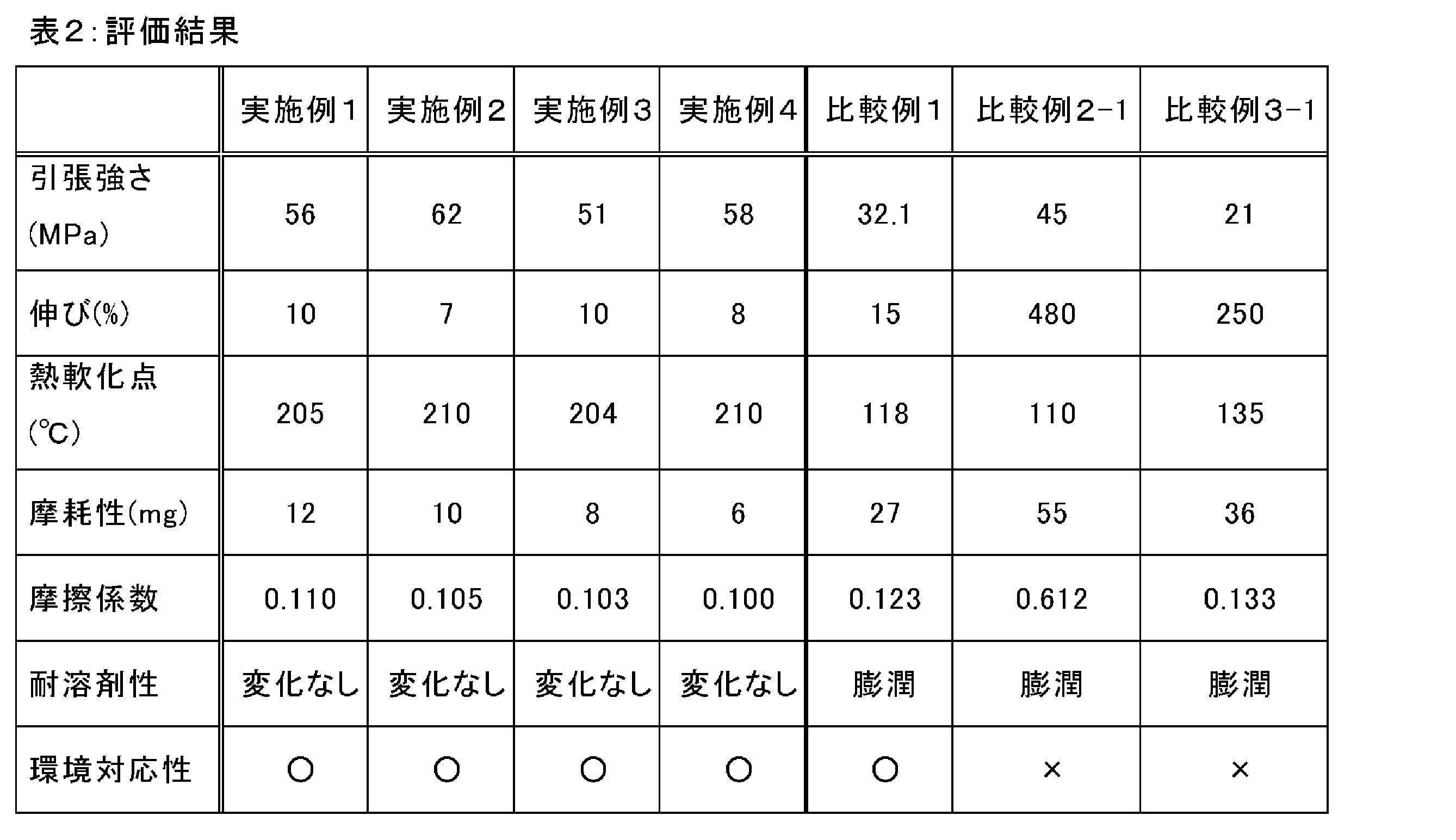
上記結果より、実施例1~4の樹脂を用いて得た各フィルムにおいて、十分な自己架橋が進んでいることが確認された。また、実施例1~4の自己架橋型ポリシロキサン変性ポリヒドロキシポリウレタン樹脂は、従来のポリエステルポリウレタン樹脂やポリシロキサン変性ポリウレタン樹脂に比べても同等、或いはそれ以上の性能を示した。 From the above results, it was confirmed that sufficient self-crosslinking had progressed in each of the films obtained using the resins of Examples 1 to 4. In addition, the self-crosslinking polysiloxane-modified polyhydroxypolyurethane resins of Examples 1 to 4 showed the same or better performance than conventional polyester polyurethane resins and polysiloxane-modified polyurethane resins.
<実施例5~12、比較例4~9>
実施例1~4、比較例1、2-2、3-2の樹脂溶液をそのまま、それぞれの擬革用塗料に使用して、下記の方法で実施例及び比較例の擬革を得た。得られた擬革について、後述するようにしてそれぞれ評価し、結果を表3、4に示した。
<Examples 5 to 12, Comparative Examples 4 to 9>
Using the resin solutions of Examples 1 to 4 and Comparative Examples 1, 2-2 and 3-2 as they were for the respective artificial leather paints, artificial leathers of Examples and Comparative Examples were obtained by the following methods. The obtained artificial leather was evaluated as described later, and the results are shown in Tables 3 and 4.
(人工皮革)
重合例および比較例の樹脂溶液を、厚さ1mmとなるように、ポリスチレン-ポリエステル繊維からなる不織布上に塗布し、25℃のDMF10%の水溶液中に浸漬し凝固させた。洗浄後、加熱乾燥(150℃/10分)し多孔層シートを有する人工皮革を得た。
(Artificial leather)
The resin solutions of the polymerization example and the comparative example were applied onto a nonwoven fabric composed of polystyrene-polyester fibers so as to have a thickness of 1 mm, and immersed in a 10% DMF aqueous solution at 25 ° C. to be solidified. After washing, drying by heating (150 ° C./10 minutes) yielded an artificial leather having a porous layer sheet.
(合成皮革)
織布上に接着剤層としてポリウレタン系樹脂溶液(レザミンUD-602S(商品名)、大日精化工業(株)製)を乾燥時の厚さが10μmとなるように塗布および乾燥して、擬革用基布シートを作成した。一方、実施例1~4および比較例1、2-2、3-2で得た樹脂溶液をそれぞれ離型紙上に塗布および加熱乾燥(150℃/10分)させ、約15μmの厚さのフィルムを形成し、これを上記基布シートに貼り合せて合成皮革を得た。
(Synthetic leather)
A polyurethane resin solution (Rezamin UD-602S (trade name), manufactured by Dainichi Seika Kogyo Co., Ltd.) is applied onto the woven fabric as an adhesive layer and dried to a thickness of 10 μm. A leather base fabric sheet was prepared. On the other hand, the resin solutions obtained in Examples 1 to 4 and Comparative Examples 1, 2-2, and 3-2 were coated on release paper and dried by heating (150 ° C./10 minutes), respectively, to a film having a thickness of about 15 μm. Was formed and bonded to the base fabric sheet to obtain a synthetic leather.
[評価]
上記で得た各人工皮革及び合成皮革の各擬革を用いて、下記の方法及び基準で評価した。結果を表3、4にまとめて示した。
[Evaluation]
Each artificial leather obtained above and each artificial leather of synthetic leather was used for evaluation according to the following methods and standards. The results are summarized in Tables 3 and 4.
(風合い)
各擬革について、手の感触により判定し、下記の基準で評価した。○を実施可能なレベルとした。
○;軟らかい
△;やや硬い
×;硬い
(Texture)
About each artificial leather, it judged by the touch of the hand and evaluated by the following reference | standard. ○ is a possible level.
○: Soft △; Slightly hard ×; Hard
(摩擦係数)
上記で得た各人工皮革表面の摩擦係数を、表面性試験機(新東科学製)を用いて測定し、評価した。
(Coefficient of friction)
The coefficient of friction of each artificial leather surface obtained above was measured and evaluated using a surface property tester (manufactured by Shinto Kagaku).
(耐薬品性)
上記で得た各合成皮革表面に、トルエンをそれぞれ滴下し、常に濡れている状態を保つため溶剤を追加滴下し、1時間後に拭き取った。拭き取った滴下部分を目視で観察して、下記の基準で評価した。
○;塗布面に滴下痕が全く見られない
△;僅かに滴下痕が認められるが目立たない
×;滴下痕が明らかに認められる
(chemical resistance)
Toluene was dropped on the surface of each synthetic leather obtained above, and a solvent was added dropwise to maintain a wet state at all times, followed by wiping after 1 hour. The dripped part wiped off was visually observed and evaluated according to the following criteria.
○: No dripping traces are observed on the coated surface. Δ: Slight dropping traces are observed but not noticeable.
(耐表面摩耗性)
上記で得た各合成皮革について、平面摩耗試験機を用い、6号帆布を荷重1Kgfで、擦り傷が発生するまでの回数を測定した。
○;5,000回以上
△;2000以上~5000回未満
×;2000回未満
(Surface wear resistance)
About each synthetic leather obtained above, the frequency | count until a scratch | wound generate | occur | produces was measured for the No. 6 canvas with the load 1Kgf using the plane abrasion tester.
○: 5,000 times or more Δ; 2000 or more to less than 5000 times ×; less than 2000 times
(熱軟化点)
上記した合成皮革の作成時、離型紙状に塗付及び加熱乾燥(150℃/10分)させて得られたフィルムを、JIS K7206(ビカット軟化点測定法)準じて測定し、熱軟化点を評価した。
(Thermal softening point)
At the time of making the above synthetic leather, a film obtained by applying to a release paper and heating and drying (150 ° C./10 minutes) was measured according to JIS K7206 (Vicat softening point measurement method), and the thermal softening point was measured. evaluated.
(環境対応性)
各擬革について、使用した樹脂中における二酸化炭素の固定化の有無によって、○×判断した。
(Environmental compatibility)
Each artificial leather was judged as “Good” by the presence or absence of carbon dioxide fixation in the resin used.


<実施例13~20、比較例10~15>
実施例1~4、比較例1、2-1、3-1の樹脂溶液を使用し、表5、6に記載した配合の表皮用塗料(樹脂組成物)をそれぞれに作製し、得られた塗料を用いて下記のようにして実施例及び比較例の熱可塑性ポリオレフィン樹脂製の表皮材を作製した。また、得られた各表皮材について、それぞれ下記の方法で評価した。
<Examples 13 to 20, Comparative Examples 10 to 15>
Using the resin solutions of Examples 1 to 4 and Comparative Examples 1, 2-1, and 3-1, skin coating compositions (resin compositions) having the formulations shown in Tables 5 and 6 were prepared and obtained. Using the paint, skin materials made of thermoplastic polyolefin resin of Examples and Comparative Examples were produced as follows. Further, each obtained skin material was evaluated by the following methods.
(トップコート層の形成方法)
コロナ放電処理をし、濡れ指数45dyn/cmに表面を活性化した熱可塑性ポリオレフィンの基材シートに、プライマー層として塩素化ポリプロピレン(スーパークロン(商品名);日本製紙(株)製)を120メッシュのグラビアロールにて乾燥後の厚みが3μmになるように塗布し、100℃で2分間乾燥してプライマー層を形成した。この塗膜の上に、表5、表6に記載の配合で作製したそれぞれの表皮用塗料(樹脂組成物)を、120メッシュのグラビアロールにて、乾燥後の厚みが5μmになるように塗布した。そして、150℃で3分間乾燥し、80℃で24時間熟成後、表面温度160℃の凸引型真空成形機で成型して、各表皮材からなる成型品を得た。
(Method for forming topcoat layer)
120-mesh chlorinated polypropylene (Super Clon (trade name); manufactured by Nippon Paper Industries Co., Ltd.) is used as a primer layer on a thermoplastic polyolefin substrate sheet that has been corona discharge treated and has a surface activated with a wetting index of 45 dyn / cm. The primer layer was formed by coating with a gravure roll so that the thickness after drying was 3 μm and dried at 100 ° C. for 2 minutes. On this coating film, each coating material for skin (resin composition) prepared by the formulation shown in Tables 5 and 6 was applied with a 120 mesh gravure roll so that the thickness after drying was 5 μm. did. And it dried at 150 degreeC for 3 minutes, and it age | cure | ripened at 80 degreeC for 24 hours, Then, it shape | molded with the convex drawing type | mold vacuum forming machine with a surface temperature of 160 degreeC, and obtained the molded article which consists of each skin material.
[評価]
上記で得た各表皮材からなる成型品について、成形性、グロス性(光沢性)、摩擦係数、接着性、耐擦傷性、耐油性、耐薬品性、耐表面摩耗性、環境対応性をそれぞれ下記の方法及び基準で評価した。特に、各シートからなる成型品の表面(トップコート層)について評価した。結果を表5、表6に示した。
[Evaluation]
The molded products made of each skin material obtained above have moldability, gloss (glossiness), coefficient of friction, adhesion, scratch resistance, oil resistance, chemical resistance, surface wear resistance, and environmental compatibility. Evaluation was performed by the following methods and criteria. In particular, the surface (topcoat layer) of the molded product made of each sheet was evaluated. The results are shown in Tables 5 and 6.
〔成形性〕
真空成形後の各シート表面を目視で観察し、下記の基準で評価した。
○;良好(成型割れや白化現象なし)
×;不良(成型割れまたは白化現象のどちらかが認められる)
[Formability]
The surface of each sheet after vacuum forming was visually observed and evaluated according to the following criteria.
○: Good (no molding cracking or whitening phenomenon)
×: Defect (either molding cracking or whitening phenomenon is recognized)
〔グロス値(光沢性)〕
真空成形後の各シート表面の光沢を、JIS K5600に準じたグロスメーターにて測定した。そして、このグロス値が1.2以下(業界の求める基準値)を合格として評価した。
[Gloss value (glossiness)]
The gloss of each sheet surface after vacuum forming was measured with a gloss meter according to JIS K5600. The gloss value was evaluated as a pass when the gloss value was 1.2 or less (standard value required by the industry).
〔摩擦係数〕
真空成形後の各シート表面の摩擦係数を、表面性試験機(新東科学製)で測定した。そして、この摩擦係数が低い程、車内装材の表面同士の擦れによる異音(きしみ音)が少なくなるので、摩擦係数が0.2以下であると望ましいと評価した。
〔Coefficient of friction〕
The friction coefficient of each sheet surface after vacuum forming was measured with a surface property tester (manufactured by Shinto Kagaku). The lower the friction coefficient, the less noise (squeak noise) caused by rubbing between the surfaces of the vehicle interior material. Therefore, it was evaluated that the friction coefficient was preferably 0.2 or less.
〔接着性〕
真空成形後の各シートの表面(トップコート層面)に対して、碁盤目セロハンテープによる剥離試験を行って、下記の基準で評価した。
○;良好(塗布面に剥離部分がない)
×;不良(塗布面に剥離部位がある)
〔Adhesiveness〕
A peel test using a grid cellophane tape was performed on the surface (top coat layer surface) of each sheet after vacuum forming, and evaluation was performed according to the following criteria.
○: Good (no peeling part on the coated surface)
×: Defect (there is a peeled part on the coated surface)
〔耐擦傷性〕
真空成形後の各シートの表面を爪でこすり、傷跡や白化が生じないかを目視判定で、下記の基準で評価した。
○;良好(塗布面の爪傷・白化を判別し難い)
×;不良(塗布面の爪傷・白化跡が明瞭に判別できる)
[Abrasion resistance]
The surface of each sheet after vacuum forming was rubbed with nails, and whether or not scars or whitening occurred was visually evaluated and evaluated according to the following criteria.
○: Good (difficult to determine claw scratches / whitening on the coated surface)
×: Defect (Nail scratches and whitening marks on the coated surface can be clearly identified)
〔耐油性〕
真空成形後の各シートの表面に牛油(ナカライテク(株))を2cm半径に塗布し、80℃雰囲気で5日間放置した後に牛油を除去した。そして、牛油の塗布面に対して、碁盤目セロハンテープによる剥離試験を行って、耐擦傷性の場合と同様の基準で評価した。
〔Oil resistance〕
Cattle oil (Nacalai Tech Co., Ltd.) was applied to a 2 cm radius on the surface of each sheet after vacuum forming, and was left in an atmosphere of 80 ° C. for 5 days, after which the cow oil was removed. Then, a peel test using a grid cellophane tape was performed on the coated surface of beef oil, and evaluation was performed based on the same criteria as in the case of scratch resistance.
〔耐薬品性〕
真空成形後の各シートの表面にエタノールをそれぞれ滴下し、常に濡れている状態を保つため溶剤を追加滴下し、1時間後に拭き取った。拭き取った部分を目視で観察して、下記の基準で、耐薬品性を評価した。
○;塗布面に滴下痕が全く見られない
△;僅かに滴下痕が認められるが目立たない
×;滴下痕が明らかに認められる
〔chemical resistance〕
Ethanol was dropped on the surface of each sheet after vacuum forming, and a solvent was further dropped to keep the wet state at all times, and wiped off after 1 hour. The wiped portion was visually observed, and chemical resistance was evaluated according to the following criteria.
○: No dripping traces are observed on the coated surface. Δ: Slight dropping traces are observed but not noticeable.
〔耐表面摩耗性〕
真空成形後の各シートの表面を、平面摩耗試験機を用い、6号帆布を荷重1kgfで擦り、傷が発生するまでの回数を測定した。そして、下記の基準で評価した。
○;5000回以上
△;2000回以上~5000回未満
×;2000回未満
(Surface wear resistance)
The surface of each sheet after vacuum forming was rubbed with No. 6 canvas with a load of 1 kgf using a flat surface wear tester, and the number of times until a scratch was generated was measured. And it evaluated on the following reference | standard.
○: 5000 times or more Δ: 2000 times or more to less than 5000 times ×; less than 2000 times
〔環境対応性〕
トップコート層の形成に使用した樹脂中における二酸化炭素の固定化の有無によって、○×判断した。
[Environmental compatibility]
Judgment was made based on whether or not carbon dioxide was immobilized in the resin used for forming the top coat layer.


以上の本発明によれば、地球温暖化、資源枯渇などの問題解決に資すると考えられる有用な材料であり、かつ産業用として有効利用できる自己架橋型ポリシロキサン変性ポリヒドロキシポリウレタン樹脂が提供される。より具体的には、本発明によれば、形成される製品が、二酸化炭素を取り入れた、温暖化ガス削減に寄与できる環境対応製品でありながら、耐熱性、滑り性、非粘着性、耐摩耗性、耐薬品性などの性能においても十分に満足できるものとなる自己架橋型ポリシロキサン変性ポリヒドロキシポリウレタン樹脂が提供される。したがって、地球環境保全の立場からも、その活用が期待される。 According to the present invention described above, a self-crosslinking polysiloxane-modified polyhydroxypolyurethane resin that is a useful material that is considered to contribute to solving problems such as global warming and resource depletion and that can be effectively used for industrial use is provided. . More specifically, according to the present invention, the product formed is an environmentally friendly product that contributes to the reduction of greenhouse gases, incorporating carbon dioxide, but has heat resistance, slipperiness, non-adhesiveness, and wear resistance. A self-crosslinking polysiloxane-modified polyhydroxypolyurethane resin that is sufficiently satisfactory in performance such as property and chemical resistance is provided. Therefore, its utilization is expected from the standpoint of global environmental conservation.
本発明の擬革は、自己架橋型ポリシロキサン変性ポリヒドロキシポリウレタン樹脂を主成分とする樹脂組成物を用いることにより、その構造中にある熱によって解離するマスキングされたイソシアネート基と、当該樹脂内のポリシロキサン変性ポリヒドロキシポリウレタン樹脂の水酸基とが反応して架橋樹脂となるので、耐擦傷性、耐摩耗性、耐薬品性、耐熱性に優れた擬革を得ることができると共に、ポリシロキサンセグメントの効果よる、柔軟性、滑性を併せ持つ優れた性能のものとなる。この結果、従来品では到達できなかった環境保全対応の擬革製品の提供が可能となり、この結果、近年、世界的な課題となっている地球温暖化、資源枯渇などの問題の解決に資することができる。 The artificial leather of the present invention uses a resin composition containing a self-crosslinking polysiloxane-modified polyhydroxypolyurethane resin as a main component, thereby masking isocyanate groups that are dissociated by heat in the structure, Since the hydroxyl group of the polysiloxane-modified polyhydroxypolyurethane resin reacts to form a cross-linked resin, it is possible to obtain a fake leather excellent in scratch resistance, abrasion resistance, chemical resistance, and heat resistance. Due to the effect, it has excellent performance and flexibility. As a result, it is possible to provide environmentally friendly artificial leather products that could not be achieved with conventional products. As a result, it can contribute to solving problems such as global warming and resource depletion that have become global issues in recent years. it can.
本発明によれば、基材である熱可塑性ポリオレフィン樹脂シート表面のトップコート層に、特定の自己架橋型ポリシロキサン変性ポリヒドロキシポリウレタン樹脂を含む樹脂組成物を用いることで、該シートから得られる成型品は、熱により解離したイソシアネート基と、自己架橋型ポリシロキサン変性ポリヒドロキシポリウレタン樹脂中の遊離水酸基とが反応して、トップコート層(最表層)として自己架橋皮膜を形成するため、その表面は、耐擦傷性、耐摩耗性、耐薬品性および耐熱性に優れ、必要に応じて均一な艶消効果にも優れるという性能を有するものになる。この結果、従来品では到達できなかった環境保全対応の表皮材の提供が可能となるので、表皮材の利用を拡大することで、近年、世界的な課題となっている地球温暖化、資源枯渇などの問題の解決に寄与できる。 According to the present invention, by using a resin composition containing a specific self-crosslinking polysiloxane-modified polyhydroxypolyurethane resin for the topcoat layer on the surface of a thermoplastic polyolefin resin sheet as a base material, molding obtained from the sheet The product reacts with the heat-dissociated isocyanate group and the free hydroxyl group in the self-crosslinked polysiloxane-modified polyhydroxypolyurethane resin to form a self-crosslinked film as the topcoat layer (outermost layer). It is excellent in scratch resistance, abrasion resistance, chemical resistance, and heat resistance, and has a performance that is excellent in uniform matting effect as required. As a result, it will be possible to provide environmentally-friendly skin materials that could not be achieved with conventional products. By expanding the use of skin materials, global warming and resource depletion have become a global issue in recent years. It can contribute to solving such problems.
Claims (14)

少なくとも一個の遊離のイソシアネート基と、マスキングされたイソシアネート基とを有する変性剤を用い、該変性剤を構成している遊離のイソシアネート基を、5員環環状カーボネートポリシロキサン化合物とアミン化合物との反応から誘導したポリシロキサン変性ポリヒドロキシポリウレタン樹脂中の水酸基と反応させて、その構造中にマスキングされたイソシアネート基を有してなるポリシロキサン変性ポリヒドロキシポリウレタン樹脂を得ることを特徴とする自己架橋型ポリシロキサン変性ポリヒドロキシポリウレタン樹脂の製造方法。 A method for producing a self-crosslinking polysiloxane-modified polyhydroxypolyurethane resin according to any one of claims 1 to 4,
Using a modifier having at least one free isocyanate group and a masked isocyanate group, the free isocyanate group constituting the modifier is reacted with a 5-membered cyclic carbonate polysiloxane compound and an amine compound. Self-crosslinking type polyoxypolyurethane resin obtained by reacting with a hydroxyl group in a polysiloxane-modified polyhydroxypolyurethane resin derived from the above to obtain a polysiloxane-modified polyhydroxypolyurethane resin having an isocyanate group masked in its structure A method for producing a siloxane-modified polyhydroxypolyurethane resin.
Priority Applications (4)
| Application Number | Priority Date | Filing Date | Title |
|---|---|---|---|
| CN201180051466.9A CN103270071B (en) | 2010-08-26 | 2011-08-11 | Self-crosslinking polysiloxane-odified polyhydroxy polyurethane resin, resin material containing same, method for producing same, artificial leather comprising same, and thermoplastic polyolefin skin material comprising same |
| EP11819802.7A EP2610276B1 (en) | 2010-08-26 | 2011-08-11 | Self-crosslinking polysiloxane-modified polyhydroxy polyurethane resin, resin material containing same, method for producing same, artificial leather comprising same, and thermoplastic polyolefin skin material comprising same |
| US13/818,552 US10000609B2 (en) | 2010-08-26 | 2011-08-11 | Self-crosslinking polysiloxane-modified polyhydroxy polyurethane resin, resin material containing same, method for producing same, artificial leather comprising same, and thermoplastic polyolefin skin material comprising same |
| KR1020137007409A KR101483381B1 (en) | 2010-08-26 | 2011-08-11 | Self-crosslinking polysiloxane-modified polyhydroxy polyurethane resin, resin material containing same, method for producing same, artificial leather comprising same, and thermoplastic polyolefin skin material comprising same |
Applications Claiming Priority (6)
| Application Number | Priority Date | Filing Date | Title |
|---|---|---|---|
| JP2010-189774 | 2010-08-26 | ||
| JP2010189774A JP5679739B2 (en) | 2010-08-26 | 2010-08-26 | Self-crosslinking polysiloxane-modified polyhydroxypolyurethane resin and process for producing the same |
| JP2010286620A JP5637559B2 (en) | 2010-12-22 | 2010-12-22 | imitation leather |
| JP2010-286620 | 2010-12-22 | ||
| JP2011004281A JP5601687B2 (en) | 2011-01-12 | 2011-01-12 | Skin material made of thermoplastic polyolefin resin |
| JP2011-004281 | 2011-01-12 |
Publications (1)
| Publication Number | Publication Date |
|---|---|
| WO2012026338A1 true WO2012026338A1 (en) | 2012-03-01 |
Family
ID=45723342
Family Applications (1)
| Application Number | Title | Priority Date | Filing Date |
|---|---|---|---|
| PCT/JP2011/068342 Ceased WO2012026338A1 (en) | 2010-08-26 | 2011-08-11 | Self-crosslinking polysiloxane-modified polyhydroxy polyurethane resin, resin material containing same, method for producing same, artificial leather comprising same, and thermoplastic polyolefin skin material comprising same |
Country Status (5)
| Country | Link |
|---|---|
| US (1) | US10000609B2 (en) |
| EP (1) | EP2610276B1 (en) |
| KR (1) | KR101483381B1 (en) |
| CN (1) | CN103270071B (en) |
| WO (1) | WO2012026338A1 (en) |
Cited By (9)
| Publication number | Priority date | Publication date | Assignee | Title |
|---|---|---|---|---|
| JP2012041452A (en) * | 2010-08-19 | 2012-03-01 | Hitachi Chem Co Ltd | Polyhydroxyurethane compound and method for producing the same, curable resin composition, photosensitive element, method for forming resist pattern, and method for manufacturing printed wiring board |
| WO2012115146A1 (en) * | 2011-02-24 | 2012-08-30 | 大日精化工業株式会社 | Coating composition for forming gas barrier layer, gas barrier film, and method for producing gas barrier film |
| WO2012137726A1 (en) * | 2011-04-04 | 2012-10-11 | 大日精化工業株式会社 | Self-crosslinkable polysiloxane-modified polyhydroxy polyurethane resin, process for producing said resin, resin material comprising said resin, and artificial leather produced utilizing said resin |
| JP2013170320A (en) * | 2012-02-20 | 2013-09-02 | Dainichiseika Color & Chem Mfg Co Ltd | imitation leather |
| US8951933B2 (en) | 2009-11-25 | 2015-02-10 | Dainichiseika Color & Chemicals Mfg. Co., Ltd. | Polysiloxane-modified polyhydroxy polyurethane resin, method for producing same, heat-sensitive recording material using the resin, imitation leather, thermoplastic polyolefin resin skin material, material for weather strip, and weather strip |
| US8975420B2 (en) | 2009-11-25 | 2015-03-10 | Dainichiseika Color & Chemicals Mfg. Co., Ltd. | Five-membered cyclocarbonate polysiloxane compound and process for preparation of same |
| US9416227B2 (en) | 2011-05-02 | 2016-08-16 | Dainichiseika Color & Chemicals Mfg. Co., Ltd. | Polyhydroxyurethane microparticles, and process for producing same |
| US10000609B2 (en) | 2010-08-26 | 2018-06-19 | Dainichiseika Color & Chemicals Mfg. Co., Ltd. | Self-crosslinking polysiloxane-modified polyhydroxy polyurethane resin, resin material containing same, method for producing same, artificial leather comprising same, and thermoplastic polyolefin skin material comprising same |
| US10066048B2 (en) | 2010-06-24 | 2018-09-04 | Dainichiseika Color & Chemicals Mfg. Co., Ltd. | Self-crosslinkable polyhydroxy polyurethane resin, resinaceous material that contains the resin, process for production of the resin, and imitation leather, surfacing material and weatherstrip material, using the resin |
Families Citing this family (12)
| Publication number | Priority date | Publication date | Assignee | Title |
|---|---|---|---|---|
| WO2011065433A1 (en) | 2009-11-26 | 2011-06-03 | 大日精化工業株式会社 | Polysiloxane-modified polyhydroxy polyurethane resin, method for producing same, heat-sensitive recording material using the resin, imitation leather, thermoplastic polyolefin resin skin material, material for weather strip, and weather strip |
| US8987378B2 (en) * | 2013-03-15 | 2015-03-24 | Ppg Industries Ohio, Inc. | Coating compositions comprising cyclic carbonate amine resins |
| CN104228246A (en) | 2013-06-13 | 2014-12-24 | 美国圣戈班性能塑料公司 | Foam sealing gasket based on polyurethane dispersion liquid and bonding adhesive tape |
| CN104512076B (en) * | 2013-09-26 | 2018-05-22 | 美国圣戈班性能塑料公司 | Ultrathin foam gasket and adhesive tape |
| KR101886482B1 (en) * | 2014-11-21 | 2018-09-07 | 롯데첨단소재(주) | Thermoplastic resin composition and article comprising the same |
| CA3079962C (en) | 2017-10-27 | 2021-04-06 | Dainichiseika Color & Chemicals Mfg. Co., Ltd. | Lusterless paint and skin material |
| WO2020003782A1 (en) * | 2018-06-27 | 2020-01-02 | Dic株式会社 | Urethane resin composition, surface treatment agent, and article |
| KR102547536B1 (en) * | 2019-09-05 | 2023-06-27 | 한화첨단소재 주식회사 | Synthetic leather |
| CN113717470B (en) * | 2021-11-01 | 2022-02-08 | 苏州度辰新材料有限公司 | Permanent antistatic master batch for polypropylene film, preparation method thereof and film |
| CN118829675A (en) * | 2022-03-23 | 2024-10-22 | 落基科技股份有限公司 | Polyhydroxycarbamate and preparation method and use thereof |
| CN114773828A (en) * | 2022-05-06 | 2022-07-22 | 盛鼎高新材料有限公司 | Corrosion-resistant polyurethane elastomer and preparation method thereof |
| TWI897391B (en) * | 2024-05-06 | 2025-09-11 | 三芳化學工業股份有限公司 | Manufacturing method of wear-resistant artificial leather |
Citations (15)
| Publication number | Priority date | Publication date | Assignee | Title |
|---|---|---|---|---|
| US3072613A (en) | 1957-08-20 | 1963-01-08 | Union Carbide Corp | Multiple cyclic carbonate polymers |
| JPH03501121A (en) * | 1987-07-16 | 1991-03-14 | 大日本インキ化学工業株式会社 | Method for producing cyclocarbonate compounds |
| JPH08245791A (en) * | 1995-02-21 | 1996-09-24 | Th Goldschmidt Ag | Method for producing carbonate group-containing organopolysiloxane |
| JP2000319504A (en) | 1999-05-11 | 2000-11-21 | Japan Chemical Innovation Institute | Novel polyhydroxyurethane and method for producing the same |
| JP2002518532A (en) * | 1998-06-15 | 2002-06-25 | ユーロテック リミテッド | Hybrid non-isocyanate polyurethane network polymers and compositions made therefrom |
| JP2004051901A (en) | 2002-07-23 | 2004-02-19 | Fujikura Kasei Co Ltd | Matte coating composition, coating film and coated product using the same |
| JP2005154580A (en) | 2003-11-26 | 2005-06-16 | Mitsui Chemicals Inc | Self-emulsifying aqueous polyurethane resin and its application |
| JP2006176615A (en) | 2004-12-22 | 2006-07-06 | Seikoh Chem Co Ltd | Coating agent for polyolefin-based resin molded article and molded article coated therewith |
| JP2006307015A (en) | 2005-04-28 | 2006-11-09 | Toyota Motor Corp | Scratch-resistant resin composition, method for producing scratch-resistant resin composition, and molded article |
| JP2007270373A (en) | 2006-03-31 | 2007-10-18 | Nisshinbo Ind Inc | Artificial leather-like sheet and method for producing the same |
| JP2009144313A (en) | 2007-11-22 | 2009-07-02 | Toray Coatex Co Ltd | Synthetic leather comprising plant originated component |
| JP2009155407A (en) * | 2007-12-26 | 2009-07-16 | Konishi Co Ltd | Curable resin composition and adhesive composition |
| WO2011065432A1 (en) * | 2009-11-25 | 2011-06-03 | 大日精化工業株式会社 | Polysiloxane-modified polyhydroxy polyurethane resin, method for producing same, heat-sensitive recording material using the resin, imitation leather, thermoplastic polyolefin resin skin material, material for weather strip, and weather strip |
| WO2011065129A1 (en) * | 2009-11-25 | 2011-06-03 | 大日精化工業株式会社 | Five-membered cyclocarbonate polysiloxane compound and process for preparation of same |
| WO2011065433A1 (en) * | 2009-11-26 | 2011-06-03 | 大日精化工業株式会社 | Polysiloxane-modified polyhydroxy polyurethane resin, method for producing same, heat-sensitive recording material using the resin, imitation leather, thermoplastic polyolefin resin skin material, material for weather strip, and weather strip |
Family Cites Families (53)
| Publication number | Priority date | Publication date | Assignee | Title |
|---|---|---|---|---|
| DE2814079A1 (en) | 1978-04-01 | 1979-10-11 | Bayer Ag | COATING DIMENSIONS |
| US4395527A (en) | 1978-05-17 | 1983-07-26 | M & T Chemicals Inc. | Siloxane-containing polymers |
| JPS5813359B2 (en) | 1978-07-03 | 1983-03-12 | 富士化学紙工業株式会社 | Thermal transfer material |
| JPS564408A (en) | 1979-06-26 | 1981-01-17 | Meitoo Kk | Waterproof* antiseptic and vermicidal method of wood |
| US4499149A (en) | 1980-12-15 | 1985-02-12 | M&T Chemicals Inc. | Siloxane-containing polymers |
| US4480009A (en) | 1980-12-15 | 1984-10-30 | M&T Chemicals Inc. | Siloxane-containing polymers |
| EP0152820B1 (en) | 1984-02-17 | 1996-04-17 | Cytec Technology Corp. | Carbamate compounds, compositions and method of making the same |
| US4520167A (en) | 1984-02-17 | 1985-05-28 | American Cyanamid Co. | Hydroxyalkyl carbamate diluent for coating compositions and compositions containing the same |
| US4631320A (en) | 1984-02-17 | 1986-12-23 | American Cyanamid Company | Coating compositions containing polyurethane or polyurea polymers and amino resins |
| US4484994A (en) | 1984-02-17 | 1984-11-27 | American Cyanamid Company | Hydroxyalkyl carbamate-containing resins for cathodic electrodeposition and method of making the same |
| US4758632A (en) | 1984-02-17 | 1988-07-19 | American Cyanamid Company | Self-cross-linkable acrylic polymer containing hydroxyalkyl carbamate groups and coating compositions containing the same |
| US4897435A (en) | 1984-02-17 | 1990-01-30 | American Cyanamid Company | Water based hydroxyalkyl carbamate-containing resins and method of making the same |
| JPS61227087A (en) | 1985-04-01 | 1986-10-09 | Dainichi Seika Kogyo Kk | Thermal recording material |
| JPS62202786A (en) | 1986-03-04 | 1987-09-07 | Dainichi Color & Chem Mfg Co Ltd | Thermal recording material |
| DE3644370A1 (en) | 1986-12-24 | 1988-07-07 | Hoechst Ag | AMINOURETHANE, METHOD FOR THE PRODUCTION THEREOF FROM POLYAMINE AND THEIR USE |
| US4883854A (en) | 1988-09-30 | 1989-11-28 | Medtronic, Inc. | Hydroxyl functional monomers |
| JPH02102096A (en) | 1988-10-12 | 1990-04-13 | Dainichiseika Color & Chem Mfg Co Ltd | heat sensitive recording material |
| DE69210919T2 (en) | 1991-09-05 | 1997-01-23 | Nippon Paint Co Ltd | Thermosetting resin mixture containing a polyfunctional oxazolidone component and a polyamine component |
| JPH0565341A (en) | 1991-09-05 | 1993-03-19 | Nippon Paint Co Ltd | Thermosetting resin composition |
| JP2630894B2 (en) | 1992-07-03 | 1997-07-16 | 信越化学工業株式会社 | Coating composition for weatherstrip |
| JP3013014B2 (en) | 1993-02-24 | 2000-02-28 | 西川ゴム工業株式会社 | Weather strip |
| JPH08109349A (en) | 1994-10-12 | 1996-04-30 | Yokohama Rubber Co Ltd:The | Coating agent for glass run for motor car |
| JP3461605B2 (en) | 1994-12-19 | 2003-10-27 | 鬼怒川ゴム工業株式会社 | Coating composition for surface treatment of polymer elastics |
| JPH08245787A (en) | 1995-03-10 | 1996-09-24 | Nippon Shokubai Co Ltd | Production of polymer having high molecular weight |
| US5686547A (en) | 1996-03-14 | 1997-11-11 | General Electric Company | Carbonate and hydroxy carbamate functionalized silicones |
| JPH09278982A (en) | 1996-04-15 | 1997-10-28 | Dainippon Ink & Chem Inc | Curable resin composition and coating film forming method using the same |
| JPH11140182A (en) | 1997-11-05 | 1999-05-25 | Nof Corp | Reactive resin |
| DE19959949A1 (en) | 1999-12-13 | 2001-06-21 | Bayer Ag | Hydrophobization with carboxyl-containing polysiloxanes |
| EP1143063B1 (en) | 2000-03-31 | 2008-09-17 | Dainichiseika Color & Chemicals Mfg. Co. Ltd. | Artificial leather |
| TWI251000B (en) | 2000-08-28 | 2006-03-11 | Aprilis Inc | Holographic storage medium comprising polyfunctional epoxy monomers capable of undergoing cationic polymerization |
| JP2002114936A (en) | 2000-10-05 | 2002-04-16 | Kinugawa Rubber Ind Co Ltd | Primer composition, and weatherstrip coated therewith |
| DE10216896A1 (en) * | 2002-04-17 | 2003-11-13 | Goldschmidt Ag Th | Aqueous polysiloxane-polyurethane dispersion, its production and use in coating materials |
| EP1506975A1 (en) | 2003-08-13 | 2005-02-16 | Vantico GmbH | Nanocomposites based on polyurethane or polyurethane-epoxy hybrid resins prepared avoiding isocyanates |
| JP4293441B2 (en) * | 2004-05-14 | 2009-07-08 | 第一工業製薬株式会社 | A water-based polyurethane resin composition for heat-resistant artificial and synthetic leather, a method for producing the same, and a leather-like sheet. |
| JP4554604B2 (en) * | 2004-05-18 | 2010-09-29 | 旭化成せんい株式会社 | Flame retardant artificial leather |
| JP4417777B2 (en) | 2004-05-25 | 2010-02-17 | 大日精化工業株式会社 | Fake leather-like sheet |
| GB2415197A (en) | 2004-06-18 | 2005-12-21 | Baxenden Chem | Urethane-group containing diol or polyol polymer products and their use as coatings |
| US20060276599A1 (en) | 2005-06-05 | 2006-12-07 | Dewitt Julie A | Weatherstrip coating |
| JP4650627B2 (en) | 2005-09-14 | 2011-03-16 | 信越化学工業株式会社 | Cyclic carbonate-modified siloxane, method for producing the same, non-aqueous electrolyte, secondary battery, and capacitor |
| US7368174B2 (en) | 2005-12-14 | 2008-05-06 | Lord Corporation | Aqueous dispersion coating composition having noise and/or friction abatement properties |
| JP2007297544A (en) | 2006-05-01 | 2007-11-15 | Dai Ichi Kogyo Seiyaku Co Ltd | Method for producing polyhydroxyurethane and aqueous dispersion of polyhydroxyurethane |
| JP2008056772A (en) | 2006-08-30 | 2008-03-13 | Seikoh Chem Co Ltd | Aqueous coating agent for ethylene-propylene rubber |
| US8399594B2 (en) * | 2006-12-20 | 2013-03-19 | Dow Corning Corporation | Blocked-isocyanate silicone resins |
| DE102007023869A1 (en) | 2007-05-21 | 2008-12-18 | Momentive Performance Materials Gmbh & Co. Kg | New polycarbonate and / or polyurethane polyorganosiloxane compounds |
| DE102007032666A1 (en) | 2007-07-13 | 2009-01-22 | Bayer Materialscience Ag | Allophanate and silane-containing polyisocyanates |
| DE102008013584A1 (en) | 2008-03-11 | 2009-09-17 | Momentive Performance Materials Gmbh | New polycarbonate-polyorganosiloxane and / or polyurethane-polyorganosiloxane compounds |
| JP5249657B2 (en) | 2008-07-10 | 2013-07-31 | 大日精化工業株式会社 | Thermosensitive recording material, polyurethane and method for producing the same |
| JP5662645B2 (en) | 2009-02-06 | 2015-02-04 | 大日精化工業株式会社 | Urethane resin and paint |
| JP5705511B2 (en) | 2009-11-26 | 2015-04-22 | 大日精化工業株式会社 | Polysiloxane-modified polyhydroxypolyurethane resin, resin-containing composition and resin production method |
| CN102958978B (en) | 2010-06-24 | 2014-11-19 | 大日精化工业株式会社 | Self-crosslinkable polyhydroxy polyurethane resin, process for production of the resin, and resinaceous material that contains the resin |
| EP2610276B1 (en) | 2010-08-26 | 2017-11-01 | Dainichiseika Color & Chemicals Mfg. Co., Ltd. | Self-crosslinking polysiloxane-modified polyhydroxy polyurethane resin, resin material containing same, method for producing same, artificial leather comprising same, and thermoplastic polyolefin skin material comprising same |
| WO2012137726A1 (en) | 2011-04-04 | 2012-10-11 | 大日精化工業株式会社 | Self-crosslinkable polysiloxane-modified polyhydroxy polyurethane resin, process for producing said resin, resin material comprising said resin, and artificial leather produced utilizing said resin |
| US9672355B2 (en) | 2011-09-16 | 2017-06-06 | Veracode, Inc. | Automated behavioral and static analysis using an instrumented sandbox and machine learning classification for mobile security |
-
2011
- 2011-08-11 EP EP11819802.7A patent/EP2610276B1/en active Active
- 2011-08-11 CN CN201180051466.9A patent/CN103270071B/en active Active
- 2011-08-11 KR KR1020137007409A patent/KR101483381B1/en active Active
- 2011-08-11 US US13/818,552 patent/US10000609B2/en active Active
- 2011-08-11 WO PCT/JP2011/068342 patent/WO2012026338A1/en not_active Ceased
Patent Citations (15)
| Publication number | Priority date | Publication date | Assignee | Title |
|---|---|---|---|---|
| US3072613A (en) | 1957-08-20 | 1963-01-08 | Union Carbide Corp | Multiple cyclic carbonate polymers |
| JPH03501121A (en) * | 1987-07-16 | 1991-03-14 | 大日本インキ化学工業株式会社 | Method for producing cyclocarbonate compounds |
| JPH08245791A (en) * | 1995-02-21 | 1996-09-24 | Th Goldschmidt Ag | Method for producing carbonate group-containing organopolysiloxane |
| JP2002518532A (en) * | 1998-06-15 | 2002-06-25 | ユーロテック リミテッド | Hybrid non-isocyanate polyurethane network polymers and compositions made therefrom |
| JP2000319504A (en) | 1999-05-11 | 2000-11-21 | Japan Chemical Innovation Institute | Novel polyhydroxyurethane and method for producing the same |
| JP2004051901A (en) | 2002-07-23 | 2004-02-19 | Fujikura Kasei Co Ltd | Matte coating composition, coating film and coated product using the same |
| JP2005154580A (en) | 2003-11-26 | 2005-06-16 | Mitsui Chemicals Inc | Self-emulsifying aqueous polyurethane resin and its application |
| JP2006176615A (en) | 2004-12-22 | 2006-07-06 | Seikoh Chem Co Ltd | Coating agent for polyolefin-based resin molded article and molded article coated therewith |
| JP2006307015A (en) | 2005-04-28 | 2006-11-09 | Toyota Motor Corp | Scratch-resistant resin composition, method for producing scratch-resistant resin composition, and molded article |
| JP2007270373A (en) | 2006-03-31 | 2007-10-18 | Nisshinbo Ind Inc | Artificial leather-like sheet and method for producing the same |
| JP2009144313A (en) | 2007-11-22 | 2009-07-02 | Toray Coatex Co Ltd | Synthetic leather comprising plant originated component |
| JP2009155407A (en) * | 2007-12-26 | 2009-07-16 | Konishi Co Ltd | Curable resin composition and adhesive composition |
| WO2011065432A1 (en) * | 2009-11-25 | 2011-06-03 | 大日精化工業株式会社 | Polysiloxane-modified polyhydroxy polyurethane resin, method for producing same, heat-sensitive recording material using the resin, imitation leather, thermoplastic polyolefin resin skin material, material for weather strip, and weather strip |
| WO2011065129A1 (en) * | 2009-11-25 | 2011-06-03 | 大日精化工業株式会社 | Five-membered cyclocarbonate polysiloxane compound and process for preparation of same |
| WO2011065433A1 (en) * | 2009-11-26 | 2011-06-03 | 大日精化工業株式会社 | Polysiloxane-modified polyhydroxy polyurethane resin, method for producing same, heat-sensitive recording material using the resin, imitation leather, thermoplastic polyolefin resin skin material, material for weather strip, and weather strip |
Non-Patent Citations (3)
| Title |
|---|
| N. KIHARA; T. ENDO, J. ORG. CHEM., vol. 58, 1993, pages 6198 |
| N. KIHARA; T. ENDO, J. POLYMER SCI., PART A POLYMER CHEM., vol. 31, no. 11, 1993, pages 2765 |
| See also references of EP2610276A4 |
Cited By (12)
| Publication number | Priority date | Publication date | Assignee | Title |
|---|---|---|---|---|
| US8951933B2 (en) | 2009-11-25 | 2015-02-10 | Dainichiseika Color & Chemicals Mfg. Co., Ltd. | Polysiloxane-modified polyhydroxy polyurethane resin, method for producing same, heat-sensitive recording material using the resin, imitation leather, thermoplastic polyolefin resin skin material, material for weather strip, and weather strip |
| US8975420B2 (en) | 2009-11-25 | 2015-03-10 | Dainichiseika Color & Chemicals Mfg. Co., Ltd. | Five-membered cyclocarbonate polysiloxane compound and process for preparation of same |
| US9394462B2 (en) | 2009-11-25 | 2016-07-19 | Dainichiseika Color & Chemicals Mfg. Co., Ltd | Polysiloxane-modified polyhydroxy polyurethane resin, method for producing same, heat-sensitive recording material using the resin, imitation leather, thermoplastic polyolefin resin skin material, material for weather strip, and weather strip |
| US10066048B2 (en) | 2010-06-24 | 2018-09-04 | Dainichiseika Color & Chemicals Mfg. Co., Ltd. | Self-crosslinkable polyhydroxy polyurethane resin, resinaceous material that contains the resin, process for production of the resin, and imitation leather, surfacing material and weatherstrip material, using the resin |
| JP2012041452A (en) * | 2010-08-19 | 2012-03-01 | Hitachi Chem Co Ltd | Polyhydroxyurethane compound and method for producing the same, curable resin composition, photosensitive element, method for forming resist pattern, and method for manufacturing printed wiring board |
| US10000609B2 (en) | 2010-08-26 | 2018-06-19 | Dainichiseika Color & Chemicals Mfg. Co., Ltd. | Self-crosslinking polysiloxane-modified polyhydroxy polyurethane resin, resin material containing same, method for producing same, artificial leather comprising same, and thermoplastic polyolefin skin material comprising same |
| WO2012115146A1 (en) * | 2011-02-24 | 2012-08-30 | 大日精化工業株式会社 | Coating composition for forming gas barrier layer, gas barrier film, and method for producing gas barrier film |
| US9540537B2 (en) | 2011-02-24 | 2017-01-10 | Dainichiseika Color & Chemicals Mfg. Co., Ltd. | Coating composition for forming gas barrier layer, gas barrier film, and method for producing gas barrier film |
| WO2012137726A1 (en) * | 2011-04-04 | 2012-10-11 | 大日精化工業株式会社 | Self-crosslinkable polysiloxane-modified polyhydroxy polyurethane resin, process for producing said resin, resin material comprising said resin, and artificial leather produced utilizing said resin |
| US9359719B2 (en) | 2011-04-04 | 2016-06-07 | Dainichiseika Color & Chemicals Mfg. Co., Ltd. | Self-crosslinkable polysiloxane-modified polyhydroxy polyurethane resin, process for producing said resin, resin material comprising said resin, and artificial leather produced utilizing said resin |
| US9416227B2 (en) | 2011-05-02 | 2016-08-16 | Dainichiseika Color & Chemicals Mfg. Co., Ltd. | Polyhydroxyurethane microparticles, and process for producing same |
| JP2013170320A (en) * | 2012-02-20 | 2013-09-02 | Dainichiseika Color & Chem Mfg Co Ltd | imitation leather |
Also Published As
| Publication number | Publication date |
|---|---|
| KR20130045933A (en) | 2013-05-06 |
| US20130171896A1 (en) | 2013-07-04 |
| CN103270071A (en) | 2013-08-28 |
| EP2610276A1 (en) | 2013-07-03 |
| EP2610276B1 (en) | 2017-11-01 |
| CN103270071B (en) | 2014-11-26 |
| KR101483381B1 (en) | 2015-01-14 |
| EP2610276A4 (en) | 2016-11-23 |
| US10000609B2 (en) | 2018-06-19 |
Similar Documents
| Publication | Publication Date | Title |
|---|---|---|
| WO2012026338A1 (en) | Self-crosslinking polysiloxane-modified polyhydroxy polyurethane resin, resin material containing same, method for producing same, artificial leather comprising same, and thermoplastic polyolefin skin material comprising same | |
| CN102958978B (en) | Self-crosslinkable polyhydroxy polyurethane resin, process for production of the resin, and resinaceous material that contains the resin | |
| CN103597003B (en) | Self-crosslinking polysiloxane-modified polyhydroxyurethane resin, method for producing the resin, resin material containing the resin, and artificial leather using the resin | |
| EP2505599B1 (en) | Polysiloxane-modified polyhydroxy polyurethane resin, method for producing same, heat-sensitive recording material using the resin, imitation leather, thermoplastic polyolefin resin skin material, material for weather strip, and weather strip | |
| KR101434764B1 (en) | Polysiloxane-modified polyhydroxy polyurethane resin, method for producing same, heat-sensitive recording material using the resin, imitation leather, thermoplastic polyolefin resin skin material, material for weather strip, and weather strip | |
| JP5601687B2 (en) | Skin material made of thermoplastic polyolefin resin | |
| JP5386468B2 (en) | Thermoplastic polyolefin resin skin material | |
| JP5688038B2 (en) | imitation leather | |
| JP5069736B2 (en) | Thermoplastic polyolefin resin skin material | |
| JP5367680B2 (en) | Thermoplastic polyolefin resin skin material | |
| JP5637559B2 (en) | imitation leather | |
| JP5554156B2 (en) | imitation leather | |
| JP5554173B2 (en) | Skin material made of thermoplastic polyolefin resin | |
| JP5554174B2 (en) | Weather strip material |
Legal Events
| Date | Code | Title | Description |
|---|---|---|---|
| 121 | Ep: the epo has been informed by wipo that ep was designated in this application |
Ref document number: 11819802 Country of ref document: EP Kind code of ref document: A1 |
|
| NENP | Non-entry into the national phase |
Ref country code: DE |
|
| REEP | Request for entry into the european phase |
Ref document number: 2011819802 Country of ref document: EP |
|
| WWE | Wipo information: entry into national phase |
Ref document number: 2011819802 Country of ref document: EP |
|
| WWE | Wipo information: entry into national phase |
Ref document number: 13818552 Country of ref document: US |
|
| ENP | Entry into the national phase |
Ref document number: 20137007409 Country of ref document: KR Kind code of ref document: A |