WO2012060428A1 - (アミドアミノアルカン)金属化合物、及び当該金属化合物を用いた金属含有薄膜の製造方法 - Google Patents
(アミドアミノアルカン)金属化合物、及び当該金属化合物を用いた金属含有薄膜の製造方法 Download PDFInfo
- Publication number
- WO2012060428A1 WO2012060428A1 PCT/JP2011/075347 JP2011075347W WO2012060428A1 WO 2012060428 A1 WO2012060428 A1 WO 2012060428A1 JP 2011075347 W JP2011075347 W JP 2011075347W WO 2012060428 A1 WO2012060428 A1 WO 2012060428A1
- Authority
- WO
- WIPO (PCT)
- Prior art keywords
- metal
- cobalt
- metal compound
- compound
- dimethylaminoethane
- Prior art date
- Legal status (The legal status is an assumption and is not a legal conclusion. Google has not performed a legal analysis and makes no representation as to the accuracy of the status listed.)
- Ceased
Links
- 0 CCC(C=CC)N(*(*)[C@@]1(CC)C2)*(*)(*)[C@]2C1=CC Chemical compound CCC(C=CC)N(*(*)[C@@]1(CC)C2)*(*)(*)[C@]2C1=CC 0.000 description 3
Images
Classifications
-
- C—CHEMISTRY; METALLURGY
- C07—ORGANIC CHEMISTRY
- C07C—ACYCLIC OR CARBOCYCLIC COMPOUNDS
- C07C209/00—Preparation of compounds containing amino groups bound to a carbon skeleton
- C07C209/68—Preparation of compounds containing amino groups bound to a carbon skeleton from amines, by reactions not involving amino groups, e.g. reduction of unsaturated amines, aromatisation, or substitution of the carbon skeleton
-
- H—ELECTRICITY
- H10—SEMICONDUCTOR DEVICES; ELECTRIC SOLID-STATE DEVICES NOT OTHERWISE PROVIDED FOR
- H10K—ORGANIC ELECTRIC SOLID-STATE DEVICES
- H10K85/00—Organic materials used in the body or electrodes of devices covered by this subclass
- H10K85/30—Coordination compounds
- H10K85/331—Metal complexes comprising an iron-series metal, e.g. Fe, Co, Ni
-
- C—CHEMISTRY; METALLURGY
- C07—ORGANIC CHEMISTRY
- C07C—ACYCLIC OR CARBOCYCLIC COMPOUNDS
- C07C211/00—Compounds containing amino groups bound to a carbon skeleton
- C07C211/65—Metal complexes of amines
-
- C—CHEMISTRY; METALLURGY
- C07—ORGANIC CHEMISTRY
- C07D—HETEROCYCLIC COMPOUNDS
- C07D295/00—Heterocyclic compounds containing polymethylene-imine rings with at least five ring members, 3-azabicyclo [3.2.2] nonane, piperazine, morpholine or thiomorpholine rings, having only hydrogen atoms directly attached to the ring carbon atoms
- C07D295/04—Heterocyclic compounds containing polymethylene-imine rings with at least five ring members, 3-azabicyclo [3.2.2] nonane, piperazine, morpholine or thiomorpholine rings, having only hydrogen atoms directly attached to the ring carbon atoms with substituted hydrocarbon radicals attached to ring nitrogen atoms
- C07D295/12—Heterocyclic compounds containing polymethylene-imine rings with at least five ring members, 3-azabicyclo [3.2.2] nonane, piperazine, morpholine or thiomorpholine rings, having only hydrogen atoms directly attached to the ring carbon atoms with substituted hydrocarbon radicals attached to ring nitrogen atoms substituted by singly or doubly bound nitrogen atoms
- C07D295/125—Heterocyclic compounds containing polymethylene-imine rings with at least five ring members, 3-azabicyclo [3.2.2] nonane, piperazine, morpholine or thiomorpholine rings, having only hydrogen atoms directly attached to the ring carbon atoms with substituted hydrocarbon radicals attached to ring nitrogen atoms substituted by singly or doubly bound nitrogen atoms with the ring nitrogen atoms and the substituent nitrogen atoms attached to the same carbon chain, which is not interrupted by carbocyclic rings
- C07D295/13—Heterocyclic compounds containing polymethylene-imine rings with at least five ring members, 3-azabicyclo [3.2.2] nonane, piperazine, morpholine or thiomorpholine rings, having only hydrogen atoms directly attached to the ring carbon atoms with substituted hydrocarbon radicals attached to ring nitrogen atoms substituted by singly or doubly bound nitrogen atoms with the ring nitrogen atoms and the substituent nitrogen atoms attached to the same carbon chain, which is not interrupted by carbocyclic rings to an acyclic saturated chain
-
- C—CHEMISTRY; METALLURGY
- C07—ORGANIC CHEMISTRY
- C07F—ACYCLIC, CARBOCYCLIC OR HETEROCYCLIC COMPOUNDS CONTAINING ELEMENTS OTHER THAN CARBON, HYDROGEN, HALOGEN, OXYGEN, NITROGEN, SULFUR, SELENIUM OR TELLURIUM
- C07F1/00—Compounds containing elements of Groups 1 or 11 of the Periodic Table
- C07F1/02—Lithium compounds
-
- C—CHEMISTRY; METALLURGY
- C07—ORGANIC CHEMISTRY
- C07F—ACYCLIC, CARBOCYCLIC OR HETEROCYCLIC COMPOUNDS CONTAINING ELEMENTS OTHER THAN CARBON, HYDROGEN, HALOGEN, OXYGEN, NITROGEN, SULFUR, SELENIUM OR TELLURIUM
- C07F13/00—Compounds containing elements of Groups 7 or 17 of the Periodic Table
- C07F13/005—Compounds without a metal-carbon linkage
-
- C—CHEMISTRY; METALLURGY
- C07—ORGANIC CHEMISTRY
- C07F—ACYCLIC, CARBOCYCLIC OR HETEROCYCLIC COMPOUNDS CONTAINING ELEMENTS OTHER THAN CARBON, HYDROGEN, HALOGEN, OXYGEN, NITROGEN, SULFUR, SELENIUM OR TELLURIUM
- C07F15/00—Compounds containing elements of Groups 8, 9, 10 or 18 of the Periodic Table
- C07F15/02—Iron compounds
- C07F15/025—Iron compounds without a metal-carbon linkage
-
- C—CHEMISTRY; METALLURGY
- C07—ORGANIC CHEMISTRY
- C07F—ACYCLIC, CARBOCYCLIC OR HETEROCYCLIC COMPOUNDS CONTAINING ELEMENTS OTHER THAN CARBON, HYDROGEN, HALOGEN, OXYGEN, NITROGEN, SULFUR, SELENIUM OR TELLURIUM
- C07F15/00—Compounds containing elements of Groups 8, 9, 10 or 18 of the Periodic Table
- C07F15/04—Nickel compounds
- C07F15/045—Nickel compounds without a metal-carbon linkage
-
- C—CHEMISTRY; METALLURGY
- C07—ORGANIC CHEMISTRY
- C07F—ACYCLIC, CARBOCYCLIC OR HETEROCYCLIC COMPOUNDS CONTAINING ELEMENTS OTHER THAN CARBON, HYDROGEN, HALOGEN, OXYGEN, NITROGEN, SULFUR, SELENIUM OR TELLURIUM
- C07F15/00—Compounds containing elements of Groups 8, 9, 10 or 18 of the Periodic Table
- C07F15/06—Cobalt compounds
- C07F15/065—Cobalt compounds without a metal-carbon linkage
-
- C—CHEMISTRY; METALLURGY
- C07—ORGANIC CHEMISTRY
- C07F—ACYCLIC, CARBOCYCLIC OR HETEROCYCLIC COMPOUNDS CONTAINING ELEMENTS OTHER THAN CARBON, HYDROGEN, HALOGEN, OXYGEN, NITROGEN, SULFUR, SELENIUM OR TELLURIUM
- C07F3/00—Compounds containing elements of Groups 2 or 12 of the Periodic Table
- C07F3/02—Magnesium compounds
-
- C—CHEMISTRY; METALLURGY
- C07—ORGANIC CHEMISTRY
- C07F—ACYCLIC, CARBOCYCLIC OR HETEROCYCLIC COMPOUNDS CONTAINING ELEMENTS OTHER THAN CARBON, HYDROGEN, HALOGEN, OXYGEN, NITROGEN, SULFUR, SELENIUM OR TELLURIUM
- C07F3/00—Compounds containing elements of Groups 2 or 12 of the Periodic Table
- C07F3/06—Zinc compounds
-
- C—CHEMISTRY; METALLURGY
- C07—ORGANIC CHEMISTRY
- C07F—ACYCLIC, CARBOCYCLIC OR HETEROCYCLIC COMPOUNDS CONTAINING ELEMENTS OTHER THAN CARBON, HYDROGEN, HALOGEN, OXYGEN, NITROGEN, SULFUR, SELENIUM OR TELLURIUM
- C07F5/00—Compounds containing elements of Groups 3 or 13 of the Periodic Table
- C07F5/003—Compounds containing elements of Groups 3 or 13 of the Periodic Table without C-Metal linkages
-
- C—CHEMISTRY; METALLURGY
- C07—ORGANIC CHEMISTRY
- C07F—ACYCLIC, CARBOCYCLIC OR HETEROCYCLIC COMPOUNDS CONTAINING ELEMENTS OTHER THAN CARBON, HYDROGEN, HALOGEN, OXYGEN, NITROGEN, SULFUR, SELENIUM OR TELLURIUM
- C07F9/00—Compounds containing elements of Groups 5 or 15 of the Periodic Table
- C07F9/94—Bismuth compounds
-
- C—CHEMISTRY; METALLURGY
- C23—COATING METALLIC MATERIAL; COATING MATERIAL WITH METALLIC MATERIAL; CHEMICAL SURFACE TREATMENT; DIFFUSION TREATMENT OF METALLIC MATERIAL; COATING BY VACUUM EVAPORATION, BY SPUTTERING, BY ION IMPLANTATION OR BY CHEMICAL VAPOUR DEPOSITION, IN GENERAL; INHIBITING CORROSION OF METALLIC MATERIAL OR INCRUSTATION IN GENERAL
- C23C—COATING METALLIC MATERIAL; COATING MATERIAL WITH METALLIC MATERIAL; SURFACE TREATMENT OF METALLIC MATERIAL BY DIFFUSION INTO THE SURFACE, BY CHEMICAL CONVERSION OR SUBSTITUTION; COATING BY VACUUM EVAPORATION, BY SPUTTERING, BY ION IMPLANTATION OR BY CHEMICAL VAPOUR DEPOSITION, IN GENERAL
- C23C16/00—Chemical coating by decomposition of gaseous compounds, without leaving reaction products of surface material in the coating, i.e. chemical vapour deposition [CVD] processes
- C23C16/06—Chemical coating by decomposition of gaseous compounds, without leaving reaction products of surface material in the coating, i.e. chemical vapour deposition [CVD] processes characterised by the deposition of metallic material
- C23C16/18—Chemical coating by decomposition of gaseous compounds, without leaving reaction products of surface material in the coating, i.e. chemical vapour deposition [CVD] processes characterised by the deposition of metallic material from metallo-organic compounds
-
- C—CHEMISTRY; METALLURGY
- C23—COATING METALLIC MATERIAL; COATING MATERIAL WITH METALLIC MATERIAL; CHEMICAL SURFACE TREATMENT; DIFFUSION TREATMENT OF METALLIC MATERIAL; COATING BY VACUUM EVAPORATION, BY SPUTTERING, BY ION IMPLANTATION OR BY CHEMICAL VAPOUR DEPOSITION, IN GENERAL; INHIBITING CORROSION OF METALLIC MATERIAL OR INCRUSTATION IN GENERAL
- C23C—COATING METALLIC MATERIAL; COATING MATERIAL WITH METALLIC MATERIAL; SURFACE TREATMENT OF METALLIC MATERIAL BY DIFFUSION INTO THE SURFACE, BY CHEMICAL CONVERSION OR SUBSTITUTION; COATING BY VACUUM EVAPORATION, BY SPUTTERING, BY ION IMPLANTATION OR BY CHEMICAL VAPOUR DEPOSITION, IN GENERAL
- C23C16/00—Chemical coating by decomposition of gaseous compounds, without leaving reaction products of surface material in the coating, i.e. chemical vapour deposition [CVD] processes
- C23C16/22—Chemical coating by decomposition of gaseous compounds, without leaving reaction products of surface material in the coating, i.e. chemical vapour deposition [CVD] processes characterised by the deposition of inorganic material, other than metallic material
- C23C16/30—Deposition of compounds, mixtures or solid solutions, e.g. borides, carbides, nitrides
- C23C16/40—Oxides
-
- C—CHEMISTRY; METALLURGY
- C23—COATING METALLIC MATERIAL; COATING MATERIAL WITH METALLIC MATERIAL; CHEMICAL SURFACE TREATMENT; DIFFUSION TREATMENT OF METALLIC MATERIAL; COATING BY VACUUM EVAPORATION, BY SPUTTERING, BY ION IMPLANTATION OR BY CHEMICAL VAPOUR DEPOSITION, IN GENERAL; INHIBITING CORROSION OF METALLIC MATERIAL OR INCRUSTATION IN GENERAL
- C23C—COATING METALLIC MATERIAL; COATING MATERIAL WITH METALLIC MATERIAL; SURFACE TREATMENT OF METALLIC MATERIAL BY DIFFUSION INTO THE SURFACE, BY CHEMICAL CONVERSION OR SUBSTITUTION; COATING BY VACUUM EVAPORATION, BY SPUTTERING, BY ION IMPLANTATION OR BY CHEMICAL VAPOUR DEPOSITION, IN GENERAL
- C23C16/00—Chemical coating by decomposition of gaseous compounds, without leaving reaction products of surface material in the coating, i.e. chemical vapour deposition [CVD] processes
- C23C16/22—Chemical coating by decomposition of gaseous compounds, without leaving reaction products of surface material in the coating, i.e. chemical vapour deposition [CVD] processes characterised by the deposition of inorganic material, other than metallic material
- C23C16/30—Deposition of compounds, mixtures or solid solutions, e.g. borides, carbides, nitrides
- C23C16/40—Oxides
- C23C16/403—Oxides of aluminium, magnesium or beryllium
-
- C—CHEMISTRY; METALLURGY
- C23—COATING METALLIC MATERIAL; COATING MATERIAL WITH METALLIC MATERIAL; CHEMICAL SURFACE TREATMENT; DIFFUSION TREATMENT OF METALLIC MATERIAL; COATING BY VACUUM EVAPORATION, BY SPUTTERING, BY ION IMPLANTATION OR BY CHEMICAL VAPOUR DEPOSITION, IN GENERAL; INHIBITING CORROSION OF METALLIC MATERIAL OR INCRUSTATION IN GENERAL
- C23C—COATING METALLIC MATERIAL; COATING MATERIAL WITH METALLIC MATERIAL; SURFACE TREATMENT OF METALLIC MATERIAL BY DIFFUSION INTO THE SURFACE, BY CHEMICAL CONVERSION OR SUBSTITUTION; COATING BY VACUUM EVAPORATION, BY SPUTTERING, BY ION IMPLANTATION OR BY CHEMICAL VAPOUR DEPOSITION, IN GENERAL
- C23C16/00—Chemical coating by decomposition of gaseous compounds, without leaving reaction products of surface material in the coating, i.e. chemical vapour deposition [CVD] processes
- C23C16/22—Chemical coating by decomposition of gaseous compounds, without leaving reaction products of surface material in the coating, i.e. chemical vapour deposition [CVD] processes characterised by the deposition of inorganic material, other than metallic material
- C23C16/30—Deposition of compounds, mixtures or solid solutions, e.g. borides, carbides, nitrides
- C23C16/40—Oxides
- C23C16/407—Oxides of zinc, germanium, cadmium, indium, tin, thallium or bismuth
-
- H—ELECTRICITY
- H10—SEMICONDUCTOR DEVICES; ELECTRIC SOLID-STATE DEVICES NOT OTHERWISE PROVIDED FOR
- H10K—ORGANIC ELECTRIC SOLID-STATE DEVICES
- H10K85/00—Organic materials used in the body or electrodes of devices covered by this subclass
- H10K85/30—Coordination compounds
-
- H—ELECTRICITY
- H10—SEMICONDUCTOR DEVICES; ELECTRIC SOLID-STATE DEVICES NOT OTHERWISE PROVIDED FOR
- H10K—ORGANIC ELECTRIC SOLID-STATE DEVICES
- H10K85/00—Organic materials used in the body or electrodes of devices covered by this subclass
- H10K85/30—Coordination compounds
- H10K85/341—Transition metal complexes, e.g. Ru(II)polypyridine complexes
-
- H—ELECTRICITY
- H10—SEMICONDUCTOR DEVICES; ELECTRIC SOLID-STATE DEVICES NOT OTHERWISE PROVIDED FOR
- H10K—ORGANIC ELECTRIC SOLID-STATE DEVICES
- H10K85/00—Organic materials used in the body or electrodes of devices covered by this subclass
- H10K85/30—Coordination compounds
- H10K85/351—Metal complexes comprising lanthanides or actinides, e.g. comprising europium
-
- H—ELECTRICITY
- H10—SEMICONDUCTOR DEVICES; ELECTRIC SOLID-STATE DEVICES NOT OTHERWISE PROVIDED FOR
- H10K—ORGANIC ELECTRIC SOLID-STATE DEVICES
- H10K85/00—Organic materials used in the body or electrodes of devices covered by this subclass
- H10K85/30—Coordination compounds
- H10K85/381—Metal complexes comprising a group IIB metal element, e.g. comprising cadmium, mercury or zinc
Definitions
- the present invention includes a novel (amidoaminoalkane) metal compound and a metal-containing material on an object to be formed by a chemical vapor deposition method (hereinafter referred to as a CVD method) using the metal compound.
- the present invention relates to a method of manufacturing a thin film.
- magnesium compounds for producing a magnesium-containing thin film for example, Patent Document 1.
- Patent Document 1 various types of magnesium compounds such as bis (cyclopentadienyl) magnesium, magnesium alkoxide, and magnesium diketonate are known as magnesium compounds for producing a magnesium-containing thin film.
- Patent Document 2 various types of magnesium compounds such as bis (cyclopentadienyl) magnesium, magnesium alkoxide, and magnesium diketonate are known as magnesium compounds for producing a magnesium-containing thin film (for example, Patent Document 1).
- bis (cyclopentadienyl) magnesium and its related compounds are used relatively often.
- bis (amidoaminoalkane) magnesium compounds are also known, and are used, for example, as raw materials for producing catalysts, pharmaceuticals, agricultural chemicals, and the like (see, for example, Non-Patent Documents 1 and 2).
- cobalt compound for thin film production examples include bis (acetylacetonato) cobalt (for example, see Non-patent Document 3), bis (dipivaloylmethanato) cobalt (for example, see Non-Patent Document 4), and octacarbonyldicobalt.
- Cobalt cyclopentadienyl dicarbonyl for example, see Non-Patent Document 6 and Patent Document 4
- bis (trimethylsilylcyclopentadienyl) cobalt for example, see Patent Document 5
- Bis (trimethylsilylcyclopentadienyl) cobalt for example, see Patent Document 5
- Bis (N, N′-diisopropylacetamidinato) cobalt see, for example, Patent Document 6, Patent Document 7 and Non-Patent Document 7
- Cobalt for example, see Patent Document 8 and Non-Patent Document 8 has been proposed.
- Examples of the manganese compound for manufacturing a thin film include bis (dipivaloylmethanato) manganese (see, for example, Patent Document 9), bis (ethylcyclopentadienyl) manganese (see, for example, Patent Documents 9 and 10), bis ( N, N′-diisopropylacetamidinato) manganese (for example, see Patent Document 11), bis (N, N′-diisopropylpentaneamidinato) manganese (for example, Patent Documents 12 and 13, Non-Patent Documents 9 and 10) Have been proposed).
- bis (dipivaloylmethanato) manganese see, for example, Patent Document 9
- bis (ethylcyclopentadienyl) manganese see, for example, Patent Documents 9 and 10
- bis ( N, N′-diisopropylacetamidinato) manganese for example, see Patent Document 11
- examples of metal compounds for producing iron-containing thin films, nickel-containing thin films, and lanthanum-containing thin films include bis (N, N′-diisopropylacetamidinato) iron and bis (N, N′-diisopropylacetamidinato).
- Nickel, tris (N, N′-diisopropyl-2-t-butylamidinato) lanthanum see, for example, Patent Document 11
- metal compounds for producing thin films are not necessarily optimal in the production of metal-containing thin films because of their physical properties such as vapor pressure, thermal stability, and reactivity, all of which are sufficient metal compounds for producing metal-containing thin films. It was hard to say. Therefore, a metal compound that satisfies all physical properties such as vapor pressure, thermal stability, and reactivity has been demanded.
- the object of the present invention is to solve the above-mentioned problems, and to produce a metal-containing thin film on a film-forming target by a simple method, more specifically an industrially suitable metal compound, more specifically CVD.
- the present invention provides a metal compound suitable for producing a metal-containing thin film by a method.
- Another object of the present invention is to provide a method for producing a metal-containing thin film using the metal compound.
- the present invention relates to the following matters.
- M represents a metal atom
- R 1 represents a linear, branched or cyclic alkyl group having 1 to 6 carbon atoms
- R 2 and R 3 may be the same or different
- Z represents a linear or branched alkylene group having 1 to 10 carbon atoms (however, a part thereof may form a ring)
- n represents the number of ligands. It is equal to the valence of the metal M and represents an integer of 1 to 3.
- M is Li (lithium), Be (beryllium), Ge (germanium), or Nd (neodymium)
- Mg magnesium
- R 1 a methyl group
- M Zn (zinc And R 1 is a methyl group
- M is Bi (bismuth) and R 1 is a t-butyl group.
- n 2 or more, two or more ligands may be the same or different.
- Z is a linear or branched alkylene group having 1 to 5 carbon atoms, or
- Z 1 represents a linear alkylene group having 1 to 3 carbon atoms
- R represents a linear or branched alkyl group having 1 to 6 carbon atoms, or cycloalkyl having 3 to 6 carbon atoms.
- Group. 2.
- M represents a metal atom
- R 4 and R 5 may be the same or different and represent a linear or branched alkyl group having 1 to 10 carbon atoms.
- R 4 represents a linear or branched alkyl group having 1 to 10 carbon atoms
- A represents an alkali metal atom.
- M represents a metal atom
- X represents a halogen atom
- n represents the number of halogen atoms, and is equal to the valence of the metal M and represents an integer of 1 to 3
- M represents a metal atom and has the same meaning as described above.
- a metal-containing thin film-forming raw material comprising the (amidoaminoalkane) metal compound described in 1 above.
- An (amidoaminoalkane) metal compound such as an amidoaminoalkane) zinc compound can be provided.
- a metal-containing thin film can be produced with good film forming characteristics by the CVD method using the metal compound.
- (Amidaminoalkane) metal compounds such as bis (amidoaminoalkane) magnesium compounds, bis (amidoaminoalkanes) cobalt compounds, bis (amidoaminoalkanes) manganese compounds, and bis (amidoaminoalkane) zinc compounds each contain magnesium. It is a compound useful as a metal-containing thin film production material such as a thin film production material, a cobalt-containing thin film production material, a manganese-containing thin film production material, and a zinc-containing thin film production material. It is a useful compound as a raw material for production.
- the (amidoaminoalkane) metal compound of the present invention is represented by the above general formula (1).
- M represents a metal atom (excluding Be (beryllium), Ge (germanium), and Nd (neodymium)).
- metal atom excluding Be (beryllium), Ge (germanium), and Nd (neodymium)
- lithium, sodium, magnesium, manganese, iron, cobalt, nickel, Zinc, yttrium, lanthanum or indium For example, lithium, sodium, magnesium, manganese, iron, cobalt, nickel, Zinc, yttrium, lanthanum or indium.
- R 1 is a carbon such as methyl group, ethyl group, n-propyl group, isopropyl group, cyclopropyl group, s-butyl group, t-butyl group, cyclobutyl group, t-pentyl group, neopentyl group, cyclopentyl group, cyclohexyl group, etc.
- a linear, branched or cyclic alkyl group having 1 to 6 atoms is shown.
- R 1 is preferably a linear or branched alkyl group having 1 to 6 carbon atoms, and more preferably a linear or branched alkyl group having 1 to 5 carbon atoms.
- a linear or branched alkyl group having 2 to 5 carbon atoms is more preferable, a linear or branched alkyl group having 3 to 5 carbon atoms is more preferable, and an isopropyl group, s -Butyl group, t-butyl group and t-pentyl group are particularly preferred.
- Mg magnesium
- Zn zinc
- R 1 a methyl group
- M bismuth
- R 2 and R 3 may be the same or different and each represents a linear or branched alkyl group having 1 to 3 carbon atoms such as a methyl group, an ethyl group, an n-propyl group, or an isopropyl group, or R 2 and R 3 together form a substituted or unsubstituted 5- or 6-membered ring with the nitrogen atom to which they are attached.
- R 2 and R 3 are preferably alkyl groups having 1 to 2 carbon atoms (methyl group, ethyl group), and R 2 and R 3 are substituted or unsubstituted together with the nitrogen atom to which they are bonded. It is also preferable to form a 5-membered ring, preferably an unsubstituted 5-membered ring.
- R 2 and R 3 are particularly preferably a methyl group or an ethyl group.
- Z represents a linear or branched alkylene group having 1 to 10 carbon atoms (however, a part thereof may form a ring). Z may partly form a ring, that is, may contain a cycloalkyl group such as a cyclopropyl group, a cyclobutyl group, a cyclopentyl group, a cyclohexyl group, but preferably does not contain a cycloalkyl group.
- Z is carbon such as methylene group, ethylene group, trimethylene group, methylethylene group, 1,2-dimethylethylene group, 1,1-dimethylethylene group, tetraethylene group, 2-methyltrimethylene group, hexamethylene group, etc.
- a linear or branched alkylene group having 1 to 5 atoms is preferred.
- Z is a linear alkylene group
- an alkylene group having 1 to 3 carbon atoms is more preferable, and an alkylene group having 2 carbon atoms (ethylene group) is particularly preferable.
- Z is a branched alkylene group, for example
- Z 1 represents a linear alkylene group having 1 to 3 carbon atoms
- R represents a linear or branched alkyl group having 1 to 6 carbon atoms, or cycloalkyl having 3 to 6 carbon atoms. Group.
- Z 1 represents, for example, a linear alkylene group having 1 to 3 carbon atoms such as a methylene group, an ethylene group or a trimethylene group, and is preferably a methylene group.
- R represents, for example, 1 to 6 carbon atoms such as methyl group, ethyl group, n-propyl group, isopropyl group, n-butyl group, isobutyl group, s-butyl group, t-butyl group, heptyl group, hexyl group and the like.
- a linear or branched alkyl group, or a cycloalkyl group having 3 to 6 carbon atoms such as a cyclopropyl group, a cyclobutyl group, a cyclopentyl group, or a cyclohexyl group
- It is preferably a branched alkyl group, more preferably a linear or branched alkyl group having 1 to 4 carbon atoms, and a linear alkyl group having 1 to 3 carbon atoms. Is more preferable, and a methyl group is particularly preferable.
- Z 1 is a methylene group
- R is a linear alkyl group having 1 to 3 carbon atoms, more preferably a methyl group.
- Z is preferably a linear or branched alkylene group having 1 to 10 carbon atoms which does not contain a ring (cycloalkyl group), more preferably a linear or branched alkylene group having 1 to 5 carbon atoms.
- it is an alkylene group having 1 to 5 carbon atoms, more preferably 1 to 3 carbon atoms, more preferably 2 carbon atoms (linear alkylene group), or an alkyl group having 1 to 3 carbon atoms, more preferably Is particularly preferably an alkylene group having 2 carbon atoms (branched alkylene group) having one or two methyl groups bonded thereto.
- this branched alkylene group two alkyl groups may be bonded to the same carbon atom or different carbon atoms of the alkylene group, and the two alkyl groups may be the same or different. Also good.
- n represents the number of ligands, is equal to the valence of the metal M, and is usually an integer of 1 to 3.
- n 2 or more
- two or more ligands may be the same or different.
- a ligand is a 2 or more types of mixture, multiple types of complexes may be made.
- R 1 is an alkyl group having 2 to 5 carbon atoms, more preferably an alkyl group having 3 to 5 carbon atoms, and R 2 and R 3 are alkyl groups having 1 to 2 carbon atoms.
- Z is an alkylene group having 1 to 3 carbon atoms.
- R 1 is an alkyl group having 1 to 5 carbon atoms
- R 2 and R 3 are alkyl groups having 1 to 2 carbon atoms
- Z is
- Z 1 is an alkylene group having 1 to 3 carbon atoms
- R is a linear or branched alkyl group having 1 to 4 carbon atoms.
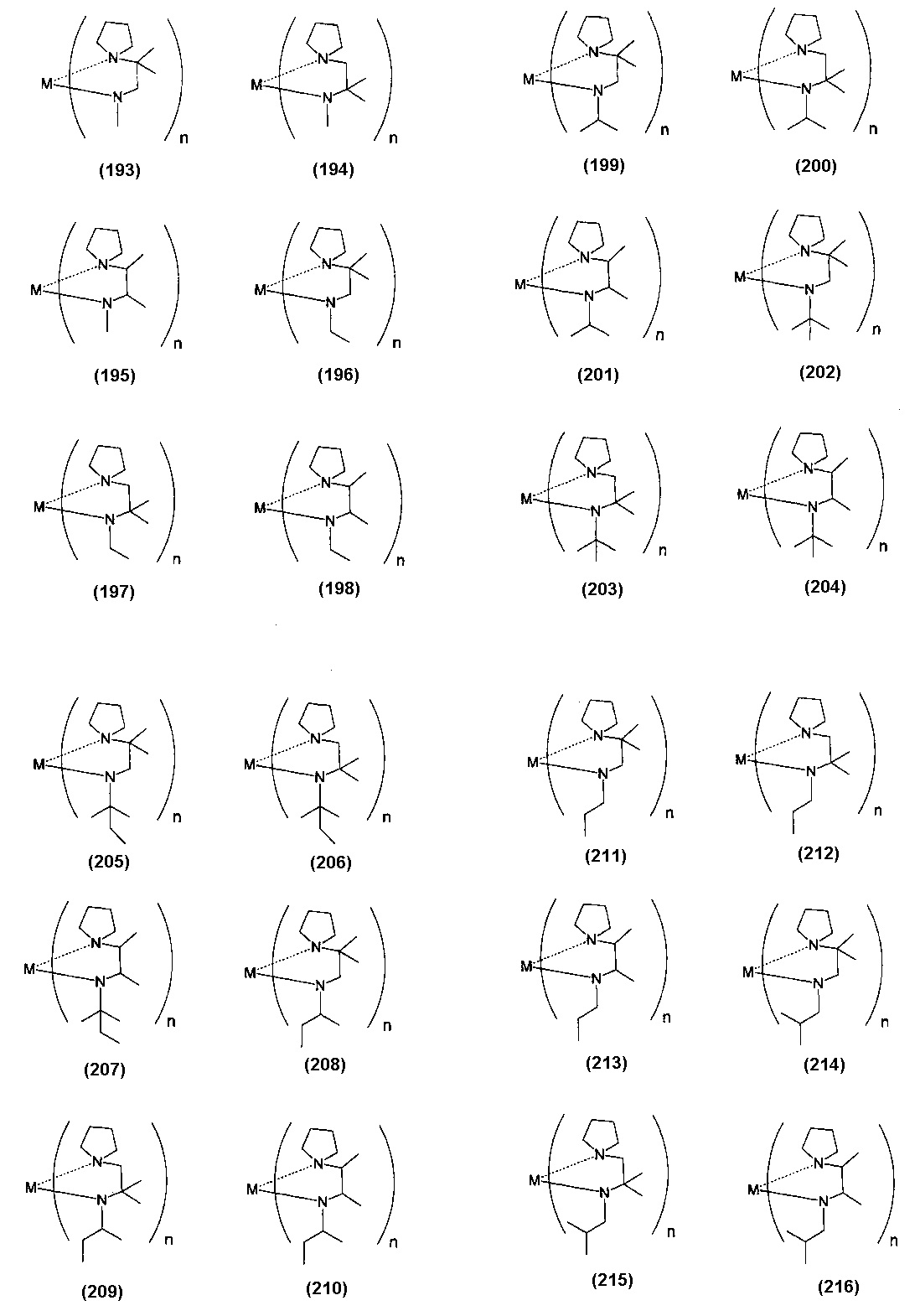
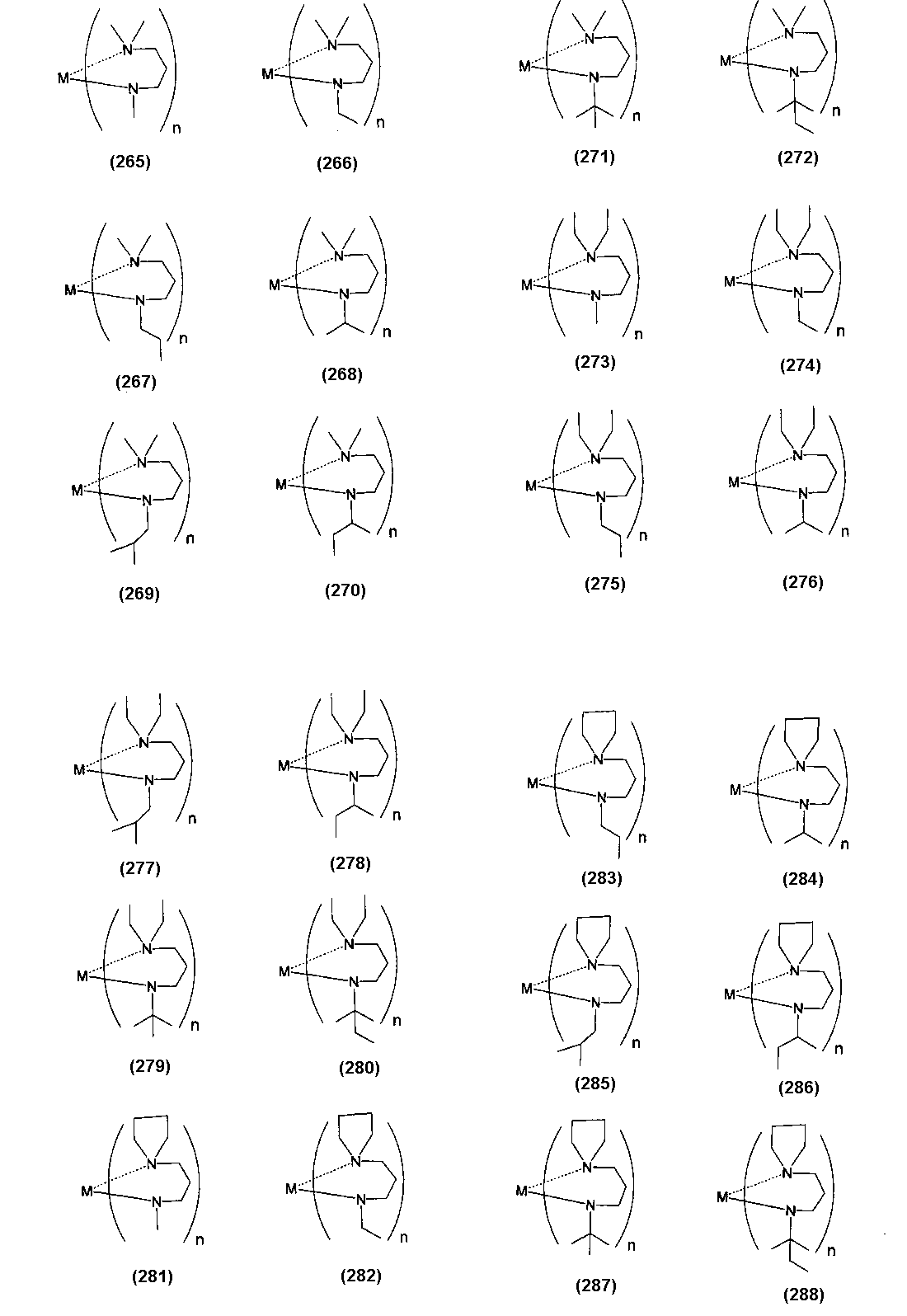
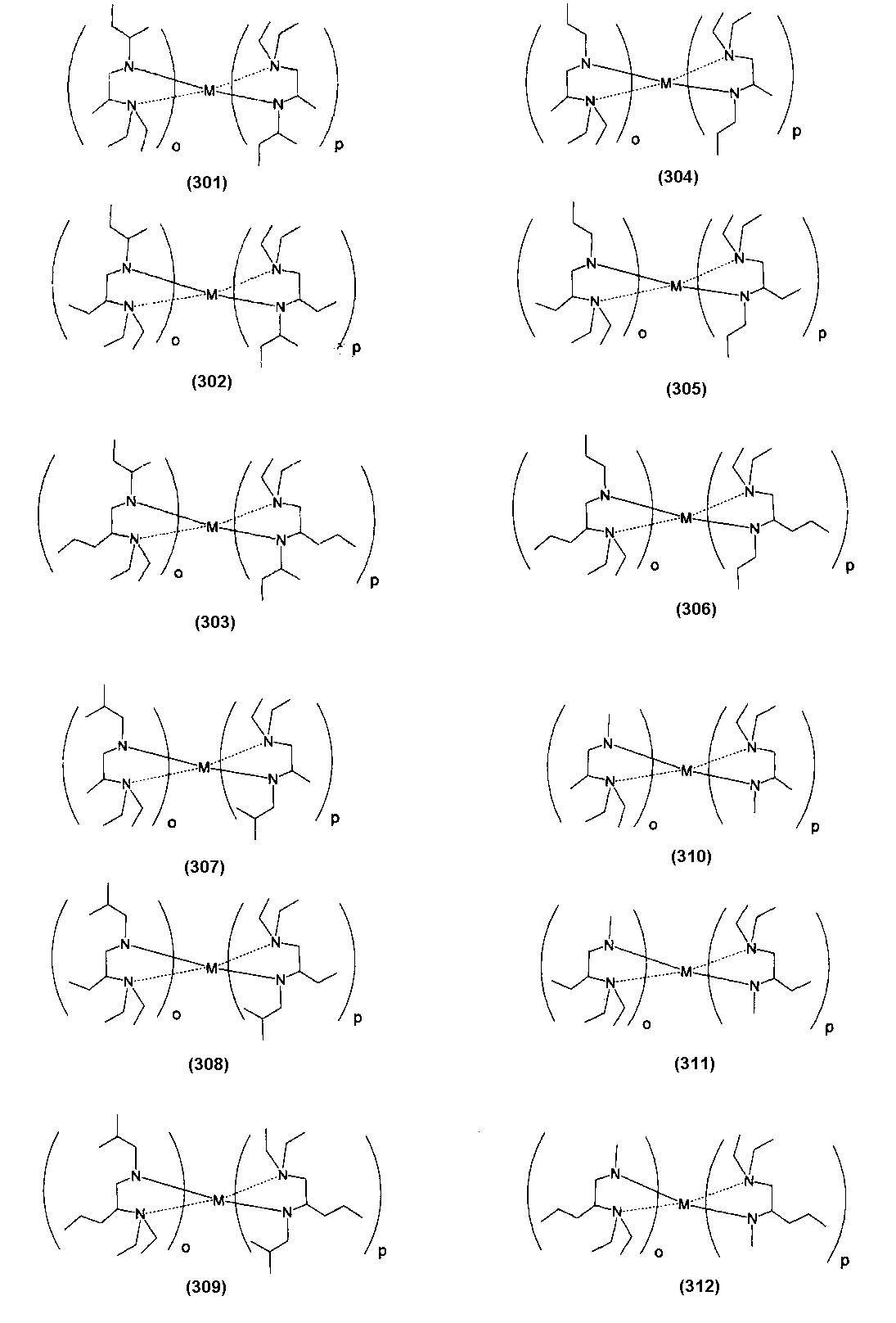
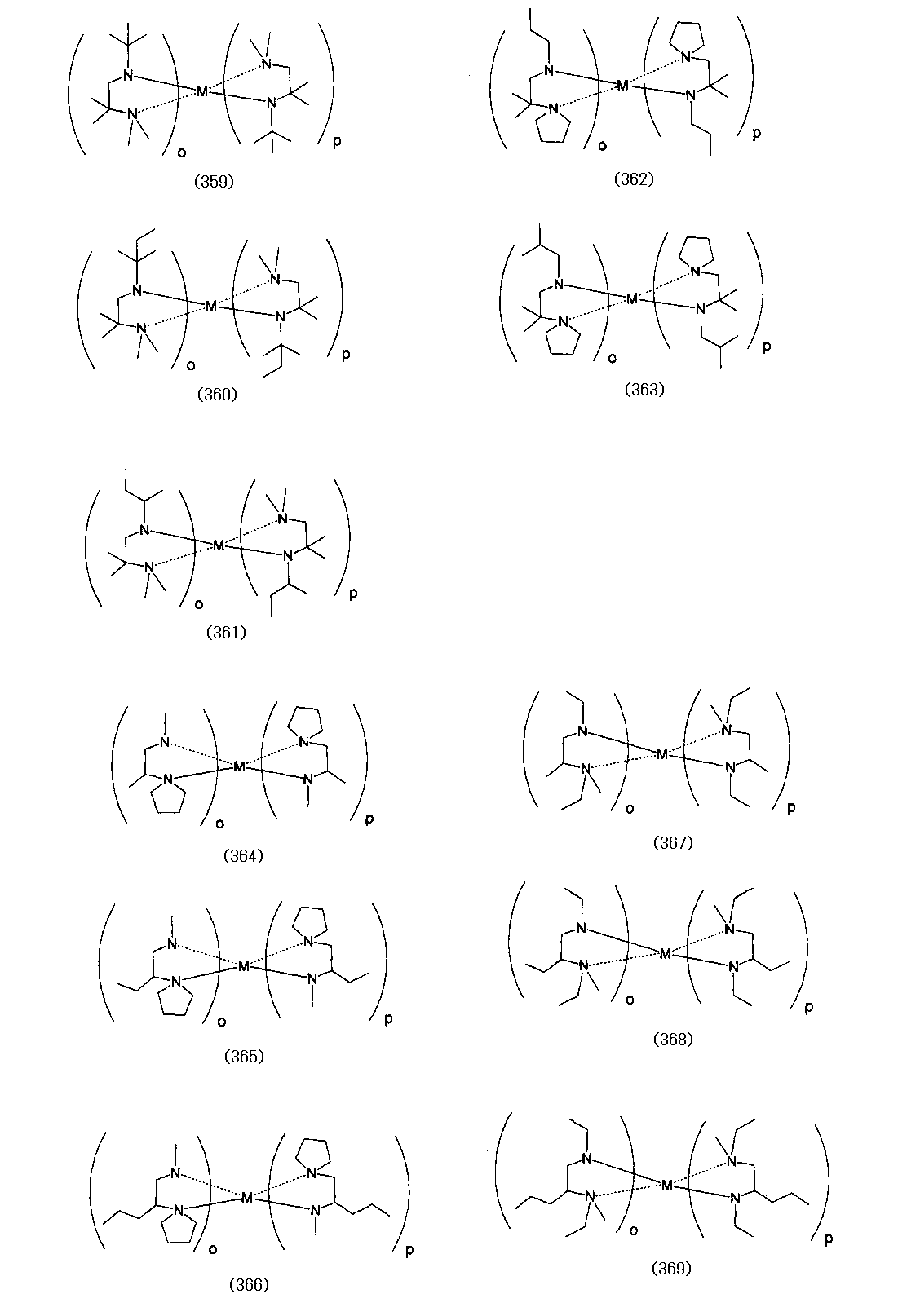
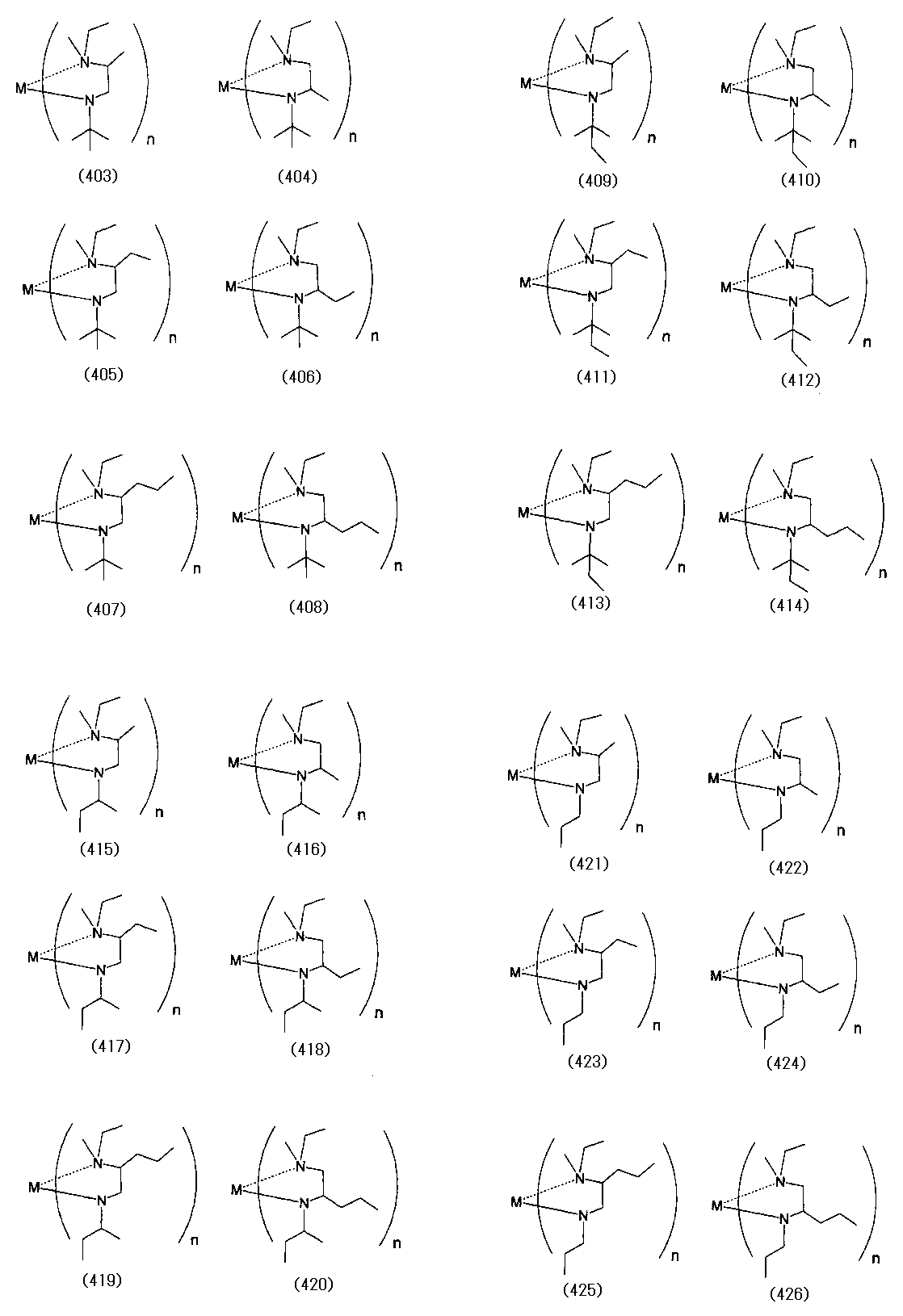
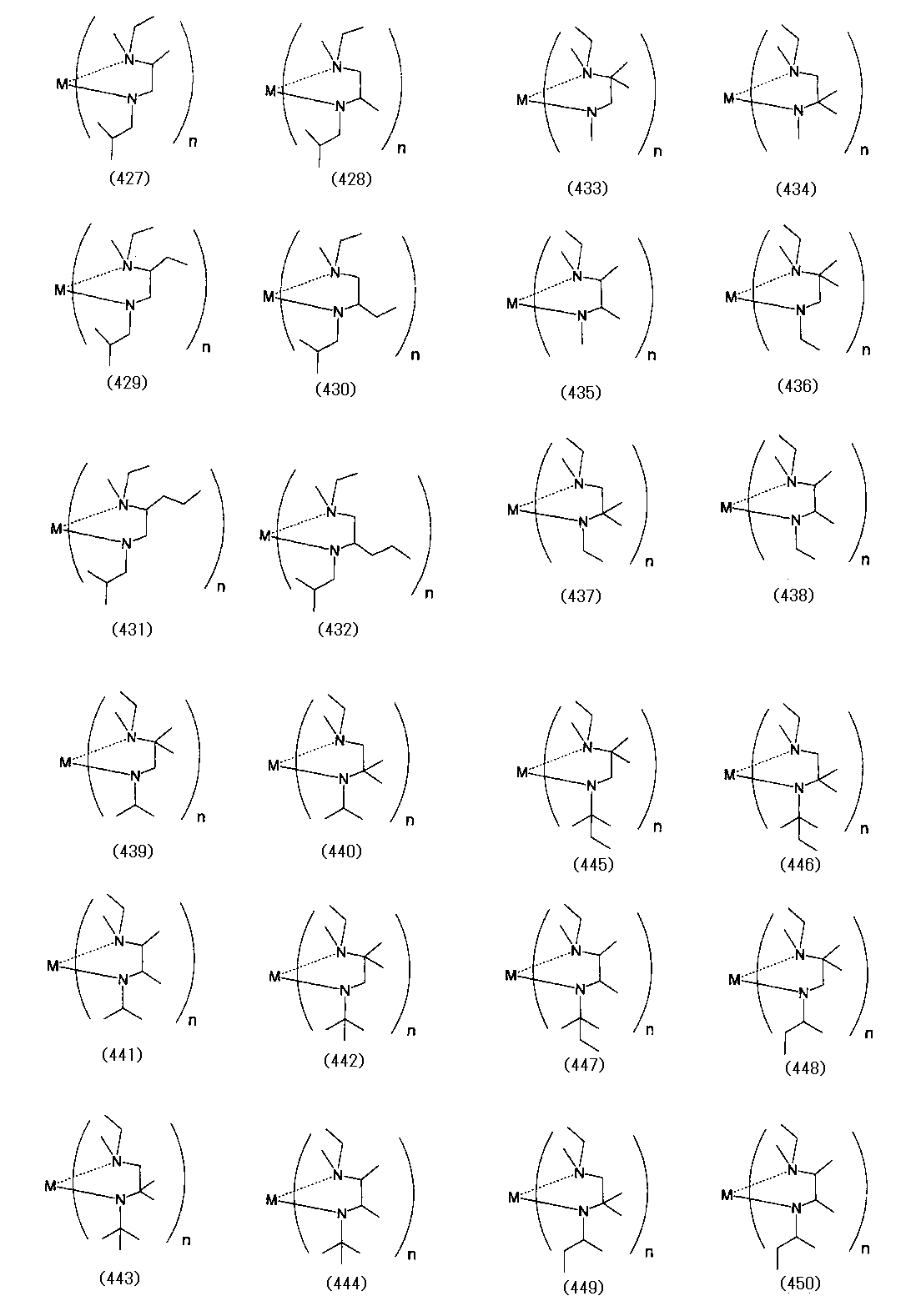
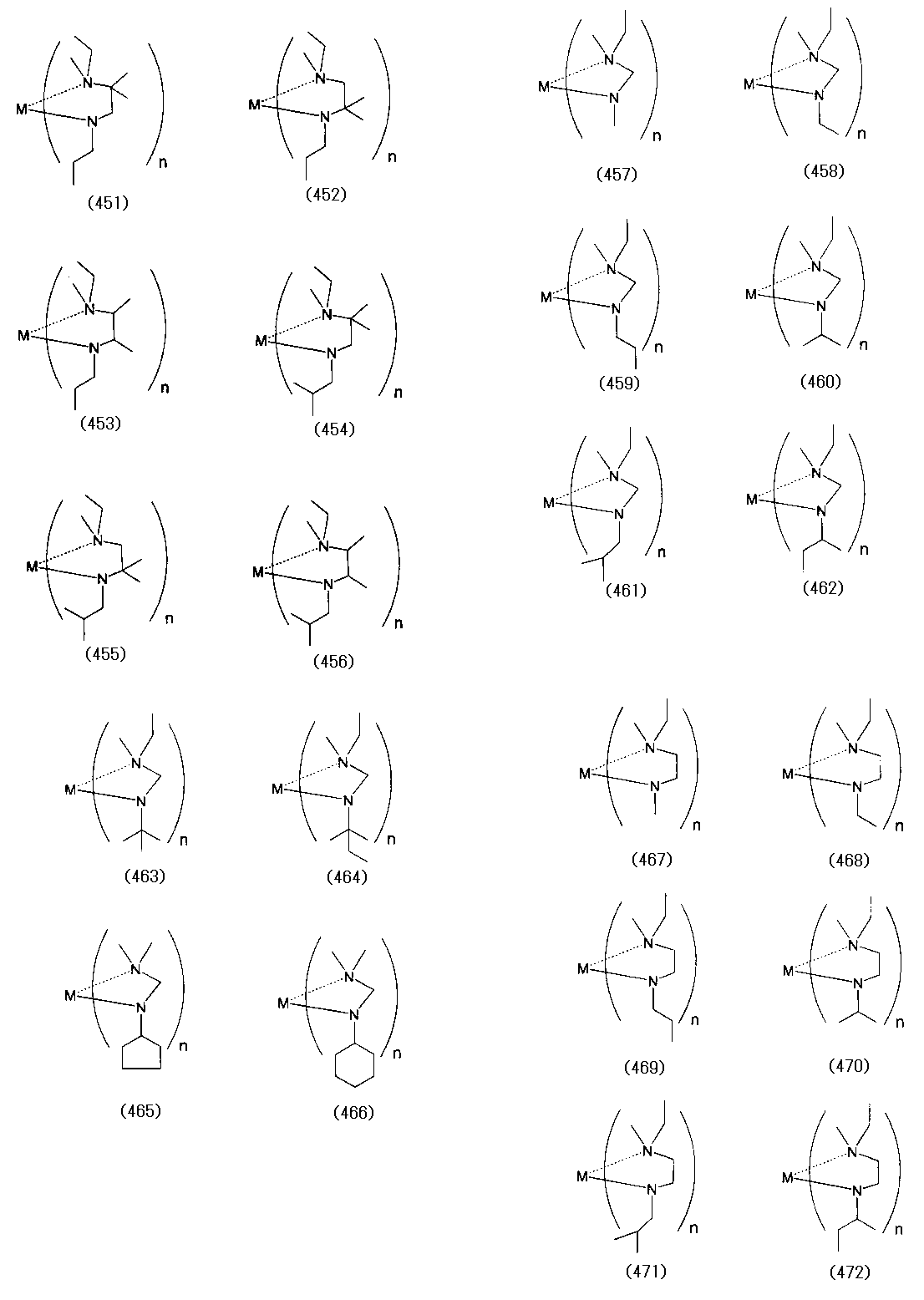
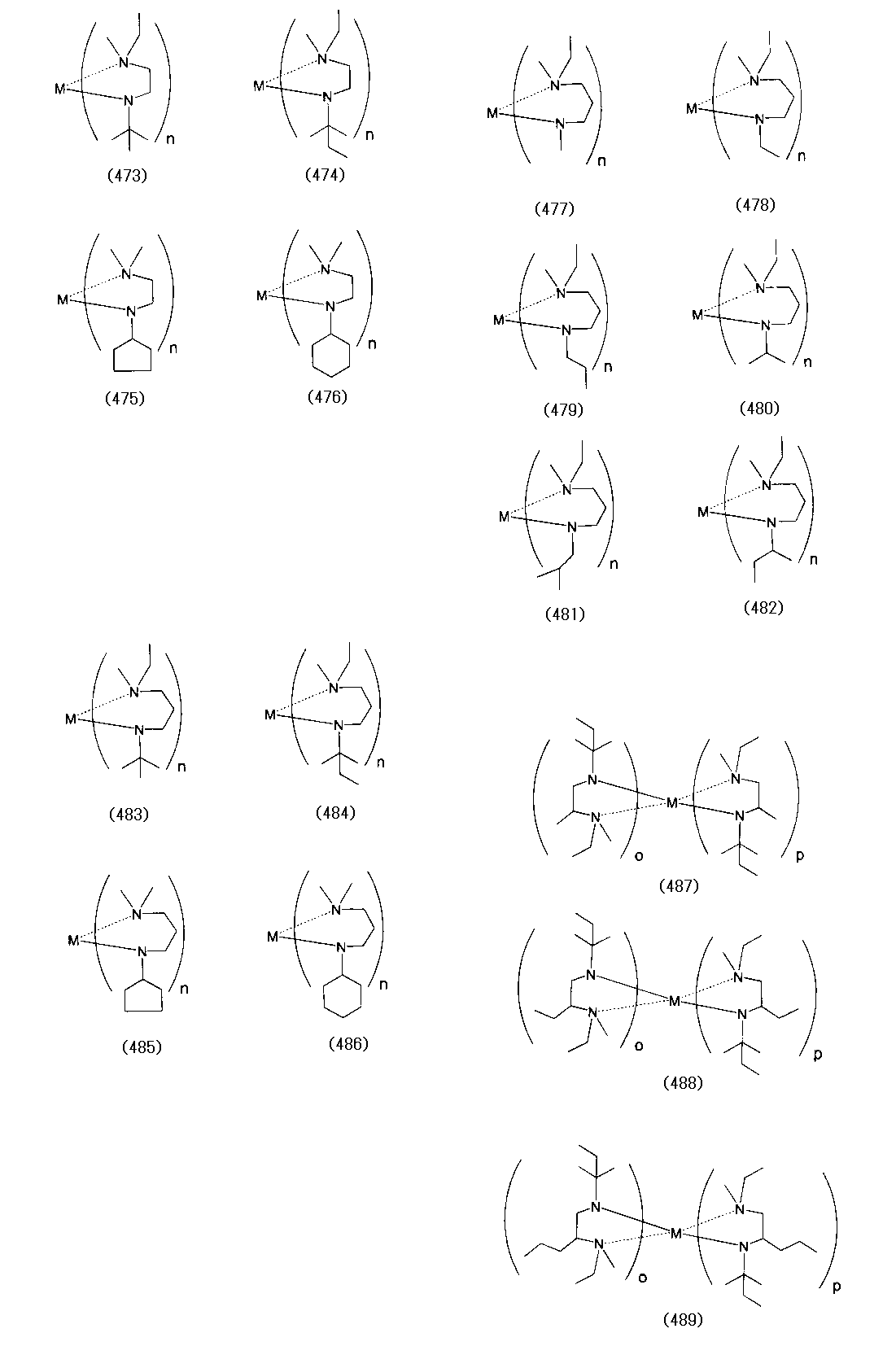
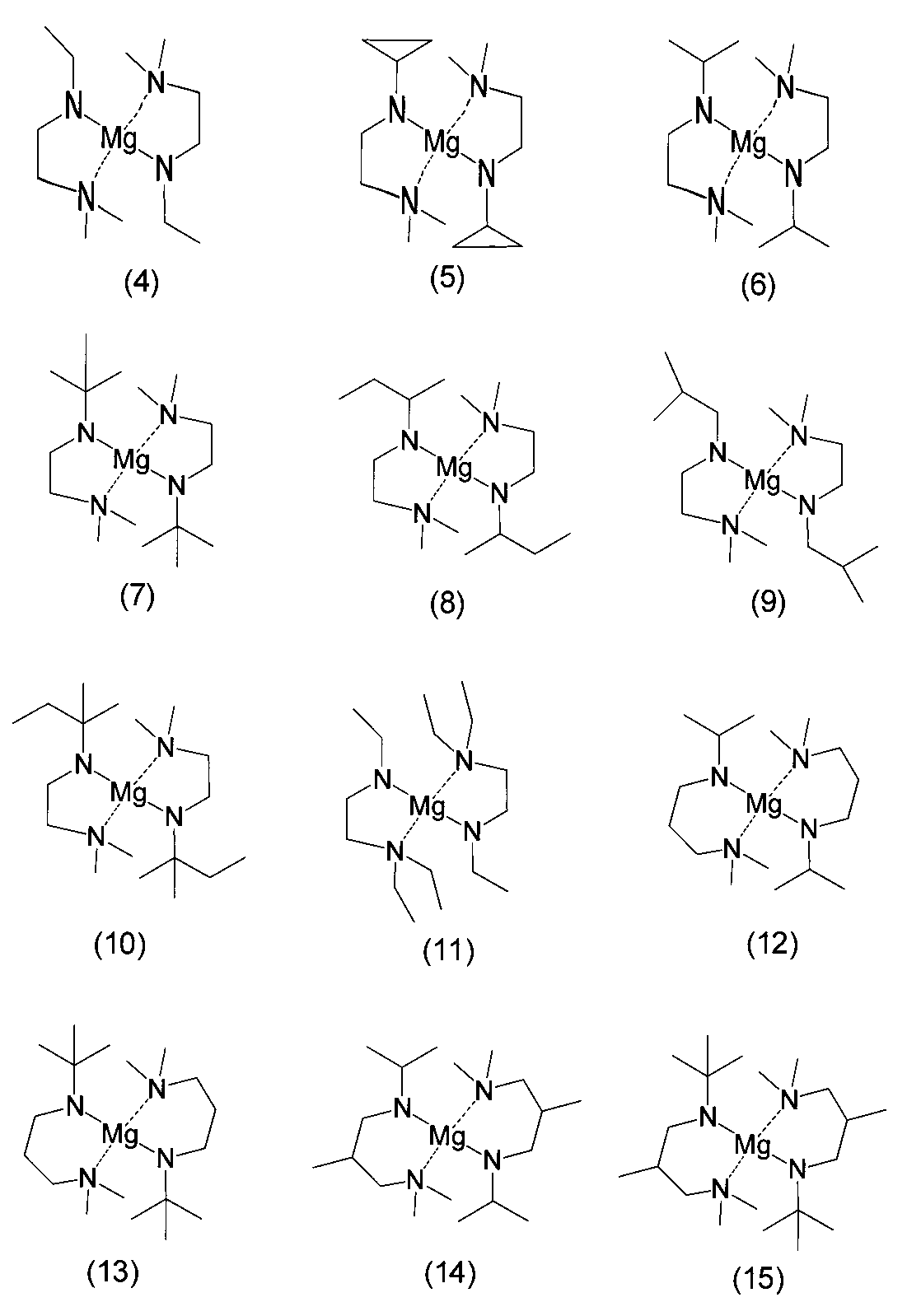
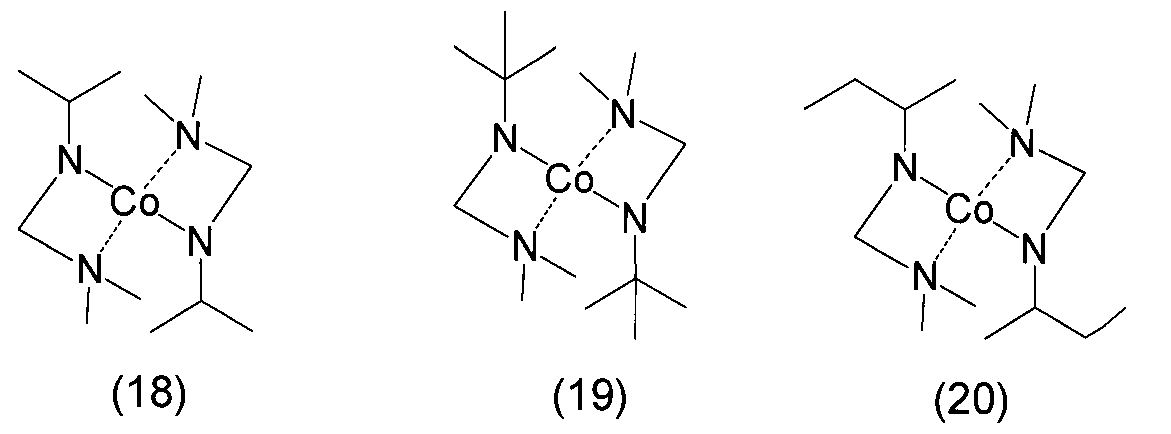
- Examples of the (amidoaminoalkane) metal compound of the present invention include compounds represented by the following formulas (1) to (498).
- M represents a metal atom
- n represents the number of ligands, and is equal to the valence of the metal M.
- o and p also indicate the number of each ligand, and the sum (o + p) is equal to the valence of the metal M.
- examples of the bis (amidoaminoalkane) magnesium compound of the present invention include compounds represented by the following formulas (4) to (18).
- Examples of the bis (amidoaminoalkane) cobalt compound of the present invention include compounds represented by the following formulas (6) to (20) and (1a) to (1u).
- Examples of the bis (amidoaminoalkane) manganese compound of the present invention include compounds represented by the following formulas (6) to (27).
- the synthesis of the (amidoaminoalkane) metal compound of the present invention is a mono- or dialkylmetal such as the following dialkylmagnesium compounds and alkyllithium compounds.
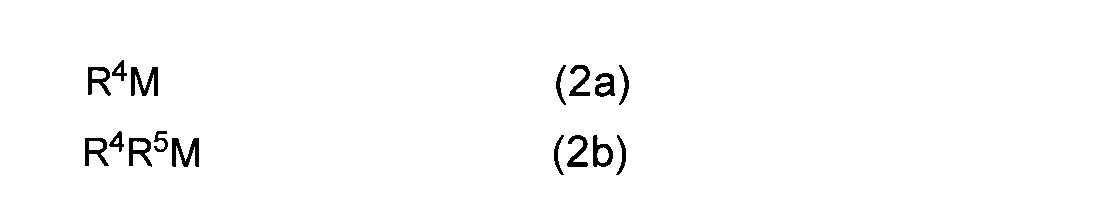
- Method of synthesizing (amidoaminoalkane) metal compound (1) by reacting compound (2a) or (2b) with diaminoalkane compound (3) (hereinafter sometimes referred to as reaction (I) of the present invention) .) Can be done.
- R 4 and R 5 may be the same or different and each represents a linear or branched alkyl group having 1 to 10 carbon atoms, and M, R 1 , R 2 , R 3 and Z are Same as above.
- R 4 and R 5 may be the same or different, and are methyl group, ethyl group, n-propyl group, isopropyl group, n-butyl group, isobutyl group, t- A linear or branched alkyl group having 1 to 10 carbon atoms, such as a butyl group, an n-pentyl group, a t-pentyl group, a neopentyl group, and an n-decyl group.
- the mono- or dialkyl metal compound used in the reaction (I) of the present invention a commercially available product can be used, and a metal simple substance such as magnesium metal can be produced as a starting material by a known method.
- a mono- or dialkyl metal compound represented by the general formula (2a) or (2b), wherein R 4 and R 5 are an n-butyl group or an ethyl group, such as di (n-butyl) magnesium or n-butylethylmagnesium Etc. are used.
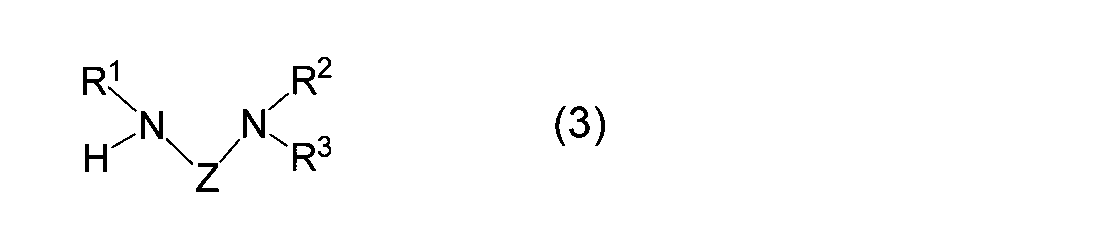
- the diaminoalkane compound used in the reaction (I) of the present invention is represented by the general formula (3).
- R 1 , R 2 , R 3 and Z correspond to R 1 , R 2 , R 3 and Z in the formula (1), respectively, and are as defined above.
- the diaminoalkane compound used in the reaction (I) of the present invention includes 1-isopropylamino-2-dimethylaminoethane, 1-cyclopropylamino-2-dimethylaminoethane, 1- (t-butylamino)- 2-dimethylaminoethane, 1-isobutylamino-2-dimethylaminoethane, 1-dimethylamino-2- (t-pentylamino) ethane, 1-isopropylamino-3-dimethylaminopropane, 1- (t-butylamino ) -3-dimethylaminopropane, (isopropylamino) (dimethylamino) methane, (t-butylamino) (dimethylamino) methane and the like are preferably used.
- the diaminoalkane compound used in the reaction (I) of the present invention can be a commercially available product, or can be produced by combining known methods. For example, a monoalkylamine and a “dialkylamino group” And a method based on a reduction reaction of a corresponding imine compound or the like.
- the amount of the diaminoalkane compound used is preferably 1.5 to 3.0 mol, more preferably 1.8 to 2.2 mol, per 1 mol of the mono- or dialkyl metal compound.
- the reaction (I) of the present invention is preferably performed in an organic solvent.
- the organic solvent used is not particularly limited as long as it does not inhibit the reaction.
- ethers such as diethyl ether, tetrahydrofuran, dimethoxyethane and dioxane; hexane, heptane, octane, cyclohexane, methylcyclohexane, ethylcyclohexane and the like
- Aliphatic hydrocarbons; aromatic hydrocarbons such as toluene and xylene are exemplified, but ethers, aliphatic hydrocarbons, and mixed solvents of ethers and aliphatic hydrocarbons are preferably used.
- the amount of the organic solvent used is preferably 1 to 100 g, more preferably 1 to 10 g, with respect to 1 g of the mono- or dialkyl metal compound.
- the reaction (I) of the present invention is performed by, for example, a method of mixing a mono- or dialkyl metal compound, a diaminoalkane compound and an organic solvent and reacting them with stirring.
- the reaction temperature at that time is preferably ⁇ 20 to 120 ° C., more preferably 0 to 100 ° C., and the reaction pressure is not particularly limited.
- the target (amidoaminoalkane) metal compound is obtained by the reaction (I) of the present invention.
- the synthesized (amidoaminoalkane) metal compound is isolated and purified by a known method such as extraction, filtration, concentration, distillation, sublimation, recrystallization, and column chromatography after completion of the reaction.
- the (amidoaminoalkane) metal compound, which is the object of the present invention, and the dialkylmagnesium compound, which is a raw material for producing it, are often unstable with respect to moisture and oxygen in the atmosphere. It is desirable to perform a reaction operation or a post-treatment of the reaction solution under an active gas atmosphere.
- a metal is used in place of the mono- or dialkyl metal compound, and the metal (amidoaminoalkane) metal compound of the present invention is reacted by reacting the metal with the diaminoalkane compound in the same manner as in the case of using the mono- or dialkyl metal compound. It can also be obtained.
- the (amidoaminoalkane) metal compound of the present invention in particular, bis (amidoaminoalkane) cobalt compound, bis (amidoaminoalkane) manganese compound, bis (amidoaminoalkane) zinc compound, bis (amidoaminoalkane) iron compound, bis The synthesis of (amidoaminoalkane) nickel compound, tris (amidoaminoalkane) indium compound, tris (amidoaminoalkane) yttrium compound, tris (amidoaminoalkane) lanthanum compound, etc.
- reaction (A) alkyl Alkali metal compound (4a) or alkali metal (4b) is reacted with diaminoalkane compound (3) to obtain (amidoaminoalkane) alkali metal compound (5) (hereinafter also referred to as reaction (A)).
- reaction (A) alkyl Alkali metal compound (4a) or alkali metal (4b) is reacted with diaminoalkane compound (3) to obtain (amidoaminoalkane) alkali metal compound (5) (hereinafter also referred to as reaction (A)).
- reaction (B) dihalogenomanganese compound
- reaction (A) and reaction (B) may be collectively called reaction (II) of the present invention.
- R 4 represents a linear or branched alkyl group having 1 to 10 carbon atoms
- A represents an alkali metal atom
- X represents a halogen atom
- M R 1 , R 2 , R 3 and Z are as defined above.
- the alkyl alkali metal compound used in the reaction (A) of the present invention is represented by the general formula (4a).
- R 4 represents methyl, ethyl, n-propyl, isopropyl, n-butyl, isobutyl, t-butyl, n-pentyl, t-pentyl, neopentyl.
- a linear or branched alkyl group having 1 to 10 carbon atoms such as a group or an n-decyl group, and A represents an alkali metal such as a lithium atom, a sodium atom or a potassium atom.
- alkali metal such as a lithium atom, a sodium atom or a potassium atom.
- alkyl alkali metal compound methyl lithium and n-butyl lithium are preferably used.
- alkali metal (4b) can be used in place of the alkyl alkali metal compound (4a).
- the diaminoalkane compound used in the reaction (A) of the present invention is represented by the general formula (3).
- R 1 , R 2 , R 3 and Z correspond to R 1 , R 2 , R 3 and Z in the formula (1), respectively, and are as defined above.
- diaminoalkane compound used in the reaction (A) of the present invention examples include 1-ethylamino-2-dimethylaminoethane, 1-isopropylamino-2-dimethylaminoethane, 1- (t- Butylamino) -2-dimethylaminoethane, 1-isobutylamino-2-dimethylaminoethane, 1-dimethylamino-2- (t-pentylamino) ethane, 1-isopropylamino-3-dimethylaminopropane, 1- ( t-butylamino) -3-dimethylaminopropane, (isopropylamino) (dimethylamino) methane, (t-butylamino) (dimethylamino) methane, 1-methylamino-2-dimethylaminopropane, 1-ethylamino- 2-dimethylaminopropane, 1-
- the diaminoalkane compound used in the reaction (A) of the present invention can be a commercially available product, or can be produced by combining known methods, for example, monoalkylamine and “dialkylamino group” And a method based on a reduction reaction of a corresponding imine compound or the like.
- the amount of the diaminoalkane compound used is preferably 1.5 to 3.0 mol, more preferably 1.8 to 2.2 mol, per 1 mol of the alkyl alkali metal compound or alkali metal.
- the reaction (A) of the present invention is preferably performed in an organic solvent.
- the organic solvent used is not particularly limited as long as it does not inhibit the reaction.
- ethers such as diethyl ether, tetrahydrofuran, dimethoxyethane and dioxane; hexane, heptane, octane, cyclohexane, methylcyclohexane, ethylcyclohexane and the like
- Aliphatic hydrocarbons; aromatic hydrocarbons such as toluene and xylene are exemplified, but ethers, aliphatic hydrocarbons, and mixed solvents of ethers and aliphatic hydrocarbons are preferably used.
- the amount of the organic solvent to be used is preferably 1 to 100 g, more preferably 1 to 10 g, per 1 g of the alkyl alkali metal compound or alkali metal.
- reaction (A) of the present invention for example, an alkyl alkali metal compound or an organic solvent solution of an alkali metal (which may be a suspension) is added while stirring a mixture of a diaminoalkane compound and an organic solvent. It is carried out by a method such as reacting.
- the reaction temperature at that time is preferably ⁇ 78 to 120 ° C., more preferably ⁇ 20 to 60 ° C., and the reaction pressure is not particularly limited.
- reaction (B) Synthesis of (amidoaminoalkane) metal compound (1)
- Halogens such as dihalogenocobalt compounds, dihalogenomanganese compounds, dihalogenozinc compounds, dihalogenoiron compounds, dihalogenonickel compounds, trihalogenoindium compounds, trihalogenoyttrium compounds, trihalogenolanthanum compounds used in the reaction (B) of the present invention
- the metal halide compound is represented by the general formula (6).
- X represents a halogen atom such as a fluorine atom, a chlorine atom, a bromine atom or an iodine atom.
- metal halide compounds include cobalt chloride (II), manganese chloride (II), zinc chloride (II), iron chloride (II), nickel chloride (II), indium chloride (III), yttrium chloride (III), Metal chlorides such as lanthanum (III) chloride, cobalt (II) bromide, manganese (II) bromide, zinc (II) bromide, iron (II) bromide, nickel (II) bromide, indium bromide ( III), metal bromides such as yttrium bromide (III), lanthanum bromide (III), cobalt (II) iodide, manganese (II) iodide, zinc (II) iodide, iron (II) iodide, iodine Metal iodides such as nickel (II) iodide, indium (III) iodide, yttrium (III)
- the amount of the metal halide compound used is preferably 0.25 to 0.75 mol, more preferably 0.4 to 0.6 mol, relative to 1 mol of the (amidoaminoalkane) alkali metal compound.
- the reaction (B) of the present invention is preferably performed in an organic solvent.
- the organic solvent used is not particularly limited as long as it does not inhibit the reaction.
- ethers such as diethyl ether, tetrahydrofuran, dimethoxyethane and dioxane; hexane, heptane, octane, cyclohexane, methylcyclohexane, ethylcyclohexane and the like
- Aliphatic hydrocarbons; aromatic hydrocarbons such as toluene and xylene are exemplified, but ethers, aliphatic hydrocarbons, and mixed solvents of ethers and aliphatic hydrocarbons are preferably used.
- the amount of the organic solvent used is preferably 1 to 100 g, more preferably 1 to 10 g, based on 1 g of the (amidoaminoalkane) alkali metal compound.
- reaction (B) of the present invention for example, an organic solvent solution of the (amidoaminoalkane) alkali metal compound obtained in the reaction (A) is added while stirring a mixture of a metal halide compound and an organic solvent. It is carried out by a method such as reacting.
- the reaction temperature at that time is preferably ⁇ 78 to 120 ° C., more preferably ⁇ 20 to 60 ° C., and the reaction pressure is not particularly limited.
- the target (amidoaminoalkane) metal compound is obtained by the reaction (B) of the present invention.
- the synthesized (amidoaminoalkane) metal compound is isolated and purified by a known method such as extraction, filtration, concentration, distillation, sublimation, recrystallization, column chromatography and the like after completion of the reaction.
- the same solvent can be used, and the (amidoaminoalkane) alkali metal compound (5) obtained as a result of the reaction (A) is isolated and Without purification, the reaction liquid obtained in the reaction (A) can be directly used in the reaction (B) to continuously synthesize (amidoaminoalkane) metal compounds.
- the target (amidoaminoalkane) metal compound, its starting material alkyl alkali metal compound, and the synthetic intermediate (amidoaminoalkane) alkali metal compound are insensitive to moisture and oxygen in the atmosphere. Since it is often stable, it is desirable to perform a reaction operation or a post-treatment of the reaction solution under anhydrous conditions or in an inert gas atmosphere. Further, it is desirable that the starting materials, the solvent, and the like are dehydrated and dried in advance before use.
- a metal-containing thin film can be formed with good film formation characteristics, for example, by the CVD method.
- a method for vapor-depositing a metal-containing thin film on a film formation target it can be performed by a known CVD method or atomic layer deposition method (ALD method).
- ALD method atomic layer deposition method
- the vapor of the metal compound is converted into a hydrogen source (for example, a reducing gas such as hydrogen or ammonia), a nitrogen source (for example, nitrogen or ammonia) or an oxygen source (for example, an oxidizing gas such as oxygen or ozone; water; methanol, (Alcohols such as ethanol, n-propyl alcohol, isopropyl alcohol, and n-butyl alcohol) can be used by depositing a metal-containing thin film on a heated film-forming target.
- these gases including vaporized liquids
- a metal-containing thin film can be deposited by plasma CVD using the same raw material supply.
- the pressure in the reaction system is preferably 1 Pa to 200 kPa
- the film formation target temperature is preferably Is from 50 to 900 ° C., more preferably from 100 to 600 ° C.
- the temperature at which the (amidoaminoalkane) metal compound is vaporized is preferably from 0 to 250 ° C., more preferably from 30 to 200 ° C.
- an oxygen source for example, an oxidizing gas, water vapor or alcohol vapor, or a mixed gas thereof
- a nitrogen source for example, a nitrogen gas, ammonia gas, or a mixed gas thereof
- a reducing gas for example, hydrogen gas, ammonia gas, or a mixed gas thereof
- reaction solution was extracted twice with 25 ml of hexane, and the hexane layer was concentrated under reduced pressure.
- the concentrate was distilled under reduced pressure (65 ° C., 4.0 kPa) to obtain 1.4 g of 1-isopropylamino-2-dimethylaminoethane (isolation yield: 31%).
- Reference Example A3 (Synthesis of 1- (t-butylamino) -2-dimethylaminoethane)
- the reaction was performed in the same manner as in Reference Example A2, except that isopropylamine was changed to 7.3 g (0.10 mol) of t-butylamine, and after concentration, distilled under reduced pressure (60 ° C., 2.4 kPa).
- isopropylamine was changed to 7.3 g (0.10 mol) of t-butylamine, and after concentration, distilled under reduced pressure (60 ° C., 2.4 kPa).
- 1.8 g of 1- (t-butylamino) -2-dimethylaminoethane was obtained (isolation yield: 36%).
- Reference Example A4 (Synthesis of 1- (s-butylamino) -2-dimethylaminoethane)
- the reaction was performed in the same manner as in Reference Example A2, except that isopropylamine was changed to 7.3 g (0.10 mol) of s-butylamine, and after concentration, distilled under reduced pressure (65 ° C., 2.0 kPa).
- isopropylamine was changed to 7.3 g (0.10 mol) of s-butylamine, and after concentration, distilled under reduced pressure (65 ° C., 2.0 kPa).
- 1.7 g of 1- (s-butylamino) -2-dimethylaminoethane was obtained (isolation yield: 34%).
- Reference Example A5 ((t-butyl) (synthesis of 3- (dimethylamino) propylamine) The same as Reference Example A2 except that in Reference Example A2, 2- (dimethylamino) ethyl chloride hydrochloride 5.0 g (35 mmol) was changed to 3- (dimethylamino) propyl chloride hydrochloride 5.5 g (35 mmol). And concentrated under reduced pressure (60 ° C., 0.80 kPa) to obtain 2.2 g of (t-butyl) (3- (dimethylamino) propylamine (isolated yield; 40%) .
- Example A1 bis (1-isopropylamido-2-dimethylaminoethane-N, N ′) magnesium (synthesis of magnesium compound (6))
- the obtained 1-isopropylamino-2-dimethylaminoethane (1.3 g, 10 mmol) was slowly added dropwise and reacted at 90 ° C. for 6 hours with stirring.
- Example A2 bis (1- (t-butylamide) -2-dimethylaminoethane-N, N ′) magnesium (synthesis of magnesium compound (7))
- Example A1 except that 1-isopropylamino-2-dimethylaminoethane was changed to 1.4 g (10 mmol) of 1- (t-butylamino) -2-dimethylaminoethane obtained in Reference Example A3.
- the reaction was carried out in the same manner as in Example A1, concentrated, and sublimated under reduced pressure (90 ° C., 13 Pa) to give bis (1- (t-butylamido) -2-dimethylaminoethane-N, N as a white solid.
- 1.2 g of magnesium was obtained (isolation yield; 77%).
- Example A3 bis (1- (s-butylamido) -2-dimethylaminoethane-N, N ′) magnesium (synthesis of magnesium compound (8))
- Example A1 except that 1-isopropylamino-2-dimethylaminoethane was changed to 1.4 g (10 mmol) of 1- (s-butylamino) -2-dimethylaminoethane obtained in Reference Example A4.
- the reaction was carried out in the same manner as in Example A1, concentrated, and distilled under reduced pressure (90 ° C., 13 Pa) to give bis (1- (s-butyramide) -2-dimethylaminoethane-N, N ′) 1.4 g of magnesium was obtained (isolation yield; 90%).
- Example A4 bis (1-ethylamido-2-dimethylaminoethane-N, N ′) magnesium (synthesis of magnesium compound (4))
- 1-isopropylamino-2-dimethylaminoethane was changed to 1.2 g (10 mmol) of 1-ethylamino-2-dimethylaminoethane (commercially available product).
- concentration, and distillation under reduced pressure 110 ° C., 13 Pa
- 0.90 g of bis (1-ethylamido-2-dimethylaminoethane-N, N ′) magnesium was obtained as a colorless transparent liquid ( Isolated yield; 71%).
- Example A5 bis (1-ethylamido-2-diethylaminoethane-N, N ′) magnesium (synthesis of magnesium compound (11))
- the reaction was conducted in the same manner as in Example A1, except that 1-isopropylamino-2-dimethylaminoethane was changed to 1.4 g (10 mmol) of 1-ethylamino-2-diethylaminoethane (commercially available product) in Example A1.
- distillation under reduced pressure 130 ° C., 13 Pa
- Example A6 bis (1- (t-butylamide) -3-dimethylaminopropane-N, N ′) magnesium (synthesis of magnesium compound (13))
- Example A1 except that 1-isopropylamino-2-dimethylaminoethane was changed to 1.6 g (10 mmol) of (t-butyl) (3- (dimethylamino) propylamine obtained in Reference Example A5.
- the reaction was carried out in the same manner as in Example A1, concentrated, and distilled under reduced pressure (90 ° C., 13 Pa) to give bis (1- (t-butylamide) -3-dimethylaminopropane-N, N ′) 1.4 g of magnesium was obtained (isolation yield; 76%).
- Example A7 (deposition experiment; production of a magnesium-containing thin film) Using the bis (1-isopropylamido-2-dimethylaminoethane-N, N ′) magnesium (magnesium compound (6)) obtained in Example A1, a vapor deposition experiment by a CVD method was performed to evaluate the film formation characteristics. did.
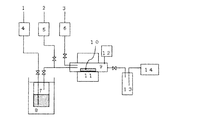
- the apparatus shown in FIG. 1 was used for the vapor deposition experiment.
- the apparatus shown in FIG. 1 has the following structure.
- the magnesium compound in the magnesium raw material container (vaporizer) 7 maintained at a constant temperature by the thermostatic bath 8 is heated and vaporized, and is guided to the helium gas introduced through the mass flow controller 4 and exits the raw material container 7. .
- the gas exiting the raw material container 7 is introduced into the reactor 9 together with the helium gas introduced through the mass flow controller 5.
- oxygen gas which is a reaction gas, is also introduced into the reactor 9 via the mass flow controller 6.
- the pressure in the reaction system is monitored by a pressure gauge 12 and controlled to a predetermined pressure by opening and closing a valve in front of the vacuum pump 14.
- the central part of the reactor 9 has a structure that can be heated by the heater 11.
- the magnesium compound introduced into the reactor 9 is set in the center of the reactor, and is oxidized and decomposed on the surface of the substrate 10 heated to a predetermined temperature by the heater 11 to form a magnesium-containing thin film on the substrate 10. Is done.
- the gas exiting the reactor 9 is exhausted to the atmosphere through the trap 13 and the vacuum pump 14.
- Comparative Example A1 (deposition experiment; production of a magnesium-containing thin film) Using bis (cyclopentadienyl) magnesium, a vapor deposition experiment by the CVD method was performed in the same manner as in Example A7, and the film formation characteristics were evaluated. Deposition conditions and film characteristics were as follows. In addition, various conditions were adjusted and the amount of raw material supply was equal to Example A7, and the vapor deposition experiment was conducted.
- Example B1 bis (1-isopropylamido-2-dimethylaminoethane-N, N ′) cobalt (II) (synthesis of cobalt compound (8))
- Reference Example B2 (1-s-Butylamido-2-dimethylaminoethane-N, N ′) Lithium Synthesis Reference Example A4 was placed in a 50 ml flask equipped with a stirrer, thermometer and dropping funnel in an argon atmosphere. 1.59 g (16.5 mmol) of 1-s-butylamino-2-dimethylaminoethane obtained in 1 above and 15 ml of hexane were added. Subsequently, 10 ml (16.5 mmol) of a hexane solution of 1.65 mol / l n-butyllithium was slowly added dropwise while maintaining the mixed solution at 0 ° C.
- the mixed solution was stirred at 0 ° C. for 30 minutes and then reacted at 20 ° C. for 2 hours with stirring. After completion of the reaction, the reaction solution was concentrated under reduced pressure, and then the concentrate was dried under vacuum to obtain 1-s-butylamido-2-dimethylaminoethane-N, N ′ lithium.
- 1-s-Butylamido-2-dimethylaminoethane-N, N ′ lithium was used for the next reaction without further purification.
- Example B2 (Synthesis of bis (1-s-butylamido-2-dimethylaminoethane-N, N ′) cobalt (cobalt compound (10)))
- anhydrous cobalt (II) chloride and 20 ml of tetrahydrofuran were added to a flask having an internal volume of 100 ml equipped with a stirrer, a thermometer and a dropping funnel, and stirred for 2 hours.
- Reference Example B4 (1-t-pentylamido-2-dimethylaminoethane-N, N ′) Lithium Synthesis Reference Example in a 50-ml flask equipped with a stirrer, thermometer and dropping funnel in an argon atmosphere 2.69 g (16.5 mmol) of 1-t-pentylamino-2-dimethylaminoethane obtained in B3 and 15 ml of hexane were added. Subsequently, 10 ml (16.5 mmol) of a hexane solution of 1.65 mol / l n-butyllithium was slowly added dropwise while maintaining the mixed solution at 0 ° C.
- the mixed solution was stirred at 0 ° C. for 30 minutes and then reacted at 20 ° C. for 2 hours with stirring. After completion of the reaction, the reaction solution was concentrated under reduced pressure, and then the concentrate was dried under vacuum to obtain 1-t-pentylamido-2-dimethylaminoethane-N, N ′ lithium.
- the 1-t-pentylamido-2-dimethylaminoethane-N, N ′ lithium was used in the next reaction without further purification.
- Example B3 (Synthesis of bis (1-t-pentylamide-2-dimethylaminoethane-N, N ′) cobalt (cobalt compound (12)))
- 1.07 g (8.25 mmol) of anhydrous cobalt (II) chloride and 20 ml of tetrahydrofuran were added to a flask having an internal volume of 100 ml equipped with a stirrer, a thermometer and a dropping funnel, and stirred for 2 hours.
- Example B4 (Synthesis of bis (1-t-butylamido-2-dimethylaminoethane-N, N ′) cobalt (cobalt compound (9)))
- 1.07 g (8.25 mmol) of anhydrous cobalt (II) chloride and 20 ml of tetrahydrofuran were added to a flask having an internal volume of 100 ml equipped with a stirrer, a thermometer and a dropping funnel, and stirred for 2 hours.
- Example B5 (deposition experiment; production of cobalt-containing thin film) Using the bis (1-isopropylamido-2-dimethylaminoethane-N, N ′) cobalt (II) (cobalt compound (8)) obtained in Example B1, a vapor deposition experiment by a CVD method was performed to form a film. Characteristics were evaluated.
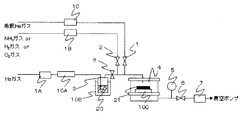
- the apparatus shown in FIG. 2 was used for the evaluation test.
- the cobalt compound 20 in the vaporizer 3 (glass ampoule) is heated and vaporized by the heater 10B, and is transferred to the helium gas introduced after preheating by the preheater 10A via the mass flow controller 1A and exits the vaporizer 3.
- the gas exiting the vaporizer 3 is introduced into the reactor 4 together with a reaction gas such as ammonia gas, hydrogen gas, oxygen gas or the like introduced via the mass flow controller 1B and the stop valve 2.
- the pressure in the reaction system is controlled to a predetermined pressure by opening and closing the valve 6 in front of the vacuum pump, and is monitored by the pressure gauge 5.
- the central part of the reactor has a structure that can be heated by a heater 10C.
- the cobalt compound introduced into the reactor is reduced or oxidized and thermally decomposed on the surface of the deposition substrate 21 set at the center of the reactor and heated to a predetermined temperature by the heater 10C. A thin film is deposited.
- the gas exiting the reactor 4 is exhausted to the atmosphere via a trap 7 and a vacuum pump.
- Deposition conditions and film characteristics were as follows. Note that a 6 mm ⁇ 20 mm rectangular substrate was used as the deposition substrate.
- Example B6 (deposition experiment; production of a cobalt-containing thin film) Using the bis (1-s-butylamido-2-dimethylaminoethane-N, N ′) cobalt (II) (cobalt compound (10)) obtained in Example B2, the CVD method was used in the same manner as in Example B5. Vapor deposition experiments were conducted to evaluate film formation characteristics. Deposition conditions and film characteristics were as follows.
- Comparative Example B1 (deposition experiment; production of cobalt-containing thin film) Using bis (Nt-butyl-N′-ethylpropionamidinato) cobalt (compound described in Patent Document 8), a vapor deposition experiment was conducted by the CVD method in the same manner as in Example B5 to evaluate the film formation characteristics. did. Deposition conditions and film characteristics were as follows.
- the bis (amidoaminoalkane) cobalt compound of the present invention can produce a cobalt-containing thin film in a short time (high film formation rate), and does not contain impurities such as carbon atoms and nitrogen atoms. It has been found that it can be a raw material for producing quality cobalt-containing thin films.
- the obtained concentrate was distilled under reduced pressure (105 ° C., 13.3 kPa) to give a mixture of 1-isopropylamino-2-dimethylaminopropane and 2-isopropylamino-1-dimethylaminopropane (mixing ratio 8: 2) 18. 2 g was obtained (isolation yield; 82%).
- Reference Example C2 (Synthesis of 1-isopropylamido-2-dimethylaminoethane-N, N ′) lithium and 2-isopropylamido-1-dimethylaminoethane-N, N ′) lithium mixture) 1-isopropylamino-2-dimethylaminopropane and 2-isopropylamino-1-dimethylamino obtained in Reference Example C1 were placed in a 50-ml flask equipped with a stirrer, thermometer and dropping funnel in an argon atmosphere. A mixture of propane (mixing ratio 8: 2) 2.15 g (16.5 mmol) and hexane 15 ml were added.
- Example C1 bis (1-isopropylamido-2-dimethylaminopropane-N, N ′) cobalt (cobalt compound (1c)), bis (2-isopropylamido-1-dimethylaminopropane-N, N ′) cobalt (Cobalt compound (1j)) and (1-Isopropylamido-2-dimethylaminopropane-N, N ′) (2-Isopropylamido-1-dimethylaminopropane-N, N ′) cobalt (Cobalt compound (1q)) Synthesis of mixture) In an argon atmosphere, 1.07 g (8.25 mmol) of anhydrous cobalt (II) chloride and 20 ml of tetrahydrofuran were added to a 100 ml flask equipped with a stirrer, a thermometer and a dropping funnel, and stirred for 2 hours.
- II anhydrous cobalt
- Reference Example C3 (Synthesis of 1-isopropylamino-2-dimethylaminopropane) A mixture of 1-isopropylamino-2-dimethylaminopropane and 2-isopropylamino-1-dimethylaminopropane obtained in Reference Example C1 (mixing) was added to a 200-ml flask equipped with a stirrer, a thermometer and a dropping funnel. Ratio 8: 2) 12.0 g (75.9 mmol) and 50 mL of methanol were added and then heated to 60-70 ° C. with stirring.
- the mixed solution was stirred at 0 ° C. for 30 minutes and then reacted at 20 ° C. for 2 hours with stirring. After completion of the reaction, the reaction solution was concentrated under reduced pressure, and then the concentrate was dried under vacuum to obtain 1-isopropylamido-2-dimethylaminopropane-N, N ′) lithium.
- Example C2 (Synthesis of bis (1-isopropylamido-2-dimethylaminopropane-N, N ′) cobalt (cobalt compound (1c)))
- anhydrous cobalt (II) chloride and 20 ml of tetrahydrofuran were added to a flask having an internal volume of 100 ml equipped with a stirrer, a thermometer and a dropping funnel, and stirred for 2 hours.
- Reference Example C6 (Synthesis of 1- (s-Butylamide) -2-dimethylaminopropane-N, N ′) Lithium and 2- (s-Butylamido) -1-dimethylaminopropane-N, N ′) Lithium Mixture)
- 1- (s-Butylamino) -2-dimethylaminopropane and 2-s-butyl obtained in Reference Example C5 were placed in a 50-ml flask equipped with a stirrer, a thermometer and a dropping funnel in an argon atmosphere.
- Example C3 bis (1- (s-butylamide) -2-dimethylaminopropane-N, N ′) cobalt (cobalt compound (1e)), bis (2- (s-butylamide) -1-dimethylaminopropane- N, N ′) cobalt (cobalt compound (1l)) and (1- (s-butylamido) -2-dimethylaminopropane-N, N ′) (2- (s-butylamido) -1-dimethylaminopropane- N, N ′) Cobalt (Cobalt Compound (1s)) Mixture)
- 1.07 g (8.25 mmol) of anhydrous cobalt (II) chloride and 20 ml of tetrahydrofuran were added to a flask having an internal volume of 100 ml equipped with a stirrer, a thermometer and a dropping funnel, and stirred for 2 hours.
- the resulting concentrate was distilled under reduced pressure (120 ° C., 12 kPa) to give a mixture of 1-t-butylamino-2-dimethylaminopropane and 2-t-butylamino-1-dimethylaminopropane (mixing ratio 8: 2). 19.2 g was obtained (isolated yield; 77%).
- Example C4 bis (1-tert-butylamido-2-dimethylaminopropane-N, N ′) cobalt (cobalt compound (1d)), bis (2-tert-butylamido-1-dimethylaminopropane-N, N ′) ) Cobalt (cobalt compound (1k)) and (1-t-butylamido-2-dimethylaminopropane-N, N ′) (2-t-butylamido-1-dimethylaminopropane-N, N ′) cobalt (cobalt compound) (1r)) Synthesis of mixture)
- bis (1-t-butylamido-2-dimethylaminopropane-N, N ′) cobalt, bis (2-t-butylamido-1-dimethylaminopropane-N, N ′) cobalt and (1-t-butylamide) -2-Dimethylaminopropane-N, N ′) (2-t-butylamido-1-dimethylaminopropane-N, N ′) cobalt mixture is a novel compound represented by the following physical property values.
- Example C5 (deposition experiment; production of cobalt-containing thin film) Using the cobalt compound obtained in Example C1, a vapor deposition experiment by the CVD method was performed in the same manner as in Example B5, and the film formation characteristics were evaluated. Deposition conditions and film characteristics are as follows.
- Example C6 (deposition experiment; production of a cobalt-containing thin film) Using the cobalt compound obtained in Example C2, a vapor deposition experiment by the CVD method was performed in the same manner as in Example B5, and the film formation characteristics were evaluated.
- Deposition conditions and film characteristics are as follows.
- (Deposition conditions) Cobalt raw material; cobalt compound (bis (1-isopropylamido-2-dimethylaminopropane-N, N ′) cobalt (compound (1c)) obtained in Example C2
- He carrier flow rate 30 sccm
- Ammonia flow rate 10 sccm
- Substrate material SiO 2 / Si wafer substrate temperature; 200 ° C.
- Reaction system pressure 0.67 kPa Deposition time: 5 minutes
- Example C7 (deposition experiment; production of a cobalt-containing thin film) Using the cobalt compound obtained in Example C3, a vapor deposition experiment by the CVD method was performed in the same manner as in Example B5, and the film formation characteristics were evaluated. Deposition conditions and film characteristics are as follows.
- Example C8 (deposition experiment; production of a cobalt-containing thin film) Using the cobalt compound obtained in Example C4, a vapor deposition experiment by the CVD method was performed in the same manner as in Example B5, and the film formation characteristics were evaluated. Deposition conditions and film characteristics are as follows.
- Comparative Example C1 (deposition experiment; production of cobalt-containing thin film) Using bis (Nt-butyl-N′-ethylpropionamidinato) cobalt (compound described in Patent Document 8), a vapor deposition experiment by the CVD method was conducted in the same manner as in Example B5 to evaluate the film formation characteristics. .
- Deposition conditions and film characteristics are as follows.
- the bis (amidoaminoalkane) cobalt compound of the present invention can produce a cobalt-containing thin film in a short period of time (high film formation rate), and does not contain impurities such as carbon atoms and nitrogen atoms. It has been found that it can be a raw material for producing quality cobalt-containing thin films.
- Example D2 bis (1- (t-butylamide) -2-dimethylaminoethane-N, N ′) manganese (II) (synthesis of manganese compound (9))
- Example D1 1-isopropylamido-2-dimethylaminoethane-N, N ′) lithium in tetrahydrofuran was added to 1- (t-butylamino) -2-dimethylaminoethane-N, N ′) lithium.
- Example D3 (deposition experiment; production of a manganese-containing thin film) Using the bis (1- (t-butylamido) -2-dimethylaminoethane-N, N ′) manganese (II) (manganese compound (9)) obtained in Example D2, a vapor deposition experiment by the CVD method was performed. The film formation characteristics were evaluated.
- the apparatus shown in FIG. 2 was used for the evaluation test.
- the manganese compound 20 in the vaporizer 3 (glass ampoule) is heated and vaporized by the heater 10B, and is transferred to the helium gas introduced after preheating by the preheater 10A through the mass flow controller 1A and exits the vaporizer 3.
- the gas exiting the vaporizer 3 is introduced into the reactor 4 together with a reaction gas such as ammonia gas, hydrogen gas, oxygen gas or the like introduced via the mass flow controller 1B and the stop valve 2.
- the pressure in the reaction system is controlled to a predetermined pressure by opening and closing the valve 6 in front of the vacuum pump, and is monitored by the pressure gauge 5.
- the central part of the reactor has a structure that can be heated by a heater 10C.
- the manganese compound introduced into the reactor is set in the center of the reactor and reduced or oxidized by thermal decomposition on the surface of the deposition target substrate 21 heated to a predetermined temperature by the heater 10C. A thin film is deposited.
- the gas exiting the reactor 4 is exhausted to the atmosphere via a trap 7 and a vacuum pump.
- Deposition conditions and film characteristics were as follows. Note that a 6 mm ⁇ 20 mm rectangular substrate was used as the deposition substrate.
- Comparative Example D1 (deposition experiment; production of manganese-containing thin film) Using bis (N, N′-diisopropylpentaneamidinato) manganese (compounds described in Non-Patent Documents 9 and 10), a vapor deposition experiment was conducted by the CVD method in the same manner as in Example D3 to evaluate the film formation characteristics. Deposition conditions and film characteristics were as follows.
- the film could not be formed under substantially the same conditions (deposition conditions 3) as in Example D3.
- Film thickness 10 nm or less
- Resistivity Not measurable
- the bis (amidoaminoalkane) manganese compound of the present invention can produce a manganese-containing thin film at a lower temperature and in a shorter time (high film formation rate) and has low resistance (impurities such as carbon atoms). It was found that it can be a raw material for producing a high-quality manganese-containing thin film.
- Example E1 a tetrahydrofuran solution of (1-isopropylamido-2-dimethylaminoethane-N, N ′) lithium was obtained in the same manner as in Reference Example D2 (1- (t-butylamino) -2 -Dimethylaminoethane-N, N ')
- the reaction was conducted in the same manner as in Example E1 except that the solution was changed to 10 ml of a tetrahydrofuran solution of 1.1 g (7.6 mmol) of lithium, and after concentration, sublimation (90 ° C , 13 Pa) to obtain 1.2 g of bis (1- (t-butylamido) -2-dimethylaminoethane-N, N ′) zinc (II) as a white solid (isolated yield; 90%) .
- Example E3 (deposition experiment; production of zinc-containing thin film) Using (bis (1-isopropylamido-2-dimethylaminoethane-N, N ′) zinc (II)) obtained in Example E1, a vapor deposition experiment by the CVD method was conducted in the same manner as in Example D3. The membrane properties were evaluated. Deposition conditions and film characteristics were as follows.
- Comparative Example E1 (deposition experiment; production of zinc-containing thin film) Using bis (acetylacetonato) zinc (compound described in Patent Document 14), a vapor deposition experiment by the CVD method was conducted in the same manner as in Example E3 to evaluate the film forming characteristics. Deposition conditions and film characteristics were as follows.
- the film could not be formed under substantially the same conditions as in Example E3 (deposition condition 2).
- Iron content by inductively coupled plasma (ICP) analysis 18.2% by mass (Calculated value: 17.8% by mass)
- Example E2 the reaction was conducted in the same manner as in Example E2 except that zinc (II) chloride was changed to 0.49 g (3.8 mmol) of nickel (II) chloride. After concentration, sublimation (90 13 Pa) to obtain 0.80 g of bis (1- (t-butylamido) -2-dimethylaminoethane-N, N ′) nickel as a brown solid (isolated yield: 61%).
- Reference Example H1 (Synthesis of (1-methylamido-2-dimethylaminoethane-N, N ′) lithium)
- the reaction was carried out in the same manner as in Reference Example D1, except that 1-isopropylamino-2-dimethylaminoethane was changed to 1.6 g (16 mmol) of 1-methylamino-2-dimethylaminoethane.
- 1.6 g of lithium (1-methylamido-2-dimethylaminoethane-N, N ′) lithium was obtained (isolation yield; 92%).
- Tris (1-methylamido-2-dimethylaminoethane-N, N ′) indium (III) is a novel compound represented by the following physical property values.
- (1-methylamido-2-dimethylaminoethane-N, N ′) sodium is a novel compound represented by the following physical property values.
- Tris (1-methylamido-2-dimethylaminoethane-N, N ′) yttrium (III) is a novel compound represented by the following physical property values.
- Tris (1-methylamido-2-dimethylaminoethane-N, N ′) lanthanum (III) is a novel compound represented by the following physical property values.
- a novel (amidoaminoalkane) metal compound capable of producing a metal-containing thin film by a simple method can be provided.
- a method for producing a metal-containing thin film on a film formation target using the metal compound by a CVD method can be provided.
- the (amidoaminoalkane) metal compound of the present invention is suitable for production of a metal-containing thin film by a CVD method, and is industrially suitable.
- Bis (amidoaminoalkane) magnesium compounds are useful compounds as raw materials for producing magnesium-containing thin film production materials, polymerization catalysts, pharmaceuticals, agricultural chemicals, and the like.
- the bis (amidoaminoalkane) cobalt compound is a compound useful as a raw material for producing cobalt-containing thin film production materials, polymerization catalysts, pharmaceuticals, agricultural chemicals, and the like.
- Bis (amidoaminoalkane) manganese compounds are compounds useful as raw materials for producing manganese-containing thin film production materials, polymerization catalysts, pharmaceuticals, agricultural chemicals, and the like.
- Bis (amidoaminoalkane) zinc compounds are compounds useful as raw materials for producing manganese-containing thin film production materials, polymerization catalysts, pharmaceuticals, agricultural chemicals, and the like.
Landscapes
- Chemical & Material Sciences (AREA)
- Organic Chemistry (AREA)
- Engineering & Computer Science (AREA)
- Materials Engineering (AREA)
- Inorganic Chemistry (AREA)
- Chemical Kinetics & Catalysis (AREA)
- General Chemical & Material Sciences (AREA)
- Mechanical Engineering (AREA)
- Metallurgy (AREA)
- Crystallography & Structural Chemistry (AREA)
- Organic Low-Molecular-Weight Compounds And Preparation Thereof (AREA)
- Chemical Vapour Deposition (AREA)
Abstract
Description

で示される(アミドアミノアルカン)金属化合物。

で示される基である上記1記載の(アミドアミノアルカン)金属化合物。
で示されるモノ又はジアルキル金属化合物と、一般式(3)

で示されるジアミノアルカン化合物とを反応させることを特徴とする、一般式(1)

で示される上記1記載の(アミドアミノアルカン)金属化合物の製造方法。

(式中、R4は炭素原子数1~10の直鎖状又は分岐状のアルキル基を示し、Aはアルカリ金属原子を示す。)
で示されるアルキルアルカリ金属化合物又はアルカリ金属と、一般式(3)
で示されるジアミノアルカン化合物とを反応させて、一般式(5)
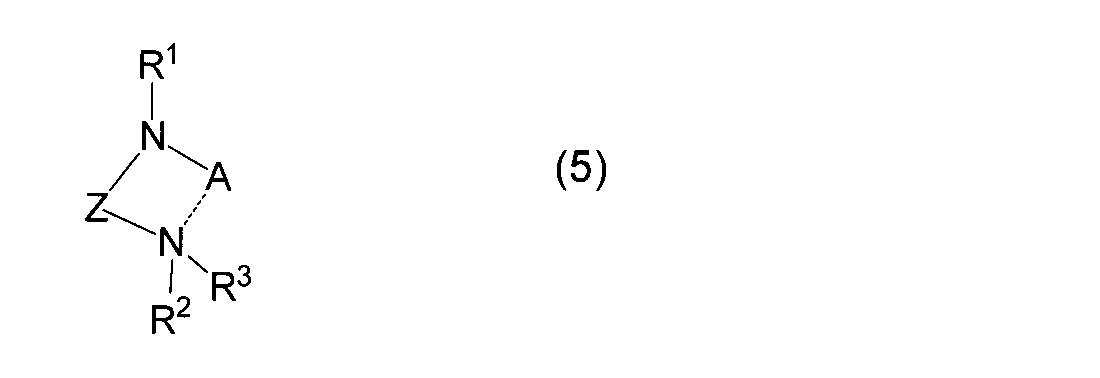
で示される(アミドアミノアルカン)アルカリ金属化合物を得、次いで、
この(アミドアミノアルカン)アルカリ金属化合物と、一般式(6)

で示されるハロゲン化金属化合物とを反応させることを特徴とする、一般式(1)
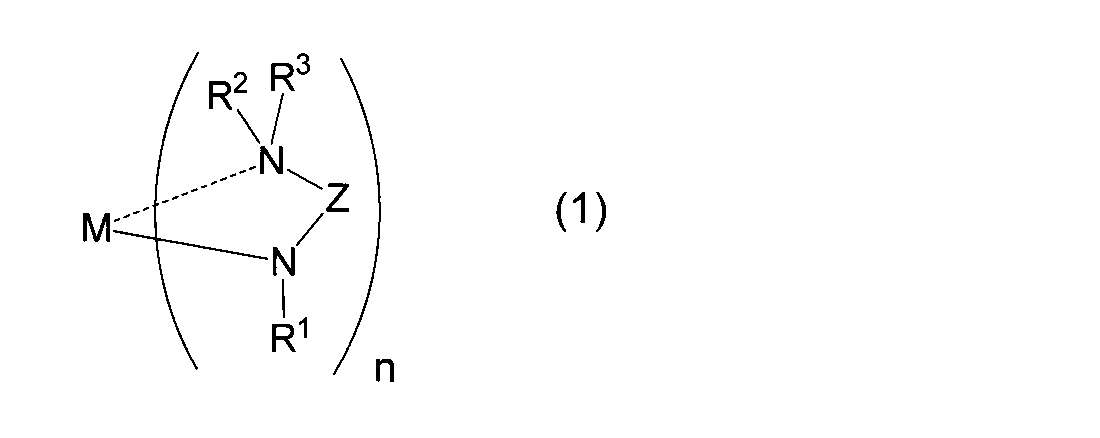
で示される上記1記載の(アミドアミノアルカン)金属化合物の製造方法。

で示される金属と、一般式(3)
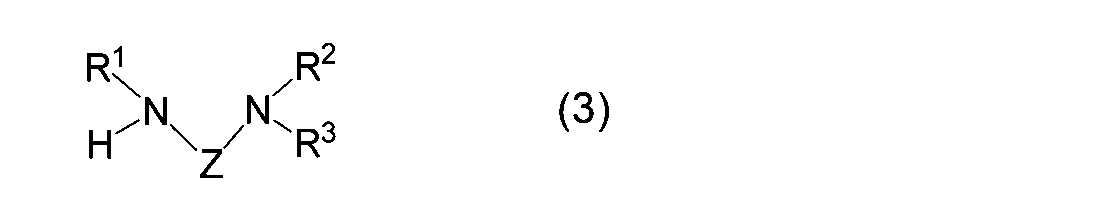
で示されるジアミノアルカン化合物とを反応させることを特徴とする、一般式(1)
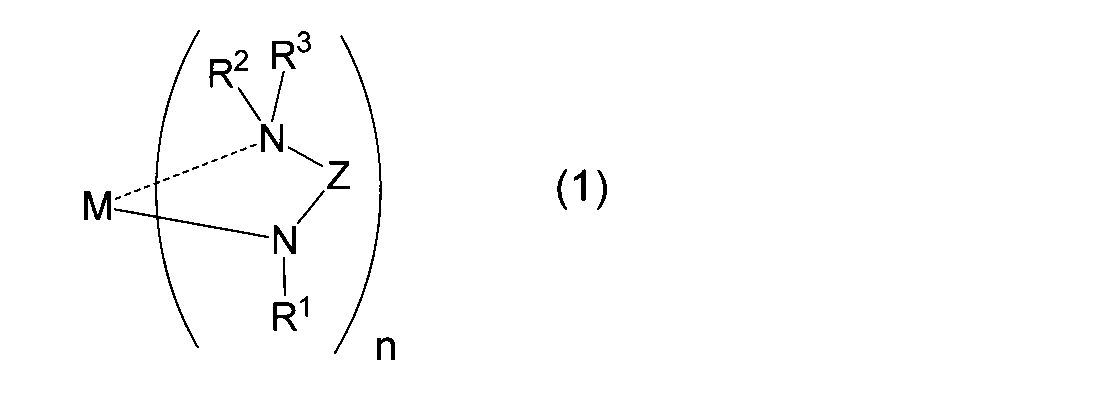
で示される上記1記載の(アミドアミノアルカン)金属化合物の製造方法。
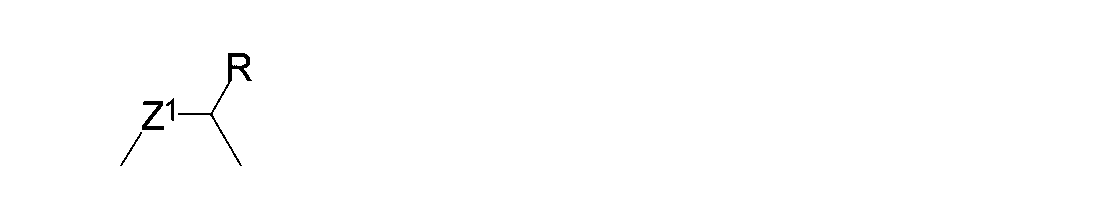
で示される基が好ましい。














(式中、R4及びR5は同一でも異なっていても良く、炭素原子数1~10の直鎖状又は分岐状のアルキル基を示し、M、R1、R2、R3及びZは前記と同義である。)


本発明の反応(A)において使用するアルキルアルカリ金属化合物は、前記の一般式(4a)で示される。その一般式(4a)において、R4は、メチル基、エチル基、n-プロピル基、イソプロピル基、n-ブチル基、イソブチル基、t-ブチル基、n-ペンチル基、t-ペンチル基、ネオペンチル基、n-デシル基等の炭素原子数1~10の直鎖状又は分岐状のアルキル基を示し、Aは、リチウム原子、ナトリウム原子又はカリウム原子等のアルカリ金属を示す。なお、これらのアルキルアルカリ金属化合物は、単独又は二種以上を混合して使用しても良い。
本発明の反応(B)において使用するジハロゲノコバルト化合物、ジハロゲノマンガン化合物、ジハロゲノ亜鉛化合物、ジハロゲノ鉄化合物、ジハロゲノニッケル化合物、トリハロゲノインジウム化合物、トリハロゲノイットリウム化合物、トリハロゲノランタン化合物等のハロゲン化金属化合物は、前記の一般式(6)で示される。その一般式(6)において、Xは、フッ素原子、塩素原子、臭素原子、ヨウ素原子等のハロゲン原子を示す。
攪拌装置、温度計及び滴下漏斗を備えた内容積100mlのフラスコに、アルゴン雰囲気にて、金属マグネシウム5.5g(0.23mol)及びジエチルエーテル20mlを加えた後、ブロモブタン3.0g(21mmol)をゆるやかに滴下した。次いで、ジエチルエーテル180ml及びブロモブタン25g(0.18mol)をゆるやかに滴下し、攪拌しながら40℃で2時間反応させ、更にジオキサン55g(0.62mol)を加えて、攪拌しながら40℃で2時間反応させた。反応終了後、アルゴン雰囲気にて反応液を濾過し、濾液を減圧下で濃縮した。濃縮物を加熱しながら真空乾燥させて、ジブチルマグネシウム22gを得た(単離収率;80%)。
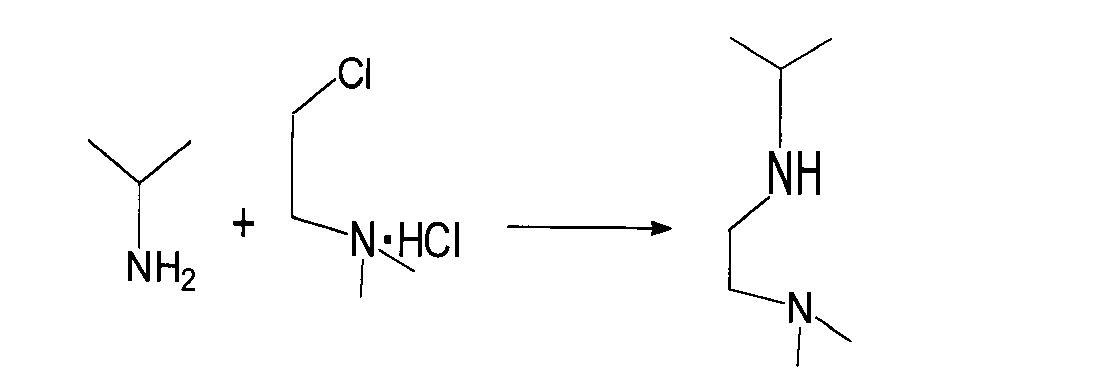
攪拌装置、温度計及び滴下漏斗を備えた内容積50mlのフラスコに、イソプロピルアミン6.0g(0.10mol)及び水5mlを加えた後、2-(ジメチルアミノ)エチルクロリド塩酸塩5.0g(35mmol)の水溶液10mlを、液温が30~50℃の範囲になるようにしながら、ゆるやかに滴下して2時間攪拌した。次いで、水酸化ナトリウム2.8g(70mmol)の水溶液10mlを氷浴下でゆるやかに滴下して、10分間反応させた。反応終了後、反応液をヘキサン25mlで2回抽出し、ヘキサン層を減圧下で濃縮した。濃縮物を減圧蒸留(65℃、4.0kPa)して、1-イソプロピルアミノ-2-ジメチルアミノエタン1.4gを得た(単離収率;31%)。
参考例A2において、イソプロピルアミンをt-ブチルアミン7.3g(0.10mol)に変更したこと以外は、参考例A2と同様に反応を行い、濃縮後、減圧蒸留(60℃、2.4kPa)して、1-(t-ブチルアミノ)-2-ジメチルアミノエタン1.8gを得た(単離収率;36%)。
参考例A2において、イソプロピルアミンをs-ブチルアミン7.3g(0.10mol)に変更したこと以外は、参考例A2と同様に反応を行い、濃縮後、減圧蒸留(65℃、2.0kPa)して、1-(s-ブチルアミノ)-2-ジメチルアミノエタン1.7gを得た(単離収率;34%)。
参考例A2において、2-(ジメチルアミノ)エチルクロリド塩酸塩5.0g(35mmol)を3-(ジメチルアミノ)プロピルクロリド塩酸塩5.5g(35mmol)に変更したこと以外は、参考例A2と同様に反応を行い、濃縮後、減圧蒸留(60℃、0.80kPa)して、(t-ブチル)(3-(ジメチルアミノ)プロピルアミン2.2gを得た(単離収率;40%)。
攪拌装置、温度計及び滴下漏斗を備えた内容積50mlのフラスコに、t-ブチルアミン16g(0.22mol)、2-(ジメチルアミノ)エチルクロリド塩酸塩5.0g(35mmol)及び水1mlを加えた後、70℃で10時間反応させた。反応終了後、反応液をヘキサン25mlで2回抽出し、ヘキサン層を減圧下で濃縮した。濃縮物を減圧蒸留(60℃、2.4kPa)して、1-(t-ブチルアミノ)-2-ジメチルアミノエタン3.0gを得た(単離収率;60%)。
攪拌装置、温度計及び滴下漏斗を備えた内容積25mlのフラスコに、アルゴン雰囲気にて、参考例A1で得られたジブチルマグネシウム0.69g(5.0mmol)及びヘプタン10mlを加え、参考例A2で得られた1-イソプロピルアミノ-2-ジメチルアミノエタン1.3g(10mmol)をゆるやかに滴下し、攪拌しながら90℃で6時間反応させた。反応終了後、反応液を濃縮した後に、減圧下で蒸留(80℃、13Pa)させて、無色透明液体として、ビス(1-イソプロピルアミド-2-ジメチルアミノエタン-N,N’)マグネシウム1.3gを得た(単離収率;92%)。当該化合物を25℃に保つと数時間で白色固体となった。
融点;53~55℃。
実施例A1において、1-イソプロピルアミノ-2-ジメチルアミノエタンを、参考例A3で得られた1-(t-ブチルアミノ)-2-ジメチルアミノエタン1.4g(10mmol)に変更したこと以外は、実施例A1と同様に反応を行い、濃縮後、減圧下で昇華(90℃、13Pa)させて、白色固体として、ビス(1-(t-ブチルアミド)-2-ジメチルアミノエタン-N,N’)マグネシウム1.2gを得た(単離収率;77%)。
融点;90~93℃
実施例A1において、1-イソプロピルアミノ-2-ジメチルアミノエタンを、参考例A4で得られた1-(s-ブチルアミノ)-2-ジメチルアミノエタン1.4g(10mmol)に変更したこと以外は、実施例A1と同様に反応を行い、濃縮後、減圧下で蒸留(90℃、13Pa)させて、無色透明液体として、ビス(1-(s-ブチルアミド)-2-ジメチルアミノエタン-N,N’)マグネシウム1.4gを得た(単離収率;90%)。
実施例A1において、1-イソプロピルアミノ-2-ジメチルアミノエタンを、1-エチルアミノ-2-ジメチルアミノエタン(市販品)1.2g(10mmol)に変えたこと以外は、実施例A1と同様に反応を行い、濃縮後、減圧下で蒸留(110℃、13Pa)させて、無色透明液体として、ビス(1-エチルアミド-2-ジメチルアミノエタン-N,N’)マグネシウム0.90gを得た(単離収率;71%)。
実施例A1において、1-イソプロピルアミノ-2-ジメチルアミノエタンを、1-エチルアミノ-2-ジエチルアミノエタン(市販品)1.4g(10mmol)に変えたこと以外は、実施例A1と同様に反応を行い、濃縮後、減圧下で蒸留(130℃、13Pa)させて、無色透明液体として、ビス(1-エチルアミド-2-ジエチルアミノエタン-N,N’)マグネシウム1.0gを得た(単離収率;60%)。
実施例A1において、1-イソプロピルアミノ-2-ジメチルアミノエタンを、参考例A5で得られた(t-ブチル)(3-(ジメチルアミノ)プロピルアミン1.6g(10mmol)に変更したこと以外は、実施例A1と同様に反応を行い、濃縮後、減圧下で蒸留(90℃、13Pa)させて、無色透明液体として、ビス(1-(t-ブチルアミド)-3-ジメチルアミノプロパン-N,N’)マグネシウム1.4gを得た(単離収率;76%)。
融点;110~114℃
実施例A1で得られたビス(1-イソプロピルアミド-2-ジメチルアミノエタン-N,N’)マグネシウム(マグネシウム化合物(6))を用いて、CVD法による蒸着実験を行い、成膜特性を評価した。
マグネシウム原料;ビス(1-イソプロピルアミド-2-ジメチルアミノエタン-N,N’)マグネシウム(マグネシウム化合物(6))
気化温度;40℃
Heキャリアー流量;100sccm
酸素流量;10sccm
基板材料;SiO2/Si
基板温度;300℃
反応系内圧力;1.33kPa
蒸着時間;30分
膜厚;50nm以上
XPS分析;マグネシウム酸化膜
炭素含有率;検出されず
窒素含有率;検出されず
ビス(シクロペンタジエニル)マグネシウムを用いて、実施例A7と同様にCVD法による蒸着実験を行い、成膜特性を評価した。蒸着条件及び膜特性は以下の通りであった。なお、各種条件を調整して原料の供給量を実施例A7に揃えて蒸着実験を行った。
マグネシウム原料;ビス(シクロペンタジエニル)マグネシウム
気化温度;30℃
Heキャリアー流量;10sccm
希釈He流量;90sccm
酸素流量;10sccm
基板材料;SiO2/Si
基板温度;300℃
反応系内圧力;10Torr(約1.33kPa)
蒸着時間;30分
膜厚;50nm以上
XPS分析;マグネシウム酸化膜
炭素含有率;30%(炭素原子換算)
窒素含有率;検出されず(そもそも原料に窒素原子が存在しない)
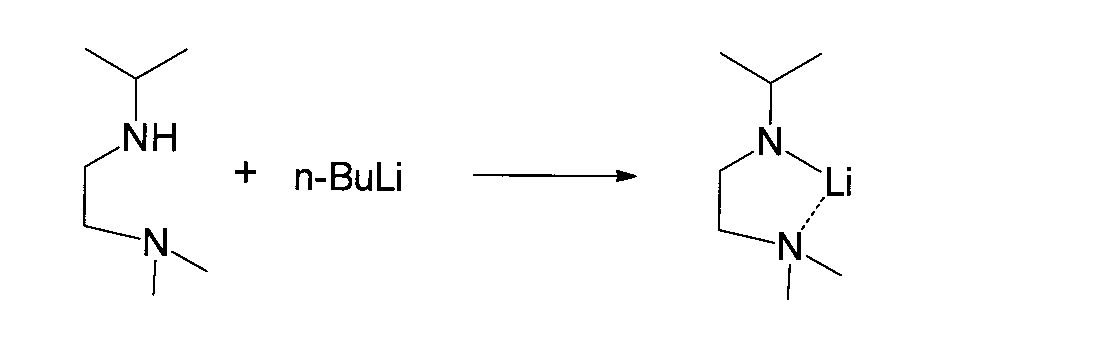
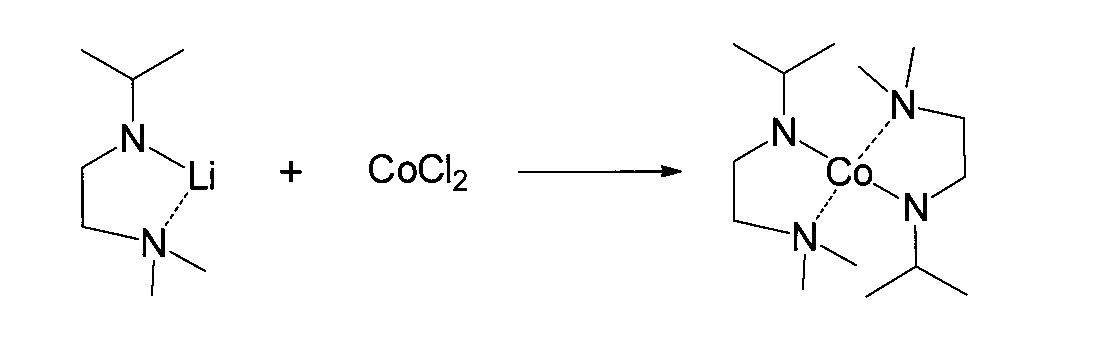
誘導結合プラズマ(ICP)分析によるコバルト含有量;19.2質量%
(計算値;18.6質量%)
攪拌装置、温度計及び滴下漏斗を備えた内容積50mlのフラスコに、アルゴン雰囲気にて、参考例A4で得られた1-s-ブチルアミノ-2-ジメチルアミノエタン2.59g(16.5mmol)とヘキサン15mlを加えた。次いで、混合液を0℃に保ちながら1.65mol/lのn-ブチルリチウムのへキサン溶液10ml(16.5mmol)を緩やかに滴下した。滴下後、混合液を0℃で30分間攪拌した後、撹拌しながら20℃にて2時間反応させた。反応終了後、反応液を減圧下で濃縮した後、濃縮物を真空下で乾燥させて、1-s-ブチルアミド-2-ジメチルアミノエタン-N,N’リチウムを得た。なお、1-s-ブチルアミド-2-ジメチルアミノエタン-N,N’リチウムは他に精製を行わず、次の反応に用いた。
攪拌装置、温度計を備えた内容積300mlのフラスコに、2-(ジメチルアミノ)エタンクロリド塩酸塩20.6g(143mmol)、t-ペンチルアミン74.0g(859mmol)を加えた後、8時間加熱還流をした。反応終了後、反応混合物をヘキサン100mlで2回濾過、洗浄し、ヘキサン層を減圧下で濃縮した。濃縮物を減圧蒸留(120℃、11.0kPa)して、1-t-ペンチルアミノ-2-ジメチルアミノエタン13.5gを得た(単離収率;60%)。
攪拌装置、温度計及び滴下漏斗を備えた内容積100mlのフラスコに、アルゴン雰囲気にて、無水塩化コバルト(II)1.07g(8.25mmol)及びテトラヒドロフラン20mlを加え、2時間攪拌させた。次いで、参考例B2で得られた1-s-ブチルアミド-2-ジメチルアミノエタン-N,N’)リチウムのテトラヒドロフラン溶液20mlを、液温を0℃に保ちながら緩やかに滴下した後、撹拌しながら20℃で6時間反応させた。反応終了後、減圧下で濃縮し、濃縮物にヘキサン100mlを加えて攪拌させた。濾過後、濾液を減圧下で濃縮し、得られた濃縮物を減圧下で蒸留(90℃、13.3Pa)し、濃緑色液体として(ビス(1-s-ブチルアミド-2-ジメチルアミノエタン-N,N’)コバルト0.8gを得た(単離収率27%)。
攪拌装置、温度計及び滴下漏斗を備えた内容積50mlのフラスコに、アルゴン雰囲気にて、参考例B3で得られた1-t-ペンチルアミノ-2-ジメチルアミノエタン2.69g(16.5mmol)とヘキサン15mlを加えた。次いで、混合液を0℃に保ちながら1.65mol/lのn-ブチルリチウムのへキサン溶液10ml(16.5mmol)を緩やかに滴下した。滴下後、混合液を0℃で30分間攪拌した後、撹拌しながら20℃にて2時間反応させた。反応終了後、反応液を減圧下で濃縮した後、濃縮物を真空下で乾燥させて、1-t-ペンチルアミド-2-ジメチルアミノエタン-N,N’リチウムを得た。なお、1-t-ペンチルアミド-2-ジメチルアミノエタン-N,N’リチウムは他に精製を行わず、次の反応に用いた。
攪拌装置、温度計及び滴下漏斗を備えた内容積100mlのフラスコに、アルゴン雰囲気にて、無水塩化コバルト(II)1.07g(8.25mmol)及びテトラヒドロフラン20mlを加え、2時間攪拌させた。次いで、参考例B4で得られた1-t-ペンチルアミド-2-ジメチルアミノエタン-N,N’)リチウムのテトラヒドロフラン溶液20mlを、液温を0℃に保ちながら緩やかに滴下した後、撹拌しながら20℃で6時間反応させた。反応終了後、減圧下で濃縮し、濃縮物にヘキサン100mlを加えて攪拌させた。濾過後、濾液を減圧下で濃縮し、得られた濃縮物を減圧下で蒸留(100℃、13.3Pa)し、濃緑色液体として(ビス(1-t-ペンチルアミド-2-ジメチルアミノエタン-N,N’)コバルト1.45gを得た(単離収率47%)。
攪拌装置、温度計及び滴下漏斗を備えた内容積100mlのフラスコに、アルゴン雰囲気にて、無水塩化コバルト(II)1.07g(8.25mmol)及びテトラヒドロフラン20mlを加え、2時間攪拌させた。次いで、参考例D3で得られた1-t-ブチルアミド-2-ジメチルアミノエタン-N,N’)リチウムのテトラヒドロフラン溶液20mlを、液温を0℃に保ちながら緩やかに滴下した後、撹拌しながら20℃で6時間反応させた。反応終了後、減圧下で濃縮し、濃縮物にヘキサン100mlを加えて攪拌させた。濾過後、濾液を減圧下で濃縮し、得られた濃縮物を減圧下で蒸留(95℃、13.3Pa)し、濃緑色固体として(ビス(1-t-ブチルアミド-2-ジメチルアミノエタン-N,N’)コバルト1.2gを得た(単離収率42%)。
実施例B1で得られたビス(1-イソプロピルアミド-2-ジメチルアミノエタン-N,N’)コバルト(II)(コバルト化合物(8))を用いて、CVD法による蒸着実験を行い、成膜特性を評価した。
コバルト原料;ビス(1-イソプロピルアミド-2-ジメチルアミノエタン-N,N’)コバルト(II)(コバルト化合物(8))
気化温度;90℃
Heキャリアー流量;10sccm
アンモニア流量;10sccm
基板材料;SiO2/Siウェハー
基板温度;200℃
反応系内圧力;0.67kPa
蒸着時間;5分
膜厚;400nm
XPS分析;コバルト膜
炭素含有率;検出されず
窒素含有率;検出されず
実施例B2で得られたビス(1-s-ブチルアミド-2-ジメチルアミノエタン-N,N’)コバルト(II)(コバルト化合物(10))を用いて、実施例B5と同様にCVD法による蒸着実験を行い、成膜特性を評価した。蒸着条件及び膜特性は以下の通りであった。
コバルト原料;ビス(1-s-ブチルアミド-2-ジメチルアミノエタン-N,N’)コバルト(コバルト化合物(10))
気化温度;80℃
Heキャリアー流量;30sccm
アンモニア流量;20sccm
基板材料;SiO2/Siウェハー
基板温度;200℃
反応系内圧力;0.67kPa
蒸着時間;5分
膜厚;200nm
XPS分析;コバルト膜
炭素含有率;検出されず
窒素含有率;検出されず
ビス(N-t-ブチル-N’-エチルプロピオンアミジナト)コバルト(特許文献8に記載の化合物)を用いて、実施例B5と同様にCVD法による蒸着実験を行い、成膜特性を評価した。蒸着条件及び膜特性は以下の通りであった。
気化温度;90℃
Heキャリアー流量;10sccm
アンモニア流量;10sccm
基板材料;SiO2/Siウェハー
基板温度;200℃
反応系内圧力;0.67kPa
蒸着時間;5分
膜厚;40nm
XPS分析;コバルト膜
炭素含有率;3%(炭素原子換算)
窒素含有率;7%(窒素原子換算)
攪拌装置、温度計を備えた内容積300mlのフラスコに、2-(ジメチルアミノ)プロパンクロリド塩酸塩25.0g(158mmol)、イソプロピルアミン56.1g(949mmol)及び水3mlを加えた後、攪拌しながら40~50℃で10時間反応させた。反応終了後、反応混合物を濾過、ヘキサン200mlで洗浄し、ヘキサン層を減圧下で濃縮した。得られた濃縮物を減圧蒸留(105℃、13.3kPa)して、1-イソプロピルアミノ-2-ジメチルアミノプロパン及び2-イソプロピルアミノ-1-ジメチルアミノプロパン混合物(混合比8:2)18.2gを得た(単離収率;82%)。
攪拌装置、温度計及び滴下漏斗を備えた内容積50mlのフラスコに、アルゴン雰囲気にて、参考例C1で得られた1-イソプロピルアミノ-2-ジメチルアミノプロパン及び2-イソプロピルアミノ-1-ジメチルアミノプロパンの混合物(混合比8:2)2.15g(16.5mmol)及びヘキサン15mlを加えた。次いで、混合液を0℃に保ちながら、1.65mol/lのn-ブチルリチウムのへキサン溶液10ml(16.5mmol)をゆるやかに滴下した。滴下後、混合液を0℃で30分間攪拌した後、攪拌しながら20℃にて2時間反応させた。反応終了後、反応液を減圧下で濃縮した後、濃縮物を真空下で乾燥させて、1-イソプロピルアミド-2-ジメチルアミノエタン-N,N’)リチウム及び2-イソプロピルアミド-1-ジメチルアミノエタン-N,N’)リチウムの混合物を得た。
攪拌装置、温度計及び滴下漏斗を備えた内容積100mlのフラスコに、アルゴン雰囲気にて、無水塩化コバルト(II)1.07g(8.25mmol)及びテトラヒドロフラン20mlを加え、2時間攪拌させた。次いで、参考例C2で得られた1-イソプロピルアミド-2-ジメチルアミノエタン-N,N’)リチウム及び2-イソプロピルアミド-1-ジメチルアミノエタン-N,N’)リチウムの混合物のテトラヒドロフラン溶液20mlを、液温を0℃に保ちながらゆるやかに滴下した後、攪拌しながら20℃で6時間反応させた。反応終了後、反応液を減圧下で濃縮し、得られた濃縮物にヘキサン100mlを加えて攪拌させた。濾過後、濾液を減圧下で濃縮し、濃縮物を減圧下で蒸留(95℃、13.3Pa)させて、暗褐色固体として、ビス(1-イソプロピルアミド-2-ジメチルアミノプロパン-N,N’)コバルト、ビス(2-イソプロピルアミド-1-ジメチルアミノプロパン-N,N’)コバルト及び(1-イソプロピルアミド-2-ジメチルアミノプロパン-N,N’)(2-イソプロピルアミド-1-ジメチルアミノプロパン-N,N’)コバルト混合物1.9gを得た(単離収率;67%)。
誘導結合プラズマ(ICP)分析によるコバルト含有量;16.4質量%
(計算値;17.06質量%)
攪拌装置、温度計及び滴下漏斗を備えた内容積200mlのフラスコに、参考例C1で得られた1-イソプロピルアミノ-2-ジメチルアミノプロパン及び2-イソプロピルアミノ-1-ジメチルアミノプロパンの混合物(混合比8:2)12.0g(75.9mmol)、メタノール50mLを加えた後、撹拌しながら60~70℃に加熱した。次いで、シュウ酸13.7g(151.8mmol)、メタノール60mLの溶液をゆるやかに滴下した後、撹拌しながら20℃にて1時間反応させた。反応混合液を濾過後、濾液を減圧下で濃縮し、濃縮物に水100mL、水酸化カリウム17.0g(303.6mmol)を加えた。次いで、クロロホルム50mLで3回抽出した後、減圧下で濃縮し、得られた濃縮物を減圧蒸留(105℃、13.3kPa)して、1-イソプロピルアミノ-2-ジメチルアミノプロパン7.6gを得た(単離収率;76%)。
攪拌装置、温度計及び滴下漏斗を備えた内容積50mlのフラスコに、アルゴン雰囲気にて、参考例C3で得られた1-イソプロピルアミノ-2-ジメチルアミノプロパン2.15g(16.5mmol)及びヘキサン15mlを加えた。次いで、混合液を0℃に保ちながら、1.65mol/lのn-ブチルリチウムのへキサン溶液10ml(16.5mmol)をゆるやかに滴下した。滴下後、混合液を0℃で30分間攪拌した後、攪拌しながら20℃にて2時間反応させた。反応終了後、反応液を減圧下で濃縮した後、濃縮物を真空下で乾燥させて、1-イソプロピルアミド-2-ジメチルアミノプロパン-N,N’)リチウムを得た。
攪拌装置、温度計及び滴下漏斗を備えた内容積100mlのフラスコに、アルゴン雰囲気にて、無水塩化コバルト(II)1.07g(8.25mmol)及びテトラヒドロフラン20mlを加え、2時間攪拌させた。次いで、参考例C4で得られた1-イソプロピルアミド-2-ジメチルアミノプロパン-N,N’)リチウムのテトラヒドロフラン溶液20mlを、液温を0℃に保ちながらゆるやかに滴下した後、攪拌しながら20℃で6時間反応させた。反応終了後、反応液を減圧下で濃縮し、得られた濃縮物にヘキサン100mlを加えて攪拌させた。濾過後、濾液を減圧下で濃縮し、濃縮物を減圧下で蒸留(95℃、13.3Pa)させて、暗褐色固体として、ビス(1-イソプロピルアミド-2-ジメチルアミノプロパン-N,N’)コバルト1.2gを得た(単離収率;43%)。
攪拌装置、温度計を備えた内容積300mlのフラスコに、2-(ジメチルアミノ)プロパンクロリド塩酸塩25.0g(158mmol)、s-ブチルアミン69.4g(949mmol)を加えた後、攪拌しながら80~90℃で10時間反応させた。反応終了後、反応混合物を濾過、ヘキサン200mlで洗浄し、ヘキサン層を減圧下で濃縮した。得られた濃縮物を減圧蒸留(110℃、11kPa)して、1-(s-ブチルアミノ)-2-ジメチルアミノプロパン及び2-s-ブチルアミノ-1-ジメチルアミノプロパンの混合物(混合比8:2)21.7gを得た(単離収率;87%)。
攪拌装置、温度計及び滴下漏斗を備えた内容積50mlのフラスコに、アルゴン雰囲気にて、参考例C5で得られた1-(s-ブチルアミノ)-2-ジメチルアミノプロパン及び2-s-ブチルアミノ-1-ジメチルアミノプロパンの混合物(混合比8:2)2.65g(16.5mmol)及びヘキサン15mlを加えた。次いで、混合液を0℃に保ちながら、1.65mol/lのn-ブチルリチウムのへキサン溶液10ml(16.5mmol)をゆるやかに滴下した。滴下後、混合液を0℃で30分間攪拌した後、攪拌しながら20℃にて2時間反応させた。反応終了後、反応液を減圧下で濃縮した後、濃縮物を真空下で乾燥させて、1-(s-ブチルアミド)-2-ジメチルアミノプロパン-N,N’)リチウム及び2-(s-ブチルアミド)-1-ジメチルアミノプロパン-N,N’)リチウム混合物を得た。
攪拌装置、温度計及び滴下漏斗を備えた内容積100mlのフラスコに、アルゴン雰囲気にて、無水塩化コバルト(II)1.07g(8.25mmol)及びテトラヒドロフラン20mlを加え、2時間攪拌させた。次いで、参考例C6で得られた1-(s-ブチルアミド)-2-ジメチルアミノプロパン-N,N’)リチウム及び2-(s-ブチルアミド)-1-ジメチルアミノプロパン-N,N’)リチウムの混合物のテトラヒドロフラン溶液20mlを、液温を0℃に保ちながらゆるやかに滴下した後、攪拌しながら20℃で6時間反応させた。反応終了後、反応液を減圧下で濃縮し、得られた濃縮物にヘキサン100mlを加えて攪拌させた。濾過後、濾液を減圧下で濃縮し、濃縮物を減圧下で蒸留(105℃、13.3Pa)させて、暗褐色液体として、(ビス(1-(s-ブチルアミド)-2-ジメチルアミノプロパン-N,N’)コバルト、(ビス(2-(s-ブチルアミド)-1-ジメチルアミノプロパン-N,N’)コバルト及び(1-(s-ブチルアミド)-2-ジメチルアミノプロパン-N,N’)(2-(s-ブチルアミド)-1-ジメチルアミノプロパン-N,N’)コバルトの混合物2.1gを得た(単離収率;68%)。
(計算値;15.8質量%)

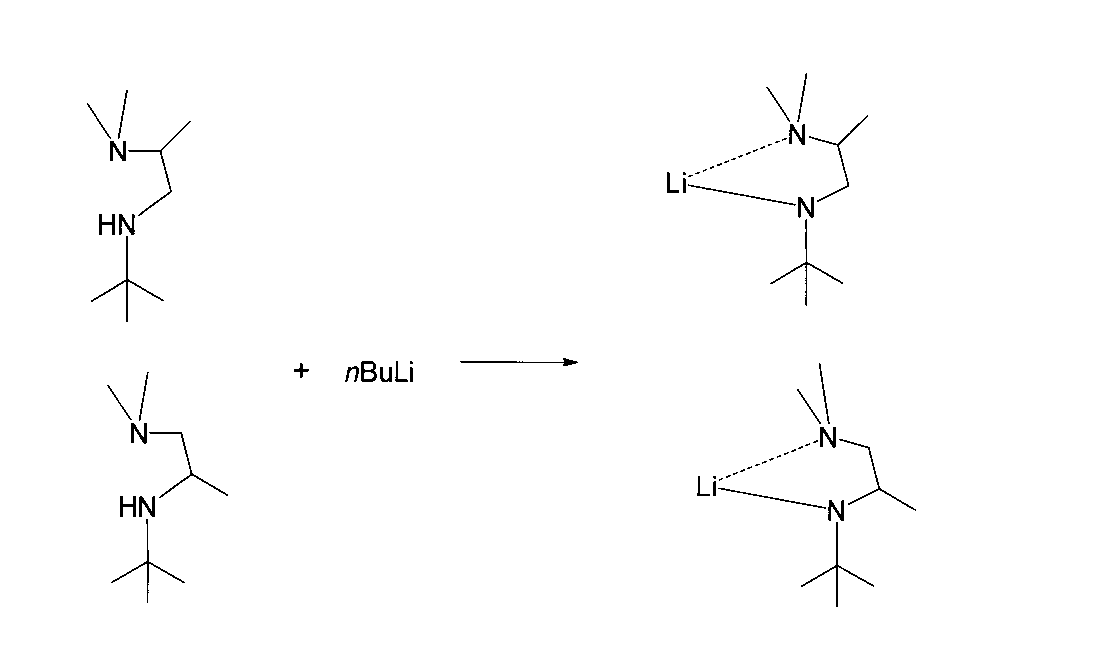

誘導結合プラズマ(ICP)分析によるコバルト含有量;15.0質量%
(計算値;15.8質量%)
実施例C1で得られたコバルト化合物を用いて、実施例B5と同様にCVD法による蒸着実験を行い、成膜特性を評価した。蒸着条件及び膜特性は以下の通りである。
(蒸着条件)
コバルト原料;実施例C1で得られたコバルト化合物
(ビス(1-イソプロピルアミド-2-ジメチルアミノプロパン-N,N’)コバルト(化合物(1c))、ビス(2-イソプロピルアミド-1-ジメチルアミノプロパン-N,N’)コバルト(化合物(1j))及び(1-イソプロピルアミド-2-ジメチルアミノプロパン-N,N’)(2-イソプロピルアミド-1-ジメチルアミノプロパン-N,N’)コバルト(化合物(1q))混合物)
気化温度;90℃
Heキャリアー流量;30sccm
アンモニア流量;10sccm
基板材料;SiO2/Siウェハー
基板温度;200℃
反応系内圧力;0.67kPa
蒸着時間;5分
膜厚;300nm
XPS分析;コバルト膜
炭素含有率;検出されず
窒素含有率;検出されず
実施例C2で得られたコバルト化合物を用いて、実施例B5と同様にCVD法による蒸着実験を行い、成膜特性を評価した。蒸着条件及び膜特性は以下の通りである。
(蒸着条件)
コバルト原料;実施例C2で得られたコバルト化合物
(ビス(1-イソプロピルアミド-2-ジメチルアミノプロパン-N,N’)コバルト(化合物(1c))
気化温度;90℃
Heキャリアー流量;30sccm
アンモニア流量;10sccm
基板材料;SiO2/Siウェハー
基板温度;200℃
反応系内圧力;0.67kPa
蒸着時間;5分
膜厚;300nm
XPS分析;コバルト膜
炭素含有率;検出されず
窒素含有率;検出されず
実施例C3で得られたコバルト化合物を用いて、実施例B5と同様にCVD法による蒸着実験を行い、成膜特性を評価した。蒸着条件及び膜特性は以下の通りである。
(蒸着条件)
コバルト原料;実施例C3で得られたコバルト化合物
(ビス(1-(s-ブチルアミド)-2-ジメチルアミノプロパン-N,N’)コバルト(化合物(1e))、ビス(2-(s-ブチルアミド)-1-ジメチルアミノプロパン-N,N’)コバルト(化合物(1l))、及び(1-(s-ブチルアミド)-2-ジメチルアミノプロパン-N,N’)(2-(s-ブチルアミド)-1-ジメチルアミノプロパン-N,N’)コバルト(化合物(1s))混合物)
気化温度;100℃
Heキャリアー流量;30sccm
アンモニア流量;10sccm
基板材料;SiO2/Siウェハー
基板温度;200℃
反応系内圧力;0.67kPa
蒸着時間;5分
膜厚;200nm
XPS分析;コバルト膜
炭素含有率;検出されず
窒素含有率;検出されず
実施例C4で得られたコバルト化合物を用いて、実施例B5と同様にCVD法による蒸着実験を行い、成膜特性を評価した。蒸着条件及び膜特性は以下の通りである。
(蒸着条件)
コバルト原料;実施例C4で得られたコバルト化合物
(ビス(1-t-ブチルアミド-2-ジメチルアミノプロパン-N,N’)コバルト(コバルト化合物(1d))、ビス(2-t-ブチルアミド-1-ジメチルアミノプロパン-N,N’)コバルト(コバルト化合物(1k))及び(1-t-ブチルアミド-2-ジメチルアミノプロパン-N,N’)(2-t-ブチルアミド-1-ジメチルアミノプロパン-N,N’)コバルト(コバルト化合物(1r))混合物)
気化温度;90℃
Heキャリアー流量;30sccm
アンモニア流量;30sccm
基板材料;SiO2/Siウェハー
基板温度;200℃
反応系内圧力;0.67kPa
蒸着時間;5分
膜厚;300nm
XPS分析;コバルト膜
炭素含有率;検出されず
窒素含有率;検出されず
ビス(N-t-ブチル-N’-エチルプロピオンアミジナト)コバルト(特許文献8記載の化合物)を用いて、実施例B5と同様にCVD法による蒸着実験を行い、成膜特性を評価した。蒸着条件及び膜特性は以下の通りである。
(蒸着条件)
コバルト化合物;ビス(N-t-ブチル-N’-エチルプロピオンアミジナト)コバルト(特許文献8記載の化合物)
気化温度;90℃
Heキャリアー流量;10sccm
アンモニア流量;10sccm
基板材料;SiO2/Siウェハー
基板温度;200℃
反応系内圧力;0.67kPa
蒸着時間;5分
膜厚;40nm
XPS分析;コバルト膜
炭素含有率;3%(炭素原子換算)
窒素含有率;7%(窒素原子換算)
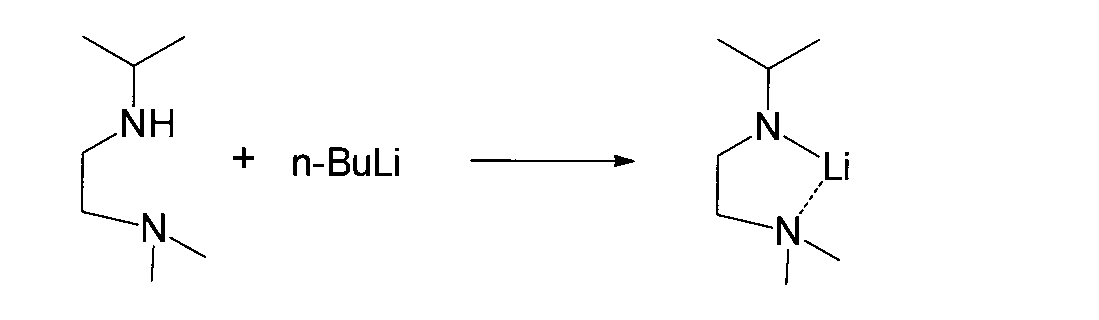
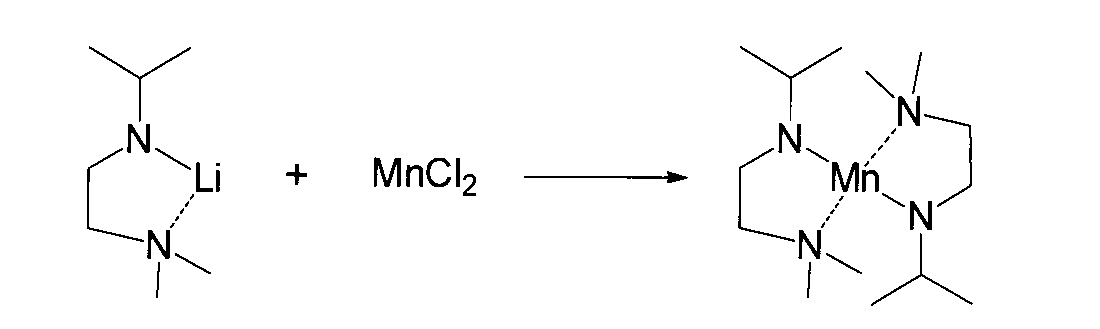
(計算値;17.5質量%)
参考例D1において、1-イソプロピルアミノ-2-ジメチルアミノエタンを1-(t-ブチルアミノ)-2-ジメチルアミノエタン2.3g(16mmol)に変更したこと以外は、参考例D1と同様に反応を行い、1-(t-ブチルアミノ)-2-ジメチルアミノエタン-N,N’)リチウム2.4gを得た(単離収率;96%)。
実施例D1において、1-イソプロピルアミド-2-ジメチルアミノエタン-N,N’)リチウムのテトラヒドロフラン溶液を、1-(t-ブチルアミノ)-2-ジメチルアミノエタン-N,N’)リチウム1.1g(7.6mmol)のテトラヒドロフラン溶液10mlに変更したこと以外は、実施例D1と同様に反応を行い、濃縮後、減圧下で昇華(90℃、13Pa)させて、淡緑褐色固体として、ビス(1-(t-ブチルアミド)-2-ジメチルアミノエタン-N,N’)マンガン1.1gを得た(単離収率;85%)。
誘導結合プラズマ(ICP)分析によるマンガン含有量;16.5質量%
(計算値;16.1質量%)
実施例D2で得られたビス(1-(t-ブチルアミド)-2-ジメチルアミノエタン-N,N’)マンガン(II)(マンガン化合物(9))を用いて、CVD法による蒸着実験を行い、成膜特性を評価した。
マンガン原料;ビス(1-(t-ブチルアミド)-2-ジメチルアミノエタン-N,N’)マンガン(II)(マンガン化合物(9))
気化温度;50℃
Heキャリアー流量;60sccm
水素流量;10sccm
基板材料;Siウェハー
基板温度;300℃
反応系内圧力;1.33kPa
蒸着時間;30分
膜厚;100nm
XPS分析;マンガン膜
抵抗率;(1.6~1.9)×10-6Ωm
マンガン原料;ビス(1-(t-ブチルアミド)-2-ジメチルアミノエタン-N,N’)マンガン(II)(マンガン化合物(9))
気化温度;50℃
Heキャリアー流量;60sccm
アンモニア流量;10sccm
基板材料;SiO2ウェハー
基板温度;200℃
反応系内圧力;1.33kPa
蒸着時間;30分
膜外観;金属光沢のあるMn含有膜が形成された。
ビス(N,N’-ジイソプロピルペンタンアミジナト)マンガン(非特許文献9及び10記載の化合物)を用いて、実施例D3と同様にCVD法による蒸着実験を行い、成膜特性を評価した。蒸着条件及び膜特性は以下の通りであった。
気化温度;70℃
Heキャリアー流量;60sccm
水素流量;10sccm
基板材料;Siウェハー
基板温度;300℃
反応系内圧力;1.33kPa
蒸着時間;30分
気化温度;70℃
Heキャリアー流量;60sccm
水素流量;10sccm
基板材料;Siウェハー
基板温度;350℃
反応系内圧力;1.33kPa
蒸着時間;30分
膜厚;10nm以下
抵抗率;測定不可

誘導結合プラズマ(ICP)分析による亜鉛含有量;19.8質量%
(計算値;20.2質量%)

融点;98~100℃
誘導結合プラズマ(ICP)分析による亜鉛含有量;18.5質量%
(計算値;18.6質量%)
実施例E1で得られた(ビス(1-イソプロピルアミド-2-ジメチルアミノエタン-N,N’)亜鉛(II))を用いて、実施例D3と同様にCVD法による蒸着実験を行い、成膜特性を評価した。蒸着条件及び膜特性は以下の通りであった。
亜鉛原料;実施例E1で得られた亜鉛化合物
(ビス(1-イソプロピルアミド-2-ジメチルアミノエタン-N,N’)亜鉛(II))
気化温度;40℃
Heキャリアー流量;100sccm
酸素流量;10sccm
基板材料;SiO2ウェハー
基板温度;300℃
反応系内圧力;1.33kPa
蒸着時間;30分
膜厚;50nm以上
XPS分析;亜鉛酸化膜
炭素含有率;検出されず
窒素含有率;検出されず
ビス(アセチルアセトナト)亜鉛(特許文献14記載の化合物)を用いて、実施例E3と同様にCVD法による蒸着実験を行い、成膜特性を評価した。蒸着条件及び膜特性は以下の通りであった。
気化温度;50℃
Heキャリアー流量;30sccm
酸素流量;10sccm
基板材料;SiO2ウェハー
基板温度;300℃
反応系内圧力;1.33kPa
蒸着時間;30分
気化温度;50℃
Heキャリアー流量;30sccm
酸素流量;10sccm
基板材料;SiO2ウェハー
基板温度;450℃
反応系内圧力;1.33kPa
蒸着時間;30分
膜厚;50nm以上
XPS分析;亜鉛酸化膜
炭素含有率;5%(炭素原子換算)
窒素含有率;検出されず(そもそも原料に窒素原子が存在しない)
以上の結果から、本発明のビス(アミドアミノアルカン)亜鉛化合物を用いることにより、炭素原子や窒素原子等の不純物を含まない高品質の亜鉛含有薄膜(亜鉛酸化膜)を製造することができることが判明した。

(計算値;17.8質量%)

誘導結合プラズマ(ICP)分析によるニッケル含有量;17.4質量%
(計算値;17.0質量%)
参考例D1において、1-イソプロピルアミノ-2-ジメチルアミノエタンを1-メチルアミノ-2-ジメチルアミノエタン1.6g(16mmol)に変更したこと以外は、参考例D1と同様に反応を行い、(1-メチルアミド-2-ジメチルアミノエタン-N,N’)リチウム1.6gを得た(単離収率;92%)。

誘導結合プラズマ(ICP)分析によるインジウム含有量;26.8質量%
(計算値;27.5質量%)
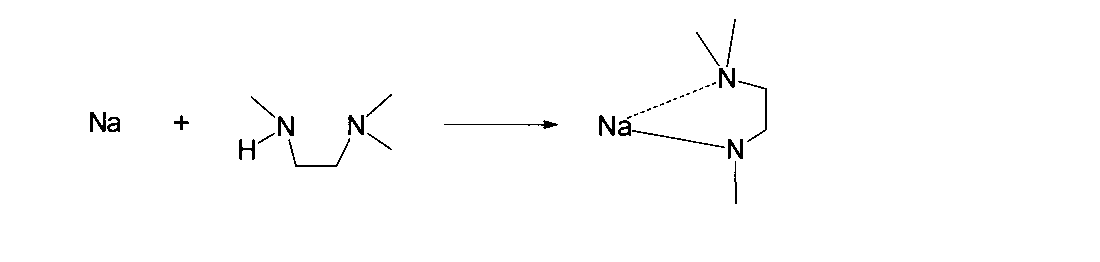

誘導結合プラズマ(ICP)分析によるイットリウム含有量;21.9質量%
(計算値;22.7質量%)

誘導結合プラズマ(ICP)分析によるランタン含有量;30.2質量%
(計算値;31.4質量%)
1.キャリアガス(He)
2.希釈ガス(He)
3.反応ガス(O2)
4.マスフローコントローラー
5.マスフローコントローラー
6.マスフローコントローラー
7.マグネシウム原料容器(気化器)
8.恒温槽
9.反応器
10.基板
11.反応器ヒーター
12.圧力計
13.トラップ
14.真空ポンプ
3 気化器
4 反応器
10B 気化器ヒータ
10C 反応器ヒータ
20 原料(アミドアミノアルカン)金属化合物
21 基板
Claims (8)
- 一般式(1)

(式中、Mは金属原子を示し、R1は炭素原子数1~6の直鎖状、分岐状又は環状のアルキル基を示し、R2及びR3は同一でも異なっていても良く、炭素原子数1~3の直鎖状又は分岐状のアルキル基を示すか、または、R2及びR3が一緒になってそれらが結合する窒素原子と共に置換もしくは無置換の5員又は6員環を形成している。Zは炭素原子数1~10の直鎖状又は分岐状のアルキレン基(但し、その一部が環を形成していてもよい)を示す。nは配位子の数を示し、金属Mの価数に等しく、1~3の整数を示す。
但し、MがLi(リチウム)、Be(ベリリウム)、Ge(ゲルマニウム)、Nd(ネオジム)である場合、MがMg(マグネシウム)であり、R1がメチル基である場合、MがZn(亜鉛)であり、R1がメチル基である場合、及びMがBi(ビスマス)であり、R1がt-ブチル基である場合を除く。また、nが2以上の場合、2つ以上の配位子は同一でも異なっていてもよい。)
で示される(アミドアミノアルカン)金属化合物。 - Mが、ナトリウム、マグネシウム、マンガン、鉄、コバルト、ニッケル、亜鉛、イットリウム、ランタン又はインジウムである請求項1記載の(アミドアミノアルカン)金属化合物。
- Zが、炭素原子数1~5の直鎖状又は分岐状のアルキレン基、または

(式中、Z1は炭素原子数1~3の直鎖状アルキレン基を示し、Rは炭素原子数1~6の直鎖状又は分岐状アルキル基、又は炭素原子数3~6のシクロアルキル基を示す。)
で示される基である請求項1記載の(アミドアミノアルカン)金属化合物。 - 一般式(2a)又は(2b)
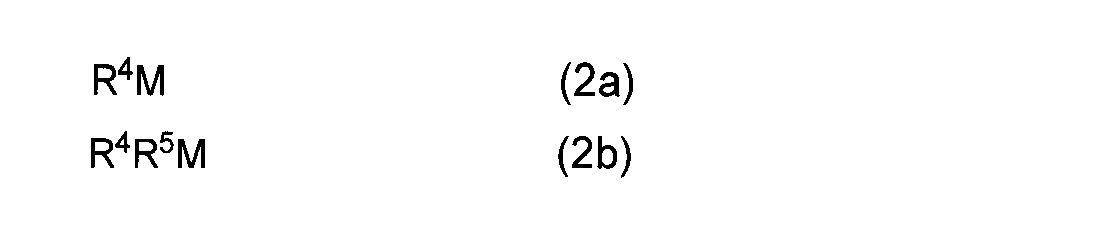
(式中、Mは金属原子を示し、R4及びR5は同一でも異なっていても良く、炭素原子数1~10の直鎖状又は分岐状のアルキル基を示す。)
で示されるモノ又はジアルキル金属化合物と、一般式(3)

で示されるジアミノアルカン化合物とを反応させることを特徴とする、一般式(1)

(式中、M、R1、R2、R3、Z及びnは前記と同義である。)
で示される請求項1記載の(アミドアミノアルカン)金属化合物の製造方法。 - 一般式(4a)

(式中、R4は炭素原子数1~10の直鎖状又は分岐状のアルキル基を示し、Aはアルカリ金属原子を示す。)
で示されるアルキルアルカリ金属化合物又はアルカリ金属と、一般式(3)

で示されるジアミノアルカン化合物とを反応させて、一般式(5)
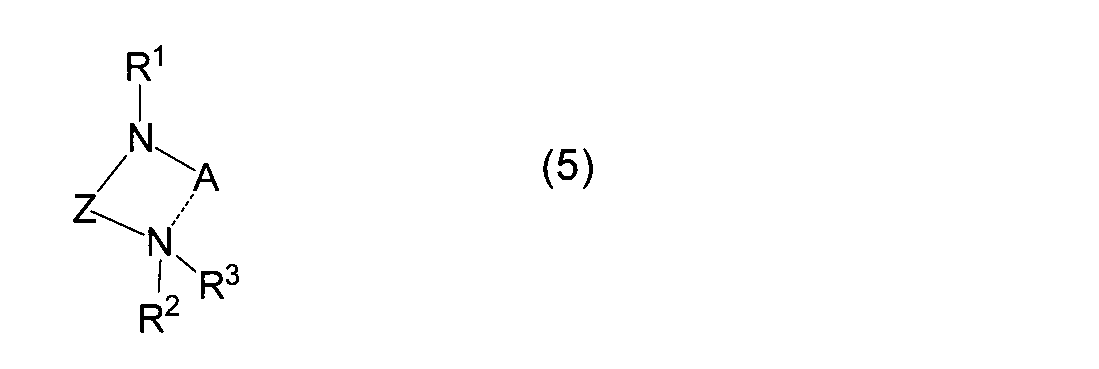
で示される(アミドアミノアルカン)アルカリ金属化合物を得、次いで、
この(アミドアミノアルカン)アルカリ金属化合物と、一般式(6)

で示されるハロゲン化金属化合物とを反応させることを特徴とする、一般式(1)

で示される請求項1記載の(アミドアミノアルカン)金属化合物の製造方法。 - 一般式(7)

で示される金属と、一般式(3)
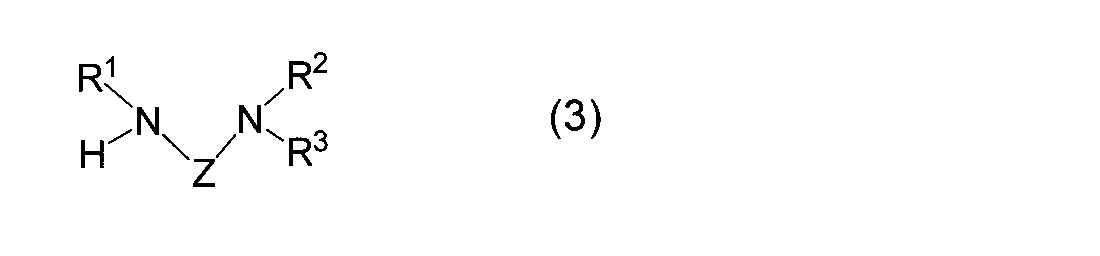
で示されるジアミノアルカン化合物とを反応させることを特徴とする、一般式(1)

で示される請求項1記載の(アミドアミノアルカン)金属化合物の製造方法。 - 請求項1記載の(アミドアミノアルカン)金属化合物を供給源として用いた化学気相蒸着法による金属含有薄膜の製造方法。
- 請求項1記載の(アミドアミノアルカン)金属化合物を含む金属含有薄膜形成用原料。
Priority Applications (5)
| Application Number | Priority Date | Filing Date | Title |
|---|---|---|---|
| US13/882,824 US8871304B2 (en) | 2010-11-02 | 2011-11-02 | (Amide amino alkane) metal compound, method of manufacturing metal-containing thin film using said metal compound |
| CN2011800637692A CN103313993A (zh) | 2010-11-02 | 2011-11-02 | (酰胺氨基烷烃)金属化合物及使用所述金属化合物制备含金属的薄膜的方法 |
| JP2012541903A JP5857970B2 (ja) | 2010-11-02 | 2011-11-02 | (アミドアミノアルカン)金属化合物、及び当該金属化合物を用いた金属含有薄膜の製造方法 |
| KR1020137013881A KR101924656B1 (ko) | 2010-11-02 | 2011-11-02 | (아미드아미노알칸) 금속 화합물, 및 당해 금속 화합물을 사용한 금속 함유 박막의 제조 방법 |
| EP11838078.1A EP2636674B1 (en) | 2010-11-02 | 2011-11-02 | (amide amino alkane) metal compound and method of producing metal-containing thin film using said metal compound |
Applications Claiming Priority (8)
| Application Number | Priority Date | Filing Date | Title |
|---|---|---|---|
| JP2010-245941 | 2010-11-02 | ||
| JP2010245941 | 2010-11-02 | ||
| JP2011000372 | 2011-01-05 | ||
| JP2011-000372 | 2011-01-05 | ||
| JP2011-170697 | 2011-08-04 | ||
| JP2011170697 | 2011-08-04 | ||
| JP2011-192228 | 2011-09-05 | ||
| JP2011192228 | 2011-09-05 |
Publications (1)
| Publication Number | Publication Date |
|---|---|
| WO2012060428A1 true WO2012060428A1 (ja) | 2012-05-10 |
Family
ID=46024541
Family Applications (1)
| Application Number | Title | Priority Date | Filing Date |
|---|---|---|---|
| PCT/JP2011/075347 Ceased WO2012060428A1 (ja) | 2010-11-02 | 2011-11-02 | (アミドアミノアルカン)金属化合物、及び当該金属化合物を用いた金属含有薄膜の製造方法 |
Country Status (7)
| Country | Link |
|---|---|
| US (1) | US8871304B2 (ja) |
| EP (1) | EP2636674B1 (ja) |
| JP (1) | JP5857970B2 (ja) |
| KR (1) | KR101924656B1 (ja) |
| CN (3) | CN105503618A (ja) |
| TW (2) | TWI564423B (ja) |
| WO (1) | WO2012060428A1 (ja) |
Cited By (19)
| Publication number | Priority date | Publication date | Assignee | Title |
|---|---|---|---|---|
| JP2013173716A (ja) * | 2012-02-27 | 2013-09-05 | Ube Industries Ltd | コバルト化合物の混合物、及び当該コバルト化合物の混合物を用いたコバルト含有薄膜の製造方法 |
| JP2013189696A (ja) * | 2012-03-15 | 2013-09-26 | Ube Industries Ltd | コバルト膜形成用原料及び当該原料を用いたコバルト含有薄膜の製造方法 |
| JP2014125674A (ja) * | 2012-12-27 | 2014-07-07 | Tokyo Electron Ltd | マンガン含有膜の形成方法、処理システム、電子デバイスの製造方法および電子デバイス |
| KR20150037837A (ko) | 2012-07-18 | 2015-04-08 | 도쿄엘렉트론가부시키가이샤 | 반도체 장치의 제조 방법 |
| US9064690B2 (en) | 2012-08-08 | 2015-06-23 | Tokyo Electron Limited | Method for forming Cu wiring |
| US9136132B2 (en) | 2012-12-27 | 2015-09-15 | Tokyo Electron Limited | Manganese metal film forming method, processing system, electronic device manufacturing method and electronic device |
| US9245847B2 (en) | 2012-04-11 | 2016-01-26 | Tokyo Electron Limited | Method for manufacturing semiconductor device for forming metal element-containing layer on insulating layer in which concave portion is formed, semiconductor device including insulating layer in which concave portion is formed, and semiconductor layer on insulating layer in which concave portion is formed |
| US9313895B2 (en) | 2012-12-12 | 2016-04-12 | Tokyo Electron Limited | Method for forming copper wiring |
| JP2016513185A (ja) * | 2013-02-28 | 2016-05-12 | アプライド マテリアルズ インコーポレイテッドApplied Materials,Incorporated | 金属アミド堆積前駆体及び不活性アンプルライナによるそれらの安定化 |
| US9368418B2 (en) | 2013-08-22 | 2016-06-14 | Tokyo Electron Limited | Copper wiring structure forming method |
| JP2016108247A (ja) * | 2014-12-02 | 2016-06-20 | 宇部興産株式会社 | ビス(シリルアミドアミノアルカン)マンガン化合物及び当該マンガン化合物を用いたマンガン含有膜の製造方法 |
| JP2016540038A (ja) * | 2013-10-28 | 2016-12-22 | エスエーエフシー ハイテック インコーポレイテッド | アミドイミン配位子を含む金属複合体 |
| US9887099B2 (en) | 2015-11-04 | 2018-02-06 | Tokyo Electron Limited | Pattern forming method capable of minimizing deviation of an inversion pattern |
| KR20180057059A (ko) | 2016-11-21 | 2018-05-30 | 한국화학연구원 | 망간 아미노아미드 아미디네이트 전구체, 이의 제조방법, 및 이를 이용하여 박막을 형성하는 방법 |
| KR20180057053A (ko) | 2016-11-21 | 2018-05-30 | 한국화학연구원 | 망간 아미노아미드 아미드 전구체, 이의 제조방법, 및 이를 이용하여 박막을 형성하는 방법 |
| WO2020100765A1 (ja) * | 2018-11-12 | 2020-05-22 | 東ソー株式会社 | コバルト錯体、その製造方法、及びコバルト含有薄膜の製造方法 |
| WO2021054160A1 (ja) * | 2019-09-17 | 2021-03-25 | 株式会社Adeka | 原子層堆積法のための薄膜形成原料及びそれを用いた亜鉛含有薄膜の製造方法 |
| JP2023554601A (ja) * | 2021-11-18 | 2023-12-28 | ハンソル ケミカル カンパニー リミテッド | 有機金属化合物を用いて薄膜を形成する方法、及びそれから製造された薄膜 |
| WO2024059203A1 (en) * | 2022-09-16 | 2024-03-21 | L'air Liquide, Societe Anonyme Pour L'etude Et L'exploitation Des Procedes Georges Claude | Novel chelating and sterically encumbered ligands and their corresponding organometallic complexes for deposition of metal-containing films |
Families Citing this family (10)
| Publication number | Priority date | Publication date | Assignee | Title |
|---|---|---|---|---|
| WO2016204772A1 (en) * | 2015-06-18 | 2016-12-22 | Intel Corporation | Inherently selective precursors for deposition of second or third row transition metal thin films |
| KR102029071B1 (ko) * | 2016-11-21 | 2019-10-07 | 한국화학연구원 | 13족 금속 전구체, 이를 포함하는 박막증착용 조성물 및 이를 이용하는 박막의 제조방법 |
| CN109369954B (zh) * | 2018-09-29 | 2020-10-27 | 山西科灜科技有限公司 | 一种络合型β成核剂及其制备与应用 |
| CN109320765B (zh) * | 2018-09-29 | 2020-10-27 | 山西科灜科技有限公司 | 一种络合型β成核剂及其制备方法与应用 |
| TWI862702B (zh) | 2019-10-08 | 2024-11-21 | 法商液態空氣喬治斯克勞帝方法研究開發股份有限公司 | 用於沉積含鋰層、島或簇的鋰前驅體及使用彼之方法 |
| IL293196B2 (en) * | 2019-11-27 | 2025-08-01 | Adeka Corp | Compound, thin-film forming raw material, and method of producing thin-film |
| US20220106333A1 (en) | 2020-10-06 | 2022-04-07 | American Air Liquide, Inc. | Indium precursors for vapor depositions |
| KR102569201B1 (ko) * | 2021-06-04 | 2023-08-23 | 주식회사 한솔케미칼 | 유기 금속 화합물 제조방법 및 이를 이용하여 박막을 형성하는 방법 |
| TW202323568A (zh) * | 2021-09-03 | 2023-06-16 | 荷蘭商Asm Ip私人控股有限公司 | 形成具有增加極紫外(euv)敏感性之底層的方法,及包括其的結構 |
| KR102847092B1 (ko) * | 2023-05-11 | 2025-08-20 | 한국화학연구원 | 14족 유기금속 화합물, 이의 제조방법 및 이를 이용하여 박막을 형성하는 방법 |
Citations (13)
| Publication number | Priority date | Publication date | Assignee | Title |
|---|---|---|---|---|
| JP2002170993A (ja) | 2000-11-30 | 2002-06-14 | Shin Etsu Handotai Co Ltd | 発光素子及びその製造方法、可視光発光装置 |
| JP2003031846A (ja) | 2001-07-19 | 2003-01-31 | Tohoku Techno Arch Co Ltd | シリコン基板上に形成された酸化亜鉛半導体部材 |
| WO2004046417A2 (en) | 2002-11-15 | 2004-06-03 | President And Fellows Of Harvard College | Atomic layer deposition using metal amidinates |
| US20050130417A1 (en) | 2003-12-16 | 2005-06-16 | Korea Advanced Institute Of Science And Technology | Method for fabricating epitaxial cobalt-disilicide layers using cobalt-nitride thin film |
| JP2005298874A (ja) | 2004-04-08 | 2005-10-27 | Japan Pionics Co Ltd | Cvd原料及びそれを用いた気化供給方法並びに成膜方法 |
| US20060157863A1 (en) | 2005-01-19 | 2006-07-20 | Micron Technology, Inc. | Nucleation method for atomic layer deposition of cobalt on bare silicon during the formation of a semiconductor device |
| WO2008111499A1 (ja) | 2007-03-12 | 2008-09-18 | Showa Denko K.K. | コバルト含有膜形成材料、および該材料を用いたコバルトシリサイド膜の製造方法 |
| WO2009088522A2 (en) | 2007-04-09 | 2009-07-16 | President And Fellows Of Harvard College | Cobalt nitride layers for copper interconnects and methods for forming them |
| WO2009117670A2 (en) | 2008-03-21 | 2009-09-24 | President And Fellows Of Harvard College | Self-aligned barrier layers for interconnects |
| JP2009277357A (ja) | 2008-05-12 | 2009-11-26 | Asahi Kasei Corp | ZnO系電界放出電子源 |
| WO2010116889A1 (ja) | 2009-04-08 | 2010-10-14 | 東京エレクトロン株式会社 | 酸化マンガン膜の形成方法、半導体装置の製造方法および半導体装置 |
| WO2011037090A1 (ja) | 2009-09-24 | 2011-03-31 | 東京エレクトロン株式会社 | 金属酸化膜の成膜方法、酸化マンガン膜の成膜方法及びコンピュータ読み取り可能な記憶媒体 |
| WO2011050073A1 (en) | 2009-10-23 | 2011-04-28 | President And Fellows Of Harvard College | Self-aligned barrier and capping layers for interconnects |
Family Cites Families (108)
| Publication number | Priority date | Publication date | Assignee | Title |
|---|---|---|---|---|
| US4268455A (en) * | 1976-08-12 | 1981-05-19 | Exxon Research & Engineering Co. | Chelating tertiary amino metal amides |
| JPS60198861A (ja) | 1984-03-23 | 1985-10-08 | Fujitsu Ltd | 薄膜トランジスタ |
| JPH0244256B2 (ja) | 1987-01-28 | 1990-10-03 | Kagaku Gijutsucho Mukizaishitsu Kenkyushocho | Ingazn2o5deshimesarerurotsuhoshokeinosojokozoojusurukagobutsuoyobisonoseizoho |
| JPH0244258B2 (ja) | 1987-02-24 | 1990-10-03 | Kagaku Gijutsucho Mukizaishitsu Kenkyushocho | Ingazn3o6deshimesarerurotsuhoshokeinosojokozoojusurukagobutsuoyobisonoseizoho |
| JPH0244260B2 (ja) | 1987-02-24 | 1990-10-03 | Kagaku Gijutsucho Mukizaishitsu Kenkyushocho | Ingazn5o8deshimesarerurotsuhoshokeinosojokozoojusurukagobutsuoyobisonoseizoho |
| JPS63210023A (ja) | 1987-02-24 | 1988-08-31 | Natl Inst For Res In Inorg Mater | InGaZn↓4O↓7で示される六方晶系の層状構造を有する化合物およびその製造法 |
| JPH0244262B2 (ja) | 1987-02-27 | 1990-10-03 | Kagaku Gijutsucho Mukizaishitsu Kenkyushocho | Ingazn6o9deshimesarerurotsuhoshokeinosojokozoojusurukagobutsuoyobisonoseizoho |
| JPH0244263B2 (ja) | 1987-04-22 | 1990-10-03 | Kagaku Gijutsucho Mukizaishitsu Kenkyushocho | Ingazn7o10deshimesarerurotsuhoshokeinosojokozoojusurukagobutsuoyobisonoseizoho |
| JPH05251705A (ja) | 1992-03-04 | 1993-09-28 | Fuji Xerox Co Ltd | 薄膜トランジスタ |
| JP3479375B2 (ja) | 1995-03-27 | 2003-12-15 | 科学技術振興事業団 | 亜酸化銅等の金属酸化物半導体による薄膜トランジスタとpn接合を形成した金属酸化物半導体装置およびそれらの製造方法 |
| WO1997006554A2 (en) | 1995-08-03 | 1997-02-20 | Philips Electronics N.V. | Semiconductor device provided with transparent switching element |
| JP3625598B2 (ja) | 1995-12-30 | 2005-03-02 | 三星電子株式会社 | 液晶表示装置の製造方法 |
| US5908947A (en) | 1996-02-09 | 1999-06-01 | Micron Technology, Inc. | Difunctional amino precursors for the deposition of films comprising metals |
| KR100246155B1 (ko) * | 1997-07-28 | 2000-04-01 | 최형수 | 알루미늄 화학 증착법을 위한 새로운 아마이도 알란 전구체 |
| JP4170454B2 (ja) | 1998-07-24 | 2008-10-22 | Hoya株式会社 | 透明導電性酸化物薄膜を有する物品及びその製造方法 |
| JP2000150861A (ja) | 1998-11-16 | 2000-05-30 | Tdk Corp | 酸化物薄膜 |
| JP3276930B2 (ja) | 1998-11-17 | 2002-04-22 | 科学技術振興事業団 | トランジスタ及び半導体装置 |
| TW460731B (en) | 1999-09-03 | 2001-10-21 | Ind Tech Res Inst | Electrode structure and production method of wide viewing angle LCD |
| JP4089858B2 (ja) | 2000-09-01 | 2008-05-28 | 国立大学法人東北大学 | 半導体デバイス |
| KR20020038482A (ko) | 2000-11-15 | 2002-05-23 | 모리시타 요이찌 | 박막 트랜지스터 어레이, 그 제조방법 및 그것을 이용한표시패널 |
| JP3997731B2 (ja) | 2001-03-19 | 2007-10-24 | 富士ゼロックス株式会社 | 基材上に結晶性半導体薄膜を形成する方法 |
| JP2002289859A (ja) | 2001-03-23 | 2002-10-04 | Minolta Co Ltd | 薄膜トランジスタ |
| JP3925839B2 (ja) | 2001-09-10 | 2007-06-06 | シャープ株式会社 | 半導体記憶装置およびその試験方法 |
| JP4090716B2 (ja) | 2001-09-10 | 2008-05-28 | 雅司 川崎 | 薄膜トランジスタおよびマトリクス表示装置 |
| US20050090383A1 (en) * | 2001-10-12 | 2005-04-28 | Thiele Sven K. | Metal complex compositions and their use as catalysts to produce polydienes |
| US7061014B2 (en) | 2001-11-05 | 2006-06-13 | Japan Science And Technology Agency | Natural-superlattice homologous single crystal thin film, method for preparation thereof, and device using said single crystal thin film |
| JP4164562B2 (ja) | 2002-09-11 | 2008-10-15 | 独立行政法人科学技術振興機構 | ホモロガス薄膜を活性層として用いる透明薄膜電界効果型トランジスタ |
| JP4083486B2 (ja) | 2002-02-21 | 2008-04-30 | 独立行政法人科学技術振興機構 | LnCuO(S,Se,Te)単結晶薄膜の製造方法 |
| US7049190B2 (en) | 2002-03-15 | 2006-05-23 | Sanyo Electric Co., Ltd. | Method for forming ZnO film, method for forming ZnO semiconductor layer, method for fabricating semiconductor device, and semiconductor device |
| JP3933591B2 (ja) | 2002-03-26 | 2007-06-20 | 淳二 城戸 | 有機エレクトロルミネッセント素子 |
| US7339187B2 (en) | 2002-05-21 | 2008-03-04 | State Of Oregon Acting By And Through The Oregon State Board Of Higher Education On Behalf Of Oregon State University | Transistor structures |
| JP2004022625A (ja) | 2002-06-13 | 2004-01-22 | Murata Mfg Co Ltd | 半導体デバイス及び該半導体デバイスの製造方法 |
| US7105868B2 (en) | 2002-06-24 | 2006-09-12 | Cermet, Inc. | High-electron mobility transistor with zinc oxide |
| US7067843B2 (en) | 2002-10-11 | 2006-06-27 | E. I. Du Pont De Nemours And Company | Transparent oxide semiconductor thin film transistors |
| JP4166105B2 (ja) | 2003-03-06 | 2008-10-15 | シャープ株式会社 | 半導体装置およびその製造方法 |
| JP2004273732A (ja) | 2003-03-07 | 2004-09-30 | Sharp Corp | アクティブマトリクス基板およびその製造方法 |
| JP4108633B2 (ja) | 2003-06-20 | 2008-06-25 | シャープ株式会社 | 薄膜トランジスタおよびその製造方法ならびに電子デバイス |
| US7262463B2 (en) | 2003-07-25 | 2007-08-28 | Hewlett-Packard Development Company, L.P. | Transistor including a deposited channel region having a doped portion |
| US7282782B2 (en) | 2004-03-12 | 2007-10-16 | Hewlett-Packard Development Company, L.P. | Combined binary oxide semiconductor device |
| KR20070116888A (ko) | 2004-03-12 | 2007-12-11 | 도꾸리쯔교세이호징 가가꾸 기쥬쯔 신꼬 기꼬 | 아몰퍼스 산화물 및 박막 트랜지스터 |
| US7145174B2 (en) | 2004-03-12 | 2006-12-05 | Hewlett-Packard Development Company, Lp. | Semiconductor device |
| US7297977B2 (en) | 2004-03-12 | 2007-11-20 | Hewlett-Packard Development Company, L.P. | Semiconductor device |
| US7211825B2 (en) | 2004-06-14 | 2007-05-01 | Yi-Chi Shih | Indium oxide-based thin film transistors and circuits |
| JP2006100760A (ja) | 2004-09-02 | 2006-04-13 | Casio Comput Co Ltd | 薄膜トランジスタおよびその製造方法 |
| US7285501B2 (en) | 2004-09-17 | 2007-10-23 | Hewlett-Packard Development Company, L.P. | Method of forming a solution processed device |
| US7298084B2 (en) | 2004-11-02 | 2007-11-20 | 3M Innovative Properties Company | Methods and displays utilizing integrated zinc oxide row and column drivers in conjunction with organic light emitting diodes |
| US7791072B2 (en) | 2004-11-10 | 2010-09-07 | Canon Kabushiki Kaisha | Display |
| US7453065B2 (en) | 2004-11-10 | 2008-11-18 | Canon Kabushiki Kaisha | Sensor and image pickup device |
| CA2585063C (en) | 2004-11-10 | 2013-01-15 | Canon Kabushiki Kaisha | Light-emitting device |
| BRPI0517560B8 (pt) | 2004-11-10 | 2018-12-11 | Canon Kk | transistor de efeito de campo |
| US7863611B2 (en) | 2004-11-10 | 2011-01-04 | Canon Kabushiki Kaisha | Integrated circuits utilizing amorphous oxides |
| US7829444B2 (en) | 2004-11-10 | 2010-11-09 | Canon Kabushiki Kaisha | Field effect transistor manufacturing method |
| EP2453481B1 (en) | 2004-11-10 | 2017-01-11 | Canon Kabushiki Kaisha | Field effect transistor with amorphous oxide |
| US7579224B2 (en) | 2005-01-21 | 2009-08-25 | Semiconductor Energy Laboratory Co., Ltd. | Method for manufacturing a thin film semiconductor device |
| US7608531B2 (en) | 2005-01-28 | 2009-10-27 | Semiconductor Energy Laboratory Co., Ltd. | Semiconductor device, electronic device, and method of manufacturing semiconductor device |
| TWI505473B (zh) | 2005-01-28 | 2015-10-21 | 半導體能源研究所股份有限公司 | 半導體裝置,電子裝置,和半導體裝置的製造方法 |
| US7858451B2 (en) | 2005-02-03 | 2010-12-28 | Semiconductor Energy Laboratory Co., Ltd. | Electronic device, semiconductor device and manufacturing method thereof |
| US7948171B2 (en) | 2005-02-18 | 2011-05-24 | Semiconductor Energy Laboratory Co., Ltd. | Light emitting device |
| US20060197092A1 (en) | 2005-03-03 | 2006-09-07 | Randy Hoffman | System and method for forming conductive material on a substrate |
| US8681077B2 (en) | 2005-03-18 | 2014-03-25 | Semiconductor Energy Laboratory Co., Ltd. | Semiconductor device, and display device, driving method and electronic apparatus thereof |
| WO2006105077A2 (en) | 2005-03-28 | 2006-10-05 | Massachusetts Institute Of Technology | Low voltage thin film transistor with high-k dielectric material |
| US7645478B2 (en) | 2005-03-31 | 2010-01-12 | 3M Innovative Properties Company | Methods of making displays |
| US8300031B2 (en) | 2005-04-20 | 2012-10-30 | Semiconductor Energy Laboratory Co., Ltd. | Semiconductor device comprising transistor having gate and drain connected through a current-voltage conversion element |
| JP2006344849A (ja) | 2005-06-10 | 2006-12-21 | Casio Comput Co Ltd | 薄膜トランジスタ |
| US7402506B2 (en) | 2005-06-16 | 2008-07-22 | Eastman Kodak Company | Methods of making thin film transistors comprising zinc-oxide-based semiconductor materials and transistors made thereby |
| US7691666B2 (en) | 2005-06-16 | 2010-04-06 | Eastman Kodak Company | Methods of making thin film transistors comprising zinc-oxide-based semiconductor materials and transistors made thereby |
| US7507618B2 (en) | 2005-06-27 | 2009-03-24 | 3M Innovative Properties Company | Method for making electronic devices using metal oxide nanoparticles |
| KR100711890B1 (ko) | 2005-07-28 | 2007-04-25 | 삼성에스디아이 주식회사 | 유기 발광표시장치 및 그의 제조방법 |
| JP2007059128A (ja) | 2005-08-23 | 2007-03-08 | Canon Inc | 有機el表示装置およびその製造方法 |
| JP4280736B2 (ja) | 2005-09-06 | 2009-06-17 | キヤノン株式会社 | 半導体素子 |
| JP5116225B2 (ja) | 2005-09-06 | 2013-01-09 | キヤノン株式会社 | 酸化物半導体デバイスの製造方法 |
| JP4850457B2 (ja) | 2005-09-06 | 2012-01-11 | キヤノン株式会社 | 薄膜トランジスタ及び薄膜ダイオード |
| JP2007073705A (ja) | 2005-09-06 | 2007-03-22 | Canon Inc | 酸化物半導体チャネル薄膜トランジスタおよびその製造方法 |
| EP3614442A3 (en) | 2005-09-29 | 2020-03-25 | Semiconductor Energy Laboratory Co., Ltd. | Semiconductor device having oxide semiconductor layer and manufactoring method thereof |
| JP5037808B2 (ja) | 2005-10-20 | 2012-10-03 | キヤノン株式会社 | アモルファス酸化物を用いた電界効果型トランジスタ、及び該トランジスタを用いた表示装置 |
| KR20090115222A (ko) | 2005-11-15 | 2009-11-04 | 가부시키가이샤 한도오따이 에네루기 켄큐쇼 | 반도체장치 제조방법 |
| TWI292281B (en) | 2005-12-29 | 2008-01-01 | Ind Tech Res Inst | Pixel structure of active organic light emitting diode and method of fabricating the same |
| US7867636B2 (en) | 2006-01-11 | 2011-01-11 | Murata Manufacturing Co., Ltd. | Transparent conductive film and method for manufacturing the same |
| JP4977478B2 (ja) | 2006-01-21 | 2012-07-18 | 三星電子株式会社 | ZnOフィルム及びこれを用いたTFTの製造方法 |
| US7576394B2 (en) | 2006-02-02 | 2009-08-18 | Kochi Industrial Promotion Center | Thin film transistor including low resistance conductive thin films and manufacturing method thereof |
| US7977169B2 (en) | 2006-02-15 | 2011-07-12 | Kochi Industrial Promotion Center | Semiconductor device including active layer made of zinc oxide with controlled orientations and manufacturing method thereof |
| KR20070101595A (ko) | 2006-04-11 | 2007-10-17 | 삼성전자주식회사 | ZnO TFT |
| US20070252928A1 (en) | 2006-04-28 | 2007-11-01 | Toppan Printing Co., Ltd. | Structure, transmission type liquid crystal display, reflection type display and manufacturing method thereof |
| JP5028033B2 (ja) | 2006-06-13 | 2012-09-19 | キヤノン株式会社 | 酸化物半導体膜のドライエッチング方法 |
| JP4999400B2 (ja) | 2006-08-09 | 2012-08-15 | キヤノン株式会社 | 酸化物半導体膜のドライエッチング方法 |
| JP4609797B2 (ja) | 2006-08-09 | 2011-01-12 | Nec液晶テクノロジー株式会社 | 薄膜デバイス及びその製造方法 |
| JP4332545B2 (ja) | 2006-09-15 | 2009-09-16 | キヤノン株式会社 | 電界効果型トランジスタ及びその製造方法 |
| JP4274219B2 (ja) | 2006-09-27 | 2009-06-03 | セイコーエプソン株式会社 | 電子デバイス、有機エレクトロルミネッセンス装置、有機薄膜半導体装置 |
| JP5164357B2 (ja) | 2006-09-27 | 2013-03-21 | キヤノン株式会社 | 半導体装置及び半導体装置の製造方法 |
| US7622371B2 (en) | 2006-10-10 | 2009-11-24 | Hewlett-Packard Development Company, L.P. | Fused nanocrystal thin film semiconductor and method |
| US7772021B2 (en) | 2006-11-29 | 2010-08-10 | Samsung Electronics Co., Ltd. | Flat panel displays comprising a thin-film transistor having a semiconductive oxide in its channel and methods of fabricating the same for use in flat panel displays |
| JP2008140684A (ja) | 2006-12-04 | 2008-06-19 | Toppan Printing Co Ltd | カラーelディスプレイおよびその製造方法 |
| KR101303578B1 (ko) | 2007-01-05 | 2013-09-09 | 삼성전자주식회사 | 박막 식각 방법 |
| US8207063B2 (en) | 2007-01-26 | 2012-06-26 | Eastman Kodak Company | Process for atomic layer deposition |
| KR100851215B1 (ko) | 2007-03-14 | 2008-08-07 | 삼성에스디아이 주식회사 | 박막 트랜지스터 및 이를 이용한 유기 전계 발광표시장치 |
| KR20100016477A (ko) | 2007-04-12 | 2010-02-12 | 어드밴스드 테크놀러지 머티리얼즈, 인코포레이티드 | Ald/cvd용의 지르코늄, 하프늄, 티타늄 및 규소 전구체 |
| US7795613B2 (en) | 2007-04-17 | 2010-09-14 | Toppan Printing Co., Ltd. | Structure with transistor |
| KR101325053B1 (ko) | 2007-04-18 | 2013-11-05 | 삼성디스플레이 주식회사 | 박막 트랜지스터 기판 및 이의 제조 방법 |
| KR20080094300A (ko) | 2007-04-19 | 2008-10-23 | 삼성전자주식회사 | 박막 트랜지스터 및 그 제조 방법과 박막 트랜지스터를포함하는 평판 디스플레이 |
| KR101334181B1 (ko) | 2007-04-20 | 2013-11-28 | 삼성전자주식회사 | 선택적으로 결정화된 채널층을 갖는 박막 트랜지스터 및 그제조 방법 |
| CN101663762B (zh) | 2007-04-25 | 2011-09-21 | 佳能株式会社 | 氧氮化物半导体 |
| KR101345376B1 (ko) | 2007-05-29 | 2013-12-24 | 삼성전자주식회사 | ZnO 계 박막 트랜지스터 및 그 제조방법 |
| JP5215158B2 (ja) | 2007-12-17 | 2013-06-19 | 富士フイルム株式会社 | 無機結晶性配向膜及びその製造方法、半導体デバイス |
| TW200930698A (en) * | 2008-01-07 | 2009-07-16 | China Petrochemical Dev Corp | Method for manufacturing carboxylic acid anhydride |
| US8674127B2 (en) * | 2008-05-02 | 2014-03-18 | Advanced Technology Materials, Inc. | Antimony compounds useful for deposition of antimony-containing materials |
| JP4623179B2 (ja) | 2008-09-18 | 2011-02-02 | ソニー株式会社 | 薄膜トランジスタおよびその製造方法 |
| JP5451280B2 (ja) | 2008-10-09 | 2014-03-26 | キヤノン株式会社 | ウルツ鉱型結晶成長用基板およびその製造方法ならびに半導体装置 |
| KR100958333B1 (ko) * | 2008-10-14 | 2010-05-17 | (주)디엔에프 | 신규한 저머늄유도체 화합물 및 이의 제조방법 |
-
2011
- 2011-11-02 JP JP2012541903A patent/JP5857970B2/ja not_active Expired - Fee Related
- 2011-11-02 CN CN201510796381.3A patent/CN105503618A/zh active Pending
- 2011-11-02 CN CN201610085616.2A patent/CN105732401A/zh active Pending
- 2011-11-02 TW TW105105060A patent/TWI564423B/zh not_active IP Right Cessation
- 2011-11-02 WO PCT/JP2011/075347 patent/WO2012060428A1/ja not_active Ceased
- 2011-11-02 US US13/882,824 patent/US8871304B2/en not_active Expired - Fee Related
- 2011-11-02 TW TW100139981A patent/TWI550119B/zh not_active IP Right Cessation
- 2011-11-02 CN CN2011800637692A patent/CN103313993A/zh active Pending
- 2011-11-02 KR KR1020137013881A patent/KR101924656B1/ko not_active Expired - Fee Related
- 2011-11-02 EP EP11838078.1A patent/EP2636674B1/en not_active Not-in-force
Patent Citations (16)
| Publication number | Priority date | Publication date | Assignee | Title |
|---|---|---|---|---|
| JP2002170993A (ja) | 2000-11-30 | 2002-06-14 | Shin Etsu Handotai Co Ltd | 発光素子及びその製造方法、可視光発光装置 |
| JP2003031846A (ja) | 2001-07-19 | 2003-01-31 | Tohoku Techno Arch Co Ltd | シリコン基板上に形成された酸化亜鉛半導体部材 |
| JP2010156058A (ja) | 2002-11-15 | 2010-07-15 | President & Fellows Of Harvard College | 金属アミジナートを用いる原子層の析出 |
| WO2004046417A2 (en) | 2002-11-15 | 2004-06-03 | President And Fellows Of Harvard College | Atomic layer deposition using metal amidinates |
| JP2006511716A (ja) * | 2002-11-15 | 2006-04-06 | プレジデント・アンド・フェロウズ・オブ・ハーバード・カレッジ | 金属アミジナートを用いる原子層の析出 |
| US20050130417A1 (en) | 2003-12-16 | 2005-06-16 | Korea Advanced Institute Of Science And Technology | Method for fabricating epitaxial cobalt-disilicide layers using cobalt-nitride thin film |
| JP2005298874A (ja) | 2004-04-08 | 2005-10-27 | Japan Pionics Co Ltd | Cvd原料及びそれを用いた気化供給方法並びに成膜方法 |
| US20060157863A1 (en) | 2005-01-19 | 2006-07-20 | Micron Technology, Inc. | Nucleation method for atomic layer deposition of cobalt on bare silicon during the formation of a semiconductor device |
| WO2008111499A1 (ja) | 2007-03-12 | 2008-09-18 | Showa Denko K.K. | コバルト含有膜形成材料、および該材料を用いたコバルトシリサイド膜の製造方法 |
| WO2009088522A2 (en) | 2007-04-09 | 2009-07-16 | President And Fellows Of Harvard College | Cobalt nitride layers for copper interconnects and methods for forming them |
| JP2010524264A (ja) | 2007-04-09 | 2010-07-15 | プレジデント アンド フェロウズ オブ ハーバード カレッジ | 銅の相互接続体のための窒化コバルト層及びそれらを形成する方法 |
| WO2009117670A2 (en) | 2008-03-21 | 2009-09-24 | President And Fellows Of Harvard College | Self-aligned barrier layers for interconnects |
| JP2009277357A (ja) | 2008-05-12 | 2009-11-26 | Asahi Kasei Corp | ZnO系電界放出電子源 |
| WO2010116889A1 (ja) | 2009-04-08 | 2010-10-14 | 東京エレクトロン株式会社 | 酸化マンガン膜の形成方法、半導体装置の製造方法および半導体装置 |
| WO2011037090A1 (ja) | 2009-09-24 | 2011-03-31 | 東京エレクトロン株式会社 | 金属酸化膜の成膜方法、酸化マンガン膜の成膜方法及びコンピュータ読み取り可能な記憶媒体 |
| WO2011050073A1 (en) | 2009-10-23 | 2011-04-28 | President And Fellows Of Harvard College | Self-aligned barrier and capping layers for interconnects |
Non-Patent Citations (17)
| Title |
|---|
| CHEMISTRY OF MATERIALS, vol. 13, 2001, pages 588 |
| DALTON TRANSACTIONS, 2008, pages 2592 - 2597 |
| EUR.J.SOLID STATE INORG.CHEM., 1993, pages 241 |
| JAPANESE JOURNAL OF APPLIED PHYSICS, vol. 36, 1997, pages 705 |
| JAPANESE JOURNAL OF APPLIED PHYSICS, vol. 46, 1997, pages 173 |
| JENNIE WESTON: "Theoretical Study on the Structure and Electronic Properties of Mono- and Bimetallic Methylzinc Complexes Containing Bidentate Ligands", ORGANOMETALLICS, vol. 20, 2001, pages 713 - 720, XP055069377 * |
| JOURNAL OF THE ELECTROCHEMICAL SOCIETY, vol. 157, 2010, pages D10 - D15 |
| JOURNAL OF THE ELECTROCHEMICAL SOCIETY, vol. 157, 2010, pages D341 - D345 |
| JOURNAL OF THE ELECTROCHEMICAL SOCIETY, vol. 158, 2011, pages D248 - D253 |
| JPN.J.APPL.PHYS., 2004, pages 1114 |
| MARTIN J. BASSINDALE ET AL.: "Application of polydentate chiral amines within magnesium-mediated asymmetric deprotonation reactions", TETRAHEDRON LETTERS, vol. 45, 2004, pages 4175 - 4179, XP004505305 * |
| O.T.BEACHLEY, JR. ET AL.: "Indium(III) Compounds Containing the Neopentyl Substituent, In (CH2CMe3)3, In(CH2CMe3)2Cl, In(CH2CMe3)C12, and In(CH2CMe3)2CH3. Crystal and Molecular Structure of Dichloroneopentylindium(III), an Inorganic Polymer", ORGANOMETALLICS, vol. 8, 1989, pages 1915 - 1921, XP055069174 * |
| PETER B. HITCHCOCK ET AL.: "Anomalous reactions of the diamine Me2NCH2NMe2 with nickel(II) and cobalt(II)", JOURNAL OF THE CHEMICAL SOCIETY, DALTON TRANSACTIONS, vol. 24, 2002, pages 4720 - 4725, XP055069172 * |
| See also references of EP2636674A4 |
| T. CLOITRE ET AL.: "ZnCdSe-ZnSe heterostructures grown by MOVPE", MATERIALS SCIENCE & ENGINEERING, B: SOLID-STATE MATERIALS FOR ADVANCED TECHNOLOGY, vol. B43, 1997, pages 16 - 20, XP004073388 * |
| TETRAHEDRON LETT., 2004, pages 4175 |
| THIN SOLID FILMS, vol. 485, 2005, pages 95 |
Cited By (23)
| Publication number | Priority date | Publication date | Assignee | Title |
|---|---|---|---|---|
| JP2013173716A (ja) * | 2012-02-27 | 2013-09-05 | Ube Industries Ltd | コバルト化合物の混合物、及び当該コバルト化合物の混合物を用いたコバルト含有薄膜の製造方法 |
| JP2013189696A (ja) * | 2012-03-15 | 2013-09-26 | Ube Industries Ltd | コバルト膜形成用原料及び当該原料を用いたコバルト含有薄膜の製造方法 |
| US9245847B2 (en) | 2012-04-11 | 2016-01-26 | Tokyo Electron Limited | Method for manufacturing semiconductor device for forming metal element-containing layer on insulating layer in which concave portion is formed, semiconductor device including insulating layer in which concave portion is formed, and semiconductor layer on insulating layer in which concave portion is formed |
| KR20150037837A (ko) | 2012-07-18 | 2015-04-08 | 도쿄엘렉트론가부시키가이샤 | 반도체 장치의 제조 방법 |
| US9064690B2 (en) | 2012-08-08 | 2015-06-23 | Tokyo Electron Limited | Method for forming Cu wiring |
| US9313895B2 (en) | 2012-12-12 | 2016-04-12 | Tokyo Electron Limited | Method for forming copper wiring |
| JP2014125674A (ja) * | 2012-12-27 | 2014-07-07 | Tokyo Electron Ltd | マンガン含有膜の形成方法、処理システム、電子デバイスの製造方法および電子デバイス |
| US9136132B2 (en) | 2012-12-27 | 2015-09-15 | Tokyo Electron Limited | Manganese metal film forming method, processing system, electronic device manufacturing method and electronic device |
| US9153481B2 (en) | 2012-12-27 | 2015-10-06 | Tokyo Electron Limited | Manganese-containing film forming method, processing system, electronic device manufacturing method and electronic device |
| JP2016513185A (ja) * | 2013-02-28 | 2016-05-12 | アプライド マテリアルズ インコーポレイテッドApplied Materials,Incorporated | 金属アミド堆積前駆体及び不活性アンプルライナによるそれらの安定化 |
| US9368418B2 (en) | 2013-08-22 | 2016-06-14 | Tokyo Electron Limited | Copper wiring structure forming method |
| JP2016540038A (ja) * | 2013-10-28 | 2016-12-22 | エスエーエフシー ハイテック インコーポレイテッド | アミドイミン配位子を含む金属複合体 |
| US10221481B2 (en) | 2013-10-28 | 2019-03-05 | Merck Patent Gmbh | Metal complexes containing amidoimine ligands |
| JP2016108247A (ja) * | 2014-12-02 | 2016-06-20 | 宇部興産株式会社 | ビス(シリルアミドアミノアルカン)マンガン化合物及び当該マンガン化合物を用いたマンガン含有膜の製造方法 |
| US9887099B2 (en) | 2015-11-04 | 2018-02-06 | Tokyo Electron Limited | Pattern forming method capable of minimizing deviation of an inversion pattern |
| KR20180057059A (ko) | 2016-11-21 | 2018-05-30 | 한국화학연구원 | 망간 아미노아미드 아미디네이트 전구체, 이의 제조방법, 및 이를 이용하여 박막을 형성하는 방법 |
| KR20180057053A (ko) | 2016-11-21 | 2018-05-30 | 한국화학연구원 | 망간 아미노아미드 아미드 전구체, 이의 제조방법, 및 이를 이용하여 박막을 형성하는 방법 |
| WO2020100765A1 (ja) * | 2018-11-12 | 2020-05-22 | 東ソー株式会社 | コバルト錯体、その製造方法、及びコバルト含有薄膜の製造方法 |
| US11753429B2 (en) | 2018-11-12 | 2023-09-12 | Tosoh Corporation | Cobalt complex, method for manufacturing same, and method for manufacturing cobalt-containing thin film |
| WO2021054160A1 (ja) * | 2019-09-17 | 2021-03-25 | 株式会社Adeka | 原子層堆積法のための薄膜形成原料及びそれを用いた亜鉛含有薄膜の製造方法 |
| JP2023554601A (ja) * | 2021-11-18 | 2023-12-28 | ハンソル ケミカル カンパニー リミテッド | 有機金属化合物を用いて薄膜を形成する方法、及びそれから製造された薄膜 |
| JP7682476B2 (ja) | 2021-11-18 | 2025-05-26 | ハンソル ケミカル カンパニー リミテッド | 有機金属化合物を用いて薄膜を形成する方法、及びそれから製造された薄膜 |
| WO2024059203A1 (en) * | 2022-09-16 | 2024-03-21 | L'air Liquide, Societe Anonyme Pour L'etude Et L'exploitation Des Procedes Georges Claude | Novel chelating and sterically encumbered ligands and their corresponding organometallic complexes for deposition of metal-containing films |
Also Published As
| Publication number | Publication date |
|---|---|
| US20130273250A1 (en) | 2013-10-17 |
| EP2636674A1 (en) | 2013-09-11 |
| TW201233839A (en) | 2012-08-16 |
| EP2636674B1 (en) | 2016-04-06 |
| JP5857970B2 (ja) | 2016-02-10 |
| CN105732401A (zh) | 2016-07-06 |
| TW201619426A (zh) | 2016-06-01 |
| CN105503618A (zh) | 2016-04-20 |
| KR20130140045A (ko) | 2013-12-23 |
| JPWO2012060428A1 (ja) | 2014-05-12 |
| TWI550119B (zh) | 2016-09-21 |
| EP2636674A4 (en) | 2014-05-14 |
| CN103313993A (zh) | 2013-09-18 |
| TWI564423B (zh) | 2017-01-01 |
| KR101924656B1 (ko) | 2018-12-03 |
| US8871304B2 (en) | 2014-10-28 |
Similar Documents
| Publication | Publication Date | Title |
|---|---|---|
| JP5857970B2 (ja) | (アミドアミノアルカン)金属化合物、及び当該金属化合物を用いた金属含有薄膜の製造方法 | |
| EP1849789B1 (en) | Metal complexes of polydentate beta-ketoiminates | |
| US9353139B2 (en) | Metal complexes with N-Aminoamidinate ligands | |
| JP6065840B2 (ja) | トリス(ジアルキルアミド)アルミニウム化合物及び当該アルミニウム化合物を用いるアルミニウム含有薄膜の製造方法 | |
| US20160348243A1 (en) | Process for the generation of thin inorganic films | |
| JP2015224227A (ja) | (アセチレン)ジコバルトヘキサカルボニル化合物の製造方法 | |
| Parish et al. | Synthesis, characterisation and thermal properties of Sn (ii) pyrrolide complexes | |
| US8779174B2 (en) | Titanium complex, processes for producing the same, titanium-containing thin film, and process for producing the same | |
| JP6662779B2 (ja) | アルコキシド化合物、薄膜形成用原料、薄膜の形成方法及びアルコール化合物 | |
| JP6565448B2 (ja) | 酸化アルミニウム膜の製造方法及び酸化アルミニウム膜の製造原料 | |
| JP5919882B2 (ja) | コバルト化合物の混合物、及び当該コバルト化合物の混合物を用いたコバルト含有薄膜の製造方法 | |
| JP5817727B2 (ja) | マグネシウムビス(ジアルキルアミド)化合物、及び当該マグネシウム化合物を用いるマグネシウム含有薄膜の製造方法 | |
| JP5825169B2 (ja) | コバルト含有薄膜の製造方法 | |
| JPWO2017030150A1 (ja) | 酸化アルミニウム膜の製造方法、酸化アルミニウム膜の製造原料、及びアルミニウム化合物 | |
| JP2007070236A (ja) | ビス(エチルシクロペンタジエニル)トリヒドロタンタルおよびその製造方法ならびにそれを用いた炭化タンタル膜または炭窒化タンタル膜の形成方法 | |
| TW201807246A (zh) | 無機薄膜之生成方法 | |
| JP2018027921A (ja) | アミジナート配位子を有するジアルキルアルミニウム化合物の製造方法 | |
| TW202033533A (zh) | 金屬有機化合物 | |
| JP2005197675A (ja) | ハフニウム含有膜形成材料及び該材料から作製されたハフニウム含有膜 |
Legal Events
| Date | Code | Title | Description |
|---|---|---|---|
| 121 | Ep: the epo has been informed by wipo that ep was designated in this application |
Ref document number: 11838078 Country of ref document: EP Kind code of ref document: A1 |
|
| ENP | Entry into the national phase |
Ref document number: 2012541903 Country of ref document: JP Kind code of ref document: A |
|
| NENP | Non-entry into the national phase |
Ref country code: DE |
|
| ENP | Entry into the national phase |
Ref document number: 20137013881 Country of ref document: KR Kind code of ref document: A |
|
| WWE | Wipo information: entry into national phase |
Ref document number: 2011838078 Country of ref document: EP |
|
| WWE | Wipo information: entry into national phase |
Ref document number: 13882824 Country of ref document: US |