WO2012073666A1 - 硬化性エポキシ樹脂組成物 - Google Patents
硬化性エポキシ樹脂組成物 Download PDFInfo
- Publication number
- WO2012073666A1 WO2012073666A1 PCT/JP2011/075816 JP2011075816W WO2012073666A1 WO 2012073666 A1 WO2012073666 A1 WO 2012073666A1 JP 2011075816 W JP2011075816 W JP 2011075816W WO 2012073666 A1 WO2012073666 A1 WO 2012073666A1
- Authority
- WO
- WIPO (PCT)
- Prior art keywords
- resin composition
- epoxy resin
- weight
- parts
- acid
- Prior art date
- Legal status (The legal status is an assumption and is not a legal conclusion. Google has not performed a legal analysis and makes no representation as to the accuracy of the status listed.)
- Ceased
Links
Classifications
-
- C—CHEMISTRY; METALLURGY
- C08—ORGANIC MACROMOLECULAR COMPOUNDS; THEIR PREPARATION OR CHEMICAL WORKING-UP; COMPOSITIONS BASED THEREON
- C08K—Use of inorganic or non-macromolecular organic substances as compounding ingredients
- C08K3/00—Use of inorganic substances as compounding ingredients
- C08K3/34—Silicon-containing compounds
- C08K3/36—Silica
-
- C—CHEMISTRY; METALLURGY
- C08—ORGANIC MACROMOLECULAR COMPOUNDS; THEIR PREPARATION OR CHEMICAL WORKING-UP; COMPOSITIONS BASED THEREON
- C08G—MACROMOLECULAR COMPOUNDS OBTAINED OTHERWISE THAN BY REACTIONS ONLY INVOLVING UNSATURATED CARBON-TO-CARBON BONDS
- C08G59/00—Polycondensates containing more than one epoxy group per molecule; Macromolecules obtained by polymerising compounds containing more than one epoxy group per molecule using curing agents or catalysts which react with the epoxy groups
- C08G59/18—Macromolecules obtained by polymerising compounds containing more than one epoxy group per molecule using curing agents or catalysts which react with the epoxy groups ; e.g. general methods of curing
- C08G59/20—Macromolecules obtained by polymerising compounds containing more than one epoxy group per molecule using curing agents or catalysts which react with the epoxy groups ; e.g. general methods of curing characterised by the epoxy compounds used
- C08G59/22—Di-epoxy compounds
- C08G59/24—Di-epoxy compounds carbocyclic
-
- C—CHEMISTRY; METALLURGY
- C08—ORGANIC MACROMOLECULAR COMPOUNDS; THEIR PREPARATION OR CHEMICAL WORKING-UP; COMPOSITIONS BASED THEREON
- C08K—Use of inorganic or non-macromolecular organic substances as compounding ingredients
- C08K5/00—Use of organic ingredients
- C08K5/49—Phosphorus-containing compounds
- C08K5/51—Phosphorus bound to oxygen
- C08K5/52—Phosphorus bound to oxygen only
-
- C—CHEMISTRY; METALLURGY
- C08—ORGANIC MACROMOLECULAR COMPOUNDS; THEIR PREPARATION OR CHEMICAL WORKING-UP; COMPOSITIONS BASED THEREON
- C08L—COMPOSITIONS OF MACROMOLECULAR COMPOUNDS
- C08L63/00—Compositions of epoxy resins; Compositions of derivatives of epoxy resins
-
- H—ELECTRICITY
- H10—SEMICONDUCTOR DEVICES; ELECTRIC SOLID-STATE DEVICES NOT OTHERWISE PROVIDED FOR
- H10W—GENERIC PACKAGES, INTERCONNECTIONS, CONNECTORS OR OTHER CONSTRUCTIONAL DETAILS OF DEVICES COVERED BY CLASS H10
- H10W74/00—Encapsulations, e.g. protective coatings
- H10W74/40—Encapsulations, e.g. protective coatings characterised by their materials
-
- H—ELECTRICITY
- H10—SEMICONDUCTOR DEVICES; ELECTRIC SOLID-STATE DEVICES NOT OTHERWISE PROVIDED FOR
- H10W—GENERIC PACKAGES, INTERCONNECTIONS, CONNECTORS OR OTHER CONSTRUCTIONAL DETAILS OF DEVICES COVERED BY CLASS H10
- H10W74/00—Encapsulations, e.g. protective coatings
- H10W74/40—Encapsulations, e.g. protective coatings characterised by their materials
- H10W74/47—Encapsulations, e.g. protective coatings characterised by their materials comprising organic materials, e.g. plastics or resins
Definitions
- the present invention relates to an epoxy resin composition. More specifically, the present invention relates to a liquid curable epoxy resin composition having a low viscosity and good storage stability. This composition can obtain a cured product by heat-curing acid anhydride curing, cationic curing, or photocationic curing.
- the liquid encapsulant for semiconductors has low viscosity from the viewpoint of coating workability, and low thermal expansion to prevent the occurrence of interfacial delamination when thermal stress is applied with the thermal expansion coefficient combined with the substrate, and there is little warpage
- performances such as low ionic impurities and good storage stability (storage stability) are demanded.
- a liquid sealing material for a semiconductor a composition comprising an alicyclic epoxy compound having a low viscosity and containing substantially no chlorine since no epichlorohydrin is used as a raw material, and silica for suppressing a coefficient of thermal expansion. Things have been used.
- the above alicyclic epoxy compound has good cationic curability.
- the reaction proceeds due to silanol groups present in the silica because of its good cation curability, so the composition is storable. There was a fault that it was bad.
- the composition composed of the alicyclic epoxy compound and silica has a problem of poor storage stability because the viscosity is likely to increase with time (that is, the viscosity stability is low).
- Patent Document 1 As a method for solving the problem of poor storage stability, a method using a metal chelate catalyst has been proposed (see Patent Document 1). However, since this method mixes a metal, there is a concern about the influence on the electrical characteristics of the cured product.
- an object of the present invention is to provide an epoxy resin composition containing silica, which is a low-viscosity liquid-curable epoxy resin composition excellent in storage stability.
- the present inventor has found that the problem of poor storage stability can be improved by adding a phosphite to a blend of an alicyclic epoxy compound and silica, and has completed the present invention.
- the present invention is composed of an alicyclic epoxy compound (A) having a cycloaliphatic skeleton and two or more epoxy groups in the molecule, silica (B), and phosphite (C).
- a liquid curable epoxy resin composition is provided.
- the above-mentioned liquid curable epoxy resin composition comprising 0.001 to 5.0 parts by weight (the total amount of the component (A) and the component (B) is 100 parts by weight) is provided.
- liquid curable epoxy resin composition containing a curing agent (D) and a curing accelerator (E) or a curing catalyst (F) is provided.
- liquid curable epoxy resin composition for semiconductor encapsulation is provided.
- the present invention also provides a cured resin obtained by curing the liquid curable epoxy resin composition.
- the present invention also provides a semiconductor device in which a semiconductor element is sealed with the above-described liquid curable epoxy resin composition for sealing a semiconductor.
- the liquid curable epoxy resin composition of the present invention Since the liquid curable epoxy resin composition of the present invention has the above-mentioned configuration, it has a low viscosity and excellent storage stability (storage stability). Specifically, the liquid curable epoxy resin composition of the present invention is suppressed in viscosity increase with time and has high viscosity stability. In addition, since the liquid curable epoxy resin composition of the present invention is a composition containing silica, the cured resin obtained by curing the composition has characteristics such as a low coefficient of thermal expansion. It can be preferably used as a resin composition for stopping.
- the liquid curable epoxy resin composition of the present invention is liquid and preferably has a viscosity (25 ° C.) of 150,000 mPa ⁇ s or less, more preferably from the viewpoint of processability when sealing a semiconductor. 100,000 mPa ⁇ s or less.
- “liquid” means liquid at normal temperature (25 ° C.).
- the liquid curable epoxy resin composition of the present invention is a liquid curable epoxy resin composition composed of an alicyclic epoxy compound (A), silica (B), and phosphite (C). That is, the liquid curable epoxy resin composition of the present invention is a liquid curable epoxy resin composition containing at least an alicyclic epoxy compound (A), silica (B), and phosphite (C). .
- the components (A) to (C) in the present invention are described below.
- the alicyclic epoxy compound (A) used in the liquid curable epoxy resin composition of the present invention is not particularly limited as long as it is a compound having a cyclic aliphatic skeleton and two or more epoxy groups in the molecule,
- the epoxy group is preferably one containing two adjacent carbon atoms constituting the cycloaliphatic skeleton.
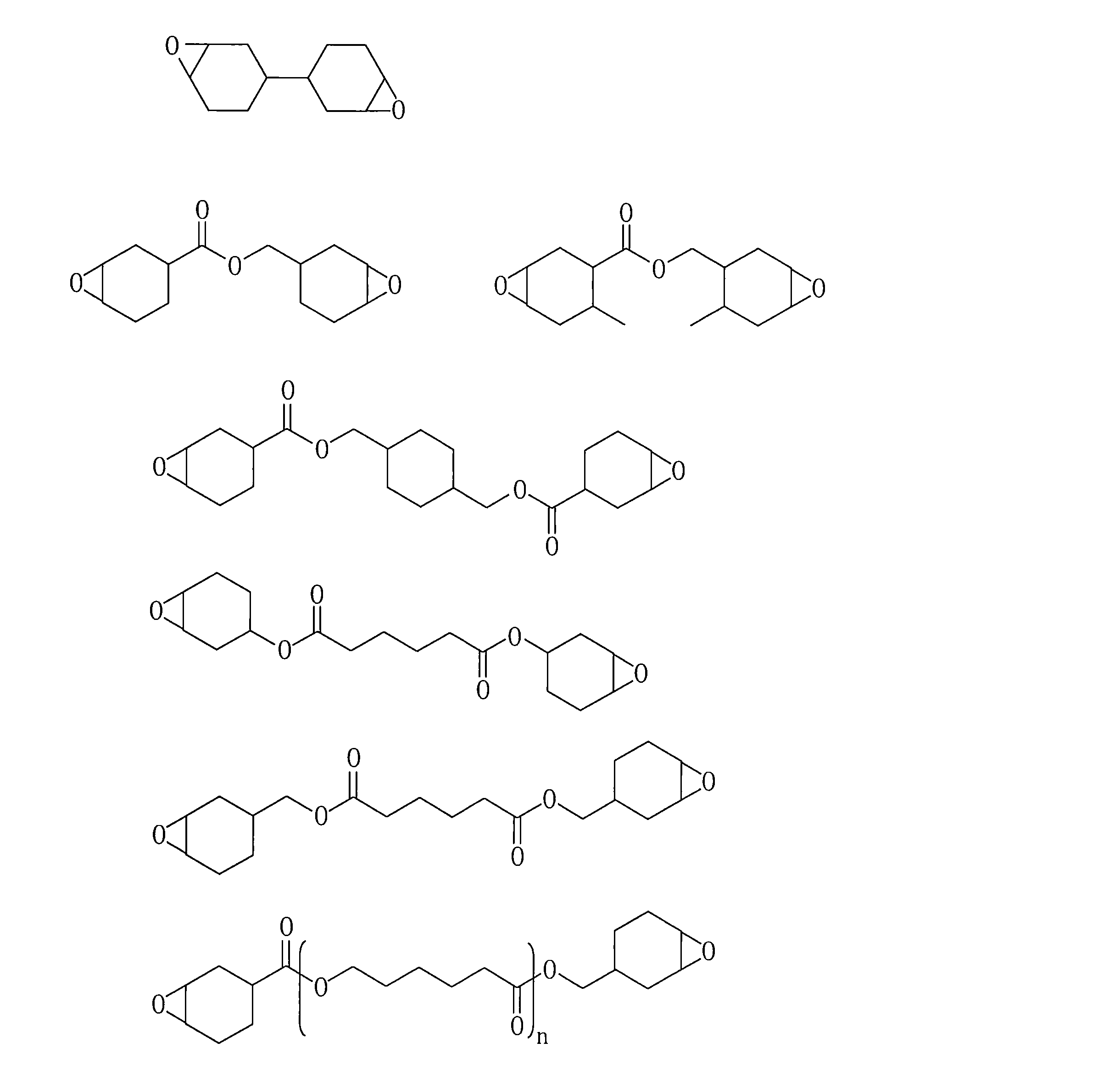
- Examples of such alicyclic epoxy compound (A) include the following compounds.
- the alicyclic epoxy compound represented by the general formula (I) is produced by oxidizing a corresponding alicyclic olefin compound with an aliphatic percarboxylic acid or the like, and a substantially anhydrous aliphatic percarboxylic acid is converted into an alicyclic epoxy compound.
- Those produced by using them are preferred in that they have a high epoxidation rate (Japanese Patent Application Laid-Open No. 2002-275169).
- Y represents a single bond or a linking group.
- the linking group include a divalent hydrocarbon group, a carbonyl group (—CO—), an ether bond (—O—), and an ester bond. (—COO—), amide bond (—CONH—), carbonate bond (—OCOO—), and groups in which a plurality of these are linked.
- the divalent hydrocarbon group include linear or branched alkylene groups having 1 to 18 carbon atoms (particularly 1 to 6) and divalent alicyclic hydrocarbon groups (particularly divalent cycloalkylene groups). And the like are preferably exemplified.
- examples of the linear or branched alkylene group include methylene, methylmethylene, dimethylmethylene, ethylene, propylene, and trimethylene groups.
- examples of the divalent alicyclic hydrocarbon group include 1,2-cyclopentylene, 1,3-cyclopentylene, cyclopentylidene, 1,2-cyclohexylene, 1,3-cyclohexylene, Examples include 1,4-cyclohexylene and cyclohexylidene groups.
- n is an integer from 1 to 30.
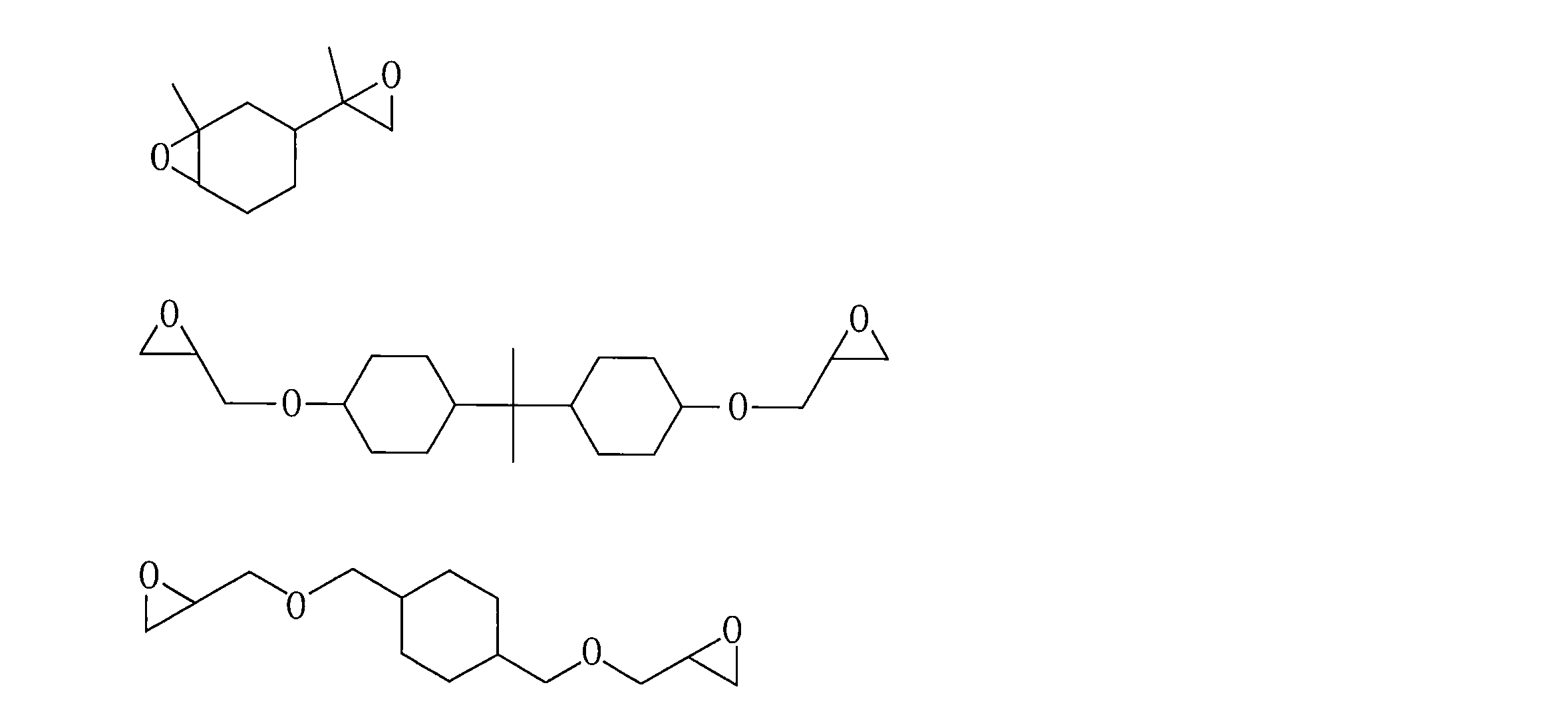
- alicyclic epoxy compound which is the component (A) of the present invention in addition to the above, only one of the two epoxy groups is formed to include two adjacent carbon atoms constituting the cycloaliphatic skeleton.
- limonene diepoxide and glycidyl ether compounds for example, glycidyl ether type epoxy compounds having a cycloaliphatic skeleton and a glycidyl ether group
- the epoxy group does not contain a carbon atom constituting the cycloaliphatic skeleton.
- Specific examples of the compound described above include the following compounds.
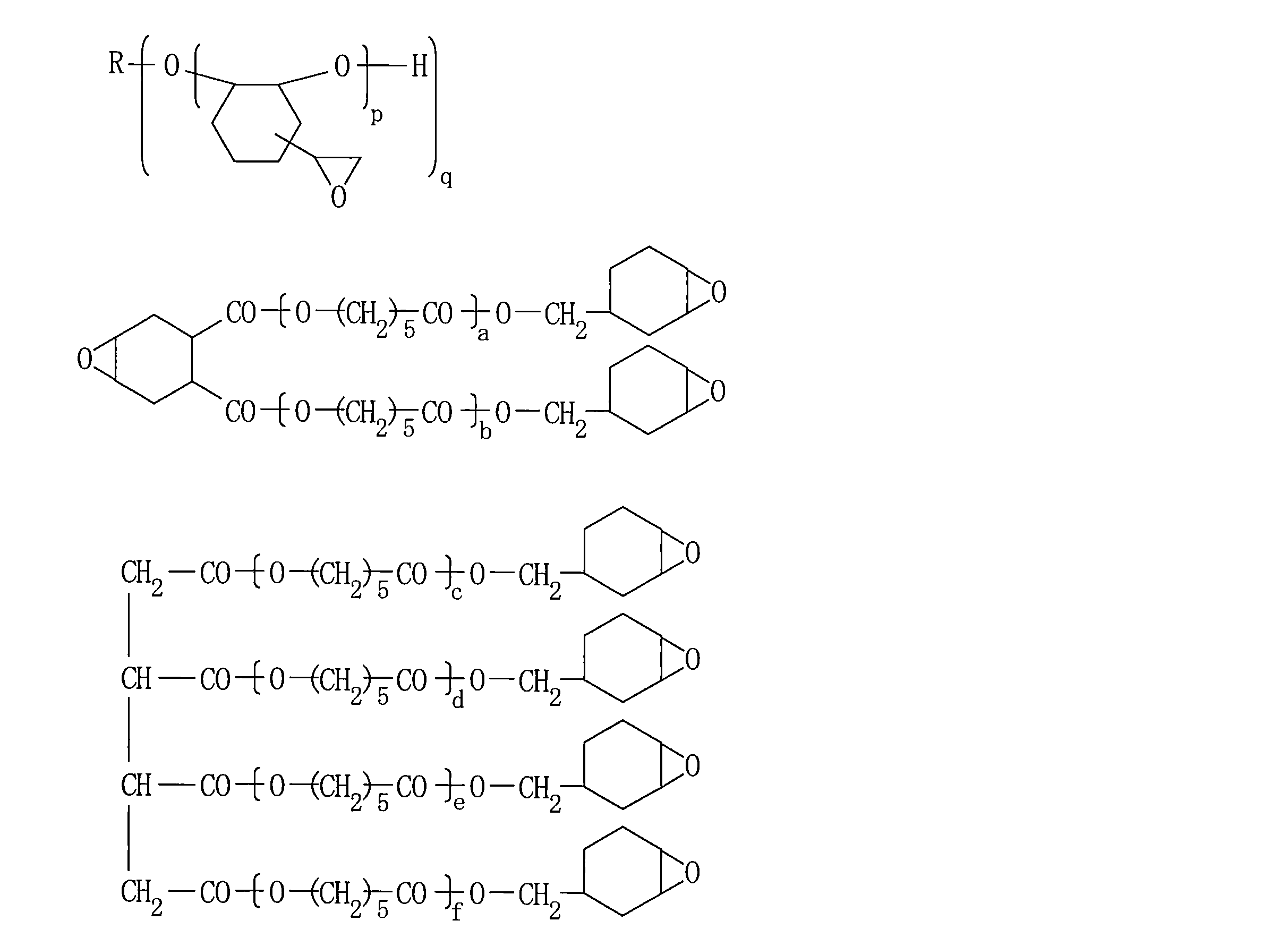
- alicyclic epoxy compound which is the component (A) of the present invention a polyfunctional epoxy compound having 3 or more epoxy groups can be used. Specifically, the following compounds are exemplified.
- a, b, c, d, e, and f are integers of 0 to 30.
- R is a group obtained by dividing q OH from a q-valent alcohol [R— (OH) q ]
- p is an integer of 1 to 50
- q is an integer of 1 to 10.
- p may be the same or different.
- Examples of the q-valent alcohol [R- (OH) q ] include monohydric alcohols such as methanol, ethanol, 1-propanol, isopropyl alcohol and 1-butanol; ethylene glycol, 1,2-propanediol, 1, Divalent alcohols such as 3-propanediol, 1,4-butanediol, neopentyl glycol, 1,6-hexanediol, diethylene glycol, triethylene glycol, tetraethylene glycol, dipropylene glycol, polypropylene glycol; glycerin, diglycerin And trivalent or higher alcohols such as erythritol, trimethylolethane, trimethylolpropane, pentaerythritol, dipentaerythritol, sorbitol, and the like.
- monohydric alcohols such as methanol, ethanol, 1-propanol, isopropyl alcohol and 1-butanol
- the alcohol may be polyether polyol, polyester polyol, polycarbonate polyol, polyolefin polyol, or the like.
- the alcohol is preferably an aliphatic alcohol having 1 to 10 carbon atoms (particularly, an aliphatic polyhydric alcohol such as trimethylolpropane).
- the alicyclic epoxy compound (A) having a cycloaliphatic skeleton and two or more epoxy groups in the molecule can be used alone or in combination of two or more.
- the amount of the alicyclic epoxy compound as component (A) is not particularly limited, but it is 5 to 80 parts by weight with respect to the total amount (100 parts by weight) of component (A) and component (B) described later.
- the amount is preferably 10 to 75 parts by weight, more preferably 20 to 65 parts by weight.
- the compounding quantity of an alicyclic epoxy compound exceeds 80 weight part, the addition effect of the component (B) mentioned later may not be exhibited.
- the cured product may be brittle and unusable.
- low-viscosity compounds such as low-viscosity cycloalkylene glycol diglycidyl ether having a viscosity at 25 ° C. of 500 mPa ⁇ s or less are the other components (A). By using together, it can also serve as a reactive diluent.
- examples of such cycloalkylene glycol diglycidyl ether include cyclohexanedimethanol diglycidyl ether, cyclohexanediol diglycidyl ether, and hydrogenated bisphenol A type epoxy resin.
- the reactive diluent liquid bisphenol A type, F type glycidyl type epoxy resin, glycidyl amine type epoxy resin or the like having an aromatic ring may be used.
- the amount of the reactive diluent is preferably 20 parts by weight or less with respect to 100 parts by weight of the alicyclic epoxy compound as the component (A). More preferably, it is 15 parts by weight or less. When the compounding amount of the reactive diluent exceeds 20 parts by weight, it is difficult to obtain desired performance.
- the alicyclic epoxy compound used as the component (A) of the present invention is preferably in a liquid form from the viewpoint of improving workability during preparation and casting.
- the viscosity of the liquid curable epoxy resin composition after blending each component is, for example, 150,000 mPa ⁇ s or less at 25 ° C. as described above. If so, it can be used.
- solid epoxy compounds examples include solid bisphenol-type epoxy compounds, novolac-type epoxy compounds, glycidyl esters, triglycidyl isocyanurate, and trade name “EHPE-3150” (manufactured by Daicel Chemical Industries, Ltd.). Epoxidized cyclohexane polyether) and the like. These solid epoxy compounds may be used alone or in combination of two or more.
- the compounding amount of the solid epoxy compound is such that the viscosity of the liquid curable epoxy resin composition does not exceed 150,000 mPa ⁇ s at 25 ° C., for example.
- the silica (B) used in the liquid curable epoxy resin composition of the present invention is not particularly limited, and known or commonly used silica can be used. Specific examples include fused silica, crystalline silica, and high-purity synthetic silica. Especially, as said (B) silica, a fused silica and a high purity synthetic silica are preferable from viewpoints of the viscosity stability of an epoxy resin composition, the thermal expansion coefficient of a resin cured product, electrical characteristics, and the like. In addition, a silica (B) can be used individually by 1 type or in combination of 2 or more types.
- the shape of the silica (B) is not particularly limited, and examples thereof include a spherical shape, a crushed shape, a fiber shape, a needle shape, a scale shape, and a whisker shape. Among these, spherical shape is preferable from the viewpoint of quality stability at a high filling rate.
- the average particle diameter of silica (B) is not particularly limited, but is preferably from 0.1 to 50 ⁇ m, more preferably from 0.2 to 35 ⁇ m, from the viewpoint of quality stability at a high filling rate.
- the average particle diameter means a particle diameter (also referred to as “median diameter”) at an integrated value of 50% in a particle size distribution measured by a laser diffraction / scattering method.
- silica (B) for example, a commercial product such as a trade name “Furex RD-8” (manufactured by Tatsumori Co., Ltd.) and a trade name “HPS-0500” (manufactured by Toagosei Co., Ltd.) should be used. You can also.
- the blending amount of silica as the component (B) is not particularly limited, but is preferably 20 to 95 parts by weight, more preferably 25 with respect to the total amount (100 parts by weight) of the component (A) and the component (B). It is ⁇ 90 parts by weight, more preferably 30 to 85 parts by weight. If the blending amount of silica exceeds 95 parts by weight, the cured product may be brittle and unusable. On the other hand, if it is less than 20 parts by weight, the thermal expansion coefficient of the resin cured product may become too large.
- Preferred examples of the phosphite (C) include 9,10-dihydro-9-oxa-10-phosphaphenanthrene-10-oxide, bis (2,6-di-t-butyl-4-methyl) Phenyl) pentaerythritol-diphosphite, bis (2,4-di-t-butylphenyl) pentaerythritol-diphosphite, tris (2,4-di-t-butylphenyl) phosphite, tris (mono, dinonylphenyl) phos Phyto, tris (2-ethylhexyl) phosphite, triphenyl phosphite, tris (monononylphenyl) phosphite, trisisodecyl phosphite and the like can be mentioned.
- phosphorous acid ester (C) can be used individually by 1 type or in combination of 2 or more
- Examples of the phosphite ester (C) include trade names “JP-360” and “JP-308E” (manufactured by Johoku Chemical Industry Co., Ltd.), trade names “IRGAFOS168” (Ciba Specialty Chemicals) Product name) “Sanko Epochlean” (manufactured by Sanko Co., Ltd.), product names “Adeka Stub 3010”, “Adeka Stub PEP-36” (manufactured by ADEKA Co., Ltd.), and the like.
- the amount of the phosphite that is component (C) is not particularly limited, but is preferably 0.001 to 5.0 parts by weight with respect to 100 parts by weight of the total amount of component (A) and component (B). More preferably, the amount is 0.005 to 1.0 part by weight, and still more preferably 0.01 to 0.5 part by weight. If the amount of the phosphite ester (C) exceeds 5.0 parts by weight, the hydrolysis resistance may deteriorate. On the other hand, when it is less than 0.001 part by weight, the viscosity stability of the liquid curable epoxy resin composition becomes insufficient, and the storage stability may be lowered.
- the liquid curable epoxy resin composition of the present invention may contain, for example, other components in addition to the main component composed of the component (A), the component (B), and the component (C). Good.
- the liquid curable epoxy resin composition of the present invention may contain, for example, a curing agent (D) and a curing accelerator (E) or a curing catalyst (F) in addition to the main agent. .
- the curing agent (D) functions to react with the alicyclic epoxy compound (A) to cure the epoxy resin composition.
- the curing agent (D) generally known curing agents can be used as epoxy resin curing agents.
- the curing agent (D) is preferably an acid anhydride which is liquid at 25 ° C., for example, methyltetrahydrophthalic anhydride, methylhexahydrophthalic anhydride, dodecenyl succinic anhydride, methylendomethylenetetrahydrophthalic anhydride, etc. Can be mentioned.
- curing agent (D) can be used individually or in combination of 2 or more types.
- solid acid anhydrides at room temperature such as phthalic anhydride, tetrahydrophthalic anhydride, hexahydrophthalic anhydride, methylcyclohexene dicarboxylic acid anhydride are liquid at room temperature (about 25 ° C.). It is preferably dissolved in an acid anhydride and used as a liquid mixture.
- curing material can be obtained by the acid anhydride hardening by the heat
- the product name “Licacid MH” (manufactured by Shin Nippon Rika Co., Ltd.), the product name “Rikacid MH-700” (manufactured by Shin Nippon Rika Co., Ltd.), and the product name “HN-5500” ( Commercial products such as Hitachi Chemical Co., Ltd.) can also be used.
- the amount of the curing agent (D) is not particularly limited, but is preferably 50 to 150 parts by weight, more preferably 52 to 145 parts by weight, and still more preferably 55 to 140 parts by weight with respect to 100 parts by weight of the component (A). Parts by weight. More specifically, an effective amount capable of exhibiting the effect as a curing agent, that is, 0 per 1 equivalent of epoxy group in the alicyclic epoxy compound as the component (A) and other epoxy compounds optionally added. It is preferable to use the acid anhydride in a proportion of 5 to 1.5.
- the curing accelerator (E) is not particularly limited as long as it is a curing accelerator generally used for accelerating the curing of the epoxy compound.
- a curing accelerator generally used for accelerating the curing of the epoxy compound.
- tertiary amines, tertiary amine salts, imidazoles, Organic phosphorus compounds, quaternary ammonium salts, quaternary phosphonium salts, organometallic salts, boron compounds, and the like can be used.
- a hardening accelerator (E) can be used individually or in combination of 2 or more types.
- Tertiary amines include, for example, lauryl dimethylamine, N, N-dimethylcyclohexylamine, N, N-dimethylbenzylamine, N, N-dimethylaniline, (N, N-dimethylaminomethyl) phenol, 2,4 , 6-tris (N, N-dimethylaminomethyl) phenol, 1,8-diazabicyclo [5.4.0] undecene-7 (DBU), 1,5-diazabicyclo [4.3.0] nonene-5 ( DBN).
- lauryl dimethylamine N, N-dimethylcyclohexylamine, N, N-dimethylbenzylamine, N, N-dimethylaniline, (N, N-dimethylaminomethyl) phenol, 2,4 , 6-tris (N, N-dimethylaminomethyl) phenol, 1,8-diazabicyclo [5.4.0] undecene-7 (DBU), 1,5-diazabicyclo [4.3
- Examples of the tertiary amine salt include carboxylates, sulfonates, and inorganic acid salts of the above tertiary amines.
- Examples of the carboxylate include salts of carboxylic acids having 1 to 30 carbon atoms (particularly 1 to 10 carbon atoms) such as octylate (particularly salts of fatty acids).
- Examples of the sulfonate include p-toluenesulfonate, benzenesulfonate, methanesulfonate, and ethanesulfonate.
- tertiary amine salts include salts of 1,8-diazabicyclo [5.4.0] undecene-7 (DBU) (for example, p-toluenesulfonate, octylate).
- DBU 1,8-diazabicyclo [5.4.0] undecene-7
- imidazoles examples include 2-methylimidazole, 2-ethylimidazole, 2-undecylimidazole, 2-heptadecylimidazole, 1,2-dimethylimidazole, 2-ethyl-4-methylimidazole, 2-phenylimidazole, 2-phenyl-4-methylimidazole, 1-benzyl-2-methylimidazole, 1-benzyl-2-phenylimidazole, 1-cyanoethyl-2-methylimidazole, 1-cyanoethyl-2-ethyl-4-methylimidazole, 1 -Cyanoethyl-2-undecylimidazole, 1-cyanoethyl-2-phenylimidazole, 2,4-diamino-6- (2-methylimidazolylethyl) -1,3,5-triazine, 2,4-diamino-6- (2-Undecylimidazolyl ) -1,3,
- organic phosphorus compounds examples include triphenylphosphine.
- Examples of the quaternary ammonium salt include tetraethylammonium bromide and tetrabutylammonium bromide.
- a quaternary phosphonium salt for example, the following general formula (II) (Wherein R 1 , R 2 , R 3 and R 4 are the same or different and represent a hydrocarbon group having 1 to 16 carbon atoms, X represents an anion residue of carboxylic acid or organic sulfonic acid)
- the compound etc. which are represented by these are mentioned.
- hydrocarbon group having 1 to 16 carbon atoms examples include straight chain such as methyl, ethyl, propyl, isopropyl, butyl, isobutyl, s-butyl, t-butyl, pentyl, hexyl, octyl, decyl, dodecyl groups, etc. Or branched alkyl group; linear or branched alkenyl group such as vinyl, allyl, crotyl group; aryl group such as phenyl, toluyl, xylyl, naphthyl, anthryl, phenanthryl group; benzyl, phenethyl group, etc. And aralkyl groups. Among these, a linear or branched alkyl group having 1 to 6 carbon atoms, particularly a butyl group is preferable.
- Examples of the “carboxylic acid” in the “anionic residue of carboxylic acid or organic sulfonic acid” include aliphatic monocarboxylic acids having 1 to 20 carbon atoms such as octanoic acid, decanoic acid, lauric acid, myristic acid, and palmitic acid. 1,2,4,5-cyclohexanetetracarboxylic acid, bicyclo [2.2.1] heptane-2,3-dicarboxylic acid, methylbicyclo [2.2.1] heptane-2,3-dicarboxylic acid, etc.
- Examples thereof include alicyclic carboxylic acids (monocyclic alicyclic mono- or polycarboxylic acids, cross-linked cyclic mono- or polycarboxylic acids).
- the alicyclic ring of the alicyclic carboxylic acid includes a linear or branched alkyl group having 1 to 4 carbon atoms such as a methyl group, an alkoxy group having 1 to 4 carbon atoms such as a methoxy group, and a chlorine atom.
- a substituent such as a halogen atom may be bonded.
- the carboxylic acid an aliphatic monocarboxylic acid having 10 to 18 carbon atoms and an alicyclic polycarboxylic acid having 8 to 18 carbon atoms are preferable.
- organic sulfonic acid in the “anionic residue of carboxylic acid or organic sulfonic acid” include, for example, methanesulfonic acid, ethanesulfonic acid, 1-propanesulfonic acid, 2-propanesulfonic acid, 1-butanesulfonic acid, Aliphatic sulfonic acids such as 1-pentanesulfonic acid, 1-hexanesulfonic acid, 1-octanesulfonic acid, 1-decanesulfonic acid, 1-dodecanesulfonic acid (for example, aliphatic sulfonic acids having 1 to 16 carbon atoms) Benzenesulfonic acid, p-toluenesulfonic acid, 4-ethylbenzenesulfonic acid, 3- (linear or branched octyl) benzenesulfonic acid, 4- (linear or branched octyl) benzenesulfonic acid,
- quaternary phosphonium salts include tetrabutylphosphonium decanoate, tetrabutylphosphonium laurate, tetrabutylphosphonium myristate, tetrabutylphosphonium palmitate, tetrabutylphosphonium cation and bicyclo [2.2.
- organic metal salt examples include tin octylate, zinc octylate, dibutyltin dilaurate, and an aluminum acetylacetone complex.
- boron compounds include boron trifluoride and triphenyl borate.
- curing accelerator (E) commercial products such as “U-CAT SA-506”, “U-CAT SA-102”, “U-CAT 5003” (above, manufactured by San Apro Co., Ltd.) are used. You can also
- the blending amount of the curing accelerator (E) is not particularly limited, but is preferably 0.05 to 5 parts by weight, more preferably 0.1 to 3 parts by weight, more preferably 100 parts by weight of the curing agent (D).
- the amount is preferably 0.2 to 3 parts by weight, particularly preferably 0.25 to 2.5 parts by weight.
- the curing accelerator (E) is less than 0.05 parts by weight, the curing acceleration effect may be insufficient.
- the blending amount of the curing accelerator (E) exceeds 5 parts by weight, the hue of the cured product may be deteriorated.
- the curing accelerator (E) is a compound having a function of accelerating the curing reaction when the epoxy compound is cured with an acid anhydride.
- the curing catalyst (F) is a cationic polymerization initiator (cationic catalyst).
- the cationic polymerization initiator is an initiator that releases a substance that initiates cationic polymerization by heating or light.
- examples of the cationic polymerization initiator that generates cationic species by heating include aryldiazonium salts, aryliodonium salts, arylsulfonium salts, and allene-ion complexes.
- PP-33 CP-66, CP-77 (manufactured by ADEKA), FC-509 (manufactured by 3M), UVE1014 (manufactured by GE), Sun-Aid SI-60L, Sun-Aid SI-80L, Sun-Aid SI-100L, Sun-Aid SI
- Commercially available products such as ⁇ 110L (manufactured by Sanshin Chemical Industry Co., Ltd.) and CG-24-61 (manufactured by Ciba Japan Co., Ltd.) can be preferably used.
- a chelate compound of a metal such as aluminum or titanium and a acetoacetate or diketone compound and a silanol such as triphenylsilanol or a chelate compound of a metal such as aluminum or titanium and acetoacetate or diketone and bisphenol S
- a chelate compound of a metal such as aluminum or titanium and acetoacetate or diketone and bisphenol S
- the compound with phenols, such as these may be sufficient.
- examples of the cationic polymerization initiator that generates cationic species by ultraviolet irradiation include hexafluoroantimonate salts, pentafluorohydroxyantimonate salts, hexafluorophosphate salts, hexafluoroarsenate salts, and the like.
- the product name “CPI-100P” (manufactured by Sun Apro Co., Ltd.), the product names “CD-1010”, “CD-1011”, “CD-1012” (above, manufactured by Sartomer, USA), the product name “ Commercial products such as “Irgacure 264” (manufactured by Ciba Japan Co., Ltd.) and trade name “CIT-1682” (manufactured by Nippon Soda Co., Ltd.) can be preferably used.
- a resin composition can be obtained by cationic curing with heat or light of the liquid curable epoxy resin composition of the present invention.
- the amount of the curing catalyst (F) is not particularly limited, but is preferably 0.01 to 15 parts by weight, more preferably 0.05 to 12 parts by weight, and still more preferably 100 parts by weight of the component (A). Is 0.1 to 10 parts by weight.
- the liquid curable epoxy resin composition of this invention may contain the polyester polyol and / or polycarbonate polyol which have a 2 or more terminal hydroxyl group in a molecule
- the hydroxyl group may be an alcoholic hydroxyl group or a phenolic hydroxyl group.
- the polyester polyol or polycarbonate polyol is not particularly limited as long as it can form a liquid curable epoxy resin composition after being blended with the component (A) and the like.
- the polyester polyol or polycarbonate polyol itself is also liquid. It is preferable.
- the number average molecular weight of the polyester polyol or polycarbonate polyol is preferably 200 to 10,000, more preferably 300 to 5,000, and still more preferably 400 to 4,000. When the molecular weight is less than 200, the effects of lowering the elastic modulus and improving the bending strength may be reduced. When the molecular weight exceeds 10,000, the liquid may not be liquid at normal temperature (25 ° C.).
- the blending amount (total amount) of the polyester polyol and / or polycarbonate polyol is preferably 5 to 50 parts by weight, more preferably 10 to 45 parts by weight, and still more preferably 20 to 40 parts by weight with respect to 100 parts by weight of the component (A). It is.
- the blending amount of the polyester polyol and / or polycarbonate polyol exceeds 50 parts by weight, the bending strength is improved, but the heat resistance and transparency may be lowered. On the other hand, if it is less than 5 parts by weight, the effect obtained by adding the polyester polyol and / or polycarbonate polyol may be reduced.
- the polyester polyol and / or polycarbonate polyol may be composed of either a linear polyol or a branched polyol, and may be composed of two or more linear or branched polyols, Moreover, you may be comprised from the linear polyol and the branched polyol.
- the polyester polyol is a polyester polyol having an ester skeleton in the molecule, and is synthesized by a transesterification reaction, a ring-opening polymerization of a lactone, and the like in the same manner as a method for producing a normal polyester polyol.
- Examples of the polyol used in the synthesis of the polyester polyol include ethylene glycol, diethylene glycol, 1,3-propanediol, 1,4-butanediol, 1,3-butanediol, 2,3-butanediol, and 1,5-pentane.
- Diol 3-methyl-1,5-pentanediol, 1,6-hexanediol, 2,6-hexanediol, 1,4-cyclohexanedimethanol, 1,12-dodecanediol, polybutadienediol, neopentyl glycol, tetra Methylene glycol, propylene glycol, dipropylene glycol, glycerin, trimethylolpropane, 1,3-dihydroxyacetone, hexylene glycol, 1,2,6-hexanetriol, ditrimethylolpropane, pentaerythritol Le and the like.
- carboxylic acid used in the synthesis of the polyester polyol oxalic acid, adipic acid, sebacic acid, fumaric acid, malonic acid, succinic acid, glutaric acid, azelaic acid, citric acid, 2,6-naphthalenedicarboxylic acid, phthalic acid , Isophthalic acid, terephthalic acid, citraconic acid, 1,10-decanedicarboxylic acid, methylhexahydrophthalic anhydride, hexahydrophthalic anhydride, methyltetrahydrophthalic anhydride, tetrahydrophthalic anhydride, pyromellitic anhydride, tri Examples include merit acid, lactic acid, malic acid, glycolic acid, dimethylolpropionic acid, and dimethylolbutanoic acid.
- lactones used in ring-opening polymerization of lactones include ⁇ -caprolactone, ⁇ -valerolactone, and
- polyester polyol Commercially available products of the above-mentioned polyester polyol include trade names Plaxel 205U, L205AL, L208AL, L212AL, L220AL, L230AL, 220ED, 220EC, 220EB, 303, 305, 308, 312, L312AL, 320, L320AL, 410, 410D, P3403, E227, DC2009, DC2016, DC2209 (above, manufactured by Daicel Chemical Industries, Ltd.).
- the polycarbonate polyol is a polycarbonate polyol having a carbonate skeleton, and is a phosgene method, or a carbonate exchange reaction using a dialkyl carbonate such as dimethyl carbonate or diethyl carbonate, or diphenyl carbonate in the same manner as a method for producing a normal polycarbonate polyol (Japanese Patent Application Laid-Open (JP-A)). 62-187725, JP-A-2-175721, JP-A-2-49025, JP-A-3-220233, JP-A-3-252420 and the like. Since the carbonate bond is less susceptible to thermal decomposition, the resin cured product made of polycarbonate polyol exhibits excellent stability even under high temperature and high humidity.
- Examples of the polyol used in the carbonate exchange reaction together with the dialkyl carbonate include 1,6-hexanediol, ethylene glycol, diethylene glycol, 1,3-propanediol, 1,4-butanediol, 1,3-butanediol, 2,3- Butanediol, 1,5-pentanediol, 3-methyl-1,5-pentanediol, 1,4-cyclohexanedimethanol, 1,12-dodecanediol, butadiene diol, neopentyl glycol, tetramethylene glycol, propylene glycol, Examples include dipropylene glycol.
- the number average molecular weight of the polycarbonate polyol is not particularly limited, but is preferably 200 to 10,000, more preferably 300 to 5,000, and still more preferably 400 to 4,000. When the number average molecular weight is less than 200, the effect of lowering the elastic modulus and improving the bending strength may be reduced. When the number average molecular weight exceeds 10,000, the liquid may not be liquid at normal temperature (25 ° C.).
- polycarbonate polyols include Plaxel CD 205, CD 210, CD 220, CD 205PL, CD 205HL, CD 210PL, CD 210HL, CD 220PL, CD 220HL, CD 220EC, CD 221T (above, Daicel Chemical Industries, Ltd.) ), ETERNACOLL UH-CARB50, UH-CARB100, UH-CARB300, UH-CARB90 (1/3), UH-CARB90 (1/1), UH-CARB100 (above, manufactured by Ube Industries, Ltd.), Duranol T6002, T5652, T4672, T4692, G3452 (the above, Asahi Kasei Chemicals Co., Ltd. product) etc. are mentioned.
- the blending amount of the polycarbonate polyol is not particularly limited, but is preferably 5 to 50 parts by weight, more preferably 10 to 45 parts by weight, and further preferably 20 to 40 parts by weight with respect to 100 parts by weight of the component (A). .
- the blending amount of the polycarbonate polyol exceeds 50 parts by weight, the bending strength is improved, but the transparency may be lowered.
- the blending amount is less than 5 parts by weight, the effect obtained by adding the polycarbonate polyol is small. There is a case.
- the liquid curable epoxy resin composition of the present invention may contain a low molecular weight compound having a hydroxyl group, if necessary.
- the low molecular weight compound having the hydroxyl group By including the low molecular weight compound having the hydroxyl group, the curing reaction can be allowed to proceed slowly.
- the low molecular weight compound having a hydroxyl group include ethylene glycol, diethylene glycol, and glycerin.
- the low molecular weight compound having a hydroxyl group is a low molecular weight substance, and is different from the above-described polyester polyol and polycarbonate polyol.
- various additives can be blended with the liquid curable epoxy resin composition of the present invention within a range that does not adversely affect the viscosity, electrical characteristics, and the like.
- additives include silicone-based and fluorine-based antifoaming agents, silane coupling agents such as ⁇ -glycidoxypropyltrimethoxysilane, fillers, antioxidants, flame retardants, and coloring agents.
- silicone-based and fluorine-based antifoaming agents silane coupling agents such as ⁇ -glycidoxypropyltrimethoxysilane
- fillers antioxidants, flame retardants, and coloring agents.
- antioxidants antioxidants, flame retardants
- coloring agents can be mentioned.
- the compounding quantity of these various additives is not specifically limited, It is preferable to set it as 5% or less on a weight basis with respect to a resin composition.
- the liquid curable epoxy resin composition of the present invention has low viscosity, high glass transition temperature when cured as a resin, and low water absorption, so that it can be used for sealing semiconductors, sealing optical semiconductors, etc. It can be preferably used for adhesive applications, sealers, coil casting applications, substrate material applications, and the like. Among these, it is particularly preferable to use as a resin composition for semiconductor encapsulation.
- the liquid curable epoxy resin composition of the present invention is not particularly limited, but can be cured into a cured resin by heating and / or irradiation with light (active energy rays) such as ultraviolet rays.
- the cured resin product of the present invention can be obtained by curing the liquid curable epoxy resin composition of the present invention.
- the cured resin of the present invention contains at least a site derived from an alicyclic epoxy compound (A) having a cycloaliphatic skeleton and two or more epoxy groups in the molecule, and silica (B).
- the semiconductor device of the present invention is formed by sealing a semiconductor element with the liquid curable epoxy resin composition of the present invention used for semiconductor encapsulation.
- the liquid curable epoxy resin composition of the present invention includes a main agent (mixture of component (A), component (B), and component (C)), a curing agent, a curing accelerator, and the like, or a main agent and a curing catalyst. It is obtained by blending etc.
- the above main agent alone can be used as the liquid curable epoxy resin composition of the present invention.
- the liquid curable epoxy resin composition of the present invention is preferably used for a thermosetting resin composition, a light (active energy ray) curable resin composition, and the like.
- a known method can be used. For example, a predetermined amount of each component (A), component (B), main component of component (C), and optionally used additives (for example, component (D), component (E), component (F), etc. ), Preferably by stirring and mixing while excluding bubbles under vacuum heating.
- the temperature at the time of stirring and mixing is usually preferably set to 10 to 150 ° C. If the set temperature at the time of preparation is less than 10 ° C, the viscosity is too high to make uniform stirring / mixing work difficult. Conversely, if the temperature at the time of preparation exceeds 150 ° C, a curing reaction occurs and normal liquid curing occurs.
- a conductive epoxy resin composition cannot be obtained.
- a general-purpose device such as a uniaxial or multi-axial extruder, kneader, or dissolver equipped with a decompression device may be used, for example, by stirring and mixing for about 10 minutes. Good.
- the prepared liquid curable epoxy resin composition is poured into a predetermined mold, and cured (heat-cured or photocured) under predetermined conditions to perform semiconductor sealing or the like.
- the curing temperature when the liquid curable epoxy resin composition of the present invention is heat-cured is not particularly limited, but is preferably 100 to 200 ° C., more preferably 100 to 190 ° C., more preferably 100 to 180 ° C.
- the curing time is preferably, for example, 30 to 600 minutes, more preferably 45 to 540 minutes, and still more preferably 60 to 480 minutes. If the curing temperature and curing time are lower (shorter) than the lower limit of the above range, curing will be insufficient.
- the curing conditions depend on various conditions, but can be appropriately adjusted by shortening the curing time when the curing temperature is high, and increasing the curing time when the curing temperature is low. Curing can also be performed in multiple stages.
- the active energy ray (light) irradiated when the liquid curable epoxy resin composition of the present invention is photocured (photocationic curing) is not particularly limited, and examples thereof include ultraviolet rays and electron beams, Of these, ultraviolet rays can be preferably used.
- the wavelength of the ultraviolet light can be appropriately selected according to the type of the curing catalyst.
- the irradiation condition of the active energy ray can be appropriately selected according to the type and thickness of the epoxy resin composition, the type and amount of the curing catalyst, and is not particularly limited.
- the irradiation amount (dose) is preferably 10 to 10,000 mJ / cm 2 , more preferably 50 to 5,000 mJ / cm 2 .
- the ultraviolet irradiation source include a high pressure mercury lamp, an ultrahigh pressure mercury lamp, a xenon lamp, a carbon arc, a metal halide lamp, sunlight, and an LED lamp.
- the liquid curable epoxy resin composition of the present invention may be further heated as necessary.
- effects such as reduction of unreacted substances in the cured resin, improvement of the degree of curing of the cured resin, relaxation of distortion, and the like can be obtained.
- the effect of improving the hardness and adhesion of the cured resin may be obtained.
- the above heating can usually be performed at an ambient temperature of 100 to 200 ° C. for 1 to 300 minutes.
- Viscosity stability The viscosity before and after heating (heating stirring) when the liquid curable epoxy resin composition was stirred at 120 ° C. for 1 hour was measured. The viscosity was measured using an E-type viscometer [“TVE-22H” manufactured by Toki Sangyo Co., Ltd.] (25 ° C.).
- Example 1 A resin composition containing 60 parts by weight of 3,4-epoxycyclohexylmethyl-3 ′, 4′-epoxycyclohexanecarboxylate as component (A) and 40 parts by weight of silica as component (B) (manufactured by Nano Resin Co., Ltd., Trade name “NANOPOX E600”) 100 parts by weight and as component (C), bis (2,6-di-t-butyl-4-methylphenyl) pentaerythritol diphosphite (manufactured by ADEKA Corporation, trade name “Adeka Stub”) PEP-36 ”) 0.5 part by weight was used as the main ingredient.
- component (B) manufactured by Nano Resin Co., Ltd., Trade name “NANOPOX E600”
- component (C) bis (2,6-di-t-butyl-4-methylphenyl) pentaerythritol diphosphite (manufactured by ADEKA Corporation, trade name
- Example 2 As component (A), 3,4-epoxycyclohexylmethyl-3 ′, 4′-epoxycyclohexanecarboxylate (manufactured by Daicel Chemical Industries, Ltd., trade name “Celoxide 2021P”), as component (B), 40 parts by weight of fused silica (manufactured by Tatsumori Co., Ltd., trade name “Furex RD-8”), as component (C), bis (2,6-di-t-butyl-4-methylphenyl) pentaerythritol- 0.5 parts by weight of diphosphite (trade name “ADK STAB PEP-36” manufactured by ADEKA Corporation) was used as a main agent.
- DK STAB PEP-36 diphosphite
- Comparative Example 1 A resin composition containing 60 parts by weight of 3,4-epoxycyclohexylmethyl-3 ′, 4′-epoxycyclohexanecarboxylate as component (A) and 40 parts by weight of silica as component (B) (manufactured by Nano Resin Co., Ltd., When the viscosity stability of the product name “NANOPOX E600”) was confirmed, the viscosity after heating and stirring was 3,380 mPa ⁇ s (viscosity before heating and stirring: 2,360 mPa ⁇ s).
- Comparative Example 2 Except not using component (C) bis (2,6-di-t-butyl-4-methylphenyl) pentaerythritol diphosphite (trade name “Adeka Stub PEP-36” manufactured by ADEKA Corporation) Compounding in the same manner as in Example 2, a liquid curable epoxy resin composition was obtained. When the viscosity stability of the obtained liquid curable epoxy resin composition was confirmed, the viscosity after heating and stirring was 5,700 mPa ⁇ s (viscosity after blending the main agent: 2,000 mPa ⁇ s).
- the liquid curable epoxy resin composition (Example) which mix
- the liquid curable epoxy resin composition of the present invention is an epoxy resin composition containing silica, has a low viscosity, and is excellent in storage stability (storage stability). Since the liquid curable epoxy resin composition of the present invention contains silica, the cured resin obtained by curing the composition has a low coefficient of thermal expansion, and can be used preferably as a resin composition for semiconductor encapsulation. .
Landscapes
- Chemical & Material Sciences (AREA)
- Health & Medical Sciences (AREA)
- Chemical Kinetics & Catalysis (AREA)
- Medicinal Chemistry (AREA)
- Polymers & Plastics (AREA)
- Organic Chemistry (AREA)
- Epoxy Resins (AREA)
- Compositions Of Macromolecular Compounds (AREA)
- Structures Or Materials For Encapsulating Or Coating Semiconductor Devices Or Solid State Devices (AREA)
Abstract
Description
本発明の液状硬化性エポキシ樹脂組成物に用いられる脂環式エポキシ化合物(A)は、分子内に環状脂肪族骨格と2個以上のエポキシ基を有する化合物であればよく、特に限定されないが、エポキシ基は環状脂肪族骨格を構成する隣接する2つの炭素原子を含んで形成されているものが好ましい。このような脂環式エポキシ化合物(A)としては、下記のような化合物が挙げられる。

本発明の液状硬化性エポキシ樹脂組成物に用いられるシリカ(B)は、特に限定されず、公知乃至慣用のシリカを用いることができる。具体的には、例えば、溶融シリカ、結晶シリカ、高純度合成シリカなどが挙げられる。中でも、上記(B)シリカとしては、エポキシ樹脂組成物の粘度安定性、樹脂硬化物の熱膨張率、電気特性等の観点で、溶融シリカ、高純度合成シリカが好ましい。なお、シリカ(B)は1種を単独で、又は2種以上を組み合わせて使用することができる。
次に、本発明における成分(C)である亜リン酸エステル(亜リン酸エステル化合物)について述べる。
上記硬化剤(D)は、脂環式エポキシ化合物(A)と反応してエポキシ樹脂組成物を硬化させる働きを有する。硬化剤(D)としては、一般にエポキシ樹脂用硬化剤として周知慣用の硬化剤を用いることができる。中でも、硬化剤(D)としては、25℃で液状の酸無水物が好ましく、例えば、メチルテトラヒドロ無水フタル酸、メチルヘキサヒドロ無水フタル酸、ドデセニル無水コハク酸、メチルエンドメチレンテトラヒドロ無水フタル酸などを挙げることができる。硬化剤(D)は単独で、又は2種以上を組み合わせて使用することができる。また、例えば、無水フタル酸、テトラヒドロ無水フタル酸、ヘキサヒドロ無水フタル酸、メチルシクロヘキセンジカルボン酸無水物などの常温(約25℃)で固体状の酸無水物は、常温(約25℃)で液状の酸無水物に溶解させ、液状の混合物として使用することが好ましい。
上記硬化促進剤(E)としては、エポキシ化合物の硬化を促進させるために一般に使用される硬化促進剤であれば特に限定されず、例えば、第三級アミン、第三級アミン塩、イミダゾール類、有機リン系化合物、第四級アンモニウム塩、第四級ホスホニウム塩、有機金属塩、ホウ素化合物などを用いることができる。硬化促進剤(E)は単独で、又は2種以上を組み合わせて使用することができる。
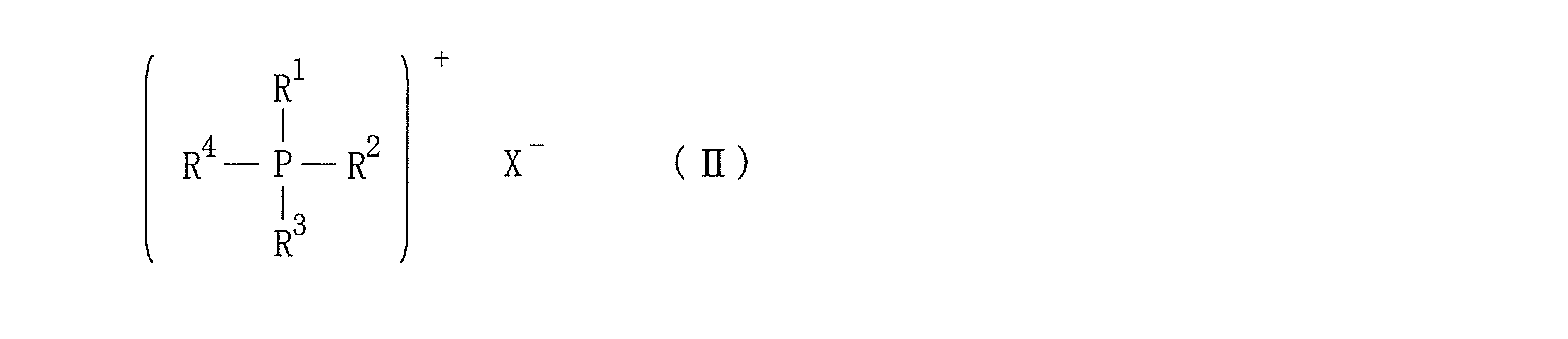
で表される化合物などが挙げられる。
上記硬化触媒(F)は、カチオン重合開始剤(カチオン触媒)である。上記カチオン重合開始剤は、加熱又は光によりカチオン重合を開始させる物質を放出する開始剤である。
本発明の液状硬化性エポキシ樹脂組成物は、必要に応じて、分子内に2個以上の末端水酸基を有するポリエステルポリオール及び/又はポリカーボネートポリオールを含んでいてもよい。上記ポリエステルポリオール及び/又はポリカーボネートポリオールを含むことにより、樹脂硬化物の耐熱性を維持したまま、耐ヒートサイクル性を向上させることができる。なお、上記水酸基はアルコール性水酸基でもフェノール性水酸基であってもよい。上記ポリエステルポリオール、又はポリカーボネートポリオールは、成分(A)等と配合された後に、液状の硬化性エポキシ樹脂組成物を形成できればよく、特に限定されないが、上記ポリエステルポリオール、又はポリカーボネートポリオール自体も液状であることが好ましい。上記ポリエステルポリオール、またはポリカーボネートポリオールの数平均分子量は200~10000が好ましく、より好ましくは300~5000、さらに好ましくは400~4000である。分子量が200未満では、低弾性率化、曲げ強度向上の効果が低下する場合があり、分子量が10000を超えると、常温(25℃)にて液状ではなくなる場合がある。ポリエステルポリオール及び/又はポリカーボネートポリオールの配合量(総量)は、成分(A)100重量部に対し、5~50重量部が好ましく、より好ましくは10~45重量部、さらに好ましくは20~40重量部である。上記ポリエステルポリオール及び/又はポリカーボネートポリオールの配合量が50重量部を超えると、曲げ強度は向上するが耐熱性や透明性が低下する場合がある。一方、5重量部未満では、上記ポリエステルポリオール及び/又はポリカーボネートポリオールを添加することにより得られる効果が小さくなる場合がある。
本発明の樹脂硬化物は、本発明の液状硬化性エポキシ樹脂組成物を硬化させることにより得られる。本発明の樹脂硬化物は、分子内に環状脂肪族骨格と2個以上のエポキシ基を有する脂環式エポキシ化合物(A)に由来する部位と、シリカ(B)とを少なくとも含んでいる。
本発明の半導体装置は、半導体封止用に用いられる本発明の液状硬化性エポキシ樹脂組成物によって半導体素子が封止されてなる。
液状硬化性エポキシ樹脂組成物を120℃にて1時間攪拌したときの、加熱(加熱攪拌)前後の粘度を測定した。粘度は、E型粘度計[東機産業(株)製「TVE-22H」]を用いて測定した(25℃)。
成分(A)として、3,4-エポキシシクロヘキシルメチル-3',4'-エポキシシクロヘキサンカルボキシレート60重量部、成分(B)として、シリカ40重量部が配合された樹脂組成物(ナノレジン社製、商品名「NANOPOX E600」)100重量部と、成分(C)として、ビス(2,6-ジ-t-ブチル-4-メチルフェニル)ペンタエリスリトール-ジホスファイト((株)ADEKA製、商品名「アデカスタブPEP-36」)0.5重量部とを主剤として用いた。
これらを、シンキー(株)製「あわとり練太郎」を用いて、室温下で20分間攪拌しながら混合することによって配合し、液状硬化性エポキシ樹脂組成物を得た。
得られた液状硬化性エポキシ樹脂組成物の粘度安定性を確認すると、加熱攪拌後の粘度は2,940mPa・sであった(主剤配合後(加熱攪拌前)の粘度:2,360mPa・s)。
成分(A)として、3,4-エポキシシクロヘキシルメチル-3',4'-エポキシシクロヘキサンカルボキシレート(ダイセル化学工業(株)製、商品名「セロキサイド2021P」)60重量部、成分(B)として、溶融シリカ((株)龍森製、商品名「ヒューズレックスRD-8」)40重量部、成分(C)として、ビス(2,6-ジ-t-ブチル-4-メチルフェニル)ペンタエリスリトール-ジホスファイト((株)ADEKA製、商品名「アデカスタブPEP-36」)0.5重量部を主剤として用いた。
これらを、80℃で90分間攪拌しながら混合することによって配合し、液状硬化性エポキシ樹脂組成物を得た。
得られた液状硬化性エポキシ樹脂組成物の粘度安定性を確認すると、加熱攪拌後の粘度は900mPa・sであった(主剤配合後の粘度:870mPa・s)。
成分(A)として、3,4-エポキシシクロヘキシルメチル-3',4'-エポキシシクロヘキサンカルボキシレート60重量部、成分(B)として、シリカ40重量部が配合された樹脂組成物(ナノレジン社製、商品名「NANOPOX E600」)の粘度安定性を確認すると、加熱攪拌後の粘度は3,380mPa・sであった(加熱攪拌前の粘度:2,360mPa・s)。
成分(C)のビス(2,6-ジ-t-ブチル-4-メチルフェニル)ペンタエリスリトール-ジホスファイト((株)ADEKA製、商品名「アデカスタブPEP-36」)を用いないこと以外は、実施例2と同様に配合し、液状硬化性エポキシ樹脂組成物を得た。
得られた液状硬化性エポキシ樹脂組成物の粘度安定性を確認すると、加熱攪拌後の粘度は5,700mPa・sであった(主剤配合後の粘度:2,000mPa・s)。
Claims (6)
- 分子内に環状脂肪族骨格と2個以上のエポキシ基を有する脂環式エポキシ化合物(A)と、シリカ(B)と、亜リン酸エステル(C)とで構成される液状硬化性エポキシ樹脂組成物。
- 分子内に環状脂肪族骨格と2個以上のエポキシ基を有する脂環式エポキシ化合物(A):5~80重量部
シリカ(B):20~95重量部
亜リン酸エステル(C):0.001~5.0重量部
を配合(成分(A)と成分(B)の合計量は100重量部である)してなる請求項1に記載の液状硬化性エポキシ樹脂組成物。 - さらに、硬化剤(D)及び硬化促進剤(E)、又は、硬化触媒(F)を含む請求項1又は2に記載の液状硬化性エポキシ樹脂組成物。
- 半導体封止用である請求項1~3のいずれかの項に記載の液状硬化性エポキシ樹脂組成物。
- 請求項1~4のいずれかの項に記載の液状硬化性エポキシ樹脂組成物を硬化させて得られる樹脂硬化物。
- 請求項4に記載の半導体封止用の液状硬化性エポキシ樹脂組成物によって半導体素子が封止されてなる半導体装置。
Priority Applications (5)
| Application Number | Priority Date | Filing Date | Title |
|---|---|---|---|
| EP11844984.2A EP2647667B1 (en) | 2010-11-30 | 2011-11-09 | Curable epoxy resin composition |
| ES11844984T ES2750565T3 (es) | 2010-11-30 | 2011-11-09 | Composición de resina epoxi curable |
| CN201180050239.4A CN103168074B (zh) | 2010-11-30 | 2011-11-09 | 固化性环氧树脂组合物 |
| KR1020137016598A KR101829948B1 (ko) | 2010-11-30 | 2011-11-09 | 경화성 에폭시 수지 조성물 |
| US13/883,297 US9200133B2 (en) | 2010-11-30 | 2011-11-09 | Curable epoxy resin composition |
Applications Claiming Priority (2)
| Application Number | Priority Date | Filing Date | Title |
|---|---|---|---|
| JP2010-267355 | 2010-11-30 | ||
| JP2010267355A JP5832740B2 (ja) | 2010-11-30 | 2010-11-30 | 硬化性エポキシ樹脂組成物 |
Publications (1)
| Publication Number | Publication Date |
|---|---|
| WO2012073666A1 true WO2012073666A1 (ja) | 2012-06-07 |
Family
ID=46171614
Family Applications (1)
| Application Number | Title | Priority Date | Filing Date |
|---|---|---|---|
| PCT/JP2011/075816 Ceased WO2012073666A1 (ja) | 2010-11-30 | 2011-11-09 | 硬化性エポキシ樹脂組成物 |
Country Status (9)
| Country | Link |
|---|---|
| US (1) | US9200133B2 (ja) |
| EP (1) | EP2647667B1 (ja) |
| JP (1) | JP5832740B2 (ja) |
| KR (1) | KR101829948B1 (ja) |
| CN (1) | CN103168074B (ja) |
| ES (1) | ES2750565T3 (ja) |
| MY (1) | MY161591A (ja) |
| TW (1) | TWI511995B (ja) |
| WO (1) | WO2012073666A1 (ja) |
Cited By (3)
| Publication number | Priority date | Publication date | Assignee | Title |
|---|---|---|---|---|
| WO2021235480A1 (ja) * | 2020-05-21 | 2021-11-25 | 株式会社ダイセル | 回転電機用硬化性エポキシ組成物 |
| JP2021183687A (ja) * | 2020-05-21 | 2021-12-02 | 株式会社ダイセル | 回転電機用硬化性エポキシ組成物 |
| WO2025047574A1 (ja) * | 2023-08-29 | 2025-03-06 | 株式会社ダイセル | 硬化性エポキシ組成物 |
Families Citing this family (15)
| Publication number | Priority date | Publication date | Assignee | Title |
|---|---|---|---|---|
| CN105229095A (zh) * | 2012-12-14 | 2016-01-06 | 蓝立方知识产权有限责任公司 | 高含固量环氧树脂涂料 |
| US9464224B2 (en) | 2013-12-18 | 2016-10-11 | Rohm And Haas Electronic Materials Llc | Transformative wavelength conversion medium |
| US9382472B2 (en) | 2013-12-18 | 2016-07-05 | Rohm And Haas Electronic Materials Llc | Transformative wavelength conversion medium |
| WO2015129503A1 (ja) * | 2014-02-28 | 2015-09-03 | 株式会社ダイセル | 硬化性組成物及びその硬化物、並びにウェハレベルレンズ |
| JP6632972B2 (ja) * | 2014-05-20 | 2020-01-22 | 株式会社ダイセル | エポキシ樹脂組成物及びその硬化物 |
| US10737786B2 (en) | 2016-05-13 | 2020-08-11 | Bell Helicopter Textron Inc. | Distributed propulsion system for vertical take off and landing closed wing aircraft |
| CN109415492B (zh) * | 2016-06-28 | 2020-05-05 | 东丽株式会社 | 环氧树脂组合物、预浸料坯及纤维增强复合材料 |
| KR102428039B1 (ko) * | 2016-10-06 | 2022-08-03 | 세키스이가가쿠 고교가부시키가이샤 | 도전 재료, 접속 구조체 및 접속 구조체의 제조 방법 |
| JP7123943B2 (ja) * | 2017-08-24 | 2022-08-23 | デンカ株式会社 | 有機エレクトロルミネッセンス素子用封止剤 |
| JP6505913B1 (ja) * | 2018-05-17 | 2019-04-24 | 株式会社T&K Toka | 硬化性エポキシド組成物 |
| CN113272383B (zh) | 2019-02-21 | 2023-11-17 | 电化株式会社 | 组合物 |
| CN113451228B (zh) * | 2019-03-06 | 2022-07-19 | 西安航思半导体有限公司 | 高强度qfn封装结构 |
| TWI724932B (zh) * | 2020-06-24 | 2021-04-11 | 朱宥豪 | Led模壓封裝膠及其使用方法(一) |
| CN115637013B (zh) * | 2022-10-31 | 2024-04-30 | 深圳伊帕思新材料科技有限公司 | 双马来酰亚胺组合物、半固化胶片以及铜箔基板 |
| JPWO2024171915A1 (ja) * | 2023-02-14 | 2024-08-22 |
Citations (11)
| Publication number | Priority date | Publication date | Assignee | Title |
|---|---|---|---|---|
| JPS6126619A (ja) * | 1984-07-17 | 1986-02-05 | Daicel Chem Ind Ltd | 脂環式エポキシ樹脂配合物 |
| JPS62187725A (ja) | 1986-02-04 | 1987-08-17 | Daicel Chem Ind Ltd | ポリカ−ボネ−トジオ−ルの製造方法 |
| JPH0249025A (ja) | 1988-05-26 | 1990-02-19 | Daicel Chem Ind Ltd | ポリカーボネートジオール |
| JPH02175721A (ja) | 1988-09-06 | 1990-07-09 | Daicel Chem Ind Ltd | ポリカーボネートジオール |
| JPH03220233A (ja) | 1989-10-11 | 1991-09-27 | Daicel Chem Ind Ltd | ポリカーボネートポリオール |
| JPH03252420A (ja) | 1990-03-01 | 1991-11-11 | Daicel Chem Ind Ltd | 共重合ポリカーボネートジオールの製造方法 |
| JPH0967356A (ja) * | 1995-09-01 | 1997-03-11 | Daicel Chem Ind Ltd | エポキシ化反応粗液の精製方法 |
| JPH1192549A (ja) | 1997-09-18 | 1999-04-06 | Sumitomo Durez Kk | 液状エポキシ樹脂組成物 |
| JP2002275169A (ja) | 2001-03-23 | 2002-09-25 | Daicel Chem Ind Ltd | エポキシ化合物の製造方法 |
| JP2002363255A (ja) * | 2001-06-06 | 2002-12-18 | Sony Chem Corp | 潜在性硬化剤、潜在性硬化剤の製造方法及び接着剤 |
| JP2010507696A (ja) * | 2006-10-24 | 2010-03-11 | チバ ホールディング インコーポレーテッド | 熱安定性のカチオン光硬化性組成物 |
Family Cites Families (14)
| Publication number | Priority date | Publication date | Assignee | Title |
|---|---|---|---|---|
| US5756780A (en) | 1995-09-01 | 1998-05-26 | Daicel Chemical Industries, Ltd. | Process for the preparation of a purified 3,4-epoxycyclohexyl methyl(meth)acrylate and, a stabilized 3,4-epoxycyclohexyl methyl acrylated |
| JPH09278869A (ja) * | 1996-04-17 | 1997-10-28 | Daicel Chem Ind Ltd | 硬化性樹脂組成物 |
| US6800373B2 (en) | 2002-10-07 | 2004-10-05 | General Electric Company | Epoxy resin compositions, solid state devices encapsulated therewith and method |
| JP4142981B2 (ja) * | 2003-05-13 | 2008-09-03 | 日東電工株式会社 | 紫外線硬化型エポキシ樹脂組成物およびその製法 |
| US20050101684A1 (en) * | 2003-11-06 | 2005-05-12 | Xiaorong You | Curable compositions and rapid prototyping process using the same |
| JP4241340B2 (ja) * | 2003-11-25 | 2009-03-18 | 日東電工株式会社 | 樹脂シート、液晶セル基板、液晶表示装置、エレクトロルミネッセンス表示装置用基板、エレクトロルミネッセンス表示装置および太陽電池用基板 |
| JP2005330335A (ja) * | 2004-05-18 | 2005-12-02 | Nitto Denko Corp | 光半導体素子封止用エポキシ樹脂組成物およびそれを用いた光半導体装置 |
| JP5073226B2 (ja) * | 2006-05-11 | 2012-11-14 | 出光興産株式会社 | 光拡散性樹脂組成物及びそれを用いた光拡散板 |
| JP2008038017A (ja) * | 2006-08-07 | 2008-02-21 | Kyocera Chemical Corp | 注形用可撓性エポキシ樹脂組成物および電気・電子部品装置 |
| US20100120965A1 (en) * | 2007-03-28 | 2010-05-13 | Masako Kikuchi | Optical Organic-Inorganic Composite Material and Optical Element |
| CN100547029C (zh) * | 2007-04-20 | 2009-10-07 | 常熟佳发化学有限责任公司 | 一种不饱和树脂组合物,及其制备方法和其使用方法 |
| TW200913181A (en) * | 2007-07-10 | 2009-03-16 | Arakawa Chem Ind | Optical semiconductor-sealing composition |
| JP5179839B2 (ja) * | 2007-11-08 | 2013-04-10 | 株式会社ダイセル | エポキシ樹脂組成物、及びその硬化物 |
| JP5675230B2 (ja) * | 2010-09-03 | 2015-02-25 | 株式会社ダイセル | 熱硬化性エポキシ樹脂組成物及びその用途 |
-
2010
- 2010-11-30 JP JP2010267355A patent/JP5832740B2/ja active Active
-
2011
- 2011-11-09 CN CN201180050239.4A patent/CN103168074B/zh active Active
- 2011-11-09 KR KR1020137016598A patent/KR101829948B1/ko active Active
- 2011-11-09 ES ES11844984T patent/ES2750565T3/es active Active
- 2011-11-09 WO PCT/JP2011/075816 patent/WO2012073666A1/ja not_active Ceased
- 2011-11-09 MY MYPI2013001730A patent/MY161591A/en unknown
- 2011-11-09 US US13/883,297 patent/US9200133B2/en active Active
- 2011-11-09 EP EP11844984.2A patent/EP2647667B1/en active Active
- 2011-11-29 TW TW100143643A patent/TWI511995B/zh active
Patent Citations (11)
| Publication number | Priority date | Publication date | Assignee | Title |
|---|---|---|---|---|
| JPS6126619A (ja) * | 1984-07-17 | 1986-02-05 | Daicel Chem Ind Ltd | 脂環式エポキシ樹脂配合物 |
| JPS62187725A (ja) | 1986-02-04 | 1987-08-17 | Daicel Chem Ind Ltd | ポリカ−ボネ−トジオ−ルの製造方法 |
| JPH0249025A (ja) | 1988-05-26 | 1990-02-19 | Daicel Chem Ind Ltd | ポリカーボネートジオール |
| JPH02175721A (ja) | 1988-09-06 | 1990-07-09 | Daicel Chem Ind Ltd | ポリカーボネートジオール |
| JPH03220233A (ja) | 1989-10-11 | 1991-09-27 | Daicel Chem Ind Ltd | ポリカーボネートポリオール |
| JPH03252420A (ja) | 1990-03-01 | 1991-11-11 | Daicel Chem Ind Ltd | 共重合ポリカーボネートジオールの製造方法 |
| JPH0967356A (ja) * | 1995-09-01 | 1997-03-11 | Daicel Chem Ind Ltd | エポキシ化反応粗液の精製方法 |
| JPH1192549A (ja) | 1997-09-18 | 1999-04-06 | Sumitomo Durez Kk | 液状エポキシ樹脂組成物 |
| JP2002275169A (ja) | 2001-03-23 | 2002-09-25 | Daicel Chem Ind Ltd | エポキシ化合物の製造方法 |
| JP2002363255A (ja) * | 2001-06-06 | 2002-12-18 | Sony Chem Corp | 潜在性硬化剤、潜在性硬化剤の製造方法及び接着剤 |
| JP2010507696A (ja) * | 2006-10-24 | 2010-03-11 | チバ ホールディング インコーポレーテッド | 熱安定性のカチオン光硬化性組成物 |
Cited By (5)
| Publication number | Priority date | Publication date | Assignee | Title |
|---|---|---|---|---|
| WO2021235480A1 (ja) * | 2020-05-21 | 2021-11-25 | 株式会社ダイセル | 回転電機用硬化性エポキシ組成物 |
| JP2021183687A (ja) * | 2020-05-21 | 2021-12-02 | 株式会社ダイセル | 回転電機用硬化性エポキシ組成物 |
| JP7068431B2 (ja) | 2020-05-21 | 2022-05-16 | 株式会社ダイセル | 回転電機用硬化性エポキシ組成物 |
| US12448480B2 (en) | 2020-05-21 | 2025-10-21 | Daicel Corporation | Curable epoxy composition for rotary electric machine |
| WO2025047574A1 (ja) * | 2023-08-29 | 2025-03-06 | 株式会社ダイセル | 硬化性エポキシ組成物 |
Also Published As
| Publication number | Publication date |
|---|---|
| EP2647667B1 (en) | 2019-09-25 |
| KR20130121135A (ko) | 2013-11-05 |
| US9200133B2 (en) | 2015-12-01 |
| KR101829948B1 (ko) | 2018-02-19 |
| CN103168074A (zh) | 2013-06-19 |
| JP2012116935A (ja) | 2012-06-21 |
| ES2750565T3 (es) | 2020-03-26 |
| JP5832740B2 (ja) | 2015-12-16 |
| US20130241086A1 (en) | 2013-09-19 |
| CN103168074B (zh) | 2016-02-10 |
| MY161591A (en) | 2017-04-28 |
| TWI511995B (zh) | 2015-12-11 |
| TW201226429A (en) | 2012-07-01 |
| EP2647667A4 (en) | 2016-12-28 |
| EP2647667A1 (en) | 2013-10-09 |
Similar Documents
| Publication | Publication Date | Title |
|---|---|---|
| JP5832740B2 (ja) | 硬化性エポキシ樹脂組成物 | |
| JP5675230B2 (ja) | 熱硬化性エポキシ樹脂組成物及びその用途 | |
| JP5329043B2 (ja) | 熱硬化性エポキシ樹脂組成物及びその用途 | |
| JP5745248B2 (ja) | エポキシ樹脂用硬化剤組成物、硬化性樹脂組成物及びその硬化物 | |
| CN107266661B (zh) | 固化性树脂组合物及其固化物 | |
| WO2011093219A1 (ja) | 硬化性エポキシ樹脂組成物 | |
| KR20130141473A (ko) | 경화성 에폭시 수지 조성물 및 이것을 사용한 광반도체 장치 | |
| WO2015030089A1 (ja) | 硬化性樹脂組成物、粉体成形用硬化性樹脂組成物、及び光半導体装置 | |
| JP6386907B2 (ja) | 硬化性エポキシ樹脂組成物 | |
| WO2013035542A1 (ja) | 光半導体封止用樹脂組成物とこれを使用した光半導体装置 | |
| EP4722269A1 (en) | Resin composition |
Legal Events
| Date | Code | Title | Description |
|---|---|---|---|
| 121 | Ep: the epo has been informed by wipo that ep was designated in this application |
Ref document number: 11844984 Country of ref document: EP Kind code of ref document: A1 |
|
| WWE | Wipo information: entry into national phase |
Ref document number: 13883297 Country of ref document: US |
|
| NENP | Non-entry into the national phase |
Ref country code: DE |
|
| ENP | Entry into the national phase |
Ref document number: 20137016598 Country of ref document: KR Kind code of ref document: A |
|
| WWE | Wipo information: entry into national phase |
Ref document number: 2011844984 Country of ref document: EP |