WO2012073744A1 - Préforme - Google Patents
Préforme Download PDFInfo
- Publication number
- WO2012073744A1 WO2012073744A1 PCT/JP2011/076828 JP2011076828W WO2012073744A1 WO 2012073744 A1 WO2012073744 A1 WO 2012073744A1 JP 2011076828 W JP2011076828 W JP 2011076828W WO 2012073744 A1 WO2012073744 A1 WO 2012073744A1
- Authority
- WO
- WIPO (PCT)
- Prior art keywords
- preform
- lightening
- main body
- peripheral surface
- outer peripheral
- Prior art date
- Legal status (The legal status is an assumption and is not a legal conclusion. Google has not performed a legal analysis and makes no representation as to the accuracy of the status listed.)
- Ceased
Links
Images




Classifications
-
- B—PERFORMING OPERATIONS; TRANSPORTING
- B29—WORKING OF PLASTICS; WORKING OF SUBSTANCES IN A PLASTIC STATE IN GENERAL
- B29B—PREPARATION OR PRETREATMENT OF THE MATERIAL TO BE SHAPED; MAKING GRANULES OR PREFORMS; RECOVERY OF PLASTICS OR OTHER CONSTITUENTS OF WASTE MATERIAL CONTAINING PLASTICS
- B29B11/00—Making preforms
- B29B11/14—Making preforms characterised by structure or composition
-
- B—PERFORMING OPERATIONS; TRANSPORTING
- B29—WORKING OF PLASTICS; WORKING OF SUBSTANCES IN A PLASTIC STATE IN GENERAL
- B29C—SHAPING OR JOINING OF PLASTICS; SHAPING OF MATERIAL IN A PLASTIC STATE, NOT OTHERWISE PROVIDED FOR; AFTER-TREATMENT OF THE SHAPED PRODUCTS, e.g. REPAIRING
- B29C49/00—Blow-moulding, i.e. blowing a preform or parison to a desired shape within a mould; Apparatus therefor
- B29C49/071—Preforms or parisons characterised by their configuration, e.g. geometry, dimensions or physical properties
-
- B—PERFORMING OPERATIONS; TRANSPORTING
- B29—WORKING OF PLASTICS; WORKING OF SUBSTANCES IN A PLASTIC STATE IN GENERAL
- B29C—SHAPING OR JOINING OF PLASTICS; SHAPING OF MATERIAL IN A PLASTIC STATE, NOT OTHERWISE PROVIDED FOR; AFTER-TREATMENT OF THE SHAPED PRODUCTS, e.g. REPAIRING
- B29C2949/00—Indexing scheme relating to blow-moulding
- B29C2949/07—Preforms or parisons characterised by their configuration
- B29C2949/0715—Preforms or parisons characterised by their configuration the preform having one end closed
-
- B—PERFORMING OPERATIONS; TRANSPORTING
- B29—WORKING OF PLASTICS; WORKING OF SUBSTANCES IN A PLASTIC STATE IN GENERAL
- B29C—SHAPING OR JOINING OF PLASTICS; SHAPING OF MATERIAL IN A PLASTIC STATE, NOT OTHERWISE PROVIDED FOR; AFTER-TREATMENT OF THE SHAPED PRODUCTS, e.g. REPAIRING
- B29C2949/00—Indexing scheme relating to blow-moulding
- B29C2949/07—Preforms or parisons characterised by their configuration
- B29C2949/072—Preforms or parisons characterised by their configuration having variable wall thickness
-
- B—PERFORMING OPERATIONS; TRANSPORTING
- B29—WORKING OF PLASTICS; WORKING OF SUBSTANCES IN A PLASTIC STATE IN GENERAL
- B29C—SHAPING OR JOINING OF PLASTICS; SHAPING OF MATERIAL IN A PLASTIC STATE, NOT OTHERWISE PROVIDED FOR; AFTER-TREATMENT OF THE SHAPED PRODUCTS, e.g. REPAIRING
- B29C2949/00—Indexing scheme relating to blow-moulding
- B29C2949/07—Preforms or parisons characterised by their configuration
- B29C2949/073—Preforms or parisons characterised by their configuration having variable diameter
-
- B—PERFORMING OPERATIONS; TRANSPORTING
- B29—WORKING OF PLASTICS; WORKING OF SUBSTANCES IN A PLASTIC STATE IN GENERAL
- B29C—SHAPING OR JOINING OF PLASTICS; SHAPING OF MATERIAL IN A PLASTIC STATE, NOT OTHERWISE PROVIDED FOR; AFTER-TREATMENT OF THE SHAPED PRODUCTS, e.g. REPAIRING
- B29C2949/00—Indexing scheme relating to blow-moulding
- B29C2949/07—Preforms or parisons characterised by their configuration
- B29C2949/076—Preforms or parisons characterised by their configuration characterised by the shape
- B29C2949/0768—Preforms or parisons characterised by their configuration characterised by the shape characterised by the shape of specific parts of preform
- B29C2949/0769—Preforms or parisons characterised by their configuration characterised by the shape characterised by the shape of specific parts of preform characterised by the lip, i.e. very top of preform neck
-
- B—PERFORMING OPERATIONS; TRANSPORTING
- B29—WORKING OF PLASTICS; WORKING OF SUBSTANCES IN A PLASTIC STATE IN GENERAL
- B29C—SHAPING OR JOINING OF PLASTICS; SHAPING OF MATERIAL IN A PLASTIC STATE, NOT OTHERWISE PROVIDED FOR; AFTER-TREATMENT OF THE SHAPED PRODUCTS, e.g. REPAIRING
- B29C2949/00—Indexing scheme relating to blow-moulding
- B29C2949/07—Preforms or parisons characterised by their configuration
- B29C2949/076—Preforms or parisons characterised by their configuration characterised by the shape
- B29C2949/0768—Preforms or parisons characterised by their configuration characterised by the shape characterised by the shape of specific parts of preform
- B29C2949/077—Preforms or parisons characterised by their configuration characterised by the shape characterised by the shape of specific parts of preform characterised by the neck
-
- B—PERFORMING OPERATIONS; TRANSPORTING
- B29—WORKING OF PLASTICS; WORKING OF SUBSTANCES IN A PLASTIC STATE IN GENERAL
- B29C—SHAPING OR JOINING OF PLASTICS; SHAPING OF MATERIAL IN A PLASTIC STATE, NOT OTHERWISE PROVIDED FOR; AFTER-TREATMENT OF THE SHAPED PRODUCTS, e.g. REPAIRING
- B29C2949/00—Indexing scheme relating to blow-moulding
- B29C2949/07—Preforms or parisons characterised by their configuration
- B29C2949/076—Preforms or parisons characterised by their configuration characterised by the shape
- B29C2949/0768—Preforms or parisons characterised by their configuration characterised by the shape characterised by the shape of specific parts of preform
- B29C2949/077—Preforms or parisons characterised by their configuration characterised by the shape characterised by the shape of specific parts of preform characterised by the neck
- B29C2949/0772—Closure retaining means
- B29C2949/0773—Threads
-
- B—PERFORMING OPERATIONS; TRANSPORTING
- B29—WORKING OF PLASTICS; WORKING OF SUBSTANCES IN A PLASTIC STATE IN GENERAL
- B29C—SHAPING OR JOINING OF PLASTICS; SHAPING OF MATERIAL IN A PLASTIC STATE, NOT OTHERWISE PROVIDED FOR; AFTER-TREATMENT OF THE SHAPED PRODUCTS, e.g. REPAIRING
- B29C2949/00—Indexing scheme relating to blow-moulding
- B29C2949/07—Preforms or parisons characterised by their configuration
- B29C2949/076—Preforms or parisons characterised by their configuration characterised by the shape
- B29C2949/0768—Preforms or parisons characterised by their configuration characterised by the shape characterised by the shape of specific parts of preform
- B29C2949/077—Preforms or parisons characterised by their configuration characterised by the shape characterised by the shape of specific parts of preform characterised by the neck
- B29C2949/0777—Tamper-evident band retaining ring
-
- B—PERFORMING OPERATIONS; TRANSPORTING
- B29—WORKING OF PLASTICS; WORKING OF SUBSTANCES IN A PLASTIC STATE IN GENERAL
- B29C—SHAPING OR JOINING OF PLASTICS; SHAPING OF MATERIAL IN A PLASTIC STATE, NOT OTHERWISE PROVIDED FOR; AFTER-TREATMENT OF THE SHAPED PRODUCTS, e.g. REPAIRING
- B29C2949/00—Indexing scheme relating to blow-moulding
- B29C2949/07—Preforms or parisons characterised by their configuration
- B29C2949/076—Preforms or parisons characterised by their configuration characterised by the shape
- B29C2949/0768—Preforms or parisons characterised by their configuration characterised by the shape characterised by the shape of specific parts of preform
- B29C2949/0779—Preforms or parisons characterised by their configuration characterised by the shape characterised by the shape of specific parts of preform characterised by the body
-
- B—PERFORMING OPERATIONS; TRANSPORTING
- B29—WORKING OF PLASTICS; WORKING OF SUBSTANCES IN A PLASTIC STATE IN GENERAL
- B29C—SHAPING OR JOINING OF PLASTICS; SHAPING OF MATERIAL IN A PLASTIC STATE, NOT OTHERWISE PROVIDED FOR; AFTER-TREATMENT OF THE SHAPED PRODUCTS, e.g. REPAIRING
- B29C2949/00—Indexing scheme relating to blow-moulding
- B29C2949/20—Preforms or parisons whereby a specific part is made of only one component, e.g. only one layer
- B29C2949/22—Preforms or parisons whereby a specific part is made of only one component, e.g. only one layer at neck portion
-
- B—PERFORMING OPERATIONS; TRANSPORTING
- B29—WORKING OF PLASTICS; WORKING OF SUBSTANCES IN A PLASTIC STATE IN GENERAL
- B29C—SHAPING OR JOINING OF PLASTICS; SHAPING OF MATERIAL IN A PLASTIC STATE, NOT OTHERWISE PROVIDED FOR; AFTER-TREATMENT OF THE SHAPED PRODUCTS, e.g. REPAIRING
- B29C2949/00—Indexing scheme relating to blow-moulding
- B29C2949/20—Preforms or parisons whereby a specific part is made of only one component, e.g. only one layer
- B29C2949/24—Preforms or parisons whereby a specific part is made of only one component, e.g. only one layer at flange portion
-
- B—PERFORMING OPERATIONS; TRANSPORTING
- B29—WORKING OF PLASTICS; WORKING OF SUBSTANCES IN A PLASTIC STATE IN GENERAL
- B29C—SHAPING OR JOINING OF PLASTICS; SHAPING OF MATERIAL IN A PLASTIC STATE, NOT OTHERWISE PROVIDED FOR; AFTER-TREATMENT OF THE SHAPED PRODUCTS, e.g. REPAIRING
- B29C2949/00—Indexing scheme relating to blow-moulding
- B29C2949/20—Preforms or parisons whereby a specific part is made of only one component, e.g. only one layer
- B29C2949/26—Preforms or parisons whereby a specific part is made of only one component, e.g. only one layer at body portion
-
- B—PERFORMING OPERATIONS; TRANSPORTING
- B29—WORKING OF PLASTICS; WORKING OF SUBSTANCES IN A PLASTIC STATE IN GENERAL
- B29C—SHAPING OR JOINING OF PLASTICS; SHAPING OF MATERIAL IN A PLASTIC STATE, NOT OTHERWISE PROVIDED FOR; AFTER-TREATMENT OF THE SHAPED PRODUCTS, e.g. REPAIRING
- B29C2949/00—Indexing scheme relating to blow-moulding
- B29C2949/20—Preforms or parisons whereby a specific part is made of only one component, e.g. only one layer
- B29C2949/28—Preforms or parisons whereby a specific part is made of only one component, e.g. only one layer at bottom portion
-
- B—PERFORMING OPERATIONS; TRANSPORTING
- B29—WORKING OF PLASTICS; WORKING OF SUBSTANCES IN A PLASTIC STATE IN GENERAL
- B29C—SHAPING OR JOINING OF PLASTICS; SHAPING OF MATERIAL IN A PLASTIC STATE, NOT OTHERWISE PROVIDED FOR; AFTER-TREATMENT OF THE SHAPED PRODUCTS, e.g. REPAIRING
- B29C2949/00—Indexing scheme relating to blow-moulding
- B29C2949/30—Preforms or parisons made of several components
- B29C2949/3024—Preforms or parisons made of several components characterised by the number of components or by the manufacturing technique
Definitions
- the present invention relates to a preform formed into a plastic bottle by biaxial stretch blow molding.
- plastic bottles mainly composed of polyethylene terephthalate resin are manufactured by biaxially stretching blow-molding a preform.
- plastic bottles mainly composed of polyethylene terephthalate resin are manufactured by biaxially stretching blow-molding a preform.
- the applicant of the present invention has proposed a bead ring and a support ring as a structure for reducing the weight of the bottle mouth (same as the mouth of the preform) without sacrificing the strength of the mouth.
- Patent Document 1 The structure described in Patent Document 1 is useful in that the amount of preform resin can be reduced by the amount of meat removal. However, further reduction of the amount of resin is desired from the viewpoint of resource saving in recent years.
- an object of the present invention is to provide a preform that can further reduce the amount of resin.
- the inventor of the present invention focused on the biaxial stretch blow molding method as a result of intensive studies on how to reduce the amount of resin while taking into consideration the strength, moldability, and container handling appropriateness.
- this molding method generally, a bottomed cylindrical preform main body continuous to the lower end of the support ring of the mouth is stretched without stretching the mouth of the preform.
- the present inventor has found that the lower part of the support ring (that is, the boundary part with the mouth part in the preform main body part) remains thick without being stretched in the same manner as the bottle body part.
- the present invention has been completed.
- the preform of the present invention is composed of a mouth portion and a bottomed cylindrical preform body portion extending from the mouth portion, and the preform body portion without being stretched by biaxial stretch blow molding.
- the preform body is evenly distributed in the circumferential direction of the preform at the boundary with the mouth and stretched by biaxial stretch blow molding. It has a plurality of lightening portions formed at intervals.
- the boundary portion that has remained thick in the conventional portion of the preform main body is cut out, the amount of resin in the cut out portion can be reduced. Further, compared with the case where the entire boundary portion is uniformly thinned, the strength of the boundary portion does not need to be greatly reduced. In particular, since the lightening portions are formed at equal intervals, the strength of the boundary portion is well balanced in the circumferential direction, and the amount of resin is reduced in consideration of strength. Moreover, in the case of forming a preform by an injection molding method, the fluidity of the injected resin is better than the case where a thin portion is provided in the entire circumferential direction in order to form the thinned portions at equal intervals. Thus, molding defects are less likely to occur.
- the mouth portion may have a circumferential ring portion having a diameter larger than that of the preform main body portion at a portion defining a boundary with the preform main body portion.
- the preform main body portion has a cylindrical outer peripheral surface having no unevenness that is continuous with the lower end of the circumferential ring portion, and is formed on the outer peripheral surface continuous with the lower end of the cylindrical outer peripheral surface without the unevenness. It is good to form the extraction part.
- the preform and thus the plastic bottle after molding can be stably handled by using the peripheral ring portion and the cylindrical outer peripheral surface without unevenness. Thereby, the handleability at the time of handling a preform and a plastic bottle can be improved.
- the height of the thinned portion is larger than the height of the cylindrical outer peripheral surface having no irregularities.
- the portion of the lightening portion is closer to the circumferential ring portion, and the amount of lightening is larger, and the amount of lightening gradually decreases as the distance from the circumferential ring portion increases, and finally disappears. Good.
- the formability from the preform to the plastic bottle is improved. Specifically, the portion of the lightening portion farthest from the circumferential ring portion is easily stretched, but if there is a step at this portion, the preform may burst during biaxial stretch blow molding. . Therefore, according to the preferable aspect in which such a step is eliminated, the moldability to the plastic bottle can be ensured. Moreover, since the part of the lightening part close
- the mouth portion may have a second circumferential ring portion on the upper side of the circumferential ring portion and a thread on the upper side of the second circumferential ring. Further, when a plurality of lightening portions are formed on the outer peripheral surface between the circumferential ring portion and the second circumferential ring portion at the same equal interval as the plurality of lightening portions in the preform main body portion. Good.
- the amount of resin can be further reduced as a whole preform.
- both the hollowed portions of the mouth portion and the preform main body portion are equally spaced from each other, the strength of the upper and lower portions of the circumferential ring portion not only improves the balance in the circumferential direction, but also an injection molding method.
- the preform is molded by the above-described method, the fluidity of the resin and the removal of the mold are improved, and molding defects are less likely to occur.
- the cross-sectional shape of the thinned portion is an arc shape.
- FIG. 3 is a longitudinal sectional view of the preform cut along the line III-III in FIG. 2, which is cut at a position that does not pass through a preformed portion of the preform.
- FIG. 4 is a longitudinal sectional view of a preform cut at an angle different from that of FIG. 3, and is cut at a position passing through a preformed portion and a central axis.
- FIG. 5 is a cross-sectional view taken along line VV in FIG. 3.
- the direction where the mouth portion exists is the upper side
- the direction where the preform main body portion exists is the lower side.
- the height means a length along the direction (vertical direction) of the central axis of the preform.
- the cross-sectional shape means a cross-sectional shape in a plane (transverse section) orthogonal to the central axis.
- the plastic bottle 1 has a mouth part 2, a shoulder part 3, a trunk part 4, and a bottom part 5 in order from the upper side. These parts (2, 3, 4 and 5) are integrally formed and constitute a bottle wall for storing a beverage therein.
- the beverage include non-carbonated beverages such as water, green tea, oolong tea, and fruit juice.
- the liquid filled in the plastic bottle 1 may be a food such as a carbonated drink or a sauce.
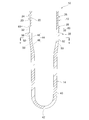
- the preform 10 includes a mouth portion 12 and a bottomed tubular preform body portion 14 extending downward from the mouth portion 12.
- the preform 10 is manufactured by injection molding using polyethylene terephthalate as a main material, and is then formed into a plastic bottle 1 by being subjected to biaxial stretch blow molding. At this time, only the preform main body portion 14 is stretched by the biaxial stretch blow molding, and the mouth portion 12 is not stretched. For this reason, the shape and size of the mouth portion 2 of the plastic bottle 1 are the same as the shape and size of the mouth portion 12 of the preform 10.
- a thermoplastic resin other than polyethylene terephthalate for example, polyethylene or polypropylene
- the mouth portion 12 has a cylindrical peripheral wall 20 having an upper end opened.
- the inner peripheral surface 22 of the peripheral wall 20 extends in the vertical direction without a step, while the outer peripheral surface 24 of the peripheral wall 20 is formed with a screw thread 26, a bead ring 28, and a support ring 30 in order from the top. Yes.
- the sealing performance of the plastic bottle 1 is maintained by fitting a cap (not shown) to the mouth portion 2 using the screw thread 26.
- Each of the bead ring 28 and the support ring 30 is a circumferential ring portion (sometimes referred to as a flange portion) having a larger diameter than the preform main body portion 14, and extends outwardly from the outer peripheral surface 24 in the circumferential direction. Protruding.
- a plurality of lightening portions 32 are formed on the outer peripheral surface of the outer peripheral surface 24 between the bead ring 28 and the support ring 30.
- a boundary between the mouth portion 12 and the preform main body portion 14 is defined by the support ring 30, and the upper portion (that is, the entire mouth portion 12) from the lower surface of the support ring 30 is not stretched in the biaxial stretch blow molding.
- the preform main body 14 has a cylindrical body 40 having a constant diameter, a bottom 42 continuous to the lower part of the body 40, and a support continuously to the upper part of the body 40. And a neck portion 44 continuous with the lower end of the ring 30.
- the bottom portion 42 is often hemispherical, but is not limited to such a shape, and may be any shape that closes the lower portion of the body portion 40.
- the neck portion 44 has a curved portion 46 extending upward from the upper portion of the body portion 40 so as to expand slightly and a short cylindrical shape extending from the curved portion 46 to the support ring 30 without being curved.
- a vertical portion 48 Further, on the outer peripheral surface of the neck portion 44, a plurality of lightening portions 50 are formed at equal intervals in the circumferential direction.
- the thickness of the trunk portion 40 and the bottom portion 42 is the same or substantially the same, but the thickness of the vertical portion 48 is It is slightly smaller than the thickness of the body 40 and the bottom 42. For this reason, the thickness of the bending portion 46 is configured to gradually decrease from the trunk portion 40 to the vertical portion 48. Further, the thickness of the vertical portion 48 is the same as or substantially the same as the thickness of the portion between the bead ring 28 and the support ring 30, and the thickness of the portion where the screw thread 26 exists (the upper portion of the mouth portion 12). Bigger than.
- the preform main body portion 14 has the largest outer diameter of the vertical portion 48, and the outer diameter is the same or substantially the same as the outer diameter of the portion between the bead ring 28 and the support ring 30. It is.
- the thinned portion 50 As shown in FIG. 5, there are a total of eight thinned portions 50, which are lined up symmetrically with equal intervals in the circumferential direction across the column portion 52.
- a portion 54 that connects the lightening portion 50 and the column portion 52 is rounded by an arc having a center of curvature inside the preform main body portion 14 so that both are smoothly connected.
- the cross-sectional shape of the lightening portion 50 is an arc shape curved inward of the preform main body portion 14. Therefore, the thinned portion 50 has the thinnest central portion and is gradually thickened at both ends thereof.
- the difference between the minimum outer diameter of the lightening portion 50 and the outer diameter of the column portion 52 is preferably 3.0 mm or less, more preferably 1.5 mm to 2.0 mm. This is because if the thickness exceeds 3.0 mm, the thermoplastic resin may not reach both ends of the thinned portion 50 when the preform 10 is injection-molded.
- the arcuate R (curvature radius) of the thinned portion 50 is preferably in the range of 5 to 50 mm, more preferably 30 mm. When R is less than 5 mm, undercutting occurs, and it becomes difficult to take out the preform 10 from the mold. On the other hand, when R exceeds 50 mm, it is not possible to sufficiently obtain a lightening effect for weight reduction.
- an outer peripheral surface 56 without unevenness is formed between the thinned portion 50 and the support ring 30.
- the outer peripheral surface 56 is a short cylindrical surface continuous with the lower edge of the base end side of the support ring 30 and is different from the outer peripheral surface where the thinned portion 50 and the column portion 52 exist in that the thinned portion 50 is not thinned. Yes.
- the outer peripheral surface 56 is flush with the outer peripheral surface constituting the column part 52.
- the height of the outer peripheral surface 56 is sufficiently shorter than the height of the thinned portion 50, the length is not limited as long as it can be stably gripped when the preform 10 is handled. If a preferable example is given, the height of the outer peripheral surface 56 is 1 mm or more and 2 mm or less.
- the thinned portion 50 is mainly formed on the outer peripheral surface of the vertical portion 48, and a part thereof also reaches the outer peripheral surface of the curved portion 46.
- the depth of the lightening portion 50 (that is, the amount of lightening) can be constant over the height direction, or can be made smaller in the curved portion 46 than in the vertical portion 48 as shown in FIG. it can.
- the thickness of the lightening portion 50 gradually decreases as it goes downward. More preferably, the amount of lightening of the lightening portion 50 is larger as the portion is closer to the support ring 30, gradually decreases as the distance from the support ring 30 increases, and continues to the outer peripheral surface of the body portion 40 without a step. Eventually disappear.
- the lightening portion 32 on the mouth portion 12 side can be formed in the same manner as the lightening portion 50 on the preform main body portion 14 side.
- the total number of the lightening portions 32 is eight, and the columnar portions 60 are spaced apart from each other and arranged in a line-symmetric manner at equal intervals in the circumferential direction, so that the cross-sectional shape can be an arc shape.
- the preform main body portion 14 when the preform main body portion 14 is stretched, the lightening portion 50 and the column portion 52 are stretched until there is no boundary between them (that is, a step), and constitute the upper portion of the shoulder portion 3. .
- the thinned portion 50 existing in the preform 10 disappears. Therefore, if it sees as the plastic bottle 1, it will become unclear whether the preform 10 for the manufacture has used the one having the lightening portion 50.
- the thinned portion 50 is partially formed in the lower portion of the support ring 30 that has not been stretched and remains thick.
- the amount of resin (amount of polyethylene terephthalate) used for the preform 10 can be reduced.
- a strength fall can be suppressed.
- the thinned portions 50 are formed at equal intervals, the strength of the lower portion of the support ring 30 is well balanced in the circumferential direction, and the amount of resin is reduced in consideration of strength.
- the thinned portions 50 are formed at equal intervals, so that the injected resin flows in a well-balanced manner. Moreover, since the thinned portion 50 is formed in an arc-shaped cross section, it is easy to ensure the fluidity of the resin. Furthermore, since the thinned portion 50 has such an aspect, after injection molding, the product (preform 10) can be easily extracted from the mold used for injection molding, and molding defects are unlikely to occur. Therefore, the moldability of the preform 10 can be maintained well, and the productivity of the plastic bottle 1 can be improved.
- the structure of the preform 10 described above can be modified as appropriate without departing from the scope of the present invention.
- the number of the lightening portions 50 is not limited to eight and may be two or more. It is also possible to form the thinned portion 50 not on the outer peripheral surface of the neck portion 44 but on the inner peripheral surface of the neck portion 44. However, from the viewpoint of ease of die removal of the mold, it is preferable to form it on the outer peripheral surface.
Landscapes
- Engineering & Computer Science (AREA)
- Mechanical Engineering (AREA)
- Physics & Mathematics (AREA)
- Geometry (AREA)
- Manufacturing & Machinery (AREA)
- Blow-Moulding Or Thermoforming Of Plastics Or The Like (AREA)
Abstract
L'invention porte sur une préforme dans laquelle la quantité de résine peut être encore réduite. Une préforme (10) est constituée par une partie bouche (12) et un corps principal de préforme (14) cylindrique et à fond, qui part de la partie bouche (12), le corps principal de préforme (14) étant étiré par moulage par soufflage à étirage biaxial pendant que la partie bouche (12) n'est pas étirée, pour former une bouteille en matière plastique. Le corps principal de préforme (14) comprend une pluralité de parties de réduction de volume (50) formées à un intervalle uniforme dans la direction circonférentielle de la préforme (10), à une partie limite à la partie bouche (12) et une partie destinée à être étirée par le moulage par soufflage à étirage biaxial.
Applications Claiming Priority (2)
| Application Number | Priority Date | Filing Date | Title |
|---|---|---|---|
| JP2010270311A JP5631183B2 (ja) | 2010-12-03 | 2010-12-03 | プリフォーム |
| JP2010-270311 | 2010-12-03 |
Publications (1)
| Publication Number | Publication Date |
|---|---|
| WO2012073744A1 true WO2012073744A1 (fr) | 2012-06-07 |
Family
ID=46171687
Family Applications (1)
| Application Number | Title | Priority Date | Filing Date |
|---|---|---|---|
| PCT/JP2011/076828 Ceased WO2012073744A1 (fr) | 2010-12-03 | 2011-11-21 | Préforme |
Country Status (2)
| Country | Link |
|---|---|
| JP (1) | JP5631183B2 (fr) |
| WO (1) | WO2012073744A1 (fr) |
Families Citing this family (4)
| Publication number | Priority date | Publication date | Assignee | Title |
|---|---|---|---|---|
| DE102014014144A1 (de) * | 2014-09-22 | 2016-03-24 | Mahir Aktas | Verfahren und Vorrichtung zur Herstellung einer optimierten Halskontur an Preformen |
| JP6665034B2 (ja) * | 2016-05-25 | 2020-03-13 | サントリーホールディングス株式会社 | 樹脂製ボトル、及び、プリフォーム |
| JP2018079574A (ja) * | 2016-11-14 | 2018-05-24 | 東洋製罐株式会社 | 合成樹脂製耐熱容器の二軸延伸ブロー成形用プリフォーム |
| MX2020014228A (es) | 2018-06-22 | 2021-03-09 | Amcor Rigid Packaging Usa Llc | Preforma de recipiente. |
Citations (6)
| Publication number | Priority date | Publication date | Assignee | Title |
|---|---|---|---|---|
| JPH01182022A (ja) * | 1988-01-18 | 1989-07-19 | Yoshida Kogyo Kk <Ykk> | ポリエステル樹脂製白濁模様入り容器の製造方法 |
| JPH0339226A (ja) * | 1989-07-07 | 1991-02-20 | Nissei Ee S B Kikai Kk | 延伸吹込成形におけるパリソン延伸方法 |
| JPH0491924A (ja) * | 1990-08-06 | 1992-03-25 | Toppan Printing Co Ltd | プラスチックボトルの製造方法 |
| JP2004330458A (ja) * | 2003-04-30 | 2004-11-25 | Aoki Technical Laboratory Inc | プリフォーム及び薄肉容器 |
| JP2005067002A (ja) * | 2003-08-22 | 2005-03-17 | Toyo Seikan Kaisha Ltd | プラスチックボトル容器用プリフォーム |
| JP2010095269A (ja) * | 2008-10-15 | 2010-04-30 | Coca Cola Co:The | プラスチックボトル |
Family Cites Families (1)
| Publication number | Priority date | Publication date | Assignee | Title |
|---|---|---|---|---|
| JPS5843308B2 (ja) * | 1976-02-09 | 1983-09-26 | 株式会社吉野工業所 | 二軸延伸した容器 |
-
2010
- 2010-12-03 JP JP2010270311A patent/JP5631183B2/ja active Active
-
2011
- 2011-11-21 WO PCT/JP2011/076828 patent/WO2012073744A1/fr not_active Ceased
Patent Citations (6)
| Publication number | Priority date | Publication date | Assignee | Title |
|---|---|---|---|---|
| JPH01182022A (ja) * | 1988-01-18 | 1989-07-19 | Yoshida Kogyo Kk <Ykk> | ポリエステル樹脂製白濁模様入り容器の製造方法 |
| JPH0339226A (ja) * | 1989-07-07 | 1991-02-20 | Nissei Ee S B Kikai Kk | 延伸吹込成形におけるパリソン延伸方法 |
| JPH0491924A (ja) * | 1990-08-06 | 1992-03-25 | Toppan Printing Co Ltd | プラスチックボトルの製造方法 |
| JP2004330458A (ja) * | 2003-04-30 | 2004-11-25 | Aoki Technical Laboratory Inc | プリフォーム及び薄肉容器 |
| JP2005067002A (ja) * | 2003-08-22 | 2005-03-17 | Toyo Seikan Kaisha Ltd | プラスチックボトル容器用プリフォーム |
| JP2010095269A (ja) * | 2008-10-15 | 2010-04-30 | Coca Cola Co:The | プラスチックボトル |
Also Published As
| Publication number | Publication date |
|---|---|
| JP5631183B2 (ja) | 2014-11-26 |
| JP2012116160A (ja) | 2012-06-21 |
Similar Documents
| Publication | Publication Date | Title |
|---|---|---|
| CN102905981B (zh) | 塑料容器以及用于生产塑料容器的吹塑方法 | |
| US8323555B2 (en) | System and method for forming a container having a grip region | |
| AU2006236674B2 (en) | Method for manufacturing blow molded containers, a base assembly for forming the containers and such a container | |
| US10322837B2 (en) | Hot fill container having superior crush resistance | |
| US8550272B2 (en) | Extrusion blow molded pet container having superior column strength | |
| WO2018061379A1 (fr) | Récipient en résine synthétique | |
| WO2016174831A1 (fr) | Récipient de résine synthétique | |
| JP5631183B2 (ja) | プリフォーム | |
| JP6242366B2 (ja) | プラスチックボトル | |
| JP6647759B2 (ja) | 合成樹脂製ブロー成形ボトル | |
| JP2011084315A (ja) | プラスチックボトル | |
| JP6537773B2 (ja) | プラスチックボトル | |
| JP5329170B2 (ja) | プラスチックボトル及びプリフォーム | |
| JP6602528B2 (ja) | プラスチックボトル | |
| US20110303682A1 (en) | Heat sterilizable plastic container | |
| JP7278465B1 (ja) | プラスチックボトル、ブロー成形型及びプラスチックボトルの製造方法 | |
| JP7838375B2 (ja) | プリフォーム | |
| JP5882578B2 (ja) | 樹脂製ボトル | |
| JP4079131B2 (ja) | 二軸延伸ブロー成形容器及びその製造方法 | |
| JP2017206313A (ja) | プラスチックボトル | |
| JP2014028630A (ja) | 合成樹脂製角形容器及びその製造方法 | |
| JP2015089827A (ja) | プラスチックボトル | |
| JP2011143953A (ja) | 樹脂製容器 | |
| WO2018055872A1 (fr) | Récipient en résine synthétique | |
| JP2018083335A (ja) | 合成樹脂製耐熱容器の二軸延伸ブロー成形用プリフォーム |
Legal Events
| Date | Code | Title | Description |
|---|---|---|---|
| 121 | Ep: the epo has been informed by wipo that ep was designated in this application |
Ref document number: 11844924 Country of ref document: EP Kind code of ref document: A1 |
|
| NENP | Non-entry into the national phase |
Ref country code: DE |
|
| 122 | Ep: pct application non-entry in european phase |
Ref document number: 11844924 Country of ref document: EP Kind code of ref document: A1 |