WO2012086080A1 - Système de gestion de transitions pour des pages, dispositif serveur pour gestion de transitions et programme pour gestion de transitions - Google Patents
Système de gestion de transitions pour des pages, dispositif serveur pour gestion de transitions et programme pour gestion de transitions Download PDFInfo
- Publication number
- WO2012086080A1 WO2012086080A1 PCT/JP2010/073429 JP2010073429W WO2012086080A1 WO 2012086080 A1 WO2012086080 A1 WO 2012086080A1 JP 2010073429 W JP2010073429 W JP 2010073429W WO 2012086080 A1 WO2012086080 A1 WO 2012086080A1
- Authority
- WO
- WIPO (PCT)
- Prior art keywords
- information
- meta information
- unit
- page
- meta
- Prior art date
- Legal status (The legal status is an assumption and is not a legal conclusion. Google has not performed a legal analysis and makes no representation as to the accuracy of the status listed.)
- Ceased
Links
Images












Classifications
-
- G—PHYSICS
- G06—COMPUTING OR CALCULATING; COUNTING
- G06F—ELECTRIC DIGITAL DATA PROCESSING
- G06F16/00—Information retrieval; Database structures therefor; File system structures therefor
- G06F16/90—Details of database functions independent of the retrieved data types
- G06F16/95—Retrieval from the web
- G06F16/953—Querying, e.g. by the use of web search engines
- G06F16/9537—Spatial or temporal dependent retrieval, e.g. spatiotemporal queries
Definitions
- the present invention relates to a page transition management system, a transition management server device, and a transition management program, and in particular, a plurality of pages without depending on hyperlinks set in a file of a page described in HTML (HyperText Markup Language). It is suitable for use in a system configured to be able to transition between pages.
- HTML HyperText Markup Language
- a URL Uniform Resource Locator
- a hyperlink is embedded in an HTML file constituting a web page.
- the transition between web pages is usually performed by a hyperlink. If a hyperlink is set, the link location is displayed in an identifiable manner on the screen. Therefore, the user can easily change the screen to the linked web page by simply clicking the link location with the mouse.
- the hyperlink is set in the source code of the HTML file. Therefore, only the creator of the HTML file can set the hyperlink, and the user browsing the web page cannot freely set the hyperlink.
- the hyperlink is set according to the intention of the creator of the HTML file, there are cases where a user who views a web page based on the HTML file desires to set a link between pages different from the intention of the file creator. However, there was a problem that it was not possible with the hyperlink mechanism.
- link information is managed in a database as a record including a link source file and a link destination file, and a link between the displayed files can be freely made by a third party who is not the file owner. You can register.
- the ID or location information of the file to be linked or linked to the displayed file is acquired by searching the database, and a list of acquired IDs is displayed.
- the browser acquires and displays the file entity based on the location information corresponding to the selected ID.
- a link area corresponding to a part of hypertext data, predetermined specific data associated with the link area, and a link destination address associated with the link area and the specific data are obtained.
- a linked database recorded in association with each other is provided. Then, based on the link area instruction from the user terminal and the input of specific data, the link destination database is searched for the link destination, the information is transmitted to the user terminal side, and the user terminal side accesses the link destination. .
- the specific data is a character string (including a numeric string) such as a keyword, a predetermined input signal, or the like.
- the predetermined input signal is, for example, “a signal generated by pressing the enter key of the keyboard five times”, “a signal generated by pressing the keyboard shift key seven times”, or “a predetermined position of the touch panel a predetermined number of times” For example, “a signal generated by pressing with a finger” or “a signal generated by inputting a predetermined sound into a microphone”.
- Patent Document 3 includes a reference site database that stores records in which address information of various home pages is associated with keywords extracted from the home pages.
- a search is performed on the reference site database for records including keywords automatically extracted from the advertisement information of the selected advertiser.
- the address information read from the record is displayed on the link screen as an address link.
- Patent Documents 1 to 3 a database storing predetermined link information is provided separately from the hyperlink, and the database can be searched to make a transition between web pages.
- a third party who is not the creator of the HTML file user browsing the web page
- can register link information in the database the page specified by the hyperlink The user can freely set a link between different pages.
- links can be managed by a database provided separately from hyperlinks, but the database is created in advance by a third party who is not a web page viewer. Therefore, a user who is a web page viewer cannot freely set a link between desired pages.
- Patent Documents 1 and 2 As described above, according to the techniques of Patent Documents 1 and 2, a user browsing a web page can freely set a link between desired pages separately from a hyperlink. However, the techniques of Patent Documents 1 and 2 have the following problems.
- the link information when there is a web page that the user wants to set a link, the link information must be registered in the database by performing a predetermined operation each time.
- the predetermined operation in this case is an operation of displaying two HTML files to be linked, designating one HTML file as a link source, and designating the other file as a link destination. is there.
- a link area is set for a part of a web page, and specific data is generated by, for example, pressing the enter key of the keyboard five times. This is an operation of associating link destination addresses with each other and recording them in a database.
- Patent Documents 1 and 2 have a problem in that it is not possible to transition between web pages unless the user explicitly registers link information in advance in the database. That is, the transition between web pages can be made only in accordance with the intention of the registrant of the link information to the database, just as the transition between web pages can be made only according to the intention of the HTML file creator like a hyperlink. You cannot follow this link.
- the present invention has been made to solve such a problem, and has a high degree of freedom for a user viewing a page without forcing the user to perform troublesome operations such as registration of link information. It aims to be able to realize.
- meta information is added to a portion specified by a user operation in a page displayed on a user terminal, and predetermined attribute information is added to the meta information.
- the meta information and the page location information are associated with each other and stored in the database, and the meta information and attribute information are associated with each other and stored in the database.
- the user does not need to perform a cumbersome operation of explicitly setting link information between pages, and simply performs an operation of adding meta information to a desired page.
- a database necessary for executing transition between pages is sequentially generated.
- the information registered in the database at this time is not link information explicitly generated by the user with the intention of transitioning between pages, but simply meta information added to the page, or a page associated with the meta information. This is information that is unrelated to the link, such as location information and attribute information of meta information.
- the transition between pages is performed based on the location information of pages extracted by a search using desired attribute information as a search key in the database generated in this way. For this reason, even if link information that the user explicitly intends to change between pages is not registered in the database in advance, it is possible to execute a transition between pages different from the hyperlink. In addition, by changing the attribute information input as the search key, transition between different pages can be performed according to the input attribute information.
- the present invention it is possible to realize transition between pages with a high degree of freedom for a user browsing a page without forcing the user to perform troublesome operations such as registration of link information.
- the user can only follow a fixed link that is explicitly registered in the database by a troublesome operation, or a link between a series of pages registered in the database cannot be traced due to some trouble after that. Inconvenience can be eliminated.
- FIG. 1 is a diagram illustrating a configuration example of a web page transition management system 100 according to the present embodiment.
- the web page transition management system 100 includes a plurality of user terminals 10 a and 10 b and a server device 20, and the user terminals 10 a and 10 b and the server device 20 are connected to a communication network 90. It is configured to be connectable via.
- Each of the user terminals 10a and 10b and the server device 20 is mainly configured by a computer having a CPU (Central Processing Unit), a ROM (Read Only Memory), and a RAM (Random Access Memory).
- the user terminals 10a and 10b include display devices 11a and 11b made of, for example, a liquid crystal display, and input devices 12a and 12b made of, for example, a mouse and a keyboard.
- the communication network 90 may employ a WWW such as the Internet. However, in addition to this, the communication network 90 may employ an in-company network called an intranet or a closed communication medium such as a LAN (Local Area Network).
- a WWW such as the Internet.
- the communication network 90 may employ an in-company network called an intranet or a closed communication medium such as a LAN (Local Area Network).
- LAN Local Area Network
- the server device 20 is, for example, a WWW server (if the communication network 90 is a closed communication medium, it is a mere server), such as information on a web page (HTML file), a tag attached to the web page, and the like. Various contents including meta information and attribute information given to the meta information are stored. Moreover, the server apparatus 20 provides the various content memorize
- FIG. 2 is a block diagram illustrating a functional configuration example of the user terminal 10a (the user terminal 10b is the same) and the server device 20.
- the user terminals 10 a and 10 b include, as functional configurations, an operation reception unit 101, a meta information generation unit 102, a coordinate acquisition unit 103, a search request unit 104, a page request unit 105, and a display information acquisition unit 106.
- the server device 20 includes, as its functional configuration, a content database 201 (corresponding to the database of the present invention), a user database 202, a meta information adding unit 203, a first storage unit 204, an attribute information adding unit 205, a timer 206, A second storage unit 207, a database search unit 208, a search result providing unit 209, a URL list storage unit 210, a page transition unit 211, and a communication unit 212 are provided.
- a content database 201 corresponding to the database of the present invention
- a user database 202 includes, as its functional configuration, a content database 201 (corresponding to the database of the present invention), a user database 202, a meta information adding unit 203, a first storage unit 204, an attribute information adding unit 205, a timer 206, A second storage unit 207, a database search unit 208, a search result providing unit 209, a URL list storage unit 210, a page transition unit 211, and a communication unit 212 are provided
- the operation reception unit 101 receives various user operations on the input devices 12a and 12b in the user terminals 10a and 10b. For example, the operation reception unit 101 inputs a user ID and a password to log in, a user operation to generate meta information such as a tag, and a user to search the content database 201 in the server device 20 An operation, a user operation for requesting display of a web page (including transition), and the like are accepted.
- the meta information generation unit 102 is attached to a designated portion in the web page displayed on the display devices 11a and 11b by the control of the web page display unit 107 in accordance with the user operation received by the operation reception unit 101.
- Meta information is generated.
- the meta information generated here is graphic information representing a sticky note having a shape, color, and size designated (or determined in advance) by a user operation.
- Meta information can also be obtained by adding text information representing a desired comment (such as a web page to which meta information is added or a content related to content in the web page) input by user operation to the graphic information of a tag. Good.
- the coordinate acquisition unit 103 acquires the relative coordinates related to the part designated by the user operation in the web page displayed on the display devices 11a and 11b as the position information to which the meta information is pasted. For example, when a pinpoint is specified by a mouse button click operation, the relative coordinates are acquired relative to the origin at the upper left corner of the window where the click operation is performed in the window. This can be done by acquiring a value.
- the meta information generated by the meta information generation unit 102 and the coordinate information acquired by the coordinate acquisition unit 103 are supplied to the communication unit 110.
- the communication unit 110 transmits the meta information and coordinate information to the server device 20.
- the communication unit 110 transmits, for example, the user ID acquired by the operation receiving unit 101 at the time of login to the server device 20 together with the meta information and the coordinate information.
- the server device 20 may include the meta information generation unit 102.
- the meta information generated by the meta information generation unit 102 and the coordinate information acquired by the coordinate acquisition unit 103 are also supplied to the meta information display unit 108.
- the meta information display unit 108 adds meta information to a designated portion (a position on the web page based on the coordinate information) displayed on the web page displayed on the display devices 11a and 11b by the web page display unit 107 and displays it.
- the server device 20 includes the meta information generation unit 102
- the user terminals 10a and 10b acquire the meta information from the server device 20 and cause the display devices 11a and 11b to display the meta information.
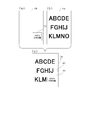
- the web page display unit 107 and the meta information display unit 108 display a web page and meta information in a state where a plurality of display layers are superimposed on each other. Specifically, as shown in FIGS. 3A to 3C, the web page display unit 107 displays a web page on the page display layer 43a and overlaps the page display layer 43a. The meta information display unit 108 displays the meta information on the combined meta information display layer 43b.
- the web page character string “ABC...” Is displayed on the page display layer 43a in a state where the meta information display layer 43b is superimposed on the page display layer 43a.
- meta information 43c such as a tag is displayed on the meta information display layer 43b.
- the meta information display layer 43b is transparent except for the portion of the meta information 43c. Therefore, the character string “ABC...” Of the page display layer 43a can be clearly seen through the transparent portion of the meta information display layer 43b.
- the search request unit 104 generates search request information for requesting a search of the content database 201 in the server device 20 in response to a user operation received by the operation receiving unit 101, and supplies the search request information to the communication unit 110.
- the communication unit 110 transmits the search request information to the server device 20.
- the search request unit 104 displays the search key.
- the search key input here is, for example, a creator name representing the creator of the meta information, a keyword representing a part or all of the comment included in the meta information, and the like.
- the page request unit 105 generates page request information for requesting the display (including transition) of the web page according to the user operation received by the operation receiving unit 101, and supplies the page request information to the communication unit 110.
- the communication unit 110 transmits the page request information to the server device 20.
- the page request unit 105 when a user operation for starting a web browser is performed, the page request unit 105 generates page request information for requesting display of a preset home page. In addition, when a user operation for designating a hyperlink set in advance on the web page is performed, the page request unit 105 displays the link destination web page designated by the hyperlink (link destination). Page request information for requesting (transition to a web page). The page request information in these cases includes the URL of the home page or linked web page.
- the page request unit 105 displays page request information for requesting display of the web page of the selected URL. Is generated.
- the page request information in this case includes the selected URL.
- the page request unit 105 displays other information specified by the designated meta information.
- Page request information for requesting display of a web page (transition to another web page) is generated.
- the page request information in this case includes a meta information ID that indicates which meta information is designated.
- the display information acquisition unit 106 acquires web page information, meta information, and URL list information to be displayed on the display devices 11 a and 11 b from the server device 20 via the communication unit 110.
- the display information acquisition unit 106 acquires the meta information
- the display information acquisition unit 106 transmits the coordinate information indicating the position on the web page to which the meta information is added and the meta information ID for identifying the meta information together with the meta information to the server. Obtained from the device 20.
- the display information acquisition unit 106 supplies the web page information acquired from the server device 20 to the web page display unit 107.
- the display information acquisition unit 106 supplies the meta information and coordinate information acquired from the server device 20 to the meta information display unit 108.
- the display information acquisition unit 106 supplies the URL list information acquired from the server device 20 to the URL list display unit 109.
- the above-described page request unit 105 is a position where the position where the user operation is performed is indicated by the coordinate information acquired by the display information acquisition unit 106 when the operation reception unit 101 receives a user operation on the web page. It is determined whether or not it is included in the meta information area added to. Then, if it is determined that a user operation for specifying meta information is performed, page request information for requesting display of another web page specified by the specified meta information is displayed. Generate.
- the meta information ID included in the page request information is acquired by the display information acquisition unit 106 from the server device 20.
- the web page display unit 107 is a web page acquired from the server device 20 by the display information acquisition unit 106 (a home page displayed when a web browser is activated, a web page displayed as a URL or a search result by a search engine, a hyperlink) (Including web pages transitioned by specifying meta information) and the like are displayed on the display devices 11a and 11b.
- the meta information display unit 108 displays the meta information added to the web page on the display devices 11a and 11b in a state of being superimposed on the position on the web page indicated by the coordinate information. For example, when meta information is generated by the meta information generation unit 102, the generated meta information is displayed on a web page in an overlapping manner.
- the meta information and coordinate information are acquired by the display information acquisition unit 106.
- the meta information display unit 108 displays the meta information acquired by the display information acquisition unit 106 at a position on the web page indicated by the coordinate information.
- the plurality of meta information is displayed on the web page.
- the URL list display unit 109 displays the URL list on the display devices 11a and 11b as information for indicating a transitionable web page based on the URL list acquired from the server device 20 by the display information acquisition unit 106.
- the page request unit 105 When the user operates the input devices 12a and 12b to select any URL, the page request unit 105 generates page request information for requesting display of a web page corresponding to the selected URL, and performs communication. The data is transmitted to the server device 20 via the unit 110.
- the content database 201 stores various contents including information on a web page (HTML file), meta information added to the web page, and attribute information given to the meta information. Note that how the meta information and attribute information are stored in the content database 201 will be described later.
- the user database 202 stores user information related to registered users who have agreed to use the web page transition management system 100 according to the present embodiment.
- This user information includes information such as a user ID and password for identifying a registered user, and a user name. In addition, you may make it comprise user information including information other than this.
- the meta information adding unit 203 adds meta information to a part designated by a user operation in the web page displayed on the display devices 11a and 11b by the user terminals 10a and 10b.
- the meta information adding unit 203 includes meta information (generated by the meta information generating unit 102) and coordinate information (acquired by the coordinate acquiring unit 103) sent from the user terminals 10a and 10b. Is received by the communication unit 212, a process of issuing a unique meta information ID for the meta information is performed.
- the meta information addition unit 203 may have the function of the meta information generation unit 102.
- the first storage unit 204 stores the meta information added by the meta information adding unit 203 in the content database 201 in association with the location information (URL) of the web page to which the meta information is added.
- FIG. 4 is a diagram illustrating an example of first table information stored in the content database 201 by the first storage unit 204. As shown in FIG. 4, the first storage unit 204 associates the meta information, the coordinate information, and the URL of the web page with the meta information ID of the meta information added by the meta information adding unit 203, and the content database 201.
- the first storage unit 204 associates the meta information, the coordinate information, and the URL of the web page with the meta information ID of the meta information added by the meta information adding unit 203, and the content database 201.
- the attribute information adding unit 205 adds predetermined attribute information to the meta information added by the meta information adding unit 203.
- the attribute information given here is, for example, user information for identifying the user who generated the meta information added by the meta information adding unit 203.
- the attribute information adding unit 205 acquires a user name corresponding to the user ID received from the user terminals 10a and 10b by the communication unit 110 together with the meta information and coordinate information from the user database 202, and acquires the user name from the meta information and coordinate information. It is given as attribute information of information.
- the attribute information adding unit 205 forms text information (a part of a tag) described by the user operation as a comment on the web page to which the meta information is added with respect to the meta information added by the meta information adding unit 203. Is assigned as attribute information. Specifically, the attribute information adding unit 205 extracts a comment from the meta information acquired by the communication unit 110, and adds the extracted comment as attribute information of the meta information.
- the attribute information adding unit 205 sets the time stamp information for specifying the date and time when the meta information is added to the meta information added by the meta information adding unit 203 as one attribute information (user name, comment). ) As attribute information. Specifically, when the communication unit 110 receives meta information or the like from the user terminals 10a and 10b, the attribute information adding unit 205 acquires the date and time at that time from the timer 206, and a time stamp including the acquired date and time. Information is given as attribute information of meta information.
- the second storage unit 207 stores the meta information added by the meta information adding unit 203 and the attribute information added by the attribute information adding unit 205 in the content database 201 in association with each other.
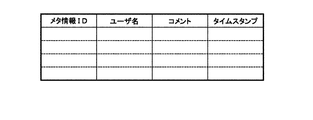
- FIG. 5 is a diagram illustrating an example of second table information stored in the content database 201 by the second storage unit 207. As illustrated in FIG. 5, the second storage unit 207 includes the user name and comment text information provided by the attribute information addition unit 205 with respect to the meta information ID of the meta information provided by the meta information addition unit 203. And the time stamp information are stored in the content database 201 in association with each other.
- the database search unit 208 When the communication unit 212 receives the search request information transmitted from the user terminals 10a and 10b, the database search unit 208 includes a search key (name of the creator representing the creator of the meta information) included in the search request information. URL of a web page to which the content database 201 is searched by a keyword indicating a part or all of comments included in the meta information, and the meta information having attribute information that matches or has a predetermined relationship with the search key is added. To extract.
- a search key name of the creator representing the creator of the meta information
- the database search unit 208 searches the second table information shown in FIG. 5 using the user information (meta information creator name) specified by the user operation in the user terminals 10a and 10b as a search key, A meta information ID having a matching user name as attribute information is acquired. Then, the database search unit 208 searches the first table information shown in FIG. 4 based on the meta information ID acquired in this way, and extracts the URL of the web page associated with the meta information ID.
- the database search unit 208 searches the second table information shown in FIG. 5 using the keyword specified by the user operation on the user terminals 10a and 10b as a search key, and uses the text information of the comment including the keyword as attribute information. Get the meta information ID you have. Then, the database search unit 208 searches the first table information shown in FIG. 4 based on the meta information ID acquired in this way, and extracts the URL of the web page associated with the meta information ID.
- the search result providing unit 209 provides a list of URLs of web pages extracted by searching the content database 201 by the database search unit 208 to the user terminals 10a and 10b via the communication unit 212.
- the URL list sent from the server device 20 is acquired by the display information acquisition unit 106 via the communication unit 110, and the URL list display unit 109 displays the URL list on the display devices 11a and 11b.
- the URL list storage unit 210 temporarily stores a list of URLs of web pages extracted by searching the content database 201 by the database search unit 208.
- the term “temporary” means, for example, until the next search is performed by the database search unit 208 in accordance with the search request information sent from the search request unit 104.
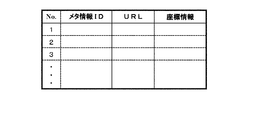
- FIG. 6 is a diagram illustrating an example of a URL list stored in the URL list storage unit 210. As shown in FIG. 6, the URL list is formed by storing a set of each URL and meta information ID extracted by the database search unit 208, one record at a time.
- the page transition unit 211 performs web page transition in response to a request from the user terminals 10a and 10b. For example, when the communication unit 212 receives page request information for requesting a transition to a web page specified by a hyperlink, the page transition unit 211 receives a link destination URL (page request) indicated by the hyperlink. Information of the web page corresponding to (included in the information) is acquired from the content database 201 and transmitted to the user terminals 10a and 10b via the communication unit 212.
- the page transition unit 211 also obtains the meta information ID, meta information, and coordinate information from the content database 201 together with the web page information, and the user terminal 10a, To 10b. Whether or not meta information is added can be determined by referring to the first table information shown in FIG. 4, for example. That is, it may be determined whether meta information is stored in association with the URL of the web page.
- the page transition unit 211 Information on the web page corresponding to the URL included in the page request information is acquired from the content database 201 and transmitted to the user terminals 10 a and 10 b via the communication unit 212. Since the meta information is added to the requested web page at this time, the page transition unit 211 also acquires the meta information ID, meta information, and coordinate information from the content database 201 together with the web page information, and the user terminal 10a, To 10b.
- the meta information (sticky note) displayed on the web page is designated by the user operation of the input devices 12a and 12b, a page for requesting the transition to the web page specified by the designated meta information.
- the communication unit 212 receives the request information.
- the page transition unit 211 performs web page transition based on the meta information ID included in the page request information.
- the page transition unit 211 extracts the meta information ID (specified by the user operation) included in the page request information based on the URL list of FIG. 6 extracted by the database search unit 208 and stored in the URL list storage unit 210. Content of the web page corresponding to the URL included in the record next to the record in which the record corresponding to the recorded meta information) is stored, and the meta information, meta information ID, and coordinate information added to the web page. Obtained from the database 201 and transmitted to the user terminals 10a and 10b via the communication unit 212.
- the page transition unit 211 acquires the information on the web page of the URL stored in the next record number “3”, the meta information added to the web page, and the like from the content database 201, and the communication unit 212 to the user terminals 10a and 10b.
- a list of URLs extracted by the database search unit 208 is displayed on the display devices 11a and 11b, and the user is allowed to select a desired URL from the list.
- the present invention is not limited to this example.
- the server device 20 may automatically select the URL of the record number “1” stored in the URL list storage unit 210 without displaying the URL list.
- the order of URLs stored in the URL list storage unit 210 is not particularly limited, but may be arranged according to a predetermined rule.
- the URLs may be arranged and stored in the URL list storage unit 210 in accordance with the order of time specified by the time stamp information provided by the attribute information adding unit 205.
- the database search unit 208 searches the content database 201 using information specified by a user operation on the user terminals 10a and 10b (meta information creator name, desired keyword, etc.) as a search key, and matches the search key.
- information specified by a user operation on the user terminals 10a and 10b meta information creator name, desired keyword, etc.
- the URL and time stamp information of a web page to which meta information having attribute information having a predetermined relationship (partial match or the like) is added are extracted.
- the database search unit 208 stores in the URL list storage unit 210 a URL list formed by storing a set of each extracted URL, time stamp information, and meta information ID, one record at a time. At this time, the database search unit 208 sequentially stores the URLs in accordance with the order of time specified by the time stamp information (for example, in ascending or descending order of time).
- the page transition unit 211 executes web page transitions according to the time sequence specified by the time stamp information based on the URL list of FIG. 7 extracted by the database search unit 208 and stored in the URL list storage unit 210. . That is, since the URLs are sorted in the URL list according to the time order specified by the time stamp information, the page transition unit 211 performs page transition so as to sequentially follow the web pages of the URLs stored in each record. Execute.
- the present embodiment when a plurality of meta information is added on the web page, all of the plurality of meta information is displayed.
- the present invention is not limited to this. That is, only some of the plurality of meta information may be displayed. In this way, when many pieces of meta information are added to one web page, it is possible to prevent the web page from being difficult to see by being hidden by the display of the meta information.
- the meta information in which the date and time indicated by the time stamp information is within a predetermined time from the current time may be displayed.
- only a predetermined number of pieces of meta information may be displayed in the order in which the date and time indicated by the time stamp information is closer to the current time.
- the user may be allowed to designate a desired period by user operation, and only meta information whose date and time indicated by the time stamp information falls within the range of the designated period may be displayed.
- the URL list is not sorted based on the time stamp information, it is not essential to have the time stamp information as attribute information.
- the display devices 11a and 11b may display only the meta information indicated by the meta information ID stored in the URL list. Good.
- the web page transition is executed based on the URL list generated by searching the content database 201 using the creator name of the meta information as a search key, the same creator It is possible to easily change the web page by following the path of the meta information pasted while transitioning.
- the display device 11a is limited to other meta information added to the same part as the meta information or a part within a predetermined vicinity range. 11b may be displayed.
- the attribute information adding unit 205 specifies the position in the web page of the portion to which the meta information is added with respect to the meta information added by the meta information adding unit 203. Coordinate information is given as attribute information together with one piece of attribute information (user name, comment text information, etc.).
- the second storage unit 207 stores the meta information ID corresponding to the meta information added by the meta information adding unit 203, the user name given by the attribute information adding unit 205, and the comment.
- the text information and the coordinate information are associated with each other and stored in the content database 201. There may also be time stamp information.
- the database search unit 208 searches the content database 201 using information (meta information creator name, desired keyword, etc.) designated by the user operation on the user terminals 10a and 10b as a search key.
- information metal information creator name, desired keyword, etc.
- the URL of the web page to which the meta information having the attribute information that matches the search key or has a predetermined relationship (partial match or the like) and the coordinate information indicating the position of the meta information are extracted. .
- the database search unit 208 stores a URL list in which a set of each URL, coordinate information, and meta information ID extracted by the search of the content database 201 is stored in one URL list storage unit. Store in 210.
- the database search unit 208 further displays the web after the transition when the page transition unit 211 performs a transition to a web page corresponding to the URL of a record in accordance with the URL list of FIG. 9 stored in the URL list storage unit 210.
- the content database 201 is re-searched using the coordinate information extracted together with the URL with respect to the page (the coordinate information stored in the certain record in the URL list storage unit 210) as the second search key. Thereby, other meta information added to the same part as the part indicated by the coordinate information or a part within a predetermined neighborhood range is extracted.
- the predetermined neighborhood range can be, for example, a range within a predetermined number of dots from the portion indicated by the coordinate information.
- the page transition unit 211 executes the transition of the web page according to the URL stored in each record of the URL list, the information of the web page indicated by the URL stored in a certain record and the stored in the certain record Meta information indicated by the meta information ID (meta information corresponding to the meta information ID extracted in advance by the database search unit 208 and stored in the URL list storage unit 210 for the web page transitioned by the page transition unit 211), and Other meta information extracted by re-searching the content database 201 based on the coordinate information stored in a certain record is transmitted to the user terminals 10a and 10b via the communication unit 212 together with the meta information ID and the coordinate information.
- the meta information display unit 108 of the user terminals 10a and 10b is limited to these meta information and other meta information in the vicinity thereof, and is displayed on the display devices 11a and 11b.
- the meta information indicated by the meta information ID stored in the URL list is designated by a user operation, it is stored in the next record based on the same URL list.
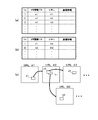
- Web page transitions can be performed according to the URL. For example, when a URL list as shown in FIG. 10A is generated by searching the content database 201 using a certain user name as a search key, it is indicated by the meta information ID stored in the URL list. If the meta information to be specified is designated by a user operation, the transition of the web page can be executed according to the URL list of FIG.
- the next record It is possible to transition to the web page of URL “A2” stored in “2”. Furthermore, by designating the meta information “a2” displayed on the web page with the URL “A2”, it is possible to transition to the web page with the URL “A3” stored in the next record “3”.
- the database search unit 208 displays the user information when other meta information “b1” is displayed on the web page by the meta information display unit 108 or when the other meta information “b1” displayed on the web page is operated by the user.
- a URL list relating to the other meta information “b1” is newly generated.
- the database search unit 208 acquires attribute information corresponding to the other meta information “b1” from the second table information of the content database 201 (see FIG. 8).
- the attribute information acquired here is the same type as the attribute information when the original URL list is generated.
- the user name corresponding to the other meta information “b1” is acquired as the third search key.
- the content database 201 re-searches the content database 201 using the third search key acquired in this way.
- meta information having attribute information that matches or has a predetermined relationship with the third search key in this example, has attribute information that matches the user name corresponding to the other meta information “b1”.
- the URL of the web page to which the (meta information) is added and the coordinate information indicating the position of the meta information are extracted.
- the database search unit 208 records one set of each URL, coordinate information, and meta information ID extracted by re-searching the content database 201 using the third search key.
- a new URL list is generated and stored in the URL list storage unit 210.
- the page transition unit 211 displays other meta information “b1” displayed on the web page with the URL “A2” in the example of FIG. 10C (meta information not included in the original URL list shown in FIG. 10A).
- the web page is extracted according to the URL list of FIG. 10B newly extracted by re-searching the content database 201 using the third search key and stored in the URL list storage unit 210.
- Perform a transition In the case of this example, a transition is made to the web page of URL “B2” stored in the record next to the record storing URL “A2” in FIG.
- the meta information display unit 108 may display the meta information and other meta information in a manner that allows them to be distinguished from each other. For example, it is possible to highlight the meta information in the original URL list or to display other meta information not in the original URL list in gray scale.
- the meta information a2 in FIG. 10C the same spatial information as the meta information a2 or within a predetermined neighborhood range.
- the other meta information (meta information b1 in FIG. 10C) added to the portion at is displayed. Then, the user designates the other meta information b1 so that the transition between pages can be performed by following another path from the middle, but the present invention is not limited to this example.
- meta information indicated by the meta information ID stored in the URL list in addition to the meta information indicated by the meta information ID stored in the URL list, other meta information (time stamp information that is the same as the meta information in time or added within a predetermined neighborhood range) (Extracted by re-searching the content database 201) as a search key. Then, when the user specifies the other meta information, the transition between pages may be performed by following another route from the middle.
- other meta information time stamp information that is the same as the meta information in time or added within a predetermined neighborhood range
- a plurality of attribute information (for example, user name and comment) is stored in the URL list, and in addition to the meta information indicated by the meta information ID stored in the URL list, one of the attribute information possessed by the meta information Display other meta information with the same attribute information. Then, by designating the other meta information, it may be possible to make a transition between pages by following another route from the middle.
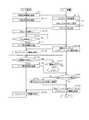
- FIG. 11 is a flowchart showing an operation example when adding meta information on a web page.
- the meta information generating unit 102 when the operation receiving unit 101 receives a user operation for generating meta information such as a sticky note, the meta information generating unit 102 is designated in the web page displayed on the display devices 11a and 11b. Meta information to be attached to the part is generated (step S101). The meta information generation unit 102 supplies the generated meta information to the meta information display unit 108 and the communication unit 110.
- the coordinate acquisition unit 103 acquires the relative coordinates related to the part specified by the user operation in the web page when generating the meta information as the coordinate information of the position where the meta information is pasted (step S102).
- the coordinate acquisition unit 103 supplies the acquired coordinate information to the meta information display unit 108 and the communication unit 110.
- the meta information display unit 108 displays the meta information generated by the meta information generation unit 102 on the display devices 11 a and 11 b so as to overlap the web page at the position of the coordinate information acquired by the coordinate acquisition unit 103. (Step S103).
- the communication unit 110 transmits the meta information generated by the meta information generation unit 102 and the coordinate information acquired by the coordinate acquisition unit 103 to the server device 20 together with the user ID acquired by the operation reception unit 101 at the time of login, for example. (Step S104).
- the meta information adding unit 203 performs a process of adding meta information to the web page (step S105).
- the first storage unit 204 associates the meta information added by the meta information adding unit 203, the meta information ID, the coordinate information, and the URL of the web page to which the meta information is added, into the content database 201. Is stored as first table information (step S106).
- the attribute information adding unit 205 adds predetermined attribute information (user name corresponding to the user ID, comment on the web page to which the meta information is added, and meta information to the meta information added by the meta information adding unit 203.
- a time stamp for specifying the date and time of the received date) is provided (step S107).
- the second storage unit 207 associates the meta information ID of the meta information added by the meta information adding unit 203 with the attribute information added by the attribute information adding unit 205, and stores the second table information in the content database 201. (Step S108).
- Step S108 a series of operations when adding meta information is completed.
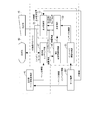
- FIG. 12 is a flowchart showing an operation example when a web page transitions according to a URL list.
- the search request unit 104 when the operation receiving unit 101 receives a user operation for searching the content database 201 in the server device 20, the search request unit 104 generates search request information including a search key specified by the user operation.
- the communication unit 110 transmits the search request information to the server device 20 (step S111).
- the database search unit 208 searches the content database 201 using the search key included in the search request information, and matches or has a predetermined relationship with the search key.
- the URL of the web page to which meta information having attribute information is added is extracted (step S112).
- the database search unit 208 stores the extracted URL list in the URL list storage unit 210 (step S113).
- the database search unit 208 supplies the extracted URL list to the search result providing unit 209.
- the search result providing unit 209 transmits the list of URLs received from the database search unit 208 to the user terminals 10a and 10b via the communication unit 212 (step S114).
- the display information acquisition unit 106 acquires the URL list.
- the display information acquisition unit 106 supplies the acquired URL list to the URL list display unit 109.
- the URL list display unit 109 displays the URL list on the display devices 11a and 11b based on the URL list (step S115).
- the operation receiving unit 101 determines whether or not a user operation for requesting display of a web page by selecting any URL from the URL list has been received (step S116).
- the page request unit 105 When the URL selection operation is received, the page request unit 105 generates page request information for requesting display of the web page of the selected URL, and supplies the page request information to the communication unit 110.
- the communication unit 110 transmits the page request information to the server device 20 (step S117).
- the page transition unit 211 acquires the information of the web page specified by the URL included in the page request information from the content database 201, and performs communication. It transmits to user terminal 10a, 10b via the part 212 (step S118). At this time, the page transition unit 211 also transmits meta information, meta information ID, and coordinate information to the user terminals 10a and 10b together with the web page information.
- the display information acquisition unit 106 acquires the information.
- the display information acquisition unit 106 supplies the web page information acquired from the server device 20 to the web page display unit 107 and also supplies meta information and coordinate information to the meta information display unit 108.
- the web page display unit 107 displays the web page of the URL selected from the URL list on the display devices 11a and 11b. Further, the meta information display unit 108 displays the meta information added to the web page on the display devices 11a and 11b so as to overlap the web page (step S119).
- the operation accepting unit 101 determines whether or not a user operation for requesting a transition of the web page by accepting the meta information displayed on the web page is received (step S120).
- the operation receiving unit 101 determines whether a user operation (for example, an operation for shutting down the web browser) for ending the browsing of the web page has been received (step S121).
- a user operation for example, an operation for shutting down the web browser
- the processing in FIG. 12 ends.
- the process returns to step S120.
- step S120 when a meta information designation operation is received, the page request unit 105 generates page request information for requesting a transition to another web page specified by the designated meta information, and performs communication. To the unit 110.
- the page request information in this case includes a meta information ID that indicates which meta information is designated.
- the communication unit 110 transmits the page request information to the server device 20 (step S122).
- the page transition unit 211 when the page request information is received by the communication unit 212, the page transition unit 211 has the meta information ID included in the page request information in the URL list stored in the URL list storage unit 210. Whether or not (step S123). If it is determined that the page transition unit 211 exists, the page transition unit 211 determines, based on the URL list, information on the web page corresponding to the URL included in the record next to the record in which the meta information ID included in the page request information is stored, and Meta information or the like added to the web page is acquired from the content database 201 and transmitted to the user terminals 10a and 10b via the communication unit 212 (step S124).
- the database search unit 208 is assigned to the meta information corresponding to the meta information ID.
- the content database 201 is searched again using the attribute information as the third search key, and a new URL list is generated (step S125).
- the process proceeds to step S124.
- step S124 the page transition unit 211 sets the URL included in the record next to the record in which the meta information ID included in the previous page request information is stored based on the newly generated URL list.
- Information on the corresponding web page and meta information added to the web page are acquired from the content database 201 and transmitted to the user terminals 10 a and 10 b via the communication unit 212.
- the display information acquisition unit 106 acquires the information.
- the display information acquisition unit 106 supplies the web page information acquired from the server device 20 to the web page display unit 107 and also supplies meta information and coordinate information to the meta information display unit 108.
- the web page display unit 107 displays the web page of the URL stored in the next record in the URL list on the display devices 11a and 11b.
- the meta information display unit 108 displays the meta information added to the web page on the display devices 11a and 11b so as to overlap the web page (step S126). Thereafter, the process returns to step S120.
- meta information is added to a portion designated by a user operation in the web page displayed on the user terminals 10a and 10b, and a predetermined value is added to the meta information. Assign attribute information.
- the meta information and the URL of the web page to which the meta information is added are associated with each other and stored in the content database 201 as the first table information (see FIG. 4). Further, the meta information and the attribute information are associated with each other and stored in the content database 201 as the second table information (see FIG. 5).
- the web page When executing the transition of the web page, by searching the content database 201 with a desired search key, the web page to which meta information having attribute information that matches or has a predetermined relationship with the search key is added.
- the URL is extracted and stored in the URL list storage unit 210 as a URL list (see FIG. 6).
- the page transition part 211 performs the transition of a web page based on this URL list.
- the user does not need to perform a cumbersome operation of explicitly setting link information between web pages, and simply performs an operation of adding meta information to a desired web page.
- the content database 201 necessary for executing the transition between the web pages is sequentially generated.
- the information registered in the content database 201 is not link information explicitly generated by the user with the intention of transition between web pages, but simply meta information added to the web page, or the meta information. This is information unrelated to the link, such as the associated URL and meta information attribute information.
- transition between the web pages is performed based on the URL of the web page extracted by the search using the desired attribute information as the search key in the content database 201 generated in this way. Therefore, even if link information that the user explicitly intends to transition between web pages is not registered in the database in advance, transition between web pages can be executed by means different from hyperlinks. In addition, transition between different web pages can be performed in accordance with the attribute information input as a search key.
- the URL list extracted by searching the content database 201 other than the deleted URL Web page transitions can be performed within range. Thereby, the influence by the change of the content database 201 can be suppressed to the minimum.
- the present embodiment it is possible to realize transition between pages with a high degree of freedom for a user who is browsing a web page without forcing the user to perform troublesome operations such as registration of link information.
- the user can only follow a fixed link explicitly registered in the database by a troublesome operation, or a link between a series of web pages registered in the database cannot be traced due to some trouble afterwards. The inconvenience can be eliminated.
- the URL list can be configured by arranging the URLs in accordance with the order of time specified by the time stamp information provided by the attribute information adding unit 205.
- another user B searches the content database 201 using the user name “A” as a search key.
- the web page can be transitioned while following the trajectory of the transition performed by the user A in order.
- the user B transitions the web page while following the trajectory of the transition performed by the user A while referring to the comment. Can do.
- meta information corresponding to the meta information ID stored in the URL list in addition to the meta information corresponding to the meta information ID stored in the URL list, other meta information (meta information not in the URL list) in the vicinity of the meta information is also displayed.
- the content database 201 is searched again to generate a new URL list, and a web page transition can be executed according to the new URL list. .
- the transition of the web page can be executed not only by specifying the meta information in the original URL list but also by specifying other meta information not in the original URL list.
- a new URL is created using the user name “B” as a search key while the web page is transitioned while specifying the meta information added by the user A.
- the list By generating the list, it is possible to switch the web page to transition while designating the meta information added by the user B. Thereby, it is possible to realize transition between pages with a considerably high degree of freedom for a user browsing a web page.
- attribute information of the same type as the attribute information used as a search key when the original URL list is generated is used as the third search key.
- the present invention is not limited to this.
- a pop-up screen for allowing the user to select the type of attribute information such as a user name or a keyword is displayed, and the desired type of attribute information is selected and displayed.
- 3 search keys may be set.
- the meta information in the original URL list and the other meta information not in the original URL list are displayed in such a manner that they can be distinguished from each other. In this way, the user can determine at a glance which is the meta information in the original URL list. This allows the user to change the web page while designating the meta information in the original URL list, or to switch to the designation of other meta information not in the original URL list to make the web page transition. It can be made easier to choose depending on
- the browsing environment here refers to various types of user terminals (desktop PC, notebook PC, mobile terminal), screen size, OS type, web browser type, screen resolution, window size, etc. This is a combination of
- FIG. 13 is an example of a display screen for explaining the above problem.
- one window size is set to 800 ⁇ 600 (refer to FIG. 13A) in pixel conversion, and the other window size is converted to pixel. Assume that the same web page is displayed as 400 ⁇ 600 (see FIG. 13B).
- This web page displays 15 elements in which A to O text characters are arranged in order from the upper left of the window, and a sticky note is added to the part specified by the user.
- the position of the part to which the tag is added is specified by, for example, two-dimensional relative coordinates based on the upper left corner of the window.
- the meta information is displayed on a web page in which a plurality of elements such as characters or images are arranged in a predetermined order so that the display position of the meta information relative to the designated portion does not shift.
- the specified element corresponding to the part specified position in the multiple elements instead of the part specification using the relative coordinates that may cause the misalignment of the meta information when the display environment is changed. You may make it perform the partial designation
- the designated element means an element existing at the part designated location.
- the elements targeted by this embodiment are those that can acquire the size in the height direction and width direction of individual elements such as characters, figures, symbols, still images, and moving images from the information on the web page. These are listed as examples. That is, any element that can be included in the web page other than these can be targeted as long as the size in the height direction and the width direction of each element can be acquired from the information on the web page.
- FIG. 14 is a block diagram illustrating a functional configuration example of one user terminal 10a for performing partial designation using index information.
- FIG. 15 is a block diagram illustrating a functional configuration example of the other user terminal 10b in order to perform partial designation using index information.
- meta information is added on one user terminal 10a and meta information is displayed on the other user terminal 10b.
- FIG. 14 both the configuration of FIG. 14 and the configuration of FIG. Needless to say, each of the user terminals 10a and 10b may be provided.
- the user terminal 10 a includes an addition side page information acquisition unit 21, an addition side rendering unit 27, and a meta information addition device 13.
- the meta information addition device 13 includes a first element information acquisition unit 29, a coordinate acquisition unit 31, a conversion unit 33, and an index information storage unit 35.
- the display unit 23 corresponds to the display device 11a made of, for example, a liquid crystal display.
- the setting unit 25 corresponds to the input device 12a including a mouse or a keyboard, for example.
- the additional-side page information acquisition unit 21 acquires, from the server device 20, for example, web page information in which a plurality of elements each having a unique height and width are arranged in a predetermined order at a timing corresponding to a user operation. .
- the display unit 23 displays the web page acquired by the additional page information acquisition unit 21 in the window.
- the setting unit 25 is used when making settings related to the size of the window and the part designated.
- the size setting of the window is realized, for example, by changing the height or width of the window by a drag-and-drop operation of a mouse button or by executing an appropriate window size adjustment application.
- part designation by pinpoint may be performed by clicking the mouse button, or rectangular range setting having a two-dimensional extent by dragging and dropping the mouse button You may specify the part by.
- the additional side rendering unit 27 Based on the web page information acquired by the additional page information acquisition unit 21 and, for example, the width direction size of the window set by the setting unit 25, the additional side rendering unit 27 performs two-dimensional row and column in the window. It has a function to construct a web page that is laid out by expanding a plurality of elements in the direction.
- the first element information acquisition unit 29 acquires, for example, element information including the size in the width direction for each of a plurality of elements, the height of each row, and the number of elements belonging to each row from the addition side rendering unit 27.
- the height of each row takes the maximum value among the sizes in the height direction for each of a plurality of elements existing in a row.
- the coordinate acquisition unit 31 acquires the relative coordinates related to the part specified location set by the setting unit 25. For example, when a pinpoint is specified by a mouse button click operation, the coordinates are obtained by calculating a relative coordinate value with respect to the origin at the upper left corner of the window where the click operation is performed in the window. This can be done by acquiring.
- the start or end point of the drag and drop operation in the window may be obtained by obtaining the relative coordinate value with respect to the origin located at the upper left corner of the window.
- the designated element in the case where the partial designation by the range setting is performed means at least one element existing in the range relating to the partial designation.
- the display control unit (not shown) of the meta information adding device 13 receives the setting.
- Meta information such as a sticky note is added to the part specified location on the web page rendered by the rendering unit 27 (position in the web page based on the relative coordinates acquired by the coordinate acquisition unit 31) and displayed on the display unit 23. .
- the conversion unit 33 Based on the element information acquired by the first element information acquisition unit 29 and the relative coordinates related to the partial designation location acquired by the coordinate acquisition unit 31, the conversion unit 33 converts the relative coordinates related to the partial designation location into a plurality of elements. Are converted into index information indicating the order of the designated elements corresponding to the partial designated locations. Details of the operation of the conversion unit 33 will be described later.
- the index information storage unit 35 stores the index information converted by the conversion unit 33 in association with the designated element.
- “stores index information in association with a specified element” For example, in preparation for the case where a plurality of partial designated portions exist in one web page, different identifiers are assigned to the partial designated portions (designated elements), and index information is associated with the identifiers.
- the content of the designated element for example, if it is a character element, whether the character is “A” or “B”
- index information is stored in association with the content of the designated element.
- the index information related to the specified element stored in this way includes the identification information of the web page where the specified element exists (for example, the URI of the web page: Uniform Resource Identifier).
- the index information related to the designated element is sent to the server device 20 together with the corresponding meta information.
- the server device 20 stores the index information and meta information related to the designated element in association with the identification information of the web page in which the designated element exists.
- the other user terminal 10 b includes a display side page information acquisition unit 41, a display side rendering unit 47, and a meta information display control device 15.
- the meta information display control device 15 includes a second element information acquisition unit 49, an index information acquisition unit 51, an inverse conversion unit 53, and a display control unit 55.
- the display unit 43 corresponds to the display device 11b made of, for example, a liquid crystal display.
- the setting unit 45 corresponds to the input device 12b including a mouse or a keyboard, for example.
- Each of the display-side page information acquisition unit 41 and the display-side rendering unit 47 of the user terminal 10b has the same function as the addition-side page information acquisition unit 21 and the addition-side rendering unit 27 that are functional units of the user terminal 10a corresponding thereto. do. Therefore, description of these functions is omitted.
- the setting unit 45 of the user terminal 10b has a function of setting the size of the window, and does not have a function of performing setting related to the part designation portion. Is different.
- the second element information acquisition unit 49 acquires, for example, element information including the size in the width direction for each of the plurality of elements, the height of each row, and the number of elements belonging to each row from the display-side rendering unit 47.
- the index information acquisition unit 51 acquires, from the server device 20, index information related to the designated element related to the web page acquired by the display side page information acquisition unit 41. Specifically, when the display-side page information acquisition unit 41 acquires a required web page, the index information acquisition unit 51 simultaneously or later with this acquisition, an index related to a designated element related to the required web page Information and meta information associated with the index information are acquired from the server device 20.
- the inverse conversion unit 53 Based on the element information acquired by the second element information acquisition unit 49 and the index information related to the specified element acquired by the index information acquisition unit 51, the inverse conversion unit 53 converts the index information indicating the location of the specified element, Reverse transform to coordinates corresponding to the location of the specified element. Details of the operation of the inverse conversion unit 53 will be described later.
- the display control unit 55 performs control to display meta information at a position in the web page based on the coordinates corresponding to the location where the designated element is inversely transformed by the inverse transformation unit 53.
- the position in the web page based on the coordinates corresponding to the location where the designated element exists means not only the position of the coordinates but also the vicinity of the position of the coordinates.
- the display control unit 55 displays individual data in a state where a plurality of display layers are superimposed on each other. Specifically, as shown in FIG. 3, the display control unit 55 displays a web page in which a plurality of elements are expanded and laid out in the two-dimensional direction of rows and columns in the window. Then, the meta information display layer 43b for displaying the meta information is superimposed and displayed.
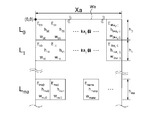
- FIG. 16 is an explanatory diagram of a page rendering function that both the user terminals 10a and 10b according to the present embodiment have.
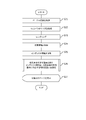
- FIG. 17 is a flowchart showing a flow of processing when performing partial designation in a web page in the user terminal 10a provided with the meta information addition device 13 according to the present embodiment.
- a page in which a plurality of elements E each having a unique height h and width w are arranged in a predetermined order is displayed.
- “Arranged in a predetermined order” means arranging a plurality of elements E according to a predetermined algorithm. An example of this algorithm is given.
- the addition side and display side rendering units 27 and 47 use a plurality of elements E each having a unique height h and width w with reference to the origin (0, 0) located at the upper left corner of the web page. In the same row, line up sequentially from left to right and to the right edge. At this time, the addition side and display side rendering units 27 and 47 store the number of elements belonging to the same row, and store the maximum value among the heights of the elements belonging to the same row as the row height.
- the addition side and display side rendering units 27 and 47 perform folding by line feed from top to bottom. In the same manner as described above, the remaining elements are sequentially arranged from the left to the right in the same row to the right end. At this time, as described above, the addition-side and display-side rendering units 27 and 47 store the number of elements belonging to the same row and set the maximum value among the heights of the elements belonging to the same row as the row height.
- the additional side and display side rendering units 27 and 47 perform folding by line feed from top to bottom, and so on. Repeat the process.
- the plurality of elements are continuously expanded from the left to the right in the width direction of the window Wa shown in FIG. 16, and when the size exceeds the width direction of the window Wa, the plurality of elements are folded and line-breaked in the height direction. Is laid out in the window Wa.
- the width direction size of the window extending in the X-axis direction (width direction) with the origin (0, 0) as a reference is defined as Xa.
- the first 0th row adjacent in the Y-axis direction (height direction) with reference to the origin (0, 0) is L 0
- the next 1st row is L 1
- the ma row is L ma .
- the first element (reference element) in the L 0th row is E 00
- the right adjacent element is E 01
- the last column element at the right end is E 0ka0-1
- the first element in the L 1st row is E 10
- the right adjacent element is E 11
- the last column element at the right end is E 1ka1-1
- the first element on the L ma line is E ma0
- the element on the right side is E ma1
- the nath element from the first element is E mana .
- the height of the L 0 line represents the h 0.
- the height h 00 / width w of the 0th element adjacent in the X-axis direction with reference to the origin (0,0). 00 the element on the right side is represented as height h 01 / width w 01
- the element in the last column at the right end is represented as height h 0ka0-1 / width w 0ka0-1 .
- the number of elements belonging to the L 1st row is represented by ka 1 and the height of the L 1 row is represented by h 1 .
- the height h of the 0th element adjacent in the X-axis direction with reference to the Y-axis in contact with the origin (0, 0) 10 / width w 10 is represented as height h 11 / width w 11
- the last row element at the right end is represented as height h 1ka1-1 / width w 1ka1-1 .
- the number of elements belonging to the L ma row is represented by ka ma
- the height of the L ma row is represented by h ma .
- the height h of the 0th element adjacent in the X-axis direction with respect to the Y-axis in contact with the origin (0, 0) is used as a reference.
- Ma0 / width w ma0 the right adjacent element is represented as height h ma1 / width w ma1
- the na th element is represented as height h mana / width w mana .
- the number of elements belonging to the L 0th row: ka 0 is arranged when a plurality of elements are sequentially arranged from the beginning of the L 0th row and reach the right end. It is obtained from the total number of elements.
- the addition side rendering unit 27 obtains the number of elements belonging to the row by calculation based on the width w unique to each of the plurality of elements belonging to a certain row and the window width direction size Xa. Can do.
- the size h in the height direction and the size w in the width direction for each of the plurality of elements may be acquired from the web page information acquired by the additional page information acquisition unit 21.
- the first element information acquisition unit 29 receives element information including the size in the width direction for each of a plurality of elements, the height of each row, and the number of elements belonging to each row from the addition-side rendering unit 27. Obtain (step S11).
- the coordinate acquisition unit 31 acquires the relative coordinates related to the part designation location set by the setting unit 25 (step S12). Based on the element information acquired by the first element information acquisition unit 29 and the relative coordinates related to the partial designation location acquired by the coordinate acquisition unit 31, the conversion unit 33 converts the relative coordinates related to the partial designation location into a plurality of elements. Are converted into index information indicating the order of the designated elements corresponding to the part designated location (step S13).
- step S13 is performed by accumulating the number of elements existing in a route in a predetermined order from the reference element (E 00 in the example of FIG. 16) located at the predetermined reference in the window to the location where the designated element exists. This is realized by obtaining a value and using the obtained accumulated value as index information.
- the conversion unit 33 designates from the row to which the reference element belongs based on the height of each row acquired by the first element information acquisition unit 29 and the relative coordinates related to the part specification location acquired by the coordinate acquisition unit 31. Accumulates the number of elements belonging to each row up to the row immediately preceding the row corresponding to the element location, and from the first column of the row corresponding to the location where the specified element exists to the column corresponding to the location where the specified element exists The cumulative value of the number of elements is obtained by integrating the number of elements belonging to the row.
- the index information storage unit 35 stores the index information converted by the conversion unit 33 in association with the designated element (step S14).
- FIG. 18 is a flowchart showing in detail the process flow of step S13 in the flowchart shown in FIG.
- FIG. 19 is a diagram for explaining a procedure for converting the relative coordinates related to the partial designated portion into the index information related to the designated element in the meta information adding apparatus 13 according to the present embodiment.
- the process shown in FIG. 18 is started after the process of step S12 in the flowchart shown in FIG.
- the conversion unit 33 initializes the value of the loop counter i to “0” (step S13-1).
- the conversion unit 33 includes the height of each row in the element information acquired by the first element information acquisition unit 29, and the relative coordinates (pa, qa) relating to the part designation location acquired by the coordinate acquisition unit 31 (see FIG. 19). ),
- the search is sequentially performed while incrementing the count value i for which the following Equation 1 is satisfied (steps S13-2 to S13-3).
- the conversion unit 33 substitutes the extracted count value i into the row number ma (step S13-4).
- the L ma row to which the row number ma is assigned is an existing location in the Y-axis direction of the designated element E mana corresponding to the relative coordinates related to the partial designated location. Recognize.
- the location where the designated element exists means a location where the designated element is presumed to exist.
- the meta information adding device 13 initializes the value of the loop counter j to “0” (step S13-5). Then, the conversion unit 33 includes the size in the width direction for each element in the element information acquired by the first element information acquisition unit 29 and the relative coordinates (pa, qa) relating to the part designation location acquired by the coordinate acquisition unit 31. Based on (see FIG. 19), the search is sequentially performed while incrementing the count value j where the following Equation 2 is satisfied (steps S13-6 to S13-7).
- Step S13-8 the conversion unit 33 substitutes the extracted count value j for the column number na (Step S13-8).
- the column with the column number na is a location in the X-axis direction of the designated element E mana corresponding to the relative coordinates related to the partial designated location.
- the converting unit 33 includes the number of elements belonging to each row in the element information acquired by the first element information acquiring unit 29, the row number ma acquired in step S13-4, and the column number acquired in step S13-8. Based on na, an integrated value N that satisfies the following expression 3 is calculated (step S13-9).
- Equation 3 as shown in FIG. 19, starting from the reference element E 00, the total number of elements existing in route leading to L ma-1 row end column of the previous L ma line specified element is present, L ma The order (column number na) in the same row of the designated elements belonging to the row is added. Therefore, by the substitution calculation of Equation 3, the number of elements existing in the route according to a predetermined order from the reference element E 00 to the location where the designated element E mana corresponding to the relative coordinates related to the partially designated location is present is accumulated. The value N can be determined.
- step S13-9 When the integrated value N is calculated by the calculation of step S13-9, the conversion unit 33 ends the series of processing flow shown in FIG. 18, and returns the processing flow to step S14 of FIG.
- FIG. 20 is a diagram for explaining a procedure for reversely converting the index information indicating the location of the designated element into coordinates corresponding to the location of the designated element in the meta information display control device 15 according to the present embodiment.
- the rendering process performed by the display-side rendering unit 47 in which a plurality of elements are arranged in a predetermined order in the window is the same as that of the additional-side rendering unit 27, and thus redundant description thereof is omitted.
- the width direction size of the window Wb extending in the X-axis direction with respect to the origin (0, 0) is assumed to be Xb.
- the first 0th row adjacent in the Y-axis direction with reference to the origin (0, 0) is L 0
- the next 1st row is L 1
- the mb row is L mb .
- the first element (reference element) in the L 0th row is E 00
- the right adjacent element is E 01
- the last column element at the right end is E 0 kb 0-1
- the first element of the L 1st row is E 10
- the right adjacent element is E 11
- the last column element at the right end is E 1 kb1-1
- the first element on the L mb line is E mb0
- the right adjacent element is E mb1
- the nb-1 element from the first element is E mbnb-1
- the nb element from the first element is E mb1. Let it be mbnb .
- the number of elements belonging to the L 0th row is represented as kb 0
- the height of the L 0 row is represented as h 0
- the element on the right side is represented as height h 01 / width w 01
- the element at the last column at the right end is represented as height h 0 kb0-1 / width w 0 kb0-1 .
- the number of elements belonging to the L 1st row is represented as kb 1 and the height of the L 1 row is represented as h 1 .
- the number of elements belonging to the L mb row is represented by kb mb
- the height of the L mb row is represented by h mb
- height h mb1 / width w mb1 in the right adjacent element height h mbnb-1 / width w mbnb-1 in the nb -1 element
- nb element it is expressed as height h mbnb / width w mbnb .
- ( Pb , qb) shown in FIG. 20 is a relative coordinate corresponding to the location where the designated element E mbnb exists.
- the coordinates of the upper left position of the rectangular area where the designated element E mbnb exists is (pb, qb). Meta information is added to the position of the relative coordinates (pb, qb). This will be described later.
- FIG. 21 shows a flow of processing when displaying a web page in which meta information as meta information is added to a designated portion in the user terminal 10b provided by including the meta information display control device 15 according to the present embodiment. It is a flowchart to show.
- the process shown in FIG. 21 is started each time a web page browsing request is generated.
- the display-side page information acquisition unit 41 acquires, from the server device 20, information on a web page in which a plurality of elements each having a unique height and width are arranged in a predetermined order (Step S ⁇ b> 21). ).
- the display-side rendering unit 47 acquires the width direction size Xb among the sizes of the window Wb set by the setting unit 45 (step S22). Then, the display-side rendering unit 47 performs a plurality of operations in the two-dimensional direction of the rows and columns in the window Wb based on the web page information acquired in step S21 and the width direction size Xb of the window Wb acquired in step S22. A web page (for example, see FIG. 20) laid out by expanding the elements is constructed (step S23).
- the second element information acquisition unit 49 acquires, from the display-side rendering unit 47, element information including the size in the width direction for each of the plurality of elements, the height of each row, and the number of elements belonging to each row (step S40). S24). Moreover, the index information acquisition part 51 acquires the index information which concerns on the designation
- the inverse conversion unit 53 uses the element information acquired by the second element information acquisition unit 49 and the index information indicating the location of the specified element based on the index information related to the specified element acquired by the index information acquisition unit 51. Is converted back to coordinates corresponding to the location of the designated element (step S26).
- the display control unit 55 performs control to display the meta information acquired by the index information acquisition unit 51 at a position in the web page based on the coordinates corresponding to the location where the designated element is inversely converted by the inverse conversion unit 53. This is performed (step S27). Thereby, the web page to which the meta information such as the tag is added is displayed in the window Wb of the display unit 43.
- FIG. 22 is a flowchart showing the process flow of step S26 in the flowchart shown in FIG.
- the algorithm shown in FIG. 22 is started after the process of step S25 in the flowchart shown in FIG.
- the inverse conversion unit 53 initializes the value of the loop counter i to “0” (step S26-1). Then, the inverse conversion unit 53 is based on the number of elements belonging to each row in the element information acquired by the second element information acquisition unit 49 and the index information “N” related to the specified element acquired by the index information acquisition unit 51. Thus, the search is sequentially performed while incrementing the count value i where the following expression 4 is satisfied (steps S26-2 to S26-3).
- the inverse conversion unit 53 substitutes the extracted count value i into the row number mb (step S26-4).
- the search of Expression 4 indicates that the L mb row with the row number mb is the location in the Y-axis direction of the designated element E mbnb corresponding to the relative coordinates related to the partially designated location.
- step S26-5 based on the height of each line in the element information acquired by the second element information acquisition unit 49 and the line number mb related to the designated element E mbnb acquired in step S26-4, the inverse conversion unit 53 A coordinate component qb in the Y-axis direction that satisfies Equation 5 is obtained by calculation (step S26-5).
- the last (rightmost) element is the R-th element represented by Expression 6 counted from the reference element E 00 . That is, by substituting the value of the line number mb related to the designated element acquired in step S26-4 and the height of each line into Equation 6, the last (rightmost) element among the elements belonging to the L mb-1 line. In this regard, it is possible to obtain the order information from the reference element E 00 (accumulated number obtained by integrating the number of elements existing in the route following the predetermined order from the reference element).
- the inverse transforming unit 53 performs the processing based on the index information “N”, which is the order information related to the designated element, and the order information “R” of the last element among the elements belonging to the L mb ⁇ 1 line.
- the column number nb related to the designated element existing in the number mb is obtained by the following formula 7 (step S26-6).
- the inverse conversion unit 53 includes the width w for each element belonging to the row number mb in the element information acquired by the second element information acquisition unit 49, and the column number nb related to the designated element obtained in step S26-6. Based on the above, a coordinate component pb in the X-axis direction in which the following Expression 8 is satisfied is obtained by calculation (step S26-7).
- step S27 the display control unit 55, as shown in FIG. 20, coordinates the web page constructed by the display side rendering unit 47 with the coordinates (pb) corresponding to the location of the designated element E mbnb acquired by the inverse transformation unit 53. , Qb), meta information such as sticky notes is added to the position based on qb) and displayed. Thereby, the web page with meta information is displayed in the window of the display unit 43.
- FIG. 23 is an explanatory diagram showing the operational effect when a character string is adopted as a plurality of elements.
- the meta information display control device 15 is used to construct and display a web page in which a tag as meta information is added to a designated portion.
- the index information storage unit 35 of the meta information adding device 13 indicates that the order of the designated element from the head is “14th” as shown in FIG. ID of the web page (for example, identification information such as URI, etc., and so on) is stored as index information.
- the display control unit 55 of the meta information display control device 15 is a narrow window having a size in the width direction of about 60% compared to the window on the user terminal 10a side.
- the upper left corner of the window has been described as an example of the reference in the window.
- the present invention is not limited to this example.
- any part such as an upper right corner, a lower right corner, a lower left corner, or a part between corners adjacent to each other may be adopted.
- the same line has different line spacing from the left to the right on the basis of the upper left corner of the web page.
- the algorithm for sequentially arranging from top to bottom is described as an example, but the present invention is not limited to this example.
- an algorithm that sequentially arranges from left to right in odd lines, from right to left in even lines, and from top to bottom in different lines with the upper left corner of the web page as a reference may be adopted.
- an algorithm that sequentially arranges from the right to the left in the same line and from the top to the bottom in different lines with the upper right corner of the web page as a reference may be adopted.
- an algorithm may be adopted in which the web page is sequentially arranged from the right to the left in the same line and from the bottom to the top in different lines with the lower right corner of the web page as a reference.
- an algorithm may be employed in which the left and right corners of the web page are used as a reference, and the same line is sequentially arranged from left to right and between different lines from bottom to top.
- the height direction (column direction) is set as the main scanning direction on the basis of the upper left corner of the web page.
- the present invention is not limited to this example.
- an algorithm that sequentially arranges a plurality of elements using the width direction (row direction) as the main scanning direction and the height direction (column direction) as the sub-scanning direction with the upper left corner of the web page as a reference is adopted. Also good.
- the “width direction size” of the window is replaced with the “height direction size”
- the “width” and the “height” for each of the plurality of elements are replaced with each other, and What is necessary is to replace the columns with each other and read them.
- the present invention is not limited to this example. Even when the width and height of each of the plurality of elements are made unequal, the embodiment according to this modification can be realized by using the technical idea of the present invention as it is.
- the index information when used as the position information of the meta information instead of the coordinate information, it is in the same part as the meta information in which the meta information ID is stored in the URL list or in a predetermined vicinity range.
- the same part or a part within a predetermined neighborhood range is determined based on the index information. Will do.
- the index is the same as the numerical value N indicated by the index information of the meta information whose meta information ID is stored in the URL list or within a predetermined number including, for example, the numerical value N (for example, N ⁇ to N + ⁇ ).
- Other meta information held as information is extracted as other meta information added to “the same part or a part within a predetermined neighborhood range”.
- the index information is inversely converted into coordinate information, and other meta information having the coordinate information in a portion within a predetermined number of dots from the portion indicated by the coordinate information is the same as the reversely converted coordinate information, It may be extracted as other meta information added to the same part or a part within a predetermined vicinity range.
- the system for performing transition between HTML web pages has been described as an example, but the present invention is not limited to this.
- entities such as an electronic dictionary, electronic book, or augmented reality
- file formats such as PDF (Portable Document Format) of Adobe Systems Inc. and ePub (electronic Publication), which is becoming the de facto standard, are used for electronic books.
- PDF Portable Document Format
- ePub electronic Publication
- There are other electronic book formats such as XMDF proposed by Sharp Corporation, .book developed by Sakai Voyager, AZW and Topaz for Amazon Kindle.
- the PDF has a link function, and a link to an external document can be established by associating the URL of the link destination with a character string or image.
- a unique ID is assigned to an object (page, image, etc.) on the PDF. Therefore, the link in the document can be realized by embedding the link destination ID in the link source.
- transition between pages can be arbitrarily set by adding meta information (tag) on a PDF page.
- EPub is a file in which an XHTML (file format corresponding to XML) file and a plurality of setting files are consolidated in a ZIP format compressed file. Since the main body of the document is in the XHTML format, a link to an external resource or a link in the document can be easily realized by an anchor (a tag) as in the case of a web browser that displays an HTML web page. Therefore, in the case of an ePub format electronic book, the present invention can be applied in the same manner as in the above-described embodiment.
- the explanation items in the page are basically headwords, spelling / reading / intonation, part of speech / utilization, meaning / source, charts, examples / songs, synonyms / synonyms / related words (links), etc. Contains information.
- EPWING JIS X 4081
- EPWIN can have a plurality of dictionaries, and has an index table of indexes (catalogs) and headwords of each dictionary.
- Each dictionary is divided into directories, and the substance of the dictionary is one file.
- Link in the dictionary is realized by obtaining the position information (number of bytes or address from the beginning) in the dictionary file or by obtaining the address in the dictionary file by searching the index from the entry word. can do. That is, in the first table information shown in FIG. 4, the meta information ID of the meta information (sticky note) added on the page displayed for each headword is replaced with the URL of the web page described above. If the position information or index is stored in association with each other, a link using a sticky note can be set.
- Augmented reality is a virtual object (such as a sticky note called “air tag” in Sekai Camera), such as a Sekai camera provided by Tonchi Dot. ) To extend the reality. Even in such augmented reality, it is possible to realize transition between pages by applying one aspect of the present invention to one page of a photographic image taken by a camera.
- the shooting position of a photo (latitude and longitude, altitude may be added) has a one-to-one correspondence with the page made up of the photo image, so the shooting position can be used as page location information. it can. That is, in the first table information shown in FIG. 4, the photo shooting position is associated with the meta information ID of the meta information (sticky note) added on the photo image page instead of the URL of the web page described above. If you store them, you can set up a link using sticky notes. Note that position information such as longitude / latitude and altitude can be obtained by using a GPS provided in the camera.
- the attribute information given to the meta information (tag) a user name indicating the creator of the tag, comment text information, a time stamp, and the like can be used as in the above-described embodiment.
- the photograph is a three-dimensional space, the direction (direction) and angle of the tag can be given as attribute information using an electronic compass.
- the shooting position information is preset to a landmark such as Tokyo Tower
- the landmark and the tag are linked, or the tag attached in the vicinity of the landmark shown in the photographic image is extracted. It can also be displayed.
- the present invention can be used in a system configured to allow a database to transit between a plurality of pages by means different from hyperlinks set in a web page file.
Landscapes
- Engineering & Computer Science (AREA)
- Databases & Information Systems (AREA)
- Theoretical Computer Science (AREA)
- Data Mining & Analysis (AREA)
- Physics & Mathematics (AREA)
- General Engineering & Computer Science (AREA)
- General Physics & Mathematics (AREA)
- Information Retrieval, Db Structures And Fs Structures Therefor (AREA)
- Information Transfer Between Computers (AREA)
Abstract
Priority Applications (2)
| Application Number | Priority Date | Filing Date | Title |
|---|---|---|---|
| JP2012549565A JP5870036B2 (ja) | 2010-12-24 | 2010-12-24 | ページの遷移管理システム、遷移管理用サーバ装置および遷移管理用プログラム |
| PCT/JP2010/073429 WO2012086080A1 (fr) | 2010-12-24 | 2010-12-24 | Système de gestion de transitions pour des pages, dispositif serveur pour gestion de transitions et programme pour gestion de transitions |
Applications Claiming Priority (1)
| Application Number | Priority Date | Filing Date | Title |
|---|---|---|---|
| PCT/JP2010/073429 WO2012086080A1 (fr) | 2010-12-24 | 2010-12-24 | Système de gestion de transitions pour des pages, dispositif serveur pour gestion de transitions et programme pour gestion de transitions |
Publications (1)
| Publication Number | Publication Date |
|---|---|
| WO2012086080A1 true WO2012086080A1 (fr) | 2012-06-28 |
Family
ID=46313377
Family Applications (1)
| Application Number | Title | Priority Date | Filing Date |
|---|---|---|---|
| PCT/JP2010/073429 Ceased WO2012086080A1 (fr) | 2010-12-24 | 2010-12-24 | Système de gestion de transitions pour des pages, dispositif serveur pour gestion de transitions et programme pour gestion de transitions |
Country Status (2)
| Country | Link |
|---|---|
| JP (1) | JP5870036B2 (fr) |
| WO (1) | WO2012086080A1 (fr) |
Cited By (1)
| Publication number | Priority date | Publication date | Assignee | Title |
|---|---|---|---|---|
| JP2015028684A (ja) * | 2013-07-30 | 2015-02-12 | 株式会社日立製作所 | 営業支援方法および営業支援システム |
Citations (3)
| Publication number | Priority date | Publication date | Assignee | Title |
|---|---|---|---|---|
| JP2002108897A (ja) * | 2000-09-27 | 2002-04-12 | Kobelco Systems Corp | 電子付箋装置及び電子付箋貼付方法並びに電子付箋プログラムが記録された記録媒体 |
| JP2005293239A (ja) * | 2004-03-31 | 2005-10-20 | Fujitsu Ltd | 情報共有装置及び情報共有方法 |
| JP2007233696A (ja) * | 2006-03-01 | 2007-09-13 | Just Syst Corp | 注釈管理装置、ウェブ表示端末、注釈管理方法およびウェブ表示方法 |
Family Cites Families (1)
| Publication number | Priority date | Publication date | Assignee | Title |
|---|---|---|---|---|
| WO2006095443A1 (fr) * | 2005-03-10 | 2006-09-14 | Hitachi, Ltd. | Systeme de gestion d'informations |
-
2010
- 2010-12-24 WO PCT/JP2010/073429 patent/WO2012086080A1/fr not_active Ceased
- 2010-12-24 JP JP2012549565A patent/JP5870036B2/ja not_active Expired - Fee Related
Patent Citations (3)
| Publication number | Priority date | Publication date | Assignee | Title |
|---|---|---|---|---|
| JP2002108897A (ja) * | 2000-09-27 | 2002-04-12 | Kobelco Systems Corp | 電子付箋装置及び電子付箋貼付方法並びに電子付箋プログラムが記録された記録媒体 |
| JP2005293239A (ja) * | 2004-03-31 | 2005-10-20 | Fujitsu Ltd | 情報共有装置及び情報共有方法 |
| JP2007233696A (ja) * | 2006-03-01 | 2007-09-13 | Just Syst Corp | 注釈管理装置、ウェブ表示端末、注釈管理方法およびウェブ表示方法 |
Cited By (1)
| Publication number | Priority date | Publication date | Assignee | Title |
|---|---|---|---|---|
| JP2015028684A (ja) * | 2013-07-30 | 2015-02-12 | 株式会社日立製作所 | 営業支援方法および営業支援システム |
Also Published As
| Publication number | Publication date |
|---|---|
| JPWO2012086080A1 (ja) | 2014-05-22 |
| JP5870036B2 (ja) | 2016-02-24 |
Similar Documents
| Publication | Publication Date | Title |
|---|---|---|
| TW504624B (en) | Method and apparatus for automatically processing acquired data and contextual information and associating the same with available multimedia resources | |
| US20110119298A1 (en) | Method and apparatus for searching information | |
| JP5371480B2 (ja) | 情報処理装置、情報処理方法、およびプログラム | |
| JP5233220B2 (ja) | ページ付加情報共有管理方法 | |
| CN104699782A (zh) | 分散型的web注释 | |
| CN101751428A (zh) | 信息搜索方法及装置 | |
| JP2009524883A (ja) | デジタルコンテンツのネットワークへの提示 | |
| US7715625B2 (en) | Image processing device, image processing method, and storage medium storing program therefor | |
| JP2007272872A (ja) | 情報検索方法、情報検索装置、情報検索システム、及び情報検索プログラム | |
| US20090024597A1 (en) | Forming web search queries from browsing annotated images | |
| JP4396314B2 (ja) | 画像生成方法、画像生成装置および画像生成プログラム | |
| JP5870036B2 (ja) | ページの遷移管理システム、遷移管理用サーバ装置および遷移管理用プログラム | |
| JP2009169596A (ja) | 家系図画像生成装置、家系図画像生成方法、及びプログラム | |
| JP2007279864A (ja) | 情報提供システムおよび方法ならびにプログラム、電子商取引システムおよび方法ならびにプログラム | |
| JP2009075678A (ja) | 画像処理装置、画像処理方法、画像処理プログラム及び記憶媒体 | |
| JP2009093389A (ja) | 情報処理装置、情報処理方法、およびプログラム | |
| JP2008305089A (ja) | 文書処理方法、文書処理プログラム、および文書処理装置 | |
| JP2017204054A (ja) | 相性算出装置、相性算出方法、およびコンピュータプログラム | |
| JP5779412B2 (ja) | クライアント・サーバシステム、クライアント機器、サーバ機器、クライアント・サーバシステムにおけるコメント画面作成方法、およびクライアント機器のプログラム、サーバ機器のプログラム | |
| JP2017037437A (ja) | 情報処理システム、情報処理装置、情報処理方法および情報処理プログラム | |
| JP5407874B2 (ja) | ブログ投稿画像コミュニケーションシステム、ブログ投稿画像コミュニケーション方法、サーバ、プログラム、記憶媒体 | |
| JP2014222448A (ja) | 書籍抽出装置、書籍抽出方法及び書籍抽出用プログラム | |
| JP4804893B2 (ja) | ウェブ構築システム、ウェブ構築装置、及びコンピュータプログラム | |
| JP6101880B1 (ja) | Webページを表示するためのシステム、プログラムおよび記録媒体 | |
| JP7724146B2 (ja) | プログラム、情報処理方法及び情報処理装置 |
Legal Events
| Date | Code | Title | Description |
|---|---|---|---|
| 121 | Ep: the epo has been informed by wipo that ep was designated in this application |
Ref document number: 10861161 Country of ref document: EP Kind code of ref document: A1 |
|
| ENP | Entry into the national phase |
Ref document number: 2012549565 Country of ref document: JP Kind code of ref document: A |
|
| NENP | Non-entry into the national phase |
Ref country code: DE |
|
| 32PN | Ep: public notification in the ep bulletin as address of the adressee cannot be established |
Free format text: NOTING OF LOSS OF RIGHTS PURSUANT TO RULE 112(1) EPC (EPO FORM 1205A DATED 30/09/2013) |
|
| 122 | Ep: pct application non-entry in european phase |
Ref document number: 10861161 Country of ref document: EP Kind code of ref document: A1 |