WO2012091092A1 - 単環芳香族炭化水素製造用触媒および単環芳香族炭化水素の製造方法 - Google Patents
単環芳香族炭化水素製造用触媒および単環芳香族炭化水素の製造方法 Download PDFInfo
- Publication number
- WO2012091092A1 WO2012091092A1 PCT/JP2011/080390 JP2011080390W WO2012091092A1 WO 2012091092 A1 WO2012091092 A1 WO 2012091092A1 JP 2011080390 W JP2011080390 W JP 2011080390W WO 2012091092 A1 WO2012091092 A1 WO 2012091092A1
- Authority
- WO
- WIPO (PCT)
- Prior art keywords
- catalyst
- monocyclic aromatic
- aromatic hydrocarbons
- producing
- mass
- Prior art date
- Legal status (The legal status is an assumption and is not a legal conclusion. Google has not performed a legal analysis and makes no representation as to the accuracy of the status listed.)
- Ceased
Links
Classifications
-
- B—PERFORMING OPERATIONS; TRANSPORTING
- B01—PHYSICAL OR CHEMICAL PROCESSES OR APPARATUS IN GENERAL
- B01J—CHEMICAL OR PHYSICAL PROCESSES, e.g. CATALYSIS OR COLLOID CHEMISTRY; THEIR RELEVANT APPARATUS
- B01J29/00—Catalysts comprising molecular sieves
- B01J29/04—Catalysts comprising molecular sieves having base-exchange properties, e.g. crystalline zeolites
- B01J29/06—Crystalline aluminosilicate zeolites; Isomorphous compounds thereof
- B01J29/40—Crystalline aluminosilicate zeolites; Isomorphous compounds thereof of the pentasil type, e.g. types ZSM-5, ZSM-8 or ZSM-11, as exemplified by patent documents US3702886, GB1334243 and US3709979, respectively
-
- B—PERFORMING OPERATIONS; TRANSPORTING
- B01—PHYSICAL OR CHEMICAL PROCESSES OR APPARATUS IN GENERAL
- B01J—CHEMICAL OR PHYSICAL PROCESSES, e.g. CATALYSIS OR COLLOID CHEMISTRY; THEIR RELEVANT APPARATUS
- B01J29/00—Catalysts comprising molecular sieves
- B01J29/04—Catalysts comprising molecular sieves having base-exchange properties, e.g. crystalline zeolites
- B01J29/06—Crystalline aluminosilicate zeolites; Isomorphous compounds thereof
- B01J29/70—Crystalline aluminosilicate zeolites; Isomorphous compounds thereof of types characterised by their specific structure not provided for in groups B01J29/08 - B01J29/65
-
- B—PERFORMING OPERATIONS; TRANSPORTING
- B01—PHYSICAL OR CHEMICAL PROCESSES OR APPARATUS IN GENERAL
- B01J—CHEMICAL OR PHYSICAL PROCESSES, e.g. CATALYSIS OR COLLOID CHEMISTRY; THEIR RELEVANT APPARATUS
- B01J29/00—Catalysts comprising molecular sieves
- B01J29/82—Phosphates
- B01J29/84—Aluminophosphates containing other elements, e.g. metals, boron
- B01J29/85—Silicoaluminophosphates [SAPO compounds]
-
- B—PERFORMING OPERATIONS; TRANSPORTING
- B01—PHYSICAL OR CHEMICAL PROCESSES OR APPARATUS IN GENERAL
- B01J—CHEMICAL OR PHYSICAL PROCESSES, e.g. CATALYSIS OR COLLOID CHEMISTRY; THEIR RELEVANT APPARATUS
- B01J37/00—Processes, in general, for preparing catalysts; Processes, in general, for activation of catalysts
- B01J37/0009—Use of binding agents; Moulding; Pressing; Powdering; Granulating; Addition of materials ameliorating the mechanical properties of the product catalyst
-
- B—PERFORMING OPERATIONS; TRANSPORTING
- B01—PHYSICAL OR CHEMICAL PROCESSES OR APPARATUS IN GENERAL
- B01J—CHEMICAL OR PHYSICAL PROCESSES, e.g. CATALYSIS OR COLLOID CHEMISTRY; THEIR RELEVANT APPARATUS
- B01J37/00—Processes, in general, for preparing catalysts; Processes, in general, for activation of catalysts
- B01J37/0009—Use of binding agents; Moulding; Pressing; Powdering; Granulating; Addition of materials ameliorating the mechanical properties of the product catalyst
- B01J37/0027—Powdering
- B01J37/0036—Grinding
-
- C—CHEMISTRY; METALLURGY
- C01—INORGANIC CHEMISTRY
- C01B—NON-METALLIC ELEMENTS; COMPOUNDS THEREOF; METALLOIDS OR COMPOUNDS THEREOF NOT COVERED BY SUBCLASS C01C
- C01B39/00—Compounds having molecular sieve and base-exchange properties, e.g. crystalline zeolites; Their preparation; After-treatment, e.g. ion-exchange or dealumination
- C01B39/02—Crystalline aluminosilicate zeolites; Isomorphous compounds thereof; Direct preparation thereof; Preparation thereof starting from a reaction mixture containing a crystalline zeolite of another type, or from preformed reactants; After-treatment thereof
- C01B39/06—Preparation of isomorphous zeolites characterised by measures to replace the aluminium or silicon atoms in the lattice framework by atoms of other elements, i.e. by direct or secondary synthesis
- C01B39/10—Preparation of isomorphous zeolites characterised by measures to replace the aluminium or silicon atoms in the lattice framework by atoms of other elements, i.e. by direct or secondary synthesis the replacing atoms being at least phosphorus atoms
-
- C—CHEMISTRY; METALLURGY
- C01—INORGANIC CHEMISTRY
- C01B—NON-METALLIC ELEMENTS; COMPOUNDS THEREOF; METALLOIDS OR COMPOUNDS THEREOF NOT COVERED BY SUBCLASS C01C
- C01B39/00—Compounds having molecular sieve and base-exchange properties, e.g. crystalline zeolites; Their preparation; After-treatment, e.g. ion-exchange or dealumination
- C01B39/02—Crystalline aluminosilicate zeolites; Isomorphous compounds thereof; Direct preparation thereof; Preparation thereof starting from a reaction mixture containing a crystalline zeolite of another type, or from preformed reactants; After-treatment thereof
- C01B39/46—Other types characterised by their X-ray diffraction pattern and their defined composition
- C01B39/48—Other types characterised by their X-ray diffraction pattern and their defined composition using at least one organic template directing agent
-
- C—CHEMISTRY; METALLURGY
- C07—ORGANIC CHEMISTRY
- C07C—ACYCLIC OR CARBOCYCLIC COMPOUNDS
- C07C15/00—Cyclic hydrocarbons containing only six-membered aromatic rings as cyclic parts
- C07C15/02—Monocyclic hydrocarbons
- C07C15/04—Benzene
-
- C—CHEMISTRY; METALLURGY
- C07—ORGANIC CHEMISTRY
- C07C—ACYCLIC OR CARBOCYCLIC COMPOUNDS
- C07C4/00—Preparation of hydrocarbons from hydrocarbons containing a larger number of carbon atoms
- C07C4/02—Preparation of hydrocarbons from hydrocarbons containing a larger number of carbon atoms by cracking a single hydrocarbon or a mixture of individually defined hydrocarbons or a normally gaseous hydrocarbon fraction
- C07C4/06—Catalytic processes
-
- C—CHEMISTRY; METALLURGY
- C10—PETROLEUM, GAS OR COKE INDUSTRIES; TECHNICAL GASES CONTAINING CARBON MONOXIDE; FUELS; LUBRICANTS; PEAT
- C10G—CRACKING HYDROCARBON OILS; PRODUCTION OF LIQUID HYDROCARBON MIXTURES, e.g. BY DESTRUCTIVE HYDROGENATION, OLIGOMERISATION, POLYMERISATION; RECOVERY OF HYDROCARBON OILS FROM OIL-SHALE, OIL-SAND, OR GASES; REFINING MIXTURES MAINLY CONSISTING OF HYDROCARBONS; REFORMING OF NAPHTHA; MINERAL WAXES
- C10G11/00—Catalytic cracking, in the absence of hydrogen, of hydrocarbon oils
- C10G11/02—Catalytic cracking, in the absence of hydrogen, of hydrocarbon oils characterised by the catalyst used
- C10G11/04—Oxides
- C10G11/05—Crystalline alumino-silicates, e.g. molecular sieves
-
- C—CHEMISTRY; METALLURGY
- C10—PETROLEUM, GAS OR COKE INDUSTRIES; TECHNICAL GASES CONTAINING CARBON MONOXIDE; FUELS; LUBRICANTS; PEAT
- C10G—CRACKING HYDROCARBON OILS; PRODUCTION OF LIQUID HYDROCARBON MIXTURES, e.g. BY DESTRUCTIVE HYDROGENATION, OLIGOMERISATION, POLYMERISATION; RECOVERY OF HYDROCARBON OILS FROM OIL-SHALE, OIL-SAND, OR GASES; REFINING MIXTURES MAINLY CONSISTING OF HYDROCARBONS; REFORMING OF NAPHTHA; MINERAL WAXES
- C10G11/00—Catalytic cracking, in the absence of hydrogen, of hydrocarbon oils
- C10G11/14—Catalytic cracking, in the absence of hydrogen, of hydrocarbon oils with preheated moving solid catalysts
- C10G11/18—Catalytic cracking, in the absence of hydrogen, of hydrocarbon oils with preheated moving solid catalysts according to the "fluidised-bed" technique
-
- C—CHEMISTRY; METALLURGY
- C10—PETROLEUM, GAS OR COKE INDUSTRIES; TECHNICAL GASES CONTAINING CARBON MONOXIDE; FUELS; LUBRICANTS; PEAT
- C10G—CRACKING HYDROCARBON OILS; PRODUCTION OF LIQUID HYDROCARBON MIXTURES, e.g. BY DESTRUCTIVE HYDROGENATION, OLIGOMERISATION, POLYMERISATION; RECOVERY OF HYDROCARBON OILS FROM OIL-SHALE, OIL-SAND, OR GASES; REFINING MIXTURES MAINLY CONSISTING OF HYDROCARBONS; REFORMING OF NAPHTHA; MINERAL WAXES
- C10G47/00—Cracking of hydrocarbon oils, in the presence of hydrogen or hydrogen- generating compounds, to obtain lower boiling fractions
- C10G47/02—Cracking of hydrocarbon oils, in the presence of hydrogen or hydrogen- generating compounds, to obtain lower boiling fractions characterised by the catalyst used
- C10G47/10—Cracking of hydrocarbon oils, in the presence of hydrogen or hydrogen- generating compounds, to obtain lower boiling fractions characterised by the catalyst used with catalysts deposited on a carrier
- C10G47/12—Inorganic carriers
- C10G47/16—Crystalline alumino-silicate carriers
-
- B—PERFORMING OPERATIONS; TRANSPORTING
- B01—PHYSICAL OR CHEMICAL PROCESSES OR APPARATUS IN GENERAL
- B01J—CHEMICAL OR PHYSICAL PROCESSES, e.g. CATALYSIS OR COLLOID CHEMISTRY; THEIR RELEVANT APPARATUS
- B01J2229/00—Aspects of molecular sieve catalysts not covered by B01J29/00
- B01J2229/10—After treatment, characterised by the effect to be obtained
- B01J2229/18—After treatment, characterised by the effect to be obtained to introduce other elements into or onto the molecular sieve itself
- B01J2229/186—After treatment, characterised by the effect to be obtained to introduce other elements into or onto the molecular sieve itself not in framework positions
-
- C—CHEMISTRY; METALLURGY
- C07—ORGANIC CHEMISTRY
- C07C—ACYCLIC OR CARBOCYCLIC COMPOUNDS
- C07C2529/00—Catalysts comprising molecular sieves
- C07C2529/04—Catalysts comprising molecular sieves having base-exchange properties, e.g. crystalline zeolites, pillared clays
- C07C2529/06—Crystalline aluminosilicate zeolites; Isomorphous compounds thereof
-
- C—CHEMISTRY; METALLURGY
- C07—ORGANIC CHEMISTRY
- C07C—ACYCLIC OR CARBOCYCLIC COMPOUNDS
- C07C2529/00—Catalysts comprising molecular sieves
- C07C2529/04—Catalysts comprising molecular sieves having base-exchange properties, e.g. crystalline zeolites, pillared clays
- C07C2529/06—Crystalline aluminosilicate zeolites; Isomorphous compounds thereof
- C07C2529/40—Crystalline aluminosilicate zeolites; Isomorphous compounds thereof of the pentasil type, e.g. types ZSM-5, ZSM-8 or ZSM-11
-
- C—CHEMISTRY; METALLURGY
- C10—PETROLEUM, GAS OR COKE INDUSTRIES; TECHNICAL GASES CONTAINING CARBON MONOXIDE; FUELS; LUBRICANTS; PEAT
- C10G—CRACKING HYDROCARBON OILS; PRODUCTION OF LIQUID HYDROCARBON MIXTURES, e.g. BY DESTRUCTIVE HYDROGENATION, OLIGOMERISATION, POLYMERISATION; RECOVERY OF HYDROCARBON OILS FROM OIL-SHALE, OIL-SAND, OR GASES; REFINING MIXTURES MAINLY CONSISTING OF HYDROCARBONS; REFORMING OF NAPHTHA; MINERAL WAXES
- C10G2300/00—Aspects relating to hydrocarbon processing covered by groups C10G1/00 - C10G99/00
- C10G2300/10—Feedstock materials
- C10G2300/1033—Oil well production fluids
-
- C—CHEMISTRY; METALLURGY
- C10—PETROLEUM, GAS OR COKE INDUSTRIES; TECHNICAL GASES CONTAINING CARBON MONOXIDE; FUELS; LUBRICANTS; PEAT
- C10G—CRACKING HYDROCARBON OILS; PRODUCTION OF LIQUID HYDROCARBON MIXTURES, e.g. BY DESTRUCTIVE HYDROGENATION, OLIGOMERISATION, POLYMERISATION; RECOVERY OF HYDROCARBON OILS FROM OIL-SHALE, OIL-SAND, OR GASES; REFINING MIXTURES MAINLY CONSISTING OF HYDROCARBONS; REFORMING OF NAPHTHA; MINERAL WAXES
- C10G2300/00—Aspects relating to hydrocarbon processing covered by groups C10G1/00 - C10G99/00
- C10G2300/10—Feedstock materials
- C10G2300/1037—Hydrocarbon fractions
- C10G2300/1048—Middle distillates
-
- C—CHEMISTRY; METALLURGY
- C10—PETROLEUM, GAS OR COKE INDUSTRIES; TECHNICAL GASES CONTAINING CARBON MONOXIDE; FUELS; LUBRICANTS; PEAT
- C10G—CRACKING HYDROCARBON OILS; PRODUCTION OF LIQUID HYDROCARBON MIXTURES, e.g. BY DESTRUCTIVE HYDROGENATION, OLIGOMERISATION, POLYMERISATION; RECOVERY OF HYDROCARBON OILS FROM OIL-SHALE, OIL-SAND, OR GASES; REFINING MIXTURES MAINLY CONSISTING OF HYDROCARBONS; REFORMING OF NAPHTHA; MINERAL WAXES
- C10G2300/00—Aspects relating to hydrocarbon processing covered by groups C10G1/00 - C10G99/00
- C10G2300/10—Feedstock materials
- C10G2300/1037—Hydrocarbon fractions
- C10G2300/1048—Middle distillates
- C10G2300/1051—Kerosene having a boiling range of about 180 - 230 °C
-
- C—CHEMISTRY; METALLURGY
- C10—PETROLEUM, GAS OR COKE INDUSTRIES; TECHNICAL GASES CONTAINING CARBON MONOXIDE; FUELS; LUBRICANTS; PEAT
- C10G—CRACKING HYDROCARBON OILS; PRODUCTION OF LIQUID HYDROCARBON MIXTURES, e.g. BY DESTRUCTIVE HYDROGENATION, OLIGOMERISATION, POLYMERISATION; RECOVERY OF HYDROCARBON OILS FROM OIL-SHALE, OIL-SAND, OR GASES; REFINING MIXTURES MAINLY CONSISTING OF HYDROCARBONS; REFORMING OF NAPHTHA; MINERAL WAXES
- C10G2300/00—Aspects relating to hydrocarbon processing covered by groups C10G1/00 - C10G99/00
- C10G2300/10—Feedstock materials
- C10G2300/1037—Hydrocarbon fractions
- C10G2300/1048—Middle distillates
- C10G2300/1055—Diesel having a boiling range of about 230 - 330 °C
-
- C—CHEMISTRY; METALLURGY
- C10—PETROLEUM, GAS OR COKE INDUSTRIES; TECHNICAL GASES CONTAINING CARBON MONOXIDE; FUELS; LUBRICANTS; PEAT
- C10G—CRACKING HYDROCARBON OILS; PRODUCTION OF LIQUID HYDROCARBON MIXTURES, e.g. BY DESTRUCTIVE HYDROGENATION, OLIGOMERISATION, POLYMERISATION; RECOVERY OF HYDROCARBON OILS FROM OIL-SHALE, OIL-SAND, OR GASES; REFINING MIXTURES MAINLY CONSISTING OF HYDROCARBONS; REFORMING OF NAPHTHA; MINERAL WAXES
- C10G2300/00—Aspects relating to hydrocarbon processing covered by groups C10G1/00 - C10G99/00
- C10G2300/10—Feedstock materials
- C10G2300/1037—Hydrocarbon fractions
- C10G2300/1048—Middle distillates
- C10G2300/1059—Gasoil having a boiling range of about 330 - 427 °C
-
- C—CHEMISTRY; METALLURGY
- C10—PETROLEUM, GAS OR COKE INDUSTRIES; TECHNICAL GASES CONTAINING CARBON MONOXIDE; FUELS; LUBRICANTS; PEAT
- C10G—CRACKING HYDROCARBON OILS; PRODUCTION OF LIQUID HYDROCARBON MIXTURES, e.g. BY DESTRUCTIVE HYDROGENATION, OLIGOMERISATION, POLYMERISATION; RECOVERY OF HYDROCARBON OILS FROM OIL-SHALE, OIL-SAND, OR GASES; REFINING MIXTURES MAINLY CONSISTING OF HYDROCARBONS; REFORMING OF NAPHTHA; MINERAL WAXES
- C10G2300/00—Aspects relating to hydrocarbon processing covered by groups C10G1/00 - C10G99/00
- C10G2300/10—Feedstock materials
- C10G2300/107—Atmospheric residues having a boiling point of at least about 538 °C
-
- C—CHEMISTRY; METALLURGY
- C10—PETROLEUM, GAS OR COKE INDUSTRIES; TECHNICAL GASES CONTAINING CARBON MONOXIDE; FUELS; LUBRICANTS; PEAT
- C10G—CRACKING HYDROCARBON OILS; PRODUCTION OF LIQUID HYDROCARBON MIXTURES, e.g. BY DESTRUCTIVE HYDROGENATION, OLIGOMERISATION, POLYMERISATION; RECOVERY OF HYDROCARBON OILS FROM OIL-SHALE, OIL-SAND, OR GASES; REFINING MIXTURES MAINLY CONSISTING OF HYDROCARBONS; REFORMING OF NAPHTHA; MINERAL WAXES
- C10G2300/00—Aspects relating to hydrocarbon processing covered by groups C10G1/00 - C10G99/00
- C10G2300/20—Characteristics of the feedstock or the products
- C10G2300/30—Physical properties of feedstocks or products
- C10G2300/301—Boiling range
-
- C—CHEMISTRY; METALLURGY
- C10—PETROLEUM, GAS OR COKE INDUSTRIES; TECHNICAL GASES CONTAINING CARBON MONOXIDE; FUELS; LUBRICANTS; PEAT
- C10G—CRACKING HYDROCARBON OILS; PRODUCTION OF LIQUID HYDROCARBON MIXTURES, e.g. BY DESTRUCTIVE HYDROGENATION, OLIGOMERISATION, POLYMERISATION; RECOVERY OF HYDROCARBON OILS FROM OIL-SHALE, OIL-SAND, OR GASES; REFINING MIXTURES MAINLY CONSISTING OF HYDROCARBONS; REFORMING OF NAPHTHA; MINERAL WAXES
- C10G2400/00—Products obtained by processes covered by groups C10G9/00 - C10G69/14
- C10G2400/30—Aromatics
Definitions
- the present invention relates to a catalyst for producing monocyclic aromatic hydrocarbons and a method for producing monocyclic aromatic hydrocarbons for producing monocyclic aromatic hydrocarbons from oils rich in polycyclic aromatic hydrocarbons.
- LCO Light cycle oil
- a fluid catalytic cracker contains a large amount of polycyclic aromatic hydrocarbons and has been utilized as a light oil or heavy oil.
- LCO can be used as a high-octane gasoline base material or petrochemical raw material, and high value-added monocyclic aromatic hydrocarbons having 6 to 8 carbon atoms (for example, benzene, toluene, xylene, ethylbenzene, etc.) are obtained. It is being considered.
- Patent Documents 1 to 3 propose a method for producing monocyclic aromatic hydrocarbons from polycyclic aromatic hydrocarbons contained in a large amount in LCO or the like using a zeolite catalyst.
- a zeolite catalyst for example, zeolitic zeolitic zeolitic zeolitic zeolitic zeolitic zeolitic zeolitic zeolitic zeolitic zeolitic zeolitic zeolitic microporous aluminum silicates, zeolitic microporous aluminum silicates, zeolitic microporous aluminum silicates, zeolitic microporous aluminum silicates, zeolitic microporous aluminum silicates, zeolitic microporous aluminum silicates, zeolitic microporous zeolitic microporous alumilicate zeolitic microporous zeolitic microporous alumilicate zeolitic microporous alumilicates, zeolitic microporous zeoli
- a method for improving hydrothermal stability a method using a zeolite having a high Si / Al ratio, a method of stabilizing a catalyst by hydrothermal treatment in advance, such as a USY type zeolite, a method of adding phosphorus to the zeolite, A method of adding a rare earth metal, a method of improving a structure directing agent at the time of zeolite synthesis, and the like are known.
- the addition of phosphorus is known not only to improve hydrothermal stability but also to improve the selectivity by suppressing carbonaceous precipitation in fluid catalytic cracking, and to improve the abrasion resistance of the binder. Is often applied.
- Patent Document 4 discloses a method for producing an olefin from naphtha using a catalyst containing ZSM-5 to which phosphorus, gallium, germanium, and tin are added.
- Patent Document 4 by adding phosphorus, the generation of methane and aromatics is suppressed to increase the selectivity of olefin production, and high activity is ensured even with a short contact time, thereby increasing the yield of olefins. It is aimed.
- Patent Document 5 discloses that a catalyst including phosphorus supported on ZSM-5 containing zirconium and rare earth and a catalyst containing USY zeolite, REY zeolite, kaolin, silica, and alumina are used to produce olefins from heavy hydrocarbons in high yield.
- a method of manufacturing is disclosed.
- Patent Document 6 discloses a method for producing ethylene and propylene in high yields by converting hydrocarbons using a catalyst containing ZSM-5 carrying phosphorus and a transition metal.
- Patent Documents 4 to 6 all of which are mainly aimed at improving the yield of olefins, and are monocyclic aromatic carbonization having 6 to 8 carbon atoms. Hydrogen could not be produced in high yield.
- Table 2 of Patent Document 6 describes the yields of olefins (ethylene, propylene) and BTX (benzene, toluene, xylene), whereas the yield of olefins is 40% by mass, The yield of BTX was as low as about 6% by mass.
- the present invention can produce a monocyclic aromatic hydrocarbon having 6 to 8 carbon atoms in a high yield from a raw material oil containing polycyclic aromatic hydrocarbons, and can also produce a monocyclic aromatic carbon having 6 to 8 carbon atoms over time. It is an object of the present invention to provide a catalyst for producing monocyclic aromatic hydrocarbons and a method for producing monocyclic aromatic hydrocarbons which can prevent a decrease in the yield of hydrogen.
- Aromatic hydrocarbon for producing monocyclic aromatic hydrocarbons having 6 to 8 carbon atoms from a feedstock having a 10 vol% distillation temperature of 140 ° C or higher and a 90 vol% distillation temperature of 380 ° C or lower A production catalyst comprising: A crystalline aluminosilicate and phosphorus are contained, and the molar ratio (P / Al ratio) between phosphorus contained in the crystalline aluminosilicate and aluminum of the crystalline aluminosilicate is 0.1 or more and 1.0 or less.
- a method for producing a monocyclic aromatic hydrocarbon having 6 to 8 carbon atoms which comprises contacting with a catalyst for producing hydrogen.
- the catalyst for producing a monocyclic aromatic hydrocarbon and the method for producing a monocyclic aromatic hydrocarbon having 6 to 8 carbon atoms according to the present invention it is possible to obtain a carbon atom having a high yield from a feedstock containing polycyclic aromatic hydrocarbons in a high yield. ⁇ 8 monocyclic aromatic hydrocarbons can be produced, and a decrease in yield of monocyclic aromatic hydrocarbons having 6 to 8 carbon atoms over time can be prevented.
- the catalyst for producing monocyclic aromatic hydrocarbons of the present embodiment (hereinafter abbreviated as “catalyst”) is a monocyclic aromatic having 6 to 8 carbon atoms from a feedstock containing polycyclic aromatic hydrocarbons and saturated hydrocarbons. It is for producing a hydrocarbon (hereinafter abbreviated as “monocyclic aromatic hydrocarbon”) and contains crystalline aluminosilicate and phosphorus.
- [Crystalline aluminosilicate] Although it does not specifically limit as crystalline aluminosilicate, for example, a pentasil type zeolite and a medium pore zeolite are preferable. As the medium pore zeolite, MFI, MEL, TON, MTT, MRE, FER, AEL, EUO type zeolite is more preferable, and since the yield of monocyclic aromatic hydrocarbons is higher, MFI type Zeolite having a crystal structure of MEL type is particularly preferred. Zeolite of MFI type, MEL type, etc. belong to a known zeolite structure type of the kind published by The Structure Commission of the International Zeolite Association (Atlas of Zeolite Structure.
- the content of the crystalline aluminosilicate in the catalyst is preferably 10 to 95% by mass, more preferably 20 to 80% by mass, especially 25 to 70% by mass when the total catalyst (total weight of the catalyst) is 100% by mass. preferable.
- the content of the crystalline aluminosilicate is 10% by mass or more and 95% by mass or less, sufficiently high catalytic activity can be obtained.
- the molar ratio (P / Al ratio) between phosphorus contained in the crystalline aluminosilicate and aluminum contained in the crystalline aluminosilicate is 0.1 or more and 1.0 or less.
- the P / Al ratio exceeds 1.0, the yield of monocyclic aromatic hydrocarbons becomes low, so the P / Al ratio is 1.0 or less, preferably 0.95 or less, more preferably 0.9 or less. It is.
- the P / Al ratio is less than 0.1, the yield of monocyclic aromatic hydrocarbons in the steady state is low, so the P / Al ratio is 0.1 or more, preferably 0.15 or more, Preferably it is 0.2 or more.
- the phosphorus content contained in the crystalline aluminosilicate in the catalyst of the present embodiment is preferably 0.1 to 3.5% by mass when the total mass of the crystalline aluminosilicate is 100% by mass. Furthermore, the lower limit is more preferably 0.2% by mass or more, and the upper limit is more preferably 3.0% by mass or less, and particularly preferably 2.8% by mass or less.
- the content of phosphorus supported on the crystalline aluminosilicate is 0.1% by mass or more, a decrease in the yield of monocyclic aromatic hydrocarbons over time can be prevented, and the content is 3.5% by mass or less. Thus, the yield of monocyclic aromatic hydrocarbons can be increased.
- the upper limit of the phosphorus content in the catalyst of the present embodiment is considerably smaller than the upper limit of the phosphorus content in the catalysts described in Patent Documents 4 to 6. This is considered to be caused by the fact that the feedstock of the reaction to which the catalyst of the present embodiment is applied contains a large amount of polycyclic aromatic hydrocarbons and has low reactivity. In the present embodiment, if the amount of phosphorus added is too high, the feedstock oil becomes more difficult to react and the aromatization activity is lowered, leading to a reduction in the yield of monocyclic aromatic hydrocarbons.
- the method of incorporating phosphorus into the catalyst of the present embodiment is not particularly limited.
- a method in which a part of the skeleton of the aluminosilicate is replaced with phosphorus a method in which a crystal accelerator containing phosphorus is used during zeolite synthesis, and the like.
- the phosphate ion-containing aqueous solution used at that time is not particularly limited, but was prepared by dissolving phosphoric acid, diammonium hydrogen phosphate, ammonium dihydrogen phosphate, and other water-soluble phosphates in water at an arbitrary concentration. Can be preferably used.
- the catalyst of the present embodiment can be obtained by firing (a firing temperature of 300 to 900 ° C.) a crystalline aluminosilicate containing phosphorus as described above.
- the catalyst of this embodiment is made into a powder form, a granular form, a pellet form, etc. according to the reaction format, for example.
- a fluidized bed it is in the form of powder, and in the case of a fixed bed, it is in the form of particles or pellets.
- the average particle size of the catalyst used in the fluidized bed is preferably 30 to 180 ⁇ m, more preferably 50 to 100 ⁇ m.
- the bulk density of the catalyst used in the fluidized bed is preferably 0.4 to 1.8 g / cc, more preferably 0.5 to 1.0 g / cc.
- the average particle size represents a particle size of 50% by mass in the particle size distribution obtained by classification with a sieve, and the bulk density is a value measured by the method of JIS standard R9301-2-3.
- an inert oxide as a binder or the like may be blended with a crystalline aluminosilicate or catalyst, and then molded using various molding machines. Examples of the inert oxide include silica, alumina, zirconia, titania, or a mixture thereof.
- the catalyst of this embodiment contains inorganic oxides, such as a binder
- the inorganic oxide such as a binder include silica, alumina, zirconia, titania, or a mixture thereof.
- the binder is preferably 10 to 80% by mass, and more preferably 25 to 75% by mass, based on the total weight of the catalyst.
- phosphorus may be added and a catalyst may be manufactured.
- the phosphorus content is preferably 0.1 to 10% by mass relative to the total weight of the catalyst, and more preferably the lower limit is 0.5% by mass or more.
- the upper limit is more preferably 9% by mass or less, and particularly preferably 8% by mass or less.
- the method for producing monocyclic aromatic hydrocarbons of the present embodiment is a method in which a raw material oil is brought into contact with the catalyst and reacted. In this reaction, various reactions such as decomposition, dehydrogenation, cyclization, and hydrogen transfer are caused by bringing the feedstock oil into contact with the acid point of the catalyst, and the polycyclic aromatic hydrocarbon is opened to form a single ring. This is a method of converting to an aromatic hydrocarbon.
- the feedstock oil used in the present embodiment is an oil having a 10 vol% distillation temperature of 140 ° C or higher and a 90 vol% distillation temperature of 380 ° C or lower.
- An oil having a 10% by volume distillation temperature of less than 140 ° C. produces BTX from a light oil, which is not suitable for the gist of the present embodiment, and is preferably 140 ° C. or higher, more preferably 150 ° C. or higher.
- a feed oil having a 90% by volume distillation temperature of the feed oil exceeding 380 ° C. is used, the amount of coke deposited on the catalyst tends to increase, causing a rapid decrease in catalyst activity.
- the 90% by volume distillation temperature of the oil is preferably 380 ° C or lower, and more preferably 360 ° C or lower.
- the 10 volume% distillation temperature, 90 volume% distillation temperature, and end point mentioned here are values measured in accordance with JIS K2254 “Petroleum products—distillation test method”. Examples of the feed oil having a 10% by volume distillation temperature of 140 ° C. or more and a 90% by volume distillation temperature of 380 ° C.
- cracked light oil LCO
- coal liquefied oil heavy oil hydrogen produced by a fluid catalytic cracking device
- examples include hydrocracked refined oil, straight-run kerosene, straight-run light oil, coker kerosene, coker light oil, and oil sand hydrocracked refined oil, and more preferably include cracked light oil (LCO) produced by a fluid catalytic cracker.
- LCO cracked light oil
- the feedstock oil contains a large amount of polycyclic aromatic hydrocarbons, the yield of monocyclic aromatic hydrocarbons having 6 to 8 carbon atoms decreases, so the content of polycyclic aromatic hydrocarbons in the feedstock oil ( The polycyclic aromatic content) is preferably 50% by volume or less, and more preferably 30% by volume or less.
- the polycyclic aromatic content referred to here is the content of bicyclic aromatic hydrocarbons measured according to JPI-5S-49 “Petroleum products—Hydrocarbon type test method—High performance liquid chromatograph method” ( 2 ring aromatic content) and the total value of the aromatic hydrocarbon content of 3 or more rings (aromatic content of 3 or more rings).
- reaction mode examples of the reaction mode for contacting and reacting the raw material oil with the catalyst include a fixed bed, a moving bed, and a fluidized bed.
- a fluidized bed capable of continuously removing the coke component adhering to the catalyst and capable of performing the reaction stably is preferable.
- the reactor and the regenerator A continuous regenerative fluidized bed is particularly preferred in which the catalyst circulates between them and the reaction-regeneration can be repeated continuously.
- the raw material oil in contact with the catalyst is preferably in a gas phase. Moreover, you may dilute a raw material with gas as needed. Moreover, when unreacted raw materials are generated, they may be recycled as necessary.
- reaction temperature The reaction temperature for contacting and reacting the feedstock with the catalyst is not particularly limited, but is preferably 350 to 700 ° C.
- the lower limit is more preferably 450 ° C. or higher because sufficient reaction activity can be obtained.
- the upper limit is more preferably 650 ° C. or lower because it is advantageous in terms of energy and can easily regenerate the catalyst.
- reaction pressure when contacting and reacting the raw material oil with the catalyst is preferably 1.5 MPaG or less, and more preferably 1.0 MPaG or less. When the reaction pressure is 1.5 MPaG or less, by-product of light gas can be prevented and the pressure resistance of the reaction apparatus can be lowered.
- the lower limit of the reaction pressure is not particularly limited, but normal pressure or higher is preferable from the viewpoint of cost and the like.
- the contact time between the feedstock and the catalyst is not particularly limited as long as the desired reaction proceeds substantially.
- the gas passage time on the catalyst is preferably 1 to 300 seconds, and the lower limit is 5 seconds or more. Is more preferably 150 seconds or less. If the contact time is 1 second or longer, the reaction can be performed reliably, and if the contact time is 300 seconds or shorter, accumulation of carbonaceous matter in the catalyst due to coking or the like can be suppressed. Or the generation amount of the light gas by decomposition
- the method for producing monocyclic aromatic hydrocarbons of the present embodiment various reactions such as decomposition, dehydrogenation, cyclization, and hydrogen transfer are caused by bringing the feedstock oil and the acid point of the catalyst into contact with each other.
- Aromatic hydrocarbons are opened to obtain monocyclic aromatic hydrocarbons.
- the yield of monocyclic aromatic hydrocarbons is preferably 15% by mass or more, more preferably 20% by mass or more, and further preferably 25% by mass or more. If the yield of monocyclic aromatic hydrocarbons is less than 15% by mass, the concentration of the target product in the product is low and the recovery efficiency is lowered, which is not preferable.
- Example 1 From 1706.1 g of sodium oxalate (J sodium silicate No. 3, SiO 2 : 28-30 mass%, Na: 9-10 mass%, balance water, manufactured by Nippon Chemical Industry Co., Ltd.) and 2227.5 g of water Solution (A), Al 2 (SO 4 ) 3 ⁇ 14 to 18H 2 O (special grade, Wako Pure Chemical Industries, Ltd.) 64.2 g, tetrapropylammonium bromide 369.2 g, H 2 SO 4 (97% by weight) of 152.1 g, NaCl (326.6 g), and 2975.7 g of water (B) were prepared.
- sodium oxalate J sodium silicate No. 3, SiO 2 : 28-30 mass%, Na: 9-10 mass%, balance water, manufactured by Nippon Chemical Industry Co., Ltd.
- water Solution (A) Al 2 (SO 4 ) 3 ⁇ 14 to 18H 2 O (special grade, Wako Pure Chemical Industries, Ltd.) 64.2 g, tetra
- the solution (B) was gradually added to the solution (A) while stirring the solution (A) at room temperature.
- the resulting mixture was vigorously stirred with a mixer for 15 minutes to break up the gel into a milky homogeneous fine state.
- this mixture was put into a stainless steel autoclave, and crystallization operation was performed under a self-pressure under conditions of a temperature of 165 ° C., a time of 72 hours, and a stirring speed of 100 rpm.
- the product was filtered to recover the solid product, and washing and filtration were repeated 5 times using about 5 liters of deionized water.
- the solid substance obtained by filtration was dried at 120 ° C., and further calcined at 550 ° C. for 3 hours under air flow.
- the obtained fired product was confirmed to have an MFI structure.
- the fluorescent X-ray analysis (model name: Rigaku ZSX101e) by, SiO 2 / Al 2 O 3 ratio (molar ratio) was 64.8.
- the aluminum element contained in the lattice skeleton calculated from this result was 1.32% by mass.
- a 30% by mass ammonium nitrate aqueous solution was added at a rate of 5 mL per 1 g of the obtained fired product, heated and stirred at 100 ° C. for 2 hours, filtered, and washed with water. This operation was repeated 4 times, followed by drying at 120 ° C. for 3 hours to obtain an ammonium type crystalline aluminosilicate. Thereafter, baking was performed at 780 ° C. for 3 hours to obtain a proton-type crystalline aluminosilicate.
- the obtained proton-type crystalline aluminosilicate was impregnated with 30 g of a diammonium hydrogen phosphate aqueous solution so that 0.2 mass% of phosphorus (a value where the total weight of the catalyst was 100 mass%) was contained. Dry at 0C. Then, it baked at 780 degreeC under air circulation for 3 hours, and obtained the catalyst containing crystalline aluminosilicate and phosphorus.
- the obtained catalyst had a molar ratio (P / Al ratio) of phosphorus contained in the crystalline aluminosilicate and aluminum of the crystalline aluminosilicate of 0.14, and the phosphorus content with respect to the total weight of the catalyst was 0. It was 2% by mass.
- the obtained catalyst was tableted by applying a pressure of 39.2 MPa (400 kgf), coarsely pulverized to a size of 20 to 28 mesh, and granulated catalyst 1 (hereinafter referred to as “granulated catalyst 1”). .)
- Example 2 Adjust the concentration of diammonium hydrogen phosphate aqueous solution so that 30 g of proton-type crystalline aluminosilicate contains 0.7% by mass of phosphorus (the total catalyst weight is 100% by mass) and impregnate with 30 g of the aqueous solution.
- a granular catalyst 2 (hereinafter referred to as “granulated catalyst 2”) was obtained in the same manner as in Example 1 except for the above.
- the obtained catalyst had a molar ratio (P / Al ratio) of phosphorus contained in the crystalline aluminosilicate to aluminum of the crystalline aluminosilicate of 0.50, and the phosphorus content with respect to the total weight of the catalyst was 0. 0.7% by mass.
- Example 3 The concentration of the phosphoric acid aqueous solution was adjusted so that 30 g of proton-type crystalline aluminosilicate contained 1.2% by mass of phosphorus (the value where the total weight of the catalyst was 100% by mass) was impregnated with 30 g of the aqueous solution. Except for the above, a granular catalyst 3 (hereinafter referred to as “granulated catalyst 3”) was obtained in the same manner as in Example 1.
- the obtained catalyst had a molar ratio (P / Al ratio) of phosphorus contained in the crystalline aluminosilicate to aluminum of the crystalline aluminosilicate of 0.86, and the phosphorus content with respect to the total weight of the catalyst was 1 It was 2% by mass.
- Example 4 18 g of fumed silica was impregnated with 30 g of a diammonium hydrogen phosphate aqueous solution so as to contain 16.2% by mass of phosphorus, and dried at 120 ° C. Then, it baked at 780 degreeC under air circulation for 3 hours, and obtained the fumed silica containing phosphorus. 18 g of fumed silica containing phosphorus and 2:12 g of the catalyst prepared in Example 2 were mixed, and the resulting catalyst was subjected to tableting by applying a pressure of 39.2 MPa (400 kgf) and coarsely pulverized to 20 A granular catalyst 4 (hereinafter referred to as “granulated catalyst 4”) was obtained in a size of ⁇ 28 mesh.
- granulated catalyst 4 hereinafter referred to as “granulated catalyst 4”
- the obtained catalyst had a molar ratio (P / Al ratio) of phosphorus contained in the crystalline aluminosilicate to aluminum of the crystalline aluminosilicate of 0.50, and the phosphorus content relative to the total weight of the catalyst was 10 It was mass%.
- Example 5 A mixed solution of 106 g of sodium oxalate (J sodium silicate No. 3, SiO 2 : 28 to 30% by mass, Na: 9 to 10% by mass, remaining water, manufactured by Nippon Chemical Industry Co., Ltd.) and pure water was added to dilute sulfuric acid. The solution was added dropwise to prepare an aqueous silica sol solution (SiO 2 concentration 10.2%). Meanwhile, distilled water was added to 20.4 g of the catalyst 2: 20.4 g containing crystalline aluminosilicate and phosphorus prepared in Example 2 to prepare a zeolite slurry.
- sodium oxalate J sodium silicate No. 3, SiO 2 : 28 to 30% by mass, Na: 9 to 10% by mass, remaining water, manufactured by Nippon Chemical Industry Co., Ltd.
- the zeolite slurry and 300 g of silica sol aqueous solution were mixed, and the prepared slurry was spray-dried at 250 ° C. to obtain a spherical catalyst. Then, it baked at 600 degreeC for 3 hours, and obtained the powdery catalyst 5 (henceforth "the powdery catalyst 5") with an average particle diameter of 84 micrometers and a bulk density of 0.74 g / cc.
- the obtained catalyst had a molar ratio (P / Al ratio) of phosphorus contained in the crystalline aluminosilicate to aluminum of the crystalline aluminosilicate of 0.50, and the phosphorus content with respect to the total weight of the catalyst was 0. It was 28% by mass.
- Example 1 The concentration of the diammonium hydrogen phosphate aqueous solution was adjusted so that 30 g of proton-type crystalline aluminosilicate contained 2.0 mass% phosphorus (the total catalyst weight being 100 mass%) and impregnated with 30 g of the aqueous solution.
- a granular catalyst 6 (hereinafter referred to as “granulated catalyst 6”) was obtained in the same manner as in Example 1 except for the above.
- the obtained catalyst had a molar ratio (P / Al ratio) of phosphorus contained in the crystalline aluminosilicate to aluminum of the crystalline aluminosilicate of 1.43, and the phosphorus content relative to the total weight of the catalyst was 2 It was 0.0 mass%.
- Example 2 A granular catalyst 7 (hereinafter referred to as “granulated catalyst 7”) was obtained in the same manner as in Example 1 except that the proton type crystalline aluminosilicate was used as it was.
- the catalytic activity of the obtained granulated catalyst at the beginning of the reaction and the catalytic activity after hydrothermal deterioration were evaluated as follows.
- the composition of the product is analyzed by an FID gas chromatograph directly connected to the reactor, and the initial catalytic activity Evaluated.
- the evaluation results are shown in Table 2.
- the heavy components in the products in Table 2 are hydrocarbons having 6 or more carbon atoms other than monocyclic aromatic hydrocarbons having 6 to 8 carbon atoms, and light naphtha is a hydrocarbon having 5 to 6 carbon atoms.
- the liquefied petroleum gas means a hydrocarbon having 3 to 4 carbon atoms, and the cracked gas means a hydrocarbon having 2 or less carbon atoms.
- the composition of the product is analyzed by an FID gas chromatograph directly connected to the reactor, and the initial catalytic activity Evaluated.
- the evaluation results are shown in Table 2.
- the heavy components in the products in Table 2 are hydrocarbons having 6 or more carbon atoms other than monocyclic aromatic hydrocarbons having 6 to 8 carbon atoms, and light naphtha is a hydrocarbon having 5 to 6 carbon atoms.
- the liquefied petroleum gas means a hydrocarbon having 3 to 4 carbon atoms, and the cracked gas means a hydrocarbon having 2 or less carbon atoms.
Landscapes
- Chemical & Material Sciences (AREA)
- Organic Chemistry (AREA)
- Engineering & Computer Science (AREA)
- Chemical Kinetics & Catalysis (AREA)
- Oil, Petroleum & Natural Gas (AREA)
- Materials Engineering (AREA)
- Geology (AREA)
- General Life Sciences & Earth Sciences (AREA)
- Life Sciences & Earth Sciences (AREA)
- General Chemical & Material Sciences (AREA)
- Crystallography & Structural Chemistry (AREA)
- Inorganic Chemistry (AREA)
- Production Of Liquid Hydrocarbon Mixture For Refining Petroleum (AREA)
- Organic Low-Molecular-Weight Compounds And Preparation Thereof (AREA)
- Catalysts (AREA)
- Low-Molecular Organic Synthesis Reactions Using Catalysts (AREA)
Abstract
Description
本願は、2010年12月28日に、日本に出願された特願2010-294185号に基づき優先権を主張し、その内容をここに援用する。
例えば、特許文献1~3では、ゼオライト触媒を用いて、LCO等に多く含まれる多環芳香族炭化水素から単環芳香族炭化水素を製造する方法が提案されている。
しかしながら、特許文献1~3に記載の方法では、炭素数6~8の単環芳香族炭化水素の収率が充分に高いとは言えなかった。
このような厳しい条件下において、触媒としてゼオライト触媒を用いる場合には、触媒の水熱劣化が進行して経時的に反応活性が低下するため、触媒の水熱安定性の向上が求められる。しかし、特許文献1~3に記載のゼオライト触媒では、水熱安定性を向上させる対策が採られておらず、実用的な利用価値は著しく低いものであった。
これらのうち、リンの添加は、水熱安定性向上だけでなく、流動接触分解における炭素質析出抑制による選択性向上、バインダーの耐摩耗性向上などの効果も知られ、接触分解反応用の触媒に対してはしばしば適用されている。
ゼオライトにリンを添加した接触分解用の触媒については、例えば、特許文献4~6に開示されている。
すなわち、特許文献4には、リン、ガリウム、ゲルマニウム、スズが添加されたZSM-5を含む触媒を用いて、ナフサからオレフィンを製造する方法が開示されている。特許文献4では、リンを添加することにより、メタンや芳香族の生成を抑制してオレフィン生成の選択率を高め、しかも短い接触時間でも高い活性を確保して、オレフィンの収率を高めることを目的としている。
特許文献5には、ジルコニウムと希土類を含有するZSM-5にリンを担持した触媒とUSYゼオライト、REYゼオライト、カオリン、シリカおよびアルミナを含む触媒を用い、重質炭化水素からオレフィンを高い収率で製造する方法が開示されている。
特許文献6には、リンおよび遷移金属を担持したZSM-5を含有する触媒を用いて炭化水素を変換して、エチレン、プロピレンを高い収率で製造する方法が開示されている。
したがって、多環芳香族炭化水素を含む原料油からの炭素数6~8の単環芳香族炭化水素を高い収率で製造し、しかも経時的な単環芳香族炭化水素の収率の低下を防止できる単環芳香族炭化水素製造用触媒は知られていないのが実情であった。
結晶性アルミノシリケートとリンとを含有し、前記結晶性アルミノシリケートに含まれるリンと、前記結晶性アルミノシリケートのアルミニウムとのモル比率(P/Al比)が0.1以上、1.0以下であることを特徴とする単環芳香族炭化水素製造用触媒。
[2]リン含有量が触媒重量に対して0.1~10質量%であることを特徴とする[1]に記載の単環芳香族炭化水素製造用触媒。
[3]前記結晶性アルミノシリケートが、中細孔ゼオライトであることを特徴とする[1]または[2]に記載の単環芳香族炭化水素製造用触媒。
[4]前記結晶性アルミノシリケートが、MFI型ゼオライトであることを特徴とする[1]から[3]のいずれか一項に記載の単環芳香族炭化水素製造用触媒。
[5]10容量%留出温度が140℃以上かつ90容量%留出温度が380℃以下である原料油を、[1]から[4]のいずれか一項に記載の単環芳香族炭化水素製造用触媒に接触させることを特徴とする炭素数6~8の単環芳香族炭化水素の製造方法。
[6]前記原料油が、流動接触分解装置で生成する分解軽油を含むことを特徴とする[5]に記載の炭素数6~8の単環芳香族炭化水素の製造方法。
[7]流動床反応装置にて前記原料油を前記単環芳香族炭化水素製造用触媒に接触させることを特徴とする[5]または[6]に記載の炭素数6~8の単環芳香族炭化水素の製造方法。
本実施形態の単環芳香族炭化水素製造用触媒(以下、「触媒」と略す。)は、多環芳香族炭化水素および飽和炭化水素を含む原料油から炭素数6~8の単環芳香族炭化水素(以下、「単環芳香族炭化水素」と略す。)を製造するためのものであり、結晶性アルミノシリケートとリンとを含有する。
結晶性アルミノシリケートとしては、特に限定されないが、例えば、ペンタシル型ゼオライト、中細孔ゼオライトが好ましい。中細孔ゼオライトとしては、MFI、MEL、TON、MTT、MRE、FER、AEL、EUOタイプの結晶構造のゼオライトがより好ましく、単環芳香族炭化水素の収率がより高くなることから、MFI型および/またはMEL型の結晶構造のゼオライトが特に好ましい。
MFI型、MEL型等のゼオライトは、The Structure Commission of the International Zeolite Associationにより公表された種類の公知ゼオライト構造型に属する(Atlas of Zeolite Structure Types,W.M.Meiyer and D.H.Olson (1978).Distributed by Polycrystal Book Service,Pittsburgh,PA,USA)。
触媒における結晶性アルミノシリケートの含有量は、触媒全体(触媒全重量)を100質量%とした際の10~95質量%が好ましく、20~80質量%がより好ましく、25~70質量%が特に好ましい。結晶性アルミノシリケートの含有量が10質量%以上かつ95質量%以下であれば、充分に高い触媒活性が得られる。
結晶性アルミノシリケートに含有されるリンと結晶性アルミノリケートに含有されるアルミニウムとのモル比率(P/Al比)は0.1以上、1.0以下である。P/Al比が1.0を超えると、単環芳香族炭化水素の収率が低くなるので、P/Al比は1.0以下、好ましくは0.95以下、より好ましくは0.9以下である。
また、P/Al比が0.1未満の場合、定常状態での単環芳香族炭化水素の収率が低くなるため、P/Al比は0.1以上、好ましくは0.15以上、より好ましくは0.2以上である。
なお、本実施形態の触媒におけるリンの含有量の上限値は、特許文献4~6に記載の触媒におけるリン含有量の上限値よりもかなり小さい。これは、本実施形態の触媒が適用される反応の原料油は多環芳香族炭化水素を多く含み、反応性が低いことが一つの要因と考えられる。本実施形態では、リン添加量を高くしすぎると、原料油がさらに反応しにくくなり、芳香族化活性が低下するため、単環芳香族炭化水素の収率の低下を招くことになる。一方、特許文献4~6での原料油(例えば、流動接触分解装置の原料油として用いられる減圧軽油等)は重質で、分子量が大きく、触媒に吸着されやすいため、LCO等の留分よりも分解されやすい。しかも、軽質オレフィンに分解することは容易であるため、リンを多量に担持して芳香族化活性が低下しても、大きな問題にはならない。
本実施形態の触媒は、反応形式に応じて、例えば、粉末状、粒状、ペレット状等にされる。
例えば、流動床の場合には粉末状にされ、固定床の場合には粒状またはペレット状にされる。流動床で用いる触媒の平均粒子径は30~180μmが好ましく、50~100μmがより好ましい。また、流動床で用いる触媒のかさ密度は0.4~1.8g/ccが好ましく、0.5~1.0g/ccがより好ましい。
なお、平均粒子径はふるいによる分級によって得た粒径分布において50質量%となる粒径を表し、かさ密度はJIS規格R9301-2-3の方法により測定した値である。
粒状またはペレット状の触媒を得る場合には、必要に応じて、結晶性アルミノシリケートまたは触媒にバインダー等として不活性な酸化物を配合した後、各種成型機を用いて成型すればよい。前記不活性な酸化物としては、例えばシリカ、アルミナ、ジルコニア、チタニア、あるいは、それらの混合物などが挙げられる。
また、触媒がバインダー等の無機酸化物を含有する場合、バインダー等と結晶性アルミノシリケートを混合した後に、リンを添加して触媒を製造してもよい。
触媒がバインダー等の無機酸化物を含有する場合、リン含有量は触媒全重量に対して0.1~10質量%であることが好ましく、さらには、下限は0.5質量%以上がより好ましく、上限は9質量%以下であることがより好ましく、8質量%以下が特に好ましい。触媒全重量に対するリンの含有量が0.1質量%以上であることで、経時的な単環芳香族炭化水素の収率低下を防止でき、10質量%以下であることで、単環芳香族炭化水素の収率を高くできる。
本実施形態の単環芳香族炭化水素の製造方法は、原料油を上記触媒に接触させて、反応させる方法である。
本反応は、原料油と触媒の酸点とを接触させることにより、分解、脱水素、環化、水素移行等の様々な反応を起こさせ、多環芳香族炭化水素を開環させて単環芳香族炭化水素に転換する方法である。
本実施形態で使用される原料油は、10容量%留出温度が140℃以上かつ90容量%留出温度が380℃以下の油である。10容量%留出温度が140℃未満の油では、軽質のものからBTXを製造することになり、本実施形態の主旨にそぐわなくなるため、140℃以上が好ましく、150℃以上がより好ましい。また、原料油の90容量%留出温度が380℃を超える原料油を用いた場合も、触媒上へのコーク堆積量が増大して、触媒活性の急激な低下を引き起こす傾向にあるため、原料油の90容量%留出温度は380℃以下が好ましく、360℃以下がより好ましい。
なお、ここでいう10容量%留出温度、90容量%留出温度、終点は、JIS K2254「石油製品-蒸留試験方法」に準拠して測定される値である。
10容量%留出温度が140℃以上かつ90容量%留出温度が380℃以下の原料油としては、例えば、流動接触分解装置で生成する分解軽油(LCO)、石炭液化油、重質油水素化分解精製油、直留灯油、直留軽油、コーカー灯油、コーカー軽油およびオイルサンド水素化分解精製油などが挙げられ、流動接触分解装置で生成する分解軽油(LCO)を含むことがより好ましい。
また、原料油中に多環芳香族炭化水素が多く含まれると炭素数6~8の単環芳香族炭化水素収率が低下するため、原料油中の多環芳香族炭化水素の含有量(多環芳香族分)は50容量%以下が好ましく、30容量%以下であることがより好ましい。
なお、ここでいう多環芳香族分とは、JPI-5S-49「石油製品-炭化水素タイプ試験方法-高速液体クロマトグラフ法」に準拠して測定される2環芳香族炭化水素含有量(2環芳香族分)および、3環以上の芳香族炭化水素含有量(3環以上の芳香族分)の合計値を意味する。
原料油を触媒と接触、反応させる際の反応形式としては、固定床、移動床、流動床等が挙げられる。本実施形態においては、重質分を原料とするため、触媒に付着したコーク分を連続的に除去可能で、かつ、安定的に反応を行うことができる流動床が好ましく、反応器と再生器との間を触媒が循環し、連続的に反応-再生を繰り返すことができる、連続再生式流動床が特に好ましい。触媒と接触する際の原料油は、気相状態であることが好ましい。
また、原料は、必要に応じてガスによって希釈してもよい。また、未反応原料が生じた場合は必要に応じてリサイクルしてもよい。
原料油を触媒と接触、反応させる際の反応温度は、特に制限されないが、350~700℃が好ましい。下限は、充分な反応活性が得られることから、450℃以上がより好ましい。一方、上限は、エネルギー的に有利である上に、容易に触媒を再生できるため、650℃以下がより好ましい。
原料油を触媒と接触、反応させる際の反応圧力は、1.5MPaG以下とすることが好ましく、1.0MPaG以下とすることがより好ましい。反応圧力が1.5MPaG以下であれば、軽質ガスの副生を防止できる上に、反応装置の耐圧性を低くできる。反応圧力の下限値は特に限定されないが、コストなどの観点から常圧以上が好ましい。
原料油と触媒との接触時間は、実質的に所望する反応が進行すれば特に制限はされないが、例えば、触媒上のガス通過時間で1~300秒が好ましく、さらに下限は5秒以上、上限は150秒以下がより好ましい。接触時間が1秒以上であれば、確実に反応させることができ、接触時間が300秒以下であれば、コーキング等による触媒への炭素質の蓄積を抑制できる。または分解による軽質ガスの発生量を抑制できる。
本実施形態では、単環芳香族炭化水素の収率が15質量%以上であることが好ましく、20質量%以上であることがより好ましく、25質量%以上であることがさらに好ましい。単環芳香族炭化水素の収率が15質量%未満であると生成物中の目的物濃度が低く、回収効率が低下するので好ましくない。
硅酸ナトリウム(Jケイ酸ソーダ3号、SiO2:28~30質量%、Na:9~10質量%、残部水、日本化学工業(株)製)の1706.1gおよび水の2227.5gからなる溶液(A)と、Al2(SO4)3・14~18H2O(試薬特級、和光純薬工業(株)製)の64.2g、テトラプロピルアンモニウムブロマイドの369.2g、H2SO4(97質量%)の152.1g、NaClの326.6gおよび水の2975.7gからなる溶液(B)をそれぞれ調製した。
得られた混合物をミキサーで15分間激しく撹拌し、ゲルを解砕して乳状の均質微細な状態にした。
次いで、この混合物をステンレス製のオートクレーブに入れ、温度:165℃、時間:72時間、撹拌速度:100rpmの条件で、自己圧力下に結晶化操作を行った。結晶化操作の終了後、生成物を濾過して固体生成物を回収し、約5リットルの脱イオン水を用いて洗浄と濾過を5回繰り返した。濾別して得られた固形物を120℃で乾燥し、さらに空気流通下、550℃で3時間焼成した。
得られた焼成物の1g当り5mLの割合で30質量%硝酸アンモニウム水溶液を加え、100℃で2時間加熱、撹拌した後、濾過、水洗した。この操作を4回繰り返した後、120℃で3時間乾燥して、アンモニウム型結晶性アルミノシリケートを得た。その後、780℃で3時間焼成を行い、プロトン型結晶性アルミノシリケートを得た。
また、得られた触媒は、結晶性アルミノシリケートに含まれるリンと、結晶性アルミノシリケートのアルミニウムとのモル比率(P/Al比)が0.14であり、触媒全重量に対するリン含有量は0.2質量%であった。
プロトン型結晶性アルミノシリケート30gに、0.7質量%のリン(触媒全重量を100質量%とした値)が含まれるようにリン酸水素二アンモニウム水溶液の濃度を調製し、該水溶液30gを含浸させたこと以外は実施例1と同様にして、粒状体の触媒2(以下、「粒状化触媒2」という。)を得た。
また、得られた触媒は、結晶性アルミノシリケートに含まれるリンと、結晶性アルミノシリケートのアルミニウムとのモル比率(P/Al比)が0.50であり、触媒全重量に対するリン含有量は0.7質量%であった。
プロトン型結晶性アルミノシリケート30gに、1.2質量%のリン(触媒全重量を100質量%とした値)が含まれるようにリン酸水溶液の濃度を調製し、該水溶液30gを含浸させたこと以外は実施例1と同様にして、粒状体の触媒3(以下、「粒状化触媒3」という。)を得た。
また、得られた触媒は、結晶性アルミノシリケートに含まれるリンと、結晶性アルミノシリケートのアルミニウムとのモル比率(P/Al比)が0.86であり、触媒全重量に対するリン含有量は1.2質量%であった。
フュームドシリカ18gに、16.2質量%のリンが含有されるようにリン酸水素二アンモニウム水溶液30gを含浸させ、120℃で乾燥させた。その後、空気流通下、780℃で3時間焼成して、リンを含有するフュームドシリカを得た。リンを含有するフュームドシリカ18gと実施例2で調製した触媒2:12gとを混合し、得られた触媒に39.2MPa(400kgf)の圧力をかけて打錠成型し、粗粉砕して20~28メッシュのサイズに揃えて、粒状体の触媒4(以下、「粒状化触媒4」という。)を得た。
また、得られた触媒は、結晶性アルミノシリケートに含まれるリンと、結晶性アルミノシリケートのアルミニウムとのモル比率(P/Al比)が0.50であり、触媒全重量に対するリン含有量は10質量%であった。
希硫酸に硅酸ナトリウム(Jケイ酸ソーダ3号、SiO2:28~30質量%、Na:9~10質量%、残部水、日本化学工業(株)製)106gと純水の混合溶液を滴下し、シリカゾル水溶液(SiO2濃度10.2%)を調製した。一方、実施例2で調製した結晶性アルミノシリケートとリンとを含有する触媒2:20.4gに蒸留水を加え、ゼオライトスラリーを調製した。上記のゼオライトスラリーとシリカゾル水溶液300gを混合し、調製したスラリーを250℃で噴霧乾燥し、球形触媒を得た。その後、600℃で3時間焼成し、平均粒子径が84μm、かさ密度が0.74g/ccある粉末状の触媒5(以下、「粉末状触媒5」という。)を得た。
また、得られた触媒は、結晶性アルミノシリケートに含まれるリンと、結晶性アルミノシリケートのアルミニウムとのモル比率(P/Al比)が0.50であり、触媒全重量に対するリン含有量は0.28質量%であった。
プロトン型結晶性アルミノシリケート30gに、2.0質量%のリン(触媒全重量を100質量%とした値)が含まれるようにリン酸水素二アンモニウム水溶液の濃度を調製し、該水溶液30gを含浸させたこと以外は実施例1と同様にして、粒状体の触媒6(以下、「粒状化触媒6」という。)を得た。
また、得られた触媒は、結晶性アルミノシリケートに含まれるリンと、結晶性アルミノシリケートのアルミニウムとのモル比率(P/Al比)が1.43であり、触媒全重量に対するリン含有量は2.0質量%であった。
プロトン型結晶性アルミノシリケートをそのまま用いたこと以外は実施例1と同様にして、粒状体の触媒7(以下、「粒状化触媒7」という。)を得た。
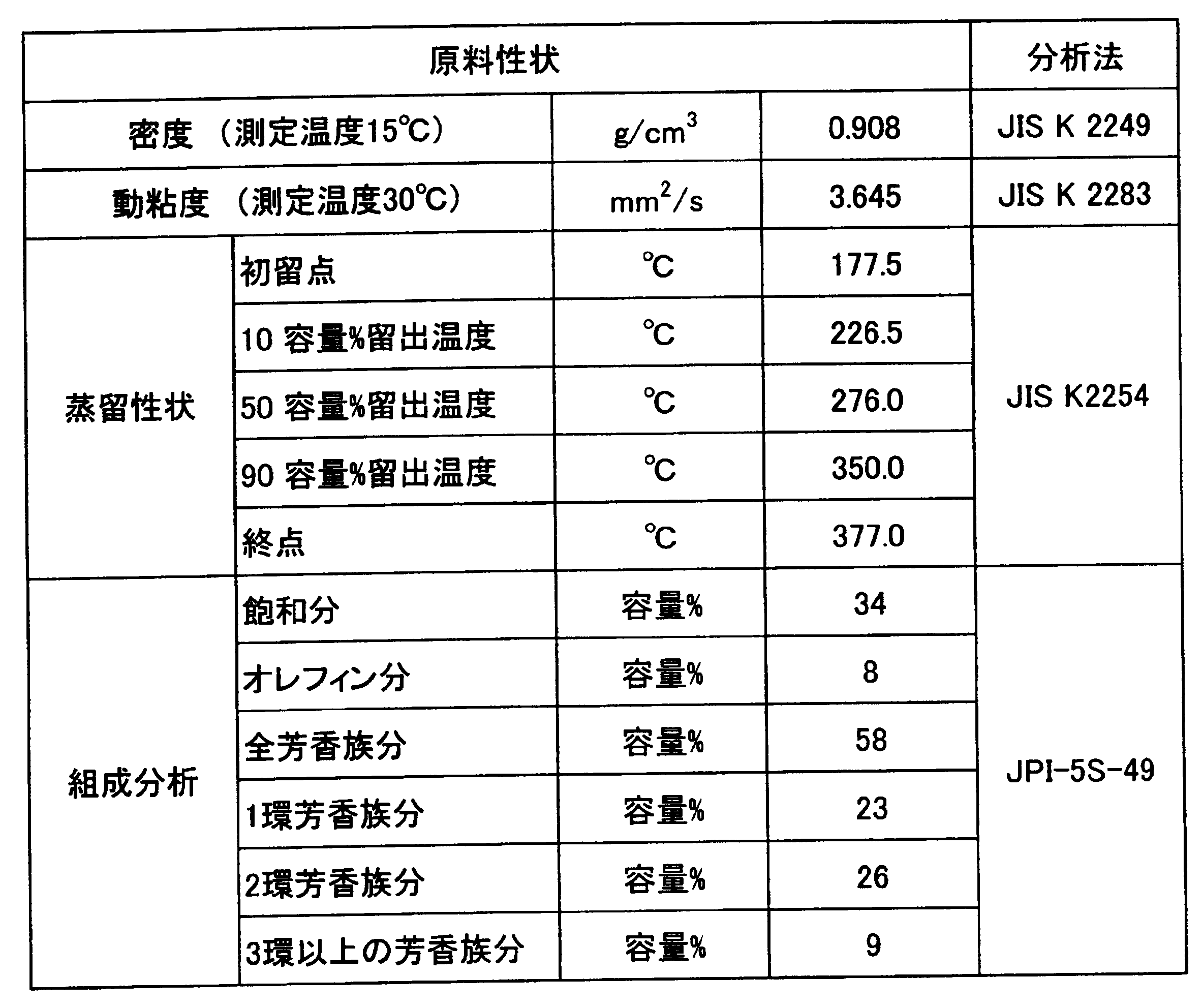
粒状化触媒1~4、6、及び7(10ml)を反応器に充填した流通式反応装置を用い、反応温度:550℃、反応圧力:0MPaGの条件で、表1の性状を有する原料油を粒状化触媒と接触、反応させた。その際、原料油と粒状化触媒との接触時間が7秒となるように希釈剤として窒素を導入した。
この条件にて30分反応させて、炭素数6~8の単環芳香族炭化水素を製造し、反応装置に直結されたFIDガスクロマトグラフにより生成物の組成分析を行って、反応初期の触媒活性を評価した。評価結果を表2に示す。
なお、表2中の生成物中の重質分とは炭素数6~8の単環芳香族炭化水素以外で炭素数6以上の炭化水素を、軽質ナフサとは炭素数5~6の炭化水素を、液化石油ガスとは炭素数3~4の炭化水素を、分解ガスとは炭素数2以下の炭化水素を意味する。
粒状化触媒1~4、7を、各々、処理温度650℃、処理時間6時間、水蒸気100質量%の環境下で水熱処理することにより、擬似的に水熱劣化させた擬似劣化触媒1~4、7を作製した。
粒状化触媒1~4、7の代わりに擬似劣化触媒1~4、7を各々用いた以外は評価1と同様に、原料油を反応させ、得られた生成物の組成分析を行って水熱劣化後の触媒活性を評価した。評価結果を表2に示す。
粉末状触媒5(400g)を反応器に充填した流通式反応装置を用い、反応温度:550℃、反応圧力:0.1MPaGの条件で、表1の性状を有する原料油を粉末状触媒5と接触、反応させた。その際、直径60mmである反応管に粉末状触媒を充填した。原料油と粉末状触媒との接触時間が10秒となるように希釈剤として窒素を導入した。
この条件にて10分反応させて、炭素数6~8の単環芳香族炭化水素を製造し、反応装置に直結されたFIDガスクロマトグラフにより生成物の組成分析を行って、反応初期の触媒活性を評価した。評価結果を表2に示す。
なお、表2中の生成物中の重質分とは炭素数6~8の単環芳香族炭化水素以外で炭素数6以上の炭化水素を、軽質ナフサとは炭素数5~6の炭化水素を、液化石油ガスとは炭素数3~4の炭化水素を、分解ガスとは炭素数2以下の炭化水素を意味する。
粉末状触媒5を、処理温度650℃、処理時間6時間、水蒸気100質量%の環境下で水熱処理することにより、擬似的に水熱劣化させた擬似劣化触媒5を作製した。
粉末状触媒5の代わりに擬似劣化触媒5を用いた以外は評価3と同様に、原料油を反応させ、得られた生成物の組成分析を行って水熱劣化後の触媒活性を評価した。評価結果を表2に示す。
反応初期の触媒活性評価(評価1または評価3)における炭素数6~8の単環芳香族炭化水素量(質量%)に対する、水熱劣化後の触媒活性評価(評価2または評価4)における炭素数6~8の単環芳香族炭化水素量(質量%)([評価2(または4)における炭素数6~8の単環芳香族炭化水素量(質量%)]/[評価1(または3)における炭素数6~8の単環芳香族炭化水素量(質量%)])の値を算出し、触媒劣化の度合いを求めた。結果を表2に併記する。なお、この値が大きいほど、触媒劣化が起こりにくいことを意味する。また、炭素数6~8の単環芳香族炭化水素量は単環芳香族炭化水素量と略す場合もある。
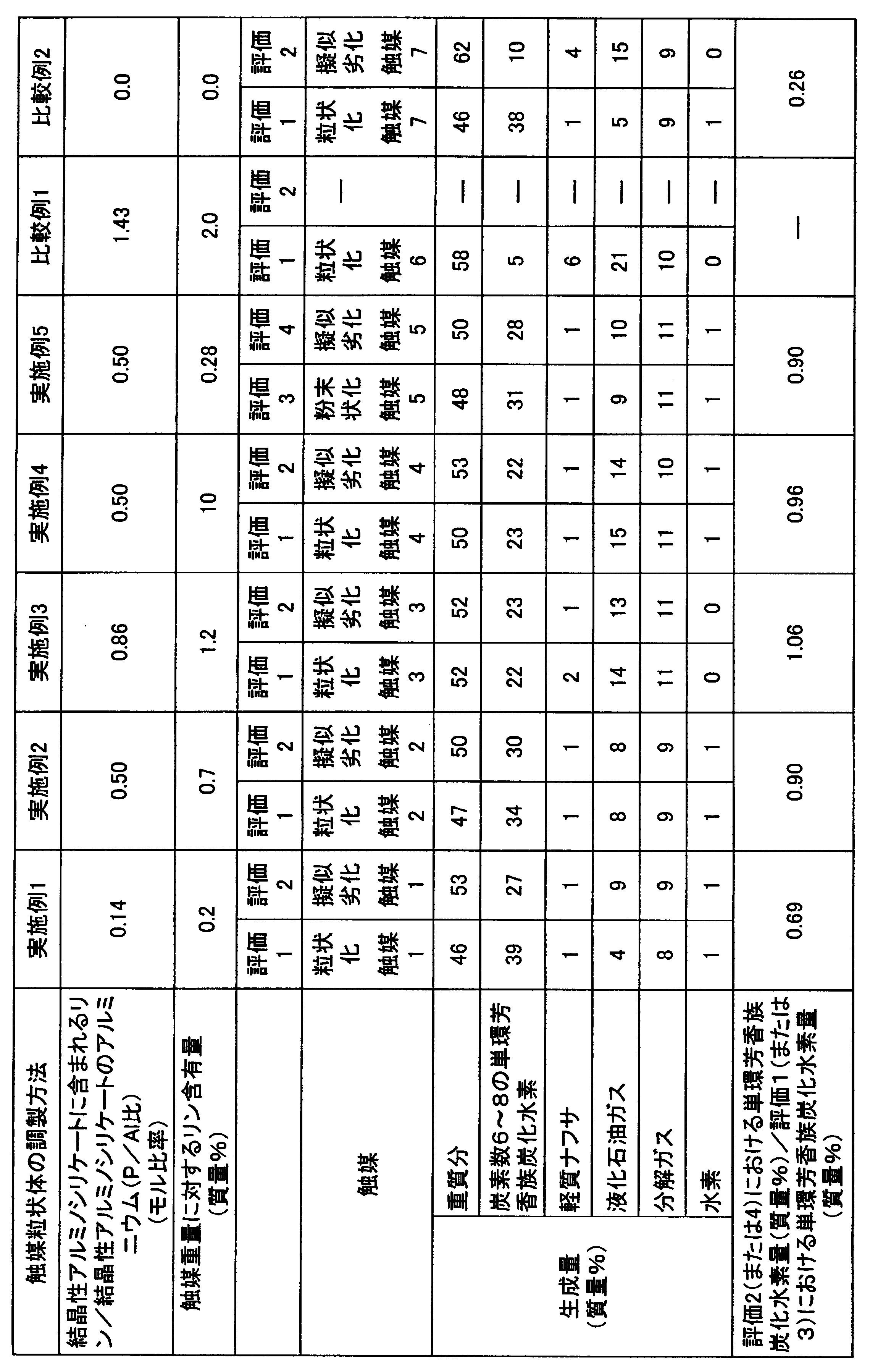
粒状化触媒1~4および粉末状触媒5を用いた実施例1~5は、反応初期における炭素数6~8の単環芳香族炭化水素生成量が、各々、39質量%、34質量%、22質量%、23質量%、31質量%であり、水熱劣化後の炭素数6~8の単環芳香族炭化水素生成量が、各々、27質量%、30質量%、23質量%、22質量%、28質量%であり、触媒劣化の度合い([評価2(または4)における単環芳香族炭化水素量(質量%)]/[評価1(または3)における単環芳香族炭化水素量(質量%)])は、各々、0.69、0.90、1.06、0.96、0.90となった。
粒状化触媒1~4および粉末状触媒5を用いた実施例1~5は、反応初期の触媒活性および水熱劣化後の触媒活性のいずれも良好で、本願の目的とする炭素数6~8の単環芳香族炭化水素を反応初期においても、水熱劣化後においても収率よく得られることが分かった。
一方、P/Al比が大きい粒状化触媒6を用いた比較例1は、反応初期における炭素数6~8の単環芳香族炭化水素生成量が、5質量%となり、多量のリンを添加すると、反応初期においても生成物中の炭素数6~8の単環芳香族炭化水素の収率が著しく低下することが分かった。
P/Al比が0である粒状化触媒7を用いた比較例2は、反応初期における炭素数6~8の単環芳香族炭化水素生成量が38質量%、水熱劣化後の炭素数6~8の単環芳香族炭化水素生成量が10質量%、触媒劣化の度合い([評価2における単環芳香族炭化水素量(質量%)]/[評価1における単環芳香族炭化水素量(質量%)])は0.26となり、リンを含有しない触媒を用いると、反応初期における炭素数6~8の単環芳香族炭化水素の収率は良好であるが、水熱劣化後の収率が低下し、触媒劣化が著しく、実用的でないことが分かった。
Claims (7)
- 10容量%留出温度が140℃以上かつ90容量%留出温度が380℃以下である原料油から炭素数6~8の単環芳香族炭化水素を製造するための芳香族炭化水素製造用触媒であって、
結晶性アルミノシリケートとリンとを含有し、前記結晶性アルミノシリケートに含まれるリンと、前記結晶性アルミノシリケートのアルミニウムとのモル比率(P/Al比)が0.1以上、1.0以下であることを特徴とする単環芳香族炭化水素製造用触媒。 - リン含有量が触媒重量に対して0.1~10質量%であることを特徴とする請求項1に記載の単環芳香族炭化水素製造用触媒。
- 前記結晶性アルミノシリケートが、中細孔ゼオライトであることを特徴とする請求項1または2に記載の単環芳香族炭化水素製造用触媒。
- 前記結晶性アルミノシリケートが、MFI型ゼオライトであることを特徴とする請求項1から3のいずれか一項に記載の単環芳香族炭化水素製造用触媒。
- 10容量%留出温度が140℃以上かつ90容量%留出温度が380℃以下である原料油を、請求項1から4のいずれか一項に記載の単環芳香族炭化水素製造用触媒に接触させることを特徴とする炭素数6~8の単環芳香族炭化水素の製造方法。
- 前記原料油が、流動接触分解装置で生成する分解軽油を含むことを特徴とする請求項5に記載の炭素数6~8の単環芳香族炭化水素の製造方法。
- 流動床反応装置にて前記原料油を前記単環芳香族炭化水素製造用触媒に接触させることを特徴とする請求項5または6に記載の炭素数6~8の単環芳香族炭化水素の製造方法。
Priority Applications (5)
| Application Number | Priority Date | Filing Date | Title |
|---|---|---|---|
| US13/976,655 US9815047B2 (en) | 2010-12-28 | 2011-12-28 | Catalyst for producing monocyclic aromatic hydrocarbon and production method of monocyclic aromatic hydrocarbon |
| CN201180062850.9A CN103282119B (zh) | 2010-12-28 | 2011-12-28 | 单环芳香族烃制造用催化剂及单环芳香族烃的制造方法 |
| KR1020137017490A KR20140027082A (ko) | 2010-12-28 | 2011-12-28 | 단환 방향족 탄화수소 제조용 촉매 및 단환 방향족 탄화수소의 제조 방법 |
| EP11853109.4A EP2659972A4 (en) | 2010-12-28 | 2011-12-28 | CATALYST FOR THE PRODUCTION OF MONOCYCLIC AROMATIC HYDROCARBONS AND METHOD FOR THE PRODUCTION OF MONOCYCLIC AROMATIC HYDROCARBONS |
| BR112013016510A BR112013016510A2 (pt) | 2010-12-28 | 2011-12-28 | catalisador para produzir hidrocarboneto aromático monocíclico e método de produção de hidrocarboneto aromático monocíclico |
Applications Claiming Priority (2)
| Application Number | Priority Date | Filing Date | Title |
|---|---|---|---|
| JP2010-294185 | 2010-12-28 | ||
| JP2010294185A JP2012139640A (ja) | 2010-12-28 | 2010-12-28 | 単環芳香族炭化水素製造用触媒および単環芳香族炭化水素の製造方法 |
Publications (1)
| Publication Number | Publication Date |
|---|---|
| WO2012091092A1 true WO2012091092A1 (ja) | 2012-07-05 |
Family
ID=46383180
Family Applications (1)
| Application Number | Title | Priority Date | Filing Date |
|---|---|---|---|
| PCT/JP2011/080390 Ceased WO2012091092A1 (ja) | 2010-12-28 | 2011-12-28 | 単環芳香族炭化水素製造用触媒および単環芳香族炭化水素の製造方法 |
Country Status (8)
| Country | Link |
|---|---|
| US (1) | US9815047B2 (ja) |
| EP (1) | EP2659972A4 (ja) |
| JP (1) | JP2012139640A (ja) |
| KR (1) | KR20140027082A (ja) |
| CN (1) | CN103282119B (ja) |
| BR (1) | BR112013016510A2 (ja) |
| MY (1) | MY163179A (ja) |
| WO (1) | WO2012091092A1 (ja) |
Cited By (3)
| Publication number | Priority date | Publication date | Assignee | Title |
|---|---|---|---|---|
| CN105008492A (zh) * | 2013-02-21 | 2015-10-28 | 吉坤日矿日石能源株式会社 | 单环芳香族烃的制造方法 |
| US10087376B2 (en) | 2010-01-20 | 2018-10-02 | Jx Nippon Oil & Energy Corporation | Method for producing monocyclic aromatic hydrocarbons |
| CN113546651A (zh) * | 2020-04-23 | 2021-10-26 | 中国科学院上海高等研究院 | 一种磷改性的炭基催化剂及其制备方法和应用 |
Families Citing this family (6)
| Publication number | Priority date | Publication date | Assignee | Title |
|---|---|---|---|---|
| CN104114277B (zh) * | 2011-10-17 | 2017-02-15 | 埃克森美孚研究工程公司 | 磷改性沸石催化剂 |
| JP6650391B2 (ja) * | 2014-04-04 | 2020-02-19 | Jxtgエネルギー株式会社 | アルミノシリケート触媒の製造方法、アルミノシリケート触媒、及び単環芳香族炭化水素の製造方法 |
| KR101600430B1 (ko) | 2015-01-08 | 2016-03-07 | 한국화학연구원 | 이산화탄소가 풍부한 합성가스로부터 단환 방향족 화합물 및 장쇄올레핀 화합물의 직접 합성방법 |
| KR102186035B1 (ko) | 2018-10-30 | 2020-12-07 | 한국화학연구원 | 합성가스로부터 단환 방향족 화합물의 직접 합성방법 |
| KR102162250B1 (ko) | 2018-10-30 | 2020-10-06 | 한국화학연구원 | 단환 방향족 화합물의 합성용 촉매 및 이를 이용한 단환 방향족 화합물의 합성방법 |
| CN112237941A (zh) * | 2019-07-19 | 2021-01-19 | 国家能源投资集团有限责任公司 | 芳构化催化剂及其制备方法和低碳烯烃芳构化方法 |
Citations (8)
| Publication number | Priority date | Publication date | Assignee | Title |
|---|---|---|---|---|
| JPH032128A (ja) | 1989-05-30 | 1991-01-08 | Idemitsu Kosan Co Ltd | 単環芳香族含有炭化水素の製造方法 |
| JPH0326791A (ja) | 1989-06-23 | 1991-02-05 | Idemitsu Kosan Co Ltd | 炭化水素の製造方法 |
| JPH0352993A (ja) | 1989-07-21 | 1991-03-07 | Idemitsu Kosan Co Ltd | Btxに富む炭化水素の製造方法 |
| JPH1135496A (ja) * | 1995-07-14 | 1999-02-09 | Mobil Oil Corp | Fccナフサからのベンゼン、トルエン及びキシレンの製造 |
| JP2002525380A (ja) | 1998-09-28 | 2002-08-13 | ビーピー・コーポレーション・ノース・アメリカ・インコーポレーテッド | ペンタジルゼオライトをベースとした触媒を用いるオレフィン製造方法 |
| JP2007190520A (ja) | 2006-01-20 | 2007-08-02 | Sekiyu Combinat Kodo Togo Unei Gijutsu Kenkyu Kumiai | 重質油の接触分解触媒及びオレフィンと燃料油の製造方法 |
| JP2007530266A (ja) | 2004-03-31 | 2007-11-01 | 中国石油化工股▲分▼有限公司 | ゼオライト含有炭化水素変換触媒、その製造方法、および該触媒で炭化水素油を変換する方法 |
| WO2010109897A1 (ja) * | 2009-03-27 | 2010-09-30 | 新日本石油株式会社 | 芳香族炭化水素の製造方法 |
Family Cites Families (5)
| Publication number | Priority date | Publication date | Assignee | Title |
|---|---|---|---|---|
| EP1116519A1 (en) * | 2000-01-12 | 2001-07-18 | Akzo Nobel N.V. | Solid-state phosphorous activation of crystalline porous silicates |
| US6776975B2 (en) * | 2002-05-09 | 2004-08-17 | Uop Llc | Crystalline aluminosilicate zeolitic composition: UZM-4M |
| TWI277648B (en) * | 2004-07-29 | 2007-04-01 | China Petrochemical Technology | A cracking catalyst for hydrocarbons and its preparation |
| AU2005321726B2 (en) * | 2004-12-28 | 2011-03-03 | China Petroleum & Chemical Corporation | A catalyst and a hydrocarbon oil cracking method |
| JP4823655B2 (ja) | 2005-11-21 | 2011-11-24 | 出光興産株式会社 | キシレン類の製造方法 |
-
2010
- 2010-12-28 JP JP2010294185A patent/JP2012139640A/ja active Pending
-
2011
- 2011-12-28 MY MYPI2013701108A patent/MY163179A/en unknown
- 2011-12-28 US US13/976,655 patent/US9815047B2/en active Active
- 2011-12-28 EP EP11853109.4A patent/EP2659972A4/en not_active Ceased
- 2011-12-28 WO PCT/JP2011/080390 patent/WO2012091092A1/ja not_active Ceased
- 2011-12-28 KR KR1020137017490A patent/KR20140027082A/ko not_active Ceased
- 2011-12-28 BR BR112013016510A patent/BR112013016510A2/pt not_active IP Right Cessation
- 2011-12-28 CN CN201180062850.9A patent/CN103282119B/zh active Active
Patent Citations (8)
| Publication number | Priority date | Publication date | Assignee | Title |
|---|---|---|---|---|
| JPH032128A (ja) | 1989-05-30 | 1991-01-08 | Idemitsu Kosan Co Ltd | 単環芳香族含有炭化水素の製造方法 |
| JPH0326791A (ja) | 1989-06-23 | 1991-02-05 | Idemitsu Kosan Co Ltd | 炭化水素の製造方法 |
| JPH0352993A (ja) | 1989-07-21 | 1991-03-07 | Idemitsu Kosan Co Ltd | Btxに富む炭化水素の製造方法 |
| JPH1135496A (ja) * | 1995-07-14 | 1999-02-09 | Mobil Oil Corp | Fccナフサからのベンゼン、トルエン及びキシレンの製造 |
| JP2002525380A (ja) | 1998-09-28 | 2002-08-13 | ビーピー・コーポレーション・ノース・アメリカ・インコーポレーテッド | ペンタジルゼオライトをベースとした触媒を用いるオレフィン製造方法 |
| JP2007530266A (ja) | 2004-03-31 | 2007-11-01 | 中国石油化工股▲分▼有限公司 | ゼオライト含有炭化水素変換触媒、その製造方法、および該触媒で炭化水素油を変換する方法 |
| JP2007190520A (ja) | 2006-01-20 | 2007-08-02 | Sekiyu Combinat Kodo Togo Unei Gijutsu Kenkyu Kumiai | 重質油の接触分解触媒及びオレフィンと燃料油の製造方法 |
| WO2010109897A1 (ja) * | 2009-03-27 | 2010-09-30 | 新日本石油株式会社 | 芳香族炭化水素の製造方法 |
Non-Patent Citations (2)
| Title |
|---|
| See also references of EP2659972A4 * |
| W. M. MEIYER; D. H. OLSON: "Atlas of Zeolite Structure Types", 1978, POLYCRYSTAL BOOK SERVICE, PITTSBURGH, PA, USA |
Cited By (5)
| Publication number | Priority date | Publication date | Assignee | Title |
|---|---|---|---|---|
| US10087376B2 (en) | 2010-01-20 | 2018-10-02 | Jx Nippon Oil & Energy Corporation | Method for producing monocyclic aromatic hydrocarbons |
| CN105008492A (zh) * | 2013-02-21 | 2015-10-28 | 吉坤日矿日石能源株式会社 | 单环芳香族烃的制造方法 |
| US9862897B2 (en) | 2013-02-21 | 2018-01-09 | Jx Nippon Oil & Energy Corporation | Method for producing monocyclic aromatic hydrocarbon |
| CN113546651A (zh) * | 2020-04-23 | 2021-10-26 | 中国科学院上海高等研究院 | 一种磷改性的炭基催化剂及其制备方法和应用 |
| CN113546651B (zh) * | 2020-04-23 | 2022-11-11 | 中国科学院上海高等研究院 | 一种磷改性的炭基催化剂及其制备方法和应用 |
Also Published As
| Publication number | Publication date |
|---|---|
| BR112013016510A2 (pt) | 2016-09-27 |
| CN103282119B (zh) | 2016-01-20 |
| JP2012139640A (ja) | 2012-07-26 |
| MY163179A (en) | 2017-08-15 |
| US9815047B2 (en) | 2017-11-14 |
| CN103282119A (zh) | 2013-09-04 |
| EP2659972A4 (en) | 2014-09-10 |
| US20130289325A1 (en) | 2013-10-31 |
| KR20140027082A (ko) | 2014-03-06 |
| EP2659972A1 (en) | 2013-11-06 |
Similar Documents
| Publication | Publication Date | Title |
|---|---|---|
| JP4820919B2 (ja) | 単環芳香族炭化水素製造用触媒および単環芳香族炭化水素の製造方法 | |
| JP6147376B2 (ja) | 単環芳香族炭化水素製造用触媒および単環芳香族炭化水素の製造方法 | |
| WO2012091092A1 (ja) | 単環芳香族炭化水素製造用触媒および単環芳香族炭化水素の製造方法 | |
| JP4740396B2 (ja) | 芳香族炭化水素の製造方法 | |
| US9815750B2 (en) | Catalyst for producing monocyclic aromatic hydrocarbons, and method for producing monocyclic aromatic hydrocarbons | |
| JP5868012B2 (ja) | 単環芳香族炭化水素の製造方法 | |
| WO2012091100A1 (ja) | 単環芳香族炭化水素製造用触媒および単環芳香族炭化水素の製造方法 | |
| JP5587761B2 (ja) | 単環芳香族炭化水素の製造方法 | |
| JP5813853B2 (ja) | 単環芳香族炭化水素製造用触媒および単環芳香族炭化水素の製造方法 | |
| JP5750434B2 (ja) | 単環芳香族炭化水素製造用触媒および単環芳香族炭化水素の製造方法 |
Legal Events
| Date | Code | Title | Description |
|---|---|---|---|
| 121 | Ep: the epo has been informed by wipo that ep was designated in this application |
Ref document number: 11853109 Country of ref document: EP Kind code of ref document: A1 |
|
| WWE | Wipo information: entry into national phase |
Ref document number: 13976655 Country of ref document: US Ref document number: 2011853109 Country of ref document: EP |
|
| NENP | Non-entry into the national phase |
Ref country code: DE |
|
| ENP | Entry into the national phase |
Ref document number: 20137017490 Country of ref document: KR Kind code of ref document: A |
|
| REG | Reference to national code |
Ref country code: BR Ref legal event code: B01A Ref document number: 112013016510 Country of ref document: BR |
|
| ENP | Entry into the national phase |
Ref document number: 112013016510 Country of ref document: BR Kind code of ref document: A2 Effective date: 20130626 |