WO2012102478A2 - 다층 필름 및 이를 포함하는 광전지 모듈 - Google Patents
다층 필름 및 이를 포함하는 광전지 모듈 Download PDFInfo
- Publication number
- WO2012102478A2 WO2012102478A2 PCT/KR2011/009334 KR2011009334W WO2012102478A2 WO 2012102478 A2 WO2012102478 A2 WO 2012102478A2 KR 2011009334 W KR2011009334 W KR 2011009334W WO 2012102478 A2 WO2012102478 A2 WO 2012102478A2
- Authority
- WO
- WIPO (PCT)
- Prior art keywords
- multilayer film
- group
- primer layer
- meth
- acrylate
- Prior art date
- Legal status (The legal status is an assumption and is not a legal conclusion. Google has not performed a legal analysis and makes no representation as to the accuracy of the status listed.)
- Ceased
Links
Images


Classifications
-
- B—PERFORMING OPERATIONS; TRANSPORTING
- B32—LAYERED PRODUCTS
- B32B—LAYERED PRODUCTS, i.e. PRODUCTS BUILT-UP OF STRATA OF FLAT OR NON-FLAT, e.g. CELLULAR OR HONEYCOMB, FORM
- B32B27/00—Layered products comprising a layer of synthetic resin
- B32B27/06—Layered products comprising a layer of synthetic resin as the main or only constituent of a layer, which is next to another layer of the same or of a different material
- B32B27/08—Layered products comprising a layer of synthetic resin as the main or only constituent of a layer, which is next to another layer of the same or of a different material of synthetic resin
-
- C—CHEMISTRY; METALLURGY
- C08—ORGANIC MACROMOLECULAR COMPOUNDS; THEIR PREPARATION OR CHEMICAL WORKING-UP; COMPOSITIONS BASED THEREON
- C08J—WORKING-UP; GENERAL PROCESSES OF COMPOUNDING; AFTER-TREATMENT NOT COVERED BY SUBCLASSES C08B, C08C, C08F, C08G or C08H
- C08J7/00—Chemical treatment or coating of shaped articles made of macromolecular substances
- C08J7/04—Coating
- C08J7/043—Improving the adhesiveness of the coatings per se, e.g. forming primers
-
- B—PERFORMING OPERATIONS; TRANSPORTING
- B32—LAYERED PRODUCTS
- B32B—LAYERED PRODUCTS, i.e. PRODUCTS BUILT-UP OF STRATA OF FLAT OR NON-FLAT, e.g. CELLULAR OR HONEYCOMB, FORM
- B32B27/00—Layered products comprising a layer of synthetic resin
- B32B27/30—Layered products comprising a layer of synthetic resin comprising vinyl (co)polymers; comprising acrylic (co)polymers
- B32B27/304—Layered products comprising a layer of synthetic resin comprising vinyl (co)polymers; comprising acrylic (co)polymers comprising vinyl halide (co)polymers, e.g. PVC, PVDC, PVF, PVDF
-
- B—PERFORMING OPERATIONS; TRANSPORTING
- B32—LAYERED PRODUCTS
- B32B—LAYERED PRODUCTS, i.e. PRODUCTS BUILT-UP OF STRATA OF FLAT OR NON-FLAT, e.g. CELLULAR OR HONEYCOMB, FORM
- B32B27/00—Layered products comprising a layer of synthetic resin
- B32B27/32—Layered products comprising a layer of synthetic resin comprising polyolefins
- B32B27/322—Layered products comprising a layer of synthetic resin comprising polyolefins comprising halogenated polyolefins, e.g. PTFE
-
- B—PERFORMING OPERATIONS; TRANSPORTING
- B32—LAYERED PRODUCTS
- B32B—LAYERED PRODUCTS, i.e. PRODUCTS BUILT-UP OF STRATA OF FLAT OR NON-FLAT, e.g. CELLULAR OR HONEYCOMB, FORM
- B32B7/00—Layered products characterised by the relation between layers; Layered products characterised by the relative orientation of features between layers, or by the relative values of a measurable parameter between layers, i.e. products comprising layers having different physical, chemical or physicochemical properties; Layered products characterised by the interconnection of layers
- B32B7/04—Interconnection of layers
- B32B7/12—Interconnection of layers using interposed adhesives or interposed materials with bonding properties
-
- C—CHEMISTRY; METALLURGY
- C08—ORGANIC MACROMOLECULAR COMPOUNDS; THEIR PREPARATION OR CHEMICAL WORKING-UP; COMPOSITIONS BASED THEREON
- C08F—MACROMOLECULAR COMPOUNDS OBTAINED BY REACTIONS ONLY INVOLVING CARBON-TO-CARBON UNSATURATED BONDS
- C08F24/00—Homopolymers and copolymers of compounds having one or more unsaturated aliphatic radicals, each having only one carbon-to-carbon double bond, and at least one being terminated by a heterocyclic ring containing oxygen
-
- C—CHEMISTRY; METALLURGY
- C08—ORGANIC MACROMOLECULAR COMPOUNDS; THEIR PREPARATION OR CHEMICAL WORKING-UP; COMPOSITIONS BASED THEREON
- C08G—MACROMOLECULAR COMPOUNDS OBTAINED OTHERWISE THAN BY REACTIONS ONLY INVOLVING UNSATURATED CARBON-TO-CARBON BONDS
- C08G73/00—Macromolecular compounds obtained by reactions forming a linkage containing nitrogen with or without oxygen or carbon in the main chain of the macromolecule, not provided for in groups C08G12/00 - C08G71/00
- C08G73/06—Polycondensates having nitrogen-containing heterocyclic rings in the main chain of the macromolecule
-
- C—CHEMISTRY; METALLURGY
- C08—ORGANIC MACROMOLECULAR COMPOUNDS; THEIR PREPARATION OR CHEMICAL WORKING-UP; COMPOSITIONS BASED THEREON
- C08J—WORKING-UP; GENERAL PROCESSES OF COMPOUNDING; AFTER-TREATMENT NOT COVERED BY SUBCLASSES C08B, C08C, C08F, C08G or C08H
- C08J7/00—Chemical treatment or coating of shaped articles made of macromolecular substances
- C08J7/04—Coating
- C08J7/042—Coating with two or more layers, where at least one layer of a composition contains a polymer binder
-
- H—ELECTRICITY
- H10—SEMICONDUCTOR DEVICES; ELECTRIC SOLID-STATE DEVICES NOT OTHERWISE PROVIDED FOR
- H10F—INORGANIC SEMICONDUCTOR DEVICES SENSITIVE TO INFRARED RADIATION, LIGHT, ELECTROMAGNETIC RADIATION OF SHORTER WAVELENGTH OR CORPUSCULAR RADIATION
- H10F19/00—Integrated devices, or assemblies of multiple devices, comprising at least one photovoltaic cell covered by group H10F10/00, e.g. photovoltaic modules
- H10F19/80—Encapsulations or containers for integrated devices, or assemblies of multiple devices, having photovoltaic cells
-
- H—ELECTRICITY
- H10—SEMICONDUCTOR DEVICES; ELECTRIC SOLID-STATE DEVICES NOT OTHERWISE PROVIDED FOR
- H10F—INORGANIC SEMICONDUCTOR DEVICES SENSITIVE TO INFRARED RADIATION, LIGHT, ELECTROMAGNETIC RADIATION OF SHORTER WAVELENGTH OR CORPUSCULAR RADIATION
- H10F19/00—Integrated devices, or assemblies of multiple devices, comprising at least one photovoltaic cell covered by group H10F10/00, e.g. photovoltaic modules
- H10F19/80—Encapsulations or containers for integrated devices, or assemblies of multiple devices, having photovoltaic cells
- H10F19/85—Protective back sheets
-
- B—PERFORMING OPERATIONS; TRANSPORTING
- B32—LAYERED PRODUCTS
- B32B—LAYERED PRODUCTS, i.e. PRODUCTS BUILT-UP OF STRATA OF FLAT OR NON-FLAT, e.g. CELLULAR OR HONEYCOMB, FORM
- B32B2309/00—Parameters for the laminating or treatment process; Apparatus details
- B32B2309/08—Dimensions, e.g. volume
- B32B2309/10—Dimensions, e.g. volume linear, e.g. length, distance, width
- B32B2309/105—Thickness
-
- B—PERFORMING OPERATIONS; TRANSPORTING
- B32—LAYERED PRODUCTS
- B32B—LAYERED PRODUCTS, i.e. PRODUCTS BUILT-UP OF STRATA OF FLAT OR NON-FLAT, e.g. CELLULAR OR HONEYCOMB, FORM
- B32B2457/00—Electrical equipment
- B32B2457/12—Photovoltaic modules
-
- B—PERFORMING OPERATIONS; TRANSPORTING
- B32—LAYERED PRODUCTS
- B32B—LAYERED PRODUCTS, i.e. PRODUCTS BUILT-UP OF STRATA OF FLAT OR NON-FLAT, e.g. CELLULAR OR HONEYCOMB, FORM
- B32B27/00—Layered products comprising a layer of synthetic resin
- B32B27/06—Layered products comprising a layer of synthetic resin as the main or only constituent of a layer, which is next to another layer of the same or of a different material
-
- C—CHEMISTRY; METALLURGY
- C08—ORGANIC MACROMOLECULAR COMPOUNDS; THEIR PREPARATION OR CHEMICAL WORKING-UP; COMPOSITIONS BASED THEREON
- C08J—WORKING-UP; GENERAL PROCESSES OF COMPOUNDING; AFTER-TREATMENT NOT COVERED BY SUBCLASSES C08B, C08C, C08F, C08G or C08H
- C08J2300/00—Characterised by the use of unspecified polymers
- C08J2300/22—Thermoplastic resins
-
- C—CHEMISTRY; METALLURGY
- C08—ORGANIC MACROMOLECULAR COMPOUNDS; THEIR PREPARATION OR CHEMICAL WORKING-UP; COMPOSITIONS BASED THEREON
- C08J—WORKING-UP; GENERAL PROCESSES OF COMPOUNDING; AFTER-TREATMENT NOT COVERED BY SUBCLASSES C08B, C08C, C08F, C08G or C08H
- C08J2367/00—Characterised by the use of polyesters obtained by reactions forming a carboxylic ester link in the main chain; Derivatives of such polymers
- C08J2367/02—Polyesters derived from dicarboxylic acids and dihydroxy compounds
-
- C—CHEMISTRY; METALLURGY
- C08—ORGANIC MACROMOLECULAR COMPOUNDS; THEIR PREPARATION OR CHEMICAL WORKING-UP; COMPOSITIONS BASED THEREON
- C08J—WORKING-UP; GENERAL PROCESSES OF COMPOUNDING; AFTER-TREATMENT NOT COVERED BY SUBCLASSES C08B, C08C, C08F, C08G or C08H
- C08J2400/00—Characterised by the use of unspecified polymers
- C08J2400/10—Polymers characterised by the presence of specified groups, e.g. terminal or pendant functional groups
- C08J2400/104—Polymers characterised by the presence of specified groups, e.g. terminal or pendant functional groups containing oxygen atoms
-
- C—CHEMISTRY; METALLURGY
- C08—ORGANIC MACROMOLECULAR COMPOUNDS; THEIR PREPARATION OR CHEMICAL WORKING-UP; COMPOSITIONS BASED THEREON
- C08J—WORKING-UP; GENERAL PROCESSES OF COMPOUNDING; AFTER-TREATMENT NOT COVERED BY SUBCLASSES C08B, C08C, C08F, C08G or C08H
- C08J2400/00—Characterised by the use of unspecified polymers
- C08J2400/10—Polymers characterised by the presence of specified groups, e.g. terminal or pendant functional groups
- C08J2400/106—Polymers characterised by the presence of specified groups, e.g. terminal or pendant functional groups containing nitrogen atoms
-
- C—CHEMISTRY; METALLURGY
- C08—ORGANIC MACROMOLECULAR COMPOUNDS; THEIR PREPARATION OR CHEMICAL WORKING-UP; COMPOSITIONS BASED THEREON
- C08J—WORKING-UP; GENERAL PROCESSES OF COMPOUNDING; AFTER-TREATMENT NOT COVERED BY SUBCLASSES C08B, C08C, C08F, C08G or C08H
- C08J2427/00—Characterised by the use of homopolymers or copolymers of compounds having one or more unsaturated aliphatic radicals, each having only one carbon-to-carbon double bond, and at least one being terminated by a halogen; Derivatives of such polymers
- C08J2427/02—Characterised by the use of homopolymers or copolymers of compounds having one or more unsaturated aliphatic radicals, each having only one carbon-to-carbon double bond, and at least one being terminated by a halogen; Derivatives of such polymers not modified by chemical after-treatment
- C08J2427/12—Characterised by the use of homopolymers or copolymers of compounds having one or more unsaturated aliphatic radicals, each having only one carbon-to-carbon double bond, and at least one being terminated by a halogen; Derivatives of such polymers not modified by chemical after-treatment containing fluorine atoms
-
- C—CHEMISTRY; METALLURGY
- C08—ORGANIC MACROMOLECULAR COMPOUNDS; THEIR PREPARATION OR CHEMICAL WORKING-UP; COMPOSITIONS BASED THEREON
- C08J—WORKING-UP; GENERAL PROCESSES OF COMPOUNDING; AFTER-TREATMENT NOT COVERED BY SUBCLASSES C08B, C08C, C08F, C08G or C08H
- C08J2433/00—Characterised by the use of homopolymers or copolymers of compounds having one or more unsaturated aliphatic radicals, each having only one carbon-to-carbon double bond, and only one being terminated by only one carboxyl radical, or of salts, anhydrides, esters, amides, imides, or nitriles thereof; Derivatives of such polymers
- C08J2433/04—Characterised by the use of homopolymers or copolymers of compounds having one or more unsaturated aliphatic radicals, each having only one carbon-to-carbon double bond, and only one being terminated by only one carboxyl radical, or of salts, anhydrides, esters, amides, imides, or nitriles thereof; Derivatives of such polymers esters
- C08J2433/14—Characterised by the use of homopolymers or copolymers of compounds having one or more unsaturated aliphatic radicals, each having only one carbon-to-carbon double bond, and only one being terminated by only one carboxyl radical, or of salts, anhydrides, esters, amides, imides, or nitriles thereof; Derivatives of such polymers esters of esters containing halogen, nitrogen, sulfur, or oxygen atoms in addition to the carboxy oxygen
-
- C—CHEMISTRY; METALLURGY
- C08—ORGANIC MACROMOLECULAR COMPOUNDS; THEIR PREPARATION OR CHEMICAL WORKING-UP; COMPOSITIONS BASED THEREON
- C08J—WORKING-UP; GENERAL PROCESSES OF COMPOUNDING; AFTER-TREATMENT NOT COVERED BY SUBCLASSES C08B, C08C, C08F, C08G or C08H
- C08J2439/00—Characterised by the use of homopolymers or copolymers of compounds having one or more unsaturated aliphatic radicals, each having only one carbon-to-carbon double bond, and at least one being terminated by a single or double bond to nitrogen or by a heterocyclic ring containing nitrogen; Derivatives of such polymers
-
- C—CHEMISTRY; METALLURGY
- C08—ORGANIC MACROMOLECULAR COMPOUNDS; THEIR PREPARATION OR CHEMICAL WORKING-UP; COMPOSITIONS BASED THEREON
- C08L—COMPOSITIONS OF MACROMOLECULAR COMPOUNDS
- C08L2203/00—Applications
- C08L2203/20—Applications use in electrical or conductive gadgets
- C08L2203/204—Applications use in electrical or conductive gadgets use in solar cells
-
- C—CHEMISTRY; METALLURGY
- C08—ORGANIC MACROMOLECULAR COMPOUNDS; THEIR PREPARATION OR CHEMICAL WORKING-UP; COMPOSITIONS BASED THEREON
- C08L—COMPOSITIONS OF MACROMOLECULAR COMPOUNDS
- C08L2205/00—Polymer mixtures characterised by other features
- C08L2205/02—Polymer mixtures characterised by other features containing two or more polymers of the same C08L -group
-
- C—CHEMISTRY; METALLURGY
- C08—ORGANIC MACROMOLECULAR COMPOUNDS; THEIR PREPARATION OR CHEMICAL WORKING-UP; COMPOSITIONS BASED THEREON
- C08L—COMPOSITIONS OF MACROMOLECULAR COMPOUNDS
- C08L2205/00—Polymer mixtures characterised by other features
- C08L2205/02—Polymer mixtures characterised by other features containing two or more polymers of the same C08L -group
- C08L2205/025—Polymer mixtures characterised by other features containing two or more polymers of the same C08L -group containing two or more polymers of the same hierarchy C08L, and differing only in parameters such as density, comonomer content, molecular weight, structure
-
- Y—GENERAL TAGGING OF NEW TECHNOLOGICAL DEVELOPMENTS; GENERAL TAGGING OF CROSS-SECTIONAL TECHNOLOGIES SPANNING OVER SEVERAL SECTIONS OF THE IPC; TECHNICAL SUBJECTS COVERED BY FORMER USPC CROSS-REFERENCE ART COLLECTIONS [XRACs] AND DIGESTS
- Y02—TECHNOLOGIES OR APPLICATIONS FOR MITIGATION OR ADAPTATION AGAINST CLIMATE CHANGE
- Y02E—REDUCTION OF GREENHOUSE GAS [GHG] EMISSIONS, RELATED TO ENERGY GENERATION, TRANSMISSION OR DISTRIBUTION
- Y02E10/00—Energy generation through renewable energy sources
- Y02E10/50—Photovoltaic [PV] energy
-
- Y—GENERAL TAGGING OF NEW TECHNOLOGICAL DEVELOPMENTS; GENERAL TAGGING OF CROSS-SECTIONAL TECHNOLOGIES SPANNING OVER SEVERAL SECTIONS OF THE IPC; TECHNICAL SUBJECTS COVERED BY FORMER USPC CROSS-REFERENCE ART COLLECTIONS [XRACs] AND DIGESTS
- Y10—TECHNICAL SUBJECTS COVERED BY FORMER USPC
- Y10T—TECHNICAL SUBJECTS COVERED BY FORMER US CLASSIFICATION
- Y10T428/00—Stock material or miscellaneous articles
- Y10T428/26—Web or sheet containing structurally defined element or component, the element or component having a specified physical dimension
- Y10T428/263—Coating layer not in excess of 5 mils thick or equivalent
- Y10T428/264—Up to 3 mils
- Y10T428/265—1 mil or less
-
- Y—GENERAL TAGGING OF NEW TECHNOLOGICAL DEVELOPMENTS; GENERAL TAGGING OF CROSS-SECTIONAL TECHNOLOGIES SPANNING OVER SEVERAL SECTIONS OF THE IPC; TECHNICAL SUBJECTS COVERED BY FORMER USPC CROSS-REFERENCE ART COLLECTIONS [XRACs] AND DIGESTS
- Y10—TECHNICAL SUBJECTS COVERED BY FORMER USPC
- Y10T—TECHNICAL SUBJECTS COVERED BY FORMER US CLASSIFICATION
- Y10T428/00—Stock material or miscellaneous articles
- Y10T428/31504—Composite [nonstructural laminate]
- Y10T428/3154—Of fluorinated addition polymer from unsaturated monomers
-
- Y—GENERAL TAGGING OF NEW TECHNOLOGICAL DEVELOPMENTS; GENERAL TAGGING OF CROSS-SECTIONAL TECHNOLOGIES SPANNING OVER SEVERAL SECTIONS OF THE IPC; TECHNICAL SUBJECTS COVERED BY FORMER USPC CROSS-REFERENCE ART COLLECTIONS [XRACs] AND DIGESTS
- Y10—TECHNICAL SUBJECTS COVERED BY FORMER USPC
- Y10T—TECHNICAL SUBJECTS COVERED BY FORMER US CLASSIFICATION
- Y10T428/00—Stock material or miscellaneous articles
- Y10T428/31504—Composite [nonstructural laminate]
- Y10T428/3154—Of fluorinated addition polymer from unsaturated monomers
- Y10T428/31544—Addition polymer is perhalogenated
Definitions
- the present invention relates to a multilayer film, a back sheet for a photovoltaic module, a manufacturing method thereof, and a photovoltaic module including the same.
- Photovoltaic cells to which the photovoltaic power generation principle is applied are devices that convert sunlight into electrical energy.
- the photovoltaic cells need to be exposed to the external environment for a long time to easily absorb sunlight, and thus various packaging is performed to protect cells. It is manufactured in unit form, and these units are called photovoltaic modules.
- the photovoltaic module uses a back sheet having excellent weather resistance and durability to stably protect the photovoltaic cell even when exposed to an external environment for a long time.
- a back sheet generally includes a back sheet on which a resin layer containing a fluorine-based polymer such as PVF (polyvinyl fluoride) is laminated on a substrate.
- PVF polyvinyl fluoride
- the PVF resin is used by laminating a fluorine-based polymer film obtained by extrusion or casting to a substrate using a urethane-based adhesive due to poor adhesion to a PET (Polyethylene Terephtalate) film, which is typically used as a substrate of a back sheet.
- PET Polyethylene Terephtalate
- this requires an expensive film production equipment, the use of an adhesive, there is a problem that additionally requires an adhesive coating process and a lamination process.
- a film thicker than the film thickness required for film handling in the film manufacturing process should be used, the use of various additives, fillers, etc. is limited, there is a problem that a high process temperature is required.
- PVF resin solutions that require a high drying temperature use a lot of energy to provide a high drying temperature, increasing the manufacturing cost of the back sheet of the photovoltaic module, and also applying thermal shock or causing thermal deformation, resulting in mechanical It deteriorates the quality of the properties, and causes a rapid deterioration of mechanical properties when used for a long time outdoors.
- Embodiments of the present invention provide a multilayer film, a back sheet for a photovoltaic module, a manufacturing method thereof, and a photovoltaic module including the same.
- One embodiment of the present invention And a primer layer formed on the substrate and comprising an oxazoline group-containing polymer. And a resin layer formed on the primer layer and including a fluorine-based polymer.
- Another embodiment of the present invention comprises the steps of forming a primer layer comprising an oxazoline group-containing polymer on the substrate; And it provides a method for producing a multilayer film comprising the step of forming a resin layer containing a fluorine-based polymer on the primer layer.
- Another embodiment of the invention provides a back sheet for a photovoltaic module comprising a multilayer film according to embodiments of the invention.
- Another embodiment of the invention provides a photovoltaic module comprising a back sheet for a photovoltaic module according to the invention.
- the multilayer film 10 of the present invention comprises a substrate 13; A primer layer (12) formed on the substrate (13); And a resin layer 11 formed on the primer layer 12.
- the primer layer 12 includes an oxazoline group-containing polymer, and the resin layer 11 includes a fluorine-based polymer.
- the specific kind of the substrate included in the multilayer film in the present invention is not particularly limited, and various materials known in the art may be used, and may be appropriately selected and used depending on the required function and use.
- various metal films or polymer films can be used as the substrate.
- the metal film include those composed of ordinary metal components depending on the use, and examples of the polymer film include a single sheet such as an acrylic film, a polyolefin film, a polyamide film, a polyurethane film, a polyester film, a laminated sheet, or the like. Co-extruded, and it is common to use a polyester film, but it is not limited to this.
- the polyester film may include at least one selected from the group consisting of a polyethylene terephtalate (PET) film, a polyethylene naphtalate (PEN) film, and a polybutylene terephtalate (PBT) film. But it is not limited thereto.
- polyester film having excellent hydrolysis resistance it is preferable to use one having a small content of oligomer generated during condensation polymerization.
- a known heat treatment to improve the hydrolysis characteristics of the polyester film it is possible to further improve the hydrolysis characteristics by reducing the water content of the polyester, reducing the shrinkage. It is also possible to use a product commercially available as a film having excellent hydrolysis resistance.
- high-frequency spark discharge treatment such as corona treatment or plasma treatment on one or both surfaces of the substrate; Heat treatment; Flame treatment; Anchor agent treatment; Coupling agent treatment; Surface treatment such as primer treatment or chemical activation treatment using gaseous Lewis acid (ex. BF 3 ), sulfuric acid or high temperature sodium hydroxide or the like can be performed.
- the surface treatment method may be by any known means generally used in the art.
- the surface treatment as described above induces a carboxyl group, an aromatic thiol group, a phenolic hydroxyl group, and the like on the surface of the substrate, thereby improving the binding property of the oxazoline group included in the primer layer, thereby improving the bonding strength of the substrate and the primer layer. It can be further improved.
- an inorganic oxide deposition layer may be formed on one or both surfaces of the substrate.
- the kind of the inorganic oxide is not particularly limited, and any type of inorganic oxide can be employed without limitation as long as it has moisture barrier properties.
- silicon oxide or aluminum oxide may be used as the inorganic oxide, but is not limited thereto.
- the method for forming the inorganic oxide deposition layer on one or both surfaces of the substrate is not particularly limited, and may be based on a deposition method or the like generally used in the art.
- the above-described surface treatment can be performed on the inorganic oxide deposited layer after the inorganic oxide deposited layer is formed on the surface of the substrate.
- the thickness of the substrate is not particularly limited, and may be, for example, in the range of 50 ⁇ m to 500 ⁇ m, or may be in the range of 100 ⁇ m to 300 ⁇ m.
- the thickness of the substrate in the present invention is not limited to the above range, which may be appropriately adjusted as necessary.
- the multilayer film of the present invention includes a primer layer formed on the substrate, and the primer layer includes an oxazoline group-containing polymer.
- the primer layer may include an oxazoline group-containing polymer, thereby improving adhesion between the substrate and the resin layer. That is, the primer layer containing the oxazoline group-containing polymer improves the adhesion to the substrate through the oxazoline group, and also improves the bonding strength with the fluorine-based resin layer, which will be described later, to strongly bond the substrate and the resin layer. Can be done.
- the type of the oxazoline group-containing polymer included in the primer layer is not particularly limited, and any type of polymer may be used as long as it has excellent compatibility with the fluorine-based polymer to be described later.
- an oxazoline group-containing polymer for example, as an oxazoline group-containing polymer, a homopolymer of an oxazoline group-containing monomer; Copolymers comprising an oxazoline group-containing monomer and one or more comonomers; Or mixtures thereof, but is not limited thereto.
- the oxazoline group-containing monomer that can be used in the present invention may be a compound represented by the following formula (1).
- R 1 , R 2 , R 3 and R 4 each independently represent a hydrogen atom, an alkyl group, a halogen, a substituted or unsubstituted phenyl group, and R 5 represents an acyclic hydrocarbon group having an unsaturated bond.
- substituent in the substituted or unsubstituted phenyl group at least one selected from the group consisting of an amino group, a methyl group, a chloromethyl group and a chloro group may be mentioned.
- the acyclic hydrocarbon group having an unsaturated bond may include an alkenyl group, an alkynyl group or an olefin group capable of radical polymerization, but is not limited thereto.
- the alkenyl group may be, for example, an alkenyl group having 1 to 12 carbon atoms, or 1 to 5 carbon atoms
- the alkynyl group may be, for example, an alkynyl group having 1 to 12 carbon atoms or 1 to 5 carbon atoms
- the olefin group may be, for example, an olefin group having 1 to 12 carbon atoms or 1 to 5 carbon atoms, but is not limited thereto.
- 2-vinyl-2-oxazoline 2-vinyl-4-methyl-2-oxazoline
- 2-vinyl-5-methyl-2-oxazoline At least one selected from the group consisting of 2-isopropenyl-2-oxazoline, 2-isopropenyl-4-methyl-2-oxazoline and 2-isopropenyl-5-ethyl-2-oxazoline
- 2-isopropenyl-2-oxazoline 2-isopropenyl-4-methyl-2-oxazoline
- 2-isopropenyl-5-ethyl-2-oxazoline 2-isopropenyl-5-ethyl-2-oxazoline
- the oxazoline group-containing monomer in the copolymer comprising the oxazoline group-containing monomer and at least one comonomer of the present invention is at least 1% by weight, 5% to 95% by weight, or 10% by weight relative to the total weight of the copolymer. To 90% by weight. If the content of the oxazoline group-containing monomer in the copolymer comprising the oxazoline group-containing monomer and one or more comonomers of the present invention is less than 1% by weight, it may be difficult to provide sufficient adhesion between the substrate and the primer layer.
- the type of comonomer included in the polymerized form in the copolymer including the oxazoline group-containing monomer and one or more comonomers is not particularly limited, and does not react with the oxazoline group-containing monomer, Copolymerization is possible without limitation.
- alkyl (meth) acrylates for example, alkyl (meth) acrylates, amide group-containing monomers, unsaturated nitrile monomers, vinyl ester monomers, vinyl ether monomers, halogen-containing ⁇ , ⁇ -unsaturated monomers and ⁇ , ⁇ as comonomers.
- the alkyl (meth) acrylate may have an alkyl group having 1 to 14 carbon atoms in order to provide a balance of compatibility with the fluorine-based polymer and excellent adhesion properties, for example, methyl (meth) acrylate, ethyl (Meth) acrylate, propyl (meth) acrylate, n-butyl (meth) acrylate, s-butyl (meth) acrylate, t-butyl (meth) acrylate, isobutyl (meth) acrylate, hexyl ( Meta) acrylate, 2-ethylhexyl (meth) acrylate, n-octyl (meth) acrylate, isooctyl (meth) acrylate, n-nonyl (meth) acrylate, isononyl (meth) acrylate, n -Decyl (meth) acrylate, iso
- examples of the amide group-containing monomer include (meth) acrylamide, diethylacrylamide, N-vinylpyrrolidone, N, N-dimethyl (meth) acrylamide, and N, N-diethyl (meth).
- unsaturated nitrile monomer examples include (meth) acrylonitrile, ethacrylonitrile, phenylacrylonitrile or ⁇ -chloroacrylonitrile.
- the vinyl ester monomer include vinyl acetate or Vinyl propionate, and the like.
- Examples of the vinyl ether monomers include methyl vinyl ether or ethyl vinyl ether.
- halogen-containing ⁇ , ⁇ -unsaturated monomers examples include vinyl chloride and chloride.
- Vinylidene or vinyl fluoride, and the like, and examples of the ⁇ , ⁇ -unsaturated aromatic monomer include, but are not limited to, styrene or ⁇ -methylstyrene.
- the weight average molecular weight of the oxazoline group-containing polymer may be 5,000 to 500,000, 10,000 to 250,000, or 20,000 to 150,000, but is not limited thereto.
- the weight average molecular weight of the oxazoline group-containing polymer by controlling the weight average molecular weight of the oxazoline group-containing polymer within the above range, it is possible to secure the appropriate compatibility fluidity with the fluorine-based polymer, to impart adhesion.
- the polymerization method of the oxazoline group-containing polymer used in the present invention is not particularly limited, and may be polymerized by a known method such as solution polymerization, emulsion polymerization, bulk polymerization or suspension polymerization.
- the copolymer obtained may be any of a random copolymer, a block copolymer, an alternating copolymer, or a graft copolymer.
- the thickness of the primer layer including the oxazoline group-containing polymer is not particularly limited, and may be, for example, 10 nm to 10,000 nm, 20 nm to 5,000 nm, or 50 nm to 2,000 nm. If the thickness of the primer layer is less than 10 nm, the adhesive force may be lowered. If the thickness of the primer layer is more than 10,000 nm, the durability and weather resistance of the resin layer containing the fluorine-based polymer may be lowered.
- the multilayer film of the present invention is formed on the primer layer, and includes a resin layer containing a fluorine-based polymer. Since the resin layer includes a fluorine-based polymer, during the coating process for forming the resin layer, the fluorine-based polymer may penetrate into the primer layer to form an interpenetrating polymer network (IPN), and the CF 2 bond of the fluorine-based polymer.
- IPN interpenetrating polymer network
- the interaction by van der Waals bonds between the oxazoline groups or additional functional groups, such as ester groups, of the dipole and primer layers can improve the adhesion and mechanical properties at the contact interface and can improve the durability and weather resistance. .
- the kind of the fluorine-based polymer forming the resin layer in the present invention is not particularly limited, and for example, vinylidene fluoride (VDF), vinyl fluoride (VF, vinyl fluoride), tetrafluoroethylene (TFE, Tetrafluoroethylene) hexafluoropropylene (HFP, Hexafluoropropylene), chlorotrifluoroethylene (CTFE, chlorotrifluoroethylene), trifluoroethylene, hexafluoroisobutylene, perfluoro butylethylene, perfluoro methyl vinyl ether (PMVE, perfluoro (methylvinylether)), perfluoro ethyl vinyl ether (PEVE), perfluoro propyl vinyl ether (PPVE), perfluoro hexyl vinyl ether (PHVE), perfluoro-2,2-dimethyl Homopolymers comprising in polymerized form one or more monomers selected from the group consisting of -1,3-di
- the fluorine-based polymer may be a copolymer including vinylidene fluoride (VDF) and a comonomer or a copolymer including vinyl fluoride (VF) and a comonomer, and may be included in a copolymerized form of the fluorine-based copolymer.
- VDF vinylidene fluoride
- VF vinyl fluoride
- the kind of comonomer which can be used is not particularly limited.
- TFE Tetrafluoroethylene
- HFP Hexafluoropropylene
- CTFE chlorotrifluoroethylene
- Ethylene hexafluoroisobutylene
- PMVE perfluoro methyl vinyl ether
- PEVE perfluoro ethyl vinyl ether
- PEVE perfluoro propyl vinyl Ether
- PHVE perfluoro hexyl vinyl ether
- PPD perfluoro-2,2-dimethyl-1,3-diosol
- PPDD perfluoro-2-methylene-4-methyl-1,3 Diok
- PMD perfluoro-2,2-dimethyl-1,3-diosol
- PPDD perfluoro-2-methylene-4-methyl-1,3 Diok
- the content of the comonomer included in the fluorine-based copolymer in the present invention is not particularly limited, for example, 0.5% to 50% by weight, 1% to 40% by weight, 7% by weight relative to the total weight of the fluorine-based copolymer To 40%, 10% to 30%, or 10% to 20% by weight.
- the present invention by controlling the content of the comonomer contained in the fluorine-based copolymer in the above range, while ensuring the durability and weather resistance of the multilayer film, it is possible to induce effective interdiffusion action and low temperature drying.
- the weight average molecular weight of the fluorine-based polymer may be 50,000 to 1 million, 100,000 to 700,000, or 300,000 to 500,000, but is not limited thereto.
- the weight average molecular weight is a conversion value of standard polystyrene measured by GPC (Gel Permeation Chromatograph).
- GPC Gel Permeation Chromatograph
- the fluorine-based polymer may have a melting point of 80 ° C to 175 ° C, or 120 ° C to 165 ° C.
- the melting point of the fluorine-based polymer by controlling the melting point of the fluorine-based polymer to 80 °C or more, to prevent deformation in the process of using the multilayer film, and also to adjust the melting point to 175 °C or less, to control the solubility in the solvent, The gloss can be improved.
- the fluorine-based polymer may include i) a first fluorine-based polymer having a melting point of 155 ° C. or less or a softening point of 100 ° C. or less.
- the first fluorine-based polymer has good compatibility with a polymer containing an oxazoline group, thereby improving adhesion to the primer layer, thereby further improving durability of the multilayer film.
- the fluorine-based polymer may further include a second fluorine-based polymer having a melting point of 155 ° C. or higher and a softening point of 100 ° C.
- the first fluorine-based polymer and the second fluorine-based polymer both correspond to the above-described fluorine-based polymer, and are classified according to melting and softening points, which are inherent characteristics of the material resulting from polymerization of the fluorine-based monomer.
- the first fluorine-based polymer having a melting point of 155 ° C. or less or a softening point of 100 ° C. or less may occupy 20% by weight or more of the fluorine-based polymer of the entire resin layer, and preferably occupy 50% or more.
- the melting point or softening point of the fluorine-based polymer it is possible to increase the interaction with the oxazoline group-containing polymer of the primer layer.
- the thickness of the resin layer is not particularly limited, and may be, for example, 3 ⁇ m to 50 ⁇ m, or 10 ⁇ m to 30 ⁇ m. If the thickness of the resin layer is less than 3 ⁇ m, the resin layer may be too thin, insufficient filling of the filler, resulting in poor light shielding properties. If the thickness is greater than 50 ⁇ m, the manufacturing cost may increase.
- the resin layer of the present invention may further include a pigment or a filler together with the fluorine-based polymer for controlling the color or opacity of the resin layer or for other purposes.
- a pigment or a filler examples include metal oxides such as titanium dioxide (TiO 2 ), silica or alumina; Black pigments such as calcium carbonate, barium sulfate or carbon black; Or a pigment component showing another color, but is not limited thereto.
- the pigment or filler as described above may act to further improve the adhesive force of the resin layer by an inherent functional group included in each component together with the inherent effect of controlling the color or opacity of the resin layer.
- the content of the other additives such as pigments or fillers may be 60 wt% or less based on the solids of the fluorine-based polymer and the oxazoline group-containing polymer, but is not limited thereto.
- the resin layer of the present invention may also further contain conventional components such as ultraviolet stabilizers, heat stabilizers or barrier particles.
- the resin layer containing the fluorine-based polymer may be a coating layer.
- coating layer used in the present invention means a resin layer formed by a coating method. More specifically, the “coating layer” is a solvent, for example, not a method in which the resin layer containing the above-described fluorine-based polymer is laminated by using an adhesive or the like on a sheet prepared by a casting method or an extrusion method. It means the case formed by dissolving a component constituting the resin layer in a solvent having a low boiling point by coating the substrate with a coating liquid.
- the multilayer film (not shown) according to another aspect of the present invention is formed with a primer layer and a resin layer on the other side of the substrate. And a primer layer and a resin layer laminated on both sides of the substrate.
- the multilayer film of the present invention may further include various functional layers known in the art as needed.
- an adhesive layer As an example of the said functional layer, an adhesive layer, an insulating layer, etc. are mentioned.
- the primer layer and the resin layer described above may be sequentially formed on one surface of the substrate, and the adhesive layer and the insulating layer may be sequentially formed on the other surface.
- the adhesive or insulating layer can be formed in a variety of ways known in the art.
- the insulating layer may be a layer composed of ethylene vinyl acetate (EVA) or low density linear polyethylene (LDPE).
- the layer composed of ethylene vinyl acetate (EVA) or low density linear polyethylene (LDPE) increases the adhesion as well as the encapsulant of the photovoltaic module as well as a function of the insulating layer, to reduce the manufacturing cost, reworkability ( At the same time, functions that maintain good re-workability can also be performed.
- EVA ethylene vinyl acetate
- LDPE low density linear polyethylene
- Another embodiment of the present invention comprises the steps of forming a primer layer comprising an oxazoline group-containing polymer on the substrate; And it relates to a method for producing a multilayer film comprising the step of forming a resin layer comprising a fluorine-based polymer on the primer layer.
- the manner of forming the primer layer on the substrate in the present invention is not particularly limited.
- coating a resin composition or a coating liquid on a base material it is possible to form a primer layer by drying on predetermined conditions.
- the coating method is not particularly limited, and includes uniform printing methods such as an offset printing method and a gravure printing method, and known coating methods such as a roll coat or a knife edge coat and a gravure coat. Any method can be applied as long as one primer layer can be formed.
- various methods known in the art may be applied, and the resin composition or coating liquid for forming the primer layer may further include various other additives as necessary.
- substrates that can be used in the production method of the present invention are as described above, one or both surfaces of the substrate, appropriate deposition treatment, plasma treatment, corona treatment, anchor treatment, coupling agent treatment, primer treatment and heat
- One or more surface treatments selected from the group consisting of treatments may be performed before the resin layer is formed, or a substrate on which one or more surface treatment layers is already formed by performing the above surface treatments may be used.
- the carboxyl group, the aromatic thiol group, the phenolic hydroxyl group, and the like can be induced on the surface of the substrate by performing one or more surface treatments on one or both surfaces of the substrate as described above.
- the functional groups may form a chemical covalent bond with an oxazoline group included in the primer layer, thereby further improving the interfacial bond between the substrate and the primer layer.
- the resin composition for forming a primer layer that is, the coating liquid
- an aqueous solvent such as water or a solvent having a relatively low boiling point, specifically, a solvent having a boiling point of 200 ° C. or less.
- a high temperature drying process is not required in the manufacturing process, thereby reducing manufacturing cost and preventing thermal deformation or thermal shock of a substrate which may be caused during high temperature drying, thereby improving product quality. You can.
- Examples of such a solvent that can be used in the present invention include one or more selected from the group consisting of water such as distilled water, acetone, methyl ethyl ketone (MEK), dimethylformamide (DMF) and dimethylacetamide (DMAC). May be, but is not limited thereto.
- water such as distilled water, acetone, methyl ethyl ketone (MEK), dimethylformamide (DMF) and dimethylacetamide (DMAC). May be, but is not limited thereto.
- the solvents such as water, methyl ethyl ketone, dimethylformamide or dimethylacetamide are solvents evaporated at a temperature of 200 ° C. or lower, and may well dissolve the primer layer coating material including the aforementioned oxazoline group-containing polymer. In addition, it may be applied together with the material onto the substrate and then dried at a relatively low temperature. In addition, in particular in the coating process, the solvent of the resin composition for forming the primer layer swells the surface of the substrate or the surface treatment layer of the substrate, whereby at the contact interface between the primer layer applied on the substrate and the substrate The intersiffusion of the oxazoline group-containing polymer included in the primer layer occurs toward the substrate.
- the oxazoline group-containing polymer may form a bond with various functional groups present on the surface of the substrate, such as a carboxyl group, an aromatic thiol group, or a phenolic hydroxyl group, through a double bond portion inside the oxazoline group ring. Accordingly, in the multilayer film, an oxazoline group-containing polymer may be distributed in the substrate adjacent to the primer layer, thereby improving physical and chemical bonding strength between the primer layer and the substrate, thereby improving adhesion between the substrate and the primer layer. Can be improved.
- the manufacturing method of the resin composition for primer layer formation, the ratio of each component contained in a resin composition, etc. are not restrict
- a step of drying the coated resin composition may be further performed.
- the drying conditions are not particularly limited, and for example, may be carried out for 30 seconds to 30 minutes, or 1 minute to 10 minutes at a temperature of 200 °C or less, or 100 °C to 180 °C.
- by performing the drying process under the above conditions it is possible to prevent the increase in the manufacturing cost by the high temperature drying process of 200 °C or more, and to prevent the product quality deterioration due to thermal deformation or thermal shock.
- the present invention includes the step of forming a resin layer containing a fluorine-based polymer on the primer layer to produce a multilayer film.
- the manner of forming the resin layer on the primer layer is not particularly limited.
- a resin composition for forming a resin layer or a coating liquid prepared by dissolving or dispersing the aforementioned fluorine-based polymer in an appropriate organic solvent or an aqueous solvent is applied onto a primer layer.
- the resin layer can be formed by drying under predetermined conditions.
- the coating method is not particularly limited, and includes uniform printing methods such as an offset printing method and a gravure printing method, and known coating methods such as a roll coat or a knife edge coat and a gravure coat. Any method can be applied as long as one resin layer can be formed.
- various methods known in the art may be applied, and the resin composition or coating liquid for forming a resin layer may further include various other additives as necessary.
- the resin composition for forming a resin layer may be prepared by dissolving or dispersing a component forming the resin layer described above in a solvent having a relatively low boiling point, specifically, a solvent having a boiling point of 200 ° C. or less. That is, in the present invention, the fluorine-based polymer can be effectively dissolved in a solvent having a relatively low boiling point. Accordingly, in the present invention, a high temperature drying process is not required in the manufacturing process, thereby reducing manufacturing cost and preventing thermal deformation or thermal shock of a substrate which may be caused during high temperature drying, thereby improving product quality. You can.
- Examples of such a solvent that can be used in the present invention include one or more selected from the group consisting of acetone, methyl ethyl ketone (MEK), dimethylformamide (DMF) and dimethylacetamide (DMAC), but is not limited thereto. It doesn't happen.
- Solvents such as methyl ethyl ketone, dimethylformamide or dimethylacetamide are solvents evaporated at a temperature of 200 ° C. or less, and are capable of dissolving the resin layer coating material containing the fluorine-based polymer as well as the materials. After being applied onto the primer layer with a relatively low temperature.
- the solvent of the resin composition for forming a resin layer swells the surface of the primer layer in the coating process, whereby the fluorine-based polymer contained in the resin layer is present at the contact interface between the resin layer and the primer layer. Interdiffusion occurs with the primer layer. Accordingly, the physical and chemical bonding strength between the resin layer and the primer layer may be improved, thereby further improving the adhesive force between the resin layer and the primer layer.
- the resin composition for forming a resin layer may further include various additives such as pigments, fillers, ultraviolet stabilizers, or heat stabilizers.
- additives may be dissolved in a solvent together with a fluorine-based polymer, or prepared in a millbase form separately from the component, and then mixed with a solvent including the fluorine-based polymer.
- Chemical interactions such as van der Waals bonds, hydrogen bonds, ionic bonds, or covalent bonds may also occur due to functional groups included in additives such as fillers or pigment dispersants that may be included in the resin layer as described above.
- the adhesion between the substrate and the substrate can be further improved.
- the manufacturing method of the resin composition for resin layer formation, the ratio of each component contained in the said resin composition, etc. are not restrict
- a step of drying the coated resin composition may be further performed.
- the drying conditions are not particularly limited, and for example, may be carried out for 30 seconds to 30 minutes, or 1 minute to 10 minutes at a temperature of 200 °C or less, or 100 °C to 180 °C.
- by performing the drying process under the above conditions it is possible to prevent the increase in the manufacturing cost by the high temperature drying process of 200 °C or more, and to prevent the product quality deterioration due to thermal deformation or thermal shock.
- the invention also relates to a back sheet for a photovoltaic module comprising the multilayer film according to the invention described above.
- the back sheet for the photovoltaic module includes a primer layer comprising an oxazoline group-containing polymer formed on a substrate and a resin layer comprising a fluorine-based polymer formed on the primer layer, and included in the primer layer.
- Oxazoline groups form chemical covalent bonds with various functional groups on the surface of the substrate, thereby providing excellent adhesion between the substrate and the primer layer, and the fluorine-based polymer included in the resin layer not only improves durability and weather resistance, but also physically interacts with the primer layer.
- the interface between the primer layer and the substrate during the manufacturing process of the back sheet for the photovoltaic module may be mutually diffused into the substrate or the surface treatment layer of the substrate, whereby between the substrate and the primer layer
- the oxazoline group-containing polymer included in the primer layer may be mutually diffused into the substrate or the surface treatment layer of the substrate, whereby between the substrate and the primer layer
- the fluorine-based polymer contained in the resin layer can diffuse into the primer layer, thereby improving adhesion between the resin layer and the primer layer by entanglement between the molecular chains and van der Waals forces.
- the back sheet for a photovoltaic module has properties such as insulation and moisture barrier as well as durability and weather resistance to stably protect the photovoltaic cell even when exposed to an external environment for a long time.
- the invention also relates to a photovoltaic module comprising the back sheet for a photovoltaic module according to the invention described above.
- the structure of the photovoltaic module of the present invention is not particularly limited as long as the multilayer film is included as a back sheet for a photovoltaic module, and various structures generally known in this field may be employed without limitation.
- the structure of the photovoltaic module includes a back sheet; A photovoltaic cell or photovoltaic array formed on said back sheet; A light receiving sheet formed on the photovoltaic cell or photovoltaic array; And an encapsulant layer encapsulating the photovoltaic cell or the photovoltaic cell array between the back sheet and the light receiving sheet.
- the back sheet may use the above-described multilayer film according to the present invention, and the thickness of the back sheet is not particularly limited, for example, 30 ⁇ m to 2,000 ⁇ m, 50 ⁇ m to 1,000 ⁇ m, or 100 ⁇ m to 600 May be ⁇ m.
- the photovoltaic module can be configured to be thinner, while maintaining excellent properties such as weather resistance of the photovoltaic module.
- amorphous silicon photovoltaic cells such as crystalline silicon photovoltaic cells such as monocrystalline silicon, polycrystalline silicon, single bond type or tandem structure type, gallium arsenide (GaAs), indium- Group III-V compound semiconductor photovoltaic cells, such as phosphorus (InP), and group II-VI compound semiconductor photovoltaic cells, such as cadmium-tellurium (CdTe) and copper-indium-selenide (CuInSe 2 ), etc.
- Film polycrystalline silicon photovoltaic cells, thin film microcrystalline silicon photovoltaic cells, and hybrid photovoltaic cells of thin film crystalline silicon and amorphous silicon may also be used.
- the photovoltaic cell can form a photovoltaic array (photovoltaic cell assembly) by wiring connecting the photovoltaic cell and the photovoltaic cell.
- photovoltaic array photovoltaic cell assembly
- the light-receiving sheet formed on the photovoltaic cell or photovoltaic cell array may perform a function of protecting the inside of the photovoltaic module from wind, external shock or fire, and ensuring long-term reliability upon outdoor exposure of the photovoltaic module.
- Specific types of the light-receiving sheet of the present invention are not particularly limited as long as the light-receiving sheet is excellent in light transmittance, electrical insulation, mechanical or physical, and chemical strength.
- a resin sheet, a poly (meth) acrylic resin sheet, a polyamide resin sheet, or a polyester resin sheet can be used.
- a glass plate having excellent heat resistance may be used, but is not limited thereto.
- the thickness of the light receiving substrate used in the present invention is not particularly limited, and may be, for example, 0.5 mm to 10 mm, 1 mm to 8 mm, or 2 mm to 5 mm.
- the photovoltaic module can be made thinner, and excellent physical properties such as long-term reliability of the photovoltaic module can be maintained.
- the encapsulant layer for encapsulating a photovoltaic cell or a photovoltaic cell array in the interior of the photovoltaic module, specifically, between the back sheet and the light receiving sheet can employ an encapsulant generally known in the art without limitation. have.
- FIGS. 2 and 3 are diagrams illustrating cross-sectional views of photovoltaic modules according to various aspects of the invention.
- a photovoltaic module typically includes a light receiving sheet 21, which may be composed of a ferroelectric (ex. Glass); A back sheet 23 for a photovoltaic module according to the present invention; Photovoltaic elements 24 such as the silicon wafer; And an encapsulant layer 22 encapsulating the photovoltaic device 24.
- the encapsulant layer 22 encapsulates the photovoltaic element 24, and encapsulates the first layer 22a and the photovoltaic element 24 attached to the light receiving sheet 21, and the back sheet 23.
- the first layer and the second layer constituting the encapsulant layer 22 may be formed of a material generally known in the art, as described above.
- FIG. 2 is a cross-sectional view of a thin film photovoltaic module 30 according to another aspect of the present invention.
- the photovoltaic device 34 may be formed on the light receiving sheet 31, which may be typically composed of a ferroelectric.
- Such a thin film photovoltaic device 34 may be deposited by conventional methods such as chemical vapor deposition (CVD).
- the attached photovoltaic module 30 of FIG. 3 includes an encapsulant layer 32 and a back sheet 33 similarly to the photovoltaic module 20 of FIG. 2, wherein the encapsulant layer 32 may be composed of a single layer. have.
- a detailed description of the encapsulant layer 32 and the back sheet 33 is as described above.
- the method of manufacturing such a photovoltaic module is not particularly limited, and various methods known to those skilled in the art may be employed without limitation.
- the photovoltaic module shown in FIGS. 1 and 2 is only one example of various aspects of the photovoltaic module of the present invention, and in the case of including the back sheet for the photovoltaic module according to the present invention, the structure of the module, constituting the module
- the kind and size of the material are not particularly limited, and those generally known in the art may be employed without limitation.
- the present invention relates to a multilayer film, by forming a primer layer containing an oxazoline group-containing polymer on a substrate, and by forming a resin layer containing a fluorine-based polymer on the primer layer, reliability and adhesion in heat and moisture resistance conditions In addition to being excellent, it is possible to provide a multilayer film having excellent weather resistance and durability.
- the primer layer and the resin layer of the multilayer film according to the present invention can be manufactured at a low cost at a low drying temperature using a low boiling point solvent, thereby reducing the manufacturing cost, such a multilayer film is useful for a back sheet for a photovoltaic module It can be used to provide a photovoltaic module that can maintain excellent durability even when exposed to external environment for a long time.
- FIG. 2 is a view showing a cross-sectional view of a photovoltaic module according to one aspect of the present invention.
- FIG 3 is a cross-sectional view of a photovoltaic module according to another aspect of the present invention.
- Peel strength was measured in accordance with the standard of ASTM D1897, after cutting the specimen to a width of 10 mm, followed by peeling at a peel rate of 4.2 mm / sec and a peel angle of 180 °.
- ASTM D3002 / D3359 which is a cross cut test standard
- the cross cut test was performed. Specifically, the specimens were cut in 11 rows in the horizontal and vertical directions at intervals of 1 mm, respectively, to form 100 square grids each having a width of 1 mm. Thereafter, when the CT-24 adhesive tape of Nichiban Co., Ltd. was attached to the cutting surface and then peeled off, the state of the surface falling together was measured and evaluated according to the following criteria.
- the multilayer films prepared in Examples and Comparative Examples (coated both sides of the substrate with a primer layer and a resin layer) were left in an oven maintained at 2 atmospheres, 121 ° C. and 100% RH for 25 hours, 50 hours, and 75 hours. After that, changes in adhesion were observed.
- the corona treatment was performed on the surface of PET (poly (ethylene terephthalate), thickness: 250 micrometers) film (Kolon Co., Ltd.) which was not surface-treated.
- Fluorine-based polymers used in Examples and Comparative Examples of the present invention were prepared. Table 1 below describes the monomer components, weight average molecular weights and melting points of the fluorine-based polymers used in Examples and Comparative Examples.
- VDF Vinylidene Fluoride
- CTFE Chlorotrifluoroethylene
- HFP Hexafluoroethylene
- a coating solution for forming a primer layer was prepared by diluting 100 g of an oxazoline group-containing acrylic polymer aqueous dispersion (WS-500, manufactured by Nippon Catalytic Co., Ltd.) having a weight average molecular weight of 70,000 with 100 g of ethanol.
- WS-500 an oxazoline group-containing acrylic polymer aqueous dispersion having a weight average molecular weight of 70,000 with 100 g of ethanol.
- the coating solution for forming the primer layer was applied using a myer bar. Specifically, after coating to adjust the thickness after drying to about 1000 nm, and then coated substrate is a speed of 3 m / min in an oven of 120 mesh (mesh speed 100%), length 4 m, temperature 120 °C Was passed through to form a primer layer. Thereafter, the coating solution was coated and dried on the opposite side of the substrate to form a primer layer containing an oxazoline group-containing polymer on both sides of the PET film (substrate).
- Fluorine-based polymer 1 (vinylidene fluoride (VDF) and chlorotrifluoroethylene (CTFE) prepared in Preparation Example 1 was added to 400 g of dimethylformamide (DMF: N, N-dimethyl formamide) at 85:15 (VDF: CTFE). 70 g of a copolymer in a polymerized form in a weight ratio of; And a fluorine-based polymer 2 prepared in Preparation Example 1 (copolymer comprising vinylidene fluoride (VDF) and hexafluoropropylene (HFP; Hexafluoropropylene) in a polymerized form at a weight ratio of 88:12 (VDF: HFP)). 30 g was dissolved in advance to prepare a first coating solution.
- VDF vinylidene fluoride
- CTFE chlorotrifluoroethylene
- the coating solution for forming a resin layer was applied on a primer layer formed on the prepared PET film by a comma reverse method. Specifically, the coating after adjusting the interval so that the thickness after drying is about 20 ⁇ m, and the coated substrate 1 in three ovens of 2 m each length, the temperature is adjusted to 80 °C, 180 °C and 180 °C 1 The resin layer was formed by passing sequentially at a speed of m / min. Thereafter, the coating solution was coated and dried on the opposite side of the substrate to prepare a multilayer film in which a primer layer and a resin layer were sequentially formed on both surfaces of a PET film (substrate).
- a multilayer film was produced in the same manner as in Example 1 except that (WS-700, Nippon Catalytic Co., Ltd.) was used.
- the multilayer film was manufactured by the same method as 1.
- An oxazoline group-containing acrylic polymer aqueous solution having a weight average molecular weight of 40,000 instead of an oxazoline group-containing acrylic polymer aqueous solution having a weight average molecular weight of 70,000 during the preparation of the coating layer for forming the primer layer.
- Ceramic pigment (30C965, Shepherd) instead of titanium dioxide (TiPure TS6200, manufactured by DuPont) as a pigment in the preparation of millbase dispersion using WS-700 (manufactured by Japan Catalyst Co., Ltd.).
- a multilayer film was produced in the same manner as in Example 1, except that 40 g of Inc. was used.
- a multilayer film was manufactured in the same manner as in Example 1, except that titanium dioxide (TiPure TS6200, manufactured by DuPont) was not used as a pigment in the millbase dispersion.
- Example 1 An oxazoline group-containing acrylic polymer aqueous solution having a weight average molecular weight of 40,000 instead of an oxazoline group-containing acrylic polymer aqueous solution having a weight average molecular weight of 70,000 during the preparation of the coating layer for forming the primer layer.
- Example 1 was used, except that (WS-700, Nippon Catalyst Co., Ltd.) was used, and titanium dioxide (TiPure TS6200, DuPont Co., Ltd.), which is a pigment, was not used in the preparation of the millbase dispersion. In the same manner, a multilayer film was prepared.
- a laminated structure of a commercially available Tedlar film / adhesive / PET film / adhesive / Tedlar film was used as the multilayer film.
- the laminated structure is a product in which a DuPont Tedlar film (PVF, polyvinyl fluoride film (thickness 38 ⁇ m)) manufactured by an extrusion process is laminated on both sides of a PET film using an adhesive.
- PVF DuPont Tedlar film
- a laminated structure of a commercially available Tedlar film / adhesive / PET film / adhesive / Tedlar film was used as the multilayer film.
- the laminated structure is a product obtained by laminating DuPont Tedlar film (PVF film, thickness 25 ⁇ m) manufactured by the casting process on both sides of the PET film using an adhesive.
- a multilayer film was prepared in the same manner as in Example 1, except that the step of forming the primer layer was omitted.
- the step of forming a primer layer was omitted, and 40 g of a ceramic pigment (30C965, Shepherd) was manufactured in the form of a composite metal oxide instead of titanium dioxide (TiPure TS6200, manufactured by DuPont), which is a pigment, in the preparation of the millbase dispersion. Except for the use, the multilayer film was produced in the same manner as in Example 1.
- the multilayer film was prepared in the same manner as in Example 1, except that the step of forming the primer layer was omitted and the pigment of titanium dioxide (TiPure TS6200, manufactured by DuPont) was not used in the preparation of the millbase dispersion. Prepared.
- Table 2 below describes the compositions and their contents contained in the multilayer films of Examples and Comparative Examples.
- the multilayer films of Examples 1 to 6 and Comparative Examples 1 to 5 were subjected to a pressure cooker test (PCT), followed by 180 ° peel strength and cross-hatch tests, respectively. Specifically, each multilayer film was left for 25 hours, 50 hours and 75 hours at 2 atmospheres, 121 ° C. and 100% RH, respectively, followed by a 180 ° peel strength and cross-hatch test to change the adhesion. Was evaluated. The evaluation results are shown in Table 3 below.
- the resin layer including the fluorine-based polymer has a high initial adhesive strength with the substrate (PET) through a primer layer containing the oxazoline group-containing acrylic polymer. It also showed excellent adhesion after 75 hours of PCT. In addition, even after 75 hours of PCT, no change in appearance such as interfacial peeling and pinhole formation was observed in the primer layer and the resin layer.
- Icosolar 2442 and 3469 comparative examples 1 and 2
- Nitrogen gas was refluxed, 400 g of toluene was added as a solvent to a 1 L reactor equipped with a cooling device for easy temperature control, and the temperature was maintained at 100 ° C., followed by 16 g of styrene, 76 g of methyl methacrylate, and butyl acrylate.
- a monomer mixture comprising 24 g and 84 g glycidyl methacrylate was prepared on a three-necked reactor, and on the other side, an initiator in which 10 g of an azo initiator (V-65, manufactured by Wako) was dissolved in 30 g of toluene. The solution was prepared.
- the initiator solution was slowly added dropwise for 2 hours, and 3 minutes after the start of dropping the initiator, the monomer mixture also started dropping, and slowly dropwise for a total of 2.5 hours.
- the reaction was completed after a total of 5 hours based on the initiator dropping time to obtain an epoxy group-containing acrylic polymer having a weight average molecular weight of 6,000.
- MEK methyl ethyl ketone
- the coating solution for forming the primer layer was applied onto the substrate prepared in advance in Preparation Example 1 using a myerba. Specifically, after coating to adjust the thickness after drying to about 1000 nm, the coated substrate is 120 mesh (mesh speed 100%), the length of 4 m, the speed of 3 m / min in an oven of 120 °C temperature was passed through to form a primer layer. Thereafter, the coating solution was coated and dried on the opposite side of the substrate to form a primer layer containing an oxazoline group-containing polymer on both sides of the PET film (substrate).
- Fluorine-based polymer 1 (vinylidene fluoride (VDF) and chlorotrifluoroethylene (CTFE) prepared in Preparation Example 1 was added to 400 g of dimethylformamide (DMF: N, N-dimethyl formamide) at 85:15 (VDF: CTFE). 70 g of a copolymer in a polymerized form in a weight ratio of; And a fluorine-based polymer 2 prepared in Preparation Example 1 (copolymer comprising vinylidene fluoride (VDF) and hexafluoropropylene (HFP; Hexafluoropropylene) in a polymerized form at a weight ratio of 88:12 (VDF: HFP)). 30 g was dissolved in advance to prepare a first coating solution.
- VDF vinylidene fluoride
- CTFE chlorotrifluoroethylene
- the coating solution for forming a resin layer was applied on a primer layer formed on the prepared PET film by a comma reverse method. Specifically, the coating after adjusting the interval so that the thickness after drying is about 20 ⁇ m, and the coated substrate 1 in three ovens of 2 m each length, the temperature is adjusted to 80 °C, 180 °C and 180 °C 1 The resin layer was formed by passing sequentially at a speed of m / min. Thereafter, the coating solution was coated and dried on the opposite side of the substrate to prepare a multilayer film in which a primer layer and a resin layer were sequentially formed on both surfaces of a PET film (substrate).
- a multilayer film was prepared in the same manner as in Comparative Example 6 except that no black pigment was used in the preparation of the millbase dispersion.
- MEK methyl ethyl ketone
- the coating liquid for forming the primer layer 100 g of an oxazoline group-containing acrylic polymer aqueous dispersion (WS-500, manufactured by Nippon Catalyst Co., Ltd.) having a weight average molecular weight of 70,000 was diluted with 100 g of distilled water instead of ethanol to form a coating liquid for forming a primer layer. Except that was prepared, a multilayer film was prepared in the same manner as in Example 1.
- WS-500 oxazoline group-containing acrylic polymer aqueous dispersion having a weight average molecular weight of 70,000
- the coating liquid for forming the primer layer 100 g of an oxazoline group-containing acrylic polymer aqueous dispersion (WS-500, manufactured by Nippon Catalyst Co., Ltd.) having a weight average molecular weight of 70,000 was diluted with 300 g of distilled water instead of ethanol to form a coating liquid for forming a primer layer. Except that was prepared, a multilayer film was prepared in the same manner as in Example 1.
- WS-500 oxazoline group-containing acrylic polymer aqueous dispersion having a weight average molecular weight of 70,000
- the coating liquid for forming the primer layer 100 g of an oxazoline group-containing acrylic polymer aqueous dispersion (WS-500, manufactured by Nippon Catalyst Co., Ltd.) having a weight average molecular weight of 70,000 was diluted with 700 g of distilled water instead of ethanol to form a coating liquid for forming a primer layer. Except that was prepared, a multilayer film was prepared in the same manner as in Example 1.
- WS-500 oxazoline group-containing acrylic polymer aqueous dispersion having a weight average molecular weight of 70,000
- the coating liquid for forming the primer layer 100 g of an oxazoline group-containing acrylic polymer aqueous dispersion (WS-500, manufactured by Nippon Catalyst Co., Ltd.) having a weight average molecular weight of 70,000 was diluted with 3900 g of distilled water instead of ethanol to coat the coating liquid for forming a primer layer. Except that was prepared, a multilayer film was prepared in the same manner as in Example 1.
- WS-500 oxazoline group-containing acrylic polymer aqueous dispersion having a weight average molecular weight of 70,000
- the primer layer includes an oxazoline group-containing acrylic copolymer in addition to the epoxy group-containing acrylic polymer
- the substrate may be used regardless of the use of the black pigment (PET).
- PET black pigment
- no change in appearance such as interfacial peeling or pinhole formation was observed in the resin layer or the like.
- Comparative Examples 6 and 7 wherein the primer layer contains only the epoxy group-containing polymer alone, it showed poor adhesion reliability when compared with the Examples according to the present invention.
Landscapes
- Chemical & Material Sciences (AREA)
- Health & Medical Sciences (AREA)
- Chemical Kinetics & Catalysis (AREA)
- Medicinal Chemistry (AREA)
- Polymers & Plastics (AREA)
- Organic Chemistry (AREA)
- Laminated Bodies (AREA)
- Photovoltaic Devices (AREA)
- Addition Polymer Or Copolymer, Post-Treatments, Or Chemical Modifications (AREA)
- Application Of Or Painting With Fluid Materials (AREA)
- Paints Or Removers (AREA)
Abstract
본 발명은 다층 필름, 광전지 모듈용 이면 시트, 그 제조 방법 및 광전지 모듈에 관한 것이다. 본 발명의 다층 필름은, 기재 상에 옥사졸린기 함유 고분자를 포함하는 프라이머 층을 형성하고, 상기 프라이머 층 상에 불소계 고분자를 포함하는 수지층을 형성함으로써 내열/내습 조건에서의 신뢰성 및 접착력이 우수할 뿐 아니라, 내후성 및 내구성이 우수한 다층 필름을 제공할 수 있다. 또한, 본 발명에 따른 다층 필름의 프라이머 층 및 수지층은 저비점 용매를 사용하여 낮은 건조 온도에서 저비용으로 제조할 수 있어, 제조 단가를 절감할 수 있으며, 열변형 또는 열충격 등에 의한 제품의 품질 저하를 방지할 수 있다. 이러한 다층 필름은 광전지 모듈용 이면 시트 등에 유용하게 사용되어, 장기간 외부환경에 노출되어도 우수한 내구성을 유지할 수 있는 광전지 모듈을 제공할 수 있다.
Description
본 발명은 다층 필름, 광전지 모듈용 이면 시트, 그의 제조 방법 및 이를 포함하는 광전지 모듈에 관한 것이다.
최근 지구 환경 문제와 화석 연료의 고갈 등에 따른 신 재생 에너지 및 청정 에너지에 대한 관심이 고조되고 있으며, 그 중 태양광 에너지는, 환경 오염 문제 및 화석 연료 고갈 문제를 해결할 수 있는 대표적인 무공해 에너지원으로 주목을 받고 있다.
태양광 발전원리가 적용되는 광전지는 태양광을 전기 에너지로 전환시키는 소자로서, 태양광을 용이하게 흡수할 수 있도록 외부환경에 장기간 노출되어야 하므로, 셀을 보호하기 위한 여러 가지 패키징이 수행되어 유닛(unit) 형태로 제조되며, 이러한 유닛을 광전지 모듈(Photovoltaic Modules)이라 한다.
일반적으로 광전지 모듈은 장기간 외부환경에 노출된 상태에서도 광전지를 안정적으로 보호할 수 있도록, 내후성 및 내구성이 우수한 이면 시트를 사용한다. 이러한 이면 시트는 기재에 PVF(polyvinyl fluoride) 등의 불소계 중합체를 포함하는 수지층이 적층되어 있는 이면 시트를 포함하는 것이 일반적이다.
그러나, 상기 PVF 수지는 이면 시트의 기재로 대표적으로 사용되는 PET(Polyethylene Terephtalate) 필름에 대한 접착력이 좋지 못하여 압출 또는 캐스팅으로 얻어진 불소계 중합체 필름을 우레탄계 접착제 등을 사용하여 기재에 라미네이션하여 사용되고 있다. 그러나, 이는 고가의 필름 제조설비가 필요하며, 접착제의 사용이 필요하고, 접착제 코팅 공정과 라미네이션 공정이 추가적으로 필요한 문제가 있다. 또한, 필름 제조공정에서의 필름 취급성을 위해 요구되는 필름 두께보다 더 두꺼운 필름을 사용하여야 하며, 다양한 첨가제, 필러 등의 사용이 제한되며, 높은 공정온도가 필요한 문제점이 있었다.
이와 달리, 불소계 중합체 필름을 수지 현탁액이나 용액으로 제조하여 기재에 코팅하여 건조할 경우에도, 통상적으로 비점(boiling point)이 높은 용매를 사용하여 200℃ 이상의 높은 건조 온도를 필요로 하는 단점이 있다.
높은 건조온도를 요구하는 PVF 수지 용액은 높은 건조온도를 제공하기 위해 많은 에너지를 사용하게 되어, 광전지 모듈의 이면 시트의 제조비용을 증가시키고, 또한 열충격을 인가하거나 열변형을 유발하여, 제품의 기계적 특성 등의 품질을 악화시키며, 옥외에서 장기 사용 시 기계적 물성의 빠른 저하를 일으킨다.
따라서, 우수한 내구성 및 내후성을 가지면서도, 낮은 건조 온도에서 건조할 수 있어 광전지 이면 시트의 제조비용을 절감할 수 있고, 광전지 모듈의 생산성 및 품질을 향상시킬 수 있는 광전지용 이면 시트 재료에 대한 요구는 지속되고 있다.
본 발명의 구현예들은 다층 필름, 광전지 모듈용 이면 시트, 그의 제조 방법 및 이를 포함하는 광전지 모듈을 제공한다.
본 발명의 일구현예는 기재; 및 상기 기재 상에 형성되고, 옥사졸린기 함유 고분자를 포함하는 프라이머 층; 및 상기 프라이머 층 상에 형성되고, 불소계 고분자를 포함하는 수지층을 포함하는 다층 필름을 제공한다.
본 발명의 다른 구현예는 기재 상에 옥사졸린기 함유 고분자를 포함하는 프라이머 층을 형성하는 단계; 및 상기 프라이머 층 상에 불소계 고분자를 포함하는 수지층을 형성하는 단계를 포함하는 다층 필름의 제조 방법을 제공한다.
본 발명의 또 다른 구현예는 본 발명의 구현예들에 따른 다층 필름을 포함하는 광전지 모듈용 이면 시트를 제공한다.
본 발명의 또 다른 구현예는 본 발명에 따른 광전지 모듈용 이면 시트를 포함하는 광전지 모듈을 제공한다.
이하에서 첨부하는 도면을 참조하여 본 발명의 구현예들을 보다 구체적으로 설명하기로 한다. 또한, 본 발명을 설명함에 있어서, 관련된 공지의 범용적인 기능 또는 구성에 대한 상세한 설명은 생략한다. 또한, 첨부되는 도면은 본 발명의 이해를 돕기 위한 개략적인 것으로 본 발명을 보다 명확하게 설명하기 위해서 설명과 관계없는 부분은 생략하였으며, 도면에서 여러 층 및 영역을 명확하게 표현하기 위하여 두께를 확대하여 나타내었고, 도면에 표시된 두께, 크기, 비율 등에 의해 본 발명의 범위가 제한되지 아니한다.
첨부된 도 1 은 본 발명의 일 태양에 따른 다층 필름의 단면도를 나타내는 도면이다. 첨부된 도 1 에 나타난 바와 같이, 본 발명의 다층 필름(10)은 기재(13); 상기 기재(13) 상에 형성되는 프라이머 층(12); 및 상기 프라이머 층(12) 상에 형성되는 수지층(11)을 포함한다. 상기 프라이머 층(12)은 옥사졸린기 함유 고분자를 포함하며, 상기 수지층(11)은 불소계 고분자를 포함한다.
본 발명에서 다층 필름에 포함되는 기재의 구체적인 종류는 특별히 제한되지 않고, 이 분야에서 공지된 다양한 소재를 사용할 수 있으며, 요구되는 기능, 용도에 따라 적절히 선택하여 사용할 수 있다.
본 발명에서는 예를 들면, 기재로서 각종 금속 필름 또는 고분자 필름을 사용할 수 있다. 상기에서 금속 필름으로는 용도에 따라 통상의 금속 성분으로 구성된 것을 들 수 있고, 고분자 필름으로는, 아크릴 필름, 폴리올레핀 필름, 폴리아미드 필름, 폴리우레탄 필름, 폴리에스테르 필름 등의 단일 시트, 적층 시트 또는 공합출물을 들 수 있고, 이 중 폴리에스테르 필름을 사용하는 것이 일반적이나, 이에 제한되는 것은 아니다. 상기 폴리에스테르 필름의 예로는, 폴리에틸렌테레프탈레이트(PET: Polyethylene Terephtalate) 필름, 폴리에틸렌나프탈레이트(PEN: Polyethylene Naphtalate) 필름 및 폴리부틸렌테레프탈레이트(PBT: Polybuthylene Terephtalate) 필름으로 이루어진 군으로부터 선택된 하나 이상을 들 수 있으나, 이에 제한되는 것은 아니다.
또한, 상기 폴리에스테르 필름으로는 내가수분해특성이 우수한 것을 사용할 수도 있다. 상기 내가수분해성이 우수한 폴리에스테르 필름은 축합 중합 시 발생하는 올리고머의 함량이 적은 것을 사용하는 것이 좋다. 또한, 상기 폴리에스테르 필름에 공지의 내가수분해특성을 향상시키는 열처리를 추가로 가해, 폴리에스테르의 수분함량을 줄이고, 수축률을 줄여줌으로써 내가수분해특성을 더욱 우수하게 할 수 있다. 내가수분해특성이 우수한 필름으로 시판되는 제품을 사용할 수도 있다.
본 발명에서는 후술할, 옥사졸린기 함유 고분자를 포함하는 프라이머 층과의 접착력을 보다 향상시키기 위하여, 기재의 일면 또는 양면에 코로나 처리 또는 플라즈마 처리와 같은 고주파수의 스파크 방전 처리; 열 처리; 화염 처리; 앵커제 처리; 커플링제 처리; 프라이머 처리 또는 기상 루이스산(ex. BF3), 황산 또는 고온 수산화나트륨 등을 사용한 화학적 활성화 처리 등의 표면 처리를 수행할 수 있다. 상기 표면 처리 방법은 이 분야에서 일반적으로 통용되는 모든 공지의 수단에 의할 수 있다.
본 발명에서 상기와 같은 표면 처리는 카르복실기, 방향족 티올기 및 페놀성 히드록실기 등을 기재 표면에 유도하여, 프라이머 층에 포함된 옥사졸린기와의 결합성을 향상시킴으로써, 기재와 프라이머 층의 결합력을 더욱 향상시킬 수 있다.
또한, 본 발명에서는 수분 차단 특성을 향상시키기 위하여, 기재의 일면 또는 양면에 무기 산화물 증착층이 형성될 수 있다. 상기 무기 산화물의 종류는 특별히 제한되지 않고, 수분 차단 특성이 있는 것이라면, 제한 없이 채용할 수 있다. 본 발명에서는 예를 들면, 무기 산화물로서 규소 산화물 또는 알루미늄 산화물을 사용할 수 있으나, 이에 제한되는 것은 아니다. 본 발명에서 기재의 일면 또는 양면에 무기 산화물 증착층을 형성하는 방법은 특별히 제한되지 않고, 이 분야에서 일반적으로 통용되는 증착법 등에 의할 수 있다.
본 발명에서 기재의 일면 또는 양면에 무기 산화물 증착층을 형성하는 경우에는, 기재 표면에 무기 산화물 증착층을 형성한 후, 상기 무기 산화물 증착층 상에 전술한 표면 처리를 행할 수 있다.
본 발명에서 상기 기재의 두께는 특별히 제한되지 않고, 예를 들면, 50 ㎛ 내지 500 ㎛의 범위일 수 있으며, 또는 100 ㎛ 내지 300 ㎛의 범위일 수 있다. 상기 기재의 두께를 상기와 같은 조절하여, 다층 필름의 전기 절연성, 수분 차단성, 기계적 특성 및 취급성 등을 우수하게 유지할 수 있다. 다만, 본 발명에서 기재의 두께가 전술한 범위에 제한되는 것은 아니며, 이는 필요에 따라서 적절히 조절될 수 있다.
본 발명의 다층 필름은 상기 기재 상에 형성되는 프라이머 층을 포함하며, 상기 프라이머 층은 옥사졸린기 함유 고분자를 포함한다. 상기 프라이머 층은 옥사졸린기 함유 고분자를 포함함으로써, 기재 및 수지층 간의 접착력을 향상시킬 수 있다. 즉, 옥사졸린기 함유 고분자를 포함하는 프라이머 층은 옥사졸린기를 통해 기재와의 접착력을 향상시키고, 또한, 후술할 불소계 수지층과도 결합력을 향상시켜, 기재 및 수지층을 강하게 결합시켜 주는 역할을 수행할 수 있다.
본 발명에서 상기 프라이머 층에 포함되는 옥사졸린기 함유 고분자의 종류는 특별히 한정되지 않고, 후술할 불소계 고분자와의 상용성이 우수한 것이라면 제한 없이 가능하다. 본 발명에서는 예를 들면, 옥사졸린기 함유 고분자로서, 옥사졸린기 함유 단량체의 단일 중합체; 옥사졸린기 함유 단량체 및 하나 이상의 공단량체를 포함하는 공중합체; 또는 이들의 혼합물을 들 수 있으나, 이에 제한되는 것은 아니다.
본 발명에서 사용될 수 있는 옥사졸린기 함유 단량체는 하기 화학식 1로 표시되는 화합물일 수 있다.
[화학식 1]

상기 화학식 1에서, R1, R2, R3 및 R4는 각각 독립적으로, 수소 원자, 알킬기, 할로겐, 치환 또는 비치환된 페닐기를 나타내고, R5는 불포화 결합을 가지는 비환식 탄화수소기를 나타낸다.
상기 치환 또는 비치환된 페닐기에서 치환기로는 아미노기, 메틸기, 클로로메틸기 및 클로로기로 이루어진 군으로부터 선택된 하나 이상을 들 수 있다.
또한, 상기 불포화 결합을 가지는 비환식 탄화수소기로는 라디칼 중합이 가능한 알케닐(alkenyl)기, 알키닐(alkynyl)기 또는 올레핀(olefin)기 등을 들 수 있으나, 이에 제한되는 것은 아니다.
본 발명에서 상기 알케닐기는 예를 들어 탄소수 1 내지 12, 또는 탄소수 1 내지 5의 알케닐기 일 수 있고, 상기 알키닐기는 예를 들어 탄소수 1 내지 12, 또는 탄소수 1 내지 5의 알키닐기일 수 있으며, 상기 올레핀기는 예를 들어 탄소수 1 내지 12, 또는 탄소수 1 내지 5의 올레핀기일 수 있으나, 이에 제한되는 것은 아니다.
본 발명에서 상기 화학식 1로 표시되는 화합물의 구체적인 예로는, 2-비닐-2-옥사졸린, 2-비닐-4-메틸-2-옥사졸린, 2-비닐-5-메틸-2-옥사졸린, 2-이소프로페닐-2-옥사졸린, 2-이소프로페닐-4-메틸-2-옥사졸린 및 2-이소프로페닐-5-에틸-2-옥사졸린으로 이루어진 군으로부터 선택된 하나 이상을 들 수 있으나, 이에 제한되는 것은 아니다.
본 발명의 옥사졸린기 함유 단량체 및 하나 이상의 공단량체를 포함하는 공중합체 내에서 옥사졸린기 함유 단량체는 상기 공중합체의 총 중량 대비 1 중량% 이상, 5 중량% 내지 95 중량%, 또는 10 중량% 내지 90 중량%로 포함될 수 있다. 본 발명의 옥사졸린기 함유 단량체 및 하나 이상의 공단량체를 포함하는 공중합체 내에서 상기 옥사졸린기 함유 단량체의 함량이 1 중량% 미만이면, 기재와 프라이머 층과의 충분한 접착력을 제공하기 어려울 수 있다.
본 발명에서 상기 옥사졸린기 함유 단량체 및 하나 이상의 공단량체를 포함하는 공중합체에 중합된 형태로 포함되는 공단량체의 종류는 특별히 제한되지 않고, 옥사졸린기와 반응하지 않으면서, 옥사졸린기 함유 단량체와 공중합이 가능한 것이라면 제한 없이 가능하다.
본 발명에서는 예를 들면, 상기 공단량체로서 알킬(메타)아크릴레이트, 아미드기 함유 단량체, 불포화 니트릴계 단량체, 비닐 에스테르계 단량체, 비닐 에테르계 단량체, 할로겐 함유 α,β-불포화 단량체 및 α,β-불포화 방향족 단량체로 이루어진 군으로부터 선택된 하나 이상을 들 수 있으나, 이에 제한되는 것은 아니다.
본 발명에서 상기 알킬(메타)아크릴레이트는 불소계 고분자와의 상용성의 균형 및 우수한 점착 특성을 부여하기 위하여, 탄소수 1 내지 14의 알킬기를 가질 수 있으며, 예를 들면, 메틸(메타)아크릴레이트, 에틸(메타)아크릴레이트, 프로필(메타)아크릴레이트, n-부틸(메타)아크릴레이트, s-부틸(메타)아크릴레이트, t-부틸(메타)아크릴레이트, 이소부틸(메타)아크릴레이트, 헥실(메타)아크릴레이트, 2-에틸헥실(메타)아크릴레이트, n-옥틸(메타)아크릴레이트, 이소옥틸(메타)아크릴레이트, n-노닐(메타)아크릴레이트, 이소노닐(메타)아크릴레이트, n-데실(메타)아크릴레이트, 이소데실(메타)아크릴레이트, n-도데실(메타)아크릴레이트, n-트리데실(메타)아크릴레이트 및 n-테트라데실(메타)아크릴레이트로 이루어진 군으로부터 선택된 하나 이상을 들 수 있다.
또한, 본 발명에서 아미드기 함유 단량체의 예로는, (메타)아크릴아미드, 디에틸아크릴아미드, N-비닐피롤리돈, N,N-디메틸(메타)아크릴아미드, N,N-디에틸(메타)아크릴아미드, N,N'-메틸렌비스아크릴아미드, N,N-디메틸아미노프로필아크릴아미드, N,N-디메틸아미노프로필메타크릴아미드, 디아세톤(메타)아크릴아미드 또는 메틸올(메타)아크릴아미드 등을 들 수 있고, 불포화 니트릴 단량체의 예로는 (메타)아크릴로니트릴, 에타크릴로니트릴, 페닐아크릴로니트릴 또는 α-클로로아크릴로니트릴 등을 들 수 있으며, 비닐 에스테르 단량체의 예로는 비닐 아세테이트 또는 비닐 프로피오네이트 등을 들 수 있고, 비닐 에테르 단량체의 예로는, 메틸 비닐 에테르 또는 에틸 비닐 에테르 등을 들 수 있으며, 할로겐 함유 α,β-불포화 단량체의 예로는, 염화 비닐, 염화 비닐리덴 또는 불화 비닐 등을 들 수 있고, α,β-불포화 방향족 단량체의 예로는, 스티렌 또는 α-메틸스티렌 등을 들 수 있으나, 이에 제한되는 것은 아니다.
본 발명에서 옥사졸린기 함유 고분자의 중량평균분자량은 5,000 내지 50만일 수 있으며, 1만 내지 25만, 또는 2만 내지 15만일 수 있으나, 이에 제한되는 것은 아니다. 본 발명에서 상기 옥사졸린기 함유 고분자의 중량평균분자량을 상기 범위 내로 제어함으로써, 불소계 고분자와의 적절한 상용성 유동성을 확보하여, 접착력을 부여할 수 있다.
본 발명에서 사용되는 옥사졸린기 함유 고분자의 중합 방법은 특별히 제한되지 않고, 용액 중합, 유화 중합, 괴상 중합 또는 현탁 중합 등의 공지된 방법에 의해 중합될 수 있다. 또한, 얻어지는 공중합체는 랜덤 공중합체, 블록 공중합체, 교대 공중합체 또는 그래프트 공중합체 등 어느 것이라도 무방하다. 당업계에서는 옥사졸린기 함유 고분자를 제조하는 방법이 다양하게 공지되어 있으며, 본 발명에서는 이러한 방식이 모두 적용될 수 있다.
본 발명에서 옥사졸린기 함유 고분자를 포함하는 프라이머 층의 두께는 특별히 제한되지 않고, 예를 들면, 10 nm 내지 10,000 nm, 20 nm 내지 5,000 nm, 또는 50 nm 내지 2,000 nm 일 수 있다. 상기 프라이머층의 두께가 10 nm 미만이면, 접착력이 저하될 우려가 있고, 10,000 nm를 초과하면, 불소계 고분자를 포함하는 수지층의 내구성 및 내후성이 저하될 우려가 있다.
본 발명의 다층 필름은 상기 프라이머 층 상에 형성되고, 불소계 고분자를 포함하는 수지층을 포함한다. 상기 수지층은 불소계 고분자를 포함함으로써, 수지층 형성을 위한 코팅 공정 시, 불소계 고분자가 프라이머 층으로 침투하여 상호침투 네트워크(IPN: Interpenetrating Polymer Networks)를 형성할 수 있고, 불소계 고분자의 C-F2 결합의 쌍극자 및 프라이머 층의 옥사졸린기 또는 추가 관능기, 예를 들면 에스테르기 간의 반데르발스 결합에 의한 상호 작용을 통해 접촉 계면에서의 접착력 및 기계적 특성을 향상시킬 수 있고, 내구성 및 내후성을 향상시킬 수 있다.
본 발명에서 수지층을 형성하는 불소계 고분자의 종류는 특별히 제한되지 않고, 예를 들면, 비닐리덴 플루오라이드(VDF, Vinylidene Fluoride), 비닐 플루오라이드(VF, Vinyl Fluoride), 테트라플루오로에틸렌(TFE, Tetrafluoroethylene) 헥사플루오로프로필렌(HFP, Hexafluoropropylene), 클로로트리플루오로에틸렌(CTFE, chlorotrifluoroethylene), 트리플루오로에틸렌, 헥사플루오로이소부틸렌, 퍼플루오로 부틸에틸렌, 퍼플루오로 메틸 비닐 에테르(PMVE, perfluoro(methylvinylether)), 퍼플루오로 에틸 비닐 에테르(PEVE, perfluoro(ethylvinylether)), 퍼플루오로 프로필 비닐 에테르(PPVE), 퍼플루오로 헥실 비닐 에테르(PHVE), 퍼플루오로-2,2-디메틸-1,3-디옥솔(PDD) 및 퍼플루오로-2-메틸렌-4-메틸-1,3-디옥솔란(PMD)으로 이루어진 군으로부터 선택된 하나 이상의 단량체를 중합된 형태로 포함하는 단독 중합체, 공중합체 또는 이들의 혼합물일 수 있다.
또한, 상기 불소계 고분자는 비닐리덴 플루오라이드(VDF)와 공단량체를 포함하는 공중합체 또는 비닐 플루오라이드(VF)와 공단량체를 포함하는 공중합체일 수 있으며, 상기 불소계 공중합체에 공중합된 형태로 포함될 수 있는 공단량체의 종류는 특별히 제한되지 않고, 예를 들면, 테트라플루오로에틸렌(TFE: Tetrafluoroethylene), 헥사플루오로프로필렌(HFP: Hexafluoropropylene), 클로로트리플루오로에틸렌(CTFE: chlorotrifluoroethylene), 트리플루오로에틸렌, 헥사플루오로이소부틸렌, 퍼플루오로 부틸에틸렌, 퍼플루오로 메틸 비닐 에테르(PMVE: perfluoro(methylvinylether)), 퍼플루오로 에틸 비닐 에테르(PEVE: perfluoro(ethylvinylether)), 퍼플루오로 프로필 비닐 에테르(PPVE), 퍼플루오로 헥실 비닐 에테르(PHVE), 퍼플루오로-2,2-디메틸-1,3-디옥솔(PDD) 및 퍼플루오로-2-메틸렌-4-메틸-1,3-디옥솔란(PMD) 으로 이루어진 군으로부터 선택된 하나 이상을 들 수 있으며, 일례로는 헥사플루오로프로필렌 및 클로로트리플루오로에틸렌 등의 하나 이상일 수 있으나, 이에 제한되는 것은 아니다.
본 발명에서 상기 불소계 공중합체에 포함되는 공단량체의 함량은 특별히 제한되지 않고, 예를 들면, 불소계 공중합체의 총 중량 대비 0.5 중량% 내지 50 중량%, 1 중량% 내지 40 중량%, 7 중량% 내지 40 중량%, 10 중량% 내지 30 중량% 또는 10 중량% 내지 20 중량%일 수 있다. 본 발명에서는 불소계 공중합체에 포함되는 공단량체의 함량을 상기 범위로 제어함으로써, 다층 필름의 내구성 및 내후성 등을 확보하면서, 효과적인 상호 확산 작용 및 저온 건조를 유도할 수 있다.
본 발명에서 상기 불소계 고분자의 중량평균분자량은 5만 내지 100만일 수 있으며, 10만 내지 70만, 또는 30만 내지 50만일 수 있으나, 이에 제한되는 것은 아니다. 본 발명에서 중량평균분자량은, GPC(Gel Permeation Chromatograph)로 측정되는 표준 폴리스티렌의 환산 수치이다. 본 발명에서는 불소계 고분자의 중량평균분자량을 상기 범위로 제어함으로써, 우수한 용해도 및 기타 물성을 확보할 수 있다.
본 발명에서 상기 불소계 고분자는 융점이 80℃ 내지 175℃, 또는 120℃ 내지 165℃일 수 있다. 본 발명에서는 불소계 고분자의 융점을 80℃ 이상으로 조절하여, 다층 필름의 사용 과정에서의 변형을 방지할 수 있고, 또한 융점을 175℃ 이하로 조절하여, 용매에 대한 용해도를 조절하고, 코팅면의 광택을 향상시킬 수 있다.
본 발명의 몇몇 구현예들에서는 상기 불소계 고분자는 i) 융점(melting point)이 155℃ 이하이거나 연화점(softening point)이 100℃ 이하인 제 1 불소계 고분자를 포함할 수 있다. 이러한 제 1 불소계 고분자는 특히 옥사졸린기를 함유하는 고분자와 혼용성이 좋아 프라이머 층과의 접착력을 향상시켜 다층 필름의 내구성을 보다 향상시킬 수 있다. 또한, 상기 불소계 고분자는 제 1 불소계 고분자 이외에도 추가로 ii) 융점이 155℃ 이상이고 연화점이 100℃ 이상인 제 2 불소계 고분자를 포함할 수 있으나, 제 2 불소계 고분자는 필요에 따라 선택적으로 사용될 수 있다. 상기 제 1 불소계 고분자 및 제 2 불소계 고분자는 모두 앞서 설명한 불소계 고분자에 해당하는 것으로, 불소계 단량체의 중합에 따른 물질의 고유한 특징인 융점 및 연화점에 따라 구분된다. 상기 융점이 155℃ 이하이거나 연화점이 100℃ 이하인 제 1 불소계 고분자는 전체 수지층의 불소계 고분자 중 20 중량% 이상을 차지할 수 있으며, 50% 이상을 차지하는 것이 좋다. 본 발명에서는 불소계 고분자의 융점 또는 연화점을 조절하여, 프라이머 층의 옥사졸린기 함유 고분자와의 상호 작용을 증대시킬 수 있다.
본 발명에서 수지층의 두께는 특별히 제한되지 않고, 예를 들면, 3 ㎛ 내지 50 ㎛일 수 있으며, 또는 10 ㎛ 내지 30 ㎛일 수 있다. 상기 수지층의 두께가 3 ㎛ 미만이면, 수지층이 너무 얇아서 충전제의 충진이 불충분하여 광차단성이 떨어질 우려가 있고, 50 ㎛를 초과하면, 제조 단가 상승의 원인이 될 수 있다.
본 발명의 수지층은, 수지층의 색상이나 불투명도의 조절 또는 기타 목적을 위하여, 불소계 고분자와 함께 안료 또는 충전제를 추가로 포함할 수 있다. 이 때 사용될 수 있는 안료 또는 충전제의 예로는, 이산화티탄(TiO2), 실리카 또는 알루미나 등과 같은 금속 산화물; 탄산 칼슘, 황산 바륨 또는 카본 블랙 등과 같은 블랙 피그먼트; 또는 다른 색상을 나타내는 피그먼트 성분 등을 들 수 있으나, 이에 제한되는 것은 아니다. 상기와 같은 안료 또는 충전제는, 수지층의 색상이나 불투명도를 제어하는 고유의 효과와 함께, 각 성분이 포함하는 고유의 작용기에 의하여 수지층의 접착력을 추가로 개선하는 작용을 할 수도 있다.
상기 안료 또는 충전제와 같은 기타 첨가제의 함량은 불소계 고분자 및 옥사졸린기 함유 고분자의 고형분을 기준으로 60중량% 이하일 수 있으나, 이에 제한되는 것은 아니다.
본 발명의 수지층은 또한, 자외선 안정제, 열 안정제 또는 장벽 입자와 같은 통상적인 성분을 추가로 포함할 수도 있다.
본 발명에서 상기 불소계 고분자를 포함하는 수지층은 코팅층일 수 있다. 본 발명에서 사용하는 용어인 「코팅층」은, 코팅 방식에 의해 형성된 수지층을 의미한다. 보다 구체적으로, 「코팅층」은 전술한 불소계 고분자를 포함하는 수지층이, 주조법(casting method) 또는 압출 방식으로 제조된 시트를 기재에 접착제 등을 사용하여 라미네이트 되는 방식이 아닌, 용매, 예를 들어 낮은 비점을 가지는 용매에 수지층을 구성하는 성분을 용해하여 제조된 코팅액을 기재에 코팅하는 방식으로 형성된 경우를 의미한다.
첨부된 도 1 은 본 발명의 일 태양에 따른 다층 필름(10)이 기재(13); 상기 기재(13)의 일면에만 형성된 프라이머 층(12); 및 상기 프라이머 층(12) 상에 형성된 수지층(11)을 포함하는 경우를 도시하고 있으나, 본 발명의 다른 태양에 의한 다층 필름(미도시)은 기재의 다른 면에도 프라이머 층 및 수지층이 형성되어, 기재의 양면에 적층된 프라이머 층 및 수지층을 포함할 수 있다.
또한, 본 발명의 다층 필름은, 필요에 따라서 당업계에서 공지되어 있는 다양한 기능성층을 추가로 포함할 수 있다. 상기 기능성층의 예로는, 접착층 또는 절연층 등을 들 수 있다. 예를 들면, 본 발명의 다층 필름에 있어서, 기재의 일면에는 전술한 프라이머 층 및 수지층이 순차적으로 형성되어 있고, 다른 일면에는 접착층 및 절연층이 순차적으로 형성되어 있을 수 있다. 접착층 또는 절연층은 이 분야에서 공지되어 있는 다양한 방식으로 형성할 수 있다. 예를 들면, 절연층은, 에틸렌비닐아세테이트(EVA) 또는 저밀도 선형 폴리에틸렌(LDPE)으로 구성된 층일 수 있다. 상기 에틸렌비닐아세테이트(EVA) 또는 저밀도 선형 폴리에틸렌(LDPE)으로 구성된 층은 절연층으로서의 기능은 물론 광전지 모듈의 봉지재(encapsulant)와의 접착력을 높이고, 제조 비용의 절감이 가능하도록 하며, 재작업성(re-workability)도 우수하게 유지하는 기능을 동시에 수행할 수 있다.
본 발명의 다른 구현예들은 기재 상에 옥사졸린기 함유 고분자를 포함하는 프라이머 층을 형성하는 단계; 및 상기 프라이머 층 상에 불소계 고분자를 포함하는 수지층을 형성하는 단계를 포함하는 다층 필름의 제조 방법에 관한 것이다.
본 발명에서 기재 상에 프라이머 층을 형성하는 방식은 특별히 제한되지 않는다. 예를 들면, 당업계에서 다양하게 공지되어 있는 방식에 준하여, 전술한 옥사졸린기 함유 고분자 등을 에탄올, 톨루엔 등의 적절한 유기 용매 또는 물과 같은 수성 용매에 용해 또는 분산시켜 제조된 프라이머 층 형성용 수지 조성물 또는 코팅액을 기재 상에 도포한 후, 소정 조건에서 건조시키는 등의 방식으로 프라이머 층의 형성이 가능하다. 이 때, 코팅 방식은 특별히 제한되지 않으며, 예를 들면, 오프셋 인쇄법, 그라비어 인쇄법 등의 주지의 인쇄 방식이나, 롤 코트 또는 나이프 엣지 코트, 그라비어 코트 등의 주지의 도포 방식을 포함하여, 균일한 프라이머 층을 형성할 수 있는 것이라면 어떠한 방식도 적용 가능하다. 본 발명에서는, 상기 방식 외에도 이 분야에서 공지되어 있는 다양한 방식이 적용될 수 있고, 상기 프라이머 층 형성용 수지 조성물 또는 코팅액은 필요에 따라 기타 다양한 첨가제를 추가로 포함할 수 있다.
본 발명의 제조방법에서 사용될 수 있는 기재의 구체적인 종류는 전술한 바와 같으며, 상기 기재의 일면 또는 양면에는, 적절한 증착 처리, 플라즈마 처리, 코로나 처리, 앵커제 처리, 커플링제 처리, 프라이머 처리 및 열 처리로 이루어진 군으로부터 선택된 하나 이상의 표면 처리가 수지층 형성 전에 수행될 수도 있고, 이미 상기의 표면 처리가 수행되어 하나 이상의 표면 처리층이 형성되어 있는 기재를 사용할 수도 있다.
본 발명에서는 상기와 같이, 기재의 일면 또는 양면에 하나 이상의 표면 처리를 함으로써, 카르복실기, 방향족 티올기 및 페놀성 히드록실기 등을 기재 표면에 유도할 수 있다. 상기 작용기들은 프라이머 층에 포함된 옥사졸린기와의 화학적 공유 결합을 형성하여, 기재와 프라이머 층 간의 계면 결합력을 더욱 향상시킬 수 있다.
본 발명에서 프라이머 층 형성용 수지 조성물, 즉 코팅액은 전술한 프라이머 층을 형성하는 성분을, 물과 같은 수성 용매 또는 상대적으로 낮은 비점을 가지는 용매, 구체적으로는 비점이 200℃ 이하인 용매에 용해 또는 분산시켜 제조될 수 있다. 이에 따라, 본 발명에서는 제조 과정에서 고온의 건조 공정이 요구되지 않아, 제조 비용을 절감하는 동시에, 고온 건조 시에 유발될 수 있는 기재의 열 변형이나 열 충격 등을 방지하여, 제품의 품질을 향상시킬 수 있다.
본 발명에서 사용할 수 있는 상기와 같은 용매의 예로는, 증류수 등의 물, 아세톤, 메틸에틸케톤(MEK), 디메틸포름아미드(DMF) 및 디메틸아세트아미드(DMAC)로 이루어진 군으로부터 선택된 하나 이상을 들 수 있으나, 이에 제한되는 것은 아니다.
상기 물, 메틸에틸케톤, 디메틸포름아미드 또는 디메틸아세트아미드와 같은 용매는 200℃ 이하의 온도에서 증발되는 용매들로서, 전술한 옥사졸린기 함유 고분자를 포함하는 프라이머 층 코팅용 재료를 잘 용해시킬 수 있을 뿐 아니라, 상기 재료와 함께 기재 상에 도포된 후 비교적 낮은 온도에서 건조될 수 있다. 또한, 특히 상기 코팅 과정에서 프라이머 층 형성용 수지 조성물의 용매가 상기 기재의 표면 또는 기재의 표면 처리층을 스웰링(swelling)시킴으로써, 상기 기재 상에 도포되는 프라이머 층과 상기 기재 사이의 접촉 계면에서, 프라이머 층에 포함된 옥사졸린기 함유 고분자가 기재 쪽으로 상호 확산(interdiffusion)이 일어나게 된다. 상기 옥사졸린기 함유 고분자는 옥사졸린기 고리 내부의 이중 결합 부분을 통해 기재 표면에 존재하는 다양한 작용기, 예를 들면, 카르복실기, 방향족 티올기 또는 페놀성 히드록실기 등과 결합을 형성할 수 있다. 이에 따라, 상기 다층 필름은 상기 프라이머 층과 인접하는 기재 내부에 옥사졸린기 함유 고분자가 분포할 수 있음으로써, 상기 프라이머 층과 기재 사이의 물리적, 화학적 결합력이 향상되어 기재 및 프라이머 층 간의 접착력을 보다 향상시킬 수 있다.
본 발명에서 프라이머 층 형성용 수지 조성물의 제조 방법이나, 수지 조성물에 포함되는 각 성분의 비율 등은 특별히 제한되지 않고, 이 분야에 공지되어 있는 다양한 방식을 적절히 채용할 수 있다.
본 발명에서는, 상기 프라이머 층 형성용 수지 조성물을 기재 상에 코팅하는 공정에 이어서, 코팅된 상기 수지 조성물을 건조시키는 공정을 추가로 수행할 수 있다. 상기 건조 시의 조건은 특별히 제한되지 않으며, 예를 들면, 200℃ 이하, 또는 100℃ 내지 180℃의 온도에서 30초 내지 30 분, 또는 1 분 내지 10 분 동안 수행될 수 있다. 본 발명에서는 상기와 같은 조건에서 건조 공정을 수행함으로써, 200℃ 이상의 고온 건조 공정에 의한 제조 비용의 상승을 방지하고, 열 변형 또는 열 충격 등에 의한 제품 품질 저하를 방지할 수 있다.
다음으로, 본 발명은 다층 필름을 제조하기 위해 프라이머 층 상에 불소계 고분자를 포함하는 수지층을 형성하는 단계를 포함한다.
본 발명에서 프라이머 층 상에 수지층을 형성하는 방식은 특별히 제한되지 않는다. 예를 들면, 당업계에서 다양하게 공지되어 있는 방식에 준하여, 전술한 불소계 고분자 등을 적절한 유기 용매 또는 수성 용매에 용해 또는 분산시켜 제조된 수지층 형성용 수지 조성물 또는 코팅액을 프라이머 층 상에 도포한 후, 소정 조건에서 건조시키는 등의 방식으로 수지층의 형성이 가능하다. 이 때, 코팅 방식은 특별히 제한되지 않으며, 예를 들면, 오프셋 인쇄법, 그라비어 인쇄법 등의 주지의 인쇄 방식이나, 롤 코트 또는 나이프 엣지 코트, 그라비어 코트 등의 주지의 도포 방식을 포함하여, 균일한 수지층을 형성할 수 있는 것이라면 어떠한 방식도 적용 가능하다. 본 발명에서는, 상기 방식 외에도 이 분야에서 공지되어 있는 다양한 방식이 적용될 수 있고, 상기 수지층 형성용 수지 조성물 또는 코팅액은 필요에 따라 기타 다양한 첨가제를 추가로 포함할 수 있다.
본 발명에서 수지층 형성용 수지 조성물, 즉 코팅액은 전술한 수지층을 형성하는 성분을, 상대적으로 낮은 비점을 가지는 용매, 구체적으로는 비점이 200℃ 이하인 용매에 용해 또는 분산시켜 제조될 수 있다. 즉, 본 발명에서는 불소계 고분자를 비점이 상대적으로 낮은 용매에 효과적으로 용해할 수 있다. 이에 따라, 본 발명에서는 제조 과정에서 고온의 건조 공정이 요구되지 않아, 제조 비용을 절감하는 동시에, 고온 건조 시에 유발될 수 있는 기재의 열 변형이나 열 충격 등을 방지하여, 제품의 품질을 향상시킬 수 있다.
본 발명에서 사용할 수 있는 상기와 같은 용매의 예로는, 아세톤, 메틸에틸케톤(MEK), 디메틸포름아미드(DMF) 및 디메틸아세트아미드(DMAC)로 이루어진 군으로부터 선택된 하나 이상을 들 수 있으나, 이에 제한되는 것은 아니다.
상기 메틸에틸케톤, 디메틸포름아미드 또는 디메틸아세트아미드와 같은 용매는 200℃ 이하의 온도에서 증발되는 용매들로서, 전술한 불소계 고분자를 포함하는 수지층 코팅용 재료를 잘 용해시킬 수 있을 뿐 아니라, 상기 재료와 함께 프라이머 층 상에 도포된 후 비교적 낮은 온도에서 건조될 수 있다. 또한, 특히 상기 코팅 과정에서 수지층 형성용 수지 조성물의 용매가 상기 프라이머 층의 표면을 스웰링(swelling)시킴으로써, 상기 수지층과 상기 프라이머 층 사이의 접촉 계면에서, 수지층에 포함된 불소계 고분자가 프라이머 층으로 상호 확산(interdiffusion)이 일어나게 된다. 이에 따라 상기 수지층과 프라이머 층 사이의 물리적, 화학적 결합력이 향상되어 수지층 및 프라이머 층 간의 접착력을 보다 향상시킬 수 있다.
본 발명에서 수지층 형성용 수지 조성물에는, 상기 불소계 고분자 이외에도, 안료, 충전제, 자외선 안정제 또는 열 안정제와 같은 다양한 첨가제가 추가로 포함되어 있을 수 있다. 상기 각 첨가제는, 불소계 고분자 등과 함께 용매에 용해되거나, 또는 상기 성분과는 별도로 밀베이스 형태로 제조된 후, 다시 상기 불소계 고분자를 포함하는 용매와 혼합될 수도 있다. 상기와 같은 수지층에 포함될 수 있는 충전제 또는 안료 분산제 등의 첨가제에 포함된 작용기에 의해서도 반데르발스 결합, 수소결합, 이온결합, 또는 공유결합과 같은 화학적 상호작용이 발생할 수 있으며, 이에 의하여 수지층과 기재 사이의 접착력이 추가로 향상될 수 있다.
본 발명에서 수지층 형성용 수지 조성물의 제조 방법이나, 상기 수지 조성물에 포함되는 각 성분의 비율 등은 특별히 제한되지 않고, 이 분야에 공지되어 있는 다양한 방식을 적절히 채용할 수 있다.
본 발명에서는, 상기 수지층 형성용 수지 조성물을 프라이머 층 상에 코팅하는 공정에 이어서, 코팅된 상기 수지 조성물을 건조시키는 공정을 추가로 수행할 수 있다. 상기 건조 시의 조건은 특별히 제한되지 않으며, 예를 들면, 200℃ 이하, 또는 100℃ 내지 180℃의 온도에서 30초 내지 30 분, 또는 1 분 내지 10 분 동안 수행될 수 있다. 본 발명에서는 상기와 같은 조건에서 건조 공정을 수행함으로써, 200℃ 이상의 고온 건조 공정에 의한 제조 비용의 상승을 방지하고, 열 변형 또는 열 충격 등에 의한 제품 품질 저하를 방지할 수 있다.
본 발명은 또한, 전술한 본 발명에 따른 다층 필름을 포함하는 광전지 모듈용 이면 시트에 관한 것이다.
전술한 바와 같이, 상기 광전지 모듈용 이면 시트는 기재 상에 형성된 옥사졸린기 함유 고분자를 포함하는 프라이머 층 및 상기 프라이머 층 상에 형성된 불소계 고분자를 포함하는 수지층을 포함하고, 상기 프라이머 층에 포함된 옥사졸린기는 기재 표면의 다양한 작용기와 화학적 공유결합을 형성함으로써, 기재 및 프라이머 층간의 우수한 접착력을 제공하며, 상기 수지층에 포함된 불소계 고분자는 내구성 및 내후성을 향상시킬 뿐만 아니라, 프라이머 층과의 물리적, 화학적 결합을 통해 계면 접착력을 향상시킬 수 있다.
구체적으로 상기 광전지 모듈용 이면 시트의 제조 공정 중 상기 프라이머 층 및 기재의 계면; 또는 상기 프라이머 층 및 기재의 표면 처리층의 계면에서, 상기 프라이머 층에 포함되는 옥사졸린기 함유 고분자가 상기 기재 또는 기재의 표면 처리층으로 상호 확산될 수 있으며, 이에 의하여 상기 기재 및 상기 프라이머 층 간의 화학적 공유결합 형성 뿐 아니라, 분자 쇄 사이의 엉킴(chain entanglement)과 반데르발스 힘 등에 의해 접착력을 향상시킬 수 있고, 또한, 상기 수지층 및 프라이머 층의 계면에서, 상기 수지층에 포함되는 불소계 고분자가 프라이머 층으로 상호 확산될 수 있으며, 이에 의하여 분자 쇄 사이의 엉킴과 반데르발스 힘 등에 의해 수지층 및 프라이머 층 간의 접착력을 향상시킬 수 있다.
또한, 본 발명의 구현예들에 의한 광전지 모듈용 이면 시트는 장기간 외부환경에의 노출에도 광전지를 안정적으로 보호할 수 있도록 내구성 및 내후성 뿐만 아니라 절연성, 수분 차단 등의 특성을 갖는다.
본 발명은 또한, 전술한 본 발명에 따른 광전지 모듈용 이면 시트를 포함하는 광전지 모듈에 관한 것이다.
본 발명의 광전지 모듈의 구조는, 상기 다층 필름을 광전지 모듈용 이면 시트로서 포함하고 있는 한 특별히 제한되지 않고, 이 분야에서 일반적으로 공지되어 있는 다양한 구조를 제한 없이 채용할 수 있다.
본 발명에서 예를 들면, 광전지 모듈의 구조는, 이면 시트; 상기 이면 시트 상에 형성된 광전지 또는 광전지 어레이; 상기 광전지 또는 광전지 어레이 상에 형성된 수광 시트; 및 상기 이면 시트 및 수광 시트 사이에서 상기 광전지 또는 광전지 어레이를 봉지하고 있는 봉지재층을 포함할 수 있다.
본 발명에서 이면 시트는 전술한 본 발명에 따른 다층 필름을 사용할 수 있으며, 상기 이면 시트의 두께는 특별히 제한되지 않고, 예를 들면 30 ㎛ 내지 2,000 ㎛, 50 ㎛ 내지 1,000 ㎛, 또는 100 ㎛ 내지 600 ㎛일 수 있다. 본 발명에서는 상기 이면 시트의 두께를 30 ㎛ 내지 2,000 ㎛의 범위로 제어함으로써, 광전지 모듈을 보다 박형으로 구성하면서도, 광전지 모듈의 내후성 등의 물성을 우수하게 유지할 수 있다.
본 발명에 있어서, 상기 이면 시트 위에 형성되는 광전지의 구체적인 종류로는, 광기전력을 일으킬 수 있는 것이라면 특별히 한정되지 않으며, 이 분야에서 일반적으로 통용될 수 있는 광전지 소자를 사용할 수 있다. 본 발명에 있어서, 예를 들면, 단결정 실리콘, 다결정 실리콘 등의 결정 실리콘 광전지, 싱글(single) 결합형 또는 탠덤(tandem) 구조형 등의 무정형(amorphous) 실리콘 광전지, 갈륨-비소(GaAs), 인듐-인(InP) 등의 III-V족 화합물 반도체 광전지 및 카드뮴-텔루륨(CdTe), 구리-인듐-셀레나이드(CuInSe2) 등의 II-VI족 화합물 반도체 광전지 등을 사용할 수 있으며, 또한, 얇은 막 다결정성 실리콘 광전지, 얇은 막 미결정성 실리콘 광전지 및 얇은 막 결정 실리콘과 무정형(amorphous) 실리콘의 혼합형(hybrid) 광전지 등도 사용할 수 있다.
본 발명에 있어서, 상기 광전지는 광전지와 광전지 사이를 연결하는 배선에 의해 광전지 어레이(광전지 집합체)를 형성할 수 있다. 본 발명의 광전지 모듈에 태양광을 비추면, 광전지 내부에서 전자(-)와 정공(+)이 발생되어, 광전지와 광전지를 연결하는 배선을 통해 전류가 흐르게 된다.
본 발명에 있어서, 상기 광전지 또는 광전지 어레이 상에 형성된 수광 시트는, 광전지 모듈의 내부를 풍우, 외부 충격 또는 화재 등으로부터 보호하고, 광전지 모듈의 옥외 노출시 장기 신뢰성을 확보하는 기능을 수행할 수 있다. 본 발명의 상기 수광 시트의 구체적인 종류로는 광 투과성, 전기 절연성, 기계적 또는 물리, 화학적 강도가 우수한 것이라면, 특별히 한정되지 않으며, 예를 들면, 유리판, 불소계 수지 시트, 환상 폴리올레핀계 수지 시트, 폴리카보네이트계 수지 시트, 폴리(메타)아크릴계 수지 시트, 폴리아미드계 수지 시트 또는 폴리 에스테르계 수지 시트 등을 사용할 수 있다. 본 발명의 일구현예에서 는, 내열성이 우수한 유리판을 사용할 수 있으나, 이에 제한되는 것은 아니다.
본 발명에 사용되는 상기 수광 기판의 두께는 특별히 제한되지 않으며, 예를 들면 0.5 mm 내지 10 mm, 1 mm 내지 8 mm, 또는 2 mm 내지 5 mm일 수 있다. 본 발명에서는 상기 수광 기판의 두께를 0.5 mm 내지 10 mm의 범위로 제어함으로써, 광전지 모듈을 보다 박형으로 구성하면서도, 광전지 모듈의 장기 신뢰성 등의 물성을 우수하게 유지할 수 있다.
또한, 본 발명에 있어서, 광전지 모듈의 내부에서, 구체적으로 상기 이면 시트 및 수광 시트 사이에서 광전지 또는 광전지 어레이를 봉지하는 봉지재층은, 이 분야에서 일반적으로 공지되어 있는 봉지재를 제한 없이 채용할 수 있다.
첨부된 도 2 및 3 은 본 발명의 다양한 태양에 따른 광전지 모듈의 단면도를 나타내는 도면이다.
첨부된 도 2 는 본 발명의 광전지 모듈용 이면 시트를 포함하는 웨이퍼계 광전지 모듈(20)의 일 예를 나타내는 도면이다. 첨부된 도 2 에 나타난 바와 같이, 본 발명의 일 태양에 따른 광전지 모듈은 통상적으로 강유전체(ex. 유리)로 구성될 수 있는 수광 시트(21); 본 발명에 따른 광전지 모듈용 이면 시트(23); 상기 실리콘계 웨이퍼 등의 광전지 소자(24); 및 상기 광전지 소자(24)를 봉지하고 있는 봉지재층(22)을 포함할 수 있다. 이 때, 상기 봉지재층(22)은, 광전지 소자(24)를 봉지하면서, 상기 수광 시트(21)에 부착되는 제 1층(22a) 및 광전지 소자(24)를 봉지하면서, 상기 이면 시트(23)에 부착되는 제 2층(22b)을 포함할 수 있다. 본 발명에 있어서, 상기 봉지재층(22)을 구성하는 제 1층 및 제 2층은 전술한 바와 같이, 이 분야에서 일반적으로 공지되어 있는 소재로 구성될 수 있다.
첨부된 도 2 는 본 발명의 다른 태양에 따른 박막형 광전지 모듈(30)의 단면도를 나타내는 도면이다. 첨부된 도 3 에 나타난 바와 같이, 박막형 광전지 모듈(30)의 경우, 광전지 소자(34)는, 통상적으로 강유전체로 구성될 수 있는 수광 시트(31) 상에 형성될 수 있다. 이와 같은 박막 광전지 소자(34)는 통상적으로 화학적 증착(CVD) 등의 방법으로 침착될 수 있다. 첨부된 도 3 의 광전지 모듈(30)은, 도 2 의 광전지 모듈(20)과 유사하게 봉지재층(32) 및 이면 시트(33)를 포함하며, 상기 봉지재층(32)은 단층으로 구성될 수 있다. 상기 봉지재층(32) 및 이면 시트(33)에 대한 구체적인 설명은 전술한 바와 같다.
본 발명에서, 상기와 같은 광전지 모듈을 제조하는 방법은 특별히 제한되지 않고, 이 분야에서 당업자에게 공지된 다양한 방법을 제한 없이 채용하여 제조할 수 있다.
첨부된 도 1 및 2 에 도시된 광전지 모듈은 본 발명의 광전지 모듈의 다양한 태양 중 일 예에 불과하며, 본 발명에 따른 광전지 모듈용 이면 시트를 포함하는 경우라면, 모듈의 구조, 모듈을 구성하는 소재의 종류 및 크기 등은 특별히 제한되지 않고, 이 분야에서 일반적으로 공지되어 있는 것을 제한 없이 채용할 수 있다.
본 발명은 다층 필름에 관한 것으로, 기재 상에 옥사졸린기 함유 고분자를 포함하는 프라이머 층을 형성하고, 상기 프라이머 층 상에 불소계 고분자를 포함하는 수지층을 형성함으로써 내열/내습 조건에서의 신뢰성 및 접착력이 우수할 뿐 아니라, 내후성 및 내구성이 우수한 다층 필름을 제공할 수 있다. 또한, 본 발명에 따른 다층 필름의 프라이머 층 및 수지층은 저비점 용매를 사용하여 낮은 건조 온도에서 저비용으로 제조할 수 있어, 제조 단가를 절감할 수 있으며, 이러한 다층 필름은 광전지 모듈용 이면 시트 등에 유용하게 사용되어, 장기간 외부환경에 노출되어도 우수한 내구성을 유지할 수 있는 광전지 모듈을 제공할 수 있다.
도 1은 본 발명의 일 태양에 따른 다층 필름의 단면도를 나타내는 도면이다.
도 2는 본 발명의 일 태양에 따른 광전지 모듈의 단면도를 나타내는 도면이다.
도 3은 본 발명의 다른 태양에 따른 광전지 모듈의 단면도를 나타내는 도면이다.
<부호의 설명>
10: 다층 필름
11: 수지층
12: 프라이머 층
13: 기재
20: 웨이퍼계 광전지 모듈
30: 박막형 광전지 모듈
21,31: 수광 시트
22,32: 봉지재층
22a: 제1층
22b: 제2층
23,33: 이면 시트
24, 34: 광전지 소자
이하 본 발명에 따르는 실시예 및 본 발명에 따르지 않는 비교예를 통하여 본 발명을 보다 상세히 설명하나, 본 발명의 범위가 하기 제시된 실시예에 의해 제한되는 것은 아니다.
실시예 및 비교예에서 제조된 필름의 각 물성은 하기의 방식으로 측정하였다.
1. 180° 박리 강도
박리 강도는, ASTM D1897의 규격에 준거하여, 시편을 10 mm의 폭으로 재단한 다음, 4.2 mm/sec의 박리 속도 및 180°의 박리 각도로 박리하면서 측정하였다.
2. 크로스-해치 접착력
크로스 컷 시험 기준인 ASTM D3002/D3359의 규격에 준거하여, 크로스 컷 테스트를 수행하였다. 구체적으로, 시편을 1 mm의 간격으로 가로 및 세로 방향으로 각각 11줄씩 칼로 그어서 가로와 세로가 각각 1 mm인 100개의 정사각형 격자를 형성하였다. 그 후, Nichiban사의 CT-24 접착 테이프를 상기 재단 면에 부착한 후 떼어낼 때에, 함께 떨어지는 면의 상태를 측정하여 하기 기준으로 평가하였다.
<크로스-해치 접착력 평가 기준>
5B: 떨어진 면이 없는 경우
4B: 떨어진 면이 총 면적 대비 5% 미만인 경우
3B: 떨어진 면이 총 면적 대비 5% 내지 15%인 경우
2B: 떨어진 면이 총 면적 대비 15% 초과 35% 이하인 경우
1B: 떨어진 면이 총 면적 대비 35% 초과 65% 이하인 경우
0B: 거의 대부분이 떨어지는 경우
3.
PCT(pressure cooker test)
실시예 및 비교예에서 제조된 다층 필름(기재의 양면을 프라이머 층 및 수지층으로 코팅)을 2 기압, 121℃ 및 100% R.H.의 조건이 유지되는 오븐에 25시간, 50 시간 및 75 시간 동안 방치한 후, 접착력의 변화를 관찰하였다.
<제조예 1>
기재층의 준비
표면처리가 되지 않은 PET(poly(ethylene terephthalate), 두께: 250 ㎛) 필름(코오롱사(제))의 표면 위에 코로나 처리를 행하였다.
불소계 고분자의 준비
본 발명의 실시예 및 비교예에서 사용되는 불소계 고분자를 준비하였다. 하기 표 1에는 실시예 및 비교예에서 사용되는 불소계 고분자의 단량체 성분, 중량평균분자량 및 융점을 기재하였다.
표 1
| 불소계 고분자 | 단량체 비율(중량비) | 중량평균 분자량(Mw) | 융점(℃) | |
| 1 | VDF-CTFE 공중합체 | 85:15(VDF:CTFE) | 270,000 | 166 |
| 2 | VDF-HFP 공중합체 | 88:12 (VDF:HFP) | 590,000 | 135 |
| VDF: 비닐리덴 플루오라이드(Vinylidene Fluoride),CTFE: 클로로트리플루오로에틸렌(Chlorotrifluoroethylene),HFP: 헥사플루오로프로필렌(Hexafluoroethylene) | ||||
<실시예 1>
프라이머 층 형성용 코팅액의 제조
중량평균분자량이 7만인 옥사졸린기 함유 아크릴계 고분자 수분산액(WS-500, 일본 촉매사(제)) 100 g을 에탄올 100 g으로 희석하여 프라이머 층 형성용 코팅액을 제조하였다.
프라이머 층의 코팅 및 건조
상기 미리 준비한 기재 상에 상기 프라이머 층 형성용 코팅액을 마이어바를 이용하여 도포하였다. 구체적으로, 건조 후의 두께가 약 1000 nm가 되도록 조절하여 코팅한 다음, 코팅된 기재를 120 메쉬(메쉬 속도 100%), 길이가 4 m이고, 온도가 120℃인 오븐에서 3 m/min의 속도로 통과시켜 프라이머 층을 형성하였다. 그 후, 기재의 반대면에 동일한 방식으로 상기 코팅액을 코팅 및 건조하여, PET 필름(기재)의 양면에 옥사졸린기 함유 고분자를 포함하는 프라이머 층을 형성하였다.
수지층 형성용 코팅액의 제조
디메틸포름아미드(DMF: N,N-dimethyl formamide) 400g에 상기 제조예 1에서 준비한 불소계 고분자 1 (비닐리덴 플루오라이드(VDF) 및 클로로트리플루오로에틸렌(CTFE)을 85:15(VDF:CTFE)의 중량 비율로 중합된 형태로 포함하는 공중합체) 70 g; 및 상기 제조예 1에서 준비한 불소계 고분자 2 (비닐리덴 플루오라이드(VDF) 및 헥사플루오로프로필렌(HFP; Hexafluoropropylene)을 88:12(VDF:HFP)의 중량 비율로 중합된 형태로 포함하는 공중합체) 30 g을 미리 용해시켜 제 1 코팅액을 준비하였다.
또한, 상기와는 별도로 디메틸포름아미드 90 g에 안료 분산제인 BYK 111(BYK사(제)) 0.9 g 및 안료인 이산화티탄(TiPure TS6200, 듀폰사(제)) 90 g을 용해시키고, 다시 직경이 0.3 mm인 지르코니아 비드(Zirconia bead) 50 g을 넣은 후, 1,000 rpm의 속도로 1 시간 동안 교반시킨 다음, 비드를 완전히 제거하여 밀베이스 분산액 180.9 g을 제조하였다.
제조된 밀베이스 분산액 120.6 g(이산화티탄 60 g 포함)을 미리 준비한 제 1 코팅액에 투입하고, 다시 교반하여 수지층 형성용 코팅액을 준비하였다.
수지층의 코팅 및 건조
상기 제조된 PET 필름 위에 형성된 프라이머 층 상에 상기 수지층 형성용 코팅액을 콤마 리버스(comma reverse) 방식으로 도포하였다. 구체적으로, 건조 후의 두께가 약 20 ㎛ 가 되도록 간격을 조절하여 코팅한 다음, 코팅된 기재를 각각의 길이가 2 m이고, 온도가 80℃, 180℃ 및 180℃로 조절된 세 개의 오븐에 1 m/min의 속도로 순차적으로 통과시켜 수지층을 형성하였다. 그 후, 기재의 반대면에 동일한 방식으로 상기 코팅액을 코팅 및 건조하여, PET 필름(기재)의 양면에 프라이머 층 및 수지층이 순차적으로 형성된 다층 필름을 제조하였다.
<실시예 2>
프라이머 층 형성용 코팅액의 제조 과정에서 중량평균분자량이 7만인 옥사졸린기 함유 아크릴계 고분자 수분산액(WS-500, 일본 촉매사(제)) 대신 중량평균분자량이 4만인 옥사졸린기 함유 아크릴계 고분자 수분산액(WS-700, 일본 촉매사(제))을 사용한 것을 제외하고는, 실시예 1과 동일한 방법으로 다층 필름을 제조하였다.
<실시예 3>
밀베이스 분산액의 제조 과정에서 안료로서, 이산화티탄(TiPure TS6200, 듀폰사(제)) 대신 복합 금속산화물 형태의 세라믹 안료(30C965, Shepherd사(제)) 40 g을 사용한 것을 제외하고는, 실시예 1과 동일한 방법으로 다층 필름을 제조하였다.
<실시예 4>
프라이머 층 형성용 코팅액의 제조 과정에서 중량평균분자량이 7만인 옥사졸린기 함유 아크릴계 고분자 수분산액(WS-500, 일본 촉매사(제)) 대신 중량평균분자량이 4만인 옥사졸린기 함유 아크릴계 고분자 수분산액(WS-700, 일본 촉매사(제))을 사용하고, 밀베이스 분산액의 제조 과정에서 안료로서, 이산화티탄(TiPure TS6200, 듀폰사(제)) 대신 복합 금속산화물 형태의 세라믹 안료(30C965, Shepherd사(제)) 40g을 사용한 것을 제외하고는, 실시예 1과 동일한 방법으로 다층 필름을 제조하였다.
<실시예 5>
밀베이스 분산액의 제조 과정에서 안료인 이산화티탄(TiPure TS6200, 듀폰사(제))을 사용하지 않는 것을 제외하고는, 실시예 1과 동일한 방법으로 다층 필름을 제조하였다.
<실시예 6>
프라이머 층 형성용 코팅액의 제조 과정에서 중량평균분자량이 7만인 옥사졸린기 함유 아크릴계 고분자 수분산액(WS-500, 일본 촉매사(제)) 대신 중량평균분자량이 4만인 옥사졸린기 함유 아크릴계 고분자 수분산액(WS-700, 일본 촉매사(제))을 사용하고, 밀베이스 분산액의 제조 과정에서 안료인 이산화티탄(TiPure TS6200, 듀폰사(제))을 사용하지 않는 것을 제외하고는, 실시예 1과 동일한 방법으로 다층 필름을 제조하였다.
<비교예 1>
상업적으로 판매되고 있는 Tedlar 필름/접착제/PET 필름/접착제/Tedlar 필름의 적층 구조체를 다층 필름으로 사용하였다. 상기 적층 구조체는 압출공정으로 제조된 듀폰사의 Tedlar 필름(PVF, polyvinyl fluoride 필름(두께 38㎛))을 접착제를 이용하여 PET 필름의 양면에 라미네이션한 제품이다.
<비교예 2>
상업적으로 판매되고 있는 Tedlar 필름/접착제/PET 필름/접착제/Tedlar 필름의 적층 구조체를 다층 필름으로 사용하였다. 상기 적층 구조체는 캐스팅 공정으로 제조된 듀폰사의 Tedlar 필름(PVF 필름, 두께 25㎛)을 접착제를 이용하여 PET 필름의 양면에 라미네이션한 제품이다.
<비교예 3>
프라이머 층을 형성하는 단계를 생략한 것을 제외하고는, 실시예 1과 동일한 방법으로 다층 필름을 제조하였다.
<비교예 4>
프라이머 층을 형성하는 단계를 생략하고, 밀베이스 분산액의 제조 과정에서 안료인 이산화티탄(TiPure TS6200, 듀폰사(제)) 대신 복합 금속산화물 형태의 세라믹 안료(30C965, Shepherd사(제)) 40g을 사용한 것을 제외하고는, 실시예 1과 동일한 방법으로 다층 필름을 제조하였다.
<비교예 5>
프라이머 층을 형성하는 단계를 생략하고, 밀베이스 분산액의 제조 과정에서 안료인 이산화티탄(TiPure TS6200, 듀폰사(제))을 사용하지 않는 것을 제외하고는, 실시예 1과 동일한 방법으로 다층 필름을 제조하였다.
하기 표 2에 실시예 및 비교예의 다층 필름에 포함된 조성 및 그 함량을 기재하였다.
[규칙 제26조에 의한 보정 13.02.2012]
표 2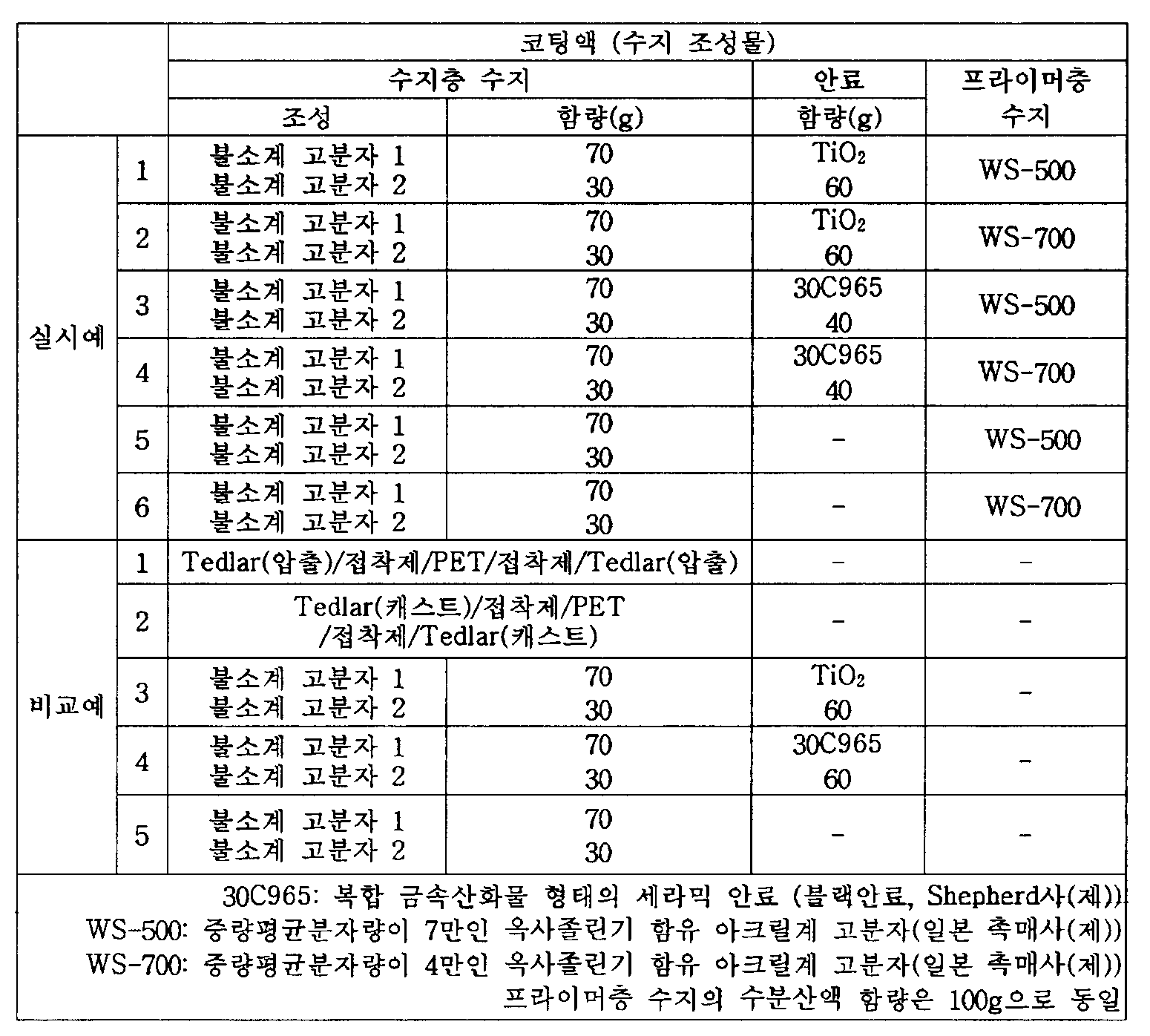
표 2
<시험예 1>
상기 실시예 1 내지 6 및 비교예 1 내지 5의 다층 필름에 대하여, PCT(Pressure cooker test) 수행 후, 180° 박리강도 및 크로스-해치 테스트를 각각 수행하였다. 구체적으로는, 각각의 다층 필름을 2 기압, 121℃ 및 100% R.H.의 조건에서 각각 25 시간, 50 시간 및 75 시간 동안 방치한 후, 180° 박리강도 및 크로스-해치 테스트를 수행하여 접착력의 변화를 평가하였다. 평가 결과는 하기 표 3에 기재하였다.
표 3
| 180° 박리 강도(N/cm) | 크로스-해치 테스트 결과 | ||||||||
| 초기 | 25 hrs | 50 hrs | 75 hrs | 초기 | 25 hrs | 50 hrs | 75 hrs | ||
| 실시예 | 1 | Coat-T | Coat-T | Coat-T | Coat-T | 5B | 5B | 5B | 5B |
| 2 | Coat-T | Coat-T | Coat-T | Coat-T | 5B | 5B | 5B | 5B | |
| 3 | Coat-T | Coat-T | Coat-T | Coat-T | 5B | 5B | 5B | 5B | |
| 4 | Coat-T | Coat-T | Coat-T | Coat-T | 5B | 5B | 5B | 5B | |
| 5 | 5.6 | 4.9 | 4.0 | 3.0 | 5B | 5B | 5B | 5B | |
| 6 | 6.0 | 5.3 | 3.6 | Coat-T | 5B | 5B | 5B | 5B | |
| 비교예 | 1 | PVF-T | PVF-T | PVF-T | 0 | 5B | 5B | 5B | 0B |
| 2 | 6.7 | 4.4 | 1.4 | 0 | 5B | 5B | 5B | 0B | |
| 3 | 0 | 0 | 0 | 0 | 0B | 0B | 0B | 0B | |
| 4 | 0 | 0 | 0 | 0 | 0B | 0B | 0B | 0B | |
| 5 | 0 | 0 | 0 | 0 | 0B | 0B | 0B | 0B | |
| Coat-T: 박리 시 수지층이 찢어져서 정확한 박리력의 측정이 불가능한 경우PVF-T: 박리 시 PVF 필름이 찢어져서 정확한 박리력의 측정이 불가능한 경우 | |||||||||
상기 표 3에 나타난 바와 같이, 본 발명에 따른 실시예의 다층 필름의 경우, 불소계 고분자를 포함하는 수지층은, 옥사졸린기 함유 아크릴계 고분자를 포함하는 프라이머 층을 통해 기재(PET)와 높은 초기 접착력을 나타내고, 또한 PCT를 75 시간 진행한 후에도 역시 탁월한 접착력을 나타내었다. 또한, PCT를 75 시간 진행한 후에도, 프라이머 층 및 수지층 등에 계면 박리 및 핀홀 생성 등과 같은 외관의 변화는 관찰되지 않았다. 반면, 상업적으로 판매되고 있는 다층 필름인 Icosolar 2442 및 3469(비교예 1 및 2)의 경우, PCT가 진행되면서, 기재와의 접착력이 크게 떨어지는 점을 확인하였다. 또한, 기재 상에 옥사졸린기 함유 고분자를 포함하는 프라이머 층의 형성 없이, 직접 불소계 고분자를 포함하는 수지층을 형성한 경우(비교예 3 내지 5), 본 발명에 따른 실시예와 비교할 때, 열악한 접착 신뢰성을 나타내었다. 또한, 안료의 포함 유무 또는 안료의 종류에 관계 없이, 옥사졸린기 함유 고분자를 포함하는 프라이머 층을 포함하는 실시예의 경우, 접착력이 우수함을 알 수 있었다.
<비교예 6>
프라이머 층 형성용 코팅액의 제조
질소 가스가 환류되고, 온도 조절이 용이하도록 냉각 장치를 설치한 1L 반응기에 용제로서 톨루엔 400 g을 넣고, 온도를 100℃로 유지시킨 후, 스티렌 16 g, 메틸 메타크릴레이트 76 g, 부틸 아크릴레이트 24g 및 글리시딜 메타크릴레이트 84 g을 포함하는 단량체 혼합물을 3구 반응기 위에 준비하고, 다른 한쪽에는 톨루엔 30 g에 아조계 개시제(V-65, Wako사(제)) 10 g을 용해시킨 개시제 용액을 준비해 두었다. 상기 개시제 용액을 2 시간 동안 서서히 적하시키고, 개시제 적하 시작 3 분 뒤에 상기 단량체 혼합물도 적하하기 시작하여, 총 2.5 시간 동안 서서히 적하시킨다. 개시제 적하 시간을 기준으로 총 5 시간 후에 상기 반응을 완료하여, 중량평균분자량이 6,000인 에폭시기 함유 아크릴계 고분자를 얻었다. 그 후, 상기 에폭시기 함유 아크릴계 고분자 100 g을 톨루엔:메틸에틸케톤(MEK) = 1:1(중량비)인 혼합 용매 400 g에 희석하여 프라이머 층 형성용 코팅액을 제조하였다.
프라이머 층의 코팅 및 건조
상기 제조예 1에서 미리 준비한 기재 상에 상기 프라이머 층 형성용 코팅액을 마이어바를 이용하여 도포하였다. 구체적으로, 건조 후의 두께가 약 1000 nm가 되도록 조절하여 코팅한 다음, 코팅된 기재를 120 메쉬(메쉬 속도 100%), 길이가 4 m이고, 온도가 120℃인 오븐에 3 m/min의 속도로 통과시켜 프라이머 층을 형성하였다. 그 후, 기재의 반대면에 동일한 방식으로 상기 코팅액을 코팅 및 건조하여, PET 필름(기재)의 양면에 옥사졸린기 함유 고분자를 포함하는 프라이머 층을 형성하였다.
수지층 형성용 코팅액의 제조
디메틸포름아미드(DMF: N,N-dimethyl formamide) 400g에 상기 제조예 1에서 준비한 불소계 고분자 1 (비닐리덴 플루오라이드(VDF) 및 클로로트리플루오로에틸렌(CTFE)을 85:15(VDF:CTFE)의 중량 비율로 중합된 형태로 포함하는 공중합체) 70 g; 및 상기 제조예 1에서 준비한 불소계 고분자 2 (비닐리덴 플루오라이드(VDF) 및 헥사플루오로프로필렌(HFP; Hexafluoropropylene)을 88:12(VDF:HFP)의 중량 비율로 중합된 형태로 포함하는 공중합체) 30 g을 미리 용해시켜 제 1 코팅액을 준비하였다.
또한, 상기와는 별도로 디메틸포름아미드 90 g에 안료 분산제인 BYK 111(BYK사(제)) 0.9 g 및 블랙 안료인 복합 금속산화물 형태의 세라믹 안료(30C965, Shepherd사(제)) 60g을 용해시키고, 다시 직경이 0.3 mm인 지르코니아 비드(Zirconia bead) 50 g을 넣은 후, 1,000 rpm의 속도로 1 시간 동안 교반시킨 다음, 비드를 완전히 제거하여 밀베이스 분산액 150.9 g을 제조하였다.
제조된 밀베이스 분산액 100.6 g(30C965, 40 g 포함)을 미리 준비한 제 1 코팅액에 투입하고, 다시 교반하여 수지층 형성용 코팅액을 준비하였다.
수지층의 코팅 및 건조
상기 제조된 PET 필름 위에 형성된 프라이머 층 상에 상기 수지층 형성용 코팅액을 콤마 리버스(comma reverse) 방식으로 도포하였다. 구체적으로, 건조 후의 두께가 약 20 ㎛ 가 되도록 간격을 조절하여 코팅한 다음, 코팅된 기재를 각각의 길이가 2 m이고, 온도가 80℃, 180℃ 및 180℃로 조절된 세 개의 오븐에 1 m/min의 속도로 순차적으로 통과시켜 수지층을 형성하였다. 그 후, 기재의 반대면에 동일한 방식으로 상기 코팅액을 코팅 및 건조하여, PET 필름(기재)의 양면에 프라이머 층 및 수지층이 순차적으로 형성된 다층 필름을 제조하였다.
<비교예 7>
밀베이스 분산액의 제조 과정에서 블랙 안료를 사용하지 않는 것을 제외하고는 비교예 6과 동일한 방법으로 다층 필름을 제조하였다.
<실시예 7 내지 9 >
프라이머 층 형성용 코팅액의 제조 과정에서, 톨루엔:메틸에틸케톤(MEK) = 1:1(중량비)인 혼합 용매를 사용하는 대신 톨루엔:에탄올 = 1:1(중량비)인 혼합 용매를 사용하고, 비교예 6에서 제조된 에폭시기 함유 아크릴계 고분자 및 옥사졸린기 함유 아크릴계 고분자(WS-500, 일본 촉매사(제))가 하기의 표 4에 기재된 바와 같은 중량 비율로 혼합된 코팅액을 제조한 것을 제외하고는, 비교예 6과 동일한 방법으로 다층 필름을 제조하였다.
<실시예 10 내지 12>
프라이머 층 형성용 코팅액의 제조 과정에서, 톨루엔:메틸에틸케톤(MEK) = 1:1(중량비)인 혼합 용매를 사용하는 대신 톨루엔:에탄올 = 1:1(중량비)인 혼합 용매를 사용하고, 비교예 6에서 제조된 에폭시기 함유 아크릴계 고분자 및 옥사졸린기 함유 아크릴계 고분자(WS-500, 일본 촉매사(제))가 하기의 표 4에 기재된 바와 같은 중량비율로 혼합된 코팅액을 제조하며, 밀베이스 분산액의 제조 과정에서 블랙 안료를 사용하지 않는 것을 제외하고는 비교예 6과 동일한 방법으로 다층 필름을 제조하였다.
<실시예 13>
프라이머 층 형성용 코팅액의 제조 과정에서, 중량평균분자량이 7만인 옥사졸린기 함유 아크릴계 고분자 수분산액(WS-500, 일본촉매사(제)) 100g을 에탄올 대신 증류수 100g으로 희석하여 프라이머 층 형성용 코팅액을 제조한 것을 제외하고는, 실시예 1과 동일한 방법으로 다층 필름을 제조하였다.
<실시예 14>
프라이머 층 형성용 코팅액의 제조 과정에서, 중량평균분자량이 7만인 옥사졸린기 함유 아크릴계 고분자 수분산액(WS-500, 일본촉매사(제)) 100g을 에탄올 대신 증류수 300g으로 희석하여 프라이머 층 형성용 코팅액을 제조한 것을 제외하고는, 실시예 1과 동일한 방법으로 다층 필름을 제조하였다.
<실시예 15>
프라이머 층 형성용 코팅액의 제조 과정에서, 중량평균분자량이 7만인 옥사졸린기 함유 아크릴계 고분자 수분산액(WS-500, 일본촉매사(제)) 100g을 에탄올 대신 증류수 700g으로 희석하여 프라이머 층 형성용 코팅액을 제조한 것을 제외하고는, 실시예 1과 동일한 방법으로 다층 필름을 제조하였다.
<실시예 16>
프라이머 층 형성용 코팅액의 제조 과정에서, 중량평균분자량이 7만인 옥사졸린기 함유 아크릴계 고분자 수분산액(WS-500, 일본촉매사(제)) 100g을 에탄올 대신 증류수 3900g으로 희석하여 프라이머 층 형성용 코팅액을 제조한 것을 제외하고는, 실시예 1과 동일한 방법으로 다층 필름을 제조하였다.
표 4
| 코팅액 (수지 조성물) | |||||
| 수지층 수지 | 안료 (함량) | 프라이머층 수지 종류(중량 비율) | |||
| 조성 | 함량(g) | ||||
| 비교예 | 6 | 실시예 1 동일 | 실시예 1 동일 | 30C965 (40g) | 에폭시기 함유 아크릴 고분자 |
| 7 | 실시예 1 동일 | 실시예 1 동일 | - | 에폭시기 함유 아크릴 고분자 | |
| 실시예 | 7 | 실시예 1 동일 | 실시예 1 동일 | 30C965 (40g) | 에폭시기 함유 아크릴고분자:WS-500 (9:1) |
| 8 | 실시예 1 동일 | 실시예 1 동일 | 30C965 (40g) | 에폭시기 함유 아크릴고분자:WS-500 (7:3) | |
| 9 | 실시예 1 동일 | 실시예 1 동일 | 30C965 (40g) | 에폭시기 함유 아크릴고분자:WS-500 (5:5) | |
| 10 | 실시예 1 동일 | 실시예 1 동일 | - | 에폭시기 함유 아크릴고분자:WS-500 (9:1) | |
| 11 | 실시예 1 동일 | 실시예 1 동일 | - | 에폭시기 함유 아크릴고분자:WS-500 (7:3) | |
| 12 | 실시예 1 동일 | 실시예 1 동일 | - | 에폭시기 함유 아크릴고분자:WS-500 (5:5) | |
| 13 | 실시예 1 동일 | 실시예 1 동일 | TiO2 (60 g) | WS-500 | |
| 14 | 실시예 1 동일 | 실시예 1 동일 | TiO2 (60 g) | WS-500 | |
| 15 | 실시예 1 동일 | 실시예 1 동일 | TiO2 (60 g) | WS-500 | |
| 16 | 실시예 1 동일 | 실시예 1 동일 | TiO2 (60 g) | WS-500 | |
| 30C965: 복합 금속산화물 형태의 세라믹 안료 (블랙안료, Shepherd사(제)),WS-500: 중량평균분자량이 7만인 옥사졸린기 함유 아크릴계 고분자(일본 촉매사(제)),에폭시기 함유 아크릴계 고분자의 중량평균분자량: 6,000 | |||||
<시험예 2>
상기 비교예 6, 7 및 실시예 7 내지 16의 다층 필름에 대하여, PCT(Pressure cooker test) 수행 후, 180° 박리강도 및 크로스-해치 테스트를 각각 수행하였다. 구체적으로는, 각각의 다층 필름을 2 기압, 121℃ 및 100% R.H.의 조건에서 각각 25시간, 50 시간 및 75 시간 동안 방치한 다음, 180° 박리강도 및 크로스-해치 테스트를 수행하여 접착력의 변화를 평가하였다. 상기 평가 결과를 하기 표 5에 기재하였다.
표 5
| 180° 박리 강도(N/cm) | 크로스-해치 테스트 결과 | ||||||||
| 초기 | 25 hrs | 50 hrs | 75 hrs | 초기 | 25 hrs | 50 hrs | 75 hrs | ||
| 비교예 | 6 | 0 | 0 | 0 | 0 | 4B | 0B | 0B | 0B |
| 7 | 0 | 0 | 0 | 0 | 0B | 0B | 0B | 0B | |
| 실시예 | 7 | Coat-T | Coat-T | 2.5 | 2.2 | 5B | 5B | 5B | 5B |
| 8 | Coat-T | Coat-T | Coat-T | 3.2 | 5B | 5B | 5B | 5B | |
| 9 | Coat-T | Coat-T | Coat-T | Coat-T | 5B | 5B | 5B | 5B | |
| 10 | 4.9 | 4.6 | 3.2 | 2.2 | 5B | 5B | 5B | 5B | |
| 11 | 4.8 | 4.5 | 3.4 | 3.0 | 5B | 5B | 5B | 5B | |
| 12 | Coat-T | 4.5 | 3.8 | 2.8 | 5B | 5B | 5B | 5B | |
| 13 | Coat-T | Coat-T | Coat-T | Coat-T | 5B | 5B | 5B | 5B | |
| 14 | Coat-T | Coat-T | Coat-T | Coat-T | 5B | 5B | 5B | 5B | |
| 15 | Coat-T | Coat-T | Coat-T | Coat-T | 5B | 5B | 5B | 5B | |
| 16 | Coat-T | Coat-T | Coat-T | Coat-T | 5B | 5B | 5B | 5B | |
| Coat-T: 박리 시 수지층이 찢어져서 정확한 박리력의 측정이 불가능한 경우 | |||||||||
상기 표 5에 나타난 바와 같이, 본 발명에 따른 실시예의 다층 필름의 경우, 프라이머 층이 에폭시기 함유 아크릴계 고분자 이외에 옥사졸린기 함유 아크릴계 공중합체를 포함하고 있어, 블랙 안료의 사용 여부와 무관하게 기재(PET)와 높은 초기 접착력을 나타내고, PCT를 75 시간 진행한 후에도 역시 탁월한 접착력을 나타내었다. 또한, PCT를 75 시간 진행한 후에도, 수지층 등에 계면 박리 및 핀홀 생성 등과 같은 외관의 변화는 관찰되지 않았다. 반면, 프라이머 층이 에폭시기 함유 고분자만 단독으로 포함하고 있는 비교예 6 및 7의 경우에는, 본 발명에 따른 실시예와 비교할 때, 열악한 접착 신뢰성을 나타내었다.
이상에서 본 발명의 예시적인 실시예를 참고로 본 발명에 대해서 상세하게 설명하였으나, 이들은 단지 예시적인 것에 불과하며, 본 발명이 속하는 기술 분야에서 통상의 지식을 가진 자라면 이로부터 다양한 변형 및 균등한 다른 실시예가 가능하다는 점을 이해할 것이다. 따라서, 본 발명의 진정한 기술적 보호 범위는 첨부된 특허청구범위의 기술적 사상에 의하여 정해져야 할 것이다.
Claims (33)
- 기재;상기 기재 상에 형성되고, 옥사졸린기 함유 고분자를 포함하는 프라이머 층; 및상기 프라이머 층 상에 형성되고, 불소계 고분자를 포함하는 수지층을 포함하는 다층 필름.
- 제 1 항에 있어서,상기 기재는 금속 필름 또는 고분자 필름인 다층 필름.
- 제 2 항에 있어서,상기 고분자 필름은 아크릴 필름, 폴리올레핀 필름, 폴리아미드 필름, 폴리우레판 필름, 폴리에틸렌테레프탈레이트(PET) 필름, 폴리에틸렌나프탈레이트(PEN) 필름 및 폴리부틸렌테레프탈레이트(PBT) 필름으로 이루어진 군으로부터 선택된 하나 이상인 다층 필름.
- 제 1 항에 있어서,상기 기재의 일면 또는 양면에 플라즈마, 코로나, 프라이머, 앵커제, 커플링제 처리 및 열 처리 중에서 선택된 하나 이상의 처리가 형성되는 다층 필름.
- 제 1 항에 있어서,상기 기재의 일면 또는 양면에 무기 산화물 증착층이 형성된 다층 필름.
- 제 1 항에 있어서,상기 기재의 두께는 50 ㎛ 내지 500 ㎛인 다층 필름.
- 제 1 항에 있어서,상기 프라이머 층의 옥사졸린기 함유 고분자는 옥사졸린기 함유 단량체의 단일 중합체; 옥사졸린기 함유 단량체 및 하나 이상의 공단량체를 포함하는 공중합체; 또는 이들의 혼합물인 다층 필름.
- 제 7 항에 있어서,상기 옥사졸린기 함유 단량체는 하기의 화학식 1로 표시되는 화합물인 다층 필름.[화학식 1]
 상기 화학식 1에서, R1, R2, R3 및 R4는 각각 독립적으로, 수소 원자, 알킬기, 할로겐, 치환 또는 비치환된 페닐기를 나타내고, R5는 불포화 결합을 가지는 비환식 탄화수소기를 나타낸다.
 - 제 7 항에 있어서,상기 옥사졸린기 함유 단량체는 2-비닐-2-옥사졸린, 2-비닐-4-메틸-2-옥사졸린, 2-비닐-5-메틸-2-옥사졸린, 2-이소프로페닐-2-옥사졸린, 2-이소프로페닐-4-메틸-2-옥사졸린 및 2-이소프로페닐-5-에틸-2-옥사졸린으로 이루어진 군으로부터 선택된 하나 이상인 다층 필름.
- 제 7 항에 있어서,상기 공중합체에 포함된 옥사졸린기 함유 단량체의 함량은 옥사졸린기 함유 단량체 및 하나 이상의 공단량체를 포함하는 공중합체의 총 중량 대비 1 중량% 이상인 다층 필름.
- 제 10 항에 있어서,상기 공중합체에 포함된 옥사졸린기 함유 단량체의 함량은 옥사졸린기 함유 단량체 및 하나 이상의 공단량체를 포함하는 공중합체의 총 중량 대비 5 중량% 내지 95 중량%인 다층 필름.
- 제 7 항에 있어서,상기 공중합체에 포함된 공단량체는 알킬(메타)아크릴레이트, 아미드기 함유 단량체, 불포화 니트릴계 단량체, 비닐 에스테르계 단량체, 비닐 에테르계 단량체, 할로겐 함유 α,β-불포화 단량체 및 α,β-불포화 방향족 단량체로 이루어진 군으로부터 선택된 하나 이상인 다층 필름.
- 제 12 항에 있어서,상기 알킬(메타)아크릴레이트는 메틸(메타)아크릴레이트, 에틸(메타)아크릴레이트, 프로필(메타)아크릴레이트, n-부틸(메타)아크릴레이트, s-부틸(메타)아크릴레이트, t-부틸(메타)아크릴레이트, 이소부틸(메타)아크릴레이트, 헥실(메타)아크릴레이트, 2-에틸헥실(메타)아크릴레이트, n-옥틸(메타)아크릴레이트, 이소옥틸(메타)아크릴레이트, n-노닐(메타)아크릴레이트, 이소노닐(메타)아크릴레이트, n-데실(메타)아크릴레이트, 이소데실(메타)아크릴레이트, n-도데실(메타)아크릴레이트, n-트리데실(메타)아크릴레이트 및 n-테트라데실(메타)아크릴레이트로 이루어진 군으로부터 선택된 하나 이상인 다층 필름.
- 제 1 항에 있어서,상기 옥사졸린기 함유 고분자의 중량평균분자량은 5,000 내지 50만인 다층 필름.
- 제 1 항에 있어서,상기 프라이머 층의 두께는 10 nm 내지 10,000 nm 인 다층 필름.
- 제 1 항에 있어서,상기 불소계 고분자는 비닐리덴 플루오라이드(VDF, Vinylidene Fluoride), 비닐 플루오라이드(VF, Vinyl Fluoride), 테트라플루오로에틸렌(TFE, Tetrafluoroethylene) 헥사플루오로프로필렌(HFP, Hexafluoropropylene), 클로로트리플루오로에틸렌(CTFE, chlorotrifluoroethylene), 트리플루오로에틸렌, 헥사플루오로이소부틸렌, 퍼플루오로 부틸에틸렌, 퍼플루오로 메틸 비닐 에테르(PMVE, perfluoro(methylvinylether)), 퍼플루오로 에틸 비닐 에테르(PEVE, perfluoro(ethylvinylether)), 퍼플루오로 프로필 비닐 에테르(PPVE), 퍼플루오로 헥실 비닐 에테르(PHVE), 퍼플루오로-2,2-디메틸-1,3-디옥솔(PDD) 및 퍼플루오로-2-메틸렌-4-메틸-1,3-디옥솔란(PMD)으로 이루어진 군으로부터 선택된 하나 이상의 단량체를 중합된 형태로 포함하는 단독 중합체, 공중합체 또는 이들의 혼합물인 다층 필름.
- 제 1 항에 있어서,상기 불소계 고분자는 비닐리덴 플루오라이드(VDF) 또는 비닐 플루오라이드(VF)와 테트라플루오로에틸렌(TFE, Tetrafluoroethylene), 헥사플루오로프로필렌(HFP, Hexafluoropropylene), 클로로트리플루오로에틸렌(CTFE, chlorotrifluoroethylene), 트리플루오로에틸렌, 헥사플루오로이소부틸렌, 퍼플루오로 부틸에틸렌, 퍼플루오로 메틸 비닐 에테르(PMVE, perfluoro(methylvinylether)), 퍼플루오로 에틸 비닐 에테르(PEVE, perfluoro(ethylvinylether)), 퍼플루오로 프로필 비닐 에테르(PPVE), 퍼플루오로 헥실 비닐 에테르(PHVE), 퍼플루오로-2,2-디메틸-1,3-디옥솔(PDD) 및 퍼플루오로-2-메틸렌-4-메틸-1,3-디옥솔란(PMD)으로 이루어진 군으로부터 선택된 하나 이상의 공단량체를 포함하는 공중합체 또는 이들의 혼합물인 다층 필름.
- 제 17 항에 있어서,상기 불소계 공중합체에 포함된 공단량체의 함량은 불소계 공중합체의 총 중량 대비 0.5 중량% 내지 50 중량%인 다층 필름.
- 제 1 항에 있어서,상기 불소계 고분자의 중량평균분자량은 5만 내지 100만인 다층 필름.
- 제 1 항에 있어서,상기 불소계 고분자의 융점이 80℃ 내지 175℃인 다층 필름.
- 제 1 항에 있어서,상기 수지층의 두께는 3 ㎛ 내지 50 ㎛인 다층 필름.
- 제 1 항에 있어서,상기 수지층은 안료, 충전제, 자외선 안정제, 열 안정제 및 장벽 입자로 이루어진 군으로부터 선택되는 하나 이상의 첨가제를 추가로 포함하는 다층 필름.
- 기재 상에 옥사졸린기 함유 고분자를 포함하는 프라이머 층을 형성하는 단계; 및상기 프라이머층 상에 불소계 고분자를 포함하는 수지층을 형성하는 단계를 포함하는 다층 필름의 제조 방법.
- 제 23 항에 있어서,옥사졸린기 함유 고분자를 포함하는 프라이머 층의 형성 단계는, 옥사졸린기 함유 고분자 및 용매를 포함하는 프라이머 층 형성용 수지 조성물을 기재 상에 코팅함으로써 수행되는 다층 필름의 제조 방법.
- 제 23 항에 있어서,프라이머 층을 형성하기 전에 기재의 일면 또는 양면에 플라즈마 처리, 코로나 처리, 프라이머 처리, 앵커제 처리, 커플링제 처리, 증착 처리 및 열 처리로 이루어진 군으로부터 선택된 하나 이상의 표면 처리를 수행하는 단계를 추가로 포함하는 다층 필름의 제조 방법.
- 제 24 항에 있어서,옥사졸린기 함유 고분자를 포함하는 프라이머 층 형성용 수지 조성물을 기재 상에 코팅하는 공정 이후, 건조하는 공정을 추가로 수행하는 다층 필름의 제조 방법.
- 제 26 항에 있어서,상기 건조하는 공정은 200℃ 이하의 온도에서 30 초 내지 30 분 동안 수행되는 다층 필름의 제조 방법.
- 제 23 항에 있어서,불소계 고분자를 포함하는 수지층의 형성 단계는, 불소계 고분자 및 비점이 200℃ 이하인 용매를 포함하는 수지층 형성용 수지 조성물을 프라이머 층 상에 코팅함으로써 수행되는 다층 필름의 제조 방법.
- 제 28 항에 있어서,상기 비점이 200℃ 이하인 용매는 아세톤, 메틸에틸케톤, 디메틸포름아미드 및 디메틸아세트아미드로 이루어진 군으로부터 선택된 하나 이상인 다층 필름의 제조 방법.
- 제 28 항에 있어서,수지층 형성용 수지 조성물을 프라이머 층 상에 코팅하는 공정 이 후, 건조하는 공정을 추가로 수행하는 다층 필름의 제조 방법.
- 제 30 항에 있어서,상기 건조하는 공정은 200℃ 이하의 온도에서 30 초 내지 30 분 동안 수행되는 다층 필름의 제조 방법.
- 제 1 항 내지 제 22 항 중 어느 한 항에 따른 다층 필름을 포함하는 광전지 모듈용 이면 시트.
- 제 32 항에 따른 광전지 모듈용 이면 시트를 포함하는 광전지 모듈.
Priority Applications (4)
| Application Number | Priority Date | Filing Date | Title |
|---|---|---|---|
| EP11857313.8A EP2669084B1 (en) | 2011-01-27 | 2011-12-02 | Multilayer film, and photovoltaic module including same |
| CN201180066294.2A CN103502001B (zh) | 2011-01-27 | 2011-12-02 | 多层膜和包括该多层膜的光伏组件 |
| JP2013551888A JP5756531B2 (ja) | 2011-01-27 | 2011-12-02 | 多層フィルム及びこれを含む光電池モジュール |
| US13/950,236 US9450128B2 (en) | 2011-01-27 | 2013-07-24 | Multi-layered film and photovoltaic modules comprising the same |
Applications Claiming Priority (4)
| Application Number | Priority Date | Filing Date | Title |
|---|---|---|---|
| KR10-2011-0008328 | 2011-01-27 | ||
| KR20110008328 | 2011-01-27 | ||
| KR10-2011-0128578 | 2011-12-02 | ||
| KR1020110128578A KR101536382B1 (ko) | 2011-01-27 | 2011-12-02 | 다층 필름 및 이를 포함하는 광전지 모듈 |
Related Child Applications (1)
| Application Number | Title | Priority Date | Filing Date |
|---|---|---|---|
| US13/950,236 Continuation US9450128B2 (en) | 2011-01-27 | 2013-07-24 | Multi-layered film and photovoltaic modules comprising the same |
Publications (2)
| Publication Number | Publication Date |
|---|---|
| WO2012102478A2 true WO2012102478A2 (ko) | 2012-08-02 |
| WO2012102478A3 WO2012102478A3 (ko) | 2012-09-20 |
Family
ID=46872727
Family Applications (1)
| Application Number | Title | Priority Date | Filing Date |
|---|---|---|---|
| PCT/KR2011/009334 Ceased WO2012102478A2 (ko) | 2011-01-27 | 2011-12-02 | 다층 필름 및 이를 포함하는 광전지 모듈 |
Country Status (7)
| Country | Link |
|---|---|
| US (1) | US9450128B2 (ko) |
| EP (1) | EP2669084B1 (ko) |
| JP (1) | JP5756531B2 (ko) |
| KR (1) | KR101536382B1 (ko) |
| CN (1) | CN103502001B (ko) |
| TW (1) | TWI499060B (ko) |
| WO (1) | WO2012102478A2 (ko) |
Cited By (1)
| Publication number | Priority date | Publication date | Assignee | Title |
|---|---|---|---|---|
| CN105754128A (zh) * | 2016-03-08 | 2016-07-13 | 合肥乐凯科技产业有限公司 | 一种光学聚酯薄膜及其制造方法 |
Families Citing this family (10)
| Publication number | Priority date | Publication date | Assignee | Title |
|---|---|---|---|---|
| CN104220255B (zh) * | 2010-12-29 | 2016-06-01 | Lg化学株式会社 | 多层膜和包括该多层膜的光伏组件 |
| WO2013058609A1 (ko) | 2011-10-21 | 2013-04-25 | 주식회사 엘지화학 | 다층 필름 및 이의 제조방법 |
| CN104349899A (zh) * | 2012-05-31 | 2015-02-11 | Lg化学株式会社 | 多层膜和具有该多层膜的光伏组件 |
| EP3085747B1 (en) * | 2013-12-17 | 2019-06-26 | Korea Research Institute of Chemical Technology | Solar cell fluorinated coating composition, fluorinated multilayer film, and solar cell comprising same |
| KR101483758B1 (ko) * | 2014-03-17 | 2015-01-26 | 주식회사 네브레이코리아 | 탄소나노튜브를 포함하여 우수한 방열 특성을 가지는 엘이디(led) 조명등기구 |
| CN103969717B (zh) * | 2014-05-09 | 2016-02-03 | 宁波东旭成新材料科技有限公司 | 一种光扩散膜 |
| KR101495052B1 (ko) * | 2014-12-11 | 2015-03-02 | 한상권 | 탄소나노튜브를 포함하여 우수한 방열 특성을 가지는 엘이디(led) 조명등기구 |
| EP3185310B1 (en) * | 2015-12-23 | 2019-02-20 | Agfa-Gevaert | A backsheet for a solar cell module |
| FR3055472B1 (fr) * | 2016-08-29 | 2019-03-15 | Arkema France | Protection de dispositifs electroniques |
| AU2018367231B2 (en) * | 2017-11-16 | 2024-08-08 | Mativ Luxembourg | Thermoplastic polymer film with interpenetrating polymer network |
Family Cites Families (24)
| Publication number | Priority date | Publication date | Assignee | Title |
|---|---|---|---|---|
| JPH07242758A (ja) * | 1994-03-08 | 1995-09-19 | Teijin Ltd | 易接着性ポリエステルフィルム |
| JP2001007368A (ja) * | 1999-06-25 | 2001-01-12 | Dainippon Printing Co Ltd | 太陽電池モジュ−ル用保護シ−トおよびそれを使用した太陽電池モジュ−ル |
| JP2001111073A (ja) * | 1999-10-12 | 2001-04-20 | Dainippon Printing Co Ltd | 太陽電池モジュ−ル用裏面保護シ−トおよびそれを使用した太陽電池モジュ−ル |
| JP2006261189A (ja) * | 2005-03-15 | 2006-09-28 | Teijin Dupont Films Japan Ltd | 太陽電池用表面保護フィルムおよびそれを用いた太陽電池積層体 |
| JP5167622B2 (ja) * | 2006-10-26 | 2013-03-21 | 凸版印刷株式会社 | 太陽電池モジュール |
| EP2094748B1 (en) * | 2006-12-21 | 2012-10-17 | E.I. Du Pont De Nemours And Company | Crosslinkable vinyl fluoride copolymer coated film and process for making same |
| JP2008214594A (ja) * | 2007-03-08 | 2008-09-18 | Oji Paper Co Ltd | 粘着シートおよび粘着シートの製造方法 |
| US8168297B2 (en) * | 2007-04-23 | 2012-05-01 | E. I. Du Pont De Nemours And Company | Fluoropolymer coated film, process for forming the same, and fluoropolymer liquid composition |
| JP5077651B2 (ja) * | 2007-05-31 | 2012-11-21 | 東洋製罐株式会社 | 樹脂被覆金属板及びそれを用いた成形体 |
| WO2009009361A2 (en) * | 2007-07-11 | 2009-01-15 | 3M Innovative Properties Company | Methods for melt-processing thermoplastic fluoropolymers |
| WO2009113318A1 (ja) * | 2008-03-13 | 2009-09-17 | 株式会社日本触媒 | 太陽電池モジュール用バックシート |
| JP2009267294A (ja) * | 2008-04-30 | 2009-11-12 | Toppan Printing Co Ltd | 太陽電池用バックシート |
| DE112009001575B4 (de) * | 2008-06-26 | 2022-10-06 | Dow-Mitsui Polychemicals Co.,Ltd. | Verfahren zum Herstellen einer Schichtfolie für eine Solarzelle |
| JP2010016286A (ja) * | 2008-07-07 | 2010-01-21 | Toppan Printing Co Ltd | 太陽電池裏面封止用シート |
| US9006565B2 (en) * | 2008-10-16 | 2015-04-14 | Solvay Specialty Polymers Italy S.P.A. | Opaque fluoropolymer composition comprising white pigments for photovoltaic elements of solar cells |
| DE102009009791A1 (de) * | 2009-02-20 | 2010-08-26 | Mitsubishi Plastics, Inc. | Weiße, beschichtete Polyesterfolie, Verfahren zu ihrer Herstellung und ihre Verwendung als Rückseitenabdeckung in Solarmodulen |
| WO2010107282A2 (ko) * | 2009-03-19 | 2010-09-23 | 주식회사 엘지화학 | 불소계 공중합체를 포함하는 태양전지 백시트 및 그 제조방법 |
| JP5389531B2 (ja) * | 2009-03-23 | 2014-01-15 | ユニチカ株式会社 | 封止用保護シートおよび太陽電池モジュール |
| JP2010287662A (ja) * | 2009-06-10 | 2010-12-24 | Dainippon Printing Co Ltd | 太陽電池モジュール用裏面保護シート、及び該保護シートを使用した太陽電池モジュール |
| JP5522362B2 (ja) * | 2009-09-28 | 2014-06-18 | 大日本印刷株式会社 | 太陽電池モジュール用裏面保護シート、及び太陽電池モジュール |
| KR101165220B1 (ko) * | 2009-11-02 | 2012-07-16 | 케이와 인코포레이티드 | 태양전지 모듈 이면 보호용 점착 시트 및 이것을 사용한 태양전지 모듈 |
| EP2508563B1 (en) * | 2009-11-30 | 2017-04-26 | Denka Company Limited | Polyvinylidene fluoride resin composition, film, back sheet, and solar cell module |
| JP5606849B2 (ja) * | 2010-09-24 | 2014-10-15 | 富士フイルム株式会社 | 太陽電池用バックシート用ポリマーシート及び太陽電池モジュール |
| JP2012138490A (ja) * | 2010-12-27 | 2012-07-19 | Mitsubishi Plastics Inc | 太陽電池裏面保護材用ポリエステルフィルムおよび太陽電池裏面保護材用部材 |
-
2011
- 2011-12-02 CN CN201180066294.2A patent/CN103502001B/zh active Active
- 2011-12-02 EP EP11857313.8A patent/EP2669084B1/en active Active
- 2011-12-02 WO PCT/KR2011/009334 patent/WO2012102478A2/ko not_active Ceased
- 2011-12-02 KR KR1020110128578A patent/KR101536382B1/ko active Active
- 2011-12-02 JP JP2013551888A patent/JP5756531B2/ja active Active
- 2011-12-26 TW TW100148771A patent/TWI499060B/zh active
-
2013
- 2013-07-24 US US13/950,236 patent/US9450128B2/en active Active
Non-Patent Citations (2)
| Title |
|---|
| None |
| See also references of EP2669084A4 |
Cited By (2)
| Publication number | Priority date | Publication date | Assignee | Title |
|---|---|---|---|---|
| CN105754128A (zh) * | 2016-03-08 | 2016-07-13 | 合肥乐凯科技产业有限公司 | 一种光学聚酯薄膜及其制造方法 |
| CN105754128B (zh) * | 2016-03-08 | 2019-03-15 | 合肥乐凯科技产业有限公司 | 一种光学聚酯薄膜及其制造方法 |
Also Published As
| Publication number | Publication date |
|---|---|
| TWI499060B (zh) | 2015-09-01 |
| JP2014510650A (ja) | 2014-05-01 |
| JP5756531B2 (ja) | 2015-07-29 |
| WO2012102478A3 (ko) | 2012-09-20 |
| CN103502001B (zh) | 2015-11-25 |
| TW201242041A (en) | 2012-10-16 |
| EP2669084A2 (en) | 2013-12-04 |
| EP2669084A4 (en) | 2014-07-23 |
| US20130309505A1 (en) | 2013-11-21 |
| KR20120087073A (ko) | 2012-08-06 |
| US9450128B2 (en) | 2016-09-20 |
| KR101536382B1 (ko) | 2015-07-15 |
| EP2669084B1 (en) | 2015-06-17 |
| CN103502001A (zh) | 2014-01-08 |
Similar Documents
| Publication | Publication Date | Title |
|---|---|---|
| WO2012091309A2 (ko) | 다층 필름 및 이를 포함하는 광전지 모듈 | |
| WO2012064082A2 (ko) | 다층 필름 및 이를 포함하는 광전지 모듈 | |
| WO2012141402A1 (ko) | 수지 조성물, 다층 필름 및 이를 포함하는 광전지 모듈 | |
| WO2011139052A2 (ko) | 다층 시트 및 이의 제조방법 | |
| WO2013058609A1 (ko) | 다층 필름 및 이의 제조방법 | |
| WO2013119069A1 (ko) | 다층 필름 및 이의 제조방법 | |
| WO2013073845A1 (ko) | 수분산 조성물, 친환경 광전지 모듈용 백시트 및 이의 제조방법 | |
| US9450128B2 (en) | Multi-layered film and photovoltaic modules comprising the same | |
| WO2012125000A9 (ko) | 친환경 태양전지용 백시트 및 이의 제조방법 | |
| KR101350517B1 (ko) | 태양전지 백시트 및 이의 제조방법 | |
| WO2013180552A1 (ko) | 친환경 광전지 모듈용 백시트 및 이의 제조방법 | |
| WO2013180532A1 (ko) | 다층 필름 및 이를 포함하는 광전지 모듈 | |
| KR101409116B1 (ko) | 다층 필름 및 이의 제조방법 | |
| KR101593741B1 (ko) | 다층 필름 및 이를 포함하는 광전지 모듈 | |
| WO2014088373A1 (ko) | 백시트 | |
| KR101554382B1 (ko) | 다층 필름의 제조방법 | |
| KR20140147935A (ko) | 다층 필름 |
Legal Events
| Date | Code | Title | Description |
|---|---|---|---|
| 121 | Ep: the epo has been informed by wipo that ep was designated in this application |
Ref document number: 11857313 Country of ref document: EP Kind code of ref document: A2 |
|
| ENP | Entry into the national phase |
Ref document number: 2013551888 Country of ref document: JP Kind code of ref document: A |
|
| WWE | Wipo information: entry into national phase |
Ref document number: 2011857313 Country of ref document: EP |
|
| NENP | Non-entry into the national phase |
Ref country code: DE |