WO2012105240A1 - Procédé de production de carbure, carbure, solution d'acide pyroligneux, matières d'élimination de substance radioactive et de sel - Google Patents
Procédé de production de carbure, carbure, solution d'acide pyroligneux, matières d'élimination de substance radioactive et de sel Download PDFInfo
- Publication number
- WO2012105240A1 WO2012105240A1 PCT/JP2012/000626 JP2012000626W WO2012105240A1 WO 2012105240 A1 WO2012105240 A1 WO 2012105240A1 JP 2012000626 W JP2012000626 W JP 2012000626W WO 2012105240 A1 WO2012105240 A1 WO 2012105240A1
- Authority
- WO
- WIPO (PCT)
- Prior art keywords
- jatroha
- carbide
- carbonized
- bacteria
- waste
- Prior art date
- Legal status (The legal status is an assumption and is not a legal conclusion. Google has not performed a legal analysis and makes no representation as to the accuracy of the status listed.)
- Ceased
Links
Images




Classifications
-
- C—CHEMISTRY; METALLURGY
- C09—DYES; PAINTS; POLISHES; NATURAL RESINS; ADHESIVES; COMPOSITIONS NOT OTHERWISE PROVIDED FOR; APPLICATIONS OF MATERIALS NOT OTHERWISE PROVIDED FOR
- C09K—MATERIALS FOR MISCELLANEOUS APPLICATIONS, NOT PROVIDED FOR ELSEWHERE
- C09K17/00—Soil-conditioning materials or soil-stabilising materials
- C09K17/14—Soil-conditioning materials or soil-stabilising materials containing organic compounds only
- C09K17/18—Prepolymers; Macromolecular compounds
- C09K17/32—Prepolymers; Macromolecular compounds of natural origin, e.g. cellulosic materials
-
- B—PERFORMING OPERATIONS; TRANSPORTING
- B01—PHYSICAL OR CHEMICAL PROCESSES OR APPARATUS IN GENERAL
- B01J—CHEMICAL OR PHYSICAL PROCESSES, e.g. CATALYSIS OR COLLOID CHEMISTRY; THEIR RELEVANT APPARATUS
- B01J20/00—Solid sorbent compositions or filter aid compositions; Sorbents for chromatography; Processes for preparing, regenerating or reactivating thereof
- B01J20/02—Solid sorbent compositions or filter aid compositions; Sorbents for chromatography; Processes for preparing, regenerating or reactivating thereof comprising inorganic material
- B01J20/20—Solid sorbent compositions or filter aid compositions; Sorbents for chromatography; Processes for preparing, regenerating or reactivating thereof comprising inorganic material comprising free carbon; comprising carbon obtained by carbonising processes
-
- C—CHEMISTRY; METALLURGY
- C01—INORGANIC CHEMISTRY
- C01B—NON-METALLIC ELEMENTS; COMPOUNDS THEREOF; METALLOIDS OR COMPOUNDS THEREOF NOT COVERED BY SUBCLASS C01C
- C01B32/00—Carbon; Compounds thereof
- C01B32/05—Preparation or purification of carbon not covered by groups C01B32/15, C01B32/20, C01B32/25, C01B32/30
-
- C—CHEMISTRY; METALLURGY
- C05—FERTILISERS; MANUFACTURE THEREOF
- C05F—ORGANIC FERTILISERS NOT COVERED BY SUBCLASSES C05B, C05C, e.g. FERTILISERS FROM WASTE OR REFUSE
- C05F17/00—Preparation of fertilisers characterised by biological or biochemical treatment steps, e.g. composting or fermentation
-
- C—CHEMISTRY; METALLURGY
- C05—FERTILISERS; MANUFACTURE THEREOF
- C05F—ORGANIC FERTILISERS NOT COVERED BY SUBCLASSES C05B, C05C, e.g. FERTILISERS FROM WASTE OR REFUSE
- C05F5/00—Fertilisers from distillery wastes, molasses, vinasses, sugar plant or similar wastes or residues, e.g. from waste originating from industrial processing of raw material of agricultural origin or derived products thereof
- C05F5/002—Solid waste from mechanical processing of material, e.g. seed coats, olive pits, almond shells, fruit residue, rice hulls
-
- G—PHYSICS
- G21—NUCLEAR PHYSICS; NUCLEAR ENGINEERING
- G21F—PROTECTION AGAINST X-RADIATION, GAMMA RADIATION, CORPUSCULAR RADIATION OR PARTICLE BOMBARDMENT; TREATING RADIOACTIVELY CONTAMINATED MATERIAL; DECONTAMINATION ARRANGEMENTS THEREFOR
- G21F9/00—Treating radioactively contaminated material; Decontamination arrangements therefor
- G21F9/04—Treating liquids
- G21F9/06—Processing
- G21F9/12—Processing by absorption; by adsorption; by ion-exchange
-
- G—PHYSICS
- G21—NUCLEAR PHYSICS; NUCLEAR ENGINEERING
- G21F—PROTECTION AGAINST X-RADIATION, GAMMA RADIATION, CORPUSCULAR RADIATION OR PARTICLE BOMBARDMENT; TREATING RADIOACTIVELY CONTAMINATED MATERIAL; DECONTAMINATION ARRANGEMENTS THEREFOR
- G21F9/00—Treating radioactively contaminated material; Decontamination arrangements therefor
- G21F9/04—Treating liquids
- G21F9/06—Processing
- G21F9/18—Processing by biological processes
-
- B—PERFORMING OPERATIONS; TRANSPORTING
- B01—PHYSICAL OR CHEMICAL PROCESSES OR APPARATUS IN GENERAL
- B01J—CHEMICAL OR PHYSICAL PROCESSES, e.g. CATALYSIS OR COLLOID CHEMISTRY; THEIR RELEVANT APPARATUS
- B01J2220/00—Aspects relating to sorbent materials
- B01J2220/40—Aspects relating to the composition of sorbent or filter aid materials
- B01J2220/48—Sorbents characterised by the starting material used for their preparation
- B01J2220/4812—Sorbents characterised by the starting material used for their preparation the starting material being of organic character
- B01J2220/4825—Polysaccharides or cellulose materials, e.g. starch, chitin, sawdust, wood, straw, cotton
-
- B—PERFORMING OPERATIONS; TRANSPORTING
- B01—PHYSICAL OR CHEMICAL PROCESSES OR APPARATUS IN GENERAL
- B01J—CHEMICAL OR PHYSICAL PROCESSES, e.g. CATALYSIS OR COLLOID CHEMISTRY; THEIR RELEVANT APPARATUS
- B01J2220/00—Aspects relating to sorbent materials
- B01J2220/40—Aspects relating to the composition of sorbent or filter aid materials
- B01J2220/48—Sorbents characterised by the starting material used for their preparation
- B01J2220/4875—Sorbents characterised by the starting material used for their preparation the starting material being a waste, residue or of undefined composition
-
- Y—GENERAL TAGGING OF NEW TECHNOLOGICAL DEVELOPMENTS; GENERAL TAGGING OF CROSS-SECTIONAL TECHNOLOGIES SPANNING OVER SEVERAL SECTIONS OF THE IPC; TECHNICAL SUBJECTS COVERED BY FORMER USPC CROSS-REFERENCE ART COLLECTIONS [XRACs] AND DIGESTS
- Y02—TECHNOLOGIES OR APPLICATIONS FOR MITIGATION OR ADAPTATION AGAINST CLIMATE CHANGE
- Y02A—TECHNOLOGIES FOR ADAPTATION TO CLIMATE CHANGE
- Y02A40/00—Adaptation technologies in agriculture, forestry, livestock or agroalimentary production
- Y02A40/10—Adaptation technologies in agriculture, forestry, livestock or agroalimentary production in agriculture
- Y02A40/20—Fertilizers of biological origin, e.g. guano or fertilizers made from animal corpses
-
- Y—GENERAL TAGGING OF NEW TECHNOLOGICAL DEVELOPMENTS; GENERAL TAGGING OF CROSS-SECTIONAL TECHNOLOGIES SPANNING OVER SEVERAL SECTIONS OF THE IPC; TECHNICAL SUBJECTS COVERED BY FORMER USPC CROSS-REFERENCE ART COLLECTIONS [XRACs] AND DIGESTS
- Y02—TECHNOLOGIES OR APPLICATIONS FOR MITIGATION OR ADAPTATION AGAINST CLIMATE CHANGE
- Y02E—REDUCTION OF GREENHOUSE GAS [GHG] EMISSIONS, RELATED TO ENERGY GENERATION, TRANSMISSION OR DISTRIBUTION
- Y02E50/00—Technologies for the production of fuel of non-fossil origin
- Y02E50/10—Biofuels, e.g. bio-diesel
-
- Y—GENERAL TAGGING OF NEW TECHNOLOGICAL DEVELOPMENTS; GENERAL TAGGING OF CROSS-SECTIONAL TECHNOLOGIES SPANNING OVER SEVERAL SECTIONS OF THE IPC; TECHNICAL SUBJECTS COVERED BY FORMER USPC CROSS-REFERENCE ART COLLECTIONS [XRACs] AND DIGESTS
- Y02—TECHNOLOGIES OR APPLICATIONS FOR MITIGATION OR ADAPTATION AGAINST CLIMATE CHANGE
- Y02P—CLIMATE CHANGE MITIGATION TECHNOLOGIES IN THE PRODUCTION OR PROCESSING OF GOODS
- Y02P20/00—Technologies relating to chemical industry
- Y02P20/141—Feedstock
- Y02P20/145—Feedstock the feedstock being materials of biological origin
-
- Y—GENERAL TAGGING OF NEW TECHNOLOGICAL DEVELOPMENTS; GENERAL TAGGING OF CROSS-SECTIONAL TECHNOLOGIES SPANNING OVER SEVERAL SECTIONS OF THE IPC; TECHNICAL SUBJECTS COVERED BY FORMER USPC CROSS-REFERENCE ART COLLECTIONS [XRACs] AND DIGESTS
- Y02—TECHNOLOGIES OR APPLICATIONS FOR MITIGATION OR ADAPTATION AGAINST CLIMATE CHANGE
- Y02W—CLIMATE CHANGE MITIGATION TECHNOLOGIES RELATED TO WASTEWATER TREATMENT OR WASTE MANAGEMENT
- Y02W30/00—Technologies for solid waste management
- Y02W30/40—Bio-organic fraction processing; Production of fertilisers from the organic fraction of waste or refuse
Definitions
- the present invention includes (1) a method for producing a carbide from at least one of jatroha fruit, a substance derived from the fruit of jatroha and a substance derived from sugarcane, (2) a carbide produced by the production method, (3) It relates to a wood vinegar solution containing the carbide, (4) a radioactive substance removing material containing the carbide as an active ingredient, and (5) a salt removal material containing the carbide as an active ingredient.
- Patent Document 1 a technique of using raw garbage, lawn, livestock excrement and the like as compost that is incinerated or dumped in a landfill as it is has been proposed (for example, see Patent Document 1).
- the seeds of Jatroha grown in the Philippines are rich in oil. This oil has been used for a long time. As one of environmental measures in recent years, attention has been paid to the fact that oil obtained from Jatroha seeds can be used as a material for biodiesel fuel. However, the pomace obtained by squeezing oil from the seeds, and the skin parts and pulp parts other than the seeds have been discarded.
- sugarcane squeezed residue has been partially used effectively, but in recent years, further expansion of the effective use of sugarcane squeezed residue has been demanded.
- an object of the present invention is to produce high-value-added carbides (carbonized fertilizer, carbon black, etc.) using at least one of jatroha fruit, jatroha fruit-derived substance, and sugarcane-derived substance. It is to provide a method.
- a carbide according to the present invention carbonization is performed by applying light energy to a mixture of at least one substance of Jatroha fruit, Jatroha fruit-derived substance and sugarcane-derived substance, and a group of fermenting bacteria.
- the carbide produced by the production method of the present invention is carbonized compost, carbon black and the like.
- the term “jatroha fruit” as used herein is a general term for jatroha fruit skin, jatroha fruit pulp, and jatroha fruit seeds.
- the substance derived from the fruit of Jatroha is, for example, a pomace obtained by squeezing oil from the seed of the fruit of Jatroha.
- the substance derived from sugarcane is, for example, bagasse (residue after squeezing sugarcane), mud press (cask obtained by crushing sugarcane and extracting sugar with water), and the like.
- carbonized compost containing carbides bearing positive ions and negative ions can be obtained.
- this carbonized compost is irradiated with sunlight, the carbides vibrate slightly and enter the soil, creating a large amount of bubbles near the roots of the plant.
- air bubbles of about 70% nitrogen are continuously absorbed from the plant roots. That is, carbonized compost that can fix nitrogen in the air in the soil can be obtained.
- the carbide of Jatroha's pulp is porous and has a hole with a diameter of about 70,000 nm (70 ⁇ m).
- the carbonized Jatroha pulp can draw soil contaminants (for example, heavy metals, salt, radioactive substances and dyes) into the pores and absorb the contaminants to shield them.
- soil contaminants for example, heavy metals, salt, radioactive substances and dyes
- a group of fermenting bacteria such as halophilic bacteria and photosynthetic bacteria
- nitrogen in the air enters the pores of the carbonized Jatrocha pulp. For this reason, jatroha pulp can fix nitrogen in the air in the soil.
- carbon black which is carbon fine particles having a diameter of about 3 nm to 500 nm. That is, high-value-added carbon black used for rubber reinforcing materials, black colorants, conductivity-imparting materials, activated carbon, and the like can be obtained from jatroha fruits, materials derived from jatroja fruits, and materials derived from sugarcane.
- a pyroligneous acid solution can be obtained in the process of carbonization of the mixture. That is, a high-value-added wood vinegar used as an agrochemical effective for food processing and pest control can be obtained from jatroha fruit, jatroha fruit-derived substance, and sugarcane-derived substance.
- carbonized compost, carbon black, wood vinegar, etc. are created from squeezed jatroha pulp and seeds that are no longer needed after squeezing oil, bagasse and mud press that are no longer needed after squeezing can do. That is, by using the production method of the present invention, it is possible to create high value-added products from jatroha fruits and seeds that have become waste, bagasse and mud press where further effective utilization destinations are required. . As a result, waste can be reduced. Therefore, the amount of CO 2 emission is reduced. For this reason, a CO 2 emission right can be obtained.
- the mixture preferably further includes boiler ash.
- boiler ash is ash obtained as a result of burning bagasse or the like in a boiler.
- the fermenting bacteria group includes at least photosynthetic bacteria, photothermal bacteria, lactic acid bacteria, nitrogen-fixing bacteria, yeasts, and radioactive bacteria.
- the photosynthetic bacterium is a symbiotic base of other fungal groups, and can be ionized by a synthetic action with sunlight to increase the absorbability of plants.
- Photothermal bacteria are active at high temperatures and control plant pests. Lactic acid bacteria can produce lactic acid by fermentation and protect the living body from other pathogenic microorganisms. Nitrogen-fixing bacteria fix nitrogen in the atmosphere and are supplied to plants as nutrients. Yeast can produce carbon dioxide and alcohol from organic matter. Radioactive bacteria like chitin and can decompose the chitin and suppress the activity of plant pathogens.
- the above-mentioned fermenting bacteria group has both photosensitivity and thermophilicity, fermentation of jatroha fruit, jatroha fruit-derived substance and sugarcane-derived substance in an environment exceeding 80 ° C. Can do. Thereby, it is possible to prevent the fermentation bacteria group from being killed in an environment where a large amount of sunlight is irradiated. Thereby, the high value-added carbonized compost in which miscellaneous sterilization is killed can be obtained by the sterilization effect of ultraviolet rays from sunlight.
- the above-mentioned fermenting bacteria group since the above-mentioned fermenting bacteria group has halophilicity, it becomes carbonized compost having a low salinity concentration, and can provide high value-added carbonized compost that is good for crop cultivation, and also has a salt-removing effect in salt damage areas. Can be demonstrated.
- the carbonized compost produced by the above production method is carbonized compost containing carbides having positive ions and negative ions.
- this carbonized compost is irradiated with sunlight, the carbides vibrate slightly and enter the soil, creating a large amount of bubbles near the roots of the plant. As a result, bubbles of about 70% nitrogen are continuously absorbed from the plant roots. That is, carbonized compost that can fix nitrogen in the air in the soil can be obtained.
- the carbide of Jatroha's pulp is porous and has a hole with a diameter of about 70,000 nm (70 ⁇ m).
- the carbonized Jatroha pulp can draw soil contaminants (for example, heavy metals, salt, radioactive substances and dyes) into the pores and absorb the contaminants to shield them.
- soil contaminants for example, heavy metals, salt, radioactive substances and dyes
- fermenting bacteria such as halophilic bacteria and photosynthetic bacteria
- the carbon black produced by the above production method can be used for rubber reinforcing materials, black colorants, conductivity-imparting materials, activated carbon and the like.
- the wood vinegar produced by the above production method can be used as an agrochemical effective for food processing and pest control.
- Carbonized fertilizers and carbon black such as carbon black produced by the above production method are mainly made from jatroha fruits and seeds that have become waste, bagasse and mud presses that require further effective utilization. . As a result, the amount of waste can be reduced, so that the amount of CO 2 emission is reduced.
- thermophilic bacteria Since the wood vinegar according to the present invention contains black charcoal, the surface of jatroha waste and sugarcane waste is blackened by spraying this wood vinegar on jatroha waste and sugarcane waste, and the sun rays (especially , Heat ray) absorption efficiency is increased, and more thermophilic bacteria can be expected to grow.
- the radioactive substance removing material and the salt removing material according to the present invention contain the above-described carbide as an active ingredient. For this reason, the radioactive substance removal material and salt removal material which concern on this invention can absorb and shield a radioactive substance and salt efficiently.
- the method for producing carbide according to the present embodiment includes a pulp A of Jatroha fruit (fruit waste in the figure) and a pomace B obtained by squeezing oil from Jatroha fruit seeds (hereinafter referred to as A). And B are collectively referred to as “jatroha waste”) and fermented fungus group C, and the mixture is subjected to carbonization by applying light energy.
- sugarcane waste for example, bagasse and mud press
- Jatroha waste may be mixed into the jatroha waste. Jatroha waste may be replaced with sugarcane waste (for example, bagasse or mud press).
- a mixture of the pulp A of Jatroha fruit and the squeezed B after squeezing oil from the seeds of the fruit of Jatroha and the fermentation fungus group C is maintained at a low temperature of 80 ° C. or higher and 90 ° C. or lower. It is preferable to perform carbonization.
- the carbide according to this embodiment is manufactured by the above-described manufacturing method.
- the pyroligneous acid solution according to the present embodiment is characterized by containing a carbide produced by the above-described production method.
- radioactive substance removing material and the salt removing material according to the present embodiment are characterized in that a carbide produced by the production method described above is used as an active ingredient.
- Jatroha fruit is a general term for the skin of Jatroha fruit, the pulp of Jatroha fruit, and the seed of Jatroha fruit.
- Jatroha is a plant that can grow on thin soil (land with an annual rainfall of about 500 mL, volcanic ash). This jatroha produces fruits with highly toxic seeds.
- the seeds of the fruit of Jatroha are oil-rich seeds, and oil refined by squeezing from the seeds is used as Jatroha Crude oil that can be used as biodiesel fuel.
- Jatroha is a very fast growing plant. As shown in Fig. 2, after planting, it is about 20cm in 2 months, about 180cm in 8 months, 200cm in 1 year, 300cm in 3 years, 500cm in 5 years. Grows until. Jatroha, which has grown in about 5 years, can harvest fruits for about 50 years. This Jatroha can harvest fruits more than twice a year.
- Jatroha can harvest 30 tons of fruit per ha, the fruit pulp ratio is about 22.5 t, and the seed ratio is about 7.5 t.
- Jatroha's pulp is porous having a large number of pores with a diameter of 70,000 nm (70 ⁇ m), and heavy metals and dyes in the soil are drawn into the pores of the carbonized Jatroha's pulp.
- air enters the hole of the carbonized Jatrocha pulp. For this reason, the carbonized jatroha pulp can retain nitrogen in the air in the soil.
- Jatroha seeds is squeezed with a squeezer or the like, and about 6.0 t of pomace remains.
- Jatrocha pulp about 22.5 t
- pomace 6.0 t
- carbonized compost about 4.8 t
- carbon black 2.0 t
- wood vinegar 3.0 t
- carbon black (about 2.0 t) and wood vinegar (3.0 t), which are high value-added products, are obtained from Jatroha waste, in addition to carbonized compost. It is done.
- the oil obtained by squeezing the seed is refined to obtain jatrohaclude oil (about 1.5 t) that can be used as biodiesel fuel.
- Carbonized compost produced from Jatroha waste is used as a soil conditioner, organic fertilizer, horticultural charcoal, soil contamination purification agent, and the like. Carbon black is used as a rubber reinforcing material, a black colorant, a conductivity imparting material, activated carbon, and the like.
- wood vinegar is used for pesticides and food processing effective for pest control.
- Jatroha crude oil is used as transportation fuel, ink solvent, soap, and plastic merchandise. Thus, carbonized compost derived from jatroha, carbon black, wood vinegar and jatroha crude oil are sold as products with high added value.
- the fermenting fungal group necessary for producing the above-mentioned carbides is at least a photosynthetic bacterium, a photothermal bacterium, a lactic acid bacterium, a nitrogen-fixing bacterium, a yeast, and a radiobacterium. It is preferable to have.
- This group of fermenting bacteria has photosensitivity, thermophilicity, and halophilicity.
- the photophilic bacterium is, for example, a photosynthetic bacterium, and examples of the photosynthetic bacterium include, but are not limited to, a red bacterium, a green bacterium, an aerobic photosynthetic bacterium, and a heliobacterium.
- heat-resistant yeast that grows using light as energy can also be used.
- thermophilic bacterium is a generic term for a bacterium having an optimum growth temperature of 50 to 105 ° C. and hardly proliferating at a temperature of 30 ° C. or less.
- a normal bacterium has a neutral temperature, that is, an optimum growth temperature of 25 to 40 ° C.
- bacteria that can grow at both high and low temperatures are distinguished from heat-resistant bacteria. ”(Yasugi et al.,“ Iwanami Biology Dictionary 4th Edition ”(1996-3) ⁇ 21) Iwanami, p452).
- thermophilic bacteria include thermostable bacteria. This is because the inside of the greenhouse 10 (see FIG. 3) is hot during the daytime, but at night, if the temperature is not adjusted, the optimum temperature for growth of bacteria may usually fall to 25 to 40 ° C.
- the halophilic bacteria refer to “bacteria and fungi that prefer a medium having a salt concentration of 5 to 10 wt% or higher”, and refer to bacteria that reduce the salt concentration by incorporating a large amount of Na + into the cells (see p424). reference).
- fermenting fungus group having the above-mentioned photosensitivity, thermophilicity, and saltyness
- fermenting fungus group having the above-mentioned photosensitivity, thermophilicity, and saltyness
- group can be preferably used.
- This "Kenium fungus” group is a series of microorganisms in which inoculums (microorganism species) collected from various parts of Japan have been cultured and stabilized at a factory for over 40 years, as described below.
- the period of direct irradiation is sequentially increased to 1 day, 3 days, 1 week, 1 month, 2 months, and 3 months.
- the temperature is adjusted so that the medium becomes 60 ° C. or higher during direct irradiation.
- the microorganism group has photosensitivity and thermophilicity.
- the characteristics of the "K. nuensis" are as follows. It reacts mainly with sunlight and is active in both aerobic and anaerobic conditions. Jatroha waste grows if the moisture (based on moisture content) is 70 wt% or less (preferably 45-65%) and temperature is 40-100 ° C (preferably 50-70 ° C). Promote fermentation and decomposition of things.
- the salt concentration (mainly NaCl) in the fermentation residue / fermentation residual water is reduced to half or less as compared with the case of normal fermentation decomposition by selectively taking in Na + of the salt. Therefore, fermentation of organic matter is promoted, and combined with high temperature fermentation, the processed product is dried quickly.
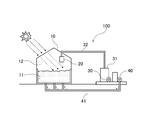
- Jatroha waste is composted in a closed greenhouse 10 as shown in FIG.
- the reason why the jatroha waste is composted in the sealed greenhouse 10 is to prevent the odor generated from the jatroha waste (especially from immediately after input to the initial and middle stages of fermentation) from being released to the outside.
- the light energy source given to Jatroha waste is usually sunlight, but may be an ultraviolet irradiation lamp or the like.
- fermenting of Jatroha waste may be promoted by using an ultraviolet irradiation lamp as an auxiliary at night or on a cloudy or rainy day.
- the gas (gas) stored in the gas storage unit is a high-temperature gas that is heated by decomposition of the mixture and heat of fermentation, and further heated by solar heat.
- this high-temperature gas usually 60 ° C. or higher
- the jatroha waste is heated and the propagation of the microbial group in the mixture is promoted.
- the propagation of normal bacteria died at 60 ° C. or higher
- the surface of the Jatroha waste is sterilized by sunlight.
- the wood vinegar solution produced by fermentation and decomposition of Jatroha waste may be commercialized as it is, it can also be sprayed on Jatroha waste as an insect repellent.
- carbonized_material which concerns on this embodiment, in order to make the inside of the greenhouse 10 into 60 degreeC or more high temperature, a carbide
- the carbonized compost production plant 100 includes a greenhouse 10 for storing Jatroha waste, a steam collecting cap 20, a suction blower 30, and a blower blower 40.
- the greenhouse 10 has a filling part 11 for storing Jatroha waste and a gas storage part 12 formed above the filling part 11.
- the filling unit 11 accommodates a mixture in which Jatroha waste and fermented bacteria are mixed. And the gas produced by decomposition
- FIG. This gas is heated by sunlight and becomes a high-temperature gas (about 60 ° C.).
- the gas storage part 12 is provided with a steam collecting cap 20.
- the vapor in the gas reservoir 12 passes through the fossil coral inside the vapor collection cap 20 and is collected into a tank (not shown).
- the tank 31 collects the pyroligneous acid produced when the Jatroha waste is fermented.
- the suction blower 30 is provided outside the greenhouse 10 and is provided for sucking the steam drifting in the vicinity of the gas storage unit 12.
- the suction blower 30 is driven, the vapor in the gas storage unit 12 is collected from the vapor collection cap 20 to the tank 31 through the duct 32.
- the blower blower 40 is provided to supply the high-temperature gas recovered from the gas storage unit 12 to the lower side of the Jatroha waste in the greenhouse 10.
- the Jatroja waste accommodated in the filling unit 11 is agitated by the hot gas blown out from the blower blower 40. By this gas stirring with the high-temperature gas, the reproduction of the fermenting bacteria group is increased.
- Jatroha pulp A and Jatroha seed pomace B are prepared (step S1). Then, the Jatroha waste and the fermentation fungus group C are weighed so as to have a desired mixing ratio (step S2). At this time, the dust contained in the Jatroha waste is separated (step S3). And while mixing a Jatroha waste and the fermentation microbe group C, the moisture content of the said mixture is adjusted (step S4). And in this embodiment, the hot gas stored in the gas storage part 12 of the greenhouse 10 is circulated, and is supplied to the bottom face side of Jatroha waste (step S5). Then, the composted mixture is sieved (step S6) to produce carbonized compost.
- the pulp A of Jatroha fruit (fruit waste in the figure), the squeezed B obtained by squeezing oil from the seed of Jatroha fruit (hereinafter referred to as Jatroha waste), etc. It is mixed with the fermenting bacteria group C, and the mixture is subjected to carbonization by applying light energy.
- carbonized_material (C) tinged with a positive ion and a negative ion can be obtained.
- the mixture is maintained at a temperature of 80 ° C. or higher and 90 ° C. or lower and composted to efficiently generate carbonized compost containing charcoal having positive ions and negative ions. be able to.
- the fruit of Jatroha is porous and has a hole with a diameter of about 70,000 nm (70 ⁇ m).
- the carbonized jatroha pulp can draw contaminants (for example, heavy metals and dyes) in the soil into the holes. Thereby, good-quality soil can be obtained.
- the carbonized compost can be fermented in a short time by a synthetic action with light energy.
- the “K. genus” group has both photosensitivity and thermophilicity, soil fermentation can be performed in an environment exceeding 80 ° C. Thereby, the carbonized compost from which miscellaneous sterilization dies can be obtained by the sterilization effect of ultraviolet rays from sunlight.
- the “Kenynu fungus” group has halophilicity, it becomes compost with a low salinity, and it can produce good compost for crop cultivation, and it can also exert a salt removal effect in salt damage areas. it can.
- carbon black which is carbon fine particles having a diameter of about 3 nm to 500 nm. That is, it is possible to obtain high-value-added carbon black used for rubber reinforcing materials, black colorants, conductivity-imparting materials, activated carbon and the like from Jatroha waste.
- a wood vinegar solution can be obtained in the process of carbonization of the Jatroha waste. That is, a high value-added wood vinegar solution used as an agrochemical effective for food processing and pest control can be obtained from Jatroha waste.
- carbonized compost, carbon black, a wood vinegar liquid, etc. can be created from the Jatroha waste etc. which became unnecessary after squeezing oil. That is, if the manufacturing method of the present embodiment is used, a high-value-added product can be created from jatroha that has become waste. As a result, the amount of waste can be reduced, so that the amount of CO 2 emission is reduced.
- the jatroha waste was carbonized and composted in the greenhouse 10 shown in FIG.
- the radioactive iodine adsorption rate of the carbide obtained as described above was measured, the value was 710 mg / g.
- carbonized_material was measured, the result was as Table 1 showing.
Landscapes
- Chemical & Material Sciences (AREA)
- Engineering & Computer Science (AREA)
- Organic Chemistry (AREA)
- Life Sciences & Earth Sciences (AREA)
- Chemical Kinetics & Catalysis (AREA)
- Health & Medical Sciences (AREA)
- Physics & Mathematics (AREA)
- General Engineering & Computer Science (AREA)
- High Energy & Nuclear Physics (AREA)
- Inorganic Chemistry (AREA)
- Molecular Biology (AREA)
- Biomedical Technology (AREA)
- Environmental & Geological Engineering (AREA)
- General Chemical & Material Sciences (AREA)
- Microbiology (AREA)
- Biochemistry (AREA)
- Mechanical Engineering (AREA)
- Botany (AREA)
- Biotechnology (AREA)
- General Health & Medical Sciences (AREA)
- Analytical Chemistry (AREA)
- General Life Sciences & Earth Sciences (AREA)
- Soil Sciences (AREA)
- Materials Engineering (AREA)
- Processing Of Solid Wastes (AREA)
- Fertilizers (AREA)
Abstract
L'invention concerne un carbure à haute valeur ajoutée qui est obtenu à l'aide de fruits de jatropha, une matière issue de fruits de jatropha et/ou une matière issue de canne à sucre. L'invention concerne également un procédé de production du carbure, ledit procédé comportant le mélange d'au moins un type de matière choisie parmi les fruits de jatropha (A), une matière (B) issue de fruits de jatropha et une matière issue de canne à sucre, avec des microorganismes de fermentation (C), et la carbonisation du mélange par l'ajout d'énergie lumineuse. Dans ce procédé, il est préféré que ledit mélange soit carbonisé alors qu'il est maintenu à une faible température de 80 à 90oC inclus. Les microorganismes de fermentation (C) comportent au moins un type de bactérie choisi parmi une bactérie photosynthétique, une bactérie héliothermique, une bactérie lactique, une bactérie fixatrice d'azote, une levure et un actinomycète.
Priority Applications (2)
| Application Number | Priority Date | Filing Date | Title |
|---|---|---|---|
| JP2012555753A JPWO2012105240A1 (ja) | 2011-01-31 | 2012-01-31 | 炭化物の製造方法、炭化物、木酢液、放射性物質除去材および除塩材 |
| CN201280007199XA CN103459053A (zh) | 2011-01-31 | 2012-01-31 | 碳化物的制造方法、碳化物、木醋液、放射性物质去除材料及除盐材料 |
Applications Claiming Priority (2)
| Application Number | Priority Date | Filing Date | Title |
|---|---|---|---|
| JP2011018005 | 2011-01-31 | ||
| JP2011-018005 | 2011-01-31 |
Publications (1)
| Publication Number | Publication Date |
|---|---|
| WO2012105240A1 true WO2012105240A1 (fr) | 2012-08-09 |
Family
ID=46602463
Family Applications (1)
| Application Number | Title | Priority Date | Filing Date |
|---|---|---|---|
| PCT/JP2012/000626 Ceased WO2012105240A1 (fr) | 2011-01-31 | 2012-01-31 | Procédé de production de carbure, carbure, solution d'acide pyroligneux, matières d'élimination de substance radioactive et de sel |
Country Status (3)
| Country | Link |
|---|---|
| JP (1) | JPWO2012105240A1 (fr) |
| CN (1) | CN103459053A (fr) |
| WO (1) | WO2012105240A1 (fr) |
Cited By (5)
| Publication number | Priority date | Publication date | Assignee | Title |
|---|---|---|---|---|
| JP2014169919A (ja) * | 2013-03-04 | 2014-09-18 | Tadatsugu Yamazaki | 除染剤および除染方法 |
| WO2017195407A1 (fr) * | 2016-05-11 | 2017-11-16 | 克守 谷黒 | Procédé de traitement de carbonisation à très basse température de matériau de biomasse, et procédé de production de carbure |
| CN108178693A (zh) * | 2018-02-13 | 2018-06-19 | 平南县亿翔环保能源有限公司 | 含有木醋液的桑树专用肥 |
| CN108299090A (zh) * | 2018-02-13 | 2018-07-20 | 平南县亿翔环保能源有限公司 | 桑树专用叶面肥及其制备方法 |
| CN111069243A (zh) * | 2019-12-25 | 2020-04-28 | 赵莉莉 | 一种城市生活垃圾处理系统 |
Citations (8)
| Publication number | Priority date | Publication date | Assignee | Title |
|---|---|---|---|---|
| JPH04204295A (ja) * | 1990-11-30 | 1992-07-24 | Tomoji Tanaka | 原子力発電に於ける放射能汚染塵灰と排水及び土壌の淨化法 |
| JPH09234446A (ja) * | 1996-03-04 | 1997-09-09 | Masashige Nishi | 微生物による熱エネルギー発生装置 |
| JPH10183135A (ja) * | 1996-12-25 | 1998-07-14 | Norio Namikata | 有機物の炭化処理装置及び炭化処理方法 |
| JP2001019580A (ja) * | 1999-06-29 | 2001-01-23 | Wakaba:Kk | 有機廃棄物堆肥化処理方法及びそれに使用する装置 |
| JP2003192476A (ja) * | 2001-12-20 | 2003-07-09 | Nihonkai Kankyo Service Kk | クリンカーアッシュ並びにフライアッシュを混合し発酵させた土壌改良効果を有する有機肥料及びその製造方法 |
| JP2009062531A (ja) * | 2007-08-13 | 2009-03-26 | Hisakazu Ikeda | 乾燥有機物燃料の製造方法及びその製造装置 |
| WO2010044167A1 (fr) * | 2008-10-17 | 2010-04-22 | Miyanouchi Koji | Appareil de production de produit utile, produit utile produit par l’appareil, et procédé de production du produit utile |
| JP2010209177A (ja) * | 2009-03-09 | 2010-09-24 | Lion Corp | 精製ジャトロファ油の製造方法 |
-
2012
- 2012-01-31 JP JP2012555753A patent/JPWO2012105240A1/ja active Pending
- 2012-01-31 CN CN201280007199XA patent/CN103459053A/zh active Pending
- 2012-01-31 WO PCT/JP2012/000626 patent/WO2012105240A1/fr not_active Ceased
Patent Citations (8)
| Publication number | Priority date | Publication date | Assignee | Title |
|---|---|---|---|---|
| JPH04204295A (ja) * | 1990-11-30 | 1992-07-24 | Tomoji Tanaka | 原子力発電に於ける放射能汚染塵灰と排水及び土壌の淨化法 |
| JPH09234446A (ja) * | 1996-03-04 | 1997-09-09 | Masashige Nishi | 微生物による熱エネルギー発生装置 |
| JPH10183135A (ja) * | 1996-12-25 | 1998-07-14 | Norio Namikata | 有機物の炭化処理装置及び炭化処理方法 |
| JP2001019580A (ja) * | 1999-06-29 | 2001-01-23 | Wakaba:Kk | 有機廃棄物堆肥化処理方法及びそれに使用する装置 |
| JP2003192476A (ja) * | 2001-12-20 | 2003-07-09 | Nihonkai Kankyo Service Kk | クリンカーアッシュ並びにフライアッシュを混合し発酵させた土壌改良効果を有する有機肥料及びその製造方法 |
| JP2009062531A (ja) * | 2007-08-13 | 2009-03-26 | Hisakazu Ikeda | 乾燥有機物燃料の製造方法及びその製造装置 |
| WO2010044167A1 (fr) * | 2008-10-17 | 2010-04-22 | Miyanouchi Koji | Appareil de production de produit utile, produit utile produit par l’appareil, et procédé de production du produit utile |
| JP2010209177A (ja) * | 2009-03-09 | 2010-09-24 | Lion Corp | 精製ジャトロファ油の製造方法 |
Cited By (8)
| Publication number | Priority date | Publication date | Assignee | Title |
|---|---|---|---|---|
| JP2014169919A (ja) * | 2013-03-04 | 2014-09-18 | Tadatsugu Yamazaki | 除染剤および除染方法 |
| WO2017195407A1 (fr) * | 2016-05-11 | 2017-11-16 | 克守 谷黒 | Procédé de traitement de carbonisation à très basse température de matériau de biomasse, et procédé de production de carbure |
| JPWO2017195407A1 (ja) * | 2016-05-11 | 2018-06-07 | 克守 谷黒 | バイオマス材料の炭化処理方法及び炭化物の製造方法 |
| US11542436B2 (en) | 2016-05-11 | 2023-01-03 | Katsumori Taniguro | Biomass treatment method |
| CN108178693A (zh) * | 2018-02-13 | 2018-06-19 | 平南县亿翔环保能源有限公司 | 含有木醋液的桑树专用肥 |
| CN108299090A (zh) * | 2018-02-13 | 2018-07-20 | 平南县亿翔环保能源有限公司 | 桑树专用叶面肥及其制备方法 |
| CN111069243A (zh) * | 2019-12-25 | 2020-04-28 | 赵莉莉 | 一种城市生活垃圾处理系统 |
| CN111069243B (zh) * | 2019-12-25 | 2021-04-13 | 赵莉莉 | 一种城市生活垃圾处理系统 |
Also Published As
| Publication number | Publication date |
|---|---|
| CN103459053A (zh) | 2013-12-18 |
| JPWO2012105240A1 (ja) | 2014-07-03 |
Similar Documents
| Publication | Publication Date | Title |
|---|---|---|
| CN104450597A (zh) | 一种石油降解菌固体菌剂的制备方法及由其制备的固体菌剂修复石油污染的土壤的方法 | |
| CN104446683A (zh) | 一种城市生活污泥综合处理工艺 | |
| CN102965319B (zh) | 冬枣专用微生物菌剂、生物有机肥及其制备方法 | |
| CN103342596B (zh) | 一种番茄育苗基质及其制备方法 | |
| CN102276299A (zh) | 处理餐厨垃圾的方法 | |
| CN107827502A (zh) | 一种餐厨垃圾堆肥用于土壤改良的方法 | |
| CN102863265A (zh) | 一种花卉种植营养土及其生产方法 | |
| CN108840781A (zh) | 一种用于烟草的生物专用肥及其制备方法和应用 | |
| CN105272421A (zh) | 农业栽培基质及其生产方法和应用 | |
| WO2012105240A1 (fr) | Procédé de production de carbure, carbure, solution d'acide pyroligneux, matières d'élimination de substance radioactive et de sel | |
| CN106085909A (zh) | 玉米秸秆基质化的熟化菌剂及应用 | |
| CN106866231A (zh) | 一种含有中药渣的玉米秸秆生物质炭有机肥 | |
| CN117263309B (zh) | 一种利用生物质联合真菌和微藻处理染料废水的方法 | |
| CN106669411A (zh) | 大气圈中co2及co2当量物质平衡的方法 | |
| CN1414093A (zh) | 一种直接分解秸秆为肥的微生物肥料菌剂及其生产工艺和使用方法 | |
| CN103992957B (zh) | 一株梨树枝条降解真菌及其菌剂 | |
| CN102942420A (zh) | 甜樱桃专用微生物菌剂、生物有机肥及其制备方法 | |
| CN111492936A (zh) | 一种食用菌栽培场生产有机蔬菜的方法 | |
| CN103898029A (zh) | 一种园林废枝叶发酵菌剂及其制备方法和应用 | |
| CN105152703A (zh) | 一种土壤调节剂 | |
| Jansirani et al. | Production and utilization of vermicast using organic wastes and its impact on Trigonella foenum and Phaseolus aureus | |
| CN102153379A (zh) | 利用餐厨废液生产液态有机菌肥的方法 | |
| CN103145502A (zh) | 一种杉木栽培复合基质及其配制方法 | |
| CN102826876A (zh) | 利用餐厨垃圾、污泥和粪便处理成复合土的方法 | |
| CN115007638B (zh) | 一种利用能源植物甜高梁及其衍生产品可持续性修复含镉盐碱地的方法 |
Legal Events
| Date | Code | Title | Description |
|---|---|---|---|
| 121 | Ep: the epo has been informed by wipo that ep was designated in this application |
Ref document number: 12741832 Country of ref document: EP Kind code of ref document: A1 |
|
| ENP | Entry into the national phase |
Ref document number: 2012555753 Country of ref document: JP Kind code of ref document: A |
|
| NENP | Non-entry into the national phase |
Ref country code: DE |
|
| 122 | Ep: pct application non-entry in european phase |
Ref document number: 12741832 Country of ref document: EP Kind code of ref document: A1 |