WO2012105444A1 - 空気ばね装置 - Google Patents
空気ばね装置 Download PDFInfo
- Publication number
- WO2012105444A1 WO2012105444A1 PCT/JP2012/051798 JP2012051798W WO2012105444A1 WO 2012105444 A1 WO2012105444 A1 WO 2012105444A1 JP 2012051798 W JP2012051798 W JP 2012051798W WO 2012105444 A1 WO2012105444 A1 WO 2012105444A1
- Authority
- WO
- WIPO (PCT)
- Prior art keywords
- diaphragm
- plate
- air spring
- spring device
- gas
- Prior art date
- Legal status (The legal status is an assumption and is not a legal conclusion. Google has not performed a legal analysis and makes no representation as to the accuracy of the status listed.)
- Ceased
Links
Images


Classifications
-
- F—MECHANICAL ENGINEERING; LIGHTING; HEATING; WEAPONS; BLASTING
- F16—ENGINEERING ELEMENTS AND UNITS; GENERAL MEASURES FOR PRODUCING AND MAINTAINING EFFECTIVE FUNCTIONING OF MACHINES OR INSTALLATIONS; THERMAL INSULATION IN GENERAL
- F16F—SPRINGS; SHOCK-ABSORBERS; MEANS FOR DAMPING VIBRATION
- F16F9/00—Springs, vibration-dampers, shock-absorbers, or similarly-constructed movement-dampers using a fluid or the equivalent as damping medium
- F16F9/02—Springs, vibration-dampers, shock-absorbers, or similarly-constructed movement-dampers using a fluid or the equivalent as damping medium using gas only or vacuum
- F16F9/04—Springs, vibration-dampers, shock-absorbers, or similarly-constructed movement-dampers using a fluid or the equivalent as damping medium using gas only or vacuum in a chamber with a flexible wall
- F16F9/05—Springs, vibration-dampers, shock-absorbers, or similarly-constructed movement-dampers using a fluid or the equivalent as damping medium using gas only or vacuum in a chamber with a flexible wall the flexible wall being of the rolling diaphragm type
-
- B—PERFORMING OPERATIONS; TRANSPORTING
- B61—RAILWAYS
- B61F—RAIL VEHICLE SUSPENSIONS, e.g. UNDERFRAMES, BOGIES OR ARRANGEMENTS OF WHEEL AXLES; RAIL VEHICLES FOR USE ON TRACKS OF DIFFERENT WIDTH; PREVENTING DERAILING OF RAIL VEHICLES; WHEEL GUARDS, OBSTRUCTION REMOVERS OR THE LIKE FOR RAIL VEHICLES
- B61F5/00—Constructional details of bogies; Connections between bogies and vehicle underframes; Arrangements or devices for adjusting or allowing self-adjustment of wheel axles or bogies when rounding curves
- B61F5/02—Arrangements permitting limited transverse relative movements between vehicle underframe or bolster and bogie; Connections between underframes and bogies
- B61F5/04—Bolster supports or mountings
- B61F5/10—Bolster supports or mountings incorporating fluid springs
-
- F—MECHANICAL ENGINEERING; LIGHTING; HEATING; WEAPONS; BLASTING
- F16—ENGINEERING ELEMENTS AND UNITS; GENERAL MEASURES FOR PRODUCING AND MAINTAINING EFFECTIVE FUNCTIONING OF MACHINES OR INSTALLATIONS; THERMAL INSULATION IN GENERAL
- F16F—SPRINGS; SHOCK-ABSORBERS; MEANS FOR DAMPING VIBRATION
- F16F13/00—Units comprising springs of the non-fluid type as well as vibration-dampers, shock-absorbers, or fluid springs
- F16F13/002—Units comprising springs of the non-fluid type as well as vibration-dampers, shock-absorbers, or fluid springs comprising at least one fluid spring
-
- F—MECHANICAL ENGINEERING; LIGHTING; HEATING; WEAPONS; BLASTING
- F16—ENGINEERING ELEMENTS AND UNITS; GENERAL MEASURES FOR PRODUCING AND MAINTAINING EFFECTIVE FUNCTIONING OF MACHINES OR INSTALLATIONS; THERMAL INSULATION IN GENERAL
- F16F—SPRINGS; SHOCK-ABSORBERS; MEANS FOR DAMPING VIBRATION
- F16F9/00—Springs, vibration-dampers, shock-absorbers, or similarly-constructed movement-dampers using a fluid or the equivalent as damping medium
- F16F9/32—Details
- F16F9/43—Filling or drainage arrangements, e.g. for supply of gas
Definitions
- the present invention relates to an air spring device disposed between a vehicle body such as a railway vehicle and a carriage, for example.
- the air spring device includes an upper member, a lower member, and a diaphragm having a tubular membrane member that is sealed by both ends of the two members being connected to each other.
- a sliding surface is formed on the lower surface of the upper member, and a sliding plate is provided on the lower member. The sliding plate is spaced apart from the sliding surface in the axial direction in a state where the diaphragm is filled with gas, and abuts against the sliding surface of the upper member in an exhausted state where the inside of the diaphragm is exhausted.
- At least one of a sliding surface and a sliding plate is formed with a supply / discharge hole for supplying and discharging gas into the diaphragm.
- the supply / discharge hole supplies / discharges gas into / from the diaphragm in order to adjust the pressure in the diaphragm in the filled state.
- the present invention has been made in view of the above-described circumstances, and an object thereof is to provide an air spring device that can easily fill a diaphragm with gas from an exhausted state in which the inside of the diaphragm is exhausted. .
- An air spring device includes an upper member, a lower member, and a diaphragm having a cylindrical membrane member that is sealed by both ends of the member being connected to each other.
- the upper member and the lower member are opposed to each other while being spaced apart from each other in the axial direction in the filled state in which the diaphragm is filled with gas, and are in contact with each other in the exhausted state in which the inside of the diaphragm is exhausted Are provided separately.
- At least one of the abutting portions of the upper member and the lower member is provided with a supply / exhaust hole for supplying / exhausting gas into / from the diaphragm and in the exhaust state.
- a communication path that communicates the exhaust hole and the inside of the tubular membrane member is formed.
- the gas when the gas is filled into the exhausted diaphragm, first, the gas is supplied from the supply / discharge hole into the cylindrical membrane member through the communication path. At this time, when the pressure in the tubular film member rises and the tubular film member expands and deforms, the upper member and the lower member are moved apart in the axial direction, and the diaphragm is filled with gas.
- the supply / discharge hole communicates with the tubular membrane member through the communication path in the exhaust state, gas is supplied into the tubular membrane member in a state in which both contact portions are in contact with each other. Is possible. As a result, gas can be easily filled into the diaphragm in the exhaust state.
- the communication path may be open toward the inside of the diaphragm along the axial direction over the entire region.
- the communication path is opened toward the inside of the diaphragm along the axial direction over the entire region. Therefore, the communication path can be processed from the inside of the diaphragm along the axial direction, and the communication path can be easily formed.
- the communication path may be communicated with the inside of the tubular film member by opening from the outer peripheral surface of the contact portion toward the outside in the radial direction.
- the communication path opens from the outer peripheral surface of the contact portion toward the outside in the radial direction.
- the diaphragm can be easily filled with gas from the exhausted state where the inside of the diaphragm is exhausted.
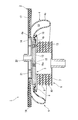
- FIG. 2 is a longitudinal sectional view of an exhaust state in which the inside of a diaphragm is exhausted in the air spring device shown in FIG. 1.
- the air spring device 1 is sealed by connecting both open end portions 4 a and 4 b to an upper plate (upper member) 2, a lower plate (lower member) 3, and these face plates 2 and 3.
- an intermediate portion 4c located between the opening end portions 4a and 4b is connected to a diaphragm 5 having a tubular membrane member 4 bulged outward in the radial direction, and a lower surface plate 3 of the diaphragm 5
- the auxiliary elastic body 6 is provided.
- the air spring device 1 is disposed between a vehicle body (not shown) such as a railway vehicle and a carriage.
- the auxiliary elastic body 6 is formed in a cylindrical shape, and the central axes of the upper surface plate 2, the lower surface plate 3, the cylindrical film member 4, and the auxiliary elastic body 6 are located on a common axis.
- this common axis is referred to as an axis O
- the upper surface plate 2 side along the axis O direction is referred to as the upper side
- the lower surface plate 3 side is referred to as the lower side
- the direction perpendicular to the axis O is referred to as the radial direction.
- the direction that circulates around O is referred to as the circumferential direction.
- the auxiliary elastic body 6 has higher spring constants in the axis O direction and the radial direction than the diaphragm 5 in which a gas such as air is filled.
- the auxiliary elastic body 6 of the present embodiment includes an annular lower substrate 7 and an upper substrate 8, annular rubber plates 9 and metal plates 10 that are alternately arranged between the substrates 7 and 8 in the direction of the axis O, It is comprised by the laminated rubber provided with.
- the lower substrate 7, the upper substrate 8, the rubber plate 9, and the metal plate 10 are arranged coaxially with the axis O, and the lower substrate 7, the upper substrate 8, the metal plate 10, and the rubber plate 9 are vulcanized and bonded to each other. Has been.
- the outer diameter of the upper substrate 8 is the largest, and the outer peripheral edge portion of the upper substrate 8 protrudes outward in the radial direction.
- the inner diameter of the lower substrate 7 is the smallest among the inner diameters of the members constituting the auxiliary elastic body 6 of the present embodiment, and the inner peripheral edge of the lower substrate 7 protrudes inward in the radial direction.
- a communication cylinder portion 11 that is open toward both sides in the axis O direction and communicates with the auxiliary elastic body 6 is fitted.
- a gas supply means or an auxiliary tank (not shown) for supplying and discharging gas into the diaphragm 5 is airtightly connected to a portion of the communication cylinder portion 11 protruding downward from the lower substrate 7.
- the lower surface plate 3 of the diaphragm 5 is formed of, for example, a metal material, a resin material, or a rubber material, and includes a plate-like base portion (contact portion) 12 disposed on the upper substrate 8 of the auxiliary elastic body 6. Yes.
- the plate-like base 12 is arranged coaxially with the axis O, and the outer diameter thereof is smaller than the outer diameter of the upper substrate 8. Further, the plate-like base portion 12 is fixed to the upper substrate 8 of the auxiliary elastic body 6 with fixing bolts 13. Thereby, the lower surface plate 3 and the auxiliary elastic body 6 are hermetically connected, and communication between the inside and the outside of the auxiliary elastic body 6 passing between the lower surface plate 3 and the auxiliary elastic body 6 is blocked.
- a plurality of bolt holes 14 through which the fixing bolts 13 are inserted are formed in the plate-like base portion 12.
- the plurality of bolt holes 14 penetrate the plate-like base portion 12 along the direction of the axis O, and are arranged at intervals in the circumferential direction as shown in FIG.
- the plurality of bolt holes 14 are arranged at equal intervals in the circumferential direction on the same circle centered on the axis O when viewed from above along the axis O direction.
- the supply / discharge hole 15 is provided through the plate-like base portion 12 along the direction of the axis O so as to communicate the inside of the auxiliary elastic body 6 and the inside of the diaphragm 5.
- the supply / discharge hole 15 is disposed coaxially with the axis O, and communicates with the communication cylinder portion 11 through the auxiliary elastic body 6.
- a female screw portion 15a is formed in the supply / discharge hole 15, and a suspension bolt provided in a lifting device (not shown) that lifts the lower surface plate 3 upward can be screwed to the female screw portion 15a. It has become.
- the upper substrate 8 of the auxiliary elastic body 6 includes an outer peripheral edge portion located on the outer side in the radial direction from the plate-like base portion 12.
- the outer peripheral edge is covered with an annular rubber seat 16 from above and radially outside.
- the inner peripheral edge of the rubber seat 16 is sandwiched between the plate-like base portion 12 of the lower surface plate 3 and the upper substrate 8 of the auxiliary elastic body 6.
- the upper surface plate 2 has a main body plate portion 17 whose outer diameter is larger than the outer diameter of the tubular membrane member 4 and is directed downward (inner side of the diaphragm along the axial direction) from a central portion in the radial direction of the main body plate portion 17.
- the main body plate portion 17 and the overhanging portion 18 are arranged coaxially with the axis O.
- the overhanging portion 18 is formed in a bottomed cylindrical shape, and is disposed to face the plate-like base portion 12 of the lower surface plate 3 in the axis O direction.
- the outer diameter of the overhang portion 18 is equal to the outer diameter of the plate-like base portion 12.
- the main body plate portion 17 includes an outer peripheral edge portion located on the outer side in the radial direction from the overhang portion 18. This outer peripheral edge is covered from below by an annular rubber film 19. A gap extending in the radial direction is opened between the overhang portion 18 and the rubber film 19.
- the upper surface plate 2 is provided with a through cylinder portion 20 that penetrates the main body plate portion 17 and the overhang portion 18 in the direction of the axis O and communicates the inside of the diaphragm 5 with the outside.
- the lower end surface of the through tube portion 20 is flush with the lower surface of the overhang portion 18, and the upper end portion of the through tube portion 20 projects upward from the main body plate portion 17.
- the gas supply means and the auxiliary tank described above are airtightly connected to the upper end portion of the through cylinder portion 20.
- the cylindrical membrane member 4 has flexibility, and is formed of, for example, an elastic material, preferably a rubber material.
- the upper opening end 4a located on the upper side of the two opening ends 4a and 4b of the tubular film member 4 is airtightly fitted to the overhanging portion 18 of the upper surface plate 2, and the overhanging portion 18 and the rubber film 19 are fitted. It is arranged in the gap between.
- the lower opening end portion 4b located on the lower side of the both opening end portions 4a and 4b is airtightly fitted to the plate-like base portion 12 of the lower surface plate 3, and is disposed on the rubber seat 16. .
- the lower opening end portion 4b of the tubular membrane member 4 is fitted to a portion of the plate-like base portion 12 located on the lower side (outside of the diaphragm along the axial direction) in FIG. Has been.
- the outer peripheral surface of the portion located on the upper side (the inner side of the diaphragm along the axial direction) of the plate-like base portion 12 is exposed toward the outer peripheral space S2 (described later) positioned on the outer side in the radial direction.
- the intermediate portion 4 c of the tubular film member 4 bulges outward in the radial direction from the upper substrate 8 of the auxiliary elastic body 6.
- the intermediate portion 4c is in contact with the upper substrate 8 of the auxiliary elastic body 6 from above and radially outside through a rubber seat 16 provided on the lower surface plate 3 side, and is provided on the upper surface plate 2 side.
- the body 19 is in contact with the main body plate portion 17 of the upper surface plate 2 through the film 19 from below.
- the overhanging portion 18 of the upper surface plate 2 and the plate-like base portion 12 of the lower surface plate 3 face each other while being spaced apart in the direction of the axis O in a filled state in which the diaphragm 5 is filled with gas.
- the diaphragms 5 are slidably in contact with each other in an exhausted state.
- the diaphragm 5 in this filled state, has a central space S ⁇ b> 1 positioned between the overhanging portion 18 of the upper surface plate 2 and the plate-like base portion 12 of the lower surface plate 3.
- a diaphragm space S is formed which is located in the tubular membrane member 4 and extends over the entire circumference in the circumferential direction, and an outer circumferential space S2 connected to the central space S1 from the outside in the radial direction.
- the inside of the through cylinder portion 20 on the upper surface plate 2 side and the supply / discharge hole 15 on the lower surface plate 3 side are the center between the overhanging portion 18 of the upper surface plate 2 and the plate-like base portion 12 of the lower surface plate 3.
- the space S1 communicates with the outer peripheral space S2 in the tubular membrane member 4.
- the gas in the diaphragm 5 is adjusted by adjusting the pressure in the diaphragm 5 through the through cylinder 20 or the supply / discharge hole 15.
- the central space S1 and the outer peripheral space S2 are gradually reduced. That is, the overhanging portion 18 of the upper surface plate 2 and the plate-like base portion 12 of the lower surface plate 3 gradually approach in the direction of the axis O, and the tubular film member 4 gradually contracts and deforms. As shown in FIG. 3, in the exhausted diaphragm 5, the overhanging portion 18 and the plate-like base portion 12 come into contact with each other and the central space S ⁇ b> 1 disappears.
- the upper surface plate 2 and the lower surface plate 3 are moved in the radial direction by sliding the protruding portion 18 of the upper surface plate 2 and the plate-like base portion 12 of the lower surface plate 3 in contact with each other. Can move relatively along. Further, in the exhausted state, the supply tube 15 in the through cylinder portion 20 on the upper surface plate 2 side and the supply and discharge hole 15 on the lower surface plate 3 side are brought into contact with the overhang portion 18 by the overhang portion 18 and the plate-like base portion 12 abutting each other. Communication with the inside of the tubular membrane member 4 through the central space S1 located between the plate-like base portion 12 is blocked.
- the plate-like pedestal portion 12 of the lower surface plate 3 is formed with a communication passage 21 that communicates the supply / discharge hole 15 and the inside of the tubular membrane member 4 in an exhausted state.
- the communication path 21 opens upward (inner side of the diaphragm along the axial direction) over the entire region, and opens toward the outer side in the radial direction from the outer peripheral surface of the plate-like base portion 12, thereby forming a cylindrical shape.
- the film member 4 communicates with the inside.
- the communication passage 21 is formed in a groove shape on the upper surface of the plate-like base portion 12, extends continuously linearly along the radial direction, and has an equal interval in the circumferential direction.
- a plurality of communication passages 21 are provided.
- the communication passage 21 passes between the bolt holes 14 adjacent in the circumferential direction among the plurality of bolt holes 14 described above.
- the communication path 21 has an outer end opening 21a that opens toward the outer side in the radial direction, and a constant width that is positioned on the inner side in the radial direction with respect to the outer end opening 21a and has a constant circumferential width. And a portion 21b.
- the width of the outer end opening 21a in the circumferential direction is wider than that of the constant width portion 21b.
- the outer end opening 21a gradually widens from the inner side to the outer side in the radial direction.
- the circumferential direction is symmetrical with respect to the passage axis L passing along the extending direction in which the communication path 21 extends and passing through the central portion in the circumferential direction of the constant width portion 21 b in the communication path 21. Widened.
- the cross-sectional area of the constant width portion 21b of the communication passage 21 in the cross section orthogonal to the passage axis L is, for example, about 1 mm 2 .
- the tubular membrane member 4 is firstly passed from the supply / discharge hole 15 through the communication path 21. Supply gas inside. Then, the outer peripheral space S2 is expanded, the pressure in the tubular membrane member 4 is increased, and the tubular membrane member 4 is expanded and deformed. As a result, the intermediate portion 4c of the tubular film member 4 lifts the upper surface plate 2 through the rubber film 19, so that the upper surface plate 2 and the lower surface plate 3 are moved away from each other in the direction of the axis O, and the central space S1. Expands. As a result, as shown in FIG. 1, the diaphragm 5 is filled with gas to form a diaphragm space S.
- the supply / discharge hole 15 communicates with the tubular membrane member 4 through the communication path 21 in the exhaust state.
- the gas can be easily filled into the diaphragm 5 in the exhaust state.
- the communication path 21 is opened upward over the entire area. Thereby, it becomes possible to process the communicating path 21 from the upper surface side of the plate-shaped base part 12, and the communicating path 21 can be formed easily. Further, the communication passage 21 communicates with the tubular membrane member 4 by opening from the outer peripheral surface of the plate-like base portion 12 of the lower surface plate 3 toward the radially outer side. Thereby, even if the overhang
- the communication path 21 is arranged with an equal interval in the circumferential direction, but is not limited thereto.
- the plurality of communication passages 21 are formed in the plate-like base portion 12, but it is sufficient that at least one communication passage 21 is formed in the plate-like base portion 12.
- the outer end opening 21a of the communication passage 21 is gradually widened from the inner side to the outer side in the radial direction, but may not be widened.
- the communicating path 21 is extended linearly along radial direction, it is not restricted to this.
- the communication path 21 may extend in a curved shape.
- the communication passage 21 communicates with the tubular membrane member 4 by opening from the outer peripheral surface of the plate-like base portion 12 toward the outside in the radial direction.
- the present invention is not limited to this. That is, in the exhaust state, the communication passage 21 may be communicated with the tubular membrane member 4 by opening upward.
- the communication path 21 opens upward over the entire area, but is not limited thereto.
- the communication path 21 may be opened upward in a partial region thereof, and may not be opened upward over the entire region.
- the communication path 21 when the communication path 21 is not opened upward over the whole area, it communicates in the cylindrical film member 4 by opening toward the outer side of radial direction from the outer peripheral surface of the plate-shaped base part 12.
- FIG. The communication path 21 can be employed.
- the communication path 21 is formed in the plate-like base portion 12 of the lower surface plate 3, but is not limited thereto.
- a communication path that communicates the inside of the through cylinder 20 (supply / discharge hole) and the inside of the tubular membrane member 4 may be formed in the overhanging portion 18 of the upper surface plate 2.
- these supply / discharge holes and the communication path may be provided in at least one of the overhanging portion 18 of the upper surface plate 2 and the plate-like base portion 12 of the lower surface plate 3.
- the upper surface plate 2 adopted as the upper member and the lower surface plate 3 adopted as the lower member are not limited to those shown in the present embodiment. That is, the upper member and the lower member are in contact with each other while being spaced apart in the axial direction in the filled state in which the diaphragm is filled with gas and slidably contact with each other in the exhausted state in which the inside of the diaphragm is exhausted. If the parts are provided separately, they can be changed as appropriate.
- the outer diameters of the overhanging portion 18 of the upper surface plate 2 and the plate-like base portion 12 of the lower surface plate 3 are the same, but this is not restrictive.
- the lower surface plate 3 may include a support portion that supports the plate-like base portion 12 from below (outside the diaphragm along the axial direction).
- the support portion may be formed of a material different from that of the plate-like base portion 12.
- the auxiliary elastic body 6 is made of laminated rubber, but is not limited thereto.
- the auxiliary elastic body 6 can be appropriately changed to other configurations as long as the spring constants in the axis O direction and the radial direction are higher than those of the diaphragm 5 filled with gas.
- a lower substrate, an upper substrate, and a cylindrical elastic member disposed between the two substrates and vulcanized and bonded to the two substrates may be provided.
- the auxiliary elastic body 6 may be omitted.
- the lower surface plate 3 may be provided with a configuration corresponding to the upper substrate 8 of the auxiliary elastic body 6.
- the diaphragm can be easily filled with gas from the exhausted state where the inside of the diaphragm is exhausted.
Landscapes
- Engineering & Computer Science (AREA)
- General Engineering & Computer Science (AREA)
- Mechanical Engineering (AREA)
- Fluid-Damping Devices (AREA)
- Diaphragms And Bellows (AREA)
Abstract
本発明は、上部材(2)、下部材(3)、およびこれらの両部材に両開口端部が各別に連結されて封止された筒状膜部材(4)を有するダイヤフラム(5)を備える空気ばね装置(1)であり、前記上部材(2)および前記下部材(3)にはそれぞれ、前記ダイヤフラム(5)内に気体が充填された充填状態で軸線方向に離間して互いに対向するとともに、前記ダイヤフラム(5)内が排気された排気状態で互いに当接する当接部(12,18)が、各別に備えられている。
Description
本発明は、例えば鉄道車両等の車体と台車との間に配設される空気ばね装置に関する。本願は、2011年02月01日に出願された日本国特許出願第2011-19766号に対して優先権を主張し、その内容をここに援用する。
従来の空気ばね装置として、例えば下記の特許文献1に記載された装置が知られている。この空気ばね装置は、上部材と、下部材と、およびこれらの両部材に両開口端部が各別に連結されて封止された筒状膜部材を有するダイヤフラムとを備えている。上部材の下面には、摺動面が形成されるとともに、下部材には、滑り板が備えられている。この滑り板は、ダイヤフラム内に気体が充填された充填状態で、摺動面と軸線方向に離間するとともに、ダイヤフラム内が排気された排気状態で、上部材の摺動面に当接する。
一般に、前記空気ばね装置では、摺動面および滑り板の少なくとも一方に、ダイヤフラム内に気体を給排する給排孔が形成されている。この給排孔は、例えば、前記充填状態でのダイヤフラム内の圧力を調整するために、ダイヤフラム内に気体を給排する。
前記従来の空気ばね装置で、排気状態のダイヤフラム内に気体を充填するときに、給排孔を用いることが考えられる。しかしながら、排気状態では摺動面と滑り板とが互いに当接していることから、給排孔からダイヤフラム内に気体を供給するのは困難である。例えば、外部の昇降装置を用いて上部材を上昇させ、摺動面と滑り板とを軸線方向に互いに離間させながらダイヤフラム内に気体を供給する必要があることから、手間がかかる。
本発明は、前述した事情に鑑みてなされたものであって、ダイヤフラム内が排気された排気状態から、ダイヤフラム内に容易に気体を充填することができる空気ばね装置を提供することを目的とする。
前記課題を解決するために、本発明は以下の手段を提案している。本発明に係る空気ばね装置は、上部材、下部材、およびこれらの両部材に両開口端部が各別に連結されて封止された筒状膜部材を有するダイヤフラムを備える。前記上部材および前記下部材にはそれぞれ、前記ダイヤフラム内に気体が充填された充填状態で軸線方向に離間して互いに対向するとともに、前記ダイヤフラム内が排気された排気状態で互いに当接する当接部が、各別に備えられている。また、この空気ばね装置には、前記上部材および前記下部材の両当接部のうち、少なくとも一方には、前記ダイヤフラム内に気体を給排する給排孔と、前記排気状態で、この給排孔と前記筒状膜部材内とを連通する連通路と、が形成されている。
この発明では、排気状態のダイヤフラム内に気体を充填するときには、まず給排孔から連通路を通して筒状膜部材内に気体を供給する。このとき、筒状膜部材内の圧力が上昇して筒状膜部材が膨張変形することにより、上部材と下部材とが軸線方向に離間移動させられ、ダイヤフラム内に気体が充填される。このように、排気状態で給排孔が連通路を通して筒状膜部材内に連通していることから、両当接部同士が互いに当接した状態で筒状膜部材内に気体を供給することが可能になる。その結果、排気状態でのダイヤフラム内への気体の充填を容易に行うことができる。
また、前記連通路は、その全域にわたって軸線方向に沿ったダイヤフラムの内側に向けて開口していてもよい。
この場合、連通路が、その全域にわたって軸線方向に沿ったダイヤフラムの内側に向けて開口している。そのため、連通路を軸線方向に沿ったダイヤフラムの内側から加工することが可能になり、連通路を容易に形成することができる。
また、前記連通路は、前記当接部の外周面から径方向の外側に向けて開口することにより、前記筒状膜部材内に連通していてもよい。
この場合、連通路が、当接部の外周面から径方向の外側に向けて開口する。これにより、連通路が筒状膜部材内に連通しているので、両当接部同士が互いに当接する。その結果、仮に連通路がその全域にわたって軸線方向に沿ったダイヤフラムの内側から閉塞されたとしても、連通路を通した給排孔と筒状膜部材内との連通を確保することができる。
本発明に係る空気ばね装置によれば、ダイヤフラム内が排気された排気状態から、ダイヤフラム内に容易に気体を充填することができる。
以下、図面を参照し、本発明の一実施形態に係る空気ばね装置を説明する。図1に示すように、空気ばね装置1は、上面板(上部材)2、下面板(下部材)3、およびこれらの面板2、3に両開口端部4a、4bが連結されて封止されるとともに両開口端部4a、4bの間に位置する中間部分4cが径方向の外側に向けて膨出された筒状膜部材4を備えるダイヤフラム5と、このダイヤフラム5の下面板3に連結された補助弾性体6と、を備えている。この空気ばね装置1は、例えば鉄道車両等の図示されない車体と台車との間に配設される。
補助弾性体6は筒状に形成されており、上面板2、下面板3、筒状膜部材4および補助弾性体6の各中心軸線は、共通軸上に位置している。以下では、この共通軸を軸線Oといい、軸線O方向に沿って上面板2側を上側といい、下面板3側を下側といい、軸線Oに直交する方向を径方向といい、軸線O回りに周回する方向を周方向という。
補助弾性体6は、例えば空気などの気体が内部に充填されたダイヤフラム5よりも、軸線O方向および径方向の各ばね定数が高い。本実施形態の補助弾性体6は、環状の下基板7および上基板8と、これら両基板7、8の間に軸線O方向に交互に配置された環状のゴム板9および金属板10と、を備える積層ゴムにより構成されている。下基板7、上基板8、ゴム板9および金属板10は、軸線Oと同軸に配置されるとともに、下基板7、上基板8および金属板10と、ゴム板9と、は互いに加硫接着されている。
また、本実施形態の補助弾性体6を構成する各部材の外径のうち、上基板8の外径が最大であり、上基板8の外周縁部は径方向の外側に突出している。一方、本実施形態の補助弾性体6を構成する各部材の内径のうち、下基板7の内径が最小であり、下基板7の内周縁部は径方向の内側に突出している。
また、そして下基板7内には、内部が軸線O方向の両側に向けて開口して補助弾性体6内に連通する連通筒部11が嵌合されている。この連通筒部11における下基板7から下方に突出する部分には、例えば、ダイヤフラム5内に気体を給排する図示しない気体供給手段や補助タンクなどが気密に接続される。
また、ダイヤフラム5の下面板3は、例えば金属材料、樹脂材料またはゴム材料などで形成され、補助弾性体6の上基板8上に配置された板状台部(当接部)12を備えている。この板状台部12は、軸線Oと同軸に配置され、その外径は上基板8の外径よりも小さい。また、この板状台部12は、補助弾性体6の上基板8に固定ボルト13により固定されている。これにより、下面板3と補助弾性体6とが気密に連結されて、下面板3と補助弾性体6との間を通した補助弾性体6内と外部との連通が遮断されている。
なお、この板状台部12には、固定ボルト13が挿通される複数のボルト孔14が形成されている。これらの複数のボルト孔14は、軸線O方向に沿って板状台部12を貫通するとともに、図2に示すように周方向に間隔をあけて配設されている。複数のボルト孔14は、軸線O方向に沿って上方から見た上面視において、軸線Oを中心とする同一円上に周方向に同等の間隔をあけて配設されている。
また、図1に示すように、給排孔15が、補助弾性体6内とダイヤフラム5内とを連通するように、軸線O方向に沿って板状台部12に貫設されている。この給排孔15は、軸線Oと同軸に配置されており、補助弾性体6内を通して連通筒部11内に連通している。なお、図示の例では、給排孔15内には雌ねじ部15aが形成されており、下面板3を上方に吊り上げる図示しない吊上げ装置に備えられた吊りボルトが、雌ねじ部15aに螺着可能となっている。
また、補助弾性体6の上基板8は、板状台部12よりも径方向の外側に位置する外周縁部を備える。この外周縁部は、環状のゴム座16により、上方および径方向の外側から被覆されている。このゴム座16の内周縁は、下面板3の板状台部12と補助弾性体6の上基板8との間に挟持されている。
上面板2は、外径が筒状膜部材4の外径よりも大きい本体板部17と、この本体板部17における径方向の中央部から下方(軸線方向に沿ったダイヤフラムの内側)に向けて張り出された張出し部(当接部)18と、を備えており、これらの本体板部17および張出し部18は、軸線Oと同軸に配設されている。
また、張出し部18は、有底筒状に形成されるとともに、軸線O方向において下面板3の板状台部12と対向して配置されている。この張出し部18の外径は、板状台部12の外径と同等になっている。また、本体板部17は、張出し部18よりも径方向の外側に位置する外周縁部を備える。この外周縁部は、環状のゴム膜19により、下方から被覆されている。張出し部18とゴム膜19との間には、径方向に延びた隙間が空いている。
さらに、上面板2には、本体板部17および張出し部18を軸線O方向に貫通し、ダイヤフラム5内と外部とを連通する貫通筒部20が設けられている。貫通筒部20の下端面は、張出し部18の下面と同一面とされるとともに、貫通筒部20の上端部は、本体板部17より上方に突出している。この貫通筒部20の上端部には、例えば、前述した気体供給手段や補助タンクなどが気密に接続される。
筒状膜部材4は、可撓性を具備しており、例えば弾性体材料、好ましくはゴム材料などで形成されている。この筒状膜部材4の両開口端部4a、4bのうち上側に位置する上開口端部4aは、上面板2の張出し部18に気密に外嵌されるとともに、張出し部18とゴム膜19との間の隙間に配置されている。一方、両開口端部4a、4bのうち下側に位置する下開口端部4bは、下面板3の板状台部12に気密に外嵌されるとともに、ゴム座16上に配置されている。
なお、図示の例では、筒状膜部材4の下開口端部4bは、板状台部12のうち、図1における下側(軸線方向に沿ったダイヤフラムの外側)に位置する部分に嵌合されている。板状台部12のうち上側(軸線方向に沿ったダイヤフラムの内側)に位置する部分の外周面は、その径方向の外側に位置する外周空間S2(後述)に向けて露出している。
筒状膜部材4の中間部分4cは、補助弾性体6の上基板8よりも径方向の外側に膨出している。この中間部分4cは、下面板3側に設けられたゴム座16を介して、補助弾性体6の上基板8に上方および径方向の外側から当接するとともに、上面板2側に設けられたゴム膜19を介して、上面板2の本体板部17に下方から当接している。
ここで、上面板2の張出し部18、および下面板3の板状台部12は、ダイヤフラム5内に気体が充填された充填状態で軸線O方向に離間して互いに対向するとともに、図3に示すように、ダイヤフラム5内が排気された排気状態で互いに摺動可能に当接する。本実施形態では、図1に示すように、この充填状態で、ダイヤフラム5内には、上面板2の張出し部18と下面板3の板状台部12との間に位置する中央空間S1と、筒状膜部材4内に位置して周方向の全周にわたって延在し、中央空間S1に径方向の外側から接続された外周空間S2と、を備えるダイヤフラム空間Sが形成される。
この充填状態では、上面板2側の貫通筒部20内、および下面板3側の給排孔15は、上面板2の張出し部18と下面板3の板状台部12との間の中央空間S1を通して、筒状膜部材4内の外周空間S2に連通している。なお、この充填状態では、例えば、貫通筒部20内、または給排孔15を通して、ダイヤフラム5内に気体を給排してダイヤフラム5内の圧力を調整する。
また、この充填状態のダイヤフラム5内から、貫通筒部20の内部、または給排孔15を通して気体が排出されると、中央空間S1および外周空間S2が、それぞれ徐々に縮小する。すなわち、上面板2の張出し部18と、下面板3の板状台部12とが、軸線O方向に徐々に接近するとともに、筒状膜部材4が徐々に収縮変形する。そして、図3に示すように、この排気状態のダイヤフラム5内では、張出し部18と板状台部12とが互いに当接して中央空間S1が消滅する。
この排気状態では、上面板2の張出し部18と、下面板3の板状台部12と、が互いに当接した状態で摺動することで、上面板2と下面板3とが径方向に沿って相対的に移動することができる。また、排気状態では、上面板2側の貫通筒部20内、および下面板3側の給排孔15は、張出し部18と板状台部12とが互いに当接することにより、張出し部18と板状台部12との間に位置する中央空間S1を介した筒状膜部材4内との連通が遮断されている。
そして本実施形態では、下面板3の板状台部12には、排気状態で、給排孔15と筒状膜部材4内とを連通する連通路21が形成されている。この連通路21は、その全域にわたって上方(軸線方向に沿ったダイヤフラムの内側)に向けて開口するとともに、板状台部12の外周面から径方向の外側に向けて開口することにより、筒状膜部材4内に連通している。
図2に示すように、連通路21は、板状台部12の上面に溝状に形成され、径方向に沿って直線状に連続して延在するとともに、周方向に同等の間隔をあけて複数の連通路21が配設されている。本実施形態では、連通路21は、前述した複数のボルト孔14のうち、周方向に隣り合うボルト孔14同士の間を通過している。
また、連通路21は、径方向の外側に向けて開口する外端開口部21aと、この外端開口部21aよりも径方向の内側に位置し、周方向の幅が一定とされた定幅部分21bとを備えている。この外端開口部21aの周方向の幅は、定幅部分21bよりも広幅になっている。特に、外端開口部21aは、径方向の内側から外側に向かうに従い徐々に拡幅する。図示の例では、連通路21が延在する延在方向に沿い、かつ連通路21における定幅部分21bの周方向の中央部を通る通路軸Lを基準として、周方向に対称となるように拡幅している。また、この通路軸Lに直交する断面における連通路21の定幅部分21bの断面積は、例えば1mm2程度となっている。
次に、以上のように構成された空気ばね装置1で、図3に示すような排気状態のダイヤフラム5内に気体を充填するときには、まず給排孔15から連通路21を通して筒状膜部材4内に気体を供給する。すると、外周空間S2が拡大して、筒状膜部材4内の圧力が上昇し筒状膜部材4が膨張変形する。これにより、筒状膜部材4の中間部分4cがゴム膜19を介して上面板2を持ち上げるため、上面板2と下面板3とが軸線O方向に離間するように移動させられて中央空間S1が拡大する。その結果、図1に示すように、ダイヤフラム5内に気体が充填されてダイヤフラム空間Sが形成される。
以上に説明したように、本実施形態に係る空気ばね装置1では、排気状態で、給排孔15が、連通路21を通して筒状膜部材4内に連通している。これにより、上面板2の張出し部18および下面板3の板状台部12が互いに当接した状態で、筒状膜部材4内に気体を供給することが可能になる。すなわち、排気状態でのダイヤフラム5内への気体の充填を容易に行うことができる。
また、連通路21が、その全域にわたって上方に向けて開口している。これにより、連通路21を板状台部12の上面側から加工することが可能になり、連通路21を容易に形成することができる。また、連通路21が、下面板3の板状台部12の外周面から径方向の外側に向けて開口することにより、筒状膜部材4内に連通している。これにより、張出し部18および板状台部12が互いに当接して仮に連通路21がその全域にわたって上方から閉塞されたとしても、連通路21を通した給排孔15と筒状膜部材4内との連通を確保することができる。
なお、本発明の技術的範囲は本実施形態に限定されるものではなく、本発明の趣旨を逸脱しない範囲において種々の変更を加えることが可能である。例えば、本実施形態では、連通路21は、周方向に同等の間隔を空けて配置されているが、これに限られない。また、本実施形態では、複数の連通路21が、板状台部12に形成されているが、少なくとも1つの連通路21が板状台部12に形成されていればよい。
また、本実施形態では、連通路21の外端開口部21aは、径方向の内側から外側に向かうに従い徐々に拡幅しているが、拡幅していなくてもよい。また、本実施形態では、連通路21は、径方向に沿って直線状に連続して延在しているが、これに限らない。例えば、連通路21は、曲線状などに延在していてもよい。
また、本実施形態では、連通路21は、板状台部12の外周面から径方向の外側に向けて開口することにより筒状膜部材4内に連通しているが、これに限らない。すなわち、排気状態で、連通路21が、上方に向けて開口することにより、筒状膜部材4内に連通していてもよい。このような構成の一例としては、上面板2の張出し部18の外径よりも大きい外径を備えた下面板3の板状台部12を設けることが考えられる。
また、本実施形態では、連通路21は、その全域にわたって上方に向けて開口しているが、これに限らない。例えば、連通路21が、その一部の領域において上方に向けて開口していてもよく、その全域にわたって上方に向けて開口していなくてもよい。なお、連通路21が、その全域にわたって上方に向けて開口していない場合、板状台部12の外周面から径方向の外側に向けて開口することにより、筒状膜部材4内に連通する連通路21を採用することができる。
また、本実施形態では、連通路21が、下面板3の板状台部12に形成されているが、これに限らない。例えば、上面板2の張出し部18に、貫通筒部20(給排孔)内と筒状膜部材4内とを連通する連通路を形成してもよい。また、これらの給排孔および連通路は、上面板2の張出し部18および下面板3の板状台部12の少なくとも一方に設けられていればよい。
また、上部材として採用した上面板2、および下部材として採用した下面板3は、本実施形態に示したものに限らない。すなわち、上部材および下部材それぞれは、ダイヤフラム内に気体が充填された充填状態で軸線方向に離間して互いに対向するとともに、ダイヤフラム内が排気された排気状態で互いに摺動可能に当接する当接部が各別に備えられていれば、適宜変更することができる。例えば、本実施形態では、上面板2の張出し部18と下面板3の板状台部12との外径が同等であるが、これに限られない。また、例えば、下面板3が、板状台部12を下方(軸線方向に沿ったダイヤフラムの外側)から支持する支持部を備えていてもよい。この場合、この支持部は、板状台部12と異なる材料で形成されていてもよい。
また、本実施形態では、補助弾性体6は、積層ゴムにより構成されているが、これに限らない。この補助弾性体6は、気体が内部に充填されたダイヤフラム5よりも軸線O方向および径方向の各ばね定数が高ければ、他の構成に適宜変更することができる。例えば、下基板と、上基板と、およびこれらの両基板の間に配設されて両基板に加硫接着された筒状の弾性部材と、を備えてもよい。さらに、補助弾性体6は、なくてもよい。この場合、下面板3に、補助弾性体6の上基板8に相当する構成が備えられていてもよい。
その他、本発明の趣旨に逸脱しない範囲で、本実施形態における構成要素を周知の構成要素に置き換えることは適宜可能であり、また前記した変形例を適宜組み合わせてもよい。
本発明に係る空気ばね装置によれば、ダイヤフラム内が排気された排気状態から、ダイヤフラム内に容易に気体を充填することができる。
1 空気ばね装置
2 上面板
3 下面板
4 筒状膜部材
4a、4b 開口端部
5 ダイヤフラム
12 板状台部(当接部)
15 給排孔
18 張出し部(当接部)
21 連通路
O 軸線
2 上面板
3 下面板
4 筒状膜部材
4a、4b 開口端部
5 ダイヤフラム
12 板状台部(当接部)
15 給排孔
18 張出し部(当接部)
21 連通路
O 軸線
Claims (3)
- 上部材、下部材、およびこれらの両部材に両開口端部が各別に連結されて封止された筒状膜部材を有するダイヤフラムを備え、
前記上部材および前記下部材にはそれぞれ、前記ダイヤフラム内に気体が充填された充填状態で軸線方向に離間して互いに対向するとともに、前記ダイヤフラム内が排気された排気状態で互いに当接する当接部が各別に備えられた空気ばね装置であって、
前記上部材および前記下部材の両当接部のうち、少なくとも一方には、
前記ダイヤフラム内に気体を給排する給排孔と、
前記排気状態でこの給排孔と前記筒状膜部材内とを連通する連通路と、が形成されている空気ばね装置。 - 前記連通路は、その全域にわたって軸線方向に沿ったダイヤフラムの内側に向けて開口している請求項1記載の空気ばね装置。
- 前記連通路は、前記当接部の外周面から径方向の外側に向けて開口することにより、前記筒状膜部材内に連通している請求項2記載の空気ばね装置。
Applications Claiming Priority (2)
| Application Number | Priority Date | Filing Date | Title |
|---|---|---|---|
| JP2011019766A JP2012159146A (ja) | 2011-02-01 | 2011-02-01 | 空気ばね装置 |
| JP2011-019766 | 2011-02-01 |
Publications (1)
| Publication Number | Publication Date |
|---|---|
| WO2012105444A1 true WO2012105444A1 (ja) | 2012-08-09 |
Family
ID=46602660
Family Applications (1)
| Application Number | Title | Priority Date | Filing Date |
|---|---|---|---|
| PCT/JP2012/051798 Ceased WO2012105444A1 (ja) | 2011-02-01 | 2012-01-27 | 空気ばね装置 |
Country Status (2)
| Country | Link |
|---|---|
| JP (1) | JP2012159146A (ja) |
| WO (1) | WO2012105444A1 (ja) |
Cited By (4)
| Publication number | Priority date | Publication date | Assignee | Title |
|---|---|---|---|---|
| WO2014127344A3 (en) * | 2013-02-18 | 2015-02-26 | Firestone Industrial Products Company, Llc | End member assemblies as well as gas spring assemblies and methods of manufacture including same |
| WO2016134185A1 (en) * | 2015-02-18 | 2016-08-25 | Firestone Industrial Products Company, Llc | End member assemblies as well as gas spring assemblies and suspension systems including same |
| EP2960541A4 (en) * | 2013-02-22 | 2016-11-02 | Toyo Tire & Rubber Co | AIR SPRING |
| CN111043226A (zh) * | 2019-12-04 | 2020-04-21 | 株洲时代新材料科技股份有限公司 | 一种空气弹簧的预压缩方法及预压缩空气弹簧 |
Families Citing this family (1)
| Publication number | Priority date | Publication date | Assignee | Title |
|---|---|---|---|---|
| CN109844356B (zh) * | 2016-10-17 | 2021-08-10 | 住友电气工业株式会社 | 空气弹簧和转向架 |
Citations (8)
| Publication number | Priority date | Publication date | Assignee | Title |
|---|---|---|---|---|
| JPH1178877A (ja) * | 1997-09-05 | 1999-03-23 | Kawasaki Heavy Ind Ltd | 車体支持用空気バネ装置 |
| JP2001263486A (ja) * | 2000-03-22 | 2001-09-26 | Matsushita Electric Works Ltd | ダイヤフラム及びダイヤフラムポンプ並びにダイヤフラムの製造方法 |
| JP2003254378A (ja) * | 2002-03-04 | 2003-09-10 | Bridgestone Corp | 空気バネ |
| JP2005036825A (ja) * | 2003-07-15 | 2005-02-10 | Bridgestone Corp | 空気バネ |
| JP2007127264A (ja) * | 2005-10-03 | 2007-05-24 | Bridgestone Corp | 空気バネ |
| JP2007321936A (ja) * | 2006-06-05 | 2007-12-13 | Fukoku Co Ltd | 空気ばね |
| JP2008196629A (ja) * | 2007-02-14 | 2008-08-28 | Bridgestone Corp | 空気バネ |
| JP2010221915A (ja) * | 2009-03-24 | 2010-10-07 | Toyo Tire & Rubber Co Ltd | 鉄道車両用空気ばね |
-
2011
- 2011-02-01 JP JP2011019766A patent/JP2012159146A/ja active Pending
-
2012
- 2012-01-27 WO PCT/JP2012/051798 patent/WO2012105444A1/ja not_active Ceased
Patent Citations (8)
| Publication number | Priority date | Publication date | Assignee | Title |
|---|---|---|---|---|
| JPH1178877A (ja) * | 1997-09-05 | 1999-03-23 | Kawasaki Heavy Ind Ltd | 車体支持用空気バネ装置 |
| JP2001263486A (ja) * | 2000-03-22 | 2001-09-26 | Matsushita Electric Works Ltd | ダイヤフラム及びダイヤフラムポンプ並びにダイヤフラムの製造方法 |
| JP2003254378A (ja) * | 2002-03-04 | 2003-09-10 | Bridgestone Corp | 空気バネ |
| JP2005036825A (ja) * | 2003-07-15 | 2005-02-10 | Bridgestone Corp | 空気バネ |
| JP2007127264A (ja) * | 2005-10-03 | 2007-05-24 | Bridgestone Corp | 空気バネ |
| JP2007321936A (ja) * | 2006-06-05 | 2007-12-13 | Fukoku Co Ltd | 空気ばね |
| JP2008196629A (ja) * | 2007-02-14 | 2008-08-28 | Bridgestone Corp | 空気バネ |
| JP2010221915A (ja) * | 2009-03-24 | 2010-10-07 | Toyo Tire & Rubber Co Ltd | 鉄道車両用空気ばね |
Cited By (6)
| Publication number | Priority date | Publication date | Assignee | Title |
|---|---|---|---|---|
| WO2014127344A3 (en) * | 2013-02-18 | 2015-02-26 | Firestone Industrial Products Company, Llc | End member assemblies as well as gas spring assemblies and methods of manufacture including same |
| US9387865B2 (en) | 2013-02-18 | 2016-07-12 | Firestone Industrial Products Company, Llc | End member assemblies as well as gas spring assemblies and methods of manufacture including same |
| EP2960541A4 (en) * | 2013-02-22 | 2016-11-02 | Toyo Tire & Rubber Co | AIR SPRING |
| WO2016134185A1 (en) * | 2015-02-18 | 2016-08-25 | Firestone Industrial Products Company, Llc | End member assemblies as well as gas spring assemblies and suspension systems including same |
| CN111043226A (zh) * | 2019-12-04 | 2020-04-21 | 株洲时代新材料科技股份有限公司 | 一种空气弹簧的预压缩方法及预压缩空气弹簧 |
| CN111043226B (zh) * | 2019-12-04 | 2021-10-01 | 株洲时代瑞唯减振装备有限公司 | 一种空气弹簧的预压缩方法及预压缩空气弹簧 |
Also Published As
| Publication number | Publication date |
|---|---|
| JP2012159146A (ja) | 2012-08-23 |
Similar Documents
| Publication | Publication Date | Title |
|---|---|---|
| WO2012105444A1 (ja) | 空気ばね装置 | |
| JP5743604B2 (ja) | 空気ばね装置 | |
| EP4464385A3 (en) | Patient interface with a seal-forming structure having varying thickness | |
| US10696202B2 (en) | Pneumatic device and method for manufacturing the same | |
| US20210187947A1 (en) | Low cost damper | |
| JP2008308125A (ja) | 安全タイヤ | |
| EP3460285A1 (en) | Air suspension device | |
| US10696338B2 (en) | Wall surface suction-type travel device | |
| JP5453144B2 (ja) | 空気ばね | |
| JP5205214B2 (ja) | 板状部材の支持装置および支持方法 | |
| JP2012180913A (ja) | 空気ばね装置 | |
| JP2008304000A (ja) | 空気ばね装置 | |
| KR101891905B1 (ko) | 공기 스프링 장치 및 공기 스프링 장치의 제조 방법 | |
| JP6442365B2 (ja) | 未加硫タイヤの製造方法 | |
| JP2009222196A (ja) | 空気ばね | |
| WO2017033695A1 (ja) | 空気ばね装置 | |
| JP5703058B2 (ja) | 空気ばね装置 | |
| JP2010030467A (ja) | 安全タイヤ用隔膜、安全タイヤ及び安全タイヤとリムとの組立体 | |
| JP2019214278A (ja) | タイヤホイール組立体 | |
| JP6097638B2 (ja) | 気体ばね式除振装置 | |
| JP5087289B2 (ja) | ランフラットタイヤ及びランフラットタイヤとリムとの組立体 | |
| US7263830B2 (en) | Master cylinder | |
| KR20140113252A (ko) | 유지 기능을 갖는 일정 형상의 다이어프램 | |
| EP4610513A1 (en) | Diaphragm for air spring and air spring | |
| JP2018119601A (ja) | 空気ばね |
Legal Events
| Date | Code | Title | Description |
|---|---|---|---|
| 121 | Ep: the epo has been informed by wipo that ep was designated in this application |
Ref document number: 12741640 Country of ref document: EP Kind code of ref document: A1 |
|
| NENP | Non-entry into the national phase |
Ref country code: DE |
|
| 122 | Ep: pct application non-entry in european phase |
Ref document number: 12741640 Country of ref document: EP Kind code of ref document: A1 |