WO2012111232A1 - Dispositif de traitement d'image, procédé de traitement d'image, programme de traitement d'image et dispositif de formation d'image - Google Patents
Dispositif de traitement d'image, procédé de traitement d'image, programme de traitement d'image et dispositif de formation d'image Download PDFInfo
- Publication number
- WO2012111232A1 WO2012111232A1 PCT/JP2011/079170 JP2011079170W WO2012111232A1 WO 2012111232 A1 WO2012111232 A1 WO 2012111232A1 JP 2011079170 W JP2011079170 W JP 2011079170W WO 2012111232 A1 WO2012111232 A1 WO 2012111232A1
- Authority
- WO
- WIPO (PCT)
- Prior art keywords
- image
- target pixel
- reference image
- contrast
- reliability
- Prior art date
- Legal status (The legal status is an assumption and is not a legal conclusion. Google has not performed a legal analysis and makes no representation as to the accuracy of the status listed.)
- Ceased
Links
Images





Classifications
-
- G—PHYSICS
- G06—COMPUTING OR CALCULATING; COUNTING
- G06T—IMAGE DATA PROCESSING OR GENERATION, IN GENERAL
- G06T5/00—Image enhancement or restoration
- G06T5/70—Denoising; Smoothing
-
- G—PHYSICS
- G06—COMPUTING OR CALCULATING; COUNTING
- G06T—IMAGE DATA PROCESSING OR GENERATION, IN GENERAL
- G06T5/00—Image enhancement or restoration
- G06T5/50—Image enhancement or restoration using two or more images, e.g. averaging or subtraction
-
- H—ELECTRICITY
- H04—ELECTRIC COMMUNICATION TECHNIQUE
- H04N—PICTORIAL COMMUNICATION, e.g. TELEVISION
- H04N23/00—Cameras or camera modules comprising electronic image sensors; Control thereof
-
- H—ELECTRICITY
- H04—ELECTRIC COMMUNICATION TECHNIQUE
- H04N—PICTORIAL COMMUNICATION, e.g. TELEVISION
- H04N5/00—Details of television systems
- H04N5/14—Picture signal circuitry for video frequency region
- H04N5/144—Movement detection
- H04N5/145—Movement estimation
-
- H—ELECTRICITY
- H04—ELECTRIC COMMUNICATION TECHNIQUE
- H04N—PICTORIAL COMMUNICATION, e.g. TELEVISION
- H04N5/00—Details of television systems
- H04N5/14—Picture signal circuitry for video frequency region
- H04N5/21—Circuitry for suppressing or minimising disturbance, e.g. moiré or halo
-
- G—PHYSICS
- G06—COMPUTING OR CALCULATING; COUNTING
- G06T—IMAGE DATA PROCESSING OR GENERATION, IN GENERAL
- G06T2207/00—Indexing scheme for image analysis or image enhancement
- G06T2207/20—Special algorithmic details
- G06T2207/20172—Image enhancement details
- G06T2207/20201—Motion blur correction
-
- G—PHYSICS
- G06—COMPUTING OR CALCULATING; COUNTING
- G06T—IMAGE DATA PROCESSING OR GENERATION, IN GENERAL
- G06T2207/00—Indexing scheme for image analysis or image enhancement
- G06T2207/20—Special algorithmic details
- G06T2207/20212—Image combination
- G06T2207/20221—Image fusion; Image merging
Definitions
- the present invention relates to an image processing device, an image processing method, an image processing program, and an imaging device.
- a cyclic noise reduction technology as a conventional technology for reducing the amount of noise in moving images.
- motion compensation is performed between the input frame image and the processed previous frame image, and the reliability of motion compensation for each pixel is calculated from the difference amount of the surrounding pixels.
- the input frame image (current frame) and the previous frame image are blended and synthesized at a blending composition ratio (mixing ratio) derived according to the reliability, the motion amount, and the noise estimation amount (see JP43216626B and JP2010-147986A).
- the reliability of motion compensation can be calculated from an evaluation value of the degree of difference such as the sum of absolute differences (SAD) between motion compensated images.
- SAD sum of absolute differences
- the motion detection error ie, motion compensation error
- the high-contrast portion is at the position of the current frame image with no error because the sum of absolute differences (SAD) is large.
- SAD sum of absolute differences
- An image processing apparatus is an image processing apparatus that performs a combining process using a base image and at least one reference image to generate a composite image that has at least less noise than the base image.
- a motion vector calculation unit that calculates a motion vector between the reference image and the reference image, and a motion compensation unit that performs motion compensation based on the motion vector so as to align the reference image with the reference image.
- a contrast calculation unit that calculates the contrast value of the target pixel of the synthesis process in the standard image from the standard image or the reference image, and the target pixel of the standard image according to the contrast value of the target pixel
- a composition ratio calculating unit that calculates a composition ratio with a corresponding pixel corresponding to the target pixel in the motion compensated reference image; Based on the formation ratio, and a synthesizing unit for synthesizing the corresponding pixel of the reference image and the target pixel of the reference image.
- An image processing method is an image processing method for generating a composite image having a noise amount smaller than that of the reference image by performing a combining process using the reference image and at least one reference image. Calculating a motion vector between the reference image and the reference image, based on the motion vector, performing motion compensation so as to align the reference image with the reference image, and the reference Calculating the contrast value of the target pixel of the synthesis process in the image from the base image or the reference image, and subjecting the target pixel of the base image to the motion compensation according to the contrast value of the target pixel Calculating a composite ratio with a corresponding pixel corresponding to the target pixel in a reference image; and based on the composite ratio, the target pixel of the reference image It includes synthesizing a corresponding pixel of the serial reference image.
- An image processing program is an image processing program for performing a synthesis process using a base image and at least one reference image to generate a composite image having a noise amount smaller than that of the base image.
- a motion vector calculation procedure for calculating a motion vector between the reference image and the reference image, and motion for motion compensation so as to align the reference image with the reference image based on the motion vector
- the contrast calculation procedure for calculating the contrast value of the target pixel of the synthesis process in the reference image from the reference image or the reference image, and the contrast value of the target pixel Calculate a synthesis ratio between the target pixel and the corresponding pixel corresponding to the target pixel in the motion-compensated reference image.
- a synthesis ratio calculation procedure based on the synthesis ratio, to perform a synthesis procedure for synthesizing the corresponding pixel of the target pixel and the reference image of the reference image, to the computer.
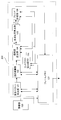
- FIG. 1 is a block diagram showing an image processing apparatus according to the present invention.
- FIG. 2 is a sequence diagram showing a blend synthesis process according to the present invention.
- FIG. 3 is a flowchart showing a procedure of reliability calculation processing according to the first embodiment.
- FIG. 4A is a diagram illustrating an example of a difference correction method.
- FIG. 4B is a diagram illustrating another example of the difference correction method.
- FIG. 4C is a diagram illustrating still another example of the difference correction method.
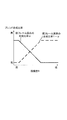
- FIG. 5 is a graph showing the relationship between the motion compensation reliability R and the blend composition ratio.
- FIG. 6 is a flowchart showing a procedure of reliability calculation processing according to the second embodiment.
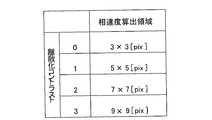
- FIG. 7 is an example of a table associating the contrast value and the size of the difference calculation area according to the second embodiment.
- FIG. 8 is a flowchart showing a procedure of reliability calculation processing according to the third embodiment.
- FIG. 9 is an example of a table associating the contrast value and the low-pass filter strength according to the third embodiment.
- FIG. 10 is a flowchart illustrating the procedure of the image processing program.
- FIG. 1 is a block diagram of an image processing apparatus according to the first embodiment.
- the image processing apparatus is mounted on the imaging apparatus.
- the imaging device is shown as an example of an electronic device, and is, for example, a video camera or an electronic still camera.
- the imaging device includes an imaging unit 100 and an image processing device 200.
- the imaging unit 100 that captures an image functions as an image input unit that inputs an image (image data) to the image processing apparatus 200.
- the image processing apparatus 200 outputs an image with a reduced amount of noise to the outside.
- the imaging unit 100 includes an imaging optical system, an imaging element, an A / D conversion circuit, and the like.
- the image processing apparatus 200 includes a motion vector calculation unit 101 (motion vector calculation unit), a motion compensation unit 102 (motion compensation unit), a contrast calculation unit 103 (contrast calculation unit), a reliability calculation unit 104 (reliability calculation unit), A synthesis ratio calculation unit 105 (synthesis ratio calculation unit) and a blend synthesis unit 106 (blend synthesis unit) are provided. Note that each of the above-described units (or all of them) of the image processing apparatus 200 may be configured by a logic circuit such as an ASIC or FPGA.
- each of the above-described units (or all of them) of the image processing apparatus 200 includes a memory for storing data, a memory for storing a calculation program, a CPU / DSP (central processing unit / digital signal processor) for executing the calculation program, and the like. May be configured.
- the image processing apparatus 200 also includes a frame memory 107 (storage unit).
- the frame memory 107 stores the current frame image captured by the image capturing unit 100 and output to the frame memory 107 and the previous frame image output from the blend composition unit 106 as pixel value data.
- the previous frame image and current frame image stored in the frame memory 107 are input to the motion vector calculation unit 101 and used as a reference image and a standard image, respectively.
- the “previous frame image” is an image output from the blend composition unit 106 and stored in the frame memory 107 in the previous processing of the image processing apparatus 200.
- the “current frame image” is an image (pre-combination image) captured by the imaging unit 100 to be blended and combined in the processing of the current image processing apparatus 200.
- the motion vector calculation unit 101 calculates a motion vector between two input images by a template matching method and outputs the motion vector to the motion compensation unit 102.
- the motion compensation unit 102 compensates motion (positional deviation) so that the previous frame image as the reference image is aligned with the current frame image as the reference image. Further, the motion compensation unit 102 cuts out a small area of the current frame image and a small area of the previous frame image aligned with the current frame image.
- the small area of the previous frame image corresponds to the small area of the current frame image and may be referred to as a reference area and a reference area, respectively.
- the motion compensation unit 102 determines the cut-out position of the small area of the previous frame image based on the motion vector so as to cancel the motion vector.
- the small area is an area having a predetermined size that is smaller than the entire image, centering on the target pixel to be blended and synthesized, for example, an area of 3 ⁇ 3 pixels and 5 ⁇ 5 pixels.
- the pixel value data of the small area of the current frame image (reference image) and the small area of the previous frame image (reference image) stored in the frame memory 107 are input to the contrast calculation unit 103.
- the contrast calculation unit 103 calculates the contrast value CN of the target pixel to be blended and outputs it to the reliability calculation unit 104.
- the reliability calculation unit 104 calculates a difference (SAD: Sum : of Absolute Difference etc.) or similarity (NCC: Normalized Cross-Correlation etc.) between the small area of the current frame image and the small area of the previous frame image. Further, the difference or similarity is corrected according to the contrast value CN. Further, the reliability calculation unit 104 calculates a motion compensation reliability R (that is, a motion vector reliability R) from the corrected difference or similarity, and outputs the motion compensation reliability R to the synthesis ratio calculation unit 105. Note that the degree of similarity decreases as the degree of difference increases.
- the composition ratio calculation unit 105 calculates a blend composition ratio between the target pixel of the current frame image (the center pixel of the small region) and the corresponding pixel corresponding to the target pixel in the previous frame image. And output to the blend composition unit 106. If the composition ratio of the corresponding pixels in the previous frame image is ⁇ , the composition ratio of the target pixel in the current frame image is (1 ⁇ ).
- the blend composition unit 106 blends and composes the target pixel and the corresponding pixel according to the calculated composition ratio, and outputs the result to the frame memory 107 for storage.
- blend synthesis weighted addition or weighted average is performed using the synthesis ratio of the target pixel and the corresponding pixel as a weight.
- the synthesized image in the frame memory 107 is output and recorded on a recording medium (memory card) or the like, or It is output and displayed on a display unit (liquid crystal monitor or the like).
- FIG. 2 shows a processing sequence diagram according to the first embodiment.
- the first input image becomes an output image as it is.
- the saved first output image previous frame image
- the second input image current frame image
- blend synthesis is performed similarly to the second input image.
- the contrast calculation unit 103 obtains an average value of the luminance in the small area including the target pixel among the luminances of the current frame image, and calculates the difference amount (difference) between the average value and the luminance of each pixel in the small area.
- the absolute value of the difference is calculated, and the contrast value CN relating to the target pixel is defined as the maximum difference amount.
- the contrast calculation unit 103 may use a difference between the lowest luminance and the highest luminance in the small area including the target pixel among the luminance values of the current frame image as the contrast value CN regarding the target pixel. In these two cases, the contrast value CN may be a value in the range from 0 to 255.
- the contrast calculation unit 103 performs a filter process so that an edge extraction filter (differential filter, Sobel filter, Laplacian filter, etc.) is applied to each pixel in a small region including the target pixel in the current frame image.
- the contrast value CN relating to the target pixel may be obtained by normalizing the total amount of each edge in the small region. In this case, the normalization may be performed so that the value is in the range of 0 to 255 so that the same scale as the contrast value CN by another method is used.
- the luminance of the current frame image is used.
- a G pixel value of the three primary colors RGB may be used to indicate the brightness of the pixel.
- the contrast value may be calculated using a small region including the corresponding pixel of the previous frame image. This is because the corresponding pixel of the previous frame image whose position corresponds to the target pixel of the current frame image (reference image) by motion compensation is known by motion compensation.
- the flowchart of FIG. 3 shows the procedure of the reliability calculation process executed by the reliability calculation unit 104.
- the number with S indicates a step number.
- the reliability calculation unit 104 reads the pixel value data of the small area of the previous frame image extracted by the alignment with the pixel value data of the small area of the current frame image from the frame memory 107, and reads both of the small areas.
- the absolute value sum (SAD) of the differences is calculated as the degree of difference.
- the reliability calculation unit 104 may calculate a sum of squares (SSD) of pixel value differences as the degree of difference and a normalized cross-correlation (NCC) as the degree of similarity.
- the reliability calculation unit 104 compares the first threshold value TH 1 and the contrast value CN, determines whether it is necessary to correct the SAD (i.e. dissimilarity) according to the comparison result. If the contrast value CN is the first threshold value TH 1 or less, it is not necessary to correct the SAD. If the contrast value CN is greater than the first threshold value TH 1, it is necessary to correct the SAD. If it is necessary to correct SAD, the routine proceeds to S13 and S14. If it is not necessary to correct SAD, the routine proceeds to S15. In S13, the reliability calculation unit 104 corrects the SAD (difference) according to the contrast value CN. The correction method will be described later.
- the reliability calculation unit 104 calculates the motion compensation reliability R based on the corrected SAD (corrected SAD). In S15, the reliability calculation unit 104 calculates the motion compensation reliability R based on the uncorrected SAD (the SAD calculated in S11).
- the reliability R is calculated so as to increase as the dissimilarity decreases and to decrease as the dissimilarity increases.
- the reliability R can be calculated using a function whose value decreases as the dissimilarity increases.
- NCC normalized cross correlation
- the reliability calculation unit 104 calculates the reliability R so that the higher the similarity is, the lower the similarity is.
- the reliability calculation unit 104 calculates the reliability R according to the contrast of the target pixel by the reliability calculation processing of S11 to S14. Therefore, since the composition ratio calculation unit 105 calculates the composition ratio according to the reliability R, the composition ratio calculation unit 105 obtains the composition ratio according to the contrast of the target pixel.
- a method for correcting SAD (degree of difference) will be described with reference to FIGS. 4A to 4C.
- a gain value GN corresponding to the contrast value CN is calculated, and a value obtained by multiplying the SAD calculated in S11 by a gain value as a correction amount becomes a corrected SAD (corrected SAD).
- an offset value VF corresponding to the contrast value CN is calculated, and a value obtained by subtracting the offset value as a correction amount from the SAD calculated in S11 becomes a corrected SAD (corrected SAD).
- the reliability calculation unit 104 calculates the motion compensation reliability R based on the corrected NCC (corrected NCC)
- the value obtained by dividing the gain value by the NCC calculated in S11 or A value obtained by adding the aforementioned offset value to the NCC calculated in S11 may be a corrected NCC (corrected NCC).
- the SAD is corrected by multiplying the gain value.
- Contrast value CN is the case of the first threshold value TH 1 or less, the gain value is a value which does not depend on the contrast value (first correction amount). In this embodiment, the gain value is 1.0, which is equivalent to no correction. Contrast value CN is in the first case is greater than the threshold value TH 1, the higher the contrast value CN is increased, the gain value decreases.
- the gain value is determined from the contrast value by a function, map, or table that associates the gain value with the contrast value. A value obtained by multiplying the SAD calculated in S11 by the gain value is set as the corrected SAD.
- the SAD is corrected by multiplying the gain value.
- the gain value is a value which does not depend on the contrast value (first correction amount).
- the gain value is 1.0, which is equivalent to no correction.
- Contrast value CN is in the range from the first threshold value TH 1 of the second threshold value TH 2, the more the contrast value CN is increased, the gain value decreases.
- Contrast value CN is the case of the second threshold value TH 2 or more, the gain value is constant at a value that does not depend on the contrast value (second correction amount).
- the gain value is determined from the contrast value by a function, map, or table that associates the gain value with the contrast value. A value obtained by multiplying the SAD calculated in S11 by the gain value is set as the corrected SAD.
- the SAD is corrected by subtracting the offset value.
- the offset value is a value which does not depend on the contrast value (first correction amount). In the present embodiment, the contrast value is zero. This is equivalent to no correction.
- the offset value increases as the contrast increases.
- Contrast value CN is the case of the second threshold value TH 2 or more, the offset value is constant at a value that does not depend on the contrast value (second correction amount).
- the offset value is determined from the contrast value by a function, map, or table that associates the offset value with the contrast value as shown in FIG. 4C. A value obtained by subtracting the offset value from the SAD calculated in S11 is set as the corrected SAD.
- the steps of S12 and S15 are omitted.
- the first threshold value TH 1 may be different for each of the correction examples 1 to 3.
- the second threshold value TH 2 may be different.
- FIG. 5 shows the relationship between the reliability R and the blend composition ratio.
- the composition ratio calculation unit 105 determines the composition ratio ⁇ of the corresponding pixel of the previous frame image and the composition ratio (1- ⁇ ) of the target pixel of the current frame image based on the reliability R. .
- the lower the reliability R the smaller the composition ratio ⁇ of the previous frame image.
- the composition ratio (1- ⁇ ) of the current frame image increases as the reliability R decreases.
- the blend composition unit 106 blends and composes the target pixel of the current frame image and the corresponding pixel of the previous frame image at the determined composition ratio.
- the blend composition unit 106 sets an image obtained by performing image processing up to blend composition for all the pixels of the current frame image as an output image related to the current frame image.
- the frame memory 107 stores the output image as a previous frame image used in the next frame processing.
- the reliability calculation unit 104 calculates the reliability R according to the contrast of the target pixel. Therefore, the composition ratio calculation unit 105 that calculates the composition ratio from the reliability R can indirectly calculate the composition ratio according to the contrast of the target pixel. However, as an alternative, the reliability calculation unit 104 does not correct the SAD, calculates the reliability R regardless of the contrast, and the synthesis ratio calculation unit 105 calculates the synthesis ratio from the reliability R and then directly It is also possible to correct the composition ratio according to the contrast value CN. Further, the composition ratio can be obtained for each region of the image, not for each pixel.
- the contrast calculation unit 103 calculates the contrast value of the target pixel to be synthesized in the standard image (current frame image) from the standard image or the reference image (previous frame image).
- the composition ratio calculation unit 105 calculates a composition ratio between the target pixel of the standard image and the corresponding pixel corresponding to the target pixel in the motion-compensated reference image according to the contrast value of the target pixel.
- the blend composition unit 106 blends and composes the target pixel of the base image and the corresponding pixel of the reference image based on the calculated composition ratio. For this reason, it can suppress that the influence of the motion compensation error with respect to a synthetic
- the reliability calculation unit 104 calculates the reliability of motion compensation for the target pixel according to the contrast value of the target pixel.
- the composition ratio calculation unit 105 calculates a composition ratio according to the reliability. Therefore, using the reliability of motion compensation according to the contrast value, it is possible to suitably suppress the influence of the motion compensation error on the composition ratio from being different depending on the contrast. Further, for example, when the reliability is low, it is possible to improve the image quality of the image output from the image processing device by reducing the composition ratio of the corresponding pixels of the reference image (previous frame image).
- the reliability calculation unit 104 calculates the difference or similarity between the reference region including the target pixel of the reference image and the reference region corresponding to the reference region in the motion-compensated reference image, and calculates the contrast of the target pixel. In accordance with the value, the calculated difference is corrected to be reduced or the calculated similarity is increased. Then, the reliability calculation unit 104 calculates the reliability so that the smaller the corrected difference or the higher the corrected similarity, the higher the reliability. In the case of high contrast, the dissimilarity or similarity becomes sensitive to the motion compensation error, but since the reliability is obtained based on the dissimilarity or similarity corrected according to the contrast value, the high contrast image region Therefore, it is possible to prevent the motion compensation error from greatly affecting the composition ratio.
- the reliability calculation unit 104 may correct the degree of difference so as to decrease or increase the degree of similarity as the contrast value increases. .
- the difference degree or the similarity degree may be corrected with a correction amount that does not depend on the contrast value.
- the flowchart of FIG. 6 shows the procedure of the reliability calculation process executed by the reliability calculation unit 104 according to the second embodiment. Since the configuration other than the reliability calculation process is the same as that of the first embodiment, the description thereof is omitted.
- the reliability calculation unit 104 calculates the degree of difference (such as SAD) (or similarity) between the small area of the current frame image and the small area of the previous frame image, and calculates the calculated difference degree (or (Similarity) is corrected based on the contrast value.
- the reliability calculation unit 104 does not correct the calculated dissimilarity (or similarity), but sets the size of the calculation area (small area) for calculating the dissimilarity (or similarity).
- the calculation area is an area centered on the target pixel.
- the reliability calculation unit 104 calculates the dissimilarity (or similarity) by calculating the dissimilarity calculation region (reference region) and the previous frame image (reference image) of the current frame image (reference image) corresponding to each other by motion compensation. ) Of the difference calculation area (reference area).
- the reliability calculation unit 104 discretizes the contrast value CN calculated by the contrast calculation unit 103.
- the reliability calculation unit 104 may set the discretized contrast value by dividing the contrast value by a certain value and rounding down (or rounding up) the fractional part after the decimal point. For example, if the contrast value ranges from 0 to 255, the contrast value is divided by a constant value 64.
- the reliability calculation unit 104 divides and discretizes by a constant value only when the contrast value is within a certain range, and discriminates between the case where the contrast value is below that range and the case where the contrast value is above that range, May be associated and discretized.
- the reliability calculation unit 104 determines the size of the calculation area for calculating the dissimilarity according to the discretized contrast value. Thereby, one calculation area size corresponds to a certain range of the original contrast value before being discretized. The higher the contrast value, the larger the size of the difference calculation area. A method for determining the size of the calculation area will be described later.
- the reliability calculation unit 104 calculates an absolute value sum (SAD) of pixel value differences as a difference between the calculation areas of the current frame image and the previous frame image. Instead, the reliability calculation unit 104 may calculate a sum of squares (SSD) of pixel value differences as the difference and a normalized cross-correlation (NCC) as the similarity.
- SAD absolute value sum
- NCC normalized cross-correlation
- the reliability calculation unit 104 calculates the reliability R from the calculated SAD. Since the sum SAD tends to increase as the size of the calculation area increases, the reliability R may be calculated from a value obtained by dividing SAD by the number of pixels in the calculation area. When evaluating the dissimilarity by SAD or SSD, the reliability R is calculated such that the smaller the dissimilarity, the higher the reliability, and the lower the dissimilarity, the lower the reliability.
- the reliability calculation unit 104 calculates the reliability R according to the contrast of the target pixel. Therefore, the composition ratio calculation unit 105 that calculates the composition ratio from the reliability R can indirectly calculate the composition ratio according to the contrast of the target pixel.
- FIG. 7 shows an example of a table associating the discretized contrast value with the calculation area size of the dissimilarity (or similarity).
- FIG. 7 shows an example in which the discretized contrast is from 0 to 3, and the higher the contrast value, the larger the size of the difference (or similarity) calculation area.
- the reliability calculation unit 104 refers to this table to determine the calculation area size.
- the size of the difference (or similarity) calculation area is 3 ⁇ 3 pixels, 5 ⁇ 5 pixels, 7 ⁇ 7 pixels, or 9 ⁇ 9 pixels, respectively. It is an area.
- the reliability calculation unit 104 increases the reference value in the reference region (reference image calculation region) including the target pixel of the reference image and the motion-compensated reference image as the contrast value of the target pixel increases.
- the size of the reference area (reference image calculation area) corresponding to the area is set large, and the degree of difference (or similarity) is calculated between the base area and the reference area. Therefore, even if there is noise or a motion compensation error within an allowable range, it is possible to avoid that the degree of difference such as SAD becomes extremely high (similarity becomes extremely low) in an image portion having a high contrast value. It becomes possible. As a result, it is possible to suppress the influence of the motion compensation error on the composition ratio calculated from the degree of difference (or similarity) and hence the reliability in the high-contrast image portion.
- the flowchart of FIG. 8 shows the procedure of the reliability calculation process executed by the reliability calculation unit 104 according to the third embodiment. Since the configuration other than the reliability calculation process is the same as that of the first embodiment, the description thereof is omitted.
- the reliability calculation unit 104 calculates the degree of difference (such as SAD) (or similarity) between the small area of the current frame image and the small area of the previous frame image, and calculates the calculated difference degree (or (Similarity) was corrected based on the contrast value.
- the reliability calculation unit 104 does not correct the calculated dissimilarity (or similarity), but removes a high spatial frequency component before calculating the dissimilarity (or similarity).
- the filter is applied to the difference calculation area (reference area) of the current frame image (reference image) and the difference calculation area (reference area) of the previous frame image (reference image).
- the strength of the low-pass filter applied to both calculation areas is changed according to the contrast value.
- the reliability calculation unit 104 discretizes the contrast value CN calculated by the contrast calculation unit 103, as in S21.
- the reliability calculation unit 104 determines the strength of the low-pass filter to be applied to the difference calculation region based on the discretized contrast value. Thereby, the intensity
- the reliability calculation unit 104 performs filter processing on the calculation areas of the previous frame image and the current frame image with the determined strength of the low-pass filter.
- the reliability calculation unit 104 calculates the absolute value sum (SAD) of pixel value differences as the degree of difference for the calculation area after the filter processing of the current frame image and the previous frame image. Instead, the reliability calculation unit 104 may calculate a sum of squares (SSD) of pixel value differences as the difference and a normalized cross-correlation (NCC) as the similarity.
- SSD sum of squares
- NCC normalized cross-correlation
- the reliability calculation unit 104 calculates the reliability R from the calculated SAD.
- the reliability R is calculated such that the smaller the dissimilarity, the higher the reliability, and the lower the dissimilarity, the lower the reliability.
- the reliability calculation unit 104 calculates the reliability R according to the contrast of the target pixel. Therefore, the composition ratio calculation unit 105 that calculates the composition ratio from the reliability R can indirectly calculate the composition ratio according to the contrast of the target pixel.
- FIG. 9 shows an example of a table associating the discretized contrast value with the low-pass filter strength.
- FIG. 9 is an example in which the discretized contrast is from 0 to 3, and the strength of the low-pass filter increases as the contrast increases.
- the reliability calculation unit 104 refers to this table to determine the strength of the low-pass filter.
- the discretized contrast is 0, the low-pass filter process is not performed.
- the discretized contrast is 1, the strength of the low-pass filter is weak.
- the discretized contrast is 2
- the strength of the low-pass filter is medium.
- the discretized contrast is 3, the strength of the low-pass filter is high.
- the reliability calculation unit includes a reference region (reference image calculation region) including the target pixel of the reference image, and a reference region (reference image of the reference image) corresponding to the reference region in the motion-compensated reference image.
- a low-pass filter is applied to the calculation area), and a difference (or similarity) is calculated between the reference area and the reference area after the low-pass filter is applied.
- the image processing apparatus corresponds to a computer, and a CPU, a main storage device such as a RAM for storing image data, and a computer reading in which a program for realizing all or part of the image processing is stored.
- a possible storage device or non-transitory storage medium.
- this program is called an image processing program.
- the CPU reads out the image processing program stored in the storage medium and executes the processing / calculation processing of the image data, thereby realizing the same processing as the above-described image processing unit.
- the computer-readable storage device means a magnetic disk, a magneto-optical disk, a CD-ROM, a DVD-ROM, a semiconductor memory, or the like.
- the image processing program may be distributed to a computer via a communication line, and the computer that has received the distribution may execute the image processing program.
- the flowchart in FIG. 10 illustrates an image processing program executed by the image processing apparatus (computer).
- the image processing apparatus reads image data (each frame of a moving image) recorded on a recording medium such as a memory card.
- the processing performed in steps S101 to S106 in FIG. 10 corresponds to the processing performed by each unit 101-106 in FIG.
Landscapes
- Engineering & Computer Science (AREA)
- Multimedia (AREA)
- Signal Processing (AREA)
- Physics & Mathematics (AREA)
- General Physics & Mathematics (AREA)
- Theoretical Computer Science (AREA)
- Studio Devices (AREA)
- Image Processing (AREA)
Abstract
La présente invention se rapporte à un dispositif de traitement d'image qui utilise une image standard et au moins une image de référence pour réaliser une opération de synthèse dans le but de générer une image synthétisée ne contenant que peu de bruit à rapport au moins à l'image standard. Le dispositif de traitement d'image selon l'invention comprend : un module de calcul de vecteurs de mouvement, pour calculer des vecteurs de mouvement entre l'image standard et l'image de référence ; un module de compensation de mouvement, pour accomplir une compensation de mouvement sur la base des vecteurs de mouvement, de telle sorte que l'image de référence soit alignée avec l'image standard ; un module de calcul de contraste, pour calculer une valeur de contraste d'un pixel cible dans l'image standard à partir de l'image standard ou de l'image de référence ; un module de calcul de taux de synthèse, pour calculer, sur la base de la valeur de contraste du pixel cible, le taux de synthèse du pixel cible de l'opération de synthèse dans l'image standard par rapport à un pixel correspondant dans l'image de référence compensée en mouvement, ledit pixel correspondant correspondant au pixel cible ; et un module de synthèse, pour synthétiser le pixel cible dans l'image standard et le pixel correspondant dans l'image de référence sur la base du taux de synthèse.
Priority Applications (1)
| Application Number | Priority Date | Filing Date | Title |
|---|---|---|---|
| US13/959,320 US9167135B2 (en) | 2011-02-16 | 2013-08-05 | Image processing device, image processing method, photographic imaging apparatus, and recording device recording image processing program |
Applications Claiming Priority (2)
| Application Number | Priority Date | Filing Date | Title |
|---|---|---|---|
| JP2011-031119 | 2011-02-16 | ||
| JP2011031119A JP5576812B2 (ja) | 2011-02-16 | 2011-02-16 | 画像処理装置、画像処理方法、画像処理プログラム、及び、撮像装置 |
Related Child Applications (1)
| Application Number | Title | Priority Date | Filing Date |
|---|---|---|---|
| US13/959,320 Continuation US9167135B2 (en) | 2011-02-16 | 2013-08-05 | Image processing device, image processing method, photographic imaging apparatus, and recording device recording image processing program |
Publications (1)
| Publication Number | Publication Date |
|---|---|
| WO2012111232A1 true WO2012111232A1 (fr) | 2012-08-23 |
Family
ID=46672181
Family Applications (1)
| Application Number | Title | Priority Date | Filing Date |
|---|---|---|---|
| PCT/JP2011/079170 Ceased WO2012111232A1 (fr) | 2011-02-16 | 2011-12-16 | Dispositif de traitement d'image, procédé de traitement d'image, programme de traitement d'image et dispositif de formation d'image |
Country Status (3)
| Country | Link |
|---|---|
| US (1) | US9167135B2 (fr) |
| JP (1) | JP5576812B2 (fr) |
| WO (1) | WO2012111232A1 (fr) |
Cited By (1)
| Publication number | Priority date | Publication date | Assignee | Title |
|---|---|---|---|---|
| CN107251089A (zh) * | 2015-01-23 | 2017-10-13 | 维斯顿有限公司 | 用于移动检测和补偿的图像处理方法 |
Families Citing this family (19)
| Publication number | Priority date | Publication date | Assignee | Title |
|---|---|---|---|---|
| KR101933454B1 (ko) * | 2012-09-25 | 2018-12-31 | 삼성전자주식회사 | 촬영 이미지 생성 방법 및 장치와 그 방법에 대한 프로그램 소스를 저장한 기록 매체 |
| JP6017279B2 (ja) * | 2012-11-22 | 2016-10-26 | オリンパス株式会社 | 画像処理装置、画像処理方法及びプログラム |
| KR102031284B1 (ko) * | 2013-03-14 | 2019-11-08 | 삼성전자주식회사 | 연속 촬영된 이미지를 합성하는 전자 장치 및 방법 |
| JP6160292B2 (ja) | 2013-06-24 | 2017-07-12 | 富士通株式会社 | 画像補正装置、撮像装置及び画像補正用コンピュータプログラム |
| US9554048B2 (en) * | 2013-09-26 | 2017-01-24 | Apple Inc. | In-stream rolling shutter compensation |
| KR102144994B1 (ko) * | 2013-09-30 | 2020-08-14 | 삼성전자주식회사 | 영상의 노이즈를 저감하는 방법 및 이를 이용한 영상 처리 장치 |
| JP5968379B2 (ja) * | 2013-10-29 | 2016-08-10 | キヤノン株式会社 | 画像処理装置およびその制御方法 |
| JP6493855B2 (ja) | 2014-02-26 | 2019-04-03 | パナソニックIpマネジメント株式会社 | 画像処理装置及び画像処理方法 |
| KR101480750B1 (ko) * | 2014-06-26 | 2015-01-12 | (주)유디피 | 모션 검출 장치 및 방법 |
| US9466094B1 (en) * | 2015-03-26 | 2016-10-11 | Sony Corporation | Method to improve video quality under low light conditions |
| JP6438136B2 (ja) * | 2015-06-29 | 2018-12-12 | オリンパス株式会社 | 画像処理装置、画像処理方法および顕微鏡 |
| JP6433389B2 (ja) * | 2015-08-04 | 2018-12-05 | キヤノン株式会社 | 画像処理装置、画像処理方法およびプログラム |
| EP3466051A1 (fr) | 2016-05-25 | 2019-04-10 | GoPro, Inc. | Réduction tridimensionnelle du bruit |
| US10140689B2 (en) * | 2017-01-20 | 2018-11-27 | Sony Corporation | Efficient path-based method for video denoising |
| US10397504B2 (en) * | 2017-02-13 | 2019-08-27 | Kidde Technologies, Inc. | Correcting lag in imaging devices |
| JP6932531B2 (ja) * | 2017-03-28 | 2021-09-08 | キヤノン株式会社 | 像ブレ補正装置、撮像装置および撮像装置の制御方法 |
| CN107527360B (zh) * | 2017-08-23 | 2019-05-17 | 维沃移动通信有限公司 | 一种图像对齐方法及移动终端 |
| WO2019116487A1 (fr) * | 2017-12-14 | 2019-06-20 | 日本電気株式会社 | Dispositif de traitement d'images, procédé de traitement d'images et programme de traitement d'images |
| JP6562492B1 (ja) * | 2019-05-16 | 2019-08-21 | 株式会社モルフォ | 画像処理装置、画像処理方法及びプログラム |
Citations (4)
| Publication number | Priority date | Publication date | Assignee | Title |
|---|---|---|---|---|
| JP2008123396A (ja) * | 2006-11-15 | 2008-05-29 | Sanyo Electric Co Ltd | 画像復元装置及び方法並びに撮像装置 |
| JP2009301463A (ja) * | 2008-06-17 | 2009-12-24 | Oki Electric Ind Co Ltd | バーコード認識装置 |
| JP2010183386A (ja) * | 2009-02-06 | 2010-08-19 | Sony Corp | 画像処理装置、画像処理方法および撮像装置 |
| JP2010278701A (ja) * | 2009-05-28 | 2010-12-09 | Casio Computer Co Ltd | 画像合成装置、画像合成方法及びプログラム |
Family Cites Families (2)
| Publication number | Priority date | Publication date | Assignee | Title |
|---|---|---|---|---|
| JP4321626B2 (ja) | 2007-05-23 | 2009-08-26 | ソニー株式会社 | 画像処理方法および画像処理装置 |
| JP4631966B2 (ja) | 2008-12-22 | 2011-02-16 | ソニー株式会社 | 画像処理装置、および画像処理方法、並びにプログラム |
-
2011
- 2011-02-16 JP JP2011031119A patent/JP5576812B2/ja active Active
- 2011-12-16 WO PCT/JP2011/079170 patent/WO2012111232A1/fr not_active Ceased
-
2013
- 2013-08-05 US US13/959,320 patent/US9167135B2/en active Active
Patent Citations (4)
| Publication number | Priority date | Publication date | Assignee | Title |
|---|---|---|---|---|
| JP2008123396A (ja) * | 2006-11-15 | 2008-05-29 | Sanyo Electric Co Ltd | 画像復元装置及び方法並びに撮像装置 |
| JP2009301463A (ja) * | 2008-06-17 | 2009-12-24 | Oki Electric Ind Co Ltd | バーコード認識装置 |
| JP2010183386A (ja) * | 2009-02-06 | 2010-08-19 | Sony Corp | 画像処理装置、画像処理方法および撮像装置 |
| JP2010278701A (ja) * | 2009-05-28 | 2010-12-09 | Casio Computer Co Ltd | 画像合成装置、画像合成方法及びプログラム |
Cited By (1)
| Publication number | Priority date | Publication date | Assignee | Title |
|---|---|---|---|---|
| CN107251089A (zh) * | 2015-01-23 | 2017-10-13 | 维斯顿有限公司 | 用于移动检测和补偿的图像处理方法 |
Also Published As
| Publication number | Publication date |
|---|---|
| JP2012170006A (ja) | 2012-09-06 |
| US20130314557A1 (en) | 2013-11-28 |
| US9167135B2 (en) | 2015-10-20 |
| JP5576812B2 (ja) | 2014-08-20 |
Similar Documents
| Publication | Publication Date | Title |
|---|---|---|
| JP5576812B2 (ja) | 画像処理装置、画像処理方法、画像処理プログラム、及び、撮像装置 | |
| US8311282B2 (en) | Image processing apparatus, image processing method, and program | |
| US8233062B2 (en) | Image processing apparatus, image processing method, and imaging apparatus | |
| US9247153B2 (en) | Image processing apparatus, method and imaging apparatus | |
| US8525904B2 (en) | Image processing device, image processing method, and capturing device | |
| US9055217B2 (en) | Image compositing apparatus, image compositing method and program recording device | |
| CN104995908B (zh) | 图像处理装置以及图像处理方法 | |
| US20100220222A1 (en) | Image processing device, image processing method, and recording medium storing image processing program | |
| US20120008005A1 (en) | Image processing apparatus, image processing method, and computer-readable recording medium having image processing program recorded thereon | |
| US8160369B2 (en) | Image processing apparatus and method | |
| US20170249721A1 (en) | Image correction apparatus and image correction method | |
| US10516825B2 (en) | Image processing device, image processing method, and computer program product for correcting a motion vector of a low-reliability block | |
| US8750635B2 (en) | Image processing apparatus, image processing method, program, and recording medium | |
| JP2011055259A (ja) | 画像処理装置、画像処理方法、画像処理プログラムおよび画像処理プログラムが格納されたプログラム記憶媒体 | |
| KR101361114B1 (ko) | 디지털 영상을 위한 적응적 잡음 저감 시스템 및 그 방법 | |
| CN101115144B (zh) | 图像处理装置和图像处理方法 | |
| JP5841345B2 (ja) | 画像処理装置、画像処理方法、画像処理プログラム、及び、撮像装置 | |
| TWI404408B (zh) | 影像處理裝置及影像處理方法 | |
| US20110293147A1 (en) | Movement detection apparatus and movement detection method | |
| US20140133752A1 (en) | Display apparatus and method for image output thereof | |
| JP6730423B2 (ja) | 画像処理装置、画像処理方法および画像処理プログラム | |
| JP2019205073A (ja) | 画像処理装置、画像処理方法、画像処理プログラム、及び、記憶媒体 | |
| JP6584173B2 (ja) | 画像処理装置及び画像処理方法 | |
| US8768066B2 (en) | Method for image processing and apparatus using the same | |
| JP2013085044A (ja) | 画像処理装置、画像処理方法、画像処理プログラム、及び、撮像装置 |
Legal Events
| Date | Code | Title | Description |
|---|---|---|---|
| 121 | Ep: the epo has been informed by wipo that ep was designated in this application |
Ref document number: 11858629 Country of ref document: EP Kind code of ref document: A1 |
|
| NENP | Non-entry into the national phase |
Ref country code: DE |
|
| 122 | Ep: pct application non-entry in european phase |
Ref document number: 11858629 Country of ref document: EP Kind code of ref document: A1 |