WO2012111232A1 - 画像処理装置、画像処理方法、画像処理プログラム、及び、撮像装置 - Google Patents
画像処理装置、画像処理方法、画像処理プログラム、及び、撮像装置 Download PDFInfo
- Publication number
- WO2012111232A1 WO2012111232A1 PCT/JP2011/079170 JP2011079170W WO2012111232A1 WO 2012111232 A1 WO2012111232 A1 WO 2012111232A1 JP 2011079170 W JP2011079170 W JP 2011079170W WO 2012111232 A1 WO2012111232 A1 WO 2012111232A1
- Authority
- WO
- WIPO (PCT)
- Prior art keywords
- image
- target pixel
- reference image
- contrast
- reliability
- Prior art date
- Legal status (The legal status is an assumption and is not a legal conclusion. Google has not performed a legal analysis and makes no representation as to the accuracy of the status listed.)
- Ceased
Links
Images





Classifications
-
- G—PHYSICS
- G06—COMPUTING OR CALCULATING; COUNTING
- G06T—IMAGE DATA PROCESSING OR GENERATION, IN GENERAL
- G06T5/00—Image enhancement or restoration
- G06T5/70—Denoising; Smoothing
-
- G—PHYSICS
- G06—COMPUTING OR CALCULATING; COUNTING
- G06T—IMAGE DATA PROCESSING OR GENERATION, IN GENERAL
- G06T5/00—Image enhancement or restoration
- G06T5/50—Image enhancement or restoration using two or more images, e.g. averaging or subtraction
-
- H—ELECTRICITY
- H04—ELECTRIC COMMUNICATION TECHNIQUE
- H04N—PICTORIAL COMMUNICATION, e.g. TELEVISION
- H04N23/00—Cameras or camera modules comprising electronic image sensors; Control thereof
-
- H—ELECTRICITY
- H04—ELECTRIC COMMUNICATION TECHNIQUE
- H04N—PICTORIAL COMMUNICATION, e.g. TELEVISION
- H04N5/00—Details of television systems
- H04N5/14—Picture signal circuitry for video frequency region
- H04N5/144—Movement detection
- H04N5/145—Movement estimation
-
- H—ELECTRICITY
- H04—ELECTRIC COMMUNICATION TECHNIQUE
- H04N—PICTORIAL COMMUNICATION, e.g. TELEVISION
- H04N5/00—Details of television systems
- H04N5/14—Picture signal circuitry for video frequency region
- H04N5/21—Circuitry for suppressing or minimising disturbance, e.g. moiré or halo
-
- G—PHYSICS
- G06—COMPUTING OR CALCULATING; COUNTING
- G06T—IMAGE DATA PROCESSING OR GENERATION, IN GENERAL
- G06T2207/00—Indexing scheme for image analysis or image enhancement
- G06T2207/20—Special algorithmic details
- G06T2207/20172—Image enhancement details
- G06T2207/20201—Motion blur correction
-
- G—PHYSICS
- G06—COMPUTING OR CALCULATING; COUNTING
- G06T—IMAGE DATA PROCESSING OR GENERATION, IN GENERAL
- G06T2207/00—Indexing scheme for image analysis or image enhancement
- G06T2207/20—Special algorithmic details
- G06T2207/20212—Image combination
- G06T2207/20221—Image fusion; Image merging
Definitions
- the present invention relates to an image processing device, an image processing method, an image processing program, and an imaging device.
- a cyclic noise reduction technology as a conventional technology for reducing the amount of noise in moving images.
- motion compensation is performed between the input frame image and the processed previous frame image, and the reliability of motion compensation for each pixel is calculated from the difference amount of the surrounding pixels.
- the input frame image (current frame) and the previous frame image are blended and synthesized at a blending composition ratio (mixing ratio) derived according to the reliability, the motion amount, and the noise estimation amount (see JP43216626B and JP2010-147986A).
- the reliability of motion compensation can be calculated from an evaluation value of the degree of difference such as the sum of absolute differences (SAD) between motion compensated images.
- SAD sum of absolute differences
- the motion detection error ie, motion compensation error
- the high-contrast portion is at the position of the current frame image with no error because the sum of absolute differences (SAD) is large.
- SAD sum of absolute differences
- An image processing apparatus is an image processing apparatus that performs a combining process using a base image and at least one reference image to generate a composite image that has at least less noise than the base image.
- a motion vector calculation unit that calculates a motion vector between the reference image and the reference image, and a motion compensation unit that performs motion compensation based on the motion vector so as to align the reference image with the reference image.
- a contrast calculation unit that calculates the contrast value of the target pixel of the synthesis process in the standard image from the standard image or the reference image, and the target pixel of the standard image according to the contrast value of the target pixel
- a composition ratio calculating unit that calculates a composition ratio with a corresponding pixel corresponding to the target pixel in the motion compensated reference image; Based on the formation ratio, and a synthesizing unit for synthesizing the corresponding pixel of the reference image and the target pixel of the reference image.
- An image processing method is an image processing method for generating a composite image having a noise amount smaller than that of the reference image by performing a combining process using the reference image and at least one reference image. Calculating a motion vector between the reference image and the reference image, based on the motion vector, performing motion compensation so as to align the reference image with the reference image, and the reference Calculating the contrast value of the target pixel of the synthesis process in the image from the base image or the reference image, and subjecting the target pixel of the base image to the motion compensation according to the contrast value of the target pixel Calculating a composite ratio with a corresponding pixel corresponding to the target pixel in a reference image; and based on the composite ratio, the target pixel of the reference image It includes synthesizing a corresponding pixel of the serial reference image.
- An image processing program is an image processing program for performing a synthesis process using a base image and at least one reference image to generate a composite image having a noise amount smaller than that of the base image.
- a motion vector calculation procedure for calculating a motion vector between the reference image and the reference image, and motion for motion compensation so as to align the reference image with the reference image based on the motion vector
- the contrast calculation procedure for calculating the contrast value of the target pixel of the synthesis process in the reference image from the reference image or the reference image, and the contrast value of the target pixel Calculate a synthesis ratio between the target pixel and the corresponding pixel corresponding to the target pixel in the motion-compensated reference image.
- a synthesis ratio calculation procedure based on the synthesis ratio, to perform a synthesis procedure for synthesizing the corresponding pixel of the target pixel and the reference image of the reference image, to the computer.
- FIG. 1 is a block diagram showing an image processing apparatus according to the present invention.
- FIG. 2 is a sequence diagram showing a blend synthesis process according to the present invention.
- FIG. 3 is a flowchart showing a procedure of reliability calculation processing according to the first embodiment.
- FIG. 4A is a diagram illustrating an example of a difference correction method.
- FIG. 4B is a diagram illustrating another example of the difference correction method.
- FIG. 4C is a diagram illustrating still another example of the difference correction method.
- FIG. 5 is a graph showing the relationship between the motion compensation reliability R and the blend composition ratio.
- FIG. 6 is a flowchart showing a procedure of reliability calculation processing according to the second embodiment.
- FIG. 7 is an example of a table associating the contrast value and the size of the difference calculation area according to the second embodiment.
- FIG. 8 is a flowchart showing a procedure of reliability calculation processing according to the third embodiment.
- FIG. 9 is an example of a table associating the contrast value and the low-pass filter strength according to the third embodiment.
- FIG. 10 is a flowchart illustrating the procedure of the image processing program.
- FIG. 1 is a block diagram of an image processing apparatus according to the first embodiment.
- the image processing apparatus is mounted on the imaging apparatus.
- the imaging device is shown as an example of an electronic device, and is, for example, a video camera or an electronic still camera.
- the imaging device includes an imaging unit 100 and an image processing device 200.
- the imaging unit 100 that captures an image functions as an image input unit that inputs an image (image data) to the image processing apparatus 200.
- the image processing apparatus 200 outputs an image with a reduced amount of noise to the outside.
- the imaging unit 100 includes an imaging optical system, an imaging element, an A / D conversion circuit, and the like.
- the image processing apparatus 200 includes a motion vector calculation unit 101 (motion vector calculation unit), a motion compensation unit 102 (motion compensation unit), a contrast calculation unit 103 (contrast calculation unit), a reliability calculation unit 104 (reliability calculation unit), A synthesis ratio calculation unit 105 (synthesis ratio calculation unit) and a blend synthesis unit 106 (blend synthesis unit) are provided. Note that each of the above-described units (or all of them) of the image processing apparatus 200 may be configured by a logic circuit such as an ASIC or FPGA.
- each of the above-described units (or all of them) of the image processing apparatus 200 includes a memory for storing data, a memory for storing a calculation program, a CPU / DSP (central processing unit / digital signal processor) for executing the calculation program, and the like. May be configured.
- the image processing apparatus 200 also includes a frame memory 107 (storage unit).
- the frame memory 107 stores the current frame image captured by the image capturing unit 100 and output to the frame memory 107 and the previous frame image output from the blend composition unit 106 as pixel value data.
- the previous frame image and current frame image stored in the frame memory 107 are input to the motion vector calculation unit 101 and used as a reference image and a standard image, respectively.
- the “previous frame image” is an image output from the blend composition unit 106 and stored in the frame memory 107 in the previous processing of the image processing apparatus 200.
- the “current frame image” is an image (pre-combination image) captured by the imaging unit 100 to be blended and combined in the processing of the current image processing apparatus 200.
- the motion vector calculation unit 101 calculates a motion vector between two input images by a template matching method and outputs the motion vector to the motion compensation unit 102.
- the motion compensation unit 102 compensates motion (positional deviation) so that the previous frame image as the reference image is aligned with the current frame image as the reference image. Further, the motion compensation unit 102 cuts out a small area of the current frame image and a small area of the previous frame image aligned with the current frame image.
- the small area of the previous frame image corresponds to the small area of the current frame image and may be referred to as a reference area and a reference area, respectively.
- the motion compensation unit 102 determines the cut-out position of the small area of the previous frame image based on the motion vector so as to cancel the motion vector.
- the small area is an area having a predetermined size that is smaller than the entire image, centering on the target pixel to be blended and synthesized, for example, an area of 3 ⁇ 3 pixels and 5 ⁇ 5 pixels.
- the pixel value data of the small area of the current frame image (reference image) and the small area of the previous frame image (reference image) stored in the frame memory 107 are input to the contrast calculation unit 103.
- the contrast calculation unit 103 calculates the contrast value CN of the target pixel to be blended and outputs it to the reliability calculation unit 104.
- the reliability calculation unit 104 calculates a difference (SAD: Sum : of Absolute Difference etc.) or similarity (NCC: Normalized Cross-Correlation etc.) between the small area of the current frame image and the small area of the previous frame image. Further, the difference or similarity is corrected according to the contrast value CN. Further, the reliability calculation unit 104 calculates a motion compensation reliability R (that is, a motion vector reliability R) from the corrected difference or similarity, and outputs the motion compensation reliability R to the synthesis ratio calculation unit 105. Note that the degree of similarity decreases as the degree of difference increases.
- the composition ratio calculation unit 105 calculates a blend composition ratio between the target pixel of the current frame image (the center pixel of the small region) and the corresponding pixel corresponding to the target pixel in the previous frame image. And output to the blend composition unit 106. If the composition ratio of the corresponding pixels in the previous frame image is ⁇ , the composition ratio of the target pixel in the current frame image is (1 ⁇ ).
- the blend composition unit 106 blends and composes the target pixel and the corresponding pixel according to the calculated composition ratio, and outputs the result to the frame memory 107 for storage.
- blend synthesis weighted addition or weighted average is performed using the synthesis ratio of the target pixel and the corresponding pixel as a weight.
- the synthesized image in the frame memory 107 is output and recorded on a recording medium (memory card) or the like, or It is output and displayed on a display unit (liquid crystal monitor or the like).
- FIG. 2 shows a processing sequence diagram according to the first embodiment.
- the first input image becomes an output image as it is.
- the saved first output image previous frame image
- the second input image current frame image
- blend synthesis is performed similarly to the second input image.
- the contrast calculation unit 103 obtains an average value of the luminance in the small area including the target pixel among the luminances of the current frame image, and calculates the difference amount (difference) between the average value and the luminance of each pixel in the small area.
- the absolute value of the difference is calculated, and the contrast value CN relating to the target pixel is defined as the maximum difference amount.
- the contrast calculation unit 103 may use a difference between the lowest luminance and the highest luminance in the small area including the target pixel among the luminance values of the current frame image as the contrast value CN regarding the target pixel. In these two cases, the contrast value CN may be a value in the range from 0 to 255.
- the contrast calculation unit 103 performs a filter process so that an edge extraction filter (differential filter, Sobel filter, Laplacian filter, etc.) is applied to each pixel in a small region including the target pixel in the current frame image.
- the contrast value CN relating to the target pixel may be obtained by normalizing the total amount of each edge in the small region. In this case, the normalization may be performed so that the value is in the range of 0 to 255 so that the same scale as the contrast value CN by another method is used.
- the luminance of the current frame image is used.
- a G pixel value of the three primary colors RGB may be used to indicate the brightness of the pixel.
- the contrast value may be calculated using a small region including the corresponding pixel of the previous frame image. This is because the corresponding pixel of the previous frame image whose position corresponds to the target pixel of the current frame image (reference image) by motion compensation is known by motion compensation.
- the flowchart of FIG. 3 shows the procedure of the reliability calculation process executed by the reliability calculation unit 104.
- the number with S indicates a step number.
- the reliability calculation unit 104 reads the pixel value data of the small area of the previous frame image extracted by the alignment with the pixel value data of the small area of the current frame image from the frame memory 107, and reads both of the small areas.
- the absolute value sum (SAD) of the differences is calculated as the degree of difference.
- the reliability calculation unit 104 may calculate a sum of squares (SSD) of pixel value differences as the degree of difference and a normalized cross-correlation (NCC) as the degree of similarity.
- the reliability calculation unit 104 compares the first threshold value TH 1 and the contrast value CN, determines whether it is necessary to correct the SAD (i.e. dissimilarity) according to the comparison result. If the contrast value CN is the first threshold value TH 1 or less, it is not necessary to correct the SAD. If the contrast value CN is greater than the first threshold value TH 1, it is necessary to correct the SAD. If it is necessary to correct SAD, the routine proceeds to S13 and S14. If it is not necessary to correct SAD, the routine proceeds to S15. In S13, the reliability calculation unit 104 corrects the SAD (difference) according to the contrast value CN. The correction method will be described later.
- the reliability calculation unit 104 calculates the motion compensation reliability R based on the corrected SAD (corrected SAD). In S15, the reliability calculation unit 104 calculates the motion compensation reliability R based on the uncorrected SAD (the SAD calculated in S11).
- the reliability R is calculated so as to increase as the dissimilarity decreases and to decrease as the dissimilarity increases.
- the reliability R can be calculated using a function whose value decreases as the dissimilarity increases.
- NCC normalized cross correlation
- the reliability calculation unit 104 calculates the reliability R so that the higher the similarity is, the lower the similarity is.
- the reliability calculation unit 104 calculates the reliability R according to the contrast of the target pixel by the reliability calculation processing of S11 to S14. Therefore, since the composition ratio calculation unit 105 calculates the composition ratio according to the reliability R, the composition ratio calculation unit 105 obtains the composition ratio according to the contrast of the target pixel.
- a method for correcting SAD (degree of difference) will be described with reference to FIGS. 4A to 4C.
- a gain value GN corresponding to the contrast value CN is calculated, and a value obtained by multiplying the SAD calculated in S11 by a gain value as a correction amount becomes a corrected SAD (corrected SAD).
- an offset value VF corresponding to the contrast value CN is calculated, and a value obtained by subtracting the offset value as a correction amount from the SAD calculated in S11 becomes a corrected SAD (corrected SAD).
- the reliability calculation unit 104 calculates the motion compensation reliability R based on the corrected NCC (corrected NCC)
- the value obtained by dividing the gain value by the NCC calculated in S11 or A value obtained by adding the aforementioned offset value to the NCC calculated in S11 may be a corrected NCC (corrected NCC).
- the SAD is corrected by multiplying the gain value.
- Contrast value CN is the case of the first threshold value TH 1 or less, the gain value is a value which does not depend on the contrast value (first correction amount). In this embodiment, the gain value is 1.0, which is equivalent to no correction. Contrast value CN is in the first case is greater than the threshold value TH 1, the higher the contrast value CN is increased, the gain value decreases.
- the gain value is determined from the contrast value by a function, map, or table that associates the gain value with the contrast value. A value obtained by multiplying the SAD calculated in S11 by the gain value is set as the corrected SAD.
- the SAD is corrected by multiplying the gain value.
- the gain value is a value which does not depend on the contrast value (first correction amount).
- the gain value is 1.0, which is equivalent to no correction.
- Contrast value CN is in the range from the first threshold value TH 1 of the second threshold value TH 2, the more the contrast value CN is increased, the gain value decreases.
- Contrast value CN is the case of the second threshold value TH 2 or more, the gain value is constant at a value that does not depend on the contrast value (second correction amount).
- the gain value is determined from the contrast value by a function, map, or table that associates the gain value with the contrast value. A value obtained by multiplying the SAD calculated in S11 by the gain value is set as the corrected SAD.
- the SAD is corrected by subtracting the offset value.
- the offset value is a value which does not depend on the contrast value (first correction amount). In the present embodiment, the contrast value is zero. This is equivalent to no correction.
- the offset value increases as the contrast increases.
- Contrast value CN is the case of the second threshold value TH 2 or more, the offset value is constant at a value that does not depend on the contrast value (second correction amount).
- the offset value is determined from the contrast value by a function, map, or table that associates the offset value with the contrast value as shown in FIG. 4C. A value obtained by subtracting the offset value from the SAD calculated in S11 is set as the corrected SAD.
- the steps of S12 and S15 are omitted.
- the first threshold value TH 1 may be different for each of the correction examples 1 to 3.
- the second threshold value TH 2 may be different.
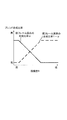
- FIG. 5 shows the relationship between the reliability R and the blend composition ratio.
- the composition ratio calculation unit 105 determines the composition ratio ⁇ of the corresponding pixel of the previous frame image and the composition ratio (1- ⁇ ) of the target pixel of the current frame image based on the reliability R. .
- the lower the reliability R the smaller the composition ratio ⁇ of the previous frame image.
- the composition ratio (1- ⁇ ) of the current frame image increases as the reliability R decreases.
- the blend composition unit 106 blends and composes the target pixel of the current frame image and the corresponding pixel of the previous frame image at the determined composition ratio.
- the blend composition unit 106 sets an image obtained by performing image processing up to blend composition for all the pixels of the current frame image as an output image related to the current frame image.
- the frame memory 107 stores the output image as a previous frame image used in the next frame processing.
- the reliability calculation unit 104 calculates the reliability R according to the contrast of the target pixel. Therefore, the composition ratio calculation unit 105 that calculates the composition ratio from the reliability R can indirectly calculate the composition ratio according to the contrast of the target pixel. However, as an alternative, the reliability calculation unit 104 does not correct the SAD, calculates the reliability R regardless of the contrast, and the synthesis ratio calculation unit 105 calculates the synthesis ratio from the reliability R and then directly It is also possible to correct the composition ratio according to the contrast value CN. Further, the composition ratio can be obtained for each region of the image, not for each pixel.
- the contrast calculation unit 103 calculates the contrast value of the target pixel to be synthesized in the standard image (current frame image) from the standard image or the reference image (previous frame image).
- the composition ratio calculation unit 105 calculates a composition ratio between the target pixel of the standard image and the corresponding pixel corresponding to the target pixel in the motion-compensated reference image according to the contrast value of the target pixel.
- the blend composition unit 106 blends and composes the target pixel of the base image and the corresponding pixel of the reference image based on the calculated composition ratio. For this reason, it can suppress that the influence of the motion compensation error with respect to a synthetic
- the reliability calculation unit 104 calculates the reliability of motion compensation for the target pixel according to the contrast value of the target pixel.
- the composition ratio calculation unit 105 calculates a composition ratio according to the reliability. Therefore, using the reliability of motion compensation according to the contrast value, it is possible to suitably suppress the influence of the motion compensation error on the composition ratio from being different depending on the contrast. Further, for example, when the reliability is low, it is possible to improve the image quality of the image output from the image processing device by reducing the composition ratio of the corresponding pixels of the reference image (previous frame image).
- the reliability calculation unit 104 calculates the difference or similarity between the reference region including the target pixel of the reference image and the reference region corresponding to the reference region in the motion-compensated reference image, and calculates the contrast of the target pixel. In accordance with the value, the calculated difference is corrected to be reduced or the calculated similarity is increased. Then, the reliability calculation unit 104 calculates the reliability so that the smaller the corrected difference or the higher the corrected similarity, the higher the reliability. In the case of high contrast, the dissimilarity or similarity becomes sensitive to the motion compensation error, but since the reliability is obtained based on the dissimilarity or similarity corrected according to the contrast value, the high contrast image region Therefore, it is possible to prevent the motion compensation error from greatly affecting the composition ratio.
- the reliability calculation unit 104 may correct the degree of difference so as to decrease or increase the degree of similarity as the contrast value increases. .
- the difference degree or the similarity degree may be corrected with a correction amount that does not depend on the contrast value.
- the flowchart of FIG. 6 shows the procedure of the reliability calculation process executed by the reliability calculation unit 104 according to the second embodiment. Since the configuration other than the reliability calculation process is the same as that of the first embodiment, the description thereof is omitted.
- the reliability calculation unit 104 calculates the degree of difference (such as SAD) (or similarity) between the small area of the current frame image and the small area of the previous frame image, and calculates the calculated difference degree (or (Similarity) is corrected based on the contrast value.
- the reliability calculation unit 104 does not correct the calculated dissimilarity (or similarity), but sets the size of the calculation area (small area) for calculating the dissimilarity (or similarity).
- the calculation area is an area centered on the target pixel.
- the reliability calculation unit 104 calculates the dissimilarity (or similarity) by calculating the dissimilarity calculation region (reference region) and the previous frame image (reference image) of the current frame image (reference image) corresponding to each other by motion compensation. ) Of the difference calculation area (reference area).
- the reliability calculation unit 104 discretizes the contrast value CN calculated by the contrast calculation unit 103.
- the reliability calculation unit 104 may set the discretized contrast value by dividing the contrast value by a certain value and rounding down (or rounding up) the fractional part after the decimal point. For example, if the contrast value ranges from 0 to 255, the contrast value is divided by a constant value 64.
- the reliability calculation unit 104 divides and discretizes by a constant value only when the contrast value is within a certain range, and discriminates between the case where the contrast value is below that range and the case where the contrast value is above that range, May be associated and discretized.
- the reliability calculation unit 104 determines the size of the calculation area for calculating the dissimilarity according to the discretized contrast value. Thereby, one calculation area size corresponds to a certain range of the original contrast value before being discretized. The higher the contrast value, the larger the size of the difference calculation area. A method for determining the size of the calculation area will be described later.
- the reliability calculation unit 104 calculates an absolute value sum (SAD) of pixel value differences as a difference between the calculation areas of the current frame image and the previous frame image. Instead, the reliability calculation unit 104 may calculate a sum of squares (SSD) of pixel value differences as the difference and a normalized cross-correlation (NCC) as the similarity.
- SAD absolute value sum
- NCC normalized cross-correlation
- the reliability calculation unit 104 calculates the reliability R from the calculated SAD. Since the sum SAD tends to increase as the size of the calculation area increases, the reliability R may be calculated from a value obtained by dividing SAD by the number of pixels in the calculation area. When evaluating the dissimilarity by SAD or SSD, the reliability R is calculated such that the smaller the dissimilarity, the higher the reliability, and the lower the dissimilarity, the lower the reliability.
- the reliability calculation unit 104 calculates the reliability R according to the contrast of the target pixel. Therefore, the composition ratio calculation unit 105 that calculates the composition ratio from the reliability R can indirectly calculate the composition ratio according to the contrast of the target pixel.
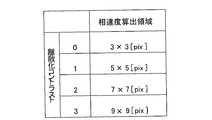
- FIG. 7 shows an example of a table associating the discretized contrast value with the calculation area size of the dissimilarity (or similarity).
- FIG. 7 shows an example in which the discretized contrast is from 0 to 3, and the higher the contrast value, the larger the size of the difference (or similarity) calculation area.
- the reliability calculation unit 104 refers to this table to determine the calculation area size.
- the size of the difference (or similarity) calculation area is 3 ⁇ 3 pixels, 5 ⁇ 5 pixels, 7 ⁇ 7 pixels, or 9 ⁇ 9 pixels, respectively. It is an area.
- the reliability calculation unit 104 increases the reference value in the reference region (reference image calculation region) including the target pixel of the reference image and the motion-compensated reference image as the contrast value of the target pixel increases.
- the size of the reference area (reference image calculation area) corresponding to the area is set large, and the degree of difference (or similarity) is calculated between the base area and the reference area. Therefore, even if there is noise or a motion compensation error within an allowable range, it is possible to avoid that the degree of difference such as SAD becomes extremely high (similarity becomes extremely low) in an image portion having a high contrast value. It becomes possible. As a result, it is possible to suppress the influence of the motion compensation error on the composition ratio calculated from the degree of difference (or similarity) and hence the reliability in the high-contrast image portion.
- the flowchart of FIG. 8 shows the procedure of the reliability calculation process executed by the reliability calculation unit 104 according to the third embodiment. Since the configuration other than the reliability calculation process is the same as that of the first embodiment, the description thereof is omitted.
- the reliability calculation unit 104 calculates the degree of difference (such as SAD) (or similarity) between the small area of the current frame image and the small area of the previous frame image, and calculates the calculated difference degree (or (Similarity) was corrected based on the contrast value.
- the reliability calculation unit 104 does not correct the calculated dissimilarity (or similarity), but removes a high spatial frequency component before calculating the dissimilarity (or similarity).
- the filter is applied to the difference calculation area (reference area) of the current frame image (reference image) and the difference calculation area (reference area) of the previous frame image (reference image).
- the strength of the low-pass filter applied to both calculation areas is changed according to the contrast value.
- the reliability calculation unit 104 discretizes the contrast value CN calculated by the contrast calculation unit 103, as in S21.
- the reliability calculation unit 104 determines the strength of the low-pass filter to be applied to the difference calculation region based on the discretized contrast value. Thereby, the intensity
- the reliability calculation unit 104 performs filter processing on the calculation areas of the previous frame image and the current frame image with the determined strength of the low-pass filter.
- the reliability calculation unit 104 calculates the absolute value sum (SAD) of pixel value differences as the degree of difference for the calculation area after the filter processing of the current frame image and the previous frame image. Instead, the reliability calculation unit 104 may calculate a sum of squares (SSD) of pixel value differences as the difference and a normalized cross-correlation (NCC) as the similarity.
- SSD sum of squares
- NCC normalized cross-correlation
- the reliability calculation unit 104 calculates the reliability R from the calculated SAD.
- the reliability R is calculated such that the smaller the dissimilarity, the higher the reliability, and the lower the dissimilarity, the lower the reliability.
- the reliability calculation unit 104 calculates the reliability R according to the contrast of the target pixel. Therefore, the composition ratio calculation unit 105 that calculates the composition ratio from the reliability R can indirectly calculate the composition ratio according to the contrast of the target pixel.
- FIG. 9 shows an example of a table associating the discretized contrast value with the low-pass filter strength.
- FIG. 9 is an example in which the discretized contrast is from 0 to 3, and the strength of the low-pass filter increases as the contrast increases.
- the reliability calculation unit 104 refers to this table to determine the strength of the low-pass filter.
- the discretized contrast is 0, the low-pass filter process is not performed.
- the discretized contrast is 1, the strength of the low-pass filter is weak.
- the discretized contrast is 2
- the strength of the low-pass filter is medium.
- the discretized contrast is 3, the strength of the low-pass filter is high.
- the reliability calculation unit includes a reference region (reference image calculation region) including the target pixel of the reference image, and a reference region (reference image of the reference image) corresponding to the reference region in the motion-compensated reference image.
- a low-pass filter is applied to the calculation area), and a difference (or similarity) is calculated between the reference area and the reference area after the low-pass filter is applied.
- the image processing apparatus corresponds to a computer, and a CPU, a main storage device such as a RAM for storing image data, and a computer reading in which a program for realizing all or part of the image processing is stored.
- a possible storage device or non-transitory storage medium.
- this program is called an image processing program.
- the CPU reads out the image processing program stored in the storage medium and executes the processing / calculation processing of the image data, thereby realizing the same processing as the above-described image processing unit.
- the computer-readable storage device means a magnetic disk, a magneto-optical disk, a CD-ROM, a DVD-ROM, a semiconductor memory, or the like.
- the image processing program may be distributed to a computer via a communication line, and the computer that has received the distribution may execute the image processing program.
- the flowchart in FIG. 10 illustrates an image processing program executed by the image processing apparatus (computer).
- the image processing apparatus reads image data (each frame of a moving image) recorded on a recording medium such as a memory card.
- the processing performed in steps S101 to S106 in FIG. 10 corresponds to the processing performed by each unit 101-106 in FIG.
Landscapes
- Engineering & Computer Science (AREA)
- Multimedia (AREA)
- Signal Processing (AREA)
- Physics & Mathematics (AREA)
- General Physics & Mathematics (AREA)
- Theoretical Computer Science (AREA)
- Studio Devices (AREA)
- Image Processing (AREA)
Abstract
基準画像と少なくとも一つの参照画像とを用いて合成処理を行って少なくとも前記基準画像に比べてノイズ量が少ない合成画像を生成する画像処理装置は、前記基準画像と前記参照画像との間の動きベクトルを算出する動きベクトル算出部と、前記動きベクトルに基づいて、前記参照画像を前記基準画像に位置合わせするように動き補償する動き補償部と、前記基準画像の対象画素のコントラストの値を、前記基準画像または前記参照画像から算出するコントラスト算出部と、前記対象画素のコントラストの値に応じて、前記基準画像における前記合成処理の対象画素と、前記動き補償した参照画像において前記対象画素に対応する対応画素との合成比率を算出する合成比率算出部と、前記合成比率に基づいて、前記基準画像の対象画素と前記参照画像の対応画素を合成する合成部と、を備える。
Description
本発明は、画像処理装置、画像処理方法、画像処理プログラム、及び、撮像装置に関する。
従来の動画像のノイズ量を低減する技術として、巡回型のノイズリダクション技術がある。この技術は、入力フレーム画像と処理済みの前フレーム画像との間で動き補償を行い、各画素に関する動き補償の信頼度を周辺画素の差分量から算出する。信頼度と動き量とノイズ推定量に応じて導出されたブレンド合成比率(混合比率)で、入力フレーム画像(現フレーム)と前フレーム画像は、ブレンド合成される(JP4321626BとJP2010-147986A参照)。
近年、高画素・高フレームレートでの動画記録により、画素毎に動き検出することは、回路規模や計算時間を増加させる。一方、離散点での動き検出に基づいて動き補償することで回路規模や計算時間が減少するが、この場合、動き検出に誤差が生じる。また、高速に動き検出できるブロックマッチング法などでは、レンズ歪みやローリングシャッター等の影響により動き検出に誤差が生じる。さらにノイズの影響によっても、動き検出に誤差が生じる。そのため、従来のノイズ量を低減する技術は、ブレンド合成時に残像やアーティファクトが発生しないように、動き補償の信頼度が高いほど程、前フレーム画像の合成比率を高くし、動き補償の信頼度が低いほど、前フレーム画像の合成比率を低くする。なお、動き補償の信頼度は、動き補償した画像間の差分絶対値和(SAD)などの相違度の評価値から算出でき、差分絶対値和が小さいほど信頼度は増加し、差分絶対値和が大きいほど信頼度は減少する。
しかし、画像中の低、中、高の各コントラスト部分では、同じ動き検出誤差、例えば+方向に0.5ピクセルの動き量又は動きベクトルの誤差があった場合でも、画像間の差分絶対値和(SAD)の値に対する誤差の影響が著しく異なる。コントラストが高い部分ほど、誤差の影響で差分絶対値和は大きくなってしまう。そのため、異なるコントラストの部分が密接した被写体の場合、動き検出誤差があると、低中コントラスト部分は、前フレーム画像の合成比率が高くなるようブレンド合成されても、高コントラスト部分は現フレームの合成比率が高くなるようブレンド合成される。
静止物体がパン/チルト撮影される場合において、一様なパン/チルトの動き量が変化して、高コントラスト部分に対する低中コントラスト部分の動き検出誤差(即ち動き補償誤差)が+0.5ピクセルから-0.5ピクセルへ急激に変わる場合がある。この場合、巡回型のノイズリダクションでは、高コントラスト部分は、差分絶対値和(SAD)が大きいので誤差がない現フレーム画像の位置にある。このために、動画像として見た際に低中コントラスト部は揺れてしまうという問題が発生する。この問題は、ノイズ量の低減効果を高くするほど、つまり、処理済みの前フレーム画像のブレンド合成比率を高くするほど顕著となる。
本発明は、ブレンド合成比率に対する動き補償誤差の影響がコントラストにより異なることを抑制し、ノイズ量を低減しつつ揺れの少ない動画像を得ることを目的とする。
本発明のある態様に係る画像処理装置は、基準画像と少なくとも一つの参照画像とを用いて合成処理を行って少なくとも前記基準画像に比べてノイズ量が少ない合成画像を生成する画像処理装置であって、前記基準画像と前記参照画像との間の動きベクトルを算出する動きベクトル算出部と、前記動きベクトルに基づいて、前記参照画像を前記基準画像に位置合わせするように動き補償する動き補償部と、前記基準画像における前記合成処理の対象画素のコントラストの値を、前記基準画像または前記参照画像から算出するコントラスト算出部と、前記対象画素のコントラストの値に応じて、前記基準画像の対象画素と、前記動き補償した参照画像において前記対象画素に対応する対応画素との合成比率を算出する合成比率算出部と、前記合成比率に基づいて、前記基準画像の対象画素と前記参照画像の対応画素を合成する合成部と、を備える。
本発明の別の態様に係る画像処理方法は、基準画像と少なくとも一つの参照画像とを用いて合成処理を行って少なくとも前記基準画像に比べてノイズ量が少ない合成画像を生成する画像処理方法であって、前記基準画像と前記参照画像との間の動きベクトルを算出することと、前記動きベクトルに基づいて、前記参照画像を前記基準画像に位置合わせするように動き補償することと、前記基準画像における前記合成処理の対象画素のコントラストの値を、前記基準画像または前記参照画像から算出することと、前記対象画素のコントラストの値に応じて、前記基準画像の対象画素と、前記動き補償した参照画像において前記対象画素に対応する対応画素との合成比率を算出することと、前記合成比率に基づいて、前記基準画像の対象画素と前記参照画像の対応画素を合成することと、を含む。
本発明のさらに別の態様に係る画像処理プログラムは、基準画像と少なくとも一つの参照画像とを用いて合成処理を行って少なくとも前記基準画像に比べてノイズ量が少ない合成画像を生成する画像処理プログラムであって、前記基準画像と前記参照画像との間の動きベクトルを算出する動きベクトル算出手順と、前記動きベクトルに基づいて、前記参照画像を前記基準画像に位置合わせするように動き補償する動き補償手順と、前記基準画像における前記合成処理の対象画素のコントラストの値を、前記基準画像または前記参照画像から算出するコントラスト算出手順と、前記対象画素のコントラストの値に応じて、前記基準画像の対象画素と、前記動き補償した参照画像において前記対象画素に対応する対応画素との合成比率を算出する合成比率算出手順と、前記合成比率に基づいて、前記基準画像の対象画素と前記参照画像の対応画素を合成する合成手順と、をコンピュータに実行させる。
本発明の実施形態、本発明の利点については、添付された図面とともに以下に詳細に説明される。
[第一実施形態]
図1は、第一実施形態に係る画像処理装置のブロック構成図を示す。本実施形態では、画像処理装置は、撮像装置に搭載されている。撮像装置は、電子機器の一例として示すものであり、例えば、ビデオカメラ、電子スチルカメラなどである。
図1は、第一実施形態に係る画像処理装置のブロック構成図を示す。本実施形態では、画像処理装置は、撮像装置に搭載されている。撮像装置は、電子機器の一例として示すものであり、例えば、ビデオカメラ、電子スチルカメラなどである。
撮像装置は、撮像部100と画像処理装置200とを備える。画像を撮影する撮像部100は、画像処理装置200へ画像(画像データ)を入力する画像入力部として機能する。画像処理装置200は、ノイズ量が低減された画像を外部へ出力する。
撮像部100は、撮像光学系、撮像素子、A/D変換回路などを備える。画像処理装置200は、動きベクトル算出部101(動きベクトル算出手段)、動き補償部102(動き補償手段)、コントラスト算出部103(コントラスト算出手段)、信頼度算出部104(信頼度算出手段)、合成比率算出部105(合成比率算出手段)、ブレンド合成部106(ブレンド合成手段)を備える。なお、画像処理装置200の上記の各部(又はこれら全体)は、ASIC、FPGAなどの論理回路から構成されてよい。或いは、画像処理装置200の上記の各部(又はこれら全体)は、データを格納するメモリ、演算プログラムを格納するメモリ、この演算プログラムを実行するCPU/DSP(中央演算処理装置/デジタルシグナルプロセッサ)等から構成されてもよい。
さらに、画像処理装置200は、フレームメモリ107(記憶部)も備える。フレームメモリ107は、撮像部100により撮像されフレームメモリ107に出力された現フレーム画像と、ブレンド合成部106から出力された前フレーム画像とを画素値データとして保存する。
フレームメモリ107に保存された前フレーム画像と現フレーム画像は、動きベクトル算出部101に入力され、それぞれ、参照画像と基準画像として使用される。ここで、「前フレーム画像」は、前回の画像処理装置200の処理で、ブレンド合成部106から出力されフレームメモリ107に記憶された画像である。「現フレーム画像」は、今回の画像処理装置200の処理で、ブレンド合成の対象となる撮像部100で撮像された画像(合成前の画像)である。
動きベクトル算出部101は、テンプレートマッチング法などにより、入力された2フレームの画像間の動きベクトルを算出し、動き補償部102へ出力する。動き補償部102は、参照画像としての前フレーム画像を、基準画像としての現フレーム画像に位置合わせするように動き(位置ずれ)を補償する。さらに、動き補償部102は、現フレーム画像の小領域、及び、現フレーム画像に位置合わせした前フレーム画像の小領域を切り出す。前フレーム画像の小領域は、現フレーム画像の小領域に対応し、それぞれ、参照領域と基準領域と呼ばれることがある。動き補償部102は、動きベクトルを相殺するように、動きベクトルに基づいて前フレーム画像の小領域の切り出し位置を決定する。小領域は、ブレンド合成の対象となっている対象画素を中心とし、画像全体に比較して小さな所定のサイズの領域であって、例えば、3×3ピクセル、5×5ピクセルの領域である。
フレームメモリ107に保存された現フレーム画像(基準画像)の小領域と前フレーム画像(参照画像)の小領域の画素値データは、コントラスト算出部103に入力される。コントラスト算出部103は、ブレンド合成の対象となる対象画素のコントラスト値CNを算出して、信頼度算出部104へと出力する。
信頼度算出部104は、現フレーム画像の小領域と前フレーム画像の小領域との間の相違度(SAD:Sum of Absolute Differenceなど)又は類似度(NCC:Normalized Cross-Correlationなど)を算出し、さらにコントラスト値CNに応じてこの相違度又は類似度を補正する。さらに、信頼度算出部104は、補正された相違度又は類似度から動き補償の信頼度R(即ち、動きベクトルの信頼度R)を算出して、合成比率算出部105へ出力する。なお、相違度が大きくなるほど、類似度は小さくなる。
合成比率算出部105は、入力された信頼度Rに基づいて、現フレーム画像の対象画素(小領域の中心画素)と前フレーム画像において対象画素に対応する対応画素とのブレンド合成比率を算出し、ブレンド合成部106に出力する。前フレーム画像の対応画素の合成比率をαとすると、現フレーム画像の対象画素の合成比率は(1-α)となる。ブレンド合成部106は、合成処理として、算出された合成比率によってこれら対象画素と対応画素をブレンド合成して、フレームメモリ107に出力して保存する。ブレンド合成として、対象画素と対応画素の合成比率を重みとして、重み付き加算、又は、加重平均が行われる。
その後、全ての対象画素(即ち、現フレーム画像の全画素)に関してブレンド合成が行われた後、フレームメモリ107の合成画像は、記録媒体(メモリカード)などに出力され記録されるか、又は、表示部(液晶モニタ等)に出力され表示される。
図2は、第一実施形態に係る処理シーケンス図を示す。複数の画像を連続して撮像する動画撮像の際、一枚目の入力画像は、そのまま出力画像となる。2枚目の入力画像が撮像されたら、保存してある一枚目の出力画像(前フレーム画像)と2枚目の入力画像(現フレーム画像)とが、ブレンド合成され合成画像が生成される。合成画像が2枚目の出力動画像となる。図2に示すように、3枚目の入力画像以降も、2枚目の入力画像と同様にブレンド合成が行われる。
コントラスト算出部103におけるコントラスの算出方法について説明する。例えば、コントラスト算出部103は、現フレーム画像の輝度のうち、対象画素を含む小領域内での輝度の平均値を求め、その平均値と小領域内の各画素の輝度との差分量(差の絶対値)を算出し、その差分量が最大のものを対象画素に関するコントラスト値CNとする。また、例えば、コントラスト算出部103は、現フレーム画像の輝度のうち、対象画素を含む小領域内で最も低い輝度と最も高い輝度の差を、対象画素に関するコントラスト値CNとしてもよい。これら二つの場合、コントラスト値CNは、0から255までの範囲の値としてよい。
さらに、例えば、コントラスト算出部103は、現フレーム画像のうち対象画素を含む小領域において、エッジを抽出するフィルタ(微分フィルタ、ソーベルフィルタ、ラプラシアンフィルタなど)を各画素にかかるようにフィルタ処理し、小領域内の各エッジ量の合計を正規化したものを、対象画素に関するコントラスト値CNとしてもよい。この場合の正規化は、他の手法によるコントラスト値CNと同一の尺度になるように、0から255までの範囲の値になるように正規化してよい。
なお、前述した3つのコントラスト算出方法において、現フレーム画像の輝度が利用されるが、画素の明度を示すような、例えば三原色RGBのうちのGの画素値などを利用してもよい。また、現フレーム画像からコントラスト値を算出するようにしたが、前フレーム画像の対応画素を含む小領域を利用してコントラスト値を算出してよい。これは、現フレーム画像(基準画像)の対象画素に対して動き補償によって位置が対応する前フレーム画像の対応画素が、動き補償によってわかるためである。
図3のフローチャートに、信頼度算出部104が実行する信頼度算出処理の手順を示す。フローチャートにおいて、Sを付した番号はステップ番号を示す。
まず、S11において、信頼度算出部104は、フレームメモリ107から現フレーム画像の小領域の画素値データと位置合わせにより抽出された前フレーム画像の小領域の画素値データを読み込み、両小領域の相違度として差分の絶対値和(SAD)を算出する。代わりに、信頼度算出部104は、相違度として画素値の差の二乗和(SSD)を、類似度として正規化相互相関(NCC)を算出してもよい。
S12において、信頼度算出部104は、コントラスト値CNと第一の閾値TH1を比較し、比較結果に応じてSAD(つまり相違度)を補正する必要があるか否か判断する。コントラスト値CNが第一の閾値TH1以下である場合、SADを補正する必要はない。コントラスト値CNが第一の閾値TH1より大きい場合、SADを補正する必要がある。SADを補正する必要がある場合、ルーチンはS13、S14に進む。SADを補正する必要がない場合、ルーチンはS15に進む。S13において、信頼度算出部104は、コントラスト値CNに応じてSAD(相違度)を補正する。補正方法については後述する。
S14において、信頼度算出部104は、補正されたSAD(補正後のSAD)に基づいて、動き補償の信頼度Rを算出する。S15において、信頼度算出部104は、補正しないSAD(S11で計算されたSAD)に基づいて、動き補償の信頼度Rを算出する。なお、SADやSSDが相違度として使用される場合、信頼度Rは、相違度が小さいほど高くなり、相違度が大きいほど低くなるように算出される。例えば、信頼度Rは、相違度が大きいほど値が小さくなる関数を用いて計算できる。なお、信頼度算出部104は、正規化相互相関(NCC)を類似度として使用する場合、類似度が大きいほど高くなり、類似度が小さいほど低くなるように信頼度Rを算出する。
このように、信頼度算出部104は、S11-S14の信頼度算出処理により、対象画素のコントラストに応じて、信頼度Rを算出する。従って、合成比率算出部105は、信頼度Rに応じて合成比率を計算するため、対象画素のコントラストに応じて合成比率を得る。
図4A-Cを参照して、SAD(相違度)の補正方法を説明する。例えば、コントラスト値CNに応じたゲイン値GNが計算され、S11で算出されたSADに補正量としてゲイン値を乗算した値が、補正されたSAD(補正後のSAD)になる。或いは、コントラスト値CNに応じたオフセット値VFが計算され、S11で算出されたSADから補正量としてオフセット値を減算した値が、補正されたSAD(補正後のSAD)になる。なお、信頼度算出部104が、補正されたNCC(補正後のNCC)に基づいて、動き補償の信頼度Rを算出するなら、S11で算出されたNCCに前述のゲイン値を除算した値又はS11で算出されたNCCに前述のオフセット値を加算した値が、補正されたNCC(補正後のNCC)になってよい。
図4Aの補正例1において、ゲイン値を乗算してSADは補正される。コントラスト値CNが第一の閾値TH1以下の場合には、ゲイン値はコントラスト値に依存しない値(第一の補正量)である。本実施形態において、ゲイン値は1.0であり、これは、補正しないことと同等である。コントラスト値CNが第一の閾値TH1より大きい場合には、コントラスト値CNが高くなるほど、ゲイン値が小さくなる。図4Aのようにゲイン値とコントラスト値を対応付ける関数、マップ又はテーブルにより、ゲイン値がコントラスト値から決定される。そして、S11で算出されたSADに対してゲイン値を乗算した値が、補正後のSADに設定される。
図4Bの補正例2において、ゲイン値を乗算してSADは補正される。コントラスト値CNが第一の閾値TH1以下の場合、ゲイン値はコントラスト値に依存しない値(第一の補正量)である。本実施形態において、ゲイン値は1.0であり、これは、補正しないことと同等である。コントラスト値CNが第一の閾値TH1から第二の閾値TH2の範囲内では、コントラスト値CNが高くなるほど、ゲイン値が小さくなる。コントラスト値CNが第二の閾値TH2以上の場合には、ゲイン値はコントラスト値に依存しない値(第二の補正量)で一定である。図4Bのようにゲイン値とコントラスト値を対応付ける関数、マップ又はテーブルにより、ゲイン値がコントラスト値から決定される。そして、S11で算出されたSADに対してゲイン値を乗算した値が、補正後のSADに設定される。
図4Cの補正例3において、オフセット値を減算してSADは補正される。コントラスト値CNが第一の閾値TH1以下の場合、オフセット値はコントラスト値に依存しない値(第一の補正量)である。本実施形態において、コントラスト値は0である。これは、補正しないことと同等である。コントラスト値CNが第一の閾値TH1から第二の閾値TH2の範囲内では、コントラストが高くなるほど、オフセット値が大きくなる。コントラスト値CNが第二の閾値TH2以上の場合には、オフセット値はコントラスト値に依存しない値(第二の補正量)で一定である。図4Cのようにオフセット値とコントラスト値を対応付ける関数、マップ又はテーブルにより、オフセット値がコントラスト値から決定される。そして、S11で算出されたSADに対してオフセット値を減算した値が、補正後のSADに設定される。
なお、第一の閾値TH1以下のコントラスト値CNでも補正が行われる場合(即ちゲイン値が1.0でない場合やオフセット値が0でない場合)、S12、S15のステップは省略される。また、補正例1~3のそれぞれについて、第一の閾値TH1は異なってよい。補正例2、3のそれぞれについて、第二の閾値TH2は異なってよい。
図5は、信頼度Rとブレンド合成比率との関係を示す。図5に示すように、合成比率算出部105は、信頼度Rに基づいて、前フレーム画像の対応画素の合成比率αと、現フレーム画像の対象画素の合成比率(1-α)を決定する。図5の実線のように、前フレーム画像の合成比率αは、信頼度Rが低いほど小さくなる。図5の破線のように、現フレーム画像の合成比率(1-α)は、信頼度Rが低いほど大きくなる。ブレンド合成部106は、決定された合成比率で現フレーム画像の対象画素と前フレーム画像の対応画素とをブレンド合成する。ブレンド合成部106は、ブレンド合成までの画像処理を現フレーム画像の全画素について施した画像を現フレーム画像に関する出力画像とする。フレームメモリ107は、この出力画像を次のフレーム処理で使用する前フレーム画像として保存する。
なお、上記の第一実施形態において、信頼度算出部104は、対象画素のコントラストに応じて信頼度Rを算出する。従って、信頼度Rから合成比率を算出する合成比率算出部105は、間接的に、対象画素のコントラストに応じて合成比率を算出できる。しかし、代替として、信頼度算出部104は、SADを補正せず、コントラストとは無関係に信頼度Rを算出し、合成比率算出部105は、信頼度Rから合成比率を算出した後、直接的にコントラスト値CNに応じて合成比率を補正することもできる。また、合成比率は、画素ごとに求めるのではなく、画像の領域ごとに求めることもできる。
(作用効果)
次に、第一実施形態の作用効果を説明する。コントラスト算出部103は、基準画像(現フレーム画像)における合成処理の対象となる対象画素のコントラストの値を、基準画像または参照画像(前フレーム画像)から算出する。合成比率算出部105は、対象画素のコントラストの値に応じて、基準画像の対象画素と、動き補償した参照画像において前記対象画素に対応する対応画素との合成比率を算出する。ブレンド合成部106は、算出した合成比率に基づいて、基準画像の対象画素と参照画像の対応画素をブレンド合成する。このため、合成比率に対する動き補償誤差の影響がコントラストにより異なることを抑制できる。そして、動き補償誤差が生じる動き検出精度においても動画像の揺れを回避しつつ少なくとも基準画像に比べてノイズ量を低減することができる。
次に、第一実施形態の作用効果を説明する。コントラスト算出部103は、基準画像(現フレーム画像)における合成処理の対象となる対象画素のコントラストの値を、基準画像または参照画像(前フレーム画像)から算出する。合成比率算出部105は、対象画素のコントラストの値に応じて、基準画像の対象画素と、動き補償した参照画像において前記対象画素に対応する対応画素との合成比率を算出する。ブレンド合成部106は、算出した合成比率に基づいて、基準画像の対象画素と参照画像の対応画素をブレンド合成する。このため、合成比率に対する動き補償誤差の影響がコントラストにより異なることを抑制できる。そして、動き補償誤差が生じる動き検出精度においても動画像の揺れを回避しつつ少なくとも基準画像に比べてノイズ量を低減することができる。
信頼度算出部104は、対象画素のコントラストの値に応じて、対象画素について動き補償の信頼度を算出する。合成比率算出部105は、信頼度に応じて合成比率を算出する。従って、コントラストの値に応じた動き補償の信頼度を用いて、合成比率に対する動き補償誤差の影響がコントラストにより異なることを好適に抑制できる。また、例えば、信頼度が低い場合に、参照画像(前フレーム画像)の対応画素の合成比率を低めて、画像処理装置から出力される画像の画質を向上できる。
信頼度算出部104は、基準画像の対象画素を含む基準領域と、動き補償した参照画像内で基準領域に対応する参照領域との間で相違度又は類似度を算出し、対象画素のコントラストの値に応じて、算出した相違度を小さくするように又は算出した類似度を大きくするように補正する。そして、信頼度算出部104は、補正した相違度が小さいほど又は補正した類似度が大きいほど信頼度が高くなるように信頼度を計算する。高コントラストの場合に相違度又は類似度が動き補償誤差に敏感になるが、コントラストの値に応じて補正された相違度又は類似度に基づいて、信頼度が求められるため、高コントラストの画像領域において、動き補償誤差が合成比率に大きく影響することを抑えられる。
信頼度算出部104は、対象画素のコントラストの値が第一の閾値TH1より高い場合、コントラストの値が高くなるほどより相違度を小さくするように又は類似度を大きくするように補正してよい。これにより、高コントラストの画像領域において、動き補償誤差が合成比率に大きく影響することをより好適に抑えられる。対象画素のコントラスト値が、第一の閾値より大きな第二の閾値TH2以上である場合、コントラストの値に依存しない補正量で相違度又は類似度が補正されてよい。これにより、高コントラストの画像領域で、過度に相違度が低下して(過度に類似度が高くなり)、参照画像(前フレーム画像)の合成比率αが高くなりすぎることが防止できる。
[第二実施形態]
図6のフローチャートに、第二実施形態に係る信頼度算出部104が実行する信頼度算出処理の手順を示す。信頼度算出処理以外の構成は、第一実施形態と同じであり説明を省略する。第一実施形態では、信頼度算出部104は、現フレーム画像の小領域と前フレーム画像の小領域と間の相違度(SADなど)(又は類似度)を算出し、算出した相違度(又は類似度)をコントラスト値に基づいて補正する。しかし、第二実施形態では、信頼度算出部104は、算出した相違度(又は類似度)を補正しないが、相違度(又は類似度)を算出するための算出領域(小領域)のサイズをコントラスト値に応じて変更する。算出領域は、対象画素を中心とする領域である。信頼度算出部104は、相違度(又は類似度)を算出するために、相互に動き補償によって対応する現フレーム画像(基準画像)の相違度算出領域(基準領域)と前フレーム画像(参照画像)の相違度算出領域(参照領域)を切り出す。
図6のフローチャートに、第二実施形態に係る信頼度算出部104が実行する信頼度算出処理の手順を示す。信頼度算出処理以外の構成は、第一実施形態と同じであり説明を省略する。第一実施形態では、信頼度算出部104は、現フレーム画像の小領域と前フレーム画像の小領域と間の相違度(SADなど)(又は類似度)を算出し、算出した相違度(又は類似度)をコントラスト値に基づいて補正する。しかし、第二実施形態では、信頼度算出部104は、算出した相違度(又は類似度)を補正しないが、相違度(又は類似度)を算出するための算出領域(小領域)のサイズをコントラスト値に応じて変更する。算出領域は、対象画素を中心とする領域である。信頼度算出部104は、相違度(又は類似度)を算出するために、相互に動き補償によって対応する現フレーム画像(基準画像)の相違度算出領域(基準領域)と前フレーム画像(参照画像)の相違度算出領域(参照領域)を切り出す。
S21において、信頼度算出部104は、コントラスト算出部103によって算出されたコントラス値CNを離散化する。例えば、信頼度算出部104は、コントラスト値を一定の値で除算して、小数点以下の端数を切り捨て(又は切り上げ)した値を離散化されたコントラスト値に設定してよい。例えば、コントラスト値の範囲が0から255までである場合、コントラスト値は、一定の値64で除算される。或いは、信頼度算出部104は、ある範囲内のコントラスト値の場合だけ一定の値で除算して離散化し、コントラスト値がその範囲以下の場合とその範囲以上の場合とで区別して、それぞれ定数値を対応付けて離散化しても良い。
S22において、信頼度算出部104は、相違度を算出するための算出領域のサイズを離散化されたコントラスト値に応じて決定する。これにより、離散化される前の元のコントラスト値のある範囲に対して、一つの算出領域サイズが対応することになる。コントラスト値が高くなるほど、相違度の算出領域のサイズは大きくなる。なお、算出領域のサイズの決定方法については後述する。
S23において、信頼度算出部104は、現フレーム画像と前フレーム画像の算出領域に対して、画素値の差分の絶対値和(SAD)を相違度として算出する。代わりに、信頼度算出部104は、相違度として、画素値の差の二乗和(SSD)を、類似度として正規化相互相関(NCC)を算出しても良い。
S24において、信頼度算出部104は、算出されたSADから信頼度Rを算出する。なお、和であるSADは、算出領域のサイズが大きくなるほど大きな値になる傾向があるため、SADを算出領域の画素数で除算した値から信頼度Rが算出されてよい。SADやSSDで相違度を評価する場合、信頼度Rは、相違度が小さいほど高く、相違度が大きいほど低くなるように、算出される。信頼度算出部104は、対象画素のコントラストに応じて信頼度Rを算出することになる。従って、信頼度Rから合成比率を算出する合成比率算出部105は、間接的に、対象画素のコントラストに応じて合成比率を算出できる。
図7は、離散化されたコントラスト値と相違度(又は類似度)の算出領域サイズを対応付けるテーブルの一例を示す。図7は、離散化されたコントラストが0から3までの例で、コントラスト値が高くなるほど、相違度(又は類似度)の算出領域のサイズは大きくなる。信頼度算出部104は、このテーブルを参照して、算出領域サイズを決定する。離散化されたコントラストが0、1、2、3の場合、相違度(又は類似度)の算出領域のサイズは、それぞれ3×3ピクセル、5×5ピクセル、7×7ピクセル、9×9ピクセルの領域である。
第二実施形態によると、信頼度算出部104は、対象画素のコントラストの値が高くなるほど、基準画像の対象画素を含む基準領域(基準画像の算出領域)と、動き補償した参照画像内で基準領域に対応する参照領域(参照画像の算出領域)のサイズを大きく設定し、基準領域と参照領域との間で相違度(又は類似度)を算出する。従って、ノイズや、許容される範囲での動き補償誤差があっても、コントラスト値が高い画像部分でSADなどの相違度が極端に高くなる(類似度が極端に低くなる)のを避けることが可能となる。これにより、高いコントラストの画像部分で、相違度(又は類似度)、ひいては信頼度から算出される合成比率に対する動き補償誤差の影響を抑えることができる。
[第三実施形態]
図8のフローチャートに、第三実施形態に係る信頼度算出部104が実行する信頼度算出処理の手順を示す。信頼度算出処理以外の構成は、第一実施形態と同じであり説明を省略する。第一実施形態では、信頼度算出部104は、現フレーム画像の小領域と前フレーム画像の小領域と間の相違度(SADなど)(又は類似度)を算出し、算出した相違度(又は類似度)をコントラスト値に基づいて補正した。しかし、第三実施形態では、信頼度算出部104は、算出した相違度(又は類似度)を補正しないが、相違度(又は類似度)を算出する前に、高い空間周波成分を除去するローパスフィルタを現フレーム画像(基準画像)の相違度算出領域(基準領域)と前フレーム画像(参照画像)の相違度算出領域(参照領域)にかける。両算出領域にかけるローパスフィルタの強度は、コントラスト値に応じて変更される。
図8のフローチャートに、第三実施形態に係る信頼度算出部104が実行する信頼度算出処理の手順を示す。信頼度算出処理以外の構成は、第一実施形態と同じであり説明を省略する。第一実施形態では、信頼度算出部104は、現フレーム画像の小領域と前フレーム画像の小領域と間の相違度(SADなど)(又は類似度)を算出し、算出した相違度(又は類似度)をコントラスト値に基づいて補正した。しかし、第三実施形態では、信頼度算出部104は、算出した相違度(又は類似度)を補正しないが、相違度(又は類似度)を算出する前に、高い空間周波成分を除去するローパスフィルタを現フレーム画像(基準画像)の相違度算出領域(基準領域)と前フレーム画像(参照画像)の相違度算出領域(参照領域)にかける。両算出領域にかけるローパスフィルタの強度は、コントラスト値に応じて変更される。
S31において、信頼度算出部104は、S21と同様に、コントラスト算出部103によって算出されたコントラス値CNを離散化する。S32において、信頼度算出部104は、離散化されたコントラスト値に基づいて相違度の算出領域にかけるローパスフィルタの強度を決定する。これにより、離散化される前の元のコントラスト値のある範囲に対して、一つのローパスフィルタの強度が対応する。
S33において、信頼度算出部104は、決定されたローパスフィルタの強度で、前フレーム画像と現フレーム画像のそれぞれの算出領域に対してフィルタ処理を行う。S34において、信頼度算出部104は、現フレーム画像と前フレーム画像のフィルタ処理後の算出領域に対して、画素値の差分の絶対値和(SAD)を相違度として算出する。代わりに、信頼度算出部104は、相違度として画素値の差の2乗和(SSD)を、類似度として正規化相互相関(NCC)を算出しても良い。
S35において、信頼度算出部104は、算出されたSADから信頼度Rを算出する。SADやSSDで相違度を評価する場合、信頼度Rは、相違度が小さいほど高く、相違度が大きいほど低くなるように、算出される。信頼度算出部104は、対象画素のコントラストに応じて信頼度Rを算出することになる。従って、信頼度Rから合成比率を算出する合成比率算出部105は、間接的に、対象画素のコントラストに応じて合成比率を算出できる。
図9は、離散化されたコントラスト値とローパスフィルタ強度を対応付けるテーブルの一例を示す。図9は、離散化されたコントラストが0から3までの例で、コントラストが高くなるほど、ローパスフィルタの強度は大きくなる。信頼度算出部104は、このテーブルを参照して、ローパスフィルタの強度を決定する。離散化されたコントラストが0の場合、ローパスフィルタ処理は行われない。離散化されたコントラストが1の場合、ローパスフィルタの強度は弱い。離散化されたコントラストが2の場合、ローパスフィルタの強度は中程度である。離散化されたコントラストが3の場合、ローパスフィルタの強度は強い。
第三実施形態によると、信頼度算出部は、基準画像の対象画素を含む基準領域(基準画像の算出領域)と、動き補償した参照画像内で前記基準領域に対応する参照領域(参照画像の算出領域)にローパスフィルタをかけ、ローパスフィルタをかけた後の基準領域と参照領域との間で相違度(又は類似度)を算出する。そして、コントラストの値が高いほどローパスフィルタの強度を強くすることで、ノイズや許容される範囲での動き補償誤差があっても、極端にSADなどの相違度が高くなる(類似度が極端に低くなる)のを避けることが可能となる。これにより、相違度(又は類似度)、ひいては信頼度から算出される合成比率に対する動き補償誤差の影響を抑えることができる。また、ローパスフィルタの強度を変更する構成であるため、実装が容易である。
[その他の実施形態]
上述した各実施形態の説明では、画像処理装置が行う処理としてハードウェアによる処理を前提としていたが、このような構成に限定される必要はない。例えば、別途ソフトウェアにて処理する構成も可能である。この場合、画像処理装置は、コンピュータに相当し、CPUと、画像データを記憶するRAM等の主記憶装置と、上記の画像処理の全て或いは一部を実現させるためのプログラムが記憶されたコンピュータ読み取り可能な記憶装置(又は非一時的な記憶媒体)とを備えている。ここでは、このプログラムを画像処理プログラムと呼ぶ。そして、CPUが上記記憶媒体に記憶されている画像処理プログラムを読み出して、画像データの加工・演算処理を実行することにより、上述の画像処理部と同様の処理を実現させる。
上述した各実施形態の説明では、画像処理装置が行う処理としてハードウェアによる処理を前提としていたが、このような構成に限定される必要はない。例えば、別途ソフトウェアにて処理する構成も可能である。この場合、画像処理装置は、コンピュータに相当し、CPUと、画像データを記憶するRAM等の主記憶装置と、上記の画像処理の全て或いは一部を実現させるためのプログラムが記憶されたコンピュータ読み取り可能な記憶装置(又は非一時的な記憶媒体)とを備えている。ここでは、このプログラムを画像処理プログラムと呼ぶ。そして、CPUが上記記憶媒体に記憶されている画像処理プログラムを読み出して、画像データの加工・演算処理を実行することにより、上述の画像処理部と同様の処理を実現させる。
ここで、コンピュータ読み取り可能な記憶装置(又は非一時的な記録媒体)とは、磁気ディスク、光磁気ディスク、CD-ROM、DVD-ROM、半導体メモリ等をいう。また、この画像処理プログラムを通信回線によってコンピュータに配信し、この配信を受けたコンピュータが当該画像処理プログラムを実行するようにしても良い。
図10のフローチャートは、画像処理装置(コンピュータ)が実行する画像処理プログラムを例示する。ステップS100において、画像処理装置は、メモリカード等の記録媒体に記録された画像データ(動画の各フレーム)を読み取る。図10のステップS101―S106で行われる処理は、それぞれ、図1の各部101-106が行う処理に対応する。
以上説明した実施形態に限定されることなく、その技術的思想の範囲内において種々の変形や変更が可能であり、それらも本発明の技術的範囲に含まれることが明白である。
本願は、2011年2月16日に日本国特許庁に出願された特願2011-31119に基づく優先権を主張し、これらの出願の全ての内容は参照により本明細書に組み込まれる。
Claims (14)
- 基準画像と少なくとも一つの参照画像とを用いて合成処理を行って少なくとも前記基準画像に比べてノイズ量が少ない合成画像を生成する画像処理装置であって、
前記基準画像と前記参照画像との間の動きベクトルを算出する動きベクトル算出部と、
前記動きベクトルに基づいて、前記参照画像を前記基準画像に位置合わせするように動き補償する動き補償部と、
前記基準画像における前記合成処理の対象画素のコントラストの値を、前記基準画像または前記参照画像から算出するコントラスト算出部と、
前記対象画素のコントラストの値に応じて、前記基準画像の対象画素と、前記動き補償した参照画像において前記対象画素に対応する対応画素との合成比率を算出する合成比率算出部と、
前記合成比率に基づいて、前記基準画像の対象画素と前記参照画像の対応画素を合成する合成部と、を備える、
画像処理装置。 - 前記画像処理装置は、前記対象画素のコントラストの値に応じて、前記対象画素について動き補償の信頼度を算出する信頼度算出部を備え、
前記合成比率算出部は、前記信頼度に応じて前記合成比率を算出する、
請求項1に記載の画像処理装置。 - 前記信頼度算出部は、
前記基準画像の対象画素を含む基準領域と、前記動き補償した参照画像内で前記基準領域に対応する参照領域との間で相違度又は類似度を算出し、
前記対象画素のコントラストの値に応じて、前記算出した相違度を小さくするように又は前記算出した類似度を大きくするように補正し、
前記補正した相違度が小さいほど又は前記補正した類似度が大きいほど前記信頼度が高くなるように前記信頼度を計算する、
請求項2に記載の画像処理装置。 - 前記信頼度算出部は、前記対象画素のコントラストの値が第一の閾値より高い場合、前記コントラストの値が高くなるほど相違度をより小さくするように又は類似度をより大きくするように補正する、
請求項3に記載の画像処理装置。 - 前記信頼度算出部は、
前記対象画素のコントラストの値が前記第一の閾値以下の場合、前記コントラストの値に依存しない第一の補正量で前記相違度又は前記類似度を補正する、
請求項4に記載の画像処理装置。 - 前記信頼度算出部は、
前記対象画素のコントラストの値が第一の閾値から第二の閾値の範囲内である場合、前記コントラストの値が高くなるほど相違度をより小さくするように又は類似度をより大きくするように補正し、
前記対象画素のコントラスト値が前記第二の閾値以上である場合、前記コントラストの値に依存しない第二の補正量で相違度又は類似度を補正する、
請求項3に記載の画像処理装置。 - 前記信頼度算出部は、
前記対象画素のコントラストの値が高くなるほど、前記基準画像の対象画素を含む基準領域と、前記動き補償した参照画像内で前記基準領域に対応する参照領域のサイズを大きく設定し、
前記基準領域と前記参照領域との間で相違度又は類似度を算出し、
前記算出した相違度が小さいほど又は前記算出した類似度が大きいほど前記信頼度が高くなるように前記信頼度を計算する、
請求項2に記載の画像処理装置。 - 前記信頼度算出部は、
前記基準画像の対象画素を含む基準領域と、前記動き補償した参照画像内で前記基準領域に対応する参照領域にローパスフィルタをかけ、
前記ローパスフィルタをかけた後の前記基準領域と前記参照領域との間で相違度又は類似度を算出し、
前記算出した相違度が小さいほど又は前記算出した類似度が大きいほど前記信頼度が高くなるように前記信頼度を計算し、
前記コントラストの値が高くなるほど前記ローパスフィルタの強度を強くする、
請求項2に記載の画像処理装置。 - 前記コントラスト算出部は、
前記対象画素を含む領域内において、前記領域内の輝度または明度の平均値と前記領域内の各画素の輝度または明度との差分の最大値を、前記対象画素のコントラストの値として算出する、
請求項1に記載の画像処理装置。 - 前記コントラスト算出部は、
前記対象画素を含む領域において、最も暗い画素と最も明るい画素の輝度または明度の差を、前記対象画素のコントラストの値として算出する、
請求項1に記載の画像処理装置。 - 前記コントラスト算出部は、
前記対象画素を含む領域における各画素のエッジ量を検出し、各エッジ量の合計を、前記対象画素のコントラスト値として算出する、
請求項1に記載の画像処理装置。 - 請求項1に記載の画像処理装置を備える撮像装置。
- 基準画像と少なくとも一つの参照画像とを用いて合成処理を行って少なくとも前記基準画像に比べてノイズ量が少ない合成画像を生成する画像処理方法であって、
前記基準画像と前記参照画像との間の動きベクトルを算出することと、
前記動きベクトルに基づいて、前記参照画像を前記基準画像に位置合わせするように動き補償することと、
前記基準画像における前記合成処理の対象画素のコントラストの値を、前記基準画像または前記参照画像から算出することと、
前記対象画素のコントラストの値に応じて、前記基準画像の対象画素と、前記動き補償した参照画像において前記対象画素に対応する対応画素との合成比率を算出することと、
前記合成比率に基づいて、前記基準画像の対象画素と前記参照画像の対応画素を合成することと、を含む、
画像処理方法。 - 基準画像と少なくとも一つの参照画像とを用いて合成処理を行って少なくとも前記基準画像に比べてノイズ量が少ない合成画像を生成する画像処理プログラムであって、
前記基準画像と前記参照画像との間の動きベクトルを算出する動きベクトル算出手順と、
前記動きベクトルに基づいて、前記参照画像を前記基準画像に位置合わせするように動き補償する動き補償手順と、
前記基準画像における前記合成処理の対象画素のコントラストの値を、前記基準画像または前記参照画像から算出するコントラスト算出手順と、
前記対象画素のコントラストの値に応じて、前記基準画像の対象画素と、前記動き補償した参照画像において前記対象画素に対応する対応画素との合成比率を算出する合成比率算出手順と、
前記合成比率に基づいて、前記基準画像の対象画素と前記参照画像の対応画素を合成する合成手順と、をコンピュータに実行させる、
画像処理プログラム。
Priority Applications (1)
| Application Number | Priority Date | Filing Date | Title |
|---|---|---|---|
| US13/959,320 US9167135B2 (en) | 2011-02-16 | 2013-08-05 | Image processing device, image processing method, photographic imaging apparatus, and recording device recording image processing program |
Applications Claiming Priority (2)
| Application Number | Priority Date | Filing Date | Title |
|---|---|---|---|
| JP2011-031119 | 2011-02-16 | ||
| JP2011031119A JP5576812B2 (ja) | 2011-02-16 | 2011-02-16 | 画像処理装置、画像処理方法、画像処理プログラム、及び、撮像装置 |
Related Child Applications (1)
| Application Number | Title | Priority Date | Filing Date |
|---|---|---|---|
| US13/959,320 Continuation US9167135B2 (en) | 2011-02-16 | 2013-08-05 | Image processing device, image processing method, photographic imaging apparatus, and recording device recording image processing program |
Publications (1)
| Publication Number | Publication Date |
|---|---|
| WO2012111232A1 true WO2012111232A1 (ja) | 2012-08-23 |
Family
ID=46672181
Family Applications (1)
| Application Number | Title | Priority Date | Filing Date |
|---|---|---|---|
| PCT/JP2011/079170 Ceased WO2012111232A1 (ja) | 2011-02-16 | 2011-12-16 | 画像処理装置、画像処理方法、画像処理プログラム、及び、撮像装置 |
Country Status (3)
| Country | Link |
|---|---|
| US (1) | US9167135B2 (ja) |
| JP (1) | JP5576812B2 (ja) |
| WO (1) | WO2012111232A1 (ja) |
Cited By (1)
| Publication number | Priority date | Publication date | Assignee | Title |
|---|---|---|---|---|
| CN107251089A (zh) * | 2015-01-23 | 2017-10-13 | 维斯顿有限公司 | 用于移动检测和补偿的图像处理方法 |
Families Citing this family (19)
| Publication number | Priority date | Publication date | Assignee | Title |
|---|---|---|---|---|
| KR101933454B1 (ko) * | 2012-09-25 | 2018-12-31 | 삼성전자주식회사 | 촬영 이미지 생성 방법 및 장치와 그 방법에 대한 프로그램 소스를 저장한 기록 매체 |
| JP6017279B2 (ja) * | 2012-11-22 | 2016-10-26 | オリンパス株式会社 | 画像処理装置、画像処理方法及びプログラム |
| KR102031284B1 (ko) * | 2013-03-14 | 2019-11-08 | 삼성전자주식회사 | 연속 촬영된 이미지를 합성하는 전자 장치 및 방법 |
| JP6160292B2 (ja) | 2013-06-24 | 2017-07-12 | 富士通株式会社 | 画像補正装置、撮像装置及び画像補正用コンピュータプログラム |
| US9554048B2 (en) * | 2013-09-26 | 2017-01-24 | Apple Inc. | In-stream rolling shutter compensation |
| KR102144994B1 (ko) * | 2013-09-30 | 2020-08-14 | 삼성전자주식회사 | 영상의 노이즈를 저감하는 방법 및 이를 이용한 영상 처리 장치 |
| JP5968379B2 (ja) * | 2013-10-29 | 2016-08-10 | キヤノン株式会社 | 画像処理装置およびその制御方法 |
| JP6493855B2 (ja) | 2014-02-26 | 2019-04-03 | パナソニックIpマネジメント株式会社 | 画像処理装置及び画像処理方法 |
| KR101480750B1 (ko) * | 2014-06-26 | 2015-01-12 | (주)유디피 | 모션 검출 장치 및 방법 |
| US9466094B1 (en) * | 2015-03-26 | 2016-10-11 | Sony Corporation | Method to improve video quality under low light conditions |
| JP6438136B2 (ja) * | 2015-06-29 | 2018-12-12 | オリンパス株式会社 | 画像処理装置、画像処理方法および顕微鏡 |
| JP6433389B2 (ja) * | 2015-08-04 | 2018-12-05 | キヤノン株式会社 | 画像処理装置、画像処理方法およびプログラム |
| EP3466051A1 (en) | 2016-05-25 | 2019-04-10 | GoPro, Inc. | Three-dimensional noise reduction |
| US10140689B2 (en) * | 2017-01-20 | 2018-11-27 | Sony Corporation | Efficient path-based method for video denoising |
| US10397504B2 (en) * | 2017-02-13 | 2019-08-27 | Kidde Technologies, Inc. | Correcting lag in imaging devices |
| JP6932531B2 (ja) * | 2017-03-28 | 2021-09-08 | キヤノン株式会社 | 像ブレ補正装置、撮像装置および撮像装置の制御方法 |
| CN107527360B (zh) * | 2017-08-23 | 2019-05-17 | 维沃移动通信有限公司 | 一种图像对齐方法及移动终端 |
| WO2019116487A1 (ja) * | 2017-12-14 | 2019-06-20 | 日本電気株式会社 | 画像処理装置、画像処理方法および画像処理プログラム |
| JP6562492B1 (ja) * | 2019-05-16 | 2019-08-21 | 株式会社モルフォ | 画像処理装置、画像処理方法及びプログラム |
Citations (4)
| Publication number | Priority date | Publication date | Assignee | Title |
|---|---|---|---|---|
| JP2008123396A (ja) * | 2006-11-15 | 2008-05-29 | Sanyo Electric Co Ltd | 画像復元装置及び方法並びに撮像装置 |
| JP2009301463A (ja) * | 2008-06-17 | 2009-12-24 | Oki Electric Ind Co Ltd | バーコード認識装置 |
| JP2010183386A (ja) * | 2009-02-06 | 2010-08-19 | Sony Corp | 画像処理装置、画像処理方法および撮像装置 |
| JP2010278701A (ja) * | 2009-05-28 | 2010-12-09 | Casio Computer Co Ltd | 画像合成装置、画像合成方法及びプログラム |
Family Cites Families (2)
| Publication number | Priority date | Publication date | Assignee | Title |
|---|---|---|---|---|
| JP4321626B2 (ja) | 2007-05-23 | 2009-08-26 | ソニー株式会社 | 画像処理方法および画像処理装置 |
| JP4631966B2 (ja) | 2008-12-22 | 2011-02-16 | ソニー株式会社 | 画像処理装置、および画像処理方法、並びにプログラム |
-
2011
- 2011-02-16 JP JP2011031119A patent/JP5576812B2/ja active Active
- 2011-12-16 WO PCT/JP2011/079170 patent/WO2012111232A1/ja not_active Ceased
-
2013
- 2013-08-05 US US13/959,320 patent/US9167135B2/en active Active
Patent Citations (4)
| Publication number | Priority date | Publication date | Assignee | Title |
|---|---|---|---|---|
| JP2008123396A (ja) * | 2006-11-15 | 2008-05-29 | Sanyo Electric Co Ltd | 画像復元装置及び方法並びに撮像装置 |
| JP2009301463A (ja) * | 2008-06-17 | 2009-12-24 | Oki Electric Ind Co Ltd | バーコード認識装置 |
| JP2010183386A (ja) * | 2009-02-06 | 2010-08-19 | Sony Corp | 画像処理装置、画像処理方法および撮像装置 |
| JP2010278701A (ja) * | 2009-05-28 | 2010-12-09 | Casio Computer Co Ltd | 画像合成装置、画像合成方法及びプログラム |
Cited By (1)
| Publication number | Priority date | Publication date | Assignee | Title |
|---|---|---|---|---|
| CN107251089A (zh) * | 2015-01-23 | 2017-10-13 | 维斯顿有限公司 | 用于移动检测和补偿的图像处理方法 |
Also Published As
| Publication number | Publication date |
|---|---|
| JP2012170006A (ja) | 2012-09-06 |
| US20130314557A1 (en) | 2013-11-28 |
| US9167135B2 (en) | 2015-10-20 |
| JP5576812B2 (ja) | 2014-08-20 |
Similar Documents
| Publication | Publication Date | Title |
|---|---|---|
| JP5576812B2 (ja) | 画像処理装置、画像処理方法、画像処理プログラム、及び、撮像装置 | |
| US8311282B2 (en) | Image processing apparatus, image processing method, and program | |
| US8233062B2 (en) | Image processing apparatus, image processing method, and imaging apparatus | |
| US9247153B2 (en) | Image processing apparatus, method and imaging apparatus | |
| US8525904B2 (en) | Image processing device, image processing method, and capturing device | |
| US9055217B2 (en) | Image compositing apparatus, image compositing method and program recording device | |
| CN104995908B (zh) | 图像处理装置以及图像处理方法 | |
| US20100220222A1 (en) | Image processing device, image processing method, and recording medium storing image processing program | |
| US20120008005A1 (en) | Image processing apparatus, image processing method, and computer-readable recording medium having image processing program recorded thereon | |
| US8160369B2 (en) | Image processing apparatus and method | |
| US20170249721A1 (en) | Image correction apparatus and image correction method | |
| US10516825B2 (en) | Image processing device, image processing method, and computer program product for correcting a motion vector of a low-reliability block | |
| US8750635B2 (en) | Image processing apparatus, image processing method, program, and recording medium | |
| JP2011055259A (ja) | 画像処理装置、画像処理方法、画像処理プログラムおよび画像処理プログラムが格納されたプログラム記憶媒体 | |
| KR101361114B1 (ko) | 디지털 영상을 위한 적응적 잡음 저감 시스템 및 그 방법 | |
| CN101115144B (zh) | 图像处理装置和图像处理方法 | |
| JP5841345B2 (ja) | 画像処理装置、画像処理方法、画像処理プログラム、及び、撮像装置 | |
| TWI404408B (zh) | 影像處理裝置及影像處理方法 | |
| US20110293147A1 (en) | Movement detection apparatus and movement detection method | |
| US20140133752A1 (en) | Display apparatus and method for image output thereof | |
| JP6730423B2 (ja) | 画像処理装置、画像処理方法および画像処理プログラム | |
| JP2019205073A (ja) | 画像処理装置、画像処理方法、画像処理プログラム、及び、記憶媒体 | |
| JP6584173B2 (ja) | 画像処理装置及び画像処理方法 | |
| US8768066B2 (en) | Method for image processing and apparatus using the same | |
| JP2013085044A (ja) | 画像処理装置、画像処理方法、画像処理プログラム、及び、撮像装置 |
Legal Events
| Date | Code | Title | Description |
|---|---|---|---|
| 121 | Ep: the epo has been informed by wipo that ep was designated in this application |
Ref document number: 11858629 Country of ref document: EP Kind code of ref document: A1 |
|
| NENP | Non-entry into the national phase |
Ref country code: DE |
|
| 122 | Ep: pct application non-entry in european phase |
Ref document number: 11858629 Country of ref document: EP Kind code of ref document: A1 |