WO2012111495A1 - 二酸化炭素回収システムを備えた石炭焚きボイラシステム - Google Patents
二酸化炭素回収システムを備えた石炭焚きボイラシステム Download PDFInfo
- Publication number
- WO2012111495A1 WO2012111495A1 PCT/JP2012/052808 JP2012052808W WO2012111495A1 WO 2012111495 A1 WO2012111495 A1 WO 2012111495A1 JP 2012052808 W JP2012052808 W JP 2012052808W WO 2012111495 A1 WO2012111495 A1 WO 2012111495A1
- Authority
- WO
- WIPO (PCT)
- Prior art keywords
- carbon dioxide
- heat
- pipe
- heater
- fired boiler
- Prior art date
- Legal status (The legal status is an assumption and is not a legal conclusion. Google has not performed a legal analysis and makes no representation as to the accuracy of the status listed.)
- Ceased
Links
Images



Classifications
-
- B—PERFORMING OPERATIONS; TRANSPORTING
- B01—PHYSICAL OR CHEMICAL PROCESSES OR APPARATUS IN GENERAL
- B01D—SEPARATION
- B01D53/00—Separation of gases or vapours; Recovering vapours of volatile solvents from gases; Chemical or biological purification of waste gases, e.g. engine exhaust gases, smoke, fumes, flue gases, aerosols
- B01D53/14—Separation of gases or vapours; Recovering vapours of volatile solvents from gases; Chemical or biological purification of waste gases, e.g. engine exhaust gases, smoke, fumes, flue gases, aerosols by absorption
- B01D53/1456—Removing acid components
- B01D53/1475—Removing carbon dioxide
-
- F—MECHANICAL ENGINEERING; LIGHTING; HEATING; WEAPONS; BLASTING
- F01—MACHINES OR ENGINES IN GENERAL; ENGINE PLANTS IN GENERAL; STEAM ENGINES
- F01K—STEAM ENGINE PLANTS; STEAM ACCUMULATORS; ENGINE PLANTS NOT OTHERWISE PROVIDED FOR; ENGINES USING SPECIAL WORKING FLUIDS OR CYCLES
- F01K7/00—Steam engine plants characterised by the use of specific types of engine; Plants or engines characterised by their use of special steam systems, cycles or processes; Control means specially adapted for such systems, cycles or processes; Use of withdrawn or exhaust steam for feed-water heating
- F01K7/06—Steam engine plants characterised by the use of specific types of engine; Plants or engines characterised by their use of special steam systems, cycles or processes; Control means specially adapted for such systems, cycles or processes; Use of withdrawn or exhaust steam for feed-water heating the engines being of multiple-inlet-pressure type
-
- F—MECHANICAL ENGINEERING; LIGHTING; HEATING; WEAPONS; BLASTING
- F01—MACHINES OR ENGINES IN GENERAL; ENGINE PLANTS IN GENERAL; STEAM ENGINES
- F01K—STEAM ENGINE PLANTS; STEAM ACCUMULATORS; ENGINE PLANTS NOT OTHERWISE PROVIDED FOR; ENGINES USING SPECIAL WORKING FLUIDS OR CYCLES
- F01K7/00—Steam engine plants characterised by the use of specific types of engine; Plants or engines characterised by their use of special steam systems, cycles or processes; Control means specially adapted for such systems, cycles or processes; Use of withdrawn or exhaust steam for feed-water heating
- F01K7/34—Steam engine plants characterised by the use of specific types of engine; Plants or engines characterised by their use of special steam systems, cycles or processes; Control means specially adapted for such systems, cycles or processes; Use of withdrawn or exhaust steam for feed-water heating the engines being of extraction or non-condensing type; Use of steam for feed-water heating
- F01K7/40—Use of two or more feed-water heaters in series
-
- B—PERFORMING OPERATIONS; TRANSPORTING
- B01—PHYSICAL OR CHEMICAL PROCESSES OR APPARATUS IN GENERAL
- B01D—SEPARATION
- B01D2258/00—Sources of waste gases
- B01D2258/02—Other waste gases
- B01D2258/0283—Flue gases
-
- B—PERFORMING OPERATIONS; TRANSPORTING
- B01—PHYSICAL OR CHEMICAL PROCESSES OR APPARATUS IN GENERAL
- B01D—SEPARATION
- B01D2259/00—Type of treatment
- B01D2259/65—Employing advanced heat integration, e.g. Pinch technology
-
- B—PERFORMING OPERATIONS; TRANSPORTING
- B01—PHYSICAL OR CHEMICAL PROCESSES OR APPARATUS IN GENERAL
- B01D—SEPARATION
- B01D53/00—Separation of gases or vapours; Recovering vapours of volatile solvents from gases; Chemical or biological purification of waste gases, e.g. engine exhaust gases, smoke, fumes, flue gases, aerosols
- B01D53/14—Separation of gases or vapours; Recovering vapours of volatile solvents from gases; Chemical or biological purification of waste gases, e.g. engine exhaust gases, smoke, fumes, flue gases, aerosols by absorption
- B01D53/1425—Regeneration of liquid absorbents
-
- F—MECHANICAL ENGINEERING; LIGHTING; HEATING; WEAPONS; BLASTING
- F23—COMBUSTION APPARATUS; COMBUSTION PROCESSES
- F23J—REMOVAL OR TREATMENT OF COMBUSTION PRODUCTS OR COMBUSTION RESIDUES; FLUES
- F23J2219/00—Treatment devices
- F23J2219/40—Sorption with wet devices, e.g. scrubbers
-
- Y—GENERAL TAGGING OF NEW TECHNOLOGICAL DEVELOPMENTS; GENERAL TAGGING OF CROSS-SECTIONAL TECHNOLOGIES SPANNING OVER SEVERAL SECTIONS OF THE IPC; TECHNICAL SUBJECTS COVERED BY FORMER USPC CROSS-REFERENCE ART COLLECTIONS [XRACs] AND DIGESTS
- Y02—TECHNOLOGIES OR APPLICATIONS FOR MITIGATION OR ADAPTATION AGAINST CLIMATE CHANGE
- Y02C—CAPTURE, STORAGE, SEQUESTRATION OR DISPOSAL OF GREENHOUSE GASES [GHG]
- Y02C20/00—Capture or disposal of greenhouse gases
- Y02C20/40—Capture or disposal of greenhouse gases of CO2
-
- Y—GENERAL TAGGING OF NEW TECHNOLOGICAL DEVELOPMENTS; GENERAL TAGGING OF CROSS-SECTIONAL TECHNOLOGIES SPANNING OVER SEVERAL SECTIONS OF THE IPC; TECHNICAL SUBJECTS COVERED BY FORMER USPC CROSS-REFERENCE ART COLLECTIONS [XRACs] AND DIGESTS
- Y02—TECHNOLOGIES OR APPLICATIONS FOR MITIGATION OR ADAPTATION AGAINST CLIMATE CHANGE
- Y02E—REDUCTION OF GREENHOUSE GAS [GHG] EMISSIONS, RELATED TO ENERGY GENERATION, TRANSMISSION OR DISTRIBUTION
- Y02E20/00—Combustion technologies with mitigation potential
- Y02E20/32—Direct CO2 mitigation
Definitions
- the present invention is a carbon dioxide recovery boiler system, and more particularly to a coal fired boiler system that absorbs carbon dioxide in exhaust gas and desorbs and recovers it.
- Coal-fired power plants are one of the major sources of carbon dioxide (hereinafter referred to as CO2), and it is an issue to recover CO2 in exhaust gas with high efficiency.
- CO2 carbon dioxide
- This recovery system is composed of an absorption tower that absorbs CO2 and a regeneration tower that desorbs CO2, and guides exhaust gas to the absorption tower so that CO2 is absorbed by the absorption liquid.
- the absorption liquid is sent to the regeneration tower to desorb CO2.
- the CO2 desorbed in the regeneration tower is compressed and liquefied and stored on the ground or sea floor.
- Patent Document 1 the absorption liquid is heated by the heat of CO2 gas containing desorbed water vapor at the upper part of the regeneration tower, and the heat is effectively used.
- patent document 2 the high temperature heat at the time of compressing desorbed CO2 is utilized, and effective use of heat is aimed at by heating an absorption liquid.
- patent document 3 the water of a condenser is utilized as a gas cooling medium of the regeneration tower exit, and effective utilization of heat is aimed at.
- patent document 4 the absorption liquid is heated with the heat of the combustion gas which came out of the boiler, and the effective use of heat is aimed at.
- Patent Document 5 exhaust gas is compressed and cooled and CO2 is separated using a swirl nozzle, but two refrigeration circuits using a condenser and an evaporator are used for exhaust gas cooling.
- the present invention includes a boiler that burns coal, an exhaust gas treatment system that includes an apparatus for treating exhaust gas downstream thereof, an absorption tower that absorbs carbon dioxide in the exhaust gas into a carbon dioxide absorbent in the middle of the exhaust gas treatment system, and A carbon dioxide absorption and desorption system having a regeneration tower for desorbing carbon dioxide from a carbon dioxide absorption liquid, a steam turbine that is recovered by heat with the boiler, and driven by high-pressure steam obtained, a generator, and cooling the steam,
- a coal fired boiler system having a carbon dioxide recovery system having a water circulation system having a condenser for liquefaction and a feed water heater for heating water from the condensate, from the absorption tower to the regeneration tower, and the regeneration tower
- Each having a pipe for leading the carbon dioxide absorption liquid from the front absorption tower to the front absorption tower, and a liquid-liquid heat exchanger for exchanging heat between the carbon dioxide absorption liquids in the middle of the pipe.
- a condensate heater is provided between the condenser and the feed water heater, and further, the condensate heating is performed from the upstream absorption liquid heat exchanger.
- a compressor is provided in the middle of a pipe that leads the heat medium to the heater, and a pressure reducing valve is provided in the middle of the pipe that leads the heat medium from the condensate heater to the upstream side absorption liquid heat exchanger.
- a plurality of the feed water heaters are provided, and a condensate heater is provided in a pipe branched from the middle of the condenser and the feed water heater.
- a compressor is provided in the middle of the pipe for guiding the water heated by the water heater to the downstream side of the plurality of feed water heaters, and further leading the heat medium from the upstream absorption liquid heat exchanger to the condensate heater.
- the pressure reducing valve is provided in the middle of the pipe for guiding the heat medium from the condensate heater to the upstream side absorption liquid heat exchanger.
- a bypass pipe connecting the compressor upstream and the pressure reducing valve downstream is provided, and a heat medium bypass valve is provided in the middle of the pipe.
- a pipe branched in the middle of the condenser and the feed water heater is provided, a pipe to the most upstream feed water heater, and the condensate heating
- Each valve is provided in the middle of the pipe to the vessel.
- the refrigerant supply pipe of the downstream absorption liquid heat exchanger has a flow rate control valve for controlling a refrigerant flow rate, and the downstream absorption liquid heat exchanger outlet And a refrigerant flow rate of the downstream absorption liquid heat exchanger is controlled by a measurement value of the temperature measurement means.
- the present invention is a coal-fired boiler system having an exhaust gas treatment system, a carbon dioxide absorption / desorption system, and a water circulation system, and has pipes for introducing a carbon dioxide absorption liquid from the absorption tower to the regeneration tower and from the regeneration tower to the front absorption tower, respectively.
- a liquid-liquid heat exchanger in which the carbon dioxide absorption liquid exchanges heat with each other, and two absorption liquid heat exchangers are installed in the middle of the pipe that leads the carbon dioxide absorption liquid from the liquid-liquid heat exchanger to the absorption tower.
- the lean liquid after heat exchange with the rich liquid of the CO2 absorption liquid is lowered to the CO2 absorption temperature.
- the generated heat as heat for heating water from the condenser, the amount of extracted steam used in the low-pressure feed water heater can be reduced, and the thermal efficiency of the boiler can be improved.
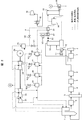
- the system diagram of a coal fired boiler provided with a CO2 recovery system. 1 is a system diagram of a coal fired boiler including a CO2 recovery system according to Embodiment 1 of the present invention.
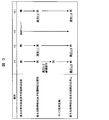
- FIG. The operation figure until the maximum heat recovery of the CO2 recovery system of Example 3 of the present invention.
- FIG. 1 shows the basic configuration of a coal fired boiler system equipped with a CO2 recovery system.
- the flow of exhaust gas is indicated by a solid line
- the flow of steam / water is indicated by a broken line
- the flow of CO2 absorbent is indicated by a dotted line.
- the exhaust gas after burning in the pulverized coal-fired boiler 1 removes nitrogen oxides (hereinafter referred to as NOx) with a denitration device 2, heats the combustion air with the exhaust gas with an air heater 3, and recovers heat.
- the exhaust gas is cooled with a gas gas heater 4 (hereinafter referred to as heat recovery GGH), dust in the exhaust gas is removed with a dry electrostatic precipitator 5, and sulfur oxides (hereinafter referred to as SOx) are removed with a desulfurizer 6.
- the reheated gas gas heater 7 hereinafter reheated GGH heats the exhaust gas to prevent white smoke and exhausts it from the chimney 8.
- CO2 recovery leads exhaust gas from the downstream of the desulfurization device 6 to the CO2 recovery system.
- the exhaust gas contains a small amount of SOx and sulfuric acid gas in which SOx is oxidized, and these gases are removed by the NaOH spraying device 12 that sprays an alkaline solution in order to degrade the CO2 absorption solution.
- an alkanolamine-based aqueous solution is used as the CO2 absorbing solution.
- the absorption tower 13 makes the exhaust gas contact with the absorption liquid, absorbs CO 2, and the exhaust gas after absorption is returned before the reheating GGH 7 and exhausted from the chimney 8.
- the absorbing solution generates heat when absorbing CO2. Therefore, in order to absorb CO2 efficiently, the absorption liquid temperature is preferably low.
- the absorption liquid that has absorbed CO2 is heated by the liquid-liquid heat exchanger 14 and led to the regeneration tower 15 to desorb CO2 from the absorption liquid.
- the reboiler 16 for heating using the extracted steam from the steam turbine is provided.
- the temperature of the absorbing solution for desorbing CO2 varies depending on the type of absorbing solution.
- the desorbed gas of CO2 contains steam, it is dehumidified by the desorbed gas cooler 18 and compressed by the compressor 19 to be liquefied and recovered.
- the absorption liquid from which CO 2 has been desorbed by the regeneration tower 15 is cooled by the liquid-liquid heat exchanger 14 and further cooled to a temperature at which the absorption liquid cooler 17 absorbs CO 2, and then guided to the absorption tower 13.
- the water in the condenser 25 is sequentially heated by a first low-pressure feed water heater 26, a second low-pressure feed water heater 27, a third low-pressure feed water heater 28, and a fourth low-pressure feed water heater 29. It is heated with a feed water heater and led to a coal fired boiler 1 for heat recovery.
- the low pressure feed water heaters 26 to 29 heat the water from the condenser 25 using the heat of the extracted steam from the low pressure turbine 23. At that time, the extracted steam is condensed in the low-pressure feed water heaters 26 to 29 to become drain water.
- the drain water is extracted so that the water level is always constant, the drain water of the first low-pressure feed water heater 26 is returned to the condenser 25, and the drain water of the second low-pressure feed water heater 27 is the first low-pressure feed water heater.
- the drain water of the third low-pressure feed water heater 28 is returned to the second low-pressure feed water heater 27, and the drain water of the fourth low-pressure feed water heater 29 is returned to the third low-pressure feed water heater 28.
- Higher temperature extraction steam is required toward the downstream, and the water from the condenser is heated stepwise toward the downstream.
- the heat loss in the CO2 recovery system is heat removal by the NaOH cooling device 11, heat removal by the absorption liquid cooler 17, and heat removal by the desorption gas cooler 18.
- the present invention focuses on heat loss in the absorption liquid cooler 17 among them, and hereinafter, the present invention will be described with reference to examples.
- FIG. 2 shows a coal fired boiler system diagram equipped with the CO2 recovery system of the first embodiment.
- An absorption liquid cooler 31 for condensate heating is provided upstream of the absorption liquid cooler 17, the water in the condenser 25 is passed through, the lean liquid of the absorption liquid is removed, and heat is recovered to recover the first low pressure. Lead to feed water heater 26.
- the temperature of the lean liquid supply port of the absorption tower 13 is measured with a T1 thermometer 37.
- the temperature of the lean liquid at the position of the lean liquid supply port needs to be maintained at T1 '(for example, about 40 degrees) that is a temperature for absorbing CO2. Therefore, a flow rate adjusting valve V3 for adjusting the cooling water amount of the absorbing liquid cooler 17 is provided, and the temperature of the thermometer 37 is maintained at the CO2 absorption temperature T1 'by increasing or decreasing the cooling water amount.
- a flow rate adjustment valve V1 is provided between the condenser 25 and the first low-pressure feed water heater 26, the pipe a is branched from between the condenser 25 and the flow rate adjustment valve V1, and is used for heating the condensate via the on-off valve V2.
- the condensed water cooler 31 for condensate heating is further connected to the flow rate control valve V1 and the first low-pressure feed water heater 26. Further, steam is extracted from the low-pressure turbine 23 and led to the first low-pressure feed water heater 26. Meanwhile, an on-off valve VL1 was provided.
- the pressure in the first low-pressure feed water heater 26 is maintained at a predetermined pressure PL1 ', and the water temperature at the outlet of the first low-pressure feed water heater 26 is maintained.
- Fig. 3 shows the operational diagram of the CO2 recovery system in the example.
- the flow control valve V1 is opened and the on-off valve V2 is closed, and the water in the condenser 25 is directly passed to the first low-pressure feed water heater 26.
- the on-off valve VL ⁇ b> 1 is open and heats water with steam from the low-pressure turbine 23.
- the CO2 absorption liquid is circulated between the absorption tower 13 and the regeneration tower 15, and the reboiler 16 starts heating the CO2 absorption liquid to absorb and desorb CO2. Adjust the temperature conditions for release. At that time, the flow rate adjustment valve V3 is adjusted so that the temperature of the T1 thermometer 37 becomes T1 '.
- the heat recovery in the condensate heating absorption liquid cooler 31 is started by opening the on-off valve V2 as operation (1-1) and closing the on-off valve VL1 as operation (1-2) to heat the first low-pressure feed water.
- the steam supply to the vessel 26 is stopped.
- the flow control valve V1 is closed.
- the operation 1-3 is preferably a slow operation.
- the flow rate adjusting valve V3 is controlled so that the temperature of the T1 thermometer 37 becomes T1 ', and is adjusted in the closing direction to suppress the cooling water amount of the absorbing liquid cooler 17 by the temperature drop of the lean liquid.
- the lean liquid temperature T1 supplied to the absorption tower 13 is controlled by the flow rate control valve V3 so that it becomes T1 ', and other operations are not required. If the boiler load increases, the amount of water from the condenser increases, so the flow control valve V3 is adjusted in the opening direction. On the other hand, if the boiler load decreases, the amount of water from the condenser decreases, the flow control valve V3 is adjusted in the closing direction.
- the absorption liquid cooling 17 in FIG. 2 can be deleted, and the control operation of the control valve V3 in FIG. 3 can be deleted. it can.
- the extracted steam led from the low-pressure turbine 23 to the second low-pressure feed water heater 27, the third low-pressure feed water heater 28, or the fourth low-pressure feed water heater 29 is supplied. It is also possible to shut off sequentially, and the power generation output can be improved by reducing the extracted steam from the low-pressure turbine 23.
- the lean liquid temperature at the outlet of the condensate heating absorption liquid cooler 31 is a temperature between the lean liquid temperature at the inlet of the condensate heating absorption liquid cooler 31 and the water temperature from the condenser, Extraction steam cannot be reduced unless the water is as hot as the subsequent stages of the low-pressure feed water heaters 26-29. Therefore, it is necessary to increase the temperature of the water from the condenser.
- Stopping the heat recovery at the condensate heating absorption liquid cooler 31 is as follows: operation (1-4): open flow control valve V1, operation (1-5): open / close valve V2: operation (1-6): open / close valve VL1 is opened in this order, and during that time, the flow rate control valve V3 controls T1 to be T1 ′.
- Example 2 of the present invention an example in which a heat pump is used to make the water from the condenser higher in temperature will be described.
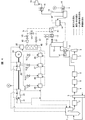
- recovery system which provided the heat pump of Example 2 in FIG. 4 is shown.
- a condenser heater 46 is provided downstream of the condenser 25.
- the heat medium was circulated between the condensate heater 46 and the heat medium heating absorption liquid cooler 41 upstream of the absorption liquid cooler 17 to constitute a heat pump to exchange heat.
- the heat medium heating absorbent cooler 41 is equivalent to the condensate heating absorbent cooler 31 of FIG. Furthermore, a heat medium compressor 45 is provided downstream of the heat medium heating absorbent cooler 41 via a pipe b so that the heat medium is guided to the condensate heater 46. In the meantime, the heat medium compressor 45 was provided, and the heat medium was compressed to a high temperature to heat the water from the condensate of the condensate heater 46. Further, a pressure reducing valve 47 is provided downstream of the condensate heater 46 so that the heat medium is expanded to a low temperature, and the heat medium is heated by the heat medium heating absorbent cooler 41.
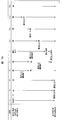
- FIG. 5A shows an operation method up to the maximum heat recovery of the CO2 recovery system provided with the heat pump of the embodiment and an operation diagram when the boiler load fluctuates.
- the flow rate control valve V3 is a water amount control valve that cools the lean liquid, and always controls the lean liquid temperature T1 to T1 '.
- the heat medium bypass valve V4 is opened and the on-off valve V5 is closed, and the water from the condenser is not subjected to heat exchange by the condensate heater 46, and is heated as it is in the first feed water.
- Guide to vessel 26 In the first to fourth feed water heaters 26 to 29, the on-off valve VL1, the on-off valve VL2, the on-off valve VL3, and the on-off valve VL4 are opened, respectively, and the water from the condenser is heated by the extraction steam from the low-pressure turbine. .
- the on-off valve V5 is opened as operation (2-1) so that the heat medium can be passed through the condensate heater 46.
- operation (2-2) the heat medium bypass valve V4 is slowly operated in the closing direction, the amount of the heat medium to the condensate heater 46 is increased, and finally the entire amount is passed.
- operation (2-3) the heat medium compressor 45 is started, and the heat medium is passed through the condensate heater 46.
- the minimum load is set, and the output of the heat medium compressor 45 is increased as operation (2-4) in accordance with the closing direction speed of the heat medium bypass valve V4.
- the operations (2-2) and (2-4) are preferably slow operations.
- the heat medium compressor 45 As the output of the heat medium compressor 45 increases, the heat medium is pressurized and the temperature rises, and the temperature of water from the condenser also rises due to heat exchange. As the temperature of the water from the condenser increases, heating in the first to fourth feed water heaters 26 to 29 becomes unnecessary, so that the supply of extracted steam from the low-pressure turbine can be shut off.
- the on-off valve VL4 is sequentially closed.
- the output of the generator 24 is improved by reducing the extracted steam from the low-pressure turbine.
- the amount of heat that can be recovered by the heat medium heating absorption liquid cooler 41 is the amount of heat when the lean liquid temperature at the outlet of the heat medium heating absorption liquid cooler 41 reaches T1 ′, and the absorption liquid cooler 17 is cooled. This is the amount of heat when water is not required, that is, when the flow control valve V3 is closed.
- the output of the heat medium compressor 45 at that time is the maximum output, and the operations (2-5) to (2-8) are finished when the maximum output is reached.
- FIG. 5B shows an operation diagram of the CO2 recovery system provided with the heat pump of the embodiment and the heat recovery stop.
- a heat recovery stop method from the condition that the heat medium compressor 45 has the maximum output, that is, the flow rate control valve V3 is closed and the heat recovery in the condensate heater becomes the maximum load is shown.
- the heat medium compressor 45 is lowered slowly from the maximum output to the minimum load. Meanwhile, the operation (2-14) to the operation (2-17), that is, the on-off valve VL4 to the on-off valve VL1 are sequentially opened from the closed state, and then the heat medium compressor 45 is stopped. Further, the open / close valve V5 is closed as operation (2-18), and the heat medium bypass valve V4 is opened as operation (2-19).
- Example 2 can make the water from a condenser into a high temperature with a heat pump, it supplies to the low-pressure feed water heater of the most downstream of a high temperature among a plurality of low-pressure feed water heaters in series. , The thermal efficiency of the boiler can be improved efficiently. Further, in the coal fired boiler system, a pipe branched in the middle of the condenser and the feed water heater is provided, and a valve is provided in the middle of the pipe to the most upstream feed water heater and the pipe to the condensate heater, respectively. Can be provided.
- Example 3 will be described.
- the increase in power generation efficiency by reducing the amount of extracted steam is effective in reducing the extracted steam of the low-pressure feed water heater on the downstream side, which has been improved.
- FIG. 6 shows a system diagram of a coal-fired boiler equipped with a CO2 recovery system provided with a heat pump according to a third embodiment of the present invention.
- a branch was made downstream of the condenser 25, one of which led to the first low-pressure feed water heater 26, and an on-off valve V6 was provided therebetween.
- the other was provided with a condensate heater 46 via a flow rate control valve V7.
- the heat exchange between the condensate heater 46 and the heat medium heating absorption liquid cooler 41 is the same as that in FIG. 5 and constitutes a heat pump. Further, the heated water that passed through the condensate heater 46 was led to the inlet of the fourth low-pressure feed water heater 29.
- the water temperature when all of the heat quantity discarded in the absorption liquid cooler 17 is used for heating water from the condenser is about the water temperature at the inlet of the fourth low-pressure feed water heater 29, and
- the temperature of the extraction steam supplied to the fourth low-pressure feed water heater 29 is equal to or lower than the temperature.
- the water heated by the condensate heater 46 may be led to the inlet of the second low-pressure feed water heater 27 and the inlet of the third low-pressure feed water heater 28, but reduces the bleed steam of the low-pressure feed water heater on the downstream side. Is effective for improving the power generation efficiency, and the extraction steam is condensed in the low-pressure feed water heater, and the drain water level must be extracted and held. Therefore, the water heated by the condensate heater 46 is used. Is preferably introduced to the inlet of the fourth low-pressure feed water heater 29.
- FIG. 7A shows an operation method up to the maximum heat recovery of the CO2 recovery system provided with the heat pump of the embodiment and an operation diagram when the boiler load fluctuates.
- the flow rate control valve V3 is a water amount control valve that cools the lean liquid, and always controls the lean liquid temperature T1 to T1 '.
- the heat medium bypass valve V4 is opened, the on-off valve V5 is closed, and the on-off valve V6 is opened, and water from the condenser is directly guided to the first feed water heater 26.
- the on-off valve VL1, the on-off valve VL2, the on-off valve VL3, and the on-off valve VL4 are opened, respectively, and the water from the condenser is heated by the extraction steam from the low-pressure turbine. .
- the flow rate control valve V7 is opened, and as the operation (3-2), the on-off valve V6 is slowly operated in the closing direction, and the water from the condenser is Is passed through the condensate heater 46.
- the on-off valve V5 is opened so that the heat medium can be passed through the condensate heater 46.
- the heat medium bypass valve V4 is slowly operated in the closing direction, the amount of the heat medium to the condensate heater 46 is increased, and finally the entire amount of the heat medium is passed through.
- the heat medium compressor 45 is started, and the heat medium is passed through the condensate heater 46.
- the minimum load is set, and the output of the heat medium compressor 45 is increased as operation (3-6) in accordance with the closing direction speed of the heat medium bypass valve V4. Since the water from the condenser is not supplied to the first low-pressure feed water heater 26 when the on-off valve V6 is closed, the on-off valve VL1, on-off valve VL2, and on-off valve are operated as operation (3-7). VL3 is closed.
- the water from the condenser is recovered by the condenser heater 46 and the temperature rises as the output of the heat medium compressor 45 increases.
- the on-off valve VL4 is normally open, and the amount of extracted steam decreases as the water temperature increases.
- the operation (3-8) reduces the output of the heat medium compressor 45 and reduces the temperature of the heat medium to suppress overheating of the water.
- the amount of water from the condenser increases. Therefore, as operation (3-9), the output of the heat medium compressor 45 is increased and the temperature of the heat medium is increased to increase the amount of water heated. increase.
- the output change of the heat medium compressor 45 is a slow operation for the stable operation of the system.
- FIG. 7B shows an operation diagram of the heat recovery stop of the CO2 recovery system provided with the heat pump of the embodiment.
- a heat recovery stop method from the condition that the heat medium compressor 45 is at the maximum output, that is, the flow rate control valve V3 is closed and the heat recovery at the condensate heater becomes the maximum load is shown.
Landscapes
- Engineering & Computer Science (AREA)
- Chemical & Material Sciences (AREA)
- Combustion & Propulsion (AREA)
- Mechanical Engineering (AREA)
- General Engineering & Computer Science (AREA)
- General Chemical & Material Sciences (AREA)
- Analytical Chemistry (AREA)
- Oil, Petroleum & Natural Gas (AREA)
- Chemical Kinetics & Catalysis (AREA)
- Treating Waste Gases (AREA)
- Carbon And Carbon Compounds (AREA)
- Chimneys And Flues (AREA)
- Gas Separation By Absorption (AREA)
Abstract
吸収液を用いたCO2回収システムにおいて、温度差が小さく有効利用されにくい熱に着目し、吸収液を用いたCO2回収システムの熱の有効利用を図る。CO2を脱離した吸収液(リーン液)とCO2を吸収した吸収液(リッチ液)とを熱交換した後のリーン液を、CO2を吸収する温度にまで低下させる熱量に着目し、その冷媒として復水器からの水を使用するようにした。さらに、復水器からの水と、リーン液とリッチ液とを熱交換した後のリーン液とを、別の媒体を用いて該媒体を圧縮、膨張させるヒートポンプにより温度差をつけ、熱交換をしやすくした。復水器からの水は、直列に複数接続された低圧給水加熱器によって、蒸気タービンからの抽気蒸気を使って、順次加熱される。復水器からの水を分岐し、一方は最上流の低圧給水加熱器の入口に供給し、一方はヒートポンプによって高温化した後、複数の低圧給水加熱器のうち、最下流の低圧給水加熱器の入口に供給する。
Description
本発明は、二酸化炭素回収型ボイラシステムであり、特に排ガス中の二酸化炭素を吸収し、脱離回収する石炭焚きボイラシステムに関するものである。
近年、地球温暖化が地球規模の環境問題として取り上げられている。大気中の二酸化炭素濃度の増加が地球温暖化の主要因であることが明らかにされており、二酸化炭素排出量の削減が重要になっている。
石炭火力発電所は二酸化炭素(以下CO2と表記)の大きな排出源の一つであり、排ガス中のCO2を高効率で回収することが課題とされている。
排ガス中のCO2を回収する技術としては、特許文献1に示されているように二酸化炭素を吸収液に吸収させ、吸収液から二酸化炭素を脱離する方式がある。この回収システムは、CO2を吸収させる吸収塔と、CO2を脱離させる再生塔から構成され、排ガスを吸収塔に導きCO2を吸収液に吸収させる。その吸収液を再生塔に送りCO2を脱離させる。再生塔で脱離したCO2は、圧縮、液化して地底あるいは海底に貯留する。
CO2の脱離には吸収液の加熱が必要であり、再生塔には加熱装置が設けられている。
吸収液に再度CO2を吸収させるためには吸収液の低温化が必要であり、再生塔から吸収塔の間に冷却装置が設けられている。この際、高温の吸収液と低温の吸収液とを熱交換することによって熱の有効利用を図っている。しかしながらさらなる熱の有効利用が必要になっており、CO2回収システム内の熱の有効利用のみならず、回収システムに関係するシステムとの連携による熱の有効利用方法が提案されている。
吸収液に再度CO2を吸収させるためには吸収液の低温化が必要であり、再生塔から吸収塔の間に冷却装置が設けられている。この際、高温の吸収液と低温の吸収液とを熱交換することによって熱の有効利用を図っている。しかしながらさらなる熱の有効利用が必要になっており、CO2回収システム内の熱の有効利用のみならず、回収システムに関係するシステムとの連携による熱の有効利用方法が提案されている。
特許文献1では、再生塔の上部で、脱離した水蒸気を含むCO2ガスの熱で吸収液を加熱し、熱の有効利用を図っている。特許文献2では、脱離したCO2を圧縮する際の高温熱を利用し、吸収液を加熱することで熱の有効利用を図っている。特許文献3では、復水器の水を再生塔出口のガス冷却媒体として利用し、熱の有効利用を図っている。特許文献4では、ボイラから出た燃焼ガスの熱で吸収液を加熱し、熱の有効利用を図っている。また、特許文献5では、排ガスを圧縮冷却しスワールノズルを用いてCO2を分離しているが排ガス冷却のため復水器と蒸発器を用いた2つの冷凍循環路を用いている。
これら特許文献は、いずれも温熱と冷熱との温度差が大きく熱交換しやすい箇所に着目して熱を有効利用している。これに対し本発明では、温度差が小さく熱が有効利用されにくい箇所に着目し、吸収液を用いたCO2回収システムの熱の有効利用をさらに図ることを課題とする。
本発明は、石炭を燃焼するボイラと、その下流に排ガスを処理する装置を備えた排ガス処理システムと、排ガス処理システムの途中に、排ガス中の二酸化炭素を二酸化炭素吸収液に吸収する吸収塔と二酸化炭素を二酸化炭素吸収液から脱離する再生塔を有する二酸化炭素吸収脱離システムと、前記ボイラで熱回収し、得た高圧蒸気で駆動する蒸気タービンと、発電機と、蒸気を冷却し、液化する復水器と、復水からの水を加熱する給水加熱器を有する水循環システムを有する二酸化炭素の回収システムを備えた石炭焚きボイラシステムにおいて、前記吸収塔から前記再生塔へ、および再生塔から前吸収塔へそれぞれ二酸化炭素吸収液を導く配管を有し、その途中で互いの二酸化炭素吸収液が熱交換する液液熱交換器を有し、該液液熱交換器から前記吸収塔へ二酸化炭素吸収液を導く前記配管の途中に、二つの吸収液熱交換器を設け、上流側の吸収液熱交換器の冷却媒体に復水器からの水を使用することを特徴とする。
また、二酸化炭素の回収システムを備えた石炭焚きボイラシステムにおいて、前記復水器と前記給水加熱器の間に復水加熱器を設け、さらに、前記上流側吸収液熱交換器から前記復水加熱器へ熱媒体を導く配管の途中に圧縮機を設け、前記復水加熱器から前記上流側吸収液熱交換器へ熱媒体を導く配管の途中に減圧弁を設けることを特徴とする。
また、二酸化炭素の回収システムを備えた石炭焚きボイラシステムにおいて、前記給水加熱器を複数設け、前記復水器と前記給水加熱器の途中から分岐させた配管に復水加熱器を設け、該復水加熱器で加熱した水を複数の前記給水加熱器のうちより下流側に導き、さらに、前記上流側吸収液熱交換器から前記復水加熱器へ熱媒体を導く配管途中に圧縮機を設け、復水加熱器から上流側吸収液熱交換器へ熱媒体を導く配管途中に減圧弁を設けることを特徴とする。
また、二酸化炭素の回収システムを備えた石炭焚きボイラシステムにおいて、前記圧縮機上流と前記減圧弁下流をつなぐバイパス配管を設け、該配管の途中に熱媒体バイパス弁を設けることを特徴とする。
また、二酸化炭素の回収システムを備えた石炭焚きボイラシステムにおいて、前記復水器と前記給水加熱器の途中で分岐する配管を設け、最上流の前記給水加熱器までの配管と、前記復水加熱器までの配管の途中にそれぞれ弁を設けることを特徴とする。
また、二酸化炭素の回収システムを備えた石炭焚きボイラシステムにおいて、前記下流側吸収液熱交換器の冷媒供給管に冷媒流量を制御する流量調節弁を有し、前記下流側吸収液熱交換器出口の吸収液温度を計測する温度計測手段を有し、該温度計測手段の計測値によって、前記下流側吸収液熱交換器の冷媒流量を制御することを特徴とする。
本発明は、排ガス処理システムと二酸化炭素吸収脱離システムと水循環システムを有する石炭焚きボイラシステムにおいて、吸収塔から再生塔へおよび再生塔から前吸収塔へそれぞれ二酸化炭素吸収液を導く配管を有し、その途中で互いの二酸化炭素吸収液が熱交換する液液熱交換器を有し、液液熱交換器から吸収塔へ二酸化炭素吸収液を導く配管の途中に二つの吸収液熱交換器を設け、上流側の吸収液熱交換器の冷却媒体に復水器からの水を使用することにより、CO2吸収液のリッチ液と熱交換した後のリーン液をCO2吸収温度にまで低下させる際に発生する熱を復水器からの水を加熱する熱として利用することにより、低圧給水加熱器で使用する抽気蒸気量を低減し、ボイラの熱効率を向上させることができる。
以下、本発明を石炭焚きボイラシステムについて説明するが、燃料は石炭に限らず化石燃料であればよい。図1に、CO2回収システムを備えた石炭焚きボイラシステムの基本構成を示す。図1において排ガスの流れを実線で、蒸気・水の流れを破線で、CO2吸収液の流れを点線で示す。
次に、排ガスの流れを説明する。図1において、微粉炭焚きボイラ1で燃焼した後の排ガスは、脱硝装置2で窒素酸化物(以下、NOxと表記)を除去し、エアーヒータ3で燃焼用空気を排ガスで加熱し、熱回収ガスガスヒータ4(以下、熱回収GGHと表記)で排ガスを冷却し、乾式電気集塵器5で排ガス中の煤塵を除去し、脱硫装置6で硫黄酸化物(以下、SOxと表記)を除去し、再加熱ガスガスヒータ7(以下、再加熱GGH)で、白煙防止のため排ガスを加熱して煙突8から排気する。
CO2の回収は、排ガスを脱硫装置6の下流からCO2回収システムに導く。排ガス中にはSOxおよびSOxが酸化した硫酸ガスが微量含まれており、これらガスはCO2の吸収液を劣化させるため、アルカリ液を噴霧するNaOH噴霧装置12で除去する。CO2の吸収液は、例えばアルカノールアミンをベースとする水溶液を使用する。
次に、CO2吸収液の流れを説明する。吸収塔13で排ガスと吸収液を接触させ、CO2を吸収し、吸収した後の排ガスは再加熱GGH7の前に戻し、煙突8から排気する。吸収液はCO2を吸収する際に発熱する。従ってCO2を効率的に吸収させるためには、吸収液温度は低温のほうが望ましい。
CO2を吸収した吸収液は液液熱交換器14で加熱し、再生塔15に導いて吸収液からCO2を脱離させる。効率的にCO2を脱離させるには吸収液の加熱が必要であり、このため蒸気タービンからの抽気蒸気を使った加熱用のリボイラ16を有する。CO2を脱離させる吸収液温度は、吸収液の種類によって異なる。
CO2の脱離ガスには蒸気も含まれることから、脱離ガス冷却器18で除湿し、圧縮機19でCO2を圧縮し液化して回収する。
再生塔15でCO2を脱離した吸収液は、液液熱交換器14で冷却し、さらに吸収液冷却器17でCO2を吸収する温度にまで冷却した後に吸収塔13に導く。
次に、蒸気・水の流れを説明する。石炭焚きボイラ1で熱回収して得た蒸気を高圧タービン21に導き、その排蒸気を石炭焚きボイラ1で再熱して中圧タービン22に導き、その排蒸気を低圧タービン23に導いて発電機24を駆動させる。低圧タービン23の排蒸気は復水器25で冷却して水に戻す。
復水器25の水は第1低圧給水加熱器26、第2低圧給水加熱器27、第3低圧給水加熱器28、第4低圧給水加熱器29で順次加熱し、さらに、図示していない高圧給水加熱器で加熱して石炭焚きボイラ1に導き、熱回収する。
低圧給水加熱器26~29では、低圧タービン23からの抽気蒸気の熱を使って復水器25からの水を加熱する。その際、抽気蒸気は低圧給水加熱器26~29内で凝縮してドレン水となる。ドレン水は水位が常に一定になるように抜き出しており、第1低圧給水加熱器26のドレン水は復水器25へ戻し、第2低圧給水加熱器27のドレン水は第1低圧給水加熱器26へ戻し、第3低圧給水加熱器28のドレン水は第2低圧給水加熱器27へ戻し、第4低圧給水加熱器29のドレン水は第3低圧給水加熱器28へ戻している。下流ほど高温の抽気蒸気が必要であり、復水器からの水を下流に向かって段階的に加熱する。
CO2回収システムでの熱損失は、NaOH冷却装置11での除熱、吸収液冷却器17での除熱、脱離ガス冷却器18での除熱である。本発明は、それらの中で吸収液冷却器17での熱損失に着目したものであり、以降、本発明を実施例について説明する。
図2に実施例1のCO2回収システムを備えた石炭焚きボイラシステム図を示す。吸収液冷却器17の上流に復水加熱用の吸収液冷却器31を設けて復水器25の水を通水し、吸収液のうちのリーン液を除熱し熱回収して、第1低圧給水加熱器26へ導く。
吸収塔13のリーン液供給口の温度はT1温度計37で測定する。リーン液供給口の位置におけるリーン液の温度は、CO2を吸収する温度であるT1’(例えば約40度)に保つ必要がある。そこで吸収液冷却器17の冷却水量を調節する流量調節弁V3を設け、冷却水量を増減させることで温度計37の温度をCO2吸収温度T1’に保つ。
復水器25と第1低圧給水加熱器26の間に流量調節弁V1を設け、復水器25と流量調節弁V1の間から配管aを分岐し、開閉弁V2を介して復水加熱用吸収液冷却器31に接続する。復水加熱用吸収液冷却器31はさらに流量調節弁V1および第1低圧給水加熱器26と接続している。また、低圧タービン23から蒸気を抽気し、第1低圧給水加熱器26へ導く。その間に開閉弁VL1を設けた。第1低圧給水加熱器26内の圧力は、所定の圧力PL1’に維持し、第1低圧給水加熱器26出口の水温は維持される。
図3に実施例におけるCO2回収システムの運用図を示す。復水加熱用吸収液冷却器で熱回収しない時には、流量調節弁V1を開とし開閉弁V2を閉として、復水器25の水を第1低圧給水加熱器26へ直接通水する。開閉弁VL1は開であり、低圧タービン23からの蒸気で水を加熱する。
復水加熱用吸収液冷却器31での熱回収準備として、CO2吸収液を吸収塔13と再生塔15の間で循環させ、さらにリボイラ16でCO2吸収液を加熱開始し、CO2を吸収、脱離する温度条件を整える。そのとき、T1温度計37の温度がT1’になるように、流量調節弁V3を調節する。
復水加熱用吸収液冷却器31での熱回収開始は、操作(1-1)として開閉弁V2を開とし、さらに操作(1-2)として開閉弁VL1を閉とし、第1低圧給水加熱器26への蒸気供給を停止する。次に操作(1-3)として流量調節弁V1を閉にする。第1低圧給水加熱器26への蒸気供給を停止することにより、復水加熱用吸収液冷却器31への水量が増加し、熱回収量が増加する。低圧タービン23の変動を抑えるため、操作1-3は緩慢操作が望ましい。
復水加熱用吸収液冷却器31での熱回収量が増加すれば、復水加熱用吸収液冷却器31出口のリーン液温度は低下する。流量調節弁V3はT1温度計37の温度がT1’になるように制御しており、リーン液の温度低下によって吸収液冷却器17の冷却水量を抑える閉方向へ調節される。
ボイラ負荷変動時は、流量調節弁V3によって吸収塔13に供給するリーン液温度T1をT1’になるように制御しており、それ以外の操作は必要としない。ボイラ負荷が増加すれば復水器からの水量が増加するため、流量調節弁V3は開方向に調節され、一方、ボイラ負荷が減少すれば復水器からの水量が減少するため、流量調節弁V3は閉方向へ調節される。
復水加熱用吸収液冷却器31出口のリーン液温度がT1’以下であれば、図2の吸収液冷却17は削除することができ、図3の調節弁V3の制御操作を削除することができる。
また、復水器からの水の温度が高い場合には、低圧タービン23から第2低圧給水加熱器27、あるいは、第3低圧給水加熱器28、第4低圧給水加熱器29へ導く抽気蒸気を逐次遮断することも可能であり、低圧タービン23からの抽気蒸気を低減することで発電出力を向上させることができる。
その際、復水加熱用吸収液冷却器31出口のリーン液温度がT1’以上であれば、T1’に冷却することが必要であり、その冷却熱をさらに熱回収することが望まれる。
ところが、復水加熱用吸収液冷却器31出口のリーン液温度は、復水加熱用吸収液冷却器31入口のリーン液温度と復水器からの水温度との間の温度になる一方で、低圧給水加熱器26~29の後段ほど高温の水でなければ抽気蒸気を低減することはできない。そこで、復水器からの水をより高温にすることが必要になる。
復水加熱用吸収液冷却器31での熱回収停止は、操作(1-4)として流量調節弁V1開、操作(1-5)として開閉弁V2閉、操作(1-6)として開閉弁VL1開の順に行い、その間、流量調節弁V3はT1をT1’になるように制御させる。
次に本発明の実施例2として、復水器からの水をより高温にするためにヒートポンプを用いた例を示す。図4に実施例2のヒートポンプを設けたCO2回収システムを備えた石炭焚きボイラのシステム図を示す。復水器25の下流に復水加熱器46を設けている。復水加熱器46と、吸収液冷却器17の上流にある熱媒体加熱用吸収液冷却器41との間で、熱媒体を循環させてヒートポンプを構成し熱交換するようにした。
ここに、熱媒体加熱用吸収液冷却器41は、図3の復水加熱用吸収液冷却器31と同等である。さらに、熱媒体加熱用吸収液冷却器41の下流に配管bを介して熱媒体圧縮機45を設け、復水加熱器46に熱媒体を導くようにした。その間に、熱媒体圧縮機45を設け、熱媒体を圧縮し、高温にして、復水加熱器46の復水からの水を加熱するようにした。さらに、復水加熱器46の下流に減圧弁47を設け、熱媒体を膨張し低温にして、熱媒体加熱用吸収液冷却器41で熱媒体を加熱するようにした。
熱媒体を圧縮、膨張させて熱交換するヒートポンプの原理を用いて、復水器からの水を高温化するとともに、リーン液の熱回収を促進している。また、復水加熱器46で熱回収しない時に、熱媒体を遮断する開閉弁V5と、バイパスする熱媒体バイパス弁V4を設けた。
図5Aに実施例のヒートポンプを設けたCO2回収システムの最大熱回収までの運用方法と、ボイラ負荷変動時の運用図を示す。流量調節弁V3は、リーン液を冷却する水量制御弁であり、リーン液温度T1を常時T1’に制御する。
復水加熱器46で熱回収する前は、熱媒体バイパス弁V4は開、開閉弁V5は閉とし、復水器からの水は復水加熱器46で熱交換せず、そのまま第1給水加熱器26に導く。第1から第4の給水加熱器26~29では、開閉弁VL1、開閉弁VL2、開閉弁VL3、開閉弁VL4をそれぞれ開とし、低圧タービンからの抽気蒸気で復水器からの水を加熱する。
復水加熱器46で熱回収するため、操作(2-1)として開閉弁V5を開とし、復水加熱器46に熱媒体を通水できるようにする。操作(2-2)として熱媒体バイパス弁V4を閉方向に緩慢操作し、復水加熱器46への熱媒体量を増加させ、最終的に全量を通水する。同時に操作(2-3)として熱媒体圧縮機45を起動させ、復水加熱器46へ熱媒体を通水する。まずは最低負荷とし、熱媒体バイパス弁V4の閉方向速度に合わせて、操作(2-4)として熱媒体圧縮機45の出力を上昇させる。熱媒体バイパス弁V4の閉方向速度と熱媒体圧縮機45の出力上昇を合わせるため、操作(2-2)と操作(2-4)は緩慢操作が望ましい。
熱媒体圧縮機45の出力上昇に伴い、熱媒体は加圧され、温度が上昇し、熱交換によって復水器からの水の温度も上昇する。復水器からの水の温度が高くなるにつれて、第1から第4の給水加熱器26~29での加熱が不要になるため、低圧タービンからの抽気蒸気の供給を遮断できる。熱媒体圧縮機45の出力上昇に合わせ、操作(2-5)として開閉弁VL1、操作(2-6)として開閉弁VL2、操作(2-7)として開閉弁VL3および操作(2-8)として開閉弁VL4を順に閉にする。このように、低圧タービンからの抽気蒸気を減らすことにより、発電機24の出力は向上する。
また、熱媒体加熱用吸収液冷却器41で熱回収できる熱量は、熱媒体加熱用吸収液冷却器41出口のリーン液温度がT1’になる時の熱量であり、吸収液冷却器17の冷却水が必要としない、すなわち、流量調節弁V3が閉になった時の熱量である。その時の熱媒体圧縮機45の出力が最大出力であり、操作(2-5)から操作(2-8)の操作も最大出力に達した時点で終える。
ボイラ負荷低減時は、復水器からの水量が減るため、操作(2-9)として熱媒体圧縮機45の出力を低減し、熱媒体の温度を下げることで水の過剰加熱を抑える。一方、ボイラ負荷上昇時は、復水器からの水量が増加するため、操作(2-10)として熱媒体圧縮機45の出力を増加させ、熱媒体の温度を上げることで水の加熱量を増加させる。操作(2-9)および操作(2-10)において、システムの安定運用のため、熱媒体圧縮機45の出力変化は緩慢操作が望ましい。
図5Bに実施例のヒートポンプを設けたCO2回収システム、熱回収停止の運用図を示す。熱媒体圧縮機45が最大出力、すなわち、流量調節弁V3が閉で、復水加熱器での熱回収が最大負荷になる条件からの熱回収停止方法を示した。
操作(2-13)として熱媒体圧縮機45を最大出力から最低負荷まで緩慢操作で低下させる。その間、操作(2-14)から操作(2-17)、すなわち、開閉弁VL4から順に開閉弁VL1までを閉から開とした後、熱媒体圧縮機45を停止する。さらに、操作(2-18)として開閉弁V5を閉とし、操作(2-19)として熱媒体バイパス弁V4を開とする。
このように、実施例2はヒートポンプにより復水器からの水を高温にすることができるため、直列に複数ある低圧給水加熱器のうち、高温の最下流の低圧給水加熱器に供給することで、効率的にボイラの熱効率を向上させることができる。また、石炭焚きボイラシステムにおいて、復水器と前記給水加熱器の途中で分岐する配管を設け、最上流の前記給水加熱器までの配管と、前記復水加熱器までの配管の途中にそれぞれ弁を設けることができる。
次に、実施例3について説明する。抽気蒸気量の低減による発電効率の増加は、より下流側の低圧給水加熱器の抽気蒸気を低減させることが有効であり、これを改良したものである。
図6に本発明の実施例3のヒートポンプを設けたCO2回収システムを備えた石炭焚きボイラのシステム図を示す。復水器25の下流で分岐し、一方は第1低圧給水加熱器26に導き、その間に開閉弁V6を設けた。他方は流量調節弁V7を介して復水加熱器46を設けた。復水加熱器46と熱媒体加熱用吸収液冷却器41との熱交換は、図5と同じであり、ヒートポンプを構成する。また、復水加熱器46を通過し、加熱された水は、第4低圧給水加熱器29の入口に導いた。
図1のシステムにおいて吸収液冷却器17で廃棄されていた熱量がすべて復水器からの水の加熱に使われたときの水温は、第4低圧給水加熱器29入口の水温程度であり、また、第4低圧給水加熱器29に供給する抽気蒸気の温度以下である。
復水加熱器46で加熱した水は、第2低圧給水加熱器27の入口、第3低圧給水加熱器28の入口に導いてもよいが、下流側の低圧給水加熱器の抽気蒸気を低減させることが発電効率向上に有効であること、また、低圧給水加熱器では抽気蒸気が凝縮し、そのドレン水の水位を抜き出しで保持する必要があることから、復水加熱器46で加熱された水を第4低圧給水加熱器29の入口に導くことが望ましい。
図7Aに実施例のヒートポンプを設けたCO2回収システムの最大熱回収までの運用方法と、ボイラ負荷変動時の運用図を示す。流量調節弁V3は、リーン液を冷却する水量制御弁であり、リーン液温度T1を常時T1’に制御する。
復水加熱器46で熱回収する以前は、熱媒体バイパス弁V4は開、開閉弁V5は閉、開閉弁V6は開とし、復水器からの水を直接第1給水加熱器26に導く。第1から第4の給水加熱器26~29では、開閉弁VL1、開閉弁VL2、開閉弁VL3、開閉弁VL4をそれぞれ開とし、低圧タービンからの抽気蒸気で復水器からの水を加熱する。
復水加熱器46で熱回収するため、操作(3-1)として流量調節弁V7を開とし、操作(3-2)として開閉弁V6を閉方向に緩慢操作し、復水器からの水を復水加熱器46に通水する。一方、操作(3-3)として開閉弁V5を開とし、復水加熱器46に熱媒体を通水できるようにする。
操作(3-4)として熱媒体バイパス弁V4を閉方向に緩慢操作し、復水加熱器46への熱媒体量を増加させ、最終的に全量熱媒体を通水する。同時に操作(3-5)として熱媒体圧縮機45を起動させ、復水加熱器46へ熱媒体を通水する。まずは最低負荷とし、熱媒体バイパス弁V4の閉方向速度に合わせて、操作(3-6)として熱媒体圧縮機45の出力を上昇させる。開閉弁V6が閉となった時点で、第1低圧給水加熱器26には復水器からの水が供給されなくなることから、操作(3-7)として開閉弁VL1、開閉弁VL2および開閉弁VL3を閉とする。
熱媒体圧縮機45の出力上昇にともなってリーン液の熱回収量が増え、吸収液冷却器17の冷却水量が減り、最終的に流量調節弁V3が閉となる。この時が熱媒体圧縮機45の最大出力となる。
一方、復水器からの水は、復水加熱器46で熱回収し、熱媒体圧縮機45の出力上昇にともなって温度上昇する。開閉弁VL4は常時開であり、水の温度上昇にともなって抽気蒸気量が低下する。
ボイラ負荷低減時は、復水器からの水量が減るため、操作(3-8)として熱媒体圧縮機45の出力を低減し、熱媒体の温度を下げることで水の過剰加熱を抑える。一方、ボイラ負荷上昇時は、復水器からの水量が増加するため、操作(3-9)として熱媒体圧縮機45の出力を増加させ、熱媒体の温度を上げることで水の加熱量を増加させる。操作(3-8)および操作(3-9)において、システムの安定運用のため、熱媒体圧縮機45の出力変化は緩慢操作が望ましい。
図7Bに実施例のヒートポンプを設けたCO2回収システムの熱回収停止の運用図を示す。熱媒体圧縮機45が最大出力、すなわち、流量調節弁V3が閉で、復水加熱器での熱回収が最大負荷になる条件からの熱回収停止方法を示す。
システムの安定運用のため、操作(3-10)として開閉弁V6を緩慢操作で開方向に調節し、開になった後、流量調節弁V7を緩慢操作で閉方向に調節することが望ましい。
これらの操作により、復水加熱器46への水量が低下するため、これに合わせて操作(3-11)として熱媒体圧縮機45の出力を緩慢操作で最低負荷まで低下させる。
これらの操作により、復水加熱器46への水量が低下するため、これに合わせて操作(3-11)として熱媒体圧縮機45の出力を緩慢操作で最低負荷まで低下させる。
その間、開閉弁VL1、開閉弁VL2、開閉弁VL3を開にするが、この操作もシステムの安定運用を考慮し、開閉弁VL3、開閉弁VL2、開閉弁VL1の順、すなわち操作(3-13)、操作(3-14)、操作(3-15)で実施することが望ましい。
流量調節弁V7が閉になったら操作(3-16)として熱媒体圧縮機45を停止し、操作(3-17)として開閉弁V5を閉とし、熱媒体バイパス弁V4を開とする。
1: 微粉炭焚きボイラ,2: 脱硝装置,4: 熱回収GGH,5: 乾式電気集塵器,6: 脱硫装置,7: 再加熱GGH,11: NaOH冷却装置,12: NaOH噴霧装置,13: 吸収塔,14: 液液熱交換器,15: 再生塔,17: 吸収液冷却器,18: 脱離ガス冷却器,19: 圧縮機,21: 高圧タービン,22: 中圧タービン,23: 低圧タービン,24: 発電機,25: 復水器,26: 第1低圧給水加熱器,27: 第2低圧給水加熱器,28: 第3低圧給水加熱器,29: 第4低圧給水加熱器,31: 復水加熱用吸収液冷却器,37: T1温度計,41: 熱媒体加熱用吸収液冷却器,45: 熱媒体圧縮機,46: 復水加熱器,47: 減圧弁,V1: 流量調節弁,V2: 開閉弁,V3: 流量調節弁,V4: 熱媒体バイパス弁,V5: 開閉弁,V6: 開閉弁,V7: 流量調節弁,VL1: 開閉弁,VL2: 開閉弁、VL3: 開閉弁,VL4: 開閉弁
Claims (6)
- 石炭を燃焼するボイラと、その下流に排ガスを処理する装置を備えた排ガス処理システムと、排ガス処理システムの途中に、排ガス中の二酸化炭素を二酸化炭素吸収液に吸収する吸収塔と二酸化炭素を二酸化炭素吸収液から脱離する再生塔を有する二酸化炭素吸収脱離システムと、前記ボイラで熱回収し、得た高圧蒸気で駆動する蒸気タービンと、発電機と、蒸気を冷却し、液化する復水器と、復水からの水を加熱する給水加熱器を有する水循環システムを有する石炭焚きボイラシステムにおいて、
前記吸収塔から前記再生塔へ、および再生塔から前吸収塔へそれぞれ二酸化炭素吸収液を導く配管を有し、その途中で互いの二酸化炭素吸収液が熱交換する液液熱交換器を有し、該液液熱交換器から前記吸収塔へ二酸化炭素吸収液を導く前記配管の途中に、二つの吸収液熱交換器を設け、上流側の吸収液熱交換器の冷却媒体に復水器からの水を使用することを特徴とする二酸化炭素の回収システムを備えた石炭焚きボイラシステム。 - 請求項1に記載された二酸化炭素の回収システムを備えた石炭焚きボイラシステムにおいて、
前記復水器と前記給水加熱器の間に復水加熱器を設け、さらに、前記上流側吸収液熱交換器から前記復水加熱器へ熱媒体を導く配管の途中に圧縮機を設け、前記復水加熱器から前記上流側吸収液熱交換器へ熱媒体を導く配管の途中に減圧弁を設けることを特徴とする二酸化炭素の回収システムを備えた石炭焚きボイラシステム。 - 請求項1に記載された二酸化炭素の回収システムを備えた石炭焚きボイラシステムにおいて、
前記給水加熱器を複数設け、前記復水器と前記給水加熱器の途中から分岐させた配管に復水加熱器を設け、該復水加熱器で加熱した水を複数の前記給水加熱器のうちより下流側に導き、さらに、前記上流側吸収液熱交換器から前記復水加熱器へ熱媒体を導く配管途中に圧縮機を設け、復水加熱器から上流側吸収液熱交換器へ熱媒体を導く配管途中に減圧弁を設けることを特徴とする二酸化炭素の回収システムを備えた石炭焚きボイラシステム。 - 請求項2または3記載の二酸化炭素の回収システムを備えた石炭焚きボイラシステムにおいて、前記圧縮機上流と前記減圧弁下流をつなぐバイパス配管を設け、該配管の途中に熱媒体バイパス弁を設けることを特徴とする二酸化炭素の回収システムを備えた石炭焚きボイラシステム。
- 請求項3記載の二酸化炭素の回収システムを備えた石炭焚きボイラシステムにおいて、前記復水器と前記給水加熱器の途中で分岐する配管を設け、最上流の前記給水加熱器までの配管と、前記復水加熱器までの配管の途中にそれぞれ弁を設けることを特徴とする二酸化炭素の回収システムを備えた石炭焚きボイラシステム。
- 請求項1乃至5のいずれかに記載の二酸化炭素の回収システムを備えた石炭焚きボイラシステムにおいて、前記下流側吸収液熱交換器の冷媒供給管に冷媒流量を制御する流量調節弁を有し、前記下流側吸収液熱交換器出口の吸収液温度を計測する温度計測手段を有し、該温度計測手段の計測値によって、前記下流側吸収液熱交換器の冷媒流量を制御することを特徴とする二酸化炭素の回収システムを備えた石炭焚きボイラシステム。
Applications Claiming Priority (2)
| Application Number | Priority Date | Filing Date | Title |
|---|---|---|---|
| JP2011031627A JP5468562B2 (ja) | 2011-02-17 | 2011-02-17 | 二酸化炭素回収システムを備えた石炭焚きボイラシステム |
| JP2011-031627 | 2011-02-17 |
Publications (1)
| Publication Number | Publication Date |
|---|---|
| WO2012111495A1 true WO2012111495A1 (ja) | 2012-08-23 |
Family
ID=46672421
Family Applications (1)
| Application Number | Title | Priority Date | Filing Date |
|---|---|---|---|
| PCT/JP2012/052808 Ceased WO2012111495A1 (ja) | 2011-02-17 | 2012-02-08 | 二酸化炭素回収システムを備えた石炭焚きボイラシステム |
Country Status (2)
| Country | Link |
|---|---|
| JP (1) | JP5468562B2 (ja) |
| WO (1) | WO2012111495A1 (ja) |
Cited By (12)
| Publication number | Priority date | Publication date | Assignee | Title |
|---|---|---|---|---|
| FR3005143A1 (fr) * | 2013-04-25 | 2014-10-31 | Pyraine | Installation thermique de production d'electricite par combustion |
| US8920548B2 (en) | 2012-01-06 | 2014-12-30 | Babcock-Hitachi K.K. | CO2 capture system by chemical absorption |
| NL2011617C2 (nl) * | 2013-10-15 | 2015-04-16 | Kea Consult B V | Systeem en werkwijze voor winning van warmte uit een gasstroom. |
| CN104534439A (zh) * | 2015-01-07 | 2015-04-22 | 西安热工研究院有限公司 | 余热梯级利用的低能级抽汽间接加热暖风器系统及方法 |
| CN107355266A (zh) * | 2017-06-14 | 2017-11-17 | 西安热工研究院有限公司 | 一种利用二氧化碳逆循环实现完全热电解耦的热电系统 |
| CN111871159A (zh) * | 2020-07-15 | 2020-11-03 | 中石化南京化工研究院有限公司 | 一种膜分离耦合醇胺溶液捕集烟气co2装置和方法 |
| CN112933894A (zh) * | 2021-04-02 | 2021-06-11 | 中国华电科工集团有限公司 | 一种二氧化碳捕集与低加凝结水耦合系统 |
| WO2022125717A1 (en) * | 2020-12-09 | 2022-06-16 | Arizona Board Of Regents On Behalf Of Arizona State University | System and method for efficient carbon dioxide capture |
| CN114934825A (zh) * | 2022-05-25 | 2022-08-23 | 西安热工研究院有限公司 | 一种与煤电机组耦合的二氧化碳储能系统及方法 |
| CN115031221A (zh) * | 2022-05-24 | 2022-09-09 | 湖北工业大学 | 一种集成槽式太阳能聚光分频集热器的燃煤脱碳发电系统及方法 |
| CN115888330A (zh) * | 2022-11-08 | 2023-04-04 | 西安交通大学 | 一种烟气能量利用的低碳排放的燃煤系统及控制方法 |
| CN116136184A (zh) * | 2021-11-18 | 2023-05-19 | 国家能源投资集团有限责任公司 | 多工质热电调峰系统及其运行方法 |
Families Citing this family (7)
| Publication number | Priority date | Publication date | Assignee | Title |
|---|---|---|---|---|
| CN102895843B (zh) * | 2012-09-24 | 2015-02-25 | 天津大学 | 一种采用超高温热泵回收利用mdea脱碳工艺余热的系统 |
| JP5914300B2 (ja) * | 2012-11-08 | 2016-05-11 | 株式会社日立製作所 | Co2固体吸着材システム |
| CN104420854A (zh) * | 2013-09-05 | 2015-03-18 | 天津凯德实业有限公司 | 煤层气采集设备 |
| JP6163994B2 (ja) * | 2013-09-18 | 2017-07-19 | 株式会社Ihi | 酸素燃焼ボイラの排ガスクーラ蒸気発生防止装置 |
| JP6737611B2 (ja) * | 2016-03-25 | 2020-08-12 | 三菱日立パワーシステムズ株式会社 | 火力発電システム及び火力発電システムの制御方法 |
| JP7356345B2 (ja) * | 2019-12-27 | 2023-10-04 | 三菱重工業株式会社 | 排気ガス処理設備、及びガスタービンプラント |
| EP4599923A4 (en) * | 2022-11-25 | 2025-12-31 | Mitsubishi Heavy Ind Ltd | CARBON DIOXIDE RECOVERY SYSTEM AND CARBON DIOXIDE RECOVERY PROCESS |
Citations (4)
| Publication number | Priority date | Publication date | Assignee | Title |
|---|---|---|---|---|
| JP2002013808A (ja) * | 2000-06-28 | 2002-01-18 | Denso Corp | ヒートポンプ式温水器 |
| JP2002364801A (ja) * | 2001-06-05 | 2002-12-18 | Nkk Corp | 廃熱利用システム |
| JP2008157511A (ja) * | 2006-12-22 | 2008-07-10 | Chugoku Electric Power Co Inc:The | 軸受冷却水熱回収装置 |
| JP2010088982A (ja) * | 2008-10-06 | 2010-04-22 | Toshiba Corp | 二酸化炭素回収システム |
Family Cites Families (2)
| Publication number | Priority date | Publication date | Assignee | Title |
|---|---|---|---|---|
| JPH0779950B2 (ja) * | 1989-12-25 | 1995-08-30 | 三菱重工業株式会社 | 燃焼排ガス中のco▲下2▼の除去方法 |
| JPH0490496A (ja) * | 1990-08-03 | 1992-03-24 | Mitsubishi Heavy Ind Ltd | 蒸気タービンプラントの復水装置 |
-
2011
- 2011-02-17 JP JP2011031627A patent/JP5468562B2/ja not_active Expired - Fee Related
-
2012
- 2012-02-08 WO PCT/JP2012/052808 patent/WO2012111495A1/ja not_active Ceased
Patent Citations (4)
| Publication number | Priority date | Publication date | Assignee | Title |
|---|---|---|---|---|
| JP2002013808A (ja) * | 2000-06-28 | 2002-01-18 | Denso Corp | ヒートポンプ式温水器 |
| JP2002364801A (ja) * | 2001-06-05 | 2002-12-18 | Nkk Corp | 廃熱利用システム |
| JP2008157511A (ja) * | 2006-12-22 | 2008-07-10 | Chugoku Electric Power Co Inc:The | 軸受冷却水熱回収装置 |
| JP2010088982A (ja) * | 2008-10-06 | 2010-04-22 | Toshiba Corp | 二酸化炭素回収システム |
Cited By (15)
| Publication number | Priority date | Publication date | Assignee | Title |
|---|---|---|---|---|
| US8920548B2 (en) | 2012-01-06 | 2014-12-30 | Babcock-Hitachi K.K. | CO2 capture system by chemical absorption |
| FR3005143A1 (fr) * | 2013-04-25 | 2014-10-31 | Pyraine | Installation thermique de production d'electricite par combustion |
| NL2011617C2 (nl) * | 2013-10-15 | 2015-04-16 | Kea Consult B V | Systeem en werkwijze voor winning van warmte uit een gasstroom. |
| CN104534439A (zh) * | 2015-01-07 | 2015-04-22 | 西安热工研究院有限公司 | 余热梯级利用的低能级抽汽间接加热暖风器系统及方法 |
| CN107355266A (zh) * | 2017-06-14 | 2017-11-17 | 西安热工研究院有限公司 | 一种利用二氧化碳逆循环实现完全热电解耦的热电系统 |
| CN111871159A (zh) * | 2020-07-15 | 2020-11-03 | 中石化南京化工研究院有限公司 | 一种膜分离耦合醇胺溶液捕集烟气co2装置和方法 |
| US12521670B2 (en) * | 2020-12-09 | 2026-01-13 | Arizona Board Of Regents On Behalf Of Arizona State University | System and method for efficient carbon dioxide capture |
| WO2022125717A1 (en) * | 2020-12-09 | 2022-06-16 | Arizona Board Of Regents On Behalf Of Arizona State University | System and method for efficient carbon dioxide capture |
| US12533624B2 (en) | 2020-12-09 | 2026-01-27 | Arizona Board Of Regents On Behalf Of Arizona State University | System and method for resource-efficient carbon dioxide capture |
| US12528042B2 (en) | 2020-12-09 | 2026-01-20 | Arizona Board Of Regents On Behalf Of Arizona State University | Device, system, and method for carbon dioxide capture in humid conditions |
| CN112933894A (zh) * | 2021-04-02 | 2021-06-11 | 中国华电科工集团有限公司 | 一种二氧化碳捕集与低加凝结水耦合系统 |
| CN116136184A (zh) * | 2021-11-18 | 2023-05-19 | 国家能源投资集团有限责任公司 | 多工质热电调峰系统及其运行方法 |
| CN115031221A (zh) * | 2022-05-24 | 2022-09-09 | 湖北工业大学 | 一种集成槽式太阳能聚光分频集热器的燃煤脱碳发电系统及方法 |
| CN114934825A (zh) * | 2022-05-25 | 2022-08-23 | 西安热工研究院有限公司 | 一种与煤电机组耦合的二氧化碳储能系统及方法 |
| CN115888330A (zh) * | 2022-11-08 | 2023-04-04 | 西安交通大学 | 一种烟气能量利用的低碳排放的燃煤系统及控制方法 |
Also Published As
| Publication number | Publication date |
|---|---|
| JP2012167918A (ja) | 2012-09-06 |
| JP5468562B2 (ja) | 2014-04-09 |
Similar Documents
| Publication | Publication Date | Title |
|---|---|---|
| JP5468562B2 (ja) | 二酸化炭素回収システムを備えた石炭焚きボイラシステム | |
| CN114768488B (zh) | 一种燃煤机组烟气二氧化碳捕集系统 | |
| AU2019261031B2 (en) | Plant and combustion exhaust gas processing method | |
| US9856755B2 (en) | Thermal integration of a carbon dioxide capture and compression unit with a steam or combined cycle plant | |
| US20130312386A1 (en) | Combined cycle power plant with co2 capture plant | |
| JP7330718B2 (ja) | ガスタービンプラント、及びその排出二酸化炭素回収方法 | |
| US12409411B2 (en) | Exhaust gas processing equipment and gas turbine plant | |
| WO2012164856A1 (ja) | 二酸化炭素回収方法および装置 | |
| JP7412102B2 (ja) | ガスタービンプラント | |
| CA2830623C (en) | Solid co2 adsorbent material system | |
| JP7720949B2 (ja) | ガスタービンプラント | |
| US20200054989A1 (en) | Carbon dioxide recovery system and carbon dioxide recovery method | |
| AU2013313605B2 (en) | Heat recovery system and heat recovery method | |
| WO2014129391A1 (ja) | Co2回収システム及びco2回収方法 | |
| JP2012137269A (ja) | 石炭火力発電プラント及び石炭火力発電プラントの制御方法 | |
| US12528041B2 (en) | Carbon capture system and method with exhaust gas recirculation | |
| JP2024146410A (ja) | 二酸化炭素回収システム装置、及び二酸化炭素回収方法 | |
| CN210768960U (zh) | 带捕碳装置的燃煤发电系统 | |
| US20250345746A1 (en) | Exhaust gas processing equipment and gas turbine plant | |
| WO2025136366A1 (en) | System and method for carbon capture using heated water from heat recovery steam generator |
Legal Events
| Date | Code | Title | Description |
|---|---|---|---|
| 121 | Ep: the epo has been informed by wipo that ep was designated in this application |
Ref document number: 12747452 Country of ref document: EP Kind code of ref document: A1 |
|
| NENP | Non-entry into the national phase |
Ref country code: DE |
|
| 122 | Ep: pct application non-entry in european phase |
Ref document number: 12747452 Country of ref document: EP Kind code of ref document: A1 |