WO2012115092A1 - 蓄電デバイス用セパレータ及び蓄電デバイス - Google Patents
蓄電デバイス用セパレータ及び蓄電デバイス Download PDFInfo
- Publication number
- WO2012115092A1 WO2012115092A1 PCT/JP2012/054102 JP2012054102W WO2012115092A1 WO 2012115092 A1 WO2012115092 A1 WO 2012115092A1 JP 2012054102 W JP2012054102 W JP 2012054102W WO 2012115092 A1 WO2012115092 A1 WO 2012115092A1
- Authority
- WO
- WIPO (PCT)
- Prior art keywords
- separator
- substituted
- storage device
- formula
- electricity storage
- Prior art date
- Legal status (The legal status is an assumption and is not a legal conclusion. Google has not performed a legal analysis and makes no representation as to the accuracy of the status listed.)
- Ceased
Links
Images


Classifications
-
- H—ELECTRICITY
- H01—ELECTRIC ELEMENTS
- H01G—CAPACITORS; CAPACITORS, RECTIFIERS, DETECTORS, SWITCHING DEVICES, LIGHT-SENSITIVE OR TEMPERATURE-SENSITIVE DEVICES OF THE ELECTROLYTIC TYPE
- H01G11/00—Hybrid capacitors, i.e. capacitors having different positive and negative electrodes; Electric double-layer [EDL] capacitors; Processes for the manufacture thereof or of parts thereof
- H01G11/52—Separators
-
- H—ELECTRICITY
- H01—ELECTRIC ELEMENTS
- H01M—PROCESSES OR MEANS, e.g. BATTERIES, FOR THE DIRECT CONVERSION OF CHEMICAL ENERGY INTO ELECTRICAL ENERGY
- H01M50/00—Constructional details or processes of manufacture of the non-active parts of electrochemical cells other than fuel cells, e.g. hybrid cells
- H01M50/40—Separators; Membranes; Diaphragms; Spacing elements inside cells
- H01M50/403—Manufacturing processes of separators, membranes or diaphragms
-
- H—ELECTRICITY
- H01—ELECTRIC ELEMENTS
- H01M—PROCESSES OR MEANS, e.g. BATTERIES, FOR THE DIRECT CONVERSION OF CHEMICAL ENERGY INTO ELECTRICAL ENERGY
- H01M50/00—Constructional details or processes of manufacture of the non-active parts of electrochemical cells other than fuel cells, e.g. hybrid cells
- H01M50/40—Separators; Membranes; Diaphragms; Spacing elements inside cells
- H01M50/409—Separators, membranes or diaphragms characterised by the material
- H01M50/411—Organic material
- H01M50/414—Synthetic resins, e.g. thermoplastics or thermosetting resins
-
- H—ELECTRICITY
- H01—ELECTRIC ELEMENTS
- H01M—PROCESSES OR MEANS, e.g. BATTERIES, FOR THE DIRECT CONVERSION OF CHEMICAL ENERGY INTO ELECTRICAL ENERGY
- H01M50/00—Constructional details or processes of manufacture of the non-active parts of electrochemical cells other than fuel cells, e.g. hybrid cells
- H01M50/40—Separators; Membranes; Diaphragms; Spacing elements inside cells
- H01M50/409—Separators, membranes or diaphragms characterised by the material
- H01M50/411—Organic material
- H01M50/429—Natural polymers
- H01M50/4295—Natural cotton, cellulose or wood
-
- H—ELECTRICITY
- H01—ELECTRIC ELEMENTS
- H01M—PROCESSES OR MEANS, e.g. BATTERIES, FOR THE DIRECT CONVERSION OF CHEMICAL ENERGY INTO ELECTRICAL ENERGY
- H01M50/00—Constructional details or processes of manufacture of the non-active parts of electrochemical cells other than fuel cells, e.g. hybrid cells
- H01M50/40—Separators; Membranes; Diaphragms; Spacing elements inside cells
- H01M50/409—Separators, membranes or diaphragms characterised by the material
- H01M50/431—Inorganic material
- H01M50/434—Ceramics
-
- H—ELECTRICITY
- H01—ELECTRIC ELEMENTS
- H01M—PROCESSES OR MEANS, e.g. BATTERIES, FOR THE DIRECT CONVERSION OF CHEMICAL ENERGY INTO ELECTRICAL ENERGY
- H01M50/00—Constructional details or processes of manufacture of the non-active parts of electrochemical cells other than fuel cells, e.g. hybrid cells
- H01M50/40—Separators; Membranes; Diaphragms; Spacing elements inside cells
- H01M50/409—Separators, membranes or diaphragms characterised by the material
- H01M50/431—Inorganic material
- H01M50/434—Ceramics
- H01M50/437—Glass
-
- H—ELECTRICITY
- H01—ELECTRIC ELEMENTS
- H01M—PROCESSES OR MEANS, e.g. BATTERIES, FOR THE DIRECT CONVERSION OF CHEMICAL ENERGY INTO ELECTRICAL ENERGY
- H01M50/00—Constructional details or processes of manufacture of the non-active parts of electrochemical cells other than fuel cells, e.g. hybrid cells
- H01M50/40—Separators; Membranes; Diaphragms; Spacing elements inside cells
- H01M50/409—Separators, membranes or diaphragms characterised by the material
- H01M50/44—Fibrous material
-
- H—ELECTRICITY
- H01—ELECTRIC ELEMENTS
- H01M—PROCESSES OR MEANS, e.g. BATTERIES, FOR THE DIRECT CONVERSION OF CHEMICAL ENERGY INTO ELECTRICAL ENERGY
- H01M10/00—Secondary cells; Manufacture thereof
- H01M10/05—Accumulators with non-aqueous electrolyte
- H01M10/052—Li-accumulators
-
- Y—GENERAL TAGGING OF NEW TECHNOLOGICAL DEVELOPMENTS; GENERAL TAGGING OF CROSS-SECTIONAL TECHNOLOGIES SPANNING OVER SEVERAL SECTIONS OF THE IPC; TECHNICAL SUBJECTS COVERED BY FORMER USPC CROSS-REFERENCE ART COLLECTIONS [XRACs] AND DIGESTS
- Y02—TECHNOLOGIES OR APPLICATIONS FOR MITIGATION OR ADAPTATION AGAINST CLIMATE CHANGE
- Y02E—REDUCTION OF GREENHOUSE GAS [GHG] EMISSIONS, RELATED TO ENERGY GENERATION, TRANSMISSION OR DISTRIBUTION
- Y02E60/00—Enabling technologies; Technologies with a potential or indirect contribution to GHG emissions mitigation
- Y02E60/10—Energy storage using batteries
-
- Y—GENERAL TAGGING OF NEW TECHNOLOGICAL DEVELOPMENTS; GENERAL TAGGING OF CROSS-SECTIONAL TECHNOLOGIES SPANNING OVER SEVERAL SECTIONS OF THE IPC; TECHNICAL SUBJECTS COVERED BY FORMER USPC CROSS-REFERENCE ART COLLECTIONS [XRACs] AND DIGESTS
- Y02—TECHNOLOGIES OR APPLICATIONS FOR MITIGATION OR ADAPTATION AGAINST CLIMATE CHANGE
- Y02E—REDUCTION OF GREENHOUSE GAS [GHG] EMISSIONS, RELATED TO ENERGY GENERATION, TRANSMISSION OR DISTRIBUTION
- Y02E60/00—Enabling technologies; Technologies with a potential or indirect contribution to GHG emissions mitigation
- Y02E60/13—Energy storage using capacitors
-
- Y—GENERAL TAGGING OF NEW TECHNOLOGICAL DEVELOPMENTS; GENERAL TAGGING OF CROSS-SECTIONAL TECHNOLOGIES SPANNING OVER SEVERAL SECTIONS OF THE IPC; TECHNICAL SUBJECTS COVERED BY FORMER USPC CROSS-REFERENCE ART COLLECTIONS [XRACs] AND DIGESTS
- Y02—TECHNOLOGIES OR APPLICATIONS FOR MITIGATION OR ADAPTATION AGAINST CLIMATE CHANGE
- Y02T—CLIMATE CHANGE MITIGATION TECHNOLOGIES RELATED TO TRANSPORTATION
- Y02T10/00—Road transport of goods or passengers
- Y02T10/60—Other road transportation technologies with climate change mitigation effect
- Y02T10/70—Energy storage systems for electromobility, e.g. batteries
Definitions
- the present invention relates to a power storage device separator and a power storage device including the separator.
- Non-Patent Document 1 a method for making an electrolyte solution flame-retardant has been proposed (Non-Patent Document 1).
- shutdown function a function of stopping the movement of ions (so-called shutdown function) by causing the separator to melt and clog at a high temperature.
- Patent Document 1 describes a technique using a paper produced using cellulose fibers having high heat resistance as a separator.
- Patent Document 2 proposes a method of esterifying the hydroxyl group of cellulose in order to suppress the oxidation / reduction reaction of the hydroxyl group (—OH) group of cellulose.
- the separator mainly used so far is a polyolefin-based microporous separator made of polypropylene or polyethylene material.
- polyolefin microporous separators may shrink at high temperatures. For this reason, the polyolefin-based microporous separator may undergo thermal contraction during abnormal heat generation, and may cause a short circuit between the positive electrode and the negative electrode.
- Patent Document 1 it is proposed to use a separator containing cellulose having high heat resistance as a main component.
- Cellulose has excellent properties such that heat shrinkage does not occur even at a high temperature close to 180 ° C.
- secondary batteries with high energy density tend to increase the temperature of the battery when overcharged or subjected to a strong impact from the outside. Therefore, a battery having a small temperature rise even when overcharged or externally impacted is desired.
- an embodiment of the present invention aims to provide a separator for an electricity storage device that has a small thermal shrinkage under a high temperature environment and can suppress an increase in battery temperature.
- One of the embodiments is A separator for an electricity storage device in which a hydroxy group on a fiber surface of a separator mainly composed of inorganic fibers is substituted with a phosphoric acid residue or a phosphorous acid residue.
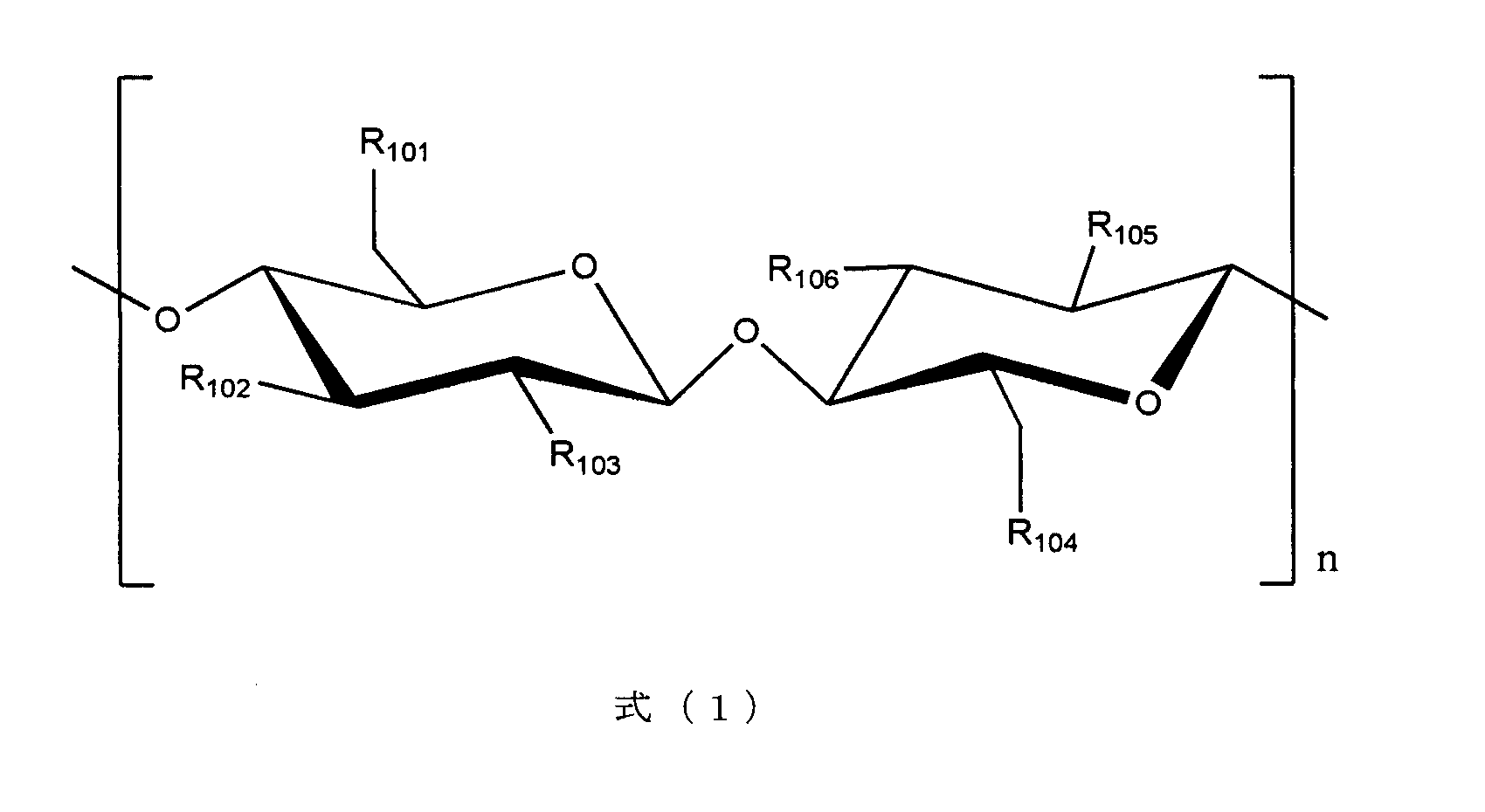
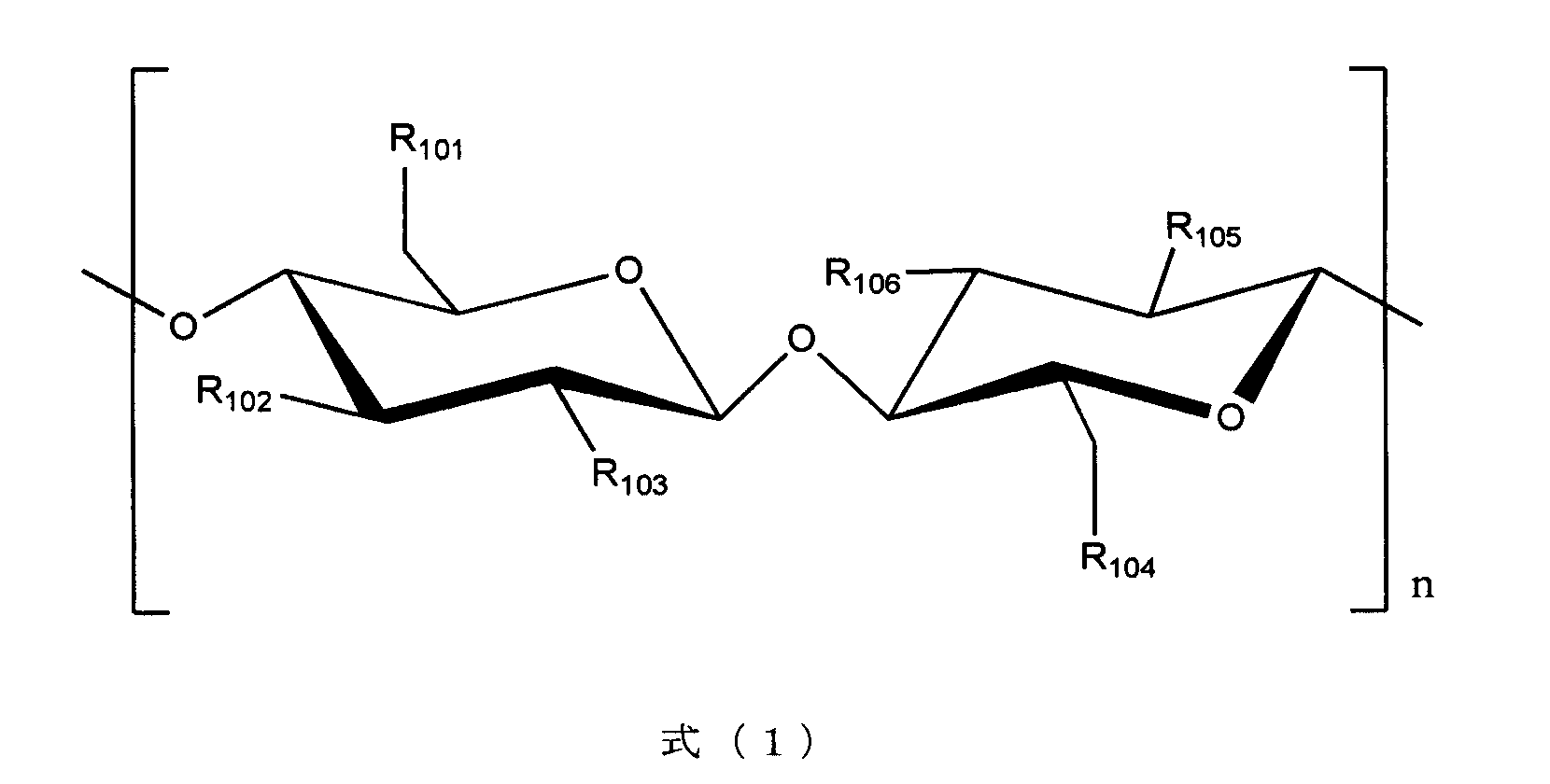
- One of the embodiments is It is a separator for electrical storage devices characterized by including the cellulose derivative represented by Formula (1).
- R 101 to R 106 each independently represents a hydroxy group, a phosphate residue, or a phosphorous acid residue, and at least one of R 101 to R 106 is a phosphate residue or It is a phosphite residue.
- n is an integer of 2 or more, and each of R 101 to R 106 is independent for each n. ].
- One of the embodiments is A separator for an electricity storage device in which a hydroxyl group on a fiber surface of a separator mainly composed of cellulose fibers is substituted with a phosphoric acid residue or a phosphorous acid residue.
- One of the embodiments is It is an electrical storage device containing the said separator for electrical storage devices, the negative electrode which has a negative electrode active material, and the electrolyte solution containing a supporting salt and a nonaqueous electrolytic solvent.
- One of the embodiments is An inorganic material-containing separator containing inorganic fibers having a hydroxy group on a surface thereof is brought into contact with a solution containing a phosphate ester or a phosphite ester and water.
- One of the embodiments is A method for producing a separator for an electricity storage device, comprising contacting a cellulose separator containing cellulose as a main component with a solution containing a phosphate ester or a phosphite ester and water.
- One of the embodiments is It is an electrical storage device containing the separator for electrical storage devices manufactured by the said manufacturing method, the negative electrode which has a negative electrode active material, and the electrolyte solution containing a supporting salt and a nonaqueous electrolytic solvent.
- an electricity storage device including the electricity storage device separator according to the embodiment of the present invention has a high initial discharge capacity and high safety.
- FIG. 3 is a schematic cross-sectional view showing a structure of an electrode element included in a laminated laminate type secondary battery.
- 3 is an IR spectrum of a phosphate ester cellulose separator in Production Example 1. It is IR spectrum of the cellulose separator before phosphate ester treatment.
- One of the embodiments is a power storage device separator including the cellulose derivative represented by the formula (1) as described above.
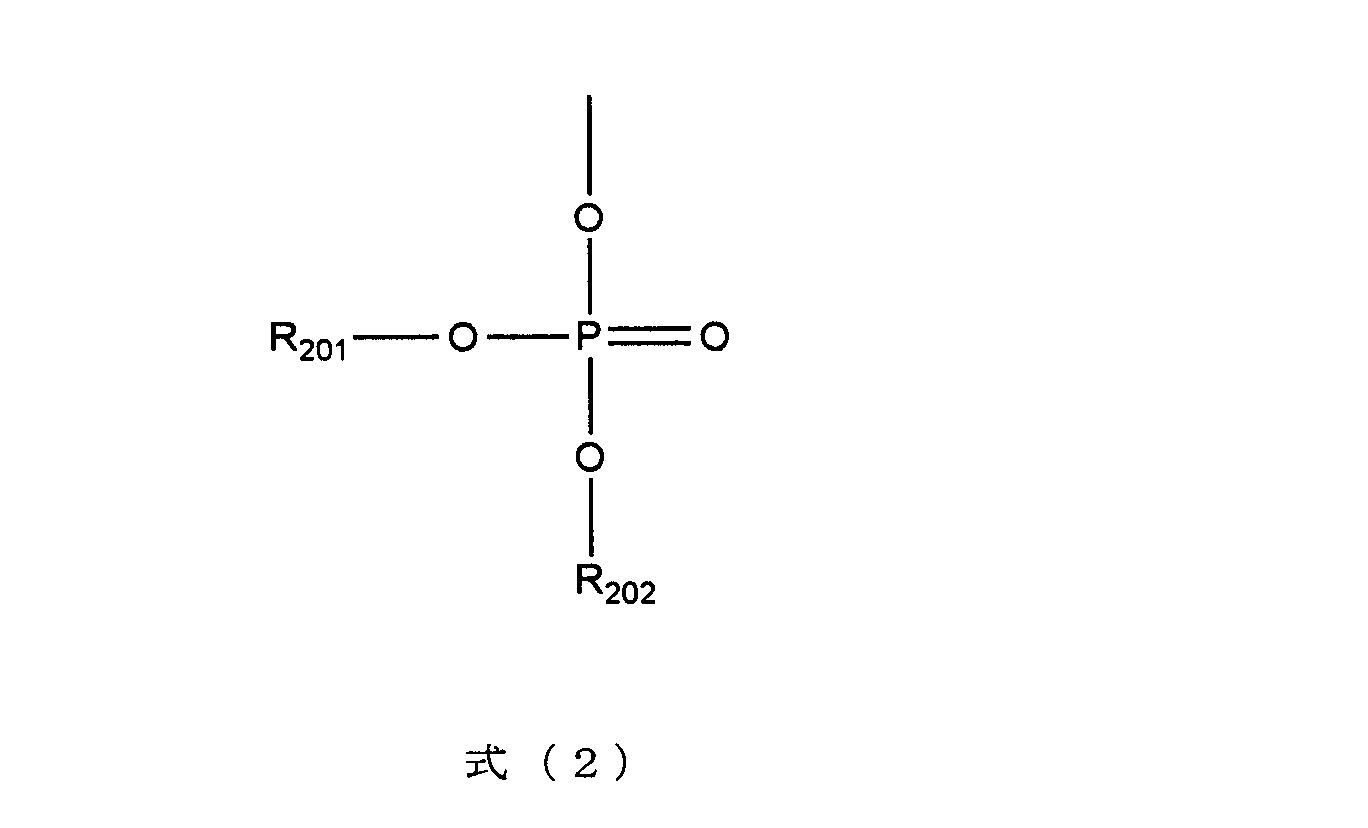
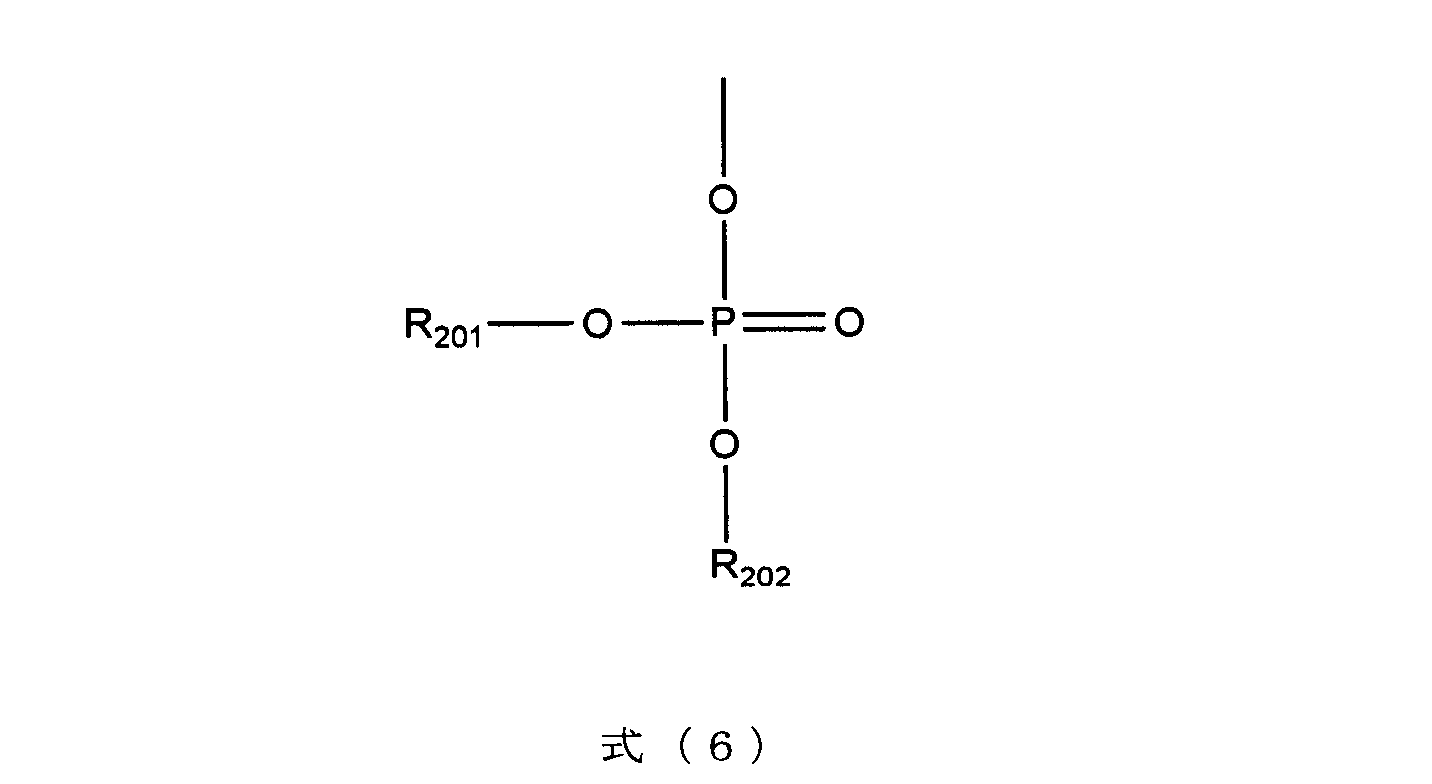
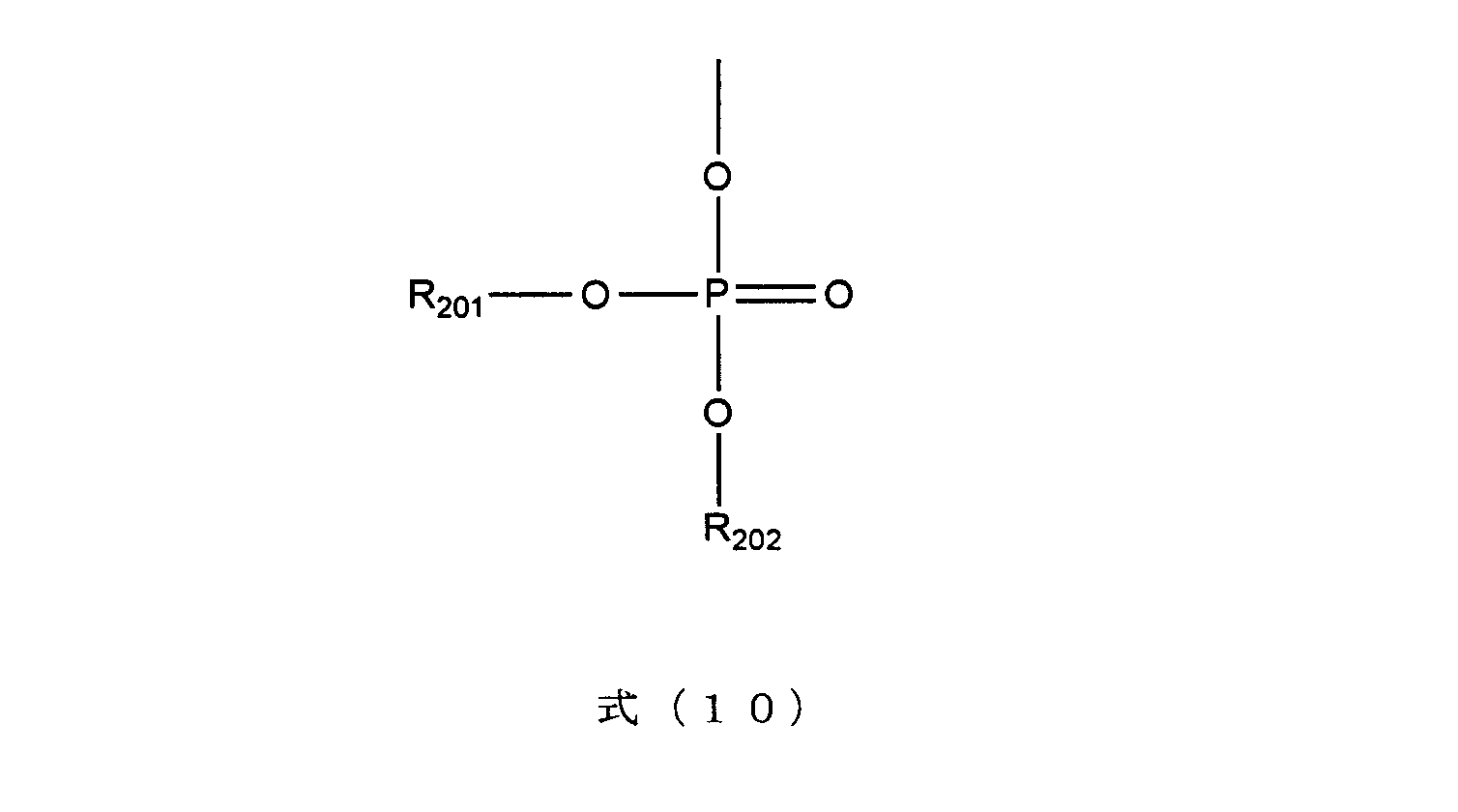
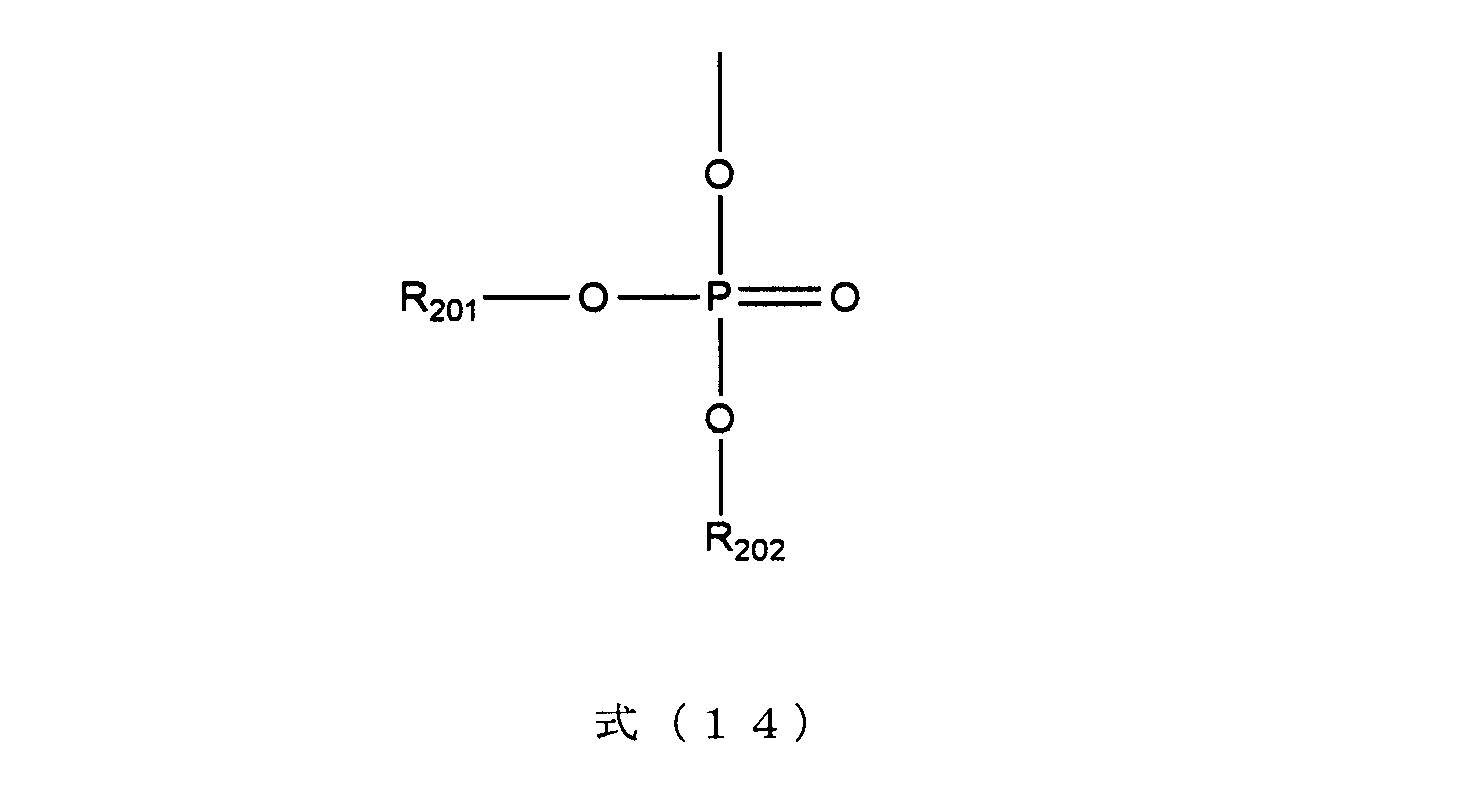
- the phosphate residue is represented by the following formula (2).
- R 201 and R 202 each independently represent a hydrogen atom, a substituted or unsubstituted alkyl group, or a substituted or unsubstituted aryl group.
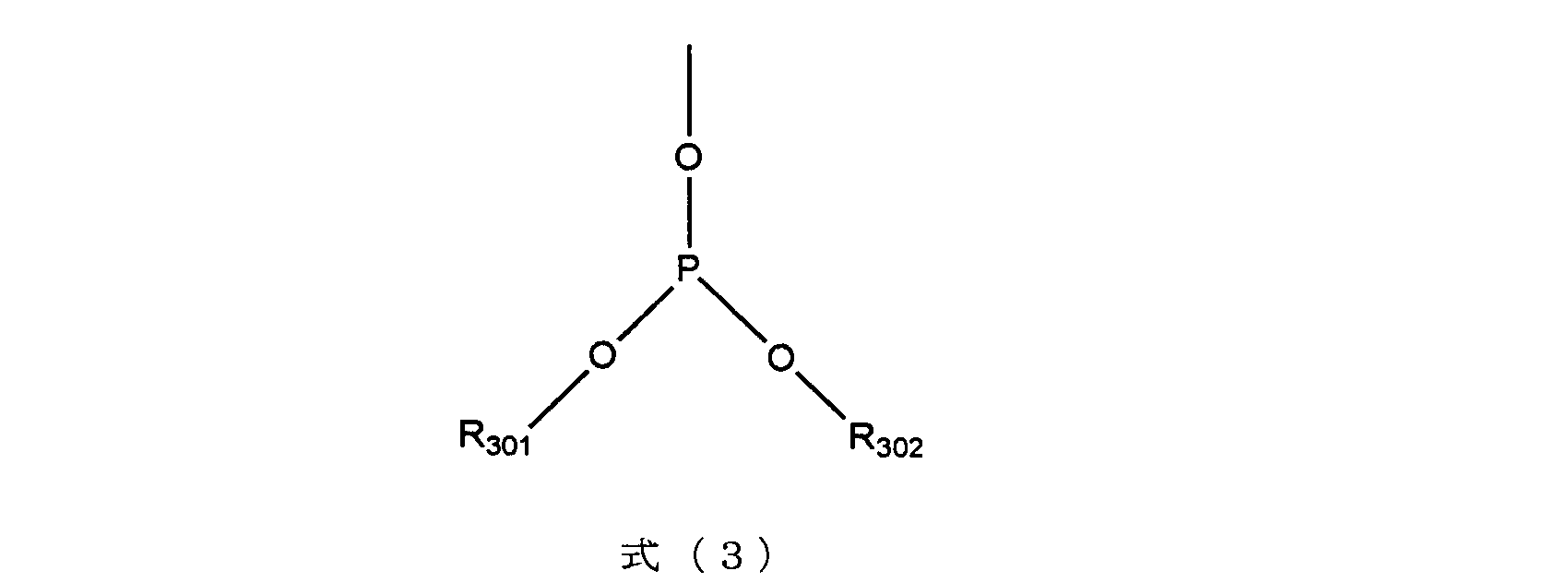
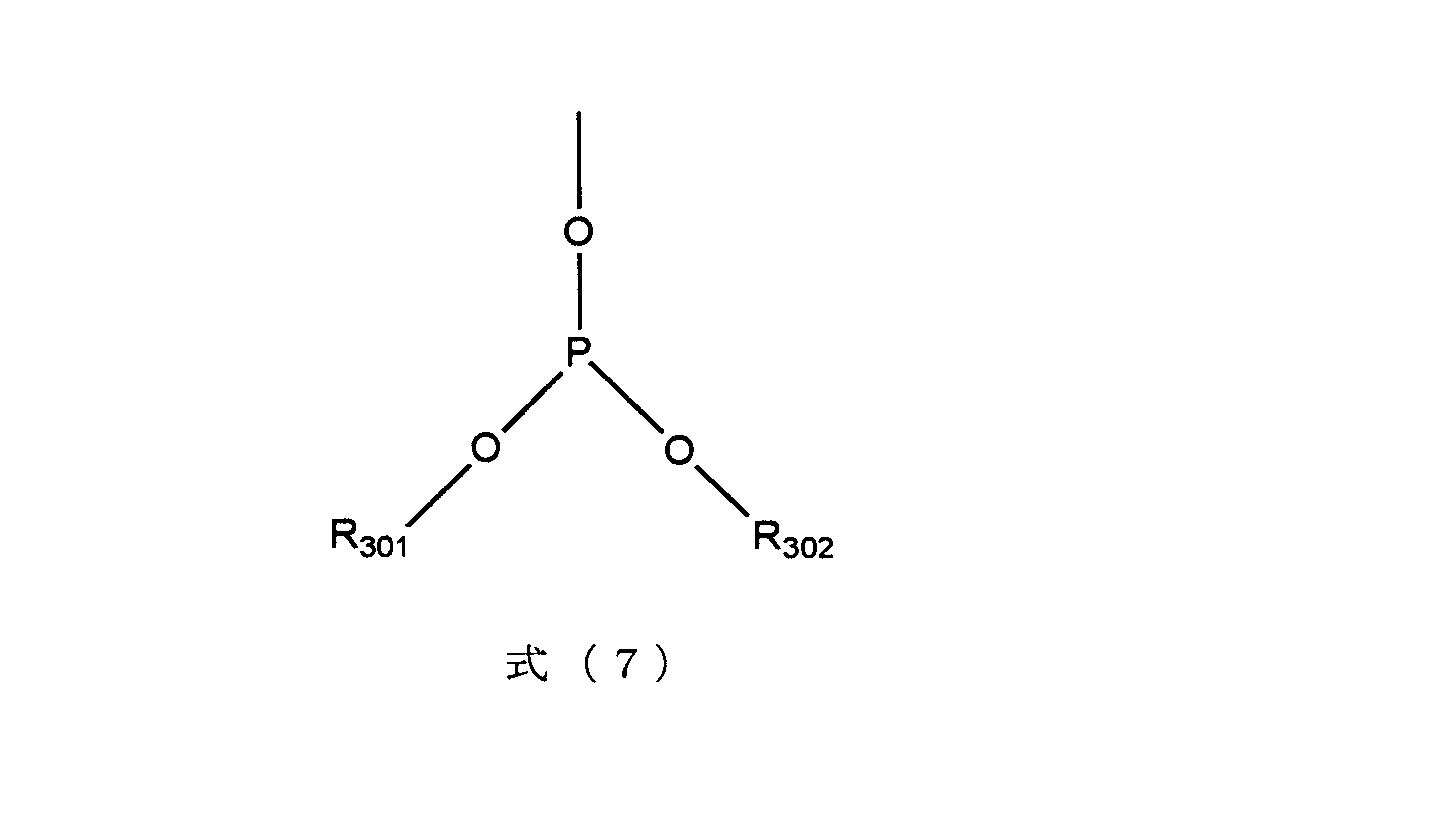
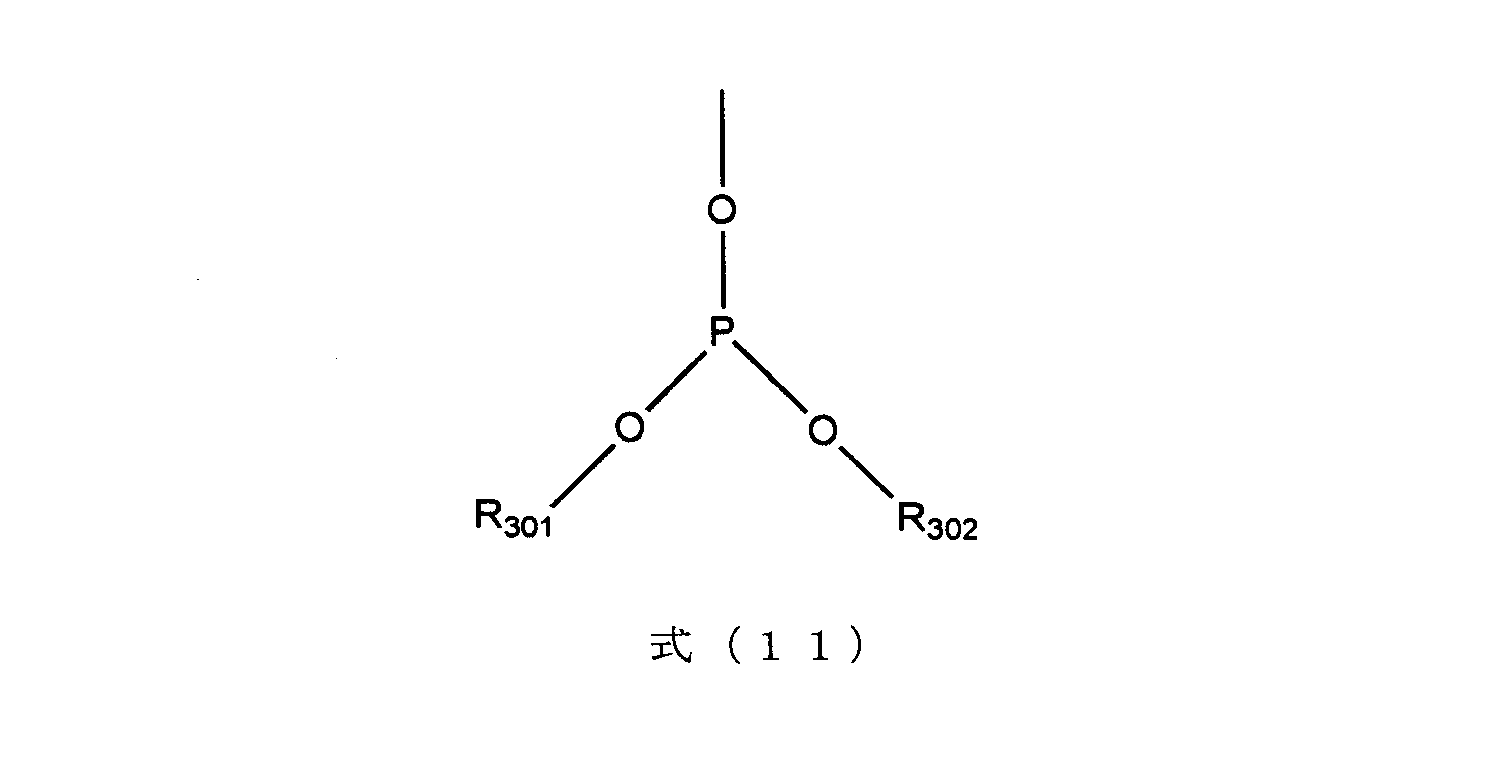
- the phosphorous acid residue is represented by the following formula (3).
- R 301 and R 302 each independently represent a hydrogen atom, a substituted or unsubstituted alkyl group, or a substituted or unsubstituted aryl group.
- the alkyl group is preferably an alkyl group having 1 to 8 carbon atoms, more preferably an alkyl group having 1 to 6 carbon atoms, More preferably, it is an alkyl group of 4.
- the alkyl group includes a linear alkyl group, a branched alkyl group, or a cyclic alkyl group.
- the aryl group is preferably an aryl group having 6 to 18 carbon atoms, more preferably an aryl group having 6 to 12 carbon atoms, and 6 to 6 carbon atoms. More preferably, it is 10 aryl groups.
- examples of the substituent of the alkyl group or aryl group include a halogen atom, preferably a fluorine atom.
- a cyclic structure may be formed by a carbon-carbon bond between R 201 and R 202 .
- a ring structure may be formed by a carbon-carbon bond between R 301 and R 302 .
- R 201 and R 202 , and R 301 and R 302 are preferably alkyl groups from the viewpoint of suppressing an increase in irreversible capacity.
- the electricity storage device separator of the present embodiment may be formed by rinsing phosphoric ester cellulose fibers by, for example, a so-called papermaking method. Moreover, what formed the fiber of the cellulose esterified into the textile fabric may be used. Moreover, the cellulose separator conventionally used as a separator can also be obtained by performing phosphoric acid esterification or phosphite esterification treatment. In this case, it is desirable to remove binders such as polyethyleneimine, sodium alginate, polyacrylamide and the like that may be used in the production of cellulose paper before or during the phosphoric acid esterification treatment.
- binders such as polyethyleneimine, sodium alginate, polyacrylamide and the like that may be used in the production of cellulose paper before or during the phosphoric acid esterification treatment.
- the thickness of the electricity storage device separator of the present embodiment is not particularly limited, but when one sheet is used alone, it is preferably 10 ⁇ m or more and 200 ⁇ m or less, and 20 ⁇ m or more and 100 ⁇ m or less. More preferably, it is further desirably 50 ⁇ m or less. It is because the intensity
- the porosity is preferably 30% or more and 99% or less. This is because, when the average pore diameter is 30% or more, the resistance of the membrane is reduced and the battery performance is improved. In order to further reduce the liquid resistance, it is desirable to be 55% or more. More preferably, it is 60% or more. Moreover, it is because generation
- the porosity can be determined from, for example, the true density and total volume of the material that is a raw material for the microporous membrane, and the weight and volume of the microporous membrane.
- the puncture strength in the film thickness direction is a value of a certain level or more.
- the separator for an electricity storage device is a separator in which cellulose fiber is a main component and at least a part of the hydroxyl group on the surface of the cellulose fiber is substituted with a phosphoric acid residue or a phosphorous acid residue. .
- Cellulose fibers are preferably contained in 30% by mass or more of the constituent materials of the separator, more preferably 50% or more, further preferably 70% or more, and more preferably 90% or more. It is particularly preferable.
- the separator for an electricity storage device of the present embodiment is a heat treatment in which a cellulose separator mainly composed of cellulose is brought into contact with a solution containing a phosphate ester or phosphite ester and water, preferably in a contact state. Obtained. That is, the manufacturing method of this embodiment can also be grasped as a manufacturing method of a separator for an electricity storage device in which a cellulose separator mainly composed of cellulose is brought into contact with a solution containing a phosphate ester or a phosphite ester and water.
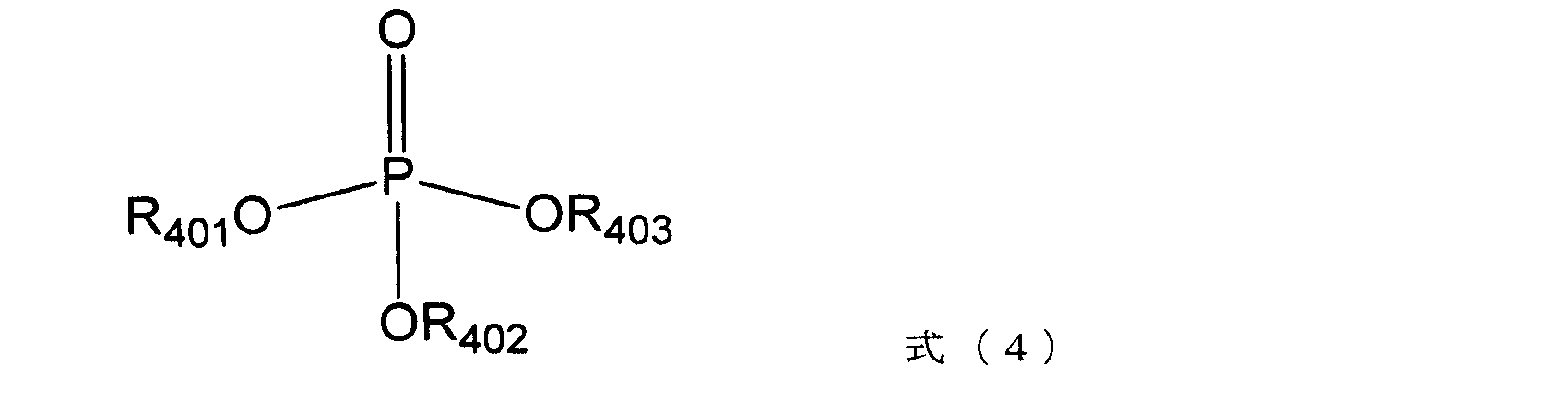
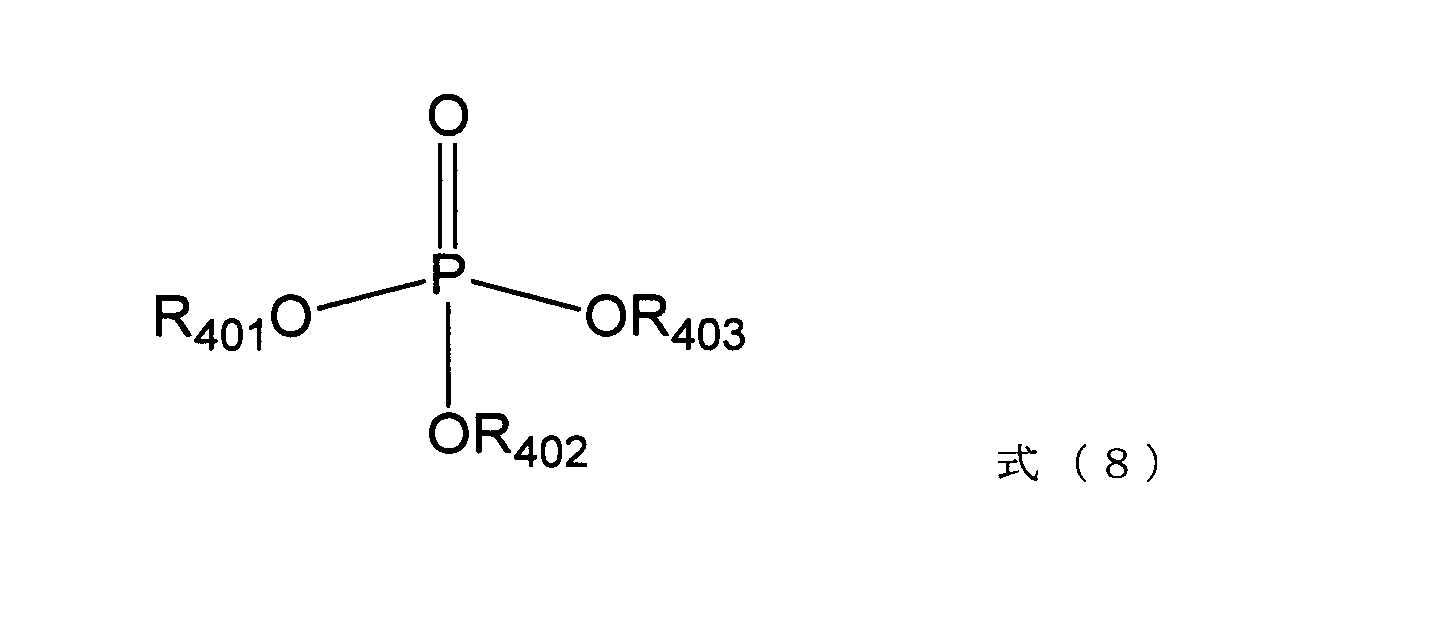
- the phosphate ester is represented by the formula (4).
- R 401 to R 403 each independently represents a hydrogen atom, a substituted or unsubstituted alkyl group, or a substituted or unsubstituted aryl group, and any of R 401 to R 403 is a substituted Or it is an unsubstituted alkyl group or a substituted or unsubstituted aryl group.
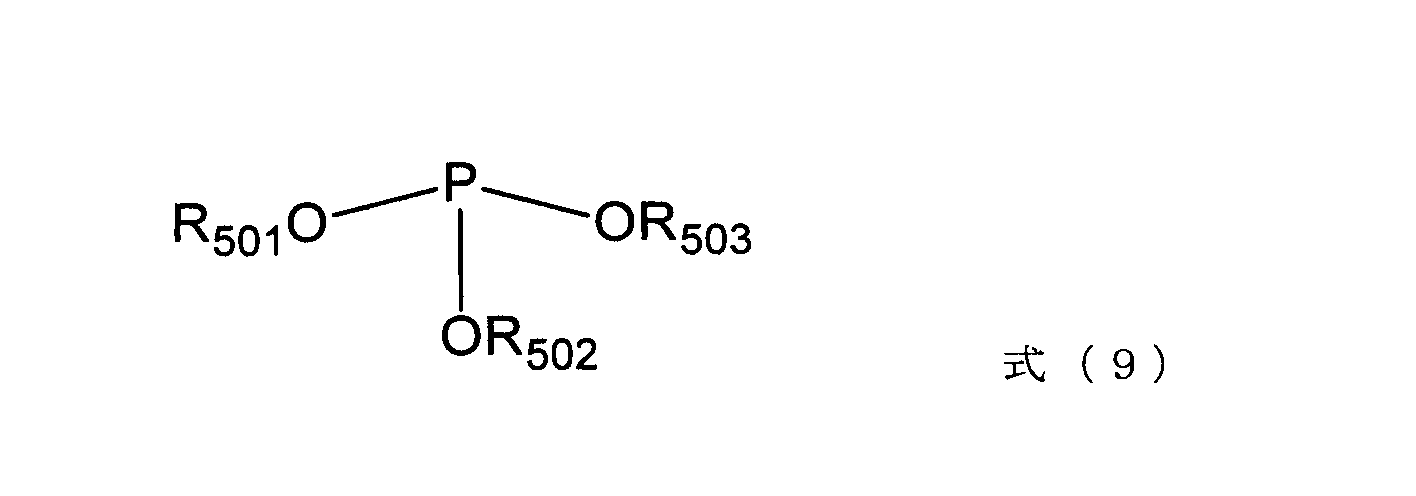
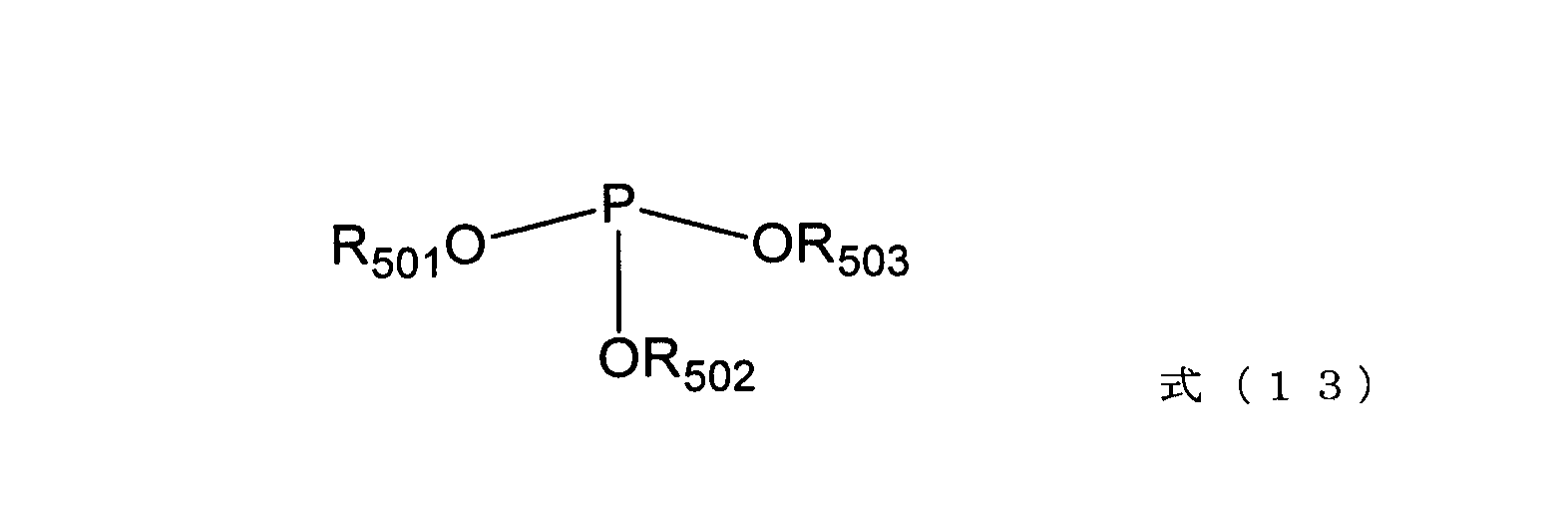
- the phosphite is represented by the formula (5).
- R 501 to R 503 each independently represent a hydrogen atom, a substituted or unsubstituted alkyl group, or a substituted or unsubstituted aryl group, and any of R 501 to R 503 is a substituted group Or it is an unsubstituted alkyl group or a substituted or unsubstituted aryl group.
- the alkyl group is preferably an alkyl group having 1 to 8 carbon atoms, more preferably an alkyl group having 1 to 6 carbon atoms, and an alkyl group having 1 to 4 carbon atoms. More preferably, it is a group.
- the alkyl group includes a linear alkyl group, a branched alkyl group, or a cyclic alkyl group.
- the aryl group is preferably an aryl group having 6 to 18 carbon atoms, more preferably an aryl group having 6 to 12 carbon atoms, and an aryl group having 6 to 10 carbon atoms. More preferably, it is a group.
- examples of the substituent of the alkyl group or aryl group include a halogen atom, and preferably a fluorine atom.
- R 401 to R 403 are all alkyl groups.
- R 501 to R 503 are preferably all alkyl groups.
- the cellulose separator it is preferable to treat the cellulose separator with a phosphate ester.
- the phosphate ester examples include trimethyl phosphate, triethyl phosphate, tripropyl phosphate, trioctyl phosphate, and triphenyl phosphate.
- a compound having a structure in which a part or all of hydrogen atoms of the unsubstituted phosphate ester is substituted with a halogen atom such as a fluorine atom or a chlorine atom may be used.
- a halogen atom such as a fluorine atom or a chlorine atom
- tristrifluoroethyl phosphate, phosphoric acid Tristrichloroethyl etc. are mentioned.
- triethyl phosphate, trioctyl phosphate, and the like that are liquid at normal temperature and are relatively stable electrochemically are preferable.
- the cellulose separator may be treated with phosphite.
- the phosphite include trimethyl phosphite, triethyl phosphite, tripropyl phosphite, trioctyl phosphite, and triphenyl phosphite.
- a compound having a structure in which part or all of the hydrogen atoms of the unsubstituted phosphite ester are substituted with a halogen atom such as a fluorine atom or a chlorine atom may be used. Examples include tristrifluoroethyl phosphate, tristrichloroethyl phosphite, and the like.
- the cellulose separator which has a cellulose as a main component is made to contact the solution containing phosphate ester or phosphite ester, and water. Moreover, it is preferable to heat-process in the state which contacted the cellulose separator with this solution. Here, it is preferable to add water after immersing the cellulose separator in the phosphate ester. By previously immersing the cellulose separator in the phosphoric acid ester and adding water, it is possible to further reduce the phosphoric acid generated by hydrolysis from dissolving the cellulose separator.
- the temperature of the solution in the heat treatment is preferably 70 ° C. or more and 150 ° C. or less from the viewpoint that the hydroxyl group of cellulose and the hydrolyzed phosphate ester easily react to form a phosphate residue.
- the temperature is more preferably 140 ° C. or lower.
- the time for the heat treatment is not particularly limited, but is, for example, 30 minutes or more.
- water is slowly added to a predetermined amount to a phosphate ester or phosphite ester soaked with a cellulose separator.
- the amount of water is not particularly limited.
- the amount of water is 1 part by mass or more and 50 parts by mass or less and 40 parts by mass or less with respect to 100 parts by mass of phosphate ester or phosphite ester. Preferably, it is 30 parts by mass or less.
- the hydroxy group of cellulose is phosphorylated by bringing the cellulose separator into contact with a solution containing phosphate ester and water, preferably by heating in the solution. That is, when water is added to a phosphate ester such as triethyl phosphate, the phosphate ester is hydrolyzed. And it is thought that a phosphoric acid residue is added to a cellulose separator when a hydrolyzed phosphoric acid ester raise
- a phosphate ester such as triethyl phosphate
- an appropriate amount of acid may be added to the solution in order to promote the reaction between the hydrolyzed phosphate ester and the hydroxyl group of cellulose.
- the acid include hydrochloric acid, sulfuric acid, concentrated sulfuric acid, phosphoric acid and the like.
- the pH of the solution is preferably from 1 to 8, more preferably from 3 to 7.
- the phosphoric acid residue is introduced into the surface of the cellulose fiber of the cellulose separator by treating with a phosphoric ester.
- the cellulose separator subjected to the phosphoric acid ester treatment is not particularly limited, and any separator containing cellulose can be used without any problem.
- any separator containing cellulose can be used without any problem.
- a known separator containing cellulose can be used.
- the cellulose separator mainly composed of cellulose fibers preferably contains 30% by mass or more, more preferably 50% by mass or more, of cellulose fibers in the constituent materials of the separator, and 70% More preferably, it is contained more than 90%, particularly preferably 90% or more.
- a cellulose separator which has a cellulose fiber as a main component it is preferable to contain a cellulose fiber as a main component.
- the cellulose separator may be a non-woven fabric made of a material other than cellulose in order to increase the strength, as long as cellulose fibers are included.
- materials other than cellulose include resin materials such as polypropylene, polyethylene, polyethylene terephthalate (PET), polytetrafluoroethylene, polyvinylidene fluoride, polyimide, and polyamideimide.
- one or both surfaces of cellulose paper may be chemically modified or physically modified by spin coating or the like.
- a film made of a resin material such as polyethylene, polypropylene, polyethylene terephthalate, polytetrafluoroethylene, polyvinylidene fluoride, polyimide, polyamideimide, or a paper-like material laminated on cellulose paper should be used. You can also.
- the cellulose separator preferably contains 30% by mass or more of the cellulose component in the constituent materials in order to maintain strength when immersed in the electrolytic solution. Moreover, when the cellulose component is contained by 50% by mass or more, the internal short circuit of the battery can be further suppressed. More preferably, it is a nonwoven fabric in which a cellulose component is contained in an amount of 70% by mass or more in the constituent material.
- the solution After replacing the hydroxy group with a phosphoric acid residue or phosphorous acid residue, the solution can be removed by washing.
- the solvent used for washing include non-aqueous solvents such as chloroform, acetonitrile, and hexane.
- the thickness of the cellulose separator used for production is not particularly limited, but when one sheet is used alone, it is preferably 10 ⁇ m or more and 200 ⁇ m or less, more preferably 20 ⁇ m or more and 100 ⁇ m or less. Preferably, it is 50 ⁇ m or less. It is because the intensity
- the porosity of the cellulose separator used for production is desirably 30% or more and 99% or less. This is because, when the average pore diameter is 30% or more, the resistance of the membrane is reduced and the battery performance is improved. In order to further reduce the liquid resistance, it is desirable to be 55% or more. More preferably, it is 60% or more. Moreover, it is because generation
- the porosity can be determined from, for example, the true density and total volume of the material that is a raw material for the microporous membrane, and the weight and volume of the microporous membrane.
- the puncture strength in the film thickness direction is a value of a certain level or more.
- phosphate ester or phosphite ester in the present embodiment those described above can be used.
- the inorganic material-containing separator contains an inorganic fiber having a hydroxy group on the surface as a main component.
- the inorganic fiber include alumina fiber, carbon fiber, glass fiber, titanium oxide fiber, and boron oxide fiber.
- the inorganic fiber may be a fiber made of ceramic or a fiber made of an inorganic electrolyte material such as a lithium ion conductor. Of these, alumina fibers or glass fibers are preferably used as the inorganic fibers.
- the glass fiber include microfiber wool, long fiber, and glass wool glass fiber.
- the inorganic material-containing separator may include particles made of an inorganic material (hereinafter also abbreviated as inorganic particles).
- the inorganic particles include alumina particles, silica particles, or carbon material particles, titanium oxide particles and boron oxide particles, quartz glass particles, silicon oxide particles, calcium oxide particles and magnesium oxide particles, potassium oxide particles, and sodium oxide. Examples thereof include particles, aluminum nitride particles, and silicon nitride particles.
- alumina particles or silica particles are preferably used as the inorganic particles.
- the inorganic particles can be fixed in the inorganic fiber using, for example, a binder.
- inorganic particles may be contained in inorganic fibers.
- the inorganic material-containing separator may be used after surface treatment with a solution containing, for example, calcium fluoride, barium sulfate, barium fluoride, calcium salt, sodium salt, magnesium salt, potassium salt, amide sulfate, and the like.
- a solution containing, for example, calcium fluoride, barium sulfate, barium fluoride, calcium salt, sodium salt, magnesium salt, potassium salt, amide sulfate, and the like. aqueous solution (Sawada Chemical Co., Ltd .; Notburn) containing amide sulfate in a glass cloth (Sawada Chemical Co., Ltd .; non-combustible mesh) in which a glass fiber is woven.
- the separator surface-treated by spraying is used.
- the inorganic material-containing separator preferably has a shrinkage rate of 30% or less when held at 200 ° C. for 10 seconds, and more preferably has a shrinkage rate of 10% or less when held at 300 ° C. for 10 seconds.
- reinforced mortar or concrete mixed with alkali-resistant glass fiber may be used as the inorganic material-containing separator.
- the inorganic material-containing separator can be obtained, for example, by forming the above-described inorganic fibers into a sheet shape, a film shape, a mesh shape, or a cloth shape.
- the inorganic fiber-containing separator can be obtained by intertwining the above-described inorganic fibers mechanically or using a chemical action to form a sheet or cloth. At this time, a binder may be added in order to make the inorganic fibers adhere more closely.
- the inorganic material-containing separator can also be obtained by weaving inorganic fibers twisted into a yarn shape to form a cloth shape, a film shape, a sheet shape, a mesh shape, or a cloth shape.
- the nonwoven fabric and thin film glass cloth made from glass fiber are mentioned, for example.
- a woven fabric is desirable because the amount of the binder is small and a thin film having a thickness of 50 ⁇ m or less can be easily formed.
- heat treated for several seconds using a gas burner or the like, or dried in a vacuum of 100 ° C or higher What was processed is good also as an inorganic material content separator.
- the thermal contraction rate of the knitted fabric by this heat treatment or heat drying treatment is preferably 20% or less of the original size, and more preferably 5% or less.
- Inorganic fibers may be used alone or in combination of two or more.
- the inorganic material-containing separator preferably contains inorganic fibers having a hydroxy group on the surface as a main component.
- the inorganic material-containing separator preferably has, for example, a configuration containing glass fiber as a main component and silica particles and alumina particles.
- the inorganic material-containing separator preferably contains 30% by mass or more of the constituent components of the separator, more preferably contains 50% by mass or more, more preferably contains 70% or more, and particularly preferably contains 90% or more. preferable.
- the inorganic material-containing separator may be one in which the inorganic fiber is used as a main component, and the strength of the inorganic fiber is increased with an organic or inorganic binder.
- the amount of the organic binder is preferably 20% by mass or less in the constituent components of the inorganic material-containing separator, and more preferably 10% by mass or less from the viewpoint of improving heat resistance.
- the shape of the inorganic material-containing separator is not particularly limited, but is, for example, paper, mesh, or plate.
- a mesh shape in which inorganic fibers are woven like a knitted fabric is desirable.
- the weaving method include plain weave, twill weave, satin weave, leopard weave, imitation weave, torn oblique weave, and double weave.
- the thickness of the inorganic material-containing separator used for production is not particularly limited, but when one sheet is used alone, it is preferably 10 ⁇ m or more and 200 ⁇ m or less, more preferably 20 ⁇ m or more and 100 ⁇ m or less. Preferably, it is 50 ⁇ m or less. It is because the intensity
- the porosity of the inorganic material-containing separator used for production is desirably 30% or more and 99% or less. This is because, when the average pore diameter is 30% or more, the resistance of the membrane is reduced and the battery performance is improved. In order to further reduce the liquid resistance, it is desirable to be 55% or more. More preferably, it is 60% or more. Moreover, it is because generation
- the porosity can be determined from, for example, the true density and total volume of the material that is a raw material for the microporous membrane, and the weight and volume of the microporous membrane.
- the puncture strength in the film thickness direction is a value of a certain level or more.
- One embodiment of the present invention is a method for manufacturing a separator for an electricity storage device in which an inorganic material-containing separator containing inorganic fibers having a hydroxy group on the surface is brought into contact with a solution containing a phosphate ester or a phosphite ester and water.
- the manufacturing method of this embodiment can also be grasped as a manufacturing method of a separator for an electricity storage device in which an inorganic material-containing separator is brought into contact with a solution containing a phosphate ester or a phosphite ester and water. Moreover, it is preferable to heat-process in the state which made the inorganic material containing separator contact this solution.
- the solution contains at least a phosphate ester or phosphite ester and water, but in addition to these, an acid may be contained from the viewpoint of promoting the reaction.
- the acid added to the reaction system is not particularly limited, and examples thereof include concentrated sulfuric acid, sulfuric acid, hydrochloric acid, and phosphoric acid.
- the pH of the solution is preferably from 1 to 8, more preferably from 3 to 7.
- the solution After replacing the hydroxy group with a phosphoric acid residue or phosphorous acid residue, the solution can be removed by washing.
- the solvent used for washing include non-aqueous solvents such as chloroform, acetonitrile, and hexane.
- the treatment using the above-mentioned phosphate ester or phosphite is performed on the inorganic fiber, and the inorganic fiber after the treatment is used to form a cloth shape, a sheet shape, a mesh shape, a film shape, or a cloth shape.
- an inorganic material-containing separator may be obtained.
- the inorganic material-containing separator may be substituted with a phosphoric acid residue or a phosphorous acid residue using phosphoric acid or phosphorous acid and an acid such as concentrated sulfuric acid. it can.
- the hydroxy group of the inorganic material-containing separator can be efficiently substituted with a phosphoric acid group or a phosphorous acid group.
- these acids can be used preferably. Heat treatment is also preferable as described above.
- the content of phosphoric acid in the solution is, for example, 100 to 200% by mass, and preferably 150 to 190% by mass.
- the content of the acid in the solution is, for example, 1 to 50% by mass, and preferably 20 to 40% by mass.
- the pH of the solution is preferably from 1 to 8, more preferably from 3 to 7.
- the separator for an electricity storage device manufactured by the above method is a separator in which the hydroxy group on the surface of the inorganic fiber of the non-material-containing separator mainly composed of inorganic fiber is replaced with a phosphoric acid residue or a phosphorous acid residue. It is.
- the phosphoric acid residue or phosphorous acid residue is the same as described above.
- the separator for an electricity storage device of this reference embodiment can be preferably applied to the configuration of the secondary battery described in the above embodiment.
- the present invention can be applied to a capacitor or the like.
- the secondary battery according to the present embodiment is a secondary battery including the power storage device separator according to the present embodiment.
- the shape of the secondary battery may be any of a cylindrical type, a flat wound square type, a laminated square type, a coin type, a flat wound laminate type, and a laminated laminate type.
- the shape of the secondary battery is preferably a laminated laminate type from the viewpoint that the separator is not easily broken.
- a laminated laminate type secondary battery will be described.
- FIG. 1 is a schematic cross-sectional view showing a structure of an electrode element included in a laminated laminate type secondary battery.
- This electrode element is formed by alternately stacking a plurality of positive electrodes c and a plurality of negative electrodes a with a separator b interposed therebetween.
- the positive electrode current collector e of each positive electrode c is welded to and electrically connected to each other at an end portion not covered with the positive electrode active material, and a positive electrode terminal f is welded to the welded portion.
- the negative electrode current collector d of each negative electrode a is welded and electrically connected to each other at an end portion not covered with the negative electrode active material, and a negative electrode terminal g is welded to the welded portion.
- the electrode element having such a planar laminated structure does not have a portion with a small R (a region close to the winding core of the wound structure), the electrode element associated with charge / discharge is compared with an electrode element having a wound structure.
- the volume change That is, it is effective as an electrode element using an active material that easily causes volume expansion.
- the lithium secondary battery of this embodiment includes a negative electrode having a negative electrode active material.
- the negative electrode active material can be bound on the negative electrode current collector by a negative electrode binder.
- the negative electrode active material in the present embodiment is not particularly limited, and for example, or a carbon material (a) that can occlude and release lithium ions, a metal that can be alloyed with lithium (b), and occlude and release lithium ions.
- Metal oxide (c) is not particularly limited, and for example, or a carbon material (a) that can occlude and release lithium ions, a metal that can be alloyed with lithium (b), and occlude and release lithium ions.
- the negative electrode active material in the present embodiment is not particularly limited, and for example, a carbon material (a) that can occlude and release lithium ions, a metal that can be alloyed with lithium (b), or occlude and release lithium ions.
- the metal oxide (c) etc. which can be mentioned.
- Examples of the carbon material (a) include carbon, amorphous carbon, diamond-like carbon, carbon nanotube, or a composite thereof.
- carbon with high crystallinity has high electrical conductivity, and is excellent in adhesiveness and voltage flatness with a negative electrode current collector made of a metal such as copper.
- amorphous carbon having low crystallinity has a relatively small volume expansion, it has a high effect of relaxing the volume expansion of the entire negative electrode, and deterioration due to non-uniformity such as crystal grain boundaries and defects hardly occurs.
- the metal (b) examples include Al, Si, Pb, Sn, In, Bi, Ag, Ba, Ca, Hg, Pd, Pt, Te, Zn, La, or alloys of two or more thereof. It is done. Moreover, you may use these metals or alloys in mixture of 2 or more types. These metals or alloys may contain one or more non-metallic elements.
- the negative electrode active material preferably includes tin or silicon, and more preferably includes silicon. This is because the phosphoric acid residue contained in the cellulose for an electricity storage device of the present embodiment hardly reacts with tin or silicon, and thus can suppress an increase in irreversible capacity.
- the metal oxide (c) examples include silicon oxide, aluminum oxide, tin oxide, indium oxide, zinc oxide, lithium oxide, and composites thereof.
- tin oxide or silicon oxide is included as a negative electrode active material, and it is more preferable that silicon oxide is included. This is because silicon oxide is relatively stable and hardly causes a reaction with other compounds.
- one or more elements selected from nitrogen, boron, and sulfur may be added to the metal oxide (c), for example, 0.1 to 5% by mass. By carrying out like this, the electrical conductivity of a metal oxide (c) can be improved.
- the metal oxide (c) has an amorphous structure.
- the metal oxide (c) having an amorphous structure can suppress volume expansion of the carbon material (a) and the metal (b) which are other negative electrode active materials. Although this mechanism is not clear, it is presumed that the formation of a film on the interface between the carbon material (a) and the electrolytic solution has some influence due to the amorphous structure of the metal oxide (c).
- the amorphous structure is considered to have relatively few elements due to non-uniformity such as crystal grain boundaries and defects.
- the metal oxide (c) does not have an amorphous structure, a peak specific to the metal oxide (c) is observed, but all or part of the metal oxide (c) is amorphous. In the case of having a structure, the intrinsic peak of the metal oxide (c) is broad and observed.
- the negative electrode active material in the present embodiment includes a carbon material (a) that can occlude and release lithium ions, a metal (b) that can be alloyed with lithium, and a metal oxide (c) that can occlude and release lithium ions. It is preferable to contain.
- the metal (b) is preferably silicon, and the metal oxide (c) is preferably silicon oxide. That is, the negative electrode active material is preferably composed of a composite of silicon, silicon oxide, and a carbon material (hereinafter also referred to as Si / SiO / C composite).
- the negative electrode active material in which lithium is chemically and thermally doped in advance.
- the negative electrode active material in thermal doping, can be doped with lithium by bringing the negative electrode active material into contact with lithium metal and warming the whole.
- the Si / SiO / C composite it is preferable that all or part of silicon is dispersed in silicon oxide.
- silicon oxide By dispersing at least a part of silicon in silicon oxide, volume expansion as a whole of the negative electrode can be further suppressed, and decomposition of the electrolytic solution can also be suppressed.
- all or part of silicon is dispersed in silicon oxide because transmission electron microscope observation (general TEM observation) and energy dispersive X-ray spectroscopy measurement (general EDX measurement) are used in combination. This can be confirmed. Specifically, the cross section of a sample containing silicon particles can be observed, and the oxygen concentration of silicon particles dispersed in silicon oxide can be measured to confirm that it is not an oxide.
- the Si / SiO / C composite for example, all or part of silicon oxide has an amorphous structure, and all or part of silicon is dispersed in silicon oxide.
- a Si / SiO / C composite can be produced, for example, by a method disclosed in Patent Document 3 (Japanese Patent Laid-Open No. 2004-47404). That is, the Si / SiO / C composite can be obtained, for example, by performing CVD treatment of silicon oxide in an atmosphere containing an organic gas such as methane gas.
- the Si / SiO / C composite obtained by such a method has a form in which the surface of particles made of silicon oxide containing silicon is coated with carbon. Silicon is nanoclustered in silicon oxide.
- the ratio of the carbon material, silicon and silicon oxide is not particularly limited.
- the carbon material is preferably 2% by mass or more and 50% by mass or less, and more preferably 2% by mass or more and 30% by mass or less with respect to the Si / SiO / C composite.
- Silicon is preferably 5% by mass or more and 90% by mass or less, and more preferably 20% by mass or more and 50% by mass or less with respect to the Si / SiO / C composite.
- Silicon oxide is preferably 5% by mass or more and 90% by mass or less, and more preferably 40% by mass or more and 70% by mass or less with respect to the Si / SiO / C composite.
- the Si / SiO / C composite can be made of a mixture of carbon material, silicon and silicon oxide.
- the Si / SiO / C composite can be obtained by mixing particles of carbon materials, silicon, and silicon oxide.
- the average particle diameter of silicon can be configured to be smaller than the average particle diameter of the carbon material and the average particle diameter of silicon oxide. In this way, silicon with a small volume change during charge and discharge has a relatively small particle size, and carbon materials and silicon oxide with a large volume change have a relatively large particle size. Is more effectively suppressed.
- lithium is occluded and released in the order of large-diameter particles, small-diameter particles, and large-diameter particles during the charge / discharge process. This also suppresses the occurrence of residual stress and residual strain. Is done.
- the average particle diameter of silicon can be, for example, 20 ⁇ m or less, and is preferably 15 ⁇ m or less.
- the binder for the negative electrode is not particularly limited.
- polyvinylidene fluoride, vinylidene fluoride-hexafluoropropylene copolymer, vinylidene fluoride-tetrafluoroethylene copolymer, styrene-butadiene copolymer Rubber, polytetrafluoroethylene, polypropylene, polyethylene, polyimide, polyamideimide, polyacrylic acid, or the like can be used.
- polyimide or polyamideimide is preferred because of its high binding properties.
- the amount of the binder for the negative electrode to be used is preferably 5 to 25 parts by mass with respect to 100 parts by mass of the negative electrode active material from the viewpoints of “sufficient binding force” and “high energy” which are in a trade-off relationship. .
- the negative electrode current collector aluminum, nickel, stainless steel, chromium, copper, silver, and alloys thereof are preferable in view of electrochemical stability.
- the shape include foil, flat plate, and mesh.
- the negative electrode can be produced by forming a negative electrode active material layer containing a negative electrode active material and a negative electrode binder on a negative electrode current collector.
- Examples of the method for forming the negative electrode active material layer include a doctor blade method, a die coater method, a CVD method, and a sputtering method.
- a thin film of aluminum, nickel, or an alloy thereof may be formed by a method such as vapor deposition or sputtering to form a negative electrode.
- the positive electrode is formed, for example, by binding a positive electrode active material so as to cover the positive electrode current collector with a positive electrode binder.
- manganese having a layered structure such as LiMnO 2 , LixMn 2 O 4 (0 ⁇ x ⁇ 2), Li 2 MnO 3 , LixMn 1.5 Ni 0.5 O 4 (0 ⁇ x ⁇ 2), etc.
- Lithium oxalate or lithium manganate having a spinel structure LiCoO 2 , LiNiO 2 or a part of these transition metals replaced with other metals; specific such as LiNi 1/3 Co 1/3 Mn 1/3 O 2 Lithium transition metal oxides with less than half of the transition metals; those lithium transition metal oxides with an excess of Li over the stoichiometric composition; those having an olivine structure such as LiFePO 4 .
- these metal oxides were partially substituted with Al, Fe, P, Ti, Si, Pb, Sn, In, Bi, Ag, Ba, Ca, Hg, Pd, Pt, Te, Zn, La, etc. Materials can also be used.
- a positive electrode active material can be used individually by 1 type or in combination of 2 or more types.
- radical materials or the like can be used as the positive electrode active material.
- the positive electrode binder the same as the negative electrode binder can be used.
- polyvinylidene fluoride is preferable from the viewpoint of versatility and low cost.
- the amount of the positive electrode binder to be used is preferably 2 to 15 parts by mass with respect to 100 parts by mass of the positive electrode active material from the viewpoints of “sufficient binding force” and “high energy” which are in a trade-off relationship. .
- the positive electrode current collector the same as the negative electrode current collector can be used.
- a conductive auxiliary material may be added to the positive electrode active material layer containing the positive electrode active material for the purpose of reducing impedance.
- the conductive auxiliary material include carbonaceous fine particles such as graphite, carbon black, and acetylene black.
- the electrolytic solution used in the present embodiment is not particularly limited, but includes, for example, a supporting salt and a nonaqueous electrolytic solvent.
- An aprotic organic solvent such as aliphatic carboxylic acid esters.
- Nonaqueous electrolytic solvents include ethylene carbonate (EC), propylene carbonate (PC), butylene carbonate (BC), vinylene carbonate (VC), dimethyl carbonate (DMC), diethyl carbonate (DEC), ethyl methyl carbonate (MEC), Cyclic or chain carbonates such as propyl carbonate (DPC) are preferred.
- a non-aqueous electrolysis solvent can be used individually by 1 type or in combination of 2 or more types.
- non-aqueous electrolytic solvents include, for example, ethylene sulfite (ES), propane sultone (PS), butane sultone (BS), dioxathilane-2,2-dioxide (DD), sulfolene, 3-methyl Sulfolen, sulfolane (SL), succinic anhydride (SUCAH), propionic anhydride, acetic anhydride, maleic anhydride, diallyl carbonate (DAC), diphenyl disulfide (DPS), dimethoxyethane (DME), dimethoxymethane (DMM) , Diethoxyethane (DEE), ethoxymethoxyethane, dimethyl ether, methyl ethyl ether, methyl propyl ether, ethyl propyl ether, dipropyl ether, methyl butyl ether, diethyl ether, phenyl methyl ether, Rahidorofuran (THF),
- the supporting salt is not particularly limited, for example, LiPF 6, LiI, LiBr, LiCl, LiAsF 6, LiAlCl 4, LiClO 4, LiBF 4, LiSbF 6, LiCF 3 SO 3, LiC 4 F 9 SO 3 , LiN (FSO 2 ) 2 , LiN (CF 3 SO 2 ) 2 , LiN (C 2 F 5 SO 2 ) 2 , LiN (CF 3 SO 2 ) (C 2 F 5 SO 2 ), LiN (CF 3 SO 2 ) (C 4 F 9 SO 2 ), cyclic LiN (CF 2 SO 2 ) 2 , LiN (CF 2 SO 2 ) 2 (CF 2 ) and the like.
- Examples of the supporting salt include LiPF 5 (CF 3 ), LiPF 5 (C 2 F 5 ), and LiPF 5 (C 3 F 7 ) in which at least one fluorine atom of LiPF 6 is substituted with a fluorinated alkyl group. , LiPF 4 (CF 3 ) 2 , LiPF 4 (CF 3 ) (C 2 F 5 ), LiPF 3 (CF 3 ) 3 and the like.
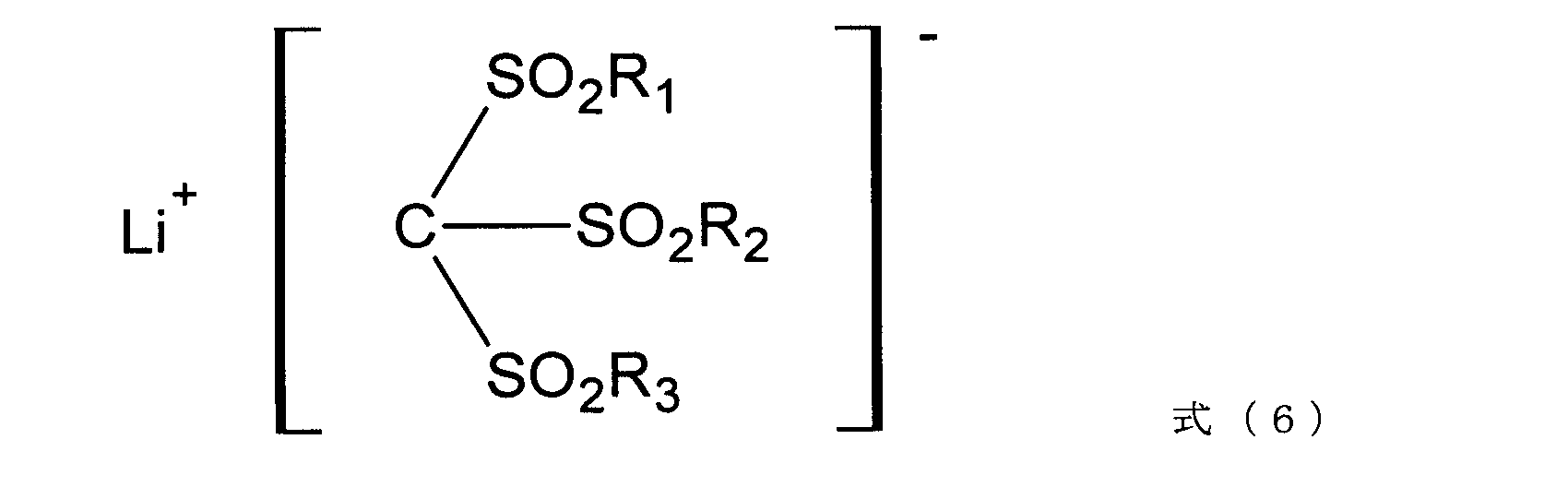
- examples of the lithium salt include a salt made of the compound represented by the formula (6).
- R 1 , R 2 and R 3 in the formula (6) are selected from the group consisting of a halogen atom and a fluorinated alkyl group, and may be different or the same.
- Specific examples of the compound represented by the formula (6) include LiC (CF 3 SO 2 ) 3 and LiC (C 2 F 5 SO 2 ) 3 .
- Supporting salt can be used alone or in combination of two or more.
- the concentration of the lithium salt is not particularly limited, but is, for example, 0.01 M (mol / L) or more and 3 M (mol / L) or less in the electrolytic solution. Moreover, it is preferable that the density
- the nonaqueous electrolytic solvent preferably contains a fluorinated carbonate.
- the fluorinated carbonate includes cyclic and chain ones, and specific examples include fluorinated cyclic carbonates and fluorinated chain carbonates. Moreover, it is preferable that it is a fluorinated cyclic carbonate.
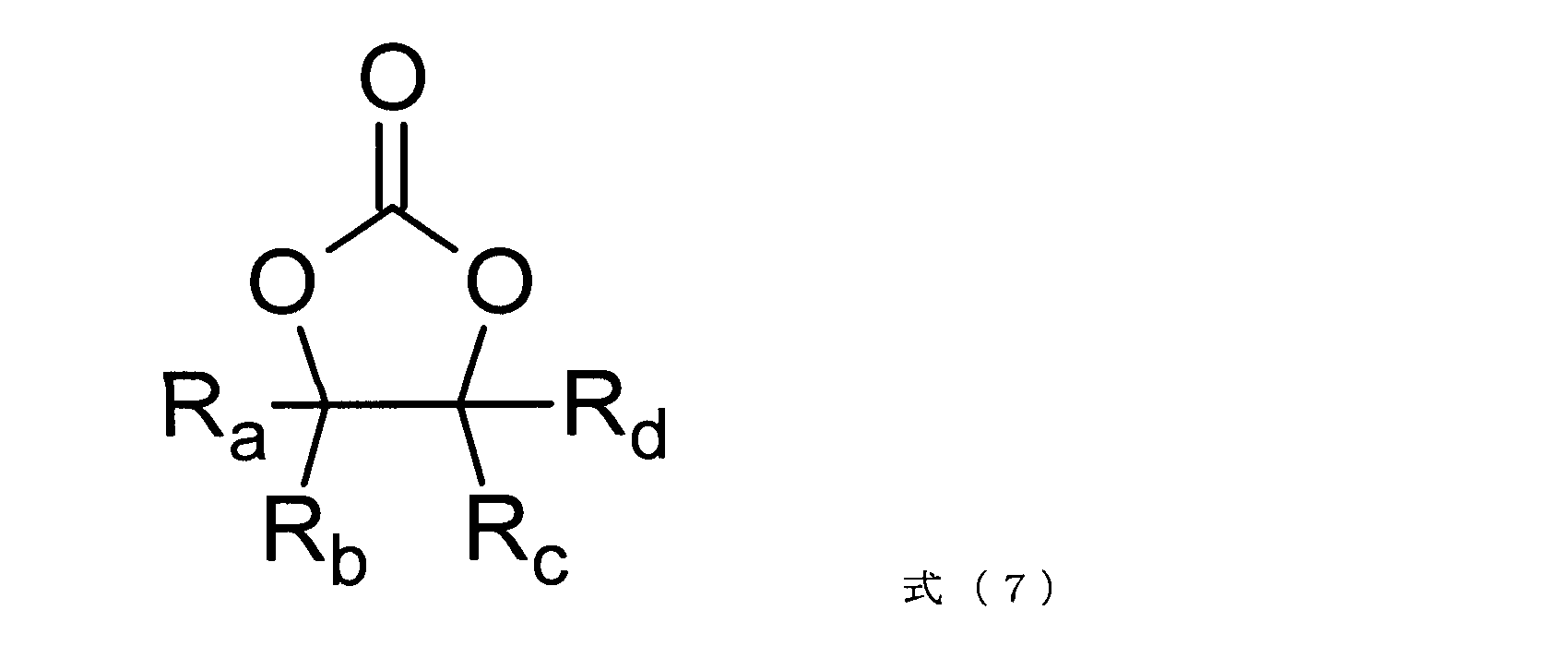
- the fluorinated cyclic carbonate is not particularly limited, and ethylene carbonate, propylene carbonate, vinylene carbonate, a compound obtained by partially fluorinating vinyl ethylene carbonate, and the like can also be used. More specifically, for example, 4-fluoro-1,3-dioxolane-2-one (fluoroethylene carbonate, hereinafter also referred to as FEC), (cis or trans) 4,5-difluoro-1,3-dioxolane-2 -One, 4,4-difluoro-1,3-dioxolan-2-one, 4-fluoro-5-methyl-1,3-dioxolan-2-one and the like can be used. Among these, fluoroethylene carbonate is preferable.
- R a , R b , R c , and R d are each independently a hydrogen atom, a fluorine atom, or a fluorine-containing alkyl group, and R a , R b , R c , and R d At least one of is a fluorine atom or a fluorine-containing alkyl group.
- the fluorine-containing alkyl group preferably has at least one fluorine atom, and all the hydrogen atoms of the alkyl group are substituted with fluorine atoms.
- the fluorine-containing alkyl group preferably includes a linear or branched chain and has 1 to 5 carbon atoms.
- the compound which substituted the hydrogen of one part or all part of dimethyl carbonate, diethyl carbonate, ethyl methyl carbonate, dipropyl carbonate, and methylpropyl carbonate can also be used.
- bis (fluoroethyl) carbonate, 3-fluoropropyl methyl carbonate, 3,3,3-trifluoropropyl methyl carbonate and the like can be mentioned.
- R y and R z are each independently a hydrogen atom or a fluorine-containing alkyl group, and at least one of R y and R z is a fluorine atom or a fluorine-containing alkyl group.
- the fluorine-containing alkyl group preferably has at least one fluorine atom, and all the hydrogen atoms of the alkyl group are substituted with fluorine atoms.
- the fluorine-containing alkyl group preferably includes a linear or branched chain and has 1 to 5 carbon atoms.
- the content of the fluorinated carbonate is preferably 0.01% by mass or more and 50% by mass or less in the nonaqueous electrolytic solvent.
- the content of the fluorinated carbonate is preferably 1% by mass or more and 30% by mass or less, and more preferably 2% by mass or more and 10% by mass or less in the nonaqueous electrolytic solvent.
- the non-aqueous electrolytic solvent preferably contains a carbonate other than the fluorinated carbonate (hereinafter also referred to as non-fluorinated carbonate) and a fluorinated carbonate.
- a carbonate other than the fluorinated carbonate hereinafter also referred to as non-fluorinated carbonate
- fluorinated carbonate By using non-fluorinated carbonate, the ion dissociation property of the electrolytic solution is improved, and the viscosity of the electrolytic solution is lowered. Therefore, ion mobility can be improved.
- Non-fluorinated carbonates include chain and cyclic (non-fluorinated) as described above.
- the non-aqueous electrolytic solvent preferably contains non-fluorinated carbonate as a main solvent, and the non-aqueous electrolytic solvent is 70 to 99.9% by mass of non-fluorinated carbonate and 0.1 to 15% by mass of fluorinated carbonate. And more preferably.
- the nonaqueous electrolytic solvent preferably contains a phosphate ester as a main solvent.
- phosphate ester as the main solvent, the affinity between the separator of this embodiment and the non-aqueous electrolytic solvent is improved, and the non-aqueous electrolytic solvent can easily penetrate into the separator of this embodiment, and the ionic conductivity is improved. It is for improving.
- the phosphate ester include trimethyl phosphate, triethyl phosphate, tripropyl phosphate, trioctyl phosphate, and triphenyl phosphate.
- the content of the phosphate ester in the nonaqueous electrolytic solution is, for example, 70% by mass or more, and preferably 80% by mass or more.
- partially fluorinated trifluoroethyl phosphate of an alkyl phosphate ester may be used.
- the nonaqueous electrolytic solution preferably contains a phosphate ester and a fluorinated carbonate as main solvents. In this case, it is more preferable that the nonaqueous electrolytic solution contains 70 to 99.9% by mass of phosphoric acid ester and 0.1 to 15% by mass of fluorinated carbonate.
- the electrolytic solution may be, for example, trimethyl phosphate, triethyl phosphate, tripropyl phosphate, trioctyl phosphate, triphenyl phosphate, R v1 —O—R v2 (R v1 , R v2 may be mixed with a fluorinated ether, ionic liquid, phosphazene, etc. each having an alkyl group or a fluorine alkyl group structure.
- the amount of the electrolytic solution is desirably adjusted as appropriate based on the porosity of the positive electrode, the negative electrode, and the separator.
- the amount of the electrolytic solution is preferably 0.2 or more and 2.0 or less, and preferably 0.5 or more and 1.5 or less, when 1.0 is the sum of the void volume of the positive electrode, the negative electrode, and the separator. More preferably. Further, from the viewpoint of facilitating further suppression of gas generation at a high temperature, the amount of the electrolytic solution is more preferably 1.2 or less, and particularly preferably 1.0 or less.
- the exterior body can be appropriately selected as long as it is stable to the electrolytic solution and has a sufficient water vapor barrier property.
- a laminated laminate type secondary battery a laminate film made of aluminum, silica-coated polypropylene, polyethylene, or the like can be used as the outer package.
- an aluminum laminate film from the viewpoint of suppressing volume expansion.
- the phosphate ester cellulose separator was washed with chloroform and sufficiently dried under vacuum, and then measured by IR.
- the IR spectrum is shown in FIG.
- the IR spectrum of the cellulose separator before the phosphate ester treatment is also shown in FIG.
- the IR measurement was performed by transmission measurement using an apparatus manufactured by JASCO Corporation with a resolution of 4 cm ⁇ 1 and a scan count of 500 times.
- the IR spectrum (FIG. 2) of the phosphoric ester cellulose separator showed a peak at 825 cm ⁇ 1 and 1640 cm ⁇ 1 . Further, an absorption peak at 1253 cm ⁇ 1 (P ⁇ O stretching vibration) was also confirmed. Since these peaks are inherent to phosphate esters, it can be considered that the hydroxy groups of cellulose are converted to phosphate esters.
- thermal stability of the phosphoric ester cellulose separator was evaluated as shown below.
- a separator made of polyethylene manufactured by Celgard, film thickness: 23 ⁇ m, porosity 50% was similarly subjected to a thermal stability test to obtain a thermal shrinkage (Table 1).
- the phosphoric ester cellulose separator has a lower thermal shrinkage and higher thermal stability in a high temperature environment than the polyethylene separator.
- Example 1 Performance evaluation of secondary battery> Next, a secondary battery was fabricated using a phosphoric ester cellulose separator.
- a silicon / silicon oxide / carbon composite (hereinafter also referred to as Si / SiO / C composite) was obtained by performing CVD treatment at 1150 ° C. for 6 hours in an atmosphere containing methane gas.
- the Si / SiO / C composite had a form in which the surface of particles composed of silicon and silicon oxide was coated with carbon. Silicon was nanoclustered in silicon oxide.
- the mass ratio of Si / SiO / C was adjusted to be approximately 29/61/10.
- the negative electrode slurry was applied to a copper foil having a thickness of 10 ⁇ m, dried, and further subjected to a heat treatment in a nitrogen atmosphere at 300 ° C. to produce a negative electrode.
- 3 layers of the obtained positive electrode and 4 layers of the negative electrode were alternately stacked while sandwiching the phosphoric ester cellulose separator.
- the ends of the positive electrode current collector that is not covered with the positive electrode active material and the negative electrode current collector that is not covered with the negative electrode active material are welded, and the positive electrode terminal made of aluminum and the negative electrode terminal made of nickel are further welded to the welded portions. Were respectively welded to obtain an electrode element having a planar laminated structure.
- electrolytic solution a solution obtained by dissolving LiPF 6 as a supporting salt at a concentration of 1 mol / L in a nonaqueous electrolytic solvent composed of EC: DEC (30:70) was used.
- the electrode element was wrapped with an aluminum laminate film as an exterior body, an electrolyte solution was poured into the inside, and then sealed while reducing the pressure to 0.1 atm to prepare a secondary battery.
- the initial charge capacity of the secondary battery produced as described above was measured.
- the initial charge / discharge conditions were 0.2 C current, 20 V environment, 4.2 V upper limit, and 2.5 V lower limit.
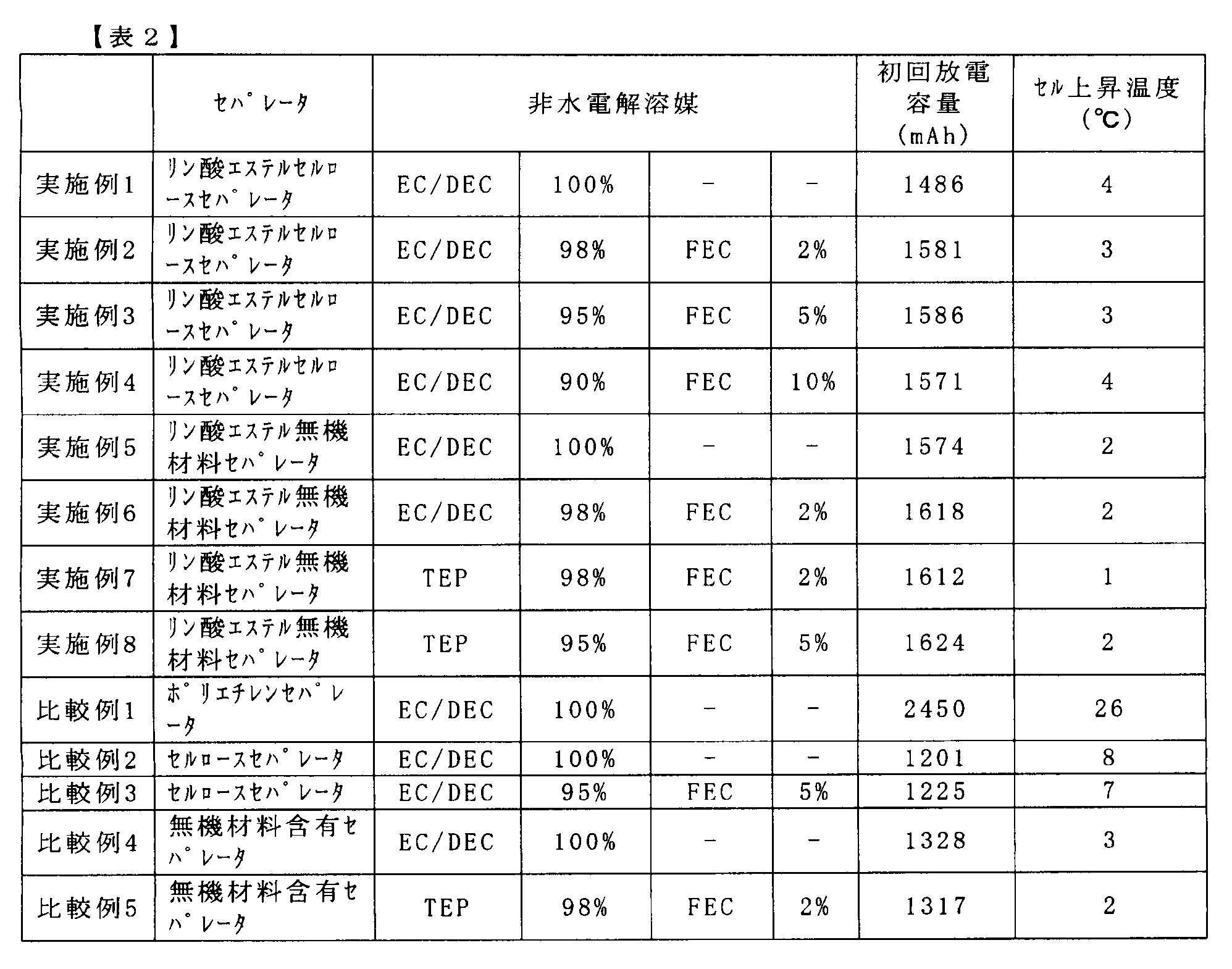
- Table 2 shows the measured discharge capacity.
- one layer of positive electrode and one layer of negative electrode were arranged through a phosphoric ester cellulose separator, and an aluminum laminate cell into which an electrolytic solution was injected was produced. After conditioning the manufactured cell, it was charged to an upper limit voltage of 4.3 V with a current of 0.2 C. The charged cell was impacted by dropping a 5 kg weight from above at a height of 50 cm. After impacting the cell, the temperature of the cell was measured with a thermocouple attached to the outside of the cell. The cell rising temperature is calculated from the maximum temperature reached after the impact test and the cell temperature before the impact test, and is shown in Table 2.
- Example 2 A secondary battery and a cell were produced and evaluated in the same manner as in Example 1 except that EC: DEC (30:70) was mixed with 2% by mass of fluoroethylene carbonate as the nonaqueous electrolytic solvent. .
- Example 3 A secondary battery and a cell were produced and evaluated in the same manner as in Example 1 except that EC: DEC (30:70) was mixed with 5% by mass of fluoroethylene carbonate as the nonaqueous electrolytic solvent. .
- Example 4 A secondary battery and a cell were prepared and evaluated in the same manner as in Example 1 except that EC: DEC (30:70) was mixed with 10% by mass of fluoroethylene carbonate as the nonaqueous electrolytic solvent. .
- Example 5 A secondary battery and a cell were prepared and evaluated in the same manner as in Example 1 except that the phosphoric ester inorganic material separator treated as described above was used instead of the phosphoric ester cellulose separator.
- Example 6 A secondary battery and a cell were produced and evaluated in the same manner as in Example 5 except that EC: DEC (30:70) was mixed with 2% by mass of fluoroethylene carbonate as the nonaqueous electrolytic solvent. .
- Example 7 A secondary battery and a cell were produced in the same manner as in Example 5 except that a non-aqueous electrolytic solvent was used in which 2% by mass of fluoroethylene carbonate was mixed with triethyl phosphate (hereinafter also abbreviated as TEP). ,evaluated.
- Example 8 A secondary battery and a cell were produced and evaluated in the same manner as in Example 5 except that TEP was mixed with 5% by mass of fluoroethylene carbonate as the nonaqueous electrolytic solvent.
- Example 1 A secondary battery and a cell were prepared and evaluated in the same manner as in Example 1 except that a polyethylene separator was used instead of the phosphoric ester cellulose separator.
- Example 2 A secondary battery and a cell were prepared and evaluated in the same manner as in Example 1 except that a cellulose separator (separator before phosphoric acid ester treatment) was used instead of the phosphate ester cellulose separator.
- Comparative Example 3 A secondary battery and a cell were prepared and evaluated in the same manner as in Comparative Example 2 except that EC: DEC (30:70) was mixed with 5% by mass of fluoroethylene carbonate as the nonaqueous electrolytic solvent. .
- Example 4 A secondary battery and a cell were prepared and evaluated in the same manner as in Example 1 except that an inorganic material-containing separator (separator before phosphate ester treatment) was used instead of the phosphate ester cellulose separator.
- Comparative Example 5 A secondary battery and a cell were prepared and evaluated in the same manner as in Comparative Example 4 except that TEP was mixed with 2% by mass of fluoroethylene carbonate as the nonaqueous electrolytic solvent.
- the initial discharge capacity is lower than when the polyethylene separator is used (Comparative Example 1 and Comparative Example 2). This may be because the hydroxy group of the cellulose separator reacted with the positive electrode or the negative electrode, so that the capacity may have decreased.
- the cell rising temperature was lower when the cellulose separator was used than when the polyethylene separator was used. This is considered to be because the shrinkage of the separator due to abnormal heat generation is small because the heat resistance of the cellulose separator is superior to that of the polyethylene separator.
- an inorganic material containing separator since a thermal stability becomes higher, it turns out that a cell raise temperature becomes low (comparative example 4).
- Example 1 the use of a phosphoric ester cellulose separator improves the initial discharge capacity compared to the cellulose separator (Example 1, Comparative Example 2). This is considered to be because the phosphoric acid residue having high oxidation resistance was introduced into the cellulose separator, thereby suppressing oxidative decomposition during charging. The same tendency was observed in the phosphoric ester inorganic material separator (Examples 5 and 6). In particular, when a phosphoric acid ester is used for the electrolytic solution, the cell rising temperature is lowered, and an initial discharge capacity equivalent to that when carbonate is used is obtained.
- the electrolyte solution containing phosphate ester and the phosphate ester inorganic material separator have good affinity, so that the penetration of electrolyte solution into the separator is improved and the ion conductivity is improved. it can. Even when a phosphoric acid ester cellulose separator is used, it is considered that the affinity with the phosphoric acid ester is good, so that the penetration of the electrolytic solution is considered to be improved.
- the initial discharge capacity is further improved by adding fluorinated carbonate to the electrolytic solution (Examples 2, 3, and 4). This is considered to be because the fluorinated carbonate forms a film on the surface of the negative electrode during charging and prevents reductive decomposition of the phosphate residue. Therefore, when using a phosphoric ester cellulose separator, it is preferable to mix a fluorinated carbonate in the electrolytic solution. This seems to be the same function when the phosphoric acid ester inorganic material separator is used (Examples 5 and 6).
- the temperature of the cell rises too much because the active material deteriorates or the electrolyte solution evaporates and the liquid witheres.
- the IC circuit and peripheral devices are adversely affected. Therefore, a cell with a small temperature rise even in impact is desirable in that it is not necessary to provide a mechanism such as a temperature control device.
- Appendix (Appendix 1) A separator for an electricity storage device comprising a cellulose derivative represented by the formula (1);
- R 101 to R 106 each independently represents a hydroxy group, a phosphate residue, or a phosphorous acid residue, and at least one of R 101 to R 106 is a phosphate residue or It is a phosphite residue.
- n is an integer of 2 or more, and each of R 101 to R 106 is independent for each n. ].
- R 201 and R 202 each independently represent a hydrogen atom, a substituted or unsubstituted alkyl group, or a substituted or unsubstituted aryl group.
- R 301 and R 302 each independently represent a hydrogen atom, a substituted or unsubstituted alkyl group, or a substituted or unsubstituted aryl group. ].
- R 201 and R 202 each independently represent a hydrogen atom, a substituted or unsubstituted alkyl group, or a substituted or unsubstituted aryl group.
- R 301 and R 302 each independently represent a hydrogen atom, a substituted or unsubstituted alkyl group, or a substituted or unsubstituted aryl group. ].
- R 201 and R 202 each independently represent a hydrogen atom, a substituted or unsubstituted alkyl group, or a substituted or unsubstituted aryl group.
- R 301 and R 302 each independently represent a hydrogen atom, a substituted or unsubstituted alkyl group, or a substituted or unsubstituted aryl group. ].
- An electricity storage device comprising the separator for an electricity storage device according to any one of appendices 1 to 8, a negative electrode having a negative electrode active material, and an electrolytic solution containing a supporting salt and a nonaqueous electrolytic solvent.
- Appendix 11 The electricity storage device according to appendix 10, wherein the negative electrode active material is made of the silicon, the silicon oxide, and a carbon material.
- Appendix 12 The electrical storage device according to any one of appendices 9 to 11, wherein the nonaqueous electrolytic solvent includes a fluorinated carbonate.
- R 401 to R 403 each independently represents a hydrogen atom, a substituted or unsubstituted alkyl group, or a substituted or unsubstituted aryl group, and any of R 401 to R 403 is A substituted or unsubstituted alkyl group, or a substituted or unsubstituted aryl group.
- R 501 to R 503 each independently represents a hydrogen atom, a substituted or unsubstituted alkyl group, or a substituted or unsubstituted aryl group, and any of R 501 to R 503 is A substituted or unsubstituted alkyl group, or a substituted or unsubstituted aryl group. ].
- R 201 and R 202 each independently represent a hydrogen atom, a substituted or unsubstituted alkyl group, or a substituted or unsubstituted aryl group.
- R 301 and R 302 each independently represent a hydrogen atom, a substituted or unsubstituted alkyl group, or a substituted or unsubstituted aryl group. ].
- Appendix 19 Item 19. The method for producing a separator for an electricity storage device according to appendix 18, wherein the temperature of the solution is 70 ° C or higher and 150 ° C or lower by the heat treatment.
- Appendix 20 The manufacturing method of the separator for electrical storage devices in any one of appendix 14 thru
- R 401 to R 403 each independently represents a hydrogen atom, a substituted or unsubstituted alkyl group, or a substituted or unsubstituted aryl group, and any of R 401 to R 403 is A substituted or unsubstituted alkyl group, or a substituted or unsubstituted aryl group.
- R 501 to R 503 each independently represents a hydrogen atom, a substituted or unsubstituted alkyl group, or a substituted or unsubstituted aryl group, and any of R 501 to R 503 is A substituted or unsubstituted alkyl group, or a substituted or unsubstituted aryl group. ].
- R 201 and R 202 each independently represent a hydrogen atom, a substituted or unsubstituted alkyl group, or a substituted or unsubstituted aryl group.
- R 301 and R 302 each independently represent a hydrogen atom, a substituted or unsubstituted alkyl group, or a substituted or unsubstituted aryl group. ].
- Appendix 27 The method for manufacturing a separator for an electricity storage device according to any one of appendices 23 to 26, wherein the inorganic fiber is an alumina fiber, a carbon fiber, or a glass fiber.
- Appendix 30 The method for producing a separator for an electricity storage device according to any one of appendices 23 to 29, wherein the water is added after the inorganic material-containing separator is immersed in the phosphate ester or the phosphite ester.
- Appendix 32 The method for producing a separator for an electricity storage device according to any one of appendices 23 to 31, wherein the solution further contains an acid.
- (Appendix 34) 34 The method for producing a separator for an electricity storage device according to any one of supplementary notes 23 to 33, wherein the amount of the water is 1 part by mass or more and 40 parts by mass or less with respect to 100 parts by mass of the phosphate ester or the phosphite ester.
- An electricity storage device comprising an electricity storage device separator produced by the production method according to any one of appendices 14 to 34, a negative electrode having a negative electrode active material, and an electrolytic solution containing a supporting salt and a nonaqueous electrolytic solvent.
- (Appendix 36) 36 The electricity storage device according to appendix 35, wherein the negative electrode active material includes at least one selected from silicon and silicon oxide.
- Appendix 38 The electrical storage device according to any one of appendices 35 to 37, wherein the nonaqueous electrolytic solvent includes a fluorinated carbonate.
- This embodiment can be used in all industrial fields that require a power source and in industrial fields related to the transport, storage, and supply of electrical energy.
- power supplies for mobile devices such as mobile phones and notebook computers
- power supplies for transportation and transportation media such as trains, satellites, and submarines, including electric vehicles such as electric cars, hybrid cars, electric bikes, and electric assist bicycles
- a backup power source such as a UPS
- a power storage facility for storing power generated by solar power generation, wind power generation, etc .
Landscapes
- Chemical & Material Sciences (AREA)
- Chemical Kinetics & Catalysis (AREA)
- Engineering & Computer Science (AREA)
- General Chemical & Material Sciences (AREA)
- Electrochemistry (AREA)
- Inorganic Chemistry (AREA)
- Ceramic Engineering (AREA)
- Power Engineering (AREA)
- Microelectronics & Electronic Packaging (AREA)
- Life Sciences & Earth Sciences (AREA)
- Wood Science & Technology (AREA)
- Manufacturing & Machinery (AREA)
- Cell Separators (AREA)
- Electric Double-Layer Capacitors Or The Like (AREA)
- Secondary Cells (AREA)
Abstract
Description
無機繊維を主成分とするセパレータの繊維表面にあるヒドロキシ基がリン酸残基又は亜リン酸残基に置換された蓄電デバイス用セパレータである。
式(1)で表されるセルロース誘導体を含むことを特徴とする蓄電デバイス用セパレータである。
セルロース繊維を主成分とするセパレータの繊維表面のヒドロキシ基がリン酸残基又は亜リン酸残基に置換されている蓄電デバイス用セパレータである。
前記蓄電デバイス用セパレータと、負極活物質を有する負極と、支持塩及び非水電解溶媒を含む電解液と、を含む蓄電デバイスである。
表面にヒドロキシ基を有する無機繊維を含む無機材料含有セパレータを、リン酸エステル又は亜リン酸エステルと水とを含む溶液に接触させることを特徴とする蓄電デバイス用セパレータの製造方法である。
セルロースを主成分とするセルロースセパレータを、リン酸エステル又は亜リン酸エステルと、水とを含む溶液に接触させることを特徴とする蓄電デバイス用セパレータの製造方法である。
前記製造方法により製造された蓄電デバイス用セパレータと、負極活物質を有する負極と、支持塩及び非水電解溶媒を含む電解液と、を含む蓄電デバイスである。
本実施形態の一は、上述のように、式(1)で表されるセルロース誘導体を含む蓄電デバイス用セパレータである。

本実施形態の蓄電デバイス用セパレータは、セルロースを主成分とするセルロースセパレータを、リン酸エステル又は亜リン酸エステルと、水とを含む溶液に接触させて、好ましくは接触させた状態で加熱処理して得られる。つまり、本実施形態の製造方法は、セルロースを主成分とするセルロースセパレータをリン酸エステル又は亜リン酸エステルと水とを含む溶液に接触させる蓄電デバイス用セパレータの製造方法とも把握できる。

別の実施形態として、表面にヒドロキシ基を有する無機繊維を含む無機材料含有セパレータを、リン酸エステル又は亜リン酸エステルを含む溶液に接触させる蓄電デバイス用セパレータの製造方法について説明する。
以下、本実施形態の二次電池について、詳細に説明する。なお、以下では蓄電デバイスの一実施形態としてリチウム二次電池を例に挙げて説明するが、本発明はこれに限定されるものではなく、例えばキャパシタ等にも適用可能である。
本実施形態のリチウム二次電池は、負極活物質を有する負極を備える。負極活物質は負極用結着材によって負極集電体上に結着されることができる。
正極は、例えば、正極活物質が正極用結着剤によって正極集電体を覆うように結着されてなる。
本実施形態で用いる電解液は、特に制限されるものではないが、例えば、支持塩と非水電解溶媒とを含む。

外装体としては、電解液に安定で、かつ十分な水蒸気バリア性を持つものであれば、適宜選択することができる。例えば、積層ラミネート型の二次電池の場合、外装体としては、アルミニウム、シリカをコーティングしたポリプロピレン、ポリエチレン等のラミネートフィルムを用いることができる。特に、体積膨張を抑制する観点から、アルミニウムラミネートフィルムを用いることが好ましい。
以下、本実施形態を実施例により具体的に説明する。
<セルロースセパレータのリン酸エステル処理方法>
セルロースセパレータ(日本高度紙工業社製、厚さ;25μm、不織布:空隙率71%、TF4425)を20質量部のリン酸トリエチルに浸した後、加熱し、110℃に制御した。その後、6質量部の水をゆっくり加え、溶液の温度が110℃となるように1時間加熱処理した。水が十分に蒸発した後、リン酸エステルで処理したセパレータを取出し、一晩乾燥した。以下、得られたセパレータをリン酸エステルセルロースセパレータとも略す。
<無機材料含有セパレータのリン酸エステル処理方法>
無機材料含有セパレータ(サワダケミカル社製(不燃メッシュ♯30)、厚さ32μm、メッシュ状)を20質量部のリン酸トリエチルに浸した後、加熱し、110℃に制御した。その後、6質量部の水をゆっくり加え、溶液の温度が110℃になるように1時間加熱処理した。水が十分に蒸発した後、リン酸エステルで処理したセパレータを取出し、一晩乾燥した。得られたセパレータ(以下、リン酸エステル無機材料セパレータとも略す)について、下記に示すように、熱安定性について評価した。
まず、作製したリン酸エステルセルロースセパレータ、及びリン酸エステル無機材料セパレータについて、熱安定性試験を以下の手法により行った。

<二次電池の性能評価>
次に、リン酸エステルセルロースセパレータを用いて二次電池を作製した。
非水電解溶媒として、EC:DEC(30:70)にフルオロエチレンカーボネートを2質量%混合させたものを用いた以外は、実施例1と同様にして二次電池及びセルを作製し、評価した。
非水電解溶媒として、EC:DEC(30:70)にフルオロエチレンカーボネートを5質量%混合させたものを用いた以外は、実施例1と同様にして二次電池及びセルを作製し、評価した。
非水電解溶媒として、EC:DEC(30:70)にフルオロエチレンカーボネートを10質量%混合させたものを用いた以外は、実施例1と同様にして二次電池及びセルを作製し、評価した。
リン酸エステルセルロースセパレータの代わりに上述のように処理したリン酸エステル無機材料セパレータを用いた以外は、実施例1と同様にして二次電池及びセルを作製し、評価した。
非水電解溶媒として、EC:DEC(30:70)にフルオロエチレンカーボネートを2質量%混合させたものを用いた以外は、実施例5と同様にして二次電池及びセルを作製し、評価した。
非水電解溶媒として、リン酸トリエチル(以下、TEPとも略記する)にフルオロエチレンカーボネートを2質量%混合させたものを用いた以外は、実施例5と同様にして二次電池及びセルを作製し、評価した。
非水電解溶媒として、TEPにフルオロエチレンカーボネートを5質量%混合させたものを用いた以外は、実施例5と同様にして二次電池及びセルを作製し、評価した。
リン酸エステルセルロースセパレータの代わりにポリエチレンセパレータを用いた以外は、実施例1と同様にして二次電池及びセルを作製し、評価した。
リン酸エステルセルロースセパレータの代わりに、セルロースセパレータ(リン酸エステル処理前のセパレータ)を用いた以外は、実施例1と同様にして二次電池及びセルを作製し、評価した。
非水電解溶媒として、EC:DEC(30:70)にフルオロエチレンカーボネートを5質量%混合させたものを用いた以外は、比較例2と同様にして二次電池及びセルを作製し、評価した。
リン酸エステルセルロースセパレータの代わりに、無機材料含有セパレータ(リン酸エステル処理前のセパレータ)を用いた以外は、実施例1と同様にして二次電池及びセルを作製し、評価した。
(比較例5)
非水電解溶媒として、TEPにフルオロエチレンカーボネートを2質量%混合させたものを用いた以外は、比較例4と同様にして二次電池およびセルを作製し、評価した。
(付記1)
式(1)で表されるセルロース誘導体を含むことを特徴とする蓄電デバイス用セパレータ;
前記リン酸残基は式(2)で表され、前記亜リン酸残基は式(3)で表される付記1に記載の蓄電デバイス用セパレータ;

セルロース繊維を主成分とするセルロースセパレータの繊維表面のヒドロキシ基がリン酸残基又は亜リン酸残基に置換された蓄電デバイス用セパレータ。
前記リン酸残基は式(4)で表され、前記亜リン酸残基は式(5)で表される付記3に記載の蓄電デバイス用セパレータ;


前記セルロースセパレータが前記セルロース繊維を30質量%以上含む付記3又は4に記載の蓄電デバイス用セパレータ。
無機繊維を主成分とする無機材料含有セパレータの繊維表面にあるヒドロキシ基がリン酸残基又は亜リン酸残基に置換された蓄電デバイス用セパレータ。
前記リン酸残基は式(6)で表され、前記亜リン酸残基は式(7)で表される付記6に記載の蓄電デバイス用セパレータ;
前記無機繊維を主成分とする無機材料含有セパレータが前記無機繊維を30質量%以上含む付記6又は7に記載の蓄電デバイス用セパレータ。
付記1乃至8のいずれかに記載の蓄電デバイス用セパレータと、負極活物質を有する負極と、支持塩及び非水電解溶媒を含む電解液と、を含む蓄電デバイス。
前記負極活物質がシリコン及び酸化シリコンから選ばれる少なくとも1種を含む付記9に記載の蓄電デバイス。
前記負極活物質が、前記シリコン、前記酸化シリコン、及び炭素材料からなる付記10に記載の蓄電デバイス。
前記非水電解溶媒がフッ素化カーボネートを含む付記9乃至11のいずれかに記載の蓄電デバイス。
前記非水電解溶媒がリン酸エステルを主溶媒として含む付記9乃至12のいずれかに記載の蓄電デバイス。
セルロースを主成分とするセルロースセパレータを、リン酸エステル又は亜リン酸エステルと水とを含む溶液に接触させることを特徴とする蓄電デバイス用セパレータの製造方法。
前記リン酸エステルは式(8)で表され、前記亜リン酸エステルは式(9)で表される付記14に記載の蓄電デバイス用セパレータの製造方法;
前記セルロースセパレータを前記溶液に接触させ、前記セルロースのヒドロキシ基をリン酸残基又は亜リン酸残基に置換する付記14又は15に記載の蓄電デバイス用セパレータの製造方法。
前記リン酸残基は式(10)で表され、前記亜リン酸残基は式(11)で表される付記16に記載の蓄電デバイス用セパレータの製造方法;
前記セルロースセパレータを前記溶液に接触させた状態で加熱処理を行う付記14乃至17のいずれかに記載の蓄電デバイス用セパレータの製造方法。
前記加熱処理により前記溶液の温度を70℃以上150℃以下とする付記18に記載の蓄電デバイス用セパレータの製造方法。
前記セルロースセパレータを前記リン酸エステル又は前記亜リン酸エステルに浸した後に前記水を加える付記14乃至19のいずれかに記載の蓄電デバイス用セパレータの製造方法。
前記セルロースセパレータが浸されている前記リン酸エステル又は前記亜リン酸エステルの温度を加熱により制御した状態で、前記水を加える付記20に記載の蓄電デバイス用セパレータの製造方法。
前記水の量は、前記リン酸エステル又は前記亜リン酸エステル100質量部に対して1質量部以上40質量部以下である付記14乃至21のいずれかに記載の蓄電デバイス用セパレータの製造方法。
表面にヒドロキシ基を有する無機繊維を含む無機材料含有セパレータを、リン酸エステル又は亜リン酸エステルと水とを含む溶液に接触させることを特徴とする蓄電デバイス用セパレータの製造方法。
前記リン酸エステルは式(12)で表され、前記亜リン酸エステルは式(13)で表される付記23に記載の蓄電デバイス用セパレータの製造方法;

前記無機材料含有セパレータを前記溶液に接触させ、前記無機繊維のヒドロキシ基をリン酸残基又は亜リン酸残基に置換する付記23又は24に記載の蓄電デバイス用セパレータの製造方法。
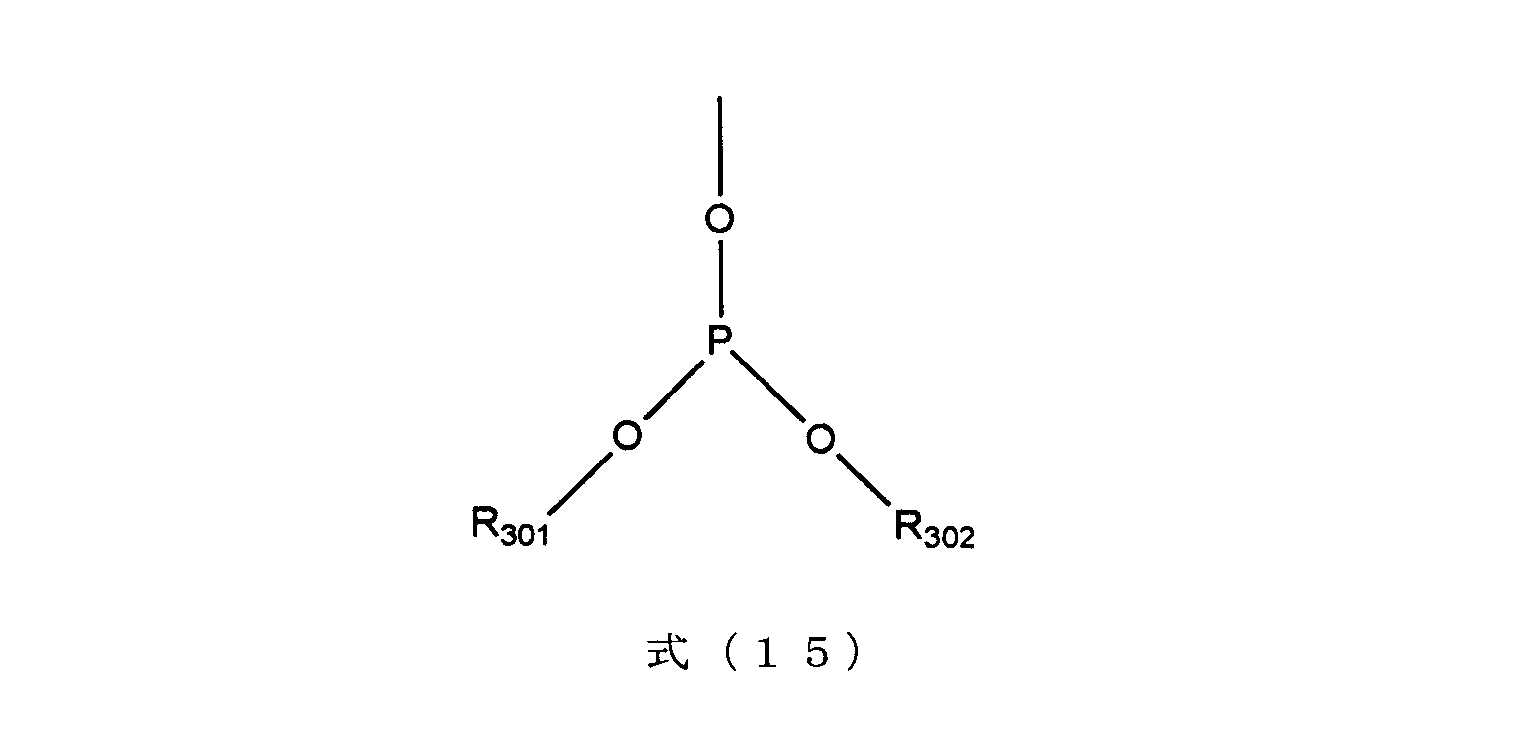
前記リン酸残基は式(14)で表され、前記亜リン酸残基は式(15)で表される付記25に記載の蓄電デバイス用セパレータの製造方法;
前記無機繊維は、アルミナ繊維、炭素繊維、又はガラス繊維である付記23乃至26のいずれかに記載の蓄電デバイス用セパレータの製造方法。
前記無機材料含有セパレータを前記溶液に接触させた状態で加熱処理を行う付記23乃至28のいずれかに記載の蓄電デバイス用セパレータの製造方法。
前記加熱処理により前記溶液の温度を70℃以上150℃以下とする付記28に記載の蓄電デバイス用セパレータの製造方法。
前記無機材料含有セパレータを前記リン酸エステル又は前記亜リン酸エステルに浸した後に前記水を加える付記23乃至29のいずれかに記載の蓄電デバイス用セパレータの製造方法。
前記無機材料含有セパレータが浸されている前記リン酸エステル又は前記亜リン酸エステルの温度を加熱により制御した状態で、前記水を加える付記30に記載の蓄電デバイス用セパレータの製造方法。
前記溶液は、さらに酸を含む付記23乃至31のいずれかに記載の蓄電デバイス用セパレータの製造方法。
前記酸は濃硫酸である付記32に記載の蓄電デバイス用セパレータの製造方法。
前記水の量は、前記リン酸エステル又は前記亜リン酸エステル100質量部に対して1質量部以上40質量部以下である付記23乃至33のいずれかに記載の蓄電デバイス用セパレータの製造方法。
付記14乃至34のいずれかに記載の製造方法により製造された蓄電デバイス用セパレータと、負極活物質を有する負極と、支持塩及び非水電解溶媒を含む電解液と、を含む蓄電デバイス。
前記負極活物質がシリコン及び酸化シリコンから選ばれる少なくとも1種を含む付記35に記載の蓄電デバイス。
前記負極活物質が、前記シリコン、前記酸化シリコン、及び炭素材料からなる付記436に記載の蓄電デバイス。
前記非水電解溶媒がフッ素化カーボネートを含む付記35乃至37のいずれかに記載の蓄電デバイス。
前記非水電解溶媒が主溶媒としてリン酸エステルを含む付記35乃至37のいずれかに記載の蓄電デバイス。
b セパレータ
c 正極
d 負極集電体
e 正極集電体
f 正極端子
g 負極端子
Claims (23)
- 無機繊維を主成分とする無機材料含有セパレータの繊維表面にあるヒドロキシ基がリン酸残基又は亜リン酸残基に置換された蓄電デバイス用セパレータ。
- 前記リン酸残基は式(6)で表され、前記亜リン酸残基は式(7)で表される請求項1に記載の蓄電デバイス用セパレータ;

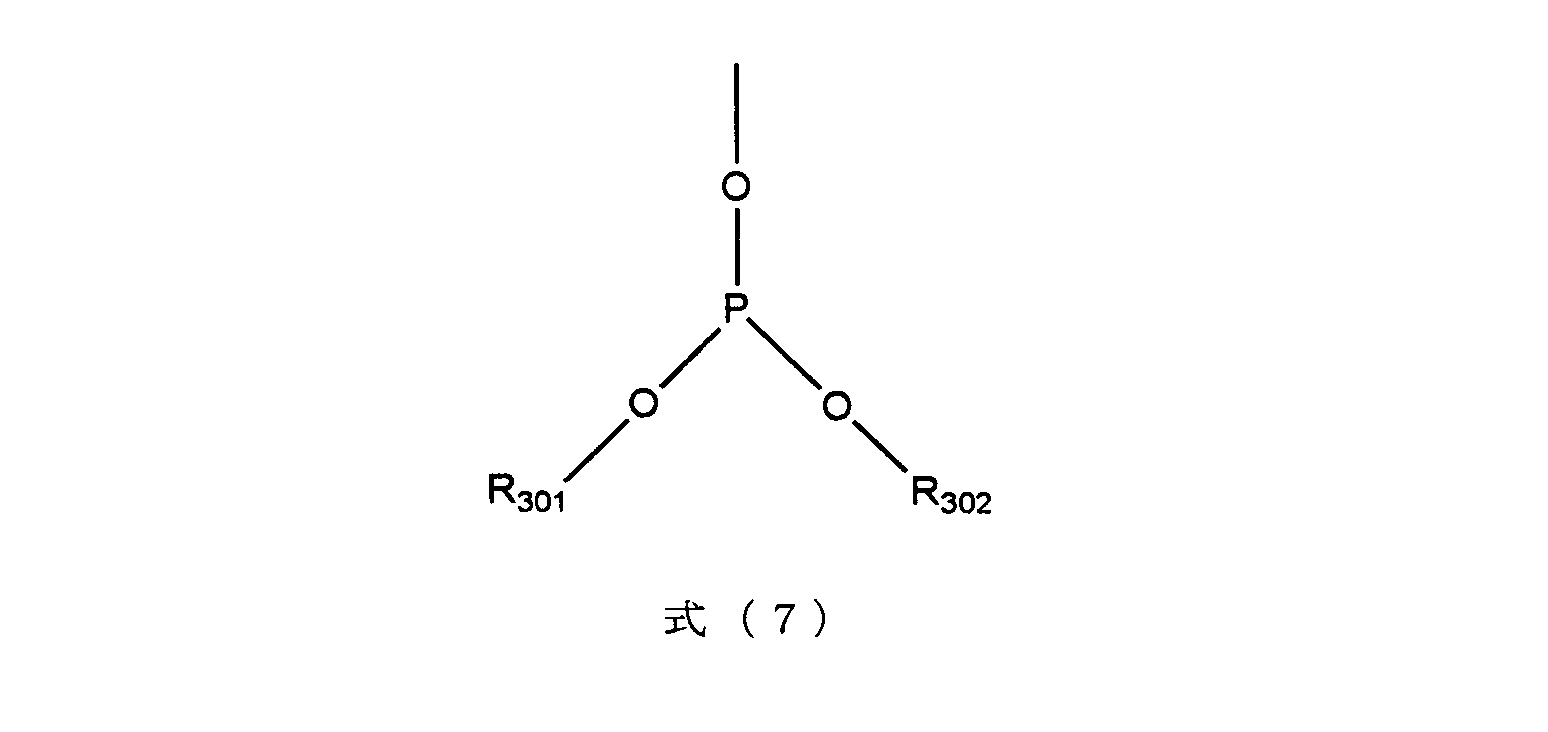
- 前記無機繊維は、アルミナ繊維、炭素繊維、又はガラス繊維である請求項1又は2に記載の蓄電デバイス用セパレータ。
- 前記無機材料含有セパレータが前記無機繊維を30質量%以上含む請求項1乃至3のいずれかに記載の蓄電デバイス用セパレータ。
- 式(1)で表されるセルロース誘導体を含むことを特徴とする蓄電デバイス用セパレータ;
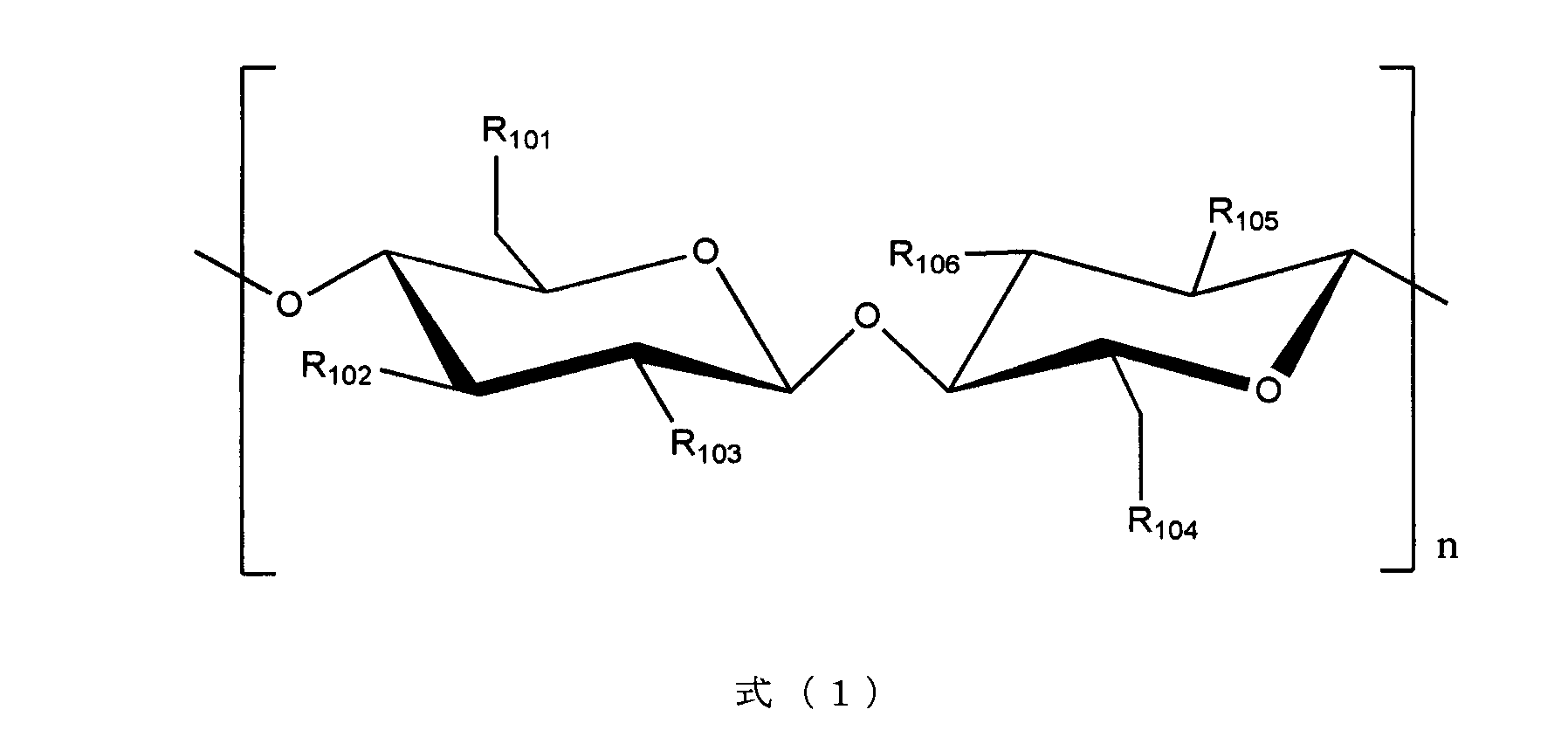
- 前記リン酸残基は式(2)で表され、前記亜リン酸残基は式(3)で表される請求項5に記載の蓄電デバイス用セパレータ;
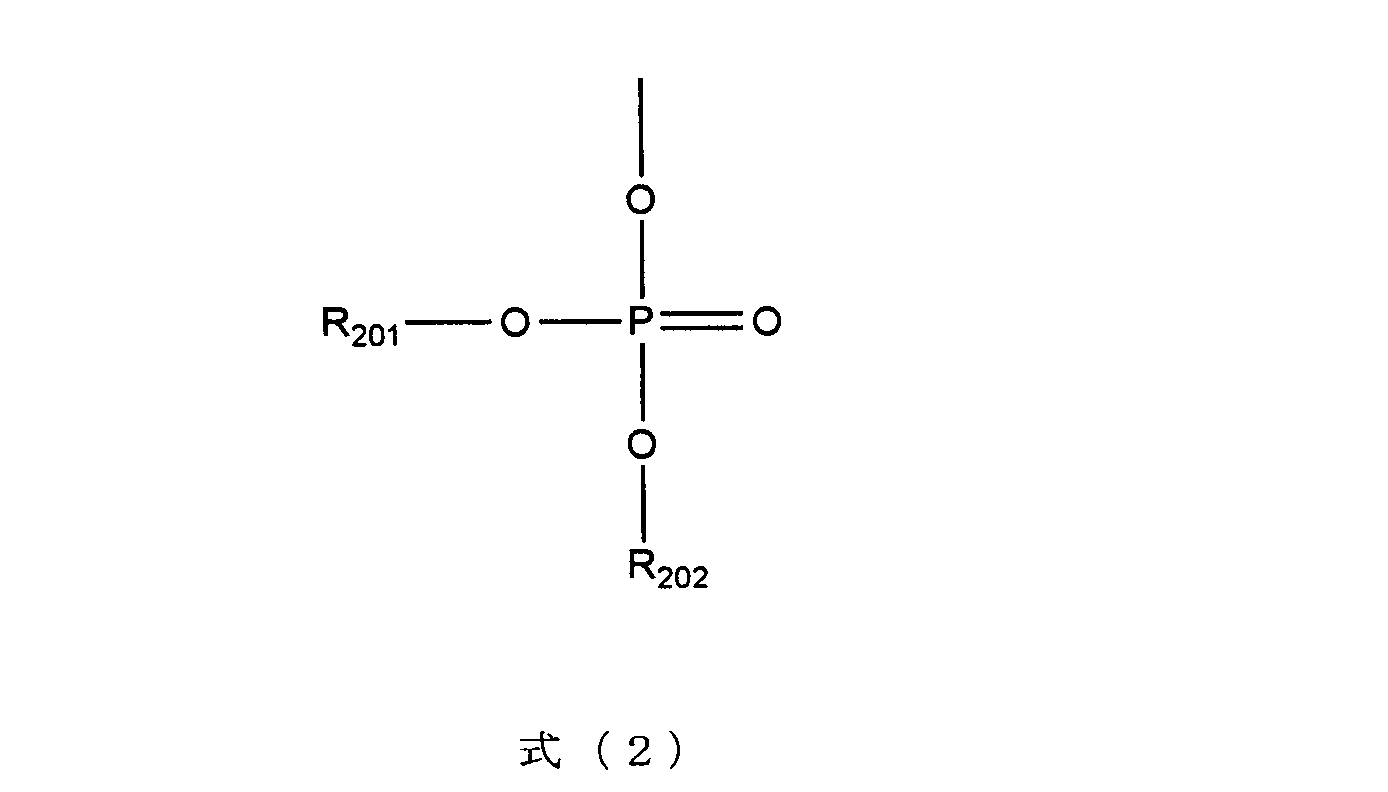
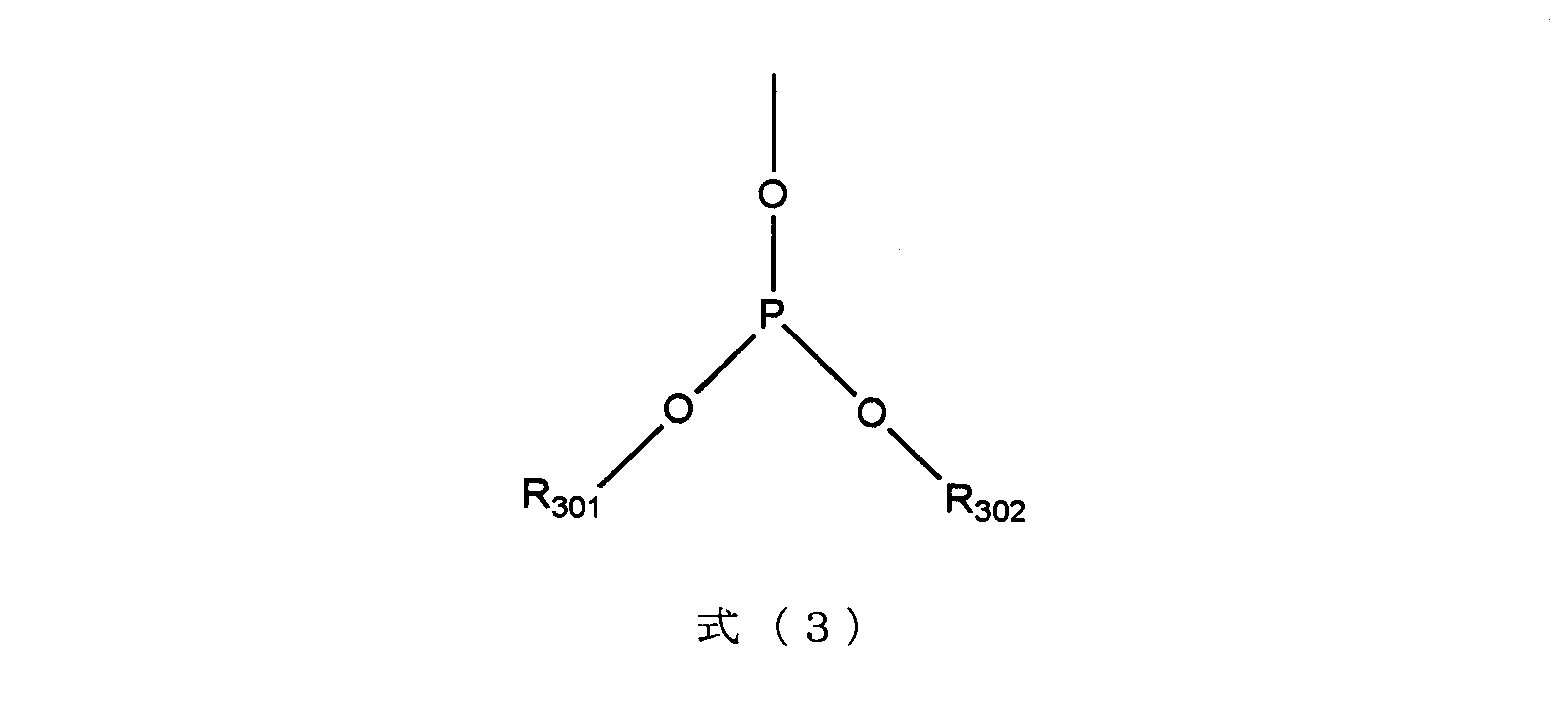
- セルロース繊維を主成分とするセルロースセパレータの繊維表面のヒドロキシ基がリン酸残基又は亜リン酸残基に置換された蓄電デバイス用セパレータ。
- 前記リン酸残基は式(4)で表され、前記亜リン酸残基は式(5)で表される請求項7に記載の蓄電デバイス用セパレータ;
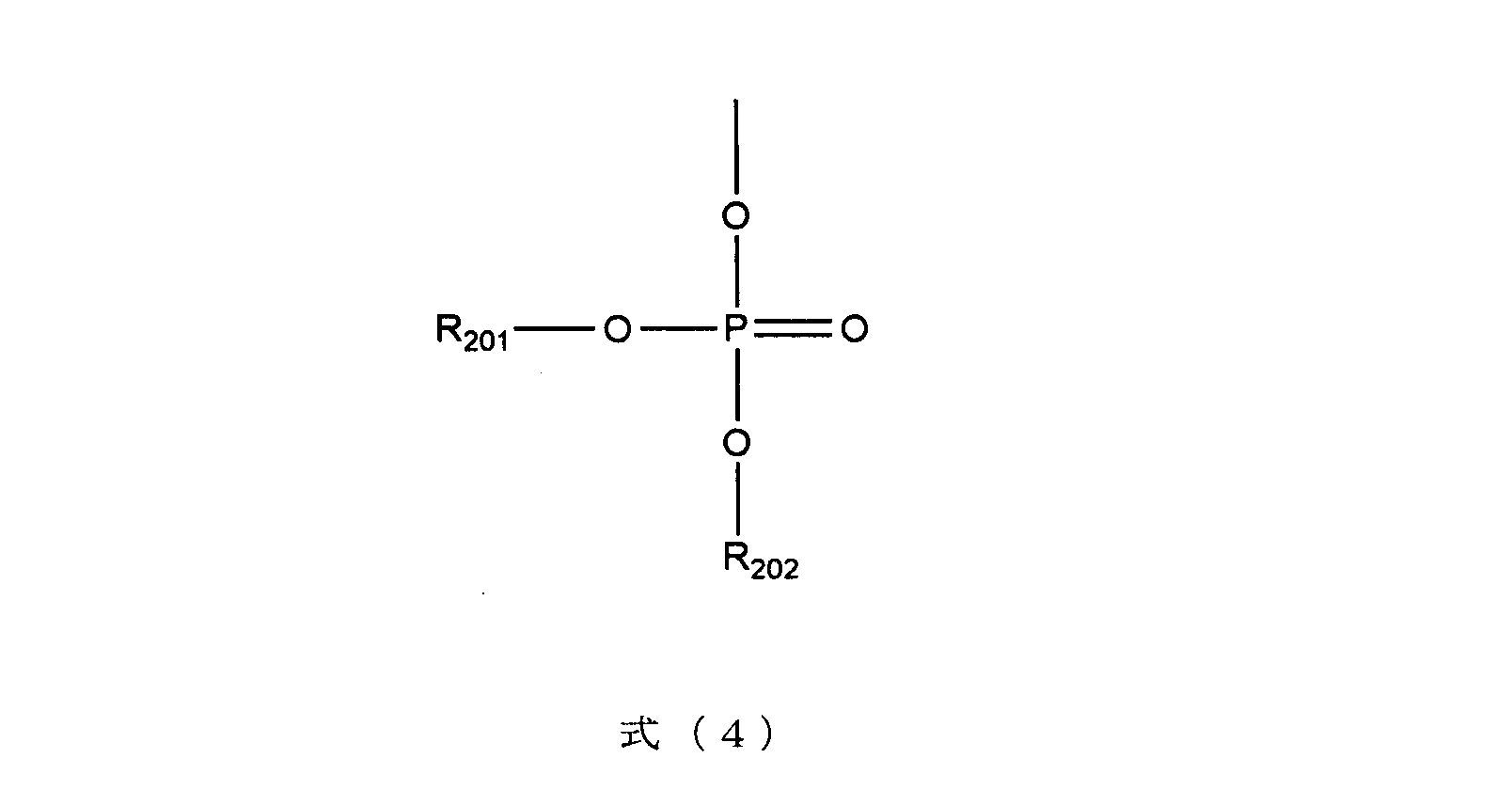
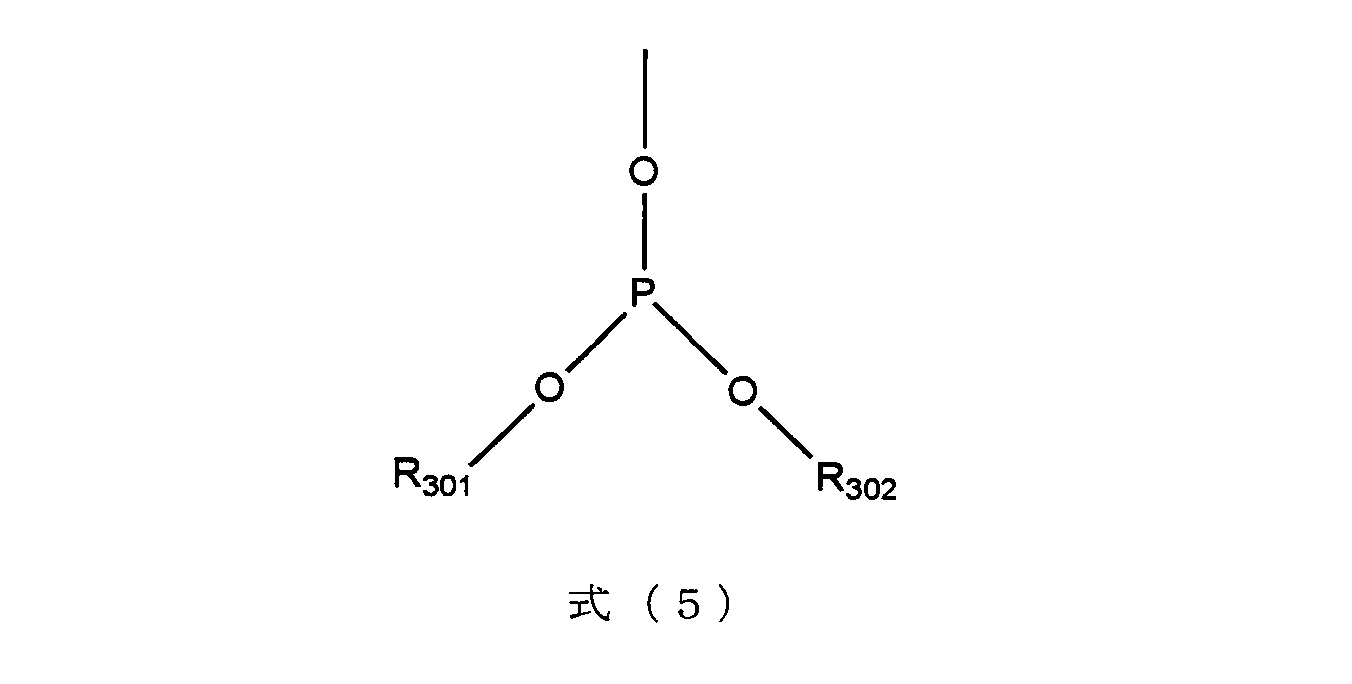
- 前記セルロースセパレータが前記セルロース繊維を30質量%以上含む請求項7又は8に記載の蓄電デバイス用セパレータ。
- 請求項1乃至9のいずれかに記載の蓄電デバイス用セパレータと、負極活物質を有する負極と、支持塩及び非水電解溶媒を含む電解液と、を含む蓄電デバイス。
- 前記負極活物質がシリコン及び酸化シリコンから選ばれる少なくとも1種を含む請求項10に記載の蓄電デバイス。
- 前記非水電解溶媒がフッ素化カーボネートを含む請求項10又は11に記載の蓄電デバイス。
- 前記非水電解溶媒がリン酸エステルを主溶媒として含む請求項10乃至12のいずれかに記載の蓄電デバイス。
- 表面にヒドロキシ基を有する無機繊維を含む無機材料含有セパレータを、リン酸エステル又は亜リン酸エステルと水とを含む溶液に接触させることを特徴とする蓄電デバイス用セパレータの製造方法。
- 前記リン酸エステルは式(12)で表され、前記亜リン酸エステルは式(13)で表される請求項14に記載の蓄電デバイス用セパレータの製造方法;

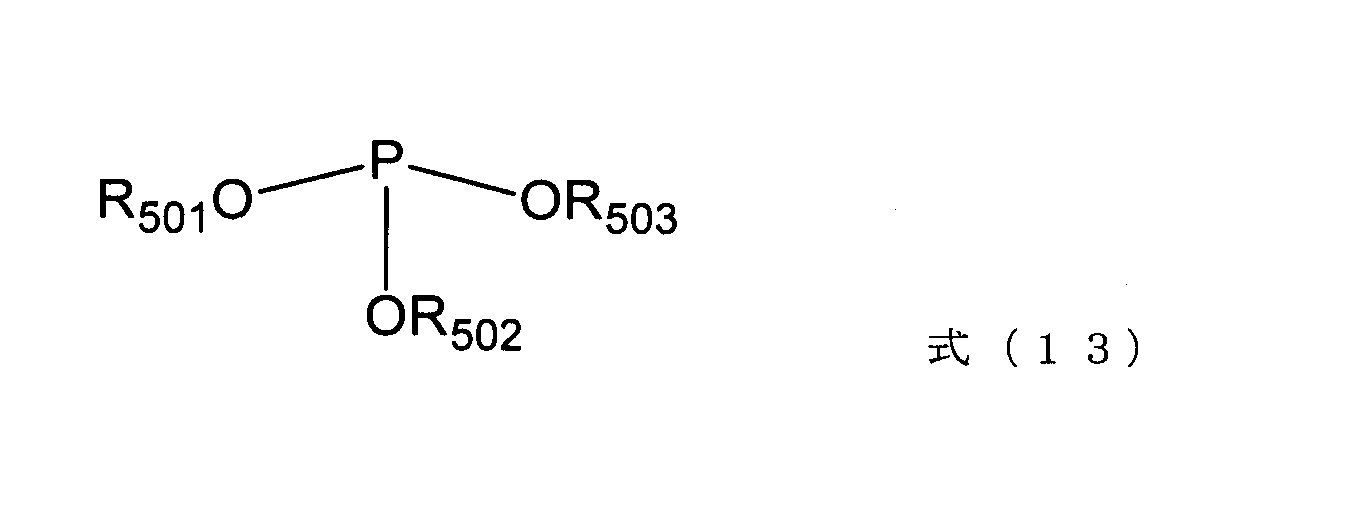
- 前記無機材料含有セパレータを前記溶液に接触させ、前記無機繊維のヒドロキシ基をリン酸残基又は亜リン酸残基に置換する請求項14又は15に記載の蓄電デバイス用セパレータの製造方法。
- 前記無機繊維は、アルミナ繊維、炭素繊維、又はガラス繊維である請求項14乃至16のいずれかに記載の蓄電デバイス用セパレータの製造方法。
- 前記無機材料含有セパレータを前記溶液に接触させた状態で加熱処理を行う請求項14乃至17のいずれかに記載の蓄電デバイス用セパレータの製造方法。
- 前記溶液は、さらに酸を含む請求項14乃至18のいずれかに記載の蓄電デバイス用セパレータの製造方法。
- セルロースを主成分とするセルロースセパレータを、リン酸エステル又は亜リン酸エステルと水とを含む溶液に接触させることを特徴とする蓄電デバイス用セパレータの製造方法。
- 前記リン酸エステルは式(8)で表され、前記亜リン酸エステルは式(9)で表される請求項20に記載の蓄電デバイス用セパレータの製造方法;


- 前記セルロースセパレータを前記溶液に接触させ、前記セルロースのヒドロキシ基をリン酸残基又は亜リン酸残基に置換する請求項20又は21に記載の蓄電デバイス用セパレータの製造方法。
- 前記セルロースセパレータを前記溶液に接触させた状態で加熱処理を行う請求項20乃至22のいずれかに記載の蓄電デバイス用セパレータの製造方法。
Priority Applications (4)
| Application Number | Priority Date | Filing Date | Title |
|---|---|---|---|
| CN2012800103558A CN103403918A (zh) | 2011-02-24 | 2012-02-21 | 蓄电装置用隔膜和蓄电装置 |
| JP2013501046A JP5962646B2 (ja) | 2011-02-24 | 2012-02-21 | 非水電解液二次電池用セパレータ及び非水電解液二次電池 |
| EP12749501.8A EP2680342B1 (en) | 2011-02-24 | 2012-02-21 | Separator for accumulators, and accumulator |
| US14/000,547 US20130330637A1 (en) | 2011-02-24 | 2012-02-21 | Separator for electric storage device and electric storage device |
Applications Claiming Priority (4)
| Application Number | Priority Date | Filing Date | Title |
|---|---|---|---|
| JP2011038317 | 2011-02-24 | ||
| JP2011-038317 | 2011-02-24 | ||
| JP2011159106 | 2011-07-20 | ||
| JP2011-159106 | 2011-07-20 |
Publications (1)
| Publication Number | Publication Date |
|---|---|
| WO2012115092A1 true WO2012115092A1 (ja) | 2012-08-30 |
Family
ID=46720869
Family Applications (1)
| Application Number | Title | Priority Date | Filing Date |
|---|---|---|---|
| PCT/JP2012/054102 Ceased WO2012115092A1 (ja) | 2011-02-24 | 2012-02-21 | 蓄電デバイス用セパレータ及び蓄電デバイス |
Country Status (5)
| Country | Link |
|---|---|
| US (1) | US20130330637A1 (ja) |
| EP (1) | EP2680342B1 (ja) |
| JP (1) | JP5962646B2 (ja) |
| CN (1) | CN103403918A (ja) |
| WO (1) | WO2012115092A1 (ja) |
Cited By (10)
| Publication number | Priority date | Publication date | Assignee | Title |
|---|---|---|---|---|
| US20150055275A1 (en) * | 2013-08-22 | 2015-02-26 | Corning Incorporated | Ceramic separator for ultracapacitors |
| US20160380311A1 (en) * | 2013-11-29 | 2016-12-29 | Gs Yuasa International Ltd. | Lead-acid battery |
| JP2017117695A (ja) * | 2015-12-25 | 2017-06-29 | 王子ホールディングス株式会社 | 電池用セパレータ塗液用増粘剤、電池用セパレータ塗液及び電池用セパレータ |
| JP2018063926A (ja) * | 2016-10-14 | 2018-04-19 | 王子ホールディングス株式会社 | 電池用セパレータ、電池及び電池用セパレータ塗液 |
| JP2018063925A (ja) * | 2016-10-14 | 2018-04-19 | 王子ホールディングス株式会社 | 電池用セパレータ、電池及び電池用セパレータ塗液 |
| JP2018063924A (ja) * | 2016-10-14 | 2018-04-19 | 王子ホールディングス株式会社 | 電池用セパレータ塗液及び電池用セパレータ |
| JP2018106845A (ja) * | 2016-12-22 | 2018-07-05 | 王子ホールディングス株式会社 | 電池用セパレータ塗液及び電池用セパレータ |
| JP2020132747A (ja) * | 2019-02-19 | 2020-08-31 | 王子ホールディングス株式会社 | 固形状体及び繊維状セルロース含有組成物 |
| JP2020132652A (ja) * | 2019-02-12 | 2020-08-31 | 王子ホールディングス株式会社 | 繊維状セルロース含有組成物、液状組成物及び成形体 |
| JP2022520082A (ja) * | 2019-02-15 | 2022-03-28 | ハイドロ-ケベック | 難燃剤を含むセルロースベースのセパレーター、および電気化学におけるその使用 |
Families Citing this family (11)
| Publication number | Priority date | Publication date | Assignee | Title |
|---|---|---|---|---|
| PL3161885T3 (pl) * | 2014-06-30 | 2021-11-22 | Basf Se | Sposób wytwarzania materiałów katodowych dla baterii litowo-jonowych |
| EP3353844B1 (en) | 2015-03-27 | 2022-05-11 | Mason K. Harrup | All-inorganic solvents for electrolytes |
| KR102635455B1 (ko) | 2016-05-20 | 2024-02-13 | 교세라 에이브이엑스 컴포넌츠 코포레이션 | 고온용 울트라커패시터 |
| MY195773A (en) | 2016-05-20 | 2023-02-11 | Kyocera Avx Components Corp | Multi-Cell Ultracapacitor |
| US10707531B1 (en) | 2016-09-27 | 2020-07-07 | New Dominion Enterprises Inc. | All-inorganic solvents for electrolytes |
| US11830672B2 (en) | 2016-11-23 | 2023-11-28 | KYOCERA AVX Components Corporation | Ultracapacitor for use in a solder reflow process |
| EP3987602A4 (en) | 2019-06-20 | 2023-06-28 | Unifrax I LLC | Lightweight nonwoven fiber mats |
| US20230231272A1 (en) * | 2020-05-26 | 2023-07-20 | Energy11 Co., Ltd. | Composite solid electrolyte separation membrane using inorganic fiber and secondary battery using the same |
| CN112582693B (zh) * | 2020-12-07 | 2021-10-22 | 界首市天鸿新材料股份有限公司 | 一种锂电池聚烯烃隔膜的阻燃化处理方法 |
| JP7483911B2 (ja) * | 2021-10-12 | 2024-05-15 | 寧徳時代新能源科技股▲分▼有限公司 | セパレーター、二次電池及び電力消費装置 |
| CN119939866B (zh) * | 2024-12-06 | 2025-11-25 | 中海储能科技(北京)有限公司 | 一种提高碳布电性能的碳布织构方法 |
Citations (9)
| Publication number | Priority date | Publication date | Assignee | Title |
|---|---|---|---|---|
| JPH07161342A (ja) * | 1993-12-13 | 1995-06-23 | Matsushita Electric Ind Co Ltd | 鉛蓄電池用セパレータ |
| JPH08306352A (ja) | 1995-05-10 | 1996-11-22 | Nippon Koudoshi Kogyo Kk | 非水系電池 |
| WO1998032184A1 (fr) * | 1997-01-16 | 1998-07-23 | Mitsubishi Paper Mills Limited | Separateur pour batteries a electrolyte non aqueux, batteries a electrolyte non aqueux l'utilisant, et procede de fabrication dudit separateur |
| JP2000048792A (ja) * | 1998-07-29 | 2000-02-18 | Mitsubishi Paper Mills Ltd | 非水電解液電池およびその製造方法 |
| JP2000173574A (ja) * | 1998-12-04 | 2000-06-23 | Mitsubishi Paper Mills Ltd | 非水電解液電池の製造方法 |
| JP2003123724A (ja) | 2001-10-11 | 2003-04-25 | Toyota Central Res & Dev Lab Inc | リチウム二次電池用セパレータおよびそれを用いたリチウム二次電池 |
| JP2004047404A (ja) | 2002-05-17 | 2004-02-12 | Shin Etsu Chem Co Ltd | 導電性珪素複合体及びその製造方法並びに非水電解質二次電池用負極材 |
| JP2004342318A (ja) * | 2002-03-22 | 2004-12-02 | Nisshinbo Ind Inc | 非水電解質二次電池の充電方法 |
| JP2010202987A (ja) * | 2009-02-27 | 2010-09-16 | Asahi Kasei Corp | 複合シート材料及びその製法 |
Family Cites Families (20)
| Publication number | Priority date | Publication date | Assignee | Title |
|---|---|---|---|---|
| US3340444A (en) * | 1964-03-03 | 1967-09-05 | Kimberly Clark Co | Electrolytic device comprising fibrous ionically permeable spacer |
| JPH07335192A (ja) * | 1994-06-02 | 1995-12-22 | Nippon Muki Co Ltd | リチウム電池用セパレータ |
| JP4437239B2 (ja) * | 1997-08-11 | 2010-03-24 | ソニー株式会社 | 非水電解質二次電池 |
| JPH11283603A (ja) * | 1998-03-30 | 1999-10-15 | Noritake Co Ltd | 電池用セパレーター及びその製造方法 |
| KR20030065089A (ko) * | 2002-01-29 | 2003-08-06 | 주식회사 뉴턴에너지 | 섬유상의 격리막 및 이를 포함하는 에너지 저장 장치 |
| JP2004146346A (ja) * | 2002-08-28 | 2004-05-20 | Nisshinbo Ind Inc | 非水電解質および非水電解質二次電池 |
| JP4403447B2 (ja) * | 2003-03-27 | 2010-01-27 | 大阪瓦斯株式会社 | 非水系二次電池 |
| JP2005078847A (ja) * | 2003-08-28 | 2005-03-24 | Mitsubishi Chemicals Corp | 二次電池用非水電解液及びそれを用いた非水系二次電池 |
| US8080335B2 (en) * | 2006-06-09 | 2011-12-20 | Canon Kabushiki Kaisha | Powder material, electrode structure using the powder material, and energy storage device having the electrode structure |
| JP4873703B2 (ja) * | 2006-07-27 | 2012-02-08 | 日本電信電話株式会社 | 電気デバイス用パッケージを備えた電気装置 |
| JP2010278015A (ja) * | 2006-09-22 | 2010-12-09 | Mitsubishi Chemicals Corp | リチウム二次電池正極材料用リチウムニッケルマンガンコバルト系複合酸化物粉体、その製造方法、及び噴霧乾燥粉体、並びにそれを用いたリチウム二次電池用正極及びリチウム二次電池 |
| CN100519594C (zh) * | 2006-12-25 | 2009-07-29 | 山东东岳神舟新材料有限公司 | 一种含氟聚合物及其作为离子交换纤维材料的应用 |
| JP4735579B2 (ja) * | 2007-03-26 | 2011-07-27 | ソニー株式会社 | 非水電解質電池 |
| JP5338041B2 (ja) * | 2007-06-05 | 2013-11-13 | ソニー株式会社 | 二次電池用負極および二次電池 |
| JP5589264B2 (ja) * | 2008-06-06 | 2014-09-17 | 三菱化学株式会社 | 非水系電解液及び非水系電解液電池 |
| EP2302714B1 (en) * | 2008-06-30 | 2016-08-03 | Daikin Industries, Ltd. | Lithium secondary cell |
| CN101320818B (zh) * | 2008-07-15 | 2010-06-09 | 山东东岳神舟新材料有限公司 | 一种纤维增强多层含氟离子交换膜 |
| CN101728504B (zh) * | 2009-12-04 | 2012-07-04 | 中国海诚工程科技股份有限公司 | 一种湿法抄造的锂离子电池隔膜柔性基材及其制造方法 |
| CN101745323B (zh) * | 2009-12-10 | 2011-04-06 | 山东东岳神舟新材料有限公司 | 一种纤维增强复合、多层全氟交联离子膜及其制备方法 |
| KR101068691B1 (ko) * | 2010-02-05 | 2011-09-29 | 한국과학기술연구원 | 셀룰로오즈 포스파이트 화합물의 제조방법 |
-
2012
- 2012-02-21 CN CN2012800103558A patent/CN103403918A/zh active Pending
- 2012-02-21 US US14/000,547 patent/US20130330637A1/en not_active Abandoned
- 2012-02-21 EP EP12749501.8A patent/EP2680342B1/en active Active
- 2012-02-21 JP JP2013501046A patent/JP5962646B2/ja active Active
- 2012-02-21 WO PCT/JP2012/054102 patent/WO2012115092A1/ja not_active Ceased
Patent Citations (9)
| Publication number | Priority date | Publication date | Assignee | Title |
|---|---|---|---|---|
| JPH07161342A (ja) * | 1993-12-13 | 1995-06-23 | Matsushita Electric Ind Co Ltd | 鉛蓄電池用セパレータ |
| JPH08306352A (ja) | 1995-05-10 | 1996-11-22 | Nippon Koudoshi Kogyo Kk | 非水系電池 |
| WO1998032184A1 (fr) * | 1997-01-16 | 1998-07-23 | Mitsubishi Paper Mills Limited | Separateur pour batteries a electrolyte non aqueux, batteries a electrolyte non aqueux l'utilisant, et procede de fabrication dudit separateur |
| JP2000048792A (ja) * | 1998-07-29 | 2000-02-18 | Mitsubishi Paper Mills Ltd | 非水電解液電池およびその製造方法 |
| JP2000173574A (ja) * | 1998-12-04 | 2000-06-23 | Mitsubishi Paper Mills Ltd | 非水電解液電池の製造方法 |
| JP2003123724A (ja) | 2001-10-11 | 2003-04-25 | Toyota Central Res & Dev Lab Inc | リチウム二次電池用セパレータおよびそれを用いたリチウム二次電池 |
| JP2004342318A (ja) * | 2002-03-22 | 2004-12-02 | Nisshinbo Ind Inc | 非水電解質二次電池の充電方法 |
| JP2004047404A (ja) | 2002-05-17 | 2004-02-12 | Shin Etsu Chem Co Ltd | 導電性珪素複合体及びその製造方法並びに非水電解質二次電池用負極材 |
| JP2010202987A (ja) * | 2009-02-27 | 2010-09-16 | Asahi Kasei Corp | 複合シート材料及びその製法 |
Non-Patent Citations (2)
| Title |
|---|
| JOURNAL OF THE ELECTROCHEMICAL SOCIETY, vol. 148, no. 10, 2001, pages A1058 - A1065 |
| See also references of EP2680342A4 |
Cited By (15)
| Publication number | Priority date | Publication date | Assignee | Title |
|---|---|---|---|---|
| WO2015026880A3 (en) * | 2013-08-22 | 2015-11-19 | Corning Incorporated | Separator based on fibrous ceramic material for ultracapacitors, edlc, hybrid capacitor, fuel cell and battery |
| US20150055275A1 (en) * | 2013-08-22 | 2015-02-26 | Corning Incorporated | Ceramic separator for ultracapacitors |
| US10121607B2 (en) | 2013-08-22 | 2018-11-06 | Corning Incorporated | Ceramic separator for ultracapacitors |
| US10096862B2 (en) * | 2013-11-29 | 2018-10-09 | Gs Yuasa International Ltd. | Lead-acid battery |
| US20160380311A1 (en) * | 2013-11-29 | 2016-12-29 | Gs Yuasa International Ltd. | Lead-acid battery |
| JP2017117695A (ja) * | 2015-12-25 | 2017-06-29 | 王子ホールディングス株式会社 | 電池用セパレータ塗液用増粘剤、電池用セパレータ塗液及び電池用セパレータ |
| JP2018063924A (ja) * | 2016-10-14 | 2018-04-19 | 王子ホールディングス株式会社 | 電池用セパレータ塗液及び電池用セパレータ |
| JP2018063925A (ja) * | 2016-10-14 | 2018-04-19 | 王子ホールディングス株式会社 | 電池用セパレータ、電池及び電池用セパレータ塗液 |
| JP2018063926A (ja) * | 2016-10-14 | 2018-04-19 | 王子ホールディングス株式会社 | 電池用セパレータ、電池及び電池用セパレータ塗液 |
| JP2018106845A (ja) * | 2016-12-22 | 2018-07-05 | 王子ホールディングス株式会社 | 電池用セパレータ塗液及び電池用セパレータ |
| JP2020132652A (ja) * | 2019-02-12 | 2020-08-31 | 王子ホールディングス株式会社 | 繊維状セルロース含有組成物、液状組成物及び成形体 |
| JP2022520082A (ja) * | 2019-02-15 | 2022-03-28 | ハイドロ-ケベック | 難燃剤を含むセルロースベースのセパレーター、および電気化学におけるその使用 |
| US12155086B2 (en) | 2019-02-15 | 2024-11-26 | HYDRO-QUéBEC | Cellulose-based separators comprising flame retardant, and uses thereof in electrochemistry |
| JP7742304B2 (ja) | 2019-02-15 | 2025-09-19 | ハイドロ-ケベック | 難燃剤を含むセルロースベースのセパレーター、および電気化学におけるその使用 |
| JP2020132747A (ja) * | 2019-02-19 | 2020-08-31 | 王子ホールディングス株式会社 | 固形状体及び繊維状セルロース含有組成物 |
Also Published As
| Publication number | Publication date |
|---|---|
| EP2680342B1 (en) | 2019-03-27 |
| JPWO2012115092A1 (ja) | 2014-07-07 |
| CN103403918A (zh) | 2013-11-20 |
| EP2680342A4 (en) | 2016-11-30 |
| JP5962646B2 (ja) | 2016-08-03 |
| EP2680342A1 (en) | 2014-01-01 |
| US20130330637A1 (en) | 2013-12-12 |
Similar Documents
| Publication | Publication Date | Title |
|---|---|---|
| JP5962646B2 (ja) | 非水電解液二次電池用セパレータ及び非水電解液二次電池 | |
| JP5962647B2 (ja) | 非水電解液二次電池用セパレータ及び非水電解液二次電池 | |
| JP6337777B2 (ja) | セパレータ、電極素子、蓄電デバイスおよび前記セパレータの製造方法 | |
| JP6079634B2 (ja) | リチウムイオン二次電池 | |
| US8859149B2 (en) | Anode for lithium ion secondary battery, lithium ion secondary battery, electric power tool, electrical vehicle, and electric power storage system | |
| JP5459448B1 (ja) | 二次電池 | |
| JP6269475B2 (ja) | 二次電池 | |
| KR20160077075A (ko) | 부극 활물질, 부극 활물질의 제조 방법, 및 리튬 이온 이차 전지 | |
| KR101440347B1 (ko) | 다층 구조의 이차전지용 음극 및 이를 포함하는 리튬 이차전지 | |
| US20140065450A1 (en) | Secondary battery, method of manufacturing the same, battery pack, and electric vehicle | |
| WO2013176275A1 (ja) | 蓄電デバイス | |
| WO2014091856A1 (ja) | セパレータ、電極素子、蓄電デバイスおよび前記セパレータの製造方法 | |
| JPWO2013176273A1 (ja) | 蓄電デバイス | |
| JP6973621B2 (ja) | リチウムイオン二次電池 | |
| JP6064540B2 (ja) | 電池用セパレータ、その製造方法、およびリチウムイオン二次電池 | |
| JP6388009B2 (ja) | 電池用セパレータ、その製造方法、およびリチウムイオン二次電池 | |
| JP2012209023A (ja) | 電池用電極群およびそれを用いた電池 | |
| JP2014116271A (ja) | セパレータ、電極素子、蓄電デバイスおよび前記セパレータの製造方法 |
Legal Events
| Date | Code | Title | Description |
|---|---|---|---|
| 121 | Ep: the epo has been informed by wipo that ep was designated in this application |
Ref document number: 12749501 Country of ref document: EP Kind code of ref document: A1 |
|
| ENP | Entry into the national phase |
Ref document number: 2013501046 Country of ref document: JP Kind code of ref document: A |
|
| WWE | Wipo information: entry into national phase |
Ref document number: 14000547 Country of ref document: US |
|
| NENP | Non-entry into the national phase |
Ref country code: DE |
|
| WWE | Wipo information: entry into national phase |
Ref document number: 2012749501 Country of ref document: EP |