WO2012118076A1 - フラックス - Google Patents
フラックス Download PDFInfo
- Publication number
- WO2012118076A1 WO2012118076A1 PCT/JP2012/054930 JP2012054930W WO2012118076A1 WO 2012118076 A1 WO2012118076 A1 WO 2012118076A1 JP 2012054930 W JP2012054930 W JP 2012054930W WO 2012118076 A1 WO2012118076 A1 WO 2012118076A1
- Authority
- WO
- WIPO (PCT)
- Prior art keywords
- flux
- solder
- solder powder
- residue
- soldering
- Prior art date
- Legal status (The legal status is an assumption and is not a legal conclusion. Google has not performed a legal analysis and makes no representation as to the accuracy of the status listed.)
- Ceased
Links
Classifications
-
- B—PERFORMING OPERATIONS; TRANSPORTING
- B23—MACHINE TOOLS; METAL-WORKING NOT OTHERWISE PROVIDED FOR
- B23K—SOLDERING OR UNSOLDERING; WELDING; CLADDING OR PLATING BY SOLDERING OR WELDING; CUTTING BY APPLYING HEAT LOCALLY, e.g. FLAME CUTTING; WORKING BY LASER BEAM
- B23K35/00—Rods, electrodes, materials, or media, for use in soldering, welding, or cutting
- B23K35/22—Rods, electrodes, materials, or media, for use in soldering, welding, or cutting characterised by the composition or nature of the material
- B23K35/36—Selection of non-metallic compositions, e.g. coatings or fluxes; Selection of soldering or welding materials, conjoint with selection of non-metallic compositions, both selections being of interest
- B23K35/3612—Selection of non-metallic compositions, e.g. coatings or fluxes; Selection of soldering or welding materials, conjoint with selection of non-metallic compositions, both selections being of interest with organic compounds as principal constituents
- B23K35/3613—Polymers, e.g. resins
-
- B—PERFORMING OPERATIONS; TRANSPORTING
- B23—MACHINE TOOLS; METAL-WORKING NOT OTHERWISE PROVIDED FOR
- B23K—SOLDERING OR UNSOLDERING; WELDING; CLADDING OR PLATING BY SOLDERING OR WELDING; CUTTING BY APPLYING HEAT LOCALLY, e.g. FLAME CUTTING; WORKING BY LASER BEAM
- B23K35/00—Rods, electrodes, materials, or media, for use in soldering, welding, or cutting
- B23K35/02—Rods, electrodes, materials, or media, for use in soldering, welding, or cutting characterised by mechanical features, e.g. shape
- B23K35/0222—Rods, electrodes, materials, or media, for use in soldering, welding, or cutting characterised by mechanical features, e.g. shape for use in soldering or brazing
- B23K35/0244—Powders, particles or spheres; Preforms made therefrom
-
- B—PERFORMING OPERATIONS; TRANSPORTING
- B23—MACHINE TOOLS; METAL-WORKING NOT OTHERWISE PROVIDED FOR
- B23K—SOLDERING OR UNSOLDERING; WELDING; CLADDING OR PLATING BY SOLDERING OR WELDING; CUTTING BY APPLYING HEAT LOCALLY, e.g. FLAME CUTTING; WORKING BY LASER BEAM
- B23K35/00—Rods, electrodes, materials, or media, for use in soldering, welding, or cutting
- B23K35/02—Rods, electrodes, materials, or media, for use in soldering, welding, or cutting characterised by mechanical features, e.g. shape
- B23K35/0222—Rods, electrodes, materials, or media, for use in soldering, welding, or cutting characterised by mechanical features, e.g. shape for use in soldering or brazing
- B23K35/0244—Powders, particles or spheres; Preforms made therefrom
- B23K35/025—Pastes, creams or slurries
-
- B—PERFORMING OPERATIONS; TRANSPORTING
- B23—MACHINE TOOLS; METAL-WORKING NOT OTHERWISE PROVIDED FOR
- B23K—SOLDERING OR UNSOLDERING; WELDING; CLADDING OR PLATING BY SOLDERING OR WELDING; CUTTING BY APPLYING HEAT LOCALLY, e.g. FLAME CUTTING; WORKING BY LASER BEAM
- B23K35/00—Rods, electrodes, materials, or media, for use in soldering, welding, or cutting
- B23K35/22—Rods, electrodes, materials, or media, for use in soldering, welding, or cutting characterised by the composition or nature of the material
- B23K35/36—Selection of non-metallic compositions, e.g. coatings or fluxes; Selection of soldering or welding materials, conjoint with selection of non-metallic compositions, both selections being of interest
- B23K35/3601—Selection of non-metallic compositions, e.g. coatings or fluxes; Selection of soldering or welding materials, conjoint with selection of non-metallic compositions, both selections being of interest with inorganic compounds as principal constituents
-
- B—PERFORMING OPERATIONS; TRANSPORTING
- B23—MACHINE TOOLS; METAL-WORKING NOT OTHERWISE PROVIDED FOR
- B23K—SOLDERING OR UNSOLDERING; WELDING; CLADDING OR PLATING BY SOLDERING OR WELDING; CUTTING BY APPLYING HEAT LOCALLY, e.g. FLAME CUTTING; WORKING BY LASER BEAM
- B23K35/00—Rods, electrodes, materials, or media, for use in soldering, welding, or cutting
- B23K35/22—Rods, electrodes, materials, or media, for use in soldering, welding, or cutting characterised by the composition or nature of the material
- B23K35/36—Selection of non-metallic compositions, e.g. coatings or fluxes; Selection of soldering or welding materials, conjoint with selection of non-metallic compositions, both selections being of interest
- B23K35/362—Selection of compositions of fluxes
Definitions
- the present invention relates to a flux mixed with solder powder, and more particularly, to a flux that has an effect of preventing the precipitation of solder powder and can realize no residue.
- flux used for soldering removes metal oxides present on the surface of the solder and the metal to be soldered chemically at the temperature at which the solder melts, and moves the metal element at the boundary between the two.
- the flux that has the effect of enabling an intermetallic compound is formed between the solder and the metal surface to be soldered, and a strong bond can be obtained.
- Solder paste is a composite material obtained by mixing solder powder and flux.
- the solder paste is applied to a soldered portion such as an electrode or a terminal of a board such as a printed board by a printing method or a discharge method.
- Components are mounted on the soldering portion to which the solder paste is applied, and the solder is melted by heating the substrate in a heating furnace called a reflow furnace to melt the solder.
- the flux used for the solder paste is a mixture of rosin for removing the oxide film on the metal surface, solder powder and the flux are mixed uniformly, and then the solder powder is prevented from settling due to the difference in specific gravity.
- a thixotropic agent for maintaining the solder paste at an appropriate viscosity, an activator for improving the cleaning ability and wettability, a solvent having solubility in solid content such as rosin, and the like are added.
- the above-described flux component particularly the thixotropic agent, contains a component that does not decompose or evaporate by heating during soldering and remains as a flux residue around the soldered portion after soldering.
- the peripheral area including the soldered part of the board after soldering is intended to ensure reliability by preventing the function of the board from being damaged by the influence of water and dust.
- the entire substrate may be coated with a resin material.
- the resin coating material and the flux residue may be mixed to inhibit the curing of the resin coating material.
- the resin coating material may be insufficiently cured at the boundary between the flux residue and the flux residue. If the resin coating material is left with insufficient curing, problems such as deterioration of the insulation resistance between the electrodes are exposed, adversely affecting the reliability after soldering.
- solder paste in which a flux of a component that is substantially residue-free after soldering is mixed (see, for example, Patent Document 1).
- thixotropic agent conventionally used as an anti-settling agent
- hydrogenated castor oil and fatty acid bisamide which are effective as an anti-settling agent, but they are not decomposed by heating, and are soldered as a residue. It will remain in the vicinity.
- the higher fatty acid amide added to the flux as a thixotropic agent in Patent Document 1 is excellent in fluidity improving characteristics as a viscosity modifier, and has the effect of decomposing without heating to be residue-free.
- the effect of solder powder as an anti-settling agent is poor.
- An object of the present invention is to provide a flux that is capable of preventing the settling of solder powder, is decomposed by heating during soldering, becomes non-residue, and does not hinder the wettability of the solder.
- the present inventors have focused on polymers having fluidity-improving properties, found a component that has the effect of preventing the precipitation of solder powder and decomposes by heating, and applied this to the flux to inhibit solderability. It has been found that no residue can be realized without using the
- the present invention relates to a flux that contains a methacrylic acid polymer in an amount that is prevented from settling in a normal temperature range and decomposes or evaporates in the heating process during soldering in a flux that is mixed with solder powder to form a solder paste. is there.
- the methacrylic acid polymer is preferably a polyalkyl methacrylate having an alkyl group, and the addition amount of the polyalkyl methacrylate is preferably 0.1% or more and less than 1.0%. % Is% by mass unless otherwise specified. Moreover, it is preferable to further include a solvent having at least three OH groups.
- solder paste when solder paste is produced by mixing with solder powder, the settling of solder powder can be prevented. Moreover, it is decomposed by heating at the time of soldering, and the flux residue does not remain, so that no residue can be realized. Furthermore, it does not hinder solderability.
- the flux of the present embodiment is mixed with solder powder to generate a solder paste.
- the flux of the present embodiment includes a methacrylic acid polymer as a thixotropic agent that prevents sedimentation of the solder powder.
- a methacrylic acid polymer As the methacrylic acid polymer, polyalkyl methacrylate having an alkyl group is preferable.
- the alloy composition of the solder powder to be mixed is not particularly limited.
- solder paste mixed with the flux added with the polyalkylmethacrylate and the solder powder prevents the solder powder from being settled at room temperature such as room temperature, and the separation of the solder powder and the flux is suppressed.
- Polyalkylmethacrylate decomposes and evaporates at the heating temperature during soldering.
- the polyalkyl methacrylate decomposes during the heating process during soldering in the reflow furnace, so that the flux is reduced after soldering. There is virtually no residue and no residue.
- the amount of polyalkyl methacrylate added is preferably 0.1% or more and less than 1.0%.
- the flux of the present embodiment preferably contains a solvent having at least three OH groups in consideration of solder wettability.
- the addition of polyalkyl methacrylate prevents the solder powder from settling as described above. On the other hand, it does not hinder the wettability of the solder.
- the flux of the present embodiment contains polyalkyl methacrylate as a thixotropic agent that prevents the solder powder from settling when mixed with the solder powder and thermally decomposes during soldering heating. Further, as other components of the flux, a solvent having at least three OH groups is included.
- the solder paste of this embodiment is generated by mixing the above-described flux and solder powder.
- the inside of the reflow furnace is replaced with nitrogen during heating, thereby realizing good solderability and no residue.
- polyalkyl methacrylate also has an effect as a viscosity modifier, but in this example, it is added for the purpose of preventing sedimentation.
- Volatile thickeners are added to increase the viscosity of the solder paste and do not contribute to preventing the solder powder from settling.
- Trimethylolpropane has OH groups and is added as a viscosity modifier and activator.
- Stearic acid amide is added as a viscosity modifier.
- 1,2,6-hexanetriol has an OH group and is added as an activator and solvent.
- 2-phenoxyethanol is added as a solvent.
- Diethylamine hydrobromide is added as an activator.
- Test method (1) Confirmation of solder powder settling prevention Solder paste was left to stand for 12 hours (hr) in an environment of 35 ° C. to confirm the settling degree of the solder powder. (2) Reflow performance confirmation Solder paste is printed on a copper-plated Ni-plated substrate, the paste is heated in an atmosphere with an oxygen concentration of 100 PPM or less, the solder is dissolved for 60 seconds, and then cooled to solidify the solder. The residue of the flux residue and the spreadability of the solder were confirmed with the naked eye.
- Example 1 and Comparative Example 1 From the results of Example 1 and Comparative Example 1 shown above, it can be seen that the addition of polyalkyl methacrylate exhibits the effect of preventing the precipitation of solder powder at room temperature. From the results of Example 1 and Comparative Example 2, it can be seen that the addition of polyalkyl methacrylate does not inhibit the wettability of the solder and does not inhibit the solderability. Furthermore, from the results of Example 1, it can be seen that the addition of 1,2,6-hexanetriol having an OH group and the addition of a trace amount of a hydrohalide further improve the solderability.
- Test method (1) Confirmation of solder powder settling prevention Solder paste was left to stand for 12 hours (hr) in an environment of 35 ° C. to confirm the settling degree of the solder powder. (2) Reflow performance confirmation Solder paste is printed on a copper-plated Ni-plated substrate, the paste is heated in an atmosphere with an oxygen concentration of 100 PPM or less, the solder is dissolved for 60 seconds, and then cooled to solidify the solder. The residue of the flux residue and the spreadability of the solder were confirmed with the naked eye.
- polyalkyl methacrylate is added at 0.1% to less than 1.0% in order to demonstrate the effect of preventing the precipitation of solder powder by adding polyalkyl methacrylate to the flux and to have no residue during reflow. It turned out to be preferable.
- polyalkylmethacrylate when used as a thixotropic agent, it has the effect of highly preventing the settling of the solder powder that occurs when the solder powder and the flux are mixed. It can also be supplied by discharging after being packed in a syringe or by an inkjet method.
- the addition of polyalkylmethacrylate exceeding the above-mentioned addition amount has both the effect as a viscosity modifier and the anti-settling effect of solder powder, so no residue is required.
- the amount of polyalkyl methacrylate added is not limited to the amount described above.
- the flux of the present invention can be applied to a field where appearance after soldering is required in addition to reliability, because it can prevent the solder powder from settling and can be free of residue after soldering.
Landscapes
- Engineering & Computer Science (AREA)
- Mechanical Engineering (AREA)
- Chemical & Material Sciences (AREA)
- Inorganic Chemistry (AREA)
- Electric Connection Of Electric Components To Printed Circuits (AREA)
Abstract
はんだ粉末の沈降防止性があり、はんだ付け時の加熱で分解して無残渣となると共に、はんだの濡れ性を阻害しないフラックスを提供する。 はんだ粉末と混合されてソルダペーストを生成するフラックスにおいて、常温域ではんだ粉末の沈降を防止し、はんだ付け時の加熱過程で分解または蒸発する量のメタクリル酸重合体を含む。メタクリル酸重合体としては、アルキル基を持つポリアルキルメタクリレートが好ましく、ポリアルキルメタクリレートの添加量は、0.1質量%以上~1.0質量%未満とすることが好ましい。また、OH基を少なくとも3つ以上持つ溶剤を更に含むことが好ましい。
Description
本発明は、はんだ粉末と混合されるフラックスに関し、特に、はんだ粉末の沈降防止効果を持ち無残渣を実現できるフラックスに関する。
一般的に、はんだ付けに用いられるフラックスは、はんだが溶解する温度にて、はんだ及びはんだ付け対象の金属表面に存在する金属酸化物を化学的に除去し、両者の境界で金属元素の移動を可能にする効能を持ち、フラックスを使用することで、はんだとはんだ付け対象の金属表面との間に金属間化合物を形成させて、強固な接合が得られるようになる。
ソルダペーストは、はんだ粉末とフラックスとを混合させて得られた複合材料である。ソルダペーストは、プリント基板などの基板の電極や端子等のはんだ付け部に、印刷法や吐出法により塗布される。ソルダペーストが塗布されたはんだ付け部には部品が搭載され、リフロー炉と称される加熱炉で基板を加熱してはんだを溶融させて、はんだ付けが行われる。
ソルダペーストに使用するフラックスには、金属表面の酸化膜を除去するためのロジン、はんだ粉末とフラックスを均一に混和させた後、比重差によってこれらが分離してはんだ粉末が沈降するのを抑制するための沈降防止効果を有すると共に、ソルダペーストを適度な粘度に保つためのチキソ剤、洗浄能力や濡れ性を向上させる活性剤、ロジン等の固形分に対する可溶性を有する溶剤等が添加されている。
上述したフラックスの成分の特にチキソ剤には、はんだ付けの加熱によって分解、蒸発しない成分が含まれ、はんだ付け後にフラックス残渣としてはんだ付け部の周辺に残留していた。
さて、自動車に搭載する電子機器等では、水や埃の影響で基板の機能が損なわれないようにして、信頼性を確保することを目的に、はんだ付け後の基板のはんだ付け部を含む周辺あるいは基板全体に、樹脂材料によるコーティングが行われる場合がある。
その際、はんだ付け部にはんだ付け後のフラックス残渣があると、フラックス残渣と樹脂コート材との相性によっては、樹脂コート材とフラックス残渣が混ざって樹脂コート材の硬化阻害が起こり、樹脂コート材とフラックス残渣との境界で樹脂コート材の硬化が不十分になることがある。樹脂コート材の硬化が不十分なままで放置されると、電極間の絶縁抵抗が劣化する等の問題が露呈し、はんだ付け後の信頼性に悪影響を与える。
この解決策として、従来は樹脂コート材とフラックス残渣の相性を確認して、最適な組み合わせを検討するか、もしくは樹脂の硬化を阻害するフラックス残渣を洗浄除去する方法が取られてきた。しかし、これらの解決策は、何れもコストと時間を要するものとなっている。
そこで、はんだ付け後に実質的に無残渣となる成分のフラックスが混合されたソルダペーストが提案されている(例えば、特許文献1参照)。
はんだ付け後の基板を洗浄せずに樹脂コートを行う場合、フラックス残渣との境界付近で樹脂材料の硬化阻害を起こさせないためには、はんだ付け後のフラックス残渣の残留量をゼロにする必要がある。しかし、ソルダペーストに使用される従来のフラックスの成分では、はんだ粉末とフラックスを混合した時に起こるはんだ粉末の沈降を抑制するチキソ剤が、加熱時に分解しないために、はんだ付け後の無残渣を実現することができなかった。
例えば、沈降防止剤として従来から使用されてきたチキソ剤に、硬化ヒマシ油や脂肪酸ビスアマイドがあり、これらは沈降防止剤としての効果はあるが、いずれも加熱によって分解せず、残渣としてはんだ付け部周辺に残留してしまう。
一方、特許文献1においてチキソ剤としてフラックスに添加される高級脂肪酸アマイドは、粘性調整剤としての流動性改善特性に優れ、加熱時に分解して無残渣となる効果がある。しかし、はんだ粉末の沈降防止剤としての効果は乏しい。
本発明は、はんだ粉末の沈降防止性があり、はんだ付け時の加熱で分解して無残渣となると共に、はんだの濡れ性を阻害しないフラックスを提供することを目的とする。
本発明者らは、流動性改善特性を持つポリマーに着目し、はんだ粉末の沈降防止効果を持ち、かつ、加熱によって分解する成分を見出し、これをフラックスに適用することで、はんだ付け性を阻害せずに無残渣を実現できることを見出した。
本発明は、はんだ粉末と混合されてソルダペーストを生成するフラックスにおいて、常温域ではんだ粉末の沈降を防止し、はんだ付け時の加熱過程で分解または蒸発する量のメタクリル酸重合体を含むフラックスである。
メタクリル酸重合体としては、アルキル基を持つポリアルキルメタクリレートが好ましく、ポリアルキルメタクリレートの添加量は、0.1%以上~1.0%未満とすることが好ましい。なお、%は、特に指定しない限り質量%である。また、OH基を少なくとも3つ以上持つ溶剤を更に含むことが好ましい。
本発明のフラックスでは、はんだ粉末と混合してソルダペーストを生成すると、はんだ粉末の沈降を防止することができる。また、はんだ付け時の加熱で分解してフラックス残渣が残留せず、無残渣を実現することができる。更に、はんだ付け性を阻害しない。
本実施の形態のフラックスは、はんだ粉末と混合されてソルダペーストを生成する。本実施の形態のフラックスは、はんだ粉末の沈降を防止するチキソ剤として、メタクリル酸重合体を含む。メタクリル酸重合体としては、アルキル基をもったポリアルキルメタクリレートが好ましい。混合されるはんだ粉末の合金組成は特に制限されない。
ポリアルキルメタクリレートが添加されたフラックスと、はんだ粉末が混合されたソルダペーストでは、室温等の常温域でのはんだ粉末の沈降が防止され、はんだ粉末とフラックスとの分離が抑制される。
ポリアルキルメタクリレートは、はんだ付け時の加熱温度で分解して蒸発する。これにより、ポリアルキルメタクリレートが添加されたフラックスと、はんだ粉末が混合されたソルダペーストでは、リフロー炉でのはんだ付け時の加熱過程で、ポリアルキルメタクリレートが分解することで、はんだ付け後にはフラックスが実質的に残らず無残渣となる。
そして、はんだ付け時の加熱過程で、ポリアルキルメタクリレートが分解に要する時間が、ポリアルキルメタクリレートを添加する量によって変化する。このため、はんだ付け時の加熱過程で、ポリアルキルメタクリレートの分解に要する時間を考慮して、ポリアルキルメタクリレートの添加量は、0.1%以上~1.0%未満であることが好ましい。
また、本実施の形態のフラックスは、はんだの濡れ性を考慮して、OH基を最低3つ以上持つ溶剤を含むことが好ましい。ポリアルキルメタクリレートの添加は、上述したように、はんだ粉末の沈降を防止する。一方で、はんだの濡れ性を阻害しない。
このように、本実施の形態のフラックスは、はんだ粉末と混合されると、はんだ粉末の沈降を防止し、はんだ付けの加熱時には熱分解するチキソ剤として、ポリアルキルメタクリレートを含む。また、フラックスの他の成分として、OH基を最低3つ以上持つ溶剤を含む。
本実施の形態のソルダペーストは、上述したフラックスとはんだ粉末を混合して生成される。そして、本実施の形態のソルダペーストを使用したはんだ付けの過程で、加熱時はリフロー炉内を窒素置換することで、良好なはんだ付け性と無残渣を実現する。
以下の各表に示す組成で実施例と比較例のフラックスを調合し、実施例及び比較例のフラックスを使用してソルダペーストを調合して、ポリアルキルメタクリレートの添加の有無とはんだ粉末の沈降防止の関係、ポリアルキルメタクリレートの添加による濡れ性への影響を比較した。また、ポリアルキルメタクリレートを添加する量と残渣の関係について比較した。
<ポリアルキルメタクリレートの添加の有無と沈降防止及び濡れ性の関係>
以下の表1に示す組成で実施例と比較例のフラックスを調合し、はんだ粉末(Sn-3Ag-0.5Cu 粒度25~36μm)が89%になるようにソルダペーストを調合した。
以下の表1に示す組成で実施例と比較例のフラックスを調合し、はんだ粉末(Sn-3Ag-0.5Cu 粒度25~36μm)が89%になるようにソルダペーストを調合した。

ここで、ポリアルキルメタクリレートは、粘性調整剤としての効果も有するが、本例では、沈降防止を目的として添加される。揮発性増粘剤は、ソルダペーストの粘度を上げるために添加され、はんだ粉末の沈降防止には寄与しない。トリメチロールプロパンはOH基を持ち、粘性調整剤及び活性剤として添加される。ステアリンン酸アミドは、粘性調整剤として添加される。
1,2,6-ヘキサントリオールはOH基を持ち、活性剤及び溶剤として添加される。2-フェノキシエタノールは、溶剤として添加される。ジエチルアミン臭化水素酸塩は、活性剤として添加される。
・試験方法
(1)はんだ粉末沈降防止確認
ソルダペーストを35℃の環境で12時間(hr)放置し、はんだ粉末の沈降度を確認した。
(2)リフロー性能確認
ソルダペーストを銅下地のNiメッキ基板上に印刷供給して、酸素濃度100PPM以下の雰囲気にてペーストを加熱し、はんだを60秒間溶解させ、その後冷却してはんだを凝固させ、肉眼でフラックス残渣の残留度とはんだの広がり性を確認した。
(1)はんだ粉末沈降防止確認
ソルダペーストを35℃の環境で12時間(hr)放置し、はんだ粉末の沈降度を確認した。
(2)リフロー性能確認
ソルダペーストを銅下地のNiメッキ基板上に印刷供給して、酸素濃度100PPM以下の雰囲気にてペーストを加熱し、はんだを60秒間溶解させ、その後冷却してはんだを凝固させ、肉眼でフラックス残渣の残留度とはんだの広がり性を確認した。
・結果
(1)はんだ粉末沈降防止確認
実施例1:はんだ粉末が沈降を起こした様子は伺えなかった。
比較例1:はんだ粉末は沈降を起こし、ペースト表面はフラックスが湧き出していた。
比較例2:はんだ粉末が沈降を起こした様子は伺えなかった。
(2)リフロー性能確認
実施例1:残留するフラックス残渣はなかった。また、はんだはNiメッキパターンの全面を覆っていた。
比較例1:残留するフラックス残渣はなかった。はんだはNiメッキパターンで一部弾かれていたが、パターン面積の50%の濡れを示した。
比較例2:残留するフラックス残渣はなかった。はんだはNiメッキパターンで完全に弾かれ、パターン面積の30%の濡れしか示さなかった。
(1)はんだ粉末沈降防止確認
実施例1:はんだ粉末が沈降を起こした様子は伺えなかった。
比較例1:はんだ粉末は沈降を起こし、ペースト表面はフラックスが湧き出していた。
比較例2:はんだ粉末が沈降を起こした様子は伺えなかった。
(2)リフロー性能確認
実施例1:残留するフラックス残渣はなかった。また、はんだはNiメッキパターンの全面を覆っていた。
比較例1:残留するフラックス残渣はなかった。はんだはNiメッキパターンで一部弾かれていたが、パターン面積の50%の濡れを示した。
比較例2:残留するフラックス残渣はなかった。はんだはNiメッキパターンで完全に弾かれ、パターン面積の30%の濡れしか示さなかった。
以上に示す実施例1と比較例1の結果から、ポリアルキルメタクリレートの添加により、常温下でのはんだ粉末の沈降防止効果が発揮されることが判る。また、実施例1と比較例2の結果から、ポリアルキルメタクリレートの添加は、はんだの濡れ性を阻害せず、はんだ付け性を阻害しないことが判る。更に、実施例1の結果から、OH基を持つ1,2,6-ヘキサントリオールの添加、及び微量のハロゲン化水素酸塩の添加は、はんだ付け性を更に向上させることが判る。
<ポリアルキルメタクリレートを添加する量と残渣の関係>
以下の表2に示す組成で実施例と比較例のフラックスを調合し、はんだ粉末(Sn-3Ag-0.5Cu 粒度25~36μm)が89%になるようにソルダペーストを調合した。
以下の表2に示す組成で実施例と比較例のフラックスを調合し、はんだ粉末(Sn-3Ag-0.5Cu 粒度25~36μm)が89%になるようにソルダペーストを調合した。
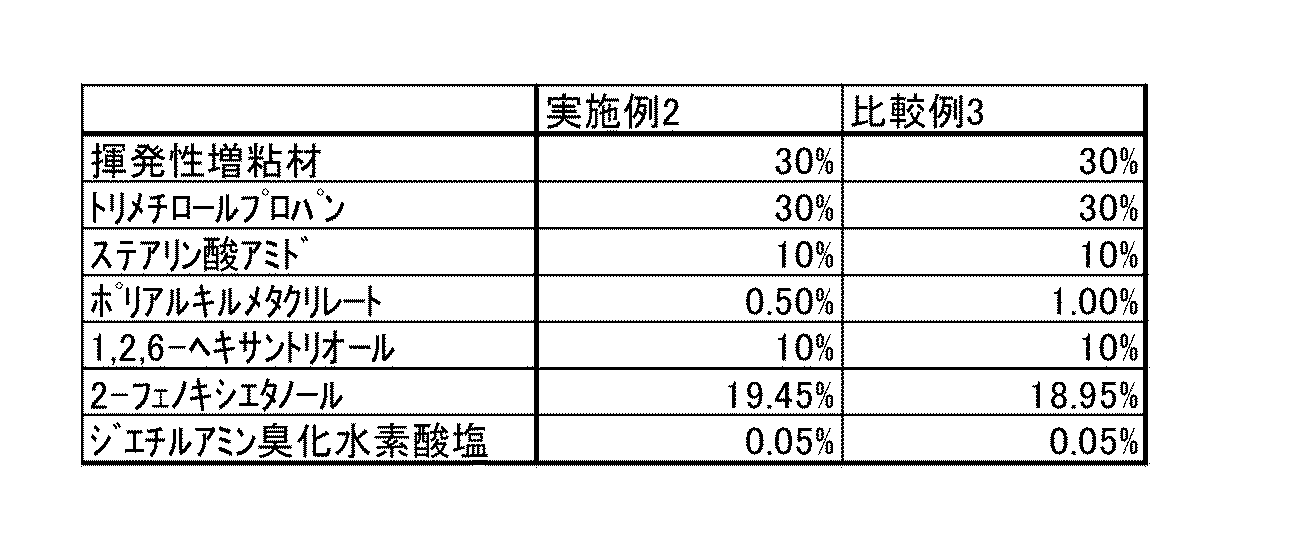
・試験方法
(1)はんだ粉末沈降防止確認
ソルダペーストを35℃の環境で12時間(hr)放置し、はんだ粉末の沈降度を確認した。
(2)リフロー性能確認
ソルダペーストを銅下地のNiメッキ基板上に印刷供給して、酸素濃度100PPM以下の雰囲気にてペーストを加熱し、はんだを60秒間溶解させ、その後冷却してはんだを凝固させ、肉眼でフラックス残渣の残留度とはんだの広がり性を確認した。
(1)はんだ粉末沈降防止確認
ソルダペーストを35℃の環境で12時間(hr)放置し、はんだ粉末の沈降度を確認した。
(2)リフロー性能確認
ソルダペーストを銅下地のNiメッキ基板上に印刷供給して、酸素濃度100PPM以下の雰囲気にてペーストを加熱し、はんだを60秒間溶解させ、その後冷却してはんだを凝固させ、肉眼でフラックス残渣の残留度とはんだの広がり性を確認した。
・結果
(1)はんだ粉末沈降防止確認
実施例2:はんだ粉末が沈降を起こした様子は伺えなかった。
比較例3:はんだ粉末が沈降を起こした様子は伺えなかった。
(2)リフロー性能確認
実施例2:残留するフラックス残渣はなかった。また、はんだはNiメッキパターンの全面を覆っていた。
比較例3:肉眼で白色のフラックス残渣が検出された。一方はんだはNiメッキパターンの全面を覆っていた。その後、試験片を3回リフローすると、白色残渣は消滅した。
(1)はんだ粉末沈降防止確認
実施例2:はんだ粉末が沈降を起こした様子は伺えなかった。
比較例3:はんだ粉末が沈降を起こした様子は伺えなかった。
(2)リフロー性能確認
実施例2:残留するフラックス残渣はなかった。また、はんだはNiメッキパターンの全面を覆っていた。
比較例3:肉眼で白色のフラックス残渣が検出された。一方はんだはNiメッキパターンの全面を覆っていた。その後、試験片を3回リフローすると、白色残渣は消滅した。
以上に示す実施例1と実施例2の結果から、ポリアルキルメタクリレートの0.1%~0.5%程度の添加により、常温下でのはんだ粉末の沈降防止効果が発揮されることが判る。また、リフロー炉でのはんだ付け時の通常の加熱時間で無残渣になることがわかる。
これに対し、比較例3の結果から、ポリアルキルメタクリレートを1.0%以上添加すると、はんだ粉末の沈降防止効果は発揮されるが、リフロー時に無残渣となるまでの時間が長くなることがわかる。実際の基板製造においては、基板やデバイスの耐熱性から、はんだの溶解時間は60秒程度であるので、無残渣を目的に加熱時間を長くするのは、実際のリフロー条件に合わない。
以上の結果から、フラックスにポリアルキルメタクリレートを添加することではんだ粉末の沈降防止効果を発揮し、かつ、リフロー時に無残渣となるためには、ポリアルキルメタクリレートを0.1%以上~1.0%未満で添加することが好ましいことが判った。
このように、フラックスにチキソ剤として所定量のポリアルキルメタクリレートを添加すると、常温域でははんだ粉末の沈降防止効果が得られ、はんだ付け時にははんだの濡れ性を阻害することはなく、はんだ付け後にはフラックス残渣が発生しない。
これにより、はんだ付け後のフラックス残渣を洗浄せずに無残渣を実現することができ、樹脂コーティングを行う場合には、樹脂コート材の選定が不要になる他、はんだ付け後の樹脂コート材塗布/硬化工程において、樹脂コート材の硬化阻害は発生せず、信頼性を向上させることができる。また、はんだ付け後のフラックス残渣を洗浄する工程を不要とすることができ、はんだ付け工程の合理化を図ることができる。
更に、無残渣を実現することで、半田付け工程後のICT(In Circuit Tester)検査における検査ミスを低減する効果もある。
また、チキソ剤としてポリアルキルメタクリレートを使用すると、はんだ粉末とフラックスを混合させたときに起こるはんだ粉末の沈降を高度に防止する効果を持つことで、ソルダペーストを印刷供給だけでなく、ソルダペーストをシリンジに詰めて吐出で供給したりインクジェット方式で供給することも可能となる。
なお、無残渣が要求されないフラックスに対しては、上述した添加量を超えたポリアルキルメタクリレートの添加でも、粘性調整剤としての効果とはんだ粉末の沈降防止効果を兼ね備えているため、無残渣が要求されないフラックスに対しては、ポリアルキルメタクリレートの添加量は上述した量に限るものではない。
本発明のフラックスは、はんだ粉末の沈降防止及びはんだ付け後の無残渣を実現できることから、信頼性に加えてはんだ付け後の外観性が求められる分野にも適用可能である。
Claims (3)
- はんだ粉末と混合されてソルダペーストを生成するフラックスにおいて、
常温域ではんだ粉末の沈降を防止し、はんだ付け時の加熱過程で分解または蒸発する量のメタクリル酸重合体を含む
ことを特徴とするフラックス。 - 前記メタクリル酸重合体として、アルキル基を持つポリアルキルメタクリレートを0.1質量%以上~1.0質量%未満で含む
ことを特徴とする請求項1記載のフラックス。 - OH基を少なくとも3つ以上持つ溶剤を更に含む
ことを特徴とする請求項1または2記載のフラックス。
Priority Applications (4)
| Application Number | Priority Date | Filing Date | Title |
|---|---|---|---|
| US14/002,182 US20130333806A1 (en) | 2011-03-02 | 2012-02-28 | Flux |
| CN2012800111982A CN103429378A (zh) | 2011-03-02 | 2012-02-28 | 助焊剂 |
| JP2013502366A JPWO2012118076A1 (ja) | 2011-03-02 | 2012-02-28 | 無残渣フラックス |
| EP12752393.4A EP2682220A1 (en) | 2011-03-02 | 2012-02-28 | Flux |
Applications Claiming Priority (2)
| Application Number | Priority Date | Filing Date | Title |
|---|---|---|---|
| JP2011045777 | 2011-03-02 | ||
| JP2011-045777 | 2011-03-02 |
Publications (1)
| Publication Number | Publication Date |
|---|---|
| WO2012118076A1 true WO2012118076A1 (ja) | 2012-09-07 |
Family
ID=46758007
Family Applications (1)
| Application Number | Title | Priority Date | Filing Date |
|---|---|---|---|
| PCT/JP2012/054930 Ceased WO2012118076A1 (ja) | 2011-03-02 | 2012-02-28 | フラックス |
Country Status (5)
| Country | Link |
|---|---|
| US (1) | US20130333806A1 (ja) |
| EP (1) | EP2682220A1 (ja) |
| JP (1) | JPWO2012118076A1 (ja) |
| CN (1) | CN103429378A (ja) |
| WO (1) | WO2012118076A1 (ja) |
Cited By (2)
| Publication number | Priority date | Publication date | Assignee | Title |
|---|---|---|---|---|
| WO2013099853A1 (ja) * | 2011-12-26 | 2013-07-04 | 千住金属工業株式会社 | ソルダペースト |
| JP2015160244A (ja) * | 2014-02-28 | 2015-09-07 | 株式会社タムラ製作所 | はんだ付け用フラックス組成物およびそれを用いた電子基板 |
Families Citing this family (5)
| Publication number | Priority date | Publication date | Assignee | Title |
|---|---|---|---|---|
| FR3033272B1 (fr) * | 2015-03-04 | 2017-03-24 | Labinal Power Systems | Procede de brasage pour assembler deux elements via un compose intermetallique |
| JP7356112B2 (ja) * | 2018-03-09 | 2023-10-04 | 株式会社オリジン | フラックス、ソルダペースト、はんだ付けプロセス、はんだ付け製品の製造方法、bgaパッケージの製造方法 |
| JP6627949B1 (ja) * | 2018-11-06 | 2020-01-08 | 千住金属工業株式会社 | フラックス、フラックスの塗布方法及びはんだボールの搭載方法 |
| US11572516B2 (en) | 2020-03-26 | 2023-02-07 | Saudi Arabian Oil Company | Systems and processes integrating steam cracking with dual catalyst metathesis for producing olefins |
| CN114952077B (zh) * | 2022-04-14 | 2024-06-21 | 天诺光电材料股份有限公司 | 一种复合钎焊膏及其制备方法和应用 |
Citations (6)
| Publication number | Priority date | Publication date | Assignee | Title |
|---|---|---|---|---|
| JPS6186092A (ja) * | 1984-10-05 | 1986-05-01 | Asahi Glass Co Ltd | 半田用フラツクス組成物 |
| JPH02290693A (ja) * | 1989-04-27 | 1990-11-30 | Matsushita Electric Ind Co Ltd | はんだペーストおよびそれを用いた印刷配線板のはんだ付け方法 |
| JPH07501985A (ja) * | 1991-12-13 | 1995-03-02 | クツクソン・グループ・ピーエルシー | 電子工業において使用されるペースト,インキ又はクリーム製剤 |
| JP2002283098A (ja) * | 2001-03-28 | 2002-10-02 | Sumitomo Bakelite Co Ltd | 半田ペースト組成物、並びにそれを用いた半田接合部、半導体パッケージ及び半導体装置 |
| JP2004001030A (ja) * | 2002-05-31 | 2004-01-08 | Fujitsu Ltd | はんだペーストおよび半導体装置の製造方法 |
| JP2004025305A (ja) | 2002-04-16 | 2004-01-29 | Tadatomo Suga | 無残渣ソルダペースト |
Family Cites Families (1)
| Publication number | Priority date | Publication date | Assignee | Title |
|---|---|---|---|---|
| JP5018017B2 (ja) * | 2006-10-30 | 2012-09-05 | 荒川化学工業株式会社 | クリームはんだ用フラックスおよびクリームはんだ |
-
2012
- 2012-02-28 CN CN2012800111982A patent/CN103429378A/zh active Pending
- 2012-02-28 JP JP2013502366A patent/JPWO2012118076A1/ja active Pending
- 2012-02-28 WO PCT/JP2012/054930 patent/WO2012118076A1/ja not_active Ceased
- 2012-02-28 US US14/002,182 patent/US20130333806A1/en not_active Abandoned
- 2012-02-28 EP EP12752393.4A patent/EP2682220A1/en not_active Withdrawn
Patent Citations (6)
| Publication number | Priority date | Publication date | Assignee | Title |
|---|---|---|---|---|
| JPS6186092A (ja) * | 1984-10-05 | 1986-05-01 | Asahi Glass Co Ltd | 半田用フラツクス組成物 |
| JPH02290693A (ja) * | 1989-04-27 | 1990-11-30 | Matsushita Electric Ind Co Ltd | はんだペーストおよびそれを用いた印刷配線板のはんだ付け方法 |
| JPH07501985A (ja) * | 1991-12-13 | 1995-03-02 | クツクソン・グループ・ピーエルシー | 電子工業において使用されるペースト,インキ又はクリーム製剤 |
| JP2002283098A (ja) * | 2001-03-28 | 2002-10-02 | Sumitomo Bakelite Co Ltd | 半田ペースト組成物、並びにそれを用いた半田接合部、半導体パッケージ及び半導体装置 |
| JP2004025305A (ja) | 2002-04-16 | 2004-01-29 | Tadatomo Suga | 無残渣ソルダペースト |
| JP2004001030A (ja) * | 2002-05-31 | 2004-01-08 | Fujitsu Ltd | はんだペーストおよび半導体装置の製造方法 |
Cited By (4)
| Publication number | Priority date | Publication date | Assignee | Title |
|---|---|---|---|---|
| WO2013099853A1 (ja) * | 2011-12-26 | 2013-07-04 | 千住金属工業株式会社 | ソルダペースト |
| JP2013132654A (ja) * | 2011-12-26 | 2013-07-08 | Senju Metal Ind Co Ltd | ソルダペースト |
| DE112012005672B4 (de) * | 2011-12-26 | 2019-11-14 | Denso Corporation | Lötpaste |
| JP2015160244A (ja) * | 2014-02-28 | 2015-09-07 | 株式会社タムラ製作所 | はんだ付け用フラックス組成物およびそれを用いた電子基板 |
Also Published As
| Publication number | Publication date |
|---|---|
| JPWO2012118076A1 (ja) | 2014-07-07 |
| CN103429378A (zh) | 2013-12-04 |
| US20130333806A1 (en) | 2013-12-19 |
| EP2682220A1 (en) | 2014-01-08 |
Similar Documents
| Publication | Publication Date | Title |
|---|---|---|
| JP6677668B2 (ja) | 鉛フリーはんだ合金、電子回路基板および電子制御装置 | |
| JPWO2012118076A1 (ja) | 無残渣フラックス | |
| JP5667101B2 (ja) | はんだ組成物およびその製造方法、並びにプリント配線基板 | |
| JP5242521B2 (ja) | はんだ接合剤組成物 | |
| WO2017164194A1 (ja) | 鉛フリーはんだ合金、フラックス組成物、ソルダペースト組成物、電子回路基板および電子制御装置 | |
| JP6635986B2 (ja) | はんだ組成物および電子基板 | |
| JP6359499B2 (ja) | 耐冷熱衝撃フラックス組成物、ソルダペースト組成物および電子回路基板 | |
| EP3369522B1 (en) | Solder paste | |
| TWI767059B (zh) | 無鉛焊料合金、電子電路基板及電子控制裝置 | |
| CN112262013B (zh) | 焊膏用助焊剂和焊膏 | |
| JP2015047615A (ja) | はんだ組成物 | |
| KR20170097764A (ko) | 급가열 공법용 플럭스 및 급가열 공법용 솔더 페이스트 | |
| JPWO2017122750A1 (ja) | フラックス | |
| KR20210103389A (ko) | 납 프리 땜납 합금, 땜납 접합용 재료, 전자 회로 실장 기판 및 전자 제어 장치 | |
| WO2015022719A1 (ja) | フラックス、ソルダペースト及びはんだ継手 | |
| JP6383544B2 (ja) | はんだ付け用フラックス組成物およびそれを用いた電子基板の製造方法 | |
| JP6585554B2 (ja) | 鉛フリーはんだ合金、電子回路基板及び電子制御装置 | |
| WO2012118077A1 (ja) | フラックス | |
| JP7202336B2 (ja) | はんだ組成物、および電子基板の製造方法 | |
| JP6937093B2 (ja) | フラックス組成物及びソルダペースト | |
| JP2002283097A (ja) | ソルダペースト組成物及びリフローはんだ付方法 | |
| JP2017100181A (ja) | フラックス組成物、ソルダペースト組成物および電子回路基板 | |
| JP7277714B2 (ja) | フラックス及びソルダペースト | |
| JP2011129694A (ja) | はんだ接合補強剤組成物、及びこれを用いた実装基板の製造方法 | |
| ES2921678T3 (es) | Aleación de soldadura sin plomo, sustrato de circuito electrónico y dispositivo de control electrónico |
Legal Events
| Date | Code | Title | Description |
|---|---|---|---|
| 121 | Ep: the epo has been informed by wipo that ep was designated in this application |
Ref document number: 12752393 Country of ref document: EP Kind code of ref document: A1 |
|
| WWE | Wipo information: entry into national phase |
Ref document number: 14002182 Country of ref document: US |
|
| ENP | Entry into the national phase |
Ref document number: 2013502366 Country of ref document: JP Kind code of ref document: A |
|
| NENP | Non-entry into the national phase |
Ref country code: DE |