WO2012118151A1 - Procédé de fabrication de matière carbonée - Google Patents
Procédé de fabrication de matière carbonée Download PDFInfo
- Publication number
- WO2012118151A1 WO2012118151A1 PCT/JP2012/055249 JP2012055249W WO2012118151A1 WO 2012118151 A1 WO2012118151 A1 WO 2012118151A1 JP 2012055249 W JP2012055249 W JP 2012055249W WO 2012118151 A1 WO2012118151 A1 WO 2012118151A1
- Authority
- WO
- WIPO (PCT)
- Prior art keywords
- coal
- carbon material
- ashless coal
- solvent
- ash
- Prior art date
- Legal status (The legal status is an assumption and is not a legal conclusion. Google has not performed a legal analysis and makes no representation as to the accuracy of the status listed.)
- Ceased
Links
Images
Classifications
-
- C—CHEMISTRY; METALLURGY
- C10—PETROLEUM, GAS OR COKE INDUSTRIES; TECHNICAL GASES CONTAINING CARBON MONOXIDE; FUELS; LUBRICANTS; PEAT
- C10B—DESTRUCTIVE DISTILLATION OF CARBONACEOUS MATERIALS FOR PRODUCTION OF GAS, COKE, TAR, OR SIMILAR MATERIALS
- C10B53/00—Destructive distillation, specially adapted for particular solid raw materials or solid raw materials in special form
- C10B53/08—Destructive distillation, specially adapted for particular solid raw materials or solid raw materials in special form in the form of briquettes, lumps and the like
-
- C—CHEMISTRY; METALLURGY
- C01—INORGANIC CHEMISTRY
- C01B—NON-METALLIC ELEMENTS; COMPOUNDS THEREOF; METALLOIDS OR COMPOUNDS THEREOF NOT COVERED BY SUBCLASS C01C
- C01B32/00—Carbon; Compounds thereof
- C01B32/05—Preparation or purification of carbon not covered by groups C01B32/15, C01B32/20, C01B32/25, C01B32/30
-
- C—CHEMISTRY; METALLURGY
- C04—CEMENTS; CONCRETE; ARTIFICIAL STONE; CERAMICS; REFRACTORIES
- C04B—LIME, MAGNESIA; SLAG; CEMENTS; COMPOSITIONS THEREOF, e.g. MORTARS, CONCRETE OR LIKE BUILDING MATERIALS; ARTIFICIAL STONE; CERAMICS; REFRACTORIES; TREATMENT OF NATURAL STONE
- C04B35/00—Shaped ceramic products characterised by their composition; Ceramics compositions; Processing powders of inorganic compounds preparatory to the manufacturing of ceramic products
- C04B35/515—Shaped ceramic products characterised by their composition; Ceramics compositions; Processing powders of inorganic compounds preparatory to the manufacturing of ceramic products based on non-oxide ceramics
- C04B35/52—Shaped ceramic products characterised by their composition; Ceramics compositions; Processing powders of inorganic compounds preparatory to the manufacturing of ceramic products based on non-oxide ceramics based on carbon, e.g. graphite
- C04B35/528—Shaped ceramic products characterised by their composition; Ceramics compositions; Processing powders of inorganic compounds preparatory to the manufacturing of ceramic products based on non-oxide ceramics based on carbon, e.g. graphite obtained from carbonaceous particles with or without other non-organic components
-
- C—CHEMISTRY; METALLURGY
- C10—PETROLEUM, GAS OR COKE INDUSTRIES; TECHNICAL GASES CONTAINING CARBON MONOXIDE; FUELS; LUBRICANTS; PEAT
- C10B—DESTRUCTIVE DISTILLATION OF CARBONACEOUS MATERIALS FOR PRODUCTION OF GAS, COKE, TAR, OR SIMILAR MATERIALS
- C10B57/00—Other carbonising or coking processes; Features of destructive distillation processes in general
- C10B57/04—Other carbonising or coking processes; Features of destructive distillation processes in general using charges of special composition
-
- C—CHEMISTRY; METALLURGY
- C25—ELECTROLYTIC OR ELECTROPHORETIC PROCESSES; APPARATUS THEREFOR
- C25C—PROCESSES FOR THE ELECTROLYTIC PRODUCTION, RECOVERY OR REFINING OF METALS; APPARATUS THEREFOR
- C25C3/00—Electrolytic production, recovery or refining of metals by electrolysis of melts
- C25C3/06—Electrolytic production, recovery or refining of metals by electrolysis of melts of aluminium
- C25C3/08—Cell construction, e.g. bottoms, walls, cathodes
- C25C3/12—Anodes
- C25C3/125—Anodes based on carbon
-
- C—CHEMISTRY; METALLURGY
- C04—CEMENTS; CONCRETE; ARTIFICIAL STONE; CERAMICS; REFRACTORIES
- C04B—LIME, MAGNESIA; SLAG; CEMENTS; COMPOSITIONS THEREOF, e.g. MORTARS, CONCRETE OR LIKE BUILDING MATERIALS; ARTIFICIAL STONE; CERAMICS; REFRACTORIES; TREATMENT OF NATURAL STONE
- C04B2235/00—Aspects relating to ceramic starting mixtures or sintered ceramic products
- C04B2235/60—Aspects relating to the preparation, properties or mechanical treatment of green bodies or pre-forms
- C04B2235/608—Green bodies or pre-forms with well-defined density
Definitions
- the present invention is a reduction carbon material for refining ferrous or non-ferrous metals, a structural carbon material, a carbon material for electrical materials, or a carbon material used as a raw material thereof, particularly as an aggregate of an anode for aluminum electrolytic production.
- the present invention relates to a method for producing a carbon material to be used.
- coal coke used for blast furnace ironmaking has properties similar to petroleum coke as carbon, and the amount is too large as a main raw material for anodes for aluminum electrolytic production.
- coal-derived ash since it contains about 10% by mass of coal-derived ash, there is a problem in quality, so it is not used in this application.
- ashless charcoal hypercoal
- ashless coal is produced by extracting coal with a solvent, separating only the components soluble in the solvent, and then removing the solvent.
- this ashless coal has a wide molecular weight distribution from a relatively low molecular weight component having 2 to 3 fused aromatic rings to a high molecular weight component having about 5 or 6 rings.
- ashless coal since ash is not dissolved in a solvent, ashless coal does not substantially contain ash, exhibits high fluidity under heating, and is excellent in thermal fluidity.
- Some coals like caking coal, exhibit thermoplasticity at around 400 ° C, but ashless coal generally melts at 200-300 ° C regardless of the quality of the raw coal (softening and melting). Have sex). Therefore, application development as a binder for coke production has been advanced taking advantage of this characteristic, and in recent years, attempts have been made to produce a carbon material by using this ashless coal as a carbon material raw material. .
- ashless coal does not contain ash and has a softening and melting property, and is known to be effective as a caking additive when producing coke for iron making. Moreover, it is a property preferable as an aggregate (main raw material) of the anode for aluminum electrolysis manufacture not to contain ash.
- ashless charcoal has a high volatile content (VM) that usually exceeds 40% by mass, is inferior in self-sinterability, and softens at about 200 ° C.
- the present invention has been made in view of the above problems, and its object is to produce a carbon material that can be economically obtained a high-purity carbon material that is dense and has no deformation and has a very low ash concentration. Is to provide.
- VM volatile content of ashless coal
- the present inventors have found that it is preferable to use as a raw material for carbon materials for electrical materials other than structural carbon materials and anode coke.
- chemical treatment and physics that reduce hydrogen content such as alkyl group decomposition, aromatization reaction, decomposition of oxygen-containing functional groups, removal of low molecular weight components by heat treatment of ashless coal
- the VM changes gradually, and the VM of the ashless coal can be adjusted to a predetermined range.
- VM can be adjusted to a predetermined range by carbonizing ashless coal.
- the method for producing a carbon material for reduction, structural carbon material, carbon material for electric material, or carbon material used as a raw material for refining iron or non-ferrous metal according to the present invention is obtained by mixing coal and a solvent.
- the slurry is heated to extract a coal component soluble in the solvent, the slurry after extraction is separated into a liquid part and a non-liquid part, and the coal is reformed by separating the solvent from the liquid part,
- VM volatile content
- ashless coal that is modified coal having an extremely low ash concentration is manufactured by reforming coal.
- the modified ashless coal heating step the modified ashless coal having a VM of 40% by mass or less is manufactured by heat-treating the ashless coal.
- the modified ashless coal is molded to an apparent specific gravity of 0.9 g / cm 3 or more, thereby suppressing expansion in the carbonization process of the next process and maintaining the strength.
- the carbonization step the molded body made of this modified ashless coal is carbonized to obtain a carbon material with an adjusted VM.
- VM of the ashless coal after heat processing is 40 mass% or less, while the expansion property of ashless coal is suppressed, self-sintering property becomes sufficient and in the case of carbonization treatment, there is no modification. Foaming of the molded body made of ash charcoal is suppressed, and the carbon material becomes dense and has no deformation, and has an extremely low ash concentration.
- the heat treatment of the ashless coal is preferably performed in the presence of the same solvent as the solvent used for reforming the coal. . According to such a manufacturing method, heat transfer efficiency becomes high and heating of ashless coal becomes uniform by using a solvent. Furthermore, since the same solvent as the solvent used for coal reforming is used, the economy is improved.
- the method for producing a carbon material according to the present invention it is possible to obtain a carbon material which is low in ash, dense and free from deformation. Moreover, such a carbon material can be obtained economically.
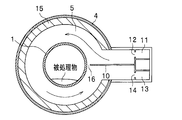
- FIG. 3 is a cross-sectional view taken along line AA in FIG. 2.
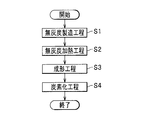
- the method for producing a carbon material includes an ashless coal production step S1, an ashless coal heating step S2, a molding step S3, and a carbonization step S4.
- each step will be described.
- Ashless coal manufacturing process S1 is a process which modifies coal using a solvent and manufactures ashless coal which is reformed coal.
- the ashless coal as used in the field of this invention is what is called hyper coal, and is manufactured by solvent-extracting coal and removing ash and an insoluble coal component. This ashless coal has very little ash (ash concentration of 1.0% by mass or less), and moisture is generally 0.5% by mass or less.
- a known method can be used, and the solvent type and production conditions are appropriately selected in view of the properties of coal and the design as a raw material for the carbon material.
- a typical method is to mix a coal with a solvent that has a high solvent power for coal, often an aromatic solvent (hydrogen donating or non-hydrogen donating solvent), and heat it in the coal. It is a method of extracting the organic component.
- a mixture (slurry) in which coal and a non-hydrogen donating solvent are mixed is heated to extract coal components that are soluble in the non-hydrogen donating solvent.
- the slurry after extraction is separated into a liquid part and a non-liquid part, and the non-hydrogen donating solvent is separated from the liquid part to produce ashless coal.
- bituminous coal As the coal for ashless coal (hereinafter also referred to as raw coal).
- the coal used is not limited to bituminous coal, and inferior quality coal can be used as necessary.
- inferior quality carbon By using an inexpensive inferior quality carbon, the carbon material can be manufactured at a low cost, thus improving the economic efficiency.
- the moisture content of raw material coal is high, it is preferable to perform dehydration prior to solvent extraction.
- inferior coal here means coals, such as a non-slightly caking coal, a general coal, a low grade coal (brown coal, subbituminous coal, etc.).
- the low-grade coal include lignite, lignite, and sub-bituminous coal.
- lignite coal includes Victoria coal, North Dakota coal, Berga coal
- sub-bituminous coal includes West Banco coal, Vinungan coal, Samarangau coal, and the like.
- the low-grade coal is not limited to those exemplified above, and any coal containing a large amount of water and desired to be dehydrated is included in the low-grade coal referred to in the present invention.
- the coal is preferably pulverized into as small particles as possible, and preferably has a particle size of 1 mm or less.
- the non-hydrogen donating solvent is a coal derivative that is a solvent mainly composed of a bicyclic aromatic and purified mainly from a coal carbonization product.
- This non-hydrogen-donating solvent is stable even in a heated state and has excellent affinity with coal. Therefore, the proportion of soluble components (herein, coal components) extracted into the solvent (hereinafter also referred to as extraction rate) In addition, it is a solvent that can be easily recovered by a method such as distillation.
- the main components of the non-hydrogen donating solvent include bicyclic aromatic naphthalene, methyl naphthalene, dimethyl naphthalene, trimethyl naphthalene and the like, and the other components of the non-hydrogen donating solvent have an aliphatic side chain.
- the extraction rate of coal can be increased by heat extraction using a non-hydrogen donating solvent.
- the solvent can be easily recovered, so that it is easy to circulate the solvent.
- coal can be solubilized at low cost to obtain ashless coal, and economic efficiency can be improved.
- the coal concentration with respect to the solvent depends on the type of raw coal, but is preferably in the range of 3 to 50% by mass, more preferably in the range of 3 to 10% by mass on the basis of dry coal.
- the coal concentration with respect to the solvent is less than 3% by mass, the proportion of the coal component extracted into the solvent decreases with respect to the amount of the solvent, which is not economical.
- the higher the coal concentration the better.
- the viscosity of the prepared slurry becomes high, and it becomes difficult to move the slurry and separate the liquid part and the non-liquid part described later.
- the heating temperature of the slurry is preferably in the range of 300 to 450 ° C. By setting the heating temperature within this range, the bonds between the molecules constituting the coal are loosened, mild thermal decomposition occurs, and the extraction rate becomes the highest. When the heating temperature is less than 300 ° C., it tends to be insufficient to weaken the bonds between the molecules constituting the coal, and the extraction rate is difficult to improve. On the other hand, when the temperature exceeds 450 ° C., the pyrolysis reaction of coal becomes very active and recombination of the generated pyrolysis radicals occurs, so that the extraction rate is hardly improved and the alteration of coal is difficult to occur.
- the temperature is preferably 300 to 400 ° C.
- the heating time is a time until reaching the dissolution equilibrium, but it is economically disadvantageous to realize it. Therefore, it varies depending on conditions such as the particle size of the coal and the type of the solvent, so it cannot be generally stated, but it is usually about 10 to 60 minutes. If the heating time is less than 10 minutes, the extraction of the coal component tends to be insufficient, while if it exceeds 60 minutes, the extraction does not proceed any further, which is not economical.
- the extraction of the coal component soluble in the non-hydrogen donating solvent is preferably performed in the presence of an inert gas. This is because contact with oxygen is dangerous because it may ignite, and when hydrogen is used, the cost increases.
- an inert gas to be used inexpensive nitrogen is preferably used, but is not particularly limited.
- the pressure is preferably 1.0 to 2.0 MPa, although it depends on the temperature during extraction and the vapor pressure of the solvent used. When the pressure is lower than the vapor pressure of the solvent, the solvent is volatilized and is not trapped in the liquid phase and cannot be extracted. In order to confine the solvent in the liquid phase, a pressure higher than the vapor pressure of the solvent is required. On the other hand, if the pressure is too high, the cost of the equipment and the operating cost increase, which is not economical.
- the slurry after extracting a coal component is isolate
- the liquid part means a solution containing a coal component extracted into a solvent
- the non-liquid part means a solute containing a coal component insoluble in the solvent (coal containing ash, that is, ash coal).
- a gravity sedimentation method that allows continuous operation of fluid and is suitable for a large amount of processing at low cost.
- a liquid part hereinafter also referred to as a supernatant liquid
- a coal component insoluble in the solvent is contained.
- a non-liquid part hereinafter also referred to as a solid content concentrate
- ashless coal is obtained by isolate
- a method for separating the solvent from the supernatant liquid (liquid part) a general distillation method or evaporation method (spray drying method, etc.) can be used. From the supernatant liquid, ashless coal substantially free of ash Can be obtained.
- This ashless coal has an ash content of 1.0% by mass or less, almost no ash content, water content of approximately 0.5% by mass or less, and a higher calorific value than raw coal. Therefore, by carbonizing this ashless coal, a high-purity carbon material having an extremely low ash concentration can be obtained.
- Ashless coal heating process S2 is a process of heat-treating the ashless coal produced in the ashless coal production process S1.
- Ashless coal is generally highly expansible and easily deformed as it is produced, so heat treatment is performed to suppress it.
- VM volatile content
- the VM is measured according to JISM8812.
- the atomic ratio of hydrogen and carbon in the ashless coal after the heat treatment (hereinafter, appropriately referred to as H / C atomic ratio) is preferably in the range of 0.68 or less, 0.5 to 0.00. More preferably, the range is 65.
- the VM of the ashless coal in the state of being produced without any treatment varies depending on the raw coal type and the production conditions of the ashless coal, but generally the VM has a high value exceeding 40% by mass. .
- chemical / physical changes such as alkyl group decomposition, aromatization reaction, decomposition of oxygen-containing functional groups, removal of low molecular weight components, etc. will decrease the hydrogen content. Progresses and VM gradually decreases. Then, it adjusts so that VM may become the range of 40 mass% or less by heat processing.
- the as-produced ashless coal has an H / C atomic ratio of approximately 0.7 to 1.0, and the H / C atomic ratio gradually decreases due to chemical and physical changes due to heat treatment. To go. Therefore, it is preferable to adjust the H / C atomic ratio to be in the range of 0.68 or less by heat treatment.
- a high value of VM exceeding 40% by mass indicates softening at about 200 ° C. and low self-sinterability. Therefore, during the carbonization in the carbonization step S4, foaming and deformation occur in the molded body made of the modified ashless coal. Even if the modified ashless coal is carbonized in the subsequent carbonization step S4, a powdery carbon material Can only get. Thus, foaming and a deformation
- transformation of a molded object can be suppressed by adjusting VM to the range of 40 mass% or less by heat processing of ashless coal. On the other hand, if the VM is too small, the modified ashless coal will be too hard and it may be difficult to grind or mold. Therefore, the VM is preferably 25% by mass or more.
- the H / C atomic ratio When the H / C atomic ratio is larger than 0.68, it indicates that the heat treatment is insufficient, and ashless coal contains a relatively large amount of hydrogen. Therefore, if the H / C atomic ratio exceeds 0.68, ashless coal (modified ashless coal) will foam during carbonization in the carbonization step S4 described later. Thus, the foaming at the time of carbonization of ashless coal (modified ashless coal) is suppressed by adjusting the H / C atomic ratio to a range of 0.68 or less by heat treatment of ashless coal. be able to.
- the small H / C atomic ratio means that the heat treatment may be excessive, the self-sinterability becomes insufficient, and the modified ashless coal is carbonized in the subsequent carbonization step S4.
- the H / C atomic ratio is preferably 0.5 or more.
- the method of heat treatment of ashless coal is not particularly limited, and can be performed by a known method. Then, ashless coal is heated to 350 to 500 ° C., preferably 350 to 450 ° C. under reduced pressure, normal pressure, pressurization, or in an inert atmosphere.
- the required treatment time varies depending on the properties of the ashless coal and the treatment temperature, but is generally in the range of 10 minutes to 5 hours, preferably 10 minutes to 2 hours.
- the VM in the ashless coal heating step S2 preferably the control of the H / C atomic ratio, is a preliminary experiment or the like, and the VM is 40% by mass or less, preferably the H / C atomic ratio is 0.68 or less.
- the processing temperature and processing time to be set are set from the above range, and the processing temperature and processing time are set.
- the heat treatment of ashless coal may be performed by heating the ashless coal alone or in the presence of the same solvent as that used for reforming the coal in the ashless coal production process. That is, ashless charcoal is mixed with a solvent, made into a slurry, and heat-treated.
- the amount of the solvent with respect to the ashless coal is not particularly limited, but from the viewpoint of making a slurry with an appropriate viscosity, for example, the ashless coal concentration with respect to the solvent is 10 to 50% by mass on the basis of dry coal, preferably It may be in the range of 20 to 35% by mass.
- separating a solvent from the ashless coal after heat processing can use a general distillation method, an evaporation method (spray dry method etc.), etc.
- the heat transfer efficiency becomes higher than when ashless coal is heated as it is, and uniform heating becomes possible. Furthermore, the manufacturing cost can be reduced by using the same solvent as the solvent used for the reforming of coal.
- a solvent used for the heat treatment of ashless coal alkylnaphthalene, anthracene oil, and the like are preferable.
- the modified ashless coal produced in the ashless coal heating step S2 is used as a main component of the molding raw material, and the modified ashless coal is molded to have an apparent specific gravity of 0.9 g / cm 3 or more.
- This is a process for producing a molded body.
- the reformed ashless coal can be molded by a known method. For example, compression molding, extrusion molding, double roll type tablet molding, and the like. Double roll tableting is preferred.
- the modified ashless coal before molding is in a lump shape, it is pulverized to a particle size of about 1 mm or less before molding. If it is finely pulverized and high-pressure pressed, a molded product can be obtained relatively easily.
- the molding step S3 it is preferable to mold and compact the molded body so that the apparent specific gravity is 0.9 g / cm 3 or more.
- the apparent specific gravity is less than 0.9 g / cm 3
- the carbonization step S4 the molded body expands and the strength decreases and breaks.
- the carbon material produced from the molded body is not a lump but a powder.
- the upper limit of the apparent specific gravity is not particularly limited, and can be about 1.5 g / cm 3 . In consideration of productivity, economic efficiency, etc., the preferable upper limit of the apparent specific gravity is 1.2 g / cm 3 .
- the apparent specific gravity is measured according to the small amount method described in “Coke Note 2001 Edition (edited by Japan Coke Association, pages 78-79)”.
- the apparent specific gravity in the molding step S3 is controlled by a molding pressure set in advance in a preliminary experiment or the like, and the molding pressure is preferably 0.1 to 5 ton / cm 3 depending on the molding method.
- the humidity may be adjusted as necessary, or an appropriate binder compound may be used.
- binder compound known compounds such as tar, pitch, ashless coal itself, and resin can be used. Of these, ashless coal itself is most preferred because of its low ash content.
- an appropriate filler such as carbon fiber, a light component produced as a by-product in the ashless coal production step S1, residual charcoal, or the like may be added and mixed.
- the ratio of the modified ashless coal in the molded body is preferably 80% by mass or more. If the ratio of the modified ashless coal is less than 80% by mass, it is difficult to mold the modified ashless coal, and even if molded, the molded body expands due to the carbonization treatment in the next carbonization step S4, Since pores are generated, it is difficult to obtain a carbon material having a low porosity in a high yield. In addition, the apparent specific gravity of the carbon material tends to be low. Furthermore, it is difficult to maintain the strength of the carbon material.
- the ratio of the modified ashless coal in a molded object may occupy 80 mass% or more, and it is set as a shaping
- Carbonization process S4 is a process which carbonizes the molded object manufactured by said shaping
- the method and conditions for the carbonization treatment are not particularly limited, and can be performed using a known technique. Typically, it is steamed and heated at 550 to 1200 ° C. in an inert atmosphere such as nitrogen or argon to change the modified ashless coal to carbon, and the VM of the modified ashless coal is 40% by mass. Adjusted to: Further, the temperature rising rate is preferably 0.1 to 5 ° C./min, and the treatment time is preferably 5 to 60 minutes.
- This carbonization treatment may be performed under pressure using a hot isostatic pressing apparatus or the like. If necessary, a binder component such as asphalt pitch or tar may be added. And adjustment of VM in carbonization process S4 is controlled by the process temperature which VM set beforehand by the preliminary experiment etc. will be 40 mass% or less.
- heat treatment furnace used for carbonization there is no particular restriction on the type of heat treatment furnace used for carbonization, and a known one can be used.
- a pot furnace, a lead hammer furnace, a kiln, a rotary kiln, a shaft furnace, or a chamber furnace can be used.
- a rotary kiln is preferable in that continuous carbonization treatment is possible.
- the rotary kiln heat-treats the product (carbon material) while rotating, there is no sticking of the product and a granular product can be easily obtained.
- the shaft furnace, particularly the vertical shaft furnace has a problem that the product is easily fixed, and the chamber furnace has a problem that the production efficiency is low due to batch processing.
- it is not limited to these furnace types You may use other furnace types.
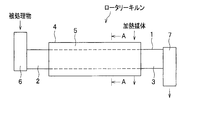
- a rotary kiln having a structure as shown in FIGS. 2 and 3 is used.
- the rotary kiln is provided in an outer peripheral portion other than a cylindrical rotary drum 1 to which a workpiece, specifically, a molded body made of modified ashless coal is supplied, and both end portions 2 and 3 of the rotary drum 1.
- the one end 2 of the outer peripheral surface of the rotary drum 1 is provided with a supply port 6 through which the object to be processed is supplied, and the other end 3 has a heat-treated object, specifically a carbonization process.
- Is provided with a discharge port 7 through which the carbon material produced by is discharged.
- the outer peripheral surface of the outer cylinder 4 is separated by a heating medium supply path 11 for supplying a heating medium (for example, hot air) to the heating chamber 5, and the heating medium supply path 11 and the metal plate 10. And a heating medium discharge passage 13 for discharging the heat medium.
- the rotational speed of the rotary kiln is not particularly limited but is preferably 1 to 60 rpm.
- the heating medium is supplied to the heating chamber 5 from a plurality of openings 12 provided in the heating medium supply path 11.
- the supplied heating medium makes one round around the rotating drum 1 along the outer periphery of the rotating drum 1 and is discharged to the outside through a plurality of openings 14 provided in the heating medium discharge path 13.
- the inside of the rotating drum 1 is heated by flowing the heating medium and transferring the heat of the heating medium to the rotating drum 1.
- the object to be processed is supplied into the rotary drum 1 from the supply port 6, and is transferred while stirring from the supply port 6 side to the discharge port 7 side by the rotation of the rotary drum 1.
- the workpiece is heated by indirect heating of the heating chamber 5, and the workpiece is carbonized.
- a gap 16 is provided between the metal plate 10 and the rotating drum 1 so that the metal plate 10 does not become an obstacle to the rotation of the rotating drum 1.
- the inner peripheral surface of the outer cylinder 4 is covered with a refractory material 15.
- the carbon material obtained by the production method of the present invention can be suitably used as a main raw material coke for an anode for aluminum electrolytic production.
- it can also be used as a reducing carbon material for refining ferrous or non-ferrous metals, a structural carbon material, or a carbon material for electrical materials other than an anode for aluminum electrolytic production, or it can be used as a reducing carbon material or structural carbon.
- It can also be used as a raw material or a raw material for carbon materials for electric materials.
- the reducing carbon material for nonferrous metal refining refers to a reducing carbon material used for refining (reducing) nonferrous metals such as silicon and titanium
- the structural carbon material includes, for example, a carbon heat insulating material, Carbonaceous material used as a raw material for carbon structural materials such as crucibles.
- Carbon material for electrical materials is a carbon material used as a raw material for carbon electrical materials such as carbon electrodes as well as anodes for aluminum electrolytic production. Say. Note that these materials are used because, for example, it may be necessary to subject the carbon material to a secondary treatment such as heat treatment.
- the method for producing a carbon material of the present invention includes an ashless coal production step S1, an ashless coal heating step S2, a forming step S3, and a carbonization step S4.
- a coal pulverization step for pulverizing raw coal or a removal step for removing unnecessary substances such as dust, before or after each step.
- other steps such as an ashless coal drying step for drying the ashless coal may be included.
- a slurry (1 methyl naphthalene (manufactured by Nippon Steel Chemical Co., Ltd.)) was mixed with 5 kg of Australian fuel coal (bituminous coal) in an amount of 4 times (20 kg) of solvent.
- This slurry was pressurized with 1.2 MPa of nitrogen and extracted in an autoclave with an internal volume of 30 L at 370 ° C. for 1 hour.
- This slurry was separated into a supernatant and a solid concentrate in a gravity sedimentation tank maintained at the same temperature and pressure, and the solvent was separated and recovered from the supernatant by a distillation method to obtain ashless coal.
- ashless coal 100 g was put into an autoclave having an internal volume of 2 L, and heat treatment was performed in a nitrogen stream at 400 ° C. for the treatment time shown in Table 1 to obtain a modified ashless coal having the VM shown in Table 1. It was.
- ashless coal that is not subjected to heat treatment is also modified ashless coal.
- the measurement of VM was performed according to JISM8812.
- This modified ashless coal is pulverized to 1 mm or less, and 3 g is filled in a mold having a cylindrical cavity having a diameter of 10 mm.
- the modified ashless coal filled in the cavity was molded at room temperature for 30 seconds at the molding pressure shown in Table 1 to obtain a molded body having the apparent specific gravity shown in Table 1.
- the apparent specific gravity was measured according to the small amount method described above.
- Example No. 1 satisfying the requirements of the present invention. In Nos. 2 to 5, a dense carbon material could be obtained. On the other hand, comparative example No. which does not satisfy the requirements of the present invention. In Nos. 1 and 6 to 8, a dense carbon material could not be obtained.
- the carbon material of the present invention is a reducing carbon material for refining ferrous or non-ferrous metals, a structural carbon material, a carbon material for electrical materials, or a carbon material used as a raw material thereof, particularly an anode for aluminum electrolytic production. It is useful as an aggregate.
Landscapes
- Chemical & Material Sciences (AREA)
- Engineering & Computer Science (AREA)
- Organic Chemistry (AREA)
- Materials Engineering (AREA)
- Oil, Petroleum & Natural Gas (AREA)
- Ceramic Engineering (AREA)
- Manufacturing & Machinery (AREA)
- Inorganic Chemistry (AREA)
- Structural Engineering (AREA)
- Chemical Kinetics & Catalysis (AREA)
- Electrochemistry (AREA)
- Metallurgy (AREA)
- Carbon And Carbon Compounds (AREA)
- Solid Fuels And Fuel-Associated Substances (AREA)
Abstract
La présente invention concerne un procédé de fabrication d'une matière carbonée de réduction, pour un raffinage d'ion ou d'un métal non ferreux, d'une matière carbonée pour des structures, pour des matériaux électriques ou qui est utilisée en tant que matière de départ pour les matières carbonées précédemment mentionnées. Le procédé comporte : une étape (S1) de production d'un charbon sans cendres, du charbon étant modifié à l'aide d'un solvant de façon à produire un charbon sans cendres qui est un charbon modifié ; une étape (S2) de chauffage de charbon sans cendres, le charbon sans cendres obtenu dans l'étape (S1) de production de charbon sans cendres étant soumis à un traitement thermique de façon à produire un charbon sans cendres modifié dont la teneur en matières volatiles (VM) est au plus de 40 % en masse ; une étape (S3) de moulage, le charbon sans cendres modifié, obtenu dans l'étape (S2) de chauffage de charbon sans cendres, étant utilisé comme composant principal d'une matière de moulage et moulé de façon à produire un corps moulé dont la masse volumique apparente est au moins de 0,9 g/cm3 ; une étape (S4) de carbonisation, le corps moulé obtenu dans l'étape (S3) de moulage étant soumis à un traitement de carbonisation de façon à obtenir une matière carbonée. Par conséquent, une matière carbonée de grande pureté, ayant une concentration extrêmement faible de teneur en cendres, peut être obtenue de façon économique, ladite matière carbonée étant dense et exempte de déformation.
Applications Claiming Priority (2)
| Application Number | Priority Date | Filing Date | Title |
|---|---|---|---|
| JP2011046767A JP2012184125A (ja) | 2011-03-03 | 2011-03-03 | 炭素材料の製造方法 |
| JP2011-046767 | 2011-03-03 |
Publications (1)
| Publication Number | Publication Date |
|---|---|
| WO2012118151A1 true WO2012118151A1 (fr) | 2012-09-07 |
Family
ID=46758077
Family Applications (1)
| Application Number | Title | Priority Date | Filing Date |
|---|---|---|---|
| PCT/JP2012/055249 Ceased WO2012118151A1 (fr) | 2011-03-03 | 2012-03-01 | Procédé de fabrication de matière carbonée |
Country Status (2)
| Country | Link |
|---|---|
| JP (1) | JP2012184125A (fr) |
| WO (1) | WO2012118151A1 (fr) |
Cited By (5)
| Publication number | Priority date | Publication date | Assignee | Title |
|---|---|---|---|---|
| WO2014050706A1 (fr) * | 2012-09-26 | 2014-04-03 | 株式会社神戸製鋼所 | Procédé de fabrication de charbon sans cendre |
| JP2014065823A (ja) * | 2012-09-26 | 2014-04-17 | Kobe Steel Ltd | 無灰炭の製造方法 |
| JP2014077097A (ja) * | 2012-10-12 | 2014-05-01 | Kobe Steel Ltd | 無灰炭の製造方法 |
| WO2014175121A1 (fr) * | 2013-04-26 | 2014-10-30 | 株式会社神戸製鋼所 | Procédé de fabrication de charbon sans cendres, et procédé de fabrication d'un matériau carboné |
| WO2016147743A1 (fr) * | 2015-03-17 | 2016-09-22 | 株式会社神戸製鋼所 | Procédé de fabrication de fibres de carbone |
Families Citing this family (5)
| Publication number | Priority date | Publication date | Assignee | Title |
|---|---|---|---|---|
| JP5998373B2 (ja) * | 2013-02-13 | 2016-09-28 | 株式会社神戸製鋼所 | 副生炭の製造方法 |
| JP5945257B2 (ja) * | 2013-09-11 | 2016-07-05 | 株式会社神戸製鋼所 | 炭素材料の製造方法 |
| JP6174004B2 (ja) * | 2014-12-08 | 2017-08-02 | 株式会社神戸製鋼所 | 炭素材料の製造方法 |
| JP6862317B2 (ja) * | 2017-09-06 | 2021-04-21 | 株式会社神戸製鋼所 | 炭素繊維の製造方法 |
| JP7276771B2 (ja) * | 2019-09-05 | 2023-05-18 | 株式会社神戸製鋼所 | 多孔質炭素の製造方法及び多孔質炭素成型体の製造方法 |
Citations (3)
| Publication number | Priority date | Publication date | Assignee | Title |
|---|---|---|---|---|
| JP2009120464A (ja) * | 2007-10-23 | 2009-06-04 | Kobe Steel Ltd | 炭素材料の製造方法 |
| JP2009144130A (ja) * | 2007-11-22 | 2009-07-02 | Kobe Steel Ltd | 炭素原料の製造方法、コークスの製造方法、およびコークス |
| JP2011001240A (ja) * | 2009-06-22 | 2011-01-06 | Kobe Steel Ltd | 炭素材料の製造方法 |
-
2011
- 2011-03-03 JP JP2011046767A patent/JP2012184125A/ja active Pending
-
2012
- 2012-03-01 WO PCT/JP2012/055249 patent/WO2012118151A1/fr not_active Ceased
Patent Citations (3)
| Publication number | Priority date | Publication date | Assignee | Title |
|---|---|---|---|---|
| JP2009120464A (ja) * | 2007-10-23 | 2009-06-04 | Kobe Steel Ltd | 炭素材料の製造方法 |
| JP2009144130A (ja) * | 2007-11-22 | 2009-07-02 | Kobe Steel Ltd | 炭素原料の製造方法、コークスの製造方法、およびコークス |
| JP2011001240A (ja) * | 2009-06-22 | 2011-01-06 | Kobe Steel Ltd | 炭素材料の製造方法 |
Cited By (11)
| Publication number | Priority date | Publication date | Assignee | Title |
|---|---|---|---|---|
| WO2014050706A1 (fr) * | 2012-09-26 | 2014-04-03 | 株式会社神戸製鋼所 | Procédé de fabrication de charbon sans cendre |
| JP2014065823A (ja) * | 2012-09-26 | 2014-04-17 | Kobe Steel Ltd | 無灰炭の製造方法 |
| CN104685037A (zh) * | 2012-09-26 | 2015-06-03 | 株式会社神户制钢所 | 无灰煤的制造方法 |
| AU2013321344B2 (en) * | 2012-09-26 | 2016-01-21 | Kabushiki Kaisha Kobe Seiko Sho (Kobe Steel, Ltd.) | Method for manufacturing ashless coal |
| KR101747564B1 (ko) * | 2012-09-26 | 2017-06-14 | 가부시키가이샤 고베 세이코쇼 | 무회탄의 제조 방법 |
| CN104685037B (zh) * | 2012-09-26 | 2018-09-11 | 株式会社神户制钢所 | 无灰煤的制造方法 |
| JP2014077097A (ja) * | 2012-10-12 | 2014-05-01 | Kobe Steel Ltd | 無灰炭の製造方法 |
| WO2014175121A1 (fr) * | 2013-04-26 | 2014-10-30 | 株式会社神戸製鋼所 | Procédé de fabrication de charbon sans cendres, et procédé de fabrication d'un matériau carboné |
| JP2014214267A (ja) * | 2013-04-26 | 2014-11-17 | 株式会社神戸製鋼所 | 無灰炭の製造方法および炭素材料の製造方法 |
| WO2016147743A1 (fr) * | 2015-03-17 | 2016-09-22 | 株式会社神戸製鋼所 | Procédé de fabrication de fibres de carbone |
| JP2016172940A (ja) * | 2015-03-17 | 2016-09-29 | 株式会社神戸製鋼所 | 炭素繊維の製造方法 |
Also Published As
| Publication number | Publication date |
|---|---|
| JP2012184125A (ja) | 2012-09-27 |
Similar Documents
| Publication | Publication Date | Title |
|---|---|---|
| WO2012118151A1 (fr) | Procédé de fabrication de matière carbonée | |
| JP4660608B2 (ja) | 炭素材料の製造方法 | |
| JP7134755B2 (ja) | コークスの製造方法 | |
| CN104395431B (zh) | 以萃余煤为主原料的焦炭 | |
| WO2011096405A1 (fr) | Procédé de production de pôle positif de carbone | |
| JP6273166B2 (ja) | 炭素材料の製造方法 | |
| WO2013129607A1 (fr) | Briquette d'un mélange de charbon et son procédé de fabrication, coke et son procédé de fabrication | |
| JP2009215505A (ja) | 無灰炭の製造方法 | |
| JP5128351B2 (ja) | 炭素材料の製造方法 | |
| JP5530292B2 (ja) | 製鉄用コークスの製造方法 | |
| JP6193191B2 (ja) | 炭素材料の製造方法 | |
| JP6017371B2 (ja) | 無灰炭の製造方法および炭素材料の製造方法 | |
| US20180320083A1 (en) | Method for producing coke, and coke | |
| JP6719342B2 (ja) | 製鉄用コークスの製造方法及び銑鉄の製造方法 | |
| JP2011032369A (ja) | 製鉄原料用塊状成形体の製造方法および鉄鉱石含有コークス |
Legal Events
| Date | Code | Title | Description |
|---|---|---|---|
| 121 | Ep: the epo has been informed by wipo that ep was designated in this application |
Ref document number: 12752061 Country of ref document: EP Kind code of ref document: A1 |
|
| NENP | Non-entry into the national phase |
Ref country code: DE |
|
| 122 | Ep: pct application non-entry in european phase |
Ref document number: 12752061 Country of ref document: EP Kind code of ref document: A1 |