WO2012124513A1 - D-succinylase modifiée ayant une sélectivité pour la forme d améliorée pour l'acide n-succinyl-dl-aminé - Google Patents
D-succinylase modifiée ayant une sélectivité pour la forme d améliorée pour l'acide n-succinyl-dl-aminé Download PDFInfo
- Publication number
- WO2012124513A1 WO2012124513A1 PCT/JP2012/055409 JP2012055409W WO2012124513A1 WO 2012124513 A1 WO2012124513 A1 WO 2012124513A1 JP 2012055409 W JP2012055409 W JP 2012055409W WO 2012124513 A1 WO2012124513 A1 WO 2012124513A1
- Authority
- WO
- WIPO (PCT)
- Prior art keywords
- residue
- amino acid
- substitution
- succinyl
- base sequence
- Prior art date
- Legal status (The legal status is an assumption and is not a legal conclusion. Google has not performed a legal analysis and makes no representation as to the accuracy of the status listed.)
- Ceased
Links
Images


Classifications
-
- C—CHEMISTRY; METALLURGY
- C12—BIOCHEMISTRY; BEER; SPIRITS; WINE; VINEGAR; MICROBIOLOGY; ENZYMOLOGY; MUTATION OR GENETIC ENGINEERING
- C12N—MICROORGANISMS OR ENZYMES; COMPOSITIONS THEREOF; PROPAGATING, PRESERVING, OR MAINTAINING MICROORGANISMS; MUTATION OR GENETIC ENGINEERING; CULTURE MEDIA
- C12N9/00—Enzymes; Proenzymes; Compositions thereof; Processes for preparing, activating, inhibiting, separating or purifying enzymes
- C12N9/14—Hydrolases (3)
- C12N9/78—Hydrolases (3) acting on carbon to nitrogen bonds other than peptide bonds (3.5)
- C12N9/80—Hydrolases (3) acting on carbon to nitrogen bonds other than peptide bonds (3.5) acting on amide bonds in linear amides (3.5.1)
-
- C—CHEMISTRY; METALLURGY
- C12—BIOCHEMISTRY; BEER; SPIRITS; WINE; VINEGAR; MICROBIOLOGY; ENZYMOLOGY; MUTATION OR GENETIC ENGINEERING
- C12P—FERMENTATION OR ENZYME-USING PROCESSES TO SYNTHESISE A DESIRED CHEMICAL COMPOUND OR COMPOSITION OR TO SEPARATE OPTICAL ISOMERS FROM A RACEMIC MIXTURE
- C12P13/00—Preparation of nitrogen-containing organic compounds
- C12P13/04—Alpha- or beta- amino acids
-
- C—CHEMISTRY; METALLURGY
- C12—BIOCHEMISTRY; BEER; SPIRITS; WINE; VINEGAR; MICROBIOLOGY; ENZYMOLOGY; MUTATION OR GENETIC ENGINEERING
- C12P—FERMENTATION OR ENZYME-USING PROCESSES TO SYNTHESISE A DESIRED CHEMICAL COMPOUND OR COMPOSITION OR TO SEPARATE OPTICAL ISOMERS FROM A RACEMIC MIXTURE
- C12P41/00—Processes using enzymes or microorganisms to separate optical isomers from a racemic mixture
- C12P41/006—Processes using enzymes or microorganisms to separate optical isomers from a racemic mixture by reactions involving C-N bonds, e.g. nitriles, amides, hydantoins, carbamates, lactames, transamination reactions, or keto group formation from racemic mixtures
- C12P41/007—Processes using enzymes or microorganisms to separate optical isomers from a racemic mixture by reactions involving C-N bonds, e.g. nitriles, amides, hydantoins, carbamates, lactames, transamination reactions, or keto group formation from racemic mixtures by reactions involving acyl derivatives of racemic amines
Definitions
- the present invention relates to a protein (hereinafter referred to as D-succinylase) which has an activity of producing D-amino acid by desuccinylation of N-succinyl-D-amino acid, which can be used for the production of D-amino acid as a raw material for intermediates such as pharmaceuticals.
- D-succinylase a protein which has an activity of producing D-amino acid by desuccinylation of N-succinyl-D-amino acid, which can be used for the production of D-amino acid as a raw material for intermediates such as pharmaceuticals.
- a modified type in which D-amino acid is efficiently generated from N-succinyl-DL-amino acid by improving D-form selectivity by amino acid substitution of wild-type D-succinylase
- the present invention relates to a D-succinylase and an efficient method for producing a D-amino acid using such a modified D-succin
- the present invention also relates to a method for more efficiently producing a D-amino acid from N-succinyl-DL-amino acid by using such a modified D-succinylase in combination with an N-succinyl amino acid racemase.
- Optically active amino acids have many demands in the fields of pharmaceuticals, agricultural chemicals, foods, etc., but D-amino acids are difficult to obtain as optically pure amino acids, particularly products such as fermentation methods (natural amino acids). Therefore, how to efficiently produce D-amino acids is an important industrial issue.
- N-succinyl-DL-amino acid N-succinyl-DL-amino acid
- D-form N-succinyl-D-amino acid
- Patent Document 1 A method for obtaining D-amino acid by selective hydrolysis of D-succinyl with D-succinylase was proposed (Patent Document 1). Further, by using N-succinylamino acid racemase in addition to D-succinylase, the L form (N-succinyl-L-amino acid) remaining in the system without reacting with D-succinylase is racemized and generated. In addition, a method for improving the yield of D-amino acid by using the racemate again as a raw material was also proposed (see Patent Document 1).
- the D-succinylase used in Patent Document 1 is a wild-type D-succinylase produced by a bacterium of the genus Cupriavidus (Cupriavidas). Although these wild-type D-succinylases have a considerably high activity of hydrolyzing N-succinyl-D-amino acids, the present inventors further researched that these wild-type D-succinylases Inability to completely recognize the steric form of N-succinyl-DL-amino acid serving as a substrate, that is, when wild-type D-succinylase is allowed to act on a racemic form of N-succinyl amino acid, it reacts with not only D-form but also L-form Thus, it was found that not only D-amino acids but also L-amino acids were slightly produced. Therefore, in order to efficiently implement the method of Patent Document 1, it was considered desirable to further improve the D-form selectivity by further improving the wild-type D-succinylase used therein
- the present invention was devised in view of the current state of the prior art, and the object thereof is to further improve the efficiency of D-amino acids by further improving wild-type D-succinylase and improving D-form selectivity. It is to be able to be manufactured.
- the present inventors have produced a D. produced by the Cupriavidus sp. P4-10-C (Cupriavidus sp. P4-10-C) strain, which is a cell line derived from the genus Cupriavidus. -In the amino acid sequence of succinylase, specific sites are involved in steric recognition of the reaction substrate, and by substituting amino acid residues at these specific sites with other specific amino acid residues, It has been found that D-form selectivity can be remarkably improved.
- the D. succinylase of the related species Cupriavidus metallidurans Cupriavidas Metalidurans
- Cupriavidus sp is also known as Cupriavidus sp. It was found that D-form selectivity can be remarkably improved by the same amino acid residue substitution at the same site as the P4-10-C strain.
- a protein comprising the following amino acid sequence (A) or (B): (A) an amino acid sequence having a substitution of at least one amino acid residue selected from the following (a) to (k) in the amino acid sequence shown in SEQ ID NO: 2 (a) an arginine residue of glutamine residue at position 72 (B) substitution of glycine residue at position 181 with tryptophan residue, lysine residue, arginine residue, aspartic acid or glutamic acid residue (c) tryptophan residue at position 182, tryptophan residue, serine residue Group, cysteine residue, tyrosine residue, lysine residue, arginine residue, aspartic acid residue, glutamic acid residue or proline residue (d) threonine residue at position 183, proline residue, leucine residue Or substitution to asparagine residue (e) substitution of leucine residue at position 184 to proline residue (f) proline
- a protein comprising the following amino acid sequence (A) or (B): (A) an amino acid sequence having a substitution of at least one amino acid residue selected from the following (a) to (e) in the amino acid sequence shown in SEQ ID NO: 4 (a) an arginine residue of a leucine residue at position 177 (B) Substitution of asparagine residue at position 180 to aspartic acid residue (c) Substitution of leucine residue at position 344 to proline residue (d) To isoleucine residue of phenylalanine residue at position 347 (E) Substitution of asparagine residue at position 457 to isoleucine residue (B) In the amino acid sequence of (A) above, at positions other than positions 177, 180, 344, 347, and 457, An amino acid sequence having substitutions, deletions, insertions, additions and / or inversions of one or several amino acid residues, which is D-form selective for N-succinyl-DL-amino acids Amino acid
- a gene comprising the following base sequence (A) or (B): (A) a base sequence having a substitution of at least one base sequence selected from the following (a) to (e) in the base sequence shown in SEQ ID NO: 3 (a) cgt of the base sequence ctg at positions 529 to 531 , Cgc, cga, cgg, aga or agg substitution (b) substitution of base sequence aac at positions 538 to 540 to gat or gac (c) cct, ccc, cca of base sequence ctg at positions 1030 to 1032 Or substitution with ccg (d) substitution of base sequence ttc at positions 1039 to 1041 with att, atc or ata (e) substitution of base sequence aat at positions 1369 to 1371 with att, atc or ata (B) A base sequence that hybridizes with the base sequence of (A) above under stringent conditions and selectively acts on D-forms against N-succinyl
- Nucleotide sequence encoding a protein having the activity to form D- amino Te In the amino acid sequence having 70% or more homology with SEQ ID NO: 2, any one of positions 72, 181-185, 305, 348, 351, 461, and 539 of SEQ ID NO: 2
- a protein comprising an amino acid sequence in which the amino acid residue at the equivalent position is substituted with the amino acid residue shown in (1) of (1), which is D-form selective for N-succinyl-DL-amino acid
- an amino acid residue at a position equivalent to any of positions 177, 180, 344, 347, and 457 of SEQ ID NO: 4 in the amino acid sequence having 70% or more homology with SEQ ID NO: 4 Is a protein comprising an amino acid sequence substituted with the amino acid residue shown in (3) (A), wherein the D-amino acid acts selectively on N-succinyl-DL-amino acid to A protein characterized by having an activity to produce.
- a recombinant vector is prepared by inserting the gene described in (3), (4), (6), (8) or (10) into a vector, and a host cell is transformed with this recombinant vector.
- N-succinyl-D-amino acid in N-succinyl-DL-amino acid is specifically hydrolyzed using the protein according to (1), (2), (5), (7) or (9)
- the modified D-succinylase of the present invention has an amino acid residue at a specific site in the amino acid sequence of the wild-type D-succinylase substituted with another specific amino acid residue. D body selectivity is remarkably improved. Therefore, if the modified D-succinylase of the present invention is used, a D-amino acid useful as a raw material for intermediates such as pharmaceuticals can be produced more efficiently.
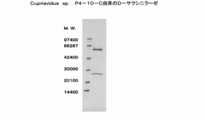
- FIG. 1 shows Cupriavidus sp.
- FIG. 3 is a diagram showing an electrophoresis image of D-succinylase produced by a P4-10-C strain by electrophoresis.
- FIG. 2 is a diagram showing a screening method for modified D-succinylase.
- FIG. 3 is a diagram showing an alignment result of amino acid sequences of D-succinylase derived from the genus Cupriavidus.
- the present invention provides a modified D-succinylase in which D-type selectivity is significantly improved by substituting wild-type D-succinylase with an amino acid at a specific site as compared with wild-type D-succinylase.
- the wild-type D-succinylase used as the base of modification is mainly D-succinylase of two types of bacteria belonging to the genus Cupriavidus (Cupriavidus sp. P4-10-C and Cupriavidus metallidurans).
- Cupriavidus sp. P4-10-C and Cupriavidus metallidurans are examples of each modified D-succinylase.
- the first aspect of the present invention relates to Cupriavidus sp.
- the present invention relates to a modified D-succinylase based on D-succinylase of the P4-10-C strain. That is, according to the first aspect of the present invention, (A) an amino acid sequence having a substitution of at least one amino acid residue selected from the following (a) to (k) in the amino acid sequence shown in SEQ ID NO: 2
- a protein characterized by comprising: (A) Replacement of glutamine residue at position 72 with arginine residue (b) Replacement of glycine residue at position 181 with tryptophan residue, lysine residue, arginine residue, aspartic acid or glutamic acid residue (c) Replacement of leucine residue at position 182 with tryptophan residue, serine residue, cysteine residue, tyrosine residue, lysine residue, arginine residue, aspartic acid residue, glutamic acid residue or proline residue (d) 183 Substitution of a
- the protein of (A) above has a substitution of a leucine residue at position 182 with a glutamic acid residue and a leucine residue at position 348 into an isoleucine residue. It consists of an amino acid sequence having the following substitutions.
- L348I single mutation does not improve the D-form selectivity, but when combined with the L182E single mutation, a synergistic effect is exhibited and the D-form selectivity is further improved. Can be made.
- the protein (A) has a feature that it has an activity of producing D-amino acid by selectively acting on D-form with respect to N-succinyl-DL-amino acid.
- “acting selectively in D form” means that N-succinyl-D-amino acid (D form) is more N-succinyl-L-amino acid (L form) than wild-type D-succinylase.
- the property which is easy to react is generally called, and this is synonymous with “D-form selectivity is improved”.
- “acting selectively in D-form” means that the degradation ratio of L-form to D-form (L / D) is lower than that of wild-type D-succinylase. Cupriavidus sp.
- N-succinyl-L-tryptophan is used according to the method described in Example 2.
- N-succinyl-D-tryptophan, L-form to D-form when the L-form is 4 and D-form is 1, ie, L: D 4: 1 in the amount of protein for each substrate. It means that the decomposition ratio (L / D) is less than 0.91.
- the decomposition ratio (L / D) of the L isomer to the D isomer is preferably 0.5 or less, and more preferably 0.3 or less.
- N-succinylphenylalanine was used as a substrate
- 4 L-forms were obtained for each of N-succinyl-L-phenylalanine and N-succinyl-D-phenylalanine according to the method described in Example 2.
- the decomposition ratio (L / D) of the L isomer to the D isomer is preferably 0.4 or less, and more preferably 0.2 or less.
- N-succinylbiphenylalanine was used as the substrate, the L-form was decomposed into the D-form when reacted with the racemic N-succinyl-DL-biphenylalanine according to the method described in Example 3. It means that the ratio (L / D) is less than 0.09.
- the decomposition ratio (L / D) of the L isomer to the D isomer is preferably 0.05 or less, and more preferably 0.02 or less.
- N-succinyl-L-tryptophan is used according to the method described in Example 2.
- N-succinyl-D-tryptophan, L-form relative to D-form when the L-form is reacted with the L-form, and the L-form is 1, ie, L: D 4: 1. It means that the decomposition ratio (L / D) is less than 0.54.
- the decomposition ratio (L / D) of the L isomer to the D isomer is preferably 0.3 or less, and more preferably 0.1 or less. From a practical viewpoint, not only the decomposition ratio of the L isomer to the D isomer but also the values of the L isomer decomposition rate and the D isomer decomposition rate should be considered. Specifically, the L-isomer decomposition rate is preferably 12% or less, the L-isomer decomposition rate is preferably 12% or less, and the D-isomer decomposition rate is more preferably 25% or more, and the L-isomer decomposition rate is 0. % And the D-form decomposition rate is particularly preferably 25% or more.
- stereoselectivity in the present invention is as shown in the examples, but the numerical value may vary depending on the reaction conditions such as the substrate concentration, enzyme amount, reaction temperature, reaction time and reaction pH.
- D-form selectivity for N-succinyl-DL-tryptophan, N-succinyl-DL-phenylalanine and N-succinyl-DL-biphenylalanine.
- the type D-succinylase has D-form selectivity not only for these specific N-succinyl-DL-amino acids but also for any N-succinyl-DL-amino acid represented by the following general formula (I). .
- R represents an aryl group having 4 to 20 carbon atoms which may have a substituent, or an aralkyl group having 5 to 20 carbon atoms which may have a substituent.
- the aryl group having 6 to 20 carbon atoms which may have a substituent for R include a phenyl group and a 4-hydroxyphenyl group.
- the substituent include an amino group, hydroxyl group, nitro group, cyano group, carboxyl group, alkyl group, aralkyl group, aryl group, alkanoyl group, alkenyl group, alkynyl group, alkoxyl group, or halogen atom.
- the aralkyl group having 7 to 20 carbon atoms which may have a substituent is not particularly limited, and examples thereof include a benzyl group, an indolylmethyl group, a 4-phenylbenzyl group, and a 4-hydroxybenzyl group. Can be mentioned.
- the conventionally known wild-type D-succinylase cannot strictly discriminate optical isomerism of N-succinyl-DL-amino acid, which is a precursor of D-amino acid, and acts slightly on L-form, and only D-amino acid In addition, L-amino acids are also produced.
- the modified D-succinylase of the present invention changes the stereoselectivity by substituting a part of the amino acid residues of the wild-type D-succinylase, and selects D-form for N-succinyl-DL-amino acid.
- D-amino acids can be selectively generated from N-succinyl-DL-amino acids since they have been modified to act in an effective manner.
- genes which are a gene corresponding to the protein of said (A) are also provided.
- the gene (a) 214 to 216 characterized by comprising a base sequence having at least one base sequence substitution selected from the following (a) to (k) in the base sequence shown in SEQ ID NO: 1.
- the gene corresponding to the protein of the above (A) is the base sequence shown in SEQ ID NO: 1, the substitution of the base sequence ctg at positions 544 to 546 to gaa or gag, and the positions 1042 to 1044
- the base sequence ctg is a base sequence having substitution to att, atc or ata. This is a gene corresponding to a double mutant of L182E + L348I.
- the protein of the modified D-succinylase according to the first aspect of the present invention is not limited to the above (A), and in the amino acid sequence of (B) (A), positions 72, 181-185, 305,
- An amino acid sequence having substitution, deletion, insertion, addition and / or inversion of one or several amino acid residues at positions other than positions 348, 351, 461, and 539, and N-succinyl -Also includes a protein characterized by comprising an amino acid sequence encoding a protein having an activity of producing a D-amino acid by acting D-selectively on a DL-amino acid.
- the modified D-succinylase gene according to the first aspect of the present invention is not limited to the gene of (A) above, and (B) a nucleotide sequence that hybridizes with the nucleotide sequence of (A) under stringent conditions. And a gene characterized by comprising a base sequence encoding a protein having an activity of producing a D-amino acid by selectively acting on D-form to N-succinyl-DL-amino acid. This is often a functionally equivalent protein even if a part of the base sequence of the gene encoding the protein is mutated, and as a result, part of the amino acid sequence of the protein is mutated. Because.
- modified D-succinylase gene of the present invention when the modified D-succinylase gene of the present invention is incorporated into a host organism (such as E. coli) other than the organism from which the modified D-succinylase gene of the present invention is expressed, This is because the base sequence may be changed according to the codon usage.
- “one or several” is a range that does not significantly impair the three-dimensional structure of the amino acid residue protein, the D-succinylase activity, and the D-form selectivity to N-succinyl-DL-amino acid. Specifically, the number is 1 to 50, preferably 1 to 30, more preferably 1 to 20, and still more preferably 1 to 10. However, in the case of an amino acid sequence containing substitution, deletion, insertion, addition and / or inversion of one or several amino acid residues in the amino acid sequence shown in SEQ ID NO: 2 in the Sequence Listing, 37 ° C., pH 7.
- stringent conditions refers to conditions under which so-called specific hybrids are formed and non-specific hybrids are not formed.
- DNAs having high homology for example, DNAs having a homology of 85% or more, preferably 90% or more, more preferably 95% or more, are present.
- the conditions are such that the DNAs that hybridize with each other and the DNAs with lower homology do not hybridize with each other (here, the homology is homologous (homology)). Or 37 ° C., 0.1 ⁇ SSC, 0.1% SDS, preferably 60 ° C., 0.1 ⁇ SSC, 0.8%, which are washing conditions for normal Southern hybridization.
- Conditions include hybridization at a salt concentration corresponding to 1% SDS, more preferably 65 ° C., 0.1 ⁇ SSC, corresponding to 0.1% SDS.
- a base sequence that hybridizes under stringent conditions with a base sequence complementary to the base sequence shown in SEQ ID NO: 1 in the sequence listing the sequence number in the sequence listing under conditions of 37 ° C and pH 7.0 3% or more, preferably 10% or more, more preferably 30% or more, still more preferably 50% or more, particularly preferably 70% or more of the D-succinylase activity of the protein having the amino acid sequence described in 2. It is desirable.
- the protein of the first aspect of the present invention and its gene are, for example, Transformer Mutagenesis Kit; manufactured by Clonetech, EXOIII / Mung Bean Selection Kit; Can be obtained by modifying the base sequence described in SEQ ID NO: 1 using a commercially available kit or PCR method.
- the activity of the protein encoded by the obtained gene is, for example, by introducing the obtained gene into Escherichia coli to produce a transformant, and culturing the transformant to produce an enzyme protein. Confirmation is made by adding the cell disruption solution of this transformant or purified enzyme protein to N-succinyl-DL-amino acid and measuring the degradation ratio of L-form to D-form by the method described in the Examples. Can do.
- the second aspect of the present invention relates to a modified D-succinylase based on the D. succinylase of Cupriavidus metallidurans. That is, according to the second aspect of the present invention, (A) an amino acid sequence having a substitution of at least one amino acid residue selected from the following (a) to (e) in the amino acid sequence shown in SEQ ID NO: 4 A protein characterized by comprising: (A) Substitution of leucine residue at position 177 to arginine residue (b) Substitution of asparagine residue at position 180 to aspartic acid residue (c) Substitution of leucine residue at position 344 to proline residue ( d) Substitution of phenylalanine residue at position 347 to isoleucine residue (e) Substitution of asparagine residue at position 457 to isoleucine residue SEQ ID NO: 4 is the amino acid sequence of D-succinylase of Cupriavidus metallidrans.
- the protein (A) has a feature that it has an activity of producing D-amino acid by selectively acting on D-form with respect to N-succinyl-DL-amino acid.
- the definition of “acting selectively on D body” and the like are the same as in the first aspect, and thus description thereof is omitted.
- a gene (a) 529 to 531 comprising a base sequence having substitution of at least one base sequence selected from the following (a) to (e) in the base sequence shown in SEQ ID NO: 3 Substitution of base sequence ctg to cgt, cgc, cga, cgg, aga or agg (b) Substitution of base sequence aac from positions 538 to 540 to gat or gac (c) Base sequence from positions 1030 to 1032 Substitution of ctg to cct, ccc, cca or ccg (d) Substitution of nucleotide sequence ttc at positions 1039 to 1041 to att, atc or ata (e) Att, atc of nucleotide sequence aat at positions 1369 to 1371 Alternatively, substitution to atata SEQ ID NO: 3 is the following (a) to (e) in the base sequence shown in SEQ ID NO: 3 Substitution of base sequence ctg to cgt, cg
- the modified D-succinylase protein of the second aspect of the present invention is not limited to the above (A), and (B) in the amino acid sequence of (A), positions 177, 180, 344, 347 And an amino acid sequence having substitutions, deletions, insertions, additions and / or inversions of one or several amino acid residues at positions other than position 457, wherein D is an N-succinyl-DL-amino acid
- a protein comprising an amino acid sequence encoding a protein having an activity of producing a D-amino acid by acting selectively on the body.
- the modified D-succinylase gene of the second aspect of the present invention is not limited to the gene of (A) above, and (B) a nucleotide sequence that hybridizes with the nucleotide sequence of (A) under stringent conditions. And a gene characterized by comprising a base sequence encoding a protein having an activity of producing a D-amino acid by selectively acting on D-form to N-succinyl-DL-amino acid.
- the definition of “one or several” and “stringent conditions”, and the method for creating and confirming the activity of the protein and gene of the second aspect are the same as those of the first aspect, and thus the description thereof is omitted. .
- the modified D-succinylase based on D-succinylase of P4-10-C strain and Cupriavidus metallidurans D-succinylase has been described.
- the modified D-succinylase of the present invention is based on the D-succinylase of these bacteria. And those based on D-succinylase of related species including other bacteria of the genus Cupriavidus.
- D-succinylase of the close relative of P4-10-C strain or Cupriavidus metallidurans Cupriavidus sp.
- D-form selectivity is improved by substituting amino acid residues at positions equivalent to the amino acid residues involved in stereoselectivity in the amino acid sequence of P4-10-C strain or Cupriavidus metallidurans D-succinylase it is conceivable that.
- Transmuter Mutagenesis Kit manufactured by Clonetech; EXOIII / Mung Bean Deletion Kit; manufactured by Stratagene; QuickChange Site Directed Mutesisis Kit;
- the base sequence corresponding to the amino acid sequence of the base D-succinylase can be mutated site-specifically.
- the activity of the protein encoded by the obtained gene is, for example, by introducing the obtained gene into Escherichia coli to produce a transformant, and culturing the transformant to produce an enzyme protein.
- the cell disruption solution of this transformant or purified enzyme protein is added to N-succinyl-DL amino acid, and the degradation ratio of L-form to D-form is measured by the method described in the Examples. it can.
- N-succinyl amino acid racemase is an enzyme that catalyzes both the reaction of converting the L-form of N-succinyl amino acid into the D-form and the reaction of converting the D-form into the L-form, and the ratios are almost equal (racemization). .
- the N-succinyl amino acid racemase used in the production method of the present invention is not particularly limited as long as the N-succinyl amino acid can be racemized, and the N-acyl amino acid racemase described in JP-A-2007-82534 and JP-A Conventionally known ones such as N-acylamino acid racemase described in 2008-61642 can be used.
- N-succinyl amino acid racemase is preferably used at a concentration of 50 to 15000 mg / L (5000 to 1500,000 U / L) in the reaction solution.
- the activity of N-succinyl amino acid racemase is significantly improved by adding a divalent metal ion at a final concentration of 0.1 mM to 1 M (preferably 0.1 to 1 mM).
- the divalent metal ion to be added include Mn 2+ , Co 2+ , Mg 2+ , Fe 2+ and Ni 2+ .
- the buffer used for the reaction of N-succinyl amino acid racemase the same buffer as that used for the reaction of D-succinylase can be used.
- the culture was carried out for 2 days at 35 ° C., 150 r / min, with rotary stirring, using 27 mediums that were autoclaved by adding 200 mL of the above medium to a 500 mL flask.
- the turbidity (ABS 660 nm) at the end of the culture was 2.7, and the pH was 8.6.
- the cells were collected by centrifugation at 8000 r / min for 30 minutes using a cooled centrifuge (manufactured by Hitachi Koki Co., Ltd.). The collected cells were washed with 20 mM HEPES-NaOH (pH 7.5) buffer, and then centrifuged again to obtain 36 g of cells.
- the transformant was cultured in LB medium, the plasmid was extracted, the gene sequence was confirmed by BigDye (registered trademark) Terminator v3.1 Cycle Sequencing Kit (Applied Biosystems), and a partial sequence of 575 bp was obtained. Furthermore, the following operation was performed to obtain a full-length sequence. Using TAKARA LA PCR In Vitro Cloning Kit (manufactured by Takara Bio Inc.), the operation was performed according to the protocol, and a DNA fragment from a known sequence toward the C-terminal was successfully amplified. The base sequence up to the partial gene sequence was determined.
- a DNA primer (SEQ ID NO: 9 in Table 1) having a sequence in which an NdeI cleavage site is bound to a portion presumed to be upstream from the N-terminus of the enzyme, and EcoRI cleavage to a portion presumed to be downstream from the C-terminus
- a DNA primer (SEQ ID NO: 10 in Table 1) having a sequence to which the sites are bound
- the DNA between this sequence is amplified by PCR using the previously obtained DNA as a template, thereby including the full length of the succinylase gene.
- a DNA fragment was obtained.
- the nucleotide sequence of the obtained DNA fragment was analyzed to confirm that the full length of the D-succinylase gene was included, and the amino acid sequence was estimated.
- the obtained base sequence and amino acid sequence are shown in SEQ ID NOs: 1 and 2, respectively.
- penicillin acylase family to which this penicillin amidase belongs is an enzyme that hydrolyzes penicillin G, cephalosporin C, etc., and it is presumed that such an enzyme hydrolyzes N-succinyl-D-amino acid. It was difficult, and it was almost impossible to obtain this gene by homology search predicted from the function.
- CmDSA gene D-succinylase gene derived from Cupriavidus metallidurans strain and Cupriavidus sp. Cloning of D-succinylase from Cupriavidus metallidurans, a related species of P4-10-C, was also performed.
- cloning kit Target Clone-Plus manufactured by Toyobo Co., Ltd.
- the operation was performed according to the protocol, and the product was cloned into the vector pBluescript to obtain a recombinant expression plasmid pCmDSA.
- pCmDSA was transformed into Escherichia coli DH5 ⁇ competent cell (manufactured by Toyobo) to obtain the transformant.
- the transformant was cultured in LB medium, the plasmid was extracted, the gene sequence was confirmed by BigDye (registered trademark) Terminator v3.1 Cycle Sequencing Kit (Applied Biosystems), and the amino acid sequence was deduced.
- the obtained base sequence and amino acid sequence are shown in SEQ ID NOs: 3 and 4, respectively.
- the ligated DNA was transformed into Escherichia coli DH5 ⁇ strain competent cells (Toyobo Competent High DH5 ⁇ ) according to the protocol attached to the product to obtain the transformants.
- Escherichia coli DH5 ⁇ strain competent cells Toyobo Competent High DH5 ⁇
- pBSKP4DSA designed to express a large amount of the D-succinylase gene was obtained.
- the plasmid was extracted from the mutant which improved stereoselectivity, the P4DSA gene whole base sequence was confirmed, and the mutation location was identified.
- the 72nd, 176th, 181 to 185th, 286th, 305th, 348th, 351st, 388th, 461st, 518th and 539th amino acid residues contribute to the improvement of stereoselectivity. I was listed as a candidate.
- modified plasmid (optimization of substituted amino acids) Among the mutant strains obtained in (1), there were mutant strains having a plurality of amino acid mutations. In addition, in order to examine the types of amino acids to be substituted, site-directed mutations were mutated. A modified DSA expression plasmid was prepared. For the production of site-specific mutations, QuikChange Site-Directed Mutagenesis Kit manufactured by STRATAGENE was used. In addition, since the substitution amino acid is also optimized when mutating, the 72nd, 181st to 185th, 305th, 348th, 351 estimated to have contributed to the improvement of stereoselectivity in (2).
- the name of the modified enzyme is expressed in the order of “amino acid residue ⁇ residue number ⁇ substituted amino acid residue in the amino acid sequence of the wild-type enzyme”.
- the L182R modified enzyme means a modified enzyme in which the 182nd Leu (L) residue in the amino acid sequence of the wild-type enzyme is substituted with an Arg (R) residue.
- X in L182X means any amino acid among the 20 types of amino acids.
- Example 2 Evaluation of stereoselectivity for N-succinyltryptophan and N-succinylphenylalanine using modified P4DSA Using the crude enzyme solution prepared in Example 1, stereoselectivity for N-succinyltryptophan and N-succinylphenylalanine was evaluated. Specifically, the crude enzyme solution was added to each of the N-succinyl-D-amino acid solution and the N-succinyl-L-amino acid solution having the following composition.
- N-succinyl-D-tryptophan solution 25 mM KPB (pH 7.0), 1% N-succinyl-D-tryptophan N-succinyl-L-tryptophan solution: 25 mM KPB (pH 7.0), 1% N-succinyl-L -Tryptophan N-succinyl-D-phenylalanine solution: 25 mM KPB (pH 7.0), 1% N-succinyl-D-phenylalanine N-succinyl-L-phenylalanine solution: 25 mM KPB (pH 7.0), 1% N-succinyl -L-Phenylalanine After incubating the obtained reaction solution at 40 ° C.
- the decomposition rate and the decomposition ratio of L-form to D-form were calculated from the remaining substrate concentration.
- the reaction was performed at a protein ratio of 1: 1.
- the enzyme protein concentration is adjusted so that the final enzyme protein concentration is 2.0 mg / ml in the case of L-form reaction, and the final enzyme protein concentration is 0.5 mg / ml in the case of D-form reaction. Adjusted as follows. The results are shown in Table 3.
- Example 3 Evaluation of Stereoselectivity for N-Succinylbiphenylalanine Using Modified P4DSA
- Example 2 it was clarified that it was involved in stereoselectivity for N-succinyltryptophan and N-succinylphenylalanine. It was confirmed whether the modified P4DSA acted selectively to other aromatic amino acids on the D form.
- N-succinylbiphenylalanine which is a kind of non-natural amino acid, is selected and the crude enzyme solution prepared in Example 1 is used to perform N-succinyl in the same procedure as in Example 2. The stereoselectivity for biphenylalanine was evaluated.
- Example 4 N-succinyl-DL-tryptophan to D-tryptophan, N-succinyl-DL-phenylalanine to D-phenylalanine and N-succinyl-DL-, using modified P4DSA and N-succinyl amino acid racemase from Chloroflexus aurantiacus Synthesis of D-biphenylalanine from biphenylalanine (1) Preparation of Modified P4DSA (L182E, L182P, R305N) A colony of E.
- Example 2 coli transformants expressing the modified P4DSA (L182E, L182P, R305N) obtained in Example 1 was placed in 5 mL of LB medium ( Inoculating ampicillin (containing 50 ⁇ g / mL), and culturing for 16 hours at 180 ° C. and 30 ° C. to obtain a seed culture solution.
- This seed culture was inoculated into 60 mL of TB medium (containing 50 ⁇ g / mL of ampicillin) contained in a 500 mL Sakaguchi flask, and cultured at a shaking speed of 310 rpm and 30 ° C. for 18 hours.
- Turbidity (Abs 660 nm) at the end of the culture was 15.0, 16.2, and 15.5.
- the obtained cells were collected by centrifugation, suspended in a 25 mM phosphate buffer solution (pH 7.0), and crushed using an ultrasonic cell crusher under ice cooling. Thereafter, heat treatment is performed at 65 ° C. for 1 hour, and then desalting is performed by a general method, and an enzyme sample for amino acid synthesis (L182E: 27.9 mg / mL, 5.2 U / mL, L182P: 7. 3 mg / mL, 1.8 U / mL, R305N: 28.5 mg / mL, 4.3 U / mL). Note that N-succinyl-D-tryptophan was used as the enzyme activity substrate.
- R305N enzyme solution (0.16 U, 0.2 U, 0.08 U) was added to each substrate, and 25 mg (6400 U) of an N-succinyl amino acid racemase solution derived from Chloroflexus aurantiacus strain prepared in Reference Example 5 was added to each substrate. And reacted at 45 ° C. for 3 days.
- a wild-type DSA enzyme solution prepared by the method described in the examples of PCT / JP2011 / 064943 was used, and reacted in the same manner to calculate the conversion rate and the optical purity of D-amino acid.
- the conversion rate is determined by measuring the peak area value of the substrate before and after the enzyme reaction by high performance liquid chromatography using “Inertsil ODS-3” (5 ⁇ m, 4.6 ⁇ 100 mm) manufactured by GL Sciences, Inc. Calculated by The optical purity was calculated by measuring the optical purity of the free amino acid produced by the above-described optical resolution column “CROWNPAK CR (+)” (5 ⁇ m, 4.0 ⁇ 150 mm) manufactured by Daicel Chemical Industries, Ltd. The results are shown in Tables 5-7.
- the conversion rate on the third day of the reaction in D-tryptophan synthesis was 83%, 87%, 86%, and 89% in the order of wild-type DSA, L182E, L182P, and R305N.
- the conversion rate on the third day of the reaction in the synthesis of phenylalanine is 81%, 84%, 83%, 84% in the order of wild-type DSA, L182E, L182P, and R305N, and the third day of the reaction in the synthesis of D-biphenylalanine.
- the conversion rates were 96%, 91%, 96%, and 91% in the order of wild type DSA, L182E, L182P, and R305N, and the reaction proceeded without any problem. Further, as shown in Tables 5 to 7, in any modified DSA, when N-succinyl-DL-amino acid constituted by an aromatic amino acid is used as a substrate, compared to the case where wild-type DSA is used. It was confirmed that a highly pure aromatic D-amino acid could be produced. In particular, when L-182E is used to produce D-tryptophan and D-biphenylalanine, 99.6% ee, 99.2% ee, and L182P are used to produce D-biphenylalanine, respectively.
- Example 5 D-Tryptophan from N-succinyl-DL-tryptophan using N-succinyl-DL-tryptophan using double mutant modified P4DSA (L182E + L348I) and N-succinyl amino acid racemase from Chloroflexus aurantiacus D-phenylalanine from N-succinyl-DL-phenylalanine And D-biphenylalanine synthesis from N-succinyl-DL-biphenylalanine (1) Construction of double-mutant modified plasmids To obtain a plasmid that expresses double-mutant variants, they were obtained in Example 1.
- PCR was carried out by the method described above.
- the 182nd leucine was replaced with glutamic acid, and the 348th leucine was replaced with isoleucine.
- the expression plasmid containing the heavy variant modified P4DSA (L182E + L348I) was constructed.
- the D-succinylase of the present invention is used for the production of D-amino acids on an industrial scale, the slight improvement in the optical purity of the produced D-amino acids means a significant improvement resulting in a reduction in production costs. You can say that.
- the single mutation of L348I does not show an effect of improving the selectivity compared to the wild type, and it is confirmed that the combination with L182E contributes to a synergistic improvement of stereoselectivity. It was done.
- the D-succinylase of the present invention is used for the production of D-amino acids on an industrial scale, the slight improvement in the optical purity of the produced D-amino acids means a significant improvement resulting in a reduction in production costs. You can say that.
- the single mutation of L348I does not show an effect of improving the selectivity compared to the wild type, and it is confirmed that the combination with L182E contributes to a synergistic improvement of stereoselectivity. It was done.
- the optical purity of D-biphenylalanine on the third day of the reaction is 88.3% ee for the wild type, whereas it is 99.2% ee for the single mutation type of L182E, and the double mutation of L182E + L348I.
- the modified type is 99.4% ee, and the optical purity of each modified type is markedly improved compared to the wild type.
- the double mutant modified type has a further improved optical purity than the single mutant modified type.
- the D-succinylase of the present invention is used for the production of D-amino acids on an industrial scale, the slight improvement in the optical purity of the produced D-amino acids means a significant improvement resulting in a reduction in production costs. You can say that.
- the single mutation of L348I does not show an effect of improving the selectivity compared to the wild type, and it is confirmed that the combination with L182E contributes to a synergistic improvement of stereoselectivity. It was done.
- Example 6 Cupriavidus sp. Comparison of homology of amino acid sequences between D-succinylase derived from P4-10-C strain and D-succinylase of related species Cupriavidus sp. In order to examine whether amino acid residues involved in stereoselectivity revealed in D-succinylase derived from P4-10-C strain are conserved in other D. succinylases of the genus Cupriavidus, Cupriavidus sp . A homology comparison of the amino acid sequences of D4 succinylases of P4-10-C, Cupriavidus metallidrans, Cupriavidus necator and Cupriavidus taiwanensis was performed. Cupriavidus sp.
- Example 7 Preparation of Modified Cupriavidus metallidurans-derived D-succinylase (hereinafter referred to as CmDSA gene) Based on the alignment results of the amino acid sequence of Example 6, the related species are also involved in the stereoselectivity of P4DSA. Substituents, 181 to 185, 305, 348, 351, 461, 539, and D-form selective action on N-succinyl-DL-amino acid by amino acid substitution at equivalent sites In order to show that this is the case, it was decided to create a modified CmDSA of Cupriavidus metallidurans, a kind of related species, and evaluate the stereoselectivity.
- CmDSA gene Modified Cupriavidus metallidurans-derived D-succinylase
- modified CmDSA gene expression plasmid A modified CmDSA gene expression plasmid was constructed in the same manner as described in Example 1 (3). Table 12 shows the sequences of the prepared modified enzymes and the synthetic oligo DNA primers used for introducing the mutation.
- Example 8 Evaluation of stereoselectivity for N-succinyltryptophan using modified CmDSA Stereoselection for N-succinyltryptophan using the crude enzyme solution prepared in Example 7 under the same conditions and procedures as in Example 1. Sexuality was evaluated. The results are shown in Table 13.
- the modified D-succinylase of the present invention has a significantly improved D-form selectivity compared to the wild-type D-succinylase, so that it can efficiently produce a D-amino acid useful as a raw material for intermediates such as pharmaceuticals. Useful for.
- SEQ ID Nos: 5 to 54 are the sequences of the designed polynucleotides described in the examples.
Landscapes
- Chemical & Material Sciences (AREA)
- Organic Chemistry (AREA)
- Life Sciences & Earth Sciences (AREA)
- Wood Science & Technology (AREA)
- Engineering & Computer Science (AREA)
- Zoology (AREA)
- Health & Medical Sciences (AREA)
- Genetics & Genomics (AREA)
- Bioinformatics & Cheminformatics (AREA)
- General Health & Medical Sciences (AREA)
- Microbiology (AREA)
- Biochemistry (AREA)
- General Engineering & Computer Science (AREA)
- Biotechnology (AREA)
- General Chemical & Material Sciences (AREA)
- Chemical Kinetics & Catalysis (AREA)
- Analytical Chemistry (AREA)
- Medicinal Chemistry (AREA)
- Molecular Biology (AREA)
- Biomedical Technology (AREA)
- Enzymes And Modification Thereof (AREA)
- Preparation Of Compounds By Using Micro-Organisms (AREA)
Abstract
La présente invention concerne la production d'un acide D-aminé à efficacité améliorée par une modification supplémentaire de la D-succinylase de type sauvage pour améliorer la sélectivité pour la forme D de celle-ci. L'invention concerne une D-succinylase modifiée obtenue par substitution, dans la séquence d'acides aminés de la D-succinylase de type sauvage issue de Cupriavidus sp. P4-10-C ou Cupriavidus metallidurans, d'un résidu d'acide aminé à une position spécifique par un résidu d'acide aminé spécifique.
Applications Claiming Priority (2)
| Application Number | Priority Date | Filing Date | Title |
|---|---|---|---|
| JP2011055365 | 2011-03-14 | ||
| JP2011-055365 | 2011-03-14 |
Publications (1)
| Publication Number | Publication Date |
|---|---|
| WO2012124513A1 true WO2012124513A1 (fr) | 2012-09-20 |
Family
ID=46830588
Family Applications (1)
| Application Number | Title | Priority Date | Filing Date |
|---|---|---|---|
| PCT/JP2012/055409 Ceased WO2012124513A1 (fr) | 2011-03-14 | 2012-03-02 | D-succinylase modifiée ayant une sélectivité pour la forme d améliorée pour l'acide n-succinyl-dl-aminé |
Country Status (2)
| Country | Link |
|---|---|
| JP (1) | JP5903298B2 (fr) |
| WO (1) | WO2012124513A1 (fr) |
Cited By (5)
| Publication number | Priority date | Publication date | Assignee | Title |
|---|---|---|---|---|
| CN106399412A (zh) * | 2016-06-03 | 2017-02-15 | 南京红杉生物科技有限公司 | 合成d-联苯基丙氨酸的方法 |
| US9700599B2 (en) | 2012-11-13 | 2017-07-11 | Adocia | Rapid-acting insulin formulation comprising a substituted anionic compound |
| US9795678B2 (en) | 2014-05-14 | 2017-10-24 | Adocia | Fast-acting insulin composition comprising a substituted anionic compound and a polyanionic compound |
| US10525133B2 (en) | 2014-05-14 | 2020-01-07 | Adocia | Aqueous composition comprising at least one protein and one solubilizing agent, preparation thereof and uses thereof |
| US10792335B2 (en) | 2015-11-16 | 2020-10-06 | Adocia | Rapid-acting insulin composition comprising a substituted citrate |
Citations (2)
| Publication number | Priority date | Publication date | Assignee | Title |
|---|---|---|---|---|
| JP2008061642A (ja) * | 2006-08-10 | 2008-03-21 | Toyobo Co Ltd | D−アミノ酸の製造方法 |
| WO2012002450A1 (fr) * | 2010-06-30 | 2012-01-05 | 積水メディカル株式会社 | D-succinylase et procédé de production d'un acide d-aminé l'utilisant |
-
2012
- 2012-03-02 WO PCT/JP2012/055409 patent/WO2012124513A1/fr not_active Ceased
- 2012-03-02 JP JP2012046441A patent/JP5903298B2/ja active Active
Patent Citations (2)
| Publication number | Priority date | Publication date | Assignee | Title |
|---|---|---|---|---|
| JP2008061642A (ja) * | 2006-08-10 | 2008-03-21 | Toyobo Co Ltd | D−アミノ酸の製造方法 |
| WO2012002450A1 (fr) * | 2010-06-30 | 2012-01-05 | 積水メディカル株式会社 | D-succinylase et procédé de production d'un acide d-aminé l'utilisant |
Non-Patent Citations (2)
| Title |
|---|
| DATABASE UNIPROTKB/ SWISS-PROT DAT [online] 28 November 2006 (2006-11-28), "Penicillin G acylase precursor.", retrieved from http://www.ncbi.nlm.nih.gov/protein/QOJY93 Database accession no. QOJY93 * |
| DATABASE UNIPROTKB/SWISS-PROT DATA [online] 28 November 2006 (2006-11-28), "Peptidase S45, penicillin amidase precursor.", retrieved from http://www.ncbi.nlm.nih.gov/protein/ Q1LBI2 Database accession no. Q1LBI2 * |
Cited By (10)
| Publication number | Priority date | Publication date | Assignee | Title |
|---|---|---|---|---|
| US9700599B2 (en) | 2012-11-13 | 2017-07-11 | Adocia | Rapid-acting insulin formulation comprising a substituted anionic compound |
| US10583175B2 (en) | 2012-11-13 | 2020-03-10 | Adocia | Rapid-acting insulin formulation comprising a substituted anionic compound |
| US10646551B2 (en) | 2012-11-13 | 2020-05-12 | Adocia | Rapid-acting insulin formulation comprising a substituted anionic compound |
| US10881716B2 (en) | 2012-11-13 | 2021-01-05 | Adocia | Rapid-acting insulin formulation comprising a substituted anionic compound |
| US11324808B2 (en) | 2012-11-13 | 2022-05-10 | Adocia | Rapid-acting insulin formulation comprising a substituted anionic compound |
| US9795678B2 (en) | 2014-05-14 | 2017-10-24 | Adocia | Fast-acting insulin composition comprising a substituted anionic compound and a polyanionic compound |
| US10525133B2 (en) | 2014-05-14 | 2020-01-07 | Adocia | Aqueous composition comprising at least one protein and one solubilizing agent, preparation thereof and uses thereof |
| US10792335B2 (en) | 2015-11-16 | 2020-10-06 | Adocia | Rapid-acting insulin composition comprising a substituted citrate |
| CN106399412A (zh) * | 2016-06-03 | 2017-02-15 | 南京红杉生物科技有限公司 | 合成d-联苯基丙氨酸的方法 |
| CN106399412B (zh) * | 2016-06-03 | 2019-12-10 | 南京红杉生物科技有限公司 | 合成d-联苯基丙氨酸的方法 |
Also Published As
| Publication number | Publication date |
|---|---|
| JP5903298B2 (ja) | 2016-04-13 |
| JP2012205587A (ja) | 2012-10-25 |
Similar Documents
| Publication | Publication Date | Title |
|---|---|---|
| US7316916B2 (en) | DNA for encoding D-hydantoin hydrolases, DNA for encoding N-carbamyl-D-amino acid hydrolases, recombinant DNA containing the genes, cells transformed with the recombinant DNA, methods for producing proteins utilizing the transformed cells and methods for producing D-amino acids | |
| JP5232247B2 (ja) | L−サクシニルアミノアシラーゼ、およびこれを用いたl−アミノ酸の製造方法 | |
| CN113969269B (zh) | D-氨基酸氧化酶突变体及其在制备l-草铵膦中的应用 | |
| JP2008061642A (ja) | D−アミノ酸の製造方法 | |
| JP6048850B2 (ja) | D−サクシニラーゼ、およびこれを用いたd−アミノ酸の製造方法 | |
| JP5903298B2 (ja) | N−サクシニル−dl−アミノ酸に対する向上されたd体選択性を有する改変型d−サクシニラーゼ | |
| WO2009136500A1 (fr) | L-succinyl aminoacylase et procédé de production d'un acide l-amino au moyen de cette dernière | |
| JP5516664B2 (ja) | N−アセチル−(R,S)−β−アミノ酸アシラーゼ遺伝子 | |
| CN113969268B (zh) | Glu/Leu/Phe/Val脱氢酶突变体及其在制备L-草铵膦中的应用 | |
| EP3666894B1 (fr) | Déshydrogénase d'acide aminé type d | |
| JP4561009B2 (ja) | D−ヒダントインハイドロラーゼをコードするdna、n−カルバミル−d−アミノ酸ハイドロラーゼをコードするdna、該遺伝子を含む組み換えdna、該組み換えdnaにより形質転換された細胞、該形質転換細胞を用いるタンパク質の製造方法、および、d−アミノ酸の製造方法 | |
| JP4118687B2 (ja) | Arthrobacter crystallopoietes(アリスロバクテリア クリスタロポイテス)DSM20117株由来のD−カルバモイラーゼ | |
| WO2015093320A1 (fr) | 2-désoxy-scyllo-inosose réductase | |
| JP4489598B2 (ja) | D−アミノアシラーゼ | |
| JP5119783B2 (ja) | N−アセチル−(R,S)−β−アミノ酸アシラーゼ遺伝子 | |
| JP4274767B2 (ja) | (r)−体のアミド結合を選択的に加水分解するアミダーゼ遺伝子及びその利用 | |
| JP4650421B2 (ja) | L体アミノ酸アミド不斉加水分解酵素及びそれをコードするdna | |
| US9493762B2 (en) | Vector, a transformant and a method to produce a polypeptide having activity to selectively hydrolyze a (R)-tropic acid amide in a racemic mixture | |
| JP4116798B2 (ja) | 新規アミダーゼ及びそれをコードする遺伝子 | |
| WO2018088434A1 (fr) | Procédé de production d'acide n-succinyl-hydroxy-d-amino et/ou d'acide hydroxy-d-amino | |
| JP4627039B2 (ja) | アミダーゼ活性を有するポリペプチド及びその遺伝子 | |
| JP5954539B2 (ja) | 1−ベンジル−4−ヒドロキシ−3−ピペリジンカルボン酸アルキルエステルの製造方法 | |
| JPWO2003085108A1 (ja) | ヒダントイナーゼ遺伝子及びカルバミラーゼ遺伝子を有する組換えdna、並びにアミノ酸製造方法 | |
| JP2005304498A (ja) | α−アミノアジピン酸セミアルデヒド誘導体およびα−アミノアジピン酸誘導体を製造するための新規微生物と酵素、およびα−アミノアジピン酸セミアルデヒド誘導体とα−アミノアジピン酸誘導体の製造方法 |
Legal Events
| Date | Code | Title | Description |
|---|---|---|---|
| 121 | Ep: the epo has been informed by wipo that ep was designated in this application |
Ref document number: 12758296 Country of ref document: EP Kind code of ref document: A1 |
|
| NENP | Non-entry into the national phase |
Ref country code: DE |
|
| 122 | Ep: pct application non-entry in european phase |
Ref document number: 12758296 Country of ref document: EP Kind code of ref document: A1 |