WO2012128246A1 - Procédé de fabrication de corps moulé en polyester cristallin - Google Patents
Procédé de fabrication de corps moulé en polyester cristallin Download PDFInfo
- Publication number
- WO2012128246A1 WO2012128246A1 PCT/JP2012/056996 JP2012056996W WO2012128246A1 WO 2012128246 A1 WO2012128246 A1 WO 2012128246A1 JP 2012056996 W JP2012056996 W JP 2012056996W WO 2012128246 A1 WO2012128246 A1 WO 2012128246A1
- Authority
- WO
- WIPO (PCT)
- Prior art keywords
- liquid crystal
- crystal polyester
- group
- mol
- producing
- Prior art date
- Legal status (The legal status is an assumption and is not a legal conclusion. Google has not performed a legal analysis and makes no representation as to the accuracy of the status listed.)
- Ceased
Links
Images
Classifications
-
- C—CHEMISTRY; METALLURGY
- C08—ORGANIC MACROMOLECULAR COMPOUNDS; THEIR PREPARATION OR CHEMICAL WORKING-UP; COMPOSITIONS BASED THEREON
- C08J—WORKING-UP; GENERAL PROCESSES OF COMPOUNDING; AFTER-TREATMENT NOT COVERED BY SUBCLASSES C08B, C08C, C08F, C08G or C08H
- C08J5/00—Manufacture of articles or shaped materials containing macromolecular substances
-
- B—PERFORMING OPERATIONS; TRANSPORTING
- B29—WORKING OF PLASTICS; WORKING OF SUBSTANCES IN A PLASTIC STATE IN GENERAL
- B29C—SHAPING OR JOINING OF PLASTICS; SHAPING OF MATERIAL IN A PLASTIC STATE, NOT OTHERWISE PROVIDED FOR; AFTER-TREATMENT OF THE SHAPED PRODUCTS, e.g. REPAIRING
- B29C48/00—Extrusion moulding, i.e. expressing the moulding material through a die or nozzle which imparts the desired form; Apparatus therefor
- B29C48/03—Extrusion moulding, i.e. expressing the moulding material through a die or nozzle which imparts the desired form; Apparatus therefor characterised by the shape of the extruded material at extrusion
- B29C48/05—Filamentary, e.g. strands
-
- B—PERFORMING OPERATIONS; TRANSPORTING
- B29—WORKING OF PLASTICS; WORKING OF SUBSTANCES IN A PLASTIC STATE IN GENERAL
- B29C—SHAPING OR JOINING OF PLASTICS; SHAPING OF MATERIAL IN A PLASTIC STATE, NOT OTHERWISE PROVIDED FOR; AFTER-TREATMENT OF THE SHAPED PRODUCTS, e.g. REPAIRING
- B29C48/00—Extrusion moulding, i.e. expressing the moulding material through a die or nozzle which imparts the desired form; Apparatus therefor
- B29C48/03—Extrusion moulding, i.e. expressing the moulding material through a die or nozzle which imparts the desired form; Apparatus therefor characterised by the shape of the extruded material at extrusion
- B29C48/07—Flat, e.g. panels
- B29C48/08—Flat, e.g. panels flexible, e.g. films
-
- B—PERFORMING OPERATIONS; TRANSPORTING
- B29—WORKING OF PLASTICS; WORKING OF SUBSTANCES IN A PLASTIC STATE IN GENERAL
- B29C—SHAPING OR JOINING OF PLASTICS; SHAPING OF MATERIAL IN A PLASTIC STATE, NOT OTHERWISE PROVIDED FOR; AFTER-TREATMENT OF THE SHAPED PRODUCTS, e.g. REPAIRING
- B29C48/00—Extrusion moulding, i.e. expressing the moulding material through a die or nozzle which imparts the desired form; Apparatus therefor
- B29C48/25—Component parts, details or accessories; Auxiliary operations
- B29C48/27—Cleaning; Purging; Avoiding contamination
- B29C48/2725—Cleaning; Purging; Avoiding contamination of filters
-
- B—PERFORMING OPERATIONS; TRANSPORTING
- B29—WORKING OF PLASTICS; WORKING OF SUBSTANCES IN A PLASTIC STATE IN GENERAL
- B29C—SHAPING OR JOINING OF PLASTICS; SHAPING OF MATERIAL IN A PLASTIC STATE, NOT OTHERWISE PROVIDED FOR; AFTER-TREATMENT OF THE SHAPED PRODUCTS, e.g. REPAIRING
- B29C48/00—Extrusion moulding, i.e. expressing the moulding material through a die or nozzle which imparts the desired form; Apparatus therefor
- B29C48/25—Component parts, details or accessories; Auxiliary operations
- B29C48/36—Means for plasticising or homogenising the moulding material or forcing it through the nozzle or die
- B29C48/50—Details of extruders
- B29C48/69—Filters or screens for the moulding material
- B29C48/694—Cylindrical or conical filters
-
- B—PERFORMING OPERATIONS; TRANSPORTING
- B29—WORKING OF PLASTICS; WORKING OF SUBSTANCES IN A PLASTIC STATE IN GENERAL
- B29C—SHAPING OR JOINING OF PLASTICS; SHAPING OF MATERIAL IN A PLASTIC STATE, NOT OTHERWISE PROVIDED FOR; AFTER-TREATMENT OF THE SHAPED PRODUCTS, e.g. REPAIRING
- B29C48/00—Extrusion moulding, i.e. expressing the moulding material through a die or nozzle which imparts the desired form; Apparatus therefor
- B29C48/001—Combinations of extrusion moulding with other shaping operations
- B29C48/0017—Combinations of extrusion moulding with other shaping operations combined with blow-moulding or thermoforming
-
- B—PERFORMING OPERATIONS; TRANSPORTING
- B29—WORKING OF PLASTICS; WORKING OF SUBSTANCES IN A PLASTIC STATE IN GENERAL
- B29C—SHAPING OR JOINING OF PLASTICS; SHAPING OF MATERIAL IN A PLASTIC STATE, NOT OTHERWISE PROVIDED FOR; AFTER-TREATMENT OF THE SHAPED PRODUCTS, e.g. REPAIRING
- B29C48/00—Extrusion moulding, i.e. expressing the moulding material through a die or nozzle which imparts the desired form; Apparatus therefor
- B29C48/001—Combinations of extrusion moulding with other shaping operations
- B29C48/0018—Combinations of extrusion moulding with other shaping operations combined with shaping by orienting, stretching or shrinking, e.g. film blowing
-
- B—PERFORMING OPERATIONS; TRANSPORTING
- B29—WORKING OF PLASTICS; WORKING OF SUBSTANCES IN A PLASTIC STATE IN GENERAL
- B29C—SHAPING OR JOINING OF PLASTICS; SHAPING OF MATERIAL IN A PLASTIC STATE, NOT OTHERWISE PROVIDED FOR; AFTER-TREATMENT OF THE SHAPED PRODUCTS, e.g. REPAIRING
- B29C48/00—Extrusion moulding, i.e. expressing the moulding material through a die or nozzle which imparts the desired form; Apparatus therefor
- B29C48/25—Component parts, details or accessories; Auxiliary operations
- B29C48/256—Exchangeable extruder parts
-
- B—PERFORMING OPERATIONS; TRANSPORTING
- B29—WORKING OF PLASTICS; WORKING OF SUBSTANCES IN A PLASTIC STATE IN GENERAL
- B29C—SHAPING OR JOINING OF PLASTICS; SHAPING OF MATERIAL IN A PLASTIC STATE, NOT OTHERWISE PROVIDED FOR; AFTER-TREATMENT OF THE SHAPED PRODUCTS, e.g. REPAIRING
- B29C48/00—Extrusion moulding, i.e. expressing the moulding material through a die or nozzle which imparts the desired form; Apparatus therefor
- B29C48/25—Component parts, details or accessories; Auxiliary operations
- B29C48/36—Means for plasticising or homogenising the moulding material or forcing it through the nozzle or die
- B29C48/395—Means for plasticising or homogenising the moulding material or forcing it through the nozzle or die using screws surrounded by a cooperating barrel, e.g. single screw extruders
- B29C48/40—Means for plasticising or homogenising the moulding material or forcing it through the nozzle or die using screws surrounded by a cooperating barrel, e.g. single screw extruders using two or more parallel screws or at least two parallel non-intermeshing screws, e.g. twin screw extruders
-
- B—PERFORMING OPERATIONS; TRANSPORTING
- B29—WORKING OF PLASTICS; WORKING OF SUBSTANCES IN A PLASTIC STATE IN GENERAL
- B29K—INDEXING SCHEME ASSOCIATED WITH SUBCLASSES B29B, B29C OR B29D, RELATING TO MOULDING MATERIALS OR TO MATERIALS FOR MOULDS, REINFORCEMENTS, FILLERS OR PREFORMED PARTS, e.g. INSERTS
- B29K2067/00—Use of polyesters or derivatives thereof, as moulding material
-
- C—CHEMISTRY; METALLURGY
- C08—ORGANIC MACROMOLECULAR COMPOUNDS; THEIR PREPARATION OR CHEMICAL WORKING-UP; COMPOSITIONS BASED THEREON
- C08J—WORKING-UP; GENERAL PROCESSES OF COMPOUNDING; AFTER-TREATMENT NOT COVERED BY SUBCLASSES C08B, C08C, C08F, C08G or C08H
- C08J2367/00—Characterised by the use of polyesters obtained by reactions forming a carboxylic ester link in the main chain; Derivatives of such polymers
Definitions
- the present invention relates to a method for producing a liquid crystal polyester molded body.
- Liquid crystalline polyester is attracting attention as a material that can realize excellent low moisture absorption, heat resistance, and mechanical strength, and is widely used for precision electronic parts such as connectors, films, fibers, etc., and various studies have been made.
- Patent Document 1 discloses that 30 to 80 mol% of repeating units derived from 6-hydroxy-2-naphthoic acid and 10 to 35 mol of repeating units derived from an aromatic diol.
- liquid crystal polyester consisting essentially of 10 to 35 mol% of a repeating unit derived from an aromatic dicarboxylic acid, specifically, a repeating unit derived from 6-hydroxy-2-naphthoic acid of 50
- a liquid crystal polyester composed of 25% by mole, a repeating unit derived from hydroquinone, 25% by mole, and a repeating unit derived from 2,6-naphthalenedicarboxylic acid, and a repeating unit derived from 6-hydroxy-2-naphthoic acid.
- Liquid crystal polyester consisting of units 20 mole% return is disclosed.
- Patent Document 2 discloses a repeating unit 30 derived from p-hydroxybenzoic acid, 6-hydroxy-2-naphthoic acid or 4-hydroxy-4′-biphenylcarboxylic acid.
- a liquid crystal polyester consisting essentially of ⁇ 60 mol%, 20-35 mol% of repeating units derived from 4,4′-dihydroxybiphenyl, and 20-35 mol% of repeating units derived from naphthalenedicarboxylic acid has been proposed.
- a liquid crystal polyester comprising 25 mol% of repeating units derived therefrom is disclosed.
- JP 2004-196930 A Japanese Patent Application Laid-Open No. 2004-244452
- the present invention has the following aspects.
- a first aspect of the present invention is a method for producing a liquid crystal polyester molded article,
- the liquid crystalline polyester has repeating units represented by the following general formulas (1), (2) and (3),
- the method for producing the liquid crystal polyester molded body includes a step of melt-extruding the liquid crystal polyester and then melt-filtering using a filter, and a step of molding the liquid crystal polyester using an injection molding machine after drying the liquid crystal polyester,
- Ar 1 is a phenylene group, a naphthylene group or a biphenylylene group
- Ar 2 and Ar 3 are each independently a phenylene group, a naphthylene group, a biphenylylene group or a group represented by the following general formula (4): Yes
- X and Y are each independently an oxygen atom or imino group
- one or more hydrogen atoms in Ar 1 , Ar 2 and Ar 3 are each independently substituted with a halogen atom, an alkyl group or an aryl group May be.
- Ar 4 and Ar 5 are each independently a phenylene group or a naphthylene group; Z is an oxygen atom, a sulfur atom, a carbonyl group, a sulfonyl group, or an alkylidene group.
- the content of the repeating unit containing 2,6-naphthylene group in the liquid crystal polyester is 40 mol% or more based on the total amount of all the repeating units constituting the liquid crystal polyester.
- the liquid crystalline polyester comprises 30 to 80 mol% of the repeating unit represented by the general formula (1) based on the total amount of all repeating units constituting the liquid crystalline polyester.
- a fourth aspect of the present invention is the method for producing a liquid crystal polyester molded article according to any one of the first to third aspects, wherein X and Y in the general formula (3) are oxygen atoms.
- a fifth aspect of the present invention is the method for producing a liquid crystal polyester molded body according to any one of the first to fourth aspects, wherein the filter medium of the filter is a metal fiber sintered body.
- a sixth aspect of the present invention is the method for producing a liquid crystal polyester molded body according to any one of the first to fifth aspects, wherein the filter is a leaf disk type.
- a seventh aspect of the present invention is the liquid crystal polyester molded body according to any one of the first to sixth aspects, wherein the liquid crystal polyester molded body contains 0.01 to 10 parts by mass of a filler with respect to 100 parts by mass of the liquid crystal polyester. This is a method for producing a liquid crystal polyester molded article.
- An eighth aspect of the present invention is the method for producing a liquid crystal polyester molded article according to the seventh aspect, wherein the filler is at least one selected from the group consisting of titanium oxide, silicon oxide and aluminum oxide. .
- a ninth aspect of the present invention is the method for producing a liquid crystal polyester molded body according to any one of the first to eighth aspects, wherein the liquid crystalline polyester molded body is a film or a fiber.
- a method for producing a liquid crystal polyester molded article having excellent heat resistance and mechanical strength can be provided.
- the liquid crystal polyester is a repeating unit represented by the following general formulas (1), (2) and (3) (hereinafter referred to as “repeating unit (1)”, “ A process of producing the liquid crystalline polyester molded article by melt-extruding the liquid crystalline polyester, and then melt-filtering it using a filter, which may be referred to as “repeating unit (2)” and “repeating unit (3)”. And a method for producing a liquid crystal polyester molded body, comprising drying the liquid crystal polyester and molding the liquid crystal polyester using an injection molding machine, wherein the filtration accuracy of the filter is 1 to 50 ⁇ m.
- Ar 1 is a phenylene group, a naphthylene group or a biphenylylene group
- Ar 2 and Ar 3 are each independently a phenylene group, a naphthylene group, a biphenylylene group or a group represented by the following general formula (4): Yes
- X and Y are each independently an oxygen atom or imino group
- one or more hydrogen atoms in Ar 1 , Ar 2 and Ar 3 are each independently substituted with a halogen atom, an alkyl group or an aryl group May be.
- Ar 4 and Ar 5 are each independently a phenylene group or a naphthylene group; Z is an oxygen atom, a sulfur atom, a carbonyl group, a sulfonyl group, or an alkylidene group.
- halogen atom a fluorine atom, a chlorine atom, a bromine atom, and an iodine atom are mentioned.
- alkyl group examples include methyl group, ethyl group, n-propyl group, isopropyl group, n-butyl group, isobutyl group, sec-butyl group, tert-butyl group, n-pentyl group, n-hexyl group, An n-heptyl group, a 2-ethylhexyl group, an n-octyl group, an n-nonyl group and an n-decyl group can be mentioned, and the carbon number is preferably 1 to 10.
- aryl group examples include a phenyl group, an o-tolyl group, an m-tolyl group, a p-tolyl group, a 1-naphthyl group, and a 2-naphthyl group, and the carbon number thereof is 6 to 20. Is preferred.
- the hydrogen atom is substituted with these groups, the number is preferably 2 or less independently for each of the groups represented by Ar 1 , Ar 2 or Ar 3. More preferably.
- alkylidene group examples include a methylene group, an ethylidene group, an isopropylidene group, an n-butylidene group, and a 2-ethylhexylidene group, and the number of carbon atoms is preferably 1 to 10.
- the repeating unit (1) is a repeating unit derived from a predetermined aromatic hydroxycarboxylic acid.
- the repeating unit (1) those ones Ar 1 is 1,4-phenylene group (repeating units derived from p- hydroxybenzoic acid), and Ar 1 is 2,6-naphthylene group (6-hydroxy -2-naphthoic acid-derived repeating units) are preferred, and those in which Ar 1 is a 2,6-naphthylene group are more preferred.
- the repeating unit (2) is a repeating unit derived from a predetermined aromatic dicarboxylic acid.
- Ar 2 is a 1,4-phenylene group (repeating unit derived from terephthalic acid), Ar 2 is a 1,3-phenylene group (repeating unit derived from isophthalic acid) ), Ar 2 is a 2,6-naphthylene group (repeating unit derived from 2,6-naphthalenedicarboxylic acid), and Ar 2 is a diphenyl ether-4,4′-diyl group (diphenyl)
- a repeating unit derived from ether-4,4′-dicarboxylic acid) is preferred, and those in which Ar 2 is a 1,4-phenylene group and those in which Ar 2 is a 2,6-naphthylene group are more preferred.
- the repeating unit (3) is a repeating unit derived from a predetermined aromatic diol, aromatic hydroxylamine or aromatic diamine.
- Ar 3 is a 1,4-phenylene group (a repeating unit derived from hydroquinone, p-aminophenol or p-phenylenediamine), and Ar 3 is a 2,6-naphthylene group.
- Ar 3 is 4,4 A biphenylylene group (a repeating unit derived from 4,4′-dihydroxybiphenyl, 4-amino-4′-hydroxybiphenyl or 4,4′-diaminobiphenyl) is preferred, and Ar 3 is a 1,4-phenylene group. More preferred are those in which Ar 3 is a 4,4′-biphenylylene group.
- the content of repeating units containing 2,6-naphthylene groups in the liquid crystalline polyester is the total amount of all repeating units constituting the liquid crystalline polyester (the mass of each repeating unit constituting the liquid crystalline polyester is expressed by the formula weight of each repeating unit).
- the substance equivalent amount (mole) of each repeating unit is obtained, and the sum of them is preferably 40 mol% or more, more preferably 50 mol% or more, and still more preferably 60 mol. % Or more, particularly preferably 70 mol% or more.
- the preferred liquid crystalline polyester the repeating units (1) Ar 1 is 2,6-naphthylene group, repeating unit Ar 2 is a 2,6-naphthylene group (2), and Ar 3 is 2,6-naphthylene
- the total content of the repeating unit (3) as a group is preferably 40 mol% or more, more preferably 50 mol% or more, and still more preferably 60, based on the total amount of all repeating units constituting the liquid crystal polyester. More than mol%, particularly preferably more than 70 mol%. All the repeating units containing 2,6-naphthylene groups in the liquid crystalline polyester are preferably any of the repeating units (1) to (3).
- the content of the repeating unit (1) is the total amount of all repeating units constituting the liquid crystal polyester (the substance of each repeating unit is obtained by dividing the mass of each repeating unit constituting the liquid crystal polyester by the formula weight of each repeating unit).
- the equivalent amount (mole) is obtained and the total of these is preferably 30 mol% or more, more preferably 30 to 80 mol%, still more preferably 40 to 70 mol%, particularly preferably 45 to 65 mol%. Mol%.
- the content of the repeating unit (2) is preferably 35 mol% or less, more preferably 10 to 35 mol%, still more preferably 15 to 30 mol%, based on the total amount of all repeating units constituting the liquid crystal polyester. Particularly preferred is 17.5 to 27.5 mol%.
- the content of the repeating unit (3) is preferably 35 mol% or less, more preferably 10 to 35 mol%, still more preferably 15 to 30 mol%, based on the total amount of all repeating units constituting the liquid crystal polyester. Particularly preferred is 17.5 to 27.5 mol%.
- the ratio between the content of the repeating unit (2) and the content of the repeating unit (3) is expressed as [content of repeating unit (2)] / [content of repeating unit (3)] (mol / mol).
- the ratio is preferably 0.9 / 1 to 1 / 0.9, more preferably 0.95 / 1 to 1 / 0.95, and still more preferably 0.98 / 1 to 1 / 0.98.
- the liquid crystal polyester may have two or more repeating units (1) to (3) independently.
- the liquid crystal polyester may have a repeating unit other than the repeating units (1) to (3), but the content thereof is preferably 10 with respect to the total amount of all repeating units constituting the liquid crystal polyester.
- the mol% or less more preferably 5 mol% or less.
- a typical example of a liquid crystal polyester having high heat resistance is a repeating unit (1) in which Ar 1 is a 2,6-naphthylene group with respect to the total amount of all repeating units constituting the liquid crystal polyester, that is, 6-hydroxy- repeating units derived from 2-naphthoic acid, preferably from 40 to 74.8 mol%, more preferably from 40 to 64.5 mol%, more preferably having 50-58 mol%, Ar 2 is 2,6 It preferably has 12.5 to 30 mol%, more preferably 17.5 to 30 mol% of repeating units derived from naphthylene groups (2), that is, 2,6-naphthalenedicarboxylic acid, and Ar 2
- the repeating unit (2) in which is a 1,4-phenylene group, that is, a repeating unit derived from terephthalic acid, is preferably 0.2 to 15 mol%, more preferably 0.5 to 12 mol%.
- the repeating units Ar 3 is 1,4-phenylene group (3), i.e. hydroquinone, repeating units derived from p- aminophenol or p- phenylenediamine, preferably 12
- the liquid crystal polyester preferably has, as the repeating unit (3), X and Y each having an oxygen atom, that is, a repeating unit derived from a predetermined aromatic diol.
- X and Y each have only an oxygen atom.
- the liquid crystal polyester includes, for example, an aromatic hydroxycarboxylic acid (a monomer that provides the repeating unit (1)), an aromatic dicarboxylic acid (a monomer that provides the repeating unit (2)), an aromatic diol, an aromatic hydroxyamine, and an aromatic. It can be produced by polymerizing (polycondensation) at least one compound selected from the group consisting of diamines (monomer that gives the repeating unit (3)).
- the aromatic hydroxycarboxylic acid, the aromatic dicarboxylic acid, the aromatic diol, the aromatic hydroxyamine, and the aromatic diamine are each independently replaced with a part or all of the polymerizable derivative. Also good.
- Examples of polymerizable derivatives of a compound having a carboxyl group such as aromatic hydroxycarboxylic acid and aromatic dicarboxylic acid include those obtained by converting a carboxyl group into an alkoxycarbonyl group or an aryloxycarbonyl group (ester), carboxyl Examples include those obtained by converting a group into a haloformyl group (acid halide), and those obtained by converting a carboxyl group into an acyloxycarbonyl group (acid anhydride).
- polymerizable derivatives of hydroxyl group-containing compounds such as aromatic hydroxycarboxylic acids, aromatic diols and aromatic hydroxyamines include those obtained by acylating hydroxyl groups and converting them to acyloxyl groups (acylated products) ).
- polymerizable derivatives of amino group-containing compounds such as aromatic hydroxyamines and aromatic diamines include those obtained by acylating an amino group and converting it to an acylamino group (acylated product).
- the liquid crystal polyester is preferably produced by melt polymerizing raw material monomers corresponding to the repeating units constituting the liquid crystal polyester and solid-phase polymerizing the obtained polymer (prepolymer). Thereby, high molecular weight liquid crystal polyester having high heat resistance, strength and rigidity can be produced with good operability.
- Melt polymerization may be carried out in the presence of a catalyst.
- the catalyst in this case include metals such as magnesium acetate, stannous acetate, tetrabutyl titanate, lead acetate, sodium acetate, potassium acetate, and antimony trioxide.
- nitrogen-containing heterocyclic compounds such as 4- (dimethylamino) pyridine and 1-methylimidazole, and nitrogen-containing heterocyclic compounds are preferably used.
- the liquid crystal polyester has a flow start temperature of preferably 280 ° C. or higher, more preferably 290 ° C. or higher, further preferably 295 ° C. or higher, and preferably 380 ° C. or lower, more preferably 350 ° C. or lower.
- a flow start temperature preferably 280 ° C. or higher, more preferably 290 ° C. or higher, further preferably 295 ° C. or higher, and preferably 380 ° C. or lower, more preferably 350 ° C. or lower.
- the flow start temperature is higher, the heat resistance, strength, and rigidity are more likely to be improved. However, if the flow start temperature is too high, the filtration pressure when passing through the filter tends to increase, making extrusion difficult. On the other hand, if the flow start temperature is too low, the heat resistance may be insufficient.
- the flow start temperature is also called flow temperature or flow temperature, and the temperature is raised at a rate of 4 ° C./min under a load of 9.8 MPa (100 kg / cm 2 ) using a capillary rheometer while liquid crystal polyester is used.
- the liquid crystal polyester may further be mixed with other components such as a filler, an additive, and a resin other than the liquid crystal polyester to form a composition.
- the other component may be one kind or two or more kinds.
- the filler examples include inorganic fillers such as silicon oxide (silica), aluminum oxide (alumina), titanium oxide, barium titanate, strontium titanate, aluminum hydroxide, calcium carbonate; cured epoxy resin, crosslinked benzoguanamine resin And organic fillers such as crosslinked acrylic resins.
- inorganic fillers such as silicon oxide (silica), aluminum oxide (alumina), titanium oxide, barium titanate, strontium titanate, aluminum hydroxide, calcium carbonate
- cured epoxy resin crosslinked benzoguanamine resin
- organic fillers such as crosslinked acrylic resins.
- one or more selected from the group consisting of titanium oxide, silicon oxide and aluminum oxide are preferable from the viewpoint of mechanical strength and color tone.
- the content of the filler is preferably 0.001 to 10 parts by mass, more preferably 0.005 to 5 parts by mass with respect to 100 parts by mass of the liquid crystalline polyester.
- the average particle size is preferably 0.05 to 2 ⁇ m, more preferably 0.05 to 1.5 ⁇ m. By setting it as such a range, melt filtration of liquid crystalline polyester becomes easier.
- additives examples include leveling agents, antifoaming agents, antioxidants, ultraviolet absorbers, flame retardants, colorants, release agents such as fluororesins and metal soaps, nucleating agents, stabilizers, plasticizers. , Lubricants, anti-coloring agents, antistatic agents and lubricants, and the content thereof is preferably 0 to 5 parts by mass with respect to 100 parts by mass of the liquid crystalline polyester.
- the resin other than the liquid crystal polyester examples include polypropylene, polyamide, polyester other than the liquid crystal polyester, thermoplastic resin such as polyphenylene sulfide, polyether ketone, polycarbonate, polyphenylene ether, and polyetherimide; phenol resin, epoxy resin, polyimide resin And a thermosetting resin such as cyanate resin, and the content thereof is preferably 0 to 20 parts by mass with respect to 100 parts by mass of the liquid crystalline polyester.
- the other components may be mixed with a liquid crystal polyester by, for example, mixing in advance using a Henschel mixer, a tumbler, etc., and then supplying the mixture to an extruder, or by side feed. It is good also as a composition with liquid crystalline polyester by supplying.
- Examples of preferable materials for the filter medium include metals such as stainless steel, bronze, copper, and iron. Among these, stainless steel is more preferable from the viewpoints of reactivity with liquid crystal polyester, corrosion resistance, and heat resistance. Of stainless steel, SUS304, SUS316, SUS316L, SUS430, and the like are particularly preferable.
- the material of the structure other than the filter medium of the filter, such as the support and the welded portion, is preferably the same as the filter medium.
- a filter medium in the present invention there can be exemplified a structure in which the passage route of the filtrate is randomly arranged in the thickness direction of the filter medium, such as a porous body.
- a metal fiber sintered body is more preferable because it is excellent in mechanical strength and heat resistance and can provide a better melt filtration effect.
- the thickness of the said filter medium is not specifically limited, It is preferable that it is 5 mm or more from the point which is excellent in mechanical strength and the effect of the more outstanding melt filtration is acquired.
- the filtration accuracy of the filter is 1 to 50 ⁇ m, preferably 5 to 25 ⁇ m. If it is less than 1 ⁇ m, the filtration pressure of the liquid crystal polyester when passing through the filter tends to be too large and extrusion tends to be difficult, and if it exceeds 50 ⁇ m, the effect of melt filtration may be insufficient.
- Filtration accuracy is determined by the following method. That is, a plurality of slurries containing contaminants and having different particle diameters are each filtered by a filter, and the number of particles before and after passing through the slurry of the filter is counted by a particle counter to calculate the collection efficiency. And the collection efficiency with respect to each particle diameter is plotted on a graph, a collection efficiency curve is created, and the particle diameter whose collection efficiency is 95% is made into filtration accuracy.
- the filter examples include a leaf disk type filter in which a support such as a metal net is sandwiched from above and below by a filter medium; a pleated cylindrical filter in which a filter medium is creased; a flat cylinder type in which the filter medium is processed into a cylindrical shape A filter; a disk type filter obtained by punching a filter medium or the like.
- a leaf disk type filter is preferable because it has a high degree of freedom in designing a filtration device and is excellent in heat resistance, pressure resistance and filtration area.
- the ratio of the volume of the support to the volume of the internal space of the leaf disk filter is preferably 20 to 50%.
- the lower limit value or more the ability of the support for supporting the filter medium is improved, and the deformation or breakage of the filter due to the filter pressure is further suppressed.
- the raise of the filtration pressure at the time of the filter passage of liquid crystalline polyester is suppressed, and extrusion becomes easier.
- the most downstream filter medium in the resin flow direction is in direct contact with the support.
- the filter medium is not in direct contact with the support.
- the portion may become a staying place of the liquid crystalline polyester.
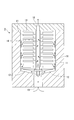
- FIG. 1 is a schematic cross-sectional view illustrating a filtration device suitable for use in the present invention.
- the filtration device 1 shown here is substantially cylindrical and has a plurality of leaf disk filters 11, 11,... Built in an internal space, and has a known configuration.
- the plurality of leaf disk type filters 11, 11,... Are coaxially stacked in the space inside the filtration device 1, and the secondary flow path 14 for the filtrate is inserted so as to penetrate the central portion thereof. Has been. Since the leaf disk type filter 11 and the secondary flow path 14 are assembled, they can be disassembled. After use, the leaf disk type filter 11 and the secondary flow path 14 can be repeatedly used several times by taking out from the inside of the filtration device 1 and washing. Yes.
- the filtration object introduced from the inlet 13 of the filtration device moves in the temporary flow path 12 and is taken in from the surface of the plurality of leaf disk type filters 11, 11. After being removed, the filtrate is introduced into the secondary flow path 14. All the filtrate is collected in the secondary flow path 14 and finally taken out from the outlet 15 through the outlet 15.
- arrows indicate the movement of the filtration object or filtrate. In this way, the filtration object 1 is simultaneously filtered by the plurality of leaf disk type filters 11, 11,.
- the filtration apparatus shown here is only an example, and various filtration apparatuses can be used according to the objective in this invention.
- the melt extrusion of the liquid crystalline polyester may be performed using a known extruder.
- the extruder may be either a single screw or a twin screw depending on the required discharge amount.
- the cylinder may be provided with a vent part and a supply port.
- a melt molding method is preferable.
- the liquid crystal polyester molded product obtained by melt filtration of the liquid crystal polyester using a filter is excellent in heat resistance and mechanical strength.
- liquid crystal polyester molded products include: optical pickup bobbins, transformer bobbins, etc .; relay parts such as relay cases, relay bases, relay sprues, relay armatures; RIMM, DDR, CPU socket, S / O, DIMM, Board to Board connectors, FPC connectors, card connectors, etc .; lamp reflectors, LED reflectors, etc .; lamp holders, heater holders, etc .; speaker diaphragms, etc .; Camera module parts; switch parts; motor parts; sensor parts; hard disk drive parts; tableware such as ovenware; vehicle parts; aircraft parts; sealing for semiconductor element sealing members, coil sealing members, etc. Wood; films; fibers and the like.
- a liquid crystalline polyester molded object is a film or a fiber.
- the flow start temperature of the liquid crystal polyester was measured by the following method. (Measurement of flow start temperature of liquid crystal polyester) Using a flow tester (manufactured by Shimadzu Corp., CFT-500 type), about 2 g of liquid crystal polyester was filled into a cylinder equipped with a die having a nozzle having an inner diameter of 1 mm and a length of 10 mm, and 9.8 MPa (100 kg / cm 2 ). The liquid crystal polyester was melted while being heated at a rate of 4 ° C./min under a load of 4 ° C. and extruded from a nozzle, and a temperature showing a viscosity of 4800 Pa ⁇ s (48000 poise) was measured.
- Example 1 Manufacture of liquid crystal polyester molding
- a filtration device (leaf disk type filter, manufactured by Nippon Seisen Co., Ltd.) is connected to the outlet of a twin screw extruder (Ikegai Iron Works Co., Ltd., PCM30 type), and the liquid crystal polyester obtained in Production Example 1 is used as the biaxial extruder.
- the liquid crystal polyester 1 was obtained by extruding from the above and filtering with the filtration device and then granulating.
- the filtration device used was a stack of 16 Naslon filters LF4-0 NF2M-05D2 (manufactured by Nippon Seisen Co., Ltd., filtration accuracy 5.0 ⁇ m).
- Example 2 Manufacture of liquid crystal polyester composition for molding
- a Henschel mixer manufactured by Kawata, SMG-100 type
- 100 parts by mass of the liquid crystalline polyester obtained in Production Example 1 and 5.0 parts by mass of titanium oxide Ishihara Sangyo Co., Ltd., CR-60
- the liquid crystal polyester composition 2 was obtained by filtering the obtained composition using the same twin-screw extruder and filtration apparatus as Example 1, and then granulating.
- Example 3 Manufacture of liquid crystalline polyester for molding
- a filtration device (leaf disk type filter, manufactured by Nippon Seisen Co., Ltd.) is connected to the outlet of a twin screw extruder (Ikegai Iron Works Co., Ltd., PCM30 type), and the liquid crystal polyester obtained in Production Example 2 is used as the biaxial extruder.
- the liquid crystal polyester 3 was obtained by extruding from the above, filtering with the said filtration apparatus, and then granulating.
- the filtration device used was a stack of 16 Naslon filters LF4-0 NF2M-05D2 (manufactured by Nippon Seisen Co., Ltd., filtration accuracy 5.0 ⁇ m).
- Example 1 Manufacture of liquid crystalline polyester for molding
- a liquid crystal polyester R1 was obtained in the same manner as in Example 1 except that the liquid crystal polyester was not melt filtered. That is, liquid crystal polyester R1 was obtained by granulating the liquid crystal polyester obtained in Production Example 1 using a twin-screw extruder (manufactured by Ikekai Tekko Co., Ltd., PCM30 type).
- a liquid crystal polyester composition R2 was obtained in the same manner as in Example 2 except that the liquid crystal polyester composition was not melt filtered. That is, using a Henschel mixer (manufactured by Kawata, SMG-100 type), 100 parts by mass of the liquid crystal polyester obtained in Production Example 1, and 5.0 parts by mass of titanium oxide (manufactured by Ishihara Sangyo Co., Ltd., CR-60) Were mixed. And liquid crystal polyester composition R2 was obtained by granulating the obtained composition using the twin-screw extruder (Ikegai Iron Works company make, PCM30 type
- Example 3 Manufacture of liquid crystal polyester composition for molding
- a liquid crystal polyester R3 was obtained in the same manner as in Example 3 except that the liquid crystal polyester was not melt filtered. That is, liquid crystal polyester R3 was obtained by granulating the liquid crystal polyester obtained in Production Example 2 using a twin-screw extruder (manufactured by Ikekai Tekko Co., Ltd., PCM30 type).
- the tensile strength of ASTM No. 4 dumbbells (molded bodies 1A, 2A, 3A, R1A, R2A, R3A) was measured according to ASTM D638.
- the bending strength of a molded product (molded body 1B, 2B, 3B, R1B, R2B, R3B) having a length of 127 mm, a width of 12.7 mm, and a thickness of 6.4 mm was measured in accordance with ASTM D790.
- the deflection temperature under load of a molded article (molded body 11B, 2B, 3B, R1B, R2B, R3B) having a length of 127 mm, a width of 12.7 mm, and a thickness of 6.4 mm is compliant with ASTM D648 and is a load of 1.82 MPa. It was measured.
- the liquid crystal polyester molded articles of each Example obtained by melt-extruding and filtering the liquid crystal polyester were excellent in both heat resistance and mechanical strength.
- the liquid crystal polyester molded body of each comparative example in which the liquid crystal polyester was not melt-filtered was inferior to the liquid crystal polyester molded body of the examples in both heat resistance and mechanical strength.
- the present invention can be used for manufacturing various parts that require heat resistance.
Landscapes
- Engineering & Computer Science (AREA)
- Mechanical Engineering (AREA)
- Chemical & Material Sciences (AREA)
- Manufacturing & Machinery (AREA)
- Materials Engineering (AREA)
- Health & Medical Sciences (AREA)
- Chemical Kinetics & Catalysis (AREA)
- Medicinal Chemistry (AREA)
- Polymers & Plastics (AREA)
- Organic Chemistry (AREA)
- Processing And Handling Of Plastics And Other Materials For Molding In General (AREA)
- Polyesters Or Polycarbonates (AREA)
Abstract
L'invention concerne un procédé de fabrication de corps moulé en polyester cristallin. Ledit polyester cristallin possède des unités répétitives représentées par les formules générales (1), (2) et (3). Ce procédé de fabrication de corps moulé en polyester cristallin comporte : une étape de filtrage de matière fondue à l'aide d'un filtre, après extrusion de matière fondue de polyester cristallin; et une étape de moulage du polyester cristallin à l'aide d'une presse à mouler par injection, après séchage du polyester cristallin. Plus précisément, l'invention concerne un procédé de fabrication de corps moulé en polyester cristallin dans lequel la précision de filtrage dudit filtre est de 1 à 50μm.
Applications Claiming Priority (2)
| Application Number | Priority Date | Filing Date | Title |
|---|---|---|---|
| JP2011062437 | 2011-03-22 | ||
| JP2011-062437 | 2011-03-22 |
Publications (1)
| Publication Number | Publication Date |
|---|---|
| WO2012128246A1 true WO2012128246A1 (fr) | 2012-09-27 |
Family
ID=46879393
Family Applications (1)
| Application Number | Title | Priority Date | Filing Date |
|---|---|---|---|
| PCT/JP2012/056996 Ceased WO2012128246A1 (fr) | 2011-03-22 | 2012-03-19 | Procédé de fabrication de corps moulé en polyester cristallin |
Country Status (3)
| Country | Link |
|---|---|
| JP (1) | JP5903733B2 (fr) |
| TW (1) | TW201302421A (fr) |
| WO (1) | WO2012128246A1 (fr) |
Cited By (1)
| Publication number | Priority date | Publication date | Assignee | Title |
|---|---|---|---|---|
| WO2021029268A1 (fr) * | 2019-08-09 | 2021-02-18 | 住友化学株式会社 | Granules de resine de polyester a cristaux liquides ainsi que corps moule de resine de polyester a cristaux liquides |
Families Citing this family (1)
| Publication number | Priority date | Publication date | Assignee | Title |
|---|---|---|---|---|
| KR102321544B1 (ko) * | 2016-05-27 | 2021-11-03 | 스미또모 가가꾸 가부시끼가이샤 | 액츄에이터 |
Citations (3)
| Publication number | Priority date | Publication date | Assignee | Title |
|---|---|---|---|---|
| JPH04227722A (ja) * | 1990-04-27 | 1992-08-17 | Hoechst Ag | シート状成形物およびその製法 |
| JP2004256673A (ja) * | 2003-02-26 | 2004-09-16 | Sumitomo Chem Co Ltd | 反射板用液晶性ポリエステル樹脂 |
| JP2006241446A (ja) * | 2005-02-02 | 2006-09-14 | Mitsubishi Gas Chem Co Inc | ポリエステルフィルム、及びその製造方法、ならびにその用途 |
Family Cites Families (1)
| Publication number | Priority date | Publication date | Assignee | Title |
|---|---|---|---|---|
| JP5503915B2 (ja) * | 2009-07-30 | 2014-05-28 | 住友化学株式会社 | 液晶ポリエステル組成物およびこれを用いた電子回路基板 |
-
2012
- 2012-03-19 JP JP2012062413A patent/JP5903733B2/ja active Active
- 2012-03-19 WO PCT/JP2012/056996 patent/WO2012128246A1/fr not_active Ceased
- 2012-03-21 TW TW101109694A patent/TW201302421A/zh unknown
Patent Citations (3)
| Publication number | Priority date | Publication date | Assignee | Title |
|---|---|---|---|---|
| JPH04227722A (ja) * | 1990-04-27 | 1992-08-17 | Hoechst Ag | シート状成形物およびその製法 |
| JP2004256673A (ja) * | 2003-02-26 | 2004-09-16 | Sumitomo Chem Co Ltd | 反射板用液晶性ポリエステル樹脂 |
| JP2006241446A (ja) * | 2005-02-02 | 2006-09-14 | Mitsubishi Gas Chem Co Inc | ポリエステルフィルム、及びその製造方法、ならびにその用途 |
Cited By (1)
| Publication number | Priority date | Publication date | Assignee | Title |
|---|---|---|---|---|
| WO2021029268A1 (fr) * | 2019-08-09 | 2021-02-18 | 住友化学株式会社 | Granules de resine de polyester a cristaux liquides ainsi que corps moule de resine de polyester a cristaux liquides |
Also Published As
| Publication number | Publication date |
|---|---|
| JP2012210808A (ja) | 2012-11-01 |
| TW201302421A (zh) | 2013-01-16 |
| JP5903733B2 (ja) | 2016-04-13 |
Similar Documents
| Publication | Publication Date | Title |
|---|---|---|
| JP6500140B2 (ja) | 液晶ポリエステル組成物 | |
| JP6671869B2 (ja) | 液晶ポリエステル樹脂組成物、コネクターおよび液晶ポリエステル樹脂組成物の製造方法 | |
| JP5633338B2 (ja) | 液晶ポリエステル組成物 | |
| KR101986075B1 (ko) | 액정 폴리에스테르 조성물, 액정 폴리에스테르 조성물의 제조 방법 및 성형체 | |
| CN102510879B (zh) | 液晶聚酯树脂组合物 | |
| KR101821415B1 (ko) | 액정 폴리에스테르 조성물 | |
| CN109863202B (zh) | 液晶聚酯树脂组合物 | |
| CN109071958B (zh) | 树脂组合物 | |
| JP6052671B2 (ja) | 樹脂組成物および成形体 | |
| KR20120059382A (ko) | 액정 폴리에스테르 조성물 | |
| JP5979534B2 (ja) | 液晶高分子射出成形体及びその製造方法 | |
| KR20130108143A (ko) | 액정 폴리에스테르 필름의 제조 방법 및 액정 폴리에스테르 필름 | |
| JP5903733B2 (ja) | 液晶ポリエステル成形体の製造方法 | |
| TWI754049B (zh) | 液晶聚酯組成物 | |
| TWI761500B (zh) | 液晶聚酯組成物的製造方法及液晶聚酯組成物 | |
| TW201522585A (zh) | 液晶聚酯組成物 | |
| JP2013193438A (ja) | 液晶ポリエステルフィルムの製造方法及び液晶ポリエステルフィルム | |
| JP2013193066A (ja) | フィルタの洗浄方法 | |
| WO2012102334A1 (fr) | Composition de résine pour article cylindrique moulé et article cylindrique moulé |
Legal Events
| Date | Code | Title | Description |
|---|---|---|---|
| 121 | Ep: the epo has been informed by wipo that ep was designated in this application |
Ref document number: 12760060 Country of ref document: EP Kind code of ref document: A1 |
|
| NENP | Non-entry into the national phase |
Ref country code: DE |
|
| 122 | Ep: pct application non-entry in european phase |
Ref document number: 12760060 Country of ref document: EP Kind code of ref document: A1 |