WO2012128293A1 - 粘着剤組成物、及び粘着シート - Google Patents
粘着剤組成物、及び粘着シート Download PDFInfo
- Publication number
- WO2012128293A1 WO2012128293A1 PCT/JP2012/057229 JP2012057229W WO2012128293A1 WO 2012128293 A1 WO2012128293 A1 WO 2012128293A1 JP 2012057229 W JP2012057229 W JP 2012057229W WO 2012128293 A1 WO2012128293 A1 WO 2012128293A1
- Authority
- WO
- WIPO (PCT)
- Prior art keywords
- sensitive adhesive
- pressure
- mass
- adhesive composition
- resin
- Prior art date
- Legal status (The legal status is an assumption and is not a legal conclusion. Google has not performed a legal analysis and makes no representation as to the accuracy of the status listed.)
- Ceased
Links
Images

Classifications
-
- C—CHEMISTRY; METALLURGY
- C09—DYES; PAINTS; POLISHES; NATURAL RESINS; ADHESIVES; COMPOSITIONS NOT OTHERWISE PROVIDED FOR; APPLICATIONS OF MATERIALS NOT OTHERWISE PROVIDED FOR
- C09J—ADHESIVES; NON-MECHANICAL ASPECTS OF ADHESIVE PROCESSES IN GENERAL; ADHESIVE PROCESSES NOT PROVIDED FOR ELSEWHERE; USE OF MATERIALS AS ADHESIVES
- C09J123/00—Adhesives based on homopolymers or copolymers of unsaturated aliphatic hydrocarbons having only one carbon-to-carbon double bond; Adhesives based on derivatives of such polymers
- C09J123/02—Adhesives based on homopolymers or copolymers of unsaturated aliphatic hydrocarbons having only one carbon-to-carbon double bond; Adhesives based on derivatives of such polymers not modified by chemical after-treatment
- C09J123/18—Homopolymers or copolymers of hydrocarbons having four or more carbon atoms
- C09J123/20—Homopolymers or copolymers of hydrocarbons having four or more carbon atoms having four to nine carbon atoms
- C09J123/22—Copolymers of isobutene; Butyl rubber ; Homo- or copolymers of other iso-olefines
-
- C—CHEMISTRY; METALLURGY
- C09—DYES; PAINTS; POLISHES; NATURAL RESINS; ADHESIVES; COMPOSITIONS NOT OTHERWISE PROVIDED FOR; APPLICATIONS OF MATERIALS NOT OTHERWISE PROVIDED FOR
- C09J—ADHESIVES; NON-MECHANICAL ASPECTS OF ADHESIVE PROCESSES IN GENERAL; ADHESIVE PROCESSES NOT PROVIDED FOR ELSEWHERE; USE OF MATERIALS AS ADHESIVES
- C09J123/00—Adhesives based on homopolymers or copolymers of unsaturated aliphatic hydrocarbons having only one carbon-to-carbon double bond; Adhesives based on derivatives of such polymers
- C09J123/26—Adhesives based on homopolymers or copolymers of unsaturated aliphatic hydrocarbons having only one carbon-to-carbon double bond; Adhesives based on derivatives of such polymers modified by chemical after-treatment
- C09J123/28—Adhesives based on homopolymers or copolymers of unsaturated aliphatic hydrocarbons having only one carbon-to-carbon double bond; Adhesives based on derivatives of such polymers modified by chemical after-treatment by reaction with halogens or compounds containing halogen
- C09J123/283—Halogenated homo- or copolymers of iso-olefines
-
- C—CHEMISTRY; METALLURGY
- C09—DYES; PAINTS; POLISHES; NATURAL RESINS; ADHESIVES; COMPOSITIONS NOT OTHERWISE PROVIDED FOR; APPLICATIONS OF MATERIALS NOT OTHERWISE PROVIDED FOR
- C09J—ADHESIVES; NON-MECHANICAL ASPECTS OF ADHESIVE PROCESSES IN GENERAL; ADHESIVE PROCESSES NOT PROVIDED FOR ELSEWHERE; USE OF MATERIALS AS ADHESIVES
- C09J9/00—Adhesives characterised by their physical nature or the effects produced, e.g. glue sticks
-
- C—CHEMISTRY; METALLURGY
- C08—ORGANIC MACROMOLECULAR COMPOUNDS; THEIR PREPARATION OR CHEMICAL WORKING-UP; COMPOSITIONS BASED THEREON
- C08K—Use of inorganic or non-macromolecular organic substances as compounding ingredients
- C08K5/00—Use of organic ingredients
- C08K5/0008—Organic ingredients according to more than one of the "one dot" groups of C08K5/01 - C08K5/59
- C08K5/0041—Optical brightening agents, organic pigments
-
- C—CHEMISTRY; METALLURGY
- C08—ORGANIC MACROMOLECULAR COMPOUNDS; THEIR PREPARATION OR CHEMICAL WORKING-UP; COMPOSITIONS BASED THEREON
- C08K—Use of inorganic or non-macromolecular organic substances as compounding ingredients
- C08K5/00—Use of organic ingredients
- C08K5/36—Sulfur-, selenium-, or tellurium-containing compounds
- C08K5/45—Heterocyclic compounds having sulfur in the ring
Definitions
- the present invention relates to a light-transmitting pressure-sensitive adhesive composition whose color tone reversibly changes and a pressure-sensitive adhesive sheet having a pressure-sensitive adhesive layer made of this pressure-sensitive adhesive composition.
- a colored sheet used for the purpose of adjusting light transmission has been used for a glass plate or a transparent resin plate for window glass, wall surfaces, partitions, or illumination used in a space irradiated with black light. Proposed.
- a colored sheet is used by being attached to a general building window, the amount of external light transmitted in rainy or cloudy weather or at night is small, and sufficient brightness cannot be secured indoors in the building. The problem was.
- the photochromic dye reversibly changes its color tone upon light irradiation. That is, it has a characteristic that it is colored by irradiating with ultraviolet rays such as sunlight and black light, while returning to colorless in an environment where no ultraviolet rays are irradiated.
- the colored sheets disclosed in Patent Documents 1 to 4 use a photochromic dye having such characteristics for the colored sheets, and thus exhibit light shielding properties in an environment irradiated with ultraviolet rays. It is possible to show transparency in the environment.
- the colored sheets disclosed in Patent Documents 1 to 4 are deteriorated in the color developability of the contained dye when used for a long period of time, for example, the weather resistance such as discoloration when not irradiated with ultraviolet rays, which should be originally transparent. There is a problem with sex. Moreover, the speed of the color tone change from colored to colorless is slow, and further, depending on the dye used, there is a problem that peeling from the release sheet is difficult.
- the present invention has been made to solve the above-mentioned problems, has excellent weather resistance that can withstand long-term use, has a relatively fast rate of color change from colored to colorless, and from a release sheet.
- An object of the present invention is to provide a pressure-sensitive adhesive composition and a pressure-sensitive adhesive sheet that are also excellent in releasability.
- a pressure-sensitive adhesive composition containing a predetermined amount of a specific rubber-based resin and a specific photochromic dye in a predetermined ratio can solve the above problems. That is, the present invention provides the following [1] to [6].
- the pressure-sensitive adhesive composition and pressure-sensitive adhesive sheet of the present invention have excellent weather resistance that can withstand long-term use, have a relatively fast change in color tone from colored to colorless, and are easy to peel from the release sheet. Are better.
- the pressure-sensitive adhesive composition of the present invention comprises a pressure-sensitive adhesive containing 40 to 95% by mass of a rubber-based resin not containing a structural unit derived from styrene, and a photochromic dye composed of a dithienylethene compound. It becomes an adhesive composition which has the said effect by containing in a ratio.
- the pressure-sensitive adhesive composition of the present invention can further contain other additives such as an antioxidant and an ultraviolet absorber.
- the pressure-sensitive adhesive, photochromic dye, antioxidant, and other additives contained in the pressure-sensitive adhesive composition of the present invention will be described in detail.
- the pressure-sensitive adhesive composition of the present invention can contain a rubber-based resin that does not contain a structural unit derived from styrene, thereby suppressing a decrease in photochromic performance due to the photochromic dye coming into contact with moisture, It is considered that the weather resistance of the pressure-sensitive adhesive composition can be improved.
- a rubber-based resin containing a structural unit derived from styrene is used as a pressure-sensitive adhesive, the photochromic dye comes into contact with moisture, resulting in a decrease in light-emitting property, and the resulting pressure-sensitive adhesive composition has weather resistance in long-term use. The bad effect that it is remarkably inferior is considered.
- the content of the rubber-based resin not containing styrene as a structural unit is 40 to 95% by mass, preferably 50 to 90% by mass, and more preferably 65 to 85% by mass in all components of the pressure-sensitive adhesive. %, More preferably 70 to 80% by mass. If it is less than 40% by mass, zipping tends to occur. Moreover, since it exists in the tendency for adhesive force to fall when it exceeds 95 mass%, it is unpreferable.
- the rubber resin is not particularly limited as long as it is a rubber resin not containing a structural unit derived from styrene.
- "does not contain the structural unit derived from styrene” means that the structural unit derived from styrene is not intentionally included in the structural unit of the rubber-based resin to be used.
- the content of the structural unit derived from styrene in all the structural units of the rubber-based resin is usually less than 0.1% by mass, preferably less than 0.01% by mass, More preferably, it is less than 0.001 mass%, More preferably, it is substantially 0 mass%.
- the rubber resin for example, synthetic rubber such as polyisobutylene resin and polybutene resin, or natural rubber can be used. Among these, polyisobutylene resin and natural rubber are preferable, and polyisobutylene resin is more preferable.
- polyisobutylene resin examples include polyisobutylene, which is a homopolymer of isobutylene, isobutylene and isoprene, isobutylene and n-butene, a copolymer of isobutylene and butadiene, and a halogenated brominated or chlorinated copolymer of these.
- a copolymer etc. are mentioned.
- the structural unit composed of isobutylene is contained in the largest amount among all the structural units.
- polyisobutylene which is a homopolymer of isobutylene is preferable.
- the content of the polyisobutylene resin is preferably 60 to 100% by mass, more preferably 80 to 100% by mass, and still more preferably 95% in the rubber resin from the viewpoint of improving the weather resistance of the obtained pressure-sensitive adhesive composition. It is ⁇ 100% by mass, more preferably substantially 100% by mass.
- the weight average molecular weight of the rubber-based resin is preferably 20,000 or more, more preferably 50,000 to 6,000,000, still more preferably, from the viewpoint of improving the cohesive force of the pressure-sensitive adhesive composition and preventing contamination of the adherend. Is 100,000 to 1,200,000, more preferably 150,000 to 500,000.
- the value of a weight average molecular weight means the value of polystyrene conversion measured by a gel permeation chromatography (GPC) method.
- a polyisobutylene resin having a large weight average molecular weight (hereinafter also referred to as “PIB resin (A)”) and the PIB resin (A) are used. It is preferable to use a polyisobutylene resin having a small weight average molecular weight (hereinafter also referred to as “PIB resin (B)”).
- PIB resin (A) and the PIB resin (B) are compatible with each other, and the PIB resin is appropriately added. It is considered that the resin (A) can be plasticized, the wettability with respect to the adherend can be improved, and the adhesive properties, flexibility, holding power and the like of the obtained adhesive composition can be improved.
- the weight average molecular weight of the PIB-based resin (A) is preferably 300,000 to 500,000, more preferably 320,000 to 480,000, from the viewpoint of the balance between cohesive force and flexibility and fluidity of the pressure-sensitive adhesive composition. More preferably, it is 330,000-450,000.
- the weight average molecular weight is 300,000 or more, the cohesive force of the pressure-sensitive adhesive composition is sufficient, and contamination of the adherend can be prevented.
- an adhesive composition can have moderate softness
- the weight average molecular weight of the PIB resin (B) is preferably from 1,000 to 280,000, more preferably from the viewpoint of good compatibility with the PIB resin (A) and appropriate plasticization of the PIB resin (A). Is from 5,000 to 250,000, more preferably from 10,000 to 220,000. When the weight average molecular weight is 1000 or more, contamination of the adherend due to separation of the PIB resin (B) as a low molecular weight component can be prevented. Moreover, if it is 280,000 or less, PIB-type resin (A) can fully be plasticized, and the adhesive physical property of the obtained adhesive composition, a softness
- the content of the PIB resin (B) is preferably 2 to 100 parts by mass, more preferably 6 to 100 parts by mass with respect to 100 parts by mass of the PIB resin (A), from the viewpoint of the balance between adhesive force and cohesive force. Part, more preferably 10 to 100 parts by weight. If the content of the PIB resin (B) is 2 parts by mass or more, the PIB resin (A) can be sufficiently plasticized, the wettability to the adherend is improved, and the resulting pressure-sensitive adhesive composition Adhesive properties, flexibility, holding power and the like can be improved. Moreover, if it is 100 mass parts or less, the cohesive force of an adhesive composition is enough and can prevent the contamination to a to-be-adhered body.
- the adhesive used by this invention contains a tackifier further from a viewpoint of improving the adhesive force of the adhesive composition obtained.
- the tackifier include known tackifiers, and hydrogenated petroleum resins are preferred from the viewpoint of improving the weather resistance of the resulting pressure-sensitive adhesive composition and maintaining photochromic performance.
- a hydrogenated petroleum resin means a hydrogenated petroleum resin such as an aliphatic petroleum resin or a cyclopentadiene petroleum resin using a hydrogenation catalyst.
- hydrogenated petroleum resins include hydrogenated terpene resins, hydrogenated rosins and hydrogenated rosin ester resins, disproportionated rosins, disproportionated rosin ester resins, pentenes generated by thermal decomposition of petroleum naphtha, and isoprene.
- Hydrogenated dicyclopentadiene resin which is a hydrogenated resin of C5 petroleum resin obtained by copolymerizing C5 fractions such as piperine and 1.3-pentadiene, partially hydrogenated aromatic modified dicyclopentadiene resin, Resin obtained by hydrogenating C9 petroleum resin obtained by copolymerizing C9 fraction such as indene, vinyltoluene, ⁇ - or ⁇ -methylstyrene produced by thermal decomposition of petroleum naphtha, C5 fraction and C9 fraction described above For example, a resin obtained by hydrogenation of a copolymerized petroleum resin.
- the content of the tackifier is preferably 5 to 60% by mass, more preferably 10 to 50% by mass, still more preferably 15 to 35% by mass, and still more preferably 20 to 30% by mass, based on all components of the adhesive. It is. If it is 5 mass% or more, sufficient adhesive force can be provided to the obtained adhesive composition. Moreover, if it is 60 mass% or less, the adhesive composition which has sufficient softness
- the pressure-sensitive adhesive used in the present invention can contain other components as long as the effects of the present invention are not impaired.
- other components include liquid paraffin, vegetable oils (for example, olive oil, soybean oil, beef oil, lard), polybutene, lower isoprene, wax, and other adhesive force / holding force adjusting agents.
- the pressure-sensitive adhesive composition of the present invention contains a photochromic dye composed of a dithienylethene compound.
- the dithienylethene compound means a compound having a double bond and two thienyl groups in the structure of one molecule.
- the double bond may be present in any part of the chain structure or the ring structure.
- the thienyl group may have a substituent such as an alkyl group, a cycloalkyl group, or an aryl group.
- dithienylethene compound examples include 1,2-bis (2,4-dimethyl-5-phenyl-3-thienyl) -3,3,4,4,5,5-hexafluoro-1-cyclopentene (commercially available product).
- a compound having two aryl groups and / or hexafluorocyclopentene groups in the structure of one molecule is preferable from the viewpoint of obtaining a pressure-sensitive adhesive composition that is excellent in weather resistance even when used for a long time.
- a compound having two aryl groups and a hexafluorocyclopentene group is more preferable, and a compound having two benzothienyl groups and a hexafluorocyclopentene group is more preferable.
- Examples of such compounds include 1,2-bis (2,4-dimethyl-5-phenyl-3-thienyl) -3,3,4,4,5,5-hexafluoro-1-cyclopentene, 1 , 2-bis [2-methylbenzo [b] thiophen-3-yl] -3,3,4,4,5,5-hexafluoro-1-cyclopentene, and the like.
- a compound having a benzothienyl group is preferred, such as methylbenzo [b] thiophen-3-yl] -3,3,4,4,5,5-hexafluoro-1-cyclopentene.
- the content of the photochromic dye composed of the dithienylethene compound is 0.40 to 8.00 parts by weight, preferably 0.43 to 7.00 parts by weight, more preferably 100 parts by weight of the pressure-sensitive adhesive. Is 0.45 to 6.00 parts by mass, more preferably 0.47 to 5.00 parts by mass, and still more preferably 0.50 to 3.50. If it is less than 0.40 parts by mass, the photochromic performance cannot be sufficiently exhibited, which is not preferable. On the other hand, when it exceeds 8.00 parts by mass, the weather resistance of the obtained pressure-sensitive adhesive composition is inferior, and the speed of color tone change from colored to unemployed is also slowed. Further, the appearance of the pressure-sensitive adhesive layer of the pressure-sensitive adhesive sheet formed from the pressure-sensitive adhesive composition is also undesirably whitened and becomes defective.
- the pressure-sensitive adhesive composition of the present invention can further contain an antioxidant. Even if the pressure-sensitive adhesive composition of the present invention contains an antioxidant, the photochromic performance or the like is not impaired. And it can be set as the adhesive composition excellent in durability with respect to high-humidity heat by containing antioxidant.
- a hindered phenol-based antioxidant is preferable from the viewpoint of improving durability against high-humidity heat of the obtained pressure-sensitive adhesive composition.
- the hindered phenol antioxidant include triethylene glycol-bis [3- (3-tert-butyl-5-methyl-4-hydroxyphenyl) propionate], 1,6-hexanediol-bis [3- (3,5-di-tert-butyl-4-hydroxyphenyl) propionate], pentaerythrityl tetrakis [3- (3,5-di-tert-butyl-4-hydroxyphenyl) propionate], 2,2- Thio-diethylenebis [3- (3,5-di-t-butyl-4-hydroxyphenyl) propionate], octadecyl-3- (3,5-di-t-butyl-4-hydroxyphenyl) propionate, N, N′-hexamethylenebis (3,5-di-t-butyl-4-
- a hindered phenol-based antioxidant having a branched alkyl group is preferred, and both of the beta positions of the hindered phenol groups are t- A hindered phenol antioxidant which is a butyl group is more preferred.
- Hindered phenolic antioxidants in which both of the hindered phenol groups are in the t-butyl group are antioxidants that improve durability, especially when used in long-term driving or outdoor driving environments. Excellent performance as an agent.
- antioxidants include 1,6-hexanediol-bis [3- (3,5-di-tert-butyl-4-hydroxyphenyl) propionate], pentaerythrityl tetrakis [3- ( 3,5-di-t-butyl-4-hydroxyphenyl) propionate], 2,2-thio-diethylenebis [3- (3,5-di-t-butyl-4-hydroxyphenyl) propionate], octadecyl- 3- (3,5-di-t-butyl-4-hydroxyphenyl) propionate, N, N′-hexamethylenebis (3,5-di-t-butyl-4-hydroxy-hydroxynnamamide), 1 , 3,5-trimethyl-2,4,6-tris (3
- antioxidants examples include Yoshinox BHT (manufactured by Yoshitomi Fine Chemical), IRGANOX 565 (manufactured by Ciba Specialty Chemicals), and IRGANOX 1010 (manufactured by BASF).
- the content of the antioxidant is preferably 0.01 to 1.0 part by mass, more preferably 100 parts by mass with respect to 100 parts by mass of the adhesive, from the viewpoint of improving the durability of the resulting adhesive composition to high heat and humidity.
- the amount is 0.03 to 0.5 parts by mass, more preferably 0.04 to 0.3 parts by mass. If it is 0.01 mass part or more, durability of the obtained adhesive composition can fully be improved. On the other hand, if it is 1.0 mass part or less, the phenomenon which isolate
- the pressure-sensitive adhesive composition of the present invention may contain other additives as long as the effects of the present invention are not impaired and properties such as adhesive strength are not impaired.
- Other additives include, for example, UV absorbers, light stabilizers, resin stabilizers, infrared / near infrared absorbers, antiseptic / mold inhibitors, freeze / thaw stabilizers, rust preventives, plasticizers, high-boiling solvents, Examples include fillers, pigments, and extenders. These additives may be used alone or in combination of two or more.
- Examples of the ultraviolet absorber include hindered amine compounds, benzotriazole compounds, oxazolyac acid amide compounds, benzophenone compounds, and the like.
- Examples of commercially available products include Tinuvin 765 (manufactured by BASF, hindered amine compounds).
- the content of the ultraviolet absorber is preferably 0.01 to 3.0 parts by mass, more preferably 0.03 to 2.0 parts by mass, and still more preferably 0.04 to 1 part with respect to 100 parts by mass of the adhesive. 0.0 part by mass.
- the light stabilizer examples include hindered amine light stabilizers, benzophenone light stabilizers, and benzotriazole light stabilizers.
- the content of the light stabilizer is preferably 0.01 to 2 parts by mass with respect to 100 parts by mass of the pressure-sensitive adhesive.
- the resin stabilizer examples include an imidazole resin stabilizer, a dithiocarbamate resin stabilizer, a phosphorus resin stabilizer, and a sulfur ester resin stabilizer.
- the content of the resin stabilizer is preferably 0.01 to 3 parts by mass with respect to 100 parts by mass of the pressure-sensitive adhesive.
- the pressure-sensitive adhesive sheet of the present invention has a pressure-sensitive adhesive layer made of the pressure-sensitive adhesive composition of the present invention.
- the structure of the adhesive sheet of this invention is not specifically limited, It is not restricted to the adhesive sheet which formed the adhesive layer 12 on the base material 11 like the adhesive sheet 1a shown by Fig.1 (a).
- the adhesive sheet etc. which formed the peeling material 13 which can be peeled on the adhesive layer 12 formed on the base material 11 like the adhesive sheet 1c shown by FIG.
- the types of the base materials 11 and 11 ′ of the pressure-sensitive adhesive sheet 1b may be the same or different.
- the pressure-sensitive adhesive sheet 1b as a base material and further laminating the pressure-sensitive adhesive layer, the pressure-sensitive adhesive layer can be sandwiched between the base materials to further improve the weather resistance.
- it is good also as an adhesive sheet which clamped the adhesive layer 12 with the peeling material 13 and another peeling material 13 'without using a base material like the adhesive sheet 1d shown by FIG.1 (d).
- the kind of peeling material 13 and 13 'of adhesive sheet 1d may be the same or different, it is preferable to adjust so that the peeling force difference between peeling material 13 and peeling material 13' may differ.
- the thickness of the pressure-sensitive adhesive layer of the pressure-sensitive adhesive sheet is appropriately selected depending on the application and the like, but is preferably 0.5 to 100 ⁇ m, more preferably 1 to 60 ⁇ m, and further preferably 3 to 40 ⁇ m. If it is 0.5 ⁇ m or more, good adhesive force can be obtained for the adherend, and if it is 100 ⁇ m or less, it is advantageous in terms of productivity and can be an easy-to-handle pressure-sensitive adhesive sheet.
- the base material used by the adhesive sheet of this invention is not specifically limited, According to the intended purpose of an adhesive sheet, it selects suitably.
- the base material include various papers such as paper base materials such as fine paper, art paper, coated paper, glassine paper, laminated paper obtained by laminating a thermoplastic resin such as polyethylene on these paper base materials; : Metal foil such as aluminum foil, copper foil and iron foil; base material made of porous material such as non-woven fabric; polyolefin resin such as polyethylene resin and polypropylene resin; polyester resin such as polybutylene terephthalate resin and polyethylene terephthalate resin; acetate resin And a plastic film or plastic sheet made of a resin such as ABS resin, polystyrene resin, vinyl chloride resin, and a mixture or laminate thereof.
- base materials such as a plastic film and a plastic sheet
- the base material to be used is not limited to the presence or absence of coloring, but a base material that sufficiently transmits ultraviolet rays is preferable. Further, the base material is more preferably colorless and transparent in the visible light region.
- the base material may contain an ultraviolet absorber, a light stabilizer, an antioxidant, an antistatic agent, a slip agent, an antiblocking agent, a colorant and the like.
- the substrate may be provided with a heat-sensitive recording layer, a print image receiving layer capable of performing thermal transfer, ink jetting, laser printing, and the like, a printability improving layer, and the like.
- the base material is a plastic material
- the oxidation method is not particularly limited, and examples thereof include a corona discharge treatment method, a plasma treatment method, chromic acid oxidation (wet), flame treatment, hot air treatment, and ozone / ultraviolet irradiation treatment.
- it does not specifically limit as an uneven
- These surface treatments are appropriately selected according to the type of the substrate, but the corona discharge treatment method is preferred from the viewpoint of improving the adhesion with the pressure-sensitive adhesive layer and operability.
- primer treatment can also be performed.
- a sealing layer may be provided between the base material and the pressure-sensitive adhesive layer as desired.
- this sealing layer is used to further improve the adhesion between the base material and the pressure-sensitive adhesive layer, or when the base material is too soft with papers, Provided to provide rigidity.
- the sealing layer is not particularly limited. For example, styrene-butadiene copolymer, acrylic resin, polyester resin, polyurethane resin, polystyrene resin, etc. are used as main components, and clay, silica can be used as necessary. And a layer made of a resin composition to which fillers such as calcium carbonate, titanium oxide, and zinc oxide are added.
- the thickness of the sealing layer is not particularly limited, but is usually in the range of 0.1 to 30 ⁇ m.
- the thickness of the substrate is not particularly limited, but is usually 10 to 250 ⁇ m, preferably 15 to 200 ⁇ m, more preferably 20 to 150 ⁇ m from the viewpoint of ease of handling.
- Examples of the release material include those obtained by applying a release agent on a base material for the release material. Specifically, a release sheet subjected to double-sided release treatment, a release sheet subjected to single-sided release treatment, or the like can be used.
- Examples of the base material for the release material include paper base materials such as glassine paper, coated paper, and high-quality paper; laminated paper obtained by laminating a thermoplastic resin such as polyethylene on these paper base materials; polyethylene terephthalate resin, polybutylene terephthalate Examples thereof include plastic films such as resins, polyester resin films such as polyethylene naphthalate resin, and polyolefin resin films such as polypropylene resin and polyethylene resin.
- Examples of the release agent include rubber elastomers such as silicone resins, olefin resins, isoprene resins, and butadiene resins, long chain alkyl resins, alkyd resins, and fluorine resins.
- the thickness of the release material is not particularly limited, but is usually 20 to 200 ⁇ m, preferably 25 to 150 ⁇ m.
- the pressure-sensitive adhesive composition of the present invention is mixed with an organic solvent such as toluene, ethyl acetate, or methyl ethyl ketone to prepare a solution of the pressure-sensitive adhesive composition.
- an organic solvent such as toluene, ethyl acetate, or methyl ethyl ketone
- examples thereof include a method for producing a pressure-sensitive adhesive sheet by applying the material on a surface to be peeled by a known coating method and then drying it to form a pressure-sensitive adhesive layer.
- the adhesive layer formed by said method on the base material and another base material are bonded together, the adhesive sheet 1b shown by FIG.1 (b) can be manufactured.
- the pressure-sensitive adhesive layer formed by the above method and the release treatment surface of the above-described release material are bonded onto a base material or a release material, the pressure-sensitive adhesive sheet 1c shown in FIG.
- the adhesive sheet 1d shown in FIG. 1 (d) can be manufactured.
- the solid content concentration of the solution is preferably 10 to 60% by mass, more preferably 10 to 45% by mass, and still more preferably 15 to 30% by mass. It is. If the solid content concentration of the solution is 10% by mass or more, the coatability is good. On the other hand, if it is 60 mass% or less, it will become a moderate viscosity and can become the solution of the adhesive composition which has the outstanding workability
- the coating method examples include known methods such as spin coating, spray coating, bar coating, knife coating, roll coating, blade coating, die coating, and gravure coating.
- the temperature is 80 to 150 ° C. It is preferable to heat and dry for 30 seconds to 5 minutes.
- Example 1 (1) Preparation of pressure-sensitive adhesive As rubber-based resin in the pressure-sensitive adhesive, PIB-based resin (A) (manufactured by BASF, product name “Opanol B50”, weight average molecular weight 350,000) 70 parts by mass (solid content ratio), and Using 7 parts by mass (solid content ratio) of PIB resin (B) (manufactured by BASF, product name “Opanol B30”, weight average molecular weight 200,000), hydrogenated petroleum resin (manufactured by Arakawa Chemical Industries, Ltd.) as a tackifier
- the product name “Alcon P-100”, molecular weight 500 to 1000) was used in an amount of 23 parts by mass (solid content ratio), and these were dissolved in toluene to prepare an adhesive solution having a solid content concentration of about 25% by mass.
- a release treatment surface of a release-treated polyethylene terephthalate film (product name “SP-PET380101”, manufactured by Lintec Co., Ltd.) is attached as a release sheet (release material) on the surface of the pressure-sensitive adhesive layer.
- Example 2 In the pressure-sensitive adhesive composition of Example 1, 0.06 parts by mass (solid content ratio) of the UV absorber (manufactured by BASF, product name “Tinvin 765”, hindered amine system) with respect to 100 parts by mass of the pressure-sensitive adhesive. And an antioxidant (manufactured by BASF, product name “IRGANOX1010”) 0.06 parts by mass (solid content ratio) were added in the same manner as in Example 1 to obtain a pressure-sensitive adhesive composition and a pressure-sensitive adhesive sheet. It was.
- the UV absorber manufactured by BASF, product name “Tinvin 765”, hindered amine system
- an antioxidant manufactured by BASF, product name “IRGANOX1010”
- Example 3 In the pressure-sensitive adhesive composition of Example 1, the amount of dithienylethene compound (product name “B2287”, manufactured by Tokyo Chemical Industry Co., Ltd.) represented by the above formula (1) used as a photochromic dye was 0.48 parts by mass. A pressure-sensitive adhesive composition and a pressure-sensitive adhesive sheet were obtained in the same manner as in Example 1 except that (solid content ratio) was used.
- Example 4 In the pressure-sensitive adhesive composition of Example 1, 0.96 parts by mass of the dithienylethene compound represented by the above formula (1) used as a photochromic dye (product name “B2287”, manufactured by Tokyo Chemical Industry Co., Ltd.) A pressure-sensitive adhesive composition and a pressure-sensitive adhesive sheet were obtained in the same manner as in Example 1 except that (solid content ratio) was used.
- Example 5 In the pressure-sensitive adhesive composition of Example 1, the added amount of the dithienylethene compound represented by the above formula (1) used as a photochromic dye (Tokyo Chemical Industry Co., Ltd., product name “B2287”) was 4.80 parts by mass. A pressure-sensitive adhesive composition and a pressure-sensitive adhesive sheet were obtained in the same manner as in Example 1 except that (solid content ratio) was used.
- Example 6 In the pressure-sensitive adhesive composition of Example 1, the added amount of the dithienylethene compound represented by the above formula (1) used as a photochromic dye (Tokyo Chemical Industry Co., Ltd., product name “B2287”) was 6.72 parts by mass. A pressure-sensitive adhesive composition and a pressure-sensitive adhesive sheet were obtained in the same manner as in Example 1 except that (solid content ratio) was used.
- Example 7 In the pressure-sensitive adhesive composition of Example 1, as a pressure-sensitive adhesive, a natural rubber-based resin (NR-based resin) -containing pressure-sensitive adhesive (product name “PV-2” manufactured by Lintec Corporation), content of natural rubber component: 44% by mass, pressure-sensitive adhesive A pressure-sensitive adhesive composition and a pressure-sensitive adhesive sheet were obtained in the same manner as in Example 1 except that 100 parts by mass (solid content) of the imparting agent content: 56% by mass was used.
- NR-based resin natural rubber-based resin
- PV-2 manufactured by Lintec Corporation
- Example 1 In the pressure-sensitive adhesive composition of Example 1, 0.96 parts by mass (solid content ratio) of a spiropyran compound represented by the following formula (2) (product name “T0366”, manufactured by Tokyo Chemical Industry Co., Ltd.) as a photochromic dye ) Except for the addition, a pressure-sensitive adhesive composition and a pressure-sensitive adhesive sheet were obtained in the same manner as in Example 1.
- a spiropyran compound represented by the following formula (2) product name “T0366”, manufactured by Tokyo Chemical Industry Co., Ltd.
- Comparative Example 2 In the pressure-sensitive adhesive composition of Comparative Example 1, with respect to 100 parts by mass of the solid content of the pressure-sensitive adhesive, 0.06 parts by mass (solid content ratio) of an ultraviolet absorber (manufactured by BASF, product name “Tinvin 765”, hindered amine system) And an antioxidant (manufactured by BASF, product name “IRGANOX1010”) 0.06 parts by mass (solid content ratio) were added in the same manner as in Example 1 to obtain a pressure-sensitive adhesive composition and a pressure-sensitive adhesive sheet. It was.
- an ultraviolet absorber manufactured by BASF, product name “Tinvin 765”, hindered amine system
- an antioxidant manufactured by BASF, product name “IRGANOX1010”
- Example 3 In the pressure-sensitive adhesive composition of Example 1, 2.88 parts by mass (solid content ratio) of a spiropyran compound represented by the above formula (2) (product name “T0366”, manufactured by Tokyo Chemical Industry Co., Ltd.) as a photochromic dye. ) Except for the addition, a pressure-sensitive adhesive composition and a pressure-sensitive adhesive sheet were obtained in the same manner as in Example 1.
- Comparative Example 4 In the pressure-sensitive adhesive composition of Comparative Example 3, with respect to 100 parts by mass of the solid content of the pressure-sensitive adhesive, 0.06 parts by mass (solid content ratio) of an ultraviolet absorber (manufactured by BASF, product name “Tinuvin 765”, hindered amine system) And an antioxidant (manufactured by BASF, product name “IRGANOX1010”) 0.06 parts by mass (solid content ratio) were added in the same manner as in Comparative Example 3 to obtain a pressure-sensitive adhesive composition and a pressure-sensitive adhesive sheet. It was.
- an ultraviolet absorber manufactured by BASF, product name “Tinuvin 765”, hindered amine system
- an antioxidant manufactured by BASF, product name “IRGANOX1010”
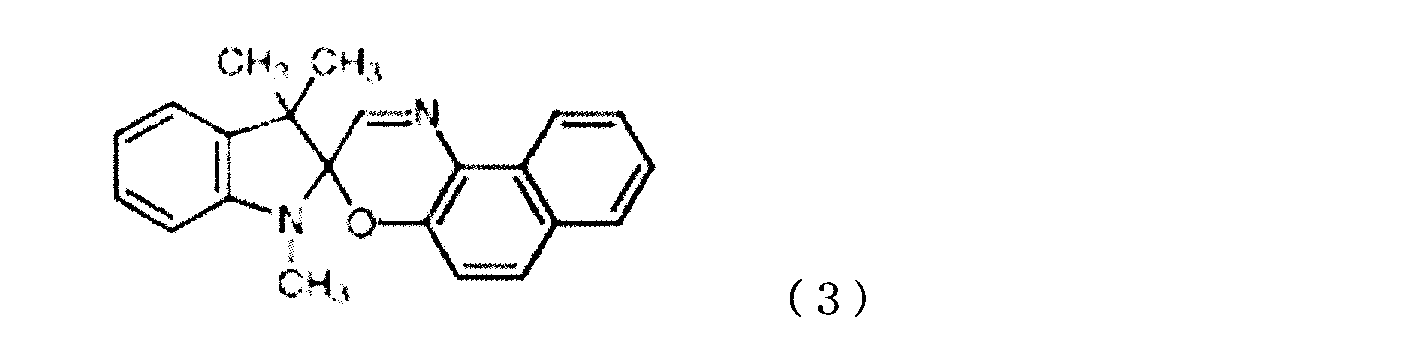
- Example 5 In the pressure-sensitive adhesive composition of Example 1, 2.88 parts by mass (solid content ratio) of an oxazine compound (product name “T1259”, manufactured by Tokyo Chemical Industry Co., Ltd.) represented by the following formula (3) as a photochromic dye: ) Except for the addition, a pressure-sensitive adhesive composition and a pressure-sensitive adhesive sheet were obtained in the same manner as in Example 1.
- an oxazine compound product name “T1259”, manufactured by Tokyo Chemical Industry Co., Ltd.
- a pressure-sensitive adhesive composition and a pressure-sensitive adhesive sheet were obtained in the same manner as in Example 1.
- Comparative Example 6 In the pressure-sensitive adhesive composition of Comparative Example 5, with respect to 100 parts by mass of the solid content of the pressure-sensitive adhesive, 0.06 parts by mass (solid content ratio) of an ultraviolet absorber (manufactured by BASF, product name “Tinvin 765”, hindered amine system) And an antioxidant (manufactured by BASF, product name “IRGANOX1010”) 0.06 parts by mass (solid content ratio) was added in the same manner as in Comparative Example 5 to obtain an adhesive composition and an adhesive sheet. It was.
- an ultraviolet absorber manufactured by BASF, product name “Tinvin 765”, hindered amine system
- an antioxidant manufactured by BASF, product name “IRGANOX1010”
- Comparative Example 8 In the pressure-sensitive adhesive composition of Comparative Example 7, with respect to 100 parts by mass of the solid content of the pressure-sensitive adhesive, 0.06 parts by mass (solid content ratio) of an ultraviolet absorber (manufactured by BASF, product name “Tinuvin 765”, hindered amine system) And an antioxidant (manufactured by BASF, product name “IRGANOX1010”) in the same manner as in Comparative Example 7, except that 0.06 part by mass (solid content ratio) was added. It was.
- an ultraviolet absorber manufactured by BASF, product name “Tinuvin 765”, hindered amine system
- an antioxidant manufactured by BASF, product name “IRGANOX1010”
- HABI hexaarylbisimidazole
- Example 11 In the pressure-sensitive adhesive composition of Example 1, the addition amount of the dithienylethene compound represented by the above formula (1) used as a photochromic dye (Tokyo Chemical Industry Co., Ltd., product name “B2287”) was 9.60 parts by mass. A pressure-sensitive adhesive composition and a pressure-sensitive adhesive sheet were obtained in the same manner as in Example 1 except that (solid content ratio) was used.
- Example 12 In the pressure-sensitive adhesive composition of Example 1, as a pressure-sensitive adhesive, a styrene-isoprene-styrene block copolymer rubber-based resin (SIS-based resin) (manufactured by Nippon Zeon Co., Ltd., product name “Quintac 3520”, styrene content: 15 26 parts by mass (solid content ratio), 50 parts by mass (solid content ratio) of an unhydrogenated petroleum resin (manufactured by Zeon Corporation, product name “Quinton N180”), a terpene resin (Yasuhara Chemical) 4 parts by mass (solids ratio), product name “YS Resin LP”, and 20 parts by mass (solids ratio) of paraffinic oil (manufactured by Fuji Kosan Co., Ltd., product name “Fukol Process P-100”)
- SIS-based resin styrene-isoprene-styrene block copolymer rubber-based resin
- an acrylic copolymer (BA / AA
- Example 17 In the pressure-sensitive adhesive composition of Example 1, an acrylic made of butyl acrylate (BA), isobutyl acrylate (iBA), vinyl acetate (VAc), 2-hydroxyethyl methacrylate (HEMA), and methacrylic acid (MAA) was used as the pressure-sensitive adhesive.
- BA butyl acrylate
- iBA isobutyl acrylate
- VAc vinyl acetate
- HEMA 2-hydroxyethyl methacrylate
- MAA methacrylic acid
- Example 19 In the pressure-sensitive adhesive composition of Example 1, an acrylic copolymer (BA / EA / VAc) composed of butyl acrylate (BA), ethyl acrylate (EA), vinyl acetate (VAc), and acrylamide (AAm) was used as the pressure-sensitive adhesive.
- BA acrylic copolymer
- EA ethyl acrylate
- VAc vinyl acetate
- AAm acrylamide
- /AAm 54.0/27.0/17.0/2.0 (mass%), weight average molecular weight 1 million, solid content concentration 24.6 mass%), and 100 parts by mass of the solid content of the pressure-sensitive adhesive
- a cross-linking agent as a tolylene diisocyanate-based cross-linking agent (manufactured by Nippon Polyurethane Co., Ltd., product name “Coronate L”, solid content concentration: 75% by mass), 3.05 parts by mass (solid content ratio)
- Example 1 except that 2.88 parts by mass (solid content ratio) of the spiropyran compound represented by the above formula (3) (product name “T0366” manufactured by Tokyo Chemical Industry Co., Ltd.) was added. It was obtained in the same manner the pressure-sensitive adhesive composition and a pressure-sensitive adhesive sheet.
- the evaluation method of the pressure-sensitive adhesive sheet obtained as described above is as follows. The evaluation results are shown in Tables 1 and 2.
- (1) Appearance evaluation The pressure-sensitive adhesive sheets obtained in Examples and Comparative Examples were cut into a size of 20 mm ⁇ 20 mm, the release sheet was removed, and the pressure-sensitive adhesive surface and glass plate (NGS Precision) A product name “Corning Glass Eagle XG”, 150 mm ⁇ 70 mm ⁇ 2 mm) manufactured by the company was attached using a squeegee to produce a sample for evaluation of appearance. First, in a state where ultraviolet rays were not irradiated, the sample for evaluation was visually confirmed, and whether or not it was colored was evaluated based on the following criteria.
- the evaluation results are listed in the “Appearance” column of “Appearance” in Tables 1 and 2. Furthermore, using the light resistance tester (product name “UV Fade Meter U48” manufactured by Suga Test Instruments Co., Ltd., light source: carbon arc lamp (hereinafter also referred to as “FOM”)), the sample for evaluation was irradiated for 75 hours, The sample for evaluation was visually confirmed, and whether or not it was colored was evaluated based on the following criteria. The evaluation results are listed in the “FOM 75h” column of “Appearance” in Tables 1 and 2.
- the pressure-sensitive adhesive composition and pressure-sensitive adhesive sheet of the present invention have excellent weather resistance that can withstand long-term use, have a relatively fast color change rate from colored to colorless, and have excellent releasability from a release sheet. Is also excellent. Therefore, the pressure-sensitive adhesive composition and pressure-sensitive adhesive sheet of the present invention are used in window glass and wall surfaces, partition glass and transparent resin plates, or illumination glass plates and transparent resin plates used in a space irradiated with black light. It is suitable as an application of a colored sheet to be attached for the purpose of adjusting light transmittance.
Landscapes
- Chemical & Material Sciences (AREA)
- Organic Chemistry (AREA)
- Chemical Kinetics & Catalysis (AREA)
- General Chemical & Material Sciences (AREA)
- Adhesives Or Adhesive Processes (AREA)
- Adhesive Tapes (AREA)
- Laminated Bodies (AREA)
Abstract
Description
特許文献1~4に開示された着色シートは、このような特性を有するフォトクロミック性染料を着色シートに使用しているため、紫外線が照射されている環境下では遮光性を示すが、それ以外の環境下では透明性を示すことが可能とされている。
すなわち、本発明は、下記[1]~[6]を提供するものである。
[1]スチレン由来の構成単位を含まないゴム系樹脂を40~95質量%含有する粘着剤と、ジチエニルエテン系化合物からなるフォトクロミック性染料を含有する粘着剤組成物であって、前記フォトクロミック性染料の含有量が、前記粘着剤100質量部に対して、0.40~8.00質量部である、粘着剤組成物。
[2]前記ジチエニルエテン系化合物が、1分子の構造中に、2つのアリール基及び/又はヘキサフルオロシクロペンテン基を有する化合物である、上記[1]に記載の粘着剤組成物。
[3]前記ゴム系樹脂としてポリイソブチレン系樹脂を含有し、当該ポリイソブチレン系樹脂の含有量が、前記ゴム系樹脂中、60~100質量%である、上記[1]又は[2]に記載の粘着剤組成物。
[4]前記粘着剤が、更に粘着付与剤を含有し、当該粘着付与剤の含有量が、前記粘着剤の全成分中、5~60質量%である、上記[1]~[3]のいずれかに記載の粘着剤組成物。
[5]上記[1]~[4]のいずれかに記載の粘着剤組成物からなる粘着剤層を有する、粘着シート。
本発明の粘着剤組成物は、スチレン由来の構成単位を含まないゴム系樹脂を40~95質量%含有する粘着剤と、ジチエニルエテン系化合物からなるフォトクロミック性染料を、前記粘着剤に対して所定の割合で含有することで、上記効果を奏する粘着剤組成物となる。
また、本発明の粘着剤組成物は、更に酸化防止剤や、紫外線吸収剤等のその他の添加剤を含有することができる。
以下、本発明の粘着剤組成物に含まれる、粘着剤、フォトクロミック性染料、酸化防止剤、及びその他の添加剤について詳述する。
本発明の粘着剤組成物は、粘着剤として、スチレン由来の構成単位を含まないゴム系樹脂を含有することで、フォトクロミック性染料が水分に触れることによるフォトクロミック性能の低下を抑制することができ、粘着剤組成物の耐候性を良好にすることができると考えられる。
つまり、スチレン由来の構成単位を含むゴム系樹脂を粘着剤として用いた場合、フォトクロミック性染料が水分と触れ合うことで発光性が低下し、得られる粘着剤組成物の長時間の使用における耐候性が著しく劣るとの弊害が考えられる。
ゴム系樹脂としては、スチレン由来の構成単位を含まないゴム系樹脂であれば特に制限されない。なお、「スチレン由来の構成単位を含まない」とは、故意に、使用するゴム系樹脂の構成単位中にスチレン由来の構成単位を含ませることは無いという意味である。当該構成単位が不純物として含有してしまう場合においても、ゴム系樹脂の全構成単位中のスチレン由来の構成単位の含有量は、通常0.1質量%未満、好ましくは0.01質量%未満、より好ましくは0.001質量%未満、更に好ましくは実質0質量%である。
ゴム系樹脂としては、例えば、ポリイソブチレン系樹脂、ポリブテン系樹脂等の合成ゴムや、天然ゴムを使用することができる。これらの中でも、ポリイソブチレン系樹脂、天然ゴムが好ましく、ポリイソブチレン系樹脂がより好ましい。
なお、本発明において、重量平均分子量の値は、ゲルパーミエーションクロマトグラフィー(GPC)法で測定されるポリスチレン換算の値を意味する。
重量平均分子量の異なるPIB系樹脂(A)とPIB系樹脂(B)とを併用することで、PIB系樹脂(A)とPIB系樹脂(B)とが良好に相溶し、適度にPIB系樹脂(A)を可塑化させることができ、被着体に対する濡れ性を高め、得られる粘着剤組成物の粘着物性、柔軟性、保持力等を向上させることができると考えられる。
重量平均分子量が30万以上であれば、粘着剤組成物の凝集力を十分であり、被着体への汚染を防止できる。また、50万以下であれば、粘着剤組成物が適度な柔軟性と流動性を兼ね備えることができ、溶媒に対する溶解性も良好となる。
重量平均分子量が1000以上であれば、PIB系樹脂(B)が低分子量成分として分離することによる被着体への汚染を防止できる。また、28万以下であれば、PIB系樹脂(A)を十分に可塑化させることができ、得られる粘着剤組成物の粘着物性、柔軟性、保持力等を向上させることができる。
PIB系樹脂(B)の含有量が2質量部以上であれば、PIB系樹脂(A)を十分に可塑化させることができ、被着体に対する濡れ性を高め、得られる粘着剤組成物の粘着物性、柔軟性、保持力等を向上させることができる。また、100質量部以下であれば、粘着剤組成物の凝集力が十分であり、被着体への汚染を防止できる。
また、本発明で使用する粘着剤は、得られる粘着剤組成物の粘着力を向上させる観点から、更に粘着付与剤を含有することが好ましい。
粘着付与剤としては、公知の粘着付与剤が挙げられるが、得られる粘着剤組成物の耐候性を良好とし、フォトクロミック性能を維持する観点から、水素化石油樹脂が好ましい。
本発明において、水素化石油樹脂とは、水素化触媒を使用して、脂肪族系石油樹脂、シクロペンタジエン系石油樹脂等の石油樹脂を水素化したものを意味する。
また、本発明で使用する粘着剤には、本発明の効果を損なわない範囲で、その他の成分を含有することができる。その他の成分としては、流動パラフィン、植物性油(例えばオリーブ油、大豆油、牛油、豚脂)、ポリブテン、低級イソプレン、ワックス等の粘着力・保持力調整剤等が挙げられる。
本発明の粘着剤組成物は、ジチエニルエテン系化合物からなるフォトクロミック性染料を含有する。
本発明において、ジチエニルエテン系化合物とは、1分子の構造中に、二重結合を有し、且つ、2つのチエニル基を有する化合物を意味する。なお、当該2重結合は、鎖構造内もしくは環構造内のいずれの部分に有していてもよい。また、上記チエニル基は、アルキル基、シクロアルキル基、アリール基等の置換基を有していてもよい。
これらのジチエニルエテン系化合物は、単独で又は2種以上組み合わせて用いてもよい。
そのような化合物としては、例えば、1,2-ビス(2,4-ジメチル-5-フェニル-3-チエニル)-3,3,4,4,5,5-ヘキサフルオロ-1-シクロペンテン、1,2-ビス[2-メチルベンゾ[b]チオフェン-3-イル]-3,3,4,4,5,5-ヘキサフルオロ-1-シクロペンテン等が挙げられるが、1,2-ビス[2-メチルベンゾ[b]チオフェン-3-イル]-3,3,4,4,5,5-ヘキサフルオロ-1-シクロペンテンのように、ベンゾチエニル基を有する化合物が好ましい。
0.40質量部未満であると、フォトクロミック性能を十分に発現できないため好ましくない。一方、8.00質量部を超えると、得られる粘着剤組成物の耐候性が劣り、有色から無職への色調変化の速度も遅くなる。また、粘着剤組成物から形成される粘着シートの粘着剤層の外観も白化して不良となるため好ましくない。
本発明の粘着剤組成物は、更に酸化防止剤を含有することができる。本発明の粘着剤組成物は、酸化防止剤を含有しても、フォトクロミック性能等を損なうことがない。そして、酸化防止剤を含有することで、高湿熱に対する耐久性に優れた粘着剤組成物とすることができる。
ヒンダードフェノール系酸化防止剤としては、例えば、トリエチレングリコール-ビス[3-(3-t-ブチル-5-メチル-4-ヒドロキシフェニル)プロピオネート]、1,6-ヘキサンジオール-ビス[3-(3,5-ジ-t-ブチル-4-ヒドロキシフェニル)プロピオネート]、ペンタエリスリチル・テトラキス[3-(3,5-ジ-t-ブチル-4-ヒドロキシフェニル)プロピオネート]、2,2-チオ-ジエチレンビス[3-(3,5-ジ-t-ブチル-4-ヒドロキシフェニル)プロピオネート]、オクタデシル-3-(3,5-ジ-t-ブチル-4-ヒドロキシフェニル)プロピオネート、N,N’-ヘキサメチレンビス(3,5-ジ-t-ブチル-4-ヒドロキシ-ヒドロキシンナマミド)、1,3,5-トリメチル-2,4,6-トリス(3,5-ジ-t-ブチル-4-ヒドロキシベンジル)ベンゼン、トリス-(3,5-ジ-t-ブチル-4-ヒドロキシベンジル)-イソシアヌレート、2,4-ビス-(n-オクチルチオ)-6-(4-ヒドロキシ-3,5-ジ-t-ブチルアニリノ)1,3,5-トリアジン、2,4-ビス[(オクチルチオ)メチル]-o-クレゾール、2,6-ジ-t-ブチル-p-クレゾール、4,4’-ブチリデンビス-(6-t-ブチル-3-メチルフェノール)、2,2’-メチレンビス-(4-メチル-6-t-ブチルフェノール)、2,2’-メチレンビス-(4-エチル-6-t-ブチルフェノール)、2,6-ジ-t-ブチル-4-エチルフェノール、1,1,3-トリス(2-メチル-4-ヒドロキシ-5-t-ブチルフェニル)ブタン、1,3,5-トリス(3,5-ジ-t-ブチル-4-ヒドロキシベンジル)-1,3,5-トリアジン-2,4,6(1H,3H,5H)トリオン、イソオクチル(3,5-ジ-t-ブチル-4-ヒドロキシフェニル)プロピオネート、1,6-ヘキサンジオール-ビス[3-(3,5-ジ-t-ブチル-4-ヒドロキシフェニル)プロピオネート]、ペンタエリスリチル・テトラキス[3-(3,5-ジ-t-ブチル-4-ヒドロキシフェニル)プロピオネート]、2,2-チオ-ジエチレンビス[3-(3,5-ジ-t-ブチル-4-ヒドロキシフェニル)プロピオネート]、オクタデシル-3-(3,5-ジ-t-ブチル-4-ヒドロキシフェニル)プロピオネート、N,N’-ヘキサメチレンビス(3,5-ジ-t-ブチル-4-ヒドロキシ-ヒドロキシンナマミド)、1,3,5-トリメチル-2,4,6-トリス(3,5-ジ-t-ブチル-4-ヒドロキシベンジル)ベンゼン、トリス-(3,5-ジ-t-ブチル-4-ヒドロキシベンジル)-イソシアヌレート、2,4-ビス-(n-オクチルチオ)-6-(4-ヒドロキシ-3,5-ジ-t-ブチルアニリノ)1,3,5-トリアジン、2,6-ジ-t-ブチル-p-クレゾール、2,6-ジ-t-ブチル-4-エチルフェノール、1,3,5-トリス(3,5-ジ-t-ブチル-4-ヒドロキシベンジル)-1,3,5-トリアジン-2,4,6(1H,3H,5H)トリオン、イソオクチル(3,5-ジ-t-ブチル-4-ヒドロキシフェニル)プロピオネート等が挙げられる。
このような酸化防止剤としては、例えば、1,6-ヘキサンジオール-ビス[3-(3,5-ジ-t-ブチル-4-ヒドロキシフェニル)プロピオネート]、ペンタエリスリチル・テトラキス[3-(3,5-ジ-t-ブチル-4-ヒドロキシフェニル)プロピオネート]、2,2-チオ-ジエチレンビス[3-(3,5-ジ-t-ブチル-4-ヒドロキシフェニル)プロピオネート]、オクタデシル-3-(3,5-ジ-t-ブチル-4-ヒドロキシフェニル)プロピオネート、N,N’-ヘキサメチレンビス(3,5-ジ-t-ブチル-4-ヒドロキシ-ヒドロキシンナマミド)、1,3,5-トリメチル-2,4,6-トリス(3,5-ジ-t-ブチル-4-ヒドロキシベンジル)ベンゼン、トリス-(3,5-ジ-t-ブチル-4-ヒドロキシベンジル)-イソシアヌレート、2,4-ビス-(n-オクチルチオ)-6-(4-ヒドロキシ-3,5-ジ-t-ブチルアニリノ)1,3,5-トリアジン、2,6-ジ-t-ブチル-p-クレゾール、2,6-ジ-t-ブチル-4-エチルフェノール、1,3,5-トリス(3,5-ジ-t-ブチル-4-ヒドロキシベンジル)-1,3,5-トリアジン-2,4,6(1H,3H,5H)トリオン、イソオクチル(3,5-ジ-t-ブチル-4-ヒドロキシフェニル)プロピオネート等が挙げられる。
なお、酸化防止剤の市販品としては、ヨシノックスBHT(吉富ファインケミカル社製)、IRGANOX565(チバ・スペシャリティ・ケミカルズ社製)、IRGANOX1010(BASF社製)等が挙げられる。
本発明の粘着剤組成物は、本発明の効果を損なわず、粘着力等の特性を阻害しない範囲、更にその他の添加剤を含有してもよい。
その他の添加剤としては、例えば、紫外線吸収剤、光安定剤、樹脂安定剤、赤外線/近赤外線吸収剤、防腐・防かび剤、凍結融解安定剤、防錆剤、可塑剤、高沸点溶剤、充てん剤、顔料、増量剤等が挙げられる。これらの添加剤は、単独で又は2種以上を組み合わせて用いてもよい。
紫外線吸収剤の含有量は、粘着剤100質量部に対して、好ましくは0.01~3.0質量部、より好ましくは0.03~2.0質量部、更に好ましくは0.04~1.0質量部である。
光安定剤の含有量は、粘着剤100質量部に対して、好ましくは0.01~2質量部である。
樹脂安定剤の含有量は、粘着剤100質量部に対して、好ましくは0.01~3質量部である。
本発明の粘着シートは、本発明の粘着剤組成物からなる粘着剤層を有するものである。本発明の粘着シートの構成は、特に限定されず、図1(a)に示された粘着シート1aのように、基材11上に粘着剤層12を形成した粘着シートに限られない。
例えば、図1(b)に示された粘着シート1bのように、基材11上に形成した粘着剤層12に、更に別の基材11’を形成した粘着シートや、図1(c)に示された粘着シート1cのように、基材11上に形成した粘着剤層12上に、剥離可能な剥離材13を形成した粘着シート等が挙げられる。なお、粘着シート1bの基材11、11’の種類は、同一でも異なるものでもよい。他にも、例えば、粘着シート1bを基材として用い、粘着剤層をさらに積層させることで、粘着剤層が基材に挟まれて耐候性がより向上した粘着シートとすることもできる。
また、図1(d)に示された粘着シート1dのように、基材を用いずに、粘着剤層12を、剥離材13と別の剥離材13’とで挟持した粘着シートとしてもよい。なお、粘着シート1dの剥離材13、13’の種類は、同一でも異なるものでもよいが、剥離材13と剥離材13’との剥離力差が異なるように調整することが好ましい。
本発明の粘着シートで用いる基材は、特に限定されず、粘着シートの使用目的に応じて適宜選定される。
基材としては、例えば、上質紙、アート紙、コート紙、グラシン紙等の紙基材、これらの紙基材にポリエチレン等の熱可塑性樹脂をラミネートしたラミネート紙等の各種紙類;各種合成紙:アルミニウム箔、銅箔、鉄箔等の金属箔;不織布等の多孔質材料からなる基材;ポリエチレン樹脂、ポリプロピレン樹脂等のポリオレフィン樹脂、ポリブチレンテレフタレート樹脂、ポリエチレンテレフタレート樹脂等のポリエステル樹脂、アセテート樹脂、ABS樹脂、ポリスチレン樹脂、塩化ビニル樹脂等の樹脂及びこれらの混合物又は積層物からなるプラスチックのフィルム又はプラスチックシート等が挙げられる。なお、プラスチックフィルム及びプラスチックシート等の基材は、未延伸でもよいし、縦又は横等の一軸方向あるいは二軸方向に延伸されていてもよい。
使用する基材は、着色の有無については問わないが、紫外線を十分に透過する基材が好ましく、さらに可視光領域においても無色透明で基材がより好ましい。
また、基材の表面又は裏面には、印刷、印字等を施してもよい。そのために、基材には、感熱記録層、熱転写、インクジェット、レーザー印字等が可能な印字受像層、印刷性向上層等が設けられてもよい。なお、不透明な基材に印刷・印字等された基材を用いた粘着シートは、該粘着シートの粘着剤層越しに印刷面を観察する用途に使ってもよい。
酸化法としては、特に限定されず、例えば、コロナ放電処理法、プラズマ処理法、クロム酸酸化(湿式)、火炎処理、熱風処理、オゾン・紫外線照射処理等が挙げられる。また、凹凸化法としては、特には限定されず、例えば、サンドブラスト法、溶剤処理法等が挙げられる。これらの表面処理は、基材の種類に応じて適宜選定されるが、粘着剤層との密着性の向上効果や操作性の観点から、コロナ放電処理法が好ましい。また、プライマー処理を施すこともできる。
目止め層としては、特には限定されないが、例えは、スチレンーブタジエン共重合体、アクリル系樹脂、ポリエステル系樹脂、ポリウレタン系樹脂、ポリスチレン系樹脂等を主成分として、必要に応じ、クレー、シリカ、炭酸カルシウム、酸化チタン、酸化亜鉛等のフィラーを添加した樹脂組成物等からなる層が挙げられる。
目止め層の厚さは、特には制限されないが、通常0.1~30μmの範囲である。
剥離材としては、剥離材用の基材上に剥離剤を塗布したものが挙げられる。具体的には、両面剥離処理をされた剥離シートや、片面剥離処理された剥離シート等が用いることができる。
剥離材用の基材としては、例えば、グラシン紙、コート紙、上質紙等の紙基材;これらの紙基材にポリエチレン等の熱可塑性樹脂をラミネートしたラミネート紙;ポリエチレンテレフタレート樹脂、ポリブチレンテレフタレート樹脂、ポリエチレンナフタレート樹脂等のポリエステル樹脂フィルム、ポリプロピレン樹脂、ポリエチレン樹脂等のポリオレフィン樹脂フィルム等のプラスチックフィルム等が挙げられる。
剥離剤としては、例えば、シリコーン系樹脂、オレフィン系樹脂、イソプレン系樹脂、ブタジエン系樹脂等のゴム系エラストマー、長鎖アルキル系樹脂、アルキド系樹脂、フッ素系樹脂等が挙げられる。
本発明の粘着シートの製造方法としては、特に制限は無い。例えば、本発明の粘着剤組成物に対して、トルエン、酢酸エチル、メチルエチルケトン等の有機溶媒を配合して、粘着剤組成物の溶液を調製し、当該溶液を、上述の基材の面上又は剥離材の剥離処理面上に公知の塗布方法により塗布し、その後乾燥させて粘着剤層を形成させて、粘着シートを製造する方法等が挙げられる。
また、基材上に上記の方法で形成した粘着剤層と、別の基材とを貼り合せれば、図1(b)に示された粘着シート1bを製造することができる。他に、基材又は剥離材上に、上記の方法で形成した粘着剤層と、上述の剥離材の剥離処理面とを貼り合せれば、図1(c)に示された粘着シート1cや、図1(d)に示された粘着シート1dを製造することができる。
(1)粘着剤の調製
粘着剤中のゴム系樹脂として、PIB系樹脂(A)(BASF社製、製品名「Oppanol B50」、重量平均分子量35万)70質量部(固形分比)、及びPIB系樹脂(B)(BASF社製、製品名「Oppanol B30」、重量平均分子量20万)7質量部(固形分比)を用い、粘着付与剤として、水素化石油樹脂(荒川化学工業社製、製品名「アルコン P-100」、分子量500~1000)23質量部(固形分比)を用い、これらをトルエンに溶解し、固形分濃度約25質量%の粘着剤の溶液を調製した。
(2)粘着剤組成物の調製
上記の粘着剤の固形分100質量部に対して、フォトクロミック性染料として、下記式(1)で表されるジチエニルエテン系化合物(東京化成工業社製、製品名「B2287」)2.88質量部(固形分比)を、上記の粘着剤の溶液に添加混合し、粘着剤組成物の溶液(固形分濃度:約25質量%)を得た。
(3)粘着シートの作製
基材として厚さ100μmのポリエチレンテレフタレート(PET)フィルム(東レ株式会社製、製品名「ルミラー」)上に、乾燥後の粘着剤層の厚さが20μmになるように、上記粘着剤組成物の溶液を塗布した後、120℃で2分間加熱し、厚さ20μmの粘着剤層を形成した。次いで、この粘着剤層の面上に、剥離シート(剥離材)として、剥離処理したポリエチレンテレフタレートフィルム(リンテック社製、製品名「SP-PET380101」)の剥離処理面を貼付して、粘着シートを作製した。

実施例1の粘着剤組成物において、粘着剤の固形分100質量部に対し、更に、紫外線吸収剤(BASF社製、製品名「Tinuvin765」、ヒンダードアミン系)0.06質量部(固形分比)と、酸化防止剤(BASF社製、製品名「IRGANOX1010」)0.06質量部(固形分比)とを添加した以外は、実施例1と同様にして、粘着剤組成物及び粘着シートを得た。
実施例1の粘着剤組成物において、フォトクロミック性染料として用いた上記式(1)で表されるジチエニルエテン系化合物(東京化成工業社製、製品名「B2287」)の添加量を0.48質量部(固形分比)とした以外は、実施例1と同様にして、粘着剤組成物及び粘着シートを得た。
実施例1の粘着剤組成物において、フォトクロミック性染料として用いた上記式(1)で表されるジチエニルエテン系化合物(東京化成工業社製、製品名「B2287」)の添加量を0.96質量部(固形分比)とした以外は、実施例1と同様にして、粘着剤組成物及び粘着シートを得た。
実施例1の粘着剤組成物において、フォトクロミック性染料として用いた上記式(1)で表されるジチエニルエテン系化合物(東京化成工業社製、製品名「B2287」)の添加量を4.80質量部(固形分比)とした以外は、実施例1と同様にして、粘着剤組成物及び粘着シートを得た。
実施例1の粘着剤組成物において、フォトクロミック性染料として用いた上記式(1)で表されるジチエニルエテン系化合物(東京化成工業社製、製品名「B2287」)の添加量を6.72質量部(固形分比)とした以外は、実施例1と同様にして、粘着剤組成物及び粘着シートを得た。
実施例1の粘着剤組成物において、粘着剤として、天然ゴム系樹脂(NR系樹脂)含有粘着剤(リンテック社製、製品名「PV-2」、天然ゴム成分含有量:44質量%、粘着付与剤含有量:56質量%)を100質量部(固形分)用いた以外は、実施例1と同様にして、粘着剤組成物及び粘着シートを得た。
実施例1の粘着剤組成物において、フォトクロミック性染料として、下記式(2)で表されるスピロピラン系化合物(東京化成工業社製、製品名「T0366」)を0.96質量部(固形分比)添加した以外は、実施例1と同様にして、粘着剤組成物及び粘着シートを得た。

比較例1の粘着剤組成物において、粘着剤の固形分100質量部に対し、更に、紫外線吸収剤(BASF社製、製品名「Tinuvin765」、ヒンダードアミン系)0.06質量部(固形分比)と、酸化防止剤(BASF社製、製品名「IRGANOX1010」)0.06質量部(固形分比)とを添加した以外は、実施例1と同様にして、粘着剤組成物及び粘着シートを得た。
実施例1の粘着剤組成物において、フォトクロミック性染料として、上記式(2)で表されるスピロピラン系化合物(東京化成工業社製、製品名「T0366」)を2.88質量部(固形分比)添加した以外は、実施例1と同様にして、粘着剤組成物及び粘着シートを得た。
比較例3の粘着剤組成物において、粘着剤の固形分100質量部に対し、更に、紫外線吸収剤(BASF社製、製品名「Tinuvin765」、ヒンダードアミン系)0.06質量部(固形分比)と、酸化防止剤(BASF社製、製品名「IRGANOX1010」)0.06質量部(固形分比)とを添加した以外は、比較例3と同様にして、粘着剤組成物及び粘着シートを得た。
実施例1の粘着剤組成物において、フォトクロミック性染料として、下記式(3)で表されるオキサジン系化合物(東京化成工業社製、製品名「T1259」)を2.88質量部(固形分比)添加した以外は、実施例1と同様にして、粘着剤組成物及び粘着シートを得た。
比較例5の粘着剤組成物において、粘着剤の固形分100質量部に対し、更に、紫外線吸収剤(BASF社製、製品名「Tinuvin765」、ヒンダードアミン系)0.06質量部(固形分比)と、酸化防止剤(BASF社製、製品名「IRGANOX1010」)0.06質量部(固形分比)とを添加した以外は、比較例5と同様にして、粘着剤組成物及び粘着シートを得た。
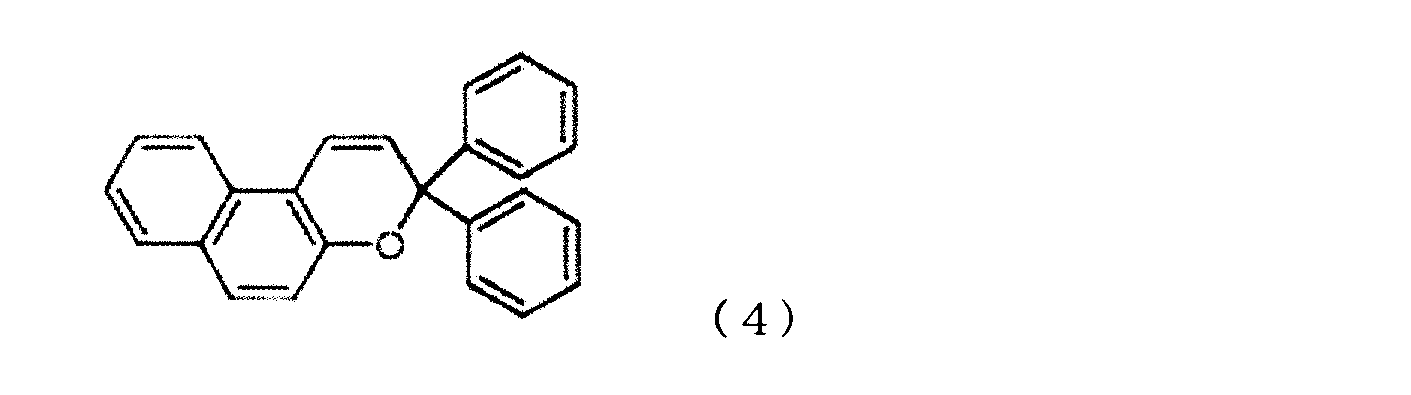
実施例1の粘着剤組成物において、フォトクロミック性染料として、下記式(4)で表されるナフトピラン系化合物(東京化成工業社製、製品名「D3197」)を2.88質量部(固形分比)添加した以外は、実施例1と同様にして、粘着剤組成物及び粘着シートを得た。
比較例7の粘着剤組成物において、粘着剤の固形分100質量部に対し、更に、紫外線吸収剤(BASF社製、製品名「Tinuvin765」、ヒンダードアミン系)0.06質量部(固形分比)と、酸化防止剤(BASF社製、製品名「IRGANOX1010」)0.06質量部(固形分比)とを添加した以外は、比較例7と同様にして、粘着剤組成物及び粘着シートを得た。
実施例1の粘着剤組成物において、フォトクロミック性染料として、下記式(5)で表されるヘキサアリールビスイミダゾール(HABI)系化合物(関東化学社製、製品名「Pseudogem-ビス(3,3’,4,4’-テトラメトキシジフェニルイミダゾール)[2.2]パラシクロフェン」)を2.88質量部(固形分比)添加した以外は、実施例1と同様にして、粘着剤組成物及び粘着シートを得た。

比較例9の粘着剤組成物において、粘着剤の固形分100質量部に対し、更に、紫外線吸収剤(BASF社製、製品名「Tinuvin765」、ヒンダードアミン系)0.06質量部(固形分比)と、酸化防止剤(BASF社製、製品名「IRGANOX1010」)0.06質量部(固形分比)とを添加した以外は、比較例9と同様にして、粘着剤組成物及び粘着シートを得た。
実施例1の粘着剤組成物において、フォトクロミック性染料として用いた上記式(1)で表されるジチエニルエテン系化合物(東京化成工業社製、製品名「B2287」)の添加量を9.60質量部(固形分比)とした以外は、実施例1と同様にして、粘着剤組成物及び粘着シートを得た。
実施例1の粘着剤組成物において、粘着剤として、スチレン-イソプレン-スチレンブロック共重合体ゴム系樹脂(SIS系樹脂)(日本ゼオン社製、製品名「クインタック3520」、スチレン含有量:15質量%)を26質量部(固形分比)、粘着付与剤として、未水添石油樹脂(日本ゼオン社製、製品名「クイントンN180」)50質量部(固形分比)、テルペン系樹脂(ヤスハラケミカル社製、製品名「YSレジンLP」)4質量部(固形分比)、パラフィン系オイル(富士興産社製、製品名「フッコールプロセス P-100」)20質量部(固形分比)を配合し、これらの成分をトルエンに溶解し、固形分濃度約25質量%に調製した粘着剤を100質量部(固形分)用いた以外は、実施例1と同様にして、粘着剤組成物及び粘着シートを得た。
実施例1の粘着剤組成物において、粘着剤として、ブチルアクリレート(BA)及びアクリル酸(AA)からなるアクリル系共重合体(BA/AA=91.0/9.0(質量%)、重量平均分子量80万、固形分濃度34質量%)を用い、該粘着剤の固形分100質量部に対し、架橋剤として、トリレンジイソシアネート系架橋剤(日本ポリウレタン社製、製品名「コロネートL」、固形分濃度75質量%)を2.21質量部(固形分比)、及びフォトクロミック性染料として、上記式(1)で表されるジチエニルエテン系化合物(東京化成工業社製、製品名「B2287」)を2.88質量部(固形分比)添加した以外は、実施例1と同様にして、粘着剤組成物及び粘着シートを得た。
比較例13の粘着剤組成物において、フォトクロミック性染料として用いた上記式(1)で表されるジチエニルエテン系化合物(東京化成工業社製、製品名「B2287」)の添加量を0.96質量部(固形分比)とした以外は、比較例13と同様にして、粘着剤組成物及び粘着シートを得た。
実施例1の粘着剤組成物において、粘着剤として、ブチルアクリレート(BA)及びアクリル酸(AA)からなるアクリル系共重合体(BA/AA=94.0/6.0(質量%)、重量平均分子量80万、固形分濃度34質量%)を用い、該粘着剤の固形分100質量部に対し、架橋剤として、トリレンジイソシアネート系架橋剤(日本ポリウレタン社製、製品名「コロネートL」、固形分濃度75質量%)を2.21質量部(固形分比)、及びフォトクロミック性染料として、上記式(1)で表されるジチエニルエテン系化合物(東京化成工業社製、製品名「B2287」)を0.96質量部(固形分比)添加した以外は、実施例1と同様にして、粘着剤組成物及び粘着シートを得た。
比較例15の粘着剤組成物において、粘着剤として、ブチルアクリレート(BA)及びアクリル酸(AA)からなるアクリル系共重合体(BA/AA=96.0/4.0(質量%)、重量平均分子量80万、固形分濃度34質量%)を用いた以外は、比較例15と同様にして、粘着剤組成物及び粘着シートを得た。
実施例1の粘着剤組成物において、粘着剤として、ブチルアクリレート(BA)、イソブチルアクリレート(iBA)、酢酸ビニル(VAc)、2-ヒドロキシエチルメタクリレート(HEMA)、及びメタクリル酸(MAA)からなるアクリル系共重合体(BA/iBA/VAc/HEMA/MAA=44.0/44.0/5.76/6.20/0.04(質量%)、重量平均分子量80万、固形分濃度37質量%)を用い、該粘着剤の固形分100質量部に対し、架橋剤として、ヘキサメチレンジイソシアネート系架橋剤(日本ポリウレタン社製、製品名「コロネートHL」、固形分濃度75質量%)を0.39質量部(固形分比)、及びフォトクロミック性染料として、上記式(2)で表されるスピロピラン系化合物(東京化成工業社製、製品名「T0366」)を2.88質量部(固形分比)添加した以外は、実施例1と同様にして、粘着剤組成物及び粘着シートを得た。
比較例17の粘着剤組成物において、フォトクロミック性染料として用いた上記式(3)で表されるスピロピラン系化合物(東京化成工業社製、製品名「T1259」)の添加量を0.96質量部(固形分比)とした以外は、比較例17と同様にして、粘着剤組成物及び粘着シートを得た。
実施例1の粘着剤組成物において、粘着剤として、ブチルアクリレート(BA)、エチルアクリレート(EA)、酢酸ビニル(VAc)、及びアクリルアミド(AAm)からなるアクリル系共重合体(BA/EA/VAc/AAm=54.0/27.0/17.0/2.0(質量%)、重量平均分子量100万、固形分濃度24.6質量%)を用い、該粘着剤の固形分100質量部に対し、架橋剤として、トリレンジイソシアネート系架橋剤(日本ポリウレタン社製、製品名「コロネートL」、固形分濃度75質量%)を3.05質量部(固形分比)、及びフォトクロミック性染料として、上記式(3)で表されるスピロピラン系化合物(東京化成工業社製、製品名「T0366」)を2.88質量部(固形分比)添加した以外は、実施例1と同様にして、粘着剤組成物及び粘着シートを得た。
比較例19の粘着剤組成物において、フォトクロミック性染料として用いた上記式(3)で表されるスピロピラン系化合物(東京化成工業社製、製品名「T1259」)の添加量を0.96質量部(固形分比)とした以外は、比較例19と同様にして、粘着剤組成物及び粘着シートを得た。
(1)外観の評価
実施例及び比較例で得た粘着シートを20mm×20mmの大きさに裁断し、剥離シートを除去し、表出した粘着剤面とガラス板(エヌ・エス・ジー・プレシジョン社製、製品名「コーニングガラス イーグルXG」、150mm×70mm×2mm)とをスキージーを用いて貼り合わせ、外観の評価用サンプルを作製した。
初めに、紫外線を照射していない状態において、当該評価用サンプルを目視で確認し、下記基準に基づき、着色されているか否かの評価を行った。なお、当該評価結果は、表1及び2中の「外観」の「作製直後」の欄に記載している。
さらに耐光性試験機(スガ試験機社製、製品名「紫外線フェードメーターU48」、光源:カーボンアークランプ(以下、「FOM」ともいう))を用いて、当該評価用サンプルを75時間照射し、当該評価用サンプルを目視で確認し、下記基準に基づき、着色されているか否かの評価を行った。なお、当該評価結果は、表1及び2中の「外観」の「FOM75h」の欄に記載している。
A:着色が認められず、無色である。
B:淡黄、淡赤、淡茶等の淡色の着色が若干認められる。
C:黄、赤、茶等の着色がはっきりと認められる。
D:粘着剤層の白化が認められる。
上述のとおり作成した外観の評価用サンプルに対して、紫外線照射装置(アズワン社製、製品名「Handy UV Lamp SLUV-4」)を用いて、紫外線(波長365nm)を5秒間照射した後の当該評価用サンプルを目視で観察し、下記基準に基づき、発色するか否かの評価を行った。なお、当該評価結果は、表1及び2中の「長時間の耐候性」の「作製直後」の欄に記載している。
さらに耐光性試験機(スガ試験機社製、製品名「紫外線フェードメーターU48」、光源:カーボンアークランプ)を用いて、当該評価用サンプルを25時間、50時間、75時間照射した後のサンプルについても同様に評価した。なお、当該評価結果は、表1及び2中の「表時間の耐候性」の「FOM25h」「FOM50h」「FOM75h」の欄に記載している。
A:発色する。
F:発色しない(変化なし)。
上述のとおり作製した外観の評価用サンプルに対して、紫外線照射装置(アズワン社製、製品名「Handy UV Lamp SLUV-4」)を用いて、紫外線(365nm)を5秒間照射した後の当該評価用サンプルが紫外線照射前の状態まで色が戻るのに要した時間を測定した。測定時間に応じて、下記基準に基づき、評価をした。
A:20分未満で消色する
F:20分以上経っても消色しない
実施例及び比較例で得られた粘着シートの剥離シートを除去する際に、剥離シートを剥離することが可能か否かを、下記基準に基づき、評価した。
A:剥離することが可能である。
F:重剥離により、剥離が困難である。


一方、比較例1~20は、表1に示すように、外観、長時間の耐候性、消色時間、及び剥離シートからの剥離性のいずれかの点で劣る結果となった。
なお、比較例9では、粘着シートを作製直後、粘着剤層が白化し固形分が析出し、透明性を有さないことを確認したため、他の評価をせずに終了した。
そのため、本発明の粘着剤組成物及び粘着シートは、窓ガラスや壁面、間仕切り用ガラスや透明樹脂板、もしくはブラックライトが照射される空間内で使用されるイルミネーション用のガラス板や透明樹脂板において、光の透過性を調節する目的で貼付される着色シートの用途として好適である。
11、11’ 基材
12 粘着剤層
13、13’ 剥離材
Claims (5)
- スチレン由来の構成単位を含まないゴム系樹脂を40~95質量%含有する粘着剤と、ジチエニルエテン系化合物からなるフォトクロミック性染料を含有する粘着剤組成物であって、前記フォトクロミック性染料の含有量が、前記粘着剤100質量部に対して、0.40~8.00質量部である、粘着剤組成物。
- 前記ジチエニルエテン系化合物が、1分子の構造中に2つのアリール基及び/又はヘキサフルオロシクロペンテン基を有する化合物である、請求項1に記載の粘着剤組成物。
- 前記ゴム系樹脂としてポリイソブチレン系樹脂を含有し、当該ポリイソブチレン系樹脂の含有量が、前記ゴム系樹脂中、60~100質量%である、請求項1又は2に記載の粘着剤組成物。
- 前記粘着剤が、更に粘着付与剤を含有し、当該粘着付与剤の含有量が、前記粘着剤の全成分中、5~60質量%である、請求項1~3のいずれかに記載の粘着剤組成物。
- 請求項1~4のいずれかに記載の粘着剤組成物からなる粘着剤層を有する、粘着シート。
Priority Applications (3)
| Application Number | Priority Date | Filing Date | Title |
|---|---|---|---|
| JP2013505991A JP5941906B2 (ja) | 2011-03-24 | 2012-03-21 | 粘着剤組成物、及び粘着シート |
| CN201280014818.8A CN103492515B (zh) | 2011-03-24 | 2012-03-21 | 一种粘着剂组合物以及粘着片 |
| US14/006,497 US9434861B2 (en) | 2011-03-24 | 2012-03-21 | Pressure sensitive adhesive composition and pressure sensitive adhesive sheet |
Applications Claiming Priority (2)
| Application Number | Priority Date | Filing Date | Title |
|---|---|---|---|
| JP2011-065826 | 2011-03-24 | ||
| JP2011065826 | 2011-03-24 |
Publications (1)
| Publication Number | Publication Date |
|---|---|
| WO2012128293A1 true WO2012128293A1 (ja) | 2012-09-27 |
Family
ID=46879435
Family Applications (1)
| Application Number | Title | Priority Date | Filing Date |
|---|---|---|---|
| PCT/JP2012/057229 Ceased WO2012128293A1 (ja) | 2011-03-24 | 2012-03-21 | 粘着剤組成物、及び粘着シート |
Country Status (5)
| Country | Link |
|---|---|
| US (1) | US9434861B2 (ja) |
| JP (1) | JP5941906B2 (ja) |
| CN (1) | CN103492515B (ja) |
| TW (1) | TWI523925B (ja) |
| WO (1) | WO2012128293A1 (ja) |
Cited By (2)
| Publication number | Priority date | Publication date | Assignee | Title |
|---|---|---|---|---|
| CN103305153A (zh) * | 2013-05-29 | 2013-09-18 | 北京京东方光电科技有限公司 | 封框胶及其制备方法和显示装置 |
| US9227986B2 (en) | 2011-09-30 | 2016-01-05 | Switch Materials, Inc. | Diarylethene compounds and uses thereof |
Families Citing this family (4)
| Publication number | Priority date | Publication date | Assignee | Title |
|---|---|---|---|---|
| WO2014078793A1 (en) * | 2012-11-19 | 2014-05-22 | Momentive Specialty Chemicals Inc. | Pressure sensitive adhesive compositions |
| WO2020227226A1 (en) * | 2019-05-03 | 2020-11-12 | Brandeis University | Light-responsive temporary adhesives and use thereof |
| US20200392378A1 (en) * | 2019-06-17 | 2020-12-17 | Richard William Schofield | Adhesive tape with strip to help locate and lift the leading edge, and methods of manufacturing same |
| CN116731622A (zh) * | 2023-06-05 | 2023-09-12 | 杭州华旺新材料科技股份有限公司 | 一种家具装饰素色纸及其制备方法 |
Citations (7)
| Publication number | Priority date | Publication date | Assignee | Title |
|---|---|---|---|---|
| JPH02686A (ja) * | 1987-11-30 | 1990-01-05 | Kendall Co:The | 新規接着剤 |
| JPH09227845A (ja) * | 1996-02-21 | 1997-09-02 | Sony Chem Corp | フォトクロミック性を有する接着剤組成物及び接着シート |
| JPH10330708A (ja) * | 1997-06-05 | 1998-12-15 | Kiroku Sozai Sogo Kenkyusho:Kk | 変色性接着剤組成物 |
| JP2003082340A (ja) * | 2001-09-10 | 2003-03-19 | Masahiro Irie | フォトクロミック材料およびその製造方法並びに記録表示媒体 |
| JP2004149501A (ja) * | 2002-09-04 | 2004-05-27 | Mitsubishi Chemicals Corp | ジアリールエテン化合物、フォトクロミック材料、カラー線量計および光メモリ素子 |
| JP2005326503A (ja) * | 2004-05-12 | 2005-11-24 | Tokai Rubber Ind Ltd | 調光材用着色部材 |
| JP2007176992A (ja) * | 2005-12-27 | 2007-07-12 | Pilot Ink Co Ltd | 色彩記憶性光変色性筆記具 |
Family Cites Families (12)
| Publication number | Priority date | Publication date | Assignee | Title |
|---|---|---|---|---|
| US3293684A (en) * | 1964-06-24 | 1966-12-27 | Colgate Palmolive Co | Integral detergent-sponge structure |
| US4171980A (en) * | 1975-04-24 | 1979-10-23 | La Cellophane | Photosensitive compositions and recording materials and processes utilizing same |
| JPS5675856A (en) * | 1979-11-28 | 1981-06-23 | Kyoraku Co Ltd | Multilayer extruding molding |
| AU595364B2 (en) * | 1986-08-25 | 1990-03-29 | Hercules Incorporated | Pressure sensitive adhesive composition and production thereof |
| JPH0725825B2 (ja) * | 1986-10-08 | 1995-03-22 | 三井石油化学工業株式会社 | 接着剤用タツキフアイヤ− |
| JP2652418B2 (ja) | 1988-07-20 | 1997-09-10 | 極東開発工業株式会社 | 塵芥車の塵芥押込制御装置 |
| JPH0932439A (ja) | 1995-07-19 | 1997-02-04 | Jisupa:Kk | 紫外線変色フィルムとその反応色の調色方法 |
| JPH1039134A (ja) | 1996-07-23 | 1998-02-13 | Matsui Shikiso Kagaku Kogyosho:Kk | 光可逆変色性遮光材 |
| FR2772266B1 (fr) * | 1997-12-12 | 2000-02-04 | Oreal | Utilisation d'agent de coloration photochrome dans une composition cosmetique, et composition cosmetique le comprenant |
| JP2001209039A (ja) * | 1999-11-18 | 2001-08-03 | Nitto Denko Corp | 液晶表示装置用表面保護フィルム及び該表面保護フィルムで保護された液晶表示装置並びに該表面保護フィルムを使用した液晶表示装置の表面保護方法 |
| JP4971554B2 (ja) * | 2001-06-14 | 2012-07-11 | 出光興産株式会社 | 1−ブテン系樹脂組成物および成形体 |
| US7655366B2 (en) * | 2007-06-13 | 2010-02-02 | Xerox Corporation | Inkless reimageable printing paper and method |
-
2012
- 2012-03-21 WO PCT/JP2012/057229 patent/WO2012128293A1/ja not_active Ceased
- 2012-03-21 US US14/006,497 patent/US9434861B2/en active Active
- 2012-03-21 JP JP2013505991A patent/JP5941906B2/ja active Active
- 2012-03-21 CN CN201280014818.8A patent/CN103492515B/zh active Active
- 2012-03-23 TW TW101109988A patent/TWI523925B/zh active
Patent Citations (7)
| Publication number | Priority date | Publication date | Assignee | Title |
|---|---|---|---|---|
| JPH02686A (ja) * | 1987-11-30 | 1990-01-05 | Kendall Co:The | 新規接着剤 |
| JPH09227845A (ja) * | 1996-02-21 | 1997-09-02 | Sony Chem Corp | フォトクロミック性を有する接着剤組成物及び接着シート |
| JPH10330708A (ja) * | 1997-06-05 | 1998-12-15 | Kiroku Sozai Sogo Kenkyusho:Kk | 変色性接着剤組成物 |
| JP2003082340A (ja) * | 2001-09-10 | 2003-03-19 | Masahiro Irie | フォトクロミック材料およびその製造方法並びに記録表示媒体 |
| JP2004149501A (ja) * | 2002-09-04 | 2004-05-27 | Mitsubishi Chemicals Corp | ジアリールエテン化合物、フォトクロミック材料、カラー線量計および光メモリ素子 |
| JP2005326503A (ja) * | 2004-05-12 | 2005-11-24 | Tokai Rubber Ind Ltd | 調光材用着色部材 |
| JP2007176992A (ja) * | 2005-12-27 | 2007-07-12 | Pilot Ink Co Ltd | 色彩記憶性光変色性筆記具 |
Cited By (7)
| Publication number | Priority date | Publication date | Assignee | Title |
|---|---|---|---|---|
| US9227986B2 (en) | 2011-09-30 | 2016-01-05 | Switch Materials, Inc. | Diarylethene compounds and uses thereof |
| US10072023B2 (en) | 2011-09-30 | 2018-09-11 | Switch Materials, Inc. | Diarylethene compounds and uses thereof |
| US10556912B2 (en) | 2011-09-30 | 2020-02-11 | Switch Materials, Inc. | Diarylethene compounds and uses thereof |
| US11124524B2 (en) | 2011-09-30 | 2021-09-21 | Solutia Canada Inc. | Diarylethene compounds and uses thereof |
| CN103305153A (zh) * | 2013-05-29 | 2013-09-18 | 北京京东方光电科技有限公司 | 封框胶及其制备方法和显示装置 |
| WO2014190683A1 (zh) * | 2013-05-29 | 2014-12-04 | 京东方科技集团股份有限公司 | 封框胶组合物及其制备方法和显示装置 |
| CN103305153B (zh) * | 2013-05-29 | 2016-07-06 | 北京京东方光电科技有限公司 | 封框胶及其制备方法和显示装置 |
Also Published As
| Publication number | Publication date |
|---|---|
| CN103492515A (zh) | 2014-01-01 |
| CN103492515B (zh) | 2016-06-29 |
| TWI523925B (zh) | 2016-03-01 |
| TW201245365A (en) | 2012-11-16 |
| JP5941906B2 (ja) | 2016-06-29 |
| JPWO2012128293A1 (ja) | 2014-07-24 |
| US9434861B2 (en) | 2016-09-06 |
| US20140077139A1 (en) | 2014-03-20 |
Similar Documents
| Publication | Publication Date | Title |
|---|---|---|
| US5427850A (en) | Pressure sensitive tape or sheet | |
| JP6767304B2 (ja) | アクリルフォーム層を含む接着剤物品 | |
| JP5941906B2 (ja) | 粘着剤組成物、及び粘着シート | |
| JP5295533B2 (ja) | 表面保護フィルムおよび表面保護フィルム付き光学フィルム | |
| US7309524B2 (en) | Adhesive and its use for an at least one-layer PSA sheet strip which can be redetached without residue or destruction by extensive stretching substantially in the bond plane | |
| US9567497B2 (en) | Adhesive agent having adhesive blend of acrylate and styrene block copolymer | |
| JP2008102271A (ja) | 表面保護フィルムおよび表面保護フィルム付き光学フィルム | |
| CN104204127B (zh) | 粘合剂组合物、以及粘合片 | |
| CN101857781A (zh) | 粘合制品 | |
| CN103102818A (zh) | 粘合片 | |
| CN102079955A (zh) | 表面保护片 | |
| JP5814037B2 (ja) | 粘着テープ | |
| JP5155527B2 (ja) | 表面保護フィルム | |
| JP5961426B2 (ja) | 粘着剤組成物、及び粘着シート | |
| JP2019052280A (ja) | 粘着シート | |
| JP5973988B2 (ja) | 粘着剤組成物、及び粘着シート | |
| JPH0598223A (ja) | 表面保護フイルム | |
| JP2862966B2 (ja) | 粘着剤組成物 | |
| JP5961427B2 (ja) | 粘着剤組成物、及び粘着シート | |
| JP5961428B2 (ja) | 粘着剤組成物、及び粘着シート | |
| KR100225665B1 (ko) | 압력민감점착제조성물및이것을사용한압력민감점착테이프또는시이트 | |
| WO2023127235A1 (ja) | 示温材含有粘着剤組成物およびそれを用いた皮膚貼付体温計 | |
| JPS599590B2 (ja) | 表面保護フイルム | |
| JP2025074844A (ja) | 再剥離粘着テープ | |
| JPH03247682A (ja) | 情報記録紙用保護シート |
Legal Events
| Date | Code | Title | Description |
|---|---|---|---|
| 121 | Ep: the epo has been informed by wipo that ep was designated in this application |
Ref document number: 12760249 Country of ref document: EP Kind code of ref document: A1 |
|
| ENP | Entry into the national phase |
Ref document number: 2013505991 Country of ref document: JP Kind code of ref document: A |
|
| NENP | Non-entry into the national phase |
Ref country code: DE |
|
| WWE | Wipo information: entry into national phase |
Ref document number: 14006497 Country of ref document: US |
|
| 122 | Ep: pct application non-entry in european phase |
Ref document number: 12760249 Country of ref document: EP Kind code of ref document: A1 |