WO2012128350A1 - 粘度指数向上剤、潤滑油用添加剤および潤滑油組成物 - Google Patents
粘度指数向上剤、潤滑油用添加剤および潤滑油組成物 Download PDFInfo
- Publication number
- WO2012128350A1 WO2012128350A1 PCT/JP2012/057510 JP2012057510W WO2012128350A1 WO 2012128350 A1 WO2012128350 A1 WO 2012128350A1 JP 2012057510 W JP2012057510 W JP 2012057510W WO 2012128350 A1 WO2012128350 A1 WO 2012128350A1
- Authority
- WO
- WIPO (PCT)
- Prior art keywords
- viscosity index
- index improver
- methacrylate
- alkyl methacrylate
- lubricating oil
- Prior art date
- Legal status (The legal status is an assumption and is not a legal conclusion. Google has not performed a legal analysis and makes no representation as to the accuracy of the status listed.)
- Ceased
Links
Classifications
-
- C—CHEMISTRY; METALLURGY
- C10—PETROLEUM, GAS OR COKE INDUSTRIES; TECHNICAL GASES CONTAINING CARBON MONOXIDE; FUELS; LUBRICANTS; PEAT
- C10M—LUBRICATING COMPOSITIONS; USE OF CHEMICAL SUBSTANCES EITHER ALONE OR AS LUBRICATING INGREDIENTS IN A LUBRICATING COMPOSITION
- C10M145/00—Lubricating compositions characterised by the additive being a macromolecular compound containing oxygen
- C10M145/02—Macromolecular compounds obtained by reactions only involving carbon-to-carbon unsaturated bonds
- C10M145/10—Macromolecular compounds obtained by reactions only involving carbon-to-carbon unsaturated bonds containing monomers having an unsaturated radical bound to a carboxyl radical, e.g. acrylate
- C10M145/12—Macromolecular compounds obtained by reactions only involving carbon-to-carbon unsaturated bonds containing monomers having an unsaturated radical bound to a carboxyl radical, e.g. acrylate monocarboxylic
- C10M145/14—Acrylate; Methacrylate
-
- C—CHEMISTRY; METALLURGY
- C08—ORGANIC MACROMOLECULAR COMPOUNDS; THEIR PREPARATION OR CHEMICAL WORKING-UP; COMPOSITIONS BASED THEREON
- C08F—MACROMOLECULAR COMPOUNDS OBTAINED BY REACTIONS ONLY INVOLVING CARBON-TO-CARBON UNSATURATED BONDS
- C08F220/00—Copolymers of compounds having one or more unsaturated aliphatic radicals, each having only one carbon-to-carbon double bond, and only one being terminated by only one carboxyl radical or a salt, anhydride ester, amide, imide or nitrile thereof
- C08F220/02—Monocarboxylic acids having less than ten carbon atoms; Derivatives thereof
- C08F220/10—Esters
- C08F220/12—Esters of monohydric alcohols or phenols
- C08F220/16—Esters of monohydric alcohols or phenols of phenols or of alcohols containing two or more carbon atoms
- C08F220/18—Esters of monohydric alcohols or phenols of phenols or of alcohols containing two or more carbon atoms with acrylic or methacrylic acids
- C08F220/1818—C13or longer chain (meth)acrylate, e.g. stearyl (meth)acrylate
-
- C—CHEMISTRY; METALLURGY
- C08—ORGANIC MACROMOLECULAR COMPOUNDS; THEIR PREPARATION OR CHEMICAL WORKING-UP; COMPOSITIONS BASED THEREON
- C08F—MACROMOLECULAR COMPOUNDS OBTAINED BY REACTIONS ONLY INVOLVING CARBON-TO-CARBON UNSATURATED BONDS
- C08F265/00—Macromolecular compounds obtained by polymerising monomers on to polymers of unsaturated monocarboxylic acids or derivatives thereof as defined in group C08F20/00
- C08F265/04—Macromolecular compounds obtained by polymerising monomers on to polymers of unsaturated monocarboxylic acids or derivatives thereof as defined in group C08F20/00 on to polymers of esters
-
- C—CHEMISTRY; METALLURGY
- C10—PETROLEUM, GAS OR COKE INDUSTRIES; TECHNICAL GASES CONTAINING CARBON MONOXIDE; FUELS; LUBRICANTS; PEAT
- C10M—LUBRICATING COMPOSITIONS; USE OF CHEMICAL SUBSTANCES EITHER ALONE OR AS LUBRICATING INGREDIENTS IN A LUBRICATING COMPOSITION
- C10M159/00—Lubricating compositions characterised by the additive being of unknown or incompletely defined constitution
- C10M159/005—Macromolecular compounds, e.g. macromolecular compounds composed of alternatively specified monomers not covered by the same main group
-
- C—CHEMISTRY; METALLURGY
- C10—PETROLEUM, GAS OR COKE INDUSTRIES; TECHNICAL GASES CONTAINING CARBON MONOXIDE; FUELS; LUBRICANTS; PEAT
- C10M—LUBRICATING COMPOSITIONS; USE OF CHEMICAL SUBSTANCES EITHER ALONE OR AS LUBRICATING INGREDIENTS IN A LUBRICATING COMPOSITION
- C10M2203/00—Organic non-macromolecular hydrocarbon compounds and hydrocarbon fractions as ingredients in lubricant compositions
- C10M2203/10—Petroleum or coal fractions, e.g. tars, solvents, bitumen
- C10M2203/102—Aliphatic fractions
- C10M2203/1025—Aliphatic fractions used as base material
-
- C—CHEMISTRY; METALLURGY
- C10—PETROLEUM, GAS OR COKE INDUSTRIES; TECHNICAL GASES CONTAINING CARBON MONOXIDE; FUELS; LUBRICANTS; PEAT
- C10M—LUBRICATING COMPOSITIONS; USE OF CHEMICAL SUBSTANCES EITHER ALONE OR AS LUBRICATING INGREDIENTS IN A LUBRICATING COMPOSITION
- C10M2205/00—Organic macromolecular hydrocarbon compounds or fractions, whether or not modified by oxidation as ingredients in lubricant compositions
- C10M2205/08—Organic macromolecular hydrocarbon compounds or fractions, whether or not modified by oxidation as ingredients in lubricant compositions containing non-conjugated dienes
-
- C—CHEMISTRY; METALLURGY
- C10—PETROLEUM, GAS OR COKE INDUSTRIES; TECHNICAL GASES CONTAINING CARBON MONOXIDE; FUELS; LUBRICANTS; PEAT
- C10M—LUBRICATING COMPOSITIONS; USE OF CHEMICAL SUBSTANCES EITHER ALONE OR AS LUBRICATING INGREDIENTS IN A LUBRICATING COMPOSITION
- C10M2209/00—Organic macromolecular compounds containing oxygen as ingredients in lubricant compositions
- C10M2209/02—Macromolecular compounds obtained by reactions only involving carbon-to-carbon unsaturated bonds
- C10M2209/08—Macromolecular compounds obtained by reactions only involving carbon-to-carbon unsaturated bonds containing monomers having an unsaturated radical bound to a carboxyl radical, e.g. acrylate type
- C10M2209/084—Acrylate; Methacrylate
-
- C—CHEMISTRY; METALLURGY
- C10—PETROLEUM, GAS OR COKE INDUSTRIES; TECHNICAL GASES CONTAINING CARBON MONOXIDE; FUELS; LUBRICANTS; PEAT
- C10M—LUBRICATING COMPOSITIONS; USE OF CHEMICAL SUBSTANCES EITHER ALONE OR AS LUBRICATING INGREDIENTS IN A LUBRICATING COMPOSITION
- C10M2215/00—Organic non-macromolecular compounds containing nitrogen as ingredients in lubricant Compositions
- C10M2215/02—Amines, e.g. polyalkylene polyamines; Quaternary amines
- C10M2215/06—Amines, e.g. polyalkylene polyamines; Quaternary amines having amino groups bound to carbon atoms of six-membered aromatic rings
- C10M2215/064—Di- and triaryl amines
-
- C—CHEMISTRY; METALLURGY
- C10—PETROLEUM, GAS OR COKE INDUSTRIES; TECHNICAL GASES CONTAINING CARBON MONOXIDE; FUELS; LUBRICANTS; PEAT
- C10M—LUBRICATING COMPOSITIONS; USE OF CHEMICAL SUBSTANCES EITHER ALONE OR AS LUBRICATING INGREDIENTS IN A LUBRICATING COMPOSITION
- C10M2219/00—Organic non-macromolecular compounds containing sulfur, selenium or tellurium as ingredients in lubricant compositions
- C10M2219/06—Thio-acids; Thiocyanates; Derivatives thereof
- C10M2219/062—Thio-acids; Thiocyanates; Derivatives thereof having carbon-to-sulfur double bonds
- C10M2219/066—Thiocarbamic type compounds
- C10M2219/068—Thiocarbamate metal salts
-
- C—CHEMISTRY; METALLURGY
- C10—PETROLEUM, GAS OR COKE INDUSTRIES; TECHNICAL GASES CONTAINING CARBON MONOXIDE; FUELS; LUBRICANTS; PEAT
- C10M—LUBRICATING COMPOSITIONS; USE OF CHEMICAL SUBSTANCES EITHER ALONE OR AS LUBRICATING INGREDIENTS IN A LUBRICATING COMPOSITION
- C10M2223/00—Organic non-macromolecular compounds containing phosphorus as ingredients in lubricant compositions
- C10M2223/02—Organic non-macromolecular compounds containing phosphorus as ingredients in lubricant compositions having no phosphorus-to-carbon bonds
- C10M2223/04—Phosphate esters
- C10M2223/045—Metal containing thio derivatives
-
- C—CHEMISTRY; METALLURGY
- C10—PETROLEUM, GAS OR COKE INDUSTRIES; TECHNICAL GASES CONTAINING CARBON MONOXIDE; FUELS; LUBRICANTS; PEAT
- C10N—INDEXING SCHEME ASSOCIATED WITH SUBCLASS C10M RELATING TO LUBRICATING COMPOSITIONS
- C10N2010/00—Metal present as such or in compounds
- C10N2010/04—Groups 2 or 12
-
- C—CHEMISTRY; METALLURGY
- C10—PETROLEUM, GAS OR COKE INDUSTRIES; TECHNICAL GASES CONTAINING CARBON MONOXIDE; FUELS; LUBRICANTS; PEAT
- C10N—INDEXING SCHEME ASSOCIATED WITH SUBCLASS C10M RELATING TO LUBRICATING COMPOSITIONS
- C10N2010/00—Metal present as such or in compounds
- C10N2010/12—Groups 6 or 16
-
- C—CHEMISTRY; METALLURGY
- C10—PETROLEUM, GAS OR COKE INDUSTRIES; TECHNICAL GASES CONTAINING CARBON MONOXIDE; FUELS; LUBRICANTS; PEAT
- C10N—INDEXING SCHEME ASSOCIATED WITH SUBCLASS C10M RELATING TO LUBRICATING COMPOSITIONS
- C10N2020/00—Specified physical or chemical properties or characteristics, i.e. function, of component of lubricating compositions
- C10N2020/01—Physico-chemical properties
- C10N2020/04—Molecular weight; Molecular weight distribution
-
- C—CHEMISTRY; METALLURGY
- C10—PETROLEUM, GAS OR COKE INDUSTRIES; TECHNICAL GASES CONTAINING CARBON MONOXIDE; FUELS; LUBRICANTS; PEAT
- C10N—INDEXING SCHEME ASSOCIATED WITH SUBCLASS C10M RELATING TO LUBRICATING COMPOSITIONS
- C10N2020/00—Specified physical or chemical properties or characteristics, i.e. function, of component of lubricating compositions
- C10N2020/01—Physico-chemical properties
- C10N2020/073—Star shaped polymers
-
- C—CHEMISTRY; METALLURGY
- C10—PETROLEUM, GAS OR COKE INDUSTRIES; TECHNICAL GASES CONTAINING CARBON MONOXIDE; FUELS; LUBRICANTS; PEAT
- C10N—INDEXING SCHEME ASSOCIATED WITH SUBCLASS C10M RELATING TO LUBRICATING COMPOSITIONS
- C10N2030/00—Specified physical or chemical properties which is improved by the additive characterising the lubricating composition, e.g. multifunctional additives
- C10N2030/02—Pour-point; Viscosity index
-
- C—CHEMISTRY; METALLURGY
- C10—PETROLEUM, GAS OR COKE INDUSTRIES; TECHNICAL GASES CONTAINING CARBON MONOXIDE; FUELS; LUBRICANTS; PEAT
- C10N—INDEXING SCHEME ASSOCIATED WITH SUBCLASS C10M RELATING TO LUBRICATING COMPOSITIONS
- C10N2030/00—Specified physical or chemical properties which is improved by the additive characterising the lubricating composition, e.g. multifunctional additives
- C10N2030/10—Inhibition of oxidation, e.g. anti-oxidants
-
- C—CHEMISTRY; METALLURGY
- C10—PETROLEUM, GAS OR COKE INDUSTRIES; TECHNICAL GASES CONTAINING CARBON MONOXIDE; FUELS; LUBRICANTS; PEAT
- C10N—INDEXING SCHEME ASSOCIATED WITH SUBCLASS C10M RELATING TO LUBRICATING COMPOSITIONS
- C10N2030/00—Specified physical or chemical properties which is improved by the additive characterising the lubricating composition, e.g. multifunctional additives
- C10N2030/54—Fuel economy
-
- C—CHEMISTRY; METALLURGY
- C10—PETROLEUM, GAS OR COKE INDUSTRIES; TECHNICAL GASES CONTAINING CARBON MONOXIDE; FUELS; LUBRICANTS; PEAT
- C10N—INDEXING SCHEME ASSOCIATED WITH SUBCLASS C10M RELATING TO LUBRICATING COMPOSITIONS
- C10N2030/00—Specified physical or chemical properties which is improved by the additive characterising the lubricating composition, e.g. multifunctional additives
- C10N2030/68—Shear stability
-
- C—CHEMISTRY; METALLURGY
- C10—PETROLEUM, GAS OR COKE INDUSTRIES; TECHNICAL GASES CONTAINING CARBON MONOXIDE; FUELS; LUBRICANTS; PEAT
- C10N—INDEXING SCHEME ASSOCIATED WITH SUBCLASS C10M RELATING TO LUBRICATING COMPOSITIONS
- C10N2040/00—Specified use or application for which the lubricating composition is intended
- C10N2040/25—Internal-combustion engines
-
- C—CHEMISTRY; METALLURGY
- C10—PETROLEUM, GAS OR COKE INDUSTRIES; TECHNICAL GASES CONTAINING CARBON MONOXIDE; FUELS; LUBRICANTS; PEAT
- C10N—INDEXING SCHEME ASSOCIATED WITH SUBCLASS C10M RELATING TO LUBRICATING COMPOSITIONS
- C10N2070/00—Specific manufacturing methods for lubricant compositions
Definitions
- the present invention relates to a viscosity index improver, an additive for lubricating oil, and a lubricating oil composition. Specifically, the present invention relates to a viscosity index improver, an additive for lubricating oil, and a lubricating oil composition that are useful in the field of fuel-saving internal combustion engine lubricating oil and the like.
- lubricating oils for internal combustion engines are required to have improved fuel saving characteristics.
- the required value becomes stricter year by year, and has become a required value that cannot be achieved by conventional lubricating oil technology.
- a viscosity index improver that has the most influence on fuel-saving properties, such as linear polymethacrylate (also called polymethacrylate, polymethacrylic acid alkyl ester, or PMA), Star-shaped polymethacrylate has been developed.
- the (meth) acrylic acid alkyl ester having 14 or 15 alkyl groups and the (meth) acrylic acid alkyl ester having one or more alkyl groups selected from alkyl groups having 16 to 24 carbon atoms are essential constituent units.
- a viscosity index improver for GTL base oil containing a copolymer as a monomer is disclosed.
- a core portion which is a polyvalent (meth) acrylic acid monomer, an oligomer or polymer thereof, or a polyvalent divinyl non-acrylic acid monomer, an oligomer thereof or A composition comprising: a core portion comprising a polymer; and (ii) a star polymer comprising at least two arms of polymerized (meth) acrylic acid alkyl ester and (b) an oil of lubricating viscosity.
- Star polymers in which the core portion contains specific functional groups and compositions thereof are disclosed. Specifically, C12-C15 / C8 copolymer, C12-C15 / C1 copolymer and the like are exemplified.
- the viscosity index improvers disclosed in Patent Documents 1 and 2 still have room for improvement as they can be put to practical use.
- the viscosity temperature characteristic is excellent and the initial fuel saving characteristic is good, but the shear stability is poor, so the fuel saving characteristic during long-term use is reduced. There is a problem to do.
- the star-shaped polymethacrylate disclosed in Patent Document 2 is excellent in shear stability, but cannot be said to have a sufficient effect of improving fuel consumption characteristics.
- the present invention has been made in view of such circumstances, a viscosity index improver that is excellent in viscosity temperature characteristics, shear stability and oxidation stability, and can achieve fuel saving characteristics and long drain properties, It is another object of the present invention to provide an additive for lubricating oil and a lubricating oil composition using the viscosity index improver.
- the present invention provides a viscosity index improver described in [1] to [6] below, an additive for lubricating oil described in [7] below, and [8] and [9] below.
- a lubricating oil composition as described is provided.
- the viscosity index improver according to [1] wherein the ratio of stearyl methacrylate in the alkyl methacrylate is 40 to 100% by mass based on the total amount of alkyl methacrylate.
- a viscosity index improver that is excellent in viscosity temperature characteristics, shear stability and oxidation stability, can achieve fuel saving characteristics and long drain properties, and the viscosity index improver.
- the lubricating oil additive and lubricating oil composition used are provided. Furthermore, according to the present invention, the above effect can be obtained regardless of whether the fuel used in the internal combustion engine is gasoline or diesel fuel.
- the viscosity index improver according to the first embodiment of the present invention is obtained by reacting divinylbenzene with alkyl methacrylate containing stearyl methacrylate, and having a core part derived from divinylbenzene and a polymerization chain of alkyl methacrylate. Contains a star polymer having an arm part.
- the arm part of the star polymer is a polymer chain of alkyl methacrylate containing stearyl methacrylate starting from the vinyl group of divinylbenzene.
- the ratio of stearyl methacrylate in the alkyl methacrylate constituting the arm part is preferably 40 to 100% by mass, more preferably 45 to 100% by mass, based on the total amount of alkyl methacrylate, 50 More preferably, it is ⁇ 100% by mass, and particularly preferably 55 ⁇ 100% by mass.
- the alkyl methacrylate constituting the arm part preferably includes methyl methacrylate, and the ratio of methyl methacrylate in this case is 20% by mass or more based on the total amount of alkyl methacrylate. Preferably there is.
- the methyl methacrylate ratio is preferably 50% by mass or less, and 45% by mass or less. It is more preferable that it is 43 mass% or less.
- the total ratio of stearyl methacrylate and methyl methacrylate is preferably 60 to 100% by mass, more preferably based on the total amount of alkyl methacrylate. 70 to 100% by mass, more preferably 80 to 100% by mass.
- the shear stability is excellent, but there is a risk that the essential effect of improving fuel saving characteristics may be insufficient.
- the alkyl methacrylate constituting the arm part may further contain an alkyl methacrylate having an alkyl group having 10 to 16 carbon atoms.
- alkyl methacrylates include undecyl methacrylate, dodecyl methacrylate, tridecyl methacrylate, heptadecyl methacrylate and hexadecyl methacrylate.
- the proportion of the alkyl methacrylate having an alkyl group having 10 to 16 carbon atoms in the alkyl methacrylate is preferably 0 to 40% by mass based on the total amount of the alkyl methacrylate.
- the number average molecular weight of the arm is preferably 10,000 to 60,000, more preferably 12,000 to 50,000, still more preferably 13,000 to 40,000, Most preferably, it is 15,000 to 30,000.
- the number average molecular weight of the arm part is less than the lower limit, the viscosity becomes excessively high and the fuel saving characteristics may be deteriorated.
- the upper limit is exceeded, the shear stability may be deteriorated.
- the number average molecular weight of the star polymer is preferably 50,000 to 1,000,000, more preferably 100,000 to 800,000, still more preferably 120,000 to 600,000, and most preferably 150. , 000 to 400,000. If the number average molecular weight of the star polymer is less than the above lower limit, the amount added to the lubricating base oil necessary to obtain the desired effect may increase, and the oxidation stability of the lubricating oil may decrease. In addition, when the above upper limit is exceeded, the amount added is reduced, but the shear stability may be reduced.
- the average number of arm portions per molecule is preferably 4 to 30, more preferably 5 to 25, and still more preferably 6 to 20. .
- the method for synthesizing the star polymer according to the present embodiment is not particularly limited.
- a polyalkyl methacrylate that becomes an arm part (polymer chain of alkyl methacrylate) is polymerized.
- a method of reacting polyalkyl methacrylate and divinylbenzene can be mentioned.
- Controlled radical polymerization processes include atom transfer radical polymerization (ATRP) processes, reversible addition-fragmentation chain transfer (RAFT) processes, or nitrogen oxide mediated polymerization processes.
- ATRP atom transfer radical polymerization
- RAFT reversible addition-fragmentation chain transfer
- nitrogen oxide mediated polymerization processes A discussion of the polymer mechanism of ATRP polymerization is given by Matyjaszewski et al., Reaction Scheme 11.1 on page 524, Reaction Scheme 11.1 on page 564, Reaction Scheme 11.4 on page 571, Reaction Scheme 11 on page 571, Reaction Schemes 11.8 and 575 on page 572. The reaction scheme on page 11.9 is shown.
- a discussion of the polymer mechanism of RAFT polymerization is given in Matjajaszewski et al., Section 12.4.4, pages 664-665.
- the above synthesis can be performed as a batch operation, semi-batch operation, continuous process, feed process or bulk process.
- the synthesis can also be made in an emulsion, solution or suspension.
- the average molecular weight of the obtained polymethacrylate or a star-shaped polymer can be adjusted by changing the usage-amount of an initiator and divinylbenzene (DVB).
- the reaction rate to the star polymer using the synthesized arm portion is 70% or more, preferably 80% or more, more preferably 85% or more, based on the amount of the polymer reacted with the star polymer. is there. If the reaction rate is low, the arm portion remains and the molecular weight cannot be increased.
- the additive for lubricating oil according to the second embodiment of the present invention contains the viscosity index improver according to the first embodiment.
- the additive for lubricating oil according to the present embodiment may be composed only of the viscosity index improver according to the first embodiment, or may be a mixture of the viscosity index improver and other additives. May be.
- additives include viscosity index improvers other than the viscosity index improver according to the first embodiment, antioxidants, antiwear agents (or extreme pressure agents), corrosion inhibitors, rust inhibitors, and viscosity index improvers. And additives such as agents, pour point depressants, demulsifiers, metal deactivators, antifoaming agents, and ashless friction modifiers. These additives can be used alone or in combination of two or more.
- Examples of the viscosity index improver other than the viscosity index improver according to the first embodiment include polymethacrylate, polyisobutene, ethylene-propylene copolymer, and styrene-butadiene hydrogenated copolymer.
- antioxidants examples include ashless antioxidants such as phenols and amines, and metal antioxidants such as zinc, copper, and molybdenum.
- metal antioxidants such as zinc, copper, and molybdenum.
- phenolic antioxidants include 4,4′-methylenebis (2,6-di-tert-butylphenol), 4,4′-bis (2,6-di-tert-butylphenol), 4,4 ′.
- amine antioxidants include known amine antioxidants that are generally used for lubricating oils such as aromatic amine compounds, alkyldiphenylamines, alkylnaphthylamines, phenyl- ⁇ -naphthylamines, alkylphenyl- ⁇ -naphthylamines, and the like. Agents.
- corrosion inhibitor examples include benzotriazole, tolyltriazole, thiadiazole, and imidazole compounds.
- rust preventive examples include petroleum sulfonate, alkylbenzene sulfonate, dinonylnaphthalene sulfonate, alkenyl succinic acid ester, and polyhydric alcohol ester.
- metal deactivators include imidazoline, pyrimidine derivatives, alkylthiadiazoles, mercaptobenzothiazoles, benzotriazoles or derivatives thereof, 1,3,4-thiadiazole polysulfide, 1,3,4-thiadiazolyl-2,5-bis.
- metal deactivators include imidazoline, pyrimidine derivatives, alkylthiadiazoles, mercaptobenzothiazoles, benzotriazoles or derivatives thereof, 1,3,4-thiadiazole polysulfide, 1,3,4-thiadiazolyl-2,5-bis.
- Examples thereof include dialkyldithiocarbamate, 2- (alkyldithio) benzimidazole, and ⁇ - (o-carboxybenzylthio) propiononitrile.
- antifoaming agents examples include silicone oils having a kinematic viscosity of 1000 to 100,000 mm 2 / s at 25 ° C., alkenyl succinic acid derivatives, esters of polyhydroxy aliphatic alcohols and long chain fatty acids, methyl salicylates and o- Examples thereof include hydroxybenzyl alcohol.
- any compound usually used as an ashless friction modifier for lubricating oils can be used.
- ashless friction modifiers such as amine compounds, fatty acid esters, fatty acid amides, fatty acids, aliphatic alcohols and aliphatic ethers having at least one linear alkyl group or linear alkenyl group in the molecule.
- Various ashless friction modifiers exemplified in International Publication No. 2005/037967 such as nitrogen-containing compounds and acid-modified derivatives thereof described in JP-A-2009-286831, can also be used.
- the additive for lubricating oil according to the present embodiment is a mixture of the viscosity index improver according to the first embodiment and other additives
- the mixing ratio is not particularly limited, and depends on the intended use. Can be selected as appropriate.
- the lubricating oil composition according to the third embodiment of the present invention contains a lubricating base oil and the viscosity index improver according to the first embodiment.
- the lubricating oil composition may further contain other additives exemplified in the description of the second embodiment.
- the lubricating base oil in the present embodiment is not particularly limited, and a lubricating base oil used for ordinary lubricating oil can be used. Specifically, a mineral oil base oil, a synthetic oil base oil, or a mixture of two or more kinds of base oils selected from these can be used.
- the mineral base oil the lube oil fraction obtained by distilling the atmospheric residue obtained by atmospheric distillation of the crude oil is subjected to solvent removal, solvent extraction, and hydrogenation.
- examples include those refined by one or more treatments such as decomposition, solvent dewaxing, hydrorefining, etc., or base oils produced by isomerizing wax isomerized mineral oil, GTL wax (gas-tuly wax) it can.
- synthetic oil-based lubricating oils include polybutene or hydrides thereof; poly- ⁇ -olefins such as 1-octene oligomers and 1-decene oligomers or hydrides thereof; ditridecyl glutarate, di-2 -Diesters such as ethylhexyl adipate, diisodecyl adipate, ditridecyl adipate, di-2-ethylhexyl sebacate; trimethylolpropane caprylate, trimethylolpropane pelargonate, pentaerythritol-2-ethylhexanoate, pentaerythritol pelargonate, etc.
- Polyol esters; aromatic synthetic oils such as alkyl naphthalene and alkyl benzene or mixtures thereof can be exemplified.
- the kinematic viscosity at 100 ° C. of the lubricating base oil is preferably 2.5 to 10.0 mm 2 / s, more preferably 3.0 to 8.0 mm 2 / s, and still more preferably 3.5 to 6.0 mm 2. / S.
- the viscosity index of the lubricating base oil is preferably 90 to 165, more preferably 100 to 155, and still more preferably 120 to 150.
- the saturated content of the base oil by chromatographic analysis is preferably 80% or more, more preferably 85% or more, still more preferably 90% or more, and most preferably 95% or more. .
- the content of the viscosity index improver according to the first embodiment is preferably 0.1 to 20.0 mass%, more preferably 0.5 to 15.0 mass%, based on the total amount of the lubricating oil composition. More preferably, the content is 1.0 to 10.0% by mass. If the content is less than the above lower limit value, a sufficient addition effect may not be obtained, and if the content exceeds the upper limit value, shear stability may be deteriorated, and the sustainability of fuel saving may be deteriorated. .
- the kinematic viscosity at 100 ° C. of the lubricating oil composition according to this embodiment is preferably 3.0 to 16.3 mm 2 / s, more preferably 3.5 to 12.5 mm 2 / s, and even more preferably 4 0.0 to 9.3 mm 2 / s. If the kinematic viscosity at 100 ° C. is less than the above lower limit, lubricity may be insufficient, and if it exceeds the above upper limit, the necessary low temperature viscosity and sufficient fuel saving performance may not be obtained. .
- the viscosity index of the lubricating oil composition according to this embodiment is preferably 150 to 250, more preferably 160 to 240, and still more preferably 170 to 230.
- the viscosity index is less than the above lower limit, it may be difficult to improve fuel economy while maintaining the HTHS viscosity, and it may be difficult to reduce the low temperature viscosity.
- the viscosity index exceeds the above upper limit value, the low temperature fluidity is deteriorated, and there is a possibility that a problem due to insufficient solubility of the additive and compatibility with the sealing material may occur.
- the HTHS viscosity at 150 ° C. of the lubricating oil composition according to this embodiment is 1.4 mPa ⁇ s or more, preferably 1.7 mPa ⁇ s or more, more preferably 2.0 mPa ⁇ s or more, and even more preferably 2. .3 mPa ⁇ s or more, and most preferred is 2.6 mPa ⁇ s or more.
- the HTHS viscosity at 100 ° C. of the lubricating oil composition is preferably less than 5.4 mPa ⁇ s, more preferably 5.2 mPa ⁇ s or less.
- the uses of the viscosity index improver according to the first embodiment, the additive for lubricating oil according to the second embodiment, and the lubricating oil composition according to the third embodiment are not particularly limited. It can be used in a wide range of fields such as lubricants.
- the viscosity index improver according to the first embodiment, the additive for lubricating oil according to the second embodiment, and the lubricating oil composition according to the third embodiment are excellent in viscosity temperature characteristics, shear stability, and oxidation stability. Since it is possible to achieve excellent fuel saving characteristics and long drain properties, it is useful in the field of lubricating oil for internal combustion engines. It does not matter whether the internal combustion engine in this case is gasoline or diesel fuel as fuel.
- a target star polymer (hereinafter, sometimes referred to as PMA1).
- PMA1 a target star polymer
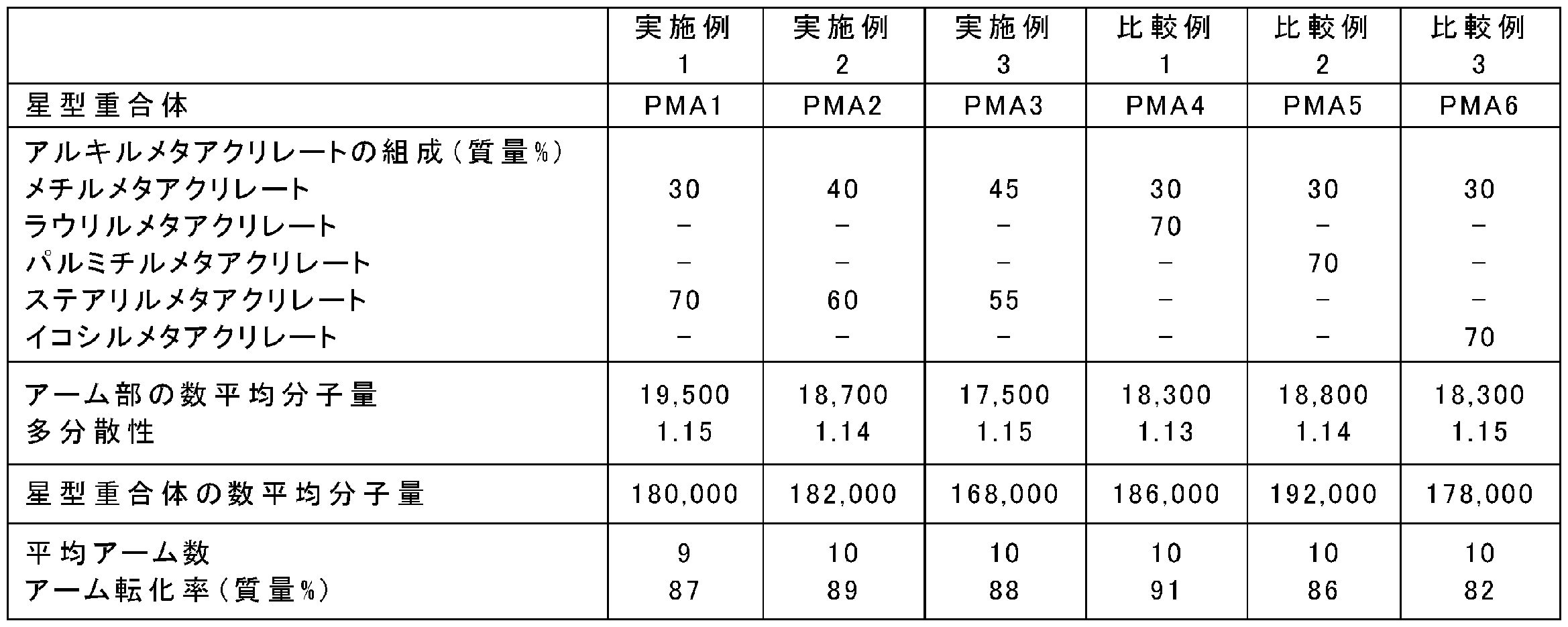
- the number average molecular weight of the arm part and the star polymer was measured by gel permeation chromatography (GPC, polystyrene conversion). Further, based on the amount of polymer added to the star polymer, the average number of arms of the star polymer and the conversion rate to the star polymer were determined. The obtained results are shown in Table 1. The molecular weight was measured as follows.
- the obtained star polymer was dissolved in THF solvent (tetrahydrofuran) to 1 mass%, THF was used as a mobile phase, RI (refractive index) was used as a detector, a flow rate was 0.5 ml / min, a column temperature was 40 ° C. Measurement was carried out at.
- THF solvent tetrahydrofuran
- RI reffractive index
- a flow rate was 0.5 ml / min
- a column temperature was 40 ° C. Measurement was carried out at.
- polystyrene which is a commercially available standard reagent, was used, and the retention time from 10,000 to 500,000 was measured and used for molecular weight distribution determination.
- Example 2 and 3 Comparative Examples 1 to 3
- Examples were used except that alkyl methacrylate having the composition shown in Table 1 was used instead of the mixture of methyl methacrylate and stearyl methacrylate in Example 1.
- the star polymer was synthesized in the same manner as in Example 1 (hereinafter, the obtained star polymer is referred to as PMA 2 to 6 in some cases).
- Table 1 shows the number average molecular weight of the arm portion, the number average molecular weight of the star polymer, the average number of arms of the star polymer, and the conversion rate to the star polymer for each of the obtained star polymers.
- Example 4 to 6 Comparative Examples 4 to 6
- package additive (8 mass%: ashless dispersant 3 mass%, metal-based detergent 3 mass) was added to Group III base oil (SK YUBASE-4) as a lubricant base oil.
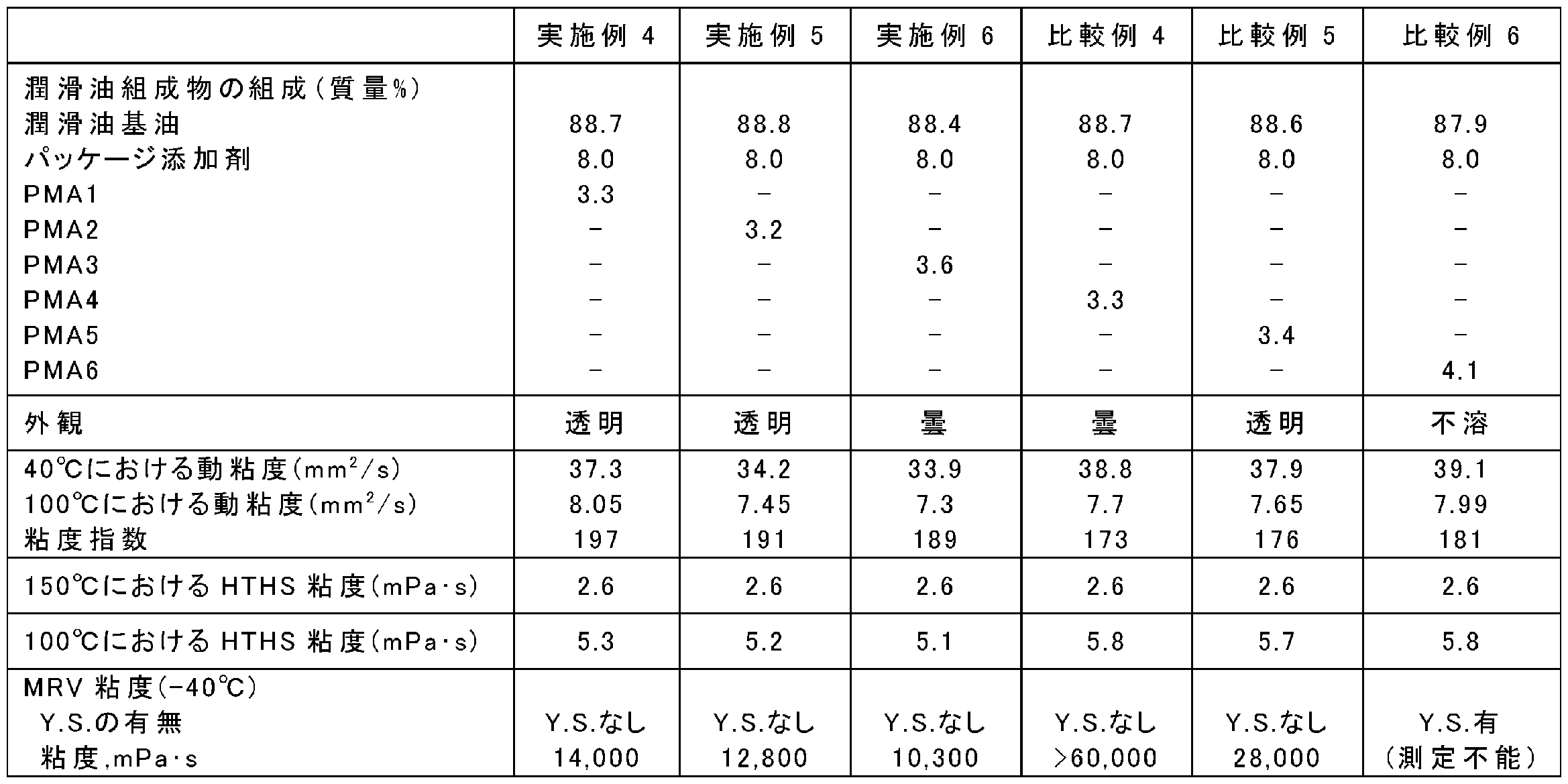
- Table 2 shows the composition and various properties of each lubricating oil composition.
- “YS” means Yield Stress.
Landscapes
- Chemical & Material Sciences (AREA)
- Chemical Kinetics & Catalysis (AREA)
- Organic Chemistry (AREA)
- General Chemical & Material Sciences (AREA)
- Oil, Petroleum & Natural Gas (AREA)
- Health & Medical Sciences (AREA)
- Medicinal Chemistry (AREA)
- Polymers & Plastics (AREA)
- Lubricants (AREA)
Abstract
本発明の粘度指数向上剤は、ジビニルベンゼンと、ステアリルメタアクリレートを含むアルキルメタアクリレートとを反応させて得られる、前記ジビニルベンゼンに由来するコア部および前記アルキルメタアクリレートの重合鎖であるアーム部を有する星型重合体を含有する。また、本発明の潤滑油用添加剤及び潤滑油組成物は、上記の粘度指数向上剤を含有する。
Description
本発明は粘度指数向上剤、潤滑油用添加剤および潤滑油組成物に関する。具体的には、省燃費型内燃機関用潤滑油などの分野において有用な粘度指数向上剤、潤滑油用添加剤および潤滑油組成物に関する。
近年、ガソリン、ディーゼルを問わず内燃機関用潤滑油は省燃費特性の向上が求められている。その要求値も年々厳しくなり、従来の潤滑油技術では到底することが出来ない要求値になってきている。そのような状況の元、省燃費特性に最も影響をおよぼす粘度指数向上剤に関する開発がなされており、直鎖型のポリメタアクリレート(ポリメタクリレート、ポリメタアクリル酸アルキルエステル、またはPMAとも呼ばれる)や星型のポリメタアクリレートなどが開発されている。
例えば、下記特許文献1には、炭素数1および/または2のアルキル基を有する(メタ)アクリル酸アルキルエステル、炭素数12および/または13のアルキル基を有する(メタ)アクリル酸アルキルエステル、炭素数14および/または15のアルキル基を有する(メタ)アクリル酸アルキルエステル、並びに炭素数16~24のアルキル基から選ばれる1種以上のアルキル基を有する(メタ)アクリル酸アルキルエステルを必須構成単量体とする共重合体を含有してなるGTL基油用粘度指数向上剤が開示されている。
また、下記特許文献2には、(a)(i)コア部分であって、多価(メタ)アクリル酸モノマー、それらのオリゴマーまたは重合体、あるいは多価ジビニル非アクリル酸モノマー、それらのオリゴマーまたは重合体を含むコア部分;および(ii)重合された(メタ)アクリル酸アルキルエステルの少なくとも2本のアームを含む星形重合体および(b)潤滑粘性のあるオイルを含有する組成物であって、該コア部分が特定の官能基を含む星型重合体およびそれらの組成物が開示されている。具体的には、コア部分がC12~C15/C8共重合体、C12~C15/C1共重合体などが例示されている。
しかしながら、特許文献1、2に開示されている粘度指数向上剤であっても、実用化に供し得るものとしては未だ改善の余地がある。例えば、特許文献1に開示されている直鎖型ポリメタアクリレートの場合、粘度温度特性に優れ初期の省燃費特性は良いが、せん断安定性が悪いため、長期間使用時の省燃費特性が低下する問題がある。また、特許文献2に開示されている星型ポリメタアクリレートの場合、せん断安定性に優れるが、本来的な省燃費特性向上効果が十分にあるとはいえない。
さらに、最近では省燃費特性に加え、廃棄物の削減の観点からロングドレイン性も求められてきている。通常潤滑油は使用により酸化劣化し、初期性能を保ちにくくなるため、長期使用により初期に有していた省燃費特性が悪くなることが問題視されている。この原因は、使用している粘度指数向上剤の安定性に関するものであるが、単純な安定性ではなく、せん断を受けることによるポリマーの切断が問題視されている。また、省燃費に関してもSAEの粘度グレードを維持しつつ、かつ実用域でのせん断粘度を下げることが要求されているが、まだその要求を満たすものは見出されていない。
本発明は、このような実情に鑑みてなされたものであり、粘度温度特性、せん断安定性および酸化安定性に優れ、省燃費特性およびロングドレイン性を達成することが可能な粘度指数向上剤、ならびに該粘度指数向上剤を用いた潤滑油用添加剤および潤滑油組成物を提供することを目的とする。
上記課題を解決するために、本発明は、下記[1]~[6]に記載の粘度指数向上剤、下記[7]に記載の潤滑油用添加剤および下記[8]、[9]に記載の潤滑油組成物を提供する。
[1]ジビニルベンゼンと、ステアリルメタアクリレート(n-オクタデシルメタアクリレート、メタクリル酸ステアリルまたはメタクリル酸n-オクタデシルとも呼ばれる)を含むアルキルメタアクリレートとを反応させて得られる、ジビニルベンゼンに由来するコア部およびアルキルメタアクリレートの重合鎖であるアーム部を有する星型重合体を含有する、粘度指数向上剤。
[2]上記アルキルメタアクリレートに占めるステアリルメタアクリレートの比率が、アルキルメタアクリレート全量を基準として、40~100質量%である、[1]に記載の粘度指数向上剤。
[3]上記アルキルメタアクリレートに占めるメチルメタアクリレートの比率が、アルキルメタアクリレート全量を基準として、0~50質量%である、[1]または[2]に記載の粘度指数向上剤。
[4]上記アルキルメタアクリレートに占める炭素数10~16のアルキル基を有するアルキルメタアクリレートの比率が、アルキルメタアクリレート全量を基準として、0~40質量%である、[1]~[3]のいずれか一項に記載の粘度指数向上剤。
[5]上記アーム部の数平均分子量が10,000~60,000である、[1]~[4]のいずれか一項に記載の粘度指数向上剤。
[6]上記星型重合体の数平均分子量が50,000~1,000,000である、[1]~[5]のいずれか一項に記載の粘度指数向上剤。
[7][1]~[6]のいずれか一項に記載の粘度指数向上剤を含む潤滑油用添加剤。
[8]潤滑油基油と、[1]~[6]のいずれか一項に記載の粘度指数向上剤とを含有する潤滑油組成物
[9]150℃におけるHTHS粘度が1.4mPa・s以上であり、かつ100℃におけるHTHS粘度が5.4mPa・s未満である、[8]に記載の潤滑油組成物。
[1]ジビニルベンゼンと、ステアリルメタアクリレート(n-オクタデシルメタアクリレート、メタクリル酸ステアリルまたはメタクリル酸n-オクタデシルとも呼ばれる)を含むアルキルメタアクリレートとを反応させて得られる、ジビニルベンゼンに由来するコア部およびアルキルメタアクリレートの重合鎖であるアーム部を有する星型重合体を含有する、粘度指数向上剤。
[2]上記アルキルメタアクリレートに占めるステアリルメタアクリレートの比率が、アルキルメタアクリレート全量を基準として、40~100質量%である、[1]に記載の粘度指数向上剤。
[3]上記アルキルメタアクリレートに占めるメチルメタアクリレートの比率が、アルキルメタアクリレート全量を基準として、0~50質量%である、[1]または[2]に記載の粘度指数向上剤。
[4]上記アルキルメタアクリレートに占める炭素数10~16のアルキル基を有するアルキルメタアクリレートの比率が、アルキルメタアクリレート全量を基準として、0~40質量%である、[1]~[3]のいずれか一項に記載の粘度指数向上剤。
[5]上記アーム部の数平均分子量が10,000~60,000である、[1]~[4]のいずれか一項に記載の粘度指数向上剤。
[6]上記星型重合体の数平均分子量が50,000~1,000,000である、[1]~[5]のいずれか一項に記載の粘度指数向上剤。
[7][1]~[6]のいずれか一項に記載の粘度指数向上剤を含む潤滑油用添加剤。
[8]潤滑油基油と、[1]~[6]のいずれか一項に記載の粘度指数向上剤とを含有する潤滑油組成物
[9]150℃におけるHTHS粘度が1.4mPa・s以上であり、かつ100℃におけるHTHS粘度が5.4mPa・s未満である、[8]に記載の潤滑油組成物。
以上の通り、本発明によれば、粘度温度特性、せん断安定性および酸化安定性に優れ、省燃費特性およびロングドレイン性を達成することが可能な粘度指数向上剤、ならびに該粘度指数向上剤を用いた潤滑油用添加剤および潤滑油組成物が提供される。
さらに、本発明によれば、内燃機関に使用される燃料がガソリンまたはディーゼル燃料のいずれであるかを問わず、上記の効果を得ることができる。
さらに、本発明によれば、内燃機関に使用される燃料がガソリンまたはディーゼル燃料のいずれであるかを問わず、上記の効果を得ることができる。
以下、本発明の好適な実施形態について詳細に説明する。
[第1実施形態:粘度指数向上剤]
本発明の第1実施形態に係る粘度指数向上剤は、ジビニルベンゼンと、ステアリルメタアクリレートを含むアルキルメタアクリレートとを反応させて得られる、ジビニルベンゼンに由来するコア部およびアルキルメタアクリレートの重合鎖であるアーム部を有する星型重合体を含有する。
本発明の第1実施形態に係る粘度指数向上剤は、ジビニルベンゼンと、ステアリルメタアクリレートを含むアルキルメタアクリレートとを反応させて得られる、ジビニルベンゼンに由来するコア部およびアルキルメタアクリレートの重合鎖であるアーム部を有する星型重合体を含有する。
星型重合体のアーム部は、ジビニルベンゼンのビニル基を起点とする、ステアリルメタアクリレートを含有するアルキルメタクリレートの重合鎖である。当該アーム部を構成するアルキルメタアクリレートに占めるステアリルメタアクリレートの比率は、アルキルメタアクリレート全量を基準として、40~100質量%であることが好ましく、45~100質量%であることがより好ましく、50~100質量%であることがさらに好ましく、55~100質量%であることが特に好ましい。ステアリルメタアクリレートの比率が上記の範囲内であると、粘度温度特性、せん断安定性および酸化安定性を一層高水準でバランス良く達成することができる。
また、省燃費特性の観点から、アーム部を構成するアルキルメタアクリレートはメチルメタアクリレートを含むことが好ましく、この場合のメチルメタアクリレートの比率は、アルキルメタアクリレート全量を基準として、20質量%以上であることが好ましい。一方、溶解性、粘度温度特性、せん断安定性および酸化安定性を一層高水準でバランス良く達成する観点からは、メチルメタアクリレートの比率は、50質量%以下であることが好ましく、45質量%以下であることがより好ましく、43質量%以下であることがさらに好ましい。
また、アーム部を構成するアルキルメタアクリレートがメチルメタアクリレートを含む場合、ステアリルメタアクリレートおよびメチルメタアクリレートの比率の合計は、アルキルメタアクリレート全量を基準として、好ましくは60~100質量%、より好ましくは70~100質量%、さらに好ましくは80~100質量%である。当該比率の合計が上記の下限値に満たない場合には、せん断安定性に優れるが、本来的な省燃費特性向上効果が不十分となるおそれがある。
また、アーム部を構成するアルキルメタクリレートは、炭素数10~16のアルキル基を有するアルキルメタアクリレートをさらに含有してもよい。かかるアルキルメタアクリレートには、ウンデシルメタアクリレート、ドデシルメタアクリレート、トリデシルメタアクリレート、ヘプタデシルメタアクリレートおよびヘキサデシルメタアクリレートが包含される。この場合、アルキルメタアクリレートに占める炭素数10~16のアルキル基を有するアルキルメタアクリレートの比率は、アルキルメタアクリレート全量を基準として、0~40質量%であることが好ましい。炭素数10~16のアルキル基を有するアルキルメタアクリレートの比率が上記上限値を超えると、基油への溶解性が低下する傾向にある。
本実施形態に係る星型重合体において、アームの数平均分子量は、好ましくは10,000~60,000、より好ましくは12,000~50,000、さらに好ましくは13,000~40,000、最も好ましくは15,000~30,000である。アーム部の数平均分子量が上記下限値に満たない場合は、粘度が過剰に高くなり省燃費特性が低下するおそれがあり、また、上記上限値を超えるとせん断安定性が悪くなるおそれがある。
また、星型重合体の数平均分子量は、好ましくは50,000~1,000,000、より好ましくは100,000~800,000、さらに好ましくは120,000~600,000、最も好ましくは150,000~400,000である。星型重合体の数平均分子量が上記下限値に満たない場合は、所望の効果を得るために必要な潤滑油基油への添加量が増大し、潤滑油の酸化安定性が低下するおそれがあり、また、上記上限値を超えると添加量は少なくなるがせん断安定性が低下するおそれがある。
本実施形態に係る星形重合体において、一分子当たりが有するアーム部の数の平均値(平均アーム数)は、好ましく4~30、より好ましくは5~25、さらに好ましくは6~20である。
本実施形態に係る星型重合体の合成方法は、特に制限されないが、例えば、制御ラジカル重合プロセスを利用して、アーム部(アルキルメタアクリレートの重合鎖)となるポリアルキルメタアクリレートを重合し、次いで、ポリアルキルメタアクリレートとジビニルベンゼンとを反応させる方法が挙げられる。
制御ラジカル重合プロセスには、原子移動ラジカル重合(ATRP)プロセス、可逆的付加-開裂連鎖移動(RAFT)プロセスまたは窒素酸化物媒介重合プロセスなどが包含される。
ATRP重合の重合体機構の論述は、Matyjaszewskiらの524ページの反応スキーム11.1、566ページの反応スキーム11.4、571ページの反応スキーム11、7、572ページの反応スキーム11.8および575ページの反応スキーム11.9で示されている。
RAFT重合の重合体機構の論述は、Matyjaszewskiらの12.4.4節の664~665ページで示されている。
窒素酸化物媒介重合(10章、463~522ページ)、ATRP(11章、523~628ページ)およびRAFT(12章、629~690ページ)の詳細な説明は、「Handbook of Radical Polymerization」(Krzysztof Matyjaszewski and Thomas P.Davis著、著作権2002、John Wiley and Sons Inc.により出版(以下、「Matyjaszewskiら」と呼ぶ)で示されている。
ATRP重合の重合体機構の論述は、Matyjaszewskiらの524ページの反応スキーム11.1、566ページの反応スキーム11.4、571ページの反応スキーム11、7、572ページの反応スキーム11.8および575ページの反応スキーム11.9で示されている。
RAFT重合の重合体機構の論述は、Matyjaszewskiらの12.4.4節の664~665ページで示されている。
窒素酸化物媒介重合(10章、463~522ページ)、ATRP(11章、523~628ページ)およびRAFT(12章、629~690ページ)の詳細な説明は、「Handbook of Radical Polymerization」(Krzysztof Matyjaszewski and Thomas P.Davis著、著作権2002、John Wiley and Sons Inc.により出版(以下、「Matyjaszewskiら」と呼ぶ)で示されている。
また、上記の合成は、バッチ操作、半バッチ操作、連続工程、フィード工程またはバルク工程として、実行され得る。また、この合成は、乳濁液、溶液または懸濁液中でなされ得る。
なお、上記の合成においては、開始剤およびジビニルベンゼン(DVB)の使用量を変えることにより、得られるポリメタアクリレートまたは星型重合体の平均分子量を調整することができる。
合成されたアーム部を用いた星形重合体への反応率は、星形重合体に反応した重合体の量を基準として、70%以上、好ましくは80%以上、より好ましくは85%以上である。反応率が低いとアーム部が残存し、分子量を上げることができない。
<第2実施形態:潤滑油用添加剤>
本発明の第2実施形態に係る潤滑油用添加剤は、上記第1実施形態に係る粘度指数向上剤を含有する。
本発明の第2実施形態に係る潤滑油用添加剤は、上記第1実施形態に係る粘度指数向上剤を含有する。
本実施形態に係る潤滑油用添加剤は、上記第1実施形態に係る粘度指数向上剤のみからなるものであってもよく、あるいは、当該粘度指数向上剤と他の添加剤との混合物であってもよい。
他の添加剤としては、上記第1実施形態に係る粘度指数向上剤以外の粘度指数向上剤、酸化防止剤、摩耗防止剤(または極圧剤)、腐食防止剤、防錆剤、粘度指数向上剤、流動点降下剤、抗乳化剤、金属不活性化剤、消泡剤、無灰摩擦調整剤等の添加剤等が挙げられる。これらの添加剤は、1種を単独で、または2種以上を組み合わせて用いることができる。
上記第1実施形態に係る粘度指数向上剤以外の粘度指数向上剤としては、ポリメタクリレート系、ポリイソブテン系、エチレン-プロピレン共重合体系、スチレン-ブタジエン水添共重合体系のものなどが挙げられる。
酸化防止剤としては、フェノール系、アミン系等の無灰酸化防止剤、亜鉛系、銅系、モリブデン系等の金属系酸化防止剤が挙げられる。
フェノール系酸化防止剤としては、例えば、4,4'-メチレンビス(2,6-ジ-tert-ブチルフェノール)、4,4’-ビス(2,6-ジ-tert-ブチルフェノール)、4,4'-ビス(2-メチル-6-tert-ブチルフェノール)、2,2'-メチレンビス(4-エチル-6-tert-ブチルフェノール)、2,2'-メチレンビス(4-メチル-6-tert-ブチルフェノール)、4,4'-ブチリデンビス(3-メチル-6-tert-ブチルフェノール)、4,4’-イソプロピリデンビス(2,6-ジ-tert-ブチルフェノール)、2,2’-メチレンビス(4-メチル-6-ノニルフェノール)、2,2'-イソブチリデンビス(4,6-ジメチルフェノール)、2,2’-メチレンビス(4-メチル-6-シクロヘキシルフェノール)、2,6-ジ-tert-ブチル-4-メチルフェノール、2,6-ジ-tert-ブチル-4-エチルフェノール、2,4-ジメチル-6-tert-ブチルフェノール、2,6-ジ-tert-α-ジメチルアミノ-p-クレゾール、2,6-ジ-tert-ブチル-4-(N,N-ジメチルアミノメチルフェノール)、4,4'-チオビス(2-メチル-6-tert-ブチルフェノール)、4,4'-チオビス(3-メチル-6-tert-ブチルフェノール)、2,2'-チオビス(4-メチル-6-tert-ブチルフェノール)、ビス(3-メチル-4-ヒドロキシ-5-tert-ブチルベンジル)スルフィド、ビス(3,5-ジ-tert-ブチル-4-ヒドロキシベンジル)スルフィド、2,2'-チオ-ジエチレンビス[3-(3,5-ジ-tert-ブチル-4-ヒドロキシフェニル)プロピオネート]、トリデシル-3-(3,5-ジ-tert-ブチル-4-ヒドロキシフェニル)プロピオネート、ペンタエリスリチル-テトラキス[3-(3,5-ジ-tert-ブチル-4-ヒドロキシフェニル)プロピオネート]、オクチル-3-(3,5-ジ-tert-ブチル-4-ヒドロキシフェニル)プロピオネート、ステアリル3-(3,5-ジ-tert-ブチル-4-ヒドロキシフェニル)プロピオネート、オクチル-3-(3-メチル-5-ジ-tert-ブチル-4-ヒドロキシフェニル)プロピオネート等が好ましく挙げられる。これらは二種以上を混合して使用してもよい。
アミン系酸化防止剤としては、例えば、芳香族アミン化合物、アルキルジフェニルアミン、アルキルナフチルアミン、フェニル-α-ナフチルアミン、アルキルフェニル-α-ナフチルアミン等の潤滑油用として一般に使用されている公知のアミン系酸化防止剤が挙げられる。
フェノール系酸化防止剤としては、例えば、4,4'-メチレンビス(2,6-ジ-tert-ブチルフェノール)、4,4’-ビス(2,6-ジ-tert-ブチルフェノール)、4,4'-ビス(2-メチル-6-tert-ブチルフェノール)、2,2'-メチレンビス(4-エチル-6-tert-ブチルフェノール)、2,2'-メチレンビス(4-メチル-6-tert-ブチルフェノール)、4,4'-ブチリデンビス(3-メチル-6-tert-ブチルフェノール)、4,4’-イソプロピリデンビス(2,6-ジ-tert-ブチルフェノール)、2,2’-メチレンビス(4-メチル-6-ノニルフェノール)、2,2'-イソブチリデンビス(4,6-ジメチルフェノール)、2,2’-メチレンビス(4-メチル-6-シクロヘキシルフェノール)、2,6-ジ-tert-ブチル-4-メチルフェノール、2,6-ジ-tert-ブチル-4-エチルフェノール、2,4-ジメチル-6-tert-ブチルフェノール、2,6-ジ-tert-α-ジメチルアミノ-p-クレゾール、2,6-ジ-tert-ブチル-4-(N,N-ジメチルアミノメチルフェノール)、4,4'-チオビス(2-メチル-6-tert-ブチルフェノール)、4,4'-チオビス(3-メチル-6-tert-ブチルフェノール)、2,2'-チオビス(4-メチル-6-tert-ブチルフェノール)、ビス(3-メチル-4-ヒドロキシ-5-tert-ブチルベンジル)スルフィド、ビス(3,5-ジ-tert-ブチル-4-ヒドロキシベンジル)スルフィド、2,2'-チオ-ジエチレンビス[3-(3,5-ジ-tert-ブチル-4-ヒドロキシフェニル)プロピオネート]、トリデシル-3-(3,5-ジ-tert-ブチル-4-ヒドロキシフェニル)プロピオネート、ペンタエリスリチル-テトラキス[3-(3,5-ジ-tert-ブチル-4-ヒドロキシフェニル)プロピオネート]、オクチル-3-(3,5-ジ-tert-ブチル-4-ヒドロキシフェニル)プロピオネート、ステアリル3-(3,5-ジ-tert-ブチル-4-ヒドロキシフェニル)プロピオネート、オクチル-3-(3-メチル-5-ジ-tert-ブチル-4-ヒドロキシフェニル)プロピオネート等が好ましく挙げられる。これらは二種以上を混合して使用してもよい。
アミン系酸化防止剤としては、例えば、芳香族アミン化合物、アルキルジフェニルアミン、アルキルナフチルアミン、フェニル-α-ナフチルアミン、アルキルフェニル-α-ナフチルアミン等の潤滑油用として一般に使用されている公知のアミン系酸化防止剤が挙げられる。
腐食防止剤としては、例えば、ベンゾトリアゾール系、トリルトリアゾール系、チアジアゾール系、またはイミダゾール系化合物等が挙げられる。
防錆剤としては、例えば、石油スルホネート、アルキルベンゼンスルホネート、ジノニルナフタレンスルホネート、アルケニルコハク酸エステル、または多価アルコールエステル等が挙げられる。
金属不活性化剤としては、例えば、イミダゾリン、ピリミジン誘導体、アルキルチアジアゾール、メルカプトベンゾチアゾール、ベンゾトリアゾールまたはその誘導体、1,3,4-チアジアゾールポリスルフィド、1,3,4-チアジアゾリル-2,5-ビスジアルキルジチオカーバメート、2-(アルキルジチオ)ベンゾイミダゾール、またはβ-(o-カルボキシベンジルチオ)プロピオンニトリル等が挙げられる。
消泡剤としては、例えば、25℃における動粘度が1000~10万mm2/sのシリコーンオイル、アルケニルコハク酸誘導体、ポリヒドロキシ脂肪族アルコールと長鎖脂肪酸のエステル、メチルサリチレートとo-ヒドロキシベンジルアルコール等が挙げられる。
無灰摩擦調整剤としては、潤滑油用の無灰摩擦調整剤として通常用いられる任意の化合物が使用可能であり、例えば、炭素数6~30のアルキル基またはアルケニル基、特に炭素数6~30の直鎖アルキル基または直鎖アルケニル基を分子中に少なくとも1個有する、アミン化合物、脂肪酸エステル、脂肪酸アミド、脂肪酸、脂肪族アルコール、脂肪族エーテル等の無灰摩擦調整剤等が挙げられる。また特開2009-286831号公報に記載の窒素含有化合物およびその酸変性誘導体等、国際公開第2005/037967号パンフレットに例示されている各種無灰摩擦調整剤を用いることもできる。
本実施形態に係る潤滑油用添加剤が上記第1実施形態に係る粘度指数向上剤と他の添加剤との混合物である場合、これらの混合割合は特に制限されず、目的とする用途に応じて適宜選定することができる。
[第3実施形態:潤滑油組成物]
本発明の第3実施形態に係る潤滑油組成物は、潤滑油基油と、上記第1実施形態に係る粘度指数向上剤とを含有する。当該潤滑油組成物は、上記第2実施形態の説明で例示した他の添加剤をさらに含有してもよい。
本発明の第3実施形態に係る潤滑油組成物は、潤滑油基油と、上記第1実施形態に係る粘度指数向上剤とを含有する。当該潤滑油組成物は、上記第2実施形態の説明で例示した他の添加剤をさらに含有してもよい。
本実施形態における潤滑油基油としては、特に制限されず、通常の潤滑油に使用される潤滑油基油が使用できる。具体的には、鉱油系潤滑油基油、合成油系潤滑油基油またはこれらの中から選ばれる2種以上の潤滑油基油を任意の割合で混合した混合物等が使用でき
る。
る。
鉱油系潤滑油基油としては、具体的には、原油を常圧蒸留して得られる常圧残油を減圧蒸留して得られた潤滑油留分を、溶剤脱れき、溶剤抽出、水素化分解、溶剤脱ろう、水素化精製等の処理を1つ以上行って精製したもの、あるいはワックス異性化鉱油、GTLワックス(ガストゥリキッドワックス)を異性化する手法で製造される基油等が例示できる。
また、合成油系潤滑油としては、具体的には、ポリブテンまたはその水素化物;1-オクテンオリゴマー、1-デセンオリゴマー等のポリ-α-オレフィンまたはその水素化物;ジトリデシルグルタレート、ジ-2-エチルヘキシルアジペート、ジイソデシルアジペート、ジトリデシルアジペート、ジ-2-エチルヘキシルセバケート等のジエステル;トリメチロールプロパンカプリレート、トリメチロールプロパンペラルゴネート、ペンタエリスリトール-2-エチルヘキサノエート、ペンタエリスリトールペラルゴネート等のポリオールエステル;アルキルナフタレン、アルキルベンゼン等の芳香族系合成油またはこれらの混合物等が例示できる。
潤滑油基油の100℃における動粘度は、好ましくは2.5~10.0mm2/s、より好ましくは3.0~8.0mm2/s、さらに好ましくは3.5~6.0mm2/sである。また、潤滑油基油の粘度指数は、好ましくは90~165、より好ましくは100~155、さらに好ましくは120~150である。
さらに、本添加剤の効果を発揮するため基油のクロマト分析による飽和分は好ましくは80%以上、より好ましくは85%以上、さらに好ましいのは90%以上、最も好ましいのは95%以上である。
さらに、本添加剤の効果を発揮するため基油のクロマト分析による飽和分は好ましくは80%以上、より好ましくは85%以上、さらに好ましいのは90%以上、最も好ましいのは95%以上である。
また、第1実施形態に係る粘度指数向上剤の含有量は、潤滑油組成物全量を基準として、好ましくは0.1~20.0質量%、より好ましくは0.5~15.0質量%、更に好ましくは1.0~10.0質量%である。当該含有量が上記下限値未満であると、十分な添加効果が得られないおそれがあり、また、上記上限値を超えるとせん断安定性が低下し、省燃費の持続性が悪くなるおそれがある。
また、本実施形態に係る潤滑油組成物の100℃における動粘度は、好ましくは3.0~16.3mm2/s、より好ましくは3.5~12.5mm2/s、さらに好ましくは4.0~9.3mm2/sである。100℃における動粘度が上記下限値未満の場合には潤滑性不足を来たすおそれがあり、また、上記上限値を超える場合には必要な低温粘度および十分な省燃費性能が得られないおそれがある。
また、本実施形態に係る潤滑油組成物の粘度指数は、好ましくは150~250、より好ましくは160~240、さらに好ましくは170~230である。粘度指数が上記下限値未満の場合には、HTHS粘度を維持しながら、省燃費性を向上させることが困難となるおそれがあり、さらに低温粘度を低減させることが困難となるおそれがある。また、粘度指数が上記上限値を超える場合には、低温流動性が悪化し、更に添加剤の溶解性やシール材料との適合性が不足することによる不具合が発生するおそれがある。
また、本実施形態に係る潤滑油組成物の150℃におけるHTHS粘度は、1.4mPa・s以上、好ましくは1.7mPa・s以上、より好ましくは2.0mPa・s以上、さらに好ましいのは2.3mPa・s以上で、最も好ましいのは2.6mPa・s以上である。また、潤滑油組成物の100℃におけるHTHS粘度は、好ましくは5.4mPa・s未満、より好ましくは5.2mPa・s以下である。ここでいう150℃または100℃におけるHTHS粘度とは、ASTM ASTM D4683に規定される150℃または100℃での高温高せん断粘度を示す。150℃または100℃におけるHTHS粘度が上記上限値を超える場合には必要な低温粘度および十分な省燃費性能が得られないおそれがあり、また、上記下限値未満の場合には、蒸発性が高く、潤滑性不足を来たすおそれがある。
第1実施形態に係る粘度指数向上剤、第2実施形態に係る潤滑油用添加剤、および第3実施形態に係る潤滑油組成物の用途は特に制限されず、内燃機関用潤滑油、駆動系潤滑油等の幅広い分野で使用することができる。
特に、第1実施形態に係る粘度指数向上剤、第2実施形態に係る潤滑油用添加剤、および第3実施形態に係る潤滑油組成物は、粘度温度特性、せん断安定性および酸化安定性に優れ、省燃費特性およびロングドレイン性を達成することが可能であるため、内燃機関用潤滑油の分野において有用である。この場合の内燃機関は、燃料としてガソリンまたはディーゼル燃料のいずれであるかを問わない。
以下、実施例および比較例に基づいて本発明をさらに具体的に説明するが、本発明は以下の実施例に何ら限定されるものではない。
[実施例1]
窒素入口、中速機械攪拌機、熱電対および水冷式冷却器を備え付けた容器(反応フラスコ)にて、室温、窒素の流量28.3L/hrの条件下で、メチルメタアクリレートおよびステアリルメタアクリレートの混合物(混合比率:メチルメタアクリレート/ステアリルメタアクリレート=60/40(質量比))、AIBN開始剤(1当量)、ジチオ安息香酸クミル(2当量)およびオイルを混合した。このとき、混合を確実にするために、N2ブランケット下にて、20分間撹拌した。その後、窒素の流量を14.2L/hrまで低下させ、混合物を4時間にわたって90℃まで加熱した。次に、容器内にジビニルベンゼンを添加し、その混合物を90℃で12時間撹拌し、目的の星型重合体(以下、場合によりPMA1という。)を得た。
得られた星型重合体について、ゲルパーミエーションクロマトグラフィー(GPC、ポリスチレン換算)により、アーム部及び星型重合体の数平均分子量を測定した。また、星型重合体に添加された重合体の量に基づいて、星形重合体の平均アーム数および星形重合体への転化率を求めた。得られた結果を表1に示す。
分子量の測定方法は以下の通り実施した。得られた星型重合体をTHF溶媒(テトラヒドロフラン)に1mass%になるように溶解し、移動相にTHF、検出器としてRI(屈折率)を用い、流速0.5ml/min、カラム温度40℃にて測定を実施した。検量線は市販標準試薬のポリスチレンを使用し、10000~500000までのリテンションタイムを測定し分子量分布決定に用いた。
窒素入口、中速機械攪拌機、熱電対および水冷式冷却器を備え付けた容器(反応フラスコ)にて、室温、窒素の流量28.3L/hrの条件下で、メチルメタアクリレートおよびステアリルメタアクリレートの混合物(混合比率:メチルメタアクリレート/ステアリルメタアクリレート=60/40(質量比))、AIBN開始剤(1当量)、ジチオ安息香酸クミル(2当量)およびオイルを混合した。このとき、混合を確実にするために、N2ブランケット下にて、20分間撹拌した。その後、窒素の流量を14.2L/hrまで低下させ、混合物を4時間にわたって90℃まで加熱した。次に、容器内にジビニルベンゼンを添加し、その混合物を90℃で12時間撹拌し、目的の星型重合体(以下、場合によりPMA1という。)を得た。
得られた星型重合体について、ゲルパーミエーションクロマトグラフィー(GPC、ポリスチレン換算)により、アーム部及び星型重合体の数平均分子量を測定した。また、星型重合体に添加された重合体の量に基づいて、星形重合体の平均アーム数および星形重合体への転化率を求めた。得られた結果を表1に示す。
分子量の測定方法は以下の通り実施した。得られた星型重合体をTHF溶媒(テトラヒドロフラン)に1mass%になるように溶解し、移動相にTHF、検出器としてRI(屈折率)を用い、流速0.5ml/min、カラム温度40℃にて測定を実施した。検量線は市販標準試薬のポリスチレンを使用し、10000~500000までのリテンションタイムを測定し分子量分布決定に用いた。
[実施例2、3、比較例1~3]
実施例2、3及び比較例1~3においては、それぞれ実施例1におけるメチルメタアクリレートおよびステアリルメタアクリレートの混合物に代えて、表1に示す組成を有するアルキルメタアクリレートを用いたこと以外は実施例1と同様にして、星型重合体の合成を行った(以下、場合により、得られた星型重合体をPMA2~6という。)。
得られた各星型重合体についてのアーム部の数平均分子量、星型重合体の数平均分子量、星形重合体の平均アーム数、ならびに星形重合体への転化率を表1に示す。
実施例2、3及び比較例1~3においては、それぞれ実施例1におけるメチルメタアクリレートおよびステアリルメタアクリレートの混合物に代えて、表1に示す組成を有するアルキルメタアクリレートを用いたこと以外は実施例1と同様にして、星型重合体の合成を行った(以下、場合により、得られた星型重合体をPMA2~6という。)。
得られた各星型重合体についてのアーム部の数平均分子量、星型重合体の数平均分子量、星形重合体の平均アーム数、ならびに星形重合体への転化率を表1に示す。
[実施例4~6、比較例4~6]
実施例4~6および比較例4~6においては、それぞれ潤滑油基油としてのグループIII基油(SK YUBASE-4)にパッケージ添加剤(8mass%:無灰分散剤3mass%,金属系清浄剤 3mass%、ZDTP 1mass%、MoDTC 0.4mass%、アミン系酸化防止剤 0.6mass%)を配合し、さらに、エンジン油の規格である0W-20を満たすようにPMA1~6のいずれかを添加して、潤滑油組成物を得た。各潤滑油組成物の組成及び各種性状を表2に示す。なお、表2中、「Y.S.」は降伏応力(Yield Stress)を意味する。
実施例4~6および比較例4~6においては、それぞれ潤滑油基油としてのグループIII基油(SK YUBASE-4)にパッケージ添加剤(8mass%:無灰分散剤3mass%,金属系清浄剤 3mass%、ZDTP 1mass%、MoDTC 0.4mass%、アミン系酸化防止剤 0.6mass%)を配合し、さらに、エンジン油の規格である0W-20を満たすようにPMA1~6のいずれかを添加して、潤滑油組成物を得た。各潤滑油組成物の組成及び各種性状を表2に示す。なお、表2中、「Y.S.」は降伏応力(Yield Stress)を意味する。
[超音波せん断安定性試験]
実施例4の潤滑油組成物について、せん断安定性をSONIC法で評価した。試験前後の粘度比(試験後の動粘度を試験前の動粘度で除した値)を表3に示す。
実施例4の潤滑油組成物について、せん断安定性をSONIC法で評価した。試験前後の粘度比(試験後の動粘度を試験前の動粘度で除した値)を表3に示す。
[比較例7]
撹拌装置、加熱装置、冷却装置、温度計、窒素吹き込み管および滴下槽を備えた反応容器に、トルエンを1,500質量部仕込み、85℃に温調し窒素置換を60分行った。次に、メタクリル酸メチル1700質量部、メタクリル酸n-ドデシルエステル1020質量部、メタクリル酸2-メチルウンデシルエステル255質量部、メタクリル酸n-トリデシルエステル1020質量部、メタクリル酸2-メチルドデシルエステル255質量部、メタクリル酸n-テトラデシルエステル1224質量部、メタクリル酸2-ドデシルエステル306質量部、メタクリル酸n-ペンタデシルエステル1224質量部、メタクリル酸2-メチルテトラデシルエステル306質量部、およびメタクリル酸n-ヘキサデシルエステル830質量部の混合物(合計8,500質量部)、重合開始剤として2,2’-アゾビス(2,4-ジメチルバレロニトリル)4質量部および2,2’-アゾビス(2-メチルブチロニトリル)17質量部を滴下槽に仕込み、密閉下85℃で2時間かけて等速で滴下槽の溶液を滴下して重合反応を行った。引き続き、85℃で2時間熟成し、120℃、20mmHgの減圧度でトルエンを留去し、直鎖型ポリメタアクリレート(以下、場合によりVM1という)を得た。
次に、得られたVMA1を粘度指数向上剤として用い、表3に示す潤滑油組成物を調製し、上記と同様の超音波せん断安定性試験を実施した。得られた結果を表3に示す。
撹拌装置、加熱装置、冷却装置、温度計、窒素吹き込み管および滴下槽を備えた反応容器に、トルエンを1,500質量部仕込み、85℃に温調し窒素置換を60分行った。次に、メタクリル酸メチル1700質量部、メタクリル酸n-ドデシルエステル1020質量部、メタクリル酸2-メチルウンデシルエステル255質量部、メタクリル酸n-トリデシルエステル1020質量部、メタクリル酸2-メチルドデシルエステル255質量部、メタクリル酸n-テトラデシルエステル1224質量部、メタクリル酸2-ドデシルエステル306質量部、メタクリル酸n-ペンタデシルエステル1224質量部、メタクリル酸2-メチルテトラデシルエステル306質量部、およびメタクリル酸n-ヘキサデシルエステル830質量部の混合物(合計8,500質量部)、重合開始剤として2,2’-アゾビス(2,4-ジメチルバレロニトリル)4質量部および2,2’-アゾビス(2-メチルブチロニトリル)17質量部を滴下槽に仕込み、密閉下85℃で2時間かけて等速で滴下槽の溶液を滴下して重合反応を行った。引き続き、85℃で2時間熟成し、120℃、20mmHgの減圧度でトルエンを留去し、直鎖型ポリメタアクリレート(以下、場合によりVM1という)を得た。
次に、得られたVMA1を粘度指数向上剤として用い、表3に示す潤滑油組成物を調製し、上記と同様の超音波せん断安定性試験を実施した。得られた結果を表3に示す。
[比較例8]
実施例1におけるメチルメタアクリレートおよびステアリルメタアクリレートの混合物に代えて、C12~15メタクリレート(70重量%)およびメタクリル酸2-エチルヘキシル(30重量%)の混合物を用いたこと、ならびにAIBN開始剤(1当量)に代えてTrigonox(商標)-21(「T-21」)開始剤(1当量)を用いたこと以外は実施例1と同様にして、星型重合体(以下、場合によりVM2という)を合成した。
次に、得られたVM2を粘度指数向上剤として用い、表3に示す潤滑油組成物を調製し、上記と同様の超音波せん断安定性試験を実施した。得られた結果を表3に示す。
実施例1におけるメチルメタアクリレートおよびステアリルメタアクリレートの混合物に代えて、C12~15メタクリレート(70重量%)およびメタクリル酸2-エチルヘキシル(30重量%)の混合物を用いたこと、ならびにAIBN開始剤(1当量)に代えてTrigonox(商標)-21(「T-21」)開始剤(1当量)を用いたこと以外は実施例1と同様にして、星型重合体(以下、場合によりVM2という)を合成した。
次に、得られたVM2を粘度指数向上剤として用い、表3に示す潤滑油組成物を調製し、上記と同様の超音波せん断安定性試験を実施した。得られた結果を表3に示す。

Claims (9)
- ジビニルベンゼンと、ステアリルメタアクリレートを含むアルキルメタアクリレートとを反応させて得られる、前記ジビニルベンゼンに由来するコア部および前記アルキルメタアクリレートの重合鎖であるアーム部を有する星型重合体を含有する、粘度指数向上剤。
- 前記アルキルメタアクリレートに占める前記ステアリルメタアクリレートの比率が、前記アルキルメタアクリレート全量を基準として、40~100質量%である、請求項1に記載の粘度指数向上剤。
- 前記アルキルメタアクリレートに占めるメチルメタアクリレートの比率が、前記アルキルメタアクリレート全量を基準として、0~50質量%である、請求項1または2に記載の粘度指数向上剤。
- 前記アルキルメタアクリレートに占める炭素数10~16のアルキル基を有するアルキルメタアクリレートの比率が、前記アルキルメタアクリレート全量を基準として、0~40質量%である、請求項1~3のいずれか一項に記載の粘度指数向上剤。
- 前記アーム部の数平均分子量が10,000~60,000である、請求項1~4のいずれか一項に記載の粘度指数向上剤。
- 前記星型重合体の数平均分子量が50,000~1,000,000である、請求項1~5のいずれか一項に記載の粘度指数向上剤。
- 請求項1~6のいずれか一項に記載の粘度指数向上剤を含む潤滑油用添加剤。
- 潤滑油基油と、請求項1~6のいずれか一項に記載の粘度指数向上剤とを含有する潤滑油組成物
- 150℃におけるHTHS粘度が1.4mPa・s以上であり、かつ100℃におけるHTHS粘度が5.4mPa・s未満である、請求項8に記載の潤滑油組成物。
Priority Applications (4)
| Application Number | Priority Date | Filing Date | Title |
|---|---|---|---|
| US14/006,239 US20140135243A1 (en) | 2011-03-23 | 2012-03-23 | Viscosity index improver, lubricant oil additive, and lubricant oil composition |
| CN201280014612.5A CN103443258B (zh) | 2011-03-23 | 2012-03-23 | 粘度指数改进剂、润滑油用添加剂以及润滑油组合物 |
| EP12760390.0A EP2690164A4 (en) | 2011-03-23 | 2012-03-23 | VISCOSITY INDEX ENHANCER, LUBRICATING OIL ADDITIVE AND LUBRICATING OIL COMPOSITION |
| CA2830885A CA2830885A1 (en) | 2011-03-23 | 2012-03-23 | Viscosity index improver, lubricant oil additive, and lubricant oil composition |
Applications Claiming Priority (2)
| Application Number | Priority Date | Filing Date | Title |
|---|---|---|---|
| JP2011-064151 | 2011-03-23 | ||
| JP2011064151A JP5735827B2 (ja) | 2011-03-23 | 2011-03-23 | 粘度指数向上剤、潤滑油用添加剤および潤滑油組成物 |
Publications (1)
| Publication Number | Publication Date |
|---|---|
| WO2012128350A1 true WO2012128350A1 (ja) | 2012-09-27 |
Family
ID=46879489
Family Applications (1)
| Application Number | Title | Priority Date | Filing Date |
|---|---|---|---|
| PCT/JP2012/057510 Ceased WO2012128350A1 (ja) | 2011-03-23 | 2012-03-23 | 粘度指数向上剤、潤滑油用添加剤および潤滑油組成物 |
Country Status (6)
| Country | Link |
|---|---|
| US (1) | US20140135243A1 (ja) |
| EP (1) | EP2690164A4 (ja) |
| JP (1) | JP5735827B2 (ja) |
| CN (1) | CN103443258B (ja) |
| CA (1) | CA2830885A1 (ja) |
| WO (1) | WO2012128350A1 (ja) |
Cited By (6)
| Publication number | Priority date | Publication date | Assignee | Title |
|---|---|---|---|---|
| CN102977254A (zh) * | 2012-11-27 | 2013-03-20 | 山东大学 | 稠油纳米降粘剂及其制备方法 |
| WO2014017556A1 (ja) * | 2012-07-24 | 2014-01-30 | Jx日鉱日石エネルギー株式会社 | 潤滑油組成物 |
| CN105102597A (zh) * | 2013-03-28 | 2015-11-25 | 吉坤日矿日石能源株式会社 | 省燃费机油组合物 |
| EP2878659A4 (en) * | 2012-07-24 | 2016-03-09 | Jx Nippon Oil & Energy Corp | OIL COMPOSITION |
| US9783757B2 (en) | 2012-07-24 | 2017-10-10 | Jx Nippon Oil & Energy Corporation | Poly(meth)acrylate-based viscosity index improver, lubricant additive and lubricant composition containing viscosity index improver |
| JP2021113262A (ja) * | 2020-01-17 | 2021-08-05 | Emgルブリカンツ合同会社 | 潤滑油組成物 |
Families Citing this family (9)
| Publication number | Priority date | Publication date | Assignee | Title |
|---|---|---|---|---|
| JP6043245B2 (ja) * | 2013-07-05 | 2016-12-14 | Jxエネルギー株式会社 | ポリ(メタ)アクリレート系粘度指数向上剤、並びに該粘度指数向上剤を含有する潤滑油添加剤及び潤滑油組成物 |
| JP6342502B2 (ja) | 2014-09-17 | 2018-06-13 | 株式会社日本触媒 | 粘度指数向上剤及びその製造方法、並びに潤滑油組成物 |
| US10982167B2 (en) | 2016-09-21 | 2021-04-20 | Nippon Shokubai Co., Ltd. | Viscosity index improver and lubricating oil composition |
| JP6975169B2 (ja) * | 2016-11-30 | 2021-12-01 | 株式会社クラレ | メタクリル系共重合体溶液の製造方法 |
| CN111057606B (zh) * | 2018-10-16 | 2022-03-11 | 中国石油化工股份有限公司 | 一种黏度指数改进剂及其制备方法、用途 |
| CN111057180B (zh) * | 2018-10-16 | 2021-12-17 | 中国石油化工股份有限公司 | 一种黏度指数改进剂及其制备方法、用途 |
| ES2876205T3 (es) * | 2019-03-11 | 2021-11-12 | Evonik Operations Gmbh | Mejoradores del índice de viscosidad de poli(metacrilato de alquilo) |
| JP7496426B2 (ja) * | 2020-09-30 | 2024-06-06 | 京セラ株式会社 | グリース組成物およびそれを用いた電子部品 |
| CN115541724A (zh) * | 2021-06-30 | 2022-12-30 | 沈阳化工研究院有限公司 | 一种检测星形黏度指数改进剂共聚物结构参数的方法 |
Citations (6)
| Publication number | Priority date | Publication date | Assignee | Title |
|---|---|---|---|---|
| FR2262102A1 (en) * | 1974-02-27 | 1975-09-19 | Inst Francais Du Petrole | Fuel oil cold filterability-improving additives - comprising crosslinked n-paraffins or microcrystalline paraffin waxes |
| JPH09511784A (ja) * | 1995-01-27 | 1997-11-25 | エチル アディティブズ コーポレイション | 星形に分岐したアクリラート及びメタクリラートのポリマー |
| WO2005037967A1 (ja) | 2003-10-16 | 2005-04-28 | Nippon Oil Corporation | 潤滑油添加剤及び潤滑油組成物 |
| JP2008088215A (ja) | 2006-09-29 | 2008-04-17 | Sanyo Chem Ind Ltd | 粘度指数向上剤および潤滑油組成物 |
| JP2008518052A (ja) | 2004-10-25 | 2008-05-29 | ザ ルブリゾル コーポレイション | 星形重合体およびそれらの組成物 |
| JP2009286831A (ja) | 2008-05-27 | 2009-12-10 | Nippon Oil Corp | 金属ベルト式無段変速機用潤滑油組成物 |
Family Cites Families (6)
| Publication number | Priority date | Publication date | Assignee | Title |
|---|---|---|---|---|
| NL273042A (ja) * | 1961-12-29 | |||
| JPH0339383A (ja) * | 1989-07-06 | 1991-02-20 | Showa Denko Kk | 架橋型アクリル酸系ポリマー組成物 |
| US5344887A (en) * | 1992-12-21 | 1994-09-06 | Shell Oil Company | Star polymers of dienes, vinylarenes and alkyl methacrylates as modiied viscosity index improvers |
| US5486563A (en) * | 1994-12-20 | 1996-01-23 | Shell Oil Company | Process for making dispersant viscosity index improvers |
| US5955405A (en) * | 1998-08-10 | 1999-09-21 | Ethyl Corporation | (Meth) acrylate copolymers having excellent low temperature properties |
| WO2007114260A1 (ja) * | 2006-03-31 | 2007-10-11 | Idemitsu Kosan Co., Ltd. | 内燃機関用潤滑油組成物 |
-
2011
- 2011-03-23 JP JP2011064151A patent/JP5735827B2/ja active Active
-
2012
- 2012-03-23 EP EP12760390.0A patent/EP2690164A4/en not_active Withdrawn
- 2012-03-23 WO PCT/JP2012/057510 patent/WO2012128350A1/ja not_active Ceased
- 2012-03-23 US US14/006,239 patent/US20140135243A1/en not_active Abandoned
- 2012-03-23 CA CA2830885A patent/CA2830885A1/en not_active Abandoned
- 2012-03-23 CN CN201280014612.5A patent/CN103443258B/zh active Active
Patent Citations (6)
| Publication number | Priority date | Publication date | Assignee | Title |
|---|---|---|---|---|
| FR2262102A1 (en) * | 1974-02-27 | 1975-09-19 | Inst Francais Du Petrole | Fuel oil cold filterability-improving additives - comprising crosslinked n-paraffins or microcrystalline paraffin waxes |
| JPH09511784A (ja) * | 1995-01-27 | 1997-11-25 | エチル アディティブズ コーポレイション | 星形に分岐したアクリラート及びメタクリラートのポリマー |
| WO2005037967A1 (ja) | 2003-10-16 | 2005-04-28 | Nippon Oil Corporation | 潤滑油添加剤及び潤滑油組成物 |
| JP2008518052A (ja) | 2004-10-25 | 2008-05-29 | ザ ルブリゾル コーポレイション | 星形重合体およびそれらの組成物 |
| JP2008088215A (ja) | 2006-09-29 | 2008-04-17 | Sanyo Chem Ind Ltd | 粘度指数向上剤および潤滑油組成物 |
| JP2009286831A (ja) | 2008-05-27 | 2009-12-10 | Nippon Oil Corp | 金属ベルト式無段変速機用潤滑油組成物 |
Non-Patent Citations (1)
| Title |
|---|
| See also references of EP2690164A4 * |
Cited By (9)
| Publication number | Priority date | Publication date | Assignee | Title |
|---|---|---|---|---|
| WO2014017556A1 (ja) * | 2012-07-24 | 2014-01-30 | Jx日鉱日石エネルギー株式会社 | 潤滑油組成物 |
| EP2878659A4 (en) * | 2012-07-24 | 2016-03-09 | Jx Nippon Oil & Energy Corp | OIL COMPOSITION |
| US9783757B2 (en) | 2012-07-24 | 2017-10-10 | Jx Nippon Oil & Energy Corporation | Poly(meth)acrylate-based viscosity index improver, lubricant additive and lubricant composition containing viscosity index improver |
| CN102977254A (zh) * | 2012-11-27 | 2013-03-20 | 山东大学 | 稠油纳米降粘剂及其制备方法 |
| CN102977254B (zh) * | 2012-11-27 | 2014-12-24 | 山东大学 | 稠油纳米降粘剂及其制备方法 |
| CN105102597A (zh) * | 2013-03-28 | 2015-11-25 | 吉坤日矿日石能源株式会社 | 省燃费机油组合物 |
| US20160083669A1 (en) * | 2013-03-28 | 2016-03-24 | Jx Nippon Oil & Energy Corporation | Fuel-efficient engine oil composition |
| JP2021113262A (ja) * | 2020-01-17 | 2021-08-05 | Emgルブリカンツ合同会社 | 潤滑油組成物 |
| JP7454947B2 (ja) | 2020-01-17 | 2024-03-25 | エクソンモービル テクノロジー アンド エンジニアリング カンパニー | 潤滑油組成物 |
Also Published As
| Publication number | Publication date |
|---|---|
| CN103443258B (zh) | 2015-08-19 |
| JP5735827B2 (ja) | 2015-06-17 |
| EP2690164A1 (en) | 2014-01-29 |
| CN103443258A (zh) | 2013-12-11 |
| CA2830885A1 (en) | 2012-09-27 |
| EP2690164A4 (en) | 2014-09-10 |
| US20140135243A1 (en) | 2014-05-15 |
| JP2012197399A (ja) | 2012-10-18 |
Similar Documents
| Publication | Publication Date | Title |
|---|---|---|
| JP5735827B2 (ja) | 粘度指数向上剤、潤滑油用添加剤および潤滑油組成物 | |
| KR102011524B1 (ko) | 개선된 비뉴튼 점성을 갖는 윤활제 조성물 | |
| WO2014017553A1 (ja) | ポリ(メタ)アクリレート系粘度指数向上剤、並びに該粘度指数向上剤を含有する潤滑油添加剤及び潤滑油組成物 | |
| AU2007316725B2 (en) | Methacrylate copolymer pourpoint depressants | |
| EP3402865A1 (en) | Poly(meth)acrylate copolymers with branched c17 alkyl chains and their use in lubricant oil compositions | |
| WO2014017558A1 (ja) | ポリ(メタ)アクリレート系粘度指数向上剤、並びに該粘度指数向上剤を含有する潤滑油添加剤及び潤滑油組成物 | |
| WO2014017554A1 (ja) | ポリ(メタ)アクリレート系粘度指数向上剤、並びに該粘度指数向上剤を含有する潤滑油添加剤及び潤滑油組成物 | |
| JPWO2006101206A1 (ja) | 動力伝達系用潤滑油の粘度調整剤および動力伝達系用潤滑油組成物 | |
| CN104395444B (zh) | 聚(甲基)丙烯酸酯系粘度指数改进剂、以及含有该粘度指数改进剂的润滑油添加剂及润滑油组合物 | |
| JP2018184518A (ja) | 内燃機関用潤滑油組成物 | |
| CN105247026A (zh) | 润滑油组合物 | |
| JP6043245B2 (ja) | ポリ(メタ)アクリレート系粘度指数向上剤、並びに該粘度指数向上剤を含有する潤滑油添加剤及び潤滑油組成物 | |
| JP7253528B2 (ja) | 潤滑油組成物 | |
| JP6077955B2 (ja) | ポリ(メタ)アクリレート系粘度指数向上剤、並びに該粘度指数向上剤を含有する潤滑油添加剤及び潤滑油組成物 | |
| JP6077954B2 (ja) | ポリ(メタ)アクリレート系粘度指数向上剤、並びに該粘度指数向上剤を含有する潤滑油添加剤及び潤滑油組成物 | |
| JP6088924B2 (ja) | ポリ(メタ)アクリレート系粘度指数向上剤、並びに該粘度指数向上剤を含有する潤滑油添加剤及び潤滑油組成物 | |
| JP6018982B2 (ja) | ポリ(メタ)アクリレート系粘度指数向上剤、並びに該粘度指数向上剤を含有する潤滑油添加剤及び潤滑油組成物 | |
| JP6077956B2 (ja) | ポリ(メタ)アクリレート系粘度指数向上剤、並びに該粘度指数向上剤を含有する潤滑油添加剤及び潤滑油組成物 | |
| JP2011219632A (ja) | ディーゼルエンジン油組成物 | |
| JP6113004B2 (ja) | ポリ(メタ)アクリレート系粘度指数向上剤、並びに該粘度指数向上剤を含有する潤滑油添加剤及び潤滑油組成物 | |
| JP6018981B2 (ja) | ポリ(メタ)アクリレート系粘度指数向上剤、並びに該粘度指数向上剤を含有する潤滑油添加剤及び潤滑油組成物 |
Legal Events
| Date | Code | Title | Description |
|---|---|---|---|
| 121 | Ep: the epo has been informed by wipo that ep was designated in this application |
Ref document number: 12760390 Country of ref document: EP Kind code of ref document: A1 |
|
| ENP | Entry into the national phase |
Ref document number: 2830885 Country of ref document: CA |
|
| NENP | Non-entry into the national phase |
Ref country code: DE |
|
| WWE | Wipo information: entry into national phase |
Ref document number: 2012760390 Country of ref document: EP |
|
| WWE | Wipo information: entry into national phase |
Ref document number: 14006239 Country of ref document: US |