WO2012132014A1 - Dispositif de calcul, système de calcul, terminal et procédé de calcul - Google Patents
Dispositif de calcul, système de calcul, terminal et procédé de calcul Download PDFInfo
- Publication number
- WO2012132014A1 WO2012132014A1 PCT/JP2011/058353 JP2011058353W WO2012132014A1 WO 2012132014 A1 WO2012132014 A1 WO 2012132014A1 JP 2011058353 W JP2011058353 W JP 2011058353W WO 2012132014 A1 WO2012132014 A1 WO 2012132014A1
- Authority
- WO
- WIPO (PCT)
- Prior art keywords
- unit
- estimated
- consumed
- calculation
- amount
- Prior art date
- Legal status (The legal status is an assumption and is not a legal conclusion. Google has not performed a legal analysis and makes no representation as to the accuracy of the status listed.)
- Ceased
Links
Images




Classifications
-
- B—PERFORMING OPERATIONS; TRANSPORTING
- B60—VEHICLES IN GENERAL
- B60R—VEHICLES, VEHICLE FITTINGS, OR VEHICLE PARTS, NOT OTHERWISE PROVIDED FOR
- B60R16/00—Electric or fluid circuits specially adapted for vehicles and not otherwise provided for; Arrangement of elements of electric or fluid circuits specially adapted for vehicles and not otherwise provided for
- B60R16/02—Electric or fluid circuits specially adapted for vehicles and not otherwise provided for; Arrangement of elements of electric or fluid circuits specially adapted for vehicles and not otherwise provided for electric constitutive elements
- B60R16/023—Electric or fluid circuits specially adapted for vehicles and not otherwise provided for; Arrangement of elements of electric or fluid circuits specially adapted for vehicles and not otherwise provided for electric constitutive elements for transmission of signals between vehicle parts or subsystems
- B60R16/0231—Circuits relating to the driving or the functioning of the vehicle
- B60R16/0236—Circuits relating to the driving or the functioning of the vehicle for economical driving
-
- B—PERFORMING OPERATIONS; TRANSPORTING
- B60—VEHICLES IN GENERAL
- B60H—ARRANGEMENTS OF HEATING, COOLING, VENTILATING OR OTHER AIR-TREATING DEVICES SPECIALLY ADAPTED FOR PASSENGER OR GOODS SPACES OF VEHICLES
- B60H1/00—Heating, cooling or ventilating devices
-
- Y—GENERAL TAGGING OF NEW TECHNOLOGICAL DEVELOPMENTS; GENERAL TAGGING OF CROSS-SECTIONAL TECHNOLOGIES SPANNING OVER SEVERAL SECTIONS OF THE IPC; TECHNICAL SUBJECTS COVERED BY FORMER USPC CROSS-REFERENCE ART COLLECTIONS [XRACs] AND DIGESTS
- Y02—TECHNOLOGIES OR APPLICATIONS FOR MITIGATION OR ADAPTATION AGAINST CLIMATE CHANGE
- Y02T—CLIMATE CHANGE MITIGATION TECHNOLOGIES RELATED TO TRANSPORTATION
- Y02T10/00—Road transport of goods or passengers
- Y02T10/80—Technologies aiming to reduce greenhouse gasses emissions common to all road transportation technologies
- Y02T10/84—Data processing systems or methods, management, administration
Definitions
- the present invention relates to a calculation device, a calculation system, a terminal, and a calculation method for calculating information associated with movement of a moving object.
- utilization of this invention is not restricted to a calculation apparatus, a calculation system, a terminal, and a calculation method.
- Patent Document 1 a calculation device that calculates a temperature correction value in an electronic device that performs temperature control is known (see, for example, Patent Document 1 below).
- a temperature correction value is calculated based on date and weather information and temperature control of an electronic device in which an installation place such as a refrigerator or an air conditioner is fixed is performed.
- Patent Document 2 a calculation device that calculates the amount of electric power stored in a mobile body is known (see, for example, Patent Document 2 below).
- Patent Document 2 an estimated kinetic energy amount consumed when the mobile body moves is calculated based on information such as the set temperature of the air adjustment unit of the mobile body and the temperature of the destination of the mobile body, and the stored power The amount is calculated.
- Patent Document 3 a calculation device that calculates an estimated amount of kinetic energy consumed when a mobile body moves based on weather information at a predetermined point is known (see, for example, Patent Document 3 below).
- an estimated air conditioning energy amount consumed by the air conditioning unit is calculated assuming an operating state of the air conditioning unit of the moving body, and an estimated moving energy amount consumed when the moving body moves is calculated. is doing.
- the estimated energy amount of the electronic device or the moving body is not calculated in consideration of the change in the energy consumption amount. For this reason, the estimated energy amount cannot be calculated more accurately.
- the estimated energy amount of the electronic device or the moving body estimated by the calculation device is not compared with the actually consumed energy amount. For this reason, even if the estimated energy amount and the consumed energy amount are different, the user cannot notice.
- the calculation device is consumed by the air conditioning unit of the moving body based on a path for the moving body to move to a predetermined point. Based on the estimated air conditioning energy amount calculated by the first calculating means, and an estimated kinetic energy amount consumed when the mobile body moves along the route, based on the estimated air conditioning energy amount calculated by the first calculating means.
- Comparing means for comparing the amount of consumed kinetic energy acquired by the first acquisition means, and a notification system for informing the notification means based on the comparison result by the comparison means. Characterized in that it comprises a means.
- a calculation system is a calculation system comprising: a server that calculates information to be provided to a mobile object; and a terminal that can communicate with the server.
- a receiving unit that receives the information on the mobile unit, and a transmission unit that transmits information on the mobile unit to the server.
- the server includes a server receiving unit that receives information from the terminal, and the mobile unit is a predetermined point.
- the first acquisition means for acquiring the energy amount, the setting of the air adjustment unit of the moving body based on the estimated movement energy amount, and the setting of the air adjustment unit of the moving body based on the consumed movement energy amount are compared.
- a notification control means for determining whether to notify the notification means, a server transmission unit for transmitting the determination result by the notification control means to the terminal, It is characterized by providing.
- a calculation system includes a calculation device that calculates information to be provided to the mobile body, a server that can communicate with the calculation device, and a terminal that can communicate with the server.
- the terminal includes: a first receiving unit that receives information from the server; and a first transmitting unit that transmits information on the moving body to the server.
- a first server receiving unit that receives information; a second server receiving unit that receives information from the calculation device; a first server transmitting unit that transmits information received by the second server receiving unit to the terminal;
- a second server transmission unit configured to transmit information received by the first server reception unit to the calculation device, wherein the calculation device includes a second reception unit configured to receive information from the server, and the mobile body.
- a first calculation unit that calculates an estimated amount of air-conditioning energy consumed by the air conditioning unit of the mobile body, and the estimated air-conditioning energy calculated by the first calculation unit
- a second calculating means for calculating an estimated amount of kinetic energy consumed when the moving body moves along the route based on an amount; and a consumed kinetic energy amount actually consumed when the moving body moves along the route Comparing the setting of the air conditioning unit of the moving body based on the estimated kinetic energy amount and the setting of the air conditioning unit of the moving body based on the consumed kinetic energy amount
- a notification control means for determining whether to notify the notification means based on a comparison result by the comparison means, and a result of determination by the notification control means as the server. Characterized in that it comprises a second transmission unit that transmits, to.
- a terminal for calculating information associated with movement of a moving body, wherein the air conditioning of the moving body is performed based on a route for the moving body to move to a predetermined point.
- First calculating means for calculating an estimated amount of air conditioning energy consumed by the unit, setting of the air conditioning unit of the moving body based on the estimated amount of air conditioning energy, and setting of the actual air conditioning unit of the moving body;
- comparing means for comparing.
- a calculation method in a calculation device for calculating information associated with movement of a moving body wherein the movement is performed based on a route for the moving body to move to a predetermined point.
- a first calculation step of calculating an estimated amount of air-conditioning energy consumed by the air conditioning unit of the body, and when the moving body moves on the path based on the estimated amount of air-conditioning energy calculated by the first calculation step A second calculating step of calculating an estimated amount of kinetic energy consumed by the mobile body, a first acquisition step of acquiring a consumed kinetic energy amount actually consumed when the mobile body moves on the route, and the estimated amount of kinetic energy
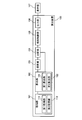
- FIG. 1 is a block diagram of a functional configuration of the calculation apparatus according to the first embodiment.
- FIG. 2 is a flowchart showing the procedure of the calculation process.
- FIG. 3 is a block diagram illustrating a hardware configuration of the navigation apparatus.
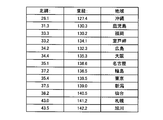
- FIG. 4 is an explanatory diagram showing a position information table held by the navigation device.
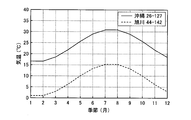
- FIG. 5 is an explanatory diagram showing the temperature calculated by the navigation device.
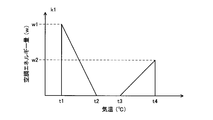
- FIG. 6 is an explanatory diagram showing the relationship between the air temperature and the air conditioning energy amount.
- FIG. 7 is a flowchart showing a procedure of calculation processing by the navigation device.
- FIG. 8 is a block diagram of a functional configuration of the calculation apparatus according to the second embodiment.
- FIG. 9 is a block diagram of a functional configuration of the calculation apparatus according to the third embodiment.
- FIG. 10 is an explanatory diagram of a system configuration of a calculation system according to the second embodiment.
- FIG. 1 is a block diagram of a functional configuration of the calculation apparatus according to the first embodiment.
- the calculation apparatus 100 calculates an estimated amount of kinetic energy that is consumed when the moving body moves.
- the calculation device 100 includes an acquisition unit 101, a calculation unit 102, a search unit 103, a comparison unit 104, a notification control unit 105, and an output unit 106.
- the acquisition unit 101 acquires information on the moving object.
- the information about the moving object includes the destination of the moving object, the route to the destination of the moving object, the amount of kinetic energy actually consumed when the moving object moves, the moving information of the moving object, the current position of the moving object, Location information and altitude information near the destination.
- the moving information of the moving body includes speed, acceleration, tilt information, and the like of the moving body.
- the acquisition unit 101 acquires information about the moving body when the moving body has moved in the past on the route to the destination.
- Information about the moving body is stored in a storage unit (not shown) for each unit time when the moving body moves, for example.
- the position information is, for example, latitude / longitude information.
- the acquisition unit 101 includes a first acquisition unit 111 and a second acquisition unit 112.
- the 1st acquisition part 111 acquires the amount of consumption kinetic energy actually consumed when a mobile object moves a predetermined course for every unit time.
- the first acquisition unit 111 acquires, for example, the consumed kinetic energy amount and the movement information of the moving body stored in the storage unit.
- the 1st acquisition part 111 acquires the setting of the air conditioning part of a moving body.
- the first acquisition unit 111 may acquire the setting of the air adjustment unit when the setting of the air adjustment unit is changed by the user, or acquires the setting of the air adjustment unit at regular intervals such as every unit time. May be.
- the 1st acquisition part 111 may acquire the external temperature in the present position of a moving body.
- the air conditioning unit is a facility provided in the moving body to adjust and maintain the temperature and humidity of the air in the moving body within a set range.
- the air conditioning unit is an air conditioner (air conditioning equipment).
- the setting of the air adjusting unit is a setting temperature (air conditioning), a set humidity, and an on / off setting of the power supply of the air adjusting unit itself.
- the first acquisition unit 111 may acquire the current remaining energy amount of the moving object. Specifically, the first acquisition unit 111 may acquire the remaining energy amount of the mobile body from the information communication network in the mobile body, or acquire the current consumption kinetic energy amount from the CAN, The remaining energy amount may be acquired by subtracting the consumed movement energy amount from the energy amount.
- the first acquisition unit 111 moves the actually consumed energy amount such as the consumed energy amount when the motor of the moving body is operated, the consumed energy amount when the air adjustment unit is used, and the consumed energy amount when the audio is used. You may acquire from the information communication network in a body.
- the information communication network is an in-vehicle communication network (hereinafter simply referred to as CAN) that is connected to an electronic control unit (ECU: Electronic Control Unit) in a moving body and operates according to a communication protocol such as CAN (Controller Area Network).
- CAN Controller Area Network
- the second acquisition unit 112 acquires information about the temperature on the route to the destination of the moving object.
- the information on temperature is information for calculating the temperature.
- the information on the temperature is, for example, latitude / longitude information, altitude information, and time information when the moving body passes through each point.
- Time information includes seasonal information and date information.
- the second acquisition unit 112 acquires the position information of the moving body from the current location of the calculation device 100. Specifically, the second acquisition unit 112 acquires the position information by calculating the current position of the own device using, for example, GPS information received from a GPS satellite. Moreover, the 2nd acquisition part 112 acquires map data etc. from the GPS information etc. which were received from the GPS satellite, for example.
- the calculation unit 102 calculates the estimated amount of kinetic energy consumed by the mobile body and the distance that the mobile body can travel with the current residual energy amount (hereinafter referred to as a cruising distance).
- the calculation unit 102 includes a first calculation unit 121 and a second calculation unit 122.
- the first calculation unit 121 calculates an estimated air conditioning energy amount consumed by the air conditioning unit of the moving body based on a predetermined route along which the moving body moves.
- the predetermined route along which the mobile body moves may be a route searched by the search unit 103 described later.
- the first calculation unit 121 calculates the estimated air conditioning energy amount based on the information regarding the temperature acquired by the second acquisition unit 112. More specifically, the first calculation unit 121 calculates the average temperature on the route to the destination of the moving body based on, for example, the position information of the moving body and the date information on which the moving body moves. And the 1st calculation part 121 is the estimated air-conditioning energy consumed with a mobile body based on the average temperature in the path
- the first calculation unit 121 may calculate the average temperature on the route to the destination of the moving body based on the temperature change based on the altitude information. By calculating the average temperature based on the temperature change based on the altitude information, it is possible to further improve the calculation accuracy of the average temperature. In addition, the first calculation unit 121 may calculate the estimated air conditioning energy amount based on temperature information outside the moving body acquired by the first acquisition unit 111.
- the first calculation unit 121 may calculate the maximum temperature and the minimum temperature in the route to the destination of the moving body based on the calculated average temperature. And the 1st calculation part 121 may calculate the average temperature in the path
- the first calculation unit 121 may calculate the estimated air conditioning energy amount based on the setting of the air adjustment unit acquired by the first acquisition unit 111. Specifically, the first calculation unit 121 sets the temperature setting of the air adjustment unit acquired by the first acquisition unit 111 and the current position and altitude of the moving body when the setting of the air adjustment unit is changed by the user. The estimated air conditioning energy amount may be calculated based on the above.
- the second calculating section 122 Calculate the estimated amount of kinetic energy to consume.
- the second calculation unit 122 may calculate an estimated kinetic energy amount when the moving body moves on the route searched by the search unit 103.
- the second calculation unit 122 for example, the steady consumption energy amount k1 that is constantly consumed regardless of the traveling state of the moving body when the moving body is operating, and the accelerated consumption energy that is consumed when the moving body is adjusted.
- the steady energy consumption k1, the acceleration energy consumption k2, and the cruise energy consumption k3 are expressed by equations having constants and coefficients, respectively, and the constants and coefficients differ depending on the vehicle type.
- the time when the moving body is in operation is a state from when the prime mover of the moving body starts until it stops.
- the steady energy consumption includes the estimated air conditioning energy.
- the amount of energy consumed for cruising includes the amount of regenerative energy that is regenerated when the moving body decelerates.
- Regeneration refers to, for example, a gasoline vehicle that uses fuel such as gasoline or light oil as a power source to suppress fuel consumption by using a brake during deceleration (fuel cut).
- Regeneration refers to, for example, converting kinetic energy during deceleration to electric power in HV (Hybrid Vehicle) cars, PEV (Plug-in Electric Vehicle) cars, EV (Electric Vehicle) cars that use electric power as a power source. This is the amount of energy recovered.
- the running resistance is various resistances generated in the moving body such as air resistance and rolling resistance.
- the second calculation unit 122 may calculate the estimated kinetic energy amount again when the setting of the air adjustment unit is changed by the user. Specifically, the second calculation unit 122 corrects the steady consumption energy amount k1 using the estimated air conditioning energy amount calculated based on the changed setting of the air conditioning unit, and the corrected steady consumption energy amount k1. Is used to calculate the estimated kinetic energy amount.
- the second calculation unit 122 calculates a travelable distance (travelable distance) with the current residual energy amount based on the current residual energy amount and the estimated kinetic energy amount of the mobile object. Specifically, the second calculation unit 122 calculates the estimated air conditioning energy amount at each point in the direction in which the mobile body can travel from the current position of the mobile body based on, for example, the position, altitude, time, and the like of the mobile body. A consumed energy amount k1 is calculated. Then, the second calculation unit 122 calculates the cruising distance based on the remaining energy amount obtained by subtracting the steady consumption energy amount k1 from the remaining energy amount.
- the search unit 103 searches for a route to the destination of the mobile object based on the link information included in the map data acquired by the second acquisition unit 112.
- a link is a section divided by points where road types and speed bands change, points where regions change such as boundaries of prefectures and municipalities, and the like.
- Link information is set for each link.
- the link information includes the link position and altitude, the link distance, the moving time of the moving object, and the like.
- the search unit 103 searches for a plurality of routes that are configured by connecting adjacent links from the departure point of the moving object to the destination by variously changing the link connection.
- the link information of each link may be used as a weight during route search. It is possible to perform route search with priority on time, distance, and energy consumption according to weighting.
- the search unit 103 searches for one route configured by connecting the links that can be moved in the shortest time.
- the search unit 103 integrates the link cost from the departure point of the moving object to the destination for each link information.
- the search part 103 performs a route search by using the link information in each link as a link cost.
- the search unit 103 may change the weighting of each link information according to the integrated cost of each link information.
- the search unit 103 searches for a route to the destination of the moving object using the estimated moving energy amount calculated based on the estimated air conditioning energy amount calculated based on the position and altitude of each link as link information. To do. Thereby, the search part 103 can perform the path
- the search unit 103 searches for a route to the destination of the moving object again using the estimated kinetic energy amount calculated again by the second calculation unit 122 when the setting of the air conditioning unit is changed by the user. May be. Specifically, for example, the search unit 103 changes the setting of the air adjustment unit when the user changes the setting of the air adjustment unit due to a temperature change or by information controlled by the notification control unit 105 described later. Sometimes, the route to the destination of the mobile object may be searched again.
- the comparison unit 104 compares the estimated kinetic energy amount calculated by the second calculation unit 122 with the consumed kinetic energy amount acquired by the first acquisition unit 111. Specifically, the comparison unit 104 calculates the energy amount obtained by converting the estimated kinetic energy amount calculated by the second calculation unit 122 for each unit time, and the consumed kinetic energy acquired for each unit time by the first acquisition unit 111. Compare the amount. Furthermore, the comparison unit 104 compares the total estimated kinetic energy amount and the total consumed kinetic energy amount from the time when the cruising distance is estimated by the second calculation unit 122 to the present.
- the comparison unit 104 compares the estimated kinetic energy amount and the consumed kinetic energy amount in the section where the mobile body will reach when the mobile body is moving on the route searched by the search unit 103.
- the comparison unit 104 also calculates the estimated kinetic energy calculated by the second calculation unit 122 based on the estimated air conditioning energy amount and the estimated kinetic energy calculated by the second calculation unit 122 based on the setting of the air conditioning unit of the moving body. The amount may be compared.
- the notification control unit 105 causes the notification unit such as the display unit 107 to notify the information determined to be notified to the user based on the comparison information compared by the comparison unit 104 via the output unit 106. Specifically, the notification control unit 105 determines whether to notify the comparison unit of the comparison result based on the comparison result by the comparison unit 104. When the notification control unit 105 determines that the notification unit notifies the comparison result of the comparison unit 104, the notification control unit 105 notifies the notification unit of the comparison result of the comparison unit 104. The notification control unit 105 may notify the information determined to be notified to the user by the notification control unit 105 by voice from a speaker (not shown).
- the information determined to be notified to the user by the notification control unit 105 means that the notification control unit 105 needs to notify the user of the setting of the air adjustment unit of the moving body based on the comparison result compared by the comparison unit 104.
- the determination result is determined to be, for example, on / off of the air adjustment unit or temperature setting.
- the notification control unit 105 displays a display for prompting the user on the display unit 107. More specifically, for example, when the amount of kinetic energy consumed is larger than the estimated amount of kinetic energy, the notification control unit 105 displays a display on the setting of the air adjustment unit such as “Please refrain from using air conditioning” on the display unit 107. Display and inform about the use of the air regulator more than necessary and the temperature regulation of the air regulator.
- the notification control unit 105 " The air conditioning unit consumes a large amount of energy and cannot reach the destination with the current amount of remaining energy.
- the display for the air conditioning unit setting is displayed on the display unit 107, and the air conditioning unit is used more than necessary and the temperature of the air conditioning unit is adjusted I will inform you about.
- the notification control unit 105 may cause the search unit 103 to search for a route to the destination of the moving object again based on the comparison result by the comparison unit 104 and present a new route to the user. At this time, the notification control unit 105 may cause the search unit 103 to search for a route including a point where energy can be supplemented.
- FIG. 2 is a flowchart illustrating a procedure of calculation processing by the calculation device.
- the calculation device 100 first calculates the estimated amount of air conditioning energy consumed by the air conditioning unit of the moving body by the first calculation unit 121 based on, for example, the route to the destination of the moving body. (Step S201).
- the route to the destination of the mobile object may be a route searched by the search unit 103.
- the calculation device 100 calculates the estimated kinetic energy amount consumed when the mobile body moves along the route to the destination by the second calculation unit 122 (step S202).
- the calculation apparatus 100 acquires, by the first acquisition unit 111, the consumed kinetic energy amount actually consumed when the moving body moves along the route to the destination (step S203).
- the calculation device 100 uses the comparison unit 104 to compare the estimated kinetic energy amount and the consumed kinetic energy amount (step S204).
- the calculation device 100 notifies the setting of the air conditioning unit based on the comparison result by the comparison unit 104 (step S205), and ends the process according to the flowchart.
- the calculation apparatus 100 may search for a route to the destination of the moving body by the search unit 103 based on the estimated kinetic energy amount calculated in step S202. In this case, the calculation apparatus 100 may perform comparison by the comparison unit 104 based on the route searched by the search unit 103.
- the calculation device 100 calculates the estimated kinetic energy amount using the estimated air conditioning energy amount, and compares the estimated kinetic energy amount with the consumed kinetic energy amount. More specifically, the calculation device 100 calculates an estimated kinetic energy amount using an estimated air conditioning energy amount that reflects a change in position information due to the movement of the moving object. Thereby, the calculation accuracy of the estimated kinetic energy amount can be improved.
- the calculation device 100 compares the estimated kinetic energy amount reflecting the estimated air conditioning energy amount with the consumed kinetic energy amount. Thereby, when the estimated kinetic energy amount and the consumed kinetic energy amount are different, it is possible to notify the user that the setting of the air adjustment unit can be changed. In addition, the calculation device 100 can notify the user that the air adjustment unit is set to a temperature setting higher than necessary when the amount of energy consumed for movement is larger than the estimated amount of air conditioning energy.
- the user can notice that the estimated air conditioning energy amount and the consumed kinetic energy amount are different. .
- the user can take measures such as replenishing the mobile body with energy before the remaining energy amount is consumed. Therefore, it is possible to give a sense of security and reliability to the user who operates the moving body.
- the calculation device 100 searches for a route to the destination of the moving body using the estimated amount of moving energy reflecting the estimated amount of air conditioning energy, and when the setting of the air adjustment unit is changed by the user, The route to the destination is searched again. Thereby, the user can grasp
- Example 1 of the present invention will be described.
- the present invention is applied to a calculation system 500 using the navigation device 300 mounted on a vehicle as the calculation device 100 will be described.
- FIG. 3 is a block diagram illustrating a hardware configuration of the navigation apparatus.
- the navigation apparatus 300 includes a CPU 301, ROM 302, RAM 303, magnetic disk drive 304, magnetic disk 305, optical disk drive 306, optical disk 307, audio I / F (interface) 308, microphone 309, speaker 310, input device 311, A video I / F 312, a display 313, a camera 314, a communication I / F 315, a GPS unit 316, and various sensors 317 are provided.
- Each component 301 to 317 is connected by a bus 320.
- the CPU 301 governs overall control of the navigation device 300.
- the ROM 302 records programs such as a boot program and a data update program.
- the RAM 303 is used as a work area for the CPU 301. That is, the CPU 301 controls the entire navigation device 300 by executing various programs recorded in the ROM 302 while using the RAM 303 as a work area.
- the magnetic disk drive 304 controls the reading / writing of the data with respect to the magnetic disk 305 according to control of CPU301.
- the magnetic disk 305 records data written under the control of the magnetic disk drive 304.
- an HD hard disk
- FD flexible disk
- the optical disk drive 306 controls reading / writing of data with respect to the optical disk 307 according to the control of the CPU 301.
- the optical disk 307 is a detachable recording medium from which data is read according to the control of the optical disk drive 306.
- a writable recording medium can be used as the optical disc 307.
- an MO, a memory card, or the like can be used as a removable recording medium.
- Examples of information recorded on the magnetic disk 305 and the optical disk 307 include map data, and link information such as position information and altitude at each link.
- Map data is used for route search processing and route guidance processing in car navigation systems.
- Background data that represents features (features) such as buildings, rivers, and the ground surface, and road shape data that represents road shapes with links and nodes. Etc.
- the voice I / F 308 is connected to a microphone 309 for voice input and a speaker 310 for voice output.
- the sound received by the microphone 309 is A / D converted in the sound I / F 308.
- the microphone 309 is installed in a dashboard portion of a vehicle, and the number thereof may be one or more. From the speaker 310, a sound obtained by D / A converting a predetermined sound signal in the sound I / F 308 is output.
- the input device 311 includes a remote controller, a keyboard, a touch panel, and the like provided with a plurality of keys for inputting characters, numerical values, various instructions, and the like.
- the input device 311 may be realized by any one form of a remote control, a keyboard, and a touch panel, but can also be realized by a plurality of forms.
- the video I / F 312 is connected to the display 313. Specifically, the video I / F 312 is output from, for example, a graphic controller that controls the entire display 313, a buffer memory such as a VRAM (Video RAM) that temporarily records image information that can be displayed immediately, and a graphic controller. And a control IC for controlling the display 313 based on the image data to be processed.
- a graphic controller that controls the entire display 313, a buffer memory such as a VRAM (Video RAM) that temporarily records image information that can be displayed immediately, and a graphic controller.
- VRAM Video RAM
- the display 313 displays icons, cursors, menus, windows, or various data such as characters and images.
- a TFT liquid crystal display, an organic EL display, or the like can be used as the display 313, for example.
- the camera 314 captures images inside or outside the vehicle.
- the image may be either a still image or a moving image.
- the outside of the vehicle is photographed by the camera 314, and the photographed image is analyzed by the CPU 301, or a recording medium such as the magnetic disk 305 or the optical disk 307 via the image I / F 312. Or output to
- the communication I / F 315 is connected to a network via a wire or wirelessly, and functions as an interface between the navigation device 300 and the CPU 301.
- Communication networks that function as networks include in-vehicle communication networks such as CAN (Controller Area Network) and LIN (Local Interconnect Network), public line networks and mobile phone networks, DSRC (Dedicated Short Range Communication), LAN, and WAN. is there.
- the communication I / F 315 is, for example, a public line connection module, an ETC (non-stop automatic fee payment system) unit, an FM tuner, a VICS (Vehicle Information and Communication System) / beacon receiver, or the like.
- the GPS unit 316 receives radio waves from GPS satellites and outputs information indicating the current position of the vehicle.
- the output information of the GPS unit 316 is used when the CPU 301 calculates the current position of the vehicle together with output values of various sensors 317 described later.
- the information indicating the current position is information for specifying one point on the map data, such as latitude / longitude and altitude.
- the various sensors 317 output information for determining the position and behavior of the vehicle, such as a vehicle speed sensor, an acceleration sensor, and an angular velocity sensor.
- the output values of the various sensors 317 are used by the CPU 301 to calculate the current position of the vehicle and the amount of change in speed and direction.
- the acquisition unit 101, the calculation unit 102, the search unit 103, the comparison unit 104, the notification control unit 105, and the output unit 106 of the calculation device 100 illustrated in FIG. 1 are the ROM 302, RAM 303, magnetic disk 305, and optical disk in the navigation device 300 described above.
- the CPU 301 executes a predetermined program using the program and data recorded in 307 and the like, and realizes its function by controlling each unit in the navigation device 300.
- the navigation device 300 calculates an estimated amount of kinetic energy while the vehicle on which the device is mounted is traveling or before traveling.
- the estimated consumed energy amount Fc is a steady consumed energy amount k1 that is constantly consumed regardless of the traveling state of the moving body during operation of the moving body, and is consumed when the moving body is adjusted. This is calculated as the sum of the acceleration energy consumption k2 and the cruise energy consumption k3 consumed by the traveling resistance of the moving body.
- the steady energy consumption k1, the acceleration energy consumption k2, and the cruise energy consumption k3 are expressed by equations having constants and coefficients, respectively, and the constants and coefficients differ depending on the vehicle type.
- FIG. 4 is an explanatory diagram showing a position information table held by the navigation device.
- FIG. 5 is an explanatory diagram showing the temperature calculated by the navigation device.
- the navigation device 300 calculates the temperature of the area where the moving body travels in order to calculate the estimated air conditioning energy amount.
- the navigation apparatus 300 uses a position information table in which latitude, longitude, altitude (not shown), etc. in a predetermined area as shown in FIG. 4 are stored as position information of the predetermined area through which the vehicle passes. Hold.
- the navigation device 300 reads the latitude and longitude of the area where the vehicle on which the device is mounted travels from the position information table, and calculates the estimated air conditioning energy amount using, for example, the following equation (2).
- temp is an average temperature
- mon is the number of months
- lat, longit, and high are latitude, longitude, and altitude.
- the navigation device 300 calculates the temperature in a predetermined region by substituting the latitude and longitude of the destination of the vehicle on which the device is mounted and the season (month) in which the vehicle travels into the above equation (2).
- FIG. 5 shows the temperature calculated by the navigation device 300 using the above equation (2).
- the horizontal axis represents the season (month)
- the vertical axis represents the temperature (° C.) calculated by the navigation device 300.
- the temperature calculated using the above equation (2) can be calculated for each region and season.
- FIG. 6 is an explanatory diagram showing the relationship between the air temperature and the air conditioning energy amount.
- the navigation device 300 calculates an estimated air conditioning energy amount in order to calculate the steady consumption energy amount k1 of the above equation (1).
- the horizontal axis represents the temperature outside the vehicle
- the vertical axis represents the amount of air conditioning energy consumed by using the air conditioner of the vehicle.
- the first temperature t1 is the temperature when the heating capacity of the air conditioner provided in the vehicle is maximized.
- the second temperature t2 is a temperature at which the user starts to use the heating function of the air conditioner.
- the third temperature t3 is a temperature at which the user starts to use the cooling function of the air conditioner.
- the fourth temperature t4 is the temperature when the cooling capacity of the air conditioner provided in the vehicle is maximized.
- the amount of air conditioning energy consumed by the use of an air conditioner is proportional to the temperature outside the vehicle.
- the heating capacity of the air conditioner is maximized from the second temperature t2 at which the user starts using the heating function of the air conditioner.
- the air conditioning energy amount increases linearly until the first temperature t1.
- the air conditioning energy amount w1 consumed by heating is the maximum energy amount when the air conditioner is heated.
- the navigation apparatus 300 can calculate the steady consumption energy amount k1 using the following formula (3) or the following formula (4).
- the above equation (3) is a formula for calculating the steady state energy consumption k1 when temp ⁇ t2.
- the above equation (4) is a formula for calculating the steady consumption energy k1 when temp> t32.
- the navigation device 300 calculates the estimated kinetic energy amount, compares it with the consumed kinetic energy amount, and notifies, for example, the set temperature of the air conditioner.
- the calculation processing of the estimated kinetic energy amount will be described.
- FIG. 7 is a flowchart showing the procedure of the calculation process by the navigation device.
- the navigation apparatus 300 acquires information about the temperature via the GPS unit 416 (step S701).
- the GPS information includes information for the navigation device 300 to calculate the temperature outside the vehicle, such as current time information, date information, latitude / longitude information of each point on the route through which the vehicle passes, and altitude information.
- the information on the temperature is latitude / longitude information and altitude information of each point on the route through which the vehicle passes.
- the navigation apparatus 300 calculates the temperature of the area where the vehicle moves using the GPS information acquired in step S701 and the above-described equation (2) (step S702).
- the navigation apparatus 300 calculates the estimated air conditioning energy amount using the air temperature calculated in step S702 and the above-described equation (3) or (4) (step S703).
- the navigation device 300 reads vehicle movement information and vehicle type information stored in the (magnetic disk 305 and optical disk 307) (step S704).
- the vehicle movement information includes information for the navigation device 300 to calculate the estimated movement energy amount, such as vehicle speed, acceleration, and inclination information.
- the navigation apparatus 300 uses the estimated air conditioning energy amount calculated in step S703, the vehicle movement information and vehicle type information acquired in step S704, and the above-described equation (1) when the vehicle moves.
- An estimated amount of kinetic energy is calculated (step S705).
- the navigation apparatus 300 acquires the remaining energy amount of the vehicle via the communication I / F 315 (step S706).
- the navigation device 300 calculates a travelable distance (travelable distance) with the current residual energy amount based on the estimated kinetic energy amount calculated in step S705 and the residual energy amount acquired in step S706. (Step S707).
- the navigation device 300 acquires map data via the GPS unit 316 (step S708).
- the map data is information for the navigation device 300 to search for a route, such as current time information, date information, and latitude / longitude information of the current location (or information for specifying a link where the navigation device 300 is located).
- the navigation device 300 searches for the route of the vehicle based on the information acquired in step S708 (step S709). At this time, the navigation device 300 performs a route search using the link information of each link as the link cost.
- the navigation device 300 reads from the storage device the amount of consumed kinetic energy consumed when traveling in the past on the route to the destination of the vehicle (step S710).
- the navigation apparatus 300 compares the estimated kinetic energy amount calculated in step S705 with the consumed kinetic energy amount read in step S710 (step S711).
- step S712 When the consumed kinetic energy amount is larger than the estimated kinetic energy amount (step S712: Yes), the navigation device 300 notifies the user about the setting of the air conditioner (step S713).
- the air conditioner settings notified to the user in step S713 are, for example, air conditioner on / off and temperature settings.
- step S712: No When the consumed kinetic energy amount is smaller than the estimated kinetic energy amount (step S712: No), the processing according to this flowchart ends.
- the estimated kinetic energy amount is calculated using the estimated air conditioning energy amount, and the estimated kinetic energy amount and the consumed kinetic energy amount are compared. More specifically, the navigation apparatus 300 calculates the estimated kinetic energy amount using the estimated air conditioning energy amount that reflects the change in the position information due to the movement of the moving body. Thereby, the calculation accuracy of the estimated kinetic energy amount can be improved.
- the navigation device 300 compares the estimated kinetic energy amount reflecting the estimated air conditioning energy amount with the consumed kinetic energy amount. Thereby, when the estimated kinetic energy amount and the consumed kinetic energy amount are different, it is possible to notify the user that the setting of the air adjustment unit can be changed. Further, the navigation device 300 can notify the user that the air adjustment unit is set to a temperature setting that is higher than necessary when the amount of energy consumed for movement is larger than the estimated amount of air conditioning energy.
- the navigation device 300 By notifying the user that the estimated kinetic energy amount and the consumed kinetic energy amount are different by the navigation device 300, the user can notice that the estimated air conditioning energy amount and the consumed kinetic energy amount are different. . Accordingly, the user can take measures such as replenishing energy before the remaining energy amount is consumed. Therefore, it is possible to give a sense of security and reliability to the user who operates the moving body.
- the navigation device 300 searches for a route to the destination of the moving body using the estimated amount of moving energy reflecting the estimated amount of air conditioning energy, and when the setting of the air adjustment unit is changed by the user, The route to the destination is searched again. Thereby, the user can grasp
- FIG. 8 is a block diagram of a functional configuration of the calculation apparatus according to the second embodiment.
- a functional configuration of the calculation system 800 according to the second embodiment will be described.
- a calculation system 800 according to the second embodiment includes a server 810 and a terminal 820.
- the server 810 includes the function of the calculation apparatus according to the first embodiment.
- the server 810 calculates information to be provided to the terminal 820 mounted on the mobile object. Specifically, the server 810 receives the movement information of the moving body from the terminal 820 mounted on the moving body, and calculates the estimated kinetic energy amount consumed by the moving body. Then, the server 810 receives the consumed kinetic energy amount actually consumed by the mobile body from the terminal 820, compares it with the estimated kinetic energy amount calculated by the own device, and transmits the comparison result to the terminal 820.
- the terminal 820 is mounted on a mobile object and provides information related to the mobile object to the server 810.
- the information related to the moving body includes information acquired from the information communication network in the moving body, movement information and position information of the moving body, and the like.
- the terminal 820 acquires information from the server 810 and displays information on the setting of the air adjustment unit of the moving body on the display unit 107.
- the server 810 includes a calculation unit 102, a search unit 103, a comparison unit 104, a notification control unit 105, a server reception unit 811, and a server transmission unit 812.
- the terminal 820 includes an acquisition unit 101, an output unit 106, a reception unit 821, and a transmission unit 822.
- the notification control unit 105 determines whether to notify the notification unit based on the comparison result by the comparison unit 104. Specifically, the notification control unit 105 controls to transmit information determined to be notified based on the comparison result by the comparison unit 104.
- symbol is attached
- the server reception unit 811 receives information on the moving object from the terminal 820. Specifically, for example, the server reception unit 811 receives information about a mobile unit from a terminal 820 connected to a communication network such as a public line network, a mobile phone network, a DSRC, a LAN, and a WAN via a radio. Information received by the server reception unit 811 is information referred to by the calculation unit 102 and the comparison unit 104.
- the server transmission unit 812 transmits information determined to be notified to the user by the notification control unit 105 to the terminal 820. Specifically, the server transmission unit 812 transmits the determination result by the notification control unit 105 to the terminal 820. More specifically, for example, the server transmission unit 812 transmits information to a terminal 820 that is connected to a communication network such as a public line network, a mobile phone network, a DSRC, a LAN, and a WAN via a wireless connection.
- the information determined to be notified to the user by the notification control unit 105 means that the notification control unit 105 needs to notify the user of the setting of the air adjustment unit of the moving body based on the comparison result compared by the comparison unit 104. It is a determination result determined to be present.
- the terminal 820 is connected to the server 810 in a communicable state via, for example, an information communication network of a portable terminal or a communication unit (not shown) provided in its own device.
- the terminal 820 may be a terminal provided in the moving body, or may be a mobile terminal of a user who operates the moving body.
- the terminal 820 may include a part of the components of the server 810.
- the receiving unit 821 receives the determination result determined by the notification control unit 105 of the server 810 from the server 810. Specifically, for example, the reception unit 821 receives the comparison result by the comparison unit 104 from a server 810 connected to a communication network such as a public line network, a mobile phone network, DSRC, LAN, WAN, or the like wirelessly.
- a communication network such as a public line network, a mobile phone network, DSRC, LAN, WAN, or the like wirelessly.
- the transmission unit 822 transmits information on the moving object acquired by the acquisition unit 101 to the server 810. Specifically, for example, the transmission unit 822 transmits information about the moving object to a server 810 connected to a communication network such as a public line network, a mobile phone network, DSRC, LAN, and WAN via a wireless connection.
- a communication network such as a public line network, a mobile phone network, DSRC, LAN, and WAN via a wireless connection.
- calculation processing by the calculation system 800 according to the second embodiment will be described. Since the calculation process by the calculation system 800 is almost the same as that of the calculation apparatus 100 according to the first embodiment, the difference from the first embodiment will be described using the flowchart of FIG.
- the calculation process by the calculation system 800 is performed by the server 810 by the calculation apparatus 100 according to the first embodiment. Specifically, in the flowchart of FIG. 2, the server 810 performs steps S201 to S204. The terminal 820 appropriately transmits information regarding the moving object to the server 810 while the processing of steps S201 to S204 is performed by the server 810.
- the server 810 transmits the determination result determined by the notification control unit 105 to the terminal 820 after the process of step S204.
- the terminal 820 displays the determination result determined by the notification control unit 105 transmitted by the server 810 on the display unit 107 by the output unit 106 to notify the user, and ends the processing according to this flowchart.
- the calculation system 800 according to the second embodiment can obtain the same effects as those of the search device 100 according to the first embodiment.
- FIG. 9 is a block diagram of a functional configuration of the calculation system according to the third embodiment.
- a functional configuration of the calculation system 900 according to the third embodiment will be described.
- a calculation system 900 according to the third embodiment includes a server 910, a calculation device 920, and a terminal 820.
- the server 910 includes the function of the search unit 103 of the calculation apparatus according to the first embodiment
- the terminal 820 includes the functions of the acquisition unit 101 and the output unit 106 of the calculation apparatus according to the first embodiment.
- a terminal 820 has the same configuration as the terminal 820 of the second embodiment.
- the terminal 820 includes an acquisition unit 101, an output unit 106, a reception unit (hereinafter referred to as a first reception unit) 821, and a transmission unit (hereinafter referred to as a second transmission unit) 822.
- the server 910 includes a search unit 103, a server reception unit (hereinafter referred to as a first server reception unit) 811, and a server transmission unit (hereinafter referred to as a first server transmission unit) 812.
- the calculation device 920 includes a calculation unit 102, a comparison unit 104, a notification control unit 105, a second reception unit 921, and a second transmission unit 922.
- the notification control unit 105 determines whether to notify the notification unit based on the comparison result by the comparison unit 104.
- the notification control unit 105 controls to transmit information determined to be notified based on the comparison result by the comparison unit 104.
- the second server reception unit 911 receives the determination result determined by the notification control unit 105 from the calculation device 920. Specifically, for example, the second server reception unit 911 receives information from a calculation device 920 that is connected to a communication network such as a public line network, a mobile phone network, DSRC, LAN, and WAN via a wireless connection.
- a communication network such as a public line network, a mobile phone network, DSRC, LAN, and WAN via a wireless connection.
- the second server transmission unit 912 transmits the information regarding the moving body received by the first server reception unit 811 to the calculation device 920. Specifically, the second server transmission unit 912 transmits information to a calculation device 920 that is connected to a communication network such as a public line network, a mobile phone network, a DSRC, a LAN, and a WAN via a wireless connection.
- a communication network such as a public line network, a mobile phone network, a DSRC, a LAN, and a WAN via a wireless connection.
- the second reception unit 921 receives information on the moving object from the server 910. Specifically, for example, the second receiving unit 921 receives information related to the moving body from the server 910 that is wirelessly connected to a communication network such as a public line network, a mobile phone network, DSRC, LAN, and WAN. .
- the information received by the second receiving unit 921 is information referred to by the calculating unit 102 and the comparing unit 104.
- the second transmission unit 922 transmits information determined to be notified to the user by the notification control unit 105 to the server 910. Specifically, the second transmission unit 922 transmits the determination result by the notification control unit 105 to the terminal 820. More specifically, for example, the second transmission unit 922 transmits information to a server 910 that is wirelessly connected to a communication network such as a public line network, a mobile phone network, DSRC, LAN, and WAN.
- the information determined to be notified to the user by the notification control unit 105 means that the notification control unit 105 needs to notify the user of the setting of the air adjustment unit of the moving body based on the comparison result compared by the comparison unit 104. It is a determination result determined to be present.
- calculation processing by the calculation system 900 according to the third embodiment will be described. Since the calculation process by the calculation system 900 is almost the same as that of the calculation apparatus 100 according to the first embodiment, the difference from the first embodiment will be described using the flowchart of FIG.
- the calculation process by the calculation system 900 is performed by the calculation apparatus 920 by the calculation apparatus 100 according to the first embodiment. Specifically, in the flowchart of FIG. 2, the calculation device 920 performs the processes of steps S201 to S204.
- the terminal 820 appropriately transmits information regarding the moving object to the calculation device 920 via the server 910 while the calculation device 920 performs the processing of steps S201 to S204.
- the calculation device 920 transmits the determination result determined by the notification control unit 105 to the terminal 820 via the server 910 after the process of step S204.
- the terminal 820 displays the determination result determined by the notification control unit 105 transmitted by the server 910 on the display unit 107 by the output unit 106 to notify the user, and ends the processing according to this flowchart.
- the calculation system 900 according to the third embodiment can obtain the same effects as the calculation system 800 according to the second embodiment.
- Example 2 of the present invention will be described.
- the present invention is applied to a calculation system 1000 in which a navigation device 1010 mounted on a vehicle is the terminal 820 and the server 1020 is the server 810 will be described.
- FIG. 10 is an explanatory diagram of a system configuration of the calculation system according to the second embodiment.
- the calculation system 1000 includes a navigation device 1010, a server 1020, and a network 1040 mounted on the vehicle 1030.
- Navigation device 1010 is mounted on vehicle 330.
- the navigation device 1010 transmits information related to the moving object to the server 1020.
- the navigation device 1010 notifies the user of information received from the server 1020.
- the server 1020 receives information related to the moving object from the navigation device 1010.
- the server 1020 calculates an estimated air conditioning energy amount based on the received information on the moving object, and further calculates an estimated moving energy amount using the estimated air conditioning energy amount. Thereby, the navigation apparatus 1010 can calculate the estimated kinetic energy amount more accurately.
- the server 1020 compares the calculated estimated kinetic energy amount with the consumed kinetic energy amount actually consumed by the mobile body in order to calculate the estimated kinetic energy amount with higher accuracy. Furthermore, the server 1020 transmits information that informs the user about the setting of the air conditioner (air conditioning unit) of the vehicle 1030 to the navigation device 1010 based on the comparison result between the estimated kinetic energy amount and the consumed kinetic energy amount. Thereby, the navigation apparatus 1010 can notify a user that the air conditioner is used more than necessary.
- the air conditioner air conditioning unit
- the server 1020 calculates the cruising distance of the mobile body based on the estimated amount of kinetic energy and the current residual energy amount of the mobile body, or searches for a route to the destination. Then, the server 1020 transmits the cruising distance and the route to the destination to the navigation device 1010. Accordingly, the user can take measures such as replenishing the vehicle 1030 with energy before the remaining energy amount is consumed.
- the hardware configuration of the server 1020 and the navigation device 1010 is the same as the hardware configuration of the navigation device 300 of the first embodiment.
- the navigation device 1010 may include only a hardware configuration corresponding to a function of transmitting information related to a moving body to the server 1020 and a function of receiving information from the server 1020 and notifying the user.
- a calculation system 1000 is configured in which the navigation device 1010 mounted on the vehicle is the terminal 820, the server 1020 is the server 910 of the third embodiment, and an external device (not shown) is the calculation device 920 of the third embodiment. Also good.
- the calculation method described in the present embodiment can be realized by executing a program prepared in advance on a computer such as a personal computer or a workstation.
- This program is recorded on a computer-readable recording medium such as a hard disk, a flexible disk, a CD-ROM, an MO, and a DVD, and is executed by being read from the recording medium by the computer.
- the program may be a transmission medium that can be distributed via a network such as the Internet.
Landscapes
- Engineering & Computer Science (AREA)
- Mechanical Engineering (AREA)
- Automation & Control Theory (AREA)
- Physics & Mathematics (AREA)
- Thermal Sciences (AREA)
- Navigation (AREA)
- Air-Conditioning For Vehicles (AREA)
- Electric Propulsion And Braking For Vehicles (AREA)
Abstract
L'invention concerne un dispositif de calcul (100) qui permet de calculer une quantité d'énergie de déplacement estimée, consommée par un objet mobile lorsqu'il est en déplacement. Une première unité d'acquisition (111) acquiert une quantité d'énergie de déplacement consommée, réellement consommée par l'objet mobile lorsqu'il est en déplacement, des informations de déplacement se rapportant à l'objet mobile, les paramètres d'une unité de climatisation de l'objet mobile et similaires. Une seconde unité d'acquisition (112) acquiert des informations de latitude/longitude et des informations d'altitude se rapportant à l'objet mobile. Une première unité de calcul (121) calcule une quantité d'énergie de climatisation estimée. Une seconde unité de calcul (122) calcule la quantité d'énergie de déplacement estimée, consommée par l'objet mobile, ainsi que la distance qu'il est encore possible de parcourir. Une unité de recherche (103) recherche un itinéraire menant à la destination de l'objet mobile. Une unité de comparaison (104) compare la quantité d'énergie de déplacement estimée et la quantité d'énergie de déplacement consommée. Une unité de commande de compte rendu (105) rend compte d'informations se rapportant aux paramètres de l'unité de climatisation de l'objet mobile.
Priority Applications (2)
| Application Number | Priority Date | Filing Date | Title |
|---|---|---|---|
| PCT/JP2011/058353 WO2012132014A1 (fr) | 2011-03-31 | 2011-03-31 | Dispositif de calcul, système de calcul, terminal et procédé de calcul |
| JP2013507016A JPWO2012132014A1 (ja) | 2011-03-31 | 2011-03-31 | 算出装置、算出システム、端末および算出方法 |
Applications Claiming Priority (1)
| Application Number | Priority Date | Filing Date | Title |
|---|---|---|---|
| PCT/JP2011/058353 WO2012132014A1 (fr) | 2011-03-31 | 2011-03-31 | Dispositif de calcul, système de calcul, terminal et procédé de calcul |
Publications (1)
| Publication Number | Publication Date |
|---|---|
| WO2012132014A1 true WO2012132014A1 (fr) | 2012-10-04 |
Family
ID=46929832
Family Applications (1)
| Application Number | Title | Priority Date | Filing Date |
|---|---|---|---|
| PCT/JP2011/058353 Ceased WO2012132014A1 (fr) | 2011-03-31 | 2011-03-31 | Dispositif de calcul, système de calcul, terminal et procédé de calcul |
Country Status (2)
| Country | Link |
|---|---|
| JP (1) | JPWO2012132014A1 (fr) |
| WO (1) | WO2012132014A1 (fr) |
Cited By (4)
| Publication number | Priority date | Publication date | Assignee | Title |
|---|---|---|---|---|
| KR101857468B1 (ko) | 2015-09-11 | 2018-05-14 | 현대자동차주식회사 | 회귀식을 이용한 전기자동차의 주행가능거리 산출 방법 |
| JP2019090790A (ja) * | 2017-10-13 | 2019-06-13 | トヨタ モーター エンジニアリング アンド マニュファクチャリング ノース アメリカ,インコーポレイティド | ハイブリッドビークルについての環境制御負荷の軽減 |
| JP2021096201A (ja) * | 2019-12-19 | 2021-06-24 | ダイムラー・アクチェンゲゼルシャフトDaimler AG | 車両の走行経路選定システム及び走行経路選定方法 |
| JP2023063233A (ja) * | 2021-10-22 | 2023-05-09 | 中汽研汽車検験中心(天津)有限公司 | 作業条件識別に基づく一車用エアコンのエネルギー消費量の予測方法および予測装置 |
Citations (2)
| Publication number | Priority date | Publication date | Assignee | Title |
|---|---|---|---|---|
| JP2008285126A (ja) * | 2007-05-21 | 2008-11-27 | Toyota Motor Corp | 空調制御装置 |
| JP2009137456A (ja) * | 2007-12-06 | 2009-06-25 | Toyota Motor Corp | 充電制御装置 |
Family Cites Families (8)
| Publication number | Priority date | Publication date | Assignee | Title |
|---|---|---|---|---|
| JP2004145727A (ja) * | 2002-10-25 | 2004-05-20 | Mazda Motor Corp | 自動車エネルギ消費予測システム、自動車エネルギ消費予測サーバ、自動車エネルギ消費予測方法及び自動車エネルギ消費予測プログラム |
| JP2005274339A (ja) * | 2004-03-24 | 2005-10-06 | Denso Corp | 経路案内システム、経路案内装置、及び障害物案内装置 |
| JP2007306656A (ja) * | 2006-05-09 | 2007-11-22 | Toyota Motor Corp | 車両用発電機制御装置 |
| JP2007303951A (ja) * | 2006-05-11 | 2007-11-22 | Navitime Japan Co Ltd | ナビゲーションシステム、経路探索サーバ、端末装置および経路探索方法 |
| JP2008001301A (ja) * | 2006-06-26 | 2008-01-10 | Mazda Motor Corp | ハイブリッド車両の制御装置 |
| JP5071018B2 (ja) * | 2007-09-18 | 2012-11-14 | アイシン・エィ・ダブリュ株式会社 | 車両消費エネルギ推定装置、車両消費エネルギ推定方法及びコンピュータプログラム |
| JP5372561B2 (ja) * | 2009-03-19 | 2013-12-18 | 富士重工業株式会社 | 電気自動車の制御装置 |
| JP4876159B2 (ja) * | 2009-09-04 | 2012-02-15 | クラリオン株式会社 | カーナビゲーションシステム |
-
2011
- 2011-03-31 JP JP2013507016A patent/JPWO2012132014A1/ja active Pending
- 2011-03-31 WO PCT/JP2011/058353 patent/WO2012132014A1/fr not_active Ceased
Patent Citations (2)
| Publication number | Priority date | Publication date | Assignee | Title |
|---|---|---|---|---|
| JP2008285126A (ja) * | 2007-05-21 | 2008-11-27 | Toyota Motor Corp | 空調制御装置 |
| JP2009137456A (ja) * | 2007-12-06 | 2009-06-25 | Toyota Motor Corp | 充電制御装置 |
Cited By (7)
| Publication number | Priority date | Publication date | Assignee | Title |
|---|---|---|---|---|
| KR101857468B1 (ko) | 2015-09-11 | 2018-05-14 | 현대자동차주식회사 | 회귀식을 이용한 전기자동차의 주행가능거리 산출 방법 |
| JP2019090790A (ja) * | 2017-10-13 | 2019-06-13 | トヨタ モーター エンジニアリング アンド マニュファクチャリング ノース アメリカ,インコーポレイティド | ハイブリッドビークルについての環境制御負荷の軽減 |
| JP7050644B2 (ja) | 2017-10-13 | 2022-04-08 | トヨタ モーター エンジニアリング アンド マニュファクチャリング ノース アメリカ,インコーポレイティド | ハイブリッドビークルについての環境制御負荷の軽減 |
| JP2021096201A (ja) * | 2019-12-19 | 2021-06-24 | ダイムラー・アクチェンゲゼルシャフトDaimler AG | 車両の走行経路選定システム及び走行経路選定方法 |
| JP7794555B2 (ja) | 2019-12-19 | 2026-01-06 | ダイムラー トラック エージー | 車両の走行経路選定システム及び走行経路選定方法 |
| JP2023063233A (ja) * | 2021-10-22 | 2023-05-09 | 中汽研汽車検験中心(天津)有限公司 | 作業条件識別に基づく一車用エアコンのエネルギー消費量の予測方法および予測装置 |
| JP7565667B2 (ja) | 2021-10-22 | 2024-10-11 | 中汽研汽車検験中心(天津)有限公司 | 作業条件識別に基づく一車用エアコンのエネルギー消費量の予測方法および予測装置 |
Also Published As
| Publication number | Publication date |
|---|---|
| JPWO2012132014A1 (ja) | 2014-07-24 |
Similar Documents
| Publication | Publication Date | Title |
|---|---|---|
| US11067403B2 (en) | Vehicle energy usage tracking | |
| JP5454537B2 (ja) | 電動車両の充電制御システム | |
| CN102473351B (zh) | 信息提供系统、信息中心、车载装置和信息提供方法 | |
| US10229600B2 (en) | Navigation system with traffic flow mechanism and method of operation thereof | |
| CN115675178A (zh) | 智能电动车辆行程规划器算法 | |
| JP2010032459A (ja) | 車載用装置 | |
| US20220357162A1 (en) | Battery management device, learning model, computer program, battery management method, and information providing device | |
| CN111912421B (zh) | 信息提供装置和计算机可读记录介质 | |
| JP2012198081A (ja) | ナビゲーション装置 | |
| JP5674915B2 (ja) | 探索装置、探索システム、探索方法および端末 | |
| CN111347879A (zh) | 确定车辆对于行程的能量需求的系统和方法 | |
| WO2012132014A1 (fr) | Dispositif de calcul, système de calcul, terminal et procédé de calcul | |
| JP6088082B2 (ja) | 管理装置及び端末装置、並びに、経路管理方法及び経路取得方法 | |
| JP2012230067A (ja) | ナビゲーション装置、ナビゲーションシステムおよびナビゲーション方法 | |
| WO2014162526A1 (fr) | Dispositif, procédé et programme d'estimation d'un niveau de consommation d'énergie et support d'enregistrement | |
| EP4101712B1 (fr) | Dispositif de commande de véhicule, support d'informations non transitoire et système de commande de véhicule | |
| WO2014162525A1 (fr) | Dispositif de recherche d'installations d'alimentation en énergie, procédé de recherche d'installations d'alimentation en énergie et programme de recherche d'installations d'alimentation en énergie | |
| JP2015190830A (ja) | 消費エネルギー推定装置、通信装置、消費エネルギー推定方法、消費エネルギー推定プログラム | |
| JP2012154782A (ja) | 車載地図表示装置、サーバ装置、車両用地図表示システム | |
| JP5860136B2 (ja) | 画像処理装置、画像処理管理装置、端末装置及び画像処理方法 | |
| JP2020161125A (ja) | 消費エネルギー推定装置、通信装置、消費エネルギー推定方法、消費エネルギー推定プログラム | |
| WO2014083710A1 (fr) | Dispositif, procédé et programme de recherche d'itinéraires | |
| JP6085671B2 (ja) | 表示制御装置、表示制御方法および表示制御プログラム | |
| JP2012214122A (ja) | 取得装置、取得システム、端末および取得方法 | |
| WO2014162609A1 (fr) | Dispositif de collecte d'informations, dispositif de transmission d'informations, dispositif de réception d'informations, procédé de collecte d'informations et programme de collecte d'informations |
Legal Events
| Date | Code | Title | Description |
|---|---|---|---|
| 121 | Ep: the epo has been informed by wipo that ep was designated in this application |
Ref document number: 11862007 Country of ref document: EP Kind code of ref document: A1 |
|
| ENP | Entry into the national phase |
Ref document number: 2013507016 Country of ref document: JP Kind code of ref document: A |
|
| NENP | Non-entry into the national phase |
Ref country code: DE |
|
| 122 | Ep: pct application non-entry in european phase |
Ref document number: 11862007 Country of ref document: EP Kind code of ref document: A1 |