WO2012132497A1 - Procédé de formage pour une structure de matière composite - Google Patents
Procédé de formage pour une structure de matière composite Download PDFInfo
- Publication number
- WO2012132497A1 WO2012132497A1 PCT/JP2012/050613 JP2012050613W WO2012132497A1 WO 2012132497 A1 WO2012132497 A1 WO 2012132497A1 JP 2012050613 W JP2012050613 W JP 2012050613W WO 2012132497 A1 WO2012132497 A1 WO 2012132497A1
- Authority
- WO
- WIPO (PCT)
- Prior art keywords
- jig
- outer plate
- composite material
- prepreg
- ply
- Prior art date
- Legal status (The legal status is an assumption and is not a legal conclusion. Google has not performed a legal analysis and makes no representation as to the accuracy of the status listed.)
- Ceased
Links
Images



Classifications
-
- B—PERFORMING OPERATIONS; TRANSPORTING
- B29—WORKING OF PLASTICS; WORKING OF SUBSTANCES IN A PLASTIC STATE IN GENERAL
- B29C—SHAPING OR JOINING OF PLASTICS; SHAPING OF MATERIAL IN A PLASTIC STATE, NOT OTHERWISE PROVIDED FOR; AFTER-TREATMENT OF THE SHAPED PRODUCTS, e.g. REPAIRING
- B29C65/00—Joining or sealing of preformed parts, e.g. welding of plastics materials; Apparatus therefor
- B29C65/02—Joining or sealing of preformed parts, e.g. welding of plastics materials; Apparatus therefor by heating, with or without pressure
-
- B—PERFORMING OPERATIONS; TRANSPORTING
- B29—WORKING OF PLASTICS; WORKING OF SUBSTANCES IN A PLASTIC STATE IN GENERAL
- B29C—SHAPING OR JOINING OF PLASTICS; SHAPING OF MATERIAL IN A PLASTIC STATE, NOT OTHERWISE PROVIDED FOR; AFTER-TREATMENT OF THE SHAPED PRODUCTS, e.g. REPAIRING
- B29C70/00—Shaping composites, i.e. plastics material comprising reinforcements, fillers or preformed parts, e.g. inserts
- B29C70/04—Shaping composites, i.e. plastics material comprising reinforcements, fillers or preformed parts, e.g. inserts comprising reinforcements only, e.g. self-reinforcing plastics
- B29C70/28—Shaping operations therefor
- B29C70/30—Shaping by lay-up, i.e. applying fibres, tape or broadsheet on a mould, former or core; Shaping by spray-up, i.e. spraying of fibres on a mould, former or core
- B29C70/34—Shaping by lay-up, i.e. applying fibres, tape or broadsheet on a mould, former or core; Shaping by spray-up, i.e. spraying of fibres on a mould, former or core and shaping or impregnating by compression, i.e. combined with compressing after the lay-up operation
- B29C70/345—Shaping by lay-up, i.e. applying fibres, tape or broadsheet on a mould, former or core; Shaping by spray-up, i.e. spraying of fibres on a mould, former or core and shaping or impregnating by compression, i.e. combined with compressing after the lay-up operation using matched moulds
-
- B—PERFORMING OPERATIONS; TRANSPORTING
- B29—WORKING OF PLASTICS; WORKING OF SUBSTANCES IN A PLASTIC STATE IN GENERAL
- B29C—SHAPING OR JOINING OF PLASTICS; SHAPING OF MATERIAL IN A PLASTIC STATE, NOT OTHERWISE PROVIDED FOR; AFTER-TREATMENT OF THE SHAPED PRODUCTS, e.g. REPAIRING
- B29C70/00—Shaping composites, i.e. plastics material comprising reinforcements, fillers or preformed parts, e.g. inserts
- B29C70/04—Shaping composites, i.e. plastics material comprising reinforcements, fillers or preformed parts, e.g. inserts comprising reinforcements only, e.g. self-reinforcing plastics
- B29C70/28—Shaping operations therefor
- B29C70/40—Shaping or impregnating by compression not applied
- B29C70/42—Shaping or impregnating by compression not applied for producing articles of definite length, i.e. discrete articles
- B29C70/46—Shaping or impregnating by compression not applied for producing articles of definite length, i.e. discrete articles using matched moulds, e.g. for deforming sheet moulding compounds [SMC] or prepregs
- B29C70/462—Moulding structures having an axis of symmetry or at least one channel, e.g. tubular structures, frames
-
- B—PERFORMING OPERATIONS; TRANSPORTING
- B29—WORKING OF PLASTICS; WORKING OF SUBSTANCES IN A PLASTIC STATE IN GENERAL
- B29C—SHAPING OR JOINING OF PLASTICS; SHAPING OF MATERIAL IN A PLASTIC STATE, NOT OTHERWISE PROVIDED FOR; AFTER-TREATMENT OF THE SHAPED PRODUCTS, e.g. REPAIRING
- B29C43/00—Compression moulding, i.e. applying external pressure to flow the moulding material; Apparatus therefor
- B29C43/02—Compression moulding, i.e. applying external pressure to flow the moulding material; Apparatus therefor of articles of definite length, i.e. discrete articles
- B29C43/18—Compression moulding, i.e. applying external pressure to flow the moulding material; Apparatus therefor of articles of definite length, i.e. discrete articles incorporating preformed parts or layers, e.g. compression moulding around inserts or for coating articles
Definitions
- the present invention relates to a method for forming a composite structure.
- composite structures made of fiber reinforced plastic are widely used as structures having high strength and light weight in aircrafts and windmills.
- FRP Fiber Reinforced Plastics
- Such a composite structure is generally formed by heating and pressing a prepreg in an autoclave.
- a jig is provided on one side of the composite structure, and the shape and dimensions on the side where the jig is not provided vary.
- the outer dimensional accuracy of a hollow object such as an aircraft wing affects the performance, it is necessary to increase the shape accuracy of the bonding surface to a predetermined outer shape and size in the bonding assembly process.
- a pressure bag that can be pressurized and inflated, a sealing mold, and a core material such as a thermoplastic foam material are used, and the hollow object is moved outward from the inside.
- a molding method is used that presses to the side (for example, Patent Document 1 or Patent Document 2).
- This invention is made
- the method for forming a composite structure according to the present invention employs the following means. That is, the method for forming a composite structure according to the first aspect of the present invention includes a winding step of winding a prepreg around an inner mold jig, and a ply laminated on the prepreg wound around the inner mold jig And a forming step of forming a composite outer plate on the outer periphery of the inner mold jig on which the ply is laminated, and mounting and molding the divided outer mold jig. To do.
- the prepreg is wound around the inner mold jig, the ply is laminated on the wound prepreg, and then a composite outer plate is provided and mounted on the outer mold jig to be molded. Therefore, the shape and dimensions of the inner molding surface of the composite structure can be formed by the inner mold jig, and the shape and dimensions of the outer molding surface of the composite structure can be molded by the outer mold jig. Furthermore, by adjusting the thickness of the composite structure by stacking the ply on the prepreg wound around the inner jig and providing the outer plate, the thickness of the composite structure can be easily adjusted. Therefore, it can be set as the composite material structure which improved the shape and dimensional accuracy of the inner side molding surface and the outer side molding surface.
- the method for forming a composite structure according to the second aspect of the present invention includes a winding step of winding a prepreg around an inner jig, and a composite around the outer periphery of the prepreg wound around the inner jig. Forming by attaching a divided outer mold jig to the outer periphery of the inner mold jig in which a ply is laminated on the outer board and a ply is laminated on the outer board. And a molding step.
- the ply was stacked on the outer plate and attached to the outer mold jig for molding. . Therefore, the shape and dimensions of the inner molding surface of the composite structure can be formed by the inner mold jig, and the shape and dimensions of the outer molding surface of the composite structure can be molded by the outer mold jig. Furthermore, by providing the outer plate on the prepreg wound around the inner jig and then stacking and forming the ply, it is easy to adjust the thickness of the composite structure. Therefore, it can be set as the composite material structure which improved the shape and dimensional accuracy of the inner side molding surface and the outer side molding surface.
- the outer plate may be an uncured composite material.
- the outer plate of the uncured composite material is provided on the outer periphery of the ply laminated on the inner die jig, or the outer plate of the uncured composite material is provided on the outer periphery of the prepreg wound around the inner die jig.
- the ply was laminated. Therefore, the thickness of the composite structure can be adjusted by the resin flow of the outer plate when the outer die jig is mounted and molded. Therefore, it is easier to adjust the thickness of the composite structure.
- the prepreg is wound around the inner jig, the ply is laminated on the wound prepreg, and then the composite outer plate is provided and mounted on the outer jig to be molded. Therefore, the shape and dimensions of the inner molding surface of the composite structure can be formed by the inner mold jig, and the shape and dimensions of the outer molding surface of the composite structure can be molded by the outer mold jig. Furthermore, by adjusting the thickness of the composite structure by stacking the ply on the prepreg wound around the inner jig and providing the outer plate, the thickness of the composite structure can be easily adjusted. Therefore, it is possible to mold a composite material structure with improved shape and dimensional accuracy of the inner molding surface and the outer molding surface.
- FIG. 1B is a cross-sectional view taken along the line aa shown in FIG. 1A, showing the tail rotor blade of the helicopter according to the first embodiment of the present invention.
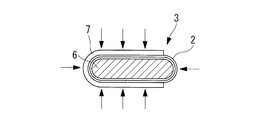
- FIG. 2 is a cross-sectional view showing a spar hardening process of the tail rotor blade shown in FIG. 1. It is the cross-sectional view which showed the modification of the process of the spar hardening shown in FIG.
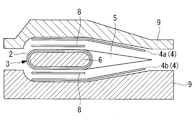
- FIG. 3 is a cross-sectional view showing the blade hardening process of the tail rotor blade in FIG. 1 or FIG. 2.
- 5 is a flowchart showing a molding process of the tail rotor blade shown in FIGS.
- FIG. 1 shows a schematic configuration diagram of a tail rotor blade 1 of a helicopter.
- the tail rotor blade (composite material structure) 1 is a hollow structure formed by a composite material such as a fiber reinforced plastic (FRP).
- FRP fiber reinforced plastic
- the tail rotor blade 1 incorporates an elastic structural member called a flex beam 11. As shown in FIG. 1B, the tail rotor blade 1 includes a tube-shaped component called a spar 3 provided so as to cover the outer periphery of the flex beam 11, an outer plate 4 that is a composite material, and a honeycomb core 5. It is mainly composed.
- the flex beam 11 has a long axis in the longitudinal direction of the tail rotor blade 1 and is built in the spar 3 so as to hold the tail rotor blade 1.
- the spar 3 is formed into a tube shape by a composite material mainly composed of carbon fiber reinforced plastic (CFRP: Carbon Fiber Reinforced Plastics).
- CFRP Carbon Fiber Reinforced Plastics
- the spar 3 has an elliptical cross-sectional shape perpendicular to the longitudinal direction of the tail rotor blade 1, and the elliptical shape has a long axis in the direction perpendicular to the longitudinal direction of the tail rotor blade 1 (the width direction of the spar 3).
- the spar 3 is divided into a plurality of pieces in the longitudinal direction of the tail rotor blade 1.
- the inner molding surface of the spar 3 is molded into a shape capable of incorporating the flex beam 11 using an inner mold jig (not shown) described later.
- a honeycomb core 5 is provided on the rear edge of the spar 3 (on the right side in FIG. 1B).
- the honeycomb core 5 is provided at the rear edge of the spar 3.
- the honeycomb core 5 has a wedge-shaped cross section as shown in FIG. 1B, which is perpendicular to the longitudinal direction of the tail rotor blade 1.
- the wedge-shaped honeycomb core 5 has a tapered shape from the front edge to the rear edge.
- the outer plate 4 is provided so as to sandwich the honeycomb core 5 and the spar 3 provided on the front edge of the honeycomb core 5.
- a composite material mainly composed of glass fiber reinforced plastic GFRP: Glass Fiber Reinforced Plastic
- the outer plate 4 has an upper surface outer plate 4a and a lower surface outer plate 4b, and is provided such that the spar 3 and the honeycomb core 5 are sandwiched between the upper surface outer plate 4a and the lower surface outer plate 4b. Yes.
- the upper surface outer plate 4a and the lower surface outer plate 4b are formed by using an outer mold jig (not shown) described later so that the spar 3 and the honeycomb core 5 are interposed between the upper surface outer plate 4a and the lower surface outer plate 4b.
- the cross-sectional shape perpendicular to the longitudinal direction of the tail rotor blade 1 is sandwiched so as to be a wing shape.
- FIGS. 2 to 4 are cross-sectional views showing the respective steps of forming the tail rotor blade 1 of the present embodiment
- FIG. 5 is a flowchart of the forming steps shown in FIGS. It is shown.
- the prepreg 2 in the winding step of winding the prepreg 2 around the inner mold jig 6, the prepreg 2 is wound around the outer peripheral surface of the inner mold jig 6, and then the prepreg 2 is cured to form the spar 3. Molding is performed (step S1 in FIG. 5).
- the inner jig 6 has an outer circumferential surface having substantially the same shape as the inner molding surface of the molded spar 3.
- the inner jig 6 is made of a material having higher rigidity than a pressure bag, a thermoplastic foam material, or the like conventionally used for forming the inner molding surface of the spar 3.
- an aluminum alloy Invar alloys and composite materials are also used.
- the prepreg 2 is wound around the outer peripheral surface of the inner jig 6 and then wound around the inner jig 6 as in the winding step shown in FIG. 3.
- the spar 3 may be formed by providing an intermediate jig 7 outside the prepreg 2 and curing the prepreg 2.
- the inner jig 6 has the same shape and material as in FIG.
- the middle die 7 has an inner peripheral surface that is substantially the same shape as the outer molding surface of the molded spar 3, and as shown in FIG. 3 is provided on the outer periphery.
- the middle jig 7 is formed of a material having lower rigidity than the inner mold 6 (softer than the inner jig 6).
- the middle jig 7 is removed.
- the surface accuracy of the shape of the outer molding surface of the molded spar 3 is improved as compared with the case of FIG. Can do.
- the plate thickness of the spar 3 formed in the winding process of FIG. 2 or FIG. 3 is measured. Based on the plate thickness measurement result, the number of layers of the adjustment ply (ply) is set. By adjusting the number of layers of the adjustment ply (not shown), the spar 3 has a predetermined plate thickness. Thereby, when the outer plate 4 (see FIG. 4) described later is provided and the tail rotor blade 1 (see FIG. 1) is formed, the tail rotor blade 1 can be adjusted to have a predetermined plate thickness.
- the honeycomb core 5 is provided on the rear edge side of the spar 3 (step S2 in FIG. 5). Further, the set adjustment ply 8 is laminated on the outer periphery of the prepreg 2 wound around the inner die 6 (lamination process). The adjustment ply 8 is provided substantially parallel to the spar 3 from above and below the spar 3.
- the upper surface outer plate 4a and the lower surface outer plate 4b of the composite material are provided on the outer periphery of the inner mold jig 6 and the honeycomb core 5 on which the adjustment ply 8 is stacked so as to sandwich them. Furthermore, an outer jig 9 that can be divided vertically is mounted from outside the upper surface outer plate 4a and the lower surface outer plate 4b. After mounting the inner jig 6, the honeycomb core 5, the upper surface outer plate 4 a, and the lower surface outer plate 4 b on which the adjustment ply 8 is laminated in this manner on the outer die jig 9, these are cured by an autoclave and molded (molding) Step, step S3 in FIG.
- the outer jig 9 that can be divided vertically is removed. Further, the inner jig 6 is pulled out from the inside of the spar 3. Thereby, the molding of the tail rotor blade 1 is completed.
- the following operational effects can be obtained.
- the prepreg 2 is wound around an inner mold jig 6, an adjustment ply 8 is laminated on the wound prepreg 2, and then a composite outer plate 4 is provided and mounted on the outer mold jig 9 to be molded. It was decided. Therefore, the shape and dimensions of the inner molding surface of the spar 3 constituting the tail rotor blade (composite material structure) 1 are formed by the inner die jig 6 and the outer side of the tail rotor blade 1 is formed by the outer die jig 9. The shape and dimensions of the molding surface can be molded.
- the adjustment of the plate thickness of the tail rotor blade 1 is facilitated by forming the outer ply 4 by laminating the adjustment ply 8 on the prepreg 2 wound around the inner jig 6. Therefore, the tail rotor blade 1 with improved shape and dimensional accuracy of the inner molding surface and the outer molding surface can be obtained.
- the adjustment ply 8 is used to adjust the plate thickness of the tail rotor blade 1.
- the present invention is not limited to this, and an adhesive is used instead of the adjustment ply 8. Also good.
- the composite structure formed by the forming method of the present invention is not limited to the tail rotor blade 1 of the helicopter, and can be applied to, for example, an aircraft blade or a windmill blade.
- the molding method of the composite material structure of the present embodiment is different from the first embodiment in that the outer plate is an uncured composite material, and the others are the same. Therefore, the description of the same configuration and process is omitted.
- An uncured composite material is used for the upper surface outer plate (outer plate) and the lower surface outer plate (outer plate) provided so as to sandwich the spar and the honeycomb core.
- An outer die jig that can be divided into upper and lower parts is assembled from the outside of the upper surface outer plate of the uncured composite material and the lower surface outer plate, and is cured by an autoclave.
- the following operational effects can be obtained.
- the upper surface outer plate (outer plate) and the lower surface outer plate (outer plate) of the uncured composite material were provided on the outer periphery of the laminated ply (ply) laminated on the inner jig. Therefore, the thickness of the tail rotor blade (composite structure) can be adjusted by the resin flow of the upper surface outer plate and the lower surface outer plate when the outer die jig is mounted and molded. Therefore, it is easier to adjust the thickness of the tail rotor blade.
- the adjustment ply 8 is described as being laminated on the prepreg 2 wound around the inner jig 6 (see FIG. 1), but the present invention is limited to this. Instead, the outer plate 4 that is a composite material may be provided on the outer periphery of the prepreg 2 wound around the inner jig 6, and then the adjustment ply 8 may be laminated on the outer plate 4.
Landscapes
- Engineering & Computer Science (AREA)
- Mechanical Engineering (AREA)
- Chemical & Material Sciences (AREA)
- Composite Materials (AREA)
- Moulding By Coating Moulds (AREA)
- Casting Or Compression Moulding Of Plastics Or The Like (AREA)
Abstract
L'invention porte sur un procédé de formage, pour une structure en matière composite, qui est apte à améliorer la précision de la forme et des dimensions de l'intérieur de la structure en matière composite. Un procédé de formage pour une structure en matière composite est caractérisé en ce qu'il comprend : une étape d'enroulement consistant à enrouler un pré-imprégné (2) autour d'un gabarit de moule intérieur (6) ; une étape d'empilement pour empiler des nappes (8) sur le pré-imprégné (2) enroulé autour du gabarit de moule intérieur (6) ; et une étape de formage consistant à placer des plaques extérieures (4a, 4b) produites en une matière composite sur la périphérie extérieure du gabarit d'outil intérieur (6) sur laquelle les nappes (8) sont empilées, à fixer un gabarit d'outil extérieur divisé (9) et à exécuter le formage.
Priority Applications (2)
| Application Number | Priority Date | Filing Date | Title |
|---|---|---|---|
| EP12763405.3A EP2692511B1 (fr) | 2011-03-28 | 2012-01-13 | Procédé de formage pour une structure de matière composite |
| US13/876,012 US9833945B2 (en) | 2011-03-28 | 2012-01-13 | Composite material structure forming method |
Applications Claiming Priority (2)
| Application Number | Priority Date | Filing Date | Title |
|---|---|---|---|
| JP2011070605A JP5738033B2 (ja) | 2011-03-28 | 2011-03-28 | 複合材構造体の成形方法 |
| JP2011-070605 | 2011-03-28 |
Publications (1)
| Publication Number | Publication Date |
|---|---|
| WO2012132497A1 true WO2012132497A1 (fr) | 2012-10-04 |
Family
ID=46930265
Family Applications (1)
| Application Number | Title | Priority Date | Filing Date |
|---|---|---|---|
| PCT/JP2012/050613 Ceased WO2012132497A1 (fr) | 2011-03-28 | 2012-01-13 | Procédé de formage pour une structure de matière composite |
Country Status (4)
| Country | Link |
|---|---|
| US (1) | US9833945B2 (fr) |
| EP (1) | EP2692511B1 (fr) |
| JP (1) | JP5738033B2 (fr) |
| WO (1) | WO2012132497A1 (fr) |
Families Citing this family (4)
| Publication number | Priority date | Publication date | Assignee | Title |
|---|---|---|---|---|
| KR102161158B1 (ko) * | 2018-11-16 | 2020-09-29 | 한국항공우주연구원 | 복합재 샌드위치구조물 제조방법 |
| CN112008990B (zh) * | 2020-08-14 | 2022-03-29 | 威海锦阳电子有限公司 | 线性压缩机磁桶加工方法 |
| CN112297470B (zh) * | 2020-10-10 | 2022-03-29 | 江西洪都航空工业集团有限责任公司 | 一种复材垂直安定面成型模具 |
| US20250361814A1 (en) * | 2024-05-23 | 2025-11-27 | General Electric Company | Composite airfoil for a turbine engine |
Citations (7)
| Publication number | Priority date | Publication date | Assignee | Title |
|---|---|---|---|---|
| JPS5016298A (fr) * | 1973-05-30 | 1975-02-20 | ||
| JPS60166593A (ja) * | 1983-10-26 | 1985-08-29 | アグスタ ソチエタ ペル アツィオニ | ヘリコプタプレ−ド用長手部材とその製造方法 |
| US4657615A (en) * | 1984-08-20 | 1987-04-14 | The Boeing Company | Composite leading edge/spar member for an aircraft control surface |
| JPS6324446B2 (fr) | 1981-09-30 | 1988-05-20 | Kawasaki Heavy Ind Ltd | |
| JPH04235004A (ja) * | 1991-01-11 | 1992-08-24 | Kawasaki Heavy Ind Ltd | ロービングプリプレグの積層方法及びその装置 |
| JP3631493B2 (ja) | 1994-08-31 | 2005-03-23 | ユナイテッド テクノロジーズ コーポレイション | ヘリコプタロータブレード用の複合材スパー及びその製造方法 |
| JP2007503533A (ja) * | 2003-08-22 | 2007-02-22 | シコルスキー エアクラフト コーポレイション | ロータブレードの編組翼桁とその製造方法 |
Family Cites Families (5)
| Publication number | Priority date | Publication date | Assignee | Title |
|---|---|---|---|---|
| FR2381662A1 (fr) * | 1977-02-28 | 1978-09-22 | Aerospatiale | Pale, notamment pour un rotor d'helicoptere, et son procede de fabrication |
| US4169749A (en) * | 1977-09-21 | 1979-10-02 | The United States Of America As Represented By The Secretary Of The Navy | Method of making a hollow airfoil |
| GB2040790B (en) * | 1979-02-05 | 1982-10-13 | Westland Aircraft Ltd | Moulding hollow articles |
| US5125993A (en) * | 1991-07-25 | 1992-06-30 | E. I. Du Pont De Nemours And Company | Method for forming and consolidating a fiber reinforced resin structure |
| DE10011879A1 (de) * | 2000-03-07 | 2001-09-13 | Roll N Ice Taiwan Corp | Verbundkunststoffstruktur und Verfahren zu deren Herstellung |
-
2011
- 2011-03-28 JP JP2011070605A patent/JP5738033B2/ja active Active
-
2012
- 2012-01-13 WO PCT/JP2012/050613 patent/WO2012132497A1/fr not_active Ceased
- 2012-01-13 EP EP12763405.3A patent/EP2692511B1/fr active Active
- 2012-01-13 US US13/876,012 patent/US9833945B2/en active Active
Patent Citations (7)
| Publication number | Priority date | Publication date | Assignee | Title |
|---|---|---|---|---|
| JPS5016298A (fr) * | 1973-05-30 | 1975-02-20 | ||
| JPS6324446B2 (fr) | 1981-09-30 | 1988-05-20 | Kawasaki Heavy Ind Ltd | |
| JPS60166593A (ja) * | 1983-10-26 | 1985-08-29 | アグスタ ソチエタ ペル アツィオニ | ヘリコプタプレ−ド用長手部材とその製造方法 |
| US4657615A (en) * | 1984-08-20 | 1987-04-14 | The Boeing Company | Composite leading edge/spar member for an aircraft control surface |
| JPH04235004A (ja) * | 1991-01-11 | 1992-08-24 | Kawasaki Heavy Ind Ltd | ロービングプリプレグの積層方法及びその装置 |
| JP3631493B2 (ja) | 1994-08-31 | 2005-03-23 | ユナイテッド テクノロジーズ コーポレイション | ヘリコプタロータブレード用の複合材スパー及びその製造方法 |
| JP2007503533A (ja) * | 2003-08-22 | 2007-02-22 | シコルスキー エアクラフト コーポレイション | ロータブレードの編組翼桁とその製造方法 |
Non-Patent Citations (1)
| Title |
|---|
| See also references of EP2692511A4 |
Also Published As
| Publication number | Publication date |
|---|---|
| EP2692511A1 (fr) | 2014-02-05 |
| EP2692511B1 (fr) | 2019-10-16 |
| US20130199709A1 (en) | 2013-08-08 |
| US9833945B2 (en) | 2017-12-05 |
| EP2692511A4 (fr) | 2014-12-10 |
| JP5738033B2 (ja) | 2015-06-17 |
| JP2012201093A (ja) | 2012-10-22 |
Similar Documents
| Publication | Publication Date | Title |
|---|---|---|
| KR101786342B1 (ko) | 멀티박스 날개 보 및 표면 | |
| CN109562578B (zh) | 复合材料结构体和复合材料结构体的制造方法 | |
| US9669581B2 (en) | Method for manufacturing an aeronautical torsion box, torsion box and tool for manufacturing an aeronautical torsion box | |
| KR101864051B1 (ko) | 복합재를 이용한 경량 날개 및 블레이드 제조방법 | |
| CA2726594C (fr) | Structure de fuselage d'aeronef en materiau composite a ame stabilisee | |
| WO2008152103A4 (fr) | Procédé pour produire des sections de cellules du fuselage d'un avion avec des matériaux fibreux composites, et dispositif associé | |
| CA2685478A1 (fr) | Caisson de torsion multi-longerons integre en materiau composite | |
| WO2011004504A1 (fr) | Pale de turbine éolienne et procédé de fabrication de celle-ci | |
| EP2070694B1 (fr) | Panneau composite et son procédé de fabrication | |
| GB2548947A (en) | Composite structures with stiffeners and method of making the same | |
| CN102712144A (zh) | 双蒙皮结构 | |
| US9051062B1 (en) | Assembly using skeleton structure | |
| US9649820B1 (en) | Assembly using skeleton structure | |
| CN114889233B (zh) | 一种轻型翼肋及其成型方法 | |
| JP5738033B2 (ja) | 複合材構造体の成形方法 | |
| CN114801237A (zh) | 一种全高度包边夹芯复合材料制件的成型方法 | |
| WO2019059260A1 (fr) | Procédé de moulage d'une lame en matériau composite, lame en matériau composite et matrice de moulage pour lame en matériau composite | |
| US11383828B2 (en) | Landing gear of rotorcraft | |
| CN110712324B (zh) | 一种复合材料机翼成型装配一体化模具 | |
| CN112793185A (zh) | 一种用于t型加筋壁板复合材料的共固化成型方法 | |
| CN110757838A (zh) | 一种复合材料机翼及成型装配一体化成型方法 | |
| CN106585955B (zh) | 无人机机翼一体复合梁结构及其制造方法 | |
| WO2019069639A1 (fr) | Procédé de fabrication d'un élément en résine renforcé par des fibres, réservoir à carburant et élément en résine renforcé par des fibres | |
| GB2533369A (en) | Method of forming a Laminar composite structure | |
| US20240217645A1 (en) | Main body of an aerial vehicle |
Legal Events
| Date | Code | Title | Description |
|---|---|---|---|
| 121 | Ep: the epo has been informed by wipo that ep was designated in this application |
Ref document number: 12763405 Country of ref document: EP Kind code of ref document: A1 |
|
| WWE | Wipo information: entry into national phase |
Ref document number: 13876012 Country of ref document: US |
|
| WWE | Wipo information: entry into national phase |
Ref document number: 2012763405 Country of ref document: EP |
|
| NENP | Non-entry into the national phase |
Ref country code: DE |