WO2012132537A1 - Courroie de transmission par friction - Google Patents
Courroie de transmission par friction Download PDFInfo
- Publication number
- WO2012132537A1 WO2012132537A1 PCT/JP2012/052207 JP2012052207W WO2012132537A1 WO 2012132537 A1 WO2012132537 A1 WO 2012132537A1 JP 2012052207 W JP2012052207 W JP 2012052207W WO 2012132537 A1 WO2012132537 A1 WO 2012132537A1
- Authority
- WO
- WIPO (PCT)
- Prior art keywords
- elastomer
- rubber
- viscosity elastomer
- transmission belt
- friction transmission
- Prior art date
- Legal status (The legal status is an assumption and is not a legal conclusion. Google has not performed a legal analysis and makes no representation as to the accuracy of the status listed.)
- Ceased
Links
Images


Classifications
-
- F—MECHANICAL ENGINEERING; LIGHTING; HEATING; WEAPONS; BLASTING
- F16—ENGINEERING ELEMENTS AND UNITS; GENERAL MEASURES FOR PRODUCING AND MAINTAINING EFFECTIVE FUNCTIONING OF MACHINES OR INSTALLATIONS; THERMAL INSULATION IN GENERAL
- F16G—BELTS, CABLES, OR ROPES, PREDOMINANTLY USED FOR DRIVING PURPOSES; CHAINS; FITTINGS PREDOMINANTLY USED THEREFOR
- F16G5/00—V-belts, i.e. belts of tapered cross-section
- F16G5/04—V-belts, i.e. belts of tapered cross-section made of rubber
- F16G5/06—V-belts, i.e. belts of tapered cross-section made of rubber with reinforcement bonded by the rubber
- F16G5/08—V-belts, i.e. belts of tapered cross-section made of rubber with reinforcement bonded by the rubber with textile reinforcement
-
- B—PERFORMING OPERATIONS; TRANSPORTING
- B29—WORKING OF PLASTICS; WORKING OF SUBSTANCES IN A PLASTIC STATE IN GENERAL
- B29D—PRODUCING PARTICULAR ARTICLES FROM PLASTICS OR FROM SUBSTANCES IN A PLASTIC STATE
- B29D29/00—Producing belts or bands
-
- C—CHEMISTRY; METALLURGY
- C08—ORGANIC MACROMOLECULAR COMPOUNDS; THEIR PREPARATION OR CHEMICAL WORKING-UP; COMPOSITIONS BASED THEREON
- C08J—WORKING-UP; GENERAL PROCESSES OF COMPOUNDING; AFTER-TREATMENT NOT COVERED BY SUBCLASSES C08B, C08C, C08F, C08G or C08H
- C08J5/00—Manufacture of articles or shaped materials containing macromolecular substances
- C08J5/04—Reinforcing macromolecular compounds with loose or coherent fibrous material
-
- C—CHEMISTRY; METALLURGY
- C08—ORGANIC MACROMOLECULAR COMPOUNDS; THEIR PREPARATION OR CHEMICAL WORKING-UP; COMPOSITIONS BASED THEREON
- C08J—WORKING-UP; GENERAL PROCESSES OF COMPOUNDING; AFTER-TREATMENT NOT COVERED BY SUBCLASSES C08B, C08C, C08F, C08G or C08H
- C08J5/00—Manufacture of articles or shaped materials containing macromolecular substances
- C08J5/04—Reinforcing macromolecular compounds with loose or coherent fibrous material
- C08J5/06—Reinforcing macromolecular compounds with loose or coherent fibrous material using pretreated fibrous materials
-
- C—CHEMISTRY; METALLURGY
- C08—ORGANIC MACROMOLECULAR COMPOUNDS; THEIR PREPARATION OR CHEMICAL WORKING-UP; COMPOSITIONS BASED THEREON
- C08L—COMPOSITIONS OF MACROMOLECULAR COMPOUNDS
- C08L23/00—Compositions of homopolymers or copolymers of unsaturated aliphatic hydrocarbons having only one carbon-to-carbon double bond; Compositions of derivatives of such polymers
- C08L23/02—Compositions of homopolymers or copolymers of unsaturated aliphatic hydrocarbons having only one carbon-to-carbon double bond; Compositions of derivatives of such polymers not modified by chemical after-treatment
- C08L23/16—Ethylene-propylene or ethylene-propylene-diene copolymers
-
- C—CHEMISTRY; METALLURGY
- C08—ORGANIC MACROMOLECULAR COMPOUNDS; THEIR PREPARATION OR CHEMICAL WORKING-UP; COMPOSITIONS BASED THEREON
- C08L—COMPOSITIONS OF MACROMOLECULAR COMPOUNDS
- C08L77/00—Compositions of polyamides obtained by reactions forming a carboxylic amide link in the main chain; Compositions of derivatives of such polymers
-
- F—MECHANICAL ENGINEERING; LIGHTING; HEATING; WEAPONS; BLASTING
- F16—ENGINEERING ELEMENTS AND UNITS; GENERAL MEASURES FOR PRODUCING AND MAINTAINING EFFECTIVE FUNCTIONING OF MACHINES OR INSTALLATIONS; THERMAL INSULATION IN GENERAL
- F16G—BELTS, CABLES, OR ROPES, PREDOMINANTLY USED FOR DRIVING PURPOSES; CHAINS; FITTINGS PREDOMINANTLY USED THEREFOR
- F16G5/00—V-belts, i.e. belts of tapered cross-section
- F16G5/04—V-belts, i.e. belts of tapered cross-section made of rubber
- F16G5/06—V-belts, i.e. belts of tapered cross-section made of rubber with reinforcement bonded by the rubber
-
- F—MECHANICAL ENGINEERING; LIGHTING; HEATING; WEAPONS; BLASTING
- F16—ENGINEERING ELEMENTS AND UNITS; GENERAL MEASURES FOR PRODUCING AND MAINTAINING EFFECTIVE FUNCTIONING OF MACHINES OR INSTALLATIONS; THERMAL INSULATION IN GENERAL
- F16G—BELTS, CABLES, OR ROPES, PREDOMINANTLY USED FOR DRIVING PURPOSES; CHAINS; FITTINGS PREDOMINANTLY USED THEREFOR
- F16G5/00—V-belts, i.e. belts of tapered cross-section
- F16G5/20—V-belts, i.e. belts of tapered cross-section with a contact surface of special shape, e.g. toothed
-
- C—CHEMISTRY; METALLURGY
- C08—ORGANIC MACROMOLECULAR COMPOUNDS; THEIR PREPARATION OR CHEMICAL WORKING-UP; COMPOSITIONS BASED THEREON
- C08L—COMPOSITIONS OF MACROMOLECULAR COMPOUNDS
- C08L2205/00—Polymer mixtures characterised by other features
- C08L2205/02—Polymer mixtures characterised by other features containing two or more polymers of the same C08L -group
-
- C—CHEMISTRY; METALLURGY
- C08—ORGANIC MACROMOLECULAR COMPOUNDS; THEIR PREPARATION OR CHEMICAL WORKING-UP; COMPOSITIONS BASED THEREON
- C08L—COMPOSITIONS OF MACROMOLECULAR COMPOUNDS
- C08L2205/00—Polymer mixtures characterised by other features
- C08L2205/02—Polymer mixtures characterised by other features containing two or more polymers of the same C08L -group
- C08L2205/025—Polymer mixtures characterised by other features containing two or more polymers of the same C08L -group containing two or more polymers of the same hierarchy C08L, and differing only in parameters such as density, comonomer content, molecular weight, structure
-
- C—CHEMISTRY; METALLURGY
- C08—ORGANIC MACROMOLECULAR COMPOUNDS; THEIR PREPARATION OR CHEMICAL WORKING-UP; COMPOSITIONS BASED THEREON
- C08L—COMPOSITIONS OF MACROMOLECULAR COMPOUNDS
- C08L2205/00—Polymer mixtures characterised by other features
- C08L2205/14—Polymer mixtures characterised by other features containing polymeric additives characterised by shape
- C08L2205/16—Fibres; Fibrils
-
- C—CHEMISTRY; METALLURGY
- C08—ORGANIC MACROMOLECULAR COMPOUNDS; THEIR PREPARATION OR CHEMICAL WORKING-UP; COMPOSITIONS BASED THEREON
- C08L—COMPOSITIONS OF MACROMOLECULAR COMPOUNDS
- C08L77/00—Compositions of polyamides obtained by reactions forming a carboxylic amide link in the main chain; Compositions of derivatives of such polymers
- C08L77/02—Polyamides derived from omega-amino carboxylic acids or from lactams thereof
-
- C—CHEMISTRY; METALLURGY
- C08—ORGANIC MACROMOLECULAR COMPOUNDS; THEIR PREPARATION OR CHEMICAL WORKING-UP; COMPOSITIONS BASED THEREON
- C08L—COMPOSITIONS OF MACROMOLECULAR COMPOUNDS
- C08L77/00—Compositions of polyamides obtained by reactions forming a carboxylic amide link in the main chain; Compositions of derivatives of such polymers
- C08L77/06—Polyamides derived from polyamines and polycarboxylic acids
Definitions
- the present invention relates to a friction transmission belt such as a V-ribbed belt used in a high tension / high load environment.
- a friction transmission belt such as a V-ribbed belt is widely used as a belt for transmitting power to an auxiliary machine.
- friction transmission belts have been increasingly used in high tension and high load environments due to the reduction in the number of ribs and belt widths due to the downsizing of engines and the increased burden of driving auxiliary equipment. Therefore, in the friction transmission belt, a rubber having a high modulus and a high tear resistance has been required for the adhesive rubber around the core wire, which is a tensile member.
- Patent Document 1 in a V-ribbed belt used in a high load environment, it is known that a short fiber is mixed in at least a part of the adhesive rubber so that the adhesive rubber has a high modulus.
- the short fiber normal nylon fiber, aramid fiber, or modified nylon microfiber obtained by bonding polyolefin to nylon fiber is used.
- the rubber component of the adhesive rubber for example, EPDM is used in order to improve heat resistance and durability. JP 2007-198485 A
- the present invention provides a friction transmission belt that increases the modulus and tear resistance of the adhesive rubber, makes it difficult to cause cord separation, and can appropriately knead the rubber composition of the adhesive rubber. Objective.
- the friction transmission belt according to the present invention is a friction transmission belt formed of rubber and embedded with a core wire extending in the longitudinal direction of the belt. At least a part of the rubber surrounding the core wire is made of a high-viscosity elastomer (first Component) and a low-viscosity elastomer (second component) are vulcanized and contain modified nylon microfibers, and the high-viscosity elastomer comprises an ethylene-propylene copolymer and an ethylene-propylene diene ternary heavy It is at least one elastomer selected from the group consisting of coalescence, and the low viscosity elastomer has a lower Mooney viscosity than the high viscosity elastomer.
- first Component high-viscosity elastomer
- second component low-viscosity elastomer
- the Mooney viscosity of the low-viscosity elastomer is preferably 10 or less, and the Mooney viscosity of the high-viscosity elastomer is preferably 50 or more.
- the weight ratio of the high viscosity elastomer to the low viscosity elastomer is preferably 95: 5 to 50:50.
- the amount of the nylon fiber of the modified nylon microfiber is preferably 10 parts by weight or more with respect to 100 parts by weight of the elastomer.
- the modified nylon microfiber is modified by at least a polyolefin and an elastomer, and specifically, is a nylon fiber in which at least a polyolefin and a third component elastomer are chemically bonded.
- the modified nylon micron fiber may be a nylon fiber bonded to a matrix composed of polyolefin, elastomer, and spherical silica having an average particle diameter of 1 ⁇ m or less and a water content of 1000 ppm or less.
- the low-viscosity elastomer should be at least one elastomer selected from the group consisting of ethylene propylene copolymer and ethylene propylene diene terpolymer.
- the weight ratio between the high-viscosity elastomer and the low-viscosity elastomer is preferably 70:30 to 50:50.
- the friction transmission belt may include a modified nylon microfiber and an adhesive rubber portion formed by vulcanizing the rubber composition.
- the core wire is embedded in the adhesive rubber portion.
- the friction transmission belt includes, for example, a compression rubber portion provided below the adhesive rubber portion.
- the compressed rubber portion contains, for example, short fibers oriented in the belt width direction.
- the adhesive rubber portion may be formed of an upper layer that constitutes the upper side and a lower layer that constitutes the lower side with respect to the core wire.
- both the upper layer and the lower layer contain modified nylon microfibers and are formed by vulcanizing the rubber composition.
- the modified nylon microfiber contained in the upper layer is preferably oriented in the belt width direction
- the modified nylon microfiber contained in the lower layer is preferably oriented in the belt longitudinal direction.
- the method of manufacturing a friction transmission belt according to the present invention is a method of manufacturing a friction transmission belt formed of rubber and embedded in a core wire extending in the longitudinal direction of the belt.
- the modified nylon microfiber, the high viscosity elastomer, and the low viscosity A first step of kneading the elastomer to obtain a rubber composition, and a second step of forming the rubber composition around the core wire and vulcanizing to form a rubber adhered to the core wire,
- the high viscosity elastomer is at least one elastomer selected from the group consisting of an ethylene propylene copolymer and an ethylene propylene diene terpolymer, and the low viscosity elastomer has a lower Mooney viscosity than the high viscosity elastomer
- the adhesive rubber according to the present invention is an adhesive rubber provided so as to surround a core wire which is a tensile member of a belt, and at least a part thereof is obtained by vulcanizing a rubber composition containing a high viscosity elastomer and a low viscosity elastomer.
- a modified nylon microfiber, and the high-viscosity elastomer is at least one elastomer selected from the group consisting of an ethylene-propylene copolymer and an ethylene-propylene-diene terpolymer, and a low-viscosity elastomer Is characterized by a lower Mooney viscosity than a high viscosity elastomer.
- the rubber composition according to the present invention includes a modified nylon microfiber, a high viscosity elastomer and a low viscosity elastomer, and the high viscosity elastomer is at least selected from the group consisting of an ethylene propylene copolymer and an ethylene propylene diene terpolymer. It is a type of elastomer and is characterized in that a low viscosity elastomer has a lower Mooney viscosity than a high viscosity elastomer.
- the present invention it is possible to prevent the cord separation from occurring while improving the modulus and tear resistance of the adhesive rubber portion, and to appropriately knead the rubber composition of the adhesive rubber.
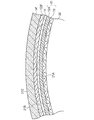
- V-ribbed belt (friction drive belt) 11 Core wire 12 Adhesive rubber part 12A Upper layer 12B Lower layer 14 Compression rubber part 15 Rib 21A, 21B Short fiber (modified nylon microfiber)
- FIG. 1 is a cross-sectional view showing a V-ribbed belt according to an embodiment of the present invention.
- the V-ribbed belt 10 is an endless frictional power transmission belt formed of rubber, and includes an adhesive rubber portion 12, a compression rubber portion 14 formed integrally with the adhesive rubber portion 12 on the lower surface of the adhesive rubber portion 12, and an adhesive rubber. And a canvas 13 attached to the upper surface of the portion 12.
- a core wire 11 that is a tensile member of the belt is embedded in the adhesive rubber portion 12, and the adhesive rubber portion 12 is a rubber that surrounds the core wire 11 and is bonded to the core wire 11.
- the core wire 11 extends in the longitudinal direction of the belt in the adhesive rubber portion 12 and is wound spirally.
- a plurality of (four in this embodiment) ribs 15 are arranged in the compressed rubber portion 14 in the width direction, extending in the longitudinal direction of the belt and having a width that decreases downward.
- the belt 10 engages the compression rubber portion 14 with a pulley, and transmits power on the driving side to the driven side by friction transmission.
- the canvas 13 may be subjected to various impregnation processes such as an RFL process and a rubber paste process in order to improve the adhesion with the upper layer 12A.
- the adhesive rubber portion 12 includes an upper layer 12A that constitutes the upper side of the adhesive rubber portion 12 with the core wire 11 as a boundary, and a lower layer 12B that constitutes the lower side.
- Innumerable short fibers 21A and 21B are mixed substantially uniformly into each of the upper layer 12A and the lower layer 12B.
- the short fibers 21A are oriented in the width direction of the belt
- the short fibers 21B are oriented in the longitudinal direction of the belt.
- the short fibers 21A and 21B are modified nylon microfibers obtained by modifying nylon fibers with polyolefin and elastomer. Specifically, the modified nylon microfiber is obtained by chemically bonding at least a polyolefin and a third component elastomer to a nylon fiber, as will be described later.
- 6-Nylon is preferably used as the nylon fiber used in the modified nylon microfiber, but 6,6-nylon or 6,10-nylon may be used.
- polyethylene is preferably used as the polyolefin, but is not limited to polyethylene, and polypropylene or the like may be used.
- the nylon fiber has a fiber length L F of about 4000 ⁇ m or less, a fiber diameter D F of about 1.5 ⁇ m or less, and a value of the ratio of the fiber length L F to the fiber diameter D F (L F / D F ) is 10 or more, but preferably the fiber length L F is about 1000 ⁇ m or less, the fiber diameter DF is about 1.0 ⁇ m or less, and the ratio value (L F / D F ) Is in the range of 500 to 1000. If the fiber diameter D F and the fiber length L F are large, cracks and cord separation may occur, and the running life of the belt tends to be reduced.
- the amount of nylon fiber of the modified nylon microfiber is 10 parts by weight or more, preferably 10 to 10 parts by weight with respect to 100 parts by weight of the elastomer of each of the upper layer 12A and the lower layer 12B. 15 parts by weight.
- the modulus of the upper layer 12A and the lower layer 12B can be increased, and the running life of the belt can be remarkably improved.
- 15 weight part or more is mix
- the adhesive rubber portion 12 (upper layer 12A and lower layer 12B) is composed of a high-viscosity elastomer as the first component, a low-viscosity elastomer as the second component, and a third-component elastomer (modified fiber-containing elastomer) including modified nylon microfibers. ) And a rubber composition (rubber composition for an adhesive rubber part) obtained by vulcanization.
- the high viscosity elastomer is an elastomer having a Mooney viscosity of 50 or more
- the low viscosity elastomer is an elastomer having a Mooney viscosity of 10 or less and a Mooney viscosity lower than that of the high viscosity elastomer.
- the Mooney viscosity of the high viscosity elastomer is preferably 50 to 150.
- the Mooney viscosity is a Mooney viscosity (ML 1 + 4 , 125 ° C.) measured at 125 ° C. according to JIS K6300.
- an ethylene propylene copolymer (hereinafter referred to as EPM) having a Mooney viscosity of 50 or more, an ethylene propylene diene terpolymer (hereinafter referred to as EPDM), or a mixture thereof is used.
- EPM ethylene propylene copolymer having a Mooney viscosity of 50 or more
- EPDM ethylene propylene diene terpolymer
- the low-viscosity elastomer EPM or EPDM having a Mooney viscosity of 10 or less, or a mixture thereof is used, but other ethylene- ⁇ -olefin copolymers such as ethylene-1-octene copolymer are used. An elastomer other than the ethylene- ⁇ -olefin copolymer may be used.
- EPM or EPDM when EPM or EPDM is used as the low-viscosity elastomer, the durability of the V-ribbed belt 10 becomes better.
- the weight ratio of high-viscosity elastomer: low-viscosity elastomer is 95: 5 to 50:50.
- mixing temperature can be made favorable, and the adhesive rubber part 12 can be made into a high modulus.
- the low-viscosity elastomer is EPM, EPDM, or a mixture thereof
- the weight ratio of high-viscosity elastomer: low-viscosity elastomer is preferably 70:30 to 50:50, particularly preferably 65: 35-55: 45. By setting the weight ratio in such a range, the belt life can be further improved.
- the fiber-containing elastomer includes (a) polyolefin, (b) third component elastomer, and (c) ultrafine nylon fiber, and these (a) component and (b) component constitute a matrix.
- Nylon fibers are dispersed therein, and the nylon fibers are chemically bonded to the component (a) and the component (b).
- the chemical bond between the nylon fiber and the component (a) or the component (b) is made by, for example, a silane coupling agent.
- Such fiber-filled elastomers are disclosed, for example, in JP-A-7-278360 and JP-A-9-59435.
- the fiber-filled elastomer also includes (d) spherical silica having an average particle size of 1 ⁇ m or less and a water content of 1000 ppm or less (hereinafter referred to as small particle size spherical silica), Nylon fibers may be dispersed in a matrix constituted by the components (a), (b), and (d), and the nylon fibers may be chemically bonded to the matrix.
- the modified nylon microfiber can be made to have higher strength by including the small particle size spherical silica in the matrix bonded to the nylon fiber.
- the polyolefin is preferably blended in an amount of 1 to 40 parts by weight with respect to 100 parts by weight of the elastomer.
- the small particle size spherical silica is preferably blended in an amount of 1 to 50 parts by weight with respect to 100 parts by weight of the elastomer.
- the average particle diameter means a value measured by a laser diffraction / scattering method using a laser diffraction / scattering particle size distribution analyzer LA-750 manufactured by Horiba, Ltd. Specifically, the sample is gradually put into a measurement tank of a measuring device, the concentration is adjusted so that the light transmittance becomes a reference value, and then measured according to automatic measurement of the measuring device.
- the amount of water means that 10 g of a sample is weighed in a crucible, heated in a dryer adjusted to 105 ° C. for 2 hours, then cooled in a desiccator so as not to absorb moisture, and the sample is weighed after cooling. Refers to weight loss.
- the third component elastomer contained in the fiber-containing elastomer is further less than the second component (weight), and is preferably EPM, EPDM, or a mixture thereof.
- the third component elastomer for example, one having a Mooney viscosity lower than that of the high viscosity elastomer and higher than that of the low viscosity elastomer is used.
- the rubber composition (rubber composition for the adhesive rubber part) of the upper layer 12A and the lower layer 12B has an average particle size other than the above-mentioned small particle size spherical silica, in addition to the high viscosity elastomer, the low viscosity elastomer and the fiber-containing elastomer.
- Various additives such as a large large particle size silica, a filler such as carbon black, a vulcanizing agent, a vulcanization aid, an anti-aging agent, a retarder, and a metal cross-linking agent are blended.
- the rubber composition for forming the upper layer 12A and the lower layer 12B may have the same composition, but may have different compositions.
- innumerable short fibers 21 ⁇ / b> C are mixed in the compressed rubber portion 14 substantially uniformly.
- the short fibers 21C are oriented in the width direction of the belt. A part of the short fiber 21C is exposed on the surface of the compressed rubber portion 14 or protrudes from the surface, thereby reducing the friction coefficient of the surface of the compressed rubber portion 14 and suppressing the generation of abnormal noise during belt running. Is possible.
- fibers having a diameter larger than the short fibers 21A and 21B, which are modified nylon microfibers, are used in order to sufficiently reduce the friction coefficient.
- the short fibers 21C for example, an aramid short fiber is used when the belt is used under a high load environment, and a nylon short fiber is used when it is necessary to sufficiently suppress the generation of abnormal noise during belt running. used. Further, it is preferable to use EPM, EPDM or the like as the elastomer of the compressed rubber portion 14.
- the rubber composition for an adhesive rubber part is produced as follows. First, an elastomer containing fibers, an unvulcanized high-viscosity elastomer, and a low-viscosity elastomer are put together with a predetermined additive into a kneader and kneaded and homogenized at a predetermined heating temperature (for example, 150 ° C. or higher). (Primary training). In the primary kneading, additives such as a vulcanizing agent that vulcanizes the elastomer when heated to the heating temperature of the primary kneading are not added.
- nylon fibers which is intended to be pre-subdivided in fiber-filled elastomer may have a fiber diameter D F and fiber length L F that is subdivided described above in the primary kneading and secondary kneading.
- a calendar device (not shown) is used to prepare a rubber-equipped canvas 31 in which an unvulcanized rubber layer 12 ⁇ / b> A ′ is laminated on one surface of the canvas 13.
- the rubber composition for the adhesive rubber part is rolled on the canvas 13 supplied by the roller along the direction corresponding to the rolling direction while being rolled by the roller of the calender device. Attached canvas 31 is obtained.
- the short fibers 21A blended in the rubber composition are oriented in the rolling direction (that is, the supply direction of the canvas).
- the rubber-equipped canvas 31 is wound around the outer circumference of the cylindrical mandrel 30 so that the canvas 13 side faces the inside and the rubber layer 12A 'side faces the outside.
- the canvas 31 with rubber is wound so that the orientation direction of the short fibers 21 ⁇ / b> A coincides with the axial direction of the mandrel 30. That is, the canvas 13 is arranged so that the direction supplied in the calendar device is along the axial direction in the mandrel 30.
- the core wire 11 is spirally wound on the unvulcanized rubber layer 12 ⁇ / b> A ′ of the canvas 31 with rubber, and the first rubber sheet 12 ⁇ / b> B ′ is wound on the core wire 11.
- the first rubber sheet 12B ′ is obtained by rolling the rubber composition for the adhesive rubber part with a calender or the like and orienting the short fibers 21B (modified nylon microfibers) in the rolling direction.
- the orientation direction of the short fibers 21 ⁇ / b> B is matched with the circumferential direction of the mandrel 30.
- the core wire 11 is arrange
- a second rubber sheet 14 ' is wound on the first rubber sheet 12B'.
- the second rubber sheet 14 ′ is obtained by rolling a rubber composition for forming the compressed rubber portion 14 with a calender or the like and orienting the short fibers 21C in the rolling direction.
- the orientation direction of the fibers 21 ⁇ / b> C is matched with the axial direction of the mandrel 30.
- the mandrel 30 is placed in a vulcanizing pot (not shown) and heated under pressure at a predetermined temperature and pressure.
- 'Is vulcanized and integrated to obtain a flat belt-like vulcanized sleeve.
- the vulcanization sleeve is cut to a predetermined width and polished by a polishing machine (not shown) to obtain a V-ribbed belt 10 (see FIG. 1) in which ribs 15 are formed.
- the rubber layer 12A ′ and the rubber sheets 12B ′ and 14 ′ are the upper layer 12A, the lower layer 12B, and the compressed rubber portion 14 in the V-ribbed belt 10, respectively. Further, by aligning the fiber orientation directions in the rubber layer 12A ′ and the rubber sheets 12B ′ and 14 ′ with the axial direction or the circumferential direction of the mandrel 30, the orientation directions of the short fibers 21A to 21C in the V-ribbed belt 10 are as described above. Thus, it coincides with the width direction or longitudinal direction of the belt.
- the adhesive rubber can be blended even if a large amount of nylon fiber is blended.
- the rubber composition for parts can be appropriately kneaded.
- the adhesive rubber portion 12 (upper layer 12A, lower layer 12B) is combined with a large amount of high-viscosity elastomer, so that a large amount of modified nylon microfibers are mixed. Modulus and tear resistance can be improved and belt durability can be improved.
- the modified nylon micron fiber is used as the short fiber, so that the short fibers 21A and 21B can be bonded to the rubber, and the cord 11 and the adhesive rubber portion 12 can be bonded to each other. Adhesion is improved. Therefore, cord separation, cracks starting from short fibers, and the like are effectively prevented, and the durability of the belt can be further improved.
- the V-ribbed belt when used under high tension and high load, a large stress along the longitudinal direction of the belt is applied to the lower layer of the compression rubber portion or the adhesive rubber portion due to friction with the pulley. May be prematurely damaged by this stress.
- the adhesive rubber part the core wire is shifted in the width direction, and pop-out and cord separation in which the core wire jumps out from the side surface of the belt easily occur.
- the short fibers 21B of the lower layer 12B oriented in the belt longitudinal direction resist the stress along the belt longitudinal direction and prevent the belt from being damaged.
- the short fiber 21A of the upper layer 12A oriented in the belt width direction suppresses the shift of the core wire 11 in the width direction, thereby preventing the core wire from popping out and cord separation. That is, the durability of the V-ribbed belt 10 according to the present embodiment is improved particularly in a high tension / high load environment due to the short fibers 21A and 21B being oriented in a predetermined direction.
- the orientation direction of the short fibers 21A and 21B in the adhesive rubber portion 12 is not limited to the above direction.
- the orientation direction of the short fibers 21B of the lower layer 12B may be along the width direction of the belt, similarly to the upper layer 12A.
- the first rubber sheet 12 ⁇ / b> B ′ is wound around the mandrel 30 so that the orientation direction of the short fibers 21 ⁇ / b> B coincides with the axial direction of the mandrel 30.
- the rubber composition for an adhesive rubber part according to the present embodiment may be used for an adhesive rubber of another friction transmission belt such as a cogged V belt.
- Example 1 First, in a matrix composed of EPDM, high-density polyethylene and small-diameter spherical silica having the composition shown in Table 1, nylon fibers are dispersed and the nylon fibers are bonded to the matrix in the form of pellets. A fiber-filled elastomer (nylon fiber content 25% by weight) was prepared.
- the EPDM in Table 1 was Nodel IP4640 (trade name, manufactured by Dow Chemical Company) having a Mooney viscosity of 40, an ethylene amount of 55%, and a diene amount of 4.9% (diene species: ENB).
- the fiber-containing elastomer, high-viscosity elastomer (EPM), low-viscosity elastomer (EPM), and additives except for the peroxide vulcanizing agent and retarder shown in Table 2 were brought to around 160 ° C. with a closed mixer. These were kneaded by heating to make them uniform (primary kneading). Next, these kneaded ones were transferred to an open roll, added with a peroxide vulcanizing agent and a retarder, and kneaded at a temperature of about 120 ° C. to homogenize them to obtain a rubber composition for an adhesive rubber part.
- the high-viscosity elastomer: low-viscosity elastomer (weight ratio) is 60:40
- the nylon fiber is 11.1 with respect to 100 parts by weight of the elastomer. 25 parts by weight were blended.
- a V-ribbed belt in which the upper layer and the lower layer of the adhesive rubber part were formed by the rubber composition for the adhesive rubber part was manufactured.
- the V-ribbed belt was obtained by vulcanization molding under pressure at 180 ° C. for 25 minutes using a vulcanizer, and the obtained V-ribbed belt was 3PK and had a length of 1040 mm and a width of 10.7 mm.
- the fiber orientation directions in the upper layer, the lower layer, and the compressed rubber portion were the belt width direction, the belt longitudinal direction, and the belt width direction, respectively, as shown in FIG.
- the rubber composition which made EPDM an elastomer and mix
- the low-viscosity elastomer was an ethylene-1-octene copolymer (trade name: Engage 8407P, manufactured by Dow Chemical Co., Ltd.) having a melting point of 110 ° C. and a Mooney viscosity of 2.
- the silicone-modified EPDM was SEP-1411U (trade name, manufactured by Shin-Etsu Chemical Co., Ltd.) having a Mooney viscosity of 28.8.
- Example 2 In addition to the low-viscosity elastomer (EPM), the low-viscosity elastomer (EOM) is blended in the rubber composition for the adhesive rubber part so that the weight ratio of the high-viscosity elastomer: low-viscosity elastomer is 90:10, and various additions are made. The same procedure as in Example 1 was performed except that the blending amount of the agent was adjusted as shown in Table 2.
- Example 3 Example 1 except that the blending amount of the high-viscosity elastomer and low-viscosity elastomer in the rubber composition for the adhesive rubber part was changed so that the weight ratio of high-viscosity elastomer: low-viscosity elastomer was 70:30. It carried out like.
- Example 4 This was carried out in the same manner as in Example 2 except that the orientation direction of the short fibers (modified nylon microfibers) in the lower layer of the adhesive rubber portion was the belt width direction.
- Example 5 By changing the blending amounts of the fiber-filled elastomer, high-viscosity elastomer and low-viscosity elastomer in the rubber composition for the adhesive rubber part, the weight ratio of high-viscosity elastomer: low-viscosity elastomer becomes 70:30, and 100 parts by weight of the elastomer This was carried out in the same manner as in Example 1 except that 5.6 parts by weight of nylon fiber was added.
- Example 1 This was carried out in the same manner as in Example 1 except that the weight ratio of high viscosity elastomer: low viscosity elastomer in the rubber composition for the adhesive rubber part was 100: 0 without blending the low viscosity elastomer.
- the compound could not be kneaded in the secondary kneading at a low kneading temperature, and a rubber composition for an adhesive rubber part could not be obtained. Therefore, in this comparative example, a V-ribbed belt could not be produced using the rubber composition for an adhesive rubber part having the composition shown in Table 2.
- Tear strength was measured according to JIS K6252 using a vulcanized rubber sample as an “angle-shaped test piece without cutting”.
- tear test as in the tensile test, in Examples 1 to 3, and 5, in the case where the short fibers are aligned in a line orientation and in the case where the short fibers are aligned in a reverse direction, each is in a normal temperature environment (23 ° C.). The tear strength was measured under a high temperature environment (120 ° C.).
- the belt 50 of each of the examples and comparative examples is made up of a driving pulley 51 with a pulley diameter of 120 mm, a driven pulley 52 with a pulley diameter of 120 mm, and a tensioner pulley 53 with a pulley diameter of 45 mm arranged on the tension side of the belt. Hung around.
- the belt 50 was reversely bent by an idler pulley 54 having a pulley diameter of 85 mm on the loose side.
- the belt 50 is stretched by the tensioner pulley 53 with a force of 559 N, and the driving pulley 51 is rotated at 4900 rpm so that the maximum tension is 350 N / rib while a load of 8.8 kW is applied to the driven pulley 52.
- the belt 50 was run.
- the belt life was defined as the failure time when the belt 50 was damaged at an environmental temperature of 100 ° C. until it could not run. Further, the time when the belt 50 was first damaged was also measured, and this time was taken as the initial break time.
- the failure mode when the belt 50 reached the belt life and the failure mode when the initial failure occurred were also observed.
- Example 1 For Example 1 and Comparative Example 2, a dematcher test was performed according to JIS K6260 using a vulcanized rubber sample obtained from the rubber composition for the adhesive rubber part, and the flex crack growth durability was evaluated.
- a cut was made in the center of each sample, and bending was repeated 25,000 times at a bending angle of 180 ° in an environment of 120 ° C., and evaluation was performed according to the following criteria.
- bending was repeated 1 million times at a bending angle of 180 ° in a 130 ° C. environment without cutting each sample, and the durability against bending cracks was also evaluated.
- evaluation was performed on each of the samples in which the fibers were oriented in the longitudinal direction of the sample (line arrangement) and the samples in which the fibers were aligned in the width direction (inverse arrangement).
- Comparative Examples 2 and 3 in which the short fibers were not blended in the adhesive rubber part, the tensile strength and tear strength were not good, and the durability of the belt was not good. In Comparative Examples 2 and 3, code separation occurs, and it is considered that unexpected transmission failure is likely to occur. Further, in Example 5 in which the short fiber was blended but the blending amount was less than 10 parts by weight, the tensile strength and tear strength were relatively good, but the running life was not blended with the short fiber. The degree of cord separation was also the same as that of Comparative Example 3. From this, the reason is not clear, but it can be understood that in the present invention, when a large amount of nylon fiber is not added to the adhesive rubber, the physical properties can be improved to some extent, but the belt life can hardly be extended.
Landscapes
- Engineering & Computer Science (AREA)
- Chemical & Material Sciences (AREA)
- General Engineering & Computer Science (AREA)
- Mechanical Engineering (AREA)
- Materials Engineering (AREA)
- Health & Medical Sciences (AREA)
- Chemical Kinetics & Catalysis (AREA)
- Medicinal Chemistry (AREA)
- Polymers & Plastics (AREA)
- Organic Chemistry (AREA)
- Manufacturing & Machinery (AREA)
- Textile Engineering (AREA)
- Compositions Of Macromolecular Compounds (AREA)
- Reinforced Plastic Materials (AREA)
- Manufacture Of Macromolecular Shaped Articles (AREA)
Abstract
Priority Applications (9)
| Application Number | Priority Date | Filing Date | Title |
|---|---|---|---|
| EP12764080.3A EP2693078A4 (fr) | 2011-03-31 | 2012-02-01 | Courroie de transmission par friction |
| BR112013024940A BR112013024940A2 (pt) | 2011-03-31 | 2012-02-01 | correia de transmissão de energia friccional |
| MX2013011160A MX342356B (es) | 2011-03-31 | 2012-02-01 | Banda de transmision de potencia por friccion. |
| CA2831267A CA2831267C (fr) | 2011-03-31 | 2012-02-01 | Courroie de transmission par friction |
| AU2012235238A AU2012235238B2 (en) | 2011-03-31 | 2012-02-01 | Friction transmission belt |
| RU2013148542/11A RU2551693C1 (ru) | 2011-03-31 | 2012-02-01 | Фрикционный приводной ремень |
| KR1020137006016A KR20130138735A (ko) | 2011-03-31 | 2012-02-01 | 마찰 전동 벨트 |
| US14/005,972 US9194458B2 (en) | 2011-03-31 | 2012-02-01 | Friction transmission belt |
| CN201280005471.0A CN103403390B (zh) | 2011-03-31 | 2012-02-01 | 摩擦传动带 |
Applications Claiming Priority (2)
| Application Number | Priority Date | Filing Date | Title |
|---|---|---|---|
| JP2011-079953 | 2011-03-31 | ||
| JP2011079953A JP5367006B2 (ja) | 2011-03-31 | 2011-03-31 | 摩擦伝動ベルト |
Publications (1)
| Publication Number | Publication Date |
|---|---|
| WO2012132537A1 true WO2012132537A1 (fr) | 2012-10-04 |
Family
ID=46930304
Family Applications (1)
| Application Number | Title | Priority Date | Filing Date |
|---|---|---|---|
| PCT/JP2012/052207 Ceased WO2012132537A1 (fr) | 2011-03-31 | 2012-02-01 | Courroie de transmission par friction |
Country Status (11)
| Country | Link |
|---|---|
| US (1) | US9194458B2 (fr) |
| EP (1) | EP2693078A4 (fr) |
| JP (1) | JP5367006B2 (fr) |
| KR (1) | KR20130138735A (fr) |
| CN (1) | CN103403390B (fr) |
| AU (1) | AU2012235238B2 (fr) |
| BR (1) | BR112013024940A2 (fr) |
| CA (1) | CA2831267C (fr) |
| MX (1) | MX342356B (fr) |
| RU (1) | RU2551693C1 (fr) |
| WO (1) | WO2012132537A1 (fr) |
Cited By (3)
| Publication number | Priority date | Publication date | Assignee | Title |
|---|---|---|---|---|
| KR20160061399A (ko) * | 2013-09-26 | 2016-05-31 | 반도 카가쿠 가부시키가이샤 | V 벨트 및 그 제조방법 |
| JP2021127386A (ja) * | 2020-02-13 | 2021-09-02 | 横浜ゴム株式会社 | コンベヤベルト用ゴム組成物及びコンベヤベルト |
| WO2023282119A1 (fr) * | 2021-07-07 | 2023-01-12 | バンドー化学株式会社 | Composition à base de caoutchouc réticulé et courroie de transmission par frottement, obtenue à l'aide de celle-ci |
Families Citing this family (17)
| Publication number | Priority date | Publication date | Assignee | Title |
|---|---|---|---|---|
| JP2014134210A (ja) * | 2013-01-08 | 2014-07-24 | Nitta Ind Corp | シャフト用構造体、雄型部材、及び、雌型部材 |
| JP5945562B2 (ja) * | 2013-03-28 | 2016-07-05 | 三ツ星ベルト株式会社 | 伝動用ベルト及びベルト変速装置 |
| CN105593567A (zh) * | 2013-09-30 | 2016-05-18 | 阪东化学株式会社 | 平带及其制造方法 |
| DE102014003564B4 (de) * | 2014-03-13 | 2015-12-17 | Arntz Beteiligungs Gmbh & Co. Kg | Keilrippenriemen und Verfahren zur Anzeige eines Verschleißzustands an einem Keilrippenriemen |
| DE102014210707A1 (de) * | 2014-06-05 | 2015-12-17 | Contitech Antriebssysteme Gmbh | Elastischer Artikel, insbesondere Keilrippenriemen |
| EP3141513B1 (fr) | 2015-09-08 | 2022-12-07 | Otis Elevator Company | Élément de tension d'ascenseur |
| KR101806632B1 (ko) * | 2015-12-04 | 2018-01-11 | 현대자동차주식회사 | 습식 페이퍼 마찰재 |
| US11300178B2 (en) | 2015-12-21 | 2022-04-12 | Mitsuboshi Belting Ltd. | Friction drive belt |
| US20190178339A1 (en) * | 2017-12-13 | 2019-06-13 | Gates Corporation | Toothed power transmission belt with back fabric |
| WO2019160055A1 (fr) * | 2018-02-15 | 2019-08-22 | 三ツ星ベルト株式会社 | Courroie à nervures en v et son utilisation |
| JP6626226B2 (ja) | 2018-02-15 | 2019-12-25 | 三ツ星ベルト株式会社 | Vリブドベルトおよびその使用方法 |
| CN109335475B (zh) * | 2018-07-25 | 2020-08-14 | 宁波伏龙同步带有限公司 | 一种耐高温耐寒同步带 |
| WO2020158629A1 (fr) * | 2019-01-28 | 2020-08-06 | 三ツ星ベルト株式会社 | Courroie striée et son procédé de fabrication |
| CN109897287A (zh) * | 2019-01-30 | 2019-06-18 | 盖茨优霓塔传动系统(苏州)有限公司 | 齿形传动带 |
| JP6746818B1 (ja) * | 2019-04-16 | 2020-08-26 | 三ツ星ベルト株式会社 | Vリブドベルトとその製造方法、およびゴム組成物 |
| CN113939670B (zh) * | 2019-06-07 | 2023-06-20 | 阪东化学株式会社 | 传动带 |
| JP7791406B2 (ja) * | 2021-08-26 | 2025-12-24 | 横浜ゴム株式会社 | コンベヤベルト用ゴム組成物及びコンベヤベルト |
Citations (7)
| Publication number | Priority date | Publication date | Assignee | Title |
|---|---|---|---|---|
| JPS63284241A (ja) * | 1987-05-15 | 1988-11-21 | Mitsubishi Petrochem Co Ltd | 繊維補強樹脂組成物 |
| JPH07278360A (ja) | 1994-04-08 | 1995-10-24 | Ube Ind Ltd | 繊維強化弾性体及びその製造方法 |
| JPH0959435A (ja) | 1995-08-25 | 1997-03-04 | Ube Ind Ltd | 繊維強化弾性体組成物の製造法 |
| JPH09286050A (ja) * | 1995-11-22 | 1997-11-04 | Union Carbide Chem & Plast Technol Corp | 粒状エラストマー及び重合体からのエラストマー配合物の製造法並びにそれから製造した物品 |
| JP2002081506A (ja) * | 2000-09-08 | 2002-03-22 | Bando Chem Ind Ltd | 伝動ベルト |
| WO2006112386A1 (fr) * | 2005-04-15 | 2006-10-26 | Bando Chemical Industries, Ltd. | Courroie de transmission de friction et processus de fabrication de celle-ci |
| JP2007198485A (ja) | 2006-01-26 | 2007-08-09 | Gates Unitta Asia Co | Vリブドベルト |
Family Cites Families (31)
| Publication number | Priority date | Publication date | Assignee | Title |
|---|---|---|---|---|
| US4047446A (en) * | 1976-06-14 | 1977-09-13 | Dayco Corporation | Endless power transmission belt |
| US4892510A (en) * | 1985-03-04 | 1990-01-09 | Bando Chemical Industries, Ltd. | V-ribbed belt and the method of manufacturing the same |
| CN2079684U (zh) * | 1990-02-27 | 1991-06-26 | 于仲华 | 一种新型三角带 |
| JPH08303529A (ja) * | 1995-05-01 | 1996-11-19 | Bando Chem Ind Ltd | コグドvベルト |
| DE69729082T2 (de) * | 1996-03-29 | 2005-04-21 | Zeon Corp | Hochgesättigter nitrile-copolymer-kautschuk, verfahren zu dessen herstellung, den kautschuk enthaltende kautschukzusammensetzungen und den kautschuk und fasern enthaltende verbundmaterialien |
| US6071996A (en) | 1997-08-08 | 2000-06-06 | Bridgestone/Firestone, Inc. | EPDM walkway pad compositions and uses therefor |
| CA2246013C (fr) * | 1998-08-21 | 2006-01-10 | Bridgestone/Firestone, Inc. | Compositions de remplissage de passerelle et usages des compositions |
| JP3441987B2 (ja) * | 1998-12-04 | 2003-09-02 | ゲイツ・ユニッタ・アジア株式会社 | 歯付きベルト |
| CA2313421A1 (fr) * | 1999-08-26 | 2001-02-26 | The Goodyear Tire & Rubber Company | Courroie de transmission d'energie |
| DE60032937T2 (de) * | 1999-11-12 | 2007-10-18 | The Gates Corp., Denver | Treibriemen mit schlauchförmigem deckgestück |
| DE10016351C2 (de) * | 2000-04-03 | 2002-09-26 | Contitech Antriebssysteme Gmbh | Treibriemen |
| JP3440288B2 (ja) * | 2000-04-05 | 2003-08-25 | バンドー化学株式会社 | 摩擦ベルト及びそれを用いたベルト式伝動装置 |
| JP2003014052A (ja) * | 2000-06-22 | 2003-01-15 | Mitsuboshi Belting Ltd | 動力伝動用ベルト |
| US6491598B1 (en) * | 2000-10-09 | 2002-12-10 | The Goodyear Tire & Rubber Company | Power transmission belt |
| US6609990B2 (en) * | 2001-07-18 | 2003-08-26 | The Gates Corporation | Power transmission belt and method |
| DE10236112B4 (de) * | 2001-08-13 | 2017-01-26 | Bando Chemical Industries, Ltd. | Kraftübertragungsriemen und Verfahren zu dessen Herstellung |
| EP1396658B1 (fr) * | 2002-09-07 | 2006-07-12 | ContiTech Antriebssysteme GmbH | Courroie à nervures en V et sa méthode de fabrication |
| US7056250B2 (en) * | 2003-04-14 | 2006-06-06 | The Goodyear Tire & Rubber Company | Power transmission belt containing short high molecular weight polyacrylonitrile fiber |
| RU2321608C1 (ru) * | 2004-03-30 | 2008-04-10 | Ниппон Шит Гласс Компани, Лимитед | Композиция для покрытия корда, корд для армирования резины, изготовленный с покрытием из указанной композиции, и изделие из резины, изготовленное с применением указанного корда |
| JP4745789B2 (ja) * | 2004-12-27 | 2011-08-10 | 三ツ星ベルト株式会社 | Vリブドベルト及びvリブドベルトの製造方法 |
| JP5016239B2 (ja) * | 2006-03-07 | 2012-09-05 | バンドー化学株式会社 | 伝動ベルト |
| US9506527B2 (en) * | 2006-04-07 | 2016-11-29 | Gates Corporation | Power transmission belt |
| US8197372B2 (en) * | 2006-04-07 | 2012-06-12 | The Gates Corporation | Power transmission belt |
| CN101326386B (zh) * | 2006-07-14 | 2011-04-06 | 坂东化学株式会社 | 摩擦传动带及其制造方法 |
| JP2009019663A (ja) | 2007-07-10 | 2009-01-29 | Mitsuboshi Belting Ltd | 動力伝動ベルト |
| JP4989556B2 (ja) * | 2008-05-26 | 2012-08-01 | 三ツ星ベルト株式会社 | Vリブドベルト |
| DE102008037561B4 (de) * | 2008-11-18 | 2020-06-18 | Contitech Antriebssysteme Gmbh | Artikel, insbesondere Antriebsriemen, mit einer Textilauflage und Verfahren zur Herstellung eines Antriebsriemens |
| DE102008055530A1 (de) | 2008-12-16 | 2010-06-17 | Contitech Antriebssysteme Gmbh | Zahnriemen zum Antrieb einer Nockenwelle in Hochleistungsmotoren |
| WO2010109533A1 (fr) * | 2009-03-26 | 2010-09-30 | バンドー化学株式会社 | Courroie plate |
| JP4768893B2 (ja) * | 2009-12-14 | 2011-09-07 | バンドー化学株式会社 | 摩擦伝動ベルト |
| JP5711167B2 (ja) * | 2012-02-22 | 2015-04-30 | 三ツ星ベルト株式会社 | アラミド心線及び伝動ベルト |
-
2011
- 2011-03-31 JP JP2011079953A patent/JP5367006B2/ja not_active Expired - Fee Related
-
2012
- 2012-02-01 CA CA2831267A patent/CA2831267C/fr not_active Expired - Fee Related
- 2012-02-01 WO PCT/JP2012/052207 patent/WO2012132537A1/fr not_active Ceased
- 2012-02-01 AU AU2012235238A patent/AU2012235238B2/en not_active Ceased
- 2012-02-01 EP EP12764080.3A patent/EP2693078A4/fr not_active Withdrawn
- 2012-02-01 BR BR112013024940A patent/BR112013024940A2/pt not_active IP Right Cessation
- 2012-02-01 US US14/005,972 patent/US9194458B2/en not_active Expired - Fee Related
- 2012-02-01 CN CN201280005471.0A patent/CN103403390B/zh not_active Expired - Fee Related
- 2012-02-01 MX MX2013011160A patent/MX342356B/es active IP Right Grant
- 2012-02-01 KR KR1020137006016A patent/KR20130138735A/ko not_active Withdrawn
- 2012-02-01 RU RU2013148542/11A patent/RU2551693C1/ru not_active IP Right Cessation
Patent Citations (7)
| Publication number | Priority date | Publication date | Assignee | Title |
|---|---|---|---|---|
| JPS63284241A (ja) * | 1987-05-15 | 1988-11-21 | Mitsubishi Petrochem Co Ltd | 繊維補強樹脂組成物 |
| JPH07278360A (ja) | 1994-04-08 | 1995-10-24 | Ube Ind Ltd | 繊維強化弾性体及びその製造方法 |
| JPH0959435A (ja) | 1995-08-25 | 1997-03-04 | Ube Ind Ltd | 繊維強化弾性体組成物の製造法 |
| JPH09286050A (ja) * | 1995-11-22 | 1997-11-04 | Union Carbide Chem & Plast Technol Corp | 粒状エラストマー及び重合体からのエラストマー配合物の製造法並びにそれから製造した物品 |
| JP2002081506A (ja) * | 2000-09-08 | 2002-03-22 | Bando Chem Ind Ltd | 伝動ベルト |
| WO2006112386A1 (fr) * | 2005-04-15 | 2006-10-26 | Bando Chemical Industries, Ltd. | Courroie de transmission de friction et processus de fabrication de celle-ci |
| JP2007198485A (ja) | 2006-01-26 | 2007-08-09 | Gates Unitta Asia Co | Vリブドベルト |
Non-Patent Citations (1)
| Title |
|---|
| See also references of EP2693078A4 * |
Cited By (6)
| Publication number | Priority date | Publication date | Assignee | Title |
|---|---|---|---|---|
| KR20160061399A (ko) * | 2013-09-26 | 2016-05-31 | 반도 카가쿠 가부시키가이샤 | V 벨트 및 그 제조방법 |
| KR102165523B1 (ko) | 2013-09-26 | 2020-10-14 | 반도 카가쿠 가부시키가이샤 | V 벨트 및 그 제조방법 |
| JP2021127386A (ja) * | 2020-02-13 | 2021-09-02 | 横浜ゴム株式会社 | コンベヤベルト用ゴム組成物及びコンベヤベルト |
| JP7464820B2 (ja) | 2020-02-13 | 2024-04-10 | 横浜ゴム株式会社 | コンベヤベルト用ゴム組成物及びコンベヤベルト |
| WO2023282119A1 (fr) * | 2021-07-07 | 2023-01-12 | バンドー化学株式会社 | Composition à base de caoutchouc réticulé et courroie de transmission par frottement, obtenue à l'aide de celle-ci |
| JP7219369B1 (ja) * | 2021-07-07 | 2023-02-07 | バンドー化学株式会社 | 架橋ゴム組成物及びそれを用いた摩擦伝動ベルト |
Also Published As
| Publication number | Publication date |
|---|---|
| RU2013148542A (ru) | 2015-05-10 |
| CN103403390A (zh) | 2013-11-20 |
| JP2012215212A (ja) | 2012-11-08 |
| MX342356B (es) | 2016-09-26 |
| EP2693078A1 (fr) | 2014-02-05 |
| BR112013024940A2 (pt) | 2017-11-14 |
| JP5367006B2 (ja) | 2013-12-11 |
| AU2012235238A1 (en) | 2013-10-17 |
| US20140066244A1 (en) | 2014-03-06 |
| MX2013011160A (es) | 2014-08-22 |
| CN103403390B (zh) | 2015-06-10 |
| EP2693078A4 (fr) | 2015-07-15 |
| KR20130138735A (ko) | 2013-12-19 |
| CA2831267C (fr) | 2016-04-05 |
| RU2551693C1 (ru) | 2015-05-27 |
| CA2831267A1 (fr) | 2012-10-04 |
| US9194458B2 (en) | 2015-11-24 |
| AU2012235238B2 (en) | 2016-05-12 |
Similar Documents
| Publication | Publication Date | Title |
|---|---|---|
| JP5367006B2 (ja) | 摩擦伝動ベルト | |
| TWI628375B (zh) | V型皮帶及該v型皮帶的製造方法 | |
| CN107735596B (zh) | Cvt皮带 | |
| JP2008261473A (ja) | 動力伝動ベルト | |
| US6177202B1 (en) | Power transmission belt | |
| WO2017033392A1 (fr) | Courroie de transmission à frottement | |
| JP3734915B2 (ja) | 伝動用vベルト | |
| JP2006194322A (ja) | 摩擦伝動ベルト | |
| WO2016194371A1 (fr) | Courroie de transmission | |
| JP4885457B2 (ja) | 摩擦伝動ベルト | |
| JP2007270917A (ja) | 摩擦伝動ベルト | |
| JP2008275004A (ja) | 動力伝動用ベルト | |
| JP2023171441A (ja) | ゴム組成物およびその製造方法ならびに伝動ベルト | |
| JP2006029493A (ja) | Vリブドベルト | |
| JP4820107B2 (ja) | 伝動ベルト | |
| JP2007009966A (ja) | 伝動ベルト | |
| JP2009249519A (ja) | ゴム組成物及び動力伝動用ベルト | |
| JP6082853B1 (ja) | 摩擦伝動ベルト | |
| JP5710192B2 (ja) | 摩擦伝動ベルト | |
| JP4886223B2 (ja) | 伝動ベルト | |
| JP2007262147A (ja) | ゴム組成物及び伝動ベルト | |
| JP2614547B2 (ja) | 動力伝動用ベルト | |
| JP2010169215A (ja) | 摩擦伝動ベルト | |
| JP2007198485A (ja) | Vリブドベルト | |
| JP2000199144A (ja) | 伝動ベルト用アラミド繊維コ―ド及びこのコ―ドを用いた伝動ベルト |
Legal Events
| Date | Code | Title | Description |
|---|---|---|---|
| 121 | Ep: the epo has been informed by wipo that ep was designated in this application |
Ref document number: 12764080 Country of ref document: EP Kind code of ref document: A1 |
|
| ENP | Entry into the national phase |
Ref document number: 20137006016 Country of ref document: KR Kind code of ref document: A |
|
| ENP | Entry into the national phase |
Ref document number: 2831267 Country of ref document: CA |
|
| WWE | Wipo information: entry into national phase |
Ref document number: MX/A/2013/011160 Country of ref document: MX |
|
| NENP | Non-entry into the national phase |
Ref country code: DE |
|
| WWE | Wipo information: entry into national phase |
Ref document number: 1301004619 Country of ref document: TH |
|
| ENP | Entry into the national phase |
Ref document number: 2012235238 Country of ref document: AU Date of ref document: 20120201 Kind code of ref document: A |
|
| WWE | Wipo information: entry into national phase |
Ref document number: 2012764080 Country of ref document: EP |
|
| ENP | Entry into the national phase |
Ref document number: 2013148542 Country of ref document: RU Kind code of ref document: A |
|
| WWE | Wipo information: entry into national phase |
Ref document number: 14005972 Country of ref document: US |
|
| REG | Reference to national code |
Ref country code: BR Ref legal event code: B01A Ref document number: 112013024940 Country of ref document: BR |
|
| REG | Reference to national code |
Ref country code: BR Ref legal event code: B01E Ref document number: 112013024940 Country of ref document: BR |
|
| ENP | Entry into the national phase |
Ref document number: 112013024940 Country of ref document: BR Kind code of ref document: A2 Effective date: 20130927 |